EP2047927A1 - Spray cast mixed-material vehicle closure panels - Google Patents
Spray cast mixed-material vehicle closure panels Download PDFInfo
- Publication number
- EP2047927A1 EP2047927A1 EP08017841A EP08017841A EP2047927A1 EP 2047927 A1 EP2047927 A1 EP 2047927A1 EP 08017841 A EP08017841 A EP 08017841A EP 08017841 A EP08017841 A EP 08017841A EP 2047927 A1 EP2047927 A1 EP 2047927A1
- Authority
- EP
- European Patent Office
- Prior art keywords
- vehicle closure
- region
- closure panel
- panel
- making
- Prior art date
- Legal status (The legal status is an assumption and is not a legal conclusion. Google has not performed a legal analysis and makes no representation as to the accuracy of the status listed.)
- Withdrawn
Links
- 239000000463 material Substances 0.000 title claims abstract description 84
- 239000007921 spray Substances 0.000 title claims abstract description 54
- 229910001092 metal group alloy Inorganic materials 0.000 claims abstract description 10
- 238000000034 method Methods 0.000 claims abstract description 9
- 238000004519 manufacturing process Methods 0.000 claims description 18
- 229910052751 metal Inorganic materials 0.000 claims description 17
- 239000002184 metal Substances 0.000 claims description 17
- 229920000642 polymer Polymers 0.000 claims description 13
- 239000000203 mixture Substances 0.000 claims description 12
- 238000005507 spraying Methods 0.000 claims description 11
- 239000002243 precursor Substances 0.000 claims description 10
- 229910000838 Al alloy Inorganic materials 0.000 claims description 8
- 239000011229 interlayer Substances 0.000 claims description 8
- 239000000835 fiber Substances 0.000 claims description 7
- 239000012779 reinforcing material Substances 0.000 claims description 7
- 229910000831 Steel Inorganic materials 0.000 claims description 5
- 239000002245 particle Substances 0.000 claims description 5
- 230000003014 reinforcing effect Effects 0.000 claims description 5
- 239000010959 steel Substances 0.000 claims description 5
- 229910000851 Alloy steel Inorganic materials 0.000 claims description 4
- 229910000861 Mg alloy Inorganic materials 0.000 claims description 4
- 239000003365 glass fiber Substances 0.000 claims description 4
- 210000002268 wool Anatomy 0.000 claims description 4
- 230000000930 thermomechanical effect Effects 0.000 claims description 3
- 239000002131 composite material Substances 0.000 claims 1
- 238000000151 deposition Methods 0.000 claims 1
- 239000002241 glass-ceramic Substances 0.000 claims 1
- 238000009718 spray deposition Methods 0.000 abstract description 12
- 230000008569 process Effects 0.000 abstract description 3
- 239000000155 melt Substances 0.000 description 7
- 239000010410 layer Substances 0.000 description 6
- 239000007788 liquid Substances 0.000 description 6
- IJGRMHOSHXDMSA-UHFFFAOYSA-N Atomic nitrogen Chemical compound N#N IJGRMHOSHXDMSA-UHFFFAOYSA-N 0.000 description 4
- 229910045601 alloy Inorganic materials 0.000 description 4
- 239000000956 alloy Substances 0.000 description 4
- 239000012768 molten material Substances 0.000 description 4
- 238000000889 atomisation Methods 0.000 description 3
- 239000000919 ceramic Substances 0.000 description 3
- 230000000295 complement effect Effects 0.000 description 3
- 239000003562 lightweight material Substances 0.000 description 3
- 238000002844 melting Methods 0.000 description 3
- 230000008018 melting Effects 0.000 description 3
- -1 polyethylene Polymers 0.000 description 3
- 230000001681 protective effect Effects 0.000 description 3
- 239000007787 solid Substances 0.000 description 3
- XKRFYHLGVUSROY-UHFFFAOYSA-N Argon Chemical compound [Ar] XKRFYHLGVUSROY-UHFFFAOYSA-N 0.000 description 2
- 229910000975 Carbon steel Inorganic materials 0.000 description 2
- 230000008901 benefit Effects 0.000 description 2
- 239000010962 carbon steel Substances 0.000 description 2
- 239000011248 coating agent Substances 0.000 description 2
- 238000000576 coating method Methods 0.000 description 2
- 238000005260 corrosion Methods 0.000 description 2
- 230000007797 corrosion Effects 0.000 description 2
- 239000007789 gas Substances 0.000 description 2
- 230000007246 mechanism Effects 0.000 description 2
- 229910052757 nitrogen Inorganic materials 0.000 description 2
- 239000002861 polymer material Substances 0.000 description 2
- 230000002787 reinforcement Effects 0.000 description 2
- 239000012783 reinforcing fiber Substances 0.000 description 2
- 238000007493 shaping process Methods 0.000 description 2
- 230000007704 transition Effects 0.000 description 2
- 238000009966 trimming Methods 0.000 description 2
- CWYNVVGOOAEACU-UHFFFAOYSA-N Fe2+ Chemical compound [Fe+2] CWYNVVGOOAEACU-UHFFFAOYSA-N 0.000 description 1
- 229920002430 Fibre-reinforced plastic Polymers 0.000 description 1
- 239000004952 Polyamide Substances 0.000 description 1
- 239000004698 Polyethylene Substances 0.000 description 1
- 239000004743 Polypropylene Substances 0.000 description 1
- 238000009825 accumulation Methods 0.000 description 1
- 238000005054 agglomeration Methods 0.000 description 1
- 230000002776 aggregation Effects 0.000 description 1
- 229910052786 argon Inorganic materials 0.000 description 1
- 210000000746 body region Anatomy 0.000 description 1
- 238000005219 brazing Methods 0.000 description 1
- 238000007723 die pressing method Methods 0.000 description 1
- 239000011151 fibre-reinforced plastic Substances 0.000 description 1
- 239000000446 fuel Substances 0.000 description 1
- 238000001513 hot isostatic pressing Methods 0.000 description 1
- 230000003116 impacting effect Effects 0.000 description 1
- 239000011261 inert gas Substances 0.000 description 1
- 238000005304 joining Methods 0.000 description 1
- 239000011344 liquid material Substances 0.000 description 1
- 150000002739 metals Chemical class 0.000 description 1
- 230000002093 peripheral effect Effects 0.000 description 1
- 229920002647 polyamide Polymers 0.000 description 1
- 229920000573 polyethylene Polymers 0.000 description 1
- 229920001155 polypropylene Polymers 0.000 description 1
- 229920002635 polyurethane Polymers 0.000 description 1
- 239000004814 polyurethane Substances 0.000 description 1
- 238000007711 solidification Methods 0.000 description 1
- 230000008023 solidification Effects 0.000 description 1
- 239000000758 substrate Substances 0.000 description 1
- 239000002344 surface layer Substances 0.000 description 1
- 229920001169 thermoplastic Polymers 0.000 description 1
- 229920001187 thermosetting polymer Polymers 0.000 description 1
- 239000004416 thermosoftening plastic Substances 0.000 description 1
Images

Classifications
-
- B—PERFORMING OPERATIONS; TRANSPORTING
- B22—CASTING; POWDER METALLURGY
- B22D—CASTING OF METALS; CASTING OF OTHER SUBSTANCES BY THE SAME PROCESSES OR DEVICES
- B22D23/00—Casting processes not provided for in groups B22D1/00 - B22D21/00
- B22D23/003—Moulding by spraying metal on a surface
-
- B—PERFORMING OPERATIONS; TRANSPORTING
- B22—CASTING; POWDER METALLURGY
- B22D—CASTING OF METALS; CASTING OF OTHER SUBSTANCES BY THE SAME PROCESSES OR DEVICES
- B22D19/00—Casting in, on, or around objects which form part of the product
- B22D19/02—Casting in, on, or around objects which form part of the product for making reinforced articles
-
- B—PERFORMING OPERATIONS; TRANSPORTING
- B22—CASTING; POWDER METALLURGY
- B22D—CASTING OF METALS; CASTING OF OTHER SUBSTANCES BY THE SAME PROCESSES OR DEVICES
- B22D19/00—Casting in, on, or around objects which form part of the product
- B22D19/16—Casting in, on, or around objects which form part of the product for making compound objects cast of two or more different metals, e.g. for making rolls for rolling mills
-
- B—PERFORMING OPERATIONS; TRANSPORTING
- B22—CASTING; POWDER METALLURGY
- B22F—WORKING METALLIC POWDER; MANUFACTURE OF ARTICLES FROM METALLIC POWDER; MAKING METALLIC POWDER; APPARATUS OR DEVICES SPECIALLY ADAPTED FOR METALLIC POWDER
- B22F3/00—Manufacture of workpieces or articles from metallic powder characterised by the manner of compacting or sintering; Apparatus specially adapted therefor ; Presses and furnaces
- B22F3/115—Manufacture of workpieces or articles from metallic powder characterised by the manner of compacting or sintering; Apparatus specially adapted therefor ; Presses and furnaces by spraying molten metal, i.e. spray sintering, spray casting
-
- B—PERFORMING OPERATIONS; TRANSPORTING
- B22—CASTING; POWDER METALLURGY
- B22F—WORKING METALLIC POWDER; MANUFACTURE OF ARTICLES FROM METALLIC POWDER; MAKING METALLIC POWDER; APPARATUS OR DEVICES SPECIALLY ADAPTED FOR METALLIC POWDER
- B22F7/00—Manufacture of composite layers, workpieces, or articles, comprising metallic powder, by sintering the powder, with or without compacting wherein at least one part is obtained by sintering or compression
- B22F7/02—Manufacture of composite layers, workpieces, or articles, comprising metallic powder, by sintering the powder, with or without compacting wherein at least one part is obtained by sintering or compression of composite layers
-
- B—PERFORMING OPERATIONS; TRANSPORTING
- B60—VEHICLES IN GENERAL
- B60J—WINDOWS, WINDSCREENS, NON-FIXED ROOFS, DOORS, OR SIMILAR DEVICES FOR VEHICLES; REMOVABLE EXTERNAL PROTECTIVE COVERINGS SPECIALLY ADAPTED FOR VEHICLES
- B60J5/00—Doors
- B60J5/04—Doors arranged at the vehicle sides
- B60J5/042—Reinforcement elements
- B60J5/0422—Elongated type elements, e.g. beams, cables, belts or wires
- B60J5/0423—Elongated type elements, e.g. beams, cables, belts or wires characterised by position in the lower door structure
- B60J5/0431—Elongated type elements, e.g. beams, cables, belts or wires characterised by position in the lower door structure the elements being arranged at the hinge area
-
- B—PERFORMING OPERATIONS; TRANSPORTING
- B60—VEHICLES IN GENERAL
- B60J—WINDOWS, WINDSCREENS, NON-FIXED ROOFS, DOORS, OR SIMILAR DEVICES FOR VEHICLES; REMOVABLE EXTERNAL PROTECTIVE COVERINGS SPECIALLY ADAPTED FOR VEHICLES
- B60J5/00—Doors
- B60J5/04—Doors arranged at the vehicle sides
- B60J5/042—Reinforcement elements
- B60J5/0422—Elongated type elements, e.g. beams, cables, belts or wires
- B60J5/0423—Elongated type elements, e.g. beams, cables, belts or wires characterised by position in the lower door structure
- B60J5/0433—Elongated type elements, e.g. beams, cables, belts or wires characterised by position in the lower door structure the elements being arranged at the lock area
-
- B—PERFORMING OPERATIONS; TRANSPORTING
- B60—VEHICLES IN GENERAL
- B60R—VEHICLES, VEHICLE FITTINGS, OR VEHICLE PARTS, NOT OTHERWISE PROVIDED FOR
- B60R13/00—Elements for body-finishing, identifying, or decorating; Arrangements or adaptations for advertising purposes
- B60R13/02—Internal Trim mouldings ; Internal Ledges; Wall liners for passenger compartments; Roof liners
- B60R13/0237—Side or rear panels
- B60R13/0243—Doors
-
- C—CHEMISTRY; METALLURGY
- C22—METALLURGY; FERROUS OR NON-FERROUS ALLOYS; TREATMENT OF ALLOYS OR NON-FERROUS METALS
- C22C—ALLOYS
- C22C47/00—Making alloys containing metallic or non-metallic fibres or filaments
- C22C47/16—Making alloys containing metallic or non-metallic fibres or filaments by thermal spraying of the metal, e.g. plasma spraying
- C22C47/18—Making alloys containing metallic or non-metallic fibres or filaments by thermal spraying of the metal, e.g. plasma spraying using a preformed structure of fibres or filaments
-
- C—CHEMISTRY; METALLURGY
- C23—COATING METALLIC MATERIAL; COATING MATERIAL WITH METALLIC MATERIAL; CHEMICAL SURFACE TREATMENT; DIFFUSION TREATMENT OF METALLIC MATERIAL; COATING BY VACUUM EVAPORATION, BY SPUTTERING, BY ION IMPLANTATION OR BY CHEMICAL VAPOUR DEPOSITION, IN GENERAL; INHIBITING CORROSION OF METALLIC MATERIAL OR INCRUSTATION IN GENERAL
- C23C—COATING METALLIC MATERIAL; COATING MATERIAL WITH METALLIC MATERIAL; SURFACE TREATMENT OF METALLIC MATERIAL BY DIFFUSION INTO THE SURFACE, BY CHEMICAL CONVERSION OR SUBSTITUTION; COATING BY VACUUM EVAPORATION, BY SPUTTERING, BY ION IMPLANTATION OR BY CHEMICAL VAPOUR DEPOSITION, IN GENERAL
- C23C4/00—Coating by spraying the coating material in the molten state, e.g. by flame, plasma or electric discharge
-
- C—CHEMISTRY; METALLURGY
- C23—COATING METALLIC MATERIAL; COATING MATERIAL WITH METALLIC MATERIAL; CHEMICAL SURFACE TREATMENT; DIFFUSION TREATMENT OF METALLIC MATERIAL; COATING BY VACUUM EVAPORATION, BY SPUTTERING, BY ION IMPLANTATION OR BY CHEMICAL VAPOUR DEPOSITION, IN GENERAL; INHIBITING CORROSION OF METALLIC MATERIAL OR INCRUSTATION IN GENERAL
- C23C—COATING METALLIC MATERIAL; COATING MATERIAL WITH METALLIC MATERIAL; SURFACE TREATMENT OF METALLIC MATERIAL BY DIFFUSION INTO THE SURFACE, BY CHEMICAL CONVERSION OR SUBSTITUTION; COATING BY VACUUM EVAPORATION, BY SPUTTERING, BY ION IMPLANTATION OR BY CHEMICAL VAPOUR DEPOSITION, IN GENERAL
- C23C4/00—Coating by spraying the coating material in the molten state, e.g. by flame, plasma or electric discharge
- C23C4/01—Selective coating, e.g. pattern coating, without pre-treatment of the material to be coated
-
- C—CHEMISTRY; METALLURGY
- C23—COATING METALLIC MATERIAL; COATING MATERIAL WITH METALLIC MATERIAL; CHEMICAL SURFACE TREATMENT; DIFFUSION TREATMENT OF METALLIC MATERIAL; COATING BY VACUUM EVAPORATION, BY SPUTTERING, BY ION IMPLANTATION OR BY CHEMICAL VAPOUR DEPOSITION, IN GENERAL; INHIBITING CORROSION OF METALLIC MATERIAL OR INCRUSTATION IN GENERAL
- C23C—COATING METALLIC MATERIAL; COATING MATERIAL WITH METALLIC MATERIAL; SURFACE TREATMENT OF METALLIC MATERIAL BY DIFFUSION INTO THE SURFACE, BY CHEMICAL CONVERSION OR SUBSTITUTION; COATING BY VACUUM EVAPORATION, BY SPUTTERING, BY ION IMPLANTATION OR BY CHEMICAL VAPOUR DEPOSITION, IN GENERAL
- C23C4/00—Coating by spraying the coating material in the molten state, e.g. by flame, plasma or electric discharge
- C23C4/12—Coating by spraying the coating material in the molten state, e.g. by flame, plasma or electric discharge characterised by the method of spraying
- C23C4/123—Spraying molten metal
-
- B—PERFORMING OPERATIONS; TRANSPORTING
- B60—VEHICLES IN GENERAL
- B60R—VEHICLES, VEHICLE FITTINGS, OR VEHICLE PARTS, NOT OTHERWISE PROVIDED FOR
- B60R13/00—Elements for body-finishing, identifying, or decorating; Arrangements or adaptations for advertising purposes
- B60R13/02—Internal Trim mouldings ; Internal Ledges; Wall liners for passenger compartments; Roof liners
- B60R2013/0281—Internal Trim mouldings ; Internal Ledges; Wall liners for passenger compartments; Roof liners made of a plurality of visible parts
Definitions
- This disclosure pertains to making vehicle body or closure panels with contiguous or overlapping surface regions formed of two or more different materials. More specifically, this disclosure pertains to the use of spray casting of different materials for making such mixed-material vehicle closure panels.
- Some vehicle components may have one portion that could be formed of a relatively light weight material and another portion that requires a stronger but heavier material.
- vehicle closure panels such as an inner or outer door panel, deck lid panel, tailgate panel, hood panel, or quarter panel.
- a major portion of the panel might be formed of a light weight reinforced polymer composition or a low density metal such as an aluminum alloy or a magnesium alloy.
- contiguous edge portions of the panel, where hinges or latching mechanisms are attached, could be made of a stronger material such as a steel alloy.
- the manufacture of such mixed material panels have required complex and expensive processing.
- This disclosure provides a spray casting based practice for the manufacture of mixed-material vehicle closure panels.
- This invention is applicable generally to vehicle closure panels that may be formed by spraying and accumulating atomized drops of a molten material in a body on a collecting surface. Two or more sprays are used to form a panel having two touching regions, contiguous or overlapping, of different materials.
- the spray collecting surface is a forming surface (like a mold or die surface) shaped to form a side of the panel.
- the spray collecting surface may be a metal stamping or a polymer shape to which a higher strength material is sprayed to locally strengthen specific areas of the metal stamping or polymer shape.
- molten metal or polymer melt is prepared under suitable conditions and placed in a tundish for the spray casting operation. This is done for each material to be sprayed. A controlled stream of each liquid material is drained from a tundish, or other holding vessel, and the liquid stream is suitably atomized into droplets of desired size.
- Atomization may be obtained, for example, by impacting the falling material stream with radially inwardly directed jets from a surrounding annular stream of atomizing gas, such as nitrogen.
- known metal spraying techniques other than the molten metal spray may be used to achieve a desired outcome.
- the sprayed material may be, for example, a metal such as a ferrous alloy, an aluminum alloy, or a magnesium alloy.
- the sprayed material may be a thermoplastic or uncured thermosetting polymeric composition such as polyethylene, polypropylene, polyamide, polyurethane, or the like.
- the separate spray streams may be applied to the forming surface simultaneously or sequentially. The separate spray streams may be joined along edges, or the material spray may overlap all or portions of the previous layer.
- the temperature of the forming surface is suitably controlled for accumulation of the sprayed drops ultimately in a solid mass of desired porosity (or non-porous condition) and local thickness over the spray area.
- Each spraying operation processing parameters such as melt temperature, temperature of atomizing gas, ambient temperature, spray distance, and temperature of the substrate or forming surface
- Reinforcement of a sprayed panel may be obtained, for example, by placing a mat of reinforcing fibers (such as steel wool, glass fibers, ceramic fibers, or any combination thereof) on the spray receiving surface and infiltrating the mat with the liquid spray. Or reinforcement within the sprayed body may be attained by including reinforcing particles (including short fibers) in the spray droplets.
- reinforcing fibers such as steel wool, glass fibers, ceramic fibers, or any combination thereof
- the sprayed material After the sprayed material has accumulated on the receiving surface to a desired shape it will, in many embodiments, be a precursor of the desired vehicle body panel member.
- the spray cast precursor body panel may be further consolidated, shaped, trimmed or the like to a more finished formed closure panel by a compacting step such as hot isostatic pressing, die pressing, die trimming, or the like.
- the spray collecting surface may be used to shape a side(s) of the closure panel or the solidified panel member may be removed from the collecting surface for shaping, trimming, etc.
- the spraying and any subsequent shaping step may be conducted in a closed chamber with a protective atmosphere, such as an atmosphere of argon or nitrogen.
- two or more materials are sprayed, simultaneously or sequentially, on the forming surface to form a unitary closure panel having a first region of one material such as an aluminum alloy and a second region of a second material such as a steel alloy.
- a first region of one material such as an aluminum alloy
- a second region of a second material such as a steel alloy.
- an edge of the second region is touching and joined to an edge of the first region.
- the two materials may be layered so that the second or subsequent layers may overlap all or a portion of the preceding sprayed layer.
- Separate melts of the two materials may be prepared in separate vessels in one or more melting chambers. The respective molten materials are maintained in atmospheres that protect desired properties of the respective melts.
- the structure of a closure panel to be manufactured is analyzed to identify two or more distinct regions that may advantageously be made of metallic or polymeric materials having different properties.
- a gathering or forming surface is then prepared to shape a side of the body panel to be formed.
- the forming surface may be preheated to enhance agglomeration and continuity of the sprayed material.
- the sprays of the different materials are then directed to the respective distinct regions of the forming surface with sufficient overlapping or merging of the different materials to form a unitary panel.
- the regions of overlapping materials may be heat treated to enhance their joining and properties.
- a thin coating of a metal alloy interlayer may be deposited over at least a portion of the first material, and the second material may be deposited over at least a portion of the interlayer, to enable a well bonded corrosion-resistant transition between the two base materials.
- vehicle closure panels may include door panels, hood panels, tailgate panels, deck lid panels, or quarter panels.
- Vehicle doors are often made by separately forming complementary inner and outer door panels.
- Each panel is often made of a shaped sheet material to define a vehicle closure member and a window opening.
- the panels are ultimately attached to each other (e.g., adhesively bonded or hemmed and welded) around the perimeter of matching peripheral edges.
- the attached panels define a space between them for a window, window closure hardware, wiring, door closure and locking components, and the like.
- the assembled closure member is attached on one side to a vehicle body structure.
- a door inner panel may be formed of a major sheet area of a light weight material such as an aluminum alloy or magnesium alloy and a smaller, but stronger hinge area or door closure area of a steel alloy.
- the inner panel may be made of a major sheet area of a polymeric (or fiber reinforced polymer) and a metal alloy hinge or closure area.
- Figure 1 illustrates a two-material door inner panel according to one embodiment of the invention.
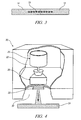
- Figure 2 illustrates a cross-sectional view of a portion of two-material door inner panel according to one embodiment of the invention.
- Figure 3 illustrates a cross-sectional view of a portion of a two-material door inner panel according to one embodiment of the invention.
- Figure 4 is a schematic view, in vertical arrangement, of a melt crucible and a tundish in a vacuum melt chamber.
- An atomizer for a stream of molten material is in a separate atmosphere-controlled chamber below the melt chamber and the atomized stream falls onto a forming surface.
- This invention provides a method for forming unitary vehicle closure panels having a first region of a first material and an adjacent and touching, or an at least partially overlapping, second region of a second material.
- vehicle closure panels are usually stamped from a sheet material and hinges or the like are attached to the formed panel.
- This invention provides a method of forming integrally bonded panel portions and hinge or latch portions of different materials.
- the panel portion may be composed of a light weight material, while the hinge or latch portion may be composed of a heavier and stronger material.
- the vehicle closure panels of the invention may be lighter than known closure panels while still providing the necessary strength for a particular application in the vehicle.
- the vehicle closure panel may be, but is not limited to, a door inner panel, door outer panel, tailgate panel, hood panel, deck lid panel, or quarter panels.
- a spray cast method is used to form at least one of the two regions.
- the first and second regions may be formed of different metal compositions, of different polymer compositions, or of a metal composition and a polymer composition.
- the first and second regions may be side-by-side or at least partially overlapping.
- a generally sheet type vehicle closure panel is formed.
- the closure panel may be an inner door panel 10 for an automotive vehicle, as illustrated in Figure 1 .
- a first region or major panel area 12 of the inner door panel will be formed of spray cast aluminum alloy and a second region or smaller hinge or latch attachment area 14 will be formed of a carbon steel alloy.
- the inner door panel 10 is basically a curved, three-dimensional, door surface layer structure of shaped sheet material with a window opening 16 in its upper region and openings 18 in the lower part of the panel for driver or passenger activated door and window closure mechanisms, speakers, or access to other components.
- the panel area 12 is formed of a spray cast aluminum alloy and the attachment area 14 is formed of spray cast carbon steel.
- the areas 12 and 14 are touching side-by-side.
- the inner door panel 10 is shaped to fit against and be attached to a complementary door outer panel (not shown). Both panels may be curved for the shape of the vehicle body to which they are hinged and latched. Various electrical and mechanical window and door closure components may be assembled between the inner and outer panels in vehicle manufacture.
- Figure 2 shows a cross-sectional view of region A in Figure 1 .
- the areas 12 and 14 touch in an overlapping region 17.
- a thin coating of a metal alloy interlayer may be located in the overlapping region 17 between the area 12 and the area 14.
- Figure 3 also shows a cross-sectional view of region A in Figure 1 .
- the areas 12 and 14 touch side-by-side and the areas 12 and 14 include a reinforcing material 19, for example a porous wire mat, onto which the spray cast alloy was sprayed.
- the reinforcing material 19 may be located where the areas 12 and 14 touch and may extend for some distance into the areas 12 and 14.
- FIG. 4 illustrates an exemplary spray casting apparatus 20.
- Such apparatus 20 comprises an upper chamber 22 (optionally closable for atmospheric control) in which a melt of metal alloy or polymer is prepared for spray casting onto a forming surface or mold die cavity 24 in the shape of, for example, the door inner panel 10.
- the surface may be a metal stamping or a polymer shape that has the minimum thickness and minimum strength properties of the desired vehicle closure panel. A higher strength material is sprayed over portions of the metal stamping or polymer shape to locally strengthen those areas.
- the upper chamber 22 may be adapted to accommodate vacuum melting, or melting in a protective gaseous atmosphere, of the sprayable composition.
- molten metal or polymer material
- molten metal may be drained from a melt crucible 26 into a tundish 28 for melt spraying.
- the melt crucible 26 and tundish 28 may be located in the upper chamber 22.
- spray castable material then flows down into a lower chamber 30 in which spray casting onto the forming surface 24 for the inner door panel 10 (or other part) or onto a collecting surface provides a precursor shape for the part to be formed.
- the lower chamber 30 may be under vacuum or in a protective gaseous atmosphere depending on the particular materials being used.
- the spray castable material As the spray castable material is released from the tundish 28 it is atomized in atomizer 32 and sprayed as droplets in a suitable pattern onto the part forming surface. Atomization may be accomplished by impingement of an inert gas against the stream dropping from the tundish 28.
- the temperature of the molten material, the size range of the spray droplets, the distance of the spray path, the nature and temperature of the atomization medium, and the temperature of the surface on which the spray accumulates are variables that may be considered in an effort to accumulate a suitable thickness of sprayed material on a forming surface.
- the material droplets/particles may be solid, partly solid and partly liquid, or liquid when they impact the forming surface or previously deposited material.
- any suitable known metal spraying technique may be used to form the first and second region of a vehicle closure panel.
- a first material spray stage will form, for example, the aluminum alloy panel area 12 and a second spray cast stage will provide the steel hinge attachment area 14.
- the spray patterns will be controlled so that there will be continuity and suitable attachment of the two contiguous material regions of the formed part.
- the forming surface 24 may be first positioned for a first spray casting stage and then moved into position for a second spray stage.
- the first spray step will form a first panel area
- the second spray step will form a second panel area or layer overlapping all or portions of the first panel area.
- a very thin interlayer is formed over at least a portion of the first panel area, and then the second spray step forms a layer overlapping all or portions of the interlayer.
- the interlayer may function as a corrosion-resistant transition between the two sprayed materials.
- the interlayer may be composed of any suitable brazing alloy composition.
- the forming surface 24 carrying the two sprayed material areas 12, 14 may be removed from the lower spray chamber 30.
- the sprayed materials may be subjected to further thermal processing or thermo-mechanical processing. In general, it may be helpful to use an opposing, complementary forming tool or surface to compact the layer(s) of the two sprayed materials against the original forming surface. Such processing consolidates the sprayed material to a desired density, local thicknesses, local curvature, and edges of the sprayed body may be trimmed or the like to bring the spray cast precursor body to (or close to) finished dimensions.
- a vehicle closure panel such as a curved, generally rectangular, vehicle inner door panel is formed in a few processing steps with connected and/or at least partially overlapping regions of different metals (or polymer materials).
- a panel may, for example, have a length and width of about 1 meter and a thickness of approximately 1 mm to 4 mm.
- the particles or fibers may include steel wool, glass fibers, ceramic fibers, or any combination thereof.
- the reinforcing mat may include reinforcing fibers such as steel wool, glass fibers, ceramic fibers, or any combination thereof.
Landscapes
- Engineering & Computer Science (AREA)
- Mechanical Engineering (AREA)
- Chemical & Material Sciences (AREA)
- Materials Engineering (AREA)
- Metallurgy (AREA)
- Plasma & Fusion (AREA)
- Physics & Mathematics (AREA)
- Organic Chemistry (AREA)
- Chemical Kinetics & Catalysis (AREA)
- Manufacturing & Machinery (AREA)
- Composite Materials (AREA)
- Body Structure For Vehicles (AREA)
- Superstructure Of Vehicle (AREA)
Abstract
Description
- This application claims the benefit of
U.S. Provisional Application No. 60/978,801 - This disclosure pertains to making vehicle body or closure panels with contiguous or overlapping surface regions formed of two or more different materials. More specifically, this disclosure pertains to the use of spray casting of different materials for making such mixed-material vehicle closure panels.
- There is a continuing need to reduce weight of automotive vehicle components in order to reduce fuel consumption of passenger and commercial vehicles. Some vehicle components may have one portion that could be formed of a relatively light weight material and another portion that requires a stronger but heavier material. An example of such components include vehicle closure panels such as an inner or outer door panel, deck lid panel, tailgate panel, hood panel, or quarter panel. A major portion of the panel might be formed of a light weight reinforced polymer composition or a low density metal such as an aluminum alloy or a magnesium alloy. And contiguous edge portions of the panel, where hinges or latching mechanisms are attached, could be made of a stronger material such as a steel alloy. However, the manufacture of such mixed material panels have required complex and expensive processing.
- This disclosure provides a spray casting based practice for the manufacture of mixed-material vehicle closure panels.
- This invention is applicable generally to vehicle closure panels that may be formed by spraying and accumulating atomized drops of a molten material in a body on a collecting surface. Two or more sprays are used to form a panel having two touching regions, contiguous or overlapping, of different materials.
- Sometimes the spray collecting surface is a forming surface (like a mold or die surface) shaped to form a side of the panel. In another embodiment the spray collecting surface may be a metal stamping or a polymer shape to which a higher strength material is sprayed to locally strengthen specific areas of the metal stamping or polymer shape. In one embodiment, molten metal or polymer melt is prepared under suitable conditions and placed in a tundish for the spray casting operation. This is done for each material to be sprayed. A controlled stream of each liquid material is drained from a tundish, or other holding vessel, and the liquid stream is suitably atomized into droplets of desired size. Atomization may be obtained, for example, by impacting the falling material stream with radially inwardly directed jets from a surrounding annular stream of atomizing gas, such as nitrogen. In other embodiments, known metal spraying techniques other than the molten metal spray may be used to achieve a desired outcome.
- Each of the spray processes is controlled so that the drops accumulate and solidify on the collecting/forming surface to form a body region with minimal porosity consistent with the properties of the sprayed liquid. Such spray casting permits portions of different thicknesses to be formed in the spray cast area on the forming surface. In forming automotive body panels, the sprayed material may be, for example, a metal such as a ferrous alloy, an aluminum alloy, or a magnesium alloy. In another example, the sprayed material may be a thermoplastic or uncured thermosetting polymeric composition such as polyethylene, polypropylene, polyamide, polyurethane, or the like. The separate spray streams may be applied to the forming surface simultaneously or sequentially. The separate spray streams may be joined along edges, or the material spray may overlap all or portions of the previous layer. The temperature of the forming surface is suitably controlled for accumulation of the sprayed drops ultimately in a solid mass of desired porosity (or non-porous condition) and local thickness over the spray area. Each spraying operation (processing parameters such as melt temperature, temperature of atomizing gas, ambient temperature, spray distance, and temperature of the substrate or forming surface) is suitably controlled to manage the partial or complete solidification of the sprayed material before, or as, it impacts the collecting surface.
- Reinforcement of a sprayed panel may be obtained, for example, by placing a mat of reinforcing fibers (such as steel wool, glass fibers, ceramic fibers, or any combination thereof) on the spray receiving surface and infiltrating the mat with the liquid spray. Or reinforcement within the sprayed body may be attained by including reinforcing particles (including short fibers) in the spray droplets.
- After the sprayed material has accumulated on the receiving surface to a desired shape it will, in many embodiments, be a precursor of the desired vehicle body panel member. The spray cast precursor body panel may be further consolidated, shaped, trimmed or the like to a more finished formed closure panel by a compacting step such as hot isostatic pressing, die pressing, die trimming, or the like. The spray collecting surface may be used to shape a side(s) of the closure panel or the solidified panel member may be removed from the collecting surface for shaping, trimming, etc. In many embodiments of the invention, the spraying and any subsequent shaping step may be conducted in a closed chamber with a protective atmosphere, such as an atmosphere of argon or nitrogen.
- In many embodiments of the invention two or more materials are sprayed, simultaneously or sequentially, on the forming surface to form a unitary closure panel having a first region of one material such as an aluminum alloy and a second region of a second material such as a steel alloy. In one embodiment, an edge of the second region is touching and joined to an edge of the first region. In another embodiment, the two materials may be layered so that the second or subsequent layers may overlap all or a portion of the preceding sprayed layer. Separate melts of the two materials may be prepared in separate vessels in one or more melting chambers. The respective molten materials are maintained in atmospheres that protect desired properties of the respective melts.
- In an embodiment of the invention, the structure of a closure panel to be manufactured is analyzed to identify two or more distinct regions that may advantageously be made of metallic or polymeric materials having different properties. A gathering or forming surface is then prepared to shape a side of the body panel to be formed. The forming surface may be preheated to enhance agglomeration and continuity of the sprayed material. The sprays of the different materials are then directed to the respective distinct regions of the forming surface with sufficient overlapping or merging of the different materials to form a unitary panel. The regions of overlapping materials may be heat treated to enhance their joining and properties. In another embodiment a thin coating of a metal alloy interlayer may be deposited over at least a portion of the first material, and the second material may be deposited over at least a portion of the interlayer, to enable a well bonded corrosion-resistant transition between the two base materials.
- It is contemplated that this spray practice of different materials may be used to form two-material vehicle closure panels. Such vehicle closure panels may include door panels, hood panels, tailgate panels, deck lid panels, or quarter panels. Vehicle doors are often made by separately forming complementary inner and outer door panels. Each panel is often made of a shaped sheet material to define a vehicle closure member and a window opening. The panels are ultimately attached to each other (e.g., adhesively bonded or hemmed and welded) around the perimeter of matching peripheral edges. The attached panels define a space between them for a window, window closure hardware, wiring, door closure and locking components, and the like. The assembled closure member is attached on one side to a vehicle body structure. In accordance with an embodiment of this invention, a door inner panel, for example, may be formed of a major sheet area of a light weight material such as an aluminum alloy or magnesium alloy and a smaller, but stronger hinge area or door closure area of a steel alloy. In another embodiment, the inner panel may be made of a major sheet area of a polymeric (or fiber reinforced polymer) and a metal alloy hinge or closure area.
- Other embodiments and advantages of the invention will be apparent from more detailed descriptions of preferred embodiments and references to the figures.
-
Figure 1 illustrates a two-material door inner panel according to one embodiment of the invention. -
Figure 2 illustrates a cross-sectional view of a portion of two-material door inner panel according to one embodiment of the invention. -
Figure 3 illustrates a cross-sectional view of a portion of a two-material door inner panel according to one embodiment of the invention. -
Figure 4 is a schematic view, in vertical arrangement, of a melt crucible and a tundish in a vacuum melt chamber. An atomizer for a stream of molten material is in a separate atmosphere-controlled chamber below the melt chamber and the atomized stream falls onto a forming surface. - This invention provides a method for forming unitary vehicle closure panels having a first region of a first material and an adjacent and touching, or an at least partially overlapping, second region of a second material. Such vehicle closure panels are usually stamped from a sheet material and hinges or the like are attached to the formed panel. This invention provides a method of forming integrally bonded panel portions and hinge or latch portions of different materials. The panel portion may be composed of a light weight material, while the hinge or latch portion may be composed of a heavier and stronger material. Thus, the vehicle closure panels of the invention may be lighter than known closure panels while still providing the necessary strength for a particular application in the vehicle.
- In various embodiments, the vehicle closure panel may be, but is not limited to, a door inner panel, door outer panel, tailgate panel, hood panel, deck lid panel, or quarter panels. A spray cast method is used to form at least one of the two regions. The first and second regions may be formed of different metal compositions, of different polymer compositions, or of a metal composition and a polymer composition. The first and second regions may be side-by-side or at least partially overlapping.
- In one embodiment of the invention, a generally sheet type vehicle closure panel is formed. For example, the closure panel may be an
inner door panel 10 for an automotive vehicle, as illustrated inFigure 1 . In this example, a first region ormajor panel area 12 of the inner door panel will be formed of spray cast aluminum alloy and a second region or smaller hinge orlatch attachment area 14 will be formed of a carbon steel alloy. Theinner door panel 10 is basically a curved, three-dimensional, door surface layer structure of shaped sheet material with awindow opening 16 in its upper region andopenings 18 in the lower part of the panel for driver or passenger activated door and window closure mechanisms, speakers, or access to other components. In the example ofFigure 1 , thepanel area 12 is formed of a spray cast aluminum alloy and theattachment area 14 is formed of spray cast carbon steel. Theareas inner door panel 10 is shaped to fit against and be attached to a complementary door outer panel (not shown). Both panels may be curved for the shape of the vehicle body to which they are hinged and latched. Various electrical and mechanical window and door closure components may be assembled between the inner and outer panels in vehicle manufacture. -
Figure 2 shows a cross-sectional view of region A inFigure 1 . In the embodiment shown inFigure 2 , theareas region 17. In another embodiment (not shown), a thin coating of a metal alloy interlayer may be located in the overlappingregion 17 between thearea 12 and thearea 14.Figure 3 also shows a cross-sectional view of region A inFigure 1 . In the embodiment shown inFigure 3 , theareas areas material 19, for example a porous wire mat, onto which the spray cast alloy was sprayed. The reinforcingmaterial 19 may be located where theareas areas -
Figure 4 illustrates an exemplaryspray casting apparatus 20.Such apparatus 20 comprises an upper chamber 22 (optionally closable for atmospheric control) in which a melt of metal alloy or polymer is prepared for spray casting onto a forming surface or mold diecavity 24 in the shape of, for example, the doorinner panel 10. In another embodiment, the surface may be a metal stamping or a polymer shape that has the minimum thickness and minimum strength properties of the desired vehicle closure panel. A higher strength material is sprayed over portions of the metal stamping or polymer shape to locally strengthen those areas. Referring again toFigure 4 , depending on the composition of a specified metal alloy or polymer theupper chamber 22 may be adapted to accommodate vacuum melting, or melting in a protective gaseous atmosphere, of the sprayable composition. When a suitable melt has been prepared, molten metal (or polymer material) may be drained from amelt crucible 26 into atundish 28 for melt spraying. Themelt crucible 26 andtundish 28 may be located in theupper chamber 22. In this embodiment, spray castable material then flows down into alower chamber 30 in which spray casting onto the formingsurface 24 for the inner door panel 10 (or other part) or onto a collecting surface provides a precursor shape for the part to be formed. Thelower chamber 30 may be under vacuum or in a protective gaseous atmosphere depending on the particular materials being used. - As the spray castable material is released from the
tundish 28 it is atomized inatomizer 32 and sprayed as droplets in a suitable pattern onto the part forming surface. Atomization may be accomplished by impingement of an inert gas against the stream dropping from thetundish 28. - There are other processing variables that may be managed in the spray casting operation. For example, the temperature of the molten material, the size range of the spray droplets, the distance of the spray path, the nature and temperature of the atomization medium, and the temperature of the surface on which the spray accumulates are variables that may be considered in an effort to accumulate a suitable thickness of sprayed material on a forming surface. The material droplets/particles may be solid, partly solid and partly liquid, or liquid when they impact the forming surface or previously deposited material. In other embodiments, any suitable known metal spraying technique may be used to form the first and second region of a vehicle closure panel.
- In many embodiments of the invention, there will be two separate spray steps of the type described above. A first material spray stage will form, for example, the aluminum
alloy panel area 12 and a second spray cast stage will provide the steelhinge attachment area 14. The spray patterns will be controlled so that there will be continuity and suitable attachment of the two contiguous material regions of the formed part. In one embodiment of the invention the formingsurface 24 may be first positioned for a first spray casting stage and then moved into position for a second spray stage. - In another embodiment, the first spray step will form a first panel area, and the second spray step will form a second panel area or layer overlapping all or portions of the first panel area. In another embodiment, a very thin interlayer is formed over at least a portion of the first panel area, and then the second spray step forms a layer overlapping all or portions of the interlayer. The interlayer may function as a corrosion-resistant transition between the two sprayed materials. The interlayer may be composed of any suitable brazing alloy composition.
- After the spray casting has been completed, the forming
surface 24 carrying the two sprayedmaterial areas lower spray chamber 30. The sprayed materials may be subjected to further thermal processing or thermo-mechanical processing. In general, it may be helpful to use an opposing, complementary forming tool or surface to compact the layer(s) of the two sprayed materials against the original forming surface. Such processing consolidates the sprayed material to a desired density, local thicknesses, local curvature, and edges of the sprayed body may be trimmed or the like to bring the spray cast precursor body to (or close to) finished dimensions. Thus, a vehicle closure panel such as a curved, generally rectangular, vehicle inner door panel is formed in a few processing steps with connected and/or at least partially overlapping regions of different metals (or polymer materials). Such a panel may, for example, have a length and width of about 1 meter and a thickness of approximately 1 mm to 4 mm. - In some spray casting steps it may be useful to include particles or short fibers of reinforcing material in the metal droplets. The particles or fibers may include steel wool, glass fibers, ceramic fibers, or any combination thereof. In other embodiments it may be useful to place a reinforcing porous wire mat or the like in the forming surface and fill the reinforcing object with sprayed liquid droplets. The reinforcing mat may include reinforcing fibers such as steel wool, glass fibers, ceramic fibers, or any combination thereof.
- Thus, it is seen that many vehicle closure panels having contiguous or overlapping regions of different materials may be formed by the disclosed spray cast processes.
- Practices of the invention have been shown by examples that are presented as illustrations and not limitations of the invention.
Claims (15)
- A method of making a vehicle closure panel having joined first and second regions formed of a first material and a second material, where each of the first and second materials may be a metal, metal alloy, or a polymeric composition, the method comprising:spraying atomized droplets of the first material on a spray receiving surface, the spray of the first material being directed to form a sprayed deposit of a first predetermined thickness that is a precursor of the first region of the vehicle closure panel;spraying atomized droplets of the second material on the spray receiving surface, the spray of the second material being directed to form a sprayed deposit of a second predetermined thickness that is a precursor of the second region of the vehicle closure panel, the sprayed first and second materials contacting each other; andsubjecting the first and second regions to thermal processing or thermomechanical processing to form the spray deposited precursors of the first and second regions of the vehicle closure panel into the joined first and second regions of the vehicle closure panel.
- A method of making a vehicle closure panel as recited in claim 1 in which the second material is sprayed over at least a portion of the first material, and the second region overlaps at least a portion of the first region.
- A method of making a vehicle closure panel as recited in claim 1 or 2 in which the first and second regions have contiguous edges.
- A method of making a vehicle closure panel as recited in claim 1, 2 or 3 in which one of the first region or the second region is a hinge area, and the other is a panel area or
in which one of the first region or the second region is a latch area, and the other is a panel area. - A method of making a vehicle closure panel as recited in one of the preceding claims in which the first material is a first metal alloy and the second material is a different metal alloy or
in which the first material is a metal alloy and the second material is a polymer composition or polymer composite composition. - A method of making a vehicle closure panel as recited in one of the preceding claims in which the first material is an aluminum alloy or magnesium alloy and the second material is a steel alloy.
- A method of making a vehicle closure panel as recited in one of the preceding claims in which one of the first or second materials contains reinforcing particles.
- A method of making a vehicle closure panel as recited in one of the preceding claims in which reinforcing material is placed on at least a portion of the spray receiving surface and atomized droplets of the first material are sprayed onto and into the reinforcing material to form a reinforced precursor of the first region,
wherein the reinforcing material comprises in particular at least one of steel wool, glass fibers, or ceramic fibers. - A method of making a vehicle closure panel as recited in one of the preceding claims in which atomized droplets of the second material are sprayed onto and into the reinforcing material to form a reinforced precursor of the second region.
- A method of making a vehicle closure panel as recited in one of the preceding claims in which spraying atomized droplets of the first and second materials is carried out at the same time or
in which the droplets of the second material are spayed after the first precursor region has been formed. - A method of making a vehicle closure panel as recited in one of the preceding claims in which the first predetermined thickness and the second predetermined thickness are about 1 mm to about 4 mm.
- A method of making a vehicle closure panel as recited in one of the preceding claims further comprising depositing an interlayer over at least a portion of the first region of the vehicle closure panel.
- A method of making a vehicle closure panel as recited in one of the preceding claims in which the spray receiving surface comprises one of a metal stamping or a polymer shape.
- A method of making a vehicle closure panel as recited in one of the preceding claims in which the vehicle closure panel comprises one of a door inner panel, door outer panel, hood panel, tailgate panel, deck lid panel, or quarter panel.
- A method of making a vehicle closure panel comprising:spraying atomized droplets of a first material on a spray receiving surface to form a first region of the vehicle closure panel;spraying atomized droplets of a second material on the spray receiving surface to form a second region of the vehicle closure panel having an edge touching the first region of the vehicle closure panel;subjecting the first and second regions to thermal processing or thermomechanical processing;wherein the first and second materials are selected such that the second region is stronger than the first region; andwherein the surface area of the first region is larger than the area of the second regionwherein in particular
the second region forms a hinge or latch portion of the vehicle closure panel.
Applications Claiming Priority (2)
| Application Number | Priority Date | Filing Date | Title |
|---|---|---|---|
| US97880107P | 2007-10-10 | 2007-10-10 | |
| US12/240,131 US8287966B2 (en) | 2007-10-10 | 2008-09-29 | Spray cast mixed-material vehicle closure panels |
Publications (1)
| Publication Number | Publication Date |
|---|---|
| EP2047927A1 true EP2047927A1 (en) | 2009-04-15 |
Family
ID=40280712
Family Applications (1)
| Application Number | Title | Priority Date | Filing Date |
|---|---|---|---|
| EP08017841A Withdrawn EP2047927A1 (en) | 2007-10-10 | 2008-10-10 | Spray cast mixed-material vehicle closure panels |
Country Status (2)
| Country | Link |
|---|---|
| US (1) | US8287966B2 (en) |
| EP (1) | EP2047927A1 (en) |
Families Citing this family (9)
| Publication number | Priority date | Publication date | Assignee | Title |
|---|---|---|---|---|
| US10086429B2 (en) | 2014-10-24 | 2018-10-02 | GM Global Technology Operations LLC | Chilled-zone microstructures for cast parts made with lightweight metal alloys |
| US10618107B2 (en) | 2016-04-14 | 2020-04-14 | GM Global Technology Operations LLC | Variable thickness continuous casting for tailor rolling |
| US10612116B2 (en) | 2016-11-08 | 2020-04-07 | GM Global Technology Operations LLC | Increasing strength of an aluminum alloy |
| DE112017007033B4 (en) | 2017-03-09 | 2024-07-11 | Gm Global Technology Operations, Llc | Chassis component for a motor vehicle made of an aluminium alloy and method for increasing the ductility and strength of an aluminium alloy |
| JP6751817B2 (en) | 2017-06-02 | 2020-09-09 | 本田技研工業株式会社 | Vehicle panels and their manufacturing methods |
| US11359269B2 (en) | 2019-02-08 | 2022-06-14 | GM Global Technology Operations LLC | High strength ductile 6000 series aluminum alloy extrusions |
| JP7443944B2 (en) * | 2020-06-10 | 2024-03-06 | マツダ株式会社 | vehicle side door structure |
| US12384045B2 (en) | 2022-06-06 | 2025-08-12 | GM Global Technology Operations LLC | Supplemental and targeted heating of vehicle body-in-white interior components/areas for paint ovens |
| US12337572B2 (en) * | 2022-11-16 | 2025-06-24 | Hyundai Motor Company | Laminated composite with non-uniform profile and method of manufacturing the same |
Citations (3)
| Publication number | Priority date | Publication date | Assignee | Title |
|---|---|---|---|---|
| EP1577166A2 (en) * | 2004-02-18 | 2005-09-21 | Grammer Ag | Skin type lining, in particular for automotive trim parts, and process for manufacturing a skin type lining. |
| DE102004032029A1 (en) * | 2004-07-02 | 2006-01-19 | Volkswagen Ag | Crash tube for motor vehicle`s door reinforcement, has tube profile in which composite materials are laid, where materials are used as bending moment absorbing coating, which is provided at place where large bending moment is expected |
| DE102005011077A1 (en) * | 2005-03-08 | 2006-09-14 | Acts Advanced Car Technology Systems Gmbh & Co.Kg | Vehicle door comprises an inner sheet metal section with penetrations, a plastic carrier section sprayed onto it, and an actuating unit |
Family Cites Families (10)
| Publication number | Priority date | Publication date | Assignee | Title |
|---|---|---|---|---|
| GB9104808D0 (en) * | 1991-03-07 | 1991-04-17 | Osprey Metals Ltd | Production of spray deposits |
| US6746225B1 (en) * | 1992-11-30 | 2004-06-08 | Bechtel Bwtx Idaho, Llc | Rapid solidification processing system for producing molds, dies and related tooling |
| US5445324A (en) * | 1993-01-27 | 1995-08-29 | The United States Of America As Represented By The United States Department Of Energy | Pressurized feed-injection spray-forming apparatus |
| US5980604A (en) * | 1996-06-13 | 1999-11-09 | The Regents Of The University Of California | Spray formed multifunctional materials |
| US6296043B1 (en) * | 1996-12-10 | 2001-10-02 | Howmet Research Corporation | Spraycast method and article |
| US6496529B1 (en) * | 2000-11-15 | 2002-12-17 | Ati Properties, Inc. | Refining and casting apparatus and method |
| US6810939B2 (en) * | 2003-02-04 | 2004-11-02 | Ford Motor Company | Spray formed articles made of boron steel and method for making the same |
| US6777035B1 (en) * | 2003-02-10 | 2004-08-17 | Ford Motor Company | Method for spray forming metal deposits |
| DE102004027628B4 (en) | 2004-06-05 | 2007-02-22 | Möllerflex GmbH | Rolling diaphragm for brake booster, in particular for motor vehicles |
| DE202005014268U1 (en) | 2005-09-09 | 2005-12-15 | Fer Fahrzeugelektrik Gmbh | Vehicle lamp e.g. side blinking lamp, for use in cap of external rear mirror, has integrally formed optical fiber-blind unit that includes optical fiber and blind section, where unit is manufactured by two-component spray casting process |
-
2008
- 2008-09-29 US US12/240,131 patent/US8287966B2/en not_active Expired - Fee Related
- 2008-10-10 EP EP08017841A patent/EP2047927A1/en not_active Withdrawn
Patent Citations (3)
| Publication number | Priority date | Publication date | Assignee | Title |
|---|---|---|---|---|
| EP1577166A2 (en) * | 2004-02-18 | 2005-09-21 | Grammer Ag | Skin type lining, in particular for automotive trim parts, and process for manufacturing a skin type lining. |
| DE102004032029A1 (en) * | 2004-07-02 | 2006-01-19 | Volkswagen Ag | Crash tube for motor vehicle`s door reinforcement, has tube profile in which composite materials are laid, where materials are used as bending moment absorbing coating, which is provided at place where large bending moment is expected |
| DE102005011077A1 (en) * | 2005-03-08 | 2006-09-14 | Acts Advanced Car Technology Systems Gmbh & Co.Kg | Vehicle door comprises an inner sheet metal section with penetrations, a plastic carrier section sprayed onto it, and an actuating unit |
Also Published As
| Publication number | Publication date |
|---|---|
| US8287966B2 (en) | 2012-10-16 |
| US20090096245A1 (en) | 2009-04-16 |
Similar Documents
| Publication | Publication Date | Title |
|---|---|---|
| US8287966B2 (en) | Spray cast mixed-material vehicle closure panels | |
| US3826301A (en) | Method and apparatus for manufacturing precision articles from molten articles | |
| Calignano et al. | Influence of process parameters on surface roughness of aluminum parts produced by DMLS | |
| CN100542718C (en) | Aluminum/magnesium 3D printing rapid prototyping | |
| DE4426627C2 (en) | Process for the production of a metallic composite material | |
| Dilip et al. | A novel method to fabricate TiAl intermetallic alloy 3D parts using additive manufacturing | |
| AU2006254135B2 (en) | Porous metal foam body | |
| CA2411044A1 (en) | Rapid solidification processing system for producing molds, dies and related tooling | |
| US7513552B2 (en) | Transformable tail gate for truck bed | |
| NZ292977A (en) | Depositing atomised metal onto a substrate, metal deposited in layers | |
| EP0270265B1 (en) | Making composite metal deposit by spray casting | |
| US4674554A (en) | Metal product fabrication | |
| US20050255311A1 (en) | Hybrid composite product and system | |
| EP0198607B1 (en) | Metal matrix composite manufacture | |
| US11040372B2 (en) | Light weight component with internal reinforcement | |
| JP2021532255A (en) | Manufacturing method of parts made of aluminum alloy | |
| US20220403486A1 (en) | Weldable aluminium alloys comprising zn as main alloying element for direct metal laser sintering | |
| CA2722757A1 (en) | Method for manufacturing massive components made of intermetallic materials | |
| US20020166649A1 (en) | Mold assembly and method for pressure casting elevated melting temperature materials | |
| WO2020122992A1 (en) | Methods for producing metallic parts | |
| US20040086701A1 (en) | Reinforced structural element | |
| KR20090078840A (en) | A method of making two joined layers and a functional part manufacturable by the method | |
| EP3585583B1 (en) | Multi-step method for producing a soundproof composite cover for internal combustion engines | |
| JPH0639525A (en) | Method for improving characteristic of thioxotropic formable material | |
| EP0090118A1 (en) | Ceramic mould and method of producing same |
Legal Events
| Date | Code | Title | Description |
|---|---|---|---|
| PUAI | Public reference made under article 153(3) epc to a published international application that has entered the european phase |
Free format text: ORIGINAL CODE: 0009012 |
|
| AK | Designated contracting states |
Kind code of ref document: A1 Designated state(s): AT BE BG CH CY CZ DE DK EE ES FI FR GB GR HR HU IE IS IT LI LT LU LV MC MT NL NO PL PT RO SE SI SK TR |
|
| AX | Request for extension of the european patent |
Extension state: AL BA MK RS |
|
| 17P | Request for examination filed |
Effective date: 20091014 |
|
| AKX | Designation fees paid |
Designated state(s): DE |
|
| 17Q | First examination report despatched |
Effective date: 20100201 |
|
| RAP1 | Party data changed (applicant data changed or rights of an application transferred) |
Owner name: GM GLOBAL TECHNOLOGY OPERATIONS LLC |
|
| STAA | Information on the status of an ep patent application or granted ep patent |
Free format text: STATUS: THE APPLICATION IS DEEMED TO BE WITHDRAWN |
|
| 18D | Application deemed to be withdrawn |
Effective date: 20130502 |