EP2045573A2 - Phase-information extraction method - Google Patents
Phase-information extraction method Download PDFInfo
- Publication number
- EP2045573A2 EP2045573A2 EP08017210A EP08017210A EP2045573A2 EP 2045573 A2 EP2045573 A2 EP 2045573A2 EP 08017210 A EP08017210 A EP 08017210A EP 08017210 A EP08017210 A EP 08017210A EP 2045573 A2 EP2045573 A2 EP 2045573A2
- Authority
- EP
- European Patent Office
- Prior art keywords
- phase
- information
- image
- region
- measurement object
- Prior art date
- Legal status (The legal status is an assumption and is not a legal conclusion. Google has not performed a legal analysis and makes no representation as to the accuracy of the status listed.)
- Withdrawn
Links
- 238000000605 extraction Methods 0.000 title description 9
- 238000005259 measurement Methods 0.000 claims abstract description 46
- 238000000034 method Methods 0.000 claims abstract description 22
- 210000004027 cell Anatomy 0.000 description 22
- 230000003287 optical effect Effects 0.000 description 2
- 230000010363 phase shift Effects 0.000 description 2
- 238000007796 conventional method Methods 0.000 description 1
- 210000004748 cultured cell Anatomy 0.000 description 1
- 238000001914 filtration Methods 0.000 description 1
- 239000001963 growth medium Substances 0.000 description 1
- 239000000758 substrate Substances 0.000 description 1
Images


Classifications
-
- G—PHYSICS
- G01—MEASURING; TESTING
- G01B—MEASURING LENGTH, THICKNESS OR SIMILAR LINEAR DIMENSIONS; MEASURING ANGLES; MEASURING AREAS; MEASURING IRREGULARITIES OF SURFACES OR CONTOURS
- G01B11/00—Measuring arrangements characterised by the use of optical techniques
- G01B11/02—Measuring arrangements characterised by the use of optical techniques for measuring length, width or thickness
- G01B11/06—Measuring arrangements characterised by the use of optical techniques for measuring length, width or thickness for measuring thickness ; e.g. of sheet material
Definitions
- the present invention relates to a phase-information extraction method.
- One known method of evaluating the phase shift in an object involves obtaining phase information from two or more bright-field images at different focal positions (for example, see Australian Patent Application, Publication No. 2004201109A1 ).
- phase information associated only with the cells when measuring the thickness of cells (measurement objects) in a culture dish, it is necessary to extract phase information associated only with the cells from phase information obtained using the method described above.
- background phase information caused by a bias component which is superimposed, deformation or thickness distribution of a substrate on which the measurement object is mounted, etc. needs to be removed.
- this background phase information when evaluating the thickness of cells in a culture medium in a plastic culture dish, it has been found that this background phase information cannot be ignored.
- the present invention has been conceived in light of the circumstances described above, and an object thereof is to provide a method of extracting phase information of a measurement object, in which it is possible to extract, with superior precision, only phase information of the measurement object from a phase-information image in which background phase information is superimposed on the phase information of the measurement object.
- the present invention provides the following solutions.
- One aspect of the present invention is a method of extracting phase information of a measurement object, including a region-specifying step of specifying a region in which a measurement object exists and a region in which no measurement object exists in a phase-information image containing measurement objects, showing a two-dimensional distribution of phase information to be measured; a background-image creating step of creating a background phase-information image by interpolating the phase information of the region in which the measurement object exists on the basis of the phase information of the region in which no measurement object exists, specified in the region-specifying step; and a difference calculating step of calculating a difference between the background phase-information image created in the background-image creating step and the phase-information image.
- the region in which the measurement object exists which is specified in the region-specifying step, is interpolated in the background-image creating step on the basis of the phase information of the region in which no measurement object exists, to create the background phase-information image.
- background noise of the tilted phase is contained in the phase-information image
- a difference of the phase exists in the periphery of the specified measurement object.
- background noise that varies so as to smoothly join the phase information in the periphery can be assumed to exist also in the region where the measurement object exists.
- the background phase-information image is created in the background-image creating step by interpolating the phase information in the region in which the measurement object exists, and by calculating the difference between the phase- information image and the background phase-information image in the difference calculating step, it is possible to extract phase information of the measurement object, from which the background noise in the region in which the measurement object exists has been removed.
- the region-specifying step may include a phase-information image acquiring step of acquiring two phase-information images formed of contrast images in which the signs of the phase during interference of an observed image of the measurement object are reversed; and a subtracting step of subtracting the difference between the two phase-information images acquired in the phase-information image acquiring step.
- the present invention affords an advantage in that it is possible to extract, with superior precision, only phase information of a measurement object from a phase-information image in which background phase information is superimposed on phase information of the measurement object.
- Fig. 1 is a flowchart showing a method of extracting phase information of a measurement object according to an embodiment of the present invention.
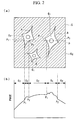
- Fig. 2 is an illustration for explaining a region-specifying step in the phase-information extraction method in Fig. 1 , wherein (a) shows an example of a phase-information image, and (b) shows a phase distribution of a pixel row along an arbitrary straight line in the phase-information image.
- Fig. 3 is an illustration for explaining a background-image creating step in the phase-information extraction method shown in Fig. 1 , wherein (a) shows a phase distribution of a pixel row along an arbitrary straight line in the phase-information image, and (b) shows a phase distribution in the created background phase-information image.
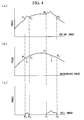
- Fig. 4 is an illustration for explaining a difference calculating step in the phase-information extraction method in Fig. 1 , wherein (a) shows a phase distribution of a pixel row along an arbitrary straight line in the phase-information image, (b) shows a phase distribution in the created background phase-information image, and (c) shows a phase-information image of cells obtained as a result of the difference calculation.
- a conventional method using interference fringes or a method using two or more bright-field images at different focal positions may be employed.
- the phase-information extraction method is a method of extracting phase information of cells A, serving as the measurement objects.
- the method includes a region-specifying step S1 of specifying regions in which cells A exist and a region in which no cells A exist, from an entire phase-information image G to be measured (hereinafter referred to as entire image G), which contains the cells A; a background-image creating step S2 of creating a background phase-information image (hereinafter referred to as background image) by estimating background noise in the regions in which the cells A exists, specified in the region-specifying step S1; and a difference calculating step S3 of calculating the difference between the entire image G and the background image.
- the region-specifying step S1 while acquiring the entire image G, two bright-field images whose contrasts are reversed are acquired by shifting the focal plane at the same position towards the front and the rear in the optical axis direction, containing the cells A, with the focal point aligned on the measurement object, and the difference of brightness information between these bright-field images is calculated. Then, a region with substantially zero intensity from an intensity distribution of the image subjected to computational processing is specified as a region G 2 in which no cell A exists, and other regions are specified as regions G 1 in which cells A exist.
- the two bright-field images can be selected from the two or more bright-field images at different focal positions.
- the phase information for a pixel row along an arbitrary straight line P in the entire image G in (a) of Fig. 2 for example, for a phase distribution like that shown in (b) of Fig. 2 , and as shown in (a) of Fig. 3 , for the region G 2 in which no cell A exists, the phase information thereof is directly used as the background image, and for the regions G 1 in which cells A exist, the phase information at both ends P 1 and P 2 of those regions G 1 is interpolated with a straight line L. By doing so, it is possible to create a background phase distribution, as shown in (b) of Fig. 3 . By repeating this process for all pixel rows, it is possible to create a background image.
- a filtering process such as an average process for the phase information row of the region G 2 in which no cell A exits may be performed in advance.
- phase-information extraction method an advantage is afforded in that it is possible to easily extract a cell image formed of phase information of the cells A only, in which the background noise is removed, from the entire image G containing background noise that is not uniform over the entire image.
- linear interpolation is performed in the regions G 1 where cells A exist. Instead of this, however, interpolation may be performed using any type of curve.
- a method using a multidimensional function formula or a method using the Fourier transform may be employed.
- the step S1 of specifying the regions in which the measurement objects exist is not limited to the method described above; edge extraction of a separately acquired phase image or differential image may be performed. In this way, the cell regions may be specified. Also the step of obtaining the phase is not limited to the method described above; it is also possible to obtain the phase by using a conventional interferometer or the like.
Landscapes
- Physics & Mathematics (AREA)
- General Physics & Mathematics (AREA)
- Investigating Or Analysing Materials By Optical Means (AREA)
- Length Measuring Devices By Optical Means (AREA)
- Image Analysis (AREA)
Abstract
Description
- The present invention relates to a phase-information extraction method.
- This application is based on Japanese Patent Application No.
2007-259394 - In the related art, there are methods of evaluating the thickness of an object by determining the optical phase shift from interference fringes formed by interference between reference light and light transmitted through or reflected from a measurement object.
- One known method of evaluating the phase shift in an object involves obtaining phase information from two or more bright-field images at different focal positions (for example, see Australian Patent Application, Publication No.
2004201109A1 - However, there is a problem when using the method described above; that is, when measuring an object in a culture dish such as a cultured cell, phase information of not only the measurement object whose thickness is to be evaluated but also is also superimposed and is thus included in the calculation.
- For example, when measuring the thickness of cells (measurement objects) in a culture dish, it is necessary to extract phase information associated only with the cells from phase information obtained using the method described above. In this case, background phase information caused by a bias component which is superimposed, deformation or thickness distribution of a substrate on which the measurement object is mounted, etc. needs to be removed. In particular, when evaluating the thickness of cells in a culture medium in a plastic culture dish, it has been found that this background phase information cannot be ignored.
- The present invention has been conceived in light of the circumstances described above, and an object thereof is to provide a method of extracting phase information of a measurement object, in which it is possible to extract, with superior precision, only phase information of the measurement object from a phase-information image in which background phase information is superimposed on the phase information of the measurement object.
- In order to realize the objects described above, the present invention provides the following solutions.
- One aspect of the present invention is a method of extracting phase information of a measurement object, including a region-specifying step of specifying a region in which a measurement object exists and a region in which no measurement object exists in a phase-information image containing measurement objects, showing a two-dimensional distribution of phase information to be measured; a background-image creating step of creating a background phase-information image by interpolating the phase information of the region in which the measurement object exists on the basis of the phase information of the region in which no measurement object exists, specified in the region-specifying step; and a difference calculating step of calculating a difference between the background phase-information image created in the background-image creating step and the phase-information image.
- According to the aspect described above, the region in which the measurement object exists, which is specified in the region-specifying step, is interpolated in the background-image creating step on the basis of the phase information of the region in which no measurement object exists, to create the background phase-information image. In other words, when background noise of the tilted phase is contained in the phase-information image, a difference of the phase exists in the periphery of the specified measurement object. In such a case, background noise that varies so as to smoothly join the phase information in the periphery can be assumed to exist also in the region where the measurement object exists. Therefore, the background phase-information image is created in the background-image creating step by interpolating the phase information in the region in which the measurement object exists, and by calculating the difference between the phase- information image and the background phase-information image in the difference calculating step, it is possible to extract phase information of the measurement object, from which the background noise in the region in which the measurement object exists has been removed.
- In the aspect described above, the region-specifying step may include a phase-information image acquiring step of acquiring two phase-information images formed of contrast images in which the signs of the phase during interference of an observed image of the measurement object are reversed; and a subtracting step of subtracting the difference between the two phase-information images acquired in the phase-information image acquiring step.
- By doing so, it is possible to specify the region in which the measurement object exists with superior precision, and it is possible to remove background noise also from the phase information in the region in which the measurement object exists, thus enabling extraction of accurate phase information.
- The present invention affords an advantage in that it is possible to extract, with superior precision, only phase information of a measurement object from a phase-information image in which background phase information is superimposed on phase information of the measurement object.
-
Fig. 1 is a flowchart showing a method of extracting phase information of a measurement object according to an embodiment of the present invention. -
Fig. 2 is an illustration for explaining a region-specifying step in the phase-information extraction method inFig. 1 , wherein (a) shows an example of a phase-information image, and (b) shows a phase distribution of a pixel row along an arbitrary straight line in the phase-information image. -
Fig. 3 is an illustration for explaining a background-image creating step in the phase-information extraction method shown inFig. 1 , wherein (a) shows a phase distribution of a pixel row along an arbitrary straight line in the phase-information image, and (b) shows a phase distribution in the created background phase-information image. -
Fig. 4 is an illustration for explaining a difference calculating step in the phase-information extraction method inFig. 1 , wherein (a) shows a phase distribution of a pixel row along an arbitrary straight line in the phase-information image, (b) shows a phase distribution in the created background phase-information image, and (c) shows a phase-information image of cells obtained as a result of the difference calculation. - A method of extracting phase information of a measurement object according to an embodiment of the present invention will be described below with reference to
Fig. 1 . - In order to obtain a phase-information image, a conventional method using interference fringes or a method using two or more bright-field images at different focal positions may be employed.
- The phase-information extraction method according to this embodiment is a method of extracting phase information of cells A, serving as the measurement objects. As shown in
Fig. 1 , the method includes a region-specifying step S1 of specifying regions in which cells A exist and a region in which no cells A exist, from an entire phase-information image G to be measured (hereinafter referred to as entire image G), which contains the cells A; a background-image creating step S2 of creating a background phase-information image (hereinafter referred to as background image) by estimating background noise in the regions in which the cells A exists, specified in the region-specifying step S1; and a difference calculating step S3 of calculating the difference between the entire image G and the background image. - In the region-specifying step S1, while acquiring the entire image G, two bright-field images whose contrasts are reversed are acquired by shifting the focal plane at the same position towards the front and the rear in the optical axis direction, containing the cells A, with the focal point aligned on the measurement object, and the difference of brightness information between these bright-field images is calculated. Then, a region with substantially zero intensity from an intensity distribution of the image subjected to computational processing is specified as a region G2 in which no cell A exists, and other regions are specified as regions G1 in which cells A exist.
- In this case, the two bright-field images can be selected from the two or more bright-field images at different focal positions.
- In the background-image creating step S2, for the phase information for a pixel row along an arbitrary straight line P in the entire image G in (a) of
Fig. 2 , for example, for a phase distribution like that shown in (b) ofFig. 2 , and as shown in (a) ofFig. 3 , for the region G2 in which no cell A exists, the phase information thereof is directly used as the background image, and for the regions G1 in which cells A exist, the phase information at both ends P1 and P2 of those regions G1 is interpolated with a straight line L. By doing so, it is possible to create a background phase distribution, as shown in (b) ofFig. 3 . By repeating this process for all pixel rows, it is possible to create a background image. - When interpolating the phase information with the straight line L, it is preferable to acquire an interpolating line by using multiple points of the phase which can be collinearly approximated, not by joining one point of the phase information of the nearest region G2 with respect to the regions G1 in which cells A exist.
- In this case, a filtering process such as an average process for the phase information row of the region G2 in which no cell A exits may be performed in advance.
- Then, in the difference calculating step S3, as shown in
Fig. 4 , by calculating the difference of the background image in (b) from the entire image G in (a), it is possible to extract a phase-information image (hereinafter referred to as cell image) of only the cells A, from which the background noise has been removed as shown in (c). - With the phase-information extraction method according to this embodiment, an advantage is afforded in that it is possible to easily extract a cell image formed of phase information of the cells A only, in which the background noise is removed, from the entire image G containing background noise that is not uniform over the entire image.
- In this embodiment, in the phase distribution for a pixel row along an arbitrary straight line P in the entire image G, linear interpolation is performed in the regions G1 where cells A exist. Instead of this, however, interpolation may be performed using any type of curve.
- As a curve interpolation method, a method using a multidimensional function formula or a method using the Fourier transform may be employed.
- The step S1 of specifying the regions in which the measurement objects exist is not limited to the method described above; edge extraction of a separately acquired phase image or differential image may be performed. In this way, the cell regions may be specified. Also the step of obtaining the phase is not limited to the method described above; it is also possible to obtain the phase by using a conventional interferometer or the like.
Claims (2)
- A method of extracting phase information of a measurement object, comprising:a region-specifying step of specifying a region in which a measurement object exists and a region in which no measurement object exists in a phase-information image containing measurement objects, showing a two-dimensional distribution of phase information to be measured;a background-image creating step of creating a background phase-information image by interpolating the phase information of the region in which the measurement object exists on the basis of the phase information of the region in which no measurement object exists, specified in the region-specifying step; anda difference calculating step of calculating a difference between the background phase-information image created in the background-image creating step and the phase-information image.
- A method of extracting phase information of a measurement object according to Claim 1, wherein the region-specifying step comprises:a bright-field image acquiring step of acquiring two bright-field images whose contrasts of an observed image of the measurement object are reversed; anda subtracting step of subtracting the difference between the two bright-field images acquired in the bright-field image acquiring step.
Applications Claiming Priority (1)
| Application Number | Priority Date | Filing Date | Title |
|---|---|---|---|
| JP2007259394 | 2007-10-03 |
Publications (2)
| Publication Number | Publication Date |
|---|---|
| EP2045573A2 true EP2045573A2 (en) | 2009-04-08 |
| EP2045573A3 EP2045573A3 (en) | 2009-08-19 |
Family
ID=40149726
Family Applications (1)
| Application Number | Title | Priority Date | Filing Date |
|---|---|---|---|
| EP08017210A Withdrawn EP2045573A3 (en) | 2007-10-03 | 2008-09-30 | Phase-information extraction method |
Country Status (3)
| Country | Link |
|---|---|
| US (1) | US20090092319A1 (en) |
| EP (1) | EP2045573A3 (en) |
| JP (1) | JP2009103695A (en) |
Families Citing this family (1)
| Publication number | Priority date | Publication date | Assignee | Title |
|---|---|---|---|---|
| ES2820228T3 (en) | 2018-03-29 | 2021-04-20 | Leica Microsystems | Apparatus and method, particularly for microscopes and endoscopes, using baseline estimation and semi-quadratic minimization to eliminate image blurring |
Citations (2)
| Publication number | Priority date | Publication date | Assignee | Title |
|---|---|---|---|---|
| AU2004201109A1 (en) | 2003-03-26 | 2004-10-14 | The University Of Melbourne | Method and apparatus for producing a phase image of an object |
| JP2007259394A (en) | 2006-03-27 | 2007-10-04 | Oki Electric Ind Co Ltd | Video transmission method in a call center and its system |
Family Cites Families (4)
| Publication number | Priority date | Publication date | Assignee | Title |
|---|---|---|---|---|
| US4921333A (en) * | 1989-01-11 | 1990-05-01 | The United States Of America As Represented By The Secretary Of The Army | Phase contrast image microscopy using optical phase conjugation in a hybrid analog/digital design |
| JP2799191B2 (en) * | 1989-08-24 | 1998-09-17 | オリンパス光学工業株式会社 | Method for forming two-dimensional concentration distribution image of intracellular ions |
| DE19506526A1 (en) * | 1995-02-24 | 1996-08-29 | Siemens Ag | Component surface defect detection method |
| JP2000197022A (en) * | 1998-12-25 | 2000-07-14 | Matsushita Electric Ind Co Ltd | Image cutout device and videophone device |
-
2008
- 2008-09-24 US US12/236,979 patent/US20090092319A1/en not_active Abandoned
- 2008-09-30 EP EP08017210A patent/EP2045573A3/en not_active Withdrawn
- 2008-10-02 JP JP2008257335A patent/JP2009103695A/en not_active Withdrawn
Patent Citations (2)
| Publication number | Priority date | Publication date | Assignee | Title |
|---|---|---|---|---|
| AU2004201109A1 (en) | 2003-03-26 | 2004-10-14 | The University Of Melbourne | Method and apparatus for producing a phase image of an object |
| JP2007259394A (en) | 2006-03-27 | 2007-10-04 | Oki Electric Ind Co Ltd | Video transmission method in a call center and its system |
Also Published As
| Publication number | Publication date |
|---|---|
| US20090092319A1 (en) | 2009-04-09 |
| EP2045573A3 (en) | 2009-08-19 |
| JP2009103695A (en) | 2009-05-14 |
Similar Documents
| Publication | Publication Date | Title |
|---|---|---|
| US12430765B2 (en) | Method and system for imaging a cell sample | |
| US12387328B2 (en) | System and method for calculating focus variation for a digital microscope | |
| EP2584309B1 (en) | Image capture device and image capture method | |
| CN103353985B (en) | A kind of Measurement Method of image Gaussian Blur | |
| CN1679053B (en) | Method for processing images acquired through a waveguide comprising multiple optical fibers | |
| JP2013239170A (en) | Stereo image processing device and stereo image processing method | |
| Hu et al. | Microscopic 3D measurement of shiny surfaces based on a multi-frequency phase-shifting scheme | |
| JP2009043221A (en) | Stereo matching system and stereo matching method | |
| WO2012001982A1 (en) | Stereo image processing apparatus and method of processing stereo image | |
| US7646327B1 (en) | Synthetic aperture radar motion estimation method | |
| Gladines et al. | A phase correlation based peak detection method for accurate shape from focus measurements | |
| Martínez et al. | Metrological characterization of different methods for recovering the optically sectioned image by means of structured light | |
| EP2045573A2 (en) | Phase-information extraction method | |
| Niederöst et al. | Shape from focus: fully automated 3D reconstruction and visualization of microscopic objects | |
| Wen et al. | 3D profile measurement for stepped microstructures using region-based transport of intensity equation | |
| Chai et al. | Sparse domain robust denoising method in optically-sectioned structured illumination microscopy for complex surface measurement | |
| Li et al. | Real-time calibration algorithm for phase shifting in phase-measuring profilometry | |
| US20090097734A1 (en) | Cellular thickness measurement method | |
| Mahmood et al. | Measuring focus quality in vector valued images for shape from focus | |
| CN111121615B (en) | A Batch Selection Method of Phase Shift Interference Fringe Pattern Based on Hilbert Transform | |
| Isakozawa et al. | High-precision image-drift-correction method for EM images with a low signal-to-noise ratio | |
| Chu et al. | 3D Shape Reconstruction based on Directional LED lights | |
| Schmit et al. | 3D interferometric microscope: color visualization of engineered surfaces for industrial applications | |
| Wu et al. | Enhanced video motion magnification for non-stationary micro-vibrations via robust phase estimation and vertical second-order synchrosqueezing transform | |
| CN120333290A (en) | A multi-frame averaging shearing speckle interferometry method |
Legal Events
| Date | Code | Title | Description |
|---|---|---|---|
| PUAI | Public reference made under article 153(3) epc to a published international application that has entered the european phase |
Free format text: ORIGINAL CODE: 0009012 |
|
| AK | Designated contracting states |
Kind code of ref document: A2 Designated state(s): AT BE BG CH CY CZ DE DK EE ES FI FR GB GR HR HU IE IS IT LI LT LU LV MC MT NL NO PL PT RO SE SI SK TR |
|
| AX | Request for extension of the european patent |
Extension state: AL BA MK RS |
|
| PUAL | Search report despatched |
Free format text: ORIGINAL CODE: 0009013 |
|
| AK | Designated contracting states |
Kind code of ref document: A3 Designated state(s): AT BE BG CH CY CZ DE DK EE ES FI FR GB GR HR HU IE IS IT LI LT LU LV MC MT NL NO PL PT RO SE SI SK TR |
|
| AX | Request for extension of the european patent |
Extension state: AL BA MK RS |
|
| AKX | Designation fees paid | ||
| STAA | Information on the status of an ep patent application or granted ep patent |
Free format text: STATUS: THE APPLICATION IS DEEMED TO BE WITHDRAWN |
|
| 18D | Application deemed to be withdrawn |
Effective date: 20100220 |
|
| REG | Reference to a national code |
Ref country code: DE Ref legal event code: 8566 |