EP2045333A1 - Method for detecting ralstonia solanacearum race 3 biovar 2 - Google Patents
Method for detecting ralstonia solanacearum race 3 biovar 2 Download PDFInfo
- Publication number
- EP2045333A1 EP2045333A1 EP07291213A EP07291213A EP2045333A1 EP 2045333 A1 EP2045333 A1 EP 2045333A1 EP 07291213 A EP07291213 A EP 07291213A EP 07291213 A EP07291213 A EP 07291213A EP 2045333 A1 EP2045333 A1 EP 2045333A1
- Authority
- EP
- European Patent Office
- Prior art keywords
- ipo
- nucleic acid
- seq
- biovar
- fragment
- Prior art date
- Legal status (The legal status is an assumption and is not a legal conclusion. Google has not performed a legal analysis and makes no representation as to the accuracy of the status listed.)
- Withdrawn
Links
- 241000589771 Ralstonia solanacearum Species 0.000 title claims abstract description 40
- 238000000034 method Methods 0.000 title claims abstract description 28
- 150000007523 nucleic acids Chemical class 0.000 claims abstract description 55
- 108020004707 nucleic acids Proteins 0.000 claims abstract description 52
- 102000039446 nucleic acids Human genes 0.000 claims abstract description 52
- 239000012634 fragment Substances 0.000 claims abstract description 33
- 230000000295 complement effect Effects 0.000 claims abstract description 18
- 238000001514 detection method Methods 0.000 claims abstract description 11
- 244000061456 Solanum tuberosum Species 0.000 claims description 39
- 235000002595 Solanum tuberosum Nutrition 0.000 claims description 39
- 239000000523 sample Substances 0.000 claims description 19
- 235000007688 Lycopersicon esculentum Nutrition 0.000 claims description 18
- 240000003768 Solanum lycopersicum Species 0.000 claims description 18
- 238000009396 hybridization Methods 0.000 claims description 13
- 108020004711 Nucleic Acid Probes Proteins 0.000 claims description 10
- 239000002853 nucleic acid probe Substances 0.000 claims description 10
- 230000003321 amplification Effects 0.000 claims description 6
- 238000003199 nucleic acid amplification method Methods 0.000 claims description 6
- 241000208152 Geranium Species 0.000 claims description 3
- 239000007787 solid Substances 0.000 claims description 3
- 238000000636 Northern blotting Methods 0.000 claims description 2
- 238000002105 Southern blotting Methods 0.000 claims description 2
- 238000000605 extraction Methods 0.000 claims description 2
- 108090000623 proteins and genes Proteins 0.000 description 58
- 238000002493 microarray Methods 0.000 description 14
- 239000002609 medium Substances 0.000 description 13
- 230000002068 genetic effect Effects 0.000 description 12
- 102000004169 proteins and genes Human genes 0.000 description 11
- 108020004414 DNA Proteins 0.000 description 10
- 108091034117 Oligonucleotide Proteins 0.000 description 10
- 241000196324 Embryophyta Species 0.000 description 7
- 241001312221 Anthurium Species 0.000 description 6
- JLCPHMBAVCMARE-UHFFFAOYSA-N [3-[[3-[[3-[[3-[[3-[[3-[[3-[[3-[[3-[[3-[[3-[[5-(2-amino-6-oxo-1H-purin-9-yl)-3-[[3-[[3-[[3-[[3-[[3-[[5-(2-amino-6-oxo-1H-purin-9-yl)-3-[[5-(2-amino-6-oxo-1H-purin-9-yl)-3-hydroxyoxolan-2-yl]methoxy-hydroxyphosphoryl]oxyoxolan-2-yl]methoxy-hydroxyphosphoryl]oxy-5-(5-methyl-2,4-dioxopyrimidin-1-yl)oxolan-2-yl]methoxy-hydroxyphosphoryl]oxy-5-(6-aminopurin-9-yl)oxolan-2-yl]methoxy-hydroxyphosphoryl]oxy-5-(6-aminopurin-9-yl)oxolan-2-yl]methoxy-hydroxyphosphoryl]oxy-5-(6-aminopurin-9-yl)oxolan-2-yl]methoxy-hydroxyphosphoryl]oxy-5-(6-aminopurin-9-yl)oxolan-2-yl]methoxy-hydroxyphosphoryl]oxyoxolan-2-yl]methoxy-hydroxyphosphoryl]oxy-5-(5-methyl-2,4-dioxopyrimidin-1-yl)oxolan-2-yl]methoxy-hydroxyphosphoryl]oxy-5-(4-amino-2-oxopyrimidin-1-yl)oxolan-2-yl]methoxy-hydroxyphosphoryl]oxy-5-(5-methyl-2,4-dioxopyrimidin-1-yl)oxolan-2-yl]methoxy-hydroxyphosphoryl]oxy-5-(5-methyl-2,4-dioxopyrimidin-1-yl)oxolan-2-yl]methoxy-hydroxyphosphoryl]oxy-5-(6-aminopurin-9-yl)oxolan-2-yl]methoxy-hydroxyphosphoryl]oxy-5-(6-aminopurin-9-yl)oxolan-2-yl]methoxy-hydroxyphosphoryl]oxy-5-(4-amino-2-oxopyrimidin-1-yl)oxolan-2-yl]methoxy-hydroxyphosphoryl]oxy-5-(4-amino-2-oxopyrimidin-1-yl)oxolan-2-yl]methoxy-hydroxyphosphoryl]oxy-5-(4-amino-2-oxopyrimidin-1-yl)oxolan-2-yl]methoxy-hydroxyphosphoryl]oxy-5-(6-aminopurin-9-yl)oxolan-2-yl]methoxy-hydroxyphosphoryl]oxy-5-(4-amino-2-oxopyrimidin-1-yl)oxolan-2-yl]methyl [5-(6-aminopurin-9-yl)-2-(hydroxymethyl)oxolan-3-yl] hydrogen phosphate Polymers Cc1cn(C2CC(OP(O)(=O)OCC3OC(CC3OP(O)(=O)OCC3OC(CC3O)n3cnc4c3nc(N)[nH]c4=O)n3cnc4c3nc(N)[nH]c4=O)C(COP(O)(=O)OC3CC(OC3COP(O)(=O)OC3CC(OC3COP(O)(=O)OC3CC(OC3COP(O)(=O)OC3CC(OC3COP(O)(=O)OC3CC(OC3COP(O)(=O)OC3CC(OC3COP(O)(=O)OC3CC(OC3COP(O)(=O)OC3CC(OC3COP(O)(=O)OC3CC(OC3COP(O)(=O)OC3CC(OC3COP(O)(=O)OC3CC(OC3COP(O)(=O)OC3CC(OC3COP(O)(=O)OC3CC(OC3COP(O)(=O)OC3CC(OC3COP(O)(=O)OC3CC(OC3COP(O)(=O)OC3CC(OC3COP(O)(=O)OC3CC(OC3CO)n3cnc4c(N)ncnc34)n3ccc(N)nc3=O)n3cnc4c(N)ncnc34)n3ccc(N)nc3=O)n3ccc(N)nc3=O)n3ccc(N)nc3=O)n3cnc4c(N)ncnc34)n3cnc4c(N)ncnc34)n3cc(C)c(=O)[nH]c3=O)n3cc(C)c(=O)[nH]c3=O)n3ccc(N)nc3=O)n3cc(C)c(=O)[nH]c3=O)n3cnc4c3nc(N)[nH]c4=O)n3cnc4c(N)ncnc34)n3cnc4c(N)ncnc34)n3cnc4c(N)ncnc34)n3cnc4c(N)ncnc34)O2)c(=O)[nH]c1=O JLCPHMBAVCMARE-UHFFFAOYSA-N 0.000 description 6
- 241000894006 Bacteria Species 0.000 description 5
- 238000004458 analytical method Methods 0.000 description 5
- 230000001580 bacterial effect Effects 0.000 description 5
- 238000002474 experimental method Methods 0.000 description 5
- 239000002773 nucleotide Substances 0.000 description 5
- 125000003729 nucleotide group Chemical group 0.000 description 5
- 241000234321 Heliconia Species 0.000 description 4
- 238000012408 PCR amplification Methods 0.000 description 4
- 235000002634 Solanum Nutrition 0.000 description 4
- 241000207763 Solanum Species 0.000 description 4
- 238000010200 validation analysis Methods 0.000 description 4
- 241000234295 Musa Species 0.000 description 3
- 235000018290 Musa x paradisiaca Nutrition 0.000 description 3
- 125000003275 alpha amino acid group Chemical group 0.000 description 3
- 230000000052 comparative effect Effects 0.000 description 3
- 238000012217 deletion Methods 0.000 description 3
- 230000037430 deletion Effects 0.000 description 3
- 108091008053 gene clusters Proteins 0.000 description 3
- 238000003780 insertion Methods 0.000 description 3
- 230000037431 insertion Effects 0.000 description 3
- 238000012546 transfer Methods 0.000 description 3
- 241001515965 unidentified phage Species 0.000 description 3
- 235000017060 Arachis glabrata Nutrition 0.000 description 2
- 244000105624 Arachis hypogaea Species 0.000 description 2
- 235000010777 Arachis hypogaea Nutrition 0.000 description 2
- 235000018262 Arachis monticola Nutrition 0.000 description 2
- 101100022434 Homo sapiens MVB12A gene Proteins 0.000 description 2
- TWRXJAOTZQYOKJ-UHFFFAOYSA-L Magnesium chloride Chemical compound [Mg+2].[Cl-].[Cl-] TWRXJAOTZQYOKJ-UHFFFAOYSA-L 0.000 description 2
- 102100038747 Multivesicular body subunit 12A Human genes 0.000 description 2
- 235000003805 Musa ABB Group Nutrition 0.000 description 2
- 240000008790 Musa x paradisiaca Species 0.000 description 2
- 108091028043 Nucleic acid sequence Proteins 0.000 description 2
- 235000015266 Plantago major Nutrition 0.000 description 2
- 101100445860 Saccharum hybrid CFBP gene Proteins 0.000 description 2
- 230000001066 destructive effect Effects 0.000 description 2
- 201000010099 disease Diseases 0.000 description 2
- 208000037265 diseases, disorders, signs and symptoms Diseases 0.000 description 2
- 230000037433 frameshift Effects 0.000 description 2
- 238000000126 in silico method Methods 0.000 description 2
- 238000007403 mPCR Methods 0.000 description 2
- 244000000010 microbial pathogen Species 0.000 description 2
- 230000001717 pathogenic effect Effects 0.000 description 2
- 230000007918 pathogenicity Effects 0.000 description 2
- 235000020232 peanut Nutrition 0.000 description 2
- 239000011541 reaction mixture Substances 0.000 description 2
- 239000002689 soil Substances 0.000 description 2
- 241000894007 species Species 0.000 description 2
- 101150028074 2 gene Proteins 0.000 description 1
- IXHBSOXJLNEOPY-UHFFFAOYSA-N 2'-anilino-6'-(n-ethyl-4-methylanilino)-3'-methylspiro[2-benzofuran-3,9'-xanthene]-1-one Chemical compound C=1C=C(C2(C3=CC=CC=C3C(=O)O2)C2=CC(NC=3C=CC=CC=3)=C(C)C=C2O2)C2=CC=1N(CC)C1=CC=C(C)C=C1 IXHBSOXJLNEOPY-UHFFFAOYSA-N 0.000 description 1
- 101150096316 5 gene Proteins 0.000 description 1
- 208000019838 Blood disease Diseases 0.000 description 1
- 235000002566 Capsicum Nutrition 0.000 description 1
- 108010059892 Cellulase Proteins 0.000 description 1
- 230000004544 DNA amplification Effects 0.000 description 1
- 238000007400 DNA extraction Methods 0.000 description 1
- 244000004281 Eucalyptus maculata Species 0.000 description 1
- 244000061408 Eugenia caryophyllata Species 0.000 description 1
- 101000948764 Haemophilus phage HP1 (strain HP1c1) Uncharacterized 58.7 kDa protein in lys 3'region Proteins 0.000 description 1
- 101000658138 Homo sapiens Thymosin beta-10 Proteins 0.000 description 1
- 241000209510 Liliopsida Species 0.000 description 1
- 240000000249 Morus alba Species 0.000 description 1
- 235000008708 Morus alba Nutrition 0.000 description 1
- 244000061176 Nicotiana tabacum Species 0.000 description 1
- 235000002637 Nicotiana tabacum Nutrition 0.000 description 1
- 241000208181 Pelargonium Species 0.000 description 1
- 239000006002 Pepper Substances 0.000 description 1
- 235000016761 Piper aduncum Nutrition 0.000 description 1
- 235000017804 Piper guineense Nutrition 0.000 description 1
- 244000203593 Piper nigrum Species 0.000 description 1
- 235000008184 Piper nigrum Nutrition 0.000 description 1
- 241000589517 Pseudomonas aeruginosa Species 0.000 description 1
- 241000232299 Ralstonia Species 0.000 description 1
- 241001135508 Ralstonia syzygii Species 0.000 description 1
- 235000011449 Rosa Nutrition 0.000 description 1
- 244000061458 Solanum melongena Species 0.000 description 1
- 235000002597 Solanum melongena Nutrition 0.000 description 1
- 235000016639 Syzygium aromaticum Nutrition 0.000 description 1
- 108010006785 Taq Polymerase Proteins 0.000 description 1
- 102100034998 Thymosin beta-10 Human genes 0.000 description 1
- 239000003795 chemical substances by application Substances 0.000 description 1
- 238000010276 construction Methods 0.000 description 1
- 238000004925 denaturation Methods 0.000 description 1
- 230000036425 denaturation Effects 0.000 description 1
- 238000011161 development Methods 0.000 description 1
- 231100000676 disease causative agent Toxicity 0.000 description 1
- 239000012636 effector Substances 0.000 description 1
- XEKOWRVHYACXOJ-UHFFFAOYSA-N ethyl acetate Substances CCOC(C)=O XEKOWRVHYACXOJ-UHFFFAOYSA-N 0.000 description 1
- 241001233957 eudicotyledons Species 0.000 description 1
- 238000011156 evaluation Methods 0.000 description 1
- 231100000221 frame shift mutation induction Toxicity 0.000 description 1
- 239000001963 growth medium Substances 0.000 description 1
- 208000014951 hematologic disease Diseases 0.000 description 1
- 208000018706 hematopoietic system disease Diseases 0.000 description 1
- 208000015181 infectious disease Diseases 0.000 description 1
- 238000002372 labelling Methods 0.000 description 1
- 239000007788 liquid Substances 0.000 description 1
- 229910001629 magnesium chloride Inorganic materials 0.000 description 1
- 238000013507 mapping Methods 0.000 description 1
- 239000000463 material Substances 0.000 description 1
- 238000005259 measurement Methods 0.000 description 1
- 244000005700 microbiome Species 0.000 description 1
- 244000052769 pathogen Species 0.000 description 1
- 244000000003 plant pathogen Species 0.000 description 1
- 239000013641 positive control Substances 0.000 description 1
- 238000003753 real-time PCR Methods 0.000 description 1
- 229910001112 rose gold Inorganic materials 0.000 description 1
- 231100000735 select agent Toxicity 0.000 description 1
- 238000011895 specific detection Methods 0.000 description 1
- 238000006467 substitution reaction Methods 0.000 description 1
- 208000024891 symptom Diseases 0.000 description 1
- 230000002792 vascular Effects 0.000 description 1
- 238000012795 verification Methods 0.000 description 1
- 230000001018 virulence Effects 0.000 description 1
- XLYOFNOQVPJJNP-UHFFFAOYSA-N water Substances O XLYOFNOQVPJJNP-UHFFFAOYSA-N 0.000 description 1
- 238000012070 whole genome sequencing analysis Methods 0.000 description 1
Classifications
-
- C—CHEMISTRY; METALLURGY
- C12—BIOCHEMISTRY; BEER; SPIRITS; WINE; VINEGAR; MICROBIOLOGY; ENZYMOLOGY; MUTATION OR GENETIC ENGINEERING
- C12Q—MEASURING OR TESTING PROCESSES INVOLVING ENZYMES, NUCLEIC ACIDS OR MICROORGANISMS; COMPOSITIONS OR TEST PAPERS THEREFOR; PROCESSES OF PREPARING SUCH COMPOSITIONS; CONDITION-RESPONSIVE CONTROL IN MICROBIOLOGICAL OR ENZYMOLOGICAL PROCESSES
- C12Q1/00—Measuring or testing processes involving enzymes, nucleic acids or microorganisms; Compositions therefor; Processes of preparing such compositions
- C12Q1/68—Measuring or testing processes involving enzymes, nucleic acids or microorganisms; Compositions therefor; Processes of preparing such compositions involving nucleic acids
- C12Q1/6876—Nucleic acid products used in the analysis of nucleic acids, e.g. primers or probes
- C12Q1/6888—Nucleic acid products used in the analysis of nucleic acids, e.g. primers or probes for detection or identification of organisms
- C12Q1/689—Nucleic acid products used in the analysis of nucleic acids, e.g. primers or probes for detection or identification of organisms for bacteria
Definitions
- the present invention relates to a method for detecting race 3 biovar 2 Ralstonia solanacearum strains.
- Ralstonia solanacearum is a Gram-negative soil-borne plant pathogen with thousands of distinct strains in a heterogeneous species complex.
- Ralstonia solanacearum causes bacterial wilt, which is globally distributed and economically destructive. It is thus considered the single most destructive bacterial plant disease because of its unusually broad host range.
- the bacterium attacks plants in over 200 different families, including dicots and monocots, and annual plants as well as trees.
- Economically important crop hosts include: tomato, potato, pepper, tobacco, peanut, ornamentals, banana, plantain, and eucalyptus.
- the pathogen usually enters host roots from the soil, multiplies in the root cortex, and colonizes the xylem vessels, so the bacteria spread rapidly throughout the host via the plant's own vascular system. Symptoms vary according to host, but rapid wilting and death are the common elements.
- Each phylotype can be further subdivided into sequevars based on differences in partial sequence of the endoglucanase gene (eg/).
- the phylotyping scheme is broadly consistent with the former phenotypic and molecular typing schemes (Fegan and Prior, 2005: Prior and Fegan 2005), and adds valuable information about the geographical origin and in some cases the pathogenicity of strains. It is believed that, after the race/biovar classification, the phylotype classification scheme is to become the core organizing principle for assigning a particular strain a phylogenetic position with a predictive value on potential host range (Fegan and Prior, 2006; Wicker et al., 2007).
- WO 2004/042016 relates to real-time PCR primers and probes useful for the detection of such strains.
- the primers and probes enable the detection of a nucleic acid sequence which is specific for race 3 biovar 2 Ralstonia solanacearum strains.
- nucleic acid sequence detected by the primers and probes of WO 2004/042016 is that of a mobile genetic element, since this sequence encodes part of a protein homologous to the Mu-like phage of the ORF35 of the B3 bacteriophage from Pseudomonas aeruginosa (Accession Q7AX27).
- mobile genetic elements should be avoided in the frame of the specific detection of a pathogenic microorganism, since particular strains of the pathogenic microorganism could lack the element or, conversely, other unrelated microorganisms could harbour the element, thereby yielding respectively false negative and false positive results.
- the present invention arises from the identification, by the inventors, of genomic portions of Ralstonia solanacearum which are specific of the race 3 biovar 2 strains of Ralstonia solanacearum .
- the present invention relates to a method for the detection of Ralstonia solanacearum race 3 biovar 2 in a medium, comprising the determination of the presence or the absence in a sample of the medium, of:
- the present invention also relates to the use of:
- the "medium” can be of natural or synthetic origin.
- the medium is of synthetic origin, it can in particular be a solid or liquid bacterial culture medium
- the medium is of natural origin, it can notably be water, soil, or a biological tissue, in particular a plant tissue.
- the medium is selected from the group constituted of a potato tissue, a tomato tissue, and a geranium tissue. These plant tissues are particularly prone to infection by Ralstonia solanacearum race 3 biovar 2.
- the medium is a potato tissue, since Ralstonia solanacearum race 3 biovar 2 is the causative agent of potato brown rot.
- the potato tissue should be the tuber, which constitutes the potato tissue most likely to contain Ralstonia solanacearum race 3 biovar 2.
- sample relates to a portion of the medium liable to contain nucleic acids.
- the sample is obtained from the medium by a nucleic acid extraction.
- nucleic acid preferably relates to RNA or DNA.
- determination of the presence or the absence of a nucleic acid in a sample relates to the detection of the full length nucleic acid in itself, but also to fragments of the nucleic acid.
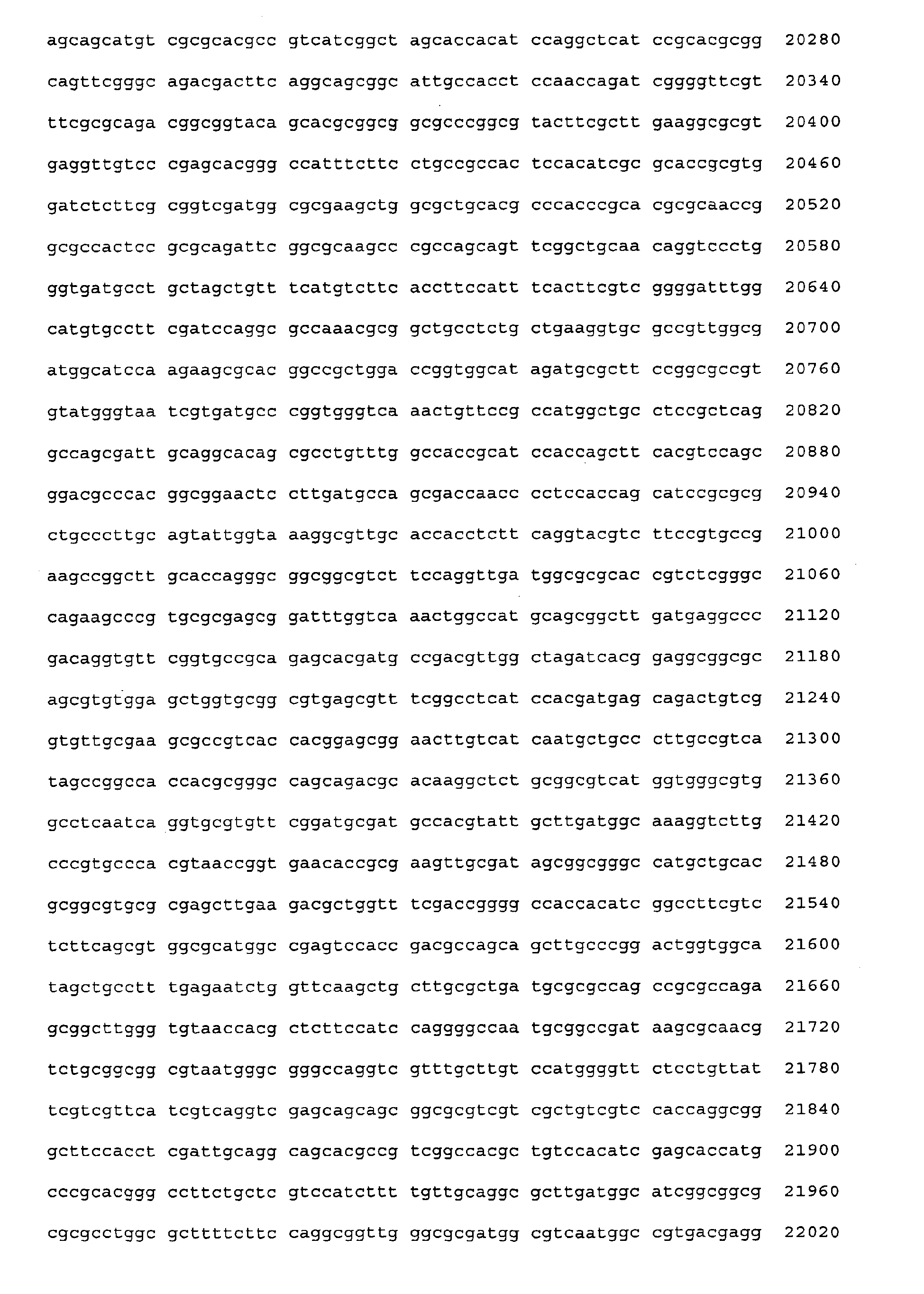
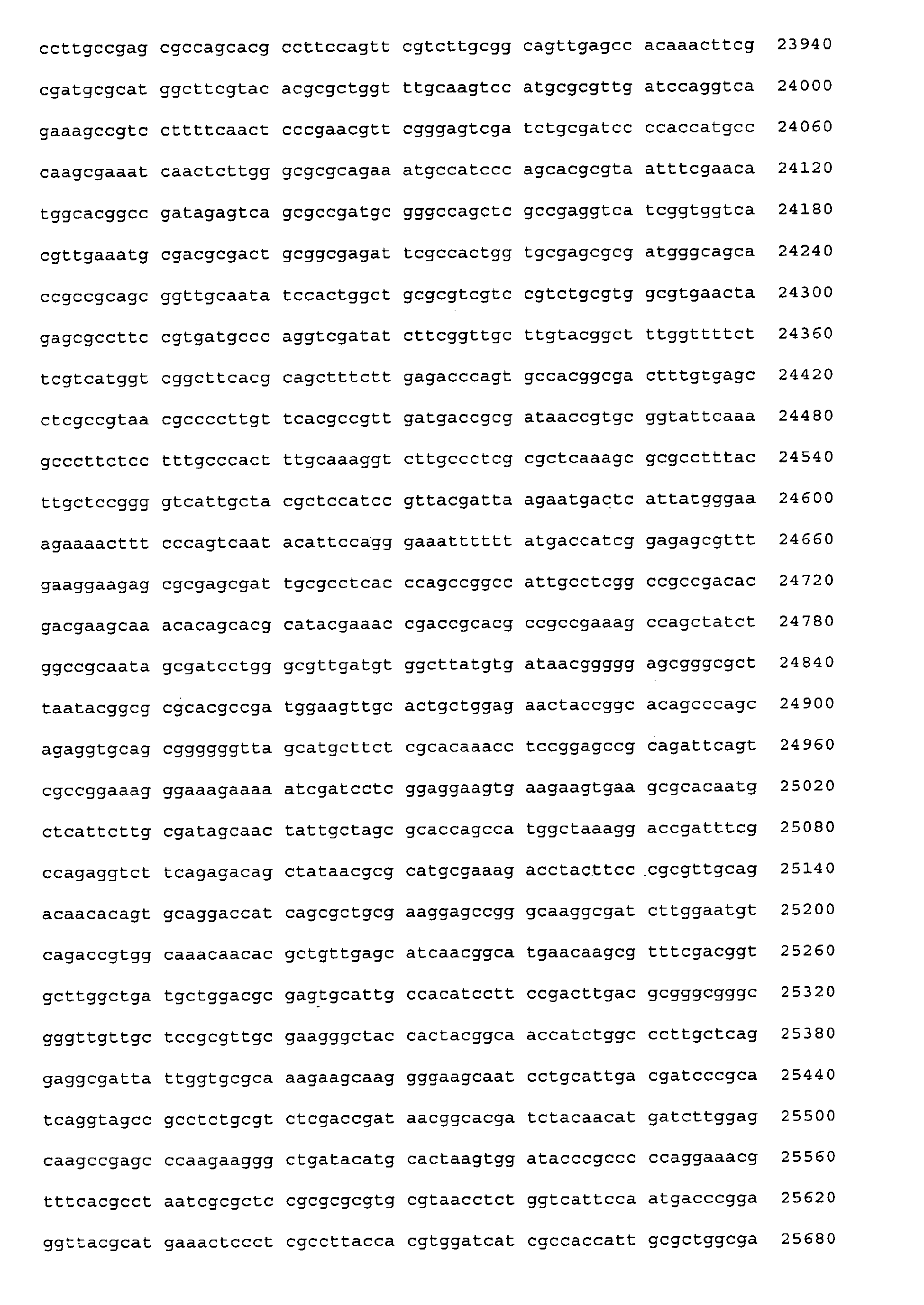
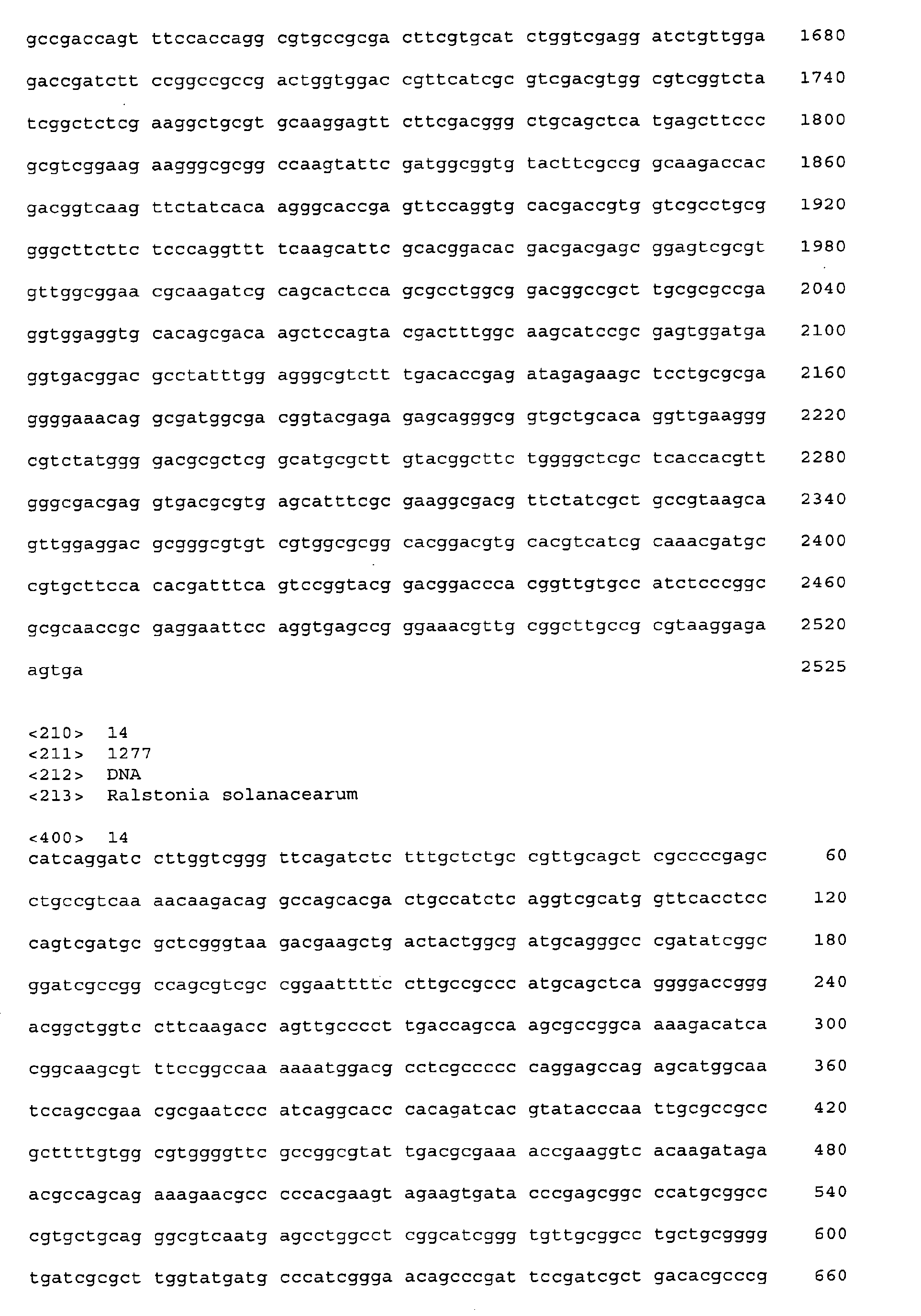
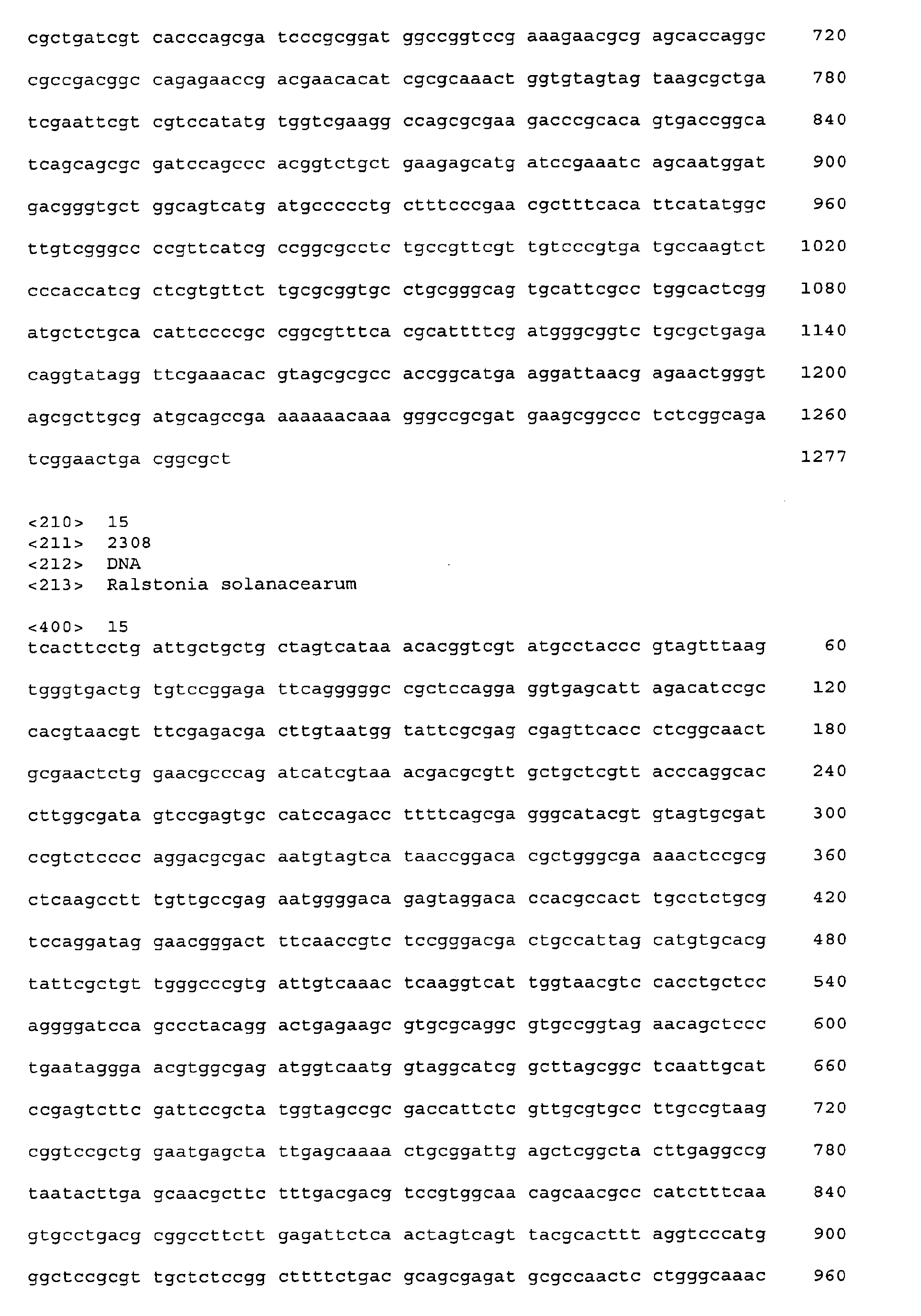
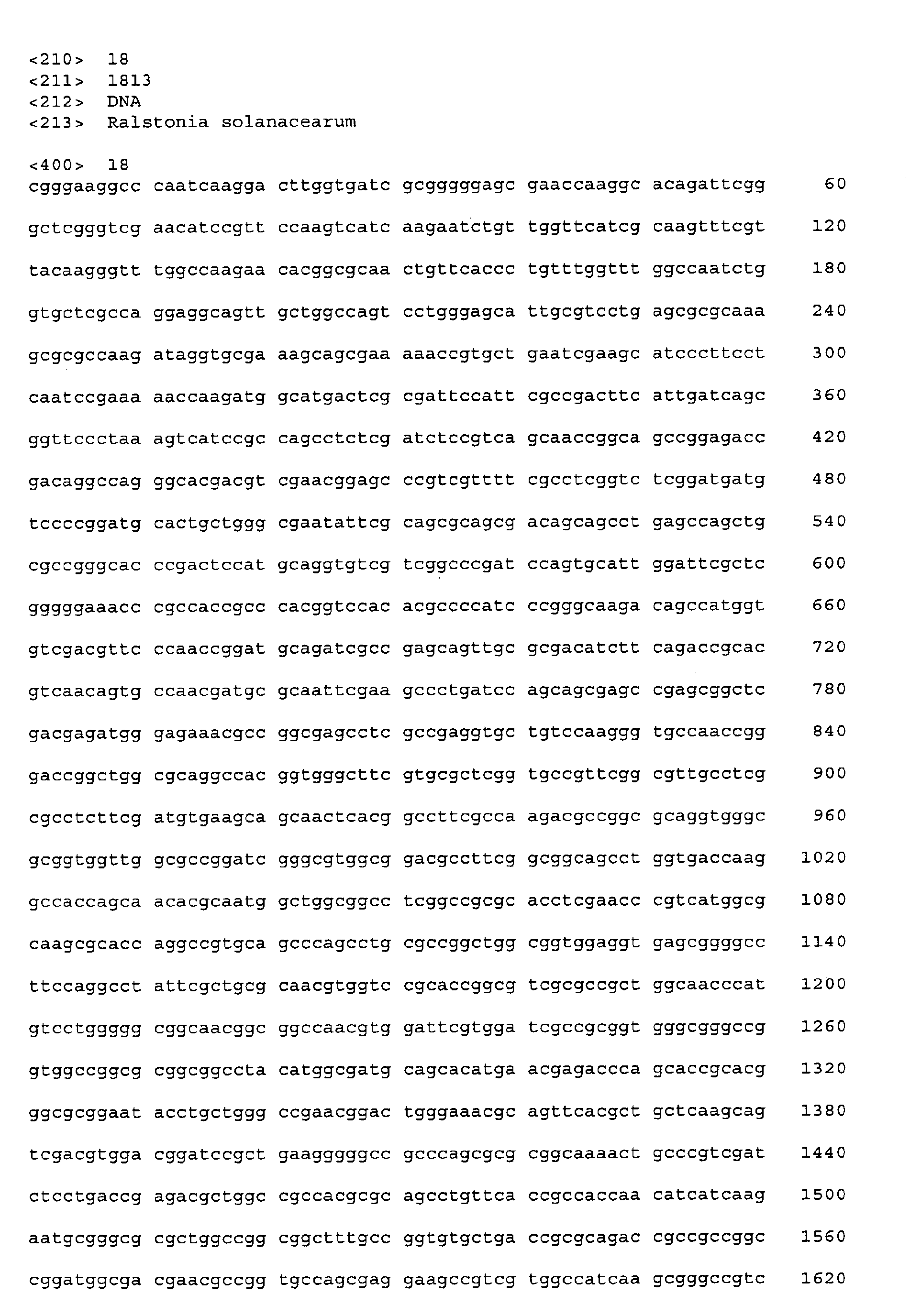
- the present inventors have shown that genetic material transfers which have occurred in the course of evolution and which have structured the genome of Ralstonia solanacearum race 3 biovar 2 concerned genomic patches often involving several genes. These genomic patches correspond to SEQ ID NO: 1-49. Accordingly, the detection of fragments of these genomic patches is generally indicative of the presence of the nucleic acid as a whole.
- fragments should be of a length such that it can be considered by one of skill in the art that it presents essentially no identity with nucleic acids of the same length which can be found in Ralstonia solanacearum strains which are not of race 3 biovar 2.
- fragments according to the invention comprise at least 9 nucleotides, more preferably at least 15 nucleotides and most preferably at least 18 nucleotides.
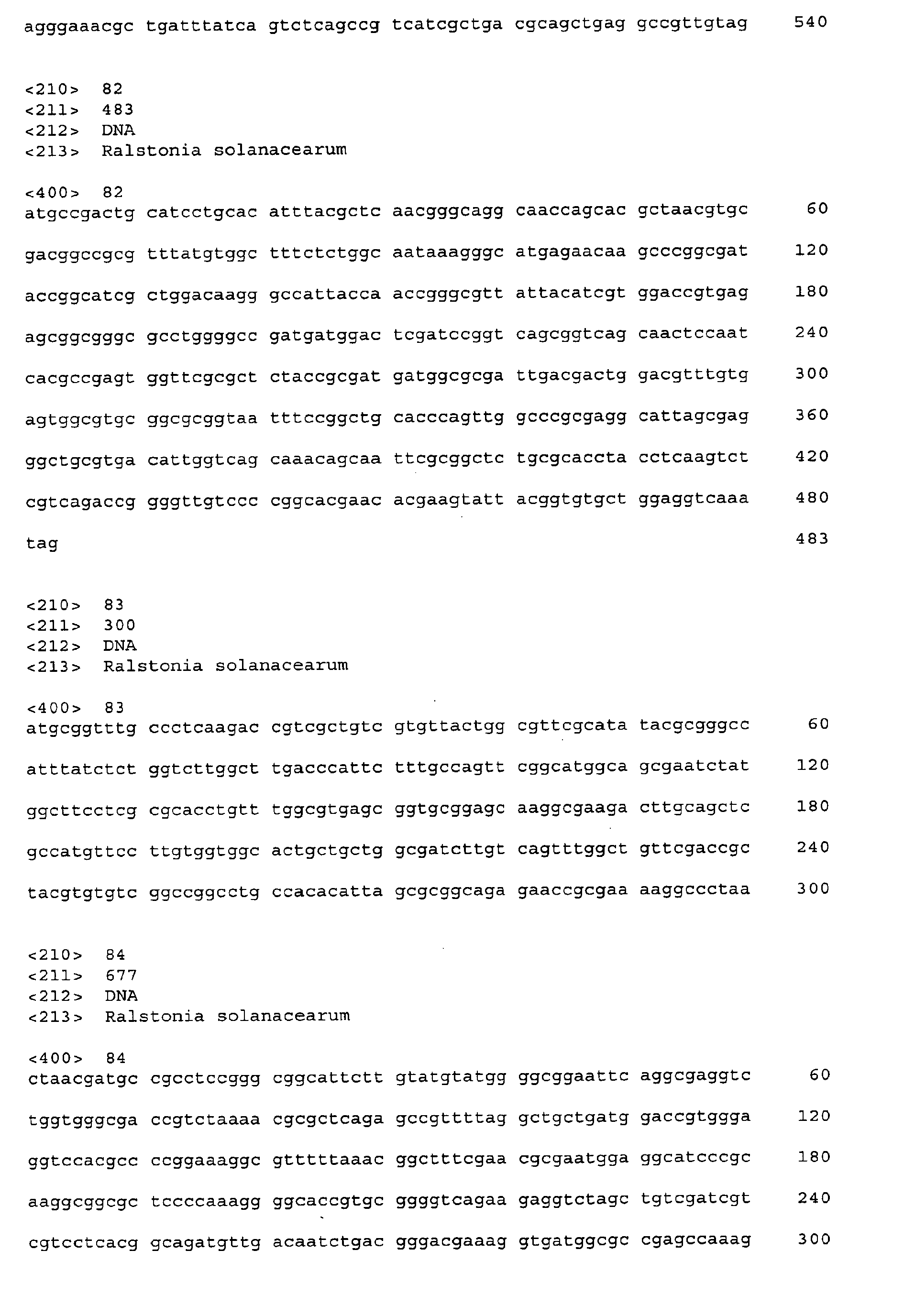
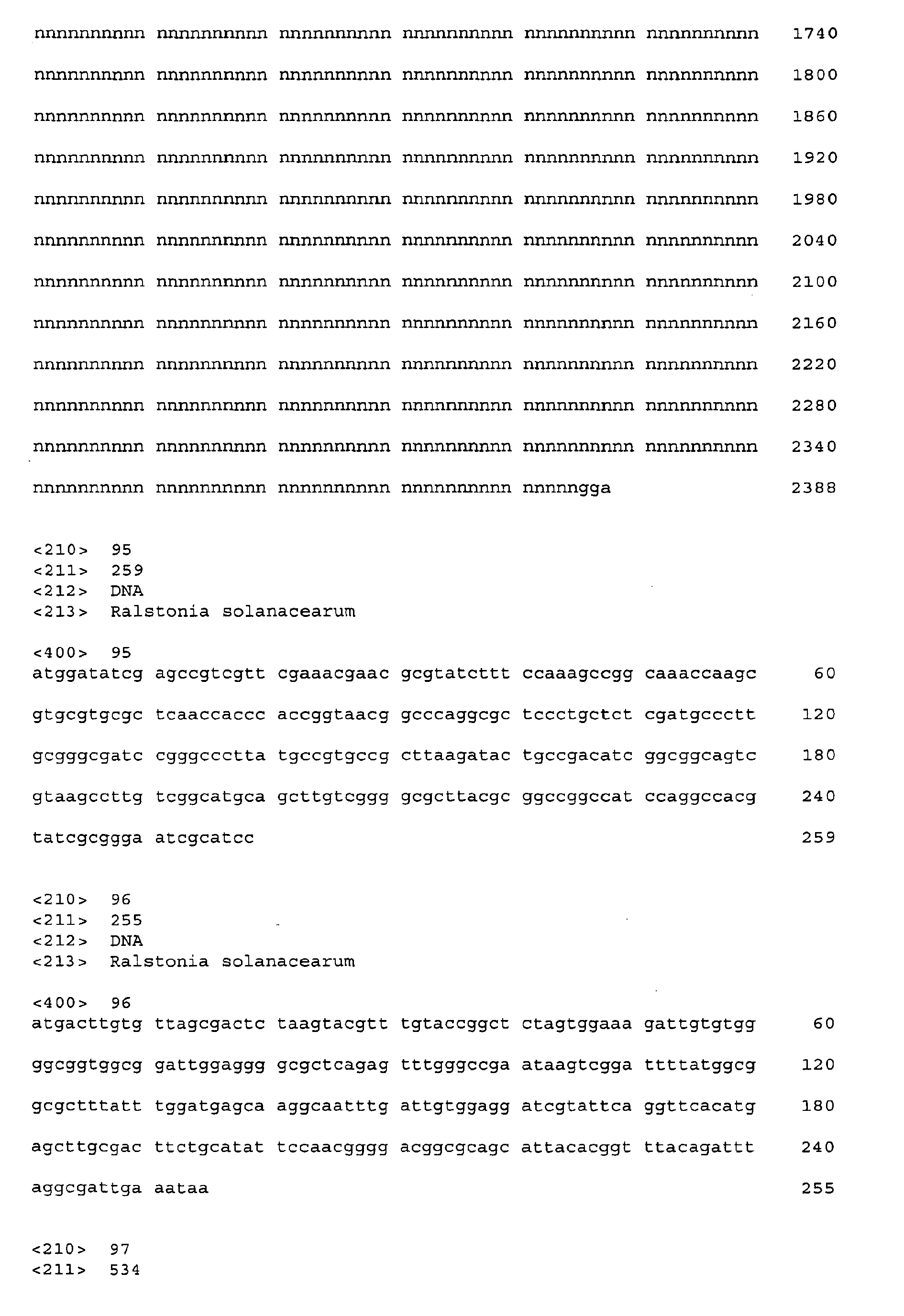
- Exemplary fragments of the above-mentioned genomic patches notably encompass gene and inter-gene sequences SEQ ID NO: 50-110.
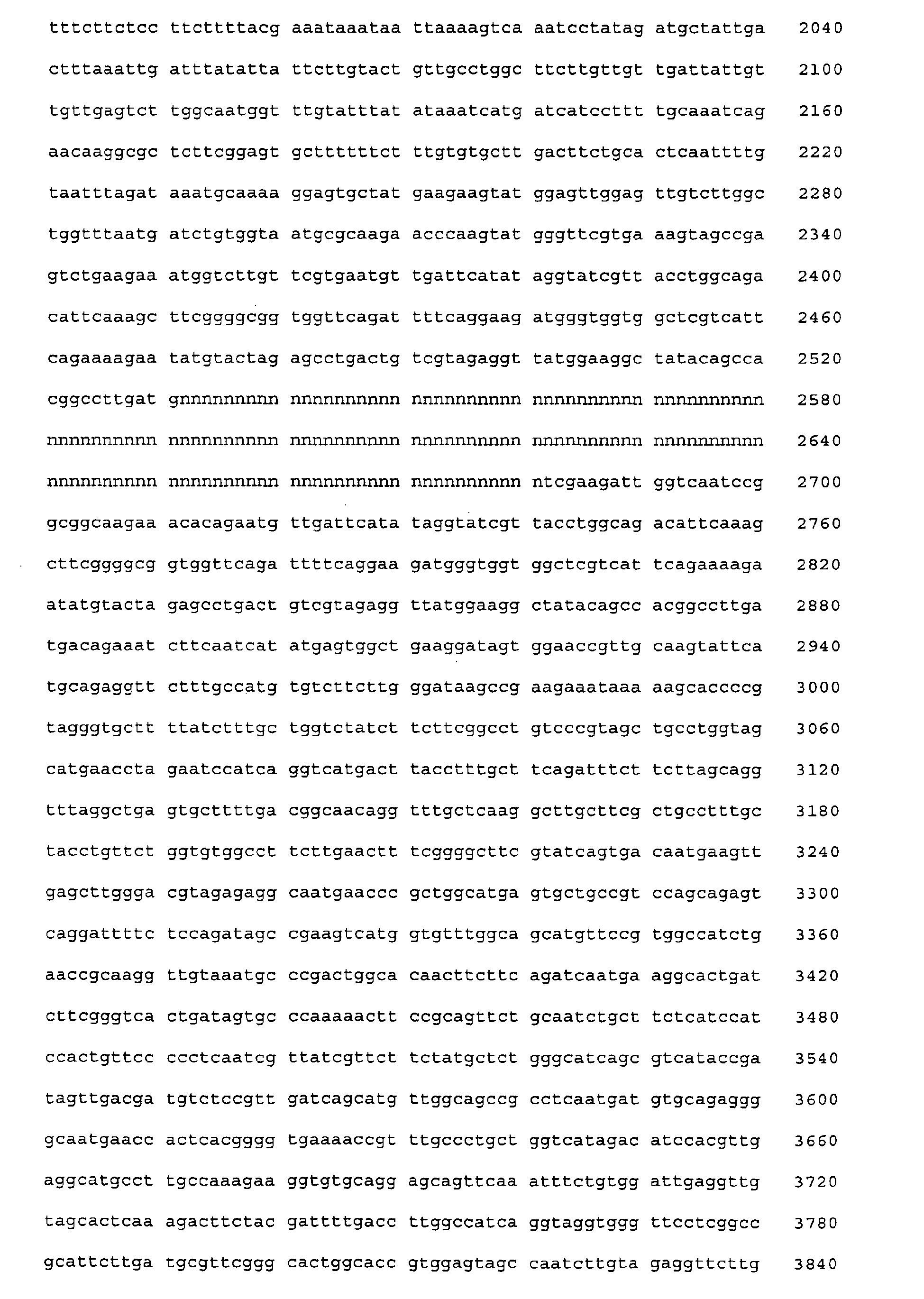
- SEQ ID NO: 1-49 Some short portions of SEQ ID NO: 1-49 are of a known length but of undetermined sequence. It will be apparent to one of skill in the art that the above-defined fragments of SEQ ID NO: 1-49 should preferably not be constituted of these short portions.
- the inventors have also found that the genomic patches they identified comprised sequence derived from mobile genetic elements. These mobile genetic elements are represented by SEQ ID NO: 111-140. Accordingly, the method and use according to the invention should preferably not determine the presence or absence of these mobile genetic elements or fragments thereof as first target nucleic acids.
- homologous sequences relate to natural variants of sequences SEQ ID NO: 1-49, which can be found in strains of Ralstonia solanacearum race 3 biovar 2.
- homologous sequences notably encompass:
- the determination comprises at least one step of hybridization of the nucleic acid target or fragment thereof with a probe or a primer.
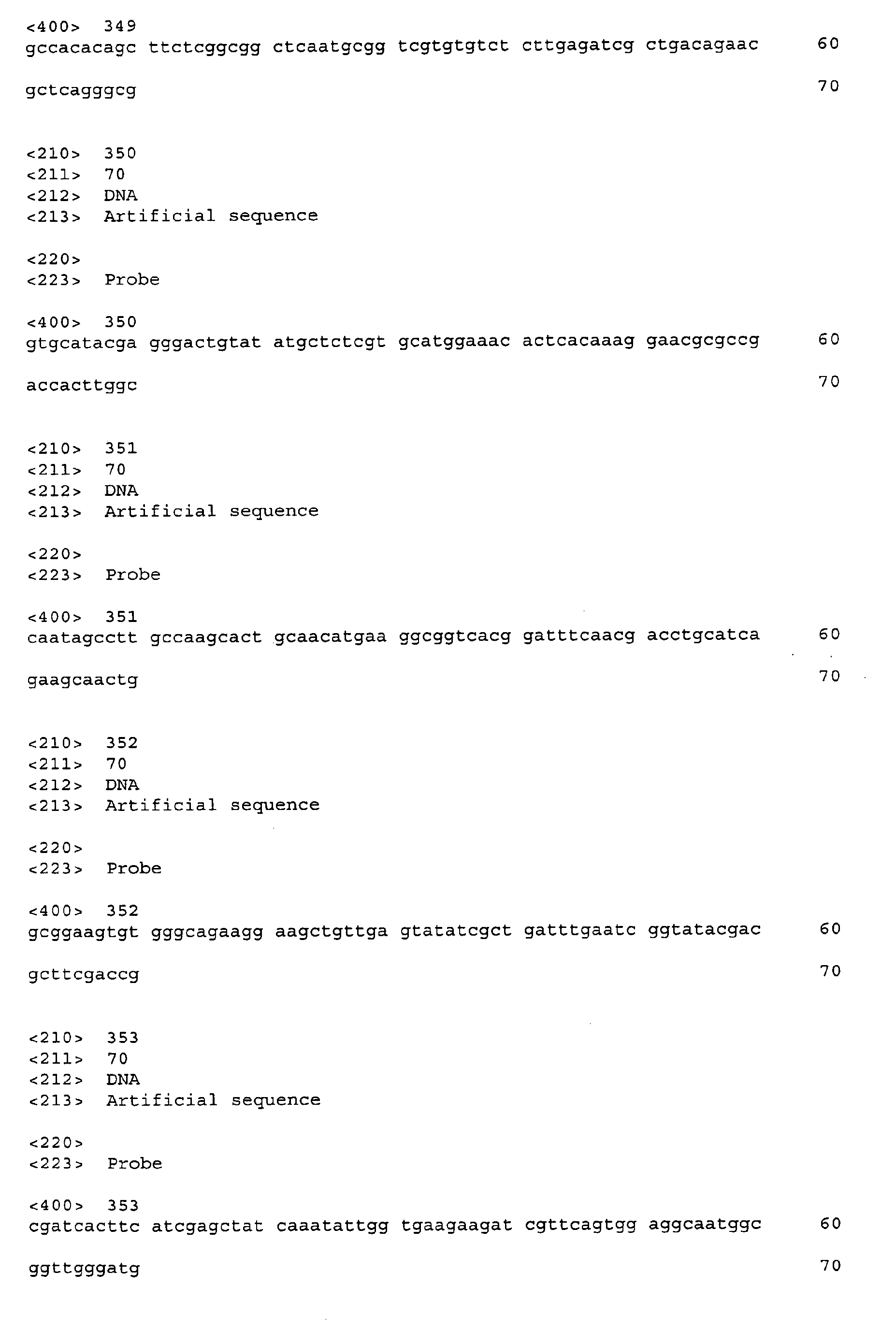
- the probe or primer is a fragment of nucleic acid having a sequence selected from the group constituted of SEQ ID NO: 1-49, homologous sequences thereof, and complementary sequences thereof. More preferably, the probe or primer is selected from the group constituted of SEQ ID NO: 141-386.
- the determination comprises at least one step of nucleic acid amplification.
- the determination comprises a step of nucleic acid amplification
- the determination is implemented by a method selected from PCR and NASBA.
- NASBA is notably described in Compton (1991) Nature 350:91-92 .
- the determination is implemented by a method selected from Southern blotting, Northern blotting, dot blots, and nucleic acid micro or macro-array hybridization,
- the above-defined method and use also comprise the determination of the presence or the absence in a sample of the medium, of:
- the at least one first target sequence is preferably not a mobile genetic elements
- the determination of the presence or absence of nucleic acids corresponding to mobile genetic elements can be effected in a further step.
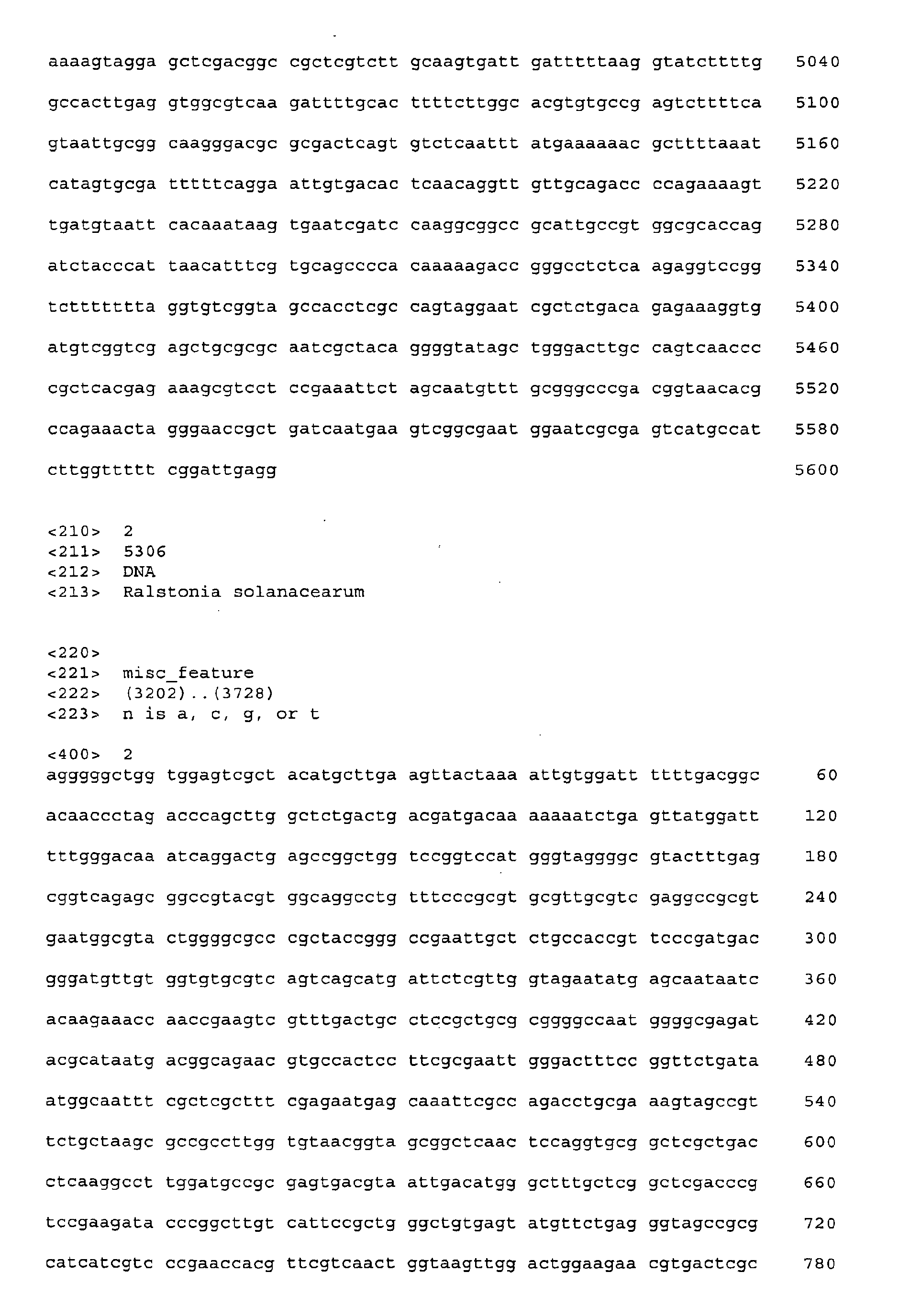
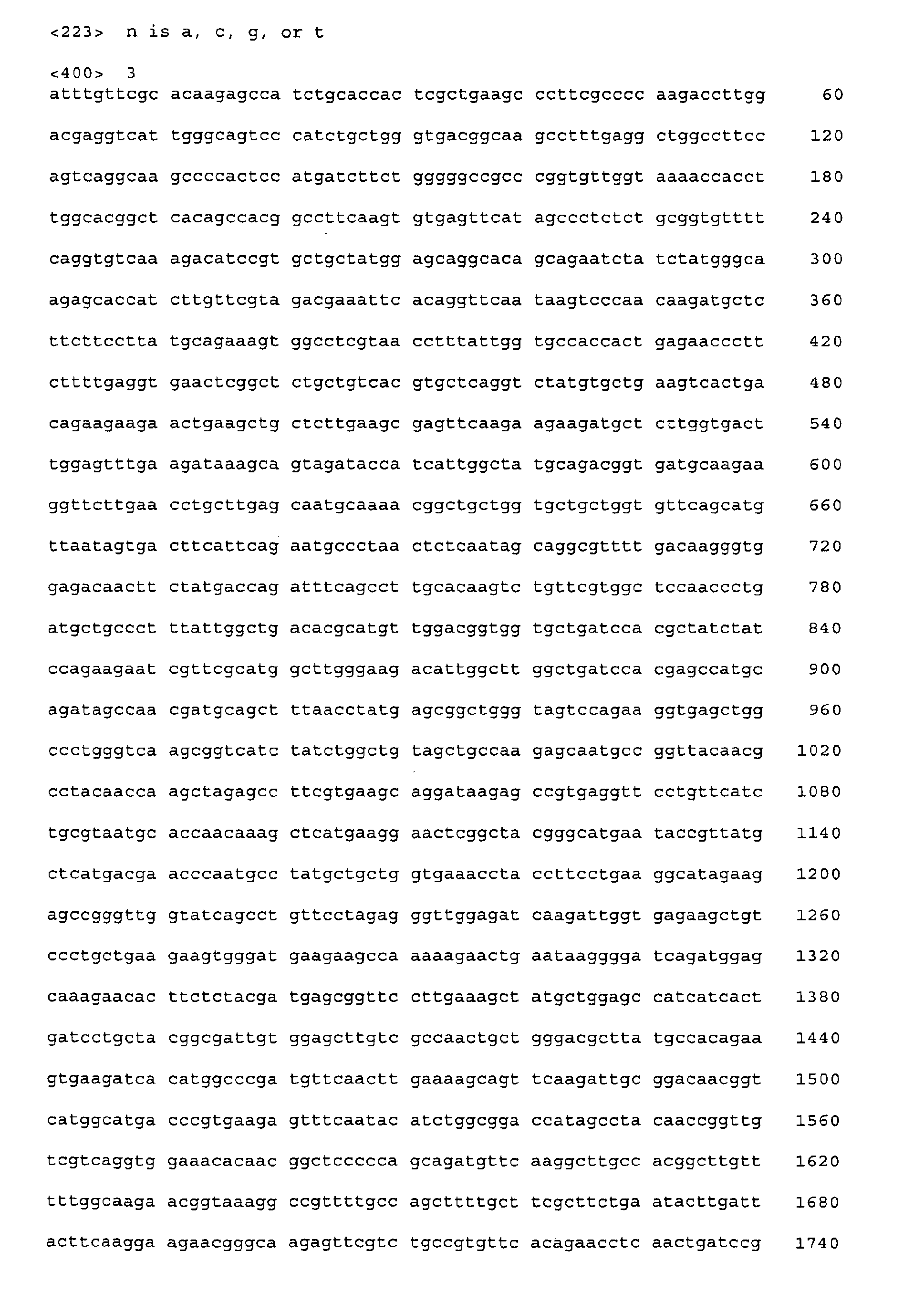
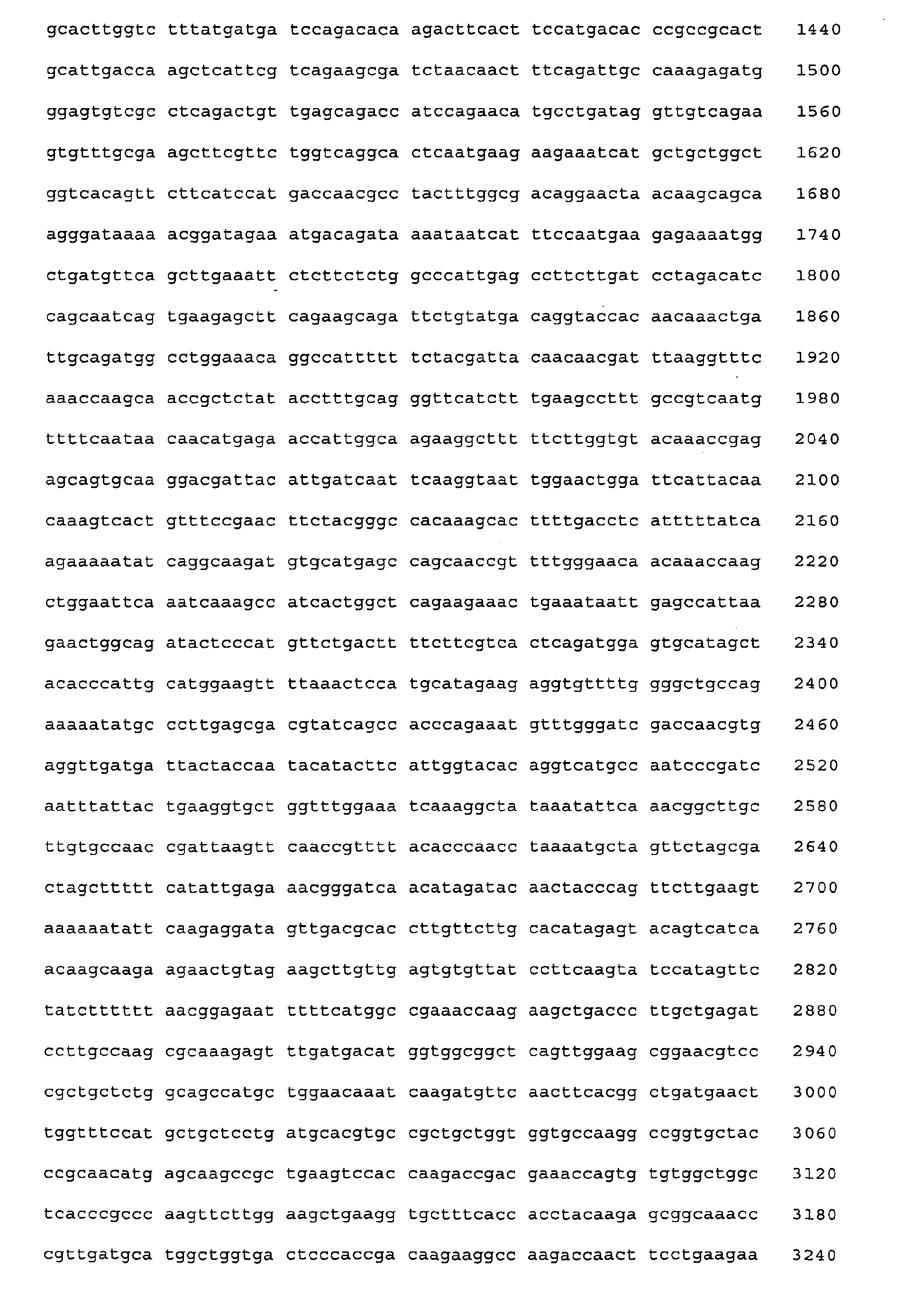
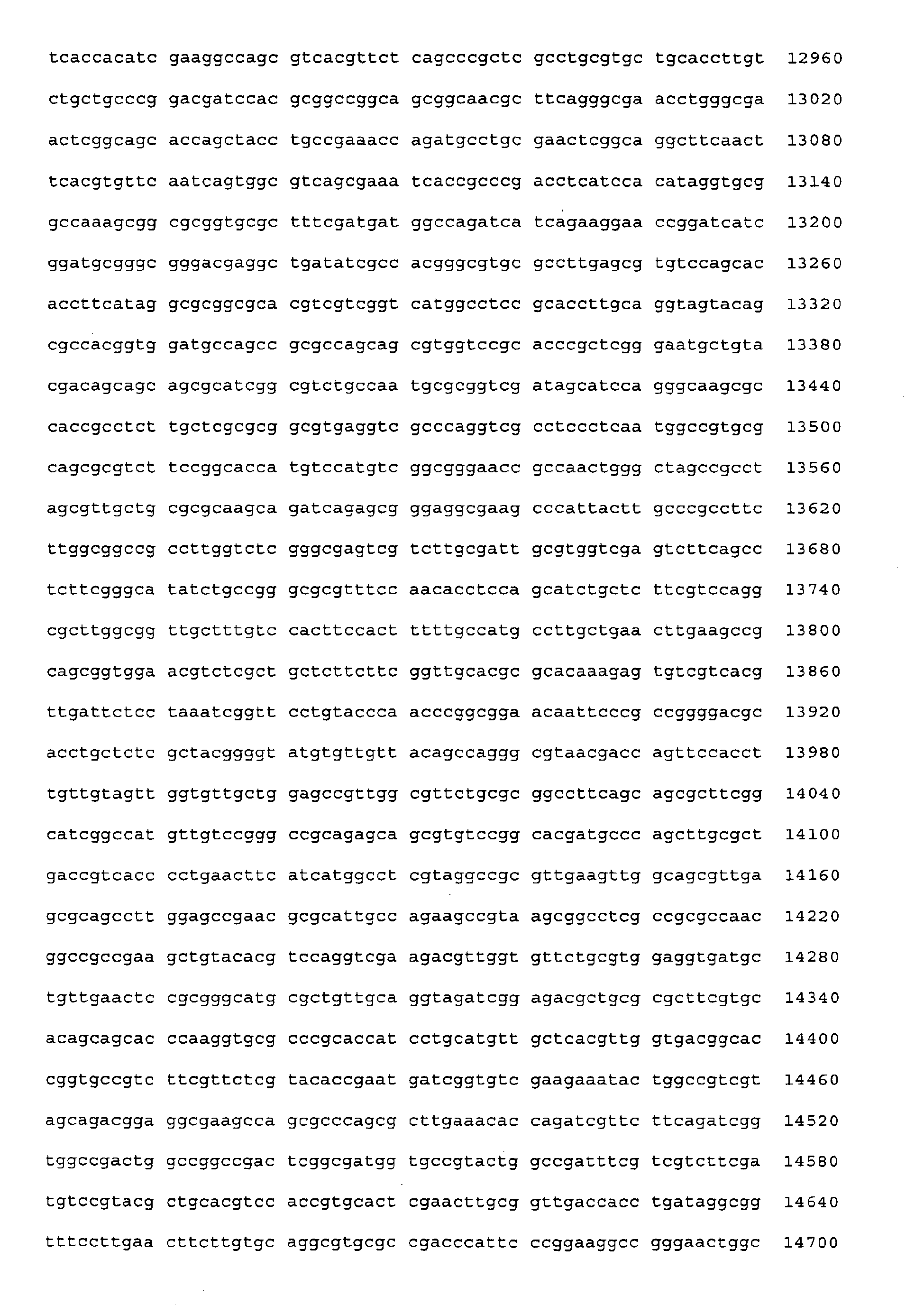
- the present invention also relates to a nucleic acid having a sequence selected from the group constituted of SEQ ID NO: 1-22, SEQ ID NO: 50-110, SEQ ID NO: 111-140, SEQ ID NO: 141-246, and SEQ ID NO: 247-386 and their complementary sequences.
- the present invention also relates to a nucleic acid micro or macro-array comprising a plurality of nucleic acid probes arranged onto a solid support, wherein the nucleic acid probes are fragments of nucleic acids having sequences selected from the group constituted of SEQ ID NO: 1-49, complementary sequences thereof, and homologous sequences thereof, provided that preferably at least one of the nucleic acid probes is not a fragment of a nucleic acid having a sequence selected from the group consisting of SEQ ID NO: 111-140.
- the nucleic acid probes comprise SEQ ID NO: 247-386.
- the present invention also relates to a kit intended for the detection of Ralstonia solanacearum race 3 biovar 2 in a medium, comprising at least:
- Table 1 provides the list of the 14 race 3 biovar 2 strains and 45 non-race 3 biovar 2 strains used herein together with their geographical origin, host of origin.
- the 14 race 3 biovar 2 strains corresponded to phylotype IIB, sequevar 1 based on the classification scheme proposed by Fegan & Prior (2005).
- oligonucleotide For each of these genes a specific representative 70 mer-oligonucleotide was designed using ROSO algorithm (Reymond, 2004). These oligonucleotides were chosen as having no significant homology with any part of the genome of strain GMI1000 and were used to generate a microarray as previously reported for the construction of the GMI1000 microarray (Occhialini et al., 2005).
- the "IPO1609 partial microarray" thus generated also includes additional oligonucleotides representative of the IPO1609 allelic variants for a limited number of genes conserved but significantly divergent between strains GMI1000 and IPO1609 (mostly including type III-secretion dependant pathogenicity effectors) therefore permitting the distinction of the two allelic forms of a given gene.
- oligonucleotides representative of particular intergenic regions were also included on the microarray.
- the sequence of each individual oligonucleotide spotted on the microarray has been deposited at influence de Protection des Programmes (APP) under accession number IDDN.FR.001.300024.000.R.P.2006.000.10300.
- the PCR primers used are given in Table 2 .
- the primers were designed to amplify one genomic fragment from each gene. When possible, one of the two primers for each gene was designed inside the oligonucleotide spotted on the microarray. PCR were conducted in 25 ⁇ l reaction mixture containing 10 ng DNA from each tested strain, 25 pmol of each primer (UR), 1.5 mM MgCl 2 , 200 ⁇ M of each four dNTP, 0.5 U of Red Gold Star Taq DNA polymerase (Eurogentec) and the buffer supplied by the manufacturer.
- PCR amplifications were performed as follows: an initial denaturation step at 96°C for 5 min followed by 30 cycles of 94°C for 15 s., 59°C for 30 s., and 72°C for 30 s., with a final extension step of 72°C for 10 min. Negative (PCR reaction mixture without DNA) and positive (IPO1609 DNA) controls were included in each experiment. The multiplex PCR described by Fegan & Prior (2005) for the Ralstonia solanacearum phylotype identification was conducted on each tested DNA as an amplification positive control.
- the deduced amino acid sequence for each predicted gene from strain UW551 was BlastX compared to the genomic sequence of strain IPO1609 in order to identify the predicted proteins of UW551 that have no counterpart covering at least 80% of their length. These proteins designated as "potential UW551-specific proteins" were then compared with BlastX to the genomic sequence of strain GMI1000 and Molk2. All the proteins that did not have a counterpart covering at least 80% of the length of the query sequence with at least 40% identity where then individually compared using BlastP with the predicted proteins from strains GMI1000 and Molk2. This was performed in order to eliminate false candidates that could remain in the list due to frameshift in the nucleotide sequence.
- Comparative genomic hybridizations (CGH) on the microarray have been performed to compare the lists of genes between 11 race 3 biovar 2 strains and 20 non-race 3 biovar 2 strains ( Table 1) .
- This analysis identifies a set of 137 oligonucleotides which are present in at least 10 of the 11 race 3 biovar 2 strains and absent from at least 19 of the 20 non-race 3 biovar 2 strains.
- These oligonucleotides were representative of 79 genes and 38 intergenic regions from the IPO1609 genome. These genes and intergenes therefore were considered as "candidate race 3 biovar 2 specific genomic regions". A large proportion of these regions forms clusters in the IPO1609 genome and sometime a few genes mapping within these clusters were not found in the list of thus defined "candidate race 3 biovar 2 specific regions”.
Landscapes
- Chemical & Material Sciences (AREA)
- Life Sciences & Earth Sciences (AREA)
- Analytical Chemistry (AREA)
- Proteomics, Peptides & Aminoacids (AREA)
- Organic Chemistry (AREA)
- Zoology (AREA)
- Wood Science & Technology (AREA)
- Health & Medical Sciences (AREA)
- Engineering & Computer Science (AREA)
- Microbiology (AREA)
- Immunology (AREA)
- Molecular Biology (AREA)
- Biotechnology (AREA)
- Biophysics (AREA)
- Physics & Mathematics (AREA)
- Biochemistry (AREA)
- Bioinformatics & Cheminformatics (AREA)
- General Engineering & Computer Science (AREA)
- General Health & Medical Sciences (AREA)
- Genetics & Genomics (AREA)
- Measuring Or Testing Involving Enzymes Or Micro-Organisms (AREA)
Abstract
The invention concerns a method for the detection of Ralstonia solanacearum race 3 biovar 2 strains in a medium, comprising the determination of the presence or the absence in a sample of the medium, of:
(i) at least one first nucleic acid target having a sequence selected from the group constituted of SEQ ID NO: 1-49, complementary sequences thereof, and homologous sequences thereof, or
(ii) at least one fragment of said first target nucleic acid, wherein said fragment is not constituted of or comprised in a sequence selected from the group constituted of SEQ ID NO: 111-140;
whereby, if said first nucleic acid target or fragment thereof is present in the sample, it is determined that Ralstonia solanacearum race 3 biovar 2 strain is present in the medium.
(i) at least one first nucleic acid target having a sequence selected from the group constituted of SEQ ID NO: 1-49, complementary sequences thereof, and homologous sequences thereof, or
(ii) at least one fragment of said first target nucleic acid, wherein said fragment is not constituted of or comprised in a sequence selected from the group constituted of SEQ ID NO: 111-140;
whereby, if said first nucleic acid target or fragment thereof is present in the sample, it is determined that Ralstonia solanacearum race 3 biovar 2 strain is present in the medium.
Description
- The present invention relates to a method for detecting race 3 biovar 2 Ralstonia solanacearum strains.
- Ralstonia solanacearum is a Gram-negative soil-borne plant pathogen with thousands of distinct strains in a heterogeneous species complex. Ralstonia solanacearum causes bacterial wilt, which is globally distributed and economically destructive. It is thus considered the single most destructive bacterial plant disease because of its unusually broad host range. The bacterium attacks plants in over 200 different families, including dicots and monocots, and annual plants as well as trees. Economically important crop hosts include: tomato, potato, pepper, tobacco, peanut, ornamentals, banana, plantain, and eucalyptus. Losses due to bacterial wilt are known to be enormous but cannot be accurately estimated because of its large but undocumented impact on subsistence agriculture and because planting of wilt-susceptible crops have been abandoned altogether in many parts of the world. Specifically, economic losses to the potato industry in the world have been estimated 950 million US $ and the potato brown rot strain of Ralstonia solanacearum was listed in the USA as a Bioterrorism Select Agent (BSA).
- The pathogen usually enters host roots from the soil, multiplies in the root cortex, and colonizes the xylem vessels, so the bacteria spread rapidly throughout the host via the plant's own vascular system. Symptoms vary according to host, but rapid wilting and death are the common elements.
- To unravel the genetic diversity within this species complex, a new classification scheme was proposed that distinguishes four phylotypes:
- phylotype I corresponds to the "Asiaticum" division 1 of Cook et al (1989) and contains strains belonging to biovars 3 (GMI1000), 4 and 5;
- phylotype II corresponds to the "Americanum" division 2 of Cook and contains strains belonging to race 1 biovar 1, race 2 biovar 1 (e.g. Moko disease-causing strains such as Molk2), race 3 biovar 2 (e.g. IPO1609 and UW551) and race 3 biovar 2T strains;
- phylotype III contains strains from Africa and the Indian Ocean, which belong to biovars 1, 2 and 2T;
- phylotype IV is reported highly heterogeneous; it contains strains from Indonesia, some strains from Japan, and a single strain from Australia, belonging to biovars 1, 2 and 2T; phylotype IV also contains the closely related species Ralstonia syzigii and the blood disease bacterium (BDB).
- Each phylotype can be further subdivided into sequevars based on differences in partial sequence of the endoglucanase gene (eg/). The phylotyping scheme is broadly consistent with the former phenotypic and molecular typing schemes (Fegan and Prior, 2005: Prior and Fegan 2005), and adds valuable information about the geographical origin and in some cases the pathogenicity of strains. It is believed that, after the race/biovar classification, the phylotype classification scheme is to become the core organizing principle for assigning a particular strain a phylogenetic position with a predictive value on potential host range (Fegan and Prior, 2006; Wicker et al., 2007).
- Whole genome sequencing was decisive in unravelling the broad genetic diversity encompassed within this organism with unusually broad host range. Thus a metagenomic microarray from sequence data of a broad host range tomato phylotype I strain (GMI1000) has been developed which has enabled comparative genomic hybridizations demonstrating that a third of the Ralstonia solanacearum genome is constituted of variable genes probably acquired by horizontal gene transfers. The distribution of variable genes between strains is related to the phylotype classification (Guidot et al, 2007).
- Recent phylogenetic evidences indicated that strains that fit with the definition of the potato brown rot agent were placed into the phylotype IIB sequevar 1 and 2, i.e. the biovar 2 Andean strains of Ralstonia solanacearum historically known as race 3 biovar 2. These strains are highly pathogenic to potato and adapted to low temperatures. Some strains in that group were also reported to carry an enlarged host range including tomato, and Geranium rosa (Carmeille et al., 2006).
- Given, the important economic impact of potato brown rot, it is highly desirable to develop methods for specifically detecting race 3 biovar 2 Ralstonia solanacearum strains.
- Thus,
WO 2004/042016 relates to real-time PCR primers and probes useful for the detection of such strains. The primers and probes enable the detection of a nucleic acid sequence which is specific for race 3 biovar 2 Ralstonia solanacearum strains. - However, it appears that the nucleic acid sequence detected by the primers and probes of
WO 2004/042016 is that of a mobile genetic element, since this sequence encodes part of a protein homologous to the Mu-like phage of the ORF35 of the B3 bacteriophage from Pseudomonas aeruginosa (Accession Q7AX27). - In general, mobile genetic elements should be avoided in the frame of the specific detection of a pathogenic microorganism, since particular strains of the pathogenic microorganism could lack the element or, conversely, other unrelated microorganisms could harbour the element, thereby yielding respectively false negative and false positive results.
- Accordingly, it is an object of the present invention to develop a method for detecting race 3 biovar 2 Ralstonia solanacearum strains which involves the detection of specific nucleic acid sequences which do not belong to mobile genetic elements.
- The present invention arises from the identification, by the inventors, of genomic portions of Ralstonia solanacearum which are specific of the race 3 biovar 2 strains of Ralstonia solanacearum.
- Thus the present invention relates to a method for the detection of Ralstonia solanacearum race 3 biovar 2 in a medium, comprising the determination of the presence or the absence in a sample of the medium, of:
- (i) at least one first nucleic acid target having a sequence selected from the group constituted of SEQ ID NO: 1-49, complementary sequences thereof, and homologous sequences thereof, or
- (ii) at least one fragment of said first nucleic acid target, wherein said fragment is preferably not constituted of or comprised in a sequence selected from the group constituted of SEQ ID NO: 111-140;
- The present invention also relates to the use of:
- (i) at least one first nucleic acid target having a sequence selected from the group constituted of SEQ ID NO: 1-49, complementary sequences thereof, and homologous sequences thereof, or
- (ii) at least one fragment of said first target nucleic acid, wherein said fragment is preferably not constituted of or comprised in a sequence selected from the group constituted of SEQ ID NO: 111-140;
- As intended herein the "medium" can be of natural or synthetic origin. Where the medium is of synthetic origin, it can in particular be a solid or liquid bacterial culture medium, Where the medium is of natural origin, it can notably be water, soil, or a biological tissue, in particular a plant tissue. Preferably, the medium is selected from the group constituted of a potato tissue, a tomato tissue, and a geranium tissue. These plant tissues are particularly prone to infection by Ralstonia solanacearum race 3 biovar 2. However, it is particularly preferred that the medium is a potato tissue, since Ralstonia solanacearum race 3 biovar 2 is the causative agent of potato brown rot. Preferably, the potato tissue should be the tuber, which constitutes the potato tissue most likely to contain Ralstonia solanacearum race 3 biovar 2.
- As intended herein a "sample" relates to a portion of the medium liable to contain nucleic acids. In particular, it is preferred that the sample is obtained from the medium by a nucleic acid extraction. Numerous methods exist, which are well known to one of skill in the art, for extracting nucleic acids from a medium, in particular from a plant tissue.
- As intended herein "nucleic acid" preferably relates to RNA or DNA.
- As intended herein "determination" of the presence or the absence of a nucleic acid in a sample relates to the detection of the full length nucleic acid in itself, but also to fragments of the nucleic acid. The present inventors have shown that genetic material transfers which have occurred in the course of evolution and which have structured the genome of Ralstonia solanacearum race 3 biovar 2 concerned genomic patches often involving several genes. These genomic patches correspond to SEQ ID NO: 1-49. Accordingly, the detection of fragments of these genomic patches is generally indicative of the presence of the nucleic acid as a whole. Besides, even if portions of SEQ ID NO: 1-49 should be lacking in a particular race 3 biovar 2 strain of Ralstonia solanacearum, it will be clear to one of skill in the art that the detection of fragments of conserved portions of SEQ ID NO: 1-49 is sufficient to unambiguously determine the presence of Ralstonia solanacearum race 3 biovar 2.
- Thus, as intended herein a "fragment" should be of a length such that it can be considered by one of skill in the art that it presents essentially no identity with nucleic acids of the same length which can be found in Ralstonia solanacearum strains which are not of race 3 biovar 2. Preferably, fragments according to the invention comprise at least 9 nucleotides, more preferably at least 15 nucleotides and most preferably at least 18 nucleotides.
- Exemplary fragments of the above-mentioned genomic patches notably encompass gene and inter-gene sequences SEQ ID NO: 50-110.
- Some short portions of SEQ ID NO: 1-49 are of a known length but of undetermined sequence. It will be apparent to one of skill in the art that the above-defined fragments of SEQ ID NO: 1-49 should preferably not be constituted of these short portions.
- The inventors have also found that the genomic patches they identified comprised sequence derived from mobile genetic elements. These mobile genetic elements are represented by SEQ ID NO: 111-140. Accordingly, the method and use according to the invention should preferably not determine the presence or absence of these mobile genetic elements or fragments thereof as first target nucleic acids.
- As intended herein "homologous sequences" relate to natural variants of sequences SEQ ID NO: 1-49, which can be found in strains of Ralstonia solanacearum race 3 biovar 2. Thus the homologous sequences notably encompass:
- sequences which are derived from sequences SEQ ID NO: 1-49 by insertion, deletion or substitution of at least one nucleotide;
- sequences which are liable to hybridize under stringent conditions to the complementary sequences of SEQ ID NO: 1-49;
- sequences which present at least 95% identity to sequences SEQ ID NO: 1-49;
- In a particular embodiment of the above-defined method and use, the determination comprises at least one step of hybridization of the nucleic acid target or fragment thereof with a probe or a primer. Preferably, the probe or primer is a fragment of nucleic acid having a sequence selected from the group constituted of SEQ ID NO: 1-49, homologous sequences thereof, and complementary sequences thereof. More preferably, the probe or primer is selected from the group constituted of SEQ ID NO: 141-386.
- In another particular embodiment of the above-defined method and use, the determination comprises at least one step of nucleic acid amplification.
- Preferably, where the determination comprises a step of nucleic acid amplification, the determination is implemented by a method selected from PCR and NASBA. NASBA is notably described in Compton (1991) Nature 350:91-92.
- Also preferably, the determination is implemented by a method selected from Southern blotting, Northern blotting, dot blots, and nucleic acid micro or macro-array hybridization,
- In a particular embodiment of the invention the above-defined method and use also comprise the determination of the presence or the absence in a sample of the medium, of:
- (i) at least one second nucleic acid target having a sequence selected from the group constituted of SEQ ID NO: 111-140, complementary sequences thereof, and homologous sequences thereof, or
- (ii) at least one fragment of said second nucleic acid target.
- Indeed, since the at least one first target sequence is preferably not a mobile genetic elements, the determination of the presence or absence of nucleic acids corresponding to mobile genetic elements can be effected in a further step.
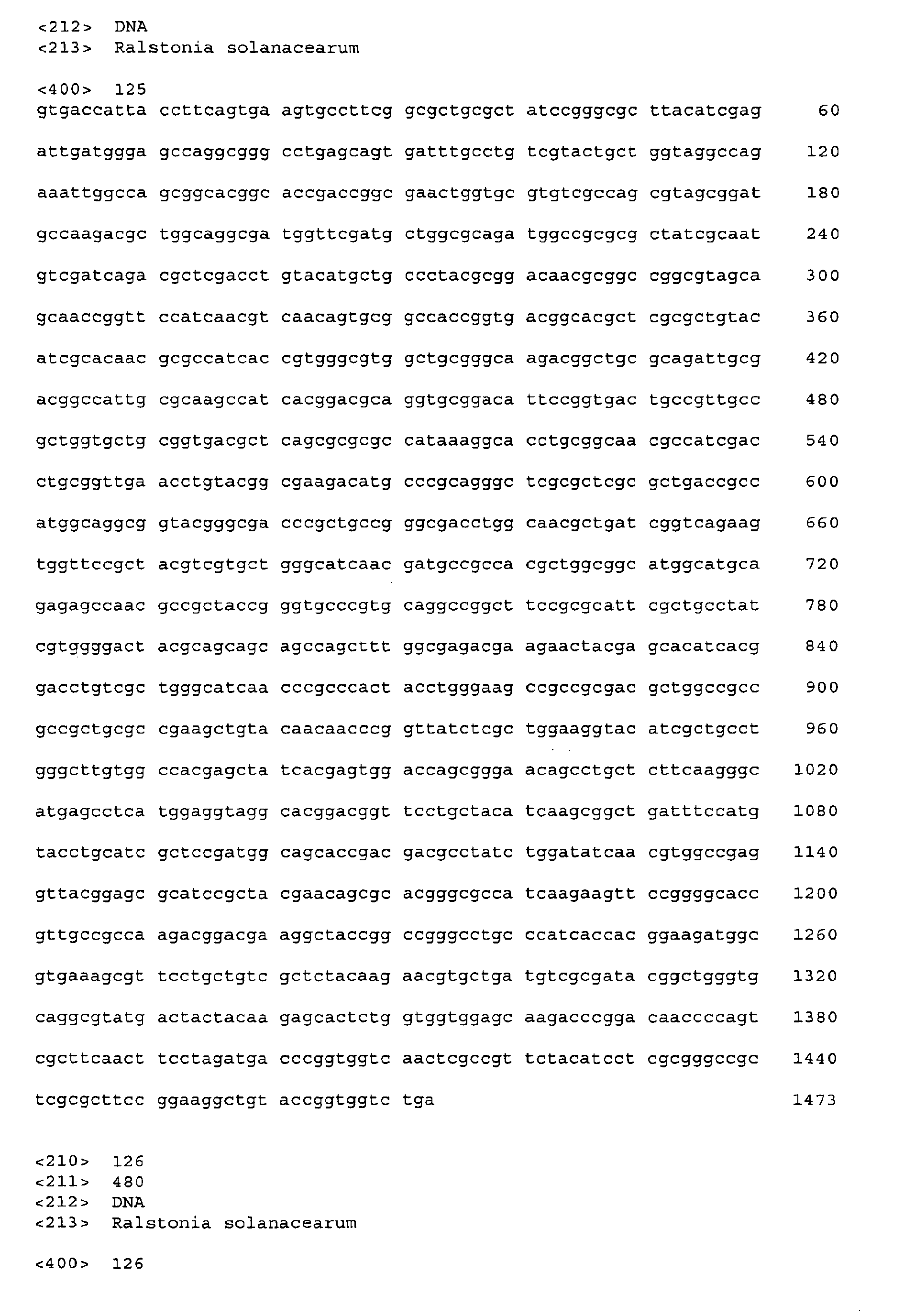
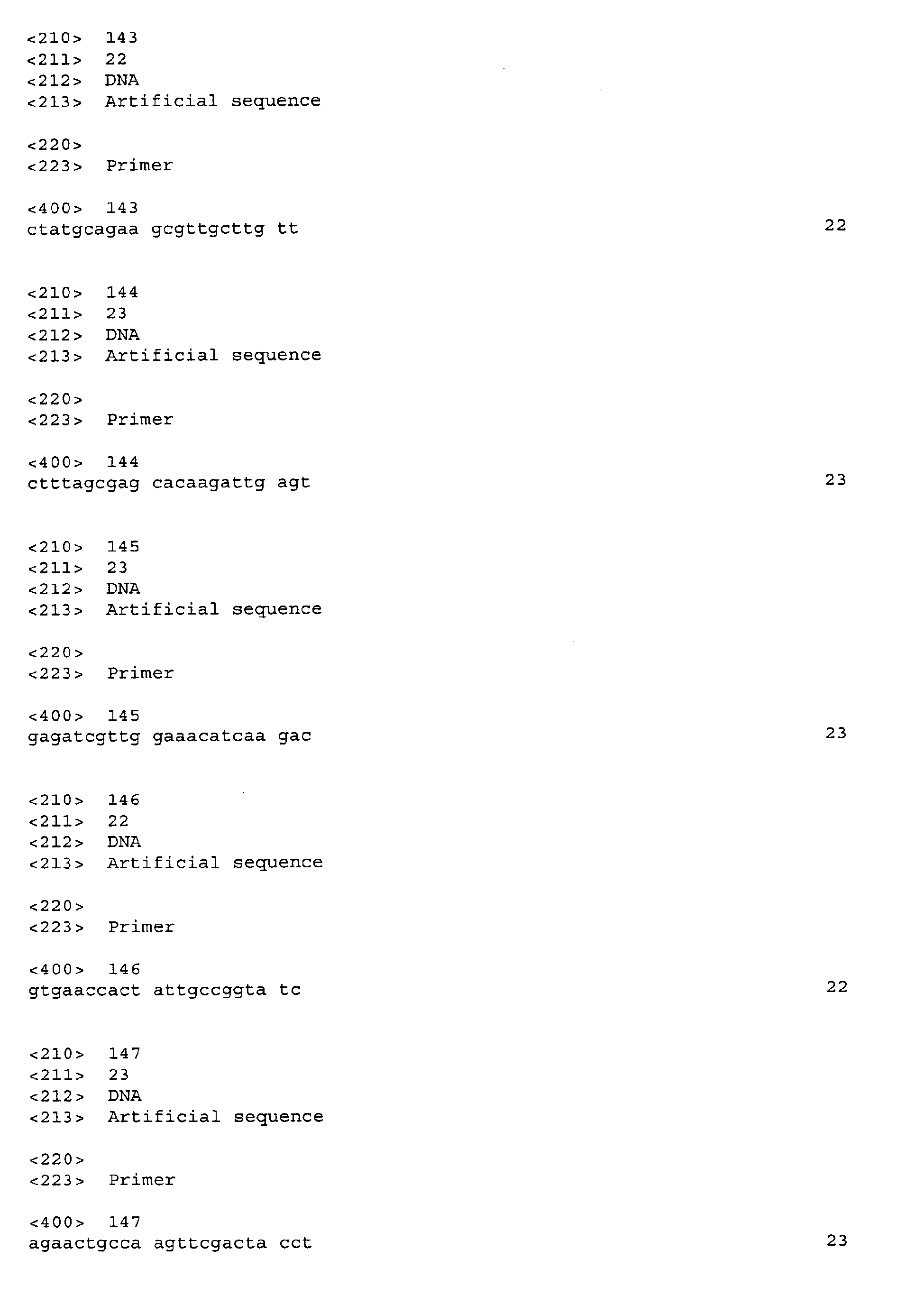
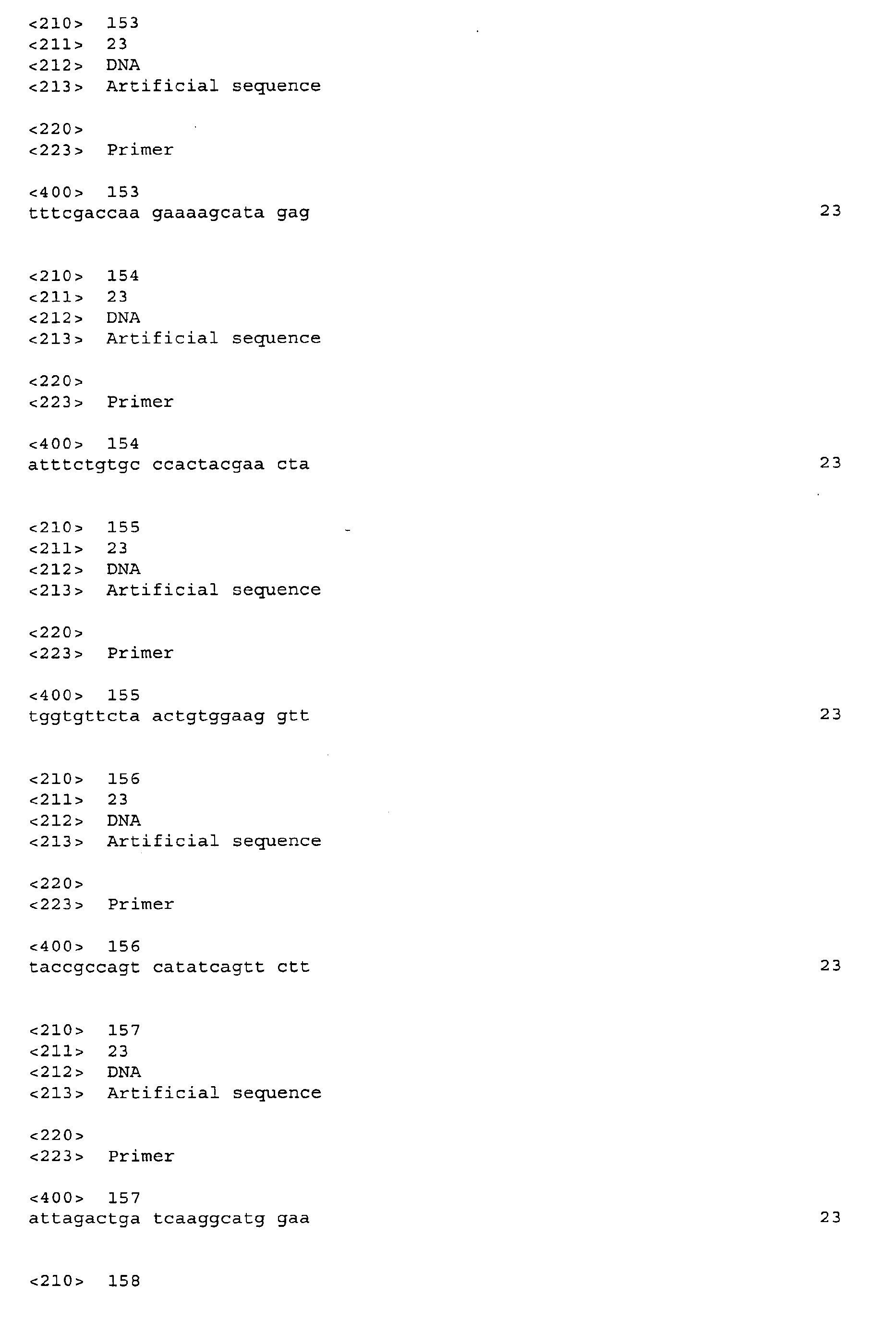
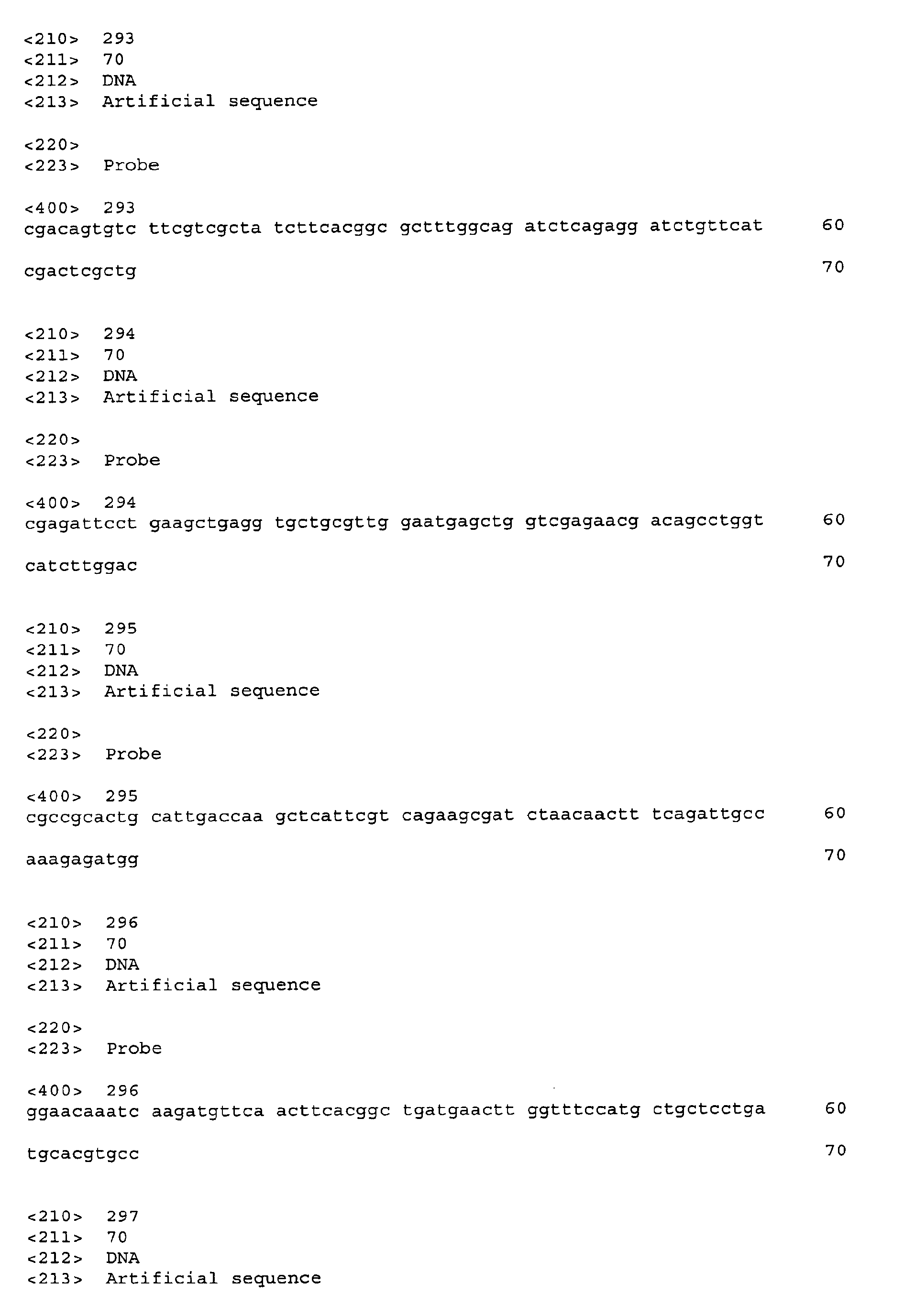
- The present invention also relates to a nucleic acid having a sequence selected from the group constituted of SEQ ID NO: 1-22, SEQ ID NO: 50-110, SEQ ID NO: 111-140, SEQ ID NO: 141-246, and SEQ ID NO: 247-386 and their complementary sequences.
- The present invention also relates to a nucleic acid micro or macro-array comprising a plurality of nucleic acid probes arranged onto a solid support, wherein the nucleic acid probes are fragments of nucleic acids having sequences selected from the group constituted of SEQ ID NO: 1-49, complementary sequences thereof, and homologous sequences thereof, provided that preferably at least one of the nucleic acid probes is not a fragment of a nucleic acid having a sequence selected from the group consisting of SEQ ID NO: 111-140.
- Preferably, in the above-defined nucleic acid micro-array, the nucleic acid probes comprise SEQ ID NO: 247-386.
- The present invention also relates to a kit intended for the detection of Ralstonia solanacearum race 3 biovar 2 in a medium, comprising at least:
- two primers suitable to amplify a portion of a nucleic acid having a sequence selected from the group constituted of SEQ ID NO: 1-49 and complementary sequences thereof, provided that said portion is preferably not comprised in a nucleic acid having a sequence selected from the group consisting of SEQ ID NO: 111-140 and complementary sequences thereof;
- optionally one detectable nucleic acid probe suitable to hybridize to said amplified portion.
- Table 1 provides the list of the 14 race 3 biovar 2 strains and 45 non-race 3 biovar 2 strains used herein together with their geographical origin, host of origin. The 14 race 3 biovar 2 strains corresponded to phylotype IIB, sequevar 1 based on the classification scheme proposed by Fegan & Prior (2005).
- A 12X draft of the genome sequence from strain IPO1609 (a race 3 biovar 2 strain accessible from the Collection Française de Bactéries Phytopathogènes under accession number CFBP 6926) has been established in collaboration with Genoscope and annotated by the inventors. The deduced amino acid sequence of the genes thus identified was compared with the amino acid sequence of the genes previously identified in strain GMI1000 (Salanoubat et al., 2002). All the genes from IPO1609 that did not have a homolog (less than 40% identity over at least 80% of both the query and subject sequences) will be further referred to as "potential IPO1609-specific genes". For each of these genes a specific representative 70 mer-oligonucleotide was designed using ROSO algorithm (Reymond, 2004). These oligonucleotides were chosen as having no significant homology with any part of the genome of strain GMI1000 and were used to generate a microarray as previously reported for the construction of the GMI1000 microarray (Occhialini et al., 2005). The "IPO1609 partial microarray" thus generated also includes additional oligonucleotides representative of the IPO1609 allelic variants for a limited number of genes conserved but significantly divergent between strains GMI1000 and IPO1609 (mostly including type III-secretion dependant pathogenicity effectors) therefore permitting the distinction of the two allelic forms of a given gene. Finally, a limited number of oligonucleotides representative of particular intergenic regions were also included on the microarray. The sequence of each individual oligonucleotide spotted on the microarray has been deposited at Agence de Protection des Programmes (APP) under accession number IDDN.FR.001.300024.000.R.P.2006.000.10300.
- These have been performed as previously described (Guidot et al., 2007) except that standard control DNA used for all genome hybridizations experiments which were performed consisted of an equimolar combination of the genomic DNA from three sequenced strains GMI1000, IPO1609 and Molk2 (IPO1609 and Molk2 genomes being unpublished) (Molk2 is accessible from the Collection Française de Bactéries Phytopathogènes under accession number CFBP 6925 and from the ATCC under accession number BAA-1115). Analysis was conducted as previously described using ImaGene and GeneShight (BioDiscovery) softwares. A gene was considered as being absent in the tested strain when the base 2 logarithm of the ratio of the normalized hybridization signal of the tested strain over the normalized hybridization signal with the control DNA was lower to -1.
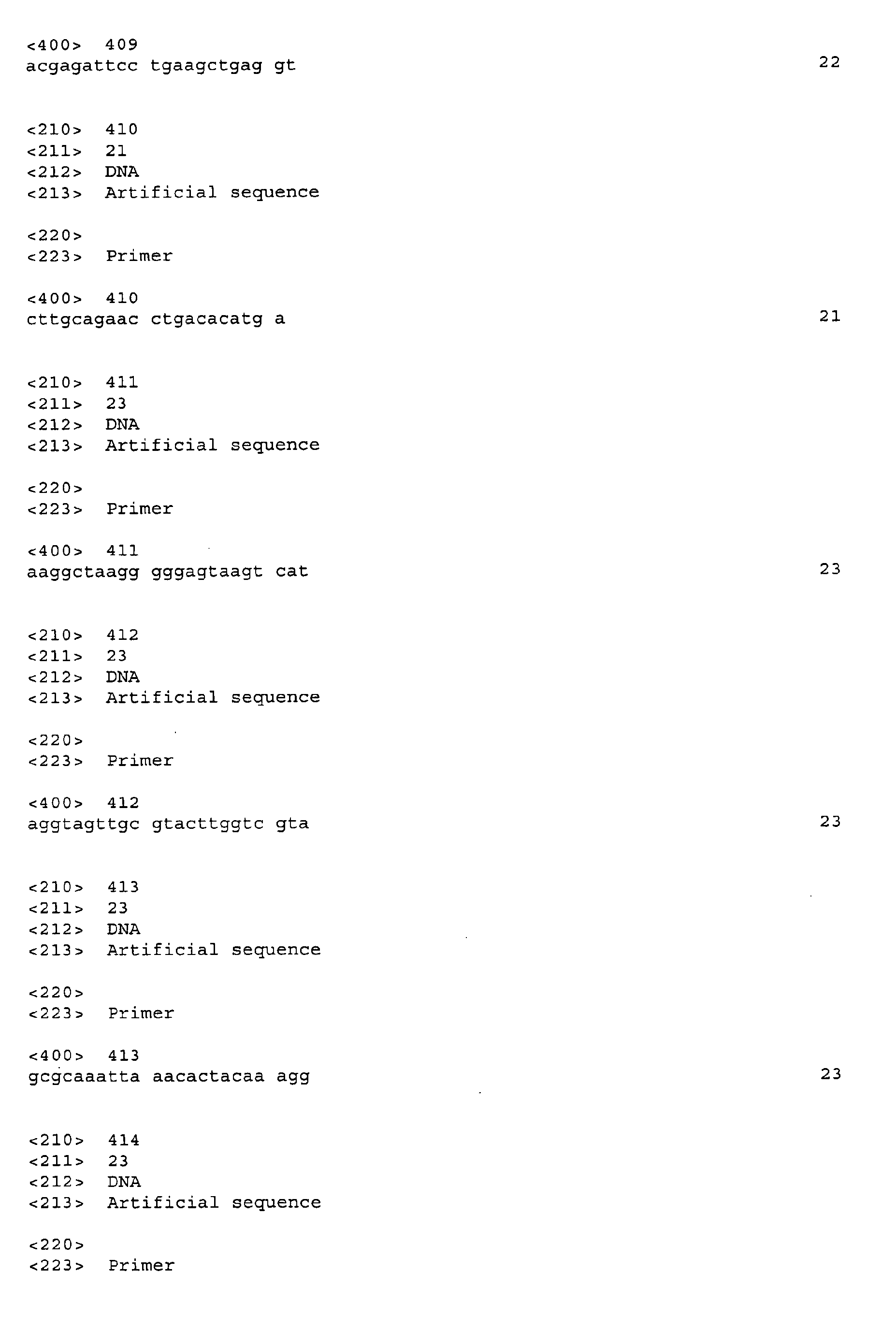
- The list of candidate race 3 biovar 2-specific genes deduced from comparative genomic hybridizations (CGH) experiments was checked by PCR amplification. The PCR primers used are given in Table 2. The primers were designed to amplify one genomic fragment from each gene. When possible, one of the two primers for each gene was designed inside the oligonucleotide spotted on the microarray. PCR were conducted in 25 µl reaction mixture containing 10 ng DNA from each tested strain, 25 pmol of each primer (UR), 1.5 mM MgCl2, 200 µM of each four dNTP, 0.5 U of Red Gold Star Taq DNA polymerase (Eurogentec) and the buffer supplied by the manufacturer. PCR amplifications were performed as follows: an initial denaturation step at 96°C for 5 min followed by 30 cycles of 94°C for 15 s., 59°C for 30 s., and 72°C for 30 s., with a final extension step of 72°C for 10 min. Negative (PCR reaction mixture without DNA) and positive (IPO1609 DNA) controls were included in each experiment. The multiplex PCR described by Fegan & Prior (2005) for the Ralstonia solanacearum phylotype identification was conducted on each tested DNA as an amplification positive control.
- The deduced amino acid sequence for each predicted gene from strain UW551 was BlastX compared to the genomic sequence of strain IPO1609 in order to identify the predicted proteins of UW551 that have no counterpart covering at least 80% of their length. These proteins designated as "potential UW551-specific proteins" were then compared with BlastX to the genomic sequence of strain GMI1000 and Molk2. All the proteins that did not have a counterpart covering at least 80% of the length of the query sequence with at least 40% identity where then individually compared using BlastP with the predicted proteins from strains GMI1000 and Molk2. This was performed in order to eliminate false candidates that could remain in the list due to frameshift in the nucleotide sequence.
- Comparative genomic hybridizations (CGH) on the microarray have been performed to compare the lists of genes between 11 race 3 biovar 2 strains and 20 non-race 3 biovar 2 strains (Table 1). This analysis identifies a set of 137 oligonucleotides which are present in at least 10 of the 11 race 3 biovar 2 strains and absent from at least 19 of the 20 non-race 3 biovar 2 strains. These oligonucleotides were representative of 79 genes and 38 intergenic regions from the IPO1609 genome. These genes and intergenes therefore were considered as "candidate race 3 biovar 2 specific genomic regions". A large proportion of these regions forms clusters in the IPO1609 genome and sometime a few genes mapping within these clusters were not found in the list of thus defined "candidate race 3 biovar 2 specific regions". Based on
- i) the known mosaic structure of Ralstonia solanacearum genome that suggests that sets of genes could have been acquired through horizontal gene transfers or lost through deletions (Salanoubat et al., 2002 ; Guidot et al., 2007),
- ii) on the consideration that some genes might be missing from this list due to the fact that hybridization data are missing in a limited number of cases, and
- iii) taking into account the possibility that certain genes that score next to the cutoff value could have been miss-categorized,
- When compared using BlastP with the sequence of the predicted proteins from strains GMI1000 and Molk2, 5 of these genes were found to have a counterpart in at least one of these strains and were therefore eliminated from the final list of race 3 biovar 2 -specific genes presented in Table 3. This final list includes a total of 151 genes or intergenic regions organized in 18 clusters and 15 additional individual genes or intergenic regions.
- The list of candidate race 3 biovar 2-specific genomic regions given in Table 3 has been established based on the analysis of a limited number of strains. Therefore the inventors validated this list on a larger collection of strains representative of the diversity found in Ralstonia solanacearum.
- A total of eight race 3 biovar 2-strains (among-which six were also used for CGH experiments) and 32 non-race 3 biovar 2 strains (seven of which were also used for CGH experiments) were used for this validation (Table 1 ). This validation was conducted by PCR amplification of one genomic fragment from each candidate race 3 biovar 2-specific region. All tested DNA could be amplified using the multiplex PCR for the Ralstonia solanacearum phylotype identification as described by Fegan and Prior (2005) therefore confirming that the strains tested actually correspond to Ralstonia solanacearum isolates.
- Each genomic region that gave a positive amplification from non-race 3 biovar 2 strains or a negative amplification from race 3 biovar 2 strains was excluded from the list of "race 3 biovar 2 specific genomic regions". The results validated the specificity of eleven gene clusters and eleven individual genes or intergenic regions (Table 4) . Among these genes, 27 were predicted to be parts of mobile genetic elements (bacteriophage or insertion sequences).
- A genomic draft for the race 3 biovar 2 virulent isolate UW551 is publicly available (Gabriel et al. 2006). Because strain IPO1609 probably harbours a genome deletion that significantly impairs its virulence compared to UW551, the inventors decided to compare the genome sequences for these two strains. In doing this 328 predicted genes from UW551 that had no counterpart in IPO1609 were identified. Based on the same criteria, in silico comparison of these 328 genes with the genome sequence of strain Molk2 and GMI1000 reduced this set to 94 UW551 specific genes. Comparison of these 94 predicted proteins using BlastP with the proteins of GMI1000 and Molk2 eliminated 67 proteins that were not previously detected as having a counterpart in GMI1000 or Molk2 due to the presence of a potential frameshift mutation in the corresponding genes, therefore leading to a final list of the 27 UW551 specific genes shown in Table 5.
-
- Table 1: List of Ralstonia solanacearum strains used in this study (ND not determined, NO no object)
- Table 2: List of the oligonucleotides used for PCR amplification of candidate race 3 biovar 2 specific genes. (a) Sequences in bold correspond to part of the oligonucleotide spotted on the microarray
- Table 3: List of candidate race 3 biovar 2-specific genomic regions.*Added genes correspond to the genes that have been included into the list based on their location within clusters of race 3 biovar 2 specific gene clusters.
- Table 4: Validated race 3 biovar 2 -specific genomic regions together with sequences of the PCR primers used for gene amplification. Black boxes highlight genes from mobile genetic elements (bacteriophage or insertion sequences).
- Table 5: List of additional candidate race 3 biovar 2-specific genes identified from strain UW551.
-
- Carmeille A, Prior P, Kodja H, Chiroleu F, Luisetti J, Besse P (2006) Evaluation of resistance to race 3, biovar 2 of Ralstonia solanacearum in tomato germplasm. J. Phytopathol. 154:398-402
- Cook, D., and L. Sequeira. 1994. Strain differentiation of Pseudomonas solanacearum by molecular genetic methods, p. 77-94. In A. C. Hayward and G. L. Hartman (ed.), BActerial wilt- The disease and ist causative agent, Pseudomonas solanacearum. CAB International, Wallingford, UK.
- Fegan, M., and P. Prior. (2005) How complex is the "Ralstonia solanacearum species complex", p. 449-462. In C. Allen, P. Prior and C. Hayward (ed.), Bacterial Wilt: the Disease and the Ralstonia solanacearum species complex. APS Press, St. Paul, MN, USA.
- Fegan, M., and Prior, P. 2006. Diverse members of the Ralstonia solanacearum species complex cause bacterial wilts of banana. Australasian Plant Pathology 35, 2: 93-101.
- Gabriel DW, Allen C, Schell M, Denny TP, Greenberg JT, Duan YP, Flores-Cruz Z, Huang Q, Clifford JM, Presting G, González ET, Reddy J, Elphinstone J, Swanson J, Yao J, Mulholland V, Liu L, Farmerie W, Patnaikuni M, Balogh B, Norman D, Alvarez A, Castillo JA, Jones J, Saddler G, Walunas T, Zhukov A, Mikhailova N. (2006) Identification of open reading frames unique to a select agent: Ralstonia solanacearum race 3 biovar 2. 1: Mol Plant Microbe Interact. 2006 Jan;19(1):69-79.
- Guidot A, Prior P, Schoenfeld J, Carrere S, Genin S, Boucher C (2007) Genomic structure and phylogeny of the plant pathogen Ralstonia solanacearum inferred from gene distribution analysis. J Bacteriol. 189:377-87.
- Occhialini A, Cunnac S, Reymond N, Genin S, Boucher C (2005) Genome-wide analysis of gene expression in Ralstonia solanacearum reveals that the hrpB gene acts as a regulatory switch controlling multiple virulence pathways. Mol Plant Microbe Interact. 18:938-49.
- Prior P., Fegan M., 2005. Recent development in the phylogeny and classification of Ralstonia solanacearum. Acta Horticulturae. (ISHS) 695:127-136.
- Reymond N, Charles H, Duret L, Calevro F, Beslon G, Fayard JM.(2004) ROSO: optimizing oligonucleotide probes for microarrays. Bioinformatics. 20:271-3
- Salanoubat, M., S. Genin, F. Artiguenave, J. Gouzy, S. Mangenot, M. Arlat, A. Billault, P. Brottier, J. C. Camus, L. Cattolico, M. Chandler, N. Choisne, C. Claudel-Renard, S. Cunnac, N. Demange, C. Gaspin, M. Lavie, A. Moisan, C. Robert, W. Saurin, T. Schiex, P. Siguier, P. Thébault, M. Whalen, P. Wincker, M. Levy, J. Weissenbach, and C. A. Boucher (2002) Genome sequence of the plant pathogen Ralstonia solanacearum. Nature 415:497-502.
- Wicker E., Grassart L., Coranson-Beaudu R., Mian D., Guilbaud C., Fegan M. and Prior P. (2007). Ralstonia solanacearum strains in Martinique (French West Indies) exhibiting a new pathogenic potential. Applied and Environmental Microbiology. In press
| Strain ID | Host | Origin | Race | Biovar | CGH on microarray | PCR verification |
| IPO1609 | Potato | Netherlands | 3 | 2 | Yes | control + |
| JT516 | Potato | Reunion Is. | 3 | 2 | Yes | Yes |
| CMR34 | Tomato | Cameroon | 3 | 2 | Yes | Yes |
| RE | Potato | Uruguay | 3 | 2 | Yes | Yes |
| AP31 H | Potato | Uruguay | 3 | 2 | Yes | |
| AP42H | Potato | Uruguay | 3 | 2 | Yes | Yes |
| TB1H | Potato | Uruguay | 3 | 2 | Yes | |
| TB2H | Potato | Uruguay | 3 | 2 | Yes | |
| TC1H | Potato | Uruguay | 3 | 2 | Yes | Yes |
| TB10 | Potato | Uruguay | 3 | 2 | Yes | |
| ETAC | Potato | Uruguay | 3 | 2 | Yes | |
| RM | Potato | Uruguay | 3 | 2 | Yes | Yes |
| PSS525 | Potato | Taiwan | 3 | 2 | Yes | |
| CMR24 | Potato | Cameroon | 3 | 2 | Yes | |
| CIP10 | Potato | Peru | 3 | 2T | Yes | |
| NCPPB3987 | Potato | Brazil | 3 | 2T | Yes | |
| Molk2 | Banana | Philippines | 2 | 1 | Yes | |
| CIP418 | Peanut | Indonesia | 2 | 1 | Yes | |
| UW9 | Heliconia | Costa Rica | 2 | 1 | Yes | |
| CFBP1183 | Heliconia | Costa Rica | 2 | 1 | Yes | |
| UW163 | Plantain | Peru | 2 | 1 | Yes | |
| Ant75 | Heliconia | Martinique | NO | 1 | Yes | |
| Ant80 | Anthurium | Martinique | NO | 1 | Yes | |
| Ant307 | Anthurium | Martinique | NO | 1 | Yes | |
| JY200 | Anthurium | Martinique | NO | 1 | Yes | |
| JY201 | Anthurium | Martinique | NO | 1 | Yes | |
| Ant1121 | Anthurium | Martinique | NO | 1 | Yes | Yes |
| CFBP6797 | Solanum | Martinique | NO | 1 | Yes | |
| CFBP7014 | Anthurium | Trinidad | NO | 1 | Yes | |
| TOM=T1 | Tomato | Uruguay | 2 | 1 | Yes | Yes |
| B34 | Banana | Brazil | 2 | 1 | Yes | Yes |
| A3909 | Heliconia | Hawai | 2 | 1 | Yes | Yes |
| CIP239 | Potato | Brazil | 1 | 1 | Yes | |
| CIP301 | Potato | Peru | 1 | 1 | Yes | |
| CFBP2957 | Tomato | Martinique | 1 | 1 | Yes | |
| CMR39 | Tomato | Cameroon | 1 | 1 | Yes | |
| ICMP7963 | Potato | Kenya | 1 | 1 | Yes | |
| CFBP6942 | Solanum | Cameroon | NO | 2T | Yes | Yes |
| CFBP6941 | Tomato | Cameroon | NO | 2T | Yes | |
| CMR43 | Potato | Cameroon | NO | 2T | Yes | |
| CIP358 | Potato | Cameroon | NO | 2T | Yes | |
| CFBP3059 | Eggplant | Burkina | NO | 1 | Yes | Yes |
| Faso | ||||||
| CMR66 | Solanum | Cameroon | NO | 2T | Yes | |
| JT525 | Pelargonium | Reunion Is. | NO | 1 | Yes | |
| JT528 | Potato | Reunion Is. | NO | 1 | Yes | |
| J25 | Potato | Kenya | NO | 2T | Yes | |
| NCPPB332 | Potato | Zimbabwe | NO | 1 | Yes | |
| GMI1000 | Tomato | Guyana | 1 | 3 | Yes | |
| CMR134 | Solanum | Cameroon | 1 | 3 | Yes | |
| CIP365 | Potato | Philippines | 1 | 3 | Yes | |
| R288 | Morus alba | China | 1 | 5 | Yes | |
| PSS358 | Tomato | Taiwan | 1 | 3 | Yes | |
| PSS190 | Tomato | Taiwan | 1 | 3 | Yes | |
| PSS219 | Tomato | Taiwan | 1 | 3 | Yes | |
| ACH732 | Tomato | Australia | NO | 2 | Yes | |
| Psi07 | Tomato | Indonesia | NO | 2T | Yes | |
| Psi36 | Tomato | Indonesia | NO | 2T | Yes | |
| MAFF301558 | Potato | Japan | NO | 2T | Yes | |
| R. syzygii | Clove | Indonesia | NO | NO | Yes | Yes |
| R28 |
| Gene name | Primer name | Primer sequence (a) | Product size (bp) | SEQ ID NO : 1 |
| IPO_00030 | IPO_00030_L | ACTTGGAGAGATTTACGGAGGAG | 200 | 387 |
| IPO_00030_R | AAGCAAACGAGATAAGGGAGAAC | 388 | ||
| IPO_00031 | IPO_00031_L | AAACACAATTCACCTTCCTGATG | 185 | 389 |
| IPO_00031_R | GGCCACTAGACTTTCCAGTGAT | 390 | ||
| IPO_00034 | IPO_00034_L | AGCTTACCTGCTGTTCGACATCT | 818 | 391 |
| IPO_00034_R | GTTCTTCGTGATAGCGGAGACT | 392 | ||
| IPO_00043 | IPO_00043_L | CTGAATTCGAAAAGGATAGAGCA | 206 | 141 |
| IPO_00043_R | CTCGACAAACTCTTGCAACTGAC | 142 | ||
| IPO_00044 | IPO_00044_L | CTATGCAGAAGCGTTGCTTGTT | 191 | 143 |
| IPO_00044_R | CTTTAGCGAGCACAAGATTGAGT | 144 | ||
| IPO_00045 | IPO_00045_L | GAGATCGTTGGAAACATCAAGAC | 165 | 145 |
| IPO_00045_R | GTGAACCACTATTGCCGGTATC | 146 | ||
| IPO_00233 | IPO_00233_L | AGAACTGCCAAGTTCGACTACCT | 207 | 147 |
| IPO_00233_R | CATTCCAACGTTCAGATGGTTAT | 148 | ||
| IPO_00234 | IPO_00234_L | GCAGAAAAGATATCCCCTGCAC | 214 | 149 |
| IPO_00234_R | TTCGAGTACAAATGTAGGCTTCC | 150 | ||
| IPO_00875 | IPO_00875_L | GATCAGATGGAGCAAAGAACACT | 221 | 151 |
| IPO_00875_R | TATTGAAACTCTTCACGGGTCAT | 152 | ||
| IPO_00876 | IPO_00876_L | TTTCGACCAAGAAAAGCATAGAG | 238 | 153 |
| IPO_00876_R | ATTTCTGTGCCCACTACGAACTA | 154 | ||
| IPO_00877 | IPO_00877_L | TGGTGTTCTAACTGTGGAAGGTT | 163 | 155 |
| IPO_00877_R | TACCGCCAGTCATATCAGTTCTT | 156 | ||
| IPO_00878 | IPO_00878_L | ATTAGACTGATCAAGGCATGGAA | 152 | 157 |
| IPO_00878_R | CCTTCATTATTGAGACGGTCAAG | 158 | ||
| IPO_00879 | IPO_00879_L | ATGTTTGTGCTACTGGTCAGTCC | 223 | 159 |
| IPO_00879_R | CCTTCACTTGCAGATAATGGAAC | 160 | ||
| IPO_00881 | IPO_00881_L | AAAGAAGCTCAAGGAGATCAAGG | 201 | 161 |
| IPO_00881_R | AACAGCAGGTTGTGATACTGCAT | 162 | ||
| IPO_01030 | IPO_01030_L | TATGAATGGGTTGATAGCGTTCT | 165 | 393 |
| IPO_01030_R | CCATATCCACCGATAAACAACAT | 394 | ||
| IPO_01058 | IPO_01058_L | CGAGCTCATCGTTATCGACAT | 140 | 163 |
| IPO_01058_R | AAGCTCTTGGACTAGGACGATCT | 164 | ||
| IPO_01131 | IPO_01131_L | CACGATATGACCACGATCAACTA | 195 | 395 |
| IPO_01131_R | GTAGACACGAATCACGTCTCCAT | 396 | ||
| IPO_01132 | IPO_01132_L | ACATCAACGACCCTTACTGTCC | 147 | 397 |
| IPO_01132_R | GACCATAGTCATCGCTGCTTAAC | 398 | ||
| IPO_01137 | IPO_01137-1_L | CTATCCCGCAGAAGGTATTCAAC | 186 | 399 |
| IPO_01137-1_R | AGTCATAGGCGTCTCGGTACTT | 400 | ||
| IPO_01137-2_L | ACACTCTGTTCACCAAGTACGG | 217 | 401 | |
| IPO_01137-2_R | CTTTGAAACTGGAGGAACAGCTT | 402 | ||
| IPO_01259 | IPO_01259_L | TGAAATGCTCAAAGACAAACAGA | 235 | 165 |
| IPO_01259_R | ATCGTACAGGTCATTGCCAAAT | 166 | ||
| IPO_01260 | IPO_01260_L | TACAACCTGAAGAGGATCTCGAA | 225 | 167 |
| IPO_01260_R | AAAGCCGGTCATAGAGGACATAG | 168 | ||
| IPO_01311 | IPO_01311_L | CAACCAGACCATCTACAAGATCC | 165 | 169 |
| IPO_01311_R | GCTTCATACTCAAATCGAACACC | 170 | ||
| IPO_01312 | IPO_01312_L | AACTCCAACTTGCTTGACTGTTC | 208 | 171 |
| IPO_01312_R | GGATGAACTTCGTTCGATTGAG | 172 | ||
| IPO_01314 | IPO_01314_L | GAAGCTCGGTGATATCGAAAC | 287 | 173 |
| IPO_01314_R | GGTGATCGCTGTCGATAATTT | 174 | ||
| IPO_01362 | IPO_01362_L | AATTGGGTATACGTGATCTGTGG | 280 | 243 |
| IPO_01362_R | TCGGGTAAGACGAAGCTGACTA | 244 | ||
| IPO_02090 | IPO_02090_L | CAATAGAAATTGCCGAGGTGATA | 171 | 239 |
| IPO_02090_R | CCTTGATAAGGATGTTCAACGAC | 240 | ||
| IPO_02092 | IPO_02092_L | AACACTCAAAAGCTGACCATCAT | 151 | 403 |
| IPO_02092_R | CAACCTTGATCTGTTCGGAGAC | 404 | ||
| IPO_02095 | IPO_02095_L | GTTGCAATGCTGGTTTCCAAG | 157 | 405 |
| IPO_02095_R | GTCATGGACGAGAAATCGATAC | 406 | ||
| IPO_02097 | IPO_02097_L | CTCAGAGGATCTGTTCATCGACT | 160 | 407 |
| IPO_02097_R | GTTGAAGACGCCGAAGAAAAA | 408 | ||
| IPO_02098 | IPO_02098_L | ACGAGATTCCTGAAGCTGAGGT | 192 | 409 |
| IPO_02098_R | CTTGCAGAACCTGACACATGA | 410 | ||
| IPO_02102 | IPO_02102_L | GTATCAGAAAGGCCAGCTACACA | 207 | 175 |
| IPO_02102_R | CTGATTGCCAATATTCGATTCTC | 176 | ||
| IPO_02140 | IPO_02140_L | AAGGGCAATGGCTTTTTCTGT | 153 | 177 |
| IPO_02140_R | GAGACTGATAAATCAGCGTTTCC | 178 | ||
| IPO_02141 | IPO_02141_L | GCTTTCTACGTCGCCTCAGTAT | 225 | 179 |
| IPO_02141_R | GTAACGGTCTGATTCTTGAGGTTT | 180 | ||
| IPO_02142 | IPO_02142_L | CCACTACCCCTGTTTCCATTC | 245 | 181 |
| IPO_02142_R | AAACCTGTAGTCGTCGTCCTTG | 182 | ||
| IPO_02143 | IPO_02143_L | AGACGTTGGACAACATCAACC | 189 | 183 |
| IPO_02143_R | AGTTCTGTTCGTCGTCGTGAAT | 184 | ||
| IPO_02144 | IPO_02144_L | CCAGTATTCCAAGACGCTATCC | 189 | 185 |
| IPO_02144_R | AACGGATACAGCAGCAGGTTT | 186 | ||
| IPO_02145 | IPO_02145_L | ATACCCAGCGCGTATTCCAA | 164 | 187 |
| IPO_02145_R | GTTGAGGCAACACCAGACAG | 188 | ||
| IPO_02146 | IPO_02146_L | CTTGAGAAAGCTTTTGGTGAAGA | 166 | 189 |
| IPO_02146_R | CTTTGAGACCTTCCCAGGCTAA | 190 | ||
| IPO_02147 | IPO_02147_L | TAAGAGCAGGCTATGGACAACAT | 209 | 191 |
| IPO_02147_R | AATACCAGCACACAGAAGGTCAG | 192 | ||
| IPO_02148 | IPO_02148_L | CTGATTTCCATGTACCTGCATC | 235 | 193 |
| IPO_02148_R | ACATCAGCACGTTCTTGTAGAGC | 194 | ||
| IPO_02149 | IPO_02149_L | GACGATGAGTTGCTGAAGTACC | 237 | 195 |
| IPO_02149_R | TGAAGGTAATGGTCACAGCTTTT | 196 | ||
| IPO_02150 | IPO_02150_L | ATCCGGTTCCTTCTGATGATCT | 124 | 197 |
| IPO_02150_R | CTTCAACTTCACGTGTTCAATCA | 198 | ||
| IPO_02151 | IPO_02151_L | GCTAGTCCACACGACAAAATCAT | 163 | 199 |
| IPO_02151_R | GTGACTAGCTTGGCGATCTTCT | 200 | ||
| IPO_02152 | IPO_02152_L | AGGTGAAGTGCTCGAAATCCT | 284 | 201 |
| IPO_02152_R | CTTCTTCCTTCTCGATGCCTTC | 202 | ||
| IPO_02153 | IPO_02153_L | TTATGTGGCTTTCTCTGGCAATA | 228 | 203 |
| IPO_02153_R | ACAAACGTCCAGTCGTCAATC | 204 | ||
| IPO_02154 | IPO_02154_L | CATTTATCTCTGGTCTTGGCTTG | 173 | 205 |
| IPO_02154_R | ACAGCCAAACTGACAAGATCG | 206 | ||
| IPO_02155 | IPO_02155_L | GCATGAAAATGTCTACGTTCCTC | 491 | 207 |
| IPO_02155_R | ATGGTGATAGTGCGGAATGAC | 208 | ||
| IPO_02156 | IPO_02156_L | CAGACATGTTCTGCGAAGGAT | 283 | 209 |
| IPO_02156_R | GAGGAACGTAGACATTTTCATGC | 210 | ||
| IPO_02157 | IPO_02157_L | TGTAATGACCAAGCAAGAACTCA | 112 | 211 |
| IPO_02157_R | CACGGTGTCAAGAATGGTTTC | 212 | ||
| IPO_02158 | IPO_02158_L | ATTTCAAACGCCAAGCCTTTAAC | 165 | 213 |
| IPO_02158_R | GTTCATCGAAAGCGATGTTCTC | 214 | ||
| IPO_02159 | IPO_02159_L | GCCTATTTGGACCGAAGAAGAC | 394 | 215 |
| IPO_02159_R | ACTTCTTGAGGCATCTCGGTTT | 216 | ||
| IPO_02160 | IPO_02160_L | GCAGCATTGATGACAAGTTCC | 339 | 217 |
| IPO_02160_R | AGTATTGGTAAAGGCGTTGCAC | 218 | ||
| IPO_02162 | IPO_02162_L | AAGGCTAAGGGGGAGTAAGTCAT | 548 | 411 |
| IPO_02162_R | AGGTAGTTGCGTACTTGGTCGTA | 412 | ||
| IPO_02163 | IPO_02163_L | AGCAACCGAAGATATCGACCT | 284 | 219 |
| IPO_02163_R | GCCCAAGCGAAATCAACTCTT | 220 | ||
| IPO_02165 | IPO_02165_L | CTTTCCCAGTCAATACATTCCAG | 220 | 221 |
| IPO_02165_R | CGTTATCACATAAGCCACATCAA | 222 | ||
| IPO_02166 | IPO_02166_L | AAACAACACGCTGTTGAGCAT | 195 | 223 |
| IPO_02166_R | CTTCTTTGCGCACCAATAATC | 224 | ||
| IPO_02923 | IPO_02923_L | GCGCAAATTAAACACTACAAAGG | 225 | 413 |
| IPO_02923_R | ATCCCCAATCTCCTTTATCACTC | 414 | ||
| IPO_02924 | IPO_02924_L | GAAGGTAAATCCAAAGGAAATGG | 232 | 415 |
| IPO_02924_R | AATTGACTTCGGCTCGTATTCTT | 416 | ||
| IPO_02927 | IPO_02927_L | AATTCCATGAGTGGAGTGATTTTT | 245 | 417 |
| IPO_02927_R | AGATCATGAGCCTCAGCATTATTA | 418 | ||
| IPO_03123 | IPO_03123_L | GAACGGAGCCATAGTGATGAAG | 946 | 419 |
| IPO_03123_R | AGAGTCGCTAACACAAGTCATCC | 420 | ||
| IPO_03132 | IPO_03132_L | AGGGAATCAAATCGCTCATCT | 226 | 245 |
| IPO_03132_R | AGAAGAAGCCCATGATGACAGAG | 246 | ||
| IPO_03302 | IPO_03302_L | CGTGTATATCGGCAGTCAAGAAG | 227 | 225 |
| IPO_03302_R | CTAAGAAATGAAAGGTGGGGTTC | 226 | ||
| IPO_03306 | IPO_03306_L | GGATGACTTGTGTTAGCGACTCT | 171 | 227 |
| IPO_03306_R | GAATACGATCCTCCACAATCAAA | 228 | ||
| IPO_03560 | IPO_03560_L | CACGATCATATATGGGTCCAGTT | 173 | 421 |
| IPO_03560_R | GGTTCTTTTTGATCGTAGCCTTT | 422 | ||
| IPO_03656 | IPO_03656_L | TCTGTTCCGAGTATCACCTTGTT | 156 | 423 |
| IPO_03656_R | CATAGTATTCGCAGTCCAGATCC | 424 | ||
| IPO_03659 | IPO_03659_L | GGATGTGGGGAGGTTTATTAGTC | 192 | 425 |
| IPO_03659_R | TTCATCAACTCCTCAGGAATCAG | 426 | ||
| IPO_03742 | IPO_03742_L | AAGATATGTGCCAGCTACCACTG | 206 | 427 |
| IPO_03742_R | AGCATATACAGTCCCTCGTATGC | 428 | ||
| IPO_03816 | IPO_03816_L | ATTTCAACGACCTGCATCAGA | 272 | 429 |
| IPO_03816_R | CCACACCAGGTTCTTCTTGTTC | 430 | ||
| IPO_04000 | IPO_04000_L | GTAAGGTCTGCAAGGACATCATC | 179 | 431 |
| IPO_04000_R | GTGGCTGCGATAGAACTTGTAGT | 432 | ||
| IPO_04001 | IPO_04001_L | GACCATCTTTCAGTGGTGGA | 110 | 433 |
| IPO_04001_R | TAATGCCCTAAACTTTCCTGATG | 434 | ||
| IPO_04002 | IPO_04002_L | TGTTTGATCTGAGCAAGTTTGTG | 250 | 435 |
| IPO_04002_R | AGAAACTCATCCGCAAGGTC | 436 | ||
| IPO_04003 | IPO_04003_L | GTAAGGAGAAGTGATGTCGGAAC | 283 | 437 |
| IPO_04003_R | GTCCTTGTTCTTGAACTGGTACG | 438 | ||
| IPO_04004 | IPO_04004_L | CTTGACGTCTGACAACCAAGTAG | 342 | 241 |
| IPO_04004_R | ATAAGATAAACAGGTCGGCCTTC | 242 | ||
| IPO_04067 | IPO_04067_L | CATGCCAAGGAACACATCAAG | 203 | 439 |
| IPO_04067_R | AAGTATTTGTTGCCGTGGTACTC | 440 | ||
| IPO_04353 | IPO_04353_L | AGGTACTCGGCTATCACAATCAC | 202 | 441 |
| IPO_04353_R | ATGCATTCTCCATGTATTCCATC | 442 | ||
| IPO_04521 | IPO_04521_L | TGAAGCACTGTCTATCAACCAGA | 222 | 229 |
| IPO_04521_R | TTTGTCCTAGTCACAGCACTGAA | 230 | ||
| IPO_04523 | IPO_04523_L | GACTTCGGCTATCTGGAGAAAAT | 217 | 231 |
| IPO_04523_R | TCTTAGCAGGTTTAGGCTGAGTG | 232 | ||
| IPO_04524 | IPO_04524_L | CATCTTCAAGGATGACTCTCTGG | 235 | 233 |
| IPO_04524_R | GAAGAAGTGACCAGGCTGAATTT | 234 | ||
| IPO_04525 | IPO_04525_L | ACTCAGTGACGAAGAGGTTGAAG | 250 | 235 |
| IPO_04525_R | ACGAGTAGCTTCAATGGTGTCTT | 236 | ||
| IPO_04526 | IPO_04526_L | ACACTATGCCTGCTGACTTGAA | 169 | 237 |
| IPO_04526_R | AGGTGACTTCAACAATGTTAGGC | 238 | ||
| IPO_04530 | IPO_04530_L | GAGACTCGGTTCAACAAGAAAAA | 207 | 443 |
| IPO_04530_R | CTTAGACGCACTAGCGAAATACG | 444 |
| a) sequences in bold correspond to part of the oligonucleotide spotted on the microarray |


| Gene ID | GenBank Accession number | SEQ ID NO: |
| RRSL_00004 | NZ_AAKL01000174 | 23 |
| RRSL_00093 | NZ_AAKL01000099 | 24 |
| RRSL_00419 | NZ_AAKL01000074 | 25 |
| RRSL_00442 | NZ_AAKL01000066 | 26 |
| RRSL_00500 | NZ_AAKL01000026 | 27 |
| RRSL_00600 | NZ-AAKLO1000073 | 28 |
| RRSL_00696 | NZ_AAKL01000059 | 29 |
| RRSL_00772 | NZ_AAKL01000058 | 30 |
| RRSL_01930 | NZ_AAKL01000033 | 31 |
| RRSL_01998 | NZ_AAKL01000044 | 32 |
| RRSL_02069 | NZ_AAKL01000022 | 33 |
| RRSL_02232 | NZ_AAKL01000025 | 34 |
| RRSL_02410 | NZ_AAKL01000024 | 35 |
| RRSL_02412 | NZ_AAKL01000024 | 36 |
| RRSL_02430 | NZ_AAKL01000024 | 37 |
| RRSL_03158 | NZ_AAKL01000027 | 38 |
| RRSL_03244 | NZ_AAKL01000017 | 39 |
| RRSL_03346 | NZ_AAKL01000012 | 40 |
| RRSL_03351 | NZ_AAKL01000012 | 41 |
| RRSL_03359 | NZ_AAKL01000012 | 42 |
| RRSL_03472 | NZ_AAKL01000008 | 43 |
| RRSL_03712 | NZ_AAKL01000013 | 44 |
| RRSL_03795 | NZ_AAKL01000009 | 45 |
| RRSL_03985 | NZ_AAKL01000007 | 46 |
| RRSL_04009 | NZ_AAKL01000007 | 47 |
| RRSL_04153 | NZ_AAKL01000004 | 48 |
| RRSL_04507 | NZ_AAKL01000002 | 49 |


































Claims (17)
- A method for the detection of Ralstonia solanacearum race 3 biovar 2 strains in a medium, comprising the determination of the presence or the absence in a sample of the medium, of:(i) at least one first nucleic acid target having a sequence selected from the group constituted of SEQ ID NO: 1-49, complementary sequences thereof, and homologous sequences thereof, or(ii) at least one fragment of said first nucleic acid target, wherein said fragment is not constituted of or comprised in a sequence selected from the group constituted of SEQ ID NO: 111-140;whereby, if said first nucleic acid target or fragment thereof is present in the sample, it is determined that Ralstonia solanacearum race 3 biovar 2 strain is present in the medium.
- The method according to claim 1, wherein the medium is selected from the group constituted of a potato tissue, a tomato tissue, and a geranium tissue.
- The method according to claim 1 or 2, wherein the medium is a potato tissue.
- The method according to claim 3, wherein the potato tissue is the tuber.
- The method according to any of claims 1 to 4, wherein the sample is obtained from the medium by a nucleic acid extraction.
- The method according to any of claims 1 to 5, wherein the determination comprises at least one step of hybridization of the nucleic acid target or fragment thereof with a probe or a primer.
- The method according to claim 6, wherein the probe or primer is a fragment of nucleic acid having a sequence selected from the group constituted of SEQ ID NO: 1-49, homologous sequences thereof, and complementary sequences thereof.
- The method according to claim 6 or 7, wherein the probe or primer is selected from the group constituted of SEQ ID NO: 141-386.
- The method according to any of claims 1 to 8, wherein the determination comprises at least one step of nucleic acid amplification.
- The method according to any of claims 6 to 9, wherein the determination is implemented by a method selected from PCR and NASBA.
- The method according to any of claims 6 to 8, wherein the determination is implemented by a method selected from Southern blotting, Northern blotting, dot blots, and nucleic acid micro or macro-array hybridization.
- The method according to any of claims 1 to 11, comprising the determination of the presence or the absence in a sample of the medium, of:(i) at least one second nucleic acid target having a sequence selected from the group constituted of SEQ ID NO: 111-140, complementary sequences thereof, and homologous sequences thereof, or(ii) at least one fragment of said second target nucleic acid.
- A nucleic acid having a sequence selected from the group constituted of SEQ ID NO: 1-22, SEQ ID NO: 50-110, SEQ ID NO: 111-140, SEQ ID NO: 141-246, and SEQ ID NO: 247-386 and their complementary sequences.
- A nucleic acid micro or macro-array comprising a plurality of nucleic acid probes arranged onto a solid support, wherein the nucleic acid probes are fragments of nucleic acids having sequences selected from the group constituted of SEQ ID NO: 1-49, complementary sequences thereof, and homologous sequences thereof, provided that at least one of the nucleic acid probes is not a fragment of a nucleic acid having a sequence selected from the group consisting of SEQ ID NO: 111-140.
- The nucleic acid micro or macro-array according to claim 14, wherein the nucleic acid probes comprise SEQ ID NO: 247-386.
- A kit intended for the detection of Ralstonia solanacearum race 3 biovar 2 in a medium, comprising at least:- two primers suitable to amplify a portion of a nucleic acid having a sequence selected from the group constituted of SEQ ID NO: 1-49 and complementary sequences thereof, provided that said portion is not comprised in a nucleic acid having a sequence selected from the group consisting of SEQ ID NO: 111-140 and complementary sequences thereof;- optionally one detectable nucleic acid probe suitable to hybridize to said amplified portion.
- The use of:(i) at least one first nucleic acid target having a sequence selected from the group constituted of SEQ ID NO: 1-49, complementary sequences thereof, and homologous sequences thereof, or(ii) at least one fragment of said first target nucleic acid, wherein said fragment is not constituted of or comprised in a sequence selected from the group constituted of SEQ ID NO: 111-140;for detecting Ralstonia solanacearum race 3 biovar 2 strains.
Priority Applications (4)
| Application Number | Priority Date | Filing Date | Title |
|---|---|---|---|
| EP07291213A EP2045333A1 (en) | 2007-10-05 | 2007-10-05 | Method for detecting ralstonia solanacearum race 3 biovar 2 |
| EP08835637A EP2198051A2 (en) | 2007-10-05 | 2008-10-03 | Method for detecting ralstonia solanacearum race 3 biovar 2 |
| US12/681,136 US20100285976A1 (en) | 2007-10-05 | 2008-10-03 | Method for detecting ralstonia solanacearum race 3 biovar 2 |
| PCT/EP2008/063298 WO2009043937A2 (en) | 2007-10-05 | 2008-10-03 | Method for detecting ralstonia solanacearum race 3 biovar 2 |
Applications Claiming Priority (1)
| Application Number | Priority Date | Filing Date | Title |
|---|---|---|---|
| EP07291213A EP2045333A1 (en) | 2007-10-05 | 2007-10-05 | Method for detecting ralstonia solanacearum race 3 biovar 2 |
Publications (1)
| Publication Number | Publication Date |
|---|---|
| EP2045333A1 true EP2045333A1 (en) | 2009-04-08 |
Family
ID=38922692
Family Applications (2)
| Application Number | Title | Priority Date | Filing Date |
|---|---|---|---|
| EP07291213A Withdrawn EP2045333A1 (en) | 2007-10-05 | 2007-10-05 | Method for detecting ralstonia solanacearum race 3 biovar 2 |
| EP08835637A Withdrawn EP2198051A2 (en) | 2007-10-05 | 2008-10-03 | Method for detecting ralstonia solanacearum race 3 biovar 2 |
Family Applications After (1)
| Application Number | Title | Priority Date | Filing Date |
|---|---|---|---|
| EP08835637A Withdrawn EP2198051A2 (en) | 2007-10-05 | 2008-10-03 | Method for detecting ralstonia solanacearum race 3 biovar 2 |
Country Status (3)
| Country | Link |
|---|---|
| US (1) | US20100285976A1 (en) |
| EP (2) | EP2045333A1 (en) |
| WO (1) | WO2009043937A2 (en) |
Cited By (2)
| Publication number | Priority date | Publication date | Assignee | Title |
|---|---|---|---|---|
| CN105296479A (en) * | 2015-11-25 | 2016-02-03 | 广东省农业科学院蚕业与农产品加工研究所 | Specific primers for identifying mulberry tree bacterial wilt, and applications thereof |
| CN113584194A (en) * | 2021-07-09 | 2021-11-02 | 西南大学 | Method for detecting composite infection of ralstonia solanacearum mixed flora |
Families Citing this family (1)
| Publication number | Priority date | Publication date | Assignee | Title |
|---|---|---|---|---|
| CN109609666B (en) * | 2018-12-27 | 2021-10-19 | 福建省农业科学院作物研究所 | Molecular detection primer for sweet potato chip blast bacteria and application thereof |
Citations (1)
| Publication number | Priority date | Publication date | Assignee | Title |
|---|---|---|---|---|
| WO2004042016A2 (en) * | 2002-10-30 | 2004-05-21 | The United States Of America, As Represented By The Secretary Of Agriculture | Real-time pcr primers and probes for identification as ralstonia solanacearum race 3, biovar 2 in potato |
-
2007
- 2007-10-05 EP EP07291213A patent/EP2045333A1/en not_active Withdrawn
-
2008
- 2008-10-03 EP EP08835637A patent/EP2198051A2/en not_active Withdrawn
- 2008-10-03 US US12/681,136 patent/US20100285976A1/en not_active Abandoned
- 2008-10-03 WO PCT/EP2008/063298 patent/WO2009043937A2/en not_active Ceased
Patent Citations (1)
| Publication number | Priority date | Publication date | Assignee | Title |
|---|---|---|---|---|
| WO2004042016A2 (en) * | 2002-10-30 | 2004-05-21 | The United States Of America, As Represented By The Secretary Of Agriculture | Real-time pcr primers and probes for identification as ralstonia solanacearum race 3, biovar 2 in potato |
Non-Patent Citations (6)
| Title |
|---|
| DATABASE BIOSIS [online] BIOSCIENCES INFORMATION SERVICE, PHILADELPHIA, PA, US; June 2002 (2002-06-01), MARTINI M ET AL: "Molecular based methods for the detection of Ralstonia solanacearum (race3/biovar2) and for biovar differentiation", XP002465431, Database accession no. PREV200200420663 * |
| DATABASE EMBL [online] 30 November 2005 (2005-11-30), "Ralstonia solanacearum GSS, clone II122R", retrieved from EBI accession no. EMBL:AJ863704 Database accession no. AJ863704 * |
| GABRIEL DEAN W ET AL: "Identification of open reading frames unique to a select agent: Ralstonia solanacearum race 3 biovar 2", MOLECULAR PLANT-MICROBE INTERACTIONS, vol. 19, no. 1, January 2006 (2006-01-01), pages 69 - 79, XP002465339, ISSN: 0894-0282 * |
| PHYTOPATHOLOGY, vol. 92, no. 6 Supplement, June 2002 (2002-06-01), 2002 ANNUAL MEETING OF THE AMERICAN PHYTOPATHOLOGICAL SOCIETY; MILWAUKEE, WI, USA; JULY 27-31, 2002, pages S52, ISSN: 0031-949X * |
| TEROL J ET AL: "Random genome sequencing of Ralstonia solanacearum strain IVIA 1602 and comparative analysis with strain GMI1000", JOURNAL OF PHYTOPATHOLOGY (BERLIN), vol. 154, no. 9, September 2006 (2006-09-01), pages 556 - 564, XP002465338, ISSN: 0931-1785 * |
| WELLER S A ET AL: "Detection of Ralstonia solanacearum strains with a quantitative, multiplex, real-time, fluorogenic PCR (taqman) assay", APPLIED AND ENVIRONMENTAL MICROBIOLOGY, WASHINGTON,DC, US, vol. 66, no. 7, July 2000 (2000-07-01), pages 2853 - 2858, XP002977122, ISSN: 0099-2240 * |
Cited By (4)
| Publication number | Priority date | Publication date | Assignee | Title |
|---|---|---|---|---|
| CN105296479A (en) * | 2015-11-25 | 2016-02-03 | 广东省农业科学院蚕业与农产品加工研究所 | Specific primers for identifying mulberry tree bacterial wilt, and applications thereof |
| CN105296479B (en) * | 2015-11-25 | 2018-05-22 | 广东省农业科学院蚕业与农产品加工研究所 | A kind of specific primer of mulberry tree bacterial wilt identification and its application |
| CN113584194A (en) * | 2021-07-09 | 2021-11-02 | 西南大学 | Method for detecting composite infection of ralstonia solanacearum mixed flora |
| CN113584194B (en) * | 2021-07-09 | 2023-06-20 | 西南大学 | A method for detecting complex infection of Ralstonia solanacearum mixed flora |
Also Published As
| Publication number | Publication date |
|---|---|
| EP2198051A2 (en) | 2010-06-23 |
| WO2009043937A3 (en) | 2009-06-11 |
| WO2009043937A2 (en) | 2009-04-09 |
| US20100285976A1 (en) | 2010-11-11 |
Similar Documents
| Publication | Publication Date | Title |
|---|---|---|
| Lievens et al. | Recent developments in the molecular discrimination of formae speciales of Fusarium oxysporum | |
| Plesken et al. | Genetic diversity of Botrytis cinerea revealed by multilocus sequencing, and identification of B. cinerea populations showing genetic isolation and distinct host adaptation | |
| Tollenaere et al. | SNP design from 454 sequencing of Podosphaera plantaginis transcriptome reveals a genetically diverse pathogen metapopulation with high levels of mixed-genotype infection | |
| KR101232878B1 (en) | PCR Primer For Amplifying 5′End Region of Mitochondrial Cytochrome Oxidase Subunit I Gene Used For DNA Barcoding of Scale Insect | |
| Guidot et al. | Specific genes from the potato brown rot strains of Ralstonia solanacearum and their potential use for strain detection | |
| Wulff et al. | Molecular characterization and detection of 16SrIII group phytoplasma associated with Huanglongbing symptoms | |
| KR101970264B1 (en) | CAPS marker for discriminating bacterial wilt-resistant pepper cultivar and uses thereof | |
| KR101954392B1 (en) | Molecular marker for detecting Erwinia amylovora and uses thereof | |
| Galli et al. | High-resolution genetic map of the Rvi15 (Vr2) apple scab resistance locus | |
| EP2297339B1 (en) | Nucleic acids and methods for detecting turfgrass pathogenic fungi | |
| CA2845444C (en) | Soybean markers linked to phytophthora resistance | |
| KR101373756B1 (en) | Primers for molecular identification of Staphylococcus aureus and method for identifying Staphylococcus aureus using the same | |
| KR20220086086A (en) | Snp marker set for identifying cucurbita moschata cultivars and method for identifying cucurbita moschata cultivars using the same | |
| Lee et al. | Identification and characterization of simple sequence repeat markers for Pythium aphanidermatum, P. cryptoirregulare, and P. irregulare and the potential use in Pythium population genetics | |
| US20100285976A1 (en) | Method for detecting ralstonia solanacearum race 3 biovar 2 | |
| KR101955074B1 (en) | Snp markers for discrimination of raphanus sativus | |
| US20040254360A1 (en) | Molecular identification of staphylococcus-type bacteria | |
| KR101887027B1 (en) | Specific single nucleotide polymorphism marker to Larix kaempferi for discrimination of Larix olgensis var. koreana and Larix kaempferi and method using the same | |
| WO2016203246A1 (en) | Method | |
| JP6945200B2 (en) | Clostridium difficile genotyping method and primer set used for this | |
| KR101955072B1 (en) | Snp markers for discrimination of raphanus sativus | |
| Castel et al. | Evolutionary trade-offs at the Arabidopsis WRR4A resistance locus underpin alternate Albugo candida recognition specificities | |
| Chakdar et al. | New generation markers for fingerprinting and structural analysis of fungal community | |
| Yimer et al. | Diagnostics of the peach root-knot nematode, Meloidogyne floridensis using multiplex real-time PCR | |
| US20040016026A1 (en) | Methods to identify evolutionarily significant changes in polynucleotide and polypeptide sequences in domesticated plants and animals |
Legal Events
| Date | Code | Title | Description |
|---|---|---|---|
| PUAI | Public reference made under article 153(3) epc to a published international application that has entered the european phase |
Free format text: ORIGINAL CODE: 0009012 |
|
| AK | Designated contracting states |
Kind code of ref document: A1 Designated state(s): AT BE BG CH CY CZ DE DK EE ES FI FR GB GR HU IE IS IT LI LT LU LV MC MT NL PL PT RO SE SI SK TR |
|
| AX | Request for extension of the european patent |
Extension state: AL BA HR MK RS |
|
| AKX | Designation fees paid | ||
| REG | Reference to a national code |
Ref country code: DE Ref legal event code: 8566 |
|
| STAA | Information on the status of an ep patent application or granted ep patent |
Free format text: STATUS: THE APPLICATION IS DEEMED TO BE WITHDRAWN |
|
| 18D | Application deemed to be withdrawn |
Effective date: 20091009 |