EP2042506A1 - Substituted phenylethynyl gold-nitrogenated heterocyclic carbene complex - Google Patents
Substituted phenylethynyl gold-nitrogenated heterocyclic carbene complex Download PDFInfo
- Publication number
- EP2042506A1 EP2042506A1 EP07744109A EP07744109A EP2042506A1 EP 2042506 A1 EP2042506 A1 EP 2042506A1 EP 07744109 A EP07744109 A EP 07744109A EP 07744109 A EP07744109 A EP 07744109A EP 2042506 A1 EP2042506 A1 EP 2042506A1
- Authority
- EP
- European Patent Office
- Prior art keywords
- group
- carbon atoms
- substituted
- nitrogen
- containing heterocyclic
- Prior art date
- Legal status (The legal status is an assumption and is not a legal conclusion. Google has not performed a legal analysis and makes no representation as to the accuracy of the status listed.)
- Granted
Links
Classifications
-
- C—CHEMISTRY; METALLURGY
- C07—ORGANIC CHEMISTRY
- C07F—ACYCLIC, CARBOCYCLIC OR HETEROCYCLIC COMPOUNDS CONTAINING ELEMENTS OTHER THAN CARBON, HYDROGEN, HALOGEN, OXYGEN, NITROGEN, SULFUR, SELENIUM OR TELLURIUM
- C07F1/00—Compounds containing elements of Groups 1 or 11 of the Periodic Table
-
- C—CHEMISTRY; METALLURGY
- C07—ORGANIC CHEMISTRY
- C07D—HETEROCYCLIC COMPOUNDS
- C07D233/00—Heterocyclic compounds containing 1,3-diazole or hydrogenated 1,3-diazole rings, not condensed with other rings
- C07D233/04—Heterocyclic compounds containing 1,3-diazole or hydrogenated 1,3-diazole rings, not condensed with other rings having one double bond between ring members or between a ring member and a non-ring member
- C07D233/06—Heterocyclic compounds containing 1,3-diazole or hydrogenated 1,3-diazole rings, not condensed with other rings having one double bond between ring members or between a ring member and a non-ring member with only hydrogen atoms or radicals containing only hydrogen and carbon atoms, directly attached to ring carbon atoms
- C07D233/08—Heterocyclic compounds containing 1,3-diazole or hydrogenated 1,3-diazole rings, not condensed with other rings having one double bond between ring members or between a ring member and a non-ring member with only hydrogen atoms or radicals containing only hydrogen and carbon atoms, directly attached to ring carbon atoms with alkyl radicals, containing more than four carbon atoms, directly attached to ring carbon atoms
- C07D233/10—Heterocyclic compounds containing 1,3-diazole or hydrogenated 1,3-diazole rings, not condensed with other rings having one double bond between ring members or between a ring member and a non-ring member with only hydrogen atoms or radicals containing only hydrogen and carbon atoms, directly attached to ring carbon atoms with alkyl radicals, containing more than four carbon atoms, directly attached to ring carbon atoms with only hydrogen atoms or radicals containing only hydrogen and carbon atoms, directly attached to ring nitrogen atoms
-
- C—CHEMISTRY; METALLURGY
- C07—ORGANIC CHEMISTRY
- C07F—ACYCLIC, CARBOCYCLIC OR HETEROCYCLIC COMPOUNDS CONTAINING ELEMENTS OTHER THAN CARBON, HYDROGEN, HALOGEN, OXYGEN, NITROGEN, SULFUR, SELENIUM OR TELLURIUM
- C07F1/00—Compounds containing elements of Groups 1 or 11 of the Periodic Table
- C07F1/005—Compounds containing elements of Groups 1 or 11 of the Periodic Table without C-Metal linkages
-
- C—CHEMISTRY; METALLURGY
- C07—ORGANIC CHEMISTRY
- C07F—ACYCLIC, CARBOCYCLIC OR HETEROCYCLIC COMPOUNDS CONTAINING ELEMENTS OTHER THAN CARBON, HYDROGEN, HALOGEN, OXYGEN, NITROGEN, SULFUR, SELENIUM OR TELLURIUM
- C07F1/00—Compounds containing elements of Groups 1 or 11 of the Periodic Table
- C07F1/12—Gold compounds
-
- C—CHEMISTRY; METALLURGY
- C09—DYES; PAINTS; POLISHES; NATURAL RESINS; ADHESIVES; COMPOSITIONS NOT OTHERWISE PROVIDED FOR; APPLICATIONS OF MATERIALS NOT OTHERWISE PROVIDED FOR
- C09K—MATERIALS FOR MISCELLANEOUS APPLICATIONS, NOT PROVIDED FOR ELSEWHERE
- C09K11/00—Luminescent materials, e.g. electroluminescent or chemiluminescent
- C09K11/06—Luminescent materials, e.g. electroluminescent or chemiluminescent containing organic luminescent materials
-
- H—ELECTRICITY
- H05—ELECTRIC TECHNIQUES NOT OTHERWISE PROVIDED FOR
- H05B—ELECTRIC HEATING; ELECTRIC LIGHT SOURCES NOT OTHERWISE PROVIDED FOR; CIRCUIT ARRANGEMENTS FOR ELECTRIC LIGHT SOURCES, IN GENERAL
- H05B33/00—Electroluminescent light sources
- H05B33/12—Light sources with substantially two-dimensional [2D] radiating surfaces
- H05B33/14—Light sources with substantially two-dimensional [2D] radiating surfaces characterised by the chemical or physical composition or the arrangement of the electroluminescent material, or by the simultaneous addition of the electroluminescent material in or onto the light source
-
- H—ELECTRICITY
- H10—SEMICONDUCTOR DEVICES; ELECTRIC SOLID-STATE DEVICES NOT OTHERWISE PROVIDED FOR
- H10K—ORGANIC ELECTRIC SOLID-STATE DEVICES
- H10K85/00—Organic materials used in the body or electrodes of devices covered by this subclass
- H10K85/30—Coordination compounds
- H10K85/341—Transition metal complexes, e.g. Ru(II)polypyridine complexes
-
- C—CHEMISTRY; METALLURGY
- C09—DYES; PAINTS; POLISHES; NATURAL RESINS; ADHESIVES; COMPOSITIONS NOT OTHERWISE PROVIDED FOR; APPLICATIONS OF MATERIALS NOT OTHERWISE PROVIDED FOR
- C09K—MATERIALS FOR MISCELLANEOUS APPLICATIONS, NOT PROVIDED FOR ELSEWHERE
- C09K2211/00—Chemical nature of organic luminescent or tenebrescent compounds
- C09K2211/10—Non-macromolecular compounds
- C09K2211/1018—Heterocyclic compounds
- C09K2211/1025—Heterocyclic compounds characterised by ligands
- C09K2211/1029—Heterocyclic compounds characterised by ligands containing one nitrogen atom as the heteroatom
- C09K2211/1033—Heterocyclic compounds characterised by ligands containing one nitrogen atom as the heteroatom with oxygen
-
- C—CHEMISTRY; METALLURGY
- C09—DYES; PAINTS; POLISHES; NATURAL RESINS; ADHESIVES; COMPOSITIONS NOT OTHERWISE PROVIDED FOR; APPLICATIONS OF MATERIALS NOT OTHERWISE PROVIDED FOR
- C09K—MATERIALS FOR MISCELLANEOUS APPLICATIONS, NOT PROVIDED FOR ELSEWHERE
- C09K2211/00—Chemical nature of organic luminescent or tenebrescent compounds
- C09K2211/10—Non-macromolecular compounds
- C09K2211/1018—Heterocyclic compounds
- C09K2211/1025—Heterocyclic compounds characterised by ligands
- C09K2211/1044—Heterocyclic compounds characterised by ligands containing two nitrogen atoms as heteroatoms
-
- C—CHEMISTRY; METALLURGY
- C09—DYES; PAINTS; POLISHES; NATURAL RESINS; ADHESIVES; COMPOSITIONS NOT OTHERWISE PROVIDED FOR; APPLICATIONS OF MATERIALS NOT OTHERWISE PROVIDED FOR
- C09K—MATERIALS FOR MISCELLANEOUS APPLICATIONS, NOT PROVIDED FOR ELSEWHERE
- C09K2211/00—Chemical nature of organic luminescent or tenebrescent compounds
- C09K2211/18—Metal complexes
- C09K2211/188—Metal complexes of other metals not provided for in one of the previous groups
-
- H—ELECTRICITY
- H10—SEMICONDUCTOR DEVICES; ELECTRIC SOLID-STATE DEVICES NOT OTHERWISE PROVIDED FOR
- H10K—ORGANIC ELECTRIC SOLID-STATE DEVICES
- H10K2101/00—Properties of the organic materials covered by group H10K85/00
- H10K2101/10—Triplet emission
-
- H—ELECTRICITY
- H10—SEMICONDUCTOR DEVICES; ELECTRIC SOLID-STATE DEVICES NOT OTHERWISE PROVIDED FOR
- H10K—ORGANIC ELECTRIC SOLID-STATE DEVICES
- H10K50/00—Organic light-emitting devices
- H10K50/10—OLEDs or polymer light-emitting diodes [PLED]
- H10K50/11—OLEDs or polymer light-emitting diodes [PLED] characterised by the electroluminescent [EL] layers
-
- H—ELECTRICITY
- H10—SEMICONDUCTOR DEVICES; ELECTRIC SOLID-STATE DEVICES NOT OTHERWISE PROVIDED FOR
- H10K—ORGANIC ELECTRIC SOLID-STATE DEVICES
- H10K85/00—Organic materials used in the body or electrodes of devices covered by this subclass
- H10K85/30—Coordination compounds
- H10K85/371—Metal complexes comprising a group IB metal element, e.g. comprising copper, gold or silver
Definitions
- the present invention relates to a substituted phenylethynylgold-nitrogen-containing heterocyclic carbene complex advantageously used as, e.g., a luminescent material for electroluminescent device (organic electroluminescent device).
- An organic electroluminescent device has recently attracted attention as a display device for high-performance flat color display.
- a fluorescent material utilizing luminescence from the excitation singlet state of an emitting molecule is mainly used, and, for further improving the emission efficiency, the development of a phosphorescent material utilizing luminescence from the excitation triplet state is being vigorously made.
- the substituted ethynylgold-nitrogen-containing heterocyclic carbene complex of the present invention has not been known.
- a task of the present invention is to provide a nonionic compound, advantageously used as, e.g., a luminescent material for organic luminescent device, having luminescence in a blue wavelength range of 460 nm or less essential to realize a full-color display and having a high melting point of 200°C or more such that the material can endure Joulean heat generated in the application of a voltage.
- a nonionic compound advantageously used as, e.g., a luminescent material for organic luminescent device, having luminescence in a blue wavelength range of 460 nm or less essential to realize a full-color display and having a high melting point of 200°C or more such that the material can endure Joulean heat generated in the application of a voltage.
- L represents a nitrogen-containing heterocyclic carbene ligand and X represents an alkyl group, a cycloalkyl group, an aryl group, an aralkyl group, a heterocyclic group, an alkoxy group, an aryloxy group, an alkylmercapto group, an arylmercapto group or a substituted amino group; and one or a plural number of hydrogen atoms on the carbon atom(s) of X are independently optionally replaced by a halogen atom, an alkyl group, a cycloalkyl group, an alkenyl group, an aryl group, an aralkyl group, an alkoxy group, an aryloxy group, an alkylmercapto group, an arylmercapto group or a substituted amino group.
- a substituted phenylethynylgold-nitrogen-containing heterocyclic carbene complex advantageously used as, e.g., a luminescent material for organic electroluminescent device.
- the substituted phenylethynylgold-nitrogen-containing heterocyclic carbene complex of the present invention is represented by the general formula (1) or (2) above.
- L represents a nitrogen-containing heterocyclic carbene ligand.
- X represents an alkyl group, a cycloalkyl group, an aryl group, an aralkyl group, a heterocyclic group, an alkoxy group, an aryloxy group, an alkylmercapto group, an arylmercapto group or a substituted amino group.
- alkyl group having 1 to 10 carbon atoms and examples include a methyl group, an ethyl group, a propyl group, a butyl group, a pentyl group, a hexyl group, a heptyl group, an octyl group, a nonyl group and a decyl group.
- alkyl group having 1 to 6 carbon atoms are especially preferred. These substituents include their isomers.
- a cycloalkyl group having 3 to 12 carbon atoms and examples include a cyclopropyl group, a cyclobutyl group, a cyclopentyl group, a cyclohexyl group, a cycloheptyl group, a cyclooctyl group, a cyclononyl group, a cyclodecyl group, a cycloundecyl group and a cyclododecyl group.
- an aryl group having 6 to 18 carbon atoms preferred is an aryl group having 6 to 18 carbon atoms and examples include a phenyl group, a tolyl group, a xylyl group, a biphenyl group, an indenyl group, a naphthyl group, a dimethylnaphthyl group, an anthryl group, a phenanthryl group, a fluorenyl group, a pyrenyl group, a chrysenyl group and a naphthacenyl group.
- an aryl group having 6 to 14 carbon atoms These substituents include their isomers.
- aralkyl group having 7 to 20 carbon atoms and examples include a benzyl group, a phenethyl group, a naphthylmethyl group, an indenylmethyl group and a biphenylmethyl group.
- heterocyclic group a saturated or unsaturated cyclic group containing at least one heteroatom selected from N, O and S and being comprised of a 3- to 10-membered ring and examples include a pyrrolyl group, a furyl group, a thienyl group, an indolyl group, a benzofuranyl group, a benzothiophenyl group, a pyridyl group, a pyrazinyl group, a pyrimidinyl group, a pyridazinyl group, a quinolyl group, an isoquinolyl group, a quinazolinyl group and a quinoxalinyl group.
- alkoxy group having 1 to 10 carbon atoms and examples include a methoxy group, an ethoxy group, a propoxy group, a butoxy group, a pentanoxy group, a hexanoxy group, a heptanoxy group, an octanoxy group, a nonanoxy group and a decanoxy group.
- alkoxy group having 1 to 6 carbon atoms are especially preferred. These substituents include their isomers.
- aryloxy group having 6 to 14 carbon atoms and examples include a phenoxy group, a tolyloxy group, a xylyloxy group and a naphthoxy group. These substituents include their isomers.
- alkylmercapto group having 1 to 6 carbon atoms and examples include a methylmercapto group, an ethylmercapto group, a propylmercapto group, a butylmercapto group, a pentylmercapto group and a hexylmercapto group.
- substituents include their isomers.
- arylmercapto group having 6 to 14 carbon atoms and examples include a phenylmercapto group, a tolylmercapto group, a xylylmercapto group and a naphthylmercapto group. These substituents include their isomers.
- substituted amino group preferred is an amino group substituted with one group or two groups selected from an alkyl group having 1 to 6 carbon atoms, an aryl group having 6 to 14 carbon atoms and an aralkyl group having 7 to 20 carbon atoms.
- examples include alkylamino groups having 1 to 6 carbon atoms such as a methylamino group, an ethylamino group, a propylamino group and a butylamino group, dialkylamino groups substituted with the same or different two alkyl groups each having 1 to 6 carbon atoms such as a dimethylamino group, a methylethylamino group, a diethylamino group and a dipropylamino group, arylamino groups having 6 to 14 carbon atoms such as a phenylamino group, a tolylamino group, a xylylamino group and a naphthylamino group, diarylamino groups substituted with the same or different two aryl groups each having 6 to 14 carbon atoms such as a diphenylamino group, a ditolylamino group and a dixylylamino group, aralkylamino groups having 7 to 20
- One or a plural number of hydrogen atoms on the carbon atom(s) of X are independently optionally replaced by a halogen atom, an alkyl group, a cycloalkyl group, an alkenyl group, an aryl group, an aralkyl group, an alkoxy group, an aryloxy group, an alkylmercapto group, an arylmercapto group or a substituted amino group.
- halogen atoms include a fluorine atom, a chlorine atom, a bromine atom and an iodine atom.
- alkyl group having 1 to 20 carbon atoms, especially 1 to 12 carbon atoms and examples include a methyl group, an ethyl group, a propyl group, a butyl group, a pentyl group, a hexyl group, a heptyl group, an octyl group, a nonyl group, a decyl group, an undecyl group and a dodecyl group.
- alkyl group having 1 to 6 carbon atoms are especially preferred. These substituents include their isomers.
- a cycloalkyl group having 3 to 7 carbon atoms especially preferred is a cycloalkyl group having 3 to 7 carbon atoms and examples include a cyclopropyl group, a cyclobutyl group, a cyclopentyl group, a cyclohexyl group, a cyclopentyl group, a cyclohexyl group and a cycloheptyl group.
- alkenyl group having 2 to 20 carbon atoms, especially 2 to 12 carbon atoms and examples include a vinyl group, a propenyl group, a butenyl group, a pentenyl group, a hexenyl group, a heptenyl group, an octenyl group, a nonenyl group, a decenyl group, an undecenyl group and a dodecenyl group. These substituents include their isomers.
- aryl group having 6 to 20 carbon atoms, especially 6 to 16 carbon atoms and examples include a phenyl group, a tolyl group, a xylyl group, a naphthyl group, a dimethylnaphthyl group, an anthryl group, a phenanthryl group, a fluorenyl group and a pyrenyl group. These substituents include their isomers.
- aralkyl group having 7 to 20 carbon atoms and examples include a benzyl group, a phenethyl group, a naphthylmethyl group, an indenylmethyl group and a biphenylmethyl group.
- alkoxy group having 1 to 10 carbon atoms and examples include a methoxy group, an ethoxy group, a propoxy group, a butoxy group, a pentanoxy group, a hexanoxy group, a heptanoxy group, an octanoxy group, a nonanoxy group and a decanoxy group.
- substituents include their isomers.
- aryloxy group especially preferred is an aryloxy group having 6 to 14 carbon atoms and examples include a phenoxy group, a tolyloxy group, a xylyloxy group and a naphthoxy group. These substituents include their isomers.
- alkylmercapto group having 1 to 6 carbon atoms and examples include a methylmercapto group, an ethylmercapto group, a propylmercapto group, a butylmercapto group, a pentylmercapto group and a hexylmercapto group.
- substituents include their isomers.
- arylmercapto group having 6 to 14 carbon atoms and examples include a phenylmercapto group, a tolylmercapto group, a xylylmercapto group and a naphthylmercapto group. These substituents include their isomers.
- substituted amino group preferred is an amino group substituted with one group or two groups selected from an alkyl group having 1 to 6 carbon atoms, an aryl group having 6 to 14 carbon atoms and an aralkyl group having 7 to 20 carbon atoms.
- examples include alkylamino groups having 1 to 6 carbon atoms such as a methylamino group, an ethylamino group, a propylamino group and a butylamino group, dialkylamino groups substituted with the same or different two alkyl groups each having 1 to 6 carbon atoms such as a dimethylamino group, a methylethylamino group, a diethylamino group and a dipropylamino group, arylamino groups having 6 to 14 carbon atoms such as a phenylamino group, a tolylamino group, a xylylamino group and a naphthylamino group, diarylamino groups substituted with the same or different two aryl groups each having 6 to 14 carbon atoms such as a diphenylamino group, a ditolylamino group and a dixylylamino group, aralkylamino groups having 7 to 20
- examples of the rings formed include a cyclopentene ring, a cyclohexene ring, a cycloheptene ring, a benzene ring, a naphthalene ring, a tetrahydrofuran ring, a benzopyran ring, an N-methylpyrrolidine ring and an N-methylpiperidine ring.
- X is selected from an alkyl group having 1 to 6 carbon atoms, an aryl group having 6 to 14 carbon atoms, an alkoxy group having 1 to 6 carbon atoms, an aryloxy group having 6 to 14 carbon atoms, an alkylmercapto group having 1 to 6 carbon atoms, an arylmercapto group having 6 to 14 carbon atoms, a dialkylamino group substituted with the same or different two alkyl groups each having 1 to 6 carbon atoms and a diarylamino group substituted with the same or different two aryl groups each having 6 to 14 carbon atoms and one or a plural number of hydrogen atoms on the carbon atom(s) of X are independently optionally replaced by a fluorine atom, a chlorine atom, a bromine atom or an iodine atom.
- X especially preferred is a methyl group, a phenyl group, a fluorophenyl group, a methoxy group, a phenoxy group, a methylmercapto group, a phenylmercapto group, a diethylamino group or a diphenylamino group.
- the nitrogen-containing heterocyclic carbene ligand is represented by the following general formula (3) or (4):
- each of R 1 and R 2 independently represents an alkyl group, a cycloalkyl group, a polycycloalkyl group or an aryl group
- each of R 3 , R 4 , R 5 and R 6 independently represents a hydrogen atom, a halogen atom, an alkyl group, an alkenyl group, an aryl group, an aralkyl group, an alkoxy group, an aryloxy group, a nitro group, a cyano group or a dialkylamino group
- the adjacent groups in R 3 , R 4 , R 5 and R 6 are optionally bonded together, so that the adjacent groups and the carbon atom(s) to which the groups are bonded together form a ring
- R 1 to R 6 represent a group containing a carbon atom(s)
- one or a plural number of hydrogen atoms on the carbon atom(s) of the group are optionally replaced by a halogen atom, an alkyl group, a cycl
- each of R 1 and R 2 represents an alkyl group, a cycloalkyl group, a polycycloalkyl group or an aryl group and the alkyl group, cycloalkyl group and aryl group are as defined above for those by which the hydrogen atom(s) on the carbon atom(s) of X is(are) optionally replaced.
- a polycycloalkyl group having 6 to 10 carbon atoms preferred is a polycycloalkyl group having 6 to 10 carbon atoms and examples include a bicyclo-[2.1.1]-hexyl group, a bicyclo-[2.2.1]-heptyl group, a bicyclo-[2.2.2]-octyl group, a bicyclo-[3.3.0]-octyl group, a bicyclo-[4.3.0]-nonyl group, a bicyclo-[4.4.0]-octyl group and an adamantyl group.
- Each of R 3 , R 4 , R 5 and R 6 represents a hydrogen atom, a halogen atom, an alkyl group, an alkenyl group, an aryl group, an aralkyl group, an alkoxy group, an aryloxy group, a nitro group, a cyano group or a dialkylamino group and the alkyl group, alkenyl group, aryl group, aralkyl group, alkoxy group, aryloxy group and dialkylamino group are as defined above for those by which the hydrogen atom(s) on the carbon atom(s) of X is(are) optionally replaced.
- the adjacent groups in R 3 , R 4 , R 5 and R 6 are optionally bonded together, so that the adjacent groups and the carbon atom(s) to which the groups are bonded together form a ring.
- the rings formed include carbon rings having 5 to 10 carbon atoms such as a cyclopentene ring, a cyclohexene ring, a cycloheptene ring, a benzene ring and a naphthalene ring.
- examples of the rings formed include carbon rings having 5 to 10 carbon atoms such as a cyclopentane ring, a cyclohexane ring, a cycloheptane ring, a benzene ring and a naphthalene ring.
- R 1 to R 6 represent a group containing a carbon atom(s)
- one or a plural number of hydrogen atoms on the carbon atom(s) of the group are optionally replaced by a halogen atom, an alkyl group, a cycloalkyl group, an alkenyl group, an aryl group, an aralkyl group, an alkoxy group or an aryloxy group and these groups are as defined above for those by which the hydrogen atom(s) on the carbon atom(s) of X is(are) optionally replaced.
- each of R 1 and R 2 is selected from an alkyl group having 1 to 6 carbon atoms, an aryl group having 6 to 14 carbon atoms and a polycycloalkyl group having 6 to 10 carbon atoms and one or a plural number of hydrogen atoms on the carbon atom(s) of the aryl group are independently optionally replaced by an alkyl group having 1 to 6 carbon atoms.
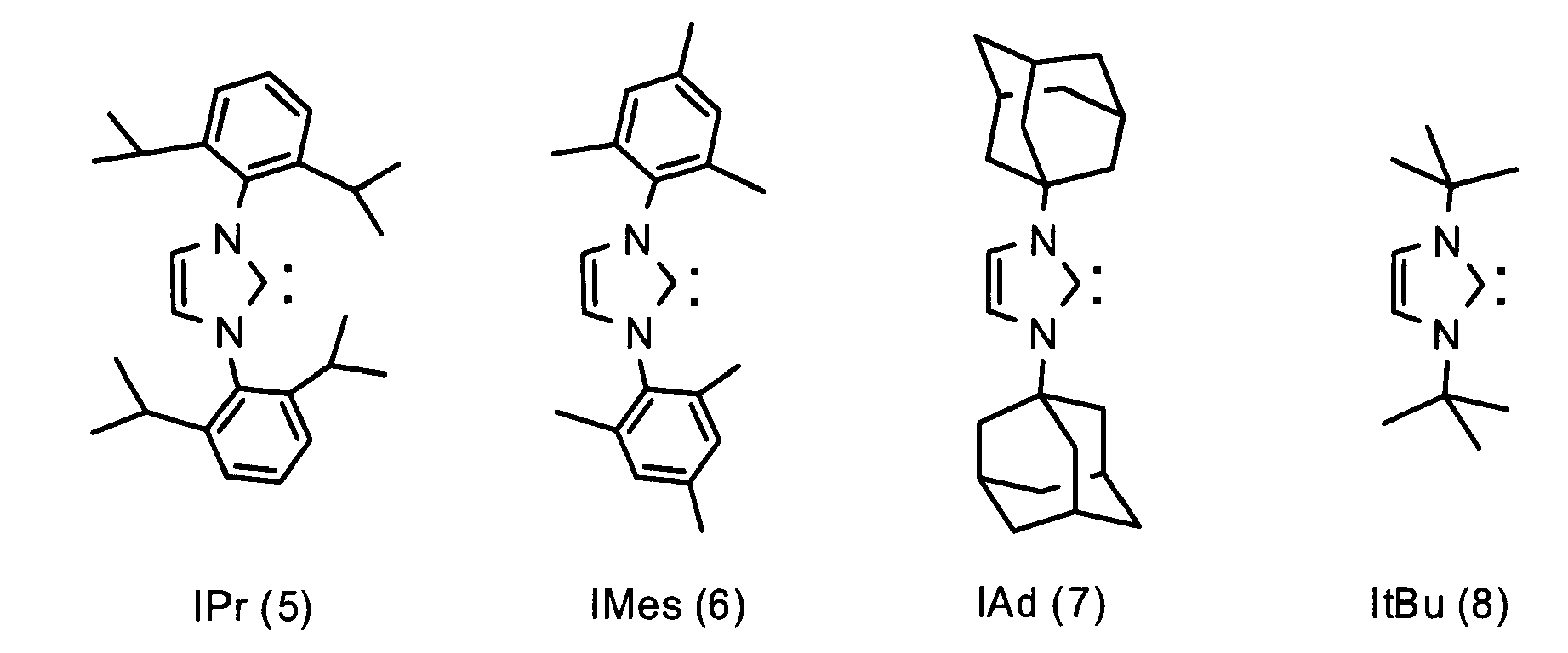
- Each of R 1 and R 2 is especially preferably a tert-butyl group, a 2,6-diisopropylphenyl group, a 2,4,6-trimethylphenyl group or an adamantyl group.
- Each of R 3 , R 4 , R 5 and R 6 is preferably a hydrogen atom or a halogen atom, especially preferably a hydrogen atom or a chlorine atom.
- nitrogen-containing heterocyclic carbene ligands (L) include compounds represented by the following formulae (5) to (14).
- X and L are as defined above and P represents a monodentate phosphine ligand, by reacting a substituted phenylethynylgold-phosphine complex represented by the general formula (Ia) or (Ib) with a nitrogen-containing heterocyclic carbene ligand (L).
- Examples of the monodentate phosphine ligands (P) include bis(pentafluorophenyl)phenylphosphine, (4-bromophenyl)diphenylphosphine, diallylphenylphosphine, dicyclohexylphenylphosphine, diethylphenylphosphine, 4-(dimethylamino)phenyldiphenylphosphine, dimethylphenylphosphine, diphenyl(2-methoxyphenyl)phosphine, diphenyl(pentafluorophenyl)phosphine, diphenylpropylphosphine, diphenyl-2-pyridylphosphine, diphenyl(p-tolyl)phosphine, diphenylvinylphosphine, ethyldiphenylphosphine, isopropyldiphenylphosphine, methyldiphenyl
- X and P are as defined above and Y represents a halogen atom, by reacting a gold-halogenophosphine complex with a substituted phenylethyn (see, for example, Journal of Chemical Society, Dalton Trans., 1986, 411 ).
- the gold-halogenophosphine complex can be synthesized by a known method (see, for example, Lecture on Experimental Chemistry, Fourth edition, published by Maruzen Co., Ltd., page 455, vol. 18 (1991 )).
- nitrogen-containing heterocyclic carbene ligand a product commercially available may be directly used or, for example, a product synthesized by a known method may be used (see, for example, J. Am. Chem. Soc., 114, 5530 (1992 ) and WO 98/27064 ).
- X is as defined above, by a known method (for example, Journal of Organic Chemistry, 1985, vol. 50, 1763 ) from the corresponding substituted phenyl bromide.
- the substituted phenylethyn compound can be synthesized by deriving an ethynyl substituted aromatic carboxylic acid ( JP 3-227954A ) and then deriving the carboxyl group into various carboxylic acid derivatives ( Lecture on Experimental Chemistry, Fourth edition, published by Maruzen Co., Ltd., vol. 22, Organic Synthesis IV ).
- the amount of the nitrogen-containing heterocyclic carbene ligand used is preferably 1 to 3 mol, further preferably 1 to 1.5 mol relative to 1 mol of the substituted phenylethynylgold-phosphine complex.
- the solvent used in the synthesis of the substituted phenylethynylgold-nitrogen-containing heterocyclic carbene complex of the present invention there is no particular limitation as long as the solvent does not inhibit the reaction and there is used, for example, an ether such as tetrahydrofuran, furan, dioxane, tetrahydropyran, diethyl ether, diisopropyl ether and dibutyl ether, an aliphatic hydrocarbon such as pentane, hexane, heptane and octane; an aromatic hydrocarbon such as benzene, toluene and xylene; a halogenated aliphatic hydrocarbon such as dichloromethane, dichloroethane and dichloropropane; or a halogenated aromatic hydrocarbon such as chlorobenzene.
- an ether such as tetrahydrofuran, furan, dioxane, tetrahydropyran
- the amount of the solvent used is appropriately selected depending on a degree of uniformity or condition of stirring of the reaction mixture and is preferably 1 to 30 L, further preferably 5 to 20 L relative to 1 mol of the substituted phenylethynylgold-phosphine complex.
- the substituted phenylethynylgold-nitrogen-containing heterocyclic carbene complex of the present invention is synthesized by, for example, a method in which a substituted ethynylgold-phosphine complex, a nitrogen-containing heterocyclic carbene ligand (formed by reacting a nitrogen-containing heterocyclic hydrohalide with a base) and a solvent are mixed to effect a reaction while stirring.
- the reaction temperature is preferably 0 to 120°C, further preferably 20 to 100°C, and, with respect to the reaction pressure, there is no particular limitation.
- the substituted phenylethynylgold-nitrogen-containing heterocyclic carbene complex of the present invention is isolated and purified by a known method such as neutralization, extraction, filtration, concentration, distillation, recrystallization, sublimation or chromatography.
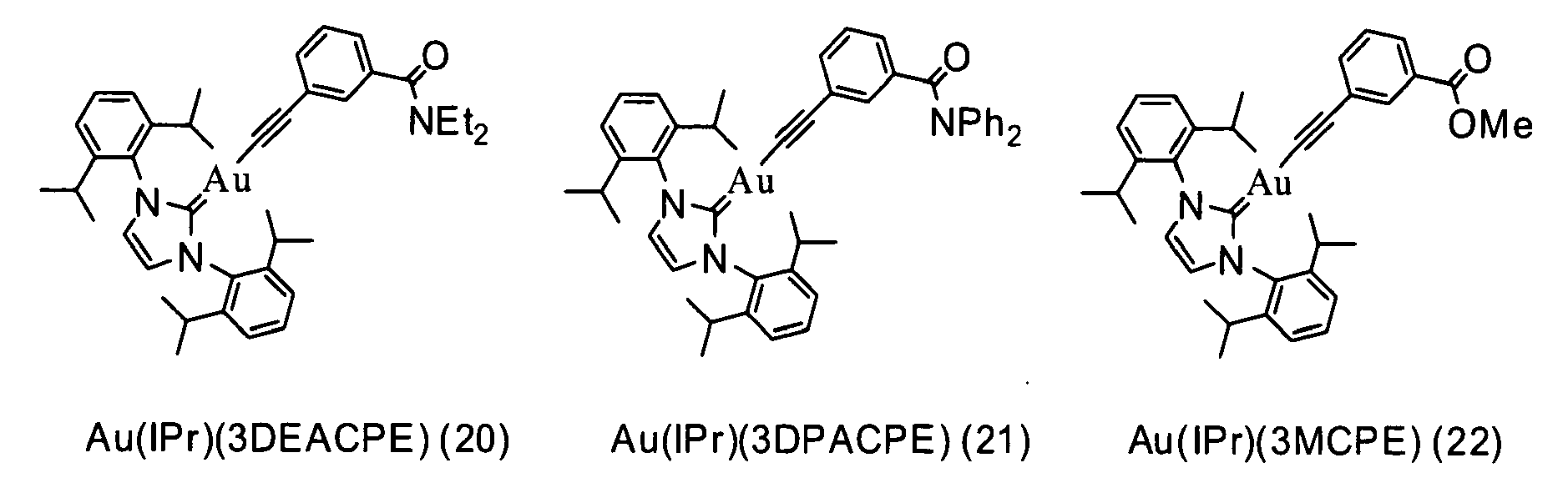
- Examples of the substituted phenylethynylgold-nitrogen-containing heterocyclic carbene complexes of the present invention include compounds represented by the following formulae (17) to (26).
- reaction mixture was subjected to filtration and the filtrate was added dropwise to another 30 ml Schlenk tube containing therein 3-benzoylphenylethynyl(triphenylphosphine)gold (340 mg, 0.51 mmol) and 10 ml of toluene.
- the reaction mixture was heated at 70°C for 3 hours.
- the resultant reaction mixture was cooled to room temperature and then toluene was added to the reaction mixture and the mixture was washed with water to make a pH thereof 7.
- the mixture was dried over sodium sulfate and the solvent was removed by distillation under reduced pressure using an evaporator.
- reaction mixture was subjected to filtration and the filtrate was added dropwise to another 30 ml Schlenk tube containing therein [3-(4'-fluorobenzoyl)phenylethynyl](triphenylphosphine)gold (320 mg, 0.47 mmol) and 10 ml of toluene.
- the reaction mixture was heated at 70°C for 3 hours.
- the resultant reaction mixture was cooled to room temperature and then toluene was added to the reaction mixture and the mixture was washed with water to make a pH thereof 7.
- the mixture was dried over sodium sulfate and the solvent was removed by distillation under reduced pressure using an evaporator.
- reaction mixture was subjected to filtration and the filtrate was added dropwise to another 30 ml Schlenk tube containing therein 3-acetylphenylethynyl(triphenylphosphine)gold (298 mg, 0.49 mmol) and 10 ml of toluene.
- the reaction mixture was heated at 70°C for 3 hours.
- the resultant reaction mixture was cooled to room temperature and then toluene was added to the reaction mixture and the mixture was washed with water to make a pH thereof 7.
- the mixture was dried over sodium sulfate and the solvent was removed by distillation under reduced pressure using an evaporator.
- reaction mixture was subjected to filtration and the filtrate was added dropwise to another 30 ml Schlenk tube containing therein 3-(diethylaminocarbonyl)phenylethynyl(triphenylphosphine)gold (356 mg, 0.54 mmol) and 11 ml of toluene.
- the reaction mixture was heated at 70°C for 3 hours.
- the resultant reaction mixture was cooled to room temperature and then toluene was added to the reaction mixture and the mixture was washed with water to make a pH thereof 7.
- the mixture was dried over sodium sulfate and the solvent was removed by distillation under reduced pressure using an evaporator.
- reaction mixture was subjected to filtration and the filtrate was added dropwise to another 30 ml Schlenk tube containing therein 3-(diphenylaminocarbonyl)phenylethynyl(triphenylphosphine)gold (356 mg, 0.54 mmol) and 12 ml of toluene.
- the reaction mixture was heated at 70°C for 3 hours.
- the resultant reaction mixture was cooled to room temperature and then toluene was added to the reaction mixture and the mixture was washed with water to make a pH thereof 7.
- the mixture was dried over sodium sulfate and the solvent was removed by distillation under reduced pressure using an evaporator.
- reaction mixture was subjected to filtration and the filtrate was added dropwise to another 30 ml Schlenk tube containing therein 3-(methoxycarbonyl)phenylethynyl-(triphenylphosphine)gold (315 mg, 0.51 mmol) and 10 ml of toluene.
- the reaction mixture was heated at 70°C for 3 hours.
- the resultant reaction mixture was cooled to room temperature and then toluene was added to the reaction mixture and the mixture was washed with water to make a pH thereof 7.
- the mixture was dried over sodium sulfate and the solvent was removed by distillation under reduced pressure using an evaporator.
- reaction mixture was subjected to filtration and the filtrate was added dropwise to another 30 ml Schlenk tube containing therein 3-(phenoxycarbonyl)phenylethynyl-(triphenylphosphine)gold (260 mg, 0.38 mmol) and 8 ml of toluene.
- the reaction mixture was heated at 70°C for 3 hours.
- the resultant reaction mixture was cooled to room temperature and then toluene was added to the reaction mixture and the mixture was washed with water to make a pH thereof 7.
- the mixture was dried over sodium sulfate and the solvent was removed by distillation under reduced pressure using an evaporator.
- reaction mixture was subjected to filtration and the filtrate was added dropwise to another 30 ml Schlenk tube containing therein 3-(methylmercaptocarbonyl)phenylethynyl(triphenylphosphine)gold (256 mg, 0.4 mmol) and 8 ml of toluene.
- the reaction mixture was heated at 70°C for 3 hours.
- the resultant reaction mixture was cooled to room temperature and then toluene was added to the reaction mixture and the mixture was washed with water to make a pH thereof 7.
- the mixture was dried over sodium sulfate and the solvent was removed by distillation under reduced pressure using an evaporator.
- reaction mixture was subjected to filtration and the filtrate was added dropwise to another 30 ml Schlenk tube containing therein 3-(phenylmercaptocarbonyl)phenylethynyl(triphenylphosphine)gold (260 mg, 0.37 mmol) and 8 ml of toluene.
- the reaction mixture was heated at 70°C for 3 hours.
- the resultant reaction mixture was cooled to room temperature and then toluene was added to the reaction mixture and the mixture was washed with water to make a pH thereof 7.
- the mixture was dried over sodium sulfate and the solvent was removed by distillation under reduced pressure using an evaporator.
- reaction mixture was subjected to filtration and the filtrate was added dropwise to another 30 ml Schlenk tube containing therein 2-benzoylphenylethynyl(triphenylphosphine)gold (335 mg, 0.50 mmol) and 10 ml of toluene.
- 2-benzoylphenylethynyl(triphenylphosphine)gold 335 mg, 0.50 mmol
- 10 ml of toluene 10 ml of toluene.
- the reaction mixture was heated at 70°C for 3 hours.
- the resultant reaction mixture was cooled to room temperature and then toluene was added to the reaction mixture and the mixture was washed with water to make a pH thereof 7.
- the mixture was dried over sodium sulfate and the solvent was removed by distillation under reduced pressure using an evaporator.
- each of the substituted phenylethynylgold-nitrogen-containing heterocyclic carbene complexes of the present invention has a melting point of 200°C or higher, which suggests that the complex is advantageously used as an organic electroluminescent device.
- Air in a 15 ml Schlenk tube was replaced by Ar gas and 1.57 g (6 mmol) of 3-bromobenzophenone, 70 mg (0.06 mmol) of tetrakis(triphenylphosphine)palladium, 6 ml of piperidine and 640 ⁇ l (6.6 mmol) of 2-methyl-3-butyn-2-ol were added to the tube and the mixture was stirred at 100°C for 1.25 hours.
- a saturated aqueous ammonium chloride solution was added to the reaction mixture and the mixture was extracted with diethyl ether. The ether layer was dried over magnesium sulfate and the solvent was removed by distillation under reduced pressure using an evaporator.
- Air in a 15 ml Schlenk tube was replaced by Ar gas and 1.4 g (5 mmol) of 3-bromo-4'-fluorobenzophenone, 58 mg (0.05 mmol) of tetrakis(triphenylphosphine)palladium, 5 ml of 1-methylpiperidine and 533 ⁇ l (5.5 mmol) of 2-methyl-3-butyn-2-ol were added to the tube and the mixture was stirred at 100°C for 4.5 hours. A saturated aqueous ammonium chloride solution was added to the reaction mixture and the mixture was extracted with diethyl ether. The ether layer was dried over magnesium sulfate and the solvent was removed by distillation under reduced pressure using an evaporator.
- Air in a 30 ml Schlenk tube was replaced by Ar gas and 1.99 ml (15 mmol) of 3-bromoacetophenone, 173 mg (0.15 mmol) of tetrakis(triphenylphosphine)palladium, 15 ml of piperidine and 1.6 ml (16.5 mmol) of 2-methyl-3-butyn-2-ol were added to the tube and the mixture was stirred at 100°C for 1.25 hours.
- a saturated aqueous ammonium chloride solution was added to the reaction mixture and the mixture was extracted with diethyl ether. The ether layer was dried over magnesium sulfate and the solvent was removed by distillation under reduced pressure using an evaporator.
- Air in a 20 ml Schlenk tube was replaced by Ar gas and 1.02 g (7 mmol) of m-ethynylbenzoic acid and 5 g (42 mmol) of thionyl chloride were added to the tube and the mixture was stirred at 50°C for 2 hours and then excess thionyl chloride was removed by distillation under reduced pressure to obtain m-ethynylbenzoyl chloride.
- To the m-ethynylbenzoyl chloride obtained was added a solution having 1.49 ml (14.4 mmol) of diethylamine dissolved in 7 ml of dichloromethane under ice-cooling and then the resultant mixture was stirred at room temperature for one hour.
- Air in a 20 ml Schlenk tube was replaced by Ar gas and 1.02 g (7 mmol) of m-ethynylbenzoic acid and 5 g (42 mmol) of thionyl chloride were added to the tube and the mixture was stirred at 50°C for 2 hours and then excess thionyl chloride was removed by distillation under reduced pressure to obtain m-ethynylbenzoyl chloride.
- To the m-ethynylbenzoyl chloride obtained was added a solution having 2.44 g (14.4 mmol) of diphenylamine dissolved in 7 ml of dichloromethane under ice-cooling and then the resultant mixture was stirred at room temperature for one hour.
- Air in a 20 ml Schlenk tube was replaced by Ar gas and 1.02 g (7 mmol) of m-ethynylbenzoic acid and 5 g (42 mmol) of thionyl chloride were added to the tube and the mixture was stirred at 50°C for 2 hours and then excess thionyl chloride was removed by distillation under reduced pressure to obtain m-ethynylbenzoyl chloride.
- Air in a 20 ml Schlenk tube was replaced by Ar gas and 1.02 g (7 mmol) of m-ethynylbenzoic acid and 5 g (42 mmol) of thionyl chloride were added to the tube and the mixture was stirred at 50°C for 2 hours and then excess thionyl chloride was removed by distillation under reduced pressure to obtain m-ethynylbenzoyl chloride.
- Air in a 20 ml Schlenk tube was replaced by Ar gas and 1.02 g (7 mmol) of m-ethynylbenzoic acid and 5 g (42 mmol) of thionyl chloride were added to the tube and the mixture was stirred at 50°C for 2 hours and then excess thionyl chloride was removed by distillation under reduced pressure to obtain m-ethynylbenzoyl chloride. To the m-ethynylbenzoyl chloride obtained was added 7 ml of dichloromethane and the resultant mixture was ice-cooled. Then, 515 mg (7.35 mmol) of sodium methanethiolate was added to the mixture and the mixture was stirred at room temperature for 3 hours.
- Air in a 20 ml Schlenk tube was replaced by Ar gas and 1.02 g (7 mmol) of m-ethynylbenzoic acid and 5 g (42 mmol) of thionyl chloride were added to the tube and the mixture was stirred at 50°C for 2 hours and then excess thionyl chloride was removed by distillation under reduced pressure to obtain m-ethynylbenzoyl chloride. To the m-ethynylbenzoyl chloride obtained was added 7 ml of THF and the resultant mixture was ice-cooled. Then, 971 mg (7.35 mmol) of sodium benzenethiol was added to the mixture and the resultant mixture was stirred at room temperature for 2 hours.
- Air in a 15 ml Schlenk tube was replaced by Ar gas and 2.61 g (10 mmol) of 2-bromobenzophenone, 231 mg (0.2 mmol) of tetrakis(triphenylphosphine)palladium, 10 ml of piperidine and 1.9 ml (20 mmol) of 2-methyl-3-butyn-2-ol were added to the tube and the mixture was stirred at 100°C for one hour. A saturated aqueous ammonium chloride solution was added to the reaction mixture and the mixture was extracted with diethyl ether. The ether layer was dried over magnesium sulfate and the solvent was removed by distillation under reduced pressure using an evaporator.
- the substituted phenylethynylgold-nitrogen-containing heterocyclic carbene complex of the present invention is advantageously used as, e.g., a luminescent material for electroluminescent device (organic electroluminescent device).
- the substituted phenylethynylgold-nitrogen-containing heterocyclic carbene complex is advantageously used as, e.g., a luminescent material for organic electroluminescent device, having luminescence in a blue wavelength range of 460 nm or less essential to realize a full-color display and having a high melting point of 200°C or more such that the material can endure Joulean heat generated in the application of a voltage.
Landscapes
- Chemical & Material Sciences (AREA)
- Organic Chemistry (AREA)
- Engineering & Computer Science (AREA)
- Materials Engineering (AREA)
- Crystallography & Structural Chemistry (AREA)
- Inorganic Chemistry (AREA)
- Electroluminescent Light Sources (AREA)
Abstract

Description
- The present invention relates to a substituted phenylethynylgold-nitrogen-containing heterocyclic carbene complex advantageously used as, e.g., a luminescent material for electroluminescent device (organic electroluminescent device).
- An organic electroluminescent device has recently attracted attention as a display device for high-performance flat color display. With respect to the luminescent material, a fluorescent material utilizing luminescence from the excitation singlet state of an emitting molecule is mainly used, and, for further improving the emission efficiency, the development of a phosphorescent material utilizing luminescence from the excitation triplet state is being vigorously made. However, the substituted ethynylgold-nitrogen-containing heterocyclic carbene complex of the present invention has not been known.
- Accordingly, a task of the present invention is to provide a nonionic compound, advantageously used as, e.g., a luminescent material for organic luminescent device, having luminescence in a blue wavelength range of 460 nm or less essential to realize a full-color display and having a high melting point of 200°C or more such that the material can endure Joulean heat generated in the application of a voltage.
- The above task of the present invention is achieved by a substituted phenylethynylgold-nitrogen-containing heterocyclic carbene complex represented by the following general formula (1) or (2):
-


- wherein L represents a nitrogen-containing heterocyclic carbene ligand and X represents an alkyl group, a cycloalkyl group, an aryl group, an aralkyl group, a heterocyclic group, an alkoxy group, an aryloxy group, an alkylmercapto group, an arylmercapto group or a substituted amino group; and one or a plural number of hydrogen atoms on the carbon atom(s) of X are independently optionally replaced by a halogen atom, an alkyl group, a cycloalkyl group, an alkenyl group, an aryl group, an aralkyl group, an alkoxy group, an aryloxy group, an alkylmercapto group, an arylmercapto group or a substituted amino group.
- According to the present invention, there can be provided a substituted phenylethynylgold-nitrogen-containing heterocyclic carbene complex advantageously used as, e.g., a luminescent material for organic electroluminescent device.
- The substituted phenylethynylgold-nitrogen-containing heterocyclic carbene complex of the present invention is represented by the general formula (1) or (2) above. In the general formula (1) or (2), L represents a nitrogen-containing heterocyclic carbene ligand. X represents an alkyl group, a cycloalkyl group, an aryl group, an aralkyl group, a heterocyclic group, an alkoxy group, an aryloxy group, an alkylmercapto group, an arylmercapto group or a substituted amino group.
- With respect to the alkyl group, preferred is an alkyl group having 1 to 10 carbon atoms and examples include a methyl group, an ethyl group, a propyl group, a butyl group, a pentyl group, a hexyl group, a heptyl group, an octyl group, a nonyl group and a decyl group. Especially preferred is an alkyl group having 1 to 6 carbon atoms. These substituents include their isomers.
- With respect to the cycloalkyl group, preferred is a cycloalkyl group having 3 to 12 carbon atoms and examples include a cyclopropyl group, a cyclobutyl group, a cyclopentyl group, a cyclohexyl group, a cycloheptyl group, a cyclooctyl group, a cyclononyl group, a cyclodecyl group, a cycloundecyl group and a cyclododecyl group.
- With respect to the aryl group, preferred is an aryl group having 6 to 18 carbon atoms and examples include a phenyl group, a tolyl group, a xylyl group, a biphenyl group, an indenyl group, a naphthyl group, a dimethylnaphthyl group, an anthryl group, a phenanthryl group, a fluorenyl group, a pyrenyl group, a chrysenyl group and a naphthacenyl group. Especially preferred is an aryl group having 6 to 14 carbon atoms. These substituents include their isomers.
- With respect to the aralkyl group, preferred is an aralkyl group having 7 to 20 carbon atoms and examples include a benzyl group, a phenethyl group, a naphthylmethyl group, an indenylmethyl group and a biphenylmethyl group.
- With respect to the heterocyclic group, preferred is a saturated or unsaturated cyclic group containing at least one heteroatom selected from N, O and S and being comprised of a 3- to 10-membered ring and examples include a pyrrolyl group, a furyl group, a thienyl group, an indolyl group, a benzofuranyl group, a benzothiophenyl group, a pyridyl group, a pyrazinyl group, a pyrimidinyl group, a pyridazinyl group, a quinolyl group, an isoquinolyl group, a quinazolinyl group and a quinoxalinyl group.
- With respect to the alkoxy group, preferred is an alkoxy group having 1 to 10 carbon atoms and examples include a methoxy group, an ethoxy group, a propoxy group, a butoxy group, a pentanoxy group, a hexanoxy group, a heptanoxy group, an octanoxy group, a nonanoxy group and a decanoxy group. Especially preferred is an alkoxy group having 1 to 6 carbon atoms. These substituents include their isomers.
- With respect to the aryloxy group, preferred is an aryloxy group having 6 to 14 carbon atoms and examples include a phenoxy group, a tolyloxy group, a xylyloxy group and a naphthoxy group. These substituents include their isomers.
- With respect to the alkylmercapto group, preferred is an alkylmercapto group having 1 to 6 carbon atoms and examples include a methylmercapto group, an ethylmercapto group, a propylmercapto group, a butylmercapto group, a pentylmercapto group and a hexylmercapto group. These substituents include their isomers.
- With respect to the arylmercapto group, preferred is an arylmercapto group having 6 to 14 carbon atoms and examples include a phenylmercapto group, a tolylmercapto group, a xylylmercapto group and a naphthylmercapto group. These substituents include their isomers.
- With respect to the substituted amino group, preferred is an amino group substituted with one group or two groups selected from an alkyl group having 1 to 6 carbon atoms, an aryl group having 6 to 14 carbon atoms and an aralkyl group having 7 to 20 carbon atoms. Particularly, examples include alkylamino groups having 1 to 6 carbon atoms such as a methylamino group, an ethylamino group, a propylamino group and a butylamino group, dialkylamino groups substituted with the same or different two alkyl groups each having 1 to 6 carbon atoms such as a dimethylamino group, a methylethylamino group, a diethylamino group and a dipropylamino group, arylamino groups having 6 to 14 carbon atoms such as a phenylamino group, a tolylamino group, a xylylamino group and a naphthylamino group, diarylamino groups substituted with the same or different two aryl groups each having 6 to 14 carbon atoms such as a diphenylamino group, a ditolylamino group and a dixylylamino group, aralkylamino groups having 7 to 20 carbon atoms such as a benzylamino group and a phenethylamino group, and diaralkylamino groups substituted with the same or different two aralkyl groups each having 7 to 20 carbon atoms such as a dibenzylamino group. These substituents include their isomers.
- One or a plural number of hydrogen atoms on the carbon atom(s) of X are independently optionally replaced by a halogen atom, an alkyl group, a cycloalkyl group, an alkenyl group, an aryl group, an aralkyl group, an alkoxy group, an aryloxy group, an alkylmercapto group, an arylmercapto group or a substituted amino group.
- Examples of the halogen atoms include a fluorine atom, a chlorine atom, a bromine atom and an iodine atom.
- With respect to the alkyl group, preferred is an alkyl group having 1 to 20 carbon atoms, especially 1 to 12 carbon atoms and examples include a methyl group, an ethyl group, a propyl group, a butyl group, a pentyl group, a hexyl group, a heptyl group, an octyl group, a nonyl group, a decyl group, an undecyl group and a dodecyl group. Especially preferred is an alkyl group having 1 to 6 carbon atoms. These substituents include their isomers.
- With respect to the cycloalkyl group, especially preferred is a cycloalkyl group having 3 to 7 carbon atoms and examples include a cyclopropyl group, a cyclobutyl group, a cyclopentyl group, a cyclohexyl group, a cyclopentyl group, a cyclohexyl group and a cycloheptyl group.
- With respect to the alkenyl group, preferred is an alkenyl group having 2 to 20 carbon atoms, especially 2 to 12 carbon atoms and examples include a vinyl group, a propenyl group, a butenyl group, a pentenyl group, a hexenyl group, a heptenyl group, an octenyl group, a nonenyl group, a decenyl group, an undecenyl group and a dodecenyl group. These substituents include their isomers.
- With respect to the aryl group, preferred is an aryl group having 6 to 20 carbon atoms, especially 6 to 16 carbon atoms and examples include a phenyl group, a tolyl group, a xylyl group, a naphthyl group, a dimethylnaphthyl group, an anthryl group, a phenanthryl group, a fluorenyl group and a pyrenyl group. These substituents include their isomers.
- With respect to the aralkyl group, preferred is an aralkyl group having 7 to 20 carbon atoms and examples include a benzyl group, a phenethyl group, a naphthylmethyl group, an indenylmethyl group and a biphenylmethyl group.
- With respect to the alkoxy group, especially preferred is an alkoxy group having 1 to 10 carbon atoms and examples include a methoxy group, an ethoxy group, a propoxy group, a butoxy group, a pentanoxy group, a hexanoxy group, a heptanoxy group, an octanoxy group, a nonanoxy group and a decanoxy group. These substituents include their isomers.
- With respect to the aryloxy group, especially preferred is an aryloxy group having 6 to 14 carbon atoms and examples include a phenoxy group, a tolyloxy group, a xylyloxy group and a naphthoxy group. These substituents include their isomers.
- With respect to the alkylmercapto group, preferred is an alkylmercapto group having 1 to 6 carbon atoms and examples include a methylmercapto group, an ethylmercapto group, a propylmercapto group, a butylmercapto group, a pentylmercapto group and a hexylmercapto group. These substituents include their isomers.
- With respect to the arylmercapto group, preferred is an arylmercapto group having 6 to 14 carbon atoms and examples include a phenylmercapto group, a tolylmercapto group, a xylylmercapto group and a naphthylmercapto group. These substituents include their isomers.
- With respect to the substituted amino group, preferred is an amino group substituted with one group or two groups selected from an alkyl group having 1 to 6 carbon atoms, an aryl group having 6 to 14 carbon atoms and an aralkyl group having 7 to 20 carbon atoms. Particularly, examples include alkylamino groups having 1 to 6 carbon atoms such as a methylamino group, an ethylamino group, a propylamino group and a butylamino group, dialkylamino groups substituted with the same or different two alkyl groups each having 1 to 6 carbon atoms such as a dimethylamino group, a methylethylamino group, a diethylamino group and a dipropylamino group, arylamino groups having 6 to 14 carbon atoms such as a phenylamino group, a tolylamino group, a xylylamino group and a naphthylamino group, diarylamino groups substituted with the same or different two aryl groups each having 6 to 14 carbon atoms such as a diphenylamino group, a ditolylamino group and a dixylylamino group, aralkylamino groups having 7 to 20 carbon atoms such as a benzylamino group and a phenethylamino group, and diaralkylamino groups substituted with the same or different two aralkyl groups each having 7 to 20 carbon atoms such as a dibenzylamino group. These substituents include their isomers.
- When a plurality of hydrogen atoms on the carbon atom(s) of X are replaced by an alkyl group, an alkenyl group, an aryl group, an aralkyl group, an alkoxy group, an aryloxy group or a substituted amino group, the adjacent groups are optionally bonded together to form a ring.
- When the adjacent groups are bonded together to form a ring, examples of the rings formed include a cyclopentene ring, a cyclohexene ring, a cycloheptene ring, a benzene ring, a naphthalene ring, a tetrahydrofuran ring, a benzopyran ring, an N-methylpyrrolidine ring and an N-methylpiperidine ring.
- It is preferred that X is selected from an alkyl group having 1 to 6 carbon atoms, an aryl group having 6 to 14 carbon atoms, an alkoxy group having 1 to 6 carbon atoms, an aryloxy group having 6 to 14 carbon atoms, an alkylmercapto group having 1 to 6 carbon atoms, an arylmercapto group having 6 to 14 carbon atoms, a dialkylamino group substituted with the same or different two alkyl groups each having 1 to 6 carbon atoms and a diarylamino group substituted with the same or different two aryl groups each having 6 to 14 carbon atoms and one or a plural number of hydrogen atoms on the carbon atom(s) of X are independently optionally replaced by a fluorine atom, a chlorine atom, a bromine atom or an iodine atom. With respect to X, especially preferred is a methyl group, a phenyl group, a fluorophenyl group, a methoxy group, a phenoxy group, a methylmercapto group, a phenylmercapto group, a diethylamino group or a diphenylamino group.
- The nitrogen-containing heterocyclic carbene ligand is represented by the following general formula (3) or (4):
-

- wherein each of R1 and R2 independently represents an alkyl group, a cycloalkyl group, a polycycloalkyl group or an aryl group, and each of R3, R4, R5 and R6 independently represents a hydrogen atom, a halogen atom, an alkyl group, an alkenyl group, an aryl group, an aralkyl group, an alkoxy group, an aryloxy group, a nitro group, a cyano group or a dialkylamino group, the adjacent groups in R3, R4, R5 and R6 are optionally bonded together, so that the adjacent groups and the carbon atom(s) to which the groups are bonded together form a ring; and, when R1 to R6 represent a group containing a carbon atom(s), one or a plural number of hydrogen atoms on the carbon atom(s) of the group are optionally replaced by a halogen atom, an alkyl group, a cycloalkyl group, an alkenyl group, an aryl group, an aralkyl group, an alkoxy group or an aryloxy group.
- In the general formula (3) or (4), each of R1 and R2 represents an alkyl group, a cycloalkyl group, a polycycloalkyl group or an aryl group and the alkyl group, cycloalkyl group and aryl group are as defined above for those by which the hydrogen atom(s) on the carbon atom(s) of X is(are) optionally replaced.
- With respect to the polycycloalkyl group, preferred is a polycycloalkyl group having 6 to 10 carbon atoms and examples include a bicyclo-[2.1.1]-hexyl group, a bicyclo-[2.2.1]-heptyl group, a bicyclo-[2.2.2]-octyl group, a bicyclo-[3.3.0]-octyl group, a bicyclo-[4.3.0]-nonyl group, a bicyclo-[4.4.0]-octyl group and an adamantyl group.
- Each of R3, R4, R5 and R6 represents a hydrogen atom, a halogen atom, an alkyl group, an alkenyl group, an aryl group, an aralkyl group, an alkoxy group, an aryloxy group, a nitro group, a cyano group or a dialkylamino group and the alkyl group, alkenyl group, aryl group, aralkyl group, alkoxy group, aryloxy group and dialkylamino group are as defined above for those by which the hydrogen atom(s) on the carbon atom(s) of X is(are) optionally replaced.
- The adjacent groups in R3, R4, R5 and R6 are optionally bonded together, so that the adjacent groups and the carbon atom(s) to which the groups are bonded together form a ring. In the general formula (3), when R3 and R4 and the carbon atoms to which they are bonded together form a ring, examples of the rings formed include carbon rings having 5 to 10 carbon atoms such as a cyclopentene ring, a cyclohexene ring, a cycloheptene ring, a benzene ring and a naphthalene ring. In the general formula (4), when R3 (or R4) and R5 (or R6) and the carbon atoms to which they are bonded together form a ring, examples of the rings formed include carbon rings having 5 to 10 carbon atoms such as a cyclopentane ring, a cyclohexane ring, a cycloheptane ring, a benzene ring and a naphthalene ring.
- When R1 to R6 represent a group containing a carbon atom(s), one or a plural number of hydrogen atoms on the carbon atom(s) of the group are optionally replaced by a halogen atom, an alkyl group, a cycloalkyl group, an alkenyl group, an aryl group, an aralkyl group, an alkoxy group or an aryloxy group and these groups are as defined above for those by which the hydrogen atom(s) on the carbon atom(s) of X is(are) optionally replaced. Of these, it is preferred that each of R1 and R2 is selected from an alkyl group having 1 to 6 carbon atoms, an aryl group having 6 to 14 carbon atoms and a polycycloalkyl group having 6 to 10 carbon atoms and one or a plural number of hydrogen atoms on the carbon atom(s) of the aryl group are independently optionally replaced by an alkyl group having 1 to 6 carbon atoms. Each of R1 and R2 is especially preferably a tert-butyl group, a 2,6-diisopropylphenyl group, a 2,4,6-trimethylphenyl group or an adamantyl group. Each of R3, R4, R5 and R6 is preferably a hydrogen atom or a halogen atom, especially preferably a hydrogen atom or a chlorine atom.
- In the present invention, specific examples of the nitrogen-containing heterocyclic carbene ligands (L) include compounds represented by the following formulae (5) to (14).
-


- The substituted phenylethynylgold-nitrogen-containing heterocyclic carbene complex represented by the general formula (1) or (2) of the present invention is obtained as shown in, for example, the following reaction scheme (1):
-

- wherein X and L are as defined above and P represents a monodentate phosphine ligand,
by reacting a substituted phenylethynylgold-phosphine complex represented by the general formula (Ia) or (Ib) with a nitrogen-containing heterocyclic carbene ligand (L). - Examples of the monodentate phosphine ligands (P) include bis(pentafluorophenyl)phenylphosphine, (4-bromophenyl)diphenylphosphine, diallylphenylphosphine, dicyclohexylphenylphosphine, diethylphenylphosphine, 4-(dimethylamino)phenyldiphenylphosphine, dimethylphenylphosphine, diphenyl(2-methoxyphenyl)phosphine, diphenyl(pentafluorophenyl)phosphine, diphenylpropylphosphine, diphenyl-2-pyridylphosphine, diphenyl(p-tolyl)phosphine, diphenylvinylphosphine, ethyldiphenylphosphine, isopropyldiphenylphosphine, methyldiphenylphosphine, tribenzylphosphine, tributylphosphine, tri-t-butylphosphine, tricyclohexylphosphine, tricyclopentylphosphine, triethylphosphine, tri-2-furylphosphine, triisobutylphosphine, triisopropylphosphine, tripropylphosphine, trimethylphosphine, trioctylphosphine, triphenylphosphine, tris(4-chlorophenyl)phosphine, tris(3-chlorophenyl)phosphine, tris(2,6-dimethoxyphenyl)phosphine, tris(4-fluorophenyl)phosphine, tris(3-fluorophenyl)phosphine, tris(4-methoxyphenyl)phosphine, tris(3-methoxyphenyl)phosphine, tris(2-methoxyphenyl)phosphine, tris(4-trifluoromethylphenyl)phosphine, tris(pentafluorophenyl)phosphine, tris(2,4,6-trimethoxyphenyl)phosphine, tris(2,4,6-trimethylphenyl)phosphine, tri-m-tolylphosphine, tri-o-tolylphosphine, tri-p-tolylphosphine, benzyldiphenylphosphine, bis(2-methoxyphenyl)phenylphosphine, diphenylcyclohexylphosphine, 2-(di-t-butylphosphino)biphenyl, 2-(dicyclohexylphosphino)biphenyl, neomenthyldiphenylphosphine, p-tolyldiphenylphosphine, triallylphosphine, tris(2,4,4-trimethylpentyl)phosphine, tri(1-naphthyl)phosphine, tris(hydroxymethyl)phosphine and tris(hydroxypropyl)phosphine. With respect to the monodentate phosphine ligand, a product commercially available can be directly used.
- The substituted phenylethynylgold-phosphine complex is obtained as shown in, for example, the following reaction scheme (2):
-

- wherein X and P are as defined above and Y represents a halogen atom,
by reacting a gold-halogenophosphine complex with a substituted phenylethyn (see, for example, Journal of Chemical Society, Dalton Trans., 1986, 411). - The gold-halogenophosphine complex can be synthesized by a known method (see, for example, Lecture on Experimental Chemistry, Fourth edition, published by Maruzen Co., Ltd., page 455, vol. 18 (1991)).
- With respect to the nitrogen-containing heterocyclic carbene ligand, a product commercially available may be directly used or, for example, a product synthesized by a known method may be used (see, for example, J. Am. Chem. Soc., 114, 5530 (1992) and
WO 98/27064 - The substituted phenylethyn compound represented by the general formula (15) or (16):
-


- wherein X is as defined above,
can be synthesized as shown in, for example, the following reaction scheme (3): -

- wherein X is as defined above,
by a known method (for example, Journal of Organic Chemistry, 1985, vol. 50, 1763) from the corresponding substituted phenyl bromide.
Alternatively, the substituted phenylethyn compound can be synthesized by deriving an ethynyl substituted aromatic carboxylic acid (JP 3-227954A - In the synthesis of the substituted phenylethynylgold-nitrogen-containing heterocyclic carbene complex of the present invention, the amount of the nitrogen-containing heterocyclic carbene ligand used is preferably 1 to 3 mol, further preferably 1 to 1.5 mol relative to 1 mol of the substituted phenylethynylgold-phosphine complex.
- With respect to the solvent used in the synthesis of the substituted phenylethynylgold-nitrogen-containing heterocyclic carbene complex of the present invention, there is no particular limitation as long as the solvent does not inhibit the reaction and there is used, for example, an ether such as tetrahydrofuran, furan, dioxane, tetrahydropyran, diethyl ether, diisopropyl ether and dibutyl ether, an aliphatic hydrocarbon such as pentane, hexane, heptane and octane; an aromatic hydrocarbon such as benzene, toluene and xylene; a halogenated aliphatic hydrocarbon such as dichloromethane, dichloroethane and dichloropropane; or a halogenated aromatic hydrocarbon such as chlorobenzene. These solvents can be used individually or in combination.
- The amount of the solvent used is appropriately selected depending on a degree of uniformity or condition of stirring of the reaction mixture and is preferably 1 to 30 L, further preferably 5 to 20 L relative to 1 mol of the substituted phenylethynylgold-phosphine complex.
- The substituted phenylethynylgold-nitrogen-containing heterocyclic carbene complex of the present invention is synthesized by, for example, a method in which a substituted ethynylgold-phosphine complex, a nitrogen-containing heterocyclic carbene ligand (formed by reacting a nitrogen-containing heterocyclic hydrohalide with a base) and a solvent are mixed to effect a reaction while stirring. In this method, the reaction temperature is preferably 0 to 120°C, further preferably 20 to 100°C, and, with respect to the reaction pressure, there is no particular limitation.
- After completion of the reaction, the substituted phenylethynylgold-nitrogen-containing heterocyclic carbene complex of the present invention is isolated and purified by a known method such as neutralization, extraction, filtration, concentration, distillation, recrystallization, sublimation or chromatography.
- Examples of the substituted phenylethynylgold-nitrogen-containing heterocyclic carbene complexes of the present invention include compounds represented by the following formulae (17) to (26).
-



- The values for physical properties described in the Examples below suggest that the substituted phenylethynylgold-nitrogen-containing heterocyclic carbene complex of the present invention is advantageously used as an organic electroluminescent device.
- Hereinbelow, the present invention will be described in more detail with reference to the following Examples, which should not be construed as limiting the scope of the present invention.
- In a 20 ml Schlenk tube in an argon atmosphere were charged 1,3-bis(2,6-diisopropylphenyl)imidazolium chloride (IPrH+Cl-; 285 mg, 0.67 mmol), potassium tert-butoxide (85% by mass reagent, 114 mg, 0.86 mmol) and tetrahydrofuran (10 ml) and the mixture was stirred at room temperature for 15 minutes and then tetrahydrofuran was removed by distillation under reduced pressure. To the resultant residue was added toluene (10 ml) and stirred at 70°C for 5 minutes. Then, the reaction mixture was subjected to filtration and the filtrate was added dropwise to another 30 ml Schlenk tube containing therein 3-benzoylphenylethynyl(triphenylphosphine)gold (340 mg, 0.51 mmol) and 10 ml of toluene. After completion of the dropwise addition, the reaction mixture was heated at 70°C for 3 hours. The resultant reaction mixture was cooled to room temperature and then toluene was added to the reaction mixture and the mixture was washed with water to make a pH thereof 7. The mixture was dried over sodium sulfate and the solvent was removed by distillation under reduced pressure using an evaporator. The crude reaction product was purified by column chromatography (Hexane/AcOEt=5/1 to 3/1) using silica gel and the resultant solids were washed with hexane and collected by filtration to obtain 0.29 g of a desired product in the form of white solid. (Yield: 72%)
- 1H-NMR (300 MHz, CDCl3) δ: 7.74-7.12 (m, 17H), 2.64-2.55 (sept, 4H), 1.37 (d, 12H), 1.21 (d, 12H)
EI-MS (M/Z): 790 (M)+
Emission spectral analysis (CHCl3, 77K, Ex 240 nm) λ (nm): 446 (max)
Thermal analysis: Melting point: 224°CElemental analysis Measured value C: 63.74, H: 5.58, N: 3.68 Theoretical value C: 63.79, H: 5.74, N: 3.54 - In a 20 ml Schlenk tube in an argon atmosphere were charged 1,3-bis(2,6-diisopropylphenyl)imidazolium chloride (IPrH+Cl-; 259 mg, 0.61 mmol), potassium tert-butoxide (85% by mass reagent, 104 mg, 0.79 mmol) and tetrahydrofuran (10 ml) and the mixture was stirred at room temperature for 15 minutes and then tetrahydrofuran was removed by distillation under reduced pressure. To the resultant residue was added toluene (10 ml) and stirred at 70°C for 5 minutes. Then, the reaction mixture was subjected to filtration and the filtrate was added dropwise to another 30 ml Schlenk tube containing therein [3-(4'-fluorobenzoyl)phenylethynyl](triphenylphosphine)gold (320 mg, 0.47 mmol) and 10 ml of toluene. After completion of the dropwise addition, the reaction mixture was heated at 70°C for 3 hours. The resultant reaction mixture was cooled to room temperature and then toluene was added to the reaction mixture and the mixture was washed with water to make a pH thereof 7. The mixture was dried over sodium sulfate and the solvent was removed by distillation under reduced pressure using an evaporator. The crude reaction product was purified by column chromatography (Hexane/AcOEt=5/1) using silica gel and the resultant solids were washed with hexane and collected by filtration to obtain 0.32 g of a desired product in the form of white solid. (Yield: 84%)
- 1H-NMR (300 MHz, CDCl3) δ: 7.76-7.07 (m, 16H), 2.62-2.56 (sept, 4H), 1.37 (d, 12H), 1.21 (d, 12H)
EI-MS (M/Z): 808 (M)+
Emission spectral analysis (CHCl3, 77K, Ex 240 nm) λ (nm): 442 (max)
Thermal analysis: Melting point: 224°CElemental analysis Measured value C: 62.35, H: 5.44, N: 3.44 Theoretical value C: 62.37, H: 5.48, N: 3.46 - In a 20 ml Schlenk tube in an argon atmosphere were charged 1,3-bis(2,6-diisopropylphenyl)imidazolium chloride (IPrH+Cl-; 272 mg, 0.64 mmol), potassium tert-butoxide (85% by mass reagent, 111 mg, 0.84 mmol) and tetrahydrofuran (10 ml) and the mixture was stirred at room temperature for 15 minutes and then tetrahydrofuran was removed by distillation under reduced pressure. To the resultant residue was added toluene (10 ml) and stirred at 70°C for 5 minutes. Then, the reaction mixture was subjected to filtration and the filtrate was added dropwise to another 30 ml Schlenk tube containing therein 3-acetylphenylethynyl(triphenylphosphine)gold (298 mg, 0.49 mmol) and 10 ml of toluene. After completion of the dropwise addition, the reaction mixture was heated at 70°C for 3 hours. The resultant reaction mixture was cooled to room temperature and then toluene was added to the reaction mixture and the mixture was washed with water to make a pH thereof 7. The mixture was dried over sodium sulfate and the solvent was removed by distillation under reduced pressure using an evaporator. The crude reaction product was purified by column chromatography (Hexane/AcOEt=5/1 to 3/1) using silica gel and the resultant solids were washed with hexane and collected by filtration to obtain 0.34 g of a desired product in the form of white solid. (Yield: 95%)
- 1H-NMR (300 MHz, CDCl3) δ: 7.88-7.13 (m, 12H), 2.65-2.49 (sept, 4H), 2.49 (s, 3H), 1.44 (d, 12H), 1.21 (d, 12H)
EI-MS (M/Z): 728 (M)+
Emission spectral analysis (CHCl3, 77K, Ex 240 nm) λ (nm): 440 (max)
Thermal analysis: Melting point: 224°CElemental analysis Measured value C: 60.73, H: 5.95, N: 3.97 Theoretical value C: 60.98, H: 5.95, N: 3.84 - In a 20 ml Schlenk tube in an argon atmosphere were charged 1,3-bis(2,6-diisopropylphenyl)imidazolium chloride (IPrH+Cl-; 298 mg, 0.70 mmol), potassium tert-butoxide (85% by mass reagent, 120 mg, 0.91 mmol) and tetrahydrofuran (11 ml) and the mixture was stirred at room temperature for 15 minutes and then tetrahydrofuran was removed by distillation under reduced pressure. To the resultant residue was added toluene (11 ml) and stirred at 70°C for 5 minutes. Then, the reaction mixture was subjected to filtration and the filtrate was added dropwise to another 30 ml Schlenk tube containing therein 3-(diethylaminocarbonyl)phenylethynyl(triphenylphosphine)gold (356 mg, 0.54 mmol) and 11 ml of toluene. After completion of the dropwise addition, the reaction mixture was heated at 70°C for 3 hours. The resultant reaction mixture was cooled to room temperature and then toluene was added to the reaction mixture and the mixture was washed with water to make a pH thereof 7. The mixture was dried over sodium sulfate and the solvent was removed by distillation under reduced pressure using an evaporator. The crude reaction product was purified by column chromatography (Hexane/AcOEt=5/1 to 1/1) using silica gel and the resultant solids were washed with hexane and collected by filtration to obtain 0.38 g of a desired product in the form of white solid. (Yield: 91%)
- 1H-NMR (300 MHz, CDCl3) δ: 7.52-7.03 (m, 12H), 3.31 (m, 4H), 2.65-2.54 (sept, 4H), 1.44 (d, 12H), 1.21 (d, 12H), 1.09 (m, 6H)
EI-MS (M/Z): 785 (M)+
Emission spectral analysis (CHCl3, 77K, Ex 240 nm) λ (nm): 421 (max)
Thermal analysis: Melting point: 218°CElemental analysis Measured value C: 61.02, H: 6.30, N: 5.32 Theoretical value C: 61.14, H: 6.41, N: 5.35 - In a 20 ml Schlenk tube in an argon atmosphere were charged 1,3-bis(2,6-diisopropylphenyl)imidazolium chloride (IPrH+Cl-; 319 mg, 0.75 mmol), potassium tert-butoxide (85% by mass reagent, 129 mg, 0.98 mmol) and tetrahydrofuran (12 ml) and the mixture was stirred at room temperature for 15 minutes and then tetrahydrofuran was removed by distillation under reduced pressure. To the resultant residue was added toluene (12 ml) and stirred at 70°C for 5 minutes. Then, the reaction mixture was subjected to filtration and the filtrate was added dropwise to another 30 ml Schlenk tube containing therein 3-(diphenylaminocarbonyl)phenylethynyl(triphenylphosphine)gold (356 mg, 0.54 mmol) and 12 ml of toluene. After completion of the dropwise addition, the reaction mixture was heated at 70°C for 3 hours. The resultant reaction mixture was cooled to room temperature and then toluene was added to the reaction mixture and the mixture was washed with water to make a pH thereof 7. The mixture was dried over sodium sulfate and the solvent was removed by distillation under reduced pressure using an evaporator. The crude reaction product was purified by column chromatography (Hexane/AcOEt=5/1) using silica gel and the resultant solids were washed with hexane and collected by filtration to obtain 0.48 g of a desired product in the form of white solid. (Yield: 95%)
- 1H-NMR (300 MHz, CDCl3) δ: 7.54-6.83 (m, 22H), 2.62-2.55 (sept, 4H), 1.37 (d, 12H), 1.21 (d, 12H)
EI-MS (M/Z): 881 (M)+
Emission spectral analysis (CHCl3, 77K, Ex 240 nm) λ (nm): 427 (max)
Thermal analysis: Melting point: 260°CElemental analysis Measured value C: 65.23, H: 5.62, N: 4.87 Theoretical value C: 65.37, H: 5.71, N: 4.76 - In a 20 ml Schlenk tube in an argon atmosphere were charged 1,3-bis(2,6-diisopropylphenyl)imidazolium chloride (IPrH+Cl-; 282 mg, 0.66 mmol), potassium tert-butoxide (85% by mass reagent, 114 mg, 0.86 mmol) and tetrahydrofuran (10 ml) and the mixture was stirred at room temperature for 15 minutes and then tetrahydrofuran was removed by distillation under reduced pressure. To the resultant residue was added toluene (10 ml) and stirred at 70°C for 5 minutes. Then, the reaction mixture was subjected to filtration and the filtrate was added dropwise to another 30 ml Schlenk tube containing therein 3-(methoxycarbonyl)phenylethynyl-(triphenylphosphine)gold (315 mg, 0.51 mmol) and 10 ml of toluene. After completion of the dropwise addition, the reaction mixture was heated at 70°C for 3 hours. The resultant reaction mixture was cooled to room temperature and then toluene was added to the reaction mixture and the mixture was washed with water to make a pH thereof 7. The mixture was dried over sodium sulfate and the solvent was removed by distillation under reduced pressure using an evaporator. The crude reaction product was purified by column chromatography (Hexane/AcOEt=5/1) using silica gel and the resultant solids were washed with hexane and collected by filtration to obtain 0.31 g of a desired product in the form of white solid. (Yield: 80%)
- 1H-NMR (300 MHz, CDCl3) δ: 7.98-7.12 (m, 12H), 3.83 (s, 3H), 2.67-2.54 (sept, 4H), 1.38 (d, 12H), 1.23 (d, 12H)
EI-MS (M/Z): 744 (M)+
Emission spectral analysis (CHCl3, 77K, Ex 240 nm) λ (nm): 426 (max)
Thermal analysis: Melting point: 205°CElemental analysis Measured value C: 59.75, H: 5.69, N: 3.77 Theoretical value C: 59.67, H: 5.82, N: 3.76 - In a 20 ml Schlenk tube in an argon atmosphere were charged 1,3-bis(2,6-diisopropylphenyl)imidazolium chloride (IPrH+Cl-; 212 mg, 0.50 mmol), potassium tert-butoxide (85% by mass reagent, 86 mg, 0.65 mmol) and tetrahydrofuran (8 ml) and the mixture was stirred at room temperature for 15 minutes and then tetrahydrofuran was removed by distillation under reduced pressure. To the resultant residue was added toluene (8 ml) and stirred at 70°C for 5 minutes. Then, the reaction mixture was subjected to filtration and the filtrate was added dropwise to another 30 ml Schlenk tube containing therein 3-(phenoxycarbonyl)phenylethynyl-(triphenylphosphine)gold (260 mg, 0.38 mmol) and 8 ml of toluene. After completion of the dropwise addition, the reaction mixture was heated at 70°C for 3 hours. The resultant reaction mixture was cooled to room temperature and then toluene was added to the reaction mixture and the mixture was washed with water to make a pH thereof 7. The mixture was dried over sodium sulfate and the solvent was removed by distillation under reduced pressure using an evaporator. The crude reaction product was purified by column chromatography (Hexane/AcOEt=5/1) using silica gel and the resultant solids were washed with hexane and collected by filtration to obtain 0.22 g of a desired product in the form of white solid. (Yield: 70%)
- 1H-NMR (300 MHz, CDCl3) δ: 8.16-7.13 (m, 17H), 2.63-2.56 (sept, 4H), 1.38 (d, 12H), 1.22 (d, 12H)
EI-MS (M/Z): 806 (M)+
Emission spectral analysis (CHCl3, 77K, Ex 240 nm) λ (nm): 427 (max)
Thermal analysis: Melting point: 224°CElemental analysis Measured value C: 62.17, H: 5.52, N: 3.48 Theoretical value C: 62.53, H: 5.62, N: 3.47 - In a 20 ml Schlenk tube in an argon atmosphere were charged 1,3-bis(2,6-diisopropylphenyl)imidazolium chloride (IPrH+Cl-; 221 mg, 0.52 mmol), potassium tert-butoxide (85% by mass reagent, 90 mg, 0.68 mmol) and tetrahydrofuran (8 ml) and the mixture was stirred at room temperature for 15 minutes and then tetrahydrofuran was removed by distillation under reduced pressure. To the resultant residue was added toluene (8 ml) and stirred at 70°C for 5 minutes. Then, the reaction mixture was subjected to filtration and the filtrate was added dropwise to another 30 ml Schlenk tube containing therein 3-(methylmercaptocarbonyl)phenylethynyl(triphenylphosphine)gold (256 mg, 0.4 mmol) and 8 ml of toluene. After completion of the dropwise addition, the reaction mixture was heated at 70°C for 3 hours. The resultant reaction mixture was cooled to room temperature and then toluene was added to the reaction mixture and the mixture was washed with water to make a pH thereof 7. The mixture was dried over sodium sulfate and the solvent was removed by distillation under reduced pressure using an evaporator. The crude reaction product was purified by column chromatography (Hexane/AcOEt=5/1) using silica gel and the resultant solids were washed with hexane and collected by filtration to obtain 0.22 g of a desired product in the form of white solid. (Yield: 73%)
- 1H-NMR (300 MHz, CDCl3) δ: 7.91-7.13 (m, 12H), 2.67-2.54 (sept, 4H), 2.40 (s, 3H), 1.38 (d, 12H), 1.22 (d, 12H)
EI-MS (M/Z): 760 (M)+
Emission spectral analysis (CHCl3, 77K, Ex 240 nm) λ (nm) : 434 (max)
Thermal analysis: Melting point: 212°CElemental analysis Measured value C: 58.15, H: 5.70, N: 3.80 Theoretical value C: 58.41, H: 5.70, N: 3.68 - In a 20 ml Schlenk tube in an argon atmosphere were charged 1,3-bis(2,6-diisopropylphenyl)imidazolium chloride (IPrH+Cl-; 212 mg, 0.50 mmol), potassium tert-butoxide (85% by mass reagent, 206 mg, 0.49 mmol) and tetrahydrofuran (8 ml) and the mixture was stirred at room temperature for 15 minutes and then tetrahydrofuran was removed by distillation under reduced pressure. To the resultant residue was added toluene (8 ml) and stirred at 70°C for 5 minutes. Then, the reaction mixture was subjected to filtration and the filtrate was added dropwise to another 30 ml Schlenk tube containing therein 3-(phenylmercaptocarbonyl)phenylethynyl(triphenylphosphine)gold (260 mg, 0.37 mmol) and 8 ml of toluene. After completion of the dropwise addition, the reaction mixture was heated at 70°C for 3 hours. The resultant reaction mixture was cooled to room temperature and then toluene was added to the reaction mixture and the mixture was washed with water to make a pH thereof 7. The mixture was dried over sodium sulfate and the solvent was removed by distillation under reduced pressure using an evaporator. The crude reaction product was purified by column chromatography (Hexane/AcOEt=5/1) using silica gel and the resultant solids were washed with hexane and collected by filtration to obtain 0.17 g of a desired product in the form of white solid. (Yield: 56%)
- 1H-NMR (300 MHz, CDCl3) δ: 7.99-7.13 (m, 17H), 2.63-2.56 (sept, 4H), 1.39 (d, 12H), 1.22 (d, 12H)
EI-MS (M/Z): 822 (M)+
Emission spectral analysis (CHCl3, 77K, Ex 240 nm) λ (nm): 435 (max)
Thermal analysis: Melting point: 223°CElemental analysis Measured value C: 60.94, H: 5.49, N: 3.50 Theoretical value C: 61.30, H: 5.51, N: 3.40 - In a 20 ml Schlenk tube in an argon atmosphere were charged 1,3-bis(2,6-diisopropylphenyl)imidazolium chloride (IPrH+Cl-; 278 mg, 0.66 mmol), potassium tert-butoxide (85% by mass reagent, 112 mg, 0.85 mmol) and tetrahydrofuran (10 ml) and the mixture was stirred at room temperature for 15 minutes and then tetrahydrofuran was removed by distillation under reduced pressure. To the resultant residue was added toluene (10 ml) and stirred at 70°C for 5 minutes. Then, the reaction mixture was subjected to filtration and the filtrate was added dropwise to another 30 ml Schlenk tube containing therein 2-benzoylphenylethynyl(triphenylphosphine)gold (335 mg, 0.50 mmol) and 10 ml of toluene. After completion of the dropwise addition, the reaction mixture was heated at 70°C for 3 hours. The resultant reaction mixture was cooled to room temperature and then toluene was added to the reaction mixture and the mixture was washed with water to make a pH thereof 7. The mixture was dried over sodium sulfate and the solvent was removed by distillation under reduced pressure using an evaporator. The crude reaction product was purified by column chromatography (Hexane/AcOEt=5/1) using silica gel and the resultant solids were washed with hexane and collected by filtration to obtain 0.37 g of a desired product in the form of white solid. (Yield: 93%)
- 1H-NMR (300 MHz, CDCl3) δ: 7.67-7.06 (m, 17H), 2.53-2.44 (sept, 4H), 1.23 (d, 12H), 1.18 (d, 12H)
EI-MS (M/Z): 790 (M)+
Emission spectral analysis (CHCl3, 77K, Ex 240 nm) λ (nm): 457 (max)
Thermal analysis: Melting point: 242°CElemental analysis Measured value C: 63.77, H: 5.51, N: 3.54 Theoretical value C: 63.79, H: 5.74, N: 3.54 - With respect to each of the substituted phenylethynylgold-nitrogen-containing heterocyclic carbene complexes synthesized in Examples 1 to 10, an emission spectrum was measured by means of a fluorophotometer (in chloroform, at a temperature of 77K (kelvins), under ultraviolet light radiation). Each complex exhibited blue phosphorescence with the emission maximum wavelength of 421 to 457 nm on the CIE chromaticity coordinates (0.149, 0.085) to (0.153, 0.208).
The results of thermal analysis have confirmed that each of the substituted phenylethynylgold-nitrogen-containing heterocyclic carbene complexes of the present invention has a melting point of 200°C or higher, which suggests that the complex is advantageously used as an organic electroluminescent device. - Air in a 15 ml Schlenk tube was replaced by Ar gas and 1.57 g (6 mmol) of 3-bromobenzophenone, 70 mg (0.06 mmol) of tetrakis(triphenylphosphine)palladium, 6 ml of piperidine and 640 µl (6.6 mmol) of 2-methyl-3-butyn-2-ol were added to the tube and the mixture was stirred at 100°C for 1.25 hours.
A saturated aqueous ammonium chloride solution was added to the reaction mixture and the mixture was extracted with diethyl ether. The ether layer was dried over magnesium sulfate and the solvent was removed by distillation under reduced pressure using an evaporator. The resultant crude reaction product was purified by column chromatography (Hexane/AcOEt=5/1) using silica gel to obtain 1.46 g of 3-(3-hydroxy-3-methyl-1-butynyl)benzophenone which is a desired product as yellow liquid.
(Yield: 92%) - 1H-NMR (300 MHz, CDCl3) δ: 7.83-7.40 (m, 9H), 2.09 (s, 1H), 1.61 (s, 6H)
EI-MS (M/Z): 264 (M)+ - In a 100 ml two-necked flask having a reflux condenser were charged 1.45 g (5.5 mmol) of 3-(3-hydroxy-3-methyl-1-butynyl)benzophenone and 230 mg (5.8 mmol) of NaOH (Kishida Chemical Co., Ltd.; 0.7 mm particles, 98%) and air in the flask was replaced by Ar gas. 30 ml of toluene was added to the mixture and the mixture was heated at 120°C under reflux for 0.5 hour. Toluene was added to the reaction mixture and the mixture was washed with a saturated aqueous ammonium chloride solution and dried over magnesium sulfate and the solvent was removed by distillation under reduced pressure using an evaporator. The resultant crude reaction product was purified by column chromatography (Hexane/AcOEt=30/1) using silica gel to obtain 0.9 g of 3-ethynylbenzophenone as orange solid. (Yield: 80%)
- 1H-NMR (300 MHz, CDCl3) δ: 7.91-7.26 (m, 9H), 3.12 (s, 1H)
EI-MS (M/Z): 206 (M)+ - Air in a 15 ml Schlenk tube was replaced by Ar gas and 1.4 g (5 mmol) of 3-bromo-4'-fluorobenzophenone, 58 mg (0.05 mmol) of tetrakis(triphenylphosphine)palladium, 5 ml of 1-methylpiperidine and 533 µl (5.5 mmol) of 2-methyl-3-butyn-2-ol were added to the tube and the mixture was stirred at 100°C for 4.5 hours.
A saturated aqueous ammonium chloride solution was added to the reaction mixture and the mixture was extracted with diethyl ether. The ether layer was dried over magnesium sulfate and the solvent was removed by distillation under reduced pressure using an evaporator. The resultant crude reaction product was purified by column chromatography (Hexane/AcOEt=5/1) using silica gel to obtain 1.11 g of 4-fluoro-3'-(3-hydroxy-3-methyl-1-butynyl)benzophenone which is a desired product as orange crystal. (Yield: 79%) - 1H-NMR (300 MHz, CDCl3) δ: 7.83-7.15 (m, 8H), 2.15 (s, 1H), 1.62 (s, 6H)
EI-MS (M/Z): 282 (M)+ - In a 100 ml two-necked flask having a reflux condenser were charged 1.11 g (3.9 mmol) of 4-fluoro-3'-(3-hydroxy-3-methyl-1-butynyl)benzophenone and 165 mg (4.1 mmol) of NaOH (Kishida Chemical Co., Ltd.; 0.7 mm particles, 98%) and air in the flask was replaced by Ar gas. 20 ml of toluene was added to the mixture and the mixture was heated at 120°C under reflux for 0.5 hour. Toluene was added to the reaction mixture and the mixture was washed with a saturated aqueous ammonium chloride solution and dried over magnesium sulfate and the solvent was removed by distillation under reduced pressure using an evaporator. The resultant crude reaction product was purified by column chromatography (hexane/ AcOEt=10/1) using silica gel to obtain 0.5 g of 3-ethynyl-4'-fluorobenzophenone as yellow solid. (Yield: 53%)
- 1H-NMR (300 MHz, CDCl3) δ: 7.87-7.14 (m, 8H), 3.13 (s, 1H) EI-MS (M/Z): 224 (M)+
- Air in a 30 ml Schlenk tube was replaced by Ar gas and 1.99 ml (15 mmol) of 3-bromoacetophenone, 173 mg (0.15 mmol) of tetrakis(triphenylphosphine)palladium, 15 ml of piperidine and 1.6 ml (16.5 mmol) of 2-methyl-3-butyn-2-ol were added to the tube and the mixture was stirred at 100°C for 1.25 hours.
A saturated aqueous ammonium chloride solution was added to the reaction mixture and the mixture was extracted with diethyl ether. The ether layer was dried over magnesium sulfate and the solvent was removed by distillation under reduced pressure using an evaporator. The resultant crude reaction product was purified by column chromatography (Hexane/AcOEt=5/1) using silica gel to obtain 2.98 g of 3-(3-hydroxy-3-methyl-1-butynyl)acetophenone which is a desired product as orange liquid. (Yield: 98%) - 1H-NMR (300 MHz, CDCl3) δ: 8.00-7.38 (m, 4H), 2.59 (s, 3H), 2.13 (s, 1H), 1.63 (s, 6H)
EI-MS (M/Z): 202 (M)+ - In a 200 ml two-necked flask having a reflux condenser were charged 2.98 g (14.7 mmol) of 3-(3-hydroxy-3-methyl-1-butynyl)acetophenone and 0.62 g (15.4 mmol) of NaOH (Kishida Chemical Co., Ltd.; 0.7 mm particles, 98%) and air in the flask was replaced by Ar gas. 75 ml of toluene was added to the mixture and the mixture was heated at 120°C under reflux for 0.5 hour. Toluene was added to the reaction mixture and the mixture was washed with a saturated aqueous ammonium chloride solution and dried over magnesium sulfate and the solvent was removed by distillation under reduced pressure using an evaporator. The resultant crude reaction product was dissolved in 40 ml of hexane at 70°C and insoluble matter was removed by filtration and then the filtrate was cooled to obtain 3-ethynylacetophenone which is a desired product as white solid. (1.43 g; Yield: 67%)
- 1H-NMR (300 MHz, CDCl3) δ: 8.07-7.39 (m, 4H), 3.14 (s, 1H), 2.61 (s, 3H)
EI-MS (M/Z): 144 (M)+ - Air in a 20 ml Schlenk tube was replaced by Ar gas and 1.02 g (7 mmol) of m-ethynylbenzoic acid and 5 g (42 mmol) of thionyl chloride were added to the tube and the mixture was stirred at 50°C for 2 hours and then excess thionyl chloride was removed by distillation under reduced pressure to obtain m-ethynylbenzoyl chloride. To the m-ethynylbenzoyl chloride obtained was added a solution having 1.49 ml (14.4 mmol) of diethylamine dissolved in 7 ml of dichloromethane under ice-cooling and then the resultant mixture was stirred at room temperature for one hour. After completion of the stirring, dichloromethane was removed by distillation under reduced pressure and 35 ml of water was added to the resultant residue. The mixture was extracted with 35 ml of diethyl ether, the ether layer was dried over magnesium sulfate and the solvent was removed by distillation under reduced pressure using an evaporator. The resultant crude reaction product was purified by column chromatography (Hexane/AcOEt=5/1 to 3/1) using silica gel to obtain 1.3 g of 3-ethynyl-N,N-diethylbenzamide which is a desired product as pale yellow liquid. (Yield: 92%)
- 1H-NMR (300 MHz, CDCl3) δ: 7.76-7.22 (m, 4H), 3.54 (m, 2H), 3.25 (m, 2H), 3.11 (s, 1H), 1.26 (m, 3H) 1.11 (m, 3H)
EI-MS (M/Z): 201 (M)+ - Air in a 20 ml Schlenk tube was replaced by Ar gas and 1.02 g (7 mmol) of m-ethynylbenzoic acid and 5 g (42 mmol) of thionyl chloride were added to the tube and the mixture was stirred at 50°C for 2 hours and then excess thionyl chloride was removed by distillation under reduced pressure to obtain m-ethynylbenzoyl chloride. To the m-ethynylbenzoyl chloride obtained was added a solution having 2.44 g (14.4 mmol) of diphenylamine dissolved in 7 ml of dichloromethane under ice-cooling and then the resultant mixture was stirred at room temperature for one hour. After completion of the stirring, dichloromethane was removed by distillation under reduced pressure and 35 ml of water was added to the resultant residue. The mixture was extracted with 35 ml of ethyl acetate, the extract was dried over magnesium sulfate and the solvent was removed by distillation under reduced pressure using an evaporator. The resultant crude reaction product was purified by column chromatography (hexane/AcOEt=10/1) using silica gel to obtain 0.7 g of 3-ethynyl-N,N-diphenylbenzamide which is a desired product as pale yellow liquid.
(Yield: 35%) - 1H-NMR (300 MHz, CDCl3) δ: 7.63-6.91 (m, 14H), 3.03 (s, 1H) EI-MS (M/Z): 297 (M)+
- Air in a 20 ml Schlenk tube was replaced by Ar gas and 1.02 g (7 mmol) of m-ethynylbenzoic acid and 5 g (42 mmol) of thionyl chloride were added to the tube and the mixture was stirred at 50°C for 2 hours and then excess thionyl chloride was removed by distillation under reduced pressure to obtain m-ethynylbenzoyl chloride. To the m-ethynylbenzoyl chloride obtained was added a solution having 298 µl (7.35 mmol) of methanol and 3.4 ml (42 mmol) of pyridine dissolved in 7 ml of dichloromethane under ice-cooling and then the resultant mixture was stirred at room temperature for one hour. After completion of the stirring, dichloromethane was removed by distillation under reduced pressure and 35 ml of water was added to the resultant residue and extracted with 35 ml of diethyl ether. The ether layer was dried over magnesium sulfate and the solvent was removed by distillation under reduced pressure using an evaporator. The resultant crude reaction product was dissolved in 15 ml of hexane at 70°C, insoluble matter was removed by filtration and the filtrate was cooled to obtain 0.74 g of ethyl 3-ethynylbenzoate which is a desired product as yellow solid. (Yield: 66%)
- 1H-NMR (300 MHz, CDCl3) δ: 8.17-7.38 (m, 4H), 3.95 (s, 3H), 3.11 (s, 1H)
EI-MS (M/Z): 160 (M)+ - Air in a 20 ml Schlenk tube was replaced by Ar gas and 1.02 g (7 mmol) of m-ethynylbenzoic acid and 5 g (42 mmol) of thionyl chloride were added to the tube and the mixture was stirred at 50°C for 2 hours and then excess thionyl chloride was removed by distillation under reduced pressure to obtain m-ethynylbenzoyl chloride. To the m-ethynylbenzoyl chloride obtained was added a solution having 692 mg (7.35 mmol) of phenol and 3.4 ml (42 mmol) of pyridine dissolved in 7 ml of dichloromethane under ice-cooling and then the resultant mixture was stirred at room temperature for one hour. After completion of the stirring, dichloromethane was removed by distillation under reduced pressure and 35 ml of water was added to the resultant residue. The mixture was extracted with 35 ml of ethyl acetate, the extract was dried over magnesium sulfate and the solvent was removed by distillation under reduced pressure using an evaporator. The resultant crude reaction product was purified by column chromatography (Hexane/AcOEt=10/1) using silica gel to obtain 0.55 g of phenyl 3-ethynylbenzoate which is a desired product as yellow solid.
(Yield: 35%) - 1H-NMR (300 MHz, CDCl3) δ: 8.34-6.69 (m, 9H), 3.15 (s, 1H) EI-MS (M/Z): 222 (M)+
- Air in a 20 ml Schlenk tube was replaced by Ar gas and 1.02 g (7 mmol) of m-ethynylbenzoic acid and 5 g (42 mmol) of thionyl chloride were added to the tube and the mixture was stirred at 50°C for 2 hours and then excess thionyl chloride was removed by distillation under reduced pressure to obtain m-ethynylbenzoyl chloride. To the m-ethynylbenzoyl chloride obtained was added 7 ml of dichloromethane and the resultant mixture was ice-cooled. Then, 515 mg (7.35 mmol) of sodium methanethiolate was added to the mixture and the mixture was stirred at room temperature for 3 hours. After completion of the stirring, dichloromethane was removed by distillation under reduced pressure and 35 ml of water was added to the resultant residue. The mixture was extracted with 35 ml of ethyl acetate and the extract was dried over magnesium sulfate and the solvent was removed by distillation under reduced pressure using an evaporator. The resultant crude reaction product was purified by column chromatography (Hexane/AcOEt=10/1) using silica gel to obtain 0.49 g of S-methyl 3-ethynyl-thiobenzoate which is a desired product as yellow solid. (Yield: 40%)
- 1H-NMR (300 MHz, CDCl3) δ: 8.09-7.39 (m, 4H), 3.14 (s, 1H), 2.48 (s, 3H)
EI-MS (M/Z): 176 (M)+ - Air in a 20 ml Schlenk tube was replaced by Ar gas and 1.02 g (7 mmol) of m-ethynylbenzoic acid and 5 g (42 mmol) of thionyl chloride were added to the tube and the mixture was stirred at 50°C for 2 hours and then excess thionyl chloride was removed by distillation under reduced pressure to obtain m-ethynylbenzoyl chloride. To the m-ethynylbenzoyl chloride obtained was added 7 ml of THF and the resultant mixture was ice-cooled. Then, 971 mg (7.35 mmol) of sodium benzenethiol was added to the mixture and the resultant mixture was stirred at room temperature for 2 hours. After completion of the stirring, THF was removed by distillation under reduced pressure and 35 ml of water was added to the resultant residue. The mixture was extracted with 35 ml of ethyl acetate, the extract was dried over magnesium sulfate and the solvent was removed by distillation under reduced pressure using an evaporator. The resultant crude reaction product was purified by column chromatography (Hexane/AcOEt=20/1) using silica gel to obtain 0.51 g of S-phenyl 3-ethynyl-thiobenzoate which is a desired product as yellow solid. (Yield: 31%)
- 1H-NMR (300 MHz, CDCl3) δ: 8.15-7.39 (m, 9H), 3.16 (s, 1H) EI-MS (M/Z): 238 (M)+
- In a 30 ml Schlenk tube in an argon gas atmosphere were charged Au(PPh3)Cl (297 mg, 0.60 mmol), 3-ethynylbenzophenone (186 mg, 0.9 mmol) and ethanol (12 ml), and then sodium ethoxide (247 µl, 0.63 mmol: ethanol solution having a concentration of 2.55 mol/L (liter)) was added dropwise to the mixture and the mixture was stirred at room temperature for 17 hours. After completion of the reaction, the resultant white precipitate was collected by filtration, washed successively with ethanol (12 ml x 3 times), water (12 ml x 3 times) and ethanol (6 ml x 3 times), and subjected to vacuum drying to obtain 0.38 g of a desired compound as white powder. (Yield: 96%)
- 1H-NMR (300 MHz, CDCl3) δ: 7.88-7.26 (m, 24H)
FAB-MS (M/Z): 665 (M+H)+
Emission spectral analysis (CHCl3, 77K, Ex 240 nm) λ (nm) : 441 (max)Elemental analysis Measured value C: 59.57, H: 3.57 Theoretical value C: 59.65, H: 3.64 - In a 30 ml Schlenk tube in an argon atmosphere were charged Au(PPh3)Cl (297 mg, 0.60 mmol), 3-ethynyl-4'-fluorobenzophenone (202 mg, 0.9 mmol) and ethanol (12 ml), and then sodium ethoxide (247 µl, 0.63 mmol: ethanol solution having a concentration of 2.55 mol/L (liter)) was added dropwise to the mixture and the mixture was stirred at room temperature for 17 hours. After completion of the reaction, the resultant white precipitate was collected by filtration, washed successively with ethanol (12 ml x 3 times), water (12 ml x 3 times) and ethanol (6 ml x 3 times), and subjected to vacuum drying to obtain 0.36 g of a desired compound as white powder. (Yield: 89%)
- 1H-NMR (300 MHz, CDCl3) δ: 7.86-7.11 (m, 23H)
FAB-MS (M/Z): 683 (M+H)+
Emission spectral analysis (CHCl3, 77K, Ex 240 nm) λ (nm): 424 (max)Elemental analysis Measured value C: 58.26, H: 3.32 Theoretical value C: 58.08, H: 3.40 - In a 30 ml Schlenk tube in an argon atmosphere were charged Au(PPh3)Cl (297 mg, 0.60 mmol), 3-ethynylacetophenone (130 mg, 0.9 mmol) and ethanol (12 ml), and then sodium ethoxide (247 µl, 0.63 mmol: ethanol solution having a concentration of 2.55 mol/L (liter)) was added dropwise to the mixture and the mixture was stirred at room temperature for 17 hours. After completion of the reaction, the resultant white precipitate was collected by filtration, washed successively with ethanol (12 ml x 3 times), water (12 ml x 3 times) and ethanol (6 ml x 3 times), and subjected to vacuum drying to obtain 0.34 g of a desired compound as white powder. (Yield: 94%)
- 1H-NMR (300 MHz, CDCl3) δ: 8.09-7.26 (m, 19H), 2.57 (s, 3H)
FAB-MS (M/Z): 603 (M+H)+
Emission spectral analysis (CHCl3, 77K, Ex 240 nm) λ (nm): 434 (max)Elemental analysis Measured value C: 55.74, H: 3.73 Theoretical value C: 55.83, H: 3.68 - In a 30 ml Schlenk tube in an argon atmosphere were charged Au(PPh3)Cl (297 mg, 0.60 mmol), 3-ethynyl-N,N-diethylbenzamide (181 mg, 0.9 mmol) and ethanol (12 ml), and then sodium ethoxide (247 µl, 0.63 mmol: ethanol solution having a concentration of 2.55 mol/L (liter)) was added dropwise to the mixture and the mixture was stirred at room temperature for 17 hours. Ethanol was removed by distillation under reduced pressure and dichloromethane was added to the resultant residue. The mixture was washed with water and then dried over sodium sulfate, and the solvent was removed by distillation under reduced pressure using an evaporator to obtain 0.36 g of a desired compound as oil. (Yield: 90%)
- 1H-NMR (300 MHz, CDCl3) δ: 7.59-7.20 (m, 19H), 3.40 (d, 4H), 1.15 (d, 6H)
FAB-MS (M/Z): 660 (M+H)+ - In a 30 ml Schlenk tube in an argon atmosphere were charged Au(PPh3)Cl (297 mg, 0.60 mmol), 3-ethynyl-N,N-diphenylbenzamide (268 mg, 0.9 mmol) and ethanol (12 ml) and then sodium ethoxide (247 µl, 0.63 mmol: ethanol solution having a concentration of 2.55 mol/L (liter)) was added dropwise to the mixture and the mixture was stirred at room temperature for 17 hours. After completion of the reaction, the resultant white precipitate was collected by filtration, washed successively with ethanol (12 ml x 3 times), water (12 ml x 3 times) and ethanol (6 ml x 3 times), and subjected to vacuum drying to obtain 0.41 g of a desired compound as white powder. (Yield: 91%)
- 1H-NMR (300 MHz, CDCl3) δ: 7.67-7.06 (m, 29H)
FAB-MS (M/Z): 756 (M+H)+ - In a 30 ml Schlenk tube in an argon atmosphere were charged Au(PPh3)Cl (297 mg, 0.60 mmol), ethyl 3-ethynylbenzoate (181 mg, 0.9 mmol) and ethanol (12 ml) and then sodium methoxide (91 µl, 0.63 mmol: methanol solution having a concentration of 6.95 mol/L (liter)) was added dropwise to the mixture and the mixture was stirred at room temperature for 17 hours. After completion of the reaction, the resultant white precipitate was collected by filtration, washed successively with methanol (12 ml x 3 times), water (12 ml x 3 times) and methanol (6 ml x 3 times), and subjected to vacuum drying to obtain 0.33 g of a desired compound as white powder. (Yield: 88%)
- 1H-NMR (300 MHz, CDCl3) δ: 8.20-7.26 (m, 19H), 3.89 (s, 3H) FAB-MS (M/Z): 619 (M+H)+
- In a 30 ml Schlenk tube in an argon atmosphere were charged Au(PPh3)Cl (297 mg, 0.60 mmol), phenyl 3-ethynylbenzoate (200 mg, 0.9 mmol) and sodium t-butoxide (61 mg, 0.63 mmol), amyl alcohol (12 ml) was added to the mixture, and the resultant mixture was stirred at room temperature for 17 hours. After completion of the reaction, the resultant white precipitate was collected by filtration and washed successively with t-butanol (12 ml x 3 times), warm water (12 ml x 3 times) and ethanol (6 ml x 3 times) and subjected to vacuum drying to obtain 0.27 g of a desired compound as white powder. (Yield: 67%)
- 1H-NMR (300 MHz, CDCl3) δ: 8.38-7.19 (m, 24H)
FAB-MS (M/Z): 679 (M+H)+ - In a 30 ml Schlenk tube in an argon atmosphere were charged Au(PPh3)Cl (297 mg, 0.60 mmol), S-methyl 3-ethynyl-thiobenzoate (159 mg, 0.9 mmol) and sodium t-butoxide (61 mg, 0.63 mmol), amyl alcohol (12 ml) was added to the mixture, and the resultant mixture was stirred at room temperature for 17 hours. After completion of the reaction, the resultant white precipitate was collected by filtration, washed successively with t-butanol (12 ml x 3 times), warm water (12 ml x 3 times) and ethanol (6 ml x 3 times), and subjected to vacuum drying to obtain 0.27 g of a desired compound as white powder. (Yield: 70%)
- 1H-NMR (300 MHz, CDCl3) δ: 8.14-7.31 (m, 19H), 2.46 (s, 3H) FAB-MS (M/Z): 635 (M+H)+
- In a 30 ml Schlenk tube in an argon atmosphere were charged Au(PPh3)Cl (297 mg, 0.60 mmol), S-phenyl 3-ethynyl-thiobenzoate (215 mg, 0.9 mmol) and sodium t-butoxide (61 mg, 0.63 mmol), amyl alcohol (12 ml) was added to the mixture, and the resultant mixture was stirred at room temperature for 17 hours. After completion of the reaction, the resultant white precipitate was collected by filtration, washed successively with t-butanol (12 ml x 3 times), warm water (12 ml x 3 times) and ethanol (6 ml x 3 times), and subjected to vacuum drying to obtain 0.27 g of a desired compound as white powder. (Yield: 65%)
- 1H-NMR (300 MHz, CDCl3) δ: 8.21-6.99 (m, 24H)
FAB-MS (M/Z): 697 (M+H)+ - Air in a 15 ml Schlenk tube was replaced by Ar gas and 2.61 g (10 mmol) of 2-bromobenzophenone, 231 mg (0.2 mmol) of tetrakis(triphenylphosphine)palladium, 10 ml of piperidine and 1.9 ml (20 mmol) of 2-methyl-3-butyn-2-ol were added to the tube and the mixture was stirred at 100°C for one hour.
A saturated aqueous ammonium chloride solution was added to the reaction mixture and the mixture was extracted with diethyl ether. The ether layer was dried over magnesium sulfate and the solvent was removed by distillation under reduced pressure using an evaporator. The resultant crude reaction product was purified by column chromatography (Hexane/AcOEt=5/1) using silica gel to obtain 2.6 g of 2-(3-hydroxy-3-methyl-1-butynyl)benzophenone which is a desired product as yellow liquid. (Yield: 99%) - 1H-NMR (300 MHz, CDCl3) δ: 7.84-7.40 (m, 9H), 1.67 (s, 1H), 1.21 (s, 6H)
EI-MS (M/Z): 264 (M)+ - In a 100 ml two-necked flask having a reflux condenser were charged 2.6 g (9.9 mmol) of dimethylhydroxymethyl-2-benzoylphenylacetylene and 416 mg (10.4 mmol) of NaOH (Kishida Chemical Co., Ltd.; 0.7 mm particles, 98%) and air in the flask was replaced by Ar gas. 50 ml of toluene was added to the mixture and the mixture was heated at 120°C under reflux for 0.25 hour. Toluene was added to the reaction mixture, and the mixture was washed with a saturated aqueous ammonium chloride solution and dried over magnesium sulfate. The solvent was removed by distillation under reduced pressure using an evaporator. The resultant crude reaction product was purified by column chromatography (Hexane/AcOEt=20/1) using silica gel to obtain 1.7 g of 2-ethynylbenzophenone as orange solid. (Yield: 82%)
- 1H-NMR (300 MHz, CDCl3) δ: 7.84-7.42 (m, 9H), 3.04 (s, 1H)
EI-MS (M/Z): 206 (M)+ - In a 30 ml Schlenk tube in an argon atmosphere were charged Au(PPh3)Cl (297 mg, 0.60 mmol), 2-ethynylbenzophenone (186 mg, 0.9 mmol) and ethanol (12 ml), and then sodium ethoxide (247 µl, 0.63 mmol: ethanol solution having a concentration of 2.55 mol/L (liter)) was added dropwise to the mixture and the mixture was stirred at room temperature for 17 hours. After completion of the reaction, the resultant white precipitate was collected by filtration, washed successively with ethanol (12 ml x 3 times), water (12 ml x 3 times) and ethanol (6 ml x 3 times), and subjected to vacuum drying to obtain 0.39 g of a desired compound as white powder. (Yield: 97%)
- 1H-NMR (300 MHz, CDCl3) δ: 7.88-7.25 (m, 24H)
FAB-MS (M/Z): 665 (M+H)+
Emission spectral analysis (CHCl3, 77K, Ex 240 nm) λ (nm): 459 (max)Elemental analysis Measured value C: 59.24, H: 3.62 Theoretical value C: 59.65, H: 3.64 - The substituted phenylethynylgold-nitrogen-containing heterocyclic carbene complex of the present invention is advantageously used as, e.g., a luminescent material for electroluminescent device (organic electroluminescent device). Specifically, the substituted phenylethynylgold-nitrogen-containing heterocyclic carbene complex is advantageously used as, e.g., a luminescent material for organic electroluminescent device, having luminescence in a blue wavelength range of 460 nm or less essential to realize a full-color display and having a high melting point of 200°C or more such that the material can endure Joulean heat generated in the application of a voltage.
Claims (12)
- A substituted ethynylgold-nitrogen-containing heterocyclic carbene complex represented by the following general formula (1) or (2):


L represents a nitrogen-containing heterocyclic carbene ligand, and
X represents an alkyl group, a cycloalkyl group, an aryl group, an aralkyl group, a heterocyclic group, an alkoxy group, an aryloxy group, an alkylmercapto group, an arylmercapto group or a substituted amino group and one hydrogen atom or a plurality of hydrogen atoms on the carbon atom(s) of X are independently optionally replaced by a halogen atom, an alkyl group, a cycloalkyl group, an alkenyl group, an aryl group, an aralkyl group, an alkoxy group, an aryloxy group, an alkylmercapto group, an arylmercapto group or a substituted amino group. - The substituted phenylethynylgold-nitrogen-containing heterocyclic carbene complex according to claim 1, wherein L is a nitrogen-containing heterocyclic carbene ligand represented by the following the general formula (3) or (4):

each of R1 and R2 independently represents an alkyl group, a cycloalkyl group, a polycycloalkyl group or an aryl group, and
each of R3, R4, R5 and R6 independently represents a hydrogen atom, a halogen atom, an alkyl group, an alkenyl group, an aryl group, an aralkyl group, an alkoxy group, an aryloxy group, a nitro group, a cyano group or a dialkylamino group; the adjacent groups in R3, R4, R5 and R6 are optionally bonded together, so that the adjacent groups and the carbon atom(s) to which the groups are bonded together form a ring; and, when R1 to R6 represent a group containing a carbon atom(s), one or a plural number of hydrogen atoms on the carbon atom(s) of the group are optionally replaced by a halogen atom, an alkyl group, a cycloalkyl group, an alkenyl group, an aryl group, an aralkyl group, an alkoxy group or an aryloxy group. - The substituted phenylethynylgold-nitrogen-containing heterocyclic carbene complex according to claim 2, wherein each of R1 and R2 represents an alkyl group having 1 to 20 carbon atoms, a cycloalkyl group having 3 to 7 carbon atoms, a polycycloalkyl group having 6 to 10 carbon atoms or an aryl group having 6 to 20 carbon atoms, and each of R3, R4, R5 and R6 represents a hydrogen atom, a halogen atom, an alkyl group having 1 to 20 carbon atoms, an alkenyl group having 2 to 20 carbon atoms, an aryl group having 6 to 20 carbon atoms, an aralkyl group having 7 to 20 carbon atoms, an alkoxy group having 1 to 10 carbon atoms, an aryloxy group having 6 to 14 carbon atoms, a nitro group, a cyano group or a dialkylamino group substituted with the same or different two alkyl groups each having 1 to 6 carbon atoms.
- The substituted phenylethynylgold-nitrogen-containing heterocyclic carbene complex according to claim 3, wherein the polycycloalkyl group is selected from the group consisting of a bicyclo-[2.1.1]-hexyl group, a bicyclo-[2.2.1]-heptyl group, a bicyclo-[2.2.2]-octyl group, a bicyclo-[3.3.0]-octyl group, a bicyclo-[4.3.0]-nonyl group, a bicyclo-[4.4.0]-octyl group and an adamantyl group.
- The substituted phenylethynylgold-nitrogen-containing heterocyclic carbene complex according to claim 2, wherein each of R1 and R2 represents a tert-butyl group, a 2,6-diisopropylphenyl group, a 2,4,6-trimethylphenyl group or an adamantyl group, and each of R3, R4, R5 and R6 represents a hydrogen atom or a chlorine atom.
- The substituted phenylethynylgold-nitrogen-containing heterocyclic carbene complex according to claim 2, wherein each of R1 and R2 represents a tert-butyl group, a 2,6-diisopropylphenyl group, a 2,4,6-trimethylphenyl group or an adamantyl group, and each of R3, R4, R5 and R6 represents a hydrogen atom.
- The substituted phenylethynylgold-nitrogen-containing heterocyclic carbene complex according to any one of claims 1 to 6, wherein X is selected from an alkyl group having 1 to 10 carbon atoms; a cycloalkyl group having 3 to 12 carbon atoms; an aryl group having 6 to 18 carbon atoms; an aralkyl group having 7 to 20 carbon atoms; a saturated or unsaturated heterocyclic group containing at least one heteroatom selected from N, O and S and being comprised of a 3- to 10-membered ring; an alkoxy group having 1 to 10 carbon atoms; an aryloxy group having 6 to 14 carbon atoms; an alkylmercapto group having 1 to 6 carbon atoms; an arylmercapto group having 6 to 14 carbon atoms; and an amino group substituted with one group or two groups selected from an alkyl group having 1 to 6 carbon atoms, an aryl group having 6 to 14 carbon atoms and an aralkyl group having 7 to 20 carbon atoms, and one or a plural number of hydrogen atoms on the carbon atom(s) of X are independently optionally replaced by a fluorine atom, a chlorine atom, a bromine atom, an iodine atom, an alkyl group having 1 to 20 carbon atoms, a cycloalkyl group having 3 to 7 carbon atoms, an alkenyl group having 2 to 20 carbon atoms, an aryl group having 6 to 20 carbon atoms, an aralkyl group having 7 to 20 carbon atoms, an alkoxy group having 1 to 10 carbon atoms, an aryloxy group having 6 to 14 carbon atoms, an alkylmercapto group having 1 to 6 carbon atoms, an arylmercapto group having 6 to 14 carbon atoms or an amino group substituted with one group or two groups selected from an alkyl group having 1 to 6 carbon atoms, an aryl group having 6 to 14 carbon atoms and an aralkyl group having 7 to 20 carbon atoms.
- The substituted phenylethynylgold-nitrogen-containing heterocyclic carbene complex according to any one of claims 1 to 7, wherein X is selected from the group consisting of a phenyl group, a fluorophenyl group, a methyl group, a diethylamino group, a diphenylamino group, a methoxy group, a phenoxy group, a methylmercapto group and a phenylmercapto group.
- A method for preparing the substituted phenylethynylgold-nitrogen-containing heterocyclic carbene complex of claim 1,
the method comprising reacting a substituted phenylethynylgold-phosphine complex represented by the following general formula (Ia) or (Ib):
represents a monodentate phosphine ligand,
with a nitrogen-containing heterocyclic carbene ligand. - The method according to claim 9, wherein the nitrogen-containing heterocyclic carbene ligand is represented by the following general formula (3) or (4):

- The method according to claim 9 or 10, wherein the reaction uses 1 to 3 mol of the nitrogen-containing heterocyclic carbene ligand relative to 1 mol of the substituted phenylethynylgold-phosphine complex represented by the general formula (Ia) or (Ib).
- The method according to any one of claims 9 to 11, wherein the reaction is conducted by mixing together the substituted phenylethynylgold-phosphine complex represented by the general formula (Ia) or (Ib) and the nitrogen-containing heterocyclic carbene ligand, and stirring the resultant mixture in the presence of a solvent at a temperature of 0 to 120°C.
Applications Claiming Priority (2)
| Application Number | Priority Date | Filing Date | Title |
|---|---|---|---|
| JP2006145091 | 2006-05-25 | ||
| PCT/JP2007/060675 WO2007139001A1 (en) | 2006-05-25 | 2007-05-25 | Substituted phenylethynyl gold-nitrogenated heterocyclic carbene complex |
Publications (3)
| Publication Number | Publication Date |
|---|---|
| EP2042506A1 true EP2042506A1 (en) | 2009-04-01 |
| EP2042506A4 EP2042506A4 (en) | 2011-02-09 |
| EP2042506B1 EP2042506B1 (en) | 2012-12-19 |
Family
ID=38778521
Family Applications (1)
| Application Number | Title | Priority Date | Filing Date |
|---|---|---|---|
| EP07744109A Not-in-force EP2042506B1 (en) | 2006-05-25 | 2007-05-25 | Substituted phenylethynyl gold-nitrogenated heterocyclic carbene complex |
Country Status (7)
| Country | Link |
|---|---|
| US (1) | US7932398B2 (en) |
| EP (1) | EP2042506B1 (en) |
| JP (1) | JP5169825B2 (en) |
| KR (1) | KR101429734B1 (en) |
| CN (1) | CN101454329B (en) |
| TW (1) | TWI388564B (en) |
| WO (1) | WO2007139001A1 (en) |
Families Citing this family (6)
| Publication number | Priority date | Publication date | Assignee | Title |
|---|---|---|---|---|
| JP4784600B2 (en) * | 2005-01-31 | 2011-10-05 | 宇部興産株式会社 | Substituted ethynyl gold-nitrogen-containing heterocyclic carbene complex and organic electroluminescence device using the same |
| WO2008050733A1 (en) * | 2006-10-24 | 2008-05-02 | Ube Industries, Ltd. | Gold complex, method for production of the gold complex, and organic ultraviolet electroluminescent element using the gold complex |
| JP5181480B2 (en) * | 2007-01-24 | 2013-04-10 | 宇部興産株式会社 | Substituted phenylethynyl gold-nitrogen-containing heterocyclic carbene complex |
| TW200946537A (en) * | 2008-03-13 | 2009-11-16 | Ube Industries | Substituted ethynyl golden-cyclic alkylaminocarbene complex and organic electroluminescent element |
| CN102225943B (en) * | 2011-04-28 | 2015-03-11 | 华南理工大学 | Preparation method of N-heterocyclic carbine complex |
| WO2022187311A1 (en) * | 2021-03-02 | 2022-09-09 | Rutgers, The State University Of New Jersey | Sterically hindered n-aliphatic n-heterocyclic carbene catalysts and methods using same |
Family Cites Families (3)
| Publication number | Priority date | Publication date | Assignee | Title |
|---|---|---|---|---|
| JPH082837B2 (en) | 1990-02-02 | 1996-01-17 | 積水化学工業株式会社 | Process for producing ethynylbenzoic acid derivative |
| AU5530998A (en) | 1996-12-18 | 1998-07-15 | E.I. Du Pont De Nemours And Company | Relatively stable (1,3-disubstitutedimidazol-2-ylidene)-type carbenes |
| JP4784600B2 (en) * | 2005-01-31 | 2011-10-05 | 宇部興産株式会社 | Substituted ethynyl gold-nitrogen-containing heterocyclic carbene complex and organic electroluminescence device using the same |
-
2007
- 2007-05-25 CN CN2007800191948A patent/CN101454329B/en not_active Expired - Fee Related
- 2007-05-25 JP JP2008517899A patent/JP5169825B2/en not_active Expired - Fee Related
- 2007-05-25 TW TW096118660A patent/TWI388564B/en not_active IP Right Cessation
- 2007-05-25 KR KR1020087030885A patent/KR101429734B1/en not_active Expired - Fee Related
- 2007-05-25 WO PCT/JP2007/060675 patent/WO2007139001A1/en not_active Ceased
- 2007-05-25 US US12/302,499 patent/US7932398B2/en not_active Expired - Fee Related
- 2007-05-25 EP EP07744109A patent/EP2042506B1/en not_active Not-in-force
Non-Patent Citations (2)
| Title |
|---|
| No further relevant documents disclosed * |
| See also references of WO2007139001A1 * |
Also Published As
| Publication number | Publication date |
|---|---|
| KR101429734B1 (en) | 2014-08-12 |
| TW200801023A (en) | 2008-01-01 |
| TWI388564B (en) | 2013-03-11 |
| CN101454329A (en) | 2009-06-10 |
| JP5169825B2 (en) | 2013-03-27 |
| US20090234130A1 (en) | 2009-09-17 |
| WO2007139001A1 (en) | 2007-12-06 |
| EP2042506B1 (en) | 2012-12-19 |
| KR20090018966A (en) | 2009-02-24 |
| EP2042506A4 (en) | 2011-02-09 |
| JPWO2007139001A1 (en) | 2009-10-08 |
| US7932398B2 (en) | 2011-04-26 |
| CN101454329B (en) | 2012-02-22 |
Similar Documents
| Publication | Publication Date | Title |
|---|---|---|
| TWI549960B (en) | Phosphorescent materials | |
| JP5259426B2 (en) | Electroluminescent compound containing fluorene group and organic electroluminescent device using the same as luminescent material | |
| JP5127206B2 (en) | Metal complex compound, organic light emitting device and display device | |
| TW200946635A (en) | Organic electroluminescent devices | |
| TW201022209A (en) | Phosphorescent materials | |
| TW201224110A (en) | Novel organic electroluminescent compounds and organic electroluminescent device using the same | |
| EP2042506B1 (en) | Substituted phenylethynyl gold-nitrogenated heterocyclic carbene complex | |
| TW201634475A (en) | Pyridyl carbene phosphorescent emitters | |
| JP5279234B2 (en) | Platinum complex and organic light emitting device using the same | |
| US20070259207A1 (en) | Metal complex, light-emitting device, and image display apparatus | |
| CN114106056A (en) | Metal organic light-emitting material and application thereof in OLED device | |
| CN115947764B (en) | A kind of metal iridium complex and its application | |
| TW200530367A (en) | A phosphorescent material | |
| JP4350960B2 (en) | 4,4 ″ -di- (aryl) -3 ′, 4 ′, 5 ′, 6′-tetraphenyl-p-terphenyl derivative, host material comprising the same, and electroluminescence device using the same | |
| WO2019109458A1 (en) | Organic monomolecular white light material, preparation method therefor, and oled device | |
| CN114773399A (en) | Metal organic luminescent material and application thereof | |
| CN114773394A (en) | Metal organic light-emitting material and application thereof in OLED device | |
| CN112079778A (en) | Organic light-emitting compound and preparation method and device thereof | |
| JP2010037244A (en) | Substituted ethynyl gold-nitrogen-containing heterocyclic carbene complex | |
| JP5181480B2 (en) | Substituted phenylethynyl gold-nitrogen-containing heterocyclic carbene complex | |
| US8618295B2 (en) | Preparation of luminescent iridium complexes and precursors thereof | |
| CN115443551A (en) | Material for organic electroluminescent element and organic electroluminescent element | |
| TWI403569B (en) | Emissive transition-metal complexes with both carbon-phosphorus ancillary and chromophoric chelates, synthetic method of preparing the same and phosphorescent organic light emitting diode thereof | |
| US12252640B2 (en) | Phosphors based on carbene metal complex | |
| JP5594139B2 (en) | Process for the preparation of substituted ethynylgold-nitrogen-containing heterocyclic carbene complexes |
Legal Events
| Date | Code | Title | Description |
|---|---|---|---|
| PUAI | Public reference made under article 153(3) epc to a published international application that has entered the european phase |
Free format text: ORIGINAL CODE: 0009012 |
|
| 17P | Request for examination filed |
Effective date: 20081202 |
|
| AK | Designated contracting states |
Kind code of ref document: A1 Designated state(s): AT BE BG CH CY CZ DE DK EE ES FI FR GB GR HU IE IS IT LI LT LU LV MC MT NL PL PT RO SE SI SK TR |
|
| AX | Request for extension of the european patent |
Extension state: AL BA HR MK RS |
|
| A4 | Supplementary search report drawn up and despatched |
Effective date: 20110112 |
|
| GRAP | Despatch of communication of intention to grant a patent |
Free format text: ORIGINAL CODE: EPIDOSNIGR1 |
|
| DAX | Request for extension of the european patent (deleted) | ||
| GRAS | Grant fee paid |
Free format text: ORIGINAL CODE: EPIDOSNIGR3 |
|
| GRAA | (expected) grant |
Free format text: ORIGINAL CODE: 0009210 |
|
| AK | Designated contracting states |
Kind code of ref document: B1 Designated state(s): AT BE BG CH CY CZ DE DK EE ES FI FR GB GR HU IE IS IT LI LT LU LV MC MT NL PL PT RO SE SI SK TR |
|
| REG | Reference to a national code |
Ref country code: GB Ref legal event code: FG4D |
|
| REG | Reference to a national code |
Ref country code: CH Ref legal event code: EP |
|
| RAP2 | Party data changed (patent owner data changed or rights of a patent transferred) |
Owner name: UBE INDUSTRIES, LTD. |
|
| REG | Reference to a national code |
Ref country code: AT Ref legal event code: REF Ref document number: 589369 Country of ref document: AT Kind code of ref document: T Effective date: 20130115 |
|
| REG | Reference to a national code |
Ref country code: DE Ref legal event code: R096 Ref document number: 602007027481 Country of ref document: DE Effective date: 20130207 |
|
| PG25 | Lapsed in a contracting state [announced via postgrant information from national office to epo] |
Ref country code: ES Free format text: LAPSE BECAUSE OF FAILURE TO SUBMIT A TRANSLATION OF THE DESCRIPTION OR TO PAY THE FEE WITHIN THE PRESCRIBED TIME-LIMIT Effective date: 20130330 Ref country code: LT Free format text: LAPSE BECAUSE OF FAILURE TO SUBMIT A TRANSLATION OF THE DESCRIPTION OR TO PAY THE FEE WITHIN THE PRESCRIBED TIME-LIMIT Effective date: 20121219 Ref country code: SE Free format text: LAPSE BECAUSE OF FAILURE TO SUBMIT A TRANSLATION OF THE DESCRIPTION OR TO PAY THE FEE WITHIN THE PRESCRIBED TIME-LIMIT Effective date: 20121219 Ref country code: FI Free format text: LAPSE BECAUSE OF FAILURE TO SUBMIT A TRANSLATION OF THE DESCRIPTION OR TO PAY THE FEE WITHIN THE PRESCRIBED TIME-LIMIT Effective date: 20121219 |
|
| REG | Reference to a national code |
Ref country code: NL Ref legal event code: VDEP Effective date: 20121219 Ref country code: AT Ref legal event code: MK05 Ref document number: 589369 Country of ref document: AT Kind code of ref document: T Effective date: 20121219 |
|
| REG | Reference to a national code |
Ref country code: LT Ref legal event code: MG4D |
|
| PG25 | Lapsed in a contracting state [announced via postgrant information from national office to epo] |
Ref country code: GR Free format text: LAPSE BECAUSE OF FAILURE TO SUBMIT A TRANSLATION OF THE DESCRIPTION OR TO PAY THE FEE WITHIN THE PRESCRIBED TIME-LIMIT Effective date: 20130320 Ref country code: LV Free format text: LAPSE BECAUSE OF FAILURE TO SUBMIT A TRANSLATION OF THE DESCRIPTION OR TO PAY THE FEE WITHIN THE PRESCRIBED TIME-LIMIT Effective date: 20121219 Ref country code: SI Free format text: LAPSE BECAUSE OF FAILURE TO SUBMIT A TRANSLATION OF THE DESCRIPTION OR TO PAY THE FEE WITHIN THE PRESCRIBED TIME-LIMIT Effective date: 20121219 |
|
| PG25 | Lapsed in a contracting state [announced via postgrant information from national office to epo] |
Ref country code: BG Free format text: LAPSE BECAUSE OF FAILURE TO SUBMIT A TRANSLATION OF THE DESCRIPTION OR TO PAY THE FEE WITHIN THE PRESCRIBED TIME-LIMIT Effective date: 20130319 Ref country code: EE Free format text: LAPSE BECAUSE OF FAILURE TO SUBMIT A TRANSLATION OF THE DESCRIPTION OR TO PAY THE FEE WITHIN THE PRESCRIBED TIME-LIMIT Effective date: 20121219 Ref country code: IS Free format text: LAPSE BECAUSE OF FAILURE TO SUBMIT A TRANSLATION OF THE DESCRIPTION OR TO PAY THE FEE WITHIN THE PRESCRIBED TIME-LIMIT Effective date: 20130419 Ref country code: BE Free format text: LAPSE BECAUSE OF FAILURE TO SUBMIT A TRANSLATION OF THE DESCRIPTION OR TO PAY THE FEE WITHIN THE PRESCRIBED TIME-LIMIT Effective date: 20121219 Ref country code: CZ Free format text: LAPSE BECAUSE OF FAILURE TO SUBMIT A TRANSLATION OF THE DESCRIPTION OR TO PAY THE FEE WITHIN THE PRESCRIBED TIME-LIMIT Effective date: 20121219 Ref country code: AT Free format text: LAPSE BECAUSE OF FAILURE TO SUBMIT A TRANSLATION OF THE DESCRIPTION OR TO PAY THE FEE WITHIN THE PRESCRIBED TIME-LIMIT Effective date: 20121219 Ref country code: SK Free format text: LAPSE BECAUSE OF FAILURE TO SUBMIT A TRANSLATION OF THE DESCRIPTION OR TO PAY THE FEE WITHIN THE PRESCRIBED TIME-LIMIT Effective date: 20121219 |
|
| PG25 | Lapsed in a contracting state [announced via postgrant information from national office to epo] |
Ref country code: PT Free format text: LAPSE BECAUSE OF FAILURE TO SUBMIT A TRANSLATION OF THE DESCRIPTION OR TO PAY THE FEE WITHIN THE PRESCRIBED TIME-LIMIT Effective date: 20130419 Ref country code: RO Free format text: LAPSE BECAUSE OF FAILURE TO SUBMIT A TRANSLATION OF THE DESCRIPTION OR TO PAY THE FEE WITHIN THE PRESCRIBED TIME-LIMIT Effective date: 20121219 Ref country code: NL Free format text: LAPSE BECAUSE OF FAILURE TO SUBMIT A TRANSLATION OF THE DESCRIPTION OR TO PAY THE FEE WITHIN THE PRESCRIBED TIME-LIMIT Effective date: 20121219 Ref country code: PL Free format text: LAPSE BECAUSE OF FAILURE TO SUBMIT A TRANSLATION OF THE DESCRIPTION OR TO PAY THE FEE WITHIN THE PRESCRIBED TIME-LIMIT Effective date: 20121219 |
|
| PLBE | No opposition filed within time limit |
Free format text: ORIGINAL CODE: 0009261 |
|
| STAA | Information on the status of an ep patent application or granted ep patent |
Free format text: STATUS: NO OPPOSITION FILED WITHIN TIME LIMIT |
|
| PG25 | Lapsed in a contracting state [announced via postgrant information from national office to epo] |
Ref country code: DK Free format text: LAPSE BECAUSE OF FAILURE TO SUBMIT A TRANSLATION OF THE DESCRIPTION OR TO PAY THE FEE WITHIN THE PRESCRIBED TIME-LIMIT Effective date: 20121219 |
|
| 26N | No opposition filed |
Effective date: 20130920 |
|
| PG25 | Lapsed in a contracting state [announced via postgrant information from national office to epo] |
Ref country code: CY Free format text: LAPSE BECAUSE OF FAILURE TO SUBMIT A TRANSLATION OF THE DESCRIPTION OR TO PAY THE FEE WITHIN THE PRESCRIBED TIME-LIMIT Effective date: 20121219 |
|
| PG25 | Lapsed in a contracting state [announced via postgrant information from national office to epo] |
Ref country code: IT Free format text: LAPSE BECAUSE OF FAILURE TO SUBMIT A TRANSLATION OF THE DESCRIPTION OR TO PAY THE FEE WITHIN THE PRESCRIBED TIME-LIMIT Effective date: 20121219 Ref country code: MC Free format text: LAPSE BECAUSE OF FAILURE TO SUBMIT A TRANSLATION OF THE DESCRIPTION OR TO PAY THE FEE WITHIN THE PRESCRIBED TIME-LIMIT Effective date: 20121219 |
|
| REG | Reference to a national code |
Ref country code: CH Ref legal event code: PL |
|
| REG | Reference to a national code |
Ref country code: DE Ref legal event code: R097 Ref document number: 602007027481 Country of ref document: DE Effective date: 20130920 |
|
| PG25 | Lapsed in a contracting state [announced via postgrant information from national office to epo] |
Ref country code: CH Free format text: LAPSE BECAUSE OF NON-PAYMENT OF DUE FEES Effective date: 20130531 Ref country code: LI Free format text: LAPSE BECAUSE OF NON-PAYMENT OF DUE FEES Effective date: 20130531 |
|
| REG | Reference to a national code |
Ref country code: IE Ref legal event code: MM4A |
|
| REG | Reference to a national code |
Ref country code: FR Ref legal event code: ST Effective date: 20140131 |
|
| PG25 | Lapsed in a contracting state [announced via postgrant information from national office to epo] |
Ref country code: IE Free format text: LAPSE BECAUSE OF NON-PAYMENT OF DUE FEES Effective date: 20130525 |
|
| PG25 | Lapsed in a contracting state [announced via postgrant information from national office to epo] |
Ref country code: FR Free format text: LAPSE BECAUSE OF NON-PAYMENT OF DUE FEES Effective date: 20130531 |
|
| PG25 | Lapsed in a contracting state [announced via postgrant information from national office to epo] |
Ref country code: MT Free format text: LAPSE BECAUSE OF FAILURE TO SUBMIT A TRANSLATION OF THE DESCRIPTION OR TO PAY THE FEE WITHIN THE PRESCRIBED TIME-LIMIT Effective date: 20121219 |
|
| PG25 | Lapsed in a contracting state [announced via postgrant information from national office to epo] |
Ref country code: TR Free format text: LAPSE BECAUSE OF FAILURE TO SUBMIT A TRANSLATION OF THE DESCRIPTION OR TO PAY THE FEE WITHIN THE PRESCRIBED TIME-LIMIT Effective date: 20121219 |
|
| PG25 | Lapsed in a contracting state [announced via postgrant information from national office to epo] |
Ref country code: HU Free format text: LAPSE BECAUSE OF FAILURE TO SUBMIT A TRANSLATION OF THE DESCRIPTION OR TO PAY THE FEE WITHIN THE PRESCRIBED TIME-LIMIT; INVALID AB INITIO Effective date: 20070525 Ref country code: LU Free format text: LAPSE BECAUSE OF NON-PAYMENT OF DUE FEES Effective date: 20130525 |
|
| PGFP | Annual fee paid to national office [announced via postgrant information from national office to epo] |
Ref country code: GB Payment date: 20150520 Year of fee payment: 9 Ref country code: DE Payment date: 20150519 Year of fee payment: 9 |
|
| REG | Reference to a national code |
Ref country code: DE Ref legal event code: R119 Ref document number: 602007027481 Country of ref document: DE |
|
| GBPC | Gb: european patent ceased through non-payment of renewal fee |
Effective date: 20160525 |
|
| PG25 | Lapsed in a contracting state [announced via postgrant information from national office to epo] |
Ref country code: DE Free format text: LAPSE BECAUSE OF NON-PAYMENT OF DUE FEES Effective date: 20161201 |
|
| PG25 | Lapsed in a contracting state [announced via postgrant information from national office to epo] |
Ref country code: GB Free format text: LAPSE BECAUSE OF NON-PAYMENT OF DUE FEES Effective date: 20160525 |