EP2042200A1 - Method of producing bioactive complex material - Google Patents
Method of producing bioactive complex material Download PDFInfo
- Publication number
- EP2042200A1 EP2042200A1 EP07767169A EP07767169A EP2042200A1 EP 2042200 A1 EP2042200 A1 EP 2042200A1 EP 07767169 A EP07767169 A EP 07767169A EP 07767169 A EP07767169 A EP 07767169A EP 2042200 A1 EP2042200 A1 EP 2042200A1
- Authority
- EP
- European Patent Office
- Prior art keywords
- substrate
- production method
- solution
- major component
- calcium phosphate
- Prior art date
- Legal status (The legal status is an assumption and is not a legal conclusion. Google has not performed a legal analysis and makes no representation as to the accuracy of the status listed.)
- Withdrawn
Links
- 230000000975 bioactive effect Effects 0.000 title claims abstract description 23
- 238000000034 method Methods 0.000 title description 11
- 239000011365 complex material Substances 0.000 title 1
- 239000000758 substrate Substances 0.000 claims abstract description 190
- -1 calcium phosphate compound Chemical class 0.000 claims abstract description 79
- 238000004519 manufacturing process Methods 0.000 claims abstract description 65
- 239000011148 porous material Substances 0.000 claims abstract description 61
- 239000011247 coating layer Substances 0.000 claims abstract description 60
- 229910000389 calcium phosphate Inorganic materials 0.000 claims abstract description 59
- 239000001506 calcium phosphate Substances 0.000 claims abstract description 58
- 235000011010 calcium phosphates Nutrition 0.000 claims abstract description 58
- 239000010419 fine particle Substances 0.000 claims abstract description 51
- 239000002131 composite material Substances 0.000 claims abstract description 24
- 229920000620 organic polymer Polymers 0.000 claims abstract description 19
- 238000000151 deposition Methods 0.000 claims abstract description 18
- BHPQYMZQTOCNFJ-UHFFFAOYSA-N Calcium cation Chemical compound [Ca+2] BHPQYMZQTOCNFJ-UHFFFAOYSA-N 0.000 claims abstract description 14
- 229910001424 calcium ion Inorganic materials 0.000 claims abstract description 14
- 239000000243 solution Substances 0.000 claims description 63
- LENZDBCJOHFCAS-UHFFFAOYSA-N tris Chemical compound OCC(N)(CO)CO LENZDBCJOHFCAS-UHFFFAOYSA-N 0.000 claims description 27
- 230000001965 increasing effect Effects 0.000 claims description 10
- 230000003028 elevating effect Effects 0.000 claims description 9
- 238000007872 degassing Methods 0.000 claims description 7
- 239000000872 buffer Substances 0.000 claims description 6
- 239000003795 chemical substances by application Substances 0.000 claims description 6
- 229920000747 poly(lactic acid) Polymers 0.000 claims description 5
- 239000004626 polylactic acid Substances 0.000 claims description 5
- 238000004381 surface treatment Methods 0.000 claims description 5
- 238000007788 roughening Methods 0.000 claims description 4
- 229920000219 Ethylene vinyl alcohol Polymers 0.000 claims description 3
- 239000004695 Polyether sulfone Substances 0.000 claims description 3
- 239000004698 Polyethylene Substances 0.000 claims description 3
- 239000004743 Polypropylene Substances 0.000 claims description 3
- 239000004372 Polyvinyl alcohol Substances 0.000 claims description 3
- 229920001610 polycaprolactone Polymers 0.000 claims description 3
- 239000004632 polycaprolactone Substances 0.000 claims description 3
- 229920006393 polyether sulfone Polymers 0.000 claims description 3
- 229920000573 polyethylene Polymers 0.000 claims description 3
- 229920000139 polyethylene terephthalate Polymers 0.000 claims description 3
- 239000005020 polyethylene terephthalate Substances 0.000 claims description 3
- 229920001155 polypropylene Polymers 0.000 claims description 3
- 229920002451 polyvinyl alcohol Polymers 0.000 claims description 3
- 238000001727 in vivo Methods 0.000 abstract description 8
- 238000000338 in vitro Methods 0.000 abstract description 7
- 238000007654 immersion Methods 0.000 description 35
- 239000007788 liquid Substances 0.000 description 17
- XLYOFNOQVPJJNP-UHFFFAOYSA-N water Substances O XLYOFNOQVPJJNP-UHFFFAOYSA-N 0.000 description 15
- 239000012153 distilled water Substances 0.000 description 14
- 239000012890 simulated body fluid Substances 0.000 description 11
- 210000000988 bone and bone Anatomy 0.000 description 10
- 238000009694 cold isostatic pressing Methods 0.000 description 8
- 238000002474 experimental method Methods 0.000 description 8
- 239000010936 titanium Substances 0.000 description 8
- QORWJWZARLRLPR-UHFFFAOYSA-H tricalcium bis(phosphate) Chemical class [Ca+2].[Ca+2].[Ca+2].[O-]P([O-])([O-])=O.[O-]P([O-])([O-])=O QORWJWZARLRLPR-UHFFFAOYSA-H 0.000 description 8
- NBIIXXVUZAFLBC-UHFFFAOYSA-N Phosphoric acid Chemical compound OP(O)(O)=O NBIIXXVUZAFLBC-UHFFFAOYSA-N 0.000 description 7
- RTAQQCXQSZGOHL-UHFFFAOYSA-N Titanium Chemical compound [Ti] RTAQQCXQSZGOHL-UHFFFAOYSA-N 0.000 description 7
- 239000002245 particle Substances 0.000 description 7
- 229910052719 titanium Inorganic materials 0.000 description 7
- 229910021642 ultra pure water Inorganic materials 0.000 description 7
- 239000012498 ultrapure water Substances 0.000 description 7
- 238000007605 air drying Methods 0.000 description 6
- 230000000694 effects Effects 0.000 description 6
- 239000000126 substance Substances 0.000 description 6
- 238000004506 ultrasonic cleaning Methods 0.000 description 6
- 229920010741 Ultra High Molecular Weight Polyethylene (UHMWPE) Polymers 0.000 description 5
- 239000004744 fabric Substances 0.000 description 5
- 230000000737 periodic effect Effects 0.000 description 5
- CSCPPACGZOOCGX-UHFFFAOYSA-N Acetone Chemical compound CC(C)=O CSCPPACGZOOCGX-UHFFFAOYSA-N 0.000 description 4
- LFQSCWFLJHTTHZ-UHFFFAOYSA-N Ethanol Chemical compound CCO LFQSCWFLJHTTHZ-UHFFFAOYSA-N 0.000 description 4
- JLVVSXFLKOJNIY-UHFFFAOYSA-N Magnesium ion Chemical compound [Mg+2] JLVVSXFLKOJNIY-UHFFFAOYSA-N 0.000 description 4
- 229910019142 PO4 Inorganic materials 0.000 description 4
- QAOWNCQODCNURD-UHFFFAOYSA-N Sulfuric acid Chemical compound OS(O)(=O)=O QAOWNCQODCNURD-UHFFFAOYSA-N 0.000 description 4
- 229910001425 magnesium ion Inorganic materials 0.000 description 4
- 229910052751 metal Inorganic materials 0.000 description 4
- 239000002184 metal Substances 0.000 description 4
- 229910001415 sodium ion Inorganic materials 0.000 description 4
- 239000010935 stainless steel Substances 0.000 description 4
- 229910001220 stainless steel Inorganic materials 0.000 description 4
- VEXZGXHMUGYJMC-UHFFFAOYSA-M Chloride anion Chemical compound [Cl-] VEXZGXHMUGYJMC-UHFFFAOYSA-M 0.000 description 3
- VYPSYNLAJGMNEJ-UHFFFAOYSA-N Silicium dioxide Chemical compound O=[Si]=O VYPSYNLAJGMNEJ-UHFFFAOYSA-N 0.000 description 3
- 229910000831 Steel Inorganic materials 0.000 description 3
- QAOWNCQODCNURD-UHFFFAOYSA-L Sulfate Chemical compound [O-]S([O-])(=O)=O QAOWNCQODCNURD-UHFFFAOYSA-L 0.000 description 3
- 229910000147 aluminium phosphate Inorganic materials 0.000 description 3
- QVGXLLKOCUKJST-UHFFFAOYSA-N atomic oxygen Chemical compound [O] QVGXLLKOCUKJST-UHFFFAOYSA-N 0.000 description 3
- 239000000470 constituent Substances 0.000 description 3
- 229910052588 hydroxylapatite Inorganic materials 0.000 description 3
- 229910001410 inorganic ion Inorganic materials 0.000 description 3
- 239000000463 material Substances 0.000 description 3
- 201000008482 osteoarthritis Diseases 0.000 description 3
- 229910052760 oxygen Inorganic materials 0.000 description 3
- 239000001301 oxygen Substances 0.000 description 3
- XYJRXVWERLGGKC-UHFFFAOYSA-D pentacalcium;hydroxide;triphosphate Chemical compound [OH-].[Ca+2].[Ca+2].[Ca+2].[Ca+2].[Ca+2].[O-]P([O-])([O-])=O.[O-]P([O-])([O-])=O.[O-]P([O-])([O-])=O XYJRXVWERLGGKC-UHFFFAOYSA-D 0.000 description 3
- 238000009832 plasma treatment Methods 0.000 description 3
- 229920000728 polyester Polymers 0.000 description 3
- 229910001414 potassium ion Inorganic materials 0.000 description 3
- 239000010959 steel Substances 0.000 description 3
- QGZKDVFQNNGYKY-UHFFFAOYSA-N Ammonia Chemical compound N QGZKDVFQNNGYKY-UHFFFAOYSA-N 0.000 description 2
- KRHYYFGTRYWZRS-UHFFFAOYSA-N Fluorane Chemical compound F KRHYYFGTRYWZRS-UHFFFAOYSA-N 0.000 description 2
- VEXZGXHMUGYJMC-UHFFFAOYSA-N Hydrochloric acid Chemical compound Cl VEXZGXHMUGYJMC-UHFFFAOYSA-N 0.000 description 2
- 235000010724 Wisteria floribunda Nutrition 0.000 description 2
- YYRMJZQKEFZXMX-UHFFFAOYSA-L calcium bis(dihydrogenphosphate) Chemical compound [Ca+2].OP(O)([O-])=O.OP(O)([O-])=O YYRMJZQKEFZXMX-UHFFFAOYSA-L 0.000 description 2
- 239000000919 ceramic Substances 0.000 description 2
- 150000001875 compounds Chemical class 0.000 description 2
- 230000002950 deficient Effects 0.000 description 2
- 238000009826 distribution Methods 0.000 description 2
- 125000000524 functional group Chemical group 0.000 description 2
- 125000002887 hydroxy group Chemical group [H]O* 0.000 description 2
- 150000002500 ions Chemical class 0.000 description 2
- 239000000203 mixture Substances 0.000 description 2
- 230000003534 oscillatory effect Effects 0.000 description 2
- 230000000149 penetrating effect Effects 0.000 description 2
- 238000005498 polishing Methods 0.000 description 2
- 238000002360 preparation method Methods 0.000 description 2
- 239000000741 silica gel Substances 0.000 description 2
- 229910002027 silica gel Inorganic materials 0.000 description 2
- 229920003319 Araldite® Polymers 0.000 description 1
- BVKZGUZCCUSVTD-UHFFFAOYSA-M Bicarbonate Chemical compound OC([O-])=O BVKZGUZCCUSVTD-UHFFFAOYSA-M 0.000 description 1
- 229910014497 Ca10(PO4)6(OH)2 Inorganic materials 0.000 description 1
- 229910014771 Ca4(PO4)2O Inorganic materials 0.000 description 1
- 229910014772 Ca8H2(PO4)6 Inorganic materials 0.000 description 1
- OYPRJOBELJOOCE-UHFFFAOYSA-N Calcium Chemical compound [Ca] OYPRJOBELJOOCE-UHFFFAOYSA-N 0.000 description 1
- 102000008186 Collagen Human genes 0.000 description 1
- 108010035532 Collagen Proteins 0.000 description 1
- 239000004593 Epoxy Substances 0.000 description 1
- NBIIXXVUZAFLBC-UHFFFAOYSA-L Phosphate ion(2-) Chemical compound OP([O-])([O-])=O NBIIXXVUZAFLBC-UHFFFAOYSA-L 0.000 description 1
- OAICVXFJPJFONN-UHFFFAOYSA-N Phosphorus Chemical compound [P] OAICVXFJPJFONN-UHFFFAOYSA-N 0.000 description 1
- 230000002378 acidificating effect Effects 0.000 description 1
- 239000000853 adhesive Substances 0.000 description 1
- 230000001070 adhesive effect Effects 0.000 description 1
- 229910045601 alloy Inorganic materials 0.000 description 1
- 239000000956 alloy Substances 0.000 description 1
- PNEYBMLMFCGWSK-UHFFFAOYSA-N aluminium oxide Inorganic materials [O-2].[O-2].[O-2].[Al+3].[Al+3] PNEYBMLMFCGWSK-UHFFFAOYSA-N 0.000 description 1
- 229910021529 ammonia Inorganic materials 0.000 description 1
- 239000007864 aqueous solution Substances 0.000 description 1
- 230000015572 biosynthetic process Effects 0.000 description 1
- 239000010839 body fluid Substances 0.000 description 1
- 210000001124 body fluid Anatomy 0.000 description 1
- 239000011575 calcium Substances 0.000 description 1
- 229910052791 calcium Inorganic materials 0.000 description 1
- FUFJGUQYACFECW-UHFFFAOYSA-L calcium hydrogenphosphate Chemical compound [Ca+2].OP([O-])([O-])=O FUFJGUQYACFECW-UHFFFAOYSA-L 0.000 description 1
- 239000011248 coating agent Substances 0.000 description 1
- 238000000576 coating method Methods 0.000 description 1
- 229920001436 collagen Polymers 0.000 description 1
- 238000002425 crystallisation Methods 0.000 description 1
- 230000008025 crystallization Effects 0.000 description 1
- 238000005520 cutting process Methods 0.000 description 1
- 230000008021 deposition Effects 0.000 description 1
- 235000019700 dicalcium phosphate Nutrition 0.000 description 1
- 229940095079 dicalcium phosphate anhydrous Drugs 0.000 description 1
- NBIIXXVUZAFLBC-UHFFFAOYSA-M dihydrogenphosphate Chemical compound OP(O)([O-])=O NBIIXXVUZAFLBC-UHFFFAOYSA-M 0.000 description 1
- 230000002349 favourable effect Effects 0.000 description 1
- 239000000835 fiber Substances 0.000 description 1
- 238000000227 grinding Methods 0.000 description 1
- 239000007943 implant Substances 0.000 description 1
- 239000011777 magnesium Substances 0.000 description 1
- 235000019691 monocalcium phosphate Nutrition 0.000 description 1
- 229910000150 monocalcium phosphate Inorganic materials 0.000 description 1
- 229910000392 octacalcium phosphate Inorganic materials 0.000 description 1
- 230000000278 osteoconductive effect Effects 0.000 description 1
- NBIIXXVUZAFLBC-UHFFFAOYSA-K phosphate Chemical compound [O-]P([O-])([O-])=O NBIIXXVUZAFLBC-UHFFFAOYSA-K 0.000 description 1
- 229940085991 phosphate ion Drugs 0.000 description 1
- 239000011574 phosphorus Substances 0.000 description 1
- 229910052698 phosphorus Inorganic materials 0.000 description 1
- 238000007750 plasma spraying Methods 0.000 description 1
- 229920003023 plastic Polymers 0.000 description 1
- 239000004033 plastic Substances 0.000 description 1
- 229920000642 polymer Polymers 0.000 description 1
- 239000002861 polymer material Substances 0.000 description 1
- 238000006116 polymerization reaction Methods 0.000 description 1
- 229910052700 potassium Inorganic materials 0.000 description 1
- 238000003825 pressing Methods 0.000 description 1
- 229910052761 rare earth metal Inorganic materials 0.000 description 1
- 150000002910 rare earth metals Chemical class 0.000 description 1
- 239000011734 sodium Substances 0.000 description 1
- 229910052708 sodium Inorganic materials 0.000 description 1
- YIGWVOWKHUSYER-UHFFFAOYSA-F tetracalcium;hydrogen phosphate;diphosphate Chemical compound [Ca+2].[Ca+2].[Ca+2].[Ca+2].OP([O-])([O-])=O.[O-]P([O-])([O-])=O.[O-]P([O-])([O-])=O YIGWVOWKHUSYER-UHFFFAOYSA-F 0.000 description 1
- GBNXLQPMFAUCOI-UHFFFAOYSA-H tetracalcium;oxygen(2-);diphosphate Chemical compound [O-2].[Ca+2].[Ca+2].[Ca+2].[Ca+2].[O-]P([O-])([O-])=O.[O-]P([O-])([O-])=O GBNXLQPMFAUCOI-UHFFFAOYSA-H 0.000 description 1
- 239000010409 thin film Substances 0.000 description 1
- 235000019731 tricalcium phosphate Nutrition 0.000 description 1
- 229910000391 tricalcium phosphate Inorganic materials 0.000 description 1
Images
Classifications
-
- A—HUMAN NECESSITIES
- A61—MEDICAL OR VETERINARY SCIENCE; HYGIENE
- A61L—METHODS OR APPARATUS FOR STERILISING MATERIALS OR OBJECTS IN GENERAL; DISINFECTION, STERILISATION OR DEODORISATION OF AIR; CHEMICAL ASPECTS OF BANDAGES, DRESSINGS, ABSORBENT PADS OR SURGICAL ARTICLES; MATERIALS FOR BANDAGES, DRESSINGS, ABSORBENT PADS OR SURGICAL ARTICLES
- A61L27/00—Materials for grafts or prostheses or for coating grafts or prostheses
- A61L27/50—Materials characterised by their function or physical properties, e.g. injectable or lubricating compositions, shape-memory materials, surface modified materials
- A61L27/56—Porous materials, e.g. foams or sponges
-
- A—HUMAN NECESSITIES
- A61—MEDICAL OR VETERINARY SCIENCE; HYGIENE
- A61L—METHODS OR APPARATUS FOR STERILISING MATERIALS OR OBJECTS IN GENERAL; DISINFECTION, STERILISATION OR DEODORISATION OF AIR; CHEMICAL ASPECTS OF BANDAGES, DRESSINGS, ABSORBENT PADS OR SURGICAL ARTICLES; MATERIALS FOR BANDAGES, DRESSINGS, ABSORBENT PADS OR SURGICAL ARTICLES
- A61L27/00—Materials for grafts or prostheses or for coating grafts or prostheses
- A61L27/28—Materials for coating prostheses
- A61L27/30—Inorganic materials
- A61L27/32—Phosphorus-containing materials, e.g. apatite
-
- A—HUMAN NECESSITIES
- A61—MEDICAL OR VETERINARY SCIENCE; HYGIENE
- A61P—SPECIFIC THERAPEUTIC ACTIVITY OF CHEMICAL COMPOUNDS OR MEDICINAL PREPARATIONS
- A61P19/00—Drugs for skeletal disorders
-
- C—CHEMISTRY; METALLURGY
- C08—ORGANIC MACROMOLECULAR COMPOUNDS; THEIR PREPARATION OR CHEMICAL WORKING-UP; COMPOSITIONS BASED THEREON
- C08J—WORKING-UP; GENERAL PROCESSES OF COMPOUNDING; AFTER-TREATMENT NOT COVERED BY SUBCLASSES C08B, C08C, C08F, C08G or C08H
- C08J9/00—Working-up of macromolecular substances to porous or cellular articles or materials; After-treatment thereof
- C08J9/36—After-treatment
- C08J9/40—Impregnation
-
- C—CHEMISTRY; METALLURGY
- C08—ORGANIC MACROMOLECULAR COMPOUNDS; THEIR PREPARATION OR CHEMICAL WORKING-UP; COMPOSITIONS BASED THEREON
- C08J—WORKING-UP; GENERAL PROCESSES OF COMPOUNDING; AFTER-TREATMENT NOT COVERED BY SUBCLASSES C08B, C08C, C08F, C08G or C08H
- C08J2201/00—Foams characterised by the foaming process
- C08J2201/02—Foams characterised by the foaming process characterised by mechanical pre- or post-treatments
- C08J2201/038—Use of an inorganic compound to impregnate, bind or coat a foam, e.g. waterglass
Definitions
- the present invention relates to a method for producing bioactive composites comprising a porous substrate having bioactivity imparted thereto, which is capable of forming and growing in vivo or in vitro on the surface with a high adhesion strength, a coating layer containing a calcium phosphate compound as the major component.
- Implants such as an artificial bone and an artificial arthrosis using porous shaped bodies comprising organic polymers as substrates are advantageous in that they have favorable biomechanical compatibility in vivo because they not only have excellent mechanical strength but also flexibility and toughness, and in that bone tissues strongly adhere to the substrate by an interlocking effect that is exerted when growing the bone tissues containing a calcium phosphate compound as the major component inside the pores of the substrate.
- bioactivity osteoconductive property which induces the growth of the bone tissues should be imparted to the substrate.
- Patent Literature 1 JP-A-2000-126280
- an objective of the present invention is to provide a method for producing bioactive composites having imparted thereto bioactivity, to thereby form and grow in vivo or in vitro a coating layer containing a calcium phosphate compound as the major component with a high adhesion strength on the surface of various types of porous substrates such as a porous shaped body comprising an organic polymer.
- SBF Simulated Body Fluid
- the present invention has been accomplished based on the above findings, and a method for producing bioactive composites for forming and growing a coating layer containing a calcium phosphate compound as the major component on the surface thereof is as claimed in Claim 1, which is characterized in that it at least comprises: (1) a step of immersing a porous substrate in a solution containing at least calcium ions and hydrogenphosphate ions, thereby distributing the solution to the inside of at least a part of the pores of the substrate, and (2) a step of depositing fine particles containing a calcium phosphate compound as the major component inside the pores into which the solution is introduced.
- the production method as claimed in Claim 2 is characterized in that, in the production method of Claim 1, the porous substrate is a porous shaped body comprising an organic polymer.
- the production method as claimed in Claim 3 is characterized in that, in the production method of Claim 1, the average diameter of the pores is in the range of 10 nm to 1 mm.
- the production method as claimed in Claim 4 is characterized in that, in the production method of Claim 1, the porosity of the porous substrate is in the range of 10 % to 65 %.
- the production method as claimed in Claim 5 is characterized in that, in the production method of Claim 2, the organic polymer is at least one type selected from polyethylene, polypropylene, polyethylene terephthalate, polyvinyl alcohol, ethylene-vinyl alcohol copolymer, polyethersulfone, polycaprolactone, and polylactic acid.
- the production method as claimed in Claim 6 is characterized in that, in the production method of Claim 1, the calcium phosphate compound is hydroxyapatites.
- the production method as claimed in Claim 7 is characterized in that, in the production method of Claim 1, the solution used in the step (1) containing at least calcium ions and hydrogenphosphate ions is such a solution which deposits fine particles containing a calcium phosphate compound as the major component by increasing the pH value.
- the production method as claimed in Claim 8 is characterized in that, in the production method of Claim 7, the pH value of the solution is in the range of 4.0 to 7.1.
- the production method as claimed in Claim 9 is characterized in that, in the production method of Claim 1, in the step (1), a degassing treatment is carried out to thereby distribute the solution to the inside of at least a part of the pores of the substrate.
- the production method as claimed in Claim 10 is characterized in that, in the production method of Claim 1, in the step (1), a pressurizing treatment is carried out to thereby distribute the solution to the inside of at least a part of the pores of the substrate.
- the production method as claimed in Claim 11 is characterized in that, in the production method of Claim 1, in the step (2), the fine particles containing a calcium phosphate compound as the major component are deposited by increasing the pH value of the solution to in the range of 7.2 to 9.0.
- the production method as claimed in Claim 12 is characterized in that, in the production method of Claim 11, the pH value of the solution is increased by adding a pH controlling agent having a buffer function.
- the production method as claimed in Claim 13 is characterized in that, in the production method of Claim 12, the pH controlling agent having a buffer function is tris(hydroxymethyl)aminomethane.
- the production method as claimed in Claim 14 is characterized in that, in the production method of Claim 1, in the step (2), the fine particles containing a calcium phosphate compound as the major component are deposited by elevating the temperature of the solution.
- the production method as claimed in Claim 15 is characterized in that, in the production method of Claim 14, the temperature of the solution is elevated by 20°C or more with respect to the temperature of the solution before elevating the solution temperature.
- the production method as claimed in Claim 16 is characterized in that, in the production method of Claim 1, the size of the fine particles containing a calcium phosphate compound as the major component is in the range of 1 nm to 500 ⁇ m.
- the production method as claimed in Claim 17 is characterized in that, in the production method of Claim 1, a plasma surface treatment is applied to the porous substrate before carrying out the step (1).
- the production method as claimed in Claim 18 is characterized in that, in the production method of Claim 1, the porous substrate is subjected to a surface roughening treatment to provide poriform irregularities to the surface thereof.
- bioactive composites according to the present invention as claimed in Claim 19 which is characterized in that it is produced by the production method of Claim 1, and fine particles containing a calcium phosphate compound as the major component are deposited inside at least a part of the pores of the porous substrate.
- a method for producing bioactive composites having on the surface thereof a coating layer containing a calcium phosphate compound as the major component as claimed in Claim 20, which is characterized in that it at least comprises: (1) a step of immersing a porous substrate in a solution containing at least calcium ions and hydrogenphosphate ions, thereby distributing the solution to the inside of at least a part of the pores of the substrate, (2) a step of depositing fine particles containing a calcium phosphate compound as the major component inside the pores into which the solution is introduced, and (3) a step of forming and growing a coating layer containing a calcium phosphate compound as the major component by using the fine particles containing a calcium phosphate compound as the major component, which have deposited inside the pores, as nuclei.
- bioactive composites according to the present invention as claimed in Claim 21 which is characterized in that it is produced by the production method of Claim 20, and a coating layer containing a calcium phosphate compound as the major component is formed and grown by using, as nuclei, fine particles containing a calcium phosphate compound as the major component, which have deposited inside at least a part of the pores of the porous substrate.
- a method for producing bioactive composites having imparted thereto bioactivity to thereby form and grow in vivo or in vitro a coating layer containing a calcium phosphate compound as the major component with a high adhesion strength on the surface of various types of porous substrates such as a porous shaped body comprising an organic polymer.
- a porous shaped body comprising an organic polymer can be mentioned as a representative example of a porous substrate for use as a substrate of bioactive composites.
- organic polymers included are polyethylene, polypropylene, polyethylene terephthalate, polyvinyl alcohol, ethylene-vinyl alcohol copolymer, polyethersulfone, polycaprolactone, and polylactic acid.
- the organic polymer may be a naturally occurring substance such as collagen.
- the porous shaped body comprising an organic polymer may be such made of a single organic polymer, or of plural kinds of organic polymers (such as polymer alloys) . Furthermore, it may be a composite comprising different kinds of organic polymers.
- the porous substrate is not limited to the porous shaped body comprising an organic polymer, but may be a porous shaped body comprising any material.
- it may be a porous shaped body comprising a metal or ceramics and the like, or may be a porous shaped body comprising a composite of an organic polymer with a metal or ceramics and the like.
- the shape of the substrate may be a complex shape or a simple shape, or any other shape.
- the substrate may have a shape of a bone or an arthrosis, or may have a shape of joint members such as an artificial arthrosis or an artificial root.
- the shape may be plate-like, sheet-like, rod-like, or granular.
- the substrate having such shapes may be formed by a method according to the material.
- a coating layer containing a calcium phosphate compound as the major component on the surface of a porous substrate with a high adhesion strength by an interlocking effect the average diameter of the pores is preferably in the range of 10 nm to 1 mm, and the porosity is preferably in the range of 10 % to 65 %.
- the porous substrate may be, in addition to foamed bodies and felt, such having surfaces with poriform irregularities provided by means of a surface roughening treatment using chemicals such as an acidic or alkaline substance, or a polishing paper, a porous coating treatment using reduced pressure plasma spraying or the like, or a grinding processing treatment such as an electrolytic in-process dressing (ELID); and, it may be a woven cloth or a non-woven cloth (the interstices among the fibers correspond to the pores).
- a surface roughening treatment using chemicals such as an acidic or alkaline substance, or a polishing paper, a porous coating treatment using reduced pressure plasma spraying or the like, or a grinding processing treatment such as an electrolytic in-process dressing (ELID)
- ELID electrolytic in-process dressing
- a porous substrate is immersed in a solution containing at least calcium ions and hydrogenphosphate ions to thereby distribute the solution to the inside of at least a part of the pores of the substrate, and then, in a step (2), fine particles containing a calcium phosphate compound as the major component are deposited inside the pores into which the solution is introduced.
- composition of the fine particles containing a calcium phosphate compound as the major component and which are deposited inside the pores is not particularly limited so long as it provides nuclei on the surface of the substrate for forming and growing a coating layer containing a calcium phosphate compound as the major component.
- examples include monobasic calcium phosphate (Ca(H 2 PO 4 ) 2 ), dibasic calcium phosphate (CaHPO 4 ), tribasic calcium phosphate (Ca 3 (PO 4 ) 2 ), tetracalcium phosphate (Ca 4 (PO 4 ) 2 O), octacalcium phosphate (Ca 8 H 2 (PO 4 ) 6 ), apatites such as hydroxyapatites, and an amorphous calcium phosphate (which may have water of crystallization).
- the preferred fine particles containing a calcium phosphate compound as the major component there can be mentioned fine particles containing hydroxyapatites as the major component.
- Hydroxyapatite is a compound expressed by the chemical formula Ca 10 (PO 4 ) 6 (OH) 2 .
- Hydroxyapatites include hydroxyapatite and those derived therefrom, in which a constituent element is substituted and/or deficient.
- hydroxyapatites whose constituent elements or groups are partly substituted by the elements of Group 1 of the periodic table, such as Na and K; or the elements of Group 2 of the periodic table, such as Mg; or the elements of Group 4 of the periodic table, such as Ti; or the elements of Group 12 of the periodic table, such as Zn; or the elements of Group 17 of the periodic table, such as F and Cl; or groups such as CO 3 2- , HPO 4 2- , SO 4 2- ; or rare earth metal elements.
- the size of the particles is preferably in the range of 1 nm to 500 ⁇ m, more preferably in the range of 10 nm to 10 ⁇ m, and most preferably in the range of 50 nm to 1 ⁇ m. Further, the fine particles may be crystalline or amorphous.
- the solution for use in the step (1) which contains at least calcium ions and hydrogenphosphate ions for depositing the fine particles containing a calcium phosphate compound as the major component
- a solution from which fine particles containing a calcium phosphate compound as the major component deposit by increasing the pH value or by elevating the temperature specifically, there can be exemplified a solution containing 0.02 mM to 25 mM of calcium ions and 0.01 mM to 10 mM of hydrogenphosphate ions, and whose pH value is in the range of 4.0 to 8.0.
- the preparation method thereof is not particularly limited, and a known preparation method can be employed.
- Hydrogenphosphate ions collectively mean phosphoric acid capable of generating PO 4 3- in an aqueous solution, and included are phosphoric acid (H 3 PO 4 ), dihydrogenphosphate ion (H 2 PO 4 - ), hydrogenphosphate ion (HPO 4 2- ), phosphate ion (PO 4 3- ), and condensed phosphoric acid which are generated by polymerization of two or more PO 4 3- .
- the concentration of calcium ions is preferably in the range of 0.2 mM to 20 mM, and more preferably in the range of 1.2 mM to 5 mM.
- the concentration of hydrogenphosphate ions is preferably in the range of 0.1 mM to 8 mM, and more preferably in the range of 0.5 mM to 2 mM.
- a simulated body fluid SBF: Simulated Body Fluid
- SBF Simulated Body Fluid
- the concentration of sodium ions in the simulated body fluid is preferably in the range of 1.4 mM to 1420 mM, more preferably in the range of 14 mM to 1140 mM, and most preferably in the range of 70 mM to 290 mM.
- the concentration of potassium ions is preferably in the range of 0.05 mM to 50 mM, more preferably in the range of 0.5 mM to 40 mM, and most preferably in the range of 2.5 mM to 10 mM.
- the concentration of magnesium ions is preferably in the range of 0.01 mM to 15 mM, more preferably in the range of 0.1 mM to 12 mM, and most preferably in the range of 0.7 mM to 3 mM.
- the concentration of chloride ions is preferably in the range of 1.4 mM to 1500 mM, more preferably in the range of 14.5 mM to 1200 mM, and most preferably in the range of 70 mM to 300 mM.
- the concentration of hydrogencarbonate ions is preferably in the range of 0.04 mM to 45 mM, more preferably in the range of 0.4 mM to 36 mM, and most preferably in the range of 2 mM to 9 mM.
- the concentration of sulfate ions is preferably in the range of 5.0 x 10 -3 mM to 5 mM, more preferably in the range of 0.05 mM to 4 mM, and most preferably in the range of 0.2 mM to 1 mM.
- the simulated body fluid containing these inorganic ions at concentrations similar to the body fluid is denoted as 1.0SBF.
- 1.0SBF the concentration of sodium ions is 142.0 mM
- the concentration of potassium ions is 5.0 mM
- the concentration of magnesium ions is 1.5 mM
- the concentration of calcium ions is 2.5 mM
- the concentration of chloride ions is 147.8 mM
- the concentration of hydrogencarbonate ions is 4.2 mM
- the concentration of hydrogenphosphate ions is 1.0 mM
- the concentration of sulfate ions is 0.5 mM.
- a simulated body fluid containing the inorganic ions at a concentration x times (where x is a positive real number) higher than that of 1.0SBF is denoted as x SBF.
- the step (1) it is not necessary to distribute the solution for depositing the fine particles containing a calcium phosphate compound as the major component to the inside of all pores present in the substrate.
- the coating layer containing a calcium phosphate compound as the major component on the surface of the substrate with a high adhesion strength by the interlocking effect it is necessary to deposit the fine particles inside at least a part of the pores in the vicinity of the surface of the substrate, to thereby provide the nuclei for forming and growing the coating layer.
- This operation can be effectively carried out by performing a degassing treatment after immersing the substrate in the solution, thereby removing the bubbles that exist inside the pores, or by applying a pressurizing treatment using a cold isostatic pressing apparatus, thereby compressing the solution inside the pores.
- the operation for depositing the fine particles containing a calcium phosphate compound as the major component from the solution in the step (2) is preferably carried out by adding in the solution a pH controlling agent having a buffer function, for instance, tris(hydroxymethyl)aminomethane or ammonia, to thereby increase the pH value of the solution.
- a pH controlling agent having a buffer function for instance, tris(hydroxymethyl)aminomethane or ammonia
- the pH value of the solution can be precisely controlled by using the pH controlling agent having a buffer function.
- the pH value of the solution for use in the step (1) is in the range of 4.0 to 7.1
- the fine particles having excellent biocompatibility can be efficiently deposited inside the pores by increasing the pH value to in the range of 7.2 to 9.0.
- the solution in which the substrate is immersed it is preferred to allow the solution in which the substrate is immersed to stand still for a predetermined duration of time after increasing the pH value of the solution, for instance, 1 hour to 30 hours. Furthermore, the solution is preferably maintained at in the range of 35°C to 60°C while increasing the pH value, and then allowed to stand still.
- the operation for depositing the fine particles containing a calcium phosphate compound as the major component from the solution in the step (2) can be effected by elevating the temperature of the solution.
- the temperature of the solution is elevated by 20°C or more with respect to the temperature of the solution before elevating the solution temperature (for example, in case the solution temperature before elevating the temperature is 40°C or lower, the temperature is preferably elevated to 60°C or higher).
- a coating layer containing a calcium phosphate compound as the major component i.e., a bone tissue
- the bioactive composites possesses a characteristic feature as such that, since the fine particles containing a calcium phosphate compound as the major component are deposited inside the pores that are located even in the deep part of the substrate, the bioactivity remains even if processing such as cutting or whittling is applied thereto.
- the bioactive composites may be implanted in the bodies after forming and growing beforehand the coating layer containing a calcium phosphate compound as the major component on the surface thereof by using the simulated body fluid and the like.
- the addition of functional groups such as a hydroxyl group to the surface by applying a plasma surface treatment to the porous substrate prior to the step (1) enables forming and growing in vivo or in vitro, the coating layer containing a calcium phosphate compound as the major component with a higher adhesion strength.
- a porous substrate i.e., a 15 mm length x 10 mm width x 2 mm thickness porous shaped body comprising ultrahigh molecular weight polyethylene (UHMWPE) (manufactured by NITTO DENKO CORPORATION; having an average pore diameter of 17 ⁇ m and a porosity of 26 %), was immersed in 2.0SBF whose pH was controlled to 7.0 by adding therein tris (hydroxymethyl) aminomethane under a liquid temperature of 36.5°C, and was subjected to a degassing treatment using a vacuum pump.
- UHMWPE ultrahigh molecular weight polyethylene
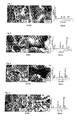
- FIG. 6 shows the results obtained by SEM and EDX observations of the cross section of Sample A immersed in 1.0SBF for 14 days.
- Fig. 1 numerous fine particles of nanometer order containing amorphous calcium phosphate as the major component were found to deposit and adhere to the inside of the fine pores of the substrate of Sample A.
- Fig. 2 to Fig. 4 a coating layer containing hydroxyapatites as the major component was found to gradually form and grow on the surface of Sample A by immersion in 1.0SBF.
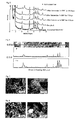
- Fig. 5 reads clearly that a peak indicating the crystalline structure of hydroxyapatites is detected on the surface of Sample A immersed in 1.0SBF for 14 days.
- Fig. 1 shows numerous fine particles of nanometer order containing amorphous calcium phosphate as the major component were found to deposit and adhere to the inside of the fine pores of the substrate of Sample A.
- Fig. 2 to Fig. 4 a coating layer containing hydroxyapatites as the major component was found to gradually form and grow on the
- Sample A comprising the fine particles containing hydroxyapatites as the major component which have deposited inside the fine pores of the substrate, was found to be bioactive composites having bioactivity imparted thereto, in which the fine particles function as nuclei for forming and growing on the surface of the substrate, a coating layer containing hydroxyapatites as the major component.
- the adhesion strength of the coating layer containing hydroxyapatites as the major component on Sample A immersed in 1.0SBF for 14 days to the substrate was measured in the following manner.
- Stainless steel jigs (10 x 10 mm 2 ) were adhered using an epoxy-based adhesive (trade name: Araldite, produced by Huntsman Advanced Materials) to the surface of the coating layer which have been formed on one side of Sample A and to the surface of the other side of the substrate which has been exposed by peeling off the coating layer, and after air-drying for about one week, the jigs were pulled at a crosshead speed of 1 mm/min by using a universal testing machine to thereby obtain the adhesion strength by reading the strength at which the coating layer was separated from the substrate at the contact plane.
- an epoxy-based adhesive trade name: Araldite, produced by Huntsman Advanced Materials
- FIG. 9 shows the results obtained by TF-XRD observation of the surface of an untreated substrate, Sample B, and Sample B immersed in 1.0SBF for 14 days.
- Fig. 7 clearly shows, numerous fine particles of nanometer order containing amorphous calcium phosphate as the major component were found to deposit and adhere to the inside of the fine pores of the substrate of Sample B.
- a coating layer containing hydroxyapatites as the major component was found to gradually form and grow on the surface of Sample B by immersion in 1.0SBF.
- Fig. 9 reads clearly that a peak indicating the crystalline structure of hydroxyapatites is detected on the surface of Sample B immersed in 1.0SBF for 14 days. It was thereby found from the results above that Sample B is bioactive composites having bioactivity imparted thereto.
- a porous substrate i.e., a 15 mm length x 10 mm width x 2 mm thickness porous shaped body comprising ultrahigh molecular weight polyethylene (UHMWPE) (manufactured by NITTO DENKO CORPORATION; having an average pore diameter of 17 ⁇ m and a porosity of 26 %), was immersed in 1.0SBF whose pH was controlled to 8.0 by adding therein tris (hydroxymethyl) aminomethane under a liquid temperature of 36.5°C, and the temperature was elevated to 60°C, at which temperature the resulting product was allowed to stand still for 24 hours in an incubator set at 60°C.
- UHMWPE ultrahigh molecular weight polyethylene
- the substrate was taken out from the 1.0SBF, rinsed with ultrapure water, and air dried. Then, the substrate subjected to the treatment above (Sample C) was immersed in 1.0SBF (pH 7.4) at 36.5°C for 14 days to study its bioactivity.
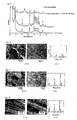
- the results obtained SEM and EDX observations of the surface of Sample C are given in Fig. 10
- the results obtained by SEM and EDX observations of the surface of Sample C immersed in 1.0SBF for 14 days are given in Fig. 11 .
- Fig. 10 clearly shows, numerous fine particles of nanometer order containing amorphous calcium phosphate as the major component were found to deposit and adhere to the inside of the fine pores of the substrate of Sample C.
- An oxygen plasma treatment by glow discharge (at a plasma electric power density of 1 W/cm 2 ) was applied for 30 seconds to the surface of a 15 mm length x 10 mm width x 2 mm thickness porous shaped body comprising ultrahigh molecular weight polyethylene (UHMWPE) (manufactured by NITTO DENKO CORPORATION; having an average pore diameter of 17 ⁇ m and a porosity of 26 %) to use as a porous substrate.
- UHMWPE ultrahigh molecular weight polyethylene
- OSBF whose pH was controlled to 8.0 by adding therein tris(hydroxymethyl)aminomethane under a liquid temperature of 36.5°C, and the temperature was elevated to 60°C, at which temperature the resulting product was allowed to stand still for 24 hours in an incubator set at 60°C. After passage of 24 hours, the substrate was taken out from the 1.0SBF, rinsed with ultrapure water, and air dried. Subsequently, the substrate to which bioactivity was imparted by applying the treatment above was immersed in 1. OSBF (pH 7.4) at 36.5°C for 14 days to form and grow on the surface thereof, a coating layer containing hydroxyapatites as the major component.
- the adhesion strength of the coating layer containing hydroxyapatites as the major component to the substrate was measured on 8 samples according to the method similar to that described in Example 1, and as a result, an average adhesion strength of 6.9 MPa was obtained with a standard deviation of 1.4 MPa.
- an average adhesion strength of 10 samples having formed and grown on the surface of the substrate, a coating layer containing hydroxyapatites as the major component under similar conditions as above, except for not applying the oxygen plasma treatment by glow discharge was 4.6 MPa with a standard deviation of 0.8 MPa.
- a polyester woven cloth (white colored, purchased from Nomura-tailor. Corporation) was used as a porous substrate, which was immersed in 2.0SBF whose pH was controlled to 7.0 by adding therein tris(hydroxymethyl)aminomethane under a liquid temperature of 36.5°C. Subsequently, tris(hydroxymethyl)aminomethane was added to the 2.0SBF having immersed therein the substrate to control the pH to 8.2 at 36.5°C, and the resulting product was allowed to stand still for 24 hours. After passage of 24 hours, the substrate was taken out from the 2.0SBF, rinsed with ultrapure water, and air dried.
- Example D the substrate to which bioactivity was imparted by applying the treatment above (Sample D) was immersed in 1.0SBF (pH 7.4) at 36.5°C for 14 days.
- 1.0SBF pH 7.4
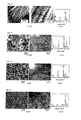
- the results obtained by SEM and EDX observations of the surface of Sample D immersed in 1.0SBF for 14 days are given in Fig. 12 .
- a coating layer containing hydroxyapatites as the major component was found to gradually form and grow on the surface of Sample D by immersion in 1.0SBF.
- a polyester woven cloth (white colored, purchased from Nomura-tailor. Corporation) was used as a porous substrate, which was immersed in 1.0SBF whose pH was controlled to 8.0 by adding therein tris(hydroxymethyl)aminomethane under a liquid temperature of 36.5°C, and the temperature was elevated to 60°C, at which temperature the resulting product was allowed to stand still for 24 hours in an incubator set at 60°C. After passage of 24 hours, the substrate was taken out from the 1.0SBF, rinsed with ultrapure water, and air dried. Then, the substrate to which bioactivity was imparted by applying the treatment above (Sample E) was immersed in 1.0SBF (pH 7.4) at 36.5°C for 14 days.
- Fig. 13 The results obtained by SEM and EDX observations of the surface of Sample E immersed in 1.0SBF for 14 days are given in Fig. 13 . As is shown clearly in Fig. 13 , a coating layer containing hydroxyapatites as the major component was found to gradually form and grow on the surface of Sample E by immersion in 1.0SBF.
- a 10 mm length ⁇ 10 mm width ⁇ 1 mm thickness porous titanium plate (manufactured by Sumitomo Titanium Corporation; having an average pore diameter of 25 ⁇ m and a porosity of 40 %) was cleaned with ethanol and distilled water, and was air dried to use as a porous substrate.
- the substrate was immersed in 2. OSBF whose pH was controlled to 7. 0 by adding therein tris(hydroxymethyl)aminomethane under a liquid temperature of 36.5°C, and was subjected to a degassing treatment using a vacuum pump.
- a 10 mm length ⁇ 10 mm width ⁇ 1 mm thickness porous titanium plate (manufactured by Sumitomo Titanium Corporation; having an average pore diameter of 25 ⁇ m and a porosity of 40 %) was cleaned with ethanol and distilled water, and was air dried to use as a porous substrate.
- the substrate was immersed in 1. OSBF whose pH was controlled to 8.0 by adding therein tris(hydroxymethyl)aminomethane under a liquid temperature of 36.5°C, and was subjected to a degassing treatment using a vacuum pump. Subsequently, the temperature was elevated to 60°C, at which temperature the resulting product was allowed to stand still for 24 hours in an incubator set at 60°C.
- a coating layer containing hydroxyapatites as the major component was found to gradually form and grow on the surface of Sample G by immersion in 1.0SBF.
- a 10 mm length ⁇ 10 mm width ⁇ 1 mm thickness titanium flat plate (manufactured by KOBE STEEL, LTD.) was immersed in 48 % sulfuric acid for 60 minutes in an incubator set at 90°C, followed by ultrasonic cleaning in distilled water and air drying to use as a porous substrate.
- the substrate was immersed in 1.0SBF whose pH was controlled to 8.0 by adding therein tris(hydroxymethyl)aminomethane under a liquid temperature of 36.5°C, and was subjected to a pressurizing treatment (392 MPa) for 1 hour by using a cold isostatic pressing apparatus.
- the adhesion strength of the coating layer containing hydroxyapatites as the major component to the substrate was measured on 7 samples according to the method similar to that described in Example 1, and as a result, an average adhesion strength of 8.4 MPa was obtained with a standard deviation of 1.2 MPa.
- the reason for such a high adhesion strength of the coating layer containing hydroxyapatites as the major component to the substrate was considered attributed to the randomly formed fine pores of the substrate of Sample H with respect to the direction, by which an interlocking effect was effectively functioned.
- a porous substrate i.e., a 15 mm length x 10 mm width x 2 mm thickness porous shaped body comprising ultrahigh molecular weight polyethylene (UHMWPE) (manufactured by NITTO DENKO CORPORATION; having an average pore diameter of 17 ⁇ m and a porosity of 26 %), was immersed in 1.0SBF whose pH was controlled to 8.0 by adding therein tris (hydroxymethyl) aminomethane under a liquid temperature of 36.5°C, and was subjected to a pressurizing treatment (392 MPa) for 1 hour by using a cold isostatic pressing apparatus.
- UHMWPE ultrahigh molecular weight polyethylene
- the substrate was placed in a 500 ml beaker, and 1.0SBF at 36.5°C, whose pH was controlled to 8.0 by adding therein tris(hydroxymethyl)aminomethane, was poured therein to make a volume of 150 ml to have the substrate immersed.
- the beaker was then covered with a wrap, and after penetrating holes in the wrap for vapor escape, was heated using a microwave oven (at a high frequency power output of 500 W and at an oscillatory frequency of 2450 MHz) for 120 seconds (at which point it became white clouded in the 1.0SBF).
- the substrate was taken out from the beaker, rinsed lightly with distilled water, and air dried.
- Example I the substrate to which bioactivity was imparted by applying the treatment above (Sample I) was immersed in 1.0SBF (pH 7.4) at 36.5°C for 14 days.
- 1.0SBF pH 7.4
- the results obtained by SEM and EDX observations of the surface of Sample I immersed in 1.0SBF for 14 days are given in Fig. 18 .
- a coating layer containing hydroxyapatites as the major component was found to gradually form and grow on the surface of Sample I by immersion in 1.0SBF.
- An 8 mm length ⁇ 8 mm width ⁇ 1 mm thickness porous stainless steel plate (manufactured by TAISEI KOGYO CO., LTD.; having an average pore diameter of 10 ⁇ m and a porosity of 62 %) was subjected to ultrasonic cleaning in acetone, and was air dried to use as a porous substrate.
- the substrate was immersed in 2.0SBF whose pH was controlled to 7.0 by adding therein tris (hydroxymethyl) aminomethane under a liquid temperature of 36.5°C, and was subjected to a degassing treatment using a vacuum pump.
- Spherical silica gel particles having a particle distribution in the range of 1.7 mm to 4.0 mm manufactured by Fuji Silysia Chemical Ltd. ; having an average pore diameter of 47 nm and fine pore volume of 1.0 dm 3 ⁇ g -1 ) were used as a porous substrate, and were immersed in 1.0SBF whose pH was controlled to 8.0 by adding therein tris (hydroxymethyl) aminomethane under a liquid temperature of 36.5°C. Then, a pressurizing treatment (392 MPa) for 1 hour by using a cold isostatic pressing apparatus was applied thereto.
- Spherical silica gel particles having a particle distribution in the range of 1.7 mm to 4.0 mm (manufactured by Fuji Silysia Chemical Ltd.; having an average pore diameter of 47 nm and fine pore volume of 1.0 dm 3 ⁇ g -1 ) were used as a porous substrate, and were immersed in 1.0SBF whose pH was adjusted to 8.0 by adding therein tris (hydroxymethyl) aminomethane under a liquid temperature of 36.5°C. Then, a pressurizing treatment (392 MPa) for 1 hour by using a cold isostatic pressing apparatus was applied thereto.
- the substrate was placed in a 500 ml beaker, and 1.0SBF at 36.5°C, whose pH was controlled to 8.0 by adding therein tris(hydroxymethyl)aminomethane, was poured therein to have the substrate immersed.
- the beaker was then covered with a wrap, and after penetrating holes in the wrap for vapor escape, was heated using a microwave oven (at a high frequency power output of 500 W and at an oscillatory frequency of 2450 MHz) for 120 seconds (at which point it became white clouded in the 1.0SBF).
- the substrate was taken out from the beaker, rinsed lightly with distilled water, and air dried.
- Example L the substrate to which bioactivity was imparted by applying the treatment above (Sample L) was immersed in 1.0SBF (pH 7.4) at 36.5°C for 7 days.
- 1.0SBF pH 7.4
- the results obtained by SEM and EDX observations of the surface of Sample L immersed in 1.0SBF for 7 days are given in Fig. 21 .
- a coating layer containing hydroxyapatites as the major component was found to gradually form and grow on the surface of Sample L by immersion in 1.0SBF.
- a 10 mm length ⁇ 10 mm width ⁇ 1 mm thickness titanium flat plate (manufactured by KOBE STEEL, LTD.) was subjected to a surface roughening treatment using a polishing paper (P2000), followed by ultrasonic cleaning in acetone and air drying to use as a porous substrate.
- the substrate was immersed in 1.0SBF whose pH was controlled to 8.0 by adding therein tris(hydroxymethyl)aminomethane under a liquid temperature of 36.5°C, and was subjected to a pressurizing treatment (392 MPa) for 1 hour by using a cold isostatic pressing apparatus.
- a coating layer containing hydroxyapatites as the major component was found to gradually form and grow on the surface of Sample M by immersion in 1.0SBF.
- the adhesion strength of the coating layer containing hydroxyapatites as the major component to the substrate was measured on 4 samples according to the method similar to that described in Example 1, and as a result, an average adhesion strength of 1.5 MPa was obtained with a standard deviation of 1.0 MPa.
- a 10 mm length ⁇ 10 mm width ⁇ 1 mm thickness stainless steel flat plate (manufactured by NIPPON METAL INDUSTRY CO., LTD.) was immersed in 18 % hydrochloric acid for 24 hours in an incubator set at 60°C, followed by ultrasonic cleaning in distilled water and air drying to use as a porous substrate.
- the substrate was immersed in 1.0SBF whose pH was controlled to 8.0 by adding therein tris(hydroxymethyl)aminomethane under a liquid temperature of 36.5°C, and was subjected to a pressurizing treatment (392 MPa) for 1 hour by using a cold isostatic pressing apparatus.
- a coating layer containing hydroxyapatites as the major component was found to gradually form and grow on the surface of Sample N by immersion in 1.0SBF.
- the adhesion strength of the coating layer containing hydroxyapatites as the major component to the substrate was measured on 9 samples according to the method similar to that described in Example 1, and as a result, an average adhesion strength of 2.0 MPa was obtained with a standard deviation of 1.5 MPa.
- a 10 mm length ⁇ 10 mm width ⁇ 1 mm thickness silica glass plate (manufactured by EIKOH Co., Ltd.) was immersed in 46 % hydrofluoric acid, allowed to stand still for 12 hours at room temperature, and followed by ultrasonic cleaning in distilled water and air drying to use as a porous substrate.
- the substrate was immersed in 1.0SBF whose pH was controlled to 8.0 by adding therein tris(hydroxymethyl)aminomethane under a liquid temperature of 36.5°C, and was subjected to a pressurizing treatment (392 MPa) for 1 hour using a cold isostatic pressing apparatus.
- the present invention has an industrial applicability in the point that it can provide a method for producing bioactive composites having imparted thereto bioactivity, to thereby form and grow in vivo or in vitro a coating layer containing a calcium phosphate compound as the major component with a high adhesion strength on the surface of various types of porous substrates such as a porous shaped body comprising an organic polymer.
Landscapes
- Health & Medical Sciences (AREA)
- Chemical & Material Sciences (AREA)
- Medicinal Chemistry (AREA)
- Life Sciences & Earth Sciences (AREA)
- Veterinary Medicine (AREA)
- Public Health (AREA)
- General Health & Medical Sciences (AREA)
- Animal Behavior & Ethology (AREA)
- Transplantation (AREA)
- Oral & Maxillofacial Surgery (AREA)
- Dermatology (AREA)
- Epidemiology (AREA)
- Chemical Kinetics & Catalysis (AREA)
- Organic Chemistry (AREA)
- Engineering & Computer Science (AREA)
- Polymers & Plastics (AREA)
- Materials Engineering (AREA)
- Dispersion Chemistry (AREA)
- Inorganic Chemistry (AREA)
- Bioinformatics & Cheminformatics (AREA)
- Physical Education & Sports Medicine (AREA)
- General Chemical & Material Sciences (AREA)
- Nuclear Medicine, Radiotherapy & Molecular Imaging (AREA)
- Pharmacology & Pharmacy (AREA)
- Materials For Medical Uses (AREA)
Abstract
An object of the present invention is to provide a method for producing bioactive composites having imparted thereto bioactivity, to thereby form and grow in vivo or in vitro a coating layer containing a calcium phosphate compound as the major component with a high adhesion strength on the surface of various types of porous substrates such as a porous shaped body comprising an organic polymer. The means for solving the problem is characterized by comprising at least (1) a step of immersing a porous substrate in a solution containing at least calcium ions and hydrogenphosphate ions, thereby distributing the solution to the inside of at least a part of the pores of the substrate, and (2) a step of depositing fine particles containing a calcium phosphate compound as the major component inside the pores into which the solution is introduced.
Description
- The present invention relates to a method for producing bioactive composites comprising a porous substrate having bioactivity imparted thereto, which is capable of forming and growing in vivo or in vitro on the surface with a high adhesion strength, a coating layer containing a calcium phosphate compound as the major component.
- Implants such as an artificial bone and an artificial arthrosis using porous shaped bodies comprising organic polymers as substrates are advantageous in that they have favorable biomechanical compatibility in vivo because they not only have excellent mechanical strength but also flexibility and toughness, and in that bone tissues strongly adhere to the substrate by an interlocking effect that is exerted when growing the bone tissues containing a calcium phosphate compound as the major component inside the pores of the substrate. However, in order to grow the bone tissues on the surface of the substrate, bioactivity (osteoconductive property) which induces the growth of the bone tissues should be imparted to the substrate. As the methods for imparting bioactivity to organic polymer materials known to the present include, for instance, adhering particles comprising calcium phosphate compounds on the substrate sheet and pressing, thereby embedding a part of the particles inside the sheet (Patent literature 1). Such a method, however, fails to strongly adhere the bone tissues with the substrate because the bone tissues cannot be grown inside the pores of the porous substrate.
Patent Literature 1:JP-A-2000-126280 - Thus, an objective of the present invention is to provide a method for producing bioactive composites having imparted thereto bioactivity, to thereby form and grow in vivo or in vitro a coating layer containing a calcium phosphate compound as the major component with a high adhesion strength on the surface of various types of porous substrates such as a porous shaped body comprising an organic polymer.
- In the light of such circumstances, the present inventors intensively conducted studies, and as a result, they have found that a bioactivity can be extremely easily imparted to a substrate by a method comprising immersing a porous substrate in a simulated body fluid (SBF=Simulated Body Fluid) whose pH is adjusted to 7.0, followed by shifting the pH of the simulated body fluid to the alkaline side or immersing a porous substrate in a simulated body fluid, followed by elevating the temperature of the simulated body fluid, thereby depositing fine particles containing a calcium phosphate compound as the major component which serve as nuclei for growing bone tissues inside the pores of the substrate.
- The present invention has been accomplished based on the above findings, and a method for producing bioactive composites for forming and growing a coating layer containing a calcium phosphate compound as the major component on the surface thereof is as claimed in
Claim 1, which is characterized in that it at least comprises: (1) a step of immersing a porous substrate in a solution containing at least calcium ions and hydrogenphosphate ions, thereby distributing the solution to the inside of at least a part of the pores of the substrate, and (2) a step of depositing fine particles containing a calcium phosphate compound as the major component inside the pores into which the solution is introduced.
Further, the production method as claimed inClaim 2 is characterized in that, in the production method ofClaim 1, the porous substrate is a porous shaped body comprising an organic polymer.
Furthermore, the production method as claimed inClaim 3 is characterized in that, in the production method ofClaim 1, the average diameter of the pores is in the range of 10 nm to 1 mm.
Moreover, the production method as claimed inClaim 4 is characterized in that, in the production method ofClaim 1, the porosity of the porous substrate is in the range of 10 % to 65 %.
Further, the production method as claimed in Claim 5 is characterized in that, in the production method ofClaim 2, the organic polymer is at least one type selected from polyethylene, polypropylene, polyethylene terephthalate, polyvinyl alcohol, ethylene-vinyl alcohol copolymer, polyethersulfone, polycaprolactone, and polylactic acid.
Furthermore, the production method as claimed in Claim 6 is characterized in that, in the production method ofClaim 1, the calcium phosphate compound is hydroxyapatites.
Further, the production method as claimed inClaim 7 is characterized in that, in the production method ofClaim 1, the solution used in the step (1) containing at least calcium ions and hydrogenphosphate ions is such a solution which deposits fine particles containing a calcium phosphate compound as the major component by increasing the pH value.
Furthermore, the production method as claimed in Claim 8 is characterized in that, in the production method ofClaim 7, the pH value of the solution is in the range of 4.0 to 7.1.
Moreover, the production method as claimed in Claim 9 is characterized in that, in the production method ofClaim 1, in the step (1), a degassing treatment is carried out to thereby distribute the solution to the inside of at least a part of the pores of the substrate.
Further, the production method as claimed inClaim 10 is characterized in that, in the production method ofClaim 1, in the step (1), a pressurizing treatment is carried out to thereby distribute the solution to the inside of at least a part of the pores of the substrate.
Furthermore, the production method as claimed in Claim 11 is characterized in that, in the production method ofClaim 1, in the step (2), the fine particles containing a calcium phosphate compound as the major component are deposited by increasing the pH value of the solution to in the range of 7.2 to 9.0.
Further, the production method as claimed in Claim 12 is characterized in that, in the production method of Claim 11, the pH value of the solution is increased by adding a pH controlling agent having a buffer function.
Moreover, the production method as claimed in Claim 13 is characterized in that, in the production method of Claim 12, the pH controlling agent having a buffer function is tris(hydroxymethyl)aminomethane.
Furthermore, the production method as claimed inClaim 14 is characterized in that, in the production method ofClaim 1, in the step (2), the fine particles containing a calcium phosphate compound as the major component are deposited by elevating the temperature of the solution.
Further, the production method as claimed in Claim 15 is characterized in that, in the production method ofClaim 14, the temperature of the solution is elevated by 20°C or more with respect to the temperature of the solution before elevating the solution temperature.
Moreover, the production method as claimed in Claim 16 is characterized in that, in the production method ofClaim 1, the size of the fine particles containing a calcium phosphate compound as the major component is in the range of 1 nm to 500 µm.
Furthermore, the production method as claimed in Claim 17 is characterized in that, in the production method ofClaim 1, a plasma surface treatment is applied to the porous substrate before carrying out the step (1).
Further, the production method as claimed in Claim 18 is characterized in that, in the production method ofClaim 1, the porous substrate is subjected to a surface roughening treatment to provide poriform irregularities to the surface thereof.
In addition, bioactive composites according to the present invention as claimed in Claim 19, which is characterized in that it is produced by the production method ofClaim 1, and fine particles containing a calcium phosphate compound as the major component are deposited inside at least a part of the pores of the porous substrate.
Additionally, according to the present invention, a method for producing bioactive composites having on the surface thereof a coating layer containing a calcium phosphate compound as the major component as claimed inClaim 20, which is characterized in that it at least comprises: (1) a step of immersing a porous substrate in a solution containing at least calcium ions and hydrogenphosphate ions, thereby distributing the solution to the inside of at least a part of the pores of the substrate, (2) a step of depositing fine particles containing a calcium phosphate compound as the major component inside the pores into which the solution is introduced, and (3) a step of forming and growing a coating layer containing a calcium phosphate compound as the major component by using the fine particles containing a calcium phosphate compound as the major component, which have deposited inside the pores, as nuclei.
Furthermore, bioactive composites according to the present invention as claimed in Claim 21, which is characterized in that it is produced by the production method ofClaim 20, and a coating layer containing a calcium phosphate compound as the major component is formed and grown by using, as nuclei, fine particles containing a calcium phosphate compound as the major component, which have deposited inside at least a part of the pores of the porous substrate. - According to the present invention, there is provided a method for producing bioactive composites having imparted thereto bioactivity, to thereby form and grow in vivo or in vitro a coating layer containing a calcium phosphate compound as the major component with a high adhesion strength on the surface of various types of porous substrates such as a porous shaped body comprising an organic polymer.
-
- [
Fig. 1 ] It shows the results obtained by SEM and EDX observations of the surface of a substrate subjected to a treatment for imparting bioactivity (Sample A) in Example 1. - [
Fig. 2 ] It shows the results obtained by SEM and EDX observations of the surface of Sample A, which has been left for 4 days after immersion in 1.0SBF in the same Example 1. - [
Fig. 3 ] It shows the results obtained by SEM and EDX observations of the surface of Sample A, which has been left for 7 days after immersion in 1.0SBF in the same Example 1. - [
Fig. 4 ] It shows the results obtained by SEM and EDX observations of the surface of Sample A, which has been left for 14 days after immersion in 1.0SBF in the same Example 1. - [
Fig. 5 ] It shows the results obtained by TF-XRD observation of the surface of an untreated substrate, Sample A, and Samples A which has been left for 4 days, 7 days, and 14 days after immersion in 1.0SBF in the same Example 1. - [
Fig. 6 ] It shows the results obtained by SEM and EDX observations of the cross section of sample A, which has been left for 14 days after immersion in 1.0SBF in the same Example 1. - [
Fig. 7 ] It shows the result obtained by SEM observation of the surface of a substrate subjected to a treatment for imparting bioactivity (Sample B) in Example 3. - [
Fig. 8 ] It shows the result obtained by SEM observation of the surface of Sample B, which has been left for 14 days after immersion in 1.0SBF in the same Example 3. - [
Fig. 9 ] It shows the results obtained by TF-XRD observation of the surface of an untreated substrate, Sample B, and Sample B which has been left for 14 days after immersion in 1.0SBF in the same Example 3. - [
Fig. 10 ] It shows the results obtained by SEM and EDX observations of the surface of a substrate subjected to a treatment for imparting bioactivity (Sample C) in Example 7. - [
Fig. 11 ] It shows the results obtained by SEM and EDX observations of the surface of Sample C, which has been left for 14 days after immersion in 1.0SBF in the same Example 7. - [
Fig. 12 ] It shows the results obtained by SEM and EDX observations of the surface of a substrate subjected to a treatment for imparting bioactivity (Sample D) and which has been left for 14 days after immersion in 1.0SBF in Example 9. - [
Fig. 13 ] It shows the results obtained by SEM and EDX observations of the surface of a substrate subjected to a treatment for imparting bioactivity (Sample E) and which has been left for 14 days after immersion in 1.0SBF in Example 10. - [
Fig. 14 ] It shows the results obtained by SEM and EDX observations of the surface of a substrate subjected to a treatment for imparting bioactivity (Sample F) and which has been left for 14 days after immersion in 1.0SBF in Example 12. - [
Fig. 15 ] It shows the results obtained by SEM and EDX observations of the surface of a substrate subjected to a treatment for imparting bioactivity (Sample G) and which has been left for 14 days after immersion in 1.0SBF in Example 13. - [
Fig. 16 ] It shows the results obtained by SEM and EDX observations of the surface of a substrate subjected to a treatment for imparting bioactivity (Sample H) in Example 14. - [
Fig. 17 ] It shows the results obtained by SEM and EDX observations of the surface of Sample H, which has been left for 14 days after immersion in 1.0SBF in the same Example 14. - [
Fig. 18 ] It shows the results obtained by SEM and EDX observations of the surface of a substrate subjected to a treatment for imparting bioactivity (Sample I) and which has been left for 14 days after immersion in 1.0SBF in Example 15. - [
Fig. 19 ] It shows the results obtained by SEM and EDX observations of the surface of a substrate subjected to a treatment for imparting bioactivity (Sample J) and which has been left for 14 days after immersion in 1.0SBF in Example 16. - [
Fig. 20 ] It shows the results obtained by SEM and EDX observations of the surface of a substrate subjected to a treatment for imparting bioactivity (Sample K) and which has been left for 7 days after immersion in 1.0SBF in Example 17. - [
Fig. 21 ] It shows the results obtained by SEM and EDX observations of the surface of a substrate subjected to a treatment for imparting bioactivity (Sample L) and which has been left for 7 days after immersion in 1.0SBF in Example 18. - [
Fig. 22 ] It shows the results obtained by SEM and EDX observations of the surface of a substrate subjected to a treatment for imparting bioactivity (Sample M) and which has been left for 14 days after immersion in 1.0SBF in Example 20. - [
Fig. 23 ] It shows the results obtained by SEM and EDX observations of the surface of a substrate subjected to a treatment for imparting bioactivity (Sample N) and which has been left for 14 days after immersion in 1.0SBF in Example 21. - [
Fig. 24 ] It shows the results obtained by SEM and EDX observations of the surface of a substrate subjected to a treatment for imparting bioactivity (Sample O) and which has been left for 3 days after immersion in 1.0SBF in Example 23. - In the present invention, a porous shaped body comprising an organic polymer can be mentioned as a representative example of a porous substrate for use as a substrate of bioactive composites. As the examples of organic polymers, included are polyethylene, polypropylene, polyethylene terephthalate, polyvinyl alcohol, ethylene-vinyl alcohol copolymer, polyethersulfone, polycaprolactone, and polylactic acid. Furthermore, the organic polymer may be a naturally occurring substance such as collagen. The porous shaped body comprising an organic polymer may be such made of a single organic polymer, or of plural kinds of organic polymers (such as polymer alloys) . Furthermore, it may be a composite comprising different kinds of organic polymers. Moreover, the porous substrate is not limited to the porous shaped body comprising an organic polymer, but may be a porous shaped body comprising any material. For instance, it may be a porous shaped body comprising a metal or ceramics and the like, or may be a porous shaped body comprising a composite of an organic polymer with a metal or ceramics and the like. The shape of the substrate may be a complex shape or a simple shape, or any other shape. Specifically, the substrate may have a shape of a bone or an arthrosis, or may have a shape of joint members such as an artificial arthrosis or an artificial root. Furthermore, the shape may be plate-like, sheet-like, rod-like, or granular. The substrate having such shapes may be formed by a method according to the material. In order to form and grow in vivo or in vitro a coating layer containing a calcium phosphate compound as the major component on the surface of a porous substrate with a high adhesion strength by an interlocking effect, the average diameter of the pores is preferably in the range of 10 nm to 1 mm, and the porosity is preferably in the range of 10 % to 65 %. Furthermore, the porous substrate may be, in addition to foamed bodies and felt, such having surfaces with poriform irregularities provided by means of a surface roughening treatment using chemicals such as an acidic or alkaline substance, or a polishing paper, a porous coating treatment using reduced pressure plasma spraying or the like, or a grinding processing treatment such as an electrolytic in-process dressing (ELID); and, it may be a woven cloth or a non-woven cloth (the interstices among the fibers correspond to the pores).
- In the method for producing bioactive composites according to the present invention, firstly, in a step (1), a porous substrate is immersed in a solution containing at least calcium ions and hydrogenphosphate ions to thereby distribute the solution to the inside of at least a part of the pores of the substrate, and then, in a step (2), fine particles containing a calcium phosphate compound as the major component are deposited inside the pores into which the solution is introduced.
- The composition of the fine particles containing a calcium phosphate compound as the major component and which are deposited inside the pores is not particularly limited so long as it provides nuclei on the surface of the substrate for forming and growing a coating layer containing a calcium phosphate compound as the major component. As the calcium phosphate compounds, examples include monobasic calcium phosphate (Ca(H2PO4)2), dibasic calcium phosphate (CaHPO4), tribasic calcium phosphate (Ca3(PO4)2), tetracalcium phosphate (Ca4(PO4)2O), octacalcium phosphate (Ca8H2(PO4)6), apatites such as hydroxyapatites, and an amorphous calcium phosphate (which may have water of crystallization). As the preferred fine particles containing a calcium phosphate compound as the major component, there can be mentioned fine particles containing hydroxyapatites as the major component. Hydroxyapatite is a compound expressed by the chemical formula Ca10(PO4)6(OH)2. Hydroxyapatites include hydroxyapatite and those derived therefrom, in which a constituent element is substituted and/or deficient. As specific examples of a hydroxyapatite whose constituent element is substituted and/or deficient, there can be mentioned hydroxyapatites whose constituent elements or groups are partly substituted by the elements of
Group 1 of the periodic table, such as Na and K; or the elements ofGroup 2 of the periodic table, such as Mg; or the elements ofGroup 4 of the periodic table, such as Ti; or the elements of Group 12 of the periodic table, such as Zn; or the elements of Group 17 of the periodic table, such as F and Cl; or groups such as CO3 2-, HPO4 2-, SO4 2-; or rare earth metal elements. Such elements and groups incorporated in the compound originates from the elements and groups contained in the solution that is used for depositing the fine particles. In order to obtain the fine particles that function as the nuclei having excellent biocompatibility, which effectively induce and accelerate the formation and growth of the coating layer containing a calcium phosphate compound as the major component on the surface of the substrate, the size of the particles is preferably in the range of 1 nm to 500 µm, more preferably in the range of 10 nm to 10 µm, and most preferably in the range of 50 nm to 1 µm. Further, the fine particles may be crystalline or amorphous. - As the solution for use in the step (1), which contains at least calcium ions and hydrogenphosphate ions for depositing the fine particles containing a calcium phosphate compound as the major component, there can be mentioned, for example, a solution from which fine particles containing a calcium phosphate compound as the major component deposit by increasing the pH value or by elevating the temperature; specifically, there can be exemplified a solution containing 0.02 mM to 25 mM of calcium ions and 0.01 mM to 10 mM of hydrogenphosphate ions, and whose pH value is in the range of 4.0 to 8.0. The preparation method thereof is not particularly limited, and a known preparation method can be employed. Hydrogenphosphate ions collectively mean phosphoric acid capable of generating PO4 3- in an aqueous solution, and included are phosphoric acid (H3PO4), dihydrogenphosphate ion (H2PO4 -), hydrogenphosphate ion (HPO4 2-), phosphate ion (PO4 3-), and condensed phosphoric acid which are generated by polymerization of two or more PO4 3-. The concentration of calcium ions is preferably in the range of 0.2 mM to 20 mM, and more preferably in the range of 1.2 mM to 5 mM. The concentration of hydrogenphosphate ions is preferably in the range of 0.1 mM to 8 mM, and more preferably in the range of 0.5 mM to 2 mM. In order to obtain the deposits of the fine particles having excellent biocompatibility, preferred is to use a simulated body fluid (SBF: Simulated Body Fluid) as the solution for depositing the fine particles, which contains sodium ions, potassium ions, magnesium ions, chloride ions, hydrogencarbonate ions, and sulfate ions in addition to calcium ions and hydrogenphosphate ions, each at a concentration similar to the ion concentration of a human plasma. The concentration of sodium ions in the simulated body fluid is preferably in the range of 1.4 mM to 1420 mM, more preferably in the range of 14 mM to 1140 mM, and most preferably in the range of 70 mM to 290 mM. The concentration of potassium ions is preferably in the range of 0.05 mM to 50 mM, more preferably in the range of 0.5 mM to 40 mM, and most preferably in the range of 2.5 mM to 10 mM. The concentration of magnesium ions is preferably in the range of 0.01 mM to 15 mM, more preferably in the range of 0.1 mM to 12 mM, and most preferably in the range of 0.7 mM to 3 mM. The concentration of chloride ions is preferably in the range of 1.4 mM to 1500 mM, more preferably in the range of 14.5 mM to 1200 mM, and most preferably in the range of 70 mM to 300 mM. The concentration of hydrogencarbonate ions is preferably in the range of 0.04 mM to 45 mM, more preferably in the range of 0.4 mM to 36 mM, and most preferably in the range of 2 mM to 9 mM. The concentration of sulfate ions is preferably in the range of 5.0 x 10⁻³ mM to 5 mM, more preferably in the range of 0.05 mM to 4 mM, and most preferably in the range of 0.2 mM to 1 mM. The simulated body fluid containing these inorganic ions at concentrations similar to the body fluid is denoted as 1.0SBF. In 1.0SBF, the concentration of sodium ions is 142.0 mM, the concentration of potassium ions is 5.0 mM, the concentration of magnesium ions is 1.5 mM, the concentration of calcium ions is 2.5 mM, the concentration of chloride ions is 147.8 mM, the concentration of hydrogencarbonate ions is 4.2 mM, the concentration of hydrogenphosphate ions is 1.0 mM, and the concentration of sulfate ions is 0.5 mM. A simulated body fluid containing the inorganic ions at a concentration x times (where x is a positive real number) higher than that of 1.0SBF is denoted as xSBF. In the present invention, it is preferred to use 0.5SBF to 5.0SBF as the solution for depositing the fine particles.
- In the step (1), it is not necessary to distribute the solution for depositing the fine particles containing a calcium phosphate compound as the major component to the inside of all pores present in the substrate. However, in order to form and grow the coating layer containing a calcium phosphate compound as the major component on the surface of the substrate with a high adhesion strength by the interlocking effect, it is necessary to deposit the fine particles inside at least a part of the pores in the vicinity of the surface of the substrate, to thereby provide the nuclei for forming and growing the coating layer. In this context, it is preferred to distribute the solution for depositing the fine particles to the inside of at least a part of the pores in the vicinity of the surface of the substrate. This operation can be effectively carried out by performing a degassing treatment after immersing the substrate in the solution, thereby removing the bubbles that exist inside the pores, or by applying a pressurizing treatment using a cold isostatic pressing apparatus, thereby compressing the solution inside the pores.
- The operation for depositing the fine particles containing a calcium phosphate compound as the major component from the solution in the step (2) is preferably carried out by adding in the solution a pH controlling agent having a buffer function, for instance, tris(hydroxymethyl)aminomethane or ammonia, to thereby increase the pH value of the solution. The pH value of the solution can be precisely controlled by using the pH controlling agent having a buffer function. For example, in the case the pH value of the solution for use in the step (1) is in the range of 4.0 to 7.1, the fine particles having excellent biocompatibility can be efficiently deposited inside the pores by increasing the pH value to in the range of 7.2 to 9.0. In order to assure the deposition of the fine particles, it is preferred to allow the solution in which the substrate is immersed to stand still for a predetermined duration of time after increasing the pH value of the solution, for instance, 1 hour to 30 hours. Furthermore, the solution is preferably maintained at in the range of 35°C to 60°C while increasing the pH value, and then allowed to stand still.
- Furthermore, the operation for depositing the fine particles containing a calcium phosphate compound as the major component from the solution in the step (2) can be effected by elevating the temperature of the solution. In order to efficiently and surely deposit the fine particles having excellent biocompatibility inside the pores, preferably, the temperature of the solution is elevated by 20°C or more with respect to the temperature of the solution before elevating the solution temperature (for example, in case the solution temperature before elevating the temperature is 40°C or lower, the temperature is preferably elevated to 60°C or higher).
- By body implanting the bioactive composites thus produced by depositing the fine particles containing a calcium phosphate compound as the major component inside at least a part of the pores of the porous substrate, a coating layer containing a calcium phosphate compound as the major component, i.e., a bone tissue, can be formed and grown on the surface with a high adhesion strength by using the fine particles that have deposited inside the pores as the nuclei. Furthermore, the bioactive composites possesses a characteristic feature as such that, since the fine particles containing a calcium phosphate compound as the major component are deposited inside the pores that are located even in the deep part of the substrate, the bioactivity remains even if processing such as cutting or whittling is applied thereto. Furthermore, the bioactive composites may be implanted in the bodies after forming and growing beforehand the coating layer containing a calcium phosphate compound as the major component on the surface thereof by using the simulated body fluid and the like. Moreover, the addition of functional groups such as a hydroxyl group to the surface by applying a plasma surface treatment to the porous substrate prior to the step (1) enables forming and growing in vivo or in vitro, the coating layer containing a calcium phosphate compound as the major component with a higher adhesion strength.
- The present invention is explained in further detail by way of Examples below, but the present invention should not be understood as limited thereto.
- A porous substrate, i.e., a 15 mm length x 10 mm width x 2 mm thickness porous shaped body comprising ultrahigh molecular weight polyethylene (UHMWPE) (manufactured by NITTO DENKO CORPORATION; having an average pore diameter of 17 µm and a porosity of 26 %), was immersed in 2.0SBF whose pH was controlled to 7.0 by adding therein tris (hydroxymethyl) aminomethane under a liquid temperature of 36.5°C, and was subjected to a degassing treatment using a vacuum pump. Subsequently, tris(hydroxymethyl)aminomethane was added to the 2.0SBF having immersed therein the substrate to control the pH to 8.2 at 36.5°C (at which point it became white clouded in the 2.0SBF), and the resulting product was allowed to stand still for 24 hours. After passage of 24 hours, the substrate was taken out from the 2.0SBF, rinsed with ultrapure water, and air dried. Then, the substrate subjected to the treatment above (Sample A) was immersed in 1.0SBF (pH 7.4) at 36.5°C for 14 days to study its bioactivity. Table 1 shows the composition of inorganic ions of the plasma, 1. OSBF, and 2.0SBF.
-
[Table 1] Ions Concentration(mM) Plasma 1.0SBF 2.0SBF Na+ 142.0 142.0 284.0 K+ 5.0 5.0 10.0 Mg2+ 1.5 1.5 3.0 Ca2+ 2.5 2.5 5.0 Cl- 103.0 147.8 295.6 HCO3 - 27.0 4.2 8.4 HPO4 2- 1.0 1.0 2.0 SO4 2- 0.5 0.5 1.0 - The results obtained by SEM (Scanning Electron Microscope) and EDX (Energy Dispersive X-ray Analyzer) observations of the surface of Sample A with are given in
Fig. 1 . The results obtained by SEM and EDX observations of the surface of Sample A immersed in 1.0SBF for 4 days, 7 days, and 14 days are given inFig. 2, Fig. 3, and Fig. 4 , respectively. Furthermore, the results obtained by TF-XRD (Thin Film X-ray Diffractometer) observation of the surface of an untreated substrate, Sample A, and the Samples A immersed in 1.0SBF for 4 days, 7 days, and 14 days, are given inFig. 5. Fig. 6 shows the results obtained by SEM and EDX observations of the cross section of Sample A immersed in 1.0SBF for 14 days.
As is clearly understood fromFig. 1 , numerous fine particles of nanometer order containing amorphous calcium phosphate as the major component were found to deposit and adhere to the inside of the fine pores of the substrate of Sample A. Furthermore, as is clarified inFig. 2 to Fig. 4 , a coating layer containing hydroxyapatites as the major component was found to gradually form and grow on the surface of Sample A by immersion in 1.0SBF. Additionally,Fig. 5 reads clearly that a peak indicating the crystalline structure of hydroxyapatites is detected on the surface of Sample A immersed in 1.0SBF for 14 days. Moreover, referring toFig. 6 , it is apparently read in the depth range of about 200 µm to 500 µm from the surface of the substrate on the cross section of Sample A immersed in 1.0SBF for 14 days that the peaks for calcium and phosphorus are detected at positions corresponding to those constituting hydroxyapatites.
From the results above, Sample A comprising the fine particles containing hydroxyapatites as the major component which have deposited inside the fine pores of the substrate, was found to be bioactive composites having bioactivity imparted thereto, in which the fine particles function as nuclei for forming and growing on the surface of the substrate, a coating layer containing hydroxyapatites as the major component. - The adhesion strength of the coating layer containing hydroxyapatites as the major component on Sample A immersed in 1.0SBF for 14 days to the substrate was measured in the following manner. Stainless steel jigs (10 x 10 mm2) were adhered using an epoxy-based adhesive (trade name: Araldite, produced by Huntsman Advanced Materials) to the surface of the coating layer which have been formed on one side of Sample A and to the surface of the other side of the substrate which has been exposed by peeling off the coating layer, and after air-drying for about one week, the jigs were pulled at a crosshead speed of 1 mm/min by using a universal testing machine to thereby obtain the adhesion strength by reading the strength at which the coating layer was separated from the substrate at the contact plane. On measuring 12 samples, an average adhesion strength of 4.2 MPa was obtained with a standard deviation of 0.8 MPa, and the coating layer containing hydroxyapatites as the major component of Sample A was found to be formed and grown on the surface of the substrate with high adhesion strength.
- Experiments were conducted under the conditions similar to those used in Example 1, except for using, as the solution for depositing fine particles containing hydroxyapatites as the major components inside the fine pores of the substrate, 1.0SBF whose pH was controlled to 7.0 by adding therein tris (hydroxymethyl) aminomethane under a liquid temperature of 36.5°C, and controlling the increase of pH values to 7.2, 7.4, 7.6, 7.8, and 8.0 by adding tris(hydroxymethyl)aminomethane at 60°C. As a result, it has been found that bioactivity can be imparted to the substrate under the above conditions, and that a coating layer containing hydroxyapatites as the major component can be formed and grown on the surface of the substrate.
- Experiments were conducted under the conditions similar to those used in Example 1, except for using a 15 mm length x 10 mm width x 3.2 mm thickness porous shaped body comprising ultrahigh molecular weight polyethylene (UHMWPE) (manufactured by Mitsubishi Plastics, Inc.; having an average pore diameter of 9 µm and a porosity of 52 %) as a porous substrate.
Fig. 7 shows the results obtained by SEM observation of the surface of the substrate subjected to a treatment for imparting bioactivity (Sample B), andFig. 8 shows the results obtained by SEM observation of the surface of Sample B immersed in 1.0SBF for 14 days. Furthermore,Fig. 9 shows the results obtained by TF-XRD observation of the surface of an untreated substrate, Sample B, and Sample B immersed in 1.0SBF for 14 days. AsFig. 7 clearly shows, numerous fine particles of nanometer order containing amorphous calcium phosphate as the major component were found to deposit and adhere to the inside of the fine pores of the substrate of Sample B. Furthermore, as is clarified inFig. 8 , a coating layer containing hydroxyapatites as the major component was found to gradually form and grow on the surface of Sample B by immersion in 1.0SBF. Additionally,Fig. 9 reads clearly that a peak indicating the crystalline structure of hydroxyapatites is detected on the surface of Sample B immersed in 1.0SBF for 14 days. It was thereby found from the results above that Sample B is bioactive composites having bioactivity imparted thereto. - Experiments were conducted under the conditions similar to those used in Example 1, except for using a 20 mm length x 20 mm width x 2 mm thickness porous shaped body comprising alumina (manufactured by Kyushuceramics industries Co., Lid.; having an average pore diameter of 10 µm and a porosity of 40 %) as a porous substrate. As a result, it has been found that bioactivity can be imparted to this substrate, and that a coating layer containing hydroxyapatites as the major component can be formed and grown on the surface of the substrate.
- Experiments were conducted under the conditions similar to those used in Example 1, except for using a 20 mm length x 20 mm width x 2 mm thickness foamed body comprising polylactic acid (manufactured by KASAHARA Industry Co., Ltd.) as a porous substrate. As a result, it has been found that bioactivity can be imparted to this substrate, and that a coating layer containing hydroxyapatites as the major component can be formed and grown on the surface of the substrate.
- Experiments were conducted under the conditions similar to those used in Example 1, except for using a 10 mm length x 10 mm width (approximate size) felt comprising polylactic acid (manufactured by COREFRONT Corporation) as a porous substrate. As a result, it has been found that bioactivity can be imparted to this substrate, and that a coating layer containing hydroxyapatites as the major component can be formed and grown on the surface of the substrate.
- A porous substrate, i.e., a 15 mm length x 10 mm width x 2 mm thickness porous shaped body comprising ultrahigh molecular weight polyethylene (UHMWPE) (manufactured by NITTO DENKO CORPORATION; having an average pore diameter of 17 µm and a porosity of 26 %), was immersed in 1.0SBF whose pH was controlled to 8.0 by adding therein tris (hydroxymethyl) aminomethane under a liquid temperature of 36.5°C, and the temperature was elevated to 60°C, at which temperature the resulting product was allowed to stand still for 24 hours in an incubator set at 60°C. After passage of 24 hours, the substrate was taken out from the 1.0SBF, rinsed with ultrapure water, and air dried. Then, the substrate subjected to the treatment above (Sample C) was immersed in 1.0SBF (pH 7.4) at 36.5°C for 14 days to study its bioactivity. The results obtained SEM and EDX observations of the surface of Sample C are given in
Fig. 10 , and the results obtained by SEM and EDX observations of the surface of Sample C immersed in 1.0SBF for 14 days are given inFig. 11 . AsFig. 10 clearly shows, numerous fine particles of nanometer order containing amorphous calcium phosphate as the major component were found to deposit and adhere to the inside of the fine pores of the substrate of Sample C. Furthermore, as is clarified inFig. 11 , a coating layer containing hydroxyapatites as the major component was found to gradually form and grow on the surface of Sample C by immersion in 1.0SBF. It was thereby found from the results above that Sample C is bioactive composites having bioactivity imparted thereto. - An oxygen plasma treatment by glow discharge (at a plasma electric power density of 1 W/cm2) was applied for 30 seconds to the surface of a 15 mm length x 10 mm width x 2 mm thickness porous shaped body comprising ultrahigh molecular weight polyethylene (UHMWPE) (manufactured by NITTO DENKO CORPORATION; having an average pore diameter of 17 µm and a porosity of 26 %) to use as a porous substrate. The substrate was immersed in 1. OSBF whose pH was controlled to 8.0 by adding therein tris(hydroxymethyl)aminomethane under a liquid temperature of 36.5°C, and the temperature was elevated to 60°C, at which temperature the resulting product was allowed to stand still for 24 hours in an incubator set at 60°C. After passage of 24 hours, the substrate was taken out from the 1.0SBF, rinsed with ultrapure water, and air dried. Subsequently, the substrate to which bioactivity was imparted by applying the treatment above was immersed in 1. OSBF (pH 7.4) at 36.5°C for 14 days to form and grow on the surface thereof, a coating layer containing hydroxyapatites as the major component. The adhesion strength of the coating layer containing hydroxyapatites as the major component to the substrate was measured on 8 samples according to the method similar to that described in Example 1, and as a result, an average adhesion strength of 6.9 MPa was obtained with a standard deviation of 1.4 MPa. On the other hand, an average adhesion strength of 10 samples having formed and grown on the surface of the substrate, a coating layer containing hydroxyapatites as the major component under similar conditions as above, except for not applying the oxygen plasma treatment by glow discharge, was 4.6 MPa with a standard deviation of 0.8 MPa. From the results above, it has been found that, by applying a plasma surface treatment to the porous substrate, a coating layer containing hydroxyapatites as the major component can be formed and grown on the surface of the substrate with a higher adhesion strength. It is presumed that functional groups such as a hydroxyl group that have been added to the surface of the substrate by the plasma surface treatment contribute to chemically fixing the coating layer containing hydroxyapatites as the major component to the surface of the substrate to make this effect.
- A polyester woven cloth (white colored, purchased from Nomura-tailor. Corporation) was used as a porous substrate, which was immersed in 2.0SBF whose pH was controlled to 7.0 by adding therein tris(hydroxymethyl)aminomethane under a liquid temperature of 36.5°C. Subsequently, tris(hydroxymethyl)aminomethane was added to the 2.0SBF having immersed therein the substrate to control the pH to 8.2 at 36.5°C, and the resulting product was allowed to stand still for 24 hours. After passage of 24 hours, the substrate was taken out from the 2.0SBF, rinsed with ultrapure water, and air dried. Then, the substrate to which bioactivity was imparted by applying the treatment above (Sample D) was immersed in 1.0SBF (pH 7.4) at 36.5°C for 14 days. The results obtained by SEM and EDX observations of the surface of Sample D immersed in 1.0SBF for 14 days are given in
Fig. 12 . As is shown clearly inFig. 12 , a coating layer containing hydroxyapatites as the major component was found to gradually form and grow on the surface of Sample D by immersion in 1.0SBF. - A polyester woven cloth (white colored, purchased from Nomura-tailor. Corporation) was used as a porous substrate, which was immersed in 1.0SBF whose pH was controlled to 8.0 by adding therein tris(hydroxymethyl)aminomethane under a liquid temperature of 36.5°C, and the temperature was elevated to 60°C, at which temperature the resulting product was allowed to stand still for 24 hours in an incubator set at 60°C. After passage of 24 hours, the substrate was taken out from the 1.0SBF, rinsed with ultrapure water, and air dried. Then, the substrate to which bioactivity was imparted by applying the treatment above (Sample E) was immersed in 1.0SBF (pH 7.4) at 36.5°C for 14 days. The results obtained by SEM and EDX observations of the surface of Sample E immersed in 1.0SBF for 14 days are given in
Fig. 13 . As is shown clearly inFig. 13 , a coating layer containing hydroxyapatites as the major component was found to gradually form and grow on the surface of Sample E by immersion in 1.0SBF. - Experiments were conducted under the conditions similar to those used in Example 10, except for using, as a porous substrate, a polyester woven cloth (white colored, purchased from Nomura-tailor. Corporation) having subjected to an oxygen plasma treatment by glow discharge (at a plasma electric power density of 1 W/cm2) for 30 seconds. As a result, it has been found that bioactivity can be imparted to this substrate, and that a coating layer containing hydroxyapatites as the major component can be formed and grown on the surface of the substrate with a higher adhesion strength.
- A 10 mm length × 10 mm width × 1 mm thickness porous titanium plate (manufactured by Sumitomo Titanium Corporation; having an average pore diameter of 25µm and a porosity of 40 %) was cleaned with ethanol and distilled water, and was air dried to use as a porous substrate. The substrate was immersed in 2. OSBF whose pH was controlled to 7. 0 by adding therein tris(hydroxymethyl)aminomethane under a liquid temperature of 36.5°C, and was subjected to a degassing treatment using a vacuum pump. Subsequently, tris(hydroxymethyl)aminomethane was added to the 2.0SBF having immersed therein the substrate to control the pH to 8.2 at 36.5°C, and the resulting product was allowed to stand still for 24 hours. After passage of 24 hours, the substrate was taken out from the 2.0SBF, rinsed with ultrapure water, and air dried. Then, the substrate to which bioactivity was imparted by applying the treatment above (Sample F) was immersed in 1.0SBF (pH 7.4) at 36.5°C for 14 days. The results obtained by SEM and EDX observations of the surface of Sample F immersed in 1.0SBF for 14 days are given in
Fig. 14 . AsFig. 14 clearly shows, a coating layer containing hydroxyapatites as the major component was found to gradually form and grow on the surface of Sample F by immersion in 1. OSBF. The adhesion strength of the coating layer containing hydroxyapatites as the major component to the substrate was measured on 9 samples according to the method similar to that described in Example 1, and as a result, an average adhesion strength of 7.0 MPa was obtained with a standard deviation of 2.8 MPa. - A 10 mm length × 10 mm width × 1 mm thickness porous titanium plate (manufactured by Sumitomo Titanium Corporation; having an average pore diameter of 25µm and a porosity of 40 %) was cleaned with ethanol and distilled water, and was air dried to use as a porous substrate. The substrate was immersed in 1. OSBF whose pH was controlled to 8.0 by adding therein tris(hydroxymethyl)aminomethane under a liquid temperature of 36.5°C, and was subjected to a degassing treatment using a vacuum pump. Subsequently, the temperature was elevated to 60°C, at which temperature the resulting product was allowed to stand still for 24 hours in an incubator set at 60°C. After passage of 24 hours, the substrate was taken out from the 1. OSBF, rinsed with ultrapure water, and air dried. Then, the substrate to which bioactivity was imparted by applying the treatment above (Sample G) was immersed in 1.0SBF (pH 7.4) at 36.5°C for 14 days. The results obtained by SEM and EDX observations of the surface of Sample G immersed in 1.0SBF for 14 days are given in
Fig. 15 . As is shown clearly inFig. 15 , a coating layer containing hydroxyapatites as the major component was found to gradually form and grow on the surface of Sample G by immersion in 1.0SBF. - A 10 mm length × 10 mm width × 1 mm thickness titanium flat plate (manufactured by KOBE STEEL, LTD.) was immersed in 48 % sulfuric acid for 60 minutes in an incubator set at 90°C, followed by ultrasonic cleaning in distilled water and air drying to use as a porous substrate. The substrate was immersed in 1.0SBF whose pH was controlled to 8.0 by adding therein tris(hydroxymethyl)aminomethane under a liquid temperature of 36.5°C, and was subjected to a pressurizing treatment (392 MPa) for 1 hour by using a cold isostatic pressing apparatus. Subsequently, the temperature was elevated to 60°C, at which temperature the resulting product was allowed to stand still for 24 hours in an incubator set at 60°C. After passage of 24 hours, the substrate was taken out from the 1.0SBF, rinsed lightly with distilled water, and air dried. Then, the substrate subjected to the treatment above (Sample H) was immersed in 1.0SBF (pH 7.4) at 36.5°C for 14 days to study its bioactivity. The results obtained by SEM and EDX observations of the surface of Sample H are given in
Fig. 16 , and the results obtained by SEM and EDX observations of the surface of Sample H immersed in 1.0SBF for 14 days are given inFig. 17 . As is shown clearly inFig. 16 , numerous fine particles of nanometer order containing amorphous calcium phosphate as the major component were found to deposit and adhere to the inside of the fine pores about 1 µm in diameter of the substrate of Sample H. Furthermore, as is clarified inFig. 17 , a coating layer containing hydroxyapatites as the major component was found to gradually form and grow on the surface of Sample H by immersion in 1.0SBF. It was thereby found from the results above that Sample H is bioactive composites having bioactivity imparted thereto. The adhesion strength of the coating layer containing hydroxyapatites as the major component to the substrate was measured on 7 samples according to the method similar to that described in Example 1, and as a result, an average adhesion strength of 8.4 MPa was obtained with a standard deviation of 1.2 MPa. The reason for such a high adhesion strength of the coating layer containing hydroxyapatites as the major component to the substrate was considered attributed to the randomly formed fine pores of the substrate of Sample H with respect to the direction, by which an interlocking effect was effectively functioned. On the other hand, in the case of a porous shaped body, which was produced by immersing a 10 mm length x 10 mm width x 1 mm thickness titanium flat plate (manufactured by KOBE STEEL, LTD.) in 48 % sulfuric acid for 60 minutes in an incubator set at 90°C, followed by ultrasonic cleaning in distilled water and air drying, and which was immersed immediately in 1.0SBF (pH 7.4) at 36.5°C for 14 days, no coating layer containing hydroxyapatites as the major component was found to either form or grow on the surface thereof. - A porous substrate, i.e., a 15 mm length x 10 mm width x 2 mm thickness porous shaped body comprising ultrahigh molecular weight polyethylene (UHMWPE) (manufactured by NITTO DENKO CORPORATION; having an average pore diameter of 17 µm and a porosity of 26 %), was immersed in 1.0SBF whose pH was controlled to 8.0 by adding therein tris (hydroxymethyl) aminomethane under a liquid temperature of 36.5°C, and was subjected to a pressurizing treatment (392 MPa) for 1 hour by using a cold isostatic pressing apparatus. The substrate was placed in a 500 ml beaker, and 1.0SBF at 36.5°C, whose pH was controlled to 8.0 by adding therein tris(hydroxymethyl)aminomethane, was poured therein to make a volume of 150 ml to have the substrate immersed. The beaker was then covered with a wrap, and after penetrating holes in the wrap for vapor escape, was heated using a microwave oven (at a high frequency power output of 500 W and at an oscillatory frequency of 2450 MHz) for 120 seconds (at which point it became white clouded in the 1.0SBF). The substrate was taken out from the beaker, rinsed lightly with distilled water, and air dried. Then, the substrate to which bioactivity was imparted by applying the treatment above (Sample I) was immersed in 1.0SBF (pH 7.4) at 36.5°C for 14 days. The results obtained by SEM and EDX observations of the surface of Sample I immersed in 1.0SBF for 14 days are given in
Fig. 18 . As is read clearly fromFig. 18 , a coating layer containing hydroxyapatites as the major component was found to gradually form and grow on the surface of Sample I by immersion in 1.0SBF. - An 8 mm length × 8 mm width × 1 mm thickness porous stainless steel plate (manufactured by TAISEI KOGYO CO., LTD.; having an average pore diameter of 10µm and a porosity of 62 %) was subjected to ultrasonic cleaning in acetone, and was air dried to use as a porous substrate. The substrate was immersed in 2.0SBF whose pH was controlled to 7.0 by adding therein tris (hydroxymethyl) aminomethane under a liquid temperature of 36.5°C, and was subjected to a degassing treatment using a vacuum pump. Subsequently, tris(hydroxymethyl)aminomethane was added to the 2.0SBF having immersed therein the substrate to control the pH to 8.2 at 36.5°C, and the resulting product was allowed to stand still for 24 hours. After passage of 24 hours, the substrate was taken out from the 2.0SBF, rinsed lightly with distilled water, and air dried. Then, the substrate to which bioactivity was imparted by applying the treatment above (Sample J) was immersed in 1.0SBF (pH 7.4) at 36.5°C for 14 days. The results obtained by SEM and EDX observations of the surface of Sample J immersed in 1.0SBF for 14 days are given in
Fig. 19 . AsFig. 19 clearly shows, a coating layer containing hydroxyapatites as the major component was found to gradually form and grow on the surface of Sample J by immersion in 1.0SBF. - Spherical silica gel particles having a particle distribution in the range of 1.7 mm to 4.0 mm (manufactured by Fuji Silysia Chemical Ltd. ; having an average pore diameter of 47 nm and fine pore volume of 1.0 dm3·g-1) were used as a porous substrate, and were immersed in 1.0SBF whose pH was controlled to 8.0 by adding therein tris (hydroxymethyl) aminomethane under a liquid temperature of 36.5°C. Then, a pressurizing treatment (392 MPa) for 1 hour by using a cold isostatic pressing apparatus was applied thereto. Subsequently, the temperature was elevated to 60°C, at which temperature the resulting product was allowed to stand still for 24 hours in an incubator set at 60°C. After passage of 24 hours, the substrate was taken out from the 1.0SBF, rinsed lightly with distilled water, and air dried. Then, the substrate to which bioactivity was imparted by applying the treatment above (Sample K) was immersed in 1.0SBF (pH 7.4) at 36.5°C for 7 days. The results obtained by SEM and EDX observations of the surface of Sample K immersed in 1.0SBF for 7 days are given in
Fig. 20 . As is shown clearly inFig. 20 , a coating layer containing hydroxyapatites as the major component was found to gradually form and grow on the surface of Sample K by immersion in 1.0SBF. - Spherical silica gel particles having a particle distribution in the range of 1.7 mm to 4.0 mm (manufactured by Fuji Silysia Chemical Ltd.; having an average pore diameter of 47 nm and fine pore volume of 1.0 dm3·g-1) were used as a porous substrate, and were immersed in 1.0SBF whose pH was adjusted to 8.0 by adding therein tris (hydroxymethyl) aminomethane under a liquid temperature of 36.5°C. Then, a pressurizing treatment (392 MPa) for 1 hour by using a cold isostatic pressing apparatus was applied thereto. The substrate was placed in a 500 ml beaker, and 1.0SBF at 36.5°C, whose pH was controlled to 8.0 by adding therein tris(hydroxymethyl)aminomethane, was poured therein to have the substrate immersed. The beaker was then covered with a wrap, and after penetrating holes in the wrap for vapor escape, was heated using a microwave oven (at a high frequency power output of 500 W and at an oscillatory frequency of 2450 MHz) for 120 seconds (at which point it became white clouded in the 1.0SBF). The substrate was taken out from the beaker, rinsed lightly with distilled water, and air dried. Then, the substrate to which bioactivity was imparted by applying the treatment above (Sample L) was immersed in 1.0SBF (pH 7.4) at 36.5°C for 7 days. The results obtained by SEM and EDX observations of the surface of Sample L immersed in 1.0SBF for 7 days are given in
Fig. 21 . As is read clearly fromFig. 21 , a coating layer containing hydroxyapatites as the major component was found to gradually form and grow on the surface of Sample L by immersion in 1.0SBF. - Experiments were conducted under the conditions similar to those used in Example 18, except for using, as the solution for depositing fine particles containing hydroxyapatites as the major component inside the fine pores of the substrate, 1.0SBF whose pH was controlled to 7.85 by adding therein tris (hydroxymethyl) aminomethane under a liquid temperature of 36.5°C. As a result, it has been found that bioactivity can be imparted to the substrate under the above conditions, and that a coating layer containing hydroxyapatites as the major component can be formed and grown on the surface of the substrate.
- A 10 mm length × 10 mm width × 1 mm thickness titanium flat plate (manufactured by KOBE STEEL, LTD.) was subjected to a surface roughening treatment using a polishing paper (P2000), followed by ultrasonic cleaning in acetone and air drying to use as a porous substrate. The substrate was immersed in 1.0SBF whose pH was controlled to 8.0 by adding therein tris(hydroxymethyl)aminomethane under a liquid temperature of 36.5°C, and was subjected to a pressurizing treatment (392 MPa) for 1 hour by using a cold isostatic pressing apparatus. Subsequently, the temperature was elevated to 60°C, at which temperature the resulting product was allowed to stand still for 24 hours in an incubator set at 60°C. After passage of 24 hours, the substrate was taken out from the 1.0SBF, rinsed lightly with distilled water, and air dried. Then, the substrate to which bioactivity was imparted by applying the treatment above (Sample M) was immersed in 1.0SBF (pH 7.4) at 36.5°C for 14 days. The results obtained by SEM and EDX observations of the surface of Sample M immersed in 1.0SBF for 14 days are given in
Fig. 22 . As is shown clearly inFig. 22 , a coating layer containing hydroxyapatites as the major component was found to gradually form and grow on the surface of Sample M by immersion in 1.0SBF. The adhesion strength of the coating layer containing hydroxyapatites as the major component to the substrate was measured on 4 samples according to the method similar to that described in Example 1, and as a result, an average adhesion strength of 1.5 MPa was obtained with a standard deviation of 1.0 MPa. - A 10 mm length × 10 mm width × 1 mm thickness stainless steel flat plate (manufactured by NIPPON METAL INDUSTRY CO., LTD.) was immersed in 18 % hydrochloric acid for 24 hours in an incubator set at 60°C, followed by ultrasonic cleaning in distilled water and air drying to use as a porous substrate. The substrate was immersed in 1.0SBF whose pH was controlled to 8.0 by adding therein tris(hydroxymethyl)aminomethane under a liquid temperature of 36.5°C, and was subjected to a pressurizing treatment (392 MPa) for 1 hour by using a cold isostatic pressing apparatus. Subsequently, the temperature was elevated to 60°C, at which temperature the resulting product was allowed to stand still for 24 hours in an incubator set at 60°C. After passage of 24 hours, the substrate was taken out from the 1.0SBF, rinsed lightly with distilled water, and air dried. Then, the substrate to which bioactivity was imparted by applying the treatment above (Sample N) was immersed in 1.0SBF (pH 7.4) at 36.5°C for 14 days. The results obtained by SEM and EDX observations of the surface of Sample N immersed in 1.0SBF for 14 days are given in
Fig. 23 . As is shown clearly inFig. 23 , a coating layer containing hydroxyapatites as the major component was found to gradually form and grow on the surface of Sample N by immersion in 1.0SBF. The adhesion strength of the coating layer containing hydroxyapatites as the major component to the substrate was measured on 9 samples according to the method similar to that described in Example 1, and as a result, an average adhesion strength of 2.0 MPa was obtained with a standard deviation of 1.5 MPa. - Experiments were conducted under the conditions similar to those used in Example 20, except for using a 10 mm length × 10 mm width × 1 mm thickness stainless steel flat plate (manufactured by NIPPON METAL INDUSTRY CO., LTD.) as a porous substrate. As a result, it has been found that bioactivity can be imparted to this substrate, and that a coating layer containing hydroxyapatites as the major component can be formed and grown on the surface of the substrate.
- A 10 mm length × 10 mm width × 1 mm thickness silica glass plate (manufactured by EIKOH Co., Ltd.) was immersed in 46 % hydrofluoric acid, allowed to stand still for 12 hours at room temperature, and followed by ultrasonic cleaning in distilled water and air drying to use as a porous substrate. The substrate was immersed in 1.0SBF whose pH was controlled to 8.0 by adding therein tris(hydroxymethyl)aminomethane under a liquid temperature of 36.5°C, and was subjected to a pressurizing treatment (392 MPa) for 1 hour using a cold isostatic pressing apparatus. Subsequently, the temperature was elevated to 60°C, at which temperature the resulting product was allowed to stand still for 24 hours in an incubator set at 60°C. After passage of 24 hours, the substrate was taken out from the 1.0SBF, rinsed lightly with distilled water, and air dried. Then, the substrate to which bioactivity was imparted by applying the treatment above (Sample O) was immersed in 1.0SBF (pH 7.4) at 36.5°C for 3 days. The results obtained by SEM and EDX observations of the surface of Sample O immersed in 1.0SBF for 3 days are given in
Fig. 24 . As is shown clearly inFig. 24 , a coating layer containing hydroxyapatites as the major component was found to gradually form and grow on the surface of Sample O by immersion in 1.0SBF. - The present invention has an industrial applicability in the point that it can provide a method for producing bioactive composites having imparted thereto bioactivity, to thereby form and grow in vivo or in vitro a coating layer containing a calcium phosphate compound as the major component with a high adhesion strength on the surface of various types of porous substrates such as a porous shaped body comprising an organic polymer.
Claims (21)
- A method for producing bioactive composites for forming and growing a coating layer containing a calcium phosphate compound as the major component on the surface thereof, which is characterized in that it at least comprises: (1) a step of immersing a porous substrate in a solution containing at least calcium ions and hydrogenphosphate ions, thereby distributing the solution to the inside of at least a part of the pores of the substrate, and (2) a step of depositing fine particles containing a calcium phosphate compound as the major component inside the pores into which the solution is introduced.
- The production method as claimed in Claim 1, wherein the porous substrate is a porous shaped body comprising an organic polymer.
- The production method as claimed in Claim 1, wherein the average diameter of the pores is in the range of 10nm to 1mm.
- The production method as claimed in Claim 1, wherein the porosity of the porous substrate is in the range of 10 % to 65 %.
- The production method as claimed in Claim 2, wherein the organic polymer is at least one type selected from polyethylene, polypropylene, polyethylene terephthalate, polyvinyl alcohol, ethylene-vinyl alcohol copolymer, polyethersulfone, polycaprolactone, and polylactic acid.
- The production method as claimed in Claim 1, wherein the calcium phosphate compound is hydroxyapatites.
- The production method as claimed in Claim 1, wherein the solution used in the step (1) containing at least calcium ions and hydrogenphosphate ions is such a solution which deposits fine particles containing a calcium phosphate compound as the major component by increasing the pH value.
- The production method as claimed in Claim 7, wherein the pH value of the solution is in the range of 4.0 to 7.1.
- The production method as claimed in Claim 1, wherein in the step (1), a degassing treatment is carried out to thereby distribute the solution to the inside of at least a part of the pores of the substrate.
- The production method as claimed in Claim 1, wherein in the step (1), a pressurizing treatment is carried out to thereby distribute the solution to the inside of at least a part of the pores of the substrate.
- The production method as claimed in Claim 1, wherein in the step (2), the fine particles containing a calcium phosphate compound as the major component are deposited by increasing the pH value of the solution to in the range of 7.2 to 9.0.
- The production method as claimed in Claim 11, wherein the pH value of the solution is increased by adding a pH controlling agent having a buffer function.
- The production method as claimed in Claim 12, wherein the pH controlling agent having a buffer function is tris(hydroxymethyl)aminomethane.
- The production method as claimed in Claim 1, wherein in the step (2), the fine particles containing a calcium phosphate compound as the major component are deposited by elevating the temperature of the solution.
- The production method as claimed in Claim 14, wherein the temperature of the solution is elevated by 20°C or more with respect to the temperature of the solution before elevating the solution temperature.
- The production method as claimed in Claim 1, wherein the size of the fine particles containing a calcium phosphate compound as the major component is in the range of 1 nm to 500 µm.
- The production method as claimed in Claim 1, wherein a plasma surface treatment is applied to the porous substrate before carrying out the step (1).
- The production method as claimed in Claim 1, wherein the porous substrate is subjected to a surface roughening treatment to provide poriform irregularities to the surface thereof.
- Bioactive composites, which is characterized in that it is produced by the production method of Claim 1, and fine particles containing a calcium phosphate compound as the major component are deposited inside at least a part of the pores of the porous substrate.
- A method for producing bioactive composites having on the surface thereof a coating layer containing a calcium phosphate compound as the major component, which is characterized in that it at least comprises: (1) a step of immersing a porous substrate in a solution containing at least calcium ions and hydrogenphosphate ions, thereby distributing the solution to the inside of at least a part of the pores of the substrate, (2) a step of depositing fine particles containing a calcium phosphate compound as the major component inside the pores into which the solution is introduced, and (3) a step of forming and growing a coating layer containing a calcium phosphate compound as the major component by using the fine particles containing a calcium phosphate compound as the major component, which have deposited inside the pores, as nuclei.
- Bioactive composites, which is characterized in that it is produced by the production method of Claim 20, and a coating layer containing a calcium phosphate compound as the major component is formed and grown by using, as nuclei, fine particles containing a calcium phosphate compound as the major component, which have deposited inside at least a part of the pores of the porous substrate.
Applications Claiming Priority (2)
| Application Number | Priority Date | Filing Date | Title |
|---|---|---|---|
| JP2006168748 | 2006-06-19 | ||
| PCT/JP2007/062301 WO2007148682A1 (en) | 2006-06-19 | 2007-06-19 | Method of producing bioactive complex material |
Publications (1)
| Publication Number | Publication Date |
|---|---|
| EP2042200A1 true EP2042200A1 (en) | 2009-04-01 |
Family
ID=38833424
Family Applications (1)
| Application Number | Title | Priority Date | Filing Date |
|---|---|---|---|
| EP07767169A Withdrawn EP2042200A1 (en) | 2006-06-19 | 2007-06-19 | Method of producing bioactive complex material |
Country Status (4)
| Country | Link |
|---|---|
| US (1) | US8512732B2 (en) |
| EP (1) | EP2042200A1 (en) |
| JP (1) | JP5252399B2 (en) |
| WO (1) | WO2007148682A1 (en) |
Cited By (4)
| Publication number | Priority date | Publication date | Assignee | Title |
|---|---|---|---|---|
| WO2011035428A1 (en) * | 2009-09-28 | 2011-03-31 | Tissue Regeneration Therapeutic Inc. | Porous materials coated with calcium phosphate and methods of fabrication thereof |
| WO2014020446A3 (en) * | 2012-08-01 | 2014-03-20 | Sandvik Intellectual Property Ab | Hydroxyapatite coating process using microwave technology |
| EP2773389A4 (en) * | 2011-10-31 | 2015-09-16 | Univ Toledo | METHOD FOR MODIFYING SURFACES FOR BETTER OSTEOINTEGRATION |
| CN109350768A (en) * | 2018-09-18 | 2019-02-19 | 福建师范大学 | Preparation method of hydroxyapatite/modified polylactic acid composite microspheres |
Families Citing this family (5)
| Publication number | Priority date | Publication date | Assignee | Title |
|---|---|---|---|---|
| CN108452382B (en) * | 2011-02-28 | 2021-07-27 | 太阳星光齿磨公司 | Non-woven fabric containing bone filling material |
| EP2774722A4 (en) * | 2011-11-04 | 2015-07-08 | Univ Kyoto | MATERIAL HAVING SURFACE PORES AND METHOD OF MANUFACTURING THE SAME |
| JP2013227444A (en) * | 2012-04-26 | 2013-11-07 | Kinki Univ | Composite particle and cell preparation using the same |
| US10537661B2 (en) | 2017-03-28 | 2020-01-21 | DePuy Synthes Products, Inc. | Orthopedic implant having a crystalline calcium phosphate coating and methods for making the same |
| US10537658B2 (en) | 2017-03-28 | 2020-01-21 | DePuy Synthes Products, Inc. | Orthopedic implant having a crystalline gallium-containing hydroxyapatite coating and methods for making the same |
Family Cites Families (11)
| Publication number | Priority date | Publication date | Assignee | Title |
|---|---|---|---|---|
| DE2620907C3 (en) * | 1976-05-12 | 1984-09-20 | Battelle-Institut E.V., 6000 Frankfurt | Anchoring for highly stressed endoprostheses |
| JPS62172960A (en) | 1986-01-27 | 1987-07-29 | 住友電気工業株式会社 | Medical materials with antithrombotic properties |
| JPH0629126B2 (en) * | 1989-03-29 | 1994-04-20 | 京都大学長 | Coating method of bioactive hydroxyapatite film |
| JPH0773600B2 (en) | 1989-09-08 | 1995-08-09 | 株式会社村田製作所 | Coating method of bioactive hydroxyapatite film |
| JP3310291B2 (en) * | 1992-08-13 | 2002-08-05 | ザ・トラスティーズ・オブ・ザ・ユニバーシティ・オブ・ペンシルバニア | Bioactive substance template for in vitro synthesis of bone tissue |
| US6419945B1 (en) * | 1996-01-17 | 2002-07-16 | Cambridge Scientific, Inc. | Buffered resorbable internal fixation devices and methods for making material therefore |
| US6143948A (en) * | 1996-05-10 | 2000-11-07 | Isotis B.V. | Device for incorporation and release of biologically active agents |
| JPH10287411A (en) | 1997-04-07 | 1998-10-27 | Agency Of Ind Science & Technol | Method for forming hydroxyapatite film |
| US7601156B2 (en) * | 2001-12-05 | 2009-10-13 | Randolph C. Robinson | Limb lengthener |
| JP4606813B2 (en) | 2003-09-19 | 2011-01-05 | 独立行政法人産業技術総合研究所 | Calcium phosphate complex, method for producing the same, and artificial biomaterial using the same. |
| WO2007020928A1 (en) | 2005-08-15 | 2007-02-22 | Kyoto University | Method for stabilizing calcium phosphate fine particles, process for production of calcium phosphate fine particles by utilizing the method, and use thereof |
-
2007
- 2007-06-19 JP JP2008522469A patent/JP5252399B2/en active Active
- 2007-06-19 EP EP07767169A patent/EP2042200A1/en not_active Withdrawn
- 2007-06-19 US US12/305,270 patent/US8512732B2/en active Active
- 2007-06-19 WO PCT/JP2007/062301 patent/WO2007148682A1/en not_active Ceased
Non-Patent Citations (1)
| Title |
|---|
| See references of WO2007148682A1 * |
Cited By (6)
| Publication number | Priority date | Publication date | Assignee | Title |
|---|---|---|---|---|
| WO2011035428A1 (en) * | 2009-09-28 | 2011-03-31 | Tissue Regeneration Therapeutic Inc. | Porous materials coated with calcium phosphate and methods of fabrication thereof |
| CN102695751A (en) * | 2009-09-28 | 2012-09-26 | 组织再生医疗公司 | Porous materials coated with calcium phosphate and methods of fabrication thereof |
| EP2773389A4 (en) * | 2011-10-31 | 2015-09-16 | Univ Toledo | METHOD FOR MODIFYING SURFACES FOR BETTER OSTEOINTEGRATION |
| US10369253B2 (en) | 2011-10-31 | 2019-08-06 | The University Of Toledo | Method for modifying surfaces for better osseointegration |
| WO2014020446A3 (en) * | 2012-08-01 | 2014-03-20 | Sandvik Intellectual Property Ab | Hydroxyapatite coating process using microwave technology |
| CN109350768A (en) * | 2018-09-18 | 2019-02-19 | 福建师范大学 | Preparation method of hydroxyapatite/modified polylactic acid composite microspheres |
Also Published As
| Publication number | Publication date |
|---|---|
| JPWO2007148682A1 (en) | 2009-11-19 |
| WO2007148682A1 (en) | 2007-12-27 |
| JP5252399B2 (en) | 2013-07-31 |
| US8512732B2 (en) | 2013-08-20 |
| US20090324673A1 (en) | 2009-12-31 |
Similar Documents
| Publication | Publication Date | Title |
|---|---|---|
| US8512732B2 (en) | Method for producing bioactive composites | |
| Roh et al. | In vitro study of 3D PLGA/n-HAp/β-TCP composite scaffolds with etched oxygen plasma surface modification in bone tissue engineering | |
| EP2585516B1 (en) | Method for producing nanosurfaces with nano, micron, and/or submicron structures on a polymer | |
| Ma et al. | Biomimetic processing of nanocrystallite bioactive apatite coating on titanium | |
| US6136369A (en) | Device for incorporation and release of biologically active agents | |
| EP0806212B1 (en) | Device for incorporation and release of biologically active agents | |
| Huang et al. | Improving the bioactivity and corrosion resistance properties of electrodeposited hydroxyapatite coating by dual doping of bivalent strontium and manganese ion | |
| Yabutsuka et al. | Effect of pores formation process and oxygen plasma treatment to hydroxyapatite formation on bioactive PEEK prepared by incorporation of precursor of apatite | |
| Elayaraja et al. | Enhancement of wettability and antibiotic loading/release of hydroxyapatite thin film modified by 100 MeV Ag7+ ion irradiation | |
| EP2774722A1 (en) | Material having pores on surface, and method for manufacturing same | |
| EP4023262A1 (en) | Medical calcium carbonate composition, related medical compositions, and production methods therefor | |
| JP4635177B2 (en) | Biocompatible implant material and method for producing the same | |
| JP7583848B2 (en) | Zirconium and Titanium Phosphate Coatings for Implants and Other Substrates | |
| PL226891B1 (en) | Method for producing bone implant and the bone implant | |
| Kim et al. | Enhanced bone forming ability of SLA-treated Ti coated with a calcium phosphate thin film formed by e-beam evaporation | |
| Salemi et al. | Biomimetic synthesis of calcium phosphate materials on alkaline-treated titanium | |
| Leonor et al. | Alkaline treatments to render starch‐based biodegradable polymers self‐mineralizable | |
| KR100558157B1 (en) | Biotransplantable ceramic porous body and its manufacturing method | |
| CN118480763B (en) | Magnesium-doped coralline hydroxyapatite/tannic acid composite film and preparation method and application thereof | |
| KR102931217B1 (en) | Method for Coating Low Crystalline Calcium Phosphates on Bone Substitutes | |
| Martínez-Pérez et al. | Hydroxyapatite coating on porous polyurethane facilitated by tetraethoxysilane | |
| Sun et al. | Highly efficient biphasic calcium-phosphate coating procedure with an enhanced coating yield and protein incorporation rate | |
| Hong et al. | Fabrication of hollow hydroxyapatite spherical granules for hard tissue regeneration and alternative method for drug release test | |
| KR100675573B1 (en) | Surface modification method by forming porous calcium phosphate thin film | |
| Medvecký et al. | Chemical modification of hydroxyapatite ceramic surface by calcium phosphate coatings and in-vitro osteoblast response |
Legal Events
| Date | Code | Title | Description |
|---|---|---|---|
| PUAI | Public reference made under article 153(3) epc to a published international application that has entered the european phase |
Free format text: ORIGINAL CODE: 0009012 |
|
| 17P | Request for examination filed |
Effective date: 20090117 |
|
| AK | Designated contracting states |
Kind code of ref document: A1 Designated state(s): AT BE BG CH CY CZ DE DK EE ES FI FR GB GR HU IE IS IT LI LT LU LV MC MT NL PL PT RO SE SI SK TR |
|
| AX | Request for extension of the european patent |
Extension state: AL BA HR MK RS |
|
| STAA | Information on the status of an ep patent application or granted ep patent |
Free format text: STATUS: THE APPLICATION IS DEEMED TO BE WITHDRAWN |
|
| 18D | Application deemed to be withdrawn |
Effective date: 20110104 |