EP2041082B1 - Pyrrolidine derivatives having activity at the glyt1 transporter - Google Patents
Pyrrolidine derivatives having activity at the glyt1 transporter Download PDFInfo
- Publication number
- EP2041082B1 EP2041082B1 EP07786764A EP07786764A EP2041082B1 EP 2041082 B1 EP2041082 B1 EP 2041082B1 EP 07786764 A EP07786764 A EP 07786764A EP 07786764 A EP07786764 A EP 07786764A EP 2041082 B1 EP2041082 B1 EP 2041082B1
- Authority
- EP
- European Patent Office
- Prior art keywords
- phenyl
- pyrrolidinyl
- methyl
- propyl
- trifluoromethyl
- Prior art date
- Legal status (The legal status is an assumption and is not a legal conclusion. Google has not performed a legal analysis and makes no representation as to the accuracy of the status listed.)
- Active
Links
- 230000000694 effects Effects 0.000 title description 6
- 150000003235 pyrrolidines Chemical class 0.000 title 1
- 239000012453 solvate Substances 0.000 claims description 84
- 150000001875 compounds Chemical class 0.000 claims description 82
- NGWVYOWTXSIDQF-UHFFFAOYSA-N 2-methoxy-n-(2-methyl-1-phenyl-2-pyrrolidin-1-ylpropyl)-4,6-bis(trifluoromethyl)benzamide Chemical compound COC1=CC(C(F)(F)F)=CC(C(F)(F)F)=C1C(=O)NC(C(C)(C)N1CCCC1)C1=CC=CC=C1 NGWVYOWTXSIDQF-UHFFFAOYSA-N 0.000 claims description 76
- BYLSDOKSBJMLMK-UHFFFAOYSA-N butanedioic acid;2-methoxy-n-(2-methyl-1-phenyl-2-pyrrolidin-1-ylpropyl)-4,6-bis(trifluoromethyl)benzamide Chemical compound OC(=O)CCC(O)=O.COC1=CC(C(F)(F)F)=CC(C(F)(F)F)=C1C(=O)NC(C(C)(C)N1CCCC1)C1=CC=CC=C1 BYLSDOKSBJMLMK-UHFFFAOYSA-N 0.000 claims description 61
- 208000037265 diseases, disorders, signs and symptoms Diseases 0.000 claims description 48
- 238000011282 treatment Methods 0.000 claims description 43
- 208000028017 Psychotic disease Diseases 0.000 claims description 42
- 101710083171 Sodium- and chloride-dependent glycine transporter 1 Proteins 0.000 claims description 27
- 239000003814 drug Substances 0.000 claims description 25
- 125000001436 propyl group Chemical group [H]C([*])([H])C([H])([H])C([H])([H])[H] 0.000 claims description 24
- 238000000634 powder X-ray diffraction Methods 0.000 claims description 20
- 102100023145 Sodium- and chloride-dependent glycine transporter 1 Human genes 0.000 claims description 18
- 239000008194 pharmaceutical composition Substances 0.000 claims description 17
- 206010012289 Dementia Diseases 0.000 claims description 14
- 230000001404 mediated effect Effects 0.000 claims description 13
- 201000000980 schizophrenia Diseases 0.000 claims description 13
- 239000005557 antagonist Substances 0.000 claims description 10
- 208000015802 attention deficit-hyperactivity disease Diseases 0.000 claims description 10
- NGWVYOWTXSIDQF-HXUWFJFHSA-N 2-methoxy-n-[(1r)-2-methyl-1-phenyl-2-pyrrolidin-1-ylpropyl]-4,6-bis(trifluoromethyl)benzamide Chemical compound COC1=CC(C(F)(F)F)=CC(C(F)(F)F)=C1C(=O)N[C@@H](C(C)(C)N1CCCC1)C1=CC=CC=C1 NGWVYOWTXSIDQF-HXUWFJFHSA-N 0.000 claims description 9
- 208000036864 Attention deficit/hyperactivity disease Diseases 0.000 claims description 9
- BYLSDOKSBJMLMK-VEIFNGETSA-N butanedioic acid;2-methoxy-n-[(1r)-2-methyl-1-phenyl-2-pyrrolidin-1-ylpropyl]-4,6-bis(trifluoromethyl)benzamide Chemical compound OC(=O)CCC(O)=O.COC1=CC(C(F)(F)F)=CC(C(F)(F)F)=C1C(=O)N[C@@H](C(C)(C)N1CCCC1)C1=CC=CC=C1 BYLSDOKSBJMLMK-VEIFNGETSA-N 0.000 claims description 8
- 208000006096 Attention Deficit Disorder with Hyperactivity Diseases 0.000 claims description 7
- 229940079593 drug Drugs 0.000 claims description 7
- 238000002360 preparation method Methods 0.000 claims description 6
- 239000000935 antidepressant agent Substances 0.000 claims description 5
- 229940124834 selective serotonin reuptake inhibitor Drugs 0.000 claims description 5
- 239000000556 agonist Substances 0.000 claims description 4
- 229940125681 anticonvulsant agent Drugs 0.000 claims description 4
- 239000001961 anticonvulsive agent Substances 0.000 claims description 4
- 239000003937 drug carrier Substances 0.000 claims description 4
- 208000035231 inattentive type attention deficit hyperactivity disease Diseases 0.000 claims description 4
- 239000003112 inhibitor Substances 0.000 claims description 4
- 239000012896 selective serotonin reuptake inhibitor Substances 0.000 claims description 4
- 229940123445 Tricyclic antidepressant Drugs 0.000 claims description 3
- 229940005513 antidepressants Drugs 0.000 claims description 3
- 239000003085 diluting agent Substances 0.000 claims description 3
- 230000003291 dopaminomimetic effect Effects 0.000 claims description 3
- 239000003369 serotonin 5-HT3 receptor antagonist Substances 0.000 claims description 3
- 239000000952 serotonin receptor agonist Substances 0.000 claims description 3
- 229940124597 therapeutic agent Drugs 0.000 claims description 3
- 239000003029 tricyclic antidepressant agent Substances 0.000 claims description 3
- 101000783611 Takifugu rubripes 5-hydroxytryptamine receptor 1D Proteins 0.000 claims description 2
- 239000003693 atypical antipsychotic agent Substances 0.000 claims description 2
- 229940127236 atypical antipsychotics Drugs 0.000 claims description 2
- 239000002475 cognitive enhancer Substances 0.000 claims description 2
- 239000000546 pharmaceutical excipient Substances 0.000 claims description 2
- 239000003775 serotonin noradrenalin reuptake inhibitor Substances 0.000 claims description 2
- 238000002560 therapeutic procedure Methods 0.000 claims description 2
- 230000000966 norepinephrine reuptake Effects 0.000 claims 1
- XEKOWRVHYACXOJ-UHFFFAOYSA-N Ethyl acetate Chemical compound CCOC(C)=O XEKOWRVHYACXOJ-UHFFFAOYSA-N 0.000 description 89
- 239000000243 solution Substances 0.000 description 72
- 239000000203 mixture Substances 0.000 description 63
- YMWUJEATGCHHMB-UHFFFAOYSA-N Dichloromethane Chemical compound ClCCl YMWUJEATGCHHMB-UHFFFAOYSA-N 0.000 description 62
- 239000007787 solid Substances 0.000 description 50
- XLYOFNOQVPJJNP-UHFFFAOYSA-N water Substances O XLYOFNOQVPJJNP-UHFFFAOYSA-N 0.000 description 48
- OKKJLVBELUTLKV-UHFFFAOYSA-N Methanol Chemical compound OC OKKJLVBELUTLKV-UHFFFAOYSA-N 0.000 description 42
- HEMHJVSKTPXQMS-UHFFFAOYSA-M Sodium hydroxide Chemical compound [OH-].[Na+] HEMHJVSKTPXQMS-UHFFFAOYSA-M 0.000 description 42
- KFZMGEQAYNKOFK-UHFFFAOYSA-N Isopropanol Chemical compound CC(C)O KFZMGEQAYNKOFK-UHFFFAOYSA-N 0.000 description 41
- 235000019439 ethyl acetate Nutrition 0.000 description 40
- ZMANZCXQSJIPKH-UHFFFAOYSA-N Triethylamine Chemical compound CCN(CC)CC ZMANZCXQSJIPKH-UHFFFAOYSA-N 0.000 description 39
- 208000035475 disorder Diseases 0.000 description 37
- 150000003839 salts Chemical class 0.000 description 28
- 239000002904 solvent Substances 0.000 description 28
- GEPUTQMHNJGKLT-UHFFFAOYSA-N 2-methyl-1-phenyl-2-pyrrolidin-1-ylpropan-1-amine Chemical compound C1CCCN1C(C)(C)C(N)C1=CC=CC=C1 GEPUTQMHNJGKLT-UHFFFAOYSA-N 0.000 description 27
- 238000003756 stirring Methods 0.000 description 27
- LFQSCWFLJHTTHZ-UHFFFAOYSA-N Ethanol Chemical compound CCO LFQSCWFLJHTTHZ-UHFFFAOYSA-N 0.000 description 26
- CSCPPACGZOOCGX-UHFFFAOYSA-N Acetone Chemical compound CC(C)=O CSCPPACGZOOCGX-UHFFFAOYSA-N 0.000 description 24
- 230000001225 therapeutic effect Effects 0.000 description 23
- DHMQDGOQFOQNFH-UHFFFAOYSA-N Glycine Chemical compound NCC(O)=O DHMQDGOQFOQNFH-UHFFFAOYSA-N 0.000 description 20
- WEVYAHXRMPXWCK-UHFFFAOYSA-N Acetonitrile Chemical compound CC#N WEVYAHXRMPXWCK-UHFFFAOYSA-N 0.000 description 19
- RTZKZFJDLAIYFH-UHFFFAOYSA-N Diethyl ether Chemical compound CCOCC RTZKZFJDLAIYFH-UHFFFAOYSA-N 0.000 description 19
- 238000006243 chemical reaction Methods 0.000 description 19
- YXFVVABEGXRONW-UHFFFAOYSA-N Toluene Chemical compound CC1=CC=CC=C1 YXFVVABEGXRONW-UHFFFAOYSA-N 0.000 description 18
- 239000003176 neuroleptic agent Substances 0.000 description 17
- KDYFGRWQOYBRFD-UHFFFAOYSA-N succinic acid Chemical compound OC(=O)CCC(O)=O KDYFGRWQOYBRFD-UHFFFAOYSA-N 0.000 description 16
- 238000001914 filtration Methods 0.000 description 15
- 230000035987 intoxication Effects 0.000 description 15
- 231100000566 intoxication Toxicity 0.000 description 15
- 238000000034 method Methods 0.000 description 15
- 239000000725 suspension Substances 0.000 description 15
- 208000019901 Anxiety disease Diseases 0.000 description 14
- -1 monosuccinate salt Chemical class 0.000 description 14
- 208000019022 Mood disease Diseases 0.000 description 13
- RWRDLPDLKQPQOW-UHFFFAOYSA-N Pyrrolidine Chemical compound C1CCNC1 RWRDLPDLKQPQOW-UHFFFAOYSA-N 0.000 description 13
- 238000009472 formulation Methods 0.000 description 13
- XTEGVFVZDVNBPF-UHFFFAOYSA-N naphthalene-1,5-disulfonic acid Chemical compound C1=CC=C2C(S(=O)(=O)O)=CC=CC2=C1S(O)(=O)=O XTEGVFVZDVNBPF-UHFFFAOYSA-N 0.000 description 13
- 208000019116 sleep disease Diseases 0.000 description 13
- 206010010904 Convulsion Diseases 0.000 description 12
- 206010012218 Delirium Diseases 0.000 description 12
- 239000000047 product Substances 0.000 description 12
- 239000004471 Glycine Substances 0.000 description 11
- 239000012071 phase Substances 0.000 description 11
- IIWWKGJYKXFWRG-UHFFFAOYSA-N 2-methoxy-4,6-bis(trifluoromethyl)benzoic acid Chemical compound COC1=CC(C(F)(F)F)=CC(C(F)(F)F)=C1C(O)=O IIWWKGJYKXFWRG-UHFFFAOYSA-N 0.000 description 10
- UIIMBOGNXHQVGW-UHFFFAOYSA-M Sodium bicarbonate Chemical compound [Na+].OC([O-])=O UIIMBOGNXHQVGW-UHFFFAOYSA-M 0.000 description 10
- 238000010438 heat treatment Methods 0.000 description 10
- 239000010410 layer Substances 0.000 description 10
- QTBSBXVTEAMEQO-UHFFFAOYSA-N Acetic acid Chemical compound CC(O)=O QTBSBXVTEAMEQO-UHFFFAOYSA-N 0.000 description 9
- 102000004868 N-Methyl-D-Aspartate Receptors Human genes 0.000 description 9
- 108090001041 N-Methyl-D-Aspartate Receptors Proteins 0.000 description 9
- 201000001880 Sexual dysfunction Diseases 0.000 description 9
- 208000010877 cognitive disease Diseases 0.000 description 9
- 201000010099 disease Diseases 0.000 description 9
- 238000004519 manufacturing process Methods 0.000 description 9
- 239000011541 reaction mixture Substances 0.000 description 9
- 231100000872 sexual dysfunction Toxicity 0.000 description 9
- KDYFGRWQOYBRFD-UHFFFAOYSA-L succinate(2-) Chemical compound [O-]C(=O)CCC([O-])=O KDYFGRWQOYBRFD-UHFFFAOYSA-L 0.000 description 9
- YYROPELSRYBVMQ-UHFFFAOYSA-N 4-toluenesulfonyl chloride Chemical compound CC1=CC=C(S(Cl)(=O)=O)C=C1 YYROPELSRYBVMQ-UHFFFAOYSA-N 0.000 description 8
- CSNNHWWHGAXBCP-UHFFFAOYSA-L Magnesium sulfate Chemical compound [Mg+2].[O-][S+2]([O-])([O-])[O-] CSNNHWWHGAXBCP-UHFFFAOYSA-L 0.000 description 8
- 239000012458 free base Substances 0.000 description 8
- 239000000463 material Substances 0.000 description 8
- 239000012074 organic phase Substances 0.000 description 8
- 208000020685 sleep-wake disease Diseases 0.000 description 8
- 239000002002 slurry Substances 0.000 description 8
- 239000001384 succinic acid Substances 0.000 description 8
- HBAQYPYDRFILMT-UHFFFAOYSA-N 8-[3-(1-cyclopropylpyrazol-4-yl)-1H-pyrazolo[4,3-d]pyrimidin-5-yl]-3-methyl-3,8-diazabicyclo[3.2.1]octan-2-one Chemical class C1(CC1)N1N=CC(=C1)C1=NNC2=C1N=C(N=C2)N1C2C(N(CC1CC2)C)=O HBAQYPYDRFILMT-UHFFFAOYSA-N 0.000 description 7
- 239000002253 acid Substances 0.000 description 7
- 239000004480 active ingredient Substances 0.000 description 7
- LNEPOXFFQSENCJ-UHFFFAOYSA-N haloperidol Chemical compound C1CC(O)(C=2C=CC(Cl)=CC=2)CCN1CCCC(=O)C1=CC=C(F)C=C1 LNEPOXFFQSENCJ-UHFFFAOYSA-N 0.000 description 7
- 239000003921 oil Substances 0.000 description 7
- KWTSXDURSIMDCE-QMMMGPOBSA-N (S)-amphetamine Chemical compound C[C@H](N)CC1=CC=CC=C1 KWTSXDURSIMDCE-QMMMGPOBSA-N 0.000 description 6
- 238000005160 1H NMR spectroscopy Methods 0.000 description 6
- XKRFYHLGVUSROY-UHFFFAOYSA-N Argon Chemical compound [Ar] XKRFYHLGVUSROY-UHFFFAOYSA-N 0.000 description 6
- IJGRMHOSHXDMSA-UHFFFAOYSA-N Atomic nitrogen Chemical compound N#N IJGRMHOSHXDMSA-UHFFFAOYSA-N 0.000 description 6
- 208000028698 Cognitive impairment Diseases 0.000 description 6
- DIWVBIXQCNRCFE-UHFFFAOYSA-N DL-alpha-Methoxyphenylacetic acid Chemical class COC(C(O)=O)C1=CC=CC=C1 DIWVBIXQCNRCFE-UHFFFAOYSA-N 0.000 description 6
- IAZDPXIOMUYVGZ-UHFFFAOYSA-N Dimethylsulphoxide Chemical compound CS(C)=O IAZDPXIOMUYVGZ-UHFFFAOYSA-N 0.000 description 6
- 239000007832 Na2SO4 Substances 0.000 description 6
- PMZURENOXWZQFD-UHFFFAOYSA-L Sodium Sulfate Chemical compound [Na+].[Na+].[O-]S([O-])(=O)=O PMZURENOXWZQFD-UHFFFAOYSA-L 0.000 description 6
- WYURNTSHIVDZCO-UHFFFAOYSA-N Tetrahydrofuran Chemical compound C1CCOC1 WYURNTSHIVDZCO-UHFFFAOYSA-N 0.000 description 6
- 150000001412 amines Chemical class 0.000 description 6
- 229940025084 amphetamine Drugs 0.000 description 6
- 239000002249 anxiolytic agent Substances 0.000 description 6
- 230000000949 anxiolytic effect Effects 0.000 description 6
- 230000015572 biosynthetic process Effects 0.000 description 6
- 210000004027 cell Anatomy 0.000 description 6
- 230000000147 hypnotic effect Effects 0.000 description 6
- 239000012044 organic layer Substances 0.000 description 6
- BWHMMNNQKKPAPP-UHFFFAOYSA-L potassium carbonate Chemical compound [K+].[K+].[O-]C([O-])=O BWHMMNNQKKPAPP-UHFFFAOYSA-L 0.000 description 6
- 239000000932 sedative agent Substances 0.000 description 6
- 230000001624 sedative effect Effects 0.000 description 6
- 229910052938 sodium sulfate Inorganic materials 0.000 description 6
- 208000011117 substance-related disease Diseases 0.000 description 6
- 238000003786 synthesis reaction Methods 0.000 description 6
- 208000020706 Autistic disease Diseases 0.000 description 5
- 206010013654 Drug abuse Diseases 0.000 description 5
- 206010026749 Mania Diseases 0.000 description 5
- 102100028886 Sodium- and chloride-dependent glycine transporter 2 Human genes 0.000 description 5
- 101710083167 Sodium- and chloride-dependent glycine transporter 2 Proteins 0.000 description 5
- 239000008346 aqueous phase Substances 0.000 description 5
- 239000007864 aqueous solution Substances 0.000 description 5
- 238000001816 cooling Methods 0.000 description 5
- 238000001704 evaporation Methods 0.000 description 5
- 238000004128 high performance liquid chromatography Methods 0.000 description 5
- 239000007788 liquid Substances 0.000 description 5
- 230000002085 persistent effect Effects 0.000 description 5
- 208000022821 personality disease Diseases 0.000 description 5
- JTJMJGYZQZDUJJ-UHFFFAOYSA-N phencyclidine Chemical compound C1CCCCN1C1(C=2C=CC=CC=2)CCCCC1 JTJMJGYZQZDUJJ-UHFFFAOYSA-N 0.000 description 5
- 229950010883 phencyclidine Drugs 0.000 description 5
- 208000020016 psychiatric disease Diseases 0.000 description 5
- 229910000030 sodium bicarbonate Inorganic materials 0.000 description 5
- 229910000033 sodium borohydride Inorganic materials 0.000 description 5
- 239000012279 sodium borohydride Substances 0.000 description 5
- GUGMWCUXIGSRJX-UHFFFAOYSA-N 2-methyl-2-pyrrolidin-1-ylpropanenitrile Chemical compound N#CC(C)(C)N1CCCC1 GUGMWCUXIGSRJX-UHFFFAOYSA-N 0.000 description 4
- 208000031091 Amnestic disease Diseases 0.000 description 4
- KXDAEFPNCMNJSK-UHFFFAOYSA-N Benzamide Chemical compound NC(=O)C1=CC=CC=C1 KXDAEFPNCMNJSK-UHFFFAOYSA-N 0.000 description 4
- 208000020925 Bipolar disease Diseases 0.000 description 4
- 208000022497 Cocaine-Related disease Diseases 0.000 description 4
- 208000003863 Marijuana Abuse Diseases 0.000 description 4
- 239000012359 Methanesulfonyl chloride Substances 0.000 description 4
- IMNFDUFMRHMDMM-UHFFFAOYSA-N N-Heptane Chemical compound CCCCCCC IMNFDUFMRHMDMM-UHFFFAOYSA-N 0.000 description 4
- SECXISVLQFMRJM-UHFFFAOYSA-N N-Methylpyrrolidone Chemical compound CN1CCCC1=O SECXISVLQFMRJM-UHFFFAOYSA-N 0.000 description 4
- 208000026251 Opioid-Related disease Diseases 0.000 description 4
- KDLHZDBZIXYQEI-UHFFFAOYSA-N Palladium Chemical compound [Pd] KDLHZDBZIXYQEI-UHFFFAOYSA-N 0.000 description 4
- 208000006262 Psychological Sexual Dysfunctions Diseases 0.000 description 4
- 208000006011 Stroke Diseases 0.000 description 4
- 239000000228 antimanic agent Substances 0.000 description 4
- 239000002585 base Substances 0.000 description 4
- RYYVLZVUVIJVGH-UHFFFAOYSA-N caffeine Chemical compound CN1C(=O)N(C)C(=O)C2=C1N=CN2C RYYVLZVUVIJVGH-UHFFFAOYSA-N 0.000 description 4
- ZPUCINDJVBIVPJ-LJISPDSOSA-N cocaine Chemical compound O([C@H]1C[C@@H]2CC[C@@H](N2C)[C@H]1C(=O)OC)C(=O)C1=CC=CC=C1 ZPUCINDJVBIVPJ-LJISPDSOSA-N 0.000 description 4
- LGTLXDJOAJDFLR-UHFFFAOYSA-N diethyl chlorophosphate Chemical compound CCOP(Cl)(=O)OCC LGTLXDJOAJDFLR-UHFFFAOYSA-N 0.000 description 4
- 235000014632 disordered eating Nutrition 0.000 description 4
- 238000009826 distribution Methods 0.000 description 4
- 230000008020 evaporation Effects 0.000 description 4
- 229910052943 magnesium sulfate Inorganic materials 0.000 description 4
- 208000024714 major depressive disease Diseases 0.000 description 4
- QARBMVPHQWIHKH-UHFFFAOYSA-N methanesulfonyl chloride Chemical compound CS(Cl)(=O)=O QARBMVPHQWIHKH-UHFFFAOYSA-N 0.000 description 4
- BDAGIHXWWSANSR-UHFFFAOYSA-N methanoic acid Natural products OC=O BDAGIHXWWSANSR-UHFFFAOYSA-N 0.000 description 4
- 239000004050 mood stabilizer Substances 0.000 description 4
- 239000012299 nitrogen atmosphere Substances 0.000 description 4
- 239000000843 powder Substances 0.000 description 4
- 238000002603 single-photon emission computed tomography Methods 0.000 description 4
- MVWVFYHBGMAFLY-UHFFFAOYSA-N ziprasidone Chemical compound C1=CC=C2C(N3CCN(CC3)CCC3=CC=4CC(=O)NC=4C=C3Cl)=NSC2=C1 MVWVFYHBGMAFLY-UHFFFAOYSA-N 0.000 description 4
- WSPOMRSOLSGNFJ-AUWJEWJLSA-N (Z)-chlorprothixene Chemical compound C1=C(Cl)C=C2C(=C/CCN(C)C)\C3=CC=CC=C3SC2=C1 WSPOMRSOLSGNFJ-AUWJEWJLSA-N 0.000 description 3
- UGPLARWZFAOTLM-UHFFFAOYSA-N 2-methoxy-n-(2-methyl-1-phenyl-2-pyrrolidin-1-ylpropyl)-4,6-bis(trifluoromethyl)benzamide;hydrochloride Chemical compound Cl.COC1=CC(C(F)(F)F)=CC(C(F)(F)F)=C1C(=O)NC(C(C)(C)N1CCCC1)C1=CC=CC=C1 UGPLARWZFAOTLM-UHFFFAOYSA-N 0.000 description 3
- QCQCHGYLTSGIGX-GHXANHINSA-N 4-[[(3ar,5ar,5br,7ar,9s,11ar,11br,13as)-5a,5b,8,8,11a-pentamethyl-3a-[(5-methylpyridine-3-carbonyl)amino]-2-oxo-1-propan-2-yl-4,5,6,7,7a,9,10,11,11b,12,13,13a-dodecahydro-3h-cyclopenta[a]chrysen-9-yl]oxy]-2,2-dimethyl-4-oxobutanoic acid Chemical compound N([C@@]12CC[C@@]3(C)[C@]4(C)CC[C@H]5C(C)(C)[C@@H](OC(=O)CC(C)(C)C(O)=O)CC[C@]5(C)[C@H]4CC[C@@H]3C1=C(C(C2)=O)C(C)C)C(=O)C1=CN=CC(C)=C1 QCQCHGYLTSGIGX-GHXANHINSA-N 0.000 description 3
- 206010000117 Abnormal behaviour Diseases 0.000 description 3
- 208000024827 Alzheimer disease Diseases 0.000 description 3
- 208000029197 Amphetamine-Related disease Diseases 0.000 description 3
- 206010003805 Autism Diseases 0.000 description 3
- 208000030814 Eating disease Diseases 0.000 description 3
- 208000019454 Feeding and Eating disease Diseases 0.000 description 3
- PLDUPXSUYLZYBN-UHFFFAOYSA-N Fluphenazine Chemical compound C1CN(CCO)CCN1CCCN1C2=CC(C(F)(F)F)=CC=C2SC2=CC=CC=C21 PLDUPXSUYLZYBN-UHFFFAOYSA-N 0.000 description 3
- 208000004230 Gender Dysphoria Diseases 0.000 description 3
- 208000020358 Learning disease Diseases 0.000 description 3
- KLPWJLBORRMFGK-UHFFFAOYSA-N Molindone Chemical compound O=C1C=2C(CC)=C(C)NC=2CCC1CN1CCOCC1 KLPWJLBORRMFGK-UHFFFAOYSA-N 0.000 description 3
- HOKKHZGPKSLGJE-GSVOUGTGSA-N N-Methyl-D-aspartic acid Chemical compound CN[C@@H](C(O)=O)CC(O)=O HOKKHZGPKSLGJE-GSVOUGTGSA-N 0.000 description 3
- 208000006199 Parasomnias Diseases 0.000 description 3
- RGCVKNLCSQQDEP-UHFFFAOYSA-N Perphenazine Chemical compound C1CN(CCO)CCN1CCCN1C2=CC(Cl)=CC=C2SC2=CC=CC=C21 RGCVKNLCSQQDEP-UHFFFAOYSA-N 0.000 description 3
- ZGUGWUXLJSTTMA-UHFFFAOYSA-N Promazinum Chemical compound C1=CC=C2N(CCCN(C)C)C3=CC=CC=C3SC2=C1 ZGUGWUXLJSTTMA-UHFFFAOYSA-N 0.000 description 3
- VYPSYNLAJGMNEJ-UHFFFAOYSA-N Silicium dioxide Chemical compound O=[Si]=O VYPSYNLAJGMNEJ-UHFFFAOYSA-N 0.000 description 3
- 208000013738 Sleep Initiation and Maintenance disease Diseases 0.000 description 3
- KLBQZWRITKRQQV-UHFFFAOYSA-N Thioridazine Chemical compound C12=CC(SC)=CC=C2SC2=CC=CC=C2N1CCC1CCCCN1C KLBQZWRITKRQQV-UHFFFAOYSA-N 0.000 description 3
- GFBKORZTTCHDGY-UWVJOHFNSA-N Thiothixene Chemical compound C12=CC(S(=O)(=O)N(C)C)=CC=C2SC2=CC=CC=C2\C1=C\CCN1CCN(C)CC1 GFBKORZTTCHDGY-UWVJOHFNSA-N 0.000 description 3
- 229960000276 acetophenazine Drugs 0.000 description 3
- 229910052786 argon Inorganic materials 0.000 description 3
- 238000003556 assay Methods 0.000 description 3
- 239000012131 assay buffer Substances 0.000 description 3
- 239000000969 carrier Substances 0.000 description 3
- ZPEIMTDSQAKGNT-UHFFFAOYSA-N chlorpromazine Chemical compound C1=C(Cl)C=C2N(CCCN(C)C)C3=CC=CC=C3SC2=C1 ZPEIMTDSQAKGNT-UHFFFAOYSA-N 0.000 description 3
- 229960001076 chlorpromazine Drugs 0.000 description 3
- 229960001552 chlorprothixene Drugs 0.000 description 3
- QZUDBNBUXVUHMW-UHFFFAOYSA-N clozapine Chemical compound C1CN(C)CCN1C1=NC2=CC(Cl)=CC=C2NC2=CC=CC=C12 QZUDBNBUXVUHMW-UHFFFAOYSA-N 0.000 description 3
- 230000019771 cognition Effects 0.000 description 3
- 230000007278 cognition impairment Effects 0.000 description 3
- 239000013078 crystal Substances 0.000 description 3
- 230000003001 depressive effect Effects 0.000 description 3
- 229960004132 diethyl ether Drugs 0.000 description 3
- 238000000113 differential scanning calorimetry Methods 0.000 description 3
- 229960000394 droperidol Drugs 0.000 description 3
- RMEDXOLNCUSCGS-UHFFFAOYSA-N droperidol Chemical compound C1=CC(F)=CC=C1C(=O)CCCN1CC=C(N2C(NC3=CC=CC=C32)=O)CC1 RMEDXOLNCUSCGS-UHFFFAOYSA-N 0.000 description 3
- 206010013663 drug dependence Diseases 0.000 description 3
- 238000001035 drying Methods 0.000 description 3
- 239000000499 gel Substances 0.000 description 3
- 229960003878 haloperidol Drugs 0.000 description 3
- 206010020765 hypersomnia Diseases 0.000 description 3
- 239000012535 impurity Substances 0.000 description 3
- 208000014674 injury Diseases 0.000 description 3
- 206010022437 insomnia Diseases 0.000 description 3
- 201000003723 learning disability Diseases 0.000 description 3
- XJGVXQDUIWGIRW-UHFFFAOYSA-N loxapine Chemical compound C1CN(C)CCN1C1=NC2=CC=CC=C2OC2=CC=C(Cl)C=C12 XJGVXQDUIWGIRW-UHFFFAOYSA-N 0.000 description 3
- YZMHQCWXYHARLS-UHFFFAOYSA-N naphthalene-1,2-disulfonic acid Chemical compound C1=CC=CC2=C(S(O)(=O)=O)C(S(=O)(=O)O)=CC=C21 YZMHQCWXYHARLS-UHFFFAOYSA-N 0.000 description 3
- 230000000926 neurological effect Effects 0.000 description 3
- 229910052757 nitrogen Inorganic materials 0.000 description 3
- 208000019906 panic disease Diseases 0.000 description 3
- 229910000027 potassium carbonate Inorganic materials 0.000 description 3
- 230000008569 process Effects 0.000 description 3
- 238000000746 purification Methods 0.000 description 3
- RAPZEAPATHNIPO-UHFFFAOYSA-N risperidone Chemical compound FC1=CC=C2C(C3CCN(CC3)CCC=3C(=O)N4CCCCC4=NC=3C)=NOC2=C1 RAPZEAPATHNIPO-UHFFFAOYSA-N 0.000 description 3
- HPALAKNZSZLMCH-UHFFFAOYSA-M sodium;chloride;hydrate Chemical class O.[Na+].[Cl-] HPALAKNZSZLMCH-UHFFFAOYSA-M 0.000 description 3
- 230000005062 synaptic transmission Effects 0.000 description 3
- 239000003826 tablet Substances 0.000 description 3
- 229960000607 ziprasidone Drugs 0.000 description 3
- DIWVBIXQCNRCFE-MRVPVSSYSA-N (2r)-2-methoxy-2-phenylacetic acid Chemical compound CO[C@@H](C(O)=O)C1=CC=CC=C1 DIWVBIXQCNRCFE-MRVPVSSYSA-N 0.000 description 2
- DURPTKYDGMDSBL-UHFFFAOYSA-N 1-butoxybutane Chemical compound CCCCOCCCC DURPTKYDGMDSBL-UHFFFAOYSA-N 0.000 description 2
- FPIRBHDGWMWJEP-UHFFFAOYSA-N 1-hydroxy-7-azabenzotriazole Chemical compound C1=CN=C2N(O)N=NC2=C1 FPIRBHDGWMWJEP-UHFFFAOYSA-N 0.000 description 2
- ZWEHNKRNPOVVGH-UHFFFAOYSA-N 2-Butanone Chemical compound CCC(C)=O ZWEHNKRNPOVVGH-UHFFFAOYSA-N 0.000 description 2
- QMOSZSHTSOWPRX-UHFFFAOYSA-N 2-bromo-2-methyl-1-phenylpropan-1-one Chemical compound CC(C)(Br)C(=O)C1=CC=CC=C1 QMOSZSHTSOWPRX-UHFFFAOYSA-N 0.000 description 2
- JFIWHJKPNGEANU-UHFFFAOYSA-N 2-methoxy-4,6-bis(trifluoromethyl)benzoyl chloride Chemical compound COC1=CC(C(F)(F)F)=CC(C(F)(F)F)=C1C(Cl)=O JFIWHJKPNGEANU-UHFFFAOYSA-N 0.000 description 2
- FEBOTPHFXYHVPL-UHFFFAOYSA-N 3-[1-[4-(4-fluorophenyl)-4-oxobutyl]-4-piperidinyl]-1H-benzimidazol-2-one Chemical compound C1=CC(F)=CC=C1C(=O)CCCN1CCC(N2C(NC3=CC=CC=C32)=O)CC1 FEBOTPHFXYHVPL-UHFFFAOYSA-N 0.000 description 2
- WDBQJSCPCGTAFG-QHCPKHFHSA-N 4,4-difluoro-N-[(1S)-3-[4-(3-methyl-5-propan-2-yl-1,2,4-triazol-4-yl)piperidin-1-yl]-1-pyridin-3-ylpropyl]cyclohexane-1-carboxamide Chemical compound FC1(CCC(CC1)C(=O)N[C@@H](CCN1CCC(CC1)N1C(=NN=C1C)C(C)C)C=1C=NC=CC=1)F WDBQJSCPCGTAFG-QHCPKHFHSA-N 0.000 description 2
- OSWFIVFLDKOXQC-UHFFFAOYSA-N 4-(3-methoxyphenyl)aniline Chemical compound COC1=CC=CC(C=2C=CC(N)=CC=2)=C1 OSWFIVFLDKOXQC-UHFFFAOYSA-N 0.000 description 2
- 241000220479 Acacia Species 0.000 description 2
- 208000008811 Agoraphobia Diseases 0.000 description 2
- 206010001605 Alcohol poisoning Diseases 0.000 description 2
- 208000007848 Alcoholism Diseases 0.000 description 2
- CEUORZQYGODEFX-UHFFFAOYSA-N Aripirazole Chemical compound ClC1=CC=CC(N2CCN(CCCCOC=3C=C4NC(=O)CCC4=CC=3)CC2)=C1Cl CEUORZQYGODEFX-UHFFFAOYSA-N 0.000 description 2
- 241000218236 Cannabis Species 0.000 description 2
- HEDRZPFGACZZDS-UHFFFAOYSA-N Chloroform Chemical compound ClC(Cl)Cl HEDRZPFGACZZDS-UHFFFAOYSA-N 0.000 description 2
- 208000017781 Cocaine intoxication Diseases 0.000 description 2
- 206010012239 Delusion Diseases 0.000 description 2
- 208000020401 Depressive disease Diseases 0.000 description 2
- IAZDPXIOMUYVGZ-WFGJKAKNSA-N Dimethyl sulfoxide Chemical compound [2H]C([2H])([2H])S(=O)C([2H])([2H])[2H] IAZDPXIOMUYVGZ-WFGJKAKNSA-N 0.000 description 2
- 208000007590 Disorders of Excessive Somnolence Diseases 0.000 description 2
- 206010013980 Dyssomnias Diseases 0.000 description 2
- 206010016754 Flashback Diseases 0.000 description 2
- 208000029810 Gender identity disease Diseases 0.000 description 2
- 229940123454 Glucose transporter 1 inhibitor Drugs 0.000 description 2
- PEDCQBHIVMGVHV-UHFFFAOYSA-N Glycerine Chemical compound OCC(O)CO PEDCQBHIVMGVHV-UHFFFAOYSA-N 0.000 description 2
- 102000010726 Glycine Plasma Membrane Transport Proteins Human genes 0.000 description 2
- 108010063380 Glycine Plasma Membrane Transport Proteins Proteins 0.000 description 2
- 102000011714 Glycine Receptors Human genes 0.000 description 2
- 108010076533 Glycine Receptors Proteins 0.000 description 2
- 239000007821 HATU Substances 0.000 description 2
- 208000004547 Hallucinations Diseases 0.000 description 2
- 206010019196 Head injury Diseases 0.000 description 2
- 208000023105 Huntington disease Diseases 0.000 description 2
- LPHGQDQBBGAPDZ-UHFFFAOYSA-N Isocaffeine Natural products CN1C(=O)N(C)C(=O)C2=C1N(C)C=N2 LPHGQDQBBGAPDZ-UHFFFAOYSA-N 0.000 description 2
- 235000010643 Leucaena leucocephala Nutrition 0.000 description 2
- 208000026139 Memory disease Diseases 0.000 description 2
- 206010061285 Mental disorder due to a general medical condition Diseases 0.000 description 2
- 241001465754 Metazoa Species 0.000 description 2
- BZLVMXJERCGZMT-UHFFFAOYSA-N Methyl tert-butyl ether Chemical compound COC(C)(C)C BZLVMXJERCGZMT-UHFFFAOYSA-N 0.000 description 2
- 208000005314 Multi-Infarct Dementia Diseases 0.000 description 2
- JGFZNNIVVJXRND-UHFFFAOYSA-N N,N-Diisopropylethylamine (DIPEA) Chemical compound CCN(C(C)C)C(C)C JGFZNNIVVJXRND-UHFFFAOYSA-N 0.000 description 2
- 229910019065 NaOH 1 M Inorganic materials 0.000 description 2
- GQPLMRYTRLFLPF-UHFFFAOYSA-N Nitrous Oxide Chemical compound [O-][N+]#N GQPLMRYTRLFLPF-UHFFFAOYSA-N 0.000 description 2
- 208000021384 Obsessive-Compulsive disease Diseases 0.000 description 2
- 208000002193 Pain Diseases 0.000 description 2
- 206010033888 Paraphilia Diseases 0.000 description 2
- 208000018737 Parkinson disease Diseases 0.000 description 2
- 208000030988 Schizoid Personality disease Diseases 0.000 description 2
- 208000024791 Schizotypal Personality disease Diseases 0.000 description 2
- CDBYLPFSWZWCQE-UHFFFAOYSA-L Sodium Carbonate Chemical compound [Na+].[Na+].[O-]C([O-])=O CDBYLPFSWZWCQE-UHFFFAOYSA-L 0.000 description 2
- FAPWRFPIFSIZLT-UHFFFAOYSA-M Sodium chloride Chemical compound [Na+].[Cl-] FAPWRFPIFSIZLT-UHFFFAOYSA-M 0.000 description 2
- 208000011962 Substance-induced mood disease Diseases 0.000 description 2
- 231100000395 Substance-induced mood disorder Toxicity 0.000 description 2
- 208000011963 Substance-induced psychotic disease Diseases 0.000 description 2
- 231100000393 Substance-induced psychotic disorder Toxicity 0.000 description 2
- 239000012317 TBTU Substances 0.000 description 2
- 201000004810 Vascular dementia Diseases 0.000 description 2
- CLZISMQKJZCZDN-UHFFFAOYSA-N [benzotriazol-1-yloxy(dimethylamino)methylidene]-dimethylazanium Chemical compound C1=CC=C2N(OC(N(C)C)=[N+](C)C)N=NC2=C1 CLZISMQKJZCZDN-UHFFFAOYSA-N 0.000 description 2
- WNTYBHLDCKXEOT-UHFFFAOYSA-N acetophenazine Chemical compound C12=CC(C(=O)C)=CC=C2SC2=CC=CC=C2N1CCCN1CCN(CCO)CC1 WNTYBHLDCKXEOT-UHFFFAOYSA-N 0.000 description 2
- 208000028505 alcohol-related disease Diseases 0.000 description 2
- 150000001298 alcohols Chemical class 0.000 description 2
- 239000000164 antipsychotic agent Substances 0.000 description 2
- 229960004372 aripiprazole Drugs 0.000 description 2
- 239000011324 bead Substances 0.000 description 2
- 229960002507 benperidol Drugs 0.000 description 2
- BLGXFZZNTVWLAY-UHFFFAOYSA-N beta-Yohimbin Natural products C1=CC=C2C(CCN3CC4CCC(O)C(C4CC33)C(=O)OC)=C3NC2=C1 BLGXFZZNTVWLAY-UHFFFAOYSA-N 0.000 description 2
- 208000028683 bipolar I disease Diseases 0.000 description 2
- 210000004556 brain Anatomy 0.000 description 2
- 239000012267 brine Substances 0.000 description 2
- BTANRVKWQNVYAZ-UHFFFAOYSA-N butan-2-ol Chemical compound CCC(C)O BTANRVKWQNVYAZ-UHFFFAOYSA-N 0.000 description 2
- 229960001948 caffeine Drugs 0.000 description 2
- VJEONQKOZGKCAK-UHFFFAOYSA-N caffeine Natural products CN1C(=O)N(C)C(=O)C2=C1C=CN2C VJEONQKOZGKCAK-UHFFFAOYSA-N 0.000 description 2
- 201000001843 cannabis dependence Diseases 0.000 description 2
- 239000002775 capsule Substances 0.000 description 2
- 229960004170 clozapine Drugs 0.000 description 2
- 229960003920 cocaine Drugs 0.000 description 2
- 238000002648 combination therapy Methods 0.000 description 2
- 229940126214 compound 3 Drugs 0.000 description 2
- 230000036461 convulsion Effects 0.000 description 2
- 239000013058 crude material Substances 0.000 description 2
- 238000002425 crystallisation Methods 0.000 description 2
- 230000003247 decreasing effect Effects 0.000 description 2
- 231100000868 delusion Toxicity 0.000 description 2
- 150000004985 diamines Chemical class 0.000 description 2
- 239000002552 dosage form Substances 0.000 description 2
- 230000000142 dyskinetic effect Effects 0.000 description 2
- 239000000839 emulsion Substances 0.000 description 2
- 206010015037 epilepsy Diseases 0.000 description 2
- 239000000284 extract Substances 0.000 description 2
- 229960002690 fluphenazine Drugs 0.000 description 2
- 235000019253 formic acid Nutrition 0.000 description 2
- 230000006870 function Effects 0.000 description 2
- 239000008187 granular material Substances 0.000 description 2
- 239000000380 hallucinogen Substances 0.000 description 2
- 208000011331 hallucinogen-persisting perception disease Diseases 0.000 description 2
- 229910052739 hydrogen Inorganic materials 0.000 description 2
- 230000001771 impaired effect Effects 0.000 description 2
- 239000004615 ingredient Substances 0.000 description 2
- 239000011872 intimate mixture Substances 0.000 description 2
- 238000002955 isolation Methods 0.000 description 2
- 239000003446 ligand Substances 0.000 description 2
- 238000004895 liquid chromatography mass spectrometry Methods 0.000 description 2
- 229960000423 loxapine Drugs 0.000 description 2
- 239000007937 lozenge Substances 0.000 description 2
- 239000000155 melt Substances 0.000 description 2
- 206010027175 memory impairment Diseases 0.000 description 2
- 229940042053 methotrimeprazine Drugs 0.000 description 2
- 229960004503 metoclopramide Drugs 0.000 description 2
- TTWJBBZEZQICBI-UHFFFAOYSA-N metoclopramide Chemical compound CCN(CC)CCNC(=O)C1=CC(Cl)=C(N)C=C1OC TTWJBBZEZQICBI-UHFFFAOYSA-N 0.000 description 2
- 238000010369 molecular cloning Methods 0.000 description 2
- 229960004938 molindone Drugs 0.000 description 2
- 208000004296 neuralgia Diseases 0.000 description 2
- 230000004770 neurodegeneration Effects 0.000 description 2
- 230000000701 neuroleptic effect Effects 0.000 description 2
- 210000002569 neuron Anatomy 0.000 description 2
- 230000016273 neuron death Effects 0.000 description 2
- 239000002674 ointment Substances 0.000 description 2
- 229960005017 olanzapine Drugs 0.000 description 2
- KVWDHTXUZHCGIO-UHFFFAOYSA-N olanzapine Chemical compound C1CN(C)CCN1C1=NC2=CC=CC=C2NC2=C1C=C(C)S2 KVWDHTXUZHCGIO-UHFFFAOYSA-N 0.000 description 2
- 238000005580 one pot reaction Methods 0.000 description 2
- 239000003960 organic solvent Substances 0.000 description 2
- CTSLXHKWHWQRSH-UHFFFAOYSA-N oxalyl chloride Chemical compound ClC(=O)C(Cl)=O CTSLXHKWHWQRSH-UHFFFAOYSA-N 0.000 description 2
- 238000007911 parenteral administration Methods 0.000 description 2
- 239000002245 particle Substances 0.000 description 2
- FDPIMTJIUBPUKL-UHFFFAOYSA-N pentan-3-one Chemical compound CCC(=O)CC FDPIMTJIUBPUKL-UHFFFAOYSA-N 0.000 description 2
- WEYVCQFUGFRXOM-UHFFFAOYSA-N perazine Chemical compound C1CN(C)CCN1CCCN1C2=CC=CC=C2SC2=CC=CC=C21 WEYVCQFUGFRXOM-UHFFFAOYSA-N 0.000 description 2
- 229960000762 perphenazine Drugs 0.000 description 2
- 208000007100 phencyclidine abuse Diseases 0.000 description 2
- NHKJPPKXDNZFBJ-UHFFFAOYSA-N phenyllithium Chemical compound [Li]C1=CC=CC=C1 NHKJPPKXDNZFBJ-UHFFFAOYSA-N 0.000 description 2
- NNFCIKHAZHQZJG-UHFFFAOYSA-N potassium cyanide Chemical compound [K+].N#[C-] NNFCIKHAZHQZJG-UHFFFAOYSA-N 0.000 description 2
- 230000001376 precipitating effect Effects 0.000 description 2
- 238000001556 precipitation Methods 0.000 description 2
- WIKYUJGCLQQFNW-UHFFFAOYSA-N prochlorperazine Chemical compound C1CN(C)CCN1CCCN1C2=CC(Cl)=CC=C2SC2=CC=CC=C21 WIKYUJGCLQQFNW-UHFFFAOYSA-N 0.000 description 2
- 229960003111 prochlorperazine Drugs 0.000 description 2
- 238000010926 purge Methods 0.000 description 2
- 238000010992 reflux Methods 0.000 description 2
- 230000004044 response Effects 0.000 description 2
- 229960001534 risperidone Drugs 0.000 description 2
- FSYKKLYZXJSNPZ-UHFFFAOYSA-N sarcosine Chemical compound C[NH2+]CC([O-])=O FSYKKLYZXJSNPZ-UHFFFAOYSA-N 0.000 description 2
- 229920006395 saturated elastomer Polymers 0.000 description 2
- 239000012047 saturated solution Substances 0.000 description 2
- 208000022610 schizoaffective disease Diseases 0.000 description 2
- 235000017557 sodium bicarbonate Nutrition 0.000 description 2
- 238000000527 sonication Methods 0.000 description 2
- 238000001228 spectrum Methods 0.000 description 2
- 239000007858 starting material Substances 0.000 description 2
- 230000000707 stereoselective effect Effects 0.000 description 2
- 239000000126 substance Substances 0.000 description 2
- 201000009032 substance abuse Diseases 0.000 description 2
- 208000024891 symptom Diseases 0.000 description 2
- 208000011580 syndromic disease Diseases 0.000 description 2
- 238000001757 thermogravimetry curve Methods 0.000 description 2
- 229960002784 thioridazine Drugs 0.000 description 2
- 208000016686 tic disease Diseases 0.000 description 2
- 229960005013 tiotixene Drugs 0.000 description 2
- XJDNKRIXUMDJCW-UHFFFAOYSA-J titanium tetrachloride Chemical compound Cl[Ti](Cl)(Cl)Cl XJDNKRIXUMDJCW-UHFFFAOYSA-J 0.000 description 2
- 230000000699 topical effect Effects 0.000 description 2
- 230000008733 trauma Effects 0.000 description 2
- ZEWQUBUPAILYHI-UHFFFAOYSA-N trifluoperazine Chemical compound C1CN(C)CCN1CCCN1C2=CC(C(F)(F)F)=CC=C2SC2=CC=CC=C21 ZEWQUBUPAILYHI-UHFFFAOYSA-N 0.000 description 2
- 229960002324 trifluoperazine Drugs 0.000 description 2
- BXDAOUXDMHXPDI-UHFFFAOYSA-N trifluoperazine hydrochloride Chemical compound [H+].[H+].[Cl-].[Cl-].C1CN(C)CCN1CCCN1C2=CC(C(F)(F)F)=CC=C2SC2=CC=CC=C21 BXDAOUXDMHXPDI-UHFFFAOYSA-N 0.000 description 2
- 238000010626 work up procedure Methods 0.000 description 2
- AHOUBRCZNHFOSL-YOEHRIQHSA-N (+)-Casbol Chemical compound C1=CC(F)=CC=C1[C@H]1[C@H](COC=2C=C3OCOC3=CC=2)CNCC1 AHOUBRCZNHFOSL-YOEHRIQHSA-N 0.000 description 1
- SNICXCGAKADSCV-JTQLQIEISA-N (-)-Nicotine Chemical compound CN1CCC[C@H]1C1=CC=CN=C1 SNICXCGAKADSCV-JTQLQIEISA-N 0.000 description 1
- FELGMEQIXOGIFQ-CYBMUJFWSA-N (3r)-9-methyl-3-[(2-methylimidazol-1-yl)methyl]-2,3-dihydro-1h-carbazol-4-one Chemical compound CC1=NC=CN1C[C@@H]1C(=O)C(C=2C(=CC=CC=2)N2C)=C2CC1 FELGMEQIXOGIFQ-CYBMUJFWSA-N 0.000 description 1
- WSEQXVZVJXJVFP-HXUWFJFHSA-N (R)-citalopram Chemical compound C1([C@@]2(C3=CC=C(C=C3CO2)C#N)CCCN(C)C)=CC=C(F)C=C1 WSEQXVZVJXJVFP-HXUWFJFHSA-N 0.000 description 1
- RTHCYVBBDHJXIQ-MRXNPFEDSA-N (R)-fluoxetine Chemical compound O([C@H](CCNC)C=1C=CC=CC=1)C1=CC=C(C(F)(F)F)C=C1 RTHCYVBBDHJXIQ-MRXNPFEDSA-N 0.000 description 1
- IFLZPECPTYCEBR-VIEYUMQNSA-N (z)-but-2-enedioic acid;(2r)-3-(2-methoxyphenothiazin-10-yl)-n,n,2-trimethylpropan-1-amine Chemical compound OC(=O)\C=C/C(O)=O.C1=CC=C2N(C[C@H](C)CN(C)C)C3=CC(OC)=CC=C3SC2=C1 IFLZPECPTYCEBR-VIEYUMQNSA-N 0.000 description 1
- JYEUMXHLPRZUAT-UHFFFAOYSA-N 1,2,3-triazine Chemical compound C1=CN=NN=C1 JYEUMXHLPRZUAT-UHFFFAOYSA-N 0.000 description 1
- DKMFBWQBDIGMHM-UHFFFAOYSA-N 1-(4-fluorophenyl)-4-(4-methyl-1-piperidinyl)-1-butanone Chemical compound C1CC(C)CCN1CCCC(=O)C1=CC=C(F)C=C1 DKMFBWQBDIGMHM-UHFFFAOYSA-N 0.000 description 1
- MQHYXXIJLKFQGY-UHFFFAOYSA-N 1-(4-fluorophenyl)-4-(4-methylpiperidin-1-ium-1-yl)butan-1-one;chloride Chemical compound [Cl-].C1CC(C)CC[NH+]1CCCC(=O)C1=CC=C(F)C=C1 MQHYXXIJLKFQGY-UHFFFAOYSA-N 0.000 description 1
- JZUMPNUYDJBTNO-UHFFFAOYSA-N 1-hydroxybenzotriazole;hydrate Chemical compound O.C1=CC=C2N(O)N=NC2=C1.C1=CC=C2N(O)N=NC2=C1 JZUMPNUYDJBTNO-UHFFFAOYSA-N 0.000 description 1
- JKMHFZQWWAIEOD-UHFFFAOYSA-N 2-[4-(2-hydroxyethyl)piperazin-1-yl]ethanesulfonic acid Chemical compound OCC[NH+]1CCN(CCS([O-])(=O)=O)CC1 JKMHFZQWWAIEOD-UHFFFAOYSA-N 0.000 description 1
- UHTQHHLSGVOGQR-UHFFFAOYSA-N 2-[4-(2-hydroxyethyl)piperazin-4-ium-1-yl]ethanesulfonate Chemical compound OCCN1CCN(CCS(O)(=O)=O)CC1.OCC[NH+]1CCN(CCS([O-])(=O)=O)CC1 UHTQHHLSGVOGQR-UHFFFAOYSA-N 0.000 description 1
- ABFPKTQEQNICFT-UHFFFAOYSA-M 2-chloro-1-methylpyridin-1-ium;iodide Chemical compound [I-].C[N+]1=CC=CC=C1Cl ABFPKTQEQNICFT-UHFFFAOYSA-M 0.000 description 1
- NGWVYOWTXSIDQF-FQEVSTJZSA-N 2-methoxy-n-[(1s)-2-methyl-1-phenyl-2-pyrrolidin-1-ylpropyl]-4,6-bis(trifluoromethyl)benzamide Chemical compound COC1=CC(C(F)(F)F)=CC(C(F)(F)F)=C1C(=O)N[C@H](C(C)(C)N1CCCC1)C1=CC=CC=C1 NGWVYOWTXSIDQF-FQEVSTJZSA-N 0.000 description 1
- 208000030507 AIDS Diseases 0.000 description 1
- 206010065040 AIDS dementia complex Diseases 0.000 description 1
- 206010001596 Alcohol induced persisting dementia Diseases 0.000 description 1
- 208000000044 Amnesia Diseases 0.000 description 1
- 208000000103 Anorexia Nervosa Diseases 0.000 description 1
- 206010002859 Anxiety disorder due to a general medical condition Diseases 0.000 description 1
- 241000416162 Astragalus gummifer Species 0.000 description 1
- 206010003628 Atonic seizures Diseases 0.000 description 1
- 208000027448 Attention Deficit and Disruptive Behavior disease Diseases 0.000 description 1
- BVKZGUZCCUSVTD-UHFFFAOYSA-M Bicarbonate Chemical compound OC([O-])=O BVKZGUZCCUSVTD-UHFFFAOYSA-M 0.000 description 1
- 206010004716 Binge eating Diseases 0.000 description 1
- 108091003079 Bovine Serum Albumin Proteins 0.000 description 1
- 208000021500 Breathing-related sleep disease Diseases 0.000 description 1
- 208000021465 Brief psychotic disease Diseases 0.000 description 1
- 208000032841 Bulimia Diseases 0.000 description 1
- 206010006550 Bulimia nervosa Diseases 0.000 description 1
- 0 CC(*)(C#N)N1CCCC1 Chemical compound CC(*)(C#N)N1CCCC1 0.000 description 1
- UXVMQQNJUSDDNG-UHFFFAOYSA-L Calcium chloride Chemical compound [Cl-].[Cl-].[Ca+2] UXVMQQNJUSDDNG-UHFFFAOYSA-L 0.000 description 1
- OKTJSMMVPCPJKN-UHFFFAOYSA-N Carbon Chemical compound [C] OKTJSMMVPCPJKN-UHFFFAOYSA-N 0.000 description 1
- 108010078791 Carrier Proteins Proteins 0.000 description 1
- 206010008027 Cerebellar atrophy Diseases 0.000 description 1
- JZUFKLXOESDKRF-UHFFFAOYSA-N Chlorothiazide Chemical compound C1=C(Cl)C(S(=O)(=O)N)=CC2=C1NCNS2(=O)=O JZUFKLXOESDKRF-UHFFFAOYSA-N 0.000 description 1
- 208000019888 Circadian rhythm sleep disease Diseases 0.000 description 1
- GDLIGKIOYRNHDA-UHFFFAOYSA-N Clomipramine Chemical compound C1CC2=CC=C(Cl)C=C2N(CCCN(C)C)C2=CC=CC=C21 GDLIGKIOYRNHDA-UHFFFAOYSA-N 0.000 description 1
- 206010053398 Clonic convulsion Diseases 0.000 description 1
- 208000018652 Closed Head injury Diseases 0.000 description 1
- 208000033001 Complex partial seizures Diseases 0.000 description 1
- 208000027691 Conduct disease Diseases 0.000 description 1
- 206010012225 Delirium tremens Diseases 0.000 description 1
- 208000024254 Delusional disease Diseases 0.000 description 1
- 208000032131 Diabetic Neuropathies Diseases 0.000 description 1
- 201000010374 Down Syndrome Diseases 0.000 description 1
- 239000006144 Dulbecco’s modified Eagle's medium Substances 0.000 description 1
- 208000004483 Dyspareunia Diseases 0.000 description 1
- 208000010228 Erectile Dysfunction Diseases 0.000 description 1
- 208000026097 Factitious disease Diseases 0.000 description 1
- 208000021663 Female sexual arousal disease Diseases 0.000 description 1
- 208000001640 Fibromyalgia Diseases 0.000 description 1
- 208000010235 Food Addiction Diseases 0.000 description 1
- 201000011240 Frontotemporal dementia Diseases 0.000 description 1
- 206010017389 Frotteurism Diseases 0.000 description 1
- 108010010803 Gelatin Proteins 0.000 description 1
- 208000011688 Generalised anxiety disease Diseases 0.000 description 1
- WQZGKKKJIJFFOK-GASJEMHNSA-N Glucose Natural products OC[C@H]1OC(O)[C@H](O)[C@@H](O)[C@@H]1O WQZGKKKJIJFFOK-GASJEMHNSA-N 0.000 description 1
- 208000034308 Grand mal convulsion Diseases 0.000 description 1
- 239000007995 HEPES buffer Substances 0.000 description 1
- 208000016619 Histrionic personality disease Diseases 0.000 description 1
- 241000282412 Homo Species 0.000 description 1
- UFHFLCQGNIYNRP-UHFFFAOYSA-N Hydrogen Chemical compound [H][H] UFHFLCQGNIYNRP-UHFFFAOYSA-N 0.000 description 1
- KRDOFMHJLWKXIU-UHFFFAOYSA-N ID11614 Chemical class C1CNCCN1C1=NSC2=CC=CC=C12 KRDOFMHJLWKXIU-UHFFFAOYSA-N 0.000 description 1
- 208000016588 Idiopathic hypersomnia Diseases 0.000 description 1
- 208000001271 Inhalant Abuse Diseases 0.000 description 1
- ZCYVEMRRCGMTRW-AHCXROLUSA-N Iodine-123 Chemical compound [123I] ZCYVEMRRCGMTRW-AHCXROLUSA-N 0.000 description 1
- YQEZLKZALYSWHR-UHFFFAOYSA-N Ketamine Chemical compound C=1C=CC=C(Cl)C=1C1(NC)CCCCC1=O YQEZLKZALYSWHR-UHFFFAOYSA-N 0.000 description 1
- QNAYBMKLOCPYGJ-REOHCLBHSA-N L-alanine Chemical compound C[C@H](N)C(O)=O QNAYBMKLOCPYGJ-REOHCLBHSA-N 0.000 description 1
- ZDXPYRJPNDTMRX-VKHMYHEASA-N L-glutamine Chemical compound OC(=O)[C@@H](N)CCC(N)=O ZDXPYRJPNDTMRX-VKHMYHEASA-N 0.000 description 1
- 229930182816 L-glutamine Natural products 0.000 description 1
- 239000004166 Lanolin Substances 0.000 description 1
- 206010024419 Libido decreased Diseases 0.000 description 1
- 208000008930 Low Back Pain Diseases 0.000 description 1
- 208000030431 Male orgasmic disease Diseases 0.000 description 1
- 241000124008 Mammalia Species 0.000 description 1
- 206010026864 Masochism Diseases 0.000 description 1
- 206010027944 Mood disorder due to a general medical condition Diseases 0.000 description 1
- 229910002651 NO3 Inorganic materials 0.000 description 1
- 208000027120 Narcissistic personality disease Diseases 0.000 description 1
- 206010028980 Neoplasm Diseases 0.000 description 1
- 206010057852 Nicotine dependence Diseases 0.000 description 1
- 208000000224 Night Terrors Diseases 0.000 description 1
- 206010029412 Nightmare Diseases 0.000 description 1
- NHNBFGGVMKEFGY-UHFFFAOYSA-N Nitrate Chemical compound [O-][N+]([O-])=O NHNBFGGVMKEFGY-UHFFFAOYSA-N 0.000 description 1
- 208000008589 Obesity Diseases 0.000 description 1
- 206010033664 Panic attack Diseases 0.000 description 1
- 208000027089 Parkinsonian disease Diseases 0.000 description 1
- 206010034010 Parkinsonism Diseases 0.000 description 1
- AHOUBRCZNHFOSL-UHFFFAOYSA-N Paroxetine hydrochloride Natural products C1=CC(F)=CC=C1C1C(COC=2C=C3OCOC3=CC=2)CNCC1 AHOUBRCZNHFOSL-UHFFFAOYSA-N 0.000 description 1
- 208000037158 Partial Epilepsies Diseases 0.000 description 1
- 208000032769 Pedophilia Diseases 0.000 description 1
- 206010034912 Phobia Diseases 0.000 description 1
- 208000000609 Pick Disease of the Brain Diseases 0.000 description 1
- 208000024571 Pick disease Diseases 0.000 description 1
- 208000034592 Polysubstance dependence Diseases 0.000 description 1
- 206010036376 Postherpetic Neuralgia Diseases 0.000 description 1
- 206010052276 Pseudodementia Diseases 0.000 description 1
- 206010061921 Psychotic disorder due to a general medical condition Diseases 0.000 description 1
- 206010039367 Sadism Diseases 0.000 description 1
- 108010077895 Sarcosine Proteins 0.000 description 1
- 208000020186 Schizophreniform disease Diseases 0.000 description 1
- 208000008765 Sciatica Diseases 0.000 description 1
- 229940121991 Serotonin and norepinephrine reuptake inhibitor Drugs 0.000 description 1
- 208000029901 Sexual arousal disease Diseases 0.000 description 1
- 208000029899 Sexual aversion disease Diseases 0.000 description 1
- 208000030047 Sexual desire disease Diseases 0.000 description 1
- 208000019568 Shared Paranoid disease Diseases 0.000 description 1
- 208000028810 Shared psychotic disease Diseases 0.000 description 1
- 206010040703 Simple partial seizures Diseases 0.000 description 1
- 206010063910 Sleep disorder due to a general medical condition Diseases 0.000 description 1
- 206010041250 Social phobia Diseases 0.000 description 1
- 208000027520 Somatoform disease Diseases 0.000 description 1
- 206010041347 Somnambulism Diseases 0.000 description 1
- 208000007271 Substance Withdrawal Syndrome Diseases 0.000 description 1
- 231100000643 Substance intoxication Toxicity 0.000 description 1
- CZMRCDWAGMRECN-UGDNZRGBSA-N Sucrose Chemical compound O[C@H]1[C@H](O)[C@@H](CO)O[C@@]1(CO)O[C@@H]1[C@H](O)[C@@H](O)[C@H](O)[C@@H](CO)O1 CZMRCDWAGMRECN-UGDNZRGBSA-N 0.000 description 1
- 229930006000 Sucrose Natural products 0.000 description 1
- QAOWNCQODCNURD-UHFFFAOYSA-N Sulfuric acid Chemical compound OS(O)(=O)=O QAOWNCQODCNURD-UHFFFAOYSA-N 0.000 description 1
- 206010043118 Tardive Dyskinesia Diseases 0.000 description 1
- GKLVYJBZJHMRIY-OUBTZVSYSA-N Technetium-99 Chemical compound [99Tc] GKLVYJBZJHMRIY-OUBTZVSYSA-N 0.000 description 1
- 208000025569 Tobacco Use disease Diseases 0.000 description 1
- 206010043994 Tonic convulsion Diseases 0.000 description 1
- 208000000323 Tourette Syndrome Diseases 0.000 description 1
- 208000016620 Tourette disease Diseases 0.000 description 1
- 229920001615 Tragacanth Polymers 0.000 description 1
- 208000005386 Transient Global Amnesia Diseases 0.000 description 1
- 208000031674 Traumatic Acute Stress disease Diseases 0.000 description 1
- 208000030886 Traumatic Brain injury Diseases 0.000 description 1
- 206010044688 Trisomy 21 Diseases 0.000 description 1
- 208000012886 Vertigo Diseases 0.000 description 1
- 206010047700 Vomiting Diseases 0.000 description 1
- 208000027418 Wounds and injury Diseases 0.000 description 1
- 238000002441 X-ray diffraction Methods 0.000 description 1
- BLGXFZZNTVWLAY-CCZXDCJGSA-N Yohimbine Natural products C1=CC=C2C(CCN3C[C@@H]4CC[C@@H](O)[C@H]([C@H]4C[C@H]33)C(=O)OC)=C3NC2=C1 BLGXFZZNTVWLAY-CCZXDCJGSA-N 0.000 description 1
- 208000028311 absence seizure Diseases 0.000 description 1
- KRHYYFGTRYWZRS-BJUDXGSMSA-N ac1l2y5h Chemical compound [18FH] KRHYYFGTRYWZRS-BJUDXGSMSA-N 0.000 description 1
- CSCPPACGZOOCGX-WFGJKAKNSA-N acetone d6 Chemical compound [2H]C([2H])([2H])C(=O)C([2H])([2H])[2H] CSCPPACGZOOCGX-WFGJKAKNSA-N 0.000 description 1
- NUKVZKPNSKJGBK-SPIKMXEPSA-N acetophenazine dimaleate Chemical compound [H+].[H+].[H+].[H+].[O-]C(=O)\C=C/C([O-])=O.[O-]C(=O)\C=C/C([O-])=O.C12=CC(C(=O)C)=CC=C2SC2=CC=CC=C2N1CCCN1CCN(CCO)CC1 NUKVZKPNSKJGBK-SPIKMXEPSA-N 0.000 description 1
- 230000002378 acidificating effect Effects 0.000 description 1
- 150000007513 acids Chemical class 0.000 description 1
- 230000009471 action Effects 0.000 description 1
- 230000004913 activation Effects 0.000 description 1
- 230000001154 acute effect Effects 0.000 description 1
- 208000026345 acute stress disease Diseases 0.000 description 1
- 239000000443 aerosol Substances 0.000 description 1
- 230000007000 age related cognitive decline Effects 0.000 description 1
- 230000016571 aggressive behavior Effects 0.000 description 1
- 235000004279 alanine Nutrition 0.000 description 1
- 206010001584 alcohol abuse Diseases 0.000 description 1
- 201000007930 alcohol dependence Diseases 0.000 description 1
- 208000025746 alcohol use disease Diseases 0.000 description 1
- 208000029650 alcohol withdrawal Diseases 0.000 description 1
- 208000006246 alcohol withdrawal delirium Diseases 0.000 description 1
- 230000001476 alcoholic effect Effects 0.000 description 1
- 230000004075 alteration Effects 0.000 description 1
- 239000004411 aluminium Substances 0.000 description 1
- XAGFODPZIPBFFR-UHFFFAOYSA-N aluminium Chemical compound [Al] XAGFODPZIPBFFR-UHFFFAOYSA-N 0.000 description 1
- 229910052782 aluminium Inorganic materials 0.000 description 1
- 229960000959 amineptine Drugs 0.000 description 1
- VDPUXONTAVMIKZ-UHFFFAOYSA-N amineptine hydrochloride Chemical compound [Cl-].C1CC2=CC=CC=C2C([NH2+]CCCCCCC(=O)O)C2=CC=CC=C21 VDPUXONTAVMIKZ-UHFFFAOYSA-N 0.000 description 1
- 230000006986 amnesia Effects 0.000 description 1
- 230000003109 amnesic effect Effects 0.000 description 1
- 201000002472 amphetamine abuse Diseases 0.000 description 1
- APKFDSVGJQXUKY-INPOYWNPSA-N amphotericin B Chemical compound O[C@H]1[C@@H](N)[C@H](O)[C@@H](C)O[C@H]1O[C@H]1/C=C/C=C/C=C/C=C/C=C/C=C/C=C/[C@H](C)[C@@H](O)[C@@H](C)[C@H](C)OC(=O)C[C@H](O)C[C@H](O)CC[C@@H](O)[C@H](O)C[C@H](O)C[C@](O)(C[C@H](O)[C@H]2C(O)=O)O[C@H]2C1 APKFDSVGJQXUKY-INPOYWNPSA-N 0.000 description 1
- 229960003942 amphotericin b Drugs 0.000 description 1
- 239000003708 ampul Substances 0.000 description 1
- 238000002266 amputation Methods 0.000 description 1
- 206010002026 amyotrophic lateral sclerosis Diseases 0.000 description 1
- 239000003263 anabolic agent Substances 0.000 description 1
- 229940070021 anabolic steroids Drugs 0.000 description 1
- 238000004458 analytical method Methods 0.000 description 1
- 230000000561 anti-psychotic effect Effects 0.000 description 1
- 229940125682 antidementia agent Drugs 0.000 description 1
- 229940005529 antipsychotics Drugs 0.000 description 1
- 208000024823 antisocial personality disease Diseases 0.000 description 1
- 208000022804 avoidant personality disease Diseases 0.000 description 1
- 230000003542 behavioural effect Effects 0.000 description 1
- 150000008316 benzisoxazoles Chemical class 0.000 description 1
- SNIABFMMCKVXSY-UHFFFAOYSA-N benzoylazanium;chloride Chemical compound Cl.NC(=O)C1=CC=CC=C1 SNIABFMMCKVXSY-UHFFFAOYSA-N 0.000 description 1
- 239000011230 binding agent Substances 0.000 description 1
- 208000014679 binge eating disease Diseases 0.000 description 1
- 230000004071 biological effect Effects 0.000 description 1
- 208000022257 bipolar II disease Diseases 0.000 description 1
- 239000008280 blood Substances 0.000 description 1
- 210000004369 blood Anatomy 0.000 description 1
- 230000037396 body weight Effects 0.000 description 1
- 238000009835 boiling Methods 0.000 description 1
- 208000030963 borderline personality disease Diseases 0.000 description 1
- 210000000133 brain stem Anatomy 0.000 description 1
- SNPPWIUOZRMYNY-UHFFFAOYSA-N bupropion Chemical compound CC(C)(C)NC(C)C(=O)C1=CC=CC(Cl)=C1 SNPPWIUOZRMYNY-UHFFFAOYSA-N 0.000 description 1
- 229960001058 bupropion Drugs 0.000 description 1
- FFSAXUULYPJSKH-UHFFFAOYSA-N butyrophenone Chemical class CCCC(=O)C1=CC=CC=C1 FFSAXUULYPJSKH-UHFFFAOYSA-N 0.000 description 1
- 239000001110 calcium chloride Substances 0.000 description 1
- 229910001628 calcium chloride Inorganic materials 0.000 description 1
- 201000011510 cancer Diseases 0.000 description 1
- 201000009322 cannabis abuse Diseases 0.000 description 1
- 229960000623 carbamazepine Drugs 0.000 description 1
- FFGPTBGBLSHEPO-UHFFFAOYSA-N carbamazepine Chemical compound C1=CC2=CC=CC=C2N(C(=O)N)C2=CC=CC=C21 FFGPTBGBLSHEPO-UHFFFAOYSA-N 0.000 description 1
- 229910052799 carbon Inorganic materials 0.000 description 1
- OKTJSMMVPCPJKN-BJUDXGSMSA-N carbon-11 Chemical compound [11C] OKTJSMMVPCPJKN-BJUDXGSMSA-N 0.000 description 1
- 206010007776 catatonia Diseases 0.000 description 1
- 239000006143 cell culture medium Substances 0.000 description 1
- 239000006285 cell suspension Substances 0.000 description 1
- 230000008859 change Effects 0.000 description 1
- 239000003153 chemical reaction reagent Substances 0.000 description 1
- 239000003795 chemical substances by application Substances 0.000 description 1
- 238000004296 chiral HPLC Methods 0.000 description 1
- 230000001684 chronic effect Effects 0.000 description 1
- 229960001653 citalopram Drugs 0.000 description 1
- 229940068796 clozaril Drugs 0.000 description 1
- 201000001272 cocaine abuse Diseases 0.000 description 1
- 201000006145 cocaine dependence Diseases 0.000 description 1
- 229940110456 cocoa butter Drugs 0.000 description 1
- 235000019868 cocoa butter Nutrition 0.000 description 1
- 230000006999 cognitive decline Effects 0.000 description 1
- 230000003920 cognitive function Effects 0.000 description 1
- 239000008119 colloidal silica Substances 0.000 description 1
- 229940088505 compazine Drugs 0.000 description 1
- 238000013270 controlled release Methods 0.000 description 1
- 239000006071 cream Substances 0.000 description 1
- 238000002447 crystallographic data Methods 0.000 description 1
- 208000026725 cyclothymic disease Diseases 0.000 description 1
- DEZRYPDIMOWBDS-UHFFFAOYSA-N dcm dichloromethane Chemical compound ClCCl.ClCCl DEZRYPDIMOWBDS-UHFFFAOYSA-N 0.000 description 1
- 230000006735 deficit Effects 0.000 description 1
- 230000003412 degenerative effect Effects 0.000 description 1
- 230000002939 deleterious effect Effects 0.000 description 1
- 208000030964 dependent personality disease Diseases 0.000 description 1
- 229960003529 diazepam Drugs 0.000 description 1
- AAOVKJBEBIDNHE-UHFFFAOYSA-N diazepam Chemical compound N=1CC(=O)N(C)C2=CC=C(Cl)C=C2C=1C1=CC=CC=C1 AAOVKJBEBIDNHE-UHFFFAOYSA-N 0.000 description 1
- 150000008533 dibenzodiazepines Chemical class 0.000 description 1
- 150000008509 dibenzothiazepines Chemical class 0.000 description 1
- 238000001938 differential scanning calorimetry curve Methods 0.000 description 1
- 238000010790 dilution Methods 0.000 description 1
- 239000012895 dilution Substances 0.000 description 1
- UXGNZZKBCMGWAZ-UHFFFAOYSA-N dimethylformamide dmf Chemical compound CN(C)C=O.CN(C)C=O UXGNZZKBCMGWAZ-UHFFFAOYSA-N 0.000 description 1
- UZUODNWWWUQRIR-UHFFFAOYSA-L disodium;3-aminonaphthalene-1,5-disulfonate Chemical compound [Na+].[Na+].C1=CC=C(S([O-])(=O)=O)C2=CC(N)=CC(S([O-])(=O)=O)=C21 UZUODNWWWUQRIR-UHFFFAOYSA-L 0.000 description 1
- 239000002270 dispersing agent Substances 0.000 description 1
- 239000003372 dissociative anesthetic agent Substances 0.000 description 1
- CETRZFQIITUQQL-UHFFFAOYSA-N dmso dimethylsulfoxide Chemical compound CS(C)=O.CS(C)=O CETRZFQIITUQQL-UHFFFAOYSA-N 0.000 description 1
- 231100000673 dose–response relationship Toxicity 0.000 description 1
- 208000024732 dysthymic disease Diseases 0.000 description 1
- 150000002170 ethers Chemical class 0.000 description 1
- 229940052303 ethers for general anesthesia Drugs 0.000 description 1
- OJCSPXHYDFONPU-UHFFFAOYSA-N etoac etoac Chemical compound CCOC(C)=O.CCOC(C)=O OJCSPXHYDFONPU-UHFFFAOYSA-N 0.000 description 1
- 208000003481 exhibitionism Diseases 0.000 description 1
- 238000002474 experimental method Methods 0.000 description 1
- 208000014840 female orgasmic disease Diseases 0.000 description 1
- 229950003930 femoxetine Drugs 0.000 description 1
- OJSFTALXCYKKFQ-YLJYHZDGSA-N femoxetine Chemical compound C1=CC(OC)=CC=C1OC[C@@H]1[C@@H](C=2C=CC=CC=2)CCN(C)C1 OJSFTALXCYKKFQ-YLJYHZDGSA-N 0.000 description 1
- 239000012894 fetal calf serum Substances 0.000 description 1
- 206010016531 fetishism Diseases 0.000 description 1
- 239000012467 final product Substances 0.000 description 1
- 238000003818 flash chromatography Methods 0.000 description 1
- 229960002464 fluoxetine Drugs 0.000 description 1
- 229960004038 fluvoxamine Drugs 0.000 description 1
- CJOFXWAVKWHTFT-XSFVSMFZSA-N fluvoxamine Chemical compound COCCCC\C(=N/OCCN)C1=CC=C(C(F)(F)F)C=C1 CJOFXWAVKWHTFT-XSFVSMFZSA-N 0.000 description 1
- 238000004108 freeze drying Methods 0.000 description 1
- 230000002496 gastric effect Effects 0.000 description 1
- 239000008273 gelatin Substances 0.000 description 1
- 229920000159 gelatin Polymers 0.000 description 1
- 235000019322 gelatine Nutrition 0.000 description 1
- 235000011852 gelatine desserts Nutrition 0.000 description 1
- 239000003349 gelling agent Substances 0.000 description 1
- 208000029364 generalized anxiety disease Diseases 0.000 description 1
- 229940003380 geodon Drugs 0.000 description 1
- 239000011521 glass Substances 0.000 description 1
- 239000008103 glucose Substances 0.000 description 1
- 230000000848 glutamatergic effect Effects 0.000 description 1
- 235000011187 glycerol Nutrition 0.000 description 1
- 150000002333 glycines Chemical class 0.000 description 1
- MFWNKCLOYSRHCJ-BTTYYORXSA-N granisetron Chemical compound C1=CC=C2C(C(=O)N[C@H]3C[C@H]4CCC[C@@H](C3)N4C)=NN(C)C2=C1 MFWNKCLOYSRHCJ-BTTYYORXSA-N 0.000 description 1
- 229960003727 granisetron Drugs 0.000 description 1
- 229940095895 haldol Drugs 0.000 description 1
- 201000002270 hallucinogen abuse Diseases 0.000 description 1
- 201000006138 hallucinogen dependence Diseases 0.000 description 1
- 150000008282 halocarbons Chemical class 0.000 description 1
- 239000001257 hydrogen Substances 0.000 description 1
- 238000007327 hydrogenolysis reaction Methods 0.000 description 1
- 230000002209 hydrophobic effect Effects 0.000 description 1
- 208000017020 hypoactive sexual desire disease Diseases 0.000 description 1
- 238000003384 imaging method Methods 0.000 description 1
- 150000008624 imidazolidinones Chemical class 0.000 description 1
- BCGWQEUPMDMJNV-UHFFFAOYSA-N imipramine Chemical compound C1CC2=CC=CC=C2N(CCCN(C)C)C2=CC=CC=C21 BCGWQEUPMDMJNV-UHFFFAOYSA-N 0.000 description 1
- 229960004801 imipramine Drugs 0.000 description 1
- 238000001727 in vivo Methods 0.000 description 1
- 229950002473 indalpine Drugs 0.000 description 1
- SADQVAVFGNTEOD-UHFFFAOYSA-N indalpine Chemical compound C=1NC2=CC=CC=C2C=1CCC1CCNCC1 SADQVAVFGNTEOD-UHFFFAOYSA-N 0.000 description 1
- 239000003701 inert diluent Substances 0.000 description 1
- 230000004968 inflammatory condition Effects 0.000 description 1
- 201000004197 inhibited female orgasm Diseases 0.000 description 1
- 201000000068 inhibited male orgasm Diseases 0.000 description 1
- 238000007918 intramuscular administration Methods 0.000 description 1
- 238000010255 intramuscular injection Methods 0.000 description 1
- 239000007927 intramuscular injection Substances 0.000 description 1
- 238000001990 intravenous administration Methods 0.000 description 1
- 238000005342 ion exchange Methods 0.000 description 1
- 229960003299 ketamine Drugs 0.000 description 1
- 150000002576 ketones Chemical class 0.000 description 1
- 229960001848 lamotrigine Drugs 0.000 description 1
- PYZRQGJRPPTADH-UHFFFAOYSA-N lamotrigine Chemical compound NC1=NC(N)=NN=C1C1=CC=CC(Cl)=C1Cl PYZRQGJRPPTADH-UHFFFAOYSA-N 0.000 description 1
- 230000008449 language Effects 0.000 description 1
- 229940039717 lanolin Drugs 0.000 description 1
- 235000019388 lanolin Nutrition 0.000 description 1
- 238000011031 large-scale manufacturing process Methods 0.000 description 1
- 201000010901 lateral sclerosis Diseases 0.000 description 1
- DBYQHFPBWKKZAT-UHFFFAOYSA-N lithium;benzene Chemical compound [Li+].C1=CC=[C-]C=C1 DBYQHFPBWKKZAT-UHFFFAOYSA-N 0.000 description 1
- 239000006210 lotion Substances 0.000 description 1
- 229940089527 loxitane Drugs 0.000 description 1
- 239000000314 lubricant Substances 0.000 description 1
- 235000019341 magnesium sulphate Nutrition 0.000 description 1
- 208000015421 male orgasm disease Diseases 0.000 description 1
- 210000005171 mammalian brain Anatomy 0.000 description 1
- 238000001819 mass spectrum Methods 0.000 description 1
- 229960001861 melperone Drugs 0.000 description 1
- 238000002844 melting Methods 0.000 description 1
- 230000008018 melting Effects 0.000 description 1
- COTNUBDHGSIOTA-UHFFFAOYSA-N meoh methanol Chemical compound OC.OC COTNUBDHGSIOTA-UHFFFAOYSA-N 0.000 description 1
- SLVMESMUVMCQIY-UHFFFAOYSA-N mesoridazine Chemical compound CN1CCCCC1CCN1C2=CC(S(C)=O)=CC=C2SC2=CC=CC=C21 SLVMESMUVMCQIY-UHFFFAOYSA-N 0.000 description 1
- 229960000300 mesoridazine Drugs 0.000 description 1
- VRQVVMDWGGWHTJ-CQSZACIVSA-N methotrimeprazine Chemical compound C1=CC=C2N(C[C@H](C)CN(C)C)C3=CC(OC)=CC=C3SC2=C1 VRQVVMDWGGWHTJ-CQSZACIVSA-N 0.000 description 1
- 229920000609 methyl cellulose Polymers 0.000 description 1
- 239000001923 methylcellulose Substances 0.000 description 1
- 235000010981 methylcellulose Nutrition 0.000 description 1
- 208000027061 mild cognitive impairment Diseases 0.000 description 1
- 229940028394 moban Drugs 0.000 description 1
- 230000001483 mobilizing effect Effects 0.000 description 1
- 208000005264 motor neuron disease Diseases 0.000 description 1
- 238000000465 moulding Methods 0.000 description 1
- 201000006417 multiple sclerosis Diseases 0.000 description 1
- WOOWBQQQJXZGIE-UHFFFAOYSA-N n-ethyl-n-propan-2-ylpropan-2-amine Chemical compound CCN(C(C)C)C(C)C.CCN(C(C)C)C(C)C WOOWBQQQJXZGIE-UHFFFAOYSA-N 0.000 description 1
- 210000004897 n-terminal region Anatomy 0.000 description 1
- 229950005216 napadisilate Drugs 0.000 description 1
- FKORGLNGEASTQE-UHFFFAOYSA-N naphthalene-1,3-disulfonic acid Chemical compound C1=CC=CC2=CC(S(=O)(=O)O)=CC(S(O)(=O)=O)=C21 FKORGLNGEASTQE-UHFFFAOYSA-N 0.000 description 1
- 201000003631 narcolepsy Diseases 0.000 description 1
- 208000015122 neurodegenerative disease Diseases 0.000 description 1
- 208000021722 neuropathic pain Diseases 0.000 description 1
- 201000001119 neuropathy Diseases 0.000 description 1
- 230000007823 neuropathy Effects 0.000 description 1
- 239000002581 neurotoxin Substances 0.000 description 1
- 229960002715 nicotine Drugs 0.000 description 1
- SNICXCGAKADSCV-UHFFFAOYSA-N nicotine Natural products CN1CCCC1C1=CC=CN=C1 SNICXCGAKADSCV-UHFFFAOYSA-N 0.000 description 1
- 239000001272 nitrous oxide Substances 0.000 description 1
- 239000002664 nootropic agent Substances 0.000 description 1
- 239000002767 noradrenalin uptake inhibitor Substances 0.000 description 1
- 238000010899 nucleation Methods 0.000 description 1
- 235000020824 obesity Nutrition 0.000 description 1
- 208000030459 obsessive-compulsive personality disease Diseases 0.000 description 1
- 229960005343 ondansetron Drugs 0.000 description 1
- 201000005040 opiate dependence Diseases 0.000 description 1
- 201000000988 opioid abuse Diseases 0.000 description 1
- 208000024196 oppositional defiant disease Diseases 0.000 description 1
- 230000003287 optical effect Effects 0.000 description 1
- 150000002894 organic compounds Chemical class 0.000 description 1
- DZOJBGLFWINFBF-UMSFTDKQSA-N osanetant Chemical compound C([C@](C1)(CCCN2CCC(CC2)(N(C(C)=O)C)C=2C=CC=CC=2)C=2C=C(Cl)C(Cl)=CC=2)CCN1C(=O)C1=CC=CC=C1 DZOJBGLFWINFBF-UMSFTDKQSA-N 0.000 description 1
- 229950009875 osanetant Drugs 0.000 description 1
- 208000027753 pain disease Diseases 0.000 description 1
- 208000024817 paranoid personality disease Diseases 0.000 description 1
- 208000002851 paranoid schizophrenia Diseases 0.000 description 1
- 229960002296 paroxetine Drugs 0.000 description 1
- 239000006072 paste Substances 0.000 description 1
- 235000010603 pastilles Nutrition 0.000 description 1
- 230000037361 pathway Effects 0.000 description 1
- 229960002195 perazine Drugs 0.000 description 1
- 230000002093 peripheral effect Effects 0.000 description 1
- 208000033808 peripheral neuropathy Diseases 0.000 description 1
- 235000019271 petrolatum Nutrition 0.000 description 1
- 239000008177 pharmaceutical agent Substances 0.000 description 1
- 239000000825 pharmaceutical preparation Substances 0.000 description 1
- 229940127557 pharmaceutical product Drugs 0.000 description 1
- 239000002831 pharmacologic agent Substances 0.000 description 1
- 238000005191 phase separation Methods 0.000 description 1
- 150000002990 phenothiazines Chemical class 0.000 description 1
- 230000000704 physical effect Effects 0.000 description 1
- YVUQSNJEYSNKRX-UHFFFAOYSA-N pimozide Chemical compound C1=CC(F)=CC=C1C(C=1C=CC(F)=CC=1)CCCN1CCC(N2C(NC3=CC=CC=C32)=O)CC1 YVUQSNJEYSNKRX-UHFFFAOYSA-N 0.000 description 1
- 229960003634 pimozide Drugs 0.000 description 1
- JOMHSQGEWSNUKU-UHFFFAOYSA-N pipotiazine Chemical compound C12=CC(S(=O)(=O)N(C)C)=CC=C2SC2=CC=CC=C2N1CCCN1CCC(CCO)CC1 JOMHSQGEWSNUKU-UHFFFAOYSA-N 0.000 description 1
- 229960003252 pipotiazine Drugs 0.000 description 1
- 229920001223 polyethylene glycol Polymers 0.000 description 1
- 238000002600 positron emission tomography Methods 0.000 description 1
- 208000028173 post-traumatic stress disease Diseases 0.000 description 1
- 206010036596 premature ejaculation Diseases 0.000 description 1
- DSKIOWHQLUWFLG-SPIKMXEPSA-N prochlorperazine maleate Chemical compound [H+].[H+].[H+].[H+].[O-]C(=O)\C=C/C([O-])=O.[O-]C(=O)\C=C/C([O-])=O.C1CN(C)CCN1CCCN1C2=CC(Cl)=CC=C2SC2=CC=CC=C21 DSKIOWHQLUWFLG-SPIKMXEPSA-N 0.000 description 1
- 229960003598 promazine Drugs 0.000 description 1
- 238000011321 prophylaxis Methods 0.000 description 1
- 210000004129 prosencephalon Anatomy 0.000 description 1
- 239000003368 psychostimulant agent Substances 0.000 description 1
- 238000011002 quantification Methods 0.000 description 1
- 229960004431 quetiapine Drugs 0.000 description 1
- URKOMYMAXPYINW-UHFFFAOYSA-N quetiapine Chemical compound C1CN(CCOCCO)CCN1C1=NC2=CC=CC=C2SC2=CC=CC=C12 URKOMYMAXPYINW-UHFFFAOYSA-N 0.000 description 1
- ZTHJULTYCAQOIJ-WXXKFALUSA-N quetiapine fumarate Chemical compound [H+].[H+].[O-]C(=O)\C=C\C([O-])=O.C1CN(CCOCCO)CCN1C1=NC2=CC=CC=C2SC2=CC=CC=C12.C1CN(CCOCCO)CCN1C1=NC2=CC=CC=C2SC2=CC=CC=C12 ZTHJULTYCAQOIJ-WXXKFALUSA-N 0.000 description 1
- 229960005197 quetiapine fumarate Drugs 0.000 description 1
- 230000005855 radiation Effects 0.000 description 1
- BLGXFZZNTVWLAY-DIRVCLHFSA-N rauwolscine Chemical compound C1=CC=C2C(CCN3C[C@H]4CC[C@H](O)[C@H]([C@H]4C[C@H]33)C(=O)OC)=C3NC2=C1 BLGXFZZNTVWLAY-DIRVCLHFSA-N 0.000 description 1
- 239000002994 raw material Substances 0.000 description 1
- CBQGYUDMJHNJBX-RTBURBONSA-N reboxetine Chemical compound CCOC1=CC=CC=C1O[C@H](C=1C=CC=CC=1)[C@@H]1OCCNC1 CBQGYUDMJHNJBX-RTBURBONSA-N 0.000 description 1
- 229960003770 reboxetine Drugs 0.000 description 1
- 230000000306 recurrent effect Effects 0.000 description 1
- 230000009467 reduction Effects 0.000 description 1
- 230000001105 regulatory effect Effects 0.000 description 1
- 238000009877 rendering Methods 0.000 description 1
- 229940106887 risperdal Drugs 0.000 description 1
- 229940043230 sarcosine Drugs 0.000 description 1
- 238000013341 scale-up Methods 0.000 description 1
- 238000007789 sealing Methods 0.000 description 1
- 229940035004 seroquel Drugs 0.000 description 1
- 229960002073 sertraline Drugs 0.000 description 1
- VGKDLMBJGBXTGI-SJCJKPOMSA-N sertraline Chemical compound C1([C@@H]2CC[C@@H](C3=CC=CC=C32)NC)=CC=C(Cl)C(Cl)=C1 VGKDLMBJGBXTGI-SJCJKPOMSA-N 0.000 description 1
- 208000012201 sexual and gender identity disease Diseases 0.000 description 1
- 208000015891 sexual disease Diseases 0.000 description 1
- 230000001568 sexual effect Effects 0.000 description 1
- 201000005814 sexual masochism Diseases 0.000 description 1
- 208000027599 sexual masochism disease Diseases 0.000 description 1
- 201000005841 sexual sadism Diseases 0.000 description 1
- 208000027596 sexual sadism disease Diseases 0.000 description 1
- 238000007493 shaping process Methods 0.000 description 1
- 239000000741 silica gel Substances 0.000 description 1
- 229910002027 silica gel Inorganic materials 0.000 description 1
- 229910000029 sodium carbonate Inorganic materials 0.000 description 1
- 239000011780 sodium chloride Substances 0.000 description 1
- 238000007711 solidification Methods 0.000 description 1
- 230000008023 solidification Effects 0.000 description 1
- 230000000392 somatic effect Effects 0.000 description 1
- 201000001716 specific phobia Diseases 0.000 description 1
- 210000000278 spinal cord Anatomy 0.000 description 1
- 239000007921 spray Substances 0.000 description 1
- 238000001694 spray drying Methods 0.000 description 1
- 230000035882 stress Effects 0.000 description 1
- 238000007920 subcutaneous administration Methods 0.000 description 1
- 238000010254 subcutaneous injection Methods 0.000 description 1
- 239000007929 subcutaneous injection Substances 0.000 description 1
- 231100000736 substance abuse Toxicity 0.000 description 1
- 201000006152 substance dependence Diseases 0.000 description 1
- 239000000758 substrate Substances 0.000 description 1
- 239000005720 sucrose Substances 0.000 description 1
- 235000000346 sugar Nutrition 0.000 description 1
- 239000001117 sulphuric acid Substances 0.000 description 1
- 235000011149 sulphuric acid Nutrition 0.000 description 1
- KQKPFRSPSRPDEB-UHFFFAOYSA-N sumatriptan Chemical compound CNS(=O)(=O)CC1=CC=C2NC=C(CCN(C)C)C2=C1 KQKPFRSPSRPDEB-UHFFFAOYSA-N 0.000 description 1
- 229960003708 sumatriptan Drugs 0.000 description 1
- 239000000829 suppository Substances 0.000 description 1
- 239000002511 suppository base Substances 0.000 description 1
- 230000000946 synaptic effect Effects 0.000 description 1
- 238000010998 test method Methods 0.000 description 1
- 238000012360 testing method Methods 0.000 description 1
- YLQBMQCUIZJEEH-UHFFFAOYSA-N tetrahydrofuran Natural products C=1C=COC=1 YLQBMQCUIZJEEH-UHFFFAOYSA-N 0.000 description 1
- WHRNULOCNSKMGB-UHFFFAOYSA-N tetrahydrofuran thf Chemical compound C1CCOC1.C1CCOC1 WHRNULOCNSKMGB-UHFFFAOYSA-N 0.000 description 1
- 150000005075 thioxanthenes Chemical class 0.000 description 1
- 238000003325 tomography Methods 0.000 description 1
- 238000011200 topical administration Methods 0.000 description 1
- 239000003053 toxin Substances 0.000 description 1
- 231100000765 toxin Toxicity 0.000 description 1
- 108700012359 toxins Proteins 0.000 description 1
- 239000000196 tragacanth Substances 0.000 description 1
- 235000010487 tragacanth Nutrition 0.000 description 1
- 229940116362 tragacanth Drugs 0.000 description 1
- 201000005142 transvestism Diseases 0.000 description 1
- 206010044652 trigeminal neuralgia Diseases 0.000 description 1
- 238000001291 vacuum drying Methods 0.000 description 1
- 206010046947 vaginismus Diseases 0.000 description 1
- MSRILKIQRXUYCT-UHFFFAOYSA-M valproate semisodium Chemical compound [Na+].CCCC(C(O)=O)CCC.CCCC(C([O-])=O)CCC MSRILKIQRXUYCT-UHFFFAOYSA-M 0.000 description 1
- 229960000604 valproic acid Drugs 0.000 description 1
- 239000003981 vehicle Substances 0.000 description 1
- 229960004688 venlafaxine Drugs 0.000 description 1
- PNVNVHUZROJLTJ-UHFFFAOYSA-N venlafaxine Chemical compound C1=CC(OC)=CC=C1C(CN(C)C)C1(O)CCCCC1 PNVNVHUZROJLTJ-UHFFFAOYSA-N 0.000 description 1
- 231100000889 vertigo Toxicity 0.000 description 1
- 238000012800 visualization Methods 0.000 description 1
- 208000008918 voyeurism Diseases 0.000 description 1
- 229960000317 yohimbine Drugs 0.000 description 1
- BLGXFZZNTVWLAY-SCYLSFHTSA-N yohimbine Chemical compound C1=CC=C2C(CCN3C[C@@H]4CC[C@H](O)[C@@H]([C@H]4C[C@H]33)C(=O)OC)=C3NC2=C1 BLGXFZZNTVWLAY-SCYLSFHTSA-N 0.000 description 1
- AADVZSXPNRLYLV-UHFFFAOYSA-N yohimbine carboxylic acid Natural products C1=CC=C2C(CCN3CC4CCC(C(C4CC33)C(O)=O)O)=C3NC2=C1 AADVZSXPNRLYLV-UHFFFAOYSA-N 0.000 description 1
- 229960002791 zimeldine Drugs 0.000 description 1
- OYPPVKRFBIWMSX-SXGWCWSVSA-N zimeldine Chemical compound C=1C=CN=CC=1C(=C/CN(C)C)\C1=CC=C(Br)C=C1 OYPPVKRFBIWMSX-SXGWCWSVSA-N 0.000 description 1
Images


Classifications
-
- C—CHEMISTRY; METALLURGY
- C07—ORGANIC CHEMISTRY
- C07D—HETEROCYCLIC COMPOUNDS
- C07D207/00—Heterocyclic compounds containing five-membered rings not condensed with other rings, with one nitrogen atom as the only ring hetero atom
- C07D207/02—Heterocyclic compounds containing five-membered rings not condensed with other rings, with one nitrogen atom as the only ring hetero atom with only hydrogen or carbon atoms directly attached to the ring nitrogen atom
- C07D207/04—Heterocyclic compounds containing five-membered rings not condensed with other rings, with one nitrogen atom as the only ring hetero atom with only hydrogen or carbon atoms directly attached to the ring nitrogen atom having no double bonds between ring members or between ring members and non-ring members
- C07D207/06—Heterocyclic compounds containing five-membered rings not condensed with other rings, with one nitrogen atom as the only ring hetero atom with only hydrogen or carbon atoms directly attached to the ring nitrogen atom having no double bonds between ring members or between ring members and non-ring members with radicals, containing only hydrogen and carbon atoms, attached to ring carbon atoms
-
- A—HUMAN NECESSITIES
- A61—MEDICAL OR VETERINARY SCIENCE; HYGIENE
- A61K—PREPARATIONS FOR MEDICAL, DENTAL OR TOILETRY PURPOSES
- A61K31/00—Medicinal preparations containing organic active ingredients
- A61K31/33—Heterocyclic compounds
- A61K31/395—Heterocyclic compounds having nitrogen as a ring hetero atom, e.g. guanethidine or rifamycins
- A61K31/40—Heterocyclic compounds having nitrogen as a ring hetero atom, e.g. guanethidine or rifamycins having five-membered rings with one nitrogen as the only ring hetero atom, e.g. sulpiride, succinimide, tolmetin, buflomedil
- A61K31/401—Proline; Derivatives thereof, e.g. captopril
-
- A—HUMAN NECESSITIES
- A61—MEDICAL OR VETERINARY SCIENCE; HYGIENE
- A61P—SPECIFIC THERAPEUTIC ACTIVITY OF CHEMICAL COMPOUNDS OR MEDICINAL PREPARATIONS
- A61P25/00—Drugs for disorders of the nervous system
-
- A—HUMAN NECESSITIES
- A61—MEDICAL OR VETERINARY SCIENCE; HYGIENE
- A61P—SPECIFIC THERAPEUTIC ACTIVITY OF CHEMICAL COMPOUNDS OR MEDICINAL PREPARATIONS
- A61P25/00—Drugs for disorders of the nervous system
- A61P25/08—Antiepileptics; Anticonvulsants
-
- A—HUMAN NECESSITIES
- A61—MEDICAL OR VETERINARY SCIENCE; HYGIENE
- A61P—SPECIFIC THERAPEUTIC ACTIVITY OF CHEMICAL COMPOUNDS OR MEDICINAL PREPARATIONS
- A61P25/00—Drugs for disorders of the nervous system
- A61P25/14—Drugs for disorders of the nervous system for treating abnormal movements, e.g. chorea, dyskinesia
-
- A—HUMAN NECESSITIES
- A61—MEDICAL OR VETERINARY SCIENCE; HYGIENE
- A61P—SPECIFIC THERAPEUTIC ACTIVITY OF CHEMICAL COMPOUNDS OR MEDICINAL PREPARATIONS
- A61P25/00—Drugs for disorders of the nervous system
- A61P25/18—Antipsychotics, i.e. neuroleptics; Drugs for mania or schizophrenia
-
- A—HUMAN NECESSITIES
- A61—MEDICAL OR VETERINARY SCIENCE; HYGIENE
- A61P—SPECIFIC THERAPEUTIC ACTIVITY OF CHEMICAL COMPOUNDS OR MEDICINAL PREPARATIONS
- A61P25/00—Drugs for disorders of the nervous system
- A61P25/20—Hypnotics; Sedatives
-
- A—HUMAN NECESSITIES
- A61—MEDICAL OR VETERINARY SCIENCE; HYGIENE
- A61P—SPECIFIC THERAPEUTIC ACTIVITY OF CHEMICAL COMPOUNDS OR MEDICINAL PREPARATIONS
- A61P25/00—Drugs for disorders of the nervous system
- A61P25/22—Anxiolytics
-
- A—HUMAN NECESSITIES
- A61—MEDICAL OR VETERINARY SCIENCE; HYGIENE
- A61P—SPECIFIC THERAPEUTIC ACTIVITY OF CHEMICAL COMPOUNDS OR MEDICINAL PREPARATIONS
- A61P25/00—Drugs for disorders of the nervous system
- A61P25/24—Antidepressants
-
- A—HUMAN NECESSITIES
- A61—MEDICAL OR VETERINARY SCIENCE; HYGIENE
- A61P—SPECIFIC THERAPEUTIC ACTIVITY OF CHEMICAL COMPOUNDS OR MEDICINAL PREPARATIONS
- A61P25/00—Drugs for disorders of the nervous system
- A61P25/28—Drugs for disorders of the nervous system for treating neurodegenerative disorders of the central nervous system, e.g. nootropic agents, cognition enhancers, drugs for treating Alzheimer's disease or other forms of dementia
-
- A—HUMAN NECESSITIES
- A61—MEDICAL OR VETERINARY SCIENCE; HYGIENE
- A61P—SPECIFIC THERAPEUTIC ACTIVITY OF CHEMICAL COMPOUNDS OR MEDICINAL PREPARATIONS
- A61P25/00—Drugs for disorders of the nervous system
- A61P25/30—Drugs for disorders of the nervous system for treating abuse or dependence
-
- A—HUMAN NECESSITIES
- A61—MEDICAL OR VETERINARY SCIENCE; HYGIENE
- A61P—SPECIFIC THERAPEUTIC ACTIVITY OF CHEMICAL COMPOUNDS OR MEDICINAL PREPARATIONS
- A61P25/00—Drugs for disorders of the nervous system
- A61P25/30—Drugs for disorders of the nervous system for treating abuse or dependence
- A61P25/32—Alcohol-abuse
-
- A—HUMAN NECESSITIES
- A61—MEDICAL OR VETERINARY SCIENCE; HYGIENE
- A61P—SPECIFIC THERAPEUTIC ACTIVITY OF CHEMICAL COMPOUNDS OR MEDICINAL PREPARATIONS
- A61P25/00—Drugs for disorders of the nervous system
- A61P25/30—Drugs for disorders of the nervous system for treating abuse or dependence
- A61P25/34—Tobacco-abuse
-
- A—HUMAN NECESSITIES
- A61—MEDICAL OR VETERINARY SCIENCE; HYGIENE
- A61P—SPECIFIC THERAPEUTIC ACTIVITY OF CHEMICAL COMPOUNDS OR MEDICINAL PREPARATIONS
- A61P25/00—Drugs for disorders of the nervous system
- A61P25/30—Drugs for disorders of the nervous system for treating abuse or dependence
- A61P25/36—Opioid-abuse
-
- A—HUMAN NECESSITIES
- A61—MEDICAL OR VETERINARY SCIENCE; HYGIENE
- A61P—SPECIFIC THERAPEUTIC ACTIVITY OF CHEMICAL COMPOUNDS OR MEDICINAL PREPARATIONS
- A61P43/00—Drugs for specific purposes, not provided for in groups A61P1/00-A61P41/00
Definitions
- the present invention relates to novel salts of 2-(methyloxy)- N -[2-methyl-1-phenyl-2-(1-pyrrolidinyl)propyl]-4,6-bis(trifluoromethyl)benzamide and solvates thereof, pharmaceutical formulations, processes for their preparation, and their use in medicine.
- GlyT1 is found predominantly in the forebrain and its distribution corresponds to that of glutamatergic pathways and NMDA receptors ( Smith, et al., Neuron, 8, 1992: 927-935 ).
- GlyT-la is found predominantly in the forebrain and its distribution corresponds to that of glutamatergic pathways and NMDA receptors ( Smith, et al., Neuron, 8, 1992: 927-935 ).
- GlyT-la three variants of GlyT1
- GlyT-1b is three variants of GlyT-1b and GlyT-1c ( Kim et al., Molecular Pharmacology, 45, 1994: 608-617 ), each of which displays a unique distribution in the brain and peripheral tissues.
- GlyT2 in contrast, is found predominantly in the brain stem and spinal cord, and its distribution corresponds closely to that of strychnine-sensitive glycine receptors ( Liu et al., J. Biological Chemistry, 268, 1993: 22802-22808 ; Jursky and Nelson, J. Neurochemistry, 64, 1995 : 1026-1033 ).
- Another distinguishing feature of glycine transport mediated by GlyT2 is that it is not inhibited by sarcosine as is the case for glycine transport mediated by GlyT1.
- NMDA receptors are critically involved in memory and learning ( Rison and Staunton, Neurosci. Biobehav. Rev., 19 533-552 (1995 ); Danysz et al, Behavioral Pharmacol., 6 455-474 (1995 )); and, furthermore, decreased function of NMDA-mediated neurotransmission appears to underlie, or contribute to, the symptoms of schizophrenia ( Olney and Farber, Archives General Psychiatry, 52, 998-1007 (1996 ).
- agents that inhibit GlyT1 and thereby increase glycine activation of NMDA receptors can be used as novel antipsychotics and anti-dementia agents, and to treat other diseases in which cognitive processes are impaired, such as attention deficit disorders and organic brain syndromes.
- NMDA receptors have been implicated in a number of disease states, in particular the neuronal death associated with stroke and possibly neurodegenerative diseases, such as Alzheimer's disease, multi-infarct dementia, AIDS dementia, Huntington's disease, Parkinson's disease, amyotrophic lateral sclerosis or other conditions in which neuronal cell death occurs, such as stroke or head trauma.
- neurodegenerative diseases such as Alzheimer's disease, multi-infarct dementia, AIDS dementia, Huntington's disease, Parkinson's disease, amyotrophic lateral sclerosis or other conditions in which neuronal cell death occurs, such as stroke or head trauma.
- Coyle & Puttfarcken Science, 262, 689-695 (1993 ); Lipton and Rosenberg, New Engl. J. of Medicine, 330, 613-622 (1993 ); Choi, Neuron, 1, 623-634 (1988 ).
- pharmacological agents that increase the activity of GlyT1 will result in decreased glycine-activation of NMDA receptors, which activity can be used to treat these and related disease states.
- drugs that directly block the glycine site of the NMDA receptors can be used to treat these and related disease states.
- 2-(methyloxy)- N -[2-methyl-1-phenyl-2-(1-pyrrolidinyl)propyl]-4,6-bis(trifluoromethyl)benzamide and its hydrochloride salt are disclosed in WO2006067423 as being glycine transport inhibitors and useful in the manufacture of medicaments for treating neurological and neuropsychiatric disorders, in particular psychoses, dementia or attention deficit disorder.
- the compound of can be prepared, for example, by reacting 2,4-ditrifluoromethyl-6-methoxy-benzoic acid and [2-methyl-1-phenyl-2-(1-pyrrolidinyl)propyl]amine in an appropriate solvent such as DMF.
- an appropriate solvent such as DMF.
- 2-(methyloxy)- N -[2-methyl-1-phenyl-2-(1-pyrrolidinyl)propyl]-4,6-bis(trifluoromethyl)benzamide is a chiral molecule, the (+) form and the (-) may be prepared by stereospecific synthesis and/or by resolution of the final product or any intermediate.
- the compound For use in medicine there exists a need for the compound to be prepared in a form suitable for ease of isolation in large scale manufacture and ease of formulating into an acceptable product for administration to patients. It is difficult to predict the physical characteristics of any particular salt of a compound and small differences in physical properties may equate to large savings in the manufacture and formulation of a pharmaceutical product containing the compound.
- the present invention provides 2-(methyloxy)- N -[2-methyl-1-phenyl-2-(1-pyrrolidinyl)propyl]-4,6-bis(trifluoromethyl)benzamide succinate and 2-(methyloxy)- N -[2-methyl-1-phenyl-2-(1-pyrrolidinyl)propyl]-4,6-bis(trifluoromethyl)benzamide napadisylate, which may be used as alternatives to the free base and the hydrochloride salt of 2-(methyloxy)- N -[2-methyl-1-phenyl-2-(1-pyrrolidinyl)propyl]-4,6-bis(trifluoromethyl)benzamide for therapeutic administration or as an intermediate in the preparation of other salts.
- the present invention provides 2-(methyloxy)- N -[2-methyl-1-phenyl-2-(1-pyrrolidinyl)propyl]-4,6-bis(trifluoromethyl)benzamide succinate or a solvate thereof.
- the present invention also provides 2-(methyloxy)- N -[2-methyl-1-phenyl-2-(1-pyrrolidinyl)propyl]-4,6-bis(trifluoromethyl)benzamide napadisylate or a solvate thereof.
- napadisylate is interchangeable with “napadisilate” and “naphthalenedisulfonate”.
- napadisylic acid is interchangeable with “naphthalenedisulfonic acid”.
- solvate refers to a complex of variable stoichiometry formed by a solute (in this invention, 2-(methyloxy)- N -[2-methyl-1-phenyl-2-(1-pyrrolidinyl)propyl]-4,6-bis(trifluoromethyl)benzamide succinate or napadisylate) and a solvent.
- solvents for the purpose of the invention may not interfere with the biological activity of the solute.
- suitable solvents include, but are not limited to, water, methanol, ethanol and acetic acid.
- the solvent used is a pharmaceutically acceptable solvent.
- suitable pharmaceutically acceptable solvents include water, ethanol and acetic acid.
- the solvent used is water.
- the enantiomers may be separated by chiral high-performance liquid chromatography or other appropriate means, or may be obtained by stereospecific synthesis, using any suitable method known in the art. See, for example, Stereochemistry of Organic Compounds by E. L. Eliel, S. H. Wilen, and L. N. Mander (Wiley-Interscience, 1994 ).
- an optically pure enantiomer is provided.
- optically pure enantiomer means that the compound contains greater than about 90% of the desired isomer by weight. In one embodiment, the compound contains greater than about 95% of the desired isomer by weight. In one embodiment, the compound contains greater than about 99% of the desired isomer by weight, said weight percent based upon the total weight of the isomer(s) of the compound.
- the present invention includes the succinate and the napadisylate of both possible enantiomers of 2-(methyloxy)- N -[2-methyl-1-phenyl-2-(1-pyrrolidinyl)propyl]-4,6-bis(trifluoromethyl)benzamide, ie:
- the present invention encompasses the succinate and the napadisylate salts of racemic compounds and that of the individual enantiomers as well.
- stereochemical isomers enriched in configuration (R)-(-)-2-(methyloxy)- N -[2-methyl-1-phenyl-2-(1-pyrrolidinyl)propyl]-4,6-bis(trifluoromethyl)benzamide succinate or R-(-)-2-(methyloxy)- N -[2-methyl-1-phenyl-2-(1-pyrrolidinyl)propyl]-4,6-bis(trifluoromethyl)benzamide napadisylate correspond to at least 90% enantiomeric excess.
- the isomers correspond to at least 95% enantiomeric excess.
- the isomers correspond to at least 99% enantiomeric excess.
- stereochemical isomers enriched in configuration S-(+)-2-(methyloxy)- N -[2-methyl-1-phenyl-2-(1-pyrrolidinyl)propyl]-4,6-bis(trifluoromethyl)benzamide succinate or S-(+)-2-(methyloxy)- N -[2-methyl-1-phenyl-2-(1-pyrrolidinyl)propyl]-4,6-bis(trifluoromethyl)benzamide napadisylate correspond to at least 90% enantiomeric excess.
- the isomers correspond to at least 95% enantiomeric excess.
- the isomers correspond to at least 99% enantiomeric excess.
- naphthalenedisulfonic acid exists in several isomeric forms, such as 1,5-naphthalenedisulfonic acid and 1,3-naphthalenedisulfonic.
- the present invention encompasses all salts made from all forms of naphthalenedisulfonic acid, including 1,5-naphthalenedisulfonic acid and 1,3-naphthalenedisulfonic acid.
- the present invention provides 2-(methyloxy)- N -[2-methyl-1-phenyl-2-(1-pyrrolidinyl)propyl]-4,6-bis(trifluoromethyl)benzamide-1,5-napadisylate.
- the present invention provides 2-(methyloxy)- N -[2-methyl-1-phenyl-2-(1-pyrrolidinyl)propyl]-4,6-bis(trifluoromethyl)benzamide-1,3-napadisylate.
- the 2-(methyloxy)- N -[2-methyl-1-phenyl-2-(1-pyrrolidinyl)propyl]-4,6-bis(trifluoromethyl)benzamide succinate or the napadisylate may be prepared by contacting appropriate stoichiometric amounts of the free base with succinic acid or napadisylic acid.
- the base is in solution. In another embodiment, both are in solution.
- the present invention includes within its scope all possible stoichiometric and non-stoichiometric forms of 2-(methyloxy)- N -[2-methyl-1-phenyl-2-(1-pyrrolidinyl)propyl]-4,6-bis(trifluoromethyl)benzamide succinate and napadisylate.
- the present invention includes:
- the succinate and the napadisylate is substantially free of alternative salt, free base or impurity.
- substantially free is meant containing less than 10%, such as less than 5%, or less than 2%, of impurity.
- the impurity may be other compounds or other salts or solvates of 2-(methyloxy)- N -[2-methyl-1-phenyl-2-(1-pyrrolidinyl)propyl]-4,6-bis(trifluoromethyl)benzamide.
- the succinate or the napadisylate may be obtained as a solvate.
- a solvate also forms one aspect of the present invention.
- the solvate is a pharmaceutically acceptable solvate.
- a suitable solvate is a hydrate.
- the present invention encompasses 2-(methyloxy)- N -[2-methyl-1-phenyl-2-(1-pyrrolidinyl)propyl]-4,6-bis(trifluoromethyl)benzamide succinate or the napadisylate or a solvate thereof isolated in pure form or when admixed with other materials.
- 2-(methyloxy)- N -[2-methyl-1-phenyl-2-(1-pyrrolidinyl)propyl]-4,6-bis(trifluoromethyl)benzamide succinate or 2-(methyloxy)- N -[2-methyl-1-phenyl-2-(1-pyrrolidinyl)propyl]-4,6-bis(trifluoromethyl)benzamide napadisylate is greater than 90% pure, such as greater than 95% pure, or greater than 98% pure.
- the compounds of the present invention may have the ability to crystallise in more than one form. This is a characteristic known as polymorphism, and it is understood that such polymorphic forms (“polymorphs”) are within the scope of the present invention. Polymorphism generally can occur as a response to changes in temperature or pressure or both and can also result from variations in the crystallisation process. Polymorphs can be distinguished by various physical characteristics known in the art such as x-ray diffraction patterns, solubility, and melting point.
- substantially crystalline form means that it is substantially free of amorphous form 2-(methyloxy)- N -[2-methyl-1-phenyl-2-(1-pyrrolidinyl)propyl]-4,6-bis(trifluoromethyl)benzamide succinate.
- substantially free is meant containing less than 50% of the amorphous form, preferably less than 20% of the amorphous form, more preferably less than 10% of the amorphous form, more preferably less than 5% of the amorphous form, even more preferably less than 2% of the amorphous form, most preferably less than 1% of the amorphous form.
- the present invention also provides 2-(methyloxy)- N -[2-methyl-1-phenyl-2-(1-pyrrolidinyl)propyl]-4,6-bis(trifluoromethyl)benzamide succinate or a solvate thereof, or 2-(methyloxy)- N -[2-methyl-1-phenyl-2-(1-pyrrolidinyl)propyl]-4,6-bis(trifluoromethyl)benzamide napadisylate or a solvate thereof, when admixed with other material, for example another salt and/or solvate of 2-(methyloxy)- N -[2-methyl-1-phenyl-2-(1-pyrrolidinyl)propyl]-4,6-bis(trifluoromethyl)benzamide.
- solvents are suitable for mobilising the free base, for example alcohols such as ethanol, ketones such as acetone, halogenated hydrocarbons such as dichloromethane, and ethers such as tetrahydrofuran.
- the acids may be added as a solid, as an aqueous solution, or as a solution in an organic solvent such as ethanol, or water, methanol, propan-2-ol, or acetone.
- the concentration of 2-(methyloxy)- N -[2-methyl-1-phenyl-2-(1-pyrrolidinyl)propyl]-4,6-bis(trifluoromethyl)benzamide base is, in one embodiment in the range 3 to 25% weight/volume, such as in the range 5 to 15% .
- the concentration of succinic acid or napadisylic acid when used in solution may be in one embodiment in the range 0.5 to 10 molar, such as for example between 5 to 10 molar.
- the salts may be isolated in solid form by conventional means from a solution thereof obtained as above.
- a non-crystalline salt may be prepared by precipitation from solution, spray drying and freeze drying of solutions, evaporating a solution to a glass, or vacuum drying of oils, or solidification of melts obtained from reaction of the free base and the acid.
- Crystalline salts may be prepared by directly crystallising from a solvent in which the product has limited solubility, or by triturating or otherwise crystallising a non-crystalline salt.
- the succinate or the napadisylate may be recrystallised from a variety of organic solvents, such as acetonitrile, butanone, sec -butanol, dichloromethane, ethanol, 3-pentanone, propan-2-ol and toluene.
- An improved yield of the salt is obtained by evaporation of some or all of the solvent or by crystallisation at elevated temperature followed by controlled cooling, for example in stages. Careful control of precipitation temperature and seeding may be used to improve the reproducibility of the production process and the particle size distribution and form of the product.
- individual polymorphs are crystallized directly from a solution of the salt, although recrystallizing a solution of one polymorph using seeds of another polymorph may also be carried out.
- 2-(methyloxy)- N -[2-methyl-1-phenyl-2-(1-pyrrolidinyl)propyl]-4,6-bis(trifluoromethyl)benzamide may be prepared by the processes set forth below. All forms of succinic acid and napadisylic acid are commercially available.
- 2-(methyloxy)- N -[2-methyl-1-phenyl-2-(1-pyrrolidinyl)propyl]-4,6-bis(trifluoromethyl)benzamide succinate or the napadisylate may be obtained as a solvate, when during isolation from solution it becomes associated with the solvent in which it is dissolved. Any such solvate forms a further aspect of this invention. Solvates may be returned to the unsolvated succinate or the napadisylate salt by heating, for example by heating a hydrate form above 70°C.
- the present invention also provides 2-(methyloxy)- N -[2-methyl-1-phenyl-2-(1-pyrrolidinyl)propyl]-4,6-bis(trifluoromethyl)benzamide succinate characterised in that it provides an XRPD diffractogram substantially as illustrated in Figure 1 .
- the present invention further provides 2-(methyloxy)- N -[2-methyl-1-phenyl-2-(1-pyrrolidinyl)propyl]-4,6-bis(trifluoromethyl)benzamide succinate characterised in that it provides an XRPD diffractogram with signals substantially as listed in Table 1.
- the present invention also provides 2-(methyloxy)- N -[2-methyl-1-phenyl-2-(1-pyrrolidinyl)propyl]-4,6-bis(trifluoromethyl)benzamide napadisylate, characterised in that it provides an XRPD diffractogram substantially as illustrated in Figure 2 .
- the present invention further provides 2-(methyloxy)- N -[2-methyl-1-phenyl-2-(1-pyrrolidinyl)propyl]-4,6-bis(trifluoromethyl)benzamide napadisylate, characterised in that it provides an XRPD diffractogram with signals substantially as listed in Table 2.
- the peaks of 2-(methyloxy)- N -[2-methyl-1-phenyl-2-(1-pyrrolidinyl)propyl]-4,6-bis(trifluoromethyl)benzamide succinate occur at the following positions, expressed in 2 theta angles ( ⁇ 0.1 degrees): 10.6, 11.1, 21.3 degrees.
- 2-(methyloxy)- N -[2-methyl-1-phenyl-2-(1-pyrrolidinyl)propyl]-4,6-bis(trifluoromethyl)benzamide succinate characterised in that it provides an X-ray powder diffraction pattern comprising 2 theta angles at one or more positions selected from the group consisting of 10.6 ⁇ 0.1, 11.1 ⁇ 0.1, 21.3 ⁇ 0.1 degrees.
- 2-(methyloxy)- N -[2-methyl-1-phenyl-2-(1-pyrrolidinyl)propyl]-4,6-bis(trifluoromethyl)benzamide succinate characterised in that it provides an X-ray powder diffraction pattern comprising 2 theta angles at two or more positions selected from the group consisting of 10.6 ⁇ 0.1, 11.1 ⁇ 0.1, 21.3 ⁇ 0.1 degrees.
- 2-(methyloxy)- N -[2-methyl-1-phenyl-2-(1-pyrrolidinyl)propyl]-4,6-bis(trifluoromethyl)benzamide has been found to be an inhibitor of the glycine transporter type GlyT1.
- Compounds which are inhibitors of GlyT1 are useful in the treatment of disease states which require modulation of GlyT1.
- 2-(methyloxy)- N -[2-methyl-1-phenyl-2-(1-pyrrolidinyl)propyl]-4,6-bis(trifluoromethyl)benzamide has also been found to have greater affinity for GlyT1 than for GlyT2.
- the compounds are suitable for the treatment of certain neurological and neuropsychiatric disorders.
- treatment and “treating” refer to the alleviation and/or cure of established symptoms as well as prophylaxis.
- psychotic disorder includes the term “psychiatric disorder”.
- the invention provides 2-(methyloxy)- N -[2-methyl-1-phenyl-2-(1-pyrrolidinyl)propyl]-4,6-bis(trifluoromethyl)benzamide succinate or a solvate thereof or 2-(methyloxy)- N -[2-methyl-1-phenyl-2-(1-pyrrolidinyl)propyl]-4,6-bis(trifluoromethyl)benzamide napadisylate or a solvate thereof for use in therapy.
- the invention provides 2-(methyloxy)- N -[2-methyl-1-phenyl-2-(1-pyrrolidinyl)propyl]-4,6-bis(trifluoromethyl)benzamide succinate or a solvate thereof or 2-(methyloxy)- N -[2-methyl-1-phenyl-2-(1-pyrrolidinyl)propyl]-4,6-bis(trifluoromethyl)benzamide napadisylate or a solvate thereof for use in the treatment of a disorder mediated by GlyT1.
- a disorder mediated by GlyT1 refers to a disorder that may be treated by the administration of a medicament that alters the activity of the GlyT1 transporter.
- the action of GlyT1 transporters affects the local concentration of glycine around NMDA receptors. As a certain amount of glycine is needed for the efficient functioning of NMDA receptors, any change to that local concentration can affect NMDA-mediated neurotransmission.
- changes in NMDA-mediated neurotransmission have been implicated in certain neuropsychiatric disorders such as dementia, depression and psychoses, for example schizophrenia, and learning and memory disorders, for example attention deficit disorders and autism.
- alterations in the activity of the GlyT1 transporter are expected to influence such disorders.
- the disorders mediated by GlyT1 referred to herein include neurological and neuropsychiatric disorders, including psychoses such as schizophrenia, dementia and other forms of impaired cognition such as attention deficit disorders and organic brain syndromes.
- Other neuropsychiatric disorders include drug-induced (phencyclidine, ketamine and other dissociative anesthetics, amphetamine and other psychostimulants and cocaine) psychosis, psychosis associated with affective disorders, brief reactive psychosis, schizoaffective psychosis, and psychosis NOS, "schizophrenia-spectrum” disorders such as schizoid or schizotypal personality disorders, or illness associated with psychosis (such as major depression, manic depressive (bipolar) disorder, Alzheimer's disease and post-traumatic stress syndrome), and disorders such as autism, depression, benign forgetfulness, childhood learning disorders, closed head injury, emesis, aggression, gastric mobility disorders and vertigo.
- DSM-IV Diagnostic and Statistical Manual of Mental Disorders, 4th Edition, published by the American Psychiatric Association (DSM-IV ) and/or the International Classification of Diseases, 10 th Edition (ICD-10).
- DSM-IV Diagnostic and Statistical Manual of Mental Disorders
- ICD-10 International Classification of Diseases, 10 th Edition
- 2-(methyloxy)- N -[2-methyl-1-phenyl-2-(1-pyrrolidinyl)propyl]-4,6-bis(trifluoromethyl)benzamide succinate and 2-(methyloxy)- N -[2-methyl-1-phenyl-2-(1-pyrrolidinyl)propyl]-4,6-bis(trifluoromethyl)benzamide napadisylate are also of use in the treatment of sleep disorders including primary sleep disorders such as Dyssomnias such as Primary Insomnia (307.42), Primary Hypersomnia (307.44), Narcolepsy (347), Breathing-Related Sleep Disorders (780.59), Circadian Rhythm Sleep Disorder (307.45) and Dyssomnia Not Otherwise Specified (307.47); primary sleep disorders such as Parasomnias such as Nightmare Disorder (307.47), Sleep Terror Disorder (307.46), Sleepwalking Disorder (307.46) and Parasomnia Not Otherwise Specified (307.47); Sleep Disorders Related to Another Mental Disorder such as In
- 2-(methyloxy)- N -[2-methyl-1-phenyl-2-(1-pyrrolidinyl)propyl]-4,6-bis(trifluoromethyl)benzamide succinate and 2-(methyloxy)- N -[2-methyl-1-phenyl-2-(1-pyrrolidinyl)propyl]-4,6-bis(trifluoromethyl)benzamide napadisylate are also of use in the treatment of eating disorders such as Anorexia Nervosa (307.1) including the subtypes Restricting Type and Binge-Eating/Purging Type; Bulimia Nervosa (307.51) including the subtypes Purging Type and Nonpurging Type; Obesity; Compulsive Eating Disorder; and Eating Disorder Not Otherwise Specified (307.50).
- 2-(methyloxy)- N -[2-methyl-1-phenyl-2-(1-pyrrolidinyl)propyl]-4,6-bis(trifluoromethyl)benzamide succinate and 2-(methyloxy)- N -[2-methyl-1-phenyl-2-(1-pyrrolidinyl)propyl]-4,6-bis(trifluoromethyl)benzamide napadisylate are also of use in the enhancement of cognition including the treatment of cognition impairment in other diseases such as schizophrenia, bipolar disorder, depression, other psychotic disorders and psychotic conditions associated with cognitive impairment.
- cognitive impairment includes for example the treatment of impairment of cognitive functions induing attention, orientation, learning disorders, memory (i.e.
- Alzheimer's disease Huntington's disease, Pick disease, Aids-related dementia or other dementia states
- Multiinfarct dementia alcoholic dementia, hypotiroidism-related dementia, and dementia associated to other degenerative disorders such as cerebellar atrophy and amyotropic lateral sclerosis
- other acute or sub-acute conditions that may cause cognitive decline such as delirium or depression (pseudodementia states) trauma, head trauma, age related cognitive decline, stroke, neurodegeneration, drug-induced states, neurotoxic agents, mild cognitive impairment, age related cognitive impairment, autism related cognitive impairment, Down's syndrome, cognitive deficit related to psychosis, and post-electroconvulsive treatment related cognitive disorders
- dyskinetic disorders such as Parkinson's disease, neuroleptic-induced parkinsonism, and tardive dyskinesias.
- Epilepsy is intended to include the following seizures: simple partial seizures, complex partial seizures, secondary generalised seizures, generalised seizures including absence seizures, myoclonic seizures, clonic seizures, tonic seizures, tonic clonic seizures and atonic seizures.
- 2-(methyloxy)- N -[2-methyl-1-phenyl-2-(1-pyrrolidinyl)propyl]-4,6-bis(trifluoromethyl)benzamide succinate and 2-(methyloxy)- N -[2-methyl-1-phenyl-2-(1-pyrrolidinyl)propyl]-4,6-bis(trifluoromethyl)benzamide napadisylate also find use in the treatment of neuropathic pain, for example in diabetic neuropathy, sciatica, non-specific lower back pain, multiple sclerosis pain, fibromyalgia, HIV-related neuropathy, neuralgia such as post-herpetic neuralgia and trigeminal neuralgia and pain resulting from physical trauma, amputation, cancer, toxins or chronic inflammatory conditions.
- the disorder mediated by GlyT1 to be treated by the use as hereinbefore described is a psychosis, including schizophrenia, dementia and attention deficit disorders, particularly schizophrenia.
- the term "effective amount” means that amount of a drug or pharmaceutical agent that will elicit the biological or medical response of a tissue, system, animal or human that is being sought, for instance, by a researcher or clinician.
- compositions for use according to the invention may be administered as the raw material, but in one embodiment, the active ingredients are provided in the form of pharmaceutical compositions.
- a pharmaceutical composition comprising 2-(methyloxy)- N -[2-methyl-1-phenyl-2-(1-pyrrolidinyl)propyl]-4,6-bis(trifluoromethyl)benzamide succinate or a solvate thereof, or 2-(methyloxy- N -[2-methyl-1-phenyl-2-(1-pyrrolidinyl)propyl]-4,6-bis(trifluoromethyl)benzamide napadisylate or a solvate thereof, and at least one pharmaceutically acceptable carrier, diluent or excipient.
- compositions may be used in the treatment of clinical conditions for which a GlyT1 inhibitor is indicated such as, for example, schizophrenia.
- the carrier must be pharmaceutically acceptable to the recipient and must be compatible with, i.e. not have a deleterious effect upon, the other ingredients in the composition.
- the carrier may be a solid or a liquid and may be formulated with at least one of 2-(methyloxy)- N -[2-methyl-1-phenyl-2-(1-pyrrolidinyl)propyl]-4,6-bis(trifluoromethyl)benzamide succinate or a solvate thereof, and 2-(methyloxy)- N -[2-methyl-1-phenyl-2-(1-pyrrolidinyl)propyl]-4,6-bis(trifluoromethyl)benzamide napadisylate or a solvate thereof, as a unit dose formulation.
- other active ingredients may also be incorporated in the pharmaceutical compositions of the invention.
- the compounds according to the invention may advantageously be used in conjunction with one or more other therapeutic agents, for instance, different antidepressant agents such as 5HT3 antagonists, serotonin agonists, NK-1 antagonists, selective serotonin reuptake inhibitors (SSRI), noradrenaline reuptake inhibitors (SNRI), tricyclic antidepressants, dopaminergic antidepressants, H3 antagonists, 5HT1A antagonists, 5HT1B antagonists, 5HT1D antagonists, D1 agonists, M1 agonists and/or anticonvulsant agents, as well as typical and atypical antipsychotic drugs and cognitive enhancers.
- different antidepressant agents such as 5HT3 antagonists, serotonin agonists, NK-1 antagonists, selective serotonin reuptake inhibitors (SSRI), noradrenaline reuptake inhibitors (SNRI), tricyclic antidepressants, dopaminergic antidepressants, H3 antagonists, 5HT1A antagonists, 5
- Suitable 5HT3 antagonists which may be used in combination of the compounds of the inventions include for example ondansetron, granisetron, metoclopramide.
- Suitable serotonin agonists which may be used in combination with the compounds of the invention include sumatriptan, rauwolscine, yohimbine, metoclopramide.
- Suitable SSRIs which may be used in combination with the compounds of the invention include fluoxetine, citalopram, femoxetine, fluvoxamine, paroxetine, indalpine, sertraline, zimeldine.
- Suitable SNRIs which may be used in combination with the compounds of the invention include venlafaxine and reboxetine.
- Suitable tricyclic antidepressants which may be used in combination with a compound of the invention include imipramine, amitriptiline, chlomipramine and nortriptiline.
- Suitable dopaminergic antidepressants which may be used in combination with a compound of the invention include bupropion and amineptine.
- Suitable anticonvulsant agents which may be used in combination of the compounds of the invention include for example divalproex, carbamazepine and diazepam.
- neuroleptic/antipsychotic drugs examples include, but are not limited to: butyrophenones, such as haloperidol, pimozide, and droperidol; phenothiazines, such as chlorpromazine, thioridazine, mesoridazine, trifluoperazine, perphenazine, fluphenazine, thiflupromazine, prochlorperazine, and acetophenazine; thioxanthenes, such as thiothixene and chlorprothixene ; thienobenzodiazepines; dibenzodiazepines; benzisoxazoles; dibenzothiazepines; imidazolidinones ; benzisothiazolyl-piperazines; triazine such as lamotrigine; dibenzoxazepines, such as loxapine; dihydroindolones, such as molindone; arip
- clozapine available under the tradename CLOZARIL®, from Mylan, Zenith Goldline, UDL, Novartis
- olanzapine available under the tradename ZYPREX®, from Lilly
- ziprasidone available under the tradename GEODON®, from Pfizer
- risperidone available under the tradename RISPERDAL®, from Janssen
- quetiapine fumarate available under the tradename SEROQUEL®, from AstraZeneca
- haloperidol available under the tradename HALDOL®, from Ortho-McNeil
- chlorpromazine available under the tradename THORAZINE®, from SmithKline Beecham (GSK); fluphenazine (available under the tradename PROLIXIN®, from Apothecon, Copley, Schering, Teva, and American Pharmaceutical Partners, Pasadena); thiothixene (available under
- benperidol (Glianimon®), perazine (Taxilan®) or melperone (Eunerpan®)) may be used.
- Other neuroleptic drugs include promazine (available under the tradename SPARINE®), triflurpromazine (available under the tradename VESPRIN®), chlorprothixene (available under the tradename TARACTAN®), droperidol (available under the tradename INAPSINE®), acetophenazine (available under the tradename TINDAL®;), prochlorperazine (available under the tradename COMPAZINE®), methotrimeprazine (available under the tradename NOZINAN®), pipotiazine (available under the tradename PIPOTRIL®), ziprasidone, and hoperidone.
- promazine available under the tradename SPARINE®
- triflurpromazine available under the tradename VESPRIN®
- chlorprothixene available under the tradename TARACTAN®
- droperidol
- the neuroleptic agent for use in the invention is olanzapine, risperidone, quetiapine, aripiprazole, haloperidol, clozapine, ziprasidone or osanetant.
- the compounds of the combination or composition may be administered simultaneously (either in the same or different pharmaceutical formulations), separately or sequentially.
- adjunctive administration is meant the coterminous or overlapping administration of each of the components in the form of separate pharmaceutical compositions or devices.
- This regime of therapeutic administration of two or more therapeutic agents is referred to generally by those skilled in the art and herein as adjunctive therapeutic administration; it is also known as add-on therapeutic administration.
- a patient receives separate but coterminous or overlapping therapeutic administration of the compounds of the present invention or a pharmaceutically acceptable salt or solvate thereof and at least one neuroleptic agent are within the scope of the current invention.
- a patient is typically stabilised on a therapeutic administration of one or more of the components for a period of time and then receives administration of another component.
- the combination therapies of the invention may also be administered simultaneously.
- simultaneous administration is meant a treatment regime wherein the individual components are administered together, either in the form of a single pharmaceutical composition or device comprising or containing both components, or as separate compositions or devices, each comprising one of the components, administered simultaneously.
- Such combinations of the separate individual components for simultaneous combination may be provided in the form of a kit-of-parts.
- the invention provides the use of 2-(methyloxy)- N -[2-methyl-1-phenyl-2-(1-pyrrolidinyl)propyl]-4,6-bis(trifluoromethyl)benzamide succinate or a solvate thereof, or 2-(methyloxy)- N -[2-methyl-1-phenyl-2-(1-pyrrolidinyl)propyl]-4,6-bis(trifluoromethyl)benzamide napadisylate or a solvate thereof, in the manufacture of a medicament for adjunctive therapeutic administration for the treatment of a psychotic disorder in a patient receiving therapeutic administration of at least one neuroleptic agent.
- the invention further provides 2-(methyloxy)- N -[2-methyl-1-phenyl-2-(1-pyrrolidinyl)propyl]-4,6-bis(trifluoromethyl)benzamide succinate or a solvate thereof, or 2-(methyloxy)- N- [2-methyl-1-phenyl-2-(1-pyrrolidinyl)propyl]-4,6-bis(trifluoromethyl)benzamide napadisylate or a solvate thereof, for use for adjunctive therapeutic administration for the treatment of a psychotic disorder in a patient receiving therapeutic administration of at least one neuroleptic agent.
- the invention provides the use of at least one neuroleptic agent in the manufacture of a medicament for adjunctive therapeutic administration for the treatment of a psychotic disorder in a patient receiving therapeutic administration of 2-(methyloxy)- N -[2-methyl-1-phenyl-2-(1-pyrrolidinyl)propyl]-4,6-bis(trifluoromethyl)benzamide succinate or a solvate thereof, or 2-(methyloxy)- N -[2-methyl-1-phenyl-2-(1-pyrrolidinyl)propyl]-4,6-bis(trifluoromethyl)benzamide napadisylate or a solvate thereof.
- the invention further provides at least one neuroleptic agent for adjunctive therapeutic administration for the treatment of a psychotic disorder in a patient receiving therapeutic administration of 2-(methyloxy)- N -[2-methyl-1-phenyl-2-(1-pyrrolidinyl)propyl]-4,6-bis(trifluoromethyl)benzamide succinate or a solvate thereof, or 2-(methyloxy)- N -[2-methyl-1-phenyt-2-(1-pyrrolidinyt)propyl]-4,6-bis(trifluoromethyl)benzamide napadisylate or a solvate thereof.
- the invention further provides the use of a combination of 2-(methyloxy)- N -[2-methyl-1-phenyl-2-(1-pyrrolidinyl)propyl]-4,6-bis(trifluoromethyl)benzamide succinate or a solvate thereof, or 2-(methyloxy)- N -[2-methyl-1-phenyl-2-(1-pyrrolidinyl)propyl]-4,6-bis(trifluoromethyl)benzamide napadisylate or a solvate thereof, and at least one neuroleptic agent in the manufacture of a medicament for simultaneous therapeutic administration in the treatment of a psychotic disorder.
- the invention further provides the use of 2-(methyloxy)- N -[2-methyl-1-phenyl-2-(1-pyrrolidinyl)propyl]-4,6-bis(trifluoromethyl)benzamide succinate or a solvate thereof, or 2-(methyloxy)- N- [2-methyl-1-phenyl-2-(1-pyrrolidinyl)propyl]-4,6-bis(trifluoromethyl)benzamide napadisylate or a solvate thereof, in the manufacture of a medicament for simultaneous therapeutic administration with at least one neuroleptic agent in the treatment of a psychotic disorder.
- the invention further provides 2-(methyloxy)- N -[2-methyl-1-phenyl-2-(1-pyrrolidinyl)propyl]-4,6-bis(trifluoromethyl)benzamide succinate or a solvate thereof, or 2-(methyloxy)- N -[2-methyl-1-phenyl-2-(1-pyrrolidinyl)propyl]-4,6-bis(trifluoromethyl)benzamide napadisylate or a solvate thereof, for use for simultaneous therapeutic administration with at least one neuroleptic agent in the treatment of a psychotic disorder.
- the invention further provides the use of at least one neuroleptic agent in the manufacture of a medicament for simultaneous therapeutic administration with compounds 2-(methyloxy)- N -[2-methyl-1-phenyl-2-(1-pyrrolidinyl)propyl]-4,6-bis(trifluoromethyl)benzamide succinate or a solvate thereof, or 21-(methyloxy)- N -[2-methyl-1-phenyl-2-(1-pyrrolidinyl)propyl]-4,6-bis(trifluoromethyl)benzamide napadisylate or a solvate thereof, in the treatment of a psychotic disorder.
- the invention provides a medicament for a method of treatment of a psychotic disorder by simultaneous therapeutic administration of a pharmaceutical composition comprising 2-(methyloxy)- N -[2-methyl-1-phenyl-2-(1-pyrrolidinyl)propyl]-4,6-bis(trifluoromethyl)benzamide succinate or a solvate thereof, or 2-(methyloxy)- N -[2-methyl-1-phenyl-2-(1-pyrrolidinyl)propyl]-4,6-bis(trifluoromethyl)benzamide napadisylate or a solvate thereof, and at least one mood stabilising or antimanic agent, a pharmaceutical composition comprising 2-(methyloxy)- N -[2-methyl-1-phenyl-2-(1-pyrrolidinyl)propyl]-4,6-bis(trifluoromethyl)benzamide succinate or a solvate thereof, or 2-(methyloxy)- N -[2-methyl-1-phenyl-2-(1-pyrrolidin
- the invention provides a kit-of-parts for use in the treatment of a psychotic disorder comprising a first dosage form 2-(methyloxy)- N -[2-methyl-1-phenyl-2-(1-pyrrolidinyl)propyl]-4,6-bis(trifluoromethyl)benzamide succinate or a solvate thereof, or 2-(methyloxy)- N -[2-methyl-1-phenyl-2-(1-pyrrolidinyl)propyl]-4,6-bis(trifluoromethyl)benzamide napadisylate or a solvate thereof, and one or more further dosage forms each comprising a neuroleptic agent for simultaneous therapeutic administration.
- psychotic disorder includes those disorders mentioned above, such as schizophrenia, mood disorders, anxiety disorders, substance-related disorders, sleep disorders, eating disorders, autistic disorder, attention-deficit/hyperactivity disorder, disruptive behaviour disorder, tic disorders, personality disorders, cognition impairment in other diseases, sexual dysfunction, dyskinetic disorders, depression, bipolar disorder, cognitive impairment and obsessive-compulsive disorders and all the various forms of the disorders as mentioned herein. which are contemplated as part of the present invention.
- the compounds of the present invention are usually administered as a standard pharmaceutical composition.
- the present invention therefore provides in a further aspect a pharmaceutical composition comprising 2-(methyloxyry)- N -[2-methyl-1-phenyl-2-(1-pyrrolidinyl)propyl]-4,6-bis(trifluoromethyl)benzamide succinate or a solvate thereof and a pharmaceutically acceptable carrier.
- the present invention also provides 2-(methyloxy)- N- [2-methyl-1-phenyl-2-(1-pyrrolidinyl)propyl]-4,6-bis(trifluoromethyl)benzamide napadisylate or a solvate thereof and a pharmaceutically acceptable carrier.
- the pharmaceutical composition can be for use in the treatment of any of the conditions described herein.
- Possible formulations include those suitable for oral, sub-lingual, buccal, parenteral (for example, subcutaneous, intramuscular, or intravenous), rectal, topical and intranasal administration and in forms suitable for administration by inhalation or insufflation (either through the mouth or nose).
- parenteral for example, subcutaneous, intramuscular, or intravenous
- rectal topical and intranasal administration and in forms suitable for administration by inhalation or insufflation (either through the mouth or nose).
- inhalation or insufflation either through the mouth or nose.
- oral administration is provided
- Formulations suitable for oral administration may be provided as discrete units, such as tablets, capsules, cachets, or lozenges, each containing a predetermined amount of the active compound; as powders or granules; as solutions or suspensions in aqueous or nonaqueous liquids; or as oil-in-water or water-in-oil emulsions.
- a compound of the invention may be prepared as a formulation with a controlled release profile. This may be in any of the above mentioned pharmaceutical forms.
- it may be a gel formulation in a non aqueous oily vehicle, for example Miglyol, with a suitable gelling agent if required, for example methyl cellulose or hydrophobic colloidal silica.
- Formulations suitable for sublingual or buccal administration include lozenges comprising the active compound and, typically, a flavoured base, such as sugar and acacia or tragacanth and pastilles comprising the active compound in an inert base, such as gelatin and glycerin or sucrose and acacia.
- a flavoured base such as sugar and acacia or tragacanth
- pastilles comprising the active compound in an inert base, such as gelatin and glycerin or sucrose and acacia.
- Formulations suitable for parenteral administration typically comprise sterile aqueous solutions containing a predetermined concentration of the active compound; the solution may be isotonic with the blood of the intended recipient. Although such solutions may be administered intraveneously, they may also be administered by subcutaneous or intramuscular injection.
- Formulations suitable for rectal administration may be provided as unit-dose suppositories comprising the active ingredient and one or more solid carriers forming the suppository base, for example, cocoa butter.
- Formulations suitable for topical or intranasal application include ointments, creams, lotions, pastes, gels, sprays, aerosols and oils.
- Suitable carriers for such formulations include petroleum jelly, lanolin, polyethylene glycols, alcohols, and combinations thereof.
- Formulations of compounds of the invention may, for example, be composed so as to improve the exposure profile of the compound of the invention.
- compositions suitable for transdermal administration include ointments, gels and patches.
- the composition is in unit dose form such as a tablet, capsule or ampoule.
- the formulations of the invention may be prepared by any suitable method, typically by uniformly and intimately admixing the active compound(s) with liquids or finely divided solid carriers, or both, in the required proportions and then, if necessary, shaping the resulting mixture into the desired shape.
- a tablet may be prepared by compressing an intimate mixture comprising a powder or granules of the active ingredient and one or more optional ingredients, such as a binder, lubricant, inert diluent, or surface active dispersing agent, or by moulding an intimate mixture of powdered active ingredient and inert liquid diluent.
- one or more optional ingredients such as a binder, lubricant, inert diluent, or surface active dispersing agent, or by moulding an intimate mixture of powdered active ingredient and inert liquid diluent.
- Aqueous solutions for parenteral administration are typically prepared by dissolving the active compound in sufficient water to give the desired concentration and then rendering the resulting solution sterile and isotonic.
- the compound may be administered in single or divided doses and may be administered one or more times, for example 1 to 4 times per day.
- a proposed dose of the active ingredient for use according to the invention for oral, sublingual, parenteral, buccal, rectal, intranasal or topical administration to a human (of approximately 70 kg bodyweight) for the treatment of a psychotic disorder mediated by a GlyT1 inhibitor, including schizophrenia, may be about 1 to about 1000 mg, such as about 5 to about 500 mg, or about 10 to about 100 mg of the active ingredient per unit dose which could be administered, for example, 1 to 4 times per day.
- PET for example labelled with carbon-11 or fluorine-18
- SPECT ligands for example labelled with iodine-123 or meta stable technetium-99
- they may be used in PET or SPECT imaging of the brain.
- PET shall mean: positron emission tomography
- SPECT shall mean: single photon emission (computed) tomography.
- affinities of the compounds of this invention for the GlyT1 transporter were determined by the following assay:
- HEK293 cells expressing the Glycine (Type 1) transporter were grown in cell culture medium [DMEM/NUT mix F12 containing 2mM L-Glutamine, 0.8mg/mL G418 and 10% heat inactivated fetal calf serum] at 37°C. and 5% CO 2 .
- Cells grown to 70-80% confluency in T175 flasks were harvested and frozen.
- Assay buffer [140mM NaCl, 5.4mM KCI, 1.8mM CaCl 2 , 0.8mM MgSO 4 , 20mM HEPES, 5mM glucose and 5mM alanine, pH 7.4].
- 2-Bromoisobutyrophenone 1 (15 mmol, 3.37 g, 2.5 ml) and K 2 CO 3 99% (6 g, 1.8 wt) in ethanol 9 ml, 2.7 vol) were stirred at room temperature overnight under nitrogen atmosphere. Pyrrolidine 99.5% (3.5 ml, 1 vol) was added to the slurry and heated at reflux for 24 hours. The solution was cooled and diluted with EtOAc (20 ml) and filtered. The residue was washed with EtOAc (20 ml). The solvent was washed with water (20 ml x 2) and extracted with 2 N HCl (20 ml x 2).
- the chiral diamine 5 (1.45 g, 1 wt) was dissolved in formic acid (5 mL, 3.4 vol) and EtOAc (0.5 mL). 10 % Palladium/carbon (300 mg, 10 % wt; Strem Chemicals, 50 % wet) was added and the suspension heated to 100°C. After stirring for 2 hours the reaction was .finished giving the formilated derivative. The suspension was cooled to 40-50 °C and filtered on Sterimat. The Pd/C was washed with EtOAc (5 mL x 2). The solvent was evaporated at 50°C to 3-4 total vol under vacuum, then a solution of 4 N HCl in water (10 mL) was added.
- 2,4-ditrifluoromethyl-6-methoxy-benzoic acid 300 mg, 1.1 mmol was suspended in AcCN (3 ml, 10 vol) .
- TEA 0.2 ml, 1.4 eq
- Tosylchloride 200 mg, 0.7 mmol was added and the mixture stirred for 30 min at 0°C.
- (+)-[2-methyl-1-phenyl-2-(1-pyrrolidinyl)propyl]amine 200 mg, 1 mmol
- TEA 0.2 ml, 1.4 eq was added and the obtained suspension stirred for 30 min at 0°C.
- 2,4-ditrifluoromethyl-6-methoxy-benzoic acid (1.7 g, 6 mmol) was suspended in AcCN (17 ml, 10 vol) and the mixture cooled to -10°C.
- TEA (0.77 ml, 5 mmol) was added then tosylchloride (1 g), and the mixture stirred for 20 min.
- TEA (1.6 ml) was added followed by (+)-[2-methyl-1-phenyl-2-(1-pyrrolidinyl)propyl]amine (1.9 g, 5 mmol) and CH 2 Cl 2 (10 ml).
- the reaction temperature increased to 0 °C, after stirring at this temperature for 30 min the reaction was terminated.
- Step 2 [2-Methyl-1-phenyl-2-(1-pyrrolidinyl)propyl]amine R(-)a methoxy phenyl acetic acid salt
- This solid (37.8g) was suspended in isopropanol (0.756L, 20 volumes, relative volumes being referred to the quantity of solid obtained in the last filtration step), and heated at 60°C for 2h and at room temperature overnight, then recovered by filtration.
- This solid (36.5g) was suspended in isopropanol (0.912L, 25 volumes, relative volumes being referred to the quantity of solid obtained in the last filtration step), and heated at 60°C for 2h and then filtered at room temperature.
- This solid (34g) was suspended in isopropanol (0.850L, 25 volumes, relative volumes being referred to the quantity of solid obtained in the last filtration step), and heated at 60°C for 2h and filtered at room temperature.
- This solid (31.5g) was suspended in isopropanol (0.787L, 25 volumes, relative volumes being referred to the quantity of solid obtained in the last filtration step), and heated at 60°C for 2h, cooled down to 40°C and then filtered to get the title material (27g) as a white solid.
- Step 4 2-(Methyloxy)- N -[2-methyl-1-phenyl-2-(1-pyrrolidinyl)propyl]-4,6-bis(trifluoromethyl)benzamide chiral (E15)
- Step 5 2-(Methyloxy)- N -[2-methyl-1-phenyl-2-(1-pyrrolidinyi)propyl]-4,6-bis(trifluoromethyl)benzamide hydrochloride chiral
- the solution was cooled to -60°C to -50°C.
- a solution of 1.9 M phenyllitium in dibuthylether (8.9 wt) was added keeping the temperature below -50°C.
- the mixture was stirred for additional 1 to 1.5 hrs at -60° to -50°C, and then it was warmed to 15 to 25°C.
- Acetone (1.5 vol) was added allowing the exotherm to increase the contents temperature up to a maximum of 40°C.
- the mixture was cooled to 20°C to 26°C and water (10 vol) was added. The phases were stirred for 30-60 min and then separated. The organic layer was washed with a brine solution (10 vol) and evaporated to dryness.
- the crude was then dissolved in methanol (11 vol) and the solution cooled to 0°C to 6°C.
- a solution of NaBH 4 (0.4wt) in aqueous 1 M NaOH (3.2 vol) was added maintaining the temperature between 0°C to 6°C.
- Water (2 vol) was added.
- the reaction mixture was stirred for 1-2 hrs at 0-6°C.
- Water (3.5 vol) was added to the mixture, maintaining the contents below 10°C, followed by acetic acid (2.5 wt), maintaining the contents below 15°C.
- the mixture was stirred for 15 to 30 minutes then further water (5 vol) was added maintaining the contents below 15°C.
- the mixture was stirred for 15-30 min, maintaining continuously below 15°C and then the two phases separated.
- toluene (8 vol) was added and the two phases separated.
- the aqueous phase was extracted with toluene (2 vol).
- a 1M HCl aqueous solution (10 vol) was added to the combined organic layers maintaining the contents temperature below 30°C.
- the two phases were separated.
- the aqueous layer was washed two times with toluene (2x4 vol).
- a solution of NaOH 1 M aqueous (3.5 vol) was added to the aqueous layer maintaining the contents temperature below 30°C, to adjust the pH to >12.
- the reaction mixture was concentrated to 3 vol (27 ml) and fresh ethyl acetate (11 vol, 100 ml). was added.
- the organic phase was washed with 15% sodium carbonate aqueous solution (4 vol, 36 ml) and water (4 vol, 36 ml).
- the organic layer was washed with water (1 ⁇ 5 vol + 2 ⁇ 3 vol) and concentrated under vacuum to 4 vol. Further ethyl acetate was added (4 vol, 36 ml).
- the organic phase was concentrated again to 4 vol.
- Fresh ethyl acetate was added (7 vol, 63.77 ml).
- the solution was heated to 70°C and succinic acid (2.25g) was added. After 20 min a seed (final compound) was added.
- the data were acquired on a PANalytical X'Pert Pro TM powder diffractometer, model PW3040/60, serial number DY1850 using an XCelerator TM detector.
- the acquisition conditions were: radiation: Cu K ⁇ , generator tension: 40 kV, generator current: 45 mA, start angle: 2.0°2 ⁇ , end angle: 40.0°2 ⁇ , step size: 0.0167°2 ⁇ , time per step: 31.75 seconds.
- the sample was prepared by mounting a few milligrams of sample on a Si wafer (zero background) plates, resulting in a thin layer of powder.
- DSC thermograms were obtained using a TA Q1000 calorimeter, serial number 1000-0126. The samples were weighed into an aluminium pan, a pan lid placed on top and lightly crimped without sealing the pan. The experiment was conducted using a heating rate of 10°C min -1 .
Landscapes
- Health & Medical Sciences (AREA)
- Chemical & Material Sciences (AREA)
- Organic Chemistry (AREA)
- Bioinformatics & Cheminformatics (AREA)
- Engineering & Computer Science (AREA)
- General Health & Medical Sciences (AREA)
- Veterinary Medicine (AREA)
- Public Health (AREA)
- Medicinal Chemistry (AREA)
- Pharmacology & Pharmacy (AREA)
- Life Sciences & Earth Sciences (AREA)
- Animal Behavior & Ethology (AREA)
- Nuclear Medicine, Radiotherapy & Molecular Imaging (AREA)
- Neurosurgery (AREA)
- Chemical Kinetics & Catalysis (AREA)
- General Chemical & Material Sciences (AREA)
- Biomedical Technology (AREA)
- Neurology (AREA)
- Psychiatry (AREA)
- Addiction (AREA)
- Pain & Pain Management (AREA)
- Psychology (AREA)
- Hospice & Palliative Care (AREA)
- Anesthesiology (AREA)
- Epidemiology (AREA)
- Pharmaceuticals Containing Other Organic And Inorganic Compounds (AREA)
- Pyrrole Compounds (AREA)
- Organic Low-Molecular-Weight Compounds And Preparation Thereof (AREA)
- Medicines That Contain Protein Lipid Enzymes And Other Medicines (AREA)
Description
- The present invention relates to novel salts of 2-(methyloxy)-N-[2-methyl-1-phenyl-2-(1-pyrrolidinyl)propyl]-4,6-bis(trifluoromethyl)benzamide and solvates thereof, pharmaceutical formulations, processes for their preparation, and their use in medicine.
- Molecular cloning has revealed the existence in mammalian brains of two classes of glycine transporters, termed GlyT1 and GlyT2. GlyT1 is found predominantly in the forebrain and its distribution corresponds to that of glutamatergic pathways and NMDA receptors (Smith, et al., Neuron, 8, 1992: 927-935). Molecular cloning has further revealed the existence of three variants of GlyT1, termed GlyT-la, GlyT-1b and GlyT-1c (Kim et al., Molecular Pharmacology, 45, 1994: 608-617), each of which displays a unique distribution in the brain and peripheral tissues. The variants arise by differential splicing and exon usage, and differ in their N-terminal regions. GlyT2, in contrast, is found predominantly in the brain stem and spinal cord, and its distribution corresponds closely to that of strychnine-sensitive glycine receptors (Liu et al., J. Biological Chemistry, 268, 1993: 22802-22808; Jursky and Nelson, J. Neurochemistry, 64, 1995 : 1026-1033). Another distinguishing feature of glycine transport mediated by GlyT2 is that it is not inhibited by sarcosine as is the case for glycine transport mediated by GlyT1. These data are consistent with the view that, by regulating the synaptic levels of glycine, GlyT1 and GlyT2 selectively influence the activity of NMDA receptors and strychnine-sensitive glycine receptors, respectively.
- NMDA receptors are critically involved in memory and learning (Rison and Staunton, Neurosci. Biobehav. Rev., 19 533-552 (1995); Danysz et al, Behavioral Pharmacol., 6 455-474 (1995)); and, furthermore, decreased function of NMDA-mediated neurotransmission appears to underlie, or contribute to, the symptoms of schizophrenia (Olney and Farber, Archives General Psychiatry, 52, 998-1007 (1996). Thus, agents that inhibit GlyT1 and thereby increase glycine activation of NMDA receptors can be used as novel antipsychotics and anti-dementia agents, and to treat other diseases in which cognitive processes are impaired, such as attention deficit disorders and organic brain syndromes. Conversely, over-activation of NMDA receptors has been implicated in a number of disease states, in particular the neuronal death associated with stroke and possibly neurodegenerative diseases, such as Alzheimer's disease, multi-infarct dementia, AIDS dementia, Huntington's disease, Parkinson's disease, amyotrophic lateral sclerosis or other conditions in which neuronal cell death occurs, such as stroke or head trauma. Coyle & Puttfarcken, Science, 262, 689-695 (1993); Lipton and Rosenberg, New Engl. J. of Medicine, 330, 613-622 (1993); Choi, Neuron, 1, 623-634 (1988). Thus, pharmacological agents that increase the activity of GlyT1 will result in decreased glycine-activation of NMDA receptors, which activity can be used to treat these and related disease states. Similarly, drugs that directly block the glycine site of the NMDA receptors can be used to treat these and related disease states.
- 2-(methyloxy)-N-[2-methyl-1-phenyl-2-(1-pyrrolidinyl)propyl]-4,6-bis(trifluoromethyl)benzamide and its hydrochloride salt are disclosed in
WO2006067423 as being glycine transport inhibitors and useful in the manufacture of medicaments for treating neurological and neuropsychiatric disorders, in particular psychoses, dementia or attention deficit disorder. - The structure of 2-(methyloxy)-N-[2-methyl-1-phenyl-2-(1-pyrrolidinyl)propyl]-4,6-bis(trifluoromethyl)benzamide is indicated below:

- The compound of can be prepared, for example, by reacting 2,4-ditrifluoromethyl-6-methoxy-benzoic acid and [2-methyl-1-phenyl-2-(1-pyrrolidinyl)propyl]amine in an appropriate solvent such as DMF. As 2-(methyloxy)-N-[2-methyl-1-phenyl-2-(1-pyrrolidinyl)propyl]-4,6-bis(trifluoromethyl)benzamide is a chiral molecule, the (+) form and the (-) may be prepared by stereospecific synthesis and/or by resolution of the final product or any intermediate.
- For use in medicine there exists a need for the compound to be prepared in a form suitable for ease of isolation in large scale manufacture and ease of formulating into an acceptable product for administration to patients. It is difficult to predict the physical characteristics of any particular salt of a compound and small differences in physical properties may equate to large savings in the manufacture and formulation of a pharmaceutical product containing the compound.
- The present invention provides 2-(methyloxy)-N-[2-methyl-1-phenyl-2-(1-pyrrolidinyl)propyl]-4,6-bis(trifluoromethyl)benzamide succinate and 2-(methyloxy)-N-[2-methyl-1-phenyl-2-(1-pyrrolidinyl)propyl]-4,6-bis(trifluoromethyl)benzamide napadisylate, which may be used as alternatives to the free base and the hydrochloride salt of 2-(methyloxy)-N-[2-methyl-1-phenyl-2-(1-pyrrolidinyl)propyl]-4,6-bis(trifluoromethyl)benzamide for therapeutic administration or as an intermediate in the preparation of other salts.
- The crystallinity, thermal properties, stability and hygroscopicity of both 2-(methyloxy)-N-[2-methyl-1-phenyl-2-(1-pyrrolidinyl)propyl]-4,6-bis(trifluoromethyl)benzamide succinate and 2-(methyloxy)-N-[2-methyl-1-phenyl-2-(1-pyrrolidinyl)propyl]-4,6-bis(trifluoromethyl)benzamide napadisylate are at acceptable levels for commercial use.
- Therefore, the present invention provides 2-(methyloxy)-N-[2-methyl-1-phenyl-2-(1-pyrrolidinyl)propyl]-4,6-bis(trifluoromethyl)benzamide succinate or a solvate thereof.
- The present invention also provides 2-(methyloxy)-N-[2-methyl-1-phenyl-2-(1-pyrrolidinyl)propyl]-4,6-bis(trifluoromethyl)benzamide napadisylate or a solvate thereof.
- It should be noted that "napadisylate" is interchangeable with "napadisilate" and "naphthalenedisulfonate". Similarly the term "napadisylic acid" is interchangeable with "naphthalenedisulfonic acid".
- As used herein, the term "solvate" refers to a complex of variable stoichiometry formed by a solute (in this invention, 2-(methyloxy)-N-[2-methyl-1-phenyl-2-(1-pyrrolidinyl)propyl]-4,6-bis(trifluoromethyl)benzamide succinate or napadisylate) and a solvent. Such solvents for the purpose of the invention may not interfere with the biological activity of the solute. Examples of suitable solvents include, but are not limited to, water, methanol, ethanol and acetic acid. In one embodiment, the solvent used is a pharmaceutically acceptable solvent. Examples of suitable pharmaceutically acceptable solvents include water, ethanol and acetic acid. In one embodiment, the solvent used is water.
- 2-(Methyloxy)-N-[2-methyl-1-phenyl-2-(1-pyrrolidinyl)propyl]-4,6-bis(trifluoromethyl)benzamide exists in two stereoisomeric forms, owing to the presence of an asymmetric carbon, indicated below with a star:

- The enantiomers may be separated by chiral high-performance liquid chromatography or other appropriate means, or may be obtained by stereospecific synthesis, using any suitable method known in the art. See, for example, Stereochemistry of Organic Compounds by E. L. Eliel, S. H. Wilen, and L. N. Mander (Wiley-Interscience, 1994).
- In one embodiment, an optically pure enantiomer is provided. The term "optically pure enantiomer" means that the compound contains greater than about 90% of the desired isomer by weight. In one embodiment, the compound contains greater than about 95% of the desired isomer by weight. In one embodiment, the compound contains greater than about 99% of the desired isomer by weight, said weight percent based upon the total weight of the isomer(s) of the compound.
- The present invention includes the succinate and the napadisylate of both possible enantiomers of 2-(methyloxy)-N-[2-methyl-1-phenyl-2-(1-pyrrolidinyl)propyl]-4,6-bis(trifluoromethyl)benzamide, ie:
- (R)-(-)-2-(methyloxy)-N-[2-methyl-1-phenyl-2-(1-pyrrolidinyl)propyl]-4,6-bis(trifluoromethyl)benzamide and
- (S)-(+)-2-(methyloxy)-N-[2-methyl-1-phenyl-2-(1-pyrrolidinyl)propyl]-4,6-bis(trifluoromethyl)benzamide;
- as well as any mixtures thereof, such as the racemic mixture: (±)-2-(methyloxy)-N-[2-methyl-1-phenyl-2-(1-pyrrolidinyl)propyl]-4,6-bis(trifluoromethyl)benzamide.
- The present invention encompasses the succinate and the napadisylate salts of racemic compounds and that of the individual enantiomers as well.
- In one embodiment, stereochemical isomers enriched in configuration (R)-(-)-2-(methyloxy)-N-[2-methyl-1-phenyl-2-(1-pyrrolidinyl)propyl]-4,6-bis(trifluoromethyl)benzamide succinate or R-(-)-2-(methyloxy)-N-[2-methyl-1-phenyl-2-(1-pyrrolidinyl)propyl]-4,6-bis(trifluoromethyl)benzamide napadisylate correspond to at least 90% enantiomeric excess. In another embodiment, the isomers correspond to at least 95% enantiomeric excess. In another embodiment, the isomers correspond to at least 99% enantiomeric excess.
- In one embodiment, stereochemical isomers enriched in configuration S-(+)-2-(methyloxy)-N-[2-methyl-1-phenyl-2-(1-pyrrolidinyl)propyl]-4,6-bis(trifluoromethyl)benzamide succinate or S-(+)-2-(methyloxy)-N-[2-methyl-1-phenyl-2-(1-pyrrolidinyl)propyl]-4,6-bis(trifluoromethyl)benzamide napadisylate correspond to at least 90% enantiomeric excess. In another embodiment, the isomers correspond to at least 95% enantiomeric excess. In another embodiment, the isomers correspond to at least 99% enantiomeric excess.
- Furthermore, naphthalenedisulfonic acid exists in several isomeric forms, such as 1,5-naphthalenedisulfonic acid and 1,3-naphthalenedisulfonic. The present invention encompasses all salts made from all forms of naphthalenedisulfonic acid, including 1,5-naphthalenedisulfonic acid and 1,3-naphthalenedisulfonic acid.
- In one embodiment, the present invention provides 2-(methyloxy)-N-[2-methyl-1-phenyl-2-(1-pyrrolidinyl)propyl]-4,6-bis(trifluoromethyl)benzamide-1,5-napadisylate.
- In another embodiment, the present invention provides 2-(methyloxy)-N-[2-methyl-1-phenyl-2-(1-pyrrolidinyl)propyl]-4,6-bis(trifluoromethyl)benzamide-1,3-napadisylate.
- The 2-(methyloxy)-N-[2-methyl-1-phenyl-2-(1-pyrrolidinyl)propyl]-4,6-bis(trifluoromethyl)benzamide succinate or the napadisylate may be prepared by contacting appropriate stoichiometric amounts of the free base with succinic acid or napadisylic acid. In one embodiment, the base is in solution. In another embodiment, both are in solution. The present invention includes within its scope all possible stoichiometric and non-stoichiometric forms of 2-(methyloxy)-N-[2-methyl-1-phenyl-2-(1-pyrrolidinyl)propyl]-4,6-bis(trifluoromethyl)benzamide succinate and napadisylate. Thus the present invention includes:
- salts of 2-(methyloxy)-N-[2-methyl-1-phenyl-2-(1-pyrrolidinyl)propyl]-4,6-bis(trifluoromethyl)benzamide with succinic acid in molar ratio of 1:1 (which would give a monosuccinate salt);
- salts of 2-(methyloxy)-N-[2-methyl-1-phenyl-2-(1-pyrrolidinyl)propyl]-4,6-bis(trifluoromethyl)benzamide with succinic acid in molar ratio of 2:1 (which would give a hemisuccinate salt);
- salts of 2-(methyloxy)-N-[2-methyl-1-phenyl-2-(1-pyrrolidinyl)propyl]-4,6-bis(trifluoromethyl)benzamide with napadisylic acid in molar ratio of 1:1 (which would give a mononapadisylate salt); and
- salts of 2-(methyloxy)-N-[2-methyl-1-phenyl-2-(1-pyrrolidinyl)propyl]-4,6-bis(trifluoromethyl)benzamide with napadisylic acid in molar ratio of 2:1 (which would give a heminapadisylate salt).
- In one embodiment, there is provided 2-(methyloxy)-N-[2-methyl-1-phènyl-2-(1-pyrrolidinyl)propyl]-4,6-bis(trifluoromethyl)benzamide-1,5-napadisylate or a solvate thereof in which the ratio of 2-(methyloxy)-N-[2-methyl-1-phenyl-2-(1-pyrrolidinyl)propyl]-4,6-bis(trifluoromethyl)benzamide to napadisylic acid (by mole) is 2:1 (ie 2-(methyloxy)-N-[2-methyl-1-phenyl-2-(1-pyrrolidinyl)propyl]-4,6-bis(trifluoromethyl)benzamide-1,5-heminapadisylate or a solvate thereof).
- Thus, the terms "2-(methyloxy)-N-[2-methyl-1-phenyl-2-(1-pyrrolidinyl)propyl]-4,6-bis(trifluoromethyl)benzamide succinate" and "2-(methyloxy)-N-[2-methyl-1-phenyl-2-(1-pyrrolidinyl)propyl]-4,6-bis(trifluoromethyl)benzamide napadisylate" as used herein include:
- (±)-2-(methyloxy)-N-[2-methyl-1-phenyl-2-(1-pyrrolidinyl)propyl]-4,6-bis(trifluoromethyl)benzamide hemisuccinate;
- (±)-2-(methyloxy)-N-[2-methyl-1-phenyl-2-(1-pyrrolidinyl)propyl]-4,6-bis(trifluoromethyl)benzamide monosuccinate;
- S-(+)-2-(methyloxy)-N-[2-methyl-1-phenyl-2-(1-pyrrolidinyl)propyl]-4,6-bis(trifluoromethyl)benzamide hemisuccinate;
- S-(+)-2-(methyloxy)-N-[2-methyl-1-phenyl-2-(1-pyrrolidinyl)propyl]-4,6-bis(trifluoromethyl)benzamide monosuccinate;
- R-(-)-2-(methyloxy)-N-[2-methyl-1-phenyl-2-(1-pyrrolidinyl)propyl]-4,6-bis(trifluoromethyl)benzamide hemisuccinate;
- R-(-)2-(methyloxy)-N-[2-methyl-1-phenyl-2-(1-pyrrolidinyl)propyl]-4,6-bis(trifluoromethyl)benzamide monosuccinate;
- (±)-2-(methyloxy)-N-[2-methyl-1-phenyl-2-(1-pyrrolidinyl)propyl]-4,6-bis(trifluoromethyl)benzamide-1,3-heminapadisylate;
- (±)-2-(methyloxy)-N-[2-methyl-1-phenyl-2-(1-pyrrolidinyl)propyl]-4,6-bis(trifluoromethyl)benzamide-1,3-mononapadisylate;
- (±)-2-(methyloxy)-N-[2-methyl-1-phenyl-2-(1-pyrrolidinyl)propyl]-4,6-bis(trifluoromethyl)benzamide-1,5-heminapadisylate;
- (±)-2-(methyloxy)-N-[2-methyl-1-phenyl-2-(1-pyrrolidinyl)propyl]-4,6-bis(trifluoromethyl)benzamide-1,5-mononapadisylate;
- S-(+)-2-(methyloxy)-N-[2-methyl-1-phenyl-2-(1-pyrrolidinyl)propyl]-4,6-bis(trifluoromethyl)benzamide-1,3-heminapadisylate;
- S-(+)-2-(methyloxy)-N-[2-methyl-1-phenyl-2-(1-pyrrolidinyl)propyl]-4,6-bis(trifluoromethyl)benzamide-1,3-mononapadisylate;
- S-(+)-2-(methyloxy)-N-[2-methyl-1-phenyl-2-(1-pyrrolidinyl)propyl]-4,6-bis(trifluoromethyl)benzamide-1,5-heminapadisylate;
- S-(+)-2-(methyloxy)-N-[2-methyl-1-phenyl-2-(1-pyrrolidinyl)propyl]-4,6-bis(trifluoromethyl)benzamide-1,5-mononapadisylate;
- R-(-)2-(methyloxy)-N-[2-methyl-1-phenyl-2-(1-pyrrolidinyl)propyl]-4,6-bis(trifluoromethyl)benzamide-1,3-heminapadisylate;
- R-(-)-2-(methyloxy)-N-[2-methyl-1-phenyl-2-(1-pyrrolidinyl)propyl]-4,6-bis(trifluoromethyl)benzamide-1,3-mononapadisylate;
- R-(-)-2-(methyloxy)-N-[2-methyl-1-phenyl-2-(1-pyrrolidinyl)propyl]-4,6-bis(trifluoromethyl)benzamide-1,5-heminapadisylate;
- R-(-)-2-(methyloxy)-N-[2-methyl-1-phenyl-2-(1-pyrrolidinyl)propyl]-4,6-bis(trifluoromethyl)benzamide-1,5-mononapadisylate; and
- a mixture of one or more of the above.
- In one embodiment of the present invention, the succinate and the napadisylate is substantially free of alternative salt, free base or impurity. By "substantially free" is meant containing less than 10%, such as less than 5%, or less than 2%, of impurity. The impurity may be other compounds or other salts or solvates of 2-(methyloxy)-N-[2-methyl-1-phenyl-2-(1-pyrrolidinyl)propyl]-4,6-bis(trifluoromethyl)benzamide.
- Depending on the solvent from which the succinate or the napadisylate is recovered, the succinate or the napadisylate may be obtained as a solvate. Such a solvate also forms one aspect of the present invention. In one embodiment, the solvate is a pharmaceutically acceptable solvate. A suitable solvate is a hydrate. In one embodiment, 2-(methyloxy)-N-[2-methyl-1-phenyl-2-(1-pyrrolidinyl)propyl]-4,6-bis(trifluoromethyl)benzamide succinate which is a 1:1 hydrate, or 2-(methyloxy)-N-[2-methyl-1-phenyl-2-(1-pyrrolidinyl)propyl]-4,6-bis(trifluoromethyl)benzamide napadisylate which is a 1:1 hydrate, is provided.
- The present invention encompasses 2-(methyloxy)-N-[2-methyl-1-phenyl-2-(1-pyrrolidinyl)propyl]-4,6-bis(trifluoromethyl)benzamide succinate or the napadisylate or a solvate thereof isolated in pure form or when admixed with other materials.
- Therefore, in one aspect there is provided 2-(methyloxy)-N-[2-methyl-1-phenyl-2-(1-pyrrolidinyl)propyl]-4,6-bis(trifluoromethyl)benzamide succinate or a solvate thereof, or 2-(methyloxy)-N-[2-methyl-1-phenyl-2-(1-pyrrolidinyl)propyl]-4,6-bis(trifluoromethyl)benzamide napadisylate or a solvate thereof, in isolated form.
- In another aspect there is provided 2-(methyloxy)-N-[2-methyl-1-phenyl-2-(1-pyrrolidinyl)propyl]-4,6-bis(trifluoromethyl)benzamide succinate or a solvate thereof, or 2-(methyloxy)-N-[2-methyl-1-phenyl-2-(1-pyrrolidinyl)propyl]-4,6-bis(trifluoromethyl)benzamide napadisylate or a solvate thereof, in pure form. In one embodiment, 2-(methyloxy)-N-[2-methyl-1-phenyl-2-(1-pyrrolidinyl)propyl]-4,6-bis(trifluoromethyl)benzamide succinate or 2-(methyloxy)-N-[2-methyl-1-phenyl-2-(1-pyrrolidinyl)propyl]-4,6-bis(trifluoromethyl)benzamide napadisylate is greater than 90% pure, such as greater than 95% pure, or greater than 98% pure.
- The compounds of the present invention may have the ability to crystallise in more than one form. This is a characteristic known as polymorphism, and it is understood that such polymorphic forms ("polymorphs") are within the scope of the present invention. Polymorphism generally can occur as a response to changes in temperature or pressure or both and can also result from variations in the crystallisation process. Polymorphs can be distinguished by various physical characteristics known in the art such as x-ray diffraction patterns, solubility, and melting point.
- In a further aspect there is provided 2-(methyloxy)-N-[2-methyl-1-phenyl-2-(1-pyrrolidinyl)propyl]-4,6-bis(trifluoromethyl)benzamide succinate or a solvate thereof, or 2-(methyloxy)-N-[2-methyl-1-phenyl-2-(1-pyrrolidinyl)propyl]-4,6-bis(trifluoromethyl)benzamide napadisylate or a solvate thereof, in crystalline form. In one embodiment, there is provided 2-(methyloxy)-N-[2-methyl-1-phenyl-2-(1-pyrrolidinyl)propyl]-4,6-bis(trifluoromethyl)benzamide succinate or a solvate thereof, or 2-(methyloxy)-N-[2-methyl-1-phenyl-2-(1-pyrrolidinyl)propyl]-4,6-bis(trifluoromethyl)benzamide napadisylate or a solvate thereof, in substantially crystalline form.
- As used herein, the term "substantially crystalline form" means that it is substantially free of amorphous form 2-(methyloxy)-N-[2-methyl-1-phenyl-2-(1-pyrrolidinyl)propyl]-4,6-bis(trifluoromethyl)benzamide succinate. By "substantially free" is meant containing less than 50% of the amorphous form, preferably less than 20% of the amorphous form, more preferably less than 10% of the amorphous form, more preferably less than 5% of the amorphous form, even more preferably less than 2% of the amorphous form, most preferably less than 1% of the amorphous form.
- In a still further aspect there is provided 2-(methyloxy)-N-[2-methyl-1-phenyl-2-(1-pyrrolidinyl)propyl]-4,6-bis(trifluoromethyl)benzamide succinate or a solvate thereof, or 2-(methyloxy)-N-[2-methyl-1-phenyl-2-(1-pyrrolidinyl)propyl]-4,6-bis(trifluoromethyl)benzamide napadisylate or a solvate thereof, in polymorphic form(s).
- The present invention also provides 2-(methyloxy)-N-[2-methyl-1-phenyl-2-(1-pyrrolidinyl)propyl]-4,6-bis(trifluoromethyl)benzamide succinate or a solvate thereof, or 2-(methyloxy)-N-[2-methyl-1-phenyl-2-(1-pyrrolidinyl)propyl]-4,6-bis(trifluoromethyl)benzamide napadisylate or a solvate thereof, when admixed with other material, for example another salt and/or solvate of 2-(methyloxy)-N-[2-methyl-1-phenyl-2-(1-pyrrolidinyl)propyl]-4,6-bis(trifluoromethyl)benzamide.
- Most commonly used solvents are suitable for mobilising the free base, for example alcohols such as ethanol, ketones such as acetone, halogenated hydrocarbons such as dichloromethane, and ethers such as tetrahydrofuran. The acids may be added as a solid, as an aqueous solution, or as a solution in an organic solvent such as ethanol, or water, methanol, propan-2-ol, or acetone.
- For the preparation of the succinate or the napadisylate, the concentration of 2-(methyloxy)-N-[2-methyl-1-phenyl-2-(1-pyrrolidinyl)propyl]-4,6-bis(trifluoromethyl)benzamide base is, in one embodiment in the range 3 to 25% weight/volume, such as in the
range 5 to 15% . The concentration of succinic acid or napadisylic acid when used in solution may be in one embodiment in the range 0.5 to 10 molar, such as for example between 5 to 10 molar. - The salts may be isolated in solid form by conventional means from a solution thereof obtained as above. For example, a non-crystalline salt may be prepared by precipitation from solution, spray drying and freeze drying of solutions, evaporating a solution to a glass, or vacuum drying of oils, or solidification of melts obtained from reaction of the free base and the acid.
- Crystalline salts may be prepared by directly crystallising from a solvent in which the product has limited solubility, or by triturating or otherwise crystallising a non-crystalline salt. For example, the succinate or the napadisylate may be recrystallised from a variety of organic solvents, such as acetonitrile, butanone, sec-butanol, dichloromethane, ethanol, 3-pentanone, propan-2-ol and toluene. An improved yield of the salt is obtained by evaporation of some or all of the solvent or by crystallisation at elevated temperature followed by controlled cooling, for example in stages. Careful control of precipitation temperature and seeding may be used to improve the reproducibility of the production process and the particle size distribution and form of the product. In one embodiment, individual polymorphs are crystallized directly from a solution of the salt, although recrystallizing a solution of one polymorph using seeds of another polymorph may also be carried out.
- 2-(methyloxy)-N-[2-methyl-1-phenyl-2-(1-pyrrolidinyl)propyl]-4,6-bis(trifluoromethyl)benzamide may be prepared by the processes set forth below. All forms of succinic acid and napadisylic acid are commercially available.
- 2-(methyloxy)-N-[2-methyl-1-phenyl-2-(1-pyrrolidinyl)propyl]-4,6-bis(trifluoromethyl)benzamide succinate or the napadisylate may be obtained as a solvate, when during isolation from solution it becomes associated with the solvent in which it is dissolved. Any such solvate forms a further aspect of this invention. Solvates may be returned to the unsolvated succinate or the napadisylate salt by heating, for example by heating a hydrate form above 70°C.
- The present invention also provides 2-(methyloxy)-N-[2-methyl-1-phenyl-2-(1-pyrrolidinyl)propyl]-4,6-bis(trifluoromethyl)benzamide succinate characterised in that it provides an XRPD diffractogram substantially as illustrated in
Figure 1 . - The present invention further provides 2-(methyloxy)-N-[2-methyl-1-phenyl-2-(1-pyrrolidinyl)propyl]-4,6-bis(trifluoromethyl)benzamide succinate characterised in that it provides an XRPD diffractogram with signals substantially as listed in Table 1.
- The present invention also provides 2-(methyloxy)-N-[2-methyl-1-phenyl-2-(1-pyrrolidinyl)propyl]-4,6-bis(trifluoromethyl)benzamide napadisylate, characterised in that it provides an XRPD diffractogram substantially as illustrated in
Figure 2 . - The present invention further provides 2-(methyloxy)-N-[2-methyl-1-phenyl-2-(1-pyrrolidinyl)propyl]-4,6-bis(trifluoromethyl)benzamide napadisylate, characterised in that it provides an XRPD diffractogram with signals substantially as listed in Table 2.
- In one particular aspect of the invention, the peaks of 2-(methyloxy)-N-[2-methyl-1-phenyl-2-(1-pyrrolidinyl)propyl]-4,6-bis(trifluoromethyl)benzamide succinate occur at the following positions, expressed in 2 theta angles (±0.1 degrees): 10.6, 11.1, 21.3 degrees.
- In one embodiment, there is provided 2-(methyloxy)-N-[2-methyl-1-phenyl-2-(1-pyrrolidinyl)propyl]-4,6-bis(trifluoromethyl)benzamide succinate, characterised in that it provides an X-ray powder diffraction pattern comprising 2 theta angles at one or more positions selected from the group consisting of 10.6±0.1, 11.1±0.1, 21.3±0.1 degrees. In another embodiment, there is provided 2-(methyloxy)-N-[2-methyl-1-phenyl-2-(1-pyrrolidinyl)propyl]-4,6-bis(trifluoromethyl)benzamide succinate, characterised in that it provides an X-ray powder diffraction pattern comprising 2 theta angles at two or more positions selected from the group consisting of 10.6±0.1, 11.1±0.1, 21.3±0.1 degrees.
- 2-(methyloxy)-N-[2-methyl-1-phenyl-2-(1-pyrrolidinyl)propyl]-4,6-bis(trifluoromethyl)benzamide has been found to be an inhibitor of the glycine transporter type GlyT1. Compounds which are inhibitors of GlyT1 are useful in the treatment of disease states which require modulation of GlyT1. 2-(methyloxy)-N-[2-methyl-1-phenyl-2-(1-pyrrolidinyl)propyl]-4,6-bis(trifluoromethyl)benzamide has also been found to have greater affinity for GlyT1 than for GlyT2.
- Thus the compounds are suitable for the treatment of certain neurological and neuropsychiatric disorders. As used herein, the terms "treatment" and "treating" refer to the alleviation and/or cure of established symptoms as well as prophylaxis. As used herein, the term "psychotic disorder" includes the term "psychiatric disorder".
- Therefore, the invention provides 2-(methyloxy)-N-[2-methyl-1-phenyl-2-(1-pyrrolidinyl)propyl]-4,6-bis(trifluoromethyl)benzamide succinate or a solvate thereof or 2-(methyloxy)-N-[2-methyl-1-phenyl-2-(1-pyrrolidinyl)propyl]-4,6-bis(trifluoromethyl)benzamide napadisylate or a solvate thereof for use in therapy.
- In particular the invention provides 2-(methyloxy)-N-[2-methyl-1-phenyl-2-(1-pyrrolidinyl)propyl]-4,6-bis(trifluoromethyl)benzamide succinate or a solvate thereof or 2-(methyloxy)-N-[2-methyl-1-phenyl-2-(1-pyrrolidinyl)propyl]-4,6-bis(trifluoromethyl)benzamide napadisylate or a solvate thereof for use in the treatment of a disorder mediated by GlyT1.
- As used herein, the term "a disorder mediated by GlyT1" refers to a disorder that may be treated by the administration of a medicament that alters the activity of the GlyT1 transporter. As hereinbefore described, the action of GlyT1 transporters affects the local concentration of glycine around NMDA receptors. As a certain amount of glycine is needed for the efficient functioning of NMDA receptors, any change to that local concentration can affect NMDA-mediated neurotransmission. As hereinbefore described, changes in NMDA-mediated neurotransmission have been implicated in certain neuropsychiatric disorders such as dementia, depression and psychoses, for example schizophrenia, and learning and memory disorders, for example attention deficit disorders and autism. Thus, alterations in the activity of the GlyT1 transporter are expected to influence such disorders.
- The disorders mediated by GlyT1 referred to herein include neurological and neuropsychiatric disorders, including psychoses such as schizophrenia, dementia and other forms of impaired cognition such as attention deficit disorders and organic brain syndromes. Other neuropsychiatric disorders include drug-induced (phencyclidine, ketamine and other dissociative anesthetics, amphetamine and other psychostimulants and cocaine) psychosis, psychosis associated with affective disorders, brief reactive psychosis, schizoaffective psychosis, and psychosis NOS, "schizophrenia-spectrum" disorders such as schizoid or schizotypal personality disorders, or illness associated with psychosis (such as major depression, manic depressive (bipolar) disorder, Alzheimer's disease and post-traumatic stress syndrome), and disorders such as autism, depression, benign forgetfulness, childhood learning disorders, closed head injury, emesis, aggression, gastric mobility disorders and vertigo.
- Within the context of the present invention, the terms used herein are classified in the Diagnostic and Statistical Manual of Mental Disorders, 4th Edition, published by the American Psychiatric Association (DSM-IV) and/or the International Classification of Diseases, 10th Edition (ICD-10). The various subtypes of the disorders mentioned herein are contemplated as part of the present invention. Numbers in brackets after the listed diseases below refer to the classification code in DSM-IV.
- 2-(methyloxy)-N-[2-methyl-1-phenyl-2-(1-pyrrolidinyl)propyl]-4,6-bis(trifluoromethyl)benzamide succinate and 2-(methyloxy)-N-[2-methyl-1-phenyl-2-(1-pyrrolidinyl)propyl]-4,6-bis(trifluoromethyl)benzamide napadisylate are of use in the treatment of schizophrenia including the subtypes Paranoid Type (295.30), Disorganised Type (295.10), Catatonic Type (295.20), Undifferentiated Type (295.90) and Residual Type (295.60); Schizophreniform Disorder (295.40); Schizoaffective Disorder (295.70) including the subtypes Bipolar Type and Depressive Type; Delusional Disorder (297.1) including the subtypes Erotomanic Type, Grandiose Type, Jealous Type, Persecutory Type, Somatic Type, Mixed Type and Unspecified Type; Brief Psychotic Disorder (298.8); Shared Psychotic Disorder (297.3); Psychotic Disorder Due to a General Medical Condition including the subtypes With Delusions and With Hallucinations; Substance-Induced Psychotic Disorder including the subtypes With Delusions (293.81) and With Hallucinations (293.82); and Psychotic Disorder Not Otherwise Specified (298.9).
- 2-(Methyloxy)-N-[2-methyl-1-phenyl-2-(1-pyrrolidinyl)propyl]-4,6-bis(trifluoromethyl)benzamide succinate and 2-(methyloxy)-N-[2-methyl-1-phenyl-2-(1-pyrrolidinyl)propyl]-4,6-bis(trifluoromethyl)benzamide napadisylate are also of use in the treatment of mood disorders including Major Depressive Episode, Manic Episode, Mixed Episode and Hypomanic Episode; Depressive Disorders including Major Depressive Disorder, Dysthymic Disorder (300.4), Depressive Disorder Not Otherwise Specified (311); Bipolar Disorders including Bipolar I Disorder, Bipolar II Disorder (Recurrent Major Depressive Episodes with Hypomanic Episodes) (296.89), Cyclothymic Disorder (301.13) and Bipolar Disorder Not Otherwise Specified (296.80); Other Mood Disorders including Mood Disorder Due to a General Medical Condition (293.83) which includes the subtypes With Depressive Features, With Major Depressive-like Episode, With Manic Features and With Mixed Features), Substance-Induced Mood Disorder (including the subtypes With Depressive Features, With Manic Features and With Mixed Features) and Mood Disorder Not Otherwise Specified (296.90).
- 2-(Methyloxy)-N-[2-methyl-1-phenyl-2-(1-pyrrolidinyl)propyl]-4,6-bis(trifluoromethyl)benzamide succinate and 2-(methyloxy)-N-[2-methyl-1-phenyl-2-(1-pyrrolidinyl)propyl]-4,6-bis(trifluoromethyl)benzamide napadisylate are also of use in the treatment of anxiety disorders including Panic Attack, Agoraphobia, Panic Disorder, Agoraphobia Without History of Panic Disorder (300.22), Specific Phobia (300.29) including the subtypes Animal Type, Natural Environment Type, Blood-Injection-Injury Type, Situational Type and Other Type), Social Phobia (300.23), Obsessive-Compulsive Disorder (300.3), Posttraumatic Stress Disorder (309.81), Acute Stress Disorder (308.3), Generalized Anxiety Disorder (300.02), Anxiety Disorder Due to a General Medical Condition (293.84), Substance-Induced Anxiety Disorder and Anxiety Disorder Not Otherwise Specified (300.00).
- 2-(Methyloxy)-N-[2-methyl-1-phenyl-2-(1-pyrrolidinyl)propyl]-4,6-bis(trifluoromethyl)benzamide succinate and 2-(methyloxy)-N-[2-methyl-1-phenyl-2-(1-pyrrolidinyl)propyl]-4,6-bis(trifluoromethyl)benzamide napadisylate are also of use in the treatment of substance-related disorders including Substance Use Disorders such as Substance Dependence and Substance Abuse; Substance-Induced Disorders such as Substance Intoxication, Substance Withdrawal, Substance-Induced Delirium, Substance-Induced Persisting Dementia, Substance-Induced Persisting Amnestic Disorder, Substance-Induced Psychotic Disorder, Substance-Induced Mood Disorder, Substance-Induced Anxiety Disorder, Substance-Induced Sexual Dysfunction, Substance-Induced Sleep Disorder and Hallucinogen Persisting Perception Disorder (Flashbacks); Alcohol-Related Disorders such as Alcohol Dependence (303.90), Alcohol Abuse (305.00), Alcohol Intoxication (303.00), Alcohol Withdrawal (291.81), Alcohol Intoxication Delirium, Alcohol Withdrawal Delirium, Alcohol-Induced Persisting Dementia, Alcohol-Induced Persisting Amnestic Disorder, Alcohol-Induced Psychotic Disorder, Alcohol-Induced Mood Disorder, Alcohol-Induced Anxiety Disorder, Alcohol-Induced Sexual Dysfunction, Alcohol-Induced Sleep Disorder and Alcohol-Related Disorder Not Otherwise Specified (291.9); Amphetamine (or Amphetamine-Like)-Related Disorders such as Amphetamine Dependence (304.40), Amphetamine Abuse (305.70), Amphetamine Intoxication (292.89), Amphetamine Withdrawal (292.0), Amphetamine Intoxication Delirium, Amphetamine Induced Psychotic Disorder, Amphetamine-Induced Mood Disorder, Amphetamine-Induced Anxiety Disorder, Amphetamine-Induced Sexual Dysfunction, Amphetamine-Induced Sleep Disorder and Amphetamine-Related Disorder Not Otherwise Specified (292.9); Caffeine Related Disorders such as Caffeine Intoxication (305.90), Caffeine-Induced Anxiety Disorder, Caffeine-Induced Sleep Disorder and Caffeine-Related Disorder Not Otherwise Specified (292.9); Cannabis-Related Disorders such as Cannabis Dependence (304.30), Cannabis Abuse (305.20), Cannabis Intoxication (292.89), Cannabis Intoxication Delirium, Cannabis-Induced Psychotic Disorder, Cannabis-Induced Anxiety Disorder and Cannabis-Related Disorder Not Otherwise Specified (292.9); Cocaine-Related Disorders such as Cocaine Dependence (304.20), Cocaine Abuse (305.60), Cocaine Intoxication (292.89), Cocaine Withdrawal (292.0), Cocaine Intoxication Delirium, Cocaine-Induced Psychotic Disorder, Cocaine-Induced Mood Disorder, Cocaine-Induced Anxiety Disorder, Cocaine-Induced Sexual Dysfunction, Cocaine-Induced Sleep Disorder and Cocaine-Related Disorder Not Otherwise Specified (292.9); Hallucinogen-Related Disorders such as Hallucinogen Dependence (304.50), Hallucinogen Abuse (305.30), Hallucinogen Intoxication (292.89), Hallucinogen Persisting Perception Disorder (Flashbacks) (292.89), Hallucinogen Intoxication Delirium, Hallucinogen-Induced Psychotic Disorder, Hallucinogen-Induced Mood Disorder, Hallucinogen-Induced Anxiety Disorder and Hallucinogen-Related Disorder Not Otherwise Specified (292.9); Inhalant-Related Disorders such as Inhalant Dependence (304.60), Inhalant Abuse (305.90), Inhalant Intoxication (292.89), Inhalant Intoxication Delirium, Inhalant-Induced Persisting Dementia, Inhalant-Induced Psychotic Disorder, Inhalant-Induced Mood Disorder, Inhalant-Induced Anxiety Disorder and Inhalant-Related Disorder Not Otherwise Specified (292.9); Nicotine-Related Disorders such as Nicotine Dependence (305.1), Nicotine Withdrawal (292.0) and Nicotine-Related Disorder Not Otherwise Specified (292.9); Opioid-Related Disorders such as Opioid Dependence (304.00), Opioid Abuse (305.50), Opioid Intoxication (292.89), Opioid Withdrawal (292.0), Opioid Intoxication Delirium, Opioid-Induced Psychotic Disorder, Opioid-Induced Mood Disorder, Opioid-Induced Sexual Dysfunction, Opioid-Induced Sleep Disorder and Opioid-Related Disorder Not Otherwise Specified (292.9); Phencyclidine (or Phencyclidine-Like)-Related Disorders such as Phencyclidine Dependence (304.60), Phencyclidine Abuse (305.90), Phencyclidine Intoxication (292.89), Phencyclidine Intoxication Delirium, Phencyclidine-Induced Psychotic Disorder, Phencyclidine-Induced Mood Disorder, Phencyclidine-Induced Anxiety Disorder and Phencyclidine-Related Disorder Not Otherwise Specified (292.9); Sedative-, Hypnotic-, or Anxiolytic-Related Disorders such as Sedative, Hypnotic, or Anxiolytic Dependence (304.10), Sedative, Hypnotic, or Anxiolytic Abuse (305.40), Sedative, Hypnotic, or Anxiolytic Intoxication (292.89), Sedative, Hypnotic, or Anxiolytic Withdrawal (292.0), Sedative, Hypnotic, or Anxiolytic Intoxication Delirium, Sedative, Hypnotic, or Anxiolytic Withdrawal Delirium, Sedative-, Hypnotic-, or Anxiolytic-Persisting Dementia, Sedative-, Hypnotic-, or Anxiolytic- Persisting Amnestic Disorder, Sedative-, Hypnotic-, or Anxiolytic-Induced Psychotic Disorder, Sedative-, Hypnotic-, or Anxiolytic-Induced Mood Disorder, Sedative-, Hypnotic-, or Anxiolytic-Induced Anxiety Disorder Sedative-, Hypnotic-, or Anxiolytic-Induced Sexual Dysfunction, Sedative-, Hypnotic-, or Anxiolytic-Induced Sleep Disorder and Sedative-, Hypnotic-, or Anxiolytic-Related Disorder Not Otherwise Specified (292.9); Polysubstance-Related Disorder such as Polysubstance Dependence (304.80); and Other (or Unknown) Substance-Related Disorders such as Anabolic Steroids, Nitrate Inhalants and Nitrous Oxide.
- 2-(methyloxy)-N-[2-methyl-1-phenyl-2-(1-pyrrolidinyl)propyl]-4,6-bis(trifluoromethyl)benzamide succinate and 2-(methyloxy)-N-[2-methyl-1-phenyl-2-(1-pyrrolidinyl)propyl]-4,6-bis(trifluoromethyl)benzamide napadisylate are also of use in the treatment of sleep disorders including primary sleep disorders such as Dyssomnias such as Primary Insomnia (307.42), Primary Hypersomnia (307.44), Narcolepsy (347), Breathing-Related Sleep Disorders (780.59), Circadian Rhythm Sleep Disorder (307.45) and Dyssomnia Not Otherwise Specified (307.47); primary sleep disorders such as Parasomnias such as Nightmare Disorder (307.47), Sleep Terror Disorder (307.46), Sleepwalking Disorder (307.46) and Parasomnia Not Otherwise Specified (307.47); Sleep Disorders Related to Another Mental Disorder such as Insomnia Related to Another Mental Disorder (307.42) and Hypersomnia Related to Another Mental Disorder (307.44); Sleep Disorder Due to a General Medical Condition; and Substance-Induced Sleep Disorder including the subtypes Insomnia Type, Hypersomnia Type, Parasomnia Type and Mixed Type.
- 2-(methyloxy)-N-[2-methyl-1-phenyl-2-(1-pyrrolidinyl)propyl]-4,6-bis(trifluoromethyl)benzamide succinate and 2-(methyloxy)-N-[2-methyl-1-phenyl-2-(1-pyrrolidinyl)propyl]-4,6-bis(trifluoromethyl)benzamide napadisylate are also of use in the treatment of eating disorders such as Anorexia Nervosa (307.1) including the subtypes Restricting Type and Binge-Eating/Purging Type; Bulimia Nervosa (307.51) including the subtypes Purging Type and Nonpurging Type; Obesity; Compulsive Eating Disorder; and Eating Disorder Not Otherwise Specified (307.50).
- 2-(methyloxy)-N-[2-methyl-1-phenyl-2-(1-pyrrolidinyl)propyl]-4,6-bis(trifluoromethyl)benzamide succinate and 2-(methyloxy)-N-[2-methyl-1-phenyl-2-(1-pyrrolidinyl)propyl]-4,6-bis(trifluoromethyl)benzamide napadisylate are also of use in the treatment of Autistic Disorder (299.00); Attention-Deficit /Hyperactivity Disorder including the subtypes Attention-Deficit /Hyperactivity Disorder Combined Type (314.01), Attention-Deficit /Hyperactivity Disorder Predominantly Inattentive Type (314.00), Attention-Deficit /Hyperactivity Disorder Hyperactive-Impulse Type (314.01) and Attention-Deficit /Hyperactivity Disorder Not Otherwise Specified (314.9); Hyperkinetic Disorder; Disruptive Behaviour Disorders such as Conduct Disorder including the subtypes childhood-onset type (321.81), Adolescent-Onset Type (312.82) and Unspecified Onset (312.89), Oppositional Defiant Disorder (313.81) and Disruptive Behaviour Disorder Not Otherwise Specified; and Tic Disorders such as Tourette's Disorder (307.23).
- 2-(methyloxy)-N-[2-methyl-1-phenyl-2-(1-pyrrolidinyl)propyl]-4,6-bis(trifluoromethyl)benzamide succinate and 2-(methyloxy)-N-[2-methyl-I-phenyl-2-(1-pyrrolidinyl)propyl]-4,6-bis(trifluoromethyl)benzamide napadisylate are also of use in the treatment of Personality Disorders including the subtypes Paranoid Personality Disorder (301.0), Schizoid Personality Disorder (301.20), Schizotypal Personality Disorder (301,22), Antisocial Personality Disorder (301.7), Borderline Personality Disorder (301,83), Histrionic Personality Disorder (301.50), Narcissistic Personality Disorder (301,81), Avoidant Personality Disorder (301.82), Dependent Personality Disorder (301.6), Obsessive-Compulsive Personality Disorder (301.4) and Personality Disorder Not Otherwise Specified (301.9).
- 2-(methyloxy)-N-[2-methyl-1-phenyl-2-(1-pyrrolidinyl)propyl]-4,6-bis(trifluoromethyl)benzamide succinate and 2-(methyloxy)-N-[2-methyl-1-phenyl-2-(1-pyrrolidinyl)propyl]-4,6-bis(trifluoromethyl)benzamide napadisylate are also of use in the enhancement of cognition including the treatment of cognition impairment in other diseases such as schizophrenia, bipolar disorder, depression, other psychotic disorders and psychotic conditions associated with cognitive impairment. Within the context of the present invention, the term cognitive impairment includes for example the treatment of impairment of cognitive functions induing attention, orientation, learning disorders, memory (i.e. memory disorders, amnesia, amnesic disorders, transient global amnesia syndrome and age-associated memory impairment) and language function; cognitive impairment as a result of stroke, Alzheimer's disease, Huntington's disease, Pick disease, Aids-related dementia or other dementia states such as Multiinfarct dementia, alcoholic dementia, hypotiroidism-related dementia, and dementia associated to other degenerative disorders such as cerebellar atrophy and amyotropic lateral sclerosis; other acute or sub-acute conditions that may cause cognitive decline such as delirium or depression (pseudodementia states) trauma, head trauma, age related cognitive decline, stroke, neurodegeneration, drug-induced states, neurotoxic agents, mild cognitive impairment, age related cognitive impairment, autism related cognitive impairment, Down's syndrome, cognitive deficit related to psychosis, and post-electroconvulsive treatment related cognitive disorders; and dyskinetic disorders such as Parkinson's disease, neuroleptic-induced parkinsonism, and tardive dyskinesias.
- 2-(methyloxy)-N-[2-methyl-1-phenyl-2- (1-pyrrolidinyl)propyl]-4,6-bis(trifluoromethyl)benzamide succinate and 2-(methyloxy)-N-[2-methyl-1-phenyl-2-(1-pyrrolidinyl)propyl]-4,6-bis(trifluoromethyl)benzamide napadisylate are also of use in the treatment of sexual dysfunctions including Sexual Desire Disorders such as Hypoactive Sexual Desire Disorder (302.71), and Sexual Aversion Disorder (302.79); sexual arousal disorders such as Female Sexual Arousal Disorder (302.72) and Male Erectile Disorder (302.72); orgasmic disorders such as Female Orgasmic Disorder (302.73), Male Orgasmic Disorder (302.74) and Premature Ejaculation (302.75); sexual pain disorder such as Dyspareunia (302.76) and Vaginismus (306.51); Sexual Dysfunction Not Otherwise Specified (302.70); paraphilias such as Exhibitionism (302.4), Fetishism (302.81), Frotteurism (302.89), Pedophilia (302.2), Sexual Masochism (302.83), Sexual Sadism (302.84), Transvestic Fetishism (302.3), Voyeurism (302.82) and Paraphilia Not Otherwise Specified (302.9); gender identity disorders such as Gender Identity Disorder in Children (302.6) and Gender Identity Disorder in Adolescents or Adults (302.85); and Sexual Disorder Not Otherwise Specified (302.9).
- 2-(methyloxy)-N-[2-methyl-1-phenyl-2-(1-pyrrolidinyl)propyl]-4,6-bis(trifluoromethyl)benzamide succinate and 2-(methyloxy)-N-[2-methyl-1-phenyl-2-(1-pyrrolidinyl)propyl]-4,6-bis(trifluoromethyl)benzamide napadisylate are also of use as anticonvulsants. 2-(methyloxy)-N-[2-methyl-1-phenyl-2-(1-pyrrolidinyl)propyl]-4,6-bis(trifluoromethyl)benzamide succinate and 2-(methyloxy)-N-[2-methyl-1-phenyl-2-(1-pyrrolidinyl)propyl]-4,6-bis(trifluoromethyl)benzamide napadisylate are thus useful in the treatment of convulsions in mammals, and particularly epilepsy in humans. "Epilepsy" is intended to include the following seizures: simple partial seizures, complex partial seizures, secondary generalised seizures, generalised seizures including absence seizures, myoclonic seizures, clonic seizures, tonic seizures, tonic clonic seizures and atonic seizures. 2-(methyloxy)-N-[2-methyl-1-phenyl-2-(1-pyrrolidinyl)propyl]-4,6-bis(trifluoromethyl)benzamide succinate or a solvate thereof, or 2-(methyloxy)-N-[2-methyl-1-phenyl-2-(1-pyrrolidinyl)propyl]-4,6-bis(trifluoromethyl)benzamide napadisylate or a solvate thereof is used in the treatment of convulsions.
- 2-(methyloxy)-N-[2-methyl-1-phenyl-2-(1-pyrrolidinyl)propyl]-4,6-bis(trifluoromethyl)benzamide succinate and 2-(methyloxy)-N-[2-methyl-1-phenyl-2-(1-pyrrolidinyl)propyl]-4,6-bis(trifluoromethyl)benzamide napadisylate also find use in the treatment of neuropathic pain, for example in diabetic neuropathy, sciatica, non-specific lower back pain, multiple sclerosis pain, fibromyalgia, HIV-related neuropathy, neuralgia such as post-herpetic neuralgia and trigeminal neuralgia and pain resulting from physical trauma, amputation, cancer, toxins or chronic inflammatory conditions.
- In another aspect of the invention, there is provided use of 2-(methyloxy)-N-[2-methyl-1-phenyl-2-(1-pyrrolidinyl)propyl]-4,6-bis(trifluoromethyl)benzamide succinate or a solvate thereof, or 2-(methyloxy)-N-[2-methyl-1-phenyl-2-(1-pyrrolidinyl)propyl]-4,6-bis(trifluoromethyl)benzamide napadisylate or a solvate thereof, in the preparation of a medicament for the treatment of a disorder mediated by GlyT1.
- In one embodiment, the disorder mediated by GlyT1 to be treated by the use as hereinbefore described is a psychosis, including schizophrenia, dementia and attention deficit disorders, particularly schizophrenia.
- As used herein, the term "effective amount" means that amount of a drug or pharmaceutical agent that will elicit the biological or medical response of a tissue, system, animal or human that is being sought, for instance, by a researcher or clinician.
- Compounds for use according to the invention may be administered as the raw material, but in one embodiment, the active ingredients are provided in the form of pharmaceutical compositions.
- Accordingly, in a further aspect of the invention, there is provided a pharmaceutical composition comprising 2-(methyloxy)-N-[2-methyl-1-phenyl-2-(1-pyrrolidinyl)propyl]-4,6-bis(trifluoromethyl)benzamide succinate or a solvate thereof, or 2-(methyloxy-N-[2-methyl-1-phenyl-2-(1-pyrrolidinyl)propyl]-4,6-bis(trifluoromethyl)benzamide napadisylate or a solvate thereof, and at least one pharmaceutically acceptable carrier, diluent or excipient.
- These pharmaceutical compositions may be used in the treatment of clinical conditions for which a GlyT1 inhibitor is indicated such as, for example, schizophrenia. The carrier must be pharmaceutically acceptable to the recipient and must be compatible with, i.e. not have a deleterious effect upon, the other ingredients in the composition. The carrier may be a solid or a liquid and may be formulated with at least one of 2-(methyloxy)-N-[2-methyl-1-phenyl-2-(1-pyrrolidinyl)propyl]-4,6-bis(trifluoromethyl)benzamide succinate or a solvate thereof, and 2-(methyloxy)-N-[2-methyl-1-phenyl-2-(1-pyrrolidinyl)propyl]-4,6-bis(trifluoromethyl)benzamide napadisylate or a solvate thereof, as a unit dose formulation. If desired, other active ingredients may also be incorporated in the pharmaceutical compositions of the invention.
- It will be appreciated by those skilled in the art that the compounds according to the invention may advantageously be used in conjunction with one or more other therapeutic agents, for instance, different antidepressant agents such as 5HT3 antagonists, serotonin agonists, NK-1 antagonists, selective serotonin reuptake inhibitors (SSRI), noradrenaline reuptake inhibitors (SNRI), tricyclic antidepressants, dopaminergic antidepressants, H3 antagonists, 5HT1A antagonists, 5HT1B antagonists, 5HT1D antagonists, D1 agonists, M1 agonists and/or anticonvulsant agents, as well as typical and atypical antipsychotic drugs and cognitive enhancers.
- Suitable 5HT3 antagonists which may be used in combination of the compounds of the inventions include for example ondansetron, granisetron, metoclopramide.
- Suitable serotonin agonists which may be used in combination with the compounds of the invention include sumatriptan, rauwolscine, yohimbine, metoclopramide.
- Suitable SSRIs which may be used in combination with the compounds of the invention include fluoxetine, citalopram, femoxetine, fluvoxamine, paroxetine, indalpine, sertraline, zimeldine.
- Suitable SNRIs which may be used in combination with the compounds of the invention include venlafaxine and reboxetine.
- Suitable tricyclic antidepressants which may be used in combination with a compound of the invention include imipramine, amitriptiline, chlomipramine and nortriptiline.
- Suitable dopaminergic antidepressants which may be used in combination with a compound of the invention include bupropion and amineptine.
- Suitable anticonvulsant agents which may be used in combination of the compounds of the invention include for example divalproex, carbamazepine and diazepam.
- Examples of neuroleptic/antipsychotic drugs that are useful in the present invention include, but are not limited to: butyrophenones, such as haloperidol, pimozide, and droperidol; phenothiazines, such as chlorpromazine, thioridazine, mesoridazine, trifluoperazine, perphenazine, fluphenazine, thiflupromazine, prochlorperazine, and acetophenazine; thioxanthenes, such as thiothixene and chlorprothixene ; thienobenzodiazepines; dibenzodiazepines; benzisoxazoles; dibenzothiazepines; imidazolidinones ; benzisothiazolyl-piperazines; triazine such as lamotrigine; dibenzoxazepines, such as loxapine; dihydroindolones, such as molindone; aripiprazole; and derivatives thereof that have antipsychotic activity.
- Examples of tradenames and suppliers of selected neuroleptic drugs are as follows : clozapine (available under the tradename CLOZARIL®, from Mylan, Zenith Goldline, UDL, Novartis); olanzapine (available under the tradename ZYPREX®, from Lilly ; ziprasidone (available under the tradename GEODON®, from Pfizer); risperidone (available under the tradename RISPERDAL®, from Janssen); quetiapine fumarate (available under the tradename SEROQUEL®, from AstraZeneca); haloperidol (available under the tradename HALDOL®, from Ortho-McNeil); chlorpromazine (available under the tradename THORAZINE®, from SmithKline Beecham (GSK); fluphenazine (available under the tradename PROLIXIN®, from Apothecon, Copley, Schering, Teva, and American Pharmaceutical Partners, Pasadena); thiothixene (available under the tradename NAVANE®;, from Pfizer); trifluoperazine (10-[3-(4-methyl-1-piperazinyl)propyl]-2-(trifluoromethyl)phenothiazine dihydrochloride, available under the tradename STELAZINE®, from Smith Klein Beckman; perphenazine (available under the tradename TRILAFON®; from Schering); thioridazine (available under the tradename MELLARIL®; from Novartis, Roxane, HiTech, Teva, and Alpharma) ; molindone (available under the tradename MOBAN®, from Endo); and loxapine (available under the tradename LOXITANE®; from Watson). Furthermore, benperidol (Glianimon®), perazine (Taxilan®) or melperone (Eunerpan®)) may be used. Other neuroleptic drugs include promazine (available under the tradename SPARINE®), triflurpromazine (available under the tradename VESPRIN®), chlorprothixene (available under the tradename TARACTAN®), droperidol (available under the tradename INAPSINE®), acetophenazine (available under the tradename TINDAL®;), prochlorperazine (available under the tradename COMPAZINE®), methotrimeprazine (available under the tradename NOZINAN®), pipotiazine (available under the tradename PIPOTRIL®), ziprasidone, and hoperidone.
- In one embodiment, the neuroleptic agent for use in the invention is olanzapine, risperidone, quetiapine, aripiprazole, haloperidol, clozapine, ziprasidone or osanetant.
- It will be appreciated that the compounds of the combination or composition may be administered simultaneously (either in the same or different pharmaceutical formulations), separately or sequentially.
- In one embodiment, the combination therapies of the invention are administered adjunctively. By adjunctive administration is meant the coterminous or overlapping administration of each of the components in the form of separate pharmaceutical compositions or devices. This regime of therapeutic administration of two or more therapeutic agents is referred to generally by those skilled in the art and herein as adjunctive therapeutic administration; it is also known as add-on therapeutic administration.
- Any and all treatment regimes in which a patient receives separate but coterminous or overlapping therapeutic administration of the compounds of the present invention or a pharmaceutically acceptable salt or solvate thereof and at least one neuroleptic agent are within the scope of the current invention. In one embodiment of adjunctive therapeutic administration as described herein, a patient is typically stabilised on a therapeutic administration of one or more of the components for a period of time and then receives administration of another component. Within the scope of this invention, 2-(methyloxy)-N-[2-methyl-1-phenyl-2-(1-pyrrolidinyl)propyl]-4,6-bis(trifluoromethyl)benzamide succinate or a solvate thereof, or 2-(methyloxy)-N-[2-methyl-1-phenyl-2-(1-pyrrolidinyl)propyl]-4,6-bis(trifluoromethyl)benzamide napadisylate or a solvate thereof, may be administered as adjunctive therapeutic treatment to patients who are receiving administration of at least one neuroleptic agent, but the scope of the invention also includes the adjunctive therapeutic administration of at least one neuroleptic agent to patients who are receiving administration 2-(methyloxy)-N-[2-methyl-1-phenyl-2-(1-pyrrolidinyl)propyl]-4,6-bis(trifluoromethyl)benzamide succinate or a solvate thereof, or 2-(methyloxy)-N-[2-methyl-1-phenyl-2-(1-pyrrolidinyl)propyl]-4,6-bis(trifluoromethyl)benzamide napadisylate or a solvate thereof.
- The combination therapies of the invention may also be administered simultaneously. By simultaneous administration is meant a treatment regime wherein the individual components are administered together, either in the form of a single pharmaceutical composition or device comprising or containing both components, or as separate compositions or devices, each comprising one of the components, administered simultaneously. Such combinations of the separate individual components for simultaneous combination may be provided in the form of a kit-of-parts.
- In a further aspect, the invention provides the use of 2-(methyloxy)-N-[2-methyl-1-phenyl-2-(1-pyrrolidinyl)propyl]-4,6-bis(trifluoromethyl)benzamide succinate or a solvate thereof, or 2-(methyloxy)-N-[2-methyl-1-phenyl-2-(1-pyrrolidinyl)propyl]-4,6-bis(trifluoromethyl)benzamide napadisylate or a solvate thereof, in the manufacture of a medicament for adjunctive therapeutic administration for the treatment of a psychotic disorder in a patient receiving therapeutic administration of at least one neuroleptic agent. The invention further provides 2-(methyloxy)-N-[2-methyl-1-phenyl-2-(1-pyrrolidinyl)propyl]-4,6-bis(trifluoromethyl)benzamide succinate or a solvate thereof, or 2-(methyloxy)-N-[2-methyl-1-phenyl-2-(1-pyrrolidinyl)propyl]-4,6-bis(trifluoromethyl)benzamide napadisylate or a solvate thereof, for use for adjunctive therapeutic administration for the treatment of a psychotic disorder in a patient receiving therapeutic administration of at least one neuroleptic agent.
- In a further aspect, the invention provides the use of at least one neuroleptic agent in the manufacture of a medicament for adjunctive therapeutic administration for the treatment of a psychotic disorder in a patient receiving therapeutic administration of 2-(methyloxy)-N-[2-methyl-1-phenyl-2-(1-pyrrolidinyl)propyl]-4,6-bis(trifluoromethyl)benzamide succinate or a solvate thereof, or 2-(methyloxy)-N-[2-methyl-1-phenyl-2-(1-pyrrolidinyl)propyl]-4,6-bis(trifluoromethyl)benzamide napadisylate or a solvate thereof. The invention further provides at least one neuroleptic agent for adjunctive therapeutic administration for the treatment of a psychotic disorder in a patient receiving therapeutic administration of 2-(methyloxy)-N-[2-methyl-1-phenyl-2-(1-pyrrolidinyl)propyl]-4,6-bis(trifluoromethyl)benzamide succinate or a solvate thereof, or 2-(methyloxy)-N-[2-methyl-1-phenyt-2-(1-pyrrolidinyt)propyl]-4,6-bis(trifluoromethyl)benzamide napadisylate or a solvate thereof.
- The invention further provides the use of a combination of 2-(methyloxy)-N-[2-methyl-1-phenyl-2-(1-pyrrolidinyl)propyl]-4,6-bis(trifluoromethyl)benzamide succinate or a solvate thereof, or 2-(methyloxy)-N-[2-methyl-1-phenyl-2-(1-pyrrolidinyl)propyl]-4,6-bis(trifluoromethyl)benzamide napadisylate or a solvate thereof, and at least one neuroleptic agent in the manufacture of a medicament for simultaneous therapeutic administration in the treatment of a psychotic disorder. The invention further provides the use of 2-(methyloxy)-N-[2-methyl-1-phenyl-2-(1-pyrrolidinyl)propyl]-4,6-bis(trifluoromethyl)benzamide succinate or a solvate thereof, or 2-(methyloxy)-N-[2-methyl-1-phenyl-2-(1-pyrrolidinyl)propyl]-4,6-bis(trifluoromethyl)benzamide napadisylate or a solvate thereof, in the manufacture of a medicament for simultaneous therapeutic administration with at least one neuroleptic agent in the treatment of a psychotic disorder. The invention further provides 2-(methyloxy)-N-[2-methyl-1-phenyl-2-(1-pyrrolidinyl)propyl]-4,6-bis(trifluoromethyl)benzamide succinate or a solvate thereof, or 2-(methyloxy)-N-[2-methyl-1-phenyl-2-(1-pyrrolidinyl)propyl]-4,6-bis(trifluoromethyl)benzamide napadisylate or a solvate thereof, for use for simultaneous therapeutic administration with at least one neuroleptic agent in the treatment of a psychotic disorder. The invention further provides the use of at least one neuroleptic agent in the manufacture of a medicament for simultaneous therapeutic administration with compounds 2-(methyloxy)-N-[2-methyl-1-phenyl-2-(1-pyrrolidinyl)propyl]-4,6-bis(trifluoromethyl)benzamide succinate or a solvate thereof, or 21-(methyloxy)-N-[2-methyl-1-phenyl-2-(1-pyrrolidinyl)propyl]-4,6-bis(trifluoromethyl)benzamide napadisylate or a solvate thereof, in the treatment of a psychotic disorder.
- In further aspects, the invention provides a medicament for a method of treatment of a psychotic disorder by simultaneous therapeutic administration of a pharmaceutical composition comprising 2-(methyloxy)-N-[2-methyl-1-phenyl-2-(1-pyrrolidinyl)propyl]-4,6-bis(trifluoromethyl)benzamide succinate or a solvate thereof, or 2-(methyloxy)-N-[2-methyl-1-phenyl-2-(1-pyrrolidinyl)propyl]-4,6-bis(trifluoromethyl)benzamide napadisylate or a solvate thereof, and at least one mood stabilising or antimanic agent, a pharmaceutical composition comprising 2-(methyloxy)-N-[2-methyl-1-phenyl-2-(1-pyrrolidinyl)propyl]-4,6-bis(trifluoromethyl)benzamide succinate or a solvate thereof, or 2-(methyloxy)-N-[2-methyl-1-phenyl-2-(1-pyrrolidinyl)propyl]-4,6-bis(trifluoromethyl)benzamide napadisylate or a solvate thereof, and at least one mood stabilising or antimanic agent, the use of a pharmaceutical composition comprising 2-(methyloxy)-N-[2-methyl-1-phenyl-2-(1-pyrrolidinyl)propyl]-4,6-bis(trifluoromethyl)benzamide succinate or a solvate thereof, or 2-(methyloxy)-N-[2-methyl-1-phenyl-2-(1-pyrrolidinyl)propyl]-4,6-bis(trifluoromethyl)benzamide napadisylate or a solvate thereof, and at least one mood stabilising or antimanic agent in the manufacture of a medicament for the treatment of a psychotic disorder, and a pharmaceutical composition comprising 2-(methyloxy)-N-[2-methyl-1-phenyl-2-(1-pyrrolidinyi)propyl]-4,6-bis(trifluoromethyl)benzamide succinate or a solvate thereof, or 2-(methyloxy)-N-[2-methyl-1-phenyl-2-(1-pyrrolidinyl)propyl]-4,6-bis(trifluoromethyl)benzamide napadisylate or a solvate thereof, and at least one mood stabilising or antimanic agent for use in the treatment of a psychotic disorder.
- In a further aspect, the invention provides a kit-of-parts for use in the treatment of a psychotic disorder comprising a first dosage form 2-(methyloxy)-N-[2-methyl-1-phenyl-2-(1-pyrrolidinyl)propyl]-4,6-bis(trifluoromethyl)benzamide succinate or a solvate thereof, or 2-(methyloxy)-N-[2-methyl-1-phenyl-2-(1-pyrrolidinyl)propyl]-4,6-bis(trifluoromethyl)benzamide napadisylate or a solvate thereof, and one or more further dosage forms each comprising a neuroleptic agent for simultaneous therapeutic administration.
- Within the context of the present invention, the term psychotic disorder includes those disorders mentioned above, such as schizophrenia, mood disorders, anxiety disorders, substance-related disorders, sleep disorders, eating disorders, autistic disorder, attention-deficit/hyperactivity disorder, disruptive behaviour disorder, tic disorders, personality disorders, cognition impairment in other diseases, sexual dysfunction, dyskinetic disorders, depression, bipolar disorder, cognitive impairment and obsessive-compulsive disorders and all the various forms of the disorders as mentioned herein. which are contemplated as part of the present invention.
- For use in medicine, the compounds of the present invention are usually administered as a standard pharmaceutical composition. The present invention therefore provides in a further aspect a pharmaceutical composition comprising 2-(methyloxyry)-N-[2-methyl-1-phenyl-2-(1-pyrrolidinyl)propyl]-4,6-bis(trifluoromethyl)benzamide succinate or a solvate thereof and a pharmaceutically acceptable carrier. The present invention also provides 2-(methyloxy)-N-[2-methyl-1-phenyl-2-(1-pyrrolidinyl)propyl]-4,6-bis(trifluoromethyl)benzamide napadisylate or a solvate thereof and a pharmaceutically acceptable carrier. The pharmaceutical composition can be for use in the treatment of any of the conditions described herein.
- Possible formulations include those suitable for oral, sub-lingual, buccal, parenteral (for example, subcutaneous, intramuscular, or intravenous), rectal, topical and intranasal administration and in forms suitable for administration by inhalation or insufflation (either through the mouth or nose). The most suitable means of administration for a particular patient will depend on the nature and severity of the conditions being treated and on the nature of the active compound. In one embodiment, oral administration is provided
- Formulations suitable for oral administration may be provided as discrete units, such as tablets, capsules, cachets, or lozenges, each containing a predetermined amount of the active compound; as powders or granules; as solutions or suspensions in aqueous or nonaqueous liquids; or as oil-in-water or water-in-oil emulsions. For example, a compound of the invention may be prepared as a formulation with a controlled release profile. This may be in any of the above mentioned pharmaceutical forms. For example, it may be a gel formulation in a non aqueous oily vehicle, for example Miglyol, with a suitable gelling agent if required, for example methyl cellulose or hydrophobic colloidal silica.
- Formulations suitable for sublingual or buccal administration include lozenges comprising the active compound and, typically, a flavoured base, such as sugar and acacia or tragacanth and pastilles comprising the active compound in an inert base, such as gelatin and glycerin or sucrose and acacia.
- Formulations suitable for parenteral administration typically comprise sterile aqueous solutions containing a predetermined concentration of the active compound; the solution may be isotonic with the blood of the intended recipient. Although such solutions may be administered intraveneously, they may also be administered by subcutaneous or intramuscular injection.
- Formulations suitable for rectal administration may be provided as unit-dose suppositories comprising the active ingredient and one or more solid carriers forming the suppository base, for example, cocoa butter.
- Formulations suitable for topical or intranasal application include ointments, creams, lotions, pastes, gels, sprays, aerosols and oils. Suitable carriers for such formulations include petroleum jelly, lanolin, polyethylene glycols, alcohols, and combinations thereof.
- Formulations of compounds of the invention may, for example, be composed so as to improve the exposure profile of the compound of the invention.
- Compositions suitable for transdermal administration include ointments, gels and patches. In one embodiment, the composition is in unit dose form such as a tablet, capsule or ampoule.
- The formulations of the invention may be prepared by any suitable method, typically by uniformly and intimately admixing the active compound(s) with liquids or finely divided solid carriers, or both, in the required proportions and then, if necessary, shaping the resulting mixture into the desired shape.
- For example, a tablet may be prepared by compressing an intimate mixture comprising a powder or granules of the active ingredient and one or more optional ingredients, such as a binder, lubricant, inert diluent, or surface active dispersing agent, or by moulding an intimate mixture of powdered active ingredient and inert liquid diluent.
- Aqueous solutions for parenteral administration are typically prepared by dissolving the active compound in sufficient water to give the desired concentration and then rendering the resulting solution sterile and isotonic.
- It will be appreciated that the precise dose administered will depend on the age and condition of the patient and the frequency and route of administration and will be at the ultimate discretion of the attendant physician. The compound may be administered in single or divided doses and may be administered one or more times, for example 1 to 4 times per day.
- A proposed dose of the active ingredient for use according to the invention for oral, sublingual, parenteral, buccal, rectal, intranasal or topical administration to a human (of approximately 70 kg bodyweight) for the treatment of a psychotic disorder mediated by a GlyT1 inhibitor, including schizophrenia, may be about 1 to about 1000 mg, such as about 5 to about 500 mg, or about 10 to about 100 mg of the active ingredient per unit dose which could be administered, for example, 1 to 4 times per day.
- Compounds of the invention may be used as PET ligands (for example labelled with carbon-11 or fluorine-18) or as SPECT ligands (for example labelled with iodine-123 or meta stable technetium-99) for in vivo visualisation and quantification of the GlyT1 transporter. For example, they may be used in PET or SPECT imaging of the brain. In the context of this patent, PET shall mean: positron emission tomography and SPECT (= SPET) shall mean: single photon emission (computed) tomography.
- The invention is further illustrated by the following non-limiting examples.
-
- THF
- tetrahydrofuran
- DCM
- dichloromethane
- DMF
- dimethylformamide
- HATU
- O-(7-azabenzotriazol-1-yl)-N,N,N',N'-tetramethyluronium hexafluorophosphate
- EDC
- N-(3-(dimethylamino)propyl)-N-ethylcarbodiimide hydrochloride
- HOAt
- 3H-(1,2,3)-triazolo(4,5-b)pyridine-3-ol
- EtOAc
- ethyl acetate
- NMP
- N-methylpyrrolidinone
- DIPEA
- N,N-diisopropylethylamine
- HOBt
- 1-hydroxybenzotriazole hydrate
- IPA
- 2-propanol
- TBTU
- O-benzotriazol-1-yl-N,N,N',N'-tetramethyluronium tetrafluoroborate
- DMSO
- dimethylsulfoxide
- HEPES
- 4-(2-hydroxyethyl)-1-piperazineethanesulfonic acid
- AcCN
- acetonitrile
- TEA
- triethylamine
- MeOH
- methanol
- The affinities of the compounds of this invention for the GlyT1 transporter were determined by the following assay:
- HEK293 cells expressing the Glycine (Type 1) transporter were grown in cell culture medium [DMEM/NUT mix F12 containing 2mM L-Glutamine, 0.8mg/mL G418 and 10% heat inactivated fetal calf serum] at 37°C. and 5% CO2. Cells grown to 70-80% confluency in T175 flasks were harvested and frozen. For the assay, cells were defrosted and resuspended at 1.32x10⁶ cells/mL in assay buffer [140mM NaCl, 5.4mM KCI, 1.8mM CaCl2, 0.8mM MgSO4, 20mM HEPES, 5mM glucose and 5mM alanine, pH 7.4]. Compounds were serially diluted either 3-fold or 4-fold in DMSO from a top concentration of 2.5mM with each compound giving a 11 data point dose-response. 100nL of compound at each concentration was added to the assay plate. An equal volume of Leadseeker™ WGA SPA beads (12.5mg/ml suspended in assay buffer) was added to the cell suspension (1.32 x 10⁶) and 5uL of the cell/bead suspension transferred to each well of a LV384-well white solid bottom plate (3300 cells/well) containing 100nL of test compounds. Substrate (5uL) was added to each well [1:100 dilution of [3H]-glycine stock in assay buffer containing 2.5uM glycine). Final DMSO concentration was 1% v/v. Data was collected using a Perkin Elmer Viewlux™. pIC50 values were determined using ActivityBase ™ .
- Compounds having a pIC50 at the GlyT1 transporter of greater than or equal to 5.0 are considered to be active at the GlyT1 transporter. R-(-)-2-(methyloxy)-N-[2-methyl-1-phenyl-2-(1-pyrrolidinyl)propyl]-4,6-bis(trifluoromethyl)benzamide monosuccinate was found to have an average pIC50 at the GlyT1 transporter of 7.8 (n=5). R-(-)-2-(methyloxy)-N-[2-methyl-1-phenyl-2-(1-pyrrolidinyl)propyl]-4,6-bis(trifluoromethyl)benzamide 1,5-heminapadisylate was found to have a pIC50 at the GlyT1 transporter of 8.3 (n=1).
- Throughout the examples section, the following terminology is adopted with regard to chiral compounds: when a mixture of two enantiomers has been prepared, the compound is described as (±). When a single enantiomer (that is to say mixture chirally enriched in one of the enantiomers) has been prepared, it is referred to as "chiral". Individual enantiomers of some materials prepared are identified by virtue of optical rotations and such materials are identified as the (+) or (-) enantiomers.
- Where reactions are described as having been carried out in a similar manner to earlier, more completely described reactions, the general reaction conditions used were essentially the same. Work up conditions used were of the types standard in the art, but may have been adapted from one reaction to another. The starting material may not necessarily have been prepared from the batch referred to.
-

- To a stirred, ice-cooled mixture of pyrrolidine (8.35ml; 0.1mol) and acetone (7.34ml; 0.1mol) was added a solution of potassium cyanide (6.51g; 0.1mol) in water (50ml) dropwise over 10min. After stirring at room temperature overnight, the crude reaction mixture was extracted with diethyl ether (2 x 250ml) and the combined extracts washed with saturated brine (150ml), dried (MgSO4), and evaporated under reduced pressure to afford the title product as a pale green liquid (10.7g; 78%) which was used without further purification. 1H NMR (CDCl3) δ: 1.51 (6H, s), 1.80 -1.90 (4H, m), 2.70 - 2.80 (4H, m).
-

- To a solution of 2-methyl-2-(1-pyrrolidinyl)propanenitrile D1 (10.7g; 77.54mmol) in THF (400ml) at -70°C under argon was added over 10 minutes a solution of phenyllithium in dibutylether (86.3ml of a 1.8M solution; 155mmol). The reaction mixture was stirred at - 70°C for 2 hours then allowed to warm to room temperature and stirred overnight. The reaction mixture was cooled in ice as saturated aqueous sodium hydrogen carbonate (400ml) was added. After stirring for a further 30 minutes the layers were separated, and the aqueous layer extracted with ether (200ml). Combined organics were dried (MgSO4) and evaporated. The residual amber oil was dissolved in methanol (400ml), cooled in ice and sodium borohydride (5.2g; 137mmol) added in four portions over 5 minutes. The reaction mixture was stirred with ice cooling for 30 minutes, the ice removed and stirred at room temperature for 1.5 hours. The mixture was cooled in ice as water (50ml) was added prior to concentration in vacuo to approx 70ml. The mixture was partitioned between 2N HCl (100ml) and ethyl acetate (400ml) and the organics extracted with 2N HCl (2 x 100ml). Combined acidic aqueous layers were washed with ethyl acetate (200ml), basified with 50% NaOH and extracted with DCM (3 x 150ml). Combined DCM organic extracts were dried (Na2SO4) and evaporated in vacuo to afford the title compound as a colourless solid (15g: 88%)1H NMR (CDCl3), δ:0.75 (3H, s), 0.99 (3H, s), 1.70 - 1.76 (4H, m), 1.80 (2H, bs), 2.65 - 2.70 (4H, m), 4.08 (1H, s), 7.20 - 7.42 (5H, m).
-

- A solution of (R)-(-)-α-methoxyphenylacetic acid (8.08g; 49mmol) in 2-propanol (50ml) was added dropwise over 10 minutes to a stirred solution of [2-methyl-1-phenyl-2-(1-pyrrolidinyl)propyl]amine D2 (10.64g; 49mmol) in 2-propanol (107ml) at 57°C. After complete addition heating was continued for a further 10 minutes. Heating was then removed and stirring continued for one and three quarter hours. Further 2-propanol (100ml)) was added and the mixture filtered and the solid washed with 2-propanol (3 x 50ml), ether (100ml) and dried. The solid was recrystallised from boiling 2-propanol (1L) and the crystals filtered, washed with cold 2-propanol, ether and dried. A sample was partitioned between saturated aqueous sodium hydrogen carbonate and DCM and the organic layer passed through a phase separation cartridge and blown down with argon to afford the title compound as a colourless solid. 1H NMR (CDCl3), δ:0.75 (3H, s), 0.99 (3H, s), 1.70 - 1.79 (4H, m), 1.85 (2H, bs), 2.65 - 2.70 (4H, m), 4.08 (1H. s), 7.20 - 7.42 (5H, m). Chiral HPLC: 97.5% ee, corresponding to the
slower running enantiomer 2. [α]D = +28.5° (c=1, CHCl3 at 27.5°C). The remaining free base was liberated in a similar manner (3.55g, 66%). - Conditions for resolution of racemate D2 were as follows:-
Column: chiralcel OD- H 5 um, 250 x 4.6 mm i.d.10 micron particle size Mobile phase: Heptane : Ethanol (90:10) Gradient: isocratic Flow rate: 1 ml/min UV wavelength range: 254 nm Analysis time: 10 min Ret. Time: 5.4min (Enantiomer 1); 7.0min (Enantiomer 2) - For the following enantioselective synthesis of (+)-[2-methyl-1-phenyl-2-(1-pyrrolidinyl)propyl]amine, all the reagents and solvents were purchased from AldrichChimica unless specified. Reactions were followed up with the walkup HPLC (acid method, 8 min or 2 min run was effective), or LC-MS. 1H-NMR was run on the 400 MHz, preparing a solution of the sample in DMSO-d6 or Acetone-d6.
-

- 2-Bromoisobutyrophenone 1 (0.05 mol, 11.36 g) and K2CO3 99% (20 g, 2 wt) in methanol (HPLC grade, 25 mL, 2 vol) were stirred at room temperature for 3 hours under nitrogen atmosphere. 1H-NMR showed completeness. Pyrrolidine 99.5% (10 mL, 0.9 vol) was added to the slurry and heated at 70 °C for 40 hours (HPLC, RTRP 1.00; RTSP 1.31; 2 min method). Workup started although some starting material was left (about 5% a/a). The solution was diluted with TBME (11 mL, 1 vol) and filtered. The residue was rinsed with TBME (10 mL x 2) and the combined organic layer was concentrated at vacuum. The resulting oil was taken up with EtOAc (20 mL, 2 vol) and washed with 2 N HCl (5 mL x 5). The acid solution was brought to pH 12-13 with 6 N aqueous NaOH (about 10 mL, 1 vol) and extracted with EtOAc (8 mL x 3). Evaporation of the organic solution gave 3 as yellow crystals (9.58 g, 0.044 mol, 88 % yield). This reaction was repeated many times, yielding between 75-90 %.
-

- 2-Bromoisobutyrophenone 1 (15 mmol, 3.37 g, 2.5 ml) and K2CO3 99% (6 g, 1.8 wt) in ethanol 9 ml, 2.7 vol) were stirred at room temperature overnight under nitrogen atmosphere. Pyrrolidine 99.5% (3.5 ml, 1 vol) was added to the slurry and heated at reflux for 24 hours. The solution was cooled and diluted with EtOAc (20 ml) and filtered. The residue was washed with EtOAc (20 ml). The solvent was washed with water (20 ml x 2) and extracted with 2 N HCl (20 ml x 2). The acid solution was washed with EtOAc (20 ml) then EtOAc (20 ml) was added followed by 6 N aqueous K2CO3 to pH 12-13. The EtOAc was separated and the water re-extracted with EtOAc (20 ml). The combined organic solutions were washed with water (20 ml x 2) and concentrated to give the desired product (2.62 g, 81 % yield).
-
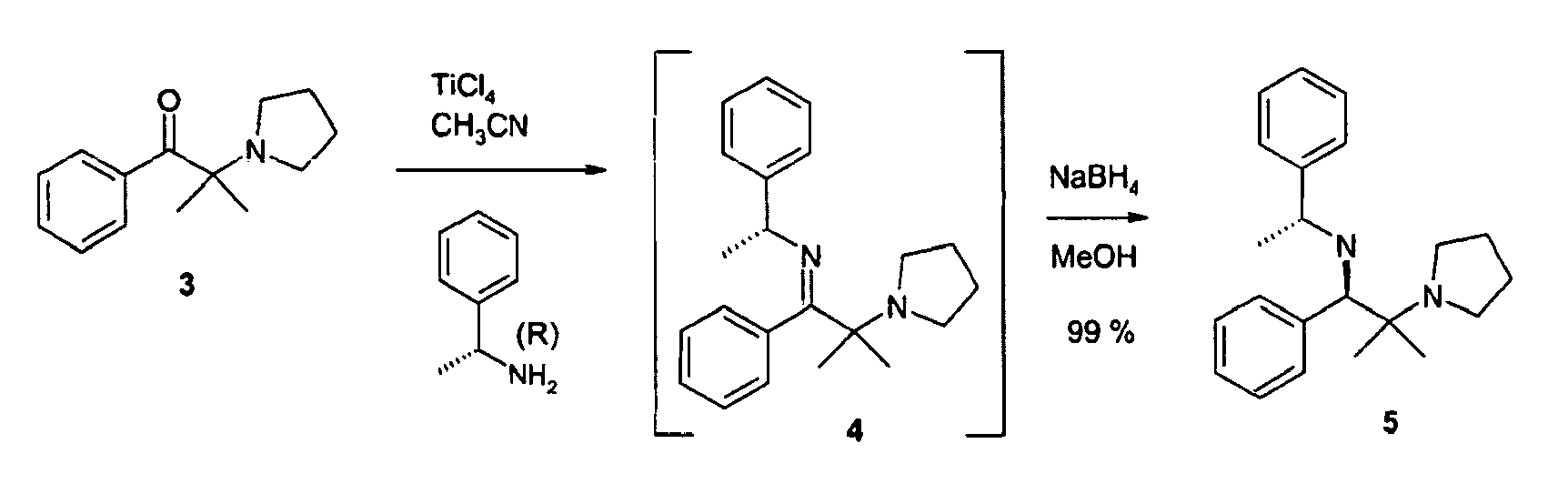
- A flask was charged with the pyrrolidineketone 3 (3.90 g, 17.9 mmol, 1 wt), triethylamine 99.5 % (9.36 ml, 4 eq, 0.072 mol) and R-(+)-a-methylbenzylamine (2.60g, 21.5 mmol, 2.77 ml) in acetonitrile (35 ml, 10 vol) under nitrogen atmosphere. 1 M titanium(IV) chloride in dichloromethane (14.3 mL, 3.7 vol) was added dropwise in 15 min, cooling the flask at 5-10 °C (water-ice bath). The resulting slurry was kept at room temperature for 2.5 hours. The mixture was brought to 0 °C and sodium borohydride (1.40 g, 2 eq) was added portionwise followed by dropwise addition of methanol (8 mL, 2 vol). The reaction was slowly brought to room temperature in 2 hours and left overnight with stirring. The slurry was quenched with 4 N HCl (2 ml) and filtered and washed with CH3CN (2 ml). The solvent was partially evaporated and extracted with EtOAc (8 mL, 2 vol x 2) after addition of 1 N HCl (16 ml, 4 vol). The emulsion was filtered. After filtration 2vol of
HCl 2 N and 2 vol of EtOAc were added. The water phase (25ml) was separated and the organic layer was washed with HCl 2N (2 vol, 8 ml). The combined water layer (33ml, 10 vol) was brought to pH 12 with 6 N NaOH and taken up with EtOAc (8 mL x 3). Evaporation gave a yellow-dark oil (5.16 g, 20 mmol, 100%). - Pyrrolidineketone 3 (1 g, 4.6 mmol, 1 wt) was dissolved in acetonitrile (8 mL, 9 vol) and R-(+)-a-methylbenzylamine (0.7 mL, 0.7 vol) was added followed by triethylamine 99.5 % (2.5 ml, 2.5 vol) under nitrogen atmosphere. The mixture was stirred at 15-20°C. Then a solution of 1 M titanium(IV) chloride in dichloromethane (4.6 ml) was added dropwise in 15 min at 10 °C (water-ice bath) with vigorous stirring. The funnel was washed with acetonitrile (2 ml, 2 vol). The resulting slurry was stirred at room temperature for 1.5 hours. The mixture was cooled to 0 °C and sodium borohydride (350 mg, 2 eq) was added followed by dropwise addition over 20 min of methanol (4 ml). The reaction was slowly brought to room temperature in 2 hours and left for a further two hours. The solvent was evaporated under vacuum to 5 vol and EtOAc (10 vol) was added. The suspension was filtered on Sterimat and the solid washed with EtOAc (5 vol). The EtOAc was extracted with 2N HCl solution (10 vol x 2) and the combined water solutions were washed with EtOAc (10 vol). EtOAc (10 vol) was added and the combined water layer was brought to pH 12 with solid KOH. The EtOAc was separated and the water re-extracted with EtOAc (10 ml). The organic phases were combined, washed with water (3 x 10 ml) and evaporated to give the desired compound (1.45 g, 97%).
-

- An endeavor tube was charged with the chiral diamine 5 (1.62 g, 1 wt, 5.31 mmol) and dissolved in 10 % conc. sulphuric acid in methanol (HPLC grade, 3 mL, 2 vol), 10 % palladium/carbon (150 mg, 10 % wt; Strem Chemicals, 50 % wet) and submitted for 1 hour at 60°C and 3 atm of hydrogen. The mixture was left to reach room temperature and filtered over celite. The filter was rinsed with methanol (4 ml x 2.5 vol) and evaporated to 5 volumes. The pale yellow solution was added to 1 N HCl (6 mL, 4 vol), extracted with EtOAc (6 mL, 4 vol) and separated. The organic phase was extracted with 2 N HCl (2 vol) and the combined water layer was basified to pH 12-13 with 6 N NaOH (4 ml, 3 vol). The resulting milky solution gave a white solid after stirring at room temperature at 10 °C for 1 hour. The solid was washed with water (1 vol). After filtration and drying in the oven at 30 °C overnight a white solid was recovered (890 mg, 76 %).
- The chiral diamine 5 (1.45 g, 1 wt) was dissolved in formic acid (5 mL, 3.4 vol) and EtOAc (0.5 mL). 10 % Palladium/carbon (300 mg, 10 % wt; Strem Chemicals, 50 % wet) was added and the suspension heated to 100°C. After stirring for 2 hours the reaction was .finished giving the formilated derivative. The suspension was cooled to 40-50 °C and filtered on Sterimat. The Pd/C was washed with EtOAc (5 mL x 2). The solvent was evaporated at 50°C to 3-4 total vol under vacuum, then a solution of 4 N HCl in water (10 mL) was added. The solution was stirred at 100°C for 3 hours, then at room temperature the water was washed with EtOAc (10 mL x 2). EtOH (2 mL) was added and the solution cooled at 10°C then
NaOH 30 % was added to pH 12-13, maintaining the temperature at approximately 10 °C. A solid was obtained and after 1 hour filtered and washed with cold water (5 mL x 2). The solid was dissolved in CH2Cl2 and dried for 14 hours under vacuum at 25°C giving the desired compound (710 mg, 71%). -

- To a solution of diisopropylethylamine (0.915ml; 5.37mmol), 2,4-ditrifluoromethyl-6-methoxy-benzoic acid (0.511g; 1.78mmol) and (+)-[2-methyl-1-phenyl-2-(1-pyrrolidinyl)propyl]amine D3 (0.501g; 1.74mmol) in DMF (50ml) under argon was added HATU (0.676g; 1.78mmol) portionwise. After stirring at room temperature for 3h., followed by standing for ca. 2 days the reaction mixture was purified using an SCX column (an ion exchange column) and the resulting product partitioned between ethyl acetate and water. The solvent was removed in vacuo to afford the title product. 1H NMR (CDCl3) δ:0.94 (6H, s), 1.60 - 1.80 (4H, m), 2.55 - 2.75 (4H, m), 3.89 (3H, s), 4.78 (1 H, s), 7.20 -7.40 (7H, m), 7.52 (1H, s). Mass Spectrum (Electrospray LC/MS): Found 489 (MH+). C24H26F6N202 requires 488. Ret. time 2.06min. Conversion of the title product to the corresponding hydrochloride salt afforded an off-white solid (0.893g; 96%). Due to the use of the chiral intermediate (D3), it is believed that the title product was obtained as a chiral compound.
-

R= CH3SO2 - , p-MePhSOz- , (EtO)2PO-
- 2,4-ditrifluoromethyl-6-methoxy-benzoic acid (150 mg , 0.55 mmol) was suspended in AcCN (1.5 ml, 10 vol). TEA (0.1 ml, 1.4 eq) was added and the mixture cooled to 0°C. Mesylchloride (0.054 ml, 0.7 mmol) was added and the mixture stirred for 30 min. (+)-[2-methyl-1-phenyl-2-(1-pyrrolidinyl)propyl]amine (100 mg, 0.5 mmol) was added. After stirring for 15 min, TEA (0.1 ml, 1.4 eq) was added and the obtained suspension stirred for 10 min. Methanol (0.2 ml) was added and after stirring for 30 min, the solvent was partially evaporated and the obtained suspension was diluted with EtOAc (2 ml) washed with water (3 ml), a 0.1% bicarbonate solution, water and evaporated to give the title compound (200 mg, ∼80% yield).
- 2,4-ditrifluoromethyl-6-methoxy-benzoic acid (300 mg, 1.1 mmol) was suspended in AcCN (3 ml, 10 vol) . TEA (0.2 ml, 1.4 eq) was added and the mixture cooled to 0°C. Tosylchloride (200 mg, 0.7 mmol) was added and the mixture stirred for 30 min at 0°C. (+)-[2-methyl-1-phenyl-2-(1-pyrrolidinyl)propyl]amine (200 mg, 1 mmol) was added . After stirring for 5 min, TEA (0.2 ml, 1.4 eq) was added and the obtained suspension stirred for 30 min at 0°C. The solvent was partially evaporated and the obtained suspension was diluted with EtOAc (5 ml) washed with water (5 ml), 1 M NaOH in water (2 x 5 ml), water (5 ml) and evaporated to give the title compound (500 mg , 90% a/a purity, ∼70% yield ).
- 2,4-ditrifluoromethyl-6-methoxy-benzoic acid (1.58 g, 5.5 mmol) was suspended in AcCN (15 ml, 10 vol). TEA (1.4 ml, 10 mmol) was added and the mixture cooled to 0°C. Diethylchlorophosphate (0.8 ml , 5.5 mmol) was added over 5 min and the mixture stirred for 1
hr 30 min. In a different flask (+)-[2-methyl-1-phenyl-2-(1-pyrrolidinyl)propyl]amine (1.92 g, 5 mmol) was dissolved in CH2Cl2 (20 ml, 10 vol) and treated with 1 M NaOH (10 ml). The organic phase was separated, washed with water and evaporated to -10 ml total volume. The CH2Cl2 solution was added over 15 min to the activated acid solution cooled at -5°C. It was washed with 5 ml CH2Cl2. It was left for another 15 minutes at -5 °C then the solvent was partially evaporated to approximately 10 vol of total. EtOAc (20 ml) was added, washed with 1 M NaOH (2 x 15 ml) , water (2 x 15 ml) and then evaporated to give the title compound (2.33 g, 94%yield). - 2,4-ditrifluoromethyl-6-methoxy-benzoic acid (1.58 g, 5.5 mmol) was suspended in AcCN (15 ml, 10 vol) at -10°C. TEA (0.8 ml, 0.5 vol) was added and the mixture cooled to -10°C for 5 min. Mesylchloride (0.42 ml, 0.25 vol) was added and the mixture stirred for 15 min. CH2Cl2 (15 ml) was added and cooled to -15°C. TEA (2 ml) was added followed by (+)-[2-methyl-1-phenyl-2-(1-pyrrolidinyl)propyl]amine (1.9 g, 5 mmol) and CH2Cl2 (15 ml). The reaction temperature increased to 5°C, after stirring at this temperature for 30 min the reaction was terminated. The solvent was partially evaporated and the obtained suspension was diluted with EtOAc (20 ml) washed with 1 M NaOH (2 x 20 ml), water (2 x 20 ml). The ethyl acetate was filtered and evaporated to give the title compound (2.4g, 94%)
- 2,4-ditrifluoromethyl-6-methoxy-benzoic acid (1.7 g, 6 mmol) was suspended in AcCN (17 ml, 10 vol) and the mixture cooled to -10°C. TEA (0.77 ml, 5 mmol) was added then tosylchloride (1 g), and the mixture stirred for 20 min. TEA (1.6 ml) was added followed by (+)-[2-methyl-1-phenyl-2-(1-pyrrolidinyl)propyl]amine (1.9 g, 5 mmol) and CH2Cl2 (10 ml). The reaction temperature increased to 0 °C, after stirring at this temperature for 30 min the reaction was terminated. The solvent was partially evaporated to approximately 5 vol, and the obtained suspension was diluted with EtOAc (20 ml), washed with 1 M NaOH (2 x 20 ml), then by water-NaOH-NaOH, water (2 x 20 ml). The ethyl acetate was filtered and evaporated to give the title compound (2 g , 80% a/a purity, ∼70% yield ).
- 2,4-ditrifluoromethyl-6-methoxy-benzoic acid (1.58g, 5.5mmol) was suspended in AcCN (15 ml, 10 vol). TEA (1.4ml, 10mmol) was added and the mixture cooled to 0°C. Diethylchlorophosphate (0.8ml , 5.5mmol) was added over 5 min and the mixture stirred for 1
hr 30 min. The mixture was cooled to -20°C, CH2Cl2 (10 ml) was added at -20°C followed by (+)-[2-methyl-1-phenyl-2-(1-pyrrolidinyl)propyl]amine (1.92 g, 5 mmol) followed by CH2Cl2 (5 ml). After stirring for 5 min, TEA (0.8 ml) was added and after stirring at -10°C for 1 hr 30min the reaction was terminated. The solvent was partially evaporated to approximately 10 vol, EtOAc (20 ml) was added , washed with 1 M NaOH (2 x 15 ml), water (2 x 15 ml) and then evaporated to give the title compound (2.3 g, 96% a/a purity, ∼90%yield ) -

- To a solution of 2-methyl-2-(1-pyrrolidinyl)propanenitrile D1 (40g; 289.85mmol) in dry THF (0.8L) under nitrogen, cooled at -78°C, was added dropwise a solution of phenyl lithium in dibutyl ether over 40 minutes (305.1mL of a 1.9M solution; 579.70mmol). After 2h the reaction was allowed to reach room temperature and then stirred overnight at this temperature. The mixture was quenched at 0°C with a saturated solution of NaHCO3 (0.8L) and stirred for 15 minutes and diluted with water (ca.0.6L). The phases were separated and the aqueous back extracted with diethylether (2x1L). The collected organics were dried over Na2SO4 and evaporated in vacuo to get 90g of crude material as a yellow oil that was dissolved in methanol (1 L) at 0°C and treated portionwise with sodium borohydride (21.93g; 579.70mmol). After 1 hour at 0°C and then overnight at room temperature the mixture was cooled and quenched with water (ca.0.5L). Methanol was evaporated in vacuo and the aqueous phase, diluted with water (200mL), was extracted with DCM (3x800mL).
- The collected organics were dried over Na2SO4 and evaporated in vacuo to get the title product (51g) as a yellow solid, used in
step 2 without further purification. - [2-Methyl-1-phenyl-2-(1-pyrrolidinyl)propyl]amine D2 from step 1 (51g; 234mmol) was dissolved in isopropanol (0.765L, 15 volumes, relative volumes being referred to the quantity of [2-methyl-l-phenyl-2-(l-pyrrolidinyl)propyl]amine). To this stirred solution, heated at 50°C, was added a solution of R(-)a methoxy phenyl acetic acid (38.83g; 234mmol) in isopropanol (0.255L, 5 volumes, relative volumes being referred to the quantity of [2-methyl-1-phenyl-2-(1-pyrrolidinyl)propyl]amine). After 1.5h the mixture was cooled to room temperature and then left stirring at this temperature overnight. The solid was recovered by filtration and washed with cold isopropanol. This solid (40.5g) was suspended in isopropanol (0.648L, 16 volumes, relative volumes being referred to the quantity of solid obtained in the last filtration step), and heated at 60°C for 2h, at room temperature overnight and recovered by filtration. This solid (38.5g) was suspended in isopropanol (0.616L, 16 volumes, relative volumes being referred to the quantity of solid obtained in the last filtration step), and heated at 60°C for 2h and at room temperature overnight, then recovered by filtration. This solid (37.8g) was suspended in isopropanol (0.756L, 20 volumes, relative volumes being referred to the quantity of solid obtained in the last filtration step), and heated at 60°C for 2h and at room temperature overnight, then recovered by filtration. This solid (36.5g) was suspended in isopropanol (0.912L, 25 volumes, relative volumes being referred to the quantity of solid obtained in the last filtration step), and heated at 60°C for 2h and then filtered at room temperature. This solid (34g) was suspended in isopropanol (0.850L, 25 volumes, relative volumes being referred to the quantity of solid obtained in the last filtration step), and heated at 60°C for 2h and filtered at room temperature. This solid (31.5g) was suspended in isopropanol (0.787L, 25 volumes, relative volumes being referred to the quantity of solid obtained in the last filtration step), and heated at 60°C for 2h, cooled down to 40°C and then filtered to get the title material (27g) as a white solid.
-

- To a solution of 2-(methyloxy)-4,6-bis(trifluoromethyl)benzoic acid (20.2g; 70.14mmol) in dry DCM (400mL), at 0°C, was added dropwise oxalyl chloride (13.4mL; 154.31mmol) followed by dry DMF (5 drops). The reaction was allowed to reach room temperature. After overnight stirring the solvent was evaporated in vacuo to get the title product (23.5g) as a yellow slurry used without further purification.
-

- [2-Methyl-1-phenyl-2-(1-pyrrolidinyl)propyl]amine R(-)a methoxy phenyl acetic acid salt from step 2 (22g; 57.3mmol) was suspended in DCM at 0°C, treated with 1M NaOH solution (86mL) and stirred at room temperature for 20 minutes. To the mixture water (250mL) was added, the phases separated and the aqueous one extracted with DCM (2x300mL). The collected organics were dried over Na2SO4 and evaporated in vacuo to get 12.3g of white solid that was diluted with dry DCM (200mL) under nitrogen and cooled at 0°C. To this solution was added triethylamine (23.92mL; 172mmol) and a solution of 2-(methyloxy)-4,6-bis(trifluoromethyl)benzoyl chloride from Step 3 in dry DCM (190ml of a 200mL solution in DCM of the step 3 material) over 30 minutes. The reaction was left stirring at room temperature for 2 hours and then quenched with a saturated solution of NaHCO3 (ca.450mL). The phases were separated and the organic one washed with water (500mL), dried over Na2SO4 and evaporated in vacuo to get crude material that was purified by silica gel flash chromatography eluting with DCM/methanol 97/3. Evaporation of the solvent afforded the title material (26g) as a pale yellow solid.
- 2-(Methyloxy)-N-[2-methyl-1-phenyl-2-(1-pyrrolidinyl)propyl]-4,6-bis(trifluoromethyl) benzamide from step 4 (10g; 20.47mmol) was dissolved in dry ethyl ether (200mL), cooled to 0°C and treated with 1 M solution of HCl in ethyl ether (21.5mL; 21.49mmol). After 0.5h the solid was collected by filtration, washed with diethyl ether and dried at 45°C overnight to get the title material (9.1 g) as a pale yellow solid. Due to the use of the chiral intermediate made in
step 2, it is believed that the title product was obtained as a chiral compound. - In a different batch, 2-(methyloxy)-N-[2-methyl-1-phenyl-2-(1-pyrrolidinyl)propyl]-4,6-bis(trifluoromethyl)benzamide hydrochloride was made using the chiral intermediate: (+)-[2-methyl-1-phenyl-2-(1-pyrrolidinyl)propyl]amine, and the specific rotation of the resulting compound was determined to be -32.6°.
- In a separate crystal structure study, the absolute configuration of (-)-2-(methyloxy)-N-[2-methyl-1-phenyl-2-(1-pyrrolidinyl)propyl]-4,6-bis(trifluoromethyl)benzamide was determined to be R.
- 4.84g of 2-(Methyloxy)-N-[2-methyl-1-phenyl-2-(1-pyrrolidinyl)propyl]-4,6-bis(trifluoromethyl)benzamide hydrochloride, prepared according to
Description 5, were treated with 150mL of 2M solution of NaHCO3 and 250mL of EtOAc. The mixture was stirred for 20 minutes and then the aqueous phase was extracted with EtOAc. Combined organic phases were dried over Na2SO4 and evaporated to dryness to get 2-(methyloxy)-N-[2-methyl-1-phenyl-2-(1-pyrrolidinyl)propyl]-4,6-bis(trifluoromethyl)benzamide (free base) 4.5g as a white solid. - 300.3mg of the 2-(methyloxy)-N-[2-methyl-1-phenyl-2-(1-pyrrolidinyl)propyl]-4,6-bis(trifluoromethyl)benzamide and 73mg (1 eq) of succinic acid were dissolved in 4ml EtOAc with stirring, sonication and heating. 2ml heptane was then added dropwise to the solution with stirring. A gummy solid began to form, so this was taken into solution with heating. On cooling to ambient, solid began precipitating from solution. The slurry thickened considerably over the next hour, and was allowed to stir overnight at ambient. The solid was then isolated by filtration and dried overnight in vacuo at 40°C: 322.26mg of the title compound was recovered after drying (86% th).
- A mixture of pyrrolidine (1wt) and acetone (1 vol) in toluene (4 vol) was cooled to 0°C -6°C. A solution of potassium cyanide (1wt) in water (5 vol) was added portionwise maintaining the temperature below 6°C. The mixture was stirred for 1.5 hr to 2 hrs at 0°C -6°C.. The two phase were separated and the organic one washed with a brine solution (4 vol). The combined aqueous phases from above were extracted with toluene (8 vol). The combined organic phases were filtered on a magnesium sulphate pad under pressure (min 1 hour) to give 2-methyl-2-(1-pyrrolidinyl)propanenitrile (D3 above). The solution was cooled to -60°C to -50°C. A solution of 1.9 M phenyllitium in dibuthylether (8.9 wt) was added keeping the temperature below -50°C. After the addition, the mixture was stirred for additional 1 to 1.5 hrs at -60° to -50°C, and then it was warmed to 15 to 25°C. Acetone (1.5 vol) was added allowing the exotherm to increase the contents temperature up to a maximum of 40°C. The mixture was cooled to 20°C to 26°C and water (10 vol) was added. The phases were stirred for 30-60 min and then separated. The organic layer was washed with a brine solution (10 vol) and evaporated to dryness. The crude was then dissolved in methanol (11 vol) and the solution cooled to 0°C to 6°C. A solution of NaBH4 (0.4wt) in aqueous 1 M NaOH (3.2 vol) was added maintaining the temperature between 0°C to 6°C. Water (2 vol) was added. The reaction mixture was stirred for 1-2 hrs at 0-6°C. Water (3.5 vol) was added to the mixture, maintaining the contents below 10°C, followed by acetic acid (2.5 wt), maintaining the contents below 15°C. The mixture was stirred for 15 to 30 minutes then further water (5 vol) was added maintaining the contents below 15°C. The mixture was stirred for 15-30 min, maintaining continuously below 15°C and then the two phases separated. A solution of aqueous 1 M NaOH (about 4 vol) was added to the aqueous phase, maintaining the contents below 30°C to adjust the pH >12. After 30-60 min stirring, toluene (8 vol) was added and the two phases separated. The aqueous phase was extracted with toluene (2 vol). A 1M HCl aqueous solution (10 vol) was added to the combined organic layers maintaining the contents temperature below 30°C. After 15-30 min of stirring, the two phases were separated. The aqueous layer was washed two times with toluene (2x4 vol). A solution of NaOH 1 M aqueous (3.5 vol) was added to the aqueous layer maintaining the contents temperature below 30°C, to adjust the pH to >12. The resulting suspension was stirred for 30-60 min and then was filtered. The cake was washed with water (2 vol), to give 2-[methyl-1-phenyl-2-(1-pyrrolidinyl)propyl]amine (D2 above). The crude compound was suspended in water (17 vol) and the mixture was heated to 30°C and stirred at this temperature for 1-2 hrs. It was cooled to 20°C, stirred for 2-3 hrs and filtered. The cake was washed with water (3 vol) and the solid was dried in a vacuum oven at 35°C (yield 65%).
- 2-[methyl-1-phenyl-2-(1-pyrrolidinyl)propyl]amine (20 g; 1 wt) was dissolved in acetone (15 vol) and the mixture was stirred for 15 min under nitrogen, heating to 40 °C. 15% of a solution of R-(-)-methoxyphenylacetic acid (0.726 wt) in acetone (5 vol.) was added and stirred for 15 min at 40°C. After this, [2-methyl-1-phenyl-2-(1-pyrrolidinyl)propyl]amine R(-)a methoxy phenyl acetic acid salt was added, as a seed. The rest of the acid solution was added over 30 min and it was left for the salt to precipitate, keeping the temperature to 40°C and stirring constantly for 1 hr. The suspension was cooled down to room temperature and was left stirring overnight. The solid was filtered and washed with cold acetone (2 x 2 vol). The solid was dried in vacuum oven at 40 °C overnight to give [2-methyl-1-phenyl-2-(1-pyrrolidinyl)propyl]amine R(-)a methoxy phenyl acetic acid salt (yield 49%).
- 2-Methyl-1-phenyl-2-(1-pyrrolidinyl)propyl]amine R(-)a methoxy phenyl acetic acid salt (9.1 g,1 wt) was suspended in DCM (91 ml, 10 vol) and a solution of NaOH 1 M (5 vol, 45 ml) was added. After 15 min, the two phases were separated. The aqueous layer was extracted with DCM (45 ml, 5 vol). The combined organic phases were concentrated to dryness and dissolved with fresh DCM (3 vol, 27 ml). TBTU (9.11 g, 1 wt), 2-(methyloxy)-4,6-bis(trifluoromethyl)benzoic acid (6.82 g) and triethylamine (344 ml, 0.433 vol) in acetonitrile (45 ml, 5 vol) was stirred at room temperature for 2 hour 40 min and the free base in DCM prepared above was added in 5 minutes. The reaction mixture was stirred for 2
hr 30 min at room temperature. - The reaction mixture was concentrated to 3 vol (27 ml) and fresh ethyl acetate (11 vol, 100 ml). was added. The organic phase was washed with 15% sodium carbonate aqueous solution (4 vol, 36 ml) and water (4 vol, 36 ml). The organic layer was washed with water (1×5 vol + 2×3 vol) and concentrated under vacuum to 4 vol. Further ethyl acetate was added (4 vol, 36 ml). The organic phase was concentrated again to 4 vol. Fresh ethyl acetate was added (7 vol, 63.77 ml). The solution was heated to 70°C and succinic acid (2.25g) was added. After 20 min a seed (final compound) was added. The reaction mixture was stirred for 20 min more at 70°C and then cooled to room temperature and stirred at room tempearutre. The suspension was filtered, the cake washed with ethyl acetate (
1x 2 vol) and the solid dried in a vacuum oven, to give 2-(methyloxy)-N-[2-methyl-1-phenyl-2-(1-pyrrolidinyl)propyl]-4,6-bis(trifluoromethyl)benzamide monosuccinate (7.87g, 67%). - 2-(methyloxy)-N-[2-methyl-1-phenyl-2-(1-pyrrolidinyl)propyl]-4,6-bis(trifluoromethyl)benzamide monosuccinate (317.63 g, 1 wt) was dissolved in DCM (1588 ml, 5 vol) at room temperature and the solution was stirred for 15 min and filtered. IPA (6.3 vol) was added and the mixture was concentrated to 8 vol. Then a further 3.7 vol was added and distilled again until 8 vol. The mixture was distilled at reflux until 8 vol. The mixture was cooled to 25°C over 90 minutes. 2-(methyloxy)-N-[2-methyl-1-phenyl-2-(1-pyrrolidinyl)propyl]-4,6-bis(trifluoromethyl)benzamide monosuccinate (0.001 wt, 0.3 g), as the seed, was added at 65°C. The suspension was stirred overnight at room temperature and then filtered and washed with IPA (600 ml, 2 vol) and the solid dried in a vacuum oven at 40°C overnight. Yield 84%.
- 300.4mg of the 2-(methyloxy)-N-[2-methyl-1-phenyl-2-(1-pyrrolidinyl)propyl]-4,6-bis(trifluoromethyl)benzamide prepared as described in Example 1 was dissolved in 4ml IPA with stirring, sonication and heating. 114mg of 1,5-naphthalenedisulfonic acid was dissolved in 1 ml IPA, and the 2 solutions were combined. A thick gum formed rapidly, so this was taken into solution with heating. On cooling to ambient, solid began precipitating from solution. The slurry thickened considerably over the next hour, and was allowed to stir overnight at ambient. The solid was then isolated by filtration and dried overnight in vacuo at 40°C, and then for a further night at 60°C. 343.95mg of the title compound was recovered after drying (83% th).
Table 1: XRPD angles and d spacings for R-(-)-2-(Methyloxy)-N-[2-methyl-1-phenyl-2-(1-pyrrolidinyl)propyl]-4,6-bis(trifluoromethyl)benzamide monosuccinate 2θ/° d-spacing / Å 8.0 11.1 8.8 10.1 10.6 8.3 11.1 7.9 11.2 7.9 12.5 7.1 13.2 6.7 14.0 6.3 14.4 6.2 15.9 5.6 16.1 5.5 16.6 5.3 17.2 5.1 17.4 5.1 17.6 5.0 17.9 4.9 18.4 4.8 18.6 4.8 18.8 4.7 19.7 4.5 20.3 4.4 21.3 4.2 22.3 4.0 22.6 3.9 22.9 3.9 23.2 3.8 23.9 3.7 24.6 3.6 25.2 3.5 25.5 3.5 26.5 3.4 Table 2: XRPD angles and d spacings for R-(-)-2-(Methyloxy)-N-[2-methyl-1-phenyl-2-(1-pyrrolidinyl)propyl]-4,6-bis(trifluoromethyl)benzamide 1,5-heminapadisylate 2θ/ ° d-spacing / Å 8.0 11.0 8.9 10.0 9.3 9.5 9.7 9.1 11.3 7.9 11.6 7.6 11.9 7.4 14.4 6.2 14.6 6.1 14.9 5.9 15.3 5.8 15.8 5.6 16.0 5.5 16.6 5.3 17.2 5.1 17.9 5.0 18.2 4.9 19.4 4.6 19.9 4.5 20.8 4.3 21.1 4.2 21.4 4.1 21.7 4.1 22.2 4.0 22.6 3.9 23.2 3.8 24.1 3.7 24.5 3.6 24.9 3.6 25.3 3.5 26.3 3.4 29.4 3.0 -
-
Figure 1 : X-Ray powder diffraction data obtained for R-(-)-2-(Methyloxy)-N-[2-methyl-1-phenyl-2-(1-pyrrolidinyl)propyl]-4,6-bis(trifluoromethyl)benzamide succinate. Characteristic peaks for the solid state form are summarised in Table 1 with and calculated lattice spacings. Peak positions were measured using Highscore software. -
Figure 2 : X-Ray powder diffraction data obtained for R-(-)-2-(Methyloxy)-N-[2-methyl-1-phenyl-2-(1-pyrrolidinyl)propyl]-4,6-bis(trifluoromethyl)benzamide napadisylate. Characteristic peaks for the solid state form are summarised in Table 1 with and calculated lattice spacings. Peak positions were measured using Highscore software. -
Figure 3 : Differential Scanning Calorimetry (DSC) thermogram of R-(-)-2-(Methyloxy)-N-[2-methyl-1-phenyl-2-(1-pyrrolidinyl)propyl]-4,6-bis(trifluoromethyl)benzamide succinate. The sample shows an endotherm, with onset temp=181°C, due to melt event. -
Figure 4 : Differential Scanning Calorimetry (DSC) thermogram of R-(-)-2-(Methyloxy)-N-[2-methyl-1-phenyl-2-(1-pyrrolidinyl)propyl]-4,6-bis(trifluoromethyl)benzamide napadisylate. The sample shows an endotherm with onset temp=301°C, due to melt event. Minor endotherms are also observed with onset temp=159°C, possibly due to solvent loss or melt event and at onset temp=225°C, possibly due to a melt event. - The data were acquired on a PANalytical X'Pert Pro™ powder diffractometer, model PW3040/60, serial number DY1850 using an XCelerator™ detector. The acquisition conditions were: radiation: Cu Kα, generator tension: 40 kV, generator current: 45 mA, start angle: 2.0°2θ, end angle: 40.0°2 θ, step size: 0.0167°2 θ, time per step: 31.75 seconds. The sample was prepared by mounting a few milligrams of sample on a Si wafer (zero background) plates, resulting in a thin layer of powder.
- It will be recognised that spectra and diffraction data will vary slightly according to various factors such as the temperature, concentration and instrumentation used. The skilled person will recognise that XRPD peak positions are affected by differences in sample height. The peak positions quoted herein are thus subject to a variation of +/- 0.15 degrees 2-theta.
- It should be noted that more than one polymorph of the salt may have existed in the samples tested. This may have caused some of the minor peaks in the XRPD reading. A skilled person would understand that such minor peaks may not appear in an XRPD reading for a sample containing only one polymorph.
- DSC thermograms were obtained using a TA Q1000 calorimeter, serial number 1000-0126. The samples were weighed into an aluminium pan, a pan lid placed on top and lightly crimped without sealing the pan. The experiment was conducted using a heating rate of 10°C min-1.
Claims (24)
- 2-(Methyloxy)-N-[2-methyl-1-phenyl-2-(1-pyrrolidinyl)propyl]-4,6-bis(trifluoromethyl)benzamide succinate or a solvate thereof.
- 2-(Methyloxy)-N-[2-methyl-1-phenyl-2-(1-pyrrolidinyl)propyl]-4,6-bis(trifluoromethyl)benzamide napadisylate or a solvate thereof.
- A compound as claimed in claim 1, which is 2-(methyloxy)-N-[2-methyl-1-phenyl-2-(1-pyrrolidinyl)propyl]-4,6-bis(trifluoromethyl)benzamide monosuccinate or a solvate thereof.
- A compound as claimed in claim 1, which is R-(-)-2-(methyloxy)-N-[2-methyl-1-phenyl-2-(1-pyrrolidinyl)propyl]-4,6-bis(trifluoromethyl)benzamide monosuccinate or a solvate thereof.
- A compound as claimed in claim 1, which is S-(+)-2-(methyloxy)-N-[2-methyl-1-phenyl-2-(1-pyrrolidinyl)propyl]-4,6-bis(trifluoromethyl)benzamide monosuccinate or a solvate thereof.
- A compound as claimed in claim 2 which is 2-(methyloxy)-N-[2-methyl-1-phenyl-2-(1-pyrrolidinyl)propyl]-4,6-bis(trifluoromethyl)benzamide-1,5-napadisylate or a solvate thereof.
- A compound as claimed in claim 2 which is 2-(methyloxy)-N-[2-methyl-1-phenyl-2-(1-pyrrolidinyl)propyl]-4,6-bis(trifluoromethyl)benzamide-1,5-heminapadisylate or a solvate thereof.
- A compound as claimed in claim 2, which is R-(-)-2-(methyloxy)-N-[2-methyl-1-phenyl-2-(1-pyrrolidinyl)propyl]-4,6-bis(trifluoromethyl)benzamide 1,5-heminapadisylate or a solvate thereof.
- A compound as claimed in claim 2, which is S-(+)-2-(methyloxy)-N-[2-methyl-1-phenyl-2-(1-pyrrolidinyl)propyl]-4,6-bis(trifluoromethyl)benzamide 1,5-heminapadisylate or a solvate thereof.
- A compound as claimed in any of claims 1-9, in crystalline form.
- A compound as claimed in claim 1 having an X-ray powder diffraction pattern, wherein said X-ray powder diffraction pattern comprises 2 theta angles at one or more positions selected from the group consisting of 10.6±0.1, 11.1±0.1 and 21.3±0.1 degrees.
- A compound as claimed in claim 1 having an XRPD diffractogram substantially as illustrated in Figure 1.
- A compound as claimed in claim 1 having an XRPD diffractogram with signals substantially as listed in Table 1.
- A compound as claimed in claim 2 having an XRPD diffractogram substantially as illustrated in Figure 2.
- A compound as claimed in claim 2 having an XRPD diffractogram with signals substantially as listed in Table 2.
- A compound as claimed in any of claims 1-15 for use in therapy.
- A compound as claimed in any of claims 1-15 for use in the treatment of a disorder mediated by GlyT1.
- A compound as claimed in any of claims 1-15, for use in the treatment of psychosis.
- A compound as claimed in any of claims 1-15, for use in the treatment of schizophrenia, dementia or attention deficit disorder.
- Use of a compound as claimed in any of claims 1-15 in the preparation of a medicament for the treatment of a disorder mediated by GlyT1.
- Use of a compound as claimed in any of claims 1-15 in the preparation of a medicament for the treatment of psychosis.
- The use as claimed in claim 21, wherein the psychosis is schizophrenia, dementia or attention deficit disorder.
- A pharmaceutical composition comprising a compound as claimed in any of claims 1-15 and at least one pharmaceutically acceptable carrier, diluent or excipient.
- A pharmaceutical composition as claimed in claim 23 further comprising one or more other therapeutic agents, selected from antidepressant agents (selected from 5HT3 antagonists, serotonin agonists, NK-1 antagonists, selective serotonin reuptake inhibitors (SSRI), noradrenaline re-uptake inhibitors (SNRI), tricyclic antidepressants, dopaminergic antidepressants, H3 antagonists, 5HT1A antagonists, 5HT1B antagonists, 5HT1D antagonists, D1 agonists, M1 agonists); anticonvulsant agents; atypical antipsychotic drugs and cognitive enhancers.
Applications Claiming Priority (2)
| Application Number | Priority Date | Filing Date | Title |
|---|---|---|---|
| GBGB0612420.0A GB0612420D0 (en) | 2006-06-22 | 2006-06-22 | Compounds |
| PCT/EP2007/056106 WO2007147831A1 (en) | 2006-06-22 | 2007-06-20 | Pyrrolidine derivatives having activity at the glyt1 transporter |
Publications (2)
| Publication Number | Publication Date |
|---|---|
| EP2041082A1 EP2041082A1 (en) | 2009-04-01 |
| EP2041082B1 true EP2041082B1 (en) | 2009-09-30 |
Family
ID=36803732
Family Applications (1)
| Application Number | Title | Priority Date | Filing Date |
|---|---|---|---|
| EP07786764A Active EP2041082B1 (en) | 2006-06-22 | 2007-06-20 | Pyrrolidine derivatives having activity at the glyt1 transporter |
Country Status (23)
| Country | Link |
|---|---|
| US (1) | US20080070973A1 (en) |
| EP (1) | EP2041082B1 (en) |
| JP (1) | JP2009541261A (en) |
| KR (1) | KR20090019847A (en) |
| CN (1) | CN101506156A (en) |
| AR (1) | AR061554A1 (en) |
| AT (1) | ATE444288T1 (en) |
| AU (1) | AU2007263058A1 (en) |
| BR (1) | BRPI0713311A2 (en) |
| CA (1) | CA2655399A1 (en) |
| CL (1) | CL2007001808A1 (en) |
| CR (1) | CR10498A (en) |
| DE (1) | DE602007002642D1 (en) |
| EA (1) | EA200970044A1 (en) |
| ES (1) | ES2333918T3 (en) |
| GB (1) | GB0612420D0 (en) |
| IL (1) | IL195633A0 (en) |
| MA (1) | MA30522B1 (en) |
| NO (1) | NO20085412L (en) |
| PE (1) | PE20080380A1 (en) |
| TW (1) | TW200817322A (en) |
| WO (1) | WO2007147831A1 (en) |
| ZA (1) | ZA200810009B (en) |
Families Citing this family (5)
| Publication number | Priority date | Publication date | Assignee | Title |
|---|---|---|---|---|
| PE20061156A1 (en) | 2004-12-23 | 2006-12-16 | Glaxo Group Ltd | BENZAMIDE DERIVATIVES AS INHIBITING AGENTS OF THE GLYCINE TRANSPORTER |
| US20100184996A1 (en) * | 2007-06-20 | 2010-07-22 | Glaxo Group Limited | Process of amide formation |
| US9045445B2 (en) | 2010-06-04 | 2015-06-02 | Albany Molecular Research, Inc. | Glycine transporter-1 inhibitors, methods of making them, and uses thereof |
| US20120035156A1 (en) * | 2010-08-09 | 2012-02-09 | Daniela Alberati | Combination of glyt1 compound with antipsychotics |
| JP7152122B2 (en) | 2017-10-13 | 2022-10-12 | ツリーウェイ ティーダブリュー001 ビー.ブイ. | edaravone salt |
Family Cites Families (6)
| Publication number | Priority date | Publication date | Assignee | Title |
|---|---|---|---|---|
| US2746959A (en) * | 1953-06-02 | 1956-05-22 | American Home Prod | Diphenylethylenediamine-penicillin salt |
| US3145209A (en) * | 1961-07-31 | 1964-08-18 | Olin Mathieson | Substituted aminophenyl-ethylamine derivatives |
| NZ237443A (en) * | 1990-04-10 | 1993-11-25 | Asta Medica Ag | Phenalkylethylenediamine and aminomethyltetra hydroisoquinoline derivatives, platinum (ii) and (iv) complexes, methods of preparation and pharmaceutical compositions |
| GB0130696D0 (en) * | 2001-12-21 | 2002-02-06 | Smithkline Beecham Plc | Chemical Compounds |
| FR2861070B1 (en) * | 2003-10-17 | 2006-01-06 | Sanofi Synthelabo | DERIVATIVES OF N- [PHENYL (PYRROLIDIN-2-YL) METHYL] BENZAMIDE AND N - [(AZEPAN-2-YL) PHENYLMETHYL] BENZAMIDE, THEIR PREPARATION AND THEIR THERAPEUTIC USE |
| PE20061156A1 (en) * | 2004-12-23 | 2006-12-16 | Glaxo Group Ltd | BENZAMIDE DERIVATIVES AS INHIBITING AGENTS OF THE GLYCINE TRANSPORTER |
-
2006
- 2006-06-22 GB GBGB0612420.0A patent/GB0612420D0/en not_active Ceased
-
2007
- 2007-06-20 AU AU2007263058A patent/AU2007263058A1/en not_active Abandoned
- 2007-06-20 TW TW096121972A patent/TW200817322A/en unknown
- 2007-06-20 KR KR1020087030915A patent/KR20090019847A/en not_active Withdrawn
- 2007-06-20 DE DE602007002642T patent/DE602007002642D1/en active Active
- 2007-06-20 EA EA200970044A patent/EA200970044A1/en unknown
- 2007-06-20 WO PCT/EP2007/056106 patent/WO2007147831A1/en not_active Ceased
- 2007-06-20 US US11/765,478 patent/US20080070973A1/en not_active Abandoned
- 2007-06-20 PE PE2007000782A patent/PE20080380A1/en not_active Application Discontinuation
- 2007-06-20 JP JP2009515863A patent/JP2009541261A/en not_active Withdrawn
- 2007-06-20 BR BRPI0713311-1A patent/BRPI0713311A2/en not_active IP Right Cessation
- 2007-06-20 AR ARP070102723A patent/AR061554A1/en unknown
- 2007-06-20 CA CA002655399A patent/CA2655399A1/en not_active Abandoned
- 2007-06-20 AT AT07786764T patent/ATE444288T1/en not_active IP Right Cessation
- 2007-06-20 CL CL2007001808A patent/CL2007001808A1/en unknown
- 2007-06-20 EP EP07786764A patent/EP2041082B1/en active Active
- 2007-06-20 ES ES07786764T patent/ES2333918T3/en active Active
- 2007-06-20 CN CNA2007800312340A patent/CN101506156A/en active Pending
-
2008
- 2008-11-25 ZA ZA200810009A patent/ZA200810009B/en unknown
- 2008-12-01 IL IL195633A patent/IL195633A0/en unknown
- 2008-12-11 CR CR10498A patent/CR10498A/en not_active Application Discontinuation
- 2008-12-19 MA MA31488A patent/MA30522B1/en unknown
- 2008-12-30 NO NO20085412A patent/NO20085412L/en not_active Application Discontinuation
Also Published As
| Publication number | Publication date |
|---|---|
| AR061554A1 (en) | 2008-09-03 |
| DE602007002642D1 (en) | 2009-11-12 |
| EA200970044A1 (en) | 2009-04-28 |
| CL2007001808A1 (en) | 2008-01-18 |
| ES2333918T3 (en) | 2010-03-02 |
| JP2009541261A (en) | 2009-11-26 |
| WO2007147831A1 (en) | 2007-12-27 |
| CR10498A (en) | 2009-03-20 |
| MA30522B1 (en) | 2009-06-01 |
| BRPI0713311A2 (en) | 2012-03-06 |
| TW200817322A (en) | 2008-04-16 |
| KR20090019847A (en) | 2009-02-25 |
| CA2655399A1 (en) | 2007-12-27 |
| NO20085412L (en) | 2009-01-22 |
| EP2041082A1 (en) | 2009-04-01 |
| AU2007263058A1 (en) | 2007-12-27 |
| GB0612420D0 (en) | 2006-08-02 |
| ATE444288T1 (en) | 2009-10-15 |
| ZA200810009B (en) | 2009-11-25 |
| PE20080380A1 (en) | 2008-05-31 |
| US20080070973A1 (en) | 2008-03-20 |
| IL195633A0 (en) | 2009-09-01 |
| CN101506156A (en) | 2009-08-12 |
Similar Documents
| Publication | Publication Date | Title |
|---|---|---|
| US7745642B2 (en) | Glycine transport inhibitors | |
| US20080070973A1 (en) | Compounds having activity at the GlyT1 transporter | |
| EP1833811B1 (en) | Oxygen containing heterocycles as glycine transporter inhibiting compounds | |
| EP1838663B1 (en) | Glycine transport inhibitors | |
| US20100216837A1 (en) | Glycine transport inhibitors | |
| US20100113545A1 (en) | Glyt1 transporter inhibitors and uses thereof in treatment of neurological and neuropsychiatric disorders | |
| US20090286828A1 (en) | 2-amino-1-phenylethylcarboxamide derivatives | |
| US20090221577A1 (en) | Compounds having morpholinyl and piperidinyl groups for use as glyt1 inhibitors | |
| US20100016374A1 (en) | Compounds Which Inhibit the Glycine Transporter and Uses Thereof | |
| US20090253700A1 (en) | N-'4-4(4-morpholinyl) phenyl!- '(4-piperidinyl) methyl! carboxamide derivatives and their use as glycine transporter inhibitors | |
| US20090227629A1 (en) | Compounds having activity at the glycine transporter glyt1 and uses thereof | |
| US20100048656A1 (en) | Glyt1 transporter inhibitors and uses thereof in treatment of neurological and neuropsychiatric disorders | |
| WO2007147836A1 (en) | Glycine transporter inhibiting compounds and uses in medicine | |
| WO2007147839A1 (en) | Glycine transporter inhibiting compounds and uses in medicine | |
| WO2007147834A1 (en) | Glycine transporter inhibiting compounds and uses in medicine | |
| MX2009000106A (en) | Pyrrolidine derivatives having activity at the glyt1 transporter. | |
| US20090318447A1 (en) | N-[6-(4-morpholinyl)-3-pyridinyl]-2-(tetrahydro-2h-pyran-4-yl)-n-[(1--4-piperidinyl) methyl] acetamide derivatives and related compounds as glyt1 transport inhibitors for the treatment of neurological disorders such as schizophrenia | |
| WO2006002956A1 (en) | Piperidine derivatives and their use as glycine transporter inhibitors |
Legal Events
| Date | Code | Title | Description |
|---|---|---|---|
| PUAI | Public reference made under article 153(3) epc to a published international application that has entered the european phase |
Free format text: ORIGINAL CODE: 0009012 |
|
| 17P | Request for examination filed |
Effective date: 20090107 |
|
| AK | Designated contracting states |
Kind code of ref document: A1 Designated state(s): AT BE BG CH CY CZ DE DK EE ES FI FR GB GR HU IE IS IT LI LT LU LV MC MT NL PL PT RO SE SI SK TR |
|
| AX | Request for extension of the european patent |
Extension state: AL BA HR MK RS |
|
| GRAP | Despatch of communication of intention to grant a patent |
Free format text: ORIGINAL CODE: EPIDOSNIGR1 |
|
| GRAS | Grant fee paid |
Free format text: ORIGINAL CODE: EPIDOSNIGR3 |
|
| GRAA | (expected) grant |
Free format text: ORIGINAL CODE: 0009210 |
|
| AK | Designated contracting states |
Kind code of ref document: B1 Designated state(s): AT BE BG CH CY CZ DE DK EE ES FI FR GB GR HU IE IS IT LI LT LU LV MC MT NL PL PT RO SE SI SK TR |
|
| AX | Request for extension of the european patent |
Extension state: HR |
|
| REG | Reference to a national code |
Ref country code: GB Ref legal event code: FG4D Ref country code: CH Ref legal event code: EP |
|
| REG | Reference to a national code |
Ref country code: HK Ref legal event code: DE Ref document number: 1127598 Country of ref document: HK |
|
| REG | Reference to a national code |
Ref country code: IE Ref legal event code: FG4D |
|
| REF | Corresponds to: |
Ref document number: 602007002642 Country of ref document: DE Date of ref document: 20091112 Kind code of ref document: P |
|
| PG25 | Lapsed in a contracting state [announced via postgrant information from national office to epo] |
Ref country code: FI Free format text: LAPSE BECAUSE OF FAILURE TO SUBMIT A TRANSLATION OF THE DESCRIPTION OR TO PAY THE FEE WITHIN THE PRESCRIBED TIME-LIMIT Effective date: 20090930 Ref country code: SE Free format text: LAPSE BECAUSE OF FAILURE TO SUBMIT A TRANSLATION OF THE DESCRIPTION OR TO PAY THE FEE WITHIN THE PRESCRIBED TIME-LIMIT Effective date: 20090930 Ref country code: LT Free format text: LAPSE BECAUSE OF FAILURE TO SUBMIT A TRANSLATION OF THE DESCRIPTION OR TO PAY THE FEE WITHIN THE PRESCRIBED TIME-LIMIT Effective date: 20090930 |
|
| LTIE | Lt: invalidation of european patent or patent extension |
Effective date: 20090930 |
|
| PG25 | Lapsed in a contracting state [announced via postgrant information from national office to epo] |
Ref country code: LV Free format text: LAPSE BECAUSE OF FAILURE TO SUBMIT A TRANSLATION OF THE DESCRIPTION OR TO PAY THE FEE WITHIN THE PRESCRIBED TIME-LIMIT Effective date: 20090930 Ref country code: PL Free format text: LAPSE BECAUSE OF FAILURE TO SUBMIT A TRANSLATION OF THE DESCRIPTION OR TO PAY THE FEE WITHIN THE PRESCRIBED TIME-LIMIT Effective date: 20090930 Ref country code: SI Free format text: LAPSE BECAUSE OF FAILURE TO SUBMIT A TRANSLATION OF THE DESCRIPTION OR TO PAY THE FEE WITHIN THE PRESCRIBED TIME-LIMIT Effective date: 20090930 |
|
| NLV1 | Nl: lapsed or annulled due to failure to fulfill the requirements of art. 29p and 29m of the patents act | ||
| REG | Reference to a national code |
Ref country code: ES Ref legal event code: FG2A Ref document number: 2333918 Country of ref document: ES Kind code of ref document: T3 |
|
| PG25 | Lapsed in a contracting state [announced via postgrant information from national office to epo] |
Ref country code: PT Free format text: LAPSE BECAUSE OF FAILURE TO SUBMIT A TRANSLATION OF THE DESCRIPTION OR TO PAY THE FEE WITHIN THE PRESCRIBED TIME-LIMIT Effective date: 20100201 Ref country code: EE Free format text: LAPSE BECAUSE OF FAILURE TO SUBMIT A TRANSLATION OF THE DESCRIPTION OR TO PAY THE FEE WITHIN THE PRESCRIBED TIME-LIMIT Effective date: 20090930 Ref country code: CZ Free format text: LAPSE BECAUSE OF FAILURE TO SUBMIT A TRANSLATION OF THE DESCRIPTION OR TO PAY THE FEE WITHIN THE PRESCRIBED TIME-LIMIT Effective date: 20090930 Ref country code: IS Free format text: LAPSE BECAUSE OF FAILURE TO SUBMIT A TRANSLATION OF THE DESCRIPTION OR TO PAY THE FEE WITHIN THE PRESCRIBED TIME-LIMIT Effective date: 20100130 Ref country code: RO Free format text: LAPSE BECAUSE OF FAILURE TO SUBMIT A TRANSLATION OF THE DESCRIPTION OR TO PAY THE FEE WITHIN THE PRESCRIBED TIME-LIMIT Effective date: 20090930 |
|
| PG25 | Lapsed in a contracting state [announced via postgrant information from national office to epo] |
Ref country code: SK Free format text: LAPSE BECAUSE OF FAILURE TO SUBMIT A TRANSLATION OF THE DESCRIPTION OR TO PAY THE FEE WITHIN THE PRESCRIBED TIME-LIMIT Effective date: 20090930 |
|
| PG25 | Lapsed in a contracting state [announced via postgrant information from national office to epo] |
Ref country code: AT Free format text: LAPSE BECAUSE OF FAILURE TO SUBMIT A TRANSLATION OF THE DESCRIPTION OR TO PAY THE FEE WITHIN THE PRESCRIBED TIME-LIMIT Effective date: 20090930 |
|
| PG25 | Lapsed in a contracting state [announced via postgrant information from national office to epo] |
Ref country code: NL Free format text: LAPSE BECAUSE OF FAILURE TO SUBMIT A TRANSLATION OF THE DESCRIPTION OR TO PAY THE FEE WITHIN THE PRESCRIBED TIME-LIMIT Effective date: 20090930 Ref country code: DK Free format text: LAPSE BECAUSE OF FAILURE TO SUBMIT A TRANSLATION OF THE DESCRIPTION OR TO PAY THE FEE WITHIN THE PRESCRIBED TIME-LIMIT Effective date: 20090930 |
|
| PGFP | Annual fee paid to national office [announced via postgrant information from national office to epo] |
Ref country code: ES Payment date: 20100618 Year of fee payment: 4 Ref country code: FR Payment date: 20100617 Year of fee payment: 4 |
|
| PLBE | No opposition filed within time limit |
Free format text: ORIGINAL CODE: 0009261 |
|
| STAA | Information on the status of an ep patent application or granted ep patent |
Free format text: STATUS: NO OPPOSITION FILED WITHIN TIME LIMIT |
|
| 26N | No opposition filed |
Effective date: 20100701 |
|
| PG25 | Lapsed in a contracting state [announced via postgrant information from national office to epo] |
Ref country code: GR Free format text: LAPSE BECAUSE OF FAILURE TO SUBMIT A TRANSLATION OF THE DESCRIPTION OR TO PAY THE FEE WITHIN THE PRESCRIBED TIME-LIMIT Effective date: 20091231 |
|
| PGFP | Annual fee paid to national office [announced via postgrant information from national office to epo] |
Ref country code: BE Payment date: 20100630 Year of fee payment: 4 |
|
| PGFP | Annual fee paid to national office [announced via postgrant information from national office to epo] |
Ref country code: DE Payment date: 20100630 Year of fee payment: 4 |
|
| PG25 | Lapsed in a contracting state [announced via postgrant information from national office to epo] |
Ref country code: MC Free format text: LAPSE BECAUSE OF NON-PAYMENT OF DUE FEES Effective date: 20100630 |
|
| PG25 | Lapsed in a contracting state [announced via postgrant information from national office to epo] |
Ref country code: IE Free format text: LAPSE BECAUSE OF NON-PAYMENT OF DUE FEES Effective date: 20100620 Ref country code: MT Free format text: LAPSE BECAUSE OF FAILURE TO SUBMIT A TRANSLATION OF THE DESCRIPTION OR TO PAY THE FEE WITHIN THE PRESCRIBED TIME-LIMIT Effective date: 20090930 |
|
| PGFP | Annual fee paid to national office [announced via postgrant information from national office to epo] |
Ref country code: IT Payment date: 20100630 Year of fee payment: 4 |
|
| BERE | Be: lapsed |
Owner name: GLAXO GROUP LTD Effective date: 20110630 |
|
| REG | Reference to a national code |
Ref country code: CH Ref legal event code: PL |
|
| GBPC | Gb: european patent ceased through non-payment of renewal fee |
Effective date: 20110620 |
|
| REG | Reference to a national code |
Ref country code: FR Ref legal event code: ST Effective date: 20120229 |
|
| PG25 | Lapsed in a contracting state [announced via postgrant information from national office to epo] |
Ref country code: BE Free format text: LAPSE BECAUSE OF NON-PAYMENT OF DUE FEES Effective date: 20110630 |
|
| REG | Reference to a national code |
Ref country code: DE Ref legal event code: R119 Ref document number: 602007002642 Country of ref document: DE Effective date: 20120103 |
|
| PG25 | Lapsed in a contracting state [announced via postgrant information from national office to epo] |
Ref country code: LI Free format text: LAPSE BECAUSE OF NON-PAYMENT OF DUE FEES Effective date: 20110630 Ref country code: CH Free format text: LAPSE BECAUSE OF NON-PAYMENT OF DUE FEES Effective date: 20110630 Ref country code: FR Free format text: LAPSE BECAUSE OF NON-PAYMENT OF DUE FEES Effective date: 20110630 Ref country code: DE Free format text: LAPSE BECAUSE OF NON-PAYMENT OF DUE FEES Effective date: 20120103 |
|
| PG25 | Lapsed in a contracting state [announced via postgrant information from national office to epo] |
Ref country code: GB Free format text: LAPSE BECAUSE OF NON-PAYMENT OF DUE FEES Effective date: 20110620 |
|
| REG | Reference to a national code |
Ref country code: ES Ref legal event code: FD2A Effective date: 20120717 |
|
| PG25 | Lapsed in a contracting state [announced via postgrant information from national office to epo] |
Ref country code: ES Free format text: LAPSE BECAUSE OF NON-PAYMENT OF DUE FEES Effective date: 20110621 |
|
| PG25 | Lapsed in a contracting state [announced via postgrant information from national office to epo] |
Ref country code: CY Free format text: LAPSE BECAUSE OF FAILURE TO SUBMIT A TRANSLATION OF THE DESCRIPTION OR TO PAY THE FEE WITHIN THE PRESCRIBED TIME-LIMIT Effective date: 20090930 |
|
| PG25 | Lapsed in a contracting state [announced via postgrant information from national office to epo] |
Ref country code: BG Free format text: LAPSE BECAUSE OF FAILURE TO SUBMIT A TRANSLATION OF THE DESCRIPTION OR TO PAY THE FEE WITHIN THE PRESCRIBED TIME-LIMIT Effective date: 20090930 Ref country code: LU Free format text: LAPSE BECAUSE OF NON-PAYMENT OF DUE FEES Effective date: 20100620 Ref country code: HU Free format text: LAPSE BECAUSE OF FAILURE TO SUBMIT A TRANSLATION OF THE DESCRIPTION OR TO PAY THE FEE WITHIN THE PRESCRIBED TIME-LIMIT Effective date: 20100401 |
|
| PG25 | Lapsed in a contracting state [announced via postgrant information from national office to epo] |
Ref country code: TR Free format text: LAPSE BECAUSE OF FAILURE TO SUBMIT A TRANSLATION OF THE DESCRIPTION OR TO PAY THE FEE WITHIN THE PRESCRIBED TIME-LIMIT Effective date: 20090930 |
|
| REG | Reference to a national code |
Ref country code: HK Ref legal event code: WD Ref document number: 1127598 Country of ref document: HK |