EP2037967B1 - Prostaglandin d2 receptor antagonists for treating androgenetic alopecia - Google Patents
Prostaglandin d2 receptor antagonists for treating androgenetic alopecia Download PDFInfo
- Publication number
- EP2037967B1 EP2037967B1 EP07809581.7A EP07809581A EP2037967B1 EP 2037967 B1 EP2037967 B1 EP 2037967B1 EP 07809581 A EP07809581 A EP 07809581A EP 2037967 B1 EP2037967 B1 EP 2037967B1
- Authority
- EP
- European Patent Office
- Prior art keywords
- prostaglandin
- another embodiment
- sup
- sub
- methyl
- Prior art date
- Legal status (The legal status is an assumption and is not a legal conclusion. Google has not performed a legal analysis and makes no representation as to the accuracy of the status listed.)
- Active
Links
- 0 C*(C=C1)c(cc2)c1c(CC(O)=O)c2OC Chemical compound C*(C=C1)c(cc2)c1c(CC(O)=O)c2OC 0.000 description 6
- VNTKUJNCLAJWAD-UHFFFAOYSA-N CCc1cc(c(CC(O)=O)c(cc2)OC)c2[n]1C Chemical compound CCc1cc(c(CC(O)=O)c(cc2)OC)c2[n]1C VNTKUJNCLAJWAD-UHFFFAOYSA-N 0.000 description 1
Images


Classifications
-
- A—HUMAN NECESSITIES
- A61—MEDICAL OR VETERINARY SCIENCE; HYGIENE
- A61K—PREPARATIONS FOR MEDICAL, DENTAL OR TOILETRY PURPOSES
- A61K8/00—Cosmetics or similar toiletry preparations
- A61K8/18—Cosmetics or similar toiletry preparations characterised by the composition
- A61K8/30—Cosmetics or similar toiletry preparations characterised by the composition containing organic compounds
- A61K8/60—Sugars; Derivatives thereof
- A61K8/606—Nucleosides; Nucleotides; Nucleic acids
-
- A—HUMAN NECESSITIES
- A01—AGRICULTURE; FORESTRY; ANIMAL HUSBANDRY; HUNTING; TRAPPING; FISHING
- A01K—ANIMAL HUSBANDRY; AVICULTURE; APICULTURE; PISCICULTURE; FISHING; REARING OR BREEDING ANIMALS, NOT OTHERWISE PROVIDED FOR; NEW BREEDS OF ANIMALS
- A01K67/00—Rearing or breeding animals, not otherwise provided for; New or modified breeds of animals
- A01K67/027—New or modified breeds of vertebrates
- A01K67/0275—Genetically modified vertebrates, e.g. transgenic
-
- A—HUMAN NECESSITIES
- A61—MEDICAL OR VETERINARY SCIENCE; HYGIENE
- A61K—PREPARATIONS FOR MEDICAL, DENTAL OR TOILETRY PURPOSES
- A61K31/00—Medicinal preparations containing organic active ingredients
- A61K31/557—Eicosanoids, e.g. leukotrienes or prostaglandins
-
- A—HUMAN NECESSITIES
- A61—MEDICAL OR VETERINARY SCIENCE; HYGIENE
- A61K—PREPARATIONS FOR MEDICAL, DENTAL OR TOILETRY PURPOSES
- A61K31/00—Medicinal preparations containing organic active ingredients
- A61K31/70—Carbohydrates; Sugars; Derivatives thereof
- A61K31/7088—Compounds having three or more nucleosides or nucleotides
-
- A—HUMAN NECESSITIES
- A61—MEDICAL OR VETERINARY SCIENCE; HYGIENE
- A61K—PREPARATIONS FOR MEDICAL, DENTAL OR TOILETRY PURPOSES
- A61K31/00—Medicinal preparations containing organic active ingredients
- A61K31/70—Carbohydrates; Sugars; Derivatives thereof
- A61K31/7088—Compounds having three or more nucleosides or nucleotides
- A61K31/713—Double-stranded nucleic acids or oligonucleotides
-
- A—HUMAN NECESSITIES
- A61—MEDICAL OR VETERINARY SCIENCE; HYGIENE
- A61K—PREPARATIONS FOR MEDICAL, DENTAL OR TOILETRY PURPOSES
- A61K8/00—Cosmetics or similar toiletry preparations
- A61K8/18—Cosmetics or similar toiletry preparations characterised by the composition
- A61K8/30—Cosmetics or similar toiletry preparations characterised by the composition containing organic compounds
- A61K8/33—Cosmetics or similar toiletry preparations characterised by the composition containing organic compounds containing oxygen
- A61K8/36—Carboxylic acids; Salts or anhydrides thereof
-
- A—HUMAN NECESSITIES
- A61—MEDICAL OR VETERINARY SCIENCE; HYGIENE
- A61K—PREPARATIONS FOR MEDICAL, DENTAL OR TOILETRY PURPOSES
- A61K8/00—Cosmetics or similar toiletry preparations
- A61K8/18—Cosmetics or similar toiletry preparations characterised by the composition
- A61K8/30—Cosmetics or similar toiletry preparations characterised by the composition containing organic compounds
- A61K8/33—Cosmetics or similar toiletry preparations characterised by the composition containing organic compounds containing oxygen
- A61K8/36—Carboxylic acids; Salts or anhydrides thereof
- A61K8/365—Hydroxycarboxylic acids; Ketocarboxylic acids
-
- A—HUMAN NECESSITIES
- A61—MEDICAL OR VETERINARY SCIENCE; HYGIENE
- A61P—SPECIFIC THERAPEUTIC ACTIVITY OF CHEMICAL COMPOUNDS OR MEDICINAL PREPARATIONS
- A61P17/00—Drugs for dermatological disorders
-
- A—HUMAN NECESSITIES
- A61—MEDICAL OR VETERINARY SCIENCE; HYGIENE
- A61P—SPECIFIC THERAPEUTIC ACTIVITY OF CHEMICAL COMPOUNDS OR MEDICINAL PREPARATIONS
- A61P35/00—Antineoplastic agents
-
- A—HUMAN NECESSITIES
- A61—MEDICAL OR VETERINARY SCIENCE; HYGIENE
- A61Q—SPECIFIC USE OF COSMETICS OR SIMILAR TOILETRY PREPARATIONS
- A61Q19/00—Preparations for care of the skin
-
- A—HUMAN NECESSITIES
- A61—MEDICAL OR VETERINARY SCIENCE; HYGIENE
- A61Q—SPECIFIC USE OF COSMETICS OR SIMILAR TOILETRY PREPARATIONS
- A61Q7/00—Preparations for affecting hair growth
-
- C—CHEMISTRY; METALLURGY
- C12—BIOCHEMISTRY; BEER; SPIRITS; WINE; VINEGAR; MICROBIOLOGY; ENZYMOLOGY; MUTATION OR GENETIC ENGINEERING
- C12N—MICROORGANISMS OR ENZYMES; COMPOSITIONS THEREOF; PROPAGATING, PRESERVING, OR MAINTAINING MICROORGANISMS; MUTATION OR GENETIC ENGINEERING; CULTURE MEDIA
- C12N15/00—Mutation or genetic engineering; DNA or RNA concerning genetic engineering, vectors, e.g. plasmids, or their isolation, preparation or purification; Use of hosts therefor
- C12N15/09—Recombinant DNA-technology
- C12N15/63—Introduction of foreign genetic material using vectors; Vectors; Use of hosts therefor; Regulation of expression
- C12N15/79—Vectors or expression systems specially adapted for eukaryotic hosts
- C12N15/85—Vectors or expression systems specially adapted for eukaryotic hosts for animal cells
- C12N15/8509—Vectors or expression systems specially adapted for eukaryotic hosts for animal cells for producing genetically modified animals, e.g. transgenic
-
- C—CHEMISTRY; METALLURGY
- C12—BIOCHEMISTRY; BEER; SPIRITS; WINE; VINEGAR; MICROBIOLOGY; ENZYMOLOGY; MUTATION OR GENETIC ENGINEERING
- C12N—MICROORGANISMS OR ENZYMES; COMPOSITIONS THEREOF; PROPAGATING, PRESERVING, OR MAINTAINING MICROORGANISMS; MUTATION OR GENETIC ENGINEERING; CULTURE MEDIA
- C12N5/00—Undifferentiated human, animal or plant cells, e.g. cell lines; Tissues; Cultivation or maintenance thereof; Culture media therefor
- C12N5/06—Animal cells or tissues; Human cells or tissues
- C12N5/0602—Vertebrate cells
- C12N5/0625—Epidermal cells, skin cells; Cells of the oral mucosa
- C12N5/0627—Hair cells
-
- C—CHEMISTRY; METALLURGY
- C12—BIOCHEMISTRY; BEER; SPIRITS; WINE; VINEGAR; MICROBIOLOGY; ENZYMOLOGY; MUTATION OR GENETIC ENGINEERING
- C12N—MICROORGANISMS OR ENZYMES; COMPOSITIONS THEREOF; PROPAGATING, PRESERVING, OR MAINTAINING MICROORGANISMS; MUTATION OR GENETIC ENGINEERING; CULTURE MEDIA
- C12N9/00—Enzymes; Proenzymes; Compositions thereof; Processes for preparing, activating, inhibiting, separating or purifying enzymes
- C12N9/0004—Oxidoreductases (1.)
- C12N9/0071—Oxidoreductases (1.) acting on paired donors with incorporation of molecular oxygen (1.14)
- C12N9/0083—Miscellaneous (1.14.99)
-
- A—HUMAN NECESSITIES
- A01—AGRICULTURE; FORESTRY; ANIMAL HUSBANDRY; HUNTING; TRAPPING; FISHING
- A01K—ANIMAL HUSBANDRY; AVICULTURE; APICULTURE; PISCICULTURE; FISHING; REARING OR BREEDING ANIMALS, NOT OTHERWISE PROVIDED FOR; NEW BREEDS OF ANIMALS
- A01K2217/00—Genetically modified animals
- A01K2217/05—Animals comprising random inserted nucleic acids (transgenic)
-
- A—HUMAN NECESSITIES
- A01—AGRICULTURE; FORESTRY; ANIMAL HUSBANDRY; HUNTING; TRAPPING; FISHING
- A01K—ANIMAL HUSBANDRY; AVICULTURE; APICULTURE; PISCICULTURE; FISHING; REARING OR BREEDING ANIMALS, NOT OTHERWISE PROVIDED FOR; NEW BREEDS OF ANIMALS
- A01K2227/00—Animals characterised by species
- A01K2227/10—Mammal
- A01K2227/105—Murine
-
- A—HUMAN NECESSITIES
- A01—AGRICULTURE; FORESTRY; ANIMAL HUSBANDRY; HUNTING; TRAPPING; FISHING
- A01K—ANIMAL HUSBANDRY; AVICULTURE; APICULTURE; PISCICULTURE; FISHING; REARING OR BREEDING ANIMALS, NOT OTHERWISE PROVIDED FOR; NEW BREEDS OF ANIMALS
- A01K2267/00—Animals characterised by purpose
- A01K2267/03—Animal model, e.g. for test or diseases
- A01K2267/035—Animal model for multifactorial diseases
- A01K2267/0368—Animal model for inflammation
-
- C—CHEMISTRY; METALLURGY
- C12—BIOCHEMISTRY; BEER; SPIRITS; WINE; VINEGAR; MICROBIOLOGY; ENZYMOLOGY; MUTATION OR GENETIC ENGINEERING
- C12N—MICROORGANISMS OR ENZYMES; COMPOSITIONS THEREOF; PROPAGATING, PRESERVING, OR MAINTAINING MICROORGANISMS; MUTATION OR GENETIC ENGINEERING; CULTURE MEDIA
- C12N2830/00—Vector systems having a special element relevant for transcription
- C12N2830/008—Vector systems having a special element relevant for transcription cell type or tissue specific enhancer/promoter combination
Definitions
- This invention relates to a prostaglandin D2 receptor (DP receptor) antagonist for use in treating androgenetic alopecia (AGA).
- DP receptor prostaglandin D2 receptor
- HF hair follicles
- anagen growing stage
- catagen involutional stage
- telogen dormant stage
- the length of the hair is determined by the duration of anagen.
- scalp follicles stay in anagen for 2-7 years, while non-scalp follicles typically remain in anagen for much shorter times.
- the caliber of the hair shaft and the cycling of the follicle are thought to be under control of the dermal papilla, a cluster of inductive mesenchymal-derived cells located at the base of the follicle.
- Anagen onset appears to be triggered by mesenchymal-epithelial interactions between the dermal papilla cells and nearby hair follicle stem cells in the bulge, which is located at or near the insertion of the arrector pili muscle.
- Bulge cell progeny generate the new lower anagen hair follicle at anagen onset and contribute cells to the epidermis after wounding.
- AGA Androgenetic alopecia
- EP 1666473 A1 discloses carboxylic acid compounds of Formula I as described therein which are antagonists of the DP receptor, and their use for the prevention or treatment of conditions including acne, allergic disease, systemic mastocytosis, disorders accompanied by systemic mast cell activation, anaphylactic shock, bronchoconstriction, urticaria, eczema, diseases accompanied by or as a result of itching, inflammation, chronic obstructive pulmonary diseases, ischemic reperfusion injury, cerebrovascular accident, chronic rheumatoid arthritis, pleurisy, and ulcerative colitis.
- EP 0249193 discloses a known treatment for androgenetic alopecia.
- This invention provides a prostaglandin D2 receptor (DP receptor) antagonist for use in treating androgenetic alopecia (AGA) in a subject.
- DP receptor prostaglandin D2 receptor
- the prostaglandin DP receptor antagonist is a prostaglandin D2 receptor 2 (DP2/CRTH2 receptor) antagonist.
- the subject is also administered a pro-hair growth prostaglandin selected from a prostaglandin E1, a prostaglandin E2, a prostaglandin F2a; or an analogue thereof.
- a pro-hair growth prostaglandin selected from a prostaglandin E1, a prostaglandin E2, a prostaglandin F2a; or an analogue thereof.
- the present invention also provides the use of a prostaglandin DP receptor antagonist in the preparation of a pharmaceutical composition for treating androgenetic alopecia (AGA) in a subject.
- AGA androgenetic alopecia
- the prostaglandin DP receptor antagonist may be a prostaglandin D2 receptor 2 (DP2/CRTH2 receptor) antagonist.
- the pharmaceutical composition further comprises a pro-hair growth prostaglandin selected from a prostaglandin E 1, a prostaglandin E2, a prostaglandin F2a; or an analogue thereof.
- This invention provides compounds or compositions capable of decreasing prostaglandin D2 (PGD2) activity, or a downstream signaling or receptor pathway thereof, for use in treating androgenetic alopecia (AGA) in a subject.
- the compounds capable of decreasing prostaglandin D2 (PGD2) activity, or a downstream signaling or receptor pathway thereof are prostaglandin D2 receptor (DP receptor) antagonists.
- this invention provides a prostaglandin D2 receptor (DP receptor) antagonist for use in treating androgenetic alopecia in a subject.
- DP receptor prostaglandin D2 receptor
- the prostaglandin DP receptor antagonist is a prostaglandin D2 receptor 2 (DP2/CRTH2 receptor) antagonist.
- the subject is also administered a pro-hair growth prostaglandin selected from a prostaglandin E1, a prostaglandin E2, a prostaglandin F2a; or an analogue thereof.
- a pro-hair growth prostaglandin selected from a prostaglandin E1, a prostaglandin E2, a prostaglandin F2a; or an analogue thereof.
- the present invention also provides the use of a prostaglandin DP receptor antagonist in the preparation of a pharmaceutical composition for treating androgenetic alopecia in a subject.
- the prostaglandin DP receptor antagonist may be a prostaglandin D2 receptor 2 (DP2/CRTH2 receptor) antagonist.
- the pharmaceutical composition further comprises a pro-hair growth prostaglandin selected from a prostaglandin E 1, a prostaglandin E2, a prostaglandin F2a; or an analogue thereof.
- the present invention provides a DP receptor antagonist for use in treating baldness mediated by AGA in a scalp of a subject by contacting the subject or the scalp thereof with the DP receptor antagonist or a composition thereof.
- the AGA that is treated by the compounds of the present invention is, in another embodiment, a male-pattern baldness. In another embodiment, the AGA is a female-pattern baldness.
- prostaglandin D2 activity is enriched in bald scalp.
- decreasing prostaglandin D2 activity or levels inhibits or reverses a mechanism underlying baldness.
- Prostaglandin D2 levels can also be decreased by inhibiting one of the synthetic pathways leading to its production.
- Scalp in another embodiment, refers to the skin of the top of the head.
- the term further includes the underlying connective tissue.
- the term further includes the aponeurosis (galea aponeurotica).
- the term further includes the underlying loose connective tissue.
- the term further includes the pericranium (periosteum).
- the term further includes the hair shaft.
- the signaling pathway is mediated by a prostaglandin (PG) D receptor (DP receptor).
- PG prostaglandin
- DP receptor DP-1 receptor
- the signaling pathway is mediated by a CRTH2 (chemoattractant receptor-homologous molecule expressed on Th2 cells)/DP2 receptor.
- a DP receptor antagonist is utilized in compositions for use of the present invention. In another embodiment, a DP-1 receptor antagonist is utilized. In another embodiment, the DP-1 receptor antagonist is one that is used to treat allergic rhinitis.
- the DP receptor antagonist utilized in compositions and treatments of the present invention has the structure:
- R is selected from F, H, isopropyl, Br, CHO, CH 2 OH, CON(CH 3 ) 2 , CONH-phenol, SCH 3 , SOCH 3 , SO-ethanol, SO-isopropanol, SO-phenol, SO-boron nitride, and SO 2 CH 3 .
- the DP receptor antagonist has the structure:
- the DP receptor antagonist has one of the structures:
- the DP receptor antagonist is 2-[(1R)-9-(4-chlorobenzyl)-8-((R)-methyl-sulfinyl)-2,3,4,9-tetrahydro-1H-carbazol-1-yl]acetic acid. In another embodiment, the DP receptor antagonist is 2-[(1R)-9-(4-chlorobenzyl)-8-((S)-methyl-sulfinyl)-2,3,4,9-tetrahydro-1H-carbazol-1-yl]acetic acid.
- the DP receptor antagonist is a mixture of 2-[(1R)-9-(4-chlorobenzyl)-8-((R)-methyl-sulfinyl)-2,3,4,9-tetrahydro-1H-carbazol-1-yl]acetic acid and 2-[(1R)-9-(4-chlorobenzyl)-8-((S)-methyl-sulfinyl)-2,3,4,9-tetrahydro-1H-carbazol-1-yl]acetic acid.
- the synthetic route for preparing one of the above DP receptor antagonist comprises the steps in Scheme 1:
- the synthetic route for preparing one of the above DP receptor antagonist comprises the steps in Scheme 2:
- the DP receptor antagonist is a variant of the previous structure, wherein the upper right cyclopentyl group is substituted for by a cyclohexyl group.
- the substituents enumerated for the previous structure can be used for this cyclohexyl containing structure.
- the DP receptor antagonist has one ofthe following structures:
- the DP receptor antagonist has one ofthe following structures:
- the DP receptor antagonist is a stereoisomer of 1 of the above structures. In another embodiment, the DP receptor antagonist has an R configuration at the acetic acid side chain. In another embodiment, the DP receptor antagonist is any other stereoisomer of 1 of the above structures. In another embodiment, the DP receptor antagonist is or a compound related to 1 of the above structures, that has DP receptor antagonist activity.
- Preparation of the above compounds involves, in another embodiment, a Fischer-indole reaction as the key step in their synthesis (Scheme 1 below).
- arylhydrazines (37) are treated with ethyl 2-oxocyclohexanecarboxylate (38) in acetic acid to furnish the corresponding indoles (39).
- standard benzylation and ester hydrolysis provides the target compounds (41).
- the indole core is constructed via a palladium mediated reaction between an ortho-iodoaniline and a cyclopentanone as illustrated by the synthesis of 27 shown in Scheme 2.
- a palladium mediated reaction between an ortho-iodoaniline and a cyclopentanone as illustrated by the synthesis of 27 shown in Scheme 2.
- condensation with ethyl 2-oxocyclopentanecarboxylate followed by treatment with Pd(OAc)2 in DMF yields the desired indole 44.
- selective bromination at the 7-position is performed through the actions of pyridinium tribromide to provide 45.
- ketone 47 In another embodiment, following standard benzylation, a Stille coupling of 46 with 1-(ethoxyvinyl) tributylstannane followed by acidic work-up generates ketone 47. In another embodiment, ester hydrolysis delivers the DP receptor antagonist 27.
- the DP receptor antagonist has the following structure: wherein n is 0 or 1; m is 1, 2 or 3; R.sub.1 is H, C.sub.1-C.sub.3 alkyl, halogenated C.sub.1-C.sub.3 alkyl or cyclopropyl; R.sub.2 is 4-chlorophenyl or 2,4,6-trichlorophenyl.
- the above DP receptor antagonist has the following stereochemistry:
- the above DP receptor antagonist is [4-(4-chlorobenzyl)-7-fluoro-5-(methanesulfon- yl)-1,2,3,4-tetrahydrocyclopenta[b]-indol-3-yl]acetic acid.
- the above DP receptor antagonist is ⁇ 4-[1-(4-chlorophenyl)ethyl]-7-fluoro-5-methanesulfonyl-1,2,3,4-tetrahydrocyclopenta[b]indol-3-yl ⁇ acetic acid.
- the above DP receptor antagonist is [9-(4-chlorobenzyl)-6-fluoro-8-methanesulfonyl-2,3,4,9-tetrahydro-1H-carbazol-1-yl]-acetic acid.
- the above DP receptor antagonist is [4-(4-chlorobenzyl)-7-fluoro-5-methanesulfonyl-1-oxo-1,2,3,4-tetrahydrocyclopenta-[b]indol-3-yl]acetic acid.
- the above DP receptor antagonist is (3R)-[4-(4-chlorobenzyl)-7-fluoro-5-(methane-sulfonyl)-1,- 2,3,4-tetrahydrocyclopenta[b]indol-3-yl]acetic acid.
- the above DP receptor antagonist is (.+-.)-4-[1-(4-chlorophenyl)ethyl]-7-fluoro-5-methanesulf- onyl-1,2,3,4-tetrahydrocyclopenta[b]indol-3-yl ⁇ acetic acid.
- the above DP receptor antagonist is (.+-.)-[9-(4-chlorobenzyl)-6-fluoro-8-methane-sulfonyl-2,- 3,4,9-tetrahydro-1H-carbazol-1-yl]acetic acid and pharmaceutically acceptable salts thereof.
- the above DP receptor antagonist is [4-(4-chlorobenzyl)-7-fluoro-5-methane-sulfonyl-1-oxo-1,2- ,3,4-tetrahydro-cyclopenta[b]indol-3-yl]acetic acid.
- the DP receptor antagonist has the following structure: wherein:
- the DP receptor antagonist is MK-0524, MK-0524A, or MK-0524B (all obtainable from Merck), or a related compound with DP receptor antagonist activity.
- the DP receptor antagonist has the following structure: wherein R is selected from Cl or 1 of the following structures:
- the DP receptor antagonist has the structure: wherein R is defined as above, and the R group is at a position selected from meta, ortho, and para.
- the DP receptor antagonist has the following structure: wherein the n-butyloxy group is at a position selected from meta, ortho, and para.
- the DP receptor antagonist has the following structure: wherein R is defined as above, and R 2 is selected from OCH3, H, CH3, isopropyl, F, Cl, and OH.
- the DP receptor antagonist has the following structure: wherein R is defined as above, and R 2 is selected from OCH3, H, CH3, isopropyl, F, Cl, and OH.
- the DP receptor antagonist has the following structure: wherein R is defined as above, and R2 is selected from:
- the DP receptor antagonist has the following structure: wherein R is selected from:
- the DP receptor antagonist has the following structure: wherein R is defined as above, and R2 is selected from:
- the DP receptor antagonist has the following structure: wherein R is selected from:
- the DP receptor antagonist has the following structure: wherein
- a DP receptor antagonist of the formula I above has the structure:
- a DP receptor antagonist of formula I above has the structure: wherein Y.sup.1 is O, S, C(O) or CH.sub.2, R.sup.4 and R.sup.5 are each hydrogen or R.sup.4 and R.sup.5 together represent oxo, and R.sup.2 and R.sup.3 represent one or two non-H substituents.
- a DP receptor antagonist of formula I above has the structure: wherein Y.sup. 1 is C(O), CH.sub.2 or S, R and R' are independently hydrogen, halogen, cyano, C.sub.1-3alkanoyl or CF.sub.3, R.sup.2 is selected from halogen, S(O).sub.nC.sub.1-3alkyl, OC.sub.1-6alkyl (optionally substituted with aryl), CN, C.sub.2-6alkenyl, 1- or 2-methyltetrazolyl, 1-methylpyroolyl and C.sub.1-6alkyl, and R.sup.3 is selected from halogen, S(O).sub.nC.sub.1-3alkyl, OC.sub.1-6alkyl, C(O)R.sup.a, C.sub.1-6alkyl (optionally substitued with 3 to 6 halogen atoms, and 0 or 1 group selected from OR.sup.a,
- the DP receptor antagonist is a compound with DP receptor antagonist activity, related to 1 of the above structures.
- synthesis of the above compounds is carried out as depicted in Scheme 4.
- Compounds are prepared according to the usual indole synthesis procedure using N- acyl hydrazine 22 and the corresponding keto carboxylic acids 24 and 25a-c , respectively.
- compounds are prepared by deprotection of the allyl ester 23, which was prepared from 22 and 26 by the indole synthesis procedure described above.
- compounds are prepared from 5-methoxy-2- methylindole 27 as outlined in Scheme 5. Treatment of 27 with dimethylformamide in the presence of phosphorus oxychloride yields 28, C2 homologation of which by the Wittig reaction results in 29.
- the DP receptor antagonist has the structure: wherein:
- the 4 to 15-membered heterocycle that contains 1 to 5 of nitrogen, sulfur, and oxygen atom(s) in this specification is saturated.
- the 4 to 15-membered heterocycle is unsaturated.
- the 4 to 15-membered heterocycle is selected from the following formulas:
- the DP receptor antagonist is a non-toxic salt of one of the above compounds.
- the DP receptor antagonist is selected from the following compounds: (1) 1-(4-((2S)-4-methyl-3,4-dihydro-2H-1,4-benzoxazin-2-ylmethoxy)benzoyl)-2-methyl-1H-indol-4-yl acetic acid benzyl ester, (2) 1-(4-((2S)-4-methyl-3,4-dihydro-2H-1,4-benzoxazin-2-ylmethoxy)benzoyl)-2-methyl-1H-indol-4-yl acetic acid, (3) 1-(4-((2R)-1,4-benzodioxan-2-ylmethoxy)benzoyl)-2-methyl-1H-indol-4-yl acetic acid, (4) 1-(4-((2S)-1,4-benzodioxan-2-ylmethoxy)benzoyl)-2-methyl-1H-indole-4-yl acetic acid benz
- the DP receptor antagonist has the structure: wherein
- the DP receptor antagonist has one ofthe following structures:
- the DP receptor antagonist has one ofthe following structures:
- the DP receptor antagonist has one ofthe following structures:
- the DP receptor antagonist has one ofthe following structures:
- the DP receptor antagonist has the following structure:
- the DP receptor antagonist is [5-[(4-Chlorophenyl)thio]-4-(methylsulfonyl)-6,7,8,9-tetrahydropyrido[3,2-b]indolizin-6yl]acetic acid.
- the DP receptor antagonist is [5-[(4-Chlorophenyl)thio]-4-(methylthio)-6,7,8,9-tetrahydropyrido[3,2-b]indolizin-6-yl]acetic acid.
- the DP receptor antagonist is [5-[(3,4-Dichlorophenyl)thio]-4-(methylsulfonyl)-6,7,8,9-tetrahydropyrido[3,2-b]indolizin-6-yl]acetic acid.
- the DP receptor antagonist is [5-(4-Chlorobenzoyl)-4-(methylsulfonyl)-6,7,8,9-tetrahydropyrido[3,2-b]indolizin-6-yl]acetic acid.
- the DP receptor antagonist is [5-(4-Bromophenyl)thio]-4-(methylsulfonyl)-6,7,8,9-tetrahydropyrido[3,2-b]indolizin-6-yl]acetic acid.
- the DP receptor antagonist is [9-[(3,4-Dichlorophenyl)thio]-1-(methylsulfonyl)-7,8-dihydro-6H-pyrido[3,4-b]pyrrolizin-8-yl]acetic acid.
- the DP receptor antagonist is [10-[(3,4-Dichlorophenyl)sulfanyl]-1-(methylsulfonyl)-6,7,8,9-tetrahydropyrido[3,4-b]indolizin-9-yl]acetic acid.
- the DP receptor antagonist is (4-(Methylsulfonyl)-5- ⁇ [4-(trifluoromethyl)phenyl]thio ⁇ -6,7,8,9-tetrahydropyrido[3,2-b]indolizin-6-yl)acetic acid.
- the DP receptor antagonist is [5-[(2-Chloro-4-fluorophenyl)thiol]-4-(methylsulfonyl)-6,7,8,9-tetrahydropyrido[3,2-b]indolizin-6-yl]acetic acid.
- the DP receptor antagonist is [4-(Methylsulfonyl)-5-(2-naphthylthio)-6,7,8,9-tetrahydropyrido[3,2-b]indolizin-6-yl]acetic acid.
- the DP receptor antagonist is [5-[(2,3-Dichlorophenyl)thio]-4-(methylsulfonyl)-6,7,8,9-tetrahydropyrido[3,2-b]indolizin-6-yl]acetic acid.
- the DP receptor antagonist is [5-[(4-Methylphenyl)thiol]-4-(methylsulfonyl)-6,7,8,9-tetrahydropyrido[3,2-b]indolizin-6-yl]acetic acid.
- the DP receptor antagonist is [4-(Methylsulfonyl)-5-(phenylthio)-6,7,8,9-tetrahydropyrido[3,2-b]indolizin-6-yl]acetic acid.
- the DP receptor antagonist is [5-[(2,4-Dichlorophenyl)thiol-4-(methylsulfonyl)-6,7,8,9-tetrahydropyrido[3,2-b]indolizin-6-yl]acetic acid.
- the DP receptor antagonist is [5-[(4-Chlorophenyl)thio]-4-(methylsulfonyl)-6,7,8,9-tetrahydropyrido[4,3-b]indolizin-6-yl]acetic acid.
- the DP receptor antagonist is [9-[(4-Chlorophenyl)thio]-1-(methylsulfonyl)-7,8-dihydro-6H-pyrido[3,4-b]pyrrolizin-8-yl]acetic acid.
- the DP receptor antagonist is (-)-[(4-Chlorobenzyl)-7-fluoro-5-methanesulfonyl)-1,2,3,4-tetrahydrocyclopenta[b]indol-3-yl]acetic acid.
- the DP receptor antagonist is ( ⁇ )- ⁇ 4-[1-(4-Chlorophenyl)ethyl]-7-fluoro-5-methanesulfonyl-1,2,3,4-tetrahydrocyclopenta[b]indol-3-yl ⁇ acetic acid
- the DP receptor antagonist is ( ⁇ )-[9-(4-Chlorobenzyl)-6-fluoro-methanesulfonyl-2,3,4,9-tetrahydro-1H-carbazol-1-yl]acetic acid.
- the DP receptor antagonist is [4-(4-Chlorobenzyl)-7-fluoro-5-methanesulfonyl-1-oxo-1,2,3,4-tetrahydrocyclopenta[b]indol-3-yl]acetic acid.
- the DP receptor antagonist is ⁇ 9-[(3,4-Dichlorophenyl)thio]-1-isopropyl-7,8-dihydro-6H-pyrido[3,4-b]pyrrolizin-8-yl ⁇ acetic acid, Enantiomer A.
- the DP receptor antagonist is ⁇ 9-[(3,4-Dichlorophenyl)thio]-1-isopropyl-7,8-dihydro-6H-pyrido[3,4-b]pyrr- olizin-8-yl ⁇ acetic acid, Enantiomer B.
- the DP receptor antagonist is ((1R)-6-Fluoro-8-(methylsulfonyl)-9- ⁇ (1S)-1-[4-(trifluoromethyl)phenyl]ethyl ⁇ -2,3,4,9-tetrahydro-1H-carbazol-1-yl)acetic acid.
- the DP receptor antagonist is a non-toxic salt of one of the above compounds.
- the DP receptor antagonist is a pharmaceutically acceptable salt of one of the above DP receptor antagonists. In another embodiment, the DP receptor antagonist is a related compound with DP receptor antagonist activity.
- the DP receptor antagonist is any other DP receptor antagonist known in the art
- compositions and treatments of the present invention has, in another embodiment, the sequence:
- the DP receptor is a homologue of SEQ ID No: 1. In another embodiment, the DP receptor is a variant of SEQ ID No: 1. In another embodiment, the DP receptor is an isomer of SEQ ID No: 1. In another embodiment, the DP receptor is a fragment of SEQ ID No: 1. In another embodiment, the DP receptor comprises SEQ ID No: 1.
- the DP receptor is encoded by a nucleotide sequence having the sequence:
- the DP receptor is encoded by a nucleotide molecule that a homologue of SEQ ID No: 2.
- the nucleotide molecule is a variant of SEQ ID No: 2.
- the nucleotide molecule is an isomer ofSEQ ID No: 2.
- the nucleotide molecule is a fragment of SEQ ID No: 2.
- the nucleotide molecule comprises SEQ ID No: 2.
- the DP receptor has an AA sequence set forth in one of the following GenBank entries: BC040968, AK026202, and U31099.
- the DP receptor has a nucleotide sequence set forth in one of the above GenBank entries.
- the DP receptor is a homologue of a sequence set forth in one of the above GenBank entries.
- the DP receptor is a variant of a sequence set forth in one of the above GenBank entries.
- the DP receptor is an isomer of a sequence set forth in one of the above GenBank entries.
- the DP receptor is a fragment of a sequence set forth in one of the above GenBank entries.
- the DP receptor comprises a sequence set forth in one of the above GenBank entries.
- a DP-2 receptor antagonist is utilized in compositions and treatments of the present invention.
- the antagonist is any DP-2 antagonist known in the art.
- a composition of the present invention comprises a prostaglandin antagonist.
- the prostaglandin antagonist has the formula: wherein:
- the prostaglandin antagonist is a pharmaceutically acceptable salt of one of the above prostaglandin antagonists. In another embodiment, the prostaglandin antagonist is a compound with prostaglandin antagonist activity, related to one of the above structures.
- a compound utilized in the present invention is a CRTH2 antagonist.
- the CRTH2 antagonist has the structure: wherein:
- alkyl includes straight chain and branched chain alkyl groups.
- R.sup.1 of the above formula is a 1,3-benzothiazole group, or a group of formula (A).
- the groups R.sup.4 and R.sup.5 can be the same or different.
- R.sup.4 and R.sup.5 are both propoxy, chloro or phenoxy.
- the CRTH2 antagonist is [1-(2,6-diphenoxypyrimidin-4-yl)-2,5-dimethyl-1H-indol-3-yl]acetic acid. In another embodiment, the CRTH2 antagonist is [1-(2,6-diphenoxypyrimidin-4-yl)-5-methoxy-2-methyl-1H-indol-3-yl]acetic acid. In another embodiment, the CRTH2 antagonist is [1-(2,6-diisopropoxypyrimidin-4-yl)-2,5-dimethyl-1H-indol-3-yl]acetic acid.
- the CRTH2 antagonist is [5-methoxy-2-methyl-1-(6-methyl-2-phenylpyrimidin4-yl)-1H-indol-3-yl]acetic acid. In another embodiment, the CRTH2 antagonist is [1-(2,6-dichloropyrimidin-4-yl)-2,5-dimethyl-1H-indol-3-yl]acetic acid. In another embodiment, the CRTH2 antagonist is [1-(1,3-benzothiazol-2-yl)-5-methoxy-2-methyl-1H-indol-3-yl]acetic acid. In another embodiment, the CRTH2 antagonist is a pharmaceutically acceptable salt of one of the above compounds.
- the CRTH2 antagonist has the structure: wherein:
- alkyl includes straight chain and branched chain alkyl groups.
- R.sup.1 in the above formula is hydrogen, chloro or methyl.
- R.sup.2 is methyl, iso-propyl or methoxy.
- R.sup.4 is hydrogen or methoxy.
- X is CH.
- the CRTH2 antagonist is 1-(7-chloro-4-quinazolinyl)-2-methyl-1H-indole-3-acetic acid. In another embodiment, the CRTH2 antagonist is 5-methoxy-2-methyl-1-(4-quinazolinyl)-1H-indole-3-acetic acid. In another embodiment, the CRTH2 antagonist is 2-methyl-1-(2-methyl-4-quinazolinyl)-1H-indole-3-acetic acid. In another embodiment, the CRTH2 antagonist is 1-(6-chloro-2-quinolinyl)-5-methoxy-2-methyl-1H-indole-3-acetic acid.
- the CRTH2 antagonist is 1-(6,8-dichloro-4-quinazolinyl)-5-methoxy-2-methyl-1H-indole-3-acetic acid. In another embodiment, the CRTH2 antagonist is 1-(4-chloro-2-quinolinyl)-5-methoxy-2-methyl-1H-indole-3-acetic acid. In another embodiment, the CRTH2 antagonist is 1-(7-chloro-4-quinazolinyl)-5-methoxy-2-methyl-1H-indole-3-acetic acid. In another embodiment, the CRTH2 antagonist is 2,5-dimethyl-1-(4-quinazolinyl)-1H-indole-3-acetic acid.
- the CRTH2 antagonist is 1-(7-chloro-4-quinazolinyl)-5-methoxy-2-methyl-1H-indole-3-acetic acid. In another embodiment, the CRTH2 antagonist is 2,5-dimethyl-1-(4-quinazolinyl)-1H-indole-3-acetic acid. In another embodiment, the CRTH2 antagonist is 1-(7-chloro-4-quinazolinyl)-5-fluoro-1H-indole-3-acetic acid. In another embodiment, the CRTH2 antagonist is 5-methoxy-2-methyl-1-[2-(methylthio)-4-quinazolinyl]-1H-indole-3-acetic acid.
- the CRTH2 antagonist is 5-methoxy-1-(6-methoxy-4-quinolinyl)-2-methyl-1H-indole-3-acetic acid.
- the CRTH2 antagonist is 2-methyl-1-[2-(methylthio)-4-quinazolinyl]-1H-indole-3-acetic acid.
- the CRTH2 antagonist is 1-[2-(ethylthio)-4-quinazolinyl]-5-methoxy-2-methyl-1H-indole-3-acetic acid.
- the CRTH2 antagonist is 1-(7-chloro-4-quinazolinyl)-2,5-dimethyl-1H-indole-3-acetic acid. In another embodiment, the CRTH2 antagonist is 1-(7-chloro-4-quinazolinyl)-2-methyl-5-(1-methylethyl)-1H-indole-3-acetic acid. In another embodiment, the CRTH2 antagonist is 2,5-dimethyl-1-[2-(methylthio)-4-quinazolinyl]-1H-indole-3-acetic acid.
- the CRTH2 antagonist is 1-(7-chloro-4-quinazolinyl)-2-methyl-5-(2-methylpropoxy)-1H-indole-3-acetic acid. In another embodiment, the CRTH2 antagonist is 1-(7-chloro-4-quinolinyl)-2-methyl-1H-indole-3-acetic acid. In another embodiment, the CRTH2 antagonist is 1-(7-chloro-2-methyl-4-quinolinyl)-5-methoxy-2-methyl-1H-indole-3-acetic acid. In another embodiment, the CRTH2 antagonist is 5-methoxy-2-methyl-1-(7-methyl-4-quinolinyl)-1H-indole-3-acetic acid. In another embodiment, the CRTH2 antagonist is 1-(7-chloro-4-quinolinyl)-5-methoxy-2-methyl-1H-indole-3-acetic acid.
- the CRTH2 antagonist is a pharmaceutically acceptable salt of one of the above CRTH2 antagonists.
- the CRTH2 antagonist is any other CRTH2 antagonist known in the art.
- the 3 most populated gene function categories are response to biotic stimulus, defense response and immune response with p values ranging from 1.81 x 10 -2 to 2.67 x 10 -2 .
- the category most commonly represented-response to biotic stimulus- is defined, in another embodiment, as: "A change in state or activity of a cell or an organism (in terms of movement, secretion, enzyme production, gene expression, etc.) as a result of a biotic stimulus, a stimulus caused or produced by a living organism" ( Hill DP, Begley DA, Finger JH, Hayamizu TF, McCright IJ, Smith CM, Beal JS, Corbani LE, Blake JA, Eppig JT, Kadin JA, Richardson JE, Ringwald M. 2004.
- bald scalp exhibited a relative decrease in the proportion of alpha-6 integrin negative cells within the stem cell compartment. This is due, in another embodiment, to a decrease in the number of cell layers of the outer root sheath as the follicle miniaturizes. Since the suprabasal alpha-6 integrin negative bulge population is likely to be a progeny population from the basal layer, these findings show that, under the conditions utilized herein, haired scalp possesses a higher state of activation and division in the basal layer stem cell compartment compared with bald scalp.
- findings of the present invention reveal genes that participate in hair growth, healthy HF maintenance and cycling, and hair loss, that can be used as targets of method of the present invention.
- composition or treatment of the present invention is utilized on human skin.
- Halair-deficient refers, in another embodiment, to a region of the skin or scalp that is lacking an normal amount of hair. In another embodiment, the term refers to a region wherein the subject is dissatisfied with the amount of hair present.
- the present invention acts by generating new hair follicles (HF).
- HF new hair follicles
- the present invention acts by stimulating formation of new HF.
- the treatment further comprises the step of contacting the subject with a pro-hair growth prostaglandin.
- the scalp ofthe subject is contacted with the pro-hair growth prostaglandin.
- the skin of the subject is contacted with the pro-hair growth prostaglandin.
- the subject is contacted with the pro-hair growth prostaglandin, e.g. systemically, and the pro-hair growth prostaglandin reaches the target tissue via diffusion, active transport, or another biological process.
- the pro-hair growth prostaglandin is a prostaglandin E1.
- the pro-hair growth prostaglandin is a prostaglandin E1 analogue.
- the prostaglandin E1 analogue is Misoprostol (cytotec).
- the prostaglandin E1 analogue is 11 ⁇ -Misoprostol.
- the prostaglandin E1 analogue is 8-iso Misoprostol.
- the prostaglandin E1 analogue is Mifepristone.
- the prostaglandin E1 analogue is Misoprostol (free acid) .
- the prostaglandin E1 analogue is Prostaglandin E1. In another embodiment, the prostaglandin E1 analogue is 11 ⁇ -Prostaglandin E1. In another embodiment, the prostaglandin E1 analogue is 13,14-dihydro-15-keto Prostaglandin E1. In another embodiment, the prostaglandin E1 analogue is 13,14-dihydro-15-keto Prostaglandin E1-d4. In another embodiment, the prostaglandin E1 analogue is 13,14-dihydro-19(R)-hydroxy Prostaglandin E1. In another embodiment, the prostaglandin E1 analogue is 15-keto Prostaglandin E1.
- the prostaglandin E1 analogue is 16,16-dimethyl-6-keto Prostaglandin E1. In another embodiment, the prostaglandin E1 analogue is 16-phenyl tetranor Prostaglandin E 1. In another embodiment, the prostaglandin E1 analogue is 19(R)-hydroxy Prostaglandin E1. In another embodiment, the prostaglandin E1 analogue is 2,3-dinor Prostaglandin E1. In another embodiment, the prostaglandin E1 analogue is 8-iso Prostaglandin E1. In another embodiment, the prostaglandin E1 analogue is Bicyclo Prostaglandin E1.
- the prostaglandin E1 analogue is Dihomo- ⁇ -Linolenic Acid. In another embodiment, the prostaglandin E1 analogue is Limaprost. In another embodiment, the prostaglandin E1 analogue is ⁇ 17-Prostaglandin E1.
- the pro-hair growth prostaglandin is selected from 11 ⁇ -Misoprostol, 8-iso Misoprostol, Mifepristone, Misoprostol (free acid), Prostaglandin E1, 11 ⁇ -Prostaglandin E1, 13,14-dihydro-15-keto Prostaglandin E1, 13,14-dihydro-15-keto Prostaglandin E1-d4, 13,14-dihydro-19(R)-hydroxy Prostaglandin E 1, 15-keto Prostaglandin E1, 16,16-dimethyl-6-keto Prostaglandin E 1, 16-phenyl tetranor Prostaglandin E 1, 19(R)-hydroxy Prostaglandin E1, 2,3-dinor Prostaglandin E1, 8-iso Prostaglandin E1, Bicyclo Prostaglandin E1, Dihomo- ⁇ -Linolenic Acid, Limaprost, and ⁇ 17-Prostaglandin E1.
- the prostaglandin E1 analogue is selected from 11 ⁇ -Misoprostol, 8-iso Misoprostol, Mifepristone, Misoprostol (free acid), Prostaglandin E1, 11 ⁇ -Prostaglandin E1, 13,14-dihydro-15-keto Prostaglandin E1, 13,14-dihydro-15-keto Prostaglandin E1-d4, 13,14-dihydro-19(R)-hydroxy Prostaglandin E1, 15-keto Prostaglandin E1, 16,16-dimethyl-6-keto Prostaglandin E1, 16-phenyl tetranor Prostaglandin E1, 19(R)-hydroxy Prostaglandin E1, 2,3-dinor Prostaglandin E1, 8-iso Prostaglandin E1, Bicyclo Prostaglandin E1, Dihomo- ⁇ -Linolenic Acid, Limaprost, and ⁇ 17-Prostaglandin E1.
- the pro-hair growth prostaglandin is any other prostaglandin E1 analogue known in the art. In another embodiment, the pro-hair growth prostaglandin is any other agonistic prostaglandin E1 analogue known in the art. In another embodiment, the pro-hair growth prostaglandin is any other prostaglandin E1 analogue known in the art that mimics the action of prostaglandin E1. In another embodiment, a compound or composition that increases prostaglandin E1 levels or prostaglandin E1 synthesis is administered to the subject.
- the pro-hair growth prostaglandin is a prostaglandin E2. In another embodiment, the pro-hair growth prostaglandin is a prostaglandin E2 analogue. In another embodiment, the pro-hair growth prostaglandin is 11-deoxy-16,16-dimethyl Prostaglandin E2. In another embodiment, the pro-hair growth prostaglandin is 11-deoxy Prostaglandin E2. In another embodiment, the pro-hair growth prostaglandin is 11 ⁇ -Prostaglandin E2. In another embodiment, the pro-hair growth prostaglandin is 13,14-dihydro-15-keto Prostaglandin E1-d4.
- the pro-hair growth prostaglandin is 13,14-dihydro Prostaglandin E1-d4. In another embodiment, the pro-hair growth prostaglandin is 15(R)-15-methyl Prostaglandin E2. In another embodiment, the pro-hair growth prostaglandin is 15(R)-Prostaglandin E2. In another embodiment, the pro-hair growth prostaglandin is 15(S)-15-methyl Prostaglandin E2. In another embodiment, the pro-hair growth prostaglandin is 16-phenoxy tetranor Prostaglandin E2. In another embodiment, the pro-hair growth prostaglandin is 16-phenyl tetranor Prostaglandin E2.
- the pro-hair growth prostaglandin is 20-ethyl Prostaglandin E2. In another embodiment, the pro-hair growth prostaglandin is 5-trans Prostaglandin E2. In another embodiment, the pro-hair growth prostaglandin is 8-iso Prostaglandin E2 isopropyl ester. In another embodiment, the pro-hair growth prostaglandin is 9-deoxy-9-methylene-16,16-dimethyl Prostaglandin E2. In another embodiment, the pro-hair growth prostaglandin is 9-deoxy-9-methylene Prostaglandin E2. In another embodiment, the pro-hair growth prostaglandin is ent-Prostaglandin E2.
- the pro-hair growth prostaglandin is Prostaglandin E2-biotinimide. In another embodiment, the pro-hair growth prostaglandin is Prostaglandin E2-d4. In another embodiment, the pro-hair growth prostaglandin is Prostaglandin E2 methyl ester. In another embodiment, the pro-hair growth prostaglandin is Prostaglandin E2 serinol amide. In another embodiment, the pro-hair growth prostaglandin is Sulprostone.
- the pro-hair growth prostaglandin is selected from 11-deoxy-16,16-dimethyl Prostaglandin E2, 11-deoxy Prostaglandin E2, 11 ⁇ -Prostaglandin E2, 13,14-dihydro-15-keto Prostaglandin E1-d4, 13,14-dihydro Prostaglandin E1-d4, 15(R)-15-methyl Prostaglandin E2, 15(R)-Prostaglandin E2, 15(S)-15-methyl Prostaglandin E2, 16-phenoxy tetranor Prostaglandin E2, 16-phenyl tetranor Prostaglandin E2, 20-ethyl Prostaglandin E2, 5-trans Prostaglandin E2, 8-iso Prostaglandin E2 isopropyl ester, 9-deoxy-9-methylene-16,16-dimethyl Prostaglandin E2, 9-deoxy-9-methylene Prostaglandin E2, ent-Prostaglandin E2, Pro
- Prostaglandin E2-d4 Prostaglandin E2 methyl ester, Prostaglandin E2 serinol amide, and Sulprostone.
- the prostaglandin E2 analogue is selected from 11-deoxy-16,16-dimethyl Prostaglandin E2, 11-deoxy Prostaglandin E2, 11 ⁇ -Prostaglandin E2, 13,14-dihydro-15-keto Prostaglandin E1-d4, 13,14-dihydro Prostaglandin E1-d4, 15(R)-15-methyl Prostaglandin E2, 15(R)-Prostaglandin E2, 15(S)-15-methyl Prostaglandin E2, 16-phenoxy tetranor Prostaglandin E2, 16-phenyl tetranor Prostaglandin E2, 20-ethyl Prostaglandin E2, 5-trans Prostaglandin E2, 8-iso Prostaglandin E2 isopropyl ester, 9-deoxy-9
- the pro-hair growth prostaglandin is any other prostaglandin E2 analogue known in the art. In another embodiment, the pro-hair growth prostaglandin is any other agonistic prostaglandin E2 analogue known in the art. In another embodiment, the pro-hair growth prostaglandin is any other prostaglandin E2 analogue known in the art that mimics the action of prostaglandin E2. In another embodiment, a compound or composition that increases prostaglandin E2 levels or prostaglandin E2 synthesis is administered to the subject.
- the pro-hair growth prostaglandin is a prostaglandin F2a. In another embodiment, the pro-hair growth prostaglandin is a prostaglandin F2a analogue. In another embodiment, the pro-hair growth prostaglandin is Latanoprost (Xalatan). In another embodiment, the pro-hair growth prostaglandin is Isopropyl unoprostone (Rescula). In another embodiment, the pro-hair growth prostaglandin is 11-deoxy Prostaglandin F2 ⁇ .. In another embodiment, the pro-hair growth prostaglandin is 11 ⁇ -13,14-dihydro-15-keto Prostaglandin F2 ⁇ .
- the pro-hair growth prostaglandin is 11 ⁇ -Prostaglandin F2 ⁇ -d4. In another embodiment, the pro-hair growth prostaglandin is 11 ⁇ -Prostaglandin F2 ⁇ Ethanolamide. In another embodiment, the pro-hair growth prostaglandin is 13,14-dihydro-15-keto Prostaglandin F2 ⁇ isopropyl ester. In another embodiment, the pro-hair growth prostaglandin is 15-keto Prostaglandin F2 ⁇ . In another embodiment, the pro-hair growth prostaglandin is 15(R)-Prostaglandin F2 ⁇ . In another embodiment, the pro-hair growth prostaglandin is 16,16-dimethyl Prostaglandin F2 ⁇ .
- the pro-hair growth prostaglandin is 2,3-dinor-11 ⁇ -Prostaglandin F2 ⁇ . In another embodiment, the pro-hair growth prostaglandin is 2,3-dinor-8-iso Prostaglandin F2 ⁇ . In another embodiment, the pro-hair growth prostaglandin is 8-iso-15(R)-Prostaglandin F2 ⁇ . In another embodiment, the pro-hair growth prostaglandin is AL 8810 isopropyl ester. In another embodiment, the pro-hair growth prostaglandin is CAY10509 (Cayman Chemical, Ann Arbor, Michigan) . In another embodiment, the pro-hair growth prostaglandin is CAY10510 (Cayman Chemical).
- the pro-hair growth prostaglandin is Cloprostenol (sodium salt) .
- the pro-hair growth prostaglandin is ent-Prostaglandin F2 ⁇ .
- the pro-hair growth prostaglandin is Latanoprost-d4.
- the pro-hair growth prostaglandin is Prostaglandin F2 ⁇ Alcohol.
- the pro-hair growth prostaglandin is Prostaglandin F2 ⁇ -d4.
- the pro-hair growth prostaglandin is Prostaglandin F2 ⁇ -d9.
- the pro-hair growth prostaglandin is Prostaglandin F2 ⁇ diethyl amide.
- the pro-hair growth prostaglandin is Prostaglandin F2 ⁇ dimethyl amide. In another embodiment, the pro-hair growth prostaglandin is Prostaglandin F2 ⁇ dimethyl amine. In another embodiment, the pro-hair growth prostaglandin is Prostaglandin F2 ⁇ ethyl amide. In another embodiment, the pro-hair growth prostaglandin is Prostaglandin F2 ⁇ isopropyl ester. In another embodiment, the pro-hair growth prostaglandin is Prostaglandin F2 ⁇ methyl ester. In another embodiment, the pro-hair growth prostaglandin is Prostaglandin F2 ⁇ serinol amide.
- the pro-hair growth prostaglandin is Prostaglandin F2 ⁇ (tromethamine salt).
- the pro-hair growth prostaglandin is selected from Latanoprost (Xalatan), Isopropyl unoprostone (Rescula), 11-deoxy Prostaglandin F2 ⁇ , 11 ⁇ -13,14-dihydro-15-keto Prostaglandin F2 ⁇ , 11 ⁇ -Prostaglandin F2 ⁇ -d4, 11 ⁇ -Prostaglandin F2 ⁇ Ethanolamide, 13,14-dihydro-15-keto Prostaglandin F2 ⁇ isopropyl ester, 15-keto Prostaglandin F2 ⁇ , 15(R)-Prostaglandin F2 ⁇ , 16,16-dimethyl Prostaglandin F2 ⁇ , 2,3-dinor-11 ⁇ -Prostaglandin F2 ⁇ , 2,3-dinor-8-iso Prostaglandin F2 ⁇ , 8-iso-15(R)-Pro
- the prostaglandin F2a analogue is selected from Latanoprost (Xalatan), Isopropyl unoprostone (Rescula), 11-deoxy Prostaglandin F2 ⁇ , 11 ⁇ -13,14-dihydro-15-keto Prostaglandin F2 ⁇ , 11 ⁇ -Prostaglandin F2 ⁇ -d4, 11 ⁇ -Prostaglandin F2 ⁇ Ethanolamide, 13,14-dihydro-15-keto Prostaglandin F2 ⁇ isopropyl ester, 15-keto Prostaglandin F2 ⁇ , 15(R)-Prostaglandin F2 ⁇ , 16,16-dimethyl Prostaglandin F2 ⁇ , 2,3-dinor-11 ⁇ -Prostaglandin F2 ⁇ , 2,3-dinor-8-iso Prostaglandin F2 ⁇ , 8-iso-15(R)-Prostaglandin F2 ⁇ , AL 8810 isopropyl ester, CAY10509, CAY
- the pro-hair growth prostaglandin is any other prostaglandin F2a analogue known in the art. In another embodiment, the pro-hair growth prostaglandin is any other agonistic prostaglandin F2a analogue known in the art. In another embodiment, the pro-hair growth prostaglandin is any other prostaglandin F2a analogue known in the art that mimics the action of prostaglandin F2a. In another embodiment, a compound or composition that increases prostaglandin F2a levels or prostaglandin F2a synthesis is administered to the subject.
- the pro-hair growth prostaglandin is 11-keto Fluprostenol. In another embodiment, the pro-hair growth prostaglandin is 15-keto Latanoprost. In another embodiment, the pro-hair growth prostaglandin is 15-keto Latanoprost (free acid). In another embodiment, the pro-hair growth prostaglandin is 15(S)-Latanoprost. In another embodiment, the pro-hair growth prostaglandin is 5-trans Latanoprost. In another embodiment, the pro-hair growth prostaglandin is 9-keto Fluprostenol. In another embodiment, the pro-hair growth prostaglandin is Fluprostenol.
- the pro-hair growth prostaglandin is Latanoprost-d4. In another embodiment, the pro-hair growth prostaglandin is Latanoprost ethyl amide-d4. In another embodiment, the pro-hair growth prostaglandin is Latanoprost (free acid). In another embodiment, the pro-hair growth prostaglandin is Latanoprost Lactol. In another embodiment, the pro-hair growth prostaglandin is Lumula. In another embodiment, the pro-hair growth prostaglandin is Prostaglandin F2 ⁇ isopropyl ester. In another embodiment, the pro-hair growth prostaglandin is Unoprostone.
- the pro-hair growth prostaglandin is Unoprostone isopropyl ester.
- the pro-hair growth prostaglandin is selected from 11-keto Fluprostenol, 15-keto Latanoprost, 15-keto Latanoprost (free acid), 15(S)-Latanoprost, 5-trans Latanoprost, 9-keto Fluprostenol, Fluprostenol, Latanoprost-d4, Latanoprost ethyl amide-d4, Latanoprost (free acid), Latanoprost Lactol, Lumula, Prostaglandin F2 ⁇ isopropyl ester, Unoprostone, Unoprostone isopropyl ester.
- the treatment further comprises the step of disrupting the epidermis of the target scalp, abrading the target scalp, or wounding the target scalp.
- the epidermal disruption, wounding, or abrading is performed prior to a treatment step of the present invention.
- the epidermal disruption, wounding, or abrading is performed simultaneously with a treatment step of the present invention.
- the epidermal disruption, wounding, or abrading is performed concurrently with a treatment step of the present invention.
- the epidermal disruption, wounding, or abrading is performed after a treatment step of a method of the present invention.
- a scalp in need is contacted with a DP receptor antagonist compound or composition.
- the scalp is directly contacted.
- a compound or composition for use of the present invention is applied directly to the scalp.
- the scalp is contacted indirectly.
- a compound or composition of the present invention is administered to the subject, and then is brought into contact with the scalp or skin in need by a transport process.
- the transport process is passive transport.
- the transport process is active transport.
- the transport process is a combination of passive and active transport.
- the transport process is diffusion.
- the transport process is mediated by the circulatory system.
- the transport process is mediated by the lymph system.
- a scalp is treated by the present invention.
- homology when in reference to any protein or peptide, refer, in one embodiment, to a percentage of amino acid residues in the candidate sequence that are identical with the residues of a corresponding native polypeptide, after aligning the sequences and introducing gaps, if necessary, to achieve the maximum percent homology, and not considering any conservative substitutions as part of the sequence identity. Methods and computer programs for the alignment are well known in the art.
- Homology is, in another embodiment, determined by computer algorithm for sequence alignment, by methods well described in the art.
- computer algorithm analysis of nucleic acid sequence homology can include the utilization of any number of software packages available, such as, for example, the BLAST, DOMAIN, BEAUTY (BLAST Enhanced Alignment Utility), GENPEPT and TREMBL packages.
- “homology” refers to identity to a sequence selected from SEQ ID Nos: 1 or 2 of greater than 70%. In another embodiment, “homology” refers to identity to a sequence selected from SEQ ID Nos: 1 or 2 of greater than 72%. In another embodiment, “homology” refers to identity to one of SEQ ID Nos: 1 or 2 of greater than 75%. In another embodiment, “homology” refers to identity to a sequence selected from SEQ ID Nos: 1 or 2 of greater than 78%. In another embodiment, “homology” refers to identity to one of SEQ ID Nos: 1 or 2 of greater than 80%. In another embodiment, “homology” refers to identity to one of SEQ ID Nos: 1 or 2 of greater than 82%.
- “homology” refers to identity to a sequence selected from SEQ ID Nos: 1 or 2 of greater than 83%. In another embodiment, “homology” refers to identity to one of SEQ ID Nos: 1 or 2 of greater than 85%. In another embodiment, “homology” refers to identity to one of SEQ ID Nos: 1 or 2 of greater than 87%. In another embodiment, “homology” refers to identity to a sequence selected from SEQ ID Nos: 1 or 2 of greater than 88%. In another embodiment, “homology” refers to identity to one of SEQ ID Nos: 1 or 2 of greater than 90%. In another embodiment, “homology” refers to identity to one of SEQ ID Nos: 1 or 2 of greater than 92%.
- “homology” refers to identity to a sequence selected from SEQ ID Nos: 1 or 2 of greater than 93%. In another embodiment, “homology” refers to identity to one of SEQ ID Nos: 1 or 2 of greater than 95%. In another embodiment, “homology” refers to identity to a sequence selected from SEQ ID Nos: 1 or 2 of greater than 96%. In another embodiment, “homology” refers to identity to one of SEQ ID Nos: 1 or 2 of greater than 97%. In another embodiment, “homology” refers to identity to one of SEQ ID Nos: 1 or 2 of greater than 98%. In another embodiment, “homology” refers to identity to one of SEQ ID Nos: 1 or 2 of greater than 99%. In another embodiment, “homology” refers to identity to one of SEQ ID Nos: 1 or 2 of 100%. Each possibility represents a separate embodiment of the present invention.
- homology is determined via determination of candidate sequence hybridization, methods of which are well described in the art (See, for example, " Nucleic Acid Hybridization” Hames, B. D., and Higgins S. J., Eds. (1985 ); Sambrook et al., 2001, Molecular Cloning, A Laboratory Manual, Cold Spring Harbor Press, N.Y .; and Ausubel et al., 1989, Current Protocols in Molecular Biology, Green Publishing Associates and Wiley Interscience, N.Y ).
- methods of hybridization are carried out under moderate to stringent conditions, to the complement of a DNA encoding a native caspase peptide.
- Hybridization conditions being, for example, overnight incubation at 42 °C in a solution comprising: 10-20 % formamide, 5 X SSC (150 mM NaCl, 15 mM trisodium citrate), 50 mM sodium phosphate (pH 7. 6), 5 X Denhardt's solution, 10 % dextran sulfate, and 20 ⁇ g/ml denatured, sheared salmon sperm DNA.
- the present invention provides a kit comprising a reagent utilized in performing a treatment of the present invention.
- the present invention makes use of a pharmaceutical composition containing a DP receptor antagonist compound of the present invention.
- “Pharmaceutical composition” refers, in another embodiment, to a therapeutically effective amount of the active ingredient, together with a pharmaceutically acceptable carrier or diluent.
- a “therapeutically effective amount” refers, in one embodiment, to that amount which provides a therapeutic effect for a given condition and administration regimen.
- compositions containing the compound or composition can be, in another embodiment, suitable to be administered to a subject by any method known to a person skilled in the art, such as parenterally, paracancerally, transmucosally, transdermally, intramuscularly, intravenously, intra-dermally, subcutaneously, intra-peritonealy, intraventricularly, intra-cranially, intra-vaginally or intra-tumorally.
- the pharmaceutical composition is suitable to be administered topically to body surfaces and is thus formulated in a form suitable for topical administration.
- the pharmaceutical composition is to be administered to the target scalp, skin, or hair-bearing region.
- Suitable topical formulations include, in another embodiment, gels, ointments, creams, lotions, drops and the like.
- the compound or composition is prepared and applied as a solution, suspension, or emulsion in a physiologically acceptable diluent with or without a pharmaceutical carrier.
- the pharmaceutical compositions are to be administered orally, and are thus formulated in a form suitable for oral administration, i.e. as a solid or a liquid preparation.
- Suitable solid oral formulations include tablets, capsules, pills, granules, pellets and the like.
- Suitable liquid oral formulations include solutions, suspensions, dispersions, emulsions, oils and the like.
- the active ingredient is formulated in a capsule.
- the compositions of the present invention comprise, in addition to the active compound and the inert carrier or diluent, a hard gelating capsule.
- the pharmaceutical compositions are formulated to be administered by intravenous, intra-arterial, or intra-muscular injection of a liquid preparation. Suitable liquid formulations include solutions, suspensions, dispersions, emulsions, oils and the like.
- the pharmaceutical compositions are administered intravenously and are thus formulated in a form suitable for intravenous administration.
- the pharmaceutical compositions are administered intra-arterially and are thus formulated in a form suitable for intra-arterial administration.
- the pharmaceutical compositions are administered intra-muscularly and are thus formulated in a form suitable for intra-muscular administration.
- the pharmaceutical composition is to be administered as a suppository, for example a rectal suppository or a urethral suppository.
- the pharmaceutical composition is to be administered by subcutaneous implantation of a pellet.
- the pellet provides for controlled release of active agent over a period of time.
- the active compound is delivered in a vesicle, e.g. a liposome.
- carriers or diluents used in the present invention include, but are not limited to, a gum, a starch (e.g. corn starch, pregeletanized starch), a sugar (e.g., lactose, mannitol, sucrose, dextrose), a cellulosic material (e.g. microcrystalline cellulose), an acrylate (e.g. polymethylacrylate), calcium carbonate, magnesium oxide, talc, or mixtures thereof.
- a gum e.g. corn starch, pregeletanized starch
- a sugar e.g., lactose, mannitol, sucrose, dextrose
- a cellulosic material e.g. microcrystalline cellulose
- an acrylate e.g. polymethylacrylate
- pharmaceutically acceptable carriers for liquid formulations are aqueous or non-aqueous solutions, suspensions, emulsions or oils.
- non-aqueous solvents are propylene glycol, polyethylene glycol, and injectable organic esters such as ethyl oleate.
- Aqueous carriers include water, alcoholic/aqueous solutions, emulsions or suspensions, including saline and buffered media.
- oils are those of animal, vegetable, or synthetic origin, for example, peanut oil, soybean oil, olive oil, sunflower oil, fish-liver oil, another marine oil, or a lipid from milk or eggs.
- parenteral vehicles for subcutaneous, intravenous, intraarterial, or intramuscular injection
- parenteral vehicles include sodium chloride solution, Ringer's dextrose, dextrose and sodium chloride, lactated Ringer's and fixed oils.
- Intravenous vehicles include fluid and nutrient replenishers, electrolyte replenishers such as those based on Ringer's dextrose, and the like.
- sterile liquids such as water and oils, with or without the addition of a surfactant and other pharmaceutically acceptable adjuvants.
- water, saline, aqueous dextrose and related sugar solutions, and glycols such as propylene glycols or polyethylene glycol are preferred liquid carriers, particularly for injectable solutions.
- oils are those of animal, vegetable, or synthetic origin, for example, peanut oil, soybean oil, olive oil, sunflower oil, fish-liver oil, another marine oil, or a lipid from milk or eggs.
- compositions further comprise binders (e.g. acacia, cornstarch, gelatin, carbomer, ethyl cellulose, guar gum, hydroxypropyl cellulose, hydroxypropyl methyl cellulose, povidone), disintegrating agents (e.g.
- binders e.g. acacia, cornstarch, gelatin, carbomer, ethyl cellulose, guar gum, hydroxypropyl cellulose, hydroxypropyl methyl cellulose, povidone
- disintegrating agents e.g.
- cornstarch potato starch, alginic acid, silicon dioxide, croscarmelose sodium, crospovidone, guar gum, sodium starch glycolate), buffers (e.g., Tris-HCI., acetate, phosphate) of various pH and ionic strength, additives such as albumin or gelatin to prevent absorption to surfaces, detergents (e.g., Tween 20, Tween 80, Pluronic F68, bile acid salts), protease inhibitors, surfactants (e.g.
- sodium lauryl sulfate sodium lauryl sulfate
- permeation enhancers solubilizing agents (e.g., glycerol, polyethylene glycerol), anti-oxidants (e.g., ascorbic acid, sodium metabisulfite, butylated hydroxyanisole), stabilizers (e.g. hydroxypropyl cellulose, hyroxypropylmethyl cellulose), viscosity increasing agents(e.g. carbomer, colloidal silicon dioxide, ethyl cellulose, guar gum), sweeteners (e.g. aspartame, citric acid), preservatives (e.g., Thimerosal, benzyl alcohol, parabens), lubricants (e.g.
- stearic acid magnesium stearate, polyethylene glycol, sodium lauryl sulfate), flow-aids (e.g. colloidal silicon dioxide), plasticizers (e.g. diethyl phthalate, triethyl citrate), emulsifiers (e.g. carbomer, hydroxypropyl cellulose, sodium lauryl sulfate), polymer coatings (e.g., poloxamers or poloxamines), coating and film forming agents (e.g. ethyl cellulose, acrylates, polymethacrylates) and/or adjuvants.
- plasticizers e.g. diethyl phthalate, triethyl citrate
- emulsifiers e.g. carbomer, hydroxypropyl cellulose, sodium lauryl sulfate
- polymer coatings e.g., poloxamers or poloxamines
- coating and film forming agents e.g. ethyl cellulose
- the pharmaceutical compositions provided herein are controlled-release compositions, i.e. compositions in which the active compound is released over a period of time after administration.
- Controlled- or sustained-release compositions include formulation in lipophilic depots (e.g. fatty acids, waxes, oils).
- the composition is an immediate-release composition, i.e. a composition in which all the active compound is released immediately after administration.
- compositions that contain an active component, for example by mixing, granulating, or tablet-forming processes, is well understood in the art.
- the active therapeutic ingredient is often mixed with excipients that are pharmaceutically acceptable and compatible with the active ingredient.
- the active agent is mixed with additives customary for this purpose, such as vehicles, stabilizers, or inert diluents, and converted by customary methods into suitable forms for administration, such as tablets, coated tablets, hard or soft gelatin capsules, aqueous, alcoholic or oily solutions.
- the active agent is converted into a solution, suspension, or emulsion, if desired with the substances customary and suitable for this purpose, for example, solubilizers or other substances.
- Human scalp samples were obtained from 8 subjects during hair transplantation, with approval of the University of Pennsylvania Institutional Review Board. During the procedure, 2 millimeter mm wide by several centimeter (cm) long specimens are taken from the donor scalp, and then dissected into various graft sizes (single hair grafts to multiple hair grafts). Some tissue is deemed unsatisfactory for transplantation, due to inadvertent sectioning, for example. These discarded donor samples were used as haired specimens. Likewise, 1.2 mm and 1.7 mm diameter bald scalp cylindrical "punches" are performed to create vacant recipient sites for donor scalp, which was used as the bald samples. Subjects were 40-63 year old Caucasian males not using using minoxidil or finasteride.
- RNA isolation paired samples from 5 patients were stored in RNA later® (Qiagen).
- RNA later® Qiagen
- flow cytometry paired samples from 3 patients were kept at 4° C in DMEM + streptomycin and fungazone (GIBCO) until use. Scalp excisions used for in situ hybridization were provided by the University of Pennsylvania Human Cooperative Tissue Network.
- Samples were treated with 2.5 U/ml of Dispase (Sigma) in DMEM with 0.3% FBS, gentamycin and 0.01M HEPES overnight.
- the epidermis was gently removed from the dermis, with simultaneous removal of hair shafts. With removal of individual hair shafts, the surrounding follicle keratinocytes were likewise separated from dermis. Bald scalp follicles were also carefully separated individually. Isolated epidermis was then washed in PBS, and treated with Trypsin for 20 minutes at 37 °C in the presence of DNAase. The sample was vortexed gently and filtered trough a sterile 70 ⁇ m filter.
- Cells were spun at 200 x g for 5 minutes and washed twice with PBS. Cells were counted using a hemocytometer. For every stage of the above procedure, tissue was saved for monitoring of successful purification by hematoxylin and eosin staining. 600,000 cells were used for counting each sample with attempts made to quantify the maximum possible during flow analysis.
- Samples were stained with antibodies to alpha-6 integrin (Pharmingen, San Jose, CA, Clone GoH3), fixed and permeabilized (Caltag labs, Burlingame, CA), and stained with antibodies against ACTIN (Sigma clone AC-15), KRT15 (Lab Vision clone LHK15), FST (R&D Systems Clone 85918) and with an isotype control (IgG2a Sigma).
- Isotype, KRT15 and FST antibodies were pre-labeled with chromophores preconjugated to Fab (Zenon Tricolor IgG2a kit). The antibody to ACTIN was directly conjugated to FITC by the manufacturer.
- FITC, PE and PerCP channels were detected using the respective bandpass filters (530/30, 575/26, 695/45), after excitation from a 488 15mW argon laser. Data was analyzed with FloJo® (Treestar) software. For each patient tested, identical gating was used for all samples using the same antibodies.
- RNA 5 microgram (mcg) total RNA was converted to first-strand cDNA using Superscript II reverse transcriptase primed by a poly(T) oligomer that incorporated the T7 promoter.
- Second-strand cDNA synthesis was followed by in vitro transcription for linear amplification of each transcript and incorporation of biotinylated CTP and UTP.
- the cRNA products were fragmented to 200 nucleotides or less, heated at 99 °C for 5 min and hybridized for 16 h at 45°C to U133A Affymetrix microarrays (Human Genome U133A Array).
- microarrays were then washed at low (6X SSPE) and high (100 millimolar (mM) MES, 0.1M NaCl) stringency and stained with streptavidin-phycoerythrin. Fluorescence was amplified by adding biotinylated anti-streptavidin and an additional aliquot of streptavidin-phycoerythrin stain. A confocal scanner was used to collect fluorescence signal at 3 micrometer (mcm) resolution after excitation at 570 nm. The average signal from 2 sequential scans was calculated for each micro array feature.
- Affymetrix GeneChip® Operating System (GCOS, v. 1.4, Affymetrix, Inc.) was used to quantitate expression signal levels for the arrays; default values provided by Affymetrix were applied to all analysis parameters. Border pixels were removed, and the average intensity of pixels within the 75th percentile was computed for each probe. These values were exported as .cel files. The average of the lowest 2% of probe intensities occurring in each of 16 microarray sectors was set as background and subtracted from all features in that sector. Probe pairs were scored positive or negative for detection of the targeted sequence by comparing signals from the perfect match and mismatch probe features.
- the flag values were additionally exported in .chp files.
- Affymetrix probe intensities were imported into GeneSpring® (v7.2, Agilent Technologies) where probeset signal values were calculated using the GC-RMA algorithm. Upon import of the Affymetrix flag values, the probesets were filtered to retain only those that were flagged P (present) in at least two of the 10 samples. This list was used for condition-based principle components analysis (PCA) to assess global trends in sample similarity. This analysis demonstrated groupings based on both patient and processing date, and prompted the use of mixed-model 3-way ANOVA as a means of finding differentially regulated genes between the sites of interest.
- PCA condition-based principle components analysis
- GC-RMA signal data was imported into Partek Genomics Solution® (PGS, v6.2, Partek, Inc.), where the data were log 2 transformed, and a 3-way mixed model ANOVA was applied. Location (bald or haired) was considered a fixed effect, while patient and processing date were considered random effects. Probesets were ranked by ascending p-values for the "location" term of the ANOVA, thereby prioritizing genes that best differentiated between bald and haired scalp. The top 250 probesets, having a false discovery rate (FDR, by the "step-down" method implemented in PGS) of less than 18% were retained for further analysis. This list was imported to GeneSpring® for further analysis, visualization and hierarchical clustering of both genes and samples.
- FDR false discovery rate
- Fold change was calculated by taking the geometric mean of the 5 haired/bald patient-paired ratios for each gene (using GC-RMA signal values). Positive fold changes indicate greater relative expression in the haired scalp, and negative values indicate greater expression in the bald scalp. 169 probesets were found to be higher in haired scalp, and 81 were found to be higher in bald scalp.
- Anti-sense PCR-derived probe templates were constructed to contain the T7 promoter.
- Amplified probe templates were purified in agarose gel via QIAquick® extraction kit (Qiagen, Chatsworth, CA). Purified products were converted to digoxin-containing ribroprobes with the DIG RNA labeling kit (Roche, Indianapolis, IN) according to the manufacturer's instructions.
- Tissue was permeabilized with proteinase K (Roche, Indianapolis, IN) and re-fixed in 4% PFA followed by acetylation in acetic anhydride and triethanolamine. Sections were pre-hybridized for 2 hours, and then hybridized with 500-1000ng/ml of probe for 16 hours. Slides were subsequently washed, blocked, treated with antibodies to digoxin preconjugated to alkaline phosphatase (Roche, Indianapolis, IN), and developed with NBT and BCIP (Roche, Indianapolis, IN).
- Tissue was from different subjects than those used for microarray or flow cytometry experiments. Briefly, PFA-fixed, paraffin-embedded slides containing human scalp hair from excisions were de-parafinized and rehydrated. Microwave antigen retrieval was used with 10 mM citrate buffer (pH 6.8).
- Haired and bald human scalp was procured from individuals undergoing hair transplantation, and representative tissue was examined histologically to confirm the presence of haired and bald scalp ( Figure 1A-B , respectively).
- Bald scalp exhibited a larger number of miniaturized, vellus-like hair follicles (HF) that satisfied the formal definition of a reduction from the minimum normal hair diameter of 0.08 mm to ⁇ 0.06 mm.
- HF vellus-like hair follicles
- Occasional follicles demonstrated fibroplasia in the inferior portion of the follicle below the hair shaft (called fibrous streamers).
- fibrous streamers There was also a decrease in the normal percentage (>93%) of anagen follicles.
- alopecia areata lymphocytic infiltrates around bulbs of anagen follicles
- cicatricial alopecias often lichenoid infiltrates associated with complete loss of follicular structures
- EXAMPLE 2 SUPRABASAL BULGE CELLS , BUT NOT HF STEM CELLS , ARE DEPLETED IN BALD SCALP
- Percentages of HF stem cells in the basal layer of the bulge were similar between haired and bald scalp for all three paired samples ( Figure 2 ).
- the percentage of the KRT15 + /alpha-6 integrin + population in the haired and bald scalp was, respectively, 2.12 vs. 2.39 in the 1 st patient ( Figure 2C ); 2.05 vs. 2.55 in the 2 nd patient.
- the percentage of the FST + /alpha-6 integrin + populations in haired and bald scalp were 1.52 % vs. 1.38% ( Figure 2D ).
- the number of follicular stem cells in bald versus non-bald scalp was essentially constant.
- the KRT15 + and FST + populations differed between the bald and haired scalp with respect to the distribution of alpha-6 integrin + cells. Fewer alpha-6 integrin - cells were found in the stem cell compartment of bald scalp. The percentages of the KRT15 + / alpha-6 integrin - population were 0.7% and 0.26% in haired and bald scalp, respectively, and the FST + /alpha-6 integrin - population were 0.96% to 0.45%, respectively.
- bald scalp exhibited a relative decrease in the proportion of alpha-6 integrin negative cells within the stem cell compartment.
- NM_030977 (KRTAP2-4);NM_002279 (KRTHA3B);NM_030975 (KRTAP9-9); NM_021013 (KRTHA4); NM_004138 (KRTHA3A); NM_030967 (KRTAP1-1); NM_030966 (KRTAP1-3); NM_002277 (KRTHA1); NM_018654 (GPRC5D); NM_002281 (KRTHB1); X99142 (KRTHB6); NM_021146 (CDT6); NM_021246 (LY6G6D); AJ406939 (KRTAP4-9); X90763 (KRTHA5); NM_002282 (KRTHB3); NM_002960 (S100A3); NM_000095 (COMP); NM_002283 (KRTHB5); NM_002278 (KRTHA2); NM_014069 (PSORS1C2); AL524520 (
- findings of the present invention reveal genes that participate in hair growth, healthy HF maintenance and cycling, and hair loss.
- LRRC15 was upregulated 4.5 fold in the haired samples ( Figure 3B ).
- LRRC15 is a transmembrane glycoprotein with leucine-rich repeats.
- LRRC15 expression was measured in scalp samples by immuno-histochemistry.
- LRRC15 was present in Huxley's layer and the cuticle layer of the inner root sheath, especially at the lower follicle ( Figure 4A ), which is an area of rapid cell movement during hair growth.
- LRRC 15 functions in cell migration necessary for hair growth.
- Serpin A was up-regulated 5.7 fold in the haired samples.
- Serpin A is, in another embodiment, a clade A anti-protease in the same family as anti-trypsin and anti-chymotrypsin.
- Serpin A was expressed in the companion layer of the outer root sheath, as shown by immuno-histochemistry ( Figure 4B ).
- GPR49 (LGF5, HG38), another leucine rich repeat-containing protein, was upregulated 6.8 fold in the haired samples, and was expressed in human outer root sheath cells, as shown by immuno-histochemistry ( Figure 4C ). GPR49 is known to be upregulated in the mouse bulge (outer root sheath), thus further confirming results of the present invention. Enrichment ofthis G-protein in anagen/terminal follicles show its utility as a drug target for stimulating hair growth.
- the Angiopoietin-like gene CDT6 (upregulated 18 fold in the haired samples) is an anti-vascular factor that is also expressed in the cornea (Corneal Derived Transcript 6), and thought to maintain the avascularity of the cornea. CDT6 was expressed in the outer root sheath, as shown by immuno-histochemistry ( Figure 4D ), which is also avascular.
- GPRC5D (upregulated 19.5 fold in haired samples) is a homologue ofRAIG-1 (retinoic acid inducible gene-1). GPRC5D was expressed in the inner root sheath and precortical cells of the hair, as shown by immuno-histochemistry ( Figure 4E ).
- FGF18 upregulated almost 6 fold in the haired samples; Figure 3B ) was found to be expressed in the inner root sheath, the companion layer, and to a lesser extent in the suprabasal outer root sheath of the bulge area ( Figure 4F-G ).
- the genes identified in this Example are all enriched in haired scalp, and are thus therapeutic targets for stimulating hair growth.
- Human scalp was obtained from hair transplants to use in PGD2 measurements. Haired samples were taken from donor sites of hair-bearing scalp from the occiput. Bald samples were taken from recipient tissue taken in the bald frontal scalp to create areas of placement for donor grafts. Immediately post surgery samples were placed at 4 degrees Celsius. Sample weights varied from 0.14-0.94 g. and all results were normalized to starting tissue weight. Within 1-2 days, samples were frozen in liquid nitrogen, and frozen at -70 degrees Celsius for at least 24 hours. After thawing, samples were diluted in 1 ml of acetone and homogenized using a tabletop PowerGen 700 Fisher mechanical tissue grinder for 30 seconds at setting 3.
- PGD2S lipocalin isoform prostaglandin D2 synthase
- PGF2a also was slightly elevated in bald scalp with 6.7 pg/mg in haired scalp and 15.9 pg/mg in bald scalp. PGE2, however, exhibited the reverse trend with PGE2 present at 22.7 pg/mg in the haired scalp and 12.0 pg/mg in the bald scalp ( Figure 5C ).
- PGD2 synthase and PGD2 are targets for ameliorating common baldness, e.g. AGA.
- EXAMPLE 7 HAIRED SCALP CONTAINS A POPULATION OF CD200 HIGH ALPHA-6 INTEGRIN HIGH CELLS THAT ARE LACKING IN BALD SCALP
- Haired and bald scalp samples from 5 AGA patients were subjected to staining and FACS for alpha-6 integrin and CD200.
- haired and bald samples from the same patient were compared.
- a population of alpha-6 integrin high CD200 high cells was found to be present in the haired but not bald samples ( Figure 6 ).
- EXAMPLE 8 CD200 HIGH ALPHA-6 INTEGRIN high CELLS POSSESS HIGH IN VITRO PROLIFERATIVE POTENTIAL
- Equivalent numbers (5,000 cells/flask) of living alpha-6 integrin high CD200 high cells and mid-follicle cells (positive control) are prepared and seeded into T-25 flasks (Corning) onto a lethally irradiated NIH 3T3 cell feeder layer. Hair follicle cells are cultured in a 3:1 mixture of DMEM and Ham's F12 medium (Invitrogen Corp.) supplemented with 10% FBS, 180 ⁇ M adenine, 5 ⁇ g/ml insulin, 0.5 ⁇ g/ml hydrocortisone, 0.1 nM cholera toxin (Sigma-Aldrich), and 10 ng/ml epidermal growth factor (Invitrogen Corp.) for 2 weeks.
- Colonies are fixed with paraformaldehyde (Electron Microscopy Sciences) and stained with a 1:1 mixture of Rhodamine B and Nile blue sulfate solution (Sigma-Aldrich), and the number of colonies is per flask is counted.
- alpha-6 integrin high CD200 high cells The proliferative potential of alpha-6 integrin high CD200 high cells is measured in a colony forming assay.
- Alpha-6 integrin high CD200 high cells are found to exhibit high in vitro proliferative potential, consistent with their role as HF stem cells.
- EXAMPLE 9 CD200 HIGH ALPHA-6 INTEGRIN + CELLS ARE ABLE TO RECONSTITUTE HF
- Alpha-6 integrin high CD200 high cells expressing a marker protein are isolated by FACS and combined with and equal number of freshly isolated dermal cells from neonatal mice, and injected subcutaneously (sc) (50 mcL of 1 x 10 4 cells per mcl suspension) into CB-17 Icr scid/scid mice.
- sc subcutaneously
- cells are placed in tracheas, then implanted sc into the mice. 4 weeks after implantation, mice are sacrificed, and tracheas or subcutaneous growths are removed and assayed for marker protein activity.
- dermal cells alone or alpha-6 integrin high CD200 high cells alone are injected.
- ROSA26 reporter mice which express beta-galactosidase under control of the ROSA26 promoter, are used as the source of the alpha-6 integrin high CD200 high cells.
- alpha-6 integrin high CD200 high cells are engineered to express a reporter protein and transplanted into immunodeficient mice.
- Alpha-6 integrin high CD200 high cells exhibit stem cell proliferative capacity in this assay.
- EXAMPLE 10 GENE EXPRESSION PROFILE OF CD200 HIGH ALPHA-6 INTEGRIN HIGH CELLS
- alpha-6 integrin high CD200 high cells The gene expression profile of alpha-6 integrin high CD200 high cells is determined, as described in Example 3. Genes enriched in the alpha-6 integrin high CD200 high cells (e.g. relative to non-bulge basal keratinocytes) play a role in HF formation. Thus, administration of these genes, their protein products, or mimetics and analogues thereof, can be used to stimulate hair growth.
- Sebaceous gland hypertrophy is induced in mice, using a nude mouse grafting model with an altered dermal component, using grafts with an unaltered dermal as a negative control, and PGD2 levels are measured in the both types of skin. PGD2 levels are elevated in the areas of the skin exhibiting sebaceous gland hyperplasia, indicating the role of PGD2 in sebaceous gland hyperplasia, acne, and rosacea.
- EXAMPLE 12 PGD2S INHIBITION AMELIORATES SEBACEOUS GLAND HYPERTROPHY
- mice with sebaceous gland hypertrophy are treated with inhibitors ofPGD2, and extent of hypertrophy is determined. Sebaceous gland hypertrophy is ameliorated in skin treated with PGD2 inhibitors, but not in untreated areas of the same mice or untreated mice, confirming the role of PGD2 in sebaceous gland hyperplasia, acne, and rosacea.
- mice 25 day-old (corresponding to end of the first telogen stage) wild-type c57/black mice were treated with 200 ng of PGD2 (Cayman Chemicals) diluted in 200 ⁇ l of acetone applied to the central back after shaving. Subsequent treatments were performed every 3 days, ending on day 40 for a total of 5 applications. Photographs were taken on day 46 of life, after the end of the 2nd anagen. In the second experiment, mice were shaved and treated with 10 ⁇ g of PGD2 dissolved in 200 ⁇ l of acetone on days 66 and 69 of life, and then photographed on day #121.
- mice K14-COX2 mice were examined for hair phenotype.
- the mice exhibited very low gross hair coat volume, without significant change in hair follicle number and anagen percentage of mice at day 29, demonstrating an early defect in hair growth. Sebaceous hyperplasia was also detected at this age. By day 39, sebaceous glands had enlarged further and many hairs were miniaturized ( Figure 8A ).
- EXAMPLE 15 IDENTIFICATION OF ADDITIONAL TARGET GENES REGULATING BALDNESS AND HAIR LOSS
- Example 3 The data sets from Example 3 were re-analyzed using the following criteria: Genes exhibiting differential expression patterns in bald vs. non-bald scalp (as described in Example 1) were reviewed to identify cell surface proteins, growth factors, cytokines, G-protein coupled receptors and other signaling molecules, and proteins with biological activities possibly related to miniaturization of the hair follicle in baldness. This additional set of genes is listed below.
- Hs.283073 GPRC5D
- Hs.146559 CDT6
- Hs.408316 LY6G6D
- Hs.433168 S100A3
- Hs.1584 COMP
- Hs.146824 PSORS1C2
- Hs.522868 DAZ2
- Hs.70936 DAZ2
- Hs.522868 DAZ4
- Hs.166705 GPR49
- Hs.155569 MC4504
- Hs.87191 FGF18
- Hs.70936 DAZ3
- Hs.145949 K6HF
- Hs.297681 SERPINA1
- Hs.447836 DAZ3
- Hs.447836 DAZ3
- Hs.4863 DKFZP566A1524
- Hs.288467 LRRC15
Landscapes
- Health & Medical Sciences (AREA)
- Life Sciences & Earth Sciences (AREA)
- General Health & Medical Sciences (AREA)
- Chemical & Material Sciences (AREA)
- Veterinary Medicine (AREA)
- Engineering & Computer Science (AREA)
- Animal Behavior & Ethology (AREA)
- Public Health (AREA)
- Genetics & Genomics (AREA)
- Zoology (AREA)
- Organic Chemistry (AREA)
- Bioinformatics & Cheminformatics (AREA)
- Biotechnology (AREA)
- Wood Science & Technology (AREA)
- Biomedical Technology (AREA)
- Epidemiology (AREA)
- Medicinal Chemistry (AREA)
- Molecular Biology (AREA)
- Biochemistry (AREA)
- Pharmacology & Pharmacy (AREA)
- General Engineering & Computer Science (AREA)
- Dermatology (AREA)
- Microbiology (AREA)
- Birds (AREA)
- Emergency Medicine (AREA)
- Environmental Sciences (AREA)
- Plant Pathology (AREA)
- Animal Husbandry (AREA)
- Physics & Mathematics (AREA)
- Biophysics (AREA)
- Biodiversity & Conservation Biology (AREA)
- Cell Biology (AREA)
- General Chemical & Material Sciences (AREA)
- Chemical Kinetics & Catalysis (AREA)
- Nuclear Medicine, Radiotherapy & Molecular Imaging (AREA)
- Pharmaceuticals Containing Other Organic And Inorganic Compounds (AREA)
- Medicines That Contain Protein Lipid Enzymes And Other Medicines (AREA)
- Cosmetics (AREA)
- Measuring Or Testing Involving Enzymes Or Micro-Organisms (AREA)
- Plural Heterocyclic Compounds (AREA)
Description
- This invention relates to a prostaglandin D2 receptor (DP receptor) antagonist for use in treating androgenetic alopecia (AGA).
- In normal scalp, hair follicles (HF) constantly cycle between a growing stage (anagen), an involutional stage (catagen), and then a dormant stage (telogen). The length of the hair is determined by the duration of anagen. Thus, scalp follicles stay in anagen for 2-7 years, while non-scalp follicles typically remain in anagen for much shorter times. The caliber of the hair shaft and the cycling of the follicle are thought to be under control of the dermal papilla, a cluster of inductive mesenchymal-derived cells located at the base of the follicle. Anagen onset appears to be triggered by mesenchymal-epithelial interactions between the dermal papilla cells and nearby hair follicle stem cells in the bulge, which is located at or near the insertion of the arrector pili muscle. Bulge cell progeny generate the new lower anagen hair follicle at anagen onset and contribute cells to the epidermis after wounding.
- Androgenetic alopecia (AGA) remains enigmatic. Often, AGA is characterized by conversion of large "terminal" follicles into "miniaturized" follicles that resemble the vellus follicles of the prepubescent face. AGA often results in an increase in the proportion of hair follicles in telogen at the expense of follicles in anagen. Often, mild fibrosis replaces follicles in long-standing alopecia. Hypotheses to explain AGA include hormonal, genetic, and inflammatory insults.
-
EP 1666473 A1 (Ono Pharmaceutical Co.) discloses carboxylic acid compounds of Formula I as described therein which are antagonists of the DP receptor, and their use for the prevention or treatment of conditions including acne, allergic disease, systemic mastocytosis, disorders accompanied by systemic mast cell activation, anaphylactic shock, bronchoconstriction, urticaria, eczema, diseases accompanied by or as a result of itching, inflammation, chronic obstructive pulmonary diseases, ischemic reperfusion injury, cerebrovascular accident, chronic rheumatoid arthritis, pleurisy, and ulcerative colitis.EP 0249193 discloses a known treatment for androgenetic alopecia. - This invention provides a prostaglandin D2 receptor (DP receptor) antagonist for use in treating androgenetic alopecia (AGA) in a subject.
- In an embodiment, the prostaglandin DP receptor antagonist is a prostaglandin D2 receptor 2 (DP2/CRTH2 receptor) antagonist.
- In an embodiment, the subject is also administered a pro-hair growth prostaglandin selected from a prostaglandin E1, a prostaglandin E2, a prostaglandin F2a; or an analogue thereof.
- The present invention also provides the use of a prostaglandin DP receptor antagonist in the preparation of a pharmaceutical composition for treating androgenetic alopecia (AGA) in a subject.
- The prostaglandin DP receptor antagonist may be a prostaglandin D2 receptor 2 (DP2/CRTH2 receptor) antagonist.
- In an embodiment, the pharmaceutical composition further comprises a pro-hair growth prostaglandin selected from a
prostaglandin E 1, a prostaglandin E2, a prostaglandin F2a; or an analogue thereof. -
-
Figure 1 : A. Histology of AGA and Immunohistology of KRT15 in bald scalp. Hematoxylin and eosin stained tissue sections of haired (A) and bald (B) scalp photographed at same magnification exhibit large terminal hair follicle and miniaturized follicle. Note anagen follicle extending to subcutaneous fat in A and only to level of arrector pili muscle (apm) in B. (C) Immunohistology of sections of terminal hair follicle (thf) and miniaturized hair follicle (mhf), both staining for the bulge stem cell marker KRT15 (brown stain, arrows), indicating presence of stem cell compartment in bald scalp. Staining in superficial epidermis (epi) is nonspecific. sg, sebaceous gland. (D-E). Scanning electron microscopy of showing hair follicle miniaturization in AGA (E) compared to haired scalp (D). -
Figure 2 , part 1- FACS analysis ofkeratinocyte isolated from scalp indicates stem cell numbers are similar in paired bald and haired scalp samples, but suprabasal cell numbers are decreased within the stem cell compartment of bald scalp. A) Lack of staining from isotype antibodies, yet virtually complete staining with an anti-actin antibody as a control for permeabilization. Histogram with numbers of cells plotted as a percentage on the y axis, and intensity of staining on the x axis. B) KRT15 and FST co-localize. Pseudo-color plot of KRT15 staining intensity vs. FST staining intensity. Each point represents a cell counted, and the intensity of color is an indication of higher numbers of cells. C) Similar proportion of KRT 15+/alpha-6 integrin+ cells in bald and haired scalp. Bald scalp cells (red in the original; middle panels) were overlayed onto haired cells (blue in the original; left panels), as shown in the overlay, which has bald cells in the foreground and haired cells in the background (right panels). Although the red bald cells mostly eclipsed blue haired cells, a conspicuously higher number of blue cells were evident in the stem cell positive alpha-6 integrin- quadrant (lower right; seeFigure 2 , part 2). Insets: Percentages of each population. D) FST+ alpha-6 integrin+ compartments in haired and bald scalp. Pseudo-color plots (left and middle panel) and overlay (right panel) were prepared as in (C). -
Figure 2 ,part 2. Grayscale version ofpart 1. Red appears as gray, and blue appears a black.Figure 2 ,part 3. Image showing the blue color only from the right panels ofFigure 2C-D ofpart 1. -
Figure 3 . Specific gene expression changes in haired vs. bald scalp of selected genes. A) AR, 3beta-hydroxysteroid dehydrogenase (3beta-HSD), and immune-related genes were significantly up-regulated in bald scalp. Genes enriched in the haired scalp were assigned positive values and calculated as haired/bald; genes enriched in the bald scalp were given negative values and calculated as bald/haired. Fold changes for probe sets corresponding to genes and p values as determined by 3-way ANOVA are listed. B) Additional genes not previously identified in human HF and shown herein to be upregulated in haired scalp. -
Figure 4 . In situ hybridization showing expression of genes not previously described in human HF and shown herein to be enriched in haired scalp. Left: transverse section; right: horizontal or oblique section. A) LRRC15 is present in Huxley's layer and the cuticle layer of the inner root sheath (IRS). B) Serpin A is expressed in the companion layer (CL). C) GPR49 (LGF5, HG38) is expressed in the outer root sheath (ORS). D) CDT6 is expressed in the ORS. E) GPRC5D is expressed in the IRS and precortical (PC) area of the hair. F-G) FGF18 is expressed in the IRS, CL, matrix (M), and suprabasal cells of the bulge region in the isthmus between the arrector pili muscle (apm) and sebaceous gland (sg). -
Figure 5 . A. Microarray analysis reveals statistically significant elevation of L-PGDS type in bald scalp compared to haired scalp of men with male pattern baldness. Each of 3 probe sets, all specific to the L-PGDS mRNA, shows an elevation of at least 3-fold (see Experimental Details Section, Example 1). B. PGD2 is elevated in all bald scalp. C. Mass spectrometry measurements of PGD2, PGE2, and PGF2a (first, second, and third bar, respectively) in haired vs. bald scalp. D. Quantitative RT-PCTR of L-PGDS. -
Figure 6 . Haired scalp contains a population of CD200high alpha-6 integrinhigh cells that are lacking in bald scalp. A. Original figure. B. Figure converted to grayscale. Blue appears as black, and red appears as gray. -
Figure 7 . A. 46 day-old mouse exhibiting baldness (alopecia) at the site of PGD2 application on the central back. Note area of hair regrowth at the edge of treated area. B. PGD2-treated and control mice at a 121-day timepoint. -
Figure 8 . A. Hair follicle phenotype of normal and K14-COX2 mice.B. Part 1. L-PGDS staining in anagen dermal papilla. Wild type adult mice were stained with antibodies against L-PGDS (red in original color figure) and DAPI (nuclei; blue in original color figure). The Red center in hair follicle is dermal papillae. B,part 2. Figure frompart 1, with red fluorescence only depicted. B,part 3. Blue fluorescence only depicted. -
Figure 9 . PGD2 skin levels in normal and K14-COX2 mice. - This invention provides compounds or compositions capable of decreasing prostaglandin D2 (PGD2) activity, or a downstream signaling or receptor pathway thereof, for use in treating androgenetic alopecia (AGA) in a subject. In this invention, the compounds capable of decreasing prostaglandin D2 (PGD2) activity, or a downstream signaling or receptor pathway thereof, are prostaglandin D2 receptor (DP receptor) antagonists..
- Thus, this invention provides a prostaglandin D2 receptor (DP receptor) antagonist for use in treating androgenetic alopecia in a subject.
- In an embodiment, the prostaglandin DP receptor antagonist is a prostaglandin D2 receptor 2 (DP2/CRTH2 receptor) antagonist.
- In an embodiment, the subject is also administered a pro-hair growth prostaglandin selected from a prostaglandin E1, a prostaglandin E2, a prostaglandin F2a; or an analogue thereof.
- The present invention also provides the use of a prostaglandin DP receptor antagonist in the preparation of a pharmaceutical composition for treating androgenetic alopecia in a subject.
- The prostaglandin DP receptor antagonist may be a prostaglandin D2 receptor 2 (DP2/CRTH2 receptor) antagonist.
- In an embodiment, the pharmaceutical composition further comprises a pro-hair growth prostaglandin selected from a
prostaglandin E 1, a prostaglandin E2, a prostaglandin F2a; or an analogue thereof. - In one embodiment, the present invention provides a DP receptor antagonist for use in treating baldness mediated by AGA in a scalp of a subject by contacting the subject or the scalp thereof with the DP receptor antagonist or a composition thereof.
- The AGA that is treated by the compounds of the present invention is, in another embodiment, a male-pattern baldness. In another embodiment, the AGA is a female-pattern baldness.
- As disclosed herein, prostaglandin D2 activity is enriched in bald scalp. Thus, decreasing prostaglandin D2 activity or levels inhibits or reverses a mechanism underlying baldness. It is disclosed that Prostaglandin D2 levels can also be decreased by inhibiting one of the synthetic pathways leading to its production.
- "Scalp" in another embodiment, refers to the skin of the top of the head. In another embodiment, the term further includes the underlying connective tissue. In another embodiment, the term further includes the aponeurosis (galea aponeurotica). In another embodiment, the term further includes the underlying loose connective tissue. In another embodiment, the term further includes the pericranium (periosteum). In another embodiment, the term further includes the hair shaft.
- The signaling pathway is mediated by a prostaglandin (PG) D receptor (DP receptor). In another embodiment, the signaling pathway is mediated by a DP-1 receptor. In another embodiment, the signaling pathway is mediated by a CRTH2 (chemoattractant receptor-homologous molecule expressed on Th2 cells)/DP2 receptor.
- A DP receptor antagonist is utilized in compositions for use of the present invention. In another embodiment, a DP-1 receptor antagonist is utilized. In another embodiment, the DP-1 receptor antagonist is one that is used to treat allergic rhinitis.
- In another embodiment, the DP receptor antagonist utilized in compositions and treatments of the present invention has the structure:

- wherein R is selected from F, H, isopropyl, Br, CHO, CH2OH, CON(CH3)2, CONH-phenol, SCH3, SOCH3, SO-ethanol, SO-isopropanol, SO-phenol, SO-boron nitride, and SO2CH3.
- In another embodiment, the DP receptor antagonist has the structure:

and R2 is selected from F, H, isopropyl, Br, CHO, CH2OH, CON(CH3)2, CONH-phenol, SCH3, SOCH3, SO-ethanol, SO-isopropanol, SO-phenol, SO-boron nitride, CH=CH2, Cy (cyclohexyl), CN, 2-thiophene, COCH2, CH(OH)CH3, and SO2CH3. - In another embodiment, the DP receptor antagonist has the structure:

- In another embodiment, the DP receptor antagonist has one of the structures:

- In another embodiment, the DP receptor antagonist is 2-[(1R)-9-(4-chlorobenzyl)-8-((R)-methyl-sulfinyl)-2,3,4,9-tetrahydro-1H-carbazol-1-yl]acetic acid. In another embodiment, the DP receptor antagonist is 2-[(1R)-9-(4-chlorobenzyl)-8-((S)-methyl-sulfinyl)-2,3,4,9-tetrahydro-1H-carbazol-1-yl]acetic acid. In another embodiment, the DP receptor antagonist is a mixture of 2-[(1R)-9-(4-chlorobenzyl)-8-((R)-methyl-sulfinyl)-2,3,4,9-tetrahydro-1H-carbazol-1-yl]acetic acid and 2-[(1R)-9-(4-chlorobenzyl)-8-((S)-methyl-sulfinyl)-2,3,4,9-tetrahydro-1H-carbazol-1-yl]acetic acid.
- In another embodiment, the synthetic route for preparing one of the above DP receptor antagonist comprises the steps in Scheme 1:

- In another embodiment, the synthetic route for preparing one of the above DP receptor antagonist comprises the steps in Scheme 2:

- In another embodiment, the DP receptor antagonist is a variant of the previous structure, wherein the upper right cyclopentyl group is substituted for by a cyclohexyl group. Each of the substituents enumerated for the previous structure can be used for this cyclohexyl containing structure.
- In another embodiment, the DP receptor antagonist has one ofthe following structures:


- In another embodiment, the DP receptor antagonist has one ofthe following structures:

- In another embodiment, the DP receptor antagonist is a stereoisomer of 1 of the above structures. In another embodiment, the DP receptor antagonist has an R configuration at the acetic acid side chain. In another embodiment, the DP receptor antagonist is any other stereoisomer of 1 of the above structures. In another embodiment, the DP receptor antagonist is or a compound related to 1 of the above structures, that has DP receptor antagonist activity.
- Preparation of the above compounds involves, in another embodiment, a Fischer-indole reaction as the key step in their synthesis (
Scheme 1 below). In another embodiment, arylhydrazines (37) are treated with ethyl 2-oxocyclohexanecarboxylate (38) in acetic acid to furnish the corresponding indoles (39). In another embodiment, standard benzylation and ester hydrolysis provides the target compounds (41).
- In another embodiment (e.g. in the case of a tetrahydrocyclopenta[b]indole series, the indole core is constructed via a palladium mediated reaction between an ortho-iodoaniline and a cyclopentanone as illustrated by the synthesis of 27 shown in
Scheme 2. In another embodiment, after iodination of aniline 42, condensation with ethyl 2-oxocyclopentanecarboxylate followed by treatment with Pd(OAc)2 in DMF yields the desired indole 44. In another embodiment, selective bromination at the 7-position is performed through the actions of pyridinium tribromide to provide 45. In another embodiment, following standard benzylation, a Stille coupling of 46 with 1-(ethoxyvinyl) tributylstannane followed by acidic work-up generates ketone 47. In another embodiment, ester hydrolysis delivers the DP receptor antagonist 27. -
Scheme 2. Synthesis of tetrahydrocyclopenta[b]indole series. Reagents and conditions: (a) I2, EtOH, AgSO4; (b) ethyl 2-oxocyclopentanecarboxylate, Pd(OAc)2 DMF; (c) pyrHBr-Br2, pyr, Zn, AcOH; (d) NaH, DMF, 0L C; 4-C1C6H4CH2Br; (e) 1-1-ethoxyvinylstannane, Pd2(dba)3, Ph3As, DMF, 100L C; 2-aq HCl; (f) NaOH, H2O, MeOH, THF.
- In another embodiment, the DP receptor antagonist has the following structure:

- In another embodiment, the above DP receptor antagonist has the following stereochemistry:

- In another embodiment, the above DP receptor antagonist is [4-(4-chlorobenzyl)-7-fluoro-5-(methanesulfon- yl)-1,2,3,4-tetrahydrocyclopenta[b]-indol-3-yl]acetic acid. In another embodiment, the above DP receptor antagonist is {4-[1-(4-chlorophenyl)ethyl]-7-fluoro-5-methanesulfonyl-1,2,3,4-tetrahydrocyclopenta[b]indol-3-yl}acetic acid. In another embodiment, the above DP receptor antagonist is [9-(4-chlorobenzyl)-6-fluoro-8-methanesulfonyl-2,3,4,9-tetrahydro-1H-carbazol-1-yl]-acetic acid. In another embodiment, the above DP receptor antagonist is [4-(4-chlorobenzyl)-7-fluoro-5-methanesulfonyl-1-oxo-1,2,3,4-tetrahydrocyclopenta-[b]indol-3-yl]acetic acid.
- In another embodiment, the above DP receptor antagonist is (3R)-[4-(4-chlorobenzyl)-7-fluoro-5-(methane-sulfonyl)-1,- 2,3,4-tetrahydrocyclopenta[b]indol-3-yl]acetic acid. In another embodiment, the above DP receptor antagonist is (.+-.)-4-[1-(4-chlorophenyl)ethyl]-7-fluoro-5-methanesulf- onyl-1,2,3,4-tetrahydrocyclopenta[b]indol-3-yl}acetic acid. In another embodiment, the above DP receptor antagonist is (.+-.)-[9-(4-chlorobenzyl)-6-fluoro-8-methane-sulfonyl-2,- 3,4,9-tetrahydro-1H-carbazol-1-yl]acetic acid and pharmaceutically acceptable salts thereof. In another embodiment, the above DP receptor antagonist is [4-(4-chlorobenzyl)-7-fluoro-5-methane-sulfonyl-1-oxo-1,2- ,3,4-tetrahydro-cyclopenta[b]indol-3-yl]acetic acid.
- In another embodiment, the DP receptor antagonist has the following structure:

- R.sup.1, R.sup.2 and R.sup.3 are each independently selected from the group consisting of:
- (1) hydrogen, and (2) R.sup.c,
- R.sup.4 and R.sup.5 are each independently selected from the group consisting of:
- (1) H, (2) F, (3) CN, (4) C.sub.1-6 alkyl, (5) OR.sup.a, and (6) S(O).sub.n C.sub.1-6 alkyl, wherein each of said alkyl group is optionally substituted with halogen, or
- R.sup.4 and R.sup.5 on the same carbon atom may represent an oxo, or
- R.sup.4 and R.sup.5 on the same carbon atom or on adjacent carbon atoms taken together form a 3- or 4-membered ring containing 0 or 1 heteroatom selected from N, S, or O optionally substituted with one or two groups selected from F, CF.sub.3 and CH.sub.3 ;
- R.sup.6 is selected from the group consisting of:
- (1) H, (2) C.sub.1-6 alkyl optionally substituted with one to six groups independently selected from OR.sup.a and halogen, and (3) heterocyclyl optionally substituted with one to four halogen; or
- R.sup.5 and R.sup.6 attached on adjacent carbon atoms together form a 3- or 4-membered ring containing 0 or 1 heteroatom selected from N, S, or O optionally substituted with one or two groups selected from F, CF.sub.3 and CH.sub.3 ;
- X is selected from the group consisting of: C.dbd.O, SO.sub.2, and C.sub.1-4 alkyl wherein said alkyl is optionally substituted with one to six halogen;
- Ar is phenyl each optionally substituted with one to four groups independently selected from R.sup.c ;
- Q is C.sub.1-6 alkyl substituted with COOH or tetrazolyl, or
- Q and R.sup.6 together form a 3- or 4-membered ring optionally containing a heteroatom selected from N, S, and O, and optionally substituted with one or two groups independently selected from:
- (1) halogen, (2) oxo, (3) OR.sup.a, (4) COOH, (5) C(O)NHSO.sub.2 R.sup.7, and (6) tetrazolyl,
- R.sup.7 is selected from the group consisting of:
- (1) C.sub.1-6 alkyl optionally substituted with one to six halogen, (2) aryl, and (3) heteroaryl,
- R.sup.a and R.sup.b are independently selected from hydrogen and C.sub.1-6 alkyl optionally substituted with one to six halogen;
- R.sup.c is
- (1) halogen, (2) CN, (3) C.sub.1-6 alkyl optionally substituted with one to six groups independently selected from halogen, NR.sup.a R.sup.b, C(O)R.sup.a, C(OR.sup.a)R.sup.a R.sup.b, and OR.sup.a, (4) C.sub.2-6 alkenyl optionally substituted with one to six groups independently selected from halogen and OR.sup.a, (5) heterocyclyl, (6) aryl, (7) heteroaryl, (8) C(O)R.sup.a, (9) C(OR.sup.a)R.sup.a R.sup.b, (10) C(O)OR.sup.a, (11) CONR.sup.a R.sup.b, (12) OCONR.sup.a R.sup.b, (13) S(O).sub.n R.sup.7, (14) NR.sup.a C(O)OC.sub.1-6 alkyl, wherein alkyl is optionally substituted with one to six halogen and (15) S(O).sub.n NR.sup.a R.sup.b,
- n is 1, 1 or 2.
- In another embodiment, the DP receptor antagonist is MK-0524, MK-0524A, or MK-0524B (all obtainable from Merck), or a related compound with DP receptor antagonist activity.
- In another embodiment, the DP receptor antagonist has the following structure:


- In another embodiment, the DP receptor antagonist has the structure:

- In another embodiment, the DP receptor antagonist has the following structure:

- In another embodiment, the DP receptor antagonist has the following structure:

- In another embodiment, the DP receptor antagonist has the following structure:

- In another embodiment, the DP receptor antagonist has the following structure:


- In another embodiment, the DP receptor antagonist has the following structure:


- In another embodiment, the DP receptor antagonist has the following structure:


- In another embodiment, the DP receptor antagonist has the following structure:


- In another embodiment, the DP receptor antagonist has the following structure:

- R.sup.1, R.sup.2 and R.sup.3 are each independently selected from hydrogen and R.sup.g;
- R.sup.4 is selected from H, CN, C.sub.1-6alkyl optionally substituted with one to six halogen, OR.sup.a and S(O).sub.nC.sub.1-6alkyl;
- R.sup.5 is selected from H and C.sub.1-6alkyl optionally substituted with one to six halogen; or
- R.sup.4 and R.sup.5 together represent an oxo; or
- R.sup.4 and R.sup.5 taken together form a 3- or 4-membered ring containing 0 or 1 heteroatom selected from NR.sup.f, S, and 0 optionally substituted with one or two groups selected from F, CF.sub.3 and CH.sub.3;
- R.sup.6 is selected from H and C.sub.1-6alkyl optionally substituted with one to six groups independently selected from OR.sup.a and halogen,
- Ar is aryl or heteroaryl each optionally substituted with one to four groups independently selected from R.sup.g;
- A is C.sub.l-3alkyl optionally substituted with one to four halogen atoms, 0(CH.sub.2)12, S(CH.sub.2).sub.l-2;
- Q is selected from: (1) COOH, (2) CONR.sup.aR.sup.b, (3) C(O)NHSO.sub.2R.sup.c, (4) SO.sub.2NHR.sup.a, (5) SO.sub.3H, (6) PO.sub.3H.sub.2, and (7) tetrazolyl,
- Y.sup.1 is --(CR.sup.dR.sup.e).sub.a- --X--(CR.sup.dR.sup.e).sub.b--, phenylene, C.sub.3-6cycloalkylidene or C.sub.3-6cycloalkylene, wherein a and b are integers 0-1 such that the sum of a and b equals 0, 1 or 2;
- X is a bond, O, S, NR.sup.a, C(O), OC(O), C(O)O, C(O)NR.sup.a, OC(O)NR.sup.a, NR.sup.aC(O), CR.sup.d.dbd.CR.sup.e or C.ident.C;
- Y.sup.2 is CR.sup.dR.sup.e, CR.sup.dR.sup.e--CR.sup.dR.sup.e, or CR.sup.d.dbd.CR.sup.e,
- R.sup.a and R.sup.b are independently selected from H, C.sub.1-10alkyl, C.sub.2-10alkenyl, C.sub.2-10alkynyl, Cy and Cy C.sub.1-10alkyl, wherein alkyl, alkenyl, alkynyl and Cy are optionally substituted with one to six substituents independently selected from halogen, amino, carboxy, C.sub.1-4alkyl, C.sub.1-4alkoxy, aryl, heteroaryl, aryl C.sub.1-4alkyl, hydroxy, CF.sub.3, OC(O)C.sub.1-4alkyl, OC(O)NR.sup.iR.sup.i, and aryloxy; or
- R.sup.a and R.sup.b together with the atom(s) to which they are attached form a heterocyclic ring of 4 to 7 members containing 0-2 additional heteroatoms independently selected from oxygen, sulfur and N-R.sup.f;
- R.sup.c is selected from C.sub.1-6alkyl optionally substituted with one to six halogen, aryl and heteroaryl, wherein said aryl and heteroaryl are optionally substituted with halogen, OC.sub.1-6alkyl, C.sub.1-6alkyl and wherein said alkyl is optionally substituted with one to six halogen;
- R.sup.d and R.sup.e are independently selected from H, halogen, aryl, heteroaryl, C.sub.1-6alkyl or haloC.sub.1-6alkyl, or
- R.sup.f is selected from H, C.sub.1-6alkyl, haloC.sub.1-6alkyl, Cy, C(O)C.sub.1-6alkyl, C(O)haloC.sub.1-6 alkyl, and C(O)-Cy,
- R.sup.g is selected from(1) halogen, (2) CN, (3) C.sub.1-6alkyl optionally substituted with one to eight groups independently selected from aryl, heteroaryl, halogen, NR.sup.aR.sup.b, C(O)R.sup.a, C(OR.sup.a)R.sup.aR.sup.b, SR.sup.a and OR.sup.a, wherein aryl, heteroaryl and alkyl are each optionally substituted with one to six groups independently selected from halogen, CF.sub.3, and COOH, (4) C.sub.2-6alkenyl optionally substituted with one to six groups independently selected from halogen and OR.sup.a, (5) Cy (6) C(O)R.sup.a, (7) C(O)OR.sup.a, (8) CONR.sup.aR.sup.b, (9) OCONR.sup.aR.sup.b, (10) OC.sub.1-6alkyl, wherein alkyl is optionally substituted with one to six substituents selected from halogen, aryl, heteroaryl, OH and OC(O)R.sup.a, (11) O-aryl (12) O-heteroaryl (13) S(O).sub.nC.sub.1-6alkyl, wherein alkyl is optionally substituted with one to six substituents selected from halogen, aryl, heteroaryl, OH, and OC(O)R.sup.a, (14) S(O).sub.naryl, (15) S(O)nheteroaryl, (16) --NR.sup.aS(O).sub.nR.sup.b, (17) --NR.sup.aR.sup.b, (18)--NR.sup.aC(O)R.sup.b, (19) --NR.sup.aC(O)OR.sup.b, (20) --NR.sup.aC(O)NR.sup.aR.sup.b, (21) S(O).sub.nNR.sup.aR.sup.b, (22) NO.sub.2, (23) C.sub.5-8cycloalkenyl, wherein Cy is optionally substituted with one to eight groups independently selected from halogen, C(O)R.sup.a, OR.sup.a, C.sub.1-3alkyl, aryl, heteroaryl and CF.sub.3;
- R.sup.i and R.sup.j are independently selected from hydrogen, C.sub.1-10alkyl, Cy and Cy-C.sub.1-10alkyl; or
- R.sup.i and R.sup.j together with the carbon to which they are attached form a ring of 5 to 7 members containing 0-2 heteroatoms independently selected from oxygen, sulfur and nitrogen;
- Cy is selected from heterocyclyl, aryl, and heteroaryl; and
- n is 0, 1 or 2.
- In another embodiment, a DP receptor antagonist of the formula I above has the structure:

- In another embodiment, a DP receptor antagonist of formula I above has the structure:

- In another embodiment, a DP receptor antagonist of formula I above has the structure:

- In another embodiment, the DP receptor antagonist is a compound with DP receptor antagonist activity, related to 1 of the above structures.
- Synthesis of the above compounds is carried out, in another embodiment, as depicted in
Scheme 1 below. Formation of a hydrazone of 12 with acetaldehyde in toluene, followed by N-acylation of another NH moiety with acid chlorides 13a-j, affords the N-acyl hydrazones 14a-j, respectively. Acidic hydrolysis of 14a-j, followed by conventional indole synthesis using levulinic acid, yields the N-benzoyl-5-methoxy-2- methylindole-3-acetic acids 2a-j, respectively. In another embodiment, as shown inScheme 2 below, compounds are prepared from their corresponding 4-subsituted phenylhydrazines (15a-e, respectively) according to the same procedures described above.

- In another embodiment, synthesis of the above compounds is carried out as depicted in
Scheme 3. Replacement of the methoxy moiety of 17 with a benzyloxy moiety is achieved as follows: Demethylation of the 5-methoxy group of 17 with pyridinium chloride at 180 °C, followed by benzylation of a formed phenol derivative 18 with benzyl bromide, affords a benzyl ether 19, N-acylation of which followed by catalytic hydrogenation yields 4. In another embodiment,compound 5 is prepared from the corresponding indole derivative 21 according to the N-acylation procedure described above.
- In another embodiment, synthesis of the above compounds is carried out as depicted in
Scheme 4. Compounds are prepared according to the usual indole synthesis procedure using N-acyl hydrazine 22 and the corresponding keto carboxylic acids 24 and 25a-c, respectively. In another embodiment, compounds are prepared by deprotection of the allyl ester 23, which was prepared from 22 and 26 by the indole synthesis procedure described above. In another embodiment, compounds are prepared from 5-methoxy-2- methylindole 27 as outlined inScheme 5. Treatment of 27 with dimethylformamide in the presence of phosphorus oxychloride yields 28, C2 homologation of which by the Wittig reaction results in 29. Alkaline hydrolysis of 29 provides the correspondingcarboxylic acid 30, N-acylation of which with 4-nbutoxybenzoylchloride in the presence of n-BuLi affords 11. In another embodiment, synthesis of 2-methylindole-4-acetic acid 1 is outlined inScheme 6. Methoxycarbonylation of 32, which is prepared from 31 by the usual method, is carried out by the palladium-catalyzed carbon monoxide insertion reaction in the presence of methanol. Alkaline hydrolysis of 33, followed by O-benzylation, provides 35, after which N-acylation of 35 with an acid chloride 13d and deprotection with hydrogenolysis affords a carboxylic acid 37. Compound 37 is converted to 38 by the conventional C-1 homologation procedure, followed by O-benzylation. Deprotection of 38 with hydrogenolysis yields 1.


- In another embodiment, the DP receptor antagonist has the structure:

- R represents --COR.sup.1, --CH.sub.2OR.sup.0, or --COOR.sup.20, R.sup.0 represents a hydrogen atom or C2-6 acyl group, R.sup.1 represents a hydroxyl group, C1-6 alkoxy group,--NR.sup.8R.sup.9 wherein R.sup.8 and R.sup.9 each represents hydrogen atom, C1-6 alkyl group, --SO.sub.2R.sup.13 wherein R.sup.13 represents C1-6 alkyl group, C3-15 saturated or unsaturated carbocyclic ring, or 4 to 15-membered heterocycle containing 1 to 5 of nitrogen atom(s) sulfur atom(s) and/or oxygen atom(s), R.sup.20 represents allyl or benzyl group;
- R.sup.2 represents a hydrogen atom, C1-6 alkyl, C1-6 alkoxy, C2-6 alkoxyalkyl, a halogen atom, amino, trihalomethyl, cyano, hydroxyl, benzyl, or 4-methoxybenzyl group;
- R.sup.3 represents a hydrogen atom, C1-6 alkyl, C1-6 alkoxy, a halogen atom, trihalomethyl, cyano, or hydroxyl group;
- R.sup.4 and R.sup.5 each represents a hydrogen atom, C1-6 alkyl, C1-6 alkoxy, C2-6 alkoxyalkyl group, a halogen atom, nitro, amino, trihalomethyl, trihalomethoxy, cyano or hydroxyl group, D represents a single bond, C1-6 alkylene, C2-6 alkenylene, or C1-6 oxyalkylene group;
- --G-R.sup.6 represents:
- 1) G represents C1-6 alkylene that may be replaced by 1 or 2 of oxygen atom(s) and/or sulfur atom(s), C2-6 alkenylene that may be replaced by 1 or 2 of oxygen atom(s) and/or sulfur atom(s), wherein the alkylene and alkenylene groups may be substituted by hydroxyl or C1-4 alkoxy group, --C(O)NH--, --NHC(O)--, --SO.sub.2NH--, --NHSO.sub.2--, or diazo group,
R.sup.6 represents C3-15 saturated or unsaturated carbocyclic ring, or a 4 to 15-membered heterocycle containing 1 to 5 of nitrogen atom(s) sulfur atom(s), and/or oxygen atom(s), wherein the rings may be substituted by 1 to 5 group(s) selected from C1-6 alkyl, C1-10 alkoxy, C2-6 alkoxyalkyl, a halogen atom, hydroxyl, trihalomethyl, nitro, amino, phenyl, phenoxy, oxo, C2-6 acyl, C1-6 alkane sulphonyl, and cyano group,
- 2) together with G and R.sup.6,
- (i) C1-15 alkyl group that may be replaced by 1 to 5 of oxygen atom(s) and/or sulfur atom(s),
- (ii) C2-15 alkenyl group that may be replaced by 1 to 5 of oxygen atom(s) and/or sulfur atom(s), wherein the alkyl, alkenyl, and alkynyl groups may be substituted by 1 to 12 of groups selected from C1-6 alkoxy, a halogen atom, hydroxyl, cyano, oxo groups, and-NR.sup.11R.sup.12 wherein R.sup.11 and R.sup.12 represent hydrogen atoms, C1-6 alkyl, C2-6 alkenyl, phenyl, benzoyl, naphthyl, phenyl groups substituted with C1-6 alkyl group, or C1-6 alkyl group substituted by phenyl or cyano group, respectively,
- 1) G represents C1-6 alkylene that may be replaced by 1 or 2 of oxygen atom(s) and/or sulfur atom(s), C2-6 alkenylene that may be replaced by 1 or 2 of oxygen atom(s) and/or sulfur atom(s), wherein the alkylene and alkenylene groups may be substituted by hydroxyl or C1-4 alkoxy group, --C(O)NH--, --NHC(O)--, --SO.sub.2NH--, --NHSO.sub.2--, or diazo group,
- n represents 1 to 3,
- m represents 1 to 3,
- i represents 1 to 4,

- In another embodiment of the above structure, the 4 to 15-membered heterocycle that contains 1 to 5 of nitrogen, sulfur, and oxygen atom(s) in this specification is saturated. In another embodiment, the 4 to 15-membered heterocycle is unsaturated. In another embodiment, the 4 to 15-membered heterocycle is selected from the following formulas:


- In other embodiments, the DP receptor antagonist is a non-toxic salt of one of the above compounds.
- In other embodiments, the DP receptor antagonist is selected from the following compounds: (1) 1-(4-((2S)-4-methyl-3,4-dihydro-2H-1,4-benzoxazin-2-ylmethoxy)benzoyl)-2-methyl-1H-indol-4-yl acetic acid benzyl ester, (2) 1-(4-((2S)-4-methyl-3,4-dihydro-2H-1,4-benzoxazin-2-ylmethoxy)benzoyl)-2-methyl-1H-indol-4-yl acetic acid, (3) 1-(4-((2R)-1,4-benzodioxan-2-ylmethoxy)benzoyl)-2-methyl-1H-indol-4-yl acetic acid, (4) 1-(4-((2S)-1,4-benzodioxan-2-ylmethoxy)benzoyl)-2-methyl-1H-indole-4-yl acetic acid, (5) 1-(4-((2S)-1-methylindolin-2-ylmethoxy)benzoyl)-2-methyl-1H-indol-4-yl acetic acid, (6) 1-(4-((2R)-4-methyl-3,4-dihydro-2H-1,4-benzoxazin-2-ylmethoxy)benzoyl)-2-methyl-1H-indol-4-yl acetic acid, (7) 1-(4-((2S)-4,6-dimethyl-3,4-dihydro-2H-1,4-benzoxazin-2-ylmethoxy)benzoyl)-2-methyl-1H-indol-4-yl acetic acid, (8) 1-(4-((2S)-6-fluoro-4-methyl-3,4-dihydro-2H-1,4-benzoxazin-2-ylmethoxy)benzoyl)-2-methyl-1H-indol-4-yl acetic acid, (9) 1-(4-((2S)-6-methoxy-4-methyl-3,4-dihydro-2H-1,4-benzoxazin-2-ylmethoxy)benzoyl)-2-methyl-1H-indol-4-yl acetic acid, (10) 1-(4-((2S)-7-methoxy-4-methyl-3,4-dihydro-2H-1,4-benzoxazin-2-ylmethoxy)benzoyl)-2-methyl-1H-indol-4-yl acetic acid, (11) 1-(4-((2S)-4,7-dimethyl-3,4-dihydro-2H-1,4-benzoxazin-2-ylmethoxy)benzoyl)-2-methyl-1H-indol-4-ylacetic acid, (12) 1-(4-((2 S)-7-fluoro-4-methyl-3,4-dihydro-2H-1,4-benzoxazin-2-ylmethoxy)benzoyl)-2-methyl-1H-indol-4-yl acetic acid, (13) 1-(4-((2S)-1-ethylindolin-2-ylmethoxy)benzoyl)-2-methyl-1H-indol-4-yl acetic acid, (14) 1-(4-((2S)-4,8-dimethyl-3,4-dihydro-2H-1,4-benzoxazin-2-ylmethoxy)benzoyl)-2-methyl-1H-indol-4-yl acetic acid, (15) 1-(4-((2S)-5-methoxy-4-methyl-3,4-dihydro-2H-1,4-benzoxazin-2-ylmethoxy)benzoyl)-2-methyl-1H-indol-4-yl acetic acid, (16) 1-(4-((2S)-5-fluoro-4-methyl-3,4-dihydro-2H-1,4-benzoxazin-2-ylmethoxy)benzoyl)-2-methyl-1H-indol-4-yl acetic acid, (17) 1-(4-((2S)-2,3-dihydrobenzofuran-2-ylmethoxy)benzoyl)-2-methyl-1H-indol-4-yl acetic acid, (18) 1-(4-((2R)-2,3-dihydrobenzofuran-2-ylmethoxy)benzoyl)-2-methyl-1H-indol-4-yl acetic acid, (19) 1-(4-((2S)-8-nuoro-4-methyl-3,4-dihydro-2H-1,4-benzoxazin-2-ylmethoxy)benzoyl)-2-methyl-1H-indol-4-ylacetic acid, (20) 1-(4-((2R)-1,4-benzoxathian-2-ylmethoxy)benzoyl)-2-methyl-1H-indol-4-yl acetic acid, (21) 1-(4-((3S)-2,3-dihydrobenzofuran-3-ylmethoxy)benzoyl)-2-methyl-1H-indol-4-ylacetic acid, (22) 1-(4-((3R)-2,3-dihydrobenzofuran-3-ylmethoxy)benzoyl)-2-methyl-1H-indol-4-yl acetic acid, (23) 1-(4-((3R)-5-fluoro-2,3-dihydrobenzofuran-3-ylmethoxy)benzoyl)-2-methyl-1H-indol-4-yl acetic acid, (24) 1-(4-((3R)-5-methyl-2,3-dihydrobenzofuran-3-ylmethoxy)benzoyl)-2-methyl-1H-indol-4-yl acetic acid, (25) 1-(4-((3R)-6-fluoro-2,3-dihydrobenzofuran-3-ylmethoxy)benzoyl)-2-methyl-1H-indol-4-yl acetic acid, (26) 1-(4-((3R)-7-methyl-2,3-dihydrobenzofuran-3-ylmethoxy)benzoyl)-2-methyl-1H-indol-4-ylacetic acid, (27) 1-(4-((2R)-5-fluoro-1,4-benzodioxan-2-ylmethoxy)benzoyl)-2-methyl-1H-indol-4-yl acetic acid, (28) 1-(4-((2S)-8-fluoro-1,4-benzodioxan-2-ylmethoxy)benzoyl)-2-methyl-1H-indol-4-yl acetic acid, (29) 1-(4-((3R)-7-fluoro-2,3-dihydrobenzofuran-3-ylmethoxy)benzoyl)-2-methyl-1H-indol-4-yl acetic acid, (30) 3-(1-(4-((2S)-4-methyl-3,4-dihydro-2H-1,4-benzoxazin-2-ylmethoxy)benzoyl)-2-methyl-1H-indol-4-yl)acrylic acid allyl ester, (31) 3-(1-(4-((2S)-4-methyl-3,4-dihydro-2H-1,4-benzoxazin-2-ylmethoxy)benzoyl)-2-methyl-1H-indol-4-yl)acrylic acid, (32) 3-(1-(4-((2S)-4-methyl-3,4-dihydro-2H-1,4-benzoxazin-2-ylmethoxy)benzoyl)-2-methyl-1H-indol-4-yl)propanoic acid, (33) (1-(4-((2S)-4-methyl-3,4-dihydro-2H-1,4-benzoxazin-2-ylmethoxy)benzoyl)-2-methyl-1H-indol-4-yl)oxyacetic acid benzyl ester, (34) (1-(4-((2S)-4-methyl-3,4-dihydro-2H-1,4-benzoxazin-2-ylmethoxy)benzoyl)-2-methyl-1H-indol-4-yl)oxyacetic acid, (35) 1-(4-((2S)-4-methyl-3,4-dihydro-2H-1,4-benzoxazin-2-ylmethoxy)benzoyl)-2-methyl-1H-indol-4-carboxylic acid benzyl ester, (36) 1-(4-((2S)-4-methyl-3,4-dihydro-2H-1,4-benzoxazin-2-ylmethoxy)benzoyl)-2-methyl-1H-indol-4-carboxylic acid, (37) 1-(4-((2S)-4-methyl-3,4-dihydro-2H-1,4-benzoxazin-2-ylmethoxy)benzoyl)-1H-indol-4-yl acetic acid benzyl ester, (38) 1-(4-((2S)-4-methyl-3,4-dihydro-2H-1,4-benzoxazin-2-ylmethoxy)benzoyl)-1H-indol-4-yl acetic acid, (39) 1-(4-((2S)-4-methyl-3,4-dihydro-2H-1,4-benzoxazin-2-ylmethoxy)benzoyl)-2,3-dihydro-1H-indol-4-yl acetic acid, (40) 1-(4-((2S)-4-methyl-3,4-dihydro-2H-1,4-benzoxazin-2-ylmethoxy)benzoyl)-2-methyl-2,3-dihydro-1H-indol-4-yl acetic acid, (41) 2-(1-(4-((2S)-4-methyl-3,4-dihydro-2H-1,4-benzoxazin-2-ylmethoxy)benzoyl)-2-methyl-1H-indol-4-yl)ethanol, (42) 2-(1-(4-((2S)-4,6-dimethyl-3,4-dihydro-2H-1,4-benzoxazin-2-ylmethoxy)benzoyl)-2-methyl-1H-indol-4-yl)ethanol, (43) 2-(1-(4-((2S)-6-fluoro-4-methyl-3,4-dihydro-2H-1,4-benzoxazin-2-ylmethoxy)benzoyl)-2-methyl-1H-indol-4-yl)ethanol, (44) 2-(1-(4-((2S)-7-fluoro-4-methyl-3,4-dihydro-2H-1,4-benzoxazin-2-ylmethoxy)benzoyl)-2-methyl-1H-indol-4-yl)ethanol, (45) 2-(1-(4-((2S)-2,3-dihydrobenzofuran-2-ylmethoxy)benzoyl)-2-methyl-1H-indol-4-yl)ethanol, (46) 2-(1-(4-((3R)-2,3-dihydrobenzofuran-3-ylmethoxy)benzoyl)-2-methyl-1H-indol-4-yl)ethanol, (47) N-methylsulfonyl-( 1-(4-((2S)-4-methyl-3,4-dihydro-2H-1,4-benzoxazin-2-ylmethoxy)benzoyl)-2-methyl-1H-indol-4-yl)acetamide, (48) N-phenylsulfonyl-(1-(4-((2S)-4-methyl-3,4-dihydro-2H-1,4-benzoxazin-2-ylmethoxy)benzoyl)-2-methyl-1H-indol-4-yl)acetamide, (49) 2-(1-(4-((2S)-4-methyl-3,4-dihydro-2H-1,4-benzoxazin-2-ylmethoxy)benzoyl)-2-methyl-1H-indol-4-yl)ethyl acetate, (50) 1-(4-((2S)-4-methyl-3,4-dihydro-2H-1,4-benzoxazin-2-ylmethoxy)-2-methylbenzoyl)-2-methyl-1H-indol-4-yl acetic acid benzyl ester, (51) 1-(4-((2S)-4-methyl-3,4-dihydro-2H-1,4-benzoxazin-2-ylmethoxy)-2-methylbenzoyl)-1H-indol-4-yl acetic acid benzyl ester, (52) 1-(4-((2S)-4-methyl-3,4-dihydro-2H-1,4-benzoxazin-2-ylmethoxy)-2-methylbenzoyl)-2-methyl-1H-indol-4-yl acetic acid, and (53) 1-(4-((2S)-4-methyl-3,4-dihydro-2H-1,4-benzoxazin-2-ylmethoxy)-2-methylbenzoyl)-1H-indol-4-yl acetic acid or a non-toxic salt thereof.
- In other embodiments, the DP receptor antagonist has the structure:

- R.sup.1 represents hydroxy, C1-6 alkoxy, or NR.sup.8R.sup.9, in which R.sup.8 and R.sup.9 each independently represents a hydrogen atom, C1-6 alkyl, or SO.sub.2R.sup.13, in which R.sup.13 represents C1-6 alkyl, a C3-15 saturated or unsaturated carbocyclic ring or a 4- to 15-membered heterocyclic ring containing 1 to 5 nitrogen atom(s), sulfur atom(s) and/or oxygen atom(s);
- R.sup.2 represents a hydrogen atom, C1-6 alkyl, C1-6 alkoxy, C2-6 alkoxyalkyl, a halogen atom, amino, trihalomethyl, cyano, hydroxy, benzyl, or 4-methoxybenzyl;
- R.sup.3 represents a hydrogen atom, C1-6 alkyl, C1-6 alkoxy, a halogen atom, trihalomethyl, cyano, or hydroxy;
- R.sup.4 and R.sup.5 each independently represents a hydrogen atom, C1-6 alkyl, C1-6 alkoxy, C2-6 alkoxyalkyl, a halogen atom, nitro, amino, trihalomethyl, cyano, or hydroxy;
- D represents a single bond, C1-6 alkylene, C2-6 alkenylene, or C1-6 oxyalkylene;
- in --G--R.sup.6,
- 1)
- G represents a single bond, C1-6 alkylene which may be substituted with 1 to 2 oxygen atom(s) and/or sulfur atom(s), C2-6 alkenylene which may be substituted with 1 to 2 oxygen atom(s) and/or sulfur atom(s), in which the alkylene and the alkenylene may be substituted with hydroxy or C1-4 alkoxy, --C(O)NH--, --NHC(O)--, --SO.sub.2NH--,-NHSO.sub.2--, or diazo;
- R.sup.6 represents a C3-15 saturated or unsaturated carbocyclic ring, or a 4- to 15-membered heterocyclic ring containing 1 to 5 nitrogen atom(s), sulfur atom(s) and/or oxygen atom(s), in which the ring may be substituted with 1 to 5 substituent(s) selected from C1-6 alkyl, C1-10 alkoxy, C2-6 alkoxyalkyl, a halogen atom, hydroxy, trihalomethyl, nitro, amino, phenyl, phenoxy, oxo, C2-6 acyl, C1-6 alkanesulfonyl and cyano,
- 2) G and R.sup.6 are taken together to represent
- (i) C1-15 alkyl which may be substituted with 1 to 5 oxygen atom(s) and/or sulfur atom(s);
- (ii) C2-15 alkenyl which may be substituted with 1 to 5 oxygen atom(s) and/or sulfur atom(s); or
- (iii) C2-15 alkynyl which may be substituted with 1 to 5 oxygen atom(s) and/or sulfur atom(s),
in which the alkyl, the alkenyl and the alkynyl may be substituted with 1 to 12 substituent(s) selected from C1-6 alkoxy, a halogen atom, hydoxy, cyano, oxo and NR.sup.11R.sup.12, in which R.sup.11 and R.sup.12 each independently represents a hydrogen atom, C1-6 alkyl, C2-6 alkenyl, phenyl, benzoyl, naphthyl, phenyl substituted with C1-6 alkyl, or C1-6 alkyl substituted with phenyl or cyano;
n represents 1 to 3;
m represents 1 to 3;
i represents 1 to 4; and
- 1)
- In another embodiment, the DP receptor antagonist has one ofthe following structures:


- In another embodiment, the DP receptor antagonist has one ofthe following structures:
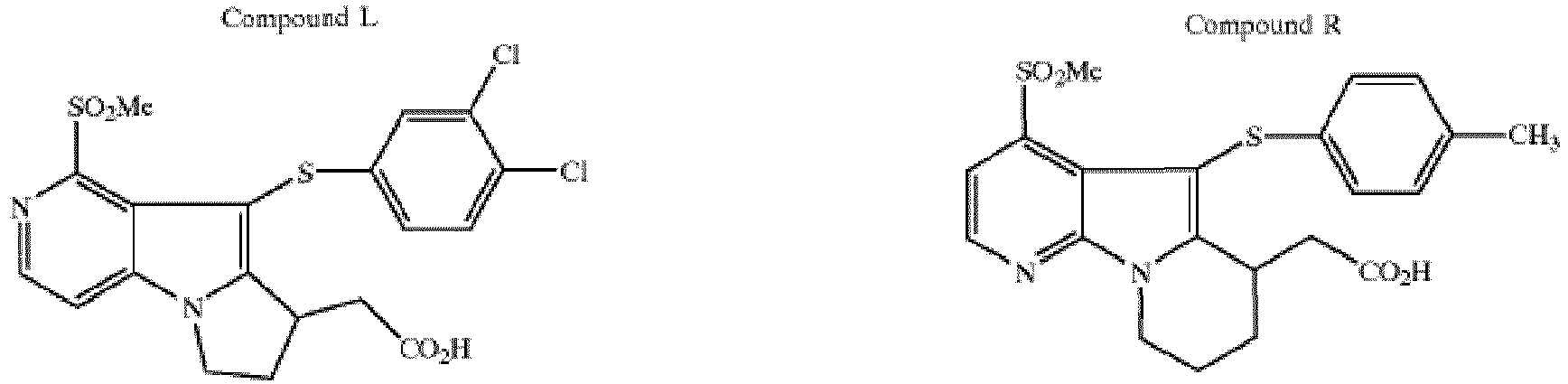


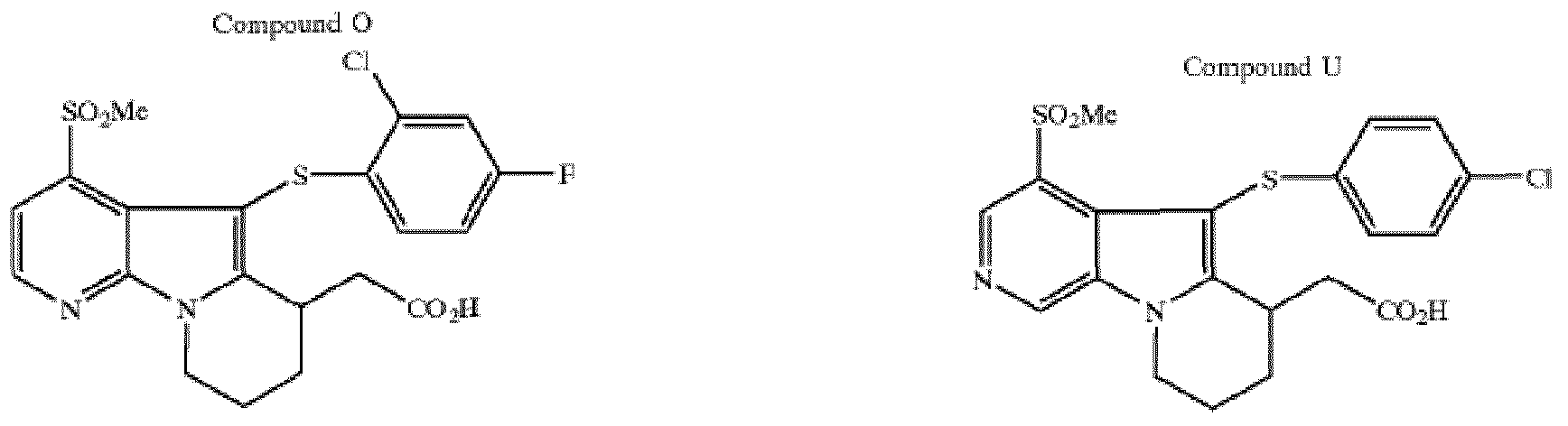


- In another embodiment, the DP receptor antagonist has one ofthe following structures:

- In another embodiment, the DP receptor antagonist has one ofthe following structures:


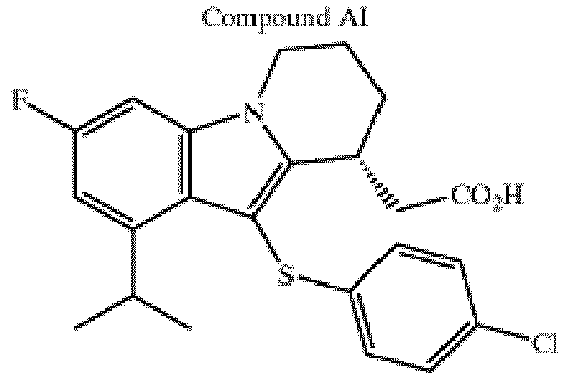
- In another embodiment, the DP receptor antagonist has the following structure:

- In another embodiment, the DP receptor antagonist is [5-[(4-Chlorophenyl)thio]-4-(methylsulfonyl)-6,7,8,9-tetrahydropyrido[3,2-b]indolizin-6yl]acetic acid. In another embodiment, the DP receptor antagonist is [5-[(4-Chlorophenyl)thio]-4-(methylthio)-6,7,8,9-tetrahydropyrido[3,2-b]indolizin-6-yl]acetic acid. In another embodiment, the DP receptor antagonist is [5-[(3,4-Dichlorophenyl)thio]-4-(methylsulfonyl)-6,7,8,9-tetrahydropyrido[3,2-b]indolizin-6-yl]acetic acid. In another embodiment, the DP receptor antagonist is [5-(4-Chlorobenzoyl)-4-(methylsulfonyl)-6,7,8,9-tetrahydropyrido[3,2-b]indolizin-6-yl]acetic acid. In another embodiment, the DP receptor antagonist is [5-(4-Bromophenyl)thio]-4-(methylsulfonyl)-6,7,8,9-tetrahydropyrido[3,2-b]indolizin-6-yl]acetic acid. In another embodiment, the DP receptor antagonist is [9-[(3,4-Dichlorophenyl)thio]-1-(methylsulfonyl)-7,8-dihydro-6H-pyrido[3,4-b]pyrrolizin-8-yl]acetic acid. In another embodiment, the DP receptor antagonist is [10-[(3,4-Dichlorophenyl)sulfanyl]-1-(methylsulfonyl)-6,7,8,9-tetrahydropyrido[3,4-b]indolizin-9-yl]acetic acid. In another embodiment, the DP receptor antagonist is (4-(Methylsulfonyl)-5-{[4-(trifluoromethyl)phenyl]thio}-6,7,8,9-tetrahydropyrido[3,2-b]indolizin-6-yl)acetic acid. In another embodiment, the DP receptor antagonist is [5-[(2-Chloro-4-fluorophenyl)thiol]-4-(methylsulfonyl)-6,7,8,9-tetrahydropyrido[3,2-b]indolizin-6-yl]acetic acid. In another embodiment, the DP receptor antagonist is [4-(Methylsulfonyl)-5-(2-naphthylthio)-6,7,8,9-tetrahydropyrido[3,2-b]indolizin-6-yl]acetic acid. In another embodiment, the DP receptor antagonist is [5-[(2,3-Dichlorophenyl)thio]-4-(methylsulfonyl)-6,7,8,9-tetrahydropyrido[3,2-b]indolizin-6-yl]acetic acid. In another embodiment, the DP receptor antagonist is [5-[(4-Methylphenyl)thiol]-4-(methylsulfonyl)-6,7,8,9-tetrahydropyrido[3,2-b]indolizin-6-yl]acetic acid. In another embodiment, the DP receptor antagonist is [4-(Methylsulfonyl)-5-(phenylthio)-6,7,8,9-tetrahydropyrido[3,2-b]indolizin-6-yl]acetic acid. In another embodiment, the DP receptor antagonist is [5-[(2,4-Dichlorophenyl)thiol-4-(methylsulfonyl)-6,7,8,9-tetrahydropyrido[3,2-b]indolizin-6-yl]acetic acid. In another embodiment, the DP receptor antagonist is [5-[(4-Chlorophenyl)thio]-4-(methylsulfonyl)-6,7,8,9-tetrahydropyrido[4,3-b]indolizin-6-yl]acetic acid. In another embodiment, the DP receptor antagonist is [9-[(4-Chlorophenyl)thio]-1-(methylsulfonyl)-7,8-dihydro-6H-pyrido[3,4-b]pyrrolizin-8-yl]acetic acid. In another embodiment, the DP receptor antagonist is (-)-[(4-Chlorobenzyl)-7-fluoro-5-methanesulfonyl)-1,2,3,4-tetrahydrocyclopenta[b]indol-3-yl]acetic acid. In another embodiment, the DP receptor antagonist is (±)-}4-[1-(4-Chlorophenyl)ethyl]-7-fluoro-5-methanesulfonyl-1,2,3,4-tetrahydrocyclopenta[b]indol-3-yl}acetic acidIn another embodiment, the DP receptor antagonist is (±)-[9-(4-Chlorobenzyl)-6-fluoro-methanesulfonyl-2,3,4,9-tetrahydro-1H-carbazol-1-yl]acetic acid. In another embodiment, the DP receptor antagonist is [4-(4-Chlorobenzyl)-7-fluoro-5-methanesulfonyl-1-oxo-1,2,3,4-tetrahydrocyclopenta[b]indol-3-yl]acetic acid. In another embodiment, the DP receptor antagonist is{9-[(3,4-Dichlorophenyl)thio]-1-isopropyl-7,8-dihydro-6H-pyrido[3,4-b]pyrrolizin-8-yl}acetic acid, Enantiomer A. In another embodiment, the DP receptor antagonist is {9-[(3,4-Dichlorophenyl)thio]-1-isopropyl-7,8-dihydro-6H-pyrido[3,4-b]pyrr- olizin-8-yl}acetic acid, Enantiomer B.In another embodiment, the DP receptor antagonist is ((1R)-6-Fluoro-8-(methylsulfonyl)-9- {(1S)-1-[4-(trifluoromethyl)phenyl]ethyl}-2,3,4,9-tetrahydro-1H-carbazol-1-yl)acetic acid.
- In other embodiments, the DP receptor antagonist is a non-toxic salt of one of the above compounds.
- Methods for synthesizing the above DP receptor antagonists are well known in the art, and are described, for example, in the following patent applications:
WO03/062200, published on Jul. 31, 2003 WO01/66520, published on Sep. 13, 2001 WO03/022814, published on Mar. 20, 2003 WO03/078409, published on Sep. 25, 2003 - In another embodiment, the DP receptor antagonist is a pharmaceutically acceptable salt of one of the above DP receptor antagonists. In another embodiment, the DP receptor antagonist is a related compound with DP receptor antagonist activity.
- In another embodiment, the DP receptor antagonist is any other DP receptor antagonist known in the art
- The DP receptor that is inhibited by compositions and treatments of the present invention has, in another embodiment, the sequence:

- In another embodiment, the DP receptor is a homologue of SEQ ID No: 1. In another embodiment, the DP receptor is a variant of SEQ ID No: 1. In another embodiment, the DP receptor is an isomer of SEQ ID No: 1. In another embodiment, the DP receptor is a fragment of SEQ ID No: 1. In another embodiment, the DP receptor comprises SEQ ID No: 1.
- In another embodiment, the DP receptor is encoded by a nucleotide sequence having the sequence:


- In another embodiment, the DP receptor is encoded by a nucleotide molecule that a homologue of SEQ ID No: 2. In another embodiment, the nucleotide molecule is a variant of SEQ ID No: 2. In another embodiment, the nucleotide molecule is an isomer ofSEQ ID No: 2. In another embodiment, the nucleotide molecule is a fragment of SEQ ID No: 2. In another embodiment, the nucleotide molecule comprises SEQ ID No: 2.
- In another embodiment, the DP receptor has an AA sequence set forth in one of the following GenBank entries: BC040968, AK026202, and U31099. In another embodiment, the DP receptor has a nucleotide sequence set forth in one of the above GenBank entries. In another embodiment, the DP receptor is a homologue of a sequence set forth in one of the above GenBank entries. In another embodiment, the DP receptor is a variant of a sequence set forth in one of the above GenBank entries. In another embodiment, the DP receptor is an isomer of a sequence set forth in one of the above GenBank entries. In another embodiment, the DP receptor is a fragment of a sequence set forth in one of the above GenBank entries. In another embodiment, the DP receptor comprises a sequence set forth in one of the above GenBank entries.
- In another embodiment, a DP-2 receptor antagonist is utilized in compositions and treatments of the present invention. In another embodiment, the antagonist is any DP-2 antagonist known in the art.
- In another embodiment, a composition of the present invention comprises a prostaglandin antagonist. In another embodiment, the prostaglandin antagonist has the formula:
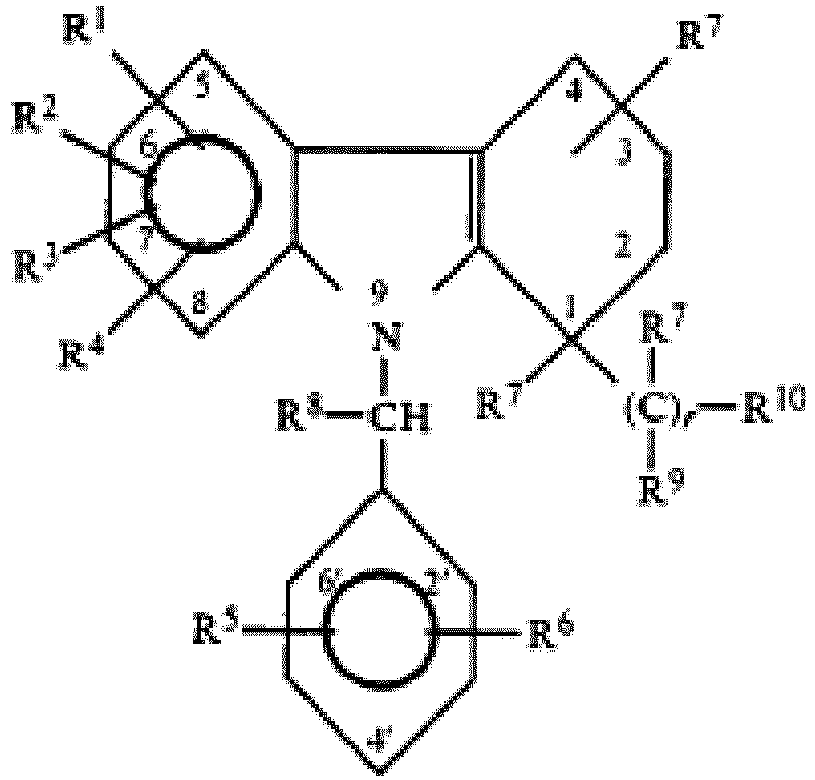
- R.sup.1, R.sup.2, R.sup.3, R.sup.4, R.sup.5 and R.sup.6 are each independently selected from: (1) hydrogen; (2) alkyl having 1 to 6 carbon atoms; (3) alkenyl having 2 to 6 carbon atoms; (4) --(CH.sub.2).sub.n M, wherein n is 0 to 3 and M is
- (a) OR.sup.13; (b) halogen; (c) CF.sub.3; (d) SR.sup.13; (e) phenyl or substituted phenyl, wherein substituted phenyl is as defined below in the definition of R.sup.13; (f) COOR.sup.14; (g)

- (h) tetrazole; (i)


- (m) --SOR.sup.13 ; (n) --CONR.sup.14 R.sup.14; (o) --SO.sub.2 NR.sup.14 R.sup.14; (p) --SO.sub.2 R.sup.13; (q) NO.sub.2; (r)
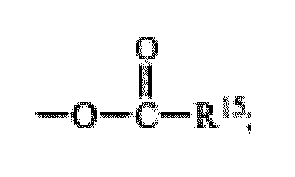
- (s)

- (t)

- (v) N.sub.3; and (u) CN;
- (a) OR.sup.13; (b) halogen; (c) CF.sub.3; (d) SR.sup.13; (e) phenyl or substituted phenyl, wherein substituted phenyl is as defined below in the definition of R.sup.13; (f) COOR.sup.14; (g)
- R.sup.7 is H or alkyl of 1 to 6 carbons;
- R.sup.8 is H or alkyl of 1 to 6 carbon atoms;
- each R.sup.9 is independently H, OH, C.sub.1 to C.sub.4 -O-alkyl or alkyl of 1 to 4 carbons; R.sup.10 is COOH; CH.sub.2 OH; CHO; tetrazole; NHSO.sub.2 R.sup.11 wherein R.sup.11 is OH, alkyl or alkoxy of 1 to 6 carbons, perhaloalkyl of 1 to 6 carbons, phenyl or phenyl substituted by alkyl or alkoxy groups of 1 to 3 carbons, halogen, hydroxy, COOH, CN, formyl or acyl to 1 to 6 carbons; CONHSO.sub.2 R.sup.11, hydroxymethylketone; CN; or CON(R.sup.9).sub.2;
- r is 1 to 6;
- each R.sup.13 independently is H; C.sub.1 to C.sub.6 alkyl; benzyl, phenyl or substituted phenyl wherein the substitents are C.sub.1 to C.sub.3 alkyl, halogen, CN, CF.sub.3, COOR.sup.14, CH.sub.2 COOR.sup.14, C.sub.1 to C.sub.3 alkoxy, or C.sub.1 to C.sub.4 perfluoroalkyl;
- each R.sup.14 is independently H, phenyl, benzyl or C.sub.1 to C.sub.6 alkyl; and
- each R.sup.15 independently is H, (CH.sub.2).sub.m COOR.sup.14 wherein m is 0 to 4, C.sub.1 to C.sub.6 alkyl, CF.sub.3, phenyl, or substituted phenyl wherein substituted phenyl is as defined above in the definition of R.sup.13.
- In another embodiment, the prostaglandin antagonist is a pharmaceutically acceptable salt of one of the above prostaglandin antagonists. In another embodiment, the prostaglandin antagonist is a compound with prostaglandin antagonist activity, related to one of the above structures.
- In another embodiment, a compound utilized in the present invention is a CRTH2 antagonist.
- In another embodiment, the CRTH2 antagonist has the structure:
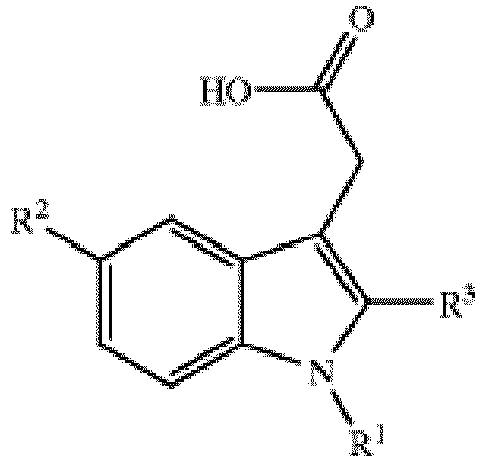
- R.sup.1 is a 1,3-benzothiazole group optionally substituted by halogen, C.sub.1-6alkyl, C.sub.1-6alkoxy or a group of formula (A) or (B):

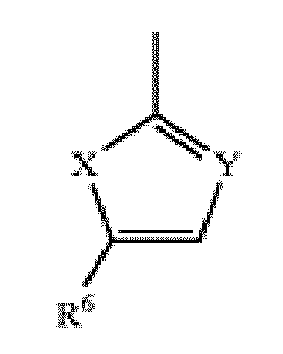
- R.sup.2 is hydrogen, halogen, C.sub.1-6-alkyl, C.sub.1-6alkoxy, and
- R.sup.3 is hydrogen or C.sub.1-6alkyl.
- In another embodiment, "alkyl" includes straight chain and branched chain alkyl groups.
- In another embodiment, R.sup.1 of the above formula is a 1,3-benzothiazole group, or a group of formula (A). In another embodiment, the groups R.sup.4 and R.sup.5 can be the same or different. In another embodiment, R.sup.4 and R.sup.5 are both propoxy, chloro or phenoxy.
- In another embodiment, the CRTH2 antagonist is [1-(2,6-diphenoxypyrimidin-4-yl)-2,5-dimethyl-1H-indol-3-yl]acetic acid. In another embodiment, the CRTH2 antagonist is [1-(2,6-diphenoxypyrimidin-4-yl)-5-methoxy-2-methyl-1H-indol-3-yl]acetic acid. In another embodiment, the CRTH2 antagonist is [1-(2,6-diisopropoxypyrimidin-4-yl)-2,5-dimethyl-1H-indol-3-yl]acetic acid. In another embodiment, the CRTH2 antagonist is [5-methoxy-2-methyl-1-(6-methyl-2-phenylpyrimidin4-yl)-1H-indol-3-yl]acetic acid. In another embodiment, the CRTH2 antagonist is [1-(2,6-dichloropyrimidin-4-yl)-2,5-dimethyl-1H-indol-3-yl]acetic acid. In another embodiment, the CRTH2 antagonist is [1-(1,3-benzothiazol-2-yl)-5-methoxy-2-methyl-1H-indol-3-yl]acetic acid. In another embodiment, the CRTH2 antagonist is a pharmaceutically acceptable salt of one of the above compounds.
- In another embodiment, the CRTH2 antagonist has the structure:

- R.sup.1 is hydrogen, halogen, C.sub.1-6alkyl, or C.sub.1-6alkoxy;
- R.sup.2 is hydrogen, halogen, C.sub.1-6alkyl, or C.sub.1-6alkoxy;
- R.sup.3 is hydrogen or C.sub.1-6alkyl;
- R.sup.4 is hydrogen, C.sub.1-6alkyl, C.sub.1-6alkoxy, or thioC.sub.1-6alkyl; and
- X is N or CH.
- In another embodiment, "alkyl" includes straight chain and branched chain alkyl groups.
- In another embodiment, R.sup.1 in the above formula is hydrogen, chloro or methyl.
- In another embodiment, R.sup.2 is methyl, iso-propyl or methoxy.
- In another embodiment, R.sup.4 is hydrogen or methoxy.
- In another embodiment, X is CH.
- In another embodiment, the CRTH2 antagonist is 1-(7-chloro-4-quinazolinyl)-2-methyl-1H-indole-3-acetic acid. In another embodiment, the CRTH2 antagonist is 5-methoxy-2-methyl-1-(4-quinazolinyl)-1H-indole-3-acetic acid. In another embodiment, the CRTH2 antagonist is 2-methyl-1-(2-methyl-4-quinazolinyl)-1H-indole-3-acetic acid. In another embodiment, the CRTH2 antagonist is 1-(6-chloro-2-quinolinyl)-5-methoxy-2-methyl-1H-indole-3-acetic acid. In another embodiment, the CRTH2 antagonist is 1-(6,8-dichloro-4-quinazolinyl)-5-methoxy-2-methyl-1H-indole-3-acetic acid. In another embodiment, the CRTH2 antagonist is 1-(4-chloro-2-quinolinyl)-5-methoxy-2-methyl-1H-indole-3-acetic acid. In another embodiment, the CRTH2 antagonist is 1-(7-chloro-4-quinazolinyl)-5-methoxy-2-methyl-1H-indole-3-acetic acid. In another embodiment, the CRTH2 antagonist is 2,5-dimethyl-1-(4-quinazolinyl)-1H-indole-3-acetic acid. In another embodiment, the CRTH2 antagonist is 1-(7-chloro-4-quinazolinyl)-5-methoxy-2-methyl-1H-indole-3-acetic acid. In another embodiment, the CRTH2 antagonist is 2,5-dimethyl-1-(4-quinazolinyl)-1H-indole-3-acetic acid. In another embodiment, the CRTH2 antagonist is 1-(7-chloro-4-quinazolinyl)-5-fluoro-1H-indole-3-acetic acid. In another embodiment, the CRTH2 antagonist is 5-methoxy-2-methyl-1-[2-(methylthio)-4-quinazolinyl]-1H-indole-3-acetic acid. In another embodiment, the CRTH2 antagonist is 5-methoxy-1-(6-methoxy-4-quinolinyl)-2-methyl-1H-indole-3-acetic acid. In another embodiment, the CRTH2 antagonist is 2-methyl-1-[2-(methylthio)-4-quinazolinyl]-1H-indole-3-acetic acid. In another embodiment, the CRTH2 antagonist is 1-[2-(ethylthio)-4-quinazolinyl]-5-methoxy-2-methyl-1H-indole-3-acetic acid. In another embodiment, the CRTH2 antagonist is 1-(7-chloro-4-quinazolinyl)-2,5-dimethyl-1H-indole-3-acetic acid. In another embodiment, the CRTH2 antagonist is 1-(7-chloro-4-quinazolinyl)-2-methyl-5-(1-methylethyl)-1H-indole-3-acetic acid. In another embodiment, the CRTH2 antagonist is 2,5-dimethyl-1-[2-(methylthio)-4-quinazolinyl]-1H-indole-3-acetic acid. In another embodiment, the CRTH2 antagonist is 1-(7-chloro-4-quinazolinyl)-2-methyl-5-(2-methylpropoxy)-1H-indole-3-acetic acid. In another embodiment, the CRTH2 antagonist is 1-(7-chloro-4-quinolinyl)-2-methyl-1H-indole-3-acetic acid. In another embodiment, the CRTH2 antagonist is 1-(7-chloro-2-methyl-4-quinolinyl)-5-methoxy-2-methyl-1H-indole-3-acetic acid. In another embodiment, the CRTH2 antagonist is 5-methoxy-2-methyl-1-(7-methyl-4-quinolinyl)-1H-indole-3-acetic acid. In another embodiment, the CRTH2 antagonist is 1-(7-chloro-4-quinolinyl)-5-methoxy-2-methyl-1H-indole-3-acetic acid.
- In another embodiment, the CRTH2 antagonist is a pharmaceutically acceptable salt of one of the above CRTH2 antagonists.
- In another embodiment, the CRTH2 antagonist is any other CRTH2 antagonist known in the art.
- Many of the genes of highest significance were related to inflammation. The 3 most populated gene function categories are response to biotic stimulus, defense response and immune response with p values ranging from 1.81 x 10⁻² to 2.67 x 10⁻². The category most commonly represented-response to biotic stimulus-is defined, in another embodiment, as: "A change in state or activity of a cell or an organism (in terms of movement, secretion, enzyme production, gene expression, etc.) as a result of a biotic stimulus, a stimulus caused or produced by a living organism" (Hill DP, Begley DA, Finger JH, Hayamizu TF, McCright IJ, Smith CM, Beal JS, Corbani LE, Blake JA, Eppig JT, Kadin JA, Richardson JE, Ringwald M. 2004. The mouse Gene Expression Database (GXD): updates and enhancements. Nucleic Acids Res 32: D568-D571).
- Further, bald scalp exhibited a relative decrease in the proportion of alpha-6 integrin negative cells within the stem cell compartment. This is due, in another embodiment, to a decrease in the number of cell layers of the outer root sheath as the follicle miniaturizes. Since the suprabasal alpha-6 integrin negative bulge population is likely to be a progeny population from the basal layer, these findings show that, under the conditions utilized herein, haired scalp possesses a higher state of activation and division in the basal layer stem cell compartment compared with bald scalp.
- Thus, findings of the present invention reveal genes that participate in hair growth, healthy HF maintenance and cycling, and hair loss, that can be used as targets of method of the present invention.
- In another embodiment, a composition or treatment of the present invention is utilized on human skin.
- "Hair-deficient" refers, in another embodiment, to a region of the skin or scalp that is lacking an normal amount of hair. In another embodiment, the term refers to a region wherein the subject is dissatisfied with the amount of hair present.
- Methods of injecting, transporting, and administering cells into the skin or scalp of a subject are well known in the art, and are described, for example, in Zheng Y et al (Organogenesis from dissociated cells: generation of mature cycling hair follicles from skin-derived cells. J Invest Dermatol. 2005 May;124(5):867-76) and in Example 9 herein.
- In another embodiment, the present invention acts by generating new hair follicles (HF).
- In another embodiment, the present invention acts by stimulating formation of new HF.
- In another embodiment, the treatment further comprises the step of contacting the subject with a pro-hair growth prostaglandin. In another embodiment, the scalp ofthe subject is contacted with the pro-hair growth prostaglandin. In another embodiment, the skin of the subject is contacted with the pro-hair growth prostaglandin. In another embodiment, the subject is contacted with the pro-hair growth prostaglandin, e.g. systemically, and the pro-hair growth prostaglandin reaches the target tissue via diffusion, active transport, or another biological process.
- In another embodiment, the pro-hair growth prostaglandin is a prostaglandin E1. In another embodiment, the pro-hair growth prostaglandin is a prostaglandin E1 analogue. In another embodiment, the prostaglandin E1 analogue is Misoprostol (cytotec). In another embodiment, the prostaglandin E1 analogue is 11β-Misoprostol. In another embodiment, the prostaglandin E1 analogue is 8-iso Misoprostol. In another embodiment, the prostaglandin E1 analogue is Mifepristone. In another embodiment, the prostaglandin E1 analogue is Misoprostol (free acid) . In another embodiment, the prostaglandin E1 analogue is Prostaglandin E1. In another embodiment, the prostaglandin E1 analogue is 11β-Prostaglandin E1. In another embodiment, the prostaglandin E1 analogue is 13,14-dihydro-15-keto Prostaglandin E1. In another embodiment, the prostaglandin E1 analogue is 13,14-dihydro-15-keto Prostaglandin E1-d4. In another embodiment, the prostaglandin E1 analogue is 13,14-dihydro-19(R)-hydroxy Prostaglandin E1. In another embodiment, the prostaglandin E1 analogue is 15-keto Prostaglandin E1. In another embodiment, the prostaglandin E1 analogue is 16,16-dimethyl-6-keto Prostaglandin E1. In another embodiment, the prostaglandin E1 analogue is 16-phenyl
tetranor Prostaglandin E 1. In another embodiment, the prostaglandin E1 analogue is 19(R)-hydroxy Prostaglandin E1. In another embodiment, the prostaglandin E1 analogue is 2,3-dinor Prostaglandin E1. In another embodiment, the prostaglandin E1 analogue is 8-iso Prostaglandin E1. In another embodiment, the prostaglandin E1 analogue is Bicyclo Prostaglandin E1. In another embodiment, the prostaglandin E1 analogue is Dihomo-γ-Linolenic Acid. In another embodiment, the prostaglandin E1 analogue is Limaprost. In another embodiment, the prostaglandin E1 analogue is Δ17-Prostaglandin E1. In another embodiment, the pro-hair growth prostaglandin is selected from 11β-Misoprostol, 8-iso Misoprostol, Mifepristone, Misoprostol (free acid), Prostaglandin E1, 11β-Prostaglandin E1, 13,14-dihydro-15-keto Prostaglandin E1, 13,14-dihydro-15-keto Prostaglandin E1-d4, 13,14-dihydro-19(R)-hydroxy Prostaglandin E 1, 15-keto Prostaglandin E1, 16,16-dimethyl-6-keto Prostaglandin E 1, 16-phenyltetranor Prostaglandin E 1, 19(R)-hydroxy Prostaglandin E1, 2,3-dinor Prostaglandin E1, 8-iso Prostaglandin E1, Bicyclo Prostaglandin E1, Dihomo-γ-Linolenic Acid, Limaprost, and Δ17-Prostaglandin E1. In another embodiment, the prostaglandin E1 analogue is selected from 11β-Misoprostol, 8-iso Misoprostol, Mifepristone, Misoprostol (free acid), Prostaglandin E1, 11β-Prostaglandin E1, 13,14-dihydro-15-keto Prostaglandin E1, 13,14-dihydro-15-keto Prostaglandin E1-d4, 13,14-dihydro-19(R)-hydroxy Prostaglandin E1, 15-keto Prostaglandin E1, 16,16-dimethyl-6-keto Prostaglandin E1, 16-phenyl tetranor Prostaglandin E1, 19(R)-hydroxy Prostaglandin E1, 2,3-dinor Prostaglandin E1, 8-iso Prostaglandin E1, Bicyclo Prostaglandin E1, Dihomo-γ-Linolenic Acid, Limaprost, and Δ17-Prostaglandin E1. In another embodiment, the pro-hair growth prostaglandin is any other prostaglandin E1 analogue known in the art. In another embodiment, the pro-hair growth prostaglandin is any other agonistic prostaglandin E1 analogue known in the art. In another embodiment, the pro-hair growth prostaglandin is any other prostaglandin E1 analogue known in the art that mimics the action of prostaglandin E1. In another embodiment, a compound or composition that increases prostaglandin E1 levels or prostaglandin E1 synthesis is administered to the subject. - In another embodiment, the pro-hair growth prostaglandin is a prostaglandin E2. In another embodiment, the pro-hair growth prostaglandin is a prostaglandin E2 analogue. In another embodiment, the pro-hair growth prostaglandin is 11-deoxy-16,16-dimethyl Prostaglandin E2. In another embodiment, the pro-hair growth prostaglandin is 11-deoxy Prostaglandin E2. In another embodiment, the pro-hair growth prostaglandin is 11β-Prostaglandin E2. In another embodiment, the pro-hair growth prostaglandin is 13,14-dihydro-15-keto Prostaglandin E1-d4. In another embodiment, the pro-hair growth prostaglandin is 13,14-dihydro Prostaglandin E1-d4. In another embodiment, the pro-hair growth prostaglandin is 15(R)-15-methyl Prostaglandin E2. In another embodiment, the pro-hair growth prostaglandin is 15(R)-Prostaglandin E2. In another embodiment, the pro-hair growth prostaglandin is 15(S)-15-methyl Prostaglandin E2. In another embodiment, the pro-hair growth prostaglandin is 16-phenoxy tetranor Prostaglandin E2. In another embodiment, the pro-hair growth prostaglandin is 16-phenyl tetranor Prostaglandin E2. In another embodiment, the pro-hair growth prostaglandin is 20-ethyl Prostaglandin E2. In another embodiment, the pro-hair growth prostaglandin is 5-trans Prostaglandin E2. In another embodiment, the pro-hair growth prostaglandin is 8-iso Prostaglandin E2 isopropyl ester. In another embodiment, the pro-hair growth prostaglandin is 9-deoxy-9-methylene-16,16-dimethyl Prostaglandin E2. In another embodiment, the pro-hair growth prostaglandin is 9-deoxy-9-methylene Prostaglandin E2. In another embodiment, the pro-hair growth prostaglandin is ent-Prostaglandin E2. In another embodiment, the pro-hair growth prostaglandin is Prostaglandin E2-biotinimide. In another embodiment, the pro-hair growth prostaglandin is Prostaglandin E2-d4. In another embodiment, the pro-hair growth prostaglandin is Prostaglandin E2 methyl ester. In another embodiment, the pro-hair growth prostaglandin is Prostaglandin E2 serinol amide. In another embodiment, the pro-hair growth prostaglandin is Sulprostone. In another embodiment, the pro-hair growth prostaglandin is selected from 11-deoxy-16,16-dimethyl Prostaglandin E2, 11-deoxy Prostaglandin E2, 11β-Prostaglandin E2, 13,14-dihydro-15-keto Prostaglandin E1-d4, 13,14-dihydro Prostaglandin E1-d4, 15(R)-15-methyl Prostaglandin E2, 15(R)-Prostaglandin E2, 15(S)-15-methyl Prostaglandin E2, 16-phenoxy tetranor Prostaglandin E2, 16-phenyl tetranor Prostaglandin E2, 20-ethyl Prostaglandin E2, 5-trans Prostaglandin E2, 8-iso Prostaglandin E2 isopropyl ester, 9-deoxy-9-methylene-16,16-dimethyl Prostaglandin E2, 9-deoxy-9-methylene Prostaglandin E2, ent-Prostaglandin E2, Prostaglandin E2-biotinimide,
- Prostaglandin E2-d4, Prostaglandin E2 methyl ester, Prostaglandin E2 serinol amide, and Sulprostone. In another embodiment, the prostaglandin E2 analogue is selected from 11-deoxy-16,16-dimethyl Prostaglandin E2, 11-deoxy Prostaglandin E2, 11β-Prostaglandin E2, 13,14-dihydro-15-keto Prostaglandin E1-d4, 13,14-dihydro Prostaglandin E1-d4, 15(R)-15-methyl Prostaglandin E2, 15(R)-Prostaglandin E2, 15(S)-15-methyl Prostaglandin E2, 16-phenoxy tetranor Prostaglandin E2, 16-phenyl tetranor Prostaglandin E2, 20-ethyl Prostaglandin E2, 5-trans Prostaglandin E2, 8-iso Prostaglandin E2 isopropyl ester, 9-deoxy-9-methylene-16,16-dimethyl Prostaglandin E2, 9-deoxy-9-methylene Prostaglandin E2, ent-Prostaglandin E2, Prostaglandin E2-biotinimide, Prostaglandin E2-d4, Prostaglandin E2 methyl ester, Prostaglandin E2 serinol amide, and Sulprostone. In another embodiment, the pro-hair growth prostaglandin is any other prostaglandin E2 analogue known in the art. In another embodiment, the pro-hair growth prostaglandin is any other agonistic prostaglandin E2 analogue known in the art. In another embodiment, the pro-hair growth prostaglandin is any other prostaglandin E2 analogue known in the art that mimics the action of prostaglandin E2. In another embodiment, a compound or composition that increases prostaglandin E2 levels or prostaglandin E2 synthesis is administered to the subject.
- In another embodiment, the pro-hair growth prostaglandin is a prostaglandin F2a. In another embodiment, the pro-hair growth prostaglandin is a prostaglandin F2a analogue. In another embodiment, the pro-hair growth prostaglandin is Latanoprost (Xalatan). In another embodiment, the pro-hair growth prostaglandin is Isopropyl unoprostone (Rescula). In another embodiment, the pro-hair growth prostaglandin is 11-deoxy Prostaglandin F2α.. In another embodiment, the pro-hair growth prostaglandin is 11β-13,14-dihydro-15-keto Prostaglandin F2α. In another embodiment, the pro-hair growth prostaglandin is 11β-Prostaglandin F2α-d4. In another embodiment, the pro-hair growth prostaglandin is 11β-Prostaglandin F2α Ethanolamide. In another embodiment, the pro-hair growth prostaglandin is 13,14-dihydro-15-keto Prostaglandin F2α isopropyl ester. In another embodiment, the pro-hair growth prostaglandin is 15-keto Prostaglandin F2α. In another embodiment, the pro-hair growth prostaglandin is 15(R)-Prostaglandin F2α. In another embodiment, the pro-hair growth prostaglandin is 16,16-dimethyl Prostaglandin F2α. In another embodiment, the pro-hair growth prostaglandin is 2,3-dinor-11β-Prostaglandin F2α. In another embodiment, the pro-hair growth prostaglandin is 2,3-dinor-8-iso Prostaglandin F2α. In another embodiment, the pro-hair growth prostaglandin is 8-iso-15(R)-Prostaglandin F2α. In another embodiment, the pro-hair growth prostaglandin is AL 8810 isopropyl ester. In another embodiment, the pro-hair growth prostaglandin is CAY10509 (Cayman Chemical, Ann Arbor, Michigan) . In another embodiment, the pro-hair growth prostaglandin is CAY10510 (Cayman Chemical). In another embodiment, the pro-hair growth prostaglandin is Cloprostenol (sodium salt) . In another embodiment, the pro-hair growth prostaglandin is ent-Prostaglandin F2α. In another embodiment, the pro-hair growth prostaglandin is Latanoprost-d4. In another embodiment, the pro-hair growth prostaglandin is Prostaglandin F2α Alcohol. In another embodiment, the pro-hair growth prostaglandin is Prostaglandin F2α-d4. In another embodiment, the pro-hair growth prostaglandin is Prostaglandin F2α-d9. In another embodiment, the pro-hair growth prostaglandin is Prostaglandin F2α diethyl amide. In another embodiment, the pro-hair growth prostaglandin is Prostaglandin F2α dimethyl amide. In another embodiment, the pro-hair growth prostaglandin is Prostaglandin F2α dimethyl amine. In another embodiment, the pro-hair growth prostaglandin is Prostaglandin F2α ethyl amide. In another embodiment, the pro-hair growth prostaglandin is Prostaglandin F2α isopropyl ester. In another embodiment, the pro-hair growth prostaglandin is Prostaglandin F2α methyl ester. In another embodiment, the pro-hair growth prostaglandin is Prostaglandin F2α serinol amide. In another embodiment, the pro-hair growth prostaglandin is Prostaglandin F2α (tromethamine salt). In another embodiment, the pro-hair growth prostaglandin is selected from Latanoprost (Xalatan), Isopropyl unoprostone (Rescula), 11-deoxy Prostaglandin F2α, 11β-13,14-dihydro-15-keto Prostaglandin F2α, 11β-Prostaglandin F2α-d4, 11β-Prostaglandin F2α Ethanolamide, 13,14-dihydro-15-keto Prostaglandin F2α isopropyl ester, 15-keto Prostaglandin F2α, 15(R)-Prostaglandin F2α, 16,16-dimethyl Prostaglandin F2α, 2,3-dinor-11β-Prostaglandin F2α, 2,3-dinor-8-iso Prostaglandin F2α, 8-iso-15(R)-Prostaglandin F2α, AL 8810 isopropyl ester, CAY10509, CAY10510, Cloprostenol (sodium salt), ent-Prostaglandin F2α, Latanoprost-d4, Prostaglandin F2α Alcohol, Prostaglandin F2α-d4, Prostaglandin F2α-d9, Prostaglandin F2α diethyl amide, Prostaglandin F2α dimethyl amide, Prostaglandin F2α dimethyl amine, Prostaglandin F2α ethyl amide, Prostaglandin F2α isopropyl ester, Prostaglandin F2α methyl ester, Prostaglandin F2α serinol amide, Prostaglandin F2α (tromethamine salt). In another embodiment, the prostaglandin F2a analogue is selected from Latanoprost (Xalatan), Isopropyl unoprostone (Rescula), 11-deoxy Prostaglandin F2α, 11β-13,14-dihydro-15-keto Prostaglandin F2α, 11β-Prostaglandin F2α-d4, 11β-Prostaglandin F2α Ethanolamide, 13,14-dihydro-15-keto Prostaglandin F2α isopropyl ester, 15-keto Prostaglandin F2α, 15(R)-Prostaglandin F2α, 16,16-dimethyl Prostaglandin F2α, 2,3-dinor-11β-Prostaglandin F2α, 2,3-dinor-8-iso Prostaglandin F2α, 8-iso-15(R)-Prostaglandin F2α, AL 8810 isopropyl ester, CAY10509, CAY10510, Cloprostenol (sodium salt), ent-Prostaglandin F2α, Latanoprost-d4, Prostaglandin F2α Alcohol, Prostaglandin F2α-d4, Prostaglandin F2α-d9, Prostaglandin F2α diethyl amide, Prostaglandin F2α dimethyl amide, Prostaglandin F2α dimethyl amine, Prostaglandin F2α ethyl amide, Prostaglandin F2α isopropyl ester, Prostaglandin F2α methyl ester, Prostaglandin F2α serinol amide, Prostaglandin F2α (tromethamine salt). In another embodiment, the pro-hair growth prostaglandin is any other prostaglandin F2a analogue known in the art. In another embodiment, the pro-hair growth prostaglandin is any other agonistic prostaglandin F2a analogue known in the art. In another embodiment, the pro-hair growth prostaglandin is any other prostaglandin F2a analogue known in the art that mimics the action of prostaglandin F2a. In another embodiment, a compound or composition that increases prostaglandin F2a levels or prostaglandin F2a synthesis is administered to the subject.
- In another embodiment, the pro-hair growth prostaglandin is 11-keto Fluprostenol. In another embodiment, the pro-hair growth prostaglandin is 15-keto Latanoprost. In another embodiment, the pro-hair growth prostaglandin is 15-keto Latanoprost (free acid). In another embodiment, the pro-hair growth prostaglandin is 15(S)-Latanoprost. In another embodiment, the pro-hair growth prostaglandin is 5-trans Latanoprost. In another embodiment, the pro-hair growth prostaglandin is 9-keto Fluprostenol. In another embodiment, the pro-hair growth prostaglandin is Fluprostenol. In another embodiment, the pro-hair growth prostaglandin is Latanoprost-d4. In another embodiment, the pro-hair growth prostaglandin is Latanoprost ethyl amide-d4. In another embodiment, the pro-hair growth prostaglandin is Latanoprost (free acid). In another embodiment, the pro-hair growth prostaglandin is Latanoprost Lactol. In another embodiment, the pro-hair growth prostaglandin is Lumula. In another embodiment, the pro-hair growth prostaglandin is Prostaglandin F2α isopropyl ester. In another embodiment, the pro-hair growth prostaglandin is Unoprostone. In another embodiment, the pro-hair growth prostaglandin is Unoprostone isopropyl ester. In another embodiment, the pro-hair growth prostaglandin is selected from 11-keto Fluprostenol, 15-keto Latanoprost, 15-keto Latanoprost (free acid), 15(S)-Latanoprost, 5-trans Latanoprost, 9-keto Fluprostenol, Fluprostenol, Latanoprost-d4, Latanoprost ethyl amide-d4, Latanoprost (free acid), Latanoprost Lactol, Lumula, Prostaglandin F2α isopropyl ester, Unoprostone, Unoprostone isopropyl ester.
- In another embodiment, the treatment further comprises the step of disrupting the epidermis of the target scalp, abrading the target scalp, or wounding the target scalp. In another embodiment, the epidermal disruption, wounding, or abrading is performed prior to a treatment step of the present invention. In another embodiment, the epidermal disruption, wounding, or abrading is performed simultaneously with a treatment step of the present invention. In another embodiment, the epidermal disruption, wounding, or abrading is performed concurrently with a treatment step of the present invention. In another embodiment, the epidermal disruption, wounding, or abrading is performed after a treatment step of a method of the present invention. Methods for disrupting the epidermis, wounding, and abrading are well known in the art, and are described, for example in
PCT International Application Serial No. PCT/US2006/011319 , published asWO 2006/105109 . - In another embodiment, a scalp in need is contacted with a DP receptor antagonist compound or composition.
- In another embodiment, the scalp is directly contacted. In another embodiment, a compound or composition for use of the present invention is applied directly to the scalp. In another embodiment, the scalp is contacted indirectly. In another embodiment, a compound or composition of the present invention is administered to the subject, and then is brought into contact with the scalp or skin in need by a transport process. In another embodiment, the transport process is passive transport. In another embodiment, the transport process is active transport. In another embodiment, the transport process is a combination of passive and active transport. In another embodiment, the transport process is diffusion. In another embodiment, the transport process is mediated by the circulatory system. In another embodiment, the transport process is mediated by the lymph system.
- In one embodiment, a scalp is treated by the present invention.
- The terms "homology," "homologous," etc, when in reference to any protein or peptide, refer, in one embodiment, to a percentage of amino acid residues in the candidate sequence that are identical with the residues of a corresponding native polypeptide, after aligning the sequences and introducing gaps, if necessary, to achieve the maximum percent homology, and not considering any conservative substitutions as part of the sequence identity. Methods and computer programs for the alignment are well known in the art.
- Homology is, in another embodiment, determined by computer algorithm for sequence alignment, by methods well described in the art. For example, computer algorithm analysis of nucleic acid sequence homology can include the utilization of any number of software packages available, such as, for example, the BLAST, DOMAIN, BEAUTY (BLAST Enhanced Alignment Utility), GENPEPT and TREMBL packages.
- In another embodiment, "homology" refers to identity to a sequence selected from SEQ ID Nos: 1 or 2 of greater than 70%. In another embodiment, "homology" refers to identity to a sequence selected from SEQ ID Nos: 1 or 2 of greater than 72%. In another embodiment, "homology" refers to identity to one of SEQ ID Nos: 1 or 2 of greater than 75%. In another embodiment, "homology" refers to identity to a sequence selected from SEQ ID Nos: 1 or 2 of greater than 78%. In another embodiment, "homology" refers to identity to one of SEQ ID Nos: 1 or 2 of greater than 80%. In another embodiment, "homology" refers to identity to one of SEQ ID Nos: 1 or 2 of greater than 82%. In another embodiment, "homology" refers to identity to a sequence selected from SEQ ID Nos: 1 or 2 of greater than 83%. In another embodiment, "homology" refers to identity to one of SEQ ID Nos: 1 or 2 of greater than 85%. In another embodiment, "homology" refers to identity to one of SEQ ID Nos: 1 or 2 of greater than 87%. In another embodiment, "homology" refers to identity to a sequence selected from SEQ ID Nos: 1 or 2 of greater than 88%. In another embodiment, "homology" refers to identity to one of SEQ ID Nos: 1 or 2 of greater than 90%. In another embodiment, "homology" refers to identity to one of SEQ ID Nos: 1 or 2 of greater than 92%. In another embodiment, "homology" refers to identity to a sequence selected from SEQ ID Nos: 1 or 2 of greater than 93%. In another embodiment, "homology" refers to identity to one of SEQ ID Nos: 1 or 2 of greater than 95%. In another embodiment, "homology" refers to identity to a sequence selected from SEQ ID Nos: 1 or 2 of greater than 96%. In another embodiment, "homology" refers to identity to one of SEQ ID Nos: 1 or 2 of greater than 97%. In another embodiment, "homology" refers to identity to one of SEQ ID Nos: 1 or 2 of greater than 98%. In another embodiment, "homology" refers to identity to one of SEQ ID Nos: 1 or 2 of greater than 99%. In another embodiment, "homology" refers to identity to one of SEQ ID Nos: 1 or 2 of 100%. Each possibility represents a separate embodiment of the present invention.
- In another embodiment, homology is determined via determination of candidate sequence hybridization, methods of which are well described in the art (See, for example, "Nucleic Acid Hybridization" Hames, B. D., and Higgins S. J., Eds. (1985); Sambrook et al., 2001, Molecular Cloning, A Laboratory Manual, Cold Spring Harbor Press, N.Y.; and Ausubel et al., 1989, Current Protocols in Molecular Biology, Green Publishing Associates and Wiley Interscience, N.Y). In other embodiments, methods of hybridization are carried out under moderate to stringent conditions, to the complement of a DNA encoding a native caspase peptide. Hybridization conditions being, for example, overnight incubation at 42 °C in a solution comprising: 10-20 % formamide, 5 X SSC (150 mM NaCl, 15 mM trisodium citrate), 50 mM sodium phosphate (pH 7. 6), 5 X Denhardt's solution, 10 % dextran sulfate, and 20 µg/ml denatured, sheared salmon sperm DNA.
- In another embodiment, the present invention provides a kit comprising a reagent utilized in performing a treatment of the present invention.
- In another embodiment, the present invention makes use of a pharmaceutical composition containing a DP receptor antagonist compound of the present invention. "Pharmaceutical composition" refers, in another embodiment, to a therapeutically effective amount of the active ingredient, together with a pharmaceutically acceptable carrier or diluent. A "therapeutically effective amount" refers, in one embodiment, to that amount which provides a therapeutic effect for a given condition and administration regimen.
- The pharmaceutical compositions containing the compound or composition can be, in another embodiment, suitable to be administered to a subject by any method known to a person skilled in the art, such as parenterally, paracancerally, transmucosally, transdermally, intramuscularly, intravenously, intra-dermally, subcutaneously, intra-peritonealy, intraventricularly, intra-cranially, intra-vaginally or intra-tumorally.
- In another embodiment, the pharmaceutical composition is suitable to be administered topically to body surfaces and is thus formulated in a form suitable for topical administration. In another embodiment, the pharmaceutical composition is to be administered to the target scalp, skin, or hair-bearing region. Suitable topical formulations include, in another embodiment, gels, ointments, creams, lotions, drops and the like. For topical administration, the compound or composition is prepared and applied as a solution, suspension, or emulsion in a physiologically acceptable diluent with or without a pharmaceutical carrier.
- In another embodiment of the present invention, the pharmaceutical compositions are to be administered orally, and are thus formulated in a form suitable for oral administration, i.e. as a solid or a liquid preparation. Suitable solid oral formulations include tablets, capsules, pills, granules, pellets and the like. Suitable liquid oral formulations include solutions, suspensions, dispersions, emulsions, oils and the like. In another embodiment of the present invention, the active ingredient is formulated in a capsule. In accordance with this embodiment, the compositions of the present invention comprise, in addition to the active compound and the inert carrier or diluent, a hard gelating capsule.
- In another embodiment, the pharmaceutical compositions are formulated to be administered by intravenous, intra-arterial, or intra-muscular injection of a liquid preparation. Suitable liquid formulations include solutions, suspensions, dispersions, emulsions, oils and the like. In another embodiment, the pharmaceutical compositions are administered intravenously and are thus formulated in a form suitable for intravenous administration. In another embodiment, the pharmaceutical compositions are administered intra-arterially and are thus formulated in a form suitable for intra-arterial administration. In another embodiment, the pharmaceutical compositions are administered intra-muscularly and are thus formulated in a form suitable for intra-muscular administration.
- In another embodiment, the pharmaceutical composition is to be administered as a suppository, for example a rectal suppository or a urethral suppository. In another embodiment, the pharmaceutical composition is to be administered by subcutaneous implantation of a pellet. In another embodiment, the pellet provides for controlled release of active agent over a period of time.
- In another embodiment, the active compound is delivered in a vesicle, e.g. a liposome.
- In other embodiments, carriers or diluents used in the present invention include, but are not limited to, a gum, a starch (e.g. corn starch, pregeletanized starch), a sugar (e.g., lactose, mannitol, sucrose, dextrose), a cellulosic material (e.g. microcrystalline cellulose), an acrylate (e.g. polymethylacrylate), calcium carbonate, magnesium oxide, talc, or mixtures thereof.
- In other embodiments, pharmaceutically acceptable carriers for liquid formulations are aqueous or non-aqueous solutions, suspensions, emulsions or oils. Examples of non-aqueous solvents are propylene glycol, polyethylene glycol, and injectable organic esters such as ethyl oleate. Aqueous carriers include water, alcoholic/aqueous solutions, emulsions or suspensions, including saline and buffered media. Examples of oils are those of animal, vegetable, or synthetic origin, for example, peanut oil, soybean oil, olive oil, sunflower oil, fish-liver oil, another marine oil, or a lipid from milk or eggs.
- In another embodiment, parenteral vehicles (for subcutaneous, intravenous, intraarterial, or intramuscular injection) include sodium chloride solution, Ringer's dextrose, dextrose and sodium chloride, lactated Ringer's and fixed oils. Intravenous vehicles include fluid and nutrient replenishers, electrolyte replenishers such as those based on Ringer's dextrose, and the like. Examples are sterile liquids such as water and oils, with or without the addition of a surfactant and other pharmaceutically acceptable adjuvants. In general, water, saline, aqueous dextrose and related sugar solutions, and glycols such as propylene glycols or polyethylene glycol are preferred liquid carriers, particularly for injectable solutions. Examples of oils are those of animal, vegetable, or synthetic origin, for example, peanut oil, soybean oil, olive oil, sunflower oil, fish-liver oil, another marine oil, or a lipid from milk or eggs.
- In other embodiments, the compositions further comprise binders (e.g. acacia, cornstarch, gelatin, carbomer, ethyl cellulose, guar gum, hydroxypropyl cellulose, hydroxypropyl methyl cellulose, povidone), disintegrating agents (e.g. cornstarch, potato starch, alginic acid, silicon dioxide, croscarmelose sodium, crospovidone, guar gum, sodium starch glycolate), buffers (e.g., Tris-HCI., acetate, phosphate) of various pH and ionic strength, additives such as albumin or gelatin to prevent absorption to surfaces, detergents (e.g., Tween 20, Tween 80, Pluronic F68, bile acid salts), protease inhibitors, surfactants (e.g. sodium lauryl sulfate), permeation enhancers, solubilizing agents (e.g., glycerol, polyethylene glycerol), anti-oxidants (e.g., ascorbic acid, sodium metabisulfite, butylated hydroxyanisole), stabilizers (e.g. hydroxypropyl cellulose, hyroxypropylmethyl cellulose), viscosity increasing agents(e.g. carbomer, colloidal silicon dioxide, ethyl cellulose, guar gum), sweeteners (e.g. aspartame, citric acid), preservatives (e.g., Thimerosal, benzyl alcohol, parabens), lubricants (e.g. stearic acid, magnesium stearate, polyethylene glycol, sodium lauryl sulfate), flow-aids (e.g. colloidal silicon dioxide), plasticizers (e.g. diethyl phthalate, triethyl citrate), emulsifiers (e.g. carbomer, hydroxypropyl cellulose, sodium lauryl sulfate), polymer coatings (e.g., poloxamers or poloxamines), coating and film forming agents (e.g. ethyl cellulose, acrylates, polymethacrylates) and/or adjuvants.
- In another embodiment, the pharmaceutical compositions provided herein are controlled-release compositions, i.e. compositions in which the active compound is released over a period of time after administration. Controlled- or sustained-release compositions include formulation in lipophilic depots (e.g. fatty acids, waxes, oils). In another embodiment, the composition is an immediate-release composition, i.e. a composition in which all the active compound is released immediately after administration.
- The preparation of pharmaceutical compositions that contain an active component, for example by mixing, granulating, or tablet-forming processes, is well understood in the art. The active therapeutic ingredient is often mixed with excipients that are pharmaceutically acceptable and compatible with the active ingredient. For oral administration, the active agent is mixed with additives customary for this purpose, such as vehicles, stabilizers, or inert diluents, and converted by customary methods into suitable forms for administration, such as tablets, coated tablets, hard or soft gelatin capsules, aqueous, alcoholic or oily solutions. For parenteral administration, the active agent is converted into a solution, suspension, or emulsion, if desired with the substances customary and suitable for this purpose, for example, solubilizers or other substances.
- To the extent that any of the following Examples do not relate to the treatment of Androgenic Alopecia, they are comparative examples.
- Human scalp samples were obtained from 8 subjects during hair transplantation, with approval of the University of Pennsylvania Institutional Review Board. During the procedure, 2 millimeter mm wide by several centimeter (cm) long specimens are taken from the donor scalp, and then dissected into various graft sizes (single hair grafts to multiple hair grafts). Some tissue is deemed unsatisfactory for transplantation, due to inadvertent sectioning, for example. These discarded donor samples were used as haired specimens. Likewise, 1.2 mm and 1.7 mm diameter bald scalp cylindrical "punches" are performed to create vacant recipient sites for donor scalp, which was used as the bald samples. Subjects were 40-63 year old Caucasian males not using using minoxidil or finasteride. For RNA isolation, paired samples from 5 patients were stored in RNA later® (Qiagen). For flow cytometry, paired samples from 3 patients were kept at 4° C in DMEM + streptomycin and fungazone (GIBCO) until use. Scalp excisions used for in situ hybridization were provided by the University of Pennsylvania Human Cooperative Tissue Network.
- Samples were treated with 2.5 U/ml of Dispase (Sigma) in DMEM with 0.3% FBS, gentamycin and 0.01M HEPES overnight. The epidermis was gently removed from the dermis, with simultaneous removal of hair shafts. With removal of individual hair shafts, the surrounding follicle keratinocytes were likewise separated from dermis. Bald scalp follicles were also carefully separated individually. Isolated epidermis was then washed in PBS, and treated with Trypsin for 20 minutes at 37 °C in the presence of DNAase. The sample was vortexed gently and filtered trough a sterile 70 µm filter. Cells were spun at 200 x g for 5 minutes and washed twice with PBS. Cells were counted using a hemocytometer. For every stage of the above procedure, tissue was saved for monitoring of successful purification by hematoxylin and eosin staining. 600,000 cells were used for counting each sample with attempts made to quantify the maximum possible during flow analysis. Samples were stained with antibodies to alpha-6 integrin (Pharmingen, San Jose, CA, Clone GoH3), fixed and permeabilized (Caltag labs, Burlingame, CA), and stained with antibodies against ACTIN (Sigma clone AC-15), KRT15 (Lab Vision clone LHK15), FST (R&D Systems Clone 85918) and with an isotype control (IgG2a Sigma). Isotype, KRT15 and FST antibodies were pre-labeled with chromophores preconjugated to Fab (Zenon Tricolor IgG2a kit). The antibody to ACTIN was directly conjugated to FITC by the manufacturer. Cells were counted on a Becton Dickson FACScalibur® machine using the Cell Quest® application (BD Biosciences, San Jose CA). FITC, PE and PerCP channels were detected using the respective bandpass filters (530/30, 575/26, 695/45), after excitation from a 488 15mW argon laser. Data was analyzed with FloJo® (Treestar) software. For each patient tested, identical gating was used for all samples using the same antibodies.
- 5 microgram (mcg) total RNA was converted to first-strand cDNA using Superscript II reverse transcriptase primed by a poly(T) oligomer that incorporated the T7 promoter. Second-strand cDNA synthesis was followed by in vitro transcription for linear amplification of each transcript and incorporation of biotinylated CTP and UTP. The cRNA products were fragmented to 200 nucleotides or less, heated at 99 °C for 5 min and hybridized for 16 h at 45°C to U133A Affymetrix microarrays (Human Genome U133A Array). The microarrays were then washed at low (6X SSPE) and high (100 millimolar (mM) MES, 0.1M NaCl) stringency and stained with streptavidin-phycoerythrin. Fluorescence was amplified by adding biotinylated anti-streptavidin and an additional aliquot of streptavidin-phycoerythrin stain. A confocal scanner was used to collect fluorescence signal at 3 micrometer (mcm) resolution after excitation at 570 nm. The average signal from 2 sequential scans was calculated for each micro array feature.
- Affymetrix GeneChip® Operating System (GCOS, v. 1.4, Affymetrix, Inc.) was used to quantitate expression signal levels for the arrays; default values provided by Affymetrix were applied to all analysis parameters. Border pixels were removed, and the average intensity of pixels within the 75th percentile was computed for each probe. These values were exported as .cel files. The average of the lowest 2% of probe intensities occurring in each of 16 microarray sectors was set as background and subtracted from all features in that sector. Probe pairs were scored positive or negative for detection of the targeted sequence by comparing signals from the perfect match and mismatch probe features. The number of probe pairs meeting the default discrimination threshold (tau = 0.015) was used to assign a call of absent, present or marginal for each assayed gene, and a p-value was calculated to reflect confidence in the detection call. The flag values were additionally exported in .chp files.
- Affymetrix probe intensities were imported into GeneSpring® (v7.2, Agilent Technologies) where probeset signal values were calculated using the GC-RMA algorithm. Upon import of the Affymetrix flag values, the probesets were filtered to retain only those that were flagged P (present) in at least two of the 10 samples. This list was used for condition-based principle components analysis (PCA) to assess global trends in sample similarity. This analysis demonstrated groupings based on both patient and processing date, and prompted the use of mixed-model 3-way ANOVA as a means of finding differentially regulated genes between the sites of interest.
- GC-RMA signal data was imported into Partek Genomics Solution® (PGS, v6.2, Partek, Inc.), where the data were log2 transformed, and a 3-way mixed model ANOVA was applied. Location (bald or haired) was considered a fixed effect, while patient and processing date were considered random effects. Probesets were ranked by ascending p-values for the "location" term of the ANOVA, thereby prioritizing genes that best differentiated between bald and haired scalp. The top 250 probesets, having a false discovery rate (FDR, by the "step-down" method implemented in PGS) of less than 18% were retained for further analysis. This list was imported to GeneSpring® for further analysis, visualization and hierarchical clustering of both genes and samples. Fold change was calculated by taking the geometric mean of the 5 haired/bald patient-paired ratios for each gene (using GC-RMA signal values). Positive fold changes indicate greater relative expression in the haired scalp, and negative values indicate greater expression in the bald scalp. 169 probesets were found to be higher in haired scalp, and 81 were found to be higher in bald scalp.
- As a further validation of the relationship among the samples, a 10 x 10 pairwise correlation matrix was calculated using log2 transformed GC-RMA data from which the batch effects of patient and processing date had been removed (PGS, using the same 3-way mixed model ANOVA described above). The mean and standard deviation for all haired-haired, haired-bald and bald-bald paired correlations were calculated (excluding self-self pairs).
- Annotations for the 251 probesets were mined using the DAVID functional annotation tool (Dennis G et al. DAVID: Database for Annotation, Visualization, and Integrated Discovery. Genome Biol. 2003;4(5):P3 The lists of 169 and 81 genes were analyzed separately, and were scored for their overrepresentation of Gene Ontology Biological Processes (GO_BP_All) categories with a minimum of 5 genes per category.
- Anti-sense PCR-derived probe templates were constructed to contain the T7 promoter. Amplified probe templates were purified in agarose gel via QIAquick® extraction kit (Qiagen, Chatsworth, CA). Purified products were converted to digoxin-containing ribroprobes with the DIG RNA labeling kit (Roche, Indianapolis, IN) according to the manufacturer's instructions. Paraformaldehyde (PFA)-fixed, paraffin-embedded tissue from scalp excisions from haired scalp. No tissue from patients participating in array or flow cytometry experiments was used. Embedded tissue was removed of paraffin with xylene and rehydrated. Tissue was permeabilized with proteinase K (Roche, Indianapolis, IN) and re-fixed in 4% PFA followed by acetylation in acetic anhydride and triethanolamine. Sections were pre-hybridized for 2 hours, and then hybridized with 500-1000ng/ml of probe for 16 hours. Slides were subsequently washed, blocked, treated with antibodies to digoxin preconjugated to alkaline phosphatase (Roche, Indianapolis, IN), and developed with NBT and BCIP (Roche, Indianapolis, IN).
- Tissue was from different subjects than those used for microarray or flow cytometry experiments. Briefly, PFA-fixed, paraffin-embedded slides containing human scalp hair from excisions were de-parafinized and rehydrated. Microwave antigen retrieval was used with 10 mM citrate buffer (pH 6.8). Slides were treated with hydrogen peroxidase to block endogenous horseradish peroxidase activity, washed, and treated with blocking reagent and then primary antibody (chicken anti-KRT 15 at 1:200, Covance), washed, treated with secondary biotinylated anti-chicken antibody (Kirkegaard and Perry Laboratories, Inc), washed, treated with streptavidin-HRP (Vectastain, Burlingame CA), and developed using DAB(3,3-diaminobenzidine).
- Haired and bald human scalp was procured from individuals undergoing hair transplantation, and representative tissue was examined histologically to confirm the presence of haired and bald scalp (
Figure 1A-B , respectively). Bald scalp exhibited a larger number of miniaturized, vellus-like hair follicles (HF) that satisfied the formal definition of a reduction from the minimum normal hair diameter of 0.08 mm to < 0.06 mm. Generally there was a large variation in size of sectioned follicles in the bald scalp. Occasional follicles demonstrated fibroplasia in the inferior portion of the follicle below the hair shaft (called fibrous streamers). There was also a decrease in the normal percentage (>93%) of anagen follicles. In addition, many follicles were found to have inflammatory infiltrates, which were composed of lymphocytes as well as mast cells, and were centered around the lower infundibulumofthe HF. Hair follicle miniaturization was confirmed with scanning electron microscopy (SEM), which demonstrated dramatic miniaturization of follicles in the bald scalp (Figure 1D-E ). - None of the subjects showed histopathology consistent with other causes of inflammatory hair loss such as alopecia areata (lymphocytic infiltrates around bulbs of anagen follicles), or cicatricial alopecias (often lichenoid infiltrates associated with complete loss of follicular structures), confirming that the subjects had AGA.
- To determine whether destruction of HF stem cells accounted for follicle miniaturization, immuno-histochemical staining was performed on bald scalp with an antibody to KRT15, a marker for follicle stem cells. KRT 15 expression was detected in the miniaturized follicles (
Figure 1C ). To determine whether bald scalp exhibited changes in stem cell number, keratinocyte suspensions were stained for KRT15 and FST protein (both intracellularly) and were subjected to flow cytometry to identify bulge follicle stem cells. FST is also a marker for HF stem cells. Cells were also stained for the basal cell marker alpha-6 integrin. - Cells were effectively permeabilized, as evidenced by the staining of over 90% of cells with antibodies against actin, in contrast to minimal staining from an unrelated isotype antibody (
Figure 2A ). A high degree of overlap was observed between KRT 15 and FST staining, with comparatively fewer single positive cells (KRT 15+/FST- or KRT 15-/FST+) than double positive or double negative cells (KRT15+/FST+ or KRT15-/FST-) as shown by the slope of the KRT 15 vs. FST plot, which was close to 1 (Figure 2B ). Haired samples from each patient yielded similar results. - Percentages of HF stem cells in the basal layer of the bulge, defined as KRT15+ or FST+ and alpha-6 integrin+, were similar between haired and bald scalp for all three paired samples (
Figure 2 ). The percentage of the KRT15+/alpha-6 integrin+ population in the haired and bald scalp was, respectively, 2.12 vs. 2.39 in the 1st patient (Figure 2C ); 2.05 vs. 2.55 in the 2nd patient. Similarly, in the 3rd patient, the percentage of the FST+/alpha-6 integrin+ populations in haired and bald scalp were 1.52 % vs. 1.38% (Figure 2D ). Thus, the number of follicular stem cells in bald versus non-bald scalp was essentially constant. - The KRT15+ and FST+ populations differed between the bald and haired scalp with respect to the distribution of alpha-6 integrin+ cells. Fewer alpha-6 integrin- cells were found in the stem cell compartment of bald scalp. The percentages of the KRT15+/ alpha-6 integrin- population were 0.7% and 0.26% in haired and bald scalp, respectively, and the FST+/alpha-6 integrin- population were 0.96% to 0.45%, respectively. Thus the ratio of KRT15+/alpha-6 integrin+ to KRT15+/alpha-6 integrin- increased from 2.17 to 5.3 between haired and bald scalp, and the ratio of FST+/alpha-6 integrin+ to FST+/alpha-6 integrin- cells increased from 2.2 to 5.3. The 3rd subject exhibited a similar 2-fold increase in the ratio of KRT 15+/alpha-6 integrin+ to KRT15+/alpha-6 integrin- cells (1.55 vs. 2.97).
- Thus, bald scalp exhibited a relative decrease in the proportion of alpha-6 integrin negative cells within the stem cell compartment.
- To measure differences in stem cell marker expression between AGA and normal samples, RNA was isolated from haired and bald scalp samples from 5 patients, converted to cRNA, and probed with an Affymetrix® U133A chip, testing 22,215 probe sets. 12,786 probe sets were found to be expressed in at least one sample. After intensity readings were obtained for probe sets, geometric means were taken of the patient-specific ratios ofhaired to bald scalp. Data was analyzed with a 3-way ANOVA algorithm to assign p values (significance), based on the primary variable of haired vs. bald sample, while the variables of patient and date of experiment were considered as secondary random effects. All probe sets tested were then ordered according to p value of the differential expression from most to least significant. The top 251 genes in order according to statistical significance are listed below. The Genbank Accession number is followed by the common Gene Symbol in parentheses:
- NM_030977 (KRTAP2-4);NM_002279 (KRTHA3B);NM_030975 (KRTAP9-9); NM_021013 (KRTHA4); NM_004138 (KRTHA3A); NM_030967 (KRTAP1-1); NM_030966 (KRTAP1-3); NM_002277 (KRTHA1); NM_018654 (GPRC5D); NM_002281 (KRTHB1); X99142 (KRTHB6); NM_021146 (CDT6); NM_021246 (LY6G6D); AJ406939 (KRTAP4-9); X90763 (KRTHA5); NM_002282 (KRTHB3); NM_002960 (S100A3); NM_000095 (COMP); NM_002283 (KRTHB5); NM_002278 (KRTHA2); NM_014069 (PSORS1C2); AL524520 (GPR49); NM_003862 (FGF18); BC006245 (FGF18); NM_004693 (K6HF); NM_000295 (SERPINA1); NM_030797 (DKFZP566A1524); N30878; AU147799(LRRC15); NM_015393 (DKFZP564O0823); NM_014031 (SLC27A6); AW009884 (PPP2R1B); NM_014600 (EHD3); NM_012342 (BAMBI); AF061812 (KRT16); BC002449 (EFHD1); NM_017637 (BNC2); AL569804 (PDZRN3); AF288571 (LEF1); NM_004267 (CHST2); NM_001200 (BMP2); NM_001085 (SERPINA3); AF062006 (GPR49); J04177 (COL11A1); NM_004789 (LHX2); AV726673 (THBS1); M65254 (PPP2R1B); NM_003063 (SLN); NM_013281 (FLRT3); NM_017410 (HOXC13); T79584 (PPP2R1B); AB040875 (SLC7A11); BC006471 (AF1Q); AL365343 (SLC7A8); U11701 (LHX2); NM_002402 (MEST); AI189753 (TM4SF1); NM_002716 (PPP2R1B); NM_004750 (CRLF1); AI754416 (CDC42EP3); NM_001442 (FABP4); D89377 (MSX2); NM_005980 (S100P); AI380298 (SDC2); NM_006317 (BASP1); BE464799; AL136842 (CDC42EP3); AA127885 (UNC5B); AL161999 (CYFIP2); AK025843 (KIAA0992); NM_002448 (MSX1); AA583044 (BMP2); AL365347 (SLC7A8); AF070448 (CTSL2); BE673445; AF039555 (VSNL1); NM_013272 (SLCO3A1); NM_006241 (PPP1R2); NM_024090 (ELOVL6); AW194730 (STK17A); NM_004392 (DACH1); NM_003385 (VSNL1); AF231124 (SPOCK); BF576710 (PTP4A1); NM_001069 (TUBB); AU144855 (CYP1B1); BC003576 (ACTN1); NM_000428 (LTBP2); NM_005384 (NFIL3); AI703188 (GPR161); NM_002305 (LGALS1); L42612 (KRT6A); U90902 (TIAM1); AU157932 (KIAA0992); NM_015907 (LAP3); NM_022003 (FXYD6); NM_003330 (TXNRD1); AL049369 (DSCR1); Z48199 (SDC1); X69397 (CD24); AI638420 (CLIC4); AL577531 (CALD1); AF007162 (CRYAB); AB014609 (MRC2); NM _016081 (KIAA0992); AI082078 (ACTN1); AL080102 (EIF5); NM_000422 (KRT17); NM_001408 (CELSR2); NM_023009 (MLP); M19267 (TPM1); NM_006623 (PHGDH); NM_000346 (SOX9); AL049370 (UNC5B); AA195259 (PPFIA1); NM_001540 (HSPB1); U73936 (JAG1); AL545760 (UBE2D1); NM_006225 (PLCD1); NM_007150 (ZNF185); NM_007026 (DUSP14); AA772285 (VDR); AL136827 (WDR37); BF033313 (YWHAQ); AI928387 (LOC157542); NM_014688 (USP6NL); NM_001450 (FHL2); Z24727 (TPM1); AK000818 (FLJ20811); NM_002394 (SLC3A2); BF346592 (DLGAP4); AF220036 (TRIM9); AI765445 (BTG3); BC001120 (LGALS3); NM_001444 (FABP5); AI806207 (KIAA0121); BC002827 (TPM4); BF215996 (MYO1B); NM_002655 (PLAG1); AB014486 (SCAP2); NM_000852 (GSTP1); AF064238 (SMTN); NM_001908 (CTSB); W27419 (IBRDC3); NM_002899 (RBP1); BC001279 (KIAA0626); AL136710 (ANK3); NM_000424 (KRT5); NM_006540 (NCOA2); AB014555 (HIP1R); BC004892 (RCN2); AF070673 (SNN); AI767414 (BTD); NM_004360 (CDH1); AL567820 (ACTG1); NM_004384 (CSNK1G3); AW062341 (TCF3); BC002690 (KRT14); AU145192 (ACTG1); AF217963 (MAGED1); U64317 (NEDD9); N25732 (FOXO3A); AI769685 (CARS); AA923354 (MAOA); AFFX-HSAC07/X00351_3 (ACTB); U63743 (KIF2C); NM_003183 (ADAM17); BC000398 (PAFAH1B2); D86227 (UMPS); AL562733 (ERAL1); BE314601 (HSPC111); BC005374 (TXNDC4); NM_003720 (DSCR2); AB041836 (PQBP1); NM_024659 (FLJ11753); AI828880 (PTPN2); NM_006102 (PGCP); NM_018306 (FLJ11036); NM_018465 (C9orf46); NM_012461 (TINF2); AL080149 (BRD1); AF285167 (ABCA1); NM_000917 (P4HA1); NM_015493 (ANKRD25); NM_004233 (CD83); NM_014367 (E2IG5); NM_003516 (HIST2H2AA); BC001669 (OXA1L); AB011110 (RASA4); NM_006327 (TIMM23); NM_021913 (AXL); NM_005666 (HFL3); H15647 (PITPN); NM_004184 (WARS); AL574184 (HPGD; hydroxyprostaglandin dehydrogenase 15-(NAD)); AI986461 (TRAM2); AW188940 (B2M); AF226990 (HLA-C); AL035683 (B4GALT5); U55968 (LPIN2); NM_004390 (CTSH); AA530995; NM_003289 (TPM2); BC005312 (HLA-DRB4); NM_002615 (SERPINF1); NM_002609 (PDGFRB); AI825832 (PCDH21); NM_005746 (PBEF1); NM_001218 (CA12); NM_006227 (PLTP); BE878277; M12679 (HLA-C); AF198052 (FYB); NM_002912 (REV3L); M90684 (HLA-G); M60334 (HLA-DRA); NM_006198 (PCP4); Y13710 (CCL18); NM_012198 (GCA); BC004489 (HLA-C); NM_025111 (DKFZp434B227); NM_003254 (TIMP1); BC001234 (LOH11CR2A); NM_002121 (HLA-DPB1); NM 031311 (CPVL); X02761 (FN1); J05594 (HPGD; hydroxyprostaglandin dehydrogenase 15-(NAD)); AF138302 (DCN); AV725664 (PPAP2B); NM_016361 (ACP6); M27487 (HLA-DPA1); NM_002198 (IRF1); AY007239 (MOXD1); Y00062 (PTPRC); AA083478 (TRIM22); AV711904 (LYZ); NM_004530 (MMP2); NM_020427 (ARS); NM_000689 (ALDH1A1); NM_006732 (FOSB); AL139318 (DCT); NM_000954 (PTGDS; prostaglandin D2 synthase 21kDa (brain)); AF059180 (HBB); AF349114 (HBB); AF349571 (HBA2); NM_000558 (HBA2); AF105974 (HBA2); BC005931 (HBA2); V00489 (HBA2); T50399 (HBA2); and M25079 (HBB).
- To corroborate the statistical test used, several additional tests were performed, as described below. First, correlation within duplicates of haired samples and within duplicates of bald samples was examined. High degrees of correlation were observed (data not shown), indicating the success of the use of internal controls between patients. Secondly, all 10 samples were clustered according to common gene expression in a hierarchical analysis using the 250 most significant genes. Haired specimens and bald samples were each grouped together, providing additional collaborative evidence (data not shown). In addition, this list of genes was compared between patients. Genes that exhibited higher expression in the haired scalp also exhibited a uniform direction of slope among all patients (data not shown). Similarly, genes higher in the bald scalp exhibited a uniform direction of slope among all patients (data not shown). Thus, the most statistically significant genes exhibited very uniform behavior across all subjects, further corroborating the gene expression data.
- In order to characterize in a non-biased fashion the global expression patterns of genes that were higher in either the donor or recipient, the functional categories of each of the 251 most significantly different genes was determined based on Gene Ontology (GO) classifications (Gene Ontology: The tool for unification of biology. The Gene Ontology Consortium (2000) Nature Genet. 25: 25-29). The 251 most significant genes were subdivided into 2 gene lists: those which were enriched in the haired scalp (169), and those enriched in the bald scalp (81). Each gene list was then analyzed for any common gene functional GO categories within the list using a computerized algorithm. P values were assigned based on the significance of overlapping common categories. Only categories populated by 5 probe sets were considered in the analysis. 13 common categories were found for the genes higher in the donor scalp, and 8 for the bald scalp (data not shown). The 4 most populated gene function categories were development, morphogenesis, organ development and organogenesis, with p values ranging from 1.99 x 10⁻¹⁰ to 4.72 x 10⁻¹². In addition to multiple known genes, genes not known to be expressed in HF were discovered.
- Thus, findings of the present invention reveal genes that participate in hair growth, healthy HF maintenance and cycling, and hair loss.
- Next, the fold change magnitude and significance of specific gene changes between haired and bald scalp were characterized. The geometric means from the 5 subjects of the abundance of each transcript were expressed as a fold-change, with a positive value indicating enrichment in the haired scalp, and a negative value indicating enrichment in bald scalp.
- Consistent with a lack of gross changes in the cell numbers of the bulge stem cell compartment, no significant differences were observed between the expression of KRT 15 and FST (
Figure 3A ). - To determine the contribution of UV light to the genetic signature of bald scalp, expression of genes known to be affected by UV light was measured. Collagen message was significantly increased (Col11A1 p=0.0038, Col3Al p=0.0046, arguing against a role ofUV light. Expression of PCNA (p=.917), CDK4 (p=.797), and cyclin G (p=.257), which are induced by UV light, was not significantly changed (
Figure 3A ). UV light exposure would also be expected to result in fewer T cells and Langerhans cells. To the contrary, however, evidence of more immune cellular infiltration was detected in the bald scalp. Thus, UV light does not fully explain the genetic signature in the bald scalp. - To test the role of steroid metabolism in aging, the expression of genes involved in steroid metabolism was examined. The androgen receptor (AR) and the enzyme 3-beta-HSD were more abundant in the bald scalp (p < 0.05;
Figure 3A ), thus corroborating the findings of the present invention. - Immune-related gene expression in bald vs. haired scalp was also examined. Multiple MHC genes, both class I and II, were enriched in the bald scalp (
Figure 3A ). In addition, transcripts specific for T cells, Langerhans cells and mast cells were enriched in a statistically significant manner in the bald scalp (CD4 [p=0.017], Cdla [p=0.0087], FCER1A [p=0.046] (Figure 3A ). Several genes not known to be expressed in human HF are depicted inFigure 3B . These genes also exhibited a high degree of statistical significance (minimum p value=0.001) and minimum fold-enrichment in haired scalp of 4.5. - In situ hybridization and immuno-histochemistry was next used to determine tissue patterns of expression of significantly enriched transcripts in the haired scalp, using human haired scalp samples from different patients than those used to generate the array and flow cytometry data.
- Microarray showed that LRRC15 was upregulated 4.5 fold in the haired samples (
Figure 3B ). LRRC15 is a transmembrane glycoprotein with leucine-rich repeats. To determine whether LRRC15 functions in cell migration, LRRC15 expression was measured in scalp samples by immuno-histochemistry. LRRC15 was present in Huxley's layer and the cuticle layer of the inner root sheath, especially at the lower follicle (Figure 4A ), which is an area of rapid cell movement during hair growth. Thus, LRRC 15 functions in cell migration necessary for hair growth. - Serpin A was up-regulated 5.7 fold in the haired samples. Serpin A is, in another embodiment, a clade A anti-protease in the same family as anti-trypsin and anti-chymotrypsin. Serpin A was expressed in the companion layer of the outer root sheath, as shown by immuno-histochemistry (
Figure 4B ). - GPR49 (LGF5, HG38), another leucine rich repeat-containing protein, was upregulated 6.8 fold in the haired samples, and was expressed in human outer root sheath cells, as shown by immuno-histochemistry (
Figure 4C ). GPR49 is known to be upregulated in the mouse bulge (outer root sheath), thus further confirming results of the present invention. Enrichment ofthis G-protein in anagen/terminal follicles show its utility as a drug target for stimulating hair growth. - The Angiopoietin-like gene CDT6 (upregulated 18 fold in the haired samples) is an anti-vascular factor that is also expressed in the cornea (Corneal Derived Transcript 6), and thought to maintain the avascularity of the cornea. CDT6 was expressed in the outer root sheath, as shown by immuno-histochemistry (
Figure 4D ), which is also avascular. - GPRC5D (upregulated 19.5 fold in haired samples) is a homologue ofRAIG-1 (retinoic acid inducible gene-1). GPRC5D was expressed in the inner root sheath and precortical cells of the hair, as shown by immuno-histochemistry (
Figure 4E ). - FGF18 (upregulated almost 6 fold in the haired samples;
Figure 3B ) was found to be expressed in the inner root sheath, the companion layer, and to a lesser extent in the suprabasal outer root sheath of the bulge area (Figure 4F-G ). - The genes identified in this Example are all enriched in haired scalp, and are thus therapeutic targets for stimulating hair growth.
- Human scalp was obtained from hair transplants to use in PGD2 measurements. Haired samples were taken from donor sites of hair-bearing scalp from the occiput. Bald samples were taken from recipient tissue taken in the bald frontal scalp to create areas of placement for donor grafts. Immediately post surgery samples were placed at 4 degrees Celsius. Sample weights varied from 0.14-0.94 g. and all results were normalized to starting tissue weight. Within 1-2 days, samples were frozen in liquid nitrogen, and frozen at -70 degrees Celsius for at least 24 hours. After thawing, samples were diluted in 1 ml of acetone and homogenized using a tabletop PowerGen 700 Fisher mechanical tissue grinder for 30 seconds at setting 3. Samples were vortexed, centrifuged at 5000 x g for 10 minutes, with retention of the supernatant and subsequent second extraction performed on the pellet. Combined supernatants were dried in a speed-vac centrifuge, resuspended in 100 microliter (mcL) of EIA buffer, and PGD2 concentration was determined relative to a prepared standard curve using the Cayman Chemical PGD2-mox ELISA kit. Values were normalized to haired scalp for fold determination.
- In addition to the above genes, levels of the lipocalin (brain) isoform prostaglandin D2 synthase (PGD2S) were elevated in bald scalp relative to haired scalp (
Figure 5A ). To confirm this finding, PGD2 levels were tested in bald and haired tissue from 3 patients. PGD2 was elevated in all bald samples, at an average fold increase of 11.6 (Figure 5B ). This increase in PGD2 was verified in 1 individual by mass spectrometry. PGD2 was detected as 17 pg/mg of tissue in haired scalp and 75.5 pg/mg in bald scalp, representing a 4.4 fold increase in bald tissue. PGF2a also was slightly elevated in bald scalp with 6.7 pg/mg in haired scalp and 15.9 pg/mg in bald scalp. PGE2, however, exhibited the reverse trend with PGE2 present at 22.7 pg/mg in the haired scalp and 12.0 pg/mg in the bald scalp (Figure 5C ). - The RT-PCR results were further confirmed in 2 individuals not measured in the original array study by quantitative RT PCR, demonstrating a 5.23 and 10.7 fold increase ofL-PGDS in bald scalp over haired scalp (
Figure 5D ). Immunohistochemical staining of L-PGDS revealed an increase in bald scalp, with L-PGDS appearing in the cells along the fibrous root sheath populated by dermal fibroblasts, as well as in scattered locations intrafollicularly. Given the lack of expression of L-PGDS in hematopoietic cells, increases in L-PGDS were not from the sparse inflammatory cell infiltrate occasionally present in AGA. - Thus, PGD2 synthase and PGD2 are targets for ameliorating common baldness, e.g. AGA.
- Haired and bald scalp samples from 5 AGA patients were subjected to staining and FACS for alpha-6 integrin and CD200. In each case, haired and bald samples from the same patient were compared. A population of alpha-6 integrinhigh CD200high cells was found to be present in the haired but not bald samples (
Figure 6 ). These findings demonstrate the existence of a stem cell population that can be transplanted to generate new HF and treat baldness. Further, these findings demonstrate that administration of CD200 and analogues thereof can be used to treat baldness. - Equivalent numbers (5,000 cells/flask) of living alpha-6 integrinhigh CD200high cells and mid-follicle cells (positive control) are prepared and seeded into T-25 flasks (Corning) onto a lethally irradiated NIH 3T3 cell feeder layer. Hair follicle cells are cultured in a 3:1 mixture of DMEM and Ham's F12 medium (Invitrogen Corp.) supplemented with 10% FBS, 180 µM adenine, 5 µg/ml insulin, 0.5 µg/ml hydrocortisone, 0.1 nM cholera toxin (Sigma-Aldrich), and 10 ng/ml epidermal growth factor (Invitrogen Corp.) for 2 weeks. Colonies are fixed with paraformaldehyde (Electron Microscopy Sciences) and stained with a 1:1 mixture of Rhodamine B and Nile blue sulfate solution (Sigma-Aldrich), and the number of colonies is per flask is counted.
- The proliferative potential of alpha-6 integrinhigh CD200high cells is measured in a colony forming assay. Alpha-6 integrinhigh CD200high cells are found to exhibit high in vitro proliferative potential, consistent with their role as HF stem cells.
- Alpha-6 integrinhigh CD200high cells expressing a marker protein are isolated by FACS and combined with and equal number of freshly isolated dermal cells from neonatal mice, and injected subcutaneously (sc) (50 mcL of 1 x 10⁴ cells per mcl suspension) into CB-17 Icr scid/scid mice. In other experiments, cells are placed in tracheas, then implanted sc into the mice. 4 weeks after implantation, mice are sacrificed, and tracheas or subcutaneous growths are removed and assayed for marker protein activity. As negative controls, dermal cells alone or alpha-6 integrinhigh CD200high cells alone are injected. In some experiments, ROSA26 reporter mice, which express beta-galactosidase under control of the ROSA26 promoter, are used as the source of the alpha-6 integrinhigh CD200high cells.
- To further characterize the stem cell capacity of alpha-6 integrinhigh CD200high cells, these cells are engineered to express a reporter protein and transplanted into immunodeficient mice. Alpha-6 integrinhigh CD200high cells exhibit stem cell proliferative capacity in this assay.
- The gene expression profile of alpha-6 integrinhigh CD200high cells is determined, as described in Example 3. Genes enriched in the alpha-6 integrinhigh CD200high cells (e.g. relative to non-bulge basal keratinocytes) play a role in HF formation. Thus, administration of these genes, their protein products, or mimetics and analogues thereof, can be used to stimulate hair growth.
- Sebaceous gland hypertrophy is induced in mice, using a nude mouse grafting model with an altered dermal component, using grafts with an unaltered dermal as a negative control, and PGD2 levels are measured in the both types of skin. PGD2 levels are elevated in the areas of the skin exhibiting sebaceous gland hyperplasia, indicating the role of PGD2 in sebaceous gland hyperplasia, acne, and rosacea.
- Mice with sebaceous gland hypertrophy are treated with inhibitors ofPGD2, and extent of hypertrophy is determined. Sebaceous gland hypertrophy is ameliorated in skin treated with PGD2 inhibitors, but not in untreated areas of the same mice or untreated mice, confirming the role of PGD2 in sebaceous gland hyperplasia, acne, and rosacea.
- 25 day-old (corresponding to end of the first telogen stage) wild-type c57/black mice were treated with 200 ng of PGD2 (Cayman Chemicals) diluted in 200µl of acetone applied to the central back after shaving. Subsequent treatments were performed every 3 days, ending on
day 40 for a total of 5 applications. Photographs were taken on day 46 of life, after the end of the 2nd anagen. In the second experiment, mice were shaved and treated with 10 µg of PGD2 dissolved in 200 µl of acetone on days 66 and 69 of life, and then photographed on day #121. - The effect of PGD2 on hair growth was directly determined by applying PGD2 to the backs of mice. Application of PGD2 induced alopecia following the second anagen phase (
Figure 7A ). In another experiment, application of PGD2 was shown to prevent hair regrowth over 50 days after the last application (Figure 7B ). - K14-COX2 mice were examined for hair phenotype. The mice exhibited very low gross hair coat volume, without significant change in hair follicle number and anagen percentage of mice at day 29, demonstrating an early defect in hair growth. Sebaceous hyperplasia was also detected at this age. By day 39, sebaceous glands had enlarged further and many hairs were miniaturized (
Figure 8A ). - To verify the contribution of L-PGDS to the phenotype of K14-COX2 mice, immunohistochemistry was performed with antibodies against L-PGDS. Adult mice expressed L-PGDS in an infiltrate of dermal cells, hair sheath fibroblasts, and melanocytes. Staining was detected in anagen dermal papilla in wild-type mice (
Figure 8B ). - PGD2 were measured in the K14-COX2 mouse skin via mass spectrometry. PGD2 was 10-fold more abundant than PGE2 in K14-COX2 mice (820.4 ng/gram of tissue vs. 82.4 ng/gram). PGD2 levels were also significantly higher in K14-COX2 mice than in wild type mice in telogen (420.9 ng/gm of tissue, p value=0.01). PGE2 was also elevated, although less so, compared to wild type mice (60.5 ng/gram of tissue). Slight elevations in PGJ-M, a metabolite of PGD2 were also detected (
Figure 9 ). - These findings corroborate the above androgenetic alopecia findings in humans, by showing that elevations of PGD2 are associated with alopecia and sebaceous gland hyperplasia in mice as well.
- The data sets from Example 3 were re-analyzed using the following criteria: Genes exhibiting differential expression patterns in bald vs. non-bald scalp (as described in Example 1) were reviewed to identify cell surface proteins, growth factors, cytokines, G-protein coupled receptors and other signaling molecules, and proteins with biological activities possibly related to miniaturization of the hair follicle in baldness. This additional set of genes is listed below. The UniGene annotation for the Affymetrix chip is followed by the common Gene Symbol in parentheses: Hs.283073 (GPRC5D); Hs.146559 (CDT6); Hs.408316 (LY6G6D); Hs.433168 (S100A3); Hs.1584 (COMP); Hs.146824 (PSORS1C2); Hs.522868 (DAZ2); Hs.70936 (DAZ2); Hs.522868 (DAZ4); Hs.166705 (GPR49); Hs.155569 (MGC4504); Hs.87191 (FGF18); Hs.70936 (DAZ3); Hs.145949 (K6HF); Hs.297681 (SERPINA1); Hs.447836 (DAZ3); Hs.447836 (DAZ3); Hs.4863 (DKFZP566A1524); Hs.288467 (LRRC15); Hs.87191 (FGF18); Hs.105460 (DKFZP564O0823); Hs.49765 (SLC27A6); Hs.431156 (PPP2R1B); Hs.368808 (EHD3); Hs.348802 (BAMBI); Hs.289242 (EFHD1); (BNC2); Hs.177635 (PDZRN3); Hs.8786 (CHST2); Hs.73853 (BMP2); Hs.76353 (SERPINA3); Hs.166705 (GPR49); Hs.513816; Hs.1569 (LHX2); Hs.22891 (SLC7A8); Hs.164226 (THBS1); Hs.129587 (DNAJC6); Hs.25960 (MYCN); Hs.334629 (SLN); Hs.41296 (FLRT3); Hs.118608 (HOXC13); Hs.6682 (SLC7A11); Hs.75823 (AF1Q); Hs.22891 (SLC7A8); Hs.82120 (NR4A2); Hs.164226 (THBS1); Hs.440459 (MEST); Hs.351316 (TM4SF1); Hs.431156 (PPP2R1B); Hs.82120 (NR4A2); Hs.114948 (CRLF1); Hs.352554 (CDC42EP3); Hs.391561 (FABP4); Hs.89404 (MSX2); Hs.164226 (THBS1); Hs.2962 (S100P); Hs.1501 (SDC2); Hs.1501 (SDC2); Hs.511745 (BASP1); Hs.380850 (KAL1); Hs.355899 (TNFRSF12A); Hs.288741; Hs.352554 (CDC42EP3); Hs.416707 (ABCA4); Hs.13350 (UNC5B); Hs.89404 (MSX2); Hs.211201 (CYFIP2); Hs.194431 (KIAA0992); Hs.245188 (TIMP3); Hs.424414 (MSX1); Hs.334841 (SELENBP1); Hs.82120 (NR4A2); Hs.245188 (TIMP3); Hs.73853 (BMP2); Hs.245188 (TIMP3); Hs.22891 (SLC7A8); Hs.159396 (PAMCI); Hs.87417 (CTSL2); Hs.351316 (TM4SF1); Hs.447694; Hs.22049; Hs.149 (CREB5); Hs.2288 (VSNL1); Hs.413843 (S100A2); Hs.372758 (UBE2H); Hs.313068 (PKP1); Hs.113657 (SLCO3A1); Hs.267819 (PPP1R2); Hs.36563 (B7-H4); Hs.82109 (SDC1); Hs.211556 (ELOVL6); Hs.211556 (ELOVL6); Hs.9075 (STK17A); Hs.63931 (DACH1); Hs.2288 (VSNL1); (TM4SF1); Hs.2316 (SOX9); Hs.93029 (SPOCK); Hs.63931 (DACH1); (PTP4A1); Hs.512712 (TUBB); Hs.8944 (PCOLCE2); Hs.154654 (CYP1B1); Hs.8230 (ADAMTS1); Hs.119000 (ACTN1); Hs.105689 (LTBP2); Hs.443020 (PCDH7); Hs.79334 (NFIL3); Hs.4863 (DKFZP566A1524); Hs.271809 (GPR161); Hs.31720 (HEPH); Hs.173859 (FZD7); Hs.25035 (CLIC4); Hs.25035 (CLIC4); Hs.76884 (ID3); Hs.94070 (OMD); Hs.9315 (OLFML3); Hs.16193; Hs.308053 (IGF1); Hs.80645 (IRF1); (IGKC); Hs.2465 (GPR105); Hs.418367 (NMU); Hs.315186 (PCSK2); Hs.6909 (MOXD1); Hs.444324 (PTPRC); Hs.83942 (CTSK); Hs.318501 (TRIM22); Hs.170019 (RUNX3); Hs.156007 (DSCR1L1); Hs.152823 (OSR2); Hs.170040 (PDGFRL); Hs.76422 (PLA2G2A); Hs.77367 (CXCL9); ; Hs.381081 (PSMB9); Hs.422857 (BCHE); Hs.80552 (DPT); Hs.249159 (ADRA2A); (LYZ); Hs.16530 (CCL18); Hs.367877 (MMP2); Hs.278613 (IFI27); Hs.190783 (HAL); Hs.284394 (C3); Hs.54037 (ENPP4); Hs.90005 (STMN2); Hs.406238 (AOX1); Hs.103505 (ARS); Hs.76392 (ALDH1A1); (STMN2); ; Hs.1787 (PLP1); Hs.442180 (CILP); Hs.50002 (CCL19); Hs.75678 (FOSB); Hs.25647 (FOS); (PTGDS; prostaglandin D2 synthase 21kDa (brain)); Hs.446429 (PTGDS; prostaglandin D2 synthase 21kDa (brain)); Hs.356861; Hs.446429 (PTGDS; prostaglandin D2 synthase 21kDa (brain)); Hs.340634 (CORIN).
-
- <110> THE TRUSTEES OF THE UNIVERSITY OF PENNSYLVANIA
- <120> PROSTAGLANDIN D2 RECEPTOR ANTAGONISTS FOR TREATING ANDROGENETIC ALOPECIA
- <130> P-8600-EP
- <140>
EP 07809581.7
<141> 2007-06-15 - <150>
US 60/814,041
<151> 2006-06-16 - <150>
US 60/845,161
<151> 2006-09-18 - <160> 2
- <170> PatentIn version 3.3
- <210> 1
<211> 359
<212> PRT
<213> Homo sapiens - <400> 1


- <210> 2
<211> 2966
<212> DNA
<213> Homo sapiens - <400> 2


Claims (6)
- A prostaglandin D2 receptor (DP receptor) antagonist for use in treating androgenetic alopecia (AGA) in the scalp of a subject.
- The DP receptor antagonist for use according to claim 1, wherein the antagonist is a prostaglandin D2 receptor 2 (DP2 receptor) antagonist.
- The DP receptor antagonist for use according to claim 1 or 2, wherein the subject is also administered a pro-hair growth prostaglandin selected from a prostaglandin E1, a prostaglandin E2, a prostaglandin F2a; or an analogue thereof.
- Use of a prostaglandin DP receptor antagonist in the preparation of a pharmaceutical composition for treating androgenetic alopecia (AGA) in a subject.
- The use of claim 4, wherein the prostaglandin DP receptor antagonist is a prostaglandin D2 receptor 2 (DP2 receptor) antagonist.
- The use of claim 4 or 5, wherein the pharmaceutical composition further comprises a pro-hair growth prostaglandin selected from a prostaglandin E1, a prostaglandin E2, a prostaglandin F2a; or an analogue thereof.
Priority Applications (3)
| Application Number | Priority Date | Filing Date | Title |
|---|---|---|---|
| EP16196670.0A EP3175856A1 (en) | 2006-06-16 | 2007-06-15 | Methods and compositions for inhibiting or reducing hair loss |
| SI200731896A SI2037967T1 (en) | 2006-06-16 | 2007-06-15 | Prostaglandin d2 receptor antagonists for treating androgenetic alopecia |
| PL07809581T PL2037967T3 (en) | 2006-06-16 | 2007-06-15 | Prostaglandin d2 receptor antagonists for treating androgenetic alopecia |
Applications Claiming Priority (3)
| Application Number | Priority Date | Filing Date | Title |
|---|---|---|---|
| US81404106P | 2006-06-16 | 2006-06-16 | |
| US84516106P | 2006-09-18 | 2006-09-18 | |
| PCT/US2007/014031 WO2007149312A2 (en) | 2006-06-16 | 2007-06-15 | Methods and compositions for inhibiting or reducing hair loss, acne, rosacea, prostate cancer, and bph |
Related Child Applications (2)
| Application Number | Title | Priority Date | Filing Date |
|---|---|---|---|
| EP16196670.0A Division-Into EP3175856A1 (en) | 2006-06-16 | 2007-06-15 | Methods and compositions for inhibiting or reducing hair loss |
| EP16196670.0A Division EP3175856A1 (en) | 2006-06-16 | 2007-06-15 | Methods and compositions for inhibiting or reducing hair loss |
Publications (3)
| Publication Number | Publication Date |
|---|---|
| EP2037967A2 EP2037967A2 (en) | 2009-03-25 |
| EP2037967A4 EP2037967A4 (en) | 2010-07-07 |
| EP2037967B1 true EP2037967B1 (en) | 2016-12-07 |
Family
ID=38833999
Family Applications (2)
| Application Number | Title | Priority Date | Filing Date |
|---|---|---|---|
| EP07809581.7A Active EP2037967B1 (en) | 2006-06-16 | 2007-06-15 | Prostaglandin d2 receptor antagonists for treating androgenetic alopecia |
| EP16196670.0A Pending EP3175856A1 (en) | 2006-06-16 | 2007-06-15 | Methods and compositions for inhibiting or reducing hair loss |
Family Applications After (1)
| Application Number | Title | Priority Date | Filing Date |
|---|---|---|---|
| EP16196670.0A Pending EP3175856A1 (en) | 2006-06-16 | 2007-06-15 | Methods and compositions for inhibiting or reducing hair loss |
Country Status (10)
| Country | Link |
|---|---|
| US (3) | US9254293B2 (en) |
| EP (2) | EP2037967B1 (en) |
| CY (1) | CY1118737T1 (en) |
| DK (1) | DK2037967T3 (en) |
| ES (1) | ES2618352T3 (en) |
| HU (1) | HUE030850T2 (en) |
| PL (1) | PL2037967T3 (en) |
| PT (1) | PT2037967T (en) |
| SI (1) | SI2037967T1 (en) |
| WO (1) | WO2007149312A2 (en) |
Families Citing this family (31)
| Publication number | Priority date | Publication date | Assignee | Title |
|---|---|---|---|---|
| US20060241696A1 (en) * | 2005-04-26 | 2006-10-26 | Stjepan Krco | Method of limiting hair loss and promoting hair growth |
| US20150072963A1 (en) * | 2006-06-16 | 2015-03-12 | The Trustees Of The University Of Pennsylvania | Compositions and methods for regulating hair growth |
| HUE030850T2 (en) | 2006-06-16 | 2017-06-28 | Univ Pennsylvania | Prostaglandin d2 receptor antagonists for treating androgenetic alopecia |
| US8455547B2 (en) | 2008-02-05 | 2013-06-04 | Allergan, Inc. | Substituted cyclopentanes having prostaglandin activity |
| US8748177B2 (en) * | 2008-09-30 | 2014-06-10 | The Hospital For Sick Children | Compositions for proliferation of cells and related methods |
| WO2012078649A1 (en) | 2010-12-06 | 2012-06-14 | Follica, Inc. | Methods for treating baldness and promoting hair growth |
| CN104602763B (en) * | 2012-03-21 | 2018-08-21 | 宾夕法尼亚大学理事会 | Compositions and methods for regulating hair growth |
| FR3000396A1 (en) * | 2012-12-31 | 2014-07-04 | Galderma Res & Dev | COMBINATION OF LAROPIPRANT AND DOXYCYCLINE FOR THE TREATMENT OF ROSACEA |
| FR3000397A1 (en) * | 2012-12-31 | 2014-07-04 | Galderma Res & Dev | COMBINATION OF LAROPIPRANT AND IVERMECTIN FOR THE TREATMENT OF ROSACEA |
| FR3000399B1 (en) * | 2012-12-31 | 2015-03-27 | Galderma Res & Dev | TOPICAL USE OF LAROPIPRANT FOR THE TREATMENT OF ROSACEA |
| FR3000395A1 (en) * | 2012-12-31 | 2014-07-04 | Galderma Res & Dev | COMBINATION OF LAROPIPRANT AND OXYMETAZOLINE FOR THE TREATMENT OF ROSACEA |
| FR3000398A1 (en) * | 2012-12-31 | 2014-07-04 | Galderma Res & Dev | COMBINATION OF LAROPIPRANT AND BRIMONIDINE FOR THE TREATMENT OF ROSACEA |
| FR3000394A1 (en) * | 2012-12-31 | 2014-07-04 | Galderma Res & Dev | COMBINATION OF LAROPIPRANT AND METRONIDAZOLE FOR THE TREATMENT OF ROSACEA |
| WO2014066568A1 (en) | 2012-10-24 | 2014-05-01 | Winthrop-University Hospital | Non-invasive biomarker to identify subjects at risk of preterm delivery |
| US20140148484A1 (en) * | 2012-11-23 | 2014-05-29 | Boehringer Ingelheim International Gmbh | Pyrazole compounds for treating hairloss |
| US20140148470A1 (en) | 2012-11-23 | 2014-05-29 | Boehringer Ingelheim International Gmbh | Pyrimidine compounds for treating hairloss |
| WO2014079803A1 (en) | 2012-11-23 | 2014-05-30 | Boehringer Ingelheim International Gmbh | Bicyclosubstituted pyrazole compounds for treating hairloss |
| US10080771B2 (en) * | 2015-01-28 | 2018-09-25 | The Trustees Of The University Of Pennsylvania | Compositions and methods for generation of human epithelial stem cells |
| WO2017019858A1 (en) * | 2015-07-30 | 2017-02-02 | The Trustees Of The University Of Pennsylvania | Single nucleotide polymorphic alleles of human dp-2 gene for detection of susceptibility to hair growth inhibition by pgd2 |
| WO2019050480A1 (en) * | 2017-09-07 | 2019-03-14 | Agency For Science, Technology And Research | Methods of screening hair growth or hair cycle regulating agents |
| US20200264188A1 (en) | 2017-09-13 | 2020-08-20 | Progenity, Inc. | Preeclampsia biomarkers and related systems and methods |
| KR101857408B1 (en) * | 2018-02-28 | 2018-05-14 | 경북대학교 산학협력단 | Composition for Preventing or Treating Hair Loss |
| US10835538B2 (en) * | 2018-03-28 | 2020-11-17 | Nymox Corporation | Method of treating benign prostatic hyperlasia with antibiotics |
| US20220143153A1 (en) * | 2019-03-08 | 2022-05-12 | The Regents Of The University Of California | Compositions and methods for treating acne |
| CN110278919A (en) * | 2019-07-30 | 2019-09-27 | 罗洋 | A method of building vermiform mite causes acne rosacea sample skin lesion animal model |
| EP4070113A4 (en) | 2019-12-04 | 2023-12-20 | Biora Therapeutics, Inc. | Assessment of preeclampsia using assays for free and dissociated placental growth factor |
| EP4171736A4 (en) | 2020-06-27 | 2024-07-03 | Crescenta Biosciences | Novel cell metabolism modulating compounds and uses thereof |
| WO2023060320A1 (en) * | 2021-10-15 | 2023-04-20 | Bod Science Limited | Topical protein based formulation |
| US12138243B2 (en) | 2021-12-31 | 2024-11-12 | Crescenta Biosciences | Antiviral use of FABP4 modulating compounds |
| EP4698207A1 (en) * | 2023-04-18 | 2026-02-25 | Optimus Salvus Limited | Topical protein based formulation |
| CN117017929B (en) * | 2023-09-11 | 2024-11-08 | 山东奥克斯畜牧种业有限公司 | A composition for improving egg collection effect and its preparation method and application |
Family Cites Families (52)
| Publication number | Priority date | Publication date | Assignee | Title |
|---|---|---|---|---|
| FI872553L (en) * | 1986-06-09 | 1987-12-10 | American Cyanamid Co | MEDIUM FOER LAEKEMEDEL FOER LOKALT BRUK. |
| US20020102208A1 (en) | 1999-03-01 | 2002-08-01 | Paul Chinn | Radiolabeling kit and binding assay |
| US6743793B2 (en) | 2000-03-09 | 2004-06-01 | Ono Pharmaceutical Co., Ltd. | Indole derivatives, process for preparation of the same and use thereof |
| US6878522B2 (en) | 2000-07-07 | 2005-04-12 | Baiyong Li | Methods for the identification of compounds useful for the treatment of disease states mediated by prostaglandin D2 |
| FR2812192B1 (en) * | 2000-07-28 | 2003-01-31 | Oreal | USE OF PROSTAGLANDIN EP-3 RECEPTOR ANTAGONISTS AS A COSMETIC AGENT FOR MITIGATING, REDUCING OR STOPPING HAIR AND HAIR LOSS |
| EP1337560B8 (en) | 2000-11-22 | 2008-10-15 | Trillium Therapeutics Inc. | Truncated cd200 |
| WO2002081649A2 (en) | 2001-04-06 | 2002-10-17 | The Trustees Of The University Of Pennsylvania | ErbB INTERFACE PEPTIDOMIMETICS AND METHODS OF USE THEREOF |
| KR20040044856A (en) | 2001-09-07 | 2004-05-31 | 오노 야꾸힝 고교 가부시키가이샤 | Indole derivatives |
| AR038136A1 (en) | 2002-01-24 | 2004-12-29 | Merck Frosst Canada Inc | CYCLALCANINDOLS WITH REPLACEMENT WITH FLUOR COMPOSITIONS CONTAINING THESE COMPOUNDS AND TREATMENT METHODS |
| SE0200356D0 (en) | 2002-02-05 | 2002-02-05 | Astrazeneca Ab | Novel use |
| SE0200411D0 (en) | 2002-02-05 | 2002-02-05 | Astrazeneca Ab | Novel use |
| DK1482973T3 (en) | 2002-03-15 | 2009-12-07 | Schering Corp | Method for modulating CD200 receptors |
| MXPA04009095A (en) | 2002-03-19 | 2004-12-06 | Ono Pharmaceutical Co | Carboxyoic acid compounds and drugs containing the compounds as the active ingredient. |
| WO2003097042A1 (en) | 2002-05-16 | 2003-11-27 | Shionogi & Co., Ltd. | Pgd2 receptor antagonist |
| TW200307542A (en) | 2002-05-30 | 2003-12-16 | Astrazeneca Ab | Novel compounds |
| SE0201635D0 (en) | 2002-05-30 | 2002-05-30 | Astrazeneca Ab | Novel compounds |
| AU2003248921A1 (en) | 2002-07-09 | 2004-01-23 | Point Therapeutics, Inc. | Boroproline compound combination therapy |
| SE0202241D0 (en) | 2002-07-17 | 2002-07-17 | Astrazeneca Ab | Novel Compounds |
| PL376156A1 (en) | 2002-10-04 | 2005-12-27 | Millennium Pharmaceuticals, Inc. | Pgd2 receptor antagonists for the treatment of inflammatory diseases |
| CA2500083A1 (en) | 2002-10-21 | 2004-04-29 | Warner-Lambert Company Llc | Tetrahydroquinoline derivatives as crth2 antagonists |
| FI116400B (en) | 2002-11-19 | 2005-11-15 | Metso Paper Inc | Press section in a paper or cardboard machine |
| CA2511513A1 (en) * | 2002-12-27 | 2004-07-22 | Schering Corporation | Methods of inducing and maintaining immune tolerance |
| EP1435356A1 (en) | 2003-01-06 | 2004-07-07 | Warner-Lambert Company LLC | Quinoline derivatives as CRTH2 antagonists |
| SE0301569D0 (en) | 2003-05-27 | 2003-05-27 | Astrazeneca Ab | Novel compounds |
| WO2005009342A2 (en) * | 2003-07-16 | 2005-02-03 | Pharmacia Corporation | Method for the treatment or prevention of dermatological disorders with a cyclooxygenase-2 inhibitor alone and in combination with a dermatological treatment agent and compositions therewith |
| SE0302232D0 (en) * | 2003-08-18 | 2003-08-18 | Astrazeneca Ab | Novel Compounds |
| SA04250253B1 (en) | 2003-08-21 | 2009-11-10 | استرازينيكا ايه بي | Substiuted phenoxacetic as pharmaceutced compunds for treating respiratory diseases such as asthma and copd |
| MXPA06002945A (en) | 2003-09-17 | 2006-06-14 | Ono Pharmaceutical Co | Carboxylic acid compounds and medicinal compositions containing the same as the active ingredient. |
| JP2007508363A (en) | 2003-10-14 | 2007-04-05 | オキサジェン リミテッド | Compound having CRTH2 antagonist activity |
| WO2005040112A1 (en) | 2003-10-14 | 2005-05-06 | Oxagen Limited | Compounds with pgd2 antagonist activity |
| GB0324763D0 (en) | 2003-10-23 | 2003-11-26 | Oxagen Ltd | Use of compounds in therapy |
| GB2407318A (en) | 2003-10-23 | 2005-04-27 | Oxagen Ltd | Substituted Indol-3-yl acetic acid derivatives |
| US20050112075A1 (en) * | 2003-11-25 | 2005-05-26 | Hwang Cheng S. | Reduction of hair growth |
| SE0303180D0 (en) | 2003-11-26 | 2003-11-26 | Astrazeneca Ab | Novel compounds |
| US7714132B2 (en) | 2004-03-11 | 2010-05-11 | Actelion Pharmaceuticals, Ltd. | Tetrahydropyridoindole derivatives |
| CA2561564A1 (en) | 2004-04-07 | 2005-10-27 | Millennium Pharmaceuticals, Inc. | Pgd2 receptor antagonists for the treatment of inflammatory diseases |
| CA2563707A1 (en) | 2004-04-20 | 2005-11-03 | Pfizer Inc. | Method of treating neuropathic pain using a crth2 receptor antagonsit |
| JP2008513512A (en) | 2004-09-21 | 2008-05-01 | アサーシス, インク. | Indoleacetic acid exhibiting CRTH2 receptor antagonism and use thereof |
| WO2006070942A1 (en) | 2004-12-29 | 2006-07-06 | R-Tech Ueno, Ltd | Composition and method for scalp and hair treatment |
| GB0505048D0 (en) | 2005-03-11 | 2005-04-20 | Oxagen Ltd | Compounds with PGD antagonist activity |
| ES2931949T3 (en) | 2005-03-29 | 2023-01-05 | Univ Pennsylvania | Minoxidil to generate new hair follicles and treat baldness |
| WO2006123677A1 (en) | 2005-05-17 | 2006-11-23 | Taiho Pharmaceutical Co., Ltd. | Method for diagnosis of severity and prediction of recurrence in eosinophilic inflammatory disease |
| RU2333763C2 (en) | 2006-02-27 | 2008-09-20 | Дмитрий Николаевич Мясников | Medicine for prevention and treatment of androgenetic alopecia, alopecia seborrheica and areata, seborrhea adiposa and concrete seborrhea of scalp, scurf, and method for obtaining same |
| GB0605743D0 (en) | 2006-03-22 | 2006-05-03 | Oxagen Ltd | Salts with CRTH2 antagonist activity |
| HUE030850T2 (en) | 2006-06-16 | 2017-06-28 | Univ Pennsylvania | Prostaglandin d2 receptor antagonists for treating androgenetic alopecia |
| WO2008012511A1 (en) | 2006-07-22 | 2008-01-31 | Oxagen Limited | Compounds having crth2 antagonist activity |
| US20120095445A1 (en) | 2009-06-17 | 2012-04-19 | Aderans Research Institute, Inc. | Methods and compositions for increasing trichogenic potency of dermal cells |
| CN102596193A (en) | 2009-07-31 | 2012-07-18 | 潘米拉制药公司 | DP2 receptor antagonistic skin formulations |
| US8771765B1 (en) | 2009-12-22 | 2014-07-08 | Ailin Fernandez | Method and composition for treatment of hair loss |
| US20100172865A1 (en) | 2010-03-18 | 2010-07-08 | Shantha Totada R | Methods of enhancing hair growth |
| WO2012078649A1 (en) | 2010-12-06 | 2012-06-14 | Follica, Inc. | Methods for treating baldness and promoting hair growth |
| CN104602763B (en) | 2012-03-21 | 2018-08-21 | 宾夕法尼亚大学理事会 | Compositions and methods for regulating hair growth |
-
2007
- 2007-06-15 HU HUE07809581A patent/HUE030850T2/en unknown
- 2007-06-15 PT PT78095817T patent/PT2037967T/en unknown
- 2007-06-15 WO PCT/US2007/014031 patent/WO2007149312A2/en not_active Ceased
- 2007-06-15 SI SI200731896A patent/SI2037967T1/en unknown
- 2007-06-15 ES ES07809581.7T patent/ES2618352T3/en active Active
- 2007-06-15 EP EP07809581.7A patent/EP2037967B1/en active Active
- 2007-06-15 EP EP16196670.0A patent/EP3175856A1/en active Pending
- 2007-06-15 PL PL07809581T patent/PL2037967T3/en unknown
- 2007-06-15 DK DK07809581.7T patent/DK2037967T3/en active
- 2007-06-15 US US12/303,998 patent/US9254293B2/en active Active
-
2015
- 2015-08-24 US US14/833,470 patent/US9889082B2/en active Active
-
2017
- 2017-03-06 CY CY20171100287T patent/CY1118737T1/en unknown
-
2018
- 2018-02-12 US US15/894,691 patent/US10849841B2/en active Active
Non-Patent Citations (1)
| Title |
|---|
| None * |
Also Published As
| Publication number | Publication date |
|---|---|
| EP2037967A4 (en) | 2010-07-07 |
| WO2007149312A2 (en) | 2007-12-27 |
| CY1118737T1 (en) | 2018-03-07 |
| ES2618352T3 (en) | 2017-06-21 |
| PL2037967T3 (en) | 2017-07-31 |
| SI2037967T1 (en) | 2017-04-26 |
| US20190380942A1 (en) | 2019-12-19 |
| WO2007149312A3 (en) | 2009-04-02 |
| US10849841B2 (en) | 2020-12-01 |
| DK2037967T3 (en) | 2017-03-13 |
| EP3175856A1 (en) | 2017-06-07 |
| HUE030850T2 (en) | 2017-06-28 |
| US20110021599A1 (en) | 2011-01-27 |
| EP2037967A2 (en) | 2009-03-25 |
| US9254293B2 (en) | 2016-02-09 |
| US20160346186A1 (en) | 2016-12-01 |
| PT2037967T (en) | 2017-03-14 |
| US9889082B2 (en) | 2018-02-13 |
Similar Documents
| Publication | Publication Date | Title |
|---|---|---|
| DK2037967T3 (en) | PROSTAGLANDIN-D2 RECEPTOR ANTAGONISTS FOR TREATMENT OF ANDROGENETIC ALOPECI | |
| Matias Santos et al. | Ear wound regeneration in the African spiny mouse Acomys cahirinus | |
| US20180291378A1 (en) | Methods and compositions for promoting hair growth | |
| JP6923927B2 (en) | Compositions for suppressing or ameliorating hair loss and whitening and their use | |
| JP2007297408A (en) | Inhibitor of proteasomal activity for stimulating bone and hair growth | |
| Tripurani et al. | Suppression of Wnt/β-catenin signaling by EGF receptor is required for hair follicle development | |
| KR20140146133A (en) | Compositions and methods for regulating hair growth | |
| KR20150131260A (en) | Methods of treating colorectal cancer | |
| Li et al. | Effects of maternal hypothyroidism on postnatal cardiomyocyte proliferation and cardiac disease responses of the progeny | |
| US20220218874A1 (en) | Compositions and methods of modulating endochondral ossification and bone formation | |
| HK1240075A1 (en) | Methods and compositions for inhibiting or reducing hair loss | |
| JP5442256B2 (en) | Drug that targets dopamine receptor and screening method thereof | |
| US20190142722A1 (en) | Methods and compositions for promoting or inducing hair growth | |
| Li et al. | Fatty acid binding protein 4 (FABP4): a key player in neuroinflammation and neuropathic pain | |
| CA3240610C (en) | Use of flibanserin in preparation of drug for treating androgenic alopecia | |
| CN118161611A (en) | Application of SCD1 in the diagnosis and treatment of diseases related to skin structural abnormalities | |
| Wolff et al. | Altered digit tip blastema differentiation and bone regeneration in skeletally mature Ts65Dn Down syndrome mice | |
| Pereira et al. | CDCP1 Deletion Protects Against Pressure Overload-Induced Cardiac Dysfunction and Fibrosis in Mice | |
| McSweeney | 11β-Hydroxysteroid Dehydrogenase Type 1: a new therapeutic target post-myocardial infarction? | |
| Sukesh et al. | Recent Advances in Pathogenesis | |
| EP4360627A1 (en) | Treatment of osteoarthritis with comt inhibitors | |
| KR101853477B1 (en) | Methods for Regulating Differentiation of kidney precursor Cells from Embryonic Stem Cells Through modulation of SIRT1 expression | |
| JP2023081768A (en) | Fatty liver therapeutic agent, pharmaceutical composition, treatment method, and screening method | |
| Vanderwinden et al. | Glial cells, but not interstitial cells, express P2x7, a ionotropic purinergic receptor, in the rat GI musculature | |
| Santos Matias et al. | Ear wound regeneration in the African spiny mouse Acomys cahirinus |
Legal Events
| Date | Code | Title | Description |
|---|---|---|---|
| PUAI | Public reference made under article 153(3) epc to a published international application that has entered the european phase |
Free format text: ORIGINAL CODE: 0009012 |
|
| 17P | Request for examination filed |
Effective date: 20090116 |
|
| AK | Designated contracting states |
Kind code of ref document: A2 Designated state(s): AT BE BG CH CY CZ DE DK EE ES FI FR GB GR HU IE IS IT LI LT LU LV MC MT NL PL PT RO SE SI SK TR |
|
| AX | Request for extension of the european patent |
Extension state: AL BA HR MK RS |
|
| R17D | Deferred search report published (corrected) |
Effective date: 20090402 |
|
| RIC1 | Information provided on ipc code assigned before grant |
Ipc: A61K 31/19 20060101ALI20090608BHEP Ipc: A61K 31/215 20060101ALI20090608BHEP Ipc: A61K 31/415 20060101ALI20090608BHEP Ipc: A61K 31/60 20060101AFI20090608BHEP |
|
| A4 | Supplementary search report drawn up and despatched |
Effective date: 20100607 |
|
| 17Q | First examination report despatched |
Effective date: 20150511 |
|
| GRAP | Despatch of communication of intention to grant a patent |
Free format text: ORIGINAL CODE: EPIDOSNIGR1 |
|
| INTG | Intention to grant announced |
Effective date: 20160201 |
|
| GRAP | Despatch of communication of intention to grant a patent |
Free format text: ORIGINAL CODE: EPIDOSNIGR1 |
|
| INTG | Intention to grant announced |
Effective date: 20160616 |
|
| GRAS | Grant fee paid |
Free format text: ORIGINAL CODE: EPIDOSNIGR3 |
|
| GRAA | (expected) grant |
Free format text: ORIGINAL CODE: 0009210 |
|
| AK | Designated contracting states |
Kind code of ref document: B1 Designated state(s): AT BE BG CH CY CZ DE DK EE ES FI FR GB GR HU IE IS IT LI LT LU LV MC MT NL PL PT RO SE SI SK TR |
|
| AX | Request for extension of the european patent |
Extension state: AL BA HR MK RS |
|
| REG | Reference to a national code |
Ref country code: GB Ref legal event code: FG4D |
|
| REG | Reference to a national code |
Ref country code: AT Ref legal event code: REF Ref document number: 851136 Country of ref document: AT Kind code of ref document: T Effective date: 20161215 Ref country code: CH Ref legal event code: EP |
|
| REG | Reference to a national code |
Ref country code: IE Ref legal event code: FG4D |
|
| REG | Reference to a national code |
Ref country code: DE Ref legal event code: R096 Ref document number: 602007049065 Country of ref document: DE |
|
| PG25 | Lapsed in a contracting state [announced via postgrant information from national office to epo] |
Ref country code: LV Free format text: LAPSE BECAUSE OF FAILURE TO SUBMIT A TRANSLATION OF THE DESCRIPTION OR TO PAY THE FEE WITHIN THE PRESCRIBED TIME-LIMIT Effective date: 20161207 |
|
| REG | Reference to a national code |
Ref country code: RO Ref legal event code: EPE |
|
| REG | Reference to a national code |
Ref country code: DK Ref legal event code: T3 Effective date: 20170309 |
|
| REG | Reference to a national code |
Ref country code: PT Ref legal event code: SC4A Ref document number: 2037967 Country of ref document: PT Date of ref document: 20170314 Kind code of ref document: T Free format text: AVAILABILITY OF NATIONAL TRANSLATION Effective date: 20170301 |
|
| REG | Reference to a national code |
Ref country code: CH Ref legal event code: NV Representative=s name: NOVAGRAAF INTERNATIONAL SA, CH Ref country code: NL Ref legal event code: FP |
|
| REG | Reference to a national code |
Ref country code: SE Ref legal event code: TRGR |
|
| REG | Reference to a national code |
Ref country code: LT Ref legal event code: MG4D |
|
| PG25 | Lapsed in a contracting state [announced via postgrant information from national office to epo] |
Ref country code: LT Free format text: LAPSE BECAUSE OF FAILURE TO SUBMIT A TRANSLATION OF THE DESCRIPTION OR TO PAY THE FEE WITHIN THE PRESCRIBED TIME-LIMIT Effective date: 20161207 |
|
| REG | Reference to a national code |
Ref country code: FR Ref legal event code: PLFP Year of fee payment: 11 |
|
| REG | Reference to a national code |
Ref country code: EE Ref legal event code: FG4A Ref document number: E013466 Country of ref document: EE Effective date: 20170327 |
|
| REG | Reference to a national code |
Ref country code: ES Ref legal event code: FG2A Ref document number: 2618352 Country of ref document: ES Kind code of ref document: T3 Effective date: 20170621 |
|
| REG | Reference to a national code |
Ref country code: HU Ref legal event code: AG4A Ref document number: E030850 Country of ref document: HU |
|
| REG | Reference to a national code |
Ref country code: GR Ref legal event code: EP Ref document number: 20170400676 Country of ref document: GR Effective date: 20170804 |
|
| REG | Reference to a national code |
Ref country code: SK Ref legal event code: T3 Ref document number: E 23673 Country of ref document: SK |
|
| REG | Reference to a national code |
Ref country code: DE Ref legal event code: R097 Ref document number: 602007049065 Country of ref document: DE |
|
| PLBE | No opposition filed within time limit |
Free format text: ORIGINAL CODE: 0009261 |
|
| STAA | Information on the status of an ep patent application or granted ep patent |
Free format text: STATUS: NO OPPOSITION FILED WITHIN TIME LIMIT |
|
| 26N | No opposition filed |
Effective date: 20170908 |
|
| REG | Reference to a national code |
Ref country code: FR Ref legal event code: PLFP Year of fee payment: 12 |
|
| PG25 | Lapsed in a contracting state [announced via postgrant information from national office to epo] |
Ref country code: MT Free format text: LAPSE BECAUSE OF NON-PAYMENT OF DUE FEES Effective date: 20170615 |
|
| PG25 | Lapsed in a contracting state [announced via postgrant information from national office to epo] |
Ref country code: CY Free format text: LAPSE BECAUSE OF NON-PAYMENT OF DUE FEES Effective date: 20180615 |
|
| REG | Reference to a national code |
Ref country code: AT Ref legal event code: UEP Ref document number: 851136 Country of ref document: AT Kind code of ref document: T Effective date: 20161207 |
|
| PG25 | Lapsed in a contracting state [announced via postgrant information from national office to epo] |
Ref country code: TR Free format text: LAPSE BECAUSE OF FAILURE TO SUBMIT A TRANSLATION OF THE DESCRIPTION OR TO PAY THE FEE WITHIN THE PRESCRIBED TIME-LIMIT Effective date: 20161207 |
|
| REG | Reference to a national code |
Ref country code: FR Ref legal event code: PLFP Year of fee payment: 17 |
|
| P01 | Opt-out of the competence of the unified patent court (upc) registered |
Effective date: 20230331 |
|
| PG25 | Lapsed in a contracting state [announced via postgrant information from national office to epo] |
Ref country code: CY Free format text: LAPSE BECAUSE OF NON-PAYMENT OF DUE FEES Effective date: 20230615 |
|
| PGFP | Annual fee paid to national office [announced via postgrant information from national office to epo] |
Ref country code: SE Payment date: 20250310 Year of fee payment: 19 |
|
| PGFP | Annual fee paid to national office [announced via postgrant information from national office to epo] |
Ref country code: NL Payment date: 20250409 Year of fee payment: 19 |
|
| PGFP | Annual fee paid to national office [announced via postgrant information from national office to epo] |
Ref country code: FI Payment date: 20250620 Year of fee payment: 19 |
|
| PGFP | Annual fee paid to national office [announced via postgrant information from national office to epo] |
Ref country code: DE Payment date: 20250402 Year of fee payment: 19 |
|
| PGFP | Annual fee paid to national office [announced via postgrant information from national office to epo] |
Ref country code: GB Payment date: 20250401 Year of fee payment: 19 Ref country code: DK Payment date: 20250618 Year of fee payment: 19 |
|
| PGFP | Annual fee paid to national office [announced via postgrant information from national office to epo] |
Ref country code: IS Payment date: 20250602 Year of fee payment: 19 |
|
| PGFP | Annual fee paid to national office [announced via postgrant information from national office to epo] |
Ref country code: LU Payment date: 20250611 Year of fee payment: 19 Ref country code: IT Payment date: 20250522 Year of fee payment: 19 Ref country code: BE Payment date: 20250410 Year of fee payment: 19 |
|
| PGFP | Annual fee paid to national office [announced via postgrant information from national office to epo] |
Ref country code: PT Payment date: 20250612 Year of fee payment: 19 |
|
| PGFP | Annual fee paid to national office [announced via postgrant information from national office to epo] |
Ref country code: HU Payment date: 20250513 Year of fee payment: 19 Ref country code: FR Payment date: 20250409 Year of fee payment: 19 Ref country code: EE Payment date: 20250514 Year of fee payment: 19 |
|
| PGFP | Annual fee paid to national office [announced via postgrant information from national office to epo] |
Ref country code: BG Payment date: 20250415 Year of fee payment: 19 Ref country code: GR Payment date: 20250516 Year of fee payment: 19 |
|
| PGFP | Annual fee paid to national office [announced via postgrant information from national office to epo] |
Ref country code: RO Payment date: 20250508 Year of fee payment: 19 Ref country code: AT Payment date: 20250528 Year of fee payment: 19 |
|
| PGFP | Annual fee paid to national office [announced via postgrant information from national office to epo] |
Ref country code: SK Payment date: 20250513 Year of fee payment: 19 |
|
| PGFP | Annual fee paid to national office [announced via postgrant information from national office to epo] |
Ref country code: CZ Payment date: 20250530 Year of fee payment: 19 |
|
| PGFP | Annual fee paid to national office [announced via postgrant information from national office to epo] |
Ref country code: IE Payment date: 20250402 Year of fee payment: 19 |
|
| PGFP | Annual fee paid to national office [announced via postgrant information from national office to epo] |
Ref country code: SI Payment date: 20250424 Year of fee payment: 19 |
|
| PGFP | Annual fee paid to national office [announced via postgrant information from national office to epo] |
Ref country code: ES Payment date: 20250704 Year of fee payment: 19 |
|
| PGFP | Annual fee paid to national office [announced via postgrant information from national office to epo] |
Ref country code: CH Payment date: 20250701 Year of fee payment: 19 |
|
| PGFP | Annual fee paid to national office [announced via postgrant information from national office to epo] |
Ref country code: CY Payment date: 20250507 Year of fee payment: 19 |
|
| PGFP | Annual fee paid to national office [announced via postgrant information from national office to epo] |
Ref country code: MC Payment date: 20260325 Year of fee payment: 20 |
|
| PGFP | Annual fee paid to national office [announced via postgrant information from national office to epo] |
Ref country code: PL Payment date: 20260327 Year of fee payment: 20 |