EP2036955A1 - Dyestuff, dye-sensitized solar cell, and method for manufacturing same - Google Patents
Dyestuff, dye-sensitized solar cell, and method for manufacturing same Download PDFInfo
- Publication number
- EP2036955A1 EP2036955A1 EP07116557A EP07116557A EP2036955A1 EP 2036955 A1 EP2036955 A1 EP 2036955A1 EP 07116557 A EP07116557 A EP 07116557A EP 07116557 A EP07116557 A EP 07116557A EP 2036955 A1 EP2036955 A1 EP 2036955A1
- Authority
- EP
- European Patent Office
- Prior art keywords
- dyestuff
- group
- dye
- following formula
- sensitized solar
- Prior art date
- Legal status (The legal status is an assumption and is not a legal conclusion. Google has not performed a legal analysis and makes no representation as to the accuracy of the status listed.)
- Granted
Links
Classifications
-
- C—CHEMISTRY; METALLURGY
- C09—DYES; PAINTS; POLISHES; NATURAL RESINS; ADHESIVES; COMPOSITIONS NOT OTHERWISE PROVIDED FOR; APPLICATIONS OF MATERIALS NOT OTHERWISE PROVIDED FOR
- C09B—ORGANIC DYES OR CLOSELY-RELATED COMPOUNDS FOR PRODUCING DYES, e.g. PIGMENTS; MORDANTS; LAKES
- C09B57/00—Other synthetic dyes of known constitution
- C09B57/10—Metal complexes of organic compounds not being dyes in uncomplexed form
-
- C—CHEMISTRY; METALLURGY
- C07—ORGANIC CHEMISTRY
- C07F—ACYCLIC, CARBOCYCLIC OR HETEROCYCLIC COMPOUNDS CONTAINING ELEMENTS OTHER THAN CARBON, HYDROGEN, HALOGEN, OXYGEN, NITROGEN, SULFUR, SELENIUM OR TELLURIUM
- C07F15/00—Compounds containing elements of Groups 8, 9, 10 or 18 of the Periodic Table
- C07F15/0006—Compounds containing elements of Groups 8, 9, 10 or 18 of the Periodic Table compounds of the platinum group
- C07F15/0046—Ruthenium compounds
-
- H—ELECTRICITY
- H10—SEMICONDUCTOR DEVICES; ELECTRIC SOLID-STATE DEVICES NOT OTHERWISE PROVIDED FOR
- H10K—ORGANIC ELECTRIC SOLID-STATE DEVICES
- H10K85/00—Organic materials used in the body or electrodes of devices covered by this subclass
- H10K85/30—Coordination compounds
- H10K85/341—Transition metal complexes, e.g. Ru(II)polypyridine complexes
- H10K85/344—Transition metal complexes, e.g. Ru(II)polypyridine complexes comprising ruthenium
-
- H—ELECTRICITY
- H01—ELECTRIC ELEMENTS
- H01G—CAPACITORS; CAPACITORS, RECTIFIERS, DETECTORS, SWITCHING DEVICES, LIGHT-SENSITIVE OR TEMPERATURE-SENSITIVE DEVICES OF THE ELECTROLYTIC TYPE
- H01G9/00—Electrolytic capacitors, rectifiers, detectors, switching devices, light-sensitive or temperature-sensitive devices; Processes of their manufacture
- H01G9/20—Light-sensitive devices
- H01G9/2027—Light-sensitive devices comprising an oxide semiconductor electrode
- H01G9/2031—Light-sensitive devices comprising an oxide semiconductor electrode comprising titanium oxide, e.g. TiO2
-
- H—ELECTRICITY
- H01—ELECTRIC ELEMENTS
- H01G—CAPACITORS; CAPACITORS, RECTIFIERS, DETECTORS, SWITCHING DEVICES, LIGHT-SENSITIVE OR TEMPERATURE-SENSITIVE DEVICES OF THE ELECTROLYTIC TYPE
- H01G9/00—Electrolytic capacitors, rectifiers, detectors, switching devices, light-sensitive or temperature-sensitive devices; Processes of their manufacture
- H01G9/20—Light-sensitive devices
- H01G9/2059—Light-sensitive devices comprising an organic dye as the active light absorbing material, e.g. adsorbed on an electrode or dissolved in solution
-
- H—ELECTRICITY
- H10—SEMICONDUCTOR DEVICES; ELECTRIC SOLID-STATE DEVICES NOT OTHERWISE PROVIDED FOR
- H10K—ORGANIC ELECTRIC SOLID-STATE DEVICES
- H10K85/00—Organic materials used in the body or electrodes of devices covered by this subclass
- H10K85/30—Coordination compounds
- H10K85/341—Transition metal complexes, e.g. Ru(II)polypyridine complexes
- H10K85/342—Transition metal complexes, e.g. Ru(II)polypyridine complexes comprising iridium
-
- H—ELECTRICITY
- H10—SEMICONDUCTOR DEVICES; ELECTRIC SOLID-STATE DEVICES NOT OTHERWISE PROVIDED FOR
- H10K—ORGANIC ELECTRIC SOLID-STATE DEVICES
- H10K85/00—Organic materials used in the body or electrodes of devices covered by this subclass
- H10K85/30—Coordination compounds
- H10K85/341—Transition metal complexes, e.g. Ru(II)polypyridine complexes
- H10K85/346—Transition metal complexes, e.g. Ru(II)polypyridine complexes comprising platinum
-
- H—ELECTRICITY
- H10—SEMICONDUCTOR DEVICES; ELECTRIC SOLID-STATE DEVICES NOT OTHERWISE PROVIDED FOR
- H10K—ORGANIC ELECTRIC SOLID-STATE DEVICES
- H10K85/00—Organic materials used in the body or electrodes of devices covered by this subclass
- H10K85/30—Coordination compounds
- H10K85/341—Transition metal complexes, e.g. Ru(II)polypyridine complexes
- H10K85/348—Transition metal complexes, e.g. Ru(II)polypyridine complexes comprising osmium
-
- Y—GENERAL TAGGING OF NEW TECHNOLOGICAL DEVELOPMENTS; GENERAL TAGGING OF CROSS-SECTIONAL TECHNOLOGIES SPANNING OVER SEVERAL SECTIONS OF THE IPC; TECHNICAL SUBJECTS COVERED BY FORMER USPC CROSS-REFERENCE ART COLLECTIONS [XRACs] AND DIGESTS
- Y02—TECHNOLOGIES OR APPLICATIONS FOR MITIGATION OR ADAPTATION AGAINST CLIMATE CHANGE
- Y02E—REDUCTION OF GREENHOUSE GAS [GHG] EMISSIONS, RELATED TO ENERGY GENERATION, TRANSMISSION OR DISTRIBUTION
- Y02E10/00—Energy generation through renewable energy sources
- Y02E10/50—Photovoltaic [PV] energy
- Y02E10/542—Dye sensitized solar cells
-
- Y—GENERAL TAGGING OF NEW TECHNOLOGICAL DEVELOPMENTS; GENERAL TAGGING OF CROSS-SECTIONAL TECHNOLOGIES SPANNING OVER SEVERAL SECTIONS OF THE IPC; TECHNICAL SUBJECTS COVERED BY FORMER USPC CROSS-REFERENCE ART COLLECTIONS [XRACs] AND DIGESTS
- Y02—TECHNOLOGIES OR APPLICATIONS FOR MITIGATION OR ADAPTATION AGAINST CLIMATE CHANGE
- Y02E—REDUCTION OF GREENHOUSE GAS [GHG] EMISSIONS, RELATED TO ENERGY GENERATION, TRANSMISSION OR DISTRIBUTION
- Y02E10/00—Energy generation through renewable energy sources
- Y02E10/50—Photovoltaic [PV] energy
- Y02E10/549—Organic PV cells
-
- Y—GENERAL TAGGING OF NEW TECHNOLOGICAL DEVELOPMENTS; GENERAL TAGGING OF CROSS-SECTIONAL TECHNOLOGIES SPANNING OVER SEVERAL SECTIONS OF THE IPC; TECHNICAL SUBJECTS COVERED BY FORMER USPC CROSS-REFERENCE ART COLLECTIONS [XRACs] AND DIGESTS
- Y02—TECHNOLOGIES OR APPLICATIONS FOR MITIGATION OR ADAPTATION AGAINST CLIMATE CHANGE
- Y02P—CLIMATE CHANGE MITIGATION TECHNOLOGIES IN THE PRODUCTION OR PROCESSING OF GOODS
- Y02P70/00—Climate change mitigation technologies in the production process for final industrial or consumer products
- Y02P70/50—Manufacturing or production processes characterised by the final manufactured product
Definitions
- the present invention relates to a dyestuff, a dye-sensitized solar cell, and a method for manufacturing the same.
- the dye-sensitized solar cell has many advantages over silicon-based solar cells such as a high power generation efficiency, comparatively low manufacturing cost, abundant availability of inexpensive oxide semiconductors such as titanium oxide as raw materials which need not be purified, low investment cost for equipment used for manufacturing, and the like. Therefore, the dye-sensitized solar cell is expected to be the next-generation solar cell (see, for example, Patent Documents 1 and 2).
- the dye-sensitized solar cell is equipped with an anode, a cathode, and an electrolyte as in other common cells.
- the cathode has a substrate made of electrically conductive transparent glass, with an oxide membrane electrode formed on the surface.
- the oxide membrane electrode contains a specific dye adsorbed therein.
- a dye "N719" shown by the following formula (10) or “Black Dye” shown by the following formula (11) are known (see, for example, Non-patent Documents 1 and 2). wherein TBA + indicates a tetrabutylammonium ion, and wherein TBA + indicates a tetrabutylammonium ion.
- the present invention has been achieved in view of such a technological problem in the present state of art and has an object of providing a dye-sensitized solar cell having high conversion efficiency and excellent durability in terms of weather resistance, heat resistance, and the like, a dyestuff used as a material for the dye-sensitized solar cell, and a method for manufacturing of the dye-sensitized solar cell.
- the inventors of the present invention have found that the above object can be achieved by a dyestuff having a ligand with a specific structure.
- the present invention provides the following dyestuff, dye-sensitized solar cell, and method for manufacturing the same.
- the dye-sensitized solar cell of the present invention exhibits high conversion efficiency and has excellent durability such as excellent weather resistance and heat resistance.
- the dyestuff, and the method for manufacturing, of the dye-sensitized solar cell can be suitably used for manufacturing the dye-sensitized solar cell.
- the dyestuff of the present invention is any one of dyestuffs shown by the following formula (1), (4), or (9).
- a first embodiment of the present invention is a dyestuff shown by the following formula (1) (hereinafter referred to from time to time as "first dyestuff"), ML 1 L 2 L 3 (1)
- M is a central atom and represents a metal atom belonging to Group 8 to Group 10 of the long-format Periodic Table.
- the metal atom belonging to Group 8 to Group 10 iron, ruthenium, and osmium of Group 8, cobalt, rhodium, and iridium of Group 9, and nickel, palladium, and platinum of Group 10 can be given.
- a dyestuff having a ruthenium atom as M is particularly preferable.
- L 1 and L 2 individually represent a bidentate ligand shown by the following formula (2),
- R 1 and R 2 individually represent a monovalent organic group.
- a carboxyl group and a group equivalent to the salt of the carboxyl group can be given.
- a group equivalent to the salt of the carboxyl group a group equivalent to the tetrabutylammonium salt of carboxylic acid can be given.
- R 3 individually represents a methyl group or a t-butyl group, and m is an integer of 1 or 2.
- the monovalent organic group shown by the following formula (14a) and (14b) can be given.
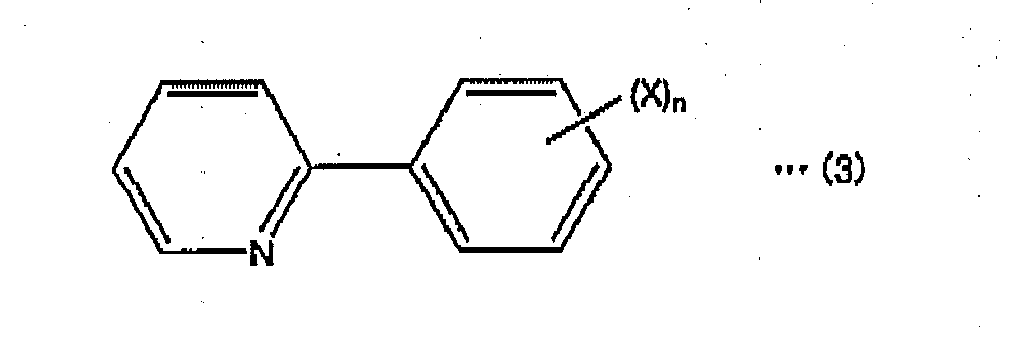
- L a is a bidentate ligand shown by the following formula (3),
- X represents a halogen atom and n is an integer of 0 to 2.
- 2-phenylpyridine (following formula (3a)), 2-(2,4-difluorophenyl)pyridine, 2-(2,4-dichlorophenyl)pyridine, and 2-(2,4-dibromophenyl)pyridine (all shown by the following formula (3b)) can be given.
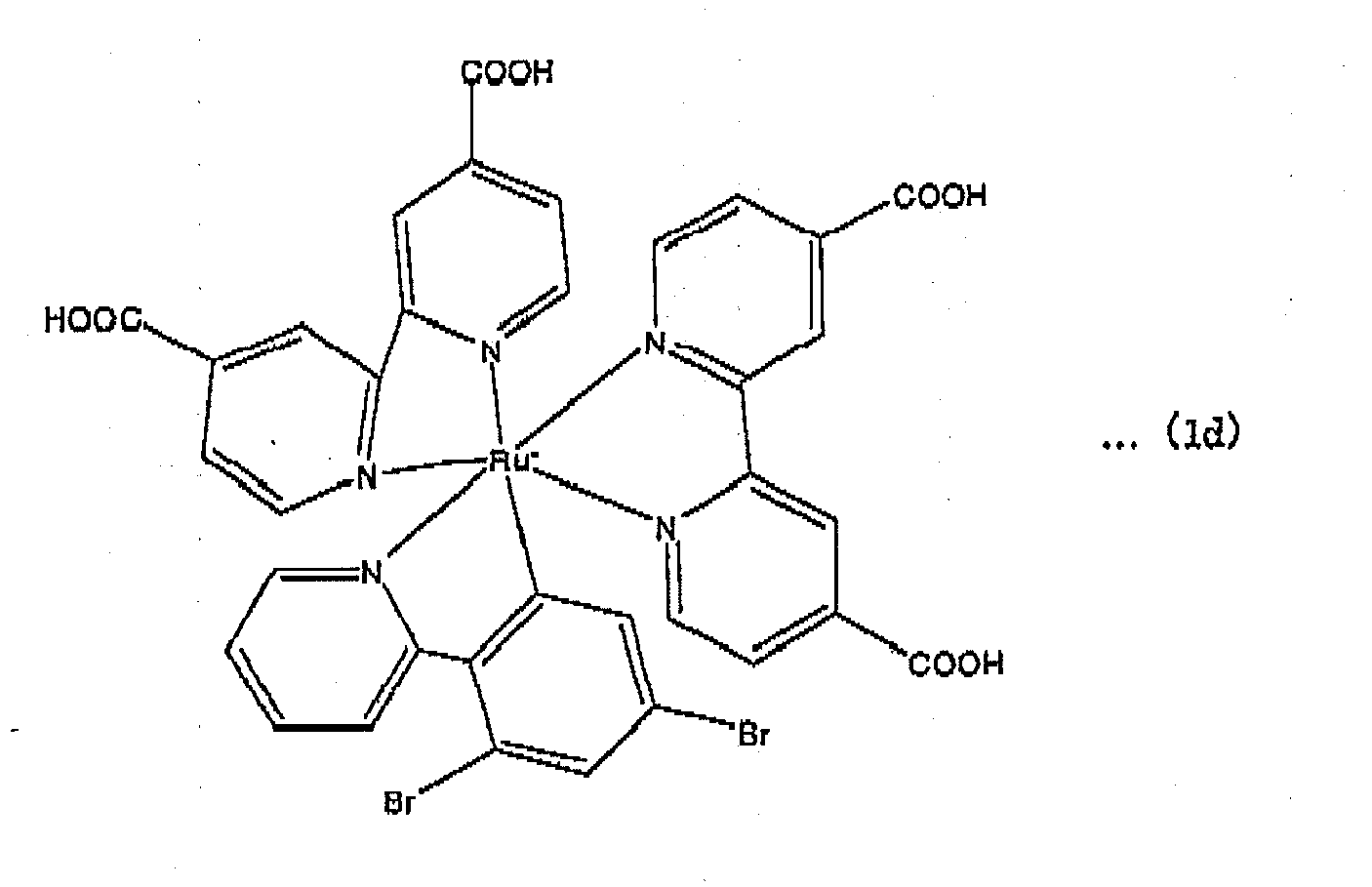
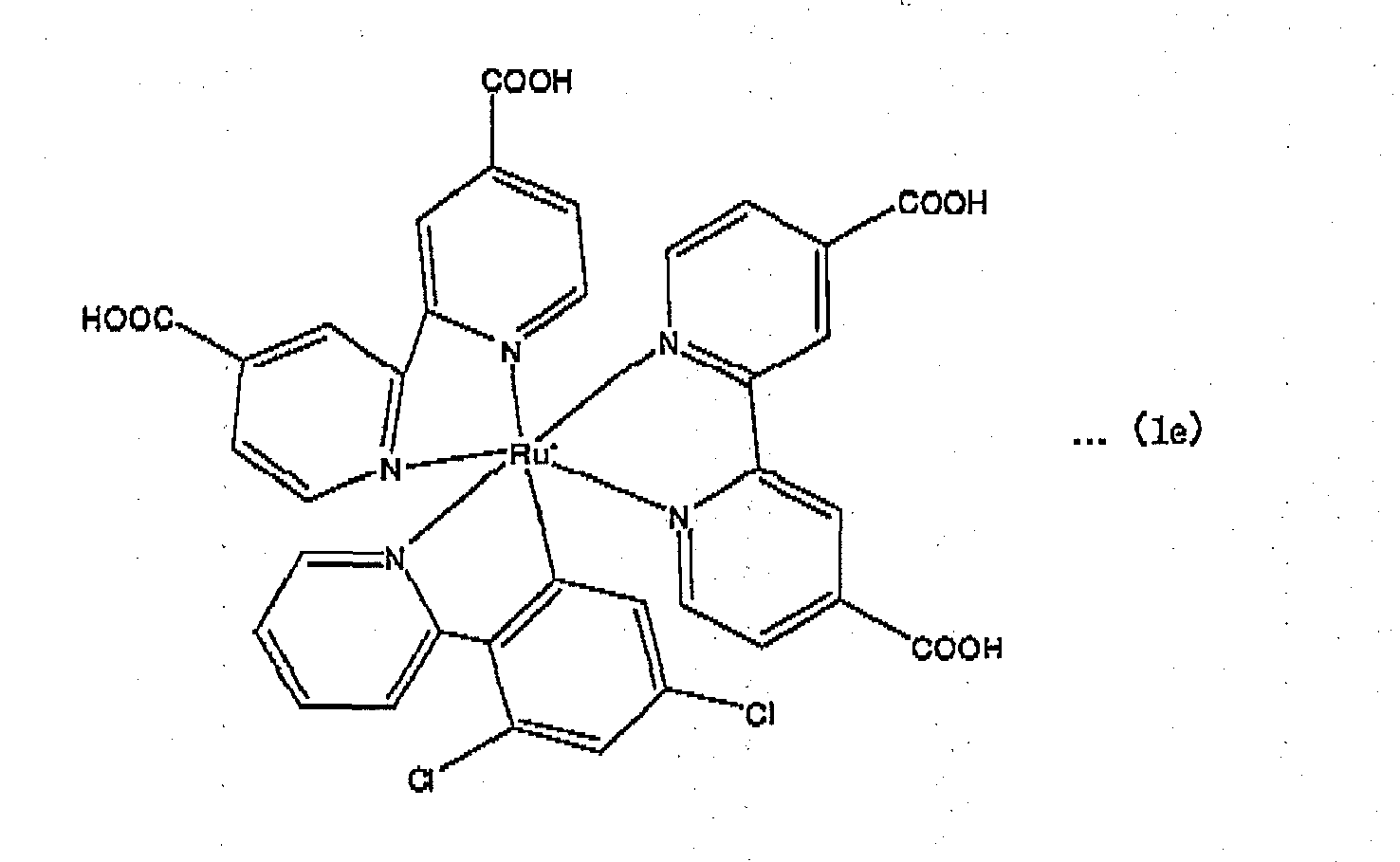
- dyestuffs shown by the following formulas (1a) to (1e) can be given.
- a second embodiment of the invention is a dyestuff shown by the following formula (4) (hereinafter referred to from time to time as "second dyestuff'). ML 4 L 5 (4)
- M is a central atom.
- the definition, examples of atoms, and preference of the ruthenium atom as described in connection of the formula (2) apply to M in the formula (4).
- L 4 is a tridentate ligand shown by the following formula (5),
- R 4 , R 5 , and R 6 individually represent a carboxyl group or a group equivalent to a salt of the carboxyl group.
- group equivalent to a salt of the carboxyl group the same group as given in connection with the formula (2) can be given.
- carboxyalkyl group a carboxymethyl group and the like can be given.
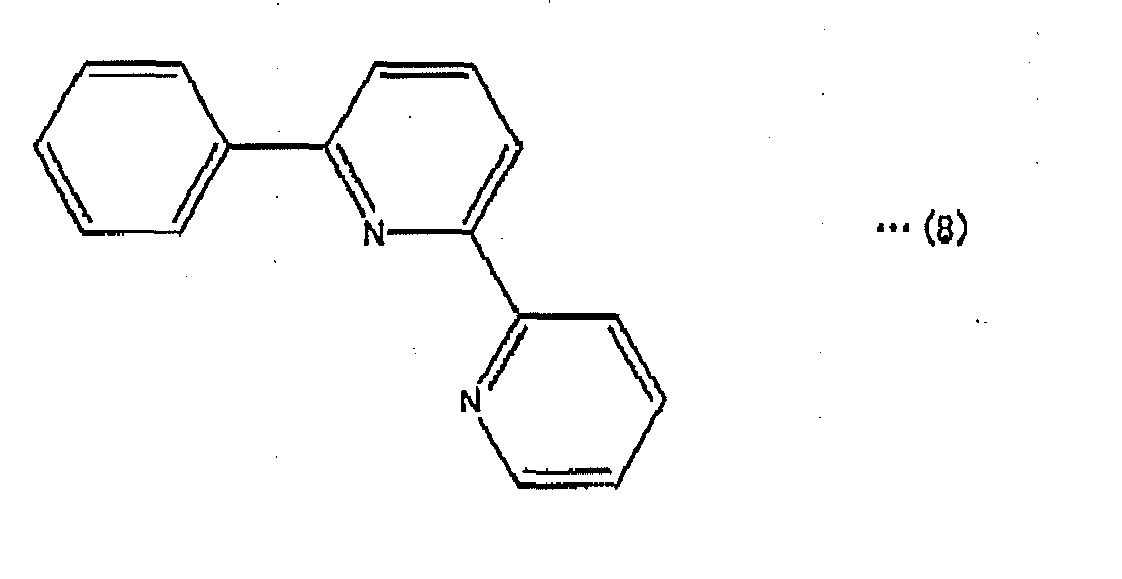
- L 5 is a tridentate ligand shown by the following formulas (6) to (8), wherein R 7 individually represents a hydrocarbon group having 1 to 8 carbon atoms,
- R 7 individually represents a hydrocarbon group having 1 to 8 carbon atoms.
- the hydrocarbon group having 1 to 8 carbon atoms an n-butyl group and the like can be given.
- M is a central atom.
- the definition, examples of atoms, and preference of the ruthenium atom as described in connection of the formula (2) apply to M in the formula (9).
- L a represents a bidentate ligand which was described in the formula (3) of the first embodiment
- L 4 represents a tridentate ligand which was described in the formula (5) of the second embodiment.
- R 4 , R 5 , and R 6 of the formula (5) The same definition and examples of substituents mentioned in the second embodiment apply to R 4 , R 5 , and R 6 of the formula (5).
- a 1 is an isothiocyanate group (-NCS).
- the dye-sensitized solar cell of the present invention is equipped with an anode, a cathode, and an electrolyte.
- the cathode has a substrate made of electrically conductive transparent glass and an oxide membrane electrode formed on the surface, and the oxide membrane electrode contains the dye described above adsorbed therein.
- the anode is formed from a material having conductivity.
- a substrate made of electrically conductive transparent glass which contains a small amount of platinum or conductive carbon adhering to the surface can be suitably used.
- the electrically conductive transparent glass a glass made of tin oxide, indium-tin oxide (ITO), or the like can be used.
- the cathode has a substrate made of electrically conductive transparent glass and an oxide membrane electrode formed on the surface, and the oxide membrane electrode contains the dye described above adsorbed therein.
- the electrically conductive transparent glass a glass made of the material described in connection with the anode can be used.
- the shape of the substrate is not particularly limited. For example, a substrate in the form of a plate and the like may be used.
- oxide forming the oxide membrane electrode a metal oxide such as titanium oxide, niobium oxide, zinc oxide, tin oxide, tungsten oxide, and indium oxide can be given. Of these oxides, titanium oxide, niobium oxide, and tin oxide are preferable, with titanium oxide being particularly preferable.
- the oxide membrane electrode adsorbing the dyestuff of the present invention is used. A method for adsorption will be discussed in the description of the manufacturing method.
- a liquid electrolyte, a solid electrolyte, or a solution containing the electrolyte can be used.
- a redox electrolyte is particularly preferable.
- the redox electrolyte refers to a solution containing a substance forming a redox system (oxidizing agent and reducing agent).
- a solution containing iodine and imidazolium salt of iodine, which forms a redox system (I - /I 3 system) shown in the following formula (15) can be suitably used.
- An electrochemically inert substance for example, acetonitrile or propionitrile, can be suitably used as the solvent for the solution.
- the dye-sensitized solar cell may be fabricated so that the electrolyte may fill the space between the anode and cathode.
- the anode and cathode may be disposed face to face in the electrolytic solution.
- the method for manufacturing the dye-sensitized solar cell of the present invention comprises causing a substrate made of electrically conductive transparent glass and a cathode having an oxide membrane electrode formed on the surface to come in contact with the dyestuff solution of the present invention, thereby causing the dyestuff to be adsorbed in the oxide membrane electrode.
- the manufacturing method of the present invention thus comprises a step of causing the dyestuff to be adsorbed in an oxide membrane electrode which constitutes the cathode.
- the oxide membrane electrode must be provided prior to adsorption of the dyestuff.
- the oxide membrane electrode can be formed by suspending fine particles of an oxide in a suitable dispersion medium to obtain an oxide slurry, applying the slurry to the surface of the substrate of electrically conductive transparent glass, removing the solvent, and heating the resulting coating.
- the dyestuff of the present invention is caused to be adsorbed in the oxide membrane electrode.
- the dyestuff is adsorbed by causing the substrate of electrically conductive transparent glass and the cathode having an oxide membrane electrode formed on the surface to come in contact with a dyestuff solution containing the dyestuff of the present invention and a base.
- the dyestuff solution is a solution containing the dyestuff of the present invention, that is, the dyestuff of any one of the above formula (1), (4), or (9).
- the dyestuff solution preferably contains the dyestuff of the present invention at a concentration of 0.1 to 10 mmol/l.
- concentration of the dyestuff at 0.1 mmol/l or more ensures sufficient adsorption of the dyestuff by the oxide membrane electrode.
- controlling the dyestuff concentration to 10 mmol/l or less inhibits adsorption of dyestuff molecules among themselves.
- a more preferable dye concentration is in a range of 0.2 to 5 mmol/l, with a particularly preferable concentration being in a range of 0.5 to 2 mmol/l.
- the dye solution contains a base in addition to the dyestuff of the present invention.
- the base is either an inorganic base or an organic base.
- a hydroxide of an alkali metal, carbonate of an alkali metal, sulfide of an alkali metal, and hydroxide of an alkaline earth metal can be given.
- hydroxide of an alkali metal lithium hydroxide, sodium hydroxide, and potassium hydroxide can be given; as examples of the carbonate of an alkali metal, lithium carbonate, sodium carbonate, and potassium carbonate can be given; as examples of the sulfide of an alkali metal, lithium sulfide, sodium sulfide, and potassium sulfide can be given; and as examples of the hydroxide of an alkaline earth metal, calcium hydroxide and magnesium hydroxide can be given.
- organic base primary to tertiary amine compounds, a hydroxide of quaternary ammonium, carbonate of quaternary ammonium, sulfide of quaternary ammonium, hydroxide of quaternary phosphonium, carbonate of quaternary phosphonium, sulfide of quaternary phosphonium, nitrogen-containing hetero aromatic compounds having a nitrogen atom in an aromatic ring, aromatic amine compounds, and the like can be given.
- primary amines such as methylamine and ethylamine
- secondary amines such as dimethylamine and diethylamine
- tertiary amines such as trimethylamine and triethylamine
- hydroxide of quaternary ammonium tetraethylammonium hydroxide and tetrabutylammonium hydroxide can be given; as examples of the carbonate of quaternary ammonium, tetramethylammonium carbonate and tetrabutylammonium carbonatecan be given; and, as examples of the sulfide of quaternary ammonium, tetramethylammonium sulfate and tetrabutylammonium sulfate can be given.
- hydroxide of quaternary phosphonium tetramethylphosphonium hydroxide and tetrabutylphosphonium hydroxide can be given; as examples of the carbonate of quaternary phosphonium, tetramethylphosphonium carbonate and tetrabutylphosphonium carbonate can be given; and as examples of the sulfide of quaternary phosphonium, tetramethylphosphonium sulfate and tetrabutylphosphonium sulfate can be given.
- nitrogen-containing hetero aromatic compound pyridine, pyrrole, and lutidine can be given; and as examples of the aromatic amine compounds, aniline, methylaniline, and dimethylaniline can be given.
- a Broensted base among the above-mentioned bases is preferable.
- Use of an organic base is more preferable, and use of a hydroxide of quaternary ammonium and carbonate of quaternary ammonium is still more preferable.
- Particularly preferable bases are tetraethylammonium hydroxide, tetrabutylammonium hydroxide, tetramethylammonium carbonate, and tetrabutylammonium carbonate; with tetraethylammonium hydroxide and tetrabutylammonium hydroxide being the most preferable.
- the dyestuff solution contains the base at a concentration preferably of 0.0001 to 50 mN, more preferably 0.001 to 20 mN, and still more preferably 0.01 to 10 mN.
- the solvent used for the dyestuff solution water, a polar organic solvent, or a mixture of these is preferably used.
- polar organic solvent ethers, alcohols, nitriles, amides, sulfoxides, and the like can be given.
- ethers diethyl ether, ethylene glycol dimethyl ether, and ethylene glycol diethyl ether can be given; as examples of the alcohols, ethanol, methanol, isopropyl alcohol, and butanol can be given; as examples of the nitriles, acetonitrile, benzonitrile, and propiononitrile can be given; as examples of the amides, dimethylformamide and dimethylacetamide can be given; and as examples of the sulfoxides, dimethylsulfoxide and the like can be given.
- an alcohol, a nitrile, or an amide is preferable in the manufacturing method of the present invention, with ethanol, methanol, butanol, or acetonitrile being more preferable.
- a mixture of an alcohol and a nitrile is preferable, with a mixture of butanol and acetonitrile being more preferable.
- the method of causing the cathode to come in contact with the dyestuff solution is not specifically limited, a method of dipping the cathode into the dyestuff solution and causing the dyestuff to be adsorbed in the oxide membrane electrode is preferably used.
- the dipping time is preferably from 0.5 to 100 hours, more preferably from 2 to 50 hours, and particularly preferably from 12 to 24 hours.
- the dipping temperature is in a range of 0 to 100°C, and more preferably 10 to 50°C.
- the dye-sensitized solar cell can be formed by, for example, filling a container with the electrolytic solution and disposing the anode and cathode face to face in the electrolytic solution.
- the anode and the cathode can be thus disposed with a desired distance between them by securing them by sandwiching a spacer between them.
- the anode and the cathode can also be face to face disposed with a desired distance between them by stacking the cathode, the solid electrolyte, and the anode in that order.
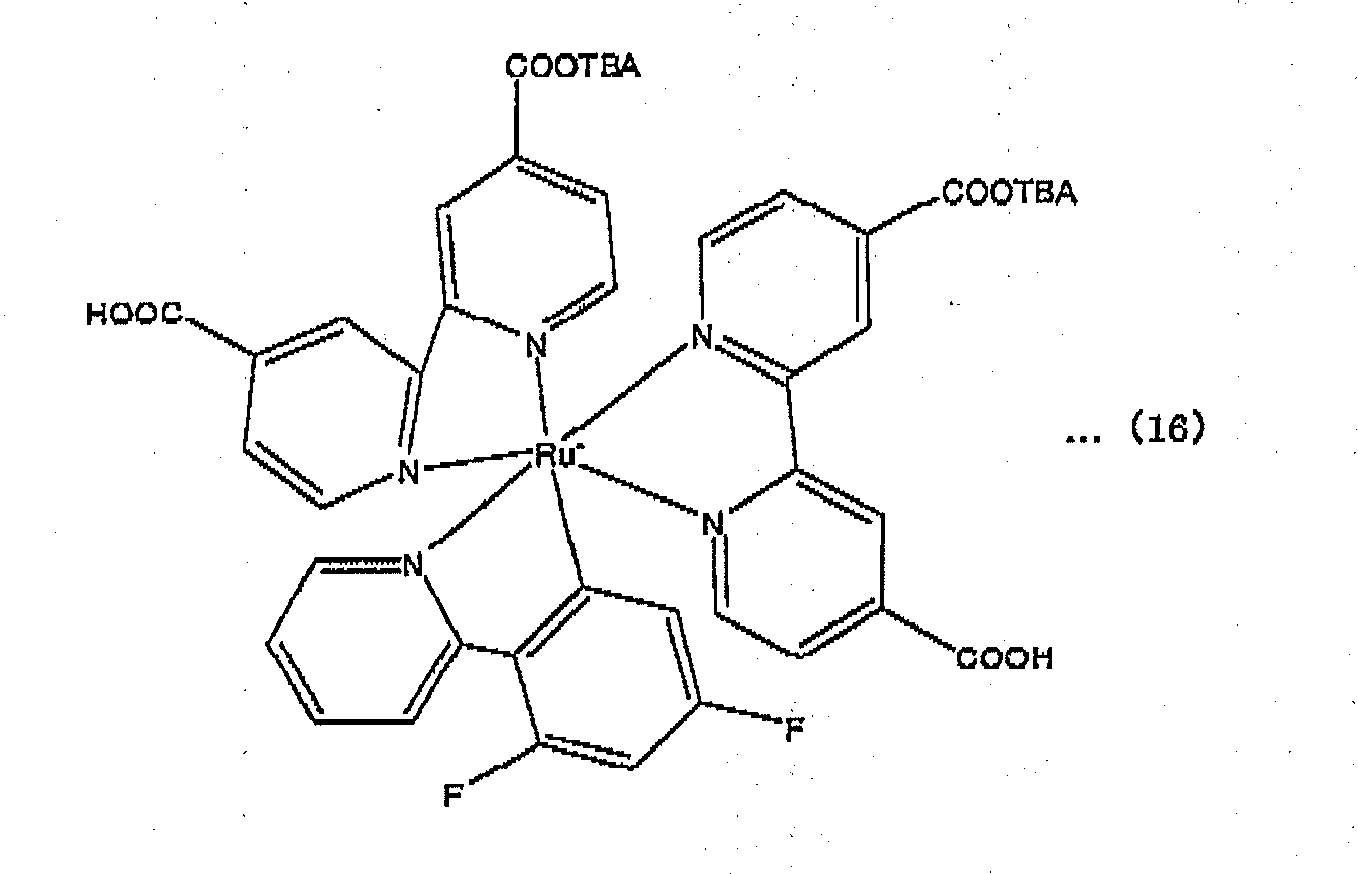
- Dyestuff T1 A dyestuff shown by the following formula (16) (hereinafter referred to as "Dyestuff T1") was prepared.
- reaction solution was allowed to cool to room temperature and 50 ml of diethyl ether and 15 ml methanol were added to precipitate a reaction product. After allowing to stand overnight, the precipitate was collected by filtration, dissolved in a small amount of methanol, and purified using column chromatography to obtain 60 mg of a product.
- column for purification "Sephadex LH-20" (manufactured by Amersham Biosciences) was used. The purified product was analyzed by 1 H-NMR to confirm it to be Dyestuff T1 of the above-described formula (16).
- Dyestuff T2 A dyestuff shown by the following formula (17) (hereinafter referred to as "Dyestuff T2”) was prepared.
- reaction solution was allowed to cool to room temperature and 50 ml of diethyl ether and 15 ml methanol were added to precipitate a reaction product. After allowing to stand overnight, the precipitate was collected by filtration and treated in the same manner as in Example 1 to obtain 60 mg of a purified product.
- the purified product was analyzed by 1 H-NMR to confirm it to be Dyestuff T2 of the above-described formula (17).
- Dyestuff T3 A dyestuff shown by the following formula (18) (hereinafter referred to as "Dyestuff T3”) was prepared.
- a reaction vessel was charged with a solution of 4.0 g of 4,4'-dimethylpyridine, 10 g of 2,5-dimethoxyformaldehyde, and 10 g of potassium t-butylalkoxide in 240 ml of dimethylformaldehyde. After replacing the atmosphere with nitrogen, the mixture was reacted at room temperature for 24 hours. After the reaction, the solvent was removed, and 400 ml of methanol was added to the residue. The resulting precipitate was collected by filtration to obtain 8.85 g of the target compound.
- reaction solution was allowed to cool to room temperature, and the solvent was removed. 5 ml of N,N-dimethylformamide was added and the solution was added dropwise to 100 ml of water to precipitate a reaction product. 100 mg of the precipitate which was collected by filtration and 42 mg of 2-(2,4-difluorophenyl)pyridine, which had been dried under reduced pressure, were added to 20 ml of ethylene glycol, which had been previously deaerated under reduced pressure and placed in a nitrogen atmosphere. The solution was allowed to stand in a nitrogen gas stream for 10 minutes. The solution was reacted at 160°0 for two hours while stirring under a nitrogen atmosphere. 266 mg of tetrabutylammonium hydroxide was added to the reaction solution, and the resulting mixture was reacted at 160°C for four hours under a nitrogen atmosphere.
- the reaction solution was allowed to cool to room temperature.
- 0.1 N nitric acid was added drop wise to adjust the pH to 5.0, and 50 ml of diethyl ether and 15 ml methanol were added to precipitate a reaction product.
- the precipitate was collected by filtration and treated in the same manner as in Example 1 to obtain 55 mg of a purified product.
- the purified product was analyzed by 1 H-NMR to confirm it to be Dyestuff T3 of the above-described formula (18).
- a dyestuff shown by the following formula (20) (hereinafter referred to as "Dyestuff T4") was prepared.
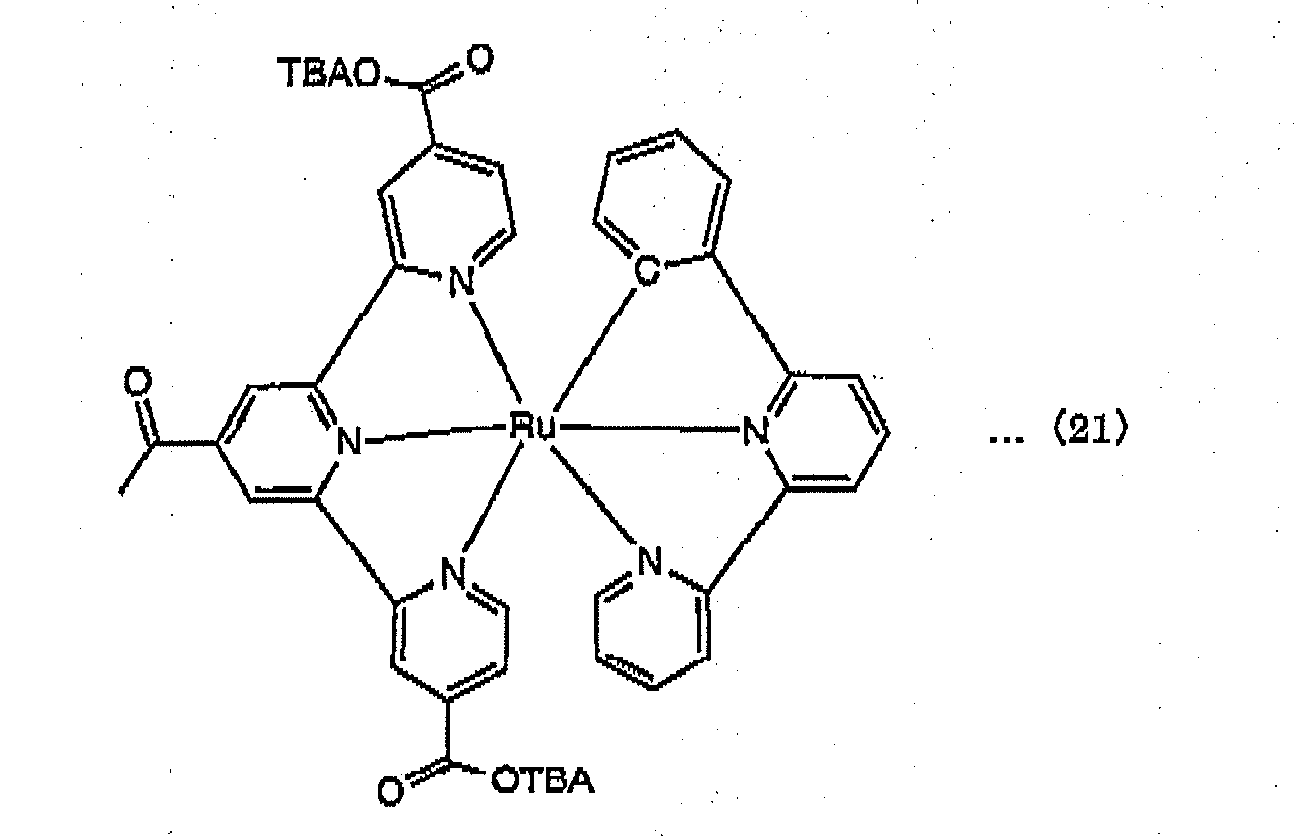
- a dyestuff shown by the following formula (21) (hereinafter referred to as "Dyestuff T5") was prepared.
- Dyestuff T6 A dyestuff shown by the following formula (22) (hereinafter referred to as "Dyestuff T6") was prepared.
- Dyestuff T7 A dyestuff shown by the following formula (23) (hereinafter referred to as "Dyestuff T7") was prepared.
- the dyestuffs T1 to T7 prepared in Examples 1 to 7 and a base were dissolved in ethanol to obtain dye solutions each having a dye concentration of 0.5 mmol/I.
- a commercially available dye "N719" was dissolved in ethanol to prepare a dye solution with a dye concentration of 0.5 mmol/l.
- the above-mentioned aubstrate on which the oxide membrane electrode was formed was dipped in the above-mentioned dye solution at 23°C for 24 hours to cause the dyestuff to be adsorbed on the oxide membrane electrode, thereby obtaining a cathode.
- electrolytic solution was prepared by dissolving guanidinum thiocyanate, iodine, 1-butyl-3-methylimidazolium iodonium salt, and t-butylpyridine in a mixed solvent of acetonitrile and valeronitrile (volume ratio: 85:15) at concentrations, respectively of 0.1 mol/l, 0.03 mol/l, 0.6 mol/l, and 0.5 mol/l.
- electrolytic solution is hereinafter referred to as "electrolytic solution E1".
- electrolytic solution E2 An electrolytic solution was prepared by dissolving lithium iodonium salt, iodine, and 1-butyl-3-methylimidazolium iodonium salt in a mixed solvent of acetonitrile and valeronitrile (volume ratio: 85:15) at concentrations, respectively of 0.1 mol/l, 0.05 mol/l, 0.6 mol/l.
- the electrolytic solution is hereinafter referred to as "electrolytic solution E2".
- solution E3 A solution was prepared by dissolving guanidinum thiocyanate, iodine, 1-metyl-3-propylimidazolium iodonium salt, and N-butylbenzimidazole in 3-methoxypropionitrile at concentrations, respectively of 0.1 mol/l, 0.15 mol/l, 1.0 mol/l, and 0.5 mol/l.
- solution E3 The solution is hereinafter referred to as "solution E3".
- Dye-sensitized solar cells (Examples 8 to 19 and Comparative Examples 2 and 3) were prepared disposing the cathodes and anodes in containers at intervals of 25 micrometers so that the platinum-sintered side of the anode and the oxide membrane electrode-formed side of the cathode may lie face to face, and filling the electrolytic solution E1, electrolytic solution E2, or solution E into the containers.
- the conversion efficiency of the dye-sensitized solar cells of Examples and Comparative Examples was measured by irradiating these dye-senaitized solar cells with false sunlight at an illumination intensity of 100 mW/cm 2 by using a solar simulator.
- the cells were evaluated as "Good” if the conversion efficiency was 6% or more, and as “Bad” if the conversion efficiency was less than 6%.
- the results are shown in Table 1.
- the dye-sensitized solar cells of Examples and Comparative Examples were allowed to stand under the conditions of 333K and 100mW/cm 2 , and irradiated with false sunlight at an illumination intensity of 100mW/cm 2 using a solar simulator for 30 days. The initial conversion efficiency and the conversion efficiency after 30 days were measured.
- the durability was evaluated by the ratio (percentage) of the conversion efficiency after 30 days (conversion efficiency B) to the initial conversion efficiency (conversion efficiency A).
- the cells were evaluated as “Good” if this ratio was 60% or more, and as “Bad” if the ratio was less than 60%.
- the initial conversion efficiency conversion efficiency A
- the cells were evaluated as "Good” if the conversion efficiency A was 4% or more, and as “Bad” if less than 4%.
- the conversion efficiency after 30 days the cells were evaluated as “Good” if the conversion efficiency B was 2% or more, and as “Bad” if less than 2%.
- Table 2 The results are shown in Table 2.
- the dye-sensitized solar cell of Example 22 using the dyestuff (T1) of Example 1 exhibited higher durability than the dye-sensitized solar cells of Comparative Example 4 in which the dye "N719" was used.
- the dye-sensitized solar cells using the dyestuffs (T2 to T7) also exhibited the same durability of the dyo-sensitized solar cells of Example 22, higher than the dye-sensitized cells of Comparative Examples 4 in which the dye "N719" was used.
- the dye-sensitized solar cell of the present invention exhibits high conversion efficiency and has excellent durability such as excellent weather resistance and heat resistance, it can be suitably used as a next-generation solar cell which replaces silicon-based solar cells.
- the dyestuff and the method for manufacturing the dye-sensitized solar cell can be suitably used for manufacturing the dye-sensitized solar cell.
Landscapes
- Chemical & Material Sciences (AREA)
- Organic Chemistry (AREA)
- Crystallography & Structural Chemistry (AREA)
- Inorganic Chemistry (AREA)
- Engineering & Computer Science (AREA)
- Materials Engineering (AREA)
- Hybrid Cells (AREA)
- Photovoltaic Devices (AREA)
- Pyridine Compounds (AREA)
Abstract
Description
- The present invention relates to a dyestuff, a dye-sensitized solar cell, and a method for manufacturing the same.
- Along with an increased concern about energy problems, extensive efforts are being directed to research on solar cells which can efficiently convert light, particularly sunlight, into electricity. For example, silicon-based solar cells using amorphous silicon or polycrystalline silicon are being widely accepted.
- However, widespread use of the silicon-based solar cells is expected to be limited because of high production cost and difficulty in making a large amount of high purity silicon available at low cost.
- For this reason, a dye-sensitized solar cell is attracting attention in recent years. The dye-sensitized solar cell has many advantages over silicon-based solar cells such as a high power generation efficiency, comparatively low manufacturing cost, abundant availability of inexpensive oxide semiconductors such as titanium oxide as raw materials which need not be purified, low investment cost for equipment used for manufacturing, and the like. Therefore, the dye-sensitized solar cell is expected to be the next-generation solar cell (see, for example, Patent Documents 1 and 2).
- The dye-sensitized solar cell is equipped with an anode, a cathode, and an electrolyte as in other common cells. The cathode has a substrate made of electrically conductive transparent glass, with an oxide membrane electrode formed on the surface. The oxide membrane electrode contains a specific dye adsorbed therein.
- As the dye adsorbed in the oxide membrane electrode, a dye "N719" shown by the following formula (10) or "Black Dye" shown by the following formula (11) are known (see, for example, Non-patent Documents 1 and 2).


-
- (Patent Document 1)
USP 4927721 - (Patent Document 2)
WO 98/50393 - (Non-patent Document 1) J. Am. Chem. Soc., 115, 6382-6390 (1993)
- (Non-patent Document 2) J. Am. Chem. Soc., 123, 1613-1624 (2001)
- Although the above dye-sensitized solar cells, particularly the dye-sensitized solar cell using the dye N719, exhibit high conversion efficiency but the main drawbacks of this sensitizer are the location of the absorption maximum around 535 nm, and the presence of monodentate ligands such as NCS, which raises the issue of sensitizer's stability. Dye-sensitized solar cells that can exhibit high conversion efficiency and satisfactory durability (weather resistance, heat resistance, etc.) have not been disclosed. There has been a strong demand for development of a dye-sensitized solar cell having high conversion efficiency and excellent durability (weather resistance, heat resistance, etc.),
- The present invention has been achieved in view of such a technological problem in the present state of art and has an object of providing a dye-sensitized solar cell having high conversion efficiency and excellent durability in terms of weather resistance, heat resistance, and the like, a dyestuff used as a material for the dye-sensitized solar cell, and a method for manufacturing of the dye-sensitized solar cell.
- As a result of extensive studies, the inventors of the present invention have found that the above object can be achieved by a dyestuff having a ligand with a specific structure. Specifically, the present invention provides the following dyestuff, dye-sensitized solar cell, and method for manufacturing the same.
-
- [1] A dyestuff shown by the following formula (1),
ML1L2L3 (1)
wherein M represents an element belonging to Group 8 to Group 10 of the long-format Periodic Table, L1 and L2 individually represent a bidentate ligand shown by the following formula (2), and L3 represents a bidentate ligand shown by the following formula (3),
-
- [2] A dyestuff shown by the following formula (4),
ML4L5 (4)
wherein M represents an element belonging to Group 8 to Group 10 of the long-format Periodic Table, L4 represents a tridentate ligand shown by the following formula (5), and L5 represents a tridentate ligand shown by the following formula (6), (7), or (8),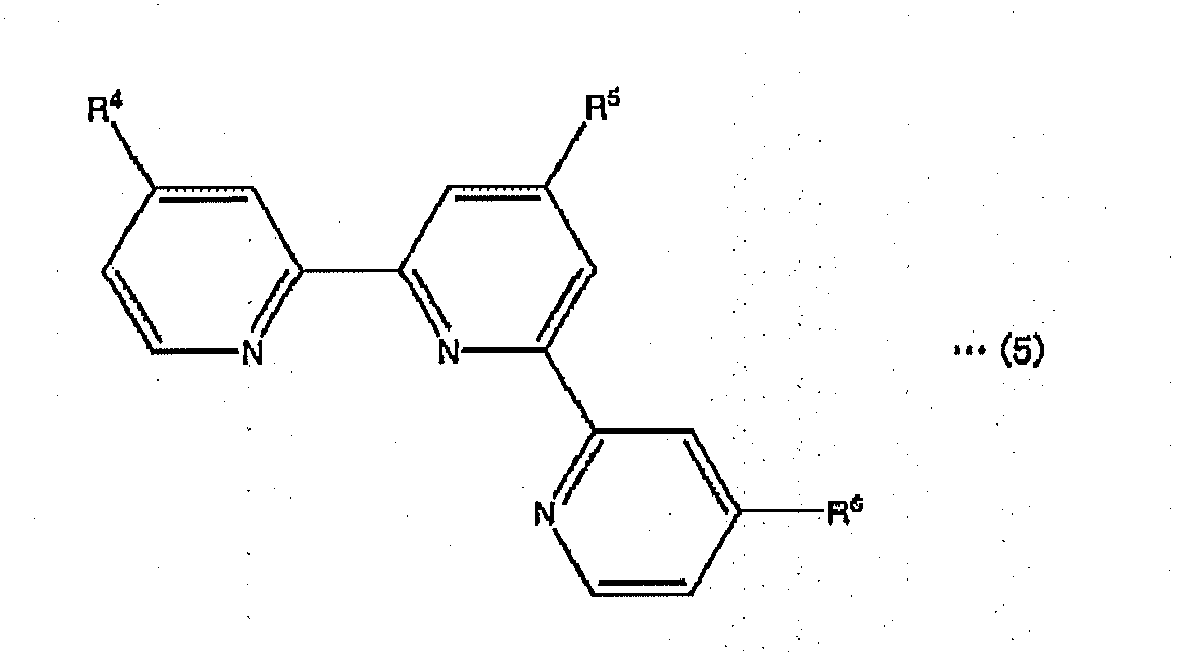


-
- [3] A dyestuff shown by the following formula (9),
ML9L4A1 (9)
wherein M represents an element belonging to Group 8 to Group 10 of the long-format Periodic Table, L9 represents a bidentate ligand shown by the following formula (3), L4 represents a tridentate ligand shown by the following formula (5), and A1 is an isothiocyanate group,
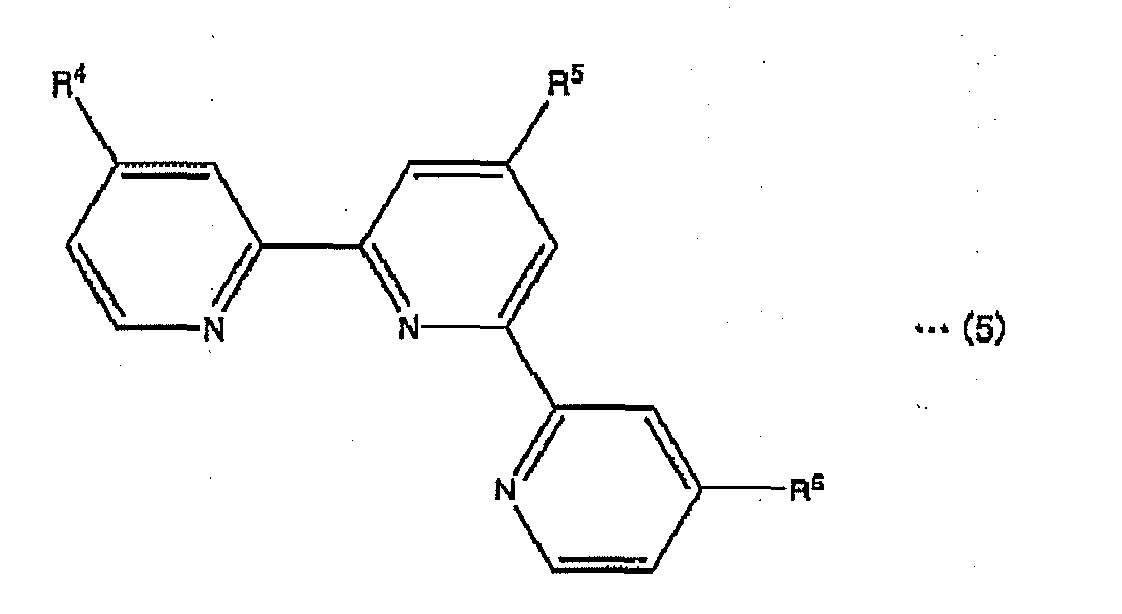
-
- [4] The dyestuff according to any one of [1] to [3] above, wherein M in the formula (1), (4) or (9) is ruthenium.
-
- [5] A dye-sensitized solar cell comprising an anode, a cathode, and an electrolyte, the cathode having a substrate made of electrically conductive transparent glass and an oxide membrane electrode formed on the surface, and the oxide membrane electrode containing a dye according to any one of [1] to [4] above adsorbed therein.
-
- [6] A method for manufacturing a dye-sensitized solar cell comprising causing a substrate made of electrically conductive transparent glass and a cathode having an oxide membrane electrode formed on the surface to come in contact with a dyestuff solution which contains a dyestuff according to any one of [1] to [4] above and a base, thereby causing the dyestuff to be adsorbed in the oxide membrane electrode.
-
- [7] The method for manufacturing a dye-sensitized solar cell according to [6] above, wherein the dyestuff solution contains the base at a concentration of 0.001 to 20 mmol/l.
- The dye-sensitized solar cell of the present invention exhibits high conversion efficiency and has excellent durability such as excellent weather resistance and heat resistance. The dyestuff, and the method for manufacturing, of the dye-sensitized solar cell can be suitably used for manufacturing the dye-sensitized solar cell.
- The present invention will be described by way of embodiments, which should not be construed as limiting the present invention. It should be understood that various modifications and improvements may be made within the scope of the present invention based on knowledge of a person skilled in the art.
- The dyestuff of the present invention is any one of dyestuffs shown by the following formula (1), (4), or (9).
- A first embodiment of the present invention is a dyestuff shown by the following formula (1) (hereinafter referred to from time to time as "first dyestuff"),
ML1L2L3 (1)
- In the formula (1), M is a central atom and represents a metal atom belonging to Group 8 to Group 10 of the long-format Periodic Table. As the metal atom belonging to Group 8 to Group 10, iron, ruthenium, and osmium of Group 8, cobalt, rhodium, and iridium of Group 9, and nickel, palladium, and platinum of Group 10 can be given. A dyestuff having a ruthenium atom as M is particularly preferable.
- In the formula (1), L1 and L2 individually represent a bidentate ligand shown by the following formula (2),

- wherein R1 and R2 individually represent a monovalent organic group.
- As examples of the monovalent organic group, a carboxyl group and a group equivalent to the salt of the carboxyl group can be given. As an example of the group equivalent to the salt of the carboxyl group, a group equivalent to the tetrabutylammonium salt of carboxylic acid can be given.
- As an example of such a monovalent organic group, the group shown by the following formula (12) can be given.

- As another example of such a monovalent organic group, the group shown by the following formula (13) can be given.

- As a further example of such a monovalent organic group, the group shown by the following formula (14) can be given,

- wherein R3 individually represents a methyl group or a t-butyl group, and m is an integer of 1 or 2. As specific examples, the monovalent organic group shown by the following formula (14a) and (14b) can be given.

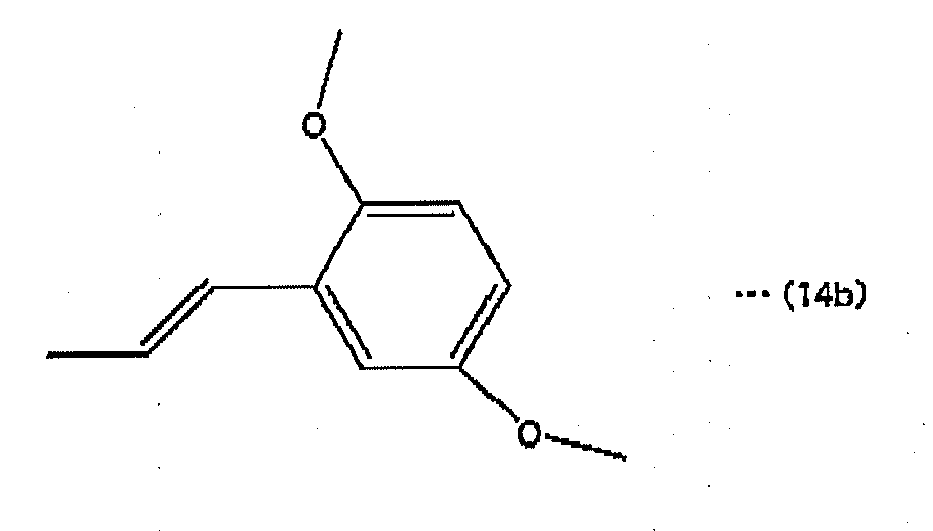
- In the formula (1), La is a bidentate ligand shown by the following formula (3),

- wherein X represents a halogen atom and n is an integer of 0 to 2. As specific examples, 2-phenylpyridine (following formula (3a)), 2-(2,4-difluorophenyl)pyridine, 2-(2,4-dichlorophenyl)pyridine, and 2-(2,4-dibromophenyl)pyridine (all shown by the following formula (3b)) can be given.


- As specific examples of the dyestuff of the first embodiment, dyestuffs shown by the following formulas (1a) to (1e) can be given.
-
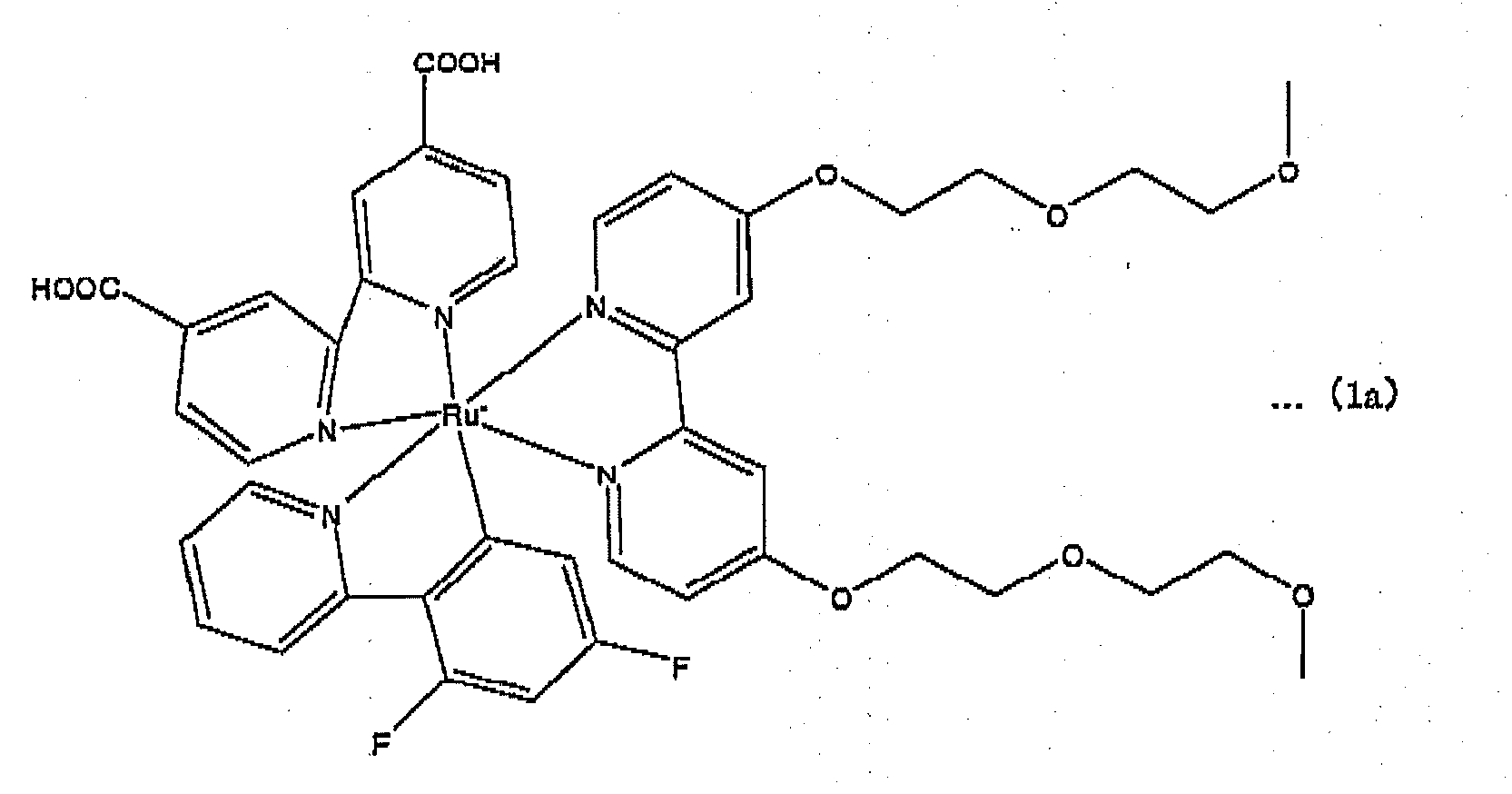
-

-

-
-
- A second embodiment of the invention is a dyestuff shown by the following formula (4) (hereinafter referred to from time to time as "second dyestuff').
ML4L5 (4)
- In the formula (4), M is a central atom. The definition, examples of atoms, and preference of the ruthenium atom as described in connection of the formula (2) apply to M in the formula (4).
- In the formula (4), L4 is a tridentate ligand shown by the following formula (5),

- wherein R4, R5, and R6 individually represent a carboxyl group or a group equivalent to a salt of the carboxyl group. As examples of the group equivalent to a salt of the carboxyl group, the same group as given in connection with the formula (2) can be given. As examples of the carboxyalkyl group, a carboxymethyl group and the like can be given.
- In the formula (4), L5 is a tridentate ligand shown by the following formulas (6) to (8),


- In the formula (7), R7 individually represents a hydrocarbon group having 1 to 8 carbon atoms. As examples of the hydrocarbon group having 1 to 8 carbon atoms, an n-butyl group and the like can be given.
- [1-3] Third embodiment:
- A third embodiment of the invention is a dyestuff shown by the following formula (9) (hereinafter referred to from time to time as "third dyestuff"),
ML3L4A1 (9)
- In the formula (9), M is a central atom. The definition, examples of atoms, and preference of the ruthenium atom as described in connection of the formula (2) apply to M in the formula (9).
- La represents a bidentate ligand which was described in the formula (3) of the first embodiment, and L4 represents a tridentate ligand which was described in the formula (5) of the second embodiment. The same definition and examples of substituents mentioned in the second embodiment apply to R4, R5, and R6 of the formula (5). A1 is an isothiocyanate group (-NCS).
- As an specific example of the dyestuff of the third embodiment, a dyestuff shown by the following formula (9a) can be given.

- The dye-sensitized solar cell of the present invention is equipped with an anode, a cathode, and an electrolyte. The cathode has a substrate made of electrically conductive transparent glass and an oxide membrane electrode formed on the surface, and the oxide membrane electrode contains the dye described above adsorbed therein.
- There are no limitations to the material of the anode insofar as the anode is formed from a material having conductivity. For example, a substrate made of electrically conductive transparent glass which contains a small amount of platinum or conductive carbon adhering to the surface can be suitably used. As the electrically conductive transparent glass, a glass made of tin oxide, indium-tin oxide (ITO), or the like can be used.
- The cathode has a substrate made of electrically conductive transparent glass and an oxide membrane electrode formed on the surface, and the oxide membrane electrode contains the dye described above adsorbed therein. As the electrically conductive transparent glass, a glass made of the material described in connection with the anode can be used. The shape of the substrate is not particularly limited. For example, a substrate in the form of a plate and the like may be used.
- As the oxide forming the oxide membrane electrode, a metal oxide such as titanium oxide, niobium oxide, zinc oxide, tin oxide, tungsten oxide, and indium oxide can be given. Of these oxides, titanium oxide, niobium oxide, and tin oxide are preferable, with titanium oxide being particularly preferable. The oxide membrane electrode adsorbing the dyestuff of the present invention is used. A method for adsorption will be discussed in the description of the manufacturing method.
- As the electrolyte, a liquid electrolyte, a solid electrolyte, or a solution containing the electrolyte can be used. A redox electrolyte is particularly preferable. The redox electrolyte refers to a solution containing a substance forming a redox system (oxidizing agent and reducing agent). For example, a solution containing iodine and imidazolium salt of iodine, which forms a redox system (I-/I3 system) shown in the following formula (15), can be suitably used. An electrochemically inert substance, for example, acetonitrile or propionitrile, can be suitably used as the solvent for the solution.
I3 - + 2e- ←→ 3I+ + I2 (15)
- The dye-sensitized solar cell may be fabricated so that the electrolyte may fill the space between the anode and cathode. For example, after filling an electrolytic solution in a container, the anode and cathode may be disposed face to face in the electrolytic solution.
- The method for manufacturing the dye-sensitized solar cell of the present invention comprises causing a substrate made of electrically conductive transparent glass and a cathode having an oxide membrane electrode formed on the surface to come in contact with the dyestuff solution of the present invention, thereby causing the dyestuff to be adsorbed in the oxide membrane electrode.
- The manufacturing method of the present invention thus comprises a step of causing the dyestuff to be adsorbed in an oxide membrane electrode which constitutes the cathode. The oxide membrane electrode must be provided prior to adsorption of the dyestuff. There are no specific limitations to the method for forming the oxide membrane electrode. For example, the oxide membrane electrode can be formed by suspending fine particles of an oxide in a suitable dispersion medium to obtain an oxide slurry, applying the slurry to the surface of the substrate of electrically conductive transparent glass, removing the solvent, and heating the resulting coating.
- The dyestuff of the present invention is caused to be adsorbed in the oxide membrane electrode. The dyestuff is adsorbed by causing the substrate of electrically conductive transparent glass and the cathode having an oxide membrane electrode formed on the surface to come in contact with a dyestuff solution containing the dyestuff of the present invention and a base.
- The dyestuff solution is a solution containing the dyestuff of the present invention, that is, the dyestuff of any one of the above formula (1), (4), or (9). The dyestuff solution preferably contains the dyestuff of the present invention at a concentration of 0.1 to 10 mmol/l. The concentration of the dyestuff at 0.1 mmol/l or more ensures sufficient adsorption of the dyestuff by the oxide membrane electrode. On the other hand, controlling the dyestuff concentration to 10 mmol/l or less inhibits adsorption of dyestuff molecules among themselves. In order to surely exhibit the above-mentioned effects, a more preferable dye concentration is in a range of 0.2 to 5 mmol/l, with a particularly preferable concentration being in a range of 0.5 to 2 mmol/l.
- The dye solution contains a base in addition to the dyestuff of the present invention. The base is either an inorganic base or an organic base.
- As examples of the inorganic base, a hydroxide of an alkali metal, carbonate of an alkali metal, sulfide of an alkali metal, and hydroxide of an alkaline earth metal can be given.
- As examples of the hydroxide of an alkali metal, lithium hydroxide, sodium hydroxide, and potassium hydroxide can be given; as examples of the carbonate of an alkali metal, lithium carbonate, sodium carbonate, and potassium carbonate can be given; as examples of the sulfide of an alkali metal, lithium sulfide, sodium sulfide, and potassium sulfide can be given; and as examples of the hydroxide of an alkaline earth metal, calcium hydroxide and magnesium hydroxide can be given.
- As the organic base, primary to tertiary amine compounds, a hydroxide of quaternary ammonium, carbonate of quaternary ammonium, sulfide of quaternary ammonium, hydroxide of quaternary phosphonium, carbonate of quaternary phosphonium, sulfide of quaternary phosphonium, nitrogen-containing hetero aromatic compounds having a nitrogen atom in an aromatic ring, aromatic amine compounds, and the like can be given.
- As examples of the primary to tertiary amine compounds, primary amines such as methylamine and ethylamine; secondary amines such as dimethylamine and diethylamine; and tertiary amines such as trimethylamine and triethylamine can be given.
- As examples of the hydroxide of quaternary ammonium, tetraethylammonium hydroxide and tetrabutylammonium hydroxide can be given; as examples of the carbonate of quaternary ammonium, tetramethylammonium carbonate and tetrabutylammonium carbonatecan be given; and, as examples of the sulfide of quaternary ammonium, tetramethylammonium sulfate and tetrabutylammonium sulfate can be given.
- As examples of the hydroxide of quaternary phosphonium, tetramethylphosphonium hydroxide and tetrabutylphosphonium hydroxide can be given; as examples of the carbonate of quaternary phosphonium, tetramethylphosphonium carbonate and tetrabutylphosphonium carbonate can be given; and as examples of the sulfide of quaternary phosphonium, tetramethylphosphonium sulfate and tetrabutylphosphonium sulfate can be given.
- As examples of the nitrogen-containing hetero aromatic compound, pyridine, pyrrole, and lutidine can be given; and as examples of the aromatic amine compounds, aniline, methylaniline, and dimethylaniline can be given.
- In the production process of the present invention, use of a Broensted base among the above-mentioned bases is preferable. Use of an organic base is more preferable, and use of a hydroxide of quaternary ammonium and carbonate of quaternary ammonium is still more preferable. Particularly preferable bases are tetraethylammonium hydroxide, tetrabutylammonium hydroxide, tetramethylammonium carbonate, and tetrabutylammonium carbonate; with tetraethylammonium hydroxide and tetrabutylammonium hydroxide being the most preferable.
- The dyestuff solution contains the base at a concentration preferably of 0.0001 to 50 mN, more preferably 0.001 to 20 mN, and still more preferably 0.01 to 10 mN.
- As the solvent used for the dyestuff solution, water, a polar organic solvent, or a mixture of these is preferably used. As the polar organic solvent, ethers, alcohols, nitriles, amides, sulfoxides, and the like can be given.
- As examples of the ethers, diethyl ether, ethylene glycol dimethyl ether, and ethylene glycol diethyl ether can be given; as examples of the alcohols, ethanol, methanol, isopropyl alcohol, and butanol can be given; as examples of the nitriles, acetonitrile, benzonitrile, and propiononitrile can be given; as examples of the amides, dimethylformamide and dimethylacetamide can be given; and as examples of the sulfoxides, dimethylsulfoxide and the like can be given.
- Among these solvents, an alcohol, a nitrile, or an amide is preferable in the manufacturing method of the present invention, with ethanol, methanol, butanol, or acetonitrile being more preferable. As mixed solvents of these solvents, a mixture of an alcohol and a nitrile is preferable, with a mixture of butanol and acetonitrile being more preferable.
- Although the method of causing the cathode to come in contact with the dyestuff solution is not specifically limited, a method of dipping the cathode into the dyestuff solution and causing the dyestuff to be adsorbed in the oxide membrane electrode is preferably used.
- The dipping time is preferably from 0.5 to 100 hours, more preferably from 2 to 50 hours, and particularly preferably from 12 to 24 hours.
- The dipping temperature is in a range of 0 to 100°C, and more preferably 10 to 50°C.
- The dye-sensitized solar cell can be formed by, for example, filling a container with the electrolytic solution and disposing the anode and cathode face to face in the electrolytic solution. The anode and the cathode can be thus disposed with a desired distance between them by securing them by sandwiching a spacer between them. When a solid electrolyte is used as an electrolyte, the anode and the cathode can also be face to face disposed with a desired distance between them by stacking the cathode, the solid electrolyte, and the anode in that order.
- A dyestuff shown by the following formula (16) (hereinafter referred to as "Dyestuff T1") was prepared.
- 520 mg of ruthenium trichloride and 950 mg of 4,4'-dicarboxy-2,2'-bipyridine, which had been dried under reduced pressure, were added to 5 ml of anhydrous N,N-dimethylformamide, which had been deaerated under reduced pressure and placed in a nitrogen atmosphere in advance. The solution was allowed to stand in a nitrogen gas stream for 10 minutes. The solution was reacted at 200°C under a nitrogen atmosphere for five hours while stirring. The reaction solution was then allowed to stand to cool to room temperature and the solvent was evaporated under reduced pressure. 1 ml of 2N hydrochloric acid and 10 ml of water were added to the resulting concentrate and the mixture was stirred at room temperature to precipitate the reaction product. The precipitate was collected by filtration to obtain 500 mg of a product (the product is hereinafter referred to as "D1").
- 100 mg of D1 and 59 mg of 2-(2,4-difluorophenyl)pyridine, which had been previously dried under reduced pressure, were added to 15 ml of ethylene glycol, which had been deaerated under reduced pressure and placed in a nitrogen atmosphere in advance. The solution was allowed to stand in a nitrogen gas stream for 10 minutes. The solution was reacted at 160°C for two hours under a nitrogen atmosphere while stirring. 600 mg of tetrabutylammonium hydroxide was added to the reaction solution, and the resulting mixture was continuously stirred and reacted at 160°C for four hours under a nitrogen atmosphere.
- After the reaction, the reaction solution was allowed to cool to room temperature and 50 ml of diethyl ether and 15 ml methanol were added to precipitate a reaction product. After allowing to stand overnight, the precipitate was collected by filtration, dissolved in a small amount of methanol, and purified using column chromatography to obtain 60 mg of a product. As a column for purification, "Sephadex LH-20" (manufactured by Amersham Biosciences) was used. The purified product was analyzed by 1H-NMR to confirm it to be Dyestuff T1 of the above-described formula (16).
[1H-NMR (CD3OD, 400 MHz, δ (ppm)); δ = 9.05(4H), 8.32(1H), 8.12(1H), 7.90(4H), 7.77(4H), 7.58(1H), 7.00(1H), 6.42(1H), 5.85(1H)] - A dyestuff shown by the following formula (17) (hereinafter referred to as "Dyestuff T2") was prepared.

- 75 mg of D1 synthesized in Example 1 and 40 mg of 2-phenylpyridine, which had been previously dried under reduced pressure, were added to 12 ml of ethylene glycol, which had been previously deaerated under reduced pressure and placed in a nitrogen atmosphere. The solution was allowed to stand in a nitrogen gas stream for 10 minutes. The solution was reacted at 160°C for two hours under a nitrogen atmosphere while stirring. 460 mg of tetrabutylammonium hydroxide was added to the reaction solution, and the resulting mixture was continuously stirred and heated at 160°C for four hours under a nitrogen atmosphere.
- After the reaction, the reaction solution was allowed to cool to room temperature and 50 ml of diethyl ether and 15 ml methanol were added to precipitate a reaction product. After allowing to stand overnight, the precipitate was collected by filtration and treated in the same manner as in Example 1 to obtain 60 mg of a purified product. The purified product was analyzed by 1H-NMR to confirm it to be Dyestuff T2 of the above-described formula (17).
[1H-NMR (CD3OD, 400MHz, δ (ppm)); δ = 9.07(1H), 9.02(1H), 8.93(1H), 8.88(2H), 8.15(1H), 8.05(1H), 7.90(5H), 7.76(1H), 7.70(1H), 7.64(1H), 7.60(1H), 6.95(1H), 6.90(1H), 6.80(1H),6.40(1H)] - A dyestuff shown by the following formula (18) (hereinafter referred to as "Dyestuff T3") was prepared.

- A reaction vessel was charged with a solution of 4.0 g of 4,4'-dimethylpyridine, 10 g of 2,5-dimethoxyformaldehyde, and 10 g of potassium t-butylalkoxide in 240 ml of dimethylformaldehyde. After replacing the atmosphere with nitrogen, the mixture was reacted at room temperature for 24 hours. After the reaction, the solvent was removed, and 400 ml of methanol was added to the residue. The resulting precipitate was collected by filtration to obtain 8.85 g of the target compound.
[1H-NMR (CDCl3, 298 K, 400 MHz, 8(ppm)); δ = 8.67(2H), 8.50(2H), 7.50(4H), 7.48(2H), 7.42(2H), 7.40(2H), 7.00(2H), 3.23(6H), 3.05(6H)]
- 100 mg of (p-cymene)ruthenium (II) dichloride and 148 mg of the compound of the above formula (19), which had been dried under reduced pressure, were added to 25 ml of anhydrous N,N-dimethylformamide, which had been previously deaerated under reduced pressure and placed in a nitrogen atmosphere. The solution was allowed to stand in a nitrogen gas stream for 10 minutes. The solution was reacted at 100°C for four hours under a nitrogen atmosphere while stirring. 76 mg of 4,4'-dicarboxy-2,2'-bipyridine was added to the reaction solution. The mixture was placed in a nitrogen stream for 10 minutes, followed by stirring at 150°C for four hours under a nitrogen atmosphere to react the mixture.
- After the reaction, the reaction solution was allowed to cool to room temperature, and the solvent was removed. 5 ml of N,N-dimethylformamide was added and the solution was added dropwise to 100 ml of water to precipitate a reaction product. 100 mg of the precipitate which was collected by filtration and 42 mg of 2-(2,4-difluorophenyl)pyridine, which had been dried under reduced pressure, were added to 20 ml of ethylene glycol, which had been previously deaerated under reduced pressure and placed in a nitrogen atmosphere. The solution was allowed to stand in a nitrogen gas stream for 10 minutes. The solution was reacted at 160°0 for two hours while stirring under a nitrogen atmosphere. 266 mg of tetrabutylammonium hydroxide was added to the reaction solution, and the resulting mixture was reacted at 160°C for four hours under a nitrogen atmosphere.
- After the reaction, the reaction solution was allowed to cool to room temperature. 0.1 N nitric acid was added drop wise to adjust the pH to 5.0, and 50 ml of diethyl ether and 15 ml methanol were added to precipitate a reaction product. After allowing to stand overnight, the precipitate was collected by filtration and treated in the same manner as in Example 1 to obtain 55 mg of a purified product. The purified product was analyzed by 1H-NMR to confirm it to be Dyestuff T3 of the above-described formula (18).
[1H-NMR (CD8OD, 400 MHz, δ(ppm)); δ = 9.05(1H), 8.95(1H), 8.60(2H), 8.30(2H), 8.10(1H), 7.90(1H), 7.85(1H), 7.80(1H), 7.78(1H), 7.68(1H), 7.62(1H), 7.58(2H), 7.40(1H), 7.38(2H), 7.25(2H), 7.00(1H), 6.85(4H), 6.10(1H), 3.25(3H), 3.24(1H), 3.22(3H), 3.19(3H)] - A dyestuff shown by the following formula (20) (hereinafter referred to as "Dyestuff T4") was prepared.

- 300 mg of ruthenium trichloride and 500 mg of 4,4',4""-tricarboxy-2,2',2"-terpyridine, which had been dried under reduced pressure, were added to 5 ml of anhydrous N,N-dimethylformamide, which had been previously deaerated under reduced pressure and placed in a nitrogen atmosphere. The solution was allowed to stand in a nitrogen gas stream for 10 minutes. The solution was reacted at 200°C under a nitrogen atmosphere for five hours while stirring. The reaction solution was then allowed to stand to cool to room temperature and the solvent was evaporated under reduced pressure. 1 ml of 2N hydrochloric acid and 10 ml of water were added to the resulting concentrate and the mixture was stirred at room temperature to precipitate the reaction product. The precipitate was collected by filtration to obtain 350 mg of a product (this product is hereinafter referred to as "D2").
- 100 mg of D2 and 150 mg of 2,6-di(2-pyridyl)benzene, which had been previously dried under reduced pressure, were added to 20 ml of ethylene glycol, which had been previously deaerated under reduced pressure and placed in a nitrogen atmosphere. The solution was allowed to stand in a nitrogen gas stream for 10 minutes. The solution was reacted at 160°C for two hours under a nitrogen atmosphere while stirring. 400 mg of tetrabutylammonium hydroxide was added to the reaction solution, and the resulting mixture was continuously stirred and reacted at 160°C for four hours under a nitrogen atmosphere.
- After the reaction, the reaction solution was allowed to cool to room temperature. The ethylene glycol was evaporated under reduced pressure. After the addition of 20 ml of distilled water, 0.15 N nitric acid was added dropwise to adjust the pH to 3.0 to precipitate a reaction product. After allowing to stand overnight, the precipitate was collected by filtration and treated in the same manner as in Example 1 to obtain 120 mg of a purified product. The purified product was analyzed by 1H-NMR to confirm it to be Dyestuff T4 of the above-described formula (20).
[1H-NMR(CD3OD, 400 MHz, δ(ppm)); δ = 9.05(1H), 8.92(1H), 8.88(1H), 8.58(2H), 8.10(1H), 7.65(1H), 7.55(1H), 7.52(1H), 7.46(1H), 7.32(1H), 7.22(1H), 7.21(2H), 7.15(2H), 7.12(1H), 6.85(1H), 6.10(1H)] - A dyestuff shown by the following formula (21) (hereinafter referred to as "Dyestuff T5") was prepared.
- 100 mg of D2 and 150 mg of 2-(2-pyridyl)-6-phenylpyridine, which had been dried under reduced pressure, were added to 20 ml of ethylene glycol, which had been previously deaerated under reduced pressure and placed in a nitrogen atmosphere. The solution was allowed to stand in a nitrogen gas stream for 10 minutes. The solution was reacted at 160°C for two hours under a nitrogen atmosphere while stirring. 400 mg of tetrabutylammonium hydroxide was added to the reaction solution, and the resulting mixture was continuously stirred and reacted at 160°C for four hours under a nitrogen atmosphere.
- After the reaction, the reaction solution was allowed to cool to room temperature. The ethylene glycol was evaporated under reduced pressure. After the addition of 20 ml of distilled water, 0.15 N nitric acid was added dropwise to adjust the pH to 3.0 to precipitate a reaction product. After allowing to stand overnight, the precipitate was collected by filtration and treated in the same manner as in Example 1 to obtain 80 mg of a purified product. The purified product was analyzed by 1H-NMR to confirm it to be Dyestuff T5 of the above-described formula (21). [1H-NMR (CD3OD, 400 MHz, δ (ppm)); δ = 9.03(1H), 8.90(2H), 8.58(2H), 8.10(1H), 7.65(1H), 7.55(1H), 7.52(1H), 7.46(1H), 7.32(1H), 7.25(2H), 7.21(3H), 6.99(1H), 6.91(1H), 6.30(1H)]
- A dyestuff shown by the following formula (22) (hereinafter referred to as "Dyestuff T6") was prepared.

- 100 mg of D2 and 150 mg of 2-phenylpiridine, which had been dried under reduced pressure, were added to 20 ml of ethylene glycol, which had been previously deaerated under reduced pressure and placed in a nitrogen atmosphere. The solution was allowed to stand in a nitrogen gas stream for 10 minutes. The solution was reacted at 160°C for two hours under a nitrogen atmosphere while stirring. 400 mg of tetrabutylammonium hydroxide was added to the reaction solution, and the resulting mixture was continuously stirred and reacted at 160°C for four hours under a nitrogen atmosphere. 250 mg of potassium thiocyanate was further added to the reaction solution, and the resulting mixture was continuously stirred and reacted at 160°C for four hours under a nitrogen atmosphere.
- After the reaction, the reaction solution was allowed to cool to room temperature. The ethylene glycol was evaporated under reduced pressure. After the addition of 20 ml of distilled water, 0.15 N nitric acid was added dropwise to adjust the pH to 3.0 to precipitate a reaction product. After allowing to stand overnight, the precipitate was collected by filtration and treated in the same manner as in Example 1 to obtain 100 mg of a purified product. The purified product was analyzed by 1H-NMR to confirm it to be Dyestuff T6 of the above-described formula (22).
[1H-NMR (CD3OD, 400 MHz, δ (ppm)); δ = 9.03(1H), 8.88(2H), 8.48(2H), 8.10(1H), 7.65(1H), 7.35(1H), 7.32(1H), 7.20(2H), 7.15(2H), 6.80(1H), 6.50(1H), 6.30(1H)] - A dyestuff shown by the following formula (23) (hereinafter referred to as "Dyestuff T7") was prepared.

- 100 mg of D2 and 150 mg of 2,6-(N,N'-butylimidazolyl)benzene, which had been dried under reduced pressure, were added to 20 ml of ethylene glycol, which had been previously deaerated under reduced pressure and placed in a nitrogen atmosphere. The solution was allowed to stand in a nitrogen gas stream for 10 minutes. The solution was reacted at 160°C for two hours under a nitrogen atmosphere while stirring. 400 mg of tetrabutylammonium hydroxide was added to the reaction solution, and the resulting mixture was continuouely stirred and reacted at 160°C for four hours under a nitrogen atmosphere.
- After the reaction, the reaction solution was allowed to cool to room temperature. The ethylene glycol was evaporated under reduced pressure. After the addition of 20 ml of distilled water, 0.16 N nitric acid was added dropwise to adjust the pH to 3.0 to precipitate a reaction product. After allowing to stand overnight, the precipitate was collected by filtration and treated in the same manner as in Example 1 to obtain 80 mg of a purified product. The purified product was analyzed by 1H-NMR to confirm it to be Dyestuff T7 of the above-described formula (23).
[1H-NMR (CDaOD, 400 MHz, δ (ppm)); δ = 9.03(1H), 8.90(2H), 8.88(2H), 8.85(1H), 8.55(1H), 8.48(1H), 8.26(1H), 7.85(2H), 7.80(2H), 7.78(2H), 7.65(2H), 5.45(1H), 5.30(1H), 3.23(4H), 1.86(4H), 1.78(4H), 1.53(6H)] - An anode was obtained by sintering platinum on the surface of an electrically conductive transparent glass substrate (thickness: 4 mm, tin oxide, resistance = 10 Ohm/cm2).
- 12 g of fine particles of titanium oxide and 0.2 g of a dispersant ("Triton X-100" manufactured by Aldrich) were added to a mixed solvent of 0.4 ml of acetylacetone and 20 ml of ion exchanged water to obtain an oxide slurry. The oxide slurry was applied to the surface of the same electrically conductive transparent glass substrate as used for the preparation of the anode and heated in air at 500°C for 0.5 hours to obtain a titanium oxide membrane electrode on the surface of the same electrically conductive transparent glass substrate.
- The dyestuffs T1 to T7 prepared in Examples 1 to 7 and a base were dissolved in ethanol to obtain dye solutions each having a dye concentration of 0.5 mmol/I. As Comparative Example 1, a commercially available dye "N719" was dissolved in ethanol to prepare a dye solution with a dye concentration of 0.5 mmol/l.
- The above-mentioned aubstrate on which the oxide membrane electrode was formed was dipped in the above-mentioned dye solution at 23°C for 24 hours to cause the dyestuff to be adsorbed on the oxide membrane electrode, thereby obtaining a cathode.
- An electrolytic solution was prepared by dissolving guanidinum thiocyanate, iodine, 1-butyl-3-methylimidazolium iodonium salt, and t-butylpyridine in a mixed solvent of acetonitrile and valeronitrile (volume ratio: 85:15) at concentrations, respectively of 0.1 mol/l, 0.03 mol/l, 0.6 mol/l, and 0.5 mol/l. The electrolytic solution is hereinafter referred to as "electrolytic solution E1".
- An electrolytic solution was prepared by dissolving lithium iodonium salt, iodine, and 1-butyl-3-methylimidazolium iodonium salt in a mixed solvent of acetonitrile and valeronitrile (volume ratio: 85:15) at concentrations, respectively of 0.1 mol/l, 0.05 mol/l, 0.6 mol/l. The electrolytic solution is hereinafter referred to as "electrolytic solution E2".
- A solution was prepared by dissolving guanidinum thiocyanate, iodine, 1-metyl-3-propylimidazolium iodonium salt, and N-butylbenzimidazole in 3-methoxypropionitrile at concentrations, respectively of 0.1 mol/l, 0.15 mol/l, 1.0 mol/l, and 0.5 mol/l. The solution is hereinafter referred to as "solution E3".
- Dye-sensitized solar cells (Examples 8 to 19 and Comparative Examples 2 and 3) were prepared disposing the cathodes and anodes in containers at intervals of 25 micrometers so that the platinum-sintered side of the anode and the oxide membrane electrode-formed side of the cathode may lie face to face, and filling the electrolytic solution E1, electrolytic solution E2, or solution E into the containers.
- The conversion efficiency of the dye-sensitized solar cells of Examples and Comparative Examples was measured by irradiating these dye-senaitized solar cells with false sunlight at an illumination intensity of 100 mW/cm2 by using a solar simulator. The cells were evaluated as "Good" if the conversion efficiency was 6% or more, and as "Bad" if the conversion efficiency was less than 6%. The results are shown in Table 1.
-
TABLE 1 Dyestuff Electrolytic solution Conversion efficiency % Evaluation Example 8 T1 E1 10.08 Good 9 T1 E2 10.02 Good 10 T2 E1 9.55 Good 11 T2 E2 9.03 Good 12 T3 E1 8.55 Good 13 T3 E2 8.32 Good 14 T4 E1 8.35 Good 15 T4 E2 8.32 Good 16 T5 E1 8.35 Good 17 T5 E2 8.32 Good 18 T6 E1 8.35 Good 19 T6 E2 8.32 Good 20 T7 E1 8.56 Good 21 T7 E2 8.85 Good Comparative Example 2 N719 E1 8.01 Good 3 N719 E2 9.03 Good - As shown in Table 1, the dye-sensitized solar cells of Examples 8 to 21 using the dyestuffs (T1 to T7) of Examples 1 to 7 exhibited high conversion efficiency comparable or higher with respect to the standard dye N719 see Examples 2 and 3.
- The dye-sensitized solar cells of Examples and Comparative Examples were allowed to stand under the conditions of 333K and 100mW/cm2, and irradiated with false sunlight at an illumination intensity of 100mW/cm2 using a solar simulator for 30 days. The initial conversion efficiency and the conversion efficiency after 30 days were measured.
- The durability was evaluated by the ratio (percentage) of the conversion efficiency after 30 days (conversion efficiency B) to the initial conversion efficiency (conversion efficiency A). The cells were evaluated as "Good" if this ratio was 60% or more, and as "Bad" if the ratio was less than 60%. In regard to the initial conversion efficiency (conversion efficiency A), the cells were evaluated as "Good" if the conversion efficiency A was 4% or more, and as "Bad" if less than 4%. In regard to the conversion efficiency after 30 days (conversion efficiency B), the cells were evaluated as "Good" if the conversion efficiency B was 2% or more, and as "Bad" if less than 2%. The results are shown in Table 2.
-
TABLE 2 Dyestuff Electrolytic solution Conversion effect (initial) Conversion effect (after 30 days) Durability A(%) Evaluation B (%) Evaluation B/A(%) Evaluation Example 22 T1 E3 4.67 Good 3.23 Good 69.2 Good Comparative Example 4 N719 E3 4.72 Good 1.58 Bad 33.6 Bad - As shown in Table 2, the dye-sensitized solar cell of Example 22 using the dyestuff (T1) of Example 1 exhibited higher durability than the dye-sensitized solar cells of Comparative Example 4 in which the dye "N719" was used. Although not shown in the Table, the dye-sensitized solar cells using the dyestuffs (T2 to T7) also exhibited the same durability of the dyo-sensitized solar cells of Example 22, higher than the dye-sensitized cells of Comparative Examples 4 in which the dye "N719" was used.
- Since the dye-sensitized solar cell of the present invention exhibits high conversion efficiency and has excellent durability such as excellent weather resistance and heat resistance, it can be suitably used as a next-generation solar cell which replaces silicon-based solar cells. In addition, the dyestuff and the method for manufacturing the dye-sensitized solar cell can be suitably used for manufacturing the dye-sensitized solar cell.
A dyestuff shown by the formula (1),
ML1L2L3 (1)
wherein M represents an element belonging to Group 8 to Group 10 of the long-format Periodic Table, L1 and L2 individually represent a bidentate ligand shown by the formula (2), L3 represents a bidentate ligand shown by the formula (3),

Claims (7)
- A dyestuff shown by the following formula (1),
ML1L2L3 (1)
wherein M represents an element belonging to Group 8 to Group 10 of the long-format Periodic Table, L1 and L2 individually represent a bidentate ligand shown by the following formula (2), and L8 represents a bidentate ligand shown by the following formula (3),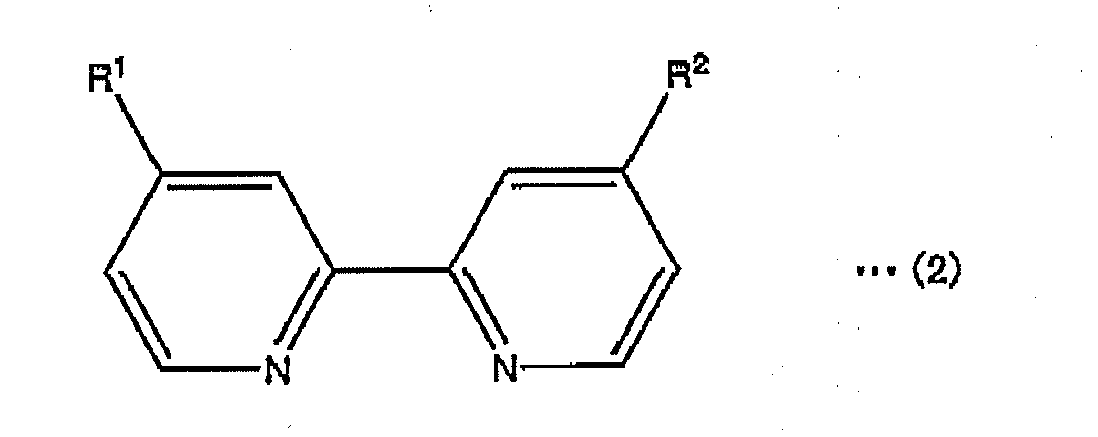

- A dyestuff shown by the following formula (4),
ML4L5 (4)
wherein M represents an clement belonging to Group 8 to Group 10 of the long-format Periodic Table, L4 represents a tridentate ligand shown by the following formula (5), and L5 represents a tridentate ligand shown by the following formula (6), (7), or (8),


- A dyestuff shown by the following formula (9),
ML3L4A1 (9)
wherein M represents an element belonging to Group 8 to Group 10 of the long-format Periodic Table, L3 represents a bidentate ligand shown by the following formula (3), L4 represents a tridentate ligand shown by the following formula (5), and A1 is an isothiocyanate group,

- The dyestuff according to any one of claims 1 to 3, wherein M in the formula (1), (4), or (9) is ruthenium.
- A dye-sensitized solar cell comprising an anode, a cathode, and an electrolyte, the cathode having a substrate made of electrically conductive transparent glass and an oxide membrane electrode formed on the surface, and the oxide membrane electrode containing a dye according to any one of claims 1 to 4 adsorbed therein.
- A method for manufacturing a dye-sensitized solar cell comprising causing a substrate made of electrically conductive transparent glass and a cathode having an oxide membrane electrode formed on the surface to come in contact with a dyestuff solution which contains the dyestuff according to any one of claim 1 to 4 and a base, thereby causing the dyestuff to be adsorbed in the oxide membrane electrode.
- The method for manufacturing a dye-sensitized solar cell according to claim 6, wherein the dyestuff solution contains the base at a concentration of 0.001 to 20 mmol/l.
Priority Applications (2)
| Application Number | Priority Date | Filing Date | Title |
|---|---|---|---|
| EP07116557A EP2036955B1 (en) | 2007-09-17 | 2007-09-17 | Dyestuff, dye-sensitized solar cell, and method for manufacturing same |
| JP2007334611A JP2009067976A (en) | 2007-09-17 | 2007-12-26 | Dye, dye-sensitized solar cell and method for producing the same |
Applications Claiming Priority (1)
| Application Number | Priority Date | Filing Date | Title |
|---|---|---|---|
| EP07116557A EP2036955B1 (en) | 2007-09-17 | 2007-09-17 | Dyestuff, dye-sensitized solar cell, and method for manufacturing same |
Publications (2)
| Publication Number | Publication Date |
|---|---|
| EP2036955A1 true EP2036955A1 (en) | 2009-03-18 |
| EP2036955B1 EP2036955B1 (en) | 2012-05-16 |
Family
ID=39735339
Family Applications (1)
| Application Number | Title | Priority Date | Filing Date |
|---|---|---|---|
| EP07116557A Not-in-force EP2036955B1 (en) | 2007-09-17 | 2007-09-17 | Dyestuff, dye-sensitized solar cell, and method for manufacturing same |
Country Status (2)
| Country | Link |
|---|---|
| EP (1) | EP2036955B1 (en) |
| JP (1) | JP2009067976A (en) |
Cited By (14)
| Publication number | Priority date | Publication date | Assignee | Title |
|---|---|---|---|---|
| WO2010115848A1 (en) * | 2009-04-08 | 2010-10-14 | Karlsruher Institut für Technologie | Dyes based on bis-terpyridine metal complex compounds |
| WO2011032269A1 (en) * | 2009-09-16 | 2011-03-24 | Berlinguette Curtis P | Cyclometalated dye complexes and their use in dye-sensitized solar cells |
| ITMI20101400A1 (en) * | 2010-07-28 | 2012-01-29 | Fond Cassa Di Risparmio Delle Provincie Lombarde | NEW CYCLOMETALLY COMPLEXES FOR SOLAR CELLS |
| CN102485731A (en) * | 2010-12-02 | 2012-06-06 | 季昀 | Hybrid, double tridentate ruthenium complex and preparation of sensitized dye solar cell |
| WO2012155247A1 (en) * | 2011-05-13 | 2012-11-22 | Uti Limited Partnership | Cyclometalated transition metal dyes |
| WO2013076197A1 (en) | 2011-11-22 | 2013-05-30 | Solvay Sa | Dye compounds, method of making the same, and their use in dye-sensitized solar cells |
| EP2801991A1 (en) * | 2013-05-06 | 2014-11-12 | Solvay SA | Dye-sensitized solar cells, metal complexes for the same, and ligands therefor |
| CN104169372A (en) * | 2012-03-16 | 2014-11-26 | 富士胶片株式会社 | Metal complex dye, photoelectric conversion element, dye-sensitized solar cell, dye-adsorbing composition solution for dye-sensitized solar cell, semiconductor electrode for dye-sensitized solar cell, and method for manufacturing dye-sensitized solar cell |
| EP2551951A4 (en) * | 2010-03-24 | 2014-12-10 | Fujifilm Corp | METHOD FOR MANUFACTURING PHOTOELECTRIC CONVERSION ELEMENT, PHOTOELECTRIC CONVERSION ELEMENT, AND PHOTOELECTROCHEMICAL CELL |
| CN104798156A (en) * | 2012-11-16 | 2015-07-22 | 富士胶片株式会社 | Photoelectric conversion element, dye-sensitized solar cell, metal complex dye, dye solution, dye-adsorbed electrode, and method for manufacturing dye-sensitized solar cell |
| EP2933875A4 (en) * | 2012-12-17 | 2015-12-16 | Fujifilm Corp | PHOTOELECTRIC CONVERSION ELEMENT, DYE SENSITIZED SOLAR CELL, METAL COMPLEX DYE, DYE SOLUTION, ABSORBED COLOR ELECTRODE AND METHOD FOR MANUFACTURING DYE SENSITIZED SOLAR CELL |
| EP2903077A4 (en) * | 2012-09-28 | 2016-06-08 | Fujifilm Corp | Photoelectric conversion element and dye-sensitized solar cell |
| WO2019029789A1 (en) | 2017-08-07 | 2019-02-14 | Tozzi Green S.P.A. | Novel fluorinated metal complexes |
| CN115181061A (en) * | 2022-06-21 | 2022-10-14 | 皖西学院 | Nickel compound, synthesis method thereof and application of nickel compound in detection of pesticide residue glyphosate |
Families Citing this family (14)
| Publication number | Priority date | Publication date | Assignee | Title |
|---|---|---|---|---|
| JP5281863B2 (en) * | 2008-09-30 | 2013-09-04 | Jsr株式会社 | Dye, dye-sensitized solar cell and method for producing the same |
| EP2541673A1 (en) | 2010-02-25 | 2013-01-02 | Tokyo Electron Limited | Apparatus for manufacturing dye-sensitized solar cell, and method of manufacturing dye-sensitized solar cell |
| WO2011118580A1 (en) * | 2010-03-24 | 2011-09-29 | 富士フイルム株式会社 | Photoelectric conversion element and photoelectrochemical cell |
| JP5580139B2 (en) * | 2010-08-03 | 2014-08-27 | 富士フイルム株式会社 | Photoelectric conversion element and photoelectrochemical cell using the same |
| JP2012146632A (en) * | 2010-12-21 | 2012-08-02 | Sony Corp | Dye, dye-sensitized photoelectric conversion element, electronic device, and building |
| JP5689861B2 (en) * | 2011-09-26 | 2015-03-25 | 富士フイルム株式会社 | Photoelectric conversion element, photoelectrochemical cell, and metal complex dye used therefor |
| JP5245001B2 (en) | 2011-09-29 | 2013-07-24 | 富士フイルム株式会社 | Photoelectric conversion element, photoelectrochemical cell, and metal complex dye used therefor |
| JP5751177B2 (en) * | 2012-01-20 | 2015-07-22 | Jsr株式会社 | Ruthenium-containing compound and method for producing the same |
| JP5770115B2 (en) * | 2012-01-20 | 2015-08-26 | シャープ株式会社 | Photoelectric conversion element and dye-sensitized solar cell |
| JP2014082187A (en) | 2012-09-28 | 2014-05-08 | Fujifilm Corp | Photoelectric conversion element and dye-sensitized solar cell |
| KR101690901B1 (en) * | 2013-03-25 | 2016-12-28 | 후지필름 가부시키가이샤 | Photoelectric conversion element, dye-sensitized solar cell, and metal-complex dye used in same |
| JP6017491B2 (en) * | 2013-04-12 | 2016-11-02 | 富士フイルム株式会社 | Photoelectric conversion element, dye-sensitized solar cell, metal complex dye, dye solution, dye-adsorbing electrode, and method for producing dye-sensitized solar battery |
| JP6300337B2 (en) * | 2015-03-17 | 2018-03-28 | 富士フイルム株式会社 | Photoelectric conversion element, dye-sensitized solar cell, ruthenium complex dye and dye solution |
| JP6370014B2 (en) * | 2015-03-17 | 2018-08-15 | 富士フイルム株式会社 | Photoelectric conversion element, dye-sensitized solar cell, metal complex dye, metal complex dye mixture and dye solution |
Citations (12)
| Publication number | Priority date | Publication date | Assignee | Title |
|---|---|---|---|---|
| US4927721A (en) | 1988-02-12 | 1990-05-22 | Michael Gratzel | Photo-electrochemical cell |
| WO1995029924A1 (en) | 1994-05-02 | 1995-11-09 | Ecole Polytechnique Federale De Lausanne (Epfl) | Phosphonated polypyridyl compounds and their complexes |
| WO1998050393A1 (en) | 1997-05-07 | 1998-11-12 | Ecole Polytechnique Federale De Lausanne | Metal complex photosensitizer and photovoltaic cell |
| EP1176618A1 (en) | 2000-07-25 | 2002-01-30 | Fuji Photo Film Co., Ltd. | Metal complex dye, photoelectric conversion device and photoelectric cell |
| JP2004296170A (en) | 2003-03-26 | 2004-10-21 | Mitsui Chemicals Inc | Material for photoelectric transfer element, photoelectric transfer element, and ruthenium complex compound |
| US20050033040A1 (en) * | 2003-08-08 | 2005-02-10 | Samsung Electronics Co., Ltd. | Self-dispersible bipyridine-based metal complex and ink composition comprising the same |
| EP1622178A1 (en) | 2004-07-29 | 2006-02-01 | Ecole Polytechnique Federale De Lausanne (Epfl) | 2,2 -Bipyridine ligand, sensitizing dye and dye sensitized solar cell |
| US20060115675A1 (en) | 2004-11-10 | 2006-06-01 | Idemitsu Kosan Co., Ltd. | Metal-complex compound ands organic electroluminescence device using the compound |
| DE102005010978A1 (en) | 2005-03-04 | 2006-09-07 | Technische Universität Dresden | Photoactive component with organic layers |
| WO2006100888A1 (en) | 2005-03-22 | 2006-09-28 | Konica Minolta Holdings, Inc. | Material for organic el device, organic el device, display and illuminating device |
| JP2007073289A (en) | 2005-09-06 | 2007-03-22 | Fujifilm Corp | Photoelectric conversion element |
| US20070141398A1 (en) | 2005-12-15 | 2007-06-21 | Idemitsu Kosan Co., Ltd. | Metal complex compound and organic electroluminescence device using the compound |
Family Cites Families (1)
| Publication number | Priority date | Publication date | Assignee | Title |
|---|---|---|---|---|
| EP2036913A3 (en) * | 2005-06-30 | 2009-04-08 | Koninklijke Philips Electronics N.V. | Electro luminescent metal complexes |
-
2007
- 2007-09-17 EP EP07116557A patent/EP2036955B1/en not_active Not-in-force
- 2007-12-26 JP JP2007334611A patent/JP2009067976A/en active Pending
Patent Citations (12)
| Publication number | Priority date | Publication date | Assignee | Title |
|---|---|---|---|---|
| US4927721A (en) | 1988-02-12 | 1990-05-22 | Michael Gratzel | Photo-electrochemical cell |
| WO1995029924A1 (en) | 1994-05-02 | 1995-11-09 | Ecole Polytechnique Federale De Lausanne (Epfl) | Phosphonated polypyridyl compounds and their complexes |
| WO1998050393A1 (en) | 1997-05-07 | 1998-11-12 | Ecole Polytechnique Federale De Lausanne | Metal complex photosensitizer and photovoltaic cell |
| EP1176618A1 (en) | 2000-07-25 | 2002-01-30 | Fuji Photo Film Co., Ltd. | Metal complex dye, photoelectric conversion device and photoelectric cell |
| JP2004296170A (en) | 2003-03-26 | 2004-10-21 | Mitsui Chemicals Inc | Material for photoelectric transfer element, photoelectric transfer element, and ruthenium complex compound |
| US20050033040A1 (en) * | 2003-08-08 | 2005-02-10 | Samsung Electronics Co., Ltd. | Self-dispersible bipyridine-based metal complex and ink composition comprising the same |
| EP1622178A1 (en) | 2004-07-29 | 2006-02-01 | Ecole Polytechnique Federale De Lausanne (Epfl) | 2,2 -Bipyridine ligand, sensitizing dye and dye sensitized solar cell |
| US20060115675A1 (en) | 2004-11-10 | 2006-06-01 | Idemitsu Kosan Co., Ltd. | Metal-complex compound ands organic electroluminescence device using the compound |
| DE102005010978A1 (en) | 2005-03-04 | 2006-09-07 | Technische Universität Dresden | Photoactive component with organic layers |
| WO2006100888A1 (en) | 2005-03-22 | 2006-09-28 | Konica Minolta Holdings, Inc. | Material for organic el device, organic el device, display and illuminating device |
| JP2007073289A (en) | 2005-09-06 | 2007-03-22 | Fujifilm Corp | Photoelectric conversion element |
| US20070141398A1 (en) | 2005-12-15 | 2007-06-21 | Idemitsu Kosan Co., Ltd. | Metal complex compound and organic electroluminescence device using the compound |
Non-Patent Citations (2)
| Title |
|---|
| DATABASE WPI Week 200504, Derwent World Patents Index; AN 2005-033390, XP002496117 * |
| DATABASE WPI Week 200737, Derwent World Patents Index; AN 2007-392907, XP002496116 * |
Cited By (22)
| Publication number | Priority date | Publication date | Assignee | Title |
|---|---|---|---|---|
| WO2010115848A1 (en) * | 2009-04-08 | 2010-10-14 | Karlsruher Institut für Technologie | Dyes based on bis-terpyridine metal complex compounds |
| WO2011032269A1 (en) * | 2009-09-16 | 2011-03-24 | Berlinguette Curtis P | Cyclometalated dye complexes and their use in dye-sensitized solar cells |
| US20120305070A1 (en) * | 2009-09-16 | 2012-12-06 | Uti Limited Partnership | Cylometalated dye complexes and their use in dye-sensitized solar cells |
| EP2551951A4 (en) * | 2010-03-24 | 2014-12-10 | Fujifilm Corp | METHOD FOR MANUFACTURING PHOTOELECTRIC CONVERSION ELEMENT, PHOTOELECTRIC CONVERSION ELEMENT, AND PHOTOELECTROCHEMICAL CELL |
| ITMI20101400A1 (en) * | 2010-07-28 | 2012-01-29 | Fond Cassa Di Risparmio Delle Provincie Lombarde | NEW CYCLOMETALLY COMPLEXES FOR SOLAR CELLS |
| WO2012013719A1 (en) * | 2010-07-28 | 2012-02-02 | Universita' Degli Studi Di Milano Bicocca | New cyclometalated complexes for solar cells |
| CN102485731A (en) * | 2010-12-02 | 2012-06-06 | 季昀 | Hybrid, double tridentate ruthenium complex and preparation of sensitized dye solar cell |
| CN102485731B (en) * | 2010-12-02 | 2014-12-24 | 季昀 | Preparation of Heteroplexic, Bitridentate Ruthenium Complexes and Sensitized Dye Solar Cells |
| WO2012155247A1 (en) * | 2011-05-13 | 2012-11-22 | Uti Limited Partnership | Cyclometalated transition metal dyes |
| WO2013076197A1 (en) | 2011-11-22 | 2013-05-30 | Solvay Sa | Dye compounds, method of making the same, and their use in dye-sensitized solar cells |
| EP2826821A4 (en) * | 2012-03-16 | 2016-06-01 | Fujifilm Corp | METAL COMPLEX DYE, PHOTOELECTRIC CONVERSION ELEMENT, DYE SENSITIZED SOLAR CELL, LIQUID DYE ADSORPTION COMPOSITION FOR DYE SENSITIZED SOLAR CELL, SEMICONDUCTOR ELECTRODE FOR DYE SENSITIZED SOLAR CELL, AND PROCESS FOR PRODUCING DYE SENSITIZED SOLAR CELL THE SAME DENSE SENSITIZED SOLAR CELL |
| CN104169372A (en) * | 2012-03-16 | 2014-11-26 | 富士胶片株式会社 | Metal complex dye, photoelectric conversion element, dye-sensitized solar cell, dye-adsorbing composition solution for dye-sensitized solar cell, semiconductor electrode for dye-sensitized solar cell, and method for manufacturing dye-sensitized solar cell |
| EP2903077A4 (en) * | 2012-09-28 | 2016-06-08 | Fujifilm Corp | Photoelectric conversion element and dye-sensitized solar cell |
| CN104798156A (en) * | 2012-11-16 | 2015-07-22 | 富士胶片株式会社 | Photoelectric conversion element, dye-sensitized solar cell, metal complex dye, dye solution, dye-adsorbed electrode, and method for manufacturing dye-sensitized solar cell |
| CN104798156B (en) * | 2012-11-16 | 2017-11-14 | 富士胶片株式会社 | Photo-electric conversion element, solar cell and its manufacture method, compound, metal complex dye, pigment solution and electrode |
| US10460879B2 (en) | 2012-11-16 | 2019-10-29 | Fujifilm Corporation | Photoelectric conversion element, dye-sensitized solar cell, metal complex dye, dye solution, dye-adsorbed electrode, and method for producing dye-sensitized solar cell |
| EP2933875A4 (en) * | 2012-12-17 | 2015-12-16 | Fujifilm Corp | PHOTOELECTRIC CONVERSION ELEMENT, DYE SENSITIZED SOLAR CELL, METAL COMPLEX DYE, DYE SOLUTION, ABSORBED COLOR ELECTRODE AND METHOD FOR MANUFACTURING DYE SENSITIZED SOLAR CELL |
| EP2922137A4 (en) * | 2013-03-25 | 2015-12-16 | Fujifilm Corp | Photoelectric conversion element, dye-sensitized solar cell, metal complex dye, dye solution, dye-adsorbed electrode, and method for manufacturing dye-sensitized solar cell |
| EP2801991A1 (en) * | 2013-05-06 | 2014-11-12 | Solvay SA | Dye-sensitized solar cells, metal complexes for the same, and ligands therefor |
| WO2019029789A1 (en) | 2017-08-07 | 2019-02-14 | Tozzi Green S.P.A. | Novel fluorinated metal complexes |
| CN115181061A (en) * | 2022-06-21 | 2022-10-14 | 皖西学院 | Nickel compound, synthesis method thereof and application of nickel compound in detection of pesticide residue glyphosate |
| CN115181061B (en) * | 2022-06-21 | 2023-10-10 | 皖西学院 | Nickel compound, synthesis method thereof and application thereof in detection of pesticide residue glyphosate |
Also Published As
| Publication number | Publication date |
|---|---|
| JP2009067976A (en) | 2009-04-02 |
| EP2036955B1 (en) | 2012-05-16 |
Similar Documents
| Publication | Publication Date | Title |
|---|---|---|
| EP2036955B1 (en) | Dyestuff, dye-sensitized solar cell, and method for manufacturing same | |
| EP2232513B1 (en) | Optoelectronic and/or electrochemical device comprising an electrolyte comprising a ternary ionic liquid | |
| EP2883881A1 (en) | Cobaltcomplex salts and mixtures of Cobaltcomplex salts for use in DSSC | |
| JP2010084003A (en) | Dye, dye-sensitized solar cell and method for producing the same | |
| JP5633370B2 (en) | Binuclear ruthenium complex dye, ruthenium-osmium complex dye, photoelectric conversion element having the complex dye, and photochemical battery | |
| JP5761024B2 (en) | Photoelectric conversion element having binuclear ruthenium complex dye having substituted bipyridyl group, and photochemical battery | |
| Burmeister et al. | Dye-sensitized solar cells based on Cu (I) complexes containing catechol anchor groups that operate with aqueous electrolytes | |
| JP5293190B2 (en) | Method for producing binuclear metal complex | |
| JP5428312B2 (en) | Photoelectric conversion element and photochemical battery | |
| KR20130092689A (en) | Novel ruthenium dye and preparation thereof | |
| Brugnati et al. | Electron transfer mediators for photoelectrochemical cells based on Cu (I) metal complexes | |
| JP4721755B2 (en) | Complex, photoelectric conversion element and dye-sensitized solar cell | |
| KR100553337B1 (en) | Copolymer containing imidazolium group, manufacturing method thereof, electrolyte composition for solar cell containing same and dye-sensitized solar cell comprising same as electrolyte | |
| JP2005330469A (en) | Dyes and dye-sensitized solar cells | |
| JP5493857B2 (en) | Dinuclear ruthenium complex dye, dinuclear ruthenium complex dye acidic aqueous solution and method for producing the same | |
| EP1767588A1 (en) | Dye and dye-sensitized solar cell | |
| WO2009102068A1 (en) | Binuclear ruthenium complex dye solution, photoelectric conversion device using photosensitized semiconductor particle obtained by using the complex dye solution, and photochemical cell using the photoelectric conversion device | |
| JP5556096B2 (en) | Photoelectric conversion element having a binuclear ruthenium complex dye having a linking molecule having an electron withdrawing group as a substituent, and a photochemical battery | |
| JP2007059293A (en) | Method for producing dye-sensitized solar cell and dye-sensitized solar cell | |
| JP5239269B2 (en) | Dinuclear ruthenium complex dye and method for producing the same | |
| JP2005120042A (en) | Ruthenium complex, dye-sensitized oxide semiconductor electrode and dye-sensitized solar cell using the same | |
| JP2009129652A (en) | Photoelectric conversion element and photochemical battery | |
| KR101722003B1 (en) | Novel Porphyrin Derivatives, Organic Dye Sensitizers Containing The Same for Highly Efficient Dye-sensitized Solar Cells And Dye-sensitized Solar Cells Containing The Same | |
| JP5446207B2 (en) | Photoelectric conversion element and photochemical battery | |
| JP2006298882A (en) | Ruthenium complex, dye-sensitized oxide semiconductor electrode and dye-sensitized solar cell using the same |
Legal Events
| Date | Code | Title | Description |
|---|---|---|---|
| PUAI | Public reference made under article 153(3) epc to a published international application that has entered the european phase |
Free format text: ORIGINAL CODE: 0009012 |
|
| AK | Designated contracting states |
Kind code of ref document: A1 Designated state(s): AT BE BG CH CY CZ DE DK EE ES FI FR GB GR HU IE IS IT LI LT LU LV MC MT NL PL PT RO SE SI SK TR |
|
| AX | Request for extension of the european patent |
Extension state: AL BA HR MK RS |
|
| 17P | Request for examination filed |
Effective date: 20090908 |
|
| 17Q | First examination report despatched |
Effective date: 20091023 |
|
| AKX | Designation fees paid |
Designated state(s): CH DE FR GB LI NL |
|
| R17C | First examination report despatched (corrected) |
Effective date: 20091030 |
|
| GRAP | Despatch of communication of intention to grant a patent |
Free format text: ORIGINAL CODE: EPIDOSNIGR1 |
|
| GRAJ | Information related to disapproval of communication of intention to grant by the applicant or resumption of examination proceedings by the epo deleted |
Free format text: ORIGINAL CODE: EPIDOSDIGR1 |
|
| GRAP | Despatch of communication of intention to grant a patent |
Free format text: ORIGINAL CODE: EPIDOSNIGR1 |
|
| RTI1 | Title (correction) |
Free format text: DYESTUFF, DYE-SENSITIZED SOLAR CELL, AND METHOD FOR MANUFACTURING SAME |
|
| GRAS | Grant fee paid |
Free format text: ORIGINAL CODE: EPIDOSNIGR3 |
|
| GRAA | (expected) grant |
Free format text: ORIGINAL CODE: 0009210 |
|
| AK | Designated contracting states |
Kind code of ref document: B1 Designated state(s): CH DE FR GB LI NL |
|
| REG | Reference to a national code |
Ref country code: GB Ref legal event code: FG4D |
|
| REG | Reference to a national code |
Ref country code: CH Ref legal event code: EP |
|
| REG | Reference to a national code |
Ref country code: DE Ref legal event code: R096 Ref document number: 602007022607 Country of ref document: DE Effective date: 20120712 |
|
| REG | Reference to a national code |
Ref country code: NL Ref legal event code: VDEP Effective date: 20120516 |
|
| PG25 | Lapsed in a contracting state [announced via postgrant information from national office to epo] |
Ref country code: NL Free format text: LAPSE BECAUSE OF FAILURE TO SUBMIT A TRANSLATION OF THE DESCRIPTION OR TO PAY THE FEE WITHIN THE PRESCRIBED TIME-LIMIT Effective date: 20120516 |
|
| PLBE | No opposition filed within time limit |
Free format text: ORIGINAL CODE: 0009261 |
|
| STAA | Information on the status of an ep patent application or granted ep patent |
Free format text: STATUS: NO OPPOSITION FILED WITHIN TIME LIMIT |
|
| 26N | No opposition filed |
Effective date: 20130219 |
|
| REG | Reference to a national code |
Ref country code: CH Ref legal event code: PL |
|
| GBPC | Gb: european patent ceased through non-payment of renewal fee |
Effective date: 20120917 |
|
| REG | Reference to a national code |
Ref country code: DE Ref legal event code: R097 Ref document number: 602007022607 Country of ref document: DE Effective date: 20130219 |
|
| REG | Reference to a national code |
Ref country code: FR Ref legal event code: ST Effective date: 20130531 |
|
| PG25 | Lapsed in a contracting state [announced via postgrant information from national office to epo] |
Ref country code: CH Free format text: LAPSE BECAUSE OF NON-PAYMENT OF DUE FEES Effective date: 20120930 Ref country code: GB Free format text: LAPSE BECAUSE OF NON-PAYMENT OF DUE FEES Effective date: 20120917 Ref country code: LI Free format text: LAPSE BECAUSE OF NON-PAYMENT OF DUE FEES Effective date: 20120930 |
|
| PG25 | Lapsed in a contracting state [announced via postgrant information from national office to epo] |
Ref country code: FR Free format text: LAPSE BECAUSE OF NON-PAYMENT OF DUE FEES Effective date: 20121001 |
|
| PGFP | Annual fee paid to national office [announced via postgrant information from national office to epo] |
Ref country code: DE Payment date: 20160913 Year of fee payment: 10 |
|
| REG | Reference to a national code |
Ref country code: DE Ref legal event code: R119 Ref document number: 602007022607 Country of ref document: DE |
|
| PG25 | Lapsed in a contracting state [announced via postgrant information from national office to epo] |
Ref country code: DE Free format text: LAPSE BECAUSE OF NON-PAYMENT OF DUE FEES Effective date: 20180404 |