EP2036897A1 - Stable rhodamine labeling reagent - Google Patents
Stable rhodamine labeling reagent Download PDFInfo
- Publication number
- EP2036897A1 EP2036897A1 EP07017268A EP07017268A EP2036897A1 EP 2036897 A1 EP2036897 A1 EP 2036897A1 EP 07017268 A EP07017268 A EP 07017268A EP 07017268 A EP07017268 A EP 07017268A EP 2036897 A1 EP2036897 A1 EP 2036897A1
- Authority
- EP
- European Patent Office
- Prior art keywords
- alkyl
- group
- phosphoramidite
- nucleosidic
- rhodamine
- Prior art date
- Legal status (The legal status is an assumption and is not a legal conclusion. Google has not performed a legal analysis and makes no representation as to the accuracy of the status listed.)
- Granted
Links
- ISUSKXFIFPNWBW-UHFFFAOYSA-N CCC#Cc1c[n](C(C2)OC(COC)C2OC)c2c1c(N)ncn2 Chemical compound CCC#Cc1c[n](C(C2)OC(COC)C2OC)c2c1c(N)ncn2 ISUSKXFIFPNWBW-UHFFFAOYSA-N 0.000 description 1
- SPVYCXHGGJXCFX-UHFFFAOYSA-N CCCCCCC(NC(C1)COC(COC)C1OC)=O Chemical compound CCCCCCC(NC(C1)COC(COC)C1OC)=O SPVYCXHGGJXCFX-UHFFFAOYSA-N 0.000 description 1
- PQTWPDXRFVSTCD-ZHACJKMWSA-N CCCCCCCCNC(/C=C/C(C(N1)=O)=CN(C(COC2COC)C2OC)C1=O)=O Chemical compound CCCCCCCCNC(/C=C/C(C(N1)=O)=CN(C(COC2COC)C2OC)C1=O)=O PQTWPDXRFVSTCD-ZHACJKMWSA-N 0.000 description 1
Images

Classifications
-
- C—CHEMISTRY; METALLURGY
- C07—ORGANIC CHEMISTRY
- C07D—HETEROCYCLIC COMPOUNDS
- C07D493/00—Heterocyclic compounds containing oxygen atoms as the only ring hetero atoms in the condensed system
- C07D493/02—Heterocyclic compounds containing oxygen atoms as the only ring hetero atoms in the condensed system in which the condensed system contains two hetero rings
- C07D493/10—Spiro-condensed systems
-
- C—CHEMISTRY; METALLURGY
- C07—ORGANIC CHEMISTRY
- C07F—ACYCLIC, CARBOCYCLIC OR HETEROCYCLIC COMPOUNDS CONTAINING ELEMENTS OTHER THAN CARBON, HYDROGEN, HALOGEN, OXYGEN, NITROGEN, SULFUR, SELENIUM OR TELLURIUM
- C07F9/00—Compounds containing elements of Groups 5 or 15 of the Periodic Table
- C07F9/02—Phosphorus compounds
- C07F9/547—Heterocyclic compounds, e.g. containing phosphorus as a ring hetero atom
- C07F9/6561—Heterocyclic compounds, e.g. containing phosphorus as a ring hetero atom containing systems of two or more relevant hetero rings condensed among themselves or condensed with a common carbocyclic ring or ring system, with or without other non-condensed hetero rings
-
- C—CHEMISTRY; METALLURGY
- C07—ORGANIC CHEMISTRY
- C07H—SUGARS; DERIVATIVES THEREOF; NUCLEOSIDES; NUCLEOTIDES; NUCLEIC ACIDS
- C07H19/00—Compounds containing a hetero ring sharing one ring hetero atom with a saccharide radical; Nucleosides; Mononucleotides; Anhydro-derivatives thereof
- C07H19/02—Compounds containing a hetero ring sharing one ring hetero atom with a saccharide radical; Nucleosides; Mononucleotides; Anhydro-derivatives thereof sharing nitrogen
- C07H19/04—Heterocyclic radicals containing only nitrogen atoms as ring hetero atom
- C07H19/06—Pyrimidine radicals
-
- C—CHEMISTRY; METALLURGY
- C07—ORGANIC CHEMISTRY
- C07H—SUGARS; DERIVATIVES THEREOF; NUCLEOSIDES; NUCLEOTIDES; NUCLEIC ACIDS
- C07H21/00—Compounds containing two or more mononucleotide units having separate phosphate or polyphosphate groups linked by saccharide radicals of nucleoside groups, e.g. nucleic acids
-
- Y—GENERAL TAGGING OF NEW TECHNOLOGICAL DEVELOPMENTS; GENERAL TAGGING OF CROSS-SECTIONAL TECHNOLOGIES SPANNING OVER SEVERAL SECTIONS OF THE IPC; TECHNICAL SUBJECTS COVERED BY FORMER USPC CROSS-REFERENCE ART COLLECTIONS [XRACs] AND DIGESTS
- Y02—TECHNOLOGIES OR APPLICATIONS FOR MITIGATION OR ADAPTATION AGAINST CLIMATE CHANGE
- Y02P—CLIMATE CHANGE MITIGATION TECHNOLOGIES IN THE PRODUCTION OR PROCESSING OF GOODS
- Y02P20/00—Technologies relating to chemical industry
- Y02P20/50—Improvements relating to the production of bulk chemicals
- Y02P20/55—Design of synthesis routes, e.g. reducing the use of auxiliary or protecting groups
Definitions
- the present invention provides a new labeling reagent for nucleic acid synthesis. More precisely, the present invention provides stable Rhodamine labeled Phosphoramidites and synthesis supports which can be used as a labeling reagent for labeling of oligonucleotides during oligonucleotide synthesis.
- Rhodamines are a well known class of fluorescent molecules which are frequently used for the labeling of biomolecules such as oligonucleotides.
- the generic substructure of such Rhodamines is All known Rhodamine Phosphoramidites which are known or even commercially available so far are free Rhodamines which comprise at least a free carboxyl group at the ortho position of the exocyclic phenyl ring.
- Phosphoramidites of Rhodamines characterized in that a carboxy group is affixed into a lactone structure, to date have neither been disclosed nor suggested.
- lactone structure has been disclosed already for Rhodamine dyes which have been used as labeling compounds during peptide synthesis ( WO 05/007678 ). Moreover, lactonized chromophors in the form of NHS esters have been used for the generation of modified nucleoside triphosphates ( WO 94/06812 ).
- this amidite can be coupled onto the oligonucleotide during or at the end of the oligonucleotide synthesis protocol, while the nascent oligonucleotide is still attached to the solid CPG phase. Thus, no further reaction step is required.
- Rhodamines which comprise a free carboxylic acid group are difficult to transform into their Phosphoramidite derivatives which are rather unstable. Also coupling yields of such Phosphoramidites are not very efficient, side reactions may occur due to the unprotected carboxylic acid group and additionally require special deprotection conditions ( EP 0 617 047 ).
- a further method for producing a labeled oligonucleotide is a synthesis which starts with a dye-labeled CPG and thus result in a 3' labeled oligonucleotide.
- CPGs labeled with a Rhodamine containing a free carboxylic acid group are known in the art provoke side reactions during conventional oligonucleotide synthesis.
- Rhodamine labeling reagents which are easy to synthesize, have a reasonable stability and show satisfying coupling efficiency during oligonucleotide synthesis.
- the present invention is directed to a chemical compound of the formula wherein
- At least one of said base labile protecting groups is - CO-CF 3
- the present invention is directed to the use of such chemical compounds as building blocks for oligonucleotide synthesis.
- the present invention is directed to a method of synthesizing a Phosphoramidite compound as disclosed above comprising the steps of
- Carboxy-Rhodamine is used for all Rhodamine compounds where the exocyclic phenyl ring comprises two carboxylic substitutions.
- a first carboxylic group is located in the ortho position and a second carboxylic group is located in either the para position or the meta position which is not positioned adjacent to the ortho position at which the first carboxylic acid is substituted.
- Lactones in general are defined in the art as cyclic esters generated upon an intramolecular reaction of a carboxyl group with a hydroxyl group.
- a lactonized Rhodamine according to the invention is understood as a Rhodamine molecule defined by the following generic formula:
- Rhodamines there is a positive charge which is delocalized in a polymethin type manner: Two amino groups are attached to a cationic xanthenylium-moiety and both amino groups (one of them having at least one hydrogen residue) are acting as electron donating groups and stabilize the positive charge.
- Rhodamines with a minimum of one hydrogen residue on one of the amino groupsand with a free carboxylic group on the C-2 carbon atom of the exocyclic phenylring are transformed in the lactonized form by acylation.
- a linker L according to the invention is a moiety which separates the Phosphoramidite group or a solid support from the lactonized Rhodamine, whereas the lactonized Rhodamine is attached to the linker L via a group "A" or the linker is directly attached to one of the Rhodamine amino groups.
- A is selected to be not cleaved during conventional oligonucleotide synthesis. Therefore A is a thiourea, urea, sulfonamido, urethane, amide -moiety or O, N(C 1 -C 3 alkyl), methylene.
- the preferred group A which connects the lactonized dye with the linker L is an amide or thiourea bond since starting materials are easily accessible.
- Dye-CO-NH-L- the starting material is commercially available carboxy-Rhodamine which is easily synthesized from a hydroxyl- or methoxy-aniline with trimellitic anhydride.
- the starting compounds are Nitrorhodamins which are synthesized from a hydroxyl- or methoxy-aniline with 4-nitro phthalic anhydride, followed by protection with the base labile protecting group and then reduction.
- the resulting amine could be transformed into the isothiocyanate and then attached to an amino modified linker or could be directly attached to a carboxy modified linker.
- linkers which are used for direct labeling in oligonucleotide chemistry can be used in combination of lactonized Rhodamines according to this invention ( Wojczewski, Christian, Stolze, Karen, Engels, Joachim W., Synlett 10 (1999) 1667-1678 ).
- Bifunctional linkers connect a reporter group to a Phosphoramidite group for attaching the reporter to the 5' end (regular synthesis) or 3'end (inverted synthesis) to the terminal hydroxyl group of a growing oligonucleotide chain.
- Bifunctional linkers are preferably non nucleosidic compounds.
- such linkers are C 2 - C 18 alkyl, alkenyl, alkinyl carbon chains, whereas said alkyl, alkenyl, alkinyl chains may be interrupted by additional ethyleneoxy and/or amide moieties in order to increase hydrophilicity of the linker.
- Cyclic moieties like C 5 -C 6 -cycloalkyl, C 4 N, C 5 N, C 4 O, C 5 O- heterocycloalkyl, phenyl which are optionally substituted with one or two C 1 -C 6 alkyl groups can also be used as nonnucleosidic bifunctional linkers.
- Preferred bifunctional linkers are C 3 -C 6 alkyl moieties and tri- to hexa- ethyleneglycol chains.
- Trifunctional linkers connect (i) a reporter group, (ii) a Phosphoramidite group for coupling the reporter during the oligonucleotide synthesis to a hydroxyl group of the growing oligonucleotide chain and (iii) a hydroxyl group which is protected with an acid labile protecting group. After removal of this protecting group a hydroxyl group is liberated which could react with further Phosphoramidites. Therefore trifunctional linkers allow placement of a reporter group at any position of an oligonucleotide. Trifunctional linkers are also a prerequisite for synthesis of solid supports eg. Controlled pore glass, (CPG) which are used for 3' terminal labeling of oligonucleotides.
- CPG Controlled pore glass
- the trifunctional linker is connected to a reporter group via a group A and comprises a hydroxyl group which is attached via a cleavable spacer to a solid phase and a hydroxyl group which is protected with an acid labile protecting group. After removal of this protecting group a hydroxyl group is liberated which could then react with a Phosphoramidite.
- Trifunctional linkers may be non nucleosidic or nucleosidic.
- Non nucleosidic trifunctional linkers are C 2 - C 18 alkyl, alkenyl, alkinyl carbon chains, whereas said alkyl, alkenyl, alkinyl are optionally interrupted by additional ethyleneoxy and/or amide moieties in order to increase hydrophilicity of the linker.
- Other trifunctional linkers are cyclic groups like C 5 -C 6 -cycloalkyl, C 4 N, C 5 N, C 4 O, C 5 O heterocycloalkyl, phenyl which are optionally substituted with one ore two C 1 -C 6 alkyl groups.
- Preferred trifunctional linkers are C 3 -C 6 alkyl, cycloalkyl, C 5 O heterocycloalkyl moieties optionally comprising one amide bond and substituted with a C 1 - C 6 alkyl O-PG group, whereas PG is a acid labile protecting group preferably monomethoxytrityl, dimethoxytrityl, pixyl, xanthyl most preferred dimethoxytrityl.
- nucleosidic trifunctional linkers are used for internal labeling whenever it is necessary not to influence the oligonucleotide hybridization properties compared to a non modified oligonucleotide. Therefore nucleosidic linkers compromise a base or a base analog which is still capable of hybridizing with a complementary base.
- X is C 2 - C 18 alkyl, alkenyl alkinyl, whereas said alkyl, alkenyl, alkinyl comprises ethyleneoxy and/or amide moieties.
- X is C 4 - C 18 alkyl, alkenyl or alkinyl and contains one amide moiety.
- PG is an acid labile protecting group which is preferably selected from a group consisting of monomethoxytrityl, dimethoxytrityl, pixyl, xanthyl most preferred dimethoxytrityl.
- nucleosidic trifunctional linkers and groups A are listed in Table 3: Table 3 Trifunctional nucleosidic A Reference: Roget, A., Bazin, H., Teoule, R., Nucleic Acids Research 17(19) (1989) 7643-51 ; WO 89/12642 ; WO 90/08156 ; WO 93/05060 Reference: Silva, Jose Angel, Jimenez, Victor, Campos, Magalys, BiotecnologiaVeronicada 15(3) (1998) 154-158 Reference: US 6,531,581 ; EP 423 839 Reference: US 4,948,882 ; US 5,541,313 ; US 5,817,786 Reference: WO 2001/042505 Reference: McKeen, Catherine M., Brown, Lynda J., Nicol, Jamie John M., Brown, Tom, Organic & Biomolecular Chemistry 1(13) T.
- terminal oxygen atom of bifunctional linkers or one of the terminal oxygen atoms of trifunctional linkers are part of the Phosphoramidite or succinyl moiety.
- the second terminal oxygen atom of trifunctional linkers is protected with an acid labile protecting group.
- a base labile protecting group is attached to one or two of the Rhodamine amino groups and guarantees that the Rhodamine is in its lactonized form.
- the base labile protecting group is cleavable under basic conditions which are applied in oligonucleotide synthesis in order to remove the base protecting groups and the phosphate protecting groups and to cleave the oligonucleotide from the synthesis solid support (e.g. CPG).
- Typical basic deprotection media are conc ammonia, sodium hydroxide in methanol/water, potassium carbonate in methanol/water, ammonia/methylamine in water.
- Acyl, aroyl and oxycarbonyl groups could be used as based protecting groups. From these three classes, trifluoracetyl, acetyl, phenoxyacetyl, benzoyl, dinitrobenzoyl and fluorenyloxycarbonyl are preferred. Usually preferred is trifluoracetyl.
- Acid labile protecting groups are protecting one of two hydroxyl groups of trifunctional linkers.
- the acid labile protecting group is used as a transient protecting group during oligonucleotide synthesis: A trifunctional Phosphoramidite is reacted with a free hydroxyl group of a growing oligonucleotide chain and after oxidation and capping the acid labile protecting group is removed in order to liberate a hydroxyl group which can be reacted with a further Phosphoramidite. If the label is attached to the 5' end it is sometimes helpful for purification to keep the acid labile protecting group.
- Synthesis solid supports for 3' attachments with a Rhodamine are always based on trifunctional linkers.
- the acid labile protecting group is removed in order to liberate a hydroxyl group which can be reacted with the first Phosphoramidite of the synthesis cycle.
- Acid labile protecting groups are removed by dichloracetic acid or trichloracetic acid in methylenechloride or when used as a purification tag with acetic acid in water.
- Preferred acid labile protecting groups are monomethoxytrityl, dimethoxytrityl, pixyl, xanthyl most preferred is dimethoxytrityl.
- Solid support material in the context of the present invention refers to polymeric substances that form a solid phase containing a reactive group on which other molecules can be immobilized.
- oligonucleotide synthesis this are usually porous glass beads having a defined pore size (CPG).
- CPG porous glass beads having a defined pore size
- polystyrene resins and other organic polymers and copolymers can also be used ( Ghosh, P.K., et al., J. Indian Chem. Soc. 75 (1998) 206-218 ). If the oligonucleotide should remain immobilized on the substrate after the synthesis, glass or semiconductor chips can also be used as a solid phase support material.
- a labelled reactive support is understood as a solid phase support material on which another compound containing a detectable label and a still unprotected reactive group is immobilized.
- solid supports are amino modified e. g long chain aminoalkyl CPG, to this aminogroup a trifunctional linker is attached to a cleavable spacer, which is cleaved under basic conditions after oligonucleotide synthesis.
- cleavable spacers are known ( Ghosh, P.K., et al., J. Indian Chem. Soc.
- a Phosphoramidite moiety comprises a trivalent phosphorous atom with three substituents: an oxygen atom (which is linked to the bi- or trifunctional linker L).
- a protected oxygen atom with protecting groups selected from beta cyanoethyl, methyl, allyl, p-nitrophenylethyl.
- a secondary amine group NR 2 with R being lower alkyl most preferred isopropyl. The most preferred Phosphoramidite moiety is
- Phosphoramidites can be coupled in presence of an activator like tetrazol or dicyanoimidazol to an alcohol function and where routinely used in oligonucleotide synthesis and for oligonucleotide modification ( EP 0 061 746 ; Wojczewski, Christian, Stolze, Karen, Engels, Joachim W., Synlett 10 (1999) 1667-1678 ). After oxidation to P(V) and final cleavage of the protecting group a phosphate diester bond is formed as a linkage between a nucleoside and the linker L to which the Rhodamine is attached.
- an activator like tetrazol or dicyanoimidazol
- the invention is also compatible with H-Phosphonate oligonucleotide synthesis method and H-phosphonate residues could also be used instead of Phosphoramidite residues in combination with lactonized Rhodamines.
- the present invention provides a compound according to the formula wherein
- R4 moieties are base labile protecting groups.
- one R2 is A - L1 - Phosphoramidite or one R4 is L2-Phosphoramidite, such a Rhodamine labeled compound can be used for 5' end labeling of a CPG bound newly generated oligonucleotide according to methods known in the art.
- L1 or L2 is nucleosidic or non nucleosidic trifunctional linker, with an appropriately protected hydroxyl group, then such a compound can be incorporated at any position within an oligonucleotide during conventional chemical oligonucleotide synthesis.
- R2 is A - L1-Succinyl-solid support or one R4 is L2- Succinyl-solid support such as a CPG, then said solid support can be used as a starting material for oligonucleotide synthesis according to methods known in the art, which in this case result in a 3' labeled oligonucleotide.
- the inventive compound is used as a building block for oligonucleotide synthesis. More precisely, the inventive compound may be either a dye labeled Phosphoramidate or, alternatively, a dye-labeled CPG.
- At least one of said base labile protecting groups of the inventive compound is - CO-CF 3 .
- the chemical structure may comprise one or more five or six membered ring structures which are formed each together by one R3 and one R4 and by the nitrogen atom to which R4 is attached and one double bond of the adjacent phenylring to which R3 and N(R4) 2 is attached.
- said one or more ring structures are di or tetrahydro pyridine, or dihydropyrrole rings which influence the quantum yield and absorption maxima of the dye.
- Such rings may be substituted by 1- 3 (C 1 -C 3 )alkyl or sulfoalkyl residues.
- Rhodamine dyes with di/tetrahydro pyridine/pyrolle rings are can be easiliy synthesized from substituted phthalic acid anhydrides and from 7-Hydroxy-1,2,3,4-tetrahydroquinoline, 1,2-dihydro-2,2,4-trimethyl 7-quinolinol and 6 hydroxyindolines ( WO 2002/036832 , US 5,256,799 ) and derivatives thereof.
- such a linker is a trifunctional nucleosidic linker.
- Preferred acid labile protecting groups are monomethoxytrityl, dimethoxytrityl, pixyl, xanthyl most preferred is dimethoxytrityl.
- such a linker is a non nucleosidic linker selected from a group consisting of
- such a non nucleosidic linker is a bifunctional linker, without any further substitutions.
- Preferred acid labile protecting groups PG are monomethoxytrityl, dimethoxytrityl, pixyl, xanthyl most preferred is dimethoxytrityl.
- such a linker provides a trifunctional structure.
- the present invention is directed to the use of a compound of the present invention as a building block for nucleotide synthesis.
- a reactive hydroxyl group on which a chain extension in the 3' - 5' direction can occur is formed after removing the DMT protective group by acid treatment.
- 3' Phosphoramidite derivatives of (deoxy) ribonucleosides that are also provided with a DMT protective group and additional base protecting groups well known in the art are successively coupled at the 5' end to each reactive group freed of the DMT protective group in the presence of tetrazole. Subsequently iodine is added for oxidation.
- labelling at the 5' end or internal labelling is carried out by using a labeled Phosphoramidate according as disclosed above.
- Labelling at the 3' end is carried out by using a labeled CPG as disclosed above.
- the present invention is directed to a method of synthesizing a compound according to the present invention.
- Such a synthesis method comprises the following four basic steps:
- step a) it can be stated that such compounds are standard reagents which are commercially available or can be synthisized by reaction of hydroxyl or methoxyanilines with trimellitic acid anhydride and separation of the isomers by column chromatography.
- step b) said 5- or 6- Carboxy-Rhodamine is acetylated according to methods known in the art ( WO 05/007678 ) with trifluoracetyl.
- trifluoracetyl substitution of the N atoms within said Rhodamine molecule.
- a lactonized structure is generated. More precisely, the carboxy group in the ortho position of the exocyclic phenyl ring reacts with the central C-9 atom of the central ring of the tricyclic xanthene part of the molecule.
- step c) the free carboxyl group of the Rhodamine is reacted with a spacer reagent by means of generating an amido bond between said carboxyl group with an amino group of said spacer reagent according to standard methods known in the art.
- step d) the free hydroxyl group of the spacer entitity is subjected to a phosphitylation reaction with a phosphitylation reagent like 2-Cyanoethyl N,N-diisopropylchloro Phosphoramidite or 2-Cyanoethyl N,N,N',N'-tetraisopropylphosphorodiamidite according to standard methods which are known in the art (e.g. Nielsen, John, Dahl, Otto, Nucleic Acids Research 15(8) (1987) 3626 ; Pon, Richard T., Tetrahedron Letters 32(14) (1991) 1715-18 .
- a phosphitylation reagent like 2-Cyanoethyl N,N-diisopropylchloro Phosphoramidite or 2-Cyanoethyl N,N,N',N'-tetraisopropylphosphorodiamidite
- the generated Phosphoramidite is rather stable and can be used for the labeling of oligonucleotides during oligonucleotide synthesis with high labeling efficiency.
- a similar method as disclosed above can also be used in order to generate a 3' labeling reagent for oligonucleotide synthesis instead of a Phosphoramidite.
- the synthesis of such a reagent is the same as it is the case for the Phosphoramidite with respect to steps a) and b).
- the free carboxyl group of the Rhodamine may be reacted with a free amino group of a trifunctional linker containing one free OH group and one protected group, eg a dimethoxytrityl protected OH group.
- the free OH group is reacted with succinic anhydride and the resulting free carboxlic acid activated and reacted with an aminomodified solid support like CPG.
- Labeling reagents according to the invention are used to synthesize fluorescently labeled oligonucleotides, which have a broad field of applications within genetic analysis. Asseline, U., Current Organic Chemistry 10(4) (2006) 491-518 ; Ranasinghe, Rohan T., Brown, Tom., Chemical Communications (44) (2005) 5487-5502 (Cambridge, United Kingdom ).
- Example 1 N,N'-5Carboxy-3-oxospiro[isobenzofuran-1(3H),9'-[9H]-(2';7'dimethyl)-xanthene]- 3',6'-diyl]bis[2,2,2-trifluoracetylethylamide, (1)
- reaction mixture was evaporated to dryness at high vacuum.
- the residue was dissolved in 10 ml of acetone/methanol 10:1 and purified by flash chromatography a silica gel column using acetone/methanol 8:1 as eluent. Product fractions were combined and evaporated to dryness.
- Example 3 N,N'-5- [4-[Bis(1-methylethyl)amino](2-cyanoethoxy)phosphino]oxy]-pentylamino]carbonyl-- 3-oxospiro[isobenzofuran-1(3H),9'-[9H] -(2';7' dimethyl)-xanthene]- 3',6'-diyl]bis[2,2,2-trifluoracetylethylamide (3)
- Oligonucleotide 5'-(Rhodamine 6G) (dT) 10 -3' was synthesized on an ABI 394 DNA synthesizer (Applied Biosystems) in a 1 ⁇ mol scale synthesis using standard Phosphoramidite chemistry.
- Example 7 CPG with a lactonized Carboxy Rhodamine 6G (6)
- the residue is washed with 220 ml of dry DMF 220 ml of THF and 150 ml of Diethylether.
- the CPG is suspended in a mixture of 80 ml pyridine with 22 ml acetanhydrid for 1 h at room temperature.
- the suspension is vacuum filtrated by using a D3 Glas filter.
- the residue is washed with 440 ml of THF and 150 ml of Diethylether.
- the CPG is dried in high vacuum for 4h at room temperature.
Landscapes
- Chemical & Material Sciences (AREA)
- Organic Chemistry (AREA)
- Health & Medical Sciences (AREA)
- Life Sciences & Earth Sciences (AREA)
- Biochemistry (AREA)
- Molecular Biology (AREA)
- General Health & Medical Sciences (AREA)
- Engineering & Computer Science (AREA)
- Biotechnology (AREA)
- Genetics & Genomics (AREA)
- Saccharide Compounds (AREA)
- Measuring Or Testing Involving Enzymes Or Micro-Organisms (AREA)
Abstract

Description
- The present invention provides a new labeling reagent for nucleic acid synthesis. More precisely, the present invention provides stable Rhodamine labeled Phosphoramidites and synthesis supports which can be used as a labeling reagent for labeling of oligonucleotides during oligonucleotide synthesis.
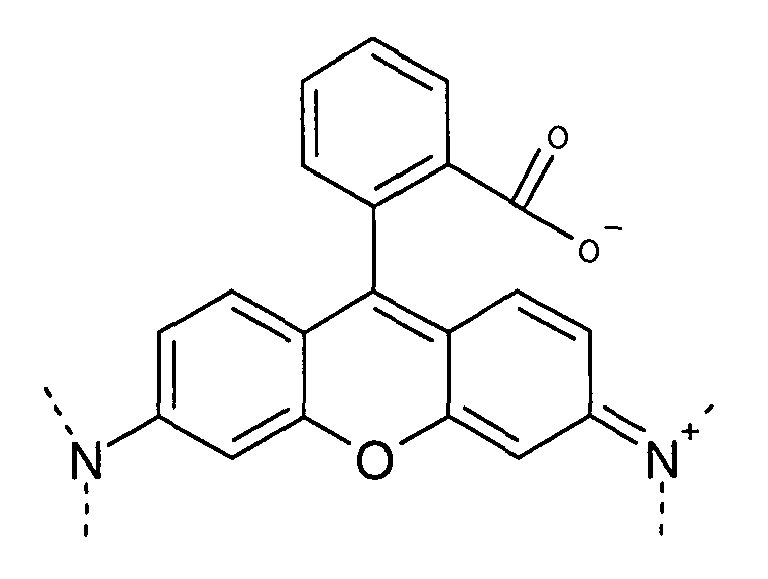
- Rhodamines are a well known class of fluorescent molecules which are frequently used for the labeling of biomolecules such as oligonucleotides. The generic substructure of such Rhodamines is
- The generation of a lactone structure has been disclosed already for Rhodamine dyes which have been used as labeling compounds during peptide synthesis (
WO 05/007678 WO 94/06812 - In the art, there exist several possibilities for the labeling of oligonucleotides. Labels in the form of an NHS ester are frequently used for "post labeling" strategies, wherein after oligonucleotide synthesis, the generated amino-modified oligonucleotide is removed from the CPG column and the labeling takes place subsequently. Rhodamine NHS esters are well known in the art and are used for post labeling strategies routinely.
- In contrast, if the label is provided in the form of a Phosphoramidite, this amidite can be coupled onto the oligonucleotide during or at the end of the oligonucleotide synthesis protocol, while the nascent oligonucleotide is still attached to the solid CPG phase. Thus, no further reaction step is required.
- However, all known Rhodamines which comprise a free carboxylic acid group are difficult to transform into their Phosphoramidite derivatives which are rather unstable. Also coupling yields of such Phosphoramidites are not very efficient, side reactions may occur due to the unprotected carboxylic acid group and additionally require special deprotection conditions (
EP 0 617 047 ). - A further method for producing a labeled oligonucleotide is a synthesis which starts with a dye-labeled CPG and thus result in a 3' labeled oligonucleotide. However, also in this case, CPGs labeled with a Rhodamine containing a free carboxylic acid group are known in the art provoke side reactions during conventional oligonucleotide synthesis.
- Thus it was an object of the present invention to provide Rhodamine labeling reagents which are easy to synthesize, have a reasonable stability and show satisfying coupling efficiency during oligonucleotide synthesis.
- In a first aspect, the present invention is directed to a chemical compound of the formula
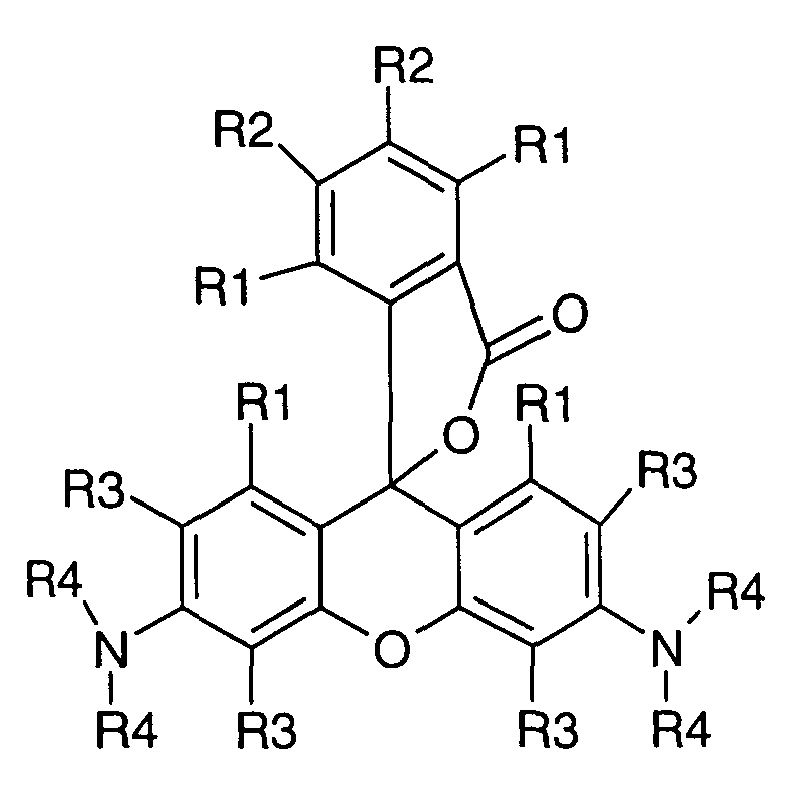
- each R1 independently of each other = H, C1-C3 alkyl or a halogen, which is preferably Cl or F
- one R2 = R1, and
- the other R2 is
- R1,
- A - L1 - Phosphoramidite, or
- A - L1-Succinyl-solid support
further wherein L1 is a nucleosidic or non nucleosidic linker; - each R3 independently from each other is
- R1, or
- together with one R4 and one N atom is part of a five or six membered ring
- each R4 independently from each other is
- a base labile protecting group
- L2 - Phosphoramidite, wherein L2 is a nucleosidic or non nucleosidic linker
- L2 - succinyl-solid support, wherein L2 is a nucleosidic or non nucleosidic linker
- selected from a group consisting of H, C1-C6-Alkyl, C1-C6 Sulfo-Alkyl,
- or together with one R3 and one N atom is part of five or six membered ring,
- provided that
- at least one R4 is a base labile protecting group, and
- there is exactly one Phosphoramidite moiety and no succinyl-solid support or exactly one succinyl-solid support and no Phosphoramidate.
- In one specific embodiment, at least one of said base labile protecting groups is
- CO-CF3
- In a further specific embodiment,
- each R1 is H
- the R2 in the 5 position is - CO-NH-(CH2)n- Phosphoramidite with n = 3-9
- the R2 in the 6 position is H
- none of R3 and R4 is part of a ring
- 2 R4 moieties connected to different N atoms are - CO-CF3
- In a second aspect, the present invention is directed to the use of such chemical compounds as building blocks for oligonucleotide synthesis.
- In a further aspect, the present invention is directed to a method of synthesizing a Phosphoramidite compound as disclosed above comprising the steps of
- a) providing a 5-Carboxy-Rhodamine or a 6-Carboxy-Rhodamine
- b) acylation of at least one N-atom with trifluoracetyl
- c) reacting the carboxy group at the 5 or 6 position with an amino group of a spacer reagent, said spacer reagent having the structure
NH2-Cn-OH with n = C3 -C12
- d) Phosphitylation with a phosphitylation reagent
-
-
Fig. 1 shows a reaction scheme for the synthesis of a typical Rhodamine Phosphoramidite according to the present invention. A Carboxyrhodamine is first acylated with trifluoracetyl, which renders the compound into its lactone form. Then, the free carboxyl group is reacted with the amino group of a linking reagent comprising a free hydroxyl group. Finally the free hydroxyl group is phosphitylated which results in the generation of a respective Phosphoramidite. -
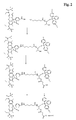
Fig. 2 shows a reaction scheme for the synthesis of a typical Rhodamine CPG according to the present invention. A Carboxyrhodamine is first acylated with trifluoracetyl, which renders the compound into its lactone form. Then, the free carboxyl group is reacted with the amino group of a linking reagent comprising a free hydroxyl group and a protected hydroxyl group. Finally the free hydroxyl group is succinylated and attached to the solid support (long chain aminoalkyl CPG) which results in the generation of a respective CPG. - In the context of the present invention, the following definitions shall apply:
- In the context of the present invention the term "Carboxy-Rhodamine" is used for all Rhodamine compounds where the exocyclic phenyl ring comprises two carboxylic substitutions. A first carboxylic group is located in the ortho position and a second carboxylic group is located in either the para position or the meta position which is not positioned adjacent to the ortho position at which the first carboxylic acid is substituted.
- Lactones in general are defined in the art as cyclic esters generated upon an intramolecular reaction of a carboxyl group with a hydroxyl group. A lactonized Rhodamine according to the invention is understood as a Rhodamine molecule defined by the following generic formula:

- Upon acylation, one or both amino groups are transformed into an acyl-amino group, which is no longer an electron donating group like the amino group. As a consequence, the polymethin type delocalization can not occur. Instead, a cyclization between the carboxylic group which is attached to the C-2 atom of the exocyclic phenyl group and the central carbon atom (C-9) of the xanthenylium subunit occurs.
- A linker L according to the invention is a moiety which separates the Phosphoramidite group or a solid support from the lactonized Rhodamine, whereas the lactonized Rhodamine is attached to the linker L via a group "A" or the linker is directly attached to one of the Rhodamine amino groups.
- "A" is selected to be not cleaved during conventional oligonucleotide synthesis. Therefore A is a thiourea, urea, sulfonamido, urethane, amide -moiety or O, N(C1-C3 alkyl), methylene. The preferred group A which connects the lactonized dye with the linker L is an amide or thiourea bond since starting materials are easily accessible. In the case of Dye-CO-NH-L- the starting material is commercially available carboxy-Rhodamine which is easily synthesized from a hydroxyl- or methoxy-aniline with trimellitic anhydride. For synthesizing compounds with the substructure Dye-NH-CS-NH-L or Dye-NH-CO- the starting compounds are Nitrorhodamins which are synthesized from a hydroxyl- or methoxy-aniline with 4-nitro phthalic anhydride, followed by protection with the base labile protecting group and then reduction. The resulting amine could be transformed into the isothiocyanate and then attached to an amino modified linker or could be directly attached to a carboxy modified linker.
- All kind of linkers which are used for direct labeling in oligonucleotide chemistry can be used in combination of lactonized Rhodamines according to this invention (Wojczewski, Christian, Stolze, Karen, Engels, Joachim W., Synlett 10 (1999) 1667-1678).
- In principle, there exist two classes of linkers:
- Bifunctional linkers connect a reporter group to a Phosphoramidite group for attaching the reporter to the 5' end (regular synthesis) or 3'end (inverted synthesis) to the terminal hydroxyl group of a growing oligonucleotide chain.
- Bifunctional linkers are preferably non nucleosidic compounds. For example, such linkers are C2 - C18 alkyl, alkenyl, alkinyl carbon chains, whereas said alkyl, alkenyl, alkinyl chains may be interrupted by additional ethyleneoxy and/or amide moieties in order to increase hydrophilicity of the linker. Cyclic moieties like C5-C6-cycloalkyl, C4N, C5N, C4O, C5O- heterocycloalkyl, phenyl which are optionally substituted with one or two C1-C6 alkyl groups can also be used as nonnucleosidic bifunctional linkers. Preferred bifunctional linkers are C3-C6 alkyl moieties and tri- to hexa- ethyleneglycol chains.
- Trifunctional linkers connect (i) a reporter group, (ii) a Phosphoramidite group for coupling the reporter during the oligonucleotide synthesis to a hydroxyl group of the growing oligonucleotide chain and (iii) a hydroxyl group which is protected with an acid labile protecting group. After removal of this protecting group a hydroxyl group is liberated which could react with further Phosphoramidites. Therefore trifunctional linkers allow placement of a reporter group at any position of an oligonucleotide. Trifunctional linkers are also a prerequisite for synthesis of solid supports eg. Controlled pore glass, (CPG) which are used for 3' terminal labeling of oligonucleotides. In this case, the trifunctional linker is connected to a reporter group via a group A and comprises a hydroxyl group which is attached via a cleavable spacer to a solid phase and a hydroxyl group which is protected with an acid labile protecting group. After removal of this protecting group a hydroxyl group is liberated which could then react with a Phosphoramidite.
- Trifunctional linkers may be non nucleosidic or nucleosidic.
- Non nucleosidic trifunctional linkers are C2 - C18 alkyl, alkenyl, alkinyl carbon chains, whereas said alkyl, alkenyl, alkinyl are optionally interrupted by additional ethyleneoxy and/or amide moieties in order to increase hydrophilicity of the linker. Other trifunctional linkers are cyclic groups like C5-C6-cycloalkyl, C4N, C5N, C4O, C5O heterocycloalkyl, phenyl which are optionally substituted with one ore two C1-C6 alkyl groups. Cyclic and acyclic groups may be substituted with one -(C1-C18)alkyl-O-PG group, whereas said C1-C18 alkyl comprises (Ethyleneoxy)n, (Amide)m moieties with n and m independently from each other = 0 - 6 and PG is an acid labile protecting group. Preferred trifunctional linkers are C3-C6 alkyl, cycloalkyl, C5O heterocycloalkyl moieties optionally comprising one amide bond and substituted with a C1 - C6 alkyl O-PG group, whereas PG is a acid labile protecting group preferably monomethoxytrityl, dimethoxytrityl, pixyl, xanthyl most preferred dimethoxytrityl.
- Nucleosidic trifunctional linkers are used for internal labeling whenever it is necessary not to influence the oligonucleotide hybridization properties compared to a non modified oligonucleotide. Therefore nucleosidic linkers compromise a base or a base analog which is still capable of hybridizing with a complementary base.
- The general formula of a labeling compound according to the invention with nucleosidic linkers is

- PG is an acid labile protecting group which is preferably selected from a group consisting of monomethoxytrityl, dimethoxytrityl, pixyl, xanthyl most preferred dimethoxytrityl.
- Specific positions of the base substitution with a lactonized Rhodamine may be chosen to minimize the influence on hybridization properties. Therefore the following substitution positions are preferred:
Natural bases: Uracil: substituted at C5: Cytosine: substituted at C5 or N4 Adenine substituted at C8 or N6 Guanine: substituted at C8 or N2 Base analogs: 7 deaza A and G: substituted at C7 7 deaza 8 Aza A and G substituted at C7 7 deaza Aza 2 amino A substituted at C7 Pseudouridine substituted at N1 Formycin substituted at N2 - Examples for non nucleosidic bifunctional linkers and groups A are listed in Table 1:
Table 1 Bifunctional nonnucleosidic A 

Reference: Pon, Richard T., Tetrahedron Letters 32(14) (1991) 1715-18 

Reference: Morocho, A. M., Karamyshev, V. N. Shcherbinina, O. V. Malykh, A. G.; Polushin, N. Nucleosides, Nucleotides & Nucleic Acids 22(5-8) (2003) 1439-1441 

Reference: Cocuzza, Anthony J., Tetrahedron Letters 30(46) (1989) 6287-90 - Examples for non nucleosidic trifunctional linkers and groups A are listed in Table 2:
Table 2 Trifunctional A 


Reference: Nelson, Paul S., Kent, Mark, Muthini, Sylvester, Nucleic Acids Research 20(23) (1992) 6253-9; EP 313 219 US 5,585,481 ;US 5,451,463 ;EP 0 786 468 ;WO 92/11388 

Reference: Su, Sheng-Hui, Iyer, Rajkumar S., Aggarwal, Sunil K., Kalra, Krishan, L., Bioorganic & Medicinal Chemistry Letters 7(13) (1997) 1639-1644; WO 97/43451 
--O-- 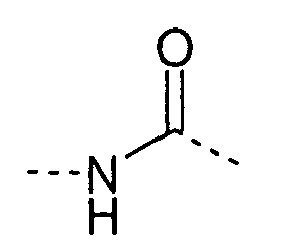

Reference: Putnam, William C., Bashkin, James K., Department of Chemistry, Nucleosides, Nucleotides & Nucleic Acids 24(9) (2005) 1309-1323; US 2005/214833 ;EP 1 186 613 

Reference: EP 1 431 298 

Reference: WO 94/04550 

Reference: WO 2003/019145 

Reference: Behrens, Carsten, Dahl, Otto, Department of Chemistry, Nucleosides & Nucleotides 18(2) (1999) 291-305; WO 97/05156 

Reference: Prokhorenko, Igor A., Korshun, Vladimir A., Petrov, Andrei A., Gontarev, Sergei V., Berlin, Yuri A., Bioorganic & Medicinal Chemistry Letters 5(18) (1995) 2081-4; WO 2003/104249 

Reference: US 5,849,879 - Examples for nucleosidic trifunctional linkers and groups A are listed in Table 3:
Table 3 Trifunctional nucleosidic A 

Reference: Roget, A., Bazin, H., Teoule, R., Nucleic Acids Research 17(19) (1989) 7643-51; WO 89/12642 WO 90/08156 WO 93/05060 

Reference: Silva, Jose Angel, Jimenez, Victor, Campos, Magalys, Biotecnologia Aplicada 15(3) (1998) 154-158 

Reference: US 6,531,581 ;EP 423 839 

Reference: US 4,948,882 ;US 5,541,313 ;US 5,817,786 

Reference: WO 2001/042505 

Reference: McKeen, Catherine M., Brown, Lynda J., Nicol, Jamie John M., Brown, Tom, Organic & Biomolecular Chemistry 1(13) T. G.,Mellor, (2003) 2267-2275 

Reference: Ramzaeva, Natalya, Rosemeyer, Helmut, Leonard, Peter, Muhlegger, Klaus, Bergmann, Frank, Von der Eltz, Herbert, Seela, Frank, Helvetica Chimica Acta 83(6) (2000) 1108-1126 - In table 1-3 the terminal oxygen atom of bifunctional linkers or one of the terminal oxygen atoms of trifunctional linkers are part of the Phosphoramidite or succinyl moiety. The second terminal oxygen atom of trifunctional linkers is protected with an acid labile protecting group.
- In the context of the present invention, a base labile protecting group is attached to one or two of the Rhodamine amino groups and guarantees that the Rhodamine is in its lactonized form. The base labile protecting group is cleavable under basic conditions which are applied in oligonucleotide synthesis in order to remove the base protecting groups and the phosphate protecting groups and to cleave the oligonucleotide from the synthesis solid support (e.g. CPG). Typical basic deprotection media are conc ammonia, sodium hydroxide in methanol/water, potassium carbonate in methanol/water, ammonia/methylamine in water.
- Acyl, aroyl and oxycarbonyl groups could be used as based protecting groups. From these three classes, trifluoracetyl, acetyl, phenoxyacetyl, benzoyl, dinitrobenzoyl and fluorenyloxycarbonyl are preferred. Mostly preferred is trifluoracetyl.
- Acid labile protecting groups are protecting one of two hydroxyl groups of trifunctional linkers. The acid labile protecting group is used as a transient protecting group during oligonucleotide synthesis: A trifunctional Phosphoramidite is reacted with a free hydroxyl group of a growing oligonucleotide chain and after oxidation and capping the acid labile protecting group is removed in order to liberate a hydroxyl group which can be reacted with a further Phosphoramidite. If the label is attached to the 5' end it is sometimes helpful for purification to keep the acid labile protecting group.
- Synthesis solid supports for 3' attachments with a Rhodamine are always based on trifunctional linkers. Also in this case the acid labile protecting group is removed in order to liberate a hydroxyl group which can be reacted with the first Phosphoramidite of the synthesis cycle. Acid labile protecting groups are removed by dichloracetic acid or trichloracetic acid in methylenechloride or when used as a purification tag with acetic acid in water. Preferred acid labile protecting groups are monomethoxytrityl, dimethoxytrityl, pixyl, xanthyl most preferred is dimethoxytrityl.
- Solid support material in the context of the present invention refers to polymeric substances that form a solid phase containing a reactive group on which other molecules can be immobilized. In the case of oligonucleotide synthesis this are usually porous glass beads having a defined pore size (CPG). Alternatively polystyrene resins and other organic polymers and copolymers can also be used (Ghosh, P.K., et al., J. Indian Chem. Soc. 75 (1998) 206-218). If the oligonucleotide should remain immobilized on the substrate after the synthesis, glass or semiconductor chips can also be used as a solid phase support material.
- A labelled reactive support is understood as a solid phase support material on which another compound containing a detectable label and a still unprotected reactive group is immobilized.
- Preferably, solid supports are amino modified e. g long chain aminoalkyl CPG, to this aminogroup a trifunctional linker is attached to a cleavable spacer, which is cleaved under basic conditions after oligonucleotide synthesis. Different cleavable spacers are known (Ghosh, P.K., et al., J. Indian Chem. Soc. 75 (1998) 206-218) Preferred cleavable spacers are oxalyl- or succinyl spacers most preferred is the succinyl: -O-C(=O)CH2-CH2 C(=O)-NH spacer Therefore "Succinyl-solid support" is an entity -O-C(=O )CH2-CH2C(=O)-NH-solid support.
- A Phosphoramidite moiety comprises a trivalent phosphorous atom with three substituents: an oxygen atom (which is linked to the bi- or trifunctional linker L). A protected oxygen atom with protecting groups selected from beta cyanoethyl, methyl, allyl, p-nitrophenylethyl. A secondary amine group NR2 with R being lower alkyl most preferred isopropyl. The most preferred Phosphoramidite moiety is

- Phosphoramidites can be coupled in presence of an activator like tetrazol or dicyanoimidazol to an alcohol function and where routinely used in oligonucleotide synthesis and for oligonucleotide modification (
EP 0 061 746 ; Wojczewski, Christian, Stolze, Karen, Engels, Joachim W., Synlett 10 (1999) 1667-1678). After oxidation to P(V) and final cleavage of the protecting group a phosphate diester bond is formed as a linkage between a nucleoside and the linker L to which the Rhodamine is attached. - In principle the invention is also compatible with H-Phosphonate oligonucleotide synthesis method and H-phosphonate residues could also be used instead of Phosphoramidite residues in combination with lactonized Rhodamines.
- The present invention provides a compound according to the formula

- each R1 independently of each other = H, C1-C3 alkyl or a halogen, which is preferably Cl or F
- one R2 = R1, and
- the other R2 is
- R1,
- A - L1- Phosphoramidite, or
- A - L1-Succinyl-solid support
- each R3 independently from each other is
- R1, or
- together with one R4 and one N atom is part of a five or six membered ring
- each R4 independently from each other is
- a base labile protecting group
- L2 - Phosphoramidite, wherein L2 is a nucleosidic or non nucleosidic linker
- L2 - succinyl-solid support, wherein L2 is a nucleosidic or non nucleosidic linker
- selected from a group consisting of H, C1-C6-Alkyl, C1-C6 Sulfo-Alkyl, or
- or together with one R3 and one N atom is part of five or six membered ring,
- provided that
- at least one R4 is a base labile protecting group, and
- there is exactly one Phosphoramidite moiety and no succinyl-solid support or exactly one succinyl-solid support and no Phosphoramidate moiety.
- Usually, not more than 2 R4 moieties are base labile protecting groups. In case one R2 is A - L1 - Phosphoramidite or one R4 is L2-Phosphoramidite, such a Rhodamine labeled compound can be used for 5' end labeling of a CPG bound newly generated oligonucleotide according to methods known in the art. Moreover, if L1 or L2 is nucleosidic or non nucleosidic trifunctional linker, with an appropriately protected hydroxyl group, then such a compound can be incorporated at any position within an oligonucleotide during conventional chemical oligonucleotide synthesis.
- In case one R2 is A - L1-Succinyl-solid support or one R4 is L2- Succinyl-solid support such as a CPG, then said solid support can be used as a starting material for oligonucleotide synthesis according to methods known in the art, which in this case result in a 3' labeled oligonucleotide.
- Therefore, it is also within the scope of the present invention, if the inventive compound is used as a building block for oligonucleotide synthesis. More precisely, the inventive compound may be either a dye labeled Phosphoramidate or, alternatively, a dye-labeled CPG.
- Preferably, at least one of said base labile protecting groups of the inventive compound is - CO-CF3. Starting from conventional Carboxy-Rhodamines with one primary amino groups or one aminogroup H, a lactonized Rhodamine with one R4 = trifluoracetyl can be generated by means of acetylating said Rhodamine with trifluoracetic acid anhydride. Most preferred, the starting Rhodamine has two primary amino groups. Acetylation results in formation of a lactonized compound with one R4= trifluoracetyl on each aminogroup.
- As disclosed above, the chemical structure may comprise one or more five or six membered ring structures which are formed each together by one R3 and one R4 and by the nitrogen atom to which R4 is attached and one double bond of the adjacent phenylring to which R3 and N(R4)2 is attached. In a specific embodiment, said one or more ring structures are di or tetrahydro pyridine, or dihydropyrrole rings which influence the quantum yield and absorption maxima of the dye. Such rings may be substituted by 1- 3 (C1-C3)alkyl or sulfoalkyl residues. Rhodamine dyes with di/tetrahydro pyridine/pyrolle rings are can be easiliy synthesized from substituted phthalic acid anhydrides and from 7-Hydroxy-1,2,3,4-tetrahydroquinoline, 1,2-dihydro-2,2,4-trimethyl 7-quinolinol and 6 hydroxyindolines (
WO 2002/036832 ,US 5,256,799 ) and derivatives thereof. Preferred are the 6 membered rings, tetrahydropyridine, 2,2,4 tetramethy tetrahydropyridine, and 2,2,4 dimethyl 1,2 dihydropyridines. - In another specific embodiment,
- each R1 is H
- the R2 in the 5 position is - CO-NH-(CH2)n- Phosphoramidite with n = 3-9
- the R2 in the 6 position is H, and
- none of R3 and R4 is part of an aromatic ring.
- Within the scope of the present invention, there exist multiple possible linker structures for L1 and/or L2.
- In one embodiment, such a linker is a trifunctional nucleosidic linker.
- Therefore the general formula of a labeling compound according to the invention with a trifunctional nucleosidic linkers is

- B is a nucleobase or a nucleobase analog
- PG is an acid labile protecting group
- X is C2 - C18 alkyl, alkenyl alkinyl, whereas said alkyl, alkenyl, alkinyl may comprise (ethyleneoxy)n and/or (amide)m moieties, with n and m is independently from each other a natural number from 1 - 6.
- Preferred acid labile protecting groups are monomethoxytrityl, dimethoxytrityl, pixyl, xanthyl most preferred is dimethoxytrityl.
- In an alternative embodiment, such a linker is a non nucleosidic linker selected from a group consisting of
- C2 - C18 alkyl, alkenyl alkinyl, whereas said alkyl, alkenyl, alkinyl may comprise (Ethyleneoxy)n, (Amide)m moieties, with with n and m is independently from each other and a natural number from 1 - 6,
- C5- C6 cycloalkyl, C4N, C5N, C4O, C5O heterocycloalkyl, phenyl, which are optionally substituted with one ore two C1-C6 alkyl groups.
- Preferably, such a non nucleosidic linker is a bifunctional linker, without any further substitutions.
- Alternatively, such a non nucleosidic linker is substituted with one -(C1-C18)alkyl-O-PG group, whereas said C1-C18 alkyl may comprise (Ethyleneoxy)n, (Amide)m moieties with n and m independently from each other = 1- 6. Preferred acid labile protecting groups PG are monomethoxytrityl, dimethoxytrityl, pixyl, xanthyl most preferred is dimethoxytrityl. Thus, such a linker provides a trifunctional structure.
- In a further aspect, the present invention is directed to the use of a compound of the present invention as a building block for nucleotide synthesis. During conventional oligonucleotide synthesis, a reactive hydroxyl group on which a chain extension in the 3' - 5' direction can occur is formed after removing the DMT protective group by acid treatment. Then 3' Phosphoramidite derivatives of (deoxy) ribonucleosides that are also provided with a DMT protective group and additional base protecting groups well known in the art are successively coupled at the 5' end to each reactive group freed of the DMT protective group in the presence of tetrazole. Subsequently iodine is added for oxidation. According to the present invention, labelling at the 5' end or internal labelling is carried out by using a labeled Phosphoramidate according as disclosed above. Labelling at the 3' end is carried out by using a labeled CPG as disclosed above.
- In yet a further aspect, the present invention is directed to a method of synthesizing a compound according to the present invention.
- Such a synthesis method comprises the following four basic steps:
- a) providing a 5-Carboxy-Rhodamine or a 6-Carboxy-Rhodamine
- b) acylation of at least one N-atom with trifluoracetyl
- c) reacting the carboxy group at the 5 position or 6 position with an amino group of a spacer reagent, said spacer reagent having the structure NH2-Cn-OH with n = C3 -C12, and
- d) Phosphitylation with a phosphitylation reagent.
- An example is schematically disclosed in
fig. 1 . - With respect to step a) it can be stated that such compounds are standard reagents which are commercially available or can be synthisized by reaction of hydroxyl or methoxyanilines with trimellitic acid anhydride and separation of the isomers by column chromatography.
- During step b) said 5- or 6- Carboxy-Rhodamine is acetylated according to methods known in the art (
WO 05/007678 - Within step c) the free carboxyl group of the Rhodamine is reacted with a spacer reagent by means of generating an amido bond between said carboxyl group with an amino group of said spacer reagent according to standard methods known in the art. Preferably, such a spacer reagent has the chemical structure
NH2-Cn-OH with n = C3 -C12
- However, the use of other chemically inert spacers having a free amino group and a free hydroxyl group and optionally a dimethoxytrityl protected hydroxylgroup is alternatively possible as well.
- In step d) the free hydroxyl group of the spacer entitity is subjected to a phosphitylation reaction with a phosphitylation reagent like 2-Cyanoethyl N,N-diisopropylchloro Phosphoramidite or 2-Cyanoethyl N,N,N',N'-tetraisopropylphosphorodiamidite according to standard methods which are known in the art (e.g. Nielsen, John, Dahl, Otto, Nucleic Acids Research 15(8) (1987) 3626; Pon, Richard T., Tetrahedron Letters 32(14) (1991) 1715-18.
- The generated Phosphoramidite is rather stable and can be used for the labeling of oligonucleotides during oligonucleotide synthesis with high labeling efficiency.
- A similar method as disclosed above can also be used in order to generate a 3' labeling reagent for oligonucleotide synthesis instead of a Phosphoramidite. The synthesis of such a reagent is the same as it is the case for the Phosphoramidite with respect to steps a) and b). Subsequently, the free carboxyl group of the Rhodamine may be reacted with a free amino group of a trifunctional linker containing one free OH group and one protected group, eg a dimethoxytrityl protected OH group. The free OH group is reacted with succinic anhydride and the resulting free carboxlic acid activated and reacted with an aminomodified solid support like CPG.
- Labeling reagents according to the invention are used to synthesize fluorescently labeled oligonucleotides, which have a broad field of applications within genetic analysis. Asseline, U., Current Organic Chemistry 10(4) (2006) 491-518; Ranasinghe, Rohan T., Brown, Tom., Chemical Communications (44) (2005) 5487-5502 (Cambridge, United Kingdom).
- The following examples and figures are provided to aid the understanding of the present invention, the true scope of which is set forth in the appended claims. It is understood that modifications can be made in the procedures set forth without departing from the spirit of the invention.
- 0.77 g (1.68 mmole) of Rhodamine 6G 5-carboxylic acid were coevaporated with 2 x 40 ml of abs. pyridine. The residue was dissolved in 100 ml of abs. pyridine and 1.7 ml (8.40 mmole) of trifluoroacetic anhydride (Aldrich 106232) were added and stirred for 5 h at r.t. under Ar. Thereafter, the reaction mixture was evaporated to dryness. Residue was dissolved in 10 ml acetone/methanol 5:1 and purified by flash chromatography over a short silica gel column using 500 ml of acetone/methanol 5:1 as eluent. Fractions containing the product were combined and evaporated to dryness. Then the residue was dissolved in dichloromethane and filtrated. Thereafter, the solvent was evaporated and the residue was dried at high vacuum (4 h, r.t.).
Yield: 1,1 g (quant.) of a yolk brown oil
Rf: 0.64 (SiO2, acetone/methanol 1:1) 1H-NMR (DMSO-d6): 8.47 (1H, s), 8.34 (1H, m), 7.55-7.43 (3H, m), 6.98 ppm (2H, s), 4,08 (2H, m), 3.24 (2H, m), 2.06 (6H, s), 1.15 (6H, m) - 1.1 g (1.68 mmole) of N,N'-di-trifluoracetyl-5-carboxyrhodamine 6G-lacton (1) was coevaporated 2 x with abs. DMF, then dissolved in 50 ml abs. DMF. Thereafter, 0.8 ml (3.18 mmole) of diisopropylethylamine and 0.78 g (1.94 mmole) of HBTU (Fluka 12804) were added and stirred for 0.5 h at r.t. under Ar. Then, 208 mg (1.68 mmole) of 5-aminopentanol (Aldrich 123048) were added and stirred for 3 h at r.t.. Thereafter, the reaction mixture was evaporated to dryness at high vacuum. The residue was dissolved in 10 ml of acetone/methanol 10:1 and purified by flash chromatography a silica gel column using acetone/methanol 8:1 as eluent. Product fractions were combined and evaporated to dryness. Yield: 1.2 g (97%) of a yellow solid
Rf: 0.86 (SiO2, acetone/methanol 5:1)
1H-NMR (DMSO-d6): 8.84 (1H, m), 8.55 (1H, m), 8.28 (1H, d), 7.60-7.40 (3H, m), 6.99-6.91 (2H, m), 4.38 (1H, s br), 4.09 (2H, m), 3.42-3.18 (6H, t, m), 2.07 (6H, s), 1.60-1.30 (6H, 3m), 1.14 (6H, m) - 0.4 g (0.54 mmole) of N,N'-di-trifluoracetyl-5-(5-hydroxypentylamido)-rhodamine 6G lactone (2) were dissolved in 20 ml of abs. dichloromethane under an Ar-atmosphere. Then, 0.23 ml (1.08 mmole) of diisopropylethylamine were added and finally 205 mg (0.80 mmole) of chloro-diisopropylamino-(2-cyanoethoxy)-phosphane in 10 ml of abs. dichloromethane were added dropwise. The reaction mixture was stirred for 4 h at r.t.. Then 50 µl of dry isopropanol were added and the reaction mixture was stirred for further 30 min. at r.t.. After addition of additional dichloromethane the reaction mixture was washed with 0.1 M sodium phosphate buffer pH 7. The organic phase was separated, dried over sodium sulfate and evaporated to dryness. The residue was dissolved in 3 ml of dichloromethane and added under stirring to 20 ml of hexane. The precipitate was separated and dried at high vacuum for 2 h at r.t..
Yield: 0.38 g (75%) of a yellow solid
Rf: 0.90 (SiO2, acetone/methanol 5:1)
31P-NMR (CDCl3): 148.37 ppm (s) - Oligonucleotide 5'-(Rhodamine 6G) (dT)10-3' was synthesized on an ABI 394 DNA synthesizer (Applied Biosystems) in a 1 µmol scale synthesis using standard Phosphoramidite chemistry.
- A 1 µmole scale synthesis column charged with dT functionalized LCAA-CPG was installed at the synthesizer, then dT Phosphoramidite (0.1M) was coupled 9 times using standard ABI DNA synthesis cycles (Applied Biosystems). Then the Rhodamine 6G Phosphoramidite (0.1M; 5/6 isomer; prepared according to the same procedure as described above; 31P-NMR (CDCl3): 148.38 ppm (s)) was coupled using a standard ABI RNA synthesis cycle (without capping step). Then the oligonucleotide was treated with a) conc. ammonia or b) 0.4 M NaOH in methanol/water 4:1 at r.t. overnight to cleave from support and deprotect protecting groups.
- RP-HPLC analysis of the crude revealed successful coupling of the dye (rt = 10.7 and 12.6 min (2 isomers). In the UV spectrum both the absorption band at about 260 nm from the nucleotides and the absorption band at about 530 nm of the Rhodamine 6G dye are present. In case of deprotection with conc. ammonia a side product is formed (rt = 15.8 and 18.1 min (2 isomers); no Rhodamine 6G dye chromophor; M.W. product -1Da).
- M.W. of product peak was confirmed (3585 Da).
- As in Example 2 N,N'-5Carboxy-3-oxospiro[isobenzofuran-1(3H),9'-[9H] -(2';7' dimethyl)-xanthene]- 3',6'-diyl]bis[2,2,2-trifluoracetylethylamide, (1) is reacted with the trifunctional 6-amino-N-[1-[[bis(4-methoxyphenyl)phenylmethoxy]methyl]-2-hydroxypropyl]- hexanamide (synthesized from L- threoninol and N-Fmoc aminocaproic acid followed by tritylation according Matulic-Adamic, J., et al., Bioconjugate Chem. 13 (2002) 1071-1078.
- 2,65 g (2 mmol) of compound 4 are stirred overnight under argon in 30 ml dry pyridine at room temperature with 0.49 g 5 mmol succinic anhydride and 61 mg (0.5 mmol) dimethylaminopyridine (DMAP). The solvent is removed and the product purified by column chromatography.
- Succinate from Example 6 (2 mmol) is stirred at room temperature under argon in a mixture of 80 ml of dry DMF and 44 ml of dry pyridine with 2.0 g ( 10.4 mmol) of N (3-dimethylaminopropyl)- N'-ethylcarbodiimid hydrochlorid (EDC) and 200 mg (1.64 mmol) of DMAP. After complete solution of the EDC 28 g of lcaa CPG -500 A (CPG.-Inc) are added. The suspension is moderately shaked for 16 h at room temperature. The suspension is vacuum filtrated by using a D3 glass filter. The residue is washed with 220 ml of dry DMF 220 ml of THF and 150 ml of Diethylether. For capping the CPG is suspended in a mixture of 80 ml pyridine with 22 ml acetanhydrid for 1 h at room temperature. The suspension is vacuum filtrated by using a D3 Glas filter. The residue is washed with 440 ml of THF and 150 ml of Diethylether. The CPG is dried in high vacuum for 4h at room temperature.
Claims (9)
- Chemical compound of the formula
 each R1 independently of each other = H, C1-C3 alkyl or a halogen, which is preferably Cl or Fone R2 = R1, andthe other R2 is- R1,- A - L1 - Phosphoramidite, or- A - L1-Succinyl-solid supportwherein A is selected from a group consisting of - NR5 - CO -, -CO-NR5 -, -NH-CO-NR5-, NH-CS-NR5-, -SO2-NR5-, -O-, -CH2-; -N(C1-C3)alkyl - NR5-CO-O- and O-CO-NR5- with R5 = H or C1-C3-alkyl;further wherein L1 is a nucleosidic or non nucleosidic linker;each R3 independently from each other is- R1, or- together with one R4 and one N atom is part of a five or six membered ringeach R4 independently from each other is- a base labile protecting group- L2 - Phosphoramidite, wherein L2 is a nucleosidic or non nucleosidic linker- L2 - succinyl-solid support, wherein L2 is a nucleosidic or non nucleosidic linker- selected from a group consisting of H, C1-C6-Alkyl, C1-C6 Sulfo-Alkyl,- or together with one R3 and one N atom is part of five or six membered ringprovided that- at least one R4 is a base labile protecting group, and- there is exactly one Phosphoramidite moiety and no succinyl-solid support or exactly one succinyl-solid support and no Phosphoramidate moiety
 - Compound according to claim 1, wherein at least one of said base labile protecting groups is
- CO-CF3
- Compound according to claims 1-3
characterized in that said five or six membered ring is di- or tetrahydro pyridine, or dihydropyrrole - Compound according to claims 1-3, wherein
L1- or L2 - Phosphoramidite is represented by the formula - B is a nucleobase or a nucleobase analog- PG is an acid labile protecting group- X is C2 - C18 alkyl, alkenyl alkinyl, whereas said alkyl, alkenyl, alkinyl may comprise (ethyleneoxy)n and/or (amide)m moieties, with n and m is independently from each other a natural number from 1 - 6.
 - Compound according to claims 1-3, wherein
L1 or L2 are non nucleosidic linkers selected from a group consisting of- C2 - C18 alkyl, alkenyl alkinyl, whereas said alkyl, alkenyl, alkinyl may comprise (Ethyleneoxy)n, (Amide)m moieties, with with n and m is independently from each other and a natural number from 1 - 6,- C5- C6 cycloalkyl, C4N, C5N, C4O, C5O heterocycloalkyl, phenyl, which are optionally substituted with one ore two C1-C6 alkyl groups. - Compound according to claim 5, wherein
L is substituted with one -(C1-C18)alkyl-O-PG group, whereas said C1-C18 alkyl may comprise (Ethyleneoxy)n, (Amide)m moieties with n and m independently from each other = 1- 6. - Compound according to claims 1-3, wherein- each R1 is H- the R2 in the 5 position is - CO-NH-(CH2)n- Phosphoramidite with n=3-9- the R2 in the 6 position is H- none of R3 and R4 is part of a ring- 2 R4 moieties connected to different N atoms are - CO-CF3
- Use of a chemical compound according to claims 1-7 as a building block for oligonucleotide synthesis.
- A method of synthesizing a Phosphoramidite compound according to claims 1-7 comprising the steps ofa) providing a 5-Carboxy-Rhodamine or a 6-Carboxy-Rhodamineb) acylation of at least one N-atom with trifluoracetylc) reacting the carboxy group at the 5 position with an amino group of a spacer reagent, said spacer reagent having the structure
NH2-Cn-OH with n = C3 -C12
d) Phosphitylation with a phosphitylation reagent.
Priority Applications (1)
| Application Number | Priority Date | Filing Date | Title |
|---|---|---|---|
| EP07017268.9A EP2036897B1 (en) | 2007-09-04 | 2007-09-04 | Stable rhodamine labeling reagent |
Applications Claiming Priority (1)
| Application Number | Priority Date | Filing Date | Title |
|---|---|---|---|
| EP07017268.9A EP2036897B1 (en) | 2007-09-04 | 2007-09-04 | Stable rhodamine labeling reagent |
Publications (2)
| Publication Number | Publication Date |
|---|---|
| EP2036897A1 true EP2036897A1 (en) | 2009-03-18 |
| EP2036897B1 EP2036897B1 (en) | 2017-10-18 |
Family
ID=38535402
Family Applications (1)
| Application Number | Title | Priority Date | Filing Date |
|---|---|---|---|
| EP07017268.9A Active EP2036897B1 (en) | 2007-09-04 | 2007-09-04 | Stable rhodamine labeling reagent |
Country Status (1)
| Country | Link |
|---|---|
| EP (1) | EP2036897B1 (en) |
Cited By (5)
| Publication number | Priority date | Publication date | Assignee | Title |
|---|---|---|---|---|
| WO2010149190A1 (en) * | 2009-06-26 | 2010-12-29 | Max-Planck-Gesellschaft Zur | Novel fluorinated rhodamines as photostable fluorescent dyes for labelling and imaging techniques |
| US20120016128A1 (en) * | 2010-07-16 | 2012-01-19 | Zhenjun Diwu | Rhodamine lactone phosphoramidites and polymers |
| US8710244B2 (en) | 2012-06-22 | 2014-04-29 | Industrial Technology Research Institute | Dyes and methods of marking biological material |
| JP2016508128A (en) * | 2012-12-20 | 2016-03-17 | エフ.ホフマン−ラ ロシュ アーゲーF. Hoffmann−La Roche Aktiengesellschaft | Labeled oligonucleotide probes used for nucleic acid sequence analysis |
| US10400263B2 (en) | 2012-07-19 | 2019-09-03 | Kingston University Higher Education Corporation | Tripeptide rhodamine compound |
Citations (6)
| Publication number | Priority date | Publication date | Assignee | Title |
|---|---|---|---|---|
| WO1993019206A1 (en) * | 1992-03-17 | 1993-09-30 | Life Technologies, Inc. | Synthesis of fluorescence-labelled nucleic acids |
| WO1994006812A1 (en) * | 1992-09-18 | 1994-03-31 | Amoco Corporation | Green fluorescent labeled nucleotides for use in probes |
| EP0617047A1 (en) * | 1987-12-24 | 1994-09-28 | The Perkin-Elmer Corporation | Dye-labelled phosphoramadites |
| US5371241A (en) * | 1991-07-19 | 1994-12-06 | Pharmacia P-L Biochemicals Inc. | Fluorescein labelled phosphoramidites |
| US20030191303A1 (en) * | 1999-02-22 | 2003-10-09 | Applera Corporation | Labelled oligonucleotides synthesized on solid-supports |
| WO2005007678A2 (en) * | 2003-07-14 | 2005-01-27 | Irm Llc | Methods for the preparation of rhodamine |
-
2007
- 2007-09-04 EP EP07017268.9A patent/EP2036897B1/en active Active
Patent Citations (6)
| Publication number | Priority date | Publication date | Assignee | Title |
|---|---|---|---|---|
| EP0617047A1 (en) * | 1987-12-24 | 1994-09-28 | The Perkin-Elmer Corporation | Dye-labelled phosphoramadites |
| US5371241A (en) * | 1991-07-19 | 1994-12-06 | Pharmacia P-L Biochemicals Inc. | Fluorescein labelled phosphoramidites |
| WO1993019206A1 (en) * | 1992-03-17 | 1993-09-30 | Life Technologies, Inc. | Synthesis of fluorescence-labelled nucleic acids |
| WO1994006812A1 (en) * | 1992-09-18 | 1994-03-31 | Amoco Corporation | Green fluorescent labeled nucleotides for use in probes |
| US20030191303A1 (en) * | 1999-02-22 | 2003-10-09 | Applera Corporation | Labelled oligonucleotides synthesized on solid-supports |
| WO2005007678A2 (en) * | 2003-07-14 | 2005-01-27 | Irm Llc | Methods for the preparation of rhodamine |
Non-Patent Citations (3)
| Title |
|---|
| GUMPORT ET AL: "T4 RNA ligase as a nucleic acid synthesis and modification reagent", NUCLEIC ACIDS SYMPOSIUM SERIES, IRL PRESS, OXFORD, GB, vol. 7, 5 March 1980 (1980-03-05), pages 167 - 171, XP009090384, ISSN: 0261-3166 * |
| LYTTLE, MATTHEW H. ET AL: "A Tetramethyl Rhodamine (Tamra) Phosphoramidite Facilitates Solid-Phase-Supported Synthesis of 5'-Tamra DNA", JOURNAL OF ORGANIC CHEMISTRY , 65(26), 9033-9038 CODEN: JOCEAH; ISSN: 0022-3263, 2000, XP002459310 * |
| VINAYAK R: "A convenient, solid-phase coupling of rhodamine dye acids to 5' amino-oligonucleotides", TETRAHEDRON LETTERS, ELSEVIER, AMSTERDAM, NL, vol. 40, no. 43, 22 October 1999 (1999-10-22), pages 7611 - 7613, XP004179879, ISSN: 0040-4039 * |
Cited By (6)
| Publication number | Priority date | Publication date | Assignee | Title |
|---|---|---|---|---|
| WO2010149190A1 (en) * | 2009-06-26 | 2010-12-29 | Max-Planck-Gesellschaft Zur | Novel fluorinated rhodamines as photostable fluorescent dyes for labelling and imaging techniques |
| US8735444B2 (en) | 2009-06-26 | 2014-05-27 | Max-Planck-Gesellschaft Zur Foerderung Der Wissenschaften E.V. | Fluorinated rhodamines as photostable fluorescent dyes for labelling and imaging techniques |
| US20120016128A1 (en) * | 2010-07-16 | 2012-01-19 | Zhenjun Diwu | Rhodamine lactone phosphoramidites and polymers |
| US8710244B2 (en) | 2012-06-22 | 2014-04-29 | Industrial Technology Research Institute | Dyes and methods of marking biological material |
| US10400263B2 (en) | 2012-07-19 | 2019-09-03 | Kingston University Higher Education Corporation | Tripeptide rhodamine compound |
| JP2016508128A (en) * | 2012-12-20 | 2016-03-17 | エフ.ホフマン−ラ ロシュ アーゲーF. Hoffmann−La Roche Aktiengesellschaft | Labeled oligonucleotide probes used for nucleic acid sequence analysis |
Also Published As
| Publication number | Publication date |
|---|---|
| EP2036897B1 (en) | 2017-10-18 |
Similar Documents
| Publication | Publication Date | Title |
|---|---|---|
| CA2627216C (en) | Polynucleotide labelling reagent | |
| KR920007558B1 (en) | Modified phosphoramidite process for the production of modified nucleic acids | |
| US5556959A (en) | Indocarbocyanine-linked phosphoramidites | |
| EP0543906B1 (en) | Hydroxyl-protecting groups orthogonally removable by reduction and their use in the chemical synthesis of oligonucleotides | |
| JP5698206B2 (en) | Useful reagents for the synthesis of rhodamine-labeled oligonucleotides | |
| US20020110691A1 (en) | Reagent for labelling nucleic acids | |
| WO2019212061A1 (en) | Segment for oligonucleotide synthesis, production method for same, and oligonucleotide synthesis method using same | |
| EP2036897B1 (en) | Stable rhodamine labeling reagent | |
| Wagner et al. | Nucleotides, Part LXV, Synthesis of 2′‐Deoxyribonucleoside 5′‐Phosphoramidites: New Building Blocks for the Inverse (5′‐3′)‐Oligonucleotide Approach | |
| US7098326B2 (en) | Methods for the integrated synthesis and purification of oligonucleotides | |
| JP5467275B2 (en) | Electron transfer inhibitors and their use | |
| WO2022191172A1 (en) | Linker and carrier for nucleic acid solid phase synthesis | |
| AU2006316903B2 (en) | Polynucleotide labelling reagent | |
| US7786296B2 (en) | Silyl linker for solid-phase synthesis of nucleic acid | |
| CA2584799A1 (en) | Amino or thiol linker building block for the synthesis of amino- or thiol-functionalized nucleic acids and methods of making and use thereof | |
| US7943758B2 (en) | 3′-end nucleoside unit comprising phosphoramidite | |
| CN117580848A (en) | Chemical phosphorylation reagents, preparation and uses | |
| AU602540B2 (en) | Compositions and methods for the synthesis of oligonucleotides having 5'-phosphorylated termini | |
| HK1126183B (en) | Polynucleotide labelling reagent |
Legal Events
| Date | Code | Title | Description |
|---|---|---|---|
| PUAI | Public reference made under article 153(3) epc to a published international application that has entered the european phase |
Free format text: ORIGINAL CODE: 0009012 |
|
| AK | Designated contracting states |
Kind code of ref document: A1 Designated state(s): AT BE BG CH CY CZ DE DK EE ES FI FR GB GR HU IE IS IT LI LT LU LV MC MT NL PL PT RO SE SI SK TR |
|
| AX | Request for extension of the european patent |
Extension state: AL BA HR MK RS |
|
| AKX | Designation fees paid | ||
| 17P | Request for examination filed |
Effective date: 20090918 |
|
| RBV | Designated contracting states (corrected) |
Designated state(s): AT BE BG CH CY CZ DE DK EE ES FI FR GB GR HU IE IS IT LI LT LU LV MC MT NL PL PT RO SE SI SK TR |
|
| 17Q | First examination report despatched |
Effective date: 20091221 |
|
| GRAP | Despatch of communication of intention to grant a patent |
Free format text: ORIGINAL CODE: EPIDOSNIGR1 |
|
| INTG | Intention to grant announced |
Effective date: 20170608 |
|
| GRAS | Grant fee paid |
Free format text: ORIGINAL CODE: EPIDOSNIGR3 |
|
| RIN1 | Information on inventor provided before grant (corrected) |
Inventor name: MAURITZ, RALF Inventor name: JOSEL, HANS-PETER Inventor name: BERGMANN, FRANK Inventor name: HEINDL, DIETER |
|
| GRAA | (expected) grant |
Free format text: ORIGINAL CODE: 0009210 |
|
| AK | Designated contracting states |
Kind code of ref document: B1 Designated state(s): AT BE BG CH CY CZ DE DK EE ES FI FR GB GR HU IE IS IT LI LT LU LV MC MT NL PL PT RO SE SI SK TR |
|
| REG | Reference to a national code |
Ref country code: GB Ref legal event code: FG4D |
|
| REG | Reference to a national code |
Ref country code: CH Ref legal event code: EP |
|
| REG | Reference to a national code |
Ref country code: AT Ref legal event code: REF Ref document number: 937822 Country of ref document: AT Kind code of ref document: T Effective date: 20171115 Ref country code: IE Ref legal event code: FG4D |
|
| REG | Reference to a national code |
Ref country code: DE Ref legal event code: R096 Ref document number: 602007052712 Country of ref document: DE |
|
| REG | Reference to a national code |
Ref country code: NL Ref legal event code: MP Effective date: 20171018 |
|
| REG | Reference to a national code |
Ref country code: LT Ref legal event code: MG4D |
|
| REG | Reference to a national code |
Ref country code: AT Ref legal event code: MK05 Ref document number: 937822 Country of ref document: AT Kind code of ref document: T Effective date: 20171018 |
|
| PG25 | Lapsed in a contracting state [announced via postgrant information from national office to epo] |
Ref country code: NL Free format text: LAPSE BECAUSE OF FAILURE TO SUBMIT A TRANSLATION OF THE DESCRIPTION OR TO PAY THE FEE WITHIN THE PRESCRIBED TIME-LIMIT Effective date: 20171018 |
|
| PG25 | Lapsed in a contracting state [announced via postgrant information from national office to epo] |
Ref country code: LT Free format text: LAPSE BECAUSE OF FAILURE TO SUBMIT A TRANSLATION OF THE DESCRIPTION OR TO PAY THE FEE WITHIN THE PRESCRIBED TIME-LIMIT Effective date: 20171018 Ref country code: SE Free format text: LAPSE BECAUSE OF FAILURE TO SUBMIT A TRANSLATION OF THE DESCRIPTION OR TO PAY THE FEE WITHIN THE PRESCRIBED TIME-LIMIT Effective date: 20171018 Ref country code: ES Free format text: LAPSE BECAUSE OF FAILURE TO SUBMIT A TRANSLATION OF THE DESCRIPTION OR TO PAY THE FEE WITHIN THE PRESCRIBED TIME-LIMIT Effective date: 20171018 Ref country code: FI Free format text: LAPSE BECAUSE OF FAILURE TO SUBMIT A TRANSLATION OF THE DESCRIPTION OR TO PAY THE FEE WITHIN THE PRESCRIBED TIME-LIMIT Effective date: 20171018 |
|
| PG25 | Lapsed in a contracting state [announced via postgrant information from national office to epo] |
Ref country code: BG Free format text: LAPSE BECAUSE OF FAILURE TO SUBMIT A TRANSLATION OF THE DESCRIPTION OR TO PAY THE FEE WITHIN THE PRESCRIBED TIME-LIMIT Effective date: 20180118 Ref country code: IS Free format text: LAPSE BECAUSE OF FAILURE TO SUBMIT A TRANSLATION OF THE DESCRIPTION OR TO PAY THE FEE WITHIN THE PRESCRIBED TIME-LIMIT Effective date: 20180218 Ref country code: LV Free format text: LAPSE BECAUSE OF FAILURE TO SUBMIT A TRANSLATION OF THE DESCRIPTION OR TO PAY THE FEE WITHIN THE PRESCRIBED TIME-LIMIT Effective date: 20171018 Ref country code: GR Free format text: LAPSE BECAUSE OF FAILURE TO SUBMIT A TRANSLATION OF THE DESCRIPTION OR TO PAY THE FEE WITHIN THE PRESCRIBED TIME-LIMIT Effective date: 20180119 Ref country code: AT Free format text: LAPSE BECAUSE OF FAILURE TO SUBMIT A TRANSLATION OF THE DESCRIPTION OR TO PAY THE FEE WITHIN THE PRESCRIBED TIME-LIMIT Effective date: 20171018 |
|
| REG | Reference to a national code |
Ref country code: DE Ref legal event code: R097 Ref document number: 602007052712 Country of ref document: DE |
|
| PG25 | Lapsed in a contracting state [announced via postgrant information from national office to epo] |
Ref country code: EE Free format text: LAPSE BECAUSE OF FAILURE TO SUBMIT A TRANSLATION OF THE DESCRIPTION OR TO PAY THE FEE WITHIN THE PRESCRIBED TIME-LIMIT Effective date: 20171018 Ref country code: DK Free format text: LAPSE BECAUSE OF FAILURE TO SUBMIT A TRANSLATION OF THE DESCRIPTION OR TO PAY THE FEE WITHIN THE PRESCRIBED TIME-LIMIT Effective date: 20171018 Ref country code: SK Free format text: LAPSE BECAUSE OF FAILURE TO SUBMIT A TRANSLATION OF THE DESCRIPTION OR TO PAY THE FEE WITHIN THE PRESCRIBED TIME-LIMIT Effective date: 20171018 Ref country code: CZ Free format text: LAPSE BECAUSE OF FAILURE TO SUBMIT A TRANSLATION OF THE DESCRIPTION OR TO PAY THE FEE WITHIN THE PRESCRIBED TIME-LIMIT Effective date: 20171018 |
|
| REG | Reference to a national code |
Ref country code: FR Ref legal event code: PLFP Year of fee payment: 12 |
|
| PLBE | No opposition filed within time limit |
Free format text: ORIGINAL CODE: 0009261 |
|
| STAA | Information on the status of an ep patent application or granted ep patent |
Free format text: STATUS: NO OPPOSITION FILED WITHIN TIME LIMIT |
|
| PG25 | Lapsed in a contracting state [announced via postgrant information from national office to epo] |
Ref country code: IT Free format text: LAPSE BECAUSE OF FAILURE TO SUBMIT A TRANSLATION OF THE DESCRIPTION OR TO PAY THE FEE WITHIN THE PRESCRIBED TIME-LIMIT Effective date: 20171018 Ref country code: RO Free format text: LAPSE BECAUSE OF FAILURE TO SUBMIT A TRANSLATION OF THE DESCRIPTION OR TO PAY THE FEE WITHIN THE PRESCRIBED TIME-LIMIT Effective date: 20171018 Ref country code: PL Free format text: LAPSE BECAUSE OF FAILURE TO SUBMIT A TRANSLATION OF THE DESCRIPTION OR TO PAY THE FEE WITHIN THE PRESCRIBED TIME-LIMIT Effective date: 20171018 |
|
| 26N | No opposition filed |
Effective date: 20180719 |
|
| PG25 | Lapsed in a contracting state [announced via postgrant information from national office to epo] |
Ref country code: SI Free format text: LAPSE BECAUSE OF FAILURE TO SUBMIT A TRANSLATION OF THE DESCRIPTION OR TO PAY THE FEE WITHIN THE PRESCRIBED TIME-LIMIT Effective date: 20171018 |
|
| PG25 | Lapsed in a contracting state [announced via postgrant information from national office to epo] |
Ref country code: MC Free format text: LAPSE BECAUSE OF FAILURE TO SUBMIT A TRANSLATION OF THE DESCRIPTION OR TO PAY THE FEE WITHIN THE PRESCRIBED TIME-LIMIT Effective date: 20171018 |
|
| REG | Reference to a national code |
Ref country code: BE Ref legal event code: MM Effective date: 20180930 |
|
| REG | Reference to a national code |
Ref country code: IE Ref legal event code: MM4A |
|
| PG25 | Lapsed in a contracting state [announced via postgrant information from national office to epo] |
Ref country code: LU Free format text: LAPSE BECAUSE OF NON-PAYMENT OF DUE FEES Effective date: 20180904 |
|
| PG25 | Lapsed in a contracting state [announced via postgrant information from national office to epo] |
Ref country code: IE Free format text: LAPSE BECAUSE OF NON-PAYMENT OF DUE FEES Effective date: 20180904 |
|
| PG25 | Lapsed in a contracting state [announced via postgrant information from national office to epo] |
Ref country code: BE Free format text: LAPSE BECAUSE OF NON-PAYMENT OF DUE FEES Effective date: 20180930 |
|
| PG25 | Lapsed in a contracting state [announced via postgrant information from national office to epo] |
Ref country code: MT Free format text: LAPSE BECAUSE OF NON-PAYMENT OF DUE FEES Effective date: 20180904 |
|
| PG25 | Lapsed in a contracting state [announced via postgrant information from national office to epo] |
Ref country code: TR Free format text: LAPSE BECAUSE OF FAILURE TO SUBMIT A TRANSLATION OF THE DESCRIPTION OR TO PAY THE FEE WITHIN THE PRESCRIBED TIME-LIMIT Effective date: 20171018 |
|
| PG25 | Lapsed in a contracting state [announced via postgrant information from national office to epo] |
Ref country code: PT Free format text: LAPSE BECAUSE OF FAILURE TO SUBMIT A TRANSLATION OF THE DESCRIPTION OR TO PAY THE FEE WITHIN THE PRESCRIBED TIME-LIMIT Effective date: 20171018 Ref country code: HU Free format text: LAPSE BECAUSE OF FAILURE TO SUBMIT A TRANSLATION OF THE DESCRIPTION OR TO PAY THE FEE WITHIN THE PRESCRIBED TIME-LIMIT; INVALID AB INITIO Effective date: 20070904 |
|
| PG25 | Lapsed in a contracting state [announced via postgrant information from national office to epo] |
Ref country code: CY Free format text: LAPSE BECAUSE OF FAILURE TO SUBMIT A TRANSLATION OF THE DESCRIPTION OR TO PAY THE FEE WITHIN THE PRESCRIBED TIME-LIMIT Effective date: 20171018 |
|
| REG | Reference to a national code |
Ref country code: CH Ref legal event code: U11 Free format text: ST27 STATUS EVENT CODE: U-0-0-U10-U11 (AS PROVIDED BY THE NATIONAL OFFICE) Effective date: 20251001 |
|
| PGFP | Annual fee paid to national office [announced via postgrant information from national office to epo] |
Ref country code: DE Payment date: 20250820 Year of fee payment: 19 |
|
| PGFP | Annual fee paid to national office [announced via postgrant information from national office to epo] |
Ref country code: GB Payment date: 20250820 Year of fee payment: 19 |
|
| PGFP | Annual fee paid to national office [announced via postgrant information from national office to epo] |
Ref country code: FR Payment date: 20250820 Year of fee payment: 19 |
|
| PGFP | Annual fee paid to national office [announced via postgrant information from national office to epo] |
Ref country code: CH Payment date: 20251001 Year of fee payment: 19 |