EP2036437A1 - Insecticidal ovicidal composition and method of insect killing and egg killing - Google Patents
Insecticidal ovicidal composition and method of insect killing and egg killing Download PDFInfo
- Publication number
- EP2036437A1 EP2036437A1 EP07741284A EP07741284A EP2036437A1 EP 2036437 A1 EP2036437 A1 EP 2036437A1 EP 07741284 A EP07741284 A EP 07741284A EP 07741284 A EP07741284 A EP 07741284A EP 2036437 A1 EP2036437 A1 EP 2036437A1
- Authority
- EP
- European Patent Office
- Prior art keywords
- pesticidal
- mass
- ovicidal
- fatty acid
- parts
- Prior art date
- Legal status (The legal status is an assumption and is not a legal conclusion. Google has not performed a legal analysis and makes no representation as to the accuracy of the status listed.)
- Granted
Links
Classifications
-
- A—HUMAN NECESSITIES
- A01—AGRICULTURE; FORESTRY; ANIMAL HUSBANDRY; HUNTING; TRAPPING; FISHING
- A01N—PRESERVATION OF BODIES OF HUMANS OR ANIMALS OR PLANTS OR PARTS THEREOF; BIOCIDES, e.g. AS DISINFECTANTS, AS PESTICIDES OR AS HERBICIDES; PEST REPELLANTS OR ATTRACTANTS; PLANT GROWTH REGULATORS
- A01N37/00—Biocides, pest repellants or attractants, or plant growth regulators containing organic compounds containing a carbon atom having three bonds to hetero atoms with at the most two bonds to halogen, e.g. carboxylic acids
- A01N37/06—Unsaturated carboxylic acids or thio analogues thereof; Derivatives thereof
-
- A—HUMAN NECESSITIES
- A01—AGRICULTURE; FORESTRY; ANIMAL HUSBANDRY; HUNTING; TRAPPING; FISHING
- A01N—PRESERVATION OF BODIES OF HUMANS OR ANIMALS OR PLANTS OR PARTS THEREOF; BIOCIDES, e.g. AS DISINFECTANTS, AS PESTICIDES OR AS HERBICIDES; PEST REPELLANTS OR ATTRACTANTS; PLANT GROWTH REGULATORS
- A01N37/00—Biocides, pest repellants or attractants, or plant growth regulators containing organic compounds containing a carbon atom having three bonds to hetero atoms with at the most two bonds to halogen, e.g. carboxylic acids
- A01N37/12—Biocides, pest repellants or attractants, or plant growth regulators containing organic compounds containing a carbon atom having three bonds to hetero atoms with at the most two bonds to halogen, e.g. carboxylic acids containing the group, wherein Cn means a carbon skeleton not containing a ring; Thio analogues thereof
-
- A—HUMAN NECESSITIES
- A01—AGRICULTURE; FORESTRY; ANIMAL HUSBANDRY; HUNTING; TRAPPING; FISHING
- A01N—PRESERVATION OF BODIES OF HUMANS OR ANIMALS OR PLANTS OR PARTS THEREOF; BIOCIDES, e.g. AS DISINFECTANTS, AS PESTICIDES OR AS HERBICIDES; PEST REPELLANTS OR ATTRACTANTS; PLANT GROWTH REGULATORS
- A01N65/00—Biocides, pest repellants or attractants, or plant growth regulators containing material from algae, lichens, bryophyta, multi-cellular fungi or plants, or extracts thereof
-
- A—HUMAN NECESSITIES
- A01—AGRICULTURE; FORESTRY; ANIMAL HUSBANDRY; HUNTING; TRAPPING; FISHING
- A01N—PRESERVATION OF BODIES OF HUMANS OR ANIMALS OR PLANTS OR PARTS THEREOF; BIOCIDES, e.g. AS DISINFECTANTS, AS PESTICIDES OR AS HERBICIDES; PEST REPELLANTS OR ATTRACTANTS; PLANT GROWTH REGULATORS
- A01N65/00—Biocides, pest repellants or attractants, or plant growth regulators containing material from algae, lichens, bryophyta, multi-cellular fungi or plants, or extracts thereof
- A01N65/08—Magnoliopsida [dicotyledons]
- A01N65/18—Euphorbiaceae [Spurge family], e.g. ricinus [castorbean]
-
- Y—GENERAL TAGGING OF NEW TECHNOLOGICAL DEVELOPMENTS; GENERAL TAGGING OF CROSS-SECTIONAL TECHNOLOGIES SPANNING OVER SEVERAL SECTIONS OF THE IPC; TECHNICAL SUBJECTS COVERED BY FORMER USPC CROSS-REFERENCE ART COLLECTIONS [XRACs] AND DIGESTS
- Y02—TECHNOLOGIES OR APPLICATIONS FOR MITIGATION OR ADAPTATION AGAINST CLIMATE CHANGE
- Y02A—TECHNOLOGIES FOR ADAPTATION TO CLIMATE CHANGE
- Y02A50/00—TECHNOLOGIES FOR ADAPTATION TO CLIMATE CHANGE in human health protection, e.g. against extreme weather
- Y02A50/30—Against vector-borne diseases, e.g. mosquito-borne, fly-borne, tick-borne or waterborne diseases whose impact is exacerbated by climate change
Definitions
- the present invention relates to a pesticidal/ovicidal composition and a pesticidal/ovicidal method.
- Patent Document 1 discloses a fungicidal composition comprising a phospholipid and an edible oil.
- Patent Documents 2 to 4 disclose a miticide comprising animal and vegetable oils and a surfactant. These Documents, however, do not disclose that the above compositions work on mite eggs.
- Patent Document 5 discloses a triglyceride composed of unsaturated fatty acid, which shows high pesticidal and ovicidal effects by combining a coconut oil, a palm kernel oil, triglyceride composed of C 12 and C 14 fatty acids (mixing ratio: from 4:1 to 1:4), triglyceride composed of C 12 and C 18-1 fatty acids (mixing ratio: from 4:1 to 1:4), triglyceride composed of C 12 , C 14 and C 18-1 fatty acids (mixing ratio: 1-4:1-4:1-4), triglyceride composed of C 10 and C 18-1 fatty acids (mixing ratio: from 4:1 to 1:4), trioleate, and DO-100 (diglycerol oleate) or DL-100 (diglycerol laurate) with a specific adjuvant.
- a coconut oil a palm kernel oil
- triglyceride composed of C 12 and C 14 fatty acids mixtureing ratio: from 4:1 to 1:4
- an object of the invention is to provide a pesticidal/ovicidal composition which has not only a pesticidal effect but also an ovicidal effect on crop pests.
- Another object of the invention is to provide a pesticidal/ovicidal method against crop pests.
- the present invention has been completed based on a finding that fats and oils having a particular fatty acid composition display excellent pesticidal/ovicidal effects on imagines, larvae and eggs of crop pests.
- the invention provides pesticidal/ovicidal compositions and pesticidal/ovicidal methods as described below.
- the pesticidal/ovicidal composition according to the invention employs triglyceride, which is used in food, as a main ingredient, it has no stress on human bodies and natural environments and no risk of drug resistance induction, and shows pesticidal and ovicidal effects even on crop pests which already have acquired resistances to other drugs.
- the composition according to the invention displays sufficient pesticidal and ovicidal effects even at lower concentrations.
- the triglyceride component (a) used for the composition of the invention contains oleic acid as a constituent fatty acid in an amount not less than 50%, preferably, not less than 55%, and more preferably, not less than 60% by mass.
- examples of such triglyceride include olive oil (containing oleic acid in an amount of 60-80% by mass), extra virgin olive oil (60-80% by mass), camellia oil (about 85% by mass), almond oil (60-70% by mass), avocado oil (64-94% by mass), tea seed oil (about 88% by mass), safflower oil (high oleic acid variety) (70-80% by mass), sunflower oil (high oleic acid variety) (75-80% by mass), and oils from other high oleic acid plants.
- sunflower oil (high oleic acid variety), safflower oil (high oleic acid variety) and extra virgin olive oil are preferred.
- composition according to the invention contains component (a) in an amount of 50-99.9 parts by mass, preferably, 70-99.9 parts by mass, and more preferably, 80-99.9 parts by mass, relative to 100 parts by mass of the total amount of components (a), (b) and (c).
- Triglyceride content of 50-99.9 parts by mass is preferred for the composition of the invention, because triglyceride content in such range tends to exert pesticidal/ovicidal effect.
- Adjuvant component (b) is a nonionic surface active agent, and preferably at least one selected from the group consisting of fatty acid esters and amino acid derivatives.
- fatty acid esters include polyoxyethylene fatty acid esters, sorbitan fatty acid esters, polyoxyethylene sorbitan fatty acid esters and polyoxyethylene glyceryl ether fatty acid esters.
- polyoxyethylene fatty acid esters include polyoxyethylene castor oil and polyoxyethylene hydrogenated castor oil. Polyoxyethylene castor oil is most preferable.
- the mole number of polyoxyethylene groups added is preferably between 5-80 moles, more preferably between 10-60 moles, and most preferably between 20-50 moles.
- the amino acid derivatives are preferably pyroglutamic acid esters, and more preferably, N-acyl glutamic acid esters.
- the pesticidal/ovicidal composition of the invention contains component (b) in an amount of 0.1-20 parts by mass, preferably, 0.1-10 parts by mass, and more preferably, 0.5-5 parts by mass, relative to 100 parts by mass of the total amount of the components (a), (b) and (c).
- the pesticidal/ovicidal composition of the invention further includes a glycerin derivative as adjuvant component (c).
- a glycerin derivative for component (c) include monoglycerol fatty acid esters and polyglycerol fatty acid esters. More specifically, glycerol monoalkyl fatty acid esters, glycerol dialkyl fatty acid esters, polyglycerol monoalkyl fatty acid esters and polyglycerol polyalkyl fatty acid esters are included. Among these, polyglycerol fatty acid esters are preferred, and diglycerol fatty acid esters are more preferred.
- constituent fatty acids for such esters are C 12 -C 18 fatty acids, such as oleic acid and lauric acid.
- Specific examples include diglycerol oleate (DO-100), diglycerol laurate (DL-100), tetraglycerol oleate (J-4581), hexaglycerol laurate (J-6021), decaglycerol oleate (J-0381), polyglycerol oleate (AG-7520) and the like.
- the pesticidal/ovicidal composition of the invention may contain component (c) in an amount of 0-30 parts by mass, preferably, 0.5-20 parts by mass, and more preferably, 1.0-10 parts by mass, relative to 100 parts by mass of the total amount of components (a), (b) and (c).
- the pesticidal/ovicidal composition of the invention may optionally include a lower alcohol as component (d).
- a lower alcohol include a C 1 -C 4 aliphatic alcohol, such as methanol, ethanol, 1-propanol, 2-propanol, 1-butanol, 2-butanol, isobutanol.
- ethanol, 1-propanol and 2-propanol are preferable, and 1-propanol and 2-propanol are more preferable.
- the pesticidal/ovicidal composition of the invention may contain optional component (d) in an amount not more than 10 parts by mass, preferably, not more than 5 parts by mass, and more preferably, not more than 3 parts by mass, relative to 100 parts by mass of the total amount of components (a), (b) and (c).
- component (d) is preferable to use the lower alcohol in an amount not less than 0.1 part by mass.
- the pesticidal/ovicidal composition of the invention may optionally include, as component (e), a vegetable oil other than component (a).
- vegetable oil include sesame oil, safflower oil, soybean oil, corn oil, sunflower oil and cottonseed oil. Among these, safflower oil, soybean oil, corn oil, sunflower oil and cottonseed oil are preferable, and soybean oil and cottonseed oil are more preferable.
- the pesticidal/ovicidal composition of the invention may contain the optional component (e) in an amount not more than 39 parts by mass, preferably, not more than 20 parts by mass, and more preferably, not more than 15 parts by mass, relative to 100 parts by mass of the total amount of components (a), (b) and (c).
- a vegetable oil other than (a) as component (e) increases the adhesiveness of the composition to plants and insect bodies, and allows the composition to be mixed more uniformly.
- the pesticidal/ovicidal composition of the present invention is preferably sprayed after dilution with water by preferably 100-fold to 1000-fold, more preferably 200-fold to 500-fold, so as to attain a total concentration of the active ingredients of preferably about 0.1 to 1% by mass, more preferably about 0.2 to 0.5% by mass. It is preferable to spray, to crops, the pesticidal/ovicidal composition of the invention, in such an amount that the total amount of components (a), (b) and (c) is in the range between 0.2 kg/10a and 8 kg/10a, more preferably, in the range between 0.5 kg/10a and 3 kg/10a.
- the pesticidal/ovicidal composition of the invention can be applied from the initial phase to terminal phase of oviposition, however, the term for application depends on types of vermin pests. Although earlier application provides higher efficiency, the composition of the invention would work when applied even after laid eggs are identified due to its high ovicidal activity.
- the pesticidal/ovicidal composition of the invention has a pesticidal effect on any agricultural vermin pests, and ovicidal effect on eggs thereof Examples of the subject vermin pests include:
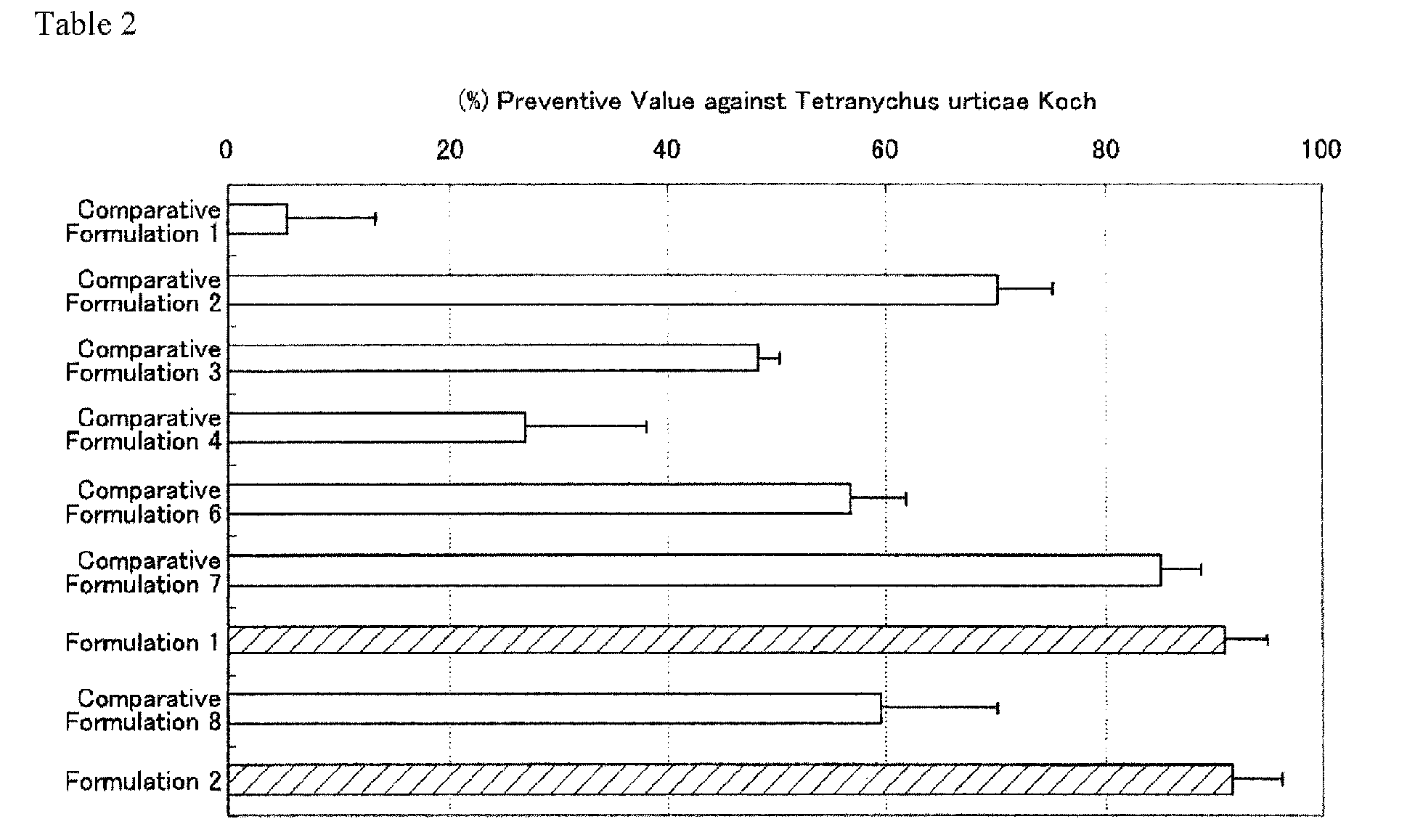
- Adjuvant components (b) and (c) for pesticidal/ovicidal composition used in Examples and Comparative Examples below are in the form of a mixture of diglycerol monooleate (Adjuvant (c)) and polyoxyethylene (42 moles of oxyethylene added) castor oil (Adjuvant (b)) at a mass ratio of 3:1.
- Examples of diglycerol monooleate include Rikemal DO-100 (a product from Riken Vitamin Co., Ltd., Japan).
- polyoxyethylene (42 moles of oxyethylene added) castor oil include Solpole CA-42 (Toho Chemical Industry Co., Ltd., Japan).
- Sunflower oil (containing oleic acid in an amount of about 80% by mass) and Adjuvant A were mixed at a mass ratio (hereinafter, the same will be used) of 80:20 to produce Formulation 1.
- Safflower oil (containing oleic acid in an amount of about 80% by mass) and Adjuvant A were mixed at a ratio of 80:20 to produce Formulation 2.
- Comparative Formulation 1 contained Adjuvant A only.
- Cottonseed oil (containing oleic acid in an amount of about 30% by mass) and Adjuvant A were mixed at a ratio of 80:20 to produce Comparative Formulation 2.
- Tung oil (containing oleic acid in an amount of about 9% by mass) and Adjuvant A were mixed at a ratio of 80:20 to produce Comparative Formulation 4.
- Grape seed oil (containing oleic acid in an amount of about 19% by mass) and Adjuvant A were mixed at a ratio of 80:20 to produce Comparative Formulation 5.
- Sunflower oil (Japanese local variety) (containing oleic acid in an amount of about 35% by mass) and Adjuvant A were mixed at a ratio of 80:20 to produce Comparative Formulation 6.
- Sunflower oil (medium level oleic acid variety) (containing oleic acid in an amount of about 45% by mass) and Adjuvant A were mixed at a ratio of 80:20 to produce Comparative Formulation 7.
- Formulations 1-3 and Comparative Formulations 1-8 were examined for their hatching inhibitory effects on eggs of Tetranychus urticae Koch.
- Tetranychus urticae Koch were released onto snap bean leaf discs and allowed to oviposit for three days while preventing drying by placing filter papers and a water-filled cup, followed by removal of the imagines to prepare Tetranychus urticae Koch eggs for experimental use.
- Each of the formulations diluted by 300-fold with water was sprayed to the leaf disc using a spray gun. Then, the leaf discs were incubated at 25°C to culture the eggs. After five days, efficiency of hatching inhibition was estimated by counting the number of hatched larvae and unhatched eggs. The results are shown in Table 1.
- Formulations 1 and 2 as well as Comparative Formulations 1-4 and 6-8 were examined for their pesticidal/ovicidal effects on Tetranychus urticae Koch.
- leaf discs for Tetranychus urticae Koch growth were cut out of snap bean leaves, on which Tetranychus urticae Koch had been preliminarily grown, and then left in a snap bean seedling pot for three days to allow Tetranychus urticae Koch to grow, followed by spraying each of the formulations diluted by 300-fold with water using a spray gun. Then, the snap bean pot was placed in a glass green house to grow Tetranychus urticae Koch.
- Formulations 4-11 used in Examples of the invention were prepared by mixing 85 parts by mass of safflower oil (containing about 80% by mass of oleic acid) and 15 parts by mass of component (b) listed in Table 3. Formulations 4-11 were examined for their pesticidal/ovicidal effects on Tetranychus urticae Koch. In brief, leaf discs for Tetranychus urticae Koch growth were cut out of snap bean leaves, on which Tetranychus urticae Koch had been preliminarily grown, and then left in a snap bean seedling pot for three days to allow Tetranychus urticae Koch to grow. Three days later, each of the formulations diluted with water (300 mg/ 100 ml) was sprayed using a spray gun.
- the pesticidal/ovicidal composition according to the invention is prepared from food products and food additives as main materials, it has no stress on human bodies and natural environments and no risk of drug resistance induction, and can be applied to vermin pests which already have acquired resistances to other drugs.
- the composition according to the invention can be used at lower concentrations as compared to conventional methods.
- the composition can provide an increased preventive effect on a variety of crop pests per spray as compared to conventional pesticides.
Landscapes
- Life Sciences & Earth Sciences (AREA)
- Health & Medical Sciences (AREA)
- General Health & Medical Sciences (AREA)
- Engineering & Computer Science (AREA)
- Wood Science & Technology (AREA)
- Plant Pathology (AREA)
- Dentistry (AREA)
- Agronomy & Crop Science (AREA)
- Zoology (AREA)
- Environmental Sciences (AREA)
- Biotechnology (AREA)
- Microbiology (AREA)
- Mycology (AREA)
- Natural Medicines & Medicinal Plants (AREA)
- Pest Control & Pesticides (AREA)
- Agricultural Chemicals And Associated Chemicals (AREA)
Abstract
Description
- The present invention relates to a pesticidal/ovicidal composition and a pesticidal/ovicidal method.
- Various agents have been known as a fungicide and a triglyceride-based pesticidal composition against crop pests such as mites and aphids. For example, Patent Document 1 discloses a fungicidal composition comprising a phospholipid and an edible oil. Patent Documents 2 to 4 disclose a miticide comprising animal and vegetable oils and a surfactant. These Documents, however, do not disclose that the above compositions work on mite eggs.
Patent Document 5 discloses a triglyceride composed of unsaturated fatty acid, which shows high pesticidal and ovicidal effects by combining a coconut oil, a palm kernel oil, triglyceride composed of C12 and C14 fatty acids (mixing ratio: from 4:1 to 1:4), triglyceride composed of C12 and C18-1 fatty acids (mixing ratio: from 4:1 to 1:4), triglyceride composed of C12, C14 and C18-1 fatty acids (mixing ratio: 1-4:1-4:1-4), triglyceride composed of C10 and C18-1 fatty acids (mixing ratio: from 4:1 to 1:4), trioleate, and DO-100 (diglycerol oleate) or DL-100 (diglycerol laurate) with a specific adjuvant. However, since glycerides other than the coconut oil and the palm kernel oil are synthetically produced, they require high production costs and are of little practical use.
Accordingly, in recent years, there is a demand for an agent, which is amenable to various applications, has no risk of drug resistance induction, and is safe for crops and natural environment-friendly. -
- Patent Document 1:
JP-A-53-47532 - Patent Document 2:
JP-A-56-92207 - Patent Document 3:
JP-A-56-138105 - Patent Document 4:
JP-A-56-140911 - Patent Document 5:
JP-A-2005-29489 - Accordingly, an object of the invention is to provide a pesticidal/ovicidal composition which has not only a pesticidal effect but also an ovicidal effect on crop pests.
Another object of the invention is to provide a pesticidal/ovicidal method against crop pests. - The present invention has been completed based on a finding that fats and oils having a particular fatty acid composition display excellent pesticidal/ovicidal effects on imagines, larvae and eggs of crop pests. The invention provides pesticidal/ovicidal compositions and pesticidal/ovicidal methods as described below.
- 1. A pesticidal/ovicidal composition comprising:
- (a) 50-99.9 parts by mass of a triglyceride containing not less than 50% of oleic acid as a fatty acid component;
- (b) 0.1-20 parts by mass of a nonionic surface active agent; and
- (c) 0-30 parts by mass of a glycerin derivative.
- 2. The pesticidal/ovicidal composition according to above item 1, wherein said nonionic surface active agent is at least one selected from the group consisting of fatty acid esters and amino acid derivatives.
- 3. The pesticidal/ovicidal composition according to above item 2, wherein said nonionic surface active agent is a fatty acid ester, wherein said fatty acid ester is at least one selected from the group consisting of polyoxyethylene fatty acid esters, sorbitan fatty acid esters, polyoxyethylene sorbitan fatty acid esters and polyoxyethylene glyceryl ether fatty acid esters.
- 4. The pesticidal/ovicidal composition according to above item 3, wherein said fatty acid ester is a polyoxyethylene fatty acid ester, wherein said polyoxyethylene fatty acid ester is at least one selected from the group consisting of polyoxyethylene castor oil, and polyoxyethylene hydrogenated castor oil.
- 5. The pesticidal/ovicidal composition according to any one of above items 1 to 4, further comprising:
- (d) a lower alcohol in an amount not more than 10 parts by mass; and/or
- (e) a vegetable oil in an amount not more than 39 parts by mass, relative to 100 parts by mass of the total amount of the components (a), (b) and (c).
- 6. The pesticidal/ovicidal composition according to any one of above items 1 to 5, which is diluted by 100-fold to1000-fold with water.
- 7. A pesticidal/ovicidal method which comprises the step of spraying to crops the pesticidal/ovicidal composition according to any one of above items 1 to 6, in such an amount that the total amount of the components (a), (b) and (c) is in the range between 0.2 kg/10a and 8 kg/10a.
- 8. The pesticidal/ovicidal method according to above item 7 which comprises the step of spraying to crops the pesticidal/ovicidal composition, in such an amount that the total amount of the components (a), (b) and (c) is in the range between 0.5 kg/10a and 3 kg/10a.
- Since the pesticidal/ovicidal composition according to the invention employs triglyceride, which is used in food, as a main ingredient, it has no stress on human bodies and natural environments and no risk of drug resistance induction, and shows pesticidal and ovicidal effects even on crop pests which already have acquired resistances to other drugs. In addition, the composition according to the invention displays sufficient pesticidal and ovicidal effects even at lower concentrations.
- The triglyceride component (a) used for the composition of the invention contains oleic acid as a constituent fatty acid in an amount not less than 50%, preferably, not less than 55%, and more preferably, not less than 60% by mass. Examples of such triglyceride include olive oil (containing oleic acid in an amount of 60-80% by mass), extra virgin olive oil (60-80% by mass), camellia oil (about 85% by mass), almond oil (60-70% by mass), avocado oil (64-94% by mass), tea seed oil (about 88% by mass), safflower oil (high oleic acid variety) (70-80% by mass), sunflower oil (high oleic acid variety) (75-80% by mass), and oils from other high oleic acid plants. Among these, sunflower oil (high oleic acid variety), safflower oil (high oleic acid variety) and extra virgin olive oil are preferred.
- The composition according to the invention contains component (a) in an amount of 50-99.9 parts by mass, preferably, 70-99.9 parts by mass, and more preferably, 80-99.9 parts by mass, relative to 100 parts by mass of the total amount of components (a), (b) and (c). Triglyceride content of 50-99.9 parts by mass is preferred for the composition of the invention, because triglyceride content in such range tends to exert pesticidal/ovicidal effect.
- For the composition of the invention, an adjuvant containing component (b) or components (b) and (c) is used.
Adjuvant component (b) is a nonionic surface active agent, and preferably at least one selected from the group consisting of fatty acid esters and amino acid derivatives.
Examples of the fatty acid esters include polyoxyethylene fatty acid esters, sorbitan fatty acid esters, polyoxyethylene sorbitan fatty acid esters and polyoxyethylene glyceryl ether fatty acid esters.
Examples of the polyoxyethylene fatty acid esters include polyoxyethylene castor oil and polyoxyethylene hydrogenated castor oil. Polyoxyethylene castor oil is most preferable. - The mole number of polyoxyethylene groups added is preferably between 5-80 moles, more preferably between 10-60 moles, and most preferably between 20-50 moles.
The amino acid derivatives are preferably pyroglutamic acid esters, and more preferably, N-acyl glutamic acid esters.
The pesticidal/ovicidal composition of the invention contains component (b) in an amount of 0.1-20 parts by mass, preferably, 0.1-10 parts by mass, and more preferably, 0.5-5 parts by mass, relative to 100 parts by mass of the total amount of the components (a), (b) and (c). - Preferably, the pesticidal/ovicidal composition of the invention further includes a glycerin derivative as adjuvant component (c). Examples of the glycerin derivative for component (c) include monoglycerol fatty acid esters and polyglycerol fatty acid esters. More specifically, glycerol monoalkyl fatty acid esters, glycerol dialkyl fatty acid esters, polyglycerol monoalkyl fatty acid esters and polyglycerol polyalkyl fatty acid esters are included. Among these, polyglycerol fatty acid esters are preferred, and diglycerol fatty acid esters are more preferred. Preferably, constituent fatty acids for such esters are C12-C18 fatty acids, such as oleic acid and lauric acid.
Specific examples include diglycerol oleate (DO-100), diglycerol laurate (DL-100), tetraglycerol oleate (J-4581), hexaglycerol laurate (J-6021), decaglycerol oleate (J-0381), polyglycerol oleate (AG-7520) and the like.
The pesticidal/ovicidal composition of the invention may contain component (c) in an amount of 0-30 parts by mass, preferably, 0.5-20 parts by mass, and more preferably, 1.0-10 parts by mass, relative to 100 parts by mass of the total amount of components (a), (b) and (c). - The pesticidal/ovicidal composition of the invention may optionally include a lower alcohol as component (d). Examples of such a lower alcohol include a C1-C4 aliphatic alcohol, such as methanol, ethanol, 1-propanol, 2-propanol, 1-butanol, 2-butanol, isobutanol. Among these, ethanol, 1-propanol and 2-propanol are preferable, and 1-propanol and 2-propanol are more preferable.
The pesticidal/ovicidal composition of the invention may contain optional component (d) in an amount not more than 10 parts by mass, preferably, not more than 5 parts by mass, and more preferably, not more than 3 parts by mass, relative to 100 parts by mass of the total amount of components (a), (b) and (c). Use of lower alcohol as component (d) allows components (a), (b) and (c) to be mixed more uniformly, and increases their dispersibility in water. In order to achieve this, it is preferable to use the lower alcohol in an amount not less than 0.1 part by mass. - The pesticidal/ovicidal composition of the invention may optionally include, as component (e), a vegetable oil other than component (a). Examples of such vegetable oil include sesame oil, safflower oil, soybean oil, corn oil, sunflower oil and cottonseed oil. Among these, safflower oil, soybean oil, corn oil, sunflower oil and cottonseed oil are preferable, and soybean oil and cottonseed oil are more preferable.
The pesticidal/ovicidal composition of the invention may contain the optional component (e) in an amount not more than 39 parts by mass, preferably, not more than 20 parts by mass, and more preferably, not more than 15 parts by mass, relative to 100 parts by mass of the total amount of components (a), (b) and (c). Use of a vegetable oil other than (a) as component (e) increases the adhesiveness of the composition to plants and insect bodies, and allows the composition to be mixed more uniformly. In order to achieve this, it is desirable to use the vegetable oil in an amount not less than 1 part by mass, preferably, about 1-15 parts by mass. - The pesticidal/ovicidal composition of the present invention is preferably sprayed after dilution with water by preferably 100-fold to 1000-fold, more preferably 200-fold to 500-fold, so as to attain a total concentration of the active ingredients of preferably about 0.1 to 1% by mass, more preferably about 0.2 to 0.5% by mass.
It is preferable to spray, to crops, the pesticidal/ovicidal composition of the invention, in such an amount that the total amount of components (a), (b) and (c) is in the range between 0.2 kg/10a and 8 kg/10a, more preferably, in the range between 0.5 kg/10a and 3 kg/10a. - In general, the pesticidal/ovicidal composition of the invention can be applied from the initial phase to terminal phase of oviposition, however, the term for application depends on types of vermin pests. Although earlier application provides higher efficiency, the composition of the invention would work when applied even after laid eggs are identified due to its high ovicidal activity.
The pesticidal/ovicidal composition of the invention has a pesticidal effect on any agricultural vermin pests, and ovicidal effect on eggs thereof Examples of the subject vermin pests include: - Lepidopteras: Mamestra brassicae, Leucania separata and Plutella maculipennis;
- Tetranychidae: Panonychus citri, Tetranychus urticae and Tetranychus kanzawai;
- Eriophyidae: Aculus pelekassi and Aculops lycopersici;
- Tarsonemidae: Brevipalpus obovatus;
- Astigmatae: Tyrophagus similes;
- Aphidoideae: Aphis gossypii, Myzus persicae and Aulacorthum solani;
- Hemipterae: Trialeurodes vaporariorus and Bemisia tabaci; and
- Coccoideae: Icerya purchasi, Unaspis yanonensis and Ceroplastes pseudoceriferus.
- The present invention will be explained more in detail by way of referring to Examples, Comparative Examples and Experimental Examples described below. However, these examples are not intended to limit the scope of the invention.
- Adjuvant components (b) and (c) for pesticidal/ovicidal composition used in Examples and Comparative Examples below (hereinafter, an adjuvant containing both of these components will be referred to as "Adjuvant A") are in the form of a mixture of diglycerol monooleate (Adjuvant (c)) and polyoxyethylene (42 moles of oxyethylene added) castor oil (Adjuvant (b)) at a mass ratio of 3:1. Examples of diglycerol monooleate include Rikemal DO-100 (a product from Riken Vitamin Co., Ltd., Japan). Examples of polyoxyethylene (42 moles of oxyethylene added) castor oil include Solpole CA-42 (Toho Chemical Industry Co., Ltd., Japan).
- Sunflower oil (containing oleic acid in an amount of about 80% by mass) and Adjuvant A were mixed at a mass ratio (hereinafter, the same will be used) of 80:20 to produce Formulation 1.
- Safflower oil (containing oleic acid in an amount of about 80% by mass) and Adjuvant A were mixed at a ratio of 80:20 to produce Formulation 2.
- Extra virgin olive oil (containing oleic acid in an amount of about 80% by mass) and Adjuvant A were mixed at a ratio of 80:20 to produce Formulation 3.
- Comparative Formulation 1 contained Adjuvant A only.
- Cottonseed oil (containing oleic acid in an amount of about 30% by mass) and Adjuvant A were mixed at a ratio of 80:20 to produce Comparative Formulation 2.
- Castor oil (containing oleic acid in an amount of about 3% by mass) and Adjuvant A were mixed at a ratio of 80:20 to produce Comparative Formulation 3.
- Tung oil (containing oleic acid in an amount of about 9% by mass) and Adjuvant A were mixed at a ratio of 80:20 to produce Comparative Formulation 4.
- Grape seed oil (containing oleic acid in an amount of about 19% by mass) and Adjuvant A were mixed at a ratio of 80:20 to produce Comparative Formulation 5.
- Sunflower oil (Japanese local variety) (containing oleic acid in an amount of about 35% by mass) and Adjuvant A were mixed at a ratio of 80:20 to produce Comparative Formulation 6.
- Sunflower oil (medium level oleic acid variety) (containing oleic acid in an amount of about 45% by mass) and Adjuvant A were mixed at a ratio of 80:20 to produce Comparative Formulation 7.
- Safflower oil (Japanese local variety) (containing oleic acid in an amount of about 14% by mass) and Adjuvant A were mixed at a ratio of 80:20 to produce Comparative Formulation 8.
- Formulations 1-3 and Comparative Formulations 1-8 were examined for their hatching inhibitory effects on eggs of Tetranychus urticae Koch. In brief, imagines of Tetranychus urticae Koch were released onto snap bean leaf discs and allowed to oviposit for three days while preventing drying by placing filter papers and a water-filled cup, followed by removal of the imagines to prepare Tetranychus urticae Koch eggs for experimental use. Each of the formulations diluted by 300-fold with water was sprayed to the leaf disc using a spray gun. Then, the leaf discs were incubated at 25°C to culture the eggs. After five days, efficiency of hatching inhibition was estimated by counting the number of hatched larvae and unhatched eggs. The results are shown in Table 1.
-

- Formulations 1 and 2 as well as Comparative Formulations 1-4 and 6-8 were examined for their pesticidal/ovicidal effects on Tetranychus urticae Koch. In brief, leaf discs for Tetranychus urticae Koch growth were cut out of snap bean leaves, on which Tetranychus urticae Koch had been preliminarily grown, and then left in a snap bean seedling pot for three days to allow Tetranychus urticae Koch to grow, followed by spraying each of the formulations diluted by 300-fold with water using a spray gun. Then, the snap bean pot was placed in a glass green house to grow Tetranychus urticae Koch. Tetranychus urticae Koch were observed daily and the preventive value was calculated based on the number of female imagines of Tetranychus urticae Koch 14 days after spraying.
(%) Preventive value = 100 - (%) corrected density index
(%) corrected density index = (A1/A0) x (B0/B1) x 100 - A0 : The number of female imagines of Tetranychus urticae Koch before treatment in treatment area
- A1 : The number of female imagines of Tetranychus urticae Koch 14 days after treatment in treatment area
- B0 : The number of female imagines of Tetranychus urticae Koch before treatment in non-treatment area
- B1 : The number of female imagines of Tetranychus urticae Koch 14 days after treatment in non-treatment area
-
- Formulations 4-11 used in Examples of the invention were prepared by mixing 85 parts by mass of safflower oil (containing about 80% by mass of oleic acid) and 15 parts by mass of component (b) listed in Table 3. Formulations 4-11 were examined for their pesticidal/ovicidal effects on Tetranychus urticae Koch. In brief, leaf discs for Tetranychus urticae Koch growth were cut out of snap bean leaves, on which Tetranychus urticae Koch had been preliminarily grown, and then left in a snap bean seedling pot for three days to allow Tetranychus urticae Koch to grow. Three days later, each of the formulations diluted with water (300 mg/ 100 ml) was sprayed using a spray gun. Then, the snap bean pot was placed in a glass green house to grow Tetranychus urticae Koch. Tetranychus urticae Koch were observed daily and the preventive value was calculated based on the number of female imagines of Tetranychus urticae Koch 14 days after spraying. The calculated numbers were categorized as follows. Non-treated areas were defined as reference. The pesticidal/ovicidal effect was evaluated according to the following criteria. The results are shown in Table 3.
- A: 0-2 femail Tetranychus urticae Koch per leaf disc
- B: 3-10 femail Tetranychus urticae Koch per leaf disc
- C: 11-25 femail Tetranychus urticae Koch per leaf disc
- D: 26 or more femail Tetranychus urticae Koch per leaf disc
- In this study, formulations were spayed to imagines and eggs. When the formulation used has no ovicidal effect, the eggs would hatch and eventually metamorphose to imagines. On the other hand, when the formulation has no pesticidal effect, the imagines would survive and lay eggs, which would hatch eventually. Therefore, the number of female imagines of Tetranychus urticae Koch can be employed as an index for the pesticidal/ovicidal effect of the formulation.
-
Table 3 Formulation Nos. Component (b) Pesticidal/Ovicidal Effect 4 Sorbitan Monooleate (18-1) B 5 Sorbitan Sesquioleate (18-1) B 6 POE (20) Sorbitan Monooleate (18-1) A 7 POE (8) Monooleate (18-1) A 8 POE (8) Monostearate (18) A 9 POE (30) Glyceryl Triisostearate A 10 Disteareth-5 Lauroyl Glutamate A 11 POE (40) hydrogenated castor oil PCA Isostearate A Untreated D PCA: pyrrolidone carboxylic acid
Disteareth-5: POE (5) stearyl ether - Since the pesticidal/ovicidal composition according to the invention is prepared from food products and food additives as main materials, it has no stress on human bodies and natural environments and no risk of drug resistance induction, and can be applied to vermin pests which already have acquired resistances to other drugs. In addition, the composition according to the invention can be used at lower concentrations as compared to conventional methods. Furthermore, due to its excellent ovicidal effect, the composition can provide an increased preventive effect on a variety of crop pests per spray as compared to conventional pesticides.
Claims (8)
- A pesticidal/ovicidal composition comprising:(a) 50-99.9 parts by mass of a triglyceride containing not less than 50% of oleic acid as a fatty acid component;(b) 0.1-20 parts by mass of a nonionic surface active agent; and(c) 0-30 parts by mass of a glycerin derivative.
- The pesticidal/ovicidal composition according to claim 1, wherein said nonionic surface active agent is at least one selected from the group consisting of fatty acid esters and amino acid derivatives.
- The pesticidal/ovicidal composition according to claim 2, wherein said nonionic surface active agent is a fatty acid ester, wherein said fatty acid ester is at least one selected from the group consisting of polyoxyethylene fatty acid esters, sorbitan fatty acid esters, polyoxyethylene sorbitan fatty acid esters and polyoxyethylene glyceryl ether fatty acid esters.
- The pesticidal/ovicidal composition according to claim 3, wherein said fatty acid ester is a polyoxyethylene fatty acid ester, wherein said polyoxyethylene fatty acid ester is at least one selected from the group consisting of polyoxyethylene castor oil, and polyoxyethylene hydrogenated castor oil.
- The pesticidal/ovicidal composition according to any one of claims 1 to 4, further comprising:(d) a lower alcohol in an amount not more than 10 parts by mass; and/or(e) a vegetable oil in an amount not more than 39 parts by mass, relative to 100 parts by mass of the total amount of the components (a), (b) and (c).
- The pesticidal/ovicidal composition according to any one of claims 1 to 5, which is diluted by 100-fold to1000-fold with water.
- A pesticidal/ovicidal method which comprises the step of spraying to crops the pesticidal/ovicidal composition according to any one of claims 1 to 6, in such an amount that the total amount of the components (a), (b) and (c) is in the range between 0.2 kg/10a and 8 kg/10a.
- The pesticidal/ovicidal method according to claim 7 which comprises the step of spraying to crops the pesticidal/ovicidal composition, in such an amount that the total amount of the components (a), (b) and (c) is in the range between 0.5 kg/10a and 3 kg/10a.
Applications Claiming Priority (2)
| Application Number | Priority Date | Filing Date | Title |
|---|---|---|---|
| JP2006106727 | 2006-04-07 | ||
| PCT/JP2007/057848 WO2007117001A1 (en) | 2006-04-07 | 2007-04-09 | Insecticidal ovicidal composition and method of insect killing and egg killing |
Publications (3)
| Publication Number | Publication Date |
|---|---|
| EP2036437A1 true EP2036437A1 (en) | 2009-03-18 |
| EP2036437A4 EP2036437A4 (en) | 2012-03-28 |
| EP2036437B1 EP2036437B1 (en) | 2014-10-22 |
Family
ID=38581274
Family Applications (1)
| Application Number | Title | Priority Date | Filing Date |
|---|---|---|---|
| EP20070741284 Active EP2036437B1 (en) | 2006-04-07 | 2007-04-09 | Insecticidal ovicidal composition and method of insect killing and egg killing |
Country Status (5)
| Country | Link |
|---|---|
| US (2) | US20090286877A1 (en) |
| EP (1) | EP2036437B1 (en) |
| JP (1) | JP5181346B2 (en) |
| TW (1) | TWI414238B (en) |
| WO (1) | WO2007117001A1 (en) |
Cited By (5)
| Publication number | Priority date | Publication date | Assignee | Title |
|---|---|---|---|---|
| ES2357826A1 (en) * | 2009-10-16 | 2011-05-03 | Repsol Ypf, S.A. | USE OF OILS IN SPRAY OF VEGETABLE ORIGIN AS INSECTICIDES AGAINST PESTS OF AGRICULTURAL CROPS. |
| WO2011030061A3 (en) * | 2009-09-08 | 2011-07-07 | Fonds De Developpement Des Filieres Des Oleagineux Et Proteagineux (Fidop) | Use of glycerol ethers as activators of the biological effects of a herbicide, fungicide or insecticide substance |
| US9723834B2 (en) | 2010-09-14 | 2017-08-08 | Basf Se | Composition containing a pyripyropene insecticide and a base |
| US9888689B2 (en) | 2010-09-14 | 2018-02-13 | Basf Se | Compositions containing a pyripyropene insecticide and an adjuvant |
| US9924712B2 (en) | 2012-03-12 | 2018-03-27 | Basf Se | Liquid concentrate formulation containing a pyripyropene insecticide II |
Families Citing this family (4)
| Publication number | Priority date | Publication date | Assignee | Title |
|---|---|---|---|---|
| KR102056608B1 (en) | 2012-03-12 | 2019-12-17 | 바스프 에스이 | Method for producing an aqueous suspension concentrate formulation of a pyripyropene insecticide |
| KR102055551B1 (en) | 2012-03-12 | 2019-12-13 | 바스프 에스이 | Liquid concentrate formulation containing a pyripyropene insecticide i |
| JP7684093B2 (en) * | 2020-06-02 | 2025-05-27 | 日本化薬株式会社 | Pest control compositions |
| WO2022158590A1 (en) * | 2021-01-25 | 2022-07-28 | 国立研究開発法人理化学研究所 | Spider mite repellent |
Family Cites Families (10)
| Publication number | Priority date | Publication date | Assignee | Title |
|---|---|---|---|---|
| JPS5347532A (en) | 1976-10-08 | 1978-04-28 | Kumiai Chem Ind Co Ltd | Fungicide comosition for agriculture and horticulture |
| JPS5692207A (en) | 1979-12-27 | 1981-07-25 | Nisshin Oil Mills Ltd:The | Acaricide |
| JPS56138105A (en) | 1980-03-31 | 1981-10-28 | Nisshin Oil Mills Ltd:The | Acaricide |
| JPS56140911A (en) | 1980-04-07 | 1981-11-04 | Nisshin Oil Mills Ltd:The | Miticide |
| AU7894591A (en) * | 1990-05-28 | 1991-12-31 | Sostra S.R.L. | Composition against ozone damages to cultivations and method for its application |
| JP3738430B2 (en) * | 1997-03-07 | 2006-01-25 | 独立行政法人理化学研究所 | Insecticide and acaricide composition and insecticide and acaricide method |
| US20010055628A1 (en) * | 2000-05-12 | 2001-12-27 | Hsu Hsinhung John | Natural oils having a synergistic effect as a pesticide |
| JP2005029489A (en) | 2003-07-10 | 2005-02-03 | Institute Of Physical & Chemical Research | Insecticidal egg-killing composition |
| WO2005115144A1 (en) * | 2004-05-25 | 2005-12-08 | William Stringfellow | Pesticide composition |
| JP5013329B2 (en) | 2004-09-08 | 2012-08-29 | 独立行政法人理化学研究所 | Plant pest repellent and method |
-
2007
- 2007-04-09 WO PCT/JP2007/057848 patent/WO2007117001A1/en not_active Ceased
- 2007-04-09 EP EP20070741284 patent/EP2036437B1/en active Active
- 2007-04-09 TW TW96112280A patent/TWI414238B/en active
- 2007-04-09 JP JP2008509901A patent/JP5181346B2/en active Active
- 2007-04-09 US US12/296,358 patent/US20090286877A1/en not_active Abandoned
-
2015
- 2015-05-07 US US14/706,430 patent/US10130094B2/en active Active
Cited By (6)
| Publication number | Priority date | Publication date | Assignee | Title |
|---|---|---|---|---|
| WO2011030061A3 (en) * | 2009-09-08 | 2011-07-07 | Fonds De Developpement Des Filieres Des Oleagineux Et Proteagineux (Fidop) | Use of glycerol ethers as activators of the biological effects of a herbicide, fungicide or insecticide substance |
| US9179668B2 (en) | 2009-09-08 | 2015-11-10 | Fonds De Developpement Des Filieres Des Oleagineux Et Proteagineux Fidop | Use of glycerol ethers as activators of the biological effects of a herbicide, fungicide or insecticide substance |
| ES2357826A1 (en) * | 2009-10-16 | 2011-05-03 | Repsol Ypf, S.A. | USE OF OILS IN SPRAY OF VEGETABLE ORIGIN AS INSECTICIDES AGAINST PESTS OF AGRICULTURAL CROPS. |
| US9723834B2 (en) | 2010-09-14 | 2017-08-08 | Basf Se | Composition containing a pyripyropene insecticide and a base |
| US9888689B2 (en) | 2010-09-14 | 2018-02-13 | Basf Se | Compositions containing a pyripyropene insecticide and an adjuvant |
| US9924712B2 (en) | 2012-03-12 | 2018-03-27 | Basf Se | Liquid concentrate formulation containing a pyripyropene insecticide II |
Also Published As
| Publication number | Publication date |
|---|---|
| JP5181346B2 (en) | 2013-04-10 |
| US10130094B2 (en) | 2018-11-20 |
| WO2007117001A1 (en) | 2007-10-18 |
| US20150230459A1 (en) | 2015-08-20 |
| TWI414238B (en) | 2013-11-11 |
| TW200810689A (en) | 2008-03-01 |
| EP2036437A4 (en) | 2012-03-28 |
| US20090286877A1 (en) | 2009-11-19 |
| JPWO2007117001A1 (en) | 2009-08-20 |
| EP2036437B1 (en) | 2014-10-22 |
Similar Documents
| Publication | Publication Date | Title |
|---|---|---|
| US10130094B2 (en) | Pesticidal/ovicidal composition and pesticidal/ovicidal method | |
| EP0862861B1 (en) | Insecticides, miticides comprising fatty acid esters and method for killing insects and mites | |
| EP3346835B1 (en) | Insecticide/miticide composition based on fatty acid salts | |
| JP5013329B2 (en) | Plant pest repellent and method | |
| US20060165748A1 (en) | Insecticidal and ovicidal composition | |
| JP3121036B2 (en) | Plant pest control agent | |
| CA2184042C (en) | Triglyceride enhanced pyrethrin-based arthropodicidal composition | |
| US10874099B2 (en) | Sabadilla alkaloid emulsifiable concentrate | |
| US7931911B2 (en) | Pesticidal/ovicidal composition and pesticidal/ovicidal method | |
| EP4494467A1 (en) | Agriculture composition | |
| JP2024009844A (en) | Liquid antipathogenic agricultural composition | |
| KR102956377B1 (en) | Composition for repellent and oviposition inhibition against two-spotted spider mite comprising fatty acid as effective component and uses thereof | |
| WO2022158590A1 (en) | Spider mite repellent | |
| WO2008082028A1 (en) | Mosquito repellent comprising an esterified glycerol. |
Legal Events
| Date | Code | Title | Description |
|---|---|---|---|
| PUAI | Public reference made under article 153(3) epc to a published international application that has entered the european phase |
Free format text: ORIGINAL CODE: 0009012 |
|
| 17P | Request for examination filed |
Effective date: 20081029 |
|
| AK | Designated contracting states |
Kind code of ref document: A1 Designated state(s): AT BE BG CH CY CZ DE DK EE ES FI FR GB GR HU IE IS IT LI LT LU LV MC MT NL PL PT RO SE SI SK TR |
|
| AX | Request for extension of the european patent |
Extension state: AL BA HR MK RS |
|
| A4 | Supplementary search report drawn up and despatched |
Effective date: 20120229 |
|
| RIC1 | Information provided on ipc code assigned before grant |
Ipc: A01N 25/30 20060101ALI20120223BHEP Ipc: A01M 1/20 20060101ALI20120223BHEP Ipc: A01N 37/06 20060101AFI20120223BHEP Ipc: A01N 25/04 20060101ALI20120223BHEP Ipc: A01P 7/04 20060101ALI20120223BHEP Ipc: A01N 37/12 20060101ALI20120223BHEP |
|
| DAX | Request for extension of the european patent (deleted) | ||
| 17Q | First examination report despatched |
Effective date: 20130306 |
|
| REG | Reference to a national code |
Ref country code: DE Ref legal event code: R079 Ref document number: 602007038976 Country of ref document: DE Free format text: PREVIOUS MAIN CLASS: A01N0037060000 Ipc: A01N0065000000 |
|
| RIC1 | Information provided on ipc code assigned before grant |
Ipc: A01N 65/00 20090101AFI20140124BHEP Ipc: A01M 1/20 20060101ALI20140124BHEP Ipc: A01N 37/12 20060101ALI20140124BHEP Ipc: A01N 25/04 20060101ALI20140124BHEP Ipc: A01N 25/30 20060101ALI20140124BHEP Ipc: A01P 7/04 20060101ALI20140124BHEP Ipc: A01N 37/06 20060101ALI20140124BHEP |
|
| GRAP | Despatch of communication of intention to grant a patent |
Free format text: ORIGINAL CODE: EPIDOSNIGR1 |
|
| INTG | Intention to grant announced |
Effective date: 20140409 |
|
| GRAS | Grant fee paid |
Free format text: ORIGINAL CODE: EPIDOSNIGR3 |
|
| GRAA | (expected) grant |
Free format text: ORIGINAL CODE: 0009210 |
|
| AK | Designated contracting states |
Kind code of ref document: B1 Designated state(s): AT BE BG CH CY CZ DE DK EE ES FI FR GB GR HU IE IS IT LI LT LU LV MC MT NL PL PT RO SE SI SK TR |
|
| RAP1 | Party data changed (applicant data changed or rights of an application transferred) |
Owner name: RIKEN |
|
| REG | Reference to a national code |
Ref country code: GB Ref legal event code: FG4D |
|
| REG | Reference to a national code |
Ref country code: CH Ref legal event code: EP |
|
| REG | Reference to a national code |
Ref country code: AT Ref legal event code: REF Ref document number: 692163 Country of ref document: AT Kind code of ref document: T Effective date: 20141115 |
|
| REG | Reference to a national code |
Ref country code: IE Ref legal event code: FG4D |
|
| REG | Reference to a national code |
Ref country code: DE Ref legal event code: R096 Ref document number: 602007038976 Country of ref document: DE Effective date: 20141204 |
|
| REG | Reference to a national code |
Ref country code: NL Ref legal event code: T3 |
|
| REG | Reference to a national code |
Ref country code: AT Ref legal event code: MK05 Ref document number: 692163 Country of ref document: AT Kind code of ref document: T Effective date: 20141022 |
|
| REG | Reference to a national code |
Ref country code: LT Ref legal event code: MG4D |
|
| PG25 | Lapsed in a contracting state [announced via postgrant information from national office to epo] |
Ref country code: PT Free format text: LAPSE BECAUSE OF FAILURE TO SUBMIT A TRANSLATION OF THE DESCRIPTION OR TO PAY THE FEE WITHIN THE PRESCRIBED TIME-LIMIT Effective date: 20150223 Ref country code: LT Free format text: LAPSE BECAUSE OF FAILURE TO SUBMIT A TRANSLATION OF THE DESCRIPTION OR TO PAY THE FEE WITHIN THE PRESCRIBED TIME-LIMIT Effective date: 20141022 Ref country code: ES Free format text: LAPSE BECAUSE OF FAILURE TO SUBMIT A TRANSLATION OF THE DESCRIPTION OR TO PAY THE FEE WITHIN THE PRESCRIBED TIME-LIMIT Effective date: 20141022 Ref country code: FI Free format text: LAPSE BECAUSE OF FAILURE TO SUBMIT A TRANSLATION OF THE DESCRIPTION OR TO PAY THE FEE WITHIN THE PRESCRIBED TIME-LIMIT Effective date: 20141022 Ref country code: IS Free format text: LAPSE BECAUSE OF FAILURE TO SUBMIT A TRANSLATION OF THE DESCRIPTION OR TO PAY THE FEE WITHIN THE PRESCRIBED TIME-LIMIT Effective date: 20150222 |
|
| PG25 | Lapsed in a contracting state [announced via postgrant information from national office to epo] |
Ref country code: CY Free format text: LAPSE BECAUSE OF FAILURE TO SUBMIT A TRANSLATION OF THE DESCRIPTION OR TO PAY THE FEE WITHIN THE PRESCRIBED TIME-LIMIT Effective date: 20141022 Ref country code: GR Free format text: LAPSE BECAUSE OF FAILURE TO SUBMIT A TRANSLATION OF THE DESCRIPTION OR TO PAY THE FEE WITHIN THE PRESCRIBED TIME-LIMIT Effective date: 20150123 Ref country code: LV Free format text: LAPSE BECAUSE OF FAILURE TO SUBMIT A TRANSLATION OF THE DESCRIPTION OR TO PAY THE FEE WITHIN THE PRESCRIBED TIME-LIMIT Effective date: 20141022 Ref country code: SE Free format text: LAPSE BECAUSE OF FAILURE TO SUBMIT A TRANSLATION OF THE DESCRIPTION OR TO PAY THE FEE WITHIN THE PRESCRIBED TIME-LIMIT Effective date: 20141022 Ref country code: PL Free format text: LAPSE BECAUSE OF FAILURE TO SUBMIT A TRANSLATION OF THE DESCRIPTION OR TO PAY THE FEE WITHIN THE PRESCRIBED TIME-LIMIT Effective date: 20141022 Ref country code: AT Free format text: LAPSE BECAUSE OF FAILURE TO SUBMIT A TRANSLATION OF THE DESCRIPTION OR TO PAY THE FEE WITHIN THE PRESCRIBED TIME-LIMIT Effective date: 20141022 |
|
| REG | Reference to a national code |
Ref country code: DE Ref legal event code: R097 Ref document number: 602007038976 Country of ref document: DE |
|
| PG25 | Lapsed in a contracting state [announced via postgrant information from national office to epo] |
Ref country code: CZ Free format text: LAPSE BECAUSE OF FAILURE TO SUBMIT A TRANSLATION OF THE DESCRIPTION OR TO PAY THE FEE WITHIN THE PRESCRIBED TIME-LIMIT Effective date: 20141022 Ref country code: SK Free format text: LAPSE BECAUSE OF FAILURE TO SUBMIT A TRANSLATION OF THE DESCRIPTION OR TO PAY THE FEE WITHIN THE PRESCRIBED TIME-LIMIT Effective date: 20141022 Ref country code: DK Free format text: LAPSE BECAUSE OF FAILURE TO SUBMIT A TRANSLATION OF THE DESCRIPTION OR TO PAY THE FEE WITHIN THE PRESCRIBED TIME-LIMIT Effective date: 20141022 Ref country code: RO Free format text: LAPSE BECAUSE OF FAILURE TO SUBMIT A TRANSLATION OF THE DESCRIPTION OR TO PAY THE FEE WITHIN THE PRESCRIBED TIME-LIMIT Effective date: 20141022 Ref country code: EE Free format text: LAPSE BECAUSE OF FAILURE TO SUBMIT A TRANSLATION OF THE DESCRIPTION OR TO PAY THE FEE WITHIN THE PRESCRIBED TIME-LIMIT Effective date: 20141022 |
|
| PLBE | No opposition filed within time limit |
Free format text: ORIGINAL CODE: 0009261 |
|
| STAA | Information on the status of an ep patent application or granted ep patent |
Free format text: STATUS: NO OPPOSITION FILED WITHIN TIME LIMIT |
|
| PG25 | Lapsed in a contracting state [announced via postgrant information from national office to epo] |
Ref country code: IT Free format text: LAPSE BECAUSE OF FAILURE TO SUBMIT A TRANSLATION OF THE DESCRIPTION OR TO PAY THE FEE WITHIN THE PRESCRIBED TIME-LIMIT Effective date: 20141022 |
|
| 26N | No opposition filed |
Effective date: 20150723 |
|
| PG25 | Lapsed in a contracting state [announced via postgrant information from national office to epo] |
Ref country code: LU Free format text: LAPSE BECAUSE OF FAILURE TO SUBMIT A TRANSLATION OF THE DESCRIPTION OR TO PAY THE FEE WITHIN THE PRESCRIBED TIME-LIMIT Effective date: 20150409 Ref country code: MC Free format text: LAPSE BECAUSE OF FAILURE TO SUBMIT A TRANSLATION OF THE DESCRIPTION OR TO PAY THE FEE WITHIN THE PRESCRIBED TIME-LIMIT Effective date: 20141022 |
|
| REG | Reference to a national code |
Ref country code: CH Ref legal event code: PL |
|
| GBPC | Gb: european patent ceased through non-payment of renewal fee |
Effective date: 20150409 |
|
| REG | Reference to a national code |
Ref country code: IE Ref legal event code: MM4A |
|
| PG25 | Lapsed in a contracting state [announced via postgrant information from national office to epo] |
Ref country code: GB Free format text: LAPSE BECAUSE OF NON-PAYMENT OF DUE FEES Effective date: 20150409 Ref country code: CH Free format text: LAPSE BECAUSE OF NON-PAYMENT OF DUE FEES Effective date: 20150430 Ref country code: LI Free format text: LAPSE BECAUSE OF NON-PAYMENT OF DUE FEES Effective date: 20150430 |
|
| PG25 | Lapsed in a contracting state [announced via postgrant information from national office to epo] |
Ref country code: SI Free format text: LAPSE BECAUSE OF FAILURE TO SUBMIT A TRANSLATION OF THE DESCRIPTION OR TO PAY THE FEE WITHIN THE PRESCRIBED TIME-LIMIT Effective date: 20141022 |
|
| REG | Reference to a national code |
Ref country code: FR Ref legal event code: PLFP Year of fee payment: 10 |
|
| PG25 | Lapsed in a contracting state [announced via postgrant information from national office to epo] |
Ref country code: IE Free format text: LAPSE BECAUSE OF NON-PAYMENT OF DUE FEES Effective date: 20150409 |
|
| PG25 | Lapsed in a contracting state [announced via postgrant information from national office to epo] |
Ref country code: MT Free format text: LAPSE BECAUSE OF FAILURE TO SUBMIT A TRANSLATION OF THE DESCRIPTION OR TO PAY THE FEE WITHIN THE PRESCRIBED TIME-LIMIT Effective date: 20141022 |
|
| REG | Reference to a national code |
Ref country code: FR Ref legal event code: PLFP Year of fee payment: 11 |
|
| PG25 | Lapsed in a contracting state [announced via postgrant information from national office to epo] |
Ref country code: HU Free format text: LAPSE BECAUSE OF FAILURE TO SUBMIT A TRANSLATION OF THE DESCRIPTION OR TO PAY THE FEE WITHIN THE PRESCRIBED TIME-LIMIT; INVALID AB INITIO Effective date: 20070409 Ref country code: BG Free format text: LAPSE BECAUSE OF FAILURE TO SUBMIT A TRANSLATION OF THE DESCRIPTION OR TO PAY THE FEE WITHIN THE PRESCRIBED TIME-LIMIT Effective date: 20141022 |
|
| PG25 | Lapsed in a contracting state [announced via postgrant information from national office to epo] |
Ref country code: TR Free format text: LAPSE BECAUSE OF FAILURE TO SUBMIT A TRANSLATION OF THE DESCRIPTION OR TO PAY THE FEE WITHIN THE PRESCRIBED TIME-LIMIT Effective date: 20141022 |
|
| PG25 | Lapsed in a contracting state [announced via postgrant information from national office to epo] |
Ref country code: BE Free format text: LAPSE BECAUSE OF FAILURE TO SUBMIT A TRANSLATION OF THE DESCRIPTION OR TO PAY THE FEE WITHIN THE PRESCRIBED TIME-LIMIT Effective date: 20141022 |
|
| REG | Reference to a national code |
Ref country code: FR Ref legal event code: PLFP Year of fee payment: 12 |
|
| PGFP | Annual fee paid to national office [announced via postgrant information from national office to epo] |
Ref country code: NL Payment date: 20250418 Year of fee payment: 19 |
|
| PGFP | Annual fee paid to national office [announced via postgrant information from national office to epo] |
Ref country code: DE Payment date: 20250422 Year of fee payment: 19 |
|
| PGFP | Annual fee paid to national office [announced via postgrant information from national office to epo] |
Ref country code: FR Payment date: 20250424 Year of fee payment: 19 |