EP2032118B1 - Cosmetic compositions containing piperidinium compounds - Google Patents
Cosmetic compositions containing piperidinium compounds Download PDFInfo
- Publication number
- EP2032118B1 EP2032118B1 EP07729927A EP07729927A EP2032118B1 EP 2032118 B1 EP2032118 B1 EP 2032118B1 EP 07729927 A EP07729927 A EP 07729927A EP 07729927 A EP07729927 A EP 07729927A EP 2032118 B1 EP2032118 B1 EP 2032118B1
- Authority
- EP
- European Patent Office
- Prior art keywords
- composition
- oxy
- dimethyl
- hydroxyphenylacetyl
- weight
- Prior art date
- Legal status (The legal status is an assumption and is not a legal conclusion. Google has not performed a legal analysis and makes no representation as to the accuracy of the status listed.)
- Not-in-force
Links
- 239000000203 mixture Substances 0.000 title claims description 96
- 239000002537 cosmetic Substances 0.000 title claims description 34
- NQRYJNQNLNOLGT-UHFFFAOYSA-N Piperidine Chemical class C1CCNCC1 NQRYJNQNLNOLGT-UHFFFAOYSA-N 0.000 title description 6
- SVBUCOFTVGICLD-UHFFFAOYSA-M (1,1-dimethylpiperidin-1-ium-4-yl) 2-(6-cyclopentyl-6-hydroxycyclohexa-2,4-dien-1-yl)acetate;bromide Chemical compound [Br-].C1C[N+](C)(C)CCC1OC(=O)CC1C(C2CCCC2)(O)C=CC=C1 SVBUCOFTVGICLD-UHFFFAOYSA-M 0.000 claims description 63
- -1 aluminum compound Chemical class 0.000 claims description 44
- 239000003213 antiperspirant Substances 0.000 claims description 23
- 230000001877 deodorizing effect Effects 0.000 claims description 21
- 230000001166 anti-perspirative effect Effects 0.000 claims description 17
- 239000000443 aerosol Substances 0.000 claims description 16
- 239000000126 substance Substances 0.000 claims description 15
- 239000006071 cream Substances 0.000 claims description 9
- 229910052782 aluminium Inorganic materials 0.000 claims description 8
- 230000002401 inhibitory effect Effects 0.000 claims description 8
- 238000000034 method Methods 0.000 claims description 8
- 239000000843 powder Substances 0.000 claims description 8
- 239000007921 spray Substances 0.000 claims description 8
- AZDRQVAHHNSJOQ-UHFFFAOYSA-N alumane Chemical class [AlH3] AZDRQVAHHNSJOQ-UHFFFAOYSA-N 0.000 claims description 7
- 150000001450 anions Chemical class 0.000 claims description 7
- 239000013543 active substance Substances 0.000 claims description 6
- 239000003795 chemical substances by application Substances 0.000 claims description 6
- 150000003839 salts Chemical class 0.000 claims description 6
- 239000007788 liquid Substances 0.000 claims description 5
- 239000006210 lotion Substances 0.000 claims description 5
- 229940098458 powder spray Drugs 0.000 claims description 5
- 229940098465 tincture Drugs 0.000 claims description 5
- VSCWAEJMTAWNJL-UHFFFAOYSA-K aluminium trichloride Chemical compound Cl[Al](Cl)Cl VSCWAEJMTAWNJL-UHFFFAOYSA-K 0.000 claims description 4
- 239000002674 ointment Substances 0.000 claims description 4
- 239000007787 solid Substances 0.000 claims description 4
- 239000004753 textile Substances 0.000 claims description 4
- 235000010654 Melissa officinalis Nutrition 0.000 claims description 3
- 239000003788 bath preparation Substances 0.000 claims description 3
- 239000004744 fabric Substances 0.000 claims description 3
- 239000000865 liniment Substances 0.000 claims description 3
- 235000013336 milk Nutrition 0.000 claims description 3
- 239000008267 milk Substances 0.000 claims description 3
- 210000004080 milk Anatomy 0.000 claims description 3
- 239000002453 shampoo Substances 0.000 claims description 3
- 239000000344 soap Substances 0.000 claims description 3
- 125000006552 (C3-C8) cycloalkyl group Chemical group 0.000 claims description 2
- ZGUQGPFMMTZGBQ-UHFFFAOYSA-N [Al].[Al].[Zr] Chemical compound [Al].[Al].[Zr] ZGUQGPFMMTZGBQ-UHFFFAOYSA-N 0.000 claims description 2
- 238000004519 manufacturing process Methods 0.000 claims description 2
- 125000001997 phenyl group Chemical group [H]C1=C([H])C([H])=C(*)C([H])=C1[H] 0.000 claims description 2
- 241000021559 Dicerandra Species 0.000 claims 1
- 238000002560 therapeutic procedure Methods 0.000 claims 1
- XLYOFNOQVPJJNP-UHFFFAOYSA-N water Substances O XLYOFNOQVPJJNP-UHFFFAOYSA-N 0.000 description 52
- 239000002304 perfume Substances 0.000 description 45
- OSCJHTSDLYVCQC-UHFFFAOYSA-N 2-ethylhexyl 4-[[4-[4-(tert-butylcarbamoyl)anilino]-6-[4-(2-ethylhexoxycarbonyl)anilino]-1,3,5-triazin-2-yl]amino]benzoate Chemical compound C1=CC(C(=O)OCC(CC)CCCC)=CC=C1NC1=NC(NC=2C=CC(=CC=2)C(=O)NC(C)(C)C)=NC(NC=2C=CC(=CC=2)C(=O)OCC(CC)CCCC)=N1 OSCJHTSDLYVCQC-UHFFFAOYSA-N 0.000 description 43
- 239000002994 raw material Substances 0.000 description 43
- LFQSCWFLJHTTHZ-UHFFFAOYSA-N Ethanol Chemical compound CCO LFQSCWFLJHTTHZ-UHFFFAOYSA-N 0.000 description 39
- PEDCQBHIVMGVHV-UHFFFAOYSA-N Glycerine Chemical compound OCC(O)CO PEDCQBHIVMGVHV-UHFFFAOYSA-N 0.000 description 38
- 238000002360 preparation method Methods 0.000 description 33
- RTZKZFJDLAIYFH-UHFFFAOYSA-N Diethyl ether Chemical compound CCOCC RTZKZFJDLAIYFH-UHFFFAOYSA-N 0.000 description 22
- 239000003963 antioxidant agent Substances 0.000 description 21
- 150000001875 compounds Chemical class 0.000 description 21
- VYPSYNLAJGMNEJ-UHFFFAOYSA-N Silicium dioxide Chemical compound O=[Si]=O VYPSYNLAJGMNEJ-UHFFFAOYSA-N 0.000 description 20
- GLDOVTGHNKAZLK-UHFFFAOYSA-N octadecan-1-ol Chemical compound CCCCCCCCCCCCCCCCCCO GLDOVTGHNKAZLK-UHFFFAOYSA-N 0.000 description 20
- 235000011187 glycerol Nutrition 0.000 description 19
- 239000004205 dimethyl polysiloxane Substances 0.000 description 18
- 235000013870 dimethyl polysiloxane Nutrition 0.000 description 18
- 229920000435 poly(dimethylsiloxane) Polymers 0.000 description 18
- 229940086555 cyclomethicone Drugs 0.000 description 17
- 229920001577 copolymer Polymers 0.000 description 16
- WWZKQHOCKIZLMA-UHFFFAOYSA-N octanoic acid Chemical compound CCCCCCCC(O)=O WWZKQHOCKIZLMA-UHFFFAOYSA-N 0.000 description 16
- 239000000454 talc Substances 0.000 description 16
- 229910052623 talc Inorganic materials 0.000 description 16
- LVYZJEPLMYTTGH-UHFFFAOYSA-H dialuminum chloride pentahydroxide dihydrate Chemical compound [Cl-].[Al+3].[OH-].[OH-].[Al+3].[OH-].[OH-].[OH-].O.O LVYZJEPLMYTTGH-UHFFFAOYSA-H 0.000 description 15
- XMSXQFUHVRWGNA-UHFFFAOYSA-N Decamethylcyclopentasiloxane Chemical compound C[Si]1(C)O[Si](C)(C)O[Si](C)(C)O[Si](C)(C)O[Si](C)(C)O1 XMSXQFUHVRWGNA-UHFFFAOYSA-N 0.000 description 14
- 239000002202 Polyethylene glycol Substances 0.000 description 14
- 239000002781 deodorant agent Substances 0.000 description 14
- 229920001223 polyethylene glycol Polymers 0.000 description 14
- 239000003755 preservative agent Substances 0.000 description 14
- 229920001661 Chitosan Polymers 0.000 description 13
- HBXWUCXDUUJDRB-UHFFFAOYSA-N 1-octadecoxyoctadecane Chemical compound CCCCCCCCCCCCCCCCCCOCCCCCCCCCCCCCCCCCC HBXWUCXDUUJDRB-UHFFFAOYSA-N 0.000 description 12
- QCDWFXQBSFUVSP-UHFFFAOYSA-N 2-phenoxyethanol Chemical compound OCCOC1=CC=CC=C1 QCDWFXQBSFUVSP-UHFFFAOYSA-N 0.000 description 12
- 239000000839 emulsion Substances 0.000 description 12
- JVTAAEKCZFNVCJ-UHFFFAOYSA-N lactic acid Chemical compound CC(O)C(O)=O JVTAAEKCZFNVCJ-UHFFFAOYSA-N 0.000 description 12
- 229960005323 phenoxyethanol Drugs 0.000 description 12
- 229920002125 Sokalan® Polymers 0.000 description 11
- DLAHAXOYRFRPFQ-UHFFFAOYSA-N dodecyl benzoate Chemical compound CCCCCCCCCCCCOC(=O)C1=CC=CC=C1 DLAHAXOYRFRPFQ-UHFFFAOYSA-N 0.000 description 11
- 239000003921 oil Substances 0.000 description 11
- 235000019198 oils Nutrition 0.000 description 11
- NIXOWILDQLNWCW-UHFFFAOYSA-N 2-Propenoic acid Natural products OC(=O)C=C NIXOWILDQLNWCW-UHFFFAOYSA-N 0.000 description 10
- 229920003171 Poly (ethylene oxide) Polymers 0.000 description 10
- 239000000945 filler Substances 0.000 description 10
- 239000000377 silicon dioxide Substances 0.000 description 10
- 229940008099 dimethicone Drugs 0.000 description 9
- 239000001245 distarch phosphate Substances 0.000 description 9
- 235000013804 distarch phosphate Nutrition 0.000 description 9
- 239000004530 micro-emulsion Substances 0.000 description 9
- GOQYKNQRPGWPLP-UHFFFAOYSA-N n-heptadecyl alcohol Natural products CCCCCCCCCCCCCCCCCO GOQYKNQRPGWPLP-UHFFFAOYSA-N 0.000 description 9
- OULAJFUGPPVRBK-UHFFFAOYSA-N tetratriacontyl alcohol Natural products CCCCCCCCCCCCCCCCCCCCCCCCCCCCCCCCCCO OULAJFUGPPVRBK-UHFFFAOYSA-N 0.000 description 9
- LEACJMVNYZDSKR-UHFFFAOYSA-N 2-octyldodecan-1-ol Chemical compound CCCCCCCCCCC(CO)CCCCCCCC LEACJMVNYZDSKR-UHFFFAOYSA-N 0.000 description 8
- 230000015572 biosynthetic process Effects 0.000 description 8
- 239000004359 castor oil Substances 0.000 description 8
- 235000019438 castor oil Nutrition 0.000 description 8
- 239000000499 gel Substances 0.000 description 8
- ZEMPKEQAKRGZGQ-XOQCFJPHSA-N glycerol triricinoleate Natural products CCCCCC[C@@H](O)CC=CCCCCCCCC(=O)OC[C@@H](COC(=O)CCCCCCCC=CC[C@@H](O)CCCCCC)OC(=O)CCCCCCCC=CC[C@H](O)CCCCCC ZEMPKEQAKRGZGQ-XOQCFJPHSA-N 0.000 description 8
- BXWNKGSJHAJOGX-UHFFFAOYSA-N hexadecan-1-ol Chemical compound CCCCCCCCCCCCCCCCO BXWNKGSJHAJOGX-UHFFFAOYSA-N 0.000 description 8
- 239000002562 thickening agent Substances 0.000 description 8
- 230000000699 topical effect Effects 0.000 description 8
- NKEQOUMMGPBKMM-UHFFFAOYSA-N 2-hydroxy-2-[2-(2-hydroxy-3-octadecanoyloxypropoxy)-2-oxoethyl]butanedioic acid Chemical compound CCCCCCCCCCCCCCCCCC(=O)OCC(O)COC(=O)CC(O)(C(O)=O)CC(O)=O NKEQOUMMGPBKMM-UHFFFAOYSA-N 0.000 description 7
- 239000000654 additive Substances 0.000 description 7
- BQMNFPBUAQPINY-UHFFFAOYSA-N azane;2-methyl-2-(prop-2-enoylamino)propane-1-sulfonic acid Chemical compound [NH4+].[O-]S(=O)(=O)CC(C)(C)NC(=O)C=C BQMNFPBUAQPINY-UHFFFAOYSA-N 0.000 description 7
- 230000000694 effects Effects 0.000 description 7
- 229920000642 polymer Polymers 0.000 description 7
- 229920006395 saturated elastomer Polymers 0.000 description 7
- ASKIVFGGGGIGKH-UHFFFAOYSA-N 2,3-dihydroxypropyl 16-methylheptadecanoate Chemical compound CC(C)CCCCCCCCCCCCCCC(=O)OCC(O)CO ASKIVFGGGGIGKH-UHFFFAOYSA-N 0.000 description 6
- 239000005635 Caprylic acid (CAS 124-07-2) Substances 0.000 description 6
- KCXVZYZYPLLWCC-UHFFFAOYSA-N EDTA Chemical compound OC(=O)CN(CC(O)=O)CCN(CC(O)=O)CC(O)=O KCXVZYZYPLLWCC-UHFFFAOYSA-N 0.000 description 6
- DNIAPMSPPWPWGF-UHFFFAOYSA-N Propylene glycol Chemical compound CC(O)CO DNIAPMSPPWPWGF-UHFFFAOYSA-N 0.000 description 6
- GWEVSGVZZGPLCZ-UHFFFAOYSA-N Titan oxide Chemical compound O=[Ti]=O GWEVSGVZZGPLCZ-UHFFFAOYSA-N 0.000 description 6
- 229960001631 carbomer Drugs 0.000 description 6
- KRKNYBCHXYNGOX-UHFFFAOYSA-N citric acid Chemical compound OC(=O)CC(O)(C(O)=O)CC(O)=O KRKNYBCHXYNGOX-UHFFFAOYSA-N 0.000 description 6
- 239000008139 complexing agent Substances 0.000 description 6
- 239000000470 constituent Substances 0.000 description 6
- 239000003814 drug Substances 0.000 description 6
- 238000005755 formation reaction Methods 0.000 description 6
- 238000009472 formulation Methods 0.000 description 6
- BANXPJUEBPWEOT-UHFFFAOYSA-N isohexadecane Natural products CCCCCCCCCCCCCC(C)C BANXPJUEBPWEOT-UHFFFAOYSA-N 0.000 description 6
- 229940119170 jojoba wax Drugs 0.000 description 6
- 239000004310 lactic acid Substances 0.000 description 6
- 235000014655 lactic acid Nutrition 0.000 description 6
- 229920002545 silicone oil Polymers 0.000 description 6
- LADGBHLMCUINGV-UHFFFAOYSA-N tricaprin Chemical compound CCCCCCCCCC(=O)OCC(OC(=O)CCCCCCCCC)COC(=O)CCCCCCCCC LADGBHLMCUINGV-UHFFFAOYSA-N 0.000 description 6
- 239000000230 xanthan gum Substances 0.000 description 6
- 235000010493 xanthan gum Nutrition 0.000 description 6
- 229920001285 xanthan gum Polymers 0.000 description 6
- 229940082509 xanthan gum Drugs 0.000 description 6
- OARDBPIZDHVTCK-UHFFFAOYSA-N 2-butyloctanoic acid Chemical compound CCCCCCC(C(O)=O)CCCC OARDBPIZDHVTCK-UHFFFAOYSA-N 0.000 description 5
- 239000004354 Hydroxyethyl cellulose Substances 0.000 description 5
- 229920000663 Hydroxyethyl cellulose Polymers 0.000 description 5
- 239000004907 Macro-emulsion Substances 0.000 description 5
- 235000021302 avocado oil Nutrition 0.000 description 5
- 239000008163 avocado oil Substances 0.000 description 5
- 229910052681 coesite Inorganic materials 0.000 description 5
- 239000003086 colorant Substances 0.000 description 5
- 229910052906 cristobalite Inorganic materials 0.000 description 5
- 235000019447 hydroxyethyl cellulose Nutrition 0.000 description 5
- 239000012071 phase Substances 0.000 description 5
- 239000003380 propellant Substances 0.000 description 5
- 239000011734 sodium Substances 0.000 description 5
- 229910052682 stishovite Inorganic materials 0.000 description 5
- 229910052905 tridymite Inorganic materials 0.000 description 5
- LODUNVCFMXTGDB-UHFFFAOYSA-N (1,1-dimethylpiperidin-1-ium-4-yl) 2-(6-cyclopentyl-6-hydroxycyclohexa-2,4-dien-1-yl)acetate Chemical compound C1C[N+](C)(C)CCC1OC(=O)CC1C(C2CCCC2)(O)C=CC=C1 LODUNVCFMXTGDB-UHFFFAOYSA-N 0.000 description 4
- 229940043268 2,2,4,4,6,8,8-heptamethylnonane Drugs 0.000 description 4
- SMZOUWXMTYCWNB-UHFFFAOYSA-N 2-(2-methoxy-5-methylphenyl)ethanamine Chemical compound COC1=CC=C(C)C=C1CCN SMZOUWXMTYCWNB-UHFFFAOYSA-N 0.000 description 4
- LEGVTAFKUDAZRE-UHFFFAOYSA-N 5-ethylnonane-1,2,3-triol Chemical compound CCCCC(CC)CC(O)C(O)CO LEGVTAFKUDAZRE-UHFFFAOYSA-N 0.000 description 4
- 239000004322 Butylated hydroxytoluene Substances 0.000 description 4
- XEEYBQQBJWHFJM-UHFFFAOYSA-N Iron Chemical compound [Fe] XEEYBQQBJWHFJM-UHFFFAOYSA-N 0.000 description 4
- XLOMVQKBTHCTTD-UHFFFAOYSA-N Zinc monoxide Chemical compound [Zn]=O XLOMVQKBTHCTTD-UHFFFAOYSA-N 0.000 description 4
- 239000002253 acid Substances 0.000 description 4
- 150000001298 alcohols Chemical class 0.000 description 4
- 125000005250 alkyl acrylate group Chemical group 0.000 description 4
- POJWUDADGALRAB-UHFFFAOYSA-N allantoin Chemical compound NC(=O)NC1NC(=O)NC1=O POJWUDADGALRAB-UHFFFAOYSA-N 0.000 description 4
- CEGOLXSVJUTHNZ-UHFFFAOYSA-K aluminium tristearate Chemical compound [Al+3].CCCCCCCCCCCCCCCCCC([O-])=O.CCCCCCCCCCCCCCCCCC([O-])=O.CCCCCCCCCCCCCCCCCC([O-])=O CEGOLXSVJUTHNZ-UHFFFAOYSA-K 0.000 description 4
- 229940063655 aluminum stearate Drugs 0.000 description 4
- BTFJIXJJCSYFAL-UHFFFAOYSA-N arachidyl alcohol Natural products CCCCCCCCCCCCCCCCCCCCO BTFJIXJJCSYFAL-UHFFFAOYSA-N 0.000 description 4
- 235000012216 bentonite Nutrition 0.000 description 4
- 125000004432 carbon atom Chemical group C* 0.000 description 4
- 229960000541 cetyl alcohol Drugs 0.000 description 4
- 238000006243 chemical reaction Methods 0.000 description 4
- 229920006037 cross link polymer Polymers 0.000 description 4
- 125000004122 cyclic group Chemical group 0.000 description 4
- GHVNFZFCNZKVNT-UHFFFAOYSA-N decanoic acid Chemical compound CCCCCCCCCC(O)=O GHVNFZFCNZKVNT-UHFFFAOYSA-N 0.000 description 4
- GUJOJGAPFQRJSV-UHFFFAOYSA-N dialuminum;dioxosilane;oxygen(2-);hydrate Chemical compound O.[O-2].[O-2].[O-2].[Al+3].[Al+3].O=[Si]=O.O=[Si]=O.O=[Si]=O.O=[Si]=O GUJOJGAPFQRJSV-UHFFFAOYSA-N 0.000 description 4
- SOROIESOUPGGFO-UHFFFAOYSA-N diazolidinylurea Chemical compound OCNC(=O)N(CO)C1N(CO)C(=O)N(CO)C1=O SOROIESOUPGGFO-UHFFFAOYSA-N 0.000 description 4
- 235000014113 dietary fatty acids Nutrition 0.000 description 4
- PKPOVTYZGGYDIJ-UHFFFAOYSA-N dioctyl carbonate Chemical compound CCCCCCCCOC(=O)OCCCCCCCC PKPOVTYZGGYDIJ-UHFFFAOYSA-N 0.000 description 4
- 229940102552 disteardimonium hectorite Drugs 0.000 description 4
- 238000005516 engineering process Methods 0.000 description 4
- 150000002148 esters Chemical class 0.000 description 4
- 239000000194 fatty acid Substances 0.000 description 4
- 229930195729 fatty acid Natural products 0.000 description 4
- JMOLZNNXZPAGBH-UHFFFAOYSA-N hexyldecanoic acid Chemical compound CCCCCCCCC(C(O)=O)CCCCCC JMOLZNNXZPAGBH-UHFFFAOYSA-N 0.000 description 4
- 229950004531 hexyldecanoic acid Drugs 0.000 description 4
- 229930195733 hydrocarbon Natural products 0.000 description 4
- KUVMKLCGXIYSNH-UHFFFAOYSA-N isopentadecane Natural products CCCCCCCCCCCCC(C)C KUVMKLCGXIYSNH-UHFFFAOYSA-N 0.000 description 4
- 229910052751 metal Inorganic materials 0.000 description 4
- 239000002184 metal Substances 0.000 description 4
- 125000002496 methyl group Chemical group [H]C([H])([H])* 0.000 description 4
- 229910052901 montmorillonite Inorganic materials 0.000 description 4
- 229960002446 octanoic acid Drugs 0.000 description 4
- 229910052615 phyllosilicate Inorganic materials 0.000 description 4
- 229920001451 polypropylene glycol Polymers 0.000 description 4
- 235000012239 silicon dioxide Nutrition 0.000 description 4
- 239000004094 surface-active agent Substances 0.000 description 4
- 210000000106 sweat gland Anatomy 0.000 description 4
- 238000012360 testing method Methods 0.000 description 4
- 229940124597 therapeutic agent Drugs 0.000 description 4
- PUPZLCDOIYMWBV-UHFFFAOYSA-N (+/-)-1,3-Butanediol Chemical compound CC(O)CCO PUPZLCDOIYMWBV-UHFFFAOYSA-N 0.000 description 3
- CYGOIKAXOWKXRO-UHFFFAOYSA-M (1,1-dimethylpiperidin-1-ium-4-yl) 2-(6-cyclohexyl-6-hydroxycyclohexa-2,4-dien-1-yl)acetate;bromide Chemical compound [Br-].C1C[N+](C)(C)CCC1OC(=O)CC1C(C2CCCCC2)(O)C=CC=C1 CYGOIKAXOWKXRO-UHFFFAOYSA-M 0.000 description 3
- NKJOXAZJBOMXID-UHFFFAOYSA-N 1,1'-Oxybisoctane Chemical compound CCCCCCCCOCCCCCCCC NKJOXAZJBOMXID-UHFFFAOYSA-N 0.000 description 3
- VBICKXHEKHSIBG-UHFFFAOYSA-N 1-monostearoylglycerol Chemical compound CCCCCCCCCCCCCCCCCC(=O)OCC(O)CO VBICKXHEKHSIBG-UHFFFAOYSA-N 0.000 description 3
- IIZPXYDJLKNOIY-JXPKJXOSSA-N 1-palmitoyl-2-arachidonoyl-sn-glycero-3-phosphocholine Chemical compound CCCCCCCCCCCCCCCC(=O)OC[C@H](COP([O-])(=O)OCC[N+](C)(C)C)OC(=O)CCC\C=C/C\C=C/C\C=C/C\C=C/CCCCC IIZPXYDJLKNOIY-JXPKJXOSSA-N 0.000 description 3
- LQXBZWFNAKZUNM-UHFFFAOYSA-N 16-methyl-1-(16-methylheptadecoxy)heptadecane Chemical compound CC(C)CCCCCCCCCCCCCCCOCCCCCCCCCCCCCCCC(C)C LQXBZWFNAKZUNM-UHFFFAOYSA-N 0.000 description 3
- FLPJVCMIKUWSDR-UHFFFAOYSA-N 2-(4-formylphenoxy)acetamide Chemical compound NC(=O)COC1=CC=C(C=O)C=C1 FLPJVCMIKUWSDR-UHFFFAOYSA-N 0.000 description 3
- RFVNOJDQRGSOEL-UHFFFAOYSA-N 2-hydroxyethyl octadecanoate Chemical compound CCCCCCCCCCCCCCCCCC(=O)OCCO RFVNOJDQRGSOEL-UHFFFAOYSA-N 0.000 description 3
- FJKROLUGYXJWQN-UHFFFAOYSA-N 4-hydroxybenzoic acid Chemical compound OC(=O)C1=CC=C(O)C=C1 FJKROLUGYXJWQN-UHFFFAOYSA-N 0.000 description 3
- 239000005632 Capric acid (CAS 334-48-5) Substances 0.000 description 3
- KXDHJXZQYSOELW-UHFFFAOYSA-M Carbamate Chemical compound NC([O-])=O KXDHJXZQYSOELW-UHFFFAOYSA-M 0.000 description 3
- 229920000858 Cyclodextrin Polymers 0.000 description 3
- ZAKOWWREFLAJOT-CEFNRUSXSA-N D-alpha-tocopherylacetate Chemical compound CC(=O)OC1=C(C)C(C)=C2O[C@@](CCC[C@H](C)CCC[C@H](C)CCCC(C)C)(C)CCC2=C1C ZAKOWWREFLAJOT-CEFNRUSXSA-N 0.000 description 3
- FEWJPZIEWOKRBE-JCYAYHJZSA-N Dextrotartaric acid Chemical compound OC(=O)[C@H](O)[C@@H](O)C(O)=O FEWJPZIEWOKRBE-JCYAYHJZSA-N 0.000 description 3
- WSFSSNUMVMOOMR-UHFFFAOYSA-N Formaldehyde Chemical compound O=C WSFSSNUMVMOOMR-UHFFFAOYSA-N 0.000 description 3
- JVTAAEKCZFNVCJ-UHFFFAOYSA-M Lactate Chemical compound CC(O)C([O-])=O JVTAAEKCZFNVCJ-UHFFFAOYSA-M 0.000 description 3
- 229920002701 Polyoxyl 40 Stearate Polymers 0.000 description 3
- HEMHJVSKTPXQMS-UHFFFAOYSA-M Sodium hydroxide Chemical compound [OH-].[Na+] HEMHJVSKTPXQMS-UHFFFAOYSA-M 0.000 description 3
- FEWJPZIEWOKRBE-UHFFFAOYSA-N Tartaric acid Natural products [H+].[H+].[O-]C(=O)C(O)C(O)C([O-])=O FEWJPZIEWOKRBE-UHFFFAOYSA-N 0.000 description 3
- 150000007513 acids Chemical class 0.000 description 3
- 150000001252 acrylic acid derivatives Chemical class 0.000 description 3
- 230000001476 alcoholic effect Effects 0.000 description 3
- 125000005907 alkyl ester group Chemical group 0.000 description 3
- 230000000845 anti-microbial effect Effects 0.000 description 3
- 230000001857 anti-mycotic effect Effects 0.000 description 3
- 239000002543 antimycotic Substances 0.000 description 3
- 125000004429 atom Chemical group 0.000 description 3
- 239000000440 bentonite Substances 0.000 description 3
- 229910000278 bentonite Inorganic materials 0.000 description 3
- SVPXDRXYRYOSEX-UHFFFAOYSA-N bentoquatam Chemical compound O.O=[Si]=O.O=[Al]O[Al]=O SVPXDRXYRYOSEX-UHFFFAOYSA-N 0.000 description 3
- 229940074979 cetyl palmitate Drugs 0.000 description 3
- 239000002738 chelating agent Substances 0.000 description 3
- 229960001083 diazolidinylurea Drugs 0.000 description 3
- 239000003995 emulsifying agent Substances 0.000 description 3
- 239000007789 gas Substances 0.000 description 3
- 239000003349 gelling agent Substances 0.000 description 3
- PXDJXZJSCPSGGI-UHFFFAOYSA-N hexadecanoic acid hexadecyl ester Natural products CCCCCCCCCCCCCCCCOC(=O)CCCCCCCCCCCCCCC PXDJXZJSCPSGGI-UHFFFAOYSA-N 0.000 description 3
- 150000002430 hydrocarbons Chemical class 0.000 description 3
- 239000000787 lecithin Substances 0.000 description 3
- 235000010445 lecithin Nutrition 0.000 description 3
- 229940067606 lecithin Drugs 0.000 description 3
- 229920005615 natural polymer Polymers 0.000 description 3
- CKQVRZJOMJRTOY-UHFFFAOYSA-N octadecanoic acid;propane-1,2,3-triol Chemical compound OCC(O)CO.CCCCCCCCCCCCCCCCCC(O)=O CKQVRZJOMJRTOY-UHFFFAOYSA-N 0.000 description 3
- UWJJYHHHVWZFEP-UHFFFAOYSA-N pentane-1,1-diol Chemical compound CCCCC(O)O UWJJYHHHVWZFEP-UHFFFAOYSA-N 0.000 description 3
- 239000000825 pharmaceutical preparation Substances 0.000 description 3
- 229940068918 polyethylene glycol 400 Drugs 0.000 description 3
- 229960004063 propylene glycol Drugs 0.000 description 3
- 239000000243 solution Substances 0.000 description 3
- 229920001059 synthetic polymer Polymers 0.000 description 3
- 239000011975 tartaric acid Substances 0.000 description 3
- 235000002906 tartaric acid Nutrition 0.000 description 3
- 239000001993 wax Substances 0.000 description 3
- VNDYJBBGRKZCSX-UHFFFAOYSA-L zinc bromide Chemical compound Br[Zn]Br VNDYJBBGRKZCSX-UHFFFAOYSA-L 0.000 description 3
- JNYAEWCLZODPBN-JGWLITMVSA-N (2r,3r,4s)-2-[(1r)-1,2-dihydroxyethyl]oxolane-3,4-diol Chemical class OC[C@@H](O)[C@H]1OC[C@H](O)[C@H]1O JNYAEWCLZODPBN-JGWLITMVSA-N 0.000 description 2
- DURPTKYDGMDSBL-UHFFFAOYSA-N 1-butoxybutane Chemical compound CCCCOCCCC DURPTKYDGMDSBL-UHFFFAOYSA-N 0.000 description 2
- QWGRWMMWNDWRQN-UHFFFAOYSA-N 2-methylpropane-1,3-diol Chemical compound OCC(C)CO QWGRWMMWNDWRQN-UHFFFAOYSA-N 0.000 description 2
- PBFGMXZRJIUGKU-UHFFFAOYSA-N 3-decanoyloxybutyl decanoate Chemical compound CCCCCCCCCC(=O)OCCC(C)OC(=O)CCCCCCCCC PBFGMXZRJIUGKU-UHFFFAOYSA-N 0.000 description 2
- LFESLSYSZQYEIZ-UHFFFAOYSA-N 3-octanoyloxybutyl octanoate Chemical compound CCCCCCCC(=O)OCCC(C)OC(=O)CCCCCCC LFESLSYSZQYEIZ-UHFFFAOYSA-N 0.000 description 2
- HBAQYPYDRFILMT-UHFFFAOYSA-N 8-[3-(1-cyclopropylpyrazol-4-yl)-1H-pyrazolo[4,3-d]pyrimidin-5-yl]-3-methyl-3,8-diazabicyclo[3.2.1]octan-2-one Chemical class C1(CC1)N1N=CC(=C1)C1=NNC2=C1N=C(N=C2)N1C2C(N(CC1CC2)C)=O HBAQYPYDRFILMT-UHFFFAOYSA-N 0.000 description 2
- 229910018323 Al0.33Si3.67 Inorganic materials 0.000 description 2
- POJWUDADGALRAB-PVQJCKRUSA-N Allantoin Natural products NC(=O)N[C@@H]1NC(=O)NC1=O POJWUDADGALRAB-PVQJCKRUSA-N 0.000 description 2
- 241000894006 Bacteria Species 0.000 description 2
- QFOHBWFCKVYLES-UHFFFAOYSA-N Butylparaben Chemical compound CCCCOC(=O)C1=CC=C(O)C=C1 QFOHBWFCKVYLES-UHFFFAOYSA-N 0.000 description 2
- 239000004215 Carbon black (E152) Substances 0.000 description 2
- BVKZGUZCCUSVTD-UHFFFAOYSA-L Carbonate Chemical compound [O-]C([O-])=O BVKZGUZCCUSVTD-UHFFFAOYSA-L 0.000 description 2
- 239000005714 Chitosan hydrochloride Substances 0.000 description 2
- QZKRHPLGUJDVAR-UHFFFAOYSA-K EDTA trisodium salt Chemical compound [Na+].[Na+].[Na+].OC(=O)CN(CC([O-])=O)CCN(CC([O-])=O)CC([O-])=O QZKRHPLGUJDVAR-UHFFFAOYSA-K 0.000 description 2
- VPNYRYCIDCJBOM-UHFFFAOYSA-M Glycopyrronium bromide Chemical compound [Br-].C1[N+](C)(C)CCC1OC(=O)C(O)(C=1C=CC=CC=1)C1CCCC1 VPNYRYCIDCJBOM-UHFFFAOYSA-M 0.000 description 2
- 238000003747 Grignard reaction Methods 0.000 description 2
- 241000282412 Homo Species 0.000 description 2
- 235000019493 Macadamia oil Nutrition 0.000 description 2
- 244000062730 Melissa officinalis Species 0.000 description 2
- 229920002367 Polyisobutene Polymers 0.000 description 2
- ATUOYWHBWRKTHZ-UHFFFAOYSA-N Propane Chemical compound CCC ATUOYWHBWRKTHZ-UHFFFAOYSA-N 0.000 description 2
- HVUMOYIDDBPOLL-XWVZOOPGSA-N Sorbitan monostearate Chemical compound CCCCCCCCCCCCCCCCCC(=O)OC[C@@H](O)[C@H]1OC[C@H](O)[C@H]1O HVUMOYIDDBPOLL-XWVZOOPGSA-N 0.000 description 2
- XEFQLINVKFYRCS-UHFFFAOYSA-N Triclosan Chemical compound OC1=CC(Cl)=CC=C1OC1=CC=C(Cl)C=C1Cl XEFQLINVKFYRCS-UHFFFAOYSA-N 0.000 description 2
- CYQJMVVXNFXJQL-UHFFFAOYSA-M [I-].C[N+]1(C)CCC(CC1)OC(=O)C(O)(C1CCCC1)c1ccccc1 Chemical compound [I-].C[N+]1(C)CCC(CC1)OC(=O)C(O)(C1CCCC1)c1ccccc1 CYQJMVVXNFXJQL-UHFFFAOYSA-M 0.000 description 2
- 229960000458 allantoin Drugs 0.000 description 2
- XAGFODPZIPBFFR-UHFFFAOYSA-N aluminium Chemical compound [Al] XAGFODPZIPBFFR-UHFFFAOYSA-N 0.000 description 2
- 239000003212 astringent agent Substances 0.000 description 2
- 239000012752 auxiliary agent Substances 0.000 description 2
- WPYMKLBDIGXBTP-UHFFFAOYSA-N benzoic acid Chemical compound OC(=O)C1=CC=CC=C1 WPYMKLBDIGXBTP-UHFFFAOYSA-N 0.000 description 2
- GZUXJHMPEANEGY-UHFFFAOYSA-N bromomethane Chemical compound BrC GZUXJHMPEANEGY-UHFFFAOYSA-N 0.000 description 2
- HOWJQLVNDUGZBI-UHFFFAOYSA-N butane;propane Chemical compound CCC.CCCC HOWJQLVNDUGZBI-UHFFFAOYSA-N 0.000 description 2
- 229940114374 butylene glycol dicaprylate Drugs 0.000 description 2
- VNSBYDPZHCQWNB-UHFFFAOYSA-N calcium;aluminum;dioxido(oxo)silane;sodium;hydrate Chemical compound O.[Na].[Al].[Ca+2].[O-][Si]([O-])=O VNSBYDPZHCQWNB-UHFFFAOYSA-N 0.000 description 2
- 229940082500 cetostearyl alcohol Drugs 0.000 description 2
- 229960004022 clotrimazole Drugs 0.000 description 2
- VNFPBHJOKIVQEB-UHFFFAOYSA-N clotrimazole Chemical compound ClC1=CC=CC=C1C(N1C=NC=C1)(C=1C=CC=CC=1)C1=CC=CC=C1 VNFPBHJOKIVQEB-UHFFFAOYSA-N 0.000 description 2
- 229940097362 cyclodextrins Drugs 0.000 description 2
- ZAKOWWREFLAJOT-UHFFFAOYSA-N d-alpha-Tocopheryl acetate Natural products CC(=O)OC1=C(C)C(C)=C2OC(CCCC(C)CCCC(C)CCCC(C)C)(C)CCC2=C1C ZAKOWWREFLAJOT-UHFFFAOYSA-N 0.000 description 2
- 239000003599 detergent Substances 0.000 description 2
- 125000001495 ethyl group Chemical group [H]C([H])([H])C([H])([H])* 0.000 description 2
- FOYKKGHVWRFIBD-UHFFFAOYSA-N gamma-tocopherol acetate Natural products CC(=O)OC1=C(C)C(C)=C2OC(CCCC(C)CCCC(C)CCCC(C)C)(C)CCC2=C1 FOYKKGHVWRFIBD-UHFFFAOYSA-N 0.000 description 2
- 229940075529 glyceryl stearate Drugs 0.000 description 2
- 229940015042 glycopyrrolate Drugs 0.000 description 2
- KWLMIXQRALPRBC-UHFFFAOYSA-L hectorite Chemical compound [Li+].[OH-].[OH-].[Na+].[Mg+2].O1[Si]2([O-])O[Si]1([O-])O[Si]([O-])(O1)O[Si]1([O-])O2 KWLMIXQRALPRBC-UHFFFAOYSA-L 0.000 description 2
- 229910000271 hectorite Inorganic materials 0.000 description 2
- ACCCMOQWYVYDOT-UHFFFAOYSA-N hexane-1,1-diol Chemical compound CCCCCC(O)O ACCCMOQWYVYDOT-UHFFFAOYSA-N 0.000 description 2
- 230000002209 hydrophobic effect Effects 0.000 description 2
- 239000001866 hydroxypropyl methyl cellulose Substances 0.000 description 2
- 229920003088 hydroxypropyl methyl cellulose Polymers 0.000 description 2
- 235000010979 hydroxypropyl methyl cellulose Nutrition 0.000 description 2
- UFVKGYZPFZQRLF-UHFFFAOYSA-N hydroxypropyl methyl cellulose Chemical compound OC1C(O)C(OC)OC(CO)C1OC1C(O)C(O)C(OC2C(C(O)C(OC3C(C(O)C(O)C(CO)O3)O)C(CO)O2)O)C(CO)O1 UFVKGYZPFZQRLF-UHFFFAOYSA-N 0.000 description 2
- ZCTXEAQXZGPWFG-UHFFFAOYSA-N imidurea Chemical compound O=C1NC(=O)N(CO)C1NC(=O)NCNC(=O)NC1C(=O)NC(=O)N1CO ZCTXEAQXZGPWFG-UHFFFAOYSA-N 0.000 description 2
- 229910052742 iron Inorganic materials 0.000 description 2
- NNPPMTNAJDCUHE-UHFFFAOYSA-N isobutane Chemical compound CC(C)C NNPPMTNAJDCUHE-UHFFFAOYSA-N 0.000 description 2
- 125000001449 isopropyl group Chemical group [H]C([H])([H])C([H])(*)C([H])([H])[H] 0.000 description 2
- XUGNVMKQXJXZCD-UHFFFAOYSA-N isopropyl palmitate Chemical compound CCCCCCCCCCCCCCCC(=O)OC(C)C XUGNVMKQXJXZCD-UHFFFAOYSA-N 0.000 description 2
- 229910052622 kaolinite Inorganic materials 0.000 description 2
- CYPPCCJJKNISFK-UHFFFAOYSA-J kaolinite Chemical compound [OH-].[OH-].[OH-].[OH-].[Al+3].[Al+3].[O-][Si](=O)O[Si]([O-])=O CYPPCCJJKNISFK-UHFFFAOYSA-J 0.000 description 2
- 239000003446 ligand Substances 0.000 description 2
- 150000002632 lipids Chemical class 0.000 description 2
- 239000007791 liquid phase Substances 0.000 description 2
- 239000010469 macadamia oil Substances 0.000 description 2
- 229920002521 macromolecule Polymers 0.000 description 2
- 230000007246 mechanism Effects 0.000 description 2
- 229940100573 methylpropanediol Drugs 0.000 description 2
- 239000002480 mineral oil Substances 0.000 description 2
- 235000010446 mineral oil Nutrition 0.000 description 2
- 238000002156 mixing Methods 0.000 description 2
- 229910000273 nontronite Inorganic materials 0.000 description 2
- 239000000049 pigment Substances 0.000 description 2
- 229920001296 polysiloxane Polymers 0.000 description 2
- RUOJZAUFBMNUDX-UHFFFAOYSA-N propylene carbonate Chemical compound CC1COC(=O)O1 RUOJZAUFBMNUDX-UHFFFAOYSA-N 0.000 description 2
- 238000005956 quaternization reaction Methods 0.000 description 2
- 230000002829 reductive effect Effects 0.000 description 2
- 229910000275 saponite Inorganic materials 0.000 description 2
- 229910052708 sodium Inorganic materials 0.000 description 2
- RYYKJJJTJZKILX-UHFFFAOYSA-M sodium octadecanoate Chemical compound [Na+].CCCCCCCCCCCCCCCCCC([O-])=O RYYKJJJTJZKILX-UHFFFAOYSA-M 0.000 description 2
- 159000000000 sodium salts Chemical class 0.000 description 2
- PRAKJMSDJKAYCZ-UHFFFAOYSA-N squalane Chemical compound CC(C)CCCC(C)CCCC(C)CCCCC(C)CCCC(C)CCCC(C)C PRAKJMSDJKAYCZ-UHFFFAOYSA-N 0.000 description 2
- 239000007858 starting material Substances 0.000 description 2
- 210000004243 sweat Anatomy 0.000 description 2
- 238000003786 synthesis reaction Methods 0.000 description 2
- 230000001225 therapeutic effect Effects 0.000 description 2
- 229960003500 triclosan Drugs 0.000 description 2
- HRXKRNGNAMMEHJ-UHFFFAOYSA-K trisodium citrate Chemical compound [Na+].[Na+].[Na+].[O-]C(=O)CC(O)(CC([O-])=O)C([O-])=O HRXKRNGNAMMEHJ-UHFFFAOYSA-K 0.000 description 2
- 238000002604 ultrasonography Methods 0.000 description 2
- 208000026533 urinary bladder disease Diseases 0.000 description 2
- 239000011787 zinc oxide Substances 0.000 description 2
- QGOYWPPIKDZGPR-UHFFFAOYSA-N (1,1-dimethylpiperidin-1-ium-4-yl) 2-(6-cyclohexyl-6-hydroxycyclohexa-2,4-dien-1-yl)acetate Chemical class C1C[N+](C)(C)CCC1OC(=O)CC1C(C2CCCCC2)(O)C=CC=C1 QGOYWPPIKDZGPR-UHFFFAOYSA-N 0.000 description 1
- CRDAMVZIKSXKFV-FBXUGWQNSA-N (2-cis,6-cis)-farnesol Chemical compound CC(C)=CCC\C(C)=C/CC\C(C)=C/CO CRDAMVZIKSXKFV-FBXUGWQNSA-N 0.000 description 1
- 239000000260 (2E,6E)-3,7,11-trimethyldodeca-2,6,10-trien-1-ol Substances 0.000 description 1
- KIUKXJAPPMFGSW-DNGZLQJQSA-N (2S,3S,4S,5R,6R)-6-[(2S,3R,4R,5S,6R)-3-Acetamido-2-[(2S,3S,4R,5R,6R)-6-[(2R,3R,4R,5S,6R)-3-acetamido-2,5-dihydroxy-6-(hydroxymethyl)oxan-4-yl]oxy-2-carboxy-4,5-dihydroxyoxan-3-yl]oxy-5-hydroxy-6-(hydroxymethyl)oxan-4-yl]oxy-3,4,5-trihydroxyoxane-2-carboxylic acid Chemical compound CC(=O)N[C@H]1[C@H](O)O[C@H](CO)[C@@H](O)[C@@H]1O[C@H]1[C@H](O)[C@@H](O)[C@H](O[C@H]2[C@@H]([C@@H](O[C@H]3[C@@H]([C@@H](O)[C@H](O)[C@H](O3)C(O)=O)O)[C@H](O)[C@@H](CO)O2)NC(C)=O)[C@@H](C(O)=O)O1 KIUKXJAPPMFGSW-DNGZLQJQSA-N 0.000 description 1
- YHHHHJCAVQSFMJ-FNORWQNLSA-N (3e)-deca-1,3-diene Chemical compound CCCCCC\C=C\C=C YHHHHJCAVQSFMJ-FNORWQNLSA-N 0.000 description 1
- DOGQRRGVLIGIEG-UHFFFAOYSA-N 1-(prop-2-enoylamino)butane-2-sulfonic acid Chemical compound CCC(S(O)(=O)=O)CNC(=O)C=C DOGQRRGVLIGIEG-UHFFFAOYSA-N 0.000 description 1
- BAUWRHPMUVYFOD-UHFFFAOYSA-N 1-methylpiperidin-4-ol Chemical compound CN1CCC(O)CC1 BAUWRHPMUVYFOD-UHFFFAOYSA-N 0.000 description 1
- QHZLMUACJMDIAE-UHFFFAOYSA-N 1-monopalmitoylglycerol Chemical class CCCCCCCCCCCCCCCC(=O)OCC(O)CO QHZLMUACJMDIAE-UHFFFAOYSA-N 0.000 description 1
- AZLWQVJVINEILY-UHFFFAOYSA-N 2-(2-dodecoxyethoxy)ethanol Chemical compound CCCCCCCCCCCCOCCOCCO AZLWQVJVINEILY-UHFFFAOYSA-N 0.000 description 1
- ILCOCZBHMDEIAI-UHFFFAOYSA-N 2-(2-octadecoxyethoxy)ethanol Chemical compound CCCCCCCCCCCCCCCCCCOCCOCCO ILCOCZBHMDEIAI-UHFFFAOYSA-N 0.000 description 1
- WFLUEQCOAQCQLP-UHFFFAOYSA-N 2-cyclopentyl-2-hydroxy-2-phenylacetic acid Chemical compound C=1C=CC=CC=1C(O)(C(=O)O)C1CCCC1 WFLUEQCOAQCQLP-UHFFFAOYSA-N 0.000 description 1
- LWLRMRFJCCMNML-UHFFFAOYSA-N 2-ethylhexyl dodecanoate Chemical compound CCCCCCCCCCCC(=O)OCC(CC)CCCC LWLRMRFJCCMNML-UHFFFAOYSA-N 0.000 description 1
- SFAAOBGYWOUHLU-UHFFFAOYSA-N 2-ethylhexyl hexadecanoate Chemical compound CCCCCCCCCCCCCCCC(=O)OCC(CC)CCCC SFAAOBGYWOUHLU-UHFFFAOYSA-N 0.000 description 1
- MWKPHOIHTLQZIY-UHFFFAOYSA-N 2-hexyldecyl octadecanoate Chemical compound CCCCCCCCCCCCCCCCCC(=O)OCC(CCCCCC)CCCCCCCC MWKPHOIHTLQZIY-UHFFFAOYSA-N 0.000 description 1
- OMIGHNLMNHATMP-UHFFFAOYSA-N 2-hydroxyethyl prop-2-enoate Chemical compound OCCOC(=O)C=C OMIGHNLMNHATMP-UHFFFAOYSA-N 0.000 description 1
- 229940100555 2-methyl-4-isothiazolin-3-one Drugs 0.000 description 1
- QOFLTGDAZLWRMJ-UHFFFAOYSA-N 2-methylpropane-1,1-diol Chemical compound CC(C)C(O)O QOFLTGDAZLWRMJ-UHFFFAOYSA-N 0.000 description 1
- ICIDSZQHPUZUHC-UHFFFAOYSA-N 2-octadecoxyethanol Chemical compound CCCCCCCCCCCCCCCCCCOCCO ICIDSZQHPUZUHC-UHFFFAOYSA-N 0.000 description 1
- RUDXBXPTJPNTSO-UHFFFAOYSA-N 2-octyldodecyl hexadecanoate Chemical compound CCCCCCCCCCCCCCCC(=O)OCC(CCCCCCCC)CCCCCCCCCC RUDXBXPTJPNTSO-UHFFFAOYSA-N 0.000 description 1
- 125000003903 2-propenyl group Chemical group [H]C([*])([H])C([H])=C([H])[H] 0.000 description 1
- 125000001494 2-propynyl group Chemical group [H]C#CC([H])([H])* 0.000 description 1
- UIVPNOBLHXUKDX-UHFFFAOYSA-N 3,5,5-trimethylhexyl 3,5,5-trimethylhexanoate Chemical compound CC(C)(C)CC(C)CCOC(=O)CC(C)CC(C)(C)C UIVPNOBLHXUKDX-UHFFFAOYSA-N 0.000 description 1
- NCZPCONIKBICGS-UHFFFAOYSA-N 3-(2-ethylhexoxy)propane-1,2-diol Chemical compound CCCCC(CC)COCC(O)CO NCZPCONIKBICGS-UHFFFAOYSA-N 0.000 description 1
- AGNTUZCMJBTHOG-UHFFFAOYSA-N 3-[3-(2,3-dihydroxypropoxy)-2-hydroxypropoxy]propane-1,2-diol Chemical class OCC(O)COCC(O)COCC(O)CO AGNTUZCMJBTHOG-UHFFFAOYSA-N 0.000 description 1
- 229940099451 3-iodo-2-propynylbutylcarbamate Drugs 0.000 description 1
- DNKGZSOYWMQDTK-UHFFFAOYSA-N 3-iodoprop-1-ynyl N-butylcarbamate Chemical class CCCCNC(=O)OC#CCI DNKGZSOYWMQDTK-UHFFFAOYSA-N 0.000 description 1
- WYVVKGNFXHOCQV-UHFFFAOYSA-N 3-iodoprop-2-yn-1-yl butylcarbamate Chemical compound CCCCNC(=O)OCC#CI WYVVKGNFXHOCQV-UHFFFAOYSA-N 0.000 description 1
- HIQIXEFWDLTDED-UHFFFAOYSA-N 4-hydroxy-1-piperidin-4-ylpyrrolidin-2-one Chemical compound O=C1CC(O)CN1C1CCNCC1 HIQIXEFWDLTDED-UHFFFAOYSA-N 0.000 description 1
- IRLPACMLTUPBCL-KQYNXXCUSA-N 5'-adenylyl sulfate Chemical compound C1=NC=2C(N)=NC=NC=2N1[C@@H]1O[C@H](COP(O)(=O)OS(O)(=O)=O)[C@@H](O)[C@H]1O IRLPACMLTUPBCL-KQYNXXCUSA-N 0.000 description 1
- QYYMDNHUJFIDDQ-UHFFFAOYSA-N 5-chloro-2-methyl-1,2-thiazol-3-one;2-methyl-1,2-thiazol-3-one Chemical compound CN1SC=CC1=O.CN1SC(Cl)=CC1=O QYYMDNHUJFIDDQ-UHFFFAOYSA-N 0.000 description 1
- SJIDAAGFCNIAJP-UHFFFAOYSA-N 6-methylheptyl octadecanoate Chemical compound CCCCCCCCCCCCCCCCCC(=O)OCCCCCC(C)C SJIDAAGFCNIAJP-UHFFFAOYSA-N 0.000 description 1
- XUVVLJKRLAXOKZ-UHFFFAOYSA-N 7-methyloctyl octadecanoate Chemical compound CCCCCCCCCCCCCCCCCC(=O)OCCCCCCC(C)C XUVVLJKRLAXOKZ-UHFFFAOYSA-N 0.000 description 1
- QTBSBXVTEAMEQO-UHFFFAOYSA-M Acetate Chemical compound CC([O-])=O QTBSBXVTEAMEQO-UHFFFAOYSA-M 0.000 description 1
- 208000002874 Acne Vulgaris Diseases 0.000 description 1
- 235000019489 Almond oil Nutrition 0.000 description 1
- 239000005711 Benzoic acid Substances 0.000 description 1
- CPELXLSAUQHCOX-UHFFFAOYSA-M Bromide Chemical compound [Br-] CPELXLSAUQHCOX-UHFFFAOYSA-M 0.000 description 1
- 240000008886 Ceratonia siliqua Species 0.000 description 1
- 235000013912 Ceratonia siliqua Nutrition 0.000 description 1
- GHXZTYHSJHQHIJ-UHFFFAOYSA-N Chlorhexidine Chemical compound C=1C=C(Cl)C=CC=1NC(N)=NC(N)=NCCCCCCN=C(N)N=C(N)NC1=CC=C(Cl)C=C1 GHXZTYHSJHQHIJ-UHFFFAOYSA-N 0.000 description 1
- 208000032544 Cicatrix Diseases 0.000 description 1
- KRKNYBCHXYNGOX-UHFFFAOYSA-K Citrate Chemical compound [O-]C(=O)CC(O)(CC([O-])=O)C([O-])=O KRKNYBCHXYNGOX-UHFFFAOYSA-K 0.000 description 1
- QCZAWDGAVJMPTA-RNFRBKRXSA-N ClC1=CC=CC(=N1)C1=NC(=NC(=N1)N[C@@H](C(F)(F)F)C)N[C@@H](C(F)(F)F)C Chemical compound ClC1=CC=CC(=N1)C1=NC(=NC(=N1)N[C@@H](C(F)(F)F)C)N[C@@H](C(F)(F)F)C QCZAWDGAVJMPTA-RNFRBKRXSA-N 0.000 description 1
- 244000060011 Cocos nucifera Species 0.000 description 1
- 235000013162 Cocos nucifera Nutrition 0.000 description 1
- SNPLKNRPJHDVJA-ZETCQYMHSA-N D-panthenol Chemical compound OCC(C)(C)[C@@H](O)C(=O)NCCCO SNPLKNRPJHDVJA-ZETCQYMHSA-N 0.000 description 1
- IAYPIBMASNFSPL-UHFFFAOYSA-N Ethylene oxide Chemical group C1CO1 IAYPIBMASNFSPL-UHFFFAOYSA-N 0.000 description 1
- CMBYOWLFQAFZCP-UHFFFAOYSA-N Hexyl dodecanoate Chemical compound CCCCCCCCCCCC(=O)OCCCCCC CMBYOWLFQAFZCP-UHFFFAOYSA-N 0.000 description 1
- 229940124091 Keratolytic Drugs 0.000 description 1
- CERQOIWHTDAKMF-UHFFFAOYSA-N Methacrylic acid Chemical compound CC(=C)C(O)=O CERQOIWHTDAKMF-UHFFFAOYSA-N 0.000 description 1
- 229920000881 Modified starch Polymers 0.000 description 1
- 239000004909 Moisturizer Substances 0.000 description 1
- 235000019482 Palm oil Nutrition 0.000 description 1
- 239000005662 Paraffin oil Substances 0.000 description 1
- 235000019483 Peanut oil Nutrition 0.000 description 1
- 239000004264 Petrolatum Substances 0.000 description 1
- NQRYJNQNLNOLGT-UHFFFAOYSA-O Piperidinium(1+) Chemical compound C1CC[NH2+]CC1 NQRYJNQNLNOLGT-UHFFFAOYSA-O 0.000 description 1
- RWRDLPDLKQPQOW-UHFFFAOYSA-N Pyrrolidine Chemical group C1CCNC1 RWRDLPDLKQPQOW-UHFFFAOYSA-N 0.000 description 1
- 235000019484 Rapeseed oil Nutrition 0.000 description 1
- MTCFGRXMJLQNBG-UHFFFAOYSA-N Serine Natural products OCC(N)C(O)=O MTCFGRXMJLQNBG-UHFFFAOYSA-N 0.000 description 1
- XUIMIQQOPSSXEZ-UHFFFAOYSA-N Silicon Chemical compound [Si] XUIMIQQOPSSXEZ-UHFFFAOYSA-N 0.000 description 1
- ABBQHOQBGMUPJH-UHFFFAOYSA-M Sodium salicylate Chemical compound [Na+].OC1=CC=CC=C1C([O-])=O ABBQHOQBGMUPJH-UHFFFAOYSA-M 0.000 description 1
- 229920002472 Starch Polymers 0.000 description 1
- 235000021355 Stearic acid Nutrition 0.000 description 1
- 235000019486 Sunflower oil Nutrition 0.000 description 1
- RTAQQCXQSZGOHL-UHFFFAOYSA-N Titanium Chemical compound [Ti] RTAQQCXQSZGOHL-UHFFFAOYSA-N 0.000 description 1
- HCHKCACWOHOZIP-UHFFFAOYSA-N Zinc Chemical compound [Zn] HCHKCACWOHOZIP-UHFFFAOYSA-N 0.000 description 1
- QCWXUUIWCKQGHC-UHFFFAOYSA-N Zirconium Chemical compound [Zr] QCWXUUIWCKQGHC-UHFFFAOYSA-N 0.000 description 1
- BZUVPTAFNJMPEZ-CLFAGFIQSA-N [(z)-docos-13-enyl] (z)-docos-13-enoate Chemical compound CCCCCCCC\C=C/CCCCCCCCCCCCOC(=O)CCCCCCCCCCC\C=C/CCCCCCCC BZUVPTAFNJMPEZ-CLFAGFIQSA-N 0.000 description 1
- TXZRBCSUYLEATA-GALHSAGASA-N [(z)-docos-13-enyl] (z)-octadec-9-enoate Chemical compound CCCCCCCC\C=C/CCCCCCCCCCCCOC(=O)CCCCCCC\C=C/CCCCCCCC TXZRBCSUYLEATA-GALHSAGASA-N 0.000 description 1
- SZAMSYKZCSDVBH-CLFAGFIQSA-N [(z)-octadec-9-enyl] (z)-docos-13-enoate Chemical compound CCCCCCCC\C=C/CCCCCCCCCCCC(=O)OCCCCCCCC\C=C/CCCCCCCC SZAMSYKZCSDVBH-CLFAGFIQSA-N 0.000 description 1
- NRTJGTSOTDBPDE-UHFFFAOYSA-N [dimethyl(methylsilyloxy)silyl]oxy-dimethyl-trimethylsilyloxysilane Chemical compound C[SiH2]O[Si](C)(C)O[Si](C)(C)O[Si](C)(C)C NRTJGTSOTDBPDE-UHFFFAOYSA-N 0.000 description 1
- 230000002378 acidificating effect Effects 0.000 description 1
- 206010000496 acne Diseases 0.000 description 1
- 229920000800 acrylic rubber Polymers 0.000 description 1
- 230000009471 action Effects 0.000 description 1
- 230000004913 activation Effects 0.000 description 1
- 239000004480 active ingredient Substances 0.000 description 1
- 230000000996 additive effect Effects 0.000 description 1
- 239000008168 almond oil Substances 0.000 description 1
- PNEYBMLMFCGWSK-UHFFFAOYSA-N aluminium oxide Inorganic materials [O-2].[O-2].[O-2].[Al+3].[Al+3] PNEYBMLMFCGWSK-UHFFFAOYSA-N 0.000 description 1
- 229940099583 aluminum starch octenylsuccinate Drugs 0.000 description 1
- 239000002280 amphoteric surfactant Substances 0.000 description 1
- 125000000129 anionic group Chemical group 0.000 description 1
- 239000003945 anionic surfactant Substances 0.000 description 1
- 230000000844 anti-bacterial effect Effects 0.000 description 1
- 239000002260 anti-inflammatory agent Substances 0.000 description 1
- 239000012736 aqueous medium Substances 0.000 description 1
- 239000007864 aqueous solution Substances 0.000 description 1
- 238000003556 assay Methods 0.000 description 1
- 239000003899 bactericide agent Substances 0.000 description 1
- 230000003385 bacteriostatic effect Effects 0.000 description 1
- 229940110830 beheneth-25 methacrylate Drugs 0.000 description 1
- 230000008901 benefit Effects 0.000 description 1
- 235000010233 benzoic acid Nutrition 0.000 description 1
- 229960004365 benzoic acid Drugs 0.000 description 1
- 230000000903 blocking effect Effects 0.000 description 1
- 239000001273 butane Substances 0.000 description 1
- SKKTUOZKZKCGTB-UHFFFAOYSA-N butyl carbamate Chemical compound CCCCOC(N)=O SKKTUOZKZKCGTB-UHFFFAOYSA-N 0.000 description 1
- ULBTUVJTXULMLP-UHFFFAOYSA-N butyl octadecanoate Chemical compound CCCCCCCCCCCCCCCCCC(=O)OCCCC ULBTUVJTXULMLP-UHFFFAOYSA-N 0.000 description 1
- 229940067596 butylparaben Drugs 0.000 description 1
- 235000010418 carrageenan Nutrition 0.000 description 1
- 239000000679 carrageenan Substances 0.000 description 1
- 229920001525 carrageenan Polymers 0.000 description 1
- 229940113118 carrageenan Drugs 0.000 description 1
- 230000015556 catabolic process Effects 0.000 description 1
- 125000002091 cationic group Chemical group 0.000 description 1
- 239000003093 cationic surfactant Substances 0.000 description 1
- 229920002678 cellulose Polymers 0.000 description 1
- 239000001913 cellulose Substances 0.000 description 1
- 235000010980 cellulose Nutrition 0.000 description 1
- 229920003086 cellulose ether Polymers 0.000 description 1
- 229940073669 ceteareth 20 Drugs 0.000 description 1
- 239000013522 chelant Substances 0.000 description 1
- 239000003153 chemical reaction reagent Substances 0.000 description 1
- 229960003260 chlorhexidine Drugs 0.000 description 1
- 239000002734 clay mineral Substances 0.000 description 1
- MRUAUOIMASANKQ-UHFFFAOYSA-N cocamidopropyl betaine Chemical compound CCCCCCCCCCCC(=O)NCCC[N+](C)(C)CC([O-])=O MRUAUOIMASANKQ-UHFFFAOYSA-N 0.000 description 1
- 229940073507 cocamidopropyl betaine Drugs 0.000 description 1
- 239000003240 coconut oil Substances 0.000 description 1
- 235000019864 coconut oil Nutrition 0.000 description 1
- 238000004040 coloring Methods 0.000 description 1
- 230000009918 complex formation Effects 0.000 description 1
- 229910052593 corundum Inorganic materials 0.000 description 1
- 239000008271 cosmetic emulsion Substances 0.000 description 1
- 238000005859 coupling reaction Methods 0.000 description 1
- 125000000113 cyclohexyl group Chemical group [H]C1([H])C([H])([H])C([H])([H])C([H])(*)C([H])([H])C1([H])[H] 0.000 description 1
- 125000001511 cyclopentyl group Chemical group [H]C1([H])C([H])([H])C([H])([H])C([H])(*)C1([H])[H] 0.000 description 1
- GVJHHUAWPYXKBD-UHFFFAOYSA-N d-alpha-tocopherol Natural products OC1=C(C)C(C)=C2OC(CCCC(C)CCCC(C)CCCC(C)C)(C)CCC2=C1C GVJHHUAWPYXKBD-UHFFFAOYSA-N 0.000 description 1
- 125000003450 decanoic acid ester group Chemical group 0.000 description 1
- NXMUXTAGFPJGTQ-UHFFFAOYSA-N decanoic acid;octanoic acid Chemical compound CCCCCCCC(O)=O.CCCCCCCCCC(O)=O NXMUXTAGFPJGTQ-UHFFFAOYSA-N 0.000 description 1
- SASYSVUEVMOWPL-NXVVXOECSA-N decyl oleate Chemical compound CCCCCCCCCCOC(=O)CCCCCCC\C=C/CCCCCCCC SASYSVUEVMOWPL-NXVVXOECSA-N 0.000 description 1
- 238000011161 development Methods 0.000 description 1
- 150000001983 dialkylethers Chemical class 0.000 description 1
- MTHSVFCYNBDYFN-UHFFFAOYSA-N diethylene glycol Chemical compound OCCOCCO MTHSVFCYNBDYFN-UHFFFAOYSA-N 0.000 description 1
- 239000006185 dispersion Substances 0.000 description 1
- 238000004090 dissolution Methods 0.000 description 1
- WSDISUOETYTPRL-UHFFFAOYSA-N dmdm hydantoin Chemical compound CC1(C)N(CO)C(=O)N(CO)C1=O WSDISUOETYTPRL-UHFFFAOYSA-N 0.000 description 1
- 239000003792 electrolyte Substances 0.000 description 1
- 239000010696 ester oil Substances 0.000 description 1
- 238000005886 esterification reaction Methods 0.000 description 1
- 229960004756 ethanol Drugs 0.000 description 1
- BEFDCLMNVWHSGT-UHFFFAOYSA-N ethenylcyclopentane Chemical compound C=CC1CCCC1 BEFDCLMNVWHSGT-UHFFFAOYSA-N 0.000 description 1
- 150000002170 ethers Chemical class 0.000 description 1
- 229960001617 ethyl hydroxybenzoate Drugs 0.000 description 1
- 229940043259 farnesol Drugs 0.000 description 1
- 229930002886 farnesol Natural products 0.000 description 1
- 150000004665 fatty acids Chemical class 0.000 description 1
- 230000002349 favourable effect Effects 0.000 description 1
- 235000013312 flour Nutrition 0.000 description 1
- 239000004872 foam stabilizing agent Substances 0.000 description 1
- 238000005187 foaming Methods 0.000 description 1
- 210000000245 forearm Anatomy 0.000 description 1
- 239000003205 fragrance Substances 0.000 description 1
- 125000000524 functional group Chemical group 0.000 description 1
- 125000003976 glyceryl group Chemical group [H]C([*])([H])C(O[H])([H])C(O[H])([H])[H] 0.000 description 1
- 229940074052 glyceryl isostearate Drugs 0.000 description 1
- 150000004820 halides Chemical class 0.000 description 1
- HTDJPCNNEPUOOQ-UHFFFAOYSA-N hexamethylcyclotrisiloxane Chemical compound C[Si]1(C)O[Si](C)(C)O[Si](C)(C)O1 HTDJPCNNEPUOOQ-UHFFFAOYSA-N 0.000 description 1
- 208000002557 hidradenitis Diseases 0.000 description 1
- 239000003906 humectant Substances 0.000 description 1
- 229920002674 hyaluronan Polymers 0.000 description 1
- 229960003160 hyaluronic acid Drugs 0.000 description 1
- 230000036571 hydration Effects 0.000 description 1
- 238000006703 hydration reaction Methods 0.000 description 1
- 238000000338 in vitro Methods 0.000 description 1
- 238000010348 incorporation Methods 0.000 description 1
- 238000011534 incubation Methods 0.000 description 1
- 229910052500 inorganic mineral Inorganic materials 0.000 description 1
- 239000001023 inorganic pigment Substances 0.000 description 1
- 239000000077 insect repellent Substances 0.000 description 1
- 238000003780 insertion Methods 0.000 description 1
- 230000037431 insertion Effects 0.000 description 1
- 230000003993 interaction Effects 0.000 description 1
- 150000002500 ions Chemical class 0.000 description 1
- 239000001282 iso-butane Substances 0.000 description 1
- 229940113096 isoceteth 20 Drugs 0.000 description 1
- 229940100554 isononyl isononanoate Drugs 0.000 description 1
- 229940089456 isopropyl stearate Drugs 0.000 description 1
- 229940113094 isopropylparaben Drugs 0.000 description 1
- 230000001530 keratinolytic effect Effects 0.000 description 1
- 229940100491 laureth-2 Drugs 0.000 description 1
- 230000000670 limiting effect Effects 0.000 description 1
- 239000002502 liposome Substances 0.000 description 1
- WPBNNNQJVZRUHP-UHFFFAOYSA-L manganese(2+);methyl n-[[2-(methoxycarbonylcarbamothioylamino)phenyl]carbamothioyl]carbamate;n-[2-(sulfidocarbothioylamino)ethyl]carbamodithioate Chemical compound [Mn+2].[S-]C(=S)NCCNC([S-])=S.COC(=O)NC(=S)NC1=CC=CC=C1NC(=S)NC(=O)OC WPBNNNQJVZRUHP-UHFFFAOYSA-L 0.000 description 1
- 239000000463 material Substances 0.000 description 1
- 239000011159 matrix material Substances 0.000 description 1
- 239000012528 membrane Substances 0.000 description 1
- 229940102396 methyl bromide Drugs 0.000 description 1
- YLHXLHGIAMFFBU-UHFFFAOYSA-N methyl phenylglyoxalate Chemical compound COC(=O)C(=O)C1=CC=CC=C1 YLHXLHGIAMFFBU-UHFFFAOYSA-N 0.000 description 1
- BEGLCMHJXHIJLR-UHFFFAOYSA-N methylisothiazolinone Chemical compound CN1SC=CC1=O BEGLCMHJXHIJLR-UHFFFAOYSA-N 0.000 description 1
- 229960002216 methylparaben Drugs 0.000 description 1
- 239000011707 mineral Substances 0.000 description 1
- 235000019426 modified starch Nutrition 0.000 description 1
- 230000001333 moisturizer Effects 0.000 description 1
- 239000000178 monomer Substances 0.000 description 1
- 229940078812 myristyl myristate Drugs 0.000 description 1
- JXTPJDDICSTXJX-UHFFFAOYSA-N n-Triacontane Natural products CCCCCCCCCCCCCCCCCCCCCCCCCCCCCC JXTPJDDICSTXJX-UHFFFAOYSA-N 0.000 description 1
- SYSQUGFVNFXIIT-UHFFFAOYSA-N n-[4-(1,3-benzoxazol-2-yl)phenyl]-4-nitrobenzenesulfonamide Chemical class C1=CC([N+](=O)[O-])=CC=C1S(=O)(=O)NC1=CC=C(C=2OC3=CC=CC=C3N=2)C=C1 SYSQUGFVNFXIIT-UHFFFAOYSA-N 0.000 description 1
- IJDNQMDRQITEOD-UHFFFAOYSA-N n-butane Chemical compound CCCC IJDNQMDRQITEOD-UHFFFAOYSA-N 0.000 description 1
- 125000004108 n-butyl group Chemical group [H]C([H])([H])C([H])([H])C([H])([H])C([H])([H])* 0.000 description 1
- OFBQJSOFQDEBGM-UHFFFAOYSA-N n-pentane Natural products CCCCC OFBQJSOFQDEBGM-UHFFFAOYSA-N 0.000 description 1
- 125000004123 n-propyl group Chemical group [H]C([H])([H])C([H])([H])C([H])([H])* 0.000 description 1
- MGFYIUFZLHCRTH-UHFFFAOYSA-N nitrilotriacetic acid Chemical compound OC(=O)CN(CC(O)=O)CC(O)=O MGFYIUFZLHCRTH-UHFFFAOYSA-N 0.000 description 1
- 229910052757 nitrogen Inorganic materials 0.000 description 1
- 125000004433 nitrogen atom Chemical group N* 0.000 description 1
- 239000002736 nonionic surfactant Substances 0.000 description 1
- 231100000252 nontoxic Toxicity 0.000 description 1
- 230000003000 nontoxic effect Effects 0.000 description 1
- 239000007764 o/w emulsion Substances 0.000 description 1
- QIQXTHQIDYTFRH-UHFFFAOYSA-N octadecanoic acid Chemical compound CCCCCCCCCCCCCCCCCC(O)=O QIQXTHQIDYTFRH-UHFFFAOYSA-N 0.000 description 1
- OQCDKBAXFALNLD-UHFFFAOYSA-N octadecanoic acid Natural products CCCCCCCC(C)CCCCCCCCC(O)=O OQCDKBAXFALNLD-UHFFFAOYSA-N 0.000 description 1
- HMMGMWAXVFQUOA-UHFFFAOYSA-N octamethylcyclotetrasiloxane Chemical compound C[Si]1(C)O[Si](C)(C)O[Si](C)(C)O[Si](C)(C)O1 HMMGMWAXVFQUOA-UHFFFAOYSA-N 0.000 description 1
- BARWIPMJPCRCTP-UHFFFAOYSA-N oleic acid oleyl ester Natural products CCCCCCCCC=CCCCCCCCCOC(=O)CCCCCCCC=CCCCCCCCC BARWIPMJPCRCTP-UHFFFAOYSA-N 0.000 description 1
- 229940120511 oleyl erucate Drugs 0.000 description 1
- BARWIPMJPCRCTP-CLFAGFIQSA-N oleyl oleate Chemical compound CCCCCCCC\C=C/CCCCCCCCOC(=O)CCCCCCC\C=C/CCCCCCCC BARWIPMJPCRCTP-CLFAGFIQSA-N 0.000 description 1
- 239000004006 olive oil Substances 0.000 description 1
- 235000008390 olive oil Nutrition 0.000 description 1
- 239000003960 organic solvent Substances 0.000 description 1
- 239000003346 palm kernel oil Substances 0.000 description 1
- 235000019865 palm kernel oil Nutrition 0.000 description 1
- 239000002540 palm oil Substances 0.000 description 1
- 229940101267 panthenol Drugs 0.000 description 1
- 235000020957 pantothenol Nutrition 0.000 description 1
- 239000011619 pantothenol Substances 0.000 description 1
- 239000012188 paraffin wax Substances 0.000 description 1
- 230000037361 pathway Effects 0.000 description 1
- 239000000312 peanut oil Substances 0.000 description 1
- 229940086539 peg-7 glyceryl cocoate Drugs 0.000 description 1
- 230000035515 penetration Effects 0.000 description 1
- 229940066842 petrolatum Drugs 0.000 description 1
- 235000019271 petrolatum Nutrition 0.000 description 1
- 239000008177 pharmaceutical agent Substances 0.000 description 1
- 229940127557 pharmaceutical product Drugs 0.000 description 1
- WVDDGKGOMKODPV-ZQBYOMGUSA-N phenyl(114C)methanol Chemical compound O[14CH2]C1=CC=CC=C1 WVDDGKGOMKODPV-ZQBYOMGUSA-N 0.000 description 1
- 150000003904 phospholipids Chemical class 0.000 description 1
- DNSOURMEXQQZAS-UHFFFAOYSA-N piperidin-1-yl 2-phenylacetate Chemical class C1CCCCN1OC(=O)CC1=CC=CC=C1 DNSOURMEXQQZAS-UHFFFAOYSA-N 0.000 description 1
- 239000011505 plaster Substances 0.000 description 1
- 229920002189 poly(glycerol 1-O-monomethacrylate) polymer Polymers 0.000 description 1
- 229920003216 poly(methylphenylsiloxane) Polymers 0.000 description 1
- 229920002401 polyacrylamide Polymers 0.000 description 1
- 229920000151 polyglycol Polymers 0.000 description 1
- 239000010695 polyglycol Substances 0.000 description 1
- 229920005862 polyol Polymers 0.000 description 1
- 150000003077 polyols Chemical class 0.000 description 1
- 239000001818 polyoxyethylene sorbitan monostearate Substances 0.000 description 1
- 235000010989 polyoxyethylene sorbitan monostearate Nutrition 0.000 description 1
- 229920000136 polysorbate Polymers 0.000 description 1
- 229950008882 polysorbate Drugs 0.000 description 1
- 229920000036 polyvinylpyrrolidone Polymers 0.000 description 1
- 239000001267 polyvinylpyrrolidone Substances 0.000 description 1
- 235000013855 polyvinylpyrrolidone Nutrition 0.000 description 1
- 230000002335 preservative effect Effects 0.000 description 1
- PZQSQRCNMZGWFT-QXMHVHEDSA-N propan-2-yl (z)-octadec-9-enoate Chemical compound CCCCCCCC\C=C/CCCCCCCC(=O)OC(C)C PZQSQRCNMZGWFT-QXMHVHEDSA-N 0.000 description 1
- ZPWFUIUNWDIYCJ-UHFFFAOYSA-N propan-2-yl octadecanoate Chemical compound CCCCCCCCCCCCCCCCCC(=O)OC(C)C ZPWFUIUNWDIYCJ-UHFFFAOYSA-N 0.000 description 1
- 239000001294 propane Substances 0.000 description 1
- 125000001436 propyl group Chemical group [H]C([*])([H])C([H])([H])C([H])([H])[H] 0.000 description 1
- 229960003415 propylparaben Drugs 0.000 description 1
- 239000011814 protection agent Substances 0.000 description 1
- 102000004169 proteins and genes Human genes 0.000 description 1
- 108090000623 proteins and genes Proteins 0.000 description 1
- 230000002797 proteolythic effect Effects 0.000 description 1
- 230000005855 radiation Effects 0.000 description 1
- 102000005962 receptors Human genes 0.000 description 1
- 108020003175 receptors Proteins 0.000 description 1
- 230000002787 reinforcement Effects 0.000 description 1
- 231100000241 scar Toxicity 0.000 description 1
- 230000037387 scars Effects 0.000 description 1
- HFHDHCJBZVLPGP-UHFFFAOYSA-N schardinger α-dextrin Chemical compound O1C(C(C2O)O)C(CO)OC2OC(C(C2O)O)C(CO)OC2OC(C(C2O)O)C(CO)OC2OC(C(O)C2O)C(CO)OC2OC(C(C2O)O)C(CO)OC2OC2C(O)C(O)C1OC2CO HFHDHCJBZVLPGP-UHFFFAOYSA-N 0.000 description 1
- 230000028327 secretion Effects 0.000 description 1
- 239000010703 silicon Substances 0.000 description 1
- 229910052710 silicon Inorganic materials 0.000 description 1
- 229910021647 smectite Inorganic materials 0.000 description 1
- YRWWOAFMPXPHEJ-OFBPEYICSA-K sodium L-ascorbic acid 2-phosphate Chemical compound [Na+].[Na+].[Na+].OC[C@H](O)[C@H]1OC(=O)C(OP([O-])([O-])=O)=C1[O-] YRWWOAFMPXPHEJ-OFBPEYICSA-K 0.000 description 1
- 229940048058 sodium ascorbyl phosphate Drugs 0.000 description 1
- 239000004299 sodium benzoate Substances 0.000 description 1
- 235000010234 sodium benzoate Nutrition 0.000 description 1
- 235000002639 sodium chloride Nutrition 0.000 description 1
- 229940079781 sodium cocoyl glutamate Drugs 0.000 description 1
- 229940057950 sodium laureth sulfate Drugs 0.000 description 1
- 229960004025 sodium salicylate Drugs 0.000 description 1
- SXHLENDCVBIJFO-UHFFFAOYSA-M sodium;2-[2-(2-dodecoxyethoxy)ethoxy]ethyl sulfate Chemical compound [Na+].CCCCCCCCCCCCOCCOCCOCCOS([O-])(=O)=O SXHLENDCVBIJFO-UHFFFAOYSA-M 0.000 description 1
- FWFUWXVFYKCSQA-UHFFFAOYSA-M sodium;2-methyl-2-(prop-2-enoylamino)propane-1-sulfonate Chemical compound [Na+].[O-]S(=O)(=O)CC(C)(C)NC(=O)C=C FWFUWXVFYKCSQA-UHFFFAOYSA-M 0.000 description 1
- 239000002904 solvent Substances 0.000 description 1
- 239000004334 sorbic acid Substances 0.000 description 1
- 235000010199 sorbic acid Nutrition 0.000 description 1
- 229940075582 sorbic acid Drugs 0.000 description 1
- 239000001587 sorbitan monostearate Substances 0.000 description 1
- 235000011076 sorbitan monostearate Nutrition 0.000 description 1
- 229940035048 sorbitan monostearate Drugs 0.000 description 1
- 229950011392 sorbitan stearate Drugs 0.000 description 1
- 235000012424 soybean oil Nutrition 0.000 description 1
- 229940032094 squalane Drugs 0.000 description 1
- 239000003381 stabilizer Substances 0.000 description 1
- 238000010186 staining Methods 0.000 description 1
- 239000008107 starch Substances 0.000 description 1
- 235000019698 starch Nutrition 0.000 description 1
- 229940098760 steareth-2 Drugs 0.000 description 1
- 229940100458 steareth-21 Drugs 0.000 description 1
- 239000008117 stearic acid Substances 0.000 description 1
- 229960004274 stearic acid Drugs 0.000 description 1
- 230000000638 stimulation Effects 0.000 description 1
- 239000002600 sunflower oil Substances 0.000 description 1
- DZKXJUASMGQEMA-UHFFFAOYSA-N tetradecyl tetradecanoate Chemical compound CCCCCCCCCCCCCCOC(=O)CCCCCCCCCCCCC DZKXJUASMGQEMA-UHFFFAOYSA-N 0.000 description 1
- 239000010936 titanium Substances 0.000 description 1
- 229910052719 titanium Inorganic materials 0.000 description 1
- 239000004408 titanium dioxide Substances 0.000 description 1
- 235000010384 tocopherol Nutrition 0.000 description 1
- 229960001295 tocopherol Drugs 0.000 description 1
- 229930003799 tocopherol Natural products 0.000 description 1
- 239000011732 tocopherol Substances 0.000 description 1
- 229940042585 tocopherol acetate Drugs 0.000 description 1
- CRDAMVZIKSXKFV-UHFFFAOYSA-N trans-Farnesol Natural products CC(C)=CCCC(C)=CCCC(C)=CCO CRDAMVZIKSXKFV-UHFFFAOYSA-N 0.000 description 1
- 238000005809 transesterification reaction Methods 0.000 description 1
- 239000012873 virucide Substances 0.000 description 1
- 239000011782 vitamin Substances 0.000 description 1
- 229940088594 vitamin Drugs 0.000 description 1
- 229930003231 vitamin Natural products 0.000 description 1
- 235000013343 vitamin Nutrition 0.000 description 1
- 229920003169 water-soluble polymer Polymers 0.000 description 1
- 229910001845 yogo sapphire Inorganic materials 0.000 description 1
- 239000011701 zinc Substances 0.000 description 1
- 229910052725 zinc Inorganic materials 0.000 description 1
- UHVMMEOXYDMDKI-JKYCWFKZSA-L zinc;1-(5-cyanopyridin-2-yl)-3-[(1s,2s)-2-(6-fluoro-2-hydroxy-3-propanoylphenyl)cyclopropyl]urea;diacetate Chemical compound [Zn+2].CC([O-])=O.CC([O-])=O.CCC(=O)C1=CC=C(F)C([C@H]2[C@H](C2)NC(=O)NC=2N=CC(=CC=2)C#N)=C1O UHVMMEOXYDMDKI-JKYCWFKZSA-L 0.000 description 1
- 229910052726 zirconium Inorganic materials 0.000 description 1
- GVJHHUAWPYXKBD-IEOSBIPESA-N α-tocopherol Chemical compound OC1=C(C)C(C)=C2O[C@@](CCC[C@H](C)CCC[C@H](C)CCCC(C)C)(C)CCC2=C1C GVJHHUAWPYXKBD-IEOSBIPESA-N 0.000 description 1
Images

Classifications
-
- A—HUMAN NECESSITIES
- A61—MEDICAL OR VETERINARY SCIENCE; HYGIENE
- A61K—PREPARATIONS FOR MEDICAL, DENTAL OR TOILETRY PURPOSES
- A61K8/00—Cosmetics or similar toiletry preparations
- A61K8/18—Cosmetics or similar toiletry preparations characterised by the composition
- A61K8/30—Cosmetics or similar toiletry preparations characterised by the composition containing organic compounds
- A61K8/49—Cosmetics or similar toiletry preparations characterised by the composition containing organic compounds containing heterocyclic compounds
- A61K8/4906—Cosmetics or similar toiletry preparations characterised by the composition containing organic compounds containing heterocyclic compounds with one nitrogen as the only hetero atom
- A61K8/4926—Cosmetics or similar toiletry preparations characterised by the composition containing organic compounds containing heterocyclic compounds with one nitrogen as the only hetero atom having six membered rings
-
- A—HUMAN NECESSITIES
- A61—MEDICAL OR VETERINARY SCIENCE; HYGIENE
- A61Q—SPECIFIC USE OF COSMETICS OR SIMILAR TOILETRY PREPARATIONS
- A61Q15/00—Anti-perspirants or body deodorants
-
- C—CHEMISTRY; METALLURGY
- C07—ORGANIC CHEMISTRY
- C07D—HETEROCYCLIC COMPOUNDS
- C07D211/00—Heterocyclic compounds containing hydrogenated pyridine rings, not condensed with other rings
- C07D211/04—Heterocyclic compounds containing hydrogenated pyridine rings, not condensed with other rings with only hydrogen or carbon atoms directly attached to the ring nitrogen atom
- C07D211/06—Heterocyclic compounds containing hydrogenated pyridine rings, not condensed with other rings with only hydrogen or carbon atoms directly attached to the ring nitrogen atom having no double bonds between ring members or between ring members and non-ring members
- C07D211/36—Heterocyclic compounds containing hydrogenated pyridine rings, not condensed with other rings with only hydrogen or carbon atoms directly attached to the ring nitrogen atom having no double bonds between ring members or between ring members and non-ring members with hetero atoms or with carbon atoms having three bonds to hetero atoms with at the most one bond to halogen, e.g. ester or nitrile radicals, directly attached to ring carbon atoms
- C07D211/40—Oxygen atoms
- C07D211/44—Oxygen atoms attached in position 4
- C07D211/46—Oxygen atoms attached in position 4 having a hydrogen atom as the second substituent in position 4
-
- A—HUMAN NECESSITIES
- A61—MEDICAL OR VETERINARY SCIENCE; HYGIENE
- A61Q—SPECIFIC USE OF COSMETICS OR SIMILAR TOILETRY PREPARATIONS
- A61Q19/00—Preparations for care of the skin
- A61Q19/10—Washing or bathing preparations
Definitions
- the present invention relates to piperidinium compounds and in particular their use in compositions for topical application, in particular antiperspirants.
- the piperidinium compound is 1,1-dimethyl-4-[(2-cyclopentyl-2-hydroxyphenylacetyl)oxy]-piperidinium bromide. Its use in therapeutically active or cosmetic compositions is advantageous.
- the eccrine sweat glands secrete mainly salt and water and usually do not contribute to the formation of odor.
- the apocrine sweat glands are responsible for the odor, which secrete fatty acids, cholesterines and other compounds. These substances are decomposed by bacteria on the skin, the breakdown products producing the odor typical of perspiration.
- the conventional cosmetic deodorants are based on different mechanisms of action that can also be combined: on the one hand deodorizing agents are used that suppress the growth of the bacteria causing the perspiration odor.
- deodorizing agents include, e.g., triclosan, chlorhexidine and naturally occurring compounds such as farnesol and phenoxyethanol.
- antiperspirants are used which prevent the secretion of sweat by blocking the sweat gland ducts.
- astringents primarily aluminum salts such as aluminum hydroxychloride (aluminum chlorohydrate) or aluminum/zirconium salts.
- astringents with antimicrobially active substances in one and the same composition is customary.
- fragrances are used to mask the perspiration odor.
- the aluminum chlorohydrate conventionally used as an antiperspirant has various disadvantages due to the acid character and the active mechanism, which range from the known yellowish textile staining to perfume instabilities to a limited selection of formulas. It is a particular drawback for the user that residues can stain clothing in an unpleasant way and the low pH value (very acidic) of the cosmetic preparation negatively impacts the biological balance of the skin.
- the present invention provides cosmetic or dermatological compositions which comprise at least 4-[(2-cyclopentyl-2-hydroxyphenylacetyl)-oxy]-1,1- dimethyl-piperidinium bromide which is a piperidinium salt of formula (I): and a cosmetically or dermatologically acceptable carrier.
- the compounds of formula (I) may, for example, be present as individual isomers (e.g., enantiomers), as any mixtures of isomers and as racemates.
- a 4-[(2-cyclopentyl-2-hydroxyphenylacetyl)oxy]-1,1-dimethyl-piperidinium bromide is represented by the following formula;
- the composition according to the present invention may contain 4-[(2-cyclopentyl-2-hydroxyphenylacetyl)oxy]- 1,1-dimethyl-piperidinium bromide in a concentration of from about 0.001 % to about 15 % by weight, based on the total weight of the composition.
- the composition may contain at least one salt of formula (I) in a concentration of from about 0.05 % to about 10 % by weight, or in a concentration of from about 0.1 % to about 5 % by weight.
- the composition according to the present invention may be present in a form which is suitable for topical application.
- the composition may be present in the form of a cream, a lotion, a gel, an ointment, a tincture, a skin oil, a milk, a balm, a bandage impregnated with the composition, a cloth impregnated with the composition, a textile impregnated with the composition, a pad impregnated with the composition, a spray, an aerosol, a roll-on, a stick, a soft solid, a powder or a powder spray.
- composition according to the present invention may be present in a form that is suitable for use as an antiperspirant.
- composition may further comprise at least one deodorizing substance.
- the composition according to the present invention may further comprise an antiperspirant-active aluminum compound.
- the at least one antiperspirant-active aluminum compound may be present in a concentration of from about 0.1 % to about 30 % by weight, e.g., in a concentration of from about 1 % to about 15 % by weight, based on the total weight of the composition.
- the antiperspirant-active aluminum compound may comprise, e.g., aluminum chlorohydrate, aluminum chloride and/or an aluminum zirconium compound.
- the composition may be essentially free of antiperspirant-active substances that are different from a salt of formula (I).
- the composition may be substantially free of aluminum compounds.
- the composition according to the present invention may be present in the form of a liquid or bar soap, an aerosol, a stick deodorant, a cream, a lotion, a deodorizing tincture, a deodorizing intimate cleansing agent, a deodorizing shampoo, a deodorizing shower or bath preparation, a deodorizing powder or a deodorizing powder spray and/or the composition may be present in combination with an aerosol container, a squeeze bottle, a pump device or a roll-on device.
- the present invention also provides a method for reducing or inhibiting the formation of perspiration.
- the method comprises the application of an antiperspirant-effective amount of a composition according to the present invention as set forth above (including the different aspects thereof) onto (human) skin.
- the application of the composition may be carried out with the use of ultrasound, an iontophoresis apparatus, microchannels and/or microneedles.
- the piperidinium compound 4-[(2-cyclopentyl-2-hydroxyphenylacetyl)oxy]-1,1-dimethyl-piperidinium shows a very good efficacy in inhibiting perspiration.
- the 4-[(2-cyclopentyl-2-hydroxyphenylacetyl)oxy]-1,1-dimethyl-piperidinium° bromide thus represents an alternative to the known agents for inhibiting or reducing perspiration.
- the piperidinium compound used according to the present invention i.e., the 4-[(2-cyclopentyl-2-hydroxyphenylacetyl)oxy]-1,1-dimethyl-piperidinium bromide can thus preferably be used for inhibiting or at least significantly reducing perspiration. It is easy to produce and may easily be incorporated into a plurality of therapeutically active or cosmetic formulations.
- the piperidinium compound used according to the present invention can be produced synthetically in a few steps from commercially available starting materials.
- a possible and preferred synthetic pathway set forth by way of example for the 4-[(2-cyclopentyl-2-hydroxyphenylacetyl)oxy]-1,1-dimethyl-piperidinium salts, starts from methyl (2-cyclopentyl mandelate) and 4-hydroxy-N-methylpiperidine which are reacted in an esterification reaction.
- the last step of the synthesis is the conversion into the corresponding piperidinium compound, i.e., the quaternization of the nitrogen atom with reagents commonly used for this purpose, such as, e.g., methylbromide.
- the methyl (2-cyclopentyl mandelate) can, for example, in addition to many other conceivable variants, be prepared by a coupling reaction (e.g., a Grignard reaction) of, e.g., methylphenylglyoxylate (CAS No. 15205-55-0) with cylcopentyl halides.
- a coupling reaction e.g., a Grignard reaction
- the compound can also be prepared in enantiomerically pure or enantiomerically enriched form, respectively.
- the following reaction scheme illustrates the synthesis set forth above: Particularly advantageous results are obtained in the Grignard reaction if ZnBr 2 is used as additive.
- the present invention encompasses not only the above piperidinium compound in general and in particular, the 4-[(2-cyclopentyl-2-hydroxyphenylacetyl)oxy]-1,1-dimethyl-piperidinium bromid but also encompasses the individual isomers and any desired mixtures thereof, even if for the sake of simplicity these compounds are discussed herein without any stereochemical information.
- the use of racemic mixtures is particularly preferred. If during a reaction a 1 : 1 mixture of enantiomers is formed, this is called a racemate or racemic mixture.
- the piperidinium compound used according to the present invention i.e. the 4-[(2-cyclopentyl-2-hydroxyphenylacetyl)oxy]-1,1-dimethyl-piperidinium bromide is toxicologically harmless, which could not necessarily be expected solely based on the chemical structural units thereof.
- phenylacetoxy piperidinium salts and, in particular the 4-[(2-cyclopentyl-2-hydroxyphenylacetyl)oxy]-1,1-dimethyl-piperidinium bromide are readily soluble in water. Incorporation into known water-based compositions is thus possible and preferred.
- 4-[(2-cyclopenty)-2-hydroxyphenylacetyl)oxy]-1,1-dimethyl-piperidinium bromide can therefore be used as a therapeutic agent, in a pharmaceutical preparation and here in particular for reducing or inhibiting the formation of perspiration.
- composition and “agent” include all application forms, preparations, media or substances that can be used at, on, in and/or with objects, in methods and/or for application on human skin.
- Topical application forms are summarized herein as topical application forms and comprise in particular all administration and application forms for external application to human skin.
- Topical application is therefore preferred and comprises topical external use or application, such as the application as cream, lotion, gel, ointment, tincture, skin oil, milk, balm, by means of plaster, cloth, textile, pad, as spray, as an atomizer, aerosol, roll-on, stick, soft solid, powder, powder spray and other known forms of topical application, such as, e.g., insertion into the skin by an iontophoresis apparatus, ultrasound, microchannels or microneedles and the like. With the latter methods, a distinct reinforcement of penetration is achieved, which can lead to an intensified effect.
- piperidinium compound according to the present invention preferably in the application forms set forth above, and as readily water-soluble substances can be mixed in relatively large amounts and with the usual cosmetic production methods into cosmetic and/or dermatological preparations.
- the concentration of 4-[(2-cyclopentyl-2-hydroxyphenylacetyl)oxy]-1,1-dimethyl-piperidinium bromide in a composition usually is at least about 0.001 % by weight, preferably at least about 0.05 % by weight, particularly preferably at least about 0.1 % by weight, but usually not higher than about 15% by weight, preferably not higher than about 10 % by weight, particularly preferably not higher than about 5 % by weight, based on the total weight of the composition.
- the topical compositions to not include pharmaceutical products or agents with a therapeutic effect. Consequently, the compositions of the present invention preferably do not contain therapeutic agents. However, if therapeutic agents are included in the compositions, they are preferably selected from those which are conventionally administered by topical application to the skin, such as, e.g., antimycotics.
- piperidinium compounds used according to the present invention in particular of the 4-[(2-cyclopentyl-2-hydroxyphenylacetyl)oxy]-1,1-dimethyl-piperidinium salts and the 4-[(2-cyclohexyl-2-hydroxyphenylacetyl)oxy]-1,1-dimethyl-piperidinium salts, is preferred also for wound and skin care, as constituents of detersive compositions and cleansing compositions, in (preferably decorative) cosmetics, and in particular, in deodorant/antiperspirant compositions.
- cosmetics are creams, ointments and other compositions which are applied to the skin. They serve either to accent individual parts of the body, mostly on the face (lipstick, eye shadow) or for covering, for example, scars, acne etc. In general, cosmetics are used for beautification, but not for medicinal purposes.
- the present invention provides a remedy for the described disadvantages of the known antiperspirant agents, in particular aluminum compounds, since, due to the antihidrotic effect of the 4-[(2-cyclopentyl-2-hydroxyphenylacetyl)oxy]-1,1-dimethyl-piperidinium bromide, the amount of antiperspirant agents used, such as ACH, can be reduced or completely eliminated.
- the 4-[(2-cyclopentyl-2-hydroxyphenylacetyl)oxy]-1,1-dimethyl-piperidinium bromide shows a good tolerance and preferably do not significantly inhibit the effectiveness of antiperspirant agents.
- Another possible advantage associated with the present invention is that 4-[(2-cyclopentyl-2-hydroxyphenylacetyl)oxy]-1,1-dimethyl-piperidinium bromide can be used in deodorant/antiperspirant compositions as antimicrobial substances for reducing odor both in combination with standard deodorant/antiperspirant agents such as, e.g., aluminum chlorohydrate or other aluminum salts and also completely without such standard agents.
- standard deodorant/antiperspirant agents such as, e.g., aluminum chlorohydrate or other aluminum salts and also completely without such standard agents.
- deodorant/antiperspirant compositions which preferably comprise from about 0.01 to about 25 % by weight of aluminum-containing antiperspirant agents, in particular aluminum chlorohydrates, in combination with the 4-[(2-cyclopentyl-2-hydroxyphenylacetyl)oxy]-1,1-dimethyl-piperidinium bromide.
- the cosmetic preparations of the present invention can be employed, for example, in the form of aerosols, thus preparations that can be sprayed from aerosol containers, squeeze bottles or by a pump device, or in the form of liquid compositions that can be applied by means of roll-on devices or with a brush, as deodorant sticks and in the form of W/O or O/W emulsions, e.g., creams or lotions, that can be applied from normal bottles or containers, or in the form of liquid or bar soaps.
- the cosmetic deodorants can advantageously be present in the form of deodorizing tinctures, deodorizing feminine hygiene cleansing agents, deodorizing shampoos, deodorizing shower or bath preparations, deodorizing powders or deodorizing powder sprays.
- Non-limiting examples of materials for these formulation technologies include waxes, lipids, phospholipids, natural and synthetic polymers and also cyclodextrins.
- the dimensions of these systems are usually of the order of from about 0.01 ⁇ m to about 50 ⁇ m.
- piperidinium compound according to the present invention i.e. the 4-[(2-cyclopentyl-2-hydroxyphenylacetyl)oxy]-1,1-dimethyl-piperidinium bromide in wound dressings and skin care and as constituents of detersive preparations and cleansing compositions.
- cosmetic preparations are usually inconceivable without the usual auxiliary agents and additives.
- the cosmetic preparations according to the invention can accordingly further contain cosmetic auxiliary agents as are conventionally used in such preparations; for example builders, preservatives, stabilizers, fillers, perfumes, pigments with/without coloring effect, thickeners, surface-active substances, emolients, moisturizers and/or humectants, antiinflammatory substances, additional active agents, such as vitamins or proteins, light protection agents, insect repellents, bactericides, virucides, water, salts, antimicrobial, proteolytic or keratolytic substances, medicaments or other customary constituents of a cosmetic or dermatological formulation, such as alcohols, polyols, polymers, foam stabilizers, organic solvents and also electrolytes.
- cosmetic auxiliary agents as are conventionally used in such preparations; for example builders, preservatives, stabilizers, fillers, perfumes, pigments with/without coloring effect, thickeners, surface-active substances, emolient
- Cosmetic and/or dermatological preparations according to the present invention can also be present as gels which in addition to an effective amount of the compounds used according to the present invention and solvents conventionally used therefor, usually and preferably water, also contain organic and/or inorganic thickeners. Furthermore, these thickeners are a constituent of cosmetic emulsions.
- nonionic types have proven to be suitable, such as polyoxyethylene fatty alcohol ethers, for example cetostearyl alcohol polyethylene glycol ether having 12 or 20 ethylene oxide units per molecule, cetostearyl alcohol and sorbitan esters and sorbitan ester-ethylene oxide compounds (for example, sorbitan monostearate and polyoxyethylene sorbitan monostearate), and long-chain higher molecular weight waxy polyglycol ethers.
- emulsifiers or emulsifier mixtures are also suitable, which are normally used in cosmetic preparations.
- emulsifiers or emulsifier mixtures include glyceryl stearate citrate, PEG 40 stearate or also polyglyeryl(3)-methylglucose distearate, stearic acid, steareth-2, steareth-21, glyceryl isostearate isoceteth-20 or also ceteareth-20.
- the oil (lipid) phase of the preparations which are preferred according to the present invention is advantageously chosen from esters of saturated and/or unsaturated, branched and/or unbranched alkanecarboxylic acids having a chain length of from about 3 to about 30 carbon atoms and saturated and/or unsaturated, branched and/or unbranched alcohols having a chain length of from about 3 to about 30 carbon atoms, from esters of aromatic carboxylic acids and saturated and/or unsaturated, branched and/or unbranched alcohols having a chain length of from about 3 to about 30 carbon atoms.
- ester oils can then advantageously be chosen, e.g., from isopropyl myristate, isopropyl palmitate, isopropyl stearate, isopropyl oleate, n-butyl stearate, n-hexyl laurate, n-decyl oleate, isooctyl stearate, isononyl stearate, isononyl isononanoate, 2-ethylhexyl palmitate, 2-ethylhexyl laurate, 2-hexyldecyl stearate, 2-octyldodecyl palmitate, oleyl oleate, oleyl erucate, erucyl oleate, erucyl erucate, and synthetic, semi-synthetic and natural mixtures of such esters, e.g., jojoba oil.
- the oil phase can be advantageously chosen from branched and unbranched hydrocarbons and hydrocarbon waxes, silicone oils, dialkyl ethers, the group of saturated or unsaturated, branched or unbranched alcohols, and fatty acid triglycerides, namely the triglycerol esters of saturated and/or unsaturated, branched and/or unbranched alkanecarboxylic acids having a chain length of from about 8 to about 24, in particular from about 12 to about 18 carbon atoms.
- the fatty acid triglycerides can, for example, be advantageously chosen from synthetic, semi-synthetic and natural oils, e.g., olive oil, sunflower oil, soya oil, peanut oil, rapeseed oil, almond oil, palm oil, coconut oil, palm kernel oil and the like.
- synthetic, semi-synthetic and natural oils e.g., olive oil, sunflower oil, soya oil, peanut oil, rapeseed oil, almond oil, palm oil, coconut oil, palm kernel oil and the like.
- the oil phase can advantageously also contain cyclic or linear silicone oils or can consist entirely of such oils, although it is preferable to use an additional content of other oil phase components in addition to the silicone oil or silicone oils.
- Cyclomethicone (octamethylcyclotetrasiloxane) or dimethicone is advantageously used as the silicone oil for use according to the present invention.
- other silicone oils can also be advantageously used for the purposes of the present invention, for example hexamethylcyclotrisiloxane, polydimethylsiloxane or poly(methylphenylsiloxane).
- the concentration of the oil phase is from about 1 % to about 50 % by weight, based on the total weight of the preparations, preferably from about 2.5 % to about 30 % by weight, in particular preferably from about 5 % to about 15 % by weight.
- Gelling agents also called thickeners, are macromolecules which have a largely linear structure and have intermolecular forces of interaction which permit secondary and primary valence bonds between the individual molecules and thus the formation of a network-like structure.
- Some of them are water-soluble natural or synthetic polymers which form gels or viscous solutions in aqueous systems. They increase the viscosity of the water by either binding water molecules (hydration), or else by absorbing and encapsulating the water into their interwoven macromolecules, at the same time restricting the mobility of the water.
- Such water-soluble polymers represent a large group of chemically very different natural and synthetic polymers whose common feature is their solubility in water or aqueous media. A prerequisite for this is that these polymers have a number of hydrophilic groups sufficient for the solubility in water and are not too strongly crosslinked.
- the hydrophilic groups may be nonionic, anionic or cationic in nature.
- Advantageous thickeners for cosmetic preparations are, for example, copolymers of C 10-30 alkyl acrylates and one or more monomers of acrylic acid, methacrylic acid or esters thereof.
- the INCI designation for such compounds is "acrylates/C 10-30 alkyl acrylate crosspolymer.”
- Particularly advantageous are the Pemulen® grades TR1, TR2 and TRZ by Goodrich (Noveon).
- Carbopols are also advantageous gelling agents for preparations according to the invention.
- Carbopols are polymers of acrylic acid, in particular also acrylate-alkyl acrylate copolymers.
- Advantageous polymers are, for example, the grades 980, 981, 984, 1342, 1382, 2984 and 5984, likewise the ETD grades 2001, 2020, 2050 and Carbopol Ultrez 10, PVM/MA decadiene crosspolymer (trade name Stabileze 06), polyglyceryl methacrylate, and polyacrylamide.
- gelling agents for such preparations are xanthan gum, polyvinylpyrrolidone, cellulose derivatives, in particular cellulose ethers, such as, for example, hydroxypropylmethylcellulose, starch and starch derivatives, hyaluronic acid, carob seed flour, silica and aluminum silicates.
- the thickener usually is contained in a gel, a dispersion, an emulsion and the like in a concentration of from about 0.01 % to about 5 % by weight, preferably from about 0.1 % to about 2 % by weight, based on the total weight of the composition.
- the AMPS polymers may be commercially available as 100% active substance or as inverse thickeners.
- Ammonium acryloyldimethyltaurate/VP copolymer is a preferred acrylamidomethylpropyl sulfonic acid polymer for use in the present invention.
- Complexing agents are auxiliaries known per se in cosmetology and galenic medicine. Complexing agents, in particular chelating agents, form complexes with metal atoms; in the presence of one or more polybasic complexing agents, i.e. chelating agents, these complexes represent metallacycles. Chelating agents are compounds in which an individual ligand occupies more than one coordination site on a central atom. In this case, therefore, compounds which are normally linear are closed as a result of complex formations via a metal atom or ion to form rings. The number of bonded ligands depends on the coordination number of the central metal. A prerequisite for chelate formation is that the compound which reacts with the metal contains two or more atomic groups which act as electron donors.
- the complexing agent(s) can advantageously be chosen from customary compounds, preference being given to at least one substance selected from tartaric acid and anions thereof, citric acid and anions thereof, aminopolycarboxylic acids and anions thereof (such as, for example, ethylenediaminetetraacetic acid (EDTA) and anions thereof and nitrilotriacetic acid (NTA) and anions thereof.
- EDTA ethylenediaminetetraacetic acid
- NTA nitrilotriacetic acid
- the complexing agent(s) is/are advantageously present in cosmetic or dermatological preparations in amounts of from about 0.01 % to about 10 % by weight, preferably from about 0.05 % to about 10% by weight, particularly preferably from about 0.1 % to about 1.0 % by weight, based on the total weight of the preparations.
- Advantageous preservatives for the purposes of the present invention are, for example, benzyl alcohol, sorbic acid and salts thereof, formaldehyde donors (such as, for example, diazolidinyl urea (trade name Germall II from ISP), imidazolidinyl urea (trade name Germall 115) or DMDM hydantoin, which is available, for example, under the trade name GlydantTM from Lonza), methyl isothiazolinone and corresponding derivatives (trade name Kathon CG), iodopropynyl butylcarbamates (e.g., those available under the trade names Glycacil-L, Glycacil-S from Lonza and/or Dekaben LMB from Jan Dekker), parabens (i.e., alkyl p-hydroxybenzoates, such as methyl, ethyl, propyl, isopropyl and/or butyl paraben), phen
- the preservative system usually also advantageously comprises substances that improve the effectiveness of classic preservatives, such as, for example, hexanediol, pentanediol, butylene glycol and methylpropanediol.
- antioxidants it is likewise advantageous to add antioxidants to the preparations of the present invention. According to the invention, all antioxidants which are suitable and/or customary for cosmetic and/or dermatological applications can be used as favorable antioxidants.
- the concentration of the antioxidants (one or more compounds) in the preparations is preferably from about 0.001 % to about 30 % by weight, particularly preferably from about 0.05 % to about 20% by weight, in particular from about 1 % to about 10 % by weight, based on the total weight of the preparation.
- UV-protective substances that absorb UV radiation in the UVB range.
- the total concentration of such filter substances may preferably be from about 0.1 % by weight to about 30 % by weight, based on the total weight of the composition.
- Commercially available water-soluble or oil-soluble UVB filters are preferred.
- UVA filters which are usually contained in cosmetic and/or dermatological preparations. The same amounts can be used as those listed for UVB filters.
- Cosmetic and/or dermatological preparations according to the invention can also contain inorganic pigments that are customarily used in cosmetics for protecting the skin against UV rays. These are usually oxides of titanium, zinc, iron, zirconium, silicon, manganese, aluminum and mixtures thereof. Particular preference is given to pigments based on titanium dioxide, TiO 2 , or zinc oxide, ZnO. The amounts given for the above combinations can be used.
- Suitable propellants for cosmetic and/or dermatological formulations according to the invention which can be sprayed from aerosol containers include the customary known readily volatile, liquefied propellants, for example hydrocarbons (propane, butane, isobutane), which can be employed individually or as mixtures. Compressed air can also advantageously be used.
- propellants for example hydrocarbons (propane, butane, isobutane), which can be employed individually or as mixtures. Compressed air can also advantageously be used.
- Cosmetic or dermatological compositions of the present invention may also contain clay minerals such as sheet silicates and/or silicas as they are often used as suspending aids in oil containing cosmetic deodorants and antiperspirants.
- clay minerals such as sheet silicates and/or silicas as they are often used as suspending aids in oil containing cosmetic deodorants and antiperspirants.
- Advantageous sheet silicates optionally in modified form, for the purposes of the present invention include montmorillonite, kaolinite, ilite, beidellite, nontronite, saponite, hectorite, bentonite and smectite.
- Saponite Ca,Na) 0.33 ((Mg, F e ) 3 (OH) 2 (Al 0.33 Si 3.67 O 10 ))
- Montmorillonite constitutes the main mineral of the naturally occurring bentonites.
- Preparations according to the present invention may also contain one or more surfactants.
- Surfactants are amphiphilic substances which can dissolve organic, non-polar substances in water. As a result of their specific molecular structure having at least one hydrophilic molecular moiety and one hydrophobic molecular moiety, they are able to reduce the surface tension of the water, wet the skin, facilitate the removal and dissolution of soiling, facilitate rinsing and, if desired, control foaming.
- hydrophilic moieties of a surfactant molecule are mostly polar functional groups, for example -COO - , -OSO 3 2- , -SO 3 - , while the hydrophobic moieties are usually non-polar hydrocarbon radicals.
- Surfactants are generally classified according to the type and charge of the hydrophilic molecular moiety. In this regard, it is possible to differentiate between four groups:
- compositions of the present invention are advantageous and non-limiting examples of compositions of the present invention.
- Example 1 Alcoholic roll-ons - transparent
- Example 10 Transparent Microemulsion - roll-on
- Example 12 Macroemulsion - roll-on
- Example 13 Macroemulsion - Cream
- Example 14 Alcoholic solution - roll-on
- the liquid phase obtained by mixing together the respective constituents is poured into the aerosol container with a propane-butane mixture (2.7) in a ratio of 39:61.
- the liquid phase obtained by mixing together the respective constituents is poured into the aerosol container with a propane-butane mixture (2.7) in a ratio of 17:83.
- Example 21 Transparent Microemulsion - roll-on
- Example 22 Translucent Microemulsion - atomizer
- Example 23 Macroemulsion - roll-on
- Example 27 Deodorant Stick Type A
- Example 28 Deodorant Stick Type B
- Example 32 Transparent Microemulsion - roll-on
- Example 33 Translucent Microemulsion - atomizer
- Example 34 Macroemulsion - roll-on
- Example 35 Alcoholic solution - roll-on
- Each sweat droplet makes an imprint in the silicone composition and the number of imprints is analyzed by means of a picture analyzer.
- the treated areas were automatically standardized with respect to an untreated area.
- the results are expressed in terms of % residual sweat gland activity and are graphically represented in Fig. 1 .
- Fig. 2 shows the results of an in vitro study by means of a receptor activation assay. The stimulation of the cells without preceding incubation with a piperidinium compound serves as a control.
Landscapes
- Life Sciences & Earth Sciences (AREA)
- Health & Medical Sciences (AREA)
- Chemical & Material Sciences (AREA)
- Organic Chemistry (AREA)
- Animal Behavior & Ethology (AREA)
- General Health & Medical Sciences (AREA)
- Public Health (AREA)
- Veterinary Medicine (AREA)
- Birds (AREA)
- Epidemiology (AREA)
- Cosmetics (AREA)
Description
- The present invention relates to piperidinium compounds and in particular their use in compositions for topical application, in particular antiperspirants. The piperidinium compound is 1,1-dimethyl-4-[(2-cyclopentyl-2-hydroxyphenylacetyl)oxy]-piperidinium bromide. Its use in therapeutically active or cosmetic compositions is advantageous.
- Various chemical compounds for treating bladder diseases are known from
U.S. Patent No. 6,482,837 . Substituted N-methyl-4-piperidinium compounds, inter alia, are disclosed therein, a plurality of molecular residues and combinations and variations of these residues being described. The compounds disclosed inU.S. Patent No. 6,482,837 serve all medical purposes and in particular the treatment of bladder diseases. - Furthermore, from the literature are known 4-[cyclopentylhydroxyphenylacetyl)oxy]-1,1-dimethyl-piperidinium with CAS number 807285-21-8 and 4-hydroxy-1,1-dimethylpiperidinium iodide, α-cyclopentyl mandelate with CAS number 113569-69-0 and 1,1-dimethyl-4-[3-methyl-2-phenylvaleryl)oxy]-piperidinium bromide with CAS number 100337-30-2. However, further information regarding these compounds, in particular on their possible applications, are not found in the literature.
- In humans two different sweat glands are responsible for the development of perspiration and perspiration odor, which are more or less pronounced, depending on the area of the body. The eccrine sweat glands secrete mainly salt and water and usually do not contribute to the formation of odor. The apocrine sweat glands are responsible for the odor, which secrete fatty acids, cholesterines and other compounds. These substances are decomposed by bacteria on the skin, the breakdown products producing the odor typical of perspiration.
- In order to suppress perspiration odor over a longer period, the use of cosmetic preparations is essential. The conventional cosmetic deodorants are based on different mechanisms of action that can also be combined: on the one hand deodorizing agents are used that suppress the growth of the bacteria causing the perspiration odor. These antimicrobial (bacteriostatic) agents include, e.g., triclosan, chlorhexidine and naturally occurring compounds such as farnesol and phenoxyethanol.
- On the other hand, antiperspirants are used which prevent the secretion of sweat by blocking the sweat gland ducts. In the large majority of antiperspirants, the formation of perspiration is reduced by the use of so-called astringents - primarily aluminum salts such as aluminum hydroxychloride (aluminum chlorohydrate) or aluminum/zirconium salts.
- Also the combination of astringents with antimicrobially active substances in one and the same composition is customary. Furthermore, fragrances are used to mask the perspiration odor.
- However, the aluminum chlorohydrate conventionally used as an antiperspirant has various disadvantages due to the acid character and the active mechanism, which range from the known yellowish textile staining to perfume instabilities to a limited selection of formulas. It is a particular drawback for the user that residues can stain clothing in an unpleasant way and the low pH value (very acidic) of the cosmetic preparation negatively impacts the biological balance of the skin.
- It would be desirable to provide compounds that are toxicologically harmless, can be easily incorporated without complications into therapeutically active or cosmetic preparations, are easy to synthesize and moreover have one or more additional advantageous properties. It would be particularly advantageous to provide substances for use in therapeutic or cosmetic compositions that have the effect of reducing or inhibiting perspiration.
- It would also be desirable to provide effective cosmetics and in particular antiperspirant products that do not exhibit the disadvantages of the prior art and preferably render superfluous the necessity of the use of antiperspirant agents based on aluminum compounds or at least help to reduce them.
- The present invention provides cosmetic or dermatological compositions which comprise at least 4-[(2-cyclopentyl-2-hydroxyphenylacetyl)-oxy]-1,1- dimethyl-piperidinium bromide which is a piperidinium salt of formula (I):

- In formula (I), the radicals R1 through R5 and X- have the following meanings:
- R4 and R5
- independently represent H or C1 - C6 alkyl;
- R1 and R3
- independently represent optionally substituted C3 - C8 cycloalkyl, optionally substituted phenyl or optionally substituted saturated or unsaturated C1 - C6 alkyl;
- R2
- represents H, OH and OR, with R representing or C1 - C7 alkyl (linear, branched, cyclic, saturated or unsaturated such as, e.g., methyl, ethyl, n-propyl, isopropyl, allyl, propargyl, n-butyl, cyclopentyl and cyclohexyl); and
- X-
- represents a cosmetically or dermatologically acceptable anion.
- The compounds of formula (I) may, for example, be present as individual isomers (e.g., enantiomers), as any mixtures of isomers and as racemates.
A 4-[(2-cyclopentyl-2-hydroxyphenylacetyl)oxy]-1,1-dimethyl-piperidinium bromide is represented by the following formula;
- In yet another aspect, the composition according to the present invention may contain 4-[(2-cyclopentyl-2-hydroxyphenylacetyl)oxy]- 1,1-dimethyl-piperidinium bromide in a concentration of from about 0.001 % to about 15 % by weight, based on the total weight of the composition. For example, the composition may contain at least one salt of formula (I) in a concentration of from about 0.05 % to about 10 % by weight, or in a concentration of from about 0.1 % to about 5 % by weight.
- In another aspect, the composition according to the present invention may be present in a form which is suitable for topical application. For example, the composition may be present in the form of a cream, a lotion, a gel, an ointment, a tincture, a skin oil, a milk, a balm, a bandage impregnated with the composition, a cloth impregnated with the composition, a textile impregnated with the composition, a pad impregnated with the composition, a spray, an aerosol, a roll-on, a stick, a soft solid, a powder or a powder spray.
- In another aspect, the composition according to the present invention may be present in a form that is suitable for use as an antiperspirant.
- In another aspect, the composition may further comprise at least one deodorizing substance.
- In another aspect, the composition according to the present invention may further comprise an antiperspirant-active aluminum compound. For example, the at least one antiperspirant-active aluminum compound may be present in a concentration of from about 0.1 % to about 30 % by weight, e.g., in a concentration of from about 1 % to about 15 % by weight, based on the total weight of the composition. The antiperspirant-active aluminum compound may comprise, e.g., aluminum chlorohydrate, aluminum chloride and/or an aluminum zirconium compound.
- In another aspect, the composition may be essentially free of antiperspirant-active substances that are different from a salt of formula (I). In particular, the composition may be substantially free of aluminum compounds.
- In another aspect, the composition according to the present invention may be present in the form of a liquid or bar soap, an aerosol, a stick deodorant, a cream, a lotion, a deodorizing tincture, a deodorizing intimate cleansing agent, a deodorizing shampoo, a deodorizing shower or bath preparation, a deodorizing powder or a deodorizing powder spray and/or the composition may be present in combination with an aerosol container, a squeeze bottle, a pump device or a roll-on device.
- The present invention also provides a method for reducing or inhibiting the formation of perspiration. The method comprises the application of an antiperspirant-effective amount of a composition according to the present invention as set forth above (including the different aspects thereof) onto (human) skin.
- In one aspect of the method, the application of the composition may be carried out with the use of ultrasound, an iontophoresis apparatus, microchannels and/or microneedles.
- The particulars shown herein are by way of example and for purposes of illustrative discussion of the embodiments of the present invention only and are presented in the cause of providing what is believed to be the most useful and readily understood description of the principles and conceptual aspects of the present invention. In this regard, no attempt is made to show details of the present invention in more detail than is necessary for the fundamental understanding of the present invention, the description making apparent to those skilled in the art how the several forms of the present invention may be embodied in practice. The subject-matter is set out in the claims.
- Surprisingly, the piperidinium compound 4-[(2-cyclopentyl-2-hydroxyphenylacetyl)oxy]-1,1-dimethyl-piperidinium shows a very good efficacy in inhibiting perspiration. The 4-[(2-cyclopentyl-2-hydroxyphenylacetyl)oxy]-1,1-dimethyl-piperidinium° bromide thus represents an alternative to the known agents for inhibiting or reducing perspiration.
- The piperidinium compound used according to the present invention, i.e., the 4-[(2-cyclopentyl-2-hydroxyphenylacetyl)oxy]-1,1-dimethyl-piperidinium bromide can thus preferably be used for inhibiting or at least significantly reducing perspiration. It is easy to produce and may easily be incorporated into a plurality of therapeutically active or cosmetic formulations.
- The piperidinium compound used according to the present invention can be produced synthetically in a few steps from commercially available starting materials. A possible and preferred synthetic pathway, set forth by way of example for the 4-[(2-cyclopentyl-2-hydroxyphenylacetyl)oxy]-1,1-dimethyl-piperidinium salts, starts from methyl (2-cyclopentyl mandelate) and 4-hydroxy-N-methylpiperidine which are reacted in an esterification reaction. The last step of the synthesis is the conversion into the corresponding piperidinium compound, i.e., the quaternization of the nitrogen atom with reagents commonly used for this purpose, such as, e.g., methylbromide. The methyl (2-cyclopentyl mandelate) can, for example, in addition to many other conceivable variants, be prepared by a coupling reaction (e.g., a Grignard reaction) of, e.g., methylphenylglyoxylate (CAS No. 15205-55-0) with cylcopentyl halides. Through suitable starting compounds and suitable reaction conditions, the compound can also be prepared in enantiomerically pure or enantiomerically enriched form, respectively. The following reaction scheme illustrates the synthesis set forth above:

-

- The present invention encompasses not only the above piperidinium compound in general and in particular, the 4-[(2-cyclopentyl-2-hydroxyphenylacetyl)oxy]-1,1-dimethyl-piperidinium bromid but also encompasses the individual isomers and any desired mixtures thereof, even if for the sake of simplicity these compounds are discussed herein without any stereochemical information. The use of racemic mixtures is particularly preferred. If during a reaction a 1 : 1 mixture of enantiomers is formed, this is called a racemate or racemic mixture.
- Surprisingly, the piperidinium compound used according to the present invention, i.e. the 4-[(2-cyclopentyl-2-hydroxyphenylacetyl)oxy]-1,1-dimethyl-piperidinium bromide is toxicologically harmless, which could not necessarily be expected solely based on the chemical structural units thereof.
- The applicability of 4-[(2-cyclopentyl-2-hydroxyphenylacetyl)oxy]-1,1-dimethyl-piperidinium bromide in all conceivable product or application forms that permit any type of contact with humans, is particularly surprising.
- Moreover, it is surprising and advantageous that the phenylacetoxy piperidinium salts and, in particular the 4-[(2-cyclopentyl-2-hydroxyphenylacetyl)oxy]-1,1-dimethyl-piperidinium bromide, are readily soluble in water. Incorporation into known water-based compositions is thus possible and preferred.
- In addition to the medical application forms as a therapeutic agent, i.e., as a pharmaceutical preparation, the use of the present piperidinium compounds in cosmetics is possible and preferred.
- 4-[(2-cyclopenty)-2-hydroxyphenylacetyl)oxy]-1,1-dimethyl-piperidinium bromide can therefore be used as a therapeutic agent, in a pharmaceutical preparation and here in particular for reducing or inhibiting the formation of perspiration.
- In the present specification and the appended claims the terms "composition" and "agent" include all application forms, preparations, media or substances that can be used at, on, in and/or with objects, in methods and/or for application on human skin.
- The latter application forms are summarized herein as topical application forms and comprise in particular all administration and application forms for external application to human skin. Topical application is therefore preferred and comprises topical external use or application, such as the application as cream, lotion, gel, ointment, tincture, skin oil, milk, balm, by means of plaster, cloth, textile, pad, as spray, as an atomizer, aerosol, roll-on, stick, soft solid, powder, powder spray and other known forms of topical application, such as, e.g., insertion into the skin by an iontophoresis apparatus, ultrasound, microchannels or microneedles and the like. With the latter methods, a distinct reinforcement of penetration is achieved, which can lead to an intensified effect.
- The piperidinium compound according to the present invention, preferably in the application forms set forth above, and as readily water-soluble substances can be mixed in relatively large amounts and with the usual cosmetic production methods into cosmetic and/or dermatological preparations.
- The concentration of 4-[(2-cyclopentyl-2-hydroxyphenylacetyl)oxy]-1,1-dimethyl-piperidinium bromide in a composition, individually or as mixtures, usually is at least about 0.001 % by weight, preferably at least about 0.05 % by weight, particularly preferably at least about 0.1 % by weight, but usually not higher than about 15% by weight, preferably not higher than about 10 % by weight, particularly preferably not higher than about 5 % by weight, based on the total weight of the composition.
- It is furthermore preferred according to the present invention for the topical compositions to not include pharmaceutical products or agents with a therapeutic effect. Consequently, the compositions of the present invention preferably do not contain therapeutic agents. However, if therapeutic agents are included in the compositions, they are preferably selected from those which are conventionally administered by topical application to the skin, such as, e.g., antimycotics.
- The use of the piperidinium compounds used according to the present invention, in particular of the 4-[(2-cyclopentyl-2-hydroxyphenylacetyl)oxy]-1,1-dimethyl-piperidinium salts and the 4-[(2-cyclohexyl-2-hydroxyphenylacetyl)oxy]-1,1-dimethyl-piperidinium salts, is preferred also for wound and skin care, as constituents of detersive compositions and cleansing compositions, in (preferably decorative) cosmetics, and in particular, in deodorant/antiperspirant compositions.
- As a rule, cosmetics are creams, ointments and other compositions which are applied to the skin. They serve either to accent individual parts of the body, mostly on the face (lipstick, eye shadow) or for covering, for example, scars, acne etc. In general, cosmetics are used for beautification, but not for medicinal purposes.
- Surprisingly, the present invention provides a remedy for the described disadvantages of the known antiperspirant agents, in particular aluminum compounds, since, due to the antihidrotic effect of the 4-[(2-cyclopentyl-2-hydroxyphenylacetyl)oxy]-1,1-dimethyl-piperidinium bromide, the amount of antiperspirant agents used, such as ACH, can be reduced or completely eliminated.
- Moreover, the 4-[(2-cyclopentyl-2-hydroxyphenylacetyl)oxy]-1,1-dimethyl-piperidinium bromide shows a good tolerance and preferably do not significantly inhibit the effectiveness of antiperspirant agents.
- Another possible advantage associated with the present invention is that 4-[(2-cyclopentyl-2-hydroxyphenylacetyl)oxy]-1,1-dimethyl-piperidinium bromide can be used in deodorant/antiperspirant compositions as antimicrobial substances for reducing odor both in combination with standard deodorant/antiperspirant agents such as, e.g., aluminum chlorohydrate or other aluminum salts and also completely without such standard agents.
- It is therefore possible to provide deodorant/antiperspirant compositions which preferably comprise from about 0.01 to about 25 % by weight of aluminum-containing antiperspirant agents, in particular aluminum chlorohydrates, in combination with the 4-[(2-cyclopentyl-2-hydroxyphenylacetyl)oxy]-1,1-dimethyl-piperidinium bromide.
- In addition there is the extremely advantageous property of good water solubility of the compounds used according to the present invention.
- Due to their advantageous properties, the cosmetic preparations of the present invention can be employed, for example, in the form of aerosols, thus preparations that can be sprayed from aerosol containers, squeeze bottles or by a pump device, or in the form of liquid compositions that can be applied by means of roll-on devices or with a brush, as deodorant sticks and in the form of W/O or O/W emulsions, e.g., creams or lotions, that can be applied from normal bottles or containers, or in the form of liquid or bar soaps. Furthermore, the cosmetic deodorants can advantageously be present in the form of deodorizing tinctures, deodorizing feminine hygiene cleansing agents, deodorizing shampoos, deodorizing shower or bath preparations, deodorizing powders or deodorizing powder sprays.
- In addition to these preparations and application forms, those of skill in the art are also aware of modern technologies for the formulation of active ingredients for optimizing the parameters stability, solubility, control of release and bioavailability. The modern formulation technologies include, for example, microencapsulation and nanoencapsulation (matrix principle), membrane systems (e.g., liposomes) as well as cyclodextrins. Some of these methods are described, e.g., in the textbook Pharmazeutische Technologie: Moderne Arzneiformen, 2. ed., Wiss. Verl.-Ges. 1998 by Rainer H. Müller and Gesine H. Hildebrand, the entire disclosure whereof is incorporated by reference herein.
- Non-limiting examples of materials for these formulation technologies include waxes, lipids, phospholipids, natural and synthetic polymers and also cyclodextrins. The dimensions of these systems are usually of the order of from about 0.01 µm to about 50 µm.
- Likewise preferred is the use of the piperidinium compound according to the present invention, i.e. the 4-[(2-cyclopentyl-2-hydroxyphenylacetyl)oxy]-1,1-dimethyl-piperidinium bromide
in wound dressings and skin care and as constituents of detersive preparations and cleansing compositions. - Of course, it is known to those of skill in the art that cosmetic preparations are usually inconceivable without the usual auxiliary agents and additives. The cosmetic preparations according to the invention can accordingly further contain cosmetic auxiliary agents as are conventionally used in such preparations; for example builders, preservatives, stabilizers, fillers, perfumes, pigments with/without coloring effect, thickeners, surface-active substances, emolients, moisturizers and/or humectants, antiinflammatory substances, additional active agents, such as vitamins or proteins, light protection agents, insect repellents, bactericides, virucides, water, salts, antimicrobial, proteolytic or keratolytic substances, medicaments or other customary constituents of a cosmetic or dermatological formulation, such as alcohols, polyols, polymers, foam stabilizers, organic solvents and also electrolytes.
- Cosmetic and/or dermatological preparations according to the present invention can also be present as gels which in addition to an effective amount of the compounds used according to the present invention and solvents conventionally used therefor, usually and preferably water, also contain organic and/or inorganic thickeners. Furthermore, these thickeners are a constituent of cosmetic emulsions.
- As emulsifiers for producing the preparations according to the present invention, which may advantageously be applied to the desired areas of the skin as liquid or solid preparations, and which can be used in the preparations in small amounts, for example, from about 1 % to about 6 % by weight, nonionic types have proven to be suitable, such as polyoxyethylene fatty alcohol ethers, for example cetostearyl alcohol polyethylene glycol ether having 12 or 20 ethylene oxide units per molecule, cetostearyl alcohol and sorbitan esters and sorbitan ester-ethylene oxide compounds (for example, sorbitan monostearate and polyoxyethylene sorbitan monostearate), and long-chain higher molecular weight waxy polyglycol ethers. In addition, however, a large number of other emulsifiers or emulsifier mixtures are also suitable, which are normally used in cosmetic preparations. Non-limiting examples thereof include glyceryl stearate citrate,
PEG 40 stearate or also polyglyeryl(3)-methylglucose distearate, stearic acid, steareth-2, steareth-21, glyceryl isostearate isoceteth-20 or also ceteareth-20. - The oil (lipid) phase of the preparations which are preferred according to the present invention is advantageously chosen from esters of saturated and/or unsaturated, branched and/or unbranched alkanecarboxylic acids having a chain length of from about 3 to about 30 carbon atoms and saturated and/or unsaturated, branched and/or unbranched alcohols having a chain length of from about 3 to about 30 carbon atoms, from esters of aromatic carboxylic acids and saturated and/or unsaturated, branched and/or unbranched alcohols having a chain length of from about 3 to about 30 carbon atoms. Such ester oils can then advantageously be chosen, e.g., from isopropyl myristate, isopropyl palmitate, isopropyl stearate, isopropyl oleate, n-butyl stearate, n-hexyl laurate, n-decyl oleate, isooctyl stearate, isononyl stearate, isononyl isononanoate, 2-ethylhexyl palmitate, 2-ethylhexyl laurate, 2-hexyldecyl stearate, 2-octyldodecyl palmitate, oleyl oleate, oleyl erucate, erucyl oleate, erucyl erucate, and synthetic, semi-synthetic and natural mixtures of such esters, e.g., jojoba oil.
- Furthermore, the oil phase can be advantageously chosen from branched and unbranched hydrocarbons and hydrocarbon waxes, silicone oils, dialkyl ethers, the group of saturated or unsaturated, branched or unbranched alcohols, and fatty acid triglycerides, namely the triglycerol esters of saturated and/or unsaturated, branched and/or unbranched alkanecarboxylic acids having a chain length of from about 8 to about 24, in particular from about 12 to about 18 carbon atoms. The fatty acid triglycerides can, for example, be advantageously chosen from synthetic, semi-synthetic and natural oils, e.g., olive oil, sunflower oil, soya oil, peanut oil, rapeseed oil, almond oil, palm oil, coconut oil, palm kernel oil and the like.
- Any blends of such oil and wax components can also be used advantageously for the purposes of the present invention.
- The oil phase can advantageously also contain cyclic or linear silicone oils or can consist entirely of such oils, although it is preferable to use an additional content of other oil phase components in addition to the silicone oil or silicone oils. Cyclomethicone (octamethylcyclotetrasiloxane) or dimethicone is advantageously used as the silicone oil for use according to the present invention. However, other silicone oils can also be advantageously used for the purposes of the present invention, for example hexamethylcyclotrisiloxane, polydimethylsiloxane or poly(methylphenylsiloxane).
- Advantageously, the concentration of the oil phase is from about 1 % to about 50 % by weight, based on the total weight of the preparations, preferably from about 2.5 % to about 30 % by weight, in particular preferably from about 5 % to about 15 % by weight.
- Gelling agents, also called thickeners, are macromolecules which have a largely linear structure and have intermolecular forces of interaction which permit secondary and primary valence bonds between the individual molecules and thus the formation of a network-like structure. Some of them are water-soluble natural or synthetic polymers which form gels or viscous solutions in aqueous systems. They increase the viscosity of the water by either binding water molecules (hydration), or else by absorbing and encapsulating the water into their interwoven macromolecules, at the same time restricting the mobility of the water. Such water-soluble polymers represent a large group of chemically very different natural and synthetic polymers whose common feature is their solubility in water or aqueous media. A prerequisite for this is that these polymers have a number of hydrophilic groups sufficient for the solubility in water and are not too strongly crosslinked. The hydrophilic groups may be nonionic, anionic or cationic in nature.
- Advantageous thickeners for cosmetic preparations are, for example, copolymers of C10-30 alkyl acrylates and one or more monomers of acrylic acid, methacrylic acid or esters thereof. The INCI designation for such compounds is "acrylates/C 10-30 alkyl acrylate crosspolymer." Particularly advantageous are the Pemulen® grades TR1, TR2 and TRZ by Goodrich (Noveon).
- Carbopols are also advantageous gelling agents for preparations according to the invention. Carbopols are polymers of acrylic acid, in particular also acrylate-alkyl acrylate copolymers. Advantageous polymers are, for example, the grades 980, 981, 984, 1342, 1382, 2984 and 5984, likewise the ETD grades 2001, 2020, 2050 and
Carbopol Ultrez 10, PVM/MA decadiene crosspolymer (trade name Stabileze 06), polyglyceryl methacrylate, and polyacrylamide. Also advantageous gelling agents for such preparations are xanthan gum, polyvinylpyrrolidone, cellulose derivatives, in particular cellulose ethers, such as, for example, hydroxypropylmethylcellulose, starch and starch derivatives, hyaluronic acid, carob seed flour, silica and aluminum silicates. - The thickener usually is contained in a gel, a dispersion, an emulsion and the like in a concentration of from about 0.01 % to about 5 % by weight, preferably from about 0.1 % to about 2 % by weight, based on the total weight of the composition.
- The AMPS polymers may be commercially available as 100% active substance or as inverse thickeners.
-
- Cross-linked AMPS copolymers, powder form:
- Aristoflex AVC (ammonium acryloyldimethyltaurate/VP copolymer, Clariant) Aristoflex HMB (ammonium acryloyldimethyltaurate/beheneth-25 methacrylate copolymer, Clariant)
- Cross-linked AMPS copolymers, inverse thickeners:
- Simulgel (Seppic): hydroxyethyl acrylate/sodium acryloyldimethyl taurate copolymer/squalane/polysorbate
- Advantageous polymers for use in the present invention are described, for example, in
DE 100 29 462 A1 - Ammonium acryloyldimethyltaurate/VP copolymer is a preferred acrylamidomethylpropyl sulfonic acid polymer for use in the present invention.
- It may be preferred according to the present invention to add complexing agents to the described preparations. Complexing agents are auxiliaries known per se in cosmetology and galenic medicine. Complexing agents, in particular chelating agents, form complexes with metal atoms; in the presence of one or more polybasic complexing agents, i.e. chelating agents, these complexes represent metallacycles. Chelating agents are compounds in which an individual ligand occupies more than one coordination site on a central atom. In this case, therefore, compounds which are normally linear are closed as a result of complex formations via a metal atom or ion to form rings. The number of bonded ligands depends on the coordination number of the central metal. A prerequisite for chelate formation is that the compound which reacts with the metal contains two or more atomic groups which act as electron donors.
- The complexing agent(s) can advantageously be chosen from customary compounds, preference being given to at least one substance selected from tartaric acid and anions thereof, citric acid and anions thereof, aminopolycarboxylic acids and anions thereof (such as, for example, ethylenediaminetetraacetic acid (EDTA) and anions thereof and nitrilotriacetic acid (NTA) and anions thereof.
- The complexing agent(s) is/are advantageously present in cosmetic or dermatological preparations in amounts of from about 0.01 % to about 10 % by weight, preferably from about 0.05 % to about 10% by weight, particularly preferably from about 0.1 % to about 1.0 % by weight, based on the total weight of the preparations.
- Advantageous preservatives for the purposes of the present invention are, for example, benzyl alcohol, sorbic acid and salts thereof, formaldehyde donors (such as, for example, diazolidinyl urea (trade name Germall II from ISP), imidazolidinyl urea (trade name Germall 115) or DMDM hydantoin, which is available, for example, under the trade name Glydant™ from Lonza), methyl isothiazolinone and corresponding derivatives (trade name Kathon CG), iodopropynyl butylcarbamates (e.g., those available under the trade names Glycacil-L, Glycacil-S from Lonza and/or Dekaben LMB from Jan Dekker), parabens (i.e., alkyl p-hydroxybenzoates, such as methyl, ethyl, propyl, isopropyl and/or butyl paraben), phenoxyethanol, ethanol, triclosan, benzoic acid and the like. In addition, according to the present invention, the preservative system usually also advantageously comprises substances that improve the effectiveness of classic preservatives, such as, for example, hexanediol, pentanediol, butylene glycol and methylpropanediol.
- It is likewise advantageous to add antioxidants to the preparations of the present invention. According to the invention, all antioxidants which are suitable and/or customary for cosmetic and/or dermatological applications can be used as favorable antioxidants.
- The concentration of the antioxidants (one or more compounds) in the preparations is preferably from about 0.001 % to about 30 % by weight, particularly preferably from about 0.05 % to about 20% by weight, in particular from about 1 % to about 10 % by weight, based on the total weight of the preparation.
- According to the invention it is also possible and advantageous, to use UV-protective substances that absorb UV radiation in the UVB range. The total concentration of such filter substances may preferably be from about 0.1 % by weight to about 30 % by weight, based on the total weight of the composition. Commercially available water-soluble or oil-soluble UVB filters are preferred. It can also be advantageous to use in preparations according to the present invention UVA filters which are usually contained in cosmetic and/or dermatological preparations. The same amounts can be used as those listed for UVB filters.
- Cosmetic and/or dermatological preparations according to the invention can also contain inorganic pigments that are customarily used in cosmetics for protecting the skin against UV rays. These are usually oxides of titanium, zinc, iron, zirconium, silicon, manganese, aluminum and mixtures thereof. Particular preference is given to pigments based on titanium dioxide, TiO2, or zinc oxide, ZnO. The amounts given for the above combinations can be used.
- Suitable propellants for cosmetic and/or dermatological formulations according to the invention which can be sprayed from aerosol containers include the customary known readily volatile, liquefied propellants, for example hydrocarbons (propane, butane, isobutane), which can be employed individually or as mixtures. Compressed air can also advantageously be used.
- Of course, one of skill in the art is aware that there are propellant gases which are nontoxic per se and would in principle be suitable for realizing the present invention in the form of aerosol preparations, but which nevertheless should be avoided because of their unacceptable impact on the environment or other accompanying circumstances, in particular fluorocarbons and chlorofluorocarbons (CFCs).
- Cosmetic or dermatological compositions of the present invention may also contain clay minerals such as sheet silicates and/or silicas as they are often used as suspending aids in oil containing cosmetic deodorants and antiperspirants.
- Advantageous sheet silicates, optionally in modified form, for the purposes of the present invention include montmorillonite, kaolinite, ilite, beidellite, nontronite, saponite, hectorite, bentonite and smectite. Non-limiting specific examples of suitable sheet silicates include:
Montmorillonite Na0.33((Al1.67Mg0.33)(OH)2(Si4O10)) or simplified Al2O3*4SiO2*H2O*nH2O Kaolinite Al2(OH)4(Si2O5) Ilite (K,H3O)y(Mg3(OH)2(Si4-yAlyO10)) and (K,H3O)y(Al2(OH)2(Si4-yAlyO10)) y = 0.7 - 0.9 Beidellite (Ca,Na)0.3(Al2(OH)2(Al0.5Si3.5O10)) Nontronite Na0.33(Fe2(OH)2(Al0.33Si3.67O10)) Saponite (Ca,Na)0.33((Mg, Fe)3(OH)2(Al0.33Si3.67O10)) Hectorite Na0.33((Mg, Li)3(OH,F)2(Si4O10)) - Montmorillonite constitutes the main mineral of the naturally occurring bentonites.
- Sheet silicates are well documented in the literature, see, e.g., the text books "Lehrbuch der Anorganischen Chemie", A.F. Hollemann, E. Wiberg und N. Wiberg, 91.-100. ed., Walter de Gruyter-Verlag 1985, passim, and "Lehrbuch der Anorganischen Chemie", H.Remy, 12. ed., Akademische Verlagsgesellschaft, Leipzig 1965, passim. The sheet structure of montmorillonite is documented in, for example, Römpps Chemie-Lexikon, Franckh'sche Verlagshandlung W. Keller & Co., Stuttgart, 8. ed., 1985, pp. 2668f.
- Preparations according to the present invention may also contain one or more surfactants. Surfactants are amphiphilic substances which can dissolve organic, non-polar substances in water. As a result of their specific molecular structure having at least one hydrophilic molecular moiety and one hydrophobic molecular moiety, they are able to reduce the surface tension of the water, wet the skin, facilitate the removal and dissolution of soiling, facilitate rinsing and, if desired, control foaming.
- The hydrophilic moieties of a surfactant molecule are mostly polar functional groups, for example -COO-, -OSO3 2-, -SO3 -, while the hydrophobic moieties are usually non-polar hydrocarbon radicals. Surfactants are generally classified according to the type and charge of the hydrophilic molecular moiety. In this regard, it is possible to differentiate between four groups:
- anionic surfactants,
- cationic surfactants,
- amphoteric surfactants and
- nonionic surfactants.
- The following are advantageous and non-limiting examples of compositions of the present invention.
-
I (not part of invention) II III Raw Material (INCI) % by weight Denaturated alcohol 20.000 30.000 20.000 Hydroxyethylcellulose 0.400 0.300 0.400 Polyethylene glycol 400 3.000 2.000 3.000 Polyethylene glycol (2000) hydrogenated castor oil 2.000 3.000 2.000 Avocado oil 0.500 0.100 0.500 4-[(2-Cyclopentyl-2-hydroxyphenyl-acetyl)oxy]-1,1-dimethyl-piperidinium bromide - 0.30 0.50 4-[(2-Cyclohexyl-2-hydroxyphenyl-acetyl)oxy]-1,1-dimethyl-piperidinium bromide 0.50 Perfume, antioxidants q.s. q.s. q.s. Water ad 100.000 ad100.000 ad100.000 -


-
I II (not part of invention) Raw Material (INCI) % by weight Polyglyceryl-3-methyl glucose distearate 2.00 2.00 Stearyl alcohol 2.00 2.00 C12-15Alkyl benzoate 3.00 3.00 Butylene glycol dicaprylate/dicaprate 2.00 2.00 Cyclomethicone 3.00 3.00 Hydrogenated polydecene 2.00 2.00 Dimethylpolysiloxane (dimethicone) 1.00 1.00 Petrolatum 1.00 1.00 TiO2 1.00 1.00 4-[(2-Cyclopentyl-2-hydroxyphenylacetyl)oxy]-1,1-dimethyl-piperidinium bromide 2.00 - 4-[(2-cyclohexyl-2-hydroxyphenylacetyl)oxy]-1,1-dimethyl-piperidinium bromide - 1.00 Allantoin 0.10 0.10 Phenoxyethanol 0.40 0.40 Iodopropynylbutyl carbamate 0.05 0.05 p-Hydroxybenzoic alkyl ester (paraben) 0.20 0.20 Xanthan gum 0.10 0.10 Carbomer 0.10 0.10 Butylene glycol 3.00 3.00 Additives (talc, BHT) 0.50 0.50 Perfume q.s. q.s. Water ad 100 ad 100 -
I II (not part of invention) Raw Material (INCI) % by weight Polyglyceryl-3-methyl glucose distearate 3.00 3.00 Cetyl alcohol 1.00 1.00 Cyclomethicone 3.00 3.00 Dicapryl ether 2.00 2.00 Paraffinum liquidum 3.00 3.00 Ethylenediaminetetraacetic acid trisodium 0.10 0.10 Carbomer 0.10 0.10 Hydroxypropylmethylcellulose 0.3 0.3 4-[(2-Cyclopentyl-2-hydroxyphenylacetyl)oxy]-1,1-dimethyl-piperidinium bromide 0.50 - 4-[(2-(2-butyl)-2-hydroxyphenylacetyl)oxy]-1,1-dimethyl-piperidinium bromide - 0.05 Aluminum chlorohydrate 5.00 5.00 Glycerin 3.00 3.00 NaOH q.s. q.s. Preservatives q.s. q.s. Perfume q.s. q.s. Water ad 100 ad 100 -
I II (not part of invention) Raw Material (INCI) % by weight Polyglyceryl-3-methyl glucose distearate 3.00 3.00 Sorbitan stearate 1.00 1.00 C12-15Alkyl benzoate 2.00 2.00 Ethylhexyl coconut fatty acid ester 5.00 5.00 Octamethyltetrasiloxane (cyclomethicone) 5.00 5.00 Polydecene 1.00 1.00 4-[(2-Cyclopentyl-2-hydroxyphenylacetyl)oxy]-1,1-dimethyl-piperidinium bromide 1.00 - 4-[(2-Cyclohexyl-2-hydroxyphenylacetyl)oxy]-1,1-dimethyl-piperidinium bromide - 1.00 Tocopherol 0.10 0.10 EDTA 0.20 0.20 para-Hydroxybenzoic alkyl ester (paraben) 0.40 0.40 Methylpropanediol 3.00 3.00 Ethanol, denaturated 2.00 2.00 Xanthan gum 0.2 0.2 Carbomer 0.1 0.1 Glycerin 5.00 5.00 Filler/additives (distarch phosphate, talc) 2.00 2.00 Perfume q.s. q.s. Water ad 100 ad 100 -
I II (not part of invention) Raw Material (INCI) % by weight Glyceryl stearate citrate 1.50 1.50 Cetyl stearyl alcohol 1.00 1.00 Caprylic/capric triglyceride 1.00 1.00 Dicaprylcarbonate 2.00 2.00 Dimethylpolysiloxane, cyclic (dimethicone) 4.00 4.00 Carbopol 0.15 0.15 Acrylic acid/C10-30 alkylmethacrylate-copolymer 0.25 0.25 Dimethicone 0.75 0.75 Jojoba oil 1.00 1.00 Tocopheryl acetate 0.75 0.75 Glycerin 10.00 10.00 Ethanol 1.00 1.00 4-[(2-Cyclopentyl-2-hydroxyphenylacetyl)oxy]-1,1-dimethyl-piperidinium bromide 1.50 - 4-[(2-(2-butyl)-2-hydroxyphenylacetyl)oxy]-1,1-dimethyl-piperidinium bromide - 0.75 Fillers/additives (distarch phosphate, BHT, talc, aluminum starch octenylsuccinate, cyclodextrin) 1.00 1.00 Perfume q.s. q.s. Preservatives q.s. q.s. Water ad 100 ad 100pH value adjusted to 6.0 -
I II (not part of invention) Raw material (INCI) % by weight Glyceryl stearate citrate 3.00 3.00 Stearyl alcohol 1.00 1.00 Caprylic/capric triglyceride 1.00 1.00 Octyldodecanol 1.00 1.00 Dicaprylether 1.00 1.00 4-[(2-Cyclopentyl-2-hydroxyphenylacetyl)oxy]-1,1-dimethyl-piperidinium bromide 0.50 - 4-[(2-Cyclohexyl-2-hydroxyphenylacetyl)oxy]-1,1-dimethyl-piperidinium bromide - 0.50 Aluminum chlorohydrate 3.00 3.00 Carbomer 0.15 0.15 Glycerin 3.00 3.00 Perfume, preservatives, colorants, antioxidants, etc. q.s. q.s. Water ad 100 ad 100pH value adjusted to 5.5 -
I II (not part of invention) Raw Material (INCI) % by weight Glyceryl stearate citrate 3.00 3.00 Cetyl stearyl alcohol 1.00 1.00 Cyclomethicone 4.00 4.00 Octyldodecanol 1.00 1.00 Dimethicone 1.00 1.00 4-[(2-Cyclopentyl-2-hydroxyphenylacetyl)oxy]-1,1-dimethyl-piperidinium bromide 1.00 - 4-[(2-Cyclohexyl-2-hydroxyphenylacetyl)oxy]-1,1-dimethyl-piperidinium bromide - 1.00 Allantoin 0.10 0.10 Citric acid, sodium salt 0.10 0.10 Ethanol, denaturated 3.00 3.00 Aluminum zirconium chlorohydrate 3.00 3.00 Ammoniumacryloyl dimethyltaurate/VP copolymer 0.30 0.30 Glycerin 10.00 10.00 Additives (distarch phosphate, SiO2, talc) 0.1 0.1 Perfume, preservatives, antioxidants, etc. q.s. q.s. Water ad 100 ad 100pH value adjusted to 5.5 -
I II (not part of invention) III Raw Material (INCI) % by weight Glyceryl stearate citrate 2.00 2.00 2.00 Cetyl alcohol 1.00 1.00 1.00 Cyclomethicone 3.00 3.00 3.00 Jojoba oil 0.30 0.30 0.30 Paraffinium liquidum 1.00 1.00 1.00 4-[(2-Cyclopentyl-2-hydroxyphenylacetyl)oxy]-1,1-dimethyl-piperidinium bromide 1.00 - - 4-[(2-(2-butyl)-2-hydroxyphenylacetyl)oxy]-1,1-dimethyl-piperidinium bromide - 0.75 - 4-[(2-Cyclohexyl-2-hydroxyphenylacetyl)oxy]-1,1-dimethyl-piperidinium bromide - - 0.75 Chitosan 0.50 0.50 0.50 Glycerin 3.00 3.00 3.00 Serine 0.10 0.10 0.10 Tocopherol acetate 1.00 1.00 1.00 Xanthan gum 0.10 0.10 0.10 Perfume, preservatives, colorants, antioxidants, etc. q.s. q.s. q.s. Water ad 100 ad 100ad 100pH value adjusted to 6.0 -
I II (not part of invention) Raw Material (INCI) % by weight Glycerol monoisostearate 1.00 1.00 Polyoxyethylene(20)isostearylether 3.00 3.00 Di-n-octylcarbonate 3.00 3.00 2-Octyldodecanol 2.00 2.00 Glycerin 3.00 3.00 Jojoba oil 0.10 0.10 4-[(2-Cyclopentyl-2-hydroxyphenylacetyl)oxy]-1,1-dimethyl-piperidinium bromide 1.00 - 4-[(2-Cyclohexyl-2-hydroxyphenylacetyl)oxy]-1,1-dimethyl-piperidinium bromide - 1.00 2-Ethylhexyl glycerin ether 0.50 0.50 Chitosan 0.50 0.50 Perfume, antioxidants q.s. q.s. Water ad 100 ad 100 -
I II (not part of invention) Raw Material (INCI) % by weight Polyoxyethylene(20)cetylstearyl ether 2.00 2.00 Polyoxyethylene(12)cetylstearyl ether 1.00 1.00 Glycerin stearate 2.50 2.50 Cetylstearyl alcohol 0.50 0.50 Cetyl palmitate 0.50 0.50 Capryl/capric acid 4.00 4.00 Di-n-octylether 8.00 8.00 Glycerin 3.00 3.00 4-[(2-Cyclopentyl-2-hydroxyphenylacetyl)oxy]-1,1-dimethyl-piperidinium bromide 0.30 - 4-[(2-Cyclohexyl-2-hydroxyphenylacetyl)oxy]-1,1-dimethyl-piperidinium bromide - 0.30 Pentanediol 2.50 2.50 Perfume, antioxidants q.s. q.s. Water ad 100 ad 100 -
I II (not part of invention) III (not part of invention) Raw Material (INCI) % by weight Polyethyleneglycol(21)stearyl ether 3.00 3.00 3.00 Polyethyleneglycol(2)stearyl ether 2.00 2.00 2.00 Polypropyleneglycol(15)stearyl ether 2.00 2.00 2.00 EDTA 0.10 0.10 0.10 Avocado oil 0.10 0.10 0.10 Perfume, antioxidants q.s. q.s. q.s. 2-Ethylhexyl glycerin ether (octoxyglycerin) 0.50 0.50 0.50 Hexanediol 3.00 3.00 3.00 4-[(2-Cyclopentyl-2-hydroxyphenylacetyl)oxy]-1,1-dimethyl-piperidinium bromide 0.50 - - 4-[(2-Cyclohexyl-2-hydroxyphenylacetyl)oxy]-1,1-dimethyl-piperidinium bromide - 0.50 - 4-[(2-(2-Butyl)-2-hydroxyphenylacetyl)oxy]-1,1-dimethyl-piperidinium bromide - - 0.50 Aluminum chlorohydrate 3.00 3.00 3.00 Water ad 100 ad 100ad 100 -
I II III (not part of invention) IV (not part of invention) Raw Material (INCI) % by weight Glycerin monostearate 5.00 5.00 5.00 5.00 Polyethyleneglycol(2000) monostearate 2.00 2.00 2.00 2.00 Stearyl alcohol 3.00 3.00 3.00 3.00 Cyclomethicone 4.00 4.00 4.00 4.00 Paraffin oil 6.00 6.00 6.00 6.00 EDTA 0.20 0.20 0.20 0.20 Chitosan 0.50 0.50 0.50 0.50 4-[(2-Cyclopentyl-2-hydroxyphenylacetyl)oxy]-1,1-dimethyl-piperidinium bromide 0.80 0.75 - - 4-[(2-Cyclohexyl-2-hydroxyphenylacetyl)oxy]-1,1-dimethyl-piperidinium bromide - - 0.80 - 4-[(2-(2-Butyl)-2-hydroxyphenylacetyl)oxy]-1,1-dimethyl-piperidinium bromide - - - 0.80 2-Methylpropanediol 3.00 3.00 3.00 3.00 2-Ethylhexyl glycerin ether 0.50 0.50 0.50 0.50 Antimycotic (clotrimazole or terbenafine) - 0.005 - - Perfume, antioxidants q.s. q.s. q.s. q.s. Water ad 100 ad 100ad 100ad 100 -
I II (not part of invention) Raw Material (INCI) % by weight Alcohol, denat. 25.00 25.00 Hydroxyethylcellulose 0.50 0.50 Polyethyleneglycol 400 5.00 5.00 Polyethyleneglycol (2000) hydrogenated castor oil 4.00 4.00 Macadamia oil 0.20 0.20 4-[(2-Cyclopentyl-2-hydroxyphenylacetyl)oxy]-1,1-dimethyl-piperidinium bromide 0.30 - 4-[(2-Cyclohexyl-2-hydroxyphenylacetyl)oxy]-1,1-dimethyl-piperidinium bromide - 0.30 Pentanediol 5.00 5.00 2-Ethylhexyl glycerin ether 0.50 0.50 Perfume, antioxidants q.s. q.s. Water ad 100 ad 100 -
I II III (not part of invention) Raw Material (INCI) % by weight 2-Octyldodecanol 0.50 0.50 0.50 1,2-Propyleneglycol 1.00 1.00 1.00 Butyloctanoic acid 0.25 0.25 0.25 4-[(2-Cyclopentyl-2-hydroxyphenylacetyl)oxy]-1,1-dimethyl-piperidinium bromide 0.50 0.50 - 4-[(2-Cyclohexyl-2-hydroxyphenylacetyl)oxy]-1,1-dimethyl-piperidinium bromide 0.50 Antimycotic (clotrimazole or terbenafine) 0.005 Perfume q.s. q.s. q.s. Ethanol ad 100 ad 100ad 100 - The liquid phase obtained by mixing together the respective constituents is poured into the aerosol container with a propane-butane mixture (2.7) in a ratio of 39:61.
-
I II III (not part of invention) Raw Material (INCI) % by weight Aluminum chlorohydrate 45.00 25.00 25.00 Isopropyl palmitate 25.00 30.00 30.00 Cyclomethicone ad 100.00 0.30 0.30 Isoparaffin - ad 100.00 ad 100.00 Talc - 10.00 10.00 2-Hexyldecanoic acid 0.25 0.30 0.25 4-[(2-Cyclopentyl-2-hydroxyphenylacetyl)oxy]-1,1-dimethyl-piperidinium bromide 0.50 0.20 - 4-[(2-Cyclohexyl-2-hydroxyphenylacetyl)oxy]-1,1-dimethyl-piperidinium bromide 0.25 - -.20 Perfume q.s. q.s. q.s. - The liquid phase obtained by mixing together the respective constituents is poured into the aerosol container with a propane-butane mixture (2.7) in a ratio of 17:83.
-
I II (not part of invention) III (not part of invention) Raw Material (INCI) % by weight Glycerystearate citrate 2.00 2.00 2.00 Cetylstearyl alcohol 2.00 2.00 2.00 Cyclomethicone 3.00 3.00 3.00 Caprylic acid/capric acid triglycerides 4.00 4.00 4.00 Octyldodecanol 1.00 1.00 1.00 Dimethicone 2.00 2.00 2.00 4-[(2-Cyclopentyl-2-hydroxyphenylacetyl)oxy]-1,1-dimethyl-piperidinium bromide 0.50 - - 4-[(2-Cyclohexyl-2-hydroxyphenylacetyl)oxy]-1,1-dimethyl-piperidinium bromide - 0.50 - 4-[(2-(2-Butyl)-2-hydroxyphenylacetyl)oxy]-1,1-dimethyl-piperidinium bromide - - 0.50 Citric acid, sodium salt 0.10 0.10 0.10 Ethanol, denaturated 3.00 3.00 3.00 Ammoniumacryloyl dimethyltaurate/VP copolymer 0.30 0.30 0.30 Glycerin 3.00 3.00 3.00 Fillers (distarch phosphate, talc) 0.10 0.10 0.10 Perfume, fillers q.s. q.s. q.s. Water ad 100 ad 100ad 100 -
I II (not part of invention) Raw Material (INCl) % by weight PEG-40 stearate 2.00 2.00 Glyceryl stearate 2.00 2.00 Stearyl alcohol 0.50 0.50 Cetyl alcohol 2.00 2.00 C12-15 Alkyl benzoate 2.00 2.00 Caprylic acid/capric acid triglycerides 1.00 1.00 Cyclomethicone 3.00 3.00 Dicaprylylcarbonate 2.00 2.00 4-[(2-Cyclopentyl-2-hydroxyphenylacetyl)oxy]-1,1-dimethyl-piperidinium bromide 0.75 - 4-[(2-Cyclohexyl-2-hydroxyphenylacetyl)oxy]-1,1-dimethyl-piperidinium bromide - 0.75 Tartaric acid, sodium salt 0.10 0.10 Phenoxyethanol 0.40 0.40 Diazolidinylurea 0.20 0.20 Ethanol, denaturated 8.00 8.00 Ammoniumacryloyl dimethyltaurate/VP copolymer 0.80 0.80 Glycerin 5.00 5.00 Fillers, (distarch phosphate, BHT, talc) 0.10 0.10 Perfume, colorants q.s. q.s. Water ad 100 ad 100 -
I II (not part of invention) II Raw Material (INCI) % by weight Lecithin 1.00 1.00 Oleth-15 5.00 5.00 Phenoxyethanol 0.50 0.50 Hexamidinylurea 0.10 0.10 lodopropynylbutyl carbamate 0.25 0.25 Acrylates/C10-30 alkyl acrylate crosspolymer 0.30 0.30 Polyurethane-4 (Avalure UR-445) 0.50 0.50 Hydrophobicized AMPS copolymer 0.20 0.20 4-[(2-Cyclopentyl-2-hydroxyphenylacetyl)oxy]-1,1-dimethyl-piperidinium bromide 1.00 - 4-[(2-Cyclohexyl-2-hydroxyphenylacetyl)oxy]-1,1-dimethyl-piperidinium bromide - 1.00 Aluminum chlorohydrate Glycerin 6.00 6.00 Perfume q.s. q.s. Fillers (distarch phosphate, SiO2, talc, aluminum stearate) q.s. q.s. Water ad 100 ad 100 -
I II (not part of invention) Raw Material (INCI) % by weight Lecithin 1.00 1.00 Oleth-15 5.00 5.00 Phenoxyethanol 0.50 0.50 Hexamidinylurea 0.10 0.10 lodopropynylbutyl carbamate 0.25 0.25 Acrylates/C10-30 alkyl acrylate crosspolymer 0.30 0.30 Polyurethane-4 (Avalure UR-445) 0.50 0.50 Hydrophobicized AMPS copolymer 0.20 0.20 4-[(2-Cyclopentyl-2-hydroxyphenylacetyl)oxy]-1,1-dimethyl-piperidinium bromide 1.00 - 4-[(2-Cyclohexyl-2-hydroxyphenylacetyl)oxy]-1,1-dimethyl-piperidinium bromide - 1.00 Glycerin 6.00 6.00 Perfume q.s. q.s. Fillers (distarch phosphate, SiO2, talc, aluminum stearate) q.s. q.s. Water Ad 100 Ad 100 -
I II (not part of invention) Raw Material (INCI) % by weight Glycerin monoisostearate 1.00 1.00 Polyoxyethylene(20)isostearyl ether 2.00 2.00 Di-n-octylcarbonate 3.00 3.00 2-Octyldodecanol 1.00 1.00 Panthenol 1.00 1.00 Jojoba oil 0.10 0.10 Hydrophobically modified hydroxyethylcellulose 0.20 0.20 4-[(2-Cyclopentyl-2-hydroxyphenylacetyl)oxy]-1,1-dimethyl-piperidinium bromide 0.50 - 4-[(2-Cyclohexyl-2-hydroxyphenylacetyl)oxy]-1,1-dimethyl-piperidinium bromide - 0.50 2-Phenoxyethanol 0.50 0.50 Perfume, antioxidants q.s. q.s. Water ad 100 ad 100 -
I II (not part of invention) Raw Material (INCI) % by weight Polyoxyethylene(20)cetylstearyl ether 2.00 2.00 Polyoxyethylene(12)cetylstearyl ether 1.00 1.00 Glycerin stearate 2.00 2.00 Cetylstearyl alcohol 0.50 0.50 Cetylpalmitate 0.50 0.50 Caprylic acid-capric acid ester 3.00 3.00 Di-n-octylether 7.00 7.00 Glycerin 3.00 3.00 Carrageenan 0.2 0.2 4-[(2-Cyclopentyl-2-hydroxyphenylacetyl)oxy]-1,1-dimethyl-piperidinium bromide 0.50 - 4-[(2-Cyclohexyl-2-hydroxyphenylacetyl)oxy]-1,1-dimethyl-piperidinium bromide - 0.50 2-Phenoxyethanol 0.50 0.50 Perfume, antioxidants q.s. q.s. Water ad 100 ad 100 -
I II (not part of invention) III (not part of invention) Raw Material (INCI) % by weight Polyethyleneglycol(21)stearyl ether 3.00 3.00 3.00 Polyethyleneglycol(2)stearyl ether 2.00 2.00 2.00 Polypropyleneglycol(15)stearyl ether 2.00 2.00 2.00 EDTA 0.1 0.1 0.1 Acryloyldimethyl taurate 0.4 0.4 0.4 Macadamia oil 0.10 0.10 0.10 Perfume, antioxidants q.s. q.s. q.s. 2-Phenoxyethanol 0.5 0.5 0.5 4-[(2-Cyclopentyl-2-hydroxyphenylacetyl)oxy]-1,1-dimethyl-piperidinium bromide 1.50 - - 4-[(2-Cyclohexyl-2-hydroxyphenylacetyl)oxy]-1,1-dimethyl-piperidinium bromide - 1.00 - 4-[(2-(2-Butyl)-2-hydroxyphenylacetyl)oxy]-1,1-dimethyl-piperidinium bromide - - 1.00 Water ad 100 ad 100ad 100 -
I II (not part of invention) Raw material (INCI) % by weight Ethanol 55.00 55.00 PEG-40 hydrogenated castor oil 2.00 2.00 Glycerin 1.00 1.00 2-Butyloctanoic acid 0.20 0.20 4-[(2-Cyclopentyl-2-hydroxyphenylacetyl)oxy]-1,1-dimethyl-piperidinium bromide 0.50 - 4-[(2-Cyclohexyl-2-hydroxyphenylacetyl)oxy]-1,1-dimethyl-piperidinium bromide - 0.50 Perfume q.s. q.s. Water ad 100.00 ad 100.00 -
I II III (not part of invention) Raw Material (INCI) % by weight Ethanol 50.00 50.00 50.00 PEG-40 hydrogenated castor oil 2.00 2.00 2.00 Hydroxyethylcellulose 0.50 0.50 0.50 2-Butyloctanoic acid 0.20 0.30 0.30 4-[(2-Cyclopentyl-2-hydroxyphenylacetyl)oxy]-1,1-dimethyl-piperidinium bromide 0.10 0.20 - 4-[(2-Cyclohexyl-2-hydroxyphenylacetyl)oxy]-1,1-dimethyl-piperidinium bromide - - 0.20 Aluminum chlorohydrate - 10.00 10.00 Perfume q.s. q.s. q.s. Water ad 100 ad 100ad 100 -
II III (not part of invention) Raw Material (INCI) % by weight Aluminum chlorohydrate - 10.00 10.00 Polypropyleneglycol(15)stearyl ether 5.00 5.00 5.00 Polyethyleneglycol(100)stearyl ether 1.00 1.00 1.00 Polyethyleneglycol(2)stearyl ether 4.00 4.00 4.00 2-Hexyldecanoic acid 0.20 0.30 0.30 4-[(2-Cyclopentyl-2-hydroxyphenylacetyl)oxy]-1,1-dimethyl-piperidinium bromide 1.00 3.00 - 4-[(2-Cyclohexyl-2-hydroxyphenylacetyl)oxy]-1,1-dimethyl-piperidinium bromide - - 3.00 Perfume, preservatives q.s. q.s. q.s. Water ad 100.00 ad 100.00 ad 100.00 -
I II III (not part of invention) Raw material (INCI) % by weight Sodium stearate 7.00 7.00 7.00 1,2-Propyleneglycol 48.00 48.00 48.00 4-[(2-Cyclopentyl-2-hydroxyphenylacetyl)oxy]-1,1-dimethyl-piperidinium bromide 0.20 0.30 - 4-[(2-Cyclohexyl-2-hydroxyphenylacetyl)oxy]-1,1-dimethyl-piperidinium bromide - - 0.30 2-Butyloctanoic acid - 0.10 0.10 2-Hexyldecanoic acid 0.20 - - Perfume, preservatives q.s. q.s. q.s. Water ad 100 ad 100ad 100 -
I II III (not part of invention) Raw Material (INCI) % by weight Sodium stearate 8.00 8.00 8.00 1,2-Propyleneglycol 45.00 45.00 45.00 4-[(2-Cyclopentyl-2-hydroxyphenylacetyl)oxy]-1,1-dimethyl-piperidinium bromide 0.20 0.30 - 4-[(2-Cyclohexyl-2-hydroxyphenylacetyl)oxy]-1,1-dimethyl-piperidinium bromide - - 0.30 2-Butyloctanoic acid - 0.50 0.50 2-Hexyldecanoic acid 0.50 - - Polyethyleneglycol(25)cetearyl ether 3.00 3.00 3.00 Ethanol 20.00 20.00 20.00 Perfume, preservatives q.s. q.s. q.s. Water ad 100 ad 100ad 100 -
Raw Material (INCI) % by weight I II III (not part of invention) 4-[(2-Cyclopentyl-2-hydroxyphenylacetyl)oxy]-1,1-dimethyl-piperidinium bromide 0.6 0.5 - 4-[(2-Cyclohexyl-2-hydroxyphenylacetyl)oxy]-1,1-dimethyl-piperidinium bromide - - 0.50 Chitosan lactate 0.50 0.30 - Cyclomethicone 8.50 - 12.80 C12-15Alkyl benzoate 3.00 5.00 - Dicaprylyl carbonate - 2.00 - Isohexadecane - 9.10 - Polydimethylsiloxane 0.90 1.00 2.00 Disteardimonium hectorite 0.60 - 0.40 Silicon dioxide - 1.10 0.30 Talc - - 3.00 Perfume 0.90 1.00 1.00 Propellant gas mixture 85.00 80.00 80.00 Total 100.00 100.00 100.00 -
Raw Material (INCI) % by weight I II III (not part of invention) 4-[(2-Cyclopentyl-2-hydroxyphenylacetyl)oxy]-1,1-dimethyl-piperidinium bromide 0.5 1.0 - 4-[(2-Cyclohexyl-2-hydroxyphenylacetyl)oxy]-1,1-dimethyl-piperidinium bromide - - 0.5 Chitosan hydrochloride 0.5 0.5 - Cyclomethicone 51.0 45.0 45.2 C12-15Alkyl benzoate - 15.0 10.0 PPG-14 butyl ether -15.0 5.0 - Polydimethylsiloxane - - 10.0 Disteardimonium hectorite 1.0 - 1.0 Silicon dioxide - 1.0 0.8 Stearyl alcohol 20.0 20.0 18.0 Hydrogenated castor oil 1.0 1.5 1.5 Talc 10.0 10.0 12.0 Perfume 1.0 1.0 1.0 Total 100.0 100.0 100.0 -
Raw Material (INCI) % by weight I II III (not part of invention) 4-[(2-Cyclopentyl-2-hydroxyphenylacetyl)oxy]-1,1-dimethyl-piperidinium bromide 0.5 1.0 - 4-[(2-Cyclohexyl-2-hydroxyphenylacetyl)oxy]-1,1-dimethyl-piperidinium bromide - - 1.0 Chitosan acetate 0.3 0.4 0.4 Cyclomethicone 82.2 76.0 76.0 C12-15Alkyl benzoate 2.0 5.0 5.0 Polyisobutene 0.5 2.0 2.0 Isohexadecane 10.0 5.0 5.0 Quaternium-90 bentonite 2.5 2.8 2.8 Mineral oil 5.0 5.0 Propylene carbonate 0.5 0.8 0.8 Water 0.5 1.0 1.0 Perfume 1.0 1.0 1.0 Total 100.0 100.0 100.0 -
I II (not part of invention) III (not part of invention) Raw Material (INCI) % by weight Glycerin monoisostearate 2.00 2.00 2.00 Polyoxyethylene(20)isostearyl ether 4.00 4.00 4.00 Di-n-octyl carbonate 2.00 2.00 2.00 2-Octyldodecanol 2.00 2.00 2.00 Glycerin 3.00 3.00 3.00 Avocado oil 0.10 0.10 0.10 4-[(2-Cyclopentyl-2-hydroxyphenylacetyl)oxy]-1,1-dimethyl-piperidinium bromide 0.05 - - 4-[(2-Cyclohexyl-2-hydroxyphenylacetyl)oxy]-1,1-dimethyl-piperidinium bromide - 0.05 - 4-[(2-(2-Butyl)-2-hydroxyphenylacetyl)oxy]-1,1-dimethyl-piperidinium bromide - - 0.05 Chitosan 0.50 0.50 0.50 Lactic acid 0.13 0.13 0.13 Perfume, antioxidants q.s. q.s. q.s. Water ad 100 ad 100ad 100 -
I II (not part of invention) Raw Material (INCI) % by weight Polyoxyethylene(20)cetylstearyl ether 3.00 3.00 Polyoxyethylene(12)cetylstearyl ether 0.50 0.50 Glycerin stearate 3.00 3.00 Cetyl stearyl alcohol 0.50 0.50 Cetyl palmitate 0.50 0.50 Capryl/capric acid ester 5.00 5.00 Di-n-octylether 5.00 5.00 Glycerin 4.00 4.00 4-[(2-Cyclopentyl-2-hydroxyphenylacetyl)oxy]-1,1-dimethyl-piperidinium bromide 0.15 - 4-[(2-Cyclohexyl-2-hydroxyphenylacetyl)oxy]-1,1-dimethyl-piperidinium bromide - 0.15 Chitosan lactate 0.30 0.30 Perfume, antioxidants q.s. q.s. Water ad 100 ad 100 -
I II (not part of invention) Raw Material (INCI) % by weight Polyethyleneglycol(21)stearyl ether 2.00 2.00 Polyethyleneglycol(2)stearyl ether 2.50 2.50 Polypropyleneglycol(15)stearyl ether 3.00 3.00 Trisodium salt of ethylenediaminetetraacetic acid (20% aqueous solution) 1.50 1.50 Avocado oil 0.10 0.10 Perfume, antioxidants q.s. q.s. Lactic acid 0.1 0.1 Chitosan 0.5 0.5 4-[(2-Cyclopentyl-2-hydroxyphenylacetyl)oxy]-1,1-dimethyl-piperidinium bromide 0.25 - 4-[(2-Cyclohexyl-2-hydroxyphenylacetyl)oxy]-1,1-dimethyl-piperidinium bromide - 0.25 Water ad 100 ad 100 -
I II (not part of invention) Raw Material (INCI) % by weight Alcohol denat. 20.00 20.00 Hydroxyethylcellulose 0.40 0.40 Polyethyleneglycol 400 3.00 3.00 Polyethyleneglycol (2000) hydrogenated castor oil 2.00 2.00 Avocado oil 0.50 0.50 4-[(2-Cyclopentyl-2-hydroxyphenylacetyl)oxy]-1,1-dimethyl-piperidinium bromide 0.05 - 4-[(2-Cyclohexyl-2-hydroxyphenylacetyl)oxy]-1,1-dimethyl-piperidinium bromide - 0.05 Chitosan hydrochloride 0.2 0.2 Perfume, antioxidants q.s. q.s. Water ad 100 ad 100 -
I II (not part of invention) Raw Material (INCI) % by weight Glyceryl stearate citrate 1.25 1.25 Cetylstearyl alcohol 0.75 0.75 Caprylic/capric triglyceride 1.00 1.00 Dicapryl carbonate 2.00 2.00 Dimethylpolysiloxane, cyclic (dimethicone) 4.00 4.00 Carbopol 0.15 0.15 Acrylic acid/C10-30 alkylmethacrylate-copolymer 0.25 0.25 Dimethicone 0.75 0.75 Jojoba oil 1.00 1.00 Myristyl myristate 1.00 1.00 Tocopheryl acetate 0.75 0.75 Glycerin 10.00 10.00 Ethanol 1.00 1.00 Chitosan lactate 0.80 0.80 4-[(2-Cyclopentyl-2-hydroxyphenylacetyl)oxy]-1,1-dimethyl-piperidinium bromide 1.50 - 4-[(2-Cyclohexyl-2-hydroxyphenylacetyl)oxy]-1,1-dimethyl-piperidinium bromide - 1.50 Perfume q.s. q.s. Preservatives q.s. q.s. Water ad 100 ad 100pH value adjusted to 5.0 -
I II (not part of invention) Raw Material (INCI) % by weight Glyceryl stearate citrate 3.00 3.00 Stearyl alcohol 1.00 1.00 Caprylic/capric triglyceride 1.00 1.00 Octyldodecanol 1.00 1.00 Dicapryl ether 1.00 1.00 Lactic acid 0.08 0.08 Chitosan 0.30 0.30 4-[(2-Cyclopentyl-2-hydroxyphenylacetyl)oxy]-1,1-dimethyl-piperidinium bromide 0.50 - 4-[(2-Cyclohexyl-2-hydroxyphenylacetyl)oxy]-1,1-dimethyl-piperidinium bromide - 0.50 Carbomer 0.15 0.15 Glycerin 3.00 3.00 Perfume, preservatives, colorants, antioxidants, etc. q.s. q.s. Water Ad 100 Ad 100pH value adjusted to 5.5 -
I II (not part of invention) Raw Material (INCI) % by weight Polyglyceryl-3-methyl glucose distearate 3.00 3.00 Stearyl alcohol 3.00 3.00 C12-15 Alkyl benzoate 3.00 3.00 Butylene glycol dicaprylate/dicaprate 2.00 2.00 Caprylic acid/capric acid triglyceride 3.00 3.00 Hydrogenated polydecene 2.00 2.00 Dimethylpolysiloxane (dimethicone) 1.00 1.00 Lactic acid 0.25 0.25 Chitosan 1.00 1.00 4-[(2-Cyclopentyl-2-hydroxyphenylacetyl)oxy]-1,1-dimethyl-piperidinium bromide 2.00 - 4-[(2-Cyclohexyl-2-hydroxyphenylacetyl)oxy]-1,1-dimethyl-piperidinium bromide - 2.00 Sodium ascorbyl phosphate 0.10 0.10 Phenoxyethanol 0.40 0.40 lodopropynylbutyl carbamate 0.05 0.05 p-Hydroxybenzoic alkyl ester (paraben) 0.20 0.20 Xanthan gum 0.10 0.10 Carbomer 0.10 0.10 Butylene glycol 2.00 2.00 Additives (talc, BHT) 0.50 0.50 Perfume q.s. q.s. Water ad 100 ad 100 -
I II (not part of invention) Raw Material (INCI) % by weight PEG-40 stearate 2.00 2.00 Glyceryl stearate 2.00 2.00 Stearyl alcohol 0.50 0.50 Cetyl alcohol 2.00 2.00 C12-15 Alkyl benzoate 2.00 2.00 Caprylic acid/capric acid triglyceride 1.00 1.00 Cyclomethicone 3.00 3.00 Cicaprylyl carbonate 2.00 2.00 Lactic acid 0.25 0.25 Chitosan 1.00 1.00 4-[(2-Cyclopentyl-2-hydroxyphenylacetyl)oxy]-1,1-dimethyl-piperidinium bromide 0.75 - 4-[(2-Cyclohexyl-2-hydroxyphenylacetyl)oxy]-1,1-dimethyl-piperidinium bromide - 0.75 Tartaric acid, sodium salt 0.10 0.10 Phenoxyethanol 0.40 0.40 Diazolidinylurea 0.20 0.20 Ethanol denaturated 8.00 8.00 Ammonium acryloyldimethyltaurate/VP copolymer 0.80 0.80 Glycerin 5.00 5.00 Fillers (distarch phosphate, SiO2, talc, aluminum stearate) 0.10 0.10 Perfume, colorants q.s q.s Water ad 100 ad 100 -
I II (not part of invention) Raw Material (INCI) % by weight Lecithin 1.00 1.00 Oleth-15 5.00 5.00 Phenoxyethanol 0.50 0.50 Hexamidinylurea 0.10 0.10 lodopropynyl butylcarbamate 0.25 0.25 Xanthan gum 0.10 0.10 Polyurethane-4(Avalure UR-445) 0.50 0.50 Hydrophobicized AMPS copolymer 0.20 0.20 Chitosan 0.30 0.30 Lactic acid 0.08 0.08 4-[(2-Cyclopentyl-2-hydroxyphenylacetyl)oxy]-1,1-dimethyl-piperidinium bromide 1.00 - 4-[(2-Cyclohexyl-2-hydroxyphenylacetyl)oxy]-1,1-dimethyl-piperidinium bromide - 1.00 Glycerin 6.00 6.00 Perfume q.s. q.s. Fillers (distarch phosphate, SiO2, talc, aluminum stearate) q.s. q.s. Water ad 100 ad 100 -
Raw Material (INCI) % by weight I (not part of invention) II III 4-[(2-Cyclopentyl-2-hydroxyphenylacetyl)oxy]-1,1-dimethyl-piperidinium bromide - 0.5 0.5 4-[(2-Cyclohexyl-2-hydroxyphenylacetyl)oxy]-1,1-dimethyl-piperidinium bromide 0.50 Cyclomethicone 9.0 - 12.8 C12-C15 Alkyl benzoate 3.0 5.0 - Dicaprylyl carbonate - 2.0 - Isohexadecane - 9.4 - Polydimethylsiloxane 0.9 1.0 2.0 Disteardimonium hectorite 0.6 - 0.4 Silicon dioxide - 1.1 0.3 Talc - - 3.0 Perfume 0.9 1.0 1.0 Propellant gas mixture 85.0 80.0 80.0 Total 100.0 100.0 100.0 -
Raw Material (INCI) % by weight I II III 4-[(2-Cyclopentyl-2-hydroxyphenylacetyl)oxy]-1,1-dimethyl-piperidinium bromide 0.5 1.0 0.5 4-[(2-Cyclohexyl-2-hydroxyphenylacetyl)oxy]-1,1-dimethyl-piperidinium bromide 0.5 1.0 - Cyclomethicone 51.5 45.5 45.5 C12-15 Alkyl benzoate - 15.0 10.0 PPG-14 butyl ether 15.0 5.0 - Polydimethylsiloxane - - 10.0 Disteardimonium hectorite 1.0 - 1.0 Silicon dioxide - 1.0 0.5 Stearyl alcohol 20.0 20.0 18.0 Hydrogenated castor oil 1.0 1.5 1.5 Talc 10.0 10.0 12.0 Perfume 1.0 1.0 1.0 Total 100.0 100.0 100.0 -
Raw Material (INCI) % by weight I I III (not part of invention) 4-[(2-Cyclopentyl-2-hydroxyphenylacetyl)oxy]-1,1-dimethyl-piperidinium bromide 0.5 1.0 - 4-[(2-Cyclohexyl-2-hydroxyphenylacetyl)oxy]-1,1-dimethyl-piperidinium bromide - - 1.0 Cyclomethicone 82.5 76.4 76.4 C12-15 Alkyl benzoate 2.0 5.0 5.0 Polyisobutene 0.5 2.0 2.0 Isohexadecane 10.0 5.0 5.0 Quatemium-90 bentonite 2.5 2.8 2.8 Mineral oil - 5.0 5.0 Propylene carbonate 0.5 0.8 0.8 Water 0.5 1.0 1.0 Perfume 1.0 1.0 1.0 Total 100.0 100.0 100.0 -
Raw Material (INCI) % by weight I II III IV V Sodium laureth sulfate 13.2 11 9.5 11 9.5 Cocamidopropyl betaine 1.65 3.3 3.8 3.3 3.8 PEG-7 glyceryl cocoate --- --- --- 2.0 2.0 Laureth-2 --- --- --- 0.1 --- PEG-90 glyceryl isosterate --- --- --- 0.3 --- Sodium cocoyl glutamate 1.25 0.75 2.5 0.75 0.75 PEG-40 hydrogenated castor oil 0.50 0.50 0.50 0.50 0.50 PEG-100 hydrogenated glyceryl palmitate 0.50 0.50 0.50 0.50 0.50 4-[(2-Cyclopentyl-2-hydroxyphenylacetyl)oxy]-1,1-dimethyl-piperidinium bromide 0.025 0.025 0.05 0.02 0.1 Polyquaternium-10 0.2 --- 0.20 --- --- Sodium benzoate 0.45 0.45 0.45 0.45 0.45 Sodium salicylate 0.20 0.20 0.20 0.20 0.20 Citric acid 0.50 0.50 0.5 0.50 0.50 Perfume q.s. q.s. q.s. q.s. q.s. Water ad 100 ad 100ad 100ad 100ad 100 - To test the antiperspirant activity of the compounds of the present invention, 4-[(2-Cyclopentyl-2-hydroxyphenylacetyl)oxy]-1,1-dimethyl-piperidinium bromide [Gpip] was compared to glycopyrrolate, (1,1-dimethyl-2,3,4,5-tetrahydropyrrol-3-yl) 2-cyclopentyl-2-hydroxy-2-phenyl-acetate [GP], and aluminum chlorohydrate [ACH]. Water served as a standard. Specifically, each of the above test compounds was applied to the forearms of test persons on three subsequent days for four hours each. On day 3, about 6 hours after the application, the test persons went to a sauna and silicone imprints were made. Each sweat droplet makes an imprint in the silicone composition and the number of imprints is analyzed by means of a picture analyzer. The treated areas were automatically standardized with respect to an untreated area. The results are expressed in terms of % residual sweat gland activity and are graphically represented in
Fig. 1 .Fig. 2 shows the results of an in vitro study by means of a receptor activation assay. The stimulation of the cells without preceding incubation with a piperidinium compound serves as a control. - The results represented in
Figures 1 and2 show that the piperidinium compound according to the present invention exhibits a high antiperspirant activity which is significantly higher than that of a standard antiperspirant such as aluminum chlorohydrate and still noticeably higher than that of glycopyrrolate which differs from the compound of the present invention essentially only in the presence of a (5-membered) pyrrolidinium ring instead of a (6-membered) piperidinium ring in its molecular structure. - The present application claims the priority of
U.S. Patent Application No. 11/449,720, filed June 9, 2006
Claims (16)
- A cosmetic or dermatological composition comprising at least 4-[(2-cyclopentyl-2-hydroxyphenylacetyl)oxy]-1,1-dimethyl-piperidinium bromide of formulaand a cosmetically or dermatologically acceptable carrier.
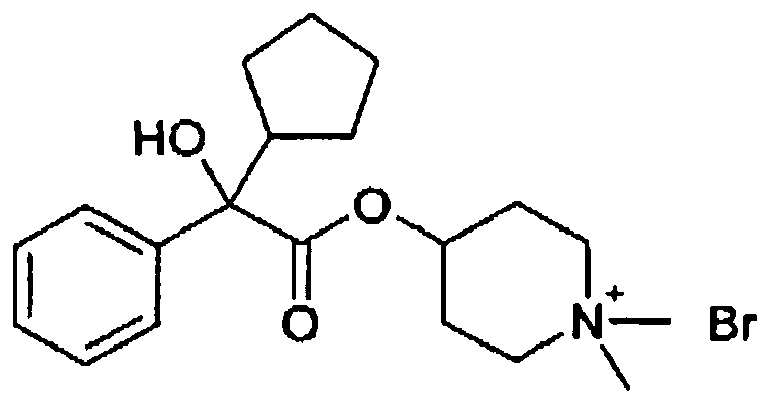
- The composition of claim 1, wherein at least 4-[(2-cyclopentyl-2-hydroxyphenylacetyl)oxy]-1,1-dimethyl-piperidinium bromide is present in a concentration of from about 0.001 % to about 15 % by weight, based on a total weight of the composition.
- The composition of claim 2, wherein at least 4-[(2-cyclopentyl-2-hydroxyphenylacetyl)oxy]-1,1-dimethyl-piperidinium bromide is present in a concentration of from about 0.05 % to about 10 % by weight, based on a total weight of the composition.
- The composition of claim 3, wherein at least 4-[(2-cyclopentyl-2-hydroxyphenylacetyl)oxy]-1,1-dimethyl-piperidinium bromide is present in a concentration of from about 0.1 % to about 5 % by weight, based on a total weight of the composition.
- The composition of claim 1, wherein the composition is present as a cream, a lotion, a gel, an ointment, a tincture, a skin oil, a milk, a balm, an impregnated bandage, an impregnated cloth, an impregnated textile, an impregnated pad, a spray, an aerosol, a roll-on, a stick, a soft solid, a powder or a powder spray.
- The composition of claim 1, wherein the composition is present in a form that is suitable for use as an antiperspirant.
- The composition of claim 1, wherein the composition further comprises at least one deodorizing substance.
- The composition of claim 1, wherein the composition is substantially free of antiperspirant-active substances that are different from salt of formula:
 R4 and R5 independently represent H or C1 - C6 alkyl;R1 and R3 independently represent optionally substituted C3 - C8 cycloalkyl, optionally substituted phenyl or optionally substituted C1 - C6 alkyl;R2 represents H, OH and OR wherein R represents C1 - C7 alkyl; andX- represents a cosmetically or dermatologically acceptable anion.
 - The composition of claim 8, wherein the composition is substantially free of aluminum compounds.
- The composition of claim 1, wherein the composition further comprises at least one antiperspirant-active aluminum compound.
- The composition of claim 10, wherein the at least one antiperspirant-active aluminum compound is present in a concentration of from about 0.1 to about 30 by weight, based on a total weight of the composition.
- The composition of claim 11, wherein the composition comprises at least one of optionally activated aluminum chlorohydrate, aluminum chloride and an aluminum zirconium compound.
- The composition of claim 1, wherein the composition is present as a liquid or bar soap, a deodorizing tincture, a deodorizing feminine hygiene agent, a deodorizing shampoo, a deodorizing shower or bath preparation, a deodorizing powder or a deodorizing powder spray.
- The composition of claim 1, wherein the composition is present in combination with an aerosol container, a squeeze bottle, a pump device or a roll-on device.
- A non-therapeutic method for reducing or inhibiting perspiration, wherein the method comprises applying an antiperspirant-effective amount of the composition of claim 1 to skin.
- A method for manufacture of a dermatological composition of claim 1 for reducing or inhibiting perspiration, wherein the composition is applied in an antiperspirant-effective amount to the skin.
Applications Claiming Priority (2)
| Application Number | Priority Date | Filing Date | Title |
|---|---|---|---|
| US11/449,720 US7851633B2 (en) | 2006-06-09 | 2006-06-09 | Piperidinium compounds and cosmetic compositions containing them |
| PCT/EP2007/055552 WO2007141289A1 (en) | 2006-06-09 | 2007-06-06 | Piperidinium compounds and cosmetic compositions containing them |
Publications (2)
| Publication Number | Publication Date |
|---|---|
| EP2032118A1 EP2032118A1 (en) | 2009-03-11 |
| EP2032118B1 true EP2032118B1 (en) | 2012-12-19 |
Family
ID=38468891
Family Applications (1)
| Application Number | Title | Priority Date | Filing Date |
|---|---|---|---|
| EP07729927A Not-in-force EP2032118B1 (en) | 2006-06-09 | 2007-06-06 | Cosmetic compositions containing piperidinium compounds |
Country Status (8)
| Country | Link |
|---|---|
| US (2) | US7851633B2 (en) |
| EP (1) | EP2032118B1 (en) |
| CN (1) | CN101466349B (en) |
| BR (1) | BRPI0712154A2 (en) |
| CH (1) | CH700338B1 (en) |
| ES (1) | ES2400922T3 (en) |
| RU (1) | RU2423101C2 (en) |
| WO (1) | WO2007141289A1 (en) |
Cited By (1)
| Publication number | Priority date | Publication date | Assignee | Title |
|---|---|---|---|---|
| DE102016204685A1 (en) * | 2016-03-22 | 2017-09-28 | Beiersdorf Ag | Antiperspirant stick in the form of an O / W emulsion |
Families Citing this family (14)
| Publication number | Priority date | Publication date | Assignee | Title |
|---|---|---|---|---|
| FR2916355B1 (en) * | 2007-05-25 | 2009-08-28 | Urgo Soc Par Actions Simplifie | NEW ACTIVE INGREDIENT IN HEALING AND ITS USE |
| FR2916356B1 (en) * | 2007-05-25 | 2009-08-28 | Urgo Soc Par Actions Simplifie | NOVEL AGENT FOR RELOCATING ACTIVE INGREDIENTS IN DRESSINGS CONTAINING AT LEAST ONE FATTY BODY |
| DE102008020746A1 (en) * | 2008-04-25 | 2009-10-29 | Saltigo Gmbh | Process for the preparation of quaternary salts of piperidyl esters of mandelic acid |
| DE102009040089A1 (en) | 2009-09-04 | 2011-07-21 | Beiersdorf AG, 20253 | Preparations with water-insoluble polymeric amines for the reduction of body odor |
| DE102009043004A1 (en) | 2009-09-28 | 2011-03-31 | Beiersdorf Ag | Aerosol preparations with stabilized particulate matter |
| DE102009048555B4 (en) | 2009-10-07 | 2011-12-22 | Beiersdorf Ag | Use of sprayable preparations with a high proportion of propellant gas |
| FR2951717B1 (en) * | 2009-10-22 | 2012-04-20 | Oreal | USE OF A DIALKYLPHENYL-4-AMINOPIPERIDINE AS A TREATMENT AGENT FOR HUMAN PERSPIRATION; NOVEL COMPOUNDS, COMPOSITIONS CONTAINING SAME |
| GB0922389D0 (en) * | 2009-12-22 | 2010-02-03 | Md Technicall Solutions Ltd | composition |
| DE102010044787A1 (en) * | 2010-09-09 | 2012-03-15 | Beiersdorf Ag | Macroemulsions with improved deodorant activity |
| EP2683347B1 (en) * | 2011-03-08 | 2018-05-09 | ISP Investments LLC | Improved antiperspirant/deodorant compositions |
| DE102013220771A1 (en) * | 2013-10-15 | 2015-04-16 | Henkel Ag & Co. Kgaa | Antiperspirant cosmetic products containing polycarboxylic acids |
| FR3038515B1 (en) * | 2015-07-07 | 2018-06-01 | Robertet S.A. | USE OF N-ALKYLAMIDE FOR THE MANUFACTURE OF AN ANTI-TRANSPIRING COSMETIC COMPOSITION |
| JP2018043981A (en) * | 2016-09-07 | 2018-03-22 | 日光ケミカルズ株式会社 | Sebum cleaning composition |
| DE102020111882A1 (en) * | 2020-04-30 | 2021-11-04 | Novigo GmbH & Co. KG | Ionic liquid as an antiperspirant |
Family Cites Families (15)
| Publication number | Priority date | Publication date | Assignee | Title |
|---|---|---|---|---|
| NL94071C (en) | 1954-04-20 | |||
| GB788126A (en) | 1955-09-29 | 1957-12-23 | Schering Corp | Quaternary salts of piperidyl esters |
| GB1032646A (en) | 1963-11-12 | 1966-06-15 | Benzon As Alfred | Cyclopentyl acetic acid ester derivatives |
| US3312709A (en) | 1964-06-29 | 1967-04-04 | Procter & Gamble | Para-(lower)alkoxybenzoylscopolamine |
| US3802862A (en) * | 1972-03-23 | 1974-04-09 | Dow Chemical Co | 1-ethyl-1-methyl-4-(3-methyl-2-phenylvalercyl oxy)piperidinium bromide as a plant stunting agent |
| US4022787A (en) | 1975-07-18 | 1977-05-10 | Carter-Wallace, Inc. | Anticholinergic ester and salts thereof |
| DD139212A1 (en) | 1978-10-09 | 1979-12-19 | Christian Starke | PROCESS FOR THE PREPARATION OF A NEW MEDICAMENT FROM ALPHA, ALPHA-DIPHENYL-ALPHA-ALKOXY ACETIC ACID 1-METHYLPIPERIDYL-4-ESTER DERIVATIVES |
| US5008111A (en) * | 1984-10-11 | 1991-04-16 | Schering Corporation | Physiological means of enhancing transdermal delivery of drugs |
| US4720494A (en) | 1984-11-05 | 1988-01-19 | The Gillette Company | Anticholinergic eucatropine esters and antiperspirant use thereof |
| WO1998000097A1 (en) * | 1996-06-28 | 1998-01-08 | Unilever Plc | Antiperspirant/deodorant fluid composition |
| US6482837B1 (en) | 1998-04-24 | 2002-11-19 | University Of Rochester | Antimuscarinic compounds and methods for treatment of bladder diseases |
| EP1069142B1 (en) | 1999-07-15 | 2010-04-28 | Clariant Produkte (Deutschland) GmbH | Water soluble polymers and their use in cosmetic and pharmaceutic products |
| DE10029462A1 (en) | 2000-06-21 | 2002-01-03 | Clariant Gmbh | New water soluble polymers based on macromonomer with polyalkylene oxide units, useful as adjuvants in cosmetic, pharmaceutical and agrochemical compositions |
| US6338841B1 (en) | 2001-07-19 | 2002-01-15 | Colgate-Palmolive Company | Antiperspirant product with dibenzylidene sorbitol and elastomer in dimethicone |
| AU2002340058A1 (en) | 2001-09-26 | 2003-04-07 | Alison B. Lukacsko | Compositions and methods for inhibiting eccrine perspiration in humans |
-
2006
- 2006-06-09 US US11/449,720 patent/US7851633B2/en not_active Expired - Fee Related
-
2007
- 2007-06-06 CH CH00169/08A patent/CH700338B1/en not_active IP Right Cessation
- 2007-06-06 RU RU2008152252/15A patent/RU2423101C2/en not_active IP Right Cessation
- 2007-06-06 WO PCT/EP2007/055552 patent/WO2007141289A1/en not_active Ceased
- 2007-06-06 BR BRPI0712154-7A patent/BRPI0712154A2/en not_active Application Discontinuation
- 2007-06-06 EP EP07729927A patent/EP2032118B1/en not_active Not-in-force
- 2007-06-06 CN CN2007800215124A patent/CN101466349B/en not_active Expired - Fee Related
- 2007-06-06 ES ES07729927T patent/ES2400922T3/en active Active
-
2010
- 2010-11-05 US US12/940,284 patent/US8633225B2/en not_active Expired - Fee Related
Cited By (1)
| Publication number | Priority date | Publication date | Assignee | Title |
|---|---|---|---|---|
| DE102016204685A1 (en) * | 2016-03-22 | 2017-09-28 | Beiersdorf Ag | Antiperspirant stick in the form of an O / W emulsion |
Also Published As
| Publication number | Publication date |
|---|---|
| US8633225B2 (en) | 2014-01-21 |
| WO2007141289A1 (en) | 2007-12-13 |
| CN101466349B (en) | 2012-11-07 |
| EP2032118A1 (en) | 2009-03-11 |
| RU2423101C2 (en) | 2011-07-10 |
| BRPI0712154A2 (en) | 2012-01-10 |
| RU2008152252A (en) | 2010-07-20 |
| US20070292375A1 (en) | 2007-12-20 |
| CN101466349A (en) | 2009-06-24 |
| US7851633B2 (en) | 2010-12-14 |
| US20110044923A1 (en) | 2011-02-24 |
| ES2400922T3 (en) | 2013-04-15 |
| CH700338B1 (en) | 2010-08-13 |
Similar Documents
| Publication | Publication Date | Title |
|---|---|---|
| US8633225B2 (en) | Piperidinium compounds and cosmetic compositions containing them | |
| JP5006887B2 (en) | Personal care composition comprising quaternary ammonium trihydroxy substituted dipropyl ether | |
| DE10031703A1 (en) | Use of calcium-releasing or binding substances for targeted scavenging or strengthening of the barrier function of the skin | |
| CN101048130A (en) | Personal care compositions containing salts of hydroxypropyltrialkylammonium substituted monosaccharides | |
| KR102584738B1 (en) | Composition for treating skin disease comprising colchicine | |
| JP6364032B2 (en) | Cosmetic composition comprising tricyclodecanamide | |
| DE102015225892A1 (en) | Deodorants containing specific cyclic alcohols in combination with certain Deowirkstoffen | |
| DE102015225876A1 (en) | "Deodorants containing specific cationic morpholino compounds in combination with certain active substances" | |
| DE102015214143A1 (en) | Sweat reducing cosmetic preparation | |
| DE102005029387B4 (en) | Drug combinations of glycopyrronium bromide and polyglyceryl (3) -methylglucose distearate | |
| EA030286B1 (en) | Sunscreen composition | |
| EP2692337A1 (en) | Film-shaped externally used drug composition | |
| DE102005029388B4 (en) | Active ingredient combinations of glycopyrronium bromide and one or more partially neutralized esters of monoglycerides and / or diglycerides of saturated fatty acids with citric acid | |
| DE19905585A1 (en) | Use of quaternary ammonium compounds as antiperspirants | |
| EP2968094B1 (en) | Photoprotective compositions with tricyclodecane amides | |
| DE102015214140A1 (en) | Sweat reducing cosmetic preparation | |
| DE102005029385B4 (en) | Drug combinations of glycopyrronium bromide and chitosan | |
| DE19936968A1 (en) | Synergistic combinations of quaternary ammonium compound and/or alkylpyridinium salt with inorganic antiperspirant, useful especially as components of foot care products | |
| JP2025071003A (en) | Composition for topical application to the skin | |
| DE102015225971A1 (en) | A method for reducing perspiration-induced body odor using special protein hydrolysates | |
| EP2086499B1 (en) | Cosmetic or dermatological preparations with a content of 2-isopropyl-5- methyl-cyclohexanecarbonyl-d-alanine methyl ester and one or more skin moisturising agents | |
| DE102005029390A1 (en) | Drug combinations of glycopyrronium bromide and polyols | |
| DE102011089610A1 (en) | Process for the preparation of a cosmetic product with a thickened oil phase |
Legal Events
| Date | Code | Title | Description |
|---|---|---|---|
| PUAI | Public reference made under article 153(3) epc to a published international application that has entered the european phase |
Free format text: ORIGINAL CODE: 0009012 |
|
| 17P | Request for examination filed |
Effective date: 20090109 |
|
| AK | Designated contracting states |
Kind code of ref document: A1 Designated state(s): AT BE BG CH CY CZ DE DK EE ES FI FR GB GR HU IE IS IT LI LT LU LV MC MT NL PL PT RO SE SI SK TR |
|
| AX | Request for extension of the european patent |
Extension state: AL BA HR MK RS |
|
| 17Q | First examination report despatched |
Effective date: 20091228 |
|
| GRAP | Despatch of communication of intention to grant a patent |
Free format text: ORIGINAL CODE: EPIDOSNIGR1 |
|
| DAX | Request for extension of the european patent (deleted) | ||
| GRAS | Grant fee paid |
Free format text: ORIGINAL CODE: EPIDOSNIGR3 |
|
| GRAA | (expected) grant |
Free format text: ORIGINAL CODE: 0009210 |
|
| AK | Designated contracting states |
Kind code of ref document: B1 Designated state(s): AT BE BG CH CY CZ DE DK EE ES FI FR GB GR HU IE IS IT LI LT LU LV MC MT NL PL PT RO SE SI SK TR |
|
| REG | Reference to a national code |
Ref country code: GB Ref legal event code: FG4D |
|
| REG | Reference to a national code |
Ref country code: CH Ref legal event code: EP |
|
| REG | Reference to a national code |
Ref country code: AT Ref legal event code: REF Ref document number: 588987 Country of ref document: AT Kind code of ref document: T Effective date: 20130115 |
|
| REG | Reference to a national code |
Ref country code: DE Ref legal event code: R096 Ref document number: 602007027468 Country of ref document: DE Effective date: 20130228 |
|
| REG | Reference to a national code |
Ref country code: ES Ref legal event code: FG2A Ref document number: 2400922 Country of ref document: ES Kind code of ref document: T3 Effective date: 20130415 |
|
| PG25 | Lapsed in a contracting state [announced via postgrant information from national office to epo] |
Ref country code: LT Free format text: LAPSE BECAUSE OF FAILURE TO SUBMIT A TRANSLATION OF THE DESCRIPTION OR TO PAY THE FEE WITHIN THE PRESCRIBED TIME-LIMIT Effective date: 20121219 Ref country code: FI Free format text: LAPSE BECAUSE OF FAILURE TO SUBMIT A TRANSLATION OF THE DESCRIPTION OR TO PAY THE FEE WITHIN THE PRESCRIBED TIME-LIMIT Effective date: 20121219 Ref country code: SE Free format text: LAPSE BECAUSE OF FAILURE TO SUBMIT A TRANSLATION OF THE DESCRIPTION OR TO PAY THE FEE WITHIN THE PRESCRIBED TIME-LIMIT Effective date: 20121219 |
|
| REG | Reference to a national code |
Ref country code: NL Ref legal event code: VDEP Effective date: 20121219 Ref country code: AT Ref legal event code: MK05 Ref document number: 588987 Country of ref document: AT Kind code of ref document: T Effective date: 20121219 |
|
| REG | Reference to a national code |
Ref country code: LT Ref legal event code: MG4D |
|
| PG25 | Lapsed in a contracting state [announced via postgrant information from national office to epo] |
Ref country code: SI Free format text: LAPSE BECAUSE OF FAILURE TO SUBMIT A TRANSLATION OF THE DESCRIPTION OR TO PAY THE FEE WITHIN THE PRESCRIBED TIME-LIMIT Effective date: 20121219 Ref country code: LV Free format text: LAPSE BECAUSE OF FAILURE TO SUBMIT A TRANSLATION OF THE DESCRIPTION OR TO PAY THE FEE WITHIN THE PRESCRIBED TIME-LIMIT Effective date: 20121219 Ref country code: GR Free format text: LAPSE BECAUSE OF FAILURE TO SUBMIT A TRANSLATION OF THE DESCRIPTION OR TO PAY THE FEE WITHIN THE PRESCRIBED TIME-LIMIT Effective date: 20130320 |
|
| PG25 | Lapsed in a contracting state [announced via postgrant information from national office to epo] |
Ref country code: EE Free format text: LAPSE BECAUSE OF FAILURE TO SUBMIT A TRANSLATION OF THE DESCRIPTION OR TO PAY THE FEE WITHIN THE PRESCRIBED TIME-LIMIT Effective date: 20121219 Ref country code: BE Free format text: LAPSE BECAUSE OF FAILURE TO SUBMIT A TRANSLATION OF THE DESCRIPTION OR TO PAY THE FEE WITHIN THE PRESCRIBED TIME-LIMIT Effective date: 20121219 Ref country code: SK Free format text: LAPSE BECAUSE OF FAILURE TO SUBMIT A TRANSLATION OF THE DESCRIPTION OR TO PAY THE FEE WITHIN THE PRESCRIBED TIME-LIMIT Effective date: 20121219 Ref country code: CZ Free format text: LAPSE BECAUSE OF FAILURE TO SUBMIT A TRANSLATION OF THE DESCRIPTION OR TO PAY THE FEE WITHIN THE PRESCRIBED TIME-LIMIT Effective date: 20121219 Ref country code: AT Free format text: LAPSE BECAUSE OF FAILURE TO SUBMIT A TRANSLATION OF THE DESCRIPTION OR TO PAY THE FEE WITHIN THE PRESCRIBED TIME-LIMIT Effective date: 20121219 Ref country code: BG Free format text: LAPSE BECAUSE OF FAILURE TO SUBMIT A TRANSLATION OF THE DESCRIPTION OR TO PAY THE FEE WITHIN THE PRESCRIBED TIME-LIMIT Effective date: 20130319 Ref country code: IS Free format text: LAPSE BECAUSE OF FAILURE TO SUBMIT A TRANSLATION OF THE DESCRIPTION OR TO PAY THE FEE WITHIN THE PRESCRIBED TIME-LIMIT Effective date: 20130419 |
|
| PG25 | Lapsed in a contracting state [announced via postgrant information from national office to epo] |
Ref country code: RO Free format text: LAPSE BECAUSE OF FAILURE TO SUBMIT A TRANSLATION OF THE DESCRIPTION OR TO PAY THE FEE WITHIN THE PRESCRIBED TIME-LIMIT Effective date: 20121219 Ref country code: PT Free format text: LAPSE BECAUSE OF FAILURE TO SUBMIT A TRANSLATION OF THE DESCRIPTION OR TO PAY THE FEE WITHIN THE PRESCRIBED TIME-LIMIT Effective date: 20130419 Ref country code: PL Free format text: LAPSE BECAUSE OF FAILURE TO SUBMIT A TRANSLATION OF THE DESCRIPTION OR TO PAY THE FEE WITHIN THE PRESCRIBED TIME-LIMIT Effective date: 20121219 Ref country code: NL Free format text: LAPSE BECAUSE OF FAILURE TO SUBMIT A TRANSLATION OF THE DESCRIPTION OR TO PAY THE FEE WITHIN THE PRESCRIBED TIME-LIMIT Effective date: 20121219 |
|
| PLBE | No opposition filed within time limit |
Free format text: ORIGINAL CODE: 0009261 |
|
| STAA | Information on the status of an ep patent application or granted ep patent |
Free format text: STATUS: NO OPPOSITION FILED WITHIN TIME LIMIT |
|
| PG25 | Lapsed in a contracting state [announced via postgrant information from national office to epo] |
Ref country code: DK Free format text: LAPSE BECAUSE OF FAILURE TO SUBMIT A TRANSLATION OF THE DESCRIPTION OR TO PAY THE FEE WITHIN THE PRESCRIBED TIME-LIMIT Effective date: 20121219 |
|
| 26N | No opposition filed |
Effective date: 20130920 |
|
| PG25 | Lapsed in a contracting state [announced via postgrant information from national office to epo] |
Ref country code: CY Free format text: LAPSE BECAUSE OF FAILURE TO SUBMIT A TRANSLATION OF THE DESCRIPTION OR TO PAY THE FEE WITHIN THE PRESCRIBED TIME-LIMIT Effective date: 20121219 |
|
| PG25 | Lapsed in a contracting state [announced via postgrant information from national office to epo] |
Ref country code: IT Free format text: LAPSE BECAUSE OF FAILURE TO SUBMIT A TRANSLATION OF THE DESCRIPTION OR TO PAY THE FEE WITHIN THE PRESCRIBED TIME-LIMIT Effective date: 20121219 |
|
| REG | Reference to a national code |
Ref country code: DE Ref legal event code: R097 Ref document number: 602007027468 Country of ref document: DE Effective date: 20130920 |
|
| PG25 | Lapsed in a contracting state [announced via postgrant information from national office to epo] |
Ref country code: MC Free format text: LAPSE BECAUSE OF FAILURE TO SUBMIT A TRANSLATION OF THE DESCRIPTION OR TO PAY THE FEE WITHIN THE PRESCRIBED TIME-LIMIT Effective date: 20121219 |
|
| REG | Reference to a national code |
Ref country code: IE Ref legal event code: MM4A |
|
| PG25 | Lapsed in a contracting state [announced via postgrant information from national office to epo] |
Ref country code: IE Free format text: LAPSE BECAUSE OF NON-PAYMENT OF DUE FEES Effective date: 20130606 |
|
| PG25 | Lapsed in a contracting state [announced via postgrant information from national office to epo] |
Ref country code: MT Free format text: LAPSE BECAUSE OF FAILURE TO SUBMIT A TRANSLATION OF THE DESCRIPTION OR TO PAY THE FEE WITHIN THE PRESCRIBED TIME-LIMIT Effective date: 20121219 |
|
| PG25 | Lapsed in a contracting state [announced via postgrant information from national office to epo] |
Ref country code: TR Free format text: LAPSE BECAUSE OF FAILURE TO SUBMIT A TRANSLATION OF THE DESCRIPTION OR TO PAY THE FEE WITHIN THE PRESCRIBED TIME-LIMIT Effective date: 20121219 |
|
| PG25 | Lapsed in a contracting state [announced via postgrant information from national office to epo] |
Ref country code: LU Free format text: LAPSE BECAUSE OF NON-PAYMENT OF DUE FEES Effective date: 20130606 Ref country code: HU Free format text: LAPSE BECAUSE OF FAILURE TO SUBMIT A TRANSLATION OF THE DESCRIPTION OR TO PAY THE FEE WITHIN THE PRESCRIBED TIME-LIMIT; INVALID AB INITIO Effective date: 20070606 |
|
| REG | Reference to a national code |
Ref country code: FR Ref legal event code: PLFP Year of fee payment: 10 |
|
| REG | Reference to a national code |
Ref country code: FR Ref legal event code: PLFP Year of fee payment: 11 |
|
| REG | Reference to a national code |
Ref country code: FR Ref legal event code: PLFP Year of fee payment: 12 |
|
| PGFP | Annual fee paid to national office [announced via postgrant information from national office to epo] |
Ref country code: FR Payment date: 20190619 Year of fee payment: 13 |
|
| PGFP | Annual fee paid to national office [announced via postgrant information from national office to epo] |
Ref country code: CH Payment date: 20190619 Year of fee payment: 13 |
|
| PGFP | Annual fee paid to national office [announced via postgrant information from national office to epo] |
Ref country code: DE Payment date: 20190630 Year of fee payment: 13 Ref country code: GB Payment date: 20190619 Year of fee payment: 13 Ref country code: ES Payment date: 20190719 Year of fee payment: 13 |
|
| REG | Reference to a national code |
Ref country code: DE Ref legal event code: R119 Ref document number: 602007027468 Country of ref document: DE |
|
| REG | Reference to a national code |
Ref country code: CH Ref legal event code: PL |
|
| GBPC | Gb: european patent ceased through non-payment of renewal fee |
Effective date: 20200606 |
|
| PG25 | Lapsed in a contracting state [announced via postgrant information from national office to epo] |
Ref country code: FR Free format text: LAPSE BECAUSE OF NON-PAYMENT OF DUE FEES Effective date: 20200630 Ref country code: GB Free format text: LAPSE BECAUSE OF NON-PAYMENT OF DUE FEES Effective date: 20200606 Ref country code: CH Free format text: LAPSE BECAUSE OF NON-PAYMENT OF DUE FEES Effective date: 20200630 Ref country code: LI Free format text: LAPSE BECAUSE OF NON-PAYMENT OF DUE FEES Effective date: 20200630 |
|
| PG25 | Lapsed in a contracting state [announced via postgrant information from national office to epo] |
Ref country code: DE Free format text: LAPSE BECAUSE OF NON-PAYMENT OF DUE FEES Effective date: 20210101 |
|
| REG | Reference to a national code |
Ref country code: ES Ref legal event code: FD2A Effective date: 20211026 |
|
| PG25 | Lapsed in a contracting state [announced via postgrant information from national office to epo] |
Ref country code: ES Free format text: LAPSE BECAUSE OF NON-PAYMENT OF DUE FEES Effective date: 20200607 |