EP2030367B1 - Verfahren zum routen virtueller verbindungen in einem frame-switching-netz - Google Patents
Verfahren zum routen virtueller verbindungen in einem frame-switching-netz Download PDFInfo
- Publication number
- EP2030367B1 EP2030367B1 EP07766095.9A EP07766095A EP2030367B1 EP 2030367 B1 EP2030367 B1 EP 2030367B1 EP 07766095 A EP07766095 A EP 07766095A EP 2030367 B1 EP2030367 B1 EP 2030367B1
- Authority
- EP
- European Patent Office
- Prior art keywords
- link
- paths
- virtual
- network
- links
- Prior art date
- Legal status (The legal status is an assumption and is not a legal conclusion. Google has not performed a legal analysis and makes no representation as to the accuracy of the status listed.)
- Not-in-force
Links
Images






Classifications
-
- H—ELECTRICITY
- H04—ELECTRIC COMMUNICATION TECHNIQUE
- H04L—TRANSMISSION OF DIGITAL INFORMATION, e.g. TELEGRAPHIC COMMUNICATION
- H04L45/00—Routing or path finding of packets in data switching networks
- H04L45/12—Shortest path evaluation
-
- H—ELECTRICITY
- H04—ELECTRIC COMMUNICATION TECHNIQUE
- H04L—TRANSMISSION OF DIGITAL INFORMATION, e.g. TELEGRAPHIC COMMUNICATION
- H04L43/00—Arrangements for monitoring or testing data switching networks
- H04L43/08—Monitoring or testing based on specific metrics, e.g. QoS, energy consumption or environmental parameters
- H04L43/0805—Monitoring or testing based on specific metrics, e.g. QoS, energy consumption or environmental parameters by checking availability
- H04L43/0811—Monitoring or testing based on specific metrics, e.g. QoS, energy consumption or environmental parameters by checking availability by checking connectivity
-
- H—ELECTRICITY
- H04—ELECTRIC COMMUNICATION TECHNIQUE
- H04L—TRANSMISSION OF DIGITAL INFORMATION, e.g. TELEGRAPHIC COMMUNICATION
- H04L45/00—Routing or path finding of packets in data switching networks
- H04L45/16—Multipoint routing
-
- H—ELECTRICITY
- H04—ELECTRIC COMMUNICATION TECHNIQUE
- H04L—TRANSMISSION OF DIGITAL INFORMATION, e.g. TELEGRAPHIC COMMUNICATION
- H04L45/00—Routing or path finding of packets in data switching networks
- H04L45/24—Multipath
-
- H—ELECTRICITY
- H04—ELECTRIC COMMUNICATION TECHNIQUE
- H04L—TRANSMISSION OF DIGITAL INFORMATION, e.g. TELEGRAPHIC COMMUNICATION
- H04L45/00—Routing or path finding of packets in data switching networks
- H04L45/24—Multipath
- H04L45/243—Multipath using M+N parallel active paths
-
- H—ELECTRICITY
- H04—ELECTRIC COMMUNICATION TECHNIQUE
- H04L—TRANSMISSION OF DIGITAL INFORMATION, e.g. TELEGRAPHIC COMMUNICATION
- H04L45/00—Routing or path finding of packets in data switching networks
- H04L45/28—Routing or path finding of packets in data switching networks using route fault recovery
-
- H—ELECTRICITY
- H04—ELECTRIC COMMUNICATION TECHNIQUE
- H04L—TRANSMISSION OF DIGITAL INFORMATION, e.g. TELEGRAPHIC COMMUNICATION
- H04L45/00—Routing or path finding of packets in data switching networks
- H04L45/42—Centralised routing
-
- H—ELECTRICITY
- H04—ELECTRIC COMMUNICATION TECHNIQUE
- H04L—TRANSMISSION OF DIGITAL INFORMATION, e.g. TELEGRAPHIC COMMUNICATION
- H04L45/00—Routing or path finding of packets in data switching networks
- H04L45/76—Routing in software-defined topologies, e.g. routing between virtual machines
-
- H—ELECTRICITY
- H04—ELECTRIC COMMUNICATION TECHNIQUE
- H04L—TRANSMISSION OF DIGITAL INFORMATION, e.g. TELEGRAPHIC COMMUNICATION
- H04L12/00—Data switching networks
- H04L12/02—Details
- H04L12/16—Arrangements for providing special services to substations
- H04L12/18—Arrangements for providing special services to substations for broadcast or conference, e.g. multicast
Definitions
- the present invention relates to the field of routing in a frame switching network and more particularly in an AFDX network.
- Ethernet networks are the best known of local networks. They can operate in two distinct but mutually compatible modes: a so-called shared mode, in which the same physical medium is shared between the terminals, with random access and detection of collisions between frames, and a so-called switched mode, in which the terminals exchange frames with virtual links, thus guaranteeing the absence of collisions.
- shared mode in which the same physical medium is shared between the terminals, with random access and detection of collisions between frames
- switched mode in which the terminals exchange frames with virtual links, thus guaranteeing the absence of collisions.
- each terminal, source or destination is individually connected to a frame switch and the switches are interconnected by physical links.
- each switch has a plurality of ports connected to the ports of other switches or terminal couplers.
- a virtual link between a source terminal and a destination terminal is defined as a path through the network traversed by the frames of the source terminal to the destination terminal. Equivalently, a virtual link is defined by the list of switches that these frames go through. For each switch traversed, the frame switching is performed from the address of the recipient, by means of a preset switch table. This switching table is very simple since it indicates according to the input port of the switch and the destination address of the frame, the corresponding output port.
- VCC virtual circuit connection
- a "virtual link" as a level-2 end-to-end connection in a frame-switched network, such as a virtual link in a switched Ethernet network or a virtual circuit connection in an ATM network.
- the virtual links are routed through the network, either administratively or by way of signaling through the control plane.
- the routing of the links consists in defining and programming the switching tables of the various switches of the network. In general, these switching tables can be static (administrative routing) or dynamic (routing by signaling).
- CBR Constant Bit Rate
- the Avionics Full Duplex Switched Ethernet (AFDX) network developed for the needs of aeronautics, is a switched Ethernet network in which it is possible to make a reservation of bandwidth by virtual link.
- each virtual link is associated with a minimum interval between frames and a maximum frame size.
- a maximum time for routing frames or latency is guaranteed for each virtual link. Since the switches can only provide a given bit rate per output port, the guarantee of the characteristics of the virtual links again depends on routing constraints.
- the present invention applies preferentially but not exclusively to the AFDX network.
- a detailed description of this network can be found in the document entitled "AFDX protocol tutorial" available on the website www.condoreng.com as well as in the patent application.
- FR-A-2832011 filed in the name of the plaintiff. Its main features will simply be recalled below.
- the AFDX network is based on a switched Ethernet network. It is also full-duplex, each terminal can simultaneously transmit and receive frames on separate virtual links.
- the AFDX network is also deterministic, in the sense that the virtual links have characteristics guarantees in terms of latency, physical segregation of flows, bandwidth and throughput.
- Each virtual link has for this purpose an end-to-end reserved path, a temporal fragmentation into transmission slots (called BAGs for Bandwidth Allocation Gap ) and a maximum frame size.
- BAGs Bandwidth Allocation Gap
- the frames are sent at the beginning of each transmission interval with a predetermined jitter tolerance.
- the AFDX network is redundant, in the sense that it is duplicated for reasons of availability.
- the data is transmitted as IP packets encapsulated in Ethernet frames.
- frame switching on an AFDX network uses a virtual link identifier concatenated to the frame header.
- a switch receives on one of its input ports a frame, it reads the virtual link identifier and determines from its switch table the output port (s) on which (s) (s) it must be transmitted.
- the switches check in flight the integrity of the transmitted frames but do not request retransmission if a frame is erroneous: the frames detected as erroneous are eliminated.
- Frames transiting a virtual link are numbered in sequence. On reception, the destination terminal checks the integrity of the sequence of frames.
- Each virtual link is mono-directional. It can only come from one source terminal at a time but can result in multiple recipients. We distinguish the virtual links in point-to-point mode, serving only one recipient, virtual links in multi-point mode that serve several.
- the Fig. 1 schematically represents an AFDX network comprising LRU1 to LRU5 terminals and frame switches SW1, SW2.
- the virtual link VL 3 connecting the terminal LRU 3 to LRU 2 is of type point to point, so that the virtual links VL 2 serving LRU 2 and LRU 3, and VL 1 serving LRU 3 to LRU5 are multipoint.
- Some virtual links are highly dependent on each other because they participate in the realization of the same function. For example, virtual links from different navigation sensors of an aircraft participate in the same positioning function. Then called functional group or simply beam any set of virtual links, point-to-point or multipoint, participating in the realization of the same function.
- Frame-switched networks offering a service guarantee such as ATM and AFDX networks, require the imposition of virtual link routing constraints.
- embedded applications in particular aeronautical applications require additional precautions, which in turn often translate into routing constraints.
- the present invention aims at providing a systematic and automatic routing method which takes into account all the routing constraints and makes it possible to optimize the security of use of the network.
- US 6,584,093 B1 relates to a method of routing telephone calls over IP in a wide area network with inter-domain routing.
- the choice of the best path is made by minimizing a metric which is a function of the elementary costs incurred in each autonomous system.
- a path including this entity is ignored in the call routing.
- said topological constraint is advantageously expressed as a constraint of no crossing of the border between zones if the switches respectively connected to the source terminal and to the destination terminal belong to the same area, and, in the opposite case, as a single crossing constraint of the boundary between the respective areas of membership of said source and destination terminals.
- the selection step may take into account additional topological constraints segregation and / or collocation of possible paths vis-à-vis virtual links already routed or route simultaneously with said link or switches of said network.
- the selection step may take into account additional topological constraints, each additional topological constraint on a group of paths constituting a set of virtual links to simultaneously route, said group consisting of a plurality N sg of sub-groups of said paths, said additional constraint expressing that at most a number n sg of subgroups such that 0 ⁇ n sg ⁇ N sg can be invalidated, a subgroup being invalidated if all the paths belonging to it are affected by the failure of the same switch of said network.
- Said cost function mentioned above can be chosen equal to the number of switches traversed by a path.
- said virtual link when said virtual link is of the multipoint type and the network is partitioned into distinct zones, it is advantageously applied to each possible path between said source terminal and a destination terminal of said link, a constraint of not crossing the border between zones if the switches respectively connected to the source terminal and to the destination terminal belong to the same zone and, in the opposite case, a single crossing constraint of the boundary between the respective membership zones of said source and destination terminals.
- the selection step may take into account additional topological constraints, each additional topological constraint on a group of paths constituting a set of virtual links to simultaneously route, said group consisting of a plurality N sg subgroups of said paths, said additional constraint expressing that at most one number n sg of subgroups such that 0 ⁇ n sg ⁇ N sg can be invalidated, a subgroup being invalidated if all the paths belonging to it are affected by the failure of the same switch of said network.
- the cost function can be taken as equal to the number of switches traversed by a path and will be minimized on each set of possible paths between said source terminal and a destination terminal of said link, to provide at least one candidate path per destination terminal.
- combinations of K candidate paths are performed where K is the number of destination terminals of the link, each combination corresponding to a possible routing solution of said multipoint link, a second cost function is minimized on all of said possible solutions thus obtained. .
- This second cost function evaluates, for each possible solution, the number of switches shared between its different constituent paths.
- said link beam for at least one group of links participating in the realization of the same function, said link beam, each link being point-to-point and the network being partitioned into separate zones, for each link of said beam is applied at each possible path between the source terminal and the destination terminal of said link, a constraint of no cross-border crossing between zones if the switches respectively connected to the source terminal and the destination terminal belong to the same zone, and, if not, a single crossing constraint of the boundary between the respective areas of membership of said source and destination terminals.
- the selection step may take into account additional topological constraints, each additional topological constraint on a group of paths constituting a set of virtual links to simultaneously route, said group consisting of a plurality N sg of sub-groups of said paths, said additional constraint expressing that at most a number n sg of subgroups such that 0 ⁇ n sg ⁇ N sg can be invalidated, a subgroup being invalidated if all the paths belonging to it are affected by the failure of the same switch of said network.
- Said cost function can be taken as equal to the number of switches traversed by a path and will be minimized, for each of the links of said beam, on each set of possible paths between the source terminal and the destination terminal of said link, to provide at least one path candidate by link.
- combinations of N candidate paths are performed where N is the number of links of said beam, each combination corresponding to a possible solution for routing said beam, a third cost function is minimized on all of said possible solutions thus obtained.
- the third cost function evaluates, for each possible routing solution of the bundle, the number of switches shared between the paths of which said solution is the combination.
- said link beam for at least one group of links participating in the realization of the same function, said link beam, each link being of multipoint type and the network being partitioned into distinct zones, for each link of said beam is applied at each possible path between the source terminal and a destination terminal of said link, a constraint of no crossing of the border between zones if the switches respectively connected to the source terminal and to the destination terminal belong to the same zone, and, if not, a single crossing constraint of the boundary between the respective areas of membership of said source and destination terminals.
- the selection step may take into account additional topological constraints, each additional topological constraint on a group of paths constituting a set of virtual links to be routed simultaneously, said group consisting of a plurality N sg of subgroups of said paths, said additional constraint expressing that at most a number n sg of subgroups such that 0 ⁇ n sg ⁇ N sg can be invalidated, a subgroup being invalidated if all the paths belonging to it are affected by the failure of the same switch of said network.
- Said cost function can be taken as equal to the number of switches traversed by a path and will be minimized, for each of the links of said beam, on each set of possible paths between the source terminal and each destination terminal of said link, to provide at least one path candidate by link and by destination terminal.
- combinations of K 1 + K 2 + ... + K N candidate paths are carried out where the K i , 1 ⁇ i N N are the number of respective paths of the N links of said beam, each combination corresponding to a possible solution. routing of said beam, and a fourth cost function is minimized on all of said possible solutions thus obtained.
- the fourth cost function evaluates, for each possible routing solution of the beam, the number of switches traversed by the links of the beam corresponding to this solution.
- said network areas are for example powered by independent power sources.
- the invention also relates to a computer program comprising software means adapted to implement the steps of the method defined above, when it is executed by a computer.
- the idea underlying the invention is to perform the routing of a virtual link by selecting among the possible paths, those that obey a constraint or a plurality of predetermined topological constraints, and then to select among those ci, the one or those that minimizes (s) a predetermined cost function.
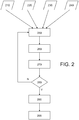
- the Fig. 2 illustrates the principle of the routing method according to the invention.
- the algorithm proceeds in a first step 250 to the selection of the paths between the source terminal and the destination terminal that satisfy a constraint or a plurality of topological constraints indicated in 240.
- the algorithm proceeds in a second step, in 260, the minimization of a cost function or the minimization of a plurality of cost functions, successively or jointly.
- a composite cost function is constructed as a linear combination of the aforementioned cost functions, the weighting coefficients being chosen to reflect the relative importance of costs in the choice of routing.
- the cost functions are minimized one after the other in a decreasing order of priority, each minimization being performed on the subset of solutions provided by the preceding minimization step.
- the output solution of 260 provides the path (point-to-point mode) or paths (multipoint mode) for routing the virtual link.
- the network status file 220 is updated. The algorithm proceeds iteratively, until the virtual links to router are exhausted.
- 280 it is checked whether all the virtual links are routed and, if so, one carries out, according to one embodiment, a step of checking the determinism of the network at 290.
- This step is supported by an algorithm called Network calculus known from the state of the art, for example from the article of Jean-Yves Le Boudec entitled "Application of network calculus to guaranteed service networks" published in IEEE Trans. on Information Theory, Vol. 44, No. 3, May 1998 .
- This algorithm calculates from a traffic envelope in all points of the network, the latency terminals and queuing sizes for each element of the network. Determinism is guaranteed for bounded latency and proper sizing of queues for each network element.
- switch tables of the frame switches are updated to 295. These switch tables uniquely fix the routing of the links on the network.
- the routing method may be implemented a first time during the operation of the network and / or whenever a virtual link must be modified or added.
- topological constraints mentioned above are of two distinct types: absolute constraints and relative constraints.
- the network can be partitioned into any plurality of distinct areas, provided that any terminal of a zone can serve any terminal of another area without passing through a third area.
- the different areas of the network are for example powered by independent power sources.
- the intra-zone virtual links are routed within the zone in question while the inter-zone virtual links cross only one time the border separating said zones, without passing through a third zone.
- the relative topological constraints concern the virtual links between them.
- constraints of collocation or segregation between virtual links This means that it can be specified that two virtual links must pass through the same network switches or on the contrary that they must not share any common switch.
- Relative topological constraints can concern different virtual links of the same functional bundle, in which case the constraint posed is a segregation constraint. They can also relate to virtual links belonging to distinct functional bundles. In both cases, the topological constraints of collocation / segregation of a virtual link can be expressed vis-à-vis links already routed or links to route simultaneously with said link.
- Each of these virtual links usually includes a (point-to-point link) or multiple (multipoint link) path (s).
- the set of constituent paths of these virtual links hereinafter called group of virtual links, can be partitioned into subgroups, a path that can belong to several subgroups.
- a subgroup corresponds to an instance of the function provided by said set of virtual links.
- the different subgroups represent a certain degree of redundancy for the realization of the same function.
- N sg is the number of subgroups of the path group
- failure of a switch here means either a faulty or absent switching, or a corruption of switched frames.
- Invalid subgroup refers to a subgroup whose all paths are affected by the failure of the same switch.
- the routing algorithm searches among the possible candidates which one or more that minimizes (s) one or more cost functions.
- a first cost function considered is the number of switches traversed by the virtual link. More precisely, if the link is of type point to point, one seeks to minimize the number of switches traversed by this link. If the link is of type multipoint, the minimization relates to the number of switches crossed for each of the paths constituting the link. A small number of traversed switches reduces the probability of failure of the virtual link or each path constituting this link.
- a second cost function concerns virtual links of the multipoint type. It is defined as the number of switches common to the paths constituting a multipoint link.
- a third cost function is for link bundles. It is defined as the number of switches common to virtual links belonging to the same bundle.
- the minimization of the second or third cost function makes it possible, as the case may be, to reduce the probability of joint failure of the paths of the same virtual link or the virtual links of the same bundle.
- a fourth cost function also applies to link bundles. It is defined as the total number of switches traversed by all the virtual links of the same bundle.
- a fifth cost function is defined as the output rate of the output port of the most heavily loaded switch in the network. The minimization of this cost function aims to distribute the traffic load within the network as well as possible.
- cost functions are in no way limiting. Other cost functions may be envisaged, in so far as they relate in particular to quantify the impact of the failure of an element or a plurality of elements of the network.
- a linear combination of the cost functions is constructed by means of weighting coefficients reflecting the relative importance of these functions in the routing and the new cost function thus constructed on the set of solutions is minimized. possible.
- the new cost function can be constructed as a product of cost functions, each with an exponent reflecting its relative importance in routing.
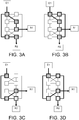
- the Figs. 3A to 3E illustrate the mechanism of minimizing the cost functions in the case of a virtual link of the multipoint type.
- the virtual link to router is derived from the source terminal E 1 and serves the destination terminals R 1 and R 2 . It is assumed that the paths satisfying the topological constraints have been previously selected.
- the minimization of the first cost function is carried out by searching for each of the possible paths connecting E 1 to R 1 on the one hand and E 1 to R 2 , on the other hand, those traversing the minimum number of switches. In this case, the minimum number is 3 for the path E 1 -R 1 as for the path E 1 -R 2 .
- Optimal solutions are illustrated in Fig. 3A to 3D . On the contrary, it should be noted that the solution illustrated in Fig. 3E is not optimal: indeed, it minimizes the number of switches on the set virtual link but not on each of its constituent paths (the path linking E 1 -R 2 is cost 4).
- the minimization of the fifth cost function makes it possible to separate the three solutions retained in the previous step. Otherwise, the chosen solution is chosen arbitrarily from among the remaining solutions.
- the problem of routing is that of minimizing a cost function / cost function under constraints.
- the constrained cost functions are expressed as linear inequalities and the cost functions are linear expressions of decision variables.
- Minimization can then be performed using the simplex algorithm. It is recalled that the simplex algorithm solves a problem of the type: Arg x min b T x with ax ⁇ vs and x ⁇ 0 where b T is the representative vector of a linear form (cost function), x is the vector of decision variables (positive), A represents the matrix of constraints and c is a constant vector.
- the routing algorithm has at the input of the list of switches, denoted SS and, for each pair of terminals source and destination, the list of paths to move from first to second, each path being described by an ordered list of switches it passes.
- SS the list of switches
- PP will be reduced beforehand to a list of paths already satisfying certain absolute topological constraints, for example those relating to the partition in independent zones.
- any virtual link is part of a functional beam, the beam being able to be reduced by where applicable to a single link.
- FF is the list of functional beams.
- the basic constraint imposed on a solution (or candidate virtual link) is that the constituent path (s) of the solution (s) originate from the source terminal and result ( nt) to the recipient (s), ie: ⁇ f ⁇ FF ; ⁇ vl ⁇ f . ocs ; ⁇ p ⁇ PP vlPath vl , p ⁇ vs fs p , vl . txsw and vlPath vl , p ⁇ ⁇ sw ⁇ vl .
- rxsw vs ls p , sw and that for each destination terminal of the virtual link, there is a single constituent path from the source terminal, namely: ⁇ f ⁇ FF ; ⁇ vl ⁇ f . ocs ; ⁇ sw ⁇ vl . rxsw ; ⁇ p ⁇ PP vlPath vl , p . vs ls p , sw . vs fs p , vl . txsw 1
- Relative topological constraints can also be expressed from the aforementioned decision variables in the form of inequalities or linear equalities.
- the segregation constraint is expressed by: ⁇ sw ⁇ SS ; ⁇ b ⁇ ⁇ vlBrSw b . vl , b . swDest , sw ⁇ 1
- the cost functions are also expressed from the aforementioned decision variables.
- the fifth cost function aims to route the virtual links so as to go through the least loaded switches. It is possible to determine from the network status file and the links to be routed the traffic cost between two adjacent switches. Adjacent switches are called switches sw 1 , sw 2 connected by a direct physical link. More precisely, for each pair of adjacent switches sw 1 , sw 2 , it is first determined whether there is at least one virtual link passing successively through them: ⁇ f ⁇ FF ; ⁇ vl ⁇ f .
- ocs ; ⁇ s w 1 , s w 2 ⁇ SS ; vlSwNb vl , s w 1 , s w 2 ⁇ p ⁇ PP vlPath vl , p . vs pss p , s w 1 , s w 2
- VlSw the decision variable [vl, sw 1, sw 2] is expressed in terms of vlSwNb [vl, sw 1, sw 2] by the following linear constraints: ⁇ f ⁇ FF ; ⁇ vl ⁇ f .
- trfCstPast [ sw 1 , sw 2 ] is the traffic cost between switches sw 1 , sw 2 that is to say on the output port of sw 1 connected to sw 2 , accumulated on all virtual links already routed .
- the value trfCstPast [ sw 1 , sw 2 ] is initialized by the value of the traffic cost induced by the fixed virtual links, that is to say whose routing is unambiguous. It can be stored in the network status file.
- the cost functions can be minimized one after the other, in decreasing order of priority, each being on the subset of solutions provided by the preceding minimization step.
- constraints can be taken into account between the minimization steps.
- the global optimization on the set FF can lead to very long computing times if the number of virtual links is high.
- each subset is then advantageously partitioned into independent subsets of lower possible cardinality, the relative topological constraints and the minimization of the cost functions applying only within each subset. Since the virtual links of the same functional bundle can not be routed independently, each subset necessarily consists of one or more bundles. The routing algorithm is applied in sequence to said subsets.
- the minimization of the cost function CF 5 in principle involves all the virtual links to be routed.
- the subsets of virtual links for which the freedom of routing is the weakest for example those whose links will be a priori shorter, these subsets are treated in priority by the routing method.
- routing unit considered here is the functional beam, a virtual link being considered as a beam with a single link.
- the Fig. 4 schematically illustrates an example of point-to-point virtual link routing (or monoline beam) between a source terminal E 1 and a destination terminal R 1 .
- step 410 the basic constraint is applied to determine the possible paths between the source terminal and the destination terminal.
- step 420 the relative topological constraints are applied, taking into account the virtual links already routed, if they exist, and then determining in 430 whether the terminals are on the same side of the network. If this is the case, a non-crossing constraint (intra-area routing) is applied at 435 and the cost function CF 1 is minimized over all the possible solutions selected by the preceding constraints. On the other hand, if the terminals are not on the same side of the network, a crossing constraint (a single inter-zone crossing) is applied in 437 and is minimized, as for the first one. case, the cost function CF 1 on all possible solutions.
- steps 435 or 437 do not provide a single routing solution, the cost function CF 5 on the remaining solutions is further minimized by 440.
- the network status file is updated to 450.
- the Fig. 5 illustrates schematically an example of multipoint virtual link routing (or monoline beam), between a source terminal E 1 and a plurality K of destination terminals R 1 , R 2 , .., R K.
- the cost function CF 1 is individually minimized in 530 1 , 530 2 ,..., 530 K , respectively.
- the cost function CF 2 is then minimized in 550 over all of these possible solutions.
- step 550 does not provide a single solution, the cost function CF 4 is minimized in 560 over all of the remaining solutions.
- step 560 If step 560 still does not provide a single solution, the cost function CF 5 is minimized at 570 on all remaining solutions and the status file of the network is updated to 580.
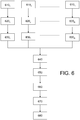
- the Fig. 6 schematically illustrates an example of beam routing of N virtual links of point-to-point type. Each link comes from a source terminal E i and serves a destination terminal R i , 1 ⁇ i N N.
- the basic stress is applied at 610 i so as to retain only the possible paths between E i and R i .
- Steps 620 i , 630 i , 640 are analogous to steps 520 k , 530 k , 540 except that all possible routing solutions for the link bundle are obtained at 640.
- the cost function CF 3 is then minimized in 650 over all the possible solutions.
- step 650 does not provide a single solution, the cost function CF 4 is minimized at 660 on all of the remaining solutions.
- step 660 If step 660 still does not provide a single solution, the cost function CF 5 is minimized to 670 on all of the remaining solutions and the status file of the network is updated to 680.
- the Fig. 7 schematically illustrates an example of beam routing of N multipoint virtual links. It is assumed that each virtual link VL i originates from a source terminal E i and serves K i recipient terminals R ik with 1 ⁇ i ⁇ N and 1 ⁇ k ⁇ K i .
- the basic stress is applied at 710 i for all the pairs of terminals (E i , R ik ), 1 ⁇ k ⁇ K i then in 720 i the relative topological constraints as in Fig. 5 .
- step 730 i the cost function CF 1 is minimized on each of these sets, as in steps 530 1 to 530 K of FIG. Fig. 5 .
- step 740 it performs all possible combinations of all the roads selected in step 730 i provided that, for each combination, one selects only path pair (E i, R ik). Each combination thus corresponds to K 1 + K 2 + ... + K N paths retained. This gives a set of possible routing solutions for the different virtual links VL i , that is to say a set of possible routing solutions of the beam.
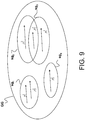
- the relaxed segregation constraints generally relate to a group of paths constituting virtual links to be routed simultaneously.
- VL 1 , VL 2 , VL 3 are to be simultaneously routed and that their constituent paths are:
- V The 1 p 1 1 , p 1 2 , p 1 3 , p 1 4 ;
- V The 2 p 2 1 , p 2 2 , p 2 3 ;
- V The 3 p 3 1 , p 3 2 ;
- the relaxed segregation constraint is expressed by a maximum number n sg ⁇ N sg of subgroups that can be invalidated by the failure of the same switch (for example, the failure of a switch will affect the paths p 1 1 , p 2 1 of sg 1 ).
- n sg - n sg subgroups must each contain at least one path not corrupted by the failure of a switch.
- FCGU Flight Control and Guidance Unit
- each FCGU calculator receives flight parameters from both FMS systems and makes a comparison. If the parameters received by the same computer differ, the computer reports an error and does not perform any processing on the parameter. Safety requirements dictate that an error on a parameter does not remain undetected by more than one calculator.
- the parameter transmitted by the FMS or a frame of such parameters assumed (s) correct (s) a * and a wrong parameter received by a computer or FCGU an erroneous frame parameters, the error being due to the failure of a switch.
- a calculator may not detect an error in case of bilateral corruption (case of FCGU 1A in Fig. 10A and FCGU 1A and FCGU 2A in Fig. 10B ), when the two erroneous parameters / erroneous frames are identical. This situation should not occur for more than one calculator. Thus, the situation illustrated in Fig. 10A (a single undetected error) is acceptable while the one Fig. 10B (two undetected errors) is not.
Landscapes
- Engineering & Computer Science (AREA)
- Computer Networks & Wireless Communication (AREA)
- Signal Processing (AREA)
- Environmental & Geological Engineering (AREA)
- Data Exchanges In Wide-Area Networks (AREA)
- Small-Scale Networks (AREA)
Claims (19)
- Verfahren zum Routen virtueller Links in einem Frame-Switching-Netz, das eine Vielzahl von Ausgangs- und/oder Empfangsendgeräten der Frames enthält, wobei Frame-Schalter durch physische Verbindungen miteinander verbunden sind, wobei jeder virtuelle Link für einen Punkt-zu-Punkt-Typ durch einen Pfad über das Netz zwischen einem Ausgangsendgerät und einem Empfangsendgerät und für einen Mehrpunkt-Typ durch eine Vielzahl von Pfaden über das Netz zwischen einem Ausgangsendgerät einerseits und einer Vielzahl von Empfangsendgeräten andererseits definiert wird, wobei das Verfahren dadurch gekennzeichnet ist, dass es für mindestens einen virtuellen Link die folgenden Schritte enthält:a) Auswahl (250), aus einer Einheit von möglichen Pfaden zwischen dem Ausgangsendgerät und dem oder den Empfangsendgerät(en), einer Teileinheit von Pfaden, die zumindest eine vorbestimmte topologische Bedingung erfüllen, wobei die topologische Bedingung zu einer Einheit von absoluten topologischen Bedingungen und relativen topologischen Bedingungen gehört, wobei die absoluten topologischen Bedingungen das Routen eines virtuellen Links unabhängig vom Vorhandensein anderer virtueller Links im Netz beeinflussen und die relativen topologischen Bedingungen die virtuellen Links untereinander betreffen;b) Bestimmung (260), in der Teileinheit, eines Pfads für einen virtuellen Link des Typs Punkt-zu-Punkt oder einer Vielzahl von Pfaden für einen virtuellen Link vom Mehrpunkt-Typ, wodurch mindestens eine gegebene Kostenfunktion minimiert wird;c) Routen (295) des virtuellen Links gemäß dem so bestimmten Pfad oder den so bestimmten Pfaden.
- Routing-Verfahren nach Anspruch 1, dadurch gekennzeichnet, dass, wenn der virtuelle Link ein Punkt-zu-Punkt-Link und das Netz in unterschiedliche Zonen partitioniert ist, die topologische Bedingung eine Bedingung (435) des Nichtüberschreitens einer Grenze zwischen Zonen ist, wenn die mit dem Ausgangsendgerät bzw. mit dem Empfangsendgerät verbundenen Schalter zur gleichen Zone gehören, wobei die angewendete topologische Bedingung im gegenteiligen Fall eine Bedingung (437) eines einmaligen Überschreitens der Grenze zwischen den Zugehörigkeitszonen des Ausgangsendgeräts bzw. des Empfangsendgeräts ist.
- Routing-Verfahren nach Anspruch 1 oder 2, dadurch gekennzeichnet, dass der Auswahlschritt zusätzliche topologische Bedingungen (420) der Segregation und/oder der Kollokation der möglichen Pfade gegenüber bereits gerouteten oder gleichzeitig mit dem Link zu routenden virtuellen Links oder Schaltern des Netzes berücksichtigt.
- Routing-Verfahren nach Anspruch 1 oder 2, dadurch gekennzeichnet, dass der Auswahlschritt zusätzliche topologische Bedingungen berücksichtigt, wobei jede zusätzliche topologische Bedingung sich auf eine Gruppe von Pfaden bezieht, die konstituierender Bestandteil einer Einheit von gleichzeitig zu routenden virtuellen Links sind, wobei die Gruppe aus einer Vielzahl Nsg von Teilgruppen der Pfade besteht, wobei die zusätzliche Bedingung ausdrückt, dass maximal eine Anzahl nsg von Teilgruppen derart, dass gilt 0 ≤ nsg < Nsg, ungültig gemacht werden können, wobei eine Teilgruppe ungültig gemacht wird, wenn alle Pfade, die zu ihr gehören, vom Ausfall des gleichen Schalters des Netzes betroffen sind.
- Routing-Verfahren nach Anspruch 2, 3 oder 4, dadurch gekennzeichnet, dass die Kostenfunktion (440) die Anzahl von von einem Pfad durchquerten Schaltern ist.
- Routing-Verfahren nach Anspruch 1, dadurch gekennzeichnet, dass, wenn der virtuelle Link vom Mehrpunkt-Typ und das Netz in unterschiedliche Zonen partitioniert ist, an jeden möglichen Pfad zwischen dem Ausgangsendgerät und einem Empfangsendgerät des Links eine Bedingung (5201, ..., 520K) des Nichtüberschreitens einer Grenze zwischen Zonen angewendet wird, wenn die mit dem Ausgangsendgerät bzw. Empfangsendgerät verbundenen Schalter zur gleichen Zone gehören, wobei die angewendete topologische Bedingung im gegenteiligen Fall eine Bedingung des einmaligen Überschreitens der Grenze zwischen den Zugehörigkeitszonen des Ausgangsendgeräts bzw. Empfangsendgeräts ist.
- Routing-Verfahren nach Anspruch 6, dadurch gekennzeichnet, dass für jeden der möglichen Pfade zwischen dem Ausgangsendgerät und einem Empfangsendgerät des Links zusätzliche topologische Bedingungen der Segregation und/oder der Kollokation dieser Pfade gegenüber bereits gerouteten oder gleichzeitig mit dem Link zu routenden virtuellen Links oder Schaltern des Netzes angewendet werden (5201, ..., 520K).
- Routing-Verfahren nach Anspruch 6, dadurch gekennzeichnet, dass der Auswahlschritt zusätzliche topologische Bedingungen berücksichtigt, wobei jede zusätzliche topologische Bedingung sich auf eine Gruppe von Pfaden bezieht, die konstituierender Bestandteil einer Einheit von gleichzeitig zu routenden virtuellen Links sind, wobei die Gruppe aus einer Vielzahl Nsg von Teilgruppen der Pfade besteht, wobei die zusätzliche Bedingung ausdrückt, dass maximal eine Anzahl nsg von Teilgruppen, derart, dass gilt 0 ≤ nsg < Nsg, ungültig gemacht werden können, wobei eine Teilgruppe ungültig gemacht wird, wenn alle Pfade, die zu ihr gehören, vom Ausfall des gleichen Schalters des Netzes betroffen sind.
- Routing-Verfahren nach Anspruch 6, 7 oder 8, dadurch gekennzeichnet, dass die Kostenfunktion die Anzahl von Schaltern ist, die von einem Pfad durchquert werden, und dass sie auf jede Einheit von möglichen Pfaden zwischen dem Ausgangsendgerät und einem Empfangsendgerät des Links minimiert wird (5301, ..., 530K), um mindestens einen Kandidat-Pfad pro Empfangsendgerät zu liefern.
- Routing-Verfahren nach Anspruch 9, dadurch gekennzeichnet, dass Kombinationen von K Kandidat-Pfaden durchgeführt werden (540), wobei K die Anzahl von Empfangsendgeräten des Links ist, wobei jede Kombination einer möglichen Routing-Lösung des Mehrpunkt-Links entspricht, und dass eine zweite Kostenfunktion auf die Einheit der so erhaltenen möglichen Lösungen minimiert wird (550).
- Routing-Verfahren nach Anspruch 10, dadurch gekennzeichnet, dass die zweite Kostenfunktion für jede mögliche Lösung die Anzahl von Schaltern ermittelt, die von ihren konstituierenden Pfaden gemeinsam genutzt werden.
- Routing-Verfahren nach Anspruch 1, dadurch gekennzeichnet, dass für mindestens eine Gruppe von Links, die an der Durchführung einer gleichen Funktion beteiligt sind, Bündel von Links genannt, wobei jeder Link Punkt-zu-Punkt und das Netz in unterschiedliche Zonen partitioniert ist, für jeden der Links des Bündels (6201, ..., 620N) an jeden möglichen Pfad zwischen dem Ausgangsendgerät und dem Empfangsendgerät des Links eine Bedingung des Nichtüberschreitens einer Grenze zwischen Zonen, wenn die mit dem Ausgangsendgerät bzw. dem Empfangsendgerät verbundenen Schalter zur gleichen Zone gehören, und im gegenteiligen Fall eine Bedingung des einmaligen Überschreitens der Grenze zwischen den Zugehörigkeitszonen des Ausgangsendgeräts bzw. des Empfangsendgeräts angewendet wird.
- Routing-Verfahren nach Anspruch 12, dadurch gekennzeichnet, dass für jeden virtuellen Link und für jeden der möglichen Pfade zwischen dem Ausgangsendgerät und dem Empfangsendgerät des Links zusätzliche topologische Bedingungen der Segregation und/oder der Kollokation dieser Pfade gegenüber bereits gerouteten oder gleichzeitig mit dem Link zu routenden virtuellen Links oder Schaltern des Netzes angewendet werden (6201, ..., 620K).
- Routing-Verfahren nach Anspruch 12, dadurch gekennzeichnet, dass der Auswahlschritt zusätzliche topologische Bedingungen berücksichtigt, wobei jede zusätzliche topologische Bedingung sich auf eine Gruppe von Pfaden bezieht, die konstituierende Bestandteile einer Einheit von gleichzeitig zu routenden virtuellen Links sind, wobei die Gruppe aus einer Vielzahl Nsg von Teilgruppen der Pfade besteht, wobei die zusätzliche Bedingung ausdrückt, dass maximal eine Anzahl nsg von Teilgruppen, derart, dass gilt 0 ≤ nsg < Nsg, ungültig gemacht werden können, wobei eine Teilgruppe ungültig gemacht wird, wenn alle Pfade, die zu ihr gehören, vom Ausfall des gleichen Schalters des Netzes betroffen sind.
- Routing-Verfahren nach Anspruch 12, 13 oder 14, dadurch gekennzeichnet, dass die Kostenfunktion die Anzahl von von einem Pfad durchquerten Schaltern ist, und dass sie für jeden der Links des Bündels auf jede Einheit von möglichen Pfaden zwischen dem Ausgangsendgerät und dem Empfangsendgerät des Links minimiert wird (6301, ..., 630N), um mindestens einen Kandidat-Pfad pro Link zu liefern.
- Routing-Verfahren nach Anspruch 15, dadurch gekennzeichnet, dass Kombinationen von N Kandidat-Pfaden, wobei N die Anzahl von Links des Bündels ist, durchgeführt werden (640), wobei jede Kombination einer möglichen Routing-Lösung des Bündels entspricht, und dass eine dritte Kostenfunktion über die Gesamtheit der so erhaltenen Lösungen minimiert wird (650).
- Routing-Verfahren nach Anspruch 16, dadurch gekennzeichnet, dass die dritte Kostenfunktion für jede mögliche Routing-Lösung des Bündels die Anzahl von gemeinsam genutzten Schaltern zwischen den Pfaden ermittelt, von denen die Lösung die Kombination ist.
- Routing-Verfahren nach Anspruch 1, dadurch gekennzeichnet, dass für mindestens eine Gruppe von Links, die an der Durchführung einer gleichen Funktion beteiligt sind, Bündel von Links genannt, wobei jedes Link vom Mehrpunkt-Typ und das Netz in unterschiedliche Zonen partitioniert ist, für jeden der Links des Bündels (7201, ..., 720N) an jeden möglichen Pfad zwischen dem Ausgangsendgerät und einem Empfangsendgerät des Links eine Bedingung des Nichtüberschreitens einer Grenze zwischen Zonen, wenn die mit dem Ausgangsendgerät bzw. dem Empfangsendgerät verbundenen Schalter zur gleichen Zone gehören, und im gegenteiligen Fall eine Bedingung des einmaligen Überschreitens der Grenze zwischen den Zugehörigkeitszonen des Ausgangsendgeräts bzw. Empfangsendgeräts angewendet wird.
- Computerprogramm, das Softwareeinrichtungen enthält, die geeignet sind, die Schritte des Verfahrens nach einem der vorhergehenden Ansprüche durchzuführen, wenn es von einem Computer ausgeführt wird.
Applications Claiming Priority (3)
| Application Number | Priority Date | Filing Date | Title |
|---|---|---|---|
| FR0652093A FR2902255B1 (fr) | 2006-06-12 | 2006-06-12 | Procede de routage de liens virtuels dans un reseau a commutation de trames |
| FR0752972A FR2902256B1 (fr) | 2006-06-12 | 2007-01-30 | Procede de routage de liens virtuels dans un reseau a commutation de trames |
| PCT/FR2007/051323 WO2007144527A1 (fr) | 2006-06-12 | 2007-05-24 | Procédé de routage de liens virtuels dans un réseau à commutation de trames |
Publications (2)
| Publication Number | Publication Date |
|---|---|
| EP2030367A1 EP2030367A1 (de) | 2009-03-04 |
| EP2030367B1 true EP2030367B1 (de) | 2018-07-04 |
Family
ID=38515530
Family Applications (1)
| Application Number | Title | Priority Date | Filing Date |
|---|---|---|---|
| EP07766095.9A Not-in-force EP2030367B1 (de) | 2006-06-12 | 2007-05-24 | Verfahren zum routen virtueller verbindungen in einem frame-switching-netz |
Country Status (8)
| Country | Link |
|---|---|
| US (1) | US8208476B2 (de) |
| EP (1) | EP2030367B1 (de) |
| JP (1) | JP5112426B2 (de) |
| BR (1) | BRPI0712116A2 (de) |
| CA (1) | CA2654969C (de) |
| FR (1) | FR2902256B1 (de) |
| RU (1) | RU2451410C2 (de) |
| WO (1) | WO2007144527A1 (de) |
Families Citing this family (12)
| Publication number | Priority date | Publication date | Assignee | Title |
|---|---|---|---|---|
| FR2914519B1 (fr) * | 2007-03-26 | 2009-06-12 | Airbus France Sas | Procede de controle d'integrite des donnees dans un reseau afdx. |
| US9306766B2 (en) * | 2011-03-28 | 2016-04-05 | Honeywell International Inc. | Versatile source port enforcement for data networks |
| US8665884B2 (en) | 2011-08-25 | 2014-03-04 | Honeywell International Inc. | Embedded end-to-end delay information for data networks |
| FR2984644B1 (fr) * | 2011-12-15 | 2014-01-17 | Airbus Operations Sas | Reseau afdx a reseau d'acces optique passif |
| US20130208630A1 (en) * | 2012-02-15 | 2013-08-15 | Ge Aviation Systems Llc | Avionics full-duplex switched ethernet network |
| GB2505203B (en) * | 2012-08-22 | 2017-09-13 | Ge Aviat Systems Ltd | Method for allocation of network resources in an operations network for a selected environment |
| WO2014147453A1 (en) | 2013-03-22 | 2014-09-25 | Freescale Semiconductor, Inc. | A multi-port transmitter device for transmitting at least partly redundant data, an associated control system, an associated method and an associated computer program product |
| US9813301B2 (en) * | 2014-08-20 | 2017-11-07 | Nec Corporation | Optimization framework for multi-tenant data centers |
| US9913195B2 (en) | 2015-06-19 | 2018-03-06 | Terranet Ab | Mesh path selection |
| EP3313118A1 (de) * | 2016-10-24 | 2018-04-25 | Thomson Licensing | Verfahren, das in einer vorrichtung implementiert wird, die mit einer kundenräumlichkeitsausrüstung eines netzwerks erster art verbunden wird, zugehörige vorrichtung |
| US10778575B2 (en) | 2017-02-20 | 2020-09-15 | Ge Aviation Systems Llc | Systems and methods for scheduling a message |
| RU2757781C1 (ru) * | 2021-01-08 | 2021-10-21 | Юрий Иванович Стародубцев | Способ устойчивой маршрутизации данных в виртуальной сети связи |
Family Cites Families (20)
| Publication number | Priority date | Publication date | Assignee | Title |
|---|---|---|---|---|
| US5623492A (en) * | 1995-03-24 | 1997-04-22 | U S West Technologies, Inc. | Methods and systems for managing bandwidth resources in a fast packet switching network |
| US6175870B1 (en) * | 1995-11-30 | 2001-01-16 | Lucent Technologies Inc. | Method of admission control and routing of virtual circuits |
| RU2189072C2 (ru) * | 1996-01-31 | 2002-09-10 | Ипсилон Нетуоркс, Инк. | Усовершенствованный способ и устройство для динамического смещения между пакетами маршрутизации и коммутации в сети передачи данных |
| US5682301A (en) * | 1996-05-14 | 1997-10-28 | Kraft; James L. | Modular network cabling system for enterprise with multiple sites |
| US5754543A (en) * | 1996-07-03 | 1998-05-19 | Alcatel Data Networks, Inc. | Connectivity matrix-based multi-cost routing |
| JP3332733B2 (ja) * | 1996-07-11 | 2002-10-07 | 株式会社東芝 | ノード装置及びパケット転送方法 |
| JP2964957B2 (ja) * | 1996-08-15 | 1999-10-18 | 日本電気株式会社 | 高速ルーティング制御方式 |
| KR100194608B1 (ko) * | 1996-11-20 | 1999-06-15 | 이계철 | Atm 통신망에서의 멀티캐스트 경로 할당방법 |
| US6041057A (en) * | 1997-03-24 | 2000-03-21 | Xylan Corporation | Self-configuring ATM network |
| US6584093B1 (en) * | 1998-08-25 | 2003-06-24 | Cisco Technology, Inc. | Method and apparatus for automatic inter-domain routing of calls |
| US6363319B1 (en) * | 1999-08-31 | 2002-03-26 | Nortel Networks Limited | Constraint-based route selection using biased cost |
| US6707820B1 (en) * | 1999-12-16 | 2004-03-16 | Intervoice Limited Partnership | Virtual circuit network dynamic channel management |
| US7123620B1 (en) * | 2000-04-25 | 2006-10-17 | Cisco Technology, Inc. | Apparatus and method for scalable and dynamic traffic engineering in a data communication network |
| GB0010514D0 (en) * | 2000-05-03 | 2000-06-21 | Marconi Comm Ltd | Communications network |
| US6775271B1 (en) * | 2000-05-17 | 2004-08-10 | Intel Corporation | Switching system and method for communicating information at a customer premises |
| US6785737B2 (en) * | 2001-07-31 | 2004-08-31 | Tropic Networks Inc. | Network resource allocation methods and systems |
| FR2832011B1 (fr) * | 2001-11-05 | 2005-05-20 | Airbus France | Reseau de communication de type ethernet full duplex commute et procede de mise en oeuvre de celui-ci |
| US7889675B2 (en) * | 2003-01-31 | 2011-02-15 | Tellabs Operations, Inc. | Method and system for multi-layer network routing |
| US7085242B2 (en) * | 2002-03-22 | 2006-08-01 | Telcordia Technologies, Inc. | Virtual IP topology reconfiguration migration |
| JP4374307B2 (ja) * | 2004-10-20 | 2009-12-02 | 株式会社日立コミュニケーションテクノロジー | ラベルスイッチパスの経路制御方法 |
-
2007
- 2007-01-30 FR FR0752972A patent/FR2902256B1/fr not_active Expired - Fee Related
- 2007-05-24 EP EP07766095.9A patent/EP2030367B1/de not_active Not-in-force
- 2007-05-24 CA CA2654969A patent/CA2654969C/en not_active Expired - Fee Related
- 2007-05-24 RU RU2008152059/08A patent/RU2451410C2/ru not_active IP Right Cessation
- 2007-05-24 JP JP2009514854A patent/JP5112426B2/ja not_active Expired - Fee Related
- 2007-05-24 WO PCT/FR2007/051323 patent/WO2007144527A1/fr not_active Ceased
- 2007-05-24 US US12/303,423 patent/US8208476B2/en active Active
- 2007-05-24 BR BRPI0712116-4A patent/BRPI0712116A2/pt not_active IP Right Cessation
Non-Patent Citations (1)
| Title |
|---|
| None * |
Also Published As
| Publication number | Publication date |
|---|---|
| US8208476B2 (en) | 2012-06-26 |
| FR2902256B1 (fr) | 2009-09-25 |
| JP5112426B2 (ja) | 2013-01-09 |
| JP2009540713A (ja) | 2009-11-19 |
| RU2451410C2 (ru) | 2012-05-20 |
| CA2654969A1 (en) | 2007-12-21 |
| WO2007144527A1 (fr) | 2007-12-21 |
| FR2902256A1 (fr) | 2007-12-14 |
| EP2030367A1 (de) | 2009-03-04 |
| CA2654969C (en) | 2016-04-05 |
| RU2008152059A (ru) | 2010-07-20 |
| US20090180482A1 (en) | 2009-07-16 |
| BRPI0712116A2 (pt) | 2012-01-31 |
Similar Documents
| Publication | Publication Date | Title |
|---|---|---|
| EP2030367B1 (de) | Verfahren zum routen virtueller verbindungen in einem frame-switching-netz | |
| CA2655948C (fr) | Procede de routage de liens virtuels dans un reseau a commutation de trames a determinisme garanti | |
| US9391704B2 (en) | Replacing an existing network communications path with a new path using some exclusive physical resources of the existing path | |
| US8873554B2 (en) | Data structure-less distributed fabric multicast | |
| EP2710785B1 (de) | Erweiterte steuer- und verwaltungsarchitektur für cloud-dienst zur schnittstellenbildung mit der netzwerkschicht | |
| US8116197B2 (en) | Method for finding protected path in mesh networks | |
| US20060002304A1 (en) | Method and apparatus for implementing link-based source routing in generic framing protocol | |
| EP1476990A1 (de) | Dynamisches und verteiltes verfahren zur lokalen beschützung von einem etikettvermittlungsweg | |
| US20110022900A1 (en) | System and method for multi-layer network analysis and design | |
| FR2905047A1 (fr) | Reseau afdx supportant une pluralite de classes de service | |
| JP5949412B2 (ja) | 通信ネットワークにおける複合型マルチレイヤメッシュ回復方法およびシステム | |
| WO2014079629A1 (fr) | Dispositif et procede de retransmission de donnees dans un commutateur reseau | |
| US20050088978A1 (en) | Method and apparatus for deriving allowable paths through a network with intransitivity constraints | |
| EP1788760A1 (de) | System und statisches Paketdatenflusswegeleitverfahren in einem Verbindungsnetzwerk | |
| CN119945528B (zh) | 一种对地观测卫星的多链路数据传输的调度优化方法及系统 | |
| FR2902255A1 (fr) | Procede de routage de liens virtuels dans un reseau a commutation de trames | |
| US20200220806A1 (en) | Provisioning recovery paths in a mesh network | |
| EP1545079B1 (de) | Verfahren zur Errichtung einer logischen Verbindung zwischen einem Startknoten und einem Endknoten, die nicht angrenzen innerhalb eines Telekommunikationsnetzwerkes | |
| EP2119140B1 (de) | Verfahren zur weiterleitung eines datenpakets durch einen router in einem durch ein transportnetzwerk gestützten paketnetzwerk | |
| WO2015177452A1 (fr) | Commutateur de trames numeriques | |
| EP3874691A1 (de) | Verfahren zur messung einer übertragungsverzögerung mit kontrolle der auf einen datenrahmen angewendeten konfliktgrade | |
| Taktak | Survavibility in Multilayer Networks: models and Polyhedra | |
| Pavan et al. | Estimating CapEx in optical multilayer networks | |
| Pinto et al. | A statistical model for capex fast calculation in optical transport networks | |
| Peterkin | A reconfigurable hardware architecture for VPN MPLS based services |
Legal Events
| Date | Code | Title | Description |
|---|---|---|---|
| PUAI | Public reference made under article 153(3) epc to a published international application that has entered the european phase |
Free format text: ORIGINAL CODE: 0009012 |
|
| 17P | Request for examination filed |
Effective date: 20081212 |
|
| AK | Designated contracting states |
Kind code of ref document: A1 Designated state(s): AT BE BG CH CY CZ DE DK EE ES FI FR GB GR HU IE IS IT LI LT LU LV MC MT NL PL PT RO SE SI SK TR |
|
| AX | Request for extension of the european patent |
Extension state: AL BA HR MK RS |
|
| RIN1 | Information on inventor provided before grant (corrected) |
Inventor name: LES AUTERS INVENTEURS ONT RENONCE A LEUR DESIGNATI Inventor name: MINOT, FREDERIC Inventor name: CABARET, REMI |
|
| RAP1 | Party data changed (applicant data changed or rights of an application transferred) |
Owner name: AIRBUS OPERATIONS |
|
| DAX | Request for extension of the european patent (deleted) | ||
| 17Q | First examination report despatched |
Effective date: 20160914 |
|
| STAA | Information on the status of an ep patent application or granted ep patent |
Free format text: STATUS: EXAMINATION IS IN PROGRESS |
|
| REG | Reference to a national code |
Ref country code: DE Ref legal event code: R079 Ref document number: 602007055282 Country of ref document: DE Free format text: PREVIOUS MAIN CLASS: H04L0012180000 Ipc: H04L0012260000 |
|
| GRAP | Despatch of communication of intention to grant a patent |
Free format text: ORIGINAL CODE: EPIDOSNIGR1 |
|
| STAA | Information on the status of an ep patent application or granted ep patent |
Free format text: STATUS: GRANT OF PATENT IS INTENDED |
|
| INTG | Intention to grant announced |
Effective date: 20180108 |
|
| RIC1 | Information provided on ipc code assigned before grant |
Ipc: H04L 12/701 20130101ALI20171219BHEP Ipc: H04L 12/703 20130101ALI20171219BHEP Ipc: H04L 12/721 20130101ALI20171219BHEP Ipc: H04L 12/717 20130101ALI20171219BHEP Ipc: H04L 12/707 20130101ALI20171219BHEP Ipc: H04L 12/26 20060101AFI20171219BHEP Ipc: H04L 12/761 20130101ALI20171219BHEP Ipc: H04L 12/18 20060101ALN20171219BHEP |
|
| GRAS | Grant fee paid |
Free format text: ORIGINAL CODE: EPIDOSNIGR3 |
|
| GRAA | (expected) grant |
Free format text: ORIGINAL CODE: 0009210 |
|
| STAA | Information on the status of an ep patent application or granted ep patent |
Free format text: STATUS: THE PATENT HAS BEEN GRANTED |
|
| AK | Designated contracting states |
Kind code of ref document: B1 Designated state(s): AT BE BG CH CY CZ DE DK EE ES FI FR GB GR HU IE IS IT LI LT LU LV MC MT NL PL PT RO SE SI SK TR |
|
| REG | Reference to a national code |
Ref country code: GB Ref legal event code: FG4D Free format text: NOT ENGLISH |
|
| REG | Reference to a national code |
Ref country code: CH Ref legal event code: EP |
|
| REG | Reference to a national code |
Ref country code: AT Ref legal event code: REF Ref document number: 1015663 Country of ref document: AT Kind code of ref document: T Effective date: 20180715 |
|
| REG | Reference to a national code |
Ref country code: IE Ref legal event code: FG4D Free format text: LANGUAGE OF EP DOCUMENT: FRENCH |
|
| REG | Reference to a national code |
Ref country code: DE Ref legal event code: R096 Ref document number: 602007055282 Country of ref document: DE |
|
| REG | Reference to a national code |
Ref country code: NL Ref legal event code: MP Effective date: 20180704 |
|
| REG | Reference to a national code |
Ref country code: LT Ref legal event code: MG4D |
|
| REG | Reference to a national code |
Ref country code: AT Ref legal event code: MK05 Ref document number: 1015663 Country of ref document: AT Kind code of ref document: T Effective date: 20180704 |
|
| PG25 | Lapsed in a contracting state [announced via postgrant information from national office to epo] |
Ref country code: NL Free format text: LAPSE BECAUSE OF FAILURE TO SUBMIT A TRANSLATION OF THE DESCRIPTION OR TO PAY THE FEE WITHIN THE PRESCRIBED TIME-LIMIT Effective date: 20180704 |
|
| PG25 | Lapsed in a contracting state [announced via postgrant information from national office to epo] |
Ref country code: FI Free format text: LAPSE BECAUSE OF FAILURE TO SUBMIT A TRANSLATION OF THE DESCRIPTION OR TO PAY THE FEE WITHIN THE PRESCRIBED TIME-LIMIT Effective date: 20180704 Ref country code: CZ Free format text: LAPSE BECAUSE OF FAILURE TO SUBMIT A TRANSLATION OF THE DESCRIPTION OR TO PAY THE FEE WITHIN THE PRESCRIBED TIME-LIMIT Effective date: 20180704 Ref country code: PL Free format text: LAPSE BECAUSE OF FAILURE TO SUBMIT A TRANSLATION OF THE DESCRIPTION OR TO PAY THE FEE WITHIN THE PRESCRIBED TIME-LIMIT Effective date: 20180704 Ref country code: AT Free format text: LAPSE BECAUSE OF FAILURE TO SUBMIT A TRANSLATION OF THE DESCRIPTION OR TO PAY THE FEE WITHIN THE PRESCRIBED TIME-LIMIT Effective date: 20180704 Ref country code: BG Free format text: LAPSE BECAUSE OF FAILURE TO SUBMIT A TRANSLATION OF THE DESCRIPTION OR TO PAY THE FEE WITHIN THE PRESCRIBED TIME-LIMIT Effective date: 20181004 Ref country code: SE Free format text: LAPSE BECAUSE OF FAILURE TO SUBMIT A TRANSLATION OF THE DESCRIPTION OR TO PAY THE FEE WITHIN THE PRESCRIBED TIME-LIMIT Effective date: 20180704 Ref country code: LT Free format text: LAPSE BECAUSE OF FAILURE TO SUBMIT A TRANSLATION OF THE DESCRIPTION OR TO PAY THE FEE WITHIN THE PRESCRIBED TIME-LIMIT Effective date: 20180704 Ref country code: IS Free format text: LAPSE BECAUSE OF FAILURE TO SUBMIT A TRANSLATION OF THE DESCRIPTION OR TO PAY THE FEE WITHIN THE PRESCRIBED TIME-LIMIT Effective date: 20181104 |
|
| PG25 | Lapsed in a contracting state [announced via postgrant information from national office to epo] |
Ref country code: ES Free format text: LAPSE BECAUSE OF FAILURE TO SUBMIT A TRANSLATION OF THE DESCRIPTION OR TO PAY THE FEE WITHIN THE PRESCRIBED TIME-LIMIT Effective date: 20180704 Ref country code: LV Free format text: LAPSE BECAUSE OF FAILURE TO SUBMIT A TRANSLATION OF THE DESCRIPTION OR TO PAY THE FEE WITHIN THE PRESCRIBED TIME-LIMIT Effective date: 20180704 |
|
| REG | Reference to a national code |
Ref country code: DE Ref legal event code: R097 Ref document number: 602007055282 Country of ref document: DE |
|
| PG25 | Lapsed in a contracting state [announced via postgrant information from national office to epo] |
Ref country code: EE Free format text: LAPSE BECAUSE OF FAILURE TO SUBMIT A TRANSLATION OF THE DESCRIPTION OR TO PAY THE FEE WITHIN THE PRESCRIBED TIME-LIMIT Effective date: 20180704 Ref country code: IT Free format text: LAPSE BECAUSE OF FAILURE TO SUBMIT A TRANSLATION OF THE DESCRIPTION OR TO PAY THE FEE WITHIN THE PRESCRIBED TIME-LIMIT Effective date: 20180704 Ref country code: RO Free format text: LAPSE BECAUSE OF FAILURE TO SUBMIT A TRANSLATION OF THE DESCRIPTION OR TO PAY THE FEE WITHIN THE PRESCRIBED TIME-LIMIT Effective date: 20180704 |
|
| PLBE | No opposition filed within time limit |
Free format text: ORIGINAL CODE: 0009261 |
|
| STAA | Information on the status of an ep patent application or granted ep patent |
Free format text: STATUS: NO OPPOSITION FILED WITHIN TIME LIMIT |
|
| PG25 | Lapsed in a contracting state [announced via postgrant information from national office to epo] |
Ref country code: DK Free format text: LAPSE BECAUSE OF FAILURE TO SUBMIT A TRANSLATION OF THE DESCRIPTION OR TO PAY THE FEE WITHIN THE PRESCRIBED TIME-LIMIT Effective date: 20180704 Ref country code: SK Free format text: LAPSE BECAUSE OF FAILURE TO SUBMIT A TRANSLATION OF THE DESCRIPTION OR TO PAY THE FEE WITHIN THE PRESCRIBED TIME-LIMIT Effective date: 20180704 |
|
| 26N | No opposition filed |
Effective date: 20190405 |
|
| PGFP | Annual fee paid to national office [announced via postgrant information from national office to epo] |
Ref country code: DE Payment date: 20190521 Year of fee payment: 13 |
|
| PG25 | Lapsed in a contracting state [announced via postgrant information from national office to epo] |
Ref country code: SI Free format text: LAPSE BECAUSE OF FAILURE TO SUBMIT A TRANSLATION OF THE DESCRIPTION OR TO PAY THE FEE WITHIN THE PRESCRIBED TIME-LIMIT Effective date: 20180704 |
|
| REG | Reference to a national code |
Ref country code: CH Ref legal event code: PL |
|
| PG25 | Lapsed in a contracting state [announced via postgrant information from national office to epo] |
Ref country code: LI Free format text: LAPSE BECAUSE OF NON-PAYMENT OF DUE FEES Effective date: 20190531 Ref country code: CH Free format text: LAPSE BECAUSE OF NON-PAYMENT OF DUE FEES Effective date: 20190531 Ref country code: MC Free format text: LAPSE BECAUSE OF FAILURE TO SUBMIT A TRANSLATION OF THE DESCRIPTION OR TO PAY THE FEE WITHIN THE PRESCRIBED TIME-LIMIT Effective date: 20180704 |
|
| REG | Reference to a national code |
Ref country code: BE Ref legal event code: MM Effective date: 20190531 |
|
| PG25 | Lapsed in a contracting state [announced via postgrant information from national office to epo] |
Ref country code: LU Free format text: LAPSE BECAUSE OF NON-PAYMENT OF DUE FEES Effective date: 20190524 |
|
| PG25 | Lapsed in a contracting state [announced via postgrant information from national office to epo] |
Ref country code: TR Free format text: LAPSE BECAUSE OF FAILURE TO SUBMIT A TRANSLATION OF THE DESCRIPTION OR TO PAY THE FEE WITHIN THE PRESCRIBED TIME-LIMIT Effective date: 20180704 |
|
| PG25 | Lapsed in a contracting state [announced via postgrant information from national office to epo] |
Ref country code: IE Free format text: LAPSE BECAUSE OF NON-PAYMENT OF DUE FEES Effective date: 20190524 |
|
| PG25 | Lapsed in a contracting state [announced via postgrant information from national office to epo] |
Ref country code: BE Free format text: LAPSE BECAUSE OF NON-PAYMENT OF DUE FEES Effective date: 20190531 |
|
| PG25 | Lapsed in a contracting state [announced via postgrant information from national office to epo] |
Ref country code: PT Free format text: LAPSE BECAUSE OF FAILURE TO SUBMIT A TRANSLATION OF THE DESCRIPTION OR TO PAY THE FEE WITHIN THE PRESCRIBED TIME-LIMIT Effective date: 20181105 |
|
| REG | Reference to a national code |
Ref country code: DE Ref legal event code: R119 Ref document number: 602007055282 Country of ref document: DE |
|
| PG25 | Lapsed in a contracting state [announced via postgrant information from national office to epo] |
Ref country code: CY Free format text: LAPSE BECAUSE OF FAILURE TO SUBMIT A TRANSLATION OF THE DESCRIPTION OR TO PAY THE FEE WITHIN THE PRESCRIBED TIME-LIMIT Effective date: 20180704 Ref country code: DE Free format text: LAPSE BECAUSE OF NON-PAYMENT OF DUE FEES Effective date: 20201201 |
|
| PG25 | Lapsed in a contracting state [announced via postgrant information from national office to epo] |
Ref country code: GR Free format text: LAPSE BECAUSE OF FAILURE TO SUBMIT A TRANSLATION OF THE DESCRIPTION OR TO PAY THE FEE WITHIN THE PRESCRIBED TIME-LIMIT Effective date: 20180704 |
|
| PG25 | Lapsed in a contracting state [announced via postgrant information from national office to epo] |
Ref country code: MT Free format text: LAPSE BECAUSE OF FAILURE TO SUBMIT A TRANSLATION OF THE DESCRIPTION OR TO PAY THE FEE WITHIN THE PRESCRIBED TIME-LIMIT Effective date: 20180704 Ref country code: HU Free format text: LAPSE BECAUSE OF FAILURE TO SUBMIT A TRANSLATION OF THE DESCRIPTION OR TO PAY THE FEE WITHIN THE PRESCRIBED TIME-LIMIT; INVALID AB INITIO Effective date: 20070524 |
|
| PGFP | Annual fee paid to national office [announced via postgrant information from national office to epo] |
Ref country code: GB Payment date: 20220520 Year of fee payment: 16 Ref country code: FR Payment date: 20220523 Year of fee payment: 16 |
|
| GBPC | Gb: european patent ceased through non-payment of renewal fee |
Effective date: 20230524 |
|
| PG25 | Lapsed in a contracting state [announced via postgrant information from national office to epo] |
Ref country code: GB Free format text: LAPSE BECAUSE OF NON-PAYMENT OF DUE FEES Effective date: 20230524 |
|
| PG25 | Lapsed in a contracting state [announced via postgrant information from national office to epo] |
Ref country code: FR Free format text: LAPSE BECAUSE OF NON-PAYMENT OF DUE FEES Effective date: 20230531 |