EP2026696B1 - Aktivitätsmonitor - Google Patents
Aktivitätsmonitor Download PDFInfo
- Publication number
- EP2026696B1 EP2026696B1 EP07733099.1A EP07733099A EP2026696B1 EP 2026696 B1 EP2026696 B1 EP 2026696B1 EP 07733099 A EP07733099 A EP 07733099A EP 2026696 B1 EP2026696 B1 EP 2026696B1
- Authority
- EP
- European Patent Office
- Prior art keywords
- stepping
- defined time
- time period
- measure
- steps
- Prior art date
- Legal status (The legal status is an assumption and is not a legal conclusion. Google has not performed a legal analysis and makes no representation as to the accuracy of the status listed.)
- Not-in-force
Links
- 230000000694 effects Effects 0.000 title claims description 22
- 230000015654 memory Effects 0.000 claims description 18
- 230000033001 locomotion Effects 0.000 claims description 14
- 238000000034 method Methods 0.000 claims description 5
- 238000012545 processing Methods 0.000 claims description 3
- 230000001429 stepping effect Effects 0.000 description 39
- 230000007774 longterm Effects 0.000 description 10
- 230000003750 conditioning effect Effects 0.000 description 6
- 210000002414 leg Anatomy 0.000 description 6
- 230000037081 physical activity Effects 0.000 description 5
- 230000001133 acceleration Effects 0.000 description 4
- 230000006870 function Effects 0.000 description 3
- 238000005259 measurement Methods 0.000 description 3
- 238000012544 monitoring process Methods 0.000 description 3
- 238000012360 testing method Methods 0.000 description 3
- 238000013459 approach Methods 0.000 description 2
- 238000004891 communication Methods 0.000 description 2
- 238000013461 design Methods 0.000 description 2
- 238000001514 detection method Methods 0.000 description 2
- 238000010586 diagram Methods 0.000 description 2
- 230000005484 gravity Effects 0.000 description 2
- 230000007787 long-term memory Effects 0.000 description 2
- 230000000284 resting effect Effects 0.000 description 2
- 238000005070 sampling Methods 0.000 description 2
- 230000003068 static effect Effects 0.000 description 2
- 230000036642 wellbeing Effects 0.000 description 2
- 208000020925 Bipolar disease Diseases 0.000 description 1
- 208000024172 Cardiovascular disease Diseases 0.000 description 1
- 208000008589 Obesity Diseases 0.000 description 1
- 238000004458 analytical method Methods 0.000 description 1
- 230000003542 behavioural effect Effects 0.000 description 1
- 238000004364 calculation method Methods 0.000 description 1
- 230000001186 cumulative effect Effects 0.000 description 1
- 230000006735 deficit Effects 0.000 description 1
- 238000005516 engineering process Methods 0.000 description 1
- 210000003414 extremity Anatomy 0.000 description 1
- 230000036541 health Effects 0.000 description 1
- 210000003141 lower extremity Anatomy 0.000 description 1
- 238000012986 modification Methods 0.000 description 1
- 230000004048 modification Effects 0.000 description 1
- 235000020824 obesity Nutrition 0.000 description 1
- 230000002093 peripheral effect Effects 0.000 description 1
- 230000005195 poor health Effects 0.000 description 1
- 230000002123 temporal effect Effects 0.000 description 1
- 238000012546 transfer Methods 0.000 description 1
- 210000000689 upper leg Anatomy 0.000 description 1
Images


Classifications
-
- A—HUMAN NECESSITIES
- A61—MEDICAL OR VETERINARY SCIENCE; HYGIENE
- A61B—DIAGNOSIS; SURGERY; IDENTIFICATION
- A61B5/00—Measuring for diagnostic purposes; Identification of persons
- A61B5/103—Measuring devices for testing the shape, pattern, colour, size or movement of the body or parts thereof, for diagnostic purposes
- A61B5/1036—Measuring load distribution, e.g. podologic studies
- A61B5/1038—Measuring plantar pressure during gait
-
- G—PHYSICS
- G01—MEASURING; TESTING
- G01C—MEASURING DISTANCES, LEVELS OR BEARINGS; SURVEYING; NAVIGATION; GYROSCOPIC INSTRUMENTS; PHOTOGRAMMETRY OR VIDEOGRAMMETRY
- G01C22/00—Measuring distance traversed on the ground by vehicles, persons, animals or other moving solid bodies, e.g. using odometers, using pedometers
- G01C22/006—Pedometers
-
- A—HUMAN NECESSITIES
- A61—MEDICAL OR VETERINARY SCIENCE; HYGIENE
- A61B—DIAGNOSIS; SURGERY; IDENTIFICATION
- A61B2562/00—Details of sensors; Constructional details of sensor housings or probes; Accessories for sensors
- A61B2562/02—Details of sensors specially adapted for in-vivo measurements
- A61B2562/0219—Inertial sensors, e.g. accelerometers, gyroscopes, tilt switches
Definitions
- the present invention relates to an activity monitor.
- the present invention relates to a long term activity monitor that is operable to provide a measure of stepping intensity.
- Physical activity and its measurement have important implications for health and wellbeing. Low levels of physical activity are associated with poor health, such as cardiovascular disease and obesity. Additionally, physical activity measurement gives a quantitative measure of an individual's community mobility. This is important for subjects with an impairment resulting in reduced mobility, for example patients who have had a stroke, or who exhibit behavioural changes, such as bipolar disorder. Stepping is the most important of the primary activities in relation to physical activity.
- the energy cost of purposeful walking is around four times resting values and the energy expenditure of running can be more than ten times resting values.
- Pedometers are the simplest and cheapest devices available for quantifying stepping activity. These provide a cumulative step count that the user can periodically reset. Typically, pedometers are designed to measure purposeful walking and tend to be inaccurate at counting slow steps or fast stepping, e.g. running. Typical pedometers do not measure the intensity of stepping, often referred to as cadence, and provide only a total count of steps taken over a time period and some simple calculations based on this total. There is a range of monitors available which provide a continuous record of the steps taken. Devices that provide this facility include the Actigraph (Actigraph LLC, Florida, USA) and the Stepwatch (CYMA Corporation, Seattle, USA). These record the number of steps taken in a defined period of time, typically one minute.
- a problem with devices that record only the number of steps taken is that they cannot accurately reflect the intensity of stepping. For example, if 120 steps were taken in a minute then the cadence is 120 steps per minute. If only 20 steps were taken in the minute then this would be represented as 20 steps per minute. However, if the 20 steps were taken in the minute but only 10 seconds was actually spent stepping then the true cadence would be 20 steps in 10 seconds, which is equivalent to 120 steps per minute. This represents an error in estimating the intensity of the stepping activity of a factor of six and misclassifies a high physical activity period as a low level period. As well as simple step counters, there are some other, more complex devices available to provide a measure of the variation in stepping intensity over extended periods.
- the activFAL PAL Technologies Ltd, Glasgow, UK
- the AMP311 Downlink Innovations Inc, Alberta, Canada
- These use sophisticated algorithms to detect and record parameters associated with each individual step. This allows a detailed picture of stepping activity to be constructed from the recorded data. Having a detailed record of the pattern of stepping activity is important as the energy cost of a step is not fixed and varies with cadence. Broadly, the energy cost of walking a mile is the same as running a mile, i.e. the energy cost per unit of distance travelled is similar. However, as stepping rate increases stride length also increases. Hence, at higher stepping rates each unit of distance is covered in less time and the physical effort, i.e. the energy cost, of the stepping activity is increased.
- WO99/18480 describes a method for measuring the foot contact time of a person in locomotion. To do this a time period that a foot is in contact with the ground during a stride taken by a user, and the period that the foot is not in contact with the ground between strides taken by the user are determined by processing and analyzing the output signal of an accelerometer.
- the accelerometer is mounted on the user to sense acceleration in a direction substantially parallel to the bottom of the user's foot.
- the output of the accelerometer is high-pass filtered, amplified, and fed to the input of a micro-controller, which monitors the signal for positive and negative signal spikes that are indicative, respectively, of the moment that the foot of the user leaves the ground and the moment that the foot impacts with the ground. By measuring time intervals between these positive and negative spikes, average "foot contact times" and "foot loft times" of the user may be calculated.
- an activity monitor that has a sensor for sensing movement and a memory, the monitor being configured to record in a long term part of the memory at least two of the number of steps taken per defined time period, a measure of the fraction of the defined time period actually spent stepping and a measure of the true cadence determined using the number of steps and the measure of the fraction of the defined time period actually spent stepping.
- a flag is also set to indicate the dominant device orientation over the epoch (ie vertical or horizontal).
- the amount of physical memory required to provide a true measure of the cadence is minimised and power consumption can be reduced, whilst allowing the true cadence per epoch to be calculated.
- This is advantageous, because in use the activity monitor will have to be used over extended periods, for example a year. For these extended recording periods power-consumption is a limiting factor.
- Minimising the size of the memory and the battery needed, allows the overall size of the monitor to be reduced. This is important, because for subject compliance the monitor has to be as small and easy to apply as possible.
- a method for measuring activity comprising sensing movement using a sensor; storing sensed movement data; using the sensed data to determine the number of steps taken for each of a plurality of epochs, as well as measure of the fraction of each epoch spent stepping, and using the number of steps taken and the measure of the fraction of each epoch spent stepping to determine a measure of the cadence for each epoch.
- the cadence is determined by dividing the number of steps by the fraction of each epoch spent stepping.
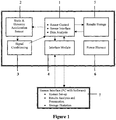
- Figure 1 shows a long-term activity monitor.
- This is a body worn sensing and recording device consisting of a control module 1 that is connected to each of an acceleration sensor 2; a signal conditioning module 3; an interface module 4 and a memory 5. Supplying all of these is a power element 6.
- the interface module 4 provides a connection to an external human interface 7, thereby to allow communication with the control module 1, so that the contents of the memory 5 can be accessed.
- This provides a means for accepting user instructions, for example for set-up, and/or to transfer the stored data to another location.
- the human interface module 7 is a software module residing at a personal computer. This allows programming and testing of the device before use and/or the presentation of activity monitoring results.
- the acceleration sensor 2 is operable to detect both static and dynamic accelerations. This means that it can provide information on both the long-term position of the structure on which it is fixed relative to gravity, for example horizontal and vertical, and the movement of this structure.
- the sensor output is passed to the conditioning module 3, where it is filtered and amplified. Any suitable filter may be used in the conditioning module 3. However in a preferred example, an anti-aliasing low pass filter in the range of 5-40Hz is used to screen out high frequencies not associated with human movement.
- the output of the conditioning module 3 is connected to the control module 1, which is the main unit of the system, and includes a processor.
- the main task of the control module is to implement algorithms for identification of position and movement changes in the incoming digital signal from the conditioning module. Included in the processor is a buffer memory for the temporary storage of data that is being processed. Data that is to be stored long term is saved in the memory 5.
- the control module 1 accepts the analogue signal from the conditioning module 3 and converts this to a digital signal, typically using a 10Hz sampling rate.
- User-defined thresholds are used for position measurement and movement (step) detection. To do this, a low pass filter is applied to the digital signal and the filtered signal is classified against the programmed thresholds for position allowing the orientation of the device with respect to gravity to be determined. If the device is judged to be in an appropriate orientation for stepping activity to occur (upright) then the unfiltered signal is tested for the presence of stepping movements. Algorithms are then applied to extract position and movement from the data signal over a defined time period or epoch, typically one minute, thereby to provide stepping information.
- the recorded data may include a measure of the true cadence determined using the number of steps and the measure of the fraction of the epoch actually spent stepping.
- These three values are the only quantitative stepping values stored in the long-term memory, and in practice it is preferred that only two of these are stored, thereby keeping memory requirements to a minimum.
- a flag is also set in the memory 5 to indicate the dominant device orientation over the epoch (ie vertical or horizontal). All the sensed data is then either deleted from the buffer or overwritten by data for the next epoch.
- the power module 6 provides the power to all other modules of the device. It is managed by the control module 1 to minimise power drain to peripheral modules. Power consumption is directly related to the recording period. Sensing and memory writing are the two highest power requirements. By storing the inter-step intervals for each epoch rather than all the stepping data captured, information can be conveyed as to whether for example ten fast steps were taken in an otherwise static minute, or ten very slow steps were uniformly taken inside that minute. Doing this reduces the memory requirements for the long-term memory 5 and so reduces the overall power requirements for the device. By using a relatively low sampling frequency on the sensor signal (typically 10Hz) and an epoch of one minute, information content is maximised while further reducing power consumption. With these settings, a single 2000mAh battery will provide in excess of one year's recording capability.
- Figure 2 shows a flowchart of a typical application procedure, where the device is being drawn from stock, tested, programmed and fitted to an individual for a period of up to 18 months and then returned and inquired at the host station.
- the device When the device is selected for use, it is firstly connected to an interface with, for example, a PC for testing. In the event that it is working, it can be programmed and applied to a user for extended use. Where the user has a prosthetic leg, the device is typically fitted to the shin of the leg so that it can be used to continuously monitor the patient's activity levels over an extended period of time by capturing data on position, i.e. horizontal or vertical, the numbers of steps per epoch and the time spent stepping during each epoch.
- This data capturing and monitoring is done continuously until, for example, the battery runs out or the memory is full or a predetermined test time has elapsed or the device has malfunctioned.
- the data captured by the device is up-loaded via the interface to a PC for analysis and/or presentation. In this way, there is provided a simple and effective way for capturing important long term clinical data.
- the activity monitor of the present invention provides significantly enhanced mobility information.
- the data that can be derived provides an improved indication of a user's activity levels over what could be obtained with a simple step counter.
- the device of the present invention allows the true pace of stepping in each epoch to be determined and recorded in such a manner that long-term use becomes a practical possibility.
- the activity monitor in which the present invention is embodied is able to generate an accurate intensity for each epoch by recording both the number of steps taken in each epoch and the time spent stepping.
- the above-described system can be applied to able-bodied subjects or those with prosthetic limbs. Typically the device is worn on the lower leg, but thigh and trunk placements are alternatives.
- the interface 4 is shown as a separate module, its functions may be integrated into the control unit 1.
- a USB communications module can be included to provide direct USB connection to the host.
- the fraction of stepping step is recorded, instead the fraction of time spent not stepping could be recorded and used later to determine the fraction of time spent stepping.
Landscapes
- Health & Medical Sciences (AREA)
- Life Sciences & Earth Sciences (AREA)
- Engineering & Computer Science (AREA)
- Physics & Mathematics (AREA)
- Pathology (AREA)
- Medical Informatics (AREA)
- Dentistry (AREA)
- Oral & Maxillofacial Surgery (AREA)
- Radar, Positioning & Navigation (AREA)
- Biophysics (AREA)
- General Physics & Mathematics (AREA)
- Biomedical Technology (AREA)
- Heart & Thoracic Surgery (AREA)
- Remote Sensing (AREA)
- Molecular Biology (AREA)
- Surgery (AREA)
- Animal Behavior & Ethology (AREA)
- General Health & Medical Sciences (AREA)
- Public Health (AREA)
- Veterinary Medicine (AREA)
- Measurement Of The Respiration, Hearing Ability, Form, And Blood Characteristics Of Living Organisms (AREA)
Claims (9)
- Aktivitätsüberwachungseinrichtung, die einen Sensor zum Erfassen von Bewegung, einen Prozessor (1) zum Verarbeiten erfasster Daten und einen Speicher (5) hat, worin der Prozessor (1) dafür konfiguriert ist, die erfassten Daten zu verwenden, um die Anzahl der getanen Schritte für jeden aus einer Vielzahl von definierten Zeitabschnitten zu bestimmen und ein Maß des Anteils jedes definierten Zeitabschnitts, der schreitend verbracht wurde, zu bestimmen, wobei die Überwachungseinrichtung dafür konfiguriert ist, im Speicher (5) mindestens zwei der Folgenden aufzuzeichnen: die Anzahl der Schritte; das Maß des schreitend verbrachten Anteils jedes definierten Zeitabschnitts; und ein unter Verwendung der Anzahl der Schritte und des schreitend verbrachten Anteils jedes definierten Zeitabschnitts berechnetes Maß der Schrittfrequenz.
- Aktivitätsüberwachungseinrichtung nach Anspruch 1, worin nur eines von Folgendem aufgezeichnet wird: das Maß des schreitend verbrachten Anteils jedes definierten Zeitabschnitts oder die Schrittfrequenz.
- Aktivitätsüberwachungseinrichtung nach Anspruch 1 oder Anspruch 2, worin Daten, die erfasst werden, in einem Kurzzeit- oder Pufferspeicherteil des Speichers (5) gespeichert werden.
- Aktivitätsüberwachungseinrichtung nach Anspruch 3, worin der Kurzzeit- oder Pufferspeicher innerhalb eines eingebauten Prozessors (1) ist.
- Aktivitätsüberwachungseinrichtung nach Anspruch 3 oder Anspruch 4, worin die erfassten Daten gelöscht oder überschrieben werden, sobald die Anzahl der Schritte und der Anteil aktiven Schreitens pro definiertem Zeitabschnitt bestimmt sind.
- Aktivitätsüberwachungseinrichtung nach einem der vorhergehenden Ansprüche, die dafür konfiguriert ist, eine Angabe der vorherrschenden Geräteausrichtung für jeden definierten Zeitabschnitt zu speichern.
- Aktivitätsüberwachungseinrichtung nach Anspruch 6, worin ein Rang bereitgestellt wird, das in einem Zustand angibt, dass die vorherrschende Geräteausrichtung horizontal war, und im anderen Zustand angibt, dass die vorherrschende Geräteausrichtung vertikal war.
- Verfahren zum Messen von Aktivität, umfassend: Erfassen von Bewegung unter Verwendung eines Sensors; Speichern erfasster Bewegungsdaten; Verwenden der erfassten Daten, um die Anzahl der getanen Schritte für jeden aus einer Vielzahl von definierten Zeitabschnitten sowie ein Maß des schreitend verbrachten Anteils jedes definierten Zeitabschnitts zu bestimmen; und Verwenden der Anzahl der getanen Schritte und des Maßes des schreitend verbrachten Anteils jedes definierten Zeitabschnitts, um ein Maß der Schrittfrequenz für jeden definierten Zeitabschnitt zu bestimmen.
- Verfahren nach Anspruch 8, worin die Schrittfrequenz durch Dividieren der Anzahl der Schritte durch den schreitend verbrachten Anteil jedes definierten Zeitabschnitts bestimmt wird.
Applications Claiming Priority (2)
| Application Number | Priority Date | Filing Date | Title |
|---|---|---|---|
| GBGB0611442.5A GB0611442D0 (en) | 2006-06-09 | 2006-06-09 | An activity monitor |
| PCT/GB2007/002087 WO2007141526A1 (en) | 2006-06-09 | 2007-06-07 | An activity monitor |
Publications (2)
| Publication Number | Publication Date |
|---|---|
| EP2026696A1 EP2026696A1 (de) | 2009-02-25 |
| EP2026696B1 true EP2026696B1 (de) | 2017-08-02 |
Family
ID=36745608
Family Applications (1)
| Application Number | Title | Priority Date | Filing Date |
|---|---|---|---|
| EP07733099.1A Not-in-force EP2026696B1 (de) | 2006-06-09 | 2007-06-07 | Aktivitätsmonitor |
Country Status (4)
| Country | Link |
|---|---|
| US (1) | US8280679B2 (de) |
| EP (1) | EP2026696B1 (de) |
| GB (1) | GB0611442D0 (de) |
| WO (1) | WO2007141526A1 (de) |
Families Citing this family (5)
| Publication number | Priority date | Publication date | Assignee | Title |
|---|---|---|---|---|
| US8998829B1 (en) * | 2009-09-18 | 2015-04-07 | Orthocare Innovations Llc | System to assess amputee patient function |
| US8573982B1 (en) | 2011-03-18 | 2013-11-05 | Thomas C. Chuang | Athletic performance and technique monitoring |
| WO2014043757A1 (en) * | 2012-09-20 | 2014-03-27 | National Ict Australia Limited | Stride detection |
| US10018481B1 (en) * | 2014-09-30 | 2018-07-10 | Worldwise, Inc. | Multi-band pedometer with mobility mode indicator |
| US11723556B1 (en) | 2022-07-21 | 2023-08-15 | University Of Houston System | Instructional technologies for positioning a lower limb during muscular activity and detecting and tracking performance of a muscular activity |
Family Cites Families (8)
| Publication number | Priority date | Publication date | Assignee | Title |
|---|---|---|---|---|
| US5485402A (en) * | 1994-03-21 | 1996-01-16 | Prosthetics Research Study | Gait activity monitor |
| US6018705A (en) | 1997-10-02 | 2000-01-25 | Personal Electronic Devices, Inc. | Measuring foot contact time and foot loft time of a person in locomotion |
| US6611789B1 (en) * | 1997-10-02 | 2003-08-26 | Personal Electric Devices, Inc. | Monitoring activity of a user in locomotion on foot |
| US20030009308A1 (en) * | 2000-06-24 | 2003-01-09 | Chris Kirtley | Instrumented insole |
| GB0114618D0 (en) * | 2001-06-15 | 2001-08-08 | Rescue Foundation The | Subject physical monitoring |
| CA2520067C (en) | 2003-04-03 | 2012-07-24 | University Of Virginia Patent Foundation | Method and system for the derivation of human gait characteristics and detecting falls passively from floor vibrations |
| JP4642338B2 (ja) * | 2003-11-04 | 2011-03-02 | 株式会社タニタ | 体動測定装置 |
| US7489249B2 (en) * | 2005-08-11 | 2009-02-10 | Dmatek Ltd. | Apparatus and method for determining the attitude of a remotely monitored device |
-
2006
- 2006-06-09 GB GBGB0611442.5A patent/GB0611442D0/en not_active Ceased
-
2007
- 2007-06-07 EP EP07733099.1A patent/EP2026696B1/de not_active Not-in-force
- 2007-06-07 US US12/303,858 patent/US8280679B2/en not_active Expired - Fee Related
- 2007-06-07 WO PCT/GB2007/002087 patent/WO2007141526A1/en not_active Ceased
Non-Patent Citations (1)
| Title |
|---|
| None * |
Also Published As
| Publication number | Publication date |
|---|---|
| WO2007141526A1 (en) | 2007-12-13 |
| US20100228520A1 (en) | 2010-09-09 |
| GB0611442D0 (en) | 2006-07-19 |
| EP2026696A1 (de) | 2009-02-25 |
| US8280679B2 (en) | 2012-10-02 |
Similar Documents
| Publication | Publication Date | Title |
|---|---|---|
| Chen et al. | The technology of accelerometry-based activity monitors: current and future | |
| US10219708B2 (en) | Device and method for calculating cardiorespiratory fitness level and energy expenditure of a living being | |
| US10258257B2 (en) | Quantitative falls risk assessment through inertial sensors and pressure sensitive platform | |
| EP1367940B1 (de) | Aktivitätsüberwachung | |
| US10426394B2 (en) | Method and apparatus for monitoring urination of a subject | |
| EP2891470A1 (de) | Verfahren und Vorrichtung zum Nachweis von Östrus | |
| US11998355B2 (en) | Pressure sensor integration into wearable device | |
| EP2845539B1 (de) | Vorrichtung und Verfahren zur automatischen Normalisierung der physiologischen Signale eines Lebewesens | |
| CN108697391A (zh) | 警觉性预测系统和方法 | |
| KR101967342B1 (ko) | 웨어러블 기기 기반 운동 가이드 시스템 | |
| US6810349B2 (en) | System and method for determining a measure of the physical activity of an object | |
| US8280679B2 (en) | Activity monitor | |
| KR101125672B1 (ko) | 운동패턴 분석방법 및 이를 이용한 운동량 산출장치 | |
| CN106901745A (zh) | 患者步态分析诊断系统 | |
| JPH08240450A (ja) | 行動パターン取得装置及び運動量解析装置 | |
| JP2007075428A (ja) | 運動測定装置 | |
| CN112180404A (zh) | 管理运动或健康活动的便携式仪器 | |
| IL299011A (en) | Movement analysis method and apparatus | |
| Li et al. | A physical activities healthcare system based onwireless sensing technology | |
| WO2019193160A1 (en) | Method and apparatus for monitoring a subject | |
| Russell et al. | Stride time estimation: Realtime peak detection implemented on an 8-bit, portable microcontroller | |
| AU2018101099A4 (en) | A wearable device for quantification of plantar pressure and ground-reaction forces during osteogenic exercise and physical activity | |
| Change | Tango™™ Wellness Motivator for Supporting |
Legal Events
| Date | Code | Title | Description |
|---|---|---|---|
| PUAI | Public reference made under article 153(3) epc to a published international application that has entered the european phase |
Free format text: ORIGINAL CODE: 0009012 |
|
| 17P | Request for examination filed |
Effective date: 20081212 |
|
| AK | Designated contracting states |
Kind code of ref document: A1 Designated state(s): AT BE BG CH CY CZ DE DK EE ES FI FR GB GR HU IE IS IT LI LT LU LV MC MT NL PL PT RO SE SI SK TR |
|
| AX | Request for extension of the european patent |
Extension state: AL BA HR MK RS |
|
| 17Q | First examination report despatched |
Effective date: 20090325 |
|
| DAX | Request for extension of the european patent (deleted) | ||
| GRAP | Despatch of communication of intention to grant a patent |
Free format text: ORIGINAL CODE: EPIDOSNIGR1 |
|
| INTG | Intention to grant announced |
Effective date: 20161223 |
|
| RIN1 | Information on inventor provided before grant (corrected) |
Inventor name: MAXWELL, DOUGLAS, JAMES Inventor name: MOURSELAS, NIKOS |
|
| GRAS | Grant fee paid |
Free format text: ORIGINAL CODE: EPIDOSNIGR3 |
|
| GRAJ | Information related to disapproval of communication of intention to grant by the applicant or resumption of examination proceedings by the epo deleted |
Free format text: ORIGINAL CODE: EPIDOSDIGR1 |
|
| GRAL | Information related to payment of fee for publishing/printing deleted |
Free format text: ORIGINAL CODE: EPIDOSDIGR3 |
|
| GRAR | Information related to intention to grant a patent recorded |
Free format text: ORIGINAL CODE: EPIDOSNIGR71 |
|
| INTC | Intention to grant announced (deleted) | ||
| GRAA | (expected) grant |
Free format text: ORIGINAL CODE: 0009210 |
|
| INTG | Intention to grant announced |
Effective date: 20170602 |
|
| AK | Designated contracting states |
Kind code of ref document: B1 Designated state(s): AT BE BG CH CY CZ DE DK EE ES FI FR GB GR HU IE IS IT LI LT LU LV MC MT NL PL PT RO SE SI SK TR |
|
| REG | Reference to a national code |
Ref country code: GB Ref legal event code: FG4D |
|
| REG | Reference to a national code |
Ref country code: CH Ref legal event code: EP Ref country code: AT Ref legal event code: REF Ref document number: 913553 Country of ref document: AT Kind code of ref document: T Effective date: 20170815 |
|
| REG | Reference to a national code |
Ref country code: IE Ref legal event code: FG4D |
|
| REG | Reference to a national code |
Ref country code: DE Ref legal event code: R096 Ref document number: 602007051824 Country of ref document: DE |
|
| REG | Reference to a national code |
Ref country code: NL Ref legal event code: MP Effective date: 20170802 |
|
| REG | Reference to a national code |
Ref country code: AT Ref legal event code: MK05 Ref document number: 913553 Country of ref document: AT Kind code of ref document: T Effective date: 20170802 |
|
| REG | Reference to a national code |
Ref country code: LT Ref legal event code: MG4D |
|
| PG25 | Lapsed in a contracting state [announced via postgrant information from national office to epo] |
Ref country code: LT Free format text: LAPSE BECAUSE OF FAILURE TO SUBMIT A TRANSLATION OF THE DESCRIPTION OR TO PAY THE FEE WITHIN THE PRESCRIBED TIME-LIMIT Effective date: 20170802 Ref country code: NL Free format text: LAPSE BECAUSE OF FAILURE TO SUBMIT A TRANSLATION OF THE DESCRIPTION OR TO PAY THE FEE WITHIN THE PRESCRIBED TIME-LIMIT Effective date: 20170802 Ref country code: SE Free format text: LAPSE BECAUSE OF FAILURE TO SUBMIT A TRANSLATION OF THE DESCRIPTION OR TO PAY THE FEE WITHIN THE PRESCRIBED TIME-LIMIT Effective date: 20170802 Ref country code: FI Free format text: LAPSE BECAUSE OF FAILURE TO SUBMIT A TRANSLATION OF THE DESCRIPTION OR TO PAY THE FEE WITHIN THE PRESCRIBED TIME-LIMIT Effective date: 20170802 Ref country code: AT Free format text: LAPSE BECAUSE OF FAILURE TO SUBMIT A TRANSLATION OF THE DESCRIPTION OR TO PAY THE FEE WITHIN THE PRESCRIBED TIME-LIMIT Effective date: 20170802 |
|
| PG25 | Lapsed in a contracting state [announced via postgrant information from national office to epo] |
Ref country code: ES Free format text: LAPSE BECAUSE OF FAILURE TO SUBMIT A TRANSLATION OF THE DESCRIPTION OR TO PAY THE FEE WITHIN THE PRESCRIBED TIME-LIMIT Effective date: 20170802 Ref country code: LV Free format text: LAPSE BECAUSE OF FAILURE TO SUBMIT A TRANSLATION OF THE DESCRIPTION OR TO PAY THE FEE WITHIN THE PRESCRIBED TIME-LIMIT Effective date: 20170802 Ref country code: BG Free format text: LAPSE BECAUSE OF FAILURE TO SUBMIT A TRANSLATION OF THE DESCRIPTION OR TO PAY THE FEE WITHIN THE PRESCRIBED TIME-LIMIT Effective date: 20171102 Ref country code: GR Free format text: LAPSE BECAUSE OF FAILURE TO SUBMIT A TRANSLATION OF THE DESCRIPTION OR TO PAY THE FEE WITHIN THE PRESCRIBED TIME-LIMIT Effective date: 20171103 Ref country code: IS Free format text: LAPSE BECAUSE OF FAILURE TO SUBMIT A TRANSLATION OF THE DESCRIPTION OR TO PAY THE FEE WITHIN THE PRESCRIBED TIME-LIMIT Effective date: 20171202 Ref country code: PL Free format text: LAPSE BECAUSE OF FAILURE TO SUBMIT A TRANSLATION OF THE DESCRIPTION OR TO PAY THE FEE WITHIN THE PRESCRIBED TIME-LIMIT Effective date: 20170802 |
|
| PG25 | Lapsed in a contracting state [announced via postgrant information from national office to epo] |
Ref country code: CZ Free format text: LAPSE BECAUSE OF FAILURE TO SUBMIT A TRANSLATION OF THE DESCRIPTION OR TO PAY THE FEE WITHIN THE PRESCRIBED TIME-LIMIT Effective date: 20170802 Ref country code: RO Free format text: LAPSE BECAUSE OF FAILURE TO SUBMIT A TRANSLATION OF THE DESCRIPTION OR TO PAY THE FEE WITHIN THE PRESCRIBED TIME-LIMIT Effective date: 20170802 Ref country code: DK Free format text: LAPSE BECAUSE OF FAILURE TO SUBMIT A TRANSLATION OF THE DESCRIPTION OR TO PAY THE FEE WITHIN THE PRESCRIBED TIME-LIMIT Effective date: 20170802 |
|
| REG | Reference to a national code |
Ref country code: DE Ref legal event code: R097 Ref document number: 602007051824 Country of ref document: DE |
|
| REG | Reference to a national code |
Ref country code: FR Ref legal event code: PLFP Year of fee payment: 12 |
|
| PG25 | Lapsed in a contracting state [announced via postgrant information from national office to epo] |
Ref country code: SK Free format text: LAPSE BECAUSE OF FAILURE TO SUBMIT A TRANSLATION OF THE DESCRIPTION OR TO PAY THE FEE WITHIN THE PRESCRIBED TIME-LIMIT Effective date: 20170802 Ref country code: EE Free format text: LAPSE BECAUSE OF FAILURE TO SUBMIT A TRANSLATION OF THE DESCRIPTION OR TO PAY THE FEE WITHIN THE PRESCRIBED TIME-LIMIT Effective date: 20170802 Ref country code: IT Free format text: LAPSE BECAUSE OF FAILURE TO SUBMIT A TRANSLATION OF THE DESCRIPTION OR TO PAY THE FEE WITHIN THE PRESCRIBED TIME-LIMIT Effective date: 20170802 |
|
| PLBE | No opposition filed within time limit |
Free format text: ORIGINAL CODE: 0009261 |
|
| STAA | Information on the status of an ep patent application or granted ep patent |
Free format text: STATUS: NO OPPOSITION FILED WITHIN TIME LIMIT |
|
| 26N | No opposition filed |
Effective date: 20180503 |
|
| PG25 | Lapsed in a contracting state [announced via postgrant information from national office to epo] |
Ref country code: SI Free format text: LAPSE BECAUSE OF FAILURE TO SUBMIT A TRANSLATION OF THE DESCRIPTION OR TO PAY THE FEE WITHIN THE PRESCRIBED TIME-LIMIT Effective date: 20170802 |
|
| REG | Reference to a national code |
Ref country code: CH Ref legal event code: PL |
|
| REG | Reference to a national code |
Ref country code: BE Ref legal event code: MM Effective date: 20180630 |
|
| REG | Reference to a national code |
Ref country code: IE Ref legal event code: MM4A |
|
| PG25 | Lapsed in a contracting state [announced via postgrant information from national office to epo] |
Ref country code: MC Free format text: LAPSE BECAUSE OF FAILURE TO SUBMIT A TRANSLATION OF THE DESCRIPTION OR TO PAY THE FEE WITHIN THE PRESCRIBED TIME-LIMIT Effective date: 20170802 Ref country code: LU Free format text: LAPSE BECAUSE OF NON-PAYMENT OF DUE FEES Effective date: 20180607 |
|
| PG25 | Lapsed in a contracting state [announced via postgrant information from national office to epo] |
Ref country code: IE Free format text: LAPSE BECAUSE OF NON-PAYMENT OF DUE FEES Effective date: 20180607 Ref country code: CH Free format text: LAPSE BECAUSE OF NON-PAYMENT OF DUE FEES Effective date: 20180630 Ref country code: LI Free format text: LAPSE BECAUSE OF NON-PAYMENT OF DUE FEES Effective date: 20180630 |
|
| PG25 | Lapsed in a contracting state [announced via postgrant information from national office to epo] |
Ref country code: BE Free format text: LAPSE BECAUSE OF NON-PAYMENT OF DUE FEES Effective date: 20180630 |
|
| PG25 | Lapsed in a contracting state [announced via postgrant information from national office to epo] |
Ref country code: MT Free format text: LAPSE BECAUSE OF NON-PAYMENT OF DUE FEES Effective date: 20180607 |
|
| PG25 | Lapsed in a contracting state [announced via postgrant information from national office to epo] |
Ref country code: TR Free format text: LAPSE BECAUSE OF FAILURE TO SUBMIT A TRANSLATION OF THE DESCRIPTION OR TO PAY THE FEE WITHIN THE PRESCRIBED TIME-LIMIT Effective date: 20170802 |
|
| PG25 | Lapsed in a contracting state [announced via postgrant information from national office to epo] |
Ref country code: PT Free format text: LAPSE BECAUSE OF FAILURE TO SUBMIT A TRANSLATION OF THE DESCRIPTION OR TO PAY THE FEE WITHIN THE PRESCRIBED TIME-LIMIT Effective date: 20170802 Ref country code: HU Free format text: LAPSE BECAUSE OF FAILURE TO SUBMIT A TRANSLATION OF THE DESCRIPTION OR TO PAY THE FEE WITHIN THE PRESCRIBED TIME-LIMIT; INVALID AB INITIO Effective date: 20070607 |
|
| PG25 | Lapsed in a contracting state [announced via postgrant information from national office to epo] |
Ref country code: CY Free format text: LAPSE BECAUSE OF FAILURE TO SUBMIT A TRANSLATION OF THE DESCRIPTION OR TO PAY THE FEE WITHIN THE PRESCRIBED TIME-LIMIT Effective date: 20170802 |
|
| REG | Reference to a national code |
Ref country code: FR Ref legal event code: PLFP Year of fee payment: 17 |
|
| PGFP | Annual fee paid to national office [announced via postgrant information from national office to epo] |
Ref country code: FR Payment date: 20230411 Year of fee payment: 17 Ref country code: DE Payment date: 20230412 Year of fee payment: 17 |
|
| PGFP | Annual fee paid to national office [announced via postgrant information from national office to epo] |
Ref country code: GB Payment date: 20230413 Year of fee payment: 17 |
|
| REG | Reference to a national code |
Ref country code: DE Ref legal event code: R119 Ref document number: 602007051824 Country of ref document: DE |
|
| GBPC | Gb: european patent ceased through non-payment of renewal fee |
Effective date: 20240607 |
|
| PG25 | Lapsed in a contracting state [announced via postgrant information from national office to epo] |
Ref country code: DE Free format text: LAPSE BECAUSE OF NON-PAYMENT OF DUE FEES Effective date: 20250101 |
|
| PG25 | Lapsed in a contracting state [announced via postgrant information from national office to epo] |
Ref country code: FR Free format text: LAPSE BECAUSE OF NON-PAYMENT OF DUE FEES Effective date: 20240630 |
|
| PG25 | Lapsed in a contracting state [announced via postgrant information from national office to epo] |
Ref country code: GB Free format text: LAPSE BECAUSE OF NON-PAYMENT OF DUE FEES Effective date: 20240607 |