EP2025756A1 - Improved targeted DNA insertion in plants - Google Patents
Improved targeted DNA insertion in plants Download PDFInfo
- Publication number
- EP2025756A1 EP2025756A1 EP08075865A EP08075865A EP2025756A1 EP 2025756 A1 EP2025756 A1 EP 2025756A1 EP 08075865 A EP08075865 A EP 08075865A EP 08075865 A EP08075865 A EP 08075865A EP 2025756 A1 EP2025756 A1 EP 2025756A1
- Authority
- EP
- European Patent Office
- Prior art keywords
- nucleotide sequence
- dna
- plant
- aat
- aaa
- Prior art date
- Legal status (The legal status is an assumption and is not a legal conclusion. Google has not performed a legal analysis and makes no representation as to the accuracy of the status listed.)
- Granted
Links
Images

Classifications
-
- C—CHEMISTRY; METALLURGY
- C12—BIOCHEMISTRY; BEER; SPIRITS; WINE; VINEGAR; MICROBIOLOGY; ENZYMOLOGY; MUTATION OR GENETIC ENGINEERING
- C12N—MICROORGANISMS OR ENZYMES; COMPOSITIONS THEREOF; PROPAGATING, PRESERVING, OR MAINTAINING MICROORGANISMS; MUTATION OR GENETIC ENGINEERING; CULTURE MEDIA
- C12N15/00—Mutation or genetic engineering; DNA or RNA concerning genetic engineering, vectors, e.g. plasmids, or their isolation, preparation or purification; Use of hosts therefor
- C12N15/09—Recombinant DNA-technology
- C12N15/63—Introduction of foreign genetic material using vectors; Vectors; Use of hosts therefor; Regulation of expression
- C12N15/79—Vectors or expression systems specially adapted for eukaryotic hosts
- C12N15/82—Vectors or expression systems specially adapted for eukaryotic hosts for plant cells, e.g. plant artificial chromosomes (PACs)
- C12N15/8201—Methods for introducing genetic material into plant cells, e.g. DNA, RNA, stable or transient incorporation, tissue culture methods adapted for transformation
- C12N15/8213—Targeted insertion of genes into the plant genome by homologous recombination
Definitions
- the current invention relates to the field of molecular plant biology, more specific to the field of plant genome engineering.
- Methods are provided for the directed introduction of a foreign DNA fragment at a preselected insertion site in the genome of a plant. Plants containing the foreign DNA inserted at a particular site can now be obtained at a higher frequency and with greater accuracy than is possible with the currently available targeted DNA insertion methods. Moreover, in a large proportion of the resulting plants, the foreign DNA has only been inserted at the preselected insertion site, without the foreign DNA also having been inserted randomly at other locations in the plant's genome.
- the methods of the invention are thus an improvement, both quantitatively and qualitatively, over the prior art methods. Also provided are chimeric genes, plasmids, vectors and other means to be used in the methods of the invention.
- transgenes incorporated in the plant genome are integrated in a random fashion and in unpredictable copy number.
- the transgenes can be integrated in the form of repeats, either of the whole transgene or of parts thereof.
- Such a complex integration pattern may influence the expression level of the transgenes, e.g. by destruction of the transcribed RNA through posttranscriptional gene silencing mechanisms or by inducing methylation of the introduced DNA, thereby downregulating the transcriptional activity on the transgene.
- the integration site per se can influence the level of expression of the transgene. The combination of these factors results in a wide variation in the level of expression of the transgenes or foreign DNA of interest among different transgenic plant cell and plant lines.
- the integration of the foreign DNA of interest may have a disruptive effect on the region of the genome where the integration occurs, and can influence or disturb the normal function of that target region, thereby leading to, often undesirable, side-effects.
- transgenic plant lines are generated and analysed in order to obtain significant results.
- a large population of independently created transgenic plant lines or so-called events is created, to allow the selection of those plant lines with optimal expression of the transgenes, and with minimal, or no, side-effects on the overall phenotype of the transgenic plant.
- transgene integration has been recognized early on, and several methods have been developed in an effort to meet this need (for a review see Kumar and Fladung, 2001, Trends in Plant Science, 6, pp155-159 ). These methods mostly rely on homologous recombination-based transgene integration, a strategy which has been successfully applied in prokaryotes and lower eukaryotes (see e.g. EP0317509 or the corresponding publication by Paszkowski et al., 1988, EMBO J., 7, pp4021-4026 ). However, for plants, the predominant mechanism for transgene integration is based on illegitimate recombination which involves little homology between the recombining DNA strands. A major challenge in this area is therefore the detection of the rare homologous recombination events, which are masked by the far more efficient integration of the introduced foreign DNA via illegitimate recombination.
- Another way of solving the problem is by activation of the target locus and/or repair or donor DNA through the induction of double stranded DNA breaks via rare-cutting endonucleases, such as I-SceI.
- This technique has been shown to increase the frequency of homologous recombination by at least two orders of magnitude using Agrobacteria to deliver the repair DNA to the plant cells ( Puchta et al., 1996, Proc. Natl. Acad. Sci. U.S.A., 93, pp5055-5060 ; Chilton and Que, Plant Physiol., 2003 ).
- WO96/14408 describes an isolated DNA encoding the enzyme I-SceI. This DNA sequence can be incorporated in cloning and expression vectors, transformed cell lines and transgenic animals. The vectors are useful in gene mapping and site-directed insertion of genes.
- WO00/46386 describes methods of modifying, repairing, attenuating and inactivating a gene or other chromosomal DNA in a cell through I-SceI double strand break. Also disclosed are methods of treating or prophylaxis of a genetic disease in an individual in need thereof. Further disclosed are chimeric restriction endonucleases.
- the invention provides a method for introducing a foreign DNA of interest, which may be flanked by a DNA region having at least 80% sequence identity to a DNA region flanking a preselected site, into a preselected site, such as an I-SceI site of a genome of a plant cell, such as a maize cell comprising the steps of
- the invention relates to a method for introducing a foreign DNA of interest into a preselected site of a genome of a plant cell comprising the steps of
- the invention also provides an isolated DNA fragment comprising a nucleotide sequence encoding the amino acid sequence of SEQ ID No 1, wherein the nucleotide sequence has a GC content of about 50% to about 60%, provided that
- the invention also provides an isolated DNA sequence comprising the nucleotide sequence of SEQ ID No 4, as well as chimeric gene comprising the isolated DNA fragment according to the invention operably linked to a plant-expressible promoter and the use of such a chimeric gene to insert a foreign DNA into an I-SceI recognition site in the genome of a plant.
- a method for introducing a foreign DNA of interest into a preselected site of a genome of a plant cell comprising the steps of
- the current invention is based on the following findings:
- the invention relates to a method for introducing a foreign DNA of interest into a preselected site of a genome of a plant cell comprising the steps of
- direct DNA transfer is any method of DNA introduction into plant cells which does not involve the use of natural Agrobacterium spp. which is capable of introducing DNA into plant cells.
- This includes methods well known in the art such as introduction of DNA by electroporation into protoplasts, introduction of DNA by electroporation into intact plant cells or partially degraded tissues or plant cells, introduction of DNA through the action of agents such as PEG and the like, into protoplasts, and particularly bombardment with DNA coated microprojectiles.
- Introduction of DNA by direct transfer into plant cells differs from Agrobacterium -mediated DNA introduction at least in that double stranded DNA enters the plant cell, in that the entering DNA is not coated with any protein, and in that the amount of DNA entering the plant cell may be considerably greater.
- DNA introduced by direct transfer methods such as the introduced chimeric gene encoding a double stranded DNA break inducing endonuclease, may be more amenable to transcription, resulting in a better timing of the induction of the double stranded DNA break.
- direct transfer methods such as the introduced chimeric gene encoding a double stranded DNA break inducing endonuclease
- the efficient homology-recombination-based insertion of repair DNA or foreign DNA in the genome of a plant cell may be due to a combination of any of these parameters.
- the double stranded DNA break may be induced at the preselected site by transient expression after introduction of a plant-expressible gene encoding a rare cleaving double stranded break inducing enzyme.
- I-SceI may be used for that purpose to introduce a foreign DNA at an I-SceI recognition site.
- other double stranded break inducing enzymes can be used to insert the foreign DNA at their respective recognition sites.
- Table I of WO 03/004659 pages 17 to 20 (incorporated herein by reference).
- a preselected site indicates a particular nucleotide sequence in the plant nuclear genome at which location it is desired to insert the foreign DNA.
- a person skilled in the art would be perfectly able to either choose a double stranded DNA break inducing ("DSBI") enzyme recognizing the selected target nucleotide sequence or engineer such a DSBI endonuclease.
- DSBI double stranded DNA break inducing
- a DSBI endonuclease recognition site may be introduced into the plant genome using any conventional transformation method or by conventional breeding using a plant line having a DSBI endonuclease recognition site in its genome, and any desired foreign DNA may afterwards be introduced into that previously introduced preselected target site.
- the double stranded DNA break may be induced conveniently by transient introduction of a plant-expressible chimeric gene comprising a plant-expressible promoter region operably linked to a DNA region encoding a double stranded break inducing enzyme.
- the DNA region encoding a double stranded break inducing enzyme may be a synthetic DNA region, such as but not limited to, a synthetic DNA region whereby the codons are chosen according to the design scheme as described elsewhere in this application for I-SceI encoding regions.
- the double stranded break inducing enzyme may comprise, but need not comprise, a nuclear localization signal (NLS) [ Raikhel, Plant Physiol. 100: 1627-1632 (1992 ) and references therein], such as the NLS of SV40 large T-antigen [ Kalderon et al. Cell 39: 499-509 (1984 )].
- the nuclear localization signal may be located anywhere in the protein, but is conveniently located at the N-terminal end of the protein.
- the nuclear localization signal may replace one or more of the amino acids of the double stranded break inducing enzyme.
- the foreign DNA of interest indicates any DNA fragment which one may want to introduce at the preselected site.
- the foreign DNA of interest may be flanked by at least one nucleotide sequence region having homology to a DNA region flanking the preselected site.
- the foreign DNA of interest may be flanked at both sites by DNA regions having homology to both DNA regions flanking the preselected site.
- the repair DNA molecule(s) introduced into the plant cell may comprise a foreign DNA flanked by one or two flanking sequences having homology to the DNA regions respectively upstream or downstream the preselected site. This allows to better control the insertion of the foreign DNA. Indeed, integration by homologous recombination will allow precise joining of the foreign DNA fragment to the plant nuclear genome up to the nucleotide level.
- flanking nucleotide sequences may vary in length, and should be at least about 10 nucleotides in length.
- the flanking region may be as long as is practically possible (e.g. up to about 100-150 kb such as complete bacterial artificial chromosomes (BACs)).
- the flanking region will be about 50 bp to about 2000 bp.
- the regions flanking the foreign DNA of interest need not be identical to the DNA regions flanking the preselected site and may have between about 80% to about 100% sequence identity, preferably about 95% to about 100% sequence identity with the DNA regions flanking the preselected site.
- the longer the flanking region the less stringent the requirement for homology.
- the sequence identity is as high as practically possible in the vicinity of the location of exact insertion of the foreign DNA.
- the regions flanking the foreign DNA of interest need not have homology to the regions immediately flanking the preselected site, but may have homology to a DNA region of the nuclear genome further remote from that preselected site. Insertion of the foreign DNA will then result in a removal of the target DNA between the preselected insertion site and the DNA region of homology. In other words, the target DNA located between the homology regions will be substituted for the foreign DNA of interest.
- sequence identity of two related nucleotide or amino acid sequences, expressed as a percentage, refers to the number of positions in the two optimally aligned sequences which have identical residues (x100) divided by the number of positions compared.
- a gap i.e. a position in an alignment where a residue is present in one sequence but not in the other, is regarded as a position with non-identical residues.
- the alignment of the two sequences is performed by the Needleman and Wunsch algorithm (Needleman and Wunsch 1970) Computer-assisted sequence alignment, can be conveniently performed using standard software program such as GAP which is part of the Wisconsin Package Version 10.1 (Genetics Computer Group, Madison, Wisconsin, USA) using the default scoring matrix with a gap creation penalty of 50 and a gap extension penalty of 3.
- the invention relates to a modified I-SceI encoding DNA fragment, and the use thereof to efficiently introduce a foreign DNA of interest into a preselected site of a genome of a plant cell, whereby the modified I-SceI encoding DNA fragment has a nucleotide sequence which has been designed to fulfill the following criteria:
- I-SceI is a site-specific endonuclease, responsible for intron mobility in mitochondria in Saccharomyces cerevisea .
- the enzyme is encoded by the optional intron Sc LSU.1 of the 21S rRNA gene and initiates a double stranded DNA break at the intron insertion site generating a 4 bp staggered cut with 3'OH overhangs.
- the recognition site of I-SceI endonuclease extends over an 18 bp non-symmetrical sequence ( Colleaux et al. 1988 Proc. Natl. Acad. Sci. USA 85: 6022-6026 ).
- the amino acid sequence for I-SceI and a universal code equivalent of the mitochondrial I-SceI gene have been provided by e.g. WO 96/14408 .
- WO 96/14408 discloses that the following variants of I-SceI protein are still functional:
- a nucleotide sequence encoding the amino acid sequence of I-SceI, wherein the amino-terminally located 4 amino acids have been replaced by a nuclear localization signal thus consist of 244 trinucleotides which can be represented as R1 through R244. For each of these positions between 1 and 6 possible choices of trinucleotides encoding the same amino acid are possible.
- Table 1 sets forth the possible choices for the trinucleotides encoding the amino acid sequence of SEQ ID 1 and provides for the structural requirements (either conditional or absolute) which allow to avoid inclusion into the synthetic DNA sequence the above mentioned "forbidden nucleotide sequences". Also provided is the nucleotide sequence of the contiguous trinucleotides in UIPAC code.
- N A or C or G or T
- R A or G
- Y C or T
- B C or G or T (not A)
- V A or C or G (not T)
- D A or G or T (not C)
- H A or C or T (not G)
- K G or T
- M A or C
- S G or C
- W A or T.
- an isolated synthetic DNA fragment which comprises a nucleotide sequence as set forth in SEQ ID No 2, wherein the codons are chosen among the choices provided in such a way as to obtain a nucleotide sequence with an overall GC content of about 50% to about 60%, preferably about 54%-55% provided that the nucleotide sequence from position 28 to position 30 is not AAG; if the nucleotide sequence from position 34 to position 36 is AAT then the nucleotide sequence from position 37 to position 39 is not ATT or ATA; if the nucleotide sequence form position 34 to position 36 is AAC then the nucleotide sequence from position 37 to position 39 is not ATT simultaneously with the nucleotide sequence from position 40 to position 42 being AAA; if the nucleotide sequence from position 34 to position 36 is AAC then the nucleotide sequence from position 37 to position 39 is not ATA; if the nucleotide sequence from position 37 to position 39 is ATT or ATA then
- a preferred group of synthetic nucleotide sequences is set forth in Table 2 and corresponds to an isolated synthetic DNA fragment is provided which comprises a nucleotide sequence as set forth in SEQ ID No 3, wherein the codons are chosen among the choices provided in such a way as to obtain a nucleotide sequence with an overall GC content of about 50% to about 60%, preferably about 54%-55% provided that if the nucleotide sequence from position 121 1 to position 123 is GAG then the nucleotide sequence from position 124 to 126 is not CAA; if the nucleotide sequence from position 253 to position 255 is GAC then the nucleotide sequence from position 256 to 258 is not CAA; if the nucleotide sequence from position 277 to position 279 is CAT then the nucleotide sequence from position 280 to 282 is not AAA; if the nucleotide sequence from position 340 to position 342 is AAG then the nucleotide sequence from position 343 to position 345
- the nucleotide sequence of SEQ ID No 4 is an example of such a synthetic nucleotide sequence encoding an I-SceI endonuclease which does no longer contain any of the nucleotide sequences or codons to be avoided.
- a person skilled in the art can readily obtain a similar sequence encoding I-SceI by replacing one or more (between two to twenty) of the nucleotides to be chosen for any of the alternatives provided in the nucleotide sequence of SEQ ID 3 (excluding any of the forbidden combinations described in the preceding paragraph) and use it to obtain a similar effect.
- the synthetic DNA fragments encoding I-SceI may be operably linked to a plant expressible promoter in order to obtain a plant expressible chimeric gene.
- repair DNA and/or the DSBI endonuclease encoding DNA are introduced into the plant cell by direct DNA transfer methods, but that the DNA may thus also be introduced into plant cells by Agrobacterium -mediated transformation methods as are available in the art.
- the invention relates to a method for introducing a foreign DNA of interest into a preselected site of a genome of a plant cell comprising the steps of
- Plant phenolic compounds or "plant phenolics” suitable for the invention are those substituted phenolic molecules which are capable to induce a positive chemotactic response, particularly those who are capable to induce increased vir gene expression in a Ti-plasmid containing Agrobacterium sp., particularly a Ti-plasmid containing Agrobacterium tumefaciens.
- Methods to measure chemotactic response towards plant phenolic compounds have been described by Ashby et al. (1988 J. Bacteriol. 170: 4181-4187 ) and methods to measure induction of vir gene expression are also well known ( Stachel et al., 1985 Nature 318: 624-629 ; Bolton et al.
- Preferred plant phenolic compounds are those found in wound exudates of plant cells.
- One of the best known plant phenolic compounds is acetosyringone, which is present in a number of wounded and intact cells of various plants, albeit it in different concentrations.
- acetosyringone (3,5-dimethoxy-4-hydroxyacetophenone) is not the only plant phenolic which can induce the expression of vir genes.
- ⁇ -hydroxy-acetosyringone sinapinic acid (3,5 dimethoxy-4-hydroxycinnamic acid), syringic acid (4-hydroxy-3,5 dimethoxybenzoic acid), ferulic acid (4-hydroxy-3-methoxycinnamic acid), catechol (1,2-dihydroxybenzene), p-hydroxybenzoic acid (4-hydroxybenzoic acid), ⁇ -resorcylic acid (2,4 dihydroxybenzoic acid), protocatechuic acid (3,4-dihydroxybenzoic acid), pyrrogallic acid (2,3,4 - trihydroxybenzoic acid), gallic acid (3,4,5-trihydroxybenzoic acid) and vanillin (3-methoxy-4-hydroxybenzaldehyde).
- Plant phenolic compounds can be added to the plant culture medium either alone or in combination with other plant phenolic compounds. Although not intending to limit the invention to a particular mode of action, it is thought that the apparent stimulating effect of these plant phenolics on cell division (and thus also genome replication) may be enhancing targeted insertion of foreign DNA.
- Plant cells are preferably incubated in plant phenolic compound for about one week, although it is expected incubation for about one or two days in or on a plant phenolic compound will be sufficient. Plant cells should be incubated for a time sufficient to stimulate cell division. According to Guivarc'h et al. (1993, Protoplasma 174: 10-18 ) such effect may already be obtained by incubation of plant cells for as little as 10 minutes.
- the above mentioned improved methods for homologous recombination based targeted DNA insertion may also be applied to improve the quality of the transgenic plant cells and plants obtained by direct DNA transfer methods, particularly by microprojectile bombardment. It is well known in the art that introduction of DNA by microprojectile bombardment frequently leads to complex integration patterns of the introduced DNA (integration of multiple copies of the foreign DNA of interest, either complete or partial, generation of repeat structures). Nevertheless, some plant genotypes or varieties may be more amenable to transformation using microprojectile bombardment than to transformation using e.g. Agrobacterium tumefaciens. It would thus be advantageous if the quality of the transgenic plant cells or plants obtained through microprojectile bombardment could be improved, i.e. if the pattern of integration of the foreign DNA could be influenced to be simpler.
- the invention also relates to a method of producing a transgenic plant by microprojectile bombardment comprising the steps of
- a significant portion of the transgenic plant population thus obtained will have a simple integration pattern of the foreign DNA in the genome of the plant cells, more particularly a significant portion of the transgenic plants will only have a one copy insertion of the foreign DNA, exactly between the two DNA regions flanking the preselected site in the genome of the plant. This portion is higher than the population of transgenic plants with simple integration patterns, when the plants are obtained by simple microprojectile bombardment without inducing a double stranded DNA break, and without providing the foreign DNA with homology to the genomic regions flanking the preselected site.
- the target plant cell comprises in its genome a marker gene, flanked by two recognition sites for a rare-cleaving double stranded DNA break inducing endonuclease, one on each side.
- This marker DNA may be introduced in the genome of the plant cell of interest using any method of transformation, or may have been introduced into the genome of a plant cell of another plant line or variety (such a as a plant line or variety easy amenable to transformation) and introduced into the plant cell of interest by classical breeding techniques.
- the population of transgenic plants or plant cells comprising a marker gene flanked by two recognition sites for a rare-cleaving double stranded break inducing endonuclease has been analysed for the expression pattern of the marker gene (such as high expression, temporally or spatially regulated expression) and the plant lines with the desired expression pattern identified.
- Production of a transgenic plant by microprojectile bombardment comprising the steps of
- the marker gene may be any selectable or a screenable plant-expressible marker gene, which is preferably a conventional chimeric marker gene.
- the chimeric marker gene can comprise a marker DNA that is under the control of, and operatively linked at its 5' end to, a promoter, preferably a constitutive plant-expressible promoter, such as a CaMV 35S promoter, or a light inducible promoter such as the promoter of the gene encoding the small subunit of Rubisco; and operatively linked at its 3' end to suitable plant transcription termination and polyadenylation signals.
- the marker DNA preferably encodes an RNA, protein or polypeptide which, when expressed in the cells of a plant, allows such cells to be readily separated from those cells in which the marker DNA is not expressed.
- the choice of the marker DNA is not critical, and any suitable marker DNA can be selected in a well known manner.
- a marker DNA can encode a protein that provides a distinguishable color to the transformed plant cell, such as the A1 gene ( Meyer et al.
- a fluorescent protein [ Chalfie et al, Science 263: 802-805 (1994 ); Crameri et al, Nature Biotechnology 14: 315-319 (1996 )], can encode a protein that provides herbicide resistance to the transformed plant cell, such as the bar gene, encoding PAT which provides resistance to phosphinothricin ( EP 0242246 ), or can encode a protein that provides antibiotic resistance to the transformed cells, such as the aac(6') gene, encoding GAT which provides resistance to gentamycin ( WO 94/01560 ).
- Such selectable marker gene generally encodes a protein that confers to the cell resistance to an antibiotic or other chemical compound that is normally toxic for the cells.
- the selectable marker gene may thus also encode a protein that confers resistance to a herbicide, such as a herbicide comprising a glutamine synthetase inhibitor (e.g. phosphinothricin) as an active ingredient.
- a herbicide such as a herbicide comprising a glutamine synthetase inhibitor (e.g. phosphinothricin) as an active ingredient.
- glutamine synthetase inhibitor e.g. phosphinothricin
- genes are genes encoding phosphinothricin acetyl transferase such as the sfr or sfrv genes ( EP 242236 ; EP 242246 ; De Block et al., 1987 EMBO J. 6: 2513-2518 ).
- the introduced repair DNA may further comprise a marker gene that allows to better discriminate between integration by homologous recombination at the preselected site and the integration elsewhere in the genome.
- marker genes are available in the art and include marker genes whereby the absence of the marker gene can be positively selected for under selective conditions (e.g. cod A, cytosyine deaminase from E. coli conferring sensitivity to 5-fluoro cytosine, Perera et al. 1993 Plant Mol. Biol. 23, 793 ; Stougaard (1993) Plant J.: 755 ).
- the repair DNA needs to comprise the marker gene in such a way that integration of the repair DNA into the nuclear genome in a random way results in the presence of the marker gene whereas the integration of the repair DNA by homologous recombination results in the absence of the marker gene.
- flanking regions of homology are then preferably chosen in such way as to either inactivate the marker gene, or delete the marker gene and substitute for the foreign DNA to be inserted.
- the methods of the invention can also be applied to any plant including but not limited to cotton, tobacco, canola, oilseed rape, soybean, vegetables, potatoes, Lemna spp., Nicotiana spp., Arabidopsis, alfalfa, barley, bean, corn, cotton, flax, pea, rape, rice, rye, safflower, sorghum, soybean, sunflower, tobacco, wheat, asparagus, beet, broccoli, cabbage, carrot, cauliflower, celery, cucumber, eggplant, lettuce, onion, oilseed rape, pepper, potato, pumpkin, radish, spinach, squash, tomato, zucchini, almond, apple, apricot, banana, blackberry, blueberry, cacao, cherry, coconut, cranberry, date, grape, grapefruit, guava, kiwi, lemon, lime, mango, melon, nectarine, orange, papaya, passion fruit, peach, peanut, pear, pineapple, pistachio, plum, raspberry, strawberry, tangerine
- Gametes, seeds, embryos, either zygotic or somatic, progeny or hybrids of plants comprising the targeted DNA insertion events, which are produced by traditional breeding methods are also included within the scope of the present invention.
- the plants obtained by the methods described herein may be further crossed by traditional breeding techniques with other plants to obtain progeny plants comprising the targeted DNA insertion events obtained according to the present invention.
- Example 1 Design, synthesis and analysis of a plant expressible chimeric gene encoding I-SceI.
- the coding region of I-Scel wherein the 4 aminoterminal amino acids have been replaced by a nuclear localization signal was optimized using the following process:
- a possible example of such a nucleotide sequence is represented in SEQ ID No 4.
- a synthetic DNA fragment having the nucleotide sequence of SEQ ID No 4 was synthesized and operably linked to a CaMV35S promoter and a CaMV35S 3' termination and polyadenylation signal (yielding plasmid pCV78; SEQ ID No 7).
- the synthetic I-SceI coding region was also cloned into a bacterial expression vector (as a fusion protein allowing protein enrichment on amylose beads). The capacity of semi-purified I-SceI protein to cleave in vitro a plasmid containing an I-SceI recognition site was verified.
- Example 2 Isolation of maize cell lines containing a promoterless bar gene preceded by an I-SceI site.
- the target locus was constructed by operably linking through conventional cloning techniques the following DNA regions
- the T-DNA vector was used directly to transform protoplasts of corn according to the methods described in EP 0 469 273 , using a He89-derived corn cell suspension.
- the T-DNA vector was also introduced into Agrobacterium tumefaciens C58C1Rif(pEHA101) and the resulting Agrobacterium was used to transform an He89-derived cell line.
- a number of target lines were identified that contained a single copy of the target locus construct pTTAM78, such as T24 (obtained by protoplast transformation) and lines 14-1 and 1-20 (obtained by Agrobacterium mediated transformation)
- Example 3 Homology based targeted insertion.
- the repair DNA pTTA82 is a T-DNA vector containing between the T-DNA borders the following operably linked DNA regions:
- the nucleotide sequence of the T-DNA of pTTA82 is represented in SEQ ID NO 6.
- This repair DNA was co-delivered with pCV78 (see Example 1) by particle bombardment into suspension derived cells which were plated on filter paper as a thin layer.
- the filter paper was plated on Mahq1 VII substrate.
- the DNA was bombarded into the cells using a PDS-1000/He Biolistics device. Microcarrier preparation and coating of DNA onto microcarriers was essentially as described by Sanford et al. 1992. Particle bombardment parameters were: target distance of 9cm; bombardment pressure of 1350 psi, gap distance of 1 ⁇ 4" and macrocarrier flight distance of 11 cm. Immediately after bombardment the tissue was transferred onto non-selective Mhi1VII substrate. As a control for successful delivery of DNA by particle bombardment, the three target lines were also bombarded with microcarriers coated with plasmid DNA comprising a chimeric bar gene under the control of a CaMV35S promoter (pRVA52).
- pRVA52 CaMV35S promoter
- the filters were transferred onto Mh1 VII substrate supplemented with 25 mg/L PPT or on Ahx1.5VIIino1000 substrate supplemented with 50 mg/L PPT.
- the filters were transferred onto fresh Mh1 VII medium with 10 mg/L PPT for the target lines T24 and 14-1 and Mh1 VII substrate with 25 mg/L PPT for target line 1-20.
- PPT resistant events Two weeks later, potential targeted insertion events were scored based on their resistance to PPT. These PPT resistant events were also positive in the Liberty Link Corn Leaf/Seed test (Strategic Diagnostics Inc.). Number of PPT resistant calli 38 days after bombardment: Target line pRVA52 pTTA82+pCV78 Total number of PPT R events Mean number of PPT R events/petridish Total number of PPT R events Mean number of PPT R events/petridish 1-20 75 25 115 7.6 14-1 37 12.3 38 2.2 24 40 13.3 2 0.13
- the PPT resistant events were further subcultured on Mh1 VII substrate containing 10 mg/L PPT and callus material was used for molecular analysis. Twenty independent candidate TSI were analyzed by Southern analysis using the 35S promoter and the 3' end termination and polyadenylation signal from the nopaline synthase gene as a probe. Based on the size of the expected fragment, all events appeared to be perfect targeted sequence insertion events. Moreover, further analysis of about half of the targeted sequence insertion events did not show additional non-targeted integration of either the repair DNA or the I-SceI encoding DNA.
- the ratio of homologous recombination based DNA insertion versus the "normal" illegitimate recombination varies from about 30% for 1-20 to about 17% for 14-1 and to about 1 % for 24.
- the ratio of HR based DNA insertion versus normal insertion varied between 0.032% and 16% for different target lines, both using electroporation or Agrobacterium mediated DNA delivery.
- the relative frequency of perfect targeted insertion events differed between the different target lines, and varied from 8 to 70% for electroporation mediated DNA delivery and between 73 to 90% for Agrobacterium mediated DNA delivery.
- Example 4 Acetosyringone pre-incubation improves the frequency of recovery of targeted insertion events.
- Example 3 One week before bombardment as described in Example 3, cell suspensions were either diluted in N6M medium or in LSIDhy1.5 medium supplemented with 200 ⁇ M acetosyringone. Otherwise, the method as described in Example 3 was employed. As can be seen from the results summarized in the following table, preincubation of the cells to be transformed with acetosyringone had a beneficial effect on the recovery of targeted PPT resistant insertion events.
- Target line Preincubation with acetosyringone No preincubation Total number of PPT R events Mean number of PPT R events/petridish Total number of PPT R events Mean number of PPT R events/petridish 1-20 89 7.6 26 3.7 14-1 32 3.6 6 0.75 24 0 0 2 0.3
- Example 5 DSB-mediated targeted sequence insertion in maize by Agrobacterium-mediated delivery of repair DNA.
- T-DNA vectors were constructed similar to pTTA82 (see Example 3), wherein the defective I-Scel was replaced by the synthetic I-Scel encoding gene of Example 1.
- the T-DNA vector further contained a copy of the Agrobacterium tumefaciens vir G and vir C (pTCV83) or vir G, vir C and vir B (pTCV87) outside the T-DNA borders.
- These T-DNA vectors were inserted into LBA4404, containing the helper Ti-plasmid pAL4404, yielding Agrobacterium strains A4995 and A 4996 respectively.
- the cell suspension were co-cultivated in a parallel experiment with an Agrobacterium strain LBA4404 containing helper Ti-plasmid pAL4404 and a T-DNA vector with a chimeric phosphinotricin resistance gene (bar gene) under control of a CaMV 35S vector.
- the T-DNA vector further contained a copy of the Agrobacterium tumefaciens vir G, vir C and vir B genes, outside the T-DNA border.
- Agrobacterium experiment I Target line Control A4495 N° of platings N° of transformants N° of platings (1) N° of TSI events T24 26 10 32 0 T26 36 44 36 1 14-1 20 18 28 0 T1 F155 26 7 24 0
- Agrobacterium experiment II Target line Control A4495 N° of platings N° of transformants N° of platings (1) N° of TSI events 1-20 18 ⁇ 200 27 11 T79 24 ⁇ 480 24 6 T66 26 73 31 0 T5 28 35 18 0 T1 F154 22 65 16 1
- Agrobacterium experiment III Target line Control A4496 N° of platings N° of transformants N° of platings (1) N° of TSI events T24 50 ⁇ 2250 30 1 T26 44 ⁇
- TSI Targeted Sequence Insertion
- Particle bombardment mediated delivery of repair DNA also results in better quality of DSB mediated TSI events compaired to delivery of repair DNA by Agrobacterium. This is in contrast for particle bombardment mediated delivery of "normal transforming DNA” which is characterized by the lesser quality of the transformants (complex integration pattern) in comparison with Agrobacterium-mediated transformation.
- Mahq1VII N6 medium (Chu et al. 1975) supplemented with 100mg/L casein hydrolysate, 6 mM L-proline, 0.5g/L 2-(N-morpholino)ethanesulfonic acid (MES), 0.2M mannitol, 0.2M sorbitol, 2% sucrose, 1mg/L 2,4-dichlorophenoxy acetic acid (2,4-D), adjusted to pH5.8, solidified with 2,5 g/L Gelrite®.
- MES 2-(N-morpholino)ethanesulfonic acid
- 0.2M mannitol 0.2M sorbitol
- sucrose 1mg/L 2,4-dichlorophenoxy acetic acid (2,4-D)
- 2,4-D 2,4-dichlorophenoxy acetic acid
- Mhi1VII N6 medium (Chu et al. 1975) supplemented with 0.5g/L 2-(N-morpholino)ethanesulfonic acid (MES), 0.2M mannitol, 2% sucrose, 1mg/L 2,4-dichlorophenoxy acetic acid (2,4-D), adjusted to pH5.8 solidified with 2,5 g/L Gelrite®.
- MES 2-(N-morpholino)ethanesulfonic acid
- 0.2M mannitol 2% sucrose
- 2,4-D 1,4-dichlorophenoxy acetic acid
- Mh1VII idem to Mhi1VII substrate but without 0.2 M mannitol.
- Ahx1.5VIIino1000 MS salts, supplemented with 1000mg/L myo-inositol, 0.1 mg/L thiamine-HCl, 0.5mg/L nicotinic acid, 0.5mg/L pyridoxine-HCl, 0.5g/L MES, 30g/L sucrose, 10g/L glucose, 1.5mg/L 2,4-D, adjusted to pH 5.8 solidified with 2,5 g/L Gelrite®.
- LSIDhy1.5 MS salts supplemented with 0.5mg/L nicotinic acid, 0.5mg/L pyridoxine-HCl, 1mg/L thiamine-HCl, 100mg/L myo-inositol, 6mM L-proline, 0.5g/L MES, 20g/L sucrose, 10g/L glucose, 1.5mg/L 2.4-D, adjusted to pH 5.2.
- N6M macro elements: 2830mg/L KNO 3 ; 433mg/L (NH 4 )2SO 4 ; 166mg/L CaCl 2 .2H 2 O; 250 mg/L MgSo 4 .7H 2 O; 400mg/L KH 2 PO 4 ; 37.3mg/L Na 2 EDTA; 27.3mg/L FeSO 4 .7H 2 O, MS micro elements, 500mg/L Bactotrypton, 0.5g/L MES, 1mg/L thiamin-HCl, 0.5mg/L nicotinic acid, 0.5mg/L pyridoxin-HCl, 2mg/L glycin, 100mg/L myo-inositol, 3% sucrose, 0.5mg/L 2.4-D, adjusted to pH5.8.
Landscapes
- Health & Medical Sciences (AREA)
- Life Sciences & Earth Sciences (AREA)
- Genetics & Genomics (AREA)
- Engineering & Computer Science (AREA)
- Biomedical Technology (AREA)
- Biotechnology (AREA)
- Bioinformatics & Cheminformatics (AREA)
- Organic Chemistry (AREA)
- Chemical & Material Sciences (AREA)
- General Engineering & Computer Science (AREA)
- Zoology (AREA)
- Wood Science & Technology (AREA)
- Cell Biology (AREA)
- Microbiology (AREA)
- Plant Pathology (AREA)
- Molecular Biology (AREA)
- Biophysics (AREA)
- Biochemistry (AREA)
- General Health & Medical Sciences (AREA)
- Physics & Mathematics (AREA)
- Micro-Organisms Or Cultivation Processes Thereof (AREA)
- Breeding Of Plants And Reproduction By Means Of Culturing (AREA)
Abstract
Description
- The current invention relates to the field of molecular plant biology, more specific to the field of plant genome engineering. Methods are provided for the directed introduction of a foreign DNA fragment at a preselected insertion site in the genome of a plant. Plants containing the foreign DNA inserted at a particular site can now be obtained at a higher frequency and with greater accuracy than is possible with the currently available targeted DNA insertion methods. Moreover, in a large proportion of the resulting plants, the foreign DNA has only been inserted at the preselected insertion site, without the foreign DNA also having been inserted randomly at other locations in the plant's genome. The methods of the invention are thus an improvement, both quantitatively and qualitatively, over the prior art methods. Also provided are chimeric genes, plasmids, vectors and other means to be used in the methods of the invention.
- The first generation of transgenic plants in the early 80's of last century by Agrobacterium mediated transformation technology, has spurred the development of other methods to introduce a foreign DNA of interest or a transgene into the genome of a plant, such as PEG mediated DNA uptake in protoplast, microprojectile bombardment, silicon whisker mediated transformation etc.
- All the plant transformation methods, however, have in common that the transgenes incorporated in the plant genome are integrated in a random fashion and in unpredictable copy number. Frequently, the transgenes can be integrated in the form of repeats, either of the whole transgene or of parts thereof. Such a complex integration pattern may influence the expression level of the transgenes, e.g. by destruction of the transcribed RNA through posttranscriptional gene silencing mechanisms or by inducing methylation of the introduced DNA, thereby downregulating the transcriptional activity on the transgene. Also, the integration site per se can influence the level of expression of the transgene. The combination of these factors results in a wide variation in the level of expression of the transgenes or foreign DNA of interest among different transgenic plant cell and plant lines. Moreover, the integration of the foreign DNA of interest may have a disruptive effect on the region of the genome where the integration occurs, and can influence or disturb the normal function of that target region, thereby leading to, often undesirable, side-effects.
- Therefore, whenever the effect of introduction of a particular foreign DNA into a plant is investigated, it is required that a large number of transgenic plant lines are generated and analysed in order to obtain significant results. Likewise, in the generation of transgenic crop plants, where a particular DNA of interest is introduced in plants to provide the transgenic plant with a desired, known phenotype, a large population of independently created transgenic plant lines or so-called events is created, to allow the selection of those plant lines with optimal expression of the transgenes, and with minimal, or no, side-effects on the overall phenotype of the transgenic plant. Particularly in this field, it would be advantageous if this trial-and-error process could be replaced by a more directed approach, in view of the burdensome regulatory requirements and high costs associated with the repeated field trials required for the elimination of the unwanted transgenic events. Furthermore, it will be clear that the possibility of targeted DNA insertion would also be beneficial in the process of so-called transgene stacking.
- The need to control transgene integration in plants has been recognized early on, and several methods have been developed in an effort to meet this need (for a review see Kumar and Fladung, 2001, Trends in Plant Science, 6, pp155-159). These methods mostly rely on homologous recombination-based transgene integration, a strategy which has been successfully applied in prokaryotes and lower eukaryotes (see e.g.
EP0317509 or the corresponding publication by Paszkowski et al., 1988, EMBO J., 7, pp4021-4026). However, for plants, the predominant mechanism for transgene integration is based on illegitimate recombination which involves little homology between the recombining DNA strands. A major challenge in this area is therefore the detection of the rare homologous recombination events, which are masked by the far more efficient integration of the introduced foreign DNA via illegitimate recombination. - One way of solving this problem is by selecting against the integration events that have occurred by illegitimate recombination, such as exemplified in
WO94/17176 - Another way of solving the problem is by activation of the target locus and/or repair or donor DNA through the induction of double stranded DNA breaks via rare-cutting endonucleases, such as I-SceI. This technique has been shown to increase the frequency of homologous recombination by at least two orders of magnitude using Agrobacteria to deliver the repair DNA to the plant cells (Puchta et al., 1996, Proc. Natl. Acad. Sci. U.S.A., 93, pp5055-5060; Chilton and Que, Plant Physiol., 2003 ).
-
WO96/14408 -
WO00/46386 - However, there still remains a need for improving the frequency of targeted insertion of a foreign DNA in the genome of a eukaryotic cell, particularly in the genome of a plant cell. These and other problems are solved as described hereinafter in the different detailed embodiments of the invention, as well as in the claims.
- In one embodiment, the invention provides a method for introducing a foreign DNA of interest, which may be flanked by a DNA region having at least 80% sequence identity to a DNA region flanking a preselected site, into a preselected site, such as an I-SceI site of a genome of a plant cell, such as a maize cell comprising the steps of
- (a) inducing a double stranded DNA break at the preselected site in the genome of the cell, e.g by introducing an I-SceI encoding gene;
- (b) introducing the foreign DNA of interest into the plant cell ;
- i) the nucleotide sequence does not comprise a nucleotide sequence selected from the group consisting of GATAAT, TATAAA, AATATA, AATATT, GATAAA, AATGAA, AATAAG, AATAAA, AATAAT, AACCAA, ATATAA, AATCAA, ATACTA, ATAAAA, ATGAAA, AAGCAT, ATTAAT, ATACAT, AAAATA, ATTAAA, AATTAA, AATACA and CATAAA;
- ii) the nucleotide does not comprise a nucleotide sequence selected from the group consisting of CCAAT, ATTGG, GCAAT and ATTGC;
- iii) the nucleotide sequence does not comprise a sequence selected from the group consisting of ATTTA, AAGGT, AGGTA, GGTA or GCAGG;
- iv) the nucleotide sequence does not comprise a GC stretch consisting of 7 consecutive nucleotides selected from the group of G or C;
- v) the nucleotide sequence does not comprise a AT stretch consisting of 5 consecutive nucleotides selected from the group of A or T; and
- vi) the nucleotide sequence does not comprise the codons TTA, CTA, ATA, GTA, TCG, CCG, ACG and GCG. An example of such an I-SceI encoding gene comprises the nucleotide sequence of SEQ ID 4.
- In another embodiment, the invention relates to a method for introducing a foreign DNA of interest into a preselected site of a genome of a plant cell comprising the steps of
- (a) inducing a double stranded DNA break at the preselected site in the genome of the cell ;
- (b) introducing the foreign DNA of interest into the plant cell ;
- i) the nucleotide sequence does not comprise a nucleotide sequence selected from the group consisting of GATAAT, TATAAA, AATATA, AATATT, GATAAA, AATGAA, AATAAG, AATAAA, AATAAT, AACCAA, ATATAA, AATCAA, ATACTA, ATAAAA, ATGAAA, AAGCAT, ATTAAT, ATACAT, AAAATA, ATTAAA, AATTAA, AATACA and CATAAA;
- ii) the nucleotide does not comprise a nucleotide sequence selected from the group consisting of CCAAT, ATTGG, GCAAT and ATTGC;
- iii) the nucleotide sequence does not comprise a sequence selected from the group consisting of ATTTA, AAGGT, AGGTA, GGTA or GCAGG;
- iv) the nucleotide sequence does not comprise a GC stretch consisting of 7 consecutive nucleotides selected from the group of G or C;
- v) the nucleotide sequence does not comprise a AT stretch consisting of 5 consecutive nucleotides selected from the group of A or T; and
- vi) the nucleotide sequence does not comprise the codons TTA, CTA, ATA, GTA, TCG, CCG, ACG and GCG.
- (a) inducing a double stranded DNA break at the preselected site in the genome of the cell ;
- (b) introducing the foreign DNA of interest into the plant cell ;
- The invention also provides an isolated DNA fragment comprising a nucleotide sequence encoding the amino acid sequence of SEQ ID No 1, wherein the nucleotide sequence has a GC content of about 50% to about 60%, provided that
- i) the nucleotide sequence does not comprise a nucleotide sequence selected from the group consisting of GATAAT, TATAAA, AATATA, AATATT, GATAAA, AATGAA, AATAAG, AATAAA, AATAAT, AACCAA, ATATAA, AATCAA, ATACTA, ATAAAA, ATGAAA, AAGCAT, ATTAAT, ATACAT, AAAATA, ATTAAA, AATTAA, AATACA and CATAAA;
- ii) the nucleotide does not comprise a nucleotide sequence selected from the group consisting of CCAAT, ATTGG, GCAAT and ATTGC;
- iii) the nucleotide sequence does not comprise a sequence selected from the group consisting of ATTTA, AAGGT, AGGTA, GGTA or GCAGG;
- iv) the nucleotide sequence does not comprise a GC stretch consisting of 7 consecutive nucleotides selected from the group of G or C;
- v) the nucleotide sequence does not comprise a AT stretch consisting of 5 consecutive nucleotides selected from the group of A or T; and
- vi) codons of said nucleotide sequence coding for leucine (Leu), isoleucine (Ile), valine (Val), serine (Ser), proline (Pro), threonine (Thr), alanine (Ala) do not comprise TA or GC duplets in positions 2 and 3 of said codons.
- The invention also provides an isolated DNA sequence comprising the nucleotide sequence of SEQ ID No 4, as well as chimeric gene comprising the isolated DNA fragment according to the invention operably linked to a plant-expressible promoter and the use of such a chimeric gene to insert a foreign DNA into an I-SceI recognition site in the genome of a plant.
- In yet another embodiment of the invention, a method is provided for introducing a foreign DNA of interest into a preselected site of a genome of a plant cell comprising the steps of
- a) inducing a double stranded DNA break at the preselected site in the genome of the cell by a rare cutting endonuclease
- b) introducing the foreign DNA of interest into the plant cell ;
-
- Table 1 represents the possible trinucleotide (codon) choices for a synthetic I-SceI coding region (see also the nucleotide sequence in SEQ ID No 2).
- Table 2 represents preferred possible trinucleotide choices for a synthetic I-SceI coding region (see also the nucleotide sequence in SEQ ID No 3).
-
Figure 1 : Schematic representation of the target locus (A) and the repair DNA (B) used in the assay for homologous recombination mediated targeted DNA insertion. The target locus after recombination is also represented (C). DSB site: double stranded DNA break site; 3'g7:transcription termination and polyadenylation signal of A. tumefaciens gene 7; neo: plant expressible neomycin phosphotransferase; 35S: promoter of theCaMV 35S transcript; 5' bar : DNA region encoding the amino terminal portion of the phosphinotricin acetyltransferase; 3'nos: transcription termination and polyadenylation signal of A. tumefaciens nopaline synthetase gene; Pnos: promoter of the nopaline synthetase gene of A. tumefaciens; 3'ocs: 3' transcription termination and polyadenylation signal of the octopine synthetase gene of A. tumefaciens. - The current invention is based on the following findings:
- a) Introduction into the plant cells of the foreign DNA to be inserted via direct DNA transfer, particularly microprojectile bombardment, unexpectedly increased the frequency of targeted insertion events. All of the obtained insertion events were targeted DNA insertion events, which occurred at the site of the induced double stranded DNA break. Moreover all of these targeted insertion events appeared to be exact recombination events between the provided sequence homology flanking the double stranded DNA break. Only about half of these events had an additional insertion of the foreign DNA at a site different from the site of the induced double stranded DNA break.
- b) Induction of the double stranded DNA break by transient expression of a rare-cutting double stranded break inducing endonuclease, such as I-SceI, encoded by chimeric gene comprising a synthetic coding region for a rare-cutting endonuclease such as I-SceI designed according to a preselected set of rules surprisingly increased the quality of the resulting targeted DNA insertion events (i.e. the frequency of perfectly targeted DNA insertion events). Furthermore, the endonuclease had been equipped with a nuclear localization signal.
- c) Preincubation of the target cells in a plant phenolic compound, such as acetosyringone, further increased the frequency of targeted insertion at double stranded DNA breaks induced in the genome of a plant cell.
- Any of the above findings, either alone or in combination, improves the frequency with which homologous recombination based targeted insertion events can be obtained, as well as the quality of the recovered events.
- Thus, in one aspect, the invention relates to a method for introducing a foreign DNA of interest into a preselected site of a genome of a plant cell comprising the steps of
- (a) inducing a double stranded DNA break at the preselected site in the genome of the cell ;
- (b) introducing the foreign DNA of interest into the plant cell ;
- As used herein "direct DNA transfer" is any method of DNA introduction into plant cells which does not involve the use of natural Agrobacterium spp. which is capable of introducing DNA into plant cells. This includes methods well known in the art such as introduction of DNA by electroporation into protoplasts, introduction of DNA by electroporation into intact plant cells or partially degraded tissues or plant cells, introduction of DNA through the action of agents such as PEG and the like, into protoplasts, and particularly bombardment with DNA coated microprojectiles. Introduction of DNA by direct transfer into plant cells differs from Agrobacterium-mediated DNA introduction at least in that double stranded DNA enters the plant cell, in that the entering DNA is not coated with any protein, and in that the amount of DNA entering the plant cell may be considerably greater. Furthermore, DNA introduced by direct transfer methods, such as the introduced chimeric gene encoding a double stranded DNA break inducing endonuclease, may be more amenable to transcription, resulting in a better timing of the induction of the double stranded DNA break. Although not intending to limit the invention to a particular mode of action, it is thought that the efficient homology-recombination-based insertion of repair DNA or foreign DNA in the genome of a plant cell may be due to a combination of any of these parameters.
- Conveniently, the double stranded DNA break may be induced at the preselected site by transient expression after introduction of a plant-expressible gene encoding a rare cleaving double stranded break inducing enzyme. As set forth elsewhere in this document, I-SceI may be used for that purpose to introduce a foreign DNA at an I-SceI recognition site. However, it will be immediately clear to the person skilled in the art that also other double stranded break inducing enzymes can be used to insert the foreign DNA at their respective recognition sites. A list of rare cleaving DSB inducing enzymes and their respective recognition sites is provided in Table I of
WO 03/004659 WO 03/080809 WO94/1831 WO95/09233 - Thus, as used herein "a preselected site" indicates a particular nucleotide sequence in the plant nuclear genome at which location it is desired to insert the foreign DNA. A person skilled in the art would be perfectly able to either choose a double stranded DNA break inducing ("DSBI") enzyme recognizing the selected target nucleotide sequence or engineer such a DSBI endonuclease. Alternatively, a DSBI endonuclease recognition site may be introduced into the plant genome using any conventional transformation method or by conventional breeding using a plant line having a DSBI endonuclease recognition site in its genome, and any desired foreign DNA may afterwards be introduced into that previously introduced preselected target site.
- The double stranded DNA break may be induced conveniently by transient introduction of a plant-expressible chimeric gene comprising a plant-expressible promoter region operably linked to a DNA region encoding a double stranded break inducing enzyme. The DNA region encoding a double stranded break inducing enzyme may be a synthetic DNA region, such as but not limited to, a synthetic DNA region whereby the codons are chosen according to the design scheme as described elsewhere in this application for I-SceI encoding regions.
- The double stranded break inducing enzyme may comprise, but need not comprise, a nuclear localization signal (NLS) [Raikhel, Plant Physiol. 100: 1627-1632 (1992) and references therein], such as the NLS of SV40 large T-antigen [Kalderon et al. Cell 39: 499-509 (1984)]. The nuclear localization signal may be located anywhere in the protein, but is conveniently located at the N-terminal end of the protein. The nuclear localization signal may replace one or more of the amino acids of the double stranded break inducing enzyme.
- As used herein "foreign DNA of interest" indicates any DNA fragment which one may want to introduce at the preselected site. Although it is not strictly required, the foreign DNA of interest may be flanked by at least one nucleotide sequence region having homology to a DNA region flanking the preselected site. The foreign DNA of interest may be flanked at both sites by DNA regions having homology to both DNA regions flanking the preselected site. Thus the repair DNA molecule(s) introduced into the plant cell may comprise a foreign DNA flanked by one or two flanking sequences having homology to the DNA regions respectively upstream or downstream the preselected site. This allows to better control the insertion of the foreign DNA. Indeed, integration by homologous recombination will allow precise joining of the foreign DNA fragment to the plant nuclear genome up to the nucleotide level.
- The flanking nucleotide sequences may vary in length, and should be at least about 10 nucleotides in length. However, the flanking region may be as long as is practically possible (e.g. up to about 100-150 kb such as complete bacterial artificial chromosomes (BACs)). Preferably, the flanking region will be about 50 bp to about 2000 bp. Moreover, the regions flanking the foreign DNA of interest need not be identical to the DNA regions flanking the preselected site and may have between about 80% to about 100% sequence identity, preferably about 95% to about 100% sequence identity with the DNA regions flanking the preselected site. The longer the flanking region, the less stringent the requirement for homology. Furthermore, it is preferred that the sequence identity is as high as practically possible in the vicinity of the location of exact insertion of the foreign DNA.
- Moreover, the regions flanking the foreign DNA of interest need not have homology to the regions immediately flanking the preselected site, but may have homology to a DNA region of the nuclear genome further remote from that preselected site. Insertion of the foreign DNA will then result in a removal of the target DNA between the preselected insertion site and the DNA region of homology. In other words, the target DNA located between the homology regions will be substituted for the foreign DNA of interest.
- For the purpose of this invention, the "sequence identity" of two related nucleotide or amino acid sequences, expressed as a percentage, refers to the number of positions in the two optimally aligned sequences which have identical residues (x100) divided by the number of positions compared. A gap, i.e. a position in an alignment where a residue is present in one sequence but not in the other, is regarded as a position with non-identical residues. The alignment of the two sequences is performed by the Needleman and Wunsch algorithm (Needleman and Wunsch 1970) Computer-assisted sequence alignment, can be conveniently performed using standard software program such as GAP which is part of the Wisconsin Package Version 10.1 (Genetics Computer Group, Madison, Wisconsin, USA) using the default scoring matrix with a gap creation penalty of 50 and a gap extension penalty of 3.
- In another aspect, the invention relates to a modified I-SceI encoding DNA fragment, and the use thereof to efficiently introduce a foreign DNA of interest into a preselected site of a genome of a plant cell, whereby the modified I-SceI encoding DNA fragment has a nucleotide sequence which has been designed to fulfill the following criteria:
- a) the nucleotide sequence encodes a functional I-SceI endonuclease, such as an I-SceI endonuclease having the amino acid sequence as provided in SEQ ID No 1.
- b) the nucleotide sequence has a GC content of about 50% to about 60%
- c) the nucleotide sequence does not comprise a nucleotide sequence selected from the group consisting of GATAAT, TATAAA, AATATA, AATATT, GATAAA, AATGAA, AATAAG, AATAAA, AATAAT, AACCAA, ATATAA, AATCAA, ATACTA, ATAAAA, ATGAAA, AAGCAT, ATTAAT, ATACAT, AAAATA, ATTAAA, AATTAA, AATACA and CATAAA;
- d) the nucleotide does not comprise a nucleotide sequence selected from the group consisting of CCAAT, ATTGG, GCAAT and ATTGC;
- e) the nucleotide sequence does not comprise a sequence selected from the group consisting of ATTTA, AAGGT, AGGTA, GGTA or GCAGG;
- f) the nucleotide sequence does not comprise a GC stretch consisting of 7 consecutive nucleotides selected from the group of G or C;
- g) the nucleotide sequence does not comprise a GC stretch consisting of 5 consecutive nucleotides selected from the group of A or T; and
- h) the nucleotide sequence does not comprise codons coding for Leu, Ile, Val, Ser, Pro, Thr, Ala that comprise TA or CG duplets in positions 2 and 3 (i.e. the nucleotide sequence does not comprise the codons TTA, CTA, ATA, GTA, TCG, CCG, ACG and GCG).
- I-SceI is a site-specific endonuclease, responsible for intron mobility in mitochondria in Saccharomyces cerevisea. The enzyme is encoded by the optional intron Sc LSU.1 of the 21S rRNA gene and initiates a double stranded DNA break at the intron insertion site generating a 4 bp staggered cut with 3'OH overhangs. The recognition site of I-SceI endonuclease extends over an 18 bp non-symmetrical sequence (Colleaux et al. 1988 Proc. Natl. Acad. Sci. USA 85: 6022-6026). The amino acid sequence for I-SceI and a universal code equivalent of the mitochondrial I-SceI gene have been provided by e.g.
WO 96/14408 -
WO 96/14408 - positions 1 to 10 can be deleted
- position 36: Gly (G) is tolerated
- position 40: Met (M) or Val (V) are tolerated
- position 41: Ser (S) or Asn (N) are tolerated
- position 43: Ala (A) is tolerated
- position 46: Val (V) or N (Asn) are tolerated
- position 91: Ala (A) is tolerated
- positions 123 and 156: Leu (L) is tolerated
- position 223 : Ala (A) and Ser (S) are tolerated
- A nucleotide sequence encoding the amino acid sequence of I-SceI, wherein the amino-terminally located 4 amino acids have been replaced by a nuclear localization signal (SEQ ID 1) thus consist of 244 trinucleotides which can be represented as R1 through R244. For each of these positions between 1 and 6 possible choices of trinucleotides encoding the same amino acid are possible. Table 1 sets forth the possible choices for the trinucleotides encoding the amino acid sequence of SEQ ID 1 and provides for the structural requirements (either conditional or absolute) which allow to avoid inclusion into the synthetic DNA sequence the above mentioned "forbidden nucleotide sequences". Also provided is the nucleotide sequence of the contiguous trinucleotides in UIPAC code.
- As used herein, the symbols of the UIPAC code have their usual meaning i.e. N= A or C or G or T; R= A or G; Y= C or T; B= C or G or T (not A); V= A or C or G (not T); D= A or G or T (not C); H=A or C or T (not G); K= G or T; M= A or C; S= G or C; W=A or T.
- Thus in one embodiment of the invention, an isolated synthetic DNA fragment is provided which comprises a nucleotide sequence as set forth in SEQ ID No 2, wherein the codons are chosen among the choices provided in such a way as to obtain a nucleotide sequence with an overall GC content of about 50% to about 60%, preferably about 54%-55% provided that the nucleotide sequence from position 28 to position 30 is not AAG; if the nucleotide sequence from position 34 to position 36 is AAT then the nucleotide sequence from position 37 to position 39 is not ATT or ATA; if the nucleotide sequence form position 34 to position 36 is AAC then the nucleotide sequence from position 37 to position 39 is not ATT simultaneously with the nucleotide sequence from position 40 to position 42 being AAA; if the nucleotide sequence from position 34 to position 36 is AAC then the nucleotide sequence from position 37 to position 39 is not ATA; if the nucleotide sequence from position 37 to position 39 is ATT or ATA then the nucleotide sequence from position 40 to 42 is not AAA; the nucleotide sequence from position 49 to position 51 is not CAA; the nucleotide sequence from position 52 to position 54 is not GTA; the codons from the nucleotide sequence from position 58 to position 63 are chosen according to the choices provided in such a way that the resulting nucleotide sequence does not comprise ATTTA; if the nucleotide sequence from position 67 to position 69 is CCC then the nucleotide sequence from position 70 to position 72 is not AAT; if the nucleotide sequence from position 76 to position 78 is AAA then the nucleotide sequence from position 79 to position 81 is not TTG simultaneously with the nucleotide sequence from position 82 to 84 being CTN; if the nucleotide sequence from position 79 to position 81 is TTA or CTA then the nucleotide sequence from position 82 to position 84 is not TTA; the nucleotide sequence from position 88 to position 90 is not GAA; if the nucleotide sequence from position 91 to position 93 is TAT, then the nucleotide sequence from position 94 to position 96 is not AAA; if the nucleotide sequence from position from position 97 to position 99 is TCC or TCG or AGC then the nucleotide sequence from position 100 to 102 is not CCA simultaneously with the nucleotide sequence from position 103 to 105 being TTR; it the nucleotide sequence from position 100 to 102 is CAA then the nucleotide sequence from position 103 to 105 is not TTA; if the nucleotide sequence from position 109 to position 111 is GAA then the nucleotide sequence from 112 to 114 is not TTA; if the nucleotide sequence from position 115 to 117 is AAT then the nucleotide sequence from position 118 to position 120 is not ATT or ATA; if the nucleotide sequence from position 121 to 123 is GAG then the nucleotide sequence from position 124 to position 126; the nucleotide sequence from position 133 to 135 is not GCA; the nucleotide sequence from position 139 to position 141 is not ATT; if the nucleotide sequence from position 142 to position 144 is GGA then the nucleotide sequence from position 145 to position 147 is not TTA; if the nucleotide sequence from position 145 to position 147 is TTA then the nucleotide sequence from position 148 to position 150 is not ATA simultaneously with the nucleotide sequence from position 151 to 153 being TTR; if the nucleotide sequence from position 145 to position 147 is CTA then the nucleotide sequence from position 148 to position 150 is not ATA simultaneously with the nucleotide sequence from position 151 to 153 being TTR; if the nucleotide sequence from position 148 to position 150 is ATA then the nucleotide sequence from position 151 to position 153 is not CTA or TTG; if the nucleotide sequence from position 160 to position 162 is GCA then the nucleotide sequence from position 163 to position 165 is not TAC; if the nucleotide sequence from position 163 to position 165 is TAT then the nucleotide sequence from position 166 to position 168 is not ATA simultaneously with the nucleotide sequence from position 169 to position 171 being AGR; the codons from the nucleotide sequence from position 172 to position 177 are chosen according to the choices provided in such a way that the resulting nucleotide sequence does not comprise GCAGG; the codons from the nucleotide sequence from position 178 to position 186 are chosen according to the choices provided in such a way that the resulting nucleotide sequence does not comprise AGGTA; if the nucleotide sequence from position 193 to position 195 is TAT, then the nucleotide sequence from position 196 to position 198 is not TGC; the nucleotide sequence from position 202 to position 204 is not CAA; the nucleotide sequence from position 217 to position 219 is not AAT; if the nucleotide sequence from position 220 to position 222 is AAA then the nucleotide sequence from position 223 to position 225 is not GCA; if the nucleotide sequence from position 223 to position 225 is GCA then the nucleotide sequence from position 226 to position 228 is not TAC; if the nucleotide sequence from position 253 to position 255 is GAC, then the nucleotide sequence from position 256 to position 258 is not CAA; if the nucleotide sequence from position 277 to position 279 is CAT, then the nucleotide sequence from position 280 to position 282 is not AAA; the codons from the nucleotide sequence from position 298 to position 303 are chosen according to the choices provided in such a way that the resulting nucleotide sequence does not comprise ATTTA; if the nucleotide sequence from position 304 to position 306 is GGC then the nucleotide sequence from position 307 to position 309 is not AAT; the codons from the nucleotide sequence from position 307 to position 312 are chosen according to the choices provided in such a way that the resulting nucleotide sequence does not comprise ATTTA; the codons from the nucleotide sequence from position 334 to position 342 are chosen according to the choices provided in such a way that the resulting nucleotide sequence does not comprise ATTTA; if the nucleotide sequence from position 340 to position 342 is AAG then the nucleotide sequence from position 343 to 345 is not CAT; if the nucleotide position from position 346 to position 348 is CAA then the nucleotide sequence from position 349 to position 351 is not GCA; the codons from the nucleotide sequence from position 349 to position 357 are chosen according to the choices provided in such a way that the resulting nucleotide sequence does not comprise ATTTA; the nucleotide sequence from position 355 to position 357 is not AAT; if the nucleotide sequence from position 358 to position 360 is AAA then the nucleotide sequence from position 361 to 363 is not TTG; if the nucleotide sequence from position 364 to position 366 is GCC then the nucleotide sequence from position 367 to position 369 is not AAT; the codons from the nucleotide sequence from position 367 to position 378 are chosen according to the choices provided in such a way that the resulting nucleotide sequence does not comprise ATTTA; if the nucleotide sequence from position 382 to position 384 is AAT then the nucleotide sequence from position 385 to position 387 is not AAT; the nucleotide sequence from position 385 to position 387 is not AAT; if the nucleotide sequence from position 400 to 402 is CCC, then the nucleotide sequence from position 403 to 405 is not AAT; if the nucleotide sequence from position 403 to 405 is AAT, then the nucleotide sequence from position 406 to 408 is not AAT; the codons from the nucleotide sequence from position 406 to position 411 are chosen according to the choices provided in such a way that the resulting nucleotide sequence does not comprise ATTTA; the codons from the nucleotide sequence from position 421 to position 426 are chosen according to the choices provided in such a way that the resulting nucleotide sequence does not comprise ATTTA; the nucleotide sequence from position 430 to position 432 is not CCA; if the nucleotide sequence from position 436 to position 438 is TCA then the nucleotide sequence from position 439 to position 441 is not TTG; the nucleotide sequence from position 445 to position 447 is not TAT; the nucleotide sequence from position 481 to 483 is not AAT; if the nucleotide sequence from position 484 to position 486 is AAA, then the nucleotide sequence from position 487 to position 489 is not AAT simultaneously with the nucleotide sequence from position 490 to position 492 being AGY; if the nucleotide sequence from position 490 to position 492 is TCA, then the nucleotide sequence from position 493 to position 495 is not ACC simultaneously with the nucleotide sequence from position 496 to 498 being AAY; if the nucleotide sequence from position 493 to position 495 is ACC, then the nucleotide sequence from position 496 to 498 is not AAT; the nucleotide sequence from position 496 to position 498 is not AAT; if the nucleotide sequence from position 499 to position 501 is AAA then the nucleotide sequence from position 502 to position 504 is not TCA or AGC; if the nucleotide sequence from position 508 to position 510 is GTA, then the nucleotide sequence from position 511 to 513 is not TTA; if the nucleotide sequence from position 514 to position 516 is AAT then the nucleotide sequence from position 517 to position 519 is not ACA; if the nucleotide sequence from position 517 to position 519 is ACC or ACG, then the nucleotide sequence from position 520 to position 522 is not CAA simultaneously with the nucleotide sequence from position 523 to position 525 being TCN; the codons from the nucleotide sequence from position 523 to position 531 are chosen according to the choices provided in such a way that the resulting nucleotide sequence does not comprise ATTTA; if the nucleotide sequence from position 544 to position 546 is GAA then the nucleotide sequence from position 547 to position 549 is not TAT, simultaneously with the nucleotide sequence from position 550 to position 552 being TTR; the codons from the nucleotide sequence from position 547 to position 552 are chosen according to the choices provided in such a way that the resulting nucleotide sequence does not comprise ATTTA; if the nucleotide sequence from position 559 to positon 561 is GGA then the nucleotide sequence from position 562 to position 564 is not TTG simultaneously with the nucleotide sequence from position 565 to 567 being CGN; if the nucleotide sequence from position 565 to position 567 is CGC then the nucleotide sequence from position 568 to position 570 is not AAT; the nucleotide sequence from position 568 to position 570 is not AAT; if the nucleotide sequence from position 574 to position 576 is TTC then the nucleotide sequence from position 577 to position 579 is not CAA simultaneously with the nucleotide sequence from position 580 to position 582 being TTR; if the nucleotide sequence from position 577 to position 579 is CAA then the nucleotide sequence from position 580 to position 582 is not TTA; if the nucleotide sequence from position 583 to position 585 is AAT the nucleotide sequence from position 586 to 588 is not TGC; the nucleotide sequence from position 595 to position 597 is not AAA; if the nucleotide sequence from position 598 to position 600 is ATT then the nucleotide sequence from position 601 to position 603 is not AAT; the nucleotide sequence from position 598 to position 600 is not ATA; the nucleotide sequence from position 601 to position 603 is not AAT; if the nucleotide sequence from position 604 to position 606 is AAA then the nucleotide sequence from position 607 to position 609 is not AAT; the nucleotide sequence from position 607 to position 609 is not AAT; the nucleotide sequence from position 613 to position 615 is not CCA; if the nucleotide sequence from position 613 to position 615 is CCG, then the nucleotide sequence from position 616 to position 618 is not ATA; if the nucleotide sequence from position 616 to the nucleotide at position 618 is ATA, then the nucleotide sequence from position 619 to 621 is not ATA; if the nucleotide sequence from position 619 to position 621 is ATA, then the nucleotide sequence from position 622 to position 624 is not TAC; the nucleotide sequence from position 619 to position 621 is not ATT; the codons from the nucleotide sequence from position 640 to position 645 are chosen according to the choices provided in such a way that the resulting nucleotide sequence does not comprise ATTTA; if the nucleotide sequence from position 643 to position 645 is TTA then the nucleotide sequence from position 646 to position 648 is not ATA; if the nucleotide sequence from position 643 to position 645 is CTA then the nucleotide sequence from position 646 to position 648 is not ATA; the codons from the nucleotide sequence from position 655 to position 660 are chosen according to the choices provided in such a way that the resulting nucleotide sequence does not comprise ATTTA; if the nucleotide sequence from position 658 to 660 is TTA or CTA then the nucleotide sequence from position 661 to position 663 is not ATT or ATC; the nucleotide sequence from position 661 to position 663 is not ATA; if the nucleotide sequence from position 661 to position 663 is ATT then the nucleotide sequence from position 664 to position 666 is not AAA; the codons from the nucleotide sequence from position 670 to position 675 are chosen according to the choices provided in such a way that the resulting nucleotide sequence does not comprise ATTTA; if the nucleotide sequence from position 691 to position 693 is TAT then the nucleotide sequence from position 694 to position 696 is not AAA; if the nucleotide sequence from position 694 to position 696 is AAA then the nucleotide sequence from position 697 to position 699 is not TTG; if the nucleotide sequence from position 700 to position 702 is CCC then the nucleotide sequence from position 703 to position 705 is not AAT; if the nucleotide sequence from position 703 to position 705 is AAT then the nucleotide sequence from position 706 to position 708 is not ACA or ACT; if the nucleotide sequence from position 706 to position 708 is ACA then the nucleotide sequence from position 709 to 711 is not ATA simultaneously with the nucleotide sequence from position 712 to position 714 being AGY; the nucleotide sequence does not comprise the codons TTA, CTA, ATA, GTA, TCG, CCG, ACG and GCG; said nucleotide sequence does not comprise a GC stretch consisting of 7 consecutive nucleotides selected from the group of G or C; and the nucleotide sequence does not comprise a AT stretch consisting of 5 consecutive nucleotides selected from the group of A or T.
- A preferred group of synthetic nucleotide sequences is set forth in Table 2 and corresponds to an isolated synthetic DNA fragment is provided which comprises a nucleotide sequence as set forth in SEQ ID No 3, wherein the codons are chosen among the choices provided in such a way as to obtain a nucleotide sequence with an overall GC content of about 50% to about 60%, preferably about 54%-55% provided that if the nucleotide sequence from position 121 1 to position 123 is GAG then the nucleotide sequence from position 124 to 126 is not CAA; if the nucleotide sequence from position 253 to position 255 is GAC then the nucleotide sequence from position 256 to 258 is not CAA; if the nucleotide sequence from position 277 to position 279 is CAT then the nucleotide sequence from position 280 to 282 is not AAA; if the nucleotide sequence from position 340 to position 342 is AAG then the nucleotide sequence from position 343 to position 345 is not CAT; if the nucleotide sequence from position 490 to position 492 is TCA then the nucleotide sequence from position 493 to position 495 is not ACC; if the nucleotide sequence from position 499 to position 501 is AAA then the nucleotide sequence from position 502 to 504 is not TCA or AGC; if the nucleotide sequence from position 517 to position 519 is ACC then the nucleotide sequence from position 520 to position 522 is not CAA simultaneous with the nucleotide sequence from position 523 to 525 being TCN; if the nucleotide sequence from position 661 to position 663 is ATT then the nucleotide sequence from position 664 to position 666 is not AAA; the codons from the nucleotide sequence from position 7 to position 15 are chosen according to the choices provided in such a way that the resulting nucleotide sequence does not comprise a stretch of seven contiguous nucleotides from the group of G or C; the codons from the nucleotide sequence from position 61 to position 69 are chosen according to the choices provided in such a way that the resulting nucleotide sequence does not comprise a stretch of seven contiguous nucleotides from the group of G or C; the codons from the nucleotide sequence from position 130 to position 138 are chosen according to the choices provided in such a way that the resulting nucleotide sequence does not comprise a stretch of seven contiguous nucleotides from the group of G or C; the codons from the nucleotide sequence from position 268 to position 279 are chosen according to the choices provided in such a way that the resulting nucleotide sequence does not comprise a stretch of seven contiguous nucleotides from the group of G or C; the codons from the nucleotide sequence from position 322 to position 333 are chosen according to the choices provided in such a way that the resulting nucleotide sequence does not comprise a stretch of seven contiguous nucleotides from the group of G or C; the codons from the nucleotide sequence from position 460 to position 468 are chosen according to the choices provided in such a way that the resulting nucleotide sequence does not comprise a stretch of seven contiguous nucleotides from the group of G or C; the codons from the nucleotide sequence from position 13 to position 27 are chosen according to the choices provided in such a way that the resulting nucleotide sequence does not comprise a stretch of five contiguous nucleotides from the group of A or T; the codons from the nucleotide sequence from position 37 to position 48 are chosen according to the choices provided in such a way that the resulting nucleotide sequence does not comprise a stretch of five contiguous nucleotides from the group of A or T; the codons from the nucleotide sequence from position 184 to position 192 are chosen according to the choices provided in such a way that the resulting nucleotide sequence does not comprise a stretch of five contiguous nucleotides from the group of A or T; the codons from the nucleotide sequence from position 214 to position 219 are chosen according to the choices provided in such a way that the resulting nucleotide sequence does not comprise a stretch of five contiguous nucleotides from the group of A or T; the codons from the nucleotide sequence from position 277 to position 285 are chosen according to the choices provided in such a way that the resulting nucleotide sequence does not comprise a stretch of five contiguous nucleotides from the group of A or T; and the codons from the nucleotide sequence from position 388 to position 396 are chosen according to the choices provided in such a way that the resulting nucleotide sequence does not comprise a stretch of five contiguous nucleotides from the group of A or T; the codons from the nucleotide sequence from position 466 to position 474 are chosen according to the choices provided in such a way that the resulting nucleotide sequence does not comprise a stretch of five contiguous nucleotides from the group of A or T; the codons from the nucleotide sequence from position 484 to position 489 are chosen according to the choices provided in such a way that the resulting nucleotide sequence does not comprise a stretch of five contiguous nucleotides from the group of A or T; the codons from the nucleotide sequence from position 571 to position 576 are chosen according to the choices provided in such a way that the resulting nucleotide sequence does not comprise a stretch of five contiguous nucleotides from the group of A or T; the codons from the nucleotide sequence from position 598 to position 603 are chosen according to the choices provided in such a way that the resulting nucleotide sequence does not comprise a stretch of five contiguous nucleotides from the group of A or T; the codons from the nucleotide sequence from position 604 to position 609 are chosen according to the choices provided in such a way that the resulting nucleotide sequence does not comprise a stretch of five contiguous nucleotides from the group of A or T; the codons from the nucleotide sequence from position 613 to position 621 are chosen according to the choices provided in such a way that the resulting nucleotide sequence does not comprise a stretch of five contiguous nucleotides from the group of A or T; the codons from the nucleotide sequence from position 646 to position 651 are chosen according to the choices provided in such a way that the resulting nucleotide sequence does not comprise a stretch of five contiguous nucleotides from the group of A or T; the codons from the nucleotide sequence from position 661 to position 666 are chosen according to the choices provided in such a way that the resulting nucleotide sequence does not comprise a stretch of five contiguous nucleotides from the group of A or T; and the codons from the nucleotide sequence from position 706 to position 714 are chosen according to the choices provided in such a way that the resulting nucleotide sequence does not comprise a stretch of five contiguous nucleotides from the group of A or T.
- The nucleotide sequence of SEQ ID No 4 is an example of such a synthetic nucleotide sequence encoding an I-SceI endonuclease which does no longer contain any of the nucleotide sequences or codons to be avoided. However, it will be clear that a person skilled in the art can readily obtain a similar sequence encoding I-SceI by replacing one or more (between two to twenty) of the nucleotides to be chosen for any of the alternatives provided in the nucleotide sequence of SEQ ID 3 (excluding any of the forbidden combinations described in the preceding paragraph) and use it to obtain a similar effect.
- For expression in plant cell, the synthetic DNA fragments encoding I-SceI may be operably linked to a plant expressible promoter in order to obtain a plant expressible chimeric gene.
- A person skilled in the art will immediately recognize that for this aspect of the invention, it is not required that the repair DNA and/or the DSBI endonuclease encoding DNA are introduced into the plant cell by direct DNA transfer methods, but that the DNA may thus also be introduced into plant cells by Agrobacterium-mediated transformation methods as are available in the art.
- In yet another aspect, the invention relates to a method for introducing a foreign DNA of interest into a preselected site of a genome of a plant cell comprising the steps of
- (a) inducing a double stranded break at the preselected site in the genome of the cell ;
- (b) introducing the foreign DNA of interest into the plant cell ;
- "Plant phenolic compounds" or "plant phenolics" suitable for the invention are those substituted phenolic molecules which are capable to induce a positive chemotactic response, particularly those who are capable to induce increased vir gene expression in a Ti-plasmid containing Agrobacterium sp., particularly a Ti-plasmid containing Agrobacterium tumefaciens. Methods to measure chemotactic response towards plant phenolic compounds have been described by Ashby et al. (1988 J. Bacteriol. 170: 4181-4187) and methods to measure induction of vir gene expression are also well known (Stachel et al., 1985 Nature 318: 624-629 ; Bolton et al. 1986 Science 232: 983-985). Preferred plant phenolic compounds are those found in wound exudates of plant cells. One of the best known plant phenolic compounds is acetosyringone, which is present in a number of wounded and intact cells of various plants, albeit it in different concentrations. However, acetosyringone (3,5-dimethoxy-4-hydroxyacetophenone) is not the only plant phenolic which can induce the expression of vir genes. Other examples are α-hydroxy-acetosyringone, sinapinic acid (3,5 dimethoxy-4-hydroxycinnamic acid), syringic acid (4-hydroxy-3,5 dimethoxybenzoic acid), ferulic acid (4-hydroxy-3-methoxycinnamic acid), catechol (1,2-dihydroxybenzene), p-hydroxybenzoic acid (4-hydroxybenzoic acid), β-resorcylic acid (2,4 dihydroxybenzoic acid), protocatechuic acid (3,4-dihydroxybenzoic acid), pyrrogallic acid (2,3,4 - trihydroxybenzoic acid), gallic acid (3,4,5-trihydroxybenzoic acid) and vanillin (3-methoxy-4-hydroxybenzaldehyde). As used herein, the mentioned molecules are referred to as plant phenolic compounds. Plant phenolic compounds can be added to the plant culture medium either alone or in combination with other plant phenolic compounds. Although not intending to limit the invention to a particular mode of action, it is thought that the apparent stimulating effect of these plant phenolics on cell division (and thus also genome replication) may be enhancing targeted insertion of foreign DNA.
- Plant cells are preferably incubated in plant phenolic compound for about one week, although it is expected incubation for about one or two days in or on a plant phenolic compound will be sufficient. Plant cells should be incubated for a time sufficient to stimulate cell division. According to Guivarc'h et al. (1993, Protoplasma 174: 10-18) such effect may already be obtained by incubation of plant cells for as little as 10 minutes.
- The above mentioned improved methods for homologous recombination based targeted DNA insertion may also be applied to improve the quality of the transgenic plant cells and plants obtained by direct DNA transfer methods, particularly by microprojectile bombardment. It is well known in the art that introduction of DNA by microprojectile bombardment frequently leads to complex integration patterns of the introduced DNA (integration of multiple copies of the foreign DNA of interest, either complete or partial, generation of repeat structures). Nevertheless, some plant genotypes or varieties may be more amenable to transformation using microprojectile bombardment than to transformation using e.g. Agrobacterium tumefaciens. It would thus be advantageous if the quality of the transgenic plant cells or plants obtained through microprojectile bombardment could be improved, i.e. if the pattern of integration of the foreign DNA could be influenced to be simpler.
- The above mentioned finding that introduction of foreign DNA through microprojectile bombardment in the presence of an induced double stranded DNA break in the nuclear genome, whereby the foreign DNA has homology to the sequences flanking the double stranded DNA break frequently (about 50% of the obtained events) leads to simple integration patterns (single copy insertion in a predictable way and no insertion of additional fragments of the foreign DNA) provides the basis for a method of simplifying the complexity of insertion of foreign DNA in the nuclear genome of plant cells.
- Thus the invention also relates to a method of producing a transgenic plant by microprojectile bombardment comprising the steps of
- (a) inducing a double stranded DNA break at a preselected site in the genome of a cell a plant, in accordance with the methods described elsewhere in this document or available in the art; and
- (b) introducing the foreign DNA of interest into the plant cell by microprojectile bombardment wherein said foreign DNA of interest is flanked by two DNA regions having at least 80% sequence identity to the DNA regions flanking the preselected site in the genome of the plant.
- A significant portion of the transgenic plant population thus obtained will have a simple integration pattern of the foreign DNA in the genome of the plant cells, more particularly a significant portion of the transgenic plants will only have a one copy insertion of the foreign DNA, exactly between the two DNA regions flanking the preselected site in the genome of the plant. This portion is higher than the population of transgenic plants with simple integration patterns, when the plants are obtained by simple microprojectile bombardment without inducing a double stranded DNA break, and without providing the foreign DNA with homology to the genomic regions flanking the preselected site.
- In a convenient embodiment of the invention, the target plant cell comprises in its genome a marker gene, flanked by two recognition sites for a rare-cleaving double stranded DNA break inducing endonuclease, one on each side. This marker DNA may be introduced in the genome of the plant cell of interest using any method of transformation, or may have been introduced into the genome of a plant cell of another plant line or variety (such a as a plant line or variety easy amenable to transformation) and introduced into the plant cell of interest by classical breeding techniques. Preferably, the population of transgenic plants or plant cells comprising a marker gene flanked by two recognition sites for a rare-cleaving double stranded break inducing endonuclease has been analysed for the expression pattern of the marker gene (such as high expression, temporally or spatially regulated expression) and the plant lines with the desired expression pattern identified. Production of a transgenic plant by microprojectile bombardment comprising the steps of
- (a) inducing a double stranded DNA break at a preselected site in the genome of a cell of a plant, in accordance with the methods described elsewhere in this document or available in the art; and
- (b) introducing the foreign DNA of interest into the plant cell by microprojectile bombardment wherein said foreign DNA of interest is flanked by two DNA regions having at least 80% sequence identity to the DNA regions flanking the preselected site in the genome of the plant;
- The marker gene may be any selectable or a screenable plant-expressible marker gene, which is preferably a conventional chimeric marker gene. The chimeric marker gene can comprise a marker DNA that is under the control of, and operatively linked at its 5' end to, a promoter, preferably a constitutive plant-expressible promoter, such as a
CaMV 35S promoter, or a light inducible promoter such as the promoter of the gene encoding the small subunit of Rubisco; and operatively linked at its 3' end to suitable plant transcription termination and polyadenylation signals. The marker DNA preferably encodes an RNA, protein or polypeptide which, when expressed in the cells of a plant, allows such cells to be readily separated from those cells in which the marker DNA is not expressed. The choice of the marker DNA is not critical, and any suitable marker DNA can be selected in a well known manner. For example, a marker DNA can encode a protein that provides a distinguishable color to the transformed plant cell, such as the A1 gene (Meyer et al. (1987), Nature 330: 677), can encode a fluorescent protein [Chalfie et al, Science 263: 802-805 (1994); Crameri et al, Nature Biotechnology 14: 315-319 (1996)], can encode a protein that provides herbicide resistance to the transformed plant cell, such as the bar gene, encoding PAT which provides resistance to phosphinothricin (EP 0242246 ), or can encode a protein that provides antibiotic resistance to the transformed cells, such as the aac(6') gene, encoding GAT which provides resistance to gentamycin (WO 94/01560 EP 242236 EP 242246 - The introduced repair DNA may further comprise a marker gene that allows to better discriminate between integration by homologous recombination at the preselected site and the integration elsewhere in the genome. Such marker genes are available in the art and include marker genes whereby the absence of the marker gene can be positively selected for under selective conditions (e.g. codA, cytosyine deaminase from E. coli conferring sensitivity to 5-fluoro cytosine, Perera et al. 1993 Plant Mol. Biol. 23, 793; Stougaard (1993) Plant J.: 755). The repair DNA needs to comprise the marker gene in such a way that integration of the repair DNA into the nuclear genome in a random way results in the presence of the marker gene whereas the integration of the repair DNA by homologous recombination results in the absence of the marker gene.
- It will be immediately clear that the same results can also be obtained using only one preselected site at which to induce the double stranded break, which is located in or near a marker gene. The flanking regions of homology are then preferably chosen in such way as to either inactivate the marker gene, or delete the marker gene and substitute for the foreign DNA to be inserted.
- It will be appreciated that the means and methods of the invention are particularly useful for corn, but may also be used in other plants with similar effects, particularly in cereal plants including wheat, oat, barley, rye, rice, turfgrass, sorghum, millet or sugarcane plants. The methods of the invention can also be applied to any plant including but not limited to cotton, tobacco, canola, oilseed rape, soybean, vegetables, potatoes, Lemna spp., Nicotiana spp., Arabidopsis, alfalfa, barley, bean, corn, cotton, flax, pea, rape, rice, rye, safflower, sorghum, soybean, sunflower, tobacco, wheat, asparagus, beet, broccoli, cabbage, carrot, cauliflower, celery, cucumber, eggplant, lettuce, onion, oilseed rape, pepper, potato, pumpkin, radish, spinach, squash, tomato, zucchini, almond, apple, apricot, banana, blackberry, blueberry, cacao, cherry, coconut, cranberry, date, grape, grapefruit, guava, kiwi, lemon, lime, mango, melon, nectarine, orange, papaya, passion fruit, peach, peanut, pear, pineapple, pistachio, plum, raspberry, strawberry, tangerine, walnut and watermelon.
- It is also an object of the invention to provide plant cells and plants comprising foreign DNA molecules inserted at preselected sites, according to the methods of the invention. Gametes, seeds, embryos, either zygotic or somatic, progeny or hybrids of plants comprising the targeted DNA insertion events, which are produced by traditional breeding methods are also included within the scope of the present invention.
- The plants obtained by the methods described herein may be further crossed by traditional breeding techniques with other plants to obtain progeny plants comprising the targeted DNA insertion events obtained according to the present invention.
- The following non-limiting Examples describe the design of a modified I-SceI encoding chimeric gene, and the use thereof to insert foreign DNA into a preselected site of the plant genome.
- Unless stated otherwise in the Examples, all recombinant DNA techniques are carried out according to standard protocols as described in Sambrook et al. (1989) Molecular Cloning: A Laboratory Manual, Second Edition, Cold Spring Harbor Laboratory Press, NY and in Volumes 1 and 2 of Ausubel et al. (1994) Current Protocols in Molecular Biology, Current Protocols, USA. Standard materials and methods for plant molecular work are described in Plant Molecular Biology Labfax (1993) by R.D.D. Croy, jointly published by BIOS Scientific Publications Ltd (UK) and Blackwell Scientific Publications, UK. Other references for standard molecular biology techniques include Sambrook and Russell (2001) Molecular Cloning: A Laboratory Manual, Third Edition, Cold Spring Harbor Laboratory Press, NY, Volumes I and II of Brown (1998) Molecular Biology LabFax, Second Edition, Academic Press (UK). Standard materials and methods for polymerase chain reactions can be found in Dieffenbach and Dveksler (1995) PCR Primer: A Laboratory Manual, Cold Spring Harbor Laboratory Press, and in McPherson at al. (2000) PCR - Basics: From Background to Bench, First Edition, Springer Verlag, Germany.
- Throughout the description and Examples, reference is made to the following sequences:
- SEQ ID No 1: amino acid sequence of a chimeric I-SceI comprising a nuclear localization signal linked to a I-SceI protein lacking the 4 amino-terminal amino acids.
- SEQ ID No 2: nucleotide sequence of I-SceI coding region (UIPAC code).
- SEQ ID No 3: nucleotide sequence of synthetic I-SceI coding region (UIPAC code).
- SEQ ID No 4: nucleotide sequence of synthetic I-SceI coding region.
- SEQ ID No 5: nucleotide sequence of the T-DNA of pTTAM78 (target locus).
- SEQ ID No 6: nucleotide sequence of the T-DNA of pTTA82(repair DNA).
- SEQ ID No 7: nucleotide sequence of pCV78.
- The coding region of I-Scel wherein the 4 aminoterminal amino acids have been replaced by a nuclear localization signal was optimized using the following process:
- 1. Change the codons to the most preferred codon usage for maize without altering the amino acid sequence of I-SceI protein, using the Synergy Geneoptimizer™;
- 2. Adjust the sequence to create or eliminate specific restriction sites to exchange the synthetic I-SceI coding region with the universal code I-SceI gene;
- 3. Eliminate all GC stretches longer than 6 bp and AT stretches longer than 4 bp to avoid formation of secondary RNA structures than can effect pre-mRNA splicing
- 4. Avoid CG and TA duplets in codon positions 2 and 3;
- 5. Avoid other regulatory elements such as possible premature polyadenylation signals (GATAAT, TATAAA, AATATA, AATATT, GATAAA, AATGAA, AATAAG, AATAAA, AATAAT, AACCAA, ATATAA, AATCAA, ATACTA, ATAAAA, ATGAAA, AAGCAT, ATTAAT, ATACAT, AAAATA, ATTAAA, AATTAA, AATACA and CATAAA), cryptic intron splice sites (AAGGTAAGT and TGCAGG), ATTTA pentamers and CCAAT box sequences (CCAAT, ATTGG, CGAAT and ATTGC);
- 6. Recheck if the adapted coding region fulfill all of the above mentioned criteria.
- A possible example of such a nucleotide sequence is represented in SEQ ID No 4. A synthetic DNA fragment having the nucleotide sequence of SEQ ID No 4 was synthesized and operably linked to a CaMV35S promoter and a CaMV35S 3' termination and polyadenylation signal (yielding plasmid pCV78; SEQ ID No 7).
- The synthetic I-SceI coding region was also cloned into a bacterial expression vector (as a fusion protein allowing protein enrichment on amylose beads). The capacity of semi-purified I-SceI protein to cleave in vitro a plasmid containing an I-SceI recognition site was verified.
- In order to develop an assay for double stranded DNA break induced homology-mediated recombination, maize cell suspensions were isolated that contained a promoterless bar gene preceded by an I-SceI recognition site integrated in the nuclear genome in single copy. Upon double stranded DNA break induction through delivery of an I-Scel endonuclease encoding plant expressible chimeric gene, and co-delivery of repair DNA comprising a
CaMV 35S promoter operably linked to the 5'end of the bar gene, the 35S promoter may be inserted through homology mediated targeted DNA insertion, resulting in a functional bar gene allowing resistance to phosphinotricin (PPT). The assay is schematically represented inFigure 1 . - The target locus was constructed by operably linking through conventional cloning techniques the following DNA regions
- a) a 3' end termination and polyadenylation signal from the nopaline synthetase gene
- b) a promoter-less bar encoding DNA region
- c) a DNA region comprising an I-SceI recognition site
- d) a 3' end termination and polyadenylation signal from A. tumefaciens gene 7 (3'g7)
- e) a plant expressible neomycin resistance gene comprising a nopaline synthetase promoter, a neomycine phosphotransferase gene, and a 3' ocs signal.
- The T-DNA vector was used directly to transform protoplasts of corn according to the methods described in
EP 0 469 273 , using a He89-derived corn cell suspension. The T-DNA vector was also introduced into Agrobacterium tumefaciens C58C1Rif(pEHA101) and the resulting Agrobacterium was used to transform an He89-derived cell line. A number of target lines were identified that contained a single copy of the target locus construct pTTAM78, such as T24 (obtained by protoplast transformation) and lines 14-1 and 1-20 (obtained by Agrobacterium mediated transformation) - Cell suspensions were established from these target lines in N6M cell suspension medium, and grown in the light on a shaker (120 rpm) at 25°C. Suspensions were subcultured every week.
- The repair DNA pTTA82 is a T-DNA vector containing between the T-DNA borders the following operably linked DNA regions:
- a) a DNA region encoding only the aminoterminal part of the bar gene
- b) a DNA region comprising a partial I-SceI recognition site (13 nucleotides located at the 5' end of the recognition site)
- c) a
CaMV 35S promoter region - d) a DNA region comprising a partial I-SceI recognition site (9 nucleotides located at the 3' end of the recognition site)
- e) a 3' end termination and polyadenylation signal from A.tumefaciens gene 7 (3'g7)
- f) a chimeric plant expressible neomycine resistance gene
- g) a defective I-SceI endonuclease encoding gene under control of a
CaMV 35S promoter - The nucleotide sequence of the T-DNA of pTTA82 is represented in SEQ ID NO 6.
- This repair DNA was co-delivered with pCV78 (see Example 1) by particle bombardment into suspension derived cells which were plated on filter paper as a thin layer. The filter paper was plated on Mahq1 VII substrate.
- The DNA was bombarded into the cells using a PDS-1000/He Biolistics device. Microcarrier preparation and coating of DNA onto microcarriers was essentially as described by Sanford et al. 1992. Particle bombardment parameters were: target distance of 9cm; bombardment pressure of 1350 psi, gap distance of ¼" and macrocarrier flight distance of 11 cm. Immediately after bombardment the tissue was transferred onto non-selective Mhi1VII substrate. As a control for successful delivery of DNA by particle bombardment, the three target lines were also bombarded with microcarriers coated with plasmid DNA comprising a chimeric bar gene under the control of a CaMV35S promoter (pRVA52).
- Four days after bombardment, the filters were transferred onto Mh1 VII substrate supplemented with 25 mg/L PPT or on Ahx1.5VIIino1000 substrate supplemented with 50 mg/L PPT.
- Fourteen days later, the filters were transferred onto fresh Mh1 VII medium with 10 mg/L PPT for the target lines T24 and 14-1 and Mh1 VII substrate with 25 mg/L PPT for target line 1-20.
- Two weeks later, potential targeted insertion events were scored based on their resistance to PPT. These PPT resistant events were also positive in the Liberty Link Corn Leaf/Seed test (Strategic Diagnostics Inc.).
Number of PPT resistant calli 38 days after bombardment: Target line pRVA52 pTTA82+pCV78 Total number of PPTR events Mean number of PPTR events/petridish Total number of PPTR events Mean number of PPTR events/petridish 1-20 75 25 115 7.6 14-1 37 12.3 38 2.2 24 40 13.3 2 0.13 - The PPT resistant events were further subcultured on Mh1 VII substrate containing 10 mg/L PPT and callus material was used for molecular analysis. Twenty independent candidate TSI were analyzed by Southern analysis using the 35S promoter and the 3' end termination and polyadenylation signal from the nopaline synthase gene as a probe. Based on the size of the expected fragment, all events appeared to be perfect targeted sequence insertion events. Moreover, further analysis of about half of the targeted sequence insertion events did not show additional non-targeted integration of either the repair DNA or the I-SceI encoding DNA.
- Sequence analysis of DNA amplified from eight of the targeted insertion events demonstrated that these events were indeed perfect homologous recombination based TSI events.
- Based on these data, the ratio of homologous recombination based DNA insertion versus the "normal" illegitimate recombination varies from about 30% for 1-20 to about 17% for 14-1 and to about 1 % for 24.
- When using vectors similar to the ones described in Puchta et al, 1996 (supra) delivered by electroporation to tobacco protoplasts in the presence of I-SceI induced double stranded DNA breaks, the ratio of homologous recombination based DNA insertion versus normal insertion was about 15%. However, only one of out of 33 characterized events was a homology-mediated targeted sequence insertion event whereby the homologous recombination was perfect at both sides of the double stranded break.
- Using the vectors from Example 2, but with a "universal code I-SceI construct" comprising a nuclear localization signal, the ratio of HR based DNA insertion versus normal insertion varied between 0.032% and 16% for different target lines, both using electroporation or Agrobacterium mediated DNA delivery. The relative frequency of perfect targeted insertion events differed between the different target lines, and varied from 8 to 70% for electroporation mediated DNA delivery and between 73 to 90% for Agrobacterium mediated DNA delivery.
- One week before bombardment as described in Example 3, cell suspensions were either diluted in N6M medium or in LSIDhy1.5 medium supplemented with 200 µM acetosyringone. Otherwise, the method as described in Example 3 was employed. As can be seen from the results summarized in the following table, preincubation of the cells to be transformed with acetosyringone had a beneficial effect on the recovery of targeted PPT resistant insertion events.
Target line Preincubation with acetosyringone No preincubation Total number of PPTR events Mean number of PPTR events/petridish Total number of PPTR events Mean number of PPTR events/petridish 1-20 89 7.6 26 3.7 14-1 32 3.6 6 0.75 24 0 0 2 0.3 - To analyze DSB-mediated targeted sequence insertion in maize, whereby the repair DNA is delivered by Agrobacterium-mediated transformation, T-DNA vectors were constructed similar to pTTA82 (see Example 3), wherein the defective I-Scel was replaced by the synthetic I-Scel encoding gene of Example 1. The T-DNA vector further contained a copy of the Agrobacterium tumefaciens virG and virC (pTCV83) or virG, virC and virB (pTCV87) outside the T-DNA borders. These T-DNA vectors were inserted into LBA4404, containing the helper Ti-plasmid pAL4404, yielding Agrobacterium strains A4995 and A 4996 respectively.
- Suspension cultures of the target cell lines of Example 2, as well as other target cell lines obtained in a similar way as described in Example 2, were co-cultivated with the Agrobacterium strains, and plated thereafter on a number of plates. The number of platings was determined by the density of the cell suspension. As a control for the transformation efficiency, the cell suspension were co-cultivated in a parallel experiment with an Agrobacterium strain LBA4404 containing helper Ti-plasmid pAL4404 and a T-DNA vector with a chimeric phosphinotricin resistance gene (bar gene) under control of a
CaMV 35S vector. The T-DNA vector further contained a copy of the Agrobacterium tumefaciens virG, virC and virB genes, outside the T-DNA border. The results of four different independent experiments are summarized in the tables below:Agrobacterium experiment I: Target line Control A4495 N° of platings N° of transformants N° of platings(1) N° of TSI events T24 26 10 32 0 T26 36 44 36 1 14-1 20 18 28 0 T1 F155 26 7 24 0 Agrobacterium experiment II: Target line Control A4495 N° of platings N° of transformants N° of platings(1) N° of TSI events 1-20 18 ~200 27 11 T79 24 ~480 24 6 T66 26 73 31 0 T5 28 35 18 0 T1 F154 22 65 16 1 Agrobacterium experiment III: Target line Control A4496 N° of platings N° of transformants N° of platings(1) N° of TSI events T24 50 ~2250 30 1 T26 44 ∼220 32 1 14-1 20 ∼1020 13 1 T1 F155 33 ∼1870 32 0 Agrobacterium experiment IV: Target line A3970 A4496 N° of platings N° of transformants N° of platings(1) N° of TSI events T1 F154 28 1 T5 12 ~600 28 1 T66 28 0 T79 24 0 1-20 18 ∼400 40 9 - Thus, it is clear that, while Agrobacterium-mediated repair DNA delivery is clearly feasible, the frequency of Targeted Sequence Insertion (TSI) events is lower in comparison with particle bombardment-mediated repair DNA delivery. Southern analysis performed on 23 putative TSI events showed that 20 TSI events are perfect, based on the size of the fragment. However, in contrast with the events obtained by microprojectile bombardment as in Example 3, only 6 events out of 20 did not contain additional inserts of the repair DNA, 9 events did contain 1 to 3 additional inserts of the repair DNA, and 5 events contained many additional inserts of the repair DNA.
- Particle bombardment mediated delivery of repair DNA also results in better quality of DSB mediated TSI events compaired to delivery of repair DNA by Agrobacterium. This is in contrast for particle bombardment mediated delivery of "normal transforming DNA" which is characterized by the lesser quality of the transformants (complex integration pattern) in comparison with Agrobacterium-mediated transformation.
- This indicates that the quality of transformants obtained by particle bombardment or other direct DNA delivery methods can be improved by DSB mediated insertion of sequences. This result is also confirmed by the following experiment: upon DSB mediated targeted sequence insertion of a 35S promoter, in absence of flanking sequences with homology to the target locus in the repair DNA, we observed that upon electroporation-mediated delivery of repair DNA, only a minority of the TSI events did contain additional non-targeted insertions of 35S promoter (2 TSI events out of 16 analyzed TSI events show additional at random insertion(s) of the 35S promoter). In contrast random insertion of the 35S promoter was considerably higher in TSI events obtained by Agrobacterium mediated delivery of the 35S promoter (17 out 22 analyzed TSI events showed additional at random insertion(s) of the 35S promoter).
- Mahq1VII: N6 medium (Chu et al. 1975) supplemented with 100mg/L casein hydrolysate, 6 mM L-proline, 0.5g/L 2-(N-morpholino)ethanesulfonic acid (MES), 0.2M mannitol, 0.2M sorbitol, 2% sucrose, 1mg/L 2,4-dichlorophenoxy acetic acid (2,4-D), adjusted to pH5.8, solidified with 2,5 g/L Gelrite®.
- Mhi1VII: N6 medium (Chu et al. 1975) supplemented with 0.5g/L 2-(N-morpholino)ethanesulfonic acid (MES), 0.2M mannitol, 2% sucrose, 1mg/L 2,4-dichlorophenoxy acetic acid (2,4-D), adjusted to pH5.8 solidified with 2,5 g/L Gelrite®.
- Mh1VII: idem to Mhi1VII substrate but without 0.2 M mannitol.
- Ahx1.5VIIino1000: MS salts, supplemented with 1000mg/L myo-inositol, 0.1 mg/L thiamine-HCl, 0.5mg/L nicotinic acid, 0.5mg/L pyridoxine-HCl, 0.5g/L MES, 30g/L sucrose, 10g/L glucose, 1.5mg/L 2,4-D, adjusted to pH 5.8 solidified with 2,5 g/L Gelrite®.
- LSIDhy1.5: MS salts supplemented with 0.5mg/L nicotinic acid, 0.5mg/L pyridoxine-HCl, 1mg/L thiamine-HCl, 100mg/L myo-inositol, 6mM L-proline, 0.5g/L MES, 20g/L sucrose, 10g/L glucose, 1.5mg/L 2.4-D, adjusted to pH 5.2.
- N6M: macro elements: 2830mg/L KNO3; 433mg/L (NH4)2SO4; 166mg/L CaCl2.2H2O; 250 mg/L MgSo4.7H2O; 400mg/L KH2PO4; 37.3mg/L Na2EDTA; 27.3mg/L FeSO4.7H2O, MS micro elements, 500mg/L Bactotrypton, 0.5g/L MES, 1mg/L thiamin-HCl, 0.5mg/L nicotinic acid, 0.5mg/L pyridoxin-HCl, 2mg/L glycin, 100mg/L myo-inositol, 3% sucrose, 0.5mg/L 2.4-D, adjusted to pH5.8.


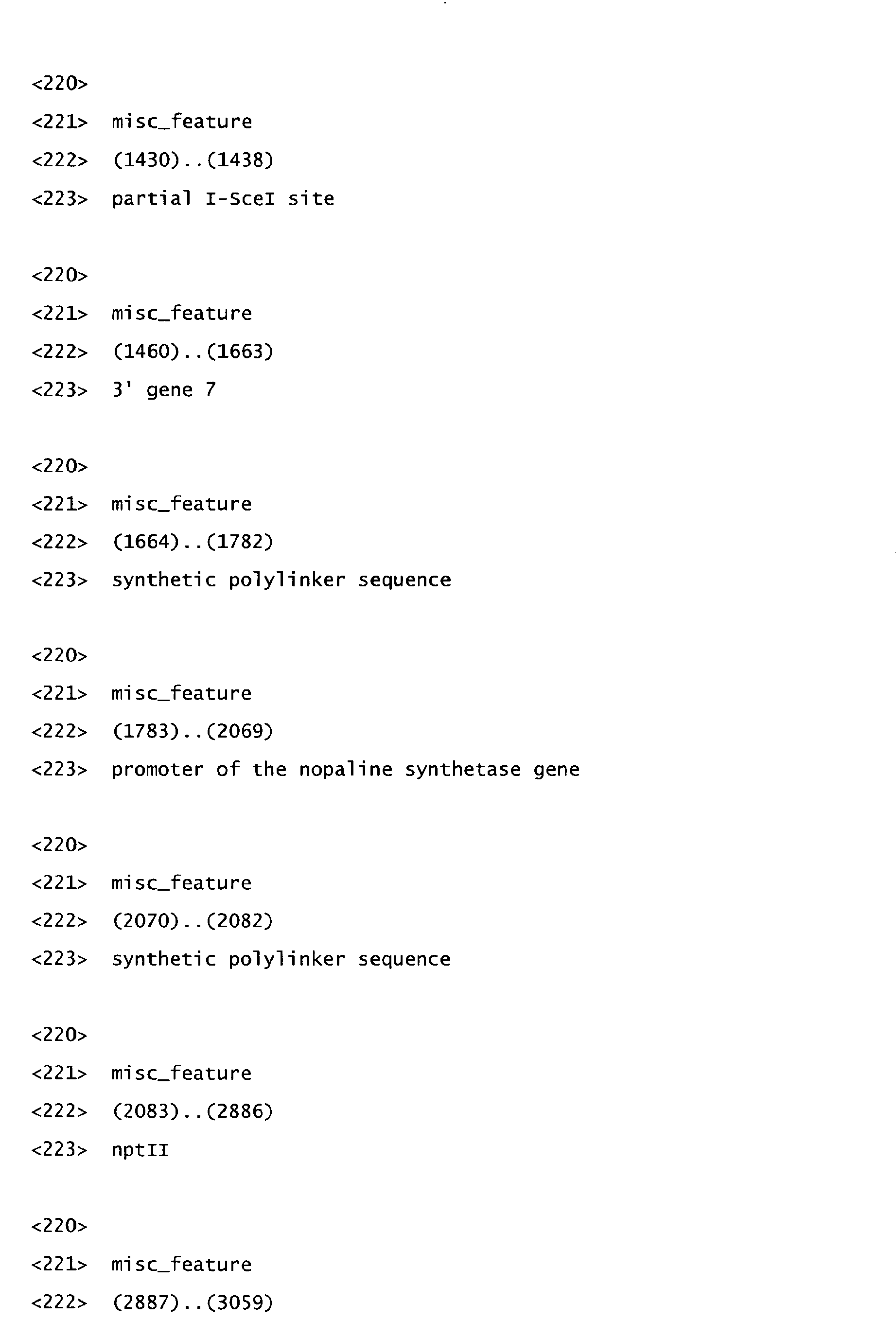


| Trinucleotide | AA | Possible trinucleotides | UIPAC code | PROVISIO |
| R1 | M | ATG | ATG | |
| R2 | A | GCA GCC GCG GCT | GCN | |
| R3 | K | AAA AAG | AAR | |
| R4 | P | CCA CCC CCG CCT | CCN | |
| R5 | P | CCA CCC CCG CCT | CCN | |
| R6 | K | AAA AAG | AAR | |
| R7 | K | AAA AAG | AAR | |
| R8 | K | AAA AAG | AAR | |
| R9 | R | AGA AGG CGA CGC CGG CGT | AGR or CGN | |
| R10 | K | AAA AAG | AAR | NOT AAG |
| R11 | V | GTA GTC GTG GTT | GTN | |
| R12 | N | AAC AAT | AAY | IF R12 AAT NOT (R13 ATT OR R13 ATA). IF R12 AAC NOT (R13 ATT AND R14 AAA) IF R12 AAC NOT R13 ATA |
| R13 | I | ATA ATC ATT | ATH | IF R13 ATT NOT R14 AAA IF R13 ATA NOT R14 AAA |
| R14 | K | AAA AAG | AAR | |
| R15 | K | AAA AAG | AAR | |
| R16 | N | AAC AAT | AAY | |
| R17 | Q | CAA CAG | CAR | NOT CAA |
| R18 | V | GTA GTC GTG GTT | GTN | NOT GTA |
| R19 | M | ATG | ATG | |
| R20 | N | AAC AAT | AAY | AVOID ATTTA |
| R21 | L | TTA TTG CTA CTC CTG CTT | TTR or CTN | |
| R22 | G | GGA GGC GGG GGT | GGN | |
| R23 | P | CCA CCC CCG CCT | CCN | IF R23 CCC NOT R24 AAT |
| R24 | N | AAC AAT | AAY | |
| R25 | S | AGC AGT TCA TCC TCG TCT | AGY or TCN | |
| R26 | K | AAA AAG | AAR | IF R26 AAA NOT (R27 TTG AND R28 CTN) |
| R27 | L | TTA TTG CTA CTC CTG CTT | TTR or CTN | IF R27 (TTA OR CTA) NOT R28 TTA |
| R28 | L | TTA TTG CTA CTC CTG CTT | TTR or CTN | |
| R29 | K | AAA AAG | AAR | |
| R30 | E | GAA GAG | GAR | NOT GAA |
| R31 | Y | TAC TAT | TAY | IF R31 TAT NOT R32 AAA |
| R32 | K | AAA AAG | AAR | |
| R33 | S | AGC AGT TCA TCC TCG TCT | AGY or TCN | IF R33 (TCC OR TCG OR AGC) NOT (R34 CAA AND R35 TTR) |
| R34 | Q | CAA CAG | CAR | IF R34 CAA NOT R35 TTA |
| R35 | L | TTA TTG CTA CTC CTG CTT | TTR or CTN | |
| R36 | I | ATA ATC ATT | ATH | |
| R37 | E | GAA GAG | GAR | IF R37 GAA NOT R38 TTA |
| R38 | L | TTA TTG CTA CTC CTG CTT | TTR or CTN | |
| R39 | N | AAC AAT | AAY | IF R39 AAT NOT R40 (ATT OR ATA) |
| R40 | I | ATA ATC ATT | ATH | |
| R41 | E | GAA GAG | GAR | IF R41 GAG NOT R42 CAA |
| R42 | Q | CAA CAG | CAR | |
| R43 | F | TTC TTT | TTY | |
| R44 | E | GAA GAG | GAR | |
| R45 | A | GCA GCC GCG GCT | GCN | NOT GCA |
| R46 | G | GGA GGC GGG GGT | GGN | |
| R47 | I | ATA ATC ATT | ATH | NOT ATT |
| R48 | G | GGA GGC GGG GGT | GGN | IF R48 GGA NOT R49 TTA |
| R49 | L | TTA TTG CTA CTC CTG CTT | TTR or CTN | IF R49 TTA NOT (R50 ATA AND R51 TTR) IF R49 CTA NOT (R50 ATA AND R51 TTR) |
| R50 | I | ATA ATC ATT | ATH | IF R50 ATA NOT R51 (CTA OR TTG) |
| R51 | L | TTA TTG CTA CTC CTG CTT | TTR or CTN | |
| R52 | G | GGA GGC GGG GGT | GGN | |
| R53 | D | GAC GAT | GAY | |
| R54 | A | GCA GCC GCG GCT | GCN | IF R54 GCA NOT R55 TAC |
| R55 | Y | TAC TAT | TAY | IF R55 TAT NOT (R56 ATA AND R57 AGR) |
| R56 | I | ATA ATC ATT | ATH | |
| R57 | R | AGA AGG CGA CGC CGG CGT | AGR or CGN | |
| R58 | S | AGC AGT TCA TCC TCG TCT | AGY or TCN | AVOID GCAGG |
| R59 | R | AGA AGG CGA CGC CGG CGT | AGR or CGN | |
| R60 | D | GAC GAT | GAY | |
| R61 | E | GAA GAG | GAR | AVOID AAGGT |
| R62 | G | GGA GGC GGG GGT | GGN | |
| R63 | K | AAA AAG | AAR | |
| R64 | T | ACA ACC ACG ACT | ACN | |
| R65 | Y | TAC TAT | TAY | IF R65 TAT NOT R66 TGC |
| R66 | C | TGC TGT | TGY | |
| R67 | M | ATG | ATG | |
| R68 | Q | CAA CAG | CAR | NOT CAA |
| R69 | F | TTC TTT | TTY | |
| R70 | E | GAA GAG | GAR | |
| R71 | W | TGG | TGG | |
| R72 | K | AAA AAG | AAR | |
| R73 | N | AAC AAT | AAY | NOT AAT |
| R74 | K | AAA AAG | AAR | IF R74 AAA NOT R75 GCA |
| R75 | A | GCA GCC GCG GCT | GCN | IF R75 GCA NOT R76 TAC |
| R76 | Y | TAC TAT | TAY | |
| R77 | M | ATG | ATG | |
| R78 | D | GAC GAT | GAY | |
| R79 | H | CAC CAT | CAY | |
| R80 | V | GTA GTC GTG GTT | GTN | |
| R81 | C | TGC TGT | TGY | |
| R82 | L | TTA TTG CTA CTC CTG CTT | TTR or CTN | |
| R83 | L | TTA TTG CTA CTC CTG CTT | TTR or CTN | |
| R84 | Y | TAC TAT | TAY | |
| R85 | D | GAC GAT | GAY | IF R85 GAC NOT R86 CAA |
| R86 | Q | CAA CAG | CAR | |
| R87 | W | TGG | TGG | |
| R88 | V | GTA GTC GTG GTT | GTN | |
| R89 | L | TTA TTG CTA CTC CTG CTT | TTR or CTN | |
| R90 | S | AGC AGT TCA TCC TCG TCT | AGY or TCN | |
| R91 | P | CCA CCC CCG CCT | CCN | |
| R92 | P | CCA CCC CCG CCT | CCN | |
| R93 | H | CAC CAT | CAY | IF R93 CAT NOT R94 AAA |
| R94 | K | AAA AAG | AAR | |
| R95 | K | AAA AAG | AAR | |
| R96 | E | GAA GAG | GAR | |
| R97 | R | AGA AGG CGA CGC CGG CGT | AGR or CGN | |
| R98 | V | GTA GTC GTG GTT | GTN | |
| R99 | N | AAC AAT | AAY | |
| R100 | H | CAC CAT | CAY | AVOID ATTTA |
| R101 | L | TTA TTG CTA CTC CTG CTT | TTR or CTN | |
| R102 | G | GGA GGC GGG GGT | GGN | IF R102 GGC NOT R103 AAT |
| R103 | N | AAC AAT | AAY | AVOID ATTTA |
| R104 | L | TTA TTG CTA CTC CTG CTT | TTR or CTN | |
| R105 | V | GTA GTC GTG GTT | GTN | |
| R106 | I | ATA ATC ATT | ATH | |
| R107 | T | ACA ACC ACG ACT | ACN | |
| R108 | W | TGG | TGG | |
| R109 | G | GGA GGC GGG GGT | GGN | |
| R110 | A | GCA GCC GCG GCT | GCN | |
| R111 | Q | CAA CAG | CAR | |
| R112 | T | ACA ACC ACG ACT | ACN | AVOID ATTTA |
| R113 | F | TTC TTT | TTY | |
| R114 | K | AAA AAG | AAR | IF R114 AAG NOT R115 CAT |
| R115 | H | CAC CAT | CAY | |
| R116 | Q | CAA CAG | CAR | IF R116 CAA NOT R117 GCA |
| R117 | A | GCA GCC GCG GCT | GCN | AVOID ATTTA |
| R118 | F | TTC TTT | TTY | |
| R119 | N | AAC AAT | AAY | NOT AAT |
| R120 | K | AAA AAG | AAR | IF R120 AAA NOT R121 TTG |
| R121 | L | TTA TTG CTA CTC CTG CTT | TTR or CTN | |
| R122 | A | GCA GCC GCG GCT | GCN | IF R122 GCC NOT R123 AAT |
| R123 | N | AAC AAT | AAY | AVOID ATTTA |
| R124 | L | TTA TTG CTA CTC CTG CTT | TTR or CTN | |
| R125 | F | TTC TTT | TTY | |
| R126 | I | ATA ATC ATT | ATH | |
| R127 | V | GTA GTC GTG GTT | GTN | |
| R128 | N | AAC AAT | AAY | IF R128 AAT NOT R129 AAT |
| R129 | N | AAC AAT | AAY | NOT AAT |
| R130 | K | AAA AAG | AAR | |
| R131 | K | AAA AAG | AAR | |
| R132 | T | ACA ACC ACG ACT | ACN | |
| R133 | I | ATA ATC ATT | ATH | |
| R134 | P | CCA CCC CCG CCT | CCN | IF R134 CCC NOT R135 AAT |
| R135 | N | AAC AAT | AAY | IF R135 AAT NOT R136 AAT |
| R136 | N | AAC AAT | AAY | AVOID ATTTA |
| R137 | L | TTA TTG CTA CTC CTG CTT | TTR or CTN | |
| R138 | V | GTA GTC GTG GTT | GTN | |
| R139 | E | GAA GAG | GAR | |
| R140 | N | AAC AAT | AAY | |
| R141 | Y | TAC TAT | TAY | AVOID ATTTA |
| R142 | L | TTA TTG CTA CTC CTG CTT | TTR or CTN | |
| R143 | T | ACA ACC ACG ACT | ACN | |
| R144 | P | CCA CCC CCG CCT | CCN | NOT CCA |
| R145 | M | ATG | ATG | |
| R146 | S | AGC AGT TCA TCC TCG TCT | AGY or TCN | IF R146 TCA NOT R147 TTG |
| R147 | L | TTA TTG CTA CTC CTG CTT | TTR or CTN | |
| R148 | A | GCA GCC GCG GCT | GCN | |
| R149 | Y | TAC TAT | TAY | NOT TAT |
| R150 | W | TGG | TGG | |
| R151 | F | TTC TTT | TTY | |
| R152 | M | ATG | ATG | |
| R153 | D | GAC GAT | GAY | |
| R154 | D | GAC GAT | GAY | |
| R155 | G | GGA GGC GGG GGT | GGN | |
| R156 | G | GGA GGC GGG GGT | GGN | |
| R157 | K | AAA AAG | AAR | |
| R158 | W | TGG | TGG | |
| R159 | D | GAC GAT | GAY | |
| R160 | Y | TAC TAT | TAY | |
| R161 | N | AAC AAT | AAY | NOT AAT |
| R162 | K | AAA AAG | AAR | IF R162 AAA NOT (R163 AAT AND R164 AGY) |
| R163 | N | AAC AAT | AAY | |
| R164 | S | AGC AGT TCA TCC TCG TCT | AGY or TCN | IF R164 TCA NOT (R165 ACC AND R166 AAY) |
| R165 | T | ACA ACC ACG ACT | ACN | IF R165 ACC NOT R166 AAT |
| R166 | N | AAC AAT | AAY | NOT AAT |
| R167 | K | AAA AAG | AAR | IF R167 AAA R168 NOT TCA OR R168 NOT AGC |
| R168 | S | AGC AGT TCA TCC TCG TCT | AGY or TCN | |
| R169 | I | ATA ATC ATT | ATH | |
| R170 | V | GTA GTC GTG GTT | GTN | IF R170 GTA NOT R171TTA |
| R171 | L | TTA TTG CTA CTC CTG CTT | TTR or CTN | |
| R172 | N | AAC AAT | AAY | IF R172 AAT NOT R173 ACA |
| R173 | T | ACA ACC ACG ACT | ACN | IF R173 (ACC OR ACG) NOT (R174 CAA AND |
| R175 TCN) | ||||
| R174 | Q | CAA CAG | CAR | |
| R175 | S | AGC AGT TCA TCC TCG TCT | AGY or TCN | AVOID ATTTA |
| R176 | F | TTC TTT | TTY | |
| R177 | T | ACA ACC ACG ACT | ACN | |
| R178 | F | TTC TTT | TTY | |
| R179 | E | GAA GAG | GAR | |
| R180 | E | GAA GAG | GAR | |
| R181 | V | GTA GTC GTG GTT | GTN | |
| R182 | E | GAA GAG | GAR | IF R182 GAA NOT (R183 TAT AND R184 TTR) |
| R183 | Y | TAC TAT | TAY | AVOID ATTTA |
| R184 | L | TTA TTG CTA CTC CTG CTT | TTR or CTN | |
| R185 | V | GTA GTC GTG GTT | GTN | |
| R186 | K | AAA AAG | AAR | |
| R187 | G | GGA GGC GGG GGT | GGN | IF R187 GGA NOT (R188 TTG AND R189 CGN) |
| R188 | L | TTA TTG CTA CTC CTG CTT | TTR or CTN | |
| R189 | R | AGA AGG CGA CGC CGG CGT | AGR or CGN | IF R189 CGC NOT R190 AAT |
| R190 | N | AAC AAT | AAY | NOT AAT |
| R191 | K | AAA AAG | AAR | |
| R192 | F | TTC TTT | TTY | IF R192 TTC NOT (R193 CAA AND R194 TTR) |
| R193 | Q | CAA CAG | CAR | IF R193 CAA NOT R194 TTA |
| R194 | L | TTA TTG CTA CTC CTG CTT | TTR or CTN | |
| R195 | N | AAC AAT | AAY | IF R195 AAT NOT R196 TGC |
| R196 | C | TGC TGT | TGY | |
| R197 | Y | TAC TAT | TAY | |
| R198 | V | GTA GTC GTG GTT | GTN | |
| R199 | K | AAA AAG | AAR | NOT AAA |
| R200 | I | ATA ATC ATT | ATH | IF R200 ATT NOT R201 AAT NOT ATA |
| R201 | N | AAC AAT | AAY | NOT AAT |
| R202 | K | AAA AAG | AAR | IF R202 AAA NOT R203 AAT |
| R203 | N | AAC AAT | AAY | NOT AAT |
| R204 | K | AAA AAG | AAR | |
| R205 | P | CCA CCC CCG CCT | CCN | NOT CCA IF R205 CCG NOT R206 ATA |
| R206 | I | ATA ATC ATT | ATH | IF R206 ATA NOT R207 ATA |
| R207 | I | ATA ATC ATT | ATH | IF R207 ATA NOT R208 TAC NOT ATT |
| R208 | Y | TAC TAT | TAY | |
| R209 | I | ATA ATC ATT | ATH | |
| R210 | D | GAC GAT | GAY | |
| R211 | S | AGC AGT TCA TCC TCG TCT | AGY or TCN | |
| R212 | M | ATG | ATG | |
| R213 | S | AGC AGT TCA TCC TCG TCT | AGY or TCN | |
| R214 | Y | TAC TAT | TAY | AVOID ATTTA |
| R215 | L | TTA TTG CTA CTC CTG CTT | TTR or CTN | IF R215 (TTA OR CTA) NOT R216 ATA |
| R216 | I | ATA ATC ATT | ATH | |
| R217 | F | TTC TTT | TTY | |
| R218 | Y | TAC TAT | TAY | |
| R219 | N | AAC AAT | AAY | AVOID ATTTA |
| R220 | L | TTA TTG CTA CTC CTG CTT | TTR or CTN | IF R220 (TTA OR CTA) NOT R221 ATT IF R220 (TTA OR CTA) NOT R221 ATC |
| R221 | I | ATA ATC ATT | ATH | IF R221 ATT NOT R222 AAA NOT ATA |
| R222 | K | AAA AAG | AAR | |
| R223 | P | CCA CCC CCG CCT | CCN | |
| R224 | Y | TAC TAT | TAY | AVOID ATTTA |
| R225 | L | TTA TTG CTA CTC CTG CTT | TTR or CTN | |
| R226 | I | ATA ATC ATT | ATH | |
| R227 | P | CCA CCC CCG CCT | CCN | |
| R228 | Q | CAA CAG | CAR | |
| R229 | M | ATG | ATG | |
| R230 | M | ATG | ATG | |
| R231 | Y | TAC TAT | TAY | IF R231TAT NOT R232 AAA |
| R232 | K | AAA AAG | AAR | IF R232 AAA NOT R233 TTG |
| R233 | L | TTA TTG CTA CTC CTG CTT | TTR or CTN | |
| R234 | P | CCA CCC CCG CCT | CCN | IF 234 CCC NOT R235 AAT |
| R235 | N | AAC AAT | AAY | IF R235 AAT NOT R236 ACA IF R235 AAT NOT R236 ACT |
| R236 | T | ACA ACC ACG ACT | ACN | IF R236 ACA NOT (R237 ATA AND R238 AGY) |
| R237 | I | ATA ATC ATT | ATH | |
| R238 | S | AGC AGT TCA TCC TCG TCT | AGY or TCN | |
| R239 | S | AGC AGT TCA TCC TCG TCT | AGY or TCN | |
| R240 | E | GAA GAG | GAR | |
| R241 | T | ACA ACC ACG ACT | ACN | |
| R242 | F | TTC TTT | TTY | |
| R243 | L | TTA TTG CTA CTC CTG CTT | TTR or CTN | |
| R244 | K | AAA AAG | AAR |
| Trinucleotide | AA | Choices | UIPAC | PROVISIO | Exemplified I-SceI (SEQ ID No 4) |
| R1 | M | ATG | ATG | ATG | |
| R2 | A | GCC GCT | GCY | GCC | |
| R3 | K | AAA AAG | AAR | AAG | |
| R4 | P | CCA CCC CCT | CCH | CCT | |
| R5 | P | CCA CCC CCT | CCH | CCC | |
| R6 | K | AAA AAG | AAR | AAG | |
| R7 | K | AAA AAG | AAR | AAG | |
| R8 | K | AAA AAG | AAR | AAG | |
| R9 | R | AGA CGC CGG | AGA or CGS | CGC | |
| R10 | K | AAA | AAA | AAA | |
| R11 | V | GTC GTG | GTS | GTG | |
| R12 | N | AAC | AAC | AAC | |
| R13 | I | ATC ATT | ATY | ATC | |
| R14 | K | AAA AAG | AAR | AAG | |
| R15 | K | AAA AAG | AAR | AAG | |
| R16 | N | AAC | AAC | AAC | |
| R17 | Q | CAG | CAG | CAG | |
| R18 | V | GTC GTG | GTS | GTG | |
| R19 | M | ATG | ATG | ATG | |
| R20 | N | AAC | AAC | AAC | |
| R21 | L | CTC CTG | CTS | CTG | |
| R22 | G | GGC GGA | GGM | GGA | |
| R23 | P | CCA CCC CCT | CCH | CCT | |
| R24 | N | AAC | AAC | AAC | |
| R25 | S | AGC TCA TCC | AGC or TCM | AGC | |
| R26 | K | AAA AAG | AAR | AAG | |
| R27 | L | CTC CTG | CTS | CTC | |
| R28 | L | CTC CTG | CTS | CTG | |
| R29 | K | AAA AAG | AAR | AAG | |
| R30 | E | GAG | GAG | GAG | |
| R31 | Y | TAC | TAC | TAC | |
| R32 | K | AAA AAG | AAR | AAG | |
| R33 | S | AGC TCA TCC | AGC or TCM | AGC | |
| R34 | Q | CAA CAG | CAR | CAG | |
| R35 | L | CTC CTG | CTS | CTG | |
| R36 | I | ATC ATT | ATY | ATC | |
| R37 | E | GAA GAG | GAR | GAA | |
| R38 | L | CTC CTG | CTS | CTG | |
| R39 | N | AAC | AAC | AAC | |
| R40 | I | ATC ATT | ATY | ATC | |
| R41 | E | GAA GAG | GAR | IF R41 GAG NOT R42 CAA | GAG |
| R42 | Q | CAA CAG | CAR | CAG | |
| R43 | F | TTC | TTC | TTC | |
| R44 | E | GAA GAG | GAR | GAA | |
| R45 | A | GCC GCT | GCY | GCT | |
| R46 | G | GGC GGA | GGM | GGC | |
| R47 | I | ATC | ATC | ATC | |
| R48 | G | GGC GGA | GGM | GGC | |
| R49 | L | CTC CTG | CTS | CTG | |
| R50 | I | ATC ATT | ATY | ATC | |
| R51 | L | CTC CTG | CTS | CTG | |
| R52 | G | GGC GGA | GGM | GGC | |
| R53 | D | GAC GAT | GAY | GAT | |
| R54 | A | GCC GCT | GCY | GCC | |
| R55 | Y | TAC | TAC | TAC | |
| R56 | I | ATC ATT | ATY | ATC | |
| R57 | R | AGA CGC CGG | AGA or CGS | AGA | |
| R58 | S | AGC TCA TCC | AGC or TCM | TCC | |
| R59 | R | AGA CGC CGG | AGA or CGS | CGG | |
| R60 | D | GAC GAT | GAY | GAC | |
| R61 | E | GAA GAG | GAR | GAA | |
| R62 | G | GGC GGA | GGM | GGC | |
| R63 | K | AAA AAG | AAR | AAG | |
| R64 | T | ACC ACT | ACY | ACC | |
| R65 | Y | TAC | TAC | TAC | |
| R66 | C | TGC TGT | TGY | TGC | |
| R67 | M | ATG | ATG | ATG | |
| R68 | Q | CAG | CAG | CAG | |
| R69 | F | TTC | TTC | TTC | |
| R70 | E | GAA GAG | GAR | GAG | |
| R71 | W | TGG | TGG | TGG | |
| R72 | K | AAA AAG | AAR | AAG | |
| R73 | N | AAC | AAC | AAC | |
| R74 | K | AAA AAG | AAR | AAG | |
| R75 | A | GCC GCT | GCY | GCC | |
| R76 | Y | TAC | TAC | TAC | |
| R77 | M | ATG | ATG | ATG | |
| R78 | D | GAC GAT | GAY | GAC | |
| R79 | H | CAC CAT | CAY | CAC | |
| R80 | V | GTC GTG | GTS | GTG | |
| R81 | C | TGC TGT | TGY | TGT | |
| R82 | L | CTC CTG | CTS | CTG | |
| R83 | L | CTC CTG | CTS | CTG | |
| R84 | Y | TAC | TAC | TAC | |
| R85 | D | GAC GAT | GAY | IF R85 GAC NOT R86 CAA | GAC |
| R86 | Q | CAA CAG | CAR | CAG | |
| R87 | W | TGG | TGG | TGG | |
| R88 | V | GTC GTG | GTS | GTC | |
| R89 | L | CTC CTG | CTS | CTG | |
| R90 | S | AGC TCA TCC | AGC or TCM | AGC | |
| R91 | P | CCA CCC CCT | CCH | CCT | |
| R92 | P | CCA CCC CCT | CCH | CCT | |
| R93 | H | CAC CAT | CAY | IF R93 CAT NOT R94 AAA | CAC |
| R94 | K | AAA AAG | AAR | AAG | |
| R95 | K | AAA AAG | AAR | AAG | |
| R96 | E | GAA GAG | GAR | GAG | |
| R97 | R | AGA CGC CGG | AGA or CGS | CGC | |
| R98 | V | GTC GTG | GTS | GTG | |
| R99 | N | AAC | AAC | AAC | |
| R100 | H | CAC CAT | CAY | CAT | |
| R101 | L | CTC CTG | CTS | CTG | |
| R102 | G | GGC GGA | GGM | GGC | |
| R103 | N | AAC | AAC | AAC | |
| R104 | L | CTC CTG | CTS | CTC | |
| R105 | V | GTC GTG | GTS | GTG | |
| R106 | I | ATC ATT | ATY | ATC | |
| R107 | T | ACC ACT | ACY | ACC | |
| R108 | W | TGG | TGG | TGG | |
| R109 | G | GGC GGA | GGM | GGA | |
| R110 | A | GCC GCT | GCY | GCC | |
| R111 | Q | CAA CAG | CAR | CAG | |
| R112 | T | ACC ACT | ACY | ACC | |
| R113 | F | TTC | TTC | TTC | |
| R114 | K | AAA AAG | AAR | IF R114 AAG NOT R115 CAT | AAG |
| R115 | H | CAC CAT | CAY | CAC | |
| R116 | Q | CAA CAG | CAR | CAG | |
| R117 | A | GCC GCT | GCY | GCC | |
| R118 | F | TTC | TTC | TTC | |
| R119 | N | AAC | AAC | AAC | |
| R120 | K | AAA AAG | AAR | AAG | |
| R121 | L | CTC CTG | CTS | CTG | |
| R122 | A | GCC GCT | GCS | GCC | |
| R123 | N | AAC | AAC | AAC | |
| R124 | L | CTC CTG | CTS | CTG | |
| R125 | F | TTC | TTC | TTC | |
| R126 | I | ATC ATT | ATY | ATC | |
| R127 | V | GTC GTG | CTS | GTG | |
| R128 | N | AAC | AAC | AAC | |
| R129 | N | AAC | AAC | AAC | |
| R130 | K | AAA AAG | AAR | AAG | |
| R131 | K | AAA AAG | AAR | AAG | |
| R132 | T | ACC ACT | ACY | ACC | |
| R133 | I | ATC ATT | ATY | ATC | |
| R134 | P | CCA CCC CCT | CCH | CCC | |
| R135 | N | AAC | AAC | AAC | |
| R136 | N | AAC | AAC | AAC | |
| R137 | L | CTC CTG | CTS | CTC | |
| R138 | V | GTC GTG | GTS | GTG | |
| R139 | E | GAA GAG | GAR | GAG | |
| R140 | N | AAC | AAC | AAC | |
| R141 | Y | TAC | TAC | TAC | |
| R142 | L | CTC CTG | CTS | CTC | |
| R143 | T | ACC ACT | ACY | ACT | |
| R144 | P | CCC CCT | CCY | CCC | |
| R145 | M | ATG | ATG | ATG | |
| R146 | S | AGC TCA TCC | AGC or TCM | AGC | |
| R147 | L | CTC CTG | CTS | CTG | |
| R148 | A | GCC GCT | GCY | GCC | |
| R149 | Y | TAC | TAC | TAC | |
| R150 | W | TGG | TGG | TGG | |
| R151 | F | TTC | TTC | TTC | |
| R152 | M | ATG | ATG | ATG | |
| R153 | D | GAC GAT | GAY | GAC | |
| R154 | D | GAC GAT | GAY | GAC | |
| R155 | G | GGC GGA | GGM | GGA | |
| R156 | G | GGC GGA | GGM | GGC | |
| R157 | K | AAA AAG | AAR | AAG | |
| R158 | W | TGG | TGG | TGG | |
| R159 | D | GAC GAT | GAY | GAC | |
| R160 | Y | TAC | TAC | TAC | |
| R161 | N | AAC | AAC | AAC | |
| R162 | K | AAA AAG | AAR | AAG | |
| R163 | N | AAC | AAC | AAC | |
| R164 | S | AGC TCA TCC | AGC or TCM | IF R164 TCA NOT R165 ACC | AGC |
| R165 | T | ACC ACT | ACY | ACC | |
| R166 | N | AAC | AAC | AAC | |
| R167 | K | AAA AAG | AAR | IF R167 AAA R168 NOT TCA OR R168 NOT AGC | AAG |
| R168 | S | AGC TCA TCC | AGC or TCM | TCA | |
| R169 | I | ATC ATT | ATY | ATT | |
| R170 | V | GTC GTG | GTS | GTG | |
| R171 | L | CTC CTG | CTS | CTG | |
| R172 | N | AAC | AAC | AAC | |
| R173 | T | ACC ACT | ACY | IF R173 ACC NOT (R174 CAA AND R175 TCN) | ACC |
| R174 | Q | CAA CAG | CAR | CAA | |
| R175 | S | AGC TCA TCC | AGC or TCM | AGC | |
| R176 | F | TTC | TTC | TTC | |
| R177 | T | ACC ACT | ACY | ACC | |
| R178 | F | TTC | TTC | TTC | |
| R179 | E | GAA GAG | GAR | GAA | |
| R180 | E | GAA GAG | GAR | GAA | |
| R181 | V | GTC GTG | GTS | GTG | |
| R182 | E | GAA GAG | GAR | GAG | |
| R183 | Y | TAC | TAC | TAC | |
| R184 | L | CTC CTG | CTS | CTC | |
| R185 | V | GTC GTG | GTS | GTC | |
| R186 | K | AAA AAG | AAR | AAG | |
| R187 | G | GGC GGA | GGM | GGC | |
| R188 | L | CTC CTG | CTS | CTG | |
| R189 | R | AGA CGC CGG | AGA or CGS | CGC | |
| R190 | N | AAC | AAC | AAC | |
| R191 | K | AAA AAG | AAR | AAG | |
| R192 | F | TTC | TTC | TTC | |
| R193 | Q | CAA CAG | CAR | CAG | |
| R194 | L | CTC CTG | CTS | CTG | |
| R195 | N | AAC | AAC | AAC | |
| R196 | C | TGC TGT | TGY | TGC | |
| R197 | Y | TAC | TAC | TAC | |
| R198 | V | GTC GTG | GTS | GTG | |
| R199 | K | AAG | AAG | AAG | |
| R200 | I | ATC ATT | ATY | ATC | |
| R201 | N | AAC | AAC | AAC | |
| R202 | K | AAA AAG | AAR | AAG | |
| R203 | N | AAC | AAC | AAC | |
| R204 | K | AAA AAG | AAR | AAG | |
| R205 | P | CCC CCT | CCY | CCT | |
| R206 | I | ATC ATT | ATY | ATC | |
| R207 | I | ATC | ATC | ATC | |
| R208 | Y | TAC | TAC | TAC | |
| R209 | I | ATC ATT | ATY | ATC | |
| R210 | D | GAC GAT | GAY | GAC | |
| R211 | S | AGC TCA TCC | AGC or TCM | AGC | |
| R212 | M | ATG | ATG | ATG | |
| R213 | S | AGC TCA TCC | AGC or TCM | AGC | |
| R214 | Y | TAC | TAC | TAC | |
| R215 | L | CTC CTG | CTS | CTG | |
| R216 | I | ATC ATT | ATY | ATC | |
| R217 | F | TTC | TTC | TTC | |
| R218 | Y | TAC | TAC | TAC | |
| R219 | N | AAC | AAC | AAC | |
| R220 | L | CTC CTG | CTS | CTG | |
| R221 | I | ATC ATT | ATY | IF R221 ATT NOT R222 AAA | ATC |
| R222 | K | AAA AAG | AAR | AAG | |
| R223 | P | CCA CCC CCT | CCH | CCA | |
| R224 | Y | TAC | TAC | TAC | |
| R225 | L | CTC CTG | CTS | CTG | |
| R226 | I | ATC ATT | ATY | ATC | |
| R227 | P | CCA CCC CCT | CCH | CCT | |
| R228 | Q | CAA CAG | CAR | CAG | |
| R229 | M | ATG | ATG | ATG | |
| R230 | M | ATG | ATG | ATG | |
| R231 | Y | TAC | TAC | TAC | |
| R232 | K | AAA AAG | AAR | AAG | |
| R233 | L | CTC CTG | CTS | CTG | |
| R234 | P | CCA CCC CCT | CCH | CCC | |
| R235 | N | AAC | AAC | AAC | |
| R236 | T | ACC ACT | ACY | ACC | |
| R237 | I | ATC ATT | ATY | ATC | |
| R238 | S | AGC TCA TCC | AGC or TCM | AGC | |
| R239 | S | AGC TCA TCC | AGC or TCM | AGC | |
| R240 | E | GAA GAG | GAR | GAG | |
| R241 | T | ACC ACT | ACY | ACC | |
| R242 | F | TTC | TTC | TTC | |
| R243 | L | CTC CTG | CTS | CTG | |
| R244 | K | AAA AAG | AAR | AAG |
Claims (11)
- A method for introducing a foreign DNA of interest into a preselected site of a genome of a plant cell comprising the steps of(a) inducing a double stranded DNA break at a preselected site in said genome wherein said double stranded break is introduced by a double stranded DNA break inducing enzyme;(b) introducing the foreign DNA of interest into the plant cell by direct DNA transfer.
- The method according to claim 1 wherein said double stranded DNA break inducing enzyme comprises a nuclear localization signal.
- The method according to claims 1 and 2 wherein said double stranded DNA break inducing enzyme is the I-Sce I endonuclease.
- The method according to claims 1-3 wherein said direct DNA transfer is accomplished by bombardment of microprojectiles coated with the foreign DNA of interest.
- The method according to claims 1-3 wherein said direct DNA transfer is accomplished by introduction of DNA by electroporation into protoplasts.
- The method according to claims 1-3 wherein said direct DNA transfer is accomplished by introduction of DNA by electroporation into intact plant cells or partially degraded tissues or plant cells.
- The method of any one of claims 1 to 6, wherein said foreign DNA of interest is flanked by a DNA region having at least 80% sequence identity to a DNA region flanking the preselected site.
- The method of any one of claims 1 to 7, whereby the plant cell is a maize cell.
- The method of claim 8, wherein the maize cell is comprised within a cell suspension.
- The method of any of claims 1 to 9, whereby said plant cell is incubated in a plant phenolic compound prior to step (a).
- The method of claim 10, wherein said plant phenolic compound is acetosyringone.
Priority Applications (4)
| Application Number | Priority Date | Filing Date | Title |
|---|---|---|---|
| EP08075865A EP2025756B1 (en) | 2003-11-18 | 2004-11-17 | Improved targeted DNA insertion in plants |
| PL08075865T PL2025756T3 (en) | 2003-11-18 | 2004-11-17 | Improved targeted DNA insertion in plants |
| SI200431737T SI2025756T1 (en) | 2003-11-18 | 2004-11-17 | Improved targeted DNA insertion in plants |
| CY20111100935T CY1112436T1 (en) | 2003-11-18 | 2011-09-27 | IMPROVED TARGET DNA INTRODUCTION TO PLANTS |
Applications Claiming Priority (3)
| Application Number | Priority Date | Filing Date | Title |
|---|---|---|---|
| EP03078700 | 2003-11-18 | ||
| EP08075865A EP2025756B1 (en) | 2003-11-18 | 2004-11-17 | Improved targeted DNA insertion in plants |
| EP04797993A EP1689870B1 (en) | 2003-11-18 | 2004-11-17 | Improved targeted dna insertion in plants |
Related Parent Applications (2)
| Application Number | Title | Priority Date | Filing Date |
|---|---|---|---|
| EP04797993.5 Division | 2004-11-17 | ||
| EP04797993A Division EP1689870B1 (en) | 2003-11-18 | 2004-11-17 | Improved targeted dna insertion in plants |
Publications (2)
| Publication Number | Publication Date |
|---|---|
| EP2025756A1 true EP2025756A1 (en) | 2009-02-18 |
| EP2025756B1 EP2025756B1 (en) | 2011-06-29 |
Family
ID=34610073
Family Applications (2)
| Application Number | Title | Priority Date | Filing Date |
|---|---|---|---|
| EP08075865A Revoked EP2025756B1 (en) | 2003-11-18 | 2004-11-17 | Improved targeted DNA insertion in plants |
| EP04797993A Expired - Lifetime EP1689870B1 (en) | 2003-11-18 | 2004-11-17 | Improved targeted dna insertion in plants |
Family Applications After (1)
| Application Number | Title | Priority Date | Filing Date |
|---|---|---|---|
| EP04797993A Expired - Lifetime EP1689870B1 (en) | 2003-11-18 | 2004-11-17 | Improved targeted dna insertion in plants |
Country Status (14)
| Country | Link |
|---|---|
| US (2) | US7598365B2 (en) |
| EP (2) | EP2025756B1 (en) |
| JP (2) | JP4885727B2 (en) |
| AT (2) | ATE514782T1 (en) |
| AU (2) | AU2004291692B2 (en) |
| CA (2) | CA2844236C (en) |
| CY (1) | CY1112436T1 (en) |
| DE (1) | DE602004018824D1 (en) |
| DK (1) | DK2025756T3 (en) |
| ES (2) | ES2368962T3 (en) |
| PL (2) | PL1689870T3 (en) |
| PT (1) | PT2025756E (en) |
| SI (1) | SI2025756T1 (en) |
| WO (1) | WO2005049842A2 (en) |
Families Citing this family (52)
| Publication number | Priority date | Publication date | Assignee | Title |
|---|---|---|---|---|
| PT1034262E (en) * | 1997-11-18 | 2005-10-31 | Pioneer Hi Bred Int | COMPOSITIONS AND METHODS FOR THE GENETIC MODIFICATION OF PLANTS |
| US7102055B1 (en) * | 1997-11-18 | 2006-09-05 | Pioneer Hi-Bred International, Inc. | Compositions and methods for the targeted insertion of a nucleotide sequence of interest into the genome of a plant |
| PT2025756E (en) * | 2003-11-18 | 2011-09-28 | Bayer Bioscience Nv | Improved targeted dna insertion in plants |
| JP5639336B2 (en) * | 2005-04-04 | 2014-12-10 | バイエル・クロップサイエンス・エヌ・ヴェーBayer Cropscience N.V. | Methods and means for removing selected DNA sequences |
| CA2615797C (en) | 2005-07-18 | 2014-04-29 | Pioneer Hi-Bred International, Inc. | Modified frt recombination sites and methods of use |
| DK3246403T3 (en) | 2005-10-18 | 2020-10-26 | Prec Biosciences | RATIONALLY DESIGNED MEGANUCLEASES WITH CHANGED SEQUENCE SPECIFICITY AND DNA BINDING AFFINITY |
| ATE500337T1 (en) * | 2006-05-18 | 2011-03-15 | Biogemma Fr | METHOD FOR CARRYING OUT HOMOLOGOUS RECOMBINATIONS IN PLANTS |
| EP2082051B1 (en) * | 2006-09-28 | 2016-03-23 | Bayer CropScience NV | Methods and means for removal of a selected dna sequence |
| CA2689345C (en) * | 2007-06-05 | 2017-07-11 | Bayer Bioscience N.V. | Methods and means for exact replacement of target dna in eukaryotic organisms |
| CA2691440A1 (en) | 2007-06-29 | 2009-01-08 | Pioneer Hi-Bred International, Inc. | Methods for altering the genome of a monocot plant cell |
| WO2009076292A2 (en) * | 2007-12-07 | 2009-06-18 | Precision Biosciences, Inc. | Rationally-designed meganucleases with recognition sequences found in dnase hypersensitive regions of the human genome |
| WO2009114321A2 (en) * | 2008-03-11 | 2009-09-17 | Precision Biosciencs, Inc. | Rationally-designed meganucleases for maize genome engineering |
| US20100071083A1 (en) * | 2008-03-12 | 2010-03-18 | Smith James J | Temperature-dependent meganuclease activity |
| JP2011519558A (en) * | 2008-04-28 | 2011-07-14 | プレシジョン バイオサイエンシズ,インク. | A rationally designed fusion molecule of DNA-binding protein and effector domain |
| JP2011527906A (en) | 2008-07-14 | 2011-11-10 | プレシジョン バイオサイエンシズ,インク. | Recognition sequences for I-CreI derived meganucleases and uses thereof |
| WO2011064751A1 (en) * | 2009-11-27 | 2011-06-03 | Basf Plant Science Company Gmbh | Chimeric endonucleases and uses thereof |
| WO2011078662A1 (en) * | 2009-12-21 | 2011-06-30 | Keygene N.V. | Dsrna for improved genetic modification of plant dna |
| CA2793600C (en) | 2009-12-30 | 2020-01-14 | Pioneer Hi-Bred International, Inc. | Methods and compositions for the introduction and regulated expression of genes in plants |
| CA2793596A1 (en) | 2009-12-30 | 2011-07-07 | Pioneer Hi-Bred International, Inc. | Methods and compositions for targeted polynucleotide modification |
| US20110203012A1 (en) * | 2010-01-21 | 2011-08-18 | Dotson Stanton B | Methods and compositions for use of directed recombination in plant breeding |
| CA2787674C (en) | 2010-01-22 | 2022-09-06 | Dow Agrosciences Llc | Excision of transgenes in genetically modified organisms |
| AU2011264074B2 (en) * | 2010-06-09 | 2015-01-22 | Bayer Cropscience Nv | Methods and means to modify a plant genome at a nucleotide sequence commonly used in plant genome engineering |
| MX347575B (en) * | 2010-06-09 | 2017-05-03 | Bayer Cropscience N V * | Methods and means to modify a plant genome at a nucleotide sequence commonly used in plant genome engineering. |
| CA2805941A1 (en) | 2010-08-13 | 2012-02-16 | Pioneer Hi-Bred International, Inc. | Methods and compositions for targeting sequences of interest to the chloroplast |
| CN102409042B (en) * | 2010-09-21 | 2014-05-14 | 深圳华大基因科技服务有限公司 | High throughput genome methylated DNA enrichment method and indexes and index adapters used in same |
| AR085533A1 (en) | 2011-03-23 | 2013-10-09 | Pioneer Hi Bred Int | PRODUCTION METHODS OF A COMPLEX TRANSGENIC RISK LOCUS |
| WO2012168124A1 (en) | 2011-06-06 | 2012-12-13 | Bayer Cropscience Nv | Methods and means to modify a plant genome at a preselected site |
| BR112014003919A2 (en) * | 2011-08-22 | 2017-03-14 | Bayer Cropscience Ag | methods and means for modifying a plant genome |
| EP2612918A1 (en) | 2012-01-06 | 2013-07-10 | BASF Plant Science Company GmbH | In planta recombination |
| WO2013103366A1 (en) | 2012-01-06 | 2013-07-11 | Pioneer Hi-Bred International, Inc. | A method to screen plants for genetic elements inducing parthenogenesis in plants |
| CA2871008C (en) * | 2012-04-23 | 2022-11-22 | Bayer Cropscience Nv | Targeted genome engineering in plants |
| CN105121650A (en) | 2013-04-02 | 2015-12-02 | 拜尔作物科学公司 | Targeted genome engineering in eukaryotes |
| CN106133138A (en) | 2013-08-22 | 2016-11-16 | 先锋国际良种公司 | Use genomic modification and the using method thereof guiding polynucleotide/CAS endonuclease systems |
| EP3166391A1 (en) | 2014-07-11 | 2017-05-17 | E. I. du Pont de Nemours and Company | Compositions and methods for producing plants resistant to glyphosate herbicide |
| BR112017003757A2 (en) | 2014-09-12 | 2017-12-26 | Du Pont | ? corn plants, parts of corn plants or corn seeds? |
| WO2016113333A1 (en) | 2015-01-16 | 2016-07-21 | Bayer Cropscience Nv | Leaf-preferential promoters and uses thereof |
| WO2016128519A1 (en) | 2015-02-12 | 2016-08-18 | Bayer Cropscience Nv | Shoot apex-preferential promoters and uses thereof |
| BR112017017260A2 (en) | 2015-03-27 | 2018-04-17 | Du Pont | dna constructs, vector, cell, plants, seed, rna expression method, and target site modification method |
| MA45638A (en) | 2015-08-07 | 2019-05-22 | BASF Agricultural Solutions Seed US LLC | USING THE ANNEXINE PROMOTER TO IMPROVE THE YIELD OF PLANTS UNDER STRESS CONDITIONS |
| WO2017060232A1 (en) | 2015-10-08 | 2017-04-13 | Bayer Cropscience Nv | Seed-preferential promoters and uses thereof |
| WO2017102923A1 (en) | 2015-12-15 | 2017-06-22 | Bayer Cropscience Nv | Brassicaceae plants resistant to plasmodiophora brassicae (clubroot) |
| US20190127747A1 (en) | 2016-04-11 | 2019-05-02 | Bayer Cropscience Nv | Seed-specific and endosperm-preferential promoters and uses thereof |
| CN109477117A (en) | 2016-04-11 | 2019-03-15 | 巴斯夫农业种子解决方案美国有限责任公司 | Seed specific and endosperm preferable promoter and application thereof |
| AU2017249365B2 (en) | 2016-04-13 | 2023-04-20 | BASF Agricultural Solutions Seed US LLC | Seed- and funiculus-preferential promoters and uses thereof |
| CA3020397A1 (en) | 2016-04-13 | 2017-10-19 | Bayer Cropscience Nv | Seed-specific and embryo-preferential promoters and uses thereof |
| US20190225974A1 (en) | 2016-09-23 | 2019-07-25 | BASF Agricultural Solutions Seed US LLC | Targeted genome optimization in plants |
| EP3601578A1 (en) | 2017-03-23 | 2020-02-05 | Basf Se | Anther-specific promoter and uses thereof |
| WO2018217474A1 (en) | 2017-05-24 | 2018-11-29 | Bayer Cropscience Lp | Fungal rust-inducible promoter |
| KR20200124702A (en) | 2018-02-23 | 2020-11-03 | 파이어니어 하이 부렛드 인터내쇼날 인코포레이팃드 | The novel CAS9 ortholog |
| EP3814490A2 (en) | 2018-06-27 | 2021-05-05 | Basf Se | Thermostable rubisco activase and uses thereof |
| CN113166744B (en) | 2018-12-14 | 2025-02-07 | 先锋国际良种公司 | Novel CRISPR-Cas system for genome editing |
| WO2024099765A2 (en) | 2022-11-10 | 2024-05-16 | BASF Agricultural Solutions Seed US LLC | Transcription regulating nucleotide sequences and methods of use |
Citations (12)
| Publication number | Priority date | Publication date | Assignee | Title |
|---|---|---|---|---|
| EP0242246A1 (en) | 1986-03-11 | 1987-10-21 | Plant Genetic Systems N.V. | Plant cells resistant to glutamine synthetase inhibitors, made by genetic engineering |
| EP0317509A2 (en) | 1987-11-16 | 1989-05-24 | Ciba-Geigy Ag | Targetted incorporation of genes into a plant genome |
| EP0469273A1 (en) | 1990-06-23 | 1992-02-05 | Hoechst Schering AgrEvo GmbH | Fertile transgenic maize plants with foreign gene as well as method for their production |
| WO1994001560A1 (en) | 1991-07-12 | 1994-01-20 | Immulogic Pharmaceutical Corporation | Allergenic proteins and peptides from japanese cedar pollen |
| WO1994017176A1 (en) | 1993-01-29 | 1994-08-04 | Purdue Research Foundation | Controlled modification of eukaryotic genomes |
| WO1994018313A1 (en) | 1993-02-12 | 1994-08-18 | The Johns-Hopkins University | Functional domains in flavobacterium okeanokoites (foki) restriction endonuclease |
| WO1995009233A1 (en) | 1993-09-27 | 1995-04-06 | The Johns-Hopkins University | Functional domains in flavobacterium okeanokoites (foki) restriction endonuclease |
| WO1996014408A2 (en) | 1994-11-07 | 1996-05-17 | Institut Pasteur | Nucleotide sequence encoding the enzyme i-scei and the uses thereof |
| WO1998037212A1 (en) * | 1997-02-20 | 1998-08-27 | Plant Genetic Systems, N.V. | Improved transformation method for plants |
| WO2003004659A2 (en) | 2001-07-04 | 2003-01-16 | Sungene Gmbh & Co. Kgaa | Recombination systems and a method for removing nucleic acid sequences from the genome of eukaryotic organisms |
| WO2003054189A2 (en) * | 2001-12-20 | 2003-07-03 | Sungene Gmbh & Co. Kgaa | Methods for the transformation of vegetal plastids |
| WO2003080809A2 (en) | 2002-03-21 | 2003-10-02 | Sangamo Biosciences, Inc. | Methods and compositions for using zinc finger endonucleases to enhance homologous recombination |
Family Cites Families (8)
| Publication number | Priority date | Publication date | Assignee | Title |
|---|---|---|---|---|
| US5474896A (en) * | 1992-05-05 | 1995-12-12 | Institut Pasteur | Nucleotide sequence encoding the enzyme I-SceI and the uses thereof |
| CA2162481C (en) | 1993-05-13 | 2005-11-15 | Marcus Cornelissen | Marker gene |
| US5689052A (en) * | 1993-12-22 | 1997-11-18 | Monsanto Company | Synthetic DNA sequences having enhanced expression in monocotyledonous plants and method for preparation thereof |
| US6774281B1 (en) * | 1998-03-06 | 2004-08-10 | Syngenta Mogen Bv | Method for the induction of pathogen resistance in plants |
| AU2982900A (en) * | 1999-02-03 | 2000-08-25 | Children's Medical Center Corporation | Gene repair involving the induction of double-stranded dna cleavage at a chromosomal target site |
| AU6677400A (en) | 1999-08-20 | 2001-03-19 | University Of Guelph | Improved method for the transformation and regeneration of plants |
| DE10114209A1 (en) * | 2001-03-23 | 2002-12-05 | Icon Genetics Ag | Site-directed transformation using amplification vectors |
| PT2025756E (en) * | 2003-11-18 | 2011-09-28 | Bayer Bioscience Nv | Improved targeted dna insertion in plants |
-
2004
- 2004-11-17 PT PT08075865T patent/PT2025756E/en unknown
- 2004-11-17 SI SI200431737T patent/SI2025756T1/en unknown
- 2004-11-17 CA CA2844236A patent/CA2844236C/en not_active Expired - Lifetime
- 2004-11-17 CA CA2545564A patent/CA2545564C/en not_active Expired - Lifetime
- 2004-11-17 EP EP08075865A patent/EP2025756B1/en not_active Revoked
- 2004-11-17 ES ES08075865T patent/ES2368962T3/en not_active Expired - Lifetime
- 2004-11-17 DK DK08075865.9T patent/DK2025756T3/en active
- 2004-11-17 US US10/580,076 patent/US7598365B2/en not_active Expired - Lifetime
- 2004-11-17 EP EP04797993A patent/EP1689870B1/en not_active Expired - Lifetime
- 2004-11-17 AU AU2004291692A patent/AU2004291692B2/en not_active Expired
- 2004-11-17 DE DE602004018824T patent/DE602004018824D1/en not_active Expired - Lifetime
- 2004-11-17 WO PCT/EP2004/013122 patent/WO2005049842A2/en not_active Ceased
- 2004-11-17 ES ES04797993T patent/ES2320228T3/en not_active Expired - Lifetime
- 2004-11-17 AT AT08075865T patent/ATE514782T1/en active
- 2004-11-17 PL PL04797993T patent/PL1689870T3/en unknown
- 2004-11-17 JP JP2006540331A patent/JP4885727B2/en not_active Expired - Lifetime
- 2004-11-17 AT AT04797993T patent/ATE419367T1/en not_active IP Right Cessation
- 2004-11-17 PL PL08075865T patent/PL2025756T3/en unknown
-
2009
- 2009-07-06 US US12/497,937 patent/US8653326B2/en not_active Expired - Fee Related
-
2010
- 2010-08-10 AU AU2010212264A patent/AU2010212264B2/en not_active Expired
-
2011
- 2011-05-13 JP JP2011108596A patent/JP5913833B2/en not_active Expired - Lifetime
- 2011-09-27 CY CY20111100935T patent/CY1112436T1/en unknown
Patent Citations (13)
| Publication number | Priority date | Publication date | Assignee | Title |
|---|---|---|---|---|
| EP0242246A1 (en) | 1986-03-11 | 1987-10-21 | Plant Genetic Systems N.V. | Plant cells resistant to glutamine synthetase inhibitors, made by genetic engineering |
| EP0242236A1 (en) | 1986-03-11 | 1987-10-21 | Plant Genetic Systems N.V. | Plant cells resistant to glutamine synthetase inhibitors, made by genetic engineering |
| EP0317509A2 (en) | 1987-11-16 | 1989-05-24 | Ciba-Geigy Ag | Targetted incorporation of genes into a plant genome |
| EP0469273A1 (en) | 1990-06-23 | 1992-02-05 | Hoechst Schering AgrEvo GmbH | Fertile transgenic maize plants with foreign gene as well as method for their production |
| WO1994001560A1 (en) | 1991-07-12 | 1994-01-20 | Immulogic Pharmaceutical Corporation | Allergenic proteins and peptides from japanese cedar pollen |
| WO1994017176A1 (en) | 1993-01-29 | 1994-08-04 | Purdue Research Foundation | Controlled modification of eukaryotic genomes |
| WO1994018313A1 (en) | 1993-02-12 | 1994-08-18 | The Johns-Hopkins University | Functional domains in flavobacterium okeanokoites (foki) restriction endonuclease |
| WO1995009233A1 (en) | 1993-09-27 | 1995-04-06 | The Johns-Hopkins University | Functional domains in flavobacterium okeanokoites (foki) restriction endonuclease |
| WO1996014408A2 (en) | 1994-11-07 | 1996-05-17 | Institut Pasteur | Nucleotide sequence encoding the enzyme i-scei and the uses thereof |
| WO1998037212A1 (en) * | 1997-02-20 | 1998-08-27 | Plant Genetic Systems, N.V. | Improved transformation method for plants |
| WO2003004659A2 (en) | 2001-07-04 | 2003-01-16 | Sungene Gmbh & Co. Kgaa | Recombination systems and a method for removing nucleic acid sequences from the genome of eukaryotic organisms |
| WO2003054189A2 (en) * | 2001-12-20 | 2003-07-03 | Sungene Gmbh & Co. Kgaa | Methods for the transformation of vegetal plastids |
| WO2003080809A2 (en) | 2002-03-21 | 2003-10-02 | Sangamo Biosciences, Inc. | Methods and compositions for using zinc finger endonucleases to enhance homologous recombination |
Non-Patent Citations (37)
| Title |
|---|
| "Molecular Biology LabFax", ACADEMIC PRESS |
| "Plant Molecular Biology Labfax", 1993, BLACKWELL SCIENTIFIC PUBLICATIONS |
| ASHBY ET AL., J. BACTERIAL., vol. 170, 1988, pages 4181 - 4187 |
| BOLTON ET AL., SCIENCE, vol. 232, 1986, pages 983 - 985 |
| CHALFIE ET AL., SCIENCE, vol. 263, 1994, pages 802 - 805 |
| CHILTON MARY-DELL M ET AL: "Targeted integration of T-DNA into the tobacco genome at double-stranded breaks: New insights on the mechanism of T-DNA integration.", PLANT PHYSIOLOGY (ROCKVILLE), vol. 133, no. 3, November 2003 (2003-11-01), pages 956 - 965, XP002319963, ISSN: 0032-0889 * |
| CHILTON; QUE, PLANT PHYSIOL., 2003 |
| CHOULIKA A ET AL: "INDUCTION OF HOMOLOGOUS RECOMBINATION IN MAMMALIAN CHROMOSOMES BY USING THE I-SCEI SYSTEM OF SACCHAROMYCES CEREVISIAE", MOLECULAR AND CELLULAR BIOLOGY, WASHINGTON, DC, US, vol. 15, no. 4, 1 April 1995 (1995-04-01), pages 1968 - 1973, XP000572017, ISSN: 0270-7306 * |
| COLLEAUX ET AL., PROC. NATL. ACAD. SCI. USA, vol. 85, 1988, pages 6022 - 6026 |
| CRAMERI ET AL., NATURE BIOTECHNOLOGY, vol. 14, 1996, pages 315 - 319 |
| CURRENT PROTOCOLS IN MOLECULAR BIOLOGY, CURRENT PROTOCOLS |
| DE BLOCK ET AL., EMBO J, vol. 6, 1987, pages 2513 - 2518 |
| D'HALLUIN KATHLEEN ET AL: "Homologous recombination: a basis for targeted genome optimization in crop species such as maize.", PLANT BIOTECHNOLOGY JOURNAL JAN 2008, vol. 6, no. 1, January 2008 (2008-01-01), pages 93 - 102, XP002509515, ISSN: 1467-7652 * |
| DIEFFENBACH; DVEKSLER: "PCR Primer: A Laboratory Manua", 1995, COLD SPRING HARBOR LABORATORY PRESS |
| GUIVARC'H ET AL., PROTOPLASMA, vol. 174, 1993, pages 10 - 18 |
| ISALAN ET AL., NATURE BIOTECHNOLOGY, vol. 19, 2001, pages 656 - 660 |
| KALDERON ET AL., CELL, vol. 39, 1984, pages 499 - 509 |
| KRYSIAK CEZARY ET AL: "Generation of DNA double-strand breaks and inhibition of somatic embryogenesis by tungsten microparticles in wheat", PLANT CELL TISSUE AND ORGAN CULTURE, vol. 58, no. 3, 1999, pages 163 - 170, XP002319964, ISSN: 0167-6857 * |
| KUMAR; FLADUNG, TRENDS IN PLANT SCIENCE, vol. 6, 2001, pages 155 - 159 |
| LIU ET AL., PROC. NATL. ACAD. SCI. USA, vol. 94, 1997, pages 5525 - 5530 |
| MCPHERSON: "PCR - Basics: From Background to Bench", 2000, SPRINGER VERLAG |
| MEYER ET AL., NATURE, vol. 330, 1987, pages 677 |
| PASZKOWSKI ET AL., EMBO J, vol. 7, 1988, pages 4021 - 4026 |
| PASZKOWSKI J ET AL: "GENE TARGETING IN PLANTS", EMBO JOURNAL, OXFORD UNIVERSITY PRESS, SURREY, GB, vol. 7, no. 13, 1988, pages 4021 - 4026, XP009001858, ISSN: 0261-4189 * |
| PERERA ET AL., PLANT MOL. BIOL., vol. 23, 1993, pages 793 |
| PUCHTA ET AL., PROC. NATL. ACAD. SCI. U.S.A., vol. 93, 1996, pages 5055 - 5060 |
| PUCHTA H ET AL: "HOMOLOGOUS RECOMBINATION IN PLANT CELLS IS ENHANCED BY IN VIVO INDUCTION OF DOUBLE STRAND BREAKS INTO DNA BY A SITE-SPECIFIC ENDONUCLEASE", NUCLEIC ACIDS RESEARCH, OXFORD UNIVERSITY PRESS, SURREY, GB, vol. 21, no. 22, 11 November 1993 (1993-11-11), pages 5034 - 5040, XP000571587, ISSN: 0305-1048 * |
| PUCHTA H ET AL: "Two different but related mechanisms are used in plants for the repair of genomic double-strand breaks by homologous recombination", PROCEEDINGS OF THE NATIONAL ACADEMY OF SCIENCES OF USA, NATIONAL ACADEMY OF SCIENCE. WASHINGTON, US, vol. 93, May 1996 (1996-05-01), pages 5055 - 5060, XP002236852, ISSN: 0027-8424 * |
| RAIKHEL, PLANT PHYSIOL., vol. 100, 1992, pages 1627 - 1632 |
| REISS ET AL: "Targeting of a functional Escherichia coli RecA protein to the nucleus of plant cells", MOL. GEN. GENET, XX, XX, vol. 253, 1 January 1997 (1997-01-01), pages 695 - 702, XP002113880 * |
| SALOMON S ET AL: "Capture of genomic and T-DNA sequences during double-strand break repair in somatic plant cells", EMBO JOURNAL, OXFORD UNIVERSITY PRESS, SURREY, GB, vol. 17, no. 20, 15 October 1998 (1998-10-15), pages 6086 - 6095, XP002259898, ISSN: 0261-4189 * |
| SAMBROOK ET AL.: "Molecular Cloning: A Laboratory Manual", vol. 1, 2, 1989, COLD SPRING HARBOR LABORATORY PRESS |
| SAMBROOK; RUSSELL: "Molecular Cloning: A Laboratory Manual", vol. I, II, 1998, COLD SPRING HARBOR LABORATORY PRESS |
| SRIVASTAVA VIBHA ET AL: "Biolistic mediated site-specific integration in rice", MOLECULAR BREEDING, vol. 8, no. 4, 2001, pages 345 - 350, XP002320020, ISSN: 1380-3743 * |
| STACHEL ET AL., NATURE, vol. 318, 1985, pages 624 - 629 |
| STOUGAARD, PLANT J., 1993, pages 755 |
| TZFIRA TZVI ET AL: "Site-specific integration of Agrobacterium tumefaciens T-DNA via double-stranded intermediates.", PLANT PHYSIOLOGY (ROCKVILLE), vol. 133, no. 3, November 2003 (2003-11-01), pages 1011 - 1023, XP002319962, ISSN: 0032-0889 * |
Also Published As
| Publication number | Publication date |
|---|---|
| JP2007511232A (en) | 2007-05-10 |
| JP4885727B2 (en) | 2012-02-29 |
| AU2004291692B2 (en) | 2010-06-24 |
| DK2025756T3 (en) | 2011-10-03 |
| WO2005049842A2 (en) | 2005-06-02 |
| WO2005049842A3 (en) | 2005-09-01 |
| ATE419367T1 (en) | 2009-01-15 |
| ES2368962T3 (en) | 2011-11-24 |
| CA2545564C (en) | 2014-09-09 |
| DE602004018824D1 (en) | 2009-02-12 |
| JP2011177191A (en) | 2011-09-15 |
| ES2320228T3 (en) | 2009-05-20 |
| JP5913833B2 (en) | 2016-04-27 |
| PT2025756E (en) | 2011-09-28 |
| CA2545564A1 (en) | 2005-06-02 |
| AU2010212264B2 (en) | 2012-03-08 |
| US7598365B2 (en) | 2009-10-06 |
| US20100003759A1 (en) | 2010-01-07 |
| EP1689870A2 (en) | 2006-08-16 |
| CA2844236C (en) | 2017-01-03 |
| ATE514782T1 (en) | 2011-07-15 |
| CY1112436T1 (en) | 2015-12-09 |
| AU2004291692A1 (en) | 2005-06-02 |
| EP1689870B1 (en) | 2008-12-31 |
| US8653326B2 (en) | 2014-02-18 |
| PL1689870T3 (en) | 2009-06-30 |
| PL2025756T3 (en) | 2011-11-30 |
| CA2844236A1 (en) | 2005-06-02 |
| AU2010212264A1 (en) | 2010-09-02 |
| US20060282914A1 (en) | 2006-12-14 |
| EP2025756B1 (en) | 2011-06-29 |
| SI2025756T1 (en) | 2011-10-28 |
Similar Documents
| Publication | Publication Date | Title |
|---|---|---|
| EP2025756B1 (en) | Improved targeted DNA insertion in plants | |
| CA2603177C (en) | Methods and means for removal of a selected dna sequence | |
| D’Halluin et al. | Homologous recombination: a basis for targeted genome optimization in crop species such as maize | |
| CA2664414C (en) | Methods and means for removal of a selected dna sequence | |
| Amasino et al. | Changes in T-DNA methylation and expression are associated with phenotypic variation and plant regeneration in a crown gall tumor line | |
| Haldrup et al. | The xylose isomerase gene from Thermoanaerobacterium thermosulfurogenes allows effective selection of transgenic plant cells using D-xylose as the selection agent | |
| EP0900279B1 (en) | Improved transformation method for plants | |
| EP3735464B1 (en) | Regeneration of genetically modified plants | |
| Ashton et al. | The bryophyte Physcomitrella patens replicates extrachromosomal transgenic elements | |
| Woo et al. | Strategies for developing marker-free transgenic plants | |
| KR102846794B1 (en) | Genome editing method of Golden SNP-carrying lycopene epsilon-cyclase gene using CRISPR/Cas9 and geminiviral replicon system in rice | |
| Chakraborty et al. | Inactivating a herbicide-resistance transgene in Nicotiana tabacum plants using CRISPR/Cas9 | |
| Schmidt-Rogge et al. | Transposition and behaviour of the maize transposable element Ac in transgenic haploid Datura innoxia Mill | |
| VON PFLANZEN et al. | EUROPEAN PATENT SPECIFICATION |
Legal Events
| Date | Code | Title | Description |
|---|---|---|---|
| PUAI | Public reference made under article 153(3) epc to a published international application that has entered the european phase |
Free format text: ORIGINAL CODE: 0009012 |
|
| AC | Divisional application: reference to earlier application |
Ref document number: 1689870 Country of ref document: EP Kind code of ref document: P |
|
| AK | Designated contracting states |
Kind code of ref document: A1 Designated state(s): AT BE BG CH CY CZ DE DK EE ES FI FR GB GR HU IE IS IT LI LU MC NL PL PT RO SE SI SK TR |
|
| 17P | Request for examination filed |
Effective date: 20090818 |
|
| 17Q | First examination report despatched |
Effective date: 20090917 |
|
| AKX | Designation fees paid |
Designated state(s): AT BE BG CH CY CZ DE DK EE ES FI FR GB GR HU IE IS IT LI LU MC NL PL PT RO SE SI SK TR |
|
| GRAP | Despatch of communication of intention to grant a patent |
Free format text: ORIGINAL CODE: EPIDOSNIGR1 |
|
| GRAS | Grant fee paid |
Free format text: ORIGINAL CODE: EPIDOSNIGR3 |
|
| GRAA | (expected) grant |
Free format text: ORIGINAL CODE: 0009210 |
|
| AC | Divisional application: reference to earlier application |
Ref document number: 1689870 Country of ref document: EP Kind code of ref document: P |
|
| AK | Designated contracting states |
Kind code of ref document: B1 Designated state(s): AT BE BG CH CY CZ DE DK EE ES FI FR GB GR HU IE IS IT LI LU MC NL PL PT RO SE SI SK TR |
|
| REG | Reference to a national code |
Ref country code: GB Ref legal event code: FG4D |
|
| REG | Reference to a national code |
Ref country code: CH Ref legal event code: EP |
|
| REG | Reference to a national code |
Ref country code: IE Ref legal event code: FG4D |
|
| REG | Reference to a national code |
Ref country code: DE Ref legal event code: R096 Ref document number: 602004033325 Country of ref document: DE Effective date: 20110825 |
|
| REG | Reference to a national code |
Ref country code: NL Ref legal event code: T3 |
|
| REG | Reference to a national code |
Ref country code: CH Ref legal event code: NV Representative=s name: PATENTANWAELTE SCHAAD, BALASS, MENZL & PARTNER AG |
|
| REG | Reference to a national code |
Ref country code: SE Ref legal event code: TRGR |
|
| REG | Reference to a national code |
Ref country code: PT Ref legal event code: SC4A Free format text: AVAILABILITY OF NATIONAL TRANSLATION Effective date: 20110921 |
|
| REG | Reference to a national code |
Ref country code: DK Ref legal event code: T3 |
|
| REG | Reference to a national code |
Ref country code: GR Ref legal event code: EP Ref document number: 20110402241 Country of ref document: GR Effective date: 20111013 |
|
| REG | Reference to a national code |
Ref country code: ES Ref legal event code: FG2A Ref document number: 2368962 Country of ref document: ES Kind code of ref document: T3 Effective date: 20111124 |
|
| REG | Reference to a national code |
Ref country code: PL Ref legal event code: T3 |
|
| REG | Reference to a national code |
Ref country code: SK Ref legal event code: T3 Ref document number: E 10140 Country of ref document: SK |
|
| REG | Reference to a national code |
Ref country code: EE Ref legal event code: FG4A Ref document number: E005945 Country of ref document: EE Effective date: 20110920 |
|
| REG | Reference to a national code |
Ref country code: HU Ref legal event code: AG4A Ref document number: E012274 Country of ref document: HU |
|
| PLBI | Opposition filed |
Free format text: ORIGINAL CODE: 0009260 |
|
| REG | Reference to a national code |
Ref country code: CH Ref legal event code: PUE Owner name: BAYER CROPSCIENCE N.V. Free format text: BAYER BIOSCIENCE N.V.#TECHNOLOGIEPARK 38#9052 GENT (BE) -TRANSFER TO- BAYER CROPSCIENCE N.V.#J.E. MOMMAERTSLAAN 14#1831 DIEGEM (BE) |
|
| REG | Reference to a national code |
Ref country code: EE Ref legal event code: GB1A Ref document number: E005945 Country of ref document: EE |
|
| 26 | Opposition filed |
Opponent name: ZACCO GMBH Effective date: 20120328 |
|
| REG | Reference to a national code |
Ref country code: FR Ref legal event code: TP Owner name: BAYER CROPSCIENCE NV, BE Effective date: 20120410 |
|
| REG | Reference to a national code |
Ref country code: HU Ref legal event code: FH1C Free format text: FORMER REPRESENTATIVE(S): DR. SVINGOR ADAM, DANUBIA SZABADALMI ES JOGI IRODA KFT., HU Representative=s name: DANUBIA SZABADALMI ES JOGI IRODA KFT., HU Ref country code: HU Ref legal event code: GB9C Owner name: BAYER CROPSCIENCE N.V., BE Free format text: FORMER OWNER(S): BAYER BIOSCIENCE N.V., BE |
|
| PLAX | Notice of opposition and request to file observation + time limit sent |
Free format text: ORIGINAL CODE: EPIDOSNOBS2 |
|
| REG | Reference to a national code |
Ref country code: DE Ref legal event code: R026 Ref document number: 602004033325 Country of ref document: DE Effective date: 20120328 |
|
| REG | Reference to a national code |
Ref country code: DE Ref legal event code: R082 Ref document number: 602004033325 Country of ref document: DE Representative=s name: HOFFMANN - EITLE, DE |
|
| REG | Reference to a national code |
Ref country code: GB Ref legal event code: 732E Free format text: REGISTERED BETWEEN 20120628 AND 20120704 Ref country code: NL Ref legal event code: SD Effective date: 20120717 |
|
| REG | Reference to a national code |
Ref country code: PT Ref legal event code: PC4A Owner name: BAYER CROPSCIENCE N.V., BE Effective date: 20120717 |
|
| REG | Reference to a national code |
Ref country code: SK Ref legal event code: PC4A Ref document number: E 10140 Country of ref document: SK Owner name: BAYER CROPSCIENCE NV, DIEGEM, BE Free format text: FORMER OWNER: BAYER BIOSCIENCE N.V., GENT, BE Effective date: 20120622 |
|
| REG | Reference to a national code |
Ref country code: DE Ref legal event code: R081 Ref document number: 602004033325 Country of ref document: DE Owner name: BAYER CROPSCIENCE NV, BE Free format text: FORMER OWNER: BAYER BIOSCIENCE N.V., GENT, BE Effective date: 20120717 Ref country code: DE Ref legal event code: R082 Ref document number: 602004033325 Country of ref document: DE Representative=s name: HOFFMANN - EITLE PATENT- UND RECHTSANWAELTE PA, DE Effective date: 20120717 |
|
| PLAF | Information modified related to communication of a notice of opposition and request to file observations + time limit |
Free format text: ORIGINAL CODE: EPIDOSCOBS2 |
|
| REG | Reference to a national code |
Ref country code: RO Ref legal event code: EPE |
|
| REG | Reference to a national code |
Ref country code: ES Ref legal event code: PC2A Owner name: BAYER CROPSCIENCE NV Effective date: 20120917 |
|
| REG | Reference to a national code |
Ref country code: SI Ref legal event code: SP73 Owner name: BAYER CROPSCIENCE NV; BE Effective date: 20120824 |
|
| PLBB | Reply of patent proprietor to notice(s) of opposition received |
Free format text: ORIGINAL CODE: EPIDOSNOBS3 |
|
| REG | Reference to a national code |
Ref country code: AT Ref legal event code: PC Ref document number: 514782 Country of ref document: AT Kind code of ref document: T Owner name: BAYER CROPSCIENCE NV, BE Effective date: 20121022 |
|
| RAP2 | Party data changed (patent owner data changed or rights of a patent transferred) |
Owner name: BAYER CROPSCIENCE NV |
|
| PGFP | Annual fee paid to national office [announced via postgrant information from national office to epo] |
Ref country code: IE Payment date: 20131112 Year of fee payment: 10 Ref country code: AT Payment date: 20131028 Year of fee payment: 10 Ref country code: MC Payment date: 20131030 Year of fee payment: 10 |
|
| PGFP | Annual fee paid to national office [announced via postgrant information from national office to epo] |
Ref country code: SI Payment date: 20131111 Year of fee payment: 10 Ref country code: FI Payment date: 20131112 Year of fee payment: 10 Ref country code: LU Payment date: 20131202 Year of fee payment: 10 |
|
| PGFP | Annual fee paid to national office [announced via postgrant information from national office to epo] |
Ref country code: EE Payment date: 20141023 Year of fee payment: 11 |
|
| PGFP | Annual fee paid to national office [announced via postgrant information from national office to epo] |
Ref country code: IS Payment date: 20141024 Year of fee payment: 11 Ref country code: PT Payment date: 20141103 Year of fee payment: 11 Ref country code: CY Payment date: 20141030 Year of fee payment: 11 |
|
| APBM | Appeal reference recorded |
Free format text: ORIGINAL CODE: EPIDOSNREFNO |
|
| APBP | Date of receipt of notice of appeal recorded |
Free format text: ORIGINAL CODE: EPIDOSNNOA2O |
|
| APAH | Appeal reference modified |
Free format text: ORIGINAL CODE: EPIDOSCREFNO |
|
| APBM | Appeal reference recorded |
Free format text: ORIGINAL CODE: EPIDOSNREFNO |
|
| APBP | Date of receipt of notice of appeal recorded |
Free format text: ORIGINAL CODE: EPIDOSNNOA2O |
|
| APAW | Appeal reference deleted |
Free format text: ORIGINAL CODE: EPIDOSDREFNO |
|
| APAY | Date of receipt of notice of appeal deleted |
Free format text: ORIGINAL CODE: EPIDOSDNOA2O |
|
| APBM | Appeal reference recorded |
Free format text: ORIGINAL CODE: EPIDOSNREFNO |
|
| APBP | Date of receipt of notice of appeal recorded |
Free format text: ORIGINAL CODE: EPIDOSNNOA2O |
|
| APAH | Appeal reference modified |
Free format text: ORIGINAL CODE: EPIDOSCREFNO |
|
| APAY | Date of receipt of notice of appeal deleted |
Free format text: ORIGINAL CODE: EPIDOSDNOA2O |
|
| APBM | Appeal reference recorded |
Free format text: ORIGINAL CODE: EPIDOSNREFNO |
|
| APBP | Date of receipt of notice of appeal recorded |
Free format text: ORIGINAL CODE: EPIDOSNNOA2O |
|
| APBQ | Date of receipt of statement of grounds of appeal recorded |
Free format text: ORIGINAL CODE: EPIDOSNNOA3O |
|
| PG25 | Lapsed in a contracting state [announced via postgrant information from national office to epo] |
Ref country code: LU Free format text: LAPSE BECAUSE OF NON-PAYMENT OF DUE FEES Effective date: 20141117 Ref country code: MC Free format text: LAPSE BECAUSE OF NON-PAYMENT OF DUE FEES Effective date: 20141201 |
|
| REG | Reference to a national code |
Ref country code: AT Ref legal event code: MM01 Ref document number: 514782 Country of ref document: AT Kind code of ref document: T Effective date: 20141117 |
|
| PG25 | Lapsed in a contracting state [announced via postgrant information from national office to epo] |
Ref country code: FI Free format text: LAPSE BECAUSE OF NON-PAYMENT OF DUE FEES Effective date: 20141117 Ref country code: SI Free format text: LAPSE BECAUSE OF NON-PAYMENT OF DUE FEES Effective date: 20141118 |
|
| REG | Reference to a national code |
Ref country code: IE Ref legal event code: MM4A |
|
| PG25 | Lapsed in a contracting state [announced via postgrant information from national office to epo] |
Ref country code: AT Free format text: LAPSE BECAUSE OF NON-PAYMENT OF DUE FEES Effective date: 20141117 |
|
| REG | Reference to a national code |
Ref country code: SI Ref legal event code: KO00 Effective date: 20150717 |
|
| REG | Reference to a national code |
Ref country code: FR Ref legal event code: PLFP Year of fee payment: 12 |
|
| PG25 | Lapsed in a contracting state [announced via postgrant information from national office to epo] |
Ref country code: IE Free format text: LAPSE BECAUSE OF NON-PAYMENT OF DUE FEES Effective date: 20141117 |
|
| APAH | Appeal reference modified |
Free format text: ORIGINAL CODE: EPIDOSCREFNO |
|
| REG | Reference to a national code |
Ref country code: PT Ref legal event code: MM4A Free format text: LAPSE DUE TO NON-PAYMENT OF FEES Effective date: 20160517 |
|
| REG | Reference to a national code |
Ref country code: EE Ref legal event code: MM4A Ref document number: E005945 Country of ref document: EE Effective date: 20151130 |
|
| PG25 | Lapsed in a contracting state [announced via postgrant information from national office to epo] |
Ref country code: CY Free format text: LAPSE BECAUSE OF NON-PAYMENT OF DUE FEES Effective date: 20151117 |
|
| PG25 | Lapsed in a contracting state [announced via postgrant information from national office to epo] |
Ref country code: IS Free format text: LAPSE BECAUSE OF FAILURE TO SUBMIT A TRANSLATION OF THE DESCRIPTION OR TO PAY THE FEE WITHIN THE PRESCRIBED TIME-LIMIT Effective date: 20160531 Ref country code: PT Free format text: LAPSE BECAUSE OF NON-PAYMENT OF DUE FEES Effective date: 20160517 Ref country code: EE Free format text: LAPSE BECAUSE OF NON-PAYMENT OF DUE FEES Effective date: 20151130 |
|
| REG | Reference to a national code |
Ref country code: FR Ref legal event code: PLFP Year of fee payment: 13 |
|
| APBY | Invitation to file observations in appeal sent |
Free format text: ORIGINAL CODE: EPIDOSNOBA2O |
|
| APCA | Receipt of observations in appeal recorded |
Free format text: ORIGINAL CODE: EPIDOSNOBA4O |
|
| REG | Reference to a national code |
Ref country code: FR Ref legal event code: PLFP Year of fee payment: 14 |
|
| REG | Reference to a national code |
Ref country code: FR Ref legal event code: PLFP Year of fee payment: 15 |
|
| PGFP | Annual fee paid to national office [announced via postgrant information from national office to epo] |
Ref country code: NL Payment date: 20181114 Year of fee payment: 15 |
|
| PGFP | Annual fee paid to national office [announced via postgrant information from national office to epo] |
Ref country code: NO Payment date: 20181127 Year of fee payment: 9 Ref country code: DK Payment date: 20181109 Year of fee payment: 15 Ref country code: RO Payment date: 20181112 Year of fee payment: 15 Ref country code: SE Payment date: 20181113 Year of fee payment: 15 Ref country code: DE Payment date: 20181106 Year of fee payment: 15 Ref country code: PL Payment date: 20181031 Year of fee payment: 15 |
|
| PGFP | Annual fee paid to national office [announced via postgrant information from national office to epo] |
Ref country code: ES Payment date: 20181203 Year of fee payment: 15 Ref country code: IT Payment date: 20181122 Year of fee payment: 15 Ref country code: FR Payment date: 20181026 Year of fee payment: 15 Ref country code: BG Payment date: 20181030 Year of fee payment: 15 Ref country code: GB Payment date: 20181114 Year of fee payment: 15 Ref country code: CH Payment date: 20181115 Year of fee payment: 15 |
|
| REG | Reference to a national code |
Ref country code: DE Ref legal event code: R064 Ref document number: 602004033325 Country of ref document: DE Ref country code: DE Ref legal event code: R103 Ref document number: 602004033325 Country of ref document: DE |
|
| APBU | Appeal procedure closed |
Free format text: ORIGINAL CODE: EPIDOSNNOA9O |
|
| RAP2 | Party data changed (patent owner data changed or rights of a patent transferred) |
Owner name: BASF AGRICULTURAL SOLUTIONS SEED US LLC |
|
| RDAF | Communication despatched that patent is revoked |
Free format text: ORIGINAL CODE: EPIDOSNREV1 |
|
| RDAG | Patent revoked |
Free format text: ORIGINAL CODE: 0009271 |
|
| STAA | Information on the status of an ep patent application or granted ep patent |
Free format text: STATUS: PATENT REVOKED |
|
| REG | Reference to a national code |
Ref country code: CH Ref legal event code: PL |
|
| 27W | Patent revoked |
Effective date: 20190314 |
|
| GBPR | Gb: patent revoked under art. 102 of the ep convention designating the uk as contracting state |
Effective date: 20190314 |
|
| REG | Reference to a national code |
Ref country code: DE Ref legal event code: R082 Ref document number: 602004033325 Country of ref document: DE Ref country code: DE Ref legal event code: R081 Ref document number: 602004033325 Country of ref document: DE Owner name: BASF AGRICULTURAL SOLUTIONS SEED US LLC, FLORH, US Free format text: FORMER OWNER: BAYER CROPSCIENCE NV, DIEGEM, BE |
|
| REG | Reference to a national code |
Ref country code: SK Ref legal event code: MC4A Ref document number: E 10140 Country of ref document: SK Effective date: 20190314 |
|
| REG | Reference to a national code |
Ref country code: GR Ref legal event code: NF Ref document number: 20110402241 Country of ref document: GR Effective date: 20190906 |
|
| REG | Reference to a national code |
Ref country code: SE Ref legal event code: ECNC Ref country code: AT Ref legal event code: MA03 Ref document number: 514782 Country of ref document: AT Kind code of ref document: T Effective date: 20190314 |
|
| REG | Reference to a national code |
Ref country code: EE Ref legal event code: MF4A Ref document number: E005945 Country of ref document: EE Effective date: 20190730 |
|
| PGFP | Annual fee paid to national office [announced via postgrant information from national office to epo] |
Ref country code: HU Payment date: 20191129 Year of fee payment: 16 Ref country code: SK Payment date: 20191030 Year of fee payment: 16 |
|
| PGFP | Annual fee paid to national office [announced via postgrant information from national office to epo] |
Ref country code: TR Payment date: 20191111 Year of fee payment: 16 |