EP2022864A1 - High-strength hot rolled steel sheet having excellent composite moldability - Google Patents
High-strength hot rolled steel sheet having excellent composite moldability Download PDFInfo
- Publication number
- EP2022864A1 EP2022864A1 EP07738521A EP07738521A EP2022864A1 EP 2022864 A1 EP2022864 A1 EP 2022864A1 EP 07738521 A EP07738521 A EP 07738521A EP 07738521 A EP07738521 A EP 07738521A EP 2022864 A1 EP2022864 A1 EP 2022864A1
- Authority
- EP
- European Patent Office
- Prior art keywords
- less
- strength
- steel sheet
- hot
- rolled steel
- Prior art date
- Legal status (The legal status is an assumption and is not a legal conclusion. Google has not performed a legal analysis and makes no representation as to the accuracy of the status listed.)
- Withdrawn
Links
- 229910000831 Steel Inorganic materials 0.000 title claims abstract description 143
- 239000010959 steel Substances 0.000 title claims abstract description 143
- 239000002131 composite material Substances 0.000 title description 4
- 229910000859 α-Fe Inorganic materials 0.000 claims abstract description 65
- 229910052802 copper Inorganic materials 0.000 claims abstract description 14
- 229910052719 titanium Inorganic materials 0.000 claims abstract description 11
- 229910052759 nickel Inorganic materials 0.000 claims abstract description 7
- 229910052748 manganese Inorganic materials 0.000 claims abstract description 4
- 229910052710 silicon Inorganic materials 0.000 claims abstract description 4
- 239000000126 substance Substances 0.000 claims description 9
- 229910052758 niobium Inorganic materials 0.000 claims description 6
- 229910052750 molybdenum Inorganic materials 0.000 claims description 2
- 229910052720 vanadium Inorganic materials 0.000 claims 1
- 238000001816 cooling Methods 0.000 description 46
- 239000010949 copper Substances 0.000 description 34
- 230000000052 comparative effect Effects 0.000 description 24
- 238000004804 winding Methods 0.000 description 23
- 239000010936 titanium Substances 0.000 description 22
- 238000005098 hot rolling Methods 0.000 description 18
- 239000000203 mixture Substances 0.000 description 15
- 238000005728 strengthening Methods 0.000 description 13
- 230000000694 effects Effects 0.000 description 12
- 229910001563 bainite Inorganic materials 0.000 description 11
- 239000006104 solid solution Substances 0.000 description 11
- 230000009466 transformation Effects 0.000 description 11
- 229910001568 polygonal ferrite Inorganic materials 0.000 description 10
- 238000001556 precipitation Methods 0.000 description 10
- XEEYBQQBJWHFJM-UHFFFAOYSA-N Iron Chemical compound [Fe] XEEYBQQBJWHFJM-UHFFFAOYSA-N 0.000 description 8
- 230000015572 biosynthetic process Effects 0.000 description 8
- 238000004519 manufacturing process Methods 0.000 description 8
- 239000002244 precipitate Substances 0.000 description 8
- RYGMFSIKBFXOCR-UHFFFAOYSA-N Copper Chemical compound [Cu] RYGMFSIKBFXOCR-UHFFFAOYSA-N 0.000 description 7
- 238000010438 heat treatment Methods 0.000 description 6
- 239000000047 product Substances 0.000 description 5
- 230000002411 adverse Effects 0.000 description 4
- 229910001566 austenite Inorganic materials 0.000 description 4
- 229910001567 cementite Inorganic materials 0.000 description 4
- 238000010348 incorporation Methods 0.000 description 4
- 229910052742 iron Inorganic materials 0.000 description 4
- 229910000734 martensite Inorganic materials 0.000 description 4
- 238000000034 method Methods 0.000 description 4
- 230000003287 optical effect Effects 0.000 description 4
- 238000005096 rolling process Methods 0.000 description 4
- 230000007547 defect Effects 0.000 description 3
- 238000002474 experimental method Methods 0.000 description 3
- 239000000463 material Substances 0.000 description 3
- 239000002245 particle Substances 0.000 description 3
- 238000010791 quenching Methods 0.000 description 3
- 230000000171 quenching effect Effects 0.000 description 3
- 239000000243 solution Substances 0.000 description 3
- IJGRMHOSHXDMSA-UHFFFAOYSA-N Atomic nitrogen Chemical compound N#N IJGRMHOSHXDMSA-UHFFFAOYSA-N 0.000 description 2
- RTAQQCXQSZGOHL-UHFFFAOYSA-N Titanium Chemical compound [Ti] RTAQQCXQSZGOHL-UHFFFAOYSA-N 0.000 description 2
- 230000002730 additional effect Effects 0.000 description 2
- 238000005275 alloying Methods 0.000 description 2
- 230000005540 biological transmission Effects 0.000 description 2
- 238000005422 blasting Methods 0.000 description 2
- 229910052799 carbon Inorganic materials 0.000 description 2
- 238000005336 cracking Methods 0.000 description 2
- 230000002542 deteriorative effect Effects 0.000 description 2
- 238000009826 distribution Methods 0.000 description 2
- 238000005485 electric heating Methods 0.000 description 2
- 239000012535 impurity Substances 0.000 description 2
- KSOKAHYVTMZFBJ-UHFFFAOYSA-N iron;methane Chemical compound C.[Fe].[Fe].[Fe] KSOKAHYVTMZFBJ-UHFFFAOYSA-N 0.000 description 2
- 150000001247 metal acetylides Chemical class 0.000 description 2
- 239000003595 mist Substances 0.000 description 2
- 230000006911 nucleation Effects 0.000 description 2
- 238000010899 nucleation Methods 0.000 description 2
- 238000000879 optical micrograph Methods 0.000 description 2
- 229910001562 pearlite Inorganic materials 0.000 description 2
- 230000001737 promoting effect Effects 0.000 description 2
- 238000005204 segregation Methods 0.000 description 2
- 238000010008 shearing Methods 0.000 description 2
- 150000003568 thioethers Chemical class 0.000 description 2
- XLYOFNOQVPJJNP-UHFFFAOYSA-N water Substances O XLYOFNOQVPJJNP-UHFFFAOYSA-N 0.000 description 2
- 229910001209 Low-carbon steel Inorganic materials 0.000 description 1
- OAICVXFJPJFONN-UHFFFAOYSA-N Phosphorus Chemical compound [P] OAICVXFJPJFONN-UHFFFAOYSA-N 0.000 description 1
- 229910001035 Soft ferrite Inorganic materials 0.000 description 1
- NINIDFKCEFEMDL-UHFFFAOYSA-N Sulfur Chemical compound [S] NINIDFKCEFEMDL-UHFFFAOYSA-N 0.000 description 1
- UCKMPCXJQFINFW-UHFFFAOYSA-N Sulphide Chemical compound [S-2] UCKMPCXJQFINFW-UHFFFAOYSA-N 0.000 description 1
- QVGXLLKOCUKJST-UHFFFAOYSA-N atomic oxygen Chemical compound [O] QVGXLLKOCUKJST-UHFFFAOYSA-N 0.000 description 1
- 238000005266 casting Methods 0.000 description 1
- 229910052804 chromium Inorganic materials 0.000 description 1
- 230000003749 cleanliness Effects 0.000 description 1
- 230000003247 decreasing effect Effects 0.000 description 1
- 230000001627 detrimental effect Effects 0.000 description 1
- 238000007598 dipping method Methods 0.000 description 1
- 230000009977 dual effect Effects 0.000 description 1
- 239000002355 dual-layer Substances 0.000 description 1
- 239000000446 fuel Substances 0.000 description 1
- 238000007654 immersion Methods 0.000 description 1
- 238000009863 impact test Methods 0.000 description 1
- PXHVJJICTQNCMI-UHFFFAOYSA-N nickel Substances [Ni] PXHVJJICTQNCMI-UHFFFAOYSA-N 0.000 description 1
- 150000004767 nitrides Chemical class 0.000 description 1
- 229910052757 nitrogen Inorganic materials 0.000 description 1
- 229910052760 oxygen Inorganic materials 0.000 description 1
- 239000001301 oxygen Substances 0.000 description 1
- 229910052698 phosphorus Inorganic materials 0.000 description 1
- 239000011574 phosphorus Substances 0.000 description 1
- 230000001376 precipitating effect Effects 0.000 description 1
- 238000004080 punching Methods 0.000 description 1
- 230000003014 reinforcing effect Effects 0.000 description 1
- 230000000717 retained effect Effects 0.000 description 1
- 239000002356 single layer Substances 0.000 description 1
- 238000005507 spraying Methods 0.000 description 1
- 238000005482 strain hardening Methods 0.000 description 1
- 229910052717 sulfur Inorganic materials 0.000 description 1
- 239000011593 sulfur Substances 0.000 description 1
- 239000002344 surface layer Substances 0.000 description 1
- 239000000725 suspension Substances 0.000 description 1
- 238000009864 tensile test Methods 0.000 description 1
- 230000007704 transition Effects 0.000 description 1
- 239000013585 weight reducing agent Substances 0.000 description 1
Images

Classifications
-
- C—CHEMISTRY; METALLURGY
- C21—METALLURGY OF IRON
- C21D—MODIFYING THE PHYSICAL STRUCTURE OF FERROUS METALS; GENERAL DEVICES FOR HEAT TREATMENT OF FERROUS OR NON-FERROUS METALS OR ALLOYS; MAKING METAL MALLEABLE, e.g. BY DECARBURISATION OR TEMPERING
- C21D9/00—Heat treatment, e.g. annealing, hardening, quenching or tempering, adapted for particular articles; Furnaces therefor
- C21D9/46—Heat treatment, e.g. annealing, hardening, quenching or tempering, adapted for particular articles; Furnaces therefor for sheet metals
-
- C—CHEMISTRY; METALLURGY
- C22—METALLURGY; FERROUS OR NON-FERROUS ALLOYS; TREATMENT OF ALLOYS OR NON-FERROUS METALS
- C22C—ALLOYS
- C22C38/00—Ferrous alloys, e.g. steel alloys
- C22C38/002—Ferrous alloys, e.g. steel alloys containing In, Mg, or other elements not provided for in one single group C22C38/001 - C22C38/60
-
- C—CHEMISTRY; METALLURGY
- C22—METALLURGY; FERROUS OR NON-FERROUS ALLOYS; TREATMENT OF ALLOYS OR NON-FERROUS METALS
- C22C—ALLOYS
- C22C38/00—Ferrous alloys, e.g. steel alloys
- C22C38/02—Ferrous alloys, e.g. steel alloys containing silicon
-
- C—CHEMISTRY; METALLURGY
- C22—METALLURGY; FERROUS OR NON-FERROUS ALLOYS; TREATMENT OF ALLOYS OR NON-FERROUS METALS
- C22C—ALLOYS
- C22C38/00—Ferrous alloys, e.g. steel alloys
- C22C38/04—Ferrous alloys, e.g. steel alloys containing manganese
-
- C—CHEMISTRY; METALLURGY
- C22—METALLURGY; FERROUS OR NON-FERROUS ALLOYS; TREATMENT OF ALLOYS OR NON-FERROUS METALS
- C22C—ALLOYS
- C22C38/00—Ferrous alloys, e.g. steel alloys
- C22C38/08—Ferrous alloys, e.g. steel alloys containing nickel
-
- C—CHEMISTRY; METALLURGY
- C22—METALLURGY; FERROUS OR NON-FERROUS ALLOYS; TREATMENT OF ALLOYS OR NON-FERROUS METALS
- C22C—ALLOYS
- C22C38/00—Ferrous alloys, e.g. steel alloys
- C22C38/14—Ferrous alloys, e.g. steel alloys containing titanium or zirconium
-
- C—CHEMISTRY; METALLURGY
- C22—METALLURGY; FERROUS OR NON-FERROUS ALLOYS; TREATMENT OF ALLOYS OR NON-FERROUS METALS
- C22C—ALLOYS
- C22C38/00—Ferrous alloys, e.g. steel alloys
- C22C38/16—Ferrous alloys, e.g. steel alloys containing copper
Definitions
- the present invention relates to a high-strength hot-rolled steel sheet with excellent combined formability (in terms of good balance between strength and ductility and good balance between strength and stretch flangeability), which will find use in the field of automobiles (trucks and passenger cars) and various industrial machines. Owing to its excellent combine formability, the steel sheet will be effectively used for automotive parts such as suspension parts (including member and arms), chassis, and reinforcing parts in complex shape.
- the hot-rolled steel sheet for such purposes is usually required to have both good elongation and good stretch flangeability from the standpoint of workability.
- excellent combined formability means that it excels in both elongation and stretch flangeability.
- a high-strength hot-rolled steel sheet that is formed into parts of complex shape needs to meet requirements for high stretch flangeability when it undergoes stretch flanging and also for high elongation when it undergoes bulging simultaneously.
- Several methods are known in literature (as listed below) for improving elongation and flangeability separately. However, they have many problems unsolved yet.
- Patent Document 1 discloses a steel sheet of bainitic-ferrite structure as a high-strength hot-rolled steel sheet to be formed. This steel sheet, however, is limited in tensile strength to 500 MPa level.
- Patent Document 2 discloses a steel sheet of bainite structure having a tensile strength exceeding 900 MPa level. This steel sheet, however, is not satisfactory despite its high strength with its total elongation being about 14% (as an index of workability) and its bore expanding ratio ( ⁇ ) being about 40% (as an index of stretch flangeability).
- Patent Document 3 discloses a steel sheet whose structure is composed of ferrite and retained austenite and whose strength is greater than 980 MPa.
- the steel sheet has a high elongation but is not necessarily satisfactory in stretch flangeability.
- Patent Document 4 discloses a steel sheet whose structure is composed of ferrite and martensite or composed of ferrite, bainite, and martensite and whose strength is greater than 980 MPa.
- the steel sheet of such composite structure also exhibits a high elongation in its own way.
- nothing is mentioned about its stretch flangeability, and it will not express high stretch flangeability because it is based on a mixed structure composed of soft ferrite and hard martensite and bainite.
- Patent Document 5 discloses a method for improving both strength and ductility by incorporating steel with copper in the state of atomic cluster. This method, however, does not provide a high strength comparable with that achieved by precipitation strengthening. In addition, the steel incorporated with copper exhibits a high strength of 980 MPa level but its bore expanding ratio ( ⁇ ) as an index of local ductility is about 22% at the highest.
- Patent Document 6 discloses a steel which has a composite structure of ferrite and bainite and which is modified by incorporation with copper.
- the steel is not so high in strength due to insufficient copper added, and it is not intended to improve strength by utilizing the precipitation strengthening of copper.
- Patent Document 7 discloses a hot-rolled steel sheet which has improved burring workability and fatigue characteristics by incorporation with copper and titanium. It is based on the idea that copper in the state of solid solution improves fatigue characteristics. The disclosed steel sheet, however, does not meet the requirements for both strength and workability.
- the present invention was completed in view of the foregoing. It is an object of the present invention to provide a high-strength hot-rolled steel sheet which is free of the above-mentioned problems involved in conventional steel sheets and which is characterized by high strength (in terms of tensile strength at 900 MPa level) and excellent combined formability expressed by balance between strength and ductility [tensile strength (TS) ⁇ total elongation (El)] and balance between strength and stretch flangeability [tensile strength (TS) ⁇ bore expanding ratio ( ⁇ )].
- a high-strength hot-rolled steel sheet with excellent combined formability which is characterized by containing:
- the foregoing high-strength hot-rolled steel sheet has excellent combined formability as defined by an index of: TS ⁇ ⁇ : MPa ⁇ % ⁇ 146000 - 5.0 ⁇ TS ⁇ El : MPa ⁇ %
- (TS ⁇ ⁇ : MPa ⁇ %) denotes balance between strength and stretch flangeability [tensile strength (TS) ⁇ bore expanding ratio ( ⁇ )]
- (TS ⁇ El : MPa ⁇ %) denotes balance between strength and ductility [tensile strength (TS) ⁇ total elongation (El)].
- the foregoing hot-rolled steel sheet may optionally contain at least one additional element selected from those elements listed below for further enhanced strength and formability.
- the high-strength hot-rolled steel sheet according to the present invention varies in strength depending on its application area. Therefore, the standard of high strength is not specifically established in the present invention; however, it is usually higher than 900 MPa, preferably higher than 980 MPa.
- the present invention realizes a high-strength hot-rolled steel sheet excelling in elongation and stretch flangeability (or strength and combined formability), which is represented by, for example, a thickness of about 2 mm, a tensile strength greater than 900 MPa, and an elongation greater than 15%, with balance between strength and ductility (tensile strength ⁇ total elongation) being greater than 14000 MPa ⁇ %, bore expanding ratio being greater than 70%, and balance between strength and stretch flangeability (tensile strength ⁇ bore expanding ratio) being greater than 70000 MPa ⁇ %.
- elongation and stretch flangeability or strength and combined formability
- the hot-rolled steel according to the present invention can be applied to various parts of automobiles and industrial machine. It will contribute to cost reduction of parts, thickness reduction of parts, and automotive safety (in case of collision) through improved body performance.
- the present invention provides a hot-rolled steel sheet which has high strength as well as excellent combined formability as indicated by improved balance between strength and ductility and improved balance between strength and stretch flangeability.
- This result is attained by specifying the chemical components of steel and also specifying the metallographic structure in the longitudinal cross section (or L cross section) such that the parent phase is based on bainitic ferrite or granular bainitic ferrite and the parent phase contains fine complex precipitates composed of ⁇ -Cu and titanium carbonitride.
- the chemical components and metallographic structure are specified by the following reasons.
- C is essential for strength and bainitic ferrite structure.
- its content should be no less than 0.02%.
- Excessive C generates and increases the second phase (pearlite and bainite) in the microstructure, thereby deteriorating the bore expanding performance.
- the maximum C content is 0.15%.
- the preferred C content is no less than 0.03% and no more than 0.10%.
- Si no less than 0.2% and no more than 2.0%
- Si widens the limits of solid solution of C in ferrite and also gives rise to the bainitic ferrite structure. Si in an adequate amount increases the volume ratio from ferrite structure to bainitic ferrite structure. This structure is hardly subject to voids due to local deformation despite its high strength, and hence it improves bore expanding ratio ( ⁇ ) and total elongation (El).
- the bainitic ferrite structure as compared with ordinary ferrite structure, has a higher dislocation density; however, it is considered to be similar to the ferrite structure in formability unlike the bainite structure, pearlite structure, or the structure containing fine iron carbide dispersed therein.
- the bainitic ferrite structure needs more than 0.2% of Si. However, excessive Si deteriorates the surface state of the hot-rolled steel sheet and increases the resistance of hot deformation, thereby presenting difficulties in production of steel sheets.
- the preferred Si content is no less than 0.5% and no more than 1.5%.
- Mn no less than 0.5% and no more than 2.5%
- Mn is effective for solid solution strengthening. At least 0.5% of Mn is necessary to produce a tensile strength greater than 900 MPa. Excessive Mn leads to excessively high hardenability, thereby giving rise to a large amount of product resulting from transformation at low temperatures, which deteriorates the bore expanding ratio ( ⁇ ). The amount of Mn should be 2.5% at most. The preferred amount of Mn is no less than 0.7% and no more than 2.4%.
- Al is added as a deoxidizer at the time of ingoting to improve the cleanliness of steel. For a good effect, more than 0.02% of Al should be added. However, excessive Al gives rise to non-metallic inclusions, thereby causing surface defects.
- the upper limit is 0.15%.
- the preferred amount of Al is no less than 0.03% and no more than 0.1%.
- Cu is important in the present invention. It contributes to solid solution strengthening and also improves fatigue characteristics. It separates out in the form of fine dispersed ⁇ -Cu precipitates during cooling after winding into a coil, thereby contributing to strengthening. Moreover, fine ⁇ -Cu precipitates lead to improved balance between strength and ductility and improved balance between strength and stretch flangeability. The reason for this is not known yet but may be explained by the fact that ⁇ -Cu precipitates measure about 5-20 nm (as observed under a transmission electron microscope) and that dislocation increases due to work hardening. Enlarged allowance for fracture by the increased dislocation is considered to be one of the reasons.
- the bore expanding ratio is evaluated by the bore expanding test which is performed on the punched hole formed by shearing, the result of the test varies depending the type of steel tested.
- a steel whose strength relies on coarse precipitated particles like iron carbide causes a large number of microcracks to occur in the shearing surface when the initial hole is punched out, and such microcracks propagate cracking before bore expanding proceeds sufficiently.
- the resulting bore expanding ratio ( ⁇ ) is rather low.
- a steel containing fine ⁇ -Cu particles which are uniformly dispersed therein prevents the occurrence of microcracks, and hence it exhibits a high strength and a high bore expanding ratio.
- the steel sheet to have a strength greater than 900 MPa as intended in the present invention should contain more than 1.0% of Cu.
- the parent material increases in strength with the increasing amount of Cu added. However, excessive Cu causes surface defects, and hence the upper limit is 3.0%.
- the preferred amount of Cu is no less than 1.0% and no more than 2.5%.
- Ni no less than 0.5% and no more than 3.0%
- Ni effectively prevents surface defects which might occur at the time of hot rolling as the result of incorporation with Cu. If Cu is added, the amount of Ni should preferably be 100% to 50% of Cu. Ni is also effective for solid solution strengthening and hardenability. It increases the dislocation density in the bainitic ferrite structure and granular bainitic ferrite structure, thereby contributing to strength. For Ni to fully produce its effect and make the foregoing steel of composite structure exhibit a tensile strength greater than 900 MPa, the amount of Ni should preferably be more than 0.5%. Excess Ni over about 3.0% is wasted without additional effect. The preferred amount of Ni is no less than 0.5% and no more than 2.5%.
- Ti dissolves in steel (to make a solid solution) when the slab is heated before hot rolling.
- the dissolved Ti prevents nucleation of polygonal ferrite at the time of quenching after hot rolling, thereby promoting the formation of granular bainitic ferrite structure and bainitic ferrite structure with a high dislocation density.
- the content of Ti should be no less than 0.03%, preferably no less than 0.05%.
- excess Ti causes the hot-worked structure to remain as such, thereby preventing the formation of adequate metallographic structure.
- the adequate amount of Ti should be less than 0.5%.
- the excellent working characteristics in terms of good balance between elongation and stretch flangeability which is featured by the present invention is presumably due to the metallographic structure (mentioned later in more detail) which is composed of bainitic ferrite (or in combination with granular bainitic ferrite) as a major component and fine ⁇ -Cu and carbonitride of Ti (or with Nb) in such a way that the major and secondary components precipitate in good matching with the base material.
- the steel sheet according to the present invention contains essential elements as mentioned above, with the remainder being substantially iron and inevitable impurities.
- the latter includes P (phosphorus), S (sulfur), O (oxygen), and N (nitrogen), which originate from iron source (such as iron ores and scraps) or enter in the manufacturing process.
- P phosphorus
- S sulfur
- O oxygen
- N nitrogen
- iron source such as iron ores and scraps
- their content should be kept respectively less than 0.08% (P), 0.010% (S), 0.003% (O), and 0.006% (N).
- P produces the effect of solid solution strengthening without deteriorating ductility. It may be intentionally added in small amounts to enhance strength without the possibility of impairing ductility (elongation and bore expanding performance) due to bainitic ferrite structure. However, an excess amount of P remarkably deteriorates impact properties and spot weldability. An adequate amount of P is less than 0.08%, preferably less than 0.05%. Also, the amount of S should be less than 0.010%, preferably less than 0.005%, because excess S gives rise to sulfide inclusions which adversely affect bore expanding performance.
- the steel sheet according to the present invention may contain optional elements (mentioned below) for additional characteristic properties.
- the one containing such optional elements is also within the scope of the present invention.
- V forms carbide, nitride, or carbonitride, thereby strengthening the steel sheet. It produces its effect when added in an amount more than 0.05%. However, an adequate amount is less than 0.5% because excess V adversely affects stretch flangeability and gives rise to a large amount of low-temperature transformation products.
- Nb dissolves in steel to form solid solution during slab heating that precedes hot rolling, so that it prevents nucleation of polygonal ferrite during quenching that follows hot rolling, thereby forming granular bainitic ferrite structure and bainitic ferrite structure, both having a high dislocation density. It fully produces its effect when added in an amount more than 0.005%. However, excess Nb causes the hot-rolled structure to remain as such and prevents the formation of adequate metallographic structure. The amount of Nb should be less than 0.5%.
- B improves hardenability and promotes formation of granular bainitic ferrite structure and bainitic ferrite structure. It fully produces its effect when added in an amount more than 0.0010%. However, excess B forms harmful non-metallic inclusions to deteriorate the bore expanding performance.
- the amount of B should be less than 0.01%, preferably less than 0.005%.
- Ca combines with S in steel to form immobile spherical sulfides (CaS) harmless to stretch flangeability, thereby preventing formation of MnS detrimental to bore expanding performance. It fully produces its effect when added in an amount more than 0.0010%. However, when added in an amount more than 0.01%, it is wasted without additional effect.
- CaS immobile spherical sulfides
- the present invention requires that the hot-rolled steel sheet have the composition specified above and the major metallographic structure in its longitudinal cross section (L cross section) is bainitic ferrite structure alone or in combination with granular bainitic ferrite structure.
- the granular bainitic ferrite structure and bainitic ferrite structure mentioned above show an acicular shape in observation under an optical microscope or SEM, and they needs identification by observation of their base structure under a transmission electron microscope.
- the bainitic ferrite structure has a higher dislocation density than the polygonal ferrite structure and looks like a lath.
- the bainite structure has a lathlike underlying structure with a high dislocation density, with carbide being formed in the lath boundary.
- the bainitic ferrite structure has the lath structure but is free of cementite in an ideal case. So, it is different from the bainite structure.
- the granular bainitic ferrite structure does not have the lathlike structure but has the underlying structure with a high dislocation density. They apparently differ from the bainite structure in that they have no cementite in the structure.
- the hot-rolled steel sheet according to the present invention it is essential for the hot-rolled steel sheet according to the present invention to have the granular bainitic ferrite structure and bainitic ferrite structure mentioned above as its main structure. However, practically, it may have either of them or both mixed together. In any case, it is necessary that their sum should account for no less than 85% (by area), preferably no less than 90%, in all the metallographic structure. In other words, the product is acceptable in the present invention even though it contains a small amount of foreign structure (other than mentioned above) in an amount less than 15%, preferably less than 10%.
- the above-mentioned areal ratio for the metallographic structure is determined by observation under an optical microscope in the following manner.
- An embedded specimen has its cross section (parallel to the rolling direction) polished and then etched by immersion in a Nital solution. That part of the specimen which is away from the surface by one quarter of the thickness is examined for structure by observation under an optical microscope ( ⁇ 400), Model PMG-II made by Olympus.
- the field of view is divided by a grid consisting of twenty each of horizontal and vertical lines.
- the phase at each intersection is determined. Observation in this manner is repeated for five view fields of each specimen. Thus, the number of different phases at 2000 intersections in total is counted to obtain the areal ratio.
- Fig. 1 is an optical microphotograph showing an example of the metallographic structure. It shows that the steel in question is composed of bainitic ferrite as the main structure and granular bainitic ferrite surrounded by ellipses. Incidentally, different microscopes were used to determine the fraction of structure and to photograph the structure.
- the hot-rolled steel sheet according to the present invention exhibits high strength and high bore expanding ratio on account of monolayer structure of bainitic ferrite formed therein or dual layer structure of granular bainitic ferrite and bainitic ferrite formed therein, the former containing a reduced amount of C, having the lathlike structure, and having a high dislocation density free of carbides, and the latter containing no carbides precipitating therein.
- the high strength of the steel sheet is attributable to solid solution strengthening due to alloying elements added (particularly Cu that forms ⁇ -Cu in bainitic ferrite to bring about fine precipitation strengthening), improved hardenability due to alloying elements added, and increased dislocation density of bainitic ferrite associated therewith.
- the longitudinal cross section of the specimen observed in the above-mentioned manner has a metallographic structure composed mainly of bainitic ferrite alone or in combination with granular bainitic ferrite. If this structure is absent, the steel sheet will not meet the requirement of the present invention -- good balance between strength and stretch flangeability [tensile strength (TS) ⁇ bore expanding ratio ( ⁇ ) : MPa ⁇ %] and good balance between strength and ductility [tensile strength (TS) ⁇ elongation (El) : MPa ⁇ %] -- which will be mentioned below in more detail.
- the high-strength hot-rolled steel sheet according to the present invention is characterized by having a good balance between high strength and workability which is achieved by the above-mentioned composition and metallographic structure in the cross section. This is quantified by the statement that balance between strength and stretch flangeability [tensile strength (TS) ⁇ bore expanding ratio ( ⁇ ) : MPa ⁇ %] and balance between strength and ductility [tensile strength (TS) ⁇ elongation (El) : MPa ⁇ %] meet the formula (I) below.
- TS ⁇ ⁇ MPa ⁇ % ⁇ 146000 - 5.0 ⁇ TS ⁇ El : MPa ⁇ %
- the bore expanding ratio ( ⁇ ) of the hot-rolled steel sheet is a characteristic value that indicates the uniformity of the structure.
- the requirement for this characteristic property is best achieved by a steel of single structure.
- total elongation depends on the ratio of the soft phase in a steel, and hard phases are desirable for high strength. Therefore, a steel with both high strength and high ductility should have a mixed structure of soft phase and hard phase.
- Such a structure is inhomogeneous and reduces the bore expanding ratio ( ⁇ ).
- a detailed study on the metallographic structure of the hot-rolled steel sheet revealed that strength, ductility, and stretch flangeability are affected by the size, shape, distribution, and particle-to-particle distance of precipitates. It also revealed that stretch flangeability (bore expanding ratio: ⁇ ), which is local ductility, is inversely proportional to ductility (or total elongation: El).
- a high-strength steel sheet having a tensile strength greater than 900 MPa that satisfies the formula (I) above excels not only in strength but also in balance between strength and ductility and balance between strength and stretch flangeability.
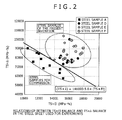
- Fig. 2 is a graph showing the relation between (TS ⁇ El) and (TS ⁇ X) which is based on data collected from many experiments including Examples mentioned later. It is apparent from the graph that the formula (I) given above draws a clear distinction between the steel according to the present invention (which has the composition and metallographic structure as specified in the present invention) and the steel for comparison (which does not meet the requirements of the present invention).
- the following deals with the manufacturing condition for the hot-rolled steel sheet that has the metallographic structure as specified above.
- the hot-rolled steel sheet according to the present invention is produced by the steps of making a steel having the composition mentioned above, casting the steel into ingots, and performing heating, hot-rolling, and winding in the usual way.
- Important factors to control the metallographic structure include heating temperature, finishing temperature of hot rolling, cooling pattern after hot rolling, winding condition, and cooling condition after winding. Such conditions are mentioned in the following.
- the slab heating temperature prior to hot rolling should be no lower than 1150°C. This temperature is just high enough for TiC and NbC to begin dissolving in austenite. Heating above this temperature is necessary for Ti and optional Nb to dissolve in steel.
- the Ti and Nb which have dissolved in steel and the dissolved C prevent the formation of polygonal ferrite at the time of quenching that follows hot rolling, thereby promoting the formation of granular bainitic ferrite structure and bainitic ferrite structure having a high dislocation density. This realizes tensile strength as well as elongation and stretch flangeability as desired.
- Hot rolling can be accomplished in the usual way without specific restrictions.
- the finishing temperature of hot rolling should be higher than the Ar 3 transformation point in the single phase of austenite. If hot rolling ends at a temperature lower than the Ar 3 transformation point, finish rolling leaves two-phase structure of ferrite and austenite. Accordingly, worked ferrite remains and the resulting hot-rolled steel sheet is poor in ductility and bore expanding performance.
- Such a steel sheet also has a coarse grainy structure in the surface layer, which lowers elongation.
- hot rolling with a lower.finishing temperature than specified causes the dissolved Ti and Nb to precipitate in the form of carbonitride and does not provide a steel sheet of the desired structure. As the result, the desired strength and elongation cannot be obtained.
- an excessively high finishing temperature leads to the formation of polygonal ferrite structure.
- the finishing temperature should not exceed "Ar 3 + 100°C" at the highest.
- Cooling after hot rolling should be carried out at an average cooling rate no lower than 20°C/sec. Cooling slower than this rate will not prevent transformation of polygonal ferrite with a low dislocation density.
- the resulting steel sheet does not have the areal ratio for granular bainitic ferrite structure and granular bainitic ferrite structure as specified in the present invention.
- a desirable cooling pattern is step cooling which includes air cooling for a short time during cooling. This is because cooling without pausing from the finishing temperature of hot rolling down to the winding temperature does not provide sufficient time for carbonitrides of Ti and Nb to precipitate in the steel, which results in a low strength.
- the temperature of air cooling should be 620°C to 720°C. Air cooling at a temperature exceeding 720°C retards precipitation of Ti and Nb carbonitrides, resulting in insufficient precipitates. Air cooling at a temperature below 620°C also retards precipitation of Ti and Nb carbonitrides, and air cooling takes a long time, which deteriorates productivity. Therefore, the preferred temperature for air cooling ranges from 650°C to 700°C.
- Duration of air cooling should be at least about 0.2 seconds for precipitation of Ti (and Nb) carbonitrides. Extending the duration of air cooling without purpose necessitates an extension of the production line or a reduction of sheet passing time. This is disadvantageous to productivity. Therefore, the duration of air cooling should be shorter than 10 seconds.
- the temperature for winding should be 400-600°C. This is because winding at this temperature results in a steel sheet whose cross section has the main structure of single phase of bainitic ferrite or dual phase of granular bainitic phase and bainitic ferrite, and cooling that follows winding causes dissolved Cu to precipitate in the form of fine ⁇ -Cu, thereby providing the desired strength and the intended total elongation and stretch flangeability. Winding at a temperature below 400°C permits entrance of bainite structure, thereby decreasing elongation, and prevents sufficient precipitation of ⁇ -Cu, which leads to insufficient strength and inadequate characteristic properties. For a good balance between strength and ductility, the winding temperature should be higher than 450°C.
- winding at a temperature above 600°C results in a steel sheet of low strength which has the polygonal ferrite structure with a low dislocation density. Moreover, winding at such a low temperature makes fine Ti (and Nb) carbonitrides (which have precipitated in the step of air cooling) coarser, which deteriorates stretch flangeability.
- the winding temperature should be 400-600°C, preferably 450-550°C.
- the wound coil should be cooled at an average cooling rate higher than 50°C/hr so as to prevent segregation of P (which is inevitably contained in steel) in ferrite grain boundaries.
- the average cooling rate should be higher than 50°C/hr for cooling from the winding temperature to 300°C. Slower cooling than specified above brings about segregation of P in ferrite grain boundaries during cooling, resulting in a high fracture appearance transition temperature(vTrs) obtained by impact test, which leads to an unsatisfactory bore expanding ratio ( ⁇ ).
- the above-mentioned cooling rate may be achieved by any means without specific restrictions, such as blasting a wound coil by blowers, blasting with mist (cooling by blast + mist), water spraying from nozzles, and dipping a wound coil in water.
- the hot-rolled steel sheet according to the present invention has an extraordinary high strength of 900 MPa level and excellent workability in terms of elongation and stretch flangeability on account of its specific composition (including C, Si, and Mn as steel's fundamental elements and Cu, Ti, and Ni as essential elements in a small amount) and also on account of its specific metallographic structure based on bainitic ferrite alone or in combination with granular bainitic ferrite.
- a steel slab having the chemical composition shown in Table 1 was heated and kept at 1250°C for 30 minutes and then hot-rolled in the usual way, with the finishing temperature being 910-950°C, to be made into a 3-mm thick hot-rolled steel sheet.
- the hot-rolled steel sheet was cooled by showering at an average cooling rate of 50°C/sec. During cooling, showering was interrupted to measure the temperature of the steel sheet, and air cooling was carried out for a prescribed period of time. showering was resumed and carried out under the same condition as above. After cooling, the steel sheet was wound and kept at 400-600°C for 30 minutes in an electric heating furnace. The steel sheet was removed from the electric furnace and cooled to room temperature at various cooling rates. Thus there was obtained the hot-rolled steel sheet as desired.
- the specimens (conforming to JIS No. 5) of the hot-rolled steel sheets thus obtained underwent tensile test (in the direction parallel to the rolling direction), bore expanding test, and observation of structure.
- each specimen was prepared by grinding the hot-rolled steel sheet to reduce its thickness to 2.0 mm.
- the bore expanding test conforms to the standard JFST 1001-1996 of the Japan Iron and Steel Federation. This test consists of punching a hole (10 mm in diameter) and expanding the hole with a conical punch having an apex angle of 60°. The diameter (d) of the hole is measured when cracking penetrates the thickness of the steel sheet.
- All the samples B to D whose composition conforms to the present invention, have the metallographic structure specified in the present invention, because they were produced at the adequate finishing temperature, cooling rate, and winding temperature and by the step cooling method which are recommenced in the present invention (except the one produced under condition No. 10).
- the sample A for comparison merely contains a small amount of Cu and Ni which are not added intentionally.
- the samples B to D whose composition conforms to the present invention, have a tensile strength (TS) greater than 900 MPa and good elongation (El) and stretch flangeability ( ⁇ ), with high values of (TS ⁇ El) and (TS ⁇ ), which suggests good combined formability.
- TS tensile strength
- El elongation
- ⁇ stretch flangeability
- the sample A is poor in balance between strength and elongation and balance between strength and stretch flangeability, because it merely contains a small amount of Cu and Ni (which are not added intentionally) and hence it lacks precipitation strengthening due to precipitation of fine ⁇ -Cu.
- it does not have a tensile strength reaching the 900 MPa level regardless of manufacturing conditions on account of lack of Ni solid solution strengthening and improved hardenability. It is inferior in (TS ⁇ E) and/or (TS ⁇ ) to the samples conforming to the present invention.
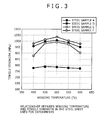
- Fig. 3 is a graph which has been compiled from data shown in Table 1 to 3 to show the relationship between tensile strength and winding temperature. It indicates that the samples B to D (conforming to the present invention) is by far superior in tensile strength to the sample A for comparison, regardless of winding temperature. Such good properties are probably due to precipitation of fine ⁇ -Cu and Ni in the steel.
- a steel slab having the chemical composition shown in Table 4 was heated and kept at 1250°C for 30 minutes and then hot-rolled in the usual way, with the finishing temperature being 910-950°C, to be made into a 3-mm thick hot-rolled steel sheet.
- the hot-rolled steel sheet was cooled at an average cooling rate of 30-100°C/sec. Cooling was interrupted and air cooling was carried out for a prescribed period.
- the steel sheet, which had undergone step cooling, was cooled by showering to a prescribed temperature. After winding the steel sheet was kept at 300-650°C for 30 minutes in an electric heating furnace. The steel sheet was removed from the electric furnace and cooled to room temperature at various cooling rates. Thus there were obtained the samples of hot-rolled steel sheets. Their manufacturing conditions are shown in Table 5.
- the hot-rolled steel sheets thus obtained were tested for tensile strength (with JIS No. 5 specimens) and bore expanding performance and also examined under an optical microscope in the same way as mentioned above. The results are shown in Table 6.
- the steel samples 1 to 10 have the composition specified by the present invention, but the steel samples 11 to 15 (for comparison) do not have the composition specified by the present invention.
- the steel sheets which were prepared from the steel samples 1 to 10, which have the composition meeting the requirements of the present invention, under any of inadequate conditions (Nos. 23, 24, 27, 33, 44, and 47) are apparently inferior in one of tensile strength, (TS ⁇ El), and (TS ⁇ ) to those which were prepared under adequate manufacturing condition that leads to an adequate metallographic structure.
Landscapes
- Chemical & Material Sciences (AREA)
- Engineering & Computer Science (AREA)
- Materials Engineering (AREA)
- Mechanical Engineering (AREA)
- Metallurgy (AREA)
- Organic Chemistry (AREA)
- Physics & Mathematics (AREA)
- Thermal Sciences (AREA)
- Crystallography & Structural Chemistry (AREA)
- Heat Treatment Of Sheet Steel (AREA)
- Heat Treatment Of Steel (AREA)
Abstract
Description
- The present invention relates to a high-strength hot-rolled steel sheet with excellent combined formability (in terms of good balance between strength and ductility and good balance between strength and stretch flangeability), which will find use in the field of automobiles (trucks and passenger cars) and various industrial machines. Owing to its excellent combine formability, the steel sheet will be effectively used for automotive parts such as suspension parts (including member and arms), chassis, and reinforcing parts in complex shape.
- The recent trend toward weight reduction of automobiles for better fuel economy and improved safety from collisions has led to an increased demand for high-strength hot-rolled steel sheet. The hot-rolled steel sheet for such purposes is usually required to have both good elongation and good stretch flangeability from the standpoint of workability. In the present invention, it is expressed as having "excellent combined formability" which means that it excels in both elongation and stretch flangeability.
- A high-strength hot-rolled steel sheet that is formed into parts of complex shape needs to meet requirements for high stretch flangeability when it undergoes stretch flanging and also for high elongation when it undergoes bulging simultaneously. Several methods are known in literature (as listed below) for improving elongation and flangeability separately. However, they have many problems unsolved yet.
- Patent Document 1 discloses a steel sheet of bainitic-ferrite structure as a high-strength hot-rolled steel sheet to be formed. This steel sheet, however, is limited in tensile strength to 500 MPa level. Patent Document 2 discloses a steel sheet of bainite structure having a tensile strength exceeding 900 MPa level. This steel sheet, however, is not satisfactory despite its high strength with its total elongation being about 14% (as an index of workability) and its bore expanding ratio (λ) being about 40% (as an index of stretch flangeability).
- Patent Document 3 discloses a steel sheet whose structure is composed of ferrite and retained austenite and whose strength is greater than 980 MPa. The steel sheet has a high elongation but is not necessarily satisfactory in stretch flangeability. Also, Patent Document 4 discloses a steel sheet whose structure is composed of ferrite and martensite or composed of ferrite, bainite, and martensite and whose strength is greater than 980 MPa. The steel sheet of such composite structure also exhibits a high elongation in its own way. However, nothing is mentioned about its stretch flangeability, and it will not express high stretch flangeability because it is based on a mixed structure composed of soft ferrite and hard martensite and bainite.
- Patent Document 5 discloses a method for improving both strength and ductility by incorporating steel with copper in the state of atomic cluster. This method, however, does not provide a high strength comparable with that achieved by precipitation strengthening. In addition, the steel incorporated with copper exhibits a high strength of 980 MPa level but its bore expanding ratio (λ) as an index of local ductility is about 22% at the highest.
- Patent Document 6 discloses a steel which has a composite structure of ferrite and bainite and which is modified by incorporation with copper. The steel, however, is not so high in strength due to insufficient copper added, and it is not intended to improve strength by utilizing the precipitation strengthening of copper.
- Patent Document 7 discloses a hot-rolled steel sheet which has improved burring workability and fatigue characteristics by incorporation with copper and titanium. It is based on the idea that copper in the state of solid solution improves fatigue characteristics. The disclosed steel sheet, however, does not meet the requirements for both strength and workability.
- Making parts in complex shape by a simple process needs a steel sheet with excellent combined forming performance, which excels in both elongation and stretch flangeability. It is not so difficult to impart such characteristic properties to a mild steel with a low strength. However, it is difficult to make a high-strength steel sheet possess both high elongation and high stretch flangeability (bore expanding ratio: λ). A steel sheet superior in one of these characteristic properties is inferior in the other. A probable reason for this is that elongation is related strongly with the structure of material; that is, a sample with a soft structure such as polygonal ferrite exhibits a high elongation but its stretch flangeability is affected intricately by structure uniformity and the size and distribution of precipitates and inclusions.
- Patent Document 1:
Japanese Patent Laid-open No.Hei-6-172924 - Patent Document 2:
Japanese Patent Laid-open No.Hei-11-80890 - Patent Document 3:
Japanese Patent Laid-open No.2000-290745 - Patent Document 4:
Japanese Patent Laid-open No.2003-73775 - Patent Document 5:
Japanese Patent Laid-open No.2003-73777 - Patent Document 6:
Japanese Patent Laid-open No.2003-55737 - Patent Document 7:
Japanese Patent Laid-open No.2001-200339 - The present invention was completed in view of the foregoing. It is an object of the present invention to provide a high-strength hot-rolled steel sheet which is free of the above-mentioned problems involved in conventional steel sheets and which is characterized by high strength (in terms of tensile strength at 900 MPa level) and excellent combined formability expressed by balance between strength and ductility [tensile strength (TS) × total elongation (El)] and balance between strength and stretch flangeability [tensile strength (TS) × bore expanding ratio (λ)].
- According to the present invention, the foregoing problems are solved by a high-strength hot-rolled steel sheet with excellent combined formability which is characterized by containing:
- C : no less than 0.02% and no more than 0.15%,
- Si : no less than 0.2% and no more than 2.0%,
- Mn : no less than 0.5% and no more than 2.5%,
- Al : no less than 0.02% and no more than 0.15%,
- Cu : no less than 1.0% and no more than 3.0%,
- Ni : no less than 0.5% and no more than 3.0%, and
- Ti : no less than 0.03% and no more than 0.5%
- According to the present invention, the foregoing high-strength hot-rolled steel sheet has excellent combined formability as defined by an index of:

- According to the present invention, the foregoing hot-rolled steel sheet may optionally contain at least one additional element selected from those elements listed below for further enhanced strength and formability.
- Cr : no less than 0.05% and no more than 1.0%,
- Mo : no less than 0.05% and no more than 1.0%,
- V : no less than 0.05% and no more than 0.5%,
- Nb : no less than 0.005% and no more than 0.5%,
- B : no less than 0.0010% and mo more than 0.01%, and
- Ca : no less than 0.0010% and no more than 0.01%.
- The high-strength hot-rolled steel sheet according to the present invention varies in strength depending on its application area. Therefore, the standard of high strength is not specifically established in the present invention; however, it is usually higher than 900 MPa, preferably higher than 980 MPa.
- The present invention realizes a high-strength hot-rolled steel sheet excelling in elongation and stretch flangeability (or strength and combined formability), which is represented by, for example, a thickness of about 2 mm, a tensile strength greater than 900 MPa, and an elongation greater than 15%, with balance between strength and ductility (tensile strength × total elongation) being greater than 14000 MPa·%, bore expanding ratio being greater than 70%, and balance between strength and stretch flangeability (tensile strength × bore expanding ratio) being greater than 70000 MPa·%. Unlike conventional hot-rolled steel sheets which are not widely used from the standpoint of formability, the hot-rolled steel according to the present invention can be applied to various parts of automobiles and industrial machine. It will contribute to cost reduction of parts, thickness reduction of parts, and automotive safety (in case of collision) through improved body performance.
-
-
Fig. 1 is an optical microphotograph showing an example of the metallographic structure of the high-strength hot-rolled steel sheet according to the present invention. -
Fig. 2 is a graph showing the relation between tensile strength (TS) × elongation (El) and tensile strength (TS) × stretch flangeability (λ), which is observed in one steel sheet obtained by experiments. -
Fig. 3 is a graph showing the relation between winding temperature and tensile strength which is found in a steel sheet used in experiments. - As mentioned above, the present invention provides a hot-rolled steel sheet which has high strength as well as excellent combined formability as indicated by improved balance between strength and ductility and improved balance between strength and stretch flangeability. This result is attained by specifying the chemical components of steel and also specifying the metallographic structure in the longitudinal cross section (or L cross section) such that the parent phase is based on bainitic ferrite or granular bainitic ferrite and the parent phase contains fine complex precipitates composed of ε-Cu and titanium carbonitride. The chemical components and metallographic structure are specified by the following reasons.
- The chemical components of the steel are specified as follows.
- C is essential for strength and bainitic ferrite structure. For C to impart a tensile strength greater than 900 MPa, its content should be no less than 0.02%. Excessive C generates and increases the second phase (pearlite and bainite) in the microstructure, thereby deteriorating the bore expanding performance. The maximum C content is 0.15%.
The preferred C content is no less than 0.03% and no more than 0.10%. - Si widens the limits of solid solution of C in ferrite and also gives rise to the bainitic ferrite structure. Si in an adequate amount increases the volume ratio from ferrite structure to bainitic ferrite structure. This structure is hardly subject to voids due to local deformation despite its high strength, and hence it improves bore expanding ratio (λ) and total elongation (El). The bainitic ferrite structure, as compared with ordinary ferrite structure, has a higher dislocation density; however, it is considered to be similar to the ferrite structure in formability unlike the bainite structure, pearlite structure, or the structure containing fine iron carbide dispersed therein. The bainitic ferrite structure needs more than 0.2% of Si. However, excessive Si deteriorates the surface state of the hot-rolled steel sheet and increases the resistance of hot deformation, thereby presenting difficulties in production of steel sheets. The preferred Si content is no less than 0.5% and no more than 1.5%.
- Mn is effective for solid solution strengthening. At least 0.5% of Mn is necessary to produce a tensile strength greater than 900 MPa. Excessive Mn leads to excessively high hardenability, thereby giving rise to a large amount of product resulting from transformation at low temperatures, which deteriorates the bore expanding ratio (λ). The amount of Mn should be 2.5% at most. The preferred amount of Mn is no less than 0.7% and no more than 2.4%.
- Al is added as a deoxidizer at the time of ingoting to improve the cleanliness of steel. For a good effect, more than 0.02% of Al should be added. However, excessive Al gives rise to non-metallic inclusions, thereby causing surface defects. The upper limit is 0.15%. The preferred amount of Al is no less than 0.03% and no more than 0.1%.
- Cu is important in the present invention. It contributes to solid solution strengthening and also improves fatigue characteristics. It separates out in the form of fine dispersed ε-Cu precipitates during cooling after winding into a coil, thereby contributing to strengthening. Moreover, fine ε-Cu precipitates lead to improved balance between strength and ductility and improved balance between strength and stretch flangeability. The reason for this is not known yet but may be explained by the fact that ε-Cu precipitates measure about 5-20 nm (as observed under a transmission electron microscope) and that dislocation increases due to work hardening. Enlarged allowance for fracture by the increased dislocation is considered to be one of the reasons.
- Although the bore expanding ratio is evaluated by the bore expanding test which is performed on the punched hole formed by shearing, the result of the test varies depending the type of steel tested. A steel whose strength relies on coarse precipitated particles like iron carbide causes a large number of microcracks to occur in the shearing surface when the initial hole is punched out, and such microcracks propagate cracking before bore expanding proceeds sufficiently. Hence the resulting bore expanding ratio (λ) is rather low. By contrast, a steel containing fine ε-Cu particles which are uniformly dispersed therein prevents the occurrence of microcracks, and hence it exhibits a high strength and a high bore expanding ratio.
- In any case, the steel sheet to have a strength greater than 900 MPa as intended in the present invention should contain more than 1.0% of Cu. The parent material increases in strength with the increasing amount of Cu added. However, excessive Cu causes surface defects, and hence the upper limit is 3.0%. The preferred amount of Cu is no less than 1.0% and no more than 2.5%.
- Ni effectively prevents surface defects which might occur at the time of hot rolling as the result of incorporation with Cu. If Cu is added, the amount of Ni should preferably be 100% to 50% of Cu. Ni is also effective for solid solution strengthening and hardenability. It increases the dislocation density in the bainitic ferrite structure and granular bainitic ferrite structure, thereby contributing to strength. For Ni to fully produce its effect and make the foregoing steel of composite structure exhibit a tensile strength greater than 900 MPa, the amount of Ni should preferably be more than 0.5%. Excess Ni over about 3.0% is wasted without additional effect. The preferred amount of Ni is no less than 0.5% and no more than 2.5%.
- Ti dissolves in steel (to make a solid solution) when the slab is heated before hot rolling. The dissolved Ti prevents nucleation of polygonal ferrite at the time of quenching after hot rolling, thereby promoting the formation of granular bainitic ferrite structure and bainitic ferrite structure with a high dislocation density. For Ti to fully produce its effect, the content of Ti should be no less than 0.03%, preferably no less than 0.05%. However, excess Ti causes the hot-worked structure to remain as such, thereby preventing the formation of adequate metallographic structure. The adequate amount of Ti should be less than 0.5%.
- The excellent working characteristics in terms of good balance between elongation and stretch flangeability which is featured by the present invention is presumably due to the metallographic structure (mentioned later in more detail) which is composed of bainitic ferrite (or in combination with granular bainitic ferrite) as a major component and fine ε-Cu and carbonitride of Ti (or with Nb) in such a way that the major and secondary components precipitate in good matching with the base material.
- The steel sheet according to the present invention contains essential elements as mentioned above, with the remainder being substantially iron and inevitable impurities. The latter includes P (phosphorus), S (sulfur), O (oxygen), and N (nitrogen), which originate from iron source (such as iron ores and scraps) or enter in the manufacturing process.
To minimize their adverse effect, their content should be kept respectively less than 0.08% (P), 0.010% (S), 0.003% (O), and 0.006% (N). - Of these impurities, P produces the effect of solid solution strengthening without deteriorating ductility. It may be intentionally added in small amounts to enhance strength without the possibility of impairing ductility (elongation and bore expanding performance) due to bainitic ferrite structure. However, an excess amount of P remarkably deteriorates impact properties and spot weldability. An adequate amount of P is less than 0.08%, preferably less than 0.05%. Also, the amount of S should be less than 0.010%, preferably less than 0.005%, because excess S gives rise to sulfide inclusions which adversely affect bore expanding performance.
- Moreover, the steel sheet according to the present invention may contain optional elements (mentioned below) for additional characteristic properties. The one containing such optional elements is also within the scope of the present invention.
- These elements contribute to solid solution strengthening and promote transformation (thereby giving rise to granular bainitic ferrite structure and bainitic ferrite structure). They produce their effect when added in small amounts, preferably more than 0.05%. However, when added in excess amounts, they give rise to a large amount of low-temperature transformation products (such as martensite and M/A transformation products) which adversely affect stretch flangeability. Their amount should be less than 1.0% each.
- V forms carbide, nitride, or carbonitride, thereby strengthening the steel sheet. It produces its effect when added in an amount more than 0.05%. However, an adequate amount is less than 0.5% because excess V adversely affects stretch flangeability and gives rise to a large amount of low-temperature transformation products.
- Like Ti mentioned above, Nb dissolves in steel to form solid solution during slab heating that precedes hot rolling, so that it prevents nucleation of polygonal ferrite during quenching that follows hot rolling, thereby forming granular bainitic ferrite structure and bainitic ferrite structure, both having a high dislocation density. It fully produces its effect when added in an amount more than 0.005%. However, excess Nb causes the hot-rolled structure to remain as such and prevents the formation of adequate metallographic structure. The amount of Nb should be less than 0.5%.
- B improves hardenability and promotes formation of granular bainitic ferrite structure and bainitic ferrite structure. It fully produces its effect when added in an amount more than 0.0010%. However, excess B forms harmful non-metallic inclusions to deteriorate the bore expanding performance. The amount of B should be less than 0.01%, preferably less than 0.005%.
- Ca combines with S in steel to form immobile spherical sulfides (CaS) harmless to stretch flangeability, thereby preventing formation of MnS detrimental to bore expanding performance. It fully produces its effect when added in an amount more than 0.0010%. However, when added in an amount more than 0.01%, it is wasted without additional effect.
- The following deals with the metallographic structure of the high-strength hot-rolled steel sheet according to the present invention.
- The present invention requires that the hot-rolled steel sheet have the composition specified above and the major metallographic structure in its longitudinal cross section (L cross section) is bainitic ferrite structure alone or in combination with granular bainitic ferrite structure.
- The granular bainitic ferrite structure and bainitic ferrite structure mentioned above show an acicular shape in observation under an optical microscope or SEM, and they needs identification by observation of their base structure under a transmission electron microscope.
- The bainitic ferrite structure has a higher dislocation density than the polygonal ferrite structure and looks like a lath. The bainite structure has a lathlike underlying structure with a high dislocation density, with carbide being formed in the lath boundary. By contrast, the bainitic ferrite structure has the lath structure but is free of cementite in an ideal case. So, it is different from the bainite structure. On the other hand, the granular bainitic ferrite structure does not have the lathlike structure but has the underlying structure with a high dislocation density. They apparently differ from the bainite structure in that they have no cementite in the structure. They also differ from either polygonal ferrite having the underlying structure with an extremely low dislocation density or quasi-polygonal ferrite having the underlying structure such as fine subgrains. (Refer to "Collection of Photographs of Bainite in Steel - 1" issued by the Japanese Steel Association, Fundamental Workshop, June 29, 1992.)
- It is essential for the hot-rolled steel sheet according to the present invention to have the granular bainitic ferrite structure and bainitic ferrite structure mentioned above as its main structure. However, practically, it may have either of them or both mixed together. In any case, it is necessary that their sum should account for no less than 85% (by area), preferably no less than 90%, in all the metallographic structure. In other words, the product is acceptable in the present invention even though it contains a small amount of foreign structure (other than mentioned above) in an amount less than 15%, preferably less than 10%.
- The above-mentioned areal ratio for the metallographic structure is determined by observation under an optical microscope in the following manner. An embedded specimen has its cross section (parallel to the rolling direction) polished and then etched by immersion in a Nital solution. That part of the specimen which is away from the surface by one quarter of the thickness is examined for structure by observation under an optical microscope (×400), Model PMG-II made by Olympus. The field of view is divided by a grid consisting of twenty each of horizontal and vertical lines. The phase at each intersection is determined. Observation in this manner is repeated for five view fields of each specimen. Thus, the number of different phases at 2000 intersections in total is counted to obtain the areal ratio.
-
Fig. 1 is an optical microphotograph showing an example of the metallographic structure. It shows that the steel in question is composed of bainitic ferrite as the main structure and granular bainitic ferrite surrounded by ellipses. Incidentally, different microscopes were used to determine the fraction of structure and to photograph the structure. - The hot-rolled steel sheet according to the present invention exhibits high strength and high bore expanding ratio on account of monolayer structure of bainitic ferrite formed therein or dual layer structure of granular bainitic ferrite and bainitic ferrite formed therein, the former containing a reduced amount of C, having the lathlike structure, and having a high dislocation density free of carbides, and the latter containing no carbides precipitating therein. The high strength of the steel sheet is attributable to solid solution strengthening due to alloying elements added (particularly Cu that forms ε-Cu in bainitic ferrite to bring about fine precipitation strengthening), improved hardenability due to alloying elements added, and increased dislocation density of bainitic ferrite associated therewith.
- In any case, it is the essential requirement of the present invention that the longitudinal cross section of the specimen observed in the above-mentioned manner has a metallographic structure composed mainly of bainitic ferrite alone or in combination with granular bainitic ferrite. If this structure is absent, the steel sheet will not meet the requirement of the present invention -- good balance between strength and stretch flangeability [tensile strength (TS) × bore expanding ratio (λ) : MPa·%] and good balance between strength and ductility [tensile strength (TS) × elongation (El) : MPa·%] -- which will be mentioned below in more detail.
- The high-strength hot-rolled steel sheet according to the present invention is characterized by having a good balance between high strength and workability which is achieved by the above-mentioned composition and metallographic structure in the cross section. This is quantified by the statement that balance between strength and stretch flangeability [tensile strength (TS) × bore expanding ratio (λ) : MPa·%] and balance between strength and ductility [tensile strength (TS) × elongation (El) : MPa·%] meet the formula (I) below.

- The bore expanding ratio (λ) of the hot-rolled steel sheet is a characteristic value that indicates the uniformity of the structure.
The requirement for this characteristic property is best achieved by a steel of single structure. On the other hand, total elongation depends on the ratio of the soft phase in a steel, and hard phases are desirable for high strength. Therefore, a steel with both high strength and high ductility should have a mixed structure of soft phase and hard phase. Such a structure, however, is inhomogeneous and reduces the bore expanding ratio (λ). A detailed study on the metallographic structure of the hot-rolled steel sheet revealed that strength, ductility, and stretch flangeability are affected by the size, shape, distribution, and particle-to-particle distance of precipitates. It also revealed that stretch flangeability (bore expanding ratio: λ), which is local ductility, is inversely proportional to ductility (or total elongation: El). - Further studies on this relationship revealed that a high-strength steel sheet having a tensile strength greater than 900 MPa that satisfies the formula (I) above excels not only in strength but also in balance between strength and ductility and balance between strength and stretch flangeability. Incidentally,
Fig. 2 is a graph showing the relation between (TS × El) and (TS × X) which is based on data collected from many experiments including Examples mentioned later. It is apparent from the graph that the formula (I) given above draws a clear distinction between the steel according to the present invention (which has the composition and metallographic structure as specified in the present invention) and the steel for comparison (which does not meet the requirements of the present invention). - The following deals with the manufacturing condition for the hot-rolled steel sheet that has the metallographic structure as specified above.
- The hot-rolled steel sheet according to the present invention is produced by the steps of making a steel having the composition mentioned above, casting the steel into ingots, and performing heating, hot-rolling, and winding in the usual way. Important factors to control the metallographic structure include heating temperature, finishing temperature of hot rolling, cooling pattern after hot rolling, winding condition, and cooling condition after winding. Such conditions are mentioned in the following.
- The slab heating temperature prior to hot rolling should be no lower than 1150°C. This temperature is just high enough for TiC and NbC to begin dissolving in austenite. Heating above this temperature is necessary for Ti and optional Nb to dissolve in steel. The Ti and Nb which have dissolved in steel and the dissolved C prevent the formation of polygonal ferrite at the time of quenching that follows hot rolling, thereby promoting the formation of granular bainitic ferrite structure and bainitic ferrite structure having a high dislocation density. This realizes tensile strength as well as elongation and stretch flangeability as desired.
- Hot rolling can be accomplished in the usual way without specific restrictions. The finishing temperature of hot rolling should be higher than the Ar3 transformation point in the single phase of austenite. If hot rolling ends at a temperature lower than the Ar3 transformation point, finish rolling leaves two-phase structure of ferrite and austenite. Accordingly, worked ferrite remains and the resulting hot-rolled steel sheet is poor in ductility and bore expanding performance. Such a steel sheet also has a coarse grainy structure in the surface layer, which lowers elongation. Moreover, hot rolling with a lower.finishing temperature than specified causes the dissolved Ti and Nb to precipitate in the form of carbonitride and does not provide a steel sheet of the desired structure. As the result, the desired strength and elongation cannot be obtained. However, an excessively high finishing temperature leads to the formation of polygonal ferrite structure. The finishing temperature should not exceed "Ar3 + 100°C" at the highest.
- Cooling after hot rolling should be carried out at an average cooling rate no lower than 20°C/sec. Cooling slower than this rate will not prevent transformation of polygonal ferrite with a low dislocation density. The resulting steel sheet does not have the areal ratio for granular bainitic ferrite structure and granular bainitic ferrite structure as specified in the present invention.
- A desirable cooling pattern is step cooling which includes air cooling for a short time during cooling. This is because cooling without pausing from the finishing temperature of hot rolling down to the winding temperature does not provide sufficient time for carbonitrides of Ti and Nb to precipitate in the steel, which results in a low strength. The temperature of air cooling should be 620°C to 720°C. Air cooling at a temperature exceeding 720°C retards precipitation of Ti and Nb carbonitrides, resulting in insufficient precipitates. Air cooling at a temperature below 620°C also retards precipitation of Ti and Nb carbonitrides, and air cooling takes a long time, which deteriorates productivity. Therefore, the preferred temperature for air cooling ranges from 650°C to 700°C.
- Duration of air cooling should be at least about 0.2 seconds for precipitation of Ti (and Nb) carbonitrides. Extending the duration of air cooling without purpose necessitates an extension of the production line or a reduction of sheet passing time. This is disadvantageous to productivity. Therefore, the duration of air cooling should be shorter than 10 seconds.
- The temperature for winding should be 400-600°C. This is because winding at this temperature results in a steel sheet whose cross section has the main structure of single phase of bainitic ferrite or dual phase of granular bainitic phase and bainitic ferrite, and cooling that follows winding causes dissolved Cu to precipitate in the form of fine ε-Cu, thereby providing the desired strength and the intended total elongation and stretch flangeability. Winding at a temperature below 400°C permits entrance of bainite structure, thereby decreasing elongation, and prevents sufficient precipitation of ε-Cu, which leads to insufficient strength and inadequate characteristic properties. For a good balance between strength and ductility, the winding temperature should be higher than 450°C.
- By contrast, winding at a temperature above 600°C results in a steel sheet of low strength which has the polygonal ferrite structure with a low dislocation density. Moreover, winding at such a low temperature makes fine Ti (and Nb) carbonitrides (which have precipitated in the step of air cooling) coarser, which deteriorates stretch flangeability. Thus, the winding temperature should be 400-600°C, preferably 450-550°C.
- The wound coil should be cooled at an average cooling rate higher than 50°C/hr so as to prevent segregation of P (which is inevitably contained in steel) in ferrite grain boundaries. The average cooling rate should be higher than 50°C/hr for cooling from the winding temperature to 300°C. Slower cooling than specified above brings about segregation of P in ferrite grain boundaries during cooling, resulting in a high fracture appearance transition temperature(vTrs) obtained by impact test, which leads to an unsatisfactory bore expanding ratio (λ).
- The above-mentioned cooling rate may be achieved by any means without specific restrictions, such as blasting a wound coil by blowers, blasting with mist (cooling by blast + mist), water spraying from nozzles, and dipping a wound coil in water.
- The foregoing is the constitution of the present invention. The hot-rolled steel sheet according to the present invention has an extraordinary high strength of 900 MPa level and excellent workability in terms of elongation and stretch flangeability on account of its specific composition (including C, Si, and Mn as steel's fundamental elements and Cu, Ti, and Ni as essential elements in a small amount) and also on account of its specific metallographic structure based on bainitic ferrite alone or in combination with granular bainitic ferrite.
- The present invention will be described in more detail with reference to the following examples, which are not intended to restrict the scope thereof and which may be changed and modified adequately within the scope thereof.
- A steel slab having the chemical composition shown in Table 1 was heated and kept at 1250°C for 30 minutes and then hot-rolled in the usual way, with the finishing temperature being 910-950°C, to be made into a 3-mm thick hot-rolled steel sheet. The hot-rolled steel sheet was cooled by showering at an average cooling rate of 50°C/sec. During cooling, showering was interrupted to measure the temperature of the steel sheet, and air cooling was carried out for a prescribed period of time. Showering was resumed and carried out under the same condition as above. After cooling, the steel sheet was wound and kept at 400-600°C for 30 minutes in an electric heating furnace. The steel sheet was removed from the electric furnace and cooled to room temperature at various cooling rates. Thus there was obtained the hot-rolled steel sheet as desired.
- The specimens (conforming to JIS No. 5) of the hot-rolled steel sheets thus obtained underwent tensile test (in the direction parallel to the rolling direction), bore expanding test, and observation of structure. Incidentally, each specimen was prepared by grinding the hot-rolled steel sheet to reduce its thickness to 2.0 mm. The bore expanding test conforms to the standard JFST 1001-1996 of the Japan Iron and Steel Federation. This test consists of punching a hole (10 mm in diameter) and expanding the hole with a conical punch having an apex angle of 60°. The diameter (d) of the hole is measured when cracking penetrates the thickness of the steel sheet. The bore expanding ratio (λ) is calculated from the following formula.

- The results are shown in Tables 2 and 3 and
Figs. 2 and3 . Incidentally, the Ar3 transformation point of the specimen was calculated from the formula below.
-
Table 1 Chemical Composition (mass%) Steel sample C Si Mn P S Al Cu Ni Ti Ar3 transformation point Remarks A 0.05 0.94 1.36 0.008 0.005 0.035 0.03 0.02 0.153 926 Steel for comparison B 0.04 1.06 1.45 0.008 0.005 0.041 1.47 0.78 0.149 906 Steel of the present inventon C 0.05 0.96 1.37 0.007 0.005 0.037 0.99 0.52 0.147 911 Steel of the present inventon D 0.05 1.00 1.36 0.008 0.005 0.038 2.00 1.01 0.154 888 Steel of the present invention -

-

- Tables 1 to 3 and
Figs. 2 and3 suggest the following. - All the samples B to D, whose composition conforms to the present invention, have the metallographic structure specified in the present invention, because they were produced at the adequate finishing temperature, cooling rate, and winding temperature and by the step cooling method which are recommenced in the present invention (except the one produced under condition No. 10). The sample A for comparison merely contains a small amount of Cu and Ni which are not added intentionally.
- The samples B to D, whose composition conforms to the present invention, have a tensile strength (TS) greater than 900 MPa and good elongation (El) and stretch flangeability (λ), with high values of (TS×El) and (TS×λ), which suggests good combined formability. By contrast, the sample A is poor in balance between strength and elongation and balance between strength and stretch flangeability, because it merely contains a small amount of Cu and Ni (which are not added intentionally) and hence it lacks precipitation strengthening due to precipitation of fine ε-Cu. Moreover, it does not have a tensile strength reaching the 900 MPa level regardless of manufacturing conditions on account of lack of Ni solid solution strengthening and improved hardenability. It is inferior in (TS×E) and/or (TS×λ) to the samples conforming to the present invention.
- Moreover, it is apparent from
Fig. 2 , in which (TS×λ) is plotted against (TS×El), that the line representing the formula (I) separates the samples B to D conforming to the present invention from the sample A for comparison. This means that the former excels in both (TS×El) and (TS×λ), but the latter does not. -
Fig. 3 is a graph which has been compiled from data shown in Table 1 to 3 to show the relationship between tensile strength and winding temperature. It indicates that the samples B to D (conforming to the present invention) is by far superior in tensile strength to the sample A for comparison, regardless of winding temperature. Such good properties are probably due to precipitation of fine ε-Cu and Ni in the steel. - A steel slab having the chemical composition shown in Table 4 was heated and kept at 1250°C for 30 minutes and then hot-rolled in the usual way, with the finishing temperature being 910-950°C, to be made into a 3-mm thick hot-rolled steel sheet. The hot-rolled steel sheet was cooled at an average cooling rate of 30-100°C/sec. Cooling was interrupted and air cooling was carried out for a prescribed period. The steel sheet, which had undergone step cooling, was cooled by showering to a prescribed temperature. After winding the steel sheet was kept at 300-650°C for 30 minutes in an electric heating furnace. The steel sheet was removed from the electric furnace and cooled to room temperature at various cooling rates. Thus there were obtained the samples of hot-rolled steel sheets. Their manufacturing conditions are shown in Table 5.
- The hot-rolled steel sheets thus obtained were tested for tensile strength (with JIS No. 5 specimens) and bore expanding performance and also examined under an optical microscope in the same way as mentioned above. The results are shown in Table 6.
-
Table 4 Chemical Composition (mass%) Steel sample C Si Mn P S Al Cu Ni Ti Others Ar3 transformation point (°C) Remarks 1 0.05 0.96 1.37 0.007 0.005 0.037 1.02 0.52 0.147 897 Steel of the present invention 2 0.05 1.00 1.36 0.008 0.005 0.038 1.50 1.01 0.154 885 Steel of the present invention 3 0.03 1.50 1.80 0.010 0.002 0.045 1.00 0.73 0.120 904 Steel of the present invention 4 0.08 1.02 1.51 0.009 0.003 0.035 2.00 1.35 0.348 931 Steel of the present invention 5 0.04 0.51 1.92 0.010 0.004 0.035 1.50 1.08 0.180 Nb:0.035, Mo:0.5 860 Steel of the present invention 6 0.06 1.80 1.11 0.015 0.006 0.052 2.00 1.52 0.240 Cr:0.5 934 Steel of the present invention 7 0.05 0.92 1.40 0.008 0.003 0.048 1.50 0.82 0.160 V:0.3 885 Steel of the present invention 8 0.04 1.10 2.23 0.013 0.002 0.048 1.75 1.03 0.180 Cr:0.3, Mo:0.2 873 Steel of the present invention 9 0.07 1.01 0.79 0.011 0.007 0.054 2.50 1.50 0.304 Ca:0.8030 926 Steel of the present invention 10 0.10 0.35 2.40 0.015 0.003 0.035 2.00 1.00 0.400 B:0.0027 894 Steel of the present invention 11 0.20 1.04 1.32 0.009 0.002 0.052 1.10 0.50 0.150 856 Steel of comparison 12 0.05 0.02 1.61 0.008 0.004 0.048 1.03 0.53 0.130 841 Steel for comparison 13 0.04 1.00 3.00 0.007 0.003 0.052 1.50 0.75 0.140 839 Steel for comparison 14 0.05 1.01 1.38 0.009 0.006 0.042 3.50 2.00 0.160 832 Steel for comparison 15 0.05 0.99 1.33 0.014 0.005 0.033 0.50 0.50 0.163 916 Steel for comparison -
Table 5 Steel sample Condition No. Finishing temperature (°C) Cooing rate (°C/sec) Cooling condition Winding temperature (°C) Cooling rate after winding (°C/hr) Remarks Step temperature Duration of air cooling 1 21 930 50 680°C 20 sec 500 100 Working Example 22 450 100 Working Example 23 300 100 Comparative Example 2 24 910 50 None None 650 100 Comparative Example 25 70 670°C 15 sec 500 80 Working Example 26 450 80 Working Example 3 27 930 70°C/sec None None 650 80 Comparative Example 28 30 650°C 30 sec 550 150 Working Example 29 500 150 Working Example 30 450 150 Working Example 4 31 950 50 650°C 30 sec 500 120 Working Example 32 450 120 Working Example 33 300 120 Comparative Example 5 34 930 50 700°C 15 sec 500 80 Working Example 35 910 500 80 Working Example 36 450 50 Working Example 6 37 950 30 675°C 20 sec 500 50 Working Example 38 450 50 Working Example 39 930 50 500 120 Working Example 40 450 120 Working Example 7 41 930 50 675°C 20 sec 550 100 Working Example 42 910 550 100 Working Example 8 43 930 50 675°C 20 sec 500 100 Working Example 44 300 100 Comparative Example 9 45 930 70 700°C 25 sec 550 80 Working Example 46 500 80 Working Example 47 350 80 Comparative Example 10 48 930 50 680°C 20 sec 550 100 Working Example 49 500 100 Working Example 50 910 450 100 Working Example 11 51 910 5C°C/sec None None 600 100 Comparative Example 12 52 910 50°C/sec 680°C 20 sec 500 80 Comparative Example 13 53 910 50°C/sec 680°C 20 sec 500 80 Comparative Example 14 54 910 50°C/sec 680°C 20 sec 500 80 Comparative Example 15 55 930 50 680°C 20 sec 550 80 Comparative Example 56 500 80 Comparative Example -
Table 6 Steel sample Condition No. YS (N/mm2) TS (N/mm2) El (%) λ (%) TSxEl MPa-% TSx λ MPa-% Major structure (area %) Remaining structure (area %) Remarks 1 21 868 998 16.3 82.3 16267.4 82135.4 BF(95) B(5) Working Example 22 871 1013 15.2 87.2 15397.6 88333.6 BF(93) B(7) Working Example 23 903 1050 10.1 63.3 10605.0 66465.0 M(60) F(15)+B(25) Comparative Example 2 24 797 885 18.3 76.3 16195.5 67525.5 P.F(90) B(10) Comparative Example 25 914 1063 16.2 92.3 17220.6 98114.9 BF(91) S(9) Working Example 26 930 1081 15.1 86.2 16323.1 93182.2 BF(92) B(8) Working Example 3 27 792 880 19.2 78.4 16896.0 68992.0 PF(85) B(15) Comparative Example 28 853 992 17.4 91.4 17260.8 90668.8 BF(88) B(12) Working Example 29 873 1015 17.3 81.2 17559.5 82418.0 BF(92) B(8) Working Example 30 864 1005 16.2 75.6 16281.0 75978.0 BF(95) B(5) Working Example 4 31 866 1007 16.1 89.3 16212.7 89925.1 BF(90) B(10) Working Example 32 882 1025 15.4 93.8 15785.0 96145.0 BF(94) B)6) Working Example 33 597 853 13.1 68.3 11174.3 58259.9 M(64) F(18)+B(18) Comparative Example 5 34 857 997 15.1 88.6 15054.7 88334.2 BF(95) B(5) Working Example 35 847 985 17.3 91.2 17040.5 89832.0 BF(92) B(8) Working Example 36 853 992 15.2 78.4 15078.4 77772.8 BF(90) B(10) Working Example 6 37 949 1103 15.1 81.3 16655.3 89673.9 BF(93) 8(7) Working Example 38 992 1153 15.3 77.5 17640.9 89357.5 BF(89) B(11) Working Example 39 940 1093 16.1 82.2 17597.3 89844.6 BF(95) B(5) Working Example 40 968 1125 15.2 73.3 17100.0 82462.5 BF(93) B(7) Working Example 7 41 926 1077 17.2 82.1 18524.4 88421.7 BF(92) B(8) Working Example 42 913 1062 16.3 78.2 17310.6 83048.4 BF(96) B(4) Working Example 8 43 953 1108 15.4 75.8 17063.2 83986.4 BF(95) B(5) Working Example 44 844 1205 11.1 68.1 13375.5 82060.5 M(68) F(18)+B(14) Comparative Example 9 45 925 1076 17.2 82.3 18507.2 88554.8 BF(90) B(10) Working Example 46 977 1136 15.2 72.3 17267.2 82132.8 BF(93) B(7) Working Example 47 790 988 10.1 55.2 9978.8 54537.6 M(64) F(15)+B(21) Comparative Example 10 48 944 1180 16.2 83.1 19116.0 98058.0 BF(89) B(11) Working Example 49 878 1098 17.2 78.5 18885.6 86193.0 BF(94) B(6) Working Example 50 828 1035 16.3 88.5 16870.5 91597.5 BF(96) B(4) Working Example 11 51 845 983 17.2 36.2 16907.6 35584.6 P(65) F(35) Comparative Example 12 52 710 825 16.4 68.1 13530.0 56182.5 BF(90) B(10) Comparative Example 13 53 933 1085 9.1 63.2 9873.5 68572.0 BF(92) B(8) Comparative Example 14 54 1004 1210 8.2 45.5 9922.0 55055.0 BF(93) B(7) Comparative Example 15 55 701 815 15.5 72.2 12632.5 58843.0 BF(88) B(12) Comparative Example 56 742 863 13.2 69.2 11391.6 59719.6 BF(91) B(9) Comparative Example - Tables 4 to 6 suggest the following.
- The steel samples 1 to 10 have the composition specified by the present invention, but the steel samples 11 to 15 (for comparison) do not have the composition specified by the present invention. The steel samples for comparison in Tables 5 and 6, which were prepared under the conditions Nos. 23, 24, 27, 33, 44, and 47, meet the requirements of the present invention but do not have the metallographic structure specified by the present invention because of inadequate manufacturing conditions.
- It is apparent from these tables that the steel sheets made of the steel samples 11 to 15 which have the composition lacking the requirements of the present invention (that is, under the conditions 51 to 56) are poor in tensile strength (lower than 900 MPa) or poor in (TS×El) and/or (TS×λ). This holds true not only for the one which was produced under an inadequate condition (No. 51) and which does not have the metallographic structure specified by the present invention, but also for those which were produced under an adequate condition and have the metallographic structure specified by the present invention.
- The steel sheets which were prepared from the steel samples 1 to 10, which have the composition meeting the requirements of the present invention, under any of inadequate conditions (Nos. 23, 24, 27, 33, 44, and 47) are apparently inferior in one of tensile strength, (TS×El), and (TS×λ) to those which were prepared under adequate manufacturing condition that leads to an adequate metallographic structure.
Claims (4)
- A hot-rolled steel sheet which is characterized by containing:C : no less than 0.02% and no more than 0.15%,Si : no less than 0.2% and no more than 2.0%,Mn : no less than 0.5% and no more than 2.5%,Al : no less than 0.02% and no more than 0.15%,Cu : no less than 1.0% and no more than 3.0%,Ni : no less than 0.5% and no more than 3.0%, andTi : no less than 0.03% and no more than 0.5%(% means mass% for chemical components hereinafter) and also by having a metallographic structure in longitudinal cross section such that the sum of bainitic ferrite and granular bainitic ferrite accounts for no less than 85% by area.
- The hot-rolled steel sheet as defined in Claim 1, which has a balance between strength and stretch flangeability [tensile strength (TS) x bore expanding ratio (λ) : MPa·%] and a balance between strength and ductility [tensile strength (TS) × total elongation (El) : MPa·%] such that these values satisfy the formula below.

- The hot-rolled steel sheet as defined in Claim 1, which further contains at least one species selected from the group consisting of:Cr : no less than 0.05% and no more than 1.0%,Mo : no less than 0.05% and no more than 1.0%,V : no less than 0.05% and no more than 0.5%,Nb : no less than 0.005% and no more than 0.5%,B : no less than 0.0010% and mo more than 0.01%, andCa : no less than 0.0010% and no more than 0.01%.
- The hot-rolled steel sheet as defined in Claim 1, which has a tensile strength greater than 900 MPa.
Applications Claiming Priority (2)
| Application Number | Priority Date | Filing Date | Title |
|---|---|---|---|
| JP2006082968A JP4088316B2 (en) | 2006-03-24 | 2006-03-24 | High strength hot-rolled steel sheet with excellent composite formability |
| PCT/JP2007/055050 WO2007122910A1 (en) | 2006-03-24 | 2007-03-14 | High-strength hot rolled steel sheet having excellent composite moldability |
Publications (2)
| Publication Number | Publication Date |
|---|---|
| EP2022864A1 true EP2022864A1 (en) | 2009-02-11 |
| EP2022864A4 EP2022864A4 (en) | 2016-04-20 |
Family
ID=38624821
Family Applications (1)
| Application Number | Title | Priority Date | Filing Date |
|---|---|---|---|
| EP07738521.9A Withdrawn EP2022864A4 (en) | 2006-03-24 | 2007-03-14 | High-strength hot rolled steel sheet having excellent composite moldability |
Country Status (6)
| Country | Link |
|---|---|
| US (1) | US8529829B2 (en) |
| EP (1) | EP2022864A4 (en) |
| JP (1) | JP4088316B2 (en) |
| KR (1) | KR101114672B1 (en) |
| CN (1) | CN101400816B (en) |
| WO (1) | WO2007122910A1 (en) |
Cited By (1)
| Publication number | Priority date | Publication date | Assignee | Title |
|---|---|---|---|---|
| EP3514250B1 (en) * | 2016-09-13 | 2022-08-31 | Nippon Steel Corporation | Steel sheet |
Families Citing this family (24)
| Publication number | Priority date | Publication date | Assignee | Title |
|---|---|---|---|---|
| WO2006103991A1 (en) | 2005-03-28 | 2006-10-05 | Kabushiki Kaisha Kobe Seiko Sho | High strength hot rolled steel sheet excellent in bore expanding workability and method for production thereof |
| CN101265553B (en) | 2007-03-15 | 2011-01-19 | 株式会社神户制钢所 | High strength hot rolled steel sheet with excellent press workability and method of manufacturing the same |
| KR101018131B1 (en) | 2007-11-22 | 2011-02-25 | 주식회사 포스코 | High-strength resistive-constructive steel with excellent low temperature toughness and its manufacturing method |
| EP2199422A1 (en) * | 2008-12-15 | 2010-06-23 | Swiss Steel AG | Low-carbon precipitation-strengthened steel for cold heading applications |
| CN102011061A (en) * | 2010-11-05 | 2011-04-13 | 钢铁研究总院 | High-performance Cu-containing steel and heat processing process thereof |
| JP5662902B2 (en) * | 2010-11-18 | 2015-02-04 | 株式会社神戸製鋼所 | High-strength steel sheet with excellent formability, warm working method, and warm-worked automotive parts |
| JP5662903B2 (en) * | 2010-11-18 | 2015-02-04 | 株式会社神戸製鋼所 | High-strength steel sheet with excellent formability, warm working method, and warm-worked automotive parts |
| JP6071608B2 (en) | 2012-03-09 | 2017-02-01 | 新日鐵住金ステンレス株式会社 | Ferritic stainless steel plate with excellent oxidation resistance |
| WO2014019844A1 (en) * | 2012-08-03 | 2014-02-06 | Tata Steel Ijmuiden Bv | A process for producing hot-rolled steel strip and a steel strip produced therewith |
| KR101435320B1 (en) * | 2013-02-27 | 2014-08-29 | 현대제철 주식회사 | Method of manufacturing steel |
| CN104968818B (en) * | 2013-03-06 | 2017-09-08 | 新日铁住金不锈钢株式会社 | Ferritic stainless steel plate with excellent heat resistance |
| EP2980251B1 (en) | 2013-03-27 | 2017-12-13 | Nippon Steel & Sumikin Stainless Steel Corporation | Hot-rolled ferritic stainless-steel plate, process for producing same, and steel strip |
| KR101630977B1 (en) | 2014-12-09 | 2016-06-16 | 주식회사 포스코 | High strength hot rolled steel sheet having excellent formability and method for manufacturing the same |
| CN105483552A (en) * | 2015-11-25 | 2016-04-13 | 河北钢铁股份有限公司承德分公司 | 900MPa-level automobile beam steel plate and production method thereof |
| TWI618800B (en) * | 2016-09-13 | 2018-03-21 | 新日鐵住金股份有限公司 | Steel sheet |
| KR101899670B1 (en) | 2016-12-13 | 2018-09-17 | 주식회사 포스코 | High strength multi-phase steel having excellent burring property at low temperature and method for manufacturing same |
| KR101925717B1 (en) * | 2017-05-11 | 2018-12-05 | 포항공과대학교 산학협력단 | Method of evaluating stretch-flangeability with small scale specimen without specimen size effects |
| KR102457409B1 (en) * | 2018-06-29 | 2022-10-24 | 닛폰세이테츠 가부시키가이샤 | steel pipe and plate |
| KR102098482B1 (en) | 2018-07-25 | 2020-04-07 | 주식회사 포스코 | High-strength steel sheet having excellent impact resistant property and method for manufacturing thereof |
| CN113122769B (en) | 2019-12-31 | 2022-06-28 | 宝山钢铁股份有限公司 | Low-silicon and low-carbon equivalent gigapascal multiphase steel sheet/strip and its manufacturing method |
| CN114107798A (en) * | 2020-08-31 | 2022-03-01 | 宝山钢铁股份有限公司 | 980 MPa-grade bainite high-reaming steel and manufacturing method thereof |
| KR20240011284A (en) | 2022-07-18 | 2024-01-26 | 주식회사 포스코 | Hot rolled high strength steel sheet having excellent shearing quality and stretch-flangeabilty, and method for the same |
| KR20240098897A (en) | 2022-12-21 | 2024-06-28 | 주식회사 포스코 | Hot rolled steel sheet and mehtod for the same |
| KR20250093736A (en) | 2023-12-15 | 2025-06-25 | 주식회사 포스코 | Hot-rolled steel sheet and method manufacturing therof |
Family Cites Families (16)
| Publication number | Priority date | Publication date | Assignee | Title |
|---|---|---|---|---|
| JP3219510B2 (en) | 1992-12-02 | 2001-10-15 | 株式会社神戸製鋼所 | High strength hot rolled steel sheet with excellent stretch flangeability |
| KR100257900B1 (en) * | 1995-03-23 | 2000-06-01 | 에모토 간지 | Hot rolled sheet and method for forming hot rolled steel sheet having low yield ratio high strength and excellent toughness |
| US6319338B1 (en) * | 1996-11-28 | 2001-11-20 | Nippon Steel Corporation | High-strength steel plate having high dynamic deformation resistance and method of manufacturing the same |
| JP3540134B2 (en) | 1997-09-04 | 2004-07-07 | 株式会社神戸製鋼所 | High strength hot rolled steel sheet and method for producing the same |
| JP3172505B2 (en) | 1998-03-12 | 2001-06-04 | 株式会社神戸製鋼所 | High strength hot rolled steel sheet with excellent formability |
| JP2000290745A (en) | 1999-04-06 | 2000-10-17 | Nippon Steel Corp | High-strength steel sheet for processing excellent in fatigue characteristics and collision safety, and method for producing the same |
| JP3781344B2 (en) | 1999-11-12 | 2006-05-31 | 新日本製鐵株式会社 | Manufacturing method of hot-rolled steel sheet with excellent burring workability and fatigue characteristics |
| US6558483B2 (en) * | 2000-06-12 | 2003-05-06 | Sumitomo Metal Industries, Ltd. | Cu precipitation strengthened steel |
| JP4051999B2 (en) | 2001-06-19 | 2008-02-27 | Jfeスチール株式会社 | High tensile hot-rolled steel sheet excellent in shape freezing property and durability fatigue property after forming, and method for producing the same |
| JP4691855B2 (en) | 2001-08-17 | 2011-06-01 | Jfeスチール株式会社 | High yield ratio type high-tensile hot-rolled steel sheet excellent in corrosion resistance, elongation and stretch flangeability, and method for producing the same |
| JP2003073777A (en) | 2001-09-03 | 2003-03-12 | Kawasaki Steel Corp | High-strength steel sheet with excellent strength-ductility balance and strain age hardening |
| JP3728239B2 (en) | 2001-11-16 | 2005-12-21 | 新日本製鐵株式会社 | High-strength hot-rolled steel sheet excellent in corrosion resistance and stretch flangeability, and method for producing the same |
| JP3887300B2 (en) * | 2002-11-12 | 2007-02-28 | 新日本製鐵株式会社 | High-strength steel sheet with excellent formability and post-weldability |
| JP4112993B2 (en) * | 2003-01-23 | 2008-07-02 | 新日本製鐵株式会社 | High-strength hot-rolled steel sheet excellent in stretch flangeability and manufacturing method thereof |
| JP3970801B2 (en) * | 2003-04-25 | 2007-09-05 | 株式会社神戸製鋼所 | High strength high toughness steel plate |
| JP4502646B2 (en) | 2004-01-21 | 2010-07-14 | 株式会社神戸製鋼所 | High-strength hot-rolled steel sheet with excellent workability, fatigue characteristics and surface properties |
-
2006
- 2006-03-24 JP JP2006082968A patent/JP4088316B2/en not_active Expired - Fee Related
-
2007
- 2007-03-14 CN CN2007800088561A patent/CN101400816B/en not_active Expired - Fee Related
- 2007-03-14 US US12/294,341 patent/US8529829B2/en not_active Expired - Fee Related
- 2007-03-14 EP EP07738521.9A patent/EP2022864A4/en not_active Withdrawn
- 2007-03-14 KR KR1020087023322A patent/KR101114672B1/en not_active Expired - Fee Related
- 2007-03-14 WO PCT/JP2007/055050 patent/WO2007122910A1/en not_active Ceased
Non-Patent Citations (1)
| Title |
|---|
| See references of WO2007122910A1 * |
Cited By (1)
| Publication number | Priority date | Publication date | Assignee | Title |
|---|---|---|---|---|
| EP3514250B1 (en) * | 2016-09-13 | 2022-08-31 | Nippon Steel Corporation | Steel sheet |
Also Published As
| Publication number | Publication date |
|---|---|
| US8529829B2 (en) | 2013-09-10 |
| JP2007254857A (en) | 2007-10-04 |
| KR101114672B1 (en) | 2012-03-14 |
| KR20080097484A (en) | 2008-11-05 |
| JP4088316B2 (en) | 2008-05-21 |
| US20090136378A1 (en) | 2009-05-28 |
| WO2007122910A1 (en) | 2007-11-01 |
| CN101400816B (en) | 2012-09-05 |
| CN101400816A (en) | 2009-04-01 |
| EP2022864A4 (en) | 2016-04-20 |
Similar Documents
| Publication | Publication Date | Title |
|---|---|---|
| US8529829B2 (en) | High-strength hot-rolled steel sheet with excellent combined formability | |
| EP2987883B1 (en) | High-strength hot-rolled steel sheet and method for manufacturing same | |
| KR101424859B1 (en) | High-strength steel sheet and manufacturing method therefor | |
| EP3187613B1 (en) | High-strength cold-rolled steel sheet and method for producing same | |
| KR101247862B1 (en) | High-strength cold-rolled steel sheet and method for producing same | |
| CN102906296B (en) | Hot-rolled steel sheet with high tensile strength and superior processability and method for producing same | |
| EP2942416B1 (en) | High-strength steel sheet with excellent workability and manufacturing process therefor | |
| KR100778264B1 (en) | High tensile hot rolled steel sheet with excellent elongation characteristics and elongation flange characteristics and its manufacturing method | |
| JP3889766B2 (en) | High-strength hot-rolled steel sheet excellent in hole expansion workability and its manufacturing method | |
| EP3889283B1 (en) | High-strength steel sheet and method for producing the same | |
| KR20000057266A (en) | High-strength steel plate having high dynamic deformation resistance and method of manufacturing the same | |
| WO2013046476A1 (en) | High strength steel plate and manufacturing method thereof | |
| KR20200101980A (en) | High-strength cold-rolled steel sheet, high-strength plated steel sheet and their manufacturing method | |
| JP6699307B2 (en) | Hot-rolled steel sheet and its manufacturing method | |
| EP4265765A1 (en) | High strength steel sheet having excellent workability and method for manufacturing same | |
| JP7006849B1 (en) | Steel sheets, members and their manufacturing methods | |
| JP7006848B1 (en) | Steel sheets, members and their manufacturing methods | |
| EP4265764A1 (en) | High strength steel sheet having excellent workability, and method for manufacturing same | |
| EP4265771A1 (en) | High strength steel sheet having excellent workability and method for manufacturing same | |
| JP5659604B2 (en) | High strength steel plate and manufacturing method thereof | |
| US8518191B2 (en) | Bake-hardenable cold rolled steel sheet with superior strength, galvannealed steel sheet using the cold rolled steel and method for manufacturing the cold rolled steel sheet | |
| EP4265763A1 (en) | High strength steel sheet having excellent workability and method for manufacturing same | |
| JP6901417B2 (en) | High-strength steel sheet and high-strength galvanized steel sheet, and their manufacturing method | |
| EP4549609A1 (en) | Cold-rolled steel sheet and method for manufacturing same | |
| EP4417718A1 (en) | Hot-rolled steel plate |
Legal Events
| Date | Code | Title | Description |
|---|---|---|---|
| PUAI | Public reference made under article 153(3) epc to a published international application that has entered the european phase |
Free format text: ORIGINAL CODE: 0009012 |
|
| 17P | Request for examination filed |
Effective date: 20081024 |
|
| AK | Designated contracting states |
Kind code of ref document: A1 Designated state(s): AT BE BG CH CY CZ DE DK EE ES FI FR GB GR HU IE IS IT LI LT LU LV MC MT NL PL PT RO SE SI SK TR |
|
| AX | Request for extension of the european patent |
Extension state: AL BA HR MK RS |
|
| DAX | Request for extension of the european patent (deleted) | ||
| RBV | Designated contracting states (corrected) |
Designated state(s): AT DE FR GB |
|
| RA4 | Supplementary search report drawn up and despatched (corrected) |
Effective date: 20160321 |
|
| RIC1 | Information provided on ipc code assigned before grant |
Ipc: C22C 38/16 20060101ALI20160315BHEP Ipc: C22C 38/58 20060101ALI20160315BHEP Ipc: C21D 9/46 20060101ALI20160315BHEP Ipc: C22C 38/00 20060101AFI20160315BHEP |
|
| STAA | Information on the status of an ep patent application or granted ep patent |
Free format text: STATUS: THE APPLICATION IS DEEMED TO BE WITHDRAWN |
|
| 18D | Application deemed to be withdrawn |
Effective date: 20161018 |