EP2022446B1 - Bio-degenerable bone cement and manufacturing method thereof - Google Patents
Bio-degenerable bone cement and manufacturing method thereof Download PDFInfo
- Publication number
- EP2022446B1 EP2022446B1 EP07113408A EP07113408A EP2022446B1 EP 2022446 B1 EP2022446 B1 EP 2022446B1 EP 07113408 A EP07113408 A EP 07113408A EP 07113408 A EP07113408 A EP 07113408A EP 2022446 B1 EP2022446 B1 EP 2022446B1
- Authority
- EP
- European Patent Office
- Prior art keywords
- bone cement
- bio
- degenerable
- bone
- cement
- Prior art date
- Legal status (The legal status is an assumption and is not a legal conclusion. Google has not performed a legal analysis and makes no representation as to the accuracy of the status listed.)
- Not-in-force
Links
Images


Classifications
-
- A—HUMAN NECESSITIES
- A61—MEDICAL OR VETERINARY SCIENCE; HYGIENE
- A61L—METHODS OR APPARATUS FOR STERILISING MATERIALS OR OBJECTS IN GENERAL; DISINFECTION, STERILISATION OR DEODORISATION OF AIR; CHEMICAL ASPECTS OF BANDAGES, DRESSINGS, ABSORBENT PADS OR SURGICAL ARTICLES; MATERIALS FOR BANDAGES, DRESSINGS, ABSORBENT PADS OR SURGICAL ARTICLES
- A61L27/00—Materials for grafts or prostheses or for coating grafts or prostheses
- A61L27/50—Materials characterised by their function or physical properties, e.g. injectable or lubricating compositions, shape-memory materials, surface modified materials
- A61L27/58—Materials at least partially resorbable by the body
-
- A—HUMAN NECESSITIES
- A61—MEDICAL OR VETERINARY SCIENCE; HYGIENE
- A61L—METHODS OR APPARATUS FOR STERILISING MATERIALS OR OBJECTS IN GENERAL; DISINFECTION, STERILISATION OR DEODORISATION OF AIR; CHEMICAL ASPECTS OF BANDAGES, DRESSINGS, ABSORBENT PADS OR SURGICAL ARTICLES; MATERIALS FOR BANDAGES, DRESSINGS, ABSORBENT PADS OR SURGICAL ARTICLES
- A61L24/00—Surgical adhesives or cements; Adhesives for colostomy devices
- A61L24/001—Use of materials characterised by their function or physical properties
- A61L24/0042—Materials resorbable by the body
-
- A—HUMAN NECESSITIES
- A61—MEDICAL OR VETERINARY SCIENCE; HYGIENE
- A61L—METHODS OR APPARATUS FOR STERILISING MATERIALS OR OBJECTS IN GENERAL; DISINFECTION, STERILISATION OR DEODORISATION OF AIR; CHEMICAL ASPECTS OF BANDAGES, DRESSINGS, ABSORBENT PADS OR SURGICAL ARTICLES; MATERIALS FOR BANDAGES, DRESSINGS, ABSORBENT PADS OR SURGICAL ARTICLES
- A61L24/00—Surgical adhesives or cements; Adhesives for colostomy devices
- A61L24/0047—Composite materials, i.e. containing one material dispersed in a matrix of the same or different material
- A61L24/0073—Composite materials, i.e. containing one material dispersed in a matrix of the same or different material with a macromolecular matrix
- A61L24/0084—Composite materials, i.e. containing one material dispersed in a matrix of the same or different material with a macromolecular matrix containing fillers of phosphorus-containing inorganic compounds, e.g. apatite
-
- A—HUMAN NECESSITIES
- A61—MEDICAL OR VETERINARY SCIENCE; HYGIENE
- A61L—METHODS OR APPARATUS FOR STERILISING MATERIALS OR OBJECTS IN GENERAL; DISINFECTION, STERILISATION OR DEODORISATION OF AIR; CHEMICAL ASPECTS OF BANDAGES, DRESSINGS, ABSORBENT PADS OR SURGICAL ARTICLES; MATERIALS FOR BANDAGES, DRESSINGS, ABSORBENT PADS OR SURGICAL ARTICLES
- A61L27/00—Materials for grafts or prostheses or for coating grafts or prostheses
- A61L27/14—Macromolecular materials
- A61L27/18—Macromolecular materials obtained otherwise than by reactions only involving carbon-to-carbon unsaturated bonds
-
- A—HUMAN NECESSITIES
- A61—MEDICAL OR VETERINARY SCIENCE; HYGIENE
- A61L—METHODS OR APPARATUS FOR STERILISING MATERIALS OR OBJECTS IN GENERAL; DISINFECTION, STERILISATION OR DEODORISATION OF AIR; CHEMICAL ASPECTS OF BANDAGES, DRESSINGS, ABSORBENT PADS OR SURGICAL ARTICLES; MATERIALS FOR BANDAGES, DRESSINGS, ABSORBENT PADS OR SURGICAL ARTICLES
- A61L27/00—Materials for grafts or prostheses or for coating grafts or prostheses
- A61L27/40—Composite materials, i.e. containing one material dispersed in a matrix of the same or different material
- A61L27/44—Composite materials, i.e. containing one material dispersed in a matrix of the same or different material having a macromolecular matrix
- A61L27/46—Composite materials, i.e. containing one material dispersed in a matrix of the same or different material having a macromolecular matrix with phosphorus-containing inorganic fillers
-
- A—HUMAN NECESSITIES
- A61—MEDICAL OR VETERINARY SCIENCE; HYGIENE
- A61L—METHODS OR APPARATUS FOR STERILISING MATERIALS OR OBJECTS IN GENERAL; DISINFECTION, STERILISATION OR DEODORISATION OF AIR; CHEMICAL ASPECTS OF BANDAGES, DRESSINGS, ABSORBENT PADS OR SURGICAL ARTICLES; MATERIALS FOR BANDAGES, DRESSINGS, ABSORBENT PADS OR SURGICAL ARTICLES
- A61L27/00—Materials for grafts or prostheses or for coating grafts or prostheses
- A61L27/50—Materials characterised by their function or physical properties, e.g. injectable or lubricating compositions, shape-memory materials, surface modified materials
- A61L27/56—Porous materials, e.g. foams or sponges
-
- A—HUMAN NECESSITIES
- A61—MEDICAL OR VETERINARY SCIENCE; HYGIENE
- A61L—METHODS OR APPARATUS FOR STERILISING MATERIALS OR OBJECTS IN GENERAL; DISINFECTION, STERILISATION OR DEODORISATION OF AIR; CHEMICAL ASPECTS OF BANDAGES, DRESSINGS, ABSORBENT PADS OR SURGICAL ARTICLES; MATERIALS FOR BANDAGES, DRESSINGS, ABSORBENT PADS OR SURGICAL ARTICLES
- A61L2430/00—Materials or treatment for tissue regeneration
- A61L2430/02—Materials or treatment for tissue regeneration for reconstruction of bones; weight-bearing implants
Definitions
- the present invention relates to a bio-degenerable bone cement and a manufacturing method thereof, and more particularly to a diphasic material composed of poly (propylene fumarate) (PPF) and tetracalcium phosphate (Ca 4 O(PO) 2 or TTCP)/anhydrous dicalcium phosphate (CaHPO 4 or DCPA) which is used as a bone cement material for filling damaged bones and its related manufacturing method.
- PPF poly (propylene fumarate)
- TTCP tetracalcium phosphate
- CaHPO 4 or DCPA anhydrous dicalcium phosphate
- osteoporosis becomes a serious problem to the health of the elderly people.
- the most common complication of osteoporosis is the vertebral compression fracture, since osteoporosis reduces the bone mineral density and makes our bone fragile.
- approximately 700,000 people are suffering vertebral compression fracture caused by osteoporosis each year, and approximately 100,000 of these patients require hospitalization.
- vertebroplasty in the treatment of vertebral compression fracture.
- the principle of vertebroplasty is to inject bone cements into the position of a bone fracture to secure the bone and achieve the effect of releasing the pain.
- PMMA polymethyl methacrylate
- CPC calcium phosphate cement
- WO 03/002490 discloses a method for the manufacture of a biodegenerable bone graft, comprising mixing diethyl fumarate and propylene glycol in the presence of ZnCl 2 and hydroquinine to synthetize a poly(propylene fumarate) polymer.
- This European application does not mention bone cement nor combination of specific calcium phosphates : TTCP and DCPA.
- US 6153664 discloses a method for the manufacture of a biodegenerable bone cement, comprising mixing calcium phosphate such as hydroxyapatite in a solution of PPF and N vinyl pyrrolidone.
- US 6124373 discloses a method for the manufacture of a biodegenerable bone cement, comprising mixing fumaryl chloride and propylene glycol in the presence of benzoyl peroxide and anhydrous potassium carbonate to synthetize a poly(propylene fumarate) polymer.
- the resulting PPF polymer is then mix with fillers (TCP) in the presence of N-vinyl pyrrolidone.
- CPC calcium phosphate cement
- the primary objective of the present invention is to provide a bio-degenerable bone cement and a manufacturing method thereof, such that the manufactured poly (propylene fumarate) (PPF) is mixed and dissolved uniformly in N-vinylpyrrolidone (N-VP), and tetracalcium phosphate (Ca40(PO)2 or TTCP)/anhydrous dicalcium phosphate (CaHPO 4 or DCPA) is dissolved in the N-VP/PPF solution, and a baking powder (BP) is dissolved in the solution, and the baking powder and the solution are mixed uniformly to allow a complete solidification in room temperature and produce a bio-degenerable bone cement in accordance with the present invention.
- N-VP N-vinylpyrrolidone
- TTCP tetracalcium phosphate
- CaHPO 4 or DCPA anhydrous dicalcium phosphate
- BP baking powder
- the bone cement complies with the patent application requirements and comes with many advantages.
- the bone cement can be injected into the position of a bone fracture, and it is bio-degenerable, and comes with better mechanical properties.
- the temperature of polymerization is lower than that of the prior art PMMA bone cement, and the pressure resistance is closer to our bone than that of the prior art PMMA bone cement PMMA.
- the bone cement has a high bio-compatibility and an impenetrability of radiation, and thus such bone cement provides a great application to the vertebroplasty.
- the present invention relates to a bio-degenerable bone cement and a manufacturing method thereof, and the bio-degenerable bone cement uses a mixture of poly (propylene fumarate) (PPF) and a diphasic material of tetracalcium phosphate (Ca 4 O(PO) 2 or TTCP)/anhydrous dicalcium phosphate (CaHPO 4 ) or anhydrous dicalcium phosphate (CaHPO 4 or DCPA) to obtain a bio-degenerable bone cement. Since poly (propylene fumarate) (PPF) comes bio-degenerable bone cement.
- PPF poly (propylene fumarate)
- bone cement can be used as an injective bone cement, and the tetra-calcium phosphate (TTCP)/anhydrous dicalcium phosphate (CaHPO 4 or DCPA) form a porous structure after the solidification, and the structure is very similar to our bone structure.
- TTCP tetra-calcium phosphate
- CaHPO 4 or DCPA tetra-calcium phosphate
- the bone cement has a relatively high bio-compatibility, and thus it can be used directly for bone remodeling and rebuilding.
- the present invention mixes the aforementioned two materials to be filled in human bones.
- the method includes two steps, wherein diethyl fumarate (DEF) and propylene glycol (PG) are mixed as the primary raw materials, and zinc chloride (ZnCl 2 ) is added to serve as a catalyst and hydroquinone (Hq) is added to serve as a crosslink breaker for producing the required polymer PPF.
- DEF diethyl fumarate
- PG propylene glycol
- ZnCl 2 zinc chloride
- Hq hydroquinone
- diethyl fumarate (DEF), propylene glycol (PG), zinc chloride (ZnCl 2 ) and hydroquinone (Hq) in a molar proportion of 1: 3: 0.01: 0.002 are mixed uniformly to increase the temperature up to 100°C, and then the mixture is heated to 150°C. Since it is necessary to maintain an air insulating status during the reaction process, nitrogen gas is used and passed through during the reaction process.
- diethyl fumarate (DEF) and propylene glycol (PG) are reacted to form ethanol, and the ethanol is condensed by a condensation pipe. If no more ethanol is condensed, it shows that the first step of the reaction is completed.
- the temperature is set at 100°C, and the pressure is reduced to 0.1 torr.
- the unreacted propylene glycol (PG) will be condensed and separated, and then the temperature is increased to 130-150°C in the next coming two hours.
- the reaction is started to form a polymer PPF.
- the temperature is increased to 200°C, and then the constant temperature at 200°C is maintained for 12 hours before the mixture is cooled to room temperature, so as to produce a viscous liquid in amber color, and this liquid is the required product of polymer PPF.
- the purification procedure comprises the steps of: dissolving the polymer PPF into dichloromethane with a volume ratio of 1 : 1; adding hydrogen chloride (HCl) with a IN concentration to remove the catalyst (zinc chloride); using the same volume of secondary water and saltwater for repeated extractions to remove the organic solvent (dichloromethane); adding a concentrate sulfuric acid to remove the extra water moisture; and adding cold ethyl ether into the remaining polymer PPF and dichloromethane to remove the extra crosslink breaker (hydroquinone).
- the purified polymer PPF should be stored at a temperature below -20°C when it is not in use.
- TTCP tetra-calcium phosphate
- CaHPO 4 or DCPA anhydrous dicalcium phosphate
- one mole of calcium pyrophosphate (Ca 2 P 2 O 7 ) powder and two moles of calcium carbonate (CaCO 3 ) powder are mixed thoroughly and uniformly, and then the mixture is laid flatly on a platinum crucible, and the platinum crucible containing the mixture is put into a silicon carbon (SiC) high temperature furnace for a high temperature sintering.
- Ca 2 P 2 O 7 calcium pyrophosphate
- CaCO 3 calcium carbonate
- the powder mixture is heated with a heating rate of 10°C/min to a sintering temperature of 1440°C, and such temperature is maintained for three hours, and then the powder mixture is quenched rapidly to room temperature to obtain tetra-calcium phosphate (TTCP).
- TTCP tetra-calcium phosphate
- a mortar grinder is used for grinding TTCP into powder, and then the powder is sieved and filtered (by a sieve model no. Mesh No. 106) and the equation of the reaction is given below: Ca 2 P 2 O 7 + 2CaCO 3 ⁇ Ca 4 (PO 4 ) 2 O + 2CO 2
- the tetra-calcium phosphate (TTCP) powder obtained from the above procedure is mixed uniformly with anhydrous dicalcium phosphate (CaHPO 4 or DCPA) in a molar ratio of 1: 1 to obtain the tetra-calcium phosphate (TTCP)/anhydrous dicalcium phosphate (CaHPO 4 or DCPA) diphasic bone cement.
- TTCP tetra-calcium phosphate
- CaHPO 4 or DCPA anhydrous dicalcium phosphate
- tetra-calcium phosphate (TTCP)/anhydrous dicalcium phosphate (CaHPO 4 or DCPA) diphasic cement is described as follows. Since tetra-calcium phosphate (TTCP) and anhydrous dicalcium phosphate (CaHPO 4 or DCPA) react with water easily, therefore hydroxyapatite will be formed at an early stage of hydration, and then calcium-deficient hydroxyapatite (dHAP) will be formed later, and such calcium-deficient hydroxyapatite (dHAP) will provide a needle-like structure that forms crystals thereon by using HAP as a crystal nucleus, and the interlaced crystals constitute a stable structure to achieve the required solidification result, and the equations of the related reactions are given below:
- the peak of the prepared material matches with the peak of the standard spectrum.
- the necessary conditions of setting the X-ray diffraction includes: The interval between atomic layers must be equal to the wavelength of the radiation, and the scattering environment of the scattering center must have a high regularity, so that a specific peak of the diffraction of the material can be used for the qualitative analysis of the crystalline phase of the material.
- the finished good of the calcium-deficient hydroxyapatite (dHAP) after hydration is definitely similar to the composition of human mineralized bones
- N-VP N-vinylpyrrolidone
- TTCP tetra-calcium phosphate
- CaHPO 4 or DCPA anhydrous dicalcium phosphate
- a baking powder BP
- BP baking powder
- the bone cement made of poly (propylene fumarate) (PPF) and tetra-calcium phosphate (TTCP)/anhydrous dicalcium phosphate (CaHPO 4 or DCPA) in accordance with the present invention complies with the patent application requirements and includes the following advantages:
Landscapes
- Health & Medical Sciences (AREA)
- Chemical & Material Sciences (AREA)
- Animal Behavior & Ethology (AREA)
- Veterinary Medicine (AREA)
- Public Health (AREA)
- General Health & Medical Sciences (AREA)
- Epidemiology (AREA)
- Life Sciences & Earth Sciences (AREA)
- Transplantation (AREA)
- Oral & Maxillofacial Surgery (AREA)
- Medicinal Chemistry (AREA)
- Dermatology (AREA)
- Engineering & Computer Science (AREA)
- Materials Engineering (AREA)
- Surgery (AREA)
- Inorganic Chemistry (AREA)
- Composite Materials (AREA)
- Chemical Kinetics & Catalysis (AREA)
- Dispersion Chemistry (AREA)
- Materials For Medical Uses (AREA)
- Medicinal Preparation (AREA)
Abstract
Description
- The present invention relates to a bio-degenerable bone cement and a manufacturing method thereof, and more particularly to a diphasic material composed of poly (propylene fumarate) (PPF) and tetracalcium phosphate (Ca4O(PO)2 or TTCP)/anhydrous dicalcium phosphate (CaHPO4 or DCPA) which is used as a bone cement material for filling damaged bones and its related manufacturing method.
- As our living standard improves and medical treatment advances, we can foresee an ageing population accompanied with all kinds of illnesses such as osteoporosis and its related complications, and osteoporosis becomes a serious problem to the health of the elderly people. The most common complication of osteoporosis is the vertebral compression fracture, since osteoporosis reduces the bone mineral density and makes our bone fragile. In the United States, approximately 700,000 people are suffering vertebral compression fracture caused by osteoporosis each year, and approximately 100,000 of these patients require hospitalization.
- In recent years, medical professionals start applying vertebroplasty in the treatment of vertebral compression fracture. The principle of vertebroplasty is to inject bone cements into the position of a bone fracture to secure the bone and achieve the effect of releasing the pain.
- At present, most bone cements applied for vertebroplasty are primarily made of polymethyl methacrylate (PMMA), because the PMMA bone cement can provide sufficient strength for the bone fracture at an early stage. However, the PMMA bone cement still has the following drawbacks to be overcome:
- 1. The high temperature of the polymerization reaction may burn the patient's sensory nerve ending.
- 2. The remained methyl methacrylate (MMA) liquid is a toxic matter, and any leak may cause vein incompetence and result in pulmonary embolism.
- 3. Compared with the natural bone structure, PMMA bone cement comes with a too-large strength after PMMA is hardened. Stresses may be concentrated at a point, which may result in osteoporosis and bone fracture for the second time.
- 4. The PMMA bone cement is a material which is not bio-degenerable, and thus it may hinder the bone remolding process. If the bone cement leaks during a surgery, a second surgical operation may be required.
- 5. The PMMA bone cement cannot be bonded with the bone directly.
- To overcome the aforementioned drawbacks, many manufacturers have attempted to add a certain material such as ceramic particle or demineralized bone matrix (DBM) to improve the property of the PMMA bone cement, so as to increase the biological activity and lower the too-large strength. However, the effect was not so great.
- In addition to the PMMA bone cement, a recently popular bone cement is the ceramic series bone cement such as the calcium phosphate cement (CPC), and this type of bone cement has the following advantages over the PMMA bone cement:
- 1. The bio-compatibility of calcium phosphate cement (CPC) is very high, since its structure and the bone tissues are basically consisted of calcium phosphate, and thus the calcium phosphate cement (CPC) can be bonded with the bone directly.
- 2. Since the structure of the CPC is the same with our bone tissues, the cement can be used for bone remodeling directly without requiring a second surgical operation to remove the cement. With this property, some growth factors are added in the cement to step up the bone repair and remodeling.
- 3. The strength of the CPC is close to the strength of our bones, and thus the CPC will not crush other bones.
-
WO 03/002490 -
US 6153664 discloses a method for the manufacture of a biodegenerable bone cement, comprising mixing calcium phosphate such as hydroxyapatite in a solution of PPF and N vinyl pyrrolidone. -
US 6124373 discloses a method for the manufacture of a biodegenerable bone cement, comprising mixing fumaryl chloride and propylene glycol in the presence of benzoyl peroxide and anhydrous potassium carbonate to synthetize a poly(propylene fumarate) polymer. The resulting PPF polymer is then mix with fillers (TCP) in the presence of N-vinyl pyrrolidone. - However, the aforementioned calcium phosphate cement (CPC) comes with an insufficient strength at an early stage, and it cannot meet clinical requirements. Ob viously, it is necessary to overcome the shortcomings of the prior art bone cement and develop a new bone cement to enhance the effect of vertebroplasty for the treatment of vertebral fractures.
- In view of the foregoing shortcomings of the prior art, the inventor of the present invention based on years of experience in the related industry to conduct extensive researches and experiments, and finally developed a bio-degenerable bone cement and a manufacturing method thereof in accordance with the present invention to overcome the shortcomings of the
- The primary objective of the present invention is to provide a bio-degenerable bone cement and a manufacturing method thereof, such that the manufactured poly (propylene fumarate) (PPF) is mixed and dissolved uniformly in N-vinylpyrrolidone (N-VP), and tetracalcium phosphate (Ca40(PO)2 or TTCP)/anhydrous dicalcium phosphate (CaHPO4 or DCPA) is dissolved in the N-VP/PPF solution, and a baking powder (BP) is dissolved in the solution, and the baking powder and the solution are mixed uniformly to allow a complete solidification in room temperature and produce a bio-degenerable bone cement in accordance with the present invention. The bone cement complies with the patent application requirements and comes with many advantages. For instance, the bone cement can be injected into the position of a bone fracture, and it is bio-degenerable, and comes with better mechanical properties. In addition, the temperature of polymerization is lower than that of the prior art PMMA bone cement, and the pressure resistance is closer to our bone than that of the prior art PMMA bone cement PMMA. The bone cement has a high bio-compatibility and an impenetrability of radiation, and thus such bone cement provides a great application to the vertebroplasty.
-
-
FIG. 1 shows the comparison of an qualitative analysis of the tetra-calcium phosphate (TTCP) measured by a X-ray diffractor with a standard spectrum of the JCPDS database in accordance with the present invention; -
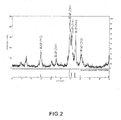
FIG. 2 shows the comparison of an qualitative analysis of a finished good of calcium-deficient hydroxyapatite (dHAP) made of the tetra-calcium phosphate (TTCP)/anhydrous dicalcium phosphate (CaHPO4 or DCPA) and measured by a X-ray diffractor with a standard spectrum of the JCPDS database in accordance with the present invention; and -
FIG. 3 shows a photo of the material surface of a bone cement taken through an electronic microscope in accordance with the present invention. - Related chemical equations of the present invention are listed below:
- TTCP Synthesis Equation:
Ca2P2O7 + 2CaCO3 → Ca4(PO4)2O + 2CO2
- CPC Hydration Equations:
- Reaction at an Early Stage:
2Ca4(PO4)2O + 2CaHPO4 + H2O → Ca10(PO4)(OH)2
- Reaction at a Later Stage:
2Ca4(PO4)2O + 2CaHPO4 + H2O → Ca10-X(HPO4)X(PO4)6-X(OH)2-X,
where 0≦X≦1. - To make it easier for our examiner to understand the objective of the invention, its structure, innovative features, and performance, we use a preferred embodiment together with the attached drawings for the detailed description of the invention.
- The present invention relates to a bio-degenerable bone cement and a manufacturing method thereof, and the bio-degenerable bone cement uses a mixture of poly (propylene fumarate) (PPF) and a diphasic material of tetracalcium phosphate (Ca4O(PO)2 or TTCP)/anhydrous dicalcium phosphate (CaHPO4) or anhydrous dicalcium phosphate (CaHPO4 or DCPA) to obtain a bio-degenerable bone cement. Since poly (propylene fumarate) (PPF) comes bio-degenerable bone cement. Since poly (propylene fumarate) (PPF) comes with a low polymerization temperature and a bio-degenerable feature, such bone cement can be used as an injective bone cement, and the tetra-calcium phosphate (TTCP)/anhydrous dicalcium phosphate (CaHPO4 or DCPA) form a porous structure after the solidification, and the structure is very similar to our bone structure. In addition, the bone cement has a relatively high bio-compatibility, and thus it can be used directly for bone remodeling and rebuilding. The present invention mixes the aforementioned two materials to be filled in human bones.
- The method of preparing polymer PPF of the bone cement material in accordance with a preferred embodiment of the present invention is described as follows:
- The method includes two steps, wherein diethyl fumarate (DEF) and propylene glycol (PG) are mixed as the primary raw materials, and zinc chloride (ZnCl2) is added to serve as a catalyst and hydroquinone (Hq) is added to serve as a crosslink breaker for producing the required polymer PPF.
- In the first step, diethyl fumarate (DEF), propylene glycol (PG), zinc chloride (ZnCl2) and hydroquinone (Hq) in a molar proportion of 1: 3: 0.01: 0.002 are mixed uniformly to increase the temperature up to 100°C, and then the mixture is heated to 150°C. Since it is necessary to maintain an air insulating status during the reaction process, nitrogen gas is used and passed through during the reaction process. In the process, diethyl fumarate (DEF) and propylene glycol (PG) are reacted to form ethanol, and the ethanol is condensed by a condensation pipe. If no more ethanol is condensed, it shows that the first step of the reaction is completed.
- In the second step, the temperature is set at 100°C, and the pressure is reduced to 0.1 torr. In this process, the unreacted propylene glycol (PG) will be condensed and separated, and then the temperature is increased to 130-150°C in the next coming two hours. Now, the reaction is started to form a polymer PPF. Within two hours, the temperature is increased to 200°C, and then the constant temperature at 200°C is maintained for 12 hours before the mixture is cooled to room temperature, so as to produce a viscous liquid in amber color, and this liquid is the required product of polymer PPF.
- Since the polymer PPF still contains the catalyst (zinc chloride) and the crosslink breaker (hydroquinone), therefore it is necessary to purify and remove the catalyst and crosslink breaker. The purification procedure comprises the steps of: dissolving the polymer PPF into dichloromethane with a volume ratio of 1 : 1; adding hydrogen chloride (HCl) with a IN concentration to remove the catalyst (zinc chloride); using the same volume of secondary water and saltwater for repeated extractions to remove the organic solvent (dichloromethane); adding a concentrate sulfuric acid to remove the extra water moisture; and adding cold ethyl ether into the remaining polymer PPF and dichloromethane to remove the extra crosslink breaker (hydroquinone). After this procedure, most of the polymer PPFs are purified. However, dichloromethane is toxic, and thus it is necessary to vacuum and dry the finished goods to remove the extra organic solvent. The purified polymer PPF should be stored at a temperature below -20°C when it is not in use.
- The method of preparing tetra-calcium phosphate (TTCP)/anhydrous dicalcium phosphate (CaHPO4 or DCPA) in the bone cement material in accordance with a preferred embodiment of the present invention is described as follows:
- In the first step, one mole of calcium pyrophosphate (Ca2P2O7) powder and two moles of calcium carbonate (CaCO3) powder are mixed thoroughly and uniformly, and then the mixture is laid flatly on a platinum crucible, and the platinum crucible containing the mixture is put into a silicon carbon (SiC) high temperature furnace for a high temperature sintering.
- In the second step, the powder mixture is heated with a heating rate of 10°C/min to a sintering temperature of 1440°C, and such temperature is maintained for three hours, and then the powder mixture is quenched rapidly to room temperature to obtain tetra-calcium phosphate (TTCP). In this embodiment, a mortar grinder is used for grinding TTCP into powder, and then the powder is sieved and filtered (by a sieve model no. Mesh No. 106) and the equation of the reaction is given below:
Ca2P2O7 + 2CaCO3 → Ca4(PO4)2O + 2CO2
- In the third step, the tetra-calcium phosphate (TTCP) powder obtained from the above procedure is mixed uniformly with anhydrous dicalcium phosphate (CaHPO4 or DCPA) in a molar ratio of 1: 1 to obtain the tetra-calcium phosphate (TTCP)/anhydrous dicalcium phosphate (CaHPO4 or DCPA) diphasic bone cement.
- In addition, the solidification mechanism of the tetra-calcium phosphate (TTCP)/anhydrous dicalcium phosphate (CaHPO4 or DCPA) diphasic cement is described as follows. Since tetra-calcium phosphate (TTCP) and anhydrous dicalcium phosphate (CaHPO4 or DCPA) react with water easily, therefore hydroxyapatite will be formed at an early stage of hydration, and then calcium-deficient hydroxyapatite (dHAP) will be formed later, and such calcium-deficient hydroxyapatite (dHAP) will provide a needle-like structure that forms crystals thereon by using HAP as a crystal nucleus, and the interlaced crystals constitute a stable structure to achieve the required solidification result, and the equations of the related reactions are given below:
- Reaction at an Early Stage:
2Ca4(PO4)2O + 2CaHPO4 + H2O → Ca10(PO4)(OH)2
- Reaction at a Later Stage:
2Ca4(PO4)2O + 2CaHPO4 + H2O → Ca10-X(HPO4)X(PO4)6-X(OH)2-X,
where 0≦X≦1 - Referring to
FIG, 1 for a comparison of an qualitative analysis of the tetra-calcium phosphate (TTCP) measured by a X-ray diffractor with a standard spectrum of the JCPDS database in accordance with the present invention, the peak of the prepared material matches with the peak of the standard spectrum. The necessary conditions of setting the X-ray diffraction includes: The interval between atomic layers must be equal to the wavelength of the radiation, and the scattering environment of the scattering center must have a high regularity, so that a specific peak of the diffraction of the material can be used for the qualitative analysis of the crystalline phase of the material. - Referring to
FIG. 2 for a comparison of an qualitative analysis of a finished good of calcium-deficient hydroxyapatite (dHAP) made of tetra-calcium phosphate (TTCP)/anhydrous dicalcium phosphate (CaHPO4 or DCPA) and measured by a X-ray diffractor with a standard spectrum of the JCPDS database in accordance with the present invention, the finished good of the calcium-deficient hydroxyapatite (dHAP) after hydration is definitely similar to the composition of human mineralized bones - After the polymer PPF and the tetra-calcium phosphate (TTCP)/anhydrous dicalcium phosphate (CaHPO4 or DCPA) are prepared, mixing and preparation are carried out according to the following procedure:
- Firstly, poly (propylene fumarate) (PPF) is dissolved and mixed uniformly in N-vinylpyrrolidone (N-VP).
- Secondly, tetra-calcium phosphate (TTCP)/anhydrous dicalcium phosphate (CaHPO4 or DCPA) is dissolved in the N-VP/PPF solution.
- Finally, a baking powder (BP) is dissolved in the solution, and they are mixed uniformly and poured into a mold. The mixture is solidified completely at room temperature to produce the bio-degenerable bone cement in accordance with the present invention. Referring to
FIG. 3 for a photo taken though an electronic microscope, the surface of the bone cement in accordance with the present invention is shown. - In summation of the description above, the bone cement made of poly (propylene fumarate) (PPF) and tetra-calcium phosphate (TTCP)/anhydrous dicalcium phosphate (CaHPO4 or DCPA) in accordance with the present invention complies with the patent application requirements and includes the following advantages:
- 1. The bone cement can be injected into the position of a bone fracture.
- 2. The bone cement comes with a bio-degenerable feature and better mechanical properties.
- 3. The appropriate temperature of the bone cement is lower than that of the prior art bone cement PMMA.
- 4. The pressure resistance of the bone cement is closer to that of our bones than the prior art PMMA bone cement PMMA.
- 5. The bone cement comes with a high bio-compatibility.
- 6. The bone cement comes with an impenetrability of radiation, and thus it is not necessary to add a developer such as a barium sulfate developer for a better developing effect than the prior art PMMA bone cement).
- 7. The bone cement provides a great application to the vertebroplasty.
- It is to be understood, however, that even though numerous characteristics and advantages of the present invention have been set forth in the foregoing description, together with details of the structure and function of the invention, the disclosure is illustrative only, and changes may be made in detail, especially in matters of shape, size, and arrangement of parts within the principles of the invention to the full extent indicated by the broad general meaning of the terms in which the appended claims are expressed.
Claims (2)
- A bio-degenerable bone cement, which is obtained by- mixing poly(propylene fumarate) and a calcium phosphate cement powder obtainable by mixing tetracalcium phosphate (Ca4O(PO4)2) and anhydrous dicalcium phosphate (CaHPO4); and- cross-linking the mixture with N-vinylpyrrolidone, wherein the mixture is solidified at room temperature.
- The bio-degenerable bone cement as recited in claim 1, wherein the tetracalcium phosphate is composed of calcium pyrophosphate (Ca2P2O7) and calcium carbonate (CaCO3).
Priority Applications (4)
| Application Number | Priority Date | Filing Date | Title |
|---|---|---|---|
| DK07113408.4T DK2022446T3 (en) | 2007-07-30 | 2007-07-30 | Biodegradable bone cement and process for its preparation |
| PT07113408T PT2022446E (en) | 2007-07-30 | 2007-07-30 | Bio-degenerable bone cement and manufacturing method thereof |
| AT07113408T ATE551967T1 (en) | 2007-07-30 | 2007-07-30 | BIODEGRADABLE BONE CEMENT AND PRODUCTION PROCESS THEREOF |
| EP07113408A EP2022446B1 (en) | 2007-07-30 | 2007-07-30 | Bio-degenerable bone cement and manufacturing method thereof |
Applications Claiming Priority (1)
| Application Number | Priority Date | Filing Date | Title |
|---|---|---|---|
| EP07113408A EP2022446B1 (en) | 2007-07-30 | 2007-07-30 | Bio-degenerable bone cement and manufacturing method thereof |
Publications (2)
| Publication Number | Publication Date |
|---|---|
| EP2022446A1 EP2022446A1 (en) | 2009-02-11 |
| EP2022446B1 true EP2022446B1 (en) | 2012-04-04 |
Family
ID=38657026
Family Applications (1)
| Application Number | Title | Priority Date | Filing Date |
|---|---|---|---|
| EP07113408A Not-in-force EP2022446B1 (en) | 2007-07-30 | 2007-07-30 | Bio-degenerable bone cement and manufacturing method thereof |
Country Status (4)
| Country | Link |
|---|---|
| EP (1) | EP2022446B1 (en) |
| AT (1) | ATE551967T1 (en) |
| DK (1) | DK2022446T3 (en) |
| PT (1) | PT2022446E (en) |
Families Citing this family (1)
| Publication number | Priority date | Publication date | Assignee | Title |
|---|---|---|---|---|
| CN114404658B (en) * | 2022-02-18 | 2023-01-31 | 中国科学技术大学先进技术研究院 | Bone cement and its preparation method, orthopedic implant material |
Family Cites Families (4)
| Publication number | Priority date | Publication date | Assignee | Title |
|---|---|---|---|---|
| US4612053A (en) * | 1983-10-06 | 1986-09-16 | American Dental Association Health Foundation | Combinations of sparingly soluble calcium phosphates in slurries and pastes as mineralizers and cements |
| US6071982A (en) * | 1997-04-18 | 2000-06-06 | Cambridge Scientific, Inc. | Bioerodible polymeric semi-interpenetrating network alloys for surgical plates and bone cements, and method for making same |
| JP2002539275A (en) * | 1998-04-10 | 2002-11-19 | ダブリューエム・マーシュ・ライス・ユニバーシティー | Synthesis of poly (propylene fumarate) by acylation of propylene glycol in the presence of proton scavenger |
| EP1409566B1 (en) * | 2001-06-28 | 2008-04-23 | Wm. MARSH RICE UNIVERSITY | Photocrosslinking of diethyl fumarate/poly(propylene fumarate) biomaterials |
-
2007
- 2007-07-30 EP EP07113408A patent/EP2022446B1/en not_active Not-in-force
- 2007-07-30 DK DK07113408.4T patent/DK2022446T3/en active
- 2007-07-30 PT PT07113408T patent/PT2022446E/en unknown
- 2007-07-30 AT AT07113408T patent/ATE551967T1/en active
Also Published As
| Publication number | Publication date |
|---|---|
| EP2022446A1 (en) | 2009-02-11 |
| DK2022446T3 (en) | 2012-07-23 |
| PT2022446E (en) | 2012-07-04 |
| ATE551967T1 (en) | 2012-04-15 |
Similar Documents
| Publication | Publication Date | Title |
|---|---|---|
| Ginebra et al. | Setting reaction and hardening of an apatitic calcium phosphate cement | |
| JP3110762B2 (en) | Absorbable bioactive phosphate-containing cement | |
| US6458162B1 (en) | Composite shaped bodies and methods for their production and use | |
| US7575628B2 (en) | Hydraulic cement compositions and methods of making and using the same | |
| US6808561B2 (en) | Biocompatible cement containing reactive calcium phosphate nanoparticles and methods for making and using such cement | |
| CN107296977B (en) | Injectable, biodegradable bone cement and methods of making and using the same | |
| US7083672B2 (en) | Method and product for phosphosilicate slurry for use in dentistry and related bone cements | |
| AU2002213313A1 (en) | Biocompatible cement containing reactive calcium phosphate nanoparticles and methods for making and using such cement | |
| CN101352584B (en) | Bone cement with biological decomposability and preparation method thereof | |
| CN102633497B (en) | Dicalcium phosphate ceramics, dual-phase ceramics of dicalcium phosphate and hydroxyapatite, and manufacturing method thereof | |
| WO2009070932A1 (en) | Bio-degenerable bone cementand manufacturing method thereof | |
| JP2558262B2 (en) | Artificial joint fixation material | |
| EP2022446A1 (en) | Bio-degenerable bone cement and manufacturing method thereof | |
| US20090036564A1 (en) | Bio-Degenerable Bone Cement and Manufacturing Method thereof | |
| KR100906545B1 (en) | Biodegradable bone cement and its manufacturing method | |
| JP4914308B2 (en) | Cement for fracture treatment having biodegradability and method for producing the same | |
| CN1234603C (en) | Calcium phosphate bone cement biological composite material and preparaton process thereof | |
| KR102744364B1 (en) | Manufacturing method of octacalcium phosphate bone cement and octacalcium phosphate bone cement manufactured by the same | |
| TW200902469A (en) | Bio-degenerable bone cement and manufacturing method thereof | |
| CN115068694A (en) | Preparation method of active injectable bone cement repair material | |
| MXPA05002379A (en) | Process for preparing a calcium phosphate-based bicompound. |
Legal Events
| Date | Code | Title | Description |
|---|---|---|---|
| PUAI | Public reference made under article 153(3) epc to a published international application that has entered the european phase |
Free format text: ORIGINAL CODE: 0009012 |
|
| 17P | Request for examination filed |
Effective date: 20080925 |
|
| AK | Designated contracting states |
Kind code of ref document: A1 Designated state(s): AT BE BG CH CY CZ DE DK EE ES FI FR GB GR HU IE IS IT LI LT LU LV MC MT NL PL PT RO SE SI SK TR |
|
| 17Q | First examination report despatched |
Effective date: 20090902 |
|
| AKX | Designation fees paid |
Designated state(s): AT BE BG CH CY CZ DE DK EE ES FI FR GB GR HU IE IS IT LI LT LU LV MC MT NL PL PT RO SE SI SK TR |
|
| GRAP | Despatch of communication of intention to grant a patent |
Free format text: ORIGINAL CODE: EPIDOSNIGR1 |
|
| GRAS | Grant fee paid |
Free format text: ORIGINAL CODE: EPIDOSNIGR3 |
|
| GRAA | (expected) grant |
Free format text: ORIGINAL CODE: 0009210 |
|
| AK | Designated contracting states |
Kind code of ref document: B1 Designated state(s): AT BE BG CH CY CZ DE DK EE ES FI FR GB GR HU IE IS IT LI LT LU LV MC MT NL PL PT RO SE SI SK TR |
|
| REG | Reference to a national code |
Ref country code: GB Ref legal event code: FG4D |
|
| REG | Reference to a national code |
Ref country code: CH Ref legal event code: EP |
|
| REG | Reference to a national code |
Ref country code: AT Ref legal event code: REF Ref document number: 551967 Country of ref document: AT Kind code of ref document: T Effective date: 20120415 |
|
| REG | Reference to a national code |
Ref country code: IE Ref legal event code: FG4D |
|
| REG | Reference to a national code |
Ref country code: DE Ref legal event code: R096 Ref document number: 602007021718 Country of ref document: DE Effective date: 20120606 |
|
| REG | Reference to a national code |
Ref country code: NL Ref legal event code: T3 |
|
| REG | Reference to a national code |
Ref country code: PT Ref legal event code: SC4A Free format text: AVAILABILITY OF NATIONAL TRANSLATION Effective date: 20120628 |
|
| REG | Reference to a national code |
Ref country code: DK Ref legal event code: T3 |
|
| REG | Reference to a national code |
Ref country code: SE Ref legal event code: TRGR |
|
| LTIE | Lt: invalidation of european patent or patent extension |
Effective date: 20120404 |
|
| PG25 | Lapsed in a contracting state [announced via postgrant information from national office to epo] |
Ref country code: FI Free format text: LAPSE BECAUSE OF FAILURE TO SUBMIT A TRANSLATION OF THE DESCRIPTION OR TO PAY THE FEE WITHIN THE PRESCRIBED TIME-LIMIT Effective date: 20120404 Ref country code: SI Free format text: LAPSE BECAUSE OF FAILURE TO SUBMIT A TRANSLATION OF THE DESCRIPTION OR TO PAY THE FEE WITHIN THE PRESCRIBED TIME-LIMIT Effective date: 20120404 Ref country code: IS Free format text: LAPSE BECAUSE OF FAILURE TO SUBMIT A TRANSLATION OF THE DESCRIPTION OR TO PAY THE FEE WITHIN THE PRESCRIBED TIME-LIMIT Effective date: 20120804 Ref country code: LT Free format text: LAPSE BECAUSE OF FAILURE TO SUBMIT A TRANSLATION OF THE DESCRIPTION OR TO PAY THE FEE WITHIN THE PRESCRIBED TIME-LIMIT Effective date: 20120404 Ref country code: PL Free format text: LAPSE BECAUSE OF FAILURE TO SUBMIT A TRANSLATION OF THE DESCRIPTION OR TO PAY THE FEE WITHIN THE PRESCRIBED TIME-LIMIT Effective date: 20120404 Ref country code: CY Free format text: LAPSE BECAUSE OF FAILURE TO SUBMIT A TRANSLATION OF THE DESCRIPTION OR TO PAY THE FEE WITHIN THE PRESCRIBED TIME-LIMIT Effective date: 20120404 |
|
| REG | Reference to a national code |
Ref country code: CH Ref legal event code: NV Representative=s name: LANGPATENT ANWALTSKANZLEI, CH |
|
| PG25 | Lapsed in a contracting state [announced via postgrant information from national office to epo] |
Ref country code: GR Free format text: LAPSE BECAUSE OF FAILURE TO SUBMIT A TRANSLATION OF THE DESCRIPTION OR TO PAY THE FEE WITHIN THE PRESCRIBED TIME-LIMIT Effective date: 20120705 Ref country code: LV Free format text: LAPSE BECAUSE OF FAILURE TO SUBMIT A TRANSLATION OF THE DESCRIPTION OR TO PAY THE FEE WITHIN THE PRESCRIBED TIME-LIMIT Effective date: 20120404 |
|
| PG25 | Lapsed in a contracting state [announced via postgrant information from national office to epo] |
Ref country code: EE Free format text: LAPSE BECAUSE OF FAILURE TO SUBMIT A TRANSLATION OF THE DESCRIPTION OR TO PAY THE FEE WITHIN THE PRESCRIBED TIME-LIMIT Effective date: 20120404 Ref country code: CZ Free format text: LAPSE BECAUSE OF FAILURE TO SUBMIT A TRANSLATION OF THE DESCRIPTION OR TO PAY THE FEE WITHIN THE PRESCRIBED TIME-LIMIT Effective date: 20120404 Ref country code: SK Free format text: LAPSE BECAUSE OF FAILURE TO SUBMIT A TRANSLATION OF THE DESCRIPTION OR TO PAY THE FEE WITHIN THE PRESCRIBED TIME-LIMIT Effective date: 20120404 Ref country code: RO Free format text: LAPSE BECAUSE OF FAILURE TO SUBMIT A TRANSLATION OF THE DESCRIPTION OR TO PAY THE FEE WITHIN THE PRESCRIBED TIME-LIMIT Effective date: 20120404 |
|
| PLBE | No opposition filed within time limit |
Free format text: ORIGINAL CODE: 0009261 |
|
| STAA | Information on the status of an ep patent application or granted ep patent |
Free format text: STATUS: NO OPPOSITION FILED WITHIN TIME LIMIT |
|
| PG25 | Lapsed in a contracting state [announced via postgrant information from national office to epo] |
Ref country code: MC Free format text: LAPSE BECAUSE OF NON-PAYMENT OF DUE FEES Effective date: 20120731 |
|
| 26N | No opposition filed |
Effective date: 20130107 |
|
| PG25 | Lapsed in a contracting state [announced via postgrant information from national office to epo] |
Ref country code: ES Free format text: LAPSE BECAUSE OF FAILURE TO SUBMIT A TRANSLATION OF THE DESCRIPTION OR TO PAY THE FEE WITHIN THE PRESCRIBED TIME-LIMIT Effective date: 20120715 |
|
| REG | Reference to a national code |
Ref country code: DE Ref legal event code: R097 Ref document number: 602007021718 Country of ref document: DE Effective date: 20130107 |
|
| REG | Reference to a national code |
Ref country code: DE Ref legal event code: R082 Ref document number: 602007021718 Country of ref document: DE Representative=s name: LANGPATENT ANWALTSKANZLEI IP LAW FIRM, DE |
|
| REG | Reference to a national code |
Ref country code: IE Ref legal event code: MM4A |
|
| PG25 | Lapsed in a contracting state [announced via postgrant information from national office to epo] |
Ref country code: MT Free format text: LAPSE BECAUSE OF FAILURE TO SUBMIT A TRANSLATION OF THE DESCRIPTION OR TO PAY THE FEE WITHIN THE PRESCRIBED TIME-LIMIT Effective date: 20120404 Ref country code: IE Free format text: LAPSE BECAUSE OF NON-PAYMENT OF DUE FEES Effective date: 20120730 |
|
| PGFP | Annual fee paid to national office [announced via postgrant information from national office to epo] |
Ref country code: LU Payment date: 20130725 Year of fee payment: 7 |
|
| PGFP | Annual fee paid to national office [announced via postgrant information from national office to epo] |
Ref country code: BE Payment date: 20130708 Year of fee payment: 7 Ref country code: DK Payment date: 20130719 Year of fee payment: 7 Ref country code: PT Payment date: 20130130 Year of fee payment: 7 Ref country code: BG Payment date: 20130715 Year of fee payment: 7 Ref country code: SE Payment date: 20130723 Year of fee payment: 7 Ref country code: AT Payment date: 20130722 Year of fee payment: 7 Ref country code: NL Payment date: 20130722 Year of fee payment: 7 |
|
| PG25 | Lapsed in a contracting state [announced via postgrant information from national office to epo] |
Ref country code: TR Free format text: LAPSE BECAUSE OF FAILURE TO SUBMIT A TRANSLATION OF THE DESCRIPTION OR TO PAY THE FEE WITHIN THE PRESCRIBED TIME-LIMIT Effective date: 20120404 |
|
| PG25 | Lapsed in a contracting state [announced via postgrant information from national office to epo] |
Ref country code: HU Free format text: LAPSE BECAUSE OF FAILURE TO SUBMIT A TRANSLATION OF THE DESCRIPTION OR TO PAY THE FEE WITHIN THE PRESCRIBED TIME-LIMIT Effective date: 20070730 |
|
| REG | Reference to a national code |
Ref country code: PT Ref legal event code: MM4A Free format text: LAPSE DUE TO NON-PAYMENT OF FEES Effective date: 20150130 |
|
| REG | Reference to a national code |
Ref country code: DK Ref legal event code: EBP Effective date: 20140731 |
|
| REG | Reference to a national code |
Ref country code: NL Ref legal event code: V1 Effective date: 20150201 |
|
| PG25 | Lapsed in a contracting state [announced via postgrant information from national office to epo] |
Ref country code: LU Free format text: LAPSE BECAUSE OF NON-PAYMENT OF DUE FEES Effective date: 20140730 |
|
| REG | Reference to a national code |
Ref country code: SE Ref legal event code: EUG |
|
| REG | Reference to a national code |
Ref country code: AT Ref legal event code: MM01 Ref document number: 551967 Country of ref document: AT Kind code of ref document: T Effective date: 20140730 |
|
| PG25 | Lapsed in a contracting state [announced via postgrant information from national office to epo] |
Ref country code: NL Free format text: LAPSE BECAUSE OF NON-PAYMENT OF DUE FEES Effective date: 20150201 |
|
| PG25 | Lapsed in a contracting state [announced via postgrant information from national office to epo] |
Ref country code: PT Free format text: LAPSE BECAUSE OF NON-PAYMENT OF DUE FEES Effective date: 20150130 Ref country code: BG Free format text: LAPSE BECAUSE OF NON-PAYMENT OF DUE FEES Effective date: 20150331 |
|
| PG25 | Lapsed in a contracting state [announced via postgrant information from national office to epo] |
Ref country code: SE Free format text: LAPSE BECAUSE OF NON-PAYMENT OF DUE FEES Effective date: 20140731 Ref country code: AT Free format text: LAPSE BECAUSE OF NON-PAYMENT OF DUE FEES Effective date: 20140730 |
|
| PG25 | Lapsed in a contracting state [announced via postgrant information from national office to epo] |
Ref country code: DK Free format text: LAPSE BECAUSE OF NON-PAYMENT OF DUE FEES Effective date: 20140731 |
|
| REG | Reference to a national code |
Ref country code: FR Ref legal event code: PLFP Year of fee payment: 10 |
|
| REG | Reference to a national code |
Ref country code: FR Ref legal event code: PLFP Year of fee payment: 11 |
|
| PG25 | Lapsed in a contracting state [announced via postgrant information from national office to epo] |
Ref country code: BE Free format text: LAPSE BECAUSE OF NON-PAYMENT OF DUE FEES Effective date: 20140731 |
|
| REG | Reference to a national code |
Ref country code: FR Ref legal event code: PLFP Year of fee payment: 12 |
|
| PGFP | Annual fee paid to national office [announced via postgrant information from national office to epo] |
Ref country code: FR Payment date: 20180730 Year of fee payment: 12 Ref country code: IT Payment date: 20180720 Year of fee payment: 12 Ref country code: DE Payment date: 20180727 Year of fee payment: 12 |
|
| PGFP | Annual fee paid to national office [announced via postgrant information from national office to epo] |
Ref country code: CH Payment date: 20180730 Year of fee payment: 12 Ref country code: GB Payment date: 20180730 Year of fee payment: 12 |
|
| REG | Reference to a national code |
Ref country code: DE Ref legal event code: R119 Ref document number: 602007021718 Country of ref document: DE |
|
| REG | Reference to a national code |
Ref country code: CH Ref legal event code: PL |
|
| GBPC | Gb: european patent ceased through non-payment of renewal fee |
Effective date: 20190730 |
|
| PG25 | Lapsed in a contracting state [announced via postgrant information from national office to epo] |
Ref country code: DE Free format text: LAPSE BECAUSE OF NON-PAYMENT OF DUE FEES Effective date: 20200201 Ref country code: GB Free format text: LAPSE BECAUSE OF NON-PAYMENT OF DUE FEES Effective date: 20190730 |
|
| PG25 | Lapsed in a contracting state [announced via postgrant information from national office to epo] |
Ref country code: LI Free format text: LAPSE BECAUSE OF NON-PAYMENT OF DUE FEES Effective date: 20190731 Ref country code: CH Free format text: LAPSE BECAUSE OF NON-PAYMENT OF DUE FEES Effective date: 20190731 |
|
| PG25 | Lapsed in a contracting state [announced via postgrant information from national office to epo] |
Ref country code: FR Free format text: LAPSE BECAUSE OF NON-PAYMENT OF DUE FEES Effective date: 20190731 |
|
| PG25 | Lapsed in a contracting state [announced via postgrant information from national office to epo] |
Ref country code: IT Free format text: LAPSE BECAUSE OF NON-PAYMENT OF DUE FEES Effective date: 20190730 |