EP2020171A1 - System and method for controlling a vehicle in response to a particular boundary - Google Patents
System and method for controlling a vehicle in response to a particular boundary Download PDFInfo
- Publication number
- EP2020171A1 EP2020171A1 EP08158222A EP08158222A EP2020171A1 EP 2020171 A1 EP2020171 A1 EP 2020171A1 EP 08158222 A EP08158222 A EP 08158222A EP 08158222 A EP08158222 A EP 08158222A EP 2020171 A1 EP2020171 A1 EP 2020171A1
- Authority
- EP
- European Patent Office
- Prior art keywords
- vehicle
- boundary
- work area
- area
- turn
- Prior art date
- Legal status (The legal status is an assumption and is not a legal conclusion. Google has not performed a legal analysis and makes no representation as to the accuracy of the status listed.)
- Granted
Links
Images


Classifications
-
- A—HUMAN NECESSITIES
- A01—AGRICULTURE; FORESTRY; ANIMAL HUSBANDRY; HUNTING; TRAPPING; FISHING
- A01B—SOIL WORKING IN AGRICULTURE OR FORESTRY; PARTS, DETAILS, OR ACCESSORIES OF AGRICULTURAL MACHINES OR IMPLEMENTS, IN GENERAL
- A01B79/00—Methods for working soil
- A01B79/005—Precision agriculture
Definitions
- the present invention relates generally to the field of agricultural equipment. More particularly, the present invention relates to the use of agricultural equipment in planting, harvesting and other operations.
- Conventional agricultural combines include a header leading the combine, having a forward gathering portion and a feederhouse portion which contains elements for processing crop material and/or transferring the crop material from the gathering portion to the body of the combine.
- the grain is separated from the chaff and straw, collected, and thereafter unloaded via an auger.
- Such combines have a variety of designs.
- a display interface is configured to define a boundary around a non-traversable area within a work area based upon a prior inspection.
- a location-determining receiver determines a position of the vehicle.
- a warning alarm is generated for an operator if the determined position of the vehicle traverses the boundary.
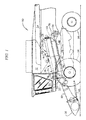
- FIG. 1 shows an example agricultural combine 10 of the type incorporating an axial rotary crop-processing unit.
- the combine 10 comprises a supporting structure or chassis 12 mounting a ground engaging mechanism 14 shown in the form of tires. Alternatively, tracks can be used in place of tires.
- a harvesting platform 16 is used for harvesting a crop and directing the crop to a feederhouse 18. The harvested crop is directed by the feederhouse 18 to a beater 20. The beater directs the crop upwardly to a rotary crop-processing unit 24.
- the rotary crop-processing unit is located between the side sheets of the combine. The side sheets form part of the supporting structure 12.
- the rotary crop-processing unit 24 comprises a rotor housing 26 and a rotor 28 located within the housing.
- the harvested crop enters the housing through an inlet 22 at the inlet end 30 of the housing 26.
- the rotor is provided with an inlet feed portion 32, a threshing portion 33, and a separating portion 34.
- the rotor housing has a corresponding infeed section 36, a threshing section 38, and a separating section 40.
- Both the threshing portion 33 and the separating portion 34 of the rotor are provided with crop engaging members (not shown).
- the threshing section 38 of the housing is provided with a concave 46 while the separating section 40 of the housing is provided with a grate 48. Grain and chaff released from the crop mat fall through the concave 46 and grate 48.
- the concave and the grate prevent the passage of crop material larger than grain or chaff from entering the combine cleaning system 50 below the rotary crop-processing unit 24.
- Grain and chaff falling through the concave and grate is directed to the cleaning system 50 that removes the chaff from the grain.
- the clean grain is then directed by an elevator (not shown) to clean the grain tank 52 where it can be directed to a truck or grain cart by unloading the auger 54.
- Straw that reaches the end 61 of the housing is expelled through an outlet 56 to a beater 58.
- the beater propels the straw out the rear of the combine.
- the end 61 is thus the outlet end of the housing.
- the crop material moves through the rotary crop-processing unit in a crop flow direction from the inlet end 30 to the outlet end 61 of the housing.
- the operation of the combine is controlled from the operator cab 60.
- the header 16 can be lifted by use of lift cylinders 63.
- the auger 54 can be pivoted via a cylinder or motor (not shown) about a vertical axis between an inboard orientation shown and an outboard orientation, substantially perpendicular to the traveling direction of the combine, to offload grain to a body of a truck.
- the auger can be pivoted inboard, substantially parallel to the direction of travel of the combine when not in use.
- the various embodiments of the present invention may be used with a tractor that pulls an implement via a hitch, with the implement being typically powered by a tractor's power take-off shaft (PTO) that is coupled to the implement.
- PTO power take-off shaft
- various embodiments may operate in conjunction with a tractor that can raise or lower a hitch, retract a hitch, and change the speed, direction, or the on/off status of the PTO.
- the implement may comprise, for example, a planter, a cultivator, a pull-behind mower, a planter or seeding apparatus, a scraper (for leveling land or making roads, or irrigation or drainage channels), a digger or trencher (e.g., for laying drain tile), or other agricultural or construction equipment.
- a planter for example, a planter, a cultivator, a pull-behind mower, a planter or seeding apparatus, a scraper (for leveling land or making roads, or irrigation or drainage channels), a digger or trencher (e.g., for laying drain tile), or other agricultural or construction equipment.
- Various embodiments of the present invention provide a system and method by which end-turns and the execution of sequences can be automated in real-time based on approaching boundaries. In other words, no pre-planning is necessary once boundaries and a turn pattern have been defined, with both being definable in the vehicle and in the field). Once these items are defined, the system create end-turns based on what type of boundary is approaching and the turn path that has been prescribed. The system simultaneously determines which vehicle functions to execute based on pre-recorded sequences that can be defined from the cab and executes the turn and the sequence automatically based on the location (which can be determined, for example, via GPS) and speed of the vehicle and its relationship to boundaries.
- This system is capable of reacting to approaching boundaries "on the fly," and the operator can make necessary changes from the cab if necessary in order to avoid any obstacles. Additionally, as a single GPS and display system may be used to perform the necessary activities associated with the various embodiments of the present invention, can clutter can also be reduced.
- the system uses a set of four sequences that are executed separately based on the type of boundary being crossed. These sequences are (1) Enter Headlands (the area at the end of a planted field where machinery is turned); (2) Exit Headlands; (3) Enter Passable Interior Boundaries; and (4) Exit Passable Interior Boundaries. Each of these sequences can be unique and drive the system to perform different actions. For example, entering a passable interior such as a waterway, the "Enter Passable Interior Boundary" sequence can have the machine slow down and only partially raise the implement. In contrast, when entering a headland, the "Enter Headlands" sequence can have the machine turn the differential lock to OFF, slow down, and then raise the implement completely out of the ground before completing a turn.
- a special situation can exist when the vehicle approaches an impassable boundary.
- an external boundary of a field or some form of internal boundary such as a pond
- the can system realizes that an impassable area is ahead, and in turn notify the operator to be alert and take control if necessary.
- Audible and/or visual tones may be used to ensure that the alert is acknowledged.
- FIG. 2 is a flow chart showing how various embodiments of the present invention may be implemented.
- a work area is inspected prior to operating a vehicle in the work area. This inspection serves to identify non-traversable areas which cannot be safely or expediently traversed by the vehicle.
- a boundary is established around the non-traversable area within the work area based on the inspection. This boundary may be established via a user interface of the vehicle.
- a position of the vehicle is determined via a location-determining receiver such as a GPS system.
- a warning alarm is generated for an operator if the determined position of the vehicle traverses the boundary.
- the non-traversable area may contain an obstacle and may comprise, but is not limited to, a hedge, vegetation, tree growth, bushes, bramble, a wooded area, a tree, a bush, a mud slide, a rock slide, a stream, a brook, a pond, a lake, a river, flood water, and a swamp.
- the vehicle can also be prevented from executing the turn if the vehicle, and this is represented at 250.
- a turn may be associated, for example, with a headland region between an outer border of the work area and an interior border of the work area.
- the boundary may also lie within an interior of the work area or a headland of the work area.
- the system may utilize "Minimize Skip” versus “Minimize Overlap” settings. These settings may be determined by the operator and can be used to make sure one or more implements are raised ahead of an approaching boundary or only after completely traversing through the boundary.
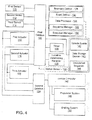
- Figures 3 and 4 are schematic diagrams of systems by which a sequence of vehicle events can be controlled according to different embodiments of the present invention.
- a data storage device 140 such as a computer memory can save information such as vehicle events 142 and established sequences 144.
- the data storage unit 140 is communicatively connected to a data processor 126.
- the data processor 126 can implement various programs, routines, sub-routines etc.
- the data processor can implement a boundary definer 128, an event definer 130, a sequence manager 132 (which may include a sequence definer, sequence editor, etc.), and an execution manager 134, with the execution manager performing functions such as adjusting speeds and compensating for changes in function.
- the data processor 126 is communicatively connected to a first databus 122.
- Other items which may be connected in some form to the first databus 122 include a timer 136 and a location-determining receiver 138.
- the location-determining receiver may comprise, for example, a Global Positioning System (GPS) receiver.
- GPS Global Positioning System
- a motion sensor 152 may also be communicatively connected to the first databus 122.
- the motion sensor 152 may comprise, for example, a velocity sensor and/or an accelerometer.
- a first sensor 110, a second sensor 112 and a third sensor 114 may also be operatively connected to the first databus 122, with these sensors comprising, for example, implement height sensors, hitch position sensors, power take-off shaft sensors, RPM sensors, etc.
- the first databus 122 can transfer data from any of these components to one of a plurality of actuators.
- a first actuator 116, a second actuator 118 and a third actuator are shown. These actuators may comprise, for example, implement actuators, hitch actuators, power take-off actuators, etc.
- Each of the first, second and third actuators 116, 118 and 120 may in turn be communicatively connected to a second databus 124, which transfer data to a vehicle controller 146 and ultimately the vehicle's propulsion system 148, braking system 150, and other systems of the vehicle that are known in the art.
Landscapes
- Life Sciences & Earth Sciences (AREA)
- Engineering & Computer Science (AREA)
- Mechanical Engineering (AREA)
- Soil Sciences (AREA)
- Environmental Sciences (AREA)
- Control Of Position, Course, Altitude, Or Attitude Of Moving Bodies (AREA)
- Position Fixing By Use Of Radio Waves (AREA)
- Guiding Agricultural Machines (AREA)
- Controls For Constant Speed Travelling (AREA)
Abstract
Description
- The present invention relates generally to the field of agricultural equipment. More particularly, the present invention relates to the use of agricultural equipment in planting, harvesting and other operations.
- Conventional agricultural combines include a header leading the combine, having a forward gathering portion and a feederhouse portion which contains elements for processing crop material and/or transferring the crop material from the gathering portion to the body of the combine. In the body of the combine, the grain is separated from the chaff and straw, collected, and thereafter unloaded via an auger. Such combines have a variety of designs.
- Various systems have been developed that serve to automate various vehicle functions, with such functions including vehicle speed, implement adjustments, vehicle turns, etc. These systems typically involve a user or operator setting these functions outside of the vehicle. In many cases, once a set of functions is defined, they cannot be changed or adjusted on the fly. Such systems are not capable of adapting to objects or boundaries that the vehicle may approach during use. Additionally, such systems often execute individual sequences based upon the vehicle's distance or an implement's distance from an end-turn, without taking into account boundary lines or other obstacles. Lastly, such systems often require the use of a separate personal computer or device in the cab of the vehicle, meaning that expensive, space-consuming equipment must be stored in the cab even if the equipment only performs a single task.
- The object to overcome the shortcomings of the prior art is achieved with the subject matter of the independent claims. The dependent claims recite advantageous features.
- Various embodiments of the present invention provide a system and method for controlling a vehicle in response to the presence of one or more vehicle boundary. According to various embodiments, a display interface is configured to define a boundary around a non-traversable area within a work area based upon a prior inspection. A location-determining receiver determines a position of the vehicle. A warning alarm is generated for an operator if the determined position of the vehicle traverses the boundary.
- These and other features of the invention, together with the organization and manner of operation thereof, will become apparent from the following detailed description when taken in conjunction with the accompanying drawings, wherein like elements have like numerals throughout the several drawings described below.
-
Figure 1 is a side view of an exemplary agricultural combine which is capable of incorporating a control system in accordance with various embodiments of the present invention; -
Figure 2 is a flow chart showing how various embodiments of the present invention may be implemented; -
Figure 3 is a schematic diagram of a system by which a sequence of vehicle events can be controlled according to a first embodiment of the present invention; and -
Figure 4 is a schematic diagram of a system by which a sequence of vehicle events can be controlled according to a second embodiment of the present invention. -
Figure 1 shows an exampleagricultural combine 10 of the type incorporating an axial rotary crop-processing unit. Thecombine 10 comprises a supporting structure or chassis 12 mounting a ground engaging mechanism 14 shown in the form of tires. Alternatively, tracks can be used in place of tires. A harvesting platform 16 is used for harvesting a crop and directing the crop to a feederhouse 18. The harvested crop is directed by the feederhouse 18 to a beater 20. The beater directs the crop upwardly to a rotary crop-processing unit 24. The rotary crop-processing unit is located between the side sheets of the combine. The side sheets form part of the supporting structure 12. - The rotary crop-
processing unit 24 comprises a rotor housing 26 and a rotor 28 located within the housing. The harvested crop enters the housing through aninlet 22 at the inlet end 30 of the housing 26. The rotor is provided with an inlet feed portion 32, athreshing portion 33, and a separating portion 34. The rotor housing has a corresponding infeed section 36, athreshing section 38, and a separating section 40. - Both the
threshing portion 33 and the separating portion 34 of the rotor are provided with crop engaging members (not shown). Thethreshing section 38 of the housing is provided with a concave 46 while the separating section 40 of the housing is provided with agrate 48. Grain and chaff released from the crop mat fall through the concave 46 and grate 48. The concave and the grate prevent the passage of crop material larger than grain or chaff from entering the combine cleaning system 50 below the rotary crop-processing unit 24. - Grain and chaff falling through the concave and grate is directed to the cleaning system 50 that removes the chaff from the grain. The clean grain is then directed by an elevator (not shown) to clean the grain tank 52 where it can be directed to a truck or grain cart by unloading the auger 54. Straw that reaches the
end 61 of the housing is expelled through anoutlet 56 to abeater 58. The beater propels the straw out the rear of the combine. Theend 61 is thus the outlet end of the housing. The crop material moves through the rotary crop-processing unit in a crop flow direction from the inlet end 30 to theoutlet end 61 of the housing. The operation of the combine is controlled from theoperator cab 60. - The header 16 can be lifted by use of lift cylinders 63. The auger 54 can be pivoted via a cylinder or motor (not shown) about a vertical axis between an inboard orientation shown and an outboard orientation, substantially perpendicular to the traveling direction of the combine, to offload grain to a body of a truck. The auger can be pivoted inboard, substantially parallel to the direction of travel of the combine when not in use.
- In addition to the vehicle depicted in
Figure 1 , it should be noted that the various embodiments of the present invention may be used with a tractor that pulls an implement via a hitch, with the implement being typically powered by a tractor's power take-off shaft (PTO) that is coupled to the implement. For example, various embodiments may operate in conjunction with a tractor that can raise or lower a hitch, retract a hitch, and change the speed, direction, or the on/off status of the PTO. The implement may comprise, for example, a planter, a cultivator, a pull-behind mower, a planter or seeding apparatus, a scraper (for leveling land or making roads, or irrigation or drainage channels), a digger or trencher (e.g., for laying drain tile), or other agricultural or construction equipment. - Various embodiments of the present invention provide a system and method by which end-turns and the execution of sequences can be automated in real-time based on approaching boundaries. In other words, no pre-planning is necessary once boundaries and a turn pattern have been defined, with both being definable in the vehicle and in the field). Once these items are defined, the system create end-turns based on what type of boundary is approaching and the turn path that has been prescribed. The system simultaneously determines which vehicle functions to execute based on pre-recorded sequences that can be defined from the cab and executes the turn and the sequence automatically based on the location (which can be determined, for example, via GPS) and speed of the vehicle and its relationship to boundaries. This system is capable of reacting to approaching boundaries "on the fly," and the operator can make necessary changes from the cab if necessary in order to avoid any obstacles. Additionally, as a single GPS and display system may be used to perform the necessary activities associated with the various embodiments of the present invention, can clutter can also be reduced.
- In various embodiments, the system uses a set of four sequences that are executed separately based on the type of boundary being crossed. These sequences are (1) Enter Headlands (the area at the end of a planted field where machinery is turned); (2) Exit Headlands; (3) Enter Passable Interior Boundaries; and (4) Exit Passable Interior Boundaries. Each of these sequences can be unique and drive the system to perform different actions. For example, entering a passable interior such as a waterway, the "Enter Passable Interior Boundary" sequence can have the machine slow down and only partially raise the implement. In contrast, when entering a headland, the "Enter Headlands" sequence can have the machine turn the differential lock to OFF, slow down, and then raise the implement completely out of the ground before completing a turn.
- A special situation can exist when the vehicle approaches an impassable boundary. For example, an external boundary of a field or some form of internal boundary (such as a pond) may simply not be passable by the machine. In such a case, the can system realizes that an impassable area is ahead, and in turn notify the operator to be alert and take control if necessary. Audible and/or visual tones may be used to ensure that the alert is acknowledged.
-
Figure 2 is a flow chart showing how various embodiments of the present invention may be implemented. At 200 inFigure 2 , a work area is inspected prior to operating a vehicle in the work area. This inspection serves to identify non-traversable areas which cannot be safely or expediently traversed by the vehicle. At 210, a boundary is established around the non-traversable area within the work area based on the inspection. This boundary may be established via a user interface of the vehicle. At 220, a position of the vehicle is determined via a location-determining receiver such as a GPS system. At 230, a warning alarm is generated for an operator if the determined position of the vehicle traverses the boundary. - When the boundary is traversed, a number of other actions may also occur. For example, the vehicle may be stopped completely at 240 if the determined position traverses the boundary, particularly if the boundary is impassible by the vehicle. The non-traversable area may contain an obstacle and may comprise, but is not limited to, a hedge, vegetation, tree growth, bushes, bramble, a wooded area, a tree, a bush, a mud slide, a rock slide, a stream, a brook, a pond, a lake, a river, flood water, and a swamp. In the event that the vehicle is performing a turn when the boundary is traversed, or is about to perform a turn when a boundary is traversed, the vehicle can also be prevented from executing the turn if the vehicle, and this is represented at 250. Such a turn may be associated, for example, with a headland region between an outer border of the work area and an interior border of the work area. The boundary may also lie within an interior of the work area or a headland of the work area.
- In addition to the above, the system according to various embodiments may utilize "Minimize Skip" versus "Minimize Overlap" settings. These settings may be determined by the operator and can be used to make sure one or more implements are raised ahead of an approaching boundary or only after completely traversing through the boundary.
-
Figures 3 and4 are schematic diagrams of systems by which a sequence of vehicle events can be controlled according to different embodiments of the present invention. In bothFigures 3 and4 , adata storage device 140 such as a computer memory can save information such asvehicle events 142 and establishedsequences 144. Thedata storage unit 140 is communicatively connected to adata processor 126. Thedata processor 126 can implement various programs, routines, sub-routines etc. For example, the data processor can implement aboundary definer 128, anevent definer 130, a sequence manager 132 (which may include a sequence definer, sequence editor, etc.), and anexecution manager 134, with the execution manager performing functions such as adjusting speeds and compensating for changes in function. - In the systems of
Figures 3 and4 , thedata processor 126 is communicatively connected to afirst databus 122. Other items which may be connected in some form to thefirst databus 122 include atimer 136 and a location-determiningreceiver 138. The location-determining receiver may comprise, for example, a Global Positioning System (GPS) receiver. In the system ofFigure 3 , amotion sensor 152 may also be communicatively connected to thefirst databus 122. Themotion sensor 152 may comprise, for example, a velocity sensor and/or an accelerometer. Afirst sensor 110, asecond sensor 112 and athird sensor 114 may also be operatively connected to thefirst databus 122, with these sensors comprising, for example, implement height sensors, hitch position sensors, power take-off shaft sensors, RPM sensors, etc. - The
first databus 122 can transfer data from any of these components to one of a plurality of actuators. InFigures 2 and3 , afirst actuator 116, asecond actuator 118 and a third actuator are shown. These actuators may comprise, for example, implement actuators, hitch actuators, power take-off actuators, etc. Each of the first, second andthird actuators vehicle controller 146 and ultimately the vehicle'spropulsion system 148,braking system 150, and other systems of the vehicle that are known in the art. - The various embodiments of the present invention described herein are described in the general context of method steps or processes, which may be implemented in one embodiment by a computer program product, embodied in a computer-readable medium, including computer-executable instructions, such as program code, executed by computers in networked environments. Generally, program modules may include routines, programs, objects, components, data structures, etc. that perform particular tasks or implement particular abstract data types. Computer-executable instructions, associated data structures, and program modules represent examples of program code for executing steps of the methods disclosed herein. The particular sequence of such executable instructions or associated data structures represents examples of corresponding acts for implementing the functions described in such steps or processes.
- Software and web implementations of various embodiments of the present invention can be accomplished with standard programming techniques with rule-based logic and other logic to accomplish various database searching steps or processes, correlation steps or processes, comparison steps or processes and decision steps or processes. It should be noted that the words "component" and "module," as used herein and in the following claims, is intended to encompass implementations using one or more lines of software code, and/or hardware implementations, and/or equipment for receiving manual inputs.
Claims (15)
- A method for controlling a vehicle, comprising:inspecting a work area prior to operation of the vehicle in the work area to identify at a non-traversable area that the vehicle cannot traverse safely or expediently;establishing, via a user interface, a boundary around the non-traversable area within the work area based on the inspection;determining a position of the vehicle via a location-determining receiver; andgenerating a warning alarm to an operator if the determined position of the vehicle traverses the boundary.
- The method of claim 1, further comprising stopping the vehicle if the determined position of the vehicle traverses the boundary.
- The method of claim 1, wherein the non-traversable area contains an obstacle.
- The method of claim 1, wherein the non-traversable area is selected from the group consisting of a hedge, vegetation, tree growth, bushes, bramble, a wooded area, a tree, a bush, a mud slide, a rock slide, a stream, a brook, a pond, a lake, a river, flood water, and a swamp.
- The method of claim 1, wherein the boundary lies within one of an interior of the work area and a headland of the work area.
- The method of claim 1, further comprising preventing the vehicle from executing a turn if the vehicle traverses the boundary during the turn or would traverse the boundary during the turn.
- The method of claim 6, wherein the turn is associated with a headland region between an outer border of the work area and an interior border of the work area.
- A system for controlling a vehicle, comprising:a display interface configured to define a boundary around a non-traversable area within a work area based upon a prior inspection; anda location-determining receiver configured to determine a position of the vehicle, whereina warning alarm is generated for an operator if the determined position of the vehicle traverses the boundary.
- The system of claim 8, wherein the non-traversable area is selected from the group consisting of a hedge, vegetation, tree growth, bushes, bramble, a wooded area, a tree, a bush, a mud slide, a rock slide, a stream, a brook, a pond, a lake, a river, flood water, and a swamp.
- The system of claim 8, wherein the boundary lies within one of an interior of the work area and a headland of the work area.
- The system of claim 8, wherein the system is configured to stop the vehicle if the determined position of the vehicle traverses the boundary.
- The system of claim 8, wherein the system is configured to prevent the vehicle from executing a turn if the vehicle traverses the boundary during the turn or would traverse the boundary during the turn.
- The system of claim 12, wherein the turn is associated with a headland region between an outer border of the work area and an interior border of the work area.
- A vehicle, comprising a system according to one of claims 8 to 13.
- The vehicle of claim 14, wherein the non-traversable area contains an obstacle.
Applications Claiming Priority (1)
| Application Number | Priority Date | Filing Date | Title |
|---|---|---|---|
| US11/831,831 US8635011B2 (en) | 2007-07-31 | 2007-07-31 | System and method for controlling a vehicle in response to a particular boundary |
Publications (2)
| Publication Number | Publication Date |
|---|---|
| EP2020171A1 true EP2020171A1 (en) | 2009-02-04 |
| EP2020171B1 EP2020171B1 (en) | 2018-09-12 |
Family
ID=39962729
Family Applications (1)
| Application Number | Title | Priority Date | Filing Date |
|---|---|---|---|
| EP08158222.3A Active EP2020171B1 (en) | 2007-07-31 | 2008-06-13 | System and method for controlling a vehicle in response to a particular boundary |
Country Status (4)
| Country | Link |
|---|---|
| US (1) | US8635011B2 (en) |
| EP (1) | EP2020171B1 (en) |
| AU (1) | AU2008202037B2 (en) |
| BR (1) | BRPI0803510B1 (en) |
Cited By (3)
| Publication number | Priority date | Publication date | Assignee | Title |
|---|---|---|---|---|
| WO2012122448A1 (en) * | 2011-03-10 | 2012-09-13 | Agco Corporation | Moving geofence for machine tracking in agriculture |
| EP3224734A4 (en) * | 2014-11-24 | 2018-04-11 | Precision Planting LLC | System and methods for identifying fields and tasks |
| CN111683517A (en) * | 2018-02-13 | 2020-09-18 | 罗伯特·博世有限公司 | Autonomous agricultural system and method for operating an agricultural system |
Families Citing this family (14)
| Publication number | Priority date | Publication date | Assignee | Title |
|---|---|---|---|---|
| WO2014105927A1 (en) * | 2012-12-28 | 2014-07-03 | Agco Corporation | Using a virtual boom to steer agricultural equipment along the edge of worked/unworked areas |
| US10180328B2 (en) * | 2013-07-10 | 2019-01-15 | Agco Coporation | Automating distribution of work in a field |
| US10143126B2 (en) | 2016-06-10 | 2018-12-04 | Cnh Industrial America Llc | Planning and control of autonomous agricultural operations |
| US10251329B2 (en) | 2016-06-10 | 2019-04-09 | Cnh Industrial Canada, Ltd. | Planning and control of autonomous agricultural operations |
| US20180341264A1 (en) * | 2017-05-24 | 2018-11-29 | Ford Global Technologies, Llc | Autonomous-vehicle control system |
| US11590522B2 (en) | 2018-02-13 | 2023-02-28 | SmartApply, Inc. | Spraying systems, kits, vehicles, and methods of use |
| US10869423B2 (en) | 2018-02-13 | 2020-12-22 | Steven R. Booher | Kits, systems, and methods for sprayers |
| US10806079B2 (en) | 2018-02-26 | 2020-10-20 | Deere & Company | Automatic product harvesting method and control system |
| US20200060061A1 (en) * | 2018-08-22 | 2020-02-27 | Cnh Industrial America Llc | Systems and methods for controlling the position of row units of an agricultural implement |
| US11178804B2 (en) | 2019-06-04 | 2021-11-23 | Cnh Industrial America Llc | Ground engaging tool positioning system |
| US12016257B2 (en) | 2020-02-19 | 2024-06-25 | Sabanto, Inc. | Methods for detecting and clearing debris from planter gauge wheels, closing wheels and seed tubes |
| US12461083B2 (en) | 2020-08-03 | 2025-11-04 | Sabanto, Inc. | Methods for improved agricultural procedures |
| CA3231287A1 (en) * | 2021-09-14 | 2023-03-23 | Patrick DiGioacchino | Systems and methods of tracking farm vehicle performance |
| US12238608B2 (en) * | 2022-06-23 | 2025-02-25 | Deere & Company | Modifying vehicle behavior based on boundary type |
Citations (3)
| Publication number | Priority date | Publication date | Assignee | Title |
|---|---|---|---|---|
| WO1998046065A1 (en) * | 1997-04-16 | 1998-10-22 | Carnegie Mellon University | Agricultural harvester with robotic control |
| DE19921105A1 (en) | 1998-05-11 | 2000-01-05 | Caterpillar Inc | Seedling location determination device for use during agricultural production |
| FR2800232A1 (en) * | 1999-10-27 | 2001-05-04 | Renault Agriculture | Automatic guidance for agricultural machine, comprises global positioning system and calculator enabling machine to follow working trajectories from departure point and working area outline |
Family Cites Families (45)
| Publication number | Priority date | Publication date | Assignee | Title |
|---|---|---|---|---|
| US3468379A (en) | 1966-03-03 | 1969-09-23 | John C Allen Jr | Automatic farming apparatus |
| US3606933A (en) | 1967-04-05 | 1971-09-21 | John Clarence Allen Jr | Automatic farming apparatus |
| NL7800648A (en) | 1978-01-19 | 1979-07-23 | Lely Nv C Van Der | TRACTOR. |
| JPS58144214A (en) | 1982-02-19 | 1983-08-27 | Kubota Ltd | Automatic traveling vehicle of teaching playback system |
| US4518044A (en) | 1982-03-22 | 1985-05-21 | Deere & Company | Vehicle with control system for raising and lowering implement |
| JP3673285B2 (en) | 1992-10-09 | 2005-07-20 | 櫻護謨株式会社 | Outdoor work automation system |
| US5543802A (en) | 1993-03-01 | 1996-08-06 | Motorola, Inc. | Position/navigation device and method |
| DE4428824C2 (en) | 1994-08-16 | 1998-05-07 | Deere & Co | Control device for controlling control devices of a work vehicle |
| US5704546A (en) * | 1995-09-15 | 1998-01-06 | Captstan, Inc. | Position-responsive control system and method for sprayer |
| DE19629618A1 (en) | 1996-07-23 | 1998-01-29 | Claas Ohg | Route planning system for agricultural work vehicles |
| DE29624492U1 (en) | 1996-07-27 | 2004-06-17 | Claas Kgaa Mbh | Control device e.g. for agricultural tractor setting element - has manual operating elements within tractor cab used for selection of automatic control sequence for setting element |
| US5978723A (en) * | 1996-11-22 | 1999-11-02 | Case Corporation | Automatic identification of field boundaries in a site-specific farming system |
| US5961573A (en) * | 1996-11-22 | 1999-10-05 | Case Corporation | Height control of an agricultural tool in a site-specific farming system |
| US5987383C1 (en) * | 1997-04-28 | 2006-06-13 | Trimble Navigation Ltd | Form line following guidance system |
| US5899950A (en) | 1997-07-07 | 1999-05-04 | Case Corporation | Sequential command repeater system for off-road vehicles |
| DE19830858A1 (en) | 1998-07-10 | 2000-01-13 | Claas Selbstfahr Erntemasch | Device and method for determining a virtual position |
| US6199000B1 (en) * | 1998-07-15 | 2001-03-06 | Trimble Navigation Limited | Methods and apparatus for precision agriculture operations utilizing real time kinematic global positioning system systems |
| US6141614A (en) * | 1998-07-16 | 2000-10-31 | Caterpillar Inc. | Computer-aided farming system and method |
| US6119069A (en) * | 1999-03-01 | 2000-09-12 | Case Corporation | System and method for deriving field boundaries using alpha shapes |
| US6236924B1 (en) * | 1999-06-21 | 2001-05-22 | Caterpillar Inc. | System and method for planning the operations of an agricultural machine in a field |
| US6266595B1 (en) * | 1999-08-12 | 2001-07-24 | Martin W. Greatline | Method and apparatus for prescription application of products to an agricultural field |
| US6611755B1 (en) | 1999-12-19 | 2003-08-26 | Trimble Navigation Ltd. | Vehicle tracking, communication and fleet management system |
| AU2001268181A1 (en) * | 2000-06-05 | 2001-12-17 | Ag-Chem Equipment Company, Inc. | System and method for creating demo application maps for site-specific farming |
| US6681551B1 (en) | 2002-07-11 | 2004-01-27 | Deere & Co. | Programmable function control for combine |
| DE10250694B3 (en) | 2002-10-31 | 2004-02-12 | CNH Österreich GmbH | Agricultural vehicle control method provides automatic travel and field end management by detection, storage and controlled alteration of vehicle operating parameters |
| US7162348B2 (en) | 2002-12-11 | 2007-01-09 | Hemisphere Gps Llc | Articulated equipment position control system and method |
| SE526913C2 (en) * | 2003-01-02 | 2005-11-15 | Arnex Navigation Systems Ab | Procedure in the form of intelligent functions for vehicles and automatic loading machines regarding mapping of terrain and material volumes, obstacle detection and control of vehicles and work tools |
| GB0306898D0 (en) * | 2003-03-26 | 2003-04-30 | Bouchard Michel | Vehicle proximity alarm system |
| US7228214B2 (en) | 2003-03-31 | 2007-06-05 | Deere & Company | Path planner and method for planning a path plan having a spiral component |
| US6907336B2 (en) * | 2003-03-31 | 2005-06-14 | Deere & Company | Method and system for efficiently traversing an area with a work vehicle |
| US6934615B2 (en) * | 2003-03-31 | 2005-08-23 | Deere & Company | Method and system for determining an efficient vehicle path |
| US7010425B2 (en) * | 2003-03-31 | 2006-03-07 | Deere & Company | Path planner and a method for planning a path of a work vehicle |
| US7216033B2 (en) | 2003-03-31 | 2007-05-08 | Deere & Company | Path planner and method for planning a contour path of a vehicle |
| US7079943B2 (en) | 2003-10-07 | 2006-07-18 | Deere & Company | Point-to-point path planning |
| US7110881B2 (en) | 2003-10-07 | 2006-09-19 | Deere & Company | Modular path planner |
| DE102004027242A1 (en) * | 2004-06-03 | 2005-12-22 | Claas Selbstfahrende Erntemaschinen Gmbh | Route planning system for agricultural machines |
| US7225060B2 (en) * | 2004-07-30 | 2007-05-29 | Novariant, Inc. | Vehicle control system with user-guided calibration |
| US20060064222A1 (en) * | 2004-09-21 | 2006-03-23 | Accurtrak Systems Limited | Kit for providing an automatic steering system |
| US7451030B2 (en) * | 2005-02-04 | 2008-11-11 | Novariant, Inc. | System and method for interactive selection and determination of agricultural vehicle guide paths offset from each other with varying curvature along their length |
| DE102005008105A1 (en) * | 2005-02-21 | 2006-08-31 | Amazonen-Werke H. Dreyer Gmbh & Co. Kg | Electronic Machine Management System |
| US7490678B2 (en) * | 2005-04-21 | 2009-02-17 | A.I.L., Inc. | GPS controlled guidance system for farm tractor/implement combination |
| US7743591B2 (en) * | 2006-02-10 | 2010-06-29 | Syngenta Participations, Ag | Research plot harvester for continuous plot to plot grain evaluation |
| DE102006019216A1 (en) * | 2006-04-21 | 2007-10-25 | Claas Selbstfahrende Erntemaschinen Gmbh | Method for controlling an agricultural machine system |
| US8209075B2 (en) * | 2007-07-31 | 2012-06-26 | Deere & Company | Method and system for generating end turns |
| US7739015B2 (en) * | 2007-07-31 | 2010-06-15 | Deere & Company | System and method for controlling a vehicle with a sequence of vehicle events |
-
2007
- 2007-07-31 US US11/831,831 patent/US8635011B2/en active Active
-
2008
- 2008-05-07 AU AU2008202037A patent/AU2008202037B2/en active Active
- 2008-06-13 EP EP08158222.3A patent/EP2020171B1/en active Active
- 2008-06-30 BR BRPI0803510-5A patent/BRPI0803510B1/en active IP Right Grant
Patent Citations (3)
| Publication number | Priority date | Publication date | Assignee | Title |
|---|---|---|---|---|
| WO1998046065A1 (en) * | 1997-04-16 | 1998-10-22 | Carnegie Mellon University | Agricultural harvester with robotic control |
| DE19921105A1 (en) | 1998-05-11 | 2000-01-05 | Caterpillar Inc | Seedling location determination device for use during agricultural production |
| FR2800232A1 (en) * | 1999-10-27 | 2001-05-04 | Renault Agriculture | Automatic guidance for agricultural machine, comprises global positioning system and calculator enabling machine to follow working trajectories from departure point and working area outline |
Cited By (4)
| Publication number | Priority date | Publication date | Assignee | Title |
|---|---|---|---|---|
| WO2012122448A1 (en) * | 2011-03-10 | 2012-09-13 | Agco Corporation | Moving geofence for machine tracking in agriculture |
| EP3224734A4 (en) * | 2014-11-24 | 2018-04-11 | Precision Planting LLC | System and methods for identifying fields and tasks |
| US10817812B2 (en) | 2014-11-24 | 2020-10-27 | The Climate Corporation | System and methods for identifying fields and tasks |
| CN111683517A (en) * | 2018-02-13 | 2020-09-18 | 罗伯特·博世有限公司 | Autonomous agricultural system and method for operating an agricultural system |
Also Published As
| Publication number | Publication date |
|---|---|
| US8635011B2 (en) | 2014-01-21 |
| US20090037096A1 (en) | 2009-02-05 |
| AU2008202037A1 (en) | 2009-02-19 |
| AU2008202037B2 (en) | 2011-11-24 |
| BRPI0803510A2 (en) | 2009-08-25 |
| EP2020171B1 (en) | 2018-09-12 |
| BRPI0803510B1 (en) | 2019-05-14 |
Similar Documents
| Publication | Publication Date | Title |
|---|---|---|
| EP2020171B1 (en) | System and method for controlling a vehicle in response to a particular boundary | |
| EP3453239B1 (en) | System for optimizing agricultural machine settings | |
| EP3841859B1 (en) | Harvester, surrounding condition detection system, surrounding condition detection program, recording medium recording the surrounding condition detection program and surrounding condition detection method | |
| EP2020170B1 (en) | System and method for controlling a vehicle with a sequence of vehicle events | |
| EP1269823B1 (en) | System for adjusting the header of a harvesting machine | |
| CN112189227A (en) | Map information generation system and work assistance system | |
| US11350568B2 (en) | Location based chop to swath conversion for riparian buffer zone management | |
| DE102014208068A1 (en) | Harvester with sensor-based adjustment of a working parameter | |
| JP7588577B2 (en) | Driving Management System | |
| US12290014B2 (en) | Working vehicle | |
| JP7546470B2 (en) | Agricultural machinery | |
| JP7482838B2 (en) | Work Support System | |
| JP7423443B2 (en) | harvester | |
| Jotautiené et al. | Automatic steering of combine harvester for agricultural and environmental monitoring. | |
| JP7630377B2 (en) | Work Support System | |
| JP2003180152A (en) | Precision farming | |
| JP7641889B2 (en) | system | |
| US20250380640A1 (en) | Agricultural working machine with at least one control device | |
| JP7558119B2 (en) | Work Support System | |
| US20260048798A1 (en) | Working vehicle | |
| JP7641764B2 (en) | Harvesting Machine | |
| US20260114368A1 (en) | Devices systems and methods for detecting and addressing work machine conditions | |
| DE102025137231A1 (en) | DEVICES, SYSTEMS AND METHODS FOR DETECTING AND TREATING MACHINERY CONDITIONS | |
| JPH0588206U (en) | Combine steering device |
Legal Events
| Date | Code | Title | Description |
|---|---|---|---|
| PUAI | Public reference made under article 153(3) epc to a published international application that has entered the european phase |
Free format text: ORIGINAL CODE: 0009012 |
|
| AK | Designated contracting states |
Kind code of ref document: A1 Designated state(s): AT BE BG CH CY CZ DE DK EE ES FI FR GB GR HR HU IE IS IT LI LT LU LV MC MT NL NO PL PT RO SE SI SK TR |
|
| AX | Request for extension of the european patent |
Extension state: AL BA MK RS |
|
| 17P | Request for examination filed |
Effective date: 20090804 |
|
| 17Q | First examination report despatched |
Effective date: 20090827 |
|
| AKX | Designation fees paid |
Designated state(s): DE GB |
|
| GRAP | Despatch of communication of intention to grant a patent |
Free format text: ORIGINAL CODE: EPIDOSNIGR1 |
|
| INTG | Intention to grant announced |
Effective date: 20180413 |
|
| GRAS | Grant fee paid |
Free format text: ORIGINAL CODE: EPIDOSNIGR3 |
|
| GRAA | (expected) grant |
Free format text: ORIGINAL CODE: 0009210 |
|
| AK | Designated contracting states |
Kind code of ref document: B1 Designated state(s): DE GB |
|
| REG | Reference to a national code |
Ref country code: GB Ref legal event code: FG4D |
|
| REG | Reference to a national code |
Ref country code: DE Ref legal event code: R096 Ref document number: 602008056905 Country of ref document: DE |
|
| REG | Reference to a national code |
Ref country code: DE Ref legal event code: R097 Ref document number: 602008056905 Country of ref document: DE |
|
| PLBE | No opposition filed within time limit |
Free format text: ORIGINAL CODE: 0009261 |
|
| STAA | Information on the status of an ep patent application or granted ep patent |
Free format text: STATUS: NO OPPOSITION FILED WITHIN TIME LIMIT |
|
| 26N | No opposition filed |
Effective date: 20190613 |
|
| PGFP | Annual fee paid to national office [announced via postgrant information from national office to epo] |
Ref country code: DE Payment date: 20250521 Year of fee payment: 18 |
|
| PGFP | Annual fee paid to national office [announced via postgrant information from national office to epo] |
Ref country code: GB Payment date: 20250627 Year of fee payment: 18 |