EP2017623A1 - Procédé de prédiction d'un score représentatif du stress oxydatif d'un patient - Google Patents
Procédé de prédiction d'un score représentatif du stress oxydatif d'un patient Download PDFInfo
- Publication number
- EP2017623A1 EP2017623A1 EP08011900A EP08011900A EP2017623A1 EP 2017623 A1 EP2017623 A1 EP 2017623A1 EP 08011900 A EP08011900 A EP 08011900A EP 08011900 A EP08011900 A EP 08011900A EP 2017623 A1 EP2017623 A1 EP 2017623A1
- Authority
- EP
- European Patent Office
- Prior art keywords
- score
- oxidative stress
- patient
- biological markers
- mda
- Prior art date
- Legal status (The legal status is an assumption and is not a legal conclusion. Google has not performed a legal analysis and makes no representation as to the accuracy of the status listed.)
- Granted
Links
- 230000036542 oxidative stress Effects 0.000 title claims abstract description 46
- 238000000034 method Methods 0.000 title claims abstract description 19
- 239000000090 biomarker Substances 0.000 claims abstract description 31
- 230000008569 process Effects 0.000 claims abstract description 8
- 239000008280 blood Substances 0.000 claims abstract description 4
- 210000004369 blood Anatomy 0.000 claims abstract description 4
- 238000007619 statistical method Methods 0.000 claims abstract description 4
- 239000011701 zinc Substances 0.000 claims description 17
- 239000010949 copper Substances 0.000 claims description 13
- 238000003556 assay Methods 0.000 claims description 5
- 229910052802 copper Inorganic materials 0.000 claims description 5
- 229910052725 zinc Inorganic materials 0.000 claims description 5
- RYGMFSIKBFXOCR-UHFFFAOYSA-N Copper Chemical compound [Cu] RYGMFSIKBFXOCR-UHFFFAOYSA-N 0.000 claims description 4
- ZNZYKNKBJPZETN-WELNAUFTSA-N Dialdehyde 11678 Chemical compound N1C2=CC=CC=C2C2=C1[C@H](C[C@H](/C(=C/O)C(=O)OC)[C@@H](C=C)C=O)NCC2 ZNZYKNKBJPZETN-WELNAUFTSA-N 0.000 claims description 4
- HCHKCACWOHOZIP-UHFFFAOYSA-N Zinc Chemical compound [Zn] HCHKCACWOHOZIP-UHFFFAOYSA-N 0.000 claims description 4
- 230000035622 drinking Effects 0.000 claims description 4
- 102000004169 proteins and genes Human genes 0.000 claims description 4
- 108090000623 proteins and genes Proteins 0.000 claims description 4
- 150000003573 thiols Chemical class 0.000 claims description 4
- 108010024636 Glutathione Proteins 0.000 claims description 2
- 108010053070 Glutathione Disulfide Proteins 0.000 claims description 2
- RWSXRVCMGQZWBV-WDSKDSINSA-N glutathione Chemical compound OC(=O)[C@@H](N)CCC(=O)N[C@@H](CS)C(=O)NCC(O)=O RWSXRVCMGQZWBV-WDSKDSINSA-N 0.000 claims description 2
- YPZRWBKMTBYPTK-BJDJZHNGSA-N glutathione disulfide Chemical compound OC(=O)[C@@H](N)CCC(=O)N[C@H](C(=O)NCC(O)=O)CSSC[C@@H](C(=O)NCC(O)=O)NC(=O)CC[C@H](N)C(O)=O YPZRWBKMTBYPTK-BJDJZHNGSA-N 0.000 claims description 2
- YPZRWBKMTBYPTK-UHFFFAOYSA-N oxidized gamma-L-glutamyl-L-cysteinylglycine Natural products OC(=O)C(N)CCC(=O)NC(C(=O)NCC(O)=O)CSSCC(C(=O)NCC(O)=O)NC(=O)CCC(N)C(O)=O YPZRWBKMTBYPTK-UHFFFAOYSA-N 0.000 claims description 2
- 239000000126 substance Substances 0.000 claims description 2
- 239000002253 acid Substances 0.000 claims 1
- 229940125717 barbiturate Drugs 0.000 claims 1
- 125000000446 sulfanediyl group Chemical group *S* 0.000 claims 1
- 230000035882 stress Effects 0.000 description 8
- 238000004458 analytical method Methods 0.000 description 4
- 239000003963 antioxidant agent Substances 0.000 description 4
- 230000004792 oxidative damage Effects 0.000 description 3
- 230000002159 abnormal effect Effects 0.000 description 2
- QVGXLLKOCUKJST-UHFFFAOYSA-N atomic oxygen Chemical compound [O] QVGXLLKOCUKJST-UHFFFAOYSA-N 0.000 description 2
- 238000011161 development Methods 0.000 description 2
- 230000018109 developmental process Effects 0.000 description 2
- 235000016709 nutrition Nutrition 0.000 description 2
- 229910052760 oxygen Inorganic materials 0.000 description 2
- 239000001301 oxygen Substances 0.000 description 2
- 230000007170 pathology Effects 0.000 description 2
- 238000012545 processing Methods 0.000 description 2
- 238000012360 testing method Methods 0.000 description 2
- RVBUGGBMJDPOST-UHFFFAOYSA-N 2-thiobarbituric acid Chemical compound O=C1CC(=O)NC(=S)N1 RVBUGGBMJDPOST-UHFFFAOYSA-N 0.000 description 1
- 208000030507 AIDS Diseases 0.000 description 1
- 208000024827 Alzheimer disease Diseases 0.000 description 1
- 206010028980 Neoplasm Diseases 0.000 description 1
- 208000018737 Parkinson disease Diseases 0.000 description 1
- 230000032683 aging Effects 0.000 description 1
- 230000003078 antioxidant effect Effects 0.000 description 1
- 238000013459 approach Methods 0.000 description 1
- 238000004166 bioassay Methods 0.000 description 1
- 238000009534 blood test Methods 0.000 description 1
- 201000011510 cancer Diseases 0.000 description 1
- 230000003247 decreasing effect Effects 0.000 description 1
- 235000005911 diet Nutrition 0.000 description 1
- 230000037213 diet Effects 0.000 description 1
- 239000003814 drug Substances 0.000 description 1
- 238000011156 evaluation Methods 0.000 description 1
- -1 free radicals Chemical compound 0.000 description 1
- 230000008014 freezing Effects 0.000 description 1
- 238000007710 freezing Methods 0.000 description 1
- 235000012055 fruits and vegetables Nutrition 0.000 description 1
- 239000000446 fuel Substances 0.000 description 1
- 230000036541 health Effects 0.000 description 1
- 208000006454 hepatitis Diseases 0.000 description 1
- 231100000283 hepatitis Toxicity 0.000 description 1
- 230000006872 improvement Effects 0.000 description 1
- 238000012417 linear regression Methods 0.000 description 1
- 239000003550 marker Substances 0.000 description 1
- 238000012986 modification Methods 0.000 description 1
- 230000004048 modification Effects 0.000 description 1
- 230000035764 nutrition Effects 0.000 description 1
- 238000007254 oxidation reaction Methods 0.000 description 1
- 230000001590 oxidative effect Effects 0.000 description 1
- 238000010238 partial least squares regression Methods 0.000 description 1
- 238000000513 principal component analysis Methods 0.000 description 1
- 238000013102 re-test Methods 0.000 description 1
- 238000005070 sampling Methods 0.000 description 1
- 230000009469 supplementation Effects 0.000 description 1
- 231100000331 toxic Toxicity 0.000 description 1
- 230000002588 toxic effect Effects 0.000 description 1
Images

Classifications
-
- G—PHYSICS
- G01—MEASURING; TESTING
- G01N—INVESTIGATING OR ANALYSING MATERIALS BY DETERMINING THEIR CHEMICAL OR PHYSICAL PROPERTIES
- G01N33/00—Investigating or analysing materials by specific methods not covered by groups G01N1/00 - G01N31/00
- G01N33/48—Biological material, e.g. blood, urine; Haemocytometers
- G01N33/50—Chemical analysis of biological material, e.g. blood, urine; Testing involving biospecific ligand binding methods; Immunological testing
- G01N33/84—Chemical analysis of biological material, e.g. blood, urine; Testing involving biospecific ligand binding methods; Immunological testing involving inorganic compounds or pH
-
- G—PHYSICS
- G01—MEASURING; TESTING
- G01N—INVESTIGATING OR ANALYSING MATERIALS BY DETERMINING THEIR CHEMICAL OR PHYSICAL PROPERTIES
- G01N33/00—Investigating or analysing materials by specific methods not covered by groups G01N1/00 - G01N31/00
- G01N33/48—Biological material, e.g. blood, urine; Haemocytometers
- G01N33/50—Chemical analysis of biological material, e.g. blood, urine; Testing involving biospecific ligand binding methods; Immunological testing
- G01N33/68—Chemical analysis of biological material, e.g. blood, urine; Testing involving biospecific ligand binding methods; Immunological testing involving proteins, peptides or amino acids
- G01N33/6893—Chemical analysis of biological material, e.g. blood, urine; Testing involving biospecific ligand binding methods; Immunological testing involving proteins, peptides or amino acids related to diseases not provided for elsewhere
Definitions
- the present invention relates to a method for predicting a score representative of the oxidative stress of a patient on a scale of 0 to 10.
- oxygen can be highly toxic to the body and cells as they catalyze oxidation reactions that may randomly alter biological molecules.
- This phenomenon is involved in a wide range of pathologies, especially hepatitis, cancer, AIDS, Alzheimer's disease, Parkinson's disease ... and is also the essential engine of aging.
- oxidative stress such as, for example, an improvement in lifestyle, nutritional care (following the recommendations of the National Health Nutrition Program). ) or the administration of natural or synthetic antioxidants.
- Such a score is a scientific tool offered to the medical profession to perform an evaluation of the oxidative stress of a patient to the extent that it is indicative of a normal or more or less abnormal balance.
- the object of the present invention is to propose a method for predicting a score representative of the oxidative stress of a patient on a scale of 0 to 10 such as to satisfy this request.
- the method according to the invention could be designed originally, through multidisciplinary work, medical and mathematical.
- This database was then statistically processed to select the most relevant markers from a medical point of view and those most likely to predict the oxidative stress score.
- the group of biological markers thus selected can advantageously contain less than 6 biological markers.
- these biological markers are Cu copper, Zn zinc, reduced glutathione / oxidized glutathione ratio (G / G ratio), thiol proteins (prot th) and plasma maldehyde dialdehyde (MDA). .
- these biological markers belong to the three categories of biological markers considered in the context of the above-mentioned oxidative stress determination method, namely exogenous markers (Cu, Zn) of endogenous markers (G / G ratio, prot th) and oxidative damage markers (MDA).
- the statistical treatment then consisted in searching, from the biological markers thus selected, for the most appropriate prediction relation for predicting with sufficient precision what the patient's oxidative stress score will be, or in other words to obtain a prediction score Sp as close as possible to the oxidative stress score S0.
- the selected biological markers are copper Cu, zinc Zn, thiol proteins (prot th), plasma dialdehyde ma- Ion (MDA) and T-Bars, that is to say substances that react with thio-barbituric acid.
- T-Bars correspond to a type 3 marker (major oxidative damage).
- Black circles correspond to patients belonging to class 1 whereas light circles correspond to patients belonging to class 2 and black squares to patients belonging to class 3.
Landscapes
- Life Sciences & Earth Sciences (AREA)
- Health & Medical Sciences (AREA)
- Engineering & Computer Science (AREA)
- Chemical & Material Sciences (AREA)
- Immunology (AREA)
- Urology & Nephrology (AREA)
- Biomedical Technology (AREA)
- Molecular Biology (AREA)
- Hematology (AREA)
- Biotechnology (AREA)
- Analytical Chemistry (AREA)
- Cell Biology (AREA)
- Pathology (AREA)
- Food Science & Technology (AREA)
- Medicinal Chemistry (AREA)
- Physics & Mathematics (AREA)
- Microbiology (AREA)
- Biochemistry (AREA)
- General Health & Medical Sciences (AREA)
- General Physics & Mathematics (AREA)
- Inorganic Chemistry (AREA)
- Proteomics, Peptides & Aminoacids (AREA)
- Investigating Or Analysing Biological Materials (AREA)
- Measurement Of The Respiration, Hearing Ability, Form, And Blood Characteristics Of Living Organisms (AREA)
Abstract
Description
- La présente invention a pour objet un procédé de prédiction d'un score représentatif du stress oxydatif d'un patient sur une échelle de 0 à 10.
- Il est connu que l'oxygène est le carburant des cellules, et il existe dans la littérature de nombreuses publications à ce sujet.
- Toutefois, certaines formes d'oxygène, notamment les radicaux libres, peuvent être fortement toxiques pour l'organisme et les cellules dans la mesure où elles catalysent des réactions d'oxydation de nature à altérer au hasard les molécules biologiques.
- Il s'agit là du phénomène connu des spécialistes sous le nom de stress oxydatif.
- Ce phénomène est impliqué dans une large gamme de pathologies, en particulier les hépatites, le cancer, le sida, la maladie d'Alzheimer, la maladie de Parkinson... et correspond en outre au moteur essentiel du vieillissement.
- Or, le corps médical dispose aujourd'hui de moyens permettant d'intervenir sur le stress oxydatif tels qu'à titre d'exemple une amélioration de l'hygiène de vie, une prise en charge nutritionnelle (suivant les recommandations du Programme National Nutrition Santé) ou encore l'administration d'antioxydants naturels ou de synthèse.
- Il est donc souhaitable de pouvoir évaluer le stress oxydatif dans chaque cas particulier afin de prédire un risque de développement d'une pathologie et de prendre précocement, dès la détection d'une anomalie, toutes les mesures possibles pour y remédier.
- A cet effet, différents laboratoires proposent actuellement d'explorer ce stress à partir de bilans essentiellement sanguins basés sur le dosage de certains marqueurs biologiques.
- Il s'agit toutefois là de démarches largement empiriques, ce d'autant plus que les marqueurs utilisés varient largement d'un laboratoire à un autre.
- En conséquence, de tels bilans ne sont pas de nature à permettre une prise en charge du stress oxydatif en médecine courante et leur interprétation qui est particulièrement complexe est l'apanage de quelques spécialistes rodés au stress oxydatif depuis plusieurs années.
- Plus récemment, et selon le document
EP 1 793 230 , on a proposé de déterminer à partir de bilans sanguins et de dosages biologiques un score représentatif du stress oxydatif d'un patient, sur une échelle de 0 à 10 (du bilan le moins perturbé au bilan le plus perturbé). - Un tel score constitue un outil scientifique offert au corps médical pour effectuer une évaluation du stress oxydatif d'un patient dans la mesure où il est indicatif d'un bilan normal ou plus ou moins anormal.
- En présence d'un bilan anormal, le médecin doit ensuite faire un travail d'interprétation pour évaluer l'origine de cette anomalie et prescrire au patient les mesures nécessaires pour y remédier.
- La pertinence de ces mesures (conseils sur l'hygiène de vie, modification du régime alimentaire, en particulier par augmentation de l'apport en fruits et légumes ou encore supplémentation antioxydante) peut être contrôlée après quelques mois grâce à une nouvelle détermination du score représentatif du stress oxydatif.
- Un tel procédé de détermination d'un score représentatif du stress oxydatif d'un patient présente toutefois l'inconvénient de nécessiter la prise en compte d'une quinzaine de marqueurs biologiques regroupés en trois catégories, exprimant respectivement des informations différentes pouvant être associées à des stades différents de développement du stress oxydatif et correspondant respectivement à des antioxydants exogènes à des antioxydants endogènes et à des marqueurs de dégâts oxydatifs. Par suite ce procédé est associé à un coût relativement élevé.
- Il serait par suite souhaitable de mettre en oeuvre avant la détermination de ce score une étape de « sondage » préalable permettant de prédire la plage dans laquelle il se situera en ne prenant en compte qu'un nombre restreint de marqueurs biologiques présélectionnés de façon à obtenir à moindre coût une prédiction suffisamment précise et fiable.
- Un tel « sondage » pourrait en effet permettre d'établir un classement préalable des patients en fonction de leur risque de stress oxydatif pour ne soumettre à un bilan complet que les patients pour lesquels un risque de stress oxydatif élevé a été auparavant déterminé.
- La présente invention a pour objet de proposer un procédé de prédiction d'un score représentatif du stress oxydatif d'un patient sur une échelle de 0 à 10 de nature à satisfaire à cette demande.
- Selon l'invention, ce procédé est caractérisé par la succession des étapes suivantes :
- dans une étape d'étalonnage initial :
- on évalue par dosage, en particulier à partir de prélèvements sanguins, une série de marqueurs biologiques liés au stress oxydatif chez un panel de personnes, puis on calcule en utilisant une formule prédéfinie un score de stress oxydatif S0 spécifique à chacune de ces personnes de façon à obtenir une base de données, et
- on effectue une analyse statistique de cette base de données de façon à sélectionner un groupe de marqueurs biologiques particulièrement représentatifs du score de stress oxydatif et à déterminer une relation de prédiction permettant de calculer à partir des marqueurs biologiques ainsi sélectionnés un score Sp prédictif du score de stress oxydatif S0,
- on évalue par dosage les marqueurs biologiques du groupe sélectionné du patient, et
- on calcule le score prédictif Sp spécifique au patient en utilisant la relation de prédiction.
- Le procédé conforme à l'invention a pu être conçu à l'origine, grâce à un travail pluridisciplinaire, médical et mathématique.
- On a ainsi préalablement établi une série de bilans de stress oxydatif complets conformément au document
EP 1 793 230 et on a fait valider chacun de ces bilans par un expert médical pour éliminer les bilans atypiques. - On a ainsi obtenu à partir de 177 bilans de stress oxydatif une base de données très complète qui figure en annexe 1 à titre d'exemple.
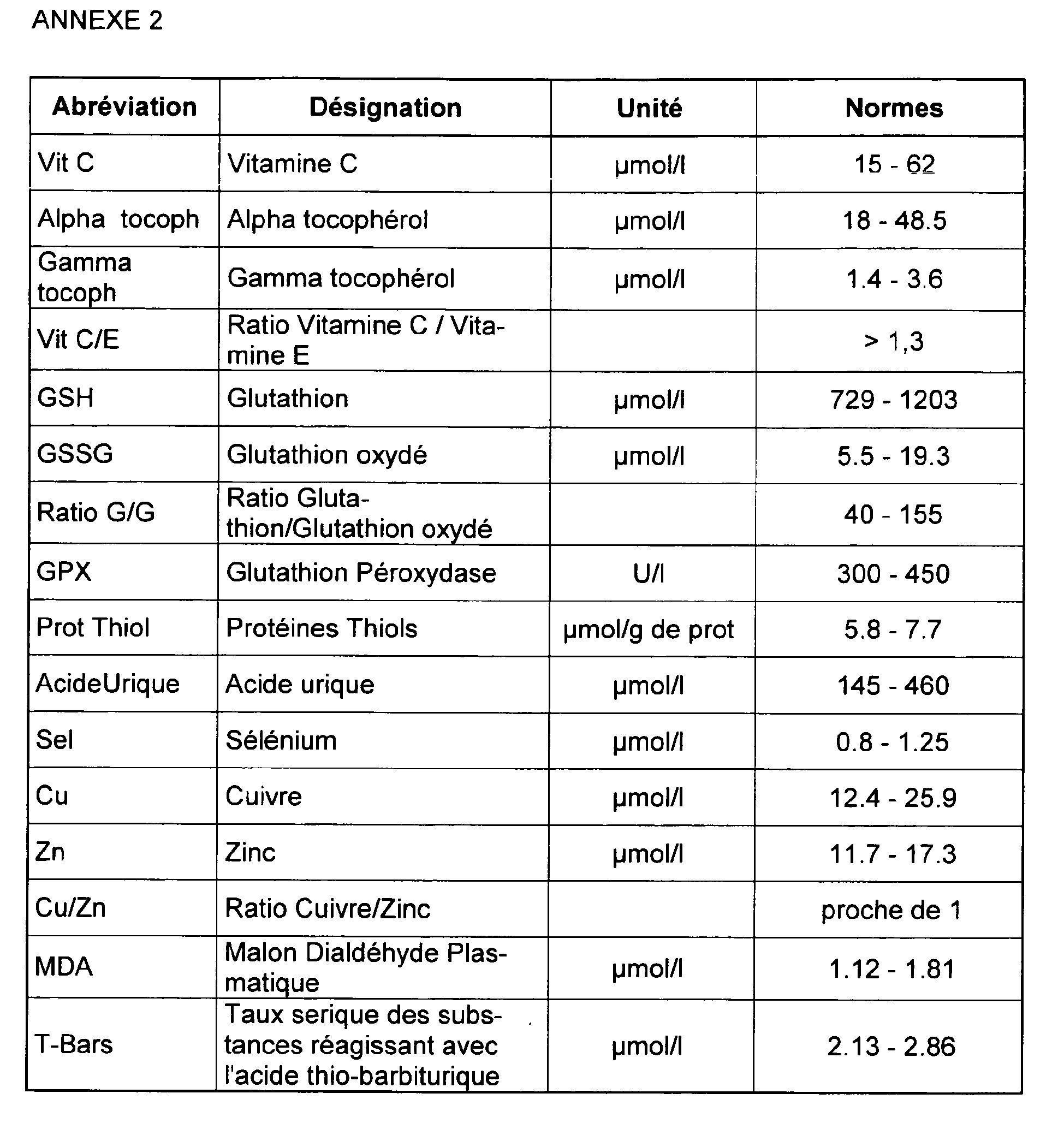
- Les significations des abréviations des différents marqueurs biologiques utilisés, leurs unités et les normes sont précisées en annexe 2.
- On a ensuite effectué un traitement statistique de cette base de données de façon à sélectionner les marqueurs les plus pertinents d'un point de vue médical et les plus aptes à prédire le score de stress oxydatif.
- Selon l'invention, le groupe de marqueurs biologiques ainsi sélectionnés peut avantageusement renfermer moins de 6 marqueurs biologiques.
- Selon une première variante de l'invention, ces marqueurs biologiques sont le cuivre Cu, le zinc Zn, le rapport glutathion réduit/glutathion oxydé(ratio G/G), les protéines thiols (prot th) et le malon dialdéhyde plasmatique (MDA).
- Selon cette variante de l'invention, il est ainsi proposé d'obtenir une prédiction suffisamment précise et fiable du score oxydatif d'un patient à partir de seulement cinq marqueurs biologiques judicieusement sélectionnés (nécessitant six dosages).
- Il est à noter que ces marqueurs biologiques appartiennent aux trois catégories de marqueurs biologiques prises en considération dans le cadre du procédé de détermination du stress oxydatif susmentionné, à savoir des marqueurs exogènes (Cu, Zn) des marqueurs endogènes (ratio G/G, prot th) et des marqueurs de dégâts oxydatifs (MDA).
- Le traitement statistique effectué a ensuite consisté à rechercher, à partir des marqueurs biologiques ainsi sélectionnés, la relation de prédiction la mieux adaptée pour prédire avec suffisamment de précision quel sera le score de stress oxydatif d'un patient ou en d'autres termes pour obtenir un score prédictif Sp le plus proche possible du score de stress oxydatif S0.
- Selon la première variante de l'invention, la relation de prédiction ainsi déterminée est la relation suivante :

- Selon cette première variante de l'invention il est proposé de classer les scores prédictifs en trois classes de risques.
- Selon la classe dans laquelle est situé le score prédictif d'un patient, le corps médical peut prendre la décision la plus appropriée pour son suivi, à savoir :
- classe 1 : note inférieure à 4,5,
aucun suivi spécifique du patient, - classe 2 : note comprise entre 4,5 et 5,5,
risque moyen ; les patients se trouvant dans cette zone peuvent subir un traitement pendant trois à six mois avant de subir une nouvelle épreuve pour déterminer si leur stress oxydatif a ou non diminué, - classe 3 : note supérieure à 5,5
risque élevé ; les patients se trouvant dans cette zone doivent subir un bilan complet de stress oxydatif ou d'autres explorations. - Selon une seconde variante de l'invention les marqueurs biologiques sélectionnés sont le cuivre Cu, le zinc Zn, les protéines thiols (prot th) le ma-Ion dialdéhyde plasmatique (MDA) et les T-Bars, c'est-à-dire les substances qui réagissent avec l'acide thio-barbiturique.
- Il est à noter que les T-Bars correspondent à un marqueur de type 3 (dégâts oxydatifs majeurs).
- Selon cette seconde variante, en vue d'éviter le dosage du Ratio G/G, nécessitant des précautions particulières lors du prélèvement et principalement lors du stockage des échantillons (congélation à -80°C), il a été décidé d'évaluer un modèle alternatif en l'absence de ce dosage.
- Le traitement statistique effectué a conduit à déterminer le score prédictif Sp' à partir de la relation de prédiction suivante


- Il est à noter que selon cette seconde variante de l'invention les classes de score prédictif sont un peu décalées par rapport aux classes définies selon la première variante ; en effet :
- la classe 1 correspond à une note inférieure à 4,
- la classe 2 correspond à une note comprise entre 4 et 6,
- la classe 3 correspond à une note supérieure à 6.
- Pour vérifier la représentativité du score prédictif du stress oxydatif obtenu par la mise en oeuvre du procédé conforme à l'invention on a calculé chez un panel de patients :
- d'une part le score de stress oxydatif conformément au document
EP 1 793 230 , et - d'autre part le score prédictif conformément aux deux variantes de l'invention.
- Les résultats obtenus sont rassemblés sur la figure annexée sur laquelle le score prédictif est porté en abscisse alors que le score de stress oxydatif est porté en ordonnée.
- Les cercles noirs correspondent à des patients appartenant à la classe 1 tandis que les cercles clairs correspondent à des patients appartenant à la classe 2 et les carrés noirs à des patients appartenant à la classe 3.
- Ces résultats sont clairement de nature à prouver la qualité des scores prédictifs obtenus conformément aux deux variantes de l'invention.
- Il est à noter que d'un point de vue purement statistique, ces travaux ont fait appel aux techniques et méthodes suivantes :
- Analyses en Composantes Principales,
- Régressions Linéaires Multiples (moindres carrés) et Régressions PLS (Partial Least Squares),
- Classification Hiérarchique et Analyse de Tableaux de Contingence (Test du Khi2 et Indice Kappa).
- Il est à noter que la prédiction du score représentatif du stress oxydatif d'un patient S0 et l'affectation à la classe de risque associée sont actuellement réalisables de façon interactive grâce à un utilitaire développé sous Microsoft® Exel dans sa version 2003 professionnelle sous la forme d'une macro commande.
- Pour l'ensemble des traitements statistiques, le logiciel Jmp dans sa version 6.0.2 (Statical Discovery TM from SAS - Copyright© 2006 SAS Institute Inc) a été utilisé.



Claims (6)
- Procédé de prédiction d'un score représentatif du stress oxydatif d'un patient sur une échelle de 0 à 10
caractérisé par
la succession des étapes suivantes :- dans une étape d'étalonnage initial :- on évalue par dosage, en particulier à partir de prélèvements sanguins, une série de marqueurs biologiques liés au stress oxydatif chez un panel de personnes, puis on calcule en utilisant une formule prédéfinie un score de stress oxydatif SO spécifique à chacune de ces personnes de façon à obtenir une base de données, et- on effectue une analyse statistique de cette base de données de façon à sélectionner un groupe de marqueurs biologiques particulièrement représentatifs du score de stress oxydatif et à déterminer une relation de prédiction permettant de calculer à partir des marqueurs biologiques ainsi sélectionnés un score Sp prédictif du score de stress oxydatif SO,- on évalue par dosage les marqueurs biologiques du groupe sélectionné du patient, et- on calcule le score prédictif Sp spécifique au patient en utilisant la relation de prédiction. - Procédé selon la revendication 1,
caractérisé en ce que
le groupe de marqueurs biologiques sélectionnés renferme moins de 6 marqueurs biologiques. - Procédé selon la revendication 2,
caractérisé en ce que
les marqueurs biologiques sélectionnés sont le cuivre Cu, le zinc Zn, le rapport glutathion réduit/glutathion oxydé(ratio G/G), les protéines thiols (prot th) et le malon dialdéhyde plasmatique (MDA). - Procédé selon la revendication 3,
caractérisé en ce que
la relation de prédiction est la relation suivante :

- Procédé selon la revendication 2,
caractérisé en ce que
les marqueurs biologiques sélectionnés sont le cuivre Cu, le zinc Zn, les protéines thiols (prot. th) le malon dialdéhyde plasmatique (MDA) et les T-Bars, c'est-à-dire les substances qui réagissent avec l'acide thio-barbiturique. - Procédé selon la revendication 5,
caractérisé en ce que
la relation de prédiction est la relation suivante :
Applications Claiming Priority (1)
| Application Number | Priority Date | Filing Date | Title |
|---|---|---|---|
| FR0705105A FR2919059B1 (fr) | 2007-07-16 | 2007-07-16 | Procede de prediction d'un score representatif du stress oxydatif d'un patient |
Publications (2)
| Publication Number | Publication Date |
|---|---|
| EP2017623A1 true EP2017623A1 (fr) | 2009-01-21 |
| EP2017623B1 EP2017623B1 (fr) | 2010-08-11 |
Family
ID=38582358
Family Applications (1)
| Application Number | Title | Priority Date | Filing Date |
|---|---|---|---|
| EP08011900A Not-in-force EP2017623B1 (fr) | 2007-07-16 | 2008-07-02 | Procédé de prédiction d'un score représentatif du stress oxydatif d'un patient |
Country Status (5)
| Country | Link |
|---|---|
| EP (1) | EP2017623B1 (fr) |
| CN (1) | CN101629949A (fr) |
| AT (1) | ATE477498T1 (fr) |
| DE (1) | DE602008002113D1 (fr) |
| FR (1) | FR2919059B1 (fr) |
Cited By (2)
| Publication number | Priority date | Publication date | Assignee | Title |
|---|---|---|---|---|
| EP3708678A1 (fr) | 2019-03-15 | 2020-09-16 | Adisseo France S.A.S. | Procédé d'identification d'un état de stress chez un sujet |
| CN114049916A (zh) * | 2021-11-30 | 2022-02-15 | 大连海洋大学 | 长牡蛎氧化应激状态评价方法 |
Citations (1)
| Publication number | Priority date | Publication date | Assignee | Title |
|---|---|---|---|---|
| EP1793230A1 (fr) | 2005-11-30 | 2007-06-06 | Michel Brack | Procédé de détermination d'un score représentatif du stress oxydatif d'un patient, sur une échelle de 0 à 10 |
-
2007
- 2007-07-16 FR FR0705105A patent/FR2919059B1/fr not_active Expired - Fee Related
-
2008
- 2008-07-02 EP EP08011900A patent/EP2017623B1/fr not_active Not-in-force
- 2008-07-02 DE DE602008002113T patent/DE602008002113D1/de active Active
- 2008-07-02 AT AT08011900T patent/ATE477498T1/de not_active IP Right Cessation
- 2008-07-14 CN CN200810168615A patent/CN101629949A/zh active Pending
Patent Citations (1)
| Publication number | Priority date | Publication date | Assignee | Title |
|---|---|---|---|---|
| EP1793230A1 (fr) | 2005-11-30 | 2007-06-06 | Michel Brack | Procédé de détermination d'un score représentatif du stress oxydatif d'un patient, sur une échelle de 0 à 10 |
Non-Patent Citations (4)
| Title |
|---|
| BEN-DOR A ET AL ASSOCIATION FOR COMPUTING MACHINERY: "TISSUE CLASSIFICATION WITH GENE EXPRESSION PROFILES", RECOMB 2000. PROCEEDINGS OF THE 4TH. ANNUAL INTERNATIONAL CONFERENCE ON COMPUTATIONAL MOLECULAR BIOLOGY. TOKYO, JAPAN, APRIL 8 - 11, 2000, PROCEEDINGS OF THE ANNUAL INTERNATIONAL CONFERENCE ON COMPUTATIONAL MOLECULAR BIOLOGY, NEW YORK, NY : ACM, US, vol. CONF.4, 8 April 2000 (2000-04-08), pages 54 - 64, XP001049478, ISBN: 1-58113-186-0 * |
| MAMTANI MANJU R ET AL: "A simple method to combine multiple molecular biomarkers for dichotomous diagnostic classification.", BMC BIOINFORMATICS 2006, vol. 7, 2006, pages 442, XP002456260, ISSN: 1471-2105 * |
| SCHISTERMAN E F ET AL: "Minimal and best linear combination of oxidative stress and antioxidant biomarkers to discriminate cardiovascular disease.", NUTRITION, METABOLISM, AND CARDIOVASCULAR DISEASES : NMCD OCT 2002, vol. 12, no. 5, October 2002 (2002-10-01), pages 259 - 266, XP008085094, ISSN: 0939-4753 * |
| VEGLIA F ET AL: "Age- and gender-related oxidative status determined in healthy subjects by means of OXY-SCORE, a potential new comprehensive index", BIOMARKERS, vol. 11, no. 6, November 2006 (2006-11-01), pages 562 - 573, XP008085093, ISSN: 1354-750X * |
Cited By (4)
| Publication number | Priority date | Publication date | Assignee | Title |
|---|---|---|---|---|
| EP3708678A1 (fr) | 2019-03-15 | 2020-09-16 | Adisseo France S.A.S. | Procédé d'identification d'un état de stress chez un sujet |
| WO2020187748A1 (fr) | 2019-03-15 | 2020-09-24 | Adisseo France S.A.S. | Procédé d'identification d'un état de stress chez un sujet et/ou d'évaluation du niveau de réponse au stress chez un sujet |
| US12624395B2 (en) | 2019-03-15 | 2026-05-12 | Adisseo France S.A.S. | Process for identifying a stress state and/or for assessing the stress response level in a subject |
| CN114049916A (zh) * | 2021-11-30 | 2022-02-15 | 大连海洋大学 | 长牡蛎氧化应激状态评价方法 |
Also Published As
| Publication number | Publication date |
|---|---|
| FR2919059B1 (fr) | 2009-12-18 |
| EP2017623B1 (fr) | 2010-08-11 |
| FR2919059A1 (fr) | 2009-01-23 |
| DE602008002113D1 (de) | 2010-09-23 |
| ATE477498T1 (de) | 2010-08-15 |
| CN101629949A (zh) | 2010-01-20 |
Similar Documents
| Publication | Publication Date | Title |
|---|---|---|
| Jiang et al. | Basal cortisol, cortisol reactivity, and telomere length: A systematic review and meta-analysis | |
| Garmendia Madariaga et al. | The incidence and prevalence of thyroid dysfunction in Europe: a meta-analysis | |
| Morris et al. | Association of seafood consumption, brain mercury level, and APOE ε4 status with brain neuropathology in older adults | |
| Mascarenhas et al. | Effect of diabetes mellitus type 2 on salivary glucose–a systematic review and meta-analysis of observational studies | |
| Fogo et al. | Machine learning-based classification of mitochondrial morphology in primary neurons and brain | |
| Mauss et al. | Association of vitamin D levels with type 2 diabetes in older working adults | |
| Hunt et al. | Anemia, iron deficiency, and cobalamin deficiency in cats with chronic gastrointestinal disease | |
| Hu et al. | Perfluoroalkyl and polyfluoroalkyl substances and hypertensive disorders of pregnancy: A systematic review and meta-analysis | |
| Taieb et al. | Deciphering the role of androgen in the dermatologic manifestations of polycystic ovary syndrome patients: a state-of-the-art review | |
| Gavran et al. | Evaluation of biochemical markers effectiveness in elderly malnutrition assessment. | |
| Lamming | Quantification of healthspan in aging mice: introducing FAMY and GRAIL | |
| Lazaro-Pacheco et al. | Exploring in-vivo infrared spectroscopy for nail-based diabetes screening | |
| Asghari et al. | Dietary amino acid patterns are associated with incidence of chronic kidney disease | |
| EP2017623B1 (fr) | Procédé de prédiction d'un score représentatif du stress oxydatif d'un patient | |
| Roberts et al. | Glial fibrillary acidic protein and ubiquitin C-terminal hydrolase L1 for acute traumatic intracranial lesions: the PIONEER diagnostic accuracy study | |
| WO2020203878A1 (fr) | Procédé d'évaluation, procédé de calcul, dispositif d'évaluation, dispositif de calcul, programme d'évaluation, programme de calcul, support d'enregistrement, système d'évaluation et dispositif terminal d'accumulation de bêta-amyloïde dans le cerveau | |
| Saitsu et al. | Low urine pH associated with sarcopenia in the elderly: A multi-center observational study | |
| Nguyen et al. | Prevalence of hyperuricemia and associated factors among pregnant women in Vietnam: A cross-sectional study | |
| EP1793230B1 (fr) | Procédé de détermination d'un score représentatif du stress oxydatif d'un patient, sur une échelle de 0 à 10 | |
| Quinn et al. | Thyroid autoimmunity and thyroid hormone reference intervals in apparently healthy Chinese adults | |
| Haque et al. | Decoding the microbiome for the development of translational applications: Overview, challenges and pitfalls: Mohammed Monzoorul Haque and Sharmila S Mande | |
| WO2022210606A1 (fr) | Procédé d'évaluation de risque futur de développement de démence | |
| Ruha et al. | Urine mercury excretion following meso-dimercaptosuccinic acid challenge in fish eaters | |
| Stoldt et al. | DNA methylation at C-reactive protein-associated CpG sites may mediate the pathway between educational attainment and cognition | |
| WO2008135642A1 (fr) | Procédé de détermination d'un score représentatif du stress oxydatif d'un patient, sur une échelle de 0 a 10 |
Legal Events
| Date | Code | Title | Description |
|---|---|---|---|
| PUAI | Public reference made under article 153(3) epc to a published international application that has entered the european phase |
Free format text: ORIGINAL CODE: 0009012 |
|
| AK | Designated contracting states |
Kind code of ref document: A1 Designated state(s): AT BE BG CH CY CZ DE DK EE ES FI FR GB GR HR HU IE IS IT LI LT LU LV MC MT NL NO PL PT RO SE SI SK TR |
|
| AX | Request for extension of the european patent |
Extension state: AL BA MK RS |
|
| 17P | Request for examination filed |
Effective date: 20090622 |
|
| 17Q | First examination report despatched |
Effective date: 20090817 |
|
| AKX | Designation fees paid |
Designated state(s): AT BE BG CH CY CZ DE DK EE ES FI FR GB GR HR HU IE IS IT LI LT LU LV MC MT NL NO PL PT RO SE SI SK TR |
|
| GRAP | Despatch of communication of intention to grant a patent |
Free format text: ORIGINAL CODE: EPIDOSNIGR1 |
|
| GRAS | Grant fee paid |
Free format text: ORIGINAL CODE: EPIDOSNIGR3 |
|
| GRAA | (expected) grant |
Free format text: ORIGINAL CODE: 0009210 |
|
| AK | Designated contracting states |
Kind code of ref document: B1 Designated state(s): AT BE BG CH CY CZ DE DK EE ES FI FR GB GR HR HU IE IS IT LI LT LU LV MC MT NL NO PL PT RO SE SI SK TR |
|
| REG | Reference to a national code |
Ref country code: GB Ref legal event code: FG4D Free format text: NOT ENGLISH |
|
| REG | Reference to a national code |
Ref country code: CH Ref legal event code: EP |
|
| REG | Reference to a national code |
Ref country code: IE Ref legal event code: FG4D Free format text: LANGUAGE OF EP DOCUMENT: FRENCH |
|
| REF | Corresponds to: |
Ref document number: 602008002113 Country of ref document: DE Date of ref document: 20100923 Kind code of ref document: P |
|
| REG | Reference to a national code |
Ref country code: CH Ref legal event code: NV Representative=s name: MICHELI & CIE SA |
|
| REG | Reference to a national code |
Ref country code: NL Ref legal event code: VDEP Effective date: 20100811 |
|
| LTIE | Lt: invalidation of european patent or patent extension |
Effective date: 20100811 |
|
| PG25 | Lapsed in a contracting state [announced via postgrant information from national office to epo] |
Ref country code: LT Free format text: LAPSE BECAUSE OF FAILURE TO SUBMIT A TRANSLATION OF THE DESCRIPTION OR TO PAY THE FEE WITHIN THE PRESCRIBED TIME-LIMIT Effective date: 20100811 Ref country code: NO Free format text: LAPSE BECAUSE OF FAILURE TO SUBMIT A TRANSLATION OF THE DESCRIPTION OR TO PAY THE FEE WITHIN THE PRESCRIBED TIME-LIMIT Effective date: 20101111 Ref country code: NL Free format text: LAPSE BECAUSE OF FAILURE TO SUBMIT A TRANSLATION OF THE DESCRIPTION OR TO PAY THE FEE WITHIN THE PRESCRIBED TIME-LIMIT Effective date: 20100811 Ref country code: AT Free format text: LAPSE BECAUSE OF FAILURE TO SUBMIT A TRANSLATION OF THE DESCRIPTION OR TO PAY THE FEE WITHIN THE PRESCRIBED TIME-LIMIT Effective date: 20100811 Ref country code: FI Free format text: LAPSE BECAUSE OF FAILURE TO SUBMIT A TRANSLATION OF THE DESCRIPTION OR TO PAY THE FEE WITHIN THE PRESCRIBED TIME-LIMIT Effective date: 20100811 |
|
| PG25 | Lapsed in a contracting state [announced via postgrant information from national office to epo] |
Ref country code: IS Free format text: LAPSE BECAUSE OF FAILURE TO SUBMIT A TRANSLATION OF THE DESCRIPTION OR TO PAY THE FEE WITHIN THE PRESCRIBED TIME-LIMIT Effective date: 20101211 Ref country code: BG Free format text: LAPSE BECAUSE OF FAILURE TO SUBMIT A TRANSLATION OF THE DESCRIPTION OR TO PAY THE FEE WITHIN THE PRESCRIBED TIME-LIMIT Effective date: 20101111 Ref country code: SI Free format text: LAPSE BECAUSE OF FAILURE TO SUBMIT A TRANSLATION OF THE DESCRIPTION OR TO PAY THE FEE WITHIN THE PRESCRIBED TIME-LIMIT Effective date: 20100811 Ref country code: CY Free format text: LAPSE BECAUSE OF FAILURE TO SUBMIT A TRANSLATION OF THE DESCRIPTION OR TO PAY THE FEE WITHIN THE PRESCRIBED TIME-LIMIT Effective date: 20100811 Ref country code: HR Free format text: LAPSE BECAUSE OF FAILURE TO SUBMIT A TRANSLATION OF THE DESCRIPTION OR TO PAY THE FEE WITHIN THE PRESCRIBED TIME-LIMIT Effective date: 20100811 Ref country code: PL Free format text: LAPSE BECAUSE OF FAILURE TO SUBMIT A TRANSLATION OF THE DESCRIPTION OR TO PAY THE FEE WITHIN THE PRESCRIBED TIME-LIMIT Effective date: 20100811 |
|
| REG | Reference to a national code |
Ref country code: IE Ref legal event code: FD4D |
|
| PG25 | Lapsed in a contracting state [announced via postgrant information from national office to epo] |
Ref country code: SE Free format text: LAPSE BECAUSE OF FAILURE TO SUBMIT A TRANSLATION OF THE DESCRIPTION OR TO PAY THE FEE WITHIN THE PRESCRIBED TIME-LIMIT Effective date: 20100811 Ref country code: GR Free format text: LAPSE BECAUSE OF FAILURE TO SUBMIT A TRANSLATION OF THE DESCRIPTION OR TO PAY THE FEE WITHIN THE PRESCRIBED TIME-LIMIT Effective date: 20101112 Ref country code: LV Free format text: LAPSE BECAUSE OF FAILURE TO SUBMIT A TRANSLATION OF THE DESCRIPTION OR TO PAY THE FEE WITHIN THE PRESCRIBED TIME-LIMIT Effective date: 20100811 |
|
| PG25 | Lapsed in a contracting state [announced via postgrant information from national office to epo] |
Ref country code: IE Free format text: LAPSE BECAUSE OF FAILURE TO SUBMIT A TRANSLATION OF THE DESCRIPTION OR TO PAY THE FEE WITHIN THE PRESCRIBED TIME-LIMIT Effective date: 20100811 Ref country code: DK Free format text: LAPSE BECAUSE OF FAILURE TO SUBMIT A TRANSLATION OF THE DESCRIPTION OR TO PAY THE FEE WITHIN THE PRESCRIBED TIME-LIMIT Effective date: 20100811 |
|
| PG25 | Lapsed in a contracting state [announced via postgrant information from national office to epo] |
Ref country code: RO Free format text: LAPSE BECAUSE OF FAILURE TO SUBMIT A TRANSLATION OF THE DESCRIPTION OR TO PAY THE FEE WITHIN THE PRESCRIBED TIME-LIMIT Effective date: 20100811 Ref country code: EE Free format text: LAPSE BECAUSE OF FAILURE TO SUBMIT A TRANSLATION OF THE DESCRIPTION OR TO PAY THE FEE WITHIN THE PRESCRIBED TIME-LIMIT Effective date: 20100811 Ref country code: SK Free format text: LAPSE BECAUSE OF FAILURE TO SUBMIT A TRANSLATION OF THE DESCRIPTION OR TO PAY THE FEE WITHIN THE PRESCRIBED TIME-LIMIT Effective date: 20100811 Ref country code: IT Free format text: LAPSE BECAUSE OF FAILURE TO SUBMIT A TRANSLATION OF THE DESCRIPTION OR TO PAY THE FEE WITHIN THE PRESCRIBED TIME-LIMIT Effective date: 20100811 Ref country code: CZ Free format text: LAPSE BECAUSE OF FAILURE TO SUBMIT A TRANSLATION OF THE DESCRIPTION OR TO PAY THE FEE WITHIN THE PRESCRIBED TIME-LIMIT Effective date: 20100811 |
|
| PLBE | No opposition filed within time limit |
Free format text: ORIGINAL CODE: 0009261 |
|
| STAA | Information on the status of an ep patent application or granted ep patent |
Free format text: STATUS: NO OPPOSITION FILED WITHIN TIME LIMIT |
|
| PG25 | Lapsed in a contracting state [announced via postgrant information from national office to epo] |
Ref country code: ES Free format text: LAPSE BECAUSE OF FAILURE TO SUBMIT A TRANSLATION OF THE DESCRIPTION OR TO PAY THE FEE WITHIN THE PRESCRIBED TIME-LIMIT Effective date: 20101122 |
|
| 26N | No opposition filed |
Effective date: 20110512 |
|
| REG | Reference to a national code |
Ref country code: DE Ref legal event code: R097 Ref document number: 602008002113 Country of ref document: DE Effective date: 20110512 |
|
| PG25 | Lapsed in a contracting state [announced via postgrant information from national office to epo] |
Ref country code: MT Free format text: LAPSE BECAUSE OF FAILURE TO SUBMIT A TRANSLATION OF THE DESCRIPTION OR TO PAY THE FEE WITHIN THE PRESCRIBED TIME-LIMIT Effective date: 20100811 |
|
| BERE | Be: lapsed |
Owner name: SWISS LINE SERVICES LTD. Effective date: 20110731 |
|
| PG25 | Lapsed in a contracting state [announced via postgrant information from national office to epo] |
Ref country code: MC Free format text: LAPSE BECAUSE OF NON-PAYMENT OF DUE FEES Effective date: 20110731 |
|
| PG25 | Lapsed in a contracting state [announced via postgrant information from national office to epo] |
Ref country code: BE Free format text: LAPSE BECAUSE OF NON-PAYMENT OF DUE FEES Effective date: 20110731 Ref country code: DE Free format text: LAPSE BECAUSE OF NON-PAYMENT OF DUE FEES Effective date: 20120201 |
|
| REG | Reference to a national code |
Ref country code: DE Ref legal event code: R119 Ref document number: 602008002113 Country of ref document: DE Effective date: 20120201 |
|
| GBPC | Gb: european patent ceased through non-payment of renewal fee |
Effective date: 20120702 |
|
| PG25 | Lapsed in a contracting state [announced via postgrant information from national office to epo] |
Ref country code: GB Free format text: LAPSE BECAUSE OF NON-PAYMENT OF DUE FEES Effective date: 20120702 |
|
| PG25 | Lapsed in a contracting state [announced via postgrant information from national office to epo] |
Ref country code: LU Free format text: LAPSE BECAUSE OF NON-PAYMENT OF DUE FEES Effective date: 20110702 |
|
| PG25 | Lapsed in a contracting state [announced via postgrant information from national office to epo] |
Ref country code: TR Free format text: LAPSE BECAUSE OF FAILURE TO SUBMIT A TRANSLATION OF THE DESCRIPTION OR TO PAY THE FEE WITHIN THE PRESCRIBED TIME-LIMIT Effective date: 20100811 |
|
| PG25 | Lapsed in a contracting state [announced via postgrant information from national office to epo] |
Ref country code: HU Free format text: LAPSE BECAUSE OF FAILURE TO SUBMIT A TRANSLATION OF THE DESCRIPTION OR TO PAY THE FEE WITHIN THE PRESCRIBED TIME-LIMIT Effective date: 20100811 |
|
| PG25 | Lapsed in a contracting state [announced via postgrant information from national office to epo] |
Ref country code: PT Free format text: LAPSE BECAUSE OF FAILURE TO SUBMIT A TRANSLATION OF THE DESCRIPTION OR TO PAY THE FEE WITHIN THE PRESCRIBED TIME-LIMIT Effective date: 20100811 |
|
| PGFP | Annual fee paid to national office [announced via postgrant information from national office to epo] |
Ref country code: CH Payment date: 20140612 Year of fee payment: 7 |
|
| PGFP | Annual fee paid to national office [announced via postgrant information from national office to epo] |
Ref country code: FR Payment date: 20140721 Year of fee payment: 7 |
|
| REG | Reference to a national code |
Ref country code: CH Ref legal event code: PL |
|
| PG25 | Lapsed in a contracting state [announced via postgrant information from national office to epo] |
Ref country code: LI Free format text: LAPSE BECAUSE OF NON-PAYMENT OF DUE FEES Effective date: 20150731 Ref country code: CH Free format text: LAPSE BECAUSE OF NON-PAYMENT OF DUE FEES Effective date: 20150731 |
|
| REG | Reference to a national code |
Ref country code: FR Ref legal event code: ST Effective date: 20160331 |
|
| PG25 | Lapsed in a contracting state [announced via postgrant information from national office to epo] |
Ref country code: FR Free format text: LAPSE BECAUSE OF NON-PAYMENT OF DUE FEES Effective date: 20150731 |