EP1793230A1 - Procédé de détermination d'un score représentatif du stress oxydatif d'un patient, sur une échelle de 0 à 10 - Google Patents
Procédé de détermination d'un score représentatif du stress oxydatif d'un patient, sur une échelle de 0 à 10 Download PDFInfo
- Publication number
- EP1793230A1 EP1793230A1 EP06301189A EP06301189A EP1793230A1 EP 1793230 A1 EP1793230 A1 EP 1793230A1 EP 06301189 A EP06301189 A EP 06301189A EP 06301189 A EP06301189 A EP 06301189A EP 1793230 A1 EP1793230 A1 EP 1793230A1
- Authority
- EP
- European Patent Office
- Prior art keywords
- markers
- group
- biological
- patient
- oxidative stress
- Prior art date
- Legal status (The legal status is an assumption and is not a legal conclusion. Google has not performed a legal analysis and makes no representation as to the accuracy of the status listed.)
- Granted
Links
- 230000036542 oxidative stress Effects 0.000 title claims abstract description 33
- 238000000034 method Methods 0.000 title claims description 17
- 230000008569 process Effects 0.000 title claims description 8
- 239000000090 biomarker Substances 0.000 claims abstract description 63
- 239000003963 antioxidant agent Substances 0.000 claims abstract description 16
- 239000003550 marker Substances 0.000 claims abstract description 15
- 230000005484 gravity Effects 0.000 claims abstract description 11
- 230000007170 pathology Effects 0.000 claims abstract description 10
- 238000007619 statistical method Methods 0.000 claims abstract description 6
- 239000008280 blood Substances 0.000 claims abstract description 5
- 210000004369 blood Anatomy 0.000 claims abstract description 5
- 238000011161 development Methods 0.000 claims abstract description 4
- 230000004792 oxidative damage Effects 0.000 claims abstract description 4
- GVJHHUAWPYXKBD-UHFFFAOYSA-N (±)-α-Tocopherol Chemical compound OC1=C(C)C(C)=C2OC(CCCC(C)CCCC(C)CCCC(C)C)(C)CCC2=C1C GVJHHUAWPYXKBD-UHFFFAOYSA-N 0.000 claims description 20
- RWSXRVCMGQZWBV-WDSKDSINSA-N glutathione Chemical compound OC(=O)[C@@H](N)CCC(=O)N[C@@H](CS)C(=O)NCC(O)=O RWSXRVCMGQZWBV-WDSKDSINSA-N 0.000 claims description 17
- 235000006708 antioxidants Nutrition 0.000 claims description 15
- CIWBSHSKHKDKBQ-JLAZNSOCSA-N Ascorbic acid Chemical compound OC[C@H](O)[C@H]1OC(=O)C(O)=C1O CIWBSHSKHKDKBQ-JLAZNSOCSA-N 0.000 claims description 14
- WIGCFUFOHFEKBI-UHFFFAOYSA-N gamma-tocopherol Natural products CC(C)CCCC(C)CCCC(C)CCCC1CCC2C(C)C(O)C(C)C(C)C2O1 WIGCFUFOHFEKBI-UHFFFAOYSA-N 0.000 claims description 12
- 229930003427 Vitamin E Natural products 0.000 claims description 10
- HCHKCACWOHOZIP-UHFFFAOYSA-N Zinc Chemical compound [Zn] HCHKCACWOHOZIP-UHFFFAOYSA-N 0.000 claims description 10
- DDRJAANPRJIHGJ-UHFFFAOYSA-N creatinine Chemical compound CN1CC(=O)NC1=N DDRJAANPRJIHGJ-UHFFFAOYSA-N 0.000 claims description 10
- 235000019165 vitamin E Nutrition 0.000 claims description 10
- 239000011709 vitamin E Substances 0.000 claims description 10
- 229940046009 vitamin E Drugs 0.000 claims description 10
- 229960003180 glutathione Drugs 0.000 claims description 9
- 239000011701 zinc Substances 0.000 claims description 9
- 229910052725 zinc Inorganic materials 0.000 claims description 8
- ZZZCUOFIHGPKAK-UHFFFAOYSA-N D-erythro-ascorbic acid Natural products OCC1OC(=O)C(O)=C1O ZZZCUOFIHGPKAK-UHFFFAOYSA-N 0.000 claims description 7
- 229930003268 Vitamin C Natural products 0.000 claims description 7
- 235000019154 vitamin C Nutrition 0.000 claims description 7
- 239000011718 vitamin C Substances 0.000 claims description 7
- RYGMFSIKBFXOCR-UHFFFAOYSA-N Copper Chemical compound [Cu] RYGMFSIKBFXOCR-UHFFFAOYSA-N 0.000 claims description 6
- 108010053070 Glutathione Disulfide Proteins 0.000 claims description 6
- 239000010949 copper Substances 0.000 claims description 6
- 150000003573 thiols Chemical class 0.000 claims description 6
- BUGBHKTXTAQXES-UHFFFAOYSA-N Selenium Chemical compound [Se] BUGBHKTXTAQXES-UHFFFAOYSA-N 0.000 claims description 5
- 229910052802 copper Inorganic materials 0.000 claims description 5
- 229940109239 creatinine Drugs 0.000 claims description 5
- 235000003969 glutathione Nutrition 0.000 claims description 5
- 108010024636 Glutathione Proteins 0.000 claims description 4
- 150000002632 lipids Chemical class 0.000 claims description 4
- 108090000623 proteins and genes Proteins 0.000 claims description 4
- 102000004169 proteins and genes Human genes 0.000 claims description 4
- 239000011669 selenium Substances 0.000 claims description 4
- 229910052711 selenium Inorganic materials 0.000 claims description 4
- 238000003556 assay Methods 0.000 claims description 3
- YPZRWBKMTBYPTK-BJDJZHNGSA-N glutathione disulfide Chemical compound OC(=O)[C@@H](N)CCC(=O)N[C@H](C(=O)NCC(O)=O)CSSC[C@@H](C(=O)NCC(O)=O)NC(=O)CC[C@H](N)C(O)=O YPZRWBKMTBYPTK-BJDJZHNGSA-N 0.000 claims description 3
- 229940108928 copper Drugs 0.000 claims description 2
- 230000006378 damage Effects 0.000 claims description 2
- 229940091258 selenium supplement Drugs 0.000 claims description 2
- FJNCXZZQNBKEJT-UHFFFAOYSA-N 8beta-hydroxymarrubiin Natural products O1C(=O)C2(C)CCCC3(C)C2C1CC(C)(O)C3(O)CCC=1C=COC=1 FJNCXZZQNBKEJT-UHFFFAOYSA-N 0.000 claims 1
- 230000035882 stress Effects 0.000 abstract description 7
- 238000011156 evaluation Methods 0.000 abstract description 6
- HVYWMOMLDIMFJA-DPAQBDIFSA-N cholesterol Chemical compound C1C=C2C[C@@H](O)CC[C@]2(C)[C@@H]2[C@@H]1[C@@H]1CC[C@H]([C@H](C)CCCC(C)C)[C@@]1(C)CC2 HVYWMOMLDIMFJA-DPAQBDIFSA-N 0.000 description 8
- 230000036541 health Effects 0.000 description 8
- 238000004458 analytical method Methods 0.000 description 7
- 108010007622 LDL Lipoproteins Proteins 0.000 description 6
- 238000012360 testing method Methods 0.000 description 6
- 108020004414 DNA Proteins 0.000 description 5
- 230000002159 abnormal effect Effects 0.000 description 5
- 230000003078 antioxidant effect Effects 0.000 description 4
- 235000012000 cholesterol Nutrition 0.000 description 4
- 229940107161 cholesterol Drugs 0.000 description 4
- GVJHHUAWPYXKBD-IEOSBIPESA-N α-tocopherol Chemical compound OC1=C(C)C(C)=C2O[C@@](CCC[C@H](C)CCC[C@H](C)CCCC(C)C)(C)CCC2=C1C GVJHHUAWPYXKBD-IEOSBIPESA-N 0.000 description 4
- 230000007812 deficiency Effects 0.000 description 3
- 208000037265 diseases, disorders, signs and symptoms Diseases 0.000 description 3
- -1 free radicals Chemical compound 0.000 description 3
- 238000011282 treatment Methods 0.000 description 3
- NYHBQMYGNKIUIF-UUOKFMHZSA-N Guanosine Chemical compound C1=NC=2C(=O)NC(N)=NC=2N1[C@@H]1O[C@H](CO)[C@@H](O)[C@H]1O NYHBQMYGNKIUIF-UUOKFMHZSA-N 0.000 description 2
- 241001080024 Telles Species 0.000 description 2
- 230000005856 abnormality Effects 0.000 description 2
- OENHQHLEOONYIE-UKMVMLAPSA-N all-trans beta-carotene Natural products CC=1CCCC(C)(C)C=1/C=C/C(/C)=C/C=C/C(/C)=C/C=C/C=C(C)C=CC=C(C)C=CC1=C(C)CCCC1(C)C OENHQHLEOONYIE-UKMVMLAPSA-N 0.000 description 2
- 229940087168 alpha tocopherol Drugs 0.000 description 2
- QVGXLLKOCUKJST-UHFFFAOYSA-N atomic oxygen Chemical compound [O] QVGXLLKOCUKJST-UHFFFAOYSA-N 0.000 description 2
- 235000013734 beta-carotene Nutrition 0.000 description 2
- TUPZEYHYWIEDIH-WAIFQNFQSA-N beta-carotene Natural products CC(=C/C=C/C=C(C)/C=C/C=C(C)/C=C/C1=C(C)CCCC1(C)C)C=CC=C(/C)C=CC2=CCCCC2(C)C TUPZEYHYWIEDIH-WAIFQNFQSA-N 0.000 description 2
- 239000011648 beta-carotene Substances 0.000 description 2
- 229960002747 betacarotene Drugs 0.000 description 2
- 238000009534 blood test Methods 0.000 description 2
- 230000018109 developmental process Effects 0.000 description 2
- 239000006185 dispersion Substances 0.000 description 2
- 239000003814 drug Substances 0.000 description 2
- 235000012055 fruits and vegetables Nutrition 0.000 description 2
- 235000010382 gamma-tocopherol Nutrition 0.000 description 2
- 235000016709 nutrition Nutrition 0.000 description 2
- 229910052760 oxygen Inorganic materials 0.000 description 2
- 239000001301 oxygen Substances 0.000 description 2
- 229960000984 tocofersolan Drugs 0.000 description 2
- 235000004835 α-tocopherol Nutrition 0.000 description 2
- 239000002076 α-tocopherol Substances 0.000 description 2
- OENHQHLEOONYIE-JLTXGRSLSA-N β-Carotene Chemical compound CC=1CCCC(C)(C)C=1\C=C\C(\C)=C\C=C\C(\C)=C\C=C\C=C(/C)\C=C\C=C(/C)\C=C\C1=C(C)CCCC1(C)C OENHQHLEOONYIE-JLTXGRSLSA-N 0.000 description 2
- 239000002478 γ-tocopherol Substances 0.000 description 2
- QUEDXNHFTDJVIY-DQCZWYHMSA-N γ-tocopherol Chemical compound OC1=C(C)C(C)=C2O[C@@](CCC[C@H](C)CCC[C@H](C)CCCC(C)C)(C)CCC2=C1 QUEDXNHFTDJVIY-DQCZWYHMSA-N 0.000 description 2
- WMYLYYNMCFINGV-CKCBUVOCSA-N (2s)-2-amino-5-[[(2r)-1-(carboxymethylamino)-1-oxo-3-sulfanylpropan-2-yl]amino]-5-oxopentanoic acid Chemical compound OC(=O)[C@@H](N)CCC(=O)N[C@@H](CS)C(=O)NCC(O)=O.OC(=O)[C@@H](N)CCC(=O)N[C@@H](CS)C(=O)NCC(O)=O WMYLYYNMCFINGV-CKCBUVOCSA-N 0.000 description 1
- WIGIZIANZCJQQY-UHFFFAOYSA-N 4-ethyl-3-methyl-N-[2-[4-[[[(4-methylcyclohexyl)amino]-oxomethyl]sulfamoyl]phenyl]ethyl]-5-oxo-2H-pyrrole-1-carboxamide Chemical compound O=C1C(CC)=C(C)CN1C(=O)NCCC1=CC=C(S(=O)(=O)NC(=O)NC2CCC(C)CC2)C=C1 WIGIZIANZCJQQY-UHFFFAOYSA-N 0.000 description 1
- NTDFJPCHHGBHCO-UHFFFAOYSA-N 7,9-dihydro-3H-purine-2,6,8-trione Chemical compound OC1=NC(O)=C2NC(O)=NC2=N1.N1C(=O)NC(=O)C2=C1NC(=O)N2 NTDFJPCHHGBHCO-UHFFFAOYSA-N 0.000 description 1
- FPGSEBKFEJEOSA-UMMCILCDSA-N 8-Hydroxyguanosine Chemical compound C1=2NC(N)=NC(=O)C=2NC(=O)N1[C@@H]1O[C@H](CO)[C@@H](O)[C@H]1O FPGSEBKFEJEOSA-UMMCILCDSA-N 0.000 description 1
- 208000030507 AIDS Diseases 0.000 description 1
- 208000024827 Alzheimer disease Diseases 0.000 description 1
- 244000118350 Andrographis paniculata Species 0.000 description 1
- MIKUYHXYGGJMLM-GIMIYPNGSA-N Crotonoside Natural products C1=NC2=C(N)NC(=O)N=C2N1[C@H]1O[C@@H](CO)[C@H](O)[C@@H]1O MIKUYHXYGGJMLM-GIMIYPNGSA-N 0.000 description 1
- NYHBQMYGNKIUIF-UHFFFAOYSA-N D-guanosine Natural products C1=2NC(N)=NC(=O)C=2N=CN1C1OC(CO)C(O)C1O NYHBQMYGNKIUIF-UHFFFAOYSA-N 0.000 description 1
- 102000053602 DNA Human genes 0.000 description 1
- 102000006587 Glutathione peroxidase Human genes 0.000 description 1
- 108700016172 Glutathione peroxidases Proteins 0.000 description 1
- 206010028980 Neoplasm Diseases 0.000 description 1
- 208000018737 Parkinson disease Diseases 0.000 description 1
- 240000001987 Pyrus communis Species 0.000 description 1
- LEHOTFFKMJEONL-UHFFFAOYSA-N Uric Acid Chemical compound N1C(=O)NC(=O)C2=C1NC(=O)N2 LEHOTFFKMJEONL-UHFFFAOYSA-N 0.000 description 1
- TVWHNULVHGKJHS-UHFFFAOYSA-N Uric acid Natural products N1C(=O)NC(=O)C2NC(=O)NC21 TVWHNULVHGKJHS-UHFFFAOYSA-N 0.000 description 1
- 230000001594 aberrant effect Effects 0.000 description 1
- 230000032683 aging Effects 0.000 description 1
- 238000013459 approach Methods 0.000 description 1
- 238000004166 bioassay Methods 0.000 description 1
- 230000015572 biosynthetic process Effects 0.000 description 1
- 201000011510 cancer Diseases 0.000 description 1
- 150000001875 compounds Chemical class 0.000 description 1
- TVZPLCNGKSPOJA-UHFFFAOYSA-N copper zinc Chemical compound [Cu].[Zn] TVZPLCNGKSPOJA-UHFFFAOYSA-N 0.000 description 1
- 238000010219 correlation analysis Methods 0.000 description 1
- 238000002790 cross-validation Methods 0.000 description 1
- 235000005911 diet Nutrition 0.000 description 1
- 230000037213 diet Effects 0.000 description 1
- 201000010099 disease Diseases 0.000 description 1
- 230000000694 effects Effects 0.000 description 1
- 230000037406 food intake Effects 0.000 description 1
- 235000012631 food intake Nutrition 0.000 description 1
- 239000000446 fuel Substances 0.000 description 1
- ZZUFCTLCJUWOSV-UHFFFAOYSA-N furosemide Chemical compound C1=C(Cl)C(S(=O)(=O)N)=CC(C(O)=O)=C1NCC1=CC=CO1 ZZUFCTLCJUWOSV-UHFFFAOYSA-N 0.000 description 1
- 229940029575 guanosine Drugs 0.000 description 1
- 230000003862 health status Effects 0.000 description 1
- 208000006454 hepatitis Diseases 0.000 description 1
- 231100000283 hepatitis Toxicity 0.000 description 1
- 230000006872 improvement Effects 0.000 description 1
- 238000012417 linear regression Methods 0.000 description 1
- 238000012986 modification Methods 0.000 description 1
- 230000004048 modification Effects 0.000 description 1
- 230000035764 nutrition Effects 0.000 description 1
- 238000007254 oxidation reaction Methods 0.000 description 1
- YPZRWBKMTBYPTK-UHFFFAOYSA-N oxidized gamma-L-glutamyl-L-cysteinylglycine Natural products OC(=O)C(N)CCC(=O)NC(C(=O)NCC(O)=O)CSSCC(C(=O)NCC(O)=O)NC(=O)CCC(N)C(O)=O YPZRWBKMTBYPTK-UHFFFAOYSA-N 0.000 description 1
- 108010071584 oxidized low density lipoprotein Proteins 0.000 description 1
- 230000005195 poor health Effects 0.000 description 1
- 238000000513 principal component analysis Methods 0.000 description 1
- 208000037821 progressive disease Diseases 0.000 description 1
- 150000003839 salts Chemical class 0.000 description 1
- 239000013589 supplement Substances 0.000 description 1
- 230000009469 supplementation Effects 0.000 description 1
- 238000003786 synthesis reaction Methods 0.000 description 1
- 231100000331 toxic Toxicity 0.000 description 1
- 230000002588 toxic effect Effects 0.000 description 1
- 229940116269 uric acid Drugs 0.000 description 1
- 238000010200 validation analysis Methods 0.000 description 1
- 238000012795 verification Methods 0.000 description 1
- 239000011782 vitamin Substances 0.000 description 1
- GZIFEOYASATJEH-VHFRWLAGSA-N δ-tocopherol Chemical compound OC1=CC(C)=C2O[C@@](CCC[C@H](C)CCC[C@H](C)CCCC(C)C)(C)CCC2=C1 GZIFEOYASATJEH-VHFRWLAGSA-N 0.000 description 1
Classifications
-
- G—PHYSICS
- G01—MEASURING; TESTING
- G01N—INVESTIGATING OR ANALYSING MATERIALS BY DETERMINING THEIR CHEMICAL OR PHYSICAL PROPERTIES
- G01N33/00—Investigating or analysing materials by specific methods not covered by groups G01N1/00 - G01N31/00
- G01N33/48—Biological material, e.g. blood, urine; Haemocytometers
- G01N33/50—Chemical analysis of biological material, e.g. blood, urine; Testing involving biospecific ligand binding methods; Immunological testing
- G01N33/68—Chemical analysis of biological material, e.g. blood, urine; Testing involving biospecific ligand binding methods; Immunological testing involving proteins, peptides or amino acids
- G01N33/6893—Chemical analysis of biological material, e.g. blood, urine; Testing involving biospecific ligand binding methods; Immunological testing involving proteins, peptides or amino acids related to diseases not provided for elsewhere
-
- G—PHYSICS
- G01—MEASURING; TESTING
- G01N—INVESTIGATING OR ANALYSING MATERIALS BY DETERMINING THEIR CHEMICAL OR PHYSICAL PROPERTIES
- G01N33/00—Investigating or analysing materials by specific methods not covered by groups G01N1/00 - G01N31/00
- G01N33/48—Biological material, e.g. blood, urine; Haemocytometers
- G01N33/50—Chemical analysis of biological material, e.g. blood, urine; Testing involving biospecific ligand binding methods; Immunological testing
- G01N33/84—Chemical analysis of biological material, e.g. blood, urine; Testing involving biospecific ligand binding methods; Immunological testing involving inorganic compounds or pH
-
- G—PHYSICS
- G01—MEASURING; TESTING
- G01N—INVESTIGATING OR ANALYSING MATERIALS BY DETERMINING THEIR CHEMICAL OR PHYSICAL PROPERTIES
- G01N33/00—Investigating or analysing materials by specific methods not covered by groups G01N1/00 - G01N31/00
- G01N33/48—Biological material, e.g. blood, urine; Haemocytometers
- G01N33/50—Chemical analysis of biological material, e.g. blood, urine; Testing involving biospecific ligand binding methods; Immunological testing
- G01N33/92—Chemical analysis of biological material, e.g. blood, urine; Testing involving biospecific ligand binding methods; Immunological testing involving lipids, e.g. cholesterol, lipoproteins, or their receptors
Definitions
- the present invention relates to a method for determining a score representative of the oxidative stress of a patient on a scale of 0 to 10.
- oxygen can be highly toxic to the body and cells as they catalyze oxidation reactions that may randomly alter biological molecules.
- This phenomenon is involved in a wide range of pathologies, in particular hepatitis, cancer, AIDS, Alzheimer's disease, Parkinson's disease ... and is also the essential engine of aging.
- oxidative stress such as, for example, an improvement in lifestyle, nutritional care (following the recommendations of the National Health Nutrition Program). ) or the administration of natural or synthetic antioxidants.
- the purpose of the present invention is to fill this gap by proposing to the medical profession a scientific tool making it possible to obtain from blood tests and biological assays an evaluation of the oxidative stress of a patient materialized by a representative score of this stress, on a scale of 0 to 10 (of the balance less disturbed in the most disturbed balance sheet).
- Such a score is therefore indicative of a normal or more or less abnormal balance.
- the process according to the invention was originally conceived, thanks to a multidisciplinary, medical and mathematical work, having lasted for a period of about four years.
- This database has been supplemented by information relating to the descriptive characteristics of the population monitored: sex, age, housing, professional activity ... and the medical history of patients: health status, personal medical history, and surgical, antecedents of direct siblings, progressive disease, treatments, level of stress ....
- This database was examined by a medical team to identify and eliminate any outliers then subjected to a statistical analysis by a modeling technique so as to weight the values of the different biological markers according to parameters such as the age of the patient and to validate it based on the verification of known relationships and mentioned in the medical literature.
- the statistical processing software used is the Jmp software in version 5.1.1 (A BUSINESS UNIT OF SAS - Copyright ⁇ 1989 - 2004 SAS Institute Inc).
- Appendix 3 reproduces the diagnoses of each of the experts, their consensus, ie the average of the scores given by these experts, the Spatient score obtained following the implementation of the method according to the invention as well as the difference between this consensus and this score.
- the biological markers are brought together in at least three groups of biological markers of increasing importance corresponding respectively to exogenous antioxidants, that is to say supplied from outside, to endogenous antioxidants. that is, cell synthesis and markers of oxidative damage.
- the first two groups of biomarkers provide information on the state of health of the patients while the third group informs about the risks they have to develop certain pathologies.
- the first group of biological markers preferably contains at least seven biological markers consisting of vitamin C, vitamin E, copper, zinc, selenium, and vitamin C / vitamin E and copper / zinc ratios.
- This first group may of course also contain other markers, among which, for example, alpha tocopherol (or vitamin E), gamma tocopherol, cholesterol, vitamin E / cholesterol ratio or beta carotene may be mentioned. .
- the second group of biological markers preferably contains at least four biological markers consisting of total glutathione GSH, oxidized glutathione GSSG, thiol proteins and the ratio GSH / GSSG.
- This second group may also contain other biological markers such as for example glutathione peroxidase or uric acid.
- the third group of biological markers contains at least one biological marker chosen from oxidized low-density lipids (LDL Oxyd.) And the 8-hydroxy-guanosine / creatinine ratio, or oxidized DNA / creatinine.
- LDL Oxyd. oxidized low-density lipids
- 8-hydroxy-guanosine / creatinine ratio or oxidized DNA / creatinine.
- This third group may also contain other biological markers such as, for example, lipid peroxides and antibodies against LDL Oxyd. or oxidized DNA.
- the score of a biological marker on the scale of gravity can according to the markers vary between 0 to 2 and from 0 to 10.
- the method according to the invention therefore makes it possible to provide the physician with a score of between 0 and 10 giving an indication of the oxidative stress state of a patient, (moderate or significant oxidative stress).
- the method allows to perform a qualitative interpretation of the score obtained by looking what is in this score the relative weight of different groups of biomarkers.
- the doctor can decide to supplement this assessment by auxiliary dosages, to check the food intake in fruits and vegetables and / or to prescribe to the patient a treatment of the proven deficiencies thanks in particular to the administration of antioxidant compounds.
- This prescription will of course be accompanied by a check of the balance sheet after a few months, after appropriate care.
- aAAml 268 - 361 Cap Lipo Lipophilic Total Antioxidant Capacity nMol eq. Trol / ml 25 - 50 Uric acid Uric acid mg / l 22 - 59 Salt Selenium ug / l 94 - 130 Cu Copper mg / l 0.7 - 1.4 Zn Zinc mg / l 0.7 - 1.2 Cu / Zn Copper / Zinc Ratio 1.00-1.17 Pero ⁇ .Lipid Lipid peroxides mmol / l 48 - 400 LDL Oxyd Low Density Lipid Oxidized U / l 26 - 117 Atcp / LDL Anti-body against oxidized LDL U / l 200 - 600 8ohd G / creat Ratio 8 Hydroxy-2 guanosine / creatinine ⁇ g / g creatinine 0 - 20 OX DNA Oxidized deoxyribonucleic acid
Landscapes
- Life Sciences & Earth Sciences (AREA)
- Health & Medical Sciences (AREA)
- Engineering & Computer Science (AREA)
- Molecular Biology (AREA)
- Chemical & Material Sciences (AREA)
- Biomedical Technology (AREA)
- Urology & Nephrology (AREA)
- Hematology (AREA)
- Immunology (AREA)
- Cell Biology (AREA)
- General Health & Medical Sciences (AREA)
- Biotechnology (AREA)
- Pathology (AREA)
- Food Science & Technology (AREA)
- Medicinal Chemistry (AREA)
- Physics & Mathematics (AREA)
- Analytical Chemistry (AREA)
- Biochemistry (AREA)
- Microbiology (AREA)
- General Physics & Mathematics (AREA)
- Proteomics, Peptides & Aminoacids (AREA)
- Inorganic Chemistry (AREA)
- Biophysics (AREA)
- Endocrinology (AREA)
- Investigating Or Analysing Biological Materials (AREA)
- Measurement Of The Respiration, Hearing Ability, Form, And Blood Characteristics Of Living Organisms (AREA)
- Acyclic And Carbocyclic Compounds In Medicinal Compositions (AREA)
Abstract
Description
- La présente invention a pour objet un procédé de détermination d'un score représentatif du stress oxydatif d'un patient sur une échelle de 0 à 10.
- Il est connu que l'oxygène est le carburant des cellules, et il existe dans la littérature de nombreuses publications à ce sujet.
- Toutefois, certaines formes d'oxygène, notamment les radicaux libres, peuvent être fortement toxiques pour l'organisme et les cellules dans la mesure où elles catalysent des réactions d'oxydation de nature à altérer au hasard les molécules biologiques.
- Il s'agit là du phénomène connu des spécialistes sous le nom de stress oxydatif.
- Ce phénomène est impliqué dans une large gamme de pathologies, en particulier les hépatites, le cancer, le sida, la maladie d'Alzheimer, la maladie de Parkinson... et correspond en outre au moteur essentiel du vieillissement.
- Or, le corps médical dispose aujourd'hui de moyens permettant d'intervenir sur le stress oxydatif tels qu'à titre d'exemple une amélioration de l'hygiène de vie, une prise en charge nutritionnelle (suivant les recommandations du Programme National Nutrition Santé) ou encore l'administration d'antioxydants naturels ou de synthèse.
- Il serait donc souhaitable de pouvoir évaluer le stress oxydatif dans chaque cas particulier afin de prédire un risque de développement d'une pathologie et de prendre précocement, dès la détection d'une anomalie, toutes les mesures possibles pour y remédier.
- L'évaluation du stress oxydatif en médecine humaine ne correspond toutefois pas à un problème aujourd'hui résolu, ce même si différents laboratoires proposent d'explorer ce stress à partir des bilans essentiellement sanguins basés sur le dosage de certains marqueurs biologiques.
- Il s'agit toutefois là plus de démarches empiriques que de procédés d'évaluation réellement scientifiques, ce d'autant plus que les marqueurs utilisés varient largement d'un laboratoire à un autre.
- En conséquence ces bilans ne sont pas de nature à permettre une prise en charge du stress oxydatif en médecine courante et leur interprétation qui est particulièrement complexe est l'apanage de quelques spécialistes rodés au stress oxydatif depuis plusieurs années.
- La présente invention a pour objet de combler cette lacune en proposant au corps médical un outil scientifique permettant d'obtenir à partir de bilans sanguins et de dosages biologiques une évaluation du stress oxydatif d'un patient matérialisée par un score représentatif de ce stress, sur une échelle de 0 à 10 (du bilan le moins perturbé au bilan le plus perturbé).
- Un tel score est donc indicatif d'un bilan normal ou plus ou moins anormal.
- En présence d'un bilan anormal, le médecin doit ensuite faire un travail d'interprétation pour évaluer l'origine de cette anomalie et prescrire au patient les mesures nécessaires pour y remédier.
- La pertinence de ces mesures (conseils sur l'hygiène de vie, modification du régime alimentaire, en particulier par augmentation de l'apport en fruits et légumes ou encore supplémentation antioxydante) peut être contrôlée après quelques mois grâce à une nouvelle détermination du score représentatif du stress oxydatif.
- Dans ce contexte, l'invention a donc pour objet un procédé de détermination d'un score représentatif du stress oxydatif d'un patient sur une échelle de 0 à 10,
caractérisé par
la succession des étapes suivantes : - dans une étape d'étalonnage initial :
- on choisit une série de marqueurs biologiques liés au stress oxydatif et on évalue ces marqueurs biologiques par dosage, en particulier à partir de prélèvements sanguins, chez un panel de personnes saines ou présentant éventuellement différents types de pathologies et troubles cliniques connus de façon à obtenir une base de données, et
- on effectue une analyse statistique de cette base de données en s'appuyant sur des relations connues dans le domaine médical et décrites dans la littérature de façon:
- à établir pour chacun des marqueurs biologiques une échelle de gravité associée aux écarts constatés par rapport à des valeurs de référence,
- à rassembler les marqueurs biologiques en un ensemble de groupes de marqueurs biologiques exprimant respectivement des informations différentes pouvant être associées à des stades différents de développement du stress oxydatif, et
- à attribuer un poids d'une part à chaque groupe de marqueurs biologiques, et d'autre part à chacun des marqueurs biologiques au sein de chaque groupe, puis
- on évalue plusieurs marqueurs biologiques du patient appartenant à plusieurs groupes de marqueurs biologiques,
- on attribue à chacune des valeurs ainsi obtenues une note sur l'échelle de gravité, et
- on calcule un score de stress oxydatif Spatient spécifique au patient en utilisant la formule

- Le procédé conforme à l'invention a pu être conçu à l'origine, grâce à un travail pluridisciplinaire, médical et mathématique, s'étant prolongé sur une période d'environ quatre ans.
- On a ainsi effectué environ 600 « premiers » bilans sanguins de stress oxydatif sur des patients sains ou présentant différents types de pathologies et troubles cliniques, en effectuant à chaque fois le dosage de dix à vingt marqueurs biologiques.
- Dans un second temps on a effectué environ 120 bilans de contrôle sur des patients ayant été traités suite à un premier bilan s'étant révélé anormal.
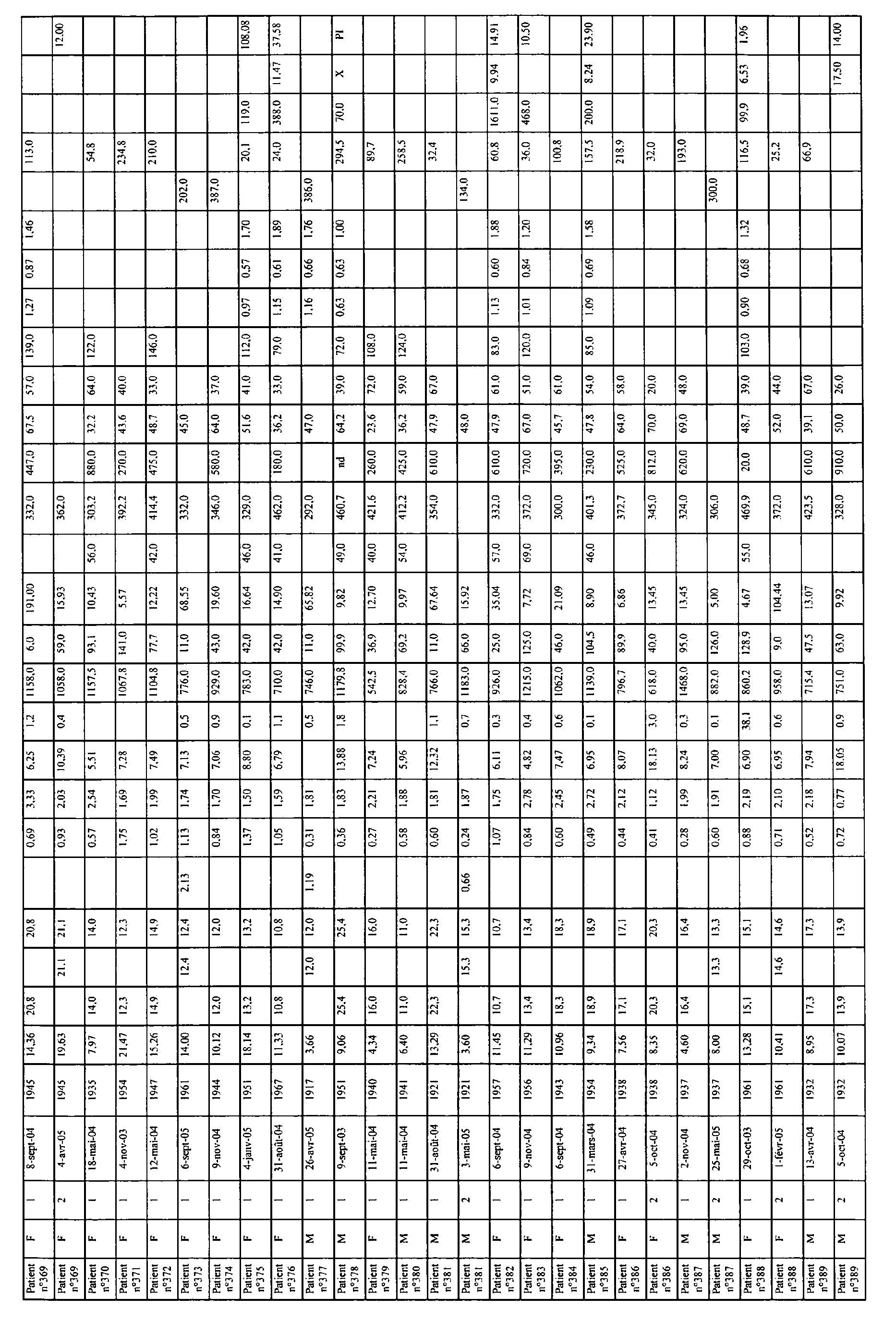
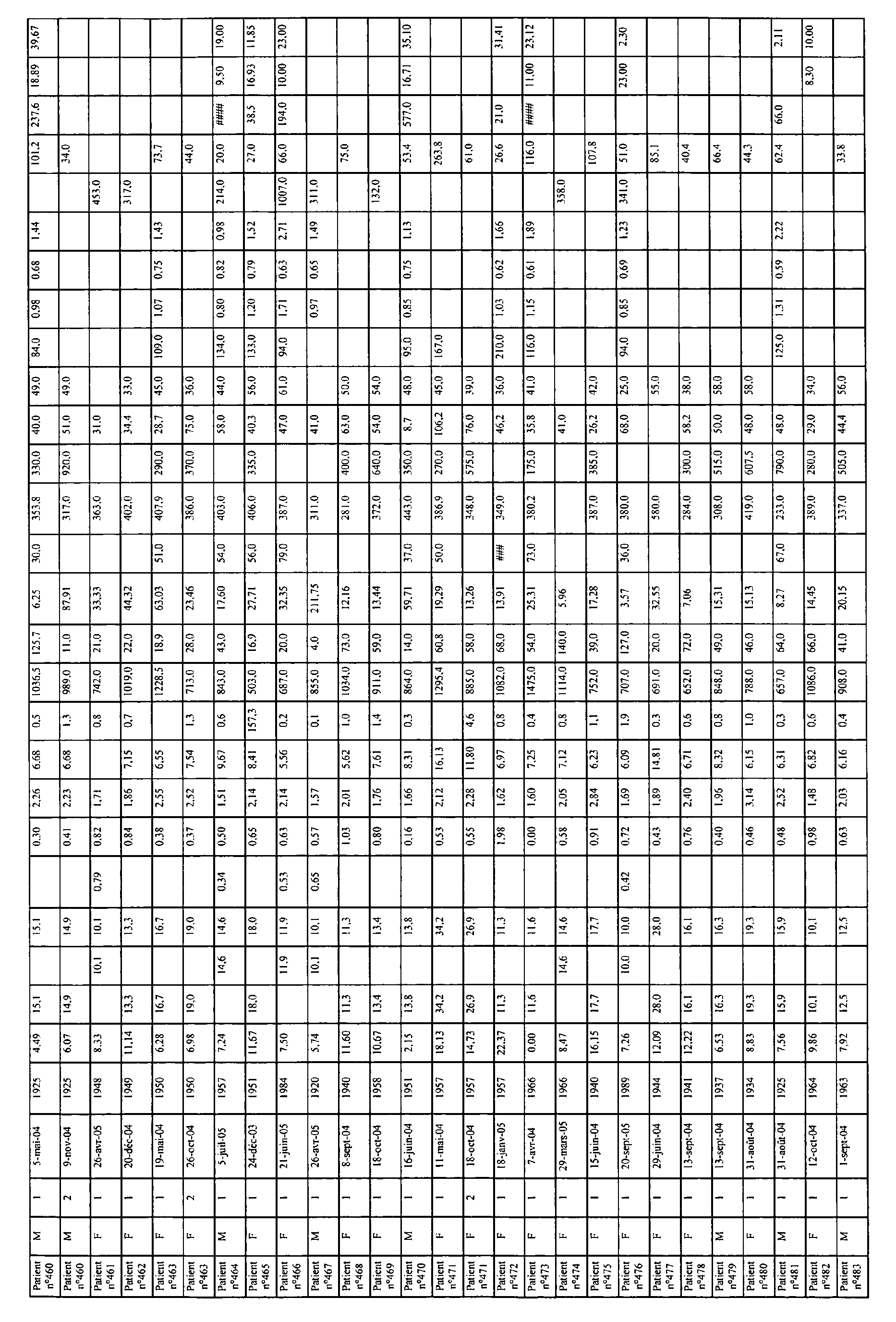
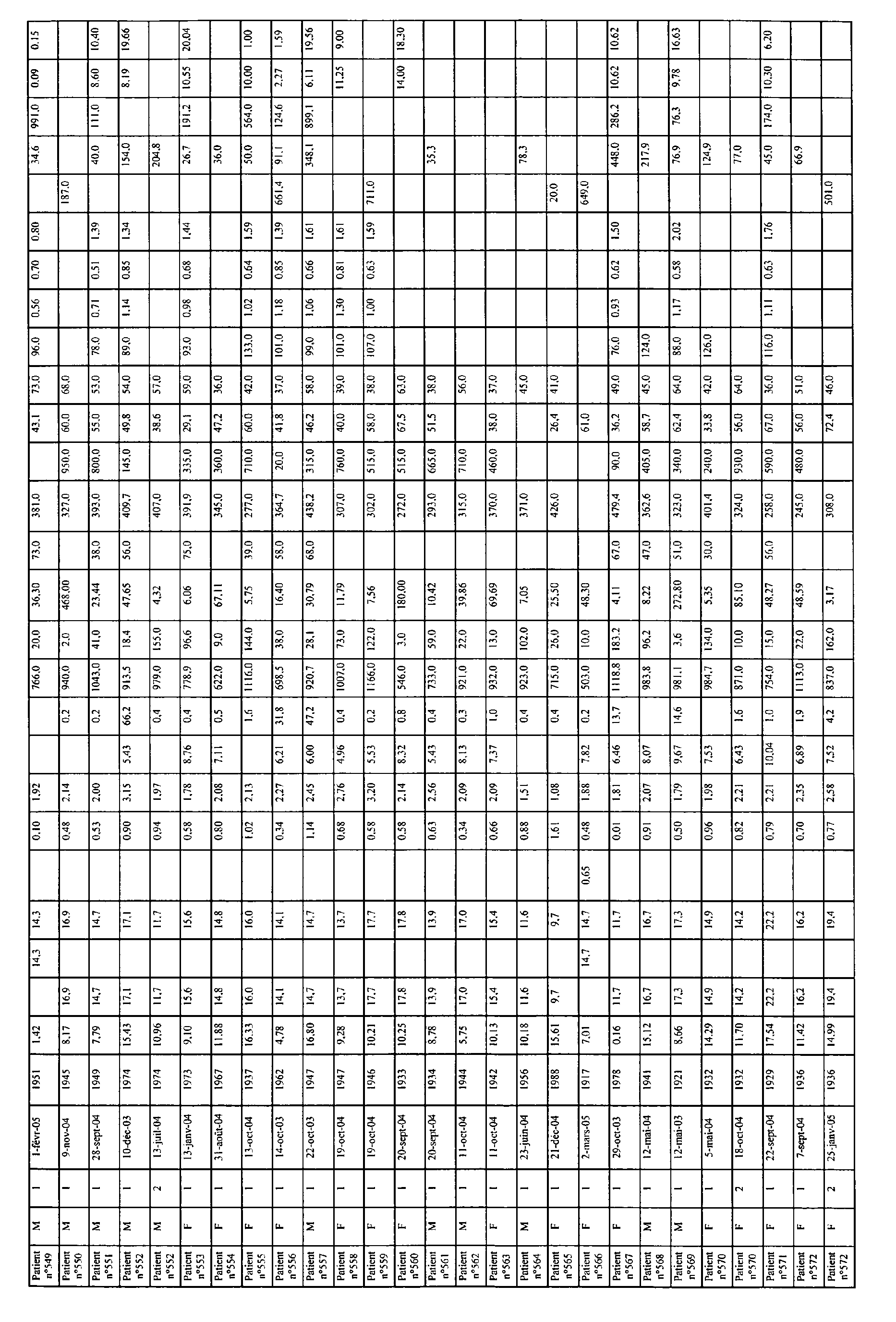
- Ce travail a permis d'obtenir une base de données très complète qui figure en annexe 1 à titre d'exemple.
- Les significations des abréviations des différents marqueurs biologiques, leurs unités et les normes sont précisées en annexe 2.
- Cette base de données a été complétée par des informations se rapportant aux caractéristiques descriptives de la population suivie : sexe, âge, habitat, activité professionnelle... et à l'anamnèse du dossier médical des patients : état de santé, antécédents personnels médicaux, et chirurgicaux, antécédents de la fratrie directe, maladie évolutive, traitements, niveau de stress....
- Cette base de données a été examinée par une équipe médicale pour identifier et éliminer d'éventuelles valeurs aberrantes puis soumise à une analyse statistique par une technique de modélisation de façon à pondérer les valeurs des différents marqueurs biologiques en fonction de paramètres tels que l'âge du patient et à valider celle-ci en s'appuyant sur la vérification de relations connues et évoquées dans la littérature médicale.
- On a ainsi vu apparaître des corrélations entre les différents marqueurs biologiques d'une part et entre certaines anomalies de ces marqueurs biologiques et certains éléments du dossier personnel et médical des patients d'autre part.
- Il est apparu que l'ensemble des marqueurs biologiques dosés ne permettait pas de reconnaître telle ou telle maladie mais que leurs anomalies renseignaient parfaitement sur l'état de santé globale des patients.
- Ainsi, deux groupes remarquables par leur phénotypes extrêmes (parfaite santé et très mauvaise santé) ont été individualisés et étudiés quant à leur absence ou haut niveau de stress oxydatif.
- L'étude des informations obtenues a conduit :
- à associer à chaque marqueur biologique une échelle de gravité en fonction des résultats obtenus sur l'ensemble des bilans,
- à réunir les marqueurs biologiques testés en groupes de marqueurs biologiques exprimant des informations différentes, certains exprimant plus l'état de santé des patients et d'autres étant plus liés à un risque élevé de développer telle ou telle pathologie, et
- à évaluer une grille de pondération des différents groupes de marqueurs biologiques et des différents marqueurs biologiques au sein de chaque groupe.
- On a finalement conçu une échelle permettant par des algorithmes mathématiques qui tiennent compte de l'ensemble des éléments susmentionnés de calculer pour chaque patient un score de 0 à 10 représentatif de son propre niveau de stress oxydatif.
- Cette échelle a permis de retrouver sur l'ensemble de la base de données les patients en parfaite santé et ceux présentant un mauvais état de santé.
- Il est à noter que d'un point de vue purement statistique ces travaux ont fait appel aux techniques et méthodes suivantes:
- Statistique descriptive : Test d'adéquation graphiques et numériques à des lois statistiques - Détermination d'estimateurs de niveau moyen et de dispersion,
- Tests graphiques et numériques de détection de valeurs aberrantes,
- Analyses d'écarts par étude des différences appariées et tests associés (paramétriques et non paramétriques),
- Analyses de corrélation et modélisation en Régression linéaire simple,
- Analyse en Composantes Principales,
- Modélisation en Régression PLS (Partial Least Squares & Discriminant Analysis) avec validation croisée selon le principe des blocs dits « splités ».
- L'évaluation de l'échelle est actuellement réalisable de façon interactive grâce à un utilitaire développé sous Microsoft® Excel dans sa version 2003 (Professionnelle) sous la forme d'une macro-commande acceptant les bilans incomplets du fait d'une pondération ajustée en fonction des dosages dont on dispose.
- Le logiciel de traitement statistique utilisé est le logiciel Jmp dans sa version 5.1.1 (A BUSINESS UNIT OF SAS - Copyright © 1989 - 2004 SAS Institute Inc).
- Pour valider l'échelle ainsi conçue, on a confié un fichier aléatoire de 30 patients à trois observateurs indépendants A, B et C experts dans le domaine du stress oxydatif.
- Il leur a été demandé de noter le bilan de chacun de ces patients de 0 à 10 en fonction de la gravité du stress oxydatif qu'ils imaginaient spontanément ce, sans qu'ils aient accès au dossier personnel et médical.
- L'annexe 3 reproduit les diagnostics de chacun des experts, leur consensus, c'est-à-dire la moyenne des notes accordées par ces experts, le score Spatient obtenu suite à la mise en oeuvre du procédé conforme à l'invention ainsi que l'écart entre ce consensus et ce score.
- Ces résultats prouvent que les trois experts ont fait des évaluations globalement équivalentes et superposables à la cotation obtenue par le procédé conforme à l'invention.
- Selon une autre caractéristique de l'invention, on rassemble les marqueurs biologiques en au moins trois groupes de marqueurs biologiques d'importance croissante correspondant respectivement à des antioxydants exogènes, c'est-à-dire apportés par l'extérieur, à des antioxydants endogènes, c'est-à-dire liés à la synthèse cellulaire et à des marqueurs de dégâts oxydatifs.
- Les deux premiers groupes de marqueurs biologiques renseignent sur l'état de santé des patients alors que le troisième groupe renseigne sur les risques qu'ils ont de développer certaines pathologies.
- Selon l'invention, on peut avantageusement attribuer au premier groupe de marqueurs biologiques correspondant à des antioxydants exogènes un poids égal à 1, au second groupe de marqueurs biologiques correspondant à des antioxydants endogènes un poids égal à 5 et au troisième groupe de marqueurs biologiques correspondant à des marqueurs de dégâts biologiques un poids égal à 10.
- Le premier groupe de marqueurs biologiques renferme de préférence au moins sept marqueurs biologiques constitués par la vitamine C, la vitamine E, le cuivre, le zinc, le sélénium, et les rapports vitamine C/vitamine E et cuivre/zinc.
- Ce premier groupe peut bien entendu également renfermer d'autres marqueurs parmi lesquels on peut à titre d'exemple mentionner l'alpha tocophérol (ou vitamine E), le gamma tocophérol, le cholestérol, le rapport vitamine E/cholestérol ou encore le bêta carotène.
- Le second groupe de marqueurs biologiques renferme quant à lui de préférence au moins quatre marqueurs biologiques constitués par le glutathion total GSH, le glutathion oxydé GSSG, les protéines thiols et le rapport GSH/GSSG.
- Ce second groupe peut lui aussi renfermer d'autres marqueurs biologiques tels qu'à titre d'exemple la glutathion peroxydase ou encore l'acide urique.
- Enfin, le troisième groupe de marqueurs biologiques renferme au moins un marqueur biologique choisi parmi les lipides basse densité oxydés (LDL Oxyd.) et le rapport 8 hydroxy 2guanosine/créatinine, ou ADN oxydé/créatinine.
- Ce troisième groupe peut également renfermer lui aussi d'autres marqueurs biologiques tels qu'à titre d'exemple les peroxydes lipidiques les anticorps contre les LDL Oxyd. ou l'ADN oxydé.
- Il est à noter que dans le cadre de l'invention on a obtenu des résultats globalement satisfaisants en attribuant dans chaque groupe un même poids, en particulier égal à 1 à chacun des marqueurs biologiques principaux susmentionnés.
- Il est par ailleurs à noter que la note d'un marqueur biologique sur l'échelle de gravité peut selon les marqueurs varier entre de 0 à 2 et de 0 à 10.
- Le procédé conforme à l'invention permet donc de fournir au médecin un score compris entre 0 et 10 donnant une indication sur l'état de stress oxydatif d'un patient, (stress oxydatif modéré ou important).
- Celui-ci peut ainsi, selon que ce score doive être ou non considéré comme normal, déterminer si le patient est en bonne ou en mauvaise santé.
- Dans le cas d'un stress oxydatif anormal (modéré ou important) le procédé permet d'effectuer une interprétation qualitative du score obtenu en recherchant quel est dans ce score le poids relatif des différents groupes de marqueurs biologiques.
- Cette interprétation permet au médecin de déterminer si le stress oxydatif anormal qui a été révélé par le score du patient est essentiellement lié, dans l'ordre d'importance :
- à une carence relative en antioxydants exogènes : vitamine C et/ou vitamine E et/ou cuivre et/ ou zinc et/ou sélénium...,
- à une carence relative en antioxydants endogènes : glutathion, protéines thiols...,
- ou à l'objectivation de dégâts oxydatifs déjà présents : LDL Oxyd., ADN oxydé...,
- A partir de cette constatation, le médecin peut décider de compléter ce bilan par des dosages auxiliaires, vérifier les apports alimentaires en fruits et légumes et/ou prescrire au patient un traitement des carences avérées grâce en particulier à l'administration de composés antioxydants.
- Cette prescription sera bien entendu accompagnée d'un contrôle du bilan au bout de quelques mois, après une prise en charge adaptée.








-
Abréviation Désignation Unité Normes Vit C Vitamine C µg/ml 8 - 18 Vit E Vitamine E µg/ml 8 - 15 Alpha tocoph Alpha tocophérol µg/ml 8 - 15 Gamma tocoph Gamma tocophérol µg/ml 0.28 - 2.42 Vit C/E Ratio Vitamine C / Vitamine E 0.53 - 1.19 Chol. Cholestérol g/l 1.40 - 2.00 Vit E/Chol Ratio Vitamine E / Cholestérol mg/g 4.4 - 7.0 βcaro Béta-carotène mg/l 0.08 - 0.36 GSH Glutathion µmol/l 717 - 1110 GSSG Glutathion oxydé µmol/l 1.17 - 5.32 Ratio G/G Ratio Glutathion/Glutathion oxydé 156 - 705 GPX Glutathion Péroxydase UI/g Hb 30 - 60 Prot Thiol Protéines Thiols µmol/l 310 -523 Cap Hydro Capacité Antioxydante totale hydrophile nMol eq. aAAml 268 - 361 Cap Lipo Capacité Antioxydante totale lipophile nMol eq. Trol/ml 25 - 50 AcideUrique Acide urique mg/l 22 - 59 Sel Sélénium µg/l 94 - 130 Cu Cuivre mg/l 0.7 - 1.4 Zn Zinc mg/l 0.7 - 1.2 Cu/Zn Ratio Cuivre/Zinc 1.00-1.17 Pero×.Lipid Péroxydes lipidiques µmol/l 48 - 400 LDL Oxyd Low Density Lipid Oxydés U/l 26 - 117 Atcp /LDL Anti-corps contre LDL oxydés U/l 200 - 600 8ohdG/ creat Ratio 8 Hydroxy-2 guanosine / créatinine µg/g créatinine 0 - 20 ADN OX Acide Désoxyribonucléinque Oxydé µg/l 0 - 26 
Claims (6)
- Procédé de détermination d'un score représentatif du stress oxydatif d'un patient, sur une échelle de 0 à 10,
caractérisé par
la succession des étapes suivantes :- dans une étape d'étalonnage initial :- on choisit une série de marqueurs biologiques liés au stress oxydatif et on évalue ces marqueurs biologiques par dosage, en particulier à partir de prélèvements sanguins, chez un panel de personnes saines ou présentant éventuellement différents types de pathologies et troubles cliniques connus de façon à obtenir une base de données, et- on effectue une analyse statistique de cette base de données en s'appuyant sur des relations connues dans le domaine médical et décrites dans la littérature de façon :- à établir pour chacun des marqueurs biologiques une échelle de gravité associée aux écarts constatés par rapport à des valeurs de référence,- à rassembler les marqueurs biologiques en au moins trois groupes de marqueurs biologiques exprimant respectivement des informations différentes pouvant être associées à des stades différents de développement du stress oxydatif et correspondant respectivement à des antioxydants exogènes, à des antioxydants endogènes et à des marqueurs de dégâts oxydatifs, et- à attribuer un poids d'une part à chaque groupe de marqueurs biologiques, et d'autre part à chacun des marqueurs biologiques au sein de chaque groupe, puis- on évalue plusieurs marqueurs biologiques du patient appartenant à plusieurs groupes de marqueurs biologiques,- on attribue à chacune des valeurs ainsi obtenues une note sur l'échelle de gravité, et- on calcule un score de stress oxydatif Spatient spécifique au patient en utilisant la formuledans laquelle Maxmarqueur représente la note maximum du marqueur biologique dans l'échelle de gravité.
- Procédé selon la revendication 1,
caractérisé en ce qu'
on attribue au premier groupe de marqueurs biologique correspondant à des antioxydants exogènes un poids égal à 1, au second groupe de marqueurs biologiques correspondant à des antioxydants endogènes un poids étal à 5, et au troisième groupe de marqueurs biologiques correspondant à des marqueurs de dégâts biologiques un poids égal à 10. - Procédé selon l'une quelconque des revendications 1 et 2,
caractérisé en ce que
le premier groupe de marqueurs biologiques renferme au moins sept marqueurs biologiques constitués par la vitamine C, la vitamine E, le cuivre, le zinc, le sélénium et les rapports vitamine C/vitamine E et cuivre/zinc. - Procédé selon l'une quelconque des revendications 1 à 3,
caractérisé en ce que
le second groupe de marqueurs biologiques renferme au moins quatre marqueurs biologiques constitués par le glutathion total GSH, le glutathion oxydé GSSG, les protéines thiols et le rapport GSH/GSSG. - Procédé selon l'une quelconque des revendications 1 à 4,
caractérisé en ce que
le troisième groupe de marqueurs biologiques renferme au moins un marqueur biologique choisi parmi les lipides basse densité oxydés LDL Oxyd. et le rapport 8 hydroxy 2guanosine/créatinine. - Procédé selon l'une quelconque des revendications 1 à 5,
caractérisé en ce que
la note d'un marqueur biologique sur l'échelle de gravité peut varier de 1 à 2 à de 1 à 10 selon les marqueurs.
Applications Claiming Priority (1)
| Application Number | Priority Date | Filing Date | Title |
|---|---|---|---|
| FR0512131A FR2894030B1 (fr) | 2005-11-30 | 2005-11-30 | Procede de determination d'un score representatif du stress oxydatif d'un patient, sur une echelle de 0 a 10 |
Publications (2)
| Publication Number | Publication Date |
|---|---|
| EP1793230A1 true EP1793230A1 (fr) | 2007-06-06 |
| EP1793230B1 EP1793230B1 (fr) | 2009-08-12 |
Family
ID=36593058
Family Applications (1)
| Application Number | Title | Priority Date | Filing Date |
|---|---|---|---|
| EP06301189A Not-in-force EP1793230B1 (fr) | 2005-11-30 | 2006-11-29 | Procédé de détermination d'un score représentatif du stress oxydatif d'un patient, sur une échelle de 0 à 10 |
Country Status (5)
| Country | Link |
|---|---|
| EP (1) | EP1793230B1 (fr) |
| AT (1) | ATE439599T1 (fr) |
| DE (1) | DE602006008406D1 (fr) |
| ES (1) | ES2331204T3 (fr) |
| FR (1) | FR2894030B1 (fr) |
Cited By (1)
| Publication number | Priority date | Publication date | Assignee | Title |
|---|---|---|---|---|
| EP2017623A1 (fr) | 2007-07-16 | 2009-01-21 | Swiss Line Services Ltd. | Procédé de prédiction d'un score représentatif du stress oxydatif d'un patient |
Families Citing this family (1)
| Publication number | Priority date | Publication date | Assignee | Title |
|---|---|---|---|---|
| CH710595A1 (fr) * | 2015-01-07 | 2016-07-15 | Michel Golay Dr | Méthode d'évaluation d'un score représentatif de la santé d'un patient et produits en améliorant le score. |
Citations (3)
| Publication number | Priority date | Publication date | Assignee | Title |
|---|---|---|---|---|
| WO2003016527A2 (fr) * | 2001-08-14 | 2003-02-27 | Probiox Sa | Procede permettant de detecter un stress oxydatif et trousse destinee a la mise en oeuvre de ce procede |
| WO2005020984A2 (fr) * | 2003-08-29 | 2005-03-10 | Aaipharma Inc. | Methode de reduction du stress oxydatif |
| WO2005086827A2 (fr) * | 2004-03-10 | 2005-09-22 | Albert Crum | Methodes permettant d'evaluer le besoin et l'efficacite d'un traitement aux antioxydants |
-
2005
- 2005-11-30 FR FR0512131A patent/FR2894030B1/fr not_active Expired - Fee Related
-
2006
- 2006-11-29 EP EP06301189A patent/EP1793230B1/fr not_active Not-in-force
- 2006-11-29 ES ES06301189T patent/ES2331204T3/es active Active
- 2006-11-29 DE DE602006008406T patent/DE602006008406D1/de active Active
- 2006-11-29 AT AT06301189T patent/ATE439599T1/de not_active IP Right Cessation
Patent Citations (3)
| Publication number | Priority date | Publication date | Assignee | Title |
|---|---|---|---|---|
| WO2003016527A2 (fr) * | 2001-08-14 | 2003-02-27 | Probiox Sa | Procede permettant de detecter un stress oxydatif et trousse destinee a la mise en oeuvre de ce procede |
| WO2005020984A2 (fr) * | 2003-08-29 | 2005-03-10 | Aaipharma Inc. | Methode de reduction du stress oxydatif |
| WO2005086827A2 (fr) * | 2004-03-10 | 2005-09-22 | Albert Crum | Methodes permettant d'evaluer le besoin et l'efficacite d'un traitement aux antioxydants |
Non-Patent Citations (3)
| Title |
|---|
| BERGMAN B ET AL: "Clinical usefulness of serum assays of neuron-specific enolase, carcinoembryonic antigen and CA-50 antigen in the diagnosis of lung cancer", EUROPEAN JOURNAL OF CANCER PART A: GENERAL TOPICS, vol. 29, no. 2, 1993, pages 198 - 202, XP002388140 * |
| L'ITALIEN G J ET AL: "Development and validation of a Bayesian model for perioperative cardiac risk assessment in a cohort of 1,081 vascular surgical candidates", JOURNAL OF THE AMERICAN COLLEGE OF CARDIOLOGY, vol. 27, no. 4, 1996, pages 779 - 786, XP002388141 * |
| NILSSEN O ET AL: "The 'WAM' score: Sensitivity and specificity of a user friendly biological screening test for alcohol problems in trauma patients", ADDICTION, vol. 91, no. 2, 1996, pages 255 - 262, XP008066022 * |
Cited By (2)
| Publication number | Priority date | Publication date | Assignee | Title |
|---|---|---|---|---|
| EP2017623A1 (fr) | 2007-07-16 | 2009-01-21 | Swiss Line Services Ltd. | Procédé de prédiction d'un score représentatif du stress oxydatif d'un patient |
| FR2919059A1 (fr) * | 2007-07-16 | 2009-01-23 | Michel Brack | Procede de prediction d'un score representatif du stress oxydatif d'un patient |
Also Published As
| Publication number | Publication date |
|---|---|
| FR2894030B1 (fr) | 2008-07-04 |
| EP1793230B1 (fr) | 2009-08-12 |
| ATE439599T1 (de) | 2009-08-15 |
| FR2894030A1 (fr) | 2007-06-01 |
| ES2331204T3 (es) | 2009-12-23 |
| DE602006008406D1 (de) | 2009-09-24 |
Similar Documents
| Publication | Publication Date | Title |
|---|---|---|
| Solfrizzi et al. | Dietary intake of unsaturated fatty acids and age-related cognitive decline: a 8.5-year follow-up of the Italian Longitudinal Study on Aging | |
| Fernandez-Barres et al. | The efficacy of a nutrition education intervention to prevent risk of malnutrition for dependent elderly patients receiving Home Care: A randomized controlled trial | |
| Christen et al. | Blood levels of homocysteine and increased risks of cardiovascular disease: causal or casual? | |
| Lyons et al. | Diabetic retinopathy and serum lipoprotein subclasses in the DCCT/EDIC cohort | |
| Beck et al. | Periodontal profile class is associated with prevalent diabetes, coronary heart disease, stroke, and systemic markers of C‐reactive protein and interleukin‐6 | |
| Catena et al. | Elevated homocysteine levels are associated with the metabolic syndrome and cardiovascular events in hypertensive patients | |
| Beydoun et al. | Plasma n− 3 fatty acids and the risk of cognitive decline in older adults: the Atherosclerosis Risk in Communities Study | |
| Schaefer et al. | Plasma phosphatidylcholine docosahexaenoic acid content and risk of dementia and Alzheimer disease: the Framingham Heart Study | |
| Coyne et al. | Diabetes mellitus and serum carotenoids: findings of a population-based study in Queensland, Australia | |
| Chen et al. | Dietary intakes of fat and risk of Parkinson’s disease | |
| Hodge et al. | Efficacy of ω-3 fatty acids in preventing age-related macular degeneration: a systematic review | |
| Fallon et al. | Homocysteine and ischaemic stroke in men: the Caerphilly study | |
| Wolfe et al. | Dietary linoleic and oleic fatty acids in relation to severe depressed mood: 10 years follow-up of a national cohort | |
| Williams et al. | Plasma carotenoids, retinol, tocopherols, and lipoproteins in preeclamptic and normotensive pregnant Zimbabwean women | |
| Assmann et al. | Unsaturated fatty acid intakes during midlife are positively associated with later cognitive function in older adults with modulating effects of antioxidant supplementation | |
| Shah et al. | Quality of life and psychosocial factors in renal transplant recipients | |
| Kawamoto et al. | Relationship between dry mouth and hypertension | |
| Klingberg et al. | Dietary intake of naturally occurring plant sterols is related to a lower risk of a first myocardial infarction in men but not in women in northern Sweden | |
| Mattei et al. | Diet quality, inflammation, and the ankle brachial index in adults with or without cardiometabolic conditions | |
| Jude et al. | Natural history and prognostic factors of diabetic nephropathy in type 2 diabetes | |
| Liu et al. | Higher direct bilirubin levels during mid-pregnancy are associated with lower risk of gestational diabetes mellitus | |
| Taylor et al. | Urinary calcium excretion and risk of chronic kidney disease in the general population | |
| Assmann et al. | Midlife plasma vitamin D concentrations and performance in different cognitive domains assessed 13 years later | |
| Arsenault et al. | Validity of estimated dietary eicosapentaenoic acid and docosahexaenoic acid intakes determined by interviewer-administered food frequency questionnaire among older adults with mild-to-moderate cognitive impairment or dementia | |
| EP1793230B1 (fr) | Procédé de détermination d'un score représentatif du stress oxydatif d'un patient, sur une échelle de 0 à 10 |
Legal Events
| Date | Code | Title | Description |
|---|---|---|---|
| PUAI | Public reference made under article 153(3) epc to a published international application that has entered the european phase |
Free format text: ORIGINAL CODE: 0009012 |
|
| AK | Designated contracting states |
Kind code of ref document: A1 Designated state(s): AT BE BG CH CY CZ DE DK EE ES FI FR GB GR HU IE IS IT LI LT LU LV MC NL PL PT RO SE SI SK TR |
|
| AX | Request for extension of the european patent |
Extension state: AL BA HR MK YU |
|
| 17P | Request for examination filed |
Effective date: 20071025 |
|
| AKX | Designation fees paid |
Designated state(s): AT BE BG CH CY CZ DE DK EE ES FI FR GB GR HU IE IS IT LI LT LU LV MC NL PL PT RO SE SI SK TR |
|
| RAP1 | Party data changed (applicant data changed or rights of an application transferred) |
Owner name: SWISS LINE SERVICES LTD. |
|
| RIN1 | Information on inventor provided before grant (corrected) |
Inventor name: BRACK, MICHEL Inventor name: CHAPMAN, JOHN Inventor name: KONTUSH, ANATOL Inventor name: DREYFUS, GERARD Inventor name: BONNEFONT-ROUSSELOT, DOMINIQUE Inventor name: BRACK, OLIVIER |
|
| GRAP | Despatch of communication of intention to grant a patent |
Free format text: ORIGINAL CODE: EPIDOSNIGR1 |
|
| GRAS | Grant fee paid |
Free format text: ORIGINAL CODE: EPIDOSNIGR3 |
|
| GRAA | (expected) grant |
Free format text: ORIGINAL CODE: 0009210 |
|
| AK | Designated contracting states |
Kind code of ref document: B1 Designated state(s): AT BE BG CH CY CZ DE DK EE ES FI FR GB GR HU IE IS IT LI LT LU LV MC NL PL PT RO SE SI SK TR |
|
| REG | Reference to a national code |
Ref country code: GB Ref legal event code: FG4D Free format text: NOT ENGLISH |
|
| REG | Reference to a national code |
Ref country code: CH Ref legal event code: EP |
|
| REG | Reference to a national code |
Ref country code: IE Ref legal event code: FG4D |
|
| REF | Corresponds to: |
Ref document number: 602006008406 Country of ref document: DE Date of ref document: 20090924 Kind code of ref document: P |
|
| REG | Reference to a national code |
Ref country code: CH Ref legal event code: NV Representative=s name: MICHELI & CIE SA |
|
| REG | Reference to a national code |
Ref country code: ES Ref legal event code: FG2A Ref document number: 2331204 Country of ref document: ES Kind code of ref document: T3 |
|
| LTIE | Lt: invalidation of european patent or patent extension |
Effective date: 20090812 |
|
| PG25 | Lapsed in a contracting state [announced via postgrant information from national office to epo] |
Ref country code: LT Free format text: LAPSE BECAUSE OF FAILURE TO SUBMIT A TRANSLATION OF THE DESCRIPTION OR TO PAY THE FEE WITHIN THE PRESCRIBED TIME-LIMIT Effective date: 20090812 Ref country code: SE Free format text: LAPSE BECAUSE OF FAILURE TO SUBMIT A TRANSLATION OF THE DESCRIPTION OR TO PAY THE FEE WITHIN THE PRESCRIBED TIME-LIMIT Effective date: 20090812 Ref country code: FI Free format text: LAPSE BECAUSE OF FAILURE TO SUBMIT A TRANSLATION OF THE DESCRIPTION OR TO PAY THE FEE WITHIN THE PRESCRIBED TIME-LIMIT Effective date: 20090812 Ref country code: AT Free format text: LAPSE BECAUSE OF FAILURE TO SUBMIT A TRANSLATION OF THE DESCRIPTION OR TO PAY THE FEE WITHIN THE PRESCRIBED TIME-LIMIT Effective date: 20090812 Ref country code: IS Free format text: LAPSE BECAUSE OF FAILURE TO SUBMIT A TRANSLATION OF THE DESCRIPTION OR TO PAY THE FEE WITHIN THE PRESCRIBED TIME-LIMIT Effective date: 20091212 |
|
| NLV1 | Nl: lapsed or annulled due to failure to fulfill the requirements of art. 29p and 29m of the patents act | ||
| PG25 | Lapsed in a contracting state [announced via postgrant information from national office to epo] |
Ref country code: LV Free format text: LAPSE BECAUSE OF FAILURE TO SUBMIT A TRANSLATION OF THE DESCRIPTION OR TO PAY THE FEE WITHIN THE PRESCRIBED TIME-LIMIT Effective date: 20090812 Ref country code: NL Free format text: LAPSE BECAUSE OF FAILURE TO SUBMIT A TRANSLATION OF THE DESCRIPTION OR TO PAY THE FEE WITHIN THE PRESCRIBED TIME-LIMIT Effective date: 20090812 Ref country code: SI Free format text: LAPSE BECAUSE OF FAILURE TO SUBMIT A TRANSLATION OF THE DESCRIPTION OR TO PAY THE FEE WITHIN THE PRESCRIBED TIME-LIMIT Effective date: 20090812 Ref country code: PL Free format text: LAPSE BECAUSE OF FAILURE TO SUBMIT A TRANSLATION OF THE DESCRIPTION OR TO PAY THE FEE WITHIN THE PRESCRIBED TIME-LIMIT Effective date: 20090812 |
|
| REG | Reference to a national code |
Ref country code: IE Ref legal event code: FD4D |
|
| PG25 | Lapsed in a contracting state [announced via postgrant information from national office to epo] |
Ref country code: PT Free format text: LAPSE BECAUSE OF FAILURE TO SUBMIT A TRANSLATION OF THE DESCRIPTION OR TO PAY THE FEE WITHIN THE PRESCRIBED TIME-LIMIT Effective date: 20091212 Ref country code: BG Free format text: LAPSE BECAUSE OF FAILURE TO SUBMIT A TRANSLATION OF THE DESCRIPTION OR TO PAY THE FEE WITHIN THE PRESCRIBED TIME-LIMIT Effective date: 20091112 |
|
| PG25 | Lapsed in a contracting state [announced via postgrant information from national office to epo] |
Ref country code: DK Free format text: LAPSE BECAUSE OF FAILURE TO SUBMIT A TRANSLATION OF THE DESCRIPTION OR TO PAY THE FEE WITHIN THE PRESCRIBED TIME-LIMIT Effective date: 20090812 Ref country code: RO Free format text: LAPSE BECAUSE OF FAILURE TO SUBMIT A TRANSLATION OF THE DESCRIPTION OR TO PAY THE FEE WITHIN THE PRESCRIBED TIME-LIMIT Effective date: 20090812 Ref country code: CZ Free format text: LAPSE BECAUSE OF FAILURE TO SUBMIT A TRANSLATION OF THE DESCRIPTION OR TO PAY THE FEE WITHIN THE PRESCRIBED TIME-LIMIT Effective date: 20090812 Ref country code: EE Free format text: LAPSE BECAUSE OF FAILURE TO SUBMIT A TRANSLATION OF THE DESCRIPTION OR TO PAY THE FEE WITHIN THE PRESCRIBED TIME-LIMIT Effective date: 20090812 Ref country code: IE Free format text: LAPSE BECAUSE OF FAILURE TO SUBMIT A TRANSLATION OF THE DESCRIPTION OR TO PAY THE FEE WITHIN THE PRESCRIBED TIME-LIMIT Effective date: 20090812 |
|
| PG25 | Lapsed in a contracting state [announced via postgrant information from national office to epo] |
Ref country code: SK Free format text: LAPSE BECAUSE OF FAILURE TO SUBMIT A TRANSLATION OF THE DESCRIPTION OR TO PAY THE FEE WITHIN THE PRESCRIBED TIME-LIMIT Effective date: 20090812 |
|
| PLBE | No opposition filed within time limit |
Free format text: ORIGINAL CODE: 0009261 |
|
| STAA | Information on the status of an ep patent application or granted ep patent |
Free format text: STATUS: NO OPPOSITION FILED WITHIN TIME LIMIT |
|
| PG25 | Lapsed in a contracting state [announced via postgrant information from national office to epo] |
Ref country code: MC Free format text: LAPSE BECAUSE OF NON-PAYMENT OF DUE FEES Effective date: 20091130 |
|
| 26N | No opposition filed |
Effective date: 20100517 |
|
| PG25 | Lapsed in a contracting state [announced via postgrant information from national office to epo] |
Ref country code: GR Free format text: LAPSE BECAUSE OF FAILURE TO SUBMIT A TRANSLATION OF THE DESCRIPTION OR TO PAY THE FEE WITHIN THE PRESCRIBED TIME-LIMIT Effective date: 20091113 |
|
| PG25 | Lapsed in a contracting state [announced via postgrant information from national office to epo] |
Ref country code: LU Free format text: LAPSE BECAUSE OF NON-PAYMENT OF DUE FEES Effective date: 20091129 |
|
| PG25 | Lapsed in a contracting state [announced via postgrant information from national office to epo] |
Ref country code: HU Free format text: LAPSE BECAUSE OF FAILURE TO SUBMIT A TRANSLATION OF THE DESCRIPTION OR TO PAY THE FEE WITHIN THE PRESCRIBED TIME-LIMIT Effective date: 20100213 |
|
| PG25 | Lapsed in a contracting state [announced via postgrant information from national office to epo] |
Ref country code: TR Free format text: LAPSE BECAUSE OF FAILURE TO SUBMIT A TRANSLATION OF THE DESCRIPTION OR TO PAY THE FEE WITHIN THE PRESCRIBED TIME-LIMIT Effective date: 20090812 |
|
| PG25 | Lapsed in a contracting state [announced via postgrant information from national office to epo] |
Ref country code: CY Free format text: LAPSE BECAUSE OF FAILURE TO SUBMIT A TRANSLATION OF THE DESCRIPTION OR TO PAY THE FEE WITHIN THE PRESCRIBED TIME-LIMIT Effective date: 20090812 |
|
| PGFP | Annual fee paid to national office [announced via postgrant information from national office to epo] |
Ref country code: DE Payment date: 20121121 Year of fee payment: 7 |
|
| PGFP | Annual fee paid to national office [announced via postgrant information from national office to epo] |
Ref country code: IT Payment date: 20121121 Year of fee payment: 7 Ref country code: GB Payment date: 20121120 Year of fee payment: 7 Ref country code: BE Payment date: 20121122 Year of fee payment: 7 Ref country code: ES Payment date: 20121122 Year of fee payment: 7 |
|
| BERE | Be: lapsed |
Owner name: SWISS LINE SERVICES LTD. Effective date: 20131130 |
|
| GBPC | Gb: european patent ceased through non-payment of renewal fee |
Effective date: 20131129 |
|
| PG25 | Lapsed in a contracting state [announced via postgrant information from national office to epo] |
Ref country code: IT Free format text: LAPSE BECAUSE OF NON-PAYMENT OF DUE FEES Effective date: 20131129 Ref country code: DE Free format text: LAPSE BECAUSE OF NON-PAYMENT OF DUE FEES Effective date: 20140603 |
|
| REG | Reference to a national code |
Ref country code: DE Ref legal event code: R119 Ref document number: 602006008406 Country of ref document: DE Effective date: 20140603 |
|
| PG25 | Lapsed in a contracting state [announced via postgrant information from national office to epo] |
Ref country code: BE Free format text: LAPSE BECAUSE OF NON-PAYMENT OF DUE FEES Effective date: 20131130 |
|
| PG25 | Lapsed in a contracting state [announced via postgrant information from national office to epo] |
Ref country code: GB Free format text: LAPSE BECAUSE OF NON-PAYMENT OF DUE FEES Effective date: 20131129 |
|
| REG | Reference to a national code |
Ref country code: ES Ref legal event code: FD2A Effective date: 20150708 |
|
| PG25 | Lapsed in a contracting state [announced via postgrant information from national office to epo] |
Ref country code: ES Free format text: LAPSE BECAUSE OF NON-PAYMENT OF DUE FEES Effective date: 20131130 |
|
| REG | Reference to a national code |
Ref country code: FR Ref legal event code: PLFP Year of fee payment: 10 |
|
| REG | Reference to a national code |
Ref country code: FR Ref legal event code: PLFP Year of fee payment: 11 |
|
| REG | Reference to a national code |
Ref country code: FR Ref legal event code: PLFP Year of fee payment: 12 |
|
| PGFP | Annual fee paid to national office [announced via postgrant information from national office to epo] |
Ref country code: FR Payment date: 20171121 Year of fee payment: 12 |
|
| PGFP | Annual fee paid to national office [announced via postgrant information from national office to epo] |
Ref country code: CH Payment date: 20171017 Year of fee payment: 12 |
|
| REG | Reference to a national code |
Ref country code: CH Ref legal event code: PL |
|
| PG25 | Lapsed in a contracting state [announced via postgrant information from national office to epo] |
Ref country code: LI Free format text: LAPSE BECAUSE OF NON-PAYMENT OF DUE FEES Effective date: 20181130 Ref country code: CH Free format text: LAPSE BECAUSE OF NON-PAYMENT OF DUE FEES Effective date: 20181130 |
|
| PG25 | Lapsed in a contracting state [announced via postgrant information from national office to epo] |
Ref country code: FR Free format text: LAPSE BECAUSE OF NON-PAYMENT OF DUE FEES Effective date: 20181130 |