EP2017136A2 - Energy-absorbing device and method - Google Patents
Energy-absorbing device and method Download PDFInfo
- Publication number
- EP2017136A2 EP2017136A2 EP08160602A EP08160602A EP2017136A2 EP 2017136 A2 EP2017136 A2 EP 2017136A2 EP 08160602 A EP08160602 A EP 08160602A EP 08160602 A EP08160602 A EP 08160602A EP 2017136 A2 EP2017136 A2 EP 2017136A2
- Authority
- EP
- European Patent Office
- Prior art keywords
- energy
- absorbing
- pivot points
- absorbing element
- parallelogram
- Prior art date
- Legal status (The legal status is an assumption and is not a legal conclusion. Google has not performed a legal analysis and makes no representation as to the accuracy of the status listed.)
- Withdrawn
Links
Images

Classifications
-
- B—PERFORMING OPERATIONS; TRANSPORTING
- B60—VEHICLES IN GENERAL
- B60R—VEHICLES, VEHICLE FITTINGS, OR VEHICLE PARTS, NOT OTHERWISE PROVIDED FOR
- B60R19/00—Wheel guards; Radiator guards, e.g. grilles; Obstruction removers; Fittings damping bouncing force in collisions
- B60R19/02—Bumpers, i.e. impact receiving or absorbing members for protecting vehicles or fending off blows from other vehicles or objects
- B60R19/24—Arrangements for mounting bumpers on vehicles
- B60R19/26—Arrangements for mounting bumpers on vehicles comprising yieldable mounting means
- B60R19/34—Arrangements for mounting bumpers on vehicles comprising yieldable mounting means destroyed upon impact, e.g. one-shot type
Definitions
- Energy-absorbing devices and methods are known in the art and may be realized in a variety of ways.
- known energy-absorbing devices and methods suffer from numerous drawbacks, such as, for example, the energy applied to the absorbing device sometimes being redirected in a way that may be dangerous and harmful, such as when a car bumper twists and bends into the car upon impact or collision, etc.
- Energy-absorbing device 100 may comprise a first main part 102 and a second main part 104, arranged in a parallelogram construction with secondary first and second parts 106 and 108, so that first main part 102 is substantially parallel to second main part 104, and secondary first and second parts 106 and 108 are substantially parallel to each other.
- These four parallelogram sides 102, 104, 106, and 108 are pivotally connected through pivot points A, A', B, and B' so as to allow parallel movement of the parallelogram sides with respect to each other.
- Energy-absorbing device 100 further comprises energy-absorbing element 110 connected between two opposite pivot points of said parallelogram, such as pivot points A and B in Fig. 1A .
- FIGs. 2A and 2B are schematic front view and perspective view, respectively, of an energy-absorbing device 100 according to embodiments of the present invention after its exposure to a mechanical impact.
- Figs. 2A and 2B are schematic front view and perspective view, respectively, of an energy-absorbing device 100 according to embodiments of the present invention after its exposure to a mechanical impact.
- the shortening of the distance between points A and B due to the application of force F bends absorbing element 110.
- main parts 102 and 104 maintain parallelism between themselves during the change caused to device 100 by the action of force F.
- absorbing element 110 may be selected to achieve a desired total absorbed energy per distance of travel of first main part 102 with respect to second main part 104.
- the mechanical features of absorbing element 110 may be selected to set the amount of force applied along force arrow lines F that will begin to bend absorbing element 110.
- absorbing device 100 may be useful as part of an absorbing element of a vehicle, such as a bumper in a car.
- one of the features of device 100 is keeping parallelism between first main part 102 with respect to second main part 104 during the absorption of the energy of the accident. This feature may be relied upon to ensure that the outer part of a bumper (not shown) connected, for example, to second main part 104, remains in the same orientation with respect to the body of the car, to which first main part 102 may be connected.
- absorbing element 110 may be designed to absorb energy when being stretched, in which case it may be attached to points A' and B', as discussed in detail above.
- the physical and geometrical features of absorbing element 110 may be designed to provide a desired graph of energy absorption with respect to the travel of first main part 102 with respect to second main part 104.
- absorbing element 110 may be designed to absorb most of the energy during the beginning of the travel of first main part 102 with respect to second main part 104.
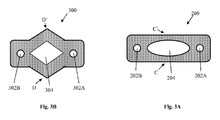
- Figs. 3A and 3B are schematic illustrations of energy-absorbing elements 200 and 300, respectively, according to some embodiments of the present invention.
- energy-absorbing elements may have the shape of, for example, element 200 or element 300.
- Energy-absorbing element 200 is so designed that when it is connected through its holes 202A and 202B to pivots A' and B' and the force developing between pivots A' and B' exceeds certain first value - and, respectively, when the energy absorbed by element 200 exceeds certain amount - then energy element 200 will be torn substantially close to or at areas C and C'.
- element 300 when energy-absorbing element 300 is connected through its holes 302A and 302B to pivots A' and B' and when the force developing between pivots A' and B' exceeds certain second value, element 300 will first begin to elongate substantially close to or at areas D and D', absorbing the energy applied to it and transforming that energy into deformation, thereby straightening out areas D and D'. If and when element 300 passes the point of elasticity and the force applied between pivots A' and B' continues to be applied, then element 300 will be torn.
- energy-absorbing elements 110, 200, or 300 may be used to achieve other desired energy absorption curves and/or energy-absorbing element breaking points.
Landscapes
- Engineering & Computer Science (AREA)
- Mechanical Engineering (AREA)
- Vibration Dampers (AREA)
Abstract
Description
- Energy-absorbing devices and methods are known in the art and may be realized in a variety of ways. However, known energy-absorbing devices and methods suffer from numerous drawbacks, such as, for example, the energy applied to the absorbing device sometimes being redirected in a way that may be dangerous and harmful, such as when a car bumper twists and bends into the car upon impact or collision, etc.
- The subject matter regarded as the invention is particularly pointed out and distinctly claimed in the concluding portion of the specification. The invention, however, both as to organization and method of operation, together with objects, features, and advantages thereof, may best be understood by reference to the following detailed description when read with the accompanying drawings in which:
-
Figs. 1A and 1B are schematic front view and perspective view, respectively, of an embodiment of the present invention before its exposure to a mechanical impact; -
Figs. 2A and 2B are schematic front view and perspective view, respectively, of an embodiment of the present invention after its exposure to a mechanical impact; and -
Figs. 3A and 3B are schematic illustrations of energy-absorbing elements according to some embodiments of the present invention. - It will be appreciated that for simplicity and clarity of illustration, elements shown in the figures have not necessarily been drawn to scale. For example, the dimensions of some of the elements may be exaggerated relative to other elements for clarity. Further, where considered appropriate, reference numerals may be repeated among the figures to indicate corresponding or analogous elements.
- In the following detailed description, numerous specific details are set forth in order to provide a thorough understanding of the invention. However, it will be understood by those skilled in the art that the present invention may be practiced without these specific details. In other instances, well-known methods, procedures, and components have not been described in detail so as not to obscure the present invention.
- Reference is now made to
Figs. 1A and 1B , which are schematic front view and perspective view, respectively, of an energy-absorbingdevice 100 according to embodiments of the present invention before its exposure to a mechanical impact. Energy-absorbingdevice 100 may comprise a firstmain part 102 and a secondmain part 104, arranged in a parallelogram construction with secondary first andsecond parts main part 102 is substantially parallel to secondmain part 104, and secondary first andsecond parts parallelogram sides Figs. 1A and 1B , and when the main parts of the parallelogram are free to move with respect to each other, then secondmain part 104 is able to move horizontally to the left with respect to the drawing and/or firstmain part 102 is able to move to the right, with the end result being pivot points A and B moving closer to each other. Energy-absorbingdevice 100 further comprises energy-absorbingelement 110 connected between two opposite pivot points of said parallelogram, such as pivot points A and B inFig. 1A . When energy-absorbingelement 110 is connected between points A and B, movement of the first and secondmain parts element 110 by folding it, bringing pivot points A and B closer to each other. Conversely, when energy-absorbingelement 110 is connected between two other pivot points A' and B' of the parallelogram, the application of force F will cause energy-absorbingelement 110 to un-bend in the opposite direction, causing it to straighten out, thereby bringing pivot points A' and B' further away from each other, while bringing pivot points A and B closer to each other. - Reference is now also made to
Figs. 2A and 2B , which are schematic front view and perspective view, respectively, of an energy-absorbingdevice 100 according to embodiments of the present invention after its exposure to a mechanical impact. As is readily evident, the shortening of the distance between points A and B due to the application of force Fbends absorbing element 110. It is also evident thatmain parts device 100 by the action of force F. - The exact mechanical features of absorbing
element 110, such as its shape, the size and shape of its cross-section at a given point, etc., which may contribute to the amount of energy absorbed by absorbingelement 110 when force F is applied, as well as to the amount of energy required to bend it, may be selected to achieve a desired total absorbed energy per distance of travel of firstmain part 102 with respect to secondmain part 104. Similarly, the mechanical features of absorbingelement 110 may be selected to set the amount of force applied along force arrow lines F that will begin to bend absorbingelement 110. - According to some embodiments of the present invention, absorbing
device 100 may be useful as part of an absorbing element of a vehicle, such as a bumper in a car. According to embodiments of the present invention, one of the features ofdevice 100 is keeping parallelism between firstmain part 102 with respect to secondmain part 104 during the absorption of the energy of the accident. This feature may be relied upon to ensure that the outer part of a bumper (not shown) connected, for example, to secondmain part 104, remains in the same orientation with respect to the body of the car, to which firstmain part 102 may be connected. - Additionally,
device 100 may be easily fixed after being involved in energy absorption, such as after having been activated due to an accident or collision, simply by replacing used absorbingelement 110 with a new one. Further, according to embodiments of the present invention, absorbingelement 110 may be designed to absorb energy when being stretched, in which case it may be attached to points A' and B', as discussed in detail above. Moreover, according to embodiments of the present invention, the physical and geometrical features of absorbingelement 110 may be designed to provide a desired graph of energy absorption with respect to the travel of firstmain part 102 with respect to secondmain part 104. For example, absorbingelement 110 may be designed to absorb most of the energy during the beginning of the travel of firstmain part 102 with respect to secondmain part 104. - Reference is now also made to
Figs. 3A and 3B , which are schematic illustrations of energy-absorbingelements device 100 is operated so that application of force F causes the distance between the pivots A' and B' ofFig. 1A (to which energy-absorbing element is connected) to decrease, then energy-absorbing elements may have the shape of, for example,element 200 orelement 300. Energy-absorbingelement 200 is so designed that when it is connected through itsholes element 200 exceeds certain amount - thenenergy element 200 will be torn substantially close to or at areas C and C'. - According to another embodiment of the invention, when energy-absorbing
element 300 is connected through itsholes element 300 will first begin to elongate substantially close to or at areas D and D', absorbing the energy applied to it and transforming that energy into deformation, thereby straightening out areas D and D'. If and whenelement 300 passes the point of elasticity and the force applied between pivots A' and B' continues to be applied, thenelement 300 will be torn. - Therefore, it can readily be seen that other shapes and/or relative sizes of energy-absorbing
elements - While certain features of the invention have been illustrated and described herein, many modifications, substitutions, changes, and equivalents will now occur to those of ordinary skill in the art. It is, therefore, to be understood that the appended claims are intended to cover all such modifications and changes as fall within the true spirit of the invention.
Claims (8)
- An apparatus comprising:a first and a second main parts connected substantially parallel to each other by a first and a second secondary parts, said main and secondary parts forming a pivotally connected parallelogram in its four comers;an energy-absorbing element connected between two opposing pivot points of said parallelogram, wherein an angle change between said main and secondary parts of said parallelogram leads to a change in distance between said two opposing pivot points.
- The apparatus of claim 1, wherein said energy-absorbing element comprises an elongated curved element between said two opposing pivot points, wherein said curved element is to bend when said apparatus is subject to a force applied substantially parallel to said first and a second main parts so that said two opposing pivot points get closer to each other.
- The apparatus of claim 1, wherein said energy-absorbing element comprises an elongated element connected between said two opposing pivot points, wherein said elongated element comprises a cut out in it to form narrowed break down zones, said elongated element is to break down when said apparatus is subject to a force applied substantially parallel to said first and a second main parts so that said two opposing pivot points get closer to each other.
- The apparatus of claims 2 or 3 wherein said energy-absorbing element is to absorb a predefined amount of energy before break down.
- A method for absorbing mechanical energy comprising:providing an energy-absorbing element between two opposing pivot points of an energy-absorbing device having a parallelogram-like form; andapplying a mechanical force to said parallelogram of said energy-absorbing device to change the distance between said two opposing pivot points.
- The method of claim 5, wherein said energy absorbing element is shaped as one of an elongated curved element and elongated element which comprises a cut out in it to form narrowed break down zones.
- The method of claim 5 wherein said energy-absorbing element is to absorb a predefined amount of mechanical energy before break down.
- The apparatus of claim 1, wherein said energy-absorbing element comprises an elongated curved part between said pivot points, wherein said curved part is bent away from said second main part and toward said first main part.
Applications Claiming Priority (1)
| Application Number | Priority Date | Filing Date | Title |
|---|---|---|---|
| US92995207P | 2007-07-19 | 2007-07-19 |
Publications (2)
| Publication Number | Publication Date |
|---|---|
| EP2017136A2 true EP2017136A2 (en) | 2009-01-21 |
| EP2017136A3 EP2017136A3 (en) | 2011-04-06 |
Family
ID=39917150
Family Applications (1)
| Application Number | Title | Priority Date | Filing Date |
|---|---|---|---|
| EP08160602A Withdrawn EP2017136A3 (en) | 2007-07-19 | 2008-07-17 | Energy-absorbing device and method |
Country Status (1)
| Country | Link |
|---|---|
| EP (1) | EP2017136A3 (en) |
Family Cites Families (3)
| Publication number | Priority date | Publication date | Assignee | Title |
|---|---|---|---|---|
| GB506719A (en) * | 1937-11-29 | 1939-05-30 | Gen Aircraft Ltd | Improvements relating to aircraft undercarriages |
| DE1812785B2 (en) * | 1968-12-05 | 1979-04-26 | Recaro Gmbh & Co, 7000 Stuttgart | Safety seat for vehicles |
| DE2830981C2 (en) * | 1978-07-14 | 1984-11-29 | AGS Aufbauten Gesellschaft Siegerland mbH & Co KG, 5900 Siegen | Impact protection device for the rear end of a motor vehicle, in particular a light truck |
-
2008
- 2008-07-17 EP EP08160602A patent/EP2017136A3/en not_active Withdrawn
Also Published As
| Publication number | Publication date |
|---|---|
| EP2017136A3 (en) | 2011-04-06 |
Similar Documents
| Publication | Publication Date | Title |
|---|---|---|
| JP5484481B2 (en) | Vehicle collision energy absorber having multiple collision energy absorption stages | |
| CN107031544A (en) | Bumper unit for motor vehicles | |
| US7731235B2 (en) | Steering column for a motor vehicle | |
| EP2130724A1 (en) | Vehicular metal absorber, vehicular bumper system, vehicular bumper absorber, and automobile bumper system | |
| RU2576674C2 (en) | Automotive shock absorber | |
| JP6468500B2 (en) | Roadside collision mitigation device | |
| CN101844550B (en) | Automobile bumper with two energy-absorbing modes | |
| US20160280271A1 (en) | Vehicle body comprising an interception device for frontal collisions with a slight overlap | |
| CN107820468A (en) | Energy-absorbing knee bolsters for vehicles | |
| CN202481129U (en) | Energy-absorbing mechanism with improved structure for automobile column | |
| CN114987375A (en) | A bumper device and vehicle | |
| CN103818428A (en) | Steering column crumpling energy absorbing device and steering column assembly | |
| US12479020B2 (en) | Method for manufacturing reinforcement bar of vehicle bumper | |
| US10099639B1 (en) | Energy absorbing device | |
| JP2010511555A (en) | Energy absorber | |
| US7124866B2 (en) | Adaptive energy absorber | |
| CN109591749A (en) | Energy absorption device and vehicle | |
| CN104527557B (en) | A kind of multistage protection bumper | |
| CN221023573U (en) | Buffer energy-absorbing automobile anti-collision safety device | |
| AU2015372440B2 (en) | Mounting assembly | |
| CN205652087U (en) | A bumper system and vehicle for vehicle | |
| CN110356350A (en) | Vehicle Energy Absorber | |
| CN106828220B (en) | Vehicle seat and vehicle | |
| CN104442681B (en) | Pedestrian leg guard device | |
| KR20110071250A (en) | Crash box of bumper for vehicle |
Legal Events
| Date | Code | Title | Description |
|---|---|---|---|
| PUAI | Public reference made under article 153(3) epc to a published international application that has entered the european phase |
Free format text: ORIGINAL CODE: 0009012 |
|
| AK | Designated contracting states |
Kind code of ref document: A2 Designated state(s): AT BE BG CH CY CZ DE DK EE ES FI FR GB GR HR HU IE IS IT LI LT LU LV MC MT NL NO PL PT RO SE SI SK TR |
|
| AX | Request for extension of the european patent |
Extension state: AL BA MK RS |
|
| PUAL | Search report despatched |
Free format text: ORIGINAL CODE: 0009013 |
|
| AK | Designated contracting states |
Kind code of ref document: A3 Designated state(s): AT BE BG CH CY CZ DE DK EE ES FI FR GB GR HR HU IE IS IT LI LT LU LV MC MT NL NO PL PT RO SE SI SK TR |
|
| AX | Request for extension of the european patent |
Extension state: AL BA MK RS |
|
| RIC1 | Information provided on ipc code assigned before grant |
Ipc: B60R 19/34 20060101ALN20081113BHEP Ipc: B64C 25/10 20060101ALI20110302BHEP Ipc: B60N 2/50 20060101ALI20110302BHEP Ipc: B60R 19/28 20060101ALI20110302BHEP Ipc: B60R 19/26 20060101AFI20081112BHEP |
|
| 17P | Request for examination filed |
Effective date: 20111006 |
|
| AKX | Designation fees paid |
Designated state(s): AT BE BG CH CY CZ DE DK EE ES FI FR GB GR HR HU IE IS IT LI LT LU LV MC MT NL NO PL PT RO SE SI SK TR |
|
| GRAP | Despatch of communication of intention to grant a patent |
Free format text: ORIGINAL CODE: EPIDOSNIGR1 |
|
| RIC1 | Information provided on ipc code assigned before grant |
Ipc: B60R 19/34 20060101ALN20120126BHEP Ipc: B64C 25/10 20060101ALI20120126BHEP Ipc: B60N 2/50 20060101ALI20120126BHEP Ipc: B60R 19/28 20060101ALI20120126BHEP Ipc: B60R 19/26 20060101AFI20120126BHEP |
|
| STAA | Information on the status of an ep patent application or granted ep patent |
Free format text: STATUS: THE APPLICATION IS DEEMED TO BE WITHDRAWN |
|
| 18D | Application deemed to be withdrawn |
Effective date: 20120731 |