EP2015584A2 - System und Verfahren zur Videokodierung - Google Patents
System und Verfahren zur Videokodierung Download PDFInfo
- Publication number
- EP2015584A2 EP2015584A2 EP08157691A EP08157691A EP2015584A2 EP 2015584 A2 EP2015584 A2 EP 2015584A2 EP 08157691 A EP08157691 A EP 08157691A EP 08157691 A EP08157691 A EP 08157691A EP 2015584 A2 EP2015584 A2 EP 2015584A2
- Authority
- EP
- European Patent Office
- Prior art keywords
- module
- current image
- image
- macroblocks
- coding
- Prior art date
- Legal status (The legal status is an assumption and is not a legal conclusion. Google has not performed a legal analysis and makes no representation as to the accuracy of the status listed.)
- Ceased
Links
- 238000000034 method Methods 0.000 title claims abstract description 13
- 239000013598 vector Substances 0.000 claims abstract description 12
- 230000009466 transformation Effects 0.000 claims description 3
- 230000004807 localization Effects 0.000 abstract description 3
- 238000013139 quantization Methods 0.000 description 7
- 230000004927 fusion Effects 0.000 description 6
- 238000011002 quantification Methods 0.000 description 5
- 230000006835 compression Effects 0.000 description 4
- 238000007906 compression Methods 0.000 description 4
- 235000021183 entrée Nutrition 0.000 description 3
- 230000006870 function Effects 0.000 description 3
- 239000008186 active pharmaceutical agent Substances 0.000 description 2
- 238000004364 calculation method Methods 0.000 description 2
- 230000000717 retained effect Effects 0.000 description 2
- 241000861223 Issus Species 0.000 description 1
- 239000003086 colorant Substances 0.000 description 1
- 238000010586 diagram Methods 0.000 description 1
Images
Classifications
-
- H—ELECTRICITY
- H04—ELECTRIC COMMUNICATION TECHNIQUE
- H04N—PICTORIAL COMMUNICATION, e.g. TELEVISION
- H04N19/00—Methods or arrangements for coding, decoding, compressing or decompressing digital video signals
- H04N19/50—Methods or arrangements for coding, decoding, compressing or decompressing digital video signals using predictive coding
- H04N19/503—Methods or arrangements for coding, decoding, compressing or decompressing digital video signals using predictive coding involving temporal prediction
- H04N19/507—Methods or arrangements for coding, decoding, compressing or decompressing digital video signals using predictive coding involving temporal prediction using conditional replenishment
-
- H—ELECTRICITY
- H04—ELECTRIC COMMUNICATION TECHNIQUE
- H04N—PICTORIAL COMMUNICATION, e.g. TELEVISION
- H04N19/00—Methods or arrangements for coding, decoding, compressing or decompressing digital video signals
- H04N19/10—Methods or arrangements for coding, decoding, compressing or decompressing digital video signals using adaptive coding
- H04N19/102—Methods or arrangements for coding, decoding, compressing or decompressing digital video signals using adaptive coding characterised by the element, parameter or selection affected or controlled by the adaptive coding
- H04N19/103—Selection of coding mode or of prediction mode
- H04N19/105—Selection of the reference unit for prediction within a chosen coding or prediction mode, e.g. adaptive choice of position and number of pixels used for prediction
-
- H—ELECTRICITY
- H04—ELECTRIC COMMUNICATION TECHNIQUE
- H04N—PICTORIAL COMMUNICATION, e.g. TELEVISION
- H04N19/00—Methods or arrangements for coding, decoding, compressing or decompressing digital video signals
- H04N19/10—Methods or arrangements for coding, decoding, compressing or decompressing digital video signals using adaptive coding
- H04N19/134—Methods or arrangements for coding, decoding, compressing or decompressing digital video signals using adaptive coding characterised by the element, parameter or criterion affecting or controlling the adaptive coding
- H04N19/162—User input
-
- H—ELECTRICITY
- H04—ELECTRIC COMMUNICATION TECHNIQUE
- H04N—PICTORIAL COMMUNICATION, e.g. TELEVISION
- H04N19/00—Methods or arrangements for coding, decoding, compressing or decompressing digital video signals
- H04N19/10—Methods or arrangements for coding, decoding, compressing or decompressing digital video signals using adaptive coding
- H04N19/169—Methods or arrangements for coding, decoding, compressing or decompressing digital video signals using adaptive coding characterised by the coding unit, i.e. the structural portion or semantic portion of the video signal being the object or the subject of the adaptive coding
- H04N19/17—Methods or arrangements for coding, decoding, compressing or decompressing digital video signals using adaptive coding characterised by the coding unit, i.e. the structural portion or semantic portion of the video signal being the object or the subject of the adaptive coding the unit being an image region, e.g. an object
-
- H—ELECTRICITY
- H04—ELECTRIC COMMUNICATION TECHNIQUE
- H04N—PICTORIAL COMMUNICATION, e.g. TELEVISION
- H04N19/00—Methods or arrangements for coding, decoding, compressing or decompressing digital video signals
- H04N19/10—Methods or arrangements for coding, decoding, compressing or decompressing digital video signals using adaptive coding
- H04N19/169—Methods or arrangements for coding, decoding, compressing or decompressing digital video signals using adaptive coding characterised by the coding unit, i.e. the structural portion or semantic portion of the video signal being the object or the subject of the adaptive coding
- H04N19/17—Methods or arrangements for coding, decoding, compressing or decompressing digital video signals using adaptive coding characterised by the coding unit, i.e. the structural portion or semantic portion of the video signal being the object or the subject of the adaptive coding the unit being an image region, e.g. an object
- H04N19/172—Methods or arrangements for coding, decoding, compressing or decompressing digital video signals using adaptive coding characterised by the coding unit, i.e. the structural portion or semantic portion of the video signal being the object or the subject of the adaptive coding the unit being an image region, e.g. an object the region being a picture, frame or field
-
- H—ELECTRICITY
- H04—ELECTRIC COMMUNICATION TECHNIQUE
- H04N—PICTORIAL COMMUNICATION, e.g. TELEVISION
- H04N19/00—Methods or arrangements for coding, decoding, compressing or decompressing digital video signals
- H04N19/20—Methods or arrangements for coding, decoding, compressing or decompressing digital video signals using video object coding
-
- H—ELECTRICITY
- H04—ELECTRIC COMMUNICATION TECHNIQUE
- H04N—PICTORIAL COMMUNICATION, e.g. TELEVISION
- H04N19/00—Methods or arrangements for coding, decoding, compressing or decompressing digital video signals
- H04N19/50—Methods or arrangements for coding, decoding, compressing or decompressing digital video signals using predictive coding
- H04N19/503—Methods or arrangements for coding, decoding, compressing or decompressing digital video signals using predictive coding involving temporal prediction
- H04N19/51—Motion estimation or motion compensation
-
- H—ELECTRICITY
- H04—ELECTRIC COMMUNICATION TECHNIQUE
- H04N—PICTORIAL COMMUNICATION, e.g. TELEVISION
- H04N19/00—Methods or arrangements for coding, decoding, compressing or decompressing digital video signals
- H04N19/60—Methods or arrangements for coding, decoding, compressing or decompressing digital video signals using transform coding
- H04N19/61—Methods or arrangements for coding, decoding, compressing or decompressing digital video signals using transform coding in combination with predictive coding
Definitions
- the present invention relates to a video coding system. It also relates to a video coding method.
- the invention applies to the field of video data broadcasting by a server to a client terminal.
- the server usually a computer, is connected to the client terminal, for example a video decoder, by a network, for example in the form of HDMI ("High Definition Multimedia Interface” in English), WIFI or ether-net.
- the computer screen can then be displayed by the client terminal on a television screen according to a "Remote Frame Buffer" type protocol, for example VNC ("Virtual Network Computing" in English).
- the present invention aims at providing a spatio-temporal video coding system that makes it possible to reduce the encoding effort with a view to using a server client protocol in real time while leaving sufficient resources on the server in charge of encoding to run other applications.
- macroblock denotes a rectangular elementary region of the image having a size between 4x4 and 16x16 pixels (via 8x16, 8x8, ). Each macroblock itself consists of luminance blocks and chrominance blocks.
- the provision of information relating to the modified zones makes it possible not to recalculate the motion vectors in the macroblocks that are not affected by one of the modified zones.
- the encoding effort is significantly reduced compared to a conventional spatio-temporal encoding.
- the device according to the invention may also have one or more of the features below, considered individually or in any technically possible combination.
- the modified zone is a rectangular zone, the location and dimension information of the modified zone being a quadruplet comprising the abscissa and the ordinate of a point of said modified zone as well as the width and the height of said modified zone. modified area.
- the current image to be encoded is transmitted from a server to a client terminal such as a video decoder, the coding being performed at the server.
- the location and dimension information of at least one modified area of the image current is provided by a programming interface of the server's graphical environment.
- the programming interface is a programming interface of a Win32-type Windows® operating system or WINE-type Unix (Win32-compatible API) or more frequently under XWindow-type Unix (for example: XFree86®). .
- the current image as well as the location and dimension information of the modified zone are initially coded in an RGB format and then undergo a transformation in a YUV format.
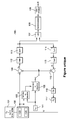
- FIG. 1 is a simplified schematic representation of a coding system according to the invention for implementing the coding method according to the invention.
- the reception module 101 receives as input a predictive image F n .
- F n is the current image of the entire server screen.
- the invention relates only to the coding of the predictive images, the intra-predictive coding of the images I continuing to be done according to known techniques. Thus, to make the diagram clearer, the means necessary for intra-predictive coding have been deliberately omitted.
- the image F n is generally in a YUV12 format after undergoing a RGB - YUV transformation.
- the reception module 101 also receives, as input, location and dimension information on the zones having changed in the image F n .
- the modified zone is a rectangular zone generally represented by a quadruplet (x, y, l, h): x and y represent respectively the abscissa and the ordinate of the point at the top left of the zone, I represents the width of the rectangle and h is the height of said rectangle.
- This information can be obtained by the server via the programming interfaces of its graphical environment, also called API (Application Programming Interface) for graphical user interface (GUI "Graphical User Interface"): it can be for example interfaces of window programming for Win32 type Win32.
- API Application Programming Interface
- GUI graphical User Interface
- each current image F n to be encoded is divided by means 103 into macroblocks corresponding to a rectangular elementary region of the image having a variable size between 4x4 and 16x16 pixels (via 8x16, 8x8, ).
- the means 104 knowing the modified areas of the image F n (defined by a quadruplet (x, y, l, h)) make it possible to distinguish the macroblocks belonging to a modified zone from those that do not belong to a modified zone. Therefore, the means 104 will direct only the macroblocks affected by a modified zone along the path V1 to the motion estimation module 105, the rest of the macroblocks being transmitted directly to the fusion module 107 via the channel V2.
- the function of the motion estimation module 105 is to find a macroblock of the current image F n in at least one previous F n-1 image of the server screen in its entirety (it could also be a posterior image in the case of an image B and even a plurality of anterior and / or posterior images).
- a motion vector which corresponds to the difference between the position of the selected region and that of the macroblock.
- the motion vectors that have been retained by the estimation module are transmitted to the motion compensation module 106. This gives a prediction error due to the fact that the region retained in the past image is not exactly equal to the macroblock analyzed.
- a set of "predicted zones" P is obtained (in the known H264 encoding, a predicted image is obtained but, according to the invention, the prediction is only made on the modified zones) .
- the subtractor 109 then calculates a residual error D n between the pixels of the modified zones in F n and the set of "predicted zones" P.
- Zones not processed by the motion estimation module 105 (because they are not modified) and sent directly to the fusion module 107 are considered to have a zero motion vector and residual error. Thanks to the invention, it is known without any treatment, the result of the encoding for macroblocks located in unmodified areas.
- a frequency transform (of discrete cosine transform type DCT "Discrete Cosine Transform” or transformed from Hadamard) via the frequency transform module 112 on each macroblock having undergone motion estimation as well as on the residual error D n .
- This transform makes it possible to have a frequency representation of the modified zones.
- the data from the frequency transform module 112 are then quantized (ie coded on a limited number of bits) by the quantization module 113 to provide transformed and quantized parameters X.
- the function of the quantization module 113 is to define steps of different quantification according to whether certain components will be judged or not visually significant; these quantization steps are defined in a quantization step table.
- the module 114 inverse quantizing retrieves the processed and quantized parameters X which then pass through the module 115 of inverse frequency transform that operates an inverse frequency transform to recover a quantized version D 'n of the residual error D n; this quantized version D ' n is then added to the macroblocks of the set of "predicted zones" P by the adder 110; the image at the output of the adder 110 is then processed by the deblocking filter to provide a reconstructed image F ' n corresponding to a set of reconstructed zones having the same position, the same width and the same height as the modified zones.
- F ' n is used internally by the decoder 100 to estimate the quality of the encoding.
- the merge module 107 merges the X parameters from the encoding for the macroblocks located in the modified zones with the result of the encoding for the macroblocks located in the unmodified zones (residual error and zero motion vectors).
- results are then reordered by the reordering module 108 to group together the non-zero coefficients so as to allow an efficient representation of the other coefficients having a zero value.
- the data then undergoes a final phase of entropy coding compression via the entropic coder 109.
- the function of the entropic coder is to re-code the data differently in order to reduce the number of bits necessary for their encoding by approaching as much as possible of the minimum of theoretical bits (which is fixed by the entropy).
- the entropy coder 109 constructs an output stream ⁇ in a Network Abstraction Layer (NAL) format defined to allow the use of the same video syntax in many network environments.
- NAL Network Abstraction Layer
- the invention has been more particularly described in the context of the H264 coding but it applies to any type of spatio-temporal coding: this is for example the case of MPEG2 coding or VC1 coding (video compression standard of the SMPTE Society of Motion Picture and Television Engineers).
Landscapes
- Engineering & Computer Science (AREA)
- Multimedia (AREA)
- Signal Processing (AREA)
- Compression Or Coding Systems Of Tv Signals (AREA)
Applications Claiming Priority (1)
| Application Number | Priority Date | Filing Date | Title |
|---|---|---|---|
| FR0755620A FR2917210B1 (fr) | 2007-06-08 | 2007-06-08 | Systeme et procede de codage video |
Publications (2)
| Publication Number | Publication Date |
|---|---|
| EP2015584A2 true EP2015584A2 (de) | 2009-01-14 |
| EP2015584A3 EP2015584A3 (de) | 2016-07-27 |
Family
ID=39148613
Family Applications (1)
| Application Number | Title | Priority Date | Filing Date |
|---|---|---|---|
| EP08157691.0A Ceased EP2015584A3 (de) | 2007-06-08 | 2008-06-05 | System und Verfahren zur Videokodierung |
Country Status (2)
| Country | Link |
|---|---|
| EP (1) | EP2015584A3 (de) |
| FR (1) | FR2917210B1 (de) |
Family Cites Families (6)
| Publication number | Priority date | Publication date | Assignee | Title |
|---|---|---|---|---|
| EP0330455A3 (de) * | 1988-02-22 | 1990-07-04 | Kabushiki Kaisha Toshiba | Vorrichtung zum Kodieren von Bildern |
| US5812787A (en) * | 1995-06-30 | 1998-09-22 | Intel Corporation | Video coding scheme with foreground/background separation |
| EP0923250A1 (de) * | 1997-12-03 | 1999-06-16 | Daewoo Electronics Co., Ltd | Verfahren und Vorrichtung zur adaptiven Kodierung eines binären Formsignals |
| GB2350512A (en) * | 1999-05-24 | 2000-11-29 | Motorola Ltd | Video encoder |
| US20030123538A1 (en) * | 2001-12-21 | 2003-07-03 | Michael Krause | Video recording and encoding in devices with limited processing capabilities |
| US20070047642A1 (en) * | 2005-08-31 | 2007-03-01 | Erlandson Erik E | Video data compression |
-
2007
- 2007-06-08 FR FR0755620A patent/FR2917210B1/fr not_active Expired - Fee Related
-
2008
- 2008-06-05 EP EP08157691.0A patent/EP2015584A3/de not_active Ceased
Non-Patent Citations (1)
| Title |
|---|
| PETER M CORCORAN ET AL: "USER INTERFACE TECHNOLOGIES FOR HOME APPLIANCES AND NETWORKS", 19980801, vol. 44, no. 3, 1 August 1998 (1998-08-01), pages 679 - 685, XP011083660 * |
Also Published As
| Publication number | Publication date |
|---|---|
| FR2917210A1 (fr) | 2008-12-12 |
| EP2015584A3 (de) | 2016-07-27 |
| FR2917210B1 (fr) | 2011-07-22 |
Similar Documents
| Publication | Publication Date | Title |
|---|---|---|
| US11445201B2 (en) | Video encoding and decoding method, device, and system, and storage medium | |
| TWI800580B (zh) | 具有聯合像素/變換為基礎之量化之視頻寫碼之量化參數控制 | |
| US8411753B2 (en) | Color space scalable video coding and decoding method and apparatus for the same | |
| CN104170391B (zh) | 图像处理设备和方法 | |
| JP6528765B2 (ja) | 画像復号装置および方法 | |
| CN108028944A (zh) | 使用核心视频标准的高动态范围hdr视频译码的视频解码器符合性 | |
| EP2380350A1 (de) | Videocodierungssystem und ?verfahren | |
| TW201711473A (zh) | 針對視訊寫碼處理高動態範圍及廣色域視訊資料 | |
| KR102814887B1 (ko) | 인트라 예측을 위한 교차-성분 선형 모델링의 방법 및 장치 | |
| CN110460850A (zh) | 用于解码视频数据的方法、介质和系统 | |
| WO2015005367A1 (ja) | 画像復号装置および方法 | |
| US20200404339A1 (en) | Loop filter apparatus and method for video coding | |
| JP7397878B2 (ja) | イントラ・サブ・パーティション・コーディング・モードのための方法及び装置 | |
| CN110754085B (zh) | 用于非4:4:4格式视频内容的颜色重映射 | |
| US8718130B2 (en) | Method and system for upsampling a spatial layered coded video image | |
| TWI713354B (zh) | 用於顯示器調適之色彩重映射資訊sei信息發信號 | |
| WO2014026097A1 (en) | Two-step quantization and coding method and apparatus | |
| US20120320993A1 (en) | Apparatus and method for mitigating the effects of packet loss on digital video streams | |
| WO2025130738A1 (zh) | 图像块压缩处理方法、装置及电子设备 | |
| FR2917210A1 (fr) | Systeme et procede de codage video | |
| Boitard et al. | Evaluation of chroma subsampling for high dynamic range video compression | |
| Dong et al. | HDR video compression using high efficiency video coding (HEVC) | |
| US20030202606A1 (en) | Multi-phase processing for real-time display of a compressed video bitstream | |
| RU2786086C1 (ru) | Способ и устройство кросс-компонентного линейного моделирования для внутреннего предсказания | |
| RU2823042C1 (ru) | Кодер, декодер и соответствующие способы для упрощения сигнализации заголовка картинки |
Legal Events
| Date | Code | Title | Description |
|---|---|---|---|
| PUAI | Public reference made under article 153(3) epc to a published international application that has entered the european phase |
Free format text: ORIGINAL CODE: 0009012 |
|
| PUAI | Public reference made under article 153(3) epc to a published international application that has entered the european phase |
Free format text: ORIGINAL CODE: 0009012 |
|
| AK | Designated contracting states |
Kind code of ref document: A2 Designated state(s): AT BE BG CH CY CZ DE DK EE ES FI FR GB GR HR HU IE IS IT LI LT LU LV MC MT NL NO PL PT RO SE SI SK TR |
|
| AX | Request for extension of the european patent |
Extension state: AL BA MK RS |
|
| RAP1 | Party data changed (applicant data changed or rights of an application transferred) |
Owner name: SAGEM COMMUNICATIONS |
|
| RAP1 | Party data changed (applicant data changed or rights of an application transferred) |
Owner name: SAGEM COMMUNICATIONS |
|
| RAP1 | Party data changed (applicant data changed or rights of an application transferred) |
Owner name: SAGEM COMMUNICATIONS SAS |
|
| RAP1 | Party data changed (applicant data changed or rights of an application transferred) |
Owner name: SAGEMCOM BROADBAND SAS |
|
| PUAL | Search report despatched |
Free format text: ORIGINAL CODE: 0009013 |
|
| AK | Designated contracting states |
Kind code of ref document: A3 Designated state(s): AT BE BG CH CY CZ DE DK EE ES FI FR GB GR HR HU IE IS IT LI LT LU LV MC MT NL NO PL PT RO SE SI SK TR |
|
| AX | Request for extension of the european patent |
Extension state: AL BA MK RS |
|
| RIC1 | Information provided on ipc code assigned before grant |
Ipc: H04N 7/26 00000000AFI20160623BHEP Ipc: H04N 7/36 00000000ALI20160623BHEP Ipc: H04N 7/50 00000000ALI20160623BHEP |
|
| 17P | Request for examination filed |
Effective date: 20170111 |
|
| RBV | Designated contracting states (corrected) |
Designated state(s): AT BE BG CH CY CZ DE DK EE ES FI FR GB GR HR HU IE IS IT LI LT LU LV MC MT NL NO PL PT RO SE SI SK TR |
|
| RBV | Designated contracting states (corrected) |
Designated state(s): AT BE BG CH CY CZ DE DK EE ES FI FR GB GR HR HU IE IS IT LI LT LU LV MC MT NL NO PL PT RO SE SI SK TR |
|
| AKX | Designation fees paid |
Designated state(s): AT BE BG CH CY CZ DE DK EE ES FI FR GB GR HR HU IE IS IT LI LT LU LV MC MT NL NO PL PT RO SE SI SK TR |
|
| AXX | Extension fees paid |
Extension state: BA Extension state: RS Extension state: MK Extension state: AL |
|
| RAP1 | Party data changed (applicant data changed or rights of an application transferred) |
Owner name: SAGEMCOM BROADBAND SAS |
|
| 17Q | First examination report despatched |
Effective date: 20180423 |
|
| STAA | Information on the status of an ep patent application or granted ep patent |
Free format text: STATUS: THE APPLICATION HAS BEEN REFUSED |
|
| 18R | Application refused |
Effective date: 20200130 |