EP2014667A1 - Catalyst for alkyne metathesis - Google Patents
Catalyst for alkyne metathesis Download PDFInfo
- Publication number
- EP2014667A1 EP2014667A1 EP07112300A EP07112300A EP2014667A1 EP 2014667 A1 EP2014667 A1 EP 2014667A1 EP 07112300 A EP07112300 A EP 07112300A EP 07112300 A EP07112300 A EP 07112300A EP 2014667 A1 EP2014667 A1 EP 2014667A1
- Authority
- EP
- European Patent Office
- Prior art keywords
- hetero
- alkyl
- aryl
- metathesis
- catalyst
- Prior art date
- Legal status (The legal status is an assumption and is not a legal conclusion. Google has not performed a legal analysis and makes no representation as to the accuracy of the status listed.)
- Withdrawn
Links
- 238000007302 alkyne metathesis reaction Methods 0.000 title claims abstract description 18
- 239000003054 catalyst Substances 0.000 title description 39
- 229910052739 hydrogen Inorganic materials 0.000 claims abstract description 51
- 150000001875 compounds Chemical class 0.000 claims abstract description 22
- 125000003118 aryl group Chemical group 0.000 claims abstract description 20
- 125000000217 alkyl group Chemical group 0.000 claims abstract description 15
- 239000001257 hydrogen Substances 0.000 claims abstract description 7
- 229910052721 tungsten Inorganic materials 0.000 claims description 18
- 238000005649 metathesis reaction Methods 0.000 claims description 8
- 229910052750 molybdenum Inorganic materials 0.000 claims description 8
- 125000000999 tert-butyl group Chemical group [H]C([H])([H])C(*)(C([H])([H])[H])C([H])([H])[H] 0.000 claims description 7
- 150000001345 alkine derivatives Chemical class 0.000 claims description 6
- 238000006243 chemical reaction Methods 0.000 claims description 6
- 238000000034 method Methods 0.000 claims description 5
- 125000001997 phenyl group Chemical group [H]C1=C([H])C([H])=C(*)C([H])=C1[H] 0.000 claims description 3
- 125000004432 carbon atom Chemical group C* 0.000 claims description 2
- UFHFLCQGNIYNRP-UHFFFAOYSA-N Hydrogen Chemical compound [H][H] UFHFLCQGNIYNRP-UHFFFAOYSA-N 0.000 claims 1
- 229910052751 metal Inorganic materials 0.000 abstract description 12
- 239000002184 metal Substances 0.000 abstract description 12
- 125000004429 atom Chemical group 0.000 abstract description 11
- 239000003446 ligand Substances 0.000 abstract description 7
- 125000004435 hydrogen atom Chemical group [H]* 0.000 abstract description 6
- 125000004433 nitrogen atom Chemical group N* 0.000 abstract description 6
- 125000001424 substituent group Chemical group 0.000 abstract description 6
- 230000000536 complexating effect Effects 0.000 abstract description 5
- 125000005842 heteroatom Chemical group 0.000 abstract description 4
- 125000003342 alkenyl group Chemical group 0.000 abstract description 3
- 229910052731 fluorine Inorganic materials 0.000 abstract description 3
- 239000011737 fluorine Substances 0.000 abstract description 3
- 125000005843 halogen group Chemical group 0.000 abstract description 2
- 150000003624 transition metals Chemical group 0.000 abstract description 2
- PXGOKWXKJXAPGV-UHFFFAOYSA-N Fluorine Chemical compound FF PXGOKWXKJXAPGV-UHFFFAOYSA-N 0.000 abstract 1
- 229910052799 carbon Inorganic materials 0.000 description 106
- VLKZOEOYAKHREP-UHFFFAOYSA-N n-Hexane Chemical compound CCCCCC VLKZOEOYAKHREP-UHFFFAOYSA-N 0.000 description 63
- UHOVQNZJYSORNB-MZWXYZOWSA-N benzene-d6 Chemical compound [2H]C1=C([2H])C([2H])=C([2H])C([2H])=C1[2H] UHOVQNZJYSORNB-MZWXYZOWSA-N 0.000 description 32
- YXFVVABEGXRONW-UHFFFAOYSA-N Toluene Chemical compound CC1=CC=CC=C1 YXFVVABEGXRONW-UHFFFAOYSA-N 0.000 description 24
- 229910052757 nitrogen Inorganic materials 0.000 description 24
- HEDRZPFGACZZDS-MICDWDOJSA-N Trichloro(2H)methane Chemical compound [2H]C(Cl)(Cl)Cl HEDRZPFGACZZDS-MICDWDOJSA-N 0.000 description 16
- 239000000047 product Substances 0.000 description 12
- 238000001644 13C nuclear magnetic resonance spectroscopy Methods 0.000 description 11
- 238000005160 1H NMR spectroscopy Methods 0.000 description 11
- 229910052760 oxygen Inorganic materials 0.000 description 9
- WFKWXMTUELFFGS-UHFFFAOYSA-N tungsten Chemical compound [W] WFKWXMTUELFFGS-UHFFFAOYSA-N 0.000 description 8
- 239000010937 tungsten Substances 0.000 description 8
- 230000015572 biosynthetic process Effects 0.000 description 7
- 238000001704 evaporation Methods 0.000 description 7
- 230000008020 evaporation Effects 0.000 description 7
- 239000002904 solvent Substances 0.000 description 7
- 238000003786 synthesis reaction Methods 0.000 description 7
- 239000011733 molybdenum Substances 0.000 description 6
- 239000000843 powder Substances 0.000 description 6
- 239000000725 suspension Substances 0.000 description 6
- ZOKXTWBITQBERF-UHFFFAOYSA-N Molybdenum Chemical compound [Mo] ZOKXTWBITQBERF-UHFFFAOYSA-N 0.000 description 5
- 230000003197 catalytic effect Effects 0.000 description 5
- PNEYBMLMFCGWSK-UHFFFAOYSA-N aluminium oxide Inorganic materials [O-2].[O-2].[O-2].[Al+3].[Al+3] PNEYBMLMFCGWSK-UHFFFAOYSA-N 0.000 description 4
- 239000006227 byproduct Substances 0.000 description 4
- 150000001721 carbon Chemical class 0.000 description 4
- 239000013078 crystal Substances 0.000 description 4
- 238000010828 elution Methods 0.000 description 4
- 238000001914 filtration Methods 0.000 description 4
- 229910052736 halogen Inorganic materials 0.000 description 4
- 150000002367 halogens Chemical group 0.000 description 4
- 125000006519 CCH3 Chemical group 0.000 description 3
- XEKOWRVHYACXOJ-UHFFFAOYSA-N Ethyl acetate Chemical compound CCOC(C)=O XEKOWRVHYACXOJ-UHFFFAOYSA-N 0.000 description 3
- 238000004458 analytical method Methods 0.000 description 3
- 238000006555 catalytic reaction Methods 0.000 description 3
- 238000001816 cooling Methods 0.000 description 3
- 238000000605 extraction Methods 0.000 description 3
- 125000001449 isopropyl group Chemical group [H]C([H])([H])C([H])(*)C([H])([H])[H] 0.000 description 3
- 125000002496 methyl group Chemical group [H]C([H])([H])* 0.000 description 3
- GHUURDQYRGVEHX-UHFFFAOYSA-N prop-1-ynylbenzene Chemical compound CC#CC1=CC=CC=C1 GHUURDQYRGVEHX-UHFFFAOYSA-N 0.000 description 3
- 238000006798 ring closing metathesis reaction Methods 0.000 description 3
- SVIUEMOZHFTFEZ-UHFFFAOYSA-N 1-methyl-2-[2-(2-methylphenyl)ethynyl]benzene Chemical group CC1=CC=CC=C1C#CC1=CC=CC=C1C SVIUEMOZHFTFEZ-UHFFFAOYSA-N 0.000 description 2
- VXKBMXXRLARKSD-UHFFFAOYSA-N 1-methyl-2-prop-1-ynylbenzene Chemical compound CC#CC1=CC=CC=C1C VXKBMXXRLARKSD-UHFFFAOYSA-N 0.000 description 2
- 238000004293 19F NMR spectroscopy Methods 0.000 description 2
- XNMQEEKYCVKGBD-UHFFFAOYSA-N 2-butyne Chemical compound CC#CC XNMQEEKYCVKGBD-UHFFFAOYSA-N 0.000 description 2
- ZAFNJMIOTHYJRJ-UHFFFAOYSA-N Diisopropyl ether Chemical class CC(C)OC(C)C ZAFNJMIOTHYJRJ-UHFFFAOYSA-N 0.000 description 2
- WHXSMMKQMYFTQS-UHFFFAOYSA-N Lithium Chemical compound [Li] WHXSMMKQMYFTQS-UHFFFAOYSA-N 0.000 description 2
- MZRVEZGGRBJDDB-UHFFFAOYSA-N N-Butyllithium Chemical compound [Li]CCCC MZRVEZGGRBJDDB-UHFFFAOYSA-N 0.000 description 2
- 125000003545 alkoxy group Chemical group 0.000 description 2
- 229910052744 lithium Inorganic materials 0.000 description 2
- 239000000203 mixture Substances 0.000 description 2
- -1 ruthenium carbene complexes Chemical class 0.000 description 2
- 150000003608 titanium Chemical class 0.000 description 2
- DISXFZWKRTZTRI-UHFFFAOYSA-N 4,5-dihydro-1h-imidazol-2-amine Chemical class NC1=NCCN1 DISXFZWKRTZTRI-UHFFFAOYSA-N 0.000 description 1
- FGBQFZWIQOVKNZ-UHFFFAOYSA-N 4,5-dimethyl-1,3-di(propan-2-yl)imidazolidin-2-imine Chemical compound CC(C)N1C(C)C(C)N(C(C)C)C1=N FGBQFZWIQOVKNZ-UHFFFAOYSA-N 0.000 description 1
- YGIKAGQWZKNCLW-UHFFFAOYSA-N C1=CC=CC=C1C#CC1=CC=CC=C1.C1=CC=CC=C1C#CC1=CC=CC=C1 Chemical compound C1=CC=CC=C1C#CC1=CC=CC=C1.C1=CC=CC=C1C#CC1=CC=CC=C1 YGIKAGQWZKNCLW-UHFFFAOYSA-N 0.000 description 1
- 0 CC(C)(C)[*@](C=C[*@@]1C(C)(C)C)C1=*C=C Chemical compound CC(C)(C)[*@](C=C[*@@]1C(C)(C)C)C1=*C=C 0.000 description 1
- WSNMPAVSZJSIMT-UHFFFAOYSA-N COc1c(C)c2COC(=O)c2c(O)c1CC(O)C1(C)CCC(=O)O1 Chemical compound COc1c(C)c2COC(=O)c2c(O)c1CC(O)C1(C)CCC(=O)O1 WSNMPAVSZJSIMT-UHFFFAOYSA-N 0.000 description 1
- RTZKZFJDLAIYFH-UHFFFAOYSA-N Diethyl ether Chemical compound CCOCC RTZKZFJDLAIYFH-UHFFFAOYSA-N 0.000 description 1
- VGGSQFUCUMXWEO-UHFFFAOYSA-N Ethene Chemical compound C=C VGGSQFUCUMXWEO-UHFFFAOYSA-N 0.000 description 1
- 239000005977 Ethylene Substances 0.000 description 1
- YCKRFDGAMUMZLT-UHFFFAOYSA-N Fluorine atom Chemical compound [F] YCKRFDGAMUMZLT-UHFFFAOYSA-N 0.000 description 1
- RTAQQCXQSZGOHL-UHFFFAOYSA-N Titanium Chemical compound [Ti] RTAQQCXQSZGOHL-UHFFFAOYSA-N 0.000 description 1
- 238000005865 alkene metathesis reaction Methods 0.000 description 1
- 150000001336 alkenes Chemical class 0.000 description 1
- 125000004414 alkyl thio group Chemical group 0.000 description 1
- 125000000129 anionic group Chemical group 0.000 description 1
- 125000004104 aryloxy group Chemical group 0.000 description 1
- JRXXLCKWQFKACW-UHFFFAOYSA-N biphenylacetylene Chemical group C1=CC=CC=C1C#CC1=CC=CC=C1 JRXXLCKWQFKACW-UHFFFAOYSA-N 0.000 description 1
- 238000005686 cross metathesis reaction Methods 0.000 description 1
- 239000012043 crude product Substances 0.000 description 1
- 125000004663 dialkyl amino group Chemical group 0.000 description 1
- 239000003480 eluent Substances 0.000 description 1
- 229940093499 ethyl acetate Drugs 0.000 description 1
- 235000019439 ethyl acetate Nutrition 0.000 description 1
- 238000003818 flash chromatography Methods 0.000 description 1
- 238000001640 fractional crystallisation Methods 0.000 description 1
- 238000002290 gas chromatography-mass spectrometry Methods 0.000 description 1
- 150000002366 halogen compounds Chemical class 0.000 description 1
- 238000004896 high resolution mass spectrometry Methods 0.000 description 1
- 230000007062 hydrolysis Effects 0.000 description 1
- 238000006460 hydrolysis reaction Methods 0.000 description 1
- 230000002779 inactivation Effects 0.000 description 1
- 239000011261 inert gas Substances 0.000 description 1
- DVSDBMFJEQPWNO-UHFFFAOYSA-N methyllithium Chemical compound C[Li] DVSDBMFJEQPWNO-UHFFFAOYSA-N 0.000 description 1
- 230000003647 oxidation Effects 0.000 description 1
- 238000007254 oxidation reaction Methods 0.000 description 1
- 238000006116 polymerization reaction Methods 0.000 description 1
- 125000001436 propyl group Chemical group [H]C([*])([H])C([H])([H])C([H])([H])[H] 0.000 description 1
- 238000012552 review Methods 0.000 description 1
- 238000007363 ring formation reaction Methods 0.000 description 1
- 229910052707 ruthenium Inorganic materials 0.000 description 1
- 239000006188 syrup Substances 0.000 description 1
- 235000020357 syrup Nutrition 0.000 description 1
- 239000010936 titanium Substances 0.000 description 1
- 229910052719 titanium Inorganic materials 0.000 description 1
- 238000006276 transfer reaction Methods 0.000 description 1
Classifications
-
- C—CHEMISTRY; METALLURGY
- C07—ORGANIC CHEMISTRY
- C07F—ACYCLIC, CARBOCYCLIC OR HETEROCYCLIC COMPOUNDS CONTAINING ELEMENTS OTHER THAN CARBON, HYDROGEN, HALOGEN, OXYGEN, NITROGEN, SULFUR, SELENIUM OR TELLURIUM
- C07F11/00—Compounds containing elements of Groups 6 or 16 of the Periodic Table
Definitions
- the present invention relates to catalysts suitable for alkyne metathesis, to the use of catalysts in alkyne metathesis and to processes in the presence of the catalysts, e.g. synthesis or metathesis processes.
- Catalysts of the invention contain a metal atom which is coordinated by two alkoxy groups and one anionic electron donating ligand.
- the metal atom is bound to a substituted carbon by a triple bond.
- the compounds of the invention mediate transfer of the substituted carbon by formal transfer to or exchange with another carbon atom being linked by a triple bond, i.e. an alkyne, while maintaining the triple bond.
- Tamm Chem. Commun. 2004, 876-877 ) disclose the synthesis of titanium complexes having imidazolin-2-iminato ligands.
- Tamm et al. (Dalton Trans. 2006, 459-467 ) describe the synthesis of imidazolin-2-iminato titanium complexes and their use in ethylene polymerization catalysis.
- the compounds have an alternative structure for use as catalysts in alkyne metathesis and metathesis processes involving the use of the catalytically active compounds.
- the compounds have a structure allowing a high efficiency of the metathesis reaction, preferably allowing metathesis reactions to occur at lower temperatures.
- the catalytically active compounds of the invention which comprise a ligand, on his part containing a guanidinate core which is forming a complex with a transition metal atom.
- the guanidinate core is a mononegative ligand that binds with the metal atom.
- substituents being selected from hydrogen, alkyl, alkenyl, aromatic residues, optionally including hetero atoms, e.g. halogen atoms, preferably fluorine.
- the metal atom is complexed by two identical or different alkoxy or aryloxy groups, optionally substituted with halogen.
- the catalytically active complex exhibits a carbon-metal triple bond, which is essential for alkyne metathesis reactions.
- the substituents to this carbon atom can be derivatized any way by any substituent moiety because this ligand moiety will be demerged during the metathesis reaction, and therefore does not initially participate in the alkyne metathesis.
- catalytically active compounds of the invention correspond to formula I : wherein
- X 1 and R 1 , and of X 2 and R 2 can be linked, forming one common substituent to both the nitrogen atoms that do not participate in the complexing of the metal atom.
- X 1 and X 2 can be replaced by a group comprising two, three or four atoms in a row, forming a 5-membered, a 6-membered or a 7-membered ring including the nitrogen atoms of the guanidinate core that do not participate in complexing the metal.
- R 1 and R 2 preferably are selected independently from electron donating groups, e.g. tert.-butyl.
- R 3 and R 4 can be selected independently from hydrogen, C 1 to C20 (hetero-) alkyl or (hetero-) aryl, preferably CMe 3 , CH(CF 3 ) 2 , CMe 2 CF 3 , CMe(CF 3 ) 2 , and C(CF 3 ) 3 .
- the compounds of the invention show the advantage that they catalyze alkyne metathesis reactions more efficiently, e.g. at lower temperatures than known catalysts, e.g. than tris-amido molybdenum complexes. Therefore, the catalysts of the invention are advantageous in use for synthetic reactions of temperature sensitive compounds.
- the catalytically active compounds of the invention are advantageous in that they do not require an inert gas atmosphere during the catalysis reaction, but can be used at ambient, preferably at reduced pressure, e.g. in the range of 10 to 500 mbar. Further, the catalytic activities of the compounds of the invention are higher than those of prior art alkyne metathesis catalysts. Accordingly, the catalysts of the invention can be used at lower temperatures, e.g. in the range of 10 to 100°C and/or at lower concentrations than previous catalysts.
- compounds used as catalysts in the present invention can be synthesized according to the methods described in Tamm et al., Dalton Trans. 2006, 459-467 , while replacing titanium with molybdenum or tungsten.
- 1,3-di- tert. -butylimino-2-imidazoline lithium (ImN)Li was synthesized by dissolving 1,3-di- tert .-butylimidazoline-2-imine (718 mg, 3.68 mmol) in 45 mL hexane in a 100 mL Schlenk tube and cooling to -30 °C. Over a period of 5 min, 2.1 mL of a hexane solution of methyllithium (1.6M, 3.4 mmol) was added and stirred for 2 h allowing the solution to warm to 0 °C.
- the intermediary product corresponds to
- the alternative molybdenum-containing catalyst was synthesized using the respective molybdenum alkylidyne complex in the place of the tungsten alkylidyne complex.
- Im i PrN 1,3-Di-iso-propyl-4,5-dimethylimidazoline-2-imine
- the homodimerization of 1-phenylprop-1-yne was performed with a catalyst of the invention using standard equipment as the reaction could be performed at conditions at moderatedly elevated temperature and at moderately reduced pressure, namely in a rotary evaporator at 60 °C.
- a hexane solution of 6,15-dioxaeicosa-2,18-diyne (125.0 mg, 0.449 mmol) was added to a hexane solution of the catalyst obtained in Example 1 (7.3 mg, 4.49 ⁇ 10 -5 mol, 2 mol%) and stirred for 2 h at room temperature under reduced pressure (350 mbar). Filtration through alumina and elution with hexane yielded the crude product after evaporation of the solvent. Pure product could be obtained by flash chromatography using hexane/ethylacetate 4:1 as the eluent in 95.1 % yield as colorless syrup:
Landscapes
- Chemical & Material Sciences (AREA)
- Organic Chemistry (AREA)
- Organic Low-Molecular-Weight Compounds And Preparation Thereof (AREA)
- Catalysts (AREA)
Abstract
The invention provides catalytically active compounds for alkyne metathesis comprising a ligand, on his part containing a guanidinate core which is forming a complex with a transition metal atom. Formally, the guanidinate core is a mononegative ligand that binds with the metal atom. One or both of the nitrogen atoms of the guanidiate core, which are not participating in the metal complexing bond, can be substituted with substituents being selected from hydrogen, alkyl, alkenyl, aromatic residues, optionally including hetero atoms, e.g. halogen atoms, preferably fluorine.
Description
- The present invention relates to catalysts suitable for alkyne metathesis, to the use of catalysts in alkyne metathesis and to processes in the presence of the catalysts, e.g. synthesis or metathesis processes.
- Catalysts of the invention contain a metal atom which is coordinated by two alkoxy groups and one anionic electron donating ligand. In the catalytically active form, the metal atom is bound to a substituted carbon by a triple bond. In use as alkyne metathesis catalysts, the compounds of the invention mediate transfer of the substituted carbon by formal transfer to or exchange with another carbon atom being linked by a triple bond, i.e. an alkyne, while maintaining the triple bond.
- Tamm (Chem. Commun. 2004, 876-877) disclose the synthesis of titanium complexes having imidazolin-2-iminato ligands.
- In Tamm et al. (Org. Biomol. Chem. 2007, 5, 523-530), the structure of 2-iminoimidazolin compounds is described.
- Tamm et al. (Dalton Trans. 2006, 459-467) describe the synthesis of imidazolin-2-iminato titanium complexes and their use in ethylene polymerization catalysis.
- Fürstner et al. (Chem. Commun. 2005, 2307-2320) describe alkyne metathesis using a molybdenum tris-amido complex of tert.-butyl-3,5-dimethyl benzene.
- When reviewing the metathesis catalysts for the conversion of alkenes and alkynes, Schrock et al. (Adv. Synth. Cat. 2007, 349, 55-77) describe molybdenum or tungsten tris-amido or tris-alkoxy compounds for use in metathesis catalysis of alkynes.
- Fürstner in Angew. Chem. 2000, 112, 3140-3172, reviews tungsten and molybdenum alkylidene complexes and ruthenium carbene complexes as catalysts for olefin metathesis.
-
US 2006/0281938 A1 describes alkyne metathesis using a tris-amido metal complex of tert.-butyl-3,5-dimethyl benzene. -
describes catalysts of the general type M (≡CR1) (OR2)3, wherein R1 can be alkyl, aryl, alkenyl, alkylthio, dialkylamino, and R2 can be e.g. alkyl, aryl, fluorine alkyl. Further, catalysts can be mixtures of M[N(R1)Ar]3 with halogen compounds of the type R22 EX2 or R33SiX with E = C or Si, X = halogen, and R3 = alkyl or aryl.WO 99/40047 - One disadvantage of catalytically active tris-amido molybdenum complexes, e.g. according to Fürstner et al. (Chem. Eur. J. 2001, 7, 5299-5317) or from
, is that these require a temperature of above 80 °C and catalyst concentrations of more than 5 to 10 mol-% for a moderate catalytic activity. Further, the known catalysts for alkyne metathesis are unstable as they are sensitive towards inactivation by oxidation or hydrolysis.WO 99/40047 - In view of the known catalysts and processes for alkyne metathesis, it is an object of the present invention to provide compounds having an alternative structure for use as catalysts in alkyne metathesis and metathesis processes involving the use of the catalytically active compounds. Preferably, the compounds have a structure allowing a high efficiency of the metathesis reaction, preferably allowing metathesis reactions to occur at lower temperatures.
- The above objects of the invention are attained by the catalytically active compounds of the invention, which comprise a ligand, on his part containing a guanidinate core which is forming a complex with a transition metal atom. Formally, the guanidinate core is a mononegative ligand that binds with the metal atom. One or both of the nitrogen atoms of the guanidiate core, which are not participating in the metal complexing bond, can be substituted with substituents being selected from hydrogen, alkyl, alkenyl, aromatic residues, optionally including hetero atoms, e.g. halogen atoms, preferably fluorine.
- Further, substituents to the nitrogen atoms not participating in the metal complexing bond can be linked by at least one single (C-C) or double (C=C) bond.
- In addition to the guanidinate core, the metal atom is complexed by two identical or different alkoxy or aryloxy groups, optionally substituted with halogen.
- The catalytically active complex exhibits a carbon-metal triple bond, which is essential for alkyne metathesis reactions. The substituents to this carbon atom can be derivatized any way by any substituent moiety because this ligand moiety will be demerged during the metathesis reaction, and therefore does not initially participate in the alkyne metathesis.
-
- M is Mo or W,
- R1, R2 are independently selected from hydrogen, C1 to C20 alkyl or aryl, optionally containing heteroatoms e.g. N, O, and/or S, preferentially methyl (Me), isopropyl (CHMe2), tert.-butyl (CMe3), and aryl, preferentially 2,4,6-Me3-C6H2, and 2,6-iPr2-C6H3, wherein iPr is isopropyl and C6H3 is phenyl,
- R3, R4 are selected from C1 to C20 alkyl or aryl, optionally containing heteroatoms, e.g. N, O, and/or S, preferentially CMe3, CH(CF3)2, CMe2CF3, CMe(CF3)2, C(CF3)3, and aryl, preferentially 2,4,6-(CF3)-C6H2, and 2,6-(CF3)-C6H3,
- X1, X2 are independently selected from H, C1 to C20 alkyl or aryl, preferentially both X1 and X2 are CH2-CH2, C(H)=C(H), or C(Me)=C(Me),
- Y is selected from C1 to C20 alkyl and aryl, preferentially CMe3 or phenyl (Ph).
- One or both of X1 and R1, and of X2 and R2, respectively, can be linked, forming one common substituent to both the nitrogen atoms that do not participate in the complexing of the metal atom. For example, X1 and X2 can be replaced by a group comprising two, three or four atoms in a row, forming a 5-membered, a 6-membered or a 7-membered ring including the nitrogen atoms of the guanidinate core that do not participate in complexing the metal. Examples for groups replacing X1 and X2 are C-C, C=C, C-C-C, and C=C-C with each C substituted by one hydrogen, a halogen, or a (hetero-) alkyl.
- Alternatively, X1 and X2 are carbon atoms being linked by single or double bond, an intermediate atom or a group of two atoms, e.g. the intermediate atom or group is selected from -CR1-, -CR1 2-CR1 2-, and -CR1=CR1-, with each R1 independently defined as above, preferably -CH=CH-, -C(CH3)=C(CH3)-.
- Preferably, X1 and X2 are replaced by C=C with each C substituted by one hydrogen, a halogen, or a (hetero-) alkyl forming an optionally further substituted 2-imidazolyl substituent to the nitrogen atom that complexes the metal atom. As a result, the following structure II is obtained:
R1 and R2 preferably are selected independently from electron donating groups, e.g. tert.-butyl.
R3 and R4 can be selected independently from hydrogen, C 1 to C20 (hetero-) alkyl or (hetero-) aryl, preferably CMe3, CH(CF3)2, CMe2CF3, CMe(CF3)2, and C(CF3)3. - In the catalytic processes, the compounds of the invention show the advantage that they catalyze alkyne metathesis reactions more efficiently, e.g. at lower temperatures than known catalysts, e.g. than tris-amido molybdenum complexes. Therefore, the catalysts of the invention are advantageous in use for synthetic reactions of temperature sensitive compounds.
- The catalytically active compounds of the invention are advantageous in that they do not require an inert gas atmosphere during the catalysis reaction, but can be used at ambient, preferably at reduced pressure, e.g. in the range of 10 to 500 mbar. Further, the catalytic activities of the compounds of the invention are higher than those of prior art alkyne metathesis catalysts. Accordingly, the catalysts of the invention can be used at lower temperatures, e.g. in the range of 10 to 100°C and/or at lower concentrations than previous catalysts.
- In general, compounds used as catalysts in the present invention can be synthesized according to the methods described in Tamm et al., Dalton Trans. 2006, 459-467, while replacing titanium with molybdenum or tungsten.
- The invention is now described in greater detail by way of examples.
- First, 1,3-di-tert.-butylimino-2-imidazoline lithium (ImN)Li was synthesized by dissolving 1,3-di-tert.-butylimidazoline-2-imine (718 mg, 3.68 mmol) in 45 mL hexane in a 100 mL Schlenk tube and cooling to -30 °C. Over a period of 5 min, 2.1 mL of a hexane solution of methyllithium (1.6M, 3.4 mmol) was added and stirred for 2 h allowing the solution to warm to 0 °C. The resulting white suspension was filtered through a Schlenk frit, and the residue was washed 5 times with 10 mL of hexane. The remaining white powder was dried for 5 h at high vacuum to yield 762 mg (97 %) of pure product. 1H NMR (200 MHz, C6D6, 25 °C): δ 1.58 (18 H, s, C(CH 3)3), 6.11 (2 H, s, CH); 13C NMR (150.9 MHz, C6D6, 25 °C): δ 30.6 (3 C, s, C(CH3)3), 53.1 (2 C, s, NCMe3), 106.6 (2 C, s, NCH), 141.1 (1 C, s, NCN); Found for C11H20N3Li: C 65.2 %, H 10.3 %, N 19.8 %; Calculated: C 65.6 %, H 10.0 %, N 20.9 %.
-
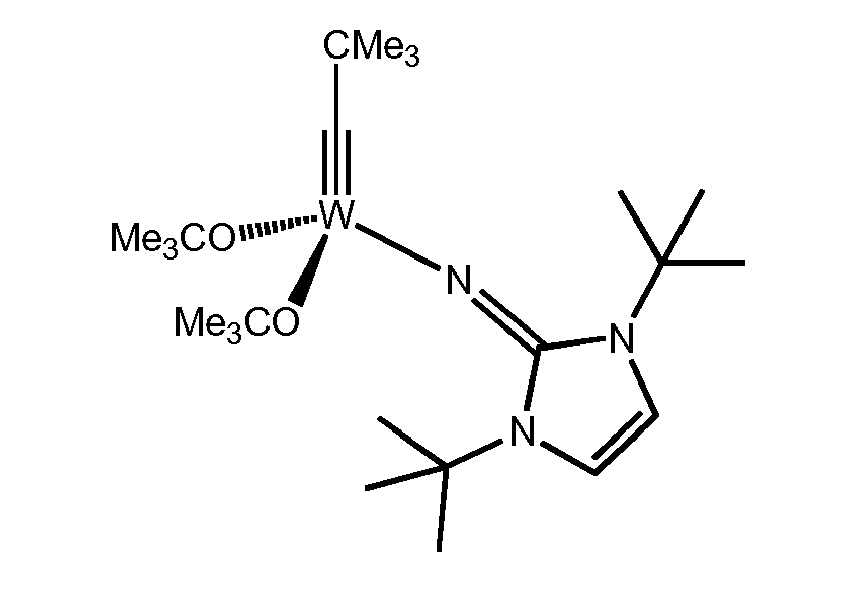
- A toluene solution of (ImN)Li (190 mg, 0.944 mmol) was slowly added to the tungsten alkylidyne complex {Me3CC≡W[OCMe(CF3)2]3(dme)} (837 mg, 0.944 mmol), which was dissolved in a 100 mL Schlenk tube in 25 mL toluene and stirred for 10 min at room temperature. The yellow-orange suspension was filtered through an Schlenk frit to remove any by-products. Evaporation of the solvent gave the clean product as yellow crystalline powder. Single crystals could be obtained by cooling a saturated diisopropylether solution to -35°C. Yield: 726 mg of yellow crystals (95%). 1H NMR (400 MHz, C6D6, 25 °C): δ 1.15 (9 H, s, W≡CCCH 3), 1.29 (18 H, s, NCCH 3), 1.96 (6 H, br, C(CH 3)(CF3)2), 5.94 (2 H, s, CH); 13C NMR (150.9 MHz, C6D6, 25 °C): δ 20.5 (2 C, s, OCCH3), 28.7 (6C, s, NCCH3), 33.8 (3 C, s, CCCH3), 50.8 (2 J CW = 38 Hz, 1 C, OCCH3), 51.7 (2 C, s, NCCH3), 81.7 (2 C, m, OCCF3), 110.0 (2 C, s, NC=CN), 124.1 (1JCF = 287 Hz, 2 C, q, CF3), 124.8 (1JCF = 287 Hz, 2 C, q, CF3), 159.4 (1 C, s, NCN), 285.6 (1 J CW = 274 Hz, 1 C, s, W≡C); 19F NMR (376.5 MHz, C6D6, 25 °C): δ -78.6 (4 J FF = 19 Hz, 6 F, q, CF 3), -76.4 (4 J FF = 19 Hz, 6 F, q, CF 3); Found for C24H35N3F12O2W: C 36.6 %, H 4.7 %, N 5.2 %; Calculated C 35.6 %, H 4.4 %, N 5.2 %. From the data, the following structure of the catalyst was deduced:
- The alternative molybdenum-containing catalyst was synthesized using the respective molybdenum alkylidyne complex in the place of the tungsten alkylidyne complex.
- As described in Example 1, 1,3-di-tert.-butylimino-2-imidazoline lithium (ImN)Li was synthesized, and a toluene solution of (ImN)Li (173 mg, 0.860 mmol) was slowly added to the tungsten alkylidyne complex [Me3CC≡W(OCMe3)3] (400 mg, 0.847 mmol), which was dissolved in a 100 mL Schlenk tube in 33 mL toluene and stirred for 120 min at room temperature. The yellow-orange suspension was filtered through an Schlenk frit to remove any by-products. Evaporation of the solvent and extraction with hexane gave the pure product as yellow crystalline powder. Single crystals could be obtained by cooling a saturated diisopropylether solution to -35 °C. Yield: 488 mg of yellow crystals (97%). 1H NMR (400.1 MHz, C6D6, 25 °C): δ 1.43 (18 H, s, NC(CH 3)3), 1.44 (9 H, s, W≡CC(CH 3)3), 1.66 (18 H, s, OC(CH 3)3), 6.03 (2 H, s, CH); 13C NMR (150.9 MHz, C6D6, 25 °C): δ 29.1 (6 C, s, NC(CH3)3), 33.5 (6C, s, OCCH3), 34.6 (3 C, s, CC(CH3)3), 50.9 (1 C, s, CC(CH3)3), 55.9 (2 C, s, NCCH3), 77.5 (2 C, s, OCCH3), 108.5 (2 C, s, NC=CN), 159.1 (1 C, s, NCN), 273.3 (1 J CW = 279 Hz, 1 C, s, W≡C); Found for C24H47N3O2W: C 47.8%, H 7.9%, N 6.3%; Calculated C 48.6%, H 8.0%, N 7.1%.
-
-
- 1,3-Di-iso-propyl-4,5-dimethylimidazoline-2-imine (Im i PrN) (1.689 g, 6.314 mmol) was dissolved in 20 mL hexane in a 100 mL Schlenk tube and cooled to -30 °C. Over a period of 10 min, 3.95 mL of a hexane solution of n-butyllithium (1.6M, 6.31 mmol) was added and stirred for 2 h allowing the solution to warm to 0 °C. The resulting white suspension was filtered through a Schlenk frit and the residue was washed 3 times with 10 mL of hexane. The remaining white powder was dried for 7 h at high vacuum giving 0.94 g (yield = 74 %) of pure product having the following analytical data: 1H NMR (200 MHz, C6D6, 25 °C): δ 1.31 (12 H, d, CH(CH 3)2), 1.98 (6 H, s, CH 3), 4.72 (2 H, sept, CHMe2); 13C NMR (150.9 MHz, C6D6, 25 °C): δ 11.5 (2 C, s, CH3), 22.9 (4 C, s, NCH(CH3)2), 45.1 (2 C, s, NCHMe2), 112.8 (2 C, s, C=C), 147.8 (1 C, s, NCN); Found for C11H20N3Li: C 65.2 %, H 10.3 %, N 19.8 %; Calculated: C 65.6 %, H 10.0 %, N 20.9 %.
- Then, a toluene solution of (Im i PrN)Li (98 mg, 0.487 mmol) was slowly added to the tungsten alkylidyne complex {Me3CC≡W[OCMe(CF3)2]3(dme)} (430 mg, 0.485 mmol), which was dissolved in a 100 mL Schlenk tube in 23 mL toluene and stirred for 10 min at room temperature. The yellow-orange suspension was filtered through an Schlenk frit to remove any by-products. Evaporation of the solvent and extraction with hexane afforded 487 mg of the product as yellow powder (63%). 1H NMR (400.1 MHz, C6D6, 25 °C): δ 1.14 (9 H, s, W≡CC(CH 3)3), 1.16 (12 H, d, NCH(CH 3)3), 1.46 (6 H, s, CCH 3), 1.94 (6 H, br, C(CH 3)(CF3)2), 4.37 (2 H, sept, NCH(CH3)3); 13C NMR (150.9 MHz, C6D6, 25 °C): δ 9.1 (2 C, s, CCH3), 20.5 (4 C, s, NCH(CH3)2), 20.7 (2 C, s, OC(CH3)3), 33.8 (3 C, s, CC(CH 3)3), 46.6 (2 C, s, NCHMe2), 50.1 (1 C, s, CCCH3), 81.0 (2 C, m, OCCF3), 117.4 (2 C, s, NC=CN), 124.1 (1JCF = 287 Hz, 2 C, q, CF3), 124.4 (1JCF = 287 Hz, 2 C, q, CF3), 158.6 (1 C, s, NCN), 284.0 (1JCW = 277 Hz, 1 C, s, W≡C); 19F NMR (376.5 MHz, C6D6, 25 °C): δ -78.6 (4 J FF = 18 Hz, 6 F, q, CF 3), -77.7 (4 J FF = 18 Hz, 6 F, q, CF 3); MS: 809 (M)
-
- A toluene solution of (Im i PrN)Li (149 mg, 0.741 mmol) was slowly added to the tungsten alkylidyne complex [Me3CC≡W(OCMe3)3] (350 mg, 0.741 mmol), which was dissolved in a 100 mL Schlenk tube in 15 mL toluene and stirred for 120 min at room temperature. The yellow-orange suspension was filtered through an Schlenk frit to remove any by-products. Evaporation of the solvent and extraction with hexane gave the pure product as a yellow powder in 46% isolated yield.
- 1H NMR (400.1 MHz, C6D6, 25 °C): δ 1.30 (12 H, d, NCH(CH 3)2), 1.43 (9 H, s, W≡CC(CH 3)3), 1.58 (6 H, s, CH 3), (18 H, s, OC(CH 3)3), 4.52 (2 H, sept, NCH); 13C NMR (150.9 MHz, C6D6, 25 °C): δ 9.6 (2 C, s, CCH3), 21.4 (4 C, s, NCH(CH3)2), 33.5 (6C, s, OC(CH3)3), 34.9 (3 C, s, CC(CH3)3), 45.9 (2 C, s, NCHMe2), 50.1 (1 C, s, CCCH3), 76.7 (2 C, s, OCCH3), 115.8 (2 C, s, NC=CN), 159.8 (1 C, s, NCN), 270.7 (1 J CW = 281 Hz, 1 C, s, W≡C).
-
- As an example for alkyne transfer reactions using the catalyst of the invention, a solution of 220 mg (1.894·10-3 mol) of 1-phenylpropyne
in 6 mL hexane and 1 mol% of catalyst obtained in Example 1 in hexane was stirred at room temperature under reduced pressure (350 mbar) to continuously remove 2-butyne. Filtration after 30 min through alumina and elution with hexane afforded the cross-metathesis product diphenylacetylene (tolane) in yields >90 %. - Analysis of the resultant product gave diphenylacetylene: 1H NMR (200 MHz, CDCl3, 25 °C): δ 7.34 (6 H, m, Ar), 7.53 (4 H, m, Ar); 13C NMR (50.3 MHz, CDCl3, 25 °C): δ 89.4 (2 C, s, C≡C), 123.3 (2C, s, Ar), 128.3 (2 C, s, Ar), 128.3 (4 C, Ar), 131.6 (4 C, s, Ar); Found for C14H10: C 93.5 %, H 5.9 %; Calculated C 94.3 %, H 5.7 %.
- As an example for the high catalytic activity of the compounds of the invention in alkyne metathesis, the homodimerization of 1-phenylprop-1-yne was performed with a catalyst of the invention using standard equipment as the reaction could be performed at conditions at moderatedly elevated temperature and at moderately reduced pressure, namely in a rotary evaporator at 60 °C.
- The stirred solution of 112 mg (0.861·10-3 mol) of 1-(2-methylphenyl)prop-1-yne in 10 mL hexane in the presence of 7.0 mg (0.864·10-5 mol) of catalyst obtained in Example 1 in hexane at 60 °C at reduced pressure (350 mbar) for 30 min, followed by filtration through alumina, elution with hexane, and evaporation of the solvent yielded 100% isolated bis-(2-methylphenyl)acetylene:
- Analysis of the product gave bis-(2-methylphenyl)acetylene:1H NMR (200.1 MHz, CDCl3, 25 °C): δ 2.53 (3 H, s, CH 3), 2.53 (3 H, s, CH 3), 7.23 (6 H, m, ArH), 7.50 (1 H, m, m-ArH), 7.53 (1 H, m, m-ArH); 13C NMR (50.3 MHz, CDCl3, 25 °C): δ 20.9 (2 C, s, CCH3), 92.3 (2 C, s, C≡C), 123.4 (2 C, s, CC≡C), 125.6 (2 C, s, Ar), 128.2 (2 C, s, Ar), 129.5 (2 C, s, Ar), 131.9 (2 C, s, Ar), 140.0 (2 C, s, Ar); Found for C16H14: C 92.5 %, H 7.4 %; Calculated C 93.2 %, H 6.8 %.
- When performing the reaction at room temperature under otherwise identical conditions, 100% yield was found after 7 h.
- As an example for ring-closing-metathesis, a hexane solution of 6,15-dioxaeicosa-2,18-diyne (125.0 mg, 0.449 mmol) was added to a hexane solution of the catalyst obtained in Example 1 (7.3 mg, 4.49·10-5 mol, 2 mol%) and stirred for 2 h at room temperature under reduced pressure (350 mbar). Filtration through alumina and elution with hexane yielded the crude product after evaporation of the solvent. Pure product could be obtained by flash chromatography using hexane/ethylacetate 4:1 as the eluent in 95.1 % yield as colorless syrup:
- Analysis of the product gave: 1H NMR (400.1 MHz, C6D6, 25 °C): δ 1.45 (4 H, m, CH 2), 1.54 (4 H, m, CH 2), 1.65 (4 H, m, CH 2), 2.27 (4 H, tt, C≡CCH 2), 3.25 (4 H, t, OCH 2), 3.31 (4 H, t, OCH 2); 13C NMR (50.3 MHz, C6D6, 25 °C): δ 20.9 (2 C, s, CH2), 24.8 (2 C, s, CH2), 27.7 (2 C, s, CH2), 29.3 (2 C, s, CH2), 69.1 (2 C, s, OCH2), 70.0 (2 C, s, OCH2), 79.0 (2 C, s, C≡C); Found for C16H14: C 72.9 %, H 10.7 %; Calculated C 74.9 %, H 10.8 %.
- HR-MS (ESI): m/z 247.168 [M + Na]; GC-MS: m/z 223 (M)-, 209 (M -CH2 +), 195 (M - C2H4), 181 (M -C3H7), 165 (M -C3H7O), 151 (M - C4H9O), 137 (M -C5H11O), 123 (M - C6H13O), 109 (M -C7H15O), 96 (M -C8H16O), 81 (M -C8H15O2), 69 (M -C9H15O2), 55 (M - C11H17O2), 41 (M -C12H19O2).
-
- A 3.1 mM hexane solution of the diyne (A) (150.0 mg, 0.055 mmol) and 2 mol% catalyst obtained in Example 1 (9.0 mg, 1.11·10-5 mol) was stirred for 2 h at room temperature under reduced pressure (350 mbar). Filtration through alumina and elution with Et2O afforded a mixture of monomeric (B) and dimeric (C) ring after evaporation of the solvent. Fractional crystallization from hexane yielded 19% of monomeric ring and 80% of dimeric ring, which is believed to be due to steric reasons.
- For the monomeric ring (B) was found:
1H NMR (200.1 MHz, CDCl3, 25 °C): δ 2.41 (4 H, tt, C≡CCH 2), 3.73 (4 H, t, OCH 2), 4.87 (4 H, s, OCH 2), 7.33 (4 H, m, ArH); 13C NMR (50.3 MHz, CDCl3, 25 °C): δ 21.2 (2 C, s, C≡CCH2), 68.4 (2 C, s, OCH2), 71.7 (2 C, s, OCH2), 80.9 (2 C, s, C≡C), 128.1 (2 C, s, Ar), 130.1 (4 C, s, Ar), 138.5 (4 C, s, Ar); MS (ESI): m/z 239.1 [M + Na]. - For the dimeric ring (C) was found:
1H NMR (200.1 MHz, CDCl3, 25 °C): δ 2.50 (8 H, tt, C≡CCH 2), 3.62 (8 H, t, OCH 2), 4.68 (8 H, s, OCH 2), 7.33 (8 H, m, ArH); 13C NMR (50.3 MHz, CDCl3, 25 °C): δ 19.6 (4 C, s, C≡CCH2), 68.5 (4 C, s, OCH2), 70.3 (4 C, s, OCH2), 77.7 (4 C, s, C≡C), 127.3 (4 C, s, Ar), 128.5 (4 C, s, Ar), 135.9 (4 C, s, Ar); Found for C28H32O4: C 77.1%, H 7.3%; Calculated C 77.7%, H 7.5%; MS (ESI): m/z 455.2 [M + Na].
Claims (8)
- Compound having a structure of formula I for use in alkyne metathesis reactions:
whereinM is Mo or W,R1, R2, are independently selected from hydrogen and C1 (hetero-) alkyl or (hetero-) aryl to C20 (hetero-) alkyl or (hetero-) aryl,R3, R4 are independently selected C 1 (hetero-) alkyl or (hetero-) aryl to C20 (hetero-) alkyl or (hetero-) aryl,X1, X2 are independently selected from H, C1 (hetero-) alkyl or (hetero-) aryl to C20 (hetero-) alkyl or (hetero-) aryl, andY is selected from C 1 alkyl or aryl to C20 alkyl or aryl. - Compound according to claim 1, wherein R1, R2 are independently selected from Me, CHMe2, CMe3, and 2,4,6-Me3-C6H2, and 2,6-iPr2-C6H3.
- Compound according to one of claims 1 and 2, wherein R3, R4 are selected from CMe3, CH(CF3)2, CMe2CF3, CMe(CF3)2, C(CF3)3, 2,4,6-(CF3)-C6H2, and 2,6-(CF3)-C6H3.
- Compound according to one of the preceding claims, wherein X1 and X2 are replaced groups comprising two, three or four carbon atoms arranged linearly to form a 5-membered, a 6-membered or a 7-membered ring, respectively.
- Compound according to claim 4, wherein X1 and X2 are replaced by one of the groups selected from CH2-CH2, C(R1)=C(R1), C(R1)-C(R1)-C(R1), and C=C-C(R1).
- Compound according to one of the preceding claims, wherein Y is selected from tert.-butyl and phenyl.
- Process for the conversion of alkynes, characterized by the presence of a compound according to one of the preceding claims.
- Use of a compound one of claims 1 to 7 for the metathesis of alkynes.
Priority Applications (3)
| Application Number | Priority Date | Filing Date | Title |
|---|---|---|---|
| EP07112300A EP2014667A1 (en) | 2007-07-11 | 2007-07-11 | Catalyst for alkyne metathesis |
| PCT/EP2008/058791 WO2009007345A2 (en) | 2007-07-11 | 2008-07-07 | Catalyst for alkyne metathesis |
| EP08774841.4A EP2164854B1 (en) | 2007-07-11 | 2008-07-07 | Catalyst for alkyne metathesis |
Applications Claiming Priority (1)
| Application Number | Priority Date | Filing Date | Title |
|---|---|---|---|
| EP07112300A EP2014667A1 (en) | 2007-07-11 | 2007-07-11 | Catalyst for alkyne metathesis |
Publications (1)
| Publication Number | Publication Date |
|---|---|
| EP2014667A1 true EP2014667A1 (en) | 2009-01-14 |
Family
ID=38691891
Family Applications (2)
| Application Number | Title | Priority Date | Filing Date |
|---|---|---|---|
| EP07112300A Withdrawn EP2014667A1 (en) | 2007-07-11 | 2007-07-11 | Catalyst for alkyne metathesis |
| EP08774841.4A Not-in-force EP2164854B1 (en) | 2007-07-11 | 2008-07-07 | Catalyst for alkyne metathesis |
Family Applications After (1)
| Application Number | Title | Priority Date | Filing Date |
|---|---|---|---|
| EP08774841.4A Not-in-force EP2164854B1 (en) | 2007-07-11 | 2008-07-07 | Catalyst for alkyne metathesis |
Country Status (2)
| Country | Link |
|---|---|
| EP (2) | EP2014667A1 (en) |
| WO (1) | WO2009007345A2 (en) |
Families Citing this family (1)
| Publication number | Priority date | Publication date | Assignee | Title |
|---|---|---|---|---|
| CN103516757B (en) * | 2012-06-28 | 2016-12-21 | 华为技术有限公司 | Content processing method, Apparatus and system |
Citations (1)
| Publication number | Priority date | Publication date | Assignee | Title |
|---|---|---|---|---|
| WO1999040047A1 (en) * | 1998-02-06 | 1999-08-12 | Studiengesellschaft Kohle Mbh | Methods for preparing macrocyclic products by ring-closing diine metathesis |
-
2007
- 2007-07-11 EP EP07112300A patent/EP2014667A1/en not_active Withdrawn
-
2008
- 2008-07-07 WO PCT/EP2008/058791 patent/WO2009007345A2/en not_active Ceased
- 2008-07-07 EP EP08774841.4A patent/EP2164854B1/en not_active Not-in-force
Patent Citations (1)
| Publication number | Priority date | Publication date | Assignee | Title |
|---|---|---|---|---|
| WO1999040047A1 (en) * | 1998-02-06 | 1999-08-12 | Studiengesellschaft Kohle Mbh | Methods for preparing macrocyclic products by ring-closing diine metathesis |
Non-Patent Citations (1)
| Title |
|---|
| STONER, TIMOTHY C. ET AL: "Preparation and electronic characterization of M2 ( CCR ) 4 ( PMe3 ) 4 : a class of conjugated transition-metal complexes", JOURNAL OF THE AMERICAN CHEMICAL SOCIETY , 112(14), 5651-3 CODEN: JACSAT; ISSN: 0002-7863, 1990, XP002459686 * |
Also Published As
| Publication number | Publication date |
|---|---|
| EP2164854A2 (en) | 2010-03-24 |
| WO2009007345A3 (en) | 2009-03-26 |
| WO2009007345A2 (en) | 2009-01-15 |
| EP2164854B1 (en) | 2013-07-10 |
Similar Documents
| Publication | Publication Date | Title |
|---|---|---|
| Tam et al. | Synthesis and electrophile-induced disproportionation of the neutral formyl triphenylphosphinenitrosyl-. eta.-cyclopentadienylrhenium formyl ((. eta.-C5H5) Re (NO)(PPh3)(CHO)) | |
| JP2010503713A (en) | New metathesis catalyst | |
| Khazipov et al. | Preventing Pd–NHC bond cleavage and switching from nano-scale to molecular catalytic systems: amines and temperature as catalyst activators | |
| KR20140117450A (en) | Method for producing farnesal using vanadium complex | |
| JP6752721B2 (en) | Complex | |
| JP4629040B2 (en) | Novel metathesis catalyst | |
| US6737531B1 (en) | Catalysts for hydrogenation and hydrosilylation, methods of making and using the same | |
| EP2752419B1 (en) | Spirobenzylamine-phosphine, preparation method therefor and use thereof | |
| Adiraju et al. | C–H addition reactivity of 2-phenylpyridine and 2, 2′-bipyridine with pentaphenylborole | |
| US20020120170A1 (en) | Conversion of alpha,beta-unsaturated ketones and alpha,beta-unsaturated esters into alpha-hydroxy ketones and alpha-hydroxy esters using Mn(III) catalyst, phenylsilane and dioxygen | |
| EP2164854B1 (en) | Catalyst for alkyne metathesis | |
| Chen et al. | Chiral cyclopalladated complex promoted asymmetric synthesis of diester-substituted P, N-ligands via stepwise hydrophosphination and hydroamination reactions | |
| Wu et al. | Palladium‐Catalyzed Trimerizations of Terminal Arylalkynes: Synthesis of 1, 3‐Diaryl‐2‐arylethynyl‐1, 3‐butadienes [1] | |
| Cenini et al. | Diruthenium (II, II) tetrakis (acetate) as a catalyst of choice for intermolecular insertion of stabilized diazocompounds into O H bonds | |
| Pérez et al. | Synthesis of new copper (I) complexes with tris (2-pyridyl) ligands. Applications to carbene and nitrene transfer reactions | |
| Krska et al. | New insights into the mechanism of molybdenum-catalyzed asymmetric alkylation | |
| EP1948671B1 (en) | Preparation of catalysts | |
| Jónsson et al. | Studies on gold–nitrone systems | |
| US6187961B1 (en) | Process for the preparation of trans-(R,R)-actinol | |
| JP4416466B2 (en) | Method for producing benzene derivatives | |
| Milheiro et al. | Regioselectivity and memory effects in palladium catalyzed allylic alkylations with bidentate P^ PS donor ligands | |
| EP3484842B1 (en) | Halogen-containing metathesis catalysts and methods thereof | |
| US10486148B2 (en) | Ni(0) catalysts | |
| Fransiscus et al. | Mo (CO) ₃ (cht) as an air-stable precatalyst for highly Z-selective one-bond isomerization of terminal alkenes | |
| CN116283672B (en) | Synthesis method and application of beta-allyl phenethylamine derivative |
Legal Events
| Date | Code | Title | Description |
|---|---|---|---|
| PUAI | Public reference made under article 153(3) epc to a published international application that has entered the european phase |
Free format text: ORIGINAL CODE: 0009012 |
|
| AK | Designated contracting states |
Kind code of ref document: A1 Designated state(s): AT BE BG CH CY CZ DE DK EE ES FI FR GB GR HU IE IS IT LI LT LU LV MC MT NL PL PT RO SE SI SK TR |
|
| AX | Request for extension of the european patent |
Extension state: AL BA HR MK RS |
|
| AKX | Designation fees paid | ||
| STAA | Information on the status of an ep patent application or granted ep patent |
Free format text: STATUS: THE APPLICATION IS DEEMED TO BE WITHDRAWN |
|
| 18D | Application deemed to be withdrawn |
Effective date: 20090715 |
|
| REG | Reference to a national code |
Ref country code: DE Ref legal event code: 8566 |