EP2013850B1 - Salience estimation for object-based visual attention model - Google Patents
Salience estimation for object-based visual attention model Download PDFInfo
- Publication number
- EP2013850B1 EP2013850B1 EP07728649.0A EP07728649A EP2013850B1 EP 2013850 B1 EP2013850 B1 EP 2013850B1 EP 07728649 A EP07728649 A EP 07728649A EP 2013850 B1 EP2013850 B1 EP 2013850B1
- Authority
- EP
- European Patent Office
- Prior art keywords
- salience
- objects
- feature
- image
- pixels
- Prior art date
- Legal status (The legal status is an assumption and is not a legal conclusion. Google has not performed a legal analysis and makes no representation as to the accuracy of the status listed.)
- Ceased
Links
Images


Classifications
-
- G—PHYSICS
- G06—COMPUTING OR CALCULATING; COUNTING
- G06T—IMAGE DATA PROCESSING OR GENERATION, IN GENERAL
- G06T7/00—Image analysis
- G06T7/10—Segmentation; Edge detection
- G06T7/11—Region-based segmentation
-
- G—PHYSICS
- G06—COMPUTING OR CALCULATING; COUNTING
- G06V—IMAGE OR VIDEO RECOGNITION OR UNDERSTANDING
- G06V10/00—Arrangements for image or video recognition or understanding
- G06V10/40—Extraction of image or video features
- G06V10/44—Local feature extraction by analysis of parts of the pattern, e.g. by detecting edges, contours, loops, corners, strokes or intersections; Connectivity analysis, e.g. of connected components
- G06V10/443—Local feature extraction by analysis of parts of the pattern, e.g. by detecting edges, contours, loops, corners, strokes or intersections; Connectivity analysis, e.g. of connected components by matching or filtering
- G06V10/449—Biologically inspired filters, e.g. difference of Gaussians [DoG] or Gabor filters
- G06V10/451—Biologically inspired filters, e.g. difference of Gaussians [DoG] or Gabor filters with interaction between the filter responses, e.g. cortical complex cells
- G06V10/454—Integrating the filters into a hierarchical structure, e.g. convolutional neural networks [CNN]
-
- G—PHYSICS
- G06—COMPUTING OR CALCULATING; COUNTING
- G06V—IMAGE OR VIDEO RECOGNITION OR UNDERSTANDING
- G06V10/00—Arrangements for image or video recognition or understanding
- G06V10/40—Extraction of image or video features
- G06V10/46—Descriptors for shape, contour or point-related descriptors, e.g. scale invariant feature transform [SIFT] or bags of words [BoW]; Salient regional features
- G06V10/462—Salient features, e.g. scale invariant feature transforms [SIFT]
Definitions
- the present invention relates to a method for estimating the salience of an image, and more particularly to a salience estimation method for object-based visual attention model.
- Attention area is the area in a picture where tends to catch more human attention.
- the system designed to automatically detect the attention area of a picture is called attention model.
- the detected attention area is widely utilized in many kinds of applications, such as accumulating limited resource in an attention area, directing retrieval/search, simplifying analysis, etc.
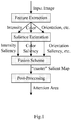
- Fig.1 indicates the general architecture of a mostly used attention model.
- an image to be estimated is inputted into the attention model.
- the feature of intensity, colour, orientation, etc. will be achieved after the step of feature extraction.
- the salience of said features are estimated.
- the steps of fusion scheme and post-processing the attention area is finally got.
- object-based visual attention model Different from attention models used in most previous machine vision systems which drive attention based on the spatial location hypothesis with macro-block (MB) being the basic unit, other models which direct visual attention are object-driven, called object-based visual attention model.
- MB macro-block
- the MB spatial-based visual attention model is a much easier and faster creation.
- it has several inherent disadvantages:
- the extracted feature of the micro-block is a mixed property of all these natural objects and thus will lower down attention area detection precision.
- the key issue of the object-based visual attention model lies in two aspects: one is the object grouping before feature extraction, the other is the particular efficient salience estimation of each object over all the objects in the image.
- the central idea of the currently used salience estimation scheme is based on Gauss distance measure as presented by Y.Sun et al.
- x the object to be salience estimated
- y i the object to be salience estimated
- w the maximum of the width and height of the input image
- S F ( x,y i ) the absolute difference of object x and y i in feature F
- the salience estimation S F ( x ) as the overall salience degree of object x in feature F can be expressed as Formula (2).
- S F ( x ) is a useful salient estimation in feature F .
- some important human perception properties are not considered in S F ( x ) .
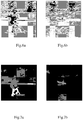
- Fig.2a is an original image of Skating to be estimated and Fig.3a is the salience estimation result of Fig.2a using the conventional object-based visual attention model.
- Fig.2b is an original image of Coastguard to be estimated and Fig.3b is the salience estimation result of Fig.2b using the conventional object-based visual attention model.
- white colour means a very outstanding object while black colour means not salient one, the grey level between white and black represents the salience degree.
- Fig.3a there is a little grey block on the left of the female dancer's head.
- the block consists of a piece of white skating rink which is circled by black male clothing and female skin, and it is salient in this local area. But when all comes to all, this block is a part of the large skating rink and will not attract viewers' attention. This is called “Local effect”. Because of the local effect, the accumulated difference between the object and its neighbours is large and thus it is recognized as “salience”.
- the conventional object-based visual attention model is far from applicable. Therefore an improved object-based visual attention model is desirable.
- EP1017019A discloses a method for detecting a main object in an image and proposes using a probabilistic reasoning engine to integrate saliency features into estimation of a region of arbitrary shape and size as a main subject of the image.
- the present invention provides a salience estimation scheme for object-based visual attention model employing a multi-level concentric circled scheme capable of lowering the computing complexity and being more applicable.
- the invention provides a method for estimating the salience of an image according to claim 1. It comprises steps of segmenting the image into a plurality of objects to be estimated; extracting feature maps for each segmented object; calculating the saliences of each segmented object in a set of circles defined around a centre pixel of the object based on the extracted feature maps; and integrating the saliences of each segmented object in the all circles in order to achieve an overall salience estimation for each segmented object.
- the step of extracting feature maps is based on the measure of image colour variation.
- the step of calculating the salience of each segmented object comprises a sub-step of comparing colour features of the object to be estimated with that of any other object in each circle defined around the object to be estimated.
- the object-based visual attention model based on multi-level concentric circled salience estimation scheme of the present invention presents an efficient framework to construct object-based visual attention model, which is of low computing complexity and much more human vision inosculated.
- the method of the present invention mainly includes three steps described as below:
- Step 1 Pre-processing (image segmentation)
- Image-based segmentation and grouping play a powerful role in human vision perception, a lot of researches have been developed in this area.
- P.F.Felzenszwalb et al. "Image Segmentation Using Local Variation", IEEE Computer Society on Computer Vision and Pattern Recognition, Jun.1998 , which is based on measures of image colour variation.
- an undirected graph H ( V, E ) is defined based on the image I , where each pixel p i of I has a corresponding vertex v i ⁇ V, and an edge ( v i , v j ) ⁇ E connects vertices v i and v j .
- the precise definition of which pixels are connected by edges in E depends on the expression (1-1).
- E v i , v j
- the process of the segmentation is to make the expression (1-5) satisfied for any two of the segmented objects: Ext C 1 , C 2 ⁇ min Int C 1 + k /
- Step 2 Pre-processing (feature extraction)
- the returned value of Major ( f, o ) is the representative feature of the object o which is defined to satisfy ( d 1 , d 2 and ⁇ are constant number, set to 2, 64 and 95% respectively in our implementation):
- the intensity feature is extracted as formula (2-1).
- I i Y i
- the "colour double-opponent" based colour features are extracted as formula (2-2) and (2-3).
- Orientation will be a certain complex feature in object based visual attention model. Since all the objects are segmented according to colour variations, the object itself then will not contain any orientation information except the border of the object. Because of this special property of the segmented objects, we will not consider orientation in the implementation.
- the remaining problem is how to estimate the salience map for each feature map F ( F ⁇ I, RG, BY ⁇ ), denoted as Sal F ( o i ) .
- X i and Y i are described as formula (3-1).
- each pixel of the o i is indistinctively considered equal to the center pixel c i , so the object is considered duplicated s i copies of the center pixel as shown in Fig.4 .
- Fig.7a and Fig.7b respectively present the salience estimation experimental results of Fig.2a and Fig.2b by using the salience estimation scheme according to the present invention.
- the audience in Fig.2a and the background in Fig.2b are considered not salient, and the little block on the left of the female dancer's head in Fig.3a is also removed from Fig.7a .
- the present invention is capable of handing the local effect and video texture and it is more applicable.
- the present object-based visual attention model based on multi-level concentric circled salience estimation scheme gives a more accuracy on understanding of the image and a far more computing efficiency, it has several advantages as below:
Landscapes
- Engineering & Computer Science (AREA)
- Computer Vision & Pattern Recognition (AREA)
- Physics & Mathematics (AREA)
- General Physics & Mathematics (AREA)
- Theoretical Computer Science (AREA)
- Multimedia (AREA)
- Artificial Intelligence (AREA)
- Evolutionary Computation (AREA)
- Health & Medical Sciences (AREA)
- Life Sciences & Earth Sciences (AREA)
- Biodiversity & Conservation Biology (AREA)
- Biomedical Technology (AREA)
- General Health & Medical Sciences (AREA)
- Molecular Biology (AREA)
- Image Analysis (AREA)
Priority Applications (1)
| Application Number | Priority Date | Filing Date | Title |
|---|---|---|---|
| EP07728649.0A EP2013850B1 (en) | 2006-04-28 | 2007-04-27 | Salience estimation for object-based visual attention model |
Applications Claiming Priority (4)
| Application Number | Priority Date | Filing Date | Title |
|---|---|---|---|
| EP06300418 | 2006-04-28 | ||
| EP06300538A EP1862966A1 (en) | 2006-05-31 | 2006-05-31 | Salience estimation for object-based visual attention model |
| PCT/EP2007/054195 WO2007125115A1 (en) | 2006-04-28 | 2007-04-27 | Salience estimation for object-based visual attention model |
| EP07728649.0A EP2013850B1 (en) | 2006-04-28 | 2007-04-27 | Salience estimation for object-based visual attention model |
Publications (2)
| Publication Number | Publication Date |
|---|---|
| EP2013850A1 EP2013850A1 (en) | 2009-01-14 |
| EP2013850B1 true EP2013850B1 (en) | 2018-07-25 |
Family
ID=38169248
Family Applications (1)
| Application Number | Title | Priority Date | Filing Date |
|---|---|---|---|
| EP07728649.0A Ceased EP2013850B1 (en) | 2006-04-28 | 2007-04-27 | Salience estimation for object-based visual attention model |
Country Status (4)
| Country | Link |
|---|---|
| US (1) | US8385654B2 (enExample) |
| EP (1) | EP2013850B1 (enExample) |
| JP (1) | JP4979033B2 (enExample) |
| WO (1) | WO2007125115A1 (enExample) |
Families Citing this family (13)
| Publication number | Priority date | Publication date | Assignee | Title |
|---|---|---|---|---|
| JP5486006B2 (ja) * | 2008-10-03 | 2014-05-07 | スリーエム イノベイティブ プロパティズ カンパニー | 堅牢性を評価するシステム及び方法 |
| JP5306940B2 (ja) * | 2009-08-11 | 2013-10-02 | 日本放送協会 | 動画像コンテンツ評価装置およびコンピュータプログラム |
| EP2515206B1 (en) * | 2009-12-14 | 2019-08-14 | Panasonic Intellectual Property Corporation of America | User interface apparatus and input method |
| CN101894371B (zh) * | 2010-07-19 | 2011-11-30 | 华中科技大学 | 一种生物激励的自顶向下的视觉注意方法 |
| AU2011254040B2 (en) * | 2011-12-14 | 2015-03-12 | Canon Kabushiki Kaisha | Method, apparatus and system for determining a saliency map for an input image |
| US9946795B2 (en) | 2014-01-27 | 2018-04-17 | Fujitsu Limited | User modeling with salience |
| US9195903B2 (en) | 2014-04-29 | 2015-11-24 | International Business Machines Corporation | Extracting salient features from video using a neurosynaptic system |
| US9373058B2 (en) | 2014-05-29 | 2016-06-21 | International Business Machines Corporation | Scene understanding using a neurosynaptic system |
| US10115054B2 (en) | 2014-07-02 | 2018-10-30 | International Business Machines Corporation | Classifying features using a neurosynaptic system |
| US9798972B2 (en) | 2014-07-02 | 2017-10-24 | International Business Machines Corporation | Feature extraction using a neurosynaptic system for object classification |
| US10055850B2 (en) * | 2014-09-19 | 2018-08-21 | Brain Corporation | Salient features tracking apparatus and methods using visual initialization |
| US9830529B2 (en) * | 2016-04-26 | 2017-11-28 | Xerox Corporation | End-to-end saliency mapping via probability distribution prediction |
| CN110781846B (zh) * | 2019-10-30 | 2021-02-09 | 江苏开放大学(江苏城市职业学院) | 一种融合视觉广度特点的视觉注意计算方法 |
Family Cites Families (4)
| Publication number | Priority date | Publication date | Assignee | Title |
|---|---|---|---|---|
| US6282317B1 (en) * | 1998-12-31 | 2001-08-28 | Eastman Kodak Company | Method for automatic determination of main subjects in photographic images |
| JP2003248825A (ja) * | 2002-02-22 | 2003-09-05 | Fuji Xerox Co Ltd | 画像処理装置及び画像処理方法、画像処理プログラム、記憶媒体 |
| US7471827B2 (en) * | 2003-10-16 | 2008-12-30 | Microsoft Corporation | Automatic browsing path generation to present image areas with high attention value as a function of space and time |
| US7940985B2 (en) * | 2007-06-06 | 2011-05-10 | Microsoft Corporation | Salient object detection |
-
2007
- 2007-04-27 EP EP07728649.0A patent/EP2013850B1/en not_active Ceased
- 2007-04-27 JP JP2009507098A patent/JP4979033B2/ja not_active Expired - Fee Related
- 2007-04-27 WO PCT/EP2007/054195 patent/WO2007125115A1/en not_active Ceased
- 2007-04-27 US US12/226,386 patent/US8385654B2/en not_active Expired - Fee Related
Non-Patent Citations (1)
| Title |
|---|
| None * |
Also Published As
| Publication number | Publication date |
|---|---|
| EP2013850A1 (en) | 2009-01-14 |
| JP4979033B2 (ja) | 2012-07-18 |
| US20090060267A1 (en) | 2009-03-05 |
| US8385654B2 (en) | 2013-02-26 |
| JP2009535683A (ja) | 2009-10-01 |
| WO2007125115A1 (en) | 2007-11-08 |
Similar Documents
| Publication | Publication Date | Title |
|---|---|---|
| EP2013850B1 (en) | Salience estimation for object-based visual attention model | |
| EP2523165B1 (en) | Image processing method and image processing device | |
| Kruthiventi et al. | Saliency unified: A deep architecture for simultaneous eye fixation prediction and salient object segmentation | |
| Rahtu et al. | Segmenting salient objects from images and videos | |
| Jia et al. | Category-independent object-level saliency detection | |
| Kuo et al. | Two-stage road sign detection and recognition | |
| Erdem et al. | Visual saliency estimation by nonlinearly integrating features using region covariances | |
| US8705866B2 (en) | Region description and modeling for image subscene recognition | |
| CN102332092B (zh) | 一种基于视频分析的火焰检测方法 | |
| Lu et al. | Salient object detection using concavity context | |
| US20200286239A1 (en) | Iterative method for salient foreground detection and multi-object segmentation | |
| Russell et al. | Segmenting scenes by matching image composites | |
| Derpanis et al. | Classification of traffic video based on a spatiotemporal orientation analysis | |
| Zohourian et al. | Superpixel-based Road Segmentation for Real-time Systems using CNN. | |
| Socarrás Salas et al. | Improving hog with image segmentation: Application to human detection | |
| Lam et al. | Highly accurate texture-based vehicle segmentation method | |
| Farid et al. | DOST: A distributed object segmentation tool | |
| Li et al. | The research on traffic sign recognition based on deep learning | |
| Jency et al. | Traffic Sign Recognition System for Autonomous Vehicles using Deep Learning | |
| CN101432775B (zh) | 基于对象的视觉注意力模型的显著性评估方法 | |
| Ishii et al. | Face detection based on skin color information in visual scenes by neural networks | |
| Yang et al. | The large-scale crowd density estimation based on sparse spatiotemporal local binary pattern | |
| Kim et al. | Segmentation of salient regions in outdoor scenes using imagery and 3-d data | |
| Liang et al. | Salient object detection based on regions | |
| EP1862966A1 (en) | Salience estimation for object-based visual attention model |
Legal Events
| Date | Code | Title | Description |
|---|---|---|---|
| PUAI | Public reference made under article 153(3) epc to a published international application that has entered the european phase |
Free format text: ORIGINAL CODE: 0009012 |
|
| 17P | Request for examination filed |
Effective date: 20081015 |
|
| AK | Designated contracting states |
Kind code of ref document: A1 Designated state(s): AT BE BG CH CY CZ DE DK EE ES FI FR GB GR HU IE IS IT LI LT LU LV MC MT NL PL PT RO SE SI SK TR |
|
| AX | Request for extension of the european patent |
Extension state: AL BA HR MK RS |
|
| DAX | Request for extension of the european patent (deleted) | ||
| RBV | Designated contracting states (corrected) |
Designated state(s): DE FR GB |
|
| RAP1 | Party data changed (applicant data changed or rights of an application transferred) |
Owner name: THOMSON LICENSING |
|
| 17Q | First examination report despatched |
Effective date: 20110523 |
|
| REG | Reference to a national code |
Ref country code: DE Ref legal event code: R079 Ref document number: 602007055507 Country of ref document: DE Free format text: PREVIOUS MAIN CLASS: G06T0005000000 Ipc: G06T0007110000 |
|
| GRAP | Despatch of communication of intention to grant a patent |
Free format text: ORIGINAL CODE: EPIDOSNIGR1 |
|
| RIC1 | Information provided on ipc code assigned before grant |
Ipc: G06T 7/11 20170101AFI20180130BHEP |
|
| INTG | Intention to grant announced |
Effective date: 20180213 |
|
| GRAS | Grant fee paid |
Free format text: ORIGINAL CODE: EPIDOSNIGR3 |
|
| GRAA | (expected) grant |
Free format text: ORIGINAL CODE: 0009210 |
|
| AK | Designated contracting states |
Kind code of ref document: B1 Designated state(s): DE FR GB |
|
| REG | Reference to a national code |
Ref country code: GB Ref legal event code: FG4D |
|
| REG | Reference to a national code |
Ref country code: DE Ref legal event code: R096 Ref document number: 602007055507 Country of ref document: DE |
|
| RIC2 | Information provided on ipc code assigned after grant |
Ipc: G06T 7/11 20170101AFI20180130BHEP |
|
| REG | Reference to a national code |
Ref country code: DE Ref legal event code: R097 Ref document number: 602007055507 Country of ref document: DE |
|
| PLBE | No opposition filed within time limit |
Free format text: ORIGINAL CODE: 0009261 |
|
| STAA | Information on the status of an ep patent application or granted ep patent |
Free format text: STATUS: NO OPPOSITION FILED WITHIN TIME LIMIT |
|
| 26N | No opposition filed |
Effective date: 20190426 |
|
| REG | Reference to a national code |
Ref country code: DE Ref legal event code: R119 Ref document number: 602007055507 Country of ref document: DE |
|
| GBPC | Gb: european patent ceased through non-payment of renewal fee |
Effective date: 20190427 |
|
| PG25 | Lapsed in a contracting state [announced via postgrant information from national office to epo] |
Ref country code: GB Free format text: LAPSE BECAUSE OF NON-PAYMENT OF DUE FEES Effective date: 20190427 Ref country code: DE Free format text: LAPSE BECAUSE OF NON-PAYMENT OF DUE FEES Effective date: 20191101 |
|
| PG25 | Lapsed in a contracting state [announced via postgrant information from national office to epo] |
Ref country code: FR Free format text: LAPSE BECAUSE OF NON-PAYMENT OF DUE FEES Effective date: 20190430 |