EP2012246A1 - Verfahren zur vorhersage der sekundärstruktur von rna, prädiktionsvorrichtung und prädiktionsprogramm - Google Patents
Verfahren zur vorhersage der sekundärstruktur von rna, prädiktionsvorrichtung und prädiktionsprogramm Download PDFInfo
- Publication number
- EP2012246A1 EP2012246A1 EP07740056A EP07740056A EP2012246A1 EP 2012246 A1 EP2012246 A1 EP 2012246A1 EP 07740056 A EP07740056 A EP 07740056A EP 07740056 A EP07740056 A EP 07740056A EP 2012246 A1 EP2012246 A1 EP 2012246A1
- Authority
- EP
- European Patent Office
- Prior art keywords
- sequence
- stem
- stem structure
- candidate
- rna
- Prior art date
- Legal status (The legal status is an assumption and is not a legal conclusion. Google has not performed a legal analysis and makes no representation as to the accuracy of the status listed.)
- Ceased
Links
Images





Classifications
-
- G—PHYSICS
- G16—INFORMATION AND COMMUNICATION TECHNOLOGY [ICT] SPECIALLY ADAPTED FOR SPECIFIC APPLICATION FIELDS
- G16B—BIOINFORMATICS, i.e. INFORMATION AND COMMUNICATION TECHNOLOGY [ICT] SPECIALLY ADAPTED FOR GENETIC OR PROTEIN-RELATED DATA PROCESSING IN COMPUTATIONAL MOLECULAR BIOLOGY
- G16B15/00—ICT specially adapted for analysing two-dimensional [2D] or three-dimensional [3D] molecular structures, e.g. structural or functional relations or structure alignment
-
- G—PHYSICS
- G16—INFORMATION AND COMMUNICATION TECHNOLOGY [ICT] SPECIALLY ADAPTED FOR SPECIFIC APPLICATION FIELDS
- G16B—BIOINFORMATICS, i.e. INFORMATION AND COMMUNICATION TECHNOLOGY [ICT] SPECIALLY ADAPTED FOR GENETIC OR PROTEIN-RELATED DATA PROCESSING IN COMPUTATIONAL MOLECULAR BIOLOGY
- G16B15/00—ICT specially adapted for analysing two-dimensional [2D] or three-dimensional [3D] molecular structures, e.g. structural or functional relations or structure alignment
- G16B15/10—Nucleic acid folding
-
- G—PHYSICS
- G16—INFORMATION AND COMMUNICATION TECHNOLOGY [ICT] SPECIALLY ADAPTED FOR SPECIFIC APPLICATION FIELDS
- G16B—BIOINFORMATICS, i.e. INFORMATION AND COMMUNICATION TECHNOLOGY [ICT] SPECIALLY ADAPTED FOR GENETIC OR PROTEIN-RELATED DATA PROCESSING IN COMPUTATIONAL MOLECULAR BIOLOGY
- G16B30/00—ICT specially adapted for sequence analysis involving nucleotides or amino acids
-
- G—PHYSICS
- G16—INFORMATION AND COMMUNICATION TECHNOLOGY [ICT] SPECIALLY ADAPTED FOR SPECIFIC APPLICATION FIELDS
- G16B—BIOINFORMATICS, i.e. INFORMATION AND COMMUNICATION TECHNOLOGY [ICT] SPECIALLY ADAPTED FOR GENETIC OR PROTEIN-RELATED DATA PROCESSING IN COMPUTATIONAL MOLECULAR BIOLOGY
- G16B30/00—ICT specially adapted for sequence analysis involving nucleotides or amino acids
- G16B30/10—Sequence alignment; Homology search
Definitions
- the present invention relates to a method for predicting secondary structure of RNA, an apparatus for predicting using the method for predicting, and a predicting program carrying out the method for predicting.
- RNA is a nucleic acid consisting of 4 type of bases including adenine (A), cytosine (C), guanine (G) and uracil (U), and hydrogen bonds between A, and U and G and C is formed in RNA to form a base pair, thereby forming various type of secondary structure in accordance with its combination.
- the type of the secondary structure of RNA includes a stem structure which is a region comprising continuous base pairs, and the various secondary structures as shown in for example in Figure 7A .
- the higher-order structure including secondary structure is intimately involved in the function of RNA. So, it is very important to know the structure of RNA.
- Non-patent-related document 1 describes in detail with regard to the prediction of the secondary structure with the dynamic programming and parameters used in the calculation of the free energy.
- the present invention is made in accordance with the above-mentioned problems.
- the present invention is to provide a method for predicting secondary structure of RNA capable of predicting the secondary structure which has been difficult to predict the secondary structure including pseudonot structure, and an apparatus for predicting secondary structure of RNA using the method for predicting.
- the first effect of the present invention is capable of predicting the secondary structure comprising pseudonot structure with the calculation of the free energy.
- the present invention is considered to be categorized in one of methods for optimizing a combination of the stem structure with one RNA.
- the prediction uses the calculation of free energy.
- the pseudonot structure which is related to calculate the free energy is treated and the other structural combination as already known in positional relationship to the circumference of the stem structure to achieve the calculation of the free energy.
- the apparatus for predicting secondary structure of RNA comprises an input device 1 such as keyboard, a data processing device (computer; central processing unit; processor) 2 operated by the program control, a storage device 3 storing the information, and a output device 4 such as the display device and printing device.
- an input device 1 such as keyboard
- a data processing device computer; central processing unit; processor
- storage device 3 storing the information
- output device 4 such as the display device and printing device.
- the storage device 3 comprises a defined value storage unit 31, a candidate stem structure storage unit 32, a defined stem structure storage unit 33 and a sequence structure state storage unit34 and sequence energy state storage unit 35.
- the defined value storage unit 31 preliminary stores numerical information which is changed in the calculation, including value of free energy due to the continuous base pair, vale of free energy due to forming the loop structure, permissible minimum length of the stem structure, length of pseudonot structure, number of trial for prediction of secondary structure.
- the candidate stem structure storage unit 32 stores various information related to the candidate stem structure which is a candidate portion of the stem structure and is searched by the means for searching candidate stem structure 21.
- the candidate stem structure storage unit 32 stores: a base constituting the candidate stem structure; an information in what number of bases the base is located from the end of the RNA sequence in the RNA sequence as input (hereinafter, also referred to as an input RNA sequence); the value of the free energy at which the candidate stem structure forms the stem structure; and the others.
- the candidate stem structure may be listed in accordance with the free energy in ascending order possessed in each stem structure, or in accordance with the order as desired by the user.
- the defined stem structure storage unit 33 stores where the candidate stem structure which is determined to select at the cycle is stored in the candidate stem structure storage unit 32.
- the sequence structure state storage unit 34 stores the result as determined by the means for investigating sequence structure state 23, including what structure state is constituted by each bases in the process of the calculation with regard to the input RNA sequence.
- Example of the structure state includes a portion of stem, a portion of bulge loop, a portion of inner loop, a portion of hairpin loop, a portion of multibranched loop, single strand, end structures such as a portion of one end of RNA sequence.
- the sequence energy state storage unit 35 stores the result value in each base (for example, matter indicating the energy state in each structure state) as calculated by the means for calculating sequence energy state 24 based on the free energy in each structure state as stored in the sequence structure state storage unit 34.
- Each adjacent base contained in the same structure possesses the identical value each other. For example, all of bases constituting the same portion of the inner loop possesses the value of the free energy possessing its inner loop.
- the data processing device 2 comprises means for searching candidate stem structure 21, means for arranging defined stem structure 22, means for investigating sequence structure state 23, means for calculating sequence energy state 24 and means for searching additional stem structure 25.
- the means for searching candidate stem structure 21 searches a region in which the stem structure can be formed, among the input RNA sequence as input from the input device 1, using the information stored in the defined value storage unit 31 (e.g. value of free energy due to the continuous base pair, vale of free energy due to forming the loop structure, permissible minimum length of the stem structure, length of pseudonot structure, number of trial for prediction of secondary structure), and calculates the free energy possessed in case of the stem structure being formed.
- the means for searching candidate stem structure 21 arranges the region in which the stem structure can be formed as obtained from the searching and the calculation, as the candidate stem structure, and stores the candidate stem structure into the candidate stem structure storage unit 32 and the free energy of each candidate stem structure into the candidate stem structure storage unit 32 as the result of searching.
- the means for arranging defined stem structure 22 receives the information of the candidate stem structure (e.g. the information of the base, the information of the free energy) from the candidate stem structure storage unit 32, selects the candidate stem structure to be investigated, calculated and searched as performed later, and stores it into the defined stem structure storage unit 33.
- the candidate stem structure to be selected differs in accordance with the searching, investigating, calculating and the other with regard to the input RNA sequence. For example, when the secondary structure prediction is at the first round, the candidate stem structure is searched with regard to the RNA sequence input from the input device 1, and these candidate stem structures are listed as mentioned above. Then, the candidate stem structure which is initially selected by the means for arranging defined stem structure 22 is the candidate stem structure listed at the top thereof by the means for searching candidate stem structure 21.
- the means for arranging defined stem structure 22 stores this candidate stem structure into the defined stem structure storage unit 33 as the defined stem structure.
- the means for arranging defined stem structure 22 arranges the next candidate stem structure of the candidate stem structure which is selected by the means for arranging defined stem structure 22 at the first round (that is, the top of the candidate stem structure in that list as stored in the defined stem structure storage unit 33), as the defined stem structure.
- the means for arranging defined stem structure 22 arranges the listed candidate stem structure as the defined stem structure at there order in accordance with the round of the secondary structure prediction.
- the means for investigating sequence structure state 23 receives various information stored in the defined stem structure storage unit 33, such as the basic information of the defined stem structure, and assigns the corresponding base in the input RNA sequence as being in a condition of containing a part of the stem structure. Next, the means for investigating sequence structure state 23 divides the input RNA sequence into regions of constituting the stem structure and the other bases at the end base constituting this stem structure. Then, the means for investigating sequence structure state 23 determines the structure state in positional relationship between each region as divided and the stem structure, and stores the result into the sequence structure state storage unit 34.
- the means for calculating sequence energy state 24 receives the information with regard to the free energy possessed in the base pair and the loop structure wherein the free energy is experimentally investigated, from the defined value storage unit 31, and receives the information of the structure state of the input RNA sequence from the sequence structure state storage unit 34. Then, the means for calculating sequence energy state 24 sequentially calculates a value of free energy corresponding to the structure state of each region of the input RNA sequence, and makes each base contained in the region to hold the value, and stores the result into the sequence energy state storage unit 35.
- the means for searching additional stem structure 25 receives the information of candidate stem structure from the candidate stem structure storage unit 32, and sets the candidate stem structure which is only constituted by the base not overlapped with each base contained in the stem structure stored in the defined stem structure storage unit 33 as a candidate of stem structure as added (hereinafter, also referred to as candidate additional stem structure).
- the means for searching additional stem structure 25 searches as to whether the candidate additional stem structure is set as the defined stem structure. That is, the means for searching additional stem structure 25 compares the structure state of the input RNA sequence in which the defined stem structure stored in the defined stem structure storage unit 33 is reflected, with the structure stat of the RNA sequence in which the candidate additional stem structure is reflected in the input RNA sequence as reflected in the defined stem structure, in view of the free energy, and determines the candidate additional stem structure with which the structure state with lower free energy can become, as the defined stem structure as stem structure to be added.
- the means for searching additional stem structure 25 receives the information of the structure at each base of the secondary structure formed with the defined stem structure stored in the defined stem structure storage unit 33, and receives the energy state of each structure containing each base in the secondary structure, from the sequence energy state storage unit 35.
- the means for searching additional stem structure 25 calculates an amount of change (a difference) between the free energy of this secondary structure and the free energy of the whole input RNA sequence due to the change of the secondary structure as created by actually adding the candidate additional stem structure in this secondary structure.
- the calculation of the amount of change is performed with regard to all of the candidate additional stem structures.
- the candidate additional stem structure which gives a negative minimum value among the amount of change is determined as the stem structure to be added, and stored in the defined stem structure storage unit 33 as the defined stem structure.
- the defined stem structure is reflected into the input RNA sequence to provide a certain secondary structure.
- the means for investigating sequence structure state 23 calculates a sequence structure state
- the means for calculating sequence energy state 24 calculates the free energy thereof.
- the secondary structure prediction at its round is terminated at that time, and the stem structure stored in the defined stem structure storage unit 33 at that time is output in just proportion to the output device 4.
- the round of the secondary structure prediction at that time is less than the predetermined round of the secondary structure prediction stored in the defined value storage unit 31, subsequent steps of the step using the means for arranging defined stem structure22 are repeated. Then, when the predetermined round is achieved, the calculation is terminated.
- the input device 1, the data processing device 2, the storage device 3 and the output device 4 may be provided in the integrated computer, and may be provided in different computers through a line such as the Internet.
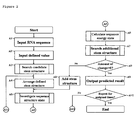
- the character string information of the RNA sequence given from the input device 1 is supplied to the means for searching candidate stem structure 21 (step A1 of Figure 2 ).
- the information of the defined value such as value of free energy due to the continuous base pair, vale of free energy due to forming the loop structure, permissible minimum length of the stem structure, length of pseudonot structure, number of trial for prediction of secondary structure is preliminary stored in the defined value storage unit 31.
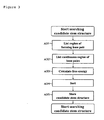
- the means for searching candidate stem structure 21 searches a possible region forming the base pair from each base constituting the input RNA sequence (step A31 of Figure 3 ), and searches a possible portion forming the stem structure (portion of continuous base pairs) (step A32), based on the information of the possible region. After the summation of the free energy of the structure due to the continuous base pairs is calculated (step A33 of Figure 3 , candidates of the searched stem structure is sorted (aligned) in ascending order of the free energy (step A34).
- the means for searching candidate stem structure 21 sets the information of the base constituting each candidate stem structure and the information of free energy of the candidate stem structure, and stores it into the candidate stem structure storage unit 32 (step A35).
- the stored candidate stem structure is picked up from the top thereof in accordance with a round (trial round) of the secondary structure prediction, and is stored in the defined stem structure storage unit 33 as the first stem structure as determined to form the stem structure.
- the means for investigating sequence structure state 23 which received the information of the defined stem structure from defined stem structure storage unit 33 lays out the defined stem structure on the input RNA sequence (step A51 of Figure 4 ). After laying out, with regard to the region of the base not belonging to the stem structure, the secondary structure of each region is searched (determined) in accordance with the positional relationship of the neighborhood stem structure (step A51 of Figure 4 ). This search is performed by making it to belong to the well-known structure in the secondary structure of the RNA sequence.
- Figure 7A shows a schematic diagram showing secondary structure of RNA
- Figure 7B shows an example of determination formula of secondary structure in the present invention.
- the base corresponding to the end of the stem structure does not form the loop structure. However, in the investigation, it deems the base to form the unique secondary structure. By doing so, the circumference structure of a stem structure is investigated. When there is an uninvestigated region in the circumference of the defined stem structure, the investigation of the circumference structure is performed. When there is not an uninvestigated (undetermined) region, the structure state as investigated is stored in the sequence structure state storage unit 34 (steps A53 and A54 of Figure 4 ).
- the means for calculating sequence energy state 24 receives the structure state of the sequence from the sequence structure state storage unit 34 (step A61 of Figure 5 ), and calculates the free energy of each region, using the value of the free energy at forming the loop structure stored in the defined value storage unit 31 as the defined value. In such a case, all of the bases contained in the region may possess the same value (step A62 of Figure 5 ). The energy state of each base of the sequence is stored in the sequence energy state storage unit 35 (step A63 of Figure 5 ).
- the means for searching additional stem structure 25 receives the candidate stem structure from the candidate stem structure storage unit32 (step A71 of Figure 6 ), and investigates as to whether the base constituting the candidate stem structure is overlapped with the base of the defined stem structure (step A72 of Figure 6 ). When there is an overlap, the investigation of the overlap with regard to the next candidate stem structure is performed. When there is not an overlap, this candidate stem structure is assigned as a candidate of the structure (candidate additional stem structure) to be added as the defined stem structure.
- the means for searching additional stem structure 25 calculates the amount of change of the free energy originated from each structure state between a structure state obtained by reflecting the defined stem structure on the input RNA sequence and a structure state obtained by reflecting the candidate additional stem structure on this structure state (step A73 of Figure 6 ).
- Minimum value (largest value in the negative direction) of the amount of change estimated at this time and the information of the candidate stem structure at which the value is estimated are temporarily stored, and the minimum amount of change and the candidate of the additional stem structure are rewritten at each time when the minimum value is renewed (steps A74 and A75 of Figure 6 ).
- the means for searching additional stem structure 25 determines as to whether the value held as the minimum amount of change at that time is positive or negative (step A8 of Figure 2 ).
- the candidate additional stem structure held in the means for searching additional stem structure 25 at that time is added to the defined stem structure storage unit 33 as the defined stem structure, and the information in the defined stem structure storage unit 33 is renewed (step A9 of Figure 2 ). Then, the subsequent steps (steps A5 to A9) of the step using the means for investigating sequence structure state 23 are repeated again.
- Each defined stem structure stored in the defined stem structure storage unit 33 at that time is a prediction result of the secondary structure for the input RNA sequence, and the result is output to the output device 4 (step A10 of Figure 2 ).
- the trial round of the secondary structure prediction at present is determined (step A11 of Figure 2 ).
- the trial round at present is less than the input trial round as the defined value, among the candidate stem structure stored in the candidate stem structure storage unit 32, the next sorted candidate stem structure of the candidate stem structure assigned in the means for arranging defined stem structure 22 at the round (the defined stem structure in case of the first round) is assigned as the defined stem structure, and the subsequent steps of the step using means for investigating sequence structure state 23 are repeated (step A4 of Figure 2 ). After the predetermined trial round is achieved, the calculation is finished.
- GCAACCCGCAUAGGG is given in the input device 1 as the input RNA sequence. If any defined values are not input at that time, the information as primary input in the defined value storage unit 31 such as free energy is used for the following calculation. It should be noted that, as a matter of convenience, the base “G” corresponding to numeral “1” as stated in Figure 8 refers to as 5' end, and the base “G” corresponding to numeral “15” as stated in the Figure refers to as 3' end.
- the means for searching candidate stem structure 21 finds and lists continuous portion of base pairs of G-C, A-U and G-U such as white area (candidate stem region 1) and shaded area (candidate stem area 2) of Figure 8 as the candidate stem structure.
- the free energy of the candidate stem region is estimated as the summation of the unique value mainly depending on the type of alignment of the base pair. Accordingly, if the value of the free energy in case of continuous base pair of G-C is supported as -2, the free energy of the candidate stem region is - 4, and free energy of the candidate stem region 2 is -6.
- the means for searching candidate stem structure 21 sorts each candidate stem structure in ascending order of free energy, and stores it in the candidate stem structure storage unit 32.
- the means for searching candidate stem structure 21 stores the order of each candidate stem region (candidate stem region 2 and candidate stem region 1) sorted as mentioned, the base constituting these candidate stem region and the value of the free energy of the region in the candidate stem structure storage unit 32.
- the means for arranging defined stem structure 22 arranges the candidate stem region as listed in the top of the list of candidate stem structures stored in the candidate stem structure storage unit 32 as the first defined stem structure, and stores it in the defined stem structure storage unit 33.
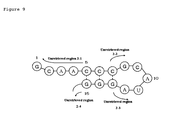
- the means for investigating sequence structure state 23 initially receives the information of the candidate stem region 2 among the defined stem structure stored in the defined stem structure storage unit 33, and assigns as being in a condition that a base corresponding the input RNA sequence is contained in the part of the candidate stem region 2. If a stem structure is determined, there can be 4 undetermined structure regions around the stem structure.
- the 4 undetermined structure regions are, as shown in Figure 9 , a region which is from 5 th residue of 5' end to the 5' end direction of the input RNA sequence (an unretrieved region 2-1), a region which is from 7 th residue of 5' end to the 3' end direction of the input RNA sequence (an unretrieved region 2-2), a region which is from 7 th residue of 5' end to 3' end of the input RNA sequence (unretrieved region 2-3) and a region which is from 15 th residue of 5' end to 3' end direction of the input RNA sequence (an unretrieved region 2-4).
- Each region is a region which is from the region of the original stem structure as a starting point to the region of the other stem structure or to the end of the sequence.
- the means for investigating sequence structure state 23 initially investigates the proximal region to 5' end of the input RNA sequence (in this case, the unretrieved region 2-1). So, in this case, there is no stem structure in the region from 5 th residue to 5' end. Accordingly, it is found that the unretrieved region 2-1 is connected to 5' end of the input RNA sequence. In this case, the unretrieved region 2-1 is assigned as a single strand region comprising 4 bases. Next, the unretrieved region 2-2 and the unretrieved region 2-3 are searched. So, it is found that there regions are connected to an anterior extremities of the unretrieved region 2-3 and the unretrieved region 2-2, respectively.
- the unretrieved region 2-2 (or the unretrieved region 2-3) forms the hairpin loop structure comprising 5 bases.
- the searching of the unretrieved region 2-4 is performed. It is found that the unretrieved region 2-4 is connected to the end of the sequence, and there is no base in the region. So, the determination of the circumference of stem structure with regard to the candidate stem region 2 is finished (step A52 of Figure 4 ).
- the defined stem structure stored in the defined stem structure storage unit 33 at this time is only the candidate stem region 2. Accordingly the investigation is finished.
- the means for investigating sequence structure state 23 stores the information of the structure state of the investigated RNA sequence in the sequence structure state storage unit 34.
- the means for calculating sequence energy state 24 receives the information of the structure state from the sequence structure state storage unit 34, and calculates the free energy corresponding to each structure using the date of the free energy received from the defined value storage unit 31.
- the input RNA sequence is constituted from the single strand region (corresponding to the unretrieved region 2-1) comprising 4 bases, the hairpin loop structure (corresponding to the unretrieved regions 2-2 and 2-3) comprising 5 bases, and the stem structure region comprising 3 G-C pairs.
- the means for calculating sequence energy state 24 stores the energy corresponding to each structure state in each bases in the sequence energy state storage unit35, as shown in Figure 10 .
- the means for searching additional stem structure 25 receives the candidate stem structure only comprising the base not contained in the defined stem structure from the candidate stem structure storage unit 32 in the sorted order among the candidate stem structure stored in the candidate stem structure storage unit 32.
- the means for searching additional stem structure 25 receives the candidate stem region 1 as shown in Figure 8 .
- the base constituting the candidate stem region 1 is not overlapped with the base contained in the current stem structure (i.e. the candidate stem region 2). Accordingly, the candidate stem region 1 is assigned as the candidate additional stem structure.
- the candidate stem region 1 is added in the stem structure stored in the defined stem structure storage unit 33, and supplied to the means for investigating sequence structure state 23.
- the means for investigating sequence structure state 23 investigates the structure state in which the candidate stem region 1 is reflected on the structure stet of the input RNA sequence as shown in Figure 9 , that is, the structure state of the input RNA sequence as shown Figure 11 . That is, the means for investigating sequence structure state 23 which receives the candidate stem region 1 from the candidate stem structure storage unit 32 as mentioned above initially arranges the corresponding base of the input RNA sequence as being in a condition that the base is contained in part of the candidate stem region 1, as similar to the investigation for the candidate stem region 2. After that, the means for investigating sequence structure state 23 the structure state around the candidate stem region 1.
- the means for investigating sequence structure state 23 searches a region which is from 1 st residue to 5' end direction (an unretrieved region 1-1), a region which is from 2 nd residue to 3' end direction (an unretrieved region 1-2), a region which is from 8 th residue to 5' end direction (an unretrieved region 1-2) and a region which is from 9 th residue to 3' end direction (an unretrieved region 1-4), respectively.
- the unretrieved region 1-1 and the unretrieved region 1-4 does not contain any bases since the region is just connected to the end of the sequence, while the unretrieved region 1-4 is connected to the other candidate stem region (in this case, the above-mentioned candidate stem region 2).
- the unretrieved region 1-1 is determined as the single strand region comprising 0 base, and the unretrieved region 1-4 is determined as the bulge loop structure comprising 3 bases.
- the unretrieved region 1-2 and the unretrieved region 1-3 searched. These regions are connected to the same side of the chain in the same stem structure.
- the unretrieved region 1-2 and the unretrieved region 1-3 are determined as forming the bulge loop structure comprising 2 bases, and the bulge loop structure comprising 0 base.
- the information of the circumference structure state of the candidate stem region 1 at this time is sent to the means for calculating sequence energy state 24.
- the means for calculating sequence energy state 24 at this time calculates the free energy using the structure information around the candidate stem region 1 previously determined as mentioned above. If the free energy of the bulge loop structure comprising 2 bases is 2, and the free energy of the bulge loop structure comprising 3 bases is 3, the free energy is calculated as shown in Figure 12 .
- Figure 9 of the original structure and Figure 11 of the structure obtained by reflecting the candidate stem region 1 what portion of the structure is changed by forming the candidate stem region 1 is the single strand region which is from 5 th residue to 5' end direction, and the region of hairpin loop structure which is from 7 th residue to 13 th residue.
- the stem structure of the candidate stem region 1 is newly formed in the structure as shown in Figure 11 , instead of the structure of the region.
- the local free energy in this case is changed from 4 which is summation of the free energies originated from the single strand region and the hairpin loop structure as shown in Figure 9 , to 1 which is summation of the free energies originated from the stem structure of the candidate stem region 1 and 2 bulge loop structures.
- the candidate stem region 1 is accepted as the additional stem structure (step A74 and step A75).
- the candidate stem region 1 is stored in the defined stem structure storage unit 33 as a new defined stem structure, since the other defined stem structure than the candidate stem region 1 is not stored in the candidate stem structure storage unit (step A76).
- the means for investigating sequence structure state 23 investigates again the whole structure state of the input RNA sequence in response to increasing the defined stem structure.
- the investigation of the structure is performed in the circumference structure in ascending order of the distance from the anterior proximity of the sequence to the anterior proximity base among the bases forming each stem structure.
- the candidate stem region 1 and the candidate stem region 2 as shown in Figure 8 are investigated in its order.
- the determination of the circumference structure of the candidate stem region 1 it is the same as mentioned above.
- the circumference structure of the candidate stem region 2 there is a region which is from 5 th residue to 5' end direction (an unretrieved region 2-1-2), a region which is from 7 th residue to 3' end direction (an unretrieved region 2-2-2), a region which is from 13 th residue to 5' end direction (an unretrieved region 2-3-2) and a region which is from 15 th residue to 3' end direction (an unretrieved region 2-4-2), as referred to Figure 13 .
- the unretrieved region 2-1-2 and the unretrieved region 2-4-2 it is found that the unretrieved region 2-1-2 is connected to the stem structure, and the unretrieved region 2-4-2 is connected to the end of the sequence.
- the unretrieved region 2-1-2 is determined as the bulge loop structure comprising 2 bases, and the unretrieved region 2-4-2 is determined as the single strand region comprising 0 base.
- the unretrieved region 2-2-2 and the unretrieved region 2-3-2 it is found that it is connected to the same side of the chain in the same stem structure. Accordingly, it is found that the unretrieved region 2-2-2 and the unretrieved region 2-3-2 is bulge loop structure comprising 0 base and the bulge loop structure comprising 3 bases, respectively.
- the unretrieved region 2-1-2, the unretrieved region 2-2-2 and the unretrieved region 2-3-2 are the region which is already determined as the circumference structure of the candidate stem region 1, and this determination is not incompatible to the result obtained from the determination of the circumference structure of the candidate stem region 2.
- the means for investigating sequence structure state 23 stores the information of the structure state of the RNA sequence investigated as mentioned above in the sequence structure state storage unit 34 by overwriting the previous one.
- the means for calculating sequence energy state 24 performs the same steps at calculating the free energy of the above-mentioned whole RNA sequence, and stores it in the sequence energy state storage unit 35 by overwriting the previous one.
- the means for searching additional stem structure 25 refers to the candidate stem structure to be added in accordance with the list of the candidate stem structures stored in the candidate stem structure storage unit 32. In this case, since the determination for all candidate stem structures to be as candidates in the sequence as shown in Figure 8 is finished, the means for searching additional stem structure 25 determines that there is no stem structure to be added (step A76).
- the first of the secondary structure prediction with regard to the input RNA sequence is finished, and a structure wholly comprising the candidate stem region 1 and the candidate stem region 2 of the stem structure stored in the defined stem structure storage unit 33 is output by the output device 4, wherein the structure is stored in the sequence structure state storage unit 34 (step A10).
- the means for arranging defined stem structure 22 receives the candidate stem region 1 from the candidate stem structure storage unit 32 as the candidate stem structure, and the result obtained by performing the above-mentioned procedure is output.
- the two steps using the means for investigating sequence structure state 23 and the means for calculating sequence energy state 24 as shown in Figure 2 may be performed by using a means for calculating sequence structure energy state 26 in which the structure of the unretrieved region is determined in the means for investigating sequence structure state 23, the energy of the region is calculated, the information of the structure is stored in the sequence structure state storage unit 34, and the information of the energy is stored in the sequence energy state storage unit 35.
- the method for predicting secondary structure of RNA according to the present invention, the apparatus for predicting secondary structure of RNA according to the present invention and the predicting program for secondary structure RNA according to the present invention are a method for predicting performing the above-mentioned steps, a apparatus for predicting comprising each means performing the above-mentioned steps, and a predicting program carrying out the above-mentioned steps, respectively.
- the increase of the specificity and the sensitivity leads to improve the accuracy of the prediction.
- the average value was increased. Therefore, it is found that it is possible to predict the secondary structure of RNA by using the present invention with good accuracy.
Landscapes
- Life Sciences & Earth Sciences (AREA)
- Physics & Mathematics (AREA)
- Spectroscopy & Molecular Physics (AREA)
- Chemical & Material Sciences (AREA)
- Health & Medical Sciences (AREA)
- Bioinformatics & Cheminformatics (AREA)
- Biotechnology (AREA)
- Crystallography & Structural Chemistry (AREA)
- Theoretical Computer Science (AREA)
- Engineering & Computer Science (AREA)
- Medical Informatics (AREA)
- Bioinformatics & Computational Biology (AREA)
- Biophysics (AREA)
- Evolutionary Biology (AREA)
- General Health & Medical Sciences (AREA)
- Biochemistry (AREA)
- Molecular Biology (AREA)
- Measuring Or Testing Involving Enzymes Or Micro-Organisms (AREA)
- Management, Administration, Business Operations System, And Electronic Commerce (AREA)
- Information Retrieval, Db Structures And Fs Structures Therefor (AREA)
Applications Claiming Priority (2)
| Application Number | Priority Date | Filing Date | Title |
|---|---|---|---|
| JP2006088599 | 2006-03-28 | ||
| PCT/JP2007/056618 WO2007116787A1 (ja) | 2006-03-28 | 2007-03-28 | Rnaの二次構造予測方法、予測装置及び予測プログラム |
Publications (2)
| Publication Number | Publication Date |
|---|---|
| EP2012246A1 true EP2012246A1 (de) | 2009-01-07 |
| EP2012246A4 EP2012246A4 (de) | 2009-04-01 |
Family
ID=38581082
Family Applications (1)
| Application Number | Title | Priority Date | Filing Date |
|---|---|---|---|
| EP07740056A Ceased EP2012246A4 (de) | 2006-03-28 | 2007-03-28 | Verfahren zur vorhersage der sekundärstruktur von rna, prädiktionsvorrichtung und prädiktionsprogramm |
Country Status (5)
| Country | Link |
|---|---|
| US (1) | US20100235155A1 (de) |
| EP (1) | EP2012246A4 (de) |
| JP (1) | JP5022361B2 (de) |
| AU (1) | AU2007236811B2 (de) |
| WO (1) | WO2007116787A1 (de) |
Cited By (6)
| Publication number | Priority date | Publication date | Assignee | Title |
|---|---|---|---|---|
| CN101908102A (zh) * | 2010-08-13 | 2010-12-08 | 山东建筑大学 | 基于茎区的核糖核酸二级结构的预测方法及装置 |
| CN101717817B (zh) * | 2009-07-17 | 2011-11-23 | 中国人民解放军国防科学技术大学 | 对基于随机上下文无关文法的rna二级结构预测进行加速的方法 |
| CN102819692A (zh) * | 2012-08-10 | 2012-12-12 | 上海交通大学 | 基于fpga的rna二级结构预测装置、系统及其实现方法 |
| CN104298894A (zh) * | 2014-09-17 | 2015-01-21 | 山东建筑大学 | 基于k茎的核糖核酸假结结构的预测方法及装置 |
| CN104375807A (zh) * | 2014-12-09 | 2015-02-25 | 中国人民解放军国防科学技术大学 | 基于众核协处理器的三级流水序列比对方法 |
| DE202022101929U1 (de) | 2022-04-09 | 2022-06-02 | Pradipta Bhowmick | Intelligentes System zur Vorhersage der Sekundärstruktur von RNA unter Verwendung von faltbaren neuronalen Netzen und künstlicher Intelligenz |
Families Citing this family (4)
| Publication number | Priority date | Publication date | Assignee | Title |
|---|---|---|---|---|
| US20110125681A1 (en) * | 2008-07-11 | 2011-05-26 | Nec Soft, Ltd. | Feature extraction method, feature extraction apparatus, and feature extraction program |
| WO2011062166A1 (ja) * | 2009-11-17 | 2011-05-26 | 武田薬品工業株式会社 | Rnaの二次構造の動態を予測する方法 |
| CN109215740A (zh) * | 2018-11-06 | 2019-01-15 | 中山大学 | 基于Xgboost的全基因组RNA二级结构预测方法 |
| CN114822692A (zh) * | 2022-05-19 | 2022-07-29 | 洛阳师范学院 | Rna二级结构预测方法及系统 |
Family Cites Families (4)
| Publication number | Priority date | Publication date | Assignee | Title |
|---|---|---|---|---|
| JP2944434B2 (ja) | 1994-12-07 | 1999-09-06 | 日本電気株式会社 | Rna2次構造予測装置及び方法 |
| JP3129202B2 (ja) * | 1996-08-30 | 2001-01-29 | 日本電気株式会社 | 配列2次構造予測方法及び配列2次構造予測装置 |
| JP3881238B2 (ja) * | 2001-12-28 | 2007-02-14 | セレスター・レキシコ・サイエンシズ株式会社 | Rna配列解析装置、rna配列解析方法、プログラム、および、記録媒体 |
| US20040002083A1 (en) * | 2002-01-29 | 2004-01-01 | Ye Ding | Statistical algorithms for folding and target accessibility prediction and design of nucleic acids |
-
2007
- 2007-03-28 AU AU2007236811A patent/AU2007236811B2/en not_active Ceased
- 2007-03-28 JP JP2008509798A patent/JP5022361B2/ja not_active Expired - Fee Related
- 2007-03-28 US US12/294,905 patent/US20100235155A1/en not_active Abandoned
- 2007-03-28 WO PCT/JP2007/056618 patent/WO2007116787A1/ja not_active Ceased
- 2007-03-28 EP EP07740056A patent/EP2012246A4/de not_active Ceased
Non-Patent Citations (4)
| Title |
|---|
| MATHEWS D H ET AL: "Expanded sequence dependence of thermodynamic parameters improves prediction of RNA secondary structure" JOURNAL OF MOLECULAR BIOLOGY, LONDON, GB, vol. 288, no. 5, 21 May 1999 (1999-05-21), pages 911-940, XP004462596 ISSN: 0022-2836 * |
| PLEIJ C W ET AL: "A new principle of RNA folding based on pseudoknotting" NUCLEIC ACIDS RESEARCH, OXFORD UNIVERSITY PRESS, SURREY, GB, vol. 13, no. 5, 11 March 1985 (1985-03-11), pages 1717-1731, XP008102207 ISSN: 0305-1048 * |
| REEDER J ET AL: "Beyond Mfold: Recent advances in RNA bioinformatics" JOURNAL OF BIOTECHNOLOGY, ELSEVIER SCIENCE PUBLISHERS, AMSTERDAM, NL, vol. 124, no. 1, 10 March 2006 (2006-03-10), pages 41-55, XP024956751 ISSN: 0168-1656 [retrieved on 2006-06-25] * |
| See also references of WO2007116787A1 * |
Cited By (7)
| Publication number | Priority date | Publication date | Assignee | Title |
|---|---|---|---|---|
| CN101717817B (zh) * | 2009-07-17 | 2011-11-23 | 中国人民解放军国防科学技术大学 | 对基于随机上下文无关文法的rna二级结构预测进行加速的方法 |
| CN101908102A (zh) * | 2010-08-13 | 2010-12-08 | 山东建筑大学 | 基于茎区的核糖核酸二级结构的预测方法及装置 |
| CN102819692A (zh) * | 2012-08-10 | 2012-12-12 | 上海交通大学 | 基于fpga的rna二级结构预测装置、系统及其实现方法 |
| CN104298894A (zh) * | 2014-09-17 | 2015-01-21 | 山东建筑大学 | 基于k茎的核糖核酸假结结构的预测方法及装置 |
| CN104298894B (zh) * | 2014-09-17 | 2017-10-20 | 山东建筑大学 | 基于k茎的核糖核酸假结结构的预测方法及装置 |
| CN104375807A (zh) * | 2014-12-09 | 2015-02-25 | 中国人民解放军国防科学技术大学 | 基于众核协处理器的三级流水序列比对方法 |
| DE202022101929U1 (de) | 2022-04-09 | 2022-06-02 | Pradipta Bhowmick | Intelligentes System zur Vorhersage der Sekundärstruktur von RNA unter Verwendung von faltbaren neuronalen Netzen und künstlicher Intelligenz |
Also Published As
| Publication number | Publication date |
|---|---|
| JP5022361B2 (ja) | 2012-09-12 |
| EP2012246A4 (de) | 2009-04-01 |
| US20100235155A1 (en) | 2010-09-16 |
| AU2007236811A1 (en) | 2007-10-18 |
| WO2007116787A1 (ja) | 2007-10-18 |
| JPWO2007116787A1 (ja) | 2009-08-20 |
| AU2007236811B2 (en) | 2012-03-01 |
Similar Documents
| Publication | Publication Date | Title |
|---|---|---|
| EP2012246A1 (de) | Verfahren zur vorhersage der sekundärstruktur von rna, prädiktionsvorrichtung und prädiktionsprogramm | |
| Ruan et al. | An iterated loop matching approach to the prediction of RNA secondary structures with pseudoknots | |
| Rivas et al. | Noncoding RNA gene detection using comparative sequence analysis | |
| Lee et al. | A comprehensive survey on genetic algorithms for DNA motif prediction | |
| Dandekar et al. | Finding the hairpin in the haystack: searching for RNA motifs | |
| El-Mabrouk et al. | Very fast identification of RNA motifs in genomic DNA. Application to tRNA search in the yeast genome | |
| CN113407185A (zh) | 基于贝叶斯优化的编译器优化选项推荐方法 | |
| CN101908102B (zh) | 基于茎区的核糖核酸二级结构的预测方法及装置 | |
| Xiao et al. | RNA-targeted small-molecule drug discoveries: a machine-learning perspective | |
| Mamuye et al. | A graph grammar for modelling RNA folding | |
| Cicconetti et al. | 3plex enables deep computational investigation of triplex forming lncRNAs | |
| Han et al. | Structural alignment of pseudoknotted RNA | |
| Deogun et al. | RNA secondary structure prediction with simple pseudoknots | |
| Washietl | Prediction of structural noncoding RNAs with RNAz | |
| WO2008059642A1 (en) | Method for prediction of higher-order nucleic acid structure, apparatus for prediction of higher-order nucleic acid structure, and program for prediction of higher-order nucleic acid structure | |
| Mauri et al. | Pattern discovery in RNA secondary structure using affix trees | |
| Dost et al. | Structural alignment of pseudoknotted RNA | |
| Alkan et al. | RNA-RNA interaction prediction and antisense RNA target search | |
| Yehdego et al. | Secondary structure predictions for long RNA sequences based on inversion excursions and MapReduce | |
| Kaya | Motif discovery using multi-objective genetic algorithm in biosequences | |
| Fu et al. | A rule-based approach for RNA pseudoknot prediction | |
| JP5348702B2 (ja) | 特徴抽出方法、特徴抽出装置及び特徴抽出プログラム | |
| Zytnicki et al. | DARN! A soft constraint solver for RNA motif localization | |
| Chen et al. | Mining characteristic relations bind to RNA secondary structures | |
| Rahmann et al. | Modeling evolutionary fitness for DNA motif discovery |
Legal Events
| Date | Code | Title | Description |
|---|---|---|---|
| PUAI | Public reference made under article 153(3) epc to a published international application that has entered the european phase |
Free format text: ORIGINAL CODE: 0009012 |
|
| 17P | Request for examination filed |
Effective date: 20081023 |
|
| AK | Designated contracting states |
Kind code of ref document: A1 Designated state(s): AT BE BG CH CY CZ DE DK EE ES FI FR GB GR HU IE IS IT LI LT LU LV MC MT NL PL PT RO SE SI SK TR |
|
| AX | Request for extension of the european patent |
Extension state: AL BA HR MK RS |
|
| A4 | Supplementary search report drawn up and despatched |
Effective date: 20090303 |
|
| DAX | Request for extension of the european patent (deleted) | ||
| RBV | Designated contracting states (corrected) |
Designated state(s): DE FR GB |
|
| 17Q | First examination report despatched |
Effective date: 20130218 |
|
| RAP1 | Party data changed (applicant data changed or rights of an application transferred) |
Owner name: NEC SOLUTION INNOVATORS, LTD. |
|
| REG | Reference to a national code |
Ref country code: DE Ref legal event code: R003 |
|
| STAA | Information on the status of an ep patent application or granted ep patent |
Free format text: STATUS: THE APPLICATION HAS BEEN REFUSED |
|
| 18R | Application refused |
Effective date: 20160609 |