EP2009889A2 - Auswahlverfahren mindestens eines materiellen Zugangs zu mindestens einem Angebot von Diensten sowie entsprechende Vorrichtung und entsprechendes Softwareprodukt - Google Patents
Auswahlverfahren mindestens eines materiellen Zugangs zu mindestens einem Angebot von Diensten sowie entsprechende Vorrichtung und entsprechendes Softwareprodukt Download PDFInfo
- Publication number
- EP2009889A2 EP2009889A2 EP08104347A EP08104347A EP2009889A2 EP 2009889 A2 EP2009889 A2 EP 2009889A2 EP 08104347 A EP08104347 A EP 08104347A EP 08104347 A EP08104347 A EP 08104347A EP 2009889 A2 EP2009889 A2 EP 2009889A2
- Authority
- EP
- European Patent Office
- Prior art keywords
- physical access
- user
- digital subscriber
- access
- offer
- Prior art date
- Legal status (The legal status is an assumption and is not a legal conclusion. Google has not performed a legal analysis and makes no representation as to the accuracy of the status listed.)
- Withdrawn
Links
- 238000000034 method Methods 0.000 title claims abstract description 40
- 238000004590 computer program Methods 0.000 title claims description 3
- 230000008901 benefit Effects 0.000 claims abstract description 12
- 239000002131 composite material Substances 0.000 claims description 13
- 238000010200 validation analysis Methods 0.000 claims description 7
- 238000012795 verification Methods 0.000 claims description 5
- 238000010187 selection method Methods 0.000 claims description 3
- 238000004891 communication Methods 0.000 claims description 2
- 238000012546 transfer Methods 0.000 description 8
- 238000012550 audit Methods 0.000 description 3
- 239000000725 suspension Substances 0.000 description 3
- 230000014759 maintenance of location Effects 0.000 description 2
- 230000003213 activating effect Effects 0.000 description 1
- 238000013475 authorization Methods 0.000 description 1
- 230000002950 deficient Effects 0.000 description 1
- 230000002427 irreversible effect Effects 0.000 description 1
- 238000011176 pooling Methods 0.000 description 1
- 239000013589 supplement Substances 0.000 description 1
Images

Classifications
-
- H—ELECTRICITY
- H04—ELECTRIC COMMUNICATION TECHNIQUE
- H04M—TELEPHONIC COMMUNICATION
- H04M3/00—Automatic or semi-automatic exchanges
- H04M3/42—Systems providing special services or facilities to subscribers
- H04M3/42229—Personal communication services, i.e. services related to one subscriber independent of his terminal and/or location
- H04M3/42263—Personal communication services, i.e. services related to one subscriber independent of his terminal and/or location where the same subscriber uses different terminals, i.e. nomadism
-
- H—ELECTRICITY
- H04—ELECTRIC COMMUNICATION TECHNIQUE
- H04M—TELEPHONIC COMMUNICATION
- H04M3/00—Automatic or semi-automatic exchanges
- H04M3/42—Systems providing special services or facilities to subscribers
- H04M3/4228—Systems providing special services or facilities to subscribers in networks
- H04M3/42297—Systems providing special services or facilities to subscribers in networks with number portability
Definitions
- the present invention is in the field of service offerings offered to users via their telephone line.
- the invention relates to improving the access of users to the service offers to which they have subscribed.
- a disadvantage of this technique of the prior art lies in the fact that to allow the user to keep his number, manual intervention is necessary, consisting of transferring a number from a first telephone line to a second telephone line.
- this technique requires the closing of the first telephone line, so that the operation is irreversible. The user can definitely no longer use his phone number to call from his old address.
- the invention offers a solution that does not have the drawbacks of the prior art, thanks to an original method of selecting at least one physical access, from among a plurality of physical accesses, making it possible to benefit from at least one offer previously subscribed by a user and associated with a physical origin access via an original digital subscriber line multiplexer.
- Physical access is understood to mean the physical devices that make it possible to communicate over a network, such as, for example, a pair of twisted cables or wireless access by means of a suitable card. Such physical access can also be called a telephone line.
- the method according to the invention allows a user to have access to his offer of services wherever he is. Such a possibility is offered by dissociating the service offer from the telephone line (physical access) as such. Therefore, unlike the techniques of the prior art, the user may have access from different locations to the services to which he has subscribed, without the need for manual intervention at the level of the telephone line where he wishes to access to his offers.
- the method according to the invention makes it possible to automatically and simply transfer all the services subscribed to the new physical address of the user.
- the method according to the invention makes it possible to avoid an incomplete or defective assignment of the services subscribed by the user to a telephone line which is not intended to implement these services.
- the verification step comprises a step of detecting a presence of a digital subscriber line multiplexer connected to said physical access.
- the method according to the invention makes it possible to ensure optimal support for the services of the user.
- the invention therefore greatly increases the satisfaction of it.
- the invention allows a user to request access to his services in a different place than the one to which they were subscribed and to authorize such access only after verification and validation that such a request is admissible, following a number of parameters, which may be associated with the user or physical access.
- the validation step comprises a substep of controlling a right of said user to request said access.
- the invention makes it possible to define multi-user and multi-service offers according to the locations of these users.
- the current offers on the market are access to 1 Mbps, 8 Mbps or 18 Mbps, if a first user holds an offer allowing access to the Internet at a rate of 1 Mbps. Mbits / s (or 8 Mbits / s) and a second also holds such an offer, then the composite offer could be an offer allowing access to 8 Mbps (or 18 Mbits / s in the case service offerings at 8 Mbits / s for each of the two users at the outset), providing continuity of quality and throughput to users.
- the composite offer corresponds to the offer subscribed by the user.
- the composite offer may correspond to an Internet access of a first user and access to the voice over IP of a second user.
- the invention also relates to a device for selecting at least one physical access, among a plurality of physical accesses, making it possible to benefit from at least one service offer previously subscribed by a user and associated with a physical access of origin through an original digital subscriber line multiplexer.
- such a device comprises means for assigning said at least one service offer to a digital subscriber line multiplexer connected to said physical access, said digital subscriber line multiplexer being distinct from said line multiplexer digital subscriber.
- Such means may be for example relays.
- the invention also relates to a computer program product downloadable from a communication network and / or recorded on a computer readable medium and / or executable by a processor, comprising program code instructions for implementing the method of selection described previously.
- Such a service offering may include one or more services such as ADSL ("Asymmetric Digital Subscriber Line”), VoIP ("Internet Protocol” for "Internet Protocol”). ) or Internet TV.
- ADSL Asymmetric Digital Subscriber Line
- VoIP Internet Protocol
- Internet TV Internet TV
- Access to such services by the user is via a telephone line, also called physical access in the following description, and the invention relates in particular to the assignment of a service offer to a telephone line.
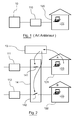
- DSLAM digital subscriber line multiplexer
- Such equipment makes it possible in particular to provide on a telephone line services of the x DSL type (of the English “Digital Subscriber Line” for "digital subscriber line”).
- the DSLAM 110 is itself connected to a splitter 10 (classically located in a telephone exchange), whose function is to carry out the links between the telephone lines of the subscribers and the infrastructures making it possible to provide the image, the voice ...
- a user who subscribes to a service offer indicates his address or his telephone number to his service provider so that he can locate the corresponding telephone line.
- the service provider verifies whether the telephone line is configured in such a way as to be able to provide the services requested by the user, that is, checks whether the telephone line is "eligible".
- Such an eligibility criterion generally corresponds to the presence or absence of a DSLAM.
- the user residing at 120 can subscribe to a service offering, his telephone line being connected to a digital subscriber line multiplexer 110.
- the service offer subscribed by the user is associated with the telephone line of the residence 120, and with the DSLAM 110 connected to it.
- the service provider must implement a manual intervention.
- This manual intervention consists first of all in connecting the telephone line of the second place to a DSLAM, in order to be able to offer the user the same services as those offered in his residence 120. Then, the intervention consists in assigning the offer of services subscribed in his residence 120 to the telephone line of the second place.
- a disadvantage of this technique of the prior art lies therefore mainly in the need for manual intervention to allow a user to access his service offer at a location other than where it was subscribed.
- the problematic is therefore the same as in the case of retention, by a subscriber, of his telephone number during a move.
- the selection method according to the invention eliminates this manual intervention by integrating the fact that all telephone lines are previously connected to a DSLAM.
- the general principle of the invention is based on the assignment of a service offering to a physical access, via a DSLAM, configured in a software way to offer the services in question.
- a service offer is no longer associated with a predefined telephone line, but can be assigned to any telephone line, at the request of the user who subscribed to it.
- a user has subscribed to an offer of services in his principal residence 121 (A), and wishes to have access to this same offer when he is in his secondary residence 122 (B).
- DSLAM 111 typically the telephone line (or the physical access of A) is connected to a DSLAM 111 which is configured to allow the provision of all subscribed services.
- the physical access of B can be connected to another DSLAM 112, separate from the DSLAM 111.
- This DSLAM can itself be configured to provide a service offer on the telephone line of the residence 122. In this case, this telephone line is effectively connected to the DSLAM 112.
- the DSLAM 112 can be simply installed and ready to be connected to the telephone line of the residence 122, as is the case on the figure 2 .
- the system also comprises a router 13, driving a plurality of relays 14.
- a router 13 driving a plurality of relays 14.
- two relays 141 and 142 are represented, each connected on the one hand to a physical access (respectively that of the residence 121 and that of the residence 122) and other part of a DSLAM (DSALM 111 and DSLAM 112 respectively).
- the router 13 by activating at least one relay 142, allows the assignment of a service offer to the telephone line of the residence 122.
- This embodiment corresponds to a duplication of a service offering.
- a user may wish to temporarily access his service offer in his secondary residence without retaining access to these services in his main residence. In this case, we are talking about transfer of service offer.
- the steps and states 20 to 26 are common to both embodiments (duplication and transfer), and the last step 27 is specific to the transfer.
- the selection process therefore receives the request from the user indicating his desire to access his service offer in his second home.
- the next identification step 21 consists in identifying the telephone line, or physical access, corresponding to the address of the secondary residence specified by the user during his request.
- the method according to the invention checks whether a telephone line is installed at the address specified by the user, whether or not it is in service, that is to say that it is or not already associated with a phone number. If such a line exists, it is associated with a unique identifier, which identifier then serves the process to identify the line (the physical access).
- the method according to the invention checks whether this access is eligible, during a step 22 of checking the presence of a DSLAM. This check consists of searching whether a DSLAM has been installed and associated with the identifier of the line, whether it is connected to the line or not.
- the selection method according to the invention determines, during a verification step 23, the adequacy between the physical access identified in step 21, and the service offer subscribed by the user.
- the method ensures that the DSLAM associated with the telephone line of the secondary residence can be configured so as to provide all the services, or a part of the services subscribed by the user.
- a user may have subscribed to a service offering that includes a television service.
- a service is accessible only under certain conditions, including distance, between the receiving terminal and the DSLAM.
- it is not ensured that all the services to which the user has subscribed are accessible at the place where the transfer is to be made.
- steps 21 to 23 therefore perform a "hard” check, consisting in ensuring that the telephone line of the user's second home is capable of providing the services he wishes to to access.
- the method according to the invention performs a verification relating to the user and the detailed configuration of the telephone line of the secondary residence.
- the request of the user is studied to be validated or not.
- This step 24 comprises several substeps, implemented successively, according to the result of the previous substep.
- a substep 241 control is to validate that the user has the right to make this request.
- a service offering may include an option, paid or not, specifying that the user may request to benefit from this offer in several different locations. These different places can be defined or not in advance, at the time of the subscription of the offer.
- the user can at any time request an authorization, paying or not a supplement, allowing him to make a request to access his offer in several places.
- the request is not validated (state 244) and does not lead to the assignment of the service offer to the secondary residence telephone line. of the user.
- the method according to the invention implements a sub-step 242 more detailed examination of the configuration of the telephone line of the second home.
- the method according to the invention notably checks whether a second service offer is already associated with the telephone line of the secondary residence.
- the method according to the invention checks whether this second service offer is compatible with the first, that is to say if the two offers can "coexist" on the telephone line.
- a second user who subscribed to this second offer of services may have specifically prohibited any transfer or duplication of another offer to the physical access corresponding to this second offer.
- the request of the first user is not validated (state 244) and does not lead to the assignment of the service offer to the telephone line of the secondary residence of the user.
- the method according to the invention can then implement a step of calculating an offer service 243, for example, called composite service offering.
- a first service offering corresponding to 8 Mbps Internet access and a second service offering also corresponding to 8 Mbps Internet access.
- the method according to the invention makes it possible to offer continuity of quality and throughput to the two users, by calculating a composite offer corresponding in our example to an Internet access at a bit rate of 18 Mbits / s (if the current offers are considered to be 1 Mbps, 8 Mbps or 18 Mbps) .
- this offer of composite services corresponds to the original service offer subscribed by the user in his main residence, except for any services that can not be implemented in the line of the second home.
- the composite offer may consist of each of the two offers if these services are compatible (and may be provided on the same telephone line), or part of the services of each of the two offers.
- the composite offer may correspond to an Internet access subscribed by the first user in his principal residence and access to the voice over IP subscribed in the secondary residence.
- the user's request is validated (state 25) and the allocation of the composite service offer to the secondary residence telephone line is carried out during a step 26.
- the router 13 ( figure 2 ) activates the relay 142 so that the telephone line of the second home is connected to the DSLAM 112, and it is configured, in a conventional manner and known to those skilled in the art, so as to offer the desired services to the user, for example through a software download of a configuration on the DSLAM.
- the user can designate one of the telephone lines of his two residences as the "mother" line, that is, the line receiving the incoming calls.
- Another option may also be to enable the switching of incoming calls from one line to another in case of no response of the line on which they arrive at first.
- This step consists of temporarily suspending access to the offer of services from the main residence.
- the router 13 activates the relay 141, so that the telephone line of the main residence is no longer connected to the DSLAM 111.
- the user only has access to the services to which he has subscribed from his secondary residence, until he makes the request for the reverse transfer of his offer (from his secondary residence to his principal residence).
Landscapes
- Engineering & Computer Science (AREA)
- Signal Processing (AREA)
- Telephonic Communication Services (AREA)
Applications Claiming Priority (1)
| Application Number | Priority Date | Filing Date | Title |
|---|---|---|---|
| FR0756059 | 2007-06-27 |
Publications (2)
| Publication Number | Publication Date |
|---|---|
| EP2009889A2 true EP2009889A2 (de) | 2008-12-31 |
| EP2009889A3 EP2009889A3 (de) | 2011-09-21 |
Family
ID=39186840
Family Applications (1)
| Application Number | Title | Priority Date | Filing Date |
|---|---|---|---|
| EP08104347A Withdrawn EP2009889A3 (de) | 2007-06-27 | 2008-06-10 | Auswahlverfahren mindestens eines materiellen Zugangs zu mindestens einem Angebot von Diensten sowie entsprechende Vorrichtung und entsprechendes Softwareprodukt |
Country Status (1)
| Country | Link |
|---|---|
| EP (1) | EP2009889A3 (de) |
Family Cites Families (2)
| Publication number | Priority date | Publication date | Assignee | Title |
|---|---|---|---|---|
| US8761363B2 (en) * | 2001-02-27 | 2014-06-24 | Verizon Data Services Llc | Methods and systems for automatic forwarding of communications to a preferred device |
| US7218721B1 (en) * | 2002-01-02 | 2007-05-15 | 8X8, Inc. | Virtual telephone extension |
-
2008
- 2008-06-10 EP EP08104347A patent/EP2009889A3/de not_active Withdrawn
Non-Patent Citations (1)
| Title |
|---|
| None * |
Also Published As
| Publication number | Publication date |
|---|---|
| EP2009889A3 (de) | 2011-09-21 |
Similar Documents
| Publication | Publication Date | Title |
|---|---|---|
| EP2327200B1 (de) | Verfahren zum erhalten von informationen aus einer lokalen endgeräteumgebung | |
| EP2612482B1 (de) | Verfahren zur verarbeitung von sip-nachrichten | |
| EP1193945A1 (de) | Netzwerkzugangsüberwachungsverfahren | |
| EP3533202A1 (de) | Dynamische und interaktive steuerung eines residential-gateways, das mit einem kommunikationsnetzwerk verbunden ist | |
| EP2227048A1 (de) | Verfahren zur Verwaltung von Benutzerprofilen in einem peer-to-peer Netzwerk | |
| WO2005096551A1 (fr) | Procede et systeme d’accreditation d’un client pour l’acces a un reseau virtuel permettant d’acceder a des services | |
| EP2009889A2 (de) | Auswahlverfahren mindestens eines materiellen Zugangs zu mindestens einem Angebot von Diensten sowie entsprechende Vorrichtung und entsprechendes Softwareprodukt | |
| FR3046517A1 (de) | ||
| EP1659760A1 (de) | Verfahren zum Verbindungsaufbau zwischen dem Netzwerk und fremden Endgeräten | |
| EP2608505B1 (de) | Automatisches Rückrufverfahren eines Teilnehmers durch Auswahl einer Online-Werbung, und entsprechendes Kommunikationssystem | |
| FR2933261A1 (fr) | Procede de traitement d'une requete, passerelle d'acces et systeme de controle d'admission a un service | |
| US20250379791A1 (en) | Automated delivery of fiber broadband service | |
| FR2778293A1 (fr) | Utilisation du couple numero d'appel - adresse d'origine internet | |
| EP3000209B1 (de) | Technik zur weiterleitung von paketen | |
| EP3785486B1 (de) | Verfahren und system zur detektion der unterbrechung von kommunikationen und zur automatischen wiederherstellung der kommunikationen | |
| EP3662648B1 (de) | Fernsprechwählnetz und verfahren zur verwaltung einer teilnehmerleitung in einem solchen netz | |
| EP2484081B1 (de) | System und verfahren zur steuerung einer kommunikationssitzung bei einem lan-endgerät | |
| WO2008031967A2 (fr) | Procédé de supervision d'une session d'accès a un service établie par un terminal client au moyen d'un protocole de configuration dynamique | |
| WO2006005818A1 (fr) | Procede et module de mise a jour logicielle d'une passerelle entre un reseau operateur et un reseau local | |
| EP1610538B1 (de) | Verfahren und Vorrichtung zur Standorterfassung eines Festnetzteilnehmers | |
| WO2009007612A1 (fr) | Procede et serveur pour gerer l'acces a un reseau de telecommunications | |
| WO2009060151A1 (fr) | Verification d'un type d'acces genere par un terminal dans un reseau de telecommunications | |
| FR2851386A1 (fr) | Systeme et procede d'acces a un reseau de donnees haut-debit par liaison haut-debit de type x-dsl | |
| FR2902596A1 (fr) | Procede d'optimisation d'un critere relatif a la transmission de donnees | |
| WO2004016025A2 (fr) | Systeme de telecommunication, et serveur et terminal pour ce systeme |
Legal Events
| Date | Code | Title | Description |
|---|---|---|---|
| PUAI | Public reference made under article 153(3) epc to a published international application that has entered the european phase |
Free format text: ORIGINAL CODE: 0009012 |
|
| AK | Designated contracting states |
Kind code of ref document: A2 Designated state(s): AT BE BG CH CY CZ DE DK EE ES FI FR GB GR HR HU IE IS IT LI LT LU LV MC MT NL NO PL PT RO SE SI SK TR |
|
| AX | Request for extension of the european patent |
Extension state: AL BA MK RS |
|
| PUAL | Search report despatched |
Free format text: ORIGINAL CODE: 0009013 |
|
| AK | Designated contracting states |
Kind code of ref document: A3 Designated state(s): AT BE BG CH CY CZ DE DK EE ES FI FR GB GR HR HU IE IS IT LI LT LU LV MC MT NL NO PL PT RO SE SI SK TR |
|
| AX | Request for extension of the european patent |
Extension state: AL BA MK RS |
|
| RIC1 | Information provided on ipc code assigned before grant |
Ipc: H04M 3/42 20060101AFI20110816BHEP |
|
| 17P | Request for examination filed |
Effective date: 20120201 |
|
| AKX | Designation fees paid |
Designated state(s): AT BE BG CH CY CZ DE DK EE ES FI FR GB GR HR HU IE IS IT LI LT LU LV MC MT NL NO PL PT RO SE SI SK TR |
|
| RAP1 | Party data changed (applicant data changed or rights of an application transferred) |
Owner name: ORANGE |
|
| 17Q | First examination report despatched |
Effective date: 20170425 |
|
| STAA | Information on the status of an ep patent application or granted ep patent |
Free format text: STATUS: THE APPLICATION IS DEEMED TO BE WITHDRAWN |
|
| 18D | Application deemed to be withdrawn |
Effective date: 20170906 |