EP2008839A2 - Air-conditioning control unit - Google Patents
Air-conditioning control unit Download PDFInfo
- Publication number
- EP2008839A2 EP2008839A2 EP08010484A EP08010484A EP2008839A2 EP 2008839 A2 EP2008839 A2 EP 2008839A2 EP 08010484 A EP08010484 A EP 08010484A EP 08010484 A EP08010484 A EP 08010484A EP 2008839 A2 EP2008839 A2 EP 2008839A2
- Authority
- EP
- European Patent Office
- Prior art keywords
- air
- chassis
- main case
- control unit
- conditioning control
- Prior art date
- Legal status (The legal status is an assumption and is not a legal conclusion. Google has not performed a legal analysis and makes no representation as to the accuracy of the status listed.)
- Granted
Links
Images




Classifications
-
- B—PERFORMING OPERATIONS; TRANSPORTING
- B60—VEHICLES IN GENERAL
- B60H—ARRANGEMENTS OF HEATING, COOLING, VENTILATING OR OTHER AIR-TREATING DEVICES SPECIALLY ADAPTED FOR PASSENGER OR GOODS SPACES OF VEHICLES
- B60H1/00—Heating, cooling or ventilating devices
- B60H1/00507—Details, e.g. mounting arrangements, desaeration devices
- B60H1/00514—Details of air conditioning housings
- B60H1/00521—Mounting or fastening of components in housings, e.g. heat exchangers, fans, electronic regulators
-
- B—PERFORMING OPERATIONS; TRANSPORTING
- B60—VEHICLES IN GENERAL
- B60H—ARRANGEMENTS OF HEATING, COOLING, VENTILATING OR OTHER AIR-TREATING DEVICES SPECIALLY ADAPTED FOR PASSENGER OR GOODS SPACES OF VEHICLES
- B60H1/00—Heating, cooling or ventilating devices
- B60H1/00642—Control systems or circuits; Control members or indication devices for heating, cooling or ventilating devices
- B60H1/00735—Control systems or circuits characterised by their input, i.e. by the detection, measurement or calculation of particular conditions, e.g. signal treatment, dynamic models
- B60H1/00792—Arrangement of detectors
Definitions
- the present invention relates to an air-conditioning control unit can aspirate air in a vehicle interior by the use of an aspirator so as to detect a room temperature in an automatic vehicle air-conditioner and the like.
- a circuit board having air-conditioning control operation switches in an automatic vehicle air-conditioner is mounted with an aspirator aspirating air in a vehicle interior.
- the aspirator has a motor and a fan in a chassis having an air inlet. Since the air in the vehicle interior is aspirated into the chassis by rotationally actuating the fan with the motor, a room temperature detecting sensor is disposed in a flow channel of the air to detect the room temperature.
- an air outlet is formed at a proper position in the chassis of the aspirator (for example, see Japanese Unexamined Patent Application Publication No. H5-505 (pages 5 to 7 and Fig. 1 )).
- the air outlet is formed in the chassis of the aspirator, but it is preferable that the air outlet is formed in the vicinity of the fan in the chassis so as to smoothly discharge the air aspirated into the chassis to the outside of the chassis.
- the motor is close to the air outlet. Accordingly, when a worker' s finger or a jig comes in contact with the air outlet at the time of assembling the air-conditioning control unit, static electricity may spatter to the motor and enter the circuit board. In this case, circuit elements such as semiconductor devices may be subjected to electrostatic breakdown.
- An object of the invention is to provide an air-conditioning control unit with high reliability in which an air outlet of an aspirator is not made to serve as a static electricity trespassing channel.
- an air-conditioning control unit comprising an aspirator in which a motor and a fan rotationally actuated with the motor are disposed in a synthetic-resin chassis having an air inlet and an air outlet, a room temperature detecting sensor disposed in a flow channel of air aspirated by the fan, a circuit board mounted with the aspirator, and a synthetic-resin main case holding the chassis with the air outlet communicating with an external space.
- the main case includes an exhaust opening being exposed to the external space and communicating with the air outlet through a communication channel and a flow channel cover covering the communication channel.
- an end of the chassis opposite to the circuit board constitutes a motor receiving section receiving the motor and a bottomed concave portion into which the motor receiving portion is inserted is formed in the main case. Accordingly, even when an opening exposing the motor is formed in the motor receiving section of the chassis, the opening can be covered with the bottomed concave portion, thereby hardly allowing static electricity to spatter to the motor from the outside.
- the concave portion includes an elastic piece protruding inwardly and coming in elastic contact with the chassis and a cutout portion cut out along the outline of the elastic piece, and the chassis has a shape in which an opening is not formed at least at a position facing the cutout portion. Accordingly, since the chassis can be pressed against the circuit board with an urging force of the elastic piece so as to be pressed from both sides, it is possible to prevent the click of the aspirator. In addition, since the motor is not exposed from the cutout portion essential to the formation of the elastic piece, the static electricity hardly spatters to the motor from the outside.
- the air outlet of the chassis of the aspirator communicates with the external space through the communication channel covered with the flow channel cover of the main case. Accordingly, it is possible to smoothly discharge the air aspirated into the chassis to the external space from the exhaust opening of the main case through the communication channel and to make the air outlet greatly apart from the exhaust opening. As a result, a worker's finger or a jig may hardly come in contact with the air outlet of the chassis at the time of assembling the air-conditioning control unit. In addition, even when the worker's finger or the jig comes in contact with the exhaust opening, static electricity hardly spatters to the motor in the chassis through the communication channel. Therefore, it is possible to allow the air outlet of the aspirator not to serve as a static electricity trespassing channel, thereby obtaining an air-conditioning control unit with high reliability in which circuit elements are hardly subjected to electrostatic breakdown.
- Fig. 1 is an exploded perspective view illustrating an air-conditioning control unit according to a first embodiment of the invention.
- Fig. 2 is a cross-sectional view of the air-conditioning control unit.
- Fig. 3 is a perspective view illustrating a backside shape of a main case of the air-conditioning control unit.
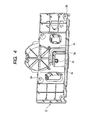
- Fig. 4 is a perspective view illustrating an inner shape of the main case.
- Fig. 5 is a front view of the main case.
- Fig. 6 is a cross-sectional view taken along line A-A of Fig. 5 .
- Fig. 7 is a cross-sectional view taken along line B-B of Fig. 5 .
- the air-conditioning control unit shown in Figs. 1 and 2 is used for an automatic vehicle air-conditioner and is unified by interposing an aspirator 4 or a circuit board, which is mounted with operation switches not shown and a variety of electronic components, between a front panel 2 and a main case 3.
- An opening 1a and a tongue piece 1b facing an air inlet 5a of the aspirator 4 are formed in the circuit board 1 and the tongue piece 1b is mounted with a room temperature detecting sensor 6.
- Plural attachment holes 1c for attaching the aspirator 4 are formed around the opening 1a.
- the front panel 2 is made of a synthetic resin and includes an air aspirating opening 2a facing the opening 1a, an operation unit 2b provided with an operation knob and the like not shown, and a display unit 2c mounted with a display device not shown.
- the main case 3 is made of a synthetic resin and is provided with a bottomed concave portion 3a into which the rear end of the aspirator 4 is inserted, a flow channel cover 3c extending in an L shape along an L-shaped wall surface 3b of the concave portion 3a, and plural attachment portions 3d into which fixing screws not shown are inserted.
- An exhaust opening 3e is defined and formed between the rear end of the flow channel cover 3c and the concave portion 3a.
- the aspirator 4 includes a synthetic-resin chassis 5 having an air inlet 5a and an air outlet 5b, and a motor 7 and a fan 8 disposed in the chassis 5.
- the air inlet 5a is formed in a round hole at the front end of the chassis 5 and the air outlet 5b is formed in a longitudinal hole at plural positions in the side wall of the chassis 5.
- the front end of the chassis 5 is provided with plural engaging protrusions 5c inserted into the attachment holes 1c of the circuit board 1 around the air inlet 5a.
- the motor 7 serves to rotationally drive the fan 8 and a quadrangular-box-shaped portion of the chassis 5 in the back of the air outlet 5b forms a motor receiving section 5d receiving the motor 7.
- the motor receiving section 5d of the chassis 5 is inserted into the concave portion 3a of the main case 3 so as to oppose two air outlets 5b to the flow channel cover 3c.
- a communication channel 9 communicating with the air outlets 5b of the aspirator 4 and being covered with the flow channel cover 3c are defined and formed between the concave portion 3a and the flow channel cover 3c of the main case 3.
- the rear end of the communication channel 9 serves as the exhaust opening 3e.
- a pair of elastic pieces 3f protruding inwardly and a pair of cutout portions 3g cut out along the outline of the elastic pieces 3f are formed in an inner wall of the concave portion 3a of the main case 3 (see Figs. 3 to 7 ) .
- the elastic pieces 3f serves to interpose an inner corner of the chassis 5 of the aspirator 4 inserted into the concave portion 3a from both sides while elastically urging the inner corner to the circuit board 1, thereby preventing the click of the aspirator 4.
- the cutout portions 3g are openings essentially formed to shape the elastic pieces 3f by the use of a mold, but the motor 7 is not exposed from the cutout portions 3g because no opening is formed at positions facing the cutout portions 3g in the motor receiving section 5d of the chassis 5.
- the air in the vehicle interior is aspirated into the chassis 5 from the air inlet 5a through the air aspirating opening 2a of the front panel 2 and the opening 1a of the circuit board 1.
- the room temperature can be detected by the use of the room temperature detecting sensor 6 disposed in the flow channel of the air.
- the air aspirated into the chassis 5 is discharged to an external space from the exhaust opening 3e from the air outlet 5b through the communication channel 9.
- the air outlet 5b of the chassis 5 of the aspirator 4 communicates with the external space through the communication channel 9 covered with the flow channel cover 3c of the main case 3, the air aspirated into the chassis 5 can be smoothly discharged to the external space from the exhaust opening 3e of the main case 3. Since the air outlet 5b and the exhaust opening 3e are greatly apart from each other due to the communication channel 9, a worker' s finger or a jig hardly comes in contact with the air outlet 5b of the chassis 5 at the time of assembling the air-conditioning control unit.
- the motor receiving section 5d of the chassis 5 is inserted into the concave portion 3a of the main case 3.
- the flow channel cover 3c is disposed to extend along the insertion direction (the lateral direction in Fig. 2 ), it is possible to form the flow channel cover 3c without using a slide core at the time of shaping the main case 3. Accordingly, the mold structure of the main case 3 is simplified, thereby easily reducing the manufacturing cost.
- the chassis 5 is elastically pressed against the circuit board 1 and is held in the main case 3 in a state where the chassis is interposed from both sides, thereby preventing the click of the aspirator 4.
- the motor 7 is not exposed from the cutout portions 3g formed in the elastic pieces 3f, the static electricity hardly spatters to the motor 7 of the chassis 5 through the cutout portions 3g from the outside.
- the motor receiving section 5d of the chassis 5 is inserted into the concave portion 3a of the main case 3.
- a second embodiment shown in Fig. 8 even when the chassis 5 is inserted through the main case 3, it is possible to make the air outlet 5b not serve as the static electricity trespassing channel without hindering the operation of discharging the air in the aspirator 4, by allowing the flow channel cover 3c of the main case 3 facing the air outlet 5b of the chassis 5 to extend backwardly and covering the communication channel 9 serving as the flow channel of the air discharged to the external space from the air outlet 5b with the flow channel cover 3c.
Landscapes
- Physics & Mathematics (AREA)
- Thermal Sciences (AREA)
- Engineering & Computer Science (AREA)
- Mechanical Engineering (AREA)
- Air-Conditioning For Vehicles (AREA)
- Measuring Temperature Or Quantity Of Heat (AREA)
- Air Conditioning Control Device (AREA)
Abstract
Description
- The present invention relates to an air-conditioning control unit can aspirate air in a vehicle interior by the use of an aspirator so as to detect a room temperature in an automatic vehicle air-conditioner and the like.
- In general, a circuit board having air-conditioning control operation switches in an automatic vehicle air-conditioner is mounted with an aspirator aspirating air in a vehicle interior. The aspirator has a motor and a fan in a chassis having an air inlet. Since the air in the vehicle interior is aspirated into the chassis by rotationally actuating the fan with the motor, a room temperature detecting sensor is disposed in a flow channel of the air to detect the room temperature. In order to discharge the air aspirated into the chassis to the outside, an air outlet is formed at a proper position in the chassis of the aspirator (for example, see Japanese Unexamined Patent Application Publication No.
H5-505 pages 5 to 7 andFig. 1 )). - By interposing the circuit board between a front panel and a main case and unifying them, it is possible to obtain an air-conditioning control unit that can facilitate an assembly operation.
- As described above, the air outlet is formed in the chassis of the aspirator, but it is preferable that the air outlet is formed in the vicinity of the fan in the chassis so as to smoothly discharge the air aspirated into the chassis to the outside of the chassis. However, when the air outlet is disposed in the vicinity of the fan of the chassis, the motor is close to the air outlet. Accordingly, when a worker' s finger or a jig comes in contact with the air outlet at the time of assembling the air-conditioning control unit, static electricity may spatter to the motor and enter the circuit board. In this case, circuit elements such as semiconductor devices may be subjected to electrostatic breakdown.
- The invention is contrived to solve the above-mentioned problem. An object of the invention is to provide an air-conditioning control unit with high reliability in which an air outlet of an aspirator is not made to serve as a static electricity trespassing channel.
- According to an aspect of the invention, there is provided an air-conditioning control unit comprising an aspirator in which a motor and a fan rotationally actuated with the motor are disposed in a synthetic-resin chassis having an air inlet and an air outlet, a room temperature detecting sensor disposed in a flow channel of air aspirated by the fan, a circuit board mounted with the aspirator, and a synthetic-resin main case holding the chassis with the air outlet communicating with an external space. Here, the main case includes an exhaust opening being exposed to the external space and communicating with the air outlet through a communication channel and a flow channel cover covering the communication channel.
- In this way, by allowing the air outlet of the chassis of the aspirator to communicate with the external space through the communication channel covered with the flow channel cover of the main case, it is possible to smoothly discharge the air aspirated into the chassis to the external space from the exhaust opening of the main case through the communication channel and to make the air outlet greatly apart from the exhaust opening. Accordingly, a worker's finger or a jig may hardly come in contact with the air outlet of the chassis at the time of assembling the air-conditioning control unit. In addition, even when the worker's finger or the jig comes in contact with the exhaust opening, static electricity hardly spatters to the motor in the chassis through the communication channel.
- In the above-mentioned configuration, it is preferable that an end of the chassis opposite to the circuit board is inserted into the main case and the flow channel cover extends in the insertion direction. According to this configuration, since the flow channel cover can be formed without a slide core at the time of molding the main case, a mold structure is simplified, thereby easily reducing the manufacturing cost.
- In the above-mentioned configuration, it is preferable that an end of the chassis opposite to the circuit board constitutes a motor receiving section receiving the motor and a bottomed concave portion into which the motor receiving portion is inserted is formed in the main case. Accordingly, even when an opening exposing the motor is formed in the motor receiving section of the chassis, the opening can be covered with the bottomed concave portion, thereby hardly allowing static electricity to spatter to the motor from the outside. In this case, it is also preferable that the concave portion includes an elastic piece protruding inwardly and coming in elastic contact with the chassis and a cutout portion cut out along the outline of the elastic piece, and the chassis has a shape in which an opening is not formed at least at a position facing the cutout portion. Accordingly, since the chassis can be pressed against the circuit board with an urging force of the elastic piece so as to be pressed from both sides, it is possible to prevent the click of the aspirator. In addition, since the motor is not exposed from the cutout portion essential to the formation of the elastic piece, the static electricity hardly spatters to the motor from the outside.
- In the air-conditioning control unit according to the invention, the air outlet of the chassis of the aspirator communicates with the external space through the communication channel covered with the flow channel cover of the main case. Accordingly, it is possible to smoothly discharge the air aspirated into the chassis to the external space from the exhaust opening of the main case through the communication channel and to make the air outlet greatly apart from the exhaust opening. As a result, a worker's finger or a jig may hardly come in contact with the air outlet of the chassis at the time of assembling the air-conditioning control unit. In addition, even when the worker's finger or the jig comes in contact with the exhaust opening, static electricity hardly spatters to the motor in the chassis through the communication channel. Therefore, it is possible to allow the air outlet of the aspirator not to serve as a static electricity trespassing channel, thereby obtaining an air-conditioning control unit with high reliability in which circuit elements are hardly subjected to electrostatic breakdown.
-
-
Fig. 1 is an exploded perspective view illustrating an air-conditioning control unit according to a first embodiment of the invention. -
Fig. 2 is a cross-sectional view of the air-conditioning control unit. -
Fig. 3 is a perspective view illustrating a backside shape of a main case of the air-conditioning control unit. -
Fig. 4 is a perspective view illustrating an inner shape of the main case. -
Fig. 5 is a front view of the main case. -
Fig. 6 is a cross-sectional view taken along line A-A ofFig. 5 . -
Fig. 7 is a cross-sectional view taken along line B-B ofFig. 5 . -
Fig. 8 is a cross-sectional view illustrating a second embodiment of the invention. -
Fig. 9 is a cross-sectional view illustrating a modified example of the second embodiment. - Exemplary embodiments of the invention will be described with the accompanying drawings.
Fig. 1 is an exploded perspective view illustrating an air-conditioning control unit according to a first embodiment of the invention.Fig. 2 is a cross-sectional view of the air-conditioning control unit.Fig. 3 is a perspective view illustrating a backside shape of a main case of the air-conditioning control unit.Fig. 4 is a perspective view illustrating an inner shape of the main case.Fig. 5 is a front view of the main case.Fig. 6 is a cross-sectional view taken along line A-A ofFig. 5 .Fig. 7 is a cross-sectional view taken along line B-B ofFig. 5 . - The air-conditioning control unit shown in
Figs. 1 and2 is used for an automatic vehicle air-conditioner and is unified by interposing anaspirator 4 or a circuit board, which is mounted with operation switches not shown and a variety of electronic components, between a front panel 2 and amain case 3. An opening 1a and atongue piece 1b facing anair inlet 5a of theaspirator 4 are formed in thecircuit board 1 and thetongue piece 1b is mounted with a roomtemperature detecting sensor 6. Plural attachment holes 1c for attaching theaspirator 4 are formed around the opening 1a. The front panel 2 is made of a synthetic resin and includes anair aspirating opening 2a facing theopening 1a, anoperation unit 2b provided with an operation knob and the like not shown, and adisplay unit 2c mounted with a display device not shown. Themain case 3 is made of a synthetic resin and is provided with a bottomedconcave portion 3a into which the rear end of theaspirator 4 is inserted, aflow channel cover 3c extending in an L shape along an L-shaped wall surface 3b of theconcave portion 3a, andplural attachment portions 3d into which fixing screws not shown are inserted. Anexhaust opening 3e is defined and formed between the rear end of theflow channel cover 3c and theconcave portion 3a. The front panel 2 and themain case 3 are coupled to each other in a snap-fit manner to interpose thecircuit board 1 therebetween and three of thecircuit board 1, the front panel 2, and themain case 3 are reliably unified by fastening the fixing screws. - The
aspirator 4 includes a synthetic-resin chassis 5 having anair inlet 5a and anair outlet 5b, and amotor 7 and afan 8 disposed in thechassis 5. Theair inlet 5a is formed in a round hole at the front end of thechassis 5 and theair outlet 5b is formed in a longitudinal hole at plural positions in the side wall of thechassis 5. The front end of thechassis 5 is provided with pluralengaging protrusions 5c inserted into the attachment holes 1c of thecircuit board 1 around theair inlet 5a. Themotor 7 serves to rotationally drive thefan 8 and a quadrangular-box-shaped portion of thechassis 5 in the back of theair outlet 5b forms amotor receiving section 5d receiving themotor 7. At the time of attaching themain case 3 to thecircuit board 1 mounted with theaspirator 4 and the like, themotor receiving section 5d of thechassis 5 is inserted into theconcave portion 3a of themain case 3 so as to oppose twoair outlets 5b to theflow channel cover 3c. - As shown in
Figs. 2 and3 , acommunication channel 9 communicating with theair outlets 5b of theaspirator 4 and being covered with theflow channel cover 3c are defined and formed between theconcave portion 3a and theflow channel cover 3c of themain case 3. The rear end of thecommunication channel 9 serves as theexhaust opening 3e. A pair ofelastic pieces 3f protruding inwardly and a pair ofcutout portions 3g cut out along the outline of theelastic pieces 3f are formed in an inner wall of theconcave portion 3a of the main case 3 (seeFigs. 3 to 7 ) . Theelastic pieces 3f serves to interpose an inner corner of thechassis 5 of theaspirator 4 inserted into theconcave portion 3a from both sides while elastically urging the inner corner to thecircuit board 1, thereby preventing the click of theaspirator 4. Thecutout portions 3g are openings essentially formed to shape theelastic pieces 3f by the use of a mold, but themotor 7 is not exposed from thecutout portions 3g because no opening is formed at positions facing thecutout portions 3g in themotor receiving section 5d of thechassis 5. - In the air-conditioning control unit having the above-mentioned configuration, when the
fan 8 is rotationally driven by themotor 7 of theaspirator 4, the air in the vehicle interior is aspirated into thechassis 5 from theair inlet 5a through theair aspirating opening 2a of the front panel 2 and theopening 1a of thecircuit board 1. As a result, the room temperature can be detected by the use of the roomtemperature detecting sensor 6 disposed in the flow channel of the air. The air aspirated into thechassis 5 is discharged to an external space from theexhaust opening 3e from theair outlet 5b through thecommunication channel 9. - As described above, in the air-conditioning control unit according to this embodiment, since the
air outlet 5b of thechassis 5 of theaspirator 4 communicates with the external space through thecommunication channel 9 covered with theflow channel cover 3c of themain case 3, the air aspirated into thechassis 5 can be smoothly discharged to the external space from theexhaust opening 3e of themain case 3. Since theair outlet 5b and theexhaust opening 3e are greatly apart from each other due to thecommunication channel 9, a worker' s finger or a jig hardly comes in contact with theair outlet 5b of thechassis 5 at the time of assembling the air-conditioning control unit. Even when the worker's finger or the jig comes in contact with theexhaust opening 3e of themain case 3, static electricity hardly spatters to themotor 7 in thechassis 5 through thecommunication channel 9. Accordingly, theair outlet 5b of theaspirator 4 cannot be made to serve as a static electricity trespassing channel, thereby obtaining an air-conditioning control unit with high reliability in which circuit elements are hardly subjected to electrostatic breakdown. - In this embodiment, the
motor receiving section 5d of thechassis 5 is inserted into theconcave portion 3a of themain case 3. However, since theflow channel cover 3c is disposed to extend along the insertion direction (the lateral direction inFig. 2 ), it is possible to form theflow channel cover 3c without using a slide core at the time of shaping themain case 3. Accordingly, the mold structure of themain case 3 is simplified, thereby easily reducing the manufacturing cost. - In this embodiment, since the
elastic pieces 3f coming in elastic contact with the inner corners of themotor receiving section 5d of thechassis 5 are disposed in the inner wall of theconcave portion 3a of themain case 3, thechassis 5 is elastically pressed against thecircuit board 1 and is held in themain case 3 in a state where the chassis is interposed from both sides, thereby preventing the click of theaspirator 4. As described above, since themotor 7 is not exposed from thecutout portions 3g formed in theelastic pieces 3f, the static electricity hardly spatters to themotor 7 of thechassis 5 through thecutout portions 3g from the outside. - It has been described in the first embodiment that the
motor receiving section 5d of thechassis 5 is inserted into theconcave portion 3a of themain case 3. However, as in a second embodiment shown inFig. 8 , even when thechassis 5 is inserted through themain case 3, it is possible to make theair outlet 5b not serve as the static electricity trespassing channel without hindering the operation of discharging the air in theaspirator 4, by allowing theflow channel cover 3c of themain case 3 facing theair outlet 5b of thechassis 5 to extend backwardly and covering thecommunication channel 9 serving as the flow channel of the air discharged to the external space from theair outlet 5b with theflow channel cover 3c. - As in a modified example shown in
Fig. 9 , even when theflow channel cover 3c is disposed to protrude perpendicularly to the insertion direction of thechassis 5 into themain case 3, it is possible to make theair outlet 5b not serve as the static electricity trespassing channel without hindering the operation of discharging the air in theaspirator 4, similarly to the second embodiment shown inFig. 8 .
Claims (4)
- An air-conditioning control unit comprising an aspirator (4) in which a motor (7) and a fan (8) rotationally actuated with the motor (7) are disposed in a synthetic-resin chassis (5) having an air inlet (5a) and an air outlet (5b), a room temperature detecting sensor (6) disposed in a flow channel of air aspirated by the fan (8), a circuit board (1) mounted with the aspirator (4), and a synthetic-resin main case (3) holding the chassis (5) with the air outlet communicating with an external space, characterized in that the main case (3) includes an exhaust opening (3e) being exposed to the external space and communicating with the air outlet (5b) through a communication channel (9) and a flow channel cover (3c) covering the communication channel.
- The air-conditioning control unit according to claim 1, wherein an end of the chassis (5) opposite to the circuit board (1) is inserted into the main case (3) and the flow channel cover (3c) extends in the insertion direction.
- The air-conditioning control unit according to claim 1 or 2, wherein an end of the chassis (5) opposite to the circuit board (1) constitutes a motor receiving section (5d) receiving the motor (7) and a bottomed concave portion (3a) into which the motor receiving portion (5d) is inserted is formed in the main case (3).
- The air-conditioning control unit according to claim 3, wherein the concave portion (3a) includes an elastic piece (3f) protruding inwardly and coming in elastic contact with the chassis (5) and a cutout portion (3g) cut out along the outline of the elastic piece (3f), and the chassis (5) has a shape in which an opening is not formed at least at a position facing the cutout portion (3g).
Applications Claiming Priority (1)
| Application Number | Priority Date | Filing Date | Title |
|---|---|---|---|
| JP2007170858A JP2009006891A (en) | 2007-06-28 | 2007-06-28 | Air-conditioning control unit |
Publications (3)
| Publication Number | Publication Date |
|---|---|
| EP2008839A2 true EP2008839A2 (en) | 2008-12-31 |
| EP2008839A3 EP2008839A3 (en) | 2010-01-20 |
| EP2008839B1 EP2008839B1 (en) | 2011-01-12 |
Family
ID=39645511
Family Applications (1)
| Application Number | Title | Priority Date | Filing Date |
|---|---|---|---|
| EP20080010484 Not-in-force EP2008839B1 (en) | 2007-06-28 | 2008-06-09 | Air-conditioning control unit |
Country Status (3)
| Country | Link |
|---|---|
| EP (1) | EP2008839B1 (en) |
| JP (1) | JP2009006891A (en) |
| DE (1) | DE602008004384D1 (en) |
Families Citing this family (2)
| Publication number | Priority date | Publication date | Assignee | Title |
|---|---|---|---|---|
| JP5616173B2 (en) * | 2010-09-14 | 2014-10-29 | Asti株式会社 | Temperature measurement thermistor mounting structure for auto air conditioner control |
| JP7263790B2 (en) * | 2019-01-17 | 2023-04-25 | 株式会社デンソー | Air conditioning operating device |
Family Cites Families (3)
| Publication number | Priority date | Publication date | Assignee | Title |
|---|---|---|---|---|
| DE4344054C2 (en) * | 1993-12-23 | 1996-05-02 | Preh Elektro Feinmechanik | Control unit for a motor vehicle air conditioning system |
| US6102296A (en) * | 1999-04-19 | 2000-08-15 | Delco Electronics Corp. | Integrated switch pad-aspirated sensor shroud for vehicular climate control systems and methods of manufacture and use |
| DE10154542A1 (en) * | 2001-11-07 | 2003-05-15 | Siemens Ag | control device |
-
2007
- 2007-06-28 JP JP2007170858A patent/JP2009006891A/en not_active Withdrawn
-
2008
- 2008-06-09 DE DE200860004384 patent/DE602008004384D1/en active Active
- 2008-06-09 EP EP20080010484 patent/EP2008839B1/en not_active Not-in-force
Also Published As
| Publication number | Publication date |
|---|---|
| DE602008004384D1 (en) | 2011-02-24 |
| EP2008839B1 (en) | 2011-01-12 |
| JP2009006891A (en) | 2009-01-15 |
| EP2008839A3 (en) | 2010-01-20 |
Similar Documents
| Publication | Publication Date | Title |
|---|---|---|
| US7048498B2 (en) | Casing, equipment unit and fan units provided with the casing, and electronic equipment provided with the fan units | |
| US9992882B2 (en) | Electronic control unit | |
| US10794564B2 (en) | Back door handle device | |
| EP2008839B1 (en) | Air-conditioning control unit | |
| KR200408235Y1 (en) | Temperature / humidity sensor unit | |
| US6900733B2 (en) | Rain sensor, particular for a motor vehicle and method for mounting a rain sensor | |
| JP7276222B2 (en) | In-vehicle device | |
| JPH0734747Y2 (en) | Aspirator for detecting room temperature of automobile | |
| JP4775334B2 (en) | Fan system | |
| JP4567991B2 (en) | cover | |
| KR101854170B1 (en) | Controlling device for vehicle | |
| JP4554041B2 (en) | vent | |
| JP5283491B2 (en) | Waterproof structure of control operation device | |
| US20070051607A1 (en) | Push-button switch assembly for a vehicle | |
| KR0120749Y1 (en) | Airconditioner | |
| JP3292106B2 (en) | Fixing structure of mounting clip | |
| JPH074742Y2 (en) | Push switch mechanism | |
| JPH10144180A (en) | Operation button installing structure of various sorts of apparatuses | |
| JPH10154428A (en) | Switch mounting structure | |
| WO2008044372A1 (en) | Switch device and method for manufacturing the same | |
| JP2000337036A (en) | Window fixing device | |
| JPH06349375A (en) | Button mounting structure for electronic devices | |
| CN117062961A (en) | Hinge assembly and refrigerator equipped with hinge assembly | |
| KR20030067264A (en) | A controller's installing structure of the air-conditioner | |
| EP2224793A1 (en) | Circuit board and circuit board assembly |
Legal Events
| Date | Code | Title | Description |
|---|---|---|---|
| PUAI | Public reference made under article 153(3) epc to a published international application that has entered the european phase |
Free format text: ORIGINAL CODE: 0009012 |
|
| AK | Designated contracting states |
Kind code of ref document: A2 Designated state(s): AT BE BG CH CY CZ DE DK EE ES FI FR GB GR HR HU IE IS IT LI LT LU LV MC MT NL NO PL PT RO SE SI SK TR |
|
| AX | Request for extension of the european patent |
Extension state: AL BA MK RS |
|
| PUAL | Search report despatched |
Free format text: ORIGINAL CODE: 0009013 |
|
| AK | Designated contracting states |
Kind code of ref document: A3 Designated state(s): AT BE BG CH CY CZ DE DK EE ES FI FR GB GR HR HU IE IS IT LI LT LU LV MC MT NL NO PL PT RO SE SI SK TR |
|
| AX | Request for extension of the european patent |
Extension state: AL BA MK RS |
|
| GRAP | Despatch of communication of intention to grant a patent |
Free format text: ORIGINAL CODE: EPIDOSNIGR1 |
|
| 17P | Request for examination filed |
Effective date: 20100602 |
|
| AKX | Designation fees paid |
Designated state(s): DE FR GB |
|
| GRAS | Grant fee paid |
Free format text: ORIGINAL CODE: EPIDOSNIGR3 |
|
| GRAA | (expected) grant |
Free format text: ORIGINAL CODE: 0009210 |
|
| AK | Designated contracting states |
Kind code of ref document: B1 Designated state(s): DE FR GB |
|
| REG | Reference to a national code |
Ref country code: GB Ref legal event code: FG4D |
|
| REF | Corresponds to: |
Ref document number: 602008004384 Country of ref document: DE Date of ref document: 20110224 Kind code of ref document: P |
|
| REG | Reference to a national code |
Ref country code: DE Ref legal event code: R096 Ref document number: 602008004384 Country of ref document: DE Effective date: 20110224 |
|
| PLBE | No opposition filed within time limit |
Free format text: ORIGINAL CODE: 0009261 |
|
| STAA | Information on the status of an ep patent application or granted ep patent |
Free format text: STATUS: NO OPPOSITION FILED WITHIN TIME LIMIT |
|
| 26N | No opposition filed |
Effective date: 20111013 |
|
| REG | Reference to a national code |
Ref country code: DE Ref legal event code: R097 Ref document number: 602008004384 Country of ref document: DE Effective date: 20111013 |
|
| PGFP | Annual fee paid to national office [announced via postgrant information from national office to epo] |
Ref country code: GB Payment date: 20120525 Year of fee payment: 5 Ref country code: FR Payment date: 20120614 Year of fee payment: 5 |
|
| GBPC | Gb: european patent ceased through non-payment of renewal fee |
Effective date: 20130609 |
|
| REG | Reference to a national code |
Ref country code: FR Ref legal event code: ST Effective date: 20140228 |
|
| PG25 | Lapsed in a contracting state [announced via postgrant information from national office to epo] |
Ref country code: GB Free format text: LAPSE BECAUSE OF NON-PAYMENT OF DUE FEES Effective date: 20130609 |
|
| PG25 | Lapsed in a contracting state [announced via postgrant information from national office to epo] |
Ref country code: FR Free format text: LAPSE BECAUSE OF NON-PAYMENT OF DUE FEES Effective date: 20130701 |
|
| REG | Reference to a national code |
Ref country code: DE Ref legal event code: R082 Ref document number: 602008004384 Country of ref document: DE Representative=s name: SCHMITT-NILSON SCHRAUD WAIBEL WOHLFROM PATENTA, DE |
|
| REG | Reference to a national code |
Ref country code: DE Ref legal event code: R082 Ref document number: 602008004384 Country of ref document: DE Representative=s name: SCHMITT-NILSON SCHRAUD WAIBEL WOHLFROM PATENTA, DE Ref country code: DE Ref legal event code: R081 Ref document number: 602008004384 Country of ref document: DE Owner name: ALPS ALPINE CO., LTD., JP Free format text: FORMER OWNER: ALPS ELECTRIC CO., LTD., TOKIO/TOKYO, JP |
|
| PGFP | Annual fee paid to national office [announced via postgrant information from national office to epo] |
Ref country code: DE Payment date: 20210618 Year of fee payment: 14 |
|
| REG | Reference to a national code |
Ref country code: DE Ref legal event code: R119 Ref document number: 602008004384 Country of ref document: DE |
|
| PG25 | Lapsed in a contracting state [announced via postgrant information from national office to epo] |
Ref country code: DE Free format text: LAPSE BECAUSE OF NON-PAYMENT OF DUE FEES Effective date: 20230103 |