EP2007743B1 - Methods for synthesizing ammonia borane - Google Patents
Methods for synthesizing ammonia borane Download PDFInfo
- Publication number
- EP2007743B1 EP2007743B1 EP07754652.1A EP07754652A EP2007743B1 EP 2007743 B1 EP2007743 B1 EP 2007743B1 EP 07754652 A EP07754652 A EP 07754652A EP 2007743 B1 EP2007743 B1 EP 2007743B1
- Authority
- EP
- European Patent Office
- Prior art keywords
- borane
- ammonia
- amine
- solvent
- reacting
- Prior art date
- Legal status (The legal status is an assumption and is not a legal conclusion. Google has not performed a legal analysis and makes no representation as to the accuracy of the status listed.)
- Not-in-force
Links
- 0 *C1*C*C1 Chemical compound *C1*C*C1 0.000 description 2
Images



Classifications
-
- C—CHEMISTRY; METALLURGY
- C01—INORGANIC CHEMISTRY
- C01B—NON-METALLIC ELEMENTS; COMPOUNDS THEREOF; METALLOIDS OR COMPOUNDS THEREOF NOT COVERED BY SUBCLASS C01C
- C01B35/00—Boron; Compounds thereof
- C01B35/08—Compounds containing boron and nitrogen, phosphorus, oxygen, sulfur, selenium or tellurium
- C01B35/14—Compounds containing boron and nitrogen, phosphorus, sulfur, selenium or tellurium
-
- C—CHEMISTRY; METALLURGY
- C01—INORGANIC CHEMISTRY
- C01P—INDEXING SCHEME RELATING TO STRUCTURAL AND PHYSICAL ASPECTS OF SOLID INORGANIC COMPOUNDS
- C01P2002/00—Crystal-structural characteristics
- C01P2002/80—Crystal-structural characteristics defined by measured data other than those specified in group C01P2002/70
- C01P2002/89—Crystal-structural characteristics defined by measured data other than those specified in group C01P2002/70 by mass-spectroscopy
Definitions
- Ammonia borane can provide a good source of storage hydrogen because it contains 19.6% hydrogen. Such a source of storage hydrogen can be useful in a variety of applications. For example, storage hydrogen can be used in vehicular fuel cells with the appropriate reformer.
- methods to produce ammonia borane can be very costly and difficult to scale to industrial production. See e.g. Hollemann Wiberg, Lehrbüch der Anorganischen Chewie, edition 101, Wackerde Grügder 1995, pages 1004-1005 , footnote 34. There remains a need in the art for improved methods of producing ammonia borane.
- methods of synthesizing ammonia borane comprise reacting at least one of an amine borane of the type as indicated below with ammonia such that ammonia borane is produced.
- the amine borane is selected from at least one of an amine borane having a structure selected from at least one of: and wherein:
- the amine borane is selected from dimethylaniline borane, diethylaniline borane, phenylmorpholine borane, and lutidine borane.
- the amine borane comprises dimethylaniline borane.
- the methods can further comprise providing the at least one of the amine borane in a solvent prior to the step of reacting the at least one of the amine borane.
- the solvent is selected from at least one of toluene, heptane, and xylenes.
- the step of reacting the at least one of the amine borane comprises providing the ammonia as a gas and bubbling the ammonia gas through the solution such that ammonia borane is produced.
- the methods further comprising separating the ammonia borane from other reactant products and the solvent after the step of reacting the at least one of the amine borane.
- the methods further comprise reacting the other reactant products in the solvent to produce an amine borane and reacting said amine borane produced from said other reactant products with ammonia to form ammonia borane.
- ammonia borane separated from other reactant products has a purity greater than about 90 percent, or about 95 percent, or about 99 percent.
- the step of reacting the at least one amine borane provides a yield of ammonia borane that is greater than about 85 percent or greater than about 95 percent.
- methods of synthesizing ammonia borane comprise reacting dimethylaniline with ammonia gas such that ammonia borane is produced.
- the methods can further comprise providing the dimethylaniline in a solvent prior to the step of reacting dimethylaniline.
- the ratio of the solvent to the dimethylaniline is about 1:1.
- the solvent is selected from at least one of toluene, heptane and xylenes.
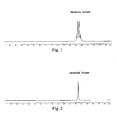
- Fig. 1 is a 11 B NMR spectrum of ammonia borane
- Fig. 2 is a 11 B ⁇ 1 H ⁇ NMR spectrum of ammonia borane
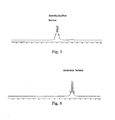
- Fig. 3 is a 1 H NMR spectrum of ammonia borane
- Fig. 4 is a 1 H ⁇ 11 B ⁇ NMR spectrum of ammonia borane
- Fig. 5 is a 11 B NMR spectrum of dimethylaniline borane
- Fig. 6 is a 11 B NMR spectrum of ammonia borane
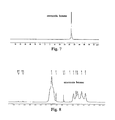
- Fig. 7 is a 11 B ⁇ 1 H ⁇ NMR spectrum of ammonia borane
- Fig. 8 is a 1 H NMR spectrum of ammonia borane
- Fig. 9 is a 1 H ⁇ 11 B ⁇ NMR spectrum of ammonia borane
- Fig. 10 is a 11 B NMR spectrum of ammonia borane from second time recycling used dimethylaniline and solvent toluene;
- Fig. 11 is a 11 B NMR spectrum of dimethylaniline borane
- Fig. 12 illustrates an apparatus for used in the preparation of dimethylaniline borane
- Fig. 13 is a 11 B NMR spectrum of dimethylaniline borane
- Fig. 14 is a 11 B NMR spectrum of a portion of the product in flask No. 2 in the apparatus illustrated in Fig. 6 ;
- Fig. 15 is a 11 B NMR of ammonia borane prepared by using heptane as a solvent
- Fig. 16 is a 11 B NMR of ammonia borane prepared by using xylenes as a solvent
- Fig. 17 is a 11 B NMR of ammonia borane prepared by using petroleum ethers as a solvent
- Fig. 18 is a 11 B NMR of ammonia borane prepared using diethylaniline borane (DEB) with a ratio of 2ml/18ml (DEB/toluene (TOL));
- Fig. 19 is a 11 B NMR of ammonia borane prepared using diethylaniline borane with a ratio of 3ml/17ml (DEB/TOL);
- Fig. 20 is a 11 B NMR of ammonia borane prepared using diethylaniline borane with a ratio of 5ml/15ml(DEB/TOL);
- Fig. 21 is a 11 B NMR of ammonia borane prepared using pure diethylaniline borane.
- Ammonia borane has a chemical formula of NH 3 ⁇ BH 3 .
- Ammonia borane can be useful in a variety of applications. For example, ammonia borane may be useful as a hydrogen source for fuel cells.
- methods of synthesizing ammonia borane comprise reacting at least one amine borane with ammonia such that ammonia borane is produced.
- the amine borane can have a structure selected from at least one of: and wherein:
- the amine borane can be selected from at least one of aniline borane, N-methylaniline borane, N,N-dimethylaniline borane, N-ethylaniline borane, N,N-diethylaniline borane, N-benzylaniline borane, N,N, dibenzylaniline borane, p-toluidine borane, m-toluidine borane, o-toluidine borane, p-chloroaniline borane, m-chloroaniline borane, o-chloroaniline borane, p-anisidine borane, m-anisidine borane, o-anisidine borane, p-nitroaniline borane, m-nitroaniline borane, o-nitroaniline borane, lutidine borane, p-fluoroaniline borane, m-fluoroaniline borane,
- amine borane or more than one amine borane can be used in the methods of the present invention.
- the amine boranes can be from any suitable source.
- the amine boranes can be purchased or synthesized. Such synthesis methods will be understood by those having skill in the art. For example, amine boranes can be synthesized in accordance with the procedures provided in Example 3 or Example 4.
- dimethylaniline borane can be reacted with ammonia to produce ammonia borane as shown below.
- (C 6 H 5 )(CH 3 ) 2 N-BH 3 + NH 3 (C 6 H 5 )(CH 3 ) 2 N + NH 3 ⁇ BH 3
- diethylaniline borane, phenylmorpholine borane or lutidine borane can be reacted with ammonia to form ditethylaniline and ammonia borane, phenylmorpholine and ammonia borane, or lutidine and ammonia borane.
- the ammonia is provided in the form of ammonia gas that is bubbled through the amine borane.
- the methods can further comprise separating the ammonia borane from the other products of the reaction, such as the amine product, after the step of reacting the amine borane complex. It will be understood that this separation can be performed in any suitable manner. For example, the separation can be performed by filtering the ammonia borane solid from the other reactant products and washing and subsequently drying the ammonia borane.
- the methods further comprise using the other products of the reaction, such as the amine product, to produce an amine borane.
- the amine borane is further reacted with ammonia to form ammonia borane and an amine product. This recycling of the amine product can be performed for more than one reaction cycle. It is believed that this recycling of the amine product in the reaction cycle can increase the yield of ammonia borane.
- the methods further comprise providing the amine borane in a solvent prior to the step of reacting the amine borane with the ammonia.
- suitable solvents include, but are not limited to toluene, heptane, and xylenes.
- the solvent can be provided in any suitable amount.
- the solvent to amine borane complex ratio can be between about 10:1 to a 0:1.
- the solvent can comprise toluene, heptane, or xylenes
- the amine borane can comprise dimethylaniline borane, diethylaniline borane, phenylmorpholine borane, or lutidine borane.
- the ratio of the solvent to the complex can be about 1:1.
- the methods can further comprise separating the ammonia borane from the amine product and the solvent after the step of reacting the amine borane with ammonia.
- the ammonia borane can be separated from the amine and the solvent by filtration.
- the methods can further comprise recycling the other products, such as the amine product, and the solvent after the ammonia borane has been removed by using the other products and the solvent to produce the amine borane reactant. This amine borane and solvent solution are then reacted with ammonia to produce ammonia borane, as discussed above. It is believed that the recycling of the amine product and solvent can improve the yield of the ammonia borane. It understood that the amine product and solvent can be reused numerous times in the reaction cycle.
- the methods can produce ammonia borane having a purity greater than about 90 percent. In further examples, the methods can produce ammonia borane having a purity greater than about 95 percent or greater than about 99 percent.
- the reaction of dimethylaniline in toluene with ammonia gas can produce ammonia borane having a purity of greater than about 99 percent.
- the amine borane may additionally react with water in the atmosphere to produce boric acid, however this side reaction may be controlled by appropriate selection of amine boranes, solvents, and/or the solvent to amine borane ratios.
- dimethylaniline in a heptane, toluene, or xylenes solvent with a ratio of solvent to the complex of about 1:1 minimizes such a reaction.
- the methods can produce yields of ammonia borane of greater than about 85 percent. In other examples, the methods can produce yields of ammonia borane of greater than about 95 percent.
- EXAMPLE 2 Synthesis of ammonia borane from dimethylaniline borane and ammonia and further confirmation of the dimethylaniline and toluene can be used repeatedly
- a solution of 12.7 g iodine (50 mmol) in 50 ml DME (dimethoxyethane) was added dropwise during 1 hour to a reactor flask containing 3.8g NaBH 4 (100 mmol) in 50 ml DME at room temperature with nitrogen at atmospheric pressure flowing through the system.
- Fig. 12 illustrates the apparatus used to carry out the preparation.
- the diborane and hydrogen produced in the reaction were carried on the stream of nitrogen into flask No1 which contained a solution of 15ml N,N-dimethylaniline (118 mmol, 18% excess) in 15ml toluene at a water bath under stirring, to produce dimethylaniline borane.
- the nitrogen flowed through flask No 1 into flask No 2 and then through flask No. 3, carrying with it any unreacted diborane.
- the contents of flasks No 2 and No 3 were identical with that of flask No 1.
- the nitrogen then flowed into flask No 4 which contained acetone that destroyed any unreacted diborane that might have passed through flasks Nos. 1, 2, and 3.
Landscapes
- Chemical & Material Sciences (AREA)
- Organic Chemistry (AREA)
- Inorganic Chemistry (AREA)
- Fuel Cell (AREA)
Description
- Ammonia borane can provide a good source of storage hydrogen because it contains 19.6% hydrogen. Such a source of storage hydrogen can be useful in a variety of applications. For example, storage hydrogen can be used in vehicular fuel cells with the appropriate reformer. Currently, methods to produce ammonia borane can be very costly and difficult to scale to industrial production. See e.g. Hollemann Wiberg, Lehrbüch der Anorganischen Chewie, , footnote 34. There remains a need in the art for improved methods of producing ammonia borane.
- In accordance with embodiments of the present invention, methods of synthesizing ammonia borane are provided. The methods comprise reacting at least one of an amine borane of the type as indicated below with ammonia such that ammonia borane is produced. The amine borane is selected from at least one of an amine borane having a structure selected from at least one of:


- R1 and R2 comprise H or a substituted or unsubstituted, saturated or unsaturated, aromatic or nonaromatic C1-C10 alkyl; and
- R3-R7 comprise H, Cl, F, NO2, OR8, or a substituted or unsubstituted, saturated or unsaturated, aromatic or nonaromatic C1-C10 alkyl, except that when the amine borane is

- R8 comprises H or a substituted or unsubstituted, saturated or unsaturated, aromatic or nonaromatic C1-C10 alkyl.
- In some examples, the amine borane is selected from dimethylaniline borane, diethylaniline borane, phenylmorpholine borane, and lutidine borane. In other examples, the amine borane comprises dimethylaniline borane. In further examples, the methods can further comprise providing the at least one of the amine borane in a solvent prior to the step of reacting the at least one of the amine borane. In some instances, the solvent is selected from at least one of toluene, heptane, and xylenes.
- In some embodiments, the step of reacting the at least one of the amine borane comprises providing the ammonia as a gas and bubbling the ammonia gas through the solution such that ammonia borane is produced. In other embodiments, the methods further comprising separating the ammonia borane from other reactant products and the solvent after the step of reacting the at least one of the amine borane. In some instances, the methods further comprise reacting the other reactant products in the solvent to produce an amine borane and reacting said amine borane produced from said other reactant products with ammonia to form ammonia borane.
- In further examples, the ammonia borane separated from other reactant products has a purity greater than about 90 percent, or about 95 percent, or about 99 percent. In other examples, the step of reacting the at least one amine borane provides a yield of ammonia borane that is greater than about 85 percent or greater than about 95 percent.
- In some embodiments, methods of synthesizing ammonia borane are provided. The methods comprise reacting dimethylaniline with ammonia gas such that ammonia borane is produced. The methods can further comprise providing the dimethylaniline in a solvent prior to the step of reacting dimethylaniline. In some examples, the ratio of the solvent to the dimethylaniline is about 1:1. In further examples, the solvent is selected from at least one of toluene, heptane and xylenes.
- The following detailed description of embodiments of the present invention can be best understood when read in conjunction with the following drawings, where like structure is indicated with like reference numerals and in which:
-
Fig. 1 is a 11B NMR spectrum of ammonia borane; -
Fig. 2 is a 11 B {1H} NMR spectrum of ammonia borane; -
Fig. 3 is a 1H NMR spectrum of ammonia borane; -
Fig. 4 is a 1 H{11B} NMR spectrum of ammonia borane; -
Fig. 5 is a 11 B NMR spectrum of dimethylaniline borane; -
Fig. 6 is a 11 B NMR spectrum of ammonia borane; -
Fig. 7 is a 11 B{1H} NMR spectrum of ammonia borane; -
Fig. 8 is a 1 H NMR spectrum of ammonia borane; -
Fig. 9 is a 1 H{11B} NMR spectrum of ammonia borane; -
Fig. 10 is a 11 B NMR spectrum of ammonia borane from second time recycling used dimethylaniline and solvent toluene; -
Fig. 11 is a 11 B NMR spectrum of dimethylaniline borane; -
Fig. 12 illustrates an apparatus for used in the preparation of dimethylaniline borane; -
Fig. 13 is a 11B NMR spectrum of dimethylaniline borane; -
Fig. 14 is a 11B NMR spectrum of a portion of the product in flask No. 2 in the apparatus illustrated inFig. 6 ; -
Fig. 15 is a 11B NMR of ammonia borane prepared by using heptane as a solvent; -
Fig. 16 is a 11B NMR of ammonia borane prepared by using xylenes as a solvent; -
Fig. 17 is a 11B NMR of ammonia borane prepared by using petroleum ethers as a solvent; -
Fig. 18 is a 11B NMR of ammonia borane prepared using diethylaniline borane (DEB) with a ratio of 2ml/18ml (DEB/toluene (TOL)); -
Fig. 19 is a 11B NMR of ammonia borane prepared using diethylaniline borane with a ratio of 3ml/17ml (DEB/TOL); -
Fig. 20 is a 11B NMR of ammonia borane prepared using diethylaniline borane with a ratio of 5ml/15ml(DEB/TOL); and -
Fig. 21 is a 11B NMR of ammonia borane prepared using pure diethylaniline borane. - Unless otherwise defined, all technical and scientific terms used herein have the same meaning as commonly understood by one of ordinary skill in the art to which this invention belongs. The terminology used in the description of the invention herein is for describing particular embodiments only and is not intended to be limiting of the invention. As used in the description of the invention and the appended claims, the singular forms "a," "an," and "the" are intended to include the plural forms as well, unless the context clearly indicates otherwise. All publications, patent applications, patents, and other references mentioned herein are incorporated by reference in their entirety.
- Unless otherwise indicated, all numbers expressing quantities of ingredients, properties such as molecular weight, reaction conditions, and so forth as used in the specification and claims are to be understood as being modified in all instances by the term "about." Accordingly, unless otherwise indicated, the numerical properties set forth in the following specification and claims are approximations that may vary depending on the desired properties sought to be obtained in embodiments of the present invention. Notwithstanding that the numerical ranges and parameters setting forth the broad scope of the invention are approximations, the numerical values set forth in the specific examples are reported as precisely as possible. Any numerical values, however, inherently contain certain errors necessarily resulting from error found in their respective measurements.
- Methods of synthesizing ammonia borane are provided. Ammonia borane has a chemical formula of NH3·BH3. Ammonia borane can be useful in a variety of applications. For example, ammonia borane may be useful as a hydrogen source for fuel cells.
- In accordance with embodiments of the present invention, methods of synthesizing ammonia borane are provided. The methods comprise reacting at least one amine borane with ammonia such that ammonia borane is produced. In some examples, the amine borane can have a structure selected from at least one of:

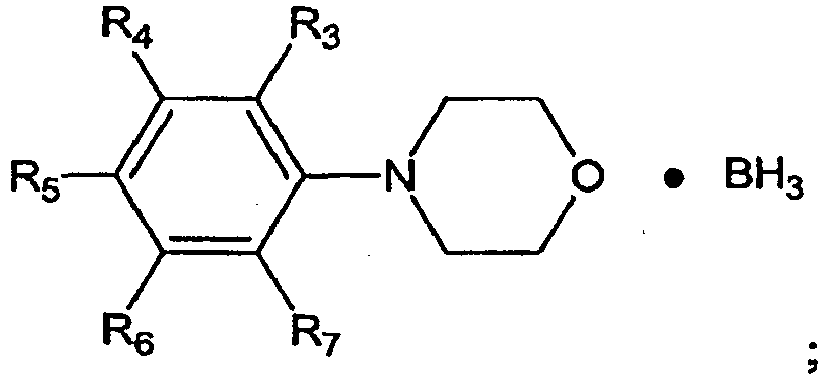

- R1 and R2 comprise H or a substituted or unsubstituted, saturated or unsaturated, aromatic or nonaromatic C1-C10 alkyl;
- R3-R7 comprise H, Cl, F, NO2, OR8, or a substituted or unsubstituted, saturated or unsaturated, aromatic or nonaromatic C1-C10 alkyl, except that when the amine borane is

- R8 comprises H or a substituted or unsubstituted, saturated or unsaturated, aromatic or nonaromatic C1-C10 alkyl.
- In some examples, the amine borane can be selected from at least one of aniline borane, N-methylaniline borane, N,N-dimethylaniline borane, N-ethylaniline borane, N,N-diethylaniline borane, N-benzylaniline borane, N,N, dibenzylaniline borane, p-toluidine borane, m-toluidine borane, o-toluidine borane, p-chloroaniline borane, m-chloroaniline borane, o-chloroaniline borane, p-anisidine borane, m-anisidine borane, o-anisidine borane, p-nitroaniline borane, m-nitroaniline borane, o-nitroaniline borane, lutidine borane, p-fluoroaniline borane, m-fluoroaniline borane, o-fluoroaniline borane, 2-chloro-4-aminotoluene borane, diphenylamine borane, and N-phenylmorpholine borane. It will be understood that a single amine borane or more than one amine borane can be used in the methods of the present invention. It will also be understood that the amine boranes can be from any suitable source. The amine boranes can be purchased or synthesized. Such synthesis methods will be understood by those having skill in the art. For example, amine boranes can be synthesized in accordance with the procedures provided in Example 3 or Example 4.
- Examples of suitable reaction schemes include the schemes illustrated below.


- For example, dimethylaniline borane can be reacted with ammonia to produce ammonia borane as shown below.
(C6H5)(CH3)2N-BH3 + NH3 = (C6H5)(CH3)2N + NH3·BH3
In other examples, diethylaniline borane, phenylmorpholine borane or lutidine borane can be reacted with ammonia to form ditethylaniline and ammonia borane, phenylmorpholine and ammonia borane, or lutidine and ammonia borane. - In some examples, the ammonia is provided in the form of ammonia gas that is bubbled through the amine borane. The methods can further comprise separating the ammonia borane from the other products of the reaction, such as the amine product, after the step of reacting the amine borane complex. It will be understood that this separation can be performed in any suitable manner. For example, the separation can be performed by filtering the ammonia borane solid from the other reactant products and washing and subsequently drying the ammonia borane. In other embodiments, the methods further comprise using the other products of the reaction, such as the amine product, to produce an amine borane. The amine borane is further reacted with ammonia to form ammonia borane and an amine product. This recycling of the amine product can be performed for more than one reaction cycle. It is believed that this recycling of the amine product in the reaction cycle can increase the yield of ammonia borane.
- In some examples, the methods further comprise providing the amine borane in a solvent prior to the step of reacting the amine borane with the ammonia. It will be understood that any suitable solvent may be used. Examples of suitable solvents include, but are not limited to toluene, heptane, and xylenes. The solvent can be provided in any suitable amount. For example, the solvent to amine borane complex ratio can be between about 10:1 to a 0:1. In some examples, the solvent can comprise toluene, heptane, or xylenes, and the amine borane can comprise dimethylaniline borane, diethylaniline borane, phenylmorpholine borane, or lutidine borane. In these examples, the ratio of the solvent to the complex can be about 1:1.
- In other examples, the methods can further comprise separating the ammonia borane from the amine product and the solvent after the step of reacting the amine borane with ammonia. For example, the ammonia borane can be separated from the amine and the solvent by filtration. In embodiments of the present invention, the methods can further comprise recycling the other products, such as the amine product, and the solvent after the ammonia borane has been removed by using the other products and the solvent to produce the amine borane reactant. This amine borane and solvent solution are then reacted with ammonia to produce ammonia borane, as discussed above. It is believed that the recycling of the amine product and solvent can improve the yield of the ammonia borane. It understood that the amine product and solvent can be reused numerous times in the reaction cycle.
- In some examples the methods can produce ammonia borane having a purity greater than about 90 percent. In further examples, the methods can produce ammonia borane having a purity greater than about 95 percent or greater than about 99 percent. For example, the reaction of dimethylaniline in toluene with ammonia gas can produce ammonia borane having a purity of greater than about 99 percent. In some examples, the amine borane may additionally react with water in the atmosphere to produce boric acid, however this side reaction may be controlled by appropriate selection of amine boranes, solvents, and/or the solvent to amine borane ratios. For example, dimethylaniline in a heptane, toluene, or xylenes solvent with a ratio of solvent to the complex of about 1:1 minimizes such a reaction. In some examples, the methods can produce yields of ammonia borane of greater than about 85 percent. In other examples, the methods can produce yields of ammonia borane of greater than about 95 percent.
- The present invention will be better understood by reference to the following examples which are offered by way of illustration not limitation.
- EXAMPLE 1 : Synthesis of ammonia borane from dimethylaniline borane and ammonia
- Ammonia gas was bubbled through a solution of 30 ml dimethylaniline borane (contained 70 mmol borane) in 30 ml toluene until all of the dimethylaniline was consumed. The reaction proceeded according to the following scheme:
(C6H5)(CH3)2N·BH3 + NH3 = (C6H5)(CH3)2N + NH3·BH3
The reaction was monitored by 11B NMR spectrum. Then removal of dimethylaniline and toluene was performed by filtering the white solid ammonia borane, which was washed three times by toluene. The product was dried under vacuum with a yield of 92%. Elemental analysis: Calc for NH3BH3: N: 45.38, H: 19.59; C: 0.0 Found, N: 44.87; H:19.46; C: less than 0.5. The NMR spectra of product ammonia borane are shown inFigs 1 to 4 . - EXAMPLE 2: Synthesis of ammonia borane from dimethylaniline borane and ammonia and further confirmation of the dimethylaniline and toluene can be used repeatedly
- A 30 ml sample of dimethylaniline (236 mmol, excess 12%) was added dropwise to 20 ml dimethyl sulfide borane (210 mmol) stirring at room temperature. The solution was heated to 40°C to evaporate dimethyl sulfide (b. p. 38°C) to generate a dimethylaniline borane solution. The 11B NMR of this solution shown in
Fig 5 . Then 30 ml toluene was mixed with the above solution and ammonia was bubbled through the mixture until all borane was converted to ammonia borane. The reaction was monitored by 11B NMR spectra. Then removal of dimethylaniline and toluene was performed by filtering the white solid ammonia borane, which was washed three times by toluene. The product was dried under vacuum with a yield of 90%. The NMR spectra of product ammonia borane are shown inFigs 6 to 9 . The above filtrate solution was added dropwise to 20 ml of dimethyl sulfide borane (210 mmol) under stirring at room temperature. And then the above operation was repeated to produce ammonia borane with a yield 99%. The 11B NMR spectrum of the product ammonia borane are shown inFig 10 . - EXAMPLE 3: Preparation of dimethylaniline borane from dimethyl sulfide borane
- Dimethylaniline borane was prepared from dimethyl sulfide borane in accordance with the following scheme:
(CH3)2S·BH3 + (C6H5)(CH3)2N = (C6H5)(CH3)2N·BH3 + (CH3)2S
A 15 ml dimethylaniline (118 mmol, excess 12%)) was added dropwise to a 10 ml dimethyl sulfide borane (105 mmol) under stirring at room temperature. Then the solution was heated to 40°C to evaporate dimethyl sulfide (b.p. 38°C) to generate a dimethylaniline borane solution. The 11B NMR showed that a small amount of dimethyl sulfide borane was left in system (seeFig 11 ). - EXAMPLE 4: Preparation of dimethylaniline borane from diborane
- Dimethylaniline borane was prepared from diborane in accordance with the following scheme:
2 NaBH4 + I2 = B2H6 + 2 NaI + H2
B2H6 + 2 (C6H5)(CH3)2N = 2 (C6H5)(CH3)2N·BH3
A solution of 12.7 g iodine (50 mmol) in 50 ml DME (dimethoxyethane) was added dropwise during 1 hour to a reactor flask containing 3.8g NaBH4 (100 mmol) in 50 ml DME at room temperature with nitrogen at atmospheric pressure flowing through the system.Fig. 12 illustrates the apparatus used to carry out the preparation. The diborane and hydrogen produced in the reaction were carried on the stream of nitrogen into flask No1 which contained a solution of 15ml N,N-dimethylaniline (118 mmol, 18% excess) in 15ml toluene at a water bath under stirring, to produce dimethylaniline borane. The nitrogen flowed through flask No 1 intoflask No 2 and then through flask No. 3, carrying with it any unreacted diborane. The contents offlasks No 2 and No 3 were identical with that of flask No 1. The nitrogen then flowed into flask No 4 which contained acetone that destroyed any unreacted diborane that might have passed through flasks Nos. 1, 2, and 3. The outlet from the flask No. 4 was vented through a mercury bubbler. The yield of reaction produced diborane in about 70%. The reaction proceeded at close to 100%. The 11B NMR spectrum of the solution of dimethylaniline borane in toluene in flask No. 1 is shown inFig. 13 . The 11B NMR spectrum shown inFig. 14 reveals that no diborane was carried intoflask No 2. - EXAMPLE 5: Effect of Solvents on the reaction of dimethylaniline borane with ammonia
- Four solvents, toluene, heptane, xylenes, and petroleum ethers were tested for the reaction of dimethylaniline borane with ammonia gas. The reactions were carried out in accordance with procedure outlined in Example 1. When the ratio of amine and solvents was kept 1:1, the following results listed were obtained: toluene, a pure product of ammonia borane(see
Figs 1 to 4 ); heptane, a pure product (seeFig. 15 ); xylenes, a pure product of ammonia borane (seeFig. 16 ); and petroleum ethers, diammoniate diborane impurity was produced and observed in the 11 B NMR spectrum. (seeFig. 17 ). - EXAMPLE 6: Effect of concentration on the amine borane solution
- No or minimal by-product of diammoniate of diborane at any ratio of solvent to the amine borane compound is produced even without toluene as solvent in the reaction system with just dimethylaniline borane reacting with NH3.
(C6H5)(CH3)2N·BH3 + NH3 = (C6H5)(CH3)2N + NH3·BH3,
However, it is convenient to employ some toluene in the system for the reaction procedure and isolation of product after reaction. Usually, the ratio of dimethylaniline borane and toluene is about 1:1. - However, for the reaction of diethylaniline borane with ammonia:
(C6H5)(CH2CH3)2N·BH3 + NH3 = (C6H5)(CH2CH3)2N + NH3·BH3,
the ratio of diethylaniline borane and toluene can influence the purity of product. See table below that outlines the ratio of diethylaniline to toluene in the reaction, in which DEB stands for diethylaniline borane and Tol for toluene.Table 1: results of reaction of diethylaniline borane with ammonia in toluene. DEB:Tol Product 2ml/18ml Pure ammonia borane ( Fig. 18 )3ml/17ml Pure ammonia borane ( Fig. 19 )5ml/15ml Ammonia borane and diammoniate of diborane ( Fig. 20 )5ml/0ml Ammonia borane and diammoniate of diborane ( Fig. 21 )
Claims (15)
- A method of synthesizing ammonia borane, comprising reacting at least one of an amine borane with ammonia such that ammonia borane is produced, wherein the amine borane is selected from at least one of an amine borane having a structure selected from at least one of:


 R1 and R2 comprise H or a substituted or unsubstituted, saturated or unsaturated, aromatic or nonaromatic C1-C10 alkyl;R3-R7 comprise H, Cl, F, NO2, OR8, or a substituted or unsubstituted, saturated or unsaturated, aromatic or nonaromatic C1-C10 alkyl, except that when the amine borane is
 R8 comprises H or a substituted or unsubstituted, saturated or unsaturated, aromatic or nonaromatic C1-C10 alkyl.
 - The method as claimed in claim 1, wherein the step of reacting the at least one amine borane provides a yield of ammonia borane that is greater than 85 percent.
- The method as claimed in claim 1, wherein the step of reacting the at least one amine borane provides a yield of ammonia borane that is greater than 95 percent.
- The method as claimed in any one of claims 1 to 3, further comprising providing the at least one of the amine borane in a solvent prior to the step of reacting the at least one of the amine borane.
- The method as claimed in claim 4, wherein the ratio of the solvent to the amine borane is not greater than 10:1.
- The method as claimed in claim 4, wherein the ratio of the solvent to the amine borane is about 1:1.
- The method as claimed in any one of claims 4 to 6, wherein the step of reacting the at least one of the amine borane comprises providing the ammonia as a gas and bubbling the ammonia gas through the solution such that ammonia borane is produced.
- The method as claimed in any one of claims 4 to 7, further comprising separating the ammonia borane from other reactant products and the solvent after the step of reacting the at least one of the amine borane.
- The method as claimed in claim 8, wherein the ammonia borane separated from other reactant products has a purity greater than 90 percent.
- The method as claimed in claim 8, wherein the ammonia borane separated from other reactant products has a purity greater than 95 percent.
- The method as claimed in claim 8, wherein the ammonia borane separated from other reactant products has a purity greater than 99 percent.
- The method as claimed in claim 8, further comprising reacting the other reactant products in the solvent to produce an amine borane and reacting said amine borane produced from said other reactant products with ammonia to form ammonia borane.
- The method as claimed in any of the previous claims, wherein the amine borane is selected from dimethylaniline borane, diethylaniline borane, phenylmorpholine borane, and lutidine borane.
- The method as claimed in claim 13, wherein the amine borane comprises dimethylananline borane.
- The method as claimed in any one of claims 4 to 14, wherein the solvent is selected from at least one of toluene, heptane, and xylenes.
Applications Claiming Priority (2)
| Application Number | Priority Date | Filing Date | Title |
|---|---|---|---|
| US74416206P | 2006-04-03 | 2006-04-03 | |
| PCT/US2007/008160 WO2007120511A2 (en) | 2006-04-03 | 2007-04-02 | Methods for synthesizing ammonia borane |
Publications (3)
| Publication Number | Publication Date |
|---|---|
| EP2007743A2 EP2007743A2 (en) | 2008-12-31 |
| EP2007743A4 EP2007743A4 (en) | 2011-05-25 |
| EP2007743B1 true EP2007743B1 (en) | 2013-06-12 |
Family
ID=38610058
Family Applications (1)
| Application Number | Title | Priority Date | Filing Date |
|---|---|---|---|
| EP07754652.1A Not-in-force EP2007743B1 (en) | 2006-04-03 | 2007-04-02 | Methods for synthesizing ammonia borane |
Country Status (5)
| Country | Link |
|---|---|
| US (2) | US7977508B2 (en) |
| EP (1) | EP2007743B1 (en) |
| JP (1) | JP2009532469A (en) |
| ES (1) | ES2426063T3 (en) |
| WO (1) | WO2007120511A2 (en) |
Cited By (1)
| Publication number | Priority date | Publication date | Assignee | Title |
|---|---|---|---|---|
| CN103569967A (en) * | 2013-11-18 | 2014-02-12 | 复旦大学 | Preparation method of ammonia borane (NH3BH3) |
Families Citing this family (12)
| Publication number | Priority date | Publication date | Assignee | Title |
|---|---|---|---|---|
| JP2009532469A (en) * | 2006-04-03 | 2009-09-10 | ザ オハイオ ステイト ユニバーシティ | Method for synthesizing ammonia borane |
| CA2713357A1 (en) * | 2008-01-16 | 2009-07-23 | Los Alamos National Security, Llc | Regeneration of polyborazylene |
| US7897129B2 (en) | 2008-05-22 | 2011-03-01 | Battelle Memorial Institute | Process for synthesis of ammonia borane for bulk hydrogen storage |
| US20100272623A1 (en) * | 2009-04-22 | 2010-10-28 | K-Energetics Corp. | Ambient temperature liquid ammonia process for the manufacture of ammonia borane |
| FR2960230B1 (en) | 2010-05-21 | 2012-08-17 | Snpe Materiaux Energetiques | PROCESS FOR OBTAINING BORAZANE, SUITABLE FOR OBTAINING BORAZANE DE GRANDE, OR VERY HIGH PURITY; BORAZANE OF VERY LARGE PURITY |
| US9005562B2 (en) | 2012-12-28 | 2015-04-14 | Boroscience International, Inc. | Ammonia borane purification method |
| CA2937768C (en) | 2013-12-27 | 2017-04-11 | Weylchem Sustainable Materials, Llc | Ammonia borane purification method |
| FR3021316B1 (en) * | 2014-05-23 | 2017-09-22 | Herakles | PROCESS FOR OBTAINING BORAZANE |
| FR3041338B1 (en) * | 2015-09-18 | 2019-05-10 | Herakles | PROCESS FOR OBTAINING BORAZANE |
| WO2017065924A1 (en) * | 2015-10-16 | 2017-04-20 | Sabic Global Technologies B.V. | Adsorption process for the recovery of ammonia from a mixed gas stream |
| JP7340256B2 (en) * | 2019-03-05 | 2023-09-07 | 国立大学法人 琉球大学 | Synthesis method of ammonia borane |
| CN115477663A (en) * | 2022-08-20 | 2022-12-16 | 河南师范大学 | A kind of synthetic method of borane cationic compound [IPr-BH2-NH3] I |
Family Cites Families (3)
| Publication number | Priority date | Publication date | Assignee | Title |
|---|---|---|---|---|
| US4157927A (en) * | 1978-03-06 | 1979-06-12 | The United States Of America As Represented By The Secretary Of The Army | Amine-boranes as hydrogen generating propellants |
| JP2000204094A (en) * | 1999-01-08 | 2000-07-25 | Shiroi Yakuhin Kk | Production of amineborane |
| JP2009532469A (en) | 2006-04-03 | 2009-09-10 | ザ オハイオ ステイト ユニバーシティ | Method for synthesizing ammonia borane |
-
2007
- 2007-04-02 JP JP2009504246A patent/JP2009532469A/en not_active Withdrawn
- 2007-04-02 WO PCT/US2007/008160 patent/WO2007120511A2/en not_active Ceased
- 2007-04-02 US US12/295,653 patent/US7977508B2/en active Active
- 2007-04-02 ES ES07754652T patent/ES2426063T3/en active Active
- 2007-04-02 EP EP07754652.1A patent/EP2007743B1/en not_active Not-in-force
-
2011
- 2011-06-13 US US13/158,713 patent/US8637703B2/en not_active Expired - Fee Related
Cited By (2)
| Publication number | Priority date | Publication date | Assignee | Title |
|---|---|---|---|---|
| CN103569967A (en) * | 2013-11-18 | 2014-02-12 | 复旦大学 | Preparation method of ammonia borane (NH3BH3) |
| CN103569967B (en) * | 2013-11-18 | 2015-10-28 | 复旦大学 | A kind of preparation method of ammonia borine |
Also Published As
| Publication number | Publication date |
|---|---|
| US20090104102A1 (en) | 2009-04-23 |
| EP2007743A4 (en) | 2011-05-25 |
| WO2007120511A2 (en) | 2007-10-25 |
| ES2426063T3 (en) | 2013-10-21 |
| WO2007120511A3 (en) | 2008-09-25 |
| US20120014857A1 (en) | 2012-01-19 |
| EP2007743A2 (en) | 2008-12-31 |
| US8637703B2 (en) | 2014-01-28 |
| JP2009532469A (en) | 2009-09-10 |
| US7977508B2 (en) | 2011-07-12 |
Similar Documents
| Publication | Publication Date | Title |
|---|---|---|
| US8637703B2 (en) | Methods for synthesizing ammonia borane | |
| Vancea et al. | Silicon-transition metal chemistry. VII. Metal carbonyl derivatives of 1, 2-bis (dimethylsilyl) ethane | |
| Dai et al. | Synthesis and characterization of thiourea | |
| TW201422687A (en) | Process for the coupled preparation of polysilazanes and trisilylamine | |
| US4115427A (en) | Method of preparing silicon-nitrogen compounds | |
| US5420322A (en) | Preparation of alkali-metal hexamethydisilazanes | |
| CN110449183B (en) | Application of ionic iron (III) complex in preparation of allylamine compound | |
| JP2002538062A (en) | Production of high purity lithium tetrafluoroborate | |
| RU2116963C1 (en) | Silicon production process | |
| KR900007781A (en) | Manufacturing method of ethylene diamine | |
| CN110668966B (en) | Method for catalytic synthesis of ethylene bis stearamide by using quaternary titanium phosphotungstate | |
| FI127376B (en) | METHOD FOR THE MANUFACTURE OF BORAN COMPLEXES, REAGENTS APPLICABLE TO THE METHOD AND USE OF REAGENTS | |
| EP1238944B1 (en) | Process for the preparation of lithium amide | |
| CN114478300A (en) | Novel acyl chloride catalyst and preparation method and application thereof | |
| EP1272496B1 (en) | Method for producing alkali metal monohydridoborates and monohydridoaluminates | |
| Cucinella et al. | Synthesis of N-alkyliminoalanes in tetrahydrofuran | |
| RU2111163C1 (en) | Method of preparing sodium cyanoborohydride | |
| US3624117A (en) | Compounds prepared from aluminium hydride-trialkyl amine and decaborane | |
| US3475138A (en) | Method of making boron-nitrogen compounds | |
| CH633293A5 (en) | PROCEDURE FOR THE SYNTHESIS OF MIXED POLYIMINUM DERIVATIVES OF ALUMINUM AND ALKALINE-EARTH METALS AND ITS APPLICATIONS. | |
| Glore et al. | cyclo-1, 5-Bis-. mu.-dimethylamino-3, 7-di-. mu.-hydrido-2, 4, 6, 8-tetrakis (dimethylaluminum) | |
| CN115784157B (en) | Preparation method of decahydrodecaboron diammonium salt | |
| CN117023516B (en) | A kind of preparation method of lithium borohydride | |
| Ates et al. | FORMATION OF (Me3M) 3Sb (M= Ge, Sn, Pb) AND (Me3M) 4Sb2 (M= Pb) BY REACTION OF (Me3Si) 3Sb WITH Me3MCl | |
| RU2093463C1 (en) | Method of preparing silane for semiconductor equipment |
Legal Events
| Date | Code | Title | Description |
|---|---|---|---|
| PUAI | Public reference made under article 153(3) epc to a published international application that has entered the european phase |
Free format text: ORIGINAL CODE: 0009012 |
|
| 17P | Request for examination filed |
Effective date: 20081023 |
|
| AK | Designated contracting states |
Kind code of ref document: A2 Designated state(s): AT BE BG CH CY CZ DE DK EE ES FI FR GB GR HU IE IS IT LI LT LU LV MC MT NL PL PT RO SE SI SK TR |
|
| AX | Request for extension of the european patent |
Extension state: AL BA HR MK RS |
|
| REG | Reference to a national code |
Ref country code: DE Ref legal event code: R079 Ref document number: 602007031021 Country of ref document: DE Free format text: PREVIOUS MAIN CLASS: C07D0265300000 Ipc: C07F0005020000 |
|
| A4 | Supplementary search report drawn up and despatched |
Effective date: 20110428 |
|
| RIC1 | Information provided on ipc code assigned before grant |
Ipc: C07F 5/02 20060101AFI20110420BHEP Ipc: C07D 265/30 20060101ALI20110420BHEP |
|
| RAP1 | Party data changed (applicant data changed or rights of an application transferred) |
Owner name: THE OHIO STATE UNIVERSITY |
|
| DAX | Request for extension of the european patent (deleted) | ||
| GRAP | Despatch of communication of intention to grant a patent |
Free format text: ORIGINAL CODE: EPIDOSNIGR1 |
|
| GRAS | Grant fee paid |
Free format text: ORIGINAL CODE: EPIDOSNIGR3 |
|
| GRAA | (expected) grant |
Free format text: ORIGINAL CODE: 0009210 |
|
| AK | Designated contracting states |
Kind code of ref document: B1 Designated state(s): AT BE BG CH CY CZ DE DK EE ES FI FR GB GR HU IE IS IT LI LT LU LV MC MT NL PL PT RO SE SI SK TR |
|
| REG | Reference to a national code |
Ref country code: GB Ref legal event code: FG4D |
|
| REG | Reference to a national code |
Ref country code: CH Ref legal event code: EP |
|
| REG | Reference to a national code |
Ref country code: AT Ref legal event code: REF Ref document number: 616652 Country of ref document: AT Kind code of ref document: T Effective date: 20130615 |
|
| REG | Reference to a national code |
Ref country code: IE Ref legal event code: FG4D |
|
| REG | Reference to a national code |
Ref country code: DE Ref legal event code: R096 Ref document number: 602007031021 Country of ref document: DE Effective date: 20130801 |
|
| REG | Reference to a national code |
Ref country code: ES Ref legal event code: FG2A Ref document number: 2426063 Country of ref document: ES Kind code of ref document: T3 Effective date: 20131021 |
|
| PG25 | Lapsed in a contracting state [announced via postgrant information from national office to epo] |
Ref country code: GR Free format text: LAPSE BECAUSE OF FAILURE TO SUBMIT A TRANSLATION OF THE DESCRIPTION OR TO PAY THE FEE WITHIN THE PRESCRIBED TIME-LIMIT Effective date: 20130913 Ref country code: LT Free format text: LAPSE BECAUSE OF FAILURE TO SUBMIT A TRANSLATION OF THE DESCRIPTION OR TO PAY THE FEE WITHIN THE PRESCRIBED TIME-LIMIT Effective date: 20130612 Ref country code: SE Free format text: LAPSE BECAUSE OF FAILURE TO SUBMIT A TRANSLATION OF THE DESCRIPTION OR TO PAY THE FEE WITHIN THE PRESCRIBED TIME-LIMIT Effective date: 20130612 Ref country code: SI Free format text: LAPSE BECAUSE OF FAILURE TO SUBMIT A TRANSLATION OF THE DESCRIPTION OR TO PAY THE FEE WITHIN THE PRESCRIBED TIME-LIMIT Effective date: 20130612 Ref country code: FI Free format text: LAPSE BECAUSE OF FAILURE TO SUBMIT A TRANSLATION OF THE DESCRIPTION OR TO PAY THE FEE WITHIN THE PRESCRIBED TIME-LIMIT Effective date: 20130612 |
|
| REG | Reference to a national code |
Ref country code: AT Ref legal event code: MK05 Ref document number: 616652 Country of ref document: AT Kind code of ref document: T Effective date: 20130612 |
|
| REG | Reference to a national code |
Ref country code: NL Ref legal event code: VDEP Effective date: 20130612 |
|
| REG | Reference to a national code |
Ref country code: LT Ref legal event code: MG4D |
|
| PG25 | Lapsed in a contracting state [announced via postgrant information from national office to epo] |
Ref country code: BG Free format text: LAPSE BECAUSE OF FAILURE TO SUBMIT A TRANSLATION OF THE DESCRIPTION OR TO PAY THE FEE WITHIN THE PRESCRIBED TIME-LIMIT Effective date: 20130912 |
|
| PG25 | Lapsed in a contracting state [announced via postgrant information from national office to epo] |
Ref country code: LV Free format text: LAPSE BECAUSE OF FAILURE TO SUBMIT A TRANSLATION OF THE DESCRIPTION OR TO PAY THE FEE WITHIN THE PRESCRIBED TIME-LIMIT Effective date: 20130612 |
|
| PG25 | Lapsed in a contracting state [announced via postgrant information from national office to epo] |
Ref country code: AT Free format text: LAPSE BECAUSE OF FAILURE TO SUBMIT A TRANSLATION OF THE DESCRIPTION OR TO PAY THE FEE WITHIN THE PRESCRIBED TIME-LIMIT Effective date: 20130612 Ref country code: CZ Free format text: LAPSE BECAUSE OF FAILURE TO SUBMIT A TRANSLATION OF THE DESCRIPTION OR TO PAY THE FEE WITHIN THE PRESCRIBED TIME-LIMIT Effective date: 20130612 Ref country code: SK Free format text: LAPSE BECAUSE OF FAILURE TO SUBMIT A TRANSLATION OF THE DESCRIPTION OR TO PAY THE FEE WITHIN THE PRESCRIBED TIME-LIMIT Effective date: 20130612 Ref country code: PT Free format text: LAPSE BECAUSE OF FAILURE TO SUBMIT A TRANSLATION OF THE DESCRIPTION OR TO PAY THE FEE WITHIN THE PRESCRIBED TIME-LIMIT Effective date: 20131014 Ref country code: IS Free format text: LAPSE BECAUSE OF FAILURE TO SUBMIT A TRANSLATION OF THE DESCRIPTION OR TO PAY THE FEE WITHIN THE PRESCRIBED TIME-LIMIT Effective date: 20131012 Ref country code: BE Free format text: LAPSE BECAUSE OF FAILURE TO SUBMIT A TRANSLATION OF THE DESCRIPTION OR TO PAY THE FEE WITHIN THE PRESCRIBED TIME-LIMIT Effective date: 20130612 Ref country code: EE Free format text: LAPSE BECAUSE OF FAILURE TO SUBMIT A TRANSLATION OF THE DESCRIPTION OR TO PAY THE FEE WITHIN THE PRESCRIBED TIME-LIMIT Effective date: 20130612 |
|
| PG25 | Lapsed in a contracting state [announced via postgrant information from national office to epo] |
Ref country code: NL Free format text: LAPSE BECAUSE OF FAILURE TO SUBMIT A TRANSLATION OF THE DESCRIPTION OR TO PAY THE FEE WITHIN THE PRESCRIBED TIME-LIMIT Effective date: 20130612 Ref country code: PL Free format text: LAPSE BECAUSE OF FAILURE TO SUBMIT A TRANSLATION OF THE DESCRIPTION OR TO PAY THE FEE WITHIN THE PRESCRIBED TIME-LIMIT Effective date: 20130612 Ref country code: RO Free format text: LAPSE BECAUSE OF FAILURE TO SUBMIT A TRANSLATION OF THE DESCRIPTION OR TO PAY THE FEE WITHIN THE PRESCRIBED TIME-LIMIT Effective date: 20130612 |
|
| PLBE | No opposition filed within time limit |
Free format text: ORIGINAL CODE: 0009261 |
|
| STAA | Information on the status of an ep patent application or granted ep patent |
Free format text: STATUS: NO OPPOSITION FILED WITHIN TIME LIMIT |
|
| PG25 | Lapsed in a contracting state [announced via postgrant information from national office to epo] |
Ref country code: DK Free format text: LAPSE BECAUSE OF FAILURE TO SUBMIT A TRANSLATION OF THE DESCRIPTION OR TO PAY THE FEE WITHIN THE PRESCRIBED TIME-LIMIT Effective date: 20130612 |
|
| 26N | No opposition filed |
Effective date: 20140313 |
|
| PG25 | Lapsed in a contracting state [announced via postgrant information from national office to epo] |
Ref country code: IT Free format text: LAPSE BECAUSE OF FAILURE TO SUBMIT A TRANSLATION OF THE DESCRIPTION OR TO PAY THE FEE WITHIN THE PRESCRIBED TIME-LIMIT Effective date: 20130612 |
|
| REG | Reference to a national code |
Ref country code: DE Ref legal event code: R097 Ref document number: 602007031021 Country of ref document: DE Effective date: 20140313 |
|
| PG25 | Lapsed in a contracting state [announced via postgrant information from national office to epo] |
Ref country code: LU Free format text: LAPSE BECAUSE OF FAILURE TO SUBMIT A TRANSLATION OF THE DESCRIPTION OR TO PAY THE FEE WITHIN THE PRESCRIBED TIME-LIMIT Effective date: 20140402 Ref country code: MC Free format text: LAPSE BECAUSE OF FAILURE TO SUBMIT A TRANSLATION OF THE DESCRIPTION OR TO PAY THE FEE WITHIN THE PRESCRIBED TIME-LIMIT Effective date: 20130612 |
|
| REG | Reference to a national code |
Ref country code: CH Ref legal event code: PL |
|
| GBPC | Gb: european patent ceased through non-payment of renewal fee |
Effective date: 20140402 |
|
| REG | Reference to a national code |
Ref country code: IE Ref legal event code: MM4A |
|
| PG25 | Lapsed in a contracting state [announced via postgrant information from national office to epo] |
Ref country code: CH Free format text: LAPSE BECAUSE OF NON-PAYMENT OF DUE FEES Effective date: 20140430 Ref country code: LI Free format text: LAPSE BECAUSE OF NON-PAYMENT OF DUE FEES Effective date: 20140430 Ref country code: GB Free format text: LAPSE BECAUSE OF NON-PAYMENT OF DUE FEES Effective date: 20140402 |
|
| PG25 | Lapsed in a contracting state [announced via postgrant information from national office to epo] |
Ref country code: IE Free format text: LAPSE BECAUSE OF NON-PAYMENT OF DUE FEES Effective date: 20140402 |
|
| PG25 | Lapsed in a contracting state [announced via postgrant information from national office to epo] |
Ref country code: MT Free format text: LAPSE BECAUSE OF FAILURE TO SUBMIT A TRANSLATION OF THE DESCRIPTION OR TO PAY THE FEE WITHIN THE PRESCRIBED TIME-LIMIT Effective date: 20130612 |
|
| REG | Reference to a national code |
Ref country code: FR Ref legal event code: PLFP Year of fee payment: 10 |
|
| PG25 | Lapsed in a contracting state [announced via postgrant information from national office to epo] |
Ref country code: CY Free format text: LAPSE BECAUSE OF FAILURE TO SUBMIT A TRANSLATION OF THE DESCRIPTION OR TO PAY THE FEE WITHIN THE PRESCRIBED TIME-LIMIT Effective date: 20130612 |
|
| PG25 | Lapsed in a contracting state [announced via postgrant information from national office to epo] |
Ref country code: HU Free format text: LAPSE BECAUSE OF FAILURE TO SUBMIT A TRANSLATION OF THE DESCRIPTION OR TO PAY THE FEE WITHIN THE PRESCRIBED TIME-LIMIT; INVALID AB INITIO Effective date: 20070402 Ref country code: TR Free format text: LAPSE BECAUSE OF FAILURE TO SUBMIT A TRANSLATION OF THE DESCRIPTION OR TO PAY THE FEE WITHIN THE PRESCRIBED TIME-LIMIT Effective date: 20130612 |
|
| REG | Reference to a national code |
Ref country code: FR Ref legal event code: PLFP Year of fee payment: 11 |
|
| PGFP | Annual fee paid to national office [announced via postgrant information from national office to epo] |
Ref country code: FR Payment date: 20170426 Year of fee payment: 11 Ref country code: DE Payment date: 20170427 Year of fee payment: 11 |
|
| PGFP | Annual fee paid to national office [announced via postgrant information from national office to epo] |
Ref country code: ES Payment date: 20170503 Year of fee payment: 11 |
|
| REG | Reference to a national code |
Ref country code: DE Ref legal event code: R119 Ref document number: 602007031021 Country of ref document: DE |
|
| PG25 | Lapsed in a contracting state [announced via postgrant information from national office to epo] |
Ref country code: DE Free format text: LAPSE BECAUSE OF NON-PAYMENT OF DUE FEES Effective date: 20181101 |
|
| PG25 | Lapsed in a contracting state [announced via postgrant information from national office to epo] |
Ref country code: FR Free format text: LAPSE BECAUSE OF NON-PAYMENT OF DUE FEES Effective date: 20180430 |
|
| REG | Reference to a national code |
Ref country code: ES Ref legal event code: FD2A Effective date: 20190911 |
|
| PG25 | Lapsed in a contracting state [announced via postgrant information from national office to epo] |
Ref country code: ES Free format text: LAPSE BECAUSE OF NON-PAYMENT OF DUE FEES Effective date: 20180403 |