EP2007513B1 - Preparation of stable silver colloids - Google Patents
Preparation of stable silver colloids Download PDFInfo
- Publication number
- EP2007513B1 EP2007513B1 EP07733563A EP07733563A EP2007513B1 EP 2007513 B1 EP2007513 B1 EP 2007513B1 EP 07733563 A EP07733563 A EP 07733563A EP 07733563 A EP07733563 A EP 07733563A EP 2007513 B1 EP2007513 B1 EP 2007513B1
- Authority
- EP
- European Patent Office
- Prior art keywords
- silver
- mixture
- predetermined temperature
- lithium citrate
- water
- Prior art date
- Legal status (The legal status is an assumption and is not a legal conclusion. Google has not performed a legal analysis and makes no representation as to the accuracy of the status listed.)
- Not-in-force
Links
Images

Classifications
-
- B—PERFORMING OPERATIONS; TRANSPORTING
- B01—PHYSICAL OR CHEMICAL PROCESSES OR APPARATUS IN GENERAL
- B01J—CHEMICAL OR PHYSICAL PROCESSES, e.g. CATALYSIS OR COLLOID CHEMISTRY; THEIR RELEVANT APPARATUS
- B01J13/00—Colloid chemistry, e.g. the production of colloidal materials or their solutions, not otherwise provided for; Making microcapsules or microballoons
- B01J13/0004—Preparation of sols
- B01J13/0043—Preparation of sols containing elemental metal
-
- B—PERFORMING OPERATIONS; TRANSPORTING
- B22—CASTING; POWDER METALLURGY
- B22F—WORKING METALLIC POWDER; MANUFACTURE OF ARTICLES FROM METALLIC POWDER; MAKING METALLIC POWDER; APPARATUS OR DEVICES SPECIALLY ADAPTED FOR METALLIC POWDER
- B22F1/00—Metallic powder; Treatment of metallic powder, e.g. to facilitate working or to improve properties
- B22F1/05—Metallic powder characterised by the size or surface area of the particles
- B22F1/054—Nanosized particles
- B22F1/0545—Dispersions or suspensions of nanosized particles
-
- B—PERFORMING OPERATIONS; TRANSPORTING
- B22—CASTING; POWDER METALLURGY
- B22F—WORKING METALLIC POWDER; MANUFACTURE OF ARTICLES FROM METALLIC POWDER; MAKING METALLIC POWDER; APPARATUS OR DEVICES SPECIALLY ADAPTED FOR METALLIC POWDER
- B22F9/00—Making metallic powder or suspensions thereof
- B22F9/16—Making metallic powder or suspensions thereof using chemical processes
- B22F9/18—Making metallic powder or suspensions thereof using chemical processes with reduction of metal compounds
- B22F9/24—Making metallic powder or suspensions thereof using chemical processes with reduction of metal compounds starting from liquid metal compounds, e.g. solutions
-
- B—PERFORMING OPERATIONS; TRANSPORTING
- B82—NANOTECHNOLOGY
- B82Y—SPECIFIC USES OR APPLICATIONS OF NANOSTRUCTURES; MEASUREMENT OR ANALYSIS OF NANOSTRUCTURES; MANUFACTURE OR TREATMENT OF NANOSTRUCTURES
- B82Y15/00—Nanotechnology for interacting, sensing or actuating, e.g. quantum dots as markers in protein assays or molecular motors
-
- B—PERFORMING OPERATIONS; TRANSPORTING
- B82—NANOTECHNOLOGY
- B82Y—SPECIFIC USES OR APPLICATIONS OF NANOSTRUCTURES; MEASUREMENT OR ANALYSIS OF NANOSTRUCTURES; MANUFACTURE OR TREATMENT OF NANOSTRUCTURES
- B82Y30/00—Nanotechnology for materials or surface science, e.g. nanocomposites
-
- C—CHEMISTRY; METALLURGY
- C22—METALLURGY; FERROUS OR NON-FERROUS ALLOYS; TREATMENT OF ALLOYS OR NON-FERROUS METALS
- C22B—PRODUCTION AND REFINING OF METALS; PRETREATMENT OF RAW MATERIALS
- C22B11/00—Obtaining noble metals
- C22B11/04—Obtaining noble metals by wet processes
Definitions
- the present invention concerns methods of making stable silver colloids and to colloids produced by the method.
- the colloids are especially useful for Raman spectroscopy.
- a colloid is a suspension of the metal particles in solution.
- controlled aggregation of the silver colloid particles is required, typically using inorganic (e.g. chloride or nitrate) or organic (e.g. poly-L-lysine or spremine) compounds as aggregation reagents.
- the colloidal silver particles should be about 20-50nm, prior to aggregation, and have a narrow particle size distribution.
- SERS surface enhanced Raman scattering
- SERRS surface enhanced resonance Raman scattering
- Silver colloids can be prepared by chemical reduction with either sodium borohydride or sodium citrate. Citrate reduced colloids are more stable and many analysts have prepared these using a method published by P. C. Lee and O. Meisel (J.Phys. Chem., 1982, 86, 3391-3395 ). Batch to batch reproducibility is difficult to achieve by this method and the stability, i.e. shelf life, is variable. Preparation requires the use of ultra clean glassware and accurately controlled temperatures, stirring speed, etc.
- Silver colloids prepared according to these known prior methods produce silver particles with a negative citrate layer on their surface, and for maximum surface enhancement effects analytes must be in close proximity to the aggregated silver surface. For cationic analytes this can be achieved as they are attracted to the negatively charged silver surface. With anionic analytes only a very weak SER(R)S effect is achieved due to repulsion from the silver surface.
- the authors of the modified colloid preparation method resolved this problem by using poly-L-lysine as the aggregation agent, but adding ascorbic acid to control pH and protonate the aggregating agent, which then acted as a bridge between the colloid surface and the analyte.
- a method for producing a silver colloidal solution comprises reducing silver nitrate with lithium citrate.
- the invention also provides a silver colloid solution made by reducing silver nitrate with lithium citrate.
- the method preferably includes the steps of (a) heating a first quantity of water to a first predetermined temperature; (b) adding a second quantity of silver nitrate to the water; (c) heating the mixture to a second predetermined temperature; (d) adding a third quantity of an aqueous lithium citrate solution to the mixture; (e) maintaining the mixture at the second predetermined temperature for a predetermined time; and (f) cooling the mixture.
- the mixing process is conveniently carried out in a three-necked container.
- the first predetermined temperature is 45°C
- the second predetermined temperature is 98°C
- the first quantity is 500ml of high purity water
- the second quantity is 90mg of silver nitrate of 99.9999% purity
- the third quantity is 10ml of aqueous lithium citrate solution
- the aqueous lithium citrate solution comprises 227mg of lithium citrate in 25ml high purity water
- the water and the mixture are stirred constantly throughout steps (a) to (f).
- the predetermined time is preferably 90 minutes.
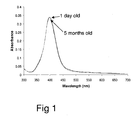
- Figure 1 is the UV/visible spectrum showing stability of a silver colloid produced by a method in accordance with the invention
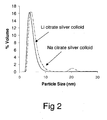
- Figure 2 is a graph showing particle size analyses of lithium and sodium citrate sliver colloids.
- Figure 3 is a graph of Raman intensity against wave number comparing a lithium citrate and a sodium citrate silver colloid used for the SERRS analysis of Rhodamine 6G.
- Lithium heads the Group 1 elements and displays some very different properties to sodium. Lithium is very electropositive and, as a result of its small atomic radius, has a high electrostatic charge and hence high solvation energy. Additionally, lithium compounds tend to form covalent as opposed to ionic bonds and, furthermore, lithium is much larger compared to sodium when hydrated. It was therefore considered by the Applicant that these properties could provide smaller particle size silver colloids and better stability in containers made of various different materials, which had proved troublesome in the past.
- High purity water (500ml - BDH; 18m ⁇ ) was put in a three-necked, one litre, round-bottomed flask.
- a thermometer (range 0 -110°C) was held in one of the side necks of the flask. Whilst stirring, the water temperature was raised and, on reaching 45°C, silver nitrate (90mg - 99.9999%; Aldrich Chemicals) was added through the third neck of the flask. The temperature of the contents of the flask was raised quickly to 98°C and then 10ml of aqueous lithium citrate solution (227mg in 25ml BDH high purity water) was added to the reaction mixture.
- the resulting silver colloidal solution exhibits a narrow size distribution, and is highly stable in glass and a wide range of other polymeric container materials.
- the silver colloidal solution exhibits high light-scattering properties and particularly intense SERS and SERRS spectra with very low fluorescence background levels.
- the silver colloidal solution can be aggregated with either organic or inorganic aggregating reagents of the kind used in Raman spectroscopy. Above all, the silver colloidal solution is incredibly stable and has a long shelf life.
- Figure 1 shows a graph of the UV/visible spectrum of a silver colloid prepared by the method described.
- UV/visible spectroscopy provides a method for characterisation of the silver colloid. Measurement of band width at half peak height gives an indication of the particle size distribution of the colloid particles - more uniform particle size leads to the narrower band width. Values of typically 60-70nm are obtained for sodium citrate reduced colloids, and these give reasonable SERRS properties, but with lithium citrate reduced colloids below 60nm have been obtained.
- the band width for the example described is 46nm.
- the ⁇ max value is related to the particle size distribution and scattering properties of the colloid. Colloids with a value of 390-400nm have been found to give the best SERRS properties, and with sodium citrate reduced colloids it is often difficult to achieve below 400nm; the typical range is 400-410nm.
- the ⁇ max value for the example described is 399nm.
- Figure 1 also shows that there is virtually no change in the spectroptometric properties over a period of 5 months, thus indicating the stability of silver colloids produced according to the invention. Batches of these colloids have found to be stable over this extended period in glass and containers made of polymeric materials including, high and low density polyethylene, polypropylene and polyethylene terephthalate.
- Particle size analysis of a silver colloid produced in accordance with the invention as shown in Figure 2 indicate that, in comparison with a silver colloid produced by the method described in the prior art, the former has a narrower distribution of particles of smaller with similar mean particle size (4nm compared with 4.5nm) but with no significant number of particles greater than 11 nm.
- the sodium citrate silver colloid shows another distribution of particles in the range of 18-23nm. The differences observed here account for the higher absorbance value, lower bandwidths and lower ⁇ max values observed in the visible spectra of lithium citrate silver colloids ie., a larger number of smaller colloidal silver particles with a more uniform particle size being produced.
- the silver colloid solution produced in accordance with the invention does produce intense SERS and SERRS spectra.
- Rhodamine 6G a dye standard commonly used for assessing SERRS activity of colloids
- a colloid should be able to produce strong SERRS spectra from a 10 -9 M solution of the dye by using an aggregating agent which is either inorganic, such as sodium chloride, or organic, for example poly-L-lysine.
Landscapes
- Chemical & Material Sciences (AREA)
- Engineering & Computer Science (AREA)
- Nanotechnology (AREA)
- Dispersion Chemistry (AREA)
- Organic Chemistry (AREA)
- Chemical Kinetics & Catalysis (AREA)
- Crystallography & Structural Chemistry (AREA)
- General Physics & Mathematics (AREA)
- Life Sciences & Earth Sciences (AREA)
- Condensed Matter Physics & Semiconductors (AREA)
- Physics & Mathematics (AREA)
- Materials Engineering (AREA)
- General Chemical & Material Sciences (AREA)
- Health & Medical Sciences (AREA)
- Composite Materials (AREA)
- General Health & Medical Sciences (AREA)
- Molecular Biology (AREA)
- Inorganic Chemistry (AREA)
- Colloid Chemistry (AREA)
- Investigating, Analyzing Materials By Fluorescence Or Luminescence (AREA)
- Manufacture Of Metal Powder And Suspensions Thereof (AREA)
- Agricultural Chemicals And Associated Chemicals (AREA)
Abstract
Description
- The present invention concerns methods of making stable silver colloids and to colloids produced by the method. The colloids are especially useful for Raman spectroscopy.
- Analytical chemists for many years did not use Raman spectroscopy because it failed to provide the sensitivity required for the detection of trace quantities of analytes. This was mainly because of very high background levels of fluorescence arising from either the sample or substrate which swamp the weak Raman signals. In 1974, Fleischman discovered, whilst using Raman spectroscopy to study the electrochemical reactions of pyridine on a silver electrode, that there was a tremendous enhancement of the pyridine Raman signals with the silver quenching a large amount of the background fluorescence. This surface enhancement could only be achieved if the silver surface was rough and not smooth.
- Subsequently, it has been found that equal or even higher surface enhancement effects can be achieved with silver colloids. A colloid is a suspension of the metal particles in solution. In order to achieve the optimum effect, controlled aggregation of the silver colloid particles is required, typically using inorganic (e.g. chloride or nitrate) or organic (e.g. poly-L-lysine or spremine) compounds as aggregation reagents. For the majority of analytes, the colloidal silver particles should be about 20-50nm, prior to aggregation, and have a narrow particle size distribution.
- With the tremendous increase in sensitivity that can be achieved using this surface enhancement effect, the analytical techniques of surface enhanced Raman scattering (SERS) spectroscopy and surface enhanced resonance Raman scattering (SERRS) spectroscopy have since been developed. The growth in the use of these techniques has been exponential but the major problem is producing stable colloids with good light scattering properties and capable of quenching background fluorescence. For a stable colloid the silver particles should remain suspended indefinitely but, on many occasions, aggregation occurs and the silver falls out of solution.
- Silver colloids can be prepared by chemical reduction with either sodium borohydride or sodium citrate. Citrate reduced colloids are more stable and many analysts have prepared these using a method published by P. C. Lee and O. Meisel (J.Phys. Chem., 1982, 86, 3391-3395). Batch to batch reproducibility is difficult to achieve by this method and the stability, i.e. shelf life, is variable. Preparation requires the use of ultra clean glassware and accurately controlled temperatures, stirring speed, etc.
- A published modification of the original method (C. H. Munro, W. E. Smith and P. C. White, Analyst 1993, Vol. 118, 733-735) has led to some improvements in the properties of the silver colloid but long term stability can still be a problem. For a commercial product, however, greater stability is still required and studies have shown that even the material used in the storage container can affect the stability of some batches of silver colloids.
- Silver colloids prepared according to these known prior methods produce silver particles with a negative citrate layer on their surface, and for maximum surface enhancement effects analytes must be in close proximity to the aggregated silver surface. For cationic analytes this can be achieved as they are attracted to the negatively charged silver surface. With anionic analytes only a very weak SER(R)S effect is achieved due to repulsion from the silver surface. The authors of the modified colloid preparation method resolved this problem by using poly-L-lysine as the aggregation agent, but adding ascorbic acid to control pH and protonate the aggregating agent, which then acted as a bridge between the colloid surface and the analyte.
- In the search to achieve stable silver colloids with good light scattering properties, other methods of preparation have been studied by the Applicant. As a result of these studies a novel method, based upon knowledge of the chemical properties of inorganic materials, has resulted in producing stable silver colloid solutions which have the desired analytical properties.
- In accordance with the present invention, a method for producing a silver colloidal solution comprises reducing silver nitrate with lithium citrate.
- The invention also provides a silver colloid solution made by reducing silver nitrate with lithium citrate.
- The method preferably includes the steps of (a) heating a first quantity of water to a first predetermined temperature; (b) adding a second quantity of silver nitrate to the water; (c) heating the mixture to a second predetermined temperature; (d) adding a third quantity of an aqueous lithium citrate solution to the mixture; (e) maintaining the mixture at the second predetermined temperature for a predetermined time; and (f) cooling the mixture.
- The mixing process is conveniently carried out in a three-necked container.
- In the method, preferably the first predetermined temperature is 45°C, the second predetermined temperature is 98°C, the first quantity is 500ml of high purity water, the second quantity is 90mg of silver nitrate of 99.9999% purity, the third quantity is 10ml of aqueous lithium citrate solution, the aqueous lithium citrate solution comprises 227mg of lithium citrate in 25ml high purity water, and the water and the mixture are stirred constantly throughout steps (a) to (f). The predetermined time is preferably 90 minutes.
- Preferred embodiments of the invention will now be described with reference to the accompanying drawing, in which:
-
Figure 1 is the UV/visible spectrum showing stability of a silver colloid produced by a method in accordance with the invention; -
Figure 2 is a graph showing particle size analyses of lithium and sodium citrate sliver colloids; and -
Figure 3 is a graph of Raman intensity against wave number comparing a lithium citrate and a sodium citrate silver colloid used for the SERRS analysis of Rhodamine 6G. - In considering the chemical properties of sodium (used in the form of sodium citrate) to reduce silver nitrate to produce the colloid, as in the prior art, it was believed that the ionic nature of sodium is responsible for the difficulty in producing colloidal particles, which leads to the de-stabilisation of the colloidal solution.
- Lithium heads the
Group 1 elements and displays some very different properties to sodium. Lithium is very electropositive and, as a result of its small atomic radius, has a high electrostatic charge and hence high solvation energy. Additionally, lithium compounds tend to form covalent as opposed to ionic bonds and, furthermore, lithium is much larger compared to sodium when hydrated. It was therefore considered by the Applicant that these properties could provide smaller particle size silver colloids and better stability in containers made of various different materials, which had proved troublesome in the past. - Prior attempts at producing silver colloids were disappointing and there was little encouragement to go against the perceived wisdom that the ionic nature of sodium in silver nitrate (discussed above) was responsible for failed attempts at obtaining silver colloids with a long enough shelf life/stability.
- However, it has now been discovered by the Applicant that the traditional sodium can be replaced with lithium. Initial experiments using lithium citrate to reduce silver nitrate proved promising. Batches of colloid produced using these materials were found to have superior scattering properties (more intense Raman signals - indicating smaller particle size and better particle size distribution), considerably reduced background fluorescence from analytes (indicating an enhanced level of fluorescence quenching), and good stability.
- These batches of colloid have remained stable, i.e. the silver particles are still in suspension, over a protracted period. Recent tests have confirmed that the particles are still dispersed. When compared with more recent samples of sodium citrate colloids, the old lithium citrate silver colloid samples still display superior light scattering properties, i.e. more intense SERRS spectra, as compared to silver colloids produced according to the prior art using sodium citrate as the reducing agent.
- It was also established that many of the silver colloids produced using sodium citrate could only be used if inorganic aggregating agents were used, with the majority failing to work with organic aggregating reagents. However, with the lithium citrate colloids, controlled aggregation could be obtained with either organic or inorganic aggregating agents. This last observation, together with the improved stability, clearly indicates that it is the use of lithium that is playing a major role in controlling the chemical properties of the silver colloid particles.
- The method of preparing these lithium citrate-reduced colloidal solutions will now be described.
- High purity water (500ml - BDH; 18mΩ) was put in a three-necked, one litre, round-bottomed flask. A glass stirring rod, passing through the central neck, was attached to an overhead stirrer motor, which was set at a stirring speed of 550 rpm. A thermometer (range 0 -110°C) was held in one of the side necks of the flask. Whilst stirring, the water temperature was raised and, on reaching 45°C, silver nitrate (90mg - 99.9999%; Aldrich Chemicals) was added through the third neck of the flask. The temperature of the contents of the flask was raised quickly to 98°C and then 10ml of aqueous lithium citrate solution (227mg in 25ml BDH high purity water) was added to the reaction mixture.
- Stirring was maintained at this temperature for a further 90 minutes and then the heat was removed. The colloidal solution was allowed to cool to room temperature and continually stirred during this period.
- The resulting silver colloidal solution exhibits a narrow size distribution, and is highly stable in glass and a wide range of other polymeric container materials. In addition, the silver colloidal solution exhibits high light-scattering properties and particularly intense SERS and SERRS spectra with very low fluorescence background levels. The silver colloidal solution can be aggregated with either organic or inorganic aggregating reagents of the kind used in Raman spectroscopy. Above all, the silver colloidal solution is incredibly stable and has a long shelf life.
-
Figure 1 shows a graph of the UV/visible spectrum of a silver colloid prepared by the method described. UV/visible spectroscopy provides a method for characterisation of the silver colloid. Measurement of band width at half peak height gives an indication of the particle size distribution of the colloid particles - more uniform particle size leads to the narrower band width. Values of typically 60-70nm are obtained for sodium citrate reduced colloids, and these give reasonable SERRS properties, but with lithium citrate reduced colloids below 60nm have been obtained. The band width for the example described is 46nm. - The λmax value is related to the particle size distribution and scattering properties of the colloid. Colloids with a value of 390-400nm have been found to give the best SERRS properties, and with sodium citrate reduced colloids it is often difficult to achieve below 400nm; the typical range is 400-410nm. The λmax value for the example described is 399nm.
- Most sodium citrate reduced colloids produce an absorbance value in the range 0.25 to 0.30 at the λmax of the colloid, and this decreases quickly over 3-6 months on storage. Absorbance is an indication of the concentration of silver particles and generally, the higher the absorbance, the higher the intensity of a SERRS signal. With lithium citrate reduced colloids, absorbance values above 0.30 are obtained. The absorbance value for the example described is 0.36.
-
Figure 1 also shows that there is virtually no change in the spectroptometric properties over a period of 5 months, thus indicating the stability of silver colloids produced according to the invention. Batches of these colloids have found to be stable over this extended period in glass and containers made of polymeric materials including, high and low density polyethylene, polypropylene and polyethylene terephthalate. - Particle size analysis of a silver colloid produced in accordance with the invention as shown in
Figure 2 indicate that, in comparison with a silver colloid produced by the method described in the prior art, the former has a narrower distribution of particles of smaller with similar mean particle size (4nm compared with 4.5nm) but with no significant number of particles greater than 11 nm. However, the sodium citrate silver colloid shows another distribution of particles in the range of 18-23nm. The differences observed here account for the higher absorbance value, lower bandwidths and lower λmax values observed in the visible spectra of lithium citrate silver colloids ie., a larger number of smaller colloidal silver particles with a more uniform particle size being produced. These are properties of a silver colloid that on aggregation would be expected to produce a more intense surface scattering effect and hence stronger SERRS signals. Furthermore, with the colloids produced in accordance with the invention, their superior stability over sodium citrate silver colloids can be attributed to their uniformity of particle size and distribution. - The silver colloid solution produced in accordance with the invention, as predicted above, does produce intense SERS and SERRS spectra. With Rhodamine 6G, a dye standard commonly used for assessing SERRS activity of colloids, a colloid should be able to produce strong SERRS spectra from a 10-9 M solution of the dye by using an aggregating agent which is either inorganic, such as sodium chloride, or organic, for example poly-L-lysine. These criteria are met by the silver colloid produced by the method of the invention, and
Figure 3 provides a SERRS spectrum of the dye (lower trace) which has been obtained using sodium chloride as the aggregating reagent at an optimal concentration of 0.0125M. The upper trace inFigure 3 shows the SERRS spectrum achieved using a sodium citrate silver colloid under the same optimal analytical conditions. These results show the significant reduction in background fluorescence and the increased sensitivity that can be achieved with silver colloids produced according to the method described in this invention. Using accurately background subtracted data from these spectra an increase in the intensity of nearly 70% for the most intense band at 1650cm-1 can be achieved.
Claims (17)
- A method for producing a silver colloidal solution by reducing silver nitrate with lithium citrate.
- A method as claimed in Claim 1, comprising the steps:(a) heating a first quantity of water to a first predetermined temperature;(b) adding a second quantity of silver nitrate to the water;(c) heating the mixture to a second predetermined temperature;(d) adding a third quantity of an aqueous lithium citrate solution to the mixture;(e) maintaining the mixture at the second predetermined temperature for a predetermined time; and(f) cooling the mixture.
- A method as claimed in Claim 2, wherein the mixing process is carried out in a three-necked container.
- A method as claimed in Claim 2 or 3, wherein the first predetermined temperature is 45°C.
- A method as claimed in Claim 4, wherein the second predetermined temperature is 98°C.
- A method as claimed in any of Claims 2 to 5, wherein the first quantity is 500ml of high purity water.
- A method as claimed in any of Claims 2 to 6, wherein the second quantity is 90mg of said silver nitrate of 99.9999% purity;
- A method as claimed in any of Claims 2 to 7, wherein the third quantity is 10ml of said aqueous lithium citrate solution.
- A method as claimed in Claim 8, wherein the aqueous lithium citrate solution comprises 227mg of lithium citrate in 25ml high purity water.
- A method as claimed in any of Claims 2 to 9, wherein the water and the mixture are stirred constantly throughout steps (b) to (f).
- A method as claimed in Claim 10, wherein the stirring is carried out using a stirrer rotated at 550rpm.
- A method as claimed in any of Claims 2 to 11, wherein in step (e) the predetermined time is 90 minutes.
- A method as claimed in any preceding claim, wherein the resultant silver colloid has a narrow particle size distribution.
- A method as claimed in Claim 13, wherein the mean particle size is 4nm.
- A method as claimed in any of Claims 2 to 12, wherein the resultant silver colloidal solution is aggregated with organic or inorganic aggregating reagents for use in SERS and SERRS spectroscopy.
- A silver colloidal solution formed by the reduction of silver nitrate with lithium citrate.
- A silver colloidal solution as claimed in Claim 16, having high light scattering properties and producing intense SERS and SERRS spectra.
Applications Claiming Priority (2)
| Application Number | Priority Date | Filing Date | Title |
|---|---|---|---|
| GBGB0605752.5A GB0605752D0 (en) | 2006-03-23 | 2006-03-23 | Preparation of stable silver colloids |
| PCT/GB2007/050138 WO2007107792A1 (en) | 2006-03-23 | 2007-03-21 | Preparation of stable silver colloids |
Publications (2)
| Publication Number | Publication Date |
|---|---|
| EP2007513A1 EP2007513A1 (en) | 2008-12-31 |
| EP2007513B1 true EP2007513B1 (en) | 2010-03-24 |
Family
ID=36383971
Family Applications (1)
| Application Number | Title | Priority Date | Filing Date |
|---|---|---|---|
| EP07733563A Not-in-force EP2007513B1 (en) | 2006-03-23 | 2007-03-21 | Preparation of stable silver colloids |
Country Status (9)
| Country | Link |
|---|---|
| US (1) | US8080180B2 (en) |
| EP (1) | EP2007513B1 (en) |
| JP (1) | JP5417659B2 (en) |
| AT (1) | ATE461743T1 (en) |
| DE (1) | DE602007005465D1 (en) |
| DK (1) | DK2007513T3 (en) |
| ES (1) | ES2343594T3 (en) |
| GB (1) | GB0605752D0 (en) |
| WO (1) | WO2007107792A1 (en) |
Families Citing this family (8)
| Publication number | Priority date | Publication date | Assignee | Title |
|---|---|---|---|---|
| GB0724870D0 (en) * | 2007-12-21 | 2008-01-30 | Univ Lincoln The | Preparation of metal colloids |
| US7846866B2 (en) | 2008-09-09 | 2010-12-07 | Guardian Industries Corp. | Porous titanium dioxide coatings and methods of forming porous titanium dioxide coatings having improved photocatalytic activity |
| US8647652B2 (en) | 2008-09-09 | 2014-02-11 | Guardian Industries Corp. | Stable silver colloids and silica-coated silver colloids, and methods of preparing stable silver colloids and silica-coated silver colloids |
| US8545899B2 (en) | 2008-11-03 | 2013-10-01 | Guardian Industries Corp. | Titanium dioxide coatings having roughened surfaces and methods of forming titanium dioxide coatings having roughened surfaces |
| RU2456356C1 (en) | 2011-04-29 | 2012-07-20 | Борис Сергеевич Кустов | Nanosilver colloidal solution and preparation method thereof |
| KR20130035014A (en) * | 2011-09-29 | 2013-04-08 | 삼성전기주식회사 | Method for producing metal particles, ink composition and paste composition produced by the same |
| CN106442466A (en) * | 2016-11-09 | 2017-02-22 | 南京理工大学 | Graphene oxide assisted SERS (surface enhanced Raman scattering) active substrate surface cleaning method |
| JP7190277B2 (en) * | 2018-07-31 | 2022-12-15 | 浜松ホトニクス株式会社 | Analyte analysis method |
Family Cites Families (13)
| Publication number | Priority date | Publication date | Assignee | Title |
|---|---|---|---|---|
| DE4244354C2 (en) * | 1991-12-28 | 1995-06-14 | Hidefumi Hirai | Process for producing a non-aqueous dispersion of particles of a metal and / or a metal compound |
| GB9517955D0 (en) * | 1995-07-25 | 1995-11-08 | Univ Strathclyde | Nucleotide sequence detection and analysis |
| GB9609793D0 (en) * | 1996-05-10 | 1996-07-17 | Ciba Geigy Ag | Pigment compositions |
| JP3429958B2 (en) * | 1996-08-28 | 2003-07-28 | 三井金属鉱業株式会社 | Method for producing silver colloid liquid |
| GB0008618D0 (en) * | 2000-04-08 | 2000-05-31 | Univ Strathclyde | Analyte detection & apparatus therefor |
| JP4603487B2 (en) * | 2003-03-12 | 2010-12-22 | インテル・コーポレーション | Chemical sensitization of surface-sensitized Raman spectroscopy using lithium salts |
| JP4424723B2 (en) * | 2003-07-07 | 2010-03-03 | バンドー化学株式会社 | Conductive coating composite |
| US20050191665A1 (en) * | 2003-12-29 | 2005-09-01 | Xing Su | Composite organic-inorganic nanoclusters |
| US20050147963A1 (en) * | 2003-12-29 | 2005-07-07 | Intel Corporation | Composite organic-inorganic nanoparticles and methods for use thereof |
| JPWO2005082561A1 (en) * | 2004-02-27 | 2007-10-25 | 有限会社サンサーラコーポレーション | Colloidal metal |
| JP2006045655A (en) * | 2004-08-09 | 2006-02-16 | Mitsubishi Materials Corp | Silver nanoparticles and production method thereof |
| JP2007194174A (en) * | 2006-01-23 | 2007-08-02 | Seiko Epson Corp | Conductor pattern ink, conductor pattern, wiring board, electro-optical device, and electronic device |
| US8012676B2 (en) * | 2006-06-22 | 2011-09-06 | Mitsubishi Paper Mills Limited | Process for preparing conductive material |
-
2006
- 2006-03-23 GB GBGB0605752.5A patent/GB0605752D0/en not_active Ceased
-
2007
- 2007-03-21 EP EP07733563A patent/EP2007513B1/en not_active Not-in-force
- 2007-03-21 WO PCT/GB2007/050138 patent/WO2007107792A1/en not_active Ceased
- 2007-03-21 JP JP2009502223A patent/JP5417659B2/en not_active Expired - Fee Related
- 2007-03-21 DK DK07733563.6T patent/DK2007513T3/en active
- 2007-03-21 ES ES07733563T patent/ES2343594T3/en active Active
- 2007-03-21 DE DE602007005465T patent/DE602007005465D1/en active Active
- 2007-03-21 US US12/294,151 patent/US8080180B2/en not_active Expired - Fee Related
- 2007-03-21 AT AT07733563T patent/ATE461743T1/en not_active IP Right Cessation
Also Published As
| Publication number | Publication date |
|---|---|
| DE602007005465D1 (en) | 2010-05-06 |
| JP2009531547A (en) | 2009-09-03 |
| US20090236570A1 (en) | 2009-09-24 |
| ATE461743T1 (en) | 2010-04-15 |
| DK2007513T3 (en) | 2011-01-10 |
| GB0605752D0 (en) | 2006-05-03 |
| US8080180B2 (en) | 2011-12-20 |
| WO2007107792A1 (en) | 2007-09-27 |
| ES2343594T3 (en) | 2010-08-04 |
| EP2007513A1 (en) | 2008-12-31 |
| JP5417659B2 (en) | 2014-02-19 |
Similar Documents
| Publication | Publication Date | Title |
|---|---|---|
| US8080180B2 (en) | Preparation of stable silver colloids | |
| Meng et al. | Preparation of silver colloids with improved uniformity and stable surface-enhanced Raman scattering | |
| Phuong et al. | Rapid and sensitive detection of Rhodamine B in food using the plasmonic silver nanocube-based sensor as SERS active substrate | |
| US9086381B2 (en) | Preparation of metal colloids | |
| Mirhosseini Moghaddam et al. | Continuous‐flow synthesis of CdSe quantum dots: A size‐tunable and scalable approach | |
| Hu et al. | Bimetallic plasmonic Au@ Ag nanocuboids for rapid and sensitive detection of phthalate plasticizers with label-free surface-enhanced Raman spectroscopy | |
| Liu et al. | Synthesis of Ag2S–Ag nanoprisms and their use as DNA hybridization probes | |
| Długosz et al. | Anhydrous metal nanoparticle suspensions using deep eutectic solvents (DES)–green approach to metal nanoparticles production | |
| Nie et al. | Synthesis of highly fluorescent Cu/Au bimetallic nanoclusters and their application in a temperature sensor and fluorescent probe for chromium (III) ions | |
| Sethi et al. | Understanding the mechanism of amino acid-based Au nanoparticle chain formation | |
| Liu et al. | Ratiometric sensors with selective fluorescence enhancement effects based on photonic crystals for the determination of acetylcholinesterase and its inhibitor | |
| Pauzi et al. | Microwave-assisted synthesis for environmentally ZnO nanoparticle synthesis | |
| Gheitaran et al. | Effect of light at different wavelengths on polyol synthesis of silver nanocubes | |
| Albuquerque et al. | Continuous synthesis of monodisperse Ag nanocubes | |
| Rahimi-Nasrabadi et al. | Optimized synthesis and characterization of lutetium carbonate and oxide nanoparticles and their use as degradation photocatalyst | |
| Chen et al. | 4-aminothiophenol-modulated Ag growth on Au nanoparticles for detection of nitrite | |
| Ruangchaithaweesuk et al. | Poly (methacrylic acid)‐Stabilized Silver Nanoclusters as Colorimetric Sensors for the Rapid and Sensitive Detection of Ascorbic Acid | |
| Quang et al. | Chiral plasmonic Au@ Pt nanoparticles for detection of H2O2 and Hg2+ and enantiomeric differentiation | |
| Ghasemi et al. | Improvement of fluorescence properties by surface modification of CdS‐ZnS quantum dots by thiol compounds and its application as a sensitive fluorescence probe for copper ion detection | |
| Nam et al. | Cooperative surface‐enhanced Raman spectroscopy enhancement in Au nanorod/SiO2 nanoparticle solutions | |
| Zhao et al. | Utilizing a SHAP-Assisted Machine Learning Algorithm for Optimization of Plasmonic Properties of Gold Nanostructure | |
| Zhang et al. | Heterogeneous Scattering Solvatochromism in Single Prussian Blue Nanoparticles | |
| Mukherjee et al. | Synthesis of Ag nanoparticles in Span/Span-Tween mixed surfactant system and its optical, kinetic and fluorimetric studies | |
| Furletov et al. | Silver triangular nanoplates as analytical reagents in optical molecular absorption spectroscopy: Possibilities and prospects | |
| Zhang et al. | Engineering Branched Silver Particles: pH-Mediated Morphology Control for Modulated Optical and Photothermal Conversion Properties |
Legal Events
| Date | Code | Title | Description |
|---|---|---|---|
| PUAI | Public reference made under article 153(3) epc to a published international application that has entered the european phase |
Free format text: ORIGINAL CODE: 0009012 |
|
| 17P | Request for examination filed |
Effective date: 20081023 |
|
| AK | Designated contracting states |
Kind code of ref document: A1 Designated state(s): AT BE BG CH CY CZ DE DK EE ES FI FR GB GR HU IE IS IT LI LT LU LV MC MT NL PL PT RO SE SI SK TR |
|
| AX | Request for extension of the european patent |
Extension state: AL BA HR MK RS |
|
| GRAP | Despatch of communication of intention to grant a patent |
Free format text: ORIGINAL CODE: EPIDOSNIGR1 |
|
| GRAS | Grant fee paid |
Free format text: ORIGINAL CODE: EPIDOSNIGR3 |
|
| GRAA | (expected) grant |
Free format text: ORIGINAL CODE: 0009210 |
|
| DAX | Request for extension of the european patent (deleted) | ||
| AK | Designated contracting states |
Kind code of ref document: B1 Designated state(s): AT BE BG CH CY CZ DE DK EE ES FI FR GB GR HU IE IS IT LI LT LU LV MC MT NL PL PT RO SE SI SK TR |
|
| REG | Reference to a national code |
Ref country code: GB Ref legal event code: FG4D |
|
| REG | Reference to a national code |
Ref country code: CH Ref legal event code: EP |
|
| REG | Reference to a national code |
Ref country code: IE Ref legal event code: FG4D |
|
| REF | Corresponds to: |
Ref document number: 602007005465 Country of ref document: DE Date of ref document: 20100506 Kind code of ref document: P |
|
| REG | Reference to a national code |
Ref country code: NL Ref legal event code: VDEP Effective date: 20100324 |
|
| PG25 | Lapsed in a contracting state [announced via postgrant information from national office to epo] |
Ref country code: LT Free format text: LAPSE BECAUSE OF FAILURE TO SUBMIT A TRANSLATION OF THE DESCRIPTION OR TO PAY THE FEE WITHIN THE PRESCRIBED TIME-LIMIT Effective date: 20100324 |
|
| REG | Reference to a national code |
Ref country code: ES Ref legal event code: FG2A Ref document number: 2343594 Country of ref document: ES Kind code of ref document: T3 |
|
| LTIE | Lt: invalidation of european patent or patent extension |
Effective date: 20100324 |
|
| PG25 | Lapsed in a contracting state [announced via postgrant information from national office to epo] |
Ref country code: FI Free format text: LAPSE BECAUSE OF FAILURE TO SUBMIT A TRANSLATION OF THE DESCRIPTION OR TO PAY THE FEE WITHIN THE PRESCRIBED TIME-LIMIT Effective date: 20100324 Ref country code: AT Free format text: LAPSE BECAUSE OF FAILURE TO SUBMIT A TRANSLATION OF THE DESCRIPTION OR TO PAY THE FEE WITHIN THE PRESCRIBED TIME-LIMIT Effective date: 20100324 Ref country code: LV Free format text: LAPSE BECAUSE OF FAILURE TO SUBMIT A TRANSLATION OF THE DESCRIPTION OR TO PAY THE FEE WITHIN THE PRESCRIBED TIME-LIMIT Effective date: 20100324 Ref country code: PL Free format text: LAPSE BECAUSE OF FAILURE TO SUBMIT A TRANSLATION OF THE DESCRIPTION OR TO PAY THE FEE WITHIN THE PRESCRIBED TIME-LIMIT Effective date: 20100324 Ref country code: SI Free format text: LAPSE BECAUSE OF FAILURE TO SUBMIT A TRANSLATION OF THE DESCRIPTION OR TO PAY THE FEE WITHIN THE PRESCRIBED TIME-LIMIT Effective date: 20100324 |
|
| PG25 | Lapsed in a contracting state [announced via postgrant information from national office to epo] |
Ref country code: BE Free format text: LAPSE BECAUSE OF FAILURE TO SUBMIT A TRANSLATION OF THE DESCRIPTION OR TO PAY THE FEE WITHIN THE PRESCRIBED TIME-LIMIT Effective date: 20100324 Ref country code: GR Free format text: LAPSE BECAUSE OF FAILURE TO SUBMIT A TRANSLATION OF THE DESCRIPTION OR TO PAY THE FEE WITHIN THE PRESCRIBED TIME-LIMIT Effective date: 20100625 Ref country code: SE Free format text: LAPSE BECAUSE OF FAILURE TO SUBMIT A TRANSLATION OF THE DESCRIPTION OR TO PAY THE FEE WITHIN THE PRESCRIBED TIME-LIMIT Effective date: 20100324 Ref country code: EE Free format text: LAPSE BECAUSE OF FAILURE TO SUBMIT A TRANSLATION OF THE DESCRIPTION OR TO PAY THE FEE WITHIN THE PRESCRIBED TIME-LIMIT Effective date: 20100324 Ref country code: NL Free format text: LAPSE BECAUSE OF FAILURE TO SUBMIT A TRANSLATION OF THE DESCRIPTION OR TO PAY THE FEE WITHIN THE PRESCRIBED TIME-LIMIT Effective date: 20100324 Ref country code: RO Free format text: LAPSE BECAUSE OF FAILURE TO SUBMIT A TRANSLATION OF THE DESCRIPTION OR TO PAY THE FEE WITHIN THE PRESCRIBED TIME-LIMIT Effective date: 20100324 |
|
| PG25 | Lapsed in a contracting state [announced via postgrant information from national office to epo] |
Ref country code: IS Free format text: LAPSE BECAUSE OF FAILURE TO SUBMIT A TRANSLATION OF THE DESCRIPTION OR TO PAY THE FEE WITHIN THE PRESCRIBED TIME-LIMIT Effective date: 20100724 Ref country code: CZ Free format text: LAPSE BECAUSE OF FAILURE TO SUBMIT A TRANSLATION OF THE DESCRIPTION OR TO PAY THE FEE WITHIN THE PRESCRIBED TIME-LIMIT Effective date: 20100324 Ref country code: BG Free format text: LAPSE BECAUSE OF FAILURE TO SUBMIT A TRANSLATION OF THE DESCRIPTION OR TO PAY THE FEE WITHIN THE PRESCRIBED TIME-LIMIT Effective date: 20100624 Ref country code: SK Free format text: LAPSE BECAUSE OF FAILURE TO SUBMIT A TRANSLATION OF THE DESCRIPTION OR TO PAY THE FEE WITHIN THE PRESCRIBED TIME-LIMIT Effective date: 20100324 |
|
| REG | Reference to a national code |
Ref country code: DK Ref legal event code: T3 |
|
| PLBE | No opposition filed within time limit |
Free format text: ORIGINAL CODE: 0009261 |
|
| STAA | Information on the status of an ep patent application or granted ep patent |
Free format text: STATUS: NO OPPOSITION FILED WITHIN TIME LIMIT |
|
| PG25 | Lapsed in a contracting state [announced via postgrant information from national office to epo] |
Ref country code: PT Free format text: LAPSE BECAUSE OF FAILURE TO SUBMIT A TRANSLATION OF THE DESCRIPTION OR TO PAY THE FEE WITHIN THE PRESCRIBED TIME-LIMIT Effective date: 20100726 |
|
| 26N | No opposition filed |
Effective date: 20101228 |
|
| PG25 | Lapsed in a contracting state [announced via postgrant information from national office to epo] |
Ref country code: MC Free format text: LAPSE BECAUSE OF NON-PAYMENT OF DUE FEES Effective date: 20110331 |
|
| REG | Reference to a national code |
Ref country code: CH Ref legal event code: PL |
|
| PG25 | Lapsed in a contracting state [announced via postgrant information from national office to epo] |
Ref country code: MT Free format text: LAPSE BECAUSE OF FAILURE TO SUBMIT A TRANSLATION OF THE DESCRIPTION OR TO PAY THE FEE WITHIN THE PRESCRIBED TIME-LIMIT Effective date: 20100324 |
|
| REG | Reference to a national code |
Ref country code: IE Ref legal event code: MM4A |
|
| PG25 | Lapsed in a contracting state [announced via postgrant information from national office to epo] |
Ref country code: CH Free format text: LAPSE BECAUSE OF NON-PAYMENT OF DUE FEES Effective date: 20110331 Ref country code: IE Free format text: LAPSE BECAUSE OF NON-PAYMENT OF DUE FEES Effective date: 20110321 Ref country code: LI Free format text: LAPSE BECAUSE OF NON-PAYMENT OF DUE FEES Effective date: 20110331 |
|
| PG25 | Lapsed in a contracting state [announced via postgrant information from national office to epo] |
Ref country code: LU Free format text: LAPSE BECAUSE OF NON-PAYMENT OF DUE FEES Effective date: 20110321 Ref country code: CY Free format text: LAPSE BECAUSE OF FAILURE TO SUBMIT A TRANSLATION OF THE DESCRIPTION OR TO PAY THE FEE WITHIN THE PRESCRIBED TIME-LIMIT Effective date: 20100324 |
|
| PG25 | Lapsed in a contracting state [announced via postgrant information from national office to epo] |
Ref country code: TR Free format text: LAPSE BECAUSE OF FAILURE TO SUBMIT A TRANSLATION OF THE DESCRIPTION OR TO PAY THE FEE WITHIN THE PRESCRIBED TIME-LIMIT Effective date: 20100324 |
|
| PG25 | Lapsed in a contracting state [announced via postgrant information from national office to epo] |
Ref country code: HU Free format text: LAPSE BECAUSE OF FAILURE TO SUBMIT A TRANSLATION OF THE DESCRIPTION OR TO PAY THE FEE WITHIN THE PRESCRIBED TIME-LIMIT Effective date: 20100324 |
|
| REG | Reference to a national code |
Ref country code: FR Ref legal event code: PLFP Year of fee payment: 10 |
|
| REG | Reference to a national code |
Ref country code: FR Ref legal event code: PLFP Year of fee payment: 11 |
|
| REG | Reference to a national code |
Ref country code: FR Ref legal event code: PLFP Year of fee payment: 12 |
|
| PGFP | Annual fee paid to national office [announced via postgrant information from national office to epo] |
Ref country code: DE Payment date: 20200228 Year of fee payment: 14 Ref country code: DK Payment date: 20200303 Year of fee payment: 14 Ref country code: GB Payment date: 20200228 Year of fee payment: 14 Ref country code: IT Payment date: 20200312 Year of fee payment: 14 |
|
| PGFP | Annual fee paid to national office [announced via postgrant information from national office to epo] |
Ref country code: FR Payment date: 20200228 Year of fee payment: 14 |
|
| PGFP | Annual fee paid to national office [announced via postgrant information from national office to epo] |
Ref country code: ES Payment date: 20200401 Year of fee payment: 14 |
|
| REG | Reference to a national code |
Ref country code: DE Ref legal event code: R119 Ref document number: 602007005465 Country of ref document: DE |
|
| REG | Reference to a national code |
Ref country code: DK Ref legal event code: EBP Effective date: 20210331 |
|
| GBPC | Gb: european patent ceased through non-payment of renewal fee |
Effective date: 20210321 |
|
| PG25 | Lapsed in a contracting state [announced via postgrant information from national office to epo] |
Ref country code: FR Free format text: LAPSE BECAUSE OF NON-PAYMENT OF DUE FEES Effective date: 20210331 Ref country code: GB Free format text: LAPSE BECAUSE OF NON-PAYMENT OF DUE FEES Effective date: 20210321 Ref country code: DE Free format text: LAPSE BECAUSE OF NON-PAYMENT OF DUE FEES Effective date: 20211001 |
|
| PG25 | Lapsed in a contracting state [announced via postgrant information from national office to epo] |
Ref country code: IT Free format text: LAPSE BECAUSE OF NON-PAYMENT OF DUE FEES Effective date: 20210321 Ref country code: DK Free format text: LAPSE BECAUSE OF NON-PAYMENT OF DUE FEES Effective date: 20210331 |
|
| REG | Reference to a national code |
Ref country code: ES Ref legal event code: FD2A Effective date: 20220523 |
|
| PG25 | Lapsed in a contracting state [announced via postgrant information from national office to epo] |
Ref country code: ES Free format text: LAPSE BECAUSE OF NON-PAYMENT OF DUE FEES Effective date: 20210322 |