EP2005598B1 - Signal jamming avoidance method for a frequency hopping communication system - Google Patents
Signal jamming avoidance method for a frequency hopping communication system Download PDFInfo
- Publication number
- EP2005598B1 EP2005598B1 EP07752300.9A EP07752300A EP2005598B1 EP 2005598 B1 EP2005598 B1 EP 2005598B1 EP 07752300 A EP07752300 A EP 07752300A EP 2005598 B1 EP2005598 B1 EP 2005598B1
- Authority
- EP
- European Patent Office
- Prior art keywords
- channel
- receiver
- dwell
- noise level
- signal
- Prior art date
- Legal status (The legal status is an assumption and is not a legal conclusion. Google has not performed a legal analysis and makes no representation as to the accuracy of the status listed.)
- Active
Links
Images


Classifications
-
- H—ELECTRICITY
- H04—ELECTRIC COMMUNICATION TECHNIQUE
- H04B—TRANSMISSION
- H04B1/00—Details of transmission systems, not covered by a single one of groups H04B3/00 - H04B13/00; Details of transmission systems not characterised by the medium used for transmission
- H04B1/69—Spread spectrum techniques
- H04B1/713—Spread spectrum techniques using frequency hopping
- H04B1/7156—Arrangements for sequence synchronisation
-
- H—ELECTRICITY
- H04—ELECTRIC COMMUNICATION TECHNIQUE
- H04B—TRANSMISSION
- H04B1/00—Details of transmission systems, not covered by a single one of groups H04B3/00 - H04B13/00; Details of transmission systems not characterised by the medium used for transmission
- H04B1/69—Spread spectrum techniques
- H04B1/713—Spread spectrum techniques using frequency hopping
- H04B1/715—Interference-related aspects
-
- H—ELECTRICITY
- H04—ELECTRIC COMMUNICATION TECHNIQUE
- H04B—TRANSMISSION
- H04B1/00—Details of transmission systems, not covered by a single one of groups H04B3/00 - H04B13/00; Details of transmission systems not characterised by the medium used for transmission
- H04B1/69—Spread spectrum techniques
- H04B1/713—Spread spectrum techniques using frequency hopping
- H04B1/715—Interference-related aspects
- H04B2001/7154—Interference-related aspects with means for preventing interference
Definitions
- the present disclosure relates generally to radio communication systems and, more particularly, to a signal jamming avoidance method for a frequency hopping communication system.
- a frequency hopping communications system utilizes many frequency channels to send information from a transmitter to a receiver.
- the receiving radio initially tunes to a new reception frequency channel.
- the new frequency channel is selectable from a group of permissible frequency channels. In many environments, some of these frequency channels can be unusable due to jamming from high noise levels or other interfering signals. To improve the receiver's ability to detect the transmitted signal, it is advantageous to avoid frequency channels that have a poor chance of detecting the desired signal.
- the receiver is operable to measure a noise level on channels over which a data signal is received at the receiver; select a dwell channel based on the measured noise levels, where the dwell channel has the lowest noise level amongst a group of permissible channels over which to acquire a signal from a transmitter; and then tune the receiver to the selected dwell channel during a search state in which the receiver attempts to synchronize with a transmitter.
- Document US 6,751,249 B1 discloses a system hopping, in a circular fashion, between frequencies, A through E.
- the controller working in conjunction with the transmission circuitry continually monitors each of the hop frequencies to determine each hop frequency's respective level of electromagnetic energy.
- the level of electromagnetic energy at each hop frequency is compared to a predetermined threshold, so the controller identifies hop frequencies that have degraded due to interference and ones that can be used to replace the degraded hop frequencies.
- the frequencies identified in the swap table are arranged in order of increasing energy, with the lowest electromagnetic energy on top.
- Document US 006018543 A discloses a method comprising the steps of successively averaging signal samples received over a particular frequency channel and time interval corresponding to the receiver mode and library period to determine the noise level of the particular reception frequency channel. The averaged signal samples are then compared to a predetermined noise threshold to determine whether the frequency channel is noisy. If the frequency channel is determined to be noisy, the receiver is tuned to a new reception frequency channel, the new frequency channel being selectable from a group of permissible frequency channels and responsive to the receiver mode and library period and in a predetermined sequence. The steps are repeated until the noise threshold is no longer exceeded.
- Figure 1 is a flowchart depicting an exemplary method for selecting the dwell channel of a receiver during its search state
- Figure 2 is a flowchart depicting another exemplary method for selecting the dwell channel of a receiver during its search state
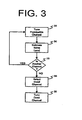
- Figure 3 is a flowchart depicting yet another methods for selecting the dwell channel of a receiver during its search state, which is not part of the claimed invention.
- Frequency hopping is a method of transmitting radio signals by rapidly transmitting a carrier among many frequency channels. Briefly, a transmitter "hops" between available frequencies according to a specified algorithm. The transmitter operates in synchronization with a receiver, which remains tuned to the same frequency as the transmitter. A short burst of data is transmitted on a narrowband. The transmitter then tunes to another frequency and transmits again. Thus, the receiver is capable of hopping its frequency several times a second to correspond to the transmission frequency employed by the transmitter. While the jamming avoidance methods of this disclosure are described in the context of a frequency hopping communication system, they have application to other types of radio communication systems where noise may interfere with a receiver's ability to receive a transmitted signal.
- the receiver may operate in three fundamental states: idle, search and active receive.
- the idle state is an initial state entered by the receiver when it is powered up. During this state, various operating parameters of the receiver are initialized.
- the receiver enters the search state. In the search state, the receiver will attempt to synchronize its operation with the transmitter. To do so, the receiver selects a channel upon which to listen for a synchronizing transmission from the transmitter. At the end of a dwell period, the receiver may choose a new channel upon which to listen. These channels are commonly referred to as the dwell channels.
- the receiver will transition to the active receive state and function in a manner known in the art.
- the receiver In the search state, the receiver must decide which frequency should be selected as the dwell channel.
- the Single Channel Ground-Airborne Radio System is an example of a radio which employs this type of operation. Further details regarding this radio system may be found in U.S. Patent Nos. 6,018,543 ; 6,052,406 ; and 6,078,612
- the jamming avoidance methods of this disclosure are particularly suited for this type of radio system as well as other military application.
- Figure 1 depicts a method for selecting the dwell channel of a receiver during its search state.
- the selection of the dwell channel is based on past data reception.
- the receiver may maintain a noise measurement for each of the channels over which a data signal has been received by the receiver.
- an active receive state an incoming radio signal is demodulated by the receiver such that baseband information is produced. While the receiver is tuned on a frequency and actively receiving the radio signal, a measurement of the noise on the channel may be made by the receiver.
- the receiver may estimate the signal-to-noise ratio (SNR) of the incoming signal.
- the estimate of the SNR can be based on the variance of the magnitude samples and/or the statistics of the expected bit transitions. As the variance of the magnitude samples increases, the SNR decreases. As the variance of the expected bit transition increases, the SNR decreases.
- a SNR estimate for a given frequency may be updated by using a weighted average of the previous SNR estimates. This weighted average can be implemented in a variety of ways. One possible implementation is an exponential averager.
- this method may need to disable the SNR estimation if it believes the signal has been lost to a fade or missed end of message. In these cases, the frequency hops will be unjustly classified as a poor channel. For a typical digital squelch tail, this could be a considerable number of frequencies.
- the receiver Upon entering the search state, the receiver selects a dwell channel. Initially, no historical noise data is available. In this case, the receiver may randomly select a dwell channel as indicated at 14. For the first selection, the probability of signal detection will be one minus the percent of jammed channels. For example, when the jamming level is 40%, the initial probability of detection is 0.6. Before sufficient historical data is available, it is understood that other methods for selecting a dwell channel may be employed.
- the receiver selects the dwell channel from the list of permissible channels as provided in the current library profile.
- the receiver may select the dwell channel from a subset of channels in the library profile. For instance, the receiver may compare the SNR values associated with three channel frequencies. From amongst these three channels, the frequency having the highest SNR value (i.e., lowest noise component) is selected as the dwell channel. If a bias to a default channel is desirable, then the SNR values can be scaled appropriately.
- a scaling factor (e.g., 5 decibels) will be added to the SNR value of the default channel before it is compared to the other channels. For these subsequent selections, the probability will rapidly approach one minus the percent of jammed channels to the number of choices. Thus, the probability of detection approaches a detection rate of 0.936 for a selection amongst three different frequencies.
- the receiver tunes to the selected channel at 18 and waits for a synch signal from the transmitter. Upon detecting a synch signal on the dwell channel, the receiver will transition from the search state to an active receive state. Variations to this algorithm are contemplated. For instance, in a heavily jammed environment, the number of permissible frequencies in the list may be increased (e.g., from 3 to 5). The use of additional frequencies could improve the overall probability of acquisition.
- the receiver maintains a noise measurement for channels over which a data signal has been received in the manner described above. However, upon entering the search state, the receiver first tunes to a default frequency at 22 and measures the noise level on this default channel at 24. In an exemplary embodiment, the receiver selects the frequency channel associated with the zero time offset in the library profile. When the noise level on the default frequency is less than some empirically derived threshold, this frequency is selected at 26 as the dwell channel by the receiver. In one exemplary embodiment, the threshold is set to a median or average noise measurement from the previous dwell periods.
- the noise level can be measured by using an exponential or block averager on the received samples and the receiver gain attenuation.
- the received signal can be averaged over 256 samples.
- N ave 2/ ⁇
- the ⁇ value for the exponential smoother is 0.00718 or 1/128. This can be implemented as a shift of 7 in an exponential smoother.
- a block averager can sum the samples and shift the result by 8 bits.
- the signal detection function of the receiver may be disabled. This is done to simplify the race condition of receiving signal detection and then switching frequency. However, the potential to miss a transmitted signal does exist. To improve performance, the signal detection function may remain enabled during noise estimation.
- the receiver selects the dwell channel at 27 based on historical noise measures. For instance, the receiver selects the channel having the smallest noise measurement in the manner described above. In other words, the receiver may select the dwell channel from the list of permissible channels or a subset thereof. Following selection of the dwell channel, the receiver tunes to the selected channel at 28 and waits for a synch signal from the transmitter. This variation adds some dynamic characteristics to the first jam avoidance method, but still relies upon historical noise data which may not reflect the current conditions.
- Figure 3 illustrates another method for selecting the dwell channel of a receiver during its search state, which is not part of the claimed invention.
- the selection of the dwell channel is based on a noise estimate for each channel in a group of permissible channels.
- the group of permissible channels may correlate to the frequencies provided by the current library profile or a subset thereof.
- the receiver Upon entering the search state, the receiver begins by tuning to one of the channels in the group of permissible channels. The receiver then estimates the noise level on this channel in the same manner as described above. Upon completing the noise measure, the receiver tunes to another channel in the group and estimates the noise level on this channel. This process is repeated for each of the channels in the group of permissible channels.
- the noise estimations for each channel are compared and the frequency having the lowest noise level is chosen as the dwell channel. It may be advantageous to bias the selection by adjusting the noise estimate for a specific channel.
- the receiver tunes to the selected dwell channel and listens for a synch signal.
- Variations to this method can be implemented to minimize the deaf period.
- variations may employ historical noise data in some instances. For example, when the list of permissible frequencies changes over time, a noise estimate for given frequency may be carried forward for use in an immediately subsequent determination regarding the same frequency. In contrast, if the given frequency does not occur in a subsequent occurring list, then the determination will revert to a current noise estimate on the channel. Similar variations will be readily apparent to one skilled in the art. Other improvements could include increases to the number of permissible frequencies upon which to test for noise. The more frequencies to choose from in a jammed environment, the higher the probability of detection. However, in a good signal environment, an increase in the number of frequencies will decrease the probability of detection. This may force the issue of searching for signal presence while measuring the noise level.
Landscapes
- Engineering & Computer Science (AREA)
- Computer Networks & Wireless Communication (AREA)
- Signal Processing (AREA)
- Mobile Radio Communication Systems (AREA)
- Monitoring And Testing Of Transmission In General (AREA)
Description
- The present disclosure relates generally to radio communication systems and, more particularly, to a signal jamming avoidance method for a frequency hopping communication system.
- A frequency hopping communications system utilizes many frequency channels to send information from a transmitter to a receiver. The receiving radio initially tunes to a new reception frequency channel. The new frequency channel is selectable from a group of permissible frequency channels. In many environments, some of these frequency channels can be unusable due to jamming from high noise levels or other interfering signals. To improve the receiver's ability to detect the transmitted signal, it is advantageous to avoid frequency channels that have a poor chance of detecting the desired signal.
- Therefore, it is desirable to provide improved signal jamming avoidance methods for frequency hopping communications systems. The statements in this section merely provide background information related to the present disclosure and may not constitute prior art.
- To avoid signal jamming, different methods are provided for selecting a dwell channel on a receiver in a frequency hopping communication system. The receiver is operable to measure a noise level on channels over which a data signal is received at the receiver; select a dwell channel based on the measured noise levels, where the dwell channel has the lowest noise level amongst a group of permissible channels over which to acquire a signal from a transmitter; and then tune the receiver to the selected dwell channel during a search state in which the receiver attempts to synchronize with a transmitter. This method
- first measures the current noise level on a default channel prior to selecting a channel based on historical measurement data.
- Document
US 6,751,249 B1 discloses a system hopping, in a circular fashion, between frequencies, A through E. When communication is in progress the controller working in conjunction with the transmission circuitry continually monitors each of the hop frequencies to determine each hop frequency's respective level of electromagnetic energy. The level of electromagnetic energy at each hop frequency is compared to a predetermined threshold, so the controller identifies hop frequencies that have degraded due to interference and ones that can be used to replace the degraded hop frequencies. The frequencies identified in the swap table are arranged in order of increasing energy, with the lowest electromagnetic energy on top. - Document
US 006018543 A discloses a method comprising the steps of successively averaging signal samples received over a particular frequency channel and time interval corresponding to the receiver mode and library period to determine the noise level of the particular reception frequency channel. The averaged signal samples are then compared to a predetermined noise threshold to determine whether the frequency channel is noisy. If the frequency channel is determined to be noisy, the receiver is tuned to a new reception frequency channel, the new frequency channel being selectable from a group of permissible frequency channels and responsive to the receiver mode and library period and in a predetermined sequence. The steps are repeated until the noise threshold is no longer exceeded. - Further areas of applicability will become apparent from the description provided herein. It should be understood that the description and specific examples are intended for purposes of illustration only and are not intended to limit the scope of the present disclosure.
-
Figure 1 is a flowchart depicting an exemplary method for selecting the dwell channel of a receiver during its search state; -
Figure 2 is a flowchart depicting another exemplary method for selecting the dwell channel of a receiver during its search state; and -
Figure 3 is a flowchart depicting yet another methods for selecting the dwell channel of a receiver during its search state, which is not part of the claimed invention. - The drawings described herein are for illustration purposes only and are not intended to limit the scope of the present disclosure in any way.
- Frequency hopping is a method of transmitting radio signals by rapidly transmitting a carrier among many frequency channels. Briefly, a transmitter "hops" between available frequencies according to a specified algorithm. The transmitter operates in synchronization with a receiver, which remains tuned to the same frequency as the transmitter. A short burst of data is transmitted on a narrowband. The transmitter then tunes to another frequency and transmits again. Thus, the receiver is capable of hopping its frequency several times a second to correspond to the transmission frequency employed by the transmitter. While the jamming avoidance methods of this disclosure are described in the context of a frequency hopping communication system, they have application to other types of radio communication systems where noise may interfere with a receiver's ability to receive a transmitted signal.
- In a frequency hopping communication system, the receiver may operate in three fundamental states: idle, search and active receive. The idle state is an initial state entered by the receiver when it is powered up. During this state, various operating parameters of the receiver are initialized. After initialization, the receiver enters the search state. In the search state, the receiver will attempt to synchronize its operation with the transmitter. To do so, the receiver selects a channel upon which to listen for a synchronizing transmission from the transmitter. At the end of a dwell period, the receiver may choose a new channel upon which to listen. These channels are commonly referred to as the dwell channels. Once a signal is detected by the receiver, the receiver will transition to the active receive state and function in a manner known in the art.
- In the search state, the receiver must decide which frequency should be selected as the dwell channel. A list of permissible frequency channels over which to acquire a synchronization signal from a transmitter. In certain applications, the list may change over time. In these instances, reference is made to the receiver's current list.
- The Single Channel Ground-Airborne Radio System (SINCGARS) is an example of a radio which employs this type of operation. Further details regarding this radio system may be found in
U.S. Patent Nos. 6,018,543 ;6,052,406 ; and6,078,612 The jamming avoidance methods of this disclosure are particularly suited for this type of radio system as well as other military application. -
Figure 1 depicts a method for selecting the dwell channel of a receiver during its search state. In this method, the selection of the dwell channel is based on past data reception. To do so, the receiver may maintain a noise measurement for each of the channels over which a data signal has been received by the receiver. In an active receive state, an incoming radio signal is demodulated by the receiver such that baseband information is produced. While the receiver is tuned on a frequency and actively receiving the radio signal, a measurement of the noise on the channel may be made by the receiver. - For example, the receiver may estimate the signal-to-noise ratio (SNR) of the incoming signal. The estimate of the SNR can be based on the variance of the magnitude samples and/or the statistics of the expected bit transitions. As the variance of the magnitude samples increases, the SNR decreases. As the variance of the expected bit transition increases, the SNR decreases. A SNR estimate for a given frequency may be updated by using a weighted average of the previous SNR estimates. This weighted average can be implemented in a variety of ways. One possible implementation is an exponential averager. An exemplary formula for the exponential averager is

or
where α is the time constant, ave[n] is the current average value, and x[n] is the new input value. If the value for a is 1, the current average is updated to the current input value. Thus, no averaging is performed. When α is small (much less then 1), the equivalent uniform averager (Nave) is approximately Nave = 2/α. Other types of noise measurements are also contemplated by this disclosure. At the end of the frequency hop period, the noise measurement for the frequency channel is updated in a data store maintained on the receiver. - In addition, this method may need to disable the SNR estimation if it believes the signal has been lost to a fade or missed end of message. In these cases, the frequency hops will be unjustly classified as a poor channel. For a typical digital squelch tail, this could be a considerable number of frequencies.
- Upon entering the search state, the receiver selects a dwell channel. Initially, no historical noise data is available. In this case, the receiver may randomly select a dwell channel as indicated at 14. For the first selection, the probability of signal detection will be one minus the percent of jammed channels. For example, when the jamming level is 40%, the initial probability of detection is 0.6. Before sufficient historical data is available, it is understood that other methods for selecting a dwell channel may be employed.
- Once noise data becomes available, the selection is based on this historical data as indicated at 16. More specifically, the channel having the smallest noise measurement is preferably selected as the dwell channel. In an exemplary embodiment, the receiver selects the dwell channel from the list of permissible channels as provided in the current library profile. Alternatively, the receiver may select the dwell channel from a subset of channels in the library profile. For instance, the receiver may compare the SNR values associated with three channel frequencies. From amongst these three channels, the frequency having the highest SNR value (i.e., lowest noise component) is selected as the dwell channel. If a bias to a default channel is desirable, then the SNR values can be scaled appropriately. For example, a scaling factor (e.g., 5 decibels) will be added to the SNR value of the default channel before it is compared to the other channels. For these subsequent selections, the probability will rapidly approach one minus the percent of jammed channels to the number of choices. Thus, the probability of detection approaches a detection rate of 0.936 for a selection amongst three different frequencies.
- Following selection of the dwell channel, the receiver tunes to the selected channel at 18 and waits for a synch signal from the transmitter. Upon detecting a synch signal on the dwell channel, the receiver will transition from the search state to an active receive state. Variations to this algorithm are contemplated. For instance, in a heavily jammed environment, the number of permissible frequencies in the list may be increased (e.g., from 3 to 5). The use of additional frequencies could improve the overall probability of acquisition.
- A variation of this jam avoidance method is further described in relation to
Figure 2 . In this claimed approach, the receiver maintains a noise measurement for channels over which a data signal has been received in the manner described above. However, upon entering the search state, the receiver first tunes to a default frequency at 22 and measures the noise level on this default channel at 24. In an exemplary embodiment, the receiver selects the frequency channel associated with the zero time offset in the library profile. When the noise level on the default frequency is less than some empirically derived threshold, this frequency is selected at 26 as the dwell channel by the receiver. In one exemplary embodiment, the threshold is set to a median or average noise measurement from the previous dwell periods. - The noise level can be measured by using an exponential or block averager on the received samples and the receiver gain attenuation. For illustration purposes, assume the received signal can be averaged over 256 samples. Using Nave = 2/α , the α value for the exponential smoother is 0.00718 or 1/128. This can be implemented as a shift of 7 in an exponential smoother. A block averager can sum the samples and shift the result by 8 bits.
- During noise estimation, the signal detection function of the receiver may be disabled. This is done to simplify the race condition of receiving signal detection and then switching frequency. However, the potential to miss a transmitted signal does exist. To improve performance, the signal detection function may remain enabled during noise estimation.
- When the noise level is greater than or equal to the threshold, the receiver selects the dwell channel at 27 based on historical noise measures. For instance, the receiver selects the channel having the smallest noise measurement in the manner described above. In other words, the receiver may select the dwell channel from the list of permissible channels or a subset thereof. Following selection of the dwell channel, the receiver tunes to the selected channel at 28 and waits for a synch signal from the transmitter. This variation adds some dynamic characteristics to the first jam avoidance method, but still relies upon historical noise data which may not reflect the current conditions.
-
Figure 3 illustrates another method for selecting the dwell channel of a receiver during its search state, which is not part of the claimed invention. In this approach, the selection of the dwell channel is based on a noise estimate for each channel in a group of permissible channels. Again, the group of permissible channels may correlate to the frequencies provided by the current library profile or a subset thereof. Upon entering the search state, the receiver begins by tuning to one of the channels in the group of permissible channels. The receiver then estimates the noise level on this channel in the same manner as described above. Upon completing the noise measure, the receiver tunes to another channel in the group and estimates the noise level on this channel. This process is repeated for each of the channels in the group of permissible channels. - The noise estimations for each channel are compared and the frequency having the lowest noise level is chosen as the dwell channel. It may be advantageous to bias the selection by adjusting the noise estimate for a specific channel. The bias can be implemented by subtracting off a power of 2 divisor from the estimated noise value (i.e., NoiseF0 = (NoiseF0 » 2)). Other schemes for biasing the noise estimates are also contemplated by this disclosure. Lastly, the receiver tunes to the selected dwell channel and listens for a synch signal.
- Variations to this method can be implemented to minimize the deaf period. Rather than using current noise estimates, variations may employ historical noise data in some instances. For example, when the list of permissible frequencies changes over time, a noise estimate for given frequency may be carried forward for use in an immediately subsequent determination regarding the same frequency. In contrast, if the given frequency does not occur in a subsequent occurring list, then the determination will revert to a current noise estimate on the channel. Similar variations will be readily apparent to one skilled in the art. Other improvements could include increases to the number of permissible frequencies upon which to test for noise. The more frequencies to choose from in a jammed environment, the higher the probability of detection. However, in a good signal environment, an increase in the number of frequencies will decrease the probability of detection. This may force the issue of searching for signal presence while measuring the noise level.
Claims (3)
- A method of selecting a dwell channel on a receiver in a frequency hopping communication system, the receiver being operable in at least a search state and an active receive state, comprising:measuring and maintaining the measured noise level on channels over which a data signal is received at the receiver during an active receive state and before selecting a dwell channel;tuning the receiver to a default channel upon entering a search state, the default channel being selected from amongst a group of permissible channels;measuring a current noise level on the default channel;selecting during the search state the default channel as the dwell channel when the current noise level on the default channel is less than a threshold noise level;selecting during the search state a dwell channel based on the maintained measured noise levels, the dwell channel having the lowest maintained noise level amongst a group of permissible channels over which to acquire a signal from a transmitter when the current noise level on the default channel is greater or equal than a threshold noise level; andtuning the receiver to the selected dwell channel during a search state in which the receiver attempts to synchronize with a transmitter.
- The method of Claim 1 wherein measuring a noise level further comprises determining a signal-to-noise ratio for each channel over which a data signal has been received at the receiver during the active receive state.
- The method of Claim 1 further comprises transitioning operation of the receiver from the search state to the active receive state upon detecting a signal on the dwell channel.
Applications Claiming Priority (2)
| Application Number | Priority Date | Filing Date | Title |
|---|---|---|---|
| US11/377,529 US7782986B2 (en) | 2006-03-16 | 2006-03-16 | Signal jamming avoidance method for a frequency hopping communication system |
| PCT/US2007/005586 WO2007108922A2 (en) | 2006-03-16 | 2007-03-06 | Signal jamming avoidance method for a frequency hopping communication system |
Publications (3)
| Publication Number | Publication Date |
|---|---|
| EP2005598A2 EP2005598A2 (en) | 2008-12-24 |
| EP2005598A4 EP2005598A4 (en) | 2011-07-27 |
| EP2005598B1 true EP2005598B1 (en) | 2013-05-08 |
Family
ID=38522888
Family Applications (1)
| Application Number | Title | Priority Date | Filing Date |
|---|---|---|---|
| EP07752300.9A Active EP2005598B1 (en) | 2006-03-16 | 2007-03-06 | Signal jamming avoidance method for a frequency hopping communication system |
Country Status (5)
| Country | Link |
|---|---|
| US (2) | US7782986B2 (en) |
| EP (1) | EP2005598B1 (en) |
| CA (1) | CA2646234A1 (en) |
| IL (1) | IL194024A (en) |
| WO (1) | WO2007108922A2 (en) |
Families Citing this family (14)
| Publication number | Priority date | Publication date | Assignee | Title |
|---|---|---|---|---|
| US8054819B2 (en) * | 2007-12-06 | 2011-11-08 | Harris Corporation | System and method for setting a data rate in TDMA communications |
| US7978748B2 (en) * | 2007-12-11 | 2011-07-12 | NDSSI Holdings, LLC | Synchronization band selection of a frequency hopping wireless receiver |
| US8571106B2 (en) * | 2008-05-22 | 2013-10-29 | Microsoft Corporation | Digital video compression acceleration based on motion vectors produced by cameras |
| US8570898B1 (en) | 2008-10-24 | 2013-10-29 | Marvell International Ltd. | Method for discovering devices in a wireless network |
| KR101606598B1 (en) * | 2009-09-30 | 2016-03-25 | 한국전자통신연구원 | System and Method for Selecting of white Gaussian Noise Sub-band using Singular Value Decomposition |
| RU2580514C2 (en) * | 2010-12-23 | 2016-04-10 | СЕНСУС ЮЭсЭй ИНК. | Multi-band channel capacity for meter network |
| US20150103680A1 (en) * | 2013-10-11 | 2015-04-16 | Qualcomm Incorporated | Dynamic scheduling for multi-channel concurrency switching |
| US10225338B1 (en) | 2014-04-15 | 2019-03-05 | Marvell International Ltd. | Peer to peer ranging exchange |
| CN105790791B (en) * | 2014-12-23 | 2018-08-28 | 巨控自动化股份有限公司 | Method for transmitting wireless signal by one-way frequency hopping |
| US10082557B1 (en) | 2015-02-11 | 2018-09-25 | Marvell International Ltd. | Methods and apparatus for frame filtering in snoop-based range measurements |
| WO2017165808A1 (en) | 2016-03-24 | 2017-09-28 | Marvell Semiconductor, Inc. | Methods and apparatus for clock drift mitigation with snoop-based ranging |
| CN111371520B (en) * | 2020-03-06 | 2021-10-26 | Tcl移动通信科技(宁波)有限公司 | Radio search processing method and device, storage medium and terminal |
| CN114071785B (en) * | 2021-12-28 | 2024-07-02 | 佛山佑尔汽车智能技术有限公司 | Self-adaptive channel selection method and system based on radio frequency background noise perception |
| CN116938284B (en) * | 2022-03-31 | 2025-10-31 | 宸芯科技股份有限公司 | Frequency hopping anti-interference method, device, equipment and storage medium |
Family Cites Families (11)
| Publication number | Priority date | Publication date | Assignee | Title |
|---|---|---|---|---|
| US6014406A (en) * | 1995-04-26 | 2000-01-11 | Hitachi, Ltd. | Frequency-hopped wireless communication system and mobile wireless terminal |
| US6240126B1 (en) * | 1996-09-18 | 2001-05-29 | Brother Kogyo Kabushiki Kaisha | Wireless communication device |
| US6052406A (en) | 1997-05-02 | 2000-04-18 | Itt Manufacturing Enterprises, Inc. | Frequency hopping synchronization and tracking in a digital communication system |
| US6078612A (en) | 1997-05-16 | 2000-06-20 | Itt Manufacturing Enterprises, Inc. | Radio architecture for an advanced digital radio in a digital communication system |
| US6018543A (en) | 1997-05-21 | 2000-01-25 | Itt Manufacturing Enterprises, Inc. | Noisy channel avoidance method in a digital communication system |
| US6574796B1 (en) * | 1999-01-08 | 2003-06-03 | Cisco Technology, Inc. | Fast and reliable data carrier detection by a cable modem in a cable television plant |
| US6751249B1 (en) * | 1999-09-24 | 2004-06-15 | Agere Systems Inc. | Received-signal-strength-based swap table for frequency hopping communication system |
| US7236740B2 (en) * | 2000-07-05 | 2007-06-26 | Samsung Electronics Co., Ltd. | Data retransmission apparatus and method in a mobile communication system employing HARQ technique |
| EP1337068A1 (en) * | 2002-02-19 | 2003-08-20 | TELEFONAKTIEBOLAGET LM ERICSSON (publ) | Interference measurement |
| CN100355231C (en) * | 2003-12-19 | 2007-12-12 | 上海贝尔阿尔卡特股份有限公司 | Data transmission method having HARQ in multi-carrier system |
| US7715800B2 (en) * | 2006-01-13 | 2010-05-11 | Airdefense, Inc. | Systems and methods for wireless intrusion detection using spectral analysis |
-
2006
- 2006-03-16 US US11/377,529 patent/US7782986B2/en active Active
-
2007
- 2007-03-06 WO PCT/US2007/005586 patent/WO2007108922A2/en not_active Ceased
- 2007-03-06 EP EP07752300.9A patent/EP2005598B1/en active Active
- 2007-03-06 CA CA002646234A patent/CA2646234A1/en not_active Abandoned
-
2008
- 2008-09-11 IL IL194024A patent/IL194024A/en active IP Right Grant
-
2010
- 2010-06-28 US US12/824,868 patent/US8165242B2/en active Active
Also Published As
| Publication number | Publication date |
|---|---|
| US7782986B2 (en) | 2010-08-24 |
| WO2007108922A2 (en) | 2007-09-27 |
| CA2646234A1 (en) | 2007-09-27 |
| EP2005598A4 (en) | 2011-07-27 |
| US20100284439A1 (en) | 2010-11-11 |
| EP2005598A2 (en) | 2008-12-24 |
| WO2007108922A3 (en) | 2008-08-21 |
| US20070237210A1 (en) | 2007-10-11 |
| IL194024A (en) | 2012-05-31 |
| US8165242B2 (en) | 2012-04-24 |
Similar Documents
| Publication | Publication Date | Title |
|---|---|---|
| US8165242B2 (en) | Signal jamming avoidance method for a frequency hopping communication system | |
| US7599424B1 (en) | Antenna diversity technique for wireless communication | |
| US7103316B1 (en) | Method and apparatus determining the presence of interference in a wireless communication channel | |
| US6018543A (en) | Noisy channel avoidance method in a digital communication system | |
| EP1376963A2 (en) | Detection of valid paths | |
| EP2131621B1 (en) | Mobile communication terminal station and transmission power setting method | |
| JP2006519552A (en) | Signal processing apparatus and method | |
| US20100150212A1 (en) | Rake receiver finger assignment based on signal path concentration | |
| EP1515460A1 (en) | Base station device and adaptive modulation method | |
| JP2013538524A (en) | Decision-oriented antenna diversity in radio frequency receivers | |
| JP5842111B2 (en) | Antenna switching reception system | |
| US20090147830A1 (en) | Synchronization band selection of a frequency hopping wireless receiver | |
| US7492842B2 (en) | Method for antenna diversity | |
| Lee et al. | Energy detector using adaptive-fixed thresholds in cognitive radio systems | |
| Hamza et al. | Wideband spectrum sensing order for cognitive radios with sensing errors and channel SNR probing uncertainty | |
| US6744748B1 (en) | Method and apparatus for monitoring errors in a wireless transceiver | |
| JP2002325056A (en) | Antenna diversity communication device | |
| EP1665571B1 (en) | Detection of process state change | |
| US8275022B2 (en) | CDMA receivers and CDMA communications systems | |
| Zhang et al. | A real-time channel evaluation technique for AFH/MSK based on SNR estimation and prediction | |
| Kim et al. | Energy detector using a hybrid threshold in cognitive radio systems | |
| Bielefeld et al. | Distributed detection with transmit-only sensors and a successive interference cancellation receiver | |
| JP2006094084A (en) | Path control device |
Legal Events
| Date | Code | Title | Description |
|---|---|---|---|
| PUAI | Public reference made under article 153(3) epc to a published international application that has entered the european phase |
Free format text: ORIGINAL CODE: 0009012 |
|
| 17P | Request for examination filed |
Effective date: 20081015 |
|
| AK | Designated contracting states |
Kind code of ref document: A2 Designated state(s): AT BE BG CH CY CZ DE DK EE ES FI FR GB GR HU IE IS IT LI LT LU LV MC MT NL PL PT RO SE SI SK TR |
|
| AX | Request for extension of the european patent |
Extension state: AL BA HR MK RS |
|
| RBV | Designated contracting states (corrected) |
Designated state(s): DE FR GB IT |
|
| A4 | Supplementary search report drawn up and despatched |
Effective date: 20110627 |
|
| DAX | Request for extension of the european patent (deleted) | ||
| REG | Reference to a national code |
Ref country code: DE Ref legal event code: R079 Ref document number: 602007030334 Country of ref document: DE Free format text: PREVIOUS MAIN CLASS: H04B0001000000 Ipc: H04B0001715600 |
|
| RIC1 | Information provided on ipc code assigned before grant |
Ipc: H04B 1/715 20110101ALI20120821BHEP Ipc: H04B 1/7156 20110101AFI20120821BHEP |
|
| GRAP | Despatch of communication of intention to grant a patent |
Free format text: ORIGINAL CODE: EPIDOSNIGR1 |
|
| GRAS | Grant fee paid |
Free format text: ORIGINAL CODE: EPIDOSNIGR3 |
|
| GRAA | (expected) grant |
Free format text: ORIGINAL CODE: 0009210 |
|
| AK | Designated contracting states |
Kind code of ref document: B1 Designated state(s): DE FR GB IT |
|
| REG | Reference to a national code |
Ref country code: GB Ref legal event code: FG4D |
|
| REG | Reference to a national code |
Ref country code: DE Ref legal event code: R096 Ref document number: 602007030334 Country of ref document: DE Effective date: 20130704 |
|
| PLBE | No opposition filed within time limit |
Free format text: ORIGINAL CODE: 0009261 |
|
| STAA | Information on the status of an ep patent application or granted ep patent |
Free format text: STATUS: NO OPPOSITION FILED WITHIN TIME LIMIT |
|
| 26N | No opposition filed |
Effective date: 20140211 |
|
| REG | Reference to a national code |
Ref country code: DE Ref legal event code: R097 Ref document number: 602007030334 Country of ref document: DE Effective date: 20140211 |
|
| REG | Reference to a national code |
Ref country code: FR Ref legal event code: PLFP Year of fee payment: 10 |
|
| REG | Reference to a national code |
Ref country code: FR Ref legal event code: PLFP Year of fee payment: 11 |
|
| REG | Reference to a national code |
Ref country code: FR Ref legal event code: PLFP Year of fee payment: 12 |
|
| REG | Reference to a national code |
Ref country code: DE Ref legal event code: R082 Ref document number: 602007030334 Country of ref document: DE Representative=s name: WUESTHOFF & WUESTHOFF, PATENTANWAELTE PARTG MB, DE Ref country code: DE Ref legal event code: R081 Ref document number: 602007030334 Country of ref document: DE Owner name: HARRIS GLOBAL COMMUNICATIONS, INC., ALBANY, US Free format text: FORMER OWNER: HARRIS CORPORATION, MELBOURNE, FLA., US Ref country code: DE Ref legal event code: R081 Ref document number: 602007030334 Country of ref document: DE Owner name: HARRIS GLOBAL COMMUNICATIONS, INC., ALBANY, US Free format text: FORMER OWNER: HARRIS CORPORATION, MELBOURNE, FL, US |
|
| REG | Reference to a national code |
Ref country code: GB Ref legal event code: 732E Free format text: REGISTERED BETWEEN 20190207 AND 20190213 |
|
| P01 | Opt-out of the competence of the unified patent court (upc) registered |
Effective date: 20230530 |
|
| PGFP | Annual fee paid to national office [announced via postgrant information from national office to epo] |
Ref country code: GB Payment date: 20260327 Year of fee payment: 20 |
|
| PGFP | Annual fee paid to national office [announced via postgrant information from national office to epo] |
Ref country code: DE Payment date: 20260327 Year of fee payment: 20 |
|
| PGFP | Annual fee paid to national office [announced via postgrant information from national office to epo] |
Ref country code: IT Payment date: 20260319 Year of fee payment: 20 |
|
| PGFP | Annual fee paid to national office [announced via postgrant information from national office to epo] |
Ref country code: FR Payment date: 20260325 Year of fee payment: 20 |