EP2003807A1 - Verfahren und Vorrichtung zur Dekodierung eines Kontrollwortes durch Maximierung der aposteriori Wahrscheinlichkeit - Google Patents
Verfahren und Vorrichtung zur Dekodierung eines Kontrollwortes durch Maximierung der aposteriori Wahrscheinlichkeit Download PDFInfo
- Publication number
- EP2003807A1 EP2003807A1 EP08104088A EP08104088A EP2003807A1 EP 2003807 A1 EP2003807 A1 EP 2003807A1 EP 08104088 A EP08104088 A EP 08104088A EP 08104088 A EP08104088 A EP 08104088A EP 2003807 A1 EP2003807 A1 EP 2003807A1
- Authority
- EP
- European Patent Office
- Prior art keywords
- ack
- radio channel
- decoding
- radio
- control word
- Prior art date
- Legal status (The legal status is an assumption and is not a legal conclusion. Google has not performed a legal analysis and makes no representation as to the accuracy of the status listed.)
- Withdrawn
Links
- 238000000034 method Methods 0.000 title claims abstract description 18
- 238000004891 communication Methods 0.000 claims description 42
- 238000012545 processing Methods 0.000 claims description 19
- 230000005540 biological transmission Effects 0.000 claims description 18
- 230000006870 function Effects 0.000 claims description 18
- 230000007246 mechanism Effects 0.000 claims description 14
- 238000012546 transfer Methods 0.000 claims description 11
- 230000008569 process Effects 0.000 claims description 3
- 101000741965 Homo sapiens Inactive tyrosine-protein kinase PRAG1 Proteins 0.000 description 50
- 102100038659 Inactive tyrosine-protein kinase PRAG1 Human genes 0.000 description 50
- 230000007704 transition Effects 0.000 description 6
- 238000011144 upstream manufacturing Methods 0.000 description 5
- 230000001174 ascending effect Effects 0.000 description 4
- 230000011664 signaling Effects 0.000 description 4
- 230000001413 cellular effect Effects 0.000 description 3
- 230000000630 rising effect Effects 0.000 description 3
- 230000008859 change Effects 0.000 description 2
- 238000012217 deletion Methods 0.000 description 2
- 230000037430 deletion Effects 0.000 description 2
- 238000013468 resource allocation Methods 0.000 description 2
- 241000861223 Issus Species 0.000 description 1
- 230000001427 coherent effect Effects 0.000 description 1
- 239000002131 composite material Substances 0.000 description 1
- 125000004122 cyclic group Chemical group 0.000 description 1
- 238000010586 diagram Methods 0.000 description 1
- 230000014509 gene expression Effects 0.000 description 1
- PCHJSUWPFVWCPO-UHFFFAOYSA-N gold Chemical compound [Au] PCHJSUWPFVWCPO-UHFFFAOYSA-N 0.000 description 1
- 239000010931 gold Substances 0.000 description 1
- 229910052737 gold Inorganic materials 0.000 description 1
- 230000006798 recombination Effects 0.000 description 1
- 238000005215 recombination Methods 0.000 description 1
Images

Classifications
-
- H—ELECTRICITY
- H04—ELECTRIC COMMUNICATION TECHNIQUE
- H04L—TRANSMISSION OF DIGITAL INFORMATION, e.g. TELEGRAPHIC COMMUNICATION
- H04L1/00—Arrangements for detecting or preventing errors in the information received
- H04L1/004—Arrangements for detecting or preventing errors in the information received by using forward error control
- H04L1/0045—Arrangements at the receiver end
- H04L1/0054—Maximum-likelihood or sequential decoding, e.g. Viterbi, Fano, ZJ algorithms
-
- H—ELECTRICITY
- H04—ELECTRIC COMMUNICATION TECHNIQUE
- H04L—TRANSMISSION OF DIGITAL INFORMATION, e.g. TELEGRAPHIC COMMUNICATION
- H04L1/00—Arrangements for detecting or preventing errors in the information received
- H04L1/004—Arrangements for detecting or preventing errors in the information received by using forward error control
- H04L1/0072—Error control for data other than payload data, e.g. control data
-
- H—ELECTRICITY
- H04—ELECTRIC COMMUNICATION TECHNIQUE
- H04L—TRANSMISSION OF DIGITAL INFORMATION, e.g. TELEGRAPHIC COMMUNICATION
- H04L1/00—Arrangements for detecting or preventing errors in the information received
- H04L1/12—Arrangements for detecting or preventing errors in the information received by using return channel
- H04L1/16—Arrangements for detecting or preventing errors in the information received by using return channel in which the return channel carries supervisory signals, e.g. repetition request signals
- H04L1/18—Automatic repetition systems, e.g. Van Duuren systems
- H04L1/1829—Arrangements specially adapted for the receiver end
-
- H—ELECTRICITY
- H04—ELECTRIC COMMUNICATION TECHNIQUE
- H04L—TRANSMISSION OF DIGITAL INFORMATION, e.g. TELEGRAPHIC COMMUNICATION
- H04L1/00—Arrangements for detecting or preventing errors in the information received
- H04L1/0001—Systems modifying transmission characteristics according to link quality, e.g. power backoff
- H04L1/0023—Systems modifying transmission characteristics according to link quality, e.g. power backoff characterised by the signalling
- H04L1/0025—Transmission of mode-switching indication
-
- H—ELECTRICITY
- H04—ELECTRIC COMMUNICATION TECHNIQUE
- H04L—TRANSMISSION OF DIGITAL INFORMATION, e.g. TELEGRAPHIC COMMUNICATION
- H04L1/00—Arrangements for detecting or preventing errors in the information received
- H04L1/12—Arrangements for detecting or preventing errors in the information received by using return channel
- H04L2001/125—Arrangements for preventing errors in the return channel
Definitions
- the invention relates to radio communication networks (or wireless or wave), and more specifically the decoding within such networks of coded control words.
- radio communication network is understood herein to mean any type of communication network capable of transmitting, by means of waves, via an air interface, signals representative of data blocks and signals representing coded control words. Therefore, it may be as well a mobile network, such as a mobile network or cellular (GSM, GPRS / EDGE, UMTS or CDMA2000, and all their variants and all their equivalents), that a wireless local area network (wireless local area network (IEEE 802.11, Wi-Fi, ETSI HiperLAN / 2), Bluetooth (IEEE 802.15), WiMAX (IEEE 802.16, ETSI HiperMAN) and Zigbee standards, or that of a satellite network.
- GSM mobile network or cellular
- GPRS / EDGE GPRS / EDGE
- UMTS or CDMA2000 Code Division Multiple Access 2000
- the H-ARQ mechanism consists, whenever a radio communication equipment receives, of another radio communication equipment to which it is connected (for example a base station or an access point or a satellite transponder), on a first (transport) radio channel, an incorrect (or erroneous) data block, encoded with a first encoding scheme and with suppressed (or "punched") bits or repeated) according to a first scheme of deletion (or “puncturing"), or bit repetition (P1) to him to transmit to this base station a bad reception message, called "NACK" (abbreviation English) of "Non Acknowledgment”), so that it retransmits in the first transport channel a new block of data encoded with the first encoding scheme and bits deleted / repeated according to a second scheme of deletion / repetition (P2)
- the radio communication equipment On receipt of this new block, the radio communication equipment recombines the data it contains with those contained in the previously received block, which it had temporarily stored in the dedicated buffer memory, thus making it possible to recover error
- the base station When the base station receives in a second data radio channel, from the radio communication equipment, a radio signal representing blocks of data symbols, it transmits to the radio communication equipment, in the first radio channel , a good reception message type ACK (abbreviation of "Acknowledgment”) or NACK type depending on whether or not it successfully decoded symbols received. What differentiates these two messages (ACK and NACK) is the value of an acknowledgment variable (ack).
- the radio communication equipment Upon receipt of an ACK or NACK message, the radio communication equipment attempts to decode the value of the acknowledgment variable (ack) and transmits to the base station, in a second control radio channel, a signal radio representing a coded control word (w ' k ) signaling in particular a data format.
- each time a message is carried by a first or second radio channel it may be subject to a radio transmission error, which may affect the proper functioning of the mechanism (here of type H). ARQ). It is therefore important to detect whether the coded control words that are decoded by the base station correspond to what they should be in the absence of a radio transmission error.
- a decoding method based on the estimation of the probability of having a coded control word (w ' k ) in a signal (r k ) received in the base station is implemented at the base station.
- the invention therefore aims to improve the situation.
- first radio channel is understood to mean a radio channel (for example a downlink) going from a first radio communication equipment to a second radio communication equipment, and by a second channel.
- radio a radio channel (eg uplink) from the second radio communication equipment to the first radio communication equipment.
- the invention also proposes a device dedicated to the decoding of coded control word (s) W ' k transported in a second control radio channel and relating to the decoding of the value of an accused variable of receiving transmitted in a first radio channel (opposite direction to said second control radio channel) following the decoding of data symbol blocks received in a second data radio channel in a previous time interval (TT1 k-1 ).
- the invention also proposes a radio receiver, for example for a base station of a radio access network of a radio communication network, and comprising a decoding device of the type of that presented above.
- the invention is particularly well suited, although not exclusively, to the decoding of coded control words w ' k of a mechanism for retransmission of erroneous data blocks of the so-called H-ARQ type.
- the object of the invention is to enable encoded control words to be decoded within a radio communication network.
- the radio (or wireless) (communication) network is a mobile telephone network (having a radio interface), for example a mobile or cellular network.
- UMTS preferably according to version 6
- the invention is not limited to this type of radio network. It relates in fact to any type of communication network capable of transmitting by waves, via an air interface, signals representative of data blocks and signals representing coded control words relating to the decoding of the value of a variable. acknowledgment of receipt.
- a mobile network such as a mobile or cellular network (GSM, GPRS / EDGE or CDMA2000, and all their variants and all their equivalents), that a wireless LAN (Wireless Local Area Network (IEEE 802.11), WI-FI ETSI HiperLAN / 2), Bluetooth (IEEE 802.15), WiMAX (IEEE 802.16, ETSI HiperMAN) and Zigbee), or as a satellite network.
- GSM Global System for Mobile Communications
- the acknowledgment variable is produced by a mechanism for retransmission of erroneous data blocks of the H-ARQ (Hybrid Automatic Repeat) type. reQuest).
- H-ARQ Hybrid Automatic Repeat
- the invention is not limited to this type of mechanism. It relates in fact to any type of mechanism requiring the transmission on a first radio channel (for example downlink) of values of an acknowledgment variable following the decoding of blocks of data symbols received in a receiver. second data radio channel (eg uplink).
- the H-ARQ mechanism has been presented in the introductory part.
- a UMTS network version 6
- E-DCH transmission for "Enhanced - Dedicated CHannel”
- a downlink radio channel from the base station SB to the mobile phone UE is a first radio channel
- a rising radio channel from the mobile phone UE to the base station SB is a second radio channel
- An upstream data channel (transport radio) CM (second radio channel), called E-DPDCH (for "Enhanced - Dedicated Physical Data CHannel”), is used to transmit signals S k representative of blocks of coded data symbols of the UE radio communication equipment to the SB base station.
- E-DPDCH for "Enhanced - Dedicated Physical Data CHannel”
- An ascending control radio channel CM2 (other second radio channel), called E-DPCCH (for "Enhanced - Dedicated Physical Control CHannel”), is used to transmit signals r k representative of coded control words w ' k of the equipment UE radio communication to the SB base station.
- E-DPCCH for "Enhanced - Dedicated Physical Control CHannel”
- a coded control word w ' k results from an encoding, for example of the Reed Muller type, of a control word W k consisting for example of 10 information bits that can be divided into three groups (or fields) P1 to P3.
- a first group (or field) P1 called Enhanced Transport Format Combination (ETFC) contains seven bits that define the format used to transmit the data symbol blocks. This format does not change between two successive retransmissions of the same block, but it can change between two successive transmissions of different blocks. This format is limited by a maximum data rate value (ETFC_set) that the UE radio communication equipment is allowed to use to transfer the data symbol blocks (S k ) to the base station SB.
- ETFC_set maximum data rate value that the UE radio communication equipment is allowed to use to transfer the data symbol blocks (S k ) to the base station SB.
- a second group (or field) P2 called "Retransmission Sequence Number" contains two bits that define the retransmission index of a block of data symbols. The value of this index is equal to 0 (zero) during the first transmission of a block, then to 1 (one) during the first retransmission of said block (following a first NACK message), and so on until at the value 3 (three) during the third retransmission of said block (following a third NACK message). This last value is repeated later for any subsequent retransmissions.
- a third group (or field) P3, called HB contains a bit that is like a random variable indicating whether the user is satisfied or not with the service offered.
- w ' k coding (w k ), the coding being for example of Reed Muller type.
- the third of the four aforementioned channels is a first downlink radio channel CD1 (first radio channel), called E-HICH (for "Enhanced - HARQ Indicator grant CHannel"), for transmitting from the base station SB to the communication equipment UE radio ACK or NACK type acknowledgment messages (including the value of an acknowledgment variable ack) following decoding by the receiver RR of the base station SB of received data symbol blocks in the form of a signal S k-1 in the rising data radio channel CM1 (here E-DPDCH) during a previous time interval (TTI k-1 ).
- E-HICH for "Enhanced - HARQ Indicator grant CHannel”
- the receiver RR of the base station SB generates an ACK message when the value of the CRC field (for "Cyclic Redundancy Check") is true (which indicates that the symbols have been correctly decoded), while generates a NACK message when the value of the CRC field is false (indicating that the symbols have not been correctly decoded).
- CRC field for "Cyclic Redundancy Check”
- the fourth of the four aforementioned channels is a second downlink radio channel CD2 (another first radio channel), called E-AGCH (for "Enhanced - Absolute Grant CHannel"), for transmitting from the base station SB to the equipment an information signaling in particular the maximum value (ETFC_set) of the data rate P1 that the UE radio communication equipment is authorized to use for transferring the data symbol blocks (S k ) to the base station SB on the rising data radio channel CM1 (here E-DPDCH).
- E-AGCH another first radio channel
- E-AGCH for "Enhanced - Absolute Grant CHannel”
- radio communication equipment any communication terminal capable of exchanging data by waves, in the form of signals, with other equipment user or network equipment home radio access, such as an SB base station. It may therefore be, for example, a mobile phone (or cell), or a personal digital assistant (or PDA) or a laptop equipped with a radio communication device.
- PDA personal digital assistant
- the invention relates specifically to the method of decoding the ascending control radio channel CM2 (here E-DPCCH) which is implemented in a decoding device D of the receiver RR of a base station SB.
- CM2 ascending control radio channel
- FIG. 2 Diagrammatically and functionally shown on the figure 2 , an exemplary embodiment of a receiver RR equipped with a decoding device D according to the invention.
- the decoding device D according to the invention (responsible for implementing the decoding method according to the invention) mainly comprises a processing module MT.
- the latter is responsible for intervening whenever the receiver RR receives a signal r k in the ascending control radio channel CM2 (here E-DPCCH) during a current time slot TTl k .
- This intervention is first intended to estimate the posterior probability p (w k
- the processing module MT decodes the coded control word w ' k which is represented by the signal r k received in maximizing the estimated posterior probability P (W k
- the invention is indeed based on the fact that successive transmissions of a coded control word W ' k on an upstream control radio channel CM2 are not independent, but depend on the decoded field CRC reception side.
- the retransmission index of the HARQ mechanism depends on the number of blocks (of data symbols) that have not been correctly decoded (and therefore have been the subject of a NACK message), whereas the modulation and coding (MCS) must remain constant between two successive retransmissions of the same block in the absence of radio transmission error.
- ack, .r k , r k-1 ) can for example be based on at least one estimated value ack_ue of the acknowledgment variable ack which has has been received by the UE radio equipment and is subject to a possible radio transmission error, and the maximum data rate ETFC_set that the RR receiver has set for the UE radio equipment and which determines the maximum format that it is authorized to use on the upstream data channel CM1 (here E-DPDCH) to transport the coded blocks, It is recalled that this maximum value ETFC_set is transmitted from the base station SB to the UE radio communication equipment on the second descending radio channel CD2 (here E-AGCH). Moreover, it is recalled that the variable ack can take either the value ACK (in the case of a good reception), or the value NACK (in the case of a bad reception).
- the processing module MT estimates the posterior probability p (w k
- SHO inter-cellular transfer conditions
- the inter-cellular transfer conditions (SHO) are a function of the number of values of the acknowledgment variable ack that the UE radio equipment can receive during the preceding time interval TT1 k- 1 of one or more base stations SB. It is indeed recalled that a UE radio equipment can be during a time interval TTl k given in radio link with one or more base stations SB.
- the first (leftmost) probability that appears in the sum of relation (1) can be written as follows, considering that the signals r k-1 , and r k are independent of ack_ue and ack: p ⁇ r k , r k - 1
- ack_ue , ack , w k , w k - 1 p ⁇ r k , r k - 1
- ack_ue , ack , w k , w k - 1 ⁇ exp - ⁇ r k - w k ⁇ 2 ⁇ 2 - ⁇ r k - 1 - w k - 1 ⁇ 2 ⁇ 2 where ⁇ indicates proportionality and ⁇ 2 represents the power of the noise.
- the estimated value ack_ue during the TTl time interval k-1 does not depend on any of the three groups of bits P1 to P3 (or ETFC, RSN and HB) which together constitute a control word W k , so it is not useful. Therefore, the second (rightmost) probability that appears in the right part of relation (3) can be rewritten as follows p w k
- ⁇ card ETFC_set and so relation (3) can be rewritten as follows: p ⁇ w k , w k - 1
- ack_ue , ack 1 8. ⁇ card ETFC_set ⁇ p ⁇ w k
- the relation (5) can be further developed if one uses the relations (14) to (17) given below, which result from the relations (6) to (13) arising from a word coder model of control w intended to borrow the CM2 control radio channel (here E-DPCCH).
- ETFC (w), RSN (w) and HB (w) respectively represent the three groups (or fields) P1 to P3 (or ETFC, RSN and HB) of a control word w. .
- conditional probability of having in the radio equipment UE ETFC field values for the control word w k which differs between two successive retransmissions, knowing that a NACK message has been received is given by the relation: p ⁇ ETFC w k ⁇ ETFC ⁇ w k - 1
- NACK 0
- conditional probability of having in the UE radio equipment a non-zero RSN field value for the control word w k between two successive retransmissions, knowing that an ACK message has been received is given by the relation: p RSN w k ⁇ 0
- ACK 0
- conditional probability of having in the UE radio equipment the same RSN field value for the control word w k between two successive retransmissions, knowing that a NACK message has been received is given by the relation: p ⁇ RSN w k ⁇ RSN ⁇ w k - 1 + 1
- NACK 0
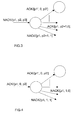
- the encoder can be represented by a state diagram with states 1024 (or 2 10 that the number of bits constituting a w k control word is equal to 10). More specifically, there is shown on the figure 3 a state which corresponds to a nonzero value (p2) of the RSN (P2) field, and associated transitions, and is shown on the figure 4 a state that corresponds to a zero value (p2) of the RSN (P2) field, and associated transitions.
- the third (rightmost) probability which appears in the sum of relation (1), depends on the aforementioned SHO conditions. Indeed, the UE radio equipment will consider that the block of data symbols it has transmitted in the previous time interval TTlk-1 has been correctly decoded when at least one of the base stations SB with which it is in communication has transmitted an ACK message in a first downlink radio channel CD1: (here E-HICH).
- p ( ack_ue ACK
- the probabilities (20) and (21) can be stored in a memory of the decoding device D according to the blers and P UEs targeted,
- ack, r k , r k-1 ) is then done by maximizing the following vector with respect to the control word w k (belonging to ETFC_set) and performing the identification.
- ack, r k , r k-1 ) is done by maximizing the vector next to the control word w k (belonging to ETFC_set): p ⁇ w k
- NACK , r k , r k - 1 exp p k , k ⁇ p ACK
- NACK ⁇ w ⁇ RSN w 0 ⁇ exp p i , k - 1 + p NACK
- the processing module MT accesses the memory MY to determine the values that correspond to the expressions of the exponentials appearing in the maximization.
- the processing module MT can, for example, perform a maximum value approximation by approximating a sum of exponentials by the maximum of the exponential in this sum.
- the decoding device D and in particular its processing module MT and its possible memory MY, can be realized in the form of electronic circuits, software modules (or computer), or a combination of circuits and software.
- the invention makes it possible to improve the demodulation performance at the RR radio receiver, so that it may be possible to reduce the radio transmission power and / or to improve the quality of the demodulation on the upstream data radio channel.
- E-DPCCH for example E-DPCCH
- the invention is not limited to the embodiments of decoding device, RR radio receiver, base station SB and decoding method described above, only by way of example, but it encompasses all the variants that can be envisaged. skilled in the art within the scope of the claims below.
Landscapes
- Engineering & Computer Science (AREA)
- Computer Networks & Wireless Communication (AREA)
- Signal Processing (AREA)
- Artificial Intelligence (AREA)
- Detection And Prevention Of Errors In Transmission (AREA)
- Mobile Radio Communication Systems (AREA)
Applications Claiming Priority (1)
| Application Number | Priority Date | Filing Date | Title |
|---|---|---|---|
| FR0755640A FR2917255A1 (fr) | 2007-06-11 | 2007-06-11 | Dispositif et procede de decodage de mot de controle code, par maximisation de probabilite a posteriori, pour un reseau de communication radio |
Publications (1)
| Publication Number | Publication Date |
|---|---|
| EP2003807A1 true EP2003807A1 (de) | 2008-12-17 |
Family
ID=39217864
Family Applications (1)
| Application Number | Title | Priority Date | Filing Date |
|---|---|---|---|
| EP08104088A Withdrawn EP2003807A1 (de) | 2007-06-11 | 2008-05-26 | Verfahren und Vorrichtung zur Dekodierung eines Kontrollwortes durch Maximierung der aposteriori Wahrscheinlichkeit |
Country Status (2)
| Country | Link |
|---|---|
| EP (1) | EP2003807A1 (de) |
| FR (1) | FR2917255A1 (de) |
Cited By (1)
| Publication number | Priority date | Publication date | Assignee | Title |
|---|---|---|---|---|
| CN110931026A (zh) * | 2019-11-27 | 2020-03-27 | 南京中感微电子有限公司 | 一种音频数据通信方法、设备及系统 |
Citations (1)
| Publication number | Priority date | Publication date | Assignee | Title |
|---|---|---|---|---|
| US20070098115A1 (en) * | 2005-10-28 | 2007-05-03 | Rainer Bachl | Multiframe control channel detection for enhanced dedicated channel |
-
2007
- 2007-06-11 FR FR0755640A patent/FR2917255A1/fr active Pending
-
2008
- 2008-05-26 EP EP08104088A patent/EP2003807A1/de not_active Withdrawn
Patent Citations (1)
| Publication number | Priority date | Publication date | Assignee | Title |
|---|---|---|---|---|
| US20070098115A1 (en) * | 2005-10-28 | 2007-05-03 | Rainer Bachl | Multiframe control channel detection for enhanced dedicated channel |
Non-Patent Citations (1)
| Title |
|---|
| HERRMANN C ET AL: "Improving packet loss probability in the UMTS high-speed downlink", VEHICULAR TECHNOLOGY CONFERENCE, 2003. VTC 2003-FALL. 2003 IEEE 58TH ORLANDO, FL, USA 6-9 OCT. 2003, PISCATAWAY, NJ, USA,IEEE, US, 6 October 2003 (2003-10-06), pages 2655 - 2659, XP010701537, ISBN: 0-7803-7954-3 * |
Cited By (2)
| Publication number | Priority date | Publication date | Assignee | Title |
|---|---|---|---|---|
| CN110931026A (zh) * | 2019-11-27 | 2020-03-27 | 南京中感微电子有限公司 | 一种音频数据通信方法、设备及系统 |
| CN110931026B (zh) * | 2019-11-27 | 2022-07-12 | 南京中感微电子有限公司 | 一种音频数据通信方法、设备及系统 |
Also Published As
| Publication number | Publication date |
|---|---|
| FR2917255A1 (fr) | 2008-12-12 |
Similar Documents
| Publication | Publication Date | Title |
|---|---|---|
| EP2003810A2 (de) | Einrichtung zur Empfangsverwaltung durch Endgeräten von Multimedia-Inhalten übertragen über Infrastrukturen unter Verwendung von verschiedenen Übertragungstechniken | |
| US6986096B2 (en) | Scaling and quantizing soft-decision metrics for decoding | |
| US8315185B2 (en) | ACK/NACK detection in LTE PUSCH | |
| EP2385648B1 (de) | Kooperatives Netzwerk mit adaptiver Neuübertragungsanforderungs-Strategie | |
| EP3756295B1 (de) | Omamrc-übertragungsverfahren und -system mit langsamer verbindungsanpassung unter bler-einschränkung | |
| EP3387773B1 (de) | Weiterleitungsverfahren und -vorrichtung und empfänger mit rückführung in einem omamrc-system | |
| US8111624B2 (en) | Link adaptation telecommunication system | |
| FR2819661A1 (fr) | Procede et dispositifs de transmission de donnees avec mecanisme d'acquittement | |
| FR2822317A1 (fr) | Unite d'emission de blocs de donnees en mode acquitte sur un canal comportant un lien radio avec une station mobile | |
| EP2784967B1 (de) | Kooperatives Kommunikationssystem mit Strategie zur adaptiven Rückübertragung von Datenpaketen | |
| Kleinschmidt et al. | An analytical model for energy efficiency of error control schemes in sensor networks | |
| EP3476071B1 (de) | Dynamische und selektive übertragung eines digitalen signals für ein system mit vollduplex-relais und einem begrenzten rückweg | |
| EP3639427B1 (de) | Omamrc-übertragungsverfahren und -system mit langsamer-link-anpassung | |
| EP2180626B1 (de) | Turbokodierer für Kanäle mit blockweisem Signalschwund | |
| EP3769451B1 (de) | Verfahren und system für omamrc übertragung mit reduzierte signalisierung | |
| CN101300771A (zh) | 增强专用信道的多帧控制信道检测 | |
| EP3224978B1 (de) | Verfahren und vorrichtung für flexible, selektive ssdf-weiterleitung | |
| EP1179911B1 (de) | Verfahren zum Beurteilen der Qualität einer Funkverbindung in einem mobilen Funkkommunikationssystem | |
| Cianca et al. | Channel‐adaptive techniques in wireless communications: an overview | |
| FR2917255A1 (fr) | Dispositif et procede de decodage de mot de controle code, par maximisation de probabilite a posteriori, pour un reseau de communication radio | |
| EP4173167A1 (de) | Omamrc-verfahren und -system mit fdm-übertragung | |
| WO2024133311A1 (fr) | Procédé de communication et système omamrc avec une sélection lors de retransmissions tenant compte du débit des sources et d'un unique échange de csi | |
| FR2910757A1 (fr) | Procede de retransmission a redondance incrementale pour des paquets fragmentes. | |
| EP4548510A1 (de) | Übertragungsverfahren und omamrc-system mit einer auswahlstrategie bei neuübertragungen unter berücksichtigung des durchsatzes der quellen und einer einzelsteuerungsvermittlungsstelle | |
| Vutukuru | Physical layer-aware wireless link layer protocols |
Legal Events
| Date | Code | Title | Description |
|---|---|---|---|
| PUAI | Public reference made under article 153(3) epc to a published international application that has entered the european phase |
Free format text: ORIGINAL CODE: 0009012 |
|
| AK | Designated contracting states |
Kind code of ref document: A1 Designated state(s): AT BE BG CH CY CZ DE DK EE ES FI FR GB GR HR HU IE IS IT LI LT LU LV MC MT NL NO PL PT RO SE SI SK TR |
|
| AX | Request for extension of the european patent |
Extension state: AL BA MK RS |
|
| 17P | Request for examination filed |
Effective date: 20090617 |
|
| AKX | Designation fees paid |
Designated state(s): AT BE BG CH CY CZ DE DK EE ES FI FR GB GR HR HU IE IS IT LI LT LU LV MC MT NL NO PL PT RO SE SI SK TR |
|
| 17Q | First examination report despatched |
Effective date: 20090803 |
|
| RAP1 | Party data changed (applicant data changed or rights of an application transferred) |
Owner name: ALCATEL LUCENT |
|
| 111Z | Information provided on other rights and legal means of execution |
Free format text: AT BE BG CH CY CZ DE DK EE ES FI FR GB GR HR HU IE IS IT LI LT LU LV MC MT NL NO PL PT RO SE SI SK TR Effective date: 20130410 |
|
| RAP1 | Party data changed (applicant data changed or rights of an application transferred) |
Owner name: ALCATEL LUCENT |
|
| D11X | Information provided on other rights and legal means of execution (deleted) | ||
| STAA | Information on the status of an ep patent application or granted ep patent |
Free format text: STATUS: THE APPLICATION IS DEEMED TO BE WITHDRAWN |
|
| 18D | Application deemed to be withdrawn |
Effective date: 20161201 |