EP2003151A1 - Improved hydrogen response through catalyst modification - Google Patents
Improved hydrogen response through catalyst modification Download PDFInfo
- Publication number
- EP2003151A1 EP2003151A1 EP07252450A EP07252450A EP2003151A1 EP 2003151 A1 EP2003151 A1 EP 2003151A1 EP 07252450 A EP07252450 A EP 07252450A EP 07252450 A EP07252450 A EP 07252450A EP 2003151 A1 EP2003151 A1 EP 2003151A1
- Authority
- EP
- European Patent Office
- Prior art keywords
- catalyst
- aluminum
- group
- process according
- support
- Prior art date
- Legal status (The legal status is an assumption and is not a legal conclusion. Google has not performed a legal analysis and makes no representation as to the accuracy of the status listed.)
- Withdrawn
Links
- 239000003054 catalyst Substances 0.000 title claims abstract description 129
- 229910052739 hydrogen Inorganic materials 0.000 title claims abstract description 17
- 239000001257 hydrogen Substances 0.000 title claims abstract description 17
- UFHFLCQGNIYNRP-UHFFFAOYSA-N Hydrogen Chemical compound [H][H] UFHFLCQGNIYNRP-UHFFFAOYSA-N 0.000 title abstract description 9
- 230000004048 modification Effects 0.000 title 1
- 238000012986 modification Methods 0.000 title 1
- 229910052782 aluminium Inorganic materials 0.000 claims abstract description 66
- 150000002576 ketones Chemical class 0.000 claims abstract description 41
- 229910052719 titanium Inorganic materials 0.000 claims abstract description 23
- 238000004519 manufacturing process Methods 0.000 claims abstract description 21
- 229910052749 magnesium Inorganic materials 0.000 claims abstract description 12
- -1 polyethylene copolymer Polymers 0.000 claims description 109
- 239000010936 titanium Substances 0.000 claims description 64
- 238000000034 method Methods 0.000 claims description 54
- 229920000642 polymer Polymers 0.000 claims description 48
- 239000011777 magnesium Substances 0.000 claims description 38
- 239000000203 mixture Substances 0.000 claims description 38
- 229910052801 chlorine Inorganic materials 0.000 claims description 33
- 150000004820 halides Chemical class 0.000 claims description 31
- VYPSYNLAJGMNEJ-UHFFFAOYSA-N Silicium dioxide Chemical compound O=[Si]=O VYPSYNLAJGMNEJ-UHFFFAOYSA-N 0.000 claims description 30
- 125000001309 chloro group Chemical group Cl* 0.000 claims description 30
- 239000003426 co-catalyst Substances 0.000 claims description 30
- XAGFODPZIPBFFR-UHFFFAOYSA-N aluminium Chemical compound [Al] XAGFODPZIPBFFR-UHFFFAOYSA-N 0.000 claims description 27
- 239000007789 gas Substances 0.000 claims description 22
- VGGSQFUCUMXWEO-UHFFFAOYSA-N Ethene Chemical compound C=C VGGSQFUCUMXWEO-UHFFFAOYSA-N 0.000 claims description 21
- 239000005977 Ethylene Substances 0.000 claims description 21
- VZGDMQKNWNREIO-UHFFFAOYSA-N tetrachloromethane Chemical compound ClC(Cl)(Cl)Cl VZGDMQKNWNREIO-UHFFFAOYSA-N 0.000 claims description 20
- 239000002904 solvent Substances 0.000 claims description 19
- VOITXYVAKOUIBA-UHFFFAOYSA-N triethylaluminium Chemical compound CC[Al](CC)CC VOITXYVAKOUIBA-UHFFFAOYSA-N 0.000 claims description 19
- 238000006116 polymerization reaction Methods 0.000 claims description 17
- 239000004711 α-olefin Substances 0.000 claims description 16
- ZWEHNKRNPOVVGH-UHFFFAOYSA-N 2-Butanone Chemical compound CCC(C)=O ZWEHNKRNPOVVGH-UHFFFAOYSA-N 0.000 claims description 15
- 125000002887 hydroxy group Chemical group [H]O* 0.000 claims description 14
- 239000000377 silicon dioxide Substances 0.000 claims description 14
- WKBOTKDWSSQWDR-UHFFFAOYSA-N Bromine atom Chemical group [Br] WKBOTKDWSSQWDR-UHFFFAOYSA-N 0.000 claims description 13
- 230000015572 biosynthetic process Effects 0.000 claims description 12
- 239000003085 diluting agent Substances 0.000 claims description 12
- 125000001183 hydrocarbyl group Chemical group 0.000 claims description 12
- 150000002681 magnesium compounds Chemical class 0.000 claims description 12
- 150000003609 titanium compounds Chemical class 0.000 claims description 12
- CSCPPACGZOOCGX-UHFFFAOYSA-N Acetone Chemical compound CC(C)=O CSCPPACGZOOCGX-UHFFFAOYSA-N 0.000 claims description 11
- 239000000460 chlorine Substances 0.000 claims description 11
- 239000002245 particle Substances 0.000 claims description 11
- 238000003786 synthesis reaction Methods 0.000 claims description 11
- RTAQQCXQSZGOHL-UHFFFAOYSA-N Titanium Chemical compound [Ti] RTAQQCXQSZGOHL-UHFFFAOYSA-N 0.000 claims description 10
- 239000000178 monomer Substances 0.000 claims description 10
- 229920000573 polyethylene Polymers 0.000 claims description 10
- 239000004698 Polyethylene Substances 0.000 claims description 9
- JHIVVAPYMSGYDF-UHFFFAOYSA-N cyclohexanone Chemical compound O=C1CCCCC1 JHIVVAPYMSGYDF-UHFFFAOYSA-N 0.000 claims description 9
- 150000001350 alkyl halides Chemical class 0.000 claims description 8
- 239000011261 inert gas Substances 0.000 claims description 8
- XJDNKRIXUMDJCW-UHFFFAOYSA-J titanium tetrachloride Chemical compound Cl[Ti](Cl)(Cl)Cl XJDNKRIXUMDJCW-UHFFFAOYSA-J 0.000 claims description 8
- 150000003623 transition metal compounds Chemical class 0.000 claims description 8
- 125000004429 atom Chemical group 0.000 claims description 7
- YNLAOSYQHBDIKW-UHFFFAOYSA-M diethylaluminium chloride Chemical compound CC[Al](Cl)CC YNLAOSYQHBDIKW-UHFFFAOYSA-M 0.000 claims description 7
- 239000002002 slurry Substances 0.000 claims description 7
- 229910003074 TiCl4 Inorganic materials 0.000 claims description 6
- 150000008365 aromatic ketones Chemical class 0.000 claims description 6
- ORYGRKHDLWYTKX-UHFFFAOYSA-N trihexylalumane Chemical compound CCCCCC[Al](CCCCCC)CCCCCC ORYGRKHDLWYTKX-UHFFFAOYSA-N 0.000 claims description 6
- JLTRXTDYQLMHGR-UHFFFAOYSA-N trimethylaluminium Chemical compound C[Al](C)C JLTRXTDYQLMHGR-UHFFFAOYSA-N 0.000 claims description 6
- LFXVBWRMVZPLFK-UHFFFAOYSA-N trioctylalumane Chemical compound CCCCCCCC[Al](CCCCCCCC)CCCCCCCC LFXVBWRMVZPLFK-UHFFFAOYSA-N 0.000 claims description 6
- 125000001931 aliphatic group Chemical group 0.000 claims description 5
- 238000002955 isolation Methods 0.000 claims description 5
- 150000005376 secondary alkyl halides Chemical class 0.000 claims description 5
- 150000005377 tertiary alkyl halides Chemical class 0.000 claims description 5
- MCULRUJILOGHCJ-UHFFFAOYSA-N triisobutylaluminium Chemical compound CC(C)C[Al](CC(C)C)CC(C)C MCULRUJILOGHCJ-UHFFFAOYSA-N 0.000 claims description 5
- XLYOFNOQVPJJNP-UHFFFAOYSA-N water Substances O XLYOFNOQVPJJNP-UHFFFAOYSA-N 0.000 claims description 5
- VSYZXASVWVQEMR-UHFFFAOYSA-N 2-methylbuta-1,3-dienylalumane Chemical compound CC(=C[AlH2])C=C VSYZXASVWVQEMR-UHFFFAOYSA-N 0.000 claims description 4
- WSSSPWUEQFSQQG-UHFFFAOYSA-N 4-methyl-1-pentene Chemical compound CC(C)CC=C WSSSPWUEQFSQQG-UHFFFAOYSA-N 0.000 claims description 4
- FYYHWMGAXLPEAU-UHFFFAOYSA-N Magnesium Chemical compound [Mg] FYYHWMGAXLPEAU-UHFFFAOYSA-N 0.000 claims description 4
- 125000004122 cyclic group Chemical group 0.000 claims description 4
- GCPCLEKQVMKXJM-UHFFFAOYSA-N ethoxy(diethyl)alumane Chemical compound CCO[Al](CC)CC GCPCLEKQVMKXJM-UHFFFAOYSA-N 0.000 claims description 4
- XGAIERUWZADBAO-UHFFFAOYSA-N ethoxy-bis(2-methylpropyl)alumane Chemical compound CCO[Al](CC(C)C)CC(C)C XGAIERUWZADBAO-UHFFFAOYSA-N 0.000 claims description 4
- KJJBSBKRXUVBMX-UHFFFAOYSA-N magnesium;butane Chemical compound [Mg+2].CCC[CH2-].CCC[CH2-] KJJBSBKRXUVBMX-UHFFFAOYSA-N 0.000 claims description 4
- 125000004169 (C1-C6) alkyl group Chemical group 0.000 claims description 3
- QQZOPKMRPOGIEB-UHFFFAOYSA-N 2-Oxohexane Chemical compound CCCCC(C)=O QQZOPKMRPOGIEB-UHFFFAOYSA-N 0.000 claims description 3
- SYBYTAAJFKOIEJ-UHFFFAOYSA-N 3-Methylbutan-2-one Chemical compound CC(C)C(C)=O SYBYTAAJFKOIEJ-UHFFFAOYSA-N 0.000 claims description 3
- NTIZESTWPVYFNL-UHFFFAOYSA-N Methyl isobutyl ketone Chemical compound CC(C)CC(C)=O NTIZESTWPVYFNL-UHFFFAOYSA-N 0.000 claims description 3
- UIHCLUNTQKBZGK-UHFFFAOYSA-N Methyl isobutyl ketone Natural products CCC(C)C(C)=O UIHCLUNTQKBZGK-UHFFFAOYSA-N 0.000 claims description 3
- 150000001348 alkyl chlorides Chemical group 0.000 claims description 3
- 229920001577 copolymer Polymers 0.000 claims description 3
- YHNWUQFTJNJVNU-UHFFFAOYSA-N magnesium;butane;ethane Chemical compound [Mg+2].[CH2-]C.CCC[CH2-] YHNWUQFTJNJVNU-UHFFFAOYSA-N 0.000 claims description 3
- XNLICIUVMPYHGG-UHFFFAOYSA-N pentan-2-one Chemical compound CCCC(C)=O XNLICIUVMPYHGG-UHFFFAOYSA-N 0.000 claims description 3
- 239000002685 polymerization catalyst Substances 0.000 claims description 3
- 239000011148 porous material Substances 0.000 claims description 3
- LIKMAJRDDDTEIG-UHFFFAOYSA-N 1-hexene Chemical compound CCCCC=C LIKMAJRDDDTEIG-UHFFFAOYSA-N 0.000 claims description 2
- PNEYBMLMFCGWSK-UHFFFAOYSA-N aluminium oxide Inorganic materials [O-2].[O-2].[O-2].[Al+3].[Al+3] PNEYBMLMFCGWSK-UHFFFAOYSA-N 0.000 claims description 2
- IAQRGUVFOMOMEM-UHFFFAOYSA-N butene Natural products CC=CC IAQRGUVFOMOMEM-UHFFFAOYSA-N 0.000 claims description 2
- 229920006026 co-polymeric resin Polymers 0.000 claims description 2
- VJRUISVXILMZSL-UHFFFAOYSA-M dibutylalumanylium;chloride Chemical compound CCCC[Al](Cl)CCCC VJRUISVXILMZSL-UHFFFAOYSA-M 0.000 claims description 2
- ALSOCDGAZNNNME-UHFFFAOYSA-N ethene;hex-1-ene Chemical compound C=C.CCCCC=C ALSOCDGAZNNNME-UHFFFAOYSA-N 0.000 claims description 2
- 239000008246 gaseous mixture Substances 0.000 claims description 2
- 229910052736 halogen Inorganic materials 0.000 claims description 2
- 150000002367 halogens Chemical class 0.000 claims description 2
- 238000011065 in-situ storage Methods 0.000 claims description 2
- KXDANLFHGCWFRQ-UHFFFAOYSA-N magnesium;butane;octane Chemical compound [Mg+2].CCC[CH2-].CCCCCCC[CH2-] KXDANLFHGCWFRQ-UHFFFAOYSA-N 0.000 claims description 2
- 238000004064 recycling Methods 0.000 claims description 2
- SQBBHCOIQXKPHL-UHFFFAOYSA-N tributylalumane Chemical compound CCCC[Al](CCCC)CCCC SQBBHCOIQXKPHL-UHFFFAOYSA-N 0.000 claims description 2
- CNWZYDSEVLFSMS-UHFFFAOYSA-N tripropylalumane Chemical compound CCC[Al](CCC)CCC CNWZYDSEVLFSMS-UHFFFAOYSA-N 0.000 claims description 2
- 125000004435 hydrogen atom Chemical class [H]* 0.000 claims 3
- 239000003701 inert diluent Substances 0.000 claims 1
- 125000000383 tetramethylene group Chemical group [H]C([H])([*:1])C([H])([H])C([H])([H])C([H])([H])[*:2] 0.000 claims 1
- 150000001875 compounds Chemical class 0.000 abstract description 9
- 238000012685 gas phase polymerization Methods 0.000 abstract description 6
- 150000001336 alkenes Chemical class 0.000 abstract description 4
- 235000010210 aluminium Nutrition 0.000 description 44
- 239000000126 substance Substances 0.000 description 16
- RTZKZFJDLAIYFH-UHFFFAOYSA-N Diethyl ether Chemical compound CCOCC RTZKZFJDLAIYFH-UHFFFAOYSA-N 0.000 description 13
- 239000000047 product Substances 0.000 description 13
- TWRXJAOTZQYOKJ-UHFFFAOYSA-L Magnesium chloride Chemical compound [Mg+2].[Cl-].[Cl-] TWRXJAOTZQYOKJ-UHFFFAOYSA-L 0.000 description 12
- OFBQJSOFQDEBGM-UHFFFAOYSA-N Pentane Chemical compound CCCCC OFBQJSOFQDEBGM-UHFFFAOYSA-N 0.000 description 12
- VLKZOEOYAKHREP-UHFFFAOYSA-N n-Hexane Chemical compound CCCCCC VLKZOEOYAKHREP-UHFFFAOYSA-N 0.000 description 12
- 239000012018 catalyst precursor Substances 0.000 description 10
- ZMANZCXQSJIPKH-UHFFFAOYSA-N Triethylamine Chemical compound CCN(CC)CC ZMANZCXQSJIPKH-UHFFFAOYSA-N 0.000 description 6
- 238000007792 addition Methods 0.000 description 6
- AZDRQVAHHNSJOQ-UHFFFAOYSA-N alumane Chemical class [AlH3] AZDRQVAHHNSJOQ-UHFFFAOYSA-N 0.000 description 6
- 229910001629 magnesium chloride Inorganic materials 0.000 description 6
- 229920005989 resin Polymers 0.000 description 6
- 239000011347 resin Substances 0.000 description 6
- 238000003756 stirring Methods 0.000 description 6
- 150000001805 chlorine compounds Chemical class 0.000 description 5
- 150000002431 hydrogen Chemical class 0.000 description 5
- 239000000243 solution Substances 0.000 description 5
- KWKAKUADMBZCLK-UHFFFAOYSA-N 1-octene Chemical compound CCCCCCC=C KWKAKUADMBZCLK-UHFFFAOYSA-N 0.000 description 4
- IJGRMHOSHXDMSA-UHFFFAOYSA-N Atomic nitrogen Chemical compound N#N IJGRMHOSHXDMSA-UHFFFAOYSA-N 0.000 description 4
- 229910010062 TiCl3 Inorganic materials 0.000 description 4
- 239000011954 Ziegler–Natta catalyst Substances 0.000 description 4
- 125000005234 alkyl aluminium group Chemical group 0.000 description 4
- 238000006243 chemical reaction Methods 0.000 description 4
- 239000003795 chemical substances by application Substances 0.000 description 4
- YONPGGFAJWQGJC-UHFFFAOYSA-K titanium(iii) chloride Chemical compound Cl[Ti](Cl)Cl YONPGGFAJWQGJC-UHFFFAOYSA-K 0.000 description 4
- VXNZUUAINFGPBY-UHFFFAOYSA-N 1-Butene Chemical compound CCC=C VXNZUUAINFGPBY-UHFFFAOYSA-N 0.000 description 3
- 239000004215 Carbon black (E152) Substances 0.000 description 3
- ZAMOUSCENKQFHK-UHFFFAOYSA-N Chlorine atom Chemical compound [Cl] ZAMOUSCENKQFHK-UHFFFAOYSA-N 0.000 description 3
- 239000004743 Polypropylene Substances 0.000 description 3
- 238000006555 catalytic reaction Methods 0.000 description 3
- 150000004796 dialkyl magnesium compounds Chemical class 0.000 description 3
- AFABGHUZZDYHJO-UHFFFAOYSA-N dimethyl butane Natural products CCCC(C)C AFABGHUZZDYHJO-UHFFFAOYSA-N 0.000 description 3
- 230000000694 effects Effects 0.000 description 3
- MTZQAGJQAFMTAQ-UHFFFAOYSA-N ethyl benzoate Chemical compound CCOC(=O)C1=CC=CC=C1 MTZQAGJQAFMTAQ-UHFFFAOYSA-N 0.000 description 3
- 239000012632 extractable Substances 0.000 description 3
- 239000012530 fluid Substances 0.000 description 3
- 238000009472 formulation Methods 0.000 description 3
- 230000002140 halogenating effect Effects 0.000 description 3
- 229930195733 hydrocarbon Natural products 0.000 description 3
- 150000002430 hydrocarbons Chemical class 0.000 description 3
- 239000004611 light stabiliser Substances 0.000 description 3
- 238000011068 loading method Methods 0.000 description 3
- 229910052757 nitrogen Inorganic materials 0.000 description 3
- 229920001155 polypropylene Polymers 0.000 description 3
- 239000000843 powder Substances 0.000 description 3
- NBRKLOOSMBRFMH-UHFFFAOYSA-N tert-butyl chloride Chemical compound CC(C)(C)Cl NBRKLOOSMBRFMH-UHFFFAOYSA-N 0.000 description 3
- 229910052723 transition metal Inorganic materials 0.000 description 3
- 150000003624 transition metals Chemical class 0.000 description 3
- 125000004209 (C1-C8) alkyl group Chemical group 0.000 description 2
- BSPCSKHALVHRSR-UHFFFAOYSA-N 2-chlorobutane Chemical compound CCC(C)Cl BSPCSKHALVHRSR-UHFFFAOYSA-N 0.000 description 2
- KWOLFJPFCHCOCG-UHFFFAOYSA-N Acetophenone Chemical compound CC(=O)C1=CC=CC=C1 KWOLFJPFCHCOCG-UHFFFAOYSA-N 0.000 description 2
- VEXZGXHMUGYJMC-UHFFFAOYSA-M Chloride anion Chemical compound [Cl-] VEXZGXHMUGYJMC-UHFFFAOYSA-M 0.000 description 2
- XEKOWRVHYACXOJ-UHFFFAOYSA-N Ethyl acetate Natural products CCOC(C)=O XEKOWRVHYACXOJ-UHFFFAOYSA-N 0.000 description 2
- IMNFDUFMRHMDMM-UHFFFAOYSA-N N-Heptane Chemical compound CCCCCCC IMNFDUFMRHMDMM-UHFFFAOYSA-N 0.000 description 2
- XYFCBTPGUUZFHI-UHFFFAOYSA-N Phosphine Chemical compound P XYFCBTPGUUZFHI-UHFFFAOYSA-N 0.000 description 2
- 239000000654 additive Substances 0.000 description 2
- 150000001412 amines Chemical class 0.000 description 2
- 229910052799 carbon Inorganic materials 0.000 description 2
- DOIRQSBPFJWKBE-UHFFFAOYSA-N dibutyl phthalate Chemical compound CCCCOC(=O)C1=CC=CC=C1C(=O)OCCCC DOIRQSBPFJWKBE-UHFFFAOYSA-N 0.000 description 2
- USIUVYZYUHIAEV-UHFFFAOYSA-N diphenyl ether Chemical compound C=1C=CC=CC=1OC1=CC=CC=C1 USIUVYZYUHIAEV-UHFFFAOYSA-N 0.000 description 2
- 238000001035 drying Methods 0.000 description 2
- 150000002148 esters Chemical class 0.000 description 2
- 238000001125 extrusion Methods 0.000 description 2
- QWTDNUCVQCZILF-UHFFFAOYSA-N isopentane Chemical compound CCC(C)C QWTDNUCVQCZILF-UHFFFAOYSA-N 0.000 description 2
- 229920000092 linear low density polyethylene Polymers 0.000 description 2
- 239000004707 linear low-density polyethylene Substances 0.000 description 2
- 239000007788 liquid Substances 0.000 description 2
- 239000000155 melt Substances 0.000 description 2
- UAEPNZWRGJTJPN-UHFFFAOYSA-N methylcyclohexane Chemical compound CC1CCCCC1 UAEPNZWRGJTJPN-UHFFFAOYSA-N 0.000 description 2
- TVMXDCGIABBOFY-UHFFFAOYSA-N octane Chemical compound CCCCCCCC TVMXDCGIABBOFY-UHFFFAOYSA-N 0.000 description 2
- JRZJOMJEPLMPRA-UHFFFAOYSA-N olefin Natural products CCCCCCCC=C JRZJOMJEPLMPRA-UHFFFAOYSA-N 0.000 description 2
- 230000000704 physical effect Effects 0.000 description 2
- 239000000758 substrate Substances 0.000 description 2
- 239000012749 thinning agent Substances 0.000 description 2
- RYHBNJHYFVUHQT-UHFFFAOYSA-N 1,4-Dioxane Chemical compound C1COCCO1 RYHBNJHYFVUHQT-UHFFFAOYSA-N 0.000 description 1
- DURPTKYDGMDSBL-UHFFFAOYSA-N 1-butoxybutane Chemical compound CCCCOCCCC DURPTKYDGMDSBL-UHFFFAOYSA-N 0.000 description 1
- GFNZJAUVJCGWLW-UHFFFAOYSA-N 2-methoxy-1,3-dimethylbenzene Chemical compound COC1=C(C)C=CC=C1C GFNZJAUVJCGWLW-UHFFFAOYSA-N 0.000 description 1
- XDTMQSROBMDMFD-UHFFFAOYSA-N Cyclohexane Chemical compound C1CCCCC1 XDTMQSROBMDMFD-UHFFFAOYSA-N 0.000 description 1
- VEXZGXHMUGYJMC-UHFFFAOYSA-N Hydrochloric acid Chemical compound Cl VEXZGXHMUGYJMC-UHFFFAOYSA-N 0.000 description 1
- 229920010126 Linear Low Density Polyethylene (LLDPE) Polymers 0.000 description 1
- 229920001730 Moisture cure polyurethane Polymers 0.000 description 1
- 239000002202 Polyethylene glycol Substances 0.000 description 1
- 239000004614 Process Aid Substances 0.000 description 1
- 239000012190 activator Substances 0.000 description 1
- 238000005054 agglomeration Methods 0.000 description 1
- 230000002776 aggregation Effects 0.000 description 1
- 238000013019 agitation Methods 0.000 description 1
- 125000003342 alkenyl group Chemical group 0.000 description 1
- QNXSIUBBGPHDDE-UHFFFAOYSA-N alpha-indanone Natural products C1=CC=C2C(=O)CCC2=C1 QNXSIUBBGPHDDE-UHFFFAOYSA-N 0.000 description 1
- VSCWAEJMTAWNJL-UHFFFAOYSA-K aluminum chloride Substances Cl[Al](Cl)Cl VSCWAEJMTAWNJL-UHFFFAOYSA-K 0.000 description 1
- 238000011021 bench scale process Methods 0.000 description 1
- HUMNYLRZRPPJDN-UHFFFAOYSA-N benzenecarboxaldehyde Natural products O=CC1=CC=CC=C1 HUMNYLRZRPPJDN-UHFFFAOYSA-N 0.000 description 1
- GDTBXPJZTBHREO-UHFFFAOYSA-N bromine Substances BrBr GDTBXPJZTBHREO-UHFFFAOYSA-N 0.000 description 1
- 229910052794 bromium Inorganic materials 0.000 description 1
- YHWCPXVTRSHPNY-UHFFFAOYSA-N butan-1-olate;titanium(4+) Chemical compound [Ti+4].CCCC[O-].CCCC[O-].CCCC[O-].CCCC[O-] YHWCPXVTRSHPNY-UHFFFAOYSA-N 0.000 description 1
- ZTQSAGDEMFDKMZ-UHFFFAOYSA-N butyric aldehyde Natural products CCCC=O ZTQSAGDEMFDKMZ-UHFFFAOYSA-N 0.000 description 1
- 239000000969 carrier Substances 0.000 description 1
- 230000003197 catalytic effect Effects 0.000 description 1
- 239000013043 chemical agent Substances 0.000 description 1
- 229960002380 dibutyl phthalate Drugs 0.000 description 1
- 235000014113 dietary fatty acids Nutrition 0.000 description 1
- AHUXYBVKTIBBJW-UHFFFAOYSA-N dimethoxy(diphenyl)silane Chemical compound C=1C=CC=CC=1[Si](OC)(OC)C1=CC=CC=C1 AHUXYBVKTIBBJW-UHFFFAOYSA-N 0.000 description 1
- 239000002270 dispersing agent Substances 0.000 description 1
- 238000009826 distribution Methods 0.000 description 1
- 238000005516 engineering process Methods 0.000 description 1
- 238000011156 evaluation Methods 0.000 description 1
- 238000002474 experimental method Methods 0.000 description 1
- 239000000194 fatty acid Substances 0.000 description 1
- 229930195729 fatty acid Natural products 0.000 description 1
- 150000004665 fatty acids Chemical class 0.000 description 1
- 238000005243 fluidization Methods 0.000 description 1
- 239000004811 fluoropolymer Substances 0.000 description 1
- 229920002313 fluoropolymer Polymers 0.000 description 1
- 239000012760 heat stabilizer Substances 0.000 description 1
- 238000010438 heat treatment Methods 0.000 description 1
- GXNDYZPMZKJDSS-UHFFFAOYSA-N hex-1-ene Chemical compound CCCCC=C.CCCCC=C GXNDYZPMZKJDSS-UHFFFAOYSA-N 0.000 description 1
- 229920001903 high density polyethylene Polymers 0.000 description 1
- 239000004700 high-density polyethylene Substances 0.000 description 1
- 239000012433 hydrogen halide Substances 0.000 description 1
- 229910000039 hydrogen halide Inorganic materials 0.000 description 1
- TUJKJAMUKRIRHC-UHFFFAOYSA-N hydroxyl Chemical compound [OH] TUJKJAMUKRIRHC-UHFFFAOYSA-N 0.000 description 1
- 238000010348 incorporation Methods 0.000 description 1
- 239000007924 injection Substances 0.000 description 1
- 238000001746 injection moulding Methods 0.000 description 1
- 229910052809 inorganic oxide Inorganic materials 0.000 description 1
- ULYZAYCEDJDHCC-UHFFFAOYSA-N isopropyl chloride Chemical compound CC(C)Cl ULYZAYCEDJDHCC-UHFFFAOYSA-N 0.000 description 1
- 229920001684 low density polyethylene Polymers 0.000 description 1
- 239000004702 low-density polyethylene Substances 0.000 description 1
- CCERQOYLJJULMD-UHFFFAOYSA-M magnesium;carbanide;chloride Chemical compound [CH3-].[Mg+2].[Cl-] CCERQOYLJJULMD-UHFFFAOYSA-M 0.000 description 1
- 239000000463 material Substances 0.000 description 1
- 239000002609 medium Substances 0.000 description 1
- 229920001179 medium density polyethylene Polymers 0.000 description 1
- 239000004701 medium-density polyethylene Substances 0.000 description 1
- GYNNXHKOJHMOHS-UHFFFAOYSA-N methyl-cycloheptane Natural products CC1CCCCCC1 GYNNXHKOJHMOHS-UHFFFAOYSA-N 0.000 description 1
- 238000000465 moulding Methods 0.000 description 1
- 150000003961 organosilicon compounds Chemical class 0.000 description 1
- 229910052760 oxygen Inorganic materials 0.000 description 1
- QNGNSVIICDLXHT-UHFFFAOYSA-N para-ethylbenzaldehyde Natural products CCC1=CC=C(C=O)C=C1 QNGNSVIICDLXHT-UHFFFAOYSA-N 0.000 description 1
- YWAKXRMUMFPDSH-UHFFFAOYSA-N pentene Chemical compound CCCC=C YWAKXRMUMFPDSH-UHFFFAOYSA-N 0.000 description 1
- 150000002989 phenols Chemical class 0.000 description 1
- JLTDJTHDQAWBAV-UHFFFAOYSA-N phenyldimethylamine Natural products CN(C)C1=CC=CC=C1 JLTDJTHDQAWBAV-UHFFFAOYSA-N 0.000 description 1
- JHYGKRLFANBDIF-UHFFFAOYSA-N phosphane;triphenylphosphane Chemical compound P.C1=CC=CC=C1P(C=1C=CC=CC=1)C1=CC=CC=C1 JHYGKRLFANBDIF-UHFFFAOYSA-N 0.000 description 1
- 229910000073 phosphorus hydride Inorganic materials 0.000 description 1
- 229920003023 plastic Polymers 0.000 description 1
- 239000004033 plastic Substances 0.000 description 1
- 229920001223 polyethylene glycol Polymers 0.000 description 1
- 239000002244 precipitate Substances 0.000 description 1
- 239000002243 precursor Substances 0.000 description 1
- 150000003254 radicals Chemical class 0.000 description 1
- 238000001175 rotational moulding Methods 0.000 description 1
- 238000000926 separation method Methods 0.000 description 1
- 229910000077 silane Inorganic materials 0.000 description 1
- 239000003381 stabilizer Substances 0.000 description 1
- 229910001220 stainless steel Inorganic materials 0.000 description 1
- 239000010935 stainless steel Substances 0.000 description 1
- HGBOYTHUEUWSSQ-UHFFFAOYSA-N valeric aldehyde Natural products CCCCC=O HGBOYTHUEUWSSQ-UHFFFAOYSA-N 0.000 description 1
- 210000003462 vein Anatomy 0.000 description 1
- 238000004260 weight control Methods 0.000 description 1
Images
Classifications
-
- C—CHEMISTRY; METALLURGY
- C08—ORGANIC MACROMOLECULAR COMPOUNDS; THEIR PREPARATION OR CHEMICAL WORKING-UP; COMPOSITIONS BASED THEREON
- C08F—MACROMOLECULAR COMPOUNDS OBTAINED BY REACTIONS ONLY INVOLVING CARBON-TO-CARBON UNSATURATED BONDS
- C08F210/00—Copolymers of unsaturated aliphatic hydrocarbons having only one carbon-to-carbon double bond
- C08F210/16—Copolymers of ethene with alpha-alkenes, e.g. EP rubbers
-
- Y—GENERAL TAGGING OF NEW TECHNOLOGICAL DEVELOPMENTS; GENERAL TAGGING OF CROSS-SECTIONAL TECHNOLOGIES SPANNING OVER SEVERAL SECTIONS OF THE IPC; TECHNICAL SUBJECTS COVERED BY FORMER USPC CROSS-REFERENCE ART COLLECTIONS [XRACs] AND DIGESTS
- Y10—TECHNICAL SUBJECTS COVERED BY FORMER USPC
- Y10S—TECHNICAL SUBJECTS COVERED BY FORMER USPC CROSS-REFERENCE ART COLLECTIONS [XRACs] AND DIGESTS
- Y10S526/00—Synthetic resins or natural rubbers -- part of the class 520 series
- Y10S526/913—Vapor phase polymerization in absence of transition metal containing catalyst
Definitions
- halogenating agent must be used in a molar ratio such that all of the Mg and Al compounds are converted to their respective halides, a limitation which is divergent from the present invention. That is, in accordance with the present invention, there is an excess of reactive aluminum and/or magnesium groups over reactive halide so that not all of the alkyl aluminum or magnesium are reacted to their respective halides (chlorides).
- MI melt index
- the support can be heat treated and/or chemically treated to reduce the level of surface hydroxyl (OH) groups in a similar fashion to that described by A. Noshay and F.J. Karol in Transition Metal Catalyzed Polymerizations, Ed. R. Quirk, 1989, pg. 396 .
- the support may be put into a mixing vessel and slurried with an inert solvent or diluent preferably a hydrocarbon and contacted with or without isolation or separation from the solvent or diluent with the remaining catalyst components.
- the support may be treated with an aluminum compound of the formula R 1 b Al(OR 1 ) a X 3-(a+b) wherein a is either 0 or 1, b is either 2 or 3 and the sum of a+b is up to 3, R 1 is the same or different C 1-10 alkyl radical, X is a chlorine atom, and mixtures thereof.
- the amount of aluminum compound is such that the amount of aluminum on the support prior to adding the remaining catalyst components will be from about 0.5 to 2.5 weight %, preferably from 1.0 to 2.0 weight % based on the weight of the support.
- the remaining aluminum content is added as a subsequent or second component of the catalyst (e.g. Al 2 ).
- the first and second aluminum compounds may be the same or different.
- the gas phase typically comprises the monomers, a balance gas such as nitrogen, a molecular weight control agent such as hydrogen, and depending on the process possibly a condensable liquid (i.e. condensing mode such as disclosed in U.S. patents 4,543,399 issued September 24, 1985 to Jenkins III et al. ; 4,588,790 issued May 15, 1986 to Jenkins III et al. ; and the so-called super condensing mode as disclosed in U.S. patent 5,352,749 issued October 4, 1994 to DeChellis et al. , assigned to Exxon Chemical Patents, Inc. and U.S. patent 5,436,304 issued July 25, 1995 to Griffen et al. , assigned to Exxon Chemical Patents, Inc.).
- condensable liquid i.e. condensing mode such as disclosed in U.S. patents 4,543,399 issued September 24, 1985 to Jenkins III et al. ; 4,588,790 issued May 15, 1986 to Jenkins III et al.
- Triethyl aluminum may be used as a co-catalyst in amounts from 10 to 200 ppm Al based on the polymer production rate, more preferably 12 to 100 most preferably from 15 to 75, desirably from 20 to 50 ppm of aluminum.
- Pentane was again added to the reactor at which time titanium tetrachloride (6.6 mmol) was added as a dilute solution ( ⁇ 20%) over approximately 5 minutes. After 2 hours of stirring the catalyst was dried. Next, pentane was added to the reactor and after remixing the slurry, an electron donor (40 mmol. see Table 1) was added as a dilute solution over about 10 minutes. After 1 hour of stirring the slurry was dried. Pentane was added to the reactor and trihexyl aluminum (20 mmol) was added over approximately 10 minutes. After stirring for 45 minutes the slurry was dried under vacuum at 50°C to produce approximately 63 g of tan powder. Alternately, the entire synthesis can be completed at essentially room temperature using only a single drying step at the end.
Landscapes
- Chemical & Material Sciences (AREA)
- Health & Medical Sciences (AREA)
- Chemical Kinetics & Catalysis (AREA)
- Medicinal Chemistry (AREA)
- Polymers & Plastics (AREA)
- Organic Chemistry (AREA)
- Transition And Organic Metals Composition Catalysts For Addition Polymerization (AREA)
Abstract
Description
- The present invention relates to preferably supported Ziegler-Natta catalysts, which are useful in olefin polymerization, and more particularly in the continuous fluidized gas phase process polymerization of alpha-olefins. The present invention provides a method for improving the hydrogen response of the catalyst as well as identifies a method to use them in a gas phase process to produce HDPE, medium and linear low-density polyethylene.
- Ziegler-Natta type catalysts are well known and have been used since the early 1950's. Generally, the catalyst comprises a transition metal compound, typically titanium in the 3 or 4 valence state (e.g. TiCl3 or TiCl4) supported on magnesium chloride.
- In some cases, the catalysts are prepared in conjunction with an electron donor (ED), which may be used to dissolve the MgCl2 and TiCl3 when they are used. This type of formulation teaches away from the current disclosure. When supported on silica, and placed in a gas phase reactor with at least one co-catalyst, typically an aluminum compound such as a trialkyl aluminum (e.g. triethylaluminum (TEAL)) or an alkyl aluminum halide (e.g. diethylaluminum chloride (DEAC)) this combination makes a good catalyst for the polymerization of ethylene. When the ED is used as the solvent in the formulation it tends to narrow the molecular weight distribution (MWD - weight average molecular weight / number average molecular weight (Mw/Mn)) of the resulting polymer. As the ED is difficult to remove, polymers having a broader MWD are not easy to manufacture using this catalyst synthesis procedure. Also, as the ED must be capable of dissolving the MgCl2, and in some cases TiCl3, the choice of the electron donor is limited, a problem which is solved with the current disclosure. A good description of these types of catalysts is contained in United States Patent
4,302,566 issued Nov. 24, 1981 to Karol et al. , assigned to Union Carbide Corporation. - Alternately, the catalysts may contain magnesium chloride, which may be generated from a dialkyl magnesium compound, and compounds containing an active chloride. These types of catalysts are described in United States Patent
4,324,691 issued April 13, 1982 to Hartshorn et al. assigned to Imperial Chemical Industries. This is a broad patent covering the synthesis of these types of catalysts but not disclosing the process of the present invention. - In a similar vein, United States Patent
5,633,419 issued May 27, 1997 to Spencer et al. assigned to The Dow Chemical Company discloses a supported Ziegler-Natta type catalyst or catalyst precursor. However, it is a limitation of the reference that the halide used is hydrogen halide (e.g. HCl). The reference teaches away from the subject matter of the present invention, which preferably uses alkyl halides as the halide source. Additionally, the reference teaches the use of an agglomerated support such as silica, instead of a typical granular support, which is contrary to the method for preparing the catalyst of the present invention. - European Patent Application
0 744 416 published November 27, 1996 in the name of BP Chemicals Limited (BP) teaches supported catalysts and catalyst precursors. The reference teaches that the support is reacted with either an aluminum compound or a magnesium compound followed by an alkyl halide and a tetravalent titanium compound. Electron donors can be added to the support at anytime during the synthesis. The reference fails to teach that ketones could be used as electron donors. This reference also teaches that the Al:Mg molar ratio is between 0.05 to 0.35, which is outside the scope of the present catalyst formulations. This reference also teaches that the halogenating agent must be used in a molar ratio such that all of the Mg and Al compounds are converted to their respective halides, a limitation which is divergent from the present invention. That is, in accordance with the present invention, there is an excess of reactive aluminum and/or magnesium groups over reactive halide so that not all of the alkyl aluminum or magnesium are reacted to their respective halides (chlorides). - BP patent
EP 0 595 574 B1 granted in January 2, 1997 requires that the catalyst be prepared on a support treated with an organosilicon compound. The supports used in accordance with the present invention are treated thermally and chemically (aluminum alkyls) but not with organosilicon. - BP patent
EP 0 453 088 B1 granted in July 31, 1996 teaches that the catalyst be made on dehydrated silica and that the catalyst needs to be pre-polymerized to obtain a useful catalyst for the synthesis of linear low density polyethylene (LLDPE). The catalysts of the present invention do not need to be pre-polymerized to be useful for the polymerization of ethylene to manufacture polyethylene. This reference also teaches against the addition of a second aluminum compound. While the patent teaches about low levels of electron donors (e.g. ED:Ti < 0.2) it fails to teach that ketones are useful as electron donors. - NOVA Chemicals Ltd.
U.S. Patent 6,140,264 issued Oct. 31, 2000 andU.S. Patent 6,046,126 issued April 4, 2000 to Kelly et al. both deal with making a TiCl4 supported catalyst on magnesium chloride (precipitated from a dialkyl magnesium compound and an organic halide) which is on a thermally and chemically treated silica. This reference teaches against the addition of a second aluminum compound and limits the electron donor to relatively low levels both restrictions, which have been removed from the present invention. - The use of ketones in Ziegler-Natta catalysts has been documented in the patent literature. For example
US patents 4,324,691 to Hartshorn assigned to Imperial Chemical Industries, issued on April 13, 1982,6,187,866 to Jorgensen assigned to Union Carbide Chemicals and Plastics, issued Feb, 13, 2001,6,174,971 assigned to Fina, issued Jan. 16, 2001 and2005/0288460 assigned to Engelhard Corporation published Dec. 29, 2005 all discuss the use of ketones, among other compounds as electron donors useful in the synthesis of Ziegler-Natta catalysts. However, none of these patents identify the subject matter of this disclosure. - In
US 4,496,660 issued to Dow Chemical Company on Jan. 29, 1985, the electron donor (ED) is added directly to the alkyl magnesium compound, to pacify it prior to adding the transition metal compound, which is not a requirement of the current invention. In this patent a second transition metal containing an O or N compound when used in conjunction with another transition metal compound was found to alter the molecular weight of the polymer, a restriction that is not required in the current patent (column 11, L 55). Data on seven different electron donors including acetone are presented in Table 1 to illustrate their invention. However, due to the number of variables changed in the experimentation process (i.e. ED:Ti, Mg:Ti and Mg:Al) this patent does not teach or suggest the present invention. - In another application, that is the high pressure, high temperature, free radical process used to manufacture low density polyethylene as described in
US 2004/0210016 issued to BASF on October 21, 2004, ketones have been identified as being useful molecular weight regulators a function which is not performed in the present invention. - The use of electron donors has also been discussed in the open literature as well. For instance Mori et al. in Journal of Molecular Catalysis A: Chemical, 140, 1997, 165 - 172, showed that adding either ethyl benzoate or dibutylphthalate to a catalyst by supporting titanium on MgCl2 resulted in increasing the Mn of polypropylene made with these catalysts. This teaching is against the subject matter of the present specification, which teaches reducing the Mn of the polymer when using a ketone. Gao in Polymer 45, 2004, 2175 - 2180 indicated that hydrogen response in polypropylene varied with the type of internal donor but again did not discuss the subject matter disclosed herein. Spitz, in Studies in Surface Science and Catalysis 1990, 59, 117 - 130 showed that for ethylene polymerization, the type of electron donor had a large effect on the melt index. The data presented in this paper showed that when using triethyl aluminum as the co-catalyst, the highest melt index polymers were obtained using diphenylether while the lowest melt index polymers were obtained using diphenyl dimethoxy silane. The findings presented in this paper do not disclose or suggest the subject matter of the present specification. Recent work by Chadwick et al. in Macromol. Chem. Phys. 197, 1996, 2501 - 2510 showed that in the synthesis of isotactic polypropylene catalysts made with diether type internal electron donors showed improved hydrogen response when compared to catalysts made with ester containing systems. Again, this teaches away from the present invention.
- The present invention seeks to provide a process for the polymerization of olefin monomers preferably ethylene in which the hydrogen response of the catalyst is significantly changed compared to a generally known Ziegler Natta catalysts. Prior to the discovery of the present patent application, increasing the H2 in the reactor generally reduced the molecular weight of a polymer. To a limited extent increasing the polymerization temperature or increasing the level of co-catalyst in the reactor could also affect the molecular weight of the resulting polymer. All of these methods have some drawbacks.
- For instance, increasing the H2 in the reactor tends to reduce catalyst productivity via two processes. First, for catalysts useful for ethylene polymerization, hydrogen is known to deactivate the catalyst as was reported by Garoff et al. in European Polymer Journal 38, 2002, 121 to 132 and Huang, et al. in Ind. Eng. Chem. Res. 1997, 36, 1136 and second increasing the level of H2 in the reactor reduces the partial pressure of ethylene which also reduces the catalysts productivity. Hence, when a high MI grade (5 to 125) such as is used in injecting molding grades is required to be manufactured the catalyst productivity can be substantially reduced resulting in higher costs to the producer.
- Problems associated with increasing the temperature revolve around reducing the operating window in which a commercial reactor can safely operate as discussed by Seville in Powder Technology, 97(2), 1998, 160 - 169. At the commercial scale, a sudden loss of fluidization can cause the granular resin in the reactor to agglomerate resulting in unwanted downtime required to clean the reactor.
- Increasing the co-catalyst is also known to reduce the molecular weight of the resin however it has also been shown to reduce the resin's physical properties as reported by NOVA Chemicals in
US patent 6,825,293 issued on Nov. 30, 2004 . - The inventors have unexpectedly found that simply by using a ketone as the electron donor in a Ziegler-Natta catalyst, polyethylene having lower molecular weight can be easily produced.
- The present invention provides a process for preparing an alpha-olefin polymerization catalyst comprising of aluminum, magnesium, and titanium compounds, a ketone and optionally an inorganic oxide support capable of manufacturing a polyethylene copolymer having an MI greater than that prepared in the absence of said ketone.
- Preferably the catalyst has a productivity of greater than 2000 g of a polymer per gram of catalyst under standard gas phase operations used to manufacture a 1 MI, ethylene hexene copolymer resin having a density of 0.918 g/cc comprising contacting at a temperature from 0°C to 100°C a support which has been heat treated to remove adsorbed water and having a residual surface hydroxyl content from 0.1 to 5 mmol/g of support, which support has been subsequently treated with an aluminum compound (Al1) reactive with the residual surface hydroxyl groups to provide from 0.5 to 2.5 wt % Al on the support, in an inert hydrocarbyl solvent or diluent with or without isolation of the treated support from the hydrocarbyl solvent or diluent with: a transition metal compound, a magnesium halide, prepared by reacting in situ an alkyl magnesium compound of the formula (R5)eMgX2-e wherein each R5 is independently a C1-8 alkyl radical and e is 1 or 2 and X is a chlorine or bromine atom; with a reactive organic halide selected from the group consisting of CCl4 and C1-6 alkyl halides and mixtures thereof, a second aluminum alkyl compound (Al2) and a ketone selected from the group consisting of C3-18 linear or cyclic, aliphatic or aromatic ketones to provide a molar ratio of ketone : Mg from 0.5:1 to 5:1 and separating the resulting catalyst from the inert hydrocarbyl solvent or diluent.
- The catalyst can be synthesized in any number of ways as defined in
US patent application serial number 10/977,949 filed October 29, 2004 - The present invention also provides a gas phase process for the polymerization, at a pressure from 10 to 500 psi, of a mixture comprising from 0 to 60 mole % hydrogen, from 0 to 35 mole % of one or more C3-8 alpha-olefins, from 15 to 100 mole % of ethylene and from 0 to 75 mole % of an inert gas such as N2, conducted at a temperature from 50°C to 125°C, preferably less than 115°C in the presence of a catalyst and a co-catalyst in an amount to produce between 10 and 200 ppm Al from the co-catalyst in the polymer as described herein.
- The present invention further provides a polymer comprising from 0 to 20 weight % of one or more C3-8 alpha-olefins, from 80 to 100 wt % of ethylene having a molecular weight (Mw) greater than 25,000 and a polydispersity (Mw/Mn) from 2.5 to 10, for a single reactor typically from 2.5 to 5 preferably from 3 to 4, prepared according to the above process.
- The present invention provides a process for controlling the catalyst productivity above 2000 g of polymer per gram of catalyst under standard gas phase operations when manufacturing an ethylene hexene copolymer having a 1 MI and a density of 0.918 g/cc comprising recycling a gaseous mixture comprising from 0 to 60 mole % hydrogen, from 0 to 35 mole % of one or more C3-8 alpha-olefins, from 15 to 100 mole % of ethylene and from 0 to 75 mole % of an inert gas through a particulate bed of growing polymer particles comprising polymer, a catalyst prepared by contacting at a temperature from 0°C to 100°C a support which has been heat treated to remove adsorbed water and having a residual surface hydroxyl content from 0.1 to 5 mmol/g of support, which support has been subsequently treated with an aluminum compound (Al1) of the formula R1 bAl(OR1)aX3-(a+b) wherein a is either 0 or 1, b is either 2 or 3 and the sum of a+b is up to 3, R1 is independently selected from the group consisting of C1-10 alkyl radicals, and X is a chlorine atom, in an inert hydrocarbyl solvent or diluent with or without isolation of the treated support from the hydrocarbyl solvent or diluent to provide 0.5 to 2.5 wt % Al on the support: a transition metal compound of the formula Ti(OR2)cXd wherein R2 is selected from the group consisting of a C1-4 alkyl radical and a C6-10 aromatic radical, X is selected from the group consisting of a chlorine atom and a bromine atom, c is 0 or an integer up to 4 and d is 0 or an integer up to 4 and the sum of c+d is the valence of the Ti atom; a magnesium compound, of formula (R5)eMgX2-e wherein each R5 is independently a C1-8 alkyl radical and e is 1 or 2 and X is a chlorine or bromine atom; a reactive organic halide selected from the group consisting of CCl4, C3-6 secondary and tertiary alkyl halides and mixtures thereof; a second aluminum alkyl compound independently having the formula R1 bAl(OR1)aX3-(a+b) wherein a is either 0 or 1, b is either 2 or 3 and the sum of a+b is up to 3, R1 is independently selected from the group consisting of C1-10 alkyl radicals, and X is a chlorine atom and a ketone selected from the group consisting of C3-18 linear or cyclic, aliphatic or aromatic ketones, to provide a molar ratio of total Al to Ti from 2:1 to 15:1; a molar ratio of Al from the second aluminum component (Al2): Ti from 1:1 to 8:1 a molar ratio of Mg:Ti from 1:1 to 20:1; a molar ratio of active halide from the alkyl halide to Mg from 1:1 to 6:1; a molar ratio of ketone to Mg from 0.5:1 to 5:1 and the titanium is present in the catalyst in an amount from 0.20 to 3.0 weight % inclusive of the support and separating the resulting catalyst from the inert hydrocarbyl solvent or diluent and a co-catalyst of the formula R1 bAl(OR1)aX3-(a+b) wherein a is either 0 or 1, b is either 2 or 3 and the sum of a+b is up to 3, R1 is independently selected from the group consisting of C1-10 alkyl radicals, and X is a chlorine atom, at a pressure from 10 to 500 psi, and at a temperature from 50°C to 125°C.
- The catalyst may be manufactured according to
US application serial number 10/ 977,949 filed October 29, 2004 - In a particularly preferred embodiment the present invention provides a process for the gas phase polymerization of ethylene and one or more C3-8 copolymerizable alpha olefin monomers in the presence of a supported Ziegler-Natta catalyst comprising one or more aluminum compounds of the formula R1 bAl(OR1)aX3-(a+b) wherein a is either 0 or 1, b is either 2 or 3 and the sum of a+b is up to 3, R1 is the same or different C1-10 alkyl radical, X is a chlorine atom, a titanium compound of the formula Ti(OR2)cXd wherein R2 is selected from the group consisting of a C1-4 alkyl radical, a C6-10 aromatic radical, X is selected from the group consisting of a chlorine atom and a bromine atom, c is 0 or an integer up to 4 and d is 0 or an integer up to 4 and the sum of c+d is the valence of the Ti atom; a magnesium compound of the formula (R5)eMgX2-e wherein each R5 is independently selected from the group consisting of C1-8 alkyl radicals, X is a chlorine atom and e is 1 or 2, a reactive organic halide selected from the group consisting of CCl4, C3-6 secondary and tertiary alkyl halides, preferably chlorides, or a mixture thereof and a ketone.
- In accordance with some preferred aspects of the present invention there is provided component loading ratios of: a molar ratio of total aluminum (Al1+ Al2) to Ti from 2:1 to 15:1, preferably from 2.5:1 to 10:1, more preferably from 4:1 to 10:1; a molar ratio of Al from the second alkyl aluminum (Al2) to Ti from 1:1 to 8:1; a molar ratio of Mg:Ti from 1:1 to 20:1, preferably from 2:1 to 12:1, most preferred from 2.5:1 to 10:1; a molar ratio of active halide from the reactive organic halide to Mg from 1:1 to 6:1, preferably from 1.5:1 to 5:1; and a molar ratio of ketone to Ti from 0.5:1 to 18:1, preferably from 1:1 to 15:1; a molar ratio of ketone to Mg from 0.5:1 to 5:1 preferable from 0.5:1 to 4:1; said catalyst being co-catalyzed with a co-catalyst selected from the group consisting of aluminum compounds of the formula R1 bAl(OR1)aX3-(a+b) wherein a is either 0 or 1, b is either 2 or 3 and the sum of a+b is up to 3, R1 is the same or different C1-10 alkyl radical, X is a chlorine atom, and mixtures thereof, preferably in an amount to provide from 10 to 200 ppm of aluminum from the co-catalyst based on the polymer production rate.
- In accordance with a further aspect of the present invention there is provided a method for controlling a gas phase polymerization of a mixture comprising from 0 to 60 mole % hydrogen, from 0 to 35 mole % of one or more C3-8 alpha-olefins, from 15 to 100 mole % of ethylene and from 0 to 75 mole % of an inert gas such as N2, in the presence of the above noted supported Ziegler-Natta catalyst co-catalyzed with a co-catalyst selected from the group consisting of aluminum compounds of the formula R1 bAl(OR1)aX3-(a+b) wherein a is either 0 or 1, b is either 2 or 3 and the sum of a+b is up to 3, R1 is the same or different C1-10 alkyl radical, X is a chlorine atom, and mixtures thereof by controlling the amount of co-catalyst in the range from 10 to 200 ppm aluminum based on the polymer production rate in the reactor and typically an Al:Ti molar ratio 25:1 to 80:1.
- In accordance with a further aspect of the present invention there is provided a catalyst as defined above.
-
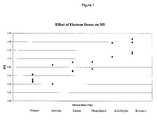
Figure 1 is a graph of the effect of electron donors on MI. - In this specification the term MI means melt index. The MI is determined according to ASTM D 1238-04 at condition 190/2.16 (at 190°C and under a weight of 2.16 kg).
- In this specification density (g/cc or kg/m3) means the density determined according to ASTM D 792-00.
- In this specification the terms catalyst and catalyst precursor are used interchangeably as some may consider the catalyst the species activated with the co-catalyst. The term catalyst and catalyst precursor mean the composition which may be and preferably is supported, before further reaction with the activator, typically a tri C1-8, preferably C2-6, most preferably C2-4 alkyl aluminum or C1-8, preferably C2-6 most preferably C2-4 alkyl aluminum halide in the reactor. The catalyst or catalyst precursor may be pre polymerized prior to introduction into the reactor. Typically the pre polymer comprises from about 5 to 20, typically 5 to 15-weight % of supported catalyst.
- A polymerization process is the gas phase process.
- The gas phase, and particularly the fluidized bed gas phase polymerization of ethylene polymers has been known for some time. A broad general description of these types of processes is set out in the paper "Gas Phase Ethylene Polymerization: Production Processes, Polymer Properties, and Reactor Modeling", by Tuyu Xie, Kim B. McAuley, James C. C. Hsu, and David W. Bacon, Ind. Eng. Chem. Res. 1994, 33, 449-479.
- Generally, a monomer feed comprising at least ethylene and optionally one or more C3-8 alpha-olefins optionally together with hydrogen and/or an inert gas are fed to the fluidized bed. In a fluidized bed reactor, the velocity of the gas is sufficient to suspend the bed in the fluid (gas) flow of monomer and other components. In a stirred bed reactor mechanical agitation serves to help suspend the bed. Generally a fluid bed reactor is vertical and a stirred bed reactor is horizontal. Concurrently with the monomers a co-catalyst and a supported catalyst are fed to the bed. The monomer passing over the supported catalyst polymerizes on the catalyst and in the pores of the catalyst support causing the particle to increase in size and to break. The resulting polymer particle continues to grow as it resides in the reactor. In a stirred tank reactor the bed is stirred to a discharge section and leaves the reactor. In a fluidized bed the reactor typically has a lower narrower section to keep the fluid (gas) velocity sufficiently high to fluidize the bed. There is an expanded zone at the top of the reactor to reduce the speed of the gas passing through this part of the reactor so the polymer/catalyst particles fall back into the bed. The discharge is from the bed zone in the reactor.
- In both the fluidized bed and stirred bed the polymer particles removed from the reactor are degassed to remove any volatile material, deactivated, and the resulting polymer (with entrained catalyst) may then be further treated (e.g. stabilizers added and pelletized if necessary).
- In accordance with the present invention, Ziegler-Natta catalysts are used in the gas phase polymerization of ethylene. Typically, the catalysts comprise a support, a magnesium compound (optionally in the presence of a halide donor to precipitate magnesium halide), a titanium compound and an aluminum compound, in the presence of a ketone. The aluminum compound is added at different stages. First it is added to the support to chemically treat it (i.e. Al1) and second it is added at some point during the manufacture of the catalyst (i.e. Al2).
- The support, if present, for the catalysts useful in the present invention typically comprises an inorganic substrate usually of alumina or silica having a pendant reactive moiety. The reactive moiety may be a siloxy radical or more typically is a hydroxyl radical. The preferred support is silica. The support should have an average particle size from about 0.1 to 150 microns, typically from 10 to 150 microns, preferably from about 20 to 100 microns. The support should have a large surface area typically greater than about 100 m2/g, preferably greater than about 250 m2/g, most preferably from 300 m2/g to 1,000 m2/g. The support may be porous and may have a pore volume from about 0.3 to 5.0 ml/g, typically from 0.5 to 3.0 ml/g. Supports, which are specifically designed to be an agglomeration of sub-particles while useful, are not required.
- The support can be heat treated and/or chemically treated to reduce the level of surface hydroxyl (OH) groups in a similar fashion to that described by A. Noshay and F.J. Karol in Transition Metal Catalyzed Polymerizations, Ed. R. Quirk, 1989, pg. 396. After treatment the support may be put into a mixing vessel and slurried with an inert solvent or diluent preferably a hydrocarbon and contacted with or without isolation or separation from the solvent or diluent with the remaining catalyst components.
- It is important that the support be dried prior to the initial reaction with an aluminum compound. Generally, the support may be heated at a temperature of at least 200°C for up to 24 hours, typically at a temperature from 500°C to 800°C for about 2 to 20, preferably 4 to 10 hours. The resulting support will be free of adsorbed water and should have a surface hydroxyl content from about 0.1 to 5 mmol/g of support, preferably from 0.5 to 3 mmol/g.
- A silica suitable for use in the present invention has a high surface area and is amorphous. For example, commercially available silicas are marketed under the trademark of Sylopol® 958 and 955 by Davison Catalysts a Division of W. R. Grace and Company and ES-70W or ES-757 by INEOS Silica.
- The amount of the hydroxyl groups in silica may be determined according to the method disclosed by M.P. McDaniel, in J. of Catalysis, 67, 71 - 76, 1980, the entire contents of which are incorporated herein by reference.
- While heating is the most preferred means of removing OH groups inherently present in many carriers, such as silica, the OH groups may also be removed by other removal means, such as chemical means. For example, a desired proportion of OH groups may be reacted with a suitable chemical agent, such as a hydroxyl reactive aluminum compound (e.g. triethyl aluminum) or a silane compound. This method of treatment has been disclosed in the literature and two relevant examples are: United States patent
4,719,193 to Levine in1988 and by Noshay A. and Karol F.J. in Transition Metal Catalyzed Polymerizations, Ed. R. Quirk, 1989, pg. 396. For example the support may be treated with an aluminum compound of the formula R1 bAl(OR1)aX3-(a+b) wherein a is either 0 or 1, b is either 2 or 3 and the sum of a+b is up to 3, R1 is the same or different C1-10 alkyl radical, X is a chlorine atom, and mixtures thereof. The amount of aluminum compound is such that the amount of aluminum on the support prior to adding the remaining catalyst components will be from about 0.5 to 2.5 weight %, preferably from 1.0 to 2.0 weight % based on the weight of the support. The remaining aluminum content is added as a subsequent or second component of the catalyst (e.g. Al2). The first and second aluminum compounds may be the same or different. - Typically the Ziegler-Natta catalyst useful in accordance with the present invention will comprise a second aluminum compound (Al2) of the formula R1 bAl(OR1)aX3-(a+b) wherein a is either 0 or 1, b is either 2 or 3 and the sum of a+b is up to 3, R1 is the same or different C1-10 alkyl radical, X is a chlorine atom, and mixtures thereof, a titanium compound of the formula Ti(OR2)cXd wherein R2 is selected from the group consisting of a C1-4 alkyl radical, a C6-10 aromatic radical, X is selected from the group consisting of a chlorine atom and a bromine atom, c is 0 or an integer up to 4 and d is 0 or an integer up to 4 and the sum of c+d is the valence of the Ti atom; a magnesium compound of the formula (R5)eMgX2-e wherein each R5 is independently a C1-8 alkyl radical and e is 1 or 2; a reactive organic halide selected from the group consisting of CCl4 and C1-6 alkyl halides preferably C3-6 secondary and tertiary alkyl halides, preferably chlorides or a mixture thereof and a ketone, a molar ratio of total Al to Ti (e.g. the first and second aluminum additions Al1 and Al2 -typically from 0 to 70 weight % of the aluminum compound is used to treat the support and the remaining aluminum is added at some time during the rest of the catalyst synthesis) from 2:1 to 15:1, preferably 2.5:1 to 10:1, most preferably 4:1 to 10:1, a molar ratio of Al from the second aluminum (Al2) addition to Ti from 1:1 to 8:1; a molar ratio of Mg:Ti from 1:1 to 20:1, preferably 2:1 to 12:1; most preferably 2.5:1 to 10:1; a molar ratio of active halide (this excludes the halide from the Al and Ti compounds if present) from the CCl4 or C1-6 preferably C3-6 alkyl halide or mixtures thereof to Mg from 1:1 to 6:1, preferably 1.5:1 to 5:1; and a molar ratio of ketones to Ti from 0.5:1 to 18:1, preferably from 1:1 to 15:1; a molar ratio of ketone to Mg from 0.5:1 to 5:1 preferable from 0.5:1 to 4:1.
- Typically the catalyst components are reacted in an organic medium such as an inert C5-10 hydrocarbon that may be unsubstituted or is substituted by a C1-4 alkyl radical. Some solvents include pentane, isopentane, hexane, isohexane, heptane, octane, cyclohexane, methyl cyclohexane, hydrogenated naphtha and ISOPAR®E (a solvent available from Exxon Chemical Company) and mixtures thereof.
- Typically the aluminum compounds (e.g. the first and/or second aluminum compounds) useful in the formation of the catalyst or catalyst precursor in accordance with the present invention have the formula R1 bAl(OR1)aX3-(a+b) wherein a is either 0 or 1 preferably 0, b is either 2 or 3 preferably 3 and the sum of a+b is 2 or 3 preferably 3, R1 is the same or different C1-10, preferably a C1-8 alkyl radical, X is a chlorine atom, and mixtures thereof. Suitable aluminum compounds include, trimethyl aluminum (TMA), triethyl aluminum (TEAL), diethyl aluminum ethoxide, diisobutyl aluminum ethoxide, isoprenyl aluminum, tri-isobutyl aluminum (TiBAL), diethyl aluminum chloride (DEAC), tri-n-hexyl aluminum (TnHAI), aluminum sesqui-halide, tri-n-octyl aluminum (TnOAl), and mixtures thereof. Preferably, in the aluminum compound a is 0, b is 3 and R1 is a C1-8 alkyl radical.
- The magnesium compound may be a compound of the formula (R5)eMgX2-e wherein each R5 is independently a C1-8 alkyl radical and e is 1 or 2 preferably 2. Some commercially available magnesium compounds include methyl magnesium chloride, butyl octyl magnesium, dibutyl magnesium and butyl ethyl magnesium. The magnesium compound is used in conjunction with a C3-6 halogenating agent or reactive organic halide to form magnesium halide (i.e. MgX2 where X is a halogen preferably chlorine or bromine, most preferably chlorine), which precipitates from the solution (potentially forming a substrate for the Ti compound).
- Some halogenating agents (e.g. reactive organic halides) include CCl4 or one or more secondary or tertiary halides, preferably chlorides, of the formula R6Cl wherein R6 is selected from the group consisting of C1-6 alkyl radicals preferably secondary and tertiary C3-6 alkyl radicals. Suitable chlorides include sec-butyl chloride, t-butyl chloride and sec-propyl chloride. The reactive halide is added in a quantity such that the molar ratio of active halide (e.g. chloride from the reactive organic halide):Mg should be from 1:1 to 6:1, preferably from 1.5:1 to 5:1, more preferably from 1.9:1 to 5:1, and most preferably from 1.9 to 4:1.
- The titanium compound in the catalyst has the formula Ti(OR2)cXd wherein R2 is selected from the group consisting of a C1-4 alkyl radical, and a C6-10 aromatic radical, X is selected from the group consisting of a chlorine atom and a bromine atom preferably chlorine, c is 0 or an integer up to 4 and d is 0 or an integer up to 4 and the sum of c+d is the valence of the Ti atom. The titanium compound may be selected from the group consisting of TiCl3, TiCl4, Ti(OC4H9)4, Ti(OC3H7)4, and Ti(OC4H9)Cl3. Most preferably the titanium compound is selected from the group consisting of Ti(OC4H9)4 and TiCl4 and mixtures thereof. Generally, the titanium in the catalyst or catalyst precursor is present in an amount from 0.20 to 3, preferably from 0.20 to 1.5, most preferably from 0.25 to 1.25 weight % based on the final weight of the catalyst (including the support).
- A ketone is used in the catalysts or catalysts precursor used in accordance with the present invention. The ketone may be selected from the group consisting of C3-18 linear or cyclic aliphatic or aromatic ketones. Most preferably, the ketone is selected from the group consisting of acetone, hexanone, cyclohexanone, butanone, acetaphenone, pentanone, methyl ethyl ketone, 3-methyl-2-butanone and methyl isobutyl ketone and mixtures thereof. The ketone may be used in a molar ratio to the titanium from 0.5:1 to 18:1 preferably in a molar ratio to Ti from 1:1 to 15:1, most preferably from 2:1 to 12:1.
- In the catalyst or catalyst precursor the molar ratio of Mg:Ti may be from 1:1 to 20:1, preferably from 2:1 to 12:1, most preferably from 2.5:1 to 10:1; desirably 3.0:1 to 10:1. The molar ratio of second aluminum (Al2) to titanium in the catalyst may be from 1:1 to 8:1, preferably from 1.5:1 to 7:1, most preferably from 1.5:1 to 6:1. Generally, from 0 to not more than about 70 weight %, preferably from 10 to 60 weight %, of the total aluminum (compound in the catalyst) may be used to treat the support (e.g. Al1). The molar ratio of active halide (from the reactive organic halide) to Mg may be from 1:1 to 6:1, preferably 1.5:1 to 5:1, more preferably from 1.9:1 to 5:1, most preferably from 1.9:1 to 4:1. The molar ratio of ketone to Ti may be from 0.5:1 to 18:1, preferably from 1:1 to 15:1. most preferably from 2:1 to 12:1. The molar ratio of total Al:Mg in the catalyst or catalyst precursor may be from 0.35:1 to 3:1, preferably from 0.4:1 to 2:1.
- In a preferred embodiment there is provided a process conducted in a hydrocarbon solvent at a temperature from 0°C to 100°C for preparing a catalyst in which the order of chemical addition is important and based on United States patent application serial number
10/ 977,949 - a. contacting a dehydrated silica support, containing from 0.5 to 2.5 weight % aluminum having the formula R1 bAl(OR1)aX3-(a+b) wherein a is either 0 or 1 preferably 0, b is either 2 or 3 preferably 3 and the sum of a+b is 2 or 3 preferably 3, R1 is the same or different C1-10, preferably a C1-8 alkyl radical, X is a chlorine atom with;
- b. a magnesium compound of the formula Mg(R5)2 wherein each R5 is independently selected from the group consisting of C1-8 alkyl radicals and may contain an aluminum alkyl as a thinning agent, to provide from 0.5 to 2.0 weight % of Mg based on the weight of the silica, contacting the resulting product with;
- c. a reactive organic halide selected from the group consisting of CCl4 and C3-6 secondary and tertiary alkyl chlorides or a mixture thereof to provide a Cl:Mg molar ratio from 1.5:1 to 5:1 in the resulting product; and contacting the resulting product with;
- d. an aluminum compound of the formula R1 bAl(OR1)aX3-(a+b) wherein a is either 0 or 1 preferably 0, b is either 2 or 3 preferably 3 and the sum of a+b is 2 or 3 preferably 3, R1 is the same or different C1-10, preferably a C1-8 alkyl radical, X is a chlorine atom; to provide a molar ratio of Al [from the second aluminum addition ( e.g. Al2)]:Ti from 1.5:1 to 7.0:1;
- e. a ketone, which may be selected from the group consisting of C 3-18 linear or cyclic aliphatic or aromatic ketones. Most preferably, the ketone is selected from the group consisting of acetone, hexanone, cyclohexanone, butanone, acetaphenone, pentanone, methyl ethyl ketone, 3-methyl-2-butanone and methyl isobutyl ketone and mixtures thereof. The ketone may be used in a molar ratio to the titanium from 1:1 to 15:1, more preferably from 2:1 to 12:1;
- f. a titanium compound of the formula Ti(OR2)cXd wherein R2 is selected from the group consisting of a C1-4 alkyl radical, and a C6-10 aromatic radical, X is selected from the group consisting of a chlorine atom and a bromine atom, preferably a chlorine atom, c is 0 or an integer up to 4 and d is 0 or an integer up to 4 and the sum of c+d is the valence of the Ti atom, preferably 3 or 4, to provide from 0.20 to 1.5 weight % of Ti based on the final catalyst.
- The productivity criteria is that the catalyst has a productivity of greater than 2000 grams of polymer per gram of catalyst (g/g) under standard commercial plant operations to produce an ethylene hexene copolymer having an MI of 1 and a density of 0.918 g/cc. The conditions of operation of a plant to produce a resin having a melt index (MI) of 1 as determined by ASTM D 1238 - 04 and a density of 0.918 g/cc as determined by ASTM D 792-00 are well known to those skilled in the art. However, if the productivity of a catalyst is below 2000 g of polymer /g of catalyst due to the poor selection of components, synthesis order and or loading levels then following the above criterion (including United States Patent Application serial number
10/977,949 - One needs to consider that the ideal catalyst of choice may be selected by the user to provide the best product for the lowest cost. However, in general there are three distinct user groups: polyethylene manufacturers, polyethylene converters and polyethylene consumers, and their criteria for success may not always be aligned. For example it is likely that everyone wants the best product for the least cost. However, the manufacturer may want to maximize plant throughput by increasing the flowability of the granular resin through the plant or by increasing the MWD to increase throughput through an extruder. Manufacturers may also choose to increase bulk density to increase the speed at which product can be discharged from the reactor. Alternately, manufacturers may want to reduce the need for a costly co-catalyst such as trimethyl aluminum and instead use triethyl aluminum. To limit capital costs, losses to flare or reduce the amount of co-monomer being recycled, manufacturers may also want a catalyst that requires low levels of co-monomer to ethylene in the reactor. Then again, manufacturers may want a catalyst with high productivity to reduce the amount they spend on catalyst. Converters will want to maximize throughput in their extruders and want broad MWD products without the loss of polymer physical properties. Hexane extractables may be important to a converter such that the products they make pass specific FDA regulations. Consumers on the other hand will want tough products in applications such as garbage bags and therefore may require high dart impact strength and machine direction (MD) tear strength. On the other hand, others may prefer sticky resin for stretch wrapping products. In summary, the ideal catalyst is dependant on the end user group and thus there can be many preferred catalysts. From a manufacturers perspective it would be best to have one catalyst fit all. However, from a users perspective one generally prefers to have specific areas addressed. As an example, for any given product, while one manufacturer wants a high productivity catalyst, another may want a catalyst that delivers a product with low hexane extractables, or high bulk density while a third may want a low C6/C2 gas phase ratio.
- One general synthetic procedure which follows the above criteria could be written as follows: treated silica (i.e. heat treated then treated with TEAL) is added to a reaction vessel and treated consecutively with the following, with or without isolation (separation of the product from the solvent or dispersant), dialkyl magnesium compound such as dibutyl magnesium or butyl ethyl magnesium, alkyl chloride such as t-butyl chloride or s-butyl chloride, a ketone such as acetone or cyclohexanone, a titanium compound such as titanium tetrachloride or titanium butoxide, and a second aluminum alkyl such as triethyl aluminum or trioctyl aluminum prior to drying to produce a free flowing powder. This is one of the acceptable orders as defined above.
- The catalyst or catalyst precursor is fed to the reactor, generally above a distributor plate into the bed of growing polymer particles using a metering device. One such device is disclosed at Col. 8 lines 15-20 of
U.S. Patent 4,543,399 issued Sept. 24, 1985 to Jenkins III et al. assigned to Union Carbide Corporation (which referencesU.S. patent 3,779,712 issued December 18, 1973 to Calvert et al. , assigned to Union Carbide Corporation). The co-catalyst, typically a tri C1-8 alkyl aluminum (in neat form or in a solution diluted with a hydrocarbon solvent) is also fed to the bed of growing polymer particles using a liquid metering device. Such devices are known in the art. - The co-catalyst may be selected from the group consisting of tri C1-8 alkyl or alkenyl; aluminums, alkyl aluminum alkoxides, alkyl aluminum chlorides (e.g. di C1-8 alkyl aluminum chloride), and mixtures thereof. This includes trimethyl aluminum, triethyl aluminum, tripropyl aluminum, tributyl aluminum, triisobutyl aluminum, diethyl aluminum ethoxide, diisobutyl aluminum ethoxide, isoprenylaluminum, tri-n-hexyl aluminum, tri-octyl aluminum, diethyl aluminum chloride, dibutyl aluminum chloride, and mixtures thereof. A preferred co-catalyst is triethyl aluminum. While the aluminum halides might be useful in accordance with the present invention they increase the amount of halide in the polymer resulting in increased consumption of additives to neutralize and stabilize the resulting polymer and are therefore not preferred.
- The co-catalyst may be fed to the reactor to provide preferably, 10 to 200, more preferably 12 to 100 most preferably from 15 to 75, desirably from 20 to 50 ppm of aluminum (Al ppm) based on the polymer production rate. Such a process is more fully described in
US 6825293 issued to NOVA Chemicals on November 30, 2004 (the text of which is hereby incorporated by reference). - In the reactor the gas phase typically comprises the monomers, a balance gas such as nitrogen, a molecular weight control agent such as hydrogen, and depending on the process possibly a condensable liquid (i.e. condensing mode such as disclosed in
U.S. patents 4,543,399 issued September 24, 1985 to Jenkins III et al. ;4,588,790 issued May 15, 1986 to Jenkins III et al. ; and the so-called super condensing mode as disclosed inU.S. patent 5,352,749 issued October 4, 1994 to DeChellis et al. , assigned to Exxon Chemical Patents, Inc. andU.S. patent 5,436,304 issued July 25, 1995 to Griffen et al. , assigned to Exxon Chemical Patents, Inc.). - The reactor mixture may comprise from 0 to 60 mole % hydrogen, from 0 to 35 mole % of one or more C3-8 alpha-olefins, from 15 to 100 mole % of ethylene and from 0 to 75 mole % of an inert gas such as N2. Copolymerizable olefins include butene (1-butene), 4-methyl-1-pentene, pentene, hexene (1-hexene) and octene (1-octene), although it may be difficult to keep significant amounts of octene in the gas phase. The polymer may have a density from 0.905 to 0.965 g/cc, typically from about 0.910 to about 0.960 g/cc.
- Triethyl aluminum may be used as a co-catalyst in amounts from 10 to 200 ppm Al based on the polymer production rate, more preferably 12 to 100 most preferably from 15 to 75, desirably from 20 to 50 ppm of aluminum.
- Fluidized bed gas phase reactors to make polyethylene are generally operated at temperatures from about 50°C up to about 125°C (provided the sticking temperature of the polymer is not exceeded) preferably from about 75°C to about 110°C and at pressures typically not exceeding 3,447 kPa (about 500 psi) preferably not greater than about 2,414 kPa (about 350 psi).
- Typically the resulting polymer will comprise from 85 to 100 weight % of ethylene and from 0 to 15 weight % of one or more C3-8 alpha-olefins. The polymer should have a molecular weight (weight average, Mw) greater than 25,000. The polymers prepared according to the present invention will have a polydispersity (Mw/Mn) from 2.5 to 5, preferably from 3 to 4.
- The resulting polymers may be used in a number of applications such as film extrusion, both cast and blown film extrusion and both injection and rotomolding applications. Typically the polymer may be compounded with the usual additives including heat and light stabilizers such as hindered phenols; ultra violet light stabilizers such as hindered amine light stabilizers (HALS); process aids such as fatty acids or their derivatives and fluoropolymers optionally in conjunction with low molecular weight esters of polyethylene glycol.
- The present invention will now be illustrated by the following non-limiting examples.
- Essentially, silica (42 g), which had been dehydrated substantially as described in
U.S. patent 6,140,264 , was added to a 500 mL stainless steel reactor in a glove box. To the flask was added approximately 150 mL of pentane, which was subsequently heated to 50°C. After the pentane was added the slurry was stirred and triethyl aluminum (0.024 mole) was added over approximately 5 minutes. After stirring for 30 minutes, the sample was dried. The remaining reactions were carried out at approximately 20 to 25°C. After reslurrying the treated silica, dibutyl magnesium (53 mmol) was added over approximately 15 minutes followed by triethyl aluminum (~6.5 mmol, used to simulate TEAL as a thinning agent in magnesium alkyl compounds, which is used commercially). After stirring for 2 hours, the slurry was dried. Solvent was again added to the reactor and cooled to maintain a temperature below 20°C while t-butyl chloride (106 mmol) was added as a dilute (~25 wt%) solution over about 15 minutes. After stirring for 2 hours the slurry was dried. Pentane was again added to the reactor at which time titanium tetrachloride (6.6 mmol) was added as a dilute solution (~ 20%) over approximately 5 minutes. After 2 hours of stirring the catalyst was dried. Next, pentane was added to the reactor and after remixing the slurry, an electron donor (40 mmol. see Table 1) was added as a dilute solution over about 10 minutes. After 1 hour of stirring the slurry was dried. Pentane was added to the reactor and trihexyl aluminum (20 mmol) was added over approximately 10 minutes. After stirring for 45 minutes the slurry was dried under vacuum at 50°C to produce approximately 63 g of tan powder. Alternately, the entire synthesis can be completed at essentially room temperature using only a single drying step at the end. - Each of the above catalysts (60 mg) were tested in a 2 L stirred bed catalytic reactor at 85°C containing hydrogen (25 psi), nitrogen (60 psi), ethylene (120 psi), and a hexene:C2H4 molar ratio of 0.065. Triethyl aluminum was used as a co-catalyst and an Al:Ti ratio of 60:1 was used for all experiments. The polymerization was continued for 1 hour at which time the feed gases were stopped and the reactor was vented. The MI of the resulting polymer formed under these conditions is reported in
Figure 1 and Table 1.Table 1 BSR Evaluation of the Effect of Electron Donors on LLDPE MI Example CHEMICAL NAME Group Formula MI MI Average MI 1 Trimethyl phoshpine phosphine 
0.71 0.81 0.76 2 Triphenyl phosphine phosphine 
0.89 0.96 0.93 3 Acetone ketone 
1.44 1.34 1.39 4 Acetophenone, 99% ketone 
1.14 1.18 1.16 5 Cyclohexanone ketone 
1.42 1.36 1.39 6 1-Indanone ketone 
1.50 1.44 1.47 7 2,4-pentadione ketone 
1.16 1.08 1.12 8 butyl ether ether 
0.59 0.65 0.62 9 Diethyl ether ether 
0.47 0.48 0.48 10 1,4-Dioxane (99+%) ether 
0.89 nd 0.89 11 Tetrahydrafuran ether 
0.52 0.52 0.52 12 2,6-Dimethylanisole ether 
0.64 0.62 0.63 13 Caprolactone ester 
0.68 0.72 0.70 14 ethyl acetate ester 
1.06 0.77 0.91 15 Ethyl benzoate ester 
0.83 0.61 0.72 16 N,N-Dimethylaniline amine 
0.93 0.77 0.85 17 Triethylamine amine Et3N 0.37 0.44 0.41 18 Benzaldehyde aldehyde 
1.05 1.04 1.05 19 butyraldehyde aldehyde 
1.46 1.30 1.38 - From the data shown in
Figure 1 and Table 1 it is apparent that catalysts containing ketones generate polyethylene having the highest MI when compared to the other electron donors used in this study. It is also apparent that the electron donor family has an affect on the polymers MI. While data is not provided, other findings when changing electron donors are that they affect productivity, density, MFR, hexane extractables and comonomer incorporation. In most cases, the electron donors containing aromatic substituents have lower productivity compared to their aliphatic counter part.
Claims (29)
- A process for preparing an alpha-olefin polymerization catalyst comprising of aluminum, magnesium, and titanium compounds, a ketone and optionally an inorganic support capable of manufacturing a polyethylene copolymer having an MI greater than that prepared in the absence of said ketone.
- A process according to claim 1 for preparing an alpha-olefin polymerization catalyst composition having a productivity of greater than 2000 g of a polymer per gram of catalyst under standard gas phase operations used to manufacture a 1 MI, ethylene hexene copolymer resin having a density of 0.918 g/cc comprising contacting at a temperature from 0°C to 100°C a support which has been heat treated to remove adsorbed water and having a residual surface hydroxyl content from 0.1 to 5 mmol/g of support, which support has been subsequently treated with an aluminum compound (Al1) reactive with the residual surface hydroxyl groups to provide from 0.5 to 2.5 wt % Al on the support, in an inert hydrocarbyl solvent or diluent with or without isolation of the treated support from the hydrocarbyl solvent or diluent with: a transition metal compound, a magnesium halide, prepared by reacting in situ an alkyl magnesium compound of the formula (R5)eMgX1 2-e wherein each R5 is independently a C1-8 alkyl radical and e is 1 or 2 and X1 is a chlorine or bromine atom; with a reactive organic halide selected from the group consisting of CCl4 and C1-6 alkyl halides and mixtures thereof, a second aluminum alkyl compound (Al2) and a ketone selected from the group consisting of C3-18 linear or cyclic, aliphatic or aromatic ketones to provide a molar ratio of electron donor to Mg from 0.5:1 to 5:1 and separating the resulting catalyst from the inert hydrocarbyl solvent or diluent.
- The process according to claim 2 wherein the aluminum compound used to treat the support (Al1) and the second aluminum compound (Al2) in the catalyst are independently of the formula R1 bAl(OR1)aX2 3-(a+b) wherein a is either 0 or 1, b is either 2 or 3 and the sum of a+b is up to 3, and R1 is independently selected from the group consisting of C1-10 alkyl radicals, and X2 is a chlorine atom.
- The process according to either claim 2 or claim 3, wherein in the catalyst the transition metal compound has the formula Ti(OR2)cX3 d wherein R2 is selected from the group consisting of a C1-4 alkyl radical, and a C6-10 aromatic radical, X3 is selected from the group consisting of a chlorine atom and a bromine atom, c is 0 or an integer up to 4 and d is 0 or an integer up to 4 and the sum of c+d is the valence of the Ti atom; the magnesium compound has the formula (R5)eMgX1 2-e wherein each R5 is independently a C1-8 alkyl radical and e is 1 or 2 and X1 is a chlorine or bromine atom; the reactive halide is selected from the group consisting of CCl4, C3-6 secondary and tertiary alkyl halides, or a mixture thereof and a ketone, said catalyst having a molar ratio of total Al to Ti from 2:1 to 15:1; a molar ratio of Al from the second aluminum component (Al2): Ti from 1:1 to 8:1 a molar ratio of Mg:Ti from 1:1 to 20:1; a molar ratio of active halide from the alkyl halide to Mg from 1:1 to 6:1; and the titanium is present in the catalyst in an amount from 0.20 to 3.0 weight % inclusive of the support.
- The process according to claim 4, wherein in the catalyst the molar ratio of total Al (Al1+Al2):Ti is from 2.5:1 to 10:1.
- The process according to either claim 4 or claim 5, wherein in the catalyst the molar ratio of Mg:Ti is from 2.5:1 to 10:1.
- The process according to any one of claims 2 to 6, wherein in the catalyst the titanium component is selected from the group consisting of TiCl4, Ti(OC4H9)4, Ti(OC3H7)4 and mixtures thereof.
- The process according to claim 7, wherein the titanium compound is selected from the group consisting of Ti(OC4H9)4 and TiCl4 and mixtures thereof.
- The process according to any one of claims 2 to 8, wherein in the catalyst the Ti is present in an amount from 0.20 to 1.5 weight % inclusive of the support.
- The process according to any one of claims 2 to 9, wherein in the catalyst the aluminum compound is selected from the group consisting of trimethyl aluminum, triethyl aluminum, diethyl aluminum ethoxide, diisobutyl aluminum ethoxide, tri iso-butyl aluminum, isoprenyl aluminum, tri-n-hexyl aluminum, tri-n-octyl aluminum, diethyl aluminum chloride and mixtures thereof.
- The process according to any one of claims 2 to 10, wherein in the catalyst the magnesium compound is selected from the group consisting of dibutyl magnesium, butyl octyl magnesium and butyl ethyl magnesium, the reactive alkyl halide is present in an amount to provide a molar ratio of active halogen:Mg from 1.5:1 to 5:1.
- The process according to any one of claims 2 to 11, wherein in the catalyst the reactive alkyl halide is a C3-6 secondary or tertiary alkyl chloride.
- The process according to any one of claims 2 to 12, wherein the ketone is present in an amount to provide a molar ratio of ketone to Mg from 0.5:1 to 4:1.
- The process according to any one of claims 2 to 13, wherein the ketone is selected from the group consisting of acetone, hexanone, cyclohexanone, butanone, acetaphenone, pentanone, methyl ethyl ketone, 3-methyl-2-butanone and methyl isobutyl ketone and mixtures thereof.
- The process according to any one of claims 2 to 14, wherein the support is an inorganic support having an average particle size from about 10 to 150 microns, a surface area greater than 100 m2/g, a pore volume from about 0.3 to 5.0 ml/g, a surface hydroxyl content from about 0.1 to 5 mmol/g of support.
- The process according to any one of claims 2 to 15, wherein the support is selected from the group consisting of silica and alumina and mixtures thereof.
- The process according to any one of claims 2 to 16, wherein in the catalyst from 0 to 70 weight % of the total aluminum content (Al1+ Al2) is used to treat the support and the aluminum content on the support is included in the ratio of total Al:Ti in the catalyst.
- The process according to claim 17, wherein the remaining aluminum compound in the catalyst is added at some point during the catalyst synthesis.
- A process according to any one of claims 1 to 18, wherein the catalyst is prepolymerized to provide from 5 to 20 weight % of catalyst in the prepolymer.
- A gas phase process for the polymerization, at a pressure from 10 to 500 psi, of a mixture comprising from 0 to 60 mole % hydrogen, from 0 to 35 mole % of one or more C3-8 alpha-olefins, from 15 to 100 mole % of ethylene and from 0 to 75 mole % of an inert gas such as N2, conducted at a temperature from 50°C to 125°C in the presence of a catalyst according to any one of claims 1 to 19.
- The process according to claim 20, wherein the co-monomer is selected from the group consisting of butene, 4-methyl pentene, hexene, and mixtures thereof.
- The process according to either claim 20 or claim 21, wherein the catalyst is activated with one or more co-catalyst of the formula R1 bAl(OR1)aX2 3-(a+b) wherein a is either 0 or 1, b is either 2 or 3 and the sum of a+b is up to 3, R1 is independently selected from the group consisting of C1-10 alkyl radicals, and X2 is a chlorine atom.
- The process according to claim 22, wherein the co-catalyst is selected from the group consisting of trimethyl aluminum, triethyl aluminum, tripropyl aluminum, tributyl aluminum, triisobutyl aluminum, diethyl aluminum ethoxide, diisobutyl aluminum ethoxide, isoprenylaluminum, tri-n-hexyl aluminum, tri-octyl aluminum, diethyl aluminum chloride, dibutyl aluminum chloride, and mixtures thereof.
- The process according to claim 22, wherein the co-catalyst is triethyl aluminum.
- The process according to any one of claims 20 to 24, wherein the co-catalysts is used in an amount to provide from 10 to 200 ppm of aluminum from the co-catalyst based on the polymer production rate.
- The process according to claim 25, wherein the co-catalysts is used in an amount to provide from 15 to 75 ppm of aluminum from the co-catalyst based on the polymer production rate.
- A process for controlling the catalyst productivity above 2000 g of polymer per gram of catalyst under standard gas phase operations when manufacturing an ethylene hexene copolymer having a 1 MI and a density of 0.918 g/cc comprising recycling a gaseous mixture comprising from 0 to 60 mole % hydrogen, from 0 to 35 mole % of one or more C3-8 alpha-olefins, from 15 to 100 mole % of ethylene and from 0 to 75 mole % of an inert gas through a particulate bed of growing polymer particles comprising polymer, a catalyst prepared by contacting at a temperature from 0°C to 100°C a support which has been heat treated to remove adsorbed water and having a residual surface hydroxyl content from 0.1 to 5 mmol/g of support, which support has been subsequently treated with an aluminum compound (Al1) of the formula R1 bAl(OR1)aX2 3-(a+b) wherein a is either 0 or 1, b is either 2 or 3 and the sum of a+b is up to 3, R1 is independently selected from the group consisting of C1-10 alkyl radicals, and X2 is a chlorine atom, in an inert hydrocarbyl solvent or diluent with or without isolation of the treated support from the hydrocarbyl solvent or diluent to provide 0.5 to 2.5 wt % Al on the support: a transition metal compound of the formula Ti(OR2)cX3 d wherein R2 is selected from the group consisting of a C1-4 alkyl radical and a C6-10 aromatic radical, X3 is selected from the group consisting of a chlorine atom and a bromine atom, c is 0 or an integer up to 4 and d is 0 or an integer up to 4 and the sum of c+d is the valence of the Ti atom; a magnesium compound, of formula (R5)eMgX1 2-e wherein each R5 is independently a C1-8 alkyl radical and e is 1 or 2 and X1 is a chlorine or bromine atom; a reactive organic halide selected from the group consisting of CCl4, C3-6 secondary and tertiary alkyl halides and mixtures thereof; a second aluminum alkyl compound independently having the formula R1 bAl(OR1)aX4 3-(a+b) wherein a is either 0 or 1, b is either 2 or 3 and the sum of a+b is up to 3, R1 is independently selected from the group consisting of C1-10 alkyl radicals, and X4 is a chlorine atom and a ketone selected from the group consisting of C3-18 linear or cyclic, aliphatic or aromatic ketones to provide a molar ratio of total Al to Ti from 2:1 to 15:1; a molar ratio of Al from the second aluminum component (Al2): Ti from 1:1 to 8:1 a molar ratio of Mg:Ti from 1:1 to 20:1; a molar ratio of active halide from the alkyl halide to Mg from 1:1 to 6:1; a molar ratio of electron donor to Mg from 0.5:1 to 5:1 and the titanium is present in the catalyst in an amount from 0.20 to 3.0 weight % inclusive of the support and separating the resulting catalyst from the inert hydrocarbyl solvent or diluent and a co-catalyst of the formula R1 bAl(OR1)aX3-(a+b) wherein a is either 0 or 1, b is either 2 or 3 and the sum of a+b is up to 3, R1 is independently selected from the group consisting of C1-10 alkyl radicals, and X is a chlorine atom, at a pressure from 10 to 500 psi, and at a temperature from 50°C to 125°C.
- The process according to claim 27, wherein the co-catalysts is used in an amount to provide from 10 to 200 ppm of aluminum from the co-catalyst based on the polymer production rate.
- A slurry phase process for the polymerization, at a pressure from 10 to 500 psi, of a mixture comprising from 0 to 60 mole % hydrogen, from 0 to 35 mole % of one or more C3-8 alpha-olefins, from 15 to 100 mole % of ethylene and from 0 to 75 mole % of an inert gas such as N2, in an inert diluent conducted at a temperature from 50°C to 125°C in the presence of a catalyst according to any one of claims 1 to 19.
Priority Applications (3)
| Application Number | Priority Date | Filing Date | Title |
|---|---|---|---|
| EP07252450A EP2003151A1 (en) | 2007-06-15 | 2007-06-15 | Improved hydrogen response through catalyst modification |
| CA2633381A CA2633381C (en) | 2007-06-15 | 2008-06-04 | Improved hydrogen response through catalyst modification |
| US12/157,353 US7671149B2 (en) | 2007-06-15 | 2008-06-10 | Hydrogen response through catalyst modification |
Applications Claiming Priority (1)
| Application Number | Priority Date | Filing Date | Title |
|---|---|---|---|
| EP07252450A EP2003151A1 (en) | 2007-06-15 | 2007-06-15 | Improved hydrogen response through catalyst modification |
Publications (1)
| Publication Number | Publication Date |
|---|---|
| EP2003151A1 true EP2003151A1 (en) | 2008-12-17 |
Family
ID=38654387
Family Applications (1)
| Application Number | Title | Priority Date | Filing Date |
|---|---|---|---|
| EP07252450A Withdrawn EP2003151A1 (en) | 2007-06-15 | 2007-06-15 | Improved hydrogen response through catalyst modification |
Country Status (3)
| Country | Link |
|---|---|
| US (1) | US7671149B2 (en) |
| EP (1) | EP2003151A1 (en) |
| CA (1) | CA2633381C (en) |
Cited By (5)
| Publication number | Priority date | Publication date | Assignee | Title |
|---|---|---|---|---|
| WO2010043355A1 (en) * | 2008-10-15 | 2010-04-22 | Saudi Basic Industries Corporation | A catalyst for the production of linear low density polyethylene |
| EP2246372A1 (en) * | 2009-04-30 | 2010-11-03 | Borealis AG | Improved multi-stage process for producing multi-modal linear low density polyethylene |
| EP2246368A1 (en) * | 2009-04-30 | 2010-11-03 | Borealis AG | Improved ethylene polymerization catalyst composition |
| EP2205645A4 (en) * | 2007-10-19 | 2011-11-30 | Braskem Sa | PROCESS FOR THE PREPARATION OF A CATALYTIC CARRIER AND SUPPORTED BIMETALLIC CATALYSTS FOR PRODUCTION WITH HIGH MOLECULAR WEIGHT ETHYLENE HOMOPOLYMER AND COPOLYMER ALPHA-OLEFINS AND LARGE MOLECULAR WEIGHT DISTRIBUTION IN MUD PROCESSES, MASS AND GAS PHASE, AND PRODUCTS SO OBTAINED |
| WO2017114814A1 (en) * | 2015-12-30 | 2017-07-06 | Sabic Global Technologies B.V. | Process for making a solid catalyst component for ethylene polymerization and copolymerization |
Families Citing this family (2)
| Publication number | Priority date | Publication date | Assignee | Title |
|---|---|---|---|---|
| CA2890606C (en) * | 2015-05-07 | 2022-07-19 | Nova Chemicals Corporation | Process for polymerization using dense and spherical ziegler-natta type catalyst |
| CA2969627C (en) | 2017-05-30 | 2024-01-16 | Nova Chemicals Corporation | Ethylene copolymer having enhanced film properties |
Citations (23)
| Publication number | Priority date | Publication date | Assignee | Title |
|---|---|---|---|---|
| US3779712A (en) | 1971-11-26 | 1973-12-18 | Union Carbide Corp | Particulate solids injector apparatus |
| US4302566A (en) | 1978-03-31 | 1981-11-24 | Union Carbide Corporation | Preparation of ethylene copolymers in fluid bed reactor |
| US4324691A (en) | 1980-01-10 | 1982-04-13 | Imperial Chemical Industries Limited | Catalyst component |
| US4496660A (en) | 1980-10-01 | 1985-01-29 | The Dow Chemical Company | Catalyst prepared from organo-magnesium compound; oxygen- or nitrogen-containing compound; halide source; transition metal compound and reducing agent |
| US4543399A (en) | 1982-03-24 | 1985-09-24 | Union Carbide Corporation | Fluidized bed reaction systems |
| US4558025A (en) * | 1984-08-06 | 1985-12-10 | Exxon Research & Engineering Co. | Polymerization catalyst, production and use |
| US4588790A (en) | 1982-03-24 | 1986-05-13 | Union Carbide Corporation | Method for fluidized bed polymerization |
| US4719193A (en) | 1986-09-30 | 1988-01-12 | Union Carbide Corporation | Processes for preparing polyethylene catalysts by heating catalyst precursors |
| US4952649A (en) * | 1981-11-13 | 1990-08-28 | Mitsui Petrochemical Industries, Ltd. | Process for producing olefin polymers or copolymers and catalyst components used therefor |
| US5352749A (en) | 1992-03-19 | 1994-10-04 | Exxon Chemical Patents, Inc. | Process for polymerizing monomers in fluidized beds |
| US5436304A (en) | 1992-03-19 | 1995-07-25 | Exxon Chemical Patents Inc. | Process for polymerizing monomers in fluidized beds |
| EP0453088B1 (en) | 1990-03-30 | 1996-07-31 | BP Chemicals Limited | Supported polyolefin catalyst for the (co-)polymerization of ethylene in gas phase |
| EP0744416A1 (en) | 1995-05-22 | 1996-11-27 | BP Chemicals Limited | Process for preparing a Ziegler-Natta catalyst |
| EP0595574B1 (en) | 1992-10-26 | 1997-01-02 | BP Chemicals Limited | Process for the preparation of a Ziegler-Natta type catalyst |
| US5633419A (en) | 1994-08-12 | 1997-05-27 | The Dow Chemical Company | Polymerization of olefins in the presence of a supported catalyst |
| US6046126A (en) | 1998-05-12 | 2000-04-04 | Kelly; Mark | Titanium process for making catalyst |
| US6140264A (en) | 1998-05-12 | 2000-10-31 | Nova Chemicals Ltd. | Split aluminum addition process for making catalyst |
| US6174971B1 (en) | 1997-01-28 | 2001-01-16 | Fina Technology, Inc. | Ziegler-natta catalysts for olefin polymerization |
| US6187866B1 (en) | 1999-06-04 | 2001-02-13 | Union Carbide Chemicals & Plastics Technology Corporation | Staged reactor process |
| EP1285934A1 (en) * | 2001-08-20 | 2003-02-26 | Nova Chemicals (International) S.A. | Polymer control through co-catalyst |
| US20040210016A1 (en) | 2001-01-23 | 2004-10-21 | Basf Aktiengesellschaft | Preparation of ethylene polymers by the high-pressure method |
| US20050288460A1 (en) | 2004-06-28 | 2005-12-29 | Zhidong Zhu | High activity and good hydrogen response Ziegler-Natta polyethylene catalyst |
| EP1652863A1 (en) * | 2004-10-29 | 2006-05-03 | Nova Chemicals Corporation | Enhanced polyolefin catalyst |
-
2007
- 2007-06-15 EP EP07252450A patent/EP2003151A1/en not_active Withdrawn
-
2008
- 2008-06-04 CA CA2633381A patent/CA2633381C/en active Active
- 2008-06-10 US US12/157,353 patent/US7671149B2/en active Active
Patent Citations (25)
| Publication number | Priority date | Publication date | Assignee | Title |
|---|---|---|---|---|
| US3779712A (en) | 1971-11-26 | 1973-12-18 | Union Carbide Corp | Particulate solids injector apparatus |
| US4302566A (en) | 1978-03-31 | 1981-11-24 | Union Carbide Corporation | Preparation of ethylene copolymers in fluid bed reactor |
| US4324691A (en) | 1980-01-10 | 1982-04-13 | Imperial Chemical Industries Limited | Catalyst component |
| US4496660A (en) | 1980-10-01 | 1985-01-29 | The Dow Chemical Company | Catalyst prepared from organo-magnesium compound; oxygen- or nitrogen-containing compound; halide source; transition metal compound and reducing agent |
| US4952649A (en) * | 1981-11-13 | 1990-08-28 | Mitsui Petrochemical Industries, Ltd. | Process for producing olefin polymers or copolymers and catalyst components used therefor |
| US4588790A (en) | 1982-03-24 | 1986-05-13 | Union Carbide Corporation | Method for fluidized bed polymerization |
| US4543399A (en) | 1982-03-24 | 1985-09-24 | Union Carbide Corporation | Fluidized bed reaction systems |
| US4558025A (en) * | 1984-08-06 | 1985-12-10 | Exxon Research & Engineering Co. | Polymerization catalyst, production and use |
| US4719193A (en) | 1986-09-30 | 1988-01-12 | Union Carbide Corporation | Processes for preparing polyethylene catalysts by heating catalyst precursors |
| EP0453088B1 (en) | 1990-03-30 | 1996-07-31 | BP Chemicals Limited | Supported polyolefin catalyst for the (co-)polymerization of ethylene in gas phase |
| US5352749A (en) | 1992-03-19 | 1994-10-04 | Exxon Chemical Patents, Inc. | Process for polymerizing monomers in fluidized beds |
| US5436304A (en) | 1992-03-19 | 1995-07-25 | Exxon Chemical Patents Inc. | Process for polymerizing monomers in fluidized beds |
| EP0595574B1 (en) | 1992-10-26 | 1997-01-02 | BP Chemicals Limited | Process for the preparation of a Ziegler-Natta type catalyst |
| US5633419A (en) | 1994-08-12 | 1997-05-27 | The Dow Chemical Company | Polymerization of olefins in the presence of a supported catalyst |
| EP0744416A1 (en) | 1995-05-22 | 1996-11-27 | BP Chemicals Limited | Process for preparing a Ziegler-Natta catalyst |
| US6174971B1 (en) | 1997-01-28 | 2001-01-16 | Fina Technology, Inc. | Ziegler-natta catalysts for olefin polymerization |
| US6046126A (en) | 1998-05-12 | 2000-04-04 | Kelly; Mark | Titanium process for making catalyst |
| US6140264A (en) | 1998-05-12 | 2000-10-31 | Nova Chemicals Ltd. | Split aluminum addition process for making catalyst |
| US6187866B1 (en) | 1999-06-04 | 2001-02-13 | Union Carbide Chemicals & Plastics Technology Corporation | Staged reactor process |
| US20040210016A1 (en) | 2001-01-23 | 2004-10-21 | Basf Aktiengesellschaft | Preparation of ethylene polymers by the high-pressure method |
| EP1285934A1 (en) * | 2001-08-20 | 2003-02-26 | Nova Chemicals (International) S.A. | Polymer control through co-catalyst |
| US6825293B1 (en) | 2001-08-20 | 2004-11-30 | Nova Chemicals (International) S.A. | Polymer control through co-catalyst |
| US20050288460A1 (en) | 2004-06-28 | 2005-12-29 | Zhidong Zhu | High activity and good hydrogen response Ziegler-Natta polyethylene catalyst |
| EP1652863A1 (en) * | 2004-10-29 | 2006-05-03 | Nova Chemicals Corporation | Enhanced polyolefin catalyst |
| US20060094838A1 (en) * | 2004-10-29 | 2006-05-04 | Nova Chemicals Corporation | Enhanced polyolefin catalyst |
Non-Patent Citations (10)
| Title |
|---|
| A. NOSHAY; F.J. KAROL: "Transition Metal Catalyzed Polymerizations", 1989, pages: 396 |
| CHADWICK ET AL., MACROMOL. CHEM. PHYS., vol. 197, 1996, pages 2501 - 2510 |
| GAO, POLYMER, vol. 45, 2004, pages 2175 - 2180 |
| GAROFF ET AL., EUROPEAN POLYMER JOURNAL, vol. 38, 2002, pages 121 - 132 |
| HUANG ET AL., IND. ENG. CHEM. RES., vol. 36, 1997, pages 1136 |
| MORI ET AL., JOURNAL OF MOLECULAR CATALYSIS A: CHEMICAL, vol. 140, 1997, pages 165 - 172 |
| NOSHAY A.; KAROL F.J.: "Transition Metal Catalyzed Polymerizations", 1989, pages: 396 |
| SEVILLE, POWDER TECHNOLOGY, vol. 97, no. 2, 1998, pages 160 - 169 |
| SPITZ, STUDIES IN SURFACE SCIENCE AND CATALYSIS, vol. 59, 1990, pages 117 - 130 |
| TUYU XIE ET AL., IND. ENG. CHEM. RES., vol. 33, 1994, pages 449 - 479 |
Cited By (9)
| Publication number | Priority date | Publication date | Assignee | Title |
|---|---|---|---|---|
| EP2205645A4 (en) * | 2007-10-19 | 2011-11-30 | Braskem Sa | PROCESS FOR THE PREPARATION OF A CATALYTIC CARRIER AND SUPPORTED BIMETALLIC CATALYSTS FOR PRODUCTION WITH HIGH MOLECULAR WEIGHT ETHYLENE HOMOPOLYMER AND COPOLYMER ALPHA-OLEFINS AND LARGE MOLECULAR WEIGHT DISTRIBUTION IN MUD PROCESSES, MASS AND GAS PHASE, AND PRODUCTS SO OBTAINED |
| WO2010043355A1 (en) * | 2008-10-15 | 2010-04-22 | Saudi Basic Industries Corporation | A catalyst for the production of linear low density polyethylene |
| EP2246372A1 (en) * | 2009-04-30 | 2010-11-03 | Borealis AG | Improved multi-stage process for producing multi-modal linear low density polyethylene |
| EP2246368A1 (en) * | 2009-04-30 | 2010-11-03 | Borealis AG | Improved ethylene polymerization catalyst composition |
| WO2010125018A1 (en) * | 2009-04-30 | 2010-11-04 | Borealis Ag | Improved ethylene polymerization catalyst composition |
| WO2010125020A1 (en) * | 2009-04-30 | 2010-11-04 | Borealis Ag | Improved multi-stage process for producing multi-modal linear low density polyethylene |
| CN102388070A (en) * | 2009-04-30 | 2012-03-21 | 北欧化工股份公司 | Improved ethylene polymerization catalyst composition |
| WO2017114814A1 (en) * | 2015-12-30 | 2017-07-06 | Sabic Global Technologies B.V. | Process for making a solid catalyst component for ethylene polymerization and copolymerization |
| US10640584B2 (en) | 2015-12-30 | 2020-05-05 | Sabic Global Technologies B.V. | Process for making a solid catalyst component for ethylene polymerization and co-polymerization |
Also Published As
| Publication number | Publication date |
|---|---|
| CA2633381C (en) | 2016-03-22 |
| CA2633381A1 (en) | 2008-12-15 |
| US7671149B2 (en) | 2010-03-02 |
| US20080312391A1 (en) | 2008-12-18 |
Similar Documents
| Publication | Publication Date | Title |
|---|---|---|
| CN104159933B (en) | The manufacture method of carbon monoxide-olefin polymeric and the polymeric articles by its production | |
| AU677145B2 (en) | Catalyst composition | |
| US7671149B2 (en) | Hydrogen response through catalyst modification | |
| US20130046070A1 (en) | Polymerization process | |
| CN110023346B (en) | Aggregation method | |
| RU2382791C2 (en) | Multistage composition preparation method | |
| CN107531841A (en) | Method for being changed between incompatible catalyst | |
| US7211535B2 (en) | Enhanced polyolefin catalyst | |
| EP3155021B1 (en) | Short chain branching control on ethylene-butene copolymers | |
| US10836851B2 (en) | Method for altering melt flow ratio of ethylene polymers | |
| EP3519447B1 (en) | Polymerization process | |
| EP1231223B1 (en) | Process for the polymerization of olefins | |
| JP2004035893A (en) | NEW CATALYST COMPOSITION AND PROCESS FOR POLYMERIZING OLEFIN AND COPOLYMERIZING OLEFIN WITH alpha-OLEFIN USING IT | |
| EP2077284B1 (en) | Use of an improved solid vanadium-containing Ziegler-Natta catalyst system for producing ethylene polymer compositions in a multistage process | |
| US8450435B2 (en) | Increased run length in gas phase reactors | |
| WO2018063767A1 (en) | Polymerization process |
Legal Events
| Date | Code | Title | Description |
|---|---|---|---|
| PUAI | Public reference made under article 153(3) epc to a published international application that has entered the european phase |
Free format text: ORIGINAL CODE: 0009012 |
|
| AK | Designated contracting states |
Kind code of ref document: A1 Designated state(s): AT BE BG CH CY CZ DE DK EE ES FI FR GB GR HU IE IS IT LI LT LU LV MC MT NL PL PT RO SE SI SK TR |
|
| AX | Request for extension of the european patent |
Extension state: AL BA HR MK RS |
|
| 17P | Request for examination filed |
Effective date: 20090603 |
|
| 17Q | First examination report despatched |
Effective date: 20090703 |
|
| AKX | Designation fees paid |
Designated state(s): AT BE BG CH CY CZ DE DK EE ES FI FR GB GR HU IE IS IT LI LT LU LV MC MT NL PL PT RO SE SI SK TR |
|
| STAA | Information on the status of an ep patent application or granted ep patent |
Free format text: STATUS: THE APPLICATION IS DEEMED TO BE WITHDRAWN |
|
| 18D | Application deemed to be withdrawn |
Effective date: 20130420 |