EP2000445B1 - Method of manufacturing a dielectric porcelain - Google Patents
Method of manufacturing a dielectric porcelain Download PDFInfo
- Publication number
- EP2000445B1 EP2000445B1 EP07739224.9A EP07739224A EP2000445B1 EP 2000445 B1 EP2000445 B1 EP 2000445B1 EP 07739224 A EP07739224 A EP 07739224A EP 2000445 B1 EP2000445 B1 EP 2000445B1
- Authority
- EP
- European Patent Office
- Prior art keywords
- weight
- dielectric
- porcelain
- cuo
- less
- Prior art date
- Legal status (The legal status is an assumption and is not a legal conclusion. Google has not performed a legal analysis and makes no representation as to the accuracy of the status listed.)
- Not-in-force
Links
Images
Classifications
-
- C—CHEMISTRY; METALLURGY
- C04—CEMENTS; CONCRETE; ARTIFICIAL STONE; CERAMICS; REFRACTORIES
- C04B—LIME, MAGNESIA; SLAG; CEMENTS; COMPOSITIONS THEREOF, e.g. MORTARS, CONCRETE OR LIKE BUILDING MATERIALS; ARTIFICIAL STONE; CERAMICS; REFRACTORIES; TREATMENT OF NATURAL STONE
- C04B35/00—Shaped ceramic products characterised by their composition; Ceramics compositions; Processing powders of inorganic compounds preparatory to the manufacturing of ceramic products
- C04B35/01—Shaped ceramic products characterised by their composition; Ceramics compositions; Processing powders of inorganic compounds preparatory to the manufacturing of ceramic products based on oxide ceramics
- C04B35/46—Shaped ceramic products characterised by their composition; Ceramics compositions; Processing powders of inorganic compounds preparatory to the manufacturing of ceramic products based on oxide ceramics based on titanium oxides or titanates
-
- H—ELECTRICITY
- H05—ELECTRIC TECHNIQUES NOT OTHERWISE PROVIDED FOR
- H05K—PRINTED CIRCUITS; CASINGS OR CONSTRUCTIONAL DETAILS OF ELECTRIC APPARATUS; MANUFACTURE OF ASSEMBLAGES OF ELECTRICAL COMPONENTS
- H05K1/00—Printed circuits
- H05K1/16—Printed circuits incorporating printed electric components, e.g. printed resistors, capacitors or inductors
- H05K1/162—Printed circuits incorporating printed electric components, e.g. printed resistors, capacitors or inductors incorporating printed capacitors
-
- C—CHEMISTRY; METALLURGY
- C04—CEMENTS; CONCRETE; ARTIFICIAL STONE; CERAMICS; REFRACTORIES
- C04B—LIME, MAGNESIA; SLAG; CEMENTS; COMPOSITIONS THEREOF, e.g. MORTARS, CONCRETE OR LIKE BUILDING MATERIALS; ARTIFICIAL STONE; CERAMICS; REFRACTORIES; TREATMENT OF NATURAL STONE
- C04B35/00—Shaped ceramic products characterised by their composition; Ceramics compositions; Processing powders of inorganic compounds preparatory to the manufacturing of ceramic products
- C04B35/01—Shaped ceramic products characterised by their composition; Ceramics compositions; Processing powders of inorganic compounds preparatory to the manufacturing of ceramic products based on oxide ceramics
- C04B35/46—Shaped ceramic products characterised by their composition; Ceramics compositions; Processing powders of inorganic compounds preparatory to the manufacturing of ceramic products based on oxide ceramics based on titanium oxides or titanates
- C04B35/462—Shaped ceramic products characterised by their composition; Ceramics compositions; Processing powders of inorganic compounds preparatory to the manufacturing of ceramic products based on oxide ceramics based on titanium oxides or titanates based on titanates
- C04B35/465—Shaped ceramic products characterised by their composition; Ceramics compositions; Processing powders of inorganic compounds preparatory to the manufacturing of ceramic products based on oxide ceramics based on titanium oxides or titanates based on titanates based on alkaline earth metal titanates
- C04B35/468—Shaped ceramic products characterised by their composition; Ceramics compositions; Processing powders of inorganic compounds preparatory to the manufacturing of ceramic products based on oxide ceramics based on titanium oxides or titanates based on titanates based on alkaline earth metal titanates based on barium titanates
- C04B35/4682—Shaped ceramic products characterised by their composition; Ceramics compositions; Processing powders of inorganic compounds preparatory to the manufacturing of ceramic products based on oxide ceramics based on titanium oxides or titanates based on titanates based on alkaline earth metal titanates based on barium titanates based on BaTiO3 perovskite phase
-
- C—CHEMISTRY; METALLURGY
- C04—CEMENTS; CONCRETE; ARTIFICIAL STONE; CERAMICS; REFRACTORIES
- C04B—LIME, MAGNESIA; SLAG; CEMENTS; COMPOSITIONS THEREOF, e.g. MORTARS, CONCRETE OR LIKE BUILDING MATERIALS; ARTIFICIAL STONE; CERAMICS; REFRACTORIES; TREATMENT OF NATURAL STONE
- C04B35/00—Shaped ceramic products characterised by their composition; Ceramics compositions; Processing powders of inorganic compounds preparatory to the manufacturing of ceramic products
- C04B35/01—Shaped ceramic products characterised by their composition; Ceramics compositions; Processing powders of inorganic compounds preparatory to the manufacturing of ceramic products based on oxide ceramics
- C04B35/48—Shaped ceramic products characterised by their composition; Ceramics compositions; Processing powders of inorganic compounds preparatory to the manufacturing of ceramic products based on oxide ceramics based on zirconium or hafnium oxides, zirconates, zircon or hafnates
- C04B35/49—Shaped ceramic products characterised by their composition; Ceramics compositions; Processing powders of inorganic compounds preparatory to the manufacturing of ceramic products based on oxide ceramics based on zirconium or hafnium oxides, zirconates, zircon or hafnates containing also titanium oxides or titanates
-
- H—ELECTRICITY
- H01—ELECTRIC ELEMENTS
- H01B—CABLES; CONDUCTORS; INSULATORS; SELECTION OF MATERIALS FOR THEIR CONDUCTIVE, INSULATING OR DIELECTRIC PROPERTIES
- H01B3/00—Insulators or insulating bodies characterised by the insulating materials; Selection of materials for their insulating or dielectric properties
- H01B3/02—Insulators or insulating bodies characterised by the insulating materials; Selection of materials for their insulating or dielectric properties mainly consisting of inorganic substances
- H01B3/12—Insulators or insulating bodies characterised by the insulating materials; Selection of materials for their insulating or dielectric properties mainly consisting of inorganic substances ceramics
-
- H—ELECTRICITY
- H01—ELECTRIC ELEMENTS
- H01G—CAPACITORS; CAPACITORS, RECTIFIERS, DETECTORS, SWITCHING DEVICES, LIGHT-SENSITIVE OR TEMPERATURE-SENSITIVE DEVICES OF THE ELECTROLYTIC TYPE
- H01G4/00—Fixed capacitors; Processes of their manufacture
- H01G4/002—Details
- H01G4/018—Dielectrics
- H01G4/06—Solid dielectrics
- H01G4/08—Inorganic dielectrics
- H01G4/12—Ceramic dielectrics
- H01G4/1209—Ceramic dielectrics characterised by the ceramic dielectric material
- H01G4/1218—Ceramic dielectrics characterised by the ceramic dielectric material based on titanium oxides or titanates
- H01G4/1227—Ceramic dielectrics characterised by the ceramic dielectric material based on titanium oxides or titanates based on alkaline earth titanates
-
- H—ELECTRICITY
- H01—ELECTRIC ELEMENTS
- H01G—CAPACITORS; CAPACITORS, RECTIFIERS, DETECTORS, SWITCHING DEVICES, LIGHT-SENSITIVE OR TEMPERATURE-SENSITIVE DEVICES OF THE ELECTROLYTIC TYPE
- H01G4/00—Fixed capacitors; Processes of their manufacture
- H01G4/30—Stacked capacitors
-
- H—ELECTRICITY
- H01—ELECTRIC ELEMENTS
- H01G—CAPACITORS; CAPACITORS, RECTIFIERS, DETECTORS, SWITCHING DEVICES, LIGHT-SENSITIVE OR TEMPERATURE-SENSITIVE DEVICES OF THE ELECTROLYTIC TYPE
- H01G4/00—Fixed capacitors; Processes of their manufacture
- H01G4/38—Multiple capacitors, i.e. structural combinations of fixed capacitors
-
- H—ELECTRICITY
- H05—ELECTRIC TECHNIQUES NOT OTHERWISE PROVIDED FOR
- H05K—PRINTED CIRCUITS; CASINGS OR CONSTRUCTIONAL DETAILS OF ELECTRIC APPARATUS; MANUFACTURE OF ASSEMBLAGES OF ELECTRICAL COMPONENTS
- H05K1/00—Printed circuits
- H05K1/02—Details
- H05K1/03—Use of materials for the substrate
-
- C—CHEMISTRY; METALLURGY
- C04—CEMENTS; CONCRETE; ARTIFICIAL STONE; CERAMICS; REFRACTORIES
- C04B—LIME, MAGNESIA; SLAG; CEMENTS; COMPOSITIONS THEREOF, e.g. MORTARS, CONCRETE OR LIKE BUILDING MATERIALS; ARTIFICIAL STONE; CERAMICS; REFRACTORIES; TREATMENT OF NATURAL STONE
- C04B2235/00—Aspects relating to ceramic starting mixtures or sintered ceramic products
- C04B2235/02—Composition of constituents of the starting material or of secondary phases of the final product
- C04B2235/30—Constituents and secondary phases not being of a fibrous nature
- C04B2235/32—Metal oxides, mixed metal oxides, or oxide-forming salts thereof, e.g. carbonates, nitrates, (oxy)hydroxides, chlorides
- C04B2235/3201—Alkali metal oxides or oxide-forming salts thereof
- C04B2235/3203—Lithium oxide or oxide-forming salts thereof
-
- C—CHEMISTRY; METALLURGY
- C04—CEMENTS; CONCRETE; ARTIFICIAL STONE; CERAMICS; REFRACTORIES
- C04B—LIME, MAGNESIA; SLAG; CEMENTS; COMPOSITIONS THEREOF, e.g. MORTARS, CONCRETE OR LIKE BUILDING MATERIALS; ARTIFICIAL STONE; CERAMICS; REFRACTORIES; TREATMENT OF NATURAL STONE
- C04B2235/00—Aspects relating to ceramic starting mixtures or sintered ceramic products
- C04B2235/02—Composition of constituents of the starting material or of secondary phases of the final product
- C04B2235/30—Constituents and secondary phases not being of a fibrous nature
- C04B2235/32—Metal oxides, mixed metal oxides, or oxide-forming salts thereof, e.g. carbonates, nitrates, (oxy)hydroxides, chlorides
- C04B2235/3205—Alkaline earth oxides or oxide forming salts thereof, e.g. beryllium oxide
- C04B2235/3206—Magnesium oxides or oxide-forming salts thereof
-
- C—CHEMISTRY; METALLURGY
- C04—CEMENTS; CONCRETE; ARTIFICIAL STONE; CERAMICS; REFRACTORIES
- C04B—LIME, MAGNESIA; SLAG; CEMENTS; COMPOSITIONS THEREOF, e.g. MORTARS, CONCRETE OR LIKE BUILDING MATERIALS; ARTIFICIAL STONE; CERAMICS; REFRACTORIES; TREATMENT OF NATURAL STONE
- C04B2235/00—Aspects relating to ceramic starting mixtures or sintered ceramic products
- C04B2235/02—Composition of constituents of the starting material or of secondary phases of the final product
- C04B2235/30—Constituents and secondary phases not being of a fibrous nature
- C04B2235/32—Metal oxides, mixed metal oxides, or oxide-forming salts thereof, e.g. carbonates, nitrates, (oxy)hydroxides, chlorides
- C04B2235/3205—Alkaline earth oxides or oxide forming salts thereof, e.g. beryllium oxide
- C04B2235/3208—Calcium oxide or oxide-forming salts thereof, e.g. lime
-
- C—CHEMISTRY; METALLURGY
- C04—CEMENTS; CONCRETE; ARTIFICIAL STONE; CERAMICS; REFRACTORIES
- C04B—LIME, MAGNESIA; SLAG; CEMENTS; COMPOSITIONS THEREOF, e.g. MORTARS, CONCRETE OR LIKE BUILDING MATERIALS; ARTIFICIAL STONE; CERAMICS; REFRACTORIES; TREATMENT OF NATURAL STONE
- C04B2235/00—Aspects relating to ceramic starting mixtures or sintered ceramic products
- C04B2235/02—Composition of constituents of the starting material or of secondary phases of the final product
- C04B2235/30—Constituents and secondary phases not being of a fibrous nature
- C04B2235/32—Metal oxides, mixed metal oxides, or oxide-forming salts thereof, e.g. carbonates, nitrates, (oxy)hydroxides, chlorides
- C04B2235/3205—Alkaline earth oxides or oxide forming salts thereof, e.g. beryllium oxide
- C04B2235/3213—Strontium oxides or oxide-forming salts thereof
-
- C—CHEMISTRY; METALLURGY
- C04—CEMENTS; CONCRETE; ARTIFICIAL STONE; CERAMICS; REFRACTORIES
- C04B—LIME, MAGNESIA; SLAG; CEMENTS; COMPOSITIONS THEREOF, e.g. MORTARS, CONCRETE OR LIKE BUILDING MATERIALS; ARTIFICIAL STONE; CERAMICS; REFRACTORIES; TREATMENT OF NATURAL STONE
- C04B2235/00—Aspects relating to ceramic starting mixtures or sintered ceramic products
- C04B2235/02—Composition of constituents of the starting material or of secondary phases of the final product
- C04B2235/30—Constituents and secondary phases not being of a fibrous nature
- C04B2235/32—Metal oxides, mixed metal oxides, or oxide-forming salts thereof, e.g. carbonates, nitrates, (oxy)hydroxides, chlorides
- C04B2235/3205—Alkaline earth oxides or oxide forming salts thereof, e.g. beryllium oxide
- C04B2235/3215—Barium oxides or oxide-forming salts thereof
-
- C—CHEMISTRY; METALLURGY
- C04—CEMENTS; CONCRETE; ARTIFICIAL STONE; CERAMICS; REFRACTORIES
- C04B—LIME, MAGNESIA; SLAG; CEMENTS; COMPOSITIONS THEREOF, e.g. MORTARS, CONCRETE OR LIKE BUILDING MATERIALS; ARTIFICIAL STONE; CERAMICS; REFRACTORIES; TREATMENT OF NATURAL STONE
- C04B2235/00—Aspects relating to ceramic starting mixtures or sintered ceramic products
- C04B2235/02—Composition of constituents of the starting material or of secondary phases of the final product
- C04B2235/30—Constituents and secondary phases not being of a fibrous nature
- C04B2235/32—Metal oxides, mixed metal oxides, or oxide-forming salts thereof, e.g. carbonates, nitrates, (oxy)hydroxides, chlorides
- C04B2235/3231—Refractory metal oxides, their mixed metal oxides, or oxide-forming salts thereof
- C04B2235/3232—Titanium oxides or titanates, e.g. rutile or anatase
- C04B2235/3234—Titanates, not containing zirconia
- C04B2235/3236—Alkaline earth titanates
-
- C—CHEMISTRY; METALLURGY
- C04—CEMENTS; CONCRETE; ARTIFICIAL STONE; CERAMICS; REFRACTORIES
- C04B—LIME, MAGNESIA; SLAG; CEMENTS; COMPOSITIONS THEREOF, e.g. MORTARS, CONCRETE OR LIKE BUILDING MATERIALS; ARTIFICIAL STONE; CERAMICS; REFRACTORIES; TREATMENT OF NATURAL STONE
- C04B2235/00—Aspects relating to ceramic starting mixtures or sintered ceramic products
- C04B2235/02—Composition of constituents of the starting material or of secondary phases of the final product
- C04B2235/30—Constituents and secondary phases not being of a fibrous nature
- C04B2235/32—Metal oxides, mixed metal oxides, or oxide-forming salts thereof, e.g. carbonates, nitrates, (oxy)hydroxides, chlorides
- C04B2235/3231—Refractory metal oxides, their mixed metal oxides, or oxide-forming salts thereof
- C04B2235/3251—Niobium oxides, niobates, tantalum oxides, tantalates, or oxide-forming salts thereof
-
- C—CHEMISTRY; METALLURGY
- C04—CEMENTS; CONCRETE; ARTIFICIAL STONE; CERAMICS; REFRACTORIES
- C04B—LIME, MAGNESIA; SLAG; CEMENTS; COMPOSITIONS THEREOF, e.g. MORTARS, CONCRETE OR LIKE BUILDING MATERIALS; ARTIFICIAL STONE; CERAMICS; REFRACTORIES; TREATMENT OF NATURAL STONE
- C04B2235/00—Aspects relating to ceramic starting mixtures or sintered ceramic products
- C04B2235/02—Composition of constituents of the starting material or of secondary phases of the final product
- C04B2235/30—Constituents and secondary phases not being of a fibrous nature
- C04B2235/32—Metal oxides, mixed metal oxides, or oxide-forming salts thereof, e.g. carbonates, nitrates, (oxy)hydroxides, chlorides
- C04B2235/3262—Manganese oxides, manganates, rhenium oxides or oxide-forming salts thereof, e.g. MnO
-
- C—CHEMISTRY; METALLURGY
- C04—CEMENTS; CONCRETE; ARTIFICIAL STONE; CERAMICS; REFRACTORIES
- C04B—LIME, MAGNESIA; SLAG; CEMENTS; COMPOSITIONS THEREOF, e.g. MORTARS, CONCRETE OR LIKE BUILDING MATERIALS; ARTIFICIAL STONE; CERAMICS; REFRACTORIES; TREATMENT OF NATURAL STONE
- C04B2235/00—Aspects relating to ceramic starting mixtures or sintered ceramic products
- C04B2235/02—Composition of constituents of the starting material or of secondary phases of the final product
- C04B2235/30—Constituents and secondary phases not being of a fibrous nature
- C04B2235/32—Metal oxides, mixed metal oxides, or oxide-forming salts thereof, e.g. carbonates, nitrates, (oxy)hydroxides, chlorides
- C04B2235/3281—Copper oxides, cuprates or oxide-forming salts thereof, e.g. CuO or Cu2O
-
- C—CHEMISTRY; METALLURGY
- C04—CEMENTS; CONCRETE; ARTIFICIAL STONE; CERAMICS; REFRACTORIES
- C04B—LIME, MAGNESIA; SLAG; CEMENTS; COMPOSITIONS THEREOF, e.g. MORTARS, CONCRETE OR LIKE BUILDING MATERIALS; ARTIFICIAL STONE; CERAMICS; REFRACTORIES; TREATMENT OF NATURAL STONE
- C04B2235/00—Aspects relating to ceramic starting mixtures or sintered ceramic products
- C04B2235/02—Composition of constituents of the starting material or of secondary phases of the final product
- C04B2235/30—Constituents and secondary phases not being of a fibrous nature
- C04B2235/32—Metal oxides, mixed metal oxides, or oxide-forming salts thereof, e.g. carbonates, nitrates, (oxy)hydroxides, chlorides
- C04B2235/3281—Copper oxides, cuprates or oxide-forming salts thereof, e.g. CuO or Cu2O
- C04B2235/3282—Cuprates
-
- C—CHEMISTRY; METALLURGY
- C04—CEMENTS; CONCRETE; ARTIFICIAL STONE; CERAMICS; REFRACTORIES
- C04B—LIME, MAGNESIA; SLAG; CEMENTS; COMPOSITIONS THEREOF, e.g. MORTARS, CONCRETE OR LIKE BUILDING MATERIALS; ARTIFICIAL STONE; CERAMICS; REFRACTORIES; TREATMENT OF NATURAL STONE
- C04B2235/00—Aspects relating to ceramic starting mixtures or sintered ceramic products
- C04B2235/02—Composition of constituents of the starting material or of secondary phases of the final product
- C04B2235/30—Constituents and secondary phases not being of a fibrous nature
- C04B2235/32—Metal oxides, mixed metal oxides, or oxide-forming salts thereof, e.g. carbonates, nitrates, (oxy)hydroxides, chlorides
- C04B2235/3284—Zinc oxides, zincates, cadmium oxides, cadmiates, mercury oxides, mercurates or oxide forming salts thereof
-
- C—CHEMISTRY; METALLURGY
- C04—CEMENTS; CONCRETE; ARTIFICIAL STONE; CERAMICS; REFRACTORIES
- C04B—LIME, MAGNESIA; SLAG; CEMENTS; COMPOSITIONS THEREOF, e.g. MORTARS, CONCRETE OR LIKE BUILDING MATERIALS; ARTIFICIAL STONE; CERAMICS; REFRACTORIES; TREATMENT OF NATURAL STONE
- C04B2235/00—Aspects relating to ceramic starting mixtures or sintered ceramic products
- C04B2235/02—Composition of constituents of the starting material or of secondary phases of the final product
- C04B2235/30—Constituents and secondary phases not being of a fibrous nature
- C04B2235/32—Metal oxides, mixed metal oxides, or oxide-forming salts thereof, e.g. carbonates, nitrates, (oxy)hydroxides, chlorides
- C04B2235/3298—Bismuth oxides, bismuthates or oxide forming salts thereof, e.g. zinc bismuthate
-
- C—CHEMISTRY; METALLURGY
- C04—CEMENTS; CONCRETE; ARTIFICIAL STONE; CERAMICS; REFRACTORIES
- C04B—LIME, MAGNESIA; SLAG; CEMENTS; COMPOSITIONS THEREOF, e.g. MORTARS, CONCRETE OR LIKE BUILDING MATERIALS; ARTIFICIAL STONE; CERAMICS; REFRACTORIES; TREATMENT OF NATURAL STONE
- C04B2235/00—Aspects relating to ceramic starting mixtures or sintered ceramic products
- C04B2235/65—Aspects relating to heat treatments of ceramic bodies such as green ceramics or pre-sintered ceramics, e.g. burning, sintering or melting processes
- C04B2235/656—Aspects relating to heat treatments of ceramic bodies such as green ceramics or pre-sintered ceramics, e.g. burning, sintering or melting processes characterised by specific heating conditions during heat treatment
-
- C—CHEMISTRY; METALLURGY
- C04—CEMENTS; CONCRETE; ARTIFICIAL STONE; CERAMICS; REFRACTORIES
- C04B—LIME, MAGNESIA; SLAG; CEMENTS; COMPOSITIONS THEREOF, e.g. MORTARS, CONCRETE OR LIKE BUILDING MATERIALS; ARTIFICIAL STONE; CERAMICS; REFRACTORIES; TREATMENT OF NATURAL STONE
- C04B2235/00—Aspects relating to ceramic starting mixtures or sintered ceramic products
- C04B2235/70—Aspects relating to sintered or melt-casted ceramic products
- C04B2235/74—Physical characteristics
- C04B2235/77—Density
-
- H—ELECTRICITY
- H05—ELECTRIC TECHNIQUES NOT OTHERWISE PROVIDED FOR
- H05K—PRINTED CIRCUITS; CASINGS OR CONSTRUCTIONAL DETAILS OF ELECTRIC APPARATUS; MANUFACTURE OF ASSEMBLAGES OF ELECTRICAL COMPONENTS
- H05K1/00—Printed circuits
- H05K1/02—Details
- H05K1/03—Use of materials for the substrate
- H05K1/0306—Inorganic insulating substrates, e.g. ceramic, glass
-
- H—ELECTRICITY
- H05—ELECTRIC TECHNIQUES NOT OTHERWISE PROVIDED FOR
- H05K—PRINTED CIRCUITS; CASINGS OR CONSTRUCTIONAL DETAILS OF ELECTRIC APPARATUS; MANUFACTURE OF ASSEMBLAGES OF ELECTRICAL COMPONENTS
- H05K2201/00—Indexing scheme relating to printed circuits covered by H05K1/00
- H05K2201/01—Dielectrics
- H05K2201/0183—Dielectric layers
- H05K2201/0187—Dielectric layers with regions of different dielectrics in the same layer, e.g. in a printed capacitor for locally changing the dielectric properties
-
- H—ELECTRICITY
- H05—ELECTRIC TECHNIQUES NOT OTHERWISE PROVIDED FOR
- H05K—PRINTED CIRCUITS; CASINGS OR CONSTRUCTIONAL DETAILS OF ELECTRIC APPARATUS; MANUFACTURE OF ASSEMBLAGES OF ELECTRICAL COMPONENTS
- H05K3/00—Apparatus or processes for manufacturing printed circuits
- H05K3/46—Manufacturing multilayer circuits
- H05K3/4688—Composite multilayer circuits, i.e. comprising insulating layers having different properties
-
- H—ELECTRICITY
- H10—SEMICONDUCTOR DEVICES; ELECTRIC SOLID-STATE DEVICES NOT OTHERWISE PROVIDED FOR
- H10W—GENERIC PACKAGES, INTERCONNECTIONS, CONNECTORS OR OTHER CONSTRUCTIONAL DETAILS OF DEVICES COVERED BY CLASS H10
- H10W90/00—Package configurations
- H10W90/701—Package configurations characterised by the relative positions of pads or connectors relative to package parts
- H10W90/721—Package configurations characterised by the relative positions of pads or connectors relative to package parts of bump connectors
- H10W90/724—Package configurations characterised by the relative positions of pads or connectors relative to package parts of bump connectors between a chip and a stacked insulating package substrate, interposer or RDL
-
- H—ELECTRICITY
- H10—SEMICONDUCTOR DEVICES; ELECTRIC SOLID-STATE DEVICES NOT OTHERWISE PROVIDED FOR
- H10W—GENERIC PACKAGES, INTERCONNECTIONS, CONNECTORS OR OTHER CONSTRUCTIONAL DETAILS OF DEVICES COVERED BY CLASS H10
- H10W90/00—Package configurations
- H10W90/701—Package configurations characterised by the relative positions of pads or connectors relative to package parts
- H10W90/721—Package configurations characterised by the relative positions of pads or connectors relative to package parts of bump connectors
- H10W90/728—Package configurations characterised by the relative positions of pads or connectors relative to package parts of bump connectors between a chip and a stacked discrete passive device, e.g. resistors, capacitors or inductors
Definitions
- the present invention relates to a method of manufacturing a dielectric porcelain, for example, a barium titanate-based dielectric porcelain composition, which is suitably used for manufacturing of a ceramic multilayer substrate or laminated piezoelectric element by use of low temperature co-fired ceramic (LTCC).
- a dielectric porcelain for example, a barium titanate-based dielectric porcelain composition
- LTCC low temperature co-fired ceramic
- Such a ceramic multilayer substrate is produced by forming a green sheet from a slurry of a dielectric porcelain composition and an organic solvent by doctor blade method followed by drying, printing a wiring conductor on the top surface of the sheet, forming a laminated body by laminating such green sheets of the same dielectric porcelain composition as described above, and co-firing it.
- Such a ceramic multilayer substrate uses Ag or Cu with small specific resistance as the wiring conductor for performing high-performance signal processing at high speed. Therefore, various ceramic materials which can be co-fired with Ag and Cu at temperatures lower than 962°C that is the melting point of Ag and 1084°C that is the melting point of Cu are developed.
- a one having a dielectric constant of 10 or less is suitably used for suppressing stray capacitance or coupling capacitance between wires. While, when a capacitor is formed within the ceramic multilayer substrate, it is desirable for the ceramics constituting the capacitor to have a high dielectric constant.
- the barium titanate-based dielectric porcelain composition generally has a high dielectric constant, and can form a high-capacity capacitor within the ceramic multilayer substrate.
- a sintering temperature as high as 1150 to 1200°C or higher, Ag and Cu cannot be used as the wiring conductor to be co-fired. Therefore, it is necessary for the barium titanate-based dielectric porcelain composition to be sinterable at a temperature of 1000°C or lower while having practical dielectric constant and dielectric loss.
- JP 11 278926 describes a dielectric porcelain having main crystalline particles comprising a perouskite type oxide compound containing at least Ba and Ti as metal elements and a grain boundary phase containing Si, Zn, Bi and Ti.
- Bi of the grain boundary phase exists as crystalline particles comprising a oxide compound containing Bi and Ti.
- Lead-free piezoelectric porcelain compositions are disclosed, for example, in Japanese Patent Application Laid-Open Nos. Hei 11-228226A , Hei 11-228228A , and Hei 10-297969A , Japanese Patent No. 2942535A , and Japanese Patent Application Laid-Open Nos. Hei 11-29356A , 2002-160967A and 2002-265262A .
- the dielectric porcelain compositions according to the related art are not desirable from the viewpoint of the environmental load of lead, since lead is contained an essential component. Otherwise, even if low-temperature sintering is possible, the resulting dielectric porcelain composition is low in electric characteristic, for example, with a dielectric constant of 1000 or less and an increasing trend of dielectric loss, and thus insufficient for practical use.
- a lead-free piezoelectric porcelain material which can be compactly sintered at a low temperature of 1000°C or lower has not been provided yet.
- An object of the present invention is thus to provide a new barium titanate-based dielectric porcelain composition, which can be sintered at a temperature of 1000°C or lower.
- the present invention provides a method of manufacturing a dielectric porcelain as set out in claim 1.
- the present invention also relates to the use of the dielectric porcelain manufactured by this method as an electronic part.
- a barium titanate-based dielectric porcelain composition which can be sintered at a temperature of 1000°C or lower can be provided.
- This dielectric porcelain composition is a breakthrough composition without needing not only inclusion of a component such that it excessively loads on the environment such as lead, but also addition of a glass component for reducing the sintering temperature.
- the present invention has an extremely great industrial advantage.
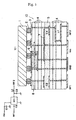
- Fig. 1 is a schematic sectional view of an example of an electronic part to which the dielectric porcelain manufactured by the method of the present invention may be applied.
- the prevent invention enables industrial manufacturing of such an electronic part to put into a new product into the market.
- the present invention is advantageously applicable to a purpose needing piezoelectric porcelain such as a laminated piezoelectric actuator since lead-free, low temperature-sinterable piezoelectric porcelain can be provided by the present invention.
- the dielectric constant of the dielectric porcelain manufactured by the method of the present invention is not particularly limited. However, in a purpose needing a high dielectric constant such as a dielectric capacitor, it is preferred to set the dielectric constant to, for example, 1000 or more.
- the barium titanate-based dielectric material referred to herein means a dielectric material mainly composed of barium titanate. Concretely, it can be, in the raw material stage, a calcined body of barium titanate or a mixture of titanium oxide and barium oxide which produce barium titanate after sintering. When the whole barium titanate-based dielectric material is 100 mol%, 100 mol% may be entirely composed of barium titanate. Otherwise, 30 mol% or less of the barium portion of the dielectric material can be substituted by strontium, calcium or magnesium. Further, 30 mol% or less of the titanium portion of the dielectric material can be substituted by zirconium.
- 0 to 30 mol% can be substituted by at least one compound selected from the group consisting of SrTiO 3 , CaTiO 3 , MgTiO 3 and BaZrO 3 .
- a dielectric porcelain is obtained by sintering a ceramic composition as set out in claim 1.
- the composite oxides in (b) and (c) can be produced by calcination.
- As the composition oxide CuBi 2 O 4 can be given as an example.
- the total amount of Bi 2 O 3 and CuO is controlled to 4 to 10 parts by weight or more, whereby the dielectric constant of porcelain when fired at 1000°C or lower can be improved, for example, to 1000 or more.
- the dielectric loss can be also reduced.
- the total amount of the sub-components is controlled preferably to 4.5 parts by weight or more, more preferably to 5.0 parts by weight or more.
- the dielectric constant of the porcelain is improved also by controlling the total amount of the sub-components to 10.0 parts by weight or less. From this point of view, the total amount of the sub-components is controlled preferably to 9.0 parts by weight or less.
- the molar ratio of the total amount of CuO to Bi 2 O 3 (the total amount of CuO: Bi 2 O 3 ) is set within the range of 1.5:1.0 to 1.0:5.0.
- the range is further preferably 1.5:1.0 to 1.0:2.0. According to this, the dielectric constant of porcelain can be further improved with further reduction in dielectric loss, and low-temperature firing at 1000°C or lower can be performed.
- the composition is sintered at a temperature of 900 to 1000°C. Sintering is difficult at a temperature below 900°C. By setting the sintering temperature to 1000°C or lower, extensive development of the purposes as described above can be attained with a great industrial advantage.
- the sintering temperature is further preferably 980°C or lower. When Ag is used as the conductor, it is preferred to set the sintering temperature to 950°C or lower.
- a means for improving dielectric characteristic by composition control of high-temperature firing BaTiO 3 is also applicable thereto.
- X7R characteristic of EIA standard and B characteristic of JIS standard can be satisfied with a dielectric constant at room temperature ranging from 1000 to 4000.
- one or more compounds selected from the group consisting of ZnO, Nb 2 O 5 and MnO are added to the ceramic composition in a total amount of 0.1 part by weight or more and 1.5 parts by weight or less. According to this, the X7R characteristic of EIA standard or the B characteristic of JIS standard can be satisfied. These characteristics, which are standards related to the electrostatic capacitance of the dielectric porcelain composition and consequently temperature characteristic of electronic part performance, are advantageous for extensive development as electronic parts.
- the total added amount of the one or more compounds selected from the group consisting of ZnO, Nb 2 O 5 and MnO further preferably may be 0.2 part by weight or more, or, 1.2 parts by weight or less.
- the dielectric porcelain obtained by the method of the present invention can have a dielectric constant at 25°C of 1000 or more.
- the upper limit thereof is not particularly limited, but is generally apt to be 4000 or less.
- the dielectric loss at 25°C can be reduced to 5% or less.
- the ceramic composition of the present invention substantially contains no oxide of Pb, except traces of unavoidable impurities.
- the ceramic composition includes 4 to 10 parts by weight in total of CuO and Bi 2 O 3 as the sub-components. According to this, development of piezoelectricity is facilitated in the dielectric porcelain obtained by the present invention.
- the piezoelectric constant is 10 or more although it is not particularly limited. In such a use, the dielectric constant does not have to be high as in the use as dielectric capacitor.
- MgO is not substantially contained (in this case, also unavoidable impurities are allowable).
- MnO is added to the ceramic composition in an amount of 0.02 part by weight or more and 0.2 part by weight or less.
- the piezoelectricity of the dielectric porcelain obtained by the method of the present invention can be further enhanced.
- the amount of MnO is controlled preferably to 0.05 part by weight or more.
- the amount of MnO is controlled preferably to 0.15 part by weight or less, further preferably to 0.1 part by weight or less.
- lithium is added to the ceramic composition in an amount of 0.05 part by weight or more and 0.3 part by weight or less in terms of Li 2 O 3 .
- the piezoelectricity of the dielectric porcelain obtained by the present invention can be further enhanced.
- the amount of Li 2 CO 3 is controlled preferably to 0.2 part by weight or less, further preferably to 0.15 part by weight or less.
- the added amount (total value) of MnO amount and Li 2 CO 3 -converted amount to the ceramic composition is 0.05 part by weight or more and 0.6 part by weight or less.
- the piezoelectricity of the dielectric porcelain obtained can be further enhanced. From the point of the improvement in piezoelectricity, the total amount of the both is controlled preferably to 0.1 part by weight or more. From the point of the improvement in piezoelectricity, the total added amount of the both is controlled preferably to 0.3 part by weight or less, further preferably to 0.2 part by weight.
- the present invention includes the use of a dielectric porcelain, obtained by the above method, as an electronic part.
- the electronic part comprises a low-temperature sinterable conductive film composed ofAg, Cu or Ag-Pd alloy.
- the ceramic composition substantially contains no glass component.
- each metal component for example, oxide, nitrate, carbonate and sulfate of each metal can be used.
- the ratio of each metal oxide component is an equivalent for each metal oxide in the raw material mixture.
- the equivalent for each metal oxide in the raw material mixture is determined by the mixing ratio of each metal raw material.
- the mixing ratio of each metal raw material is weighed by a precision scale, and the equivalent is calculated based on the weighed value.
- the electronic part is not particularly limited, and examples thereof include a laminated ceramic capacitor, a multilayer wiring board, a dielectric composite module, and a laminated piezoelectric actuator.
- a dielectric porcelain obtained by the method of the present invention can be integrated with the other low-dielectric constant dielectric porcelain composition having a dielectric constant ⁇ of 150 or less.
- the composition system of low-temperature fired porcelain constituting the other dielectric layer the followings are particularly preferred: BaO-TiO 2 -ZnO BaO-TiO 2 -Bi 2 O 3 -Nd 2 O 3 BaO-TiO 2 -Bi 2 O 3 -La 2 O 3 -Sm 2 O 3 BaO-Al 2 O 3 -SiO 2 -ZnO.
- each metal component raw material is mixed at a predetermined ratio, the resulting mixed powder is calcined at 900 to 1200°C, and the calcined body is pulverized to give ceramic powder.
- the ceramic powder is preferably granulated while mixing with an appropriate binder such as polyvinyl alcohol, and the granulated powder is molded.
- the resulting molded body is fired at 900 to 1000°C to thereby obtain a dielectric porcelain composition.
- Fig. 1 shows an example of an electronic part to which a dielectric porcelain obtained by the present invention can be applied.
- the part shown in the drawing is a multilayer wiring board with built-in capacitor.
- An integrated circuit 1 is mounted on a multilayer wiring board 10 through an external electrode 3 and a solder bump 2.
- the multilayer wiring board 10 is composed of, for example, a porcelain 4 with low dielectric constant as described above and porcelains 5 and 6 with high dielectric constant of the dielectric porcelain composition of the present invention.
- inner layer electrodes 7 and via conductors 8 are vertically and horizontally formed to constitute multilayer wiring.
- each of C1, C2 and C3 forms a capacitor, which can be used for each predetermined purpose.
- BaCO3 and TiO 2 were weighted, wet-mixed while adding pure water thereto by a ball mill, and dried.
- the resulting dried product was powderized, calcined at 1100°C for 2 hours in the atmosphere, and wet-pulverized so as to have an average particle size of about 1.0 ⁇ m to thereby obtain a barium titanate calcined powder.
- Each powder of Bi 2 O 3 , CuO, ZnO and MgO was weighed as needed so as to have each composition shown in Tables 1 and 2, and added to the barium titanate powder.
- the mixture was wet-mixed by a ball mill for 15 hours, dried, and granulated while adding a proper amount of polyvinyl alcohol, and the resulting granulated product was molded at a pressure of about 1 ton/cm 2 to thereby obtain a disk-like molded body having a diameter of 12 mm and a thickness of 1.0 mm.
- the resulting molded body was mainly fired in the atmosphere at each temperature shown in Tables 1 and 2 to thereby prepare a dielectric porcelain sample of each example.
- Sample A7 was not sintered although the sintering temperature was lowered to 850°C.
- Sample A11 in which the firing temperature was set to 1050°C the dielectric constant was further improved. However, the dielectric loss was slightly reduced.
- Porcelain of each composition shown in Table 3 was produced in the same manner as in Experiment A, and evaluated for each characteristic shown in Table 3.
- the total amount of the first sub-components and the composition ratio of bismuth oxide to the other oxide MeO in the first sub-components were varied as shown in Table 3.
- low-temperature firing could be performed by adding predetermined amounts of the first sub-components according to the present invention, and the dielectric constant of the porcelain could be increased to reduce the dielectric loss.
- Porcelain of each composition shown in Table 6 was produced in the same manner as in Experiment A, and evaluated for each characteristic shown in Tables 6 and 7. Second sub-components were added in amounts shown in Table 6 while fixing the total amount of the first sub-components to 5.0 or 6.0 parts by weight.
- the electrostatic capacitance of the porcelains was measured as follows. The difference between maximum value and minimum value of the electrostatic capacitance in each designated temperature range is shown in Table 7.
- "X7R” and “B” represent the degrees of satisfaction for X7R characteristic of EIA standard and B characteristic of JIS standard, respectively, with " ⁇ ” showing that the standards are satisfied and " ⁇ ” showing that the standards are unsatisfied.
- Porcelain of each composition shown in Table 8 was produced in the same manner as in Experiment A.
- the piezoelectricity measuring sample was formed to have a dimension after sintering of 12 mm (length) ⁇ 3 mm (width) ⁇ 1 mm (thickness).
- Measurement of bulk density, dielectric constant ( ⁇ ) and dielectric loss was performed to the porcelain of each example.
- the results are summarized in Table 8. Further, whether the porcelain could be polarized or not was also examined.
- the poling was performed by applying an electric field of 2 to 2.5 kV/mm in silicone oil of 70°C for 15 minutes.
- Sample E5 was not sintered because the firing temperature was as low as 850°C.
- Sample E9 was found not to be polable although the dielectric constant was increased with a firing temperature of 1050°C. Accordingly, polable compact dielectric porcelain with high dielectric constant that is a sintered body of barium titanate-based porcelain composition in a low-temperature area of 1000°C or lower is provided first by the present invention.
- Dielectric porcelain of each composition shown in Tables 9, 10 and 11 was produced in the same manner as in Experiment A.
- MnO was added in each amount shown in Tables 9 and 10.
- Li 2 CO 3 was added in each amount shown in Table 11. Each characteristic was measured as follows.
- the dielectric porcelain composition of the present invention can provide compact porcelains which show relatively high dielectric constant by firing in a low temperature area of 900 to 1000°C. Further, a piezoelectric constant of an unprecedented high level can be ensured as lead-free porcelain obtained by firing at 1000°C or lower.
Landscapes
- Engineering & Computer Science (AREA)
- Chemical & Material Sciences (AREA)
- Ceramic Engineering (AREA)
- Power Engineering (AREA)
- Manufacturing & Machinery (AREA)
- Microelectronics & Electronic Packaging (AREA)
- Materials Engineering (AREA)
- Structural Engineering (AREA)
- Organic Chemistry (AREA)
- Inorganic Chemistry (AREA)
- Composite Materials (AREA)
- Compositions Of Oxide Ceramics (AREA)
- Inorganic Insulating Materials (AREA)
- Ceramic Capacitors (AREA)
- Production Of Multi-Layered Print Wiring Board (AREA)
Abstract
Description
- The present invention relates to a method of manufacturing a dielectric porcelain, for example, a barium titanate-based dielectric porcelain composition, which is suitably used for manufacturing of a ceramic multilayer substrate or laminated piezoelectric element by use of low temperature co-fired ceramic (LTCC).
- In recent years, it is designed to attain miniaturization and density growth of electronic equipment by integrating a passive part such as a capacitor or inductor which was conventionally mounted on a ceramic substrate surface into a ceramic multilayer substrate. Such a ceramic multilayer substrate is produced by forming a green sheet from a slurry of a dielectric porcelain composition and an organic solvent by doctor blade method followed by drying, printing a wiring conductor on the top surface of the sheet, forming a laminated body by laminating such green sheets of the same dielectric porcelain composition as described above, and co-firing it.
- Such a ceramic multilayer substrate uses Ag or Cu with small specific resistance as the wiring conductor for performing high-performance signal processing at high speed. Therefore, various ceramic materials which can be co-fired with Ag and Cu at temperatures lower than 962°C that is the melting point of Ag and 1084°C that is the melting point of Cu are developed.
- In the above-mentioned ceramic multilayer substrate, a one having a dielectric constant of 10 or less is suitably used for suppressing stray capacitance or coupling capacitance between wires. While, when a capacitor is formed within the ceramic multilayer substrate, it is desirable for the ceramics constituting the capacitor to have a high dielectric constant.
- The barium titanate-based dielectric porcelain composition generally has a high dielectric constant, and can form a high-capacity capacitor within the ceramic multilayer substrate. However, since it needs a sintering temperature as high as 1150 to 1200°C or higher, Ag and Cu cannot be used as the wiring conductor to be co-fired. Therefore, it is necessary for the barium titanate-based dielectric porcelain composition to be sinterable at a temperature of 1000°C or lower while having practical dielectric constant and dielectric loss.
- On the other hand, in use as a piezoelectric element, development of a piezoelectric material having a lead-free composition is demanded since conventional PZT contains lead that is an environmental load substance, and the barium titanate-based porcelain composition is attracting attention as a candidate thereof.
- Further, in use as a laminated piezoelectric element through molding of sheets by the doctor blade method, it is important to develop a low-temperature sintering technique capable of suppressing use of expensive Pt or Pd. However, lead-free piezoelectric porcelain compositions disclosed in the past need firing temperatures of 1000°C or higher.
- Various prior literatures are known for the barium titanate-based dielectric porcelain composition. In Japanese Patent Application Laid-Open No.
Hei 5-120915A - Japanese Patent Application Laid-Open No.
Sho 54-53300A - Japanese Patent Application Laid-Open No.
Sho 61-251561A - Further, in Japanese Patent Application Later-Open Nos.
2001-143955A 2000-226255A 2000-264724A 2003-335575A -
JP 11 278926 - Lead-free piezoelectric porcelain compositions are disclosed, for example, in Japanese Patent Application Laid-Open Nos.
Hei 11-228226A Hei 11-228228A Hei 10-297969A 2942535A Hei 11-29356A 2002-160967A 2002-265262A - However, the dielectric porcelain compositions according to the related art are not desirable from the viewpoint of the environmental load of lead, since lead is contained an essential component. Otherwise, even if low-temperature sintering is possible, the resulting dielectric porcelain composition is low in electric characteristic, for example, with a dielectric constant of 1000 or less and an increasing trend of dielectric loss, and thus insufficient for practical use. A lead-free piezoelectric porcelain material which can be compactly sintered at a low temperature of 1000°C or lower has not been provided yet.
- An object of the present invention is thus to provide a new barium titanate-based dielectric porcelain composition, which can be sintered at a temperature of 1000°C or lower.
- The present invention provides a method of manufacturing a dielectric porcelain as set out in claim 1.
- The present invention also relates to the use of the dielectric porcelain manufactured by this method as an electronic part.
- According to the present invention, a barium titanate-based dielectric porcelain composition which can be sintered at a temperature of 1000°C or lower can be provided. This dielectric porcelain composition is a breakthrough composition without needing not only inclusion of a component such that it excessively loads on the environment such as lead, but also addition of a glass component for reducing the sintering temperature.
- By using the dielectric porcelain composition obtained by the method of the present invention, a conductive film composed of a metal having a relatively low baking temperature such as silver can be co-fired with the dielectric porcelain composition, whereby various electronic parts which were conventionally difficult to manufacture can be provided. To this extent, the present invention has an extremely great industrial advantage.
-
Fig. 1 is a schematic sectional view of an example of an electronic part to which the dielectric porcelain manufactured by the method of the present invention may be applied. - It becomes increasingly important to integrate a high-capacity passive part into an electronic part, for example, in a LTCC material using Ag conductor. The prevent invention enables industrial manufacturing of such an electronic part to put into a new product into the market.
- Further, the present invention is advantageously applicable to a purpose needing piezoelectric porcelain such as a laminated piezoelectric actuator since lead-free, low temperature-sinterable piezoelectric porcelain can be provided by the present invention.
- The dielectric constant of the dielectric porcelain manufactured by the method of the present invention is not particularly limited. However, in a purpose needing a high dielectric constant such as a dielectric capacitor, it is preferred to set the dielectric constant to, for example, 1000 or more.
- The barium titanate-based dielectric material referred to herein means a dielectric material mainly composed of barium titanate. Concretely, it can be, in the raw material stage, a calcined body of barium titanate or a mixture of titanium oxide and barium oxide which produce barium titanate after sintering. When the whole barium titanate-based dielectric material is 100 mol%, 100 mol% may be entirely composed of barium titanate. Otherwise, 30 mol% or less of the barium portion of the dielectric material can be substituted by strontium, calcium or magnesium. Further, 30 mol% or less of the titanium portion of the dielectric material can be substituted by zirconium.
- In the main component 100 mol%, 0 to 30 mol% can be substituted by at least one compound selected from the group consisting of SrTiO3, CaTiO3, MgTiO3 and BaZrO3.
- In the present invention, a dielectric porcelain is obtained by sintering a ceramic composition as set out in claim 1.
- The composite oxides in (b) and (c) can be produced by calcination. As the composition oxide, CuBi2O4 can be given as an example.
- The total amount of Bi2O3 and CuO is controlled to 4 to 10 parts by weight or more, whereby the dielectric constant of porcelain when fired at 1000°C or lower can be improved, for example, to 1000 or more. The dielectric loss can be also reduced. From the viewpoint of improving the dielectric constant, the total amount of the sub-components is controlled preferably to 4.5 parts by weight or more, more preferably to 5.0 parts by weight or more.
- The dielectric constant of the porcelain is improved also by controlling the total amount of the sub-components to 10.0 parts by weight or less. From this point of view, the total amount of the sub-components is controlled preferably to 9.0 parts by weight or less.
- The molar ratio of the total amount of CuO to Bi2O3 (the total amount of CuO: Bi2O3) is set within the range of 1.5:1.0 to 1.0:5.0. The range is further preferably 1.5:1.0 to 1.0:2.0. According to this, the dielectric constant of porcelain can be further improved with further reduction in dielectric loss, and low-temperature firing at 1000°C or lower can be performed.
- The composition is sintered at a temperature of 900 to 1000°C. Sintering is difficult at a temperature below 900°C. By setting the sintering temperature to 1000°C or lower, extensive development of the purposes as described above can be attained with a great industrial advantage. The sintering temperature is further preferably 980°C or lower. When Ag is used as the conductor, it is preferred to set the sintering temperature to 950°C or lower.
- When the porcelain composition manufactured by the method of the present invention is used as a capacitor, a means for improving dielectric characteristic by composition control of high-temperature firing BaTiO3 is also applicable thereto. For example, by firing at 1000°C or lower depending on the kind of additives, X7R characteristic of EIA standard and B characteristic of JIS standard can be satisfied with a dielectric constant at room temperature ranging from 1000 to 4000.
- In a preferred embodiment, one or more compounds selected from the group consisting of ZnO, Nb2O5 and MnO are added to the ceramic composition in a total amount of 0.1 part by weight or more and 1.5 parts by weight or less. According to this, the X7R characteristic of EIA standard or the B characteristic of JIS standard can be satisfied. These characteristics, which are standards related to the electrostatic capacitance of the dielectric porcelain composition and consequently temperature characteristic of electronic part performance, are advantageous for extensive development as electronic parts.
- From the point of improving the temperature characteristic of electrostatic capacitance of the dielectric porcelain manufactured by the method of the invention, the total added amount of the one or more compounds selected from the group consisting of ZnO, Nb2O5 and MnO further preferably may be 0.2 part by weight or more, or, 1.2 parts by weight or less.
- The dielectric porcelain obtained by the method of the present invention can have a dielectric constant at 25°C of 1000 or more. The upper limit thereof is not particularly limited, but is generally apt to be 4000 or less. The dielectric loss at 25°C can be reduced to 5% or less.
- It is preferred that the ceramic composition of the present invention substantially contains no oxide of Pb, except traces of unavoidable impurities.
- The ceramic composition includes 4 to 10 parts by weight in total of CuO and Bi2O3 as the sub-components. According to this, development of piezoelectricity is facilitated in the dielectric porcelain obtained by the present invention.
- When the dielectric porcelain obtained by the present invention is used as piezoelectric porcelain, it is preferred that the piezoelectric constant is 10 or more although it is not particularly limited. In such a use, the dielectric constant does not have to be high as in the use as dielectric capacitor.
- From the point of the piezoelectricity, it is preferred to control the amount of ZnO to 0.1 part by weight or less. From this point of view, it is further preferred that ZnO is not substantially contained (in this case, also, unavoidable impurities are allowable).
- It is preferred that MgO is not substantially contained (in this case, also unavoidable impurities are allowable).
- In a preferred embodiment, MnO is added to the ceramic composition in an amount of 0.02 part by weight or more and 0.2 part by weight or less. According to this, the piezoelectricity of the dielectric porcelain obtained by the method of the present invention can be further enhanced. From the point of the improvement in piezoelectricity, the amount of MnO is controlled preferably to 0.05 part by weight or more. From the point of the improvement in piezoelectricity, the amount of MnO is controlled preferably to 0.15 part by weight or less, further preferably to 0.1 part by weight or less.
- In a preferred embodiment, lithium is added to the ceramic composition in an amount of 0.05 part by weight or more and 0.3 part by weight or less in terms of Li2O3. According to this, the piezoelectricity of the dielectric porcelain obtained by the present invention can be further enhanced. From the point of the improvement in piezoelectricity, the amount of Li2CO3 is controlled preferably to 0.2 part by weight or less, further preferably to 0.15 part by weight or less.
- In a preferred embodiment, the added amount (total value) of MnO amount and Li2CO3-converted amount to the ceramic composition is 0.05 part by weight or more and 0.6 part by weight or less. According to this, the piezoelectricity of the dielectric porcelain obtained can be further enhanced. From the point of the improvement in piezoelectricity, the total amount of the both is controlled preferably to 0.1 part by weight or more. From the point of the improvement in piezoelectricity, the total added amount of the both is controlled preferably to 0.3 part by weight or less, further preferably to 0.2 part by weight.
- In another embodiment, the present invention includes the use of a dielectric porcelain, obtained by the above method, as an electronic part. Particularly preferably, the electronic part comprises a low-temperature sinterable conductive film composed ofAg, Cu or Ag-Pd alloy.
- The ceramic composition substantially contains no glass component.
- As the raw material of each metal component, for example, oxide, nitrate, carbonate and sulfate of each metal can be used.
- In the present invention, the ratio of each metal oxide component is an equivalent for each metal oxide in the raw material mixture. The equivalent for each metal oxide in the raw material mixture is determined by the mixing ratio of each metal raw material. In the present invention, the mixing ratio of each metal raw material is weighed by a precision scale, and the equivalent is calculated based on the weighed value.
- The electronic part is not particularly limited, and examples thereof include a laminated ceramic capacitor, a multilayer wiring board, a dielectric composite module, and a laminated piezoelectric actuator.
- A dielectric porcelain obtained by the method of the present invention can be integrated with the other low-dielectric constant dielectric porcelain composition having a dielectric constant ε of 150 or less. As the composition system of low-temperature fired porcelain constituting the other dielectric layer, the followings are particularly preferred:
BaO-TiO2-ZnO
BaO-TiO2-Bi2O3-Nd2O3
BaO-TiO2-Bi2O3-La2O3-Sm2O3
BaO-Al2O3-SiO2-ZnO.
- When a dielectric porcelain is produced according to the present invention, preferably, each metal component raw material is mixed at a predetermined ratio, the resulting mixed powder is calcined at 900 to 1200°C, and the calcined body is pulverized to give ceramic powder. The ceramic powder is preferably granulated while mixing with an appropriate binder such as polyvinyl alcohol, and the granulated powder is molded. The resulting molded body is fired at 900 to 1000°C to thereby obtain a dielectric porcelain composition.
-
Fig. 1 shows an example of an electronic part to which a dielectric porcelain obtained by the present invention can be applied. The part shown in the drawing is a multilayer wiring board with built-in capacitor. An integrated circuit 1 is mounted on amultilayer wiring board 10 through an external electrode 3 and asolder bump 2. Themultilayer wiring board 10 is composed of, for example, aporcelain 4 with low dielectric constant as described above andporcelains inner layer electrodes 7 and viaconductors 8 are vertically and horizontally formed to constitute multilayer wiring. In thispart 10, each of C1, C2 and C3 forms a capacitor, which can be used for each predetermined purpose. - BaCO3 and TiO2 were weighted, wet-mixed while adding pure water thereto by a ball mill, and dried. The resulting dried product was powderized, calcined at 1100°C for 2 hours in the atmosphere, and wet-pulverized so as to have an average particle size of about 1.0 µm to thereby obtain a barium titanate calcined powder.
- Each powder of Bi2O3, CuO, ZnO and MgO was weighed as needed so as to have each composition shown in Tables 1 and 2, and added to the barium titanate powder. The mixture was wet-mixed by a ball mill for 15 hours, dried, and granulated while adding a proper amount of polyvinyl alcohol, and the resulting granulated product was molded at a pressure of about 1 ton/cm2 to thereby obtain a disk-like molded body having a diameter of 12 mm and a thickness of 1.0 mm. The resulting molded body was mainly fired in the atmosphere at each temperature shown in Tables 1 and 2 to thereby prepare a dielectric porcelain sample of each example.
- The bulk density, dielectric constant (ε), and dielectric loss of each dielectric porcelain sample were measured. The results are summarized in Tables 1 and 2. The measurement methods are as follows.
- Archimedes method
- LCR Meter (1 kHz, 1 V)
Table 1 Sample No. Main Component First sub-component (weight parts) Sub-Components Total Bi2O3 : MeO Sintering Temperature Bulk density Dielectric Constant ε Dielectric Constant BaTiO3 Bi2O3 CuO ZnO MgO (weight Parts) Molar Ratio °C (g/cm3) (%) A1* 100 2.6 0.4 3.0 1 : 1 900 5.50 680 7.1 A2* 100 2.6 0.4 3.0 1 : 1 950 5.56 869 6.8 A3* 100 2.6 0.4 3.0 1 : 1 1000 5.60 921 6.1 A4 100 3.4 0.6 4.0 1 : 1 900 5.63 1032 3.6 A5 100 3.4 0.6 4.0 1 : 1 950 5.86 1058 3.2 A6 100 3.4 0.6 4.0 1 : 1 1000 5.99 1185 3.8 A7* 100 5.1 0.9 6.0 1 : 1 850 Not sintered A8 100 5.1 0.9 6.0 1 : 1 900 5.85 1121 2.9 A9 100 5.1 0.9 6.0 1 : 1 950 5.90 1344 3.1 A10 100 5.1 0.9 6.0 1 : 1 1000 5.92 1405 3.9 A11* 100 5.1 0.9 6.0 1 : 1 1050 5.96 1931 6.2 A12 100 8.5 1.5 10.0 1 : 1 900 5.93 1145 3.4 * Comparative Example Table 2 Sample No. Main Component First sub-component (weight parts) First Sub-component Total Bi2O3 : MeO Sintering Temperature Bulk Density Dielectric Constant ε Dielectric Loss BaTiO3 Bi2O3 CuO ZnO MgO (weight parts) Molar ratio (°C) (g/cm3) (%) A13 100 8.5 1.5 10.0 1 : 1 950 5.95 1082 2.9 A14 100 8.5 1.5 10.0 1 : 1 1000 5.91 1016 3.6 A15* 100 10.2 1.8 12.0 1 : 1 900 5.88 931 7.6 A16* 100 4.3 0.7 5.0 1 : 1 950 5.56 1135 1.9 A17* 100 4.3 0.7 5.0 1 : 1 1000 5.73 1451 2.6 A18* 100 8.5 1.5 10.0 1 : 1 950 5.72 1325 3.6 A19* 100 8.5 1.5 10.0 1 : 1 1000 5.83 1214 3.2 A20* 100 4.6 0.4 5.0 1 : 1 950 5.46 1089 2.1 A21* 100 4.6 0.4 5.0 1 . 1 1000 5.63 1023 3.8 A22* 100 9.2 0.8 10.0 1 : 1 950 5.59 1136 4.9 A23* 100 9.2 0.8 10.0 1 : 1 1000 5.66 1212 4.2 * Comparative Example - Samples A1, A2 and A3 in which the total amount of first sub-components was set to 3.0 parts by weight were low in dielectric constant and high in dielectric loss. In Samples A4, A5 and A6 in which the total amount of the first sub-components was set to 4.0 parts by weight, the dielectric loss was reduced with high dielectric constant. Sample A7 was not sintered although the sintering temperature was lowered to 850°C. Samples A8 to A10 in which the total amount of the first sub-components was set to 6.0 parts by weight, the dielectric constant was further increased with low dielectric loss. In Sample A11 in which the firing temperature was set to 1050°C, the dielectric constant was further improved. However, the dielectric loss was slightly reduced. Samples A12, A13 and A14 in which the total amount of first sub-components was set to 10.0 parts by weight were high in dielectric constant and low in dielectric loss.
- In Sample A15 in which the total amount of first sub-components was set to 12.0 parts by weight, the dielectric constant was reduced, and the dielectric loss was also deteriorated. Samples A16 to A19 in which ZnO was used instead of CuO were high in dielectric constant and low in dielectric loss. In Samples A20 to A23 in which MgO was used instead of CuO, the dielectric loss could be reduced with high dielectric constant. However, CuO and ZuO are seemed to be more preferred.
- Porcelain of each composition shown in Table 3 was produced in the same manner as in Experiment A, and evaluated for each characteristic shown in Table 3. The total amount of the first sub-components and the composition ratio of bismuth oxide to the other oxide MeO in the first sub-components were varied as shown in Table 3.
Table 3 Sample No. Main Component First sub-components (weight parts) First Sub-components Total Bi2O3: MeO Sintering Temperature Bulk Density Dielectric Constant ε Dielectric Loss BaTiO3 Bi2O3 CuO ZnO MgO (weight parts) Molar ratio (°C) (g/cm3) (%) B1 100 4.5 1.5 6.0 1.0:2.0 920 5.30 778 10.1 B2 100 4.8 1.2 6.0 1.0:1.5 920 5.77 1036 4.9 B3 100 5.5 0.5 6.0 2.0:1.0 920 5.84 1164 4.2 B4 100 5.8 0.2 6.0 5.0:1.0 920 5.48 1032 4.4 B5 100 5.9 0.1 6.0 7.0:1.0 920 5.21 430 12.1 B6* 100 6.0 6.0 - 980 Not sintered B7* 100 4.4 1.6 6.0 1.0:2.0 980 Not sintered B8* 100 4.8 1.2 6.0 1.0:1.5 960 5.57 1221 3.6 B9* 100 5.1 0.9 6.0 2.0:1.0 960 5.81 1542 3.9 B10* 100 5.5 0.5 6.0 5.0:1.0 960 5.51 1158 4.1 B11* 100 5.8 0.2 6.0 7.0:1.0 980 Not sintered B12* 100 5.1 0.9 6.0 1.0:2.0 980 Not sintered B13* 100 5.3 0.7 6.0 1.0:1.5 980 5.41 1431 2.2 B14* 100 5.8 0.2 6.0 2.0:1.0 980 5.77 1551 2.8 B15* 100 5.9 0.1 6.0 5.0:1.0 980 5.38 1031 3.8 * Comparative Example - In
Samples B 2 to B5, B8 to B10, and B 13 to B15 in which the molar ratio of the total amount (MeO) of at least one compound selected from the group consisting of CuO, ZnO and MgO to Bi2O3 ranges from 1.5:1.0 to 1.0:5.0, each characteristic was particularly excellent. - Porcelain of each composition show in Tables 4 and 5 was produced in the same manner as in Experiment A, and evaluated for each characteristic shown in Table 4. As the main component, a part of BaTiO3 was substituted by other components shown in Tables 4 and 5.
Table 4 Sample No. Main components (molar %) First Sub-components (weight parts) First Subcomponents Total Sintering Temperature Bulk Density Dielectric Constant ε Dielectric Loss BaTiO3 SrTiO3 CaTiO3 MgTiO3 BaZrO3 Bi2O3 CuO (weight parts) (°C) (g/cm3) (%) C1 90 10 4.3 0.7 5.0 980 5.81 2263 3.1 C2 80 10 5.1 0.9 6.0 940 5.89 2152 3.3 C3 70 20 4.3 0.7 5.0 980 5.85 2981 3.3 C4 90 20 5.1 0.9 6.0 940 5.87 2889 2.9 C5 80 30 4.3 0.7 5.0 980 5.87 3851 3.4 C6 70 30 5.1 0.9 6.0 940 5.81 3621 3.9 C7 99 1 4.3 0.7 5.0 980 5.79 1522 1.3 C8 99 1 5.1 0.9 6.0 940 5.77 1515 1.4 C9 98 2 4.3 0.7 5.0 980 5.65 1321 1.5 C10 98 2 5.1 0.9 6.0 940 5.71 1301 1.3 C11 95 5 4.3 0.7 5.0 980 5.88 1288 1.3 C12 95 5 5.1 0.9 6.0 940 5.99 1311 1.2 Table 5 Sample No. Main components (molar %) First Subcomponents (weight parts) First Sub-Components Total Sintering Temperature Bulk Density Dielectric Constant ε Dielectric loss BaTiO3 SrTiO3 CaTiO3 MgTiO3 BaZrO3 Bi2O3 CuO (weight parts) (°C) (g/cm3) (%) C13 99 1 4.3 0.7 5.0 980 5.87 1941 2.0 C14 99 1 5.1 0.9 6.0 940 5.98 1534 1.9 C15 98 2 4.3 0.7 5.0 980 5.86 2037 1.9 C16 98 2 5.1 0.9 6.0 940 5.85 1621 1.8 C17 95 5 4.3 0.7 5.0 980 5.71 2213 2.1 C18 95 5 5.1 0.9 6.0 940 5.73 1910 2.2 C19 90 10 4.3 0.7 5.0 980 5.41 1856 3.6 C20 90 10 5.1 0.9 6.0 940 5.89 1648 4.1 C21 80 20 4.3 0.7 5.0 980 5.92 2431 4.6 C22 80 20 5.1 0.9 6.0 940 5.77 2251 3.9 C23 70 30 4.3 0.7 5.0 980 5.61 3982 4.4 C24 70 30 5.1 0.9 6.0 940 5.66 3880 3.9 - Consequently, in also Samples C1 to C24, low-temperature firing could be performed by adding predetermined amounts of the first sub-components according to the present invention, and the dielectric constant of the porcelain could be increased to reduce the dielectric loss.
- Porcelain of each composition shown in Table 6 was produced in the same manner as in Experiment A, and evaluated for each characteristic shown in Tables 6 and 7. Second sub-components were added in amounts shown in Table 6 while fixing the total amount of the first sub-components to 5.0 or 6.0 parts by weight.
- The electrostatic capacitance of the porcelains was measured as follows. The difference between maximum value and minimum value of the electrostatic capacitance in each designated temperature range is shown in Table 7. "X7R" and "B" represent the degrees of satisfaction for X7R characteristic of EIA standard and B characteristic of JIS standard, respectively, with "○" showing that the standards are satisfied and "×" showing that the standards are unsatisfied.
Table 6 No. Main Component First Sub-Components (weight Parts) First Sub-Component Total Second Sub-Components (weight Parts) Second Sub-components total Sintering Temperature Bulk Density Dielectric Constant ε Dielectric Loss BaTiO3 Bi2O3 CuO Weight Parts ZnO Nb2O5 MnO Weight Parts °C g/cm3 (%) D1 100 4.3 0.7 5.0 0.2 0.2 960 5.55 1581 1.3 D2 100 4.3 0.7 5.0 0.5 0.5 960 5.89 1989 1.1 D3 100 4.3 0.7 5.0 0.8 0.8 960 5.85 1972 1.3 D4 100 4.3 0.7 5.0 1 1.0 960 5.87 1921 0.9 D5 100 4.3 0.7 5.0 1.2 1.2 960 6.79 1968 1 D6 100 4.3 0.7 5.0 0.2 0.2 960 5.68 1522 2.8 D7 100 4.3 0.7 5.0 0.4 0.1 0.5 960 5.96 1301 0.7 D8 100 4.3 0.7 5.0 0.2 0.3 0.5 960 5.88 1288 0.6 D9 100 5.1 0.9 6.0 0.2 0.2 930 5.99 2521 0.7 D10 100 5.1 0.9 6.0 0.5 0.5 930 5.87 2640 0.9 D11 100 5.1 0.9 6.0 0.8 0.8 930 5.98 2621 1 D12 100 5.1 0.9 6.0 1 1.0 930 5.86 2699 0.8 D13 100 5.1 0.9 6.0 1.2 1.2 930 5.85 2683 0.7 D14 100 5.1 0.9 6.0 0.2 0.2 930 5.73 1836 2.9 D15 100 5.1 0.9 6.0 0.5 0.5 930 5.41 1856 2.1 D16 100 5.1 0.9 6.0 0.2 0.3 0.5 930 5.87 1698 0.5 Table 7 Sample No. Temperature-dependency of electrostatic capacity ΔC (-55 °C/25 °C) ΔC (125 °C/25 °C) X7R ΔC (-25 °C/20 °C) ΔC (85 °C/20 °C) B D1 -22.0 +0.02 × -9.3 +6.2 ○ D2 -14.3 -6.8 ○ -8.5 -1.3 ○ D3 -13.9 -7.9 ○ -8.2 -2.8 ○ D4 -13.3 -12.5 ○ -8.4 -4.5 ○ D5 -14.1 -14.3 ○ -7.7 -5.8 ○ D6 -14.7 +10.8 ○ -8.9 +9.9 ○ D7 -14.3 +20.6 × -6.9 +9.5 ○ D8 -14.4 +14.3 ○ -7.1 +5.1 ○ D9 -20.8 -2.8 × -7.5 +0.1 ○ D10 -13.2 -4.1 ○ -3.9 -4.8 ○ D11 -12.6 -10.9 ○ -0.2 -4.4 ○ D12 -9.6 -13.9 ○ +0.6 -5.8 ○ D13 -8.3 -14.8 ○ +0.9 -8.7 ○ D14 -20.9 +25.2 × -8.6 +9.7 ○ D15 -13.2 +1.8 ○ -7.2 +7.9 ○ D16 -13.8 +13.1 ○ -8:9 +5.9 ○ - In each of Samples D1 to D16, low-temperature firing could be performed, and the dielectric loss of porcelain could be remarkably reduced with high dielectric constant. Further, it was found that the temperature change rate of electrostatic capacitance of the porcelain can be reduced to satisfy the X7R characteristic of EIA standard and the B characteristic of JIS standard.
- Porcelain of each composition shown in Table 8 was produced in the same manner as in Experiment A. The piezoelectricity measuring sample was formed to have a dimension after sintering of 12 mm (length) × 3 mm (width) × 1 mm (thickness). Measurement of bulk density, dielectric constant (ε) and dielectric loss was performed to the porcelain of each example. The results are summarized in Table 8. Further, whether the porcelain could be polarized or not was also examined. The poling was performed by applying an electric field of 2 to 2.5 kV/mm in silicone oil of 70°C for 15 minutes.
Table 8 Main component sub-component (weight parts) total sub - components Bi2O3: CuO sintering temperature Density Dielectric Constant ε Dielectric Loss tanδ Polarization BaTiO3 Bi2O3 CuO Weight parts Molar Ratio °C (g/cm3) (%) E1* 100 2.6 0.4 3.0 1 : 1 900 5.50 680 7.1 × E2* 100 2.6 0.4 3.0 1 : 1 950 5.56 869 6.8 × E3 100 3.4 0.6 4.0 1 : 1 900 5.63 1032 3.6 ○ E4 100 3.4 0.6 4.0 1 : 1 950 5.86 1058 3.2 × E5* 100 5.1 0.9 6.0 1 : 1 850 Not sintered × E6 100 5.1 0.9 6.0 1 : 1 900 5.85 1121 2.9 ○ E7 100 5.1 0.9 6.0 1 : 1 950 5.90 1344 3.1 ○ E8 100 5.1 0.9 6.0 1 : 1 1000 5.92 1405 3.9 ○ E9* 100 5.1 0.9 6.0 1 : 1 1050 5.96 1931 6.2 × E10 100 8.5 1.5 10.0 1 : 1 950 5.95 1082 2.9 ○ E11* 100 10.2 1.8 12.0 1 : 1 900 5.88 984 7.6 × * Comparative Example - Sample E5 was not sintered because the firing temperature was as low as 850°C. Sample E9 was found not to be polable although the dielectric constant was increased with a firing temperature of 1050°C. Accordingly, polable compact dielectric porcelain with high dielectric constant that is a sintered body of barium titanate-based porcelain composition in a low-temperature area of 1000°C or lower is provided first by the present invention.
- Dielectric porcelain of each composition shown in Tables 9, 10 and 11 was produced in the same manner as in Experiment A. In Experiments E12 to E29, MnO was added in each amount shown in Tables 9 and 10. In Experiments E 30 to E41, Li2CO3 was added in each amount shown in Table 11. Each characteristic was measured as follows.
- According to Experiment A (Electromechanical Coupling Factor k31, Piezoelectric Constant d31, Mechanical Quality Factor Qm)
-
Table 9 Main Component Sub- Component (weight Parts) Bi2O3 : CuO MnO Weight Parts Sintering Temperature Density Dielectric Constant ε Dielectric Loss tanδ Electromechanical Coupling Factor (k31)
Piezoelectric Constant (d31) Mechanical quality Constant (Qm) BaTiO3 Bi2O3 CuO Molar Ratio ° C (g/cm3) (%) (%) (10-12m/V) E6 100 5.1 09 1 : 1 900 5.85 1121 2.9 2.8 8.7 195 E7 100 5.1 0.9 1 : 1 950 5.90 1344 3.1 3.7 13.0 85 E8 100 5.1 0.9 1 : 1 1000 5.92 1405 3.9 5.2 17.8 44 E12 100 5.1 0.9 1 : 1 0.02 900 5.88 911 1.5 4.0 10.1 298 E13 100 5.1 0.9 1 : 1 002 920 5.86 920 3.5 3.1 17.7 232 E14 100 5.1 0.9 1 : 1 0.02 940 5.92 921 2.5 2.8 16.9 298 E15 100 4.3 0.7 1 : 1 002 960 5.91 937 3.5 3.4 18.3 201 E16 100 4.3 0.7 1 : 1 0.02 980 5.91 984 2.5 2.8 16.9 279 E17 100 4.3 0.7 1 : 1 0.02 1000 5.94 921 3.1 4.8 16.4 298 E18 100 5.1 0.9 1 : 1 0.1 900 5.89 1398 3.7 5.6 18.9 131 E19 100 5.1 0.9 1 : 1 0.1 920 5.87 1395 3.2 69 19.7 109 E20 100 5.1 0.9 1 : 1 0.1 940 5.88 1336 3.1 76 18.0 136 Table 1 0 Main Component Sub- Component (weight Parts) Bi2O3 : CuO MnO Weight Parts Sintering Temperature Density Dielectric Constant ε Dielectric Loss tanδ Electromechanical Coupling Factor (k31)
Piezoelectric Constant (d31) Mechanical quality Constant (Qm) BaTiO3 Bi2O3 CuO Molar Ratio °C (g/cm3) (%) (%) (10-12m/lV) E21 100 4.3 0.7 1 : 1 0.1 960 5.93 1304 3.9 7.8 19.1 117 E22 100 4.3 0.7 1 : 1 0.1 980 5.94 1273 3.6 8.1 19.6 102 E23 100 4.3 0.7 1 : 1 0.1 1000 5.98 1116 3.1 8.2 19.2 102 E24 100 5.1 0.9 1 : 1 0.15 900 5.97 1430 5.7 3.6 8.9 71 E25 100 5.1 0.9 1 : 1 0.2 900 5.99 1552 6.2 2.9 10.1 70 E26 100 5.1 0.9 1 : 1 0.15 940 5.97 1496 5.1 3.6 8.4 70 E27 100 5.1 0.9 1 : 1 0.2 940 5.98 1430 6.9 2.8 9.4 61 E28 100 5.1 0.9 1 : 1 0.15 1000 5.94 1304 5.6 4.1 9.7 40 E29 100 5.1 0.9 1 : 1 0.2 1000 5.93 1336 6.1 3.2 10.1 49 Table 11 Main Component Sub-Component (weight Parts) Bi2O3 : CuO Li2CO3 Weight Parts Sintering Temperature Density Dielectric Constant ε Dielectric Loss tanδ Electromechanical Coupling Factor (k31)
Piezoelectric Constant (d31) Mechanical quality Constant (Qm) BaTiO3 Bi2O3 CuO Molar Ratio ° C (g/cm3) (%) (%) (10-12m/V) E30 100 5.1 0.9 1 : 1 0.05 900 5.98 890 0.6 8.1 16.9 279 E31 100 5.1 0.9 1 : 1 0.1 900 5.98 838 0.6 12.1 24.8 216 E32 100 5.1 0.9 1 : 1 0.05 940 5.99 822 1.5 13.6 25.7 201 E33 100 4.3 0.7 1 : 1 0.1 940 5.95 835 1.6 14.4 27.7 174 E34 100 4.3 0.7 1 : 1 0.05 1000 5.94 869 1.8 14.0 29.7 151 E35 100 4.3 0.7 1 : 1 0.1 1000 5.99 834 1.5 14.6 30.0 169 E36 100 5.1 0.9 1 : 1 0.2 900 5.91 1203 6.6 6.2 17.2 272 E37 100 5.1 0.9 1 : 1 0.3 900 5.96 1029 7.8 4.7 11.6 333 E38 100 5.1 0.9 1 : 1 0.2 940 5.95 1136 6.5 7.3 19.0 373 E39 100 4.3 0.7 1 : 1 0.3 940 5.97 1148 7.6 7.1 18.9 369 E40 100 4.3 0.7 1 : 1 0.2 1000 5.96 1183 6.8 8.0 21.0 358 E41 100 4.3 0.7 1 : 1 0.3 1000 5.99 1148 7.5 7.2 19.3 302 - As is apparent from Tables 9, 10 and 11, the dielectric porcelain composition of the present invention can provide compact porcelains which show relatively high dielectric constant by firing in a low temperature area of 900 to 1000°C. Further, a piezoelectric constant of an unprecedented high level can be ensured as lead-free porcelain obtained by firing at 1000°C or lower.
- It was found from Samples E12 to E29 that the piezoelectric constant can be further enhanced by controlling the ratio of MnO to 0.1 part by weight or less.
- Further, it was found from Samples E30 to E41 that the piezoelectric constant can be further enhanced by controlling the ratio of Li2CO3 to 0.05 to 0.10 part by weight.
- While specific preferred embodiments have been shown and described, the present invention is never limited by these specific embodiments, and can be carried out with various modifications and substitutions without departing from the scope of the claims thereof.
Claims (7)
- A method of manufacturing a dielectric porcelain, the method including the step of sintering a ceramic composition comprising:(A) 100 parts by weight of a barium titanate-based dielectric material selected from the group consisting of:(i) barium titanate;(ii) barium titanate with up to 30 mol % or less of the barium substituted by strontium, calcium or magnesium;(iii) barium titanate with up to 30 mol % or less of the titanium substituted by zirconium; and(iv) barium titanate with up to 30 mol % or less of the barium substituted by strontium, calcium or magnesium and with up to 30 mol % or less of the titanium substituted by zirconium,and(B) 4 to 10 parts by weight in total of Bi2O3 and CuO as subcomponents, wherein the molar ratio of CuO to Bi2O3 ranges from 1.5:1.0 to 1.0:5.0, and wherein the Bi2O3 and CuO are added as:(a) Bi2O3 and CuO;(b) CuBi2O4 ; or(c) Bi2O3, CuO and CuBi2O4,wherein the ceramic composition contains substantially no glass component and wherein the composition is sintered at a temperature of 900 to 1000°C.
- A method according to claim 1, wherein 0 to 30 mol% of the barium titanate in (A)(i) is substituted with at least one component selected from the group consisting of SrTiO3, CaTiO3, MgTiO3 and BaZrO3.
- A method according to claim 1 or claim 2, wherein at least one component selected from the group consisting of ZnO, Nb2O5 and MnO is added to the ceramic composition in an amount of 0.1 part by weight or more and 1.5 parts by weight or less.
- A method according to claim 3, wherein MnO is added in an amount of 0.02 part by weight or more and 0.2 part by weight or less.
- A method according to claim 4, wherein lithium is added in an amount of 0.05 part by weight or more and 0.3 part by weight or less in terms of Li2CO3.
- Use of a dielectric porcelain manufactured by the method of any one of claims 1 to 5 as an electronic part.
- Use according to claim 6 wherein the electronic part comprises the dielectric porcelain and a conductive film comprising a material selected from the group consisting of Ag, Cu and Ag-Pd alloy.
Applications Claiming Priority (3)
| Application Number | Priority Date | Filing Date | Title |
|---|---|---|---|
| JP2006093579 | 2006-03-30 | ||
| JP2006235529A JP5294441B2 (en) | 2006-03-30 | 2006-08-31 | Electronic components |
| PCT/JP2007/055781 WO2007122948A1 (en) | 2006-03-30 | 2007-03-14 | Dielectric porcelain composition and electronic component |
Publications (4)
| Publication Number | Publication Date |
|---|---|
| EP2000445A2 EP2000445A2 (en) | 2008-12-10 |
| EP2000445A9 EP2000445A9 (en) | 2009-03-25 |
| EP2000445A4 EP2000445A4 (en) | 2010-04-28 |
| EP2000445B1 true EP2000445B1 (en) | 2013-12-25 |
Family
ID=38624857
Family Applications (1)
| Application Number | Title | Priority Date | Filing Date |
|---|---|---|---|
| EP07739224.9A Not-in-force EP2000445B1 (en) | 2006-03-30 | 2007-03-14 | Method of manufacturing a dielectric porcelain |
Country Status (6)
| Country | Link |
|---|---|
| US (1) | US7781360B2 (en) |
| EP (1) | EP2000445B1 (en) |
| JP (1) | JP5294441B2 (en) |
| KR (1) | KR101009596B1 (en) |
| CN (1) | CN101410344B (en) |
| WO (1) | WO2007122948A1 (en) |
Families Citing this family (17)
| Publication number | Priority date | Publication date | Assignee | Title |
|---|---|---|---|---|
| JP4840935B2 (en) | 2007-09-28 | 2011-12-21 | 双信電機株式会社 | Ceramic multilayer substrate |
| KR100930184B1 (en) | 2007-11-29 | 2009-12-07 | 삼성전기주식회사 | Dielectric Composition and Multilayer Ceramic Capacitor Embedded Low Temperature Simultaneous Ceramic Substrate Using the Same |
| EP2330604A4 (en) | 2008-09-30 | 2018-03-28 | Soshin Electric Co. Ltd. | Composite electronic component |
| JP5414433B2 (en) | 2008-09-30 | 2014-02-12 | キヤノン株式会社 | Ferroelectric ceramic material |
| US8299688B2 (en) * | 2009-03-12 | 2012-10-30 | Canon Kabushiki Kaisha | Piezoelectric material, method of manufacturing the same, and piezoelectric device |
| WO2011162044A1 (en) * | 2010-06-24 | 2011-12-29 | 株式会社村田製作所 | Dielectric ceramic composition and multilayer ceramic electronic component |
| WO2012043208A1 (en) | 2010-09-30 | 2012-04-05 | 株式会社村田製作所 | Dielectric ceramic, multilayer ceramic electronic component, and methods for producing same |
| WO2012128175A1 (en) | 2011-03-18 | 2012-09-27 | 株式会社村田製作所 | Laminated ceramic capacitor, dielectric ceramic, laminated ceramic electronic component, and process for producing laminated ceramic capacitor |
| WO2012133077A1 (en) | 2011-03-25 | 2012-10-04 | 株式会社村田製作所 | Multilayer ceramic capacitor, dielectric ceramic, multilayer ceramic electronic component, and method for manufacturing multilayer ceramic capacitor |
| JP5883244B2 (en) * | 2011-07-12 | 2016-03-09 | 双信電機株式会社 | Capacitor module |
| CN102584212A (en) * | 2012-01-31 | 2012-07-18 | 厦门大学 | Low-dielectric-loss ceramic material and preparation method thereof |
| JP6075765B2 (en) * | 2013-03-23 | 2017-02-08 | 京セラ株式会社 | Piezoelectric element |
| CN104193328B (en) * | 2014-09-03 | 2015-11-18 | 鞍山信材科技有限公司 | A kind of leadless environment-friendly of resistance to high power type ceramic medium material |
| JP6649916B2 (en) * | 2017-05-22 | 2020-02-19 | 双信電機株式会社 | Resonator |
| CN109824356A (en) * | 2019-03-19 | 2019-05-31 | 武汉理工大学 | A kind of barium phthalate base high performance piezoelectric ceramic material and preparation method thereof |
| KR102792555B1 (en) * | 2020-07-01 | 2025-04-08 | 삼성전자주식회사 | Relaxor-ferroelectric materials and methods of synthesizing the same and device including relaxor-ferroelectric material |
| CN113045307B (en) * | 2021-04-06 | 2022-09-02 | 郑州轻工业大学 | High-dielectric low-loss barium titanate-based ceramic and preparation method thereof |
Family Cites Families (39)
| Publication number | Priority date | Publication date | Assignee | Title |
|---|---|---|---|---|
| DE2736688C2 (en) | 1977-08-16 | 1986-02-20 | Philips Patentverwaltung Gmbh, 2000 Hamburg | Process for the production of a dielectric with a perovskite structure |
| US4459364A (en) * | 1982-09-13 | 1984-07-10 | North American Philips Corporation | Low-fire ceramic dielectric compositions |
| JPH06104587B2 (en) | 1985-04-26 | 1994-12-21 | 旭化成工業株式会社 | Dielectric ceramic composition and method for producing the same |
| US4764494A (en) | 1985-04-26 | 1988-08-16 | Asahi Kasei Kogyo Kabushiki Kaisha | Dielectric ceramic compositions and process for producing the same |
| US5571761A (en) * | 1986-08-22 | 1996-11-05 | Canon Kabushiki Kaisha | Ceramic substrate circuit substrate |
| JPH01192762A (en) * | 1988-01-28 | 1989-08-02 | Asahi Chem Ind Co Ltd | Dielectric ceramic composition comprising barium titanate as base material |
| JP3439774B2 (en) | 1991-10-30 | 2003-08-25 | 京セラ株式会社 | Dielectric porcelain composition |
| JP3523280B2 (en) * | 1991-12-28 | 2004-04-26 | Tdk株式会社 | Manufacturing method of multilayer ceramic parts |
| EP0637041B1 (en) * | 1993-07-26 | 1998-04-29 | Murata Manufacturing Co., Ltd. | Dielectric ceramic compositions |
| JP3161278B2 (en) * | 1995-04-26 | 2001-04-25 | 株式会社村田製作所 | Dielectric porcelain composition |
| JP3228175B2 (en) | 1997-04-28 | 2001-11-12 | 株式会社村田製作所 | Piezoelectric ceramic composition |
| JP3244027B2 (en) | 1997-07-09 | 2002-01-07 | 株式会社村田製作所 | Piezoelectric ceramic composition |
| JPH11171645A (en) * | 1997-12-09 | 1999-06-29 | Hitachi Metals Ltd | Electronic part |
| TW563265B (en) | 1998-02-18 | 2003-11-21 | Murata Manufacturing Co | Piezoelectric ceramic composition |
| JP3282576B2 (en) | 1998-02-18 | 2002-05-13 | 株式会社村田製作所 | Piezoelectric ceramic composition |
| JP3259678B2 (en) | 1998-02-18 | 2002-02-25 | 株式会社村田製作所 | Piezoelectric ceramic composition |
| JPH11310455A (en) * | 1998-02-27 | 1999-11-09 | Murata Mfg Co Ltd | Dielectric ceramic composition and ceramic electronic component using the same |
| JP2942535B1 (en) | 1998-03-06 | 1999-08-30 | ティーディーケイ株式会社 | Piezoelectric porcelain composition |
| JP3798905B2 (en) * | 1998-03-30 | 2006-07-19 | 京セラ株式会社 | Dielectric porcelain and multilayer porcelain capacitor |
| JP3706489B2 (en) * | 1998-11-30 | 2005-10-12 | 京セラ株式会社 | Dielectric porcelain and manufacturing method thereof |
| US6251816B1 (en) * | 1998-12-31 | 2001-06-26 | Mra Laboratories, Inc. | Capacitor and dielectric ceramic powder based upon a barium borate and zinc silicate dual-component sintering flux |
| JP2000226255A (en) | 1999-02-03 | 2000-08-15 | Murata Mfg Co Ltd | Dielectric ceramic composition and ceramic multilayer substrate |
| JP2000264724A (en) | 1999-03-18 | 2000-09-26 | Murata Mfg Co Ltd | Dielectric ceramic composition and ceramic multilayer substrate |
| JP3509710B2 (en) | 1999-09-03 | 2004-03-22 | 株式会社村田製作所 | Dielectric ceramic composition and multilayer ceramic capacitor |
| US6642167B1 (en) * | 1999-11-09 | 2003-11-04 | Murata Manufacturing Co., Ltd. | Dielectric ceramic composition, monolithic ceramic substrate, ceramic electronic component, and monolithic ceramic electronic component |
| JP2002173368A (en) * | 2000-02-15 | 2002-06-21 | Ngk Spark Plug Co Ltd | Dielectric porcelain composition |
| JP2001247365A (en) * | 2000-03-02 | 2001-09-11 | Murata Mfg Co Ltd | Dielectric ceramic composition, and electronic component and electronic device |
| WO2001097254A2 (en) * | 2000-06-15 | 2001-12-20 | Vishay Electronic Gmbh | Method for producing dielectric capacitor ceramics |
| JP3482394B2 (en) | 2000-11-20 | 2003-12-22 | 松下電器産業株式会社 | Piezoelectric ceramic composition |
| JP4529301B2 (en) | 2001-03-08 | 2010-08-25 | Tdk株式会社 | Piezoelectric ceramic |
| JP5170355B2 (en) * | 2001-05-17 | 2013-03-27 | Tdk株式会社 | Dielectric porcelain composition |
| DE10132798C1 (en) * | 2001-07-06 | 2003-01-16 | Epcos Ag | Ceramic material, ceramic multilayer component and method for producing the component |
| KR100444224B1 (en) * | 2001-11-13 | 2004-08-16 | 삼성전기주식회사 | Dielectric Ceramic Compositions |
| JP4048790B2 (en) * | 2002-02-12 | 2008-02-20 | 松下電器産業株式会社 | Dielectric ceramic composition, dielectric ceramic, and ceramic capacitor using the same |
| JP2003335575A (en) | 2002-05-21 | 2003-11-25 | Kcm Corp | Dielectric porcelain composition |
| DE10245106A1 (en) * | 2002-09-27 | 2004-04-15 | Siemens Ag | Glass-ceramic material suitable for making electrical phase shift component operating at specific frequencies, has specified relative permittivity |
| JP3751304B2 (en) * | 2002-12-18 | 2006-03-01 | 昭和電工株式会社 | Barium titanate and electronic components using the same |
| JP4775583B2 (en) * | 2004-03-05 | 2011-09-21 | 宇部興産株式会社 | Dielectric particle aggregate, low-temperature sintered dielectric ceramic composition using the same, and low-temperature sintered dielectric ceramic manufactured using the same |
| KR100930184B1 (en) * | 2007-11-29 | 2009-12-07 | 삼성전기주식회사 | Dielectric Composition and Multilayer Ceramic Capacitor Embedded Low Temperature Simultaneous Ceramic Substrate Using the Same |
-
2006
- 2006-08-31 JP JP2006235529A patent/JP5294441B2/en not_active Expired - Fee Related
-
2007
- 2007-03-14 EP EP07739224.9A patent/EP2000445B1/en not_active Not-in-force
- 2007-03-14 CN CN2007800112927A patent/CN101410344B/en not_active Expired - Fee Related
- 2007-03-14 WO PCT/JP2007/055781 patent/WO2007122948A1/en not_active Ceased
- 2007-03-14 KR KR1020087024107A patent/KR101009596B1/en not_active Expired - Fee Related
-
2008
- 2008-09-04 US US12/204,006 patent/US7781360B2/en not_active Expired - Fee Related
Also Published As
| Publication number | Publication date |
|---|---|
| US7781360B2 (en) | 2010-08-24 |
| EP2000445A2 (en) | 2008-12-10 |
| JP5294441B2 (en) | 2013-09-18 |
| KR20080104174A (en) | 2008-12-01 |
| KR101009596B1 (en) | 2011-01-20 |
| JP2007290940A (en) | 2007-11-08 |
| CN101410344B (en) | 2012-07-25 |
| EP2000445A4 (en) | 2010-04-28 |
| WO2007122948A1 (en) | 2007-11-01 |
| CN101410344A (en) | 2009-04-15 |
| EP2000445A9 (en) | 2009-03-25 |
| US20090011923A1 (en) | 2009-01-08 |
Similar Documents
| Publication | Publication Date | Title |
|---|---|---|
| US7781360B2 (en) | Dielectric porcelain composition and electronic component | |
| KR100264646B1 (en) | Dielectric ceramic composition and monolithic ceramic capacitor using the same | |
| KR100201201B1 (en) | Monolithic ceramic capacitors | |
| EP0257653B1 (en) | High dielectric constant ceramic material and method of manufacturing the same | |
| KR100271099B1 (en) | Dielectric ceramic composition and monolithic ceramic capacitor using same | |
| EP0534378A1 (en) | Non-reducible dielectric ceramic composition | |
| EP0354353B1 (en) | Monolithic ceramic capacitor | |
| EP0368619B1 (en) | Dielectric ceramic composition | |
| JP2566995B2 (en) | High dielectric constant porcelain composition and ceramic capacitor | |
| US20030100438A1 (en) | Ceramic materials for Capacitors with a high dielectric constant and a low capacitance change with temperature | |
| US4985381A (en) | Dielectric ceramic composition | |
| US6322718B1 (en) | Piezoelectric ceramic compositions and methods for production thereof | |
| KR101884104B1 (en) | Layered body, layered device, and methods for producing same | |
| JPH07309661A (en) | Ceramic composition, sintering method, sintering ceramic body and multilayer capacitor | |
| JPH05190376A (en) | Ceramic capacitors | |
| EP0486827A2 (en) | Dielectric material and capacitor made from the same | |
| JPH0987014A (en) | Method for producing high dielectric constant porcelain composition | |
| JP2821768B2 (en) | Multilayer ceramic capacitors | |
| JP2694975B2 (en) | Method for producing high dielectric constant porcelain composition | |
| JPH054354B2 (en) | ||
| JPH1154359A (en) | Dielectric porcelain, multilayer ceramic capacitor and method for producing dielectric porcelain | |
| JPH08208327A (en) | Dielectric porcelain composition | |
| JPH0617265B2 (en) | Method for producing dielectric ceramic composition | |
| JPH06122544A (en) | Dielectric material | |
| JP2000072547A (en) | Dielectric ceramic composition and multilayer ceramic capacitor |
Legal Events
| Date | Code | Title | Description |
|---|---|---|---|
| PUAI | Public reference made under article 153(3) epc to a published international application that has entered the european phase |
Free format text: ORIGINAL CODE: 0009012 |
|
| 17P | Request for examination filed |
Effective date: 20081006 |
|
| AK | Designated contracting states |
Kind code of ref document: A2 Designated state(s): DE FR GB |
|
| PUAB | Information related to the publication of an a document modified or deleted |
Free format text: ORIGINAL CODE: 0009199EPPU |
|
| RBV | Designated contracting states (corrected) |
Designated state(s): DE FR GB |
|
| A4 | Supplementary search report drawn up and despatched |
Effective date: 20100325 |
|
| 17Q | First examination report despatched |
Effective date: 20101028 |
|
| DAX | Request for extension of the european patent (deleted) | ||
| REG | Reference to a national code |
Ref country code: DE Ref legal event code: R079 Ref document number: 602007034441 Country of ref document: DE Free format text: PREVIOUS MAIN CLASS: C04B0035460000 Ipc: C04B0035468000 |
|
| GRAP | Despatch of communication of intention to grant a patent |
Free format text: ORIGINAL CODE: EPIDOSNIGR1 |
|
| RIC1 | Information provided on ipc code assigned before grant |
Ipc: H01G 4/30 20060101ALI20130531BHEP Ipc: H05K 1/16 20060101ALI20130531BHEP Ipc: C04B 35/49 20060101ALI20130531BHEP Ipc: H01G 4/12 20060101ALI20130531BHEP Ipc: C04B 35/468 20060101AFI20130531BHEP |
|
| INTG | Intention to grant announced |
Effective date: 20130710 |
|
| GRAS | Grant fee paid |
Free format text: ORIGINAL CODE: EPIDOSNIGR3 |
|
| GRAA | (expected) grant |
Free format text: ORIGINAL CODE: 0009210 |
|
| AK | Designated contracting states |
Kind code of ref document: B1 Designated state(s): DE FR GB |
|
| REG | Reference to a national code |
Ref country code: GB Ref legal event code: FG4D |
|
| REG | Reference to a national code |
Ref country code: DE Ref legal event code: R096 Ref document number: 602007034441 Country of ref document: DE Effective date: 20140213 |
|
| REG | Reference to a national code |
Ref country code: DE Ref legal event code: R097 Ref document number: 602007034441 Country of ref document: DE |
|
| PLBE | No opposition filed within time limit |
Free format text: ORIGINAL CODE: 0009261 |
|
| STAA | Information on the status of an ep patent application or granted ep patent |
Free format text: STATUS: NO OPPOSITION FILED WITHIN TIME LIMIT |
|
| 26N | No opposition filed |
Effective date: 20140926 |
|
| REG | Reference to a national code |
Ref country code: DE Ref legal event code: R097 Ref document number: 602007034441 Country of ref document: DE Effective date: 20140926 |
|
| REG | Reference to a national code |
Ref country code: FR Ref legal event code: PLFP Year of fee payment: 10 |
|
| PGFP | Annual fee paid to national office [announced via postgrant information from national office to epo] |
Ref country code: DE Payment date: 20160224 Year of fee payment: 10 |
|
| PGFP | Annual fee paid to national office [announced via postgrant information from national office to epo] |
Ref country code: GB Payment date: 20160219 Year of fee payment: 10 Ref country code: FR Payment date: 20160224 Year of fee payment: 10 |
|
| REG | Reference to a national code |
Ref country code: DE Ref legal event code: R119 Ref document number: 602007034441 Country of ref document: DE |
|
| GBPC | Gb: european patent ceased through non-payment of renewal fee |
Effective date: 20170314 |
|
| REG | Reference to a national code |
Ref country code: FR Ref legal event code: ST Effective date: 20171130 |
|
| PG25 | Lapsed in a contracting state [announced via postgrant information from national office to epo] |
Ref country code: DE Free format text: LAPSE BECAUSE OF NON-PAYMENT OF DUE FEES Effective date: 20171003 Ref country code: FR Free format text: LAPSE BECAUSE OF NON-PAYMENT OF DUE FEES Effective date: 20170331 |
|
| PG25 | Lapsed in a contracting state [announced via postgrant information from national office to epo] |
Ref country code: GB Free format text: LAPSE BECAUSE OF NON-PAYMENT OF DUE FEES Effective date: 20170314 |