EP2000160A2 - Method and apparatuses for determining the efficiency of dialysis - Google Patents
Method and apparatuses for determining the efficiency of dialysis Download PDFInfo
- Publication number
- EP2000160A2 EP2000160A2 EP08165248A EP08165248A EP2000160A2 EP 2000160 A2 EP2000160 A2 EP 2000160A2 EP 08165248 A EP08165248 A EP 08165248A EP 08165248 A EP08165248 A EP 08165248A EP 2000160 A2 EP2000160 A2 EP 2000160A2
- Authority
- EP
- European Patent Office
- Prior art keywords
- treatment
- eff
- whole body
- patient
- urea concentration
- Prior art date
- Legal status (The legal status is an assumption and is not a legal conclusion. Google has not performed a legal analysis and makes no representation as to the accuracy of the status listed.)
- Withdrawn
Links
Images










Classifications
-
- C—CHEMISTRY; METALLURGY
- C12—BIOCHEMISTRY; BEER; SPIRITS; WINE; VINEGAR; MICROBIOLOGY; ENZYMOLOGY; MUTATION OR GENETIC ENGINEERING
- C12N—MICROORGANISMS OR ENZYMES; COMPOSITIONS THEREOF; PROPAGATING, PRESERVING, OR MAINTAINING MICROORGANISMS; MUTATION OR GENETIC ENGINEERING; CULTURE MEDIA
- C12N15/00—Mutation or genetic engineering; DNA or RNA concerning genetic engineering, vectors, e.g. plasmids, or their isolation, preparation or purification; Use of hosts therefor
- C12N15/09—Recombinant DNA-technology
- C12N15/11—DNA or RNA fragments; Modified forms thereof; Non-coding nucleic acids having a biological activity
- C12N15/113—Non-coding nucleic acids modulating the expression of genes, e.g. antisense oligonucleotides; Antisense DNA or RNA; Triplex- forming oligonucleotides; Catalytic nucleic acids, e.g. ribozymes; Nucleic acids used in co-suppression or gene silencing
- C12N15/1138—Non-coding nucleic acids modulating the expression of genes, e.g. antisense oligonucleotides; Antisense DNA or RNA; Triplex- forming oligonucleotides; Catalytic nucleic acids, e.g. ribozymes; Nucleic acids used in co-suppression or gene silencing against receptors or cell surface proteins
-
- A—HUMAN NECESSITIES
- A61—MEDICAL OR VETERINARY SCIENCE; HYGIENE
- A61M—DEVICES FOR INTRODUCING MEDIA INTO, OR ONTO, THE BODY; DEVICES FOR TRANSDUCING BODY MEDIA OR FOR TAKING MEDIA FROM THE BODY; DEVICES FOR PRODUCING OR ENDING SLEEP OR STUPOR
- A61M1/00—Suction or pumping devices for medical purposes; Devices for carrying-off, for treatment of, or for carrying-over, body-liquids; Drainage systems
- A61M1/14—Dialysis systems; Artificial kidneys; Blood oxygenators ; Reciprocating systems for treatment of body fluids, e.g. single needle systems for hemofiltration or pheresis
-
- A—HUMAN NECESSITIES
- A61—MEDICAL OR VETERINARY SCIENCE; HYGIENE
- A61M—DEVICES FOR INTRODUCING MEDIA INTO, OR ONTO, THE BODY; DEVICES FOR TRANSDUCING BODY MEDIA OR FOR TAKING MEDIA FROM THE BODY; DEVICES FOR PRODUCING OR ENDING SLEEP OR STUPOR
- A61M1/00—Suction or pumping devices for medical purposes; Devices for carrying-off, for treatment of, or for carrying-over, body-liquids; Drainage systems
- A61M1/14—Dialysis systems; Artificial kidneys; Blood oxygenators ; Reciprocating systems for treatment of body fluids, e.g. single needle systems for hemofiltration or pheresis
- A61M1/16—Dialysis systems; Artificial kidneys; Blood oxygenators ; Reciprocating systems for treatment of body fluids, e.g. single needle systems for hemofiltration or pheresis with membranes
-
- A—HUMAN NECESSITIES
- A61—MEDICAL OR VETERINARY SCIENCE; HYGIENE
- A61M—DEVICES FOR INTRODUCING MEDIA INTO, OR ONTO, THE BODY; DEVICES FOR TRANSDUCING BODY MEDIA OR FOR TAKING MEDIA FROM THE BODY; DEVICES FOR PRODUCING OR ENDING SLEEP OR STUPOR
- A61M1/00—Suction or pumping devices for medical purposes; Devices for carrying-off, for treatment of, or for carrying-over, body-liquids; Drainage systems
- A61M1/14—Dialysis systems; Artificial kidneys; Blood oxygenators ; Reciprocating systems for treatment of body fluids, e.g. single needle systems for hemofiltration or pheresis
- A61M1/16—Dialysis systems; Artificial kidneys; Blood oxygenators ; Reciprocating systems for treatment of body fluids, e.g. single needle systems for hemofiltration or pheresis with membranes
- A61M1/1601—Control or regulation
- A61M1/1603—Regulation parameters
- A61M1/1605—Physical characteristics of the dialysate fluid
- A61M1/1609—Physical characteristics of the dialysate fluid after use, i.e. downstream of dialyser
-
- A—HUMAN NECESSITIES
- A61—MEDICAL OR VETERINARY SCIENCE; HYGIENE
- A61M—DEVICES FOR INTRODUCING MEDIA INTO, OR ONTO, THE BODY; DEVICES FOR TRANSDUCING BODY MEDIA OR FOR TAKING MEDIA FROM THE BODY; DEVICES FOR PRODUCING OR ENDING SLEEP OR STUPOR
- A61M1/00—Suction or pumping devices for medical purposes; Devices for carrying-off, for treatment of, or for carrying-over, body-liquids; Drainage systems
- A61M1/14—Dialysis systems; Artificial kidneys; Blood oxygenators ; Reciprocating systems for treatment of body fluids, e.g. single needle systems for hemofiltration or pheresis
- A61M1/16—Dialysis systems; Artificial kidneys; Blood oxygenators ; Reciprocating systems for treatment of body fluids, e.g. single needle systems for hemofiltration or pheresis with membranes
- A61M1/1601—Control or regulation
- A61M1/1617—Control or regulation using measurements made during a temporary variation of a characteristic of the fresh dialysis fluid
-
- A—HUMAN NECESSITIES
- A61—MEDICAL OR VETERINARY SCIENCE; HYGIENE
- A61M—DEVICES FOR INTRODUCING MEDIA INTO, OR ONTO, THE BODY; DEVICES FOR TRANSDUCING BODY MEDIA OR FOR TAKING MEDIA FROM THE BODY; DEVICES FOR PRODUCING OR ENDING SLEEP OR STUPOR
- A61M1/00—Suction or pumping devices for medical purposes; Devices for carrying-off, for treatment of, or for carrying-over, body-liquids; Drainage systems
- A61M1/34—Filtering material out of the blood by passing it through a membrane, i.e. hemofiltration or diafiltration
- A61M1/3403—Regulation parameters
- A61M1/3406—Physical characteristics of the filtrate, e.g. urea
-
- A—HUMAN NECESSITIES
- A61—MEDICAL OR VETERINARY SCIENCE; HYGIENE
- A61M—DEVICES FOR INTRODUCING MEDIA INTO, OR ONTO, THE BODY; DEVICES FOR TRANSDUCING BODY MEDIA OR FOR TAKING MEDIA FROM THE BODY; DEVICES FOR PRODUCING OR ENDING SLEEP OR STUPOR
- A61M1/00—Suction or pumping devices for medical purposes; Devices for carrying-off, for treatment of, or for carrying-over, body-liquids; Drainage systems
- A61M1/36—Other treatment of blood in a by-pass of the natural circulatory system, e.g. temperature adaptation, irradiation ; Extra-corporeal blood circuits
- A61M1/3607—Regulation parameters
- A61M1/3609—Physical characteristics of the blood, e.g. haematocrit, urea
-
- A—HUMAN NECESSITIES
- A61—MEDICAL OR VETERINARY SCIENCE; HYGIENE
- A61M—DEVICES FOR INTRODUCING MEDIA INTO, OR ONTO, THE BODY; DEVICES FOR TRANSDUCING BODY MEDIA OR FOR TAKING MEDIA FROM THE BODY; DEVICES FOR PRODUCING OR ENDING SLEEP OR STUPOR
- A61M1/00—Suction or pumping devices for medical purposes; Devices for carrying-off, for treatment of, or for carrying-over, body-liquids; Drainage systems
- A61M1/36—Other treatment of blood in a by-pass of the natural circulatory system, e.g. temperature adaptation, irradiation ; Extra-corporeal blood circuits
- A61M1/3607—Regulation parameters
- A61M1/3609—Physical characteristics of the blood, e.g. haematocrit, urea
- A61M1/3612—Physical characteristics of the blood, e.g. haematocrit, urea after treatment
-
- A—HUMAN NECESSITIES
- A61—MEDICAL OR VETERINARY SCIENCE; HYGIENE
- A61P—SPECIFIC THERAPEUTIC ACTIVITY OF CHEMICAL COMPOUNDS OR MEDICINAL PREPARATIONS
- A61P1/00—Drugs for disorders of the alimentary tract or the digestive system
- A61P1/16—Drugs for disorders of the alimentary tract or the digestive system for liver or gallbladder disorders, e.g. hepatoprotective agents, cholagogues, litholytics
-
- A—HUMAN NECESSITIES
- A61—MEDICAL OR VETERINARY SCIENCE; HYGIENE
- A61P—SPECIFIC THERAPEUTIC ACTIVITY OF CHEMICAL COMPOUNDS OR MEDICINAL PREPARATIONS
- A61P31/00—Antiinfectives, i.e. antibiotics, antiseptics, chemotherapeutics
-
- A—HUMAN NECESSITIES
- A61—MEDICAL OR VETERINARY SCIENCE; HYGIENE
- A61P—SPECIFIC THERAPEUTIC ACTIVITY OF CHEMICAL COMPOUNDS OR MEDICINAL PREPARATIONS
- A61P31/00—Antiinfectives, i.e. antibiotics, antiseptics, chemotherapeutics
- A61P31/12—Antivirals
-
- A—HUMAN NECESSITIES
- A61—MEDICAL OR VETERINARY SCIENCE; HYGIENE
- A61P—SPECIFIC THERAPEUTIC ACTIVITY OF CHEMICAL COMPOUNDS OR MEDICINAL PREPARATIONS
- A61P31/00—Antiinfectives, i.e. antibiotics, antiseptics, chemotherapeutics
- A61P31/12—Antivirals
- A61P31/14—Antivirals for RNA viruses
- A61P31/18—Antivirals for RNA viruses for HIV
-
- C—CHEMISTRY; METALLURGY
- C12—BIOCHEMISTRY; BEER; SPIRITS; WINE; VINEGAR; MICROBIOLOGY; ENZYMOLOGY; MUTATION OR GENETIC ENGINEERING
- C12N—MICROORGANISMS OR ENZYMES; COMPOSITIONS THEREOF; PROPAGATING, PRESERVING, OR MAINTAINING MICROORGANISMS; MUTATION OR GENETIC ENGINEERING; CULTURE MEDIA
- C12N15/00—Mutation or genetic engineering; DNA or RNA concerning genetic engineering, vectors, e.g. plasmids, or their isolation, preparation or purification; Use of hosts therefor
- C12N15/09—Recombinant DNA-technology
- C12N15/11—DNA or RNA fragments; Modified forms thereof; Non-coding nucleic acids having a biological activity
- C12N15/113—Non-coding nucleic acids modulating the expression of genes, e.g. antisense oligonucleotides; Antisense DNA or RNA; Triplex- forming oligonucleotides; Catalytic nucleic acids, e.g. ribozymes; Nucleic acids used in co-suppression or gene silencing
- C12N15/1131—Non-coding nucleic acids modulating the expression of genes, e.g. antisense oligonucleotides; Antisense DNA or RNA; Triplex- forming oligonucleotides; Catalytic nucleic acids, e.g. ribozymes; Nucleic acids used in co-suppression or gene silencing against viruses
- C12N15/1132—Non-coding nucleic acids modulating the expression of genes, e.g. antisense oligonucleotides; Antisense DNA or RNA; Triplex- forming oligonucleotides; Catalytic nucleic acids, e.g. ribozymes; Nucleic acids used in co-suppression or gene silencing against viruses against retroviridae, e.g. HIV
-
- A—HUMAN NECESSITIES
- A61—MEDICAL OR VETERINARY SCIENCE; HYGIENE
- A61K—PREPARATIONS FOR MEDICAL, DENTAL OR TOILETRY PURPOSES
- A61K38/00—Medicinal preparations containing peptides
-
- A—HUMAN NECESSITIES
- A61—MEDICAL OR VETERINARY SCIENCE; HYGIENE
- A61M—DEVICES FOR INTRODUCING MEDIA INTO, OR ONTO, THE BODY; DEVICES FOR TRANSDUCING BODY MEDIA OR FOR TAKING MEDIA FROM THE BODY; DEVICES FOR PRODUCING OR ENDING SLEEP OR STUPOR
- A61M2202/00—Special media to be introduced, removed or treated
- A61M2202/04—Liquids
- A61M2202/0496—Urine
- A61M2202/0498—Urea
-
- A—HUMAN NECESSITIES
- A61—MEDICAL OR VETERINARY SCIENCE; HYGIENE
- A61M—DEVICES FOR INTRODUCING MEDIA INTO, OR ONTO, THE BODY; DEVICES FOR TRANSDUCING BODY MEDIA OR FOR TAKING MEDIA FROM THE BODY; DEVICES FOR PRODUCING OR ENDING SLEEP OR STUPOR
- A61M2205/00—General characteristics of the apparatus
- A61M2205/15—Detection of leaks
-
- A—HUMAN NECESSITIES
- A61—MEDICAL OR VETERINARY SCIENCE; HYGIENE
- A61M—DEVICES FOR INTRODUCING MEDIA INTO, OR ONTO, THE BODY; DEVICES FOR TRANSDUCING BODY MEDIA OR FOR TAKING MEDIA FROM THE BODY; DEVICES FOR PRODUCING OR ENDING SLEEP OR STUPOR
- A61M2205/00—General characteristics of the apparatus
- A61M2205/33—Controlling, regulating or measuring
-
- A—HUMAN NECESSITIES
- A61—MEDICAL OR VETERINARY SCIENCE; HYGIENE
- A61M—DEVICES FOR INTRODUCING MEDIA INTO, OR ONTO, THE BODY; DEVICES FOR TRANSDUCING BODY MEDIA OR FOR TAKING MEDIA FROM THE BODY; DEVICES FOR PRODUCING OR ENDING SLEEP OR STUPOR
- A61M2205/00—General characteristics of the apparatus
- A61M2205/33—Controlling, regulating or measuring
- A61M2205/3317—Electromagnetic, inductive or dielectric measuring means
-
- A—HUMAN NECESSITIES
- A61—MEDICAL OR VETERINARY SCIENCE; HYGIENE
- A61M—DEVICES FOR INTRODUCING MEDIA INTO, OR ONTO, THE BODY; DEVICES FOR TRANSDUCING BODY MEDIA OR FOR TAKING MEDIA FROM THE BODY; DEVICES FOR PRODUCING OR ENDING SLEEP OR STUPOR
- A61M2205/00—General characteristics of the apparatus
- A61M2205/33—Controlling, regulating or measuring
- A61M2205/3324—PH measuring means
-
- A—HUMAN NECESSITIES
- A61—MEDICAL OR VETERINARY SCIENCE; HYGIENE
- A61M—DEVICES FOR INTRODUCING MEDIA INTO, OR ONTO, THE BODY; DEVICES FOR TRANSDUCING BODY MEDIA OR FOR TAKING MEDIA FROM THE BODY; DEVICES FOR PRODUCING OR ENDING SLEEP OR STUPOR
- A61M2205/00—General characteristics of the apparatus
- A61M2205/50—General characteristics of the apparatus with microprocessors or computers
-
- A—HUMAN NECESSITIES
- A61—MEDICAL OR VETERINARY SCIENCE; HYGIENE
- A61M—DEVICES FOR INTRODUCING MEDIA INTO, OR ONTO, THE BODY; DEVICES FOR TRANSDUCING BODY MEDIA OR FOR TAKING MEDIA FROM THE BODY; DEVICES FOR PRODUCING OR ENDING SLEEP OR STUPOR
- A61M2205/00—General characteristics of the apparatus
- A61M2205/50—General characteristics of the apparatus with microprocessors or computers
- A61M2205/52—General characteristics of the apparatus with microprocessors or computers with memories providing a history of measured variating parameters of apparatus or patient
-
- C—CHEMISTRY; METALLURGY
- C12—BIOCHEMISTRY; BEER; SPIRITS; WINE; VINEGAR; MICROBIOLOGY; ENZYMOLOGY; MUTATION OR GENETIC ENGINEERING
- C12N—MICROORGANISMS OR ENZYMES; COMPOSITIONS THEREOF; PROPAGATING, PRESERVING, OR MAINTAINING MICROORGANISMS; MUTATION OR GENETIC ENGINEERING; CULTURE MEDIA
- C12N2310/00—Structure or type of the nucleic acid
- C12N2310/10—Type of nucleic acid
- C12N2310/11—Antisense
- C12N2310/111—Antisense spanning the whole gene, or a large part of it
-
- C—CHEMISTRY; METALLURGY
- C12—BIOCHEMISTRY; BEER; SPIRITS; WINE; VINEGAR; MICROBIOLOGY; ENZYMOLOGY; MUTATION OR GENETIC ENGINEERING
- C12N—MICROORGANISMS OR ENZYMES; COMPOSITIONS THEREOF; PROPAGATING, PRESERVING, OR MAINTAINING MICROORGANISMS; MUTATION OR GENETIC ENGINEERING; CULTURE MEDIA
- C12N2310/00—Structure or type of the nucleic acid
- C12N2310/10—Type of nucleic acid
- C12N2310/14—Type of nucleic acid interfering nucleic acids [NA]
-
- C—CHEMISTRY; METALLURGY
- C12—BIOCHEMISTRY; BEER; SPIRITS; WINE; VINEGAR; MICROBIOLOGY; ENZYMOLOGY; MUTATION OR GENETIC ENGINEERING
- C12N—MICROORGANISMS OR ENZYMES; COMPOSITIONS THEREOF; PROPAGATING, PRESERVING, OR MAINTAINING MICROORGANISMS; MUTATION OR GENETIC ENGINEERING; CULTURE MEDIA
- C12N2310/00—Structure or type of the nucleic acid
- C12N2310/50—Physical structure
- C12N2310/53—Physical structure partially self-complementary or closed
-
- Y—GENERAL TAGGING OF NEW TECHNOLOGICAL DEVELOPMENTS; GENERAL TAGGING OF CROSS-SECTIONAL TECHNOLOGIES SPANNING OVER SEVERAL SECTIONS OF THE IPC; TECHNICAL SUBJECTS COVERED BY FORMER USPC CROSS-REFERENCE ART COLLECTIONS [XRACs] AND DIGESTS
- Y02—TECHNOLOGIES OR APPLICATIONS FOR MITIGATION OR ADAPTATION AGAINST CLIMATE CHANGE
- Y02A—TECHNOLOGIES FOR ADAPTATION TO CLIMATE CHANGE
- Y02A50/00—TECHNOLOGIES FOR ADAPTATION TO CLIMATE CHANGE in human health protection, e.g. against extreme weather
- Y02A50/30—Against vector-borne diseases, e.g. mosquito-borne, fly-borne, tick-borne or waterborne diseases whose impact is exacerbated by climate change
Definitions
- the present invention relates generally to dialysis clearance. More particularly the invention relates to a method of estimating a process efficiency of a dialysis system according to the preamble of claim 1, a method of estimating a whole body clearance ratio according to the preamble of claim 6, corresponding computer programs and computer readable media according to claims 11 and 13 respective 12 and 14, an apparatus adapted to estimate a whole body clearance ratio according to claim 16, as well as use of this apparatus according to claim 17. The invention also relates to a method of performing a dialysis treatment program according to the preamble of claim 15.
- a number of different parameters may be used to characterize a dialyzer's capacity to filter waste products from a patient's bloodstream and restore the normal constituents of his/her blood.
- models for solute concentrations in the different body parts may be used. It is also possible to characterize patients by measurable parameters, which in turn, may be used to improve the efficiency of the dialysis treatments.
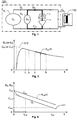
- the human body includes two urea containing pools; one large pool of volume V L , which is perfused by a relatively small blood flow Q L , and one small pool of volume V H , which is perfused by a relatively large blood flow Q H , see figure 1 .
- the small pool of volume V H represents the blood in the internal organs, such as the liver etc.
- the large pool of volume V L represents blood located in the muscles, the skin and the like. Due to the comparatively large blood flow Q H to the small pool of volume V H , this pool will be much more efficiently depurated than the large pool of volume V L . Thus, after an initial transient, the concentration of urea C H in the small pool of volume V H will be lower than the concentration of urea C L in the large pool of volume V L .
- a mixed venous urea concentration C mv therefore becomes a weighted mean value of the two pool concentrations C L and C H , with the respective flow weights Q L and Q H , according to the following:
- C mv Q L ⁇ C L + Q H + C H Q L + Q H
- the denominator here represents the total blood flow Q L + Q H .
- the mean value C mv falls between the two pool concentrations C L and C H .
- the mixed venous blood will also mix with partly cleaned blood from the dialyzer 130, so that the concentration of urea in the heart ⁇ which is equal to a concentration C b returning to the access and the dialyzer, will be lower than all other concentrations.
- the mean concentration of urea in the whole body This is sometimes referred to as the equilibrated concentration C eq , since it is the concentration which would be the result if the body were left to equilibrate the pool concentrations C L and C H .
- the equilibrated concentration C eq V L ⁇ C L + V H + C H V L + V H
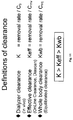
- Clearance is an entity which is used to describe the efficiency of the depuration process. More precisely, clearance is defined as the removal rate divided by the concentration of the substance in the fluid to be cleaned. Normally, a dialyzer clearance K, which is used to characterize dialyzers at different flow conditions, is defined as the removal rate divided by the concentration C b , i.e. the concentration in the blood returning from the heart-lung system to the access and the dialyzer. A part of the cleaned blood from the dialyzer which is mixed with the blood returning from the body goes from the heart and enters directly into the dialyzer again. This is called cardiopulmonary recirculation, and is the reason why blood entering the dialyzer has a lower concentration (i.e. C b ) than the blood returning from the body.
- a so-called effective clearance K eff is instead defined as the removal rate divided by the mixed venous concentration C mv , and is a better measure of the effective depuration of the patient.
- the effective clearance K eff can be estimated if the removal rate is measured either on the blood side or on the dialysate side of the dialyzer, and the mixed venous concentration (or the systemic blood concentration) C mv is measured by stopping the blood pump during an interval (say 1 minute) to let the effect of the cardiopulmonary recirculation disappear before a blood sample is drawn.
- Another simple method to estimate the effective clearance is to measure the effect in the outlet dialysate conductivity of a step in the inlet dialysate conductivity, for instance according to the procedures proposed in the documents EP 547 025 , EP 658 352 and US 6, 217, 539 .
- the interest in the whole body clearance K wb originates from the fact that this measure describes the cleaning effect of the dialyzer on the body, whereas the dialyzer clearance K and the effective clearance K eff constitute descriptions of the cleaning capacity of the dialyzer and the dialyzer together with the heart-lung system ⁇ and ⁇ respectively.
- the relationship between the effective clearance K eff and the whole body clearance K wb is much less trivial.
- Daugirdas and Schneditz have managed to solve these equations for the case when the urea generation in the pool volumes V L and V H was included. Daugirdas and Schneditz studied the impact on the rebound of urea after treatment, i.e. the magnitude of the equilibration of urea concentrations after the treatment. However, the volumes V L and V H were allowed to vary, which in turn, led to a non-steady state relationship between the pool concentrations C L and C H . Thus, a reliable estimate of the whole body clearance K wb could not be obtained.
- the U.S. patent No. 6,258,027 discloses a method and a device for calculating dialysis efficiency with respect to a mass exchange of a solute in a fluid. However, no measure is determined which reflects the whole body clearance of the dialyzer on a patient.
- the object of the present invention is therefore to alleviate the problems above and thus accomplish an improved estimation of the whole body clearance of the dialyzer on a particular patient and enabling identification of cases where an improvement is necessary, and probably possible.
- the object is achieved by the initially described method of estimating a process efficiency, wherein a whole body clearance ratio is determined, which expresses how well the patient responds to the potential cleaning capacity of a dialyzer.
- the whole body clearance ratio is determined by: measuring a final blood urea concentration, either immediately, or approximately one minute after the end of the treatment; measuring an equilibrated blood urea concentration no earlier than approximately one half hour to one hour after the end of the treatment; and dividing said final blood urea concentration by said equilibrated blood urea concentration.
- the whole body clearance ratio is determined by: measuring an initial urea concentration; measuring, during the treatment at occasions being well spaced in time at least two subsequent urea concentration values after the treatment has started, a first value of said at least two values being measured no earlier than approximately one half hour after the treatment has started; deriving a starting urea concentration based on an extrapolation in time of said at least two values back to the start of the treatment; and dividing said starting urea concentration by said initial urea concentration.
- the object is achieved by the initially mentioned method of estimating the whole body clearance ratio of a dialysis treatment of a patient, wherein the whole body clearance ratio is determined on the basis of a measurement of a slope of a logarithmic removal rate function, which describes how a urea concentration is lowered in course of the treatment. This slope is namely a key factor in the whole body clearance ratio.
- the method involves the steps of: determining an initial dialysate urea concentration; determining a total flow rate value representing the spent dialysate during the treatment, including any ultrafiltration; calculating, based on measurements performed during a steady state phase of the treatment, the slope of the logarithmic removal rate function; measuring a predialysis urea mass in the patient; and determining the whole body clearance ratio as the product of the slope and the predialysis urea mass, divided by the flow rate value and divided by the initial dialysate urea concentration.
- the method involves the steps of: calculating, based on measurements performed during a steady state phase of the treatment, the slope of said logarithmic removal rate function; determining an entire distribution volume; and determining the whole body clearance ratio as the product of said slope and said entire distribution volume divided by the potential cleaning capacity.
- the measurements relating to the slope of the logarithmic removal rate function may be performed either on a dialysate side or on a blood side of a dialysis system including the dialyzer and the patient.
- the object is achieved by a computer program, which is directly loadable into the internal memory of a computer, and includes software for controlling the above proposed method when said program is run on a computer.
- the object is achieved by a computer readable medium, having a program recorded thereon, where the program is to control a computer to perform the above-proposed method.
- the object is achieved by an apparatus, which is adapted to estimate the whole body clearance ratio of a dialysis treatment of a patient. Again, by efficiency is meant how well the patient responds to a cleaning capacity of a dialyzer, which performs the treatment.
- the apparatus includes a urea monitor and a processor.
- the urea monitor circuit is adapted to: determine an initial dialysate urea concentration; determine a total flow rate of spent dialysate during the treatment (including any ultrafiltration); during a steady state phase of the treatment, measure a slope of a logarithmic removal rate function, which describes how a dialysate urea concentration is lowered in course of the treatment; and measure a predialysis urea mass in the patient.
- the processor is adapted to determine the whole body clearance ratio of the patient by multiplying the slope of the logarithmic removal rate function with the predialysis urea mass and dividing the result thereof by the flow rate and the initial dialysate urea concentration.
- this apparatus is advantageous because it provides a measure of the actual usefulness of the dialysis treatment.
- the object is achieved by using the above the apparatus for estimating the whole body clearance ratio of a dialysis treatment of a patient according to the proposed method.
- a general advantage attained by the invention is that, based on the whole body clearance ratio for a dialysis treatment of a particular patient, a following treatment of the same patient can be made more efficient. Namely, if a relatively low ratio is determined, the next time, certain actions can be taken to improve the result of the dialysis. For instance, the treatment time can be prolonged, the composition of the dialysate can be altered, or some kind of intervention procedure with respect to the patient may be performed.
- the intervention procedure may involve subjecting the patient to physical exercise, massage, a change in the ambient temperature, an increased fluid intake, acupuncture, and/or medication affecting the systemic blood flow or the blood flow distribution in the patient's body.
- the invention presumes that the pool volumes V L and V H are constant. Thus, no ultrafiltration is presumed to take place, and the generation of urea is neglected. This means that it is possible to set up one differential equation for the ratio between the two pool concentrations C L and C H . Moreover, it can be shown that the ratio between the two pool concentrations C L and C H tends towards a constant.
- the ratio K wb /K eff or K wb /K is used to characterize a dialyzer's capacity with respect to different patients. Provided that this is done at a specific K or K eff value, all the remaining parameters determining these ratios are patient specific, and may hence be used to specify how well the patient responds to the cleaning capacity of the dialyzer.
- Figure 2 illustrates a situation where a patient 120 is connected to an apparatus 210 according to an embodiment of the invention.
- the apparatus 210 is adapted to estimate the efficiency (with respect to the whole body clearance ratio K wb /K eff ) of a dialysis treatment of the patient 120 performed by a dialyzer 130.
- the apparatus 210 includes a urea monitor circuit 211 and a processor 212.
- the urea monitor circuit 211 is adapted to measure a predialysis urea mass m 0 in the patient 120.
- the urea monitor circuit 211 is also adapted to determine an initial dialysate urea concentration C d0 (e.g. by means of samples taken between t 1 and t 2 in figure 3 , and an extrapolation back to zero) and a total flow rate Q d of spent dialysate during the treatment (including any ultrafiltration).
- the urea monitor circuit 211 measures a slope K wb /V of a logarithmic removal rate function, which describes how a dialysate urea concentration is lowered in course of the treatment (e.g. by means of samples taken between t 3 and t 4 in figure 3 ).
- K wb /K eff is determined as the product of the slope K wb /V and the predialysis urea mass m 0 , divided by the flow rate Q d and the initial dialysate urea concentration C d0 .
- K wb /V as the slope of a logarithm curve, which describes the urea concentration in the spent dialysate.
- the urea concentration may be measured continuously by the urea monitor 211. These measurements also render it possible to determine the predialysis urea mass m 0 , for example according to the procedure proposed in US 6,258,027 .
- the plasma water concentration C pw may be measured in a blood sample drawn from the patient 120 before the treatment starts, and since the volume V is the volume of water (with dissolved ions), the measured plasma concentration must be the plasma water concentration C pw .
- An effective plasma water clearance can be calculated from the removal rate and the plasma water concentration C pw . This can be done at the start of the treatment.
- K eff Q d ⁇ C d ⁇ 0 C pw
- Q d is the flow rate of spent dialysate including any ultrafiltration
- C d0 and C pw represent values of the initial dialysate urea concentration and the predialysis plasma water concentration respectively.
- Figure 3 is a graph over a removal rate function C d (or C b ) describing an example of how a urea concentration is lowered in the dialysate (or in the blood) during the dialysis treatment.
- an initial urea concentration C d0 may be found from the urea curve in the urea monitor (see e.g. 211 in figure 2 ), by fitting an exponential 310 to the function during an initial phase of the treatment t 1 to t 2 , say 5 - 20 minutes at the beginning of the treatment.
- the initial blood urea concentration C b0 is, on the other hand, most easily determined by means of a predialysis blood sample.
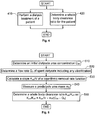
- Figure 4 shows a flow diagram which illustrates the general method of estimating a process efficiency of a dialysis system according to the invention.
- One step 410 involves performing a dialysis treatment of a specific patient.
- Another step 420 which is partly executed before and partly executed in parallel with the step 410, involves determining a whole body clearance ratio for the patient according to the above-proposed method.
- the dialysis treatment of the step 410 continues until the treatment is finished, the determination in the step 420 may be completed at an earlier point in time after which the procedure ends.
- Figure 5 shows a flow diagram which illustrates the general method of estimating a whole body clearance ratio of a dialysis treatment of a patient according to the invention.
- a first step 510 determines an initial dialysate urea concentration C d0 .
- a step 520 determines a total flow rate Q d of spent dialysate during the treatment, including any ultrafiltration.
- measurements are performed reflecting the rate at which a dialysate urea concentration is lowered in course of the treatment.
- a step 530 calculates a slope K wb /V of a logarithmic removal rate function, which describes the dialysate urea concentration over time.
- a step 540 determines a predialysis urea mass m 0 in the patient (for example according to the procedure proposed in US 6,258,027 ).
- a step 550 determines the whole body clearance ratio K wb /K eff as the product of the slope K wb /V calculated in the step 530 and the predialysis urea mass m 0 (of the step 540), divided by the initial dialysate urea concentration C d0 (determined in the step 510) and the flow rate Q d (determined in the step 520).
- a slope K wb /V of the logarithm of the dialysate concentration is calculated.
- the slope K wb /V of the logarithm of the concentration may be measured on the dialysate side or on the blood side using at least two blood samples which are well spaced in time.
- the entire distribution volume V may be measured separately, and by multiplying the slope K wb /V with the volume V, the whole body clearance K wb can be obtained.
- the clearance ratio is then determined by dividing K wb by K eff or K.
- a straightforward way to measure the effective clearance K eff or dialyzer clearance K is to register a removal rate (either on the blood side or on the dialysate side) and divide the registered figure by the systemic (or mixed blood venous) urea concentration C mv or dialyzer inlet concentration C b respectively.
- the effective clearance K eff may be measured by means of conductivity based methods, such as those described in the documents EP 547 025 , EP 658 352 and US 6,217,539 .
- the dialyzer clearance K may be found from the dialyzer data sheet.
- the entire distribution volume V There are many ways to determine the entire distribution volume V.
- One possibility is to collect a part of the spent dialysate, from which removed urea is determined from the urea concentration multiplied by the total dialysate volume. After correction for urea generation, this measure is related to the change in the equilibrated blood urea concentration with a correction for ultrafiltration.
- the entire distribution volume V multiplied by the change in the corrected equilibrated blood concentration must equal the removed amount. This gives a value for the volume V.
- the clearance ratio is to measure the ratio between the final blood urea concentration shortly after the end of the treatment, and the equilibrated concentration C eq after half an hour to one hour, i.e. measure the urea rebound. If the final blood urea concentration directly after the end of the treatment is used, the figure reflects the ratio K wb /K, since the effect of the cardiopulmonary recirculation will be included. If instead, a final blood urea concentration is used, which is measured about one minute after the end of the treatment, the figure reflects the ratio K wb /K eff because then the effect of the cardiopulmonary recirculation has disappeared.
- the actual equilibrated concentration C eq must be measured for the ratio calculation. For instance, it is not sufficient to calculate the equilibrated concentration C eq from the final concentration and the treatment efficiency (as suggested by Daugirdas), or to measure the concentration about 35 minutes before the end of the treatment (as suggested by Tattersall). Namely, these strategies will only provide a mean effect over a plurality of patients, not the effect with respect to each particular patient.
- an alternative to the above-described methods is to calculate the clearance ratio K wb /K from concentrations in three blood samples.
- a second sample C mid is taken at t mid , at least half an hour to an hour into the treatment, after the gradient between the two body pools has developed.
- a third and final sample C last is taken at t last towards the end of the treatment. The logarithm of the two values C mid and C last are used to extrapolate linearly backwards to the start of the treatment in order to find what the initial concentration would have been if the gradient between the body pools had been fully developed already at the start.
- K wb K C b C eq ⁇ C least C b ⁇ 0 ⁇ ( C mid C last ⁇ ) t last t last - t mid
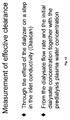
- Effective blood water clearance can be measured through the dialyzer effect on a step in the inlet conductivity. It is called effective because it takes into account the effect of recirculation, both cardiopulmonary and in the access. This has led to the misconception that this clearance also describes the total cleaning effect of the dialysis treatment.
- the differences between the two clearance definitions are important for dose calculations, and can also be used to explain differences between patients.
- C eq is more relevant than C mv .
- C eq is also a weighted mean value of the pool concentrations, but with their volumes as weighting factors, which makes a big difference.
- C mv C eq will also fall in between C H and C L , but it will be closer to C L because of the heavier weight from the large low flow pool volume V L .
- the first one which involves the blood concentration entering the dialyzer, is the normal dialyzer clearance that is used to characterize different dialyzers. If we use the mixed venous concentration we get the effective clearance, which will include the effects of both cardiopulmonary and access recirculation. This can be measured by conductivity methods such as OnLine Clearance from Fresenius and Diascan from Gambro. Finally we have the whole body clearance, which can also be called equilibrated clearance, and results if we use the equilibrated concentration. Because of the relation between the concentrations, we will always have this relation between the clearances, and our aim was to study the relation between the two last ones, both clinically and theoretically. So, how did we measure these clearances?
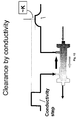
- Figure 13 presents clearance by conductivity. Firstly, using a step in the inlet conductivity of the dialysis fluid, clearance was calculated in the Integra dialysis machine from the decrease in the dialyzer of the conductivity step size. This is known to give an estimate of the effective plasma water clearance.
- clearance was calculated from the dialysate flow rate and the initial urea concentrations in the dialysate and in plasma water.
- the dialysate concentration was measured continuously in the spent dialysate by a urea monitor.
- the initial concentration was determined by fitting an exponential 5-20 minutes from the start, which was then extrapolated backwards. This calculation will give the effective clearance since the dialysate concentration after 5 minutes will refer to a fully developed cardiopulmonary recirculation, whereas the pretreatment blood sample gives the systemic blood urea concentration.
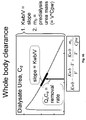
- the whole body clearance can then be calculated as the product of the slope and the urea mass, divided by the plasma water concentration.
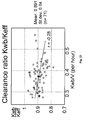
- the ratio is shown as a function of the relative treatment efficiency, whole body K/V, and we see that there is a negative correlation. This corresponds to the correlation between K/V and the error in single pool Kt/V that is the basis for Daugirdas' rate equation.
Landscapes
- Health & Medical Sciences (AREA)
- Life Sciences & Earth Sciences (AREA)
- Engineering & Computer Science (AREA)
- Heart & Thoracic Surgery (AREA)
- Biomedical Technology (AREA)
- General Health & Medical Sciences (AREA)
- Animal Behavior & Ethology (AREA)
- Public Health (AREA)
- Veterinary Medicine (AREA)
- Vascular Medicine (AREA)
- Genetics & Genomics (AREA)
- Urology & Nephrology (AREA)
- Hematology (AREA)
- Anesthesiology (AREA)
- Chemical & Material Sciences (AREA)
- Organic Chemistry (AREA)
- Bioinformatics & Cheminformatics (AREA)
- Molecular Biology (AREA)
- Wood Science & Technology (AREA)
- Zoology (AREA)
- General Engineering & Computer Science (AREA)
- Biotechnology (AREA)
- Emergency Medicine (AREA)
- Virology (AREA)
- Nuclear Medicine, Radiotherapy & Molecular Imaging (AREA)
- Chemical Kinetics & Catalysis (AREA)
- General Chemical & Material Sciences (AREA)
- Medicinal Chemistry (AREA)
- Biochemistry (AREA)
- Cardiology (AREA)
- Pharmacology & Pharmacy (AREA)
- Physics & Mathematics (AREA)
- Biophysics (AREA)
- Microbiology (AREA)
- Plant Pathology (AREA)
- Communicable Diseases (AREA)
- Oncology (AREA)
- AIDS & HIV (AREA)
- Gastroenterology & Hepatology (AREA)
- Tropical Medicine & Parasitology (AREA)
Abstract
Description
- The present invention relates generally to dialysis clearance. More particularly the invention relates to a method of estimating a process efficiency of a dialysis system according to the preamble of
claim 1, a method of estimating a whole body clearance ratio according to the preamble of claim 6, corresponding computer programs and computer readable media according toclaims 11 and 13 respective 12 and 14, an apparatus adapted to estimate a whole body clearance ratio according to claim 16, as well as use of this apparatus according to claim 17. The invention also relates to a method of performing a dialysis treatment program according to the preamble ofclaim 15. - Generally in dialysis, there is a large need to better understand the differences between patients, and what factors determine the achievable efficiency of the dialysis treatment in the individual patients. In theory, a number of different parameters may be used to characterize a dialyzer's capacity to filter waste products from a patient's bloodstream and restore the normal constituents of his/her blood. For example, models for solute concentrations in the different body parts may be used. It is also possible to characterize patients by measurable parameters, which in turn, may be used to improve the efficiency of the dialysis treatments.
- A good model to use in order to understand the process of dialysis for cleaning the body from a solute is the so-called regional blood flow model for the solute distribution in the body, which was developed by Daugirdas and Schneditz. Urea is a common marker molecule for the description of the dialysis progress, and will be used for the following discussion for this purpose. However, the same discussion may also be applied to other solutes, such as creatinine, glucose, phosphate and other ions. According to one model, the human body includes two urea containing pools; one large pool of volume VL, which is perfused by a relatively small blood flow QL, and one small pool of volume VH, which is perfused by a relatively large blood flow QH, see
figure 1 . The small pool of volume VH represents the blood in the internal organs, such as the liver etc., and the large pool of volume VL represents blood located in the muscles, the skin and the like. Due to the comparatively large blood flow QH to the small pool of volume VH, this pool will be much more efficiently depurated than the large pool of volume VL. Thus, after an initial transient, the concentration of urea CH in the small pool of volume VH will be lower than the concentration of urea CL in the large pool of volume VL. Before returning to the heart η, the blood from the two pools VL and VH will be mixed, and a mixed venous urea concentration Cmv therefore becomes a weighted mean value of the two pool concentrations CL and CH, with the respective flow weights QL and QH, according to the following:
- The denominator here represents the total blood flow QL + QH. Note that the mean value Cmv falls between the two pool concentrations CL and CH. However it will be closer to the concentration of urea CH in the small pool of volume VH because its weight QH is larger than QL. Before reaching the heart η, the mixed venous blood will also mix with partly cleaned blood from the
dialyzer 130, so that the concentration of urea in the heart η which is equal to a concentration Cb returning to the access and the dialyzer, will be lower than all other concentrations. - When discussing the depuration of the whole body it is of interest to also discuss the mean concentration of urea in the whole body. This is sometimes referred to as the equilibrated concentration Ceq, since it is the concentration which would be the result if the body were left to equilibrate the pool concentrations CL and CH. In our regional blood flow model, the equilibrated concentration Ceq is:

- The equilibrated concentration Ceq will also fall between the pool concentrations CL and CH. However, it will be closer to the concentration of urea CL in the large pool of volume VL because of the volume VL being larger than the volume VH. Consequently, we obtain the relationship:

- Clearance is an entity which is used to describe the efficiency of the depuration process. More precisely, clearance is defined as the removal rate divided by the concentration of the substance in the fluid to be cleaned. Normally, a dialyzer clearance K, which is used to characterize dialyzers at different flow conditions, is defined as the removal rate divided by the concentration Cb, i.e. the concentration in the blood returning from the heart-lung system to the access and the dialyzer. A part of the cleaned blood from the dialyzer which is mixed with the blood returning from the body goes from the heart and enters directly into the dialyzer again. This is called cardiopulmonary recirculation, and is the reason why blood entering the dialyzer has a lower concentration (i.e. Cb) than the blood returning from the body. A so-called effective clearance Keff is instead defined as the removal rate divided by the mixed venous concentration Cmv, and is a better measure of the effective depuration of the patient. The effective clearance Keff can be estimated if the removal rate is measured either on the blood side or on the dialysate side of the dialyzer, and the mixed venous concentration (or the systemic blood concentration) Cmv is measured by stopping the blood pump during an interval (say 1 minute) to let the effect of the cardiopulmonary recirculation disappear before a blood sample is drawn. Another simple method to estimate the effective clearance is to measure the effect in the outlet dialysate conductivity of a step in the inlet dialysate conductivity, for instance according to the procedures proposed in the documents
EP 547 025 EP 658 352 US 6, 217, 539 . - However, a still better measure would be to describe the cleaning of the whole body equilibrated concentration Ceq. This so-called whole body clearance Kwb (or Keq) is defined as the removal rate divided by the equilibrated concentration Ceq. Moreover, due to the relationships between the corresponding urea concentrations, we obtain the following relationships between the clearances:

- Since it is relatively difficult to measure the pool concentrations CL and CH there is no straightforward way to measure the equilibrated concentration Ceq, and consequently, the whole body clearance Kwb is also difficult to estimate. One possibility to measure the equilibrated concentration Ceq is to wait until the concentrations have equilibrated after the treatment. However, this takes relatively long time (half an hour up to one hour) and is therefore impractical.
- The interest in the whole body clearance Kwb originates from the fact that this measure describes the cleaning effect of the dialyzer on the body, whereas the dialyzer clearance K and the effective clearance Keff constitute descriptions of the cleaning capacity of the dialyzer and the dialyzer together with the heart-lung system η and λ respectively. The dialyzer clearance K is known from the dialyzers data sheet, and the relationship between this measure and the effective clearance Keff is given by the expression:

where Q is the total systemic blood flow, i.e. Q = QL + QH. Unfortunately, the relationship between the effective clearance Keff and the whole body clearance Kwb is much less trivial. - It is nevertheless possible to study the theoretical relationship between the pool concentrations CL and CH. Setting up a mass balance equation for each of the two pools of volume VL and VH leads to a system of two coupled first order differential equations for the concentrations CL and CH. If we include the effect of a constant ultrafiltration rate, the pool volumes VL and VH will decrease linearly over time, and the differential equations for the concentrations CL and CH will have variable coefficients.
- Daugirdas and Schneditz have managed to solve these equations for the case when the urea generation in the pool volumes VL and VH was included. Daugirdas and Schneditz studied the impact on the rebound of urea after treatment, i.e. the magnitude of the equilibration of urea concentrations after the treatment. However, the volumes VL and VH were allowed to vary, which in turn, led to a non-steady state relationship between the pool concentrations CL and CH. Thus, a reliable estimate of the whole body clearance Kwb could not be obtained.
- The
U.S. patent No. 6,258,027 discloses a method and a device for calculating dialysis efficiency with respect to a mass exchange of a solute in a fluid. However, no measure is determined which reflects the whole body clearance of the dialyzer on a patient. - The object of the present invention is therefore to alleviate the problems above and thus accomplish an improved estimation of the whole body clearance of the dialyzer on a particular patient and enabling identification of cases where an improvement is necessary, and probably possible.
- According to one aspect of the invention, the object is achieved by the initially described method of estimating a process efficiency, wherein a whole body clearance ratio is determined, which expresses how well the patient responds to the potential cleaning capacity of a dialyzer.
- An important advantage attained by this strategy is that the whole body clearance ratio provides an adequate measure of the actual usefulness of the dialysis treatment. Since each patient has his/her own characteristic response to a particular treatment, it is otherwise very difficult to determine the specific benefit of the dialysis process.
- According to a preferred embodiment of this aspect of the invention, the whole body clearance ratio is determined by: measuring a final blood urea concentration, either immediately, or approximately one minute after the end of the treatment; measuring an equilibrated blood urea concentration no earlier than approximately one half hour to one hour after the end of the treatment; and dividing said final blood urea concentration by said equilibrated blood urea concentration. Thereby, a reliable measure is found, which reflects the process efficiency with respect to the patient.
- According to another preferred embodiment of this aspect of the invention, the whole body clearance ratio is determined by: measuring an initial urea concentration; measuring, during the treatment at occasions being well spaced in time at least two subsequent urea concentration values after the treatment has started, a first value of said at least two values being measured no earlier than approximately one half hour after the treatment has started; deriving a starting urea concentration based on an extrapolation in time of said at least two values back to the start of the treatment; and dividing said starting urea concentration by said initial urea concentration.
- According to yet another aspect of the invention, the object is achieved by the initially mentioned method of estimating the whole body clearance ratio of a dialysis treatment of a patient, wherein the whole body clearance ratio is determined on the basis of a measurement of a slope of a logarithmic removal rate function, which describes how a urea concentration is lowered in course of the treatment. This slope is namely a key factor in the whole body clearance ratio.
- According to a first preferred alternative under this embodiment of the invention, the method involves the steps of: determining an initial dialysate urea concentration; determining a total flow rate value representing the spent dialysate during the treatment, including any ultrafiltration; calculating, based on measurements performed during a steady state phase of the treatment, the slope of the logarithmic removal rate function; measuring a predialysis urea mass in the patient; and determining the whole body clearance ratio as the product of the slope and the predialysis urea mass, divided by the flow rate value and divided by the initial dialysate urea concentration.
- According to a second preferred alternative under this embodiment of the invention, the method involves the steps of: calculating, based on measurements performed during a steady state phase of the treatment, the slope of said logarithmic removal rate function; determining an entire distribution volume; and determining the whole body clearance ratio as the product of said slope and said entire distribution volume divided by the potential cleaning capacity.
- According to preferred embodiments of this aspect of the invention, the measurements relating to the slope of the logarithmic removal rate function may be performed either on a dialysate side or on a blood side of a dialysis system including the dialyzer and the patient.
- According to a further aspect of the invention, the object is achieved by a computer program, which is directly loadable into the internal memory of a computer, and includes software for controlling the above proposed method when said program is run on a computer.
- According to another aspect of the invention the object is achieved by a computer readable medium, having a program recorded thereon, where the program is to control a computer to perform the above-proposed method.
- According to yet another aspect of the invention, the object is achieved by an apparatus, which is adapted to estimate the whole body clearance ratio of a dialysis treatment of a patient. Again, by efficiency is meant how well the patient responds to a cleaning capacity of a dialyzer, which performs the treatment. The apparatus includes a urea monitor and a processor. The urea monitor circuit is adapted to: determine an initial dialysate urea concentration; determine a total flow rate of spent dialysate during the treatment (including any ultrafiltration); during a steady state phase of the treatment, measure a slope of a logarithmic removal rate function, which describes how a dialysate urea concentration is lowered in course of the treatment; and measure a predialysis urea mass in the patient. The processor is adapted to determine the whole body clearance ratio of the patient by multiplying the slope of the logarithmic removal rate function with the predialysis urea mass and dividing the result thereof by the flow rate and the initial dialysate urea concentration. In similarity with the above-proposed method, this apparatus is advantageous because it provides a measure of the actual usefulness of the dialysis treatment.
- According to yet another aspect of the invention, the object is achieved by using the above the apparatus for estimating the whole body clearance ratio of a dialysis treatment of a patient according to the proposed method.
- A general advantage attained by the invention is that, based on the whole body clearance ratio for a dialysis treatment of a particular patient, a following treatment of the same patient can be made more efficient. Namely, if a relatively low ratio is determined, the next time, certain actions can be taken to improve the result of the dialysis. For instance, the treatment time can be prolonged, the composition of the dialysate can be altered, or some kind of intervention procedure with respect to the patient may be performed. The intervention procedure may involve subjecting the patient to physical exercise, massage, a change in the ambient temperature, an increased fluid intake, acupuncture, and/or medication affecting the systemic blood flow or the blood flow distribution in the patient's body.
- The present invention is now to be explained more closely by means of preferred embodiments, which are disclosed as examples, and with reference to the attached drawings.
- Figure 1
- shows a schematic model of a patient's blood-stream, which is connected to a dialyzer according to the invention,
- Figure 2
- illustrates a patient being attached to an apparatus for estimating a whole body clearance ratio of a dialysis treatment according to an embodiment of the invention,
- Figure 3
- is a graph over a removal rate function describing a first example of how a urea concentration is lowered during a dialysis treatment,
- Figure 4
- shows a flow diagram which illustrates the general method of estimating a process efficiency of a dialysis system according to the invention,
- Figure 5
- shows a flow diagram which illustrates the general method of estimating a whole body clearance ratio of a dialysis treatment of a patient according to the invention, and
- Figure 6
- a graph over a removal rate function describing a second example of how a urea concentration is lowered during a dialysis treatment, and
- Figures 7-24
- illustrate dialysis examples which further elucidate the strategy according to the invention.
- Returning now to the
figure 1 , in contrast to Daugirdas and Schneditz, the invention presumes that the pool volumes VL and VH are constant. Thus, no ultrafiltration is presumed to take place, and the generation of urea is neglected. This means that it is possible to set up one differential equation for the ratio between the two pool concentrations CL and CH. Moreover, it can be shown that the ratio between the two pool concentrations CL and CH tends towards a constant. This in turn, means that the clearance ratio: "whole body clearance"-to-"effective clearance" Kwb/Keff (which equals the ratio: "mixed venous concentration"-to-"equilibrated concentration" Cmv/Ceq) also tends towards a constant. The factors which determine the steady state ratios are the fraction of the large pool volume VL to the entire blood volume V = VL + VH, the fraction of the blood flow QL in the large pool to the total systemic blood flow Q, and the fraction of the effective clearance Keff to the total systemic blood flow Q. Consequently, besides the effective clearance Keff, the clearance ratio is only determined by patient specific parameters. All of the above is true if we relate the whole body clearance Kwb to the dialyzer clearance K, instead of to the effective clearance Keff. Normally, (for typical values) it takes approximately half an hour to one hour for a steady state level to be reached for these patient related parameters. - However, according to the invention, the ratio Kwb/Keff or Kwb/K is used to characterize a dialyzer's capacity with respect to different patients. Provided that this is done at a specific K or Keff value, all the remaining parameters determining these ratios are patient specific, and may hence be used to specify how well the patient responds to the cleaning capacity of the dialyzer.
-
Figure 2 illustrates a situation where apatient 120 is connected to anapparatus 210 according to an embodiment of the invention. Theapparatus 210 is adapted to estimate the efficiency (with respect to the whole body clearance ratio Kwb/Keff) of a dialysis treatment of thepatient 120 performed by adialyzer 130. - The
apparatus 210 includes aurea monitor circuit 211 and a processor 212. Theurea monitor circuit 211 is adapted to measure a predialysis urea mass m0 in thepatient 120. Theurea monitor circuit 211 is also adapted to determine an initial dialysate urea concentration Cd0 (e.g. by means of samples taken between t1 and t2 infigure 3 , and an extrapolation back to zero) and a total flow rate Qd of spent dialysate during the treatment (including any ultrafiltration). During steady state phase of the treatment, theurea monitor circuit 211 measures a slope Kwb/V of a logarithmic removal rate function, which describes how a dialysate urea concentration is lowered in course of the treatment (e.g. by means of samples taken between t3 and t4 infigure 3 ). - The processor 212 is adapted to determine the whole body clearance ratio Kwb/Keff for the
patient 120 on the basis of the predialysis urea mass m0, the slope Kwb/V of the logarithmic removal rate function, the initial dialysate urea concentration Cd0 and the total flow rate Qd. Specifically, the processor 212 calculates the whole body clearance ratio Kwb/Keff according to the expression: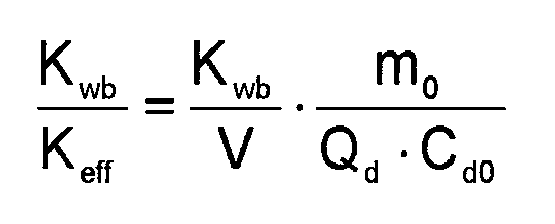
- I.e. the whole body clearance ratio Kwb/Keff is determined as the product of the slope Kwb/V and the predialysis urea mass m0, divided by the flow rate Qd and the initial dialysate urea concentration Cd0.
- The rationale behind this is that it is possible to calculate Kwb/V as the slope of a logarithm curve, which describes the urea concentration in the spent dialysate. The urea concentration may be measured continuously by the
urea monitor 211. These measurements also render it possible to determine the predialysis urea mass m0, for example according to the procedure proposed inUS 6,258,027 . - By definition, the predialysis urea mass m0 equals the product of the distribution volume (i.e. the entire body water volume V in case of urea) and the plasma water concentration Cpw, i.e. m0 = V·Cpw. The plasma water concentration Cpw may be measured in a blood sample drawn from the
patient 120 before the treatment starts, and since the volume V is the volume of water (with dissolved ions), the measured plasma concentration must be the plasma water concentration Cpw. An effective plasma water clearance, on the other hand, can be calculated from the removal rate and the plasma water concentration Cpw. This can be done at the start of the treatment. - However, the blood sample drawn from the patient before the treatment starts reflects an equilibrated (i.e. systemic) urea concentration. An effective clearance Keff may therefore be calculated according to the expression:

where Qd is the flow rate of spent dialysate including any ultrafiltration, and Cd0 and Cpw represent values of the initial dialysate urea concentration and the predialysis plasma water concentration respectively. Nevertheless, according to the invention, we are only interested in the ratio between Kwb and Keff. Therefore, the plasma water concentration Cpw can be eliminated, and no blood sample is required. Thus, provided that we know the dialysate flow rate Qd, the clearance ratio Kwb/Keff may be calculated by the processor 212 in thefigure 2 as:
-
Figure 3 is a graph over a removal rate function Cd (or Cb) describing an example of how a urea concentration is lowered in the dialysate (or in the blood) during the dialysis treatment. In case the curve describes the dialysate urea concentration, an initial urea concentration Cd0 may be found from the urea curve in the urea monitor (see e.g. 211 infigure 2 ), by fitting an exponential 310 to the function during an initial phase of the treatment t1 to t2, say 5 - 20 minutes at the beginning of the treatment. Of course, a graph describing the removal rate function Cb on the blood side actually starts at a non-zero initial urea concentration Cb0, at say twice the illustrated Cd0-value. However, this part of the graph is not shown here. - On the dialysate side, the exponential 310 is extrapolated backwards to the start (i.e. t=0) to find the initial dialysate urea concentration value Cd0. It generally takes about 5 minutes for the urea monitor 211 to find correct values at the start of the treatment, and this delay means that the dialysate urea Cd0 found by the proposed method is a value which corresponds to a fully developed cardiopulmonary recirculation. The initial blood urea concentration Cb0 is, on the other hand, most easily determined by means of a predialysis blood sample.
-
Figure 4 shows a flow diagram which illustrates the general method of estimating a process efficiency of a dialysis system according to the invention. - One
step 410, involves performing a dialysis treatment of a specific patient. Anotherstep 420, which is partly executed before and partly executed in parallel with thestep 410, involves determining a whole body clearance ratio for the patient according to the above-proposed method. Although, of course, the dialysis treatment of thestep 410 continues until the treatment is finished, the determination in thestep 420 may be completed at an earlier point in time after which the procedure ends. -
Figure 5 shows a flow diagram which illustrates the general method of estimating a whole body clearance ratio of a dialysis treatment of a patient according to the invention. - A
first step 510 determines an initial dialysate urea concentration Cd0. Then, astep 520 determines a total flow rate Qd of spent dialysate during the treatment, including any ultrafiltration. During a steady state phase of the treatment, measurements are performed reflecting the rate at which a dialysate urea concentration is lowered in course of the treatment. Specifically, astep 530 calculates a slope Kwb/V of a logarithmic removal rate function, which describes the dialysate urea concentration over time. Subsequently, astep 540 determines a predialysis urea mass m0 in the patient (for example according to the procedure proposed inUS 6,258,027 ). Finally, a step 550 determines the whole body clearance ratio Kwb/Keff as the product of the slope Kwb/V calculated in thestep 530 and the predialysis urea mass m0 (of the step 540), divided by the initial dialysate urea concentration Cd0 (determined in the step 510) and the flow rate Qd (determined in the step 520). - Returning now to
figure 3 , during a steady state phase of the treatment t3 to t4, say one hour or at least half an hour after the beginning of the treatment and onwards, a slope Kwb/V of the logarithm of the dialysate concentration is calculated. As already mentioned above with reference to thefigure 3 , the slope Kwb/V of the logarithm of the concentration may be measured on the dialysate side or on the blood side using at least two blood samples which are well spaced in time. The entire distribution volume V may be measured separately, and by multiplying the slope Kwb/V with the volume V, the whole body clearance Kwb can be obtained. The clearance ratio is then determined by dividing Kwb by Keff or K. - A straightforward way to measure the effective clearance Keff or dialyzer clearance K is to register a removal rate (either on the blood side or on the dialysate side) and divide the registered figure by the systemic (or mixed blood venous) urea concentration Cmv or dialyzer inlet concentration Cb respectively.
- Otherwise, the effective clearance Keff may be measured by means of conductivity based methods, such as those described in the documents
EP 547 025 EP 658 352 US 6,217,539 . Alternatively, the dialyzer clearance K may be found from the dialyzer data sheet. - There are many ways to determine the entire distribution volume V. One possibility is to collect a part of the spent dialysate, from which removed urea is determined from the urea concentration multiplied by the total dialysate volume. After correction for urea generation, this measure is related to the change in the equilibrated blood urea concentration with a correction for ultrafiltration. The entire distribution volume V multiplied by the change in the corrected equilibrated blood concentration must equal the removed amount. This gives a value for the volume V.
- Yet another possibility to obtain the clearance ratio is to measure the ratio between the final blood urea concentration shortly after the end of the treatment, and the equilibrated concentration Ceq after half an hour to one hour, i.e. measure the urea rebound. If the final blood urea concentration directly after the end of the treatment is used, the figure reflects the ratio Kwb/K, since the effect of the cardiopulmonary recirculation will be included. If instead, a final blood urea concentration is used, which is measured about one minute after the end of the treatment, the figure reflects the ratio Kwb/Keff because then the effect of the cardiopulmonary recirculation has disappeared.
- It should be noted that the actual equilibrated concentration Ceq must be measured for the ratio calculation. For instance, it is not sufficient to calculate the equilibrated concentration Ceq from the final concentration and the treatment efficiency (as suggested by Daugirdas), or to measure the concentration about 35 minutes before the end of the treatment (as suggested by Tattersall). Namely, these strategies will only provide a mean effect over a plurality of patients, not the effect with respect to each particular patient.
- Another possibility is to study the urea concentration in the spent dialysate. This concentration shows a two-pool behavior. After the initial half hour to one hour the concentration follows a single exponential, whereas a first part of the curve is better described as a sum of this exponential and another exponential (which fades away more rapidly). Hence, these two exponentials may be used to characterize the patient with respect to the clearance ratio.
- Referring to
figure 6 , an alternative to the above-described methods is to calculate the clearance ratio Kwb/K from concentrations in three blood samples. A first sample Cb0 is taken just at the start of the treatment (i.e. t=0). A second sample Cmid is taken at tmid, at least half an hour to an hour into the treatment, after the gradient between the two body pools has developed. A third and final sample Clast is taken at tlast towards the end of the treatment. The logarithm of the two values Cmid and Clast are used to extrapolate linearly backwards to the start of the treatment in order to find what the initial concentration would have been if the gradient between the body pools had been fully developed already at the start. This value is then divided by the actual initial value obtained from the first sample Cb0 to find the clearance ratio Kwb/K. Consequently, the clearance ratio Kwb/K is calculated as:
- Below follows examples, which further elucidate the invention, by studying the relation between whole body clearance and effective blood water clearance for urea. Effective blood water clearance can be measured through the dialyzer effect on a step in the inlet conductivity. It is called effective because it takes into account the effect of recirculation, both cardiopulmonary and in the access. This has led to the misconception that this clearance also describes the total cleaning effect of the dialysis treatment. The differences between the two clearance definitions are important for dose calculations, and can also be used to explain differences between patients. To continue, we need to discuss the clearance definitions, and we will use the regional blood flow model for this purpose. The examples are described with reference to
figures 7 to 24 . - As shown in
figure 7 , in this model we have one small pool of volume VH, corresponding to internal organs that are perfused by a high rate blood flow QH. The large pool with volume VL is perfused by the low rate blood flow QL. The heart-lung system is lumped together, and blood with a urea concentration Cb enters the dialyzer. - Referring now to
figure 8 , since the high flow pool will be more effectively cleaned, its concentration CH will always be lower than the low flow pool concentration CL. The mixed venous concentration Cmv coming back to the heart-lung system from the body is a result of the two pool concentrations being weighted together according to the flows QH and QL. Cmv must therefore lie in between CH and CL, and it will be closer to CH because of the heavier weight from the high flow QH. - As depicted in
Figure 9 , in order to measure the depuration of the whole body the equilibrated concentration Ceq is more relevant than Cmv. Ceq is also a weighted mean value of the pool concentrations, but with their volumes as weighting factors, which makes a big difference. Just as Cmv, Ceq will also fall in between CH and CL, but it will be closer to CL because of the heavier weight from the large low flow pool volume VL. - Then, in
figure 10 , we have this order between the different concentrations, with Cb lowest as a result of mixing Cmv with cleaned blood from the dialyzer. Since clearance is removal rate divided by concentration, we could have five different clearance values. CH and CL are of course less interesting, but the other three all have meaningful interpretations. - As defined in
figure 11 , the first one, which involves the blood concentration entering the dialyzer, is the normal dialyzer clearance that is used to characterize different dialyzers. If we use the mixed venous concentration we get the effective clearance, which will include the effects of both cardiopulmonary and access recirculation. This can be measured by conductivity methods such as OnLine Clearance from Fresenius and Diascan from Gambro. Finally we have the whole body clearance, which can also be called equilibrated clearance, and results if we use the equilibrated concentration. Because of the relation between the concentrations, we will always have this relation between the clearances, and our aim was to study the relation between the two last ones, both clinically and theoretically. So, how did we measure these clearances? - In
figure 12 , the effective clearance Keff was measured in two different ways. -
Figure 13 presents clearance by conductivity. Firstly, using a step in the inlet conductivity of the dialysis fluid, clearance was calculated in the Integra dialysis machine from the decrease in the dialyzer of the conductivity step size. This is known to give an estimate of the effective plasma water clearance. - Secondly, as shown in
figure 14 , clearance was calculated from the dialysate flow rate and the initial urea concentrations in the dialysate and in plasma water. The dialysate concentration was measured continuously in the spent dialysate by a urea monitor. - The initial concentration was determined by fitting an exponential 5-20 minutes from the start, which was then extrapolated backwards. This calculation will give the effective clearance since the dialysate concentration after 5 minutes will refer to a fully developed cardiopulmonary recirculation, whereas the pretreatment blood sample gives the systemic blood urea concentration.
- Then, shown in
figure 15 , the whole body urea clearance is obtained from the mass based urea kinetics that have been described elsewhere. This is a logarithmic plot of dialysate urea, and the negative steady state slope will be whole body K/V. From the slope and the removal rate it is possible to calculate mo, the predialysis urea mass in the body, and by definition this is equal to the product of volume and plasma water concentration. (Whole body Kt/V has been shown to agree with equilibrated Kt/V, and the volume V with volume determined by dialysate collection and DDQ, Direct Dialysate Quantification.) - Also, as in
figure 16 , the whole body clearance can then be calculated as the product of the slope and the urea mass, divided by the plasma water concentration. - Then, in particular as shown in
figure 17 , we studied the relation between whole body clearance and effective clearance in 80 treatments of 20 patients. A urea monitor in the spent dialysate was used to calculate whole body clearance about one hour into the treatment. An Integra machine was used for 42 treatments and a Cobe C3 machine for the remaining 38. Effective clearance was calculated from the initial concentrations, but the conductivity-based clearance could be measured only in the Integra treatments. 9 treatments had to be discarded due to fistula recirculation or technical problems. - With reference to
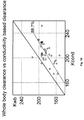
figure 18 , we see a graph over the 35 remaining Integra treatments, where the whole body clearance is about 11 % lower than the conductivity based clearance. But the data are fairly scattered, and we would therefore like to compare the whole body clearance with the initial effective clearance based on urea concentrations instead. - As shown in
figure 19 , this can be done since conductivity based clearance and initial effective clearance agree quite well as shown in this diagram from our study. This agreement has also been shown by several previous studies. - Referring to
figure 20 , if we now compare the whole body clearance to initial effective clearance based on urea concentrations in all remaining 71 treatments we see that the data are much less scattered. The difference is still about 11 %. The next figure shows the ratio between these two clearances. - Then in
figure 21 , the ratio is shown as a function of the relative treatment efficiency, whole body K/V, and we see that there is a negative correlation. This corresponds to the correlation between K/V and the error in single pool Kt/V that is the basis for Daugirdas' rate equation. - Next, in
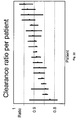
figure 22 , if we look at the clearance ratios for each patient, we see that there is a clear difference between patients. Shown here are the range and median value for each patient, and the patients have been ordered according to median value. We see that the clearance ratio varies between roughly 0.8 and 0.95. For most patients the variation in ratio is less than the interpatient variation. - Referring now to
figure 23 , let us now go back and try to explain a theoretical basis for the ratio variations. Again the two-pool regional blood flow model will be used, and in the simplified analysis it is assumed that there is no ultrafiltration or urea generation. It is then possible to set up a differential equation describing the evolution of the ratio of the two pool concentrations, which shows that their ratio will fairly quickly approach a steady state value. This is all that is needed to calculate the steady state ratio between whole body clearance and effective clearance. The clearance ratio will depend on the ratio of the two volumes, the ratio of the two flows, and the ratio of the effective clearance to the systemic blood flow. - Referring to
figure 24 . Shown here is the theoretical clearance ratio as a function of the effective clearance for a systemic blood flow of 5 L/min, a low flow pool volume of 80% of the total volume, and a flow fraction to this pool of 10, 20 and 30% of the total systemic flow. This range of parameters agrees with what Daugirdas and Schneditz found necessary to explain observed urea rebound. In our study the clearances were slightly above 200, and we see that the theoretical ratio variation is between 0.8 and 0.95, which agrees well with the clinical results. We also see that at higher clearances between 300 and 400, whole body clearance can be as much as 30% or more below the effective clearance, but the actual ratio depends heavily on the patient parameters. - The following conclusions can be drawn. Effective clearance by conductivity overestimates whole body clearance in a patient dependent way. Last, but not least, in patients with a large gap between whole body clearance and effective clearance (i.e. a small ratio) there seems to be a large potential for efficiency improvements by affecting the patient parameters. The big question is how this could be achieved.
- The term "comprises/comprising" when used in this specification is taken to specify the presence of stated features, integers, steps or components. However, the term does not preclude the presence or addition of one or more additional features, integers, steps or components or groups thereof.
The invention is not restricted to the described embodiments in the figures, but may be varied freely within the scope of the claims. -
- 1. A method of estimating a process efficiency of a dialysis system comprising a dialyzer (130) and a patient (120), where the patient's blood system is connected to the dialyzer (130) such that the dialyzer (130) performs a dialysis treatment of the patient (120), the dialyzer (130) having a potential cleaning capacity (Keff, K), characterized by the step of:
- determining a whole body clearance ratio (Kwb/Keff, Kwb/K) which expresses how well the patient (120) responds to the potential cleaning capacity (Keff, K).
- 2. A method according to
clause 1, characterized by determining the whole body clearance ratio (Kwb/Keff, Kwb/K) by:- measuring a final blood urea concentration no later than approximately one minute after the end of the treatment,
- measuring an equilibrated blood urea concentration no earlier than approximately one half hour after the end of the treatment, and
- dividing said final blood urea concentration by said equilibrated blood urea concentration.
- 3. A method according to clause 2, characterized by measuring the final blood urea concentration directly after the end of the treatment to obtain the whole body clearance ratio (Kwb/K) in respect of a dialyzer clearance (K).
- 4. A method according to clause 2, characterized by measuring the final blood urea concentration approximately one minute after the end of the treatment to obtain the whole body clearance ratio (Kwb/Keff) in respect of an effective clearance (Keff).
- 5. A method according to
clause 1, characterized by determining the whole body clearance ratio (Kwb/Keff, Kwb/K) by:- measuring an initial urea concentration (Cd0; Cb0),
- measuring, during the treatment at occasions being well spaced in time at least two subsequent urea concentration values after the treatment has started, a first value of said at least two values being measured no earlier than approximately one half hour after the treatment has started,
- deriving a starting urea concentration based on an extrapolation in time of said at least two values back to the start of the treatment, and
- dividing said starting urea concentration by said initial urea concentration (Cd0; Cb0).
- 6. A method of estimating a whole body clearance ratio (Kwb/Keff) of a dialysis treatment of a patient (120), the whole body clearance ratio (Kwb/Keff) expressing how well the patient (120) responds to a potential cleaning capacity (Keff) of a dialyzer (130) which performs the treatment, characterized by determining the whole body clearance ratio (Kwb/Keff) based on a measurement of a slope (Kwb/V) of a logarithmic removal rate function (Cd, Cb) which describes how a urea concentration is lowered in course of the treatment.
- 7. A method according to clause 6, characterized by the steps of:
- determining an initial dialysate urea concentration (Cd0),
- determining a total flow rate (Qd) of spent dialysate during the treatment including any ultrafiltration,
- calculating, based on measurements performed during a steady state phase (t3 - t4) of the treatment, the slope (Kwb/V) of said logarithmic removal rate function (Cd),
- measuring a predialysis urea mass (m0) in the patient (120), and
- determining the whole body clearance ratio (Kwb/Keff) as the product of said slope (Kwb/V) and said predialysis urea mass (m0), divided by said flow rate (Qd) and divided by said initial urea concentration (Cd0).
- 8. A method according to clause 6, characterized by the steps of:
- calculating, based on measurements performed during a steady state phase (t3 - t4) of the treatment, the slope (Kwb/V) of said logarithmic removal rate function (Cd; Cb),
- determining an entire distribution volume (V), and
- determining the whole body clearance ratio (Kwb/Keff, Kwb/K) as the product of said slope (Kwb/V) and said entire distribution volume (V) divided by the potential cleaning capacity (Keff; K).
- 9. A method according to any one of the
clauses 7 or 8, characterized by performing the measurements of the slope (Kwb/V) of said logarithmic removal rate function (Cd) on a dialysate side of a dialysis system comprising the dialyzer (130) and the patient (120). - 10. A method according to
clause 8, characterized by performing the measurements of the slope (Kwb/V) of said logarithmic removal rate function (Cb) on a blood side of a dialysis system comprising the dialyzer (130) and the patient (120). - 11. A computer program directly loadable into the internal memory of a computer, comprising software for controlling the steps of any of the
clauses 1 to 5 when said program is run on the computer. - 12. A computer readable medium, having a program recorded thereon, where the program is to make a computer control the steps of any of the
clauses 1 to 5. - 13. A computer program directly loadable into the internal memory of a computer, comprising software for controlling the steps of any of the clauses 6 to 10 when said program is run on the computer.
- 14. A computer readable medium, having a program recorded thereon, where the program is to make a computer control the steps of any of the clauses 6 to 10.
- 15. A method of performing a dialysis treatment program with respect to a patient (120) by means of a dialyzer (130), the program comprising repeated dialysis treatments, characterized by
performing a first dialysis treatment of the patient (120) under a first set of conditions which include at least one of a treatment time and a composition of the dialysate in the dialyzer (130),
estimating, in course of the first dialysis treatment, a whole body clearance ratio (Kwb/Keff, Kwb/K) according to any of the clauses 2 to 5, or any one of the clauses 6 to 10,
comparing the whole body clearance ratio (Kwb/Keff, Kwb/K) with a threshold ratio, and if the whole body clearance ratio (Kwb/Keff, Kwb/K) is less than the threshold ratio
performing a dialysis treatment of the patient (120) after said first dialysis treatment under a second set of conditions which are different from the first set of conditions. - 16. An apparatus (210) adapted to estimate a whole body clearance ratio of a dialysis treatment of a patient (120), the whole body clearance ratio expressing how well the patient (120) responds to a potential cleaning capacity of a dialyzer (130) which performs the treatment, the apparatus (210) comprising:
- a urea monitor circuit (211) adapted to: determine an initial dialysate urea concentration (Cd0); determine a total flow rate (Qd) of spent dialysate during the treatment including any ultrafiltration; measure, during a steady state phase (t3 - t4) of the treatment, a slope (Kwb/V) of a removal rate function which describes how a dialysate urea concentration is lowered in course of the treatment; and measure a predialysis urea mass (m0) in the patient (120), and
- a processor (212) adapted to determine the whole body clearance ratio (Kwb/Keff) for the patient (120), the whole body clearance ratio (Kwb/ Keff) being determined as the product of said slope (Kwb/V) and said predialysis urea mass (m0), divided by said flow rate (Qd) and divided by said initial dialysate urea concentration (Cd0).
- 17. Use of the apparatus (210) according to the clause 16 for estimating a whole body clearance ratio of a dialysis treatment of a patient (120).
Claims (20)
- A method of estimating a process efficiency of a dialysis system comprising a dialyzer (130) and a patient (120), where the patient's blood system is connected to the dialyzer (130) such that the dialyzer (130) performs a dialysis treatment of the patient (120), the dialyzer (130) having a potential cleaning capacity (Keff, K), characterized by the step of:determining a whole body clearance ratio (Kwb/Keff, Kwb/K) which expresses how well the patient (120) responds to the potential cleaning capacity (Keff, K).
- The method according to claim 1, characterized by determining the whole body clearance ratio (Kwb/Keff, Kwb/K) by:measuring a final blood urea concentration no later than approximately one minute after the end of the treatment,measuring an equilibrated blood urea concentration no earlier than approximately one half hour after the end of the treatment, anddividing said final blood urea concentration by said equilibrated blood urea concentration.
- The method according to claim 2, characterized by measuring the final blood urea concentration directly after the end of the treatment to obtain the whole body clearance ratio (Kwb/K) in respect of a dialyzer clearance (K).
- The method according to claim 2, characterized by measuring the final blood urea concentration approximately one minute after the end of the treatment to obtain the whole body clearance ratio (Kwb/Keff) in respect of an effective clearance (Keff).
- The method according to claim 1, characterized by determining the whole body clearance ratio (Kwb/Keff, Kwb/K) by:measuring an initial urea concentration (Cd0; Cb0),measuring, during the treatment at occasions being well spaced in time at least two subsequent urea concentration values after the treatment has started, a first value of said at least two values being measured no earlier than approximately one half hour after the treatment has started,deriving a starting urea concentration based on an extrapolation in time of said at least two values back to the start of the treatment, anddividing said starting urea concentration by said initial urea concentration (Cd0; Cb0).
- The method of estimating a whole body clearance ratio (Kwb/Keff) of a dialysis treatment of a patient (120), the whole body clearance ratio (Kwb/Keff) expressing how well the patient (120) responds to a potential cleaning capacity (Keff) of a dialyzer (130) which performs the treatment, characterized by determining the whole body clearance ratio (Kwb/Keff) based on a measurement of a slope (Kwb/V) of a logarithmic removal rate function (Cd, Cb) which describes how a urea concentration is lowered in course of the treatment.
- The method according to claim 6, characterized by the steps of:determining an initial dialysate urea concentration (Cd0),determining a total flow rate (Qd) of spent dialysate during the treatment including any ultrafiltration,calculating, based on measurements performed during a steady state phase (t3 - t4) of the treatment, the slope (Kwb/V) of said logarithmic removal rate function (Cd),measuring a predialysis urea mass (m0) in the patient (120), anddetermining the whole body clearance ratio (Kwb/Keff) as the product of said slope (Kwb/V) and said predialysis urea mass (m0), divided by said flow rate (Qd) and divided by said initial urea concentration (Cd0).
- The method according to claim 6, characterized by the steps of:calculating, based on measurements performed during a steady state phase (t3 - t4) of the treatment, the slope (Kwb/V) of said logarithmic removal rate function (Cd; Cb),determining an entire distribution volume (V), anddetermining the whole body clearance ratio (Kwb/Keff; Kwb/K) as the product of said slope (Kwb/V) and said entire distribution volume (V) divided by the potential cleaning capacity (Keff; K).
- The method according to any one of the claims 7 or 8, characterized by performing the measurements of the slope (Kwb/V) of said logarithmic removal rate function (Cd) on a dialysate side of a dialysis system comprising the dialyzer (130) and the patient (120).
- The method according to claim 8, characterized by performing the measurements of the slope (Kwb/V) of said logarithmic removal rate function (Cb) on a blood side of a dialysis system comprising the dialyzer (130) and the patient (120).
- An apparatus adapted to estimate a process efficiency of a dialysis system comprising a dialyzer (130) and a patient (120), where the patient's blood system is connected to the dialyzer (130) such that the dialyzer (130) performs a dialysis treatment of the patient (120), the dialyzer (130) having a potential cleaning capacity (Keff, K), the apparatus comprising a processor adapted to determine a whole body clearance ratio (Kwb/Keff, Kwb/K) which expresses how well the patient (120) responds to the potential cleaning capacity (Keff, K).
- The apparatus according to claim 11, wherein the processor is adapted to determine the whole body clearance ratio (Kwb/Keff, Kwb/K) by
measuring a final blood urea concentration no later than approximately one minute after the end of the treatment,
measuring an equilibrated blood urea concentration no earlier than approximately one half hour after the end of the treatment, and
dividing said final blood urea concentration by said equilibrated blood urea concentration. - The apparatus according to claim 12, wherein the processor is adapted to measure the final blood urea concentration directly after the end of the treatment to obtain the whole body clearance ratio (Kwb/K) in respect of a dialyzer clearance (K).
- The apparatus according to claim 12, wherein the processor is adapted to measure the final blood urea concentration approximately one minute after the end of the treatment to obtain the whole body clearance ratio (Kwb/Keff) in respect of an effective clearance (Keff).
- The apparatus according to claim 11, wherein the processor is adapted to determine the whole body clearance ratio (Kwb/Keff, Kwb/K) by:measuring an initial urea concentration (Cd0; Cb0),measuring, during the treatment at occasions being well spaced in time at least two subsequent urea concentration values after the treatment has started, a first value of said at least two values being measured no earlier than approximately one half hour after the treatment has started,deriving a starting urea concentration based on an extrapolation in time of said at least two values back to the start of the treatment, anddividing said starting urea concentration by said initial urea concentration (Cd0; Cb0).
- An apparatus adapted to estimate a whole body clearance ratio (Kwb/Keff) of a dialysis treatment of a patient (120), the whole body clearance ratio (Kwb/Keff) expressing how well the patient (120) responds to a potential cleaning capacity (Keff) of a dialyzer (130) which performs the treatment, the apparatus comprising a processor adapted to determine the whole body clearance ratio (Kwb/Keff) based on a measurement of a slope (Kwb/V) of a logarithmic removal rate function (Cd, Cb) which describes how a urea concentration is lowered in course of the treatment.
- The apparatus according to claim 16, wherein the processor is adapted to:determine an initial dialysate urea concentration (Cd0),determine a total flow rate (Qd) of spent dialysate during the treatment including any ultrafiltration,calculate, based on measurements performed during a steady state phase (t3 - t4) of the treatment, the slope (Kwb/V) of said logarithmic removal rate function (Cd),measure a predialysis urea mass (m0) in the patient (120), anddetermine the whole body clearance ratio (Kwb/Keff) as the product of said slope (Kwb/V) and said predialysis urea mass (m0), divided by said flow rate (Qd) and divided by said initial urea concentration (Cd0).
- The apparatus according to claim 16, wherein the processor is adapted to:calculate, based on measurements performed during a steady state phase (t3 - t4) of the treatment, the slope (Kwb/V) of said logarithmic removal rate function (Cd; Cb),determine an entire distribution volume (V), anddetermine the whole body clearance ratio (Kwb/Keff; Kwb/K) as the product of said slope (Kwb/V) and said entire distribution volume (V) divided by the potential cleaning capacity (Keff; K).
- The apparatus according to any one of the claims 17 or 18, wherein the processor is adapted to perform the measurements of the slope (Kwb/V) of said logarithmic removal rate function (Cd) on a dialysate side of a dialysis system comprising the dialyzer (130) and the patient (120).
- The apparatus according to claim 19, wherein the processor is adapted to perform the measurements of the slope (Kwb/V) of said logarithmic removal rate function (Cb) on a blood side of a dialysis system comprising the dialyzer (130) and the patient (120).
Applications Claiming Priority (2)
| Application Number | Priority Date | Filing Date | Title |
|---|---|---|---|
| US42241902P | 2002-10-30 | 2002-10-30 | |
| EP03759141A EP1556101B1 (en) | 2002-10-30 | 2003-10-28 | Apparatus for determining the efficiency of dialysis |
Related Parent Applications (1)
| Application Number | Title | Priority Date | Filing Date |
|---|---|---|---|
| EP03759141A Division EP1556101B1 (en) | 2002-10-30 | 2003-10-28 | Apparatus for determining the efficiency of dialysis |
Publications (2)
| Publication Number | Publication Date |
|---|---|
| EP2000160A2 true EP2000160A2 (en) | 2008-12-10 |
| EP2000160A3 EP2000160A3 (en) | 2009-03-11 |
Family
ID=32230352
Family Applications (2)
| Application Number | Title | Priority Date | Filing Date |
|---|---|---|---|
| EP08165248A Withdrawn EP2000160A3 (en) | 2002-10-30 | 2003-10-28 | Method and apparatuses for determining the efficiency of dialysis |
| EP03781487A Withdrawn EP1556089A4 (en) | 2002-10-30 | 2003-10-29 | INHIBITION OF GENE EXPRESSION WITH MITRNA INFLUENCING AGENTS |
Family Applications After (1)
| Application Number | Title | Priority Date | Filing Date |
|---|---|---|---|
| EP03781487A Withdrawn EP1556089A4 (en) | 2002-10-30 | 2003-10-29 | INHIBITION OF GENE EXPRESSION WITH MITRNA INFLUENCING AGENTS |
Country Status (5)
| Country | Link |
|---|---|
| US (1) | US7696179B2 (en) |
| EP (2) | EP2000160A3 (en) |
| JP (1) | JP2006504427A (en) |
| AU (1) | AU2003287254A1 (en) |
| WO (1) | WO2004039957A2 (en) |
Families Citing this family (22)
| Publication number | Priority date | Publication date | Assignee | Title |
|---|---|---|---|---|
| AU2002326906C1 (en) | 2001-09-13 | 2009-01-29 | California Institute Of Technology | Method for expression of small antiviral RNA molecules within a cell |
| US7737124B2 (en) | 2001-09-13 | 2010-06-15 | California Institute Of Technology | Method for expression of small antiviral RNA molecules with reduced cytotoxicity within a cell |
| US20060160759A1 (en) * | 2002-09-28 | 2006-07-20 | Jianzhu Chen | Influenza therapeutic |
| ATE503014T1 (en) * | 2003-11-04 | 2011-04-15 | Geron Corp | RNA AMIDATE AND THIOAMIDATEUR RNAI |
| CA2564616C (en) * | 2004-04-20 | 2016-08-30 | Nastech Pharmaceutical Company Inc. | Methods and compositions for enhancing delivery of double-stranded rna or a double-stranded hybrid nucleic acid to regulate gene expression in mammalian cells |
| WO2006023491A2 (en) | 2004-08-16 | 2006-03-02 | The Cbr Institute For Biomedical Research, Inc. | Method of delivering rna interference and uses thereof |
| US7943589B2 (en) * | 2005-06-03 | 2011-05-17 | President And Fellows Of Harvard College | siRNA microbicides for preventing and treating diseases |
| US8541386B2 (en) | 2009-08-19 | 2013-09-24 | University Of South Florida | Cannabinoid 2 (CB2) receptor gene promoter and unique RNA transcripts in B cells and methods of use |
| US9833480B2 (en) | 2010-04-14 | 2017-12-05 | Prospect Chartercare, Llc | Methods and compositions for treating HIV |
| WO2012056441A1 (en) * | 2010-10-28 | 2012-05-03 | Nanodoc Ltd. | Compositions and methods for specific cleavage of exogenous rna in a cell |
| WO2012075337A2 (en) | 2010-12-01 | 2012-06-07 | Spinal Modulation, Inc. | Directed delivery of agents to neural anatomy |
| US10378016B2 (en) | 2010-12-06 | 2019-08-13 | Children's Medical Center Corporation | Composition and method for oligonucleotide delivery |
| WO2012116073A2 (en) | 2011-02-23 | 2012-08-30 | The Board Of Trustees Of The University Of Illinois | Amphiphilic dendron-coils, micelles thereof and uses |
| WO2013063019A1 (en) | 2011-10-28 | 2013-05-02 | The Wistar Institute Of Anatomy And Biology | Methods and compositions for enhancing the therapeutic effect of anti-tumor t cells |
| US10238755B2 (en) | 2011-11-30 | 2019-03-26 | The Wistar Institute Of Anatomy And Biology | Methods and compositions for regulation of cell aging, carcinogenesis and reprogramming |
| KR101520383B1 (en) | 2012-08-02 | 2015-05-15 | 에이비온 주식회사 | Composition for Treating HPV-related Cancers |
| US20160008282A1 (en) | 2013-02-22 | 2016-01-14 | The Board Of Trustees Of The Universityof Illinois | Transdermal Drug Delivery Using Amphiphilic Dendron-Coil Micelles |
| DK3200815T3 (en) | 2014-10-02 | 2021-05-10 | Wistar Inst | METHODS AND COMPOSITIONS FOR TREATING CANCER |
| US11208468B2 (en) | 2016-02-18 | 2021-12-28 | The Wistar Institute Of Anatomy And Biology | Methods and compositions for treating melanoma |
| WO2020150377A1 (en) * | 2019-01-15 | 2020-07-23 | Temple University - Of The Commonwealth System Of Higher Education | Targeting the bag family for the treatment of neurodegenerative disease |
| CN110283820B (en) * | 2019-04-29 | 2023-07-28 | 新疆医科大学第一附属医院 | Interference RNA for inhibiting echinococcosis granulosa protohead DNA oxidative damage repair gene expression and application thereof |
| WO2021222943A1 (en) | 2020-04-30 | 2021-11-04 | Figene, Llc | Immunotherapeutic methods and compositions for targeting cancer fibroblasts |
Citations (4)
| Publication number | Priority date | Publication date | Assignee | Title |
|---|---|---|---|---|
| EP0547025A1 (en) | 1988-03-03 | 1993-06-16 | Gambro Ab | Method for determining a concentration of a substance in blood or the dialysance of a dialyser |
| EP0658352A1 (en) | 1993-12-17 | 1995-06-21 | Hospal Ag | Procedure for determining a parameter indicating the progress of an extracorporeal blood treatment |
| US6217539B1 (en) | 1996-11-30 | 2001-04-17 | Fresenius Medical Care Deutschland Gmbh | Method of in-vivo determination of hemodialysis parameters and a device for carrying out the method |
| US6258027B1 (en) | 1997-06-02 | 2001-07-10 | Gambro Lundia Ab | Method and device for calculating dialysis efficiency |
Family Cites Families (6)
| Publication number | Priority date | Publication date | Assignee | Title |
|---|---|---|---|---|
| CA2317895A1 (en) * | 1998-01-15 | 1999-07-22 | Btg International Limited | Ribozymal nucleic acids cleaving ccr5 or cxcr4 |
| JPH11292795A (en) * | 1998-04-02 | 1999-10-26 | Yamanouchi Pharmaceut Co Ltd | Hiv cofactor inhibitor |
| WO2002094250A2 (en) * | 2001-05-18 | 2002-11-28 | Cureon A/S | Therapeutic uses of lna-modified oligonucleotides in infectious diseases |
| AU2002326906C1 (en) * | 2001-09-13 | 2009-01-29 | California Institute Of Technology | Method for expression of small antiviral RNA molecules within a cell |
| JP2005521393A (en) * | 2002-03-20 | 2005-07-21 | マサチューセッツ インスティテュート オブ テクノロジー | HIV treatment |
| WO2003099298A1 (en) | 2002-05-24 | 2003-12-04 | Max-Planck Gesellschaft zur Förderung der Wissenschaften e.V. | Rna interference mediating small rna molecules |
-
2003
- 2003-10-28 EP EP08165248A patent/EP2000160A3/en not_active Withdrawn
- 2003-10-29 EP EP03781487A patent/EP1556089A4/en not_active Withdrawn
- 2003-10-29 US US10/533,621 patent/US7696179B2/en not_active Expired - Lifetime
- 2003-10-29 JP JP2004548585A patent/JP2006504427A/en active Pending
- 2003-10-29 AU AU2003287254A patent/AU2003287254A1/en not_active Abandoned
- 2003-10-29 WO PCT/US2003/034424 patent/WO2004039957A2/en not_active Ceased
Patent Citations (4)
| Publication number | Priority date | Publication date | Assignee | Title |
|---|---|---|---|---|
| EP0547025A1 (en) | 1988-03-03 | 1993-06-16 | Gambro Ab | Method for determining a concentration of a substance in blood or the dialysance of a dialyser |
| EP0658352A1 (en) | 1993-12-17 | 1995-06-21 | Hospal Ag | Procedure for determining a parameter indicating the progress of an extracorporeal blood treatment |
| US6217539B1 (en) | 1996-11-30 | 2001-04-17 | Fresenius Medical Care Deutschland Gmbh | Method of in-vivo determination of hemodialysis parameters and a device for carrying out the method |
| US6258027B1 (en) | 1997-06-02 | 2001-07-10 | Gambro Lundia Ab | Method and device for calculating dialysis efficiency |
Also Published As
| Publication number | Publication date |
|---|---|
| US7696179B2 (en) | 2010-04-13 |
| WO2004039957A3 (en) | 2004-09-30 |
| US20060293262A1 (en) | 2006-12-28 |
| EP1556089A4 (en) | 2008-01-09 |
| JP2006504427A (en) | 2006-02-09 |
| AU2003287254A8 (en) | 2004-05-25 |
| WO2004039957A2 (en) | 2004-05-13 |
| EP2000160A3 (en) | 2009-03-11 |
| AU2003287254A1 (en) | 2004-05-25 |
| EP1556089A2 (en) | 2005-07-27 |
Similar Documents
| Publication | Publication Date | Title |
|---|---|---|
| EP1556101B1 (en) | Apparatus for determining the efficiency of dialysis | |
| US6187199B1 (en) | Process and device for determining hemodialysis parameters | |
| Ramchandani et al. | A physiologically‐based pharmacokinetic (PBPK) model for alcohol facilitates rapid BrAC clamping | |
| AU732784B2 (en) | Method and device for calculating dialysis efficiency | |
| JP3547436B2 (en) | Hemodialysis monitoring system for hemodialysis equipment | |
| JP4046770B2 (en) | Device for implementing a method for measuring recirculation during extracorporeal blood treatment | |
| CA2313209C (en) | Method and device for calculating dialysis efficiency | |
| US7815852B2 (en) | Method, apparatus and software program for measurement of a parameter relating to a heart-lung system of a mammal | |
| US20080149563A1 (en) | Method of controlling dialysis using blood circulation times | |
| JP6043850B2 (en) | Treatment prediction and optimization for renal failure blood therapy, especially for home hemodialysis | |
| CN101918053A (en) | Method and device for determining the recirculation in a fistula or the cardiopulmonary recirculation, and a blood treatment device comprising a device for determining the fistula recirculation or the cardiopulmonary recirculation part | |
| CN104970767B (en) | Device and method for determining the distribution volume of a dialysis patient | |
| Wuepper et al. | Determination of urea distribution volume for Kt/V assessed by conductivity monitoring | |
| CN109152875B (en) | Device and method for determining a parameter indicative of the progress of an extracorporeal blood treatment | |
| Di Filippo et al. | How to determine ionic dialysance for the online assessment of delivered dialysis dose | |
| JP4676612B2 (en) | Method for measuring parameters indicating progress of extracorporeal blood treatment | |
| CN113164670A (en) | Performance monitoring of regional citrate anticoagulation | |
| Smye et al. | A mathematical analysis of a two-compartment model of urea kinetics | |
| Kaufman et al. | Solute disequilibrium and multicompartment modeling | |
| JP7495945B2 (en) | Estimation of the rate of formation of substances in dialysis patients | |
| Heaf et al. | The cellular clearance theory does not explain the post-dialytic small molecule rebound | |
| WO2022076432A1 (en) | Urea monitoring during dialysis for improved quality control and treatment guidance | |
| Azar et al. | Double pool urea kinetic modeling | |
| Jean et al. | Quest for postdialysis urea rebound-equilibrated Kt/V with only intradialytic urea samples | |
| Raj et al. | Mass balance index: an index for adequacy of dialysis and nutrition |
Legal Events
| Date | Code | Title | Description |
|---|---|---|---|
| PUAI | Public reference made under article 153(3) epc to a published international application that has entered the european phase |
Free format text: ORIGINAL CODE: 0009012 |
|
| AC | Divisional application: reference to earlier application |
Ref document number: 1556101 Country of ref document: EP Kind code of ref document: P |
|
| AK | Designated contracting states |
Kind code of ref document: A2 Designated state(s): AT BE BG CH CY CZ DE DK EE ES FI FR GB GR HU IE IT LI LU MC NL PT RO SE SI SK TR |
|
| PUAL | Search report despatched |
Free format text: ORIGINAL CODE: 0009013 |
|
| AK | Designated contracting states |
Kind code of ref document: A3 Designated state(s): AT BE BG CH CY CZ DE DK EE ES FI FR GB GR HU IE IT LI LU MC NL PT RO SE SI SK TR |
|
| 111Z | Information provided on other rights and legal means of execution |
Free format text: AT BE BG CH CY CZ DE DK EE ES FI FR GB GR HU IE IT LU MC NL PT RO SE SI SK TR Effective date: 20090504 |
|
| 17Q | First examination report despatched |
Effective date: 20090916 |
|
| AKX | Designation fees paid |
Designated state(s): AT BE BG CH CY CZ DE DK EE ES FI FR GB GR HU IE IT LI LU MC NL PT RO SE SI SK TR |
|
| D11X | Information provided on other rights and legal means of execution (deleted) | ||
| GRAP | Despatch of communication of intention to grant a patent |
Free format text: ORIGINAL CODE: EPIDOSNIGR1 |
|
| INTG | Intention to grant announced |
Effective date: 20160617 |
|
| GRAS | Grant fee paid |
Free format text: ORIGINAL CODE: EPIDOSNIGR3 |
|
| STAA | Information on the status of an ep patent application or granted ep patent |
Free format text: STATUS: THE APPLICATION IS DEEMED TO BE WITHDRAWN |
|
| 18D | Application deemed to be withdrawn |
Effective date: 20161028 |