EP1999197B1 - Method for applying a coating onto a silicone hydrogel lens - Google Patents
Method for applying a coating onto a silicone hydrogel lens Download PDFInfo
- Publication number
- EP1999197B1 EP1999197B1 EP20070780747 EP07780747A EP1999197B1 EP 1999197 B1 EP1999197 B1 EP 1999197B1 EP 20070780747 EP20070780747 EP 20070780747 EP 07780747 A EP07780747 A EP 07780747A EP 1999197 B1 EP1999197 B1 EP 1999197B1
- Authority
- EP
- European Patent Office
- Prior art keywords
- coating
- lens
- contact lens
- silicone
- lenses
- Prior art date
- Legal status (The legal status is an assumption and is not a legal conclusion. Google has not performed a legal analysis and makes no representation as to the accuracy of the status listed.)
- Not-in-force
Links
- 238000000576 coating method Methods 0.000 title claims description 195
- 239000011248 coating agent Substances 0.000 title claims description 183
- 229920001296 polysiloxane Polymers 0.000 title claims description 101
- 239000000017 hydrogel Substances 0.000 title claims description 80
- 238000000034 method Methods 0.000 title claims description 60
- 239000000463 material Substances 0.000 claims description 115
- XLYOFNOQVPJJNP-UHFFFAOYSA-N water Substances O XLYOFNOQVPJJNP-UHFFFAOYSA-N 0.000 claims description 41
- 230000002209 hydrophobic effect Effects 0.000 claims description 36
- 239000000178 monomer Substances 0.000 claims description 29
- 239000000203 mixture Substances 0.000 claims description 28
- 229920002125 Sokalan® Polymers 0.000 claims description 26
- -1 vinyl lactam Chemical class 0.000 claims description 24
- 229920001477 hydrophilic polymer Polymers 0.000 claims description 23
- 239000004584 polyacrylic acid Substances 0.000 claims description 22
- 125000002348 vinylic group Chemical group 0.000 claims description 21
- 229920000036 polyvinylpyrrolidone Polymers 0.000 claims description 20
- 239000001267 polyvinylpyrrolidone Substances 0.000 claims description 20
- 235000013855 polyvinylpyrrolidone Nutrition 0.000 claims description 20
- 230000005855 radiation Effects 0.000 claims description 17
- 229920002554 vinyl polymer Polymers 0.000 claims description 14
- 238000000465 moulding Methods 0.000 claims description 13
- 125000004432 carbon atom Chemical group C* 0.000 claims description 12
- 229920001577 copolymer Polymers 0.000 claims description 12
- 229920002451 polyvinyl alcohol Polymers 0.000 claims description 9
- 239000003960 organic solvent Substances 0.000 claims description 7
- 229920001519 homopolymer Polymers 0.000 claims description 6
- 239000001257 hydrogen Substances 0.000 claims description 6
- 229910052739 hydrogen Inorganic materials 0.000 claims description 6
- SMZOUWXMTYCWNB-UHFFFAOYSA-N 2-(2-methoxy-5-methylphenyl)ethanamine Chemical compound COC1=CC=C(C)C=C1CCN SMZOUWXMTYCWNB-UHFFFAOYSA-N 0.000 claims description 5
- 239000007788 liquid Substances 0.000 claims description 5
- 229920002845 Poly(methacrylic acid) Polymers 0.000 claims description 4
- 125000001495 ethyl group Chemical group [H]C([H])([H])C([H])([H])* 0.000 claims description 4
- 125000002496 methyl group Chemical group [H]C([H])([H])* 0.000 claims description 4
- 125000001436 propyl group Chemical group [H]C([*])([H])C([H])([H])C([H])([H])[H] 0.000 claims description 4
- NIXOWILDQLNWCW-UHFFFAOYSA-N 2-Propenoic acid Natural products OC(=O)C=C NIXOWILDQLNWCW-UHFFFAOYSA-N 0.000 claims description 3
- 125000002877 alkyl aryl group Chemical group 0.000 claims description 3
- 125000003710 aryl alkyl group Chemical group 0.000 claims description 3
- 125000003118 aryl group Chemical group 0.000 claims description 3
- 125000004435 hydrogen atom Chemical group [H]* 0.000 claims description 3
- 239000004372 Polyvinyl alcohol Substances 0.000 claims description 2
- 125000002947 alkylene group Chemical group 0.000 claims description 2
- 229920003145 methacrylic acid copolymer Polymers 0.000 claims 1
- 239000000243 solution Substances 0.000 description 69
- 238000012360 testing method Methods 0.000 description 36
- QVGXLLKOCUKJST-UHFFFAOYSA-N atomic oxygen Chemical compound [O] QVGXLLKOCUKJST-UHFFFAOYSA-N 0.000 description 28
- 239000001301 oxygen Substances 0.000 description 28
- 229910052760 oxygen Inorganic materials 0.000 description 28
- 230000035699 permeability Effects 0.000 description 18
- 229920000642 polymer Polymers 0.000 description 17
- 230000008569 process Effects 0.000 description 15
- 229920000831 ionic polymer Polymers 0.000 description 13
- 238000005507 spraying Methods 0.000 description 13
- 239000011162 core material Substances 0.000 description 12
- 230000000845 anti-microbial effect Effects 0.000 description 11
- 239000000975 dye Substances 0.000 description 9
- LFQSCWFLJHTTHZ-UHFFFAOYSA-N Ethanol Chemical compound CCO LFQSCWFLJHTTHZ-UHFFFAOYSA-N 0.000 description 8
- 239000003999 initiator Substances 0.000 description 8
- 238000004132 cross linking Methods 0.000 description 7
- 235000019422 polyvinyl alcohol Nutrition 0.000 description 7
- YCUVUDODLRLVIC-UHFFFAOYSA-N Sudan black B Chemical compound C1=CC(=C23)NC(C)(C)NC2=CC=CC3=C1N=NC(C1=CC=CC=C11)=CC=C1N=NC1=CC=CC=C1 YCUVUDODLRLVIC-UHFFFAOYSA-N 0.000 description 6
- 125000000623 heterocyclic group Chemical group 0.000 description 6
- 230000005764 inhibitory process Effects 0.000 description 6
- 230000000379 polymerizing effect Effects 0.000 description 6
- 230000009467 reduction Effects 0.000 description 6
- 238000010186 staining Methods 0.000 description 6
- 238000000108 ultra-filtration Methods 0.000 description 6
- 239000004599 antimicrobial Substances 0.000 description 5
- 210000004087 cornea Anatomy 0.000 description 5
- 238000009792 diffusion process Methods 0.000 description 5
- 230000004438 eyesight Effects 0.000 description 5
- 230000002045 lasting effect Effects 0.000 description 5
- HRPVXLWXLXDGHG-UHFFFAOYSA-N Acrylamide Chemical compound NC(=O)C=C HRPVXLWXLXDGHG-UHFFFAOYSA-N 0.000 description 4
- VEXZGXHMUGYJMC-UHFFFAOYSA-N Hydrochloric acid Chemical compound Cl VEXZGXHMUGYJMC-UHFFFAOYSA-N 0.000 description 4
- WHNWPMSKXPGLAX-UHFFFAOYSA-N N-Vinyl-2-pyrrolidone Chemical compound C=CN1CCCC1=O WHNWPMSKXPGLAX-UHFFFAOYSA-N 0.000 description 4
- 125000000217 alkyl group Chemical group 0.000 description 4
- 239000002801 charged material Substances 0.000 description 4
- 238000007334 copolymerization reaction Methods 0.000 description 4
- LOKCTEFSRHRXRJ-UHFFFAOYSA-I dipotassium trisodium dihydrogen phosphate hydrogen phosphate dichloride Chemical compound P(=O)(O)(O)[O-].[K+].P(=O)(O)([O-])[O-].[Na+].[Na+].[Cl-].[K+].[Cl-].[Na+] LOKCTEFSRHRXRJ-UHFFFAOYSA-I 0.000 description 4
- 239000012530 fluid Substances 0.000 description 4
- 230000005661 hydrophobic surface Effects 0.000 description 4
- 230000010220 ion permeability Effects 0.000 description 4
- 239000012633 leachable Substances 0.000 description 4
- 238000004519 manufacturing process Methods 0.000 description 4
- 238000005259 measurement Methods 0.000 description 4
- 229910052751 metal Inorganic materials 0.000 description 4
- 239000002184 metal Substances 0.000 description 4
- 230000004048 modification Effects 0.000 description 4
- 238000012986 modification Methods 0.000 description 4
- 230000002093 peripheral effect Effects 0.000 description 4
- 239000002953 phosphate buffered saline Substances 0.000 description 4
- 238000009832 plasma treatment Methods 0.000 description 4
- 229920000447 polyanionic polymer Polymers 0.000 description 4
- 238000007639 printing Methods 0.000 description 4
- 239000000047 product Substances 0.000 description 4
- 239000012487 rinsing solution Substances 0.000 description 4
- 239000000126 substance Substances 0.000 description 4
- 239000000080 wetting agent Substances 0.000 description 4
- OZAIFHULBGXAKX-UHFFFAOYSA-N 2-(2-cyanopropan-2-yldiazenyl)-2-methylpropanenitrile Chemical compound N#CC(C)(C)N=NC(C)(C)C#N OZAIFHULBGXAKX-UHFFFAOYSA-N 0.000 description 3
- BESKSSIEODQWBP-UHFFFAOYSA-N 3-tris(trimethylsilyloxy)silylpropyl 2-methylprop-2-enoate Chemical compound CC(=C)C(=O)OCCC[Si](O[Si](C)(C)C)(O[Si](C)(C)C)O[Si](C)(C)C BESKSSIEODQWBP-UHFFFAOYSA-N 0.000 description 3
- XEKOWRVHYACXOJ-UHFFFAOYSA-N Ethyl acetate Chemical compound CCOC(C)=O XEKOWRVHYACXOJ-UHFFFAOYSA-N 0.000 description 3
- CERQOIWHTDAKMF-UHFFFAOYSA-M Methacrylate Chemical compound CC(=C)C([O-])=O CERQOIWHTDAKMF-UHFFFAOYSA-M 0.000 description 3
- CERQOIWHTDAKMF-UHFFFAOYSA-N Methacrylic acid Chemical compound CC(=C)C(O)=O CERQOIWHTDAKMF-UHFFFAOYSA-N 0.000 description 3
- FOIXSVOLVBLSDH-UHFFFAOYSA-N Silver ion Chemical compound [Ag+] FOIXSVOLVBLSDH-UHFFFAOYSA-N 0.000 description 3
- FAPWRFPIFSIZLT-UHFFFAOYSA-M Sodium chloride Chemical compound [Na+].[Cl-] FAPWRFPIFSIZLT-UHFFFAOYSA-M 0.000 description 3
- 238000000889 atomisation Methods 0.000 description 3
- 238000006243 chemical reaction Methods 0.000 description 3
- 238000001723 curing Methods 0.000 description 3
- 238000000151 deposition Methods 0.000 description 3
- 239000004205 dimethyl polysiloxane Substances 0.000 description 3
- 238000003618 dip coating Methods 0.000 description 3
- KPUWHANPEXNPJT-UHFFFAOYSA-N disiloxane Chemical class [SiH3]O[SiH3] KPUWHANPEXNPJT-UHFFFAOYSA-N 0.000 description 3
- 238000009472 formulation Methods 0.000 description 3
- 230000036541 health Effects 0.000 description 3
- 150000002632 lipids Chemical class 0.000 description 3
- 244000005700 microbiome Species 0.000 description 3
- 229920000435 poly(dimethylsiloxane) Polymers 0.000 description 3
- 150000003254 radicals Chemical class 0.000 description 3
- 150000003839 salts Chemical class 0.000 description 3
- 239000011780 sodium chloride Substances 0.000 description 3
- 239000002904 solvent Substances 0.000 description 3
- 125000000391 vinyl group Chemical group [H]C([*])=C([H])[H] 0.000 description 3
- GVJHHUAWPYXKBD-UHFFFAOYSA-N (±)-α-Tocopherol Chemical compound OC1=C(C)C(C)=C2OC(CCCC(C)CCCC(C)CCCC(C)C)(C)CCC2=C1C GVJHHUAWPYXKBD-UHFFFAOYSA-N 0.000 description 2
- WKBPZYKAUNRMKP-UHFFFAOYSA-N 1-[2-(2,4-dichlorophenyl)pentyl]1,2,4-triazole Chemical compound C=1C=C(Cl)C=C(Cl)C=1C(CCC)CN1C=NC=N1 WKBPZYKAUNRMKP-UHFFFAOYSA-N 0.000 description 2
- JKNCOURZONDCGV-UHFFFAOYSA-N 2-(dimethylamino)ethyl 2-methylprop-2-enoate Chemical compound CN(C)CCOC(=O)C(C)=C JKNCOURZONDCGV-UHFFFAOYSA-N 0.000 description 2
- GNSFRPWPOGYVLO-UHFFFAOYSA-N 3-hydroxypropyl 2-methylprop-2-enoate Chemical compound CC(=C)C(=O)OCCCO GNSFRPWPOGYVLO-UHFFFAOYSA-N 0.000 description 2
- CSCPPACGZOOCGX-UHFFFAOYSA-N Acetone Chemical compound CC(C)=O CSCPPACGZOOCGX-UHFFFAOYSA-N 0.000 description 2
- VGGSQFUCUMXWEO-UHFFFAOYSA-N Ethene Chemical compound C=C VGGSQFUCUMXWEO-UHFFFAOYSA-N 0.000 description 2
- 239000005977 Ethylene Substances 0.000 description 2
- UFHFLCQGNIYNRP-UHFFFAOYSA-N Hydrogen Chemical compound [H][H] UFHFLCQGNIYNRP-UHFFFAOYSA-N 0.000 description 2
- 229920003171 Poly (ethylene oxide) Polymers 0.000 description 2
- 229920002873 Polyethylenimine Polymers 0.000 description 2
- 239000004743 Polypropylene Substances 0.000 description 2
- 241000589517 Pseudomonas aeruginosa Species 0.000 description 2
- VYPSYNLAJGMNEJ-UHFFFAOYSA-N Silicium dioxide Chemical compound O=[Si]=O VYPSYNLAJGMNEJ-UHFFFAOYSA-N 0.000 description 2
- 241000191967 Staphylococcus aureus Species 0.000 description 2
- XXROGKLTLUQVRX-UHFFFAOYSA-N allyl alcohol Chemical compound OCC=C XXROGKLTLUQVRX-UHFFFAOYSA-N 0.000 description 2
- 239000007864 aqueous solution Substances 0.000 description 2
- 239000003795 chemical substances by application Substances 0.000 description 2
- 229920006037 cross link polymer Polymers 0.000 description 2
- 230000007423 decrease Effects 0.000 description 2
- 230000008021 deposition Effects 0.000 description 2
- 238000013461 design Methods 0.000 description 2
- 238000007654 immersion Methods 0.000 description 2
- 239000002082 metal nanoparticle Substances 0.000 description 2
- FQPSGWSUVKBHSU-UHFFFAOYSA-N methacrylamide Chemical compound CC(=C)C(N)=O FQPSGWSUVKBHSU-UHFFFAOYSA-N 0.000 description 2
- 229940088644 n,n-dimethylacrylamide Drugs 0.000 description 2
- YLGYACDQVQQZSW-UHFFFAOYSA-N n,n-dimethylprop-2-enamide Chemical compound CN(C)C(=O)C=C YLGYACDQVQQZSW-UHFFFAOYSA-N 0.000 description 2
- JFNLZVQOOSMTJK-KNVOCYPGSA-N norbornene Chemical compound C1[C@@H]2CC[C@H]1C=C2 JFNLZVQOOSMTJK-KNVOCYPGSA-N 0.000 description 2
- 230000003287 optical effect Effects 0.000 description 2
- 239000000049 pigment Substances 0.000 description 2
- 229920000172 poly(styrenesulfonic acid) Polymers 0.000 description 2
- 229920002851 polycationic polymer Polymers 0.000 description 2
- 229920001155 polypropylene Polymers 0.000 description 2
- 108090000623 proteins and genes Proteins 0.000 description 2
- 102000004169 proteins and genes Human genes 0.000 description 2
- 238000000746 purification Methods 0.000 description 2
- 238000009877 rendering Methods 0.000 description 2
- 229910052594 sapphire Inorganic materials 0.000 description 2
- 239000010980 sapphire Substances 0.000 description 2
- 150000003384 small molecules Chemical class 0.000 description 2
- 238000002791 soaking Methods 0.000 description 2
- 229910001415 sodium ion Inorganic materials 0.000 description 2
- VZCYOOQTPOCHFL-UHFFFAOYSA-N trans-butenedioic acid Natural products OC(=O)C=CC(O)=O VZCYOOQTPOCHFL-UHFFFAOYSA-N 0.000 description 2
- 238000009736 wetting Methods 0.000 description 2
- 239000012956 1-hydroxycyclohexylphenyl-ketone Substances 0.000 description 1
- PIZHFBODNLEQBL-UHFFFAOYSA-N 2,2-diethoxy-1-phenylethanone Chemical compound CCOC(OCC)C(=O)C1=CC=CC=C1 PIZHFBODNLEQBL-UHFFFAOYSA-N 0.000 description 1
- QRIMLDXJAPZHJE-UHFFFAOYSA-N 2,3-dihydroxypropyl 2-methylprop-2-enoate Chemical compound CC(=C)C(=O)OCC(O)CO QRIMLDXJAPZHJE-UHFFFAOYSA-N 0.000 description 1
- AVTLBBWTUPQRAY-UHFFFAOYSA-N 2-(2-cyanobutan-2-yldiazenyl)-2-methylbutanenitrile Chemical compound CCC(C)(C#N)N=NC(C)(CC)C#N AVTLBBWTUPQRAY-UHFFFAOYSA-N 0.000 description 1
- WYGWHHGCAGTUCH-UHFFFAOYSA-N 2-[(2-cyano-4-methylpentan-2-yl)diazenyl]-2,4-dimethylpentanenitrile Chemical compound CC(C)CC(C)(C#N)N=NC(C)(C#N)CC(C)C WYGWHHGCAGTUCH-UHFFFAOYSA-N 0.000 description 1
- OMIGHNLMNHATMP-UHFFFAOYSA-N 2-hydroxyethyl prop-2-enoate Chemical compound OCCOC(=O)C=C OMIGHNLMNHATMP-UHFFFAOYSA-N 0.000 description 1
- VHSHLMUCYSAUQU-UHFFFAOYSA-N 2-hydroxypropyl methacrylate Chemical compound CC(O)COC(=O)C(C)=C VHSHLMUCYSAUQU-UHFFFAOYSA-N 0.000 description 1
- BQZJOQXSCSZQPS-UHFFFAOYSA-N 2-methoxy-1,2-diphenylethanone Chemical compound C=1C=CC=CC=1C(OC)C(=O)C1=CC=CC=C1 BQZJOQXSCSZQPS-UHFFFAOYSA-N 0.000 description 1
- IHNDNMHBSSSIPV-UHFFFAOYSA-N 2-methyl-n-[3-tris(trimethylsilyloxy)silylpropyl]prop-2-enamide Chemical compound CC(=C)C(=O)NCCC[Si](O[Si](C)(C)C)(O[Si](C)(C)C)O[Si](C)(C)C IHNDNMHBSSSIPV-UHFFFAOYSA-N 0.000 description 1
- 125000003903 2-propenyl group Chemical group [H]C([*])([H])C([H])=C([H])[H] 0.000 description 1
- KGIGUEBEKRSTEW-UHFFFAOYSA-N 2-vinylpyridine Chemical compound C=CC1=CC=CC=N1 KGIGUEBEKRSTEW-UHFFFAOYSA-N 0.000 description 1
- ZIFLDVXQTMSDJE-UHFFFAOYSA-N 3-[[dimethyl-[3-(2-methylprop-2-enoyloxy)propyl]silyl]oxy-dimethylsilyl]propyl 2-methylprop-2-enoate Chemical compound CC(=C)C(=O)OCCC[Si](C)(C)O[Si](C)(C)CCCOC(=O)C(C)=C ZIFLDVXQTMSDJE-UHFFFAOYSA-N 0.000 description 1
- NWBTXZPDTSKZJU-UHFFFAOYSA-N 3-[dimethyl(trimethylsilyloxy)silyl]propyl 2-methylprop-2-enoate Chemical compound CC(=C)C(=O)OCCC[Si](C)(C)O[Si](C)(C)C NWBTXZPDTSKZJU-UHFFFAOYSA-N 0.000 description 1
- QZPSOSOOLFHYRR-UHFFFAOYSA-N 3-hydroxypropyl prop-2-enoate Chemical compound OCCCOC(=O)C=C QZPSOSOOLFHYRR-UHFFFAOYSA-N 0.000 description 1
- LVGSUQNJVOIUIW-UHFFFAOYSA-N 5-(dimethylamino)-2-methylpent-2-enamide Chemical compound CN(C)CCC=C(C)C(N)=O LVGSUQNJVOIUIW-UHFFFAOYSA-N 0.000 description 1
- OZAIFHULBGXAKX-VAWYXSNFSA-N AIBN Substances N#CC(C)(C)\N=N\C(C)(C)C#N OZAIFHULBGXAKX-VAWYXSNFSA-N 0.000 description 1
- NIXOWILDQLNWCW-UHFFFAOYSA-M Acrylate Chemical compound [O-]C(=O)C=C NIXOWILDQLNWCW-UHFFFAOYSA-M 0.000 description 1
- 229920002126 Acrylic acid copolymer Polymers 0.000 description 1
- CIWBSHSKHKDKBQ-JLAZNSOCSA-N Ascorbic acid Chemical compound OC[C@H](O)[C@H]1OC(=O)C(O)=C1O CIWBSHSKHKDKBQ-JLAZNSOCSA-N 0.000 description 1
- 238000012935 Averaging Methods 0.000 description 1
- 239000004342 Benzoyl peroxide Substances 0.000 description 1
- OMPJBNCRMGITSC-UHFFFAOYSA-N Benzoylperoxide Chemical compound C=1C=CC=CC=1C(=O)OOC(=O)C1=CC=CC=C1 OMPJBNCRMGITSC-UHFFFAOYSA-N 0.000 description 1
- 239000004215 Carbon black (E152) Substances 0.000 description 1
- 235000013912 Ceratonia siliqua Nutrition 0.000 description 1
- 240000008886 Ceratonia siliqua Species 0.000 description 1
- 239000004971 Cross linker Substances 0.000 description 1
- VZCYOOQTPOCHFL-OWOJBTEDSA-N Fumaric acid Natural products OC(=O)\C=C\C(O)=O VZCYOOQTPOCHFL-OWOJBTEDSA-N 0.000 description 1
- 101150055539 HADH gene Proteins 0.000 description 1
- WOBHKFSMXKNTIM-UHFFFAOYSA-N Hydroxyethyl methacrylate Chemical compound CC(=C)C(=O)OCCO WOBHKFSMXKNTIM-UHFFFAOYSA-N 0.000 description 1
- NTIZESTWPVYFNL-UHFFFAOYSA-N Methyl isobutyl ketone Chemical compound CC(C)CC(C)=O NTIZESTWPVYFNL-UHFFFAOYSA-N 0.000 description 1
- UIHCLUNTQKBZGK-UHFFFAOYSA-N Methyl isobutyl ketone Natural products CCC(C)C(C)=O UIHCLUNTQKBZGK-UHFFFAOYSA-N 0.000 description 1
- HLJYBXJFKDDIBI-UHFFFAOYSA-N O=[PH2]C(=O)C1=CC=CC=C1 Chemical compound O=[PH2]C(=O)C1=CC=CC=C1 HLJYBXJFKDDIBI-UHFFFAOYSA-N 0.000 description 1
- 239000004952 Polyamide Substances 0.000 description 1
- 239000004698 Polyethylene Substances 0.000 description 1
- 239000004642 Polyimide Substances 0.000 description 1
- 229920001616 Polymacon Polymers 0.000 description 1
- 229920011250 Polypropylene Block Copolymer Polymers 0.000 description 1
- 239000004793 Polystyrene Substances 0.000 description 1
- OFOBLEOULBTSOW-UHFFFAOYSA-N Propanedioic acid Natural products OC(=O)CC(O)=O OFOBLEOULBTSOW-UHFFFAOYSA-N 0.000 description 1
- XUIMIQQOPSSXEZ-UHFFFAOYSA-N Silicon Chemical compound [Si] XUIMIQQOPSSXEZ-UHFFFAOYSA-N 0.000 description 1
- 239000007983 Tris buffer Substances 0.000 description 1
- 229930003427 Vitamin E Natural products 0.000 description 1
- 239000006096 absorbing agent Substances 0.000 description 1
- 125000003647 acryloyl group Chemical group O=C([*])C([H])=C([H])[H] 0.000 description 1
- 230000002411 adverse Effects 0.000 description 1
- 150000001412 amines Chemical class 0.000 description 1
- 229920006318 anionic polymer Polymers 0.000 description 1
- 229910052787 antimony Inorganic materials 0.000 description 1
- 239000000607 artificial tear Substances 0.000 description 1
- 125000004429 atom Chemical group 0.000 description 1
- 235000019400 benzoyl peroxide Nutrition 0.000 description 1
- 239000000560 biocompatible material Substances 0.000 description 1
- 230000005540 biological transmission Effects 0.000 description 1
- 230000015572 biosynthetic process Effects 0.000 description 1
- MQDJYUACMFCOFT-UHFFFAOYSA-N bis[2-(1-hydroxycyclohexyl)phenyl]methanone Chemical compound C=1C=CC=C(C(=O)C=2C(=CC=CC=2)C2(O)CCCCC2)C=1C1(O)CCCCC1 MQDJYUACMFCOFT-UHFFFAOYSA-N 0.000 description 1
- 229910052797 bismuth Inorganic materials 0.000 description 1
- 239000002981 blocking agent Substances 0.000 description 1
- 230000036770 blood supply Effects 0.000 description 1
- 210000004204 blood vessel Anatomy 0.000 description 1
- 210000001124 body fluid Anatomy 0.000 description 1
- 239000010839 body fluid Substances 0.000 description 1
- 239000006227 byproduct Substances 0.000 description 1
- 239000012986 chain transfer agent Substances 0.000 description 1
- 230000008859 change Effects 0.000 description 1
- 238000012512 characterization method Methods 0.000 description 1
- 239000007795 chemical reaction product Substances 0.000 description 1
- 238000004140 cleaning Methods 0.000 description 1
- 238000004040 coloring Methods 0.000 description 1
- 239000002322 conducting polymer Substances 0.000 description 1
- 229920001940 conductive polymer Polymers 0.000 description 1
- 239000000470 constituent Substances 0.000 description 1
- 238000007796 conventional method Methods 0.000 description 1
- 229910052802 copper Inorganic materials 0.000 description 1
- 238000003869 coulometry Methods 0.000 description 1
- 239000003431 cross linking reagent Substances 0.000 description 1
- 230000003247 decreasing effect Effects 0.000 description 1
- 230000000249 desinfective effect Effects 0.000 description 1
- 238000000502 dialysis Methods 0.000 description 1
- 239000000539 dimer Substances 0.000 description 1
- 238000007598 dipping method Methods 0.000 description 1
- 238000001035 drying Methods 0.000 description 1
- 230000000694 effects Effects 0.000 description 1
- 229940093499 ethyl acetate Drugs 0.000 description 1
- 235000019439 ethyl acetate Nutrition 0.000 description 1
- 238000000605 extraction Methods 0.000 description 1
- 210000000887 face Anatomy 0.000 description 1
- 239000000945 filler Substances 0.000 description 1
- 238000001914 filtration Methods 0.000 description 1
- 239000001530 fumaric acid Substances 0.000 description 1
- 125000000524 functional group Chemical group 0.000 description 1
- 230000005251 gamma ray Effects 0.000 description 1
- WIGCFUFOHFEKBI-UHFFFAOYSA-N gamma-tocopherol Natural products CC(C)CCCC(C)CCCC(C)CCCC1CCC2C(C)C(O)C(C)C(C)C2O1 WIGCFUFOHFEKBI-UHFFFAOYSA-N 0.000 description 1
- 239000011521 glass Substances 0.000 description 1
- 229910052737 gold Inorganic materials 0.000 description 1
- 210000003128 head Anatomy 0.000 description 1
- 229930195733 hydrocarbon Natural products 0.000 description 1
- 150000002430 hydrocarbons Chemical class 0.000 description 1
- 150000002431 hydrogen Chemical group 0.000 description 1
- 230000005660 hydrophilic surface Effects 0.000 description 1
- 230000002706 hydrostatic effect Effects 0.000 description 1
- 239000003112 inhibitor Substances 0.000 description 1
- 230000002401 inhibitory effect Effects 0.000 description 1
- 238000001746 injection moulding Methods 0.000 description 1
- 230000003993 interaction Effects 0.000 description 1
- 230000037427 ion transport Effects 0.000 description 1
- 150000002500 ions Chemical class 0.000 description 1
- 229910052741 iridium Inorganic materials 0.000 description 1
- 150000002605 large molecules Chemical class 0.000 description 1
- 230000000670 limiting effect Effects 0.000 description 1
- VZCYOOQTPOCHFL-UPHRSURJSA-N maleic acid Chemical compound OC(=O)\C=C/C(O)=O VZCYOOQTPOCHFL-UPHRSURJSA-N 0.000 description 1
- 239000011976 maleic acid Substances 0.000 description 1
- 230000000873 masking effect Effects 0.000 description 1
- 239000011159 matrix material Substances 0.000 description 1
- 239000012528 membrane Substances 0.000 description 1
- 150000002739 metals Chemical class 0.000 description 1
- 229940043265 methyl isobutyl ketone Drugs 0.000 description 1
- OMNKZBIFPJNNIO-UHFFFAOYSA-N n-(2-methyl-4-oxopentan-2-yl)prop-2-enamide Chemical compound CC(=O)CC(C)(C)NC(=O)C=C OMNKZBIFPJNNIO-UHFFFAOYSA-N 0.000 description 1
- VJUBAEVLVNBCON-UHFFFAOYSA-N n-[3-tris(trimethylsilyloxy)silylpropyl]prop-2-enamide Chemical compound C[Si](C)(C)O[Si](O[Si](C)(C)C)(O[Si](C)(C)C)CCCNC(=O)C=C VJUBAEVLVNBCON-UHFFFAOYSA-N 0.000 description 1
- 239000002105 nanoparticle Substances 0.000 description 1
- 239000003921 oil Substances 0.000 description 1
- 230000003647 oxidation Effects 0.000 description 1
- 238000007254 oxidation reaction Methods 0.000 description 1
- 229910052763 palladium Inorganic materials 0.000 description 1
- 239000002245 particle Substances 0.000 description 1
- 239000012466 permeate Substances 0.000 description 1
- 150000002978 peroxides Chemical class 0.000 description 1
- 239000003504 photosensitizing agent Substances 0.000 description 1
- 239000004014 plasticizer Substances 0.000 description 1
- 229910052697 platinum Inorganic materials 0.000 description 1
- 229920000083 poly(allylamine) Polymers 0.000 description 1
- 229920003229 poly(methyl methacrylate) Polymers 0.000 description 1
- 229920002647 polyamide Polymers 0.000 description 1
- 229920000867 polyelectrolyte Polymers 0.000 description 1
- 229920000573 polyethylene Polymers 0.000 description 1
- 229920001721 polyimide Polymers 0.000 description 1
- 239000004926 polymethyl methacrylate Substances 0.000 description 1
- 229920002223 polystyrene Polymers 0.000 description 1
- 229920002689 polyvinyl acetate Polymers 0.000 description 1
- 239000011118 polyvinyl acetate Substances 0.000 description 1
- 238000001556 precipitation Methods 0.000 description 1
- 239000010453 quartz Substances 0.000 description 1
- 238000007348 radical reaction Methods 0.000 description 1
- 229910052710 silicon Inorganic materials 0.000 description 1
- 239000010703 silicon Substances 0.000 description 1
- 229910052709 silver Inorganic materials 0.000 description 1
- NLAIHECABDOZBR-UHFFFAOYSA-M sodium 2,2-bis(2-methylprop-2-enoyloxymethyl)butyl 2-methylprop-2-enoate 2-hydroxyethyl 2-methylprop-2-enoate 2-methylprop-2-enoate Chemical compound [Na+].CC(=C)C([O-])=O.CC(=C)C(=O)OCCO.CCC(COC(=O)C(C)=C)(COC(=O)C(C)=C)COC(=O)C(C)=C NLAIHECABDOZBR-UHFFFAOYSA-M 0.000 description 1
- 238000001179 sorption measurement Methods 0.000 description 1
- 238000004528 spin coating Methods 0.000 description 1
- 239000007858 starting material Substances 0.000 description 1
- 230000003068 static effect Effects 0.000 description 1
- 238000003860 storage Methods 0.000 description 1
- 125000003011 styrenyl group Chemical group [H]\C(*)=C(/[H])C1=C([H])C([H])=C([H])C([H])=C1[H] 0.000 description 1
- 238000004381 surface treatment Methods 0.000 description 1
- 230000008961 swelling Effects 0.000 description 1
- 238000001029 thermal curing Methods 0.000 description 1
- 229910052718 tin Inorganic materials 0.000 description 1
- GETQZCLCWQTVFV-UHFFFAOYSA-N trimethylamine Chemical compound CN(C)C GETQZCLCWQTVFV-UHFFFAOYSA-N 0.000 description 1
- 238000009281 ultraviolet germicidal irradiation Methods 0.000 description 1
- 229940046009 vitamin E Drugs 0.000 description 1
- 235000019165 vitamin E Nutrition 0.000 description 1
- 239000011709 vitamin E Substances 0.000 description 1
- 238000005406 washing Methods 0.000 description 1
- 229910052725 zinc Inorganic materials 0.000 description 1
Images

Classifications
-
- G—PHYSICS
- G02—OPTICS
- G02B—OPTICAL ELEMENTS, SYSTEMS OR APPARATUS
- G02B1/00—Optical elements characterised by the material of which they are made; Optical coatings for optical elements
- G02B1/04—Optical elements characterised by the material of which they are made; Optical coatings for optical elements made of organic materials, e.g. plastics
- G02B1/041—Lenses
- G02B1/043—Contact lenses
-
- B—PERFORMING OPERATIONS; TRANSPORTING
- B29—WORKING OF PLASTICS; WORKING OF SUBSTANCES IN A PLASTIC STATE IN GENERAL
- B29D—PRODUCING PARTICULAR ARTICLES FROM PLASTICS OR FROM SUBSTANCES IN A PLASTIC STATE
- B29D11/00—Producing optical elements, e.g. lenses or prisms
- B29D11/00009—Production of simple or compound lenses
- B29D11/00038—Production of contact lenses
-
- B—PERFORMING OPERATIONS; TRANSPORTING
- B29—WORKING OF PLASTICS; WORKING OF SUBSTANCES IN A PLASTIC STATE IN GENERAL
- B29D—PRODUCING PARTICULAR ARTICLES FROM PLASTICS OR FROM SUBSTANCES IN A PLASTIC STATE
- B29D11/00—Producing optical elements, e.g. lenses or prisms
- B29D11/00865—Applying coatings; tinting; colouring
-
- C—CHEMISTRY; METALLURGY
- C08—ORGANIC MACROMOLECULAR COMPOUNDS; THEIR PREPARATION OR CHEMICAL WORKING-UP; COMPOSITIONS BASED THEREON
- C08J—WORKING-UP; GENERAL PROCESSES OF COMPOUNDING; AFTER-TREATMENT NOT COVERED BY SUBCLASSES C08B, C08C, C08F, C08G or C08H
- C08J7/00—Chemical treatment or coating of shaped articles made of macromolecular substances
- C08J7/04—Coating
- C08J7/0427—Coating with only one layer of a composition containing a polymer binder
-
- C—CHEMISTRY; METALLURGY
- C08—ORGANIC MACROMOLECULAR COMPOUNDS; THEIR PREPARATION OR CHEMICAL WORKING-UP; COMPOSITIONS BASED THEREON
- C08J—WORKING-UP; GENERAL PROCESSES OF COMPOUNDING; AFTER-TREATMENT NOT COVERED BY SUBCLASSES C08B, C08C, C08F, C08G or C08H
- C08J7/00—Chemical treatment or coating of shaped articles made of macromolecular substances
- C08J7/04—Coating
- C08J7/043—Improving the adhesiveness of the coatings per se, e.g. forming primers
-
- C—CHEMISTRY; METALLURGY
- C08—ORGANIC MACROMOLECULAR COMPOUNDS; THEIR PREPARATION OR CHEMICAL WORKING-UP; COMPOSITIONS BASED THEREON
- C08J—WORKING-UP; GENERAL PROCESSES OF COMPOUNDING; AFTER-TREATMENT NOT COVERED BY SUBCLASSES C08B, C08C, C08F, C08G or C08H
- C08J7/00—Chemical treatment or coating of shaped articles made of macromolecular substances
- C08J7/04—Coating
- C08J7/056—Forming hydrophilic coatings
-
- C—CHEMISTRY; METALLURGY
- C08—ORGANIC MACROMOLECULAR COMPOUNDS; THEIR PREPARATION OR CHEMICAL WORKING-UP; COMPOSITIONS BASED THEREON
- C08J—WORKING-UP; GENERAL PROCESSES OF COMPOUNDING; AFTER-TREATMENT NOT COVERED BY SUBCLASSES C08B, C08C, C08F, C08G or C08H
- C08J2383/00—Characterised by the use of macromolecular compounds obtained by reactions forming in the main chain of the macromolecule a linkage containing silicon with or without sulfur, nitrogen, oxygen, or carbon only; Derivatives of such polymers
-
- C—CHEMISTRY; METALLURGY
- C08—ORGANIC MACROMOLECULAR COMPOUNDS; THEIR PREPARATION OR CHEMICAL WORKING-UP; COMPOSITIONS BASED THEREON
- C08J—WORKING-UP; GENERAL PROCESSES OF COMPOUNDING; AFTER-TREATMENT NOT COVERED BY SUBCLASSES C08B, C08C, C08F, C08G or C08H
- C08J2383/00—Characterised by the use of macromolecular compounds obtained by reactions forming in the main chain of the macromolecule a linkage containing silicon with or without sulfur, nitrogen, oxygen, or carbon only; Derivatives of such polymers
- C08J2383/04—Polysiloxanes
-
- C—CHEMISTRY; METALLURGY
- C08—ORGANIC MACROMOLECULAR COMPOUNDS; THEIR PREPARATION OR CHEMICAL WORKING-UP; COMPOSITIONS BASED THEREON
- C08J—WORKING-UP; GENERAL PROCESSES OF COMPOUNDING; AFTER-TREATMENT NOT COVERED BY SUBCLASSES C08B, C08C, C08F, C08G or C08H
- C08J2433/00—Characterised by the use of homopolymers or copolymers of compounds having one or more unsaturated aliphatic radicals, each having only one carbon-to-carbon double bond, and only one being terminated by only one carboxyl radical, or of salts, anhydrides, esters, amides, imides, or nitriles thereof; Derivatives of such polymers
-
- C—CHEMISTRY; METALLURGY
- C08—ORGANIC MACROMOLECULAR COMPOUNDS; THEIR PREPARATION OR CHEMICAL WORKING-UP; COMPOSITIONS BASED THEREON
- C08J—WORKING-UP; GENERAL PROCESSES OF COMPOUNDING; AFTER-TREATMENT NOT COVERED BY SUBCLASSES C08B, C08C, C08F, C08G or C08H
- C08J2439/00—Characterised by the use of homopolymers or copolymers of compounds having one or more unsaturated aliphatic radicals, each having only one carbon-to-carbon double bond, and at least one being terminated by a single or double bond to nitrogen or by a heterocyclic ring containing nitrogen; Derivatives of such polymers
-
- Y—GENERAL TAGGING OF NEW TECHNOLOGICAL DEVELOPMENTS; GENERAL TAGGING OF CROSS-SECTIONAL TECHNOLOGIES SPANNING OVER SEVERAL SECTIONS OF THE IPC; TECHNICAL SUBJECTS COVERED BY FORMER USPC CROSS-REFERENCE ART COLLECTIONS [XRACs] AND DIGESTS
- Y10—TECHNICAL SUBJECTS COVERED BY FORMER USPC
- Y10T—TECHNICAL SUBJECTS COVERED BY FORMER US CLASSIFICATION
- Y10T428/00—Stock material or miscellaneous articles
- Y10T428/31504—Composite [nonstructural laminate]
- Y10T428/31652—Of asbestos
- Y10T428/31663—As siloxane, silicone or silane
-
- Y—GENERAL TAGGING OF NEW TECHNOLOGICAL DEVELOPMENTS; GENERAL TAGGING OF CROSS-SECTIONAL TECHNOLOGIES SPANNING OVER SEVERAL SECTIONS OF THE IPC; TECHNICAL SUBJECTS COVERED BY FORMER USPC CROSS-REFERENCE ART COLLECTIONS [XRACs] AND DIGESTS
- Y10—TECHNICAL SUBJECTS COVERED BY FORMER USPC
- Y10T—TECHNICAL SUBJECTS COVERED BY FORMER US CLASSIFICATION
- Y10T428/00—Stock material or miscellaneous articles
- Y10T428/31504—Composite [nonstructural laminate]
- Y10T428/31855—Of addition polymer from unsaturated monomers
Definitions
- the present invention generally relates to a method for applying a coating of hydrophilic polymers onto a silicone hydrogel contact lenses to improve its hydrophilicity and lubricity.
- the present invention provides a silicone hydrogel contact lens having a hydrophilic coating with a good intactness and durability.
- soft silicone hydrogel contact lenses for example, Focus NIGHT & DAYTM and O2OPTIXTM (CIBA VISION), and PureVisionTM(Bausch & Lomb) become more and more popular because of their high oxygen permeability and comfort.
- "Soft" contact lenses conform closely to the shape of the eye, so oxygen cannot easily circumvent the lens.
- Soft contact lenses must allow oxygen from the surrounding air (i.e., oxygen) to reach the cornea because the cornea does not receive oxygen from the blood supply like other tissue. If sufficient oxygen does not reach the cornea, corneal swelling occurs. Extended periods of oxygen deprivation cause the undesirable growth of blood vessels in the cornea.
- a silicone hydrogel contact lens allows sufficient oxygen permeate through the lens to the cornea and to have minimal adverse effects on corneal health.
- a silicone hydrogel material typically has a surface or at least some areas of its surface which is hydrophobic (non-wettable). Lipids or proteins from the ocular environment can be adsorbed onto hydrophobic surface or surface areas of a silicone hydrogel contact lens. The hydrophobic surface or surface areas of a silicone hydrogel contact lens may cause it be adhered to the eye. Thus, a silicone hydrogel contact lens will generally require a surface modification to increase surface hydrophilicity. High hydrophilicity and lubricity of an LbL coating on a contact lens may enhance wearer's comfort and/or ocular health.
- a known method for modifying the hydrophilicity of a relatively hydrophobic contact lens material is through the use of a plasma treatment, for example, commercial lenses such as Focus NIGHT & DAYTM and O2OPTIXTM (CIBA VISION), and PureVisionTM(Bausch & Lomb).
- a plasma treatment for example, commercial lenses such as Focus NIGHT & DAYTM and O2OPTIXTM (CIBA VISION), and PureVisionTM(Bausch & Lomb).
- Advantages of a plasma coating is its durability, relatively high hydrophilicity (or good wettability), and low susceptibility to lipid and protein deposition and adsorption.
- plasma treatment of silicone hydrogel contact lenses may not be cost effective, because the preformed contact lenses must be dried before plasma treatment and because of relative high capital investment associated with plasma treatment equipments.
- Another method for modifying the hydrophilicity of a relatively hydrophobic contact lens material is a layer-by-layer (LbL) polyionic material deposition technique (see for example, U.S. Patent Nos. 6,451,871 , 6,717,929 , 6,793,973 , 6,884,457 , 6,896,926 , 6,926,965 , 6,940,580 ).
- LbL layer-by-layer
- this technique can provide a cost effective process for rendering a silicone hydrogel material wettable, it may require relatively long time and laborious steps to apply an LbL hydrophilic coating which can impart hydrophilicity and lubricity to a silicone hydrogel contact lens.
- the reported methods for applying an LbL coating to a silicone hydrogel contact lens may not provide a surface with desired hydrophilicity, lubricity, durability, and/or full surface coverage (i.e., intactness).
- the invention in one aspect, provides a method of applying a hydrophilic coating onto a silicone hydrogel contact lens, the method of invention comprising: (a) contacting the contact lens with a first coating solution having a temperature of from 50°C to 95°C to form a prime coating which is not covalently attached to the contact lens, wherein the first coating solution includes a polyanionic material having a first hydrophobic backbone and multiple ionizable pendant groups, wherein the first coating solution has a pH sufficient low to substantially prevent the ionizable groups from ionizing, wherein the prime coating comprises at least one layer of the polyanionic material; and (b) contacting said contact lens with a second coating solution having a temperature of from 50°C to 95°Cto form a top coating over the prime coating, wherein the second coating solution contains a non-charged hydrophilic polymer having a second hydrophobic backbone, wherein the top coating comprises at least one layer of the hydrophilic polymer.
- the invention provides a method for making a silicone hydrogel contact lens, comprising the steps of: (a) cast-molding a silicone hydrogel contact lens from a silicone hydrogel lens-forming material, wherein the silicone-hydrogel lens-forming material comprises at least one member selected from the group consisting of a silicone-containing vinylic monomer, a silicone-containing macromer with ethylenically unsaturated groups, a crosslinkable silicone-containing prepolymer, and mixtures thereof; (b) contacting the contact lens with a first coating solution having a temperature of from 50°C to 95°C to form a prime coating which is not covalently attached to the contact lens, wherein the first coating solution includes a polyanionic polymeric material having a first hydrophobic backbone and multiple ionizable or charged pendant groups, wherein the prime coating comprises at least one layer of the polyanionic material; and (c) contacting said contact lens with a second coating solution having a temperature of from 50 °C to 95°C to forma top coating
- the invention provides a silicone hydrogel contact lens.
- the contact lens of the invention comprises a core silicone hydrogel material and a hydrophilic coating, wherein the core silicone hydrogel material is the copolymerization product of a silicone hydrogel lens-forming material, wherein the silicone-hydrogel lens-forming material comprises at least one member selected from the group consisting of a silicone-containing vinylic monomer, a silicone-containing macromer with ethylenically unsaturated groups, a crosslinkable silicone-containing prepolymer, and mixtures thereof, wherein the hydrophilic coating is not covalently attached to the core silicone hydrogel material and comprises one innermost layer of a polyanionic material with a first hydrophobic backbone and one outmost layer of a non-charge hydrophilic polymer with a second hydrophobic backbone, wherein the silicone hydrogel contact lens has an oxygen permeability of at least 40 barres, a wettable surface characterized by an averaged water contact angle of 80 degrees or less and a good coating durability characterized
- Contact Lens refers to a structure that can be placed on or within a wearer's eye.
- a contact lens can correct, improve, or alter a user's eyesight, but that need not be the case.
- a contact lens can be of any appropriate material known in the art or later developed, and can be a soft lens, a hard lens, or a hybrid lens.
- a "silicone hydrogel contact lens” refers to a contact lens comprising a silicone hydrogel material.
- hydrogel refers to a polymeric material which can absorb at least 10 percent by weight of water when it is fully hydrated.
- a “silicone hydrogel” refers to a silicone-containing hydrogel obtained by copolymerization of a polymerizable composition comprising at least one silicone-containing vinylic monomer or at least one silicone-containing macromer or at least one crosslinkable silicone-containing prepolymer.
- Hydrophilic as used herein, describes a material or portion thereof that will more readily associate with water than with lipids.
- a “monomer” means a low molecular weight compound that can be polymerized. Low molecular weight typically means average molecular weights less than 700 Daltons.
- a "vinylic monomer”, as used herein, refers to a low molecular weight compound that has an ethylenically unsaturated group and can be polymerized actinically or thermally. Low molecular weight typically means average molecular weights less than 700 Daltons.
- actinically in reference to curing or polymerizing of a polymerizable composition or material means that the curing (e.g., crosslinked and/or polymerized) is performed by actinic irradiation, such as, for example, UV irradiation, ionized radiation (e.g. gamma ray or X-ray irradiation), microwave irradiation, and the like.
- actinic irradiation such as, for example, UV irradiation, ionized radiation (e.g. gamma ray or X-ray irradiation), microwave irradiation, and the like.
- thermal curing or actinic curing methods are well-known to a person skilled in the art.
- hydrophilic vinylic monomer refers to a vinylic monomer which as a homopolymer typically yields a polymer that is water-soluble or can absorb at least 10 percent by weight water.
- hydrophobic vinylic monomer refers to a vinylic monomer which as a homopolymer typically yields a polymer that is insoluble in water and can absorb less than 10 percent by weight water.
- a “macromer” refers to a medium and high molecular weight compound or polymer that contains functional groups capable of undergoing further polymerizing and/or crosslinking reactions.
- Medium and high molecular weight typically means average molecular weights greater than 700 Daltons.
- a macromer contains ethylenically unsaturated groups and can be polymerized actinically or thermally.
- a “prepolymer” refers to a starting polymer which can be cured (e.g., crosslinked and/or polymerized) actinically or thermally or chemically to obtain a crosslinked and/or polymerized polymer having a molecular weight much higher than the starting polymer.
- crosslinkable prepolymer refers to a starting polymer which can be crosslinked upon actinic radiation to obtain a crosslinked polymer having a molecular weight much higher than the starting polymer.
- crosslinkable silicone-containing prepolymer refers to a starting polymer which contains silicone and can be crosslinked upon actinic radiation to obtain a crosslinked polymer having a molecular weight much higher than the starting polymer.
- a "polymer” means a material formed by polymerizing/crosslinking one or more monomers.
- a "backbone" of a polymer refers to the principle chain in a polymer molecule.
- an “initiator” is intended to describe a chemical that initiates free radical reaction and can be a photoinitiator or thermal initiator.
- a “photoinitiator” refers to a chemical that initiates radical crosslinking/polymerizing reaction by the use of light.
- Suitable photoinitiators include, without limitation, benzoin methyl ether, diethoxyacetophenone, a benzoylphosphine oxide, 1-hydroxycyclohexyl phenyl ketone, Darocure® types, and Irgacure® types, preferably Darocure® 1173, and Irgacure® 2959.
- thermal initiator refers to a chemical that initiates radical crosslinking/polymerizing reaction by the use of heat energy.
- suitable thermal initiators include, but are not limited to, 2,2'-azobis (2,4-dimethylpentanenitrile), 2,2'-azobis (2-methylpropanenitrile), 2,2'-azobis (2-methylbutanenitrile), peroxides such as benzoyl peroxide, and the like.
- the thermal initiator is 2,2'-azobis(isobutyronitrile) (AIBN).
- a "spatial limitation of actinic radiation” refers to an act or process in which energy radiation in the form of rays is directed by means of, for example, a mask or screen or combinations thereof, to impinge, in a spatially restricted manner, onto an area having a well defined peripheral boundary.
- a spatial limitation of UV radiation can be achieved by using a mask or screen which has a transparent or open region (unmasked region) surrounded by a UV impermeable region (masked region), as schematically illustrated in Figs1 -9 of U.S. Patent No. 6,627,124 .
- the unmasked region has a well defined peripheral boundary with the unmasked region.
- “Visibility tinting” in reference to a lens means dying (or coloring) of a lens to enable the user to easily locate a lens in a clear solution within a lens storage, disinfecting or cleaning container. It is well known in the art that a dye and/or a pigment can be used in visibility tinting a lens.
- fluid indicates that a material is capable of flowing like a liquid.
- LbL coating refers to a coating that is not covalently attached to a contact lens or a mold half and is obtained through a layer-by-layer (“LbL") deposition of polyionic (or charged) and/or non-charged materials on the lens or mold half.
- An LbL coating can be composed of one or more layers, preferably one or more bilayers.
- polyionic material refers to a polymeric material that has a plurality of charged groups or ionizable groups, such as polyelectrolytes, p- and n-type doped conducting polymers.
- Polyionic materials include both polycationic (having positive charges) and polyanionic (having negative charges) materials.
- bilayer is employed herein in a broad sense and is intended to encompass: a coating structure formed on a contact lens or a mold half by alternatively applying, in no particular order, one layer of a first polyionic material (or charged material) and subsequently one layer of a second polyionic material (or charged material) having charges opposite of the charges of the first polyionic material (or the charged material); or a coating structure formed on a contact lens or mold half.by alternatively applying, in no particular order, one layer of a first charged polymeric material and one layer of a non-charged polymeric material or a second charged polymeric material. It should be understood that the layers of the first and second coating materials (described above) may be intertwined with each other in the bilayer.
- Formation of an LbL coating on a contact lens or mold half may be accomplished in a number of ways, for example, as described in US Patent Ser. No. 6,451,871 , 6,719,929 , 6,793,973 , 6,811,805 , 6,896,926 .
- an “innermost layer”, as used herein, refers to the first layer of an LbL coating, which is applied onto the surface of a contact lens or mold half.
- a “capping layer” or “outmost layer”, as used herein, refers to the last layer or the sole layer of an LbL coating which is applied onto a contact lens or mold half.
- An “average contact angle” refers to a water contact angle (measured by Sessile Drop method), which is obtained by averaging measurements of at least 3 individual contact lenses.
- increased surface hydrophilicity or “increased hydrophilicity” in reference to a coated contact lens means that the contact lens coated at a temperature higher than room temperature (about 22°C) has a smaller averaged (water) contact angle relative to that of a contact lens coated at room temperature, wherein all contact lenses are made of the same core material and all coating solutions have identical compositions.
- surviving a digital rubbing test in reference to an LbL coating on a contact lens means that after digitally rubbing the lens with Solo-care® (CIBA Vision) or an equivalent, there is no noticeable increase in staining area on the lens relative to the staining of a lens of same without rubbing.
- the stain test is a Sudan Black Stain test described in Example 1.
- "surviving a digital rubbing test” in reference to an LbL coating on a contact lens means that after digitally rubbing the lens with Solo-care® (CIBA Vision) or an equivalent, averaged contact angle on the rubbed lens is still about 90 degrees or less, preferably about 80 degrees or less, even more preferably about 70 degrees or less, most preferably about 60 degrees or less.
- surviving a repeated autoclave test in reference to an LbL coating on a contact lens means that after autoclaving the lens at about 121 °C for 5 times, each autoclave lasting 30 minutes, there is no noticeable increase in staining area on the lens relative to the staining of a lens of same without repeated autoclave.
- the stain test is a Sudan Black Stain test described in Example 1.
- "surviving a repeated autoclave test" in reference to an LbL coating on a contact lens means that after autoclaving the lens at about 121 °C for 5 times, each autoclave lasting 30 minutes, averaged contact angle on the rubbed lens is still about 90 degrees or less, preferably about 80 degrees or less, even more preferably about 70 degrees or less, most preferably about 60 degrees or less.
- an “antimicrobial agent”, as used herein, refers to a chemical that is capable of decreasing or eliminating or inhibiting the growth of microorganisms such as that term is known in the art.
- preferred antimicrobial agents include without limitation antimicrobial metals (e.g., Ag, Au, Pt, Pd, Ir, Sn, Cu, Sb, Bi and Zn, with Ag being most preferred), antimicrobial metal-containing nanoparticles (i.e., having a size of less than 1 micrometer and containing at least one antimicrobial metal present in one or more of its oxidation states), and antimicrobial metal nanoparticles (i.e., particles made essentially of an antimicrobial metal and have a size of less than 1 micrometer, such as silver nanoparticles).
- antimicrobial metals e.g., Ag, Au, Pt, Pd, Ir, Sn, Cu, Sb, Bi and Zn, with Ag being most preferred
- antimicrobial metal-containing nanoparticles i.e.,
- oxygen transmissibility of a lens is the rate at which oxygen will pass through a specific ophthalmic lens.
- Oxygen transmissibility, Dk/t is conventionally expressed in units of barrers/mm, where t is the average thickness of the material [in units of mm] over the area being measured and "barrer/mm” is defined as: cm 3 oxygen / cm 2 ⁇ sec ⁇ mm 2 Hg x 10 - 9
- the intrinsic "oxygen permeability", Dk, of a lens material does not depend on lens thickness. Intrinsic oxygen permeability is the rate at which oxygen will pass through a material. Oxygen permeability is conventionally expressed in units of barrers, where “barrer” is defined as: cm 3 oxygen ⁇ mm / cm 2 ⁇ sec ⁇ mm 2 Hg x 10 - 10 These are the units commonly used in the art. Thus, in order to be consistent with the use in the art, the unit “barrer” will have the meanings as defined above.
- a lens having a Dk of 90 barrers (“oxygen permeability barrers”) and a thickness of 90 microns (0.090 mm) would have a Dk/t of 100 barrers/mm (oxygen transmissibility barrers/mm).
- oxygen permeability barrers oxygen permeability barrers
- a high oxygen permeability in reference to a material or a contact lens characterized by apparent oxygen permeability of at least 40 barrers or larger measured with a sample (film or lens) of 100 microns in thickness according to a coulometric method described in Examples.
- the "ion permeability" through a lens correlates with both the lonoflux Diffusion Coefficient and the lonoton Ion Permeability Coefficient.
- D The lonoflux Diffusion Coefficient
- An lonoflux Diffusion Coefficient, D of greater than about 1.5 x 10 -6 mm 2 /min is preferred, while greater than about 2.6 x 10 -6 mm 2 /min is more preferred and greater than about 6.4 x 10 -6 mm 2 /min is most preferred.
- Ion permeability is one of the predictors of on-eye movement, because the permeability of ions is believed to be directly proportional to the permeability of water.
- the temperature of a coating solution of a coating material with a hydrophobic backbone can have a significant impact on the hydrophilicity, intactness, and durability of an LbL coating not covalently attached onto a contact lens.
- a resulting coating on a contact lens becomes more hydrophilic (e.g., smaller water contact angle), more intact (e.g., significantly less or no Sudan Black staining), more durable (surviving a digital rubbing test or a repeated autoclave test).
- an improved LbL coating method is developed that can prepare, in a cost-effective and rapid fashion, an LbL coating on a contact lens with increased hydrophilicity, good intactness and good durability.
- the invention in one aspect, provides a method of applying a hydrophilic coating onto a silicone hydrogel contact lens, the method of invention comprising: (a) contacting the contact lens with a first coating solution having a temperature of from 50°C to 95°C to form a prime coating which is not covalently attached to the contact lens, wherein the first coating solution includes a polyanionic material having a first hydrophobic backbone and multiple ionizable or charged pendant groups, wherein the prime coating comprises at least one layer of the polyanionic material; and (b) contacting said contact lens with a second coating solution having a temperature of from 50°C to 90°C to form atop coating over the prime coating, wherein the second coating solution contains a non-charged hydrophilic polymer having a second hydrophobic backbone, wherein the top coating comprises at least one layer of the hydrophilic polymer.
- an LbL coating can be applied onto a silicone hydrogel contact lens by contacting the lens with one or more coating solutions according to various methods, such as, for examples those methods disclosed in U.S. Patent Nos. 6,451,871 , 6,719,929 , 6,793,973 , 6,811,805 , 6,896,926 .
- Contacting of a contact lens with a coating solution can occur by dipping it into the coating solution or by spraying it with the coating solution.
- One coating process involves solely dip-coating and optionally dip-rinsing steps.
- Another coating process involves solely spray-coating and spray-rinsing steps.
- a number of alternatives involve various combinations of spray- and dip-coating and rinsing steps may be designed by a person having ordinary skill in the art.
- a solely dip-coating process for forming an LbL coating composed of at least one bilayers on a contact lens involves the steps of: (a) immersing a contact lens in a first coating solution of a first coating material; (b) optionally rinsing the mold half by immersing it in water; (c) immersing the lens in a second coating solution of a second coating material to form a first bilayer of the first and second coating materials; (d) optionally rinsing the lens by immersing it in the rinsing solution; and (e) optionally repeating steps (a) to (d) for a number of times to form additional bilayers.
- a thicker LbL coating can be produced by repeating steps (a) to (d) preferably for a number of times.
- the immersion time for each of the coating and optional rinsing steps may last less than about 1 minute, because the coating temperature is relatively high.
- immersion of the core material into a coating solution occurs over a period of from about 3 second to 20 second, more preferably from about 5seconds to about 10 seconds.
- Rinsing may be accomplished with a plurality of rinsing steps, but a single rinsing step, if desired, can be quite efficient.
- a further exemplary coating process for forming an LbL coating composed of at least one bilayers on a contact lens involves a series of spray coating techniques.
- a solely spray-coating process generally includes the steps of: (a) spraying the surface of a contact lens with a first coating solution of a first coating material; (b) optionally rinsing the lens surface by spraying it with a rinsing solution; (c) spraying the surface with a second coating solution of a second coating material to form a first bilayer of the first and second coating materials; (d) optionally rinsing the lens surface by spraying it with the rinsing solution; (e) optionally repeating steps (a) to (d) for a number of times.
- the spray coating application may be accomplished via a process selected from the group consisting of an air-assisted atomization and dispensing process, an ultrasonic-assisted atomization and dispensing process, a piezoelectric assisted atomization and dispensing process, an electro-mechanical jet printing process, a piezo-electric jet printing process, a piezo-electric with hydrostatic pressure jet printing process, and a thermal jet printing process; and a computer system capable of controlling the positioning of the dispensing head of the spraying device on the ophthalmic lens and dispensing the coating liquid.
- Those spraying coating processes are described in U.S. Patent No. 6,811,805 .
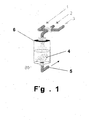
- Fig. 1 illustrates a device for implementing a method of the invention.
- a silicone hydrogel contact lens 4 is placed in a cell 6 which has three fluid inlets (1, 2, 3) connected to a spraying means on top of the cell 6 and one outlet 5.
- solution 1 e.g., a PAA solution
- solution 3 e.g., PVP solution
- PVP solution is introduced through inlet 3 into the cell 6 to apply a top layer of PVP onto the lens and then removed from the cell 6.
- the coating time and rinsing time can be controlled by the computer.
- Fig. 2 illustrates another device for implementing a method of the invention. This design is different from the device shown in Fig. 1 in that each coating and rinsing solution is introduced from the bottom of the cell 6. The stream of the solution will spin the lens in the cell 6.
- the operation of coating and rinsing can be fully automatic under control of a computer.
- the coating time and rinsing time can be controlled by the computer.
- a coating material for forming LbL coating needs to have a hydrophobic backbone.
- the hydrophobic backbone of a coating material may strongly interact with the hydrophobic surface areas of a silicone hydrogel contact lens to anchor the coating material onto the lens surface.
- molecules of a coating material might be able to be in more close contact with the hydrophobic surface areas of the lens and then "trapped" there once the temperature drops.
- the temperature of a coating solution is preferably above 50°C, more preferably above about 60°C, even more preferably above about 70°C,most preferably at about 80°C or above.
- the polyionic materials that may be employed in the present invention include polyanionic and polycationic polymers with a hydrophobic backbone and charged or ionizable pendant groups.
- the polyionic materials are polyanionic polymers.
- Suitable polyanionic polymers include, without limitation a linear polyacrylic acid (PAA), a branched polyacrylic acid, a polymethacrylic acid (PMA), a polyacrylic acid or polymethacrylic acid copolymer, a maleic or fumaric acid copolymer, a poly(styrenesulfonic acid) (PSS).
- PAA linear polyacrylic acid
- PMA polymethacrylic acid
- PSS poly(styrenesulfonic acid)
- branched polyacrylic acid include a Carbophil ® or Carbopol ® type from Goodrich Corp.
- Examples of a copolymer of acrylic or methacrylic acid include a copolymerization product of an acrylic or methacrylic acid with a vinyl monomer including, for example, acrylamide, N,N-dimethyl acrylamide or N-vinylpyrrolidone.
- a preferred polyanionic polymer with a hydrophobic backbone is a linear or branched polyacrylic acid or an acrylic acid copolymer.
- a more preferred anionic polymer is a linear or branched polyacrylic acid.
- a branched polyacrylic acid in this context is to be understood as meaning a polyacrylic acid obtainable by polymerizing acrylic acid in the presence of suitable (minor) amounts of a di- or multi-vinyl compound.
- polycationic polymers with a hydrophobic backbone examples include, without limitation, a polyallylamine (PAH), a polyethyleneimine (PEI), a polyvinylamine, a poly(vinylbenzyl-tri-C 1 -C 4 -alkylammonium salt), poly(vinylpyridinium salt), polyquat.
- PAH polyallylamine
- PEI polyethyleneimine
- PVAm polyvinylamine
- poly(vinylpyridinium salt) examples include, without limitation, a polyquat.
- the above mentioned polymers comprise in each case the free amine, a suitable salt thereof as well as any quaternized form, if not specified otherwise.
- Any suitable non-charged hydrophilic polymers with a hydrophobic backbone can be used in the invention. They are preferably polyvinyl alcohols (PVAs), more preferably a homopolymer of a vinyl lactam, a copolymer of at least one vinyl lactam in the presence or in the absence of one or more hydrophilic vinylic comonomers, or mixtures thereof.
- PVAs polyvinyl alcohols
- PVA is a highly biocompatible material used widely in ophthalmic products, especially wetting drops or artificial tears for ocular comfort (e.g., HypoTearsTM, etc.). PVAs of all kinds, for example those with low, medium or high polyvinyl acetate contents may be employed. Polyvinyl alcohols employed in the present invention are known and are commercially available, for example under the brand name Mowiol ® from KSE (Kuraray Specialties Europe).
- the vinyl lactam has a structure of formula (I) wherein R is an alkylene di-radical having from 2 to 8 carbon atoms; R 1 is hydrogen, alkyl, aryl, aralkyl or alkaryl, preferably hydrogen or lower alkyl having up to 7 carbon atoms, and, more preferably, up to 4 carbon atoms, such as, for example, methyl, ethyl or propyl; aryl having up to 10 carbon atoms, and also aralkyl or alkaryl having up to 14 carbon atoms; and R 2 is hydrogen or lower alkyl having up to 7 carob atoms and, more preferably, up to 4 carbon atoms, such as, for example, methyl, ethyl or propyl.
- R 1 is hydrogen, alkyl, aryl, aralkyl or alkaryl, preferably hydrogen or lower alkyl having up to 7 carbon atoms, and, more preferably, up to 4 carbon atoms, such as, for example
- a preferred non-charged hydrophilic polymer is a copolymer derived from a vinyl lactam which is a heterocyclic monomer of formula (I) containing from 4 to 6 carbon atoms in the heterocyclic ring, or a mixture thereof.
- a more preferred non-charged hydrophilic polymer is a copolymer derived from a vinyl lactam which is a heterocyclic monomer of formula (I) containing 4 carbon atoms in the heterocyclic ring, or a mixture thereof.
- An even more preferred non-charged hydrophilic polymer is a copolymer derived from a vinyl lactam which is a heterocyclic monomer of formula (I) containing 4 carbon atoms in the heterocyclic ring and wherein R 1 and R 2 are each independently of the other hydrogen or lower alkyl, or a mixture thereof.
- a most preferred non-charged hydrophilic polymer is polyvinylpyrrolidone (PVP).
- coating solutions can be prepared in a variety of ways.
- a coating solution can be formed by dissolving a coating material in water.
- concentration of a coating material in a solution can generally vary depending on the particular materials being utilized, the desired coating thickness, and a number of other factors. It may be typical to formulate a relatively dilute aqueous solution of a coating material.
- a coating material concentration can be between about 0.0001% to about 0.25% by weight, between about 0.005% to about 0.10% by weight, or between about 0.01% to about 0.05% by weight.
- the molecular weight of the coating materials can be varied.
- the coating thickness generally increases.
- an LbL coating comprises at least one layer of a first polyanionic material with a hydrophobic backbone and a non-charged hydrophilic polymer with a hydrophobic backbone.
- the LbL coating comprises at least one innermost layer of polyacrylic acid (PAA) and at least one capping layer of polyvinylpyrrolidone.
- PAA polyacrylic acid
- the method further comprises a step of, prior to contacting with the first coating solution, rinsing the contact lens with an organic solvent or a mixture of organic solvents at room temperature.
- the method further comprises a step of rinsing the contact lens coated with the first polyionic material with water at room temperature.
- the invention provides a method for making a silicone hydrogel contact lens, comprising the steps of: (a) cast-molding a silicone hydrogel contact lens from a silicone hydrogel lens-forming material, wherein the silicone-hydrogel lens-forming material comprises at least one member selected from the group consisting of a silicone-containing vinylic monomer, a silicone-containing macromer with ethylenically unsaturated groups, a crosslinkable silicone-containing prepolymer, and mixtures thereof; (b) contacting the contact lens with a first coating solution having a temperature of from 50°C to 95°C to form a prime coating which is not covalently attached to the contact lens, wherein the first coating solution includes a polyanionic polymeric material having a first hydrophobic backbone and multiple ionizable or charged pendant groups, wherein the prime coating comprises at least one layer of the polyanionic material; and (c) contacting said contact lens with a second coating solution having a temperature of from 50°C to 95°C to form atop
- a “silicone hydrogel lens-forming material” refers to a polymerizable composition which can be cured (i.e., polymerized and/or crosslinked) thermally or actinically or chemically to obtain a crosslinked silicone-containing polymer.
- Lens-forming materials are well known to a person skilled in the art.
- a silicone hydrogel lens-forming material comprises at least one silicon-containing monomer or macromer, or can be any lens formulations for making soft contact lenses.
- Exemplary lens formulations include without limitation the formulations of lotrafilcon A, lotrafilcon B, etafilcon A, genfilcon A, lenefilcon A, polymacon, acquafilcon A, balafilcon, senofilcon A, and the like.
- a lens-forming material can further include other components, such as an initiator (e.g., a photoinitiator or a thermal initiator), a visibility tinting agent, UV-blocking agent, photosensitizers, and the like.
- a silicone hydrogel lens-forming material used in the present invention comprises a silicone-containing macromer.
- silicone-containing monomers include, without limitation, methacryloxyalkylsiloxanes, 3-methacryloxy propylpentamethyldisiloxane, bis(methacryloxypropyl)tetramethyl-disiloxane, monomethacrylated polydimethylsiloxane, mercapto-terminated polydimethylsiloxane, N-[tris(trimethylsiloxy)silylpropyl]acrylamide; N-[tris(trimethylsiloxy)silylpropyl]methacrylamide, tris(pentamethyldisiloxyanyl)-3-methacrylatopropylsilane (T2), and tristrimethylsilyloxysilylpropyl methacrylate (TRIS).
- methacryloxyalkylsiloxanes 3-methacryloxy propylpentamethyldisiloxane
- bis(methacryloxypropyl)tetramethyl-disiloxane monometh
- a preferred siloxane-containing monomer is TRIS, which is referred to 3-methacryloxypropyltris(trimethylsiloxy) silane, and represented by CAS No. 17096-07-0.
- TRIS 3-methacryloxypropyltris(trimethylsiloxy) silane
- CAS No. 17096-07-0 The term “TRIS” also includes dimers of 3-methacryloxypropyltris(trimethylsiloxy) silane.
- siloxane-containing macromer with ethylenically unsaturated group(s) can be used to produce a silicone hydrogel material.
- a particularly preferred siloxane-containing macromer is selected from the group consisting of Macromer A, Macromer B, Macromer C, and Macromer D described in US 5,760,100 .
- Macromers that contain two or more polymerizable groups (vinylic groups) can also serve as cross linkers.
- Di and triblock macromers consisting of polydimethylsiloxane and polyakyleneoxides could also be of utility.
- Such macromers could be mono or difunctionalized with acrylate, methacrylate or vinyl groups. For example one might use methacrylate end capped polyethyleneoxide-block-polydimethylsiloxane-block-polyethyleneoxide to enhance oxygen permeability.
- silicone-containing prepolymers examples include without limitation those disclosed in US Patent Application Publication No. US 2001-0037001 A1 and US Patent No. 6,039,913 .
- the prepolymers used in the invention are previously purified in a manner known per se , for example by precipitation with organic solvents, such as acetone, filtration and washing, extraction in a suitable solvent, dialysis or ultrafiltration, ultrafiltration being especially preferred.
- organic solvents such as acetone
- filtration and washing extraction in a suitable solvent
- ultrafiltration ultrafiltration being especially preferred.
- the prepolymers can be obtained in extremely pure form, for example in the form of concentrated aqueous solutions that are free, or at least substantially free, from reaction products, such as salts, and from starting materials, such as, for example, non-polymeric constituents.
- the preferred purification process for the prepolymers used in the process according to the invention can be carried out in a manner known per se . It is possible for the ultrafiltration to be carried out repeatedly, for example from two to ten times. Alternatively, the ultrafiltration can be carried out continuously until the selected degree of purity is attained.
- the selected degree of purity can in principle be as high as desired.
- a suitable measure for the degree of purity is, for example, the concentration of dissolved salts obtained as by-products, which can be determined simply in known manner.
- a silicone hydrogel lens-forming material can also comprise a hydrophilic vinylic monomer.
- a hydrophilic vinylic monomer that can act as a plasticizer can be used in the fluid composition of the invention.
- hydrophilic monomers are N,N-dimethylacrylamide (DMA), 2-hydroxyethylmethacrylate (HEMA), hydroxyethyl acrylate, hydroxypropyl acrylate, hydroxypropyl methacrylate (HPMA), trimethylammonium 2-hydroxy propylmethacrylate hydrochloride, dimethylaminoethyl methacrylate (DMAEMA), dimethylaminoethylmethacrylamide, acrylamide, methacrylamide, allyl alcohol, vinylpyridine, glycerol methacrylate, N-(1,1dimethyl-3-oxobutyl)acrylamide, N-vinyl-2-pyrrolidone (NVP), acrylic acid, methacrylic acid, and N,
- DMA N,N-
- a silicone hydrogel lens-forming material can also comprises a hydrophobic monomer.
- a hydrophobic vinylic monomer By incorporating a certain amount of hydrophobic vinylic monomer in a polymerizable fluid composition, the mechanical properties (e.g., modulus of elasticity) of the resultant polymer may be improved.
- a silicone hydrogel lens-forming material can further comprise an antimicrobial agent, preferably antimicrobial metal nanoparticles, more preferably silver nanoparticles.
- a silicone hydrogel lens-forming material can further comprise a leachable wetting agent.
- a "leachable wetting agent” is intended to describe a wetting material that is not covalently attached to the polymer matrix of a silicone hydrogel contact lens.
- non-crosslinkable hydrophilic polymers can be used as leachable wetting agent in the invention.
- exemplary non-crosslinkable hydrophilic polymers include, but are not limited to, polyvinylalcohols (PVAs), polyethylene oxide, polyethylene-polypropylene block copolymers, polyamides, polyimides, polylactone, a homopolymer of a vinyl lactam of formula (I) shown above, a copolymer of at least one vinyl lactam of formula (I) shown above in the presence or in the absence of one or more hydrophilic vinylic comonomers, a homopolymer of acrylamide or methaacrylamide, a copolymer of acrylamide or methacrylamide with one or more hydrophilic vinylic monomers, mixtures thereof.
- PVAs polyvinylalcohols
- polyethylene oxide polyethylene-polypropylene block copolymers
- polyamides polyamides
- polyimides polylactone
- a silicone hydrogel lens-forming material can further comprise various components, such as cross-linking agents, a chain transfer agent, initiator, UV-absorbers, inhibitors, fillers, visibility tinting agents (e.g., dyes, pigments, or mixtures thereof), and the like, as known to a person skilled in the art.
- cross-linking agents such as cross-linking agents, a chain transfer agent, initiator, UV-absorbers, inhibitors, fillers, visibility tinting agents (e.g., dyes, pigments, or mixtures thereof), and the like, as known to a person skilled in the art.
- a silicone hydrogel lens-forming material can be a solution or a solvent-free liquid or melt at a temperature below 60°C.
- a person skilled in the art will known well how to prepare silicone hydrogel lens-forming material.
- a mold for cast molding
- a mold generally comprises at least two mold sections (or portions) or mold halves, i.e. first and second mold halves.
- the first mold half defines a first molding (or optical) surface and the second mold half defines a second molding (or optical) surface.
- the first and second mold halves are configured to receive each other such that a lens forming cavity is formed between the first molding surface and the second molding surface.
- the molding surface of a mold half is the cavity-forming surface of the mold and in direct contact with lens-forming material.
- Methods of manufacturing mold sections for cast-molding a contact lens are generally well known to those of ordinary skill in the art.
- the process of the present invention is not limited to any particular method of forming a mold. In fact, any method of forming a mold can be used in the present invention.
- the first and second mold halves can be formed through various techniques, such as injection molding or lathing. Examples of suitable processes for forming the mold halves are disclosed in U.S. Patent Nos. 4,444,711 to Schad ; 4,460,534 to Boehm et al. ; 5,843,346 to Morrill ; and 5,894,002 to Boneberger et al. .
- Virtually all materials known in the art for making molds can be used to make molds for making contact lenses.
- polymeric materials such as polyethylene, polypropylene, polystyrene, PMMA, Topas ® COC grade 8007-S10 (clear amorphous copolymer of ethylene and norbornene, from Ticona GmbH of Frankfurt, Germany and Summit, New Jersey), or the like can be used.
- Other materials that allow UV light transmission could be used, such as quartz glass and sapphire.
- reusable molds are used and the silicone-hydrogel lens-forming material is cured actinically under a spatial limitation of actinic radiation to form a silicone hydrogel contact lens.
- preferred reusable molds are those disclosed in U.S. patent application Nos. 08/274,942 filed July 14, 1994 , 10/732,566 filed December 10, 2003 , 10/721,913 filed November 25, 2003 , and U.S. Patent No. 6,627,124 .
- a lens-forming material is a solution (dissolved in water, a mixture of water and a water miscible organic solvent, or an organic solvent), solvent-free liquid, or melt of one or more silicone-containing prepolymers with ethylenically unsaturated groups optionally in presence of other components
- reusable molds are used and the lens-forming material is cured actinically under a spatial limitation of actinic radiation to form a colored contact lens.
- silicone-containing prepolymers include without limitation those disclosed in US Patent Application Publication No. US 2001-0037001 A1 and US Patent No. 6,039,913 .
- Examples of preferred reusable molds are those disclosed in U.S. patent application Nos. 08/274,942 filed July 14, 1994 , 10/732,566 filed December 10, 2003 , 10/721,913 filed November 25, 2003 , and U.S. Patent No. 6,627,124 .
- the lens-forming material is put into a mold consisting of two mold halves, the two mold halves not touching each other but having a thin gap of annular design arranged between them.
- the gap is connected to the mold cavity, so that excess lens material can flow away into the gap.
- polypropylene molds that can be used only once, it is possible for reusable quartz, glass, sapphire molds to be used, since, following the production of a lens, these molds can be cleaned rapidly and effectively off the uncrosslinked prepolymer and other residues, using water or a suitable solvent, and can be dried with air.
- Reusable molds can also be made of Topas ® COC grade 8007-S10 (clear amorphous copolymer of ethylene and norbornene) from Ticona GmbH of Frankfurt, Germany and Summit, New Jersey. Because of the reusability of the mold halves, a relatively high outlay can be expended at the time of their production in order to obtain molds of extremely high precision and reproducibility. Since the mold halves do not touch each other in the region of the lens to be produced, i.e. the cavity or actual mold faces, damage as a result of contact is ruled out. This ensures a high service life of the molds, which, in particular, also ensures high reproducibility of the contact lenses to be produced.
- the two opposite surfaces (anterior surface and posterior surface) of a contact lens are defined by the two molding surfaces while the edge is defined by the spatial limitation of actinic irradiation rather than by means of mold walls.
- the edge is defined by the spatial limitation of actinic irradiation rather than by means of mold walls.
- the lens-forming material within a region bound by the two molding surfaces and the projection of the well defined peripheral boundary of the spatial limitation is crosslinked whereas any lens-forming material outside of and immediately around the peripheral boundary of the spatial limitation is not crosslinked, and thereby the edge of the contact lens should be smooth and precise duplication of the dimension and geometry of the spatial limitation of actinic radiation.
- Such method of making contact lenses are described in U.S. patent application Nos. 08/274,942 filed July 14, 1994 , 10/732,566 filed December 10, 2003 , 10/721,913 filed November 25, 2003 , and U.S. Patent No. 6,627,124 .
- a spatial limitation of actinic radiation can be effected by masking for a mold that is at least partially impermeable to the particular form of energy used, as illustrated in U.S. patent application Nos. 08/274,942 filed July 14, 1994 and U.S. Patent No. 6,627,124 or by a mold that is highly permeable, at least at one side, to the energy form causing the crosslinking and that has mold parts being impermeable or of poor permeability to the energy, as illustrated in U.S. patent application Nos. 10/732,566 filed December 10, 2003 , 10/721,913 filed November 25, 2003 and U.S. Patent No. 6,627,124 .
- the energy used for the crosslinking is radiation energy, especially UV radiation, gamma radiation, electron radiation or thermal radiation, the radiation energy preferably being in the form of a substantially parallel beam in order on the one hand to achieve good restriction and on the other hand efficient use of the energy.
- the invention provides a silicone hydrogel contact lens made according to a method of the invention described above.
- the contact lens of the invention comprises a core silicone hydrogel material and a hydrophilic coating, wherein the core silicone hydrogel material is the copolymerization product of a silicone hydrogel lens-forming material, wherein the silicone-hydrogel lens-forming material comprises at least one member selected from the group consisting of a silicone-containing vinylic monomer, a silicone containing macromer with ethylenically unsaturated groups, a crosslinkable silicone-containing prepolymer, and mixtures thereof, wherein the hydrophilic coating is not covalently attached to the core silicone hydrogel material and comprises one innermost layer of a polyanionic polymeric material with a first hydrophobic backbone and one outmost layer of a non-charge hydrophilic polymer with a second hydrophobic backbone, wherein the silicone hydrogel contact lens has an oxygen permeability of at least 40 barres, a wettable surface characterized by an averaged water contact angle
- a silicone hydrogel contact lens comprises at least one antimicrobial agent, preferably silver nanoparticles in an amount sufficient to have an antimicrobial activity characterized by having at least a 5-fold reduction ( ⁇ 80% inhibition), preferably at least a 1-log reduction ( ⁇ 90% inhibition), more preferably at least a 2-log reduction ( ⁇ 99% inhibition), of viable microorganisms (e.g., Pseudomonas aeruginosa GSU # 3, or Staphylococcus aureus ATCC #6538), preferably by having a prolong antimicrobial activity (i.e., effective antimicrobial activity after direct contact with a body fluid over an extended period of time).
- Antimicrobial activity can be determined according to procedure described in the Examples of U.S. Patent Application No. 10/891,407 filed on July 14, 2004 .
- a "prolong antimicrobial activity” is characterized by having at least a 5-fold reduction ( ⁇ 80% inhibition), preferably at least a 1-log reduction ( ⁇ 90% inhibition), more preferably at least a 2-log reduction ( ⁇ 99% inhibition), of viable microorganisms (e.g., Pseudomonas aeruginosa GSU # 3, or Staphylococcus aureus ATCC #6538) after at least 5, preferably at least 10, more preferably at least 20, even more preferably at least 30 consecutive soaking/rinsing cycles, each cycle comprising soaking/rinsing one lens in a phosphate buffered saline (PBS) for a period of time from about 24 to about 72 hours, as shown in the Examples of U.S. Patent Application No. 10/891,407 filed on July 14, 2004 .
- PBS phosphate buffered saline
- a silicone hydrogel contact lens of the invention has a wettable surface characterized by having an averaged water contact angle of about 80 degrees or less, preferably about 70 degrees or less, more preferably about 60 degrees or less, even more preferably about 50 degrees or less.
- a silicone hydrogel contact lens of the invention has an oxygen permeability of at least 40 barres, preferably at least about 50 barrers, more preferably at least about 65 barrers, even more preferably at least about 80 barrers.
- an oxygen permeability is an apparent (directly measured when testing a sample with a thickness of about 100 microns) oxygen permeability according to procedures described in Examples.
- a silicone hydrogel contact lens of the invention can further have an elastic modulus of about 1.5 MPa or less, preferably about 1.2 MPa or less, more preferably about 1.0 or less, even more preferably from about 0.4 MPa to about 1.0 MPa.
- a silicone hydrogel contact lens of the invention further has an lonoflux Diffusion Coefficient, D, of, preferably at least about 1.5 x 10 -6 mm 2 /min, more preferably at least about 2.6 x 10 -6 mm 2 /min, even more preferably at least about 6.4 x 10 -6 mm 2 /min.
- a silicone hydrogel contact lens of the invention further has a water content of preferably from about 18% to about 55%, more preferably from about 20% to about 38% by weight when fully hydrated.
- the water content of a silicone hydrogel contact lens can be measured according to Bulk Technique as disclosed in US5,849,811 .
- a silicone hydrogel contact lens of the invention further comprises a leachable wetting agent.
- Water contact angle on a contact lens is a general measure of the surface hydrophilicity (or wetability) of the contact lens. In particular, a low water contact angle corresponds to more hydrophilic surface.
- Average contact angles (Sessile Drop) of contact lenses are measured using a VCA 2500 XE contact angle measurement device from AST, Inc., located in Boston, Massachusetts. This equipment is capable of measuring advancing or receding contact angles or sessile (static) contact angles. The measurements are performed on fully hydrated contact lenses and immediately after blot-drying.
- the intactness of a coating on the surface of a contact lens can be tested according to Sudan Black stain test as follow.
- Contact lenses with a coating (an LbL coating, a plasma coating, or any other coatings) are dipped into a Sudan Black dye solution (Sudan Black in vitamin E oil).
- Sudan Black dye is hydrophobic and has a great tendency to be adsorbed by a hydrophobic material or onto a hydrophobic lens surface or hydrophobic spots on a partially coated surface of a hydrophobic lens (e.g., silicone hydrogel contact lens). If the coating on a hydrophobic lens is intact, no staining spots should be observed on or in the lens. All of the lenses under test are fully hydrated.
- the lenses are digitally rubbed with Solo-care® multi-purpose lens care solution for 30 times and then rinsed with saline.
- the digitally rubbed lenses are subjected to Sudan Black test (i.e., coating intactness test described above) to examine whether the coating is still intact. Water contact angles are measured to determine the coating durability.
- the lenses are autoclaved at 121 °C br 5 times each lasting 30 minutes and then followed by Sudan Black stain test and/or measurements of water contact angles.
- Polyacrylic acid (PAA) solution A solution of polyacrylic acid having a molecular weight of about 90,000, from PolyScience, is prepared by dissolving a suitable amount of the material in water to form a 0.05M PAA solution. The PAA concentration is calculated based on the repeating unit in PAA. Once dissolved, the pH of the polyanionic PAA solution is adjusted by adding 1N hydrochloric acid until the pH is about 2.0.
- Polyvinylpyrrolidone (PVP) solution A solution of polyvinylpyrrolidone (PVP K-25 from Fluka) having a molecular weight of about 24,000 is prepared by dissolving a suitable amount of the material in water to form a 0.01 M PVP solution. The concentration is calculated based on the repeating unit in PVP. Once dissolved, the pH of the PVP solution is adjusted by adding 1 N hydrochloric acid until the pH is about 2.0.
- Silicone hydrogel contact lenses are prepared by crosslinking of a composition comprising a silicone-containing prepolymer and photoinitiator in a mold as described in U.S. Published Patent Application No. 2001/0037001 .
- the silicone-containing prepolymer is prepared according to the procedure described in U.S. Published Patent Application No. 2001/0037001 and purified by ultrafiltration.
- Uncoated Lenses are dipped into an ethanol solution for about 30 second at room temperature, wherein the ethanol solution contains 1 gallon of ethylacetate, 1 gallon of methyl iso-butyl ketone, 1 gallon of hydrocarbon solvent per 100 gallon of ethanol and drained of ethanol.
- Ethanol-rinsed contact lenses are dipped into a PAA solution (0.05 M, pH 2.0) in a temperature bath set up at a room temperature (about 25°C), 40°C (the solution temperature is about 36°C), 60°C (the solution temperature is about 52°C), or 80°C (the solution temperature is about 69°C) for about 5 seconds andthen removed quickly from the PAA solution and drained well.
- PAA-coated lenses are then placed in D.I. water for a quick rinse at room temperature (1-2 seconds).
- the water-rinsed lenses are then immersed in a PVP (0.01 mol/L, pH 2) solution in a temperature bath set up at a room temperature (about 25°C), 40°C, 60°C, or 80°C for about 5 seconds.
- the Lenses are emoved quickly from the PVP solution, drained well, and then immersed in saline (PBS) at room temperature in order to rinse out PVP solution.
- the lenses are placed into a vial filled with saline (PBS) and autoclaved at 121 °C for 30 minutes.
- Surface hydrophilicity of contact lenses are characterized by measuring water contact angles as described in Example 1. The intactness of coatings on contact lenses is examined by Sudan Black stain test described in Example 1. The durability of coatings on contact lenses are determined by digital rubbing test described in Example 1 and autoclaving lenses at 121 °C for 5 times each lasting 30 minutes and then followed by Sudan Black stain test.
- 02OptixTM lenses which have a plasma coating, are also subjected to rubbing-Sudan Black Stain test. No stain is observed.
- 02OptixTM lenses without any surface treatment are coated with PAA and PVP at various temperatures.
- 02OptixTM lenses are made of lotrafilcon B lens material.
- PAA and PVP solution are prepared as described in Example 2. The coating process is performed as described in Example 2, except that lenses are dipped in PAA or PVP solution for 5 minutes.
- Surface hydrophilicity of contact lenses are characterized by measuring water contact angles as described in Example 1. The intactness of coatings on contact lenses is examined by Sudan Black stain test described in Example 1. The durability of coatings on contact lenses are determined by digital rubbing test described in Example 1 and autoclaving lenses at 121 °C for 5 times each lasting 30 minutes and then followed by Sudan Black stain test.
- the results of water contact angles on coated contact lenses are shown in Table 2. It is found that all lenses have a water contact angle of smaller than 60 degrees without rubbing and/or the treatment of five autoclave cycles. The water contact angle decreases as the coating temperature increases, indicating that a more hydrophilic coating can be obtained at a higher coating temperature without changing the coating solution composition. By digitally rubbing coated lenses, the contact angles increase and may indicate some damages of the coating on lenses. But, the coating obtained at high temperature, e.g., at 60°C and 80°C has a smaller change in contact angle and has an contact angle smaller than 90 degrees, still hydrophilic. In contrast, the coating obtained at room temperature has a contact angle of about 116 degrees and becomes hydrophobic after digital rubbing.
- a higher coating temperature can enhance the durability of the coating on a lens. This finding is further confirmed by the data obtained with those lenses subjected to five cycles of autoclave.
- the coating obtained at room temperature has a contact angle of about 75 degrees after autoclave 5 times, about 20 degrees jump in contact angle whereas a coating obtained at a higher coating temperature has an almost constant contact angle.
- Table 2 Coating Temperature Water Contact Angle (degrees) No Treatment Rubbing 5 Autoclaves RT* 56 116 75 40°C 47 100 51 60°C 42 78 36 80°C 46 86 45 * At room temperature.
Landscapes
- Chemical & Material Sciences (AREA)
- Health & Medical Sciences (AREA)
- Chemical Kinetics & Catalysis (AREA)
- Medicinal Chemistry (AREA)
- Polymers & Plastics (AREA)
- Organic Chemistry (AREA)
- Physics & Mathematics (AREA)
- Engineering & Computer Science (AREA)
- General Physics & Mathematics (AREA)
- Optics & Photonics (AREA)
- Manufacturing & Machinery (AREA)
- Ophthalmology & Optometry (AREA)
- Mechanical Engineering (AREA)
- Eyeglasses (AREA)
- Application Of Or Painting With Fluid Materials (AREA)
Description
- The present invention generally relates to a method for applying a coating of hydrophilic polymers onto a silicone hydrogel contact lenses to improve its hydrophilicity and lubricity. In addition, the present invention provides a silicone hydrogel contact lens having a hydrophilic coating with a good intactness and durability.
- In recent years, soft silicone hydrogel contact lenses, for example, Focus NIGHT & DAY™ and O2OPTIX™ (CIBA VISION), and PureVision™(Bausch & Lomb) become more and more popular because of their high oxygen permeability and comfort. "Soft" contact lenses conform closely to the shape of the eye, so oxygen cannot easily circumvent the lens. Soft contact lenses must allow oxygen from the surrounding air (i.e., oxygen) to reach the cornea because the cornea does not receive oxygen from the blood supply like other tissue. If sufficient oxygen does not reach the cornea, corneal swelling occurs. Extended periods of oxygen deprivation cause the undesirable growth of blood vessels in the cornea. By having high oxygen permeability, a silicone hydrogel contact lens allows sufficient oxygen permeate through the lens to the cornea and to have minimal adverse effects on corneal health.
- However, a silicone hydrogel material typically has a surface or at least some areas of its surface which is hydrophobic (non-wettable). Lipids or proteins from the ocular environment can be adsorbed onto hydrophobic surface or surface areas of a silicone hydrogel contact lens. The hydrophobic surface or surface areas of a silicone hydrogel contact lens may cause it be adhered to the eye. Thus, a silicone hydrogel contact lens will generally require a surface modification to increase surface hydrophilicity. High hydrophilicity and lubricity of an LbL coating on a contact lens may enhance wearer's comfort and/or ocular health.
- A known method for modifying the hydrophilicity of a relatively hydrophobic contact lens material is through the use of a plasma treatment, for example, commercial lenses such as Focus NIGHT & DAY™ and O2OPTIX™ (CIBA VISION), and PureVision™(Bausch & Lomb). Advantages of a plasma coating is its durability, relatively high hydrophilicity (or good wettability), and low susceptibility to lipid and protein deposition and adsorption. But, plasma treatment of silicone hydrogel contact lenses may not be cost effective, because the preformed contact lenses must be dried before plasma treatment and because of relative high capital investment associated with plasma treatment equipments.
- Another method for modifying the hydrophilicity of a relatively hydrophobic contact lens material is a layer-by-layer (LbL) polyionic material deposition technique (see for example,
U.S. Patent Nos. 6,451,871 ,6,717,929 ,6,793,973 ,6,884,457 ,6,896,926 ,6,926,965 ,6,940,580 ). Although this technique can provide a cost effective process for rendering a silicone hydrogel material wettable, it may require relatively long time and laborious steps to apply an LbL hydrophilic coating which can impart hydrophilicity and lubricity to a silicone hydrogel contact lens. The reported methods for applying an LbL coating to a silicone hydrogel contact lens may not provide a surface with desired hydrophilicity, lubricity, durability, and/or full surface coverage (i.e., intactness). - Therefore, there is still need for methods of efficiently applying a hydrophilic coating to a silicone hydrogel contact lens.
- The invention, in one aspect, provides a method of applying a hydrophilic coating onto a silicone hydrogel contact lens, the method of invention comprising: (a) contacting the contact lens with a first coating solution having a temperature of from 50°C to 95°C to form a prime coating which is not covalently attached to the contact lens, wherein the first coating solution includes a polyanionic material having a first hydrophobic backbone and multiple ionizable pendant groups, wherein the first coating solution has a pH sufficient low to substantially prevent the ionizable groups from ionizing, wherein the prime coating comprises at least one layer of the polyanionic material; and (b) contacting said contact lens with a second coating solution having a temperature of from 50°C to 95°Cto form a top coating over the prime coating, wherein the second coating solution contains a non-charged hydrophilic polymer having a second hydrophobic backbone, wherein the top coating comprises at least one layer of the hydrophilic polymer.
- In another aspect, the invention provides a method for making a silicone hydrogel contact lens, comprising the steps of: (a) cast-molding a silicone hydrogel contact lens from a silicone hydrogel lens-forming material, wherein the silicone-hydrogel lens-forming material comprises at least one member selected from the group consisting of a silicone-containing vinylic monomer, a silicone-containing macromer with ethylenically unsaturated groups, a crosslinkable silicone-containing prepolymer, and mixtures thereof; (b) contacting the contact lens with a first coating solution having a temperature of from 50°C to 95°C to form a prime coating which is not covalently attached to the contact lens, wherein the first coating solution includes a polyanionic polymeric material having a first hydrophobic backbone and multiple ionizable or charged pendant groups, wherein the prime coating comprises at least one layer of the polyanionic material; and (c) contacting said contact lens with a second coating solution having a temperature of from 50 °C to 95°C to forma top coating over the prime coating, wherein the second coating solution contains a non-charged hydrophilic polymer having a second hydrophobic backbone, wherein the top coating comprises at least one layer of the hydrophilic polymer.
- In a further aspect, the invention provides a silicone hydrogel contact lens. The contact lens of the invention comprises a core silicone hydrogel material and a hydrophilic coating, wherein the core silicone hydrogel material is the copolymerization product of a silicone hydrogel lens-forming material, wherein the silicone-hydrogel lens-forming material comprises at least one member selected from the group consisting of a silicone-containing vinylic monomer, a silicone-containing macromer with ethylenically unsaturated groups, a crosslinkable silicone-containing prepolymer, and mixtures thereof, wherein the hydrophilic coating is not covalently attached to the core silicone hydrogel material and comprises one innermost layer of a polyanionic material with a first hydrophobic backbone and one outmost layer of a non-charge hydrophilic polymer with a second hydrophobic backbone, wherein the silicone hydrogel contact lens has an oxygen permeability of at least 40 barres, a wettable surface characterized by an averaged water contact angle of 80 degrees or less and a good coating durability characterized by surviving a digital rubbing test or repeated autoclave test.
- These and other aspects of the invention will become apparent from the following description of the presently preferred embodiments. The detailed description is merely illustrative of the invention and does not limit the scope of the invention, which is defined by the appended claims and equivalents thereof. As would be obvious to one skilled in the art, many variations and modifications of the invention may be effected without departing from the spirit and scope of the novel concepts of the disclosure.
-
-
Fig. 1 illustrates schematically a device for applying an LbL coating to a silicone hydrogel contact lens according to a preferred embodiment. -
Fig. 2 illustrates schematically a device for applying an LbL coating to a silicone hydrogel contact lens according to another preferred embodiment. - Reference now will be made in detail to the embodiments of the invention. It will be apparent to those skilled in the art that various modifications and variations can be made in the present invention without departing from the scope or spirit of the invention. For instance, features illustrated or described as part of one embodiment, can be used on another embodiment to yield a still further embodiment. Thus, it is intended that the present invention cover such modifications and variations as come within the scope of the appended claims and their equivalents. Other objects, features and aspects of the present invention are disclosed in or are obvious from the following detailed description. It is to be understood by one of ordinary skill in the art that the present discussion is a description of exemplary embodiments only, and is not intended as limiting the broader aspects of the present invention.
- Unless defined otherwise, all technical and scientific terms used herein have the same meaning as commonly understood by one of ordinary skill in the art to which this invention belongs. Generally, the nomenclature used herein and the laboratory procedures are well known and commonly employed in the art. Conventional methods are used for these procedures, such as those provided in the art and various general references. Where a term is provided in the singular, the inventors also contemplate the plural of that term. The nomenclature used herein and the laboratory procedures described below are those well known and commonly employed in the art.
- "Contact Lens" refers to a structure that can be placed on or within a wearer's eye. A contact lens can correct, improve, or alter a user's eyesight, but that need not be the case. A contact lens can be of any appropriate material known in the art or later developed, and can be a soft lens, a hard lens, or a hybrid lens. A "silicone hydrogel contact lens" refers to a contact lens comprising a silicone hydrogel material.
- A "hydrogel" refers to a polymeric material which can absorb at least 10 percent by weight of water when it is fully hydrated.
- A "silicone hydrogel" refers to a silicone-containing hydrogel obtained by copolymerization of a polymerizable composition comprising at least one silicone-containing vinylic monomer or at least one silicone-containing macromer or at least one crosslinkable silicone-containing prepolymer.
- "Hydrophilic," as used herein, describes a material or portion thereof that will more readily associate with water than with lipids.
- A "monomer" means a low molecular weight compound that can be polymerized. Low molecular weight typically means average molecular weights less than 700 Daltons.
- A "vinylic monomer", as used herein, refers to a low molecular weight compound that has an ethylenically unsaturated group and can be polymerized actinically or thermally. Low molecular weight typically means average molecular weights less than 700 Daltons.
- The term "olefinically unsaturated group" is employed herein in a broad sense and is intended to encompass any groups containing at least one >C=C< group. Exemplary ethylenically unsaturated groups include without limitation acryloyl, methacryloyl, allyl, vinyl, styrenyl, or other C=C containing groups.
- As used herein, "actinically" in reference to curing or polymerizing of a polymerizable composition or material means that the curing (e.g., crosslinked and/or polymerized) is performed by actinic irradiation, such as, for example, UV irradiation, ionized radiation (e.g. gamma ray or X-ray irradiation), microwave irradiation, and the like. Thermal curing or actinic curing methods are well-known to a person skilled in the art.
- A "hydrophilic vinylic monomer", as used herein, refers to a vinylic monomer which as a homopolymer typically yields a polymer that is water-soluble or can absorb at least 10 percent by weight water.
- A "hydrophobic vinylic monomer", as used herein, refers to a vinylic monomer which as a homopolymer typically yields a polymer that is insoluble in water and can absorb less than 10 percent by weight water.
- A "macromer" refers to a medium and high molecular weight compound or polymer that contains functional groups capable of undergoing further polymerizing and/or crosslinking reactions. Medium and high molecular weight typically means average molecular weights greater than 700 Daltons. Preferably, a macromer contains ethylenically unsaturated groups and can be polymerized actinically or thermally.
- A "prepolymer" refers to a starting polymer which can be cured (e.g., crosslinked and/or polymerized) actinically or thermally or chemically to obtain a crosslinked and/or polymerized polymer having a molecular weight much higher than the starting polymer.
- A "crosslinkable prepolymer" refers to a starting polymer which can be crosslinked upon actinic radiation to obtain a crosslinked polymer having a molecular weight much higher than the starting polymer.
- A "crosslinkable silicone-containing prepolymer" refers to a starting polymer which contains silicone and can be crosslinked upon actinic radiation to obtain a crosslinked polymer having a molecular weight much higher than the starting polymer.
- A "polymer" means a material formed by polymerizing/crosslinking one or more monomers.
- A "backbone" of a polymer refers to the principle chain in a polymer molecule.
- An "initiator" is intended to describe a chemical that initiates free radical reaction and can be a photoinitiator or thermal initiator.
- A "photoinitiator" refers to a chemical that initiates radical crosslinking/polymerizing reaction by the use of light. Suitable photoinitiators include, without limitation, benzoin methyl ether, diethoxyacetophenone, a benzoylphosphine oxide, 1-hydroxycyclohexyl phenyl ketone, Darocure® types, and Irgacure® types, preferably Darocure® 1173, and Irgacure® 2959.
- A "thermal initiator" refers to a chemical that initiates radical crosslinking/polymerizing reaction by the use of heat energy. Examples of suitable thermal initiators include, but are not limited to, 2,2'-azobis (2,4-dimethylpentanenitrile), 2,2'-azobis (2-methylpropanenitrile), 2,2'-azobis (2-methylbutanenitrile), peroxides such as benzoyl peroxide, and the like. Preferably, the thermal initiator is 2,2'-azobis(isobutyronitrile) (AIBN).
- A "spatial limitation of actinic radiation" refers to an act or process in which energy radiation in the form of rays is directed by means of, for example, a mask or screen or combinations thereof, to impinge, in a spatially restricted manner, onto an area having a well defined peripheral boundary. For example, a spatial limitation of UV radiation can be achieved by using a mask or screen which has a transparent or open region (unmasked region) surrounded by a UV impermeable region (masked region), as schematically illustrated in
Figs1 -9 ofU.S. Patent No. 6,627,124 . The unmasked region has a well defined peripheral boundary with the unmasked region. - "Visibility tinting" in reference to a lens means dying (or coloring) of a lens to enable the user to easily locate a lens in a clear solution within a lens storage, disinfecting or cleaning container. It is well known in the art that a dye and/or a pigment can be used in visibility tinting a lens.
- The term "fluid" as used herein indicates that a material is capable of flowing like a liquid.
- "LbL coating", as used herein, refers to a coating that is not covalently attached to a contact lens or a mold half and is obtained through a layer-by-layer ("LbL") deposition of polyionic (or charged) and/or non-charged materials on the lens or mold half. An LbL coating can be composed of one or more layers, preferably one or more bilayers.
- As used herein, a "polyionic material" refers to a polymeric material that has a plurality of charged groups or ionizable groups, such as polyelectrolytes, p- and n-type doped conducting polymers. Polyionic materials include both polycationic (having positive charges) and polyanionic (having negative charges) materials.
- The term "bilayer" is employed herein in a broad sense and is intended to encompass: a coating structure formed on a contact lens or a mold half by alternatively applying, in no particular order, one layer of a first polyionic material (or charged material) and subsequently one layer of a second polyionic material (or charged material) having charges opposite of the charges of the first polyionic material (or the charged material); or a coating structure formed on a contact lens or mold half.by alternatively applying, in no particular order, one layer of a first charged polymeric material and one layer of a non-charged polymeric material or a second charged polymeric material. It should be understood that the layers of the first and second coating materials (described above) may be intertwined with each other in the bilayer.
- Formation of an LbL coating on a contact lens or mold half may be accomplished in a number of ways, for example, as described in
US Patent Ser. No. 6,451,871 ,6,719,929 ,6,793,973 ,6,811,805 ,6,896,926 . - An "innermost layer", as used herein, refers to the first layer of an LbL coating, which is applied onto the surface of a contact lens or mold half.
- A "capping layer" or "outmost layer", as used herein, refers to the last layer or the sole layer of an LbL coating which is applied onto a contact lens or mold half.
- An "average contact angle " refers to a water contact angle (measured by Sessile Drop method), which is obtained by averaging measurements of at least 3 individual contact lenses.
- As used herein, "increased surface hydrophilicity" or "increased hydrophilicity" in reference to a coated contact lens means that the contact lens coated at a temperature higher than room temperature (about 22°C) has a smaller averaged (water) contact angle relative to that of a contact lens coated at room temperature, wherein all contact lenses are made of the same core material and all coating solutions have identical compositions.
- As used herein, "surviving a digital rubbing test" in reference to an LbL coating on a contact lens means that after digitally rubbing the lens with Solo-care® (CIBA Vision) or an equivalent, there is no noticeable increase in staining area on the lens relative to the staining of a lens of same without rubbing. The stain test is a Sudan Black Stain test described in Example 1. Preferably, "surviving a digital rubbing test" in reference to an LbL coating on a contact lens means that after digitally rubbing the lens with Solo-care® (CIBA Vision) or an equivalent, averaged contact angle on the rubbed lens is still about 90 degrees or less, preferably about 80 degrees or less, even more preferably about 70 degrees or less, most preferably about 60 degrees or less.
- As used herein, "surviving a repeated autoclave test" in reference to an LbL coating on a contact lens means that after autoclaving the lens at about 121 °C for 5 times, each autoclave lasting 30 minutes, there is no noticeable increase in staining area on the lens relative to the staining of a lens of same without repeated autoclave. The stain test is a Sudan Black Stain test described in Example 1. Preferably, "surviving a repeated autoclave test" in reference to an LbL coating on a contact lens means that after autoclaving the lens at about 121 °C for 5 times, each autoclave lasting 30 minutes, averaged contact angle on the rubbed lens is still about 90 degrees or less, preferably about 80 degrees or less, even more preferably about 70 degrees or less, most preferably about 60 degrees or less.
- An "antimicrobial agent", as used herein, refers to a chemical that is capable of decreasing or eliminating or inhibiting the growth of microorganisms such as that term is known in the art. Examples of preferred antimicrobial agents include without limitation antimicrobial metals (e.g., Ag, Au, Pt, Pd, Ir, Sn, Cu, Sb, Bi and Zn, with Ag being most preferred), antimicrobial metal-containing nanoparticles (i.e., having a size of less than 1 micrometer and containing at least one antimicrobial metal present in one or more of its oxidation states), and antimicrobial metal nanoparticles (i.e., particles made essentially of an antimicrobial metal and have a size of less than 1 micrometer, such as silver nanoparticles).
- The "oxygen transmissibility" of a lens, as used herein, is the rate at which oxygen will pass through a specific ophthalmic lens. Oxygen transmissibility, Dk/t, is conventionally expressed in units of barrers/mm, where t is the average thickness of the material [in units of mm] over the area being measured and "barrer/mm" is defined as:

- The intrinsic "oxygen permeability", Dk, of a lens material does not depend on lens thickness. Intrinsic oxygen permeability is the rate at which oxygen will pass through a material. Oxygen permeability is conventionally expressed in units of barrers, where "barrer" is defined as:

These are the units commonly used in the art. Thus, in order to be consistent with the use in the art, the unit "barrer" will have the meanings as defined above. For example, a lens having a Dk of 90 barrers ("oxygen permeability barrers") and a thickness of 90 microns (0.090 mm) would have a Dk/t of 100 barrers/mm (oxygen transmissibility barrers/mm). In accordance with the invention, a high oxygen permeability in reference to a material or a contact lens characterized by apparent oxygen permeability of at least 40 barrers or larger measured with a sample (film or lens) of 100 microns in thickness according to a coulometric method described in Examples. - The "ion permeability" through a lens correlates with both the lonoflux Diffusion Coefficient and the lonoton Ion Permeability Coefficient.
- The lonoflux Diffusion Coefficient, D, is determined by applying Fick's law as follows:

where - n' =
- rate of ion transport [mol/min]
- A =
- area of lens exposed [mm2]
- D =
- lonoflux Diffusion Coefficient [mm2/min]
- dc =
- concentration difference [mol/L]
- dx =
- thickness of lens [mm]
- The lonoton Ion Permeability Coefficient, P, is then determined in accordance with the following equation:

where: - C(t) =
- concentration of sodium ions at time t in the receiving cell
- C(0) =
- initial concentration of sodium ions in donor cell
- A =
- membrane area, i.e., lens area exposed to cells
- V =
- volume of cell compartment (3.0 ml)
- d =
- average lens thickness in the area exposed
- P =
- permeability coefficient
- An lonoflux Diffusion Coefficient, D, of greater than about 1.5 x 10⁻⁶ mm2/min is preferred, while greater than about 2.6 x 10⁻⁶ mm2/min is more preferred and greater than about 6.4 x 10⁻⁶ mm2/min is most preferred.
- It is known that on-eye movement of the lens is required to ensure good tear exchange, and ultimately, to ensure good corneal health. Ion permeability is one of the predictors of on-eye movement, because the permeability of ions is believed to be directly proportional to the permeability of water.
- It has been discovered previously and disclosed in commonly assigned
U.S. Patent No. 6,451,871 that complex and time-consuming pretreatment the surface of a core material (medical device) is not required for rendering the surface of a medical device charged prior to binding of a polyionic polymeric material to the core material. By simply and alternatively contacting a core material of a medical device, for example, a contact lens, with a solution of a first polyionic polymeric material and a solution of a second polyionic polymeric material having charges opposite of the charges of the first charged polymeric material, a multiple-layered LbL coating can be formed on a medical device to modify the surface properties of the core material of the medical device. - Now, it is unexpectedly discovered that the temperature of a coating solution of a coating material with a hydrophobic backbone can have a significant impact on the hydrophilicity, intactness, and durability of an LbL coating not covalently attached onto a contact lens. As the temperature of a coating solution increases, a resulting coating on a contact lens becomes more hydrophilic (e.g., smaller water contact angle), more intact (e.g., significantly less or no Sudan Black staining), more durable (surviving a digital rubbing test or a repeated autoclave test). Based on this unexpected discovery, an improved LbL coating method is developed that can prepare, in a cost-effective and rapid fashion, an LbL coating on a contact lens with increased hydrophilicity, good intactness and good durability.
- The invention, in one aspect, provides a method of applying a hydrophilic coating onto a silicone hydrogel contact lens, the method of invention comprising: (a) contacting the contact lens with a first coating solution having a temperature of from 50°C to 95°C to form a prime coating which is not covalently attached to the contact lens, wherein the first coating solution includes a polyanionic material having a first hydrophobic backbone and multiple ionizable or charged pendant groups, wherein the prime coating comprises at least one layer of the polyanionic material; and (b) contacting said contact lens with a second coating solution having a temperature of from 50°C to 90°C to form atop coating over the prime coating, wherein the second coating solution contains a non-charged hydrophilic polymer having a second hydrophobic backbone, wherein the top coating comprises at least one layer of the hydrophilic polymer.
- In accordance with the present invention, an LbL coating can be applied onto a silicone hydrogel contact lens by contacting the lens with one or more coating solutions according to various methods, such as, for examples those methods disclosed in
U.S. Patent Nos. 6,451,871 ,6,719,929 ,6,793,973 ,6,811,805 ,6,896,926 . - Contacting of a contact lens with a coating solution can occur by dipping it into the coating solution or by spraying it with the coating solution. One coating process involves solely dip-coating and optionally dip-rinsing steps. Another coating process involves solely spray-coating and spray-rinsing steps. However, a number of alternatives involve various combinations of spray- and dip-coating and rinsing steps may be designed by a person having ordinary skill in the art.
- For example, a solely dip-coating process for forming an LbL coating composed of at least one bilayers on a contact lens involves the steps of: (a) immersing a contact lens in a first coating solution of a first coating material; (b) optionally rinsing the mold half by immersing it in water; (c) immersing the lens in a second coating solution of a second coating material to form a first bilayer of the first and second coating materials; (d) optionally rinsing the lens by immersing it in the rinsing solution; and (e) optionally repeating steps (a) to (d) for a number of times to form additional bilayers. A thicker LbL coating can be produced by repeating steps (a) to (d) preferably for a number of times.
- The immersion time for each of the coating and optional rinsing steps may last less than about 1 minute, because the coating temperature is relatively high. Preferably, immersion of the core material into a coating solution occurs over a period of from about 3 second to 20 second, more preferably from about 5seconds to about 10 seconds. Rinsing may be accomplished with a plurality of rinsing steps, but a single rinsing step, if desired, can be quite efficient.
- A further exemplary coating process for forming an LbL coating composed of at least one bilayers on a contact lens involves a series of spray coating techniques. For example, a solely spray-coating process generally includes the steps of: (a) spraying the surface of a contact lens with a first coating solution of a first coating material; (b) optionally rinsing the lens surface by spraying it with a rinsing solution; (c) spraying the surface with a second coating solution of a second coating material to form a first bilayer of the first and second coating materials; (d) optionally rinsing the lens surface by spraying it with the rinsing solution; (e) optionally repeating steps (a) to (d) for a number of times.
- The spray coating application may be accomplished via a process selected from the group consisting of an air-assisted atomization and dispensing process, an ultrasonic-assisted atomization and dispensing process, a piezoelectric assisted atomization and dispensing process, an electro-mechanical jet printing process, a piezo-electric jet printing process, a piezo-electric with hydrostatic pressure jet printing process, and a thermal jet printing process; and a computer system capable of controlling the positioning of the dispensing head of the spraying device on the ophthalmic lens and dispensing the coating liquid. Those spraying coating processes are described in
U.S. Patent No. 6,811,805 . -
Fig. 1 illustrates a device for implementing a method of the invention. A siliconehydrogel contact lens 4 is placed in acell 6 which has three fluid inlets (1, 2, 3) connected to a spraying means on top of thecell 6 and oneoutlet 5. Under a computer control, first, solution 1 (e.g., a PAA solution) is first introduced into cell to apply a layer of PAA and after for example 5 seconds, thesolution 1 is withdrawn from thecell 6 through theoutlet 5 at the bottom. Second, water is introduced into through inlet 2 into thecell 6 to rinse the lens and then removed from thecell 6. Finally, solution 3 (e.g., PVP solution) is introduced throughinlet 3 into thecell 6 to apply a top layer of PVP onto the lens and then removed from thecell 6. The coating time and rinsing time can be controlled by the computer. -
Fig. 2 illustrates another device for implementing a method of the invention. This design is different from the device shown inFig. 1 in that each coating and rinsing solution is introduced from the bottom of thecell 6. The stream of the solution will spin the lens in thecell 6. The operation of coating and rinsing can be fully automatic under control of a computer. The coating time and rinsing time can be controlled by the computer. - In accordance with the invention, a coating material for forming LbL coating needs to have a hydrophobic backbone. Although the inventors do not wish to be bound by any particular theory, it is believed that through hydrophobic-hydrophobic interaction, the hydrophobic backbone of a coating material may strongly interact with the hydrophobic surface areas of a silicone hydrogel contact lens to anchor the coating material onto the lens surface. It is also believed that at a higher coating temperature, molecules of a coating material might be able to be in more close contact with the hydrophobic surface areas of the lens and then "trapped" there once the temperature drops.
- The temperature of a coating solution is preferably above 50°C, more preferably above about 60°C, even more preferably above about 70°C,most preferably at about 80°C or above.
- The polyionic materials that may be employed in the present invention include polyanionic and polycationic polymers with a hydrophobic backbone and charged or ionizable pendant groups. Preferably, the polyionic materials are polyanionic polymers.
- Examples of suitable polyanionic polymers include, without limitation a linear polyacrylic acid (PAA), a branched polyacrylic acid, a polymethacrylic acid (PMA), a polyacrylic acid or polymethacrylic acid copolymer, a maleic or fumaric acid copolymer, a poly(styrenesulfonic acid) (PSS). Examples of a branched polyacrylic acid include a Carbophil® or Carbopol® type from Goodrich Corp. Examples of a copolymer of acrylic or methacrylic acid include a copolymerization product of an acrylic or methacrylic acid with a vinyl monomer including, for example, acrylamide, N,N-dimethyl acrylamide or N-vinylpyrrolidone. A preferred polyanionic polymer with a hydrophobic backbone is a linear or branched polyacrylic acid or an acrylic acid copolymer. A more preferred anionic polymer is a linear or branched polyacrylic acid. A branched polyacrylic acid in this context is to be understood as meaning a polyacrylic acid obtainable by polymerizing acrylic acid in the presence of suitable (minor) amounts of a di- or multi-vinyl compound.
- Examples of polycationic polymers with a hydrophobic backbone include, without limitation, a polyallylamine (PAH), a polyethyleneimine (PEI), a polyvinylamine, a poly(vinylbenzyl-tri-C1-C4-alkylammonium salt), poly(vinylpyridinium salt), polyquat. The above mentioned polymers comprise in each case the free amine, a suitable salt thereof as well as any quaternized form, if not specified otherwise.
- Any suitable non-charged hydrophilic polymers with a hydrophobic backbone can be used in the invention. They are preferably polyvinyl alcohols (PVAs), more preferably a homopolymer of a vinyl lactam, a copolymer of at least one vinyl lactam in the presence or in the absence of one or more hydrophilic vinylic comonomers, or mixtures thereof.
- PVA is a highly biocompatible material used widely in ophthalmic products, especially wetting drops or artificial tears for ocular comfort (e.g., HypoTears™, etc.). PVAs of all kinds, for example those with low, medium or high polyvinyl acetate contents may be employed. Polyvinyl alcohols employed in the present invention are known and are commercially available, for example under the brand name Mowiol® from KSE (Kuraray Specialties Europe).
- In accordance with the invention, the vinyl lactam has a structure of formula (I)

- A preferred non-charged hydrophilic polymer is a copolymer derived from a vinyl lactam which is a heterocyclic monomer of formula (I) containing from 4 to 6 carbon atoms in the heterocyclic ring, or a mixture thereof. A more preferred non-charged hydrophilic polymer is a copolymer derived from a vinyl lactam which is a heterocyclic monomer of formula (I) containing 4 carbon atoms in the heterocyclic ring, or a mixture thereof. An even more preferred non-charged hydrophilic polymer is a copolymer derived from a vinyl lactam which is a heterocyclic monomer of formula (I) containing 4 carbon atoms in the heterocyclic ring and wherein R1 and R2 are each independently of the other hydrogen or lower alkyl, or a mixture thereof. A most preferred non-charged hydrophilic polymer is polyvinylpyrrolidone (PVP).
- In accordance with the present invention, coating solutions can be prepared in a variety of ways. Preferably, a coating solution can be formed by dissolving a coating material in water. The concentration of a coating material in a solution can generally vary depending on the particular materials being utilized, the desired coating thickness, and a number of other factors. It may be typical to formulate a relatively dilute aqueous solution of a coating material. For example, a coating material concentration can be between about 0.0001% to about 0.25% by weight, between about 0.005% to about 0.10% by weight, or between about 0.01% to about 0.05% by weight.
- In order to alter various characteristics of the coating, such as thickness, the molecular weight of the coating materials can be varied. In particular, as the molecular weight is increased, the coating thickness generally increases.
- In accordance with the invention, an LbL coating comprises at least one layer of a first polyanionic material with a hydrophobic backbone and a non-charged hydrophilic polymer with a hydrophobic backbone.
- In a more preferred embodiment, the LbL coating comprises at least one innermost layer of polyacrylic acid (PAA) and at least one capping layer of polyvinylpyrrolidone.
- In a preferred embodiment of the invention, the method further comprises a step of, prior to contacting with the first coating solution, rinsing the contact lens with an organic solvent or a mixture of organic solvents at room temperature.
- In another preferred embodiment, the method further comprises a step of rinsing the contact lens coated with the first polyionic material with water at room temperature.
- In another aspect, the invention provides a method for making a silicone hydrogel contact lens, comprising the steps of: (a) cast-molding a silicone hydrogel contact lens from a silicone hydrogel lens-forming material, wherein the silicone-hydrogel lens-forming material comprises at least one member selected from the group consisting of a silicone-containing vinylic monomer, a silicone-containing macromer with ethylenically unsaturated groups, a crosslinkable silicone-containing prepolymer, and mixtures thereof; (b) contacting the contact lens with a first coating solution having a temperature of from 50°C to 95°C to form a prime coating which is not covalently attached to the contact lens, wherein the first coating solution includes a polyanionic polymeric material having a first hydrophobic backbone and multiple ionizable or charged pendant groups, wherein the prime coating comprises at least one layer of the polyanionic material; and (c) contacting said contact lens with a second coating solution having a temperature of from 50°C to 95°C to form atop coating over the prime coating, wherein the second coating solution contains a non-charged hydrophilic polymer having a second hydrophobic backbone, wherein the top coating comprises at least one layer of the hydrophilic polymer.
- A "silicone hydrogel lens-forming material" refers to a polymerizable composition which can be cured (i.e., polymerized and/or crosslinked) thermally or actinically or chemically to obtain a crosslinked silicone-containing polymer. Lens-forming materials are well known to a person skilled in the art. In accordance with the invention, a silicone hydrogel lens-forming material comprises at least one silicon-containing monomer or macromer, or can be any lens formulations for making soft contact lenses. Exemplary lens formulations include without limitation the formulations of lotrafilcon A, lotrafilcon B, etafilcon A, genfilcon A, lenefilcon A, polymacon, acquafilcon A, balafilcon, senofilcon A, and the like. A lens-forming material can further include other components, such as an initiator (e.g., a photoinitiator or a thermal initiator), a visibility tinting agent, UV-blocking agent, photosensitizers, and the like. Preferably, a silicone hydrogel lens-forming material used in the present invention comprises a silicone-containing macromer.
- Examples of silicone-containing monomers include, without limitation, methacryloxyalkylsiloxanes, 3-methacryloxy propylpentamethyldisiloxane, bis(methacryloxypropyl)tetramethyl-disiloxane, monomethacrylated polydimethylsiloxane, mercapto-terminated polydimethylsiloxane, N-[tris(trimethylsiloxy)silylpropyl]acrylamide; N-[tris(trimethylsiloxy)silylpropyl]methacrylamide, tris(pentamethyldisiloxyanyl)-3-methacrylatopropylsilane (T2), and tristrimethylsilyloxysilylpropyl methacrylate (TRIS). A preferred siloxane-containing monomer is TRIS, which is referred to 3-methacryloxypropyltris(trimethylsiloxy) silane, and represented by CAS No. 17096-07-0. The term "TRIS" also includes dimers of 3-methacryloxypropyltris(trimethylsiloxy) silane.
- Any suitable siloxane-containing macromer with ethylenically unsaturated group(s) can be used to produce a silicone hydrogel material. A particularly preferred siloxane-containing macromer is selected from the group consisting of Macromer A, Macromer B, Macromer C, and Macromer D described in
US 5,760,100 . Macromers that contain two or more polymerizable groups (vinylic groups) can also serve as cross linkers. Di and triblock macromers consisting of polydimethylsiloxane and polyakyleneoxides could also be of utility. Such macromers could be mono or difunctionalized with acrylate, methacrylate or vinyl groups. For example one might use methacrylate end capped polyethyleneoxide-block-polydimethylsiloxane-block-polyethyleneoxide to enhance oxygen permeability. - Examples of silicone-containing prepolymers include without limitation those disclosed in US Patent Application Publication No.
US 2001-0037001 A1 andUS Patent No. 6,039,913 . Preferably, the prepolymers used in the invention are previously purified in a manner known per se, for example by precipitation with organic solvents, such as acetone, filtration and washing, extraction in a suitable solvent, dialysis or ultrafiltration, ultrafiltration being especially preferred. By means of that purification process the prepolymers can be obtained in extremely pure form, for example in the form of concentrated aqueous solutions that are free, or at least substantially free, from reaction products, such as salts, and from starting materials, such as, for example, non-polymeric constituents. The preferred purification process for the prepolymers used in the process according to the invention, ultrafiltration, can be carried out in a manner known per se. It is possible for the ultrafiltration to be carried out repeatedly, for example from two to ten times. Alternatively, the ultrafiltration can be carried out continuously until the selected degree of purity is attained. The selected degree of purity can in principle be as high as desired. A suitable measure for the degree of purity is, for example, the concentration of dissolved salts obtained as by-products, which can be determined simply in known manner. - In accordance with the present invention, a silicone hydrogel lens-forming material can also comprise a hydrophilic vinylic monomer. Nearly any hydrophilic vinylic monomer that can act as a plasticizer can be used in the fluid composition of the invention. Among the preferred hydrophilic monomers are N,N-dimethylacrylamide (DMA), 2-hydroxyethylmethacrylate (HEMA), hydroxyethyl acrylate, hydroxypropyl acrylate, hydroxypropyl methacrylate (HPMA), trimethylammonium 2-hydroxy propylmethacrylate hydrochloride, dimethylaminoethyl methacrylate (DMAEMA), dimethylaminoethylmethacrylamide, acrylamide, methacrylamide, allyl alcohol, vinylpyridine, glycerol methacrylate, N-(1,1dimethyl-3-oxobutyl)acrylamide, N-vinyl-2-pyrrolidone (NVP), acrylic acid, methacrylic acid, and N,N-dimethyacrylamide (DMA).
- A silicone hydrogel lens-forming material can also comprises a hydrophobic monomer. By incorporating a certain amount of hydrophobic vinylic monomer in a polymerizable fluid composition, the mechanical properties (e.g., modulus of elasticity) of the resultant polymer may be improved.
- A silicone hydrogel lens-forming material can further comprise an antimicrobial agent, preferably antimicrobial metal nanoparticles, more preferably silver nanoparticles.
- A silicone hydrogel lens-forming material can further comprise a leachable wetting agent. A "leachable wetting agent" is intended to describe a wetting material that is not covalently attached to the polymer matrix of a silicone hydrogel contact lens.
- Any non-crosslinkable hydrophilic polymers can be used as leachable wetting agent in the invention. Exemplary non-crosslinkable hydrophilic polymers include, but are not limited to, polyvinylalcohols (PVAs), polyethylene oxide, polyethylene-polypropylene block copolymers, polyamides, polyimides, polylactone, a homopolymer of a vinyl lactam of formula (I) shown above, a copolymer of at least one vinyl lactam of formula (I) shown above in the presence or in the absence of one or more hydrophilic vinylic comonomers, a homopolymer of acrylamide or methaacrylamide, a copolymer of acrylamide or methacrylamide with one or more hydrophilic vinylic monomers, mixtures thereof.
- In accordance with the present invention, a silicone hydrogel lens-forming material can further comprise various components, such as cross-linking agents, a chain transfer agent, initiator, UV-absorbers, inhibitors, fillers, visibility tinting agents (e.g., dyes, pigments, or mixtures thereof), and the like, as known to a person skilled in the art.
- In accordance with the present invention, a silicone hydrogel lens-forming material can be a solution or a solvent-free liquid or melt at a temperature below 60°C. A person skilled in the art will known well how to prepare silicone hydrogel lens-forming material.
- Lens molds for making contact lenses are well known to a person skilled in the art and, for example, are employed in cast molding or spin casting. For example, a mold (for cast molding) generally comprises at least two mold sections (or portions) or mold halves, i.e. first and second mold halves. The first mold half defines a first molding (or optical) surface and the second mold half defines a second molding (or optical) surface. The first and second mold halves are configured to receive each other such that a lens forming cavity is formed between the first molding surface and the second molding surface. The molding surface of a mold half is the cavity-forming surface of the mold and in direct contact with lens-forming material.
- Methods of manufacturing mold sections for cast-molding a contact lens are generally well known to those of ordinary skill in the art. The process of the present invention is not limited to any particular method of forming a mold. In fact, any method of forming a mold can be used in the present invention. The first and second mold halves can be formed through various techniques, such as injection molding or lathing. Examples of suitable processes for forming the mold halves are disclosed in
U.S. Patent Nos. 4,444,711 to Schad ;4,460,534 to Boehm et al. ;5,843,346 to Morrill ; and5,894,002 to Boneberger et al. . - Virtually all materials known in the art for making molds can be used to make molds for making contact lenses. For example, polymeric materials, such as polyethylene, polypropylene, polystyrene, PMMA, Topas® COC grade 8007-S10 (clear amorphous copolymer of ethylene and norbornene, from Ticona GmbH of Frankfurt, Germany and Summit, New Jersey), or the like can be used. Other materials that allow UV light transmission could be used, such as quartz glass and sapphire.
- In a preferred embodiment, reusable molds are used and the silicone-hydrogel lens-forming material is cured actinically under a spatial limitation of actinic radiation to form a silicone hydrogel contact lens. Examples of preferred reusable molds are those disclosed in
U.S. patent application Nos. 08/274,942 filed July 14, 1994 10/732,566 filed December 10, 2003 10/721,913 filed November 25, 2003 U.S. Patent No. 6,627,124 . - In another preferred embodiment, where a lens-forming material is a solution (dissolved in water, a mixture of water and a water miscible organic solvent, or an organic solvent), solvent-free liquid, or melt of one or more silicone-containing prepolymers with ethylenically unsaturated groups optionally in presence of other components, reusable molds are used and the lens-forming material is cured actinically under a spatial limitation of actinic radiation to form a colored contact lens. Examples of silicone-containing prepolymers include without limitation those disclosed in US Patent Application Publication No.
US 2001-0037001 A1 andUS Patent No. 6,039,913 . Examples of preferred reusable molds are those disclosed inU.S. patent application Nos. 08/274,942 filed July 14, 1994 10/732,566 filed December 10, 2003 10/721,913 filed November 25, 2003 U.S. Patent No. 6,627,124 . - In this case, the lens-forming material is put into a mold consisting of two mold halves, the two mold halves not touching each other but having a thin gap of annular design arranged between them. The gap is connected to the mold cavity, so that excess lens material can flow away into the gap. Instead of polypropylene molds that can be used only once, it is possible for reusable quartz, glass, sapphire molds to be used, since, following the production of a lens, these molds can be cleaned rapidly and effectively off the uncrosslinked prepolymer and other residues, using water or a suitable solvent, and can be dried with air. Reusable molds can also be made of Topas® COC grade 8007-S10 (clear amorphous copolymer of ethylene and norbornene) from Ticona GmbH of Frankfurt, Germany and Summit, New Jersey. Because of the reusability of the mold halves, a relatively high outlay can be expended at the time of their production in order to obtain molds of extremely high precision and reproducibility. Since the mold halves do not touch each other in the region of the lens to be produced, i.e. the cavity or actual mold faces, damage as a result of contact is ruled out. This ensures a high service life of the molds, which, in particular, also ensures high reproducibility of the contact lenses to be produced.
- The two opposite surfaces (anterior surface and posterior surface) of a contact lens are defined by the two molding surfaces while the edge is defined by the spatial limitation of actinic irradiation rather than by means of mold walls. Typically, only the lens-forming material within a region bound by the two molding surfaces and the projection of the well defined peripheral boundary of the spatial limitation is crosslinked whereas any lens-forming material outside of and immediately around the peripheral boundary of the spatial limitation is not crosslinked, and thereby the edge of the contact lens should be smooth and precise duplication of the dimension and geometry of the spatial limitation of actinic radiation. Such method of making contact lenses are described in
U.S. patent application Nos. 08/274,942 filed July 14, 1994 10/732,566 filed December 10, 2003 10/721,913 filed November 25, 2003 U.S. Patent No. 6,627,124 . - A spatial limitation of actinic radiation (or the spatial restriction of energy impingement) can be effected by masking for a mold that is at least partially impermeable to the particular form of energy used, as illustrated in
U.S. patent application Nos. 08/274,942 filed July 14, 1994 U.S. Patent No. 6,627,124 or by a mold that is highly permeable, at least at one side, to the energy form causing the crosslinking and that has mold parts being impermeable or of poor permeability to the energy, as illustrated inU.S. patent application Nos. 10/732,566 filed December 10, 2003 10/721,913 filed November 25, 2003 U.S. Patent No. 6,627,124 . The energy used for the crosslinking is radiation energy, especially UV radiation, gamma radiation, electron radiation or thermal radiation, the radiation energy preferably being in the form of a substantially parallel beam in order on the one hand to achieve good restriction and on the other hand efficient use of the energy. - Above described various embodiments and preferred embodiments of coating techniques, coating materials, and coating temperature can be used in this aspect of the invention.
- In a further aspect, the invention provides a silicone hydrogel contact lens made according to a method of the invention described above. The contact lens of the invention comprises a core silicone hydrogel material and a hydrophilic coating, wherein the core silicone hydrogel material is the copolymerization product of a silicone hydrogel lens-forming material, wherein the silicone-hydrogel lens-forming material comprises at least one member selected from the group consisting of a silicone-containing vinylic monomer, a silicone containing macromer with ethylenically unsaturated groups, a crosslinkable silicone-containing prepolymer, and mixtures thereof, wherein the hydrophilic coating is not covalently attached to the core silicone hydrogel material and comprises one innermost layer of a polyanionic polymeric material with a first hydrophobic backbone and one outmost layer of a non-charge hydrophilic polymer with a second hydrophobic backbone, wherein the silicone hydrogel contact lens has an oxygen permeability of at least 40 barres, a wettable surface characterized by an averaged water contact angle of 80 degrees or less and a good coating durability characterized by surviving a digital rubbing test or repeated autoclave test.
- Above described various embodiments and preferred embodiments of coating techniques, coating materials, and coating temperature can be used in this aspect of the invention.
- In a preferred embodiment, a silicone hydrogel contact lens comprises at least one antimicrobial agent, preferably silver nanoparticles in an amount sufficient to have an antimicrobial activity characterized by having at least a 5-fold reduction (≥80% inhibition), preferably at least a 1-log reduction (≥90% inhibition), more preferably at least a 2-log reduction (≥99% inhibition), of viable microorganisms (e.g., Pseudomonas
aeruginosa GSU # 3, or Staphylococcus aureus ATCC #6538), preferably by having a prolong antimicrobial activity (i.e., effective antimicrobial activity after direct contact with a body fluid over an extended period of time). Antimicrobial activity can be determined according to procedure described in the Examples ofU.S. Patent Application No. 10/891,407 filed on July 14, 2004 - As used herein, a "prolong antimicrobial activity" is characterized by having at least a 5-fold reduction (≥80% inhibition), preferably at least a 1-log reduction (≥90% inhibition), more preferably at least a 2-log reduction (≥99% inhibition), of viable microorganisms (e.g., Pseudomonas
aeruginosa GSU # 3, or Staphylococcus aureus ATCC #6538) after at least 5, preferably at least 10, more preferably at least 20, even more preferably at least 30 consecutive soaking/rinsing cycles, each cycle comprising soaking/rinsing one lens in a phosphate buffered saline (PBS) for a period of time from about 24 to about 72 hours, as shown in the Examples ofU.S. Patent Application No. 10/891,407 filed on July 14, 2004 - A silicone hydrogel contact lens of the invention has a wettable surface characterized by having an averaged water contact angle of about 80 degrees or less, preferably about 70 degrees or less, more preferably about 60 degrees or less, even more preferably about 50 degrees or less.
- A silicone hydrogel contact lens of the invention has an oxygen permeability of at least 40 barres, preferably at least about 50 barrers, more preferably at least about 65 barrers, even more preferably at least about 80 barrers. In accordance with the invention, an oxygen permeability is an apparent (directly measured when testing a sample with a thickness of about 100 microns) oxygen permeability according to procedures described in Examples.
- A silicone hydrogel contact lens of the invention can further have an elastic modulus of about 1.5 MPa or less, preferably about 1.2 MPa or less, more preferably about 1.0 or less, even more preferably from about 0.4 MPa to about 1.0 MPa.
- A silicone hydrogel contact lens of the invention further has an lonoflux Diffusion Coefficient, D, of, preferably at least about 1.5 x 10⁻⁶ mm2/min, more preferably at least about 2.6 x 10⁻⁶ mm2/min, even more preferably at least about 6.4 x 10⁻⁶ mm2/min.
- A silicone hydrogel contact lens of the invention further has a water content of preferably from about 18% to about 55%, more preferably from about 20% to about 38% by weight when fully hydrated. The water content of a silicone hydrogel contact lens can be measured according to Bulk Technique as disclosed in
US5,849,811 . - A silicone hydrogel contact lens of the invention further comprises a leachable wetting agent.
- The previous disclosure will enable one having ordinary skill in the art to practice the invention. In order to better enable the reader to understand specific embodiments and the advantages thereof, reference to the following examples is suggested.
- Water contact angle on a contact lens is a general measure of the surface hydrophilicity (or wetability) of the contact lens. In particular, a low water contact angle corresponds to more hydrophilic surface. Average contact angles (Sessile Drop) of contact lenses are measured using a VCA 2500 XE contact angle measurement device from AST, Inc., located in Boston, Massachusetts. This equipment is capable of measuring advancing or receding contact angles or sessile (static) contact angles. The measurements are performed on fully hydrated contact lenses and immediately after blot-drying.
- The intactness of a coating on the surface of a contact lens can be tested according to Sudan Black stain test as follow. Contact lenses with a coating (an LbL coating, a plasma coating, or any other coatings) are dipped into a Sudan Black dye solution (Sudan Black in vitamin E oil). Sudan Black dye is hydrophobic and has a great tendency to be adsorbed by a hydrophobic material or onto a hydrophobic lens surface or hydrophobic spots on a partially coated surface of a hydrophobic lens (e.g., silicone hydrogel contact lens). If the coating on a hydrophobic lens is intact, no staining spots should be observed on or in the lens. All of the lenses under test are fully hydrated.
- The lenses are digitally rubbed with Solo-care® multi-purpose lens care solution for 30 times and then rinsed with saline. The digitally rubbed lenses are subjected to Sudan Black test (i.e., coating intactness test described above) to examine whether the coating is still intact. Water contact angles are measured to determine the coating durability.
- Alternatively, the lenses are autoclaved at 121 °
C br 5 times each lasting 30 minutes and then followed by Sudan Black stain test and/or measurements of water contact angles. - Polyacrylic acid (PAA) solution: A solution of polyacrylic acid having a molecular weight of about 90,000, from PolyScience, is prepared by dissolving a suitable amount of the material in water to form a 0.05M PAA solution. The PAA concentration is calculated based on the repeating unit in PAA. Once dissolved, the pH of the polyanionic PAA solution is adjusted by adding 1N hydrochloric acid until the pH is about 2.0.
- Polyvinylpyrrolidone (PVP) solution: A solution of polyvinylpyrrolidone (PVP K-25 from Fluka) having a molecular weight of about 24,000 is prepared by dissolving a suitable amount of the material in water to form a 0.01 M PVP solution. The concentration is calculated based on the repeating unit in PVP. Once dissolved, the pH of the PVP solution is adjusted by adding 1 N hydrochloric acid until the pH is about 2.0.
- Silicone hydrogel contact lenses: Uncoated silicone hydrogel contact lenses are prepared by crosslinking of a composition comprising a silicone-containing prepolymer and photoinitiator in a mold as described in
U.S. Published Patent Application No. 2001/0037001 . The silicone-containing prepolymer is prepared according to the procedure described inU.S. Published Patent Application No. 2001/0037001 and purified by ultrafiltration. - Coating: Uncoated Lenses are dipped into an ethanol solution for about 30 second at room temperature, wherein the ethanol solution contains 1 gallon of ethylacetate, 1 gallon of methyl iso-butyl ketone, 1 gallon of hydrocarbon solvent per 100 gallon of ethanol and drained of ethanol. Ethanol-rinsed contact lenses are dipped into a PAA solution (0.05 M, pH 2.0) in a temperature bath set up at a room temperature (about 25°C), 40°C (the solution temperature is about 36°C), 60°C (the solution temperature is about 52°C), or 80°C (the solution temperature is about 69°C) for about 5 seconds andthen removed quickly from the PAA solution and drained well. PAA-coated lenses are then placed in D.I. water for a quick rinse at room temperature (1-2 seconds). The water-rinsed lenses are then immersed in a PVP (0.01 mol/L, pH 2) solution in a temperature bath set up at a room temperature (about 25°C), 40°C, 60°C, or 80°C for about 5 seconds. The Lenses are emoved quickly from the PVP solution, drained well, and then immersed in saline (PBS) at room temperature in order to rinse out PVP solution. The lenses are placed into a vial filled with saline (PBS) and autoclaved at 121 °C for 30 minutes.
- Surface hydrophilicity of contact lenses are characterized by measuring water contact angles as described in Example 1. The intactness of coatings on contact lenses is examined by Sudan Black stain test described in Example 1. The durability of coatings on contact lenses are determined by digital rubbing test described in Example 1 and autoclaving lenses at 121 °C for 5 times each lasting 30 minutes and then followed by Sudan Black stain test.
- The results of water contact angles on coated contact lenses are shown in Table 1. It is found that all lenses have a water contact angle of smaller than 50 degrees without rubbing and/or the treatment of five autoclave cycles. The water contact angle decreases as the coating temperature increases, indicating that a more hydrophilic coating can be obtained at a high coating temperature without changing the coating solution composition. By digitally rubbing coated lenses, the contact angles increase and may indicate some damages of the coating on lenses. But, the coating obtained at high temperature, e.g., at 60°C and 80°C remains almost intact with minimal alternation, as shown by slight increase in water contact angle. A high coating temperature can enhance the durability of the coating on a lens. This finding is further confirmed by the data obtained with those lenses subjected to five cycles of autoclave.
Table 1 Coating Temperature Water Contact Angle (degrees) No Treatment Rubbing 5 Autoclaves RT* 46 89 64 40°C 44 71 54 60°C 28 41 40 80°C 28 39 40 * At room temperature. - Sudan black stain tests of coated lenses without rubbing or 5 autoclaves show that the lenses coated at room temperature have scattered areas stained with Sudan Black dye, lenses coated at 40°C have a few spots stained with Sudan Black, lenses coated at 60°C and 80°C have no noticeable stains. The lenses coated at higher temperature have intact surface coating.
- As a control, 02Optix™ lenses, which have a plasma coating, are also subjected to rubbing-Sudan Black Stain test. No stain is observed.
- Sudan black stain tests of coated lenses with rubbing show that the lenses coated at temperature have large percentage of areas stained with Sudan Black dye, lenses coated at 40°C have some areas stained with Sudan Black, lenses coated at 60°C and 80°C almost have no stains. The lenses coated at higher temperature have much better durability than the lenses coated at room temperature.
- Sudan black stain tests of coated lenses subjected to 5 cycles of autoclave show that the lenses coated at temperature have large percentage of areas stained with Sudan Black dye, lenses coated at 40°C have some areas stainedwith Sudan Black, lenses coated at 60°C and 80°C almost have no stains. The lenses coated at higher temperature have much better durability than the lenses coated at room temperature.
- It is discovered here that when coating is performed at a high temperature, preferably from about 60°C to about 80°C, one can form a coating on a silicone hydrogel contact lens, wherein the coating has a good wettability (hydrophilicity), intactness, and durability.
- 02Optix™ lenses without any surface treatment are coated with PAA and PVP at various temperatures. 02Optix™ lenses are made of lotrafilcon B lens material. PAA and PVP solution are prepared as described in Example 2. The coating process is performed as described in Example 2, except that lenses are dipped in PAA or PVP solution for 5 minutes.
- Surface hydrophilicity of contact lenses are characterized by measuring water contact angles as described in Example 1. The intactness of coatings on contact lenses is examined by Sudan Black stain test described in Example 1. The durability of coatings on contact lenses are determined by digital rubbing test described in Example 1 and autoclaving lenses at 121 °C for 5 times each lasting 30 minutes and then followed by Sudan Black stain test.
- The results of water contact angles on coated contact lenses are shown in Table 2. It is found that all lenses have a water contact angle of smaller than 60 degrees without rubbing and/or the treatment of five autoclave cycles. The water contact angle decreases as the coating temperature increases, indicating that a more hydrophilic coating can be obtained at a higher coating temperature without changing the coating solution composition. By digitally rubbing coated lenses, the contact angles increase and may indicate some damages of the coating on lenses. But, the coating obtained at high temperature, e.g., at 60°C and 80°C has a smaller change in contact angle and has an contact angle smaller than 90 degrees, still hydrophilic. In contrast, the coating obtained at room temperature has a contact angle of about 116 degrees and becomes hydrophobic after digital rubbing. A higher coating temperature can enhance the durability of the coating on a lens. This finding is further confirmed by the data obtained with those lenses subjected to five cycles of autoclave. The coating obtained at room temperature has a contact angle of about 75 degrees after
autoclave 5 times, about 20 degrees jump in contact angle whereas a coating obtained at a higher coating temperature has an almost constant contact angle.Table 2 Coating Temperature Water Contact Angle (degrees) No Treatment Rubbing 5 Autoclaves RT* 56 116 75 40°C 47 100 51 60°C 42 78 36 80°C 46 86 45 * At room temperature. - Sudan black stain tests of coated lenses without rubbing or 5 autoclaves show that some lenses coated at room temperature have islands stained with Sudan Black dye, lenses coated at 40°C, 60°C, and 80°C have a few spots stained with Sudan Black or no noticeable stains. The lenses coated at higher temperature have more intact surface coating.
- Sudan black stain tests of coated lenses with rubbing show that the lenses coated at room temperature have large percentage of areas stained with Sudan Black dye, lenses coated at 40°C have some areas stained with Sudan Black, lenses coated at 60°C and 80°C have a few stains. The lenses coated at higher temperature have much better durability than the lenses coated at room temperature.
- Sudan black stain tests of coated lenses subjected to 5 cycles of autoclave show that the lenses coated at room temperature or at 40°C have areas stained with Sudan Black similar to those before subjecting to 5 times of autoclave, and lenses coated at 60°C and 80°C almost have no stains. The lenses coated at higher temperature have much better durability than the lenses coated at room temperature.
- It is discovered here that when coating is performed at a high temperature, preferably from about 60°C to about 80°C, one can form a coating on a silicone hydrogel contact lens, wherein the coating has a good wettability (hydrophilicity), intactness, and durability.
Claims (9)
- A method of applying a hydrophilic coating onto a silicone hydrogel contact lens, comprising the steps of:(a) contacting the contact lens with a first coating solution having a temperature of from 50°C to 95°C to form a prime coating which is not covalently attached to the contact lens, wherein the first coating solution includes a polyanionic material having a first hydrophobic backbone and multiple ionizable pendant groups, wherein the first coating solution has a pH sufficient low to substantially prevent the ionizable groups from ionizing, wherein the prime coating comprises at least one layer of the polyanionic material; and(b) contacting said contact lens with a second coating solution having a temperature of from 50°C to 95°C to form a top coating over the prime coating, wherein the second coating solution contains a non-charged hydrophilic polymer having a second hydrophobic backbone, wherein the top coating comprises at least one layer of the hydrophilic polymer.
- The method of claim 1, wherein the polyanionic polymeric material is selected from the group consisting of a linear polyacrylic acid, a branched polyacrylic acid, a polymethacrylic acid, a copolymer of acrylic acid with at least one hydrophilic vinylic monomer, a copolymer of methacrylic acid with at least one vinylic monomer, and a mixture thereof.
- The method of claim 2, wherein the non-charged hydrophilic polymer is selected from the group consisting of a polyvinyl alcohol, a homopolymer of a vinyl lactam, a copolymer of at least one vinyl lactam with at least one hydrophilic vinylic monomer, and a mixture thereof, wherein the vinyl lactam has a structure of formula (I)

- The method of claim 2, wherein the non-charged hydrophilic polymer is polyvinyl pyrrolidone (PVP).
- The method of claim 2, further comprising a step of, prior to contacting with the first coating solution, rinsing the contact lens with an organic solvent or a mixture of organic solvents at room temperature.
- The method of claim 5, further comprising a step of rinsing the contact lens coated with the first polyanionic material with water at room temperature.
- The method of claim 2, wherein the contact lens is obtained by cast-molding of a silicone hydrogel lens-forming material, wherein the silicone-hydrogel lens-forming material comprises at least one member selected from the group consisting of a silicone-containing vinylic monomer, a silicone-containing macromer with ethylenically unsaturated groups, a crosslinkable silicone-containing prepolymer, and mixtures thereof.
- The method of claim 7, wherein the silicone-hydrogel lens-forming material is a solution, solvent-free liquid, or melt of one or more silicone-containing prepolymers with ethylenically unsaturated groups optionally in presence of other components, wherein the lens-forming material is cured actinically under a spatial limitation of actinic radiation in a reusable mold to form the contact lens.
- The method of claim 2, wherein the temperatures of the first and second coating solutions are from 70°C to 95°C.
Applications Claiming Priority (2)
| Application Number | Priority Date | Filing Date | Title |
|---|---|---|---|
| US78758006P | 2006-03-30 | 2006-03-30 | |
| PCT/US2007/065329 WO2007115027A2 (en) | 2006-03-30 | 2007-03-28 | Method for applying a coating onto a silicone hydrogel lens |
Publications (2)
| Publication Number | Publication Date |
|---|---|
| EP1999197A2 EP1999197A2 (en) | 2008-12-10 |
| EP1999197B1 true EP1999197B1 (en) | 2014-08-13 |
Family
ID=36954856
Family Applications (1)
| Application Number | Title | Priority Date | Filing Date |
|---|---|---|---|
| EP20070780747 Not-in-force EP1999197B1 (en) | 2006-03-30 | 2007-03-28 | Method for applying a coating onto a silicone hydrogel lens |
Country Status (6)
| Country | Link |
|---|---|
| US (1) | US8044112B2 (en) |
| EP (1) | EP1999197B1 (en) |
| CN (1) | CN101410441B (en) |
| MY (1) | MY147491A (en) |
| SG (1) | SG170788A1 (en) |
| WO (1) | WO2007115027A2 (en) |
Families Citing this family (53)
| Publication number | Priority date | Publication date | Assignee | Title |
|---|---|---|---|---|
| KR101484499B1 (en) | 2005-02-14 | 2015-01-20 | 존슨 앤드 존슨 비젼 케어, 인코포레이티드 | A method of producing ophthalmic lenses, an ophthalmic device, and a contact lens |
| US9052529B2 (en) | 2006-02-10 | 2015-06-09 | Johnson & Johnson Vision Care, Inc. | Comfortable ophthalmic device and methods of its production |
| CA2682840A1 (en) * | 2007-04-06 | 2008-10-16 | Johnson & Johnson Vision Care, Inc. | Methods of degassing ophthalmic lens monomer mixtures |
| US8119753B2 (en) * | 2007-10-23 | 2012-02-21 | Bausch & Lomb Incorporated | Silicone hydrogels with amino surface groups |
| US20090171049A1 (en) * | 2007-12-27 | 2009-07-02 | Linhardt Jeffrey G | Segmented reactive block copolymers |
| TWI483996B (en) | 2009-12-08 | 2015-05-11 | Novartis Ag | A silicone hydrogel lens with a covalently attached coating |
| ES2693499T3 (en) | 2010-02-16 | 2018-12-12 | Toray Industries, Inc. | Soft ocular lens that has low moisture content and procedure to produce the same |
| US9522980B2 (en) | 2010-05-06 | 2016-12-20 | Johnson & Johnson Vision Care, Inc. | Non-reactive, hydrophilic polymers having terminal siloxanes and methods for making and using the same |
| ES2423914T3 (en) | 2010-07-30 | 2013-09-25 | Novartis Ag | Silicone hydrogel lenses with water-rich surfaces |
| US9170349B2 (en) | 2011-05-04 | 2015-10-27 | Johnson & Johnson Vision Care, Inc. | Medical devices having homogeneous charge density and methods for making same |
| SG11201400228WA (en) | 2011-10-12 | 2014-05-29 | Novartis Ag | Method for making uv-absorbing ophthalmic lenses by coating |
| HUE027313T2 (en) | 2011-11-15 | 2016-10-28 | Novartis Ag | A silicone hydrogel lens with a crosslinked hydrophilic coating |
| MX2014007211A (en) | 2011-12-14 | 2015-04-14 | Semprus Biosciences Corp | Silicone hydrogel contact lens modified using lanthanide or transition metal oxidants. |
| MX2014007203A (en) | 2011-12-14 | 2015-04-14 | Semprus Biosciences Corp | Imbibing process for contact lens surface modification. |
| US9004682B2 (en) | 2011-12-14 | 2015-04-14 | Semprus Biosciences Corporation | Surface modified contact lenses |
| EP2791211A4 (en) | 2011-12-14 | 2015-08-05 | Semprus Biosciences Corp | Multistep uv process to create surface modified contact lenses |
| EP2791214A4 (en) | 2011-12-14 | 2015-11-04 | Semprus Biosciences Corp | Redox processes for contact lens modification |
| IN2014DN09503A (en) | 2012-05-25 | 2015-07-17 | Johnson & Johnson Vision Care | |
| US10073192B2 (en) | 2012-05-25 | 2018-09-11 | Johnson & Johnson Vision Care, Inc. | Polymers and nanogel materials and methods for making and using the same |
| US9244196B2 (en) | 2012-05-25 | 2016-01-26 | Johnson & Johnson Vision Care, Inc. | Polymers and nanogel materials and methods for making and using the same |
| NZ700848A (en) | 2012-06-14 | 2016-08-26 | Novartis Ag | Azetidinium-containing copolymers and uses thereof |
| US9395468B2 (en) | 2012-08-27 | 2016-07-19 | Ocular Dynamics, Llc | Contact lens with a hydrophilic layer |
| CN104837612B (en) * | 2012-12-11 | 2017-08-25 | 诺华股份有限公司 | The method that coating is put on silicone hydrogel lens |
| CN104871036B (en) | 2012-12-17 | 2019-12-10 | 诺华股份有限公司 | Method for making improved UV-absorbing ophthalmic lenses |
| US9950483B2 (en) | 2013-05-29 | 2018-04-24 | Novartis Ag | Method for determining the surface concentration of carboxyl groups on a lens |
| CN105917270A (en) | 2013-11-15 | 2016-08-31 | 视觉力学有限责任公司 | Contact lens with a hydrophilic layer |
| HUE038809T2 (en) | 2013-12-17 | 2018-11-28 | Novartis Ag | A silicone hydrogel lens with a crosslinked hydrophilic coating |
| EP3186070B1 (en) * | 2014-08-26 | 2019-09-25 | Novartis AG | Method for applying stable coating on silicone hydrogel contact lenses |
| BR112017003447B1 (en) | 2014-08-26 | 2021-10-26 | Alcon Inc | POLY(OXAZOLINE-CO-ETHYLENEIMIN)-EPICHLORIDRINE COPOLYMER, HYDROPHILIC THERMALLY CROSS-CULTURE AND WATER SOLUBLE POLYMER MATERIAL, AND METHODS FOR PRODUCING COATED CONTACT LENSES |
| JP6774947B2 (en) | 2014-12-09 | 2020-10-28 | タンジブル サイエンス インコーポレイテッド | Medical device coating with biocompatible layer |
| EP3268804B1 (en) | 2015-03-11 | 2020-11-04 | University of Florida Research Foundation, Inc. | Mesh size control of lubrication in gemini hydrogels |
| WO2017014566A1 (en) * | 2015-07-20 | 2017-01-26 | 엘지이노텍 주식회사 | Lens and lens assembly including same |
| CA2992823C (en) | 2015-09-04 | 2019-10-29 | Novartis Ag | Method for producing contact lenses with durable lubricious coatings thereon |
| WO2017093834A1 (en) | 2015-12-03 | 2017-06-08 | Novartis Ag | Contact lens packaging solutions |
| MY192377A (en) | 2015-12-15 | 2022-08-17 | Novartis Ag | Method for producing contact lenses with a lubricious surface |
| KR102604468B1 (en) | 2015-12-15 | 2023-11-22 | 알콘 인코포레이티드 | Method for applying stable coatings on silicone hydrogel contact lenses |
| MY189895A (en) | 2016-09-20 | 2022-03-18 | Novartis Ag | Process for producing contact lenses with durable lubricious coatings thereon |
| HUE053839T2 (en) | 2016-10-31 | 2021-07-28 | Alcon Inc | Method for producing surface coated contact lenses with wearing comfort |
| EP3627212B1 (en) * | 2017-05-19 | 2023-07-26 | Toray Industries, Inc. | Contact lens composition, and contact lens and method for manufacturing same |
| KR102595791B1 (en) | 2017-06-07 | 2023-10-31 | 알콘 인코포레이티드 | silicone hydrogel contact lenses |
| WO2018224975A1 (en) | 2017-06-07 | 2018-12-13 | Novartis Ag | Silicone hydrogel contact lenses |
| US10809181B2 (en) | 2017-08-24 | 2020-10-20 | Alcon Inc. | Method and apparatus for determining a coefficient of friction at a test site on a surface of a contact lens |
| US11067831B2 (en) * | 2017-10-30 | 2021-07-20 | Coopervision International Limited | Methods of manufacturing coated contact lenses |
| US10830923B2 (en) | 2017-12-13 | 2020-11-10 | Alcon Inc. | Method for producing MPS-compatible water gradient contact lenses |
| EP3647830B1 (en) * | 2018-10-30 | 2021-03-03 | UNICON Optical Co, LTD. | Hydrophilic coating method for contact lens surface |
| US11578176B2 (en) | 2019-06-24 | 2023-02-14 | Johnson & Johnson Vision Care, Inc. | Silicone hydrogel contact lenses having non-uniform morphology |
| EP4017346B1 (en) | 2019-11-04 | 2024-12-04 | Alcon Inc. | Method of producing contact lenses with surfaces of different softness |
| WO2021124099A1 (en) | 2019-12-16 | 2021-06-24 | Alcon Inc. | Wettable silicone hydrogel contact lenses |
| US12535619B2 (en) * | 2020-07-22 | 2026-01-27 | National Yang Ming Chiao Tung University | Surface-modified contact lens, method of preparing the same, and method of modifying surface of polymeric material |
| EP4189469B1 (en) | 2020-07-28 | 2024-09-25 | Alcon Inc. | Contact lenses with softer lens surfaces |
| WO2023069566A1 (en) * | 2021-10-20 | 2023-04-27 | Streck, Inc. | Method for spray coating a surface attached hydrogel |
| WO2024038390A1 (en) | 2022-08-17 | 2024-02-22 | Alcon Inc. | A contact lens with a hydrogel coating thereon |
| TWI871197B (en) * | 2024-02-22 | 2025-01-21 | 望隼科技股份有限公司 | Hydrophilic and lubricious contact lens |
Family Cites Families (59)
| Publication number | Priority date | Publication date | Assignee | Title |
|---|---|---|---|---|
| US4168112A (en) * | 1978-01-05 | 1979-09-18 | Polymer Technology Corporation | Contact lens with a hydrophilic, polyelectrolyte complex coating and method for forming same |
| EP0032443B1 (en) | 1980-01-10 | 1985-06-05 | CooperVision Inc. | Cross-linked polymers for contact lenses |
| GB2102070A (en) | 1981-07-14 | 1983-01-26 | Anglo Netherland Engineering C | Assisted gas flow device |
| US4444711A (en) | 1981-12-21 | 1984-04-24 | Husky Injection Molding Systems Ltd. | Method of operating a two-shot injection-molding machine |
| US4570629A (en) | 1982-03-17 | 1986-02-18 | University Of Illinois Foundation | Hydrophilic biopolymeric copolyelectrolytes, and biodegradable wound dressing comprising same |
| US4460534A (en) | 1982-09-07 | 1984-07-17 | International Business Machines Corporation | Two-shot injection molding |
| JPH01158412A (en) | 1986-12-26 | 1989-06-21 | Daicel Chem Ind Ltd | Cleaning and preserving liquid for contact lens |
| US4941997A (en) * | 1987-07-13 | 1990-07-17 | Ciba-Geigy Corporation | Amphiphilic azo dyes and molecular aggregates thereof |
| EP0329613A3 (en) * | 1988-02-17 | 1991-06-05 | Ciba-Geigy Ag | Organic materials having non-linear optical properties |
| DE4026978A1 (en) * | 1990-08-25 | 1992-02-27 | Bayer Ag | Coated substrates for electro=optical applications, etc. |
| JP3166298B2 (en) | 1991-10-04 | 2001-05-14 | 株式会社ダイヘン | Arc length control method for GMA welding |
| WO1995000618A1 (en) | 1993-06-18 | 1995-01-05 | Polymer Technology Corporation | Contact lens solution containing peo and cationic cellulose |
| US5518767A (en) | 1993-07-01 | 1996-05-21 | Massachusetts Institute Of Technology | Molecular self-assembly of electrically conductive polymers |
| US5894002A (en) | 1993-12-13 | 1999-04-13 | Ciba Vision Corporation | Process and apparatus for the manufacture of a contact lens |
| GB9415926D0 (en) | 1994-08-04 | 1994-09-28 | Biocompatibles Ltd | New materials |
| JPH07256844A (en) | 1994-03-18 | 1995-10-09 | Teijin Ltd | Laminated film and its manufacturing method |
| US5843346A (en) | 1994-06-30 | 1998-12-01 | Polymer Technology Corporation | Method of cast molding contact lenses |
| US5529787A (en) * | 1994-07-07 | 1996-06-25 | Alza Corporation | Hydromorphone therapy |
| US5760100B1 (en) | 1994-09-06 | 2000-11-14 | Ciba Vision Corp | Extended wear ophthalmic lens |
| US5535908A (en) | 1994-11-04 | 1996-07-16 | Sheu; Miin-Tsang | Receptacle combination for milk powder |
| US5700559A (en) | 1994-12-16 | 1997-12-23 | Advanced Surface Technology | Durable hydrophilic surface coatings |
| WO1996037241A1 (en) | 1995-05-25 | 1996-11-28 | Minnesota Mining And Manufacturing Company | Process for producing biocompatible surfaces |
| US5700599A (en) * | 1996-01-12 | 1997-12-23 | Danko; Thomas | High absorption rate battery separator |
| US5882687A (en) * | 1997-01-10 | 1999-03-16 | Allergan | Compositions and methods for storing contact lenses |
| US6011082A (en) * | 1997-06-02 | 2000-01-04 | Pharmacia & Upjohn Ab | Process for the modification of elastomers with surface interpreting polymer networks and elastomers formed therefrom |
| GB9711818D0 (en) * | 1997-06-06 | 1997-08-06 | Bausch & Lomb | Contact lens packing solutions and methods for improving the comfort of disposable contact lenses |
| TW429327B (en) | 1997-10-21 | 2001-04-11 | Novartis Ag | Single mould alignment |
| TW403841B (en) | 1998-01-09 | 2000-09-01 | Novartis Ag | Coating of polymers |
| US6451871B1 (en) * | 1998-11-25 | 2002-09-17 | Novartis Ag | Methods of modifying surface characteristics |
| US7052131B2 (en) * | 2001-09-10 | 2006-05-30 | J&J Vision Care, Inc. | Biomedical devices containing internal wetting agents |
| US6822016B2 (en) * | 2001-09-10 | 2004-11-23 | Johnson & Johnson Vision Care, Inc. | Biomedical devices containing internal wetting agents |
| US6087415A (en) * | 1998-06-11 | 2000-07-11 | Johnson & Johnson Vision Care, Inc. | Biomedical devices with hydrophilic coatings |
| US6039913A (en) | 1998-08-27 | 2000-03-21 | Novartis Ag | Process for the manufacture of an ophthalmic molding |
| JP3105871B2 (en) | 1998-09-25 | 2000-11-06 | 埼玉日本電気株式会社 | Wireless device and wireless receiving method thereof |
| US20010036556A1 (en) | 1998-10-20 | 2001-11-01 | James S. Jen | Coatings for biomedical devices |
| US6719929B2 (en) * | 2000-02-04 | 2004-04-13 | Novartis Ag | Method for modifying a surface |
| AR027348A1 (en) * | 2000-02-04 | 2003-03-26 | Novartis Ag | PROCESS TO COVER A SURFACE |
| JP5242876B2 (en) | 2000-03-24 | 2013-07-24 | ノバルティス アーゲー | Crosslinkable or polymerizable prepolymer |
| US6689480B2 (en) | 2000-05-10 | 2004-02-10 | Toray Industries, Inc. | Surface-treated plastic article and method of surface treatment |
| US6589665B2 (en) * | 2000-05-30 | 2003-07-08 | Novartis Ag | Coated articles |
| AU2001267488A1 (en) | 2000-05-30 | 2001-12-11 | Novartis Ag | Coated articles |
| US6428839B1 (en) * | 2000-06-02 | 2002-08-06 | Bausch & Lomb Incorporated | Surface treatment of medical device |
| SK2152003A3 (en) * | 2000-08-24 | 2003-08-05 | Novartis Ag | Process for surface modifying substrates and modified substrates resulting therefrom |
| US6531432B2 (en) * | 2000-12-07 | 2003-03-11 | Johnson & Johnson Vision Care, Inc. | Contact lens packaging solutions |
| JP2003066381A (en) * | 2001-05-23 | 2003-03-05 | Novartis Ag | Systems and methods for treating articles with a fluid |
| US6811805B2 (en) * | 2001-05-30 | 2004-11-02 | Novatis Ag | Method for applying a coating |
| US6858248B2 (en) * | 2001-05-30 | 2005-02-22 | Novartis Ag | Method for applying a coating to a medical device |
| US6815074B2 (en) * | 2001-05-30 | 2004-11-09 | Novartis Ag | Polymeric materials for making contact lenses |
| US6827966B2 (en) * | 2001-05-30 | 2004-12-07 | Novartis Ag | Diffusion-controllable coatings on medical device |
| US7879267B2 (en) * | 2001-08-02 | 2011-02-01 | J&J Vision Care, Inc. | Method for coating articles by mold transfer |
| US7402318B2 (en) * | 2001-11-14 | 2008-07-22 | Novartis Ag | Medical devices having antimicrobial coatings thereon |
| AR038269A1 (en) * | 2002-01-09 | 2005-01-12 | Novartis Ag | POLYMERIC ITEMS THAT HAVE A LUBRIC COATING, AND METHOD FOR MANUFACTURING THEM |
| WO2003066714A1 (en) | 2002-02-07 | 2003-08-14 | Lions Eye Institute Limited | Method for improving the surface quality of hydrogel articles |
| AR038926A1 (en) * | 2002-03-13 | 2005-02-02 | Novartis Ag | MATERIALS WITH MULTIPLE VESICLE LAYER CONTENT |
| US6896926B2 (en) * | 2002-09-11 | 2005-05-24 | Novartis Ag | Method for applying an LbL coating onto a medical device |
| US6926965B2 (en) | 2002-09-11 | 2005-08-09 | Novartis Ag | LbL-coated medical device and method for making the same |
| US8172395B2 (en) * | 2002-12-03 | 2012-05-08 | Novartis Ag | Medical devices having antimicrobial coatings thereon |
| US8309117B2 (en) | 2002-12-19 | 2012-11-13 | Novartis, Ag | Method for making medical devices having antimicrobial coatings thereon |
| US6964580B1 (en) * | 2004-07-14 | 2005-11-15 | Datech Technology Co., Ltd. | Cable strain-relief member for a PC fan |
-
2007
- 2007-03-21 US US11/726,194 patent/US8044112B2/en not_active Expired - Fee Related
- 2007-03-28 SG SG201102197-9A patent/SG170788A1/en unknown
- 2007-03-28 CN CN2007800111197A patent/CN101410441B/en not_active Expired - Fee Related
- 2007-03-28 EP EP20070780747 patent/EP1999197B1/en not_active Not-in-force
- 2007-03-28 WO PCT/US2007/065329 patent/WO2007115027A2/en not_active Ceased
-
2008
- 2008-09-19 MY MYPI20083686A patent/MY147491A/en unknown
Also Published As
| Publication number | Publication date |
|---|---|
| US20070229758A1 (en) | 2007-10-04 |
| US8044112B2 (en) | 2011-10-25 |
| WO2007115027A3 (en) | 2008-03-20 |
| SG170788A1 (en) | 2011-05-30 |
| MY147491A (en) | 2012-12-14 |
| EP1999197A2 (en) | 2008-12-10 |
| CN101410441A (en) | 2009-04-15 |
| WO2007115027A2 (en) | 2007-10-11 |
| CN101410441B (en) | 2012-06-13 |
Similar Documents
| Publication | Publication Date | Title |
|---|---|---|
| EP1999197B1 (en) | Method for applying a coating onto a silicone hydrogel lens | |
| EP2029349B1 (en) | Method of making silicone hydrogel contact lenses | |
| AU2018381954B2 (en) | Weekly and monthly disposable water gradient contact lenses | |
| EP2115499B1 (en) | Method for imparting hydrogel contact lenses with desired properties | |
| US7671156B2 (en) | Silicone hydrogels | |
| CA2630854C (en) | Method for preparing silicone hydrogels | |
| CA2992823C (en) | Method for producing contact lenses with durable lubricious coatings thereon | |
| EP4189469B1 (en) | Contact lenses with softer lens surfaces |
Legal Events
| Date | Code | Title | Description |
|---|---|---|---|
| PUAI | Public reference made under article 153(3) epc to a published international application that has entered the european phase |
Free format text: ORIGINAL CODE: 0009012 |
|
| 17P | Request for examination filed |
Effective date: 20081016 |
|
| AK | Designated contracting states |
Kind code of ref document: A2 Designated state(s): AT BE BG CH CY CZ DE DK EE ES FI FR GB GR HU IE IS IT LI LT LU LV MC MT NL PL PT RO SE SI SK TR |
|
| RAP1 | Party data changed (applicant data changed or rights of an application transferred) |
Owner name: NOVARTIS PHARMA GMBH Owner name: NOVARTIS AG |
|
| 17Q | First examination report despatched |
Effective date: 20090324 |
|
| DAX | Request for extension of the european patent (deleted) | ||
| GRAP | Despatch of communication of intention to grant a patent |
Free format text: ORIGINAL CODE: EPIDOSNIGR1 |
|
| INTG | Intention to grant announced |
Effective date: 20140303 |
|
| GRAS | Grant fee paid |
Free format text: ORIGINAL CODE: EPIDOSNIGR3 |
|
| GRAA | (expected) grant |
Free format text: ORIGINAL CODE: 0009210 |
|
| AK | Designated contracting states |
Kind code of ref document: B1 Designated state(s): AT BE BG CH CY CZ DE DK EE ES FI FR GB GR HU IE IS IT LI LT LU LV MC MT NL PL PT RO SE SI SK TR |
|
| REG | Reference to a national code |
Ref country code: GB Ref legal event code: FG4D |
|
| REG | Reference to a national code |
Ref country code: CH Ref legal event code: EP Ref country code: AT Ref legal event code: REF Ref document number: 682246 Country of ref document: AT Kind code of ref document: T Effective date: 20140815 |
|
| REG | Reference to a national code |
Ref country code: IE Ref legal event code: FG4D |
|
| REG | Reference to a national code |
Ref country code: DE Ref legal event code: R096 Ref document number: 602007038105 Country of ref document: DE Effective date: 20140925 |
|
| REG | Reference to a national code |
Ref country code: NL Ref legal event code: VDEP Effective date: 20140813 |
|
| REG | Reference to a national code |
Ref country code: AT Ref legal event code: MK05 Ref document number: 682246 Country of ref document: AT Kind code of ref document: T Effective date: 20140813 |
|
| REG | Reference to a national code |
Ref country code: LT Ref legal event code: MG4D |
|
| PG25 | Lapsed in a contracting state [announced via postgrant information from national office to epo] |
Ref country code: FI Free format text: LAPSE BECAUSE OF FAILURE TO SUBMIT A TRANSLATION OF THE DESCRIPTION OR TO PAY THE FEE WITHIN THE PRESCRIBED TIME-LIMIT Effective date: 20140813 Ref country code: LT Free format text: LAPSE BECAUSE OF FAILURE TO SUBMIT A TRANSLATION OF THE DESCRIPTION OR TO PAY THE FEE WITHIN THE PRESCRIBED TIME-LIMIT Effective date: 20140813 Ref country code: PT Free format text: LAPSE BECAUSE OF FAILURE TO SUBMIT A TRANSLATION OF THE DESCRIPTION OR TO PAY THE FEE WITHIN THE PRESCRIBED TIME-LIMIT Effective date: 20141215 Ref country code: GR Free format text: LAPSE BECAUSE OF FAILURE TO SUBMIT A TRANSLATION OF THE DESCRIPTION OR TO PAY THE FEE WITHIN THE PRESCRIBED TIME-LIMIT Effective date: 20141114 Ref country code: BG Free format text: LAPSE BECAUSE OF FAILURE TO SUBMIT A TRANSLATION OF THE DESCRIPTION OR TO PAY THE FEE WITHIN THE PRESCRIBED TIME-LIMIT Effective date: 20141113 Ref country code: ES Free format text: LAPSE BECAUSE OF FAILURE TO SUBMIT A TRANSLATION OF THE DESCRIPTION OR TO PAY THE FEE WITHIN THE PRESCRIBED TIME-LIMIT Effective date: 20140813 Ref country code: SE Free format text: LAPSE BECAUSE OF FAILURE TO SUBMIT A TRANSLATION OF THE DESCRIPTION OR TO PAY THE FEE WITHIN THE PRESCRIBED TIME-LIMIT Effective date: 20140813 |
|
| PG25 | Lapsed in a contracting state [announced via postgrant information from national office to epo] |
Ref country code: CY Free format text: LAPSE BECAUSE OF FAILURE TO SUBMIT A TRANSLATION OF THE DESCRIPTION OR TO PAY THE FEE WITHIN THE PRESCRIBED TIME-LIMIT Effective date: 20140813 Ref country code: AT Free format text: LAPSE BECAUSE OF FAILURE TO SUBMIT A TRANSLATION OF THE DESCRIPTION OR TO PAY THE FEE WITHIN THE PRESCRIBED TIME-LIMIT Effective date: 20140813 Ref country code: LV Free format text: LAPSE BECAUSE OF FAILURE TO SUBMIT A TRANSLATION OF THE DESCRIPTION OR TO PAY THE FEE WITHIN THE PRESCRIBED TIME-LIMIT Effective date: 20140813 Ref country code: IS Free format text: LAPSE BECAUSE OF FAILURE TO SUBMIT A TRANSLATION OF THE DESCRIPTION OR TO PAY THE FEE WITHIN THE PRESCRIBED TIME-LIMIT Effective date: 20141213 |
|
| PG25 | Lapsed in a contracting state [announced via postgrant information from national office to epo] |
Ref country code: NL Free format text: LAPSE BECAUSE OF FAILURE TO SUBMIT A TRANSLATION OF THE DESCRIPTION OR TO PAY THE FEE WITHIN THE PRESCRIBED TIME-LIMIT Effective date: 20140813 |
|
| PG25 | Lapsed in a contracting state [announced via postgrant information from national office to epo] |
Ref country code: CZ Free format text: LAPSE BECAUSE OF FAILURE TO SUBMIT A TRANSLATION OF THE DESCRIPTION OR TO PAY THE FEE WITHIN THE PRESCRIBED TIME-LIMIT Effective date: 20140813 Ref country code: SK Free format text: LAPSE BECAUSE OF FAILURE TO SUBMIT A TRANSLATION OF THE DESCRIPTION OR TO PAY THE FEE WITHIN THE PRESCRIBED TIME-LIMIT Effective date: 20140813 Ref country code: IT Free format text: LAPSE BECAUSE OF FAILURE TO SUBMIT A TRANSLATION OF THE DESCRIPTION OR TO PAY THE FEE WITHIN THE PRESCRIBED TIME-LIMIT Effective date: 20140813 Ref country code: DK Free format text: LAPSE BECAUSE OF FAILURE TO SUBMIT A TRANSLATION OF THE DESCRIPTION OR TO PAY THE FEE WITHIN THE PRESCRIBED TIME-LIMIT Effective date: 20140813 Ref country code: RO Free format text: LAPSE BECAUSE OF FAILURE TO SUBMIT A TRANSLATION OF THE DESCRIPTION OR TO PAY THE FEE WITHIN THE PRESCRIBED TIME-LIMIT Effective date: 20140813 Ref country code: EE Free format text: LAPSE BECAUSE OF FAILURE TO SUBMIT A TRANSLATION OF THE DESCRIPTION OR TO PAY THE FEE WITHIN THE PRESCRIBED TIME-LIMIT Effective date: 20140813 |
|
| REG | Reference to a national code |
Ref country code: DE Ref legal event code: R097 Ref document number: 602007038105 Country of ref document: DE |
|
| PG25 | Lapsed in a contracting state [announced via postgrant information from national office to epo] |
Ref country code: PL Free format text: LAPSE BECAUSE OF FAILURE TO SUBMIT A TRANSLATION OF THE DESCRIPTION OR TO PAY THE FEE WITHIN THE PRESCRIBED TIME-LIMIT Effective date: 20140813 |
|
| PLBE | No opposition filed within time limit |
Free format text: ORIGINAL CODE: 0009261 |
|
| STAA | Information on the status of an ep patent application or granted ep patent |
Free format text: STATUS: NO OPPOSITION FILED WITHIN TIME LIMIT |
|
| 26N | No opposition filed |
Effective date: 20150515 |
|
| PG25 | Lapsed in a contracting state [announced via postgrant information from national office to epo] |
Ref country code: LU Free format text: LAPSE BECAUSE OF FAILURE TO SUBMIT A TRANSLATION OF THE DESCRIPTION OR TO PAY THE FEE WITHIN THE PRESCRIBED TIME-LIMIT Effective date: 20150328 Ref country code: MC Free format text: LAPSE BECAUSE OF FAILURE TO SUBMIT A TRANSLATION OF THE DESCRIPTION OR TO PAY THE FEE WITHIN THE PRESCRIBED TIME-LIMIT Effective date: 20140813 |
|
| REG | Reference to a national code |
Ref country code: CH Ref legal event code: PL |
|
| PG25 | Lapsed in a contracting state [announced via postgrant information from national office to epo] |
Ref country code: SI Free format text: LAPSE BECAUSE OF FAILURE TO SUBMIT A TRANSLATION OF THE DESCRIPTION OR TO PAY THE FEE WITHIN THE PRESCRIBED TIME-LIMIT Effective date: 20140813 |
|
| REG | Reference to a national code |
Ref country code: FR Ref legal event code: ST Effective date: 20151130 |
|
| PG25 | Lapsed in a contracting state [announced via postgrant information from national office to epo] |
Ref country code: CH Free format text: LAPSE BECAUSE OF NON-PAYMENT OF DUE FEES Effective date: 20150331 Ref country code: LI Free format text: LAPSE BECAUSE OF NON-PAYMENT OF DUE FEES Effective date: 20150331 |
|
| PG25 | Lapsed in a contracting state [announced via postgrant information from national office to epo] |
Ref country code: FR Free format text: LAPSE BECAUSE OF NON-PAYMENT OF DUE FEES Effective date: 20150331 |
|
| PG25 | Lapsed in a contracting state [announced via postgrant information from national office to epo] |
Ref country code: BE Free format text: LAPSE BECAUSE OF FAILURE TO SUBMIT A TRANSLATION OF THE DESCRIPTION OR TO PAY THE FEE WITHIN THE PRESCRIBED TIME-LIMIT Effective date: 20140813 |
|
| PG25 | Lapsed in a contracting state [announced via postgrant information from national office to epo] |
Ref country code: MT Free format text: LAPSE BECAUSE OF FAILURE TO SUBMIT A TRANSLATION OF THE DESCRIPTION OR TO PAY THE FEE WITHIN THE PRESCRIBED TIME-LIMIT Effective date: 20140813 |
|
| PG25 | Lapsed in a contracting state [announced via postgrant information from national office to epo] |
Ref country code: HU Free format text: LAPSE BECAUSE OF FAILURE TO SUBMIT A TRANSLATION OF THE DESCRIPTION OR TO PAY THE FEE WITHIN THE PRESCRIBED TIME-LIMIT; INVALID AB INITIO Effective date: 20070328 |
|
| PG25 | Lapsed in a contracting state [announced via postgrant information from national office to epo] |
Ref country code: TR Free format text: LAPSE BECAUSE OF FAILURE TO SUBMIT A TRANSLATION OF THE DESCRIPTION OR TO PAY THE FEE WITHIN THE PRESCRIBED TIME-LIMIT Effective date: 20140813 |
|
| REG | Reference to a national code |
Ref country code: DE Ref legal event code: R081 Ref document number: 602007038105 Country of ref document: DE Owner name: ALCON INC., CH Free format text: FORMER OWNER: NOVARTIS AG, 4056 BASEL, CH |
|
| REG | Reference to a national code |
Ref country code: GB Ref legal event code: 732E Free format text: REGISTERED BETWEEN 20200123 AND 20200129 |
|
| PGFP | Annual fee paid to national office [announced via postgrant information from national office to epo] |
Ref country code: IE Payment date: 20220223 Year of fee payment: 16 Ref country code: GB Payment date: 20220217 Year of fee payment: 16 Ref country code: DE Payment date: 20220223 Year of fee payment: 16 |
|
| REG | Reference to a national code |
Ref country code: DE Ref legal event code: R119 Ref document number: 602007038105 Country of ref document: DE |
|
| GBPC | Gb: european patent ceased through non-payment of renewal fee |
Effective date: 20230328 |
|
| REG | Reference to a national code |
Ref country code: IE Ref legal event code: MM4A |
|
| PG25 | Lapsed in a contracting state [announced via postgrant information from national office to epo] |
Ref country code: GB Free format text: LAPSE BECAUSE OF NON-PAYMENT OF DUE FEES Effective date: 20230328 |
|
| PG25 | Lapsed in a contracting state [announced via postgrant information from national office to epo] |
Ref country code: IE Free format text: LAPSE BECAUSE OF NON-PAYMENT OF DUE FEES Effective date: 20230328 Ref country code: GB Free format text: LAPSE BECAUSE OF NON-PAYMENT OF DUE FEES Effective date: 20230328 Ref country code: DE Free format text: LAPSE BECAUSE OF NON-PAYMENT OF DUE FEES Effective date: 20231003 |