EP1998176A1 - Verfahren zur Herstellung eines porösen Milieus, das für Untersuchungen von Phänomenen des biologischen Abbaus geeignet ist - Google Patents
Verfahren zur Herstellung eines porösen Milieus, das für Untersuchungen von Phänomenen des biologischen Abbaus geeignet ist Download PDFInfo
- Publication number
- EP1998176A1 EP1998176A1 EP08290454A EP08290454A EP1998176A1 EP 1998176 A1 EP1998176 A1 EP 1998176A1 EP 08290454 A EP08290454 A EP 08290454A EP 08290454 A EP08290454 A EP 08290454A EP 1998176 A1 EP1998176 A1 EP 1998176A1
- Authority
- EP
- European Patent Office
- Prior art keywords
- water
- oil
- porous medium
- column
- pores
- Prior art date
- Legal status (The legal status is an assumption and is not a legal conclusion. Google has not performed a legal analysis and makes no representation as to the accuracy of the status listed.)
- Withdrawn
Links
Images

Classifications
-
- C—CHEMISTRY; METALLURGY
- C12—BIOCHEMISTRY; BEER; SPIRITS; WINE; VINEGAR; MICROBIOLOGY; ENZYMOLOGY; MUTATION OR GENETIC ENGINEERING
- C12Q—MEASURING OR TESTING PROCESSES INVOLVING ENZYMES, NUCLEIC ACIDS OR MICROORGANISMS; COMPOSITIONS OR TEST PAPERS THEREFOR; PROCESSES OF PREPARING SUCH COMPOSITIONS; CONDITION-RESPONSIVE CONTROL IN MICROBIOLOGICAL OR ENZYMOLOGICAL PROCESSES
- C12Q1/00—Measuring or testing processes involving enzymes, nucleic acids or microorganisms; Compositions therefor; Processes of preparing such compositions
- C12Q1/64—Geomicrobiological testing, e.g. for petroleum
Definitions
- the present invention relates to the field of evaluation of the biodegradation of hydrocarbons trapped in a geological structure such as a petroleum deposit.
- the method according to the invention provides a very useful evaluation tool particularly to geologists anxious to guide investigations out of areas at risk.
- biodegradation defined as the selective destruction of a part of the molecules that make up a crude oil by bacteria, can develop up to temperatures of up to 70 to 80 ° C. Such temperatures are common in deep sea areas, which is one of the most active areas for oil exploration.
- This biodegradation whose effect is generally to increase the oil, increase its viscosity and decrease its API degree, represents a major risk for oil companies whose deep-sea drilling represents a significant financial investment. Any method to reduce this risk is therefore of major interest to these companies.
- biodegradation of an oil is an alteration phenomenon caused by the oxidation of certain hydrocarbon molecules by microorganisms or bacterial flora. Bacteria consume these hydrocarbon molecules as part of their breathing and to obtain the essential elements for their growth and replication. Biodegradation leads to the formation of a heavy oil that is difficult to produce and commercially less profitable. The study of this phenomenon is generating a renewed interest with the development of exploration in the deep sea where the presence of heavy oil is one of the major risks. There are currently few ways to predict the risks of biodegradation, while the economic need to develop quantitative tools is growing.
- Respirometry is a method of analysis used for the determination of metabolic activity by measuring oxygen consumption. These measurements are carried out on soil maintained in the solid phase or on columns reconstituting the porous medium and containing oil, water and air. The measurement of the biodegradation activity is therefore at the level of the whole sample, by monitoring the oxygen consumption. This measurement of oxygen allows kinetic monitoring much more easily than through the analysis of the hydrocarbon phase, which then requires to increase the replicates of the test, which are sacrificed for each point of kinetics.
- the soil is then placed in a column, and water is added to the system, either by conditioning wet soil, or by partially moistening the soil by two successive stages of saturation and drainage.
- the major difficulty is the establishment of the second hydrophobic phase, which is the hydrocarbon phase.
- the hydrocarbon is often brought to the bottom of the column and transferred into the unsaturated porous medium by volatilization through the gas phase.
- Very rare tests propose unsaturated porous media with double unsaturation (Wilkins et al., 1995).
- the processes of aerobic biodegradation of an oil in a porous medium develop at the level of the water / oil interface present in the medium, the seat of the biodegradation being in the water phase.
- the necessary oxygen is transferred from the gas phase to the water phase (need for an air / water interface).
- the hydrocarbon is transferred from the oil phase to the water phase in the case of water-soluble compounds, or is degraded at the interface between the water and the oil for the compounds, no or very little, soluble (interfacial degradation).
- the biological activity in the porous medium is therefore governed by the characteristics of the interfaces developed (related to the particle size distribution) and by the diffusion phenomena (oxygen of the air phase to the water phase for example) and of solubilization (transfer of hydrocarbon compounds from the oil phase to the water phase). It operates accordingly identically at any point in the column of porous medium, since the latter is homogeneous as to the respective distributions of oil, water and air on the height of porous medium studied.
- the object of the invention relates to a method for constituting a porous medium adapted to the study of kinetic biodegradation phenomena in an underground environment.
- the process is based on the introduction, for a given grain size, of a partial double saturation with water and oil in a column of porous material, so as to create reproducible and homogeneous water / oil / air interfaces. over the entire column height.
- This methodology makes it possible to use the respirometry technique to measure the oxygen consumption during biodegradation on the totality of the porous medium prepared and to deduce parameters, such as kinetic data of degradation of an oil phase. for an environmental condition represented by the constituted porous medium.
- the method according to the invention makes it possible to constitute a porous medium adapted to the study of kinetic biodegradation phenomena in an underground environment.
- a soil model is constructed consisting of a porous medium having a given particle size, which may be the setting of biodegradation phenomena.
- the porous medium constructed comprises a solid matrix of disperse mono granulometry and a bacterial inoculum (bacterial culture selected so as to trigger a biological conversion process).
- a solid matrix is a set of grains of known and unique grain size. This matrix may be sand (granulometry of 80-120 microns for example) or sand silicon carbide (particle size of 45/65 or even 10 microns for example)
- the inoculum may be soil. In this case the earth serves to bring the microflora.
- the respective proportions of sand or silicon carbide with respect to the earth are variable from 85/15% to 95/5% (by weight).
- This microflora can also be introduced in the form of a suspension or a culture at the same time as the water phase, containing the required mineral salts.
- the medium thus comprises a solid matrix (sand for example) and a bacterial inoculum (earth for example), to which water and hydrocarbon substrates (oil for example) are added, and air.
- the saline mineral medium used for the composition of the water phase can be of variable composition to simulate the environmental conditions. It contains the mineral elements necessary for the growth of bacteria brought by the inoculum.
- the essential minerals are nitrogen and phosphorus.
- the aqueous medium is preferably adjusted to pH 7 before the introduction of the aqueous phase on the sandy mass.
- the hydrocarbon substrates that can be used are not very limiting. It can be pure compounds such as hexadecane (a single chemical compound). Mixtures of compounds can also be used. It is also possible to use industrial sections representing complex sections combining saturated fractions and aromatic fractions. 2, 2, 4, 4, 6, 8,8-heptamethynonane (or HMN) can also be used. HMN is not degraded by bacteria. It therefore has the advantage of simulating an oil phase in which the compound (s) chosen for the study can be added to the desired mole fraction. It allows therefore to be able to study biodegradation phenomena by maintaining a non-reducible interface to zero.
- the process is based on the implementation, for a given particle size, of a double partial saturation with water and oil in a column of porous material, so as to create reproducible water / oil / air interfaces. and homogeneous over the entire column height.
- the two water and oil phases are put in place with respective volumes controlled, in a porous network also controlled (particle size and quantity).
- a porous network also controlled (particle size and quantity).
- the methodology is generally the same for the two phases of installation of the water and oil phases.
- a porous medium is constructed so as to respect a particle size and a fixed porous network.
- the aim is to be able to reproduce a porous network, that is to say to build a porous medium having a identical pore size distribution.
- the distribution represents the appearance frequencies of the different pore size values present in the medium.
- the porous medium is placed in a glass column comprising at its base a glass collector (COL) surmounted by a ceramic. Maintaining and sealing the ceramic and the collector are provided by clamping this assembly on a support ring by the clamping pressure of a pierced plug.
- the collector is connected by a flexible tube to a reservoir containing the saturation liquid, in this case water or a defined salt medium.
- Filling the glass collector is done by keeping the column at a lower level than the water tank and loosening the drilled plug that connects the collector base to the water tank to escape the air.
- the aqueous phase is mounted in the glass collector, so as to be flush with the ceramic.
- the setting up of the porous medium is carried out in a dry state.
- the respective amounts of sand are 100 grams, which is mixed with up to 15 grams of soil to provide the bacterial inoculum.
- silicon carbide (CSi) the amounts of SiC are 140 grams.
- the porous medium thus prepared is mixed manually in a beaker by means of a spatula.
- the introduction of the porous medium to dry is done by gradually introducing the porous medium into rain in the column.
- the glass column is turned on itself during the filling and structuring of the medium is improved by hitting the spatula walls of the column so as to obtain a homogeneous filling. This allows for a porous medium with a finished height of about 10 cm.
- the saturation with water of the porous medium previously put in place dry is done by establishing a difference in height between the bottom of the column and the water level of the reservoir (load or depression noted ⁇ H) equivalent to 20 cm to obtain a moderate flow rate allowing optimal elimination of the gas phase present in the porous medium.
- the value of ⁇ H (depression - ⁇ H, charge + ⁇ H) is conventionally expressed by specifying the difference in height between the aqueous solution in the reservoir and the level of the ceramic in the column. The saturation step is stopped when the water is flush with the surface of the porous medium.
- the introduction of the porous medium is carried out wet together with the saturation phase with water.
- the contribution of the porous medium is performed on a ceramic wet on the surface in contact with the porous medium.
- the ceramic is scanned with water by applying a low load (- ⁇ H) equivalent to 20 cm.
- a quantity of aqueous phase of the order of 5 ml is then introduced into the column by means of a pipette.
- the porous medium is then poured as rain into the column so as to fill the volume of water. This sequence is renewed until introduction of the entire porous medium.
- the walls of the porous medium column are struck with a spatula so as to expel air bubbles entrapped in the medium during this water saturation step. In this case, the column is put on hold to remove excess water over the porous medium.
- step 1 the determination of the pore volume developed by the porous medium is obtained.
- the medium is completely saturated with water. It is therefore necessary to carry out a partial desaturation of water, so as to obtain, finally, a medium partially saturated with water.
- Desaturation can be carried out by installing a depression by lowering the reservoir relative to the level of the ceramic, as shown in FIG. figure 1 .
- This figure shows the glass column (CV) containing the porous medium (MP), and at its base, the ceramic (MC). More generally, the microporous membrane (MC) permeable to water or oil is positioned downstream of the water flow induced by the emptying of water during the partial desaturation of water or oil.
- a tube connects the ceramic, through the manifold to a tank (R). Successive levels of depression can be practiced to achieve the desired final value of desaturation.
- the desaturation can also be carried out by means of a depression carried out by a vacuum pump.
- the applied vacuum measured by a manometer, is adjusted by a micrometer screw.
- a depression of 1m of water is equivalent to a depression of 100 mbar.
- This desaturation technique by means of a vacuum pump makes it possible to obtain values significant depression, necessary for the desaturation of media of fine particle size (10 microns for example).
- the vacuum limit value that can be obtained by the vacuum pump is 900 mbar. In all cases the desaturation with water results in a structuring of the porous medium by bonding the grains to each other.
- Water desaturation curves of the porous medium can be plotted against the applied vacuum value. These curves constitute true depression / partial water saturation abacuses for a given porous media particle size distribution. These graphs illustrate that the depressions to be applied to partially desaturate a porous medium are all the more important that the porous medium is constituted by small particle sizes, the large pores emptying with lower values of depression than the pores of more small size. These curves also show that there is a limit to the desaturation of the porous medium. Beyond a certain value of depression, which is a function of the particle size, the water outlet is no longer possible. This is explained by the rupture of the continuity of the water film at the level of the capillary network within the porous medium.
- the volume of residual aqueous phase in place on the porous medium is determined.
- the installation of the oil phase is done on a porous medium partially saturated with water.
- Water-wet ceramic is removed and replaced with oil-wet ceramics. This operation is delicate and requires a maintenance of the cohesion of the porous medium at the area of contact with the ceramic.
- the saturation with the oil of the porous medium is carried out by applying a difference in height (+ ⁇ H of the order of 20 cm).
- the oil is allowed to progressively penetrate by capillarity into the partially saturated medium until the surface of the porous medium is flush with the surface.
- the oil fills the capillaries left free by the water.
- the desaturation is carried out by installing a depression by lowering the reservoir relative to the level of the ceramic or by means of a vacuum pump, as for the water desaturation step.
- the weight of oil left in place in the porous medium is obtained, and with the density, the volume of oil put in place.
- a column of porous medium of defined particle size is obtained, with a poral volume and a pore volume (grain volume plus pore volume) measured. We know the volumes of water and oil put in place.
- a depression is applied to the base of the column (an overpressure of air could be applied to the top of the column, the purpose being to have a homogeneous air pressure throughout the pore volume).
- the air will thus cross the middle by a preferential path: the air does not circulate in the whole of the medium. Thus one will not be able to desaturate the medium homogeneously.
- this problem is solved by placing a material capable, under certain conditions, of blocking the air at the base of the column, but of allowing the water or, as the case may be, the oil to pass through. In this way, the air circulates throughout the pore volume, thus desaturating the porous medium homogeneously.
- This material may be a ceramic whose pores are small enough to let water or oil, but not air.
- the porous column becomes desaturated because the capillary pressure curve is weaker. For a given height H, therefore, a given saturation is imposed up to a minimum called irreducible saturation. If the height of the column hc is taken into account, there is a small difference in saturation between the top and bottom of the column, depending essentially on the grain size distribution.
- These ceramics are essential for establishing uniform (or near-uniform) saturation profiles in the porous column, and thus homogeneous exchange surfaces along the porous column.
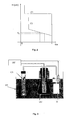
- Their operating principle can be schematized according to the figure 2 for the placement of water, the introduction of the oil being similar.
- This figure illustrates the evolution of the water saturation (Sw) as a function of the height H (inducing the depression), for the ceramic (curve C1) and for the porous column (curve C2).
- the untreated ceramic is a homogeneous porous medium wettable with water, the threshold of capillary pressure is high compared to the medium studied.
- the ceramics are then saturated with the fluid corresponding to their wettability: saturation with water for the hydrophilic ceramics and saturation with oil for the hydrophobic ceramics by a technique of saturation under vacuum.
- a porous medium is desaturated, both with water and oil, by regulating the quantities of water and oil that can be removed.
- respirometry which will measure oxygen consumption at the level of the entire column of porous media
- capillary fringes For desaturation values that are too low, one is subject to the presence of capillary fringes, that is to say, to have a total saturation of the pore volume at the water of the bottom of the column. This saturation is not technically desirable to be able to introduce the oil then.
- the same principle is used to adjust the oil saturation. This is possible because the water has low mobility at low saturation. After the installation of the oil and the installation of a wettable ceramic to the oil allowing only this fluid, it operates in the same way as with the water. In the figure 2 the saturation in water Sw can be replaced by the saturation in oil So and the amount of oil can be adjusted using the same principle.
- the respective distributions of water, oil and air are homogeneous (thanks to ceramics) at all levels of the porous medium column.
- the constraints in terms of oxygen exchange restrictions of the gas phase to the water phase and of the hydrocarbon from the oil phase to the water phase are individually identical at all points of the porous medium column.
- the water phase is the seat of biodegradation and requires for aerobic metabolism both oxygen and a carbon source, in this case the hydrocarbon.
- the porous media column represents a single operating point of environmental conditions of unsaturated porous media. We can therefore link the kinetic results obtained at this point of environmental conditions, and use a global measurement of respirometry to represent this point of operation.
- the implementation of the biodegradation tests is done by connecting the column of porous medium (biological reactor) to a measurement unit of a respirometer.
- the figure 3 illustrates this implementation.
- the unit allows both an oxygen supply via an oxygen generator (GO) and a monitoring of the oxygen consumption in the porous media column (MP) via a unit control unit (UC) connected to an acquisition system.
- the set is placed in a thermostatically controlled enclosure (ET).
- the operating principle of the respirometer is as follows.
- the column of porous medium is placed in communication with the oxygen generator.
- the assembly represents the test compartment which is separated from a reference compartment integrating a U-shaped water interface (manometer - M).
- the pressure equilibrium between the reference gas compartment and the top of the column (test compartment) is achieved at the start of each test by venting the two gaseous compartments.
- the activity of microorganisms in the porous medium generates oxygen consumption and CO 2 production.
- the CO 2 is trapped by soda lime (CS) placed in a receptacle positioned in the sky of the column of porous medium. Under these CO 2 trapping conditions, the metabolic activity generates a depression within the column sky, creating an imbalance in the manometer (M).
- CS soda lime
- a contact at the pressure gauge causes stimulation of the oxygen generator allowing a calibrated production of oxygen electrolytically.
- the manometric contact ceases and the generator is no longer stimulated.
- the monitoring of oxygen consumption is done by the acquisition system which counts the number of stimulations as a function of time.
- a homogeneous porous medium is formed at any point in the column of porous medium, both in terms of grain size, but also respective distributions of water, air and oil.
- the particle size, the porous network and the water and oil saturations of this porous medium thus constituted are chosen so as to correspond to those of the underground medium studied (soil or reservoir).
- the reconstituted porous medium is therefore, according to the respective saturations in water / air / oil and the particle sizes, representative of partial saturation states of water, oil and air which can be found in natural soil or hydrocarbon reservoirs. . Consequently, it is possible to study what happens in terms of the limiting parameter of biodegradation in an underground environment characterized by these physical data, which represent a point of operation.
Landscapes
- Chemical & Material Sciences (AREA)
- Life Sciences & Earth Sciences (AREA)
- Organic Chemistry (AREA)
- Engineering & Computer Science (AREA)
- Zoology (AREA)
- Wood Science & Technology (AREA)
- Biotechnology (AREA)
- Health & Medical Sciences (AREA)
- Proteomics, Peptides & Aminoacids (AREA)
- Microbiology (AREA)
- Chemical Kinetics & Catalysis (AREA)
- Physics & Mathematics (AREA)
- Molecular Biology (AREA)
- Biophysics (AREA)
- Geology (AREA)
- General Life Sciences & Earth Sciences (AREA)
- Immunology (AREA)
- Paleontology (AREA)
- Oil, Petroleum & Natural Gas (AREA)
- Analytical Chemistry (AREA)
- Environmental & Geological Engineering (AREA)
- General Chemical & Material Sciences (AREA)
- Biochemistry (AREA)
- Bioinformatics & Cheminformatics (AREA)
- General Engineering & Computer Science (AREA)
- General Health & Medical Sciences (AREA)
- Genetics & Genomics (AREA)
- Biological Treatment Of Waste Water (AREA)
Applications Claiming Priority (1)
| Application Number | Priority Date | Filing Date | Title |
|---|---|---|---|
| FR0703822A FR2916854B1 (fr) | 2007-05-30 | 2007-05-30 | Procede de construction d'un milieu poreux a l'etude de phenomenes de biodegradation |
Publications (1)
| Publication Number | Publication Date |
|---|---|
| EP1998176A1 true EP1998176A1 (de) | 2008-12-03 |
Family
ID=38894032
Family Applications (1)
| Application Number | Title | Priority Date | Filing Date |
|---|---|---|---|
| EP08290454A Withdrawn EP1998176A1 (de) | 2007-05-30 | 2008-05-14 | Verfahren zur Herstellung eines porösen Milieus, das für Untersuchungen von Phänomenen des biologischen Abbaus geeignet ist |
Country Status (2)
| Country | Link |
|---|---|
| EP (1) | EP1998176A1 (de) |
| FR (1) | FR2916854B1 (de) |
Cited By (1)
| Publication number | Priority date | Publication date | Assignee | Title |
|---|---|---|---|---|
| WO2011079725A1 (zh) * | 2009-12-31 | 2011-07-07 | 天津南开大学蓖麻工程科技有限公司 | 合成油和植物油基润滑油产品的生物降解测试方法 |
Citations (3)
| Publication number | Priority date | Publication date | Assignee | Title |
|---|---|---|---|---|
| EP0605308A1 (de) * | 1992-12-30 | 1994-07-06 | Institut Francais Du Petrole | Zusammensetzung die ein Tensid und Glycolipiden enthält und Verfahren zur Dekontaminierung eines polluierten Mediums |
| FR2830646A1 (fr) * | 2001-10-05 | 2003-04-11 | Inst Francais Du Petrole | Methode pour modeliser la biodegradation d'hydrocarbures dans un gisement petrolier |
| FR2888251A1 (fr) * | 2005-07-08 | 2007-01-12 | Inst Francais Du Petrole | Methode pour evaluer la biodegradation d'hydrocarbures pieges dans une structure geologique |
-
2007
- 2007-05-30 FR FR0703822A patent/FR2916854B1/fr not_active Expired - Fee Related
-
2008
- 2008-05-14 EP EP08290454A patent/EP1998176A1/de not_active Withdrawn
Patent Citations (3)
| Publication number | Priority date | Publication date | Assignee | Title |
|---|---|---|---|---|
| EP0605308A1 (de) * | 1992-12-30 | 1994-07-06 | Institut Francais Du Petrole | Zusammensetzung die ein Tensid und Glycolipiden enthält und Verfahren zur Dekontaminierung eines polluierten Mediums |
| FR2830646A1 (fr) * | 2001-10-05 | 2003-04-11 | Inst Francais Du Petrole | Methode pour modeliser la biodegradation d'hydrocarbures dans un gisement petrolier |
| FR2888251A1 (fr) * | 2005-07-08 | 2007-01-12 | Inst Francais Du Petrole | Methode pour evaluer la biodegradation d'hydrocarbures pieges dans une structure geologique |
Non-Patent Citations (3)
| Title |
|---|
| RIIS V ET AL: "A simple closed system for the microbial degradation of volatile substances", BIOTECHNOLOGY TECHNIQUES, vol. 9, no. 10, 1995, pages 705 - 708, XP002464988, ISSN: 0951-208X * |
| WATER RESOUR. RES., vol. 31, no. 9, pages 2159 - 2172 |
| WILKINS ET AL: "An experimental investigation of rate-limited nonaqueous phase liquid volatilization in unsaturated porous media: Steady state mass transfer", WATER RESOURCES RESEARCH, AMERICAN GEOPHYSICAL UNION, US, vol. 31, no. 9, September 1995 (1995-09-01), pages 2159 - 2172, XP009094423, ISSN: 0043-1397 * |
Cited By (1)
| Publication number | Priority date | Publication date | Assignee | Title |
|---|---|---|---|---|
| WO2011079725A1 (zh) * | 2009-12-31 | 2011-07-07 | 天津南开大学蓖麻工程科技有限公司 | 合成油和植物油基润滑油产品的生物降解测试方法 |
Also Published As
| Publication number | Publication date |
|---|---|
| FR2916854A1 (fr) | 2008-12-05 |
| FR2916854B1 (fr) | 2009-08-21 |
Similar Documents
| Publication | Publication Date | Title |
|---|---|---|
| Akin et al. | Spontaneous imbibition characteristics of diatomite | |
| Persoff et al. | Effect of dilution and contaminants on sand grouted with colloidal silica | |
| CA2461521C (fr) | Methode et dispositif pour evaluer des parametres physiques d'un gisement souterrain a partir de debris de roche qui y sont preleves | |
| FR2921407A1 (fr) | Preleveur statique multi-niveaux | |
| Li et al. | Fabric effect on hydraulic conductivity of kaolin under different chemical and biochemical conditions | |
| Van De Ven et al. | Impacts of water table fluctuations on actual and perceived natural source zone depletion rates | |
| Sun et al. | Using pore-solid fractal dimension to estimate residual LNAPLs saturation in sandy aquifers: A column experiment | |
| Alhashim et al. | Investigation of the effect of pore size distribution on the produced oil from surfactant-assisted spontaneous imbibition in ULRs | |
| CA3065861A1 (fr) | Installation mobile d'analyse d'un fluide | |
| Waduge et al. | Effect of NAPL entrapment conditions on air sparging remediation efficiency | |
| EP1998176A1 (de) | Verfahren zur Herstellung eines porösen Milieus, das für Untersuchungen von Phänomenen des biologischen Abbaus geeignet ist | |
| EP2500513B1 (de) | Verfahren zur geologischen lagerung von gas durch geochemische analysen von seltenen gasen | |
| Kou et al. | Experimental Study on the Formation and Characteristics of Mud Filtration Cake in Large‐Diameter Slurry Shield Tunneling | |
| Susset et al. | Column leaching tests for groundwater risk assessment: concept, interpretation of results, and reproducibility | |
| Gravelle et al. | Experimental investigation and modelling of colloidal release in porous media | |
| Shuai et al. | Experimental study on the influence of load on permeability coefficient of calcareous sand | |
| Savoy | Use of natural and artificial reactive tracers to investigate the transfer of solutes in karst systems | |
| Boisson et al. | Mesures de tres faibles permeabilities in-situ et en laboratoire sur les argilites de Tournemire (Aveyron); methodologies comparees et effet d'echelle | |
| Bella et al. | Water retention response of unsaturated Stava tailings | |
| Kneafsey et al. | Permeability of laboratory-formed hydrate-bearing sand | |
| Barciela-Rial et al. | Experimental and numerical analysis of underwater consolidation of dredged sediment: a case of study for the Marker Wadden | |
| Andre et al. | A novel experimental procedure to investigate the biodegradation of NAPL under unsaturated conditions | |
| Banks et al. | Variations in microbial activity due to fluctuations in soil water content at the water table interface | |
| Abboud et al. | Pressure redistribution and free phase gas formation during and after undrained unloading of dissolved gas-charged sediment | |
| Thijeel et al. | A LABORATORY MODEL FOR THE TWO-PHASE FLOW CONTAMINANT TRANSIENT IN MULTI-POROUS MEDIA |
Legal Events
| Date | Code | Title | Description |
|---|---|---|---|
| PUAI | Public reference made under article 153(3) epc to a published international application that has entered the european phase |
Free format text: ORIGINAL CODE: 0009012 |
|
| AK | Designated contracting states |
Kind code of ref document: A1 Designated state(s): AT BE BG CH CY CZ DE DK EE ES FI FR GB GR HR HU IE IS IT LI LT LU LV MC MT NL NO PL PT RO SE SI SK TR |
|
| AX | Request for extension of the european patent |
Extension state: AL BA MK RS |
|
| 17P | Request for examination filed |
Effective date: 20090603 |
|
| 17Q | First examination report despatched |
Effective date: 20090624 |
|
| AKX | Designation fees paid |
Designated state(s): AT BE BG CH CY CZ DE DK EE ES FI FR GB GR HR HU IE IS IT LI LT LU LV MC MT NL NO PL PT RO SE SI SK TR |
|
| STAA | Information on the status of an ep patent application or granted ep patent |
Free format text: STATUS: THE APPLICATION IS DEEMED TO BE WITHDRAWN |
|
| 18D | Application deemed to be withdrawn |
Effective date: 20100105 |