EP1998174A1 - Verfahren zur Analyse des Einflusses wässriger Lösungsmittel - Google Patents
Verfahren zur Analyse des Einflusses wässriger Lösungsmittel Download PDFInfo
- Publication number
- EP1998174A1 EP1998174A1 EP07388039A EP07388039A EP1998174A1 EP 1998174 A1 EP1998174 A1 EP 1998174A1 EP 07388039 A EP07388039 A EP 07388039A EP 07388039 A EP07388039 A EP 07388039A EP 1998174 A1 EP1998174 A1 EP 1998174A1
- Authority
- EP
- European Patent Office
- Prior art keywords
- partition
- regions
- hydrophobic
- density
- chem
- Prior art date
- Legal status (The legal status is an assumption and is not a legal conclusion. Google has not performed a legal analysis and makes no representation as to the accuracy of the status listed.)
- Withdrawn
Links
- 238000000034 method Methods 0.000 title claims abstract description 18
- 239000003125 aqueous solvent Substances 0.000 title claims description 4
- 238000005192 partition Methods 0.000 claims abstract description 31
- 238000005259 measurement Methods 0.000 claims abstract description 17
- 230000002209 hydrophobic effect Effects 0.000 claims description 23
- 238000004617 QSAR study Methods 0.000 claims description 10
- 230000003993 interaction Effects 0.000 claims description 10
- 239000000243 solution Substances 0.000 claims description 10
- 150000001413 amino acids Chemical class 0.000 claims description 8
- 239000007864 aqueous solution Substances 0.000 claims description 6
- 238000012544 monitoring process Methods 0.000 claims description 5
- 239000012634 fragment Substances 0.000 claims description 4
- 238000001069 Raman spectroscopy Methods 0.000 claims 1
- 238000000333 X-ray scattering Methods 0.000 claims 1
- 238000000862 absorption spectrum Methods 0.000 claims 1
- 238000000295 emission spectrum Methods 0.000 claims 1
- 239000012530 fluid Substances 0.000 abstract description 14
- 150000001875 compounds Chemical class 0.000 abstract description 8
- XLYOFNOQVPJJNP-UHFFFAOYSA-N water Substances O XLYOFNOQVPJJNP-UHFFFAOYSA-N 0.000 description 13
- 238000000638 solvent extraction Methods 0.000 description 10
- 230000036571 hydration Effects 0.000 description 7
- 238000006703 hydration reaction Methods 0.000 description 7
- 229940024606 amino acid Drugs 0.000 description 6
- 238000004364 calculation method Methods 0.000 description 4
- HGASFNYMVGEKTF-UHFFFAOYSA-N octan-1-ol;hydrate Chemical compound O.CCCCCCCCO HGASFNYMVGEKTF-UHFFFAOYSA-N 0.000 description 4
- 230000012846 protein folding Effects 0.000 description 4
- 239000002904 solvent Substances 0.000 description 4
- LFQSCWFLJHTTHZ-UHFFFAOYSA-N Ethanol Chemical compound CCO LFQSCWFLJHTTHZ-UHFFFAOYSA-N 0.000 description 3
- OKKJLVBELUTLKV-UHFFFAOYSA-N Methanol Chemical compound OC OKKJLVBELUTLKV-UHFFFAOYSA-N 0.000 description 3
- 244000309464 bull Species 0.000 description 3
- 239000012528 membrane Substances 0.000 description 3
- 239000003960 organic solvent Substances 0.000 description 3
- 108090000623 proteins and genes Proteins 0.000 description 3
- 102000004169 proteins and genes Human genes 0.000 description 3
- 230000008707 rearrangement Effects 0.000 description 3
- 108020003175 receptors Proteins 0.000 description 3
- 102000005962 receptors Human genes 0.000 description 3
- KBPLFHHGFOOTCA-UHFFFAOYSA-N 1-Octanol Chemical compound CCCCCCCCO KBPLFHHGFOOTCA-UHFFFAOYSA-N 0.000 description 2
- 241000125205 Anethum Species 0.000 description 2
- 102000004190 Enzymes Human genes 0.000 description 2
- 108090000790 Enzymes Proteins 0.000 description 2
- WHUUTDBJXJRKMK-VKHMYHEASA-N L-glutamic acid Chemical compound OC(=O)[C@@H](N)CCC(O)=O WHUUTDBJXJRKMK-VKHMYHEASA-N 0.000 description 2
- OUYCCCASQSFEME-QMMMGPOBSA-N L-tyrosine Chemical compound OC(=O)[C@@H](N)CC1=CC=C(O)C=C1 OUYCCCASQSFEME-QMMMGPOBSA-N 0.000 description 2
- LRHPLDYGYMQRHN-UHFFFAOYSA-N N-Butanol Chemical compound CCCCO LRHPLDYGYMQRHN-UHFFFAOYSA-N 0.000 description 2
- AMQJEAYHLZJPGS-UHFFFAOYSA-N N-Pentanol Chemical compound CCCCCO AMQJEAYHLZJPGS-UHFFFAOYSA-N 0.000 description 2
- 150000001298 alcohols Chemical class 0.000 description 2
- 238000001514 detection method Methods 0.000 description 2
- 238000009510 drug design Methods 0.000 description 2
- ZSIAUFGUXNUGDI-UHFFFAOYSA-N hexan-1-ol Chemical compound CCCCCCO ZSIAUFGUXNUGDI-UHFFFAOYSA-N 0.000 description 2
- 239000007788 liquid Substances 0.000 description 2
- 239000012074 organic phase Substances 0.000 description 2
- BDERNNFJNOPAEC-UHFFFAOYSA-N propan-1-ol Chemical compound CCCO BDERNNFJNOPAEC-UHFFFAOYSA-N 0.000 description 2
- RNHDAKUGFHSZEV-UHFFFAOYSA-N 1,4-dioxane;hydrate Chemical compound O.C1COCCO1 RNHDAKUGFHSZEV-UHFFFAOYSA-N 0.000 description 1
- 150000008574 D-amino acids Chemical class 0.000 description 1
- 108010027915 Glutamate Receptors Proteins 0.000 description 1
- 102000018899 Glutamate Receptors Human genes 0.000 description 1
- ONIBWKKTOPOVIA-BYPYZUCNSA-N L-Proline Chemical compound OC(=O)[C@@H]1CCCN1 ONIBWKKTOPOVIA-BYPYZUCNSA-N 0.000 description 1
- 150000008575 L-amino acids Chemical class 0.000 description 1
- CKLJMWTZIZZHCS-REOHCLBHSA-N L-aspartic acid Chemical compound OC(=O)[C@@H](N)CC(O)=O CKLJMWTZIZZHCS-REOHCLBHSA-N 0.000 description 1
- -1 N-acetyl-amino acid amides Chemical class 0.000 description 1
- ONIBWKKTOPOVIA-UHFFFAOYSA-N Proline Natural products OC(=O)C1CCCN1 ONIBWKKTOPOVIA-UHFFFAOYSA-N 0.000 description 1
- 238000010521 absorption reaction Methods 0.000 description 1
- 230000009471 action Effects 0.000 description 1
- 230000008841 allosteric interaction Effects 0.000 description 1
- 108010011562 aspartic acid receptor Proteins 0.000 description 1
- 230000004071 biological effect Effects 0.000 description 1
- 229920001222 biopolymer Polymers 0.000 description 1
- 230000000052 comparative effect Effects 0.000 description 1
- 230000000295 complement effect Effects 0.000 description 1
- 230000006835 compression Effects 0.000 description 1
- 238000007906 compression Methods 0.000 description 1
- 238000011161 development Methods 0.000 description 1
- 239000003814 drug Substances 0.000 description 1
- 229940079593 drug Drugs 0.000 description 1
- 238000007876 drug discovery Methods 0.000 description 1
- 230000000694 effects Effects 0.000 description 1
- IDGUHHHQCWSQLU-UHFFFAOYSA-N ethanol;hydrate Chemical compound O.CCO IDGUHHHQCWSQLU-UHFFFAOYSA-N 0.000 description 1
- 229930195712 glutamate Natural products 0.000 description 1
- 238000013537 high throughput screening Methods 0.000 description 1
- 230000006872 improvement Effects 0.000 description 1
- 239000003446 ligand Substances 0.000 description 1
- 230000009456 molecular mechanism Effects 0.000 description 1
- 238000012552 review Methods 0.000 description 1
- 239000000126 substance Substances 0.000 description 1
- OUYCCCASQSFEME-UHFFFAOYSA-N tyrosine Natural products OC(=O)C(N)CC1=CC=C(O)C=C1 OUYCCCASQSFEME-UHFFFAOYSA-N 0.000 description 1
Images
Classifications
-
- G—PHYSICS
- G01—MEASURING; TESTING
- G01N—INVESTIGATING OR ANALYSING MATERIALS BY DETERMINING THEIR CHEMICAL OR PHYSICAL PROPERTIES
- G01N29/00—Investigating or analysing materials by the use of ultrasonic, sonic or infrasonic waves; Visualisation of the interior of objects by transmitting ultrasonic or sonic waves through the object
- G01N29/02—Analysing fluids
- G01N29/036—Analysing fluids by measuring frequency or resonance of acoustic waves
-
- G—PHYSICS
- G01—MEASURING; TESTING
- G01N—INVESTIGATING OR ANALYSING MATERIALS BY DETERMINING THEIR CHEMICAL OR PHYSICAL PROPERTIES
- G01N2291/00—Indexing codes associated with group G01N29/00
- G01N2291/01—Indexing codes associated with the measuring variable
- G01N2291/014—Resonance or resonant frequency
-
- G—PHYSICS
- G01—MEASURING; TESTING
- G01N—INVESTIGATING OR ANALYSING MATERIALS BY DETERMINING THEIR CHEMICAL OR PHYSICAL PROPERTIES
- G01N2291/00—Indexing codes associated with group G01N29/00
- G01N2291/02—Indexing codes associated with the analysed material
- G01N2291/025—Change of phase or condition
- G01N2291/0255—(Bio)chemical reactions, e.g. on biosensors
Definitions
- the present invention concerns methods of analyzing a fluid and/or a compound in a fluid by assessing pressure related fluid influences.
- the present invention relates to the measurement of hydrophilic-hydrophobic partition coefficients in an aqueous fluid.
- hydrophobic hydration The hydration of apolar solutes and surfaces has been termed hydrophobic hydration.
- hydrophobic interactions involve entropic phenomena of liquid water. Hydrophobic hydration involves ordering of water hydrogen-bond networks with an associated increased density of water molecules around apolar solutes and surfaces. ( Southall and Dill (2002) Biophys. Chem. 101-102, 295-307 ). The hydrophobic effect and hydrophobic interaction are not yet well understood. However, these phenomena are clearly entropy driven, involving rearrangements of water hydrogen-bond networks, sometimes over long ranges in solution ( for review see Chandler (2005) Nature 437, 640-647 ).
- hydrophobicity of molecules has been assessed experimentally based on their tendency to partition between water and an organic solvent.
- hydrophobicity of amino acid side chains has been based upon several alternative hydrophobicity scales identified in ethanol-water and dioxane-water partition coefficients of free amino acids, in octanol-water partition coefficients of N-acetyl-amino acid amides, ( Nozaki and Tanford (1971) J. Biol. Chem. 246(7), 2211-2217 ; Fauchere and Pliska (1983) Eur. J. Med. Chem. 18(4). 369-375 ) and in a variety of calculated parameters based on these experimental observations (see Abraham and Leo (1987) Proteins Struct. Funct. and Genet. 2, 130-152 ).
- lipophilicty is something of a misnomer.
- liposome-partition measurements can provide more direct and often more predictive measures than log P ( Choi and Rogers (1990) Pharm. Res. 7(5), 508-512 ; Rogers and Choi (1993) Pharm. Res. 10(6) 913-917 ; Kitamura (1995) Anal. Chim. Acta 304, 101-106 ).
- log P is used as a measure of hydrophobicity.
- the hydrophobicity of experimental compounds is important to molecular recognition, independent of considerations of membrane partitioning.
- Receptor or enzyme recognition sites may comprise a generalized low dielectric environment, or hydrophobic cavity. Recognition may also involve specific points of hydrophobic interaction between ligand and receptor. Accordingly, experimental or calculated log P, or calculated hydrophobicity parameters which are based on log P measurements ( Klebe et al. (1994) J. Med. Chem. 37, 4130-4146 ; Kellogg et al. (1991) J. Comp.-Aid. Mol. Des. 5(6), 545-552 ; Abraham and Leo (1987) Proteins Struct. Funct. and Genet. 2, 130-152 ; Leo et al. (1971) Chem. Rev. 71(6), 525-616 ; Nozaki and Tanford (1971) J. Biol.
- thermodynamics of solute partitioning between octanol and water and between other organic phases and water clearly demonstrate that partitioning is partially entropy-driven.
- log P reliance on log P as a measure of hydrophobicity involves reliance on an entropic rearrangement or entropy/enthalpy compensation by organic solvent to estimate a complex entropic rearrangement of water hydrogen-bond networks.
- the log P estimate is clearly meaningful, however, it is equally clearly indirect.
- partition coefficients for any given compound differ considerably depending upon which organic solvent is used.
- the usefulness of log P accordingly lies, not in its absolute magnitude, but as a proportionality factor - log P is proportional to hydrophobicity.
- hydrophobicity parameters are often calculated rather than experimentally determined.
- Log P is typically calculated by a variety of available routines ( Abraham and Leo (1987) Proteins Struct. Funct. and Genet. 2, 130-152 ).
- hydrophobicity parameters may be embedded in 3D comparative molecular field routines, such as HINT or COMSIA. Whether estimating log P directly or as hydrophobic field parameters, contemporary calculation routines ultimately rely on information derived from organic phase partition measurements.
- Such a measure could be obtained by a physical treatment of an aqueous solution whereby the solvent is divided into hydrophilic and hydrophobic compartments. The partitioning of solutes between these hydrophilic and hydrophobic regions within one aqueous solution would thus provide a direct assessment of hydrophobicity.
- Such a measurement can be used directly as a second generation improvement of log P or as a hydrophobicity parameter complementary to log P. Further, such a measurement can be used to recalculate amino acid hydrophobicity scales, and atomic and fragment hydrophobicity parameters used by contemporary calculation routines.
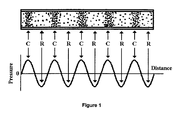
- the resonator cell provides an open system in which regions of high and low density (which could be termed high and low pressure) exist in quasi-sedimentative, diffusional equilibrium.
- regions of high and low density which could be termed high and low pressure
- solutes simply equilibrate to a thermodynamically appropriate partition or distribution between high density regions, with maximal opportunities for hydrogen-bonding (hydrophilic), and low density regions, with minimal volume resistance (hydrophobic).
- the present invention provides a method of measurement of a hydrophilic-hydrophobic partition coefficient in an aqueous fluid by measuring the partition between high and low pressure regions of a single body of aqueous fluid, whereby the high and low pressure regions are generated by an essentially standing wave using an acoustic resonator cell.
- hydrophilic-hydrophobic interaction is measured directly in an aqueous fluid alone, as opposed to the indirect measurement of hydrophilic-hydrophobic interaction using octanol-water partition. Besides being an alternative to the octanol-water partition, it is believed to be useful in generating a better QSAR, since the hydrophilic-hydrophobic interaction is measured directly.
- the method can advantageously be used together with a resonator cell designed to be used with small volumes of aqueous fluid, such as the one described in the co-pending application.
- a method for assessing aqueous solvent influences comprising the steps of providing an aqueous solution within a resonator cell, exposing the resonator cell to a continuous ultrasonic impulse whereby an essentially longitudinal, standing density wave is established in the solution, and monitoring the distribution or partition of components of the solution between different density regions of the standing wave.
- One aspect of the present invention relates to a method for assessment of aqueous solvent influences comprising the steps of:
- An essentially longitudinal, standing density wave can be created in a fluid within an acoustic resonator cell (in some embodiments, volume can be about 1 ml) by exposing the cell to an ultrasonic impulse (0.1-3 MHz). Once the standing density wave is established, it is possible to monitor partition of components of the solution between different density regions of the standing wave. Partitioning can also be monitored in relaxation kinetics after the ultrasonic impulse is discontinued. Partitioning can be monitored using any spectroscopic or other detection means well known in the art. Preferably, detection means are provided that monitors the entire length of the resonator cell, thereby providing a full resolution of high and low pressure regions of the standing density wave.
- partition coefficient and distribution coefficient are used interchangeably, and can both be expressed directly or in logarithmic form.
- the distribution or partition of components are monitored in regions associated with high density (high pressure) nodal points and in regions associated with low density (low pressure) opposite nodal points of the standing wave. It is preferred that the distribution or partition is measured in regions where the difference in density (pressure) is the largest. However, it is possible to monitor the partition in any two regions, as long as the densities (pressures) of the two regions are not essentially the same.
- a partition coefficient expressed either as logarithm or direct.
- the concentration of a solute detected at two different density regions of the standing wave (D 1 and D 2 ) provides a partition measurement.
- the method described herein can be used to measure the partition coefficient of virtually any molecule. Of particular interest is the measurement of pharmaceutical candidate compounds.
- the method of the present invention is used to assess a distribution or partition of all the amino acids, all 5800 sources of fragment constants cited in A. Leo et al. (1971) Chem. Rev. 71 (6), 525-616 , and all original sources of chemical parameters used to calculate hydrophobicity.
- the partition coefficients determined in this manner can then be used to calculate factors for estimation of hydrophobicity.
- partition coefficients determined using the method is used to define a quantitative structure-activity relationship (QSAR).
- Resonator cells such as the ones described in the co-pending application are especially suitable for the measurements described herein.
- D- and L- amino acids such as D- and L- (Ala, Cys, Asp, Glu, Phe, Gly, His, Ile, Lys, Leu, Met, Asn, Pro, Gln, Arg, Ser, Thr, Val, Trp, Tyr).
- Degassed solutions of each of the alcohols are prepared in water at ambient temperature, and introduced into the resonator cell. A standing wave is created in the cell, and evenly distributed absorption measurements along the longitudinal axis of the cell are made.
Landscapes
- Physics & Mathematics (AREA)
- Acoustics & Sound (AREA)
- Health & Medical Sciences (AREA)
- Life Sciences & Earth Sciences (AREA)
- Chemical & Material Sciences (AREA)
- Analytical Chemistry (AREA)
- Biochemistry (AREA)
- General Health & Medical Sciences (AREA)
- General Physics & Mathematics (AREA)
- Immunology (AREA)
- Pathology (AREA)
- Investigating Or Analysing Biological Materials (AREA)
Priority Applications (1)
| Application Number | Priority Date | Filing Date | Title |
|---|---|---|---|
| EP07388039A EP1998174A1 (de) | 2007-05-29 | 2007-05-29 | Verfahren zur Analyse des Einflusses wässriger Lösungsmittel |
Applications Claiming Priority (1)
| Application Number | Priority Date | Filing Date | Title |
|---|---|---|---|
| EP07388039A EP1998174A1 (de) | 2007-05-29 | 2007-05-29 | Verfahren zur Analyse des Einflusses wässriger Lösungsmittel |
Publications (1)
| Publication Number | Publication Date |
|---|---|
| EP1998174A1 true EP1998174A1 (de) | 2008-12-03 |
Family
ID=38951738
Family Applications (1)
| Application Number | Title | Priority Date | Filing Date |
|---|---|---|---|
| EP07388039A Withdrawn EP1998174A1 (de) | 2007-05-29 | 2007-05-29 | Verfahren zur Analyse des Einflusses wässriger Lösungsmittel |
Country Status (1)
| Country | Link |
|---|---|
| EP (1) | EP1998174A1 (de) |
Citations (1)
| Publication number | Priority date | Publication date | Assignee | Title |
|---|---|---|---|---|
| WO2005124300A1 (de) * | 2004-06-18 | 2005-12-29 | Austria Wirtschaftsservice Gesellschaft mit beschränkter Haftung | Verfahren und einrichtung zur absorptionsspektroskopie |
-
2007
- 2007-05-29 EP EP07388039A patent/EP1998174A1/de not_active Withdrawn
Patent Citations (1)
| Publication number | Priority date | Publication date | Assignee | Title |
|---|---|---|---|---|
| WO2005124300A1 (de) * | 2004-06-18 | 2005-12-29 | Austria Wirtschaftsservice Gesellschaft mit beschränkter Haftung | Verfahren und einrichtung zur absorptionsspektroskopie |
Non-Patent Citations (2)
| Title |
|---|
| BENES E ET AL INSTITUTE OF ELECTRICAL AND ELECTRONICS ENGINEERS: "Ultrasonic separation of suspended particles", 2001 IEEE ULTRASONICS SYMPOSIUM PROCEEDINGS. ATLANTA, GA, OCT. 7 - 10, 2001, IEEE ULTRASONICS SYMPOSIUM PROCEEDINGS, NEW YORK, NY : IEEE, US, vol. VOL. 2 OF 2, 7 October 2001 (2001-10-07), pages 649 - 659, XP010584603, ISBN: 0-7803-7177-1 * |
| RADEL S ET AL: "ULTRASONIC STANDING WAVE ACCELERATES ON-LINE MEASUREMENT AND PREVENTS COATING OF A FTIR ATR FLOW CELL", SENSORS, 2004. PROCEEDINGS OF IEEE VIENNA, AUSTRIA OCT. 24 - 27, 2004, PISCATAWAY, NJ, USA,IEEE, 2004, pages 757 - 759, XP010793513, ISBN: 0-7803-8692-2 * |
Similar Documents
| Publication | Publication Date | Title |
|---|---|---|
| JP5566456B2 (ja) | 被写体を熱音響撮像するための撮像装置及び撮像方法、コンピュータプログラム並びにコンピュータで読み取り可能な記憶媒体を備える装置 | |
| Jacek et al. | The log P parameter as a molecular descriptor in the computer-aided drug design–an overview | |
| Tellinghuisen | Optimizing experimental parameters in isothermal titration calorimetry | |
| Paloncýová et al. | Benchmarking of force fields for molecule–membrane interactions | |
| Pastor et al. | Development of the CHARMM force field for lipids | |
| Stauber et al. | Importance of individual rods and plates in the assessment of bone quality and their contribution to bone stiffness | |
| Oh et al. | Nitrile and thiocyanate IR probes: Molecular dynamics simulation studies | |
| Ciarletta et al. | On residual stresses and homeostasis: an elastic theory of functional adaptation in living matter | |
| Zgorski et al. | Surface shear viscosity and interleaflet friction from nonequilibrium simulations of lipid bilayers | |
| Dadarlat et al. | Insights into protein compressibility from molecular dynamics simulations | |
| Zeng et al. | Absolute and relative p K a predictions via a DFT approach applied to the SAMPL6 blind challenge | |
| Suomalainen et al. | Surface activity profiling of drugs applied to the prediction of blood− brain barrier permeability | |
| Mount et al. | IcePick: a flexible surface-based system for molecular diversity | |
| Ruswanto et al. | In silico study of the active compounds in bitter melon (Momordica charantia L) as antidiabetic medication | |
| Sabatino et al. | Quadriceps muscle thickness assessed by ultrasound is independently associated with mortality in hemodialysis patients | |
| Spreafico et al. | In silico prediction of brain exposure: drug free fraction, unbound brain to plasma concentration ratio and equilibrium half-life | |
| Markova et al. | The development of a continuous isothermal titration calorimetric method for equilibrium studies | |
| Zheng et al. | Empirical optimization of interactions between proteins and chemical denaturants in molecular simulations | |
| Choi et al. | Computational infrared and two-dimensional infrared photon echo spectroscopy of both wild-type and double mutant myoglobin-co proteins | |
| Choudhary et al. | Harmonizing molecular mysteries: a comprehensive review of ultrasonic, acoustic, and volumetric studies in complex solutions | |
| Imai | Molecular theory of partial molar volume and its applications to biomolecular systems | |
| Rupp et al. | Using uncertainsci to quantify uncertainty in cardiac simulations | |
| Kaczkowska et al. | The hydration of selected biologically relevant molecules–the temperature effect on apparent molar volume and compression | |
| Khan et al. | Investigating the role of functional mutations in leucine binding to Sestrin2 in aging and age-associated degenerative pathologies using structural and molecular simulation approaches | |
| Cui et al. | Selecting temperature-dependent variables in near-infrared spectra for aquaphotomics |
Legal Events
| Date | Code | Title | Description |
|---|---|---|---|
| PUAI | Public reference made under article 153(3) epc to a published international application that has entered the european phase |
Free format text: ORIGINAL CODE: 0009012 |
|
| AK | Designated contracting states |
Kind code of ref document: A1 Designated state(s): AT BE BG CH CY CZ DE DK EE ES FI FR GB GR HU IE IS IT LI LT LU LV MC MT NL PL PT RO SE SI SK TR |
|
| AX | Request for extension of the european patent |
Extension state: AL BA HR MK RS |
|
| AKX | Designation fees paid | ||
| STAA | Information on the status of an ep patent application or granted ep patent |
Free format text: STATUS: THE APPLICATION IS DEEMED TO BE WITHDRAWN |
|
| 18D | Application deemed to be withdrawn |
Effective date: 20090604 |
|
| REG | Reference to a national code |
Ref country code: DE Ref legal event code: 8566 |