EP1998037A2 - Diagnosis of gas leakage - Google Patents
Diagnosis of gas leakage Download PDFInfo
- Publication number
- EP1998037A2 EP1998037A2 EP08105249A EP08105249A EP1998037A2 EP 1998037 A2 EP1998037 A2 EP 1998037A2 EP 08105249 A EP08105249 A EP 08105249A EP 08105249 A EP08105249 A EP 08105249A EP 1998037 A2 EP1998037 A2 EP 1998037A2
- Authority
- EP
- European Patent Office
- Prior art keywords
- pump
- performance
- gas
- assembly
- tank assembly
- Prior art date
- Legal status (The legal status is an assumption and is not a legal conclusion. Google has not performed a legal analysis and makes no representation as to the accuracy of the status listed.)
- Granted
Links
Images

Classifications
-
- F—MECHANICAL ENGINEERING; LIGHTING; HEATING; WEAPONS; BLASTING
- F02—COMBUSTION ENGINES; HOT-GAS OR COMBUSTION-PRODUCT ENGINE PLANTS
- F02M—SUPPLYING COMBUSTION ENGINES IN GENERAL WITH COMBUSTIBLE MIXTURES OR CONSTITUENTS THEREOF
- F02M25/00—Engine-pertinent apparatus for adding non-fuel substances or small quantities of secondary fuel to combustion-air, main fuel or fuel-air mixture
- F02M25/08—Engine-pertinent apparatus for adding non-fuel substances or small quantities of secondary fuel to combustion-air, main fuel or fuel-air mixture adding fuel vapours drawn from engine fuel reservoir
- F02M25/0809—Judging failure of purge control system
-
- F—MECHANICAL ENGINEERING; LIGHTING; HEATING; WEAPONS; BLASTING
- F02—COMBUSTION ENGINES; HOT-GAS OR COMBUSTION-PRODUCT ENGINE PLANTS
- F02M—SUPPLYING COMBUSTION ENGINES IN GENERAL WITH COMBUSTIBLE MIXTURES OR CONSTITUENTS THEREOF
- F02M25/00—Engine-pertinent apparatus for adding non-fuel substances or small quantities of secondary fuel to combustion-air, main fuel or fuel-air mixture
- F02M25/08—Engine-pertinent apparatus for adding non-fuel substances or small quantities of secondary fuel to combustion-air, main fuel or fuel-air mixture adding fuel vapours drawn from engine fuel reservoir
- F02M25/0809—Judging failure of purge control system
- F02M25/0818—Judging failure of purge control system having means for pressurising the evaporative emission space
Definitions
- the present relation relates to a method for estimating a leakage area in a vehicle tank assembly according to the preamble of claim 1 and to a method of estimating a performance from a plurality of pump assemblies and/or at least one pump assembly at different time periods according to the preamble of claim 25.
- Vehicles for example cars, are generally equipped with at least one vehicle tank assembly comprising a tank adapted for storing a fluid, for example fuel for powering the vehicle. Furthermore, the vehicle tank assembly generally comprises a connector by which a content of the tank may be supplied to a receiving part of the vehicle. If the tank is adapted for storing fuel, an internal combustion engine of the vehicle is generally supplied with the fuel through the aforementioned connector.
- the fluid stored in the tank may be volatile, hence a leak in the vehicle tank assembly at a location above the actual fluid level may result in that evaporated fluid may exit the tank assembly and enter the surrounding atmosphere. If the evaporated fluid comprises noxious particles, such as hydrocarbons, the evaporated fluid may be harmful both to the environment in the vicinity of the vehicle tank assembly, as well as to the global environment.
- the leakage test can be performed with equipment provided with the vehicle itself, i.e. a leakage test can be performed without having to visit a service facility or similar.
- Prior art teaches the use of several leakage testing methods, but they generally require a large amount of measurement test results and generally only determine if a leakage is present or not, based on comparing the test results with empirically obtained reference values.
- the initial gas volume of the vehicle tank assembly being the total volume of the tank assembly minus the volume of the liquid stored within the tank assembly, has to be known prior to performing a leakage test. Determining the initial gas volume requires additional metering devices which may be required to provide results with an accuracy which is similar to the accuracy of the rest of the leakage test equipment. As such, a regular tank gauge may not be sufficiently accurate and thus there may be a need for introducing additional expensive metering devices in the vehicle tank assembly.
- a first object of the invention is to provide a leakage testing method, wherein the area of a leakage is estimated.
- a second object of the invention is to provide a leakage testing method, in which the initial gas volume of the vehicle tank assembly does not need to be known.
- a third object of the invention is to provide a leakage testing method, which may be performed under a plurality of different testing conditions, for example at different temperatures and/or different degrees of fullness of liquid in the tank assembly.
- a fourth object of the invention is to provide a leakage testing method, in which additional disturbances of the measurements, for instance induced by additional components of the tank assembly, such as a canister, may be easily accounted for.
- At least one of the aforementioned objects is achieved by a method for estimating a leakage area in a vehicle tank assembly as set out in appended claim 1.
- the invention relates to a method for estimating a leakage area in a vehicle tank assembly.
- the tank assembly comprises a tank, a gas pump in fluid communication with the rest of the tank assembly and means for determining a pressure in the tank assembly and a gas mass flow through the gas pump.
- the method comprises the step of varying the pressure in the tank assembly by applying the gas mass flow through the gas pump during an area estimation time period.
- the method further comprises the steps of:
- a leakage area may be unambiguously estimated. Furthermore, since the estimation is performed on the basis of an instantaneous gas flow relation for a plurality of time instants, a reliable estimate of the leakage area may be obtained.
- a further embodiment of the inventive method further comprises the feature that the estimation of the leakage area is executed by arranging the instantaneous gas mass flow relations of the gas in an equations system and determining the leakage area by utilizing a least-squares method.
- a least-squares method is an efficient method of estimating a parameter in an over-determined equations system. Furthermore, the average square error of the area estimate is minimized when utilizing the least-squares method.
- Another embodiment of the inventive method further comprises the aspect that the arrangement of the gas mass flow relation of the gas is solved by utilizing a recursive least-squares method.
- Utilizing a recursive least-squares method results in a leakage area estimation method which requires a minimum of stored data. As such, if the method is implemented on e.g. an electronic control unit, a need of memory capacity of the control unit is kept to a minimum.
- Another embodiment of the inventive method further includes each instantaneous gas mass flow relation being an equality based on an ideal gas law.
- the ideal gas law is in many applications a reasonably good approximation of the condition of the gas within the tank assembly, while still being sufficiently simple in order to be used for implementing a relatively simple leakage area estimation method.
- a first side of the equality comprises a first entity minus a second entity, wherein
- the leakage flow is determined by a leakage measure, wherein the leakage measure is a product of: the unknown leakage area and the value of a leakage function, wherein the leakage function is a function of at least the pressure in the tank assembly.
- Another embodiment of the inventive method further includes the leakage function further being a function of the pressure of a medium surrounding the tank assembly and/or the temperature of the gas in the tank assembly and/or a temperature of the surrounding medium. Incorporating any of the above mentioned entities in the estimate of the leakage function may result in an enhanced estimate of the leakage area.
- a second side of the equality comprises a third entity, wherein
- a further embodiment of the inventive method further includes the second side of the equality comprising a fourth entity, subtracted from said third entity, wherein
- the aforementioned change in volume is modelled as a function of at least the gas temperature and pressure in the tank assembly.
- an estimate of the change in volume may be obtained without any need of directly measuring changes in dimensions of the tank assembly.
- Yet another embodiment of the inventive method comprises the feature that the tank assembly comprises a canister in fluid communication with the tank, where a fifth entity is added to the first side of the equality, wherein
- a sixth entity is added to the first side of the equality, wherein
- a further embodiment of the inventive method further requires that the gas temperature in the tank assembly is assumed to be constant throughout the area estimation time period. This assumption simplifies the analysis in the leakage area estimation method and also significantly reduces the need of temperature measurements in the tank assembly.
- the gas pump is supplied with electrical power, wherein each of the change in pressure and the gas mass flow through the gas pump, respectively, is estimated by a performance function of an applied pump electrical current, each performance function having a set of performance coefficients.
- a further embodiment of the inventive method further comprises the feature that each of the performance functions is estimated by an affine performance function.
- An affine performance function comprises few parameters and fitting data to an affine function may be performed by utilizing one of a plurality conventional techniques, such as a linear regression method.
- the performance coefficients of each of the affine performance functions are dependent on at least a voltage supplied to the gas pump. Since the voltage may vary between different tank assemblies, for example between tank assemblies in different vehicles, and the electrical power supplied to the gas pump is proportional to the voltage, the estimate of the performance of a gas pump is enhanced if the voltage is taken into account.
- a further embodiment of the inventive method stipulates that the tank assembly comprises a reference opening and a gas valve for controlling the gas mass flow, the valve being operable to guide the gas mass flow at least either through the reference opening or to the tank assembly, wherein the performance coefficients of the performance functions are established by a coefficient estimation method comprising the step of operating the valve in order to guide the flow through the reference opening and determining a corresponding pump reference electrical current and determining the performance coefficients of each of the performance functions depending on the corresponding pump reference electrical current.
- Another embodiment of the inventive method includes the performance coefficients of the performance functions being established by a coefficient estimation method comprising the step of operating the valve in order to guide the flow to the tank assembly and determining an initial corresponding pump minimum electrical current, and determining the performance coefficients of each of the performance functions dependent on the corresponding pump minimum electrical current. Utilizing the aforementioned method will further enhance the opinion of the condition of the specific gas pump and the information concerning the pump minimum electrical current may thus preferably be used when determining the performance coefficient by quantitatively using the acquired knowledge regarding the pump minimum electrical current.
- the invention further relates to a method for testing leakage in a vehicle tank assembly, wherein the leakage testing method comprises the step of estimating a leakage area according to any of the aforementioned inventive methods.
- the leakage testing method of the invention instead of comparing a measured state of the gas within the tank assembly to empirically obtained reference states and further, from the result of the comparison determining whether a leakage with at least a predetermined area is present or not, the leakage testing method of the invention instead first determines an estimate of the leakage area.
- Another embodiment of the inventive leakage testing method further comprises the step of comparing the estimated leakage area to a predetermined threshold value.
- a predetermined threshold value For example the guidelines for a maximum allowable leakage area in a tank assembly change due to e.g. legal requirements, the method of the invention has only to be updated by introducing a new threshold value instead of having to generate a new set of empirically obtained reference data.
- a further embodiment of the inventive leakage testing method further comprises the step of transmitting a warning signal if the estimated leakage area exceeds the predetermined threshold value and/or the step of transmitting an acceptance signal if the estimated leakage area is lower than the predetermined threshold value.
- the invention further relates to a computer program product, comprising a computer program containing computer program code executable in a computer or a processor to implement at least one of the steps of any of the aforementioned methods.
- the product is stored on a computer-readable medium or a carrier wave.
- the invention further relates to an electronic control unit comprising the aforementioned computer program product.
- the electronic control unit is further arranged to execute a previously disclosed leakage area estimation method and/or a leakage testing method
- the invention further relates to a vehicle, comprising the aforementioned electronic control.
- a fifth object of the invention is to provide a method for estimating a performance of a pump assembly as a function of the applied pump electrical current, wherein differences between different pumps of the same model and/or aging of a pump are accounted for.
- This fifth object is achieved by a performance estimating function defined in the attached claim.
- the invention further relates to a method of estimating a performance from a plurality of pump assemblies and/or at least one pump assembly at different time periods.
- Each pump assembly comprises a gas pump, wherein the performance is indicative of at least a gas mass flow through the gas pump.
- each pump assembly comprises a reference opening and a gas valve for controlling the gas mass flow, the valve being operable to guide the gas mass flow at least either through the reference opening or through an outlet opening.
- the gas pump is supplied with electrical power.
- the method comprises the steps of:
- a further embodiment of the inventive performance testing method further comprises the step of estimating each of the performance functions by an affine performance function.
- Another embodiment of the inventive performance testing method further comprises the step of estimating the coefficients to each of the affine performance functions by utilizing a least-squares method.
- a further embodiment of the inventive performance testing method further comprises the step of estimating the coefficients to each of the affine performance functions by utilizing a recursive least-squares method.
- the pump assembly forms a part of a vehicle tank assembly, the pump assembly being in fluid communication with the rest of the tank assembly and the pump assembly performance comprises a resulting change in pressure in the tank assembly.
- an output comprising the gas mass flow through the pump, from a pump assembly may be estimated.
- a method of estimating the output, based on the performance coefficient function comprises the steps of:
- the output estimated may preferably comprise a change in pressure in a tank assembly if such a tank assembly is in fluid communication with the pump assembly.
- Fig. 1 illustrates a vehicle tank assembly 10 on which at least the leakage area estimation method of the invention may preferably be applied.
- the tank assembly 10 comprises a tank 12 which is adapted to store a liquid 14, such as fuel. Due to e.g. improper handling of the vehicle tank assembly, the tank assembly 10, above a liquid level 16, may be provided with a leakage opening 18 having a leakage area A leak . It has been observed that one frequent location of the leakage opening 18 is in the vicinity of a filler cap 22. Thus, evaporated liquid from the stored liquid 14 may exit the tank assembly 10 and enter the surrounding atmosphere.
- the tank assembly 10 optionally comprises a canister 24 in fluid communication with the tank 12. Furthermore, the tank assembly preferably comprises a gas pump 26. However, in some implementations of the tank assembly 10 on which the method of the invention is preferably applied, the gas pump 26 may preferably be replaced by other gas pressurising means, for example a gas tank having an initial gas pressure which is different than the initial pressure in the rest of the tank assembly 10. The gas pump 26 is preferably adapted to provide a gas mass flow into, or out of, the tank assembly 10. The tank assembly 10 preferably comprises metering means for determining e.g. a pressure in the tank assembly. In the tank assembly 10 illustrated in Fig.
- the metering means comprises a pressure gauge 30 within the tank assembly 10, but the metering means may be constituted by other gauges, and in some implementations of the tank assembly 10, additional physical properties may preferably be measured, such as a gas mass flow through the gas pump and the temperature within and/or outside of the tank assembly 10.
- the invention relates to a method for estimating the leakage area in a vehicle tank assembly 10 by varying the pressure in the tank assembly by applying the gas mass flow through the gas pump 26 during an area estimation time period.
- the method further comprises the steps of establishing an instantaneous gas mass flow relation of the gas in the tank assembly 10 in which relation the leakage area A leak is an unknown parameter.
- the aforesaid establishment is performed for each of a plurality of time instants during the area estimation time period, hence a plurality of gas mass flow relations are obtained.
- the method further comprises the step of estimating the leakage area A leak by utilizing the instantaneous gas mass flow relations.
- the method of the invention may be carried out by either increasing or decreasing the pressure within the tank assembly 10.
- the gas pumped by utilizing the gas pump 26 is preferably air.
- estimation of the leakage area A leak is executed by arranging the instantaneous gas mass flow relation of the gas in an equations system and determining the leakage area A leak by utilizing a least-squares method.
- the arrangement of the gas mass flow relation of the gas is solved by utilizing a recursive least-squares method.
- each of the instantaneous gas mass flow relation is an equality based on an ideal gas law.
- a first side of the equality comprises a first entity minus a second entity.
- the first entity comprises a product of: a change of pressure ⁇ p in the tank assembly 10 from the start of the area estimation time period to the time instant t , and the initial gas volume V 0 of the tank assembly 10.
- the second entity comprises a product of: the accumulated leakage flow q leak through the leakage 18 multiplied by a temperature T of the gas in the tank assembly during a time period from the start of the area estimation time period t 0 to the time instant t ; and the specific gas constant r of the gas, wherein in which leakage flow q leak , the leakage area A leak is an unknown parameter.
- a second side of the equality may comprise a third entity, wherein the third entity comprises a product of: the accumulated gas mass flow q pump from the gas pump 26 multiplied by the temperature T of the gas in the tank assembly 10 during a time period from the start of the area estimation time period to to the time instant t and the specific gas constant r of the gas.
- the second side of the equality comprises a term which relates to a change in volume of the tank assembly 10.
- the change in volume may be considered, such that the second side of the equality may comprise a fourth entity, subtracted from said third entity, wherein the fourth entity comprises a product of: the pressure p in the tank assembly 10 at the time instant t and a change in volume ⁇ V of the tank assembly from the start of the area estimation time period t 0 to the time instant t .
- the abovementioned volume change function may be empirically determined, for instance obtained by pressurizing the tank system for a plurality of different pressures and temperatures and measuring the change in volume.
- the change in volume for a plurality of different pressures and temperatures may be obtained by structural analyzes, such as FE analyses, of the tank system. Irrespective of how the change in volume as a function of pressure and temperature has been determined, i.e. by experiments or analyses, the results are preferably tabulated and stored in a storage unit.
- the change in volume for an actual pressure and temperature may be obtained by utilizing an interpolation method on the aforementioned tabulated data.
- Eq. 12 a gas equality which is valid for a time instant during the area estimation time period, wherein t ⁇ [ t 0 t end ].
- the parameter ⁇ comprising the sought leakage area A leak
- the parameter ⁇ can be determined using conventional techniques, such as a least-squares method.
- a recursive least-squares method is used.
- a fifth entity is added to the first side of the equality, wherein the fifth entity comprises a product of: an accumulated gas mass flow q canister from the canister 24 multiplied by the temperature T of the gas in the tank assembly 10 during a time period from the start of the area estimation time period t 0 to the time instant t; and the specific gas constant r of the gas.
- a sixth entity is added to the first side of the equality, wherein the sixth entity is representative of a pressure change due to evaporation of the liquid and/or dewing of the gas in the tank assembly during a time period from the start of the area estimation time period t 0 to the time instant t .
- the pressure change is formulated as an additional gas mass flow q evapor .
- the gas pump 26 of the tank assembly 10 is generally supplied with electrical power.
- each of the change in pressure ⁇ p and the gas mass flow q pump through the gas pump 26, respectively is in one preferred embodiment of the inventive method estimated by a performance function of an applied pump electrical current l.
- Each performance function has a set of performance coefficients.
- gas mass flow q pump is used as an example in the description of the performance estimation portion of the preferred embodiment of the method of the invention. It should however be realized that the description is equally valid for the change in pressure ⁇ p .
- each, of the performance functions is estimated by an affine performance function.
- the electrical power is supplied to the gas pump 26 at a predetermined voltage U .
- the performance of the gas pump 26 may differ for separate voltages U applied.
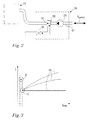
- the pump assembly 34 comprises a reference opening 36 and a valve 38 for controlling the gas mass flow q pump .
- the valve 38 is operable to guide the gas mass flow q pump at least either through the reference opening 36 or to an outlet opening 40 which outlet opening 40 may be in fluid communication with the tank assembly 10.
- the pump assembly 34 of Fig. 2 further comprises an inlet opening 42 which in some implementations of the pump assembly 34 may be in fluid communication with the surrounding atmosphere.
- the cross-sectional area of the reference opening 36 is preferably relatively small and is preferably less than 0.5 mm 2 , more preferably less than 0.2 mm 2 .
- the reference opening 36 may be a cylindrical opening having a diameter of 0.5 mm.
- the performance coefficients of the performance functions are established by a coefficient estimation method comprising the step of operating the valve 38 in order to guide the gas mass flow q pump through the reference opening 36 and determining a corresponding pump reference electrical current l ref and determining the performance coefficients of each of the performance functions depending on the corresponding pump reference electrical current l ref .
- the performance estimation may be even further refined by a coefficient estimation method which comprises the step of operating the valve 38 in order to guide the flow q pump to the tank assembly 10 and determining an initial corresponding pump minimum electrical current l min , and determining the performance coefficients of each of the performance functions depending on the corresponding pump minimum electrical current l min .
- a leakage area A leak may be estimated by utilizing the leakage estimation method and then comparing the estimated leakage area A leak to a predetermined threshold value.
- the leakage testing method further comprises the step of transmitting a warning signal if the estimated leakage area A leak exceeds the predetermined threshold value and/or the step of transmitting an acceptance signal if the estimated leakage area A leak is lower than the predetermined threshold value.
- the leakage estimation method and/or the leakage testing method may preferably be implemented in a computer program product.
- a computer program product may comprise a computer program containing computer program code executable in a computer or a processor to implement at least one of the steps of a aforementioned methods.
- the computer program product may preferably be stored on a computer-readable medium or a carrier wave.
- the computer program product may preferably be stored in an electronic control unit (ECU) 32 and the ECU 32 may preferably be located within a vehicle, which vehicle comprises the vehicle tank assembly 10.
- ECU electronice control unit
- the method comprises the steps of, for each of a plurality of pump assemblies 34 and/or at least one pump assembly 34 at different time periods:
- Fig. 3 illustrates the electrical current / applied to the gas pump 26 as a function of time, the pump electrical current / being denoted by lines 44.
- the pump electrical current / being denoted by lines 44.
- the valve 38 of the pump assembly 34 may preferably be further operated so that the gas mass flow q pump is guided out of the pump assembly 34. If the initial pressure out of the pump assembly 34 is significantly equal to the pressure at the inlet 42, a pressure difference between the inlet and outlet 42, 40 is substantially zero, resulting in a minimum of applied electrical current / to the pump, as indicated by area C in Fig. 3 .
- This illustrates additional steps of a further embodiment of the estimation method which comprises the steps of operating the valve 38 in order to guide the flow q pump out of the pump assembly 34 and determining an initial corresponding pump minimum electrical current l min and generating the performance coefficient function, which is dependent on at least the pump minimum electrical current l min .
- the pump electrical current l may remain at the minimum level or increase with time.
- An increase in pump electrical current may indicate that the pump assembly is in fluid communication with a closed system, for example a tank assembly 10.
- the performance coefficients of the affine performance function are preferably estimated by utilizing a least-squares method, more preferably a recursive least-squares method.
- the aforementioned pump assembly 34 may preferably form a part of a vehicle tank assembly 10, wherein the pump assembly 34 is in fluid communication with the rest of the tank assembly 10. Then, an additional performance of the pump assembly 10 may be a resulting change in pressure ⁇ p in the tank assembly 10 when the pump 26 of the pump assembly 34 is operated.
- the performance coefficient functions may preferably be used when estimating the output of a pump assembly. However, since this technique has been previously described with respect to the leakage area estimation methods, it will not be further detailed here.
- gas mass flow relation used in the aforementioned leakage area estimation method could take into account the compressibility of the gas.
Landscapes
- Engineering & Computer Science (AREA)
- Chemical & Material Sciences (AREA)
- Combustion & Propulsion (AREA)
- Mechanical Engineering (AREA)
- General Engineering & Computer Science (AREA)
- Examining Or Testing Airtightness (AREA)
Abstract
- for each of a plurality of time instants during the area estimation time period, establishing an instantaneous gas mass flow relation of the gas in the tank assembly in which relation the leakage area is an unknown parameter; and
- estimating the leakage area by utilizing the instantaneous gas mass flow relations.
Description
- The present relation relates to a method for estimating a leakage area in a vehicle tank assembly according to the preamble of claim 1 and to a method of estimating a performance from a plurality of pump assemblies and/or at least one pump assembly at different time periods according to the preamble of claim 25.
- Vehicles, for example cars, are generally equipped with at least one vehicle tank assembly comprising a tank adapted for storing a fluid, for example fuel for powering the vehicle. Furthermore, the vehicle tank assembly generally comprises a connector by which a content of the tank may be supplied to a receiving part of the vehicle. If the tank is adapted for storing fuel, an internal combustion engine of the vehicle is generally supplied with the fuel through the aforementioned connector.
- As in the case of fuel, the fluid stored in the tank may be volatile, hence a leak in the vehicle tank assembly at a location above the actual fluid level may result in that evaporated fluid may exit the tank assembly and enter the surrounding atmosphere. If the evaporated fluid comprises noxious particles, such as hydrocarbons, the evaporated fluid may be harmful both to the environment in the vicinity of the vehicle tank assembly, as well as to the global environment.
- As such, there is a need to test vehicle tank assemblies for leakage on a regular basis. In fact, in some countries, there are discussions about introducing legislation stating that a new vehicle should be equipped with systems capable of determining gas leakages having an area larger than a predetermined value. Preferably, the leakage test can be performed with equipment provided with the vehicle itself, i.e. a leakage test can be performed without having to visit a service facility or similar.
- Prior art teaches the use of several leakage testing methods, but they generally require a large amount of measurement test results and generally only determine if a leakage is present or not, based on comparing the test results with empirically obtained reference values. Prior art further teaches that the initial gas volume of the vehicle tank assembly, being the total volume of the tank assembly minus the volume of the liquid stored within the tank assembly, has to be known prior to performing a leakage test. Determining the initial gas volume requires additional metering devices which may be required to provide results with an accuracy which is similar to the accuracy of the rest of the leakage test equipment. As such, a regular tank gauge may not be sufficiently accurate and thus there may be a need for introducing additional expensive metering devices in the vehicle tank assembly.
- A first object of the invention is to provide a leakage testing method, wherein the area of a leakage is estimated.
- A second object of the invention is to provide a leakage testing method, in which the initial gas volume of the vehicle tank assembly does not need to be known.
- A third object of the invention is to provide a leakage testing method, which may be performed under a plurality of different testing conditions, for example at different temperatures and/or different degrees of fullness of liquid in the tank assembly.
- A fourth object of the invention is to provide a leakage testing method, in which additional disturbances of the measurements, for instance induced by additional components of the tank assembly, such as a canister, may be easily accounted for.
- At least one of the aforementioned objects is achieved by a method for estimating a leakage area in a vehicle tank assembly as set out in appended claim 1.
- Thus, the invention relates to a method for estimating a leakage area in a vehicle tank assembly. The tank assembly comprises a tank, a gas pump in fluid communication with the rest of the tank assembly and means for determining a pressure in the tank assembly and a gas mass flow through the gas pump. The method comprises the step of varying the pressure in the tank assembly by applying the gas mass flow through the gas pump during an area estimation time period.
According to the invention, the method further comprises the steps of: - for each of a plurality of time instants during the area estimation time period, establishing an instantaneous gas mass flow relation of the gas in the tank assembly in which relation the leakage area is an unknown parameter; and
- estimating the leakage area by utilizing the instantaneous gas mass flow relations.
- Thus, by utilizing the aforementioned method of the invention, a leakage area may be unambiguously estimated. Furthermore, since the estimation is performed on the basis of an instantaneous gas flow relation for a plurality of time instants, a reliable estimate of the leakage area may be obtained.
- A further embodiment of the inventive method further comprises the feature that the estimation of the leakage area is executed by arranging the instantaneous gas mass flow relations of the gas in an equations system and determining the leakage area by utilizing a least-squares method. A least-squares method is an efficient method of estimating a parameter in an over-determined equations system. Furthermore, the average square error of the area estimate is minimized when utilizing the least-squares method.
- Another embodiment of the inventive method further comprises the aspect that the arrangement of the gas mass flow relation of the gas is solved by utilizing a recursive least-squares method. Utilizing a recursive least-squares method results in a leakage area estimation method which requires a minimum of stored data. As such, if the method is implemented on e.g. an electronic control unit, a need of memory capacity of the control unit is kept to a minimum.
- Another embodiment of the inventive method further includes each instantaneous gas mass flow relation being an equality based on an ideal gas law. The ideal gas law is in many applications a reasonably good approximation of the condition of the gas within the tank assembly, while still being sufficiently simple in order to be used for implementing a relatively simple leakage area estimation method.
- In another embodiment of the inventive method, a first side of the equality comprises a first entity minus a second entity, wherein
- the first entity comprises a product of: a change of pressure in the tank assembly from the start of the area estimation time period to the time instant, and the initial gas volume of the tank assembly;
- the second entity comprises a product of: the accumulated leakage flow through the leakage multiplied by a temperature of the gas in the tank assembly during a time period from the start of the area estimation time period to the time instant; a specific gas constant of the gas, wherein in which leakage flow the leakage area is an unknown parameter.
- In a further embodiment of the inventive method, the leakage flow is determined by a leakage measure, wherein the leakage measure is a product of: the unknown leakage area and the value of a leakage function, wherein the leakage function is a function of at least the pressure in the tank assembly. By determining the leakage flow by means of a leakage measure which is proportional to the leakage area, the aforesaid leakage area may be estimated in a simple manner.
- Another embodiment of the inventive method further includes the leakage function further being a function of the pressure of a medium surrounding the tank assembly and/or the temperature of the gas in the tank assembly and/or a temperature of the surrounding medium. Incorporating any of the above mentioned entities in the estimate of the leakage function may result in an enhanced estimate of the leakage area.
- In a further embodiment of the inventive method, a second side of the equality comprises a third entity, wherein
- the third entity comprises a product of: an accumulated gas mass flow from the gas pump multiplied by the temperature of the gas in the tank assembly during a time period from the start of the area estimation time period to the time instant; and the specific gas constant of the gas.
- A further embodiment of the inventive method further includes the second side of the equality comprising a fourth entity, subtracted from said third entity, wherein
- the fourth entity comprises a product of: the pressure in the tank assembly at the time instant and a change in volume in the tank assembly from the start of the area estimation time period to the time instant.
- In another embodiment of the inventive method, the aforementioned change in volume is modelled as a function of at least the gas temperature and pressure in the tank assembly. Thus, by determining the pressure in the tank assembly, an estimate of the change in volume may be obtained without any need of directly measuring changes in dimensions of the tank assembly.
- Yet another embodiment of the inventive method comprises the feature that the tank assembly comprises a canister in fluid communication with the tank, where a fifth entity is added to the first side of the equality, wherein
- the fifth entity comprises a product of: the accumulated gas mass flow from the canister multiplied by the temperature of the gas in the tank assembly during a time period from the start of the area estimation time period to the time instant, and the specific gas constant of the gas.
- In a further embodiment of the inventive method, a sixth entity is added to the first side of the equality, wherein
- the sixth entity is representative of a pressure change due to evaporation of the liquid and/or dewing of the gas in the tank during a time period from the start of the area estimation time period to the time instant.
- A further embodiment of the inventive method further requires that the gas temperature in the tank assembly is assumed to be constant throughout the area estimation time period. This assumption simplifies the analysis in the leakage area estimation method and also significantly reduces the need of temperature measurements in the tank assembly.
- In another embodiment of the inventive method, the gas pump is supplied with electrical power, wherein each of the change in pressure and the gas mass flow through the gas pump, respectively, is estimated by a performance function of an applied pump electrical current, each performance function having a set of performance coefficients. Thus, by simply measuring the pump electrical current supplied to the gas pump, an estimate of the change in pressure and gas mass flow may be obtained, which significantly reduces the need for measuring devices, such as pressure and mass flow measuring units, within the tank assembly.
- A further embodiment of the inventive method further comprises the feature that each of the performance functions is estimated by an affine performance function. An affine performance function comprises few parameters and fitting data to an affine function may be performed by utilizing one of a plurality conventional techniques, such as a linear regression method.
- In another embodiment of the inventive method, the performance coefficients of each of the affine performance functions are dependent on at least a voltage supplied to the gas pump. Since the voltage may vary between different tank assemblies, for example between tank assemblies in different vehicles, and the electrical power supplied to the gas pump is proportional to the voltage, the estimate of the performance of a gas pump is enhanced if the voltage is taken into account.
- A further embodiment of the inventive method stipulates that the tank assembly comprises a reference opening and a gas valve for controlling the gas mass flow, the valve being operable to guide the gas mass flow at least either through the reference opening or to the tank assembly, wherein the performance coefficients of the performance functions are established by a coefficient estimation method comprising the step of operating the valve in order to guide the flow through the reference opening and determining a corresponding pump reference electrical current and determining the performance coefficients of each of the performance functions depending on the corresponding pump reference electrical current. By introducing the step of measuring the pump electrical current supplied to the pump when the pump produces a gas mass flow through a throttling, an improved opinion of the condition of the specific gas pump is obtained, which opinion later is quantitatively implemented by determining the performance coefficients of each of the performance functions as dependent on the corresponding pump reference electrical current.
- Another embodiment of the inventive method includes the performance coefficients of the performance functions being established by a coefficient estimation method comprising the step of operating the valve in order to guide the flow to the tank assembly and determining an initial corresponding pump minimum electrical current, and determining the performance coefficients of each of the performance functions dependent on the corresponding pump minimum electrical current. Utilizing the aforementioned method will further enhance the opinion of the condition of the specific gas pump and the information concerning the pump minimum electrical current may thus preferably be used when determining the performance coefficient by quantitatively using the acquired knowledge regarding the pump minimum electrical current.
- The invention further relates to a method for testing leakage in a vehicle tank assembly, wherein the leakage testing method comprises the step of estimating a leakage area according to any of the aforementioned inventive methods. Thus, instead of comparing a measured state of the gas within the tank assembly to empirically obtained reference states and further, from the result of the comparison determining whether a leakage with at least a predetermined area is present or not, the leakage testing method of the invention instead first determines an estimate of the leakage area.
- Another embodiment of the inventive leakage testing method further comprises the step of comparing the estimated leakage area to a predetermined threshold value. Thus, should for example the guidelines for a maximum allowable leakage area in a tank assembly change due to e.g. legal requirements, the method of the invention has only to be updated by introducing a new threshold value instead of having to generate a new set of empirically obtained reference data.
- A further embodiment of the inventive leakage testing method further comprises the step of transmitting a warning signal if the estimated leakage area exceeds the predetermined threshold value and/or the step of transmitting an acceptance signal if the estimated leakage area is lower than the predetermined threshold value.
- The invention further relates to a computer program product, comprising a computer program containing computer program code executable in a computer or a processor to implement at least one of the steps of any of the aforementioned methods. The product is stored on a computer-readable medium or a carrier wave.
- The invention further relates to an electronic control unit comprising the aforementioned computer program product. The electronic control unit is further arranged to execute a previously disclosed leakage area estimation method and/or a leakage testing method
- The invention further relates to a vehicle, comprising the aforementioned electronic control.
- A fifth object of the invention is to provide a method for estimating a performance of a pump assembly as a function of the applied pump electrical current, wherein differences between different pumps of the same model and/or aging of a pump are accounted for.
- This fifth object is achieved by a performance estimating function defined in the attached claim.
- Thus, the invention further relates to a method of estimating a performance from a plurality of pump assemblies and/or at least one pump assembly at different time periods. Each pump assembly comprises a gas pump, wherein the performance is indicative of at least a gas mass flow through the gas pump. Furthermore, each pump assembly comprises a reference opening and a gas valve for controlling the gas mass flow, the valve being operable to guide the gas mass flow at least either through the reference opening or through an outlet opening. The gas pump is supplied with electrical power. According to the invention, the method comprises the steps of:
- for each of the plurality of pump assemblies and/or the at least one pump assembly at different time periods:
- o measuring the performance for a plurality of applied pump electrical currents;
- o estimating the performance by the applied pump electrical current and thereby determining performance coefficients for a performance function;
- o operating the valve in order to guide the flow through the reference opening and determining the corresponding pump reference electrical current,
- for each performance coefficient, generating a performance coefficient function, which is dependent on at least the pump reference electrical current.
- A further embodiment of the inventive performance testing method further comprises the steps of:
- for each of the plurality of pump assemblies and/or the at least one pump assembly at different time periods:
- o operating the valve in order to guide the flow through the outlet opening and determining an initial corresponding pump minimum electrical current;
- for each performance coefficient, generating a performance coefficient function, which is dependent on at least the pump minimum electrical current.
- Another embodiment of the inventive performance testing method further comprises the step of:
- for each of the plurality of pump assemblies and/or the at least one pump assembly at different time periods:
- o determining a pump electrical voltage;
- for each performance coefficient, generating a performance coefficient function, which is dependent on at least the pump electrical voltage.
- A further embodiment of the inventive performance testing method further comprises the step of estimating each of the performance functions by an affine performance function.
- Another embodiment of the inventive performance testing method further comprises the step of estimating the coefficients to each of the affine performance functions by utilizing a least-squares method.
- A further embodiment of the inventive performance testing method further comprises the step of estimating the coefficients to each of the affine performance functions by utilizing a recursive least-squares method.
- In a further embodiment of the inventive method of performance testing, the pump assembly forms a part of a vehicle tank assembly, the pump assembly being in fluid communication with the rest of the tank assembly and the pump assembly performance comprises a resulting change in pressure in the tank assembly.
- Thus, by utilizing the obtained performance coefficient function as previously described, an output, comprising the gas mass flow through the pump, from a pump assembly may be estimated. A method of estimating the output, based on the performance coefficient function, comprises the steps of:
- operating the valve in order to guide the flow through the reference opening and determining a corresponding pump reference electrical current,
- determining the performance coefficients, based on the pump reference electrical current,
- operating the valve in order to guide the flow through the outlet opening;
- determining the applied pump electrical current, and
- calculating the output, by utilizing the performance function with the performance coefficients, utilizing the applied pump electrical current as input to the performance function.
- One embodiment of the output estimation method preferably further comprises the steps of:
- operating the valve in order to guide the flow through the outlet opening and determining a corresponding initial pump minimum electrical current, and
- determining the performance coefficients, based on the initial corresponding pump minimum electrical current.
- Still another embodiment of the output estimation method preferably further comprises the steps of:
- determining an pump electrical voltage;
- determining said performance coefficients, based on the pump electrical voltage.
- The output estimated may preferably comprise a change in pressure in a tank assembly if such a tank assembly is in fluid communication with the pump assembly.
- Advantages of different embodiments of the performance testing method are similar to the advantages presented when previously discussing methods for estimating the performance of a gas pump as a function of supplied pump electrical current in conjunction with the leakage area estimation method, and are thus not presented here.
- The present invention will hereinafter be further explained by means of non-limiting examples with reference to the appended figures wherein;
- Fig. 1
- is schematic view of a vehicle tank assembly on which the method of the invention may be applied;
- Fig. 2
- is schematic view of an alternative vehicle tank assembly on which embodiments of the inventive method may be applied, and
- Fig. 3
- is a time history diagram of an electrical current supplied to a gas pump.
- The invention will, in the following, be exemplified by embodiments. It should however be realized that the embodiments are included in order to explain principles of the invention and not to limit the scope of the invention, defined by the appended claims.
-
Fig. 1 illustrates avehicle tank assembly 10 on which at least the leakage area estimation method of the invention may preferably be applied. Thetank assembly 10 comprises atank 12 which is adapted to store a liquid 14, such as fuel. Due to e.g. improper handling of the vehicle tank assembly, thetank assembly 10, above aliquid level 16, may be provided with aleakage opening 18 having a leakage area Aleak. It has been observed that one frequent location of theleakage opening 18 is in the vicinity of afiller cap 22. Thus, evaporated liquid from the stored liquid 14 may exit thetank assembly 10 and enter the surrounding atmosphere. - The
tank assembly 10 optionally comprises acanister 24 in fluid communication with thetank 12. Furthermore, the tank assembly preferably comprises agas pump 26. However, in some implementations of thetank assembly 10 on which the method of the invention is preferably applied, thegas pump 26 may preferably be replaced by other gas pressurising means, for example a gas tank having an initial gas pressure which is different than the initial pressure in the rest of thetank assembly 10. Thegas pump 26 is preferably adapted to provide a gas mass flow into, or out of, thetank assembly 10. Thetank assembly 10 preferably comprises metering means for determining e.g. a pressure in the tank assembly. In thetank assembly 10 illustrated inFig. 1 , the metering means comprises apressure gauge 30 within thetank assembly 10, but the metering means may be constituted by other gauges, and in some implementations of thetank assembly 10, additional physical properties may preferably be measured, such as a gas mass flow through the gas pump and the temperature within and/or outside of thetank assembly 10. - The invention relates to a method for estimating the leakage area in a
vehicle tank assembly 10 by varying the pressure in the tank assembly by applying the gas mass flow through thegas pump 26 during an area estimation time period. - According to the invention, the method further comprises the steps of establishing an instantaneous gas mass flow relation of the gas in the
tank assembly 10 in which relation the leakage area Aleak is an unknown parameter. The aforesaid establishment is performed for each of a plurality of time instants during the area estimation time period, hence a plurality of gas mass flow relations are obtained. The method further comprises the step of estimating the leakage area Aleak by utilizing the instantaneous gas mass flow relations. - It should be realized that the method of the invention may be carried out by either increasing or decreasing the pressure within the
tank assembly 10. Furthermore, in the leakage area testing methods disclosed herein, the gas pumped by utilizing thegas pump 26 is preferably air. - According to a further embodiment of the invention, estimation of the leakage area Aleak is executed by arranging the instantaneous gas mass flow relation of the gas in an equations system and determining the leakage area Aleak by utilizing a least-squares method. Preferably, the arrangement of the gas mass flow relation of the gas is solved by utilizing a recursive least-squares method.
- In a further embodiment of the invention, each of the instantaneous gas mass flow relation is an equality based on an ideal gas law. The ideal gas law stipulates that:

where: - p is the pressure (Pa);
- V is the volume (m3);
- n is the number of moles of gas;
- R is the gas constant J/(mol·K), and
- T is the temperature (K).
- The number of moles of gas is equal to the mass of the gas, divided by the molar mass of the gas:

where: - m is the mass of the gas, and
- M is the molar mass of the gas.
- Inserting Eq. 2 into Eq. 1, the following expression is obtained:

where: - r is the specific gas constant. For example, the specific gas constant r for air is approximately 287 J/(kg·K).
- As a starting point for the aforementioned embodiment of the inventive method, an initial state of the gas filled portion of the tank assembly is considered. Thus, at a selected starting time t 0 for starting the leakage area estimation method, the following relation is assumed to apply between the pressure (p0 ), volume (V0 ) and mass (m0 ) of the gas initially entrapped in the tank assembly:

- By applying a gas mass flow qpump to (or from) the
tank assembly 10, the gas mass within thetank assembly 10 may vary. Thus, the pressure within thetank assembly 10 may also vary. Thus, utilizing the expression in Eq. 4 for a specific time instant t after the starting time t 0, the following expression is assumed to apply:
where: - Δp(t)
- is a change in pressure;
- ΔV(t)
- is a change in volume of the vehicle tank assembly, due to e.g. elasticity of one or more components of the tank assembly;
- Δm(t)
- is a change in mass;
- qpump(t)
- is a flow of the gas pump of the system, and
- qleak(t)
- is a flow through the possible leakage opening.
- In Eq. 5 above, it is assumed that the only gas mass flows to the
tank assembly 10 are from thegas pump 26 and theleakage 18. However, in embodiments of the method of the invention which are presented hereinbelow, additional flows may be taken into account. - Combining Eq. 4 and Eq. 5 and utilizing that p(t) = p 0 + Δp(t), the following expression is obtained:

which may be re-arranged to:
- Thus, a first side and a second side of the equality are obtained. The equality is assumed to be valid for each time instant during the area estimation time period.
- As may be gleaned from Eq. 7, a first side of the equality comprises a first entity minus a second entity. The first entity comprises a product of: a change of pressure Δp in the
tank assembly 10 from the start of the area estimation time period to the time instant t, and the initial gas volume V0 of thetank assembly 10. Furthermore, the second entity comprises a product of: the accumulated leakage flow qleak through theleakage 18 multiplied by a temperature T of the gas in the tank assembly during a time period from the start of the area estimation time period t0 to the time instant t; and the specific gas constant r of the gas, wherein in which leakage flow qleak, the leakage area Aleak is an unknown parameter. - Furthermore, the leakage flow qleak may in one embodiment be determined by a leakage measure, wherein the leakage measure is a product of: the unknown leakage area Aleak and the value of a leakage function fleak, wherein the leakage function fleak is a function of at least the pressure p in the
tank assembly 10, such as:
- In the following description, the leakage function fleak is denoted as a function of only the pressure p in the
tank assembly 10, pursuant to Eq. 8, in order to save space. It should however be noted that whenever the leakage function is used hereinbelow, the function fleak may preferably further be a function of the pressure of the surrounding medium and/or of the temperature of the gas in the tank and/or the temperature of the surrounding medium, i.e.
- Additionally, as may be appreciated from Eq. 7, a second side of the equality may comprise a third entity, wherein the third entity comprises a product of: the accumulated gas mass flow qpump from the
gas pump 26 multiplied by the temperature T of the gas in thetank assembly 10 during a time period from the start of the area estimation time period to to the time instant t and the specific gas constant r of the gas. - As may be gleaned from Eq. 7, the second side of the equality comprises a term which relates to a change in volume of the
tank assembly 10. In some applications of the inventive method, in which the tank assembly is considered to be rigid, it may be a sufficiently good approximation to assume that the change in volume is negligible and hence set to zero. However, in a further embodiment of the invention, the change in volume may be considered, such that the second side of the equality may comprise a fourth entity, subtracted from said third entity, wherein the fourth entity comprises a product of: the pressure p in thetank assembly 10 at the time instant t and a change in volume ΔV of the tank assembly from the start of the area estimation time period t0 to the time instant t. - In a preferred embodiment of the method of the invention, the change in volume ΔV is modelled as a function of the gas temperature and pressure, i.e.

- The abovementioned volume change function may be empirically determined, for instance obtained by pressurizing the tank system for a plurality of different pressures and temperatures and measuring the change in volume. Optionally, the change in volume for a plurality of different pressures and temperatures may be obtained by structural analyzes, such as FE analyses, of the tank system. Irrespective of how the change in volume as a function of pressure and temperature has been determined, i.e. by experiments or analyses, the results are preferably tabulated and stored in a storage unit. During the area estimation method of the invention, the change in volume for an actual pressure and temperature may be obtained by utilizing an interpolation method on the aforementioned tabulated data.
- The equality in Eq. 7 may preferably be re-written as:

or:
where:


- Thus, what is obtained in Eq. 12 is a gas equality which is valid for a time instant during the area estimation time period, wherein t ∈ [t0 tend ]. The gas equality of Eq. 12 is further in a form, suitable for generating an equations system such as:

- As may be appreciated when studying Eq. 16, an equation system may be obtained if tend > t0 and an over determined equation system may be obtained if the number of rows in the equations system is more than two. Thus, the parameter θ, comprising the sought leakage area Aleak, can be determined using conventional techniques, such as a least-squares method. However, as previously mentioned, in a preferred embodiment of the invention, a recursive least-squares method is used.
- In a preferred embodiment of the invention a fifth entity is added to the first side of the equality, wherein the fifth entity comprises a product of: an accumulated gas mass flow q canister from the
canister 24 multiplied by the temperature T of the gas in thetank assembly 10 during a time period from the start of the area estimation time period t0 to the time instant t; and the specific gas constant r of the gas. Thus, the first side of the equality may be re-written as:
- In a further embodiment of the inventive method and as may gleaned from Eq. 17, a sixth entity is added to the first side of the equality, wherein the sixth entity is representative of a pressure change due to evaporation of the liquid and/or dewing of the gas in the tank assembly during a time period from the start of the area estimation time period t0 to the time instant t. In Eq. 16 the pressure change is formulated as an additional gas mass flow qevapor.
- In order to simplify the analyses of measured data, as well as the data measurements, the gas temperature T in the
tank assembly 10 is assumed to be constant throughout the area estimation time period. Thus, Eq. 12 and 13 may be rewritten as:

- Consequently, when a
canister 24 is present and/or if evaporation is taken into account, Eq. 17 may be re-written as:
- The
gas pump 26 of thetank assembly 10 is generally supplied with electrical power. Thus, each of the change in pressure Δp and the gas mass flow qpump through thegas pump 26, respectively, is in one preferred embodiment of the inventive method estimated by a performance function of an applied pump electrical current l. Each performance function has a set of performance coefficients. Thus, an estimate of the gas mass flow qpump through thegas pump 26 may the written as:
where: - k(·)
- is the performance function.
- Herein, the gas mass flow qpump is used as an example in the description of the performance estimation portion of the preferred embodiment of the method of the invention. It should however be realized that the description is equally valid for the change in pressure Δp.
- A plurality of different functions are suitable for utilizing as the performance function. However, in a preferred embodiment of the invention each, of the performance functions is estimated by an affine performance function. Thus, for the aforementioned estimate of the gas mass flow qpump through the
gas pump 26, the following expression may be applied:
where: - α0,α1
- are the performance coefficients of the affine performance function.
- The electrical power is supplied to the
gas pump 26 at a predetermined voltage U. The performance of thegas pump 26 may differ for separate voltages U applied. Thus, in a preferred embodiment of the invention, the performance coefficients of each of the affine performance functions are dependent on at least the voltage U supplied to thegas pump 26, such as
where: - U
- is the applied voltage.
- In order to further enhance the estimate of the performance of the
gas pump 26, aspecific pump assembly 34, as illustrated inFig. 2 , may be used used. As may be gleaned fromFig. 2 , thepump assembly 34 comprises areference opening 36 and avalve 38 for controlling the gas mass flow qpump . Thevalve 38 is operable to guide the gas mass flow qpump at least either through thereference opening 36 or to anoutlet opening 40 whichoutlet opening 40 may be in fluid communication with thetank assembly 10. Thepump assembly 34 ofFig. 2 further comprises aninlet opening 42 which in some implementations of thepump assembly 34 may be in fluid communication with the surrounding atmosphere. The cross-sectional area of thereference opening 36 is preferably relatively small and is preferably less than 0.5 mm2, more preferably less than 0.2 mm2. Purely by way of example, thereference opening 36 may be a cylindrical opening having a diameter of 0.5 mm. - Utilizing a
tank assembly 10, comprising apump assembly 34 as previously described with reference toFig. 2 , introduction of additional steps in preferred embodiments of the inventive method is enabled. As such, according to a preferred implementation of the performance estimation, the performance coefficients of the performance functions are established by a coefficient estimation method comprising the step of operating thevalve 38 in order to guide the gas mass flow qpump through thereference opening 36 and determining a corresponding pump reference electrical current lref and determining the performance coefficients of each of the performance functions depending on the corresponding pump reference electrical current lref. As such, in the aforementioned example where the gas mass flow qpump through thegas pump 26 is estimated by an affine performance function, dependent on at least the supplied voltage U, the following expression may be obtained:
- The performance estimation may be even further refined by a coefficient estimation method which comprises the step of operating the
valve 38 in order to guide the flow qpump to thetank assembly 10 and determining an initial corresponding pump minimum electrical current lmin, and determining the performance coefficients of each of the performance functions depending on the corresponding pump minimum electrical current lmin. - Again, utilizing the aforementioned example where the gas mass flow qpump through the
gas pump 26 is estimated by an affine performance function, dependent on at least the supplied voltage U and the reference current lref, the following expression may be used:
- Any one embodiment previously described may preferably be used in a method for testing leakage in a
vehicle tank assembly 10. For example, a leakage area Aleak may be estimated by utilizing the leakage estimation method and then comparing the estimated leakage area Aleak to a predetermined threshold value. - Preferably, the leakage testing method further comprises the step of transmitting a warning signal if the estimated leakage area Aleak exceeds the predetermined threshold value and/or the step of transmitting an acceptance signal if the estimated leakage area Aleak is lower than the predetermined threshold value.
- The leakage estimation method and/or the leakage testing method may preferably be implemented in a computer program product. Thus, such a computer program product, may comprise a computer program containing computer program code executable in a computer or a processor to implement at least one of the steps of a aforementioned methods. The computer program product may preferably be stored on a computer-readable medium or a carrier wave. The computer program product may preferably be stored in an electronic control unit (ECU) 32 and the
ECU 32 may preferably be located within a vehicle, which vehicle comprises thevehicle tank assembly 10. - As may be appreciated when studying the performance functions of the
gas pump 26, it may be preferred to have a method to create performance functions which method takes into account individual differences betweengas pumps 26 and/or a time dependent change in the performance of agas pump 26, for example a decrease in performance due to aging. - Thus, what is proposed is a method of estimating performances from a plurality of
pump assemblies 34 and/or at least onepump assembly 34 at different time periods. The performance is indicative of at least the gas mass flow qpump through thegas pump 26 and eachpump assembly 34 comprises the features previously disclosed with reference toFig. 2 . - The method comprises the steps of, for each of a plurality of
pump assemblies 34 and/or at least onepump assembly 34 at different time periods: - measuring the performance for a plurality of applied pump electrical currents l;
- estimating the performance by the applied pump electrical current l and thereby determining performance coefficients for a performance function;
- operating the
valve 38 in order to guide the gas mass flow qpump through thereference opening 36 and determining the corresponding pump reference electrical current lref, - for each performance coefficient, generating a performance coefficient function, which is dependent on at least the pump reference electrical current lref.
- For example, if the gas mass flow qpump may be estimated as a polynomial of the applied pump electrical current / as:

wherein the value of each performance coefficient may be a function of the pump reference electrical current lref , i.e.
-
Fig. 3 illustrates the electrical current / applied to thegas pump 26 as a function of time, the pump electrical current / being denoted bylines 44. As may be gleaned fromFig. 3 , when the gas mass flow qpump is guided through thereference opening 36, a throttling of the gas mass flow qpump is obtained, resulting in an increase in applied pump electrical current / required to drive thegas pump 26, as indicated by area B inFig. 3 . - The
valve 38 of thepump assembly 34 may preferably be further operated so that the gas mass flow qpump is guided out of thepump assembly 34. If the initial pressure out of thepump assembly 34 is significantly equal to the pressure at theinlet 42, a pressure difference between the inlet andoutlet Fig. 3 . This illustrates additional steps of a further embodiment of the estimation method which comprises the steps of operating thevalve 38 in order to guide the flow qpump out of thepump assembly 34 and determining an initial corresponding pump minimum electrical current lmin and generating the performance coefficient function, which is dependent on at least the pump minimum electrical current lmin . As illustrated by the plurality oflines 44 inFig. 3 , after obtaining the pump minimum applied electrical current lmin, the pump electrical current l may remain at the minimum level or increase with time. An increase in pump electrical current may indicate that the pump assembly is in fluid communication with a closed system, for example atank assembly 10. - Thus, utilizing the expression in Eq. 27, the following expression may be obtained:

- Furthermore, the pump electrical voltage U applied may preferably be measured and used when generating the performance coefficient functions, such as:

- According to a preferred embodiment of the performance estimation method, each performance function is estimated by an affine performance function, i.e.

- The performance coefficients of the affine performance function are preferably estimated by utilizing a least-squares method, more preferably a recursive least-squares method.
- The
aforementioned pump assembly 34 may preferably form a part of avehicle tank assembly 10, wherein thepump assembly 34 is in fluid communication with the rest of thetank assembly 10. Then, an additional performance of thepump assembly 10 may be a resulting change in pressure Δp in thetank assembly 10 when thepump 26 of thepump assembly 34 is operated. - The performance coefficient functions may preferably be used when estimating the output of a pump assembly. However, since this technique has been previously described with respect to the leakage area estimation methods, it will not be further detailed here.
- Further modifications of the invention within the scope are feasible. For instance, the gas mass flow relation used in the aforementioned leakage area estimation method could take into account the compressibility of the gas.
Claims (11)
- A method of estimating a performance from a plurality of pump assemblies (34) and/or at least one pump assembly (34) at different time periods, each pump assembly (34) comprising a gas pump (26), wherein said performance is indicative of at least a gas mass flow (qpump ) through said gas pump (26), wherein each pump assembly (34) comprises a reference opening (36) and a gas valve (38) for controlling said gas mass flow (qpump ), said valve (38) being operable to guide said gas mass flow (qpump ) at least either through said reference opening (36) or through an outlet opening (40), wherein said gas pump (26) is supplied with electrical power,
characterized in that the method comprises the steps of:- for each of said plurality of pump assemblies (34) and/or said at least one pump assembly (34) at different time periods:o measuring said performance for a plurality of applied pump electrical currents (I);o estimating said performance by said applied pump electrical current (I) and thereby determining performance coefficients for a performance function;o operating said valve (38) in order to guide said flow (qpump ) through said reference opening (36) and determining the corresponding pump reference electrical current (lref );- for each performance coefficient, generating a performance coefficient function, which is dependent on at least said pump reference electrical current (lref ). - The method according to claim 1, wherein the method further comprises the steps of:- for each of said plurality of pump assemblies (34) and/or said at least one pump assembly (34) at different time periods:o operating said valve (38) in order to guide said flow (qpump ) through said outlet opening (40) and determining an initial corresponding pump minimum electrical current (lmin );- for each performance coefficient, generating a performance coefficient function, which is dependent on at least said pump minimum electrical current (lmin ).
- The method according to claim 1 or 2, wherein the method further comprises the steps of:- for each of said plurality of pump assemblies (34) and/or said at least one pump assembly (34) at different time periods:o determining a pump electrical voltage (U);- for each performance coefficient, generating a performance coefficient function, which is dependent on at least said pump electrical voltage (U).
- The method according to any ones of claims 1 to 3, wherein the method further comprises the step of:- estimating each of said performance functions by an affine performance function.
- The method according to claim 4, wherein the method further comprises the step of:- estimating said coefficients to each of said affine performance functions by utilizing a least-squares method.
- The method according to claim 5, wherein that the method further comprises the step of:- estimating said coefficients to each of said affine performance functions by utilizing a recursive least-squares method.
- The method according to any one of the preceding claims, w h e re i n said pump assembly (34) forms a part of a vehicle tank assembly (10), said pump assembly (34) being in fluid communication with the rest of said tank assembly (10) and said pump assembly performance is indicative of at least a change in pressure (Δp) in said tank assembly (10).
- A method of estimating an output from a pump assembly (34), wherein said output comprises a gas mass flow (qpump ) through said gas pump (26), wherein said pump assembly (34) is provided with said performance coefficient functions by utilizing the method according to any one of claims 1-7, characterized in that the method comprises the steps of:- operating said valve (38) in order to guide said flow (qpump ) through said reference opening (36) and determining a corresponding pump reference electrical current (lref );- determining said performance coefficients, based on said pump reference electrical current (lref );- operating said valve in order to guide said flow (qpump ) through said outlet opening (40);- determining said applied pump electrical current (l), and- calculating said output, by utilizing said performance function with said performance coefficients, wherein said applied pump electrical current (l) is input to said performance function.
- The method of estimating an output from a pump assembly according to claim 8, when dependent on any one of claims 2-7, wherein the method further comprises the steps of:- operating said valve (38) in order to guide said flow (qpump ) through said outlet opening (40) and determining a corresponding initial pump minimum electrical current (lmin ), and- determining said performance coefficients, based on said initial corresponding pump minimum electrical current (lmin ).
- The method of estimating an output from a pump assembly according to claim 8 or 9, when dependent on any one of claims 3-7, wherein the method further comprises the steps of:- determining an pump electrical voltage (U), and- determining said performance coefficients, based on said pump electrical voltage (U).
- The method of estimating an output from a pump assembly according to any one of claim 8-9, when dependent on claims 7, wherein said output further comprises a change in pressure (Δp) in said tank assembly (10).
Priority Applications (1)
| Application Number | Priority Date | Filing Date | Title |
|---|---|---|---|
| EP08105249.0A EP1998037B1 (en) | 2006-09-04 | 2006-09-04 | Diagnosis of gas leakage |
Applications Claiming Priority (2)
| Application Number | Priority Date | Filing Date | Title |
|---|---|---|---|
| EP08105249.0A EP1998037B1 (en) | 2006-09-04 | 2006-09-04 | Diagnosis of gas leakage |
| EP20060120073 EP1895144B1 (en) | 2006-09-04 | 2006-09-04 | Diagnosis of gas leakage |
Related Parent Applications (2)
| Application Number | Title | Priority Date | Filing Date |
|---|---|---|---|
| EP06120073.9 Division | 2006-09-04 | ||
| EP20060120073 Division EP1895144B1 (en) | 2006-09-04 | 2006-09-04 | Diagnosis of gas leakage |
Publications (3)
| Publication Number | Publication Date |
|---|---|
| EP1998037A2 true EP1998037A2 (en) | 2008-12-03 |
| EP1998037A3 EP1998037A3 (en) | 2013-05-29 |
| EP1998037B1 EP1998037B1 (en) | 2014-12-10 |
Family
ID=37836610
Family Applications (2)
| Application Number | Title | Priority Date | Filing Date |
|---|---|---|---|
| EP20060120073 Not-in-force EP1895144B1 (en) | 2006-09-04 | 2006-09-04 | Diagnosis of gas leakage |
| EP08105249.0A Not-in-force EP1998037B1 (en) | 2006-09-04 | 2006-09-04 | Diagnosis of gas leakage |
Family Applications Before (1)
| Application Number | Title | Priority Date | Filing Date |
|---|---|---|---|
| EP20060120073 Not-in-force EP1895144B1 (en) | 2006-09-04 | 2006-09-04 | Diagnosis of gas leakage |
Country Status (2)
| Country | Link |
|---|---|
| EP (2) | EP1895144B1 (en) |
| DE (1) | DE602006013630D1 (en) |
Families Citing this family (2)
| Publication number | Priority date | Publication date | Assignee | Title |
|---|---|---|---|---|
| DE102021128688B3 (en) * | 2021-11-04 | 2022-11-24 | Eagle Actuator Components Gmbh & Co. Kg | Assembly leakage detection module and assembly leakage detection method |
| DE102023206302A1 (en) * | 2023-07-03 | 2025-01-09 | Vitesco Technologies GmbH | Method for modeling an input current of a pump and control unit |
Family Cites Families (16)
| Publication number | Priority date | Publication date | Assignee | Title |
|---|---|---|---|---|
| DE19713085C2 (en) * | 1997-03-27 | 2003-06-12 | Siemens Ag | Method for checking the functionality of a tank ventilation system for a motor vehicle |
| US7194893B2 (en) * | 1997-10-02 | 2007-03-27 | Siemens Canada Limited | Temperature correction method and subsystem for automotive evaporative leak detection systems |
| US5974861A (en) * | 1997-10-31 | 1999-11-02 | Siemens Canada Limited | Vapor leak detection module having a shared electromagnet coil for operating both pump and vent valve |
| US6301955B1 (en) * | 1999-01-27 | 2001-10-16 | Siemens Canada Limited | Driver circuit for fuel vapor leak detection system |
| US6216674B1 (en) * | 2000-02-22 | 2001-04-17 | Jaguar Cars Limited | Fuel system vapor integrity testing with temperature compensation |
| JP3919059B2 (en) * | 2000-06-14 | 2007-05-23 | スズキ株式会社 | Air-fuel ratio control device for internal combustion engine |
| JP3876722B2 (en) * | 2001-06-28 | 2007-02-07 | トヨタ自動車株式会社 | Evaporative fuel processing device for internal combustion engine |
| DE10204132B4 (en) * | 2002-02-01 | 2012-03-15 | Robert Bosch Gmbh | Method and device for leak testing a container |
| DE10209483B4 (en) * | 2002-03-05 | 2006-07-06 | Robert Bosch Gmbh | Method for testing the functionality of a tank ventilation system and tank ventilation systems in motor vehicles |
| JP2004232521A (en) * | 2003-01-29 | 2004-08-19 | Denso Corp | Leak check device for evaporative fuel treatment equipment |
| JP4117839B2 (en) * | 2003-04-23 | 2008-07-16 | 株式会社デンソー | Evaporative gas purge system leak diagnosis device |
| US6880383B2 (en) * | 2003-05-14 | 2005-04-19 | General Motors Corporation | Apparatus and method for fuel vapor leak detection |
| JP3923473B2 (en) * | 2003-05-21 | 2007-05-30 | 本田技研工業株式会社 | Failure diagnosis device for evaporative fuel treatment equipment |
| US7255093B2 (en) * | 2003-06-30 | 2007-08-14 | Hitachi, Ltd. | Device and method for diagnosing evaporation leak, and control device of internal combustion engine |
| US7137288B2 (en) * | 2003-08-25 | 2006-11-21 | Denso Corporation | Fuel vapor leak check module |
| DE60312851T2 (en) * | 2003-08-28 | 2007-12-06 | Ford Global Technologies, LLC, Dearborn | Method and device for leak diagnosis in a container |
-
2006
- 2006-09-04 EP EP20060120073 patent/EP1895144B1/en not_active Not-in-force
- 2006-09-04 EP EP08105249.0A patent/EP1998037B1/en not_active Not-in-force
- 2006-09-04 DE DE200660013630 patent/DE602006013630D1/en active Active
Also Published As
| Publication number | Publication date |
|---|---|
| EP1895144A1 (en) | 2008-03-05 |
| EP1998037B1 (en) | 2014-12-10 |
| EP1998037A3 (en) | 2013-05-29 |
| EP1895144B1 (en) | 2010-04-14 |
| DE602006013630D1 (en) | 2010-05-27 |
Similar Documents
| Publication | Publication Date | Title |
|---|---|---|
| CN102057153B (en) | Method for detecting leaks in tank system | |
| US5379638A (en) | Method and device for detecting the fluid level in a tank | |
| CN102007424B (en) | Apparatus and method for improving the accuracy of measurements taken with a capacitance-type sensor | |
| EP2666997A1 (en) | Method for detecting a presence or absence of a leak in a fuel system | |
| US5878727A (en) | Method and system for estimating fuel vapor pressure | |
| JP2015500419A (en) | Method and apparatus for dynamic monitoring of gas sensors | |
| EP2947444A1 (en) | Vehicular liquid containment system and method for verifying integrity of same | |
| JP4760353B2 (en) | Liquid hydrogen tank remaining amount detection system | |
| US9389112B2 (en) | Method and device for detecting the tank filling level in a motor vehicle | |
| US7036354B2 (en) | Trouble diagnostics apparatus for fuel treatment system | |
| US20180245545A1 (en) | Fuel volatility sensor system | |
| US8943878B2 (en) | Method and device for detecting the blockage of a gasoline vapor filter purge valve | |
| EP1998037B1 (en) | Diagnosis of gas leakage | |
| JP2000065671A (en) | Method for testing the functionality of containers, especially tank venting equipment | |
| US20130118234A1 (en) | Apparatus for measuring air amount of engine oil and method using the same | |
| US6216674B1 (en) | Fuel system vapor integrity testing with temperature compensation | |
| US11118958B2 (en) | System for determining a filling level in a fuel tank | |
| EP1510804B1 (en) | Method and apparatus for leakage diagnosis in a vessel | |
| US6829555B2 (en) | Method and arrangement for monitoring the emissions during operation of a supply vessel for supplying a volatile medium including a fuel supply tank of a motor vehicle | |
| CN106401765A (en) | Method for ascertaining the charging of a store for hydrocarbons | |
| CN121399366A (en) | Method for modeling input current of pump, and controller | |
| US20130219989A1 (en) | Fuel property detecting device | |
| EP2666998A1 (en) | Method and system for quickly detecting an absence of a leak in a fuel system | |
| CN112031893A (en) | Engine lubricating oil moisture prediction method, system, vehicle and medium | |
| JP2005325744A (en) | Abnormality detection device for fuel processing system |
Legal Events
| Date | Code | Title | Description |
|---|---|---|---|
| PUAI | Public reference made under article 153(3) epc to a published international application that has entered the european phase |
Free format text: ORIGINAL CODE: 0009012 |
|
| AC | Divisional application: reference to earlier application |
Ref document number: 1895144 Country of ref document: EP Kind code of ref document: P |
|
| AK | Designated contracting states |
Kind code of ref document: A2 Designated state(s): AT BE BG CH CY CZ DE DK EE ES FI FR GB GR HU IE IS IT LI LT LU LV MC NL PL PT RO SE SI SK TR |
|
| AX | Request for extension of the european patent |
Extension state: AL BA HR MK RS |
|
| RIN1 | Information on inventor provided before grant (corrected) |
Inventor name: JOHANSSON, KRISTER Inventor name: LINDGARDE, OLOF |
|
| RAP1 | Party data changed (applicant data changed or rights of an application transferred) |
Owner name: VOLVO CAR CORPORATION |
|
| PUAL | Search report despatched |
Free format text: ORIGINAL CODE: 0009013 |
|
| AK | Designated contracting states |
Kind code of ref document: A3 Designated state(s): AT BE BG CH CY CZ DE DK EE ES FI FR GB GR HU IE IS IT LI LT LU LV MC NL PL PT RO SE SI SK TR |
|
| AX | Request for extension of the european patent |
Extension state: AL BA HR MK RS |
|
| RIC1 | Information provided on ipc code assigned before grant |
Ipc: F02M 25/08 20060101AFI20130422BHEP |
|
| 17P | Request for examination filed |
Effective date: 20131129 |
|
| RBV | Designated contracting states (corrected) |
Designated state(s): AT BE BG CH CY CZ DE DK EE ES FI FR GB GR HU IE IS IT LI LT LU LV MC NL PL PT RO SE SI SK TR |
|
| AKX | Designation fees paid |
Designated state(s): DE GB SE |
|
| RBV | Designated contracting states (corrected) |
Designated state(s): AT BE BG CH CY CZ DE DK EE ES FI FR GB GR HU IE IS IT LI LT LU LV MC NL PL PT RO SE SI SK TR |
|
| GRAP | Despatch of communication of intention to grant a patent |
Free format text: ORIGINAL CODE: EPIDOSNIGR1 |
|
| GRAJ | Information related to disapproval of communication of intention to grant by the applicant or resumption of examination proceedings by the epo deleted |
Free format text: ORIGINAL CODE: EPIDOSDIGR1 |
|
| GRAP | Despatch of communication of intention to grant a patent |
Free format text: ORIGINAL CODE: EPIDOSNIGR1 |
|
| INTG | Intention to grant announced |
Effective date: 20140804 |
|
| INTG | Intention to grant announced |
Effective date: 20140822 |
|
| GRAS | Grant fee paid |
Free format text: ORIGINAL CODE: EPIDOSNIGR3 |
|
| GRAA | (expected) grant |
Free format text: ORIGINAL CODE: 0009210 |
|
| AC | Divisional application: reference to earlier application |
Ref document number: 1895144 Country of ref document: EP Kind code of ref document: P |
|
| AK | Designated contracting states |
Kind code of ref document: B1 Designated state(s): AT BE BG CH CY CZ DE DK EE ES FI FR GB GR HU IE IS IT LI LT LU LV MC NL PL PT RO SE SI SK TR |
|
| REG | Reference to a national code |
Ref country code: GB Ref legal event code: FG4D |
|
| REG | Reference to a national code |
Ref country code: CH Ref legal event code: EP |
|
| REG | Reference to a national code |
Ref country code: IE Ref legal event code: FG4D |
|
| REG | Reference to a national code |
Ref country code: AT Ref legal event code: REF Ref document number: 700792 Country of ref document: AT Kind code of ref document: T Effective date: 20150115 |
|
| REG | Reference to a national code |
Ref country code: DE Ref legal event code: R096 Ref document number: 602006043984 Country of ref document: DE Effective date: 20150122 |
|
| REG | Reference to a national code |
Ref country code: SE Ref legal event code: TRGR |
|
| REG | Reference to a national code |
Ref country code: AT Ref legal event code: MK05 Ref document number: 700792 Country of ref document: AT Kind code of ref document: T Effective date: 20141210 Ref country code: NL Ref legal event code: VDEP Effective date: 20141210 |
|
| REG | Reference to a national code |
Ref country code: NL Ref legal event code: VDEP Effective date: 20141210 |
|
| PG25 | Lapsed in a contracting state [announced via postgrant information from national office to epo] |
Ref country code: FI Free format text: LAPSE BECAUSE OF FAILURE TO SUBMIT A TRANSLATION OF THE DESCRIPTION OR TO PAY THE FEE WITHIN THE PRESCRIBED TIME-LIMIT Effective date: 20141210 Ref country code: LT Free format text: LAPSE BECAUSE OF FAILURE TO SUBMIT A TRANSLATION OF THE DESCRIPTION OR TO PAY THE FEE WITHIN THE PRESCRIBED TIME-LIMIT Effective date: 20141210 Ref country code: ES Free format text: LAPSE BECAUSE OF FAILURE TO SUBMIT A TRANSLATION OF THE DESCRIPTION OR TO PAY THE FEE WITHIN THE PRESCRIBED TIME-LIMIT Effective date: 20141210 |
|
| REG | Reference to a national code |
Ref country code: LT Ref legal event code: MG4D |
|
| PG25 | Lapsed in a contracting state [announced via postgrant information from national office to epo] |
Ref country code: LV Free format text: LAPSE BECAUSE OF FAILURE TO SUBMIT A TRANSLATION OF THE DESCRIPTION OR TO PAY THE FEE WITHIN THE PRESCRIBED TIME-LIMIT Effective date: 20141210 Ref country code: GR Free format text: LAPSE BECAUSE OF FAILURE TO SUBMIT A TRANSLATION OF THE DESCRIPTION OR TO PAY THE FEE WITHIN THE PRESCRIBED TIME-LIMIT Effective date: 20150311 Ref country code: AT Free format text: LAPSE BECAUSE OF FAILURE TO SUBMIT A TRANSLATION OF THE DESCRIPTION OR TO PAY THE FEE WITHIN THE PRESCRIBED TIME-LIMIT Effective date: 20141210 |
|
| PG25 | Lapsed in a contracting state [announced via postgrant information from national office to epo] |
Ref country code: NL Free format text: LAPSE BECAUSE OF FAILURE TO SUBMIT A TRANSLATION OF THE DESCRIPTION OR TO PAY THE FEE WITHIN THE PRESCRIBED TIME-LIMIT Effective date: 20141210 |
|
| PG25 | Lapsed in a contracting state [announced via postgrant information from national office to epo] |
Ref country code: PT Free format text: LAPSE BECAUSE OF FAILURE TO SUBMIT A TRANSLATION OF THE DESCRIPTION OR TO PAY THE FEE WITHIN THE PRESCRIBED TIME-LIMIT Effective date: 20150410 Ref country code: CZ Free format text: LAPSE BECAUSE OF FAILURE TO SUBMIT A TRANSLATION OF THE DESCRIPTION OR TO PAY THE FEE WITHIN THE PRESCRIBED TIME-LIMIT Effective date: 20141210 Ref country code: RO Free format text: LAPSE BECAUSE OF FAILURE TO SUBMIT A TRANSLATION OF THE DESCRIPTION OR TO PAY THE FEE WITHIN THE PRESCRIBED TIME-LIMIT Effective date: 20141210 Ref country code: EE Free format text: LAPSE BECAUSE OF FAILURE TO SUBMIT A TRANSLATION OF THE DESCRIPTION OR TO PAY THE FEE WITHIN THE PRESCRIBED TIME-LIMIT Effective date: 20141210 Ref country code: SK Free format text: LAPSE BECAUSE OF FAILURE TO SUBMIT A TRANSLATION OF THE DESCRIPTION OR TO PAY THE FEE WITHIN THE PRESCRIBED TIME-LIMIT Effective date: 20141210 |
|
| PG25 | Lapsed in a contracting state [announced via postgrant information from national office to epo] |
Ref country code: IS Free format text: LAPSE BECAUSE OF FAILURE TO SUBMIT A TRANSLATION OF THE DESCRIPTION OR TO PAY THE FEE WITHIN THE PRESCRIBED TIME-LIMIT Effective date: 20150410 Ref country code: PL Free format text: LAPSE BECAUSE OF FAILURE TO SUBMIT A TRANSLATION OF THE DESCRIPTION OR TO PAY THE FEE WITHIN THE PRESCRIBED TIME-LIMIT Effective date: 20141210 |
|
| REG | Reference to a national code |
Ref country code: DE Ref legal event code: R097 Ref document number: 602006043984 Country of ref document: DE |
|
| PLBE | No opposition filed within time limit |
Free format text: ORIGINAL CODE: 0009261 |
|
| STAA | Information on the status of an ep patent application or granted ep patent |
Free format text: STATUS: NO OPPOSITION FILED WITHIN TIME LIMIT |
|
| PG25 | Lapsed in a contracting state [announced via postgrant information from national office to epo] |
Ref country code: DK Free format text: LAPSE BECAUSE OF FAILURE TO SUBMIT A TRANSLATION OF THE DESCRIPTION OR TO PAY THE FEE WITHIN THE PRESCRIBED TIME-LIMIT Effective date: 20141210 |
|
| 26N | No opposition filed |
Effective date: 20150911 |
|
| PGFP | Annual fee paid to national office [announced via postgrant information from national office to epo] |
Ref country code: SE Payment date: 20150925 Year of fee payment: 10 |
|
| PG25 | Lapsed in a contracting state [announced via postgrant information from national office to epo] |
Ref country code: IT Free format text: LAPSE BECAUSE OF FAILURE TO SUBMIT A TRANSLATION OF THE DESCRIPTION OR TO PAY THE FEE WITHIN THE PRESCRIBED TIME-LIMIT Effective date: 20141210 |
|
| PGFP | Annual fee paid to national office [announced via postgrant information from national office to epo] |
Ref country code: DE Payment date: 20151021 Year of fee payment: 10 Ref country code: GB Payment date: 20151023 Year of fee payment: 10 |
|
| PG25 | Lapsed in a contracting state [announced via postgrant information from national office to epo] |
Ref country code: SI Free format text: LAPSE BECAUSE OF FAILURE TO SUBMIT A TRANSLATION OF THE DESCRIPTION OR TO PAY THE FEE WITHIN THE PRESCRIBED TIME-LIMIT Effective date: 20141210 |
|
| PG25 | Lapsed in a contracting state [announced via postgrant information from national office to epo] |
Ref country code: MC Free format text: LAPSE BECAUSE OF FAILURE TO SUBMIT A TRANSLATION OF THE DESCRIPTION OR TO PAY THE FEE WITHIN THE PRESCRIBED TIME-LIMIT Effective date: 20141210 Ref country code: LU Free format text: LAPSE BECAUSE OF FAILURE TO SUBMIT A TRANSLATION OF THE DESCRIPTION OR TO PAY THE FEE WITHIN THE PRESCRIBED TIME-LIMIT Effective date: 20150904 |
|
| REG | Reference to a national code |
Ref country code: CH Ref legal event code: PL |
|
| PG25 | Lapsed in a contracting state [announced via postgrant information from national office to epo] |
Ref country code: BE Free format text: LAPSE BECAUSE OF FAILURE TO SUBMIT A TRANSLATION OF THE DESCRIPTION OR TO PAY THE FEE WITHIN THE PRESCRIBED TIME-LIMIT Effective date: 20141210 |
|
| REG | Reference to a national code |
Ref country code: IE Ref legal event code: MM4A |
|
| REG | Reference to a national code |
Ref country code: FR Ref legal event code: ST Effective date: 20160531 |
|
| PG25 | Lapsed in a contracting state [announced via postgrant information from national office to epo] |
Ref country code: IE Free format text: LAPSE BECAUSE OF NON-PAYMENT OF DUE FEES Effective date: 20150904 Ref country code: CH Free format text: LAPSE BECAUSE OF NON-PAYMENT OF DUE FEES Effective date: 20150930 Ref country code: LI Free format text: LAPSE BECAUSE OF NON-PAYMENT OF DUE FEES Effective date: 20150930 |
|
| PG25 | Lapsed in a contracting state [announced via postgrant information from national office to epo] |
Ref country code: FR Free format text: LAPSE BECAUSE OF NON-PAYMENT OF DUE FEES Effective date: 20150930 |
|
| REG | Reference to a national code |
Ref country code: DE Ref legal event code: R119 Ref document number: 602006043984 Country of ref document: DE |
|
| PG25 | Lapsed in a contracting state [announced via postgrant information from national office to epo] |
Ref country code: SE Free format text: LAPSE BECAUSE OF NON-PAYMENT OF DUE FEES Effective date: 20160905 |
|
| REG | Reference to a national code |
Ref country code: SE Ref legal event code: EUG |
|
| GBPC | Gb: european patent ceased through non-payment of renewal fee |
Effective date: 20160904 |
|
| PG25 | Lapsed in a contracting state [announced via postgrant information from national office to epo] |
Ref country code: BG Free format text: LAPSE BECAUSE OF FAILURE TO SUBMIT A TRANSLATION OF THE DESCRIPTION OR TO PAY THE FEE WITHIN THE PRESCRIBED TIME-LIMIT Effective date: 20141210 Ref country code: HU Free format text: LAPSE BECAUSE OF FAILURE TO SUBMIT A TRANSLATION OF THE DESCRIPTION OR TO PAY THE FEE WITHIN THE PRESCRIBED TIME-LIMIT; INVALID AB INITIO Effective date: 20060904 |
|
| PG25 | Lapsed in a contracting state [announced via postgrant information from national office to epo] |
Ref country code: CY Free format text: LAPSE BECAUSE OF FAILURE TO SUBMIT A TRANSLATION OF THE DESCRIPTION OR TO PAY THE FEE WITHIN THE PRESCRIBED TIME-LIMIT Effective date: 20141210 |
|
| PG25 | Lapsed in a contracting state [announced via postgrant information from national office to epo] |
Ref country code: DE Free format text: LAPSE BECAUSE OF NON-PAYMENT OF DUE FEES Effective date: 20170401 Ref country code: GB Free format text: LAPSE BECAUSE OF NON-PAYMENT OF DUE FEES Effective date: 20160904 |
|
| PG25 | Lapsed in a contracting state [announced via postgrant information from national office to epo] |
Ref country code: TR Free format text: LAPSE BECAUSE OF FAILURE TO SUBMIT A TRANSLATION OF THE DESCRIPTION OR TO PAY THE FEE WITHIN THE PRESCRIBED TIME-LIMIT Effective date: 20141210 |