EP1997820A1 - Preparation method and use of compounds having high biocidal activities - Google Patents
Preparation method and use of compounds having high biocidal activities Download PDFInfo
- Publication number
- EP1997820A1 EP1997820A1 EP06705735A EP06705735A EP1997820A1 EP 1997820 A1 EP1997820 A1 EP 1997820A1 EP 06705735 A EP06705735 A EP 06705735A EP 06705735 A EP06705735 A EP 06705735A EP 1997820 A1 EP1997820 A1 EP 1997820A1
- Authority
- EP
- European Patent Office
- Prior art keywords
- formula
- compound
- hydrogen atom
- group
- methyl
- Prior art date
- Legal status (The legal status is an assumption and is not a legal conclusion. Google has not performed a legal analysis and makes no representation as to the accuracy of the status listed.)
- Withdrawn
Links
- 0 *C*(CC*12)C1=C(*)C(*)(*)C(*)C2O* Chemical compound *C*(CC*12)C1=C(*)C(*)(*)C(*)C2O* 0.000 description 1
- JUDKUUGMALCWSW-UHFFFAOYSA-N COC(C1)C([N+]([O-])=O)=C(NCc(cn2)ccc2[ClH+])NC1O Chemical compound COC(C1)C([N+]([O-])=O)=C(NCc(cn2)ccc2[ClH+])NC1O JUDKUUGMALCWSW-UHFFFAOYSA-N 0.000 description 1
- NWTCWADWGWIZBE-YFHOEESVSA-N [O-][N+](/C=C1\N(Cc(cn2)ccc2I)CCN1)=O Chemical compound [O-][N+](/C=C1\N(Cc(cn2)ccc2I)CCN1)=O NWTCWADWGWIZBE-YFHOEESVSA-N 0.000 description 1
Classifications
-
- A—HUMAN NECESSITIES
- A01—AGRICULTURE; FORESTRY; ANIMAL HUSBANDRY; HUNTING; TRAPPING; FISHING
- A01N—PRESERVATION OF BODIES OF HUMANS OR ANIMALS OR PLANTS OR PARTS THEREOF; BIOCIDES, e.g. AS DISINFECTANTS, AS PESTICIDES OR AS HERBICIDES; PEST REPELLANTS OR ATTRACTANTS; PLANT GROWTH REGULATORS
- A01N43/00—Biocides, pest repellants or attractants, or plant growth regulators containing heterocyclic compounds
- A01N43/90—Biocides, pest repellants or attractants, or plant growth regulators containing heterocyclic compounds having two or more relevant hetero rings, condensed among themselves or with a common carbocyclic ring system
-
- C—CHEMISTRY; METALLURGY
- C07—ORGANIC CHEMISTRY
- C07D—HETEROCYCLIC COMPOUNDS
- C07D471/00—Heterocyclic compounds containing nitrogen atoms as the only ring hetero atoms in the condensed system, at least one ring being a six-membered ring with one nitrogen atom, not provided for by groups C07D451/00 - C07D463/00
- C07D471/02—Heterocyclic compounds containing nitrogen atoms as the only ring hetero atoms in the condensed system, at least one ring being a six-membered ring with one nitrogen atom, not provided for by groups C07D451/00 - C07D463/00 in which the condensed system contains two hetero rings
- C07D471/04—Ortho-condensed systems
Definitions
- the present invention relates to nitromethylene derivatives, the preparation methods thereof and the uses thereof.
- Nicotine which is an alkaloid from the extraction of tobacco leaves, serves as a natural insecticide, and it has a unique mechanism of action, whose target is the postsynaptic nicotinic acetylcholine receptor (nAchRs). However, it has low insecticidal activity to insects while it has high toxicity to humans.
- Bayer AG successfully developed the first new nicotine insecticide---Imidacloprid. After Imidacloprid, a series of nicotine insecticides such as Thiacloprid, Clothianidin, Thiamethoxam, Acetamiprid, Nitenpyram and Dinotefuran were developed.
- Neonicotine insecticides are the most important class of insecticides due to their high potency, low toxicity to mammalian and aquatic animals, broad insecticidal spectrum, good systemic properties and proper field stability.
- nitromethylene compounds Compared to Imidacloprid, nitromethylene compounds have higher binding affinity and insecticidal activity. Whereas its use as an insecticide has been restricted by its instability to light and low LogP value. Li Zhong et al did some structural modifications on nitromethylene compounds which have high activity and successfully discovered a series of compounds having high insecticidal activities by introducing a ring structure to the nitromethylene compound and controlling the space orientation of nitro group. These compounds have been disclosed in the Chinese Application No. 200410084457.1 (Publication No. CN1631887 ). However, the complex preparation methods and the high cost limit the use of these compounds.
- the object of this invention is to provide a kind of nitromethylene derivatives which have high insecticidal activities, low cost and can be prepared with relatively simple methods, and to provide the preparation methods thereof, and the uses thereof.
- R 1 is one of pyridyl, thiazolyl, pyrimidinyl, tetrahydrofuryl, oxazolyl, or the chloride thereof;
- R 5 is a hydrogen atom, saturated or unsaturated C 1-5 alkyl group, saturated or unsaturated C 1-5 chlorinated or fluorinated alkyl group, -CH 2 CH 2 OCH 2 CH 3 , or -CH 2 CH 2 OCH 3 , saturated or unsaturated C 1-8 alkoxyl group.
- R 1 represents
- R 5 represents a hydrogen atom or saturated or unsaturated C 1-5 hydrocarbyl group
- R 2 represents a hydrogen atom, C 1-3 alkyl, or C 1-3 alkoxyl
- R 3 represents a hydrogen atom, C 1-3 alkyl, or C 1-3 alkoxyl
- R 4 represents a hydrogen atom, C 1-3 alkyl, or C 1-3 alkoxyl
- the said aryl group is substituted or unsubstituted phenyl group, the said substituent is selected from C 1-3 alkyl, C 1-3 alkoxyl, halogen, -NH 2 , -NO 2 or -OH.
- R 1 represents
- R 2 represents methyl
- R 4 represents a hydrogen atom, C 1-3 alkyl or C 1-3 alkoxyl
- a pesticidal composition comprising 0.0001wt%-99.9wt% of the derivative of formula (I) of the present invention or an agriculturally acceptable salt thereof in mixture with an agriculturally acceptable carrier or diluent.
- the concentration of the said derivative of formula (I) or an agriculturally acceptable salt thereof is 10-500 ppm, more preferably 20-100 ppm.
- the formulation of the said composition can be a variety of conventionally used formulations in pesticides, such as bait formulation and the like
- a method of controlling pests which comprises applying to plant seeds, plant leaves and/or plant fruits or the places where the plant is growing or is expected to be grown an insecticidally effective amount (such as 10-500ppm, more preferably 20-100 ppm) of the derivative of formula (I).
- the pests are selected from insects with piercing-sucking type or scratching type mouthparts, Lissorhoptrus oryzophilus, carmine spider mite, sanitary pest (such as blattella germanica, dermatophagoides pteronyssinus, xenopsylla cheopis and ants) and white ant.
- the preparation method of the derivative of formula (I), the said method includes the following procedures:
- the present inventors provide three preparation methods for the derivative of formula (I), which greatly simplify the synthetic routes and reduce the cost for preparing the compounds by reducing the reaction temperature and changing the solvent, thus improving the actual value of the compounds.
- the bioassays show that the compound of formula (I) is an insecticide with wide insecticidal spectrum.
- the nitromethylene derivatives of the present invention not only show high insecticidal activities against insects with piercing-sucking type or scratching type mouthparts, such as aphid, leafhopper, plant hopper, thrips and white fly and their resistant strains, but also show high insecticidal activities against Lissorhoptrus oryzophilus, carmine spider mite, and they can also be used to prevent sanitary pest, white ant and the like.
- nitromethylene derivatives of the present invention can be synthesized by the following schemes:
- an acid-binding agent such as organic or inorganic alkali, for example pyridine, triethylamine, potassium carbonate, potassium hydroxide and the like
- an acid-binding agent such as organic or inorganic alkali, for example pyridine, triethylamine, potassium carbonate, potassium hydroxide and the like
- the mixture of the new nitromethylene compound having a hydroxyl group and various acyl chlorides or acid anhydride is refluxed to obtain the target compound.
- the compounds of the present invention can be used to control and kill general insects, including sucking insects, biting insects and other plant parasites, storage cereal insects and health hazard insects.
- insects are listed as follow:
- the compounds in this invention have special effects to insects having a piercing-sucking or scratching monthparts, such as aphid, leafhopper, plant hopper, thrips, white fly.
- active compounds can be prepared into the customary formulations, such as solutions, emulsions, suspensions, powders, foams, pastes, granules, aerosols, especially soluble solid and liquid preparations which are compatible with the environment such as water-dispersed granules, water solution and water emulsion, ultra low volume preparations, natural and synthetic materials impregnated with active compounds, and micro-capsules in polymers used in the coating complex for seed, preparations used with a combustion device (such as smoking cylindrantherae, smoking can and smoking plate) and ULV cold mist and warm mist preparations.
- a combustion device such as smoking cylindrantherae, smoking can and smoking plate
- formulations may be produced in a known manner, for example, by mixing the active compounds with extenders, which are liquid or liquefied gas or solid diluents or carriers, optionally with the use of surface-active agents, i.e. emulsifying agents and/or dispersing agents, and/or foam-forming agents.
- extenders which are liquid or liquefied gas or solid diluents or carriers
- surface-active agents i.e. emulsifying agents and/or dispersing agents, and/or foam-forming agents.
- organic solvents can, for example, also be used as auxiliary solvents.
- liquid solvents as a diluent or carrier, for example, aromatic hydrocarbons, such as xylene, toluene and alkyl naphthalenes, chlorinated aromatic or chlorinated aliphatic hydrocarbons, such as chlorobenzenes, chloroethylenes and methylene chloride, aliphatic hydrocarbons, such as cyclohexane or paraffins, for example, mineral oil fractions; alcohols, such as butanol or glycol as well as their ethers and esters; ketones, such as acetone, methyl ethyl ketone, methyl isobutyl ketone or cyclohexanone, or uncommon polar solvents, such as dimethylformamide and dimethylsulfoxide, as well as water.
- aromatic hydrocarbons such as xylene, toluene and alkyl naphthalenes
- chlorinated aromatic or chlorinated aliphatic hydrocarbons such as chlorobenzenes
- liquefied gas diluents or carriers liquids which are gaseous at normal temperature and under normal pressure, for example, aerosol propellants, such as halogenated hydrocarbons as well as butane, propane, nitrogen and carbon dioxide
- the solid carrier can use ground natural minerals, such as kaolins, clays, talcs, quartzs, attapulgites, montmorillonites or kieselguhrs; ground synthetic minerals, such as high dispersed silicic acid, alumina and silicate.
- ground natural minerals such as kaolins, clays, talcs, quartzs, attapulgites, montmorillonites or kieselguhrs
- ground synthetic minerals such as high dispersed silicic acid, alumina and silicate.
- the solid carrier used for particles is crushed and fractionated natural rocks such as calcite, marble, pumice, sepiolite and dolomite, as well as synthetic granules of inorganic and organic coarse powder, and granules of organic material such as sawdust, coconut shells, maize cobs and tobacco stalks and the like.
- Nonionic and anionic emulsifiers may be used as emulsifying and/or foam-forming agents, such as polyoxyethylene-fatty acid esters, polyoxyethylene-fatty alcohol ethers, for example, alkylaryl polyglycol ethers, alkylsulfonates, alkylsulfates, arylsulfonates as well as albumin hydrolysis products.
- Dispersing agents include, for example, lignin sulfite waste liquors and methyl cellulose.
- Adhesives such as carboxymethyl cellulose and natural and synthetic polymers, (such as gum arabic, polyvinyl alcohol and polyvinyl acetate) in the form of powders, granules or emulsions can be used in the formulations
- colorants such as inorganic dyestuffs, for example, iron oxide, cobalt oxide and Prussian Blue, and organic dyestuffs, such as diazo dyestuffs or metal phthalocyanine dyestuffs, and trace nutritional agent, such as the salts of iron, manganese, boron, copper, cobalt, aluminum, zinc and the like
- the formulations in general, contain from 0.1 to 95 percent by weight of active compound, preferably 0.5-90 percent by weight.
- the active compound of the present invention can be present as a mixture with other active compounds in a commercial formulation or a use form prepared from the commercial formulation.
- the other active compounds can be insecticide, bait formulation, bactericide, acaricide, nematocide, fungicide, growth controller and the like.
- the insecticide includes phosphates, carbamates, pyrethroids, chlorinated hydrocarbons, benzoylurea, nereistoxin and material produced by microbion such as avermectin.
- the active compound of the present invention can be present as a mixture with a synergist in a commercial formulation or a use form prepared from the commercial formulation Synergist is used to enhance the action of active compound, so if the compound itself is active there is no need to use it
- concentration of the active compound in the use form prepared from the commercial formulation can vary within a wide range.
- the active compound concentration of the formulation for use is, for example, from 0.0000001 to 100 percent by weight of active compound, preferably from 0.0001 to 1 percent by weight.
- Aphis which belongs to Homoptera and has a piercing-sucking mouthpart, is a common insect for agricultural plant. Aphis craccivora was tested by the way of immersing.
- Test method exactly weighed various samples were independently added to N,N-dimethylformamide to form a 10g/L stock solution. The mixture was diluted with 0.2mL/L aqueous Triton X-100 solution to a concentration of 500ug/mL.
- the adult aphis without wings together with bean sprout was dipped into the dilution of 500 ug/mL, 100 ug/mL, 50 ug/mL, 25 ug/mL, 12.5 ug/mL, 6.25 ug/mL (LD 50 was calculated), taken out after 5 seconds, and the excess dilution was sucked out with bibulous paper and the adult aphis without wings was incubated in clean vessel at a constant temperature of 23 °C. Each concentration was repeated for 3 times and the control group contained 0.2mL/L, aqueous Triton X-100 solution. The number of killed aphis was counted after 24 hours to calculate the mortality. The result was shown in Table 1 bellow
- Plant hopper which belongs to Homoptera and has a piercing-sucking mouthpart, is a common insect for agricultural plant. Nilaparvata lugens was tested by the way of spraying.
- Test method the compound to be tested was exactly formulated into a solution having a certain concentration and clean water was used as a blank control. Each process was repeated for 3 tumblers (3 times). 2ml of solution was sprayed uniformly to each tumbler by a mini manual sprayer. 10 Nilaparvata lugens were introduced to every sink 6 hours before spraying. Three series of experiments were conducted. The number of killed Nilaparvata lugens was counted after 24 hours to calculate the mortality. The result was shown in Table 1 and Table 2 bellow.
- Each of the components was ground in a sand mill until the solid granules were reduced to less than about 5 micrometer.
- the resulting viscous suspension can be used directly or may be used after it was emulsified in water.
- Each of the components was ground in a ball mill until the solid granules were reduced to less than about 10 micrometer.
- the aqueous suspension can be used directly.
- An edible bait was prepared with the components as follows: Any one of compounds a-q 0.1-10 wt% Wheat flour 80 wt% Molasses 19.9-10 wt%
- This edible bait may be distributed at a locus, for example domestic or industrial premises, e. g. kitchens, hospitals or stores, or outdoor areas, infested by the sanitary insects, to control the insects by oral ingestion.
- a wettable powder was prepared with the components as follows: Any one of compounds a-q 30 wt% sodium dodecyl benzene sulfonate 2 wt% Sodium lignosulphonate 5 wt% Synthetic magnesium silicate support 63wt%
- Each of these components was ground in a hammer-mill until the solid granules were reduced to less than about 50 micrometer to give a wettable powder, which may be applied to the plant seeds or plant leaves and/or plant fruits or the place where the plant is growing or is expected to be grown by dipping, or by oral administration in drinking water, to prevent the insects.
Landscapes
- Chemical & Material Sciences (AREA)
- Organic Chemistry (AREA)
- Life Sciences & Earth Sciences (AREA)
- Agronomy & Crop Science (AREA)
- Pest Control & Pesticides (AREA)
- Plant Pathology (AREA)
- Health & Medical Sciences (AREA)
- Engineering & Computer Science (AREA)
- Dentistry (AREA)
- General Health & Medical Sciences (AREA)
- Wood Science & Technology (AREA)
- Zoology (AREA)
- Environmental Sciences (AREA)
- Nitrogen Condensed Heterocyclic Rings (AREA)
- Plural Heterocyclic Compounds (AREA)
Abstract
Description
- The present invention relates to nitromethylene derivatives, the preparation methods thereof and the uses thereof.
- Nicotine, which is an alkaloid from the extraction of tobacco leaves, serves as a natural insecticide, and it has a unique mechanism of action, whose target is the postsynaptic nicotinic acetylcholine receptor (nAchRs). However, it has low insecticidal activity to insects while it has high toxicity to humans. In middle 1980s, Bayer AG successfully developed the first new nicotine insecticide---Imidacloprid. After Imidacloprid, a series of nicotine insecticides such as Thiacloprid, Clothianidin, Thiamethoxam, Acetamiprid, Nitenpyram and Dinotefuran were developed. Neonicotine insecticides are the most important class of insecticides due to their high potency, low toxicity to mammalian and aquatic animals, broad insecticidal spectrum, good systemic properties and proper field stability.
- Compared to Imidacloprid, nitromethylene compounds have higher binding affinity and insecticidal activity. Whereas its use as an insecticide has been restricted by its instability to light and low LogP value. Li Zhong et al did some structural modifications on nitromethylene compounds which have high activity and successfully discovered a series of compounds having high insecticidal activities by introducing a ring structure to the nitromethylene compound and controlling the space orientation of nitro group. These compounds have been disclosed in the Chinese Application No.
200410084457.1 CN1631887 ). However, the complex preparation methods and the high cost limit the use of these compounds. - Therefore, there is an urgent demand to develop compounds which have higher insecticidal activities and can be prepared with low cost and relatively simple preparation methods.
- The object of this invention is to provide a kind of nitromethylene derivatives which have high insecticidal activities, low cost and can be prepared with relatively simple methods, and to provide the preparation methods thereof, and the uses thereof.
- According to the first aspect of this invention, it is provided a nitromethylene derivative of formula (I).

- wherein R1 is a 5 or 6-membered heterocycle containing nitrogen, oxygen and/or sulfur, or halogenated 5 or 6-membered heterocycle containing nitrogen, oxygen and/or sulfur;
- R2 is a hydrogen atom, C1-4 alkyl group, C1-4 alkoxyl group or aryl group; R3 is a hydrogen atom, C1-4 alkyl group, or C1-4 alkoxyl group; R4 is a hydrogen atom, C1-4 alkyl group, C1-4 alkoxyl group or aryl group;
- R5 is a hydrogen atom, a saturated or unsaturated C1-8 hydrocarbyl group, saturated or unsaturated C1-8 halogenated hydrocarbyl group, -CH2CH2OCH2CH3, -CH2CH2OCH3, saturated or unsaturated C1-8 hydrocarbyloxy;
- Preferably, R1 is one of pyridyl, thiazolyl, pyrimidinyl, tetrahydrofuryl, oxazolyl, or the chloride thereof; R5 is a hydrogen atom, saturated or unsaturated C1-5 alkyl group, saturated or unsaturated C1-5 chlorinated or fluorinated alkyl group, -CH2CH2OCH2CH3, or -CH2CH2OCH3, saturated or unsaturated C1-8 alkoxyl group.
- More preferably, R1 represents


- More preferably, R5 represents a hydrogen atom or saturated or unsaturated C1-5 hydrocarbyl group;
- More preferably, R2 represents a hydrogen atom, C1-3 alkyl, or C1-3 alkoxyl;
- More preferably, R3 represents a hydrogen atom, C1-3 alkyl, or C1-3 alkoxyl;
- More preferably, R4 represents a hydrogen atom, C1-3 alkyl, or C1-3 alkoxyl,
- Preferably, the said aryl group is substituted or unsubstituted phenyl group, the said substituent is selected from C1-3 alkyl, C1-3 alkoxyl, halogen, -NH2, -NO2 or -OH.
- One kind of especially preferable compound has the structure of formula A (i.e. R3=R5=H):

- More preferably, R1 represents


- More preferably, R2 represents methyl;
- More preferably, R4 represents a hydrogen atom, C1-3 alkyl or C1-3 alkoxyl;
- According to the second aspect of this invention, it is provided a pesticidal composition comprising 0.0001wt%-99.9wt% of the derivative of formula (I) of the present invention or an agriculturally acceptable salt thereof in mixture with an agriculturally acceptable carrier or diluent.
- In one preferred example, the concentration of the said derivative of formula (I) or an agriculturally acceptable salt thereof is 10-500 ppm, more preferably 20-100 ppm.
- In another preferred example, the formulation of the said composition can be a variety of conventionally used formulations in pesticides, such as bait formulation and the like
- According to the third aspect of this invention, it is provided a method of controlling pests which comprises applying to plant seeds, plant leaves and/or plant fruits or the places where the plant is growing or is expected to be grown an insecticidally effective amount (such as 10-500ppm, more preferably 20-100 ppm) of the derivative of formula (I).
- In another preferred example, the pests are selected from insects with piercing-sucking type or scratching type mouthparts, Lissorhoptrus oryzophilus, carmine spider mite, sanitary pest (such as blattella germanica, dermatophagoides pteronyssinus, xenopsylla cheopis and ants) and white ant.
- According to the fourth aspect of this invention, it is provided the use of the derivative of formula (I) in preparing chemical insecticide for agriculture.
- According to the fifth aspect of this invention, it is provided the preparation method of the derivative of formula (I), the said method includes the following procedures:
- (a) In an appropriate solvent, a compound of the formula (II) reacts with a compound of formula (III) at 60-100 °C to form a compound of formula (IV);


- (b) In an appropriate solvent, the compound of formula (IV) reacts with a compound of formula (V) in the presence of an acid catalyst at 0-90 °C to form a compound of formula (VI).
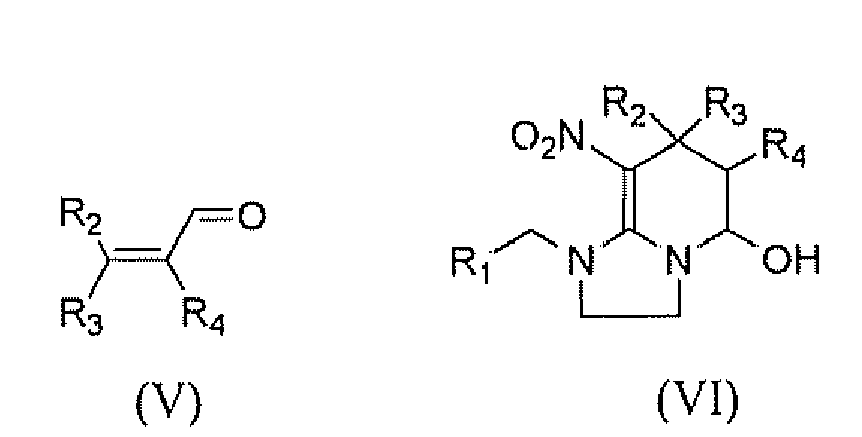
- (c) In an appropriate solvent, the compound of the formula (VI) reacts with a compound of formula (VII) in the presence of a catalytic amount of acid at 30-70 °C to form a compound of formula (I).
R5OH (VII)
- Provided that when Z represents -OR' or -SR', any two or three steps in procedures (a), (b) and (c) can be combined into one step.
- After intensive and extensive study, the inventors add a ring structure to the existing nitromethylene compounds in order to enhance its light stability and liposolubility. Furthermore, this invention can control the space orientation and liposolubility by the substituent linked to an ether bond. Additionally, based on screening of many compounds, a type of derivatives of formula (I) with high insecticidal activities, whose preparation method was simple, were picked out and the invention was thus completed.
- Concretely speaking, the present inventors provide three preparation methods for the derivative of formula (I), which greatly simplify the synthetic routes and reduce the cost for preparing the compounds by reducing the reaction temperature and changing the solvent, thus improving the actual value of the compounds.
- Furthermore, the bioassays show that the compound of formula (I) is an insecticide with wide insecticidal spectrum. The nitromethylene derivatives of the present invention not only show high insecticidal activities against insects with piercing-sucking type or scratching type mouthparts, such as aphid, leafhopper, plant hopper, thrips and white fly and their resistant strains, but also show high insecticidal activities against Lissorhoptrus oryzophilus, carmine spider mite, and they can also be used to prevent sanitary pest, white ant and the like.
- The nitromethylene derivatives of the present invention can be synthesized by the following schemes:


-
- (1) A mixture of nitromethane and carbon bisulfide, which is placed in a three-necked flask and dissolved in an alcohol, is added dropwise to the solution of potassium hydroxide in an alcohol at room temperature. The reaction is carried out at the temperature range of 0-35 °C for 2-10 hours. The solid is filtered out to afford a crude product potassium 2-nitroethene-1,1-bis(thiolate) which is a brown yellow powder.
- (2) Potassium 2-nitroethene-1,1-bis(thiolate) is dissolved in an alcohol, and then to the resulting mixture is added dropwise dimethyl sulfate solution. The reaction is stirred at room temperature for 2-8 hours. The precipitated solid is filtrated out to obtain a crude product 1,1-dimethylthio-2-nitroethene, which is a light brown yellow powder.
- (3) The solution of 2-chloro-5-(chloromethyl)pyridine in acetonitrile is added dropwise to a solution of diamine whose mole amount is 5-10 times of that of 2-chloro-5-(chloromethyl)pyridine. The reaction is carried out at the temperature range of 0-50°C for 5-10 hours. Water is added to the reaction mixture, which is then extracted with chloroform and the solvent is removed by rotary evaporation. The diamine is removed as far as possible by rotary evaporation, and then N1-((6-chloropyridin-3-yl)methyl)diamine is obtained.
- (4) The mixture of N1-((6-chloropyridin-3-yl)methyl) diamine and 1,1-dimethylthio-2-nitroethene is dissolved in ethanol and refluxed for 4-8 hours to obtain the product nitromethylene compound.
- (5) In the presence of an acid catalyst such as hydrochloric acid, sulfuric acid, acetic acid, trifluoroacetic acid and the like, nitromethylene compound reacts with olefin aldehyde to obtain a new nitromethylene compound having a hydroxyl group.
- (6) In the presence of a catalytic amount of hydrochloric acid, the new nitromethylene compound having a hydroxyl group and various alcohols whose amounts are five times of that of the new nitromethylene compound are refluxed in dichloromethane to give an ether compound containing nitromethylene structure. This method can enhance the yield by 30-50% and reduce side reactions.
- In the presence of an acid-binding agent such as organic or inorganic alkali, for example pyridine, triethylamine, potassium carbonate, potassium hydroxide and the like, the mixture of the new nitromethylene compound having a hydroxyl group and various acyl chlorides or acid anhydride is refluxed to obtain the target compound.
-
- (1) To a mixture containing 36% hydrochloric acid and 65% nitric acid in a three-necked flask is added dropwise 1,1-dichloroethene, and then the mixture is extracted with dichloromethane. The oil layer is washed with water, and then alkaline is added. After the reaction is complete, the reaction mixture is extracted with dichloromethane, and the oil layer is washed with water, dried and filtrated, evaporated to obtain yellow liquid.
- (2) The steps 3, 4, 5, 6 are the same as that in Scheme 1. This method can increase the yield by 20-40%.
- The steps 1, 2, 3 are the same as that in Scheme 1, and the following steps are performed by one-pot method:
- N1-((6-chloropyridin-3-yl)methyl)diamine and 1,1-dimethylthio-2-nitroethene are dissolved in a corresponding alcohol and refluxed for 4-8 hours, and then olefin aldehyde and acid (hydrochloric acid, sulfuric acid, acetic acid, trifluoroacetic acid, and the like) are added, refluxed to obtain the corresponding ether derivatives bearing nitromethylene scaffold. This method can increase the yield by 20-40% since one separation step is eliminated.
- The invention is further illustrated by the following examples. It should be appreciated that these examples are only intended to illustrate the invention, but not to limit the scope of the invention. For the experimental methods in the following examples, they are performed under routine conditions, or as instructed by the manufacturers, unless otherwise specified. The percents and parts are based on weight unless otherwise specified.
-

- 4g (0.03mol) of nitromethane and 6ml (0.05mol) of carbon bisulfide were placed in a 100 ml three-necked flask and 10ml of ethanol was added as a solvent, and then the solution was stirred. To the resulting solution was added slowly and dropwise the solution of 8g (0.14mol) of potassium hydroxide in 40ml of ethanol at room temperature over nearly 30min. Since the reaction was exothermic, the rate of addition depended on the reaction temperature, which was preferably controlled between 30-35°C. After the addition was complete, the mixture was further stirred for 2 hours, filtered to obtain a crude product, which was a brown yellow powder in 72% yield.
-

- To a solution of 2g (0.0094mol) of potassium 2-nitroethene-1,1-bis(thiolate) in 10ml of dried methanol in a round-bottomed flask, 0.0187mol of dimethyl sulphate was added. The mixture was then stirred for 2 hours at room temperature. The precipitated solid was filtered to obtain a crude product, which was a light brown yellow powder in 70% yield.
- GC/ MS(m/s) 165 (31) M+,148(17), 104(66), 86(100), 72(93), 57(20).
-

- To a stirred solution of 4.2g (0.03mol) of potassium carbonate and 10ml (0.15mol) of ethylenediamine in a 50ml of flask placed in an ice bath, 4.8g (0.03mol) of 2-chloro-5-(chloromethyl)pyridine dissolved in 15ml of' acetonitrile was added dropwise and slowly over nearly 20min. After addition, the ice bath was removed and the mixture was stirred for 8 hours at room temperature. After the reaction was stopped, a large amount of water was added to dissolve potassium carbonate and ethylenediamine, and the mixture was extracted with dichloromethane. The lower organic phase was collected, dried, and evaporated to dryness (It was better to remove all of the ethylenediamine in the solvent since its presence would influence the following step). The obtained product was yellow oily liquid in 68% yield.
- GC MS (m/s) 185 (5) M+, 155(49), 126(100), 99(9), 90(12).
-

- 2.5g (0.0178mol) of 1,1-dimethylthio-2-nitroethene, 3.3g (0.0178mol) of N1-((6-chloropyridin-3-yl)methyl)ethane-1,2-diamine were added to 15ml of ethanol. The resulting mixture was refluxed for 4 hours at 80-90 °C. The mixture was then cooled to educe solid, concentrated, filtrated and dried to give a light yellow powder in 56% yield.
- R1= 0.46 (petroleum ether: ethyl acetate = 1:1).
- Mp=156.9°-161.8° GC MS (m/s) 220 (25), 126(100), 90(9).
-

- A mixture of 10.16g (0.04mol) of 2-chloro-5-((2-(nitromethylene) imidazolidin-1-yl)methyl)pyridine, 100ml of anhydrous acetonitrile, 5ml of crotonaldehyde and about 4ml of acetic acid in a 250 ml of round-bottomed flask was stirred at 40 °C-45 °C. After about 1 day, a lot of solid precipitated out. The heating was stopped, and the reaction mixture was cooled and filtrated to give a crude product. After recrystallization with MeCN, the pure product was obtained as a yellow powder in 67% yield.
- mp = 175.6-177.1 °C;
- 1H NMR (500 Mz, DMSO-d 6): δ 8.32(d, J=2.14Hz, 1H, pyridine-H), 7.78(dd, J1=2.37Hz, J2=8.21Hz, 1H, pyridine-H), 7.48(d, J=8.22Hz, 1H, pyridine-H), 4.80(m, 1H, -CHOH), 4.64(dd, J1=J2=15Hz, 2H, -CH2-N-), 3.64(m, 4H, imidazolidine-H), 1.91(m, 2H, -CH2CH-), 1.71(m, 1H, -CHCH2-),1.01(d, 3H, -CH3)
- HR-MS (EI, 1.08e.3) calcd for C14H17N4O3Cl (M+), 324.0989; found, 324.0986;
m/z (%)=324(0.75),306(4),294(10),291(100),244(33),126(72); - Anal. Calcd for C14H17ClN4O3: C, 51.78; H, 5.28; N, 17.25, Found: C, 51.56; H, 5.17; N, 17.09.
-

- A mixture of 20.85g (0.2055 mol) of 36% hydrochloric acid and 19.9g (0,2055mol) of 65% nitric acid was added to a three-necked flask equipped with a stirring means, and then 15.5g (0.1575 mol) of 1,1-dichloro-2-nitroethene was added dropwise. The addition temperature was controlled between 20 and 25 °C and the mixture was stirred at that temperature for 3h. After completion, the reaction mixture was extracted with 50 ml dichloromethane and the obtained oil layer was washed with water and the PH of the oil layer was adjusted to 3 to 4. 5 to 6g of alkaline was dissolved in 120 ml of water and cooled to 0 °C, then added into the oil layer slowly, and the temperature was kept at 0 °C. After the completion of the addition, the mixture was stirred vigorously for 5 minutes and then extracted with dichloromethane. The layers are separated and the oil layer was washed with water, filtered and dried to give 13.6 to 17.5g of yellow liquid.
-

- This step was carried out according to step (3) in example 1
-

- A mixture of 2.53g (0.0178mol) of 1,1-dichloro-2-nitroethene, 3.3g (0.0178mol) or N1-((6-chloropyridin-3-yl)methyl)ethane-1,2-diamine and 15 ml of ethanol was refluxed at 80 to 90 °C for 4h. The reaction mixture was cooled to educe solid, concentrated, filtrated and dried to give pale yellow power in 56% yield.
- R1 = 0.46 (petroleum ether: ethyl acetate = 1:1).
- mp=156.9°C-161.8°C. GC MS (m/s) 220 (25), 126(100), 90(9).
-

- 0.324g (0.001mol) of compound 1 was added to a 50ml of three-necked flask, and then 15ml of methanol and a catalytic amount of glacial acetic acid were added. The resulting mixture was refluxed and followed by TLC. After the reaction was complete, the solvent was removed. The residue was then separated by column chromatography to give a pure yellow powder in 60% yield.
- mp=164.0-165.4°C;
- 1H NMR (500 MHz, CDCl3): 1HNMR (500MHz , CDCl3): 8.32(d, J=2Hz, 1H, pyridine-H), 7.86(dd, J1=2.4Hz, J2 =8.22Hz, 1H, pyridine-H), 7.32(d, J=8Hz, 1H, pyridine-H), 4.78(dd, J1=15Hz, J2=15Hz, 2H, -CH2-N-), 4.5(t, J1=3Hz,J2=3Hz, 1H, -CHO-), 3.65(m, 4H, imidazolidine-H), 3.36(m, 3H, -OCH3), 1.87(m, 2H, -CH2CH-), 1.76(m, 1H, -CHCH2-); 1.23(d,3H,-CH3);
- HRMS (EI, 2.31e4) calcd for C15H19N4O3Cl (M+), 338.1146; found, 338.1150;
m/z (%) 338(1), 308(9), 306(1), 291(100), 244(22), 126(38) - Anal. Calcd for C15H19ClN4O3: C, 53.18; H, 5.65; N, 16.54, Found: C, 53.35; H, 5.43; N, 17.34.
-

- A mixture of 10.16g (0.04mol) of 2-chloro-5-((2-(nitromethylene) -imidazolidin-1-yl)methyl)pyridine, 100ml of anhydrous acetonitrile, about 5ml of crotonaldehyde and a catalytic amount of acetic acid was placed in a 250 ml of round-bottomed flask and refluxed. The reaction was monitored by TLC. After the reaction was complete, the solvent was removed and the residue was separated by column chromatography to give a pure yellow powder in 75% yield.
- mp=138.8-140.3 °C;
- 1H NMR (500 MHz, CDCl3): δ 8.31(d, J=2Hz, 1H, pyridine-H), 7.87(dd,J1=2Hz, J2=8Hz, 1H, pyridine-H), 7.33(d, J=8Hz, 1H, pyridine-H), 4.76(dd, J1=15Hz, J2=15Hz, 2H, -CH2-N-), 4.56 (t, J1=3Hz, J2=3Hz, 1H, -CHO-),3.60(m, 4H, imidazolidine-H),3.57(m, 2H, -O-CH2-), 3.53(m, 1H, -CHCH2-), 2.01 (m, 2H, -CH2CH-), 133(t, J1=7Hz, J2=7Hz, 3H, -CHCH3), 1.24(d,3H,-CH3);
- HRMS (EI,7.04e3) calcd for C16H21N4O3Cl (M+), 35.2.1302; found, 352.1306;
m/z (%)= 352(3), 337(7), 306(8), 291(100),244(30),126(42) - Anal. Calcd for C16H21ClN4O3: C, 54 47; H, 6 00; N, 15.88, Found: C, 54.64; H, 5.96; N, 15.64.
-

- 0.972g (0.03mol) of 1-((6-chloropyridin-3-yl)methyl)-7-methyl-8-nitro-1,2,3,5,6,7-hexahydroimidazo[1,2-a]pyridin-5-ol, about 6g of propan-1-ol whose amount was about5 times of that of 1-((6-chloropyridin-3-yl)methyl)-7-methyl-8-nitro-1,2,3,5,6,7-hexahydroimidazo[1,2-a]pyridin-5-ol, 70ml of dichloromethane were added to a 100 ml of three-necked flask and 3 to 4 drops of hydrochloric acid was added to the mixture. Then the mixture was heated under reflux and the reaction was monitored by TLC. After 8 hours, the solvent was removed and the residue was separated by column chromatography, and the column was eluted by 5:1 of petroleum ether and ethyl acetate to wash out propan-1-ol and then eluted by 10:1 of dichloromethane and ethanol to give a pure yellow solid in 72% yield.
- mp = 130.2-131.9°C;;
- 1H NMR (500MHz , CDCl3): 8.36(d, J=2Hz, 1H, pyridine-H), 7.79(dd,J1=2Hz, J2=8Hz, 1H, pyridine-H), 7.48(d, J=8Hz, 1H, pyridine-H), 4.81(d, J1=15Hz, J2=15Hz, 2H, -CH2-N-), 4.54(t, J1=3Hz, J2=3Hz, 1H, -CHO-), 3.77(m, 2H, -O-CH2-), 3.66(m, 4H, imidazolidine-H), 2.81 (m, 2H, -CH2CH-), 1.92(m, I H, -CHCH2-), 1.65(m, 2H, -CH2CH3), 1.23(t, J1=7Hz, J2=7Hz, 3H, -CHCH3), 1.03(d,3H,-CH3).
- HRMS (EI,6.83e3) calcd for C17H23N4O3Cl (M+), 366.1459; found, 366.1487; m/z (%)=366(3), 351(8), 306(4), 291(100), 244(.30), 126(46)
- Anal. Calcd for C17H23ClN4O3: C, 55.66; H, 6.32; N, 15.27, Found: C, 55.50; H, 6.21; N, 15.08.
-

- A mixture of 3.713g (0.02mol) of 1,1-bis(methylthio)-2-nitroethene, 3.305g (0.02mol) of N1-((6-chloropyridin-3-yl)methyl)ethane-1,2-diamine, 15ml of butan-1-ol was refluxed at 80-90 °C for 4h, then 3ml of crotonaldehyde was added to the reaction mixture and the reaction mixture was heated under reflux. The reaction was monitored by TLC. After the reaction was complete, the solvent was removed and the residue was separated by column chromatography to give a pure yellow solid in 75% yield.
- mp = 103.5-105.2°C;
- 1H NMR (500MHz , CDCl3): 8.32(d, J=2Hz, 1H, pyridine-H), 7.85(dd,J1=2Hz, J2=8Hz, 1H, pyridine-H), 7.33(d, J=8Hz, 1H, pyridine-H), 4.74(d, J1=15Hz, J2=15Hz, 2H, -CH2-N-), 4.49(t, J1=3Hz, J2=3Hz, 1H, -CHO-), 3.77(m, 2H, -O-CH2-), 3.57(m, 4H, imidazolidine-H), 2.86(m, 2H, -CH2CH2CH2CH3), 2.81 (m, 2H, -CH2CH-), 1.92(m, 1H, -CHCH2-), 1.63(m, 2H, -CH2CH2CH3), 1.35(m, 4H, -CH2CH3), 1.27(t, J1=7Hz, J2=7Hz, 3H, -CHCH3), 0.92(d,3H,-CH3);
- HRMS (EI,6.83e3) calcd for C17H23N4O3Cl (M+), 366.1459; found, 366.1487; m/z (%) = 366(3),351(8),306(4), 291(100),244(30),126(46)
- Anal. Calcd for C17H23ClN4O3: C, 56.76; H, 6.62; N, 14.71, Found: C, 56.68; H, 6.41; N, 14.52.
-

- 0,001mol of compound I was added to a 50ml of rouned-bottomed flask and then 0.001mol of acetic anhydride and 0.001mol of pyridine were added and the resulting mixture was stirred at room temperature and the reaction was monitored by TLC. After the reaction was complete, the solvent was removed and the residue was separated by column chromatography to give a pure pale yellow powder in 70% yield.
- mp = 144-145.7 °C;
- IR (KBr cm-1) 2903, 2370, 1713, 1332, 1203, 1123, 1071, 1000, 973, 830, 592;
- 1H NMR (500MHz , CDCl3): 8.33(d, J=2Hz, 1H, pyridine-H), 7.88(dd, J1=2Hz, J2 =8Hz, 1H, pyridine-H), 7.36(d, J=8Hz, I H, pyridine-H), 4.79(d, J1=15Hz, J2=15Hz, 2H, -CH2-N-), 4.48(t, J1=3Hz,J2=3Hz, 1H, -CHO-), 4.12(m, 3H, -OCOCH3), 3.62(m, 4H, imidazolidine-H), 2.97(m, 2H, -CH2CH2-), 1.87(m, 2H, -CH2CH-), 1.76(m, 1H, -CHCH2-);
- HRMS (EI,2.08e3) calcd for C15H19N4O4Cl (M+), 366.1095; found, 366 1093;
m/z (%)=366(1), 351(11), 336(8), 306(19), 291(100), 244(22), 126(38) - Anal. Calcd for C15H19ClN4O4: C, 52.39; H, 5.52; N, 15.27, Found: C, 52.23; H, 4,98; N, 15.02.
-

- To a stirred solution of 0.03mol of potassium carbonate and 10ml (0.15mol) of ethylenediamine in a 50ml of flask placed in an ice bath, 0.03mol of 2-chloro-5-(chloromethyl)thiazole dissolved in 15ml of acetonitrile was added dropwise and slowly. After addition, the ice bath was removed and then the mixture was stirred for 8 hours at room temperature. After the reaction was complete, a large amount of water was added to dissolve potassium carbonate and ethylenediamine, and the mixture was extracted with dichloromethane. The lower organic phase was collected, dried, and evaporated to dryness. The obtained product was yellow oily liquid in 70% yield.
- GC MS (m/s) 191 (21) M+, 132(100).
-

- 2.5g (0.0178mol) of 1,1-dimethylthio-2-nitroethene, 3.3g (0.0178mol) of N1-((2-chlorothiazol-5-yl)methyl)ethane-1,2-diamine were dissolved in 15ml of ethanol. The resulting mixture was refluxed at 80-90 °C for 4 hours. The mixture was then cooled to educe solid, concentrated, filtrated and dried to give a light yellow powder in 56% yield.
- GC MS(m/s) 226 (24), 132(100), 77(9).
-

- 0.002mol of 1-((2-chlorothiazol-5-yl)methyl)-2-(nitromethylene) imidazolidine, 15ml of anhydrous acetonitrile, 0.25ml of crotonaldehyde and a catalytic amount of acetic acid were placed in a 50ml of round-bottomed flask and stirred at 40-45 °C. After about 1 day, a lot of solid precipitated out. The heating was stopped, and the reaction mixture was cooled and filtrated to give a crude product. After recrystallization with MeCN, the pure product was obtained as a yellow powder in 40% yield.
- mp=172-174.6°C;
- IR (KBr, cm-1) 3194, 1564, 1545, 1373, 1310, 1150;
- 1H NMR (500MHz ,DMSO): 7.38(s, 1H, thiazole-H), 4.83(m, 1H, -CHOH), 4.59(dd, J1=J2=15Hz, 2H, -CH2-N-), 3.56(m, 4H, imidazolidine-H), 1.93(m, 2H, -CH2CH-), 1.75(m, 1H, -CHCH2-),1.13(d, 3H, -CH3);
- HRMS (E1,3.38e3) calcd for C12H15N4O3ClS (M+), 330.0553; found, 330.0786;
m/z(%)=330(2), 315(4), 312(10), 297(100), 132(72) Anal. Calcd for C12H15N4O3ClS: C, 43.57; H, 4.57; N, 16.94, Found: C, 43.39; H, 4.35; N, 16.65. -

- A mixture of 0.509g (0.002mol) of 2-chloro-5-((2-(nitromethylene) -imidazolidin-1-yl)methyl)pyridine, 25ml of anhydrous acetonitrile, 0.20ml of methacrylaldehyde and a catalytic amount of acetic acid (If appropriate, acetic acid may be added more) in a 50 ml of round-bottomed flask was stirred at room temperature About four days later, a lot of solid precipitated out (during the reaction, a proper amount of methacrylaldehyde may be supplemented). The reaction was stopped, and the precipitated solid was filtrated to give a crude product. After recrystallization, the pure product was obtained as a milk white powder in 63% yield.
- mp = 179.6-181.1 °C;
- 1H NMR (500MHz ,DMSO): 8.32(d, J=2.14Hz, 1H, pyridine-H), 7.78(dd, J1=2.37Hz, J2=8.21Hz, 1H, pyridine-H), 7.48(d, J=8.22Hz, 1H, pyridine-H), 4.80(m, 1H, -CHOH), 4.64(dd, J1=J2=15Hz, 2H, -CH2-N-), 3.64(m, 4H, imidazolidine-H), 1.99(m, 2H, -CHCH2-), 1,78(m, 1H, -CH2CH-),1.05(d, 3H, -CH3);
- HRMS (EI,1.08e3) calcd for C14H17N4O3Cl (M+), 324.0989; found, 324.0982;
m/z (%)=324(2), 306(8), 294(10), 291(100), 244(43),126(70) - Anal Calcd for C14H17N4O3C1: C, 51.78; H, 5.28; N, 17.25, Found: C, 51.63; H, 5.11; N, 17.02.
-

- A mixture of 0.509g (0.002mol) of 2-chloro-5-((2-(nitromethylene)imidazolidin-1-yl)methyl)pyridine, 25ml of anhydrous acetonitrile, 0.20ml of 2-methyl but-2-enal and a catalytic amount of acetic acid (If appropriate, acetic acid may be added more) in a 50 ml of round-bottomed flask was stirred at room temperature. About four days later, a lot of solid precipitated out (during the reaction, a proper amount of 2-methyl but-2-enal may be supplemented). The reaction was stopped, and the precipitated solid was filtrated to give a crude product. After recrystallization, the pure product was obtained as a milk white powder in 60% yield.
- mp= 168.6-171.1 °C;
- 1H NMR (500MHz ,DMSO): 8.34(d, J=2.14Hz, 1H, pyridine-H), 7.81(dd, J1=2.37Hz, J2=8.21Hz, 1H, pyridine-H), 7,51(d, J=8.22Hz, 1H, pyridine-H), 4.79(m, 1H, -CHOH), 4.61(dd, J1=J2= 15Hz, 2H, -CH2-N-), 3.67(m, 4H, imidazolidine-H), 1. 96(m, 1H, -CHCH-), 1.51(m, 1H, -CHCH-),1.19(d, 3H, -CH3), 1.01(d, 3H, -CH3);
- HRMS (EI,4.33e4) calcd for C15H19N4O3Cl (M+), 338.1146; found, 338.1140;
m/z (%)=338(2),320(7),323(23),308(3),291(100),244(22),126(38); - Anal. Calcd for C15H19N4O3Cl: C, 53.18; H, 5.65; N, 16.54, Found: C, 52.95; H, 5.41; N, 17.30.
-

- A mixture of 0.509g (0.002mol) of 2-chloro-5-((2-(nitromethylene) -imidazolidin-1-yl)methyl)pyridine, 25ml of anhydrous acetonitrile, 0.20ml of cinnamaldehyde and a catalytic amount of acetic acid (If appropriate, acetic acid may be added more) in a 50 ml of round-bottomed flask was stirred at room temperature. About four days later, a lot of solid precipitated out (during the reaction, a proper amount of cinnamaldehyde may be supplemented). The reaction was stopped, and the precipitated solid was filtrated to give a crude product. After recrystallization, the pure product was obtained as a milk white powder in 40% yield.
- mp = 229.3-230.1°C;
- HNMR (500MHz, DMSO): 8.39(d, J=2.14Hz, 1H, pyridine-H), 7.87(dd, J1=2.37Hz, J2=8.21Hz, 1H, pyridine-H), 7.32(d, J=8.2Hz, 1H, pyridine-H), 7.24(d, J=7.64Hz,2H,benzene-H),7.17(t,1H, benzene-H ), 7.13(d, J=7.22Hz,2H,benzene-H), 4.83(dd, J1=J2=15Hz, 2H, -CH2-N-), 4.56(m, 1H, -CHOH), 4.44(t, 1H, -CHCH2-), 3.66(m, 4H, imidazolidine-H),2.33(m, 2H, -CH2CH-);
- HRMS (EI,5.96e3) calcd for C19H19N4O3Cl (M+), 386.1146; found, 386.1121;
m/z (%)=386(2), 320(7), 340(7), 210(10), 208(21), 126(100); - Anal. Calcd for C19H19N4O3Cl: C, 58.99; H, 4.95; N, 14.48, Found: C, 58.76; H, 4.87; N, 14.33.
-

- A mixture of 10.16g (0.04mol) of 2-chloro-5-((2-(nitromethylene)imidazalidin-1-yl)methyl)pyridine, 100ml of anhydrous acetonitrile, about 5ml of 3-methoxyacrylaldehyde and about 4ml of acetic acid (1f appropriate, acetic acid may be added more) in a 250 ml of round-bottomed flask was stirred at 40°C-45°C. About 1 day later, a lot of solid precipitated out. The reaction was stopped and cooled, and the precipitated solid was filtrated to give a crude product. After recrystallization from MeCN, the pure product was obtained as a yellow powder in 70% yield.
- 1H NMR (500MHz ,DMSO): 8.34(d, J=2.14Hz, 1H, pyridine-H), 7.79(dd, J 1=2.37Hz, J2=8.21Hz, 1H, pyridine-H), 7.50(d, J=8.22Hz, 1H, pyridine-H), 5.05 (t, 1H, -CHCH2-),4.95(m, 1H, -CHOH), 4.84(dd, J1=J2=15Hz, 2H, -CH2-N-), 3.9 7(s,3H,-OCH3),3.76(m, 4H, imidazolidine-H), 2.51(m, 2H, -CH2CH-);
- HRMS (EI,2.63e3) calcd for C14H17N4O4Cl (M+), 340.0938; found, 340.0936;
m/z (%)=340(3),322(4),308(11),291(100),244(37),126(78); - Anal. Calcd for C14H17N4O4Cl: C, 49.35; H, 5.03; N, 16.44, Found: C, 48.76; H, 4.87; N, 16.33.
-

- A mixture of 10.16g (0.04mol) of 2-chloro-5-((2-(nitromethylene) -imidazolidin-1-yl)methyl)pyridine, 100ml of anhydrous acetonitrile, 5ml of 2-methoxyacrylaldehyde and about 4ml of acetic acid (If appropriate, acetic acid may be added more) in a 250 ml of round-bottomed flask was stirred at 40°C-45°C. About 1 day later, a lot of solid precipitated out. The reaction was stopped and cooled, and the precipitated solid was filtrated to give a crude product. After recrystallization, the pure product was obtained as a yellow powder in 75% yield.
- 1H NMR (500MHz ,DMSO): 8.34(d, J=2.14Hz, 1H, pyridine-H), 7.79(dd, J1=2.37Hz, J2=8.21Hz, 1H, pyridine-H), 7.50(d, J=8.22Hz, 1 H, pyridine-H), 5.05(t, 1H, -CHCH2-),4.95(m, 1H, -CHOH), 4.84(dd, J1=J2=15Hz, 2H, -CH2-N-), 3.93(s,3H,-OCH3), 3.76(m, 4H, imidazolidine-H), 2.49(m, 2H, -CH2CH-);
- HR-MS (EI,2.63e3): calcd for C14H17N4O4Cl (M+): 340.0938, found:340.0936, m/z (%)=340(3), 322(4), 308(11), 291(100), 244(37), 126(78)
- Anal. Calcd for C14H17N4O4Cl: C, 49.35; H, 5.03; N, 16.44, Found: C, 48. 76; H, 4 87; N, 16.33.
- The compounds of the present invention can be used to control and kill general insects, including sucking insects, biting insects and other plant parasites, storage cereal insects and health hazard insects.
- The examples of insects are listed as follow:
- Coleoptera: Sitophilus zeamais, Tribo/ium castaneum, Henosepilacha vigintioctomaculata, Agriotes fuscicollis, Monolepta hieroglyphica, Diabrotica SPP, Anomala cupripes, Monochamus alternatus, Echinocnemus squameus, Echinocnemus bipunctaus, Lissorhoptrus oryzophilus, Lyrtus hrunneus;
- Lepidoptera: Lymantria dispar, Malacosoma neustria testacea, Prodenia litura, Mamestra brassicae, Chilo suppressalis, Ostrinia nubilalis, Cadra cautella, Adoxophyes orana, Laspeyresia splendana, Agrotis fucosa, Galleria mellonella, Plutella xylostella, Phyllocnistis citrella,
- Hemiptera: Nephotettix cincticeps, Nilaparvata lugens, Laodelphax striatellus, Bemisia tabaci, Pseudococcus comstocki, Unaspis yanonensis, Myzus persicae, Aphis pomi, Brevicoryne brassicae, Lipaphis erysimi pseudobrassicae, Stephanitis nashi, Nazara SPP., Cimicidae, Trialeurodes vaporariorum, and Psylle SPP;
- Orthoptera: Blattella germanica, Periplaneta americana, Gryllotalpa africana, Locusta migratoria.
- Isoptera: Deucotermes speratus, Coptotermes formosanus,
- Diptera: Musca domestica, Aedes aegypti, Hylemya platura, Delia platura, Anopheles sinensis and Tetranychus cinnabarinus.
- The compounds in this invention have special effects to insects having a piercing-sucking or scratching monthparts, such as aphid, leafhopper, plant hopper, thrips, white fly.
- These active compounds can be prepared into the customary formulations, such as solutions, emulsions, suspensions, powders, foams, pastes, granules, aerosols, especially soluble solid and liquid preparations which are compatible with the environment such as water-dispersed granules, water solution and water emulsion, ultra low volume preparations, natural and synthetic materials impregnated with active compounds, and micro-capsules in polymers used in the coating complex for seed, preparations used with a combustion device (such as smoking cylindrantherae, smoking can and smoking plate) and ULV cold mist and warm mist preparations. These formulations may be produced in a known manner, for example, by mixing the active compounds with extenders, which are liquid or liquefied gas or solid diluents or carriers, optionally with the use of surface-active agents, i.e. emulsifying agents and/or dispersing agents, and/or foam-forming agents. In the case of using water as an extender, organic solvents can, for example, also be used as auxiliary solvents.
- It is generally proper to use liquid solvents as a diluent or carrier, for example, aromatic hydrocarbons, such as xylene, toluene and alkyl naphthalenes, chlorinated aromatic or chlorinated aliphatic hydrocarbons, such as chlorobenzenes, chloroethylenes and methylene chloride, aliphatic hydrocarbons, such as cyclohexane or paraffins, for example, mineral oil fractions; alcohols, such as butanol or glycol as well as their ethers and esters; ketones, such as acetone, methyl ethyl ketone, methyl isobutyl ketone or cyclohexanone, or uncommon polar solvents, such as dimethylformamide and dimethylsulfoxide, as well as water.
- By liquefied gas diluents or carriers are meant liquids which are gaseous at normal temperature and under normal pressure, for example, aerosol propellants, such as halogenated hydrocarbons as well as butane, propane, nitrogen and carbon dioxide
- The solid carrier can use ground natural minerals, such as kaolins, clays, talcs, quartzs, attapulgites, montmorillonites or kieselguhrs; ground synthetic minerals, such as high dispersed silicic acid, alumina and silicate. The solid carrier used for particles is crushed and fractionated natural rocks such as calcite, marble, pumice, sepiolite and dolomite, as well as synthetic granules of inorganic and organic coarse powder, and granules of organic material such as sawdust, coconut shells, maize cobs and tobacco stalks and the like.
- Nonionic and anionic emulsifiers may be used as emulsifying and/or foam-forming agents, such as polyoxyethylene-fatty acid esters, polyoxyethylene-fatty alcohol ethers, for example, alkylaryl polyglycol ethers, alkylsulfonates, alkylsulfates, arylsulfonates as well as albumin hydrolysis products. Dispersing agents include, for example, lignin sulfite waste liquors and methyl cellulose.
- Adhesives such as carboxymethyl cellulose and natural and synthetic polymers, (such as gum arabic, polyvinyl alcohol and polyvinyl acetate) in the form of powders, granules or emulsions can be used in the formulations
- It is possible to use colorants such as inorganic dyestuffs, for example, iron oxide, cobalt oxide and Prussian Blue, and organic dyestuffs, such as diazo dyestuffs or metal phthalocyanine dyestuffs, and trace nutritional agent, such as the salts of iron, manganese, boron, copper, cobalt, aluminum, zinc and the like
- The formulations, in general, contain from 0.1 to 95 percent by weight of active compound, preferably 0.5-90 percent by weight.
- The active compound of the present invention can be present as a mixture with other active compounds in a commercial formulation or a use form prepared from the commercial formulation. The other active compounds can be insecticide, bait formulation, bactericide, acaricide, nematocide, fungicide, growth controller and the like. The insecticide includes phosphates, carbamates, pyrethroids, chlorinated hydrocarbons, benzoylurea, nereistoxin and material produced by microbion such as avermectin.
- Furthermore, the active compound of the present invention can be present as a mixture with a synergist in a commercial formulation or a use form prepared from the commercial formulation Synergist is used to enhance the action of active compound, so if the compound itself is active there is no need to use it The concentration of the active compound in the use form prepared from the commercial formulation can vary within a wide range. The active compound concentration of the formulation for use is, for example, from 0.0000001 to 100 percent by weight of active compound, preferably from 0.0001 to 1 percent by weight.
- These compounds can be prepared into proper dosage forms and used by common methods.
- Aphis, which belongs to Homoptera and has a piercing-sucking mouthpart, is a common insect for agricultural plant. Aphis craccivora was tested by the way of immersing.
- Test method: exactly weighed various samples were independently added to N,N-dimethylformamide to form a 10g/L stock solution. The mixture was diluted with 0.2mL/L aqueous Triton X-100 solution to a concentration of 500ug/mL. After stably sucking on bean sprout, the adult aphis without wings together with bean sprout was dipped into the dilution of 500 ug/mL, 100 ug/mL, 50 ug/mL, 25 ug/mL, 12.5 ug/mL, 6.25 ug/mL (LD50 was calculated), taken out after 5 seconds, and the excess dilution was sucked out with bibulous paper and the adult aphis without wings was incubated in clean vessel at a constant temperature of 23 °C. Each concentration was repeated for 3 times and the control group contained 0.2mL/L, aqueous Triton X-100 solution. The number of killed aphis was counted after 24 hours to calculate the mortality. The result was shown in Table 1 bellow
- Plant hopper, which belongs to Homoptera and has a piercing-sucking mouthpart, is a common insect for agricultural plant. Nilaparvata lugens was tested by the way of spraying.
- Test method: the compound to be tested was exactly formulated into a solution having a certain concentration and clean water was used as a blank control. Each process was repeated for 3 tumblers (3 times). 2ml of solution was sprayed uniformly to each tumbler by a mini manual sprayer. 10 Nilaparvata lugens were introduced to every sink 6 hours before spraying. Three series of experiments were conducted. The number of killed Nilaparvata lugens was counted after 24 hours to calculate the mortality. The result was shown in Table 1 and Table 2 bellow.

Table 1 Number R1 R2 R3 R4 R5 Mortality (%) (500ppm) Aphis craccivora Nilaparvata lugens 1 
CH3 H H H 100 100 2 
CH3 H H CH3 98 100 3 
CH3 H H CH2CH3 100 100 4 
CH3 H H CH2CF3 100 100 5 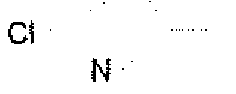
CH3 H H CH2CH2CH3 98 100 6 
CH3 H H CH(CH3)2 100 100 7 
CH3 H H CH2(CH2)2CH3 80 100 8 
CH3 H H CH2(CH2)3CH3 67 80 9 
CH3 H H CH2CH=CH2 98 100 10 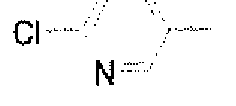
CH3 H H CH2C≡CH 43 67 11 
CH3 H H COCH3 93 100 12 
CH3 H H H 100 100 13 
CH3 H H CH2CH3 98 100 14 
CH3 H H CH2CH2CH3 100 100 15 
CH3 H H H 24 35 16 
CH3 H H CH3 45 67 17 
CH3 H H CH2CH3 89 100 18 
H H CH3 H 98 100 19 
H H CH3 CH2CH3 100 100 20 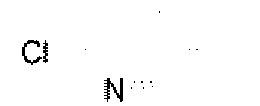
H H CH3 CH2CH2CH3 86 98 21 
H H CH3 H 90 100 22 
CH2CH2 H H H 93 98 23 
CH2CH2 H H CH(CH3)2 65 95 24 
CH2CH2CH3 H H H 97 89 25 
CH2CH2CH3 H H CH2CH3 96 100 26 
H H CH2CH3 H 100 100 27 
H H CH2CH3 CH3 92 80 28 
H H CH2CH2CH3 H 100 96 29 
H H CH2CH2CH3 CH2CH3 100 97 30 
CH3 H CH3 H 100 100 31 
CH3 CH3 H H 96 100 32 
CH3 CH3 H CH3 100 100 33 
CH3 H CH2CH3 H 92 78 34 
CH3 H CH2CH2CH3 H 95 90 35 
CH2CH3 H CH3 H 100 88 36 
CH3 CH3 CH3 CH3 H 94 97 37 
CH3 CH3 CH3 CH2CH3 H 99 88 38 

H H H 24 0 39 

H H CH3 45 0 40 
CH(CH3) H H H 87 56 41 
n-C4H9 H H H 72 50 42 
OCH3 H H H 100 97 43 
OCH3 H CH3 H 100 97 44 
OCH3 H H H 100 97 45 
OCH2CH3 H H H 100 89 46 
H H OCH3 H 100 73 47 
H H OCH2CH3 H 98 91 48 
H H OCH3 H 85 90 49 
CH3 H OCH3 H 100 100 Table 2 Number R1 R2 R3 R4 R5 Aphis craccivora Mortality(%) (100ppm) LC50 (ppm) a 
CH3 H H H 95.3 31.5 b 
CH3 H H CH3 84 50.8 c 
CH3 H H CH2CH3 67 65.4 d 
CH3 H H CH2CH2CH3 75.4 33.6 e 
CH3 H H CH(CH3)2 100 20.5 f 
CH3 H H H 87 68 g 
H H CH3 H 92 36.3 h 
CH2CH2 H H H 83 43.9 i 
CH2CH2CH3 H H H 77 75.2 j 
H H CH2CH3 H 93.6 57.3 k 
H H CH2CH3 CH3 92 83.0 l 
CH3 H CH3 H 66.7 86.4 m 
CH2CH3 H CH3 H 87 75.9 n 
OCH3 H H H 96 40.5 o 
OCH2CH3 H H H 82 66.4 p 
H H OCH3 H 93 47.6 q 
H H OCH2CH3 H 85 70.9 -
Any one of compounds a-q in Table 2 25 wt% 25 wt% Polyoxyethylene sorbitol hexaoleate 5 wt% Higher aliphatic hydrocarbon oil 70 wt% - Each of the components was ground in a sand mill until the solid granules were reduced to less than about 5 micrometer. The resulting viscous suspension can be used directly or may be used after it was emulsified in water.
-
Any one of compounds a-q 25 wt% Hydrate attapulagit 3 wt% Calcium lignosulphonate 10 wt% Sodium dihydrogen phosphate 0.5 wt% Water 61.5 wt% - Each of the components was ground in a ball mill until the solid granules were reduced to less than about 10 micrometer. The aqueous suspension can be used directly.
- An edible bait was prepared with the components as follows:
Any one of compounds a-q 0.1-10 wt% Wheat flour 80 wt% Molasses 19.9-10 wt% - These ingredients were intimately mixed and forged as required into a bait form. This edible bait may be distributed at a locus, for example domestic or industrial premises, e. g. kitchens, hospitals or stores, or outdoor areas, infested by the sanitary insects, to control the insects by oral ingestion.
- A wettable powder was prepared with the components as follows:
Any one of compounds a-q 30 wt% sodium dodecyl benzene sulfonate 2 wt% Sodium lignosulphonate 5 wt% Synthetic magnesium silicate support 63wt% - Each of these components was ground in a hammer-mill until the solid granules were reduced to less than about 50 micrometer to give a wettable powder, which may be applied to the plant seeds or plant leaves and/or plant fruits or the place where the plant is growing or is expected to be grown by dipping, or by oral administration in drinking water, to prevent the insects.
- All the documents cited herein are incorporated into the invention as reference, as if each of them is individually incorporated. Further, it would be appreciated that, in light of the above described teaching of the invention, the skilled in the art could make various changes or modifications to the invention, and these equivalents would still be within the scope of the invention defined by the appended claims of the application.
Claims (10)
- A nitromethylene derivative represented by formula (I),
 R1 is a 5 or 6-membered heterocycle containing nitrogen, oxygen and/or sulfur, or a halogenated 5 or 6-membered heterocycle containing nitrogen, oxygen and/or sulfur;R2 is a hydrogen atom, C1-4 alkyl group, C1-4 alkoxyl group or aryl group;R3 is a hydrogen atom, C1-4 alkyl group, or C1-4 alkoxyl group;R4 is a hydrogen atom, C1-4 alkyl group, C1-4 alkoxyl group or aryl group;R5 is a hydrogen atom, a saturated or unsaturated C1-8 hydrocarbyl group, saturated or unsaturated C1-8 halogenated hydrocarbyl group, -CH2CH2OCH2CH3, -CH2CH2OCH3, saturated or unsaturated C1-8 hydrocarbyloxy,
 - The derivative according to claim 1, wherein R1 represents one of pyridyl, thiazolyl, and tetrahydrofuryl, or the chloride thereof.
- The derivative according to claim 2, wherein R1 represents


- The derivative according to claim 1, wherein R5 represents a hydrogen atom or saturated or unsaturated C1-5 hydrocarbyl group.
- The derivative according to claim 1, wherein R2 represents a hydrogen atom, C1-3 alkyl, or C1-3 alkoxyl; R3 represents a hydrogen atom, C1-3 alkyl, or C1-3 alkoxyl; R4 represents a hydrogen atom, C1-3 alkyl, or C1-3 alkoxyl.
- The derivative according to claim 1, wherein R2 represents a methyl group; R3 represents a hydrogen atom; R4 represents a hydrogen atom, C1-3 alkyl, or C1-3 alkoxyl; R5 represents a hydrogen atom
- A pesticidal composition comprising 0.0001wt%-99.9wt% of a derivative (I) according to claim 1 or an agriculturally acceptable salt thereof in mixture with an agriculturally acceptable carrier or diluent.
- A method of controlling pests which comprises applying to plants seeds, plant leaves, and/or plants fruits or the places where the plant is growing or is expected to be grown an insecticidally effective amount of a derivative of formula (I) according to claim 1.
- The use of the derivative of formula (I) according to claims 1 in the preparation of a chemical insecticide for agriculture
- A process for preparing the derivative of formula (I) according to claims 1, wherein the said process includes the following procedures:(a) In an appropriate solvent, a compound of the formula (II) reacts with a compound of formula (III) at 60-100 °C to form a compound of formula (IV);


 (b) In an appropriate solvent, the compound of formula (IV) reacts with a compound of formula (V) in the presence of an acid catalyst at 0-90 °C to form a compound of formula (VI)
 (c) In an appropriate solvent, the compound of the formula (VI) reacts with a compound of formula (VII) in the presence or a catalytic amount of acid at 30-70 °C to form a compound of formula (I),wherein, R1, R2, R3, R4 and R5 are defined as in claim 1;
R5OH (VII)
provided that when Z represents -OR' or -SR1, any two or three steps in procedures (a), (b) and (c) can be combined into one step
Applications Claiming Priority (1)
| Application Number | Priority Date | Filing Date | Title |
|---|---|---|---|
| PCT/CN2006/000360 WO2007101369A1 (en) | 2006-03-09 | 2006-03-09 | Preparation method and use of compounds having high biocidal activities |
Publications (2)
| Publication Number | Publication Date |
|---|---|
| EP1997820A1 true EP1997820A1 (en) | 2008-12-03 |
| EP1997820A4 EP1997820A4 (en) | 2009-03-04 |
Family
ID=38474587
Family Applications (1)
| Application Number | Title | Priority Date | Filing Date |
|---|---|---|---|
| EP06705735A Withdrawn EP1997820A4 (en) | 2006-03-09 | 2006-03-09 | METHOD OF PREPARATION AND USE OF COMPOUNDS HAVING BIOCIDAL ACTION |
Country Status (3)
| Country | Link |
|---|---|
| US (1) | US20090111847A1 (en) |
| EP (1) | EP1997820A4 (en) |
| WO (1) | WO2007101369A1 (en) |
Cited By (6)
| Publication number | Priority date | Publication date | Assignee | Title |
|---|---|---|---|---|
| JP2013513553A (en) * | 2009-12-09 | 2013-04-22 | ▲華▼▲東▼理工大学 | Epoxy group-containing heterocyclic neonicotinoid compound and production method thereof, agricultural composition and use thereof, pest control method |
| CN103503905A (en) * | 2013-10-24 | 2014-01-15 | 江苏龙灯化学有限公司 | Insecticidal composition containing Paichongding (1-((6-chloropyridine-3-group) methyl-5-propoxy-7-methyl-8-nitryl-1,2,3,5,6,7-hexahydroimidazo[1,2-a] pyridine) and bifenthrin |
| CN103766358A (en) * | 2013-12-28 | 2014-05-07 | 上海艳紫化工科技有限公司 | Pest control pesticide suspension agent |
| CN101875653B (en) * | 2009-04-28 | 2014-12-24 | 华东理工大学 | Preparation and application of 1,2,3-3H pyridine-heterocyclic compound |
| CN103518745B (en) * | 2008-12-19 | 2015-04-15 | 华东理工大学 | Dialdehyde-built nitrogen-containing or oxygen-containing heterocyclic compound with insecticidal activity and preparation method thereof |
| CN104557963A (en) * | 2008-12-19 | 2015-04-29 | 华东理工大学 | Dialdehyde-constructed nitrogenous or heterocyclic oxygen compound with insecticidal activity and preparation method thereof |
Families Citing this family (195)
| Publication number | Priority date | Publication date | Assignee | Title |
|---|---|---|---|---|
| CN101492444B (en) | 2008-01-23 | 2012-07-04 | 华东理工大学 | Nitrogenous heterocyclic compounds with insecticidal activity, preparation and uses thereof |
| CN101747320B (en) * | 2008-12-19 | 2013-10-16 | 华东理工大学 | Dialdehyde-constructed nitrogen- or oxygen-containing heterocyclic compound with insecticidal activity and preparation method thereof |
| CN101906096B (en) * | 2009-06-05 | 2013-06-05 | 华东理工大学 | 3,4-dihydropyridine-2-ketone heterocyclic compound and application thereof |
| JP5868957B2 (en) | 2010-05-05 | 2016-02-24 | バイエル・インテレクチュアル・プロパティ・ゲゼルシャフト・ミット・ベシュレンクテル・ハフツングBayer Intellectual Property GmbH | Thiazole derivatives as insecticides |
| MX341267B (en) | 2010-06-18 | 2016-08-09 | Bayer Ip Gmbh | COMBINATIONS OF ACTIVE PRINCIPLES WITH INSECTICIDES AND ACARICIDES. |
| ES2626601T3 (en) | 2010-06-28 | 2017-07-25 | Bayer Intellectual Property Gmbh | Heterocyclic compounds such as pesticides |
| CN101861875B (en) * | 2010-06-29 | 2013-06-19 | 江苏克胜集团股份有限公司 | Synergistic pesticide compound containing mepiquat chloride and organophosphorus pesticide |
| CN101880205B (en) * | 2010-06-29 | 2013-06-19 | 江苏克胜集团股份有限公司 | Paichongding water dispersible granule and preparation method thereof |
| JP2012017289A (en) | 2010-07-08 | 2012-01-26 | Bayer Cropscience Ag | Pesticidal pyrroline derivative |
| WO2012004293A2 (en) | 2010-07-08 | 2012-01-12 | Bayer Cropscience Ag | Insecticide and fungicide active ingredient combinations |
| JP2012082186A (en) | 2010-09-15 | 2012-04-26 | Bayer Cropscience Ag | Insecticidal arylpyrrolidines |
| JP2012062267A (en) | 2010-09-15 | 2012-03-29 | Bayer Cropscience Ag | Pesticidal pyrroline n-oxide derivative |
| WO2012045680A2 (en) | 2010-10-04 | 2012-04-12 | Bayer Cropscience Ag | Insecticidal and fungicidal active substance combinations |
| US9084424B2 (en) | 2010-10-21 | 2015-07-21 | Bayer Intellectual Property Gmbh | N-benzyl heterocyclic carboxamides |
| CA2815117A1 (en) | 2010-11-02 | 2012-05-10 | Bayer Intellectual Property Gmbh | N-hetarylmethyl pyrazolylcarboxamides |
| EP2640706B1 (en) | 2010-11-15 | 2017-03-01 | Bayer Intellectual Property GmbH | N-aryl pyrazole(thio)carboxamides |
| SG190295A1 (en) | 2010-11-29 | 2013-06-28 | Bayer Ip Gmbh | Alpha,beta-unsaturated imines |
| AP3519A (en) | 2010-12-01 | 2016-01-11 | Bayer Ip Gmbh | Use of fluopyram for controlling nematodes in crops and for increasing yield |
| TWI667347B (en) | 2010-12-15 | 2019-08-01 | 瑞士商先正達合夥公司 | Soybean event syht0h2 and compositions and methods for detection thereof |
| BR112013021019A2 (en) | 2011-02-17 | 2019-02-26 | Bayer Ip Gmbh | use of sdhi fungicides in conventionally cultivated soybean varieties with Asian soybean rust (asr) tolerance, stem cancer resistance and / or frog eye leaf spot |
| CN103476256B (en) | 2011-02-17 | 2016-01-20 | 拜耳知识产权有限责任公司 | SDHI fungicide is used for the stem canker resistance of ASR tolerance and/or the purposes of frogeye leaf spot resistant soybean kind of conventional breeding |
| EP2675789A1 (en) | 2011-02-17 | 2013-12-25 | Bayer Intellectual Property GmbH | Substituted 3-(biphenyl-3-yl)-8,8-difluoro-hydroxy-1-azaspiro[4.5]dec-3-en-2-ones for therapy and halogen-substituted spirocyclic ketoenols |
| CA2828639C (en) | 2011-03-01 | 2019-02-12 | Bayer Intellectual Property Gmbh | 2-acyloxypyrrolin-4-ones |
| AR085509A1 (en) | 2011-03-09 | 2013-10-09 | Bayer Cropscience Ag | INDOL- AND BENCIMIDAZOLCARBOXAMIDS AS INSECTICIDES AND ACARICIDES |
| WO2012120105A1 (en) | 2011-03-10 | 2012-09-13 | Bayer Cropscience Ag | Use of lipochito-oligosaccharide compounds for safeguarding seed safety of treated seeds |
| AU2012230503B2 (en) | 2011-03-18 | 2016-07-07 | Bayer Intellectual Property Gmbh | N-(3-carbamoylphenyl)-1H-pyrazole-5-carboxamide derivatives and the use thereof for controlling animal pests |
| EP2535334A1 (en) | 2011-06-17 | 2012-12-19 | Bayer CropScience AG | Crystalline modifications of penflufen |
| EP2540163A1 (en) | 2011-06-30 | 2013-01-02 | Bayer CropScience AG | Nematocide N-cyclopropyl-sulfonylamide derivatives |
| DK2736327T3 (en) | 2011-07-26 | 2018-04-23 | Clariant Int Ltd | Etherized lactate esters, processes for their preparation and their use in improving the action of plant protection products |
| UA115128C2 (en) | 2011-07-27 | 2017-09-25 | Байєр Інтеллектуал Проперті Гмбх | Seed dressing for controlling phytopathogenic fungi |
| JP2013082632A (en) | 2011-10-05 | 2013-05-09 | Bayer Cropscience Ag | Agrochemical formulation and manufacturing method of the same |
| EP2604118A1 (en) | 2011-12-15 | 2013-06-19 | Bayer CropScience AG | Active ingredient combinations having insecticidal and acaricidal properties |
| IN2014CN04325A (en) | 2011-12-19 | 2015-09-04 | Bayer Cropscience Ag | |
| BR112014014972A2 (en) | 2011-12-20 | 2017-06-13 | Bayer Ip Gmbh | new aromatic insecticide amides |
| EP2606726A1 (en) | 2011-12-21 | 2013-06-26 | Bayer CropScience AG | N-Arylamidine-substituted trifluoroethylsulfide derivatives as acaricides and insecticides |
| US20150011394A1 (en) | 2012-01-21 | 2015-01-08 | Bayer Intellectual Property Gmbh | Use of host defense inducers for controlling bacterial harmful organisms in useful plants |
| CN104321317B (en) | 2012-03-14 | 2016-09-21 | 拜耳知识产权有限责任公司 | Insecticidal arylpyrrolidines |
| EP2649879A1 (en) | 2012-04-10 | 2013-10-16 | Basf Se | Pesticidal mixtures containing fluxapyroxad |
| WO2013156331A1 (en) | 2012-04-16 | 2013-10-24 | Basf Se | Synergistic compositions comprising pyraclostrobin and an insecticidal compound |
| AP2014008101A0 (en) | 2012-05-16 | 2014-12-31 | Bayer Cropscience Ag | Insecticidal water-in-oil (W/O) formulation |
| CN104302173B (en) | 2012-05-16 | 2019-10-15 | 拜尔农作物科学股份公司 | Oil-in-water (O/W) insecticide formulations |
| AR091104A1 (en) | 2012-05-22 | 2015-01-14 | Bayer Cropscience Ag | COMBINATIONS OF ACTIVE COMPOUNDS THAT INCLUDE A LIPO-CHYTOOLIGOSACARIDE DERIVATIVE AND A NEMATICIDE, INSECTICIDE OR FUNGICIDE COMPOUND |
| CN104540494B (en) | 2012-05-30 | 2017-10-24 | 科莱恩金融(Bvi)有限公司 | N methyl Ns acyl glucamides as solubilizer purposes |
| WO2013178658A1 (en) | 2012-05-30 | 2013-12-05 | Bayer Cropscience Ag | Compositions comprising a biological control agent and an insecticide |
| US10864275B2 (en) | 2012-05-30 | 2020-12-15 | Clariant International Ltd. | N-methyl-N-acylglucamine-containing composition |
| NZ701724A (en) | 2012-05-30 | 2016-11-25 | Bayer Cropscience Ag | Compositions comprising a biological control agent and an insecticide |
| EP2879493B1 (en) | 2012-07-31 | 2018-09-19 | Bayer CropScience AG | Pesticidal compositions comprising a terpene mixture and flupyradifurone |
| US9345247B2 (en) | 2012-08-17 | 2016-05-24 | Bayer Cropscience Ag | Azaindole carboxylic acid amides and azaindole thiocarboxylic acid amides for use as insecticides and acaricides |
| CN104812242A (en) | 2012-10-01 | 2015-07-29 | 巴斯夫欧洲公司 | Pesticide mixtures containing jasmonic acid or its derivatives |
| ES2651074T3 (en) | 2012-10-02 | 2018-01-24 | Bayer Cropscience Ag | Heterocyclic compounds as pesticides |
| WO2014060381A1 (en) | 2012-10-18 | 2014-04-24 | Bayer Cropscience Ag | Heterocyclic compounds as pesticides |
| CN104884449A (en) | 2012-10-31 | 2015-09-02 | 拜尔农作物科学股份公司 | Novel heterocyclic compounds as pest control agents |
| DE102012021647A1 (en) | 2012-11-03 | 2014-05-08 | Clariant International Ltd. | Aqueous adjuvant compositions |
| UA117816C2 (en) | 2012-11-06 | 2018-10-10 | Байєр Кропсайєнс Акцієнгезелльшафт | Herbicidal combinations for tolerant soybean cultures |
| WO2014079774A1 (en) | 2012-11-22 | 2014-05-30 | Basf Se | Pesticidal mixtures |
| WO2014079766A1 (en) | 2012-11-22 | 2014-05-30 | Basf Se | Pesticidal mixtures |
| WO2014079772A1 (en) | 2012-11-22 | 2014-05-30 | Basf Se | Pesticidal mixtures |
| WO2014079841A1 (en) | 2012-11-22 | 2014-05-30 | Basf Se | Pesticidal mixtures |
| WO2014079804A1 (en) | 2012-11-22 | 2014-05-30 | Basf Se | Pesticidal mixtures |
| CN104902756B (en) | 2012-11-22 | 2018-11-27 | 巴斯夫公司 | Pesticide combination |
| WO2014079728A1 (en) | 2012-11-22 | 2014-05-30 | Basf Se | Pesticidal mixtures |
| WO2014079752A1 (en) | 2012-11-23 | 2014-05-30 | Basf Se | Pesticidal mixtures |
| WO2014079813A1 (en) | 2012-11-23 | 2014-05-30 | Basf Se | Pesticidal mixtures |
| CN104837351A (en) | 2012-11-30 | 2015-08-12 | 拜耳作物科学股份公司 | Binary fungicidal or pesticidal mixture |
| WO2014083088A2 (en) | 2012-11-30 | 2014-06-05 | Bayer Cropscience Ag | Binary fungicidal mixtures |
| WO2014086749A2 (en) | 2012-12-03 | 2014-06-12 | Bayer Cropscience Ag | Composition comprising a biological control agent and an insecticide |
| MX2015006631A (en) | 2012-12-03 | 2015-08-05 | Bayer Cropscience Ag | Composition comprising a biological control agent and an insecticide. |
| WO2014086753A2 (en) | 2012-12-03 | 2014-06-12 | Bayer Cropscience Ag | Composition comprising biological control agents |
| BR112015012781A2 (en) | 2012-12-03 | 2018-06-26 | Bayer Cropscience Ag | composition comprising biological control agents |
| US9867377B2 (en) | 2012-12-03 | 2018-01-16 | Bayer Cropscience Ag | Composition comprising a biological control agent and an insecticide |
| AR093909A1 (en) | 2012-12-12 | 2015-06-24 | Bayer Cropscience Ag | USE OF ACTIVE INGREDIENTS TO CONTROL NEMATODES IN CULTURES RESISTANT TO NEMATODES |
| AR093996A1 (en) | 2012-12-18 | 2015-07-01 | Bayer Cropscience Ag | BACTERICIDAL COMBINATIONS AND BINARY FUNGICIDES |
| JP6321042B2 (en) | 2013-02-06 | 2018-05-09 | バイエル・クロップサイエンス・アクチェンゲゼルシャフト | New halogen-substituted compounds |
| BR112015018676A2 (en) | 2013-02-11 | 2017-07-18 | Bayer Cropscience Lp | compositions comprising gougerotine and a biological control agent |
| CA2898725A1 (en) | 2013-02-11 | 2014-08-14 | Bayer Cropscience Lp | Compositions comprising a streptomyces-based biological control agent and an insecticide |
| US20160024108A1 (en) | 2013-03-12 | 2016-01-28 | Bayer Cropscience Aktiengesellschaft | Use of dithiine-tetracarboximides for controlling bacterial harmful organisms in useful plants |
| WO2014170300A1 (en) | 2013-04-19 | 2014-10-23 | Basf Se | N-substituted acyl-imino-pyridine compounds and derivatives for combating animal pests |
| US9554573B2 (en) | 2013-04-19 | 2017-01-31 | Bayer Cropscience Aktiengesellschaft | Binary insecticidal or pesticidal mixture |
| BR112015026113A2 (en) | 2013-04-19 | 2017-07-25 | Bayer Cropscience Ag | combinations of active compounds with insecticidal properties |
| EP3010889B1 (en) | 2013-06-20 | 2018-10-03 | Bayer CropScience Aktiengesellschaft | Arylsulfide and arylsulfoxide derivatives as acaricides and insecticides |
| BR112015031291A2 (en) | 2013-06-20 | 2017-07-25 | Bayer Cropscience Ag | aryl sulfide derivatives and arylalkyl sulfoxide derivatives as acaricides and insecticides |
| EP3019481B1 (en) | 2013-07-08 | 2019-03-06 | Bayer CropScience Aktiengesellschaft | Six-membered c-n linked arylsulfide and arylsulfoxide derivatives as pesticides |
| MX386864B (en) | 2013-10-18 | 2025-03-19 | Basf Agrochemical Products Bv | USE OF ACTIVE CARBOXAMIDE DERIVATIVE AS A PESTICIDE IN SOIL AND SEED APPLICATION AND TREATMENT METHODS. |
| DE202014008415U1 (en) | 2014-02-19 | 2014-11-25 | Clariant International Ltd. | Aqueous adjuvant composition for increasing the effectiveness of electrolyte active substances |
| DE202014008418U1 (en) | 2014-02-19 | 2014-11-14 | Clariant International Ltd. | Low foaming agrochemical compositions |
| WO2015160618A1 (en) | 2014-04-16 | 2015-10-22 | Bayer Cropscience Lp | Compositions comprising ningnanmycin and a biological control agent |
| WO2015160620A1 (en) | 2014-04-16 | 2015-10-22 | Bayer Cropscience Lp | Compositions comprising ningnanmycin and an insecticide |
| DE102014005771A1 (en) | 2014-04-23 | 2015-10-29 | Clariant International Ltd. | Use of aqueous drift-reducing compositions |
| DE102014012022A1 (en) | 2014-08-13 | 2016-02-18 | Clariant International Ltd. | Organic ammonium salts of anionic pesticides |
| BR112017005140A2 (en) | 2014-10-06 | 2018-01-23 | Basf Se | compounding, mixing, composition, crop protection methods and control or control of invertebrate pests, non-therapeutic method for the treatment of parasite and seed-infested animals |
| BR112017009513A2 (en) | 2014-11-06 | 2018-02-06 | Basf Se | use of a heterobicyclic compound, use of compounds i, compounds, agricultural or veterinary composition, method for pest control or control, method for crop and seed protection |
| DE102014018274A1 (en) | 2014-12-12 | 2015-07-30 | Clariant International Ltd. | Sugar surfactants and their use in agrochemical compositions |
| CN104447690B (en) * | 2014-12-17 | 2019-10-11 | 上海生农生化制品股份有限公司 | One-pot method for synthesizing chloropyridine nitromethyleneimidazolidine |
| EP3232780B1 (en) | 2014-12-19 | 2021-08-04 | Clariant International Ltd | Aqueous electrolyte-containing adjuvant compositions, active ingredient-containing compositions and the use thereof |
| MX383651B (en) | 2014-12-22 | 2025-03-14 | Bayer Cropscience Lp | METHOD FOR USING A STRAIN OF BACILLUS SUBTILIS OR BACILLUS PUMILUS TO TREAT OR PREVENT PINEAPPLE DISEASE. |
| EP3253209A1 (en) | 2015-02-06 | 2017-12-13 | Basf Se | Pyrazole compounds as nitrification inhibitors |
| WO2016128261A2 (en) | 2015-02-11 | 2016-08-18 | Basf Se | Pesticidal mixture comprising a pyrazole compound, an insecticide and a fungicide |
| BR112017021450B1 (en) | 2015-04-07 | 2021-12-28 | Basf Agrochemical Products B.V. | PEST CONTROL METHODS, PLANT HEALTH IMPROVEMENT METHOD AND COATED SEED |
| MX2017014459A (en) | 2015-05-12 | 2018-03-16 | Basf Se | THIOETER COMPOUNDS AS INHIBITORS OF NITRIFICATION. |
| WO2016198613A1 (en) | 2015-06-11 | 2016-12-15 | Basf Se | N-(thio)acylimino compounds |
| WO2016198611A1 (en) | 2015-06-11 | 2016-12-15 | Basf Se | N-(thio)acylimino heterocyclic compounds |
| WO2017016883A1 (en) | 2015-07-24 | 2017-02-02 | Basf Se | Process for preparation of cyclopentene compounds |
| WO2017055386A1 (en) | 2015-10-02 | 2017-04-06 | Basf Se | Imino compounds with a 2-chloropyrimidin-5-yl substituent as pest-control agents |
| DE202015008045U1 (en) | 2015-10-09 | 2015-12-09 | Clariant International Ltd. | Universal pigment dispersions based on N-alkylglucamines |
| DE102015219651A1 (en) | 2015-10-09 | 2017-04-13 | Clariant International Ltd. | Compositions containing sugar amine and fatty acid |
| PL3383183T3 (en) | 2015-11-30 | 2020-11-16 | Basf Se | Compositions containing cis-jasmone and bacillus amyloliquefaciens |
| US20190059381A1 (en) | 2016-02-19 | 2019-02-28 | Basf Se | Method for controlling pests of soybean, corn, and cotton plants |
| WO2017153217A1 (en) | 2016-03-09 | 2017-09-14 | Basf Se | Spirocyclic derivatives |
| BR112018068042A2 (en) | 2016-03-11 | 2019-01-08 | Basf Se | methods for controlling plant pests, plant propagating material and use of one or more compounds of formula i |
| CA3015934A1 (en) | 2016-04-01 | 2017-10-05 | Basf Se | Bicyclic compounds |
| BR122021026787B1 (en) | 2016-04-24 | 2023-05-16 | Bayer Cropscience Aktiengesellschaft | USE OF BACILLUS SUBTILIS STRAIN QST 713, AND METHOD TO CONTROL FUSARIUM WILT IN PLANTS OF THE MUSACEAE FAMILY |
| DE202016003070U1 (en) | 2016-05-09 | 2016-06-07 | Clariant International Ltd. | Stabilizers for silicate paints |
| AU2017267129A1 (en) | 2016-05-18 | 2018-11-22 | Basf Se | Capsules comprising benzylpropargylethers for use as nitrification inhibitors |
| US20190159451A1 (en) | 2016-07-29 | 2019-05-30 | Bayer Cropscience Aktiengesellschaft | Active compound combinations and methods to protect the propagation material of plants |
| AR109107A1 (en) | 2016-07-29 | 2018-10-31 | Bayer Cropscience Ag | HALOGEN COMPOUNDS (UNCLE) ACILO REPLACED |
| US20200077658A1 (en) | 2016-12-16 | 2020-03-12 | Basf Se | Pesticidal Compounds |
| WO2018162312A1 (en) | 2017-03-10 | 2018-09-13 | Basf Se | Spirocyclic derivatives |
| WO2018166855A1 (en) | 2017-03-16 | 2018-09-20 | Basf Se | Heterobicyclic substituted dihydroisoxazoles |
| BR112019020277B1 (en) | 2017-03-28 | 2023-02-14 | Basf Se | COMPOUNDS, COMPOSITION, METHOD FOR COMBATING OR CONTROLING INVERTEBRATE PESTS, METHOD FOR PROTECTING GROWING PLANTS, TREATED SEED, USES OF A COMPOUND OF FORMULA I |
| MX2019011785A (en) | 2017-03-31 | 2019-11-18 | Basf Se | Process for preparing chiral 2,3-dihydrothiazolo[3,2-a]pyrimidin- 4-ium compounds. |
| WO2018192793A1 (en) | 2017-04-20 | 2018-10-25 | Basf Se | Substituted rhodanine derivatives |
| MX2019012813A (en) | 2017-04-26 | 2020-01-14 | Basf Se | Substituted succinimide derivatives as pesticides. |
| ES2910854T3 (en) | 2017-05-10 | 2022-05-13 | Basf Se | Bicyclic Pesticide Compounds |
| WO2018224455A1 (en) | 2017-06-07 | 2018-12-13 | Basf Se | Substituted cyclopropyl derivatives |
| BR112019025331A2 (en) | 2017-06-16 | 2020-06-23 | Basf Se | COMPOUNDS OF FORMULA (I), COMPOSITION, METHODS OF PROTECTION OF CROPS AND COMBAT, NON-THERAPEUTIC METHOD OF TREATMENT, SEED, USE OF COMPOUNDS AND USE OF COMPOUND |
| BR112019025191B1 (en) | 2017-06-19 | 2023-11-28 | Basf Se | SUBSTITUTED PYRIMIDINIUM COMPOUNDS, COMPOSITION, METHOD FOR PROTECTING CROPS, COATED SEED, USE OF THE COMPOUNDS AND USE OF A COMPOUND |
| WO2018234488A1 (en) | 2017-06-23 | 2018-12-27 | Basf Se | SUBSTITUTED CYCLOPROPYL DERIVATIVES |
| WO2019042932A1 (en) | 2017-08-31 | 2019-03-07 | Basf Se | Method of controlling rice pests in rice |
| EP3453706A1 (en) | 2017-09-08 | 2019-03-13 | Basf Se | Pesticidal imidazole compounds |
| US11399543B2 (en) | 2017-10-13 | 2022-08-02 | Basf Se | Substituted 1,2,3,5-tetrahydroimidazo[1,2-a]pyrimidiniumolates for combating animal pests |
| CN107821431B (en) * | 2017-10-25 | 2020-04-14 | 江苏克胜集团股份有限公司 | Insecticidal composition and production method thereof |
| CN107827822B (en) * | 2017-10-30 | 2021-06-08 | 上海生农生化制品股份有限公司 | A kind of method for one-pot synthesis of 2-(nitromethylene) imidazolidine |
| WO2019121143A1 (en) | 2017-12-20 | 2019-06-27 | Basf Se | Substituted cyclopropyl derivatives |
| MX2020006566A (en) | 2017-12-21 | 2020-09-25 | Basf Se | Pesticidal compounds. |
| BR112020013292A2 (en) | 2018-01-05 | 2020-12-01 | Basf Se | methods to control pests of soybean plants, method to control pests of the families pentatomidae, agromyzidae, noctuidae, pyralidae, and / or thripidae and use of one or more compounds of formula i |
| IL275726B2 (en) | 2018-01-09 | 2024-06-01 | Basf Se | Hetaryl silylethynyl compounds as nitrification inhibitors |
| WO2019137995A1 (en) | 2018-01-11 | 2019-07-18 | Basf Se | Novel pyridazine compounds for controlling invertebrate pests |
| BR112020016425A2 (en) | 2018-02-28 | 2020-12-15 | Basf Se | USE OF ALCOXIPYRAZOL COMPOUND, COMPOSITION FOR USE IN REDUCING NITRIFICATION, AGRICULTURAL MIXTURE AND METHODS OF REDUCING NITRIFICATION AND TREATMENT OF FERTILIZER OR COMPOSITION |
| WO2019166558A1 (en) | 2018-02-28 | 2019-09-06 | Basf Se | Use of pyrazole propargyl ethers as nitrification inhibitors |
| PE20211754A1 (en) | 2018-02-28 | 2021-09-06 | Basf Se | USE OF N-FUNCTIONALIZED ALCOXY PYRAZOLE COMPOUNDS AS NITRIFICATION INHIBITORS |
| WO2019175712A1 (en) | 2018-03-14 | 2019-09-19 | Basf Corporation | New uses for catechol molecules as inhibitors to glutathione s-transferase metabolic pathways |
| WO2019175713A1 (en) | 2018-03-14 | 2019-09-19 | Basf Corporation | New catechol molecules and their use as inhibitors to p450 related metabolic pathways |
| WO2019185413A1 (en) | 2018-03-27 | 2019-10-03 | Basf Se | Pesticidal substituted cyclopropyl derivatives |
| WO2019211106A1 (en) | 2018-04-30 | 2019-11-07 | Basf Se | Control of pests of soybean plants with mesoionic compounds |
| CN112423590B (en) | 2018-05-15 | 2022-07-08 | 巴斯夫欧洲公司 | Mixtures and use comprising benzpyrimoxan and oxazosulfyl and methods for their application |
| WO2019224092A1 (en) | 2018-05-22 | 2019-11-28 | Basf Se | Pesticidally active c15-derivatives of ginkgolides |
| WO2020002472A1 (en) | 2018-06-28 | 2020-01-02 | Basf Se | Use of alkynylthiophenes as nitrification inhibitors |
| DK3826983T3 (en) | 2018-07-23 | 2024-08-05 | Basf Se | USE OF SUBSTITUTED 2-THIAZOLINES AS NITRIFICATION INHIBITORS |
| US12151991B2 (en) | 2018-07-23 | 2024-11-26 | Basf Se | Use of a substituted thiazolidine compound as nitrification inhibitor |
| EP3613736A1 (en) | 2018-08-22 | 2020-02-26 | Basf Se | Substituted glutarimide derivatives |
| EP3628156A1 (en) | 2018-09-28 | 2020-04-01 | Basf Se | Method for controlling pests of sugarcane, citrus, rapeseed, and potato plants |
| EP3628157A1 (en) | 2018-09-28 | 2020-04-01 | Basf Se | Method of controlling insecticide resistant insects and virus transmission to plants |
| EP3628158A1 (en) | 2018-09-28 | 2020-04-01 | Basf Se | Pesticidal mixture comprising a mesoionic compound and a biopesticide |
| US20220046925A1 (en) | 2018-09-28 | 2022-02-17 | Basf Se | Method of controlling pests by seed treatment application of a mesoionic compound or mixture thereof |
| EP3643705A1 (en) | 2018-10-24 | 2020-04-29 | Basf Se | Pesticidal compounds |
| WO2020109039A1 (en) | 2018-11-28 | 2020-06-04 | Basf Se | Pesticidal compounds |
| US20230031024A1 (en) | 2018-12-18 | 2023-02-02 | Basf Se | Substituted pyrimidinium compounds for combating animal pests |
| EP3696177A1 (en) | 2019-02-12 | 2020-08-19 | Basf Se | Heterocyclic compounds for the control of invertebrate pests |
| EP3769623A1 (en) | 2019-07-22 | 2021-01-27 | Basf Se | Mesoionic imidazolium compounds and derivatives for combating animal pests |
| EP3975718A1 (en) | 2019-05-29 | 2022-04-06 | Basf Se | Mesoionic imidazolium compounds and derivatives for combating animal pests |
| EP3766879A1 (en) | 2019-07-19 | 2021-01-20 | Basf Se | Pesticidal pyrazole derivatives |
| CN114845551B (en) | 2019-12-23 | 2025-04-29 | 巴斯夫欧洲公司 | Enzymes enhance root uptake of agrochemically active compounds |
| US20230106291A1 (en) | 2020-02-28 | 2023-04-06 | BASF Agro B.V. | Methods and uses of a mixture comprising alpha-cypermethrin and dinotefuran for controlling invertebrate pests in t |
| CN115443267B (en) | 2020-04-28 | 2025-09-05 | 巴斯夫欧洲公司 | Insecticidal compounds |
| EP3909950A1 (en) | 2020-05-13 | 2021-11-17 | Basf Se | Heterocyclic compounds for the control of invertebrate pests |
| CN116829521A (en) | 2021-02-02 | 2023-09-29 | 巴斯夫欧洲公司 | Synergistic effects of DCD and alkoxypyrazoles as nitrification inhibitors |
| EP4043444A1 (en) | 2021-02-11 | 2022-08-17 | Basf Se | Substituted isoxazoline derivatives |
| EP4341245A1 (en) | 2021-05-21 | 2024-03-27 | Basf Se | Use of ethynylpyridine compounds as nitrification inhibitors |
| EP4341248A1 (en) | 2021-05-21 | 2024-03-27 | Basf Se | Use of an n-functionalized alkoxy pyrazole compound as nitrification inhibitor |
| BR112023027004A2 (en) | 2021-06-21 | 2024-03-12 | Basf Se | METAL-ORGANIC STRUCTURE, USE OF METAL-ORGANIC STRUCTURE, COMPOSITION FOR USE IN NITRIFICATION REDUCTION, AGROCHEMICAL MIXTURE AND METHODS OF NITRIFICATION REDUCTION, OF FERTILIZER TREATMENT OR FERTILIZER COMPOSITION AND OF PREPARING A METAL-ORGANIC FRAMEWORK |
| EP4119547A1 (en) | 2021-07-12 | 2023-01-18 | Basf Se | Triazole compounds for the control of invertebrate pests |
| EP4140986A1 (en) | 2021-08-23 | 2023-03-01 | Basf Se | Pyrazine compounds for the control of invertebrate pests |
| EP4140995A1 (en) | 2021-08-27 | 2023-03-01 | Basf Se | Pyrazine compounds for the control of invertebrate pests |
| EP4151631A1 (en) | 2021-09-20 | 2023-03-22 | Basf Se | Heterocyclic compounds for the control of invertebrate pests |
| EP4194453A1 (en) | 2021-12-08 | 2023-06-14 | Basf Se | Pyrazine compounds for the control of invertebrate pests |
| EP4198033A1 (en) | 2021-12-14 | 2023-06-21 | Basf Se | Heterocyclic compounds for the control of invertebrate pests |
| EP4198023A1 (en) | 2021-12-16 | 2023-06-21 | Basf Se | Pesticidally active thiosemicarbazone compounds |
| EP4238971A1 (en) | 2022-03-02 | 2023-09-06 | Basf Se | Substituted isoxazoline derivatives |
| WO2023203066A1 (en) | 2022-04-21 | 2023-10-26 | Basf Se | Synergistic action as nitrification inhibitors of dcd oligomers with alkoxypyrazole and its oligomers |
| WO2023208447A1 (en) | 2022-04-25 | 2023-11-02 | Basf Se | An emulsifiable concentrate having a (substituted) benzaldehyde-based solvent system |
| CN115005221B (en) * | 2022-07-04 | 2023-10-13 | 中国农业大学开封实验站 | Pesticide composition for preventing and controlling wheat aphids |
| CA3263381A1 (en) | 2022-08-02 | 2024-02-08 | Basf Se | Pyrazolo pesticidal compounds |
| EP4342885A1 (en) | 2022-09-20 | 2024-03-27 | Basf Se | N-(3-(aminomethyl)-phenyl)-5-(4-phenyl)-5-(trifluoromethyl)-4,5-dihydroisoxazol-3-amine derivatives and similar compounds as pesticides |
| EP4389210A1 (en) | 2022-12-21 | 2024-06-26 | Basf Se | Heteroaryl compounds for the control of invertebrate pests |
| EP4455137A1 (en) | 2023-04-24 | 2024-10-30 | Basf Se | Pyrimidine compounds for the control of invertebrate pests |
| EP4467535A1 (en) | 2023-05-25 | 2024-11-27 | Basf Se | Lactam pesticidal compounds |
| EP4488270A1 (en) | 2023-07-06 | 2025-01-08 | Basf Se | Triazole compounds for the control of invertebrate pests |
| EP4488273A1 (en) | 2023-07-06 | 2025-01-08 | Basf Se | Triazole compounds for the control of invertebrate pests |
| EP4488269A1 (en) | 2023-07-06 | 2025-01-08 | Basf Se | Triazole compounds for the control of invertebrate pests |
| WO2025117659A1 (en) | 2023-11-29 | 2025-06-05 | Basf Corporation | Insecticide delivery by nanocarriers |
| EP4574819A1 (en) | 2023-12-22 | 2025-06-25 | Basf Se | Diazinone compounds for the control of invertebrate pests |
| WO2025242699A1 (en) | 2024-05-22 | 2025-11-27 | Basf Se | Method for improving rainfastness of an agrochemical active ingredient |
| WO2026037853A1 (en) | 2024-08-14 | 2026-02-19 | Basf Se | Benzoxazole derivatives as pesticidal compounds |
| WO2026041702A1 (en) | 2024-08-21 | 2026-02-26 | Basf Se | Benzoxazole derivatives as pesticidal compounds |
| WO2026093251A1 (en) | 2024-10-28 | 2026-05-07 | Basf Se | Pesticidal compounds and uses thereof |
Family Cites Families (3)
| Publication number | Priority date | Publication date | Assignee | Title |
|---|---|---|---|---|
| EP0418199A3 (en) * | 1989-09-13 | 1991-06-12 | Ciba-Geigy Ag | Guanidine derivatives |
| JPH04173788A (en) * | 1990-11-07 | 1992-06-22 | Sumitomo Chem Co Ltd | Nitromethylene compound, its production and insecticide containing the compound as active component |
| CN1295228C (en) | 2004-11-23 | 2007-01-17 | 华东理工大学 | Nitryl methylene derivatives and uses thereof |
-
2006
- 2006-03-09 EP EP06705735A patent/EP1997820A4/en not_active Withdrawn
- 2006-03-09 WO PCT/CN2006/000360 patent/WO2007101369A1/en not_active Ceased
-
2008
- 2008-09-09 US US12/206,840 patent/US20090111847A1/en not_active Abandoned
Non-Patent Citations (2)
| Title |
|---|
| No further relevant documents disclosed * |
| See also references of WO2007101369A1 * |
Cited By (9)
| Publication number | Priority date | Publication date | Assignee | Title |
|---|---|---|---|---|
| CN103518745B (en) * | 2008-12-19 | 2015-04-15 | 华东理工大学 | Dialdehyde-built nitrogen-containing or oxygen-containing heterocyclic compound with insecticidal activity and preparation method thereof |
| CN104557963A (en) * | 2008-12-19 | 2015-04-29 | 华东理工大学 | Dialdehyde-constructed nitrogenous or heterocyclic oxygen compound with insecticidal activity and preparation method thereof |
| CN104557963B (en) * | 2008-12-19 | 2017-04-26 | 华东理工大学 | Dialdehyde-constructed nitrogenous or heterocyclic oxygen compound with insecticidal activity and preparation method thereof |
| CN101875653B (en) * | 2009-04-28 | 2014-12-24 | 华东理工大学 | Preparation and application of 1,2,3-3H pyridine-heterocyclic compound |
| JP2013513553A (en) * | 2009-12-09 | 2013-04-22 | ▲華▼▲東▼理工大学 | Epoxy group-containing heterocyclic neonicotinoid compound and production method thereof, agricultural composition and use thereof, pest control method |
| EP2511279A4 (en) * | 2009-12-09 | 2013-05-01 | Univ East China Science & Tech | HETEROCOTINIC BIVALENT AND OXAPONTATED NEONICOTINIC COMPOUNDS AND PROCESSES FOR PREPARING THE SAME |
| CN103503905A (en) * | 2013-10-24 | 2014-01-15 | 江苏龙灯化学有限公司 | Insecticidal composition containing Paichongding (1-((6-chloropyridine-3-group) methyl-5-propoxy-7-methyl-8-nitryl-1,2,3,5,6,7-hexahydroimidazo[1,2-a] pyridine) and bifenthrin |
| CN103503905B (en) * | 2013-10-24 | 2015-04-29 | 江苏龙灯化学有限公司 | Insecticidal composition containing Paichongding (1-((6-chloropyridine-3-group) methyl-5-propoxy-7-methyl-8-nitryl-1,2,3,5,6,7-hexahydroimidazo[1,2-a] pyridine) and bifenthrin |
| CN103766358A (en) * | 2013-12-28 | 2014-05-07 | 上海艳紫化工科技有限公司 | Pest control pesticide suspension agent |
Also Published As
| Publication number | Publication date |
|---|---|
| US20090111847A1 (en) | 2009-04-30 |
| EP1997820A4 (en) | 2009-03-04 |
| WO2007101369A1 (en) | 2007-09-13 |
Similar Documents
| Publication | Publication Date | Title |
|---|---|---|
| US20090111847A1 (en) | Preparation method and use of compounds having high insecticidal activities | |
| US7655665B2 (en) | Nitromethylene derivatives and their use | |
| EP2377845B1 (en) | Heterocyclic nitrogenous or oxygenous compounds with insecticidal activity formed from dialdehydes and their preparation and uses thereof | |
| CN101045728B (en) | Preparation method and use of compound with high insecticidal activity | |
| DE69215393T2 (en) | Hydrazine derivative and this derivative as an active ingredient containing pesticidal composition | |
| WO2011069456A1 (en) | Divalent and oxabridged heterocyclic neonicotinoid compounds and preparation methods thereof | |
| JP2867345B2 (en) | Insecticidal trifluoroacetyl derivative | |
| EP2281812B1 (en) | Nitrogenous heterocyclic compound with insecticidal activity and its preparation and use | |
| CN102070607A (en) | Pyridine-n-oxide anabasine compound with insecticidal activity, and application thereof | |
| CN101906096B (en) | 3,4-dihydropyridine-2-ketone heterocyclic compound and application thereof | |
| WO2010075760A1 (en) | Heterocyclic nitrogenous compounds with insecticidal activity, their preparation methods and uses thereof | |
| EP0373425A2 (en) | Substituted pyridazinones, their preparation method and their use as insecticides | |
| EP0381130A2 (en) | Production of alpha-unsaturated amines | |
| US4579853A (en) | 2-Cyano-imidazopyridine derivatives and their use as fungicides | |
| EP0049416B1 (en) | Substituted 6-halogen-tertiary-butyl-1,2,4-triazin-5-ones, process for their preparation and their application as herbicides | |
| CN102775386A (en) | Preparation method and application of open-ring nitromethylene derivative | |
| CN104557963B (en) | Dialdehyde-constructed nitrogenous or heterocyclic oxygen compound with insecticidal activity and preparation method thereof | |
| DE3784744T2 (en) | Herbicidal pyridinium inner salts and ylides. | |
| US4539039A (en) | Herbicidal (-3-fluoro-5-trifluoromethyl-pyridyl)oxy phenyloxime derivatives | |
| JPH04234877A (en) | Substituted pyridazinones, process for producing same and ues thereof as agents for controlling noxious organism | |
| EP0627424A1 (en) | Pyridazinone derivative and insecticidal and miticidal agent | |
| US4387058A (en) | Carbamic acid derivatives | |
| HU197495B (en) | Insecticide compositions containing /nitro-methylene/-tetrahydropyrimidine derivatives as active components and process for producing the active components | |
| EP0067718A1 (en) | Urea derivatives, their production and use |
Legal Events
| Date | Code | Title | Description |
|---|---|---|---|
| PUAI | Public reference made under article 153(3) epc to a published international application that has entered the european phase |
Free format text: ORIGINAL CODE: 0009012 |
|
| 17P | Request for examination filed |
Effective date: 20080929 |
|
| AK | Designated contracting states |
Kind code of ref document: A1 Designated state(s): AT BE BG CH CY CZ DE DK EE ES FI FR GB GR HU IE IS IT LI LT LU LV MC NL PL PT RO SE SI SK TR |
|
| A4 | Supplementary search report drawn up and despatched |
Effective date: 20090129 |
|
| 17Q | First examination report despatched |
Effective date: 20090525 |
|
| RIN1 | Information on inventor provided before grant (corrected) |
Inventor name: XU, XIAOYONG Inventor name: HUANG, QINGCHUN Inventor name: LI, ZHONG Inventor name: QIAN, XUHONG Inventor name: TIAN, ZHONGZHEN Inventor name: SHAO, XUSHENG |
|
| STAA | Information on the status of an ep patent application or granted ep patent |
Free format text: STATUS: THE APPLICATION IS DEEMED TO BE WITHDRAWN |
|
| 18D | Application deemed to be withdrawn |
Effective date: 20091006 |