EP1992618A1 - Polycyclic cinnamide derivative - Google Patents
Polycyclic cinnamide derivative Download PDFInfo
- Publication number
- EP1992618A1 EP1992618A1 EP07738023A EP07738023A EP1992618A1 EP 1992618 A1 EP1992618 A1 EP 1992618A1 EP 07738023 A EP07738023 A EP 07738023A EP 07738023 A EP07738023 A EP 07738023A EP 1992618 A1 EP1992618 A1 EP 1992618A1
- Authority
- EP
- European Patent Office
- Prior art keywords
- group
- methyl
- phenyl
- methoxy
- imidazol
- Prior art date
- Legal status (The legal status is an assumption and is not a legal conclusion. Google has not performed a legal analysis and makes no representation as to the accuracy of the status listed.)
- Granted
Links
- -1 Polycyclic cinnamide derivative Chemical class 0.000 title claims description 390
- 150000001875 compounds Chemical class 0.000 claims abstract description 548
- 125000004169 (C1-C6) alkyl group Chemical group 0.000 claims abstract description 146
- 125000004191 (C1-C6) alkoxy group Chemical group 0.000 claims abstract description 125
- 150000003839 salts Chemical class 0.000 claims abstract description 104
- 125000001997 phenyl group Chemical group [H]C1=C([H])C([H])=C(*)C([H])=C1[H] 0.000 claims abstract description 32
- 125000002883 imidazolyl group Chemical group 0.000 claims abstract description 21
- 208000037265 diseases, disorders, signs and symptoms Diseases 0.000 claims abstract description 19
- 201000010099 disease Diseases 0.000 claims abstract description 17
- 125000001424 substituent group Chemical group 0.000 claims description 501
- 125000005843 halogen group Chemical group 0.000 claims description 149
- 125000006615 aromatic heterocyclic group Chemical group 0.000 claims description 133
- 125000002887 hydroxy group Chemical group [H]O* 0.000 claims description 79
- 125000004435 hydrogen atom Chemical group [H]* 0.000 claims description 66
- OKKJLVBELUTLKV-UHFFFAOYSA-N methanol Natural products OC OKKJLVBELUTLKV-UHFFFAOYSA-N 0.000 claims description 57
- 208000024827 Alzheimer disease Diseases 0.000 claims description 51
- 125000004093 cyano group Chemical group *C#N 0.000 claims description 50
- 229910052757 nitrogen Inorganic materials 0.000 claims description 47
- 125000003277 amino group Chemical group 0.000 claims description 42
- 125000004432 carbon atom Chemical group C* 0.000 claims description 32
- 125000000882 C2-C6 alkenyl group Chemical group 0.000 claims description 29
- 125000003601 C2-C6 alkynyl group Chemical group 0.000 claims description 29
- 125000004433 nitrogen atom Chemical group N* 0.000 claims description 29
- 125000004430 oxygen atom Chemical group O* 0.000 claims description 29
- 125000006552 (C3-C8) cycloalkyl group Chemical group 0.000 claims description 26
- 125000001841 imino group Chemical group [H]N=* 0.000 claims description 26
- 102000013455 Amyloid beta-Peptides Human genes 0.000 claims description 24
- 108010090849 Amyloid beta-Peptides Proteins 0.000 claims description 24
- 229910052717 sulfur Inorganic materials 0.000 claims description 24
- 125000004434 sulfur atom Chemical group 0.000 claims description 23
- 125000001434 methanylylidene group Chemical group [H]C#[*] 0.000 claims description 21
- 125000006239 protecting group Chemical group 0.000 claims description 21
- 125000004076 pyridyl group Chemical group 0.000 claims description 20
- 239000003814 drug Substances 0.000 claims description 18
- 125000004916 (C1-C6) alkylcarbonyl group Chemical group 0.000 claims description 17
- 125000001570 methylene group Chemical group [H]C([H])([*:1])[*:2] 0.000 claims description 17
- 125000005133 alkynyloxy group Chemical group 0.000 claims description 15
- 125000002485 formyl group Chemical group [H]C(*)=O 0.000 claims description 15
- RAXXELZNTBOGNW-UHFFFAOYSA-N imidazole Substances C1=CNC=N1 RAXXELZNTBOGNW-UHFFFAOYSA-N 0.000 claims description 15
- 125000003320 C2-C6 alkenyloxy group Chemical group 0.000 claims description 14
- 125000000000 cycloalkoxy group Chemical group 0.000 claims description 14
- 125000001425 triazolyl group Chemical group 0.000 claims description 14
- 229910052799 carbon Inorganic materials 0.000 claims description 13
- 125000003178 carboxy group Chemical group [H]OC(*)=O 0.000 claims description 12
- 125000004738 (C1-C6) alkyl sulfinyl group Chemical group 0.000 claims description 11
- 125000004739 (C1-C6) alkylsulfonyl group Chemical group 0.000 claims description 11
- 125000006700 (C1-C6) alkylthio group Chemical group 0.000 claims description 11
- 125000000391 vinyl group Chemical group [H]C([*])=C([H])[H] 0.000 claims description 11
- 229920002554 vinyl polymer Polymers 0.000 claims description 11
- 125000004454 (C1-C6) alkoxycarbonyl group Chemical group 0.000 claims description 10
- 201000010374 Down Syndrome Diseases 0.000 claims description 10
- 125000003917 carbamoyl group Chemical group [H]N([H])C(*)=O 0.000 claims description 10
- 125000000449 nitro group Chemical group [O-][N+](*)=O 0.000 claims description 10
- 125000000714 pyrimidinyl group Chemical group 0.000 claims description 10
- CRJMPGQRVVAATK-VZUCSPMQSA-N 5-[1-(4-fluorophenyl)ethyl]-3-[(e)-2-[3-methoxy-4-(4-methylimidazol-1-yl)phenyl]ethenyl]-1h-1,2,4-triazole Chemical compound C=1C=C(N2C=C(C)N=C2)C(OC)=CC=1\C=C\C(N1)=NN=C1C(C)C1=CC=C(F)C=C1 CRJMPGQRVVAATK-VZUCSPMQSA-N 0.000 claims description 9
- 206010012289 Dementia Diseases 0.000 claims description 9
- 125000004844 (C1-C6) alkoxyimino group Chemical group 0.000 claims description 8
- 206010044688 Trisomy 21 Diseases 0.000 claims description 8
- 125000004429 atom Chemical group 0.000 claims description 8
- 125000005149 cycloalkylsulfinyl group Chemical group 0.000 claims description 8
- 125000005144 cycloalkylsulfonyl group Chemical group 0.000 claims description 8
- 125000005366 cycloalkylthio group Chemical group 0.000 claims description 8
- 125000003831 tetrazolyl group Chemical group 0.000 claims description 8
- 125000001624 naphthyl group Chemical group 0.000 claims description 7
- GQCSLAPDYCEANX-AATRIKPKSA-N 2-[(e)-2-[2-fluoro-5-methoxy-4-(4-methylimidazol-1-yl)phenyl]ethenyl]-8-(3,4,5-trifluorophenyl)-5,6,7,8-tetrahydro-[1,2,4]triazolo[1,5-a]pyridine Chemical compound FC=1C=C(N2C=C(C)N=C2)C(OC)=CC=1\C=C\C(=NN1CCC2)N=C1C2C1=CC(F)=C(F)C(F)=C1 GQCSLAPDYCEANX-AATRIKPKSA-N 0.000 claims description 6
- DSOHYMJIFPTMDI-RUDMXATFSA-N 2-[(e)-2-[2-fluoro-5-methoxy-4-(4-methylimidazol-1-yl)phenyl]ethenyl]-8-(4-fluorophenyl)-6,7-dihydro-5h-[1,2,4]triazolo[1,5-a]pyridin-8-ol Chemical compound FC=1C=C(N2C=C(C)N=C2)C(OC)=CC=1\C=C\C(=N1)N=C2N1CCCC2(O)C1=CC=C(F)C=C1 DSOHYMJIFPTMDI-RUDMXATFSA-N 0.000 claims description 6
- JONHOTQRQYAIBY-FNORWQNLSA-N 2-[(e)-2-[3-fluoro-4-(4-methylimidazol-1-yl)phenyl]ethenyl]-8-(3,4,5-trifluorophenyl)-5,6,7,8-tetrahydro-[1,2,4]triazolo[1,5-a]pyridine Chemical compound C1=NC(C)=CN1C(C(=C1)F)=CC=C1\C=C\C1=NN2CCCC(C=3C=C(F)C(F)=C(F)C=3)C2=N1 JONHOTQRQYAIBY-FNORWQNLSA-N 0.000 claims description 6
- HYBJIJLZYBQLSN-ONNFQVAWSA-N 2-[(e)-2-[3-fluoro-4-(4-methylimidazol-1-yl)phenyl]ethenyl]-8-(4-fluorophenyl)-6,7-dihydro-5h-[1,2,4]triazolo[1,5-a]pyridin-8-ol Chemical compound C1=NC(C)=CN1C(C(=C1)F)=CC=C1\C=C\C1=NN(CCCC2(O)C=3C=CC(F)=CC=3)C2=N1 HYBJIJLZYBQLSN-ONNFQVAWSA-N 0.000 claims description 6
- NLXPZPQCHWVPET-GQCTYLIASA-N 2-[(e)-2-[3-methoxy-4-(4-methylimidazol-1-yl)phenyl]ethenyl]-7-(3,4,5-trifluorophenyl)-5,6-dihydropyrrolo[1,2-b][1,2,4]triazol-7-ol Chemical compound C=1C=C(N2C=C(C)N=C2)C(OC)=CC=1\C=C\C(=N1)N=C2N1CCC2(O)C1=CC(F)=C(F)C(F)=C1 NLXPZPQCHWVPET-GQCTYLIASA-N 0.000 claims description 6
- ORKJTDDBXWRNFY-GQCTYLIASA-N 2-[(e)-2-[3-methoxy-4-(4-methylimidazol-1-yl)phenyl]ethenyl]-7-(3,4,5-trifluorophenyl)-6,7-dihydro-5h-pyrrolo[1,2-b][1,2,4]triazole Chemical compound C=1C=C(N2C=C(C)N=C2)C(OC)=CC=1\C=C\C(=NN1CC2)N=C1C2C1=CC(F)=C(F)C(F)=C1 ORKJTDDBXWRNFY-GQCTYLIASA-N 0.000 claims description 6
- YDESGKZGVHWNFJ-SOFGYWHQSA-N 2-[(e)-2-[3-methoxy-4-(4-methylimidazol-1-yl)phenyl]ethenyl]-8-(2,4,6-trifluorophenyl)-5,6,7,8-tetrahydro-[1,2,4]triazolo[1,5-a]pyridine Chemical compound C=1C=C(N2C=C(C)N=C2)C(OC)=CC=1\C=C\C(=NN1CCC2)N=C1C2C1=C(F)C=C(F)C=C1F YDESGKZGVHWNFJ-SOFGYWHQSA-N 0.000 claims description 6
- BIPXGTARIHCGIF-GQCTYLIASA-N 2-[(e)-2-[3-methoxy-4-(4-methylimidazol-1-yl)phenyl]ethenyl]-8-(2,4,6-trifluorophenyl)-6,8-dihydro-5h-[1,2,4]triazolo[5,1-c][1,4]oxazine Chemical compound C=1C=C(N2C=C(C)N=C2)C(OC)=CC=1\C=C\C(=NN1CCO2)N=C1C2C1=C(F)C=C(F)C=C1F BIPXGTARIHCGIF-GQCTYLIASA-N 0.000 claims description 6
- PUSRVRWCIBTGIV-SOFGYWHQSA-N 2-[(e)-2-[3-methoxy-4-(4-methylimidazol-1-yl)phenyl]ethenyl]-8-(3,4,5-trifluorophenyl)-5,6,7,8-tetrahydro-[1,2,4]triazolo[1,5-a]pyridine Chemical compound C=1C=C(N2C=C(C)N=C2)C(OC)=CC=1\C=C\C(=NN1CCC2)N=C1C2C1=CC(F)=C(F)C(F)=C1 PUSRVRWCIBTGIV-SOFGYWHQSA-N 0.000 claims description 6
- MLDLRNATTWHWBE-FNORWQNLSA-N 2-[(e)-2-[3-methoxy-4-(4-methylimidazol-1-yl)phenyl]ethenyl]-8-(3,4,5-trifluorophenyl)-6,7-dihydro-5h-[1,2,4]triazolo[1,5-a]pyridin-8-ol Chemical compound C=1C=C(N2C=C(C)N=C2)C(OC)=CC=1\C=C\C(=N1)N=C2N1CCCC2(O)C1=CC(F)=C(F)C(F)=C1 MLDLRNATTWHWBE-FNORWQNLSA-N 0.000 claims description 6
- ICHANYDVCWFHTG-GQCTYLIASA-N 2-[(e)-2-[3-methoxy-4-(4-methylimidazol-1-yl)phenyl]ethenyl]-8-(3,4,5-trifluorophenyl)-6,8-dihydro-5h-[1,2,4]triazolo[5,1-c][1,4]oxazine Chemical compound C=1C=C(N2C=C(C)N=C2)C(OC)=CC=1\C=C\C(=NN1CCO2)N=C1C2C1=CC(F)=C(F)C(F)=C1 ICHANYDVCWFHTG-GQCTYLIASA-N 0.000 claims description 6
- OSFRSBHFHAGHMM-NTUHNPAUSA-N 2-[(e)-2-[3-methoxy-4-(4-methylimidazol-1-yl)phenyl]ethenyl]-8-(4-methoxyphenyl)-5,6,7,8-tetrahydro-[1,2,4]triazolo[1,5-a]pyridine Chemical compound C1=CC(OC)=CC=C1C1C2=NC(\C=C\C=3C=C(OC)C(=CC=3)N3C=C(C)N=C3)=NN2CCC1 OSFRSBHFHAGHMM-NTUHNPAUSA-N 0.000 claims description 6
- NHGUPYCBODUGTD-WUXMJOGZSA-N 2-[(e)-2-[3-methoxy-4-(4-methylimidazol-1-yl)phenyl]ethenyl]-8-(4-methoxyphenyl)-6,7-dihydro-5h-[1,2,4]triazolo[1,5-a]pyridin-8-ol Chemical compound C1=CC(OC)=CC=C1C1(O)C2=NC(\C=C\C=3C=C(OC)C(=CC=3)N3C=C(C)N=C3)=NN2CCC1 NHGUPYCBODUGTD-WUXMJOGZSA-N 0.000 claims description 6
- CRLNRZGKELBCDR-UKTHLTGXSA-N 2-[(e)-2-[3-methoxy-4-(4-methylimidazol-1-yl)phenyl]ethenyl]-8-(4-methylphenyl)-5,6,7,8-tetrahydro-[1,2,4]triazolo[1,5-a]pyridine Chemical compound C=1C=C(N2C=C(C)N=C2)C(OC)=CC=1\C=C\C(=NN1CCC2)N=C1C2C1=CC=C(C)C=C1 CRLNRZGKELBCDR-UKTHLTGXSA-N 0.000 claims description 6
- KSRFLRQJBAXOJS-XYOKQWHBSA-N 2-[(e)-2-[3-methoxy-4-(4-methylimidazol-1-yl)phenyl]ethenyl]-8-(4-methylphenyl)-6,7-dihydro-5h-[1,2,4]triazolo[1,5-a]pyridin-8-ol Chemical compound C=1C=C(N2C=C(C)N=C2)C(OC)=CC=1\C=C\C(=N1)N=C2N1CCCC2(O)C1=CC=C(C)C=C1 KSRFLRQJBAXOJS-XYOKQWHBSA-N 0.000 claims description 6
- GNQGMJWSSMNPIR-YRNVUSSQSA-N 2-[(e)-2-[3-methoxy-4-(4-methylimidazol-1-yl)phenyl]ethenyl]-8-(4-methylphenyl)-6,8-dihydro-5h-[1,2,4]triazolo[5,1-c][1,4]oxazine Chemical compound C=1C=C(N2C=C(C)N=C2)C(OC)=CC=1\C=C\C(=NN1CCO2)N=C1C2C1=CC=C(C)C=C1 GNQGMJWSSMNPIR-YRNVUSSQSA-N 0.000 claims description 6
- MBVUBIYEGJZNOP-WUXMJOGZSA-N 2-[(e)-2-[3-methoxy-4-(4-methylimidazol-1-yl)phenyl]ethenyl]-8-[4-(trifluoromethoxy)phenyl]-5,6,7,8-tetrahydro-[1,2,4]triazolo[1,5-a]pyridine Chemical compound C=1C=C(N2C=C(C)N=C2)C(OC)=CC=1\C=C\C(=NN1CCC2)N=C1C2C1=CC=C(OC(F)(F)F)C=C1 MBVUBIYEGJZNOP-WUXMJOGZSA-N 0.000 claims description 6
- JNATWVFWZQZUQW-ONNFQVAWSA-N 2-[(e)-2-[3-methoxy-4-(4-methylimidazol-1-yl)phenyl]ethenyl]-8-[4-(trifluoromethoxy)phenyl]-6,8-dihydro-5h-[1,2,4]triazolo[5,1-c][1,4]oxazine Chemical compound C=1C=C(N2C=C(C)N=C2)C(OC)=CC=1\C=C\C(=NN1CCO2)N=C1C2C1=CC=C(OC(F)(F)F)C=C1 JNATWVFWZQZUQW-ONNFQVAWSA-N 0.000 claims description 6
- TXYJGXVJRDEGPF-FYWRMAATSA-N 2-[(e)-2-[3-methoxy-4-(4-methylimidazol-1-yl)phenyl]ethenyl]-8-naphthalen-1-yl-5,6,7,8-tetrahydro-[1,2,4]triazolo[1,5-a]pyridine Chemical compound COC1=CC(\C=C\C2=NN3CCCC(C3=N2)C=2C3=CC=CC=C3C=CC=2)=CC=C1N1C=NC(C)=C1 TXYJGXVJRDEGPF-FYWRMAATSA-N 0.000 claims description 6
- UIVXXXWJGLQGHY-WYMLVPIESA-N 2-[(e)-2-[3-methoxy-4-(4-methylimidazol-1-yl)phenyl]ethenyl]-8-naphthalen-1-yl-6,7-dihydro-5h-[1,2,4]triazolo[1,5-a]pyridin-8-ol Chemical compound COC1=CC(\C=C\C2=NN3C(C(CCC3)(O)C=3C4=CC=CC=C4C=CC=3)=N2)=CC=C1N1C=NC(C)=C1 UIVXXXWJGLQGHY-WYMLVPIESA-N 0.000 claims description 6
- RZRVOKNDQSZQTB-ACCUITESSA-N 2-[(e)-2-[3-methoxy-4-(4-methylimidazol-1-yl)phenyl]ethenyl]-8-phenyl-5,6,7,8-tetrahydro-[1,2,4]triazolo[1,5-a]pyridine Chemical compound C=1C=C(N2C=C(C)N=C2)C(OC)=CC=1\C=C\C(=NN1CCC2)N=C1C2C1=CC=CC=C1 RZRVOKNDQSZQTB-ACCUITESSA-N 0.000 claims description 6
- WGEOZEVVAFYXTQ-ZRDIBKRKSA-N 2-[(e)-2-[3-methoxy-4-(4-methylimidazol-1-yl)phenyl]ethenyl]-8-phenyl-6,7-dihydro-5h-[1,2,4]triazolo[1,5-a]pyridine-8-carbonitrile Chemical compound C=1C=C(N2C=C(C)N=C2)C(OC)=CC=1\C=C\C(=N1)N=C2N1CCCC2(C#N)C1=CC=CC=C1 WGEOZEVVAFYXTQ-ZRDIBKRKSA-N 0.000 claims description 6
- ZOQPNDQISVLEMB-VQHVLOKHSA-N 2-[(e)-2-[3-methoxy-4-(4-methylimidazol-1-yl)phenyl]ethenyl]-9-(3,4,5-trifluorophenyl)-6,7,8,9-tetrahydro-5h-[1,2,4]triazolo[1,5-a]azepine Chemical compound C=1C=C(N2C=C(C)N=C2)C(OC)=CC=1\C=C\C(=NN1CCCC2)N=C1C2C1=CC(F)=C(F)C(F)=C1 ZOQPNDQISVLEMB-VQHVLOKHSA-N 0.000 claims description 6
- DHLFNYGRJWGLJB-AATRIKPKSA-N 2-[(e)-2-[5-methoxy-6-(4-methylimidazol-1-yl)pyridin-3-yl]ethenyl]-8-(3,4,5-trifluorophenyl)-5,6,7,8-tetrahydro-[1,2,4]triazolo[1,5-a]pyridine Chemical compound C=1N=C(N2C=C(C)N=C2)C(OC)=CC=1\C=C\C(=NN1CCC2)N=C1C2C1=CC(F)=C(F)C(F)=C1 DHLFNYGRJWGLJB-AATRIKPKSA-N 0.000 claims description 6
- HCSNRLMIMJJKHQ-SNAWJCMRSA-N 2-[(e)-2-[5-methoxy-6-(4-methylimidazol-1-yl)pyridin-3-yl]ethenyl]-8-(3,4,5-trifluorophenyl)-6,7-dihydro-5h-[1,2,4]triazolo[1,5-a]pyridin-8-ol Chemical compound C=1N=C(N2C=C(C)N=C2)C(OC)=CC=1\C=C\C(=N1)N=C2N1CCCC2(O)C1=CC(F)=C(F)C(F)=C1 HCSNRLMIMJJKHQ-SNAWJCMRSA-N 0.000 claims description 6
- YYZNYVOEYQXGKI-ZBKNUEDVSA-N 2-[(z)-1-fluoro-2-[3-methoxy-4-(4-methylimidazol-1-yl)phenyl]ethenyl]-8-(3,4,5-trifluorophenyl)-5,6,7,8-tetrahydro-[1,2,4]triazolo[1,5-a]pyridine Chemical compound C=1C=C(N2C=C(C)N=C2)C(OC)=CC=1\C=C(/F)C(=NN1CCC2)N=C1C2C1=CC(F)=C(F)C(F)=C1 YYZNYVOEYQXGKI-ZBKNUEDVSA-N 0.000 claims description 6
- XRGGUPKWDJNMOH-NDENLUEZSA-N 2-[(z)-1-fluoro-2-[3-methoxy-4-(4-methylimidazol-1-yl)phenyl]ethenyl]-8-(4-fluorophenyl)-6,7-dihydro-5h-[1,2,4]triazolo[1,5-a]pyridin-8-ol Chemical compound C=1C=C(N2C=C(C)N=C2)C(OC)=CC=1\C=C(/F)C(=N1)N=C2N1CCCC2(O)C1=CC=C(F)C=C1 XRGGUPKWDJNMOH-NDENLUEZSA-N 0.000 claims description 6
- ZOIBJKIYLSKBIY-WYMLVPIESA-N 3-[(e)-2-[3-methoxy-4-(4-methylimidazol-1-yl)phenyl]ethenyl]-5-phenyl-5,6,7,8-tetrahydro-[1,2,4]triazolo[4,3-a]pyridine Chemical compound C=1C=C(N2C=C(C)N=C2)C(OC)=CC=1\C=C\C(N12)=NN=C2CCCC1C1=CC=CC=C1 ZOIBJKIYLSKBIY-WYMLVPIESA-N 0.000 claims description 6
- UYSGVEBSVPGEBR-GQCTYLIASA-N 3-[(e)-2-[3-methoxy-4-(4-methylimidazol-1-yl)phenyl]ethenyl]-7-(3,4,5-trifluorophenyl)-6,7-dihydro-5h-pyrrolo[2,1-c][1,2,4]triazole Chemical compound C=1C=C(N2C=C(C)N=C2)C(OC)=CC=1\C=C\C(N1CC2)=NN=C1C2C1=CC(F)=C(F)C(F)=C1 UYSGVEBSVPGEBR-GQCTYLIASA-N 0.000 claims description 6
- ONJOJETYYKOPEL-SOFGYWHQSA-N 3-[(e)-2-[3-methoxy-4-(4-methylimidazol-1-yl)phenyl]ethenyl]-8-(3,4,5-trifluorophenyl)-5,6,7,8-tetrahydro-[1,2,4]triazolo[4,3-a]pyridine Chemical compound C=1C=C(N2C=C(C)N=C2)C(OC)=CC=1\C=C\C(N1CCC2)=NN=C1C2C1=CC(F)=C(F)C(F)=C1 ONJOJETYYKOPEL-SOFGYWHQSA-N 0.000 claims description 6
- ARZQBTYLAAOUDG-WUXMJOGZSA-N 3-[1-(4-fluorophenyl)ethyl]-5-[(e)-2-[3-methoxy-4-(4-methylimidazol-1-yl)phenyl]ethenyl]-1-methyl-1,2,4-triazole Chemical compound C=1C=C(N2C=C(C)N=C2)C(OC)=CC=1\C=C\C(N(N=1)C)=NC=1C(C)C1=CC=C(F)C=C1 ARZQBTYLAAOUDG-WUXMJOGZSA-N 0.000 claims description 6
- RPIXHXMQDHJZHP-WUXMJOGZSA-N 3-[1-(4-fluorophenyl)ethyl]-5-[(e)-2-[3-methoxy-4-(4-methylimidazol-1-yl)phenyl]ethenyl]-4-methyl-1,2,4-triazole Chemical compound C=1C=C(N2C=C(C)N=C2)C(OC)=CC=1\C=C\C(N1C)=NN=C1C(C)C1=CC=C(F)C=C1 RPIXHXMQDHJZHP-WUXMJOGZSA-N 0.000 claims description 6
- TVIKCEPHNNHTTN-XYOKQWHBSA-N 4-[2-[(e)-2-[3-methoxy-4-(4-methylimidazol-1-yl)phenyl]ethenyl]-5,6,7,8-tetrahydro-[1,2,4]triazolo[1,5-a]pyridin-8-yl]benzonitrile Chemical compound C=1C=C(N2C=C(C)N=C2)C(OC)=CC=1\C=C\C(=NN1CCC2)N=C1C2C1=CC=C(C#N)C=C1 TVIKCEPHNNHTTN-XYOKQWHBSA-N 0.000 claims description 6
- DYFPUKWFZBWNMO-UXBLZVDNSA-N 4-[2-[(e)-2-[3-methoxy-4-(4-methylimidazol-1-yl)phenyl]ethenyl]-6,8-dihydro-5h-[1,2,4]triazolo[5,1-c][1,4]oxazin-8-yl]benzonitrile Chemical compound C=1C=C(N2C=C(C)N=C2)C(OC)=CC=1\C=C\C(=NN1CCO2)N=C1C2C1=CC=C(C#N)C=C1 DYFPUKWFZBWNMO-UXBLZVDNSA-N 0.000 claims description 6
- ZUZDZNVNEHTARW-NTUHNPAUSA-N 5-(4-fluorophenyl)-2-[(e)-2-[3-methoxy-4-(4-methylimidazol-1-yl)phenyl]ethenyl]-5,6,7,8-tetrahydro-[1,2,4]triazolo[1,5-a]pyridine Chemical compound C=1C=C(N2C=C(C)N=C2)C(OC)=CC=1\C=C\C(=NN12)N=C1CCCC2C1=CC=C(F)C=C1 ZUZDZNVNEHTARW-NTUHNPAUSA-N 0.000 claims description 6
- NRJKLYBXDYMKQB-WUXMJOGZSA-N 5-[1-(4-fluorophenyl)ethyl]-3-[(e)-2-[3-methoxy-4-(4-methylimidazol-1-yl)phenyl]ethenyl]-1-methyl-1,2,4-triazole Chemical compound C=1C=C(N2C=C(C)N=C2)C(OC)=CC=1\C=C\C(=NN1C)N=C1C(C)C1=CC=C(F)C=C1 NRJKLYBXDYMKQB-WUXMJOGZSA-N 0.000 claims description 6
- OXIXYQXOIBERHD-ZRDIBKRKSA-N 8-(2-bromophenyl)-2-[(e)-2-[3-methoxy-4-(4-methylimidazol-1-yl)phenyl]ethenyl]-5,6,7,8-tetrahydro-[1,2,4]triazolo[1,5-a]pyridine Chemical compound C=1C=C(N2C=C(C)N=C2)C(OC)=CC=1\C=C\C(=NN1CCC2)N=C1C2C1=CC=CC=C1Br OXIXYQXOIBERHD-ZRDIBKRKSA-N 0.000 claims description 6
- LVLVBMKGPNNHNM-UXBLZVDNSA-N 8-(3,4-difluorophenyl)-2-[(e)-2-[3-methoxy-4-(4-methylimidazol-1-yl)phenyl]ethenyl]-5,6,7,8-tetrahydro-[1,2,4]triazolo[1,5-a]pyridine Chemical compound C=1C=C(N2C=C(C)N=C2)C(OC)=CC=1\C=C\C(=NN1CCC2)N=C1C2C1=CC=C(F)C(F)=C1 LVLVBMKGPNNHNM-UXBLZVDNSA-N 0.000 claims description 6
- HOAFPHQBDYDYGC-ONNFQVAWSA-N 8-(4-bromophenyl)-2-[(e)-2-[3-methoxy-4-(4-methylimidazol-1-yl)phenyl]ethenyl]-6,8-dihydro-5h-[1,2,4]triazolo[5,1-c][1,4]oxazine Chemical compound C=1C=C(N2C=C(C)N=C2)C(OC)=CC=1\C=C\C(=NN1CCO2)N=C1C2C1=CC=C(Br)C=C1 HOAFPHQBDYDYGC-ONNFQVAWSA-N 0.000 claims description 6
- SXOHBPKLSIFMIQ-WUXMJOGZSA-N 8-(4-chlorophenyl)-2-[(e)-2-[3-methoxy-4-(4-methylimidazol-1-yl)phenyl]ethenyl]-5,6,7,8-tetrahydro-[1,2,4]triazolo[1,5-a]pyridine Chemical compound C=1C=C(N2C=C(C)N=C2)C(OC)=CC=1\C=C\C(=NN1CCC2)N=C1C2C1=CC=C(Cl)C=C1 SXOHBPKLSIFMIQ-WUXMJOGZSA-N 0.000 claims description 6
- RGMAZZSGAUHFKY-VZUCSPMQSA-N 8-(4-chlorophenyl)-2-[(e)-2-[3-methoxy-4-(4-methylimidazol-1-yl)phenyl]ethenyl]-6,7-dihydro-5h-[1,2,4]triazolo[1,5-a]pyridin-8-ol Chemical compound C=1C=C(N2C=C(C)N=C2)C(OC)=CC=1\C=C\C(=N1)N=C2N1CCCC2(O)C1=CC=C(Cl)C=C1 RGMAZZSGAUHFKY-VZUCSPMQSA-N 0.000 claims description 6
- DTUBMQQXYZEXQC-WUXMJOGZSA-N 8-(4-fluorophenyl)-2-[(e)-2-[3-methoxy-4-(4-methylimidazol-1-yl)phenyl]ethenyl]-5,6,7,8-tetrahydro-[1,2,4]triazolo[1,5-a]pyridine Chemical compound C=1C=C(N2C=C(C)N=C2)C(OC)=CC=1\C=C\C(=NN1CCC2)N=C1C2C1=CC=C(F)C=C1 DTUBMQQXYZEXQC-WUXMJOGZSA-N 0.000 claims description 6
- LHNPADXCUSPVJO-VZUCSPMQSA-N 8-(4-fluorophenyl)-2-[(e)-2-[3-methoxy-4-(4-methylimidazol-1-yl)phenyl]ethenyl]-6,7-dihydro-5h-[1,2,4]triazolo[1,5-a]pyridin-8-amine Chemical compound C=1C=C(N2C=C(C)N=C2)C(OC)=CC=1\C=C\C(=N1)N=C2N1CCCC2(N)C1=CC=C(F)C=C1 LHNPADXCUSPVJO-VZUCSPMQSA-N 0.000 claims description 6
- AGCGZSWEZREMJY-VZUCSPMQSA-N 8-(4-fluorophenyl)-2-[(e)-2-[3-methoxy-4-(4-methylimidazol-1-yl)phenyl]ethenyl]-6,7-dihydro-5h-[1,2,4]triazolo[1,5-a]pyridin-8-ol Chemical compound C=1C=C(N2C=C(C)N=C2)C(OC)=CC=1\C=C\C(=N1)N=C2N1CCCC2(O)C1=CC=C(F)C=C1 AGCGZSWEZREMJY-VZUCSPMQSA-N 0.000 claims description 6
- RUOTZYUIDUUFDI-VZUCSPMQSA-N 8-(4-fluorophenyl)-2-[(e)-2-[3-methoxy-4-(4-methylimidazol-1-yl)phenyl]ethenyl]-6,7-dihydro-5h-[1,2,4]triazolo[1,5-a]pyridine-8-carbonitrile Chemical compound C=1C=C(N2C=C(C)N=C2)C(OC)=CC=1\C=C\C(=N1)N=C2N1CCCC2(C#N)C1=CC=C(F)C=C1 RUOTZYUIDUUFDI-VZUCSPMQSA-N 0.000 claims description 6
- AMNONJZOSVUDGL-WUXMJOGZSA-N 8-(4-fluorophenyl)-2-[(e)-2-[3-methoxy-4-(4-methylimidazol-1-yl)phenyl]ethenyl]-8-methyl-6,7-dihydro-5h-[1,2,4]triazolo[1,5-a]pyridine Chemical compound C=1C=C(N2C=C(C)N=C2)C(OC)=CC=1\C=C\C(=N1)N=C2N1CCCC2(C)C1=CC=C(F)C=C1 AMNONJZOSVUDGL-WUXMJOGZSA-N 0.000 claims description 6
- HBVBZAZTCCELNB-WUXMJOGZSA-N 8-(4-fluorophenyl)-8-methoxy-2-[(e)-2-[3-methoxy-4-(4-methylimidazol-1-yl)phenyl]ethenyl]-6,7-dihydro-5h-[1,2,4]triazolo[1,5-a]pyridine Chemical compound C=1C=C(N2C=C(C)N=C2)C(OC)=CC=1\C=C\C(=N1)N=C2N1CCCC2(OC)C1=CC=C(F)C=C1 HBVBZAZTCCELNB-WUXMJOGZSA-N 0.000 claims description 6
- SRZMIJBELJDWFT-XBXARRHUSA-N 8-(6-chloropyridin-3-yl)-2-[(e)-2-[3-methoxy-4-(4-methylimidazol-1-yl)phenyl]ethenyl]-6,8-dihydro-5h-[1,2,4]triazolo[5,1-c][1,4]oxazine Chemical compound C=1C=C(N2C=C(C)N=C2)C(OC)=CC=1\C=C\C(=NN1CCO2)N=C1C2C1=CC=C(Cl)N=C1 SRZMIJBELJDWFT-XBXARRHUSA-N 0.000 claims description 6
- LLDMVSBMTOLQLK-VZUCSPMQSA-N 8-fluoro-8-(4-fluorophenyl)-2-[(e)-2-[3-methoxy-4-(4-methylimidazol-1-yl)phenyl]ethenyl]-6,7-dihydro-5h-[1,2,4]triazolo[1,5-a]pyridine Chemical compound C=1C=C(N2C=C(C)N=C2)C(OC)=CC=1\C=C\C(=N1)N=C2N1CCCC2(F)C1=CC=C(F)C=C1 LLDMVSBMTOLQLK-VZUCSPMQSA-N 0.000 claims description 6
- OONLZXCNCKIBQF-SOFGYWHQSA-N 8-methoxy-2-[(e)-2-[3-methoxy-4-(4-methylimidazol-1-yl)phenyl]ethenyl]-8-(3,4,5-trifluorophenyl)-6,7-dihydro-5h-[1,2,4]triazolo[1,5-a]pyridine Chemical compound C=1C=C(N2C=C(C)N=C2)C(OC)=CC=1\C=C\C(=N1)N=C2N1CCCC2(OC)C1=CC(F)=C(F)C(F)=C1 OONLZXCNCKIBQF-SOFGYWHQSA-N 0.000 claims description 6
- HHZBYCZWQLBOCA-NTUHNPAUSA-N 8-methoxy-2-[(e)-2-[3-methoxy-4-(4-methylimidazol-1-yl)phenyl]ethenyl]-8-(4-methoxyphenyl)-6,7-dihydro-5h-[1,2,4]triazolo[1,5-a]pyridine Chemical compound C1=CC(OC)=CC=C1C1(OC)C2=NC(\C=C\C=3C=C(OC)C(=CC=3)N3C=C(C)N=C3)=NN2CCC1 HHZBYCZWQLBOCA-NTUHNPAUSA-N 0.000 claims description 6
- RUQFKXDWMIRCLS-YRNVUSSQSA-N 4-[8-hydroxy-2-[(e)-2-[3-methoxy-4-(4-methylimidazol-1-yl)phenyl]ethenyl]-6,7-dihydro-5h-[1,2,4]triazolo[1,5-a]pyridin-8-yl]benzonitrile Chemical compound C=1C=C(N2C=C(C)N=C2)C(OC)=CC=1\C=C\C(=N1)N=C2N1CCCC2(O)C1=CC=C(C#N)C=C1 RUQFKXDWMIRCLS-YRNVUSSQSA-N 0.000 claims description 5
- 206010002022 amyloidosis Diseases 0.000 claims description 4
- LKEICCVDRQNWPP-XDHOZWIPSA-N (8e)-2-(4-fluorophenyl)-8-[[3-methoxy-4-(4-methylimidazol-1-yl)phenyl]methylidene]-6,7-dihydro-5h-[1,2,4]triazolo[1,5-a]pyridine Chemical compound C=1C=C(N2C=C(C)N=C2)C(OC)=CC=1\C=C(C1=N2)/CCCN1N=C2C1=CC=C(F)C=C1 LKEICCVDRQNWPP-XDHOZWIPSA-N 0.000 claims description 3
- YARZNZXZKFHJJJ-UDWIEESQSA-N (8e)-2-(4-fluorophenyl)-8-[[3-methoxy-4-(4-methylimidazol-1-yl)phenyl]methylidene]-6,7-dihydro-5h-imidazo[1,2-a]pyridine Chemical compound C=1C=C(N2C=C(C)N=C2)C(OC)=CC=1\C=C(C1=N2)/CCCN1C=C2C1=CC=C(F)C=C1 YARZNZXZKFHJJJ-UDWIEESQSA-N 0.000 claims description 3
- FIHZRPHAOVYWEH-UDWIEESQSA-N (8e)-2-[(4-fluorophenyl)methyl]-8-[[3-methoxy-4-(4-methylimidazol-1-yl)phenyl]methylidene]-6,7-dihydro-5h-[1,2,4]triazolo[1,5-a]pyridine Chemical compound C=1C=C(N2C=C(C)N=C2)C(OC)=CC=1\C=C(C1=N2)/CCCN1N=C2CC1=CC=C(F)C=C1 FIHZRPHAOVYWEH-UDWIEESQSA-N 0.000 claims description 3
- BBKLUKHRWJWHEW-XDHOZWIPSA-N (8e)-3-(4-fluorophenyl)-8-[[3-methoxy-4-(4-methylimidazol-1-yl)phenyl]methylidene]-6,7-dihydro-5h-[1,2,4]triazolo[4,3-a]pyridine Chemical compound C=1C=C(N2C=C(C)N=C2)C(OC)=CC=1\C=C1/CCCN2C1=NN=C2C1=CC=C(F)C=C1 BBKLUKHRWJWHEW-XDHOZWIPSA-N 0.000 claims description 3
- PDOPNEXCTFCJFK-UDWIEESQSA-N (8e)-3-(4-fluorophenyl)-8-[[3-methoxy-4-(4-methylimidazol-1-yl)phenyl]methylidene]-6,7-dihydro-5h-imidazo[1,2-a]pyridine Chemical compound C=1C=C(N2C=C(C)N=C2)C(OC)=CC=1\C=C(C1=NC=2)/CCCN1C=2C1=CC=C(F)C=C1 PDOPNEXCTFCJFK-UDWIEESQSA-N 0.000 claims description 3
- FBMANZSXJWDGGY-XDHOZWIPSA-N (8e)-3-(4-fluorophenyl)-8-[[3-methoxy-4-(4-methylimidazol-1-yl)phenyl]methylidene]-6,7-dihydro-5h-imidazo[1,2-a]pyridine-2-carboxamide Chemical compound C=1C=C(N2C=C(C)N=C2)C(OC)=CC=1\C=C1/CCCN2C1=NC(C(N)=O)=C2C1=CC=C(F)C=C1 FBMANZSXJWDGGY-XDHOZWIPSA-N 0.000 claims description 3
- PAWQGDYDYRADJZ-XDHOZWIPSA-N (8e)-3-(4-fluorophenyl)-8-[[3-methoxy-4-(4-methylimidazol-1-yl)phenyl]methylidene]-6,7-dihydro-5h-imidazo[1,2-a]pyridine-2-carboxylic acid Chemical compound C=1C=C(N2C=C(C)N=C2)C(OC)=CC=1\C=C1/CCCN2C1=NC(C(O)=O)=C2C1=CC=C(F)C=C1 PAWQGDYDYRADJZ-XDHOZWIPSA-N 0.000 claims description 3
- XKCHWONXINEIKC-KGENOOAVSA-N (8e)-3-(4-fluorophenyl)-8-[[3-methoxy-4-(4-methylimidazol-1-yl)phenyl]methylidene]-n,n-dimethyl-6,7-dihydro-5h-imidazo[1,2-a]pyridine-2-carboxamide Chemical compound C=1C=C(N2C=C(C)N=C2)C(OC)=CC=1\C=C1/CCCN2C1=NC(C(=O)N(C)C)=C2C1=CC=C(F)C=C1 XKCHWONXINEIKC-KGENOOAVSA-N 0.000 claims description 3
- UBSYDGGILOAPTE-DEDYPNTBSA-N (8e)-3-(4-fluorophenyl)-8-[[3-methoxy-4-(4-methylimidazol-1-yl)phenyl]methylidene]-n-methyl-6,7-dihydro-5h-imidazo[1,2-a]pyridine-2-carboxamide Chemical compound CNC(=O)C=1N=C2\C(=C\C=3C=C(OC)C(=CC=3)N3C=C(C)N=C3)CCCN2C=1C1=CC=C(F)C=C1 UBSYDGGILOAPTE-DEDYPNTBSA-N 0.000 claims description 3
- HZWNPXPWXMRQQB-UDWIEESQSA-N (8e)-3-[(4-fluorophenyl)methyl]-8-[[3-methoxy-4-(4-methylimidazol-1-yl)phenyl]methylidene]-6,7-dihydro-5h-[1,2,4]triazolo[4,3-a]pyridine Chemical compound C=1C=C(N2C=C(C)N=C2)C(OC)=CC=1\C=C(C1=NN=2)/CCCN1C=2CC1=CC=C(F)C=C1 HZWNPXPWXMRQQB-UDWIEESQSA-N 0.000 claims description 3
- FWYQGZDOQHSZJF-UDWIEESQSA-N (8e)-8-[[3-methoxy-4-(4-methylimidazol-1-yl)phenyl]methylidene]-2-pyridin-4-yl-6,7-dihydro-5h-imidazo[1,2-a]pyridine Chemical compound C=1C=C(N2C=C(C)N=C2)C(OC)=CC=1\C=C(C1=N2)/CCCN1C=C2C1=CC=NC=C1 FWYQGZDOQHSZJF-UDWIEESQSA-N 0.000 claims description 3
- YHFGELPHHDMZHO-YICVCXCLSA-N (8r)-8-(4-chlorophenyl)-3-[(e)-2-[3-methoxy-4-(4-methylimidazol-1-yl)phenyl]ethenyl]-5,6,7,8-tetrahydro-[1,2,4]triazolo[4,3-a]pyridine Chemical compound C1([C@@H]2C3=NN=C(N3CCC2)/C=C/C=2C=C(C(=CC=2)N2C=C(C)N=C2)OC)=CC=C(Cl)C=C1 YHFGELPHHDMZHO-YICVCXCLSA-N 0.000 claims description 3
- YHFGELPHHDMZHO-BOQJPMNSSA-N (8s)-8-(4-chlorophenyl)-3-[(e)-2-[3-methoxy-4-(4-methylimidazol-1-yl)phenyl]ethenyl]-5,6,7,8-tetrahydro-[1,2,4]triazolo[4,3-a]pyridine Chemical compound C1([C@H]2C3=NN=C(N3CCC2)/C=C/C=2C=C(C(=CC=2)N2C=C(C)N=C2)OC)=CC=C(Cl)C=C1 YHFGELPHHDMZHO-BOQJPMNSSA-N 0.000 claims description 3
- IMYNJXRWYWXIHO-QRBZPYHOSA-N (9r)-3-[(e)-2-[3-methoxy-4-(4-methylimidazol-1-yl)phenyl]ethenyl]-9-(3,4,5-trifluorophenyl)-6,7,8,9-tetrahydro-5h-[1,2,4]triazolo[4,3-a]azepine Chemical compound C1([C@@H]2C3=NN=C(N3CCCC2)/C=C/C=2C=C(C(=CC=2)N2C=C(C)N=C2)OC)=CC(F)=C(F)C(F)=C1 IMYNJXRWYWXIHO-QRBZPYHOSA-N 0.000 claims description 3
- IMYNJXRWYWXIHO-XSBJJCPUSA-N (9s)-3-[(e)-2-[3-methoxy-4-(4-methylimidazol-1-yl)phenyl]ethenyl]-9-(3,4,5-trifluorophenyl)-6,7,8,9-tetrahydro-5h-[1,2,4]triazolo[4,3-a]azepine Chemical compound C1([C@H]2C3=NN=C(N3CCCC2)/C=C/C=2C=C(C(=CC=2)N2C=C(C)N=C2)OC)=CC(F)=C(F)C(F)=C1 IMYNJXRWYWXIHO-XSBJJCPUSA-N 0.000 claims description 3
- LZVXOVBRYATIKT-ONNFQVAWSA-N 1-(4-fluorophenyl)-3-[(e)-2-[3-methoxy-4-(4-methylimidazol-1-yl)phenyl]ethenyl]-5,6-dihydroimidazo[5,1-c][1,4]oxazin-8-one Chemical compound C=1C=C(N2C=C(C)N=C2)C(OC)=CC=1\C=C\C(N1CCOC(=O)C1=1)=NC=1C1=CC=C(F)C=C1 LZVXOVBRYATIKT-ONNFQVAWSA-N 0.000 claims description 3
- NTSFRWOCQNZBPE-ONNFQVAWSA-N 1-(4-fluorophenyl)-3-[(e)-2-[3-methoxy-4-(4-methylimidazol-1-yl)phenyl]ethenyl]-6,7-dihydro-5h-imidazo[1,5-a]pyrazin-8-one Chemical compound C=1C=C(N2C=C(C)N=C2)C(OC)=CC=1\C=C\C(N1CCNC(=O)C1=1)=NC=1C1=CC=C(F)C=C1 NTSFRWOCQNZBPE-ONNFQVAWSA-N 0.000 claims description 3
- MKOUANAAYOBUQS-ONNFQVAWSA-N 1-(4-fluorophenyl)-3-[(e)-2-[3-methoxy-4-(4-methylimidazol-1-yl)phenyl]ethenyl]-6,8-dihydro-5h-imidazo[5,1-c][1,4]oxazine Chemical compound C=1C=C(N2C=C(C)N=C2)C(OC)=CC=1\C=C\C(N1CCOCC1=1)=NC=1C1=CC=C(F)C=C1 MKOUANAAYOBUQS-ONNFQVAWSA-N 0.000 claims description 3
- BRJUDVYFCNBYMP-VZUCSPMQSA-N 1-(4-fluorophenyl)-3-[(e)-2-[3-methoxy-4-(4-methylimidazol-1-yl)phenyl]ethenyl]-7-methyl-5,6-dihydroimidazo[1,5-a]pyrazin-8-one Chemical compound C=1C=C(N2C=C(C)N=C2)C(OC)=CC=1\C=C\C(N1CCN(C)C(=O)C1=1)=NC=1C1=CC=C(F)C=C1 BRJUDVYFCNBYMP-VZUCSPMQSA-N 0.000 claims description 3
- BDWUGWFKOTYPST-VZUCSPMQSA-N 1-(4-fluorophenyl)-3-[(e)-2-[3-methoxy-4-(4-methylimidazol-1-yl)phenyl]ethenyl]-7-methyl-6,8-dihydro-5h-imidazo[1,5-a]pyrazine Chemical compound C=1C=C(N2C=C(C)N=C2)C(OC)=CC=1\C=C\C(N1CCN(C)CC1=1)=NC=1C1=CC=C(F)C=C1 BDWUGWFKOTYPST-VZUCSPMQSA-N 0.000 claims description 3
- RCLLKUOOBHJCTE-PKNBQFBNSA-N 1-[2-methoxy-4-[(e)-2-(5-phenyl-1h-imidazol-2-yl)ethenyl]phenyl]-4-methylimidazole Chemical compound C=1C=C(N2C=C(C)N=C2)C(OC)=CC=1\C=C\C(NC=1)=NC=1C1=CC=CC=C1 RCLLKUOOBHJCTE-PKNBQFBNSA-N 0.000 claims description 3
- FAEGAULHOWGHCT-PKNBQFBNSA-N 1-[2-methoxy-4-[(e)-2-[5-(2-methoxyphenyl)-1h-imidazol-2-yl]ethenyl]phenyl]-4-methylimidazole Chemical compound COC1=CC=CC=C1C1=CNC(\C=C\C=2C=C(OC)C(=CC=2)N2C=C(C)N=C2)=N1 FAEGAULHOWGHCT-PKNBQFBNSA-N 0.000 claims description 3
- DMMLTKBRQGWGBC-CSKARUKUSA-N 1-[2-methoxy-4-[(e)-2-[5-(3-methoxyphenyl)-1h-imidazol-2-yl]ethenyl]phenyl]-4-methylimidazole Chemical compound COC1=CC=CC(C=2N=C(\C=C\C=3C=C(OC)C(=CC=3)N3C=C(C)N=C3)NC=2)=C1 DMMLTKBRQGWGBC-CSKARUKUSA-N 0.000 claims description 3
- UMWLWXCNEOMVEM-VZUCSPMQSA-N 1-[2-methoxy-4-[(e)-2-[5-(4-methoxyphenyl)-1h-imidazol-2-yl]ethenyl]phenyl]-4-methylimidazole Chemical compound C1=CC(OC)=CC=C1C1=CNC(\C=C\C=2C=C(OC)C(=CC=2)N2C=C(C)N=C2)=N1 UMWLWXCNEOMVEM-VZUCSPMQSA-N 0.000 claims description 3
- QKKCRIRBDWMEJO-GQCTYLIASA-N 1-[4-[(e)-2-(5-chloro-1h-imidazol-2-yl)ethenyl]-2-methoxyphenyl]-4-methylimidazole Chemical compound C=1C=C(N2C=C(C)N=C2)C(OC)=CC=1\C=C\C1=NC(Cl)=CN1 QKKCRIRBDWMEJO-GQCTYLIASA-N 0.000 claims description 3
- JMIMRKFFYGMRAA-ONNFQVAWSA-N 1-[4-[(e)-2-[5-(4-chlorophenyl)-1h-imidazol-2-yl]ethenyl]-2-methoxyphenyl]-4-methylimidazole Chemical compound C=1C=C(N2C=C(C)N=C2)C(OC)=CC=1\C=C\C(NC=1)=NC=1C1=CC=C(Cl)C=C1 JMIMRKFFYGMRAA-ONNFQVAWSA-N 0.000 claims description 3
- JTFWKEFCHFOGHE-ONNFQVAWSA-N 1-[4-[(e)-2-[5-(4-fluorophenyl)-1h-imidazol-2-yl]ethenyl]-2-methoxyphenyl]-4-methylimidazole Chemical compound C=1C=C(N2C=C(C)N=C2)C(OC)=CC=1\C=C\C(NC=1)=NC=1C1=CC=C(F)C=C1 JTFWKEFCHFOGHE-ONNFQVAWSA-N 0.000 claims description 3
- HEPATOAZXTVVDH-UXBLZVDNSA-N 1-[4-[(e)-2-[5-[(4-fluorophenyl)methyl]-1h-imidazol-2-yl]ethenyl]-2-methoxyphenyl]-4-methylimidazole Chemical compound C=1C=C(N2C=C(C)N=C2)C(OC)=CC=1\C=C\C(NC=1)=NC=1CC1=CC=C(F)C=C1 HEPATOAZXTVVDH-UXBLZVDNSA-N 0.000 claims description 3
- FRSBIDGXMBDIFI-JXMROGBWSA-N 2-[(e)-2-[2-fluoro-5-methoxy-4-(4-methylimidazol-1-yl)phenyl]ethenyl]-8-(4-fluorophenyl)-5,6,7,8-tetrahydro-[1,2,4]triazolo[1,5-a]pyridine Chemical compound FC=1C=C(N2C=C(C)N=C2)C(OC)=CC=1\C=C\C(=NN1CCC2)N=C1C2C1=CC=C(F)C=C1 FRSBIDGXMBDIFI-JXMROGBWSA-N 0.000 claims description 3
- SSTOWQTVUVXZPI-VZUCSPMQSA-N 2-[(e)-2-[3-fluoro-4-(4-methylimidazol-1-yl)phenyl]ethenyl]-8-(4-fluorophenyl)-5,6,7,8-tetrahydro-[1,2,4]triazolo[1,5-a]pyridine Chemical compound C1=NC(C)=CN1C(C(=C1)F)=CC=C1\C=C\C1=NN2CCCC(C=3C=CC(F)=CC=3)C2=N1 SSTOWQTVUVXZPI-VZUCSPMQSA-N 0.000 claims description 3
- WGVNUPKENODMAA-ZRDIBKRKSA-N 2-[(e)-2-[3-methoxy-4-(4-methylimidazol-1-yl)phenyl]ethenyl]-1-methyl-4-phenylimidazole Chemical compound C=1C=C(N2C=C(C)N=C2)C(OC)=CC=1\C=C\C(N(C=1)C)=NC=1C1=CC=CC=C1 WGVNUPKENODMAA-ZRDIBKRKSA-N 0.000 claims description 3
- HBYWSYHJIUYQDC-ZRDIBKRKSA-N 2-[(e)-2-[3-methoxy-4-(4-methylimidazol-1-yl)phenyl]ethenyl]-1-methyl-5-phenylimidazole Chemical compound C=1C=C(N2C=C(C)N=C2)C(OC)=CC=1\C=C\C(N1C)=NC=C1C1=CC=CC=C1 HBYWSYHJIUYQDC-ZRDIBKRKSA-N 0.000 claims description 3
- OZAUYOSBLXLUTO-ACCUITESSA-N 2-[(e)-2-[3-methoxy-4-(4-methylimidazol-1-yl)phenyl]ethenyl]-8-(2-methoxyphenyl)-5,6,7,8-tetrahydro-[1,2,4]triazolo[1,5-a]pyridine Chemical compound COC1=CC=CC=C1C1C2=NC(\C=C\C=3C=C(OC)C(=CC=3)N3C=C(C)N=C3)=NN2CCC1 OZAUYOSBLXLUTO-ACCUITESSA-N 0.000 claims description 3
- DOYWJCJEXBTKTH-ZRDIBKRKSA-N 2-[(e)-2-[3-methoxy-4-(4-methylimidazol-1-yl)phenyl]ethenyl]-8-(2-nitrophenyl)-5,6,7,8-tetrahydro-[1,2,4]triazolo[1,5-a]pyridine Chemical compound C=1C=C(N2C=C(C)N=C2)C(OC)=CC=1\C=C\C(=NN1CCC2)N=C1C2C1=CC=CC=C1[N+]([O-])=O DOYWJCJEXBTKTH-ZRDIBKRKSA-N 0.000 claims description 3
- KNHUCJMWKHJIIV-MTJSOVHGSA-N 2-[(z)-1-fluoro-2-[3-methoxy-4-(4-methylimidazol-1-yl)phenyl]ethenyl]-8-(4-fluorophenyl)-5,6,7,8-tetrahydro-[1,2,4]triazolo[1,5-a]pyridine Chemical compound C=1C=C(N2C=C(C)N=C2)C(OC)=CC=1\C=C(/F)C(=NN1CCC2)N=C1C2C1=CC=C(F)C=C1 KNHUCJMWKHJIIV-MTJSOVHGSA-N 0.000 claims description 3
- YLYQTLPNUAEHJU-VZUCSPMQSA-N 2-[4-(4-fluorophenyl)-5-(methoxymethyl)-2-[(e)-2-[3-methoxy-4-(4-methylimidazol-1-yl)phenyl]ethenyl]imidazol-1-yl]ethanol Chemical compound OCCN1C(COC)=C(C=2C=CC(F)=CC=2)N=C1\C=C\C(C=C1OC)=CC=C1N1C=NC(C)=C1 YLYQTLPNUAEHJU-VZUCSPMQSA-N 0.000 claims description 3
- CJCZBNFUURGLDJ-VQHVLOKHSA-N 3-(3-fluorophenyl)-5-[(e)-2-[3-methoxy-4-(4-methylimidazol-1-yl)phenyl]ethenyl]-1h-1,2,4-triazole Chemical compound C=1C=C(N2C=C(C)N=C2)C(OC)=CC=1\C=C\C(N1)=NN=C1C1=CC=CC(F)=C1 CJCZBNFUURGLDJ-VQHVLOKHSA-N 0.000 claims description 3
- ICTFWOWVNRLUJW-ONNFQVAWSA-N 3-(4-fluorophenyl)-5-[(e)-2-[3-methoxy-4-(4-methylimidazol-1-yl)phenyl]ethenyl]-1h-1,2,4-triazole Chemical compound C=1C=C(N2C=C(C)N=C2)C(OC)=CC=1\C=C\C(N1)=NN=C1C1=CC=C(F)C=C1 ICTFWOWVNRLUJW-ONNFQVAWSA-N 0.000 claims description 3
- NYBDZJWRHUSJFX-YRNVUSSQSA-N 3-[(4-fluorophenyl)methyl]-5-[(e)-2-[3-methoxy-4-(4-methylimidazol-1-yl)phenyl]ethenyl]-1-methyl-1,2,4-triazole Chemical compound C=1C=C(N2C=C(C)N=C2)C(OC)=CC=1\C=C\C(N(N=1)C)=NC=1CC1=CC=C(F)C=C1 NYBDZJWRHUSJFX-YRNVUSSQSA-N 0.000 claims description 3
- NEQSYUAQGMCWJD-ACCUITESSA-N 3-[(e)-2-[3-methoxy-4-(4-methylimidazol-1-yl)phenyl]ethenyl]-1-methyl-5-(1-phenylethyl)-1,2,4-triazole Chemical compound C=1C=C(N2C=C(C)N=C2)C(OC)=CC=1\C=C\C(=NN1C)N=C1C(C)C1=CC=CC=C1 NEQSYUAQGMCWJD-ACCUITESSA-N 0.000 claims description 3
- OSOKWONGWUVJJK-WYMLVPIESA-N 3-[(e)-2-[3-methoxy-4-(4-methylimidazol-1-yl)phenyl]ethenyl]-1-phenyl-5,6,7,8-tetrahydroimidazo[1,5-a]pyridine Chemical compound C=1C=C(N2C=C(C)N=C2)C(OC)=CC=1\C=C\C(N1CCCCC1=1)=NC=1C1=CC=CC=C1 OSOKWONGWUVJJK-WYMLVPIESA-N 0.000 claims description 3
- AJICJFMNJWNYHY-ZRDIBKRKSA-N 3-[(e)-2-[3-methoxy-4-(4-methylimidazol-1-yl)phenyl]ethenyl]-5-(1-phenylethyl)-1h-1,2,4-triazole Chemical compound C=1C=C(N2C=C(C)N=C2)C(OC)=CC=1\C=C\C(N1)=NN=C1C(C)C1=CC=CC=C1 AJICJFMNJWNYHY-ZRDIBKRKSA-N 0.000 claims description 3
- YGNAYQMAAMEAKL-ACCUITESSA-N 3-[(e)-2-[3-methoxy-4-(4-methylimidazol-1-yl)phenyl]ethenyl]-5-(2-phenylpropan-2-yl)-1h-1,2,4-triazole Chemical compound C=1C=C(N2C=C(C)N=C2)C(OC)=CC=1\C=C\C(N1)=NN=C1C(C)(C)C1=CC=CC=C1 YGNAYQMAAMEAKL-ACCUITESSA-N 0.000 claims description 3
- AJICJFMNJWNYHY-DPCFLFMUSA-N 3-[(e)-2-[3-methoxy-4-(4-methylimidazol-1-yl)phenyl]ethenyl]-5-[(1r)-1-phenylethyl]-1h-1,2,4-triazole Chemical compound C1([C@@H](C)C2=NN=C(N2)/C=C/C=2C=C(C(=CC=2)N2C=C(C)N=C2)OC)=CC=CC=C1 AJICJFMNJWNYHY-DPCFLFMUSA-N 0.000 claims description 3
- AJICJFMNJWNYHY-JICACKBISA-N 3-[(e)-2-[3-methoxy-4-(4-methylimidazol-1-yl)phenyl]ethenyl]-5-[(1s)-1-phenylethyl]-1h-1,2,4-triazole Chemical compound C1([C@H](C)C2=NN=C(N2)/C=C/C=2C=C(C(=CC=2)N2C=C(C)N=C2)OC)=CC=CC=C1 AJICJFMNJWNYHY-JICACKBISA-N 0.000 claims description 3
- 125000003349 3-pyridyl group Chemical group N1=C([H])C([*])=C([H])C([H])=C1[H] 0.000 claims description 3
- ODQIVKWLJCVBEO-WUXMJOGZSA-N 4-(4-fluorophenyl)-2-[(e)-2-[3-methoxy-4-(4-methylimidazol-1-yl)phenyl]ethenyl]-1-(oxolan-2-ylmethyl)imidazole Chemical compound C=1C=C(N2C=C(C)N=C2)C(OC)=CC=1\C=C\C1=NC(C=2C=CC(F)=CC=2)=CN1CC1CCCO1 ODQIVKWLJCVBEO-WUXMJOGZSA-N 0.000 claims description 3
- PWVHPGTXAKBAQE-VZUCSPMQSA-N 4-(4-fluorophenyl)-2-[(e)-2-[3-methoxy-4-(4-methylimidazol-1-yl)phenyl]ethenyl]-1-methylimidazole Chemical compound C=1C=C(N2C=C(C)N=C2)C(OC)=CC=1\C=C\C(N(C=1)C)=NC=1C1=CC=C(F)C=C1 PWVHPGTXAKBAQE-VZUCSPMQSA-N 0.000 claims description 3
- ZSTZSTATBPOYBI-ONNFQVAWSA-N 4-(4-fluorophenyl)-2-[(e)-2-[3-methoxy-4-(4-methylimidazol-1-yl)phenyl]ethenyl]-1h-imidazole-5-carboxylic acid Chemical compound C=1C=C(N2C=C(C)N=C2)C(OC)=CC=1\C=C\C(N1)=NC(C(O)=O)=C1C1=CC=C(F)C=C1 ZSTZSTATBPOYBI-ONNFQVAWSA-N 0.000 claims description 3
- BPVUOEALSVTFFU-VZUCSPMQSA-N 4-(4-fluorophenyl)-2-[(e)-2-[3-methoxy-4-(4-methylimidazol-1-yl)phenyl]ethenyl]-5-methyl-1h-imidazole Chemical compound C=1C=C(N2C=C(C)N=C2)C(OC)=CC=1\C=C\C(N1)=NC(C)=C1C1=CC=C(F)C=C1 BPVUOEALSVTFFU-VZUCSPMQSA-N 0.000 claims description 3
- YEQMQCLGZYHDGU-VZUCSPMQSA-N 4-(4-fluorophenyl)-2-[(e)-2-[3-methoxy-4-(4-methylimidazol-1-yl)phenyl]ethenyl]-6,7-dihydro-5h-[1,2,4]triazolo[1,5-a]pyrimidine Chemical compound C=1C=C(N2C=C(C)N=C2)C(OC)=CC=1\C=C\C(=NN1CCC2)N=C1N2C1=CC=C(F)C=C1 YEQMQCLGZYHDGU-VZUCSPMQSA-N 0.000 claims description 3
- OCSVRGARPGLGPU-RIYZIHGNSA-N 4-[2-[(e)-2-[3-methoxy-4-(4-methylimidazol-1-yl)phenyl]ethenyl]-5,6,7,8-tetrahydro-[1,2,4]triazolo[1,5-a]pyridin-8-yl]-n,n-dimethylaniline Chemical compound C=1C=C(N2C=C(C)N=C2)C(OC)=CC=1\C=C\C(=NN1CCC2)N=C1C2C1=CC=C(N(C)C)C=C1 OCSVRGARPGLGPU-RIYZIHGNSA-N 0.000 claims description 3
- BWDBBDXCHPPZNB-SOFGYWHQSA-N 4-[3-[(e)-2-[3-methoxy-4-(4-methylimidazol-1-yl)phenyl]ethenyl]-1h-1,2,4-triazol-5-yl]-4-(3,4,5-trifluorophenyl)butan-1-ol Chemical compound C=1C=C(N2C=C(C)N=C2)C(OC)=CC=1\C=C\C(N1)=NN=C1C(CCCO)C1=CC(F)=C(F)C(F)=C1 BWDBBDXCHPPZNB-SOFGYWHQSA-N 0.000 claims description 3
- VDSFTXQHCCCDJS-YRNVUSSQSA-N 5-[(4-fluorophenyl)methyl]-3-[(e)-2-[3-methoxy-4-(4-methylimidazol-1-yl)phenyl]ethenyl]-1-methyl-1,2,4-triazole Chemical compound C=1C=C(N2C=C(C)N=C2)C(OC)=CC=1\C=C\C(=NN1C)N=C1CC1=CC=C(F)C=C1 VDSFTXQHCCCDJS-YRNVUSSQSA-N 0.000 claims description 3
- KLFPAJSCKJVSDF-UXBLZVDNSA-N 5-[(4-fluorophenyl)methyl]-3-[(e)-2-[3-methoxy-4-(4-methylimidazol-1-yl)phenyl]ethenyl]-1h-1,2,4-triazole Chemical compound C=1C=C(N2C=C(C)N=C2)C(OC)=CC=1\C=C\C(N1)=NN=C1CC1=CC=C(F)C=C1 KLFPAJSCKJVSDF-UXBLZVDNSA-N 0.000 claims description 3
- WTBXBULIQGJHNQ-ACCUITESSA-N 5-[(e)-2-[3-methoxy-4-(4-methylimidazol-1-yl)phenyl]ethenyl]-1-methyl-3-(1-phenylethyl)-1,2,4-triazole Chemical compound C=1C=C(N2C=C(C)N=C2)C(OC)=CC=1\C=C\C(N(N=1)C)=NC=1C(C)C1=CC=CC=C1 WTBXBULIQGJHNQ-ACCUITESSA-N 0.000 claims description 3
- YTHNEXBOCHVDEL-KPKJPENVSA-N 5-[2-(4-fluorophenyl)ethyl]-3-[(e)-2-[3-methoxy-4-(4-methylimidazol-1-yl)phenyl]ethenyl]-1h-1,2,4-triazole Chemical compound C=1C=C(N2C=C(C)N=C2)C(OC)=CC=1\C=C\C(N1)=NN=C1CCC1=CC=C(F)C=C1 YTHNEXBOCHVDEL-KPKJPENVSA-N 0.000 claims description 3
- SSNFDOZTFDCJFS-WUXMJOGZSA-N 5-[methoxy-(4-methoxyphenyl)methyl]-3-[(e)-2-[3-methoxy-4-(4-methylimidazol-1-yl)phenyl]ethenyl]-1h-1,2,4-triazole Chemical compound C=1C=C(OC)C=CC=1C(OC)C(NN=1)=NC=1\C=C\C(C=C1OC)=CC=C1N1C=NC(C)=C1 SSNFDOZTFDCJFS-WUXMJOGZSA-N 0.000 claims description 3
- SBLFNGWQHIQICG-ONNFQVAWSA-N 7-(4-fluorophenyl)-2-[(e)-2-[3-methoxy-4-(4-methylimidazol-1-yl)phenyl]ethenyl]-5,6-dihydropyrrolo[1,2-b][1,2,4]triazol-7-ol Chemical compound C=1C=C(N2C=C(C)N=C2)C(OC)=CC=1\C=C\C(=N1)N=C2N1CCC2(O)C1=CC=C(F)C=C1 SBLFNGWQHIQICG-ONNFQVAWSA-N 0.000 claims description 3
- YJCYLFYNGBSXQJ-VZUCSPMQSA-N 7-(4-fluorophenyl)-7-methoxy-2-[(e)-2-[3-methoxy-4-(4-methylimidazol-1-yl)phenyl]ethenyl]-5,6-dihydropyrrolo[1,2-b][1,2,4]triazole Chemical compound C=1C=C(N2C=C(C)N=C2)C(OC)=CC=1\C=C\C(=N1)N=C2N1CCC2(OC)C1=CC=C(F)C=C1 YJCYLFYNGBSXQJ-VZUCSPMQSA-N 0.000 claims description 3
- KRXNRPZBLXALCH-UXBLZVDNSA-N 8-(2-bromo-4-fluorophenyl)-2-[(e)-2-[3-methoxy-4-(4-methylimidazol-1-yl)phenyl]ethenyl]-5,6,7,8-tetrahydro-[1,2,4]triazolo[1,5-a]pyridine Chemical compound C=1C=C(N2C=C(C)N=C2)C(OC)=CC=1\C=C\C(=NN1CCC2)N=C1C2C1=CC=C(F)C=C1Br KRXNRPZBLXALCH-UXBLZVDNSA-N 0.000 claims description 3
- RMSYBVQXXCRFJS-ZRDIBKRKSA-N 8-(2-fluorophenyl)-2-[(e)-2-[3-methoxy-4-(4-methylimidazol-1-yl)phenyl]ethenyl]-5,6,7,8-tetrahydro-[1,2,4]triazolo[1,5-a]pyridine Chemical compound C=1C=C(N2C=C(C)N=C2)C(OC)=CC=1\C=C\C(=NN1CCC2)N=C1C2C1=CC=CC=C1F RMSYBVQXXCRFJS-ZRDIBKRKSA-N 0.000 claims description 3
- VFXWPKWECADAHN-PKNBQFBNSA-N 8-(3-bromophenyl)-2-[(e)-2-[3-methoxy-4-(4-methylimidazol-1-yl)phenyl]ethenyl]-5,6,7,8-tetrahydro-[1,2,4]triazolo[1,5-a]pyridine Chemical compound C=1C=C(N2C=C(C)N=C2)C(OC)=CC=1\C=C\C(=NN1CCC2)N=C1C2C1=CC=CC(Br)=C1 VFXWPKWECADAHN-PKNBQFBNSA-N 0.000 claims description 3
- KACXLOORNWFOCL-WUXMJOGZSA-N 8-(4-fluorophenyl)-2-[(e)-2-[3-methoxy-4-(4-methylimidazol-1-yl)phenyl]ethenyl]-5,6-dihydro-[1,2,4]triazolo[1,5-a]pyridine Chemical compound C=1C=C(N2C=C(C)N=C2)C(OC)=CC=1\C=C\C(=NN1CCC=2)N=C1C=2C1=CC=C(F)C=C1 KACXLOORNWFOCL-WUXMJOGZSA-N 0.000 claims description 3
- HGCZCJSIBKVPHA-UDWIEESQSA-N [(8e)-3-(4-fluorophenyl)-8-[[3-methoxy-4-(4-methylimidazol-1-yl)phenyl]methylidene]-6,7-dihydro-5h-imidazo[1,2-a]pyridin-2-yl]methanol Chemical compound C=1C=C(N2C=C(C)N=C2)C(OC)=CC=1\C=C1/CCCN2C1=NC(CO)=C2C1=CC=C(F)C=C1 HGCZCJSIBKVPHA-UDWIEESQSA-N 0.000 claims description 3
- HKSRKPPOQHGNEY-ONNFQVAWSA-N [4-(4-fluorophenyl)-2-[(e)-2-[3-methoxy-4-(4-methylimidazol-1-yl)phenyl]ethenyl]-1h-imidazol-5-yl]methanol Chemical compound C=1C=C(N2C=C(C)N=C2)C(OC)=CC=1\C=C\C(NC=1CO)=NC=1C1=CC=C(F)C=C1 HKSRKPPOQHGNEY-ONNFQVAWSA-N 0.000 claims description 3
- 239000004480 active ingredient Substances 0.000 claims description 3
- LGEYAFRBGGABFB-DEDYPNTBSA-N methyl (8e)-2-(4-fluorophenyl)-8-[[3-methoxy-4-(4-methylimidazol-1-yl)phenyl]methylidene]-6,7-dihydro-5h-imidazo[1,2-a]pyridine-3-carboxylate Chemical compound C1CCN2C(C(=O)OC)=C(C=3C=CC(F)=CC=3)N=C2\C1=C\C(C=C1OC)=CC=C1N1C=NC(C)=C1 LGEYAFRBGGABFB-DEDYPNTBSA-N 0.000 claims description 3
- QUERFFVRBBDHPQ-DEDYPNTBSA-N methyl (8e)-3-(4-fluorophenyl)-8-[[3-methoxy-4-(4-methylimidazol-1-yl)phenyl]methylidene]-6,7-dihydro-5h-imidazo[1,2-a]pyridine-2-carboxylate Chemical compound COC(=O)C=1N=C2\C(=C\C=3C=C(OC)C(=CC=3)N3C=C(C)N=C3)CCCN2C=1C1=CC=C(F)C=C1 QUERFFVRBBDHPQ-DEDYPNTBSA-N 0.000 claims description 3
- ZXCOIUJZPVNJFO-VZUCSPMQSA-N methyl 4-(4-fluorophenyl)-2-[(e)-2-[3-methoxy-4-(4-methylimidazol-1-yl)phenyl]ethenyl]-1h-imidazole-5-carboxylate Chemical compound N1C(C=2C=CC(F)=CC=2)=C(C(=O)OC)N=C1\C=C\C(C=C1OC)=CC=C1N1C=NC(C)=C1 ZXCOIUJZPVNJFO-VZUCSPMQSA-N 0.000 claims description 3
- DEONRSKBUDATDN-ONNFQVAWSA-N n-(2-chloroethyl)-4-(4-fluorophenyl)-2-[(e)-2-[3-methoxy-4-(4-methylimidazol-1-yl)phenyl]ethenyl]-1h-imidazole-5-carboxamide Chemical compound C=1C=C(N2C=C(C)N=C2)C(OC)=CC=1\C=C\C(N1)=NC(C(=O)NCCCl)=C1C1=CC=C(F)C=C1 DEONRSKBUDATDN-ONNFQVAWSA-N 0.000 claims description 3
- 125000003545 alkoxy group Chemical group 0.000 claims description 2
- 125000002029 aromatic hydrocarbon group Chemical group 0.000 claims 23
- 230000000069 prophylactic effect Effects 0.000 abstract description 8
- 230000001225 therapeutic effect Effects 0.000 abstract description 4
- 238000006243 chemical reaction Methods 0.000 description 401
- 239000002904 solvent Substances 0.000 description 216
- 238000000034 method Methods 0.000 description 172
- ZMXDDKWLCZADIW-UHFFFAOYSA-N N,N-Dimethylformamide Chemical compound CN(C)C=O ZMXDDKWLCZADIW-UHFFFAOYSA-N 0.000 description 126
- 239000007858 starting material Substances 0.000 description 125
- 239000002585 base Substances 0.000 description 112
- YXFVVABEGXRONW-UHFFFAOYSA-N Toluene Chemical compound CC1=CC=CC=C1 YXFVVABEGXRONW-UHFFFAOYSA-N 0.000 description 111
- UHOVQNZJYSORNB-UHFFFAOYSA-N Benzene Chemical compound C1=CC=CC=C1 UHOVQNZJYSORNB-UHFFFAOYSA-N 0.000 description 96
- 238000004587 chromatography analysis Methods 0.000 description 86
- WYURNTSHIVDZCO-UHFFFAOYSA-N Tetrahydrofuran Chemical compound C1CCOC1 WYURNTSHIVDZCO-UHFFFAOYSA-N 0.000 description 82
- 239000006227 byproduct Substances 0.000 description 70
- 150000004945 aromatic hydrocarbons Chemical group 0.000 description 65
- YMWUJEATGCHHMB-UHFFFAOYSA-N Dichloromethane Chemical compound ClCCl YMWUJEATGCHHMB-UHFFFAOYSA-N 0.000 description 54
- KDLHZDBZIXYQEI-UHFFFAOYSA-N Palladium Chemical group [Pd] KDLHZDBZIXYQEI-UHFFFAOYSA-N 0.000 description 54
- 238000002360 preparation method Methods 0.000 description 54
- WEVYAHXRMPXWCK-UHFFFAOYSA-N Acetonitrile Chemical compound CC#N WEVYAHXRMPXWCK-UHFFFAOYSA-N 0.000 description 51
- ZMANZCXQSJIPKH-UHFFFAOYSA-N Triethylamine Chemical compound CCN(CC)CC ZMANZCXQSJIPKH-UHFFFAOYSA-N 0.000 description 51
- LFQSCWFLJHTTHZ-UHFFFAOYSA-N Ethanol Chemical compound CCO LFQSCWFLJHTTHZ-UHFFFAOYSA-N 0.000 description 48
- RTZKZFJDLAIYFH-UHFFFAOYSA-N Diethyl ether Chemical compound CCOCC RTZKZFJDLAIYFH-UHFFFAOYSA-N 0.000 description 45
- 150000001728 carbonyl compounds Chemical class 0.000 description 44
- QTBSBXVTEAMEQO-UHFFFAOYSA-N Acetic acid Chemical group CC(O)=O QTBSBXVTEAMEQO-UHFFFAOYSA-N 0.000 description 43
- HEMHJVSKTPXQMS-UHFFFAOYSA-M Sodium hydroxide Chemical compound [OH-].[Na+] HEMHJVSKTPXQMS-UHFFFAOYSA-M 0.000 description 42
- 239000003054 catalyst Substances 0.000 description 42
- 238000002425 crystallisation Methods 0.000 description 41
- 230000008025 crystallization Effects 0.000 description 41
- YLQBMQCUIZJEEH-UHFFFAOYSA-N tetrahydrofuran Natural products C=1C=COC=1 YLQBMQCUIZJEEH-UHFFFAOYSA-N 0.000 description 41
- QGZKDVFQNNGYKY-UHFFFAOYSA-N Ammonia Chemical compound N QGZKDVFQNNGYKY-UHFFFAOYSA-N 0.000 description 38
- CDBYLPFSWZWCQE-UHFFFAOYSA-L Sodium Carbonate Chemical compound [Na+].[Na+].[O-]C([O-])=O CDBYLPFSWZWCQE-UHFFFAOYSA-L 0.000 description 38
- 229910052723 transition metal Inorganic materials 0.000 description 38
- 150000003624 transition metals Chemical class 0.000 description 38
- HEDRZPFGACZZDS-UHFFFAOYSA-N Chloroform Chemical compound ClC(Cl)Cl HEDRZPFGACZZDS-UHFFFAOYSA-N 0.000 description 36
- ZHNUHDYFZUAESO-UHFFFAOYSA-N Formamide Chemical compound NC=O ZHNUHDYFZUAESO-UHFFFAOYSA-N 0.000 description 36
- 229910052740 iodine Inorganic materials 0.000 description 36
- SECXISVLQFMRJM-UHFFFAOYSA-N N-Methylpyrrolidone Chemical compound CN1CCCC1=O SECXISVLQFMRJM-UHFFFAOYSA-N 0.000 description 35
- CYPYTURSJDMMMP-WVCUSYJESA-N (1e,4e)-1,5-diphenylpenta-1,4-dien-3-one;palladium Chemical compound [Pd].[Pd].C=1C=CC=CC=1\C=C\C(=O)\C=C\C1=CC=CC=C1.C=1C=CC=CC=1\C=C\C(=O)\C=C\C1=CC=CC=C1.C=1C=CC=CC=1\C=C\C(=O)\C=C\C1=CC=CC=C1 CYPYTURSJDMMMP-WVCUSYJESA-N 0.000 description 34
- WKBOTKDWSSQWDR-UHFFFAOYSA-N Bromine atom Chemical group [Br] WKBOTKDWSSQWDR-UHFFFAOYSA-N 0.000 description 34
- XTHFKEDIFFGKHM-UHFFFAOYSA-N Dimethoxyethane Chemical compound COCCOC XTHFKEDIFFGKHM-UHFFFAOYSA-N 0.000 description 34
- 230000015572 biosynthetic process Effects 0.000 description 34
- 229910052801 chlorine Inorganic materials 0.000 description 34
- 125000001309 chloro group Chemical group Cl* 0.000 description 34
- NFHFRUOZVGFOOS-UHFFFAOYSA-N palladium;triphenylphosphane Chemical compound [Pd].C1=CC=CC=C1P(C=1C=CC=CC=1)C1=CC=CC=C1.C1=CC=CC=C1P(C=1C=CC=CC=1)C1=CC=CC=C1.C1=CC=CC=C1P(C=1C=CC=CC=1)C1=CC=CC=C1.C1=CC=CC=C1P(C=1C=CC=CC=1)C1=CC=CC=C1 NFHFRUOZVGFOOS-UHFFFAOYSA-N 0.000 description 34
- RYHBNJHYFVUHQT-UHFFFAOYSA-N 1,4-Dioxane Chemical compound C1COCCO1 RYHBNJHYFVUHQT-UHFFFAOYSA-N 0.000 description 33
- ZCYVEMRRCGMTRW-UHFFFAOYSA-N 7553-56-2 Chemical group [I] ZCYVEMRRCGMTRW-UHFFFAOYSA-N 0.000 description 33
- 238000005859 coupling reaction Methods 0.000 description 33
- 238000000605 extraction Methods 0.000 description 31
- JUJWROOIHBZHMG-UHFFFAOYSA-N Pyridine Chemical compound C1=CC=NC=C1 JUJWROOIHBZHMG-UHFFFAOYSA-N 0.000 description 30
- YNHIGQDRGKUECZ-UHFFFAOYSA-L bis(triphenylphosphine)palladium(ii) dichloride Chemical compound [Cl-].[Cl-].[Pd+2].C1=CC=CC=C1P(C=1C=CC=CC=1)C1=CC=CC=C1.C1=CC=CC=C1P(C=1C=CC=CC=1)C1=CC=CC=C1 YNHIGQDRGKUECZ-UHFFFAOYSA-L 0.000 description 30
- 230000001737 promoting effect Effects 0.000 description 29
- 125000002827 triflate group Chemical class FC(S(=O)(=O)O*)(F)F 0.000 description 29
- IAZDPXIOMUYVGZ-UHFFFAOYSA-N Dimethylsulphoxide Chemical compound CS(C)=O IAZDPXIOMUYVGZ-UHFFFAOYSA-N 0.000 description 28
- BWHMMNNQKKPAPP-UHFFFAOYSA-L potassium carbonate Chemical compound [K+].[K+].[O-]C([O-])=O BWHMMNNQKKPAPP-UHFFFAOYSA-L 0.000 description 28
- KFZMGEQAYNKOFK-UHFFFAOYSA-N Isopropanol Chemical compound CC(C)O KFZMGEQAYNKOFK-UHFFFAOYSA-N 0.000 description 27
- 229910052763 palladium Inorganic materials 0.000 description 27
- 238000003786 synthesis reaction Methods 0.000 description 26
- RIOQSEWOXXDEQQ-UHFFFAOYSA-N triphenylphosphine Chemical compound C1=CC=CC=C1P(C=1C=CC=CC=1)C1=CC=CC=C1 RIOQSEWOXXDEQQ-UHFFFAOYSA-N 0.000 description 24
- BWHDROKFUHTORW-UHFFFAOYSA-N tritert-butylphosphane Chemical compound CC(C)(C)P(C(C)(C)C)C(C)(C)C BWHDROKFUHTORW-UHFFFAOYSA-N 0.000 description 24
- 150000002391 heterocyclic compounds Chemical class 0.000 description 23
- 239000000203 mixture Substances 0.000 description 23
- 125000001273 sulfonato group Chemical group [O-]S(*)(=O)=O 0.000 description 23
- VEXZGXHMUGYJMC-UHFFFAOYSA-N Hydrochloric acid Chemical compound Cl VEXZGXHMUGYJMC-UHFFFAOYSA-N 0.000 description 20
- CTQNGGLPUBDAKN-UHFFFAOYSA-N O-Xylene Chemical compound CC1=CC=CC=C1C CTQNGGLPUBDAKN-UHFFFAOYSA-N 0.000 description 20
- 239000000126 substance Substances 0.000 description 20
- 239000008096 xylene Substances 0.000 description 20
- IJGRMHOSHXDMSA-UHFFFAOYSA-N Atomic nitrogen Chemical compound N#N IJGRMHOSHXDMSA-UHFFFAOYSA-N 0.000 description 19
- 229910021529 ammonia Inorganic materials 0.000 description 19
- 239000012454 non-polar solvent Substances 0.000 description 19
- 229910000029 sodium carbonate Inorganic materials 0.000 description 19
- 235000017550 sodium carbonate Nutrition 0.000 description 19
- JOXIMZWYDAKGHI-UHFFFAOYSA-N toluene-4-sulfonic acid Chemical group CC1=CC=C(S(O)(=O)=O)C=C1 JOXIMZWYDAKGHI-UHFFFAOYSA-N 0.000 description 19
- WMFOQBRAJBCJND-UHFFFAOYSA-M Lithium hydroxide Chemical compound [Li+].[OH-] WMFOQBRAJBCJND-UHFFFAOYSA-M 0.000 description 18
- JGFZNNIVVJXRND-UHFFFAOYSA-N N,N-Diisopropylethylamine (DIPEA) Chemical compound CCN(C(C)C)C(C)C JGFZNNIVVJXRND-UHFFFAOYSA-N 0.000 description 18
- 150000003863 ammonium salts Chemical class 0.000 description 18
- 210000004556 brain Anatomy 0.000 description 18
- 238000003756 stirring Methods 0.000 description 18
- XLYOFNOQVPJJNP-UHFFFAOYSA-N water Substances O XLYOFNOQVPJJNP-UHFFFAOYSA-N 0.000 description 18
- 101100020289 Xenopus laevis koza gene Proteins 0.000 description 17
- 239000012298 atmosphere Substances 0.000 description 17
- 150000007524 organic acids Chemical class 0.000 description 17
- 239000002798 polar solvent Substances 0.000 description 17
- 101710137189 Amyloid-beta A4 protein Proteins 0.000 description 16
- 102100022704 Amyloid-beta precursor protein Human genes 0.000 description 16
- 101710151993 Amyloid-beta precursor protein Proteins 0.000 description 16
- WQDUMFSSJAZKTM-UHFFFAOYSA-N Sodium methoxide Chemical compound [Na+].[O-]C WQDUMFSSJAZKTM-UHFFFAOYSA-N 0.000 description 16
- 239000005456 alcohol based solvent Substances 0.000 description 16
- DZHSAHHDTRWUTF-SIQRNXPUSA-N amyloid-beta polypeptide 42 Chemical compound C([C@@H](C(=O)N[C@@H](C)C(=O)N[C@@H](CCC(O)=O)C(=O)N[C@@H](CC(O)=O)C(=O)N[C@H](C(=O)NCC(=O)N[C@@H](CO)C(=O)N[C@@H](CC(N)=O)C(=O)N[C@@H](CCCCN)C(=O)NCC(=O)N[C@@H](C)C(=O)N[C@H](C(=O)N[C@@H]([C@@H](C)CC)C(=O)NCC(=O)N[C@@H](CC(C)C)C(=O)N[C@@H](CCSC)C(=O)N[C@@H](C(C)C)C(=O)NCC(=O)NCC(=O)N[C@@H](C(C)C)C(=O)N[C@@H](C(C)C)C(=O)N[C@@H]([C@@H](C)CC)C(=O)N[C@@H](C)C(O)=O)[C@@H](C)CC)C(C)C)NC(=O)[C@H](CC=1C=CC=CC=1)NC(=O)[C@@H](NC(=O)[C@H](CC(C)C)NC(=O)[C@H](CCCCN)NC(=O)[C@H](CCC(N)=O)NC(=O)[C@H](CC=1N=CNC=1)NC(=O)[C@H](CC=1N=CNC=1)NC(=O)[C@@H](NC(=O)[C@H](CCC(O)=O)NC(=O)[C@H](CC=1C=CC(O)=CC=1)NC(=O)CNC(=O)[C@H](CO)NC(=O)[C@H](CC(O)=O)NC(=O)[C@H](CC=1N=CNC=1)NC(=O)[C@H](CCCNC(N)=N)NC(=O)[C@H](CC=1C=CC=CC=1)NC(=O)[C@H](CCC(O)=O)NC(=O)[C@H](C)NC(=O)[C@@H](N)CC(O)=O)C(C)C)C(C)C)C1=CC=CC=C1 DZHSAHHDTRWUTF-SIQRNXPUSA-N 0.000 description 16
- 239000004210 ether based solvent Substances 0.000 description 16
- KWYUFKZDYYNOTN-UHFFFAOYSA-M Potassium hydroxide Chemical compound [OH-].[K+] KWYUFKZDYYNOTN-UHFFFAOYSA-M 0.000 description 15
- 239000012300 argon atmosphere Substances 0.000 description 15
- 239000011261 inert gas Substances 0.000 description 15
- 239000012299 nitrogen atmosphere Substances 0.000 description 15
- 235000005985 organic acids Nutrition 0.000 description 15
- LXNAVEXFUKBNMK-UHFFFAOYSA-N palladium(II) acetate Substances [Pd].CC(O)=O.CC(O)=O LXNAVEXFUKBNMK-UHFFFAOYSA-N 0.000 description 15
- YJVFFLUZDVXJQI-UHFFFAOYSA-L palladium(ii) acetate Chemical compound [Pd+2].CC([O-])=O.CC([O-])=O YJVFFLUZDVXJQI-UHFFFAOYSA-L 0.000 description 15
- UMJSCPRVCHMLSP-UHFFFAOYSA-N pyridine Natural products COC1=CC=CN=C1 UMJSCPRVCHMLSP-UHFFFAOYSA-N 0.000 description 15
- OAICVXFJPJFONN-UHFFFAOYSA-N Phosphorus Chemical compound [P] OAICVXFJPJFONN-UHFFFAOYSA-N 0.000 description 14
- QAOWNCQODCNURD-UHFFFAOYSA-N Sulfuric acid Chemical compound OS(O)(=O)=O QAOWNCQODCNURD-UHFFFAOYSA-N 0.000 description 14
- 229910052783 alkali metal Inorganic materials 0.000 description 14
- 239000003446 ligand Substances 0.000 description 14
- KWGKDLIKAYFUFQ-UHFFFAOYSA-M lithium chloride Chemical compound [Li+].[Cl-] KWGKDLIKAYFUFQ-UHFFFAOYSA-M 0.000 description 14
- 230000035772 mutation Effects 0.000 description 14
- 229910052698 phosphorus Inorganic materials 0.000 description 14
- 239000011574 phosphorus Substances 0.000 description 14
- 229910000027 potassium carbonate Inorganic materials 0.000 description 14
- 235000011121 sodium hydroxide Nutrition 0.000 description 14
- NHGXDBSUJJNIRV-UHFFFAOYSA-M tetrabutylammonium chloride Chemical compound [Cl-].CCCC[N+](CCCC)(CCCC)CCCC NHGXDBSUJJNIRV-UHFFFAOYSA-M 0.000 description 14
- WSLDOOZREJYCGB-UHFFFAOYSA-N 1,2-Dichloroethane Chemical compound ClCCCl WSLDOOZREJYCGB-UHFFFAOYSA-N 0.000 description 13
- AFVFQIVMOAPDHO-UHFFFAOYSA-N Methanesulfonic acid Chemical compound CS(O)(=O)=O AFVFQIVMOAPDHO-UHFFFAOYSA-N 0.000 description 13
- 102100022033 Presenilin-1 Human genes 0.000 description 13
- 108010036933 Presenilin-1 Proteins 0.000 description 13
- 239000003795 chemical substances by application Substances 0.000 description 13
- XEKOWRVHYACXOJ-UHFFFAOYSA-N Ethyl acetate Chemical compound CCOC(C)=O XEKOWRVHYACXOJ-UHFFFAOYSA-N 0.000 description 12
- MZRVEZGGRBJDDB-UHFFFAOYSA-N N-Butyllithium Chemical compound [Li]CCCC MZRVEZGGRBJDDB-UHFFFAOYSA-N 0.000 description 12
- 239000002253 acid Substances 0.000 description 12
- 125000005621 boronate group Chemical group 0.000 description 12
- 229910052751 metal Inorganic materials 0.000 description 12
- 239000002184 metal Substances 0.000 description 12
- COIOYMYWGDAQPM-UHFFFAOYSA-N tris(2-methylphenyl)phosphane Chemical compound CC1=CC=CC=C1P(C=1C(=CC=CC=1)C)C1=CC=CC=C1C COIOYMYWGDAQPM-UHFFFAOYSA-N 0.000 description 12
- KEAYESYHFKHZAL-UHFFFAOYSA-N Sodium Chemical compound [Na] KEAYESYHFKHZAL-UHFFFAOYSA-N 0.000 description 11
- 108010064539 amyloid beta-protein (1-42) Proteins 0.000 description 11
- ZADPBFCGQRWHPN-UHFFFAOYSA-N boronic acid Chemical compound OBO ZADPBFCGQRWHPN-UHFFFAOYSA-N 0.000 description 11
- FJDQFPXHSGXQBY-UHFFFAOYSA-L caesium carbonate Chemical compound [Cs+].[Cs+].[O-]C([O-])=O FJDQFPXHSGXQBY-UHFFFAOYSA-L 0.000 description 11
- 229910000024 caesium carbonate Inorganic materials 0.000 description 11
- 239000012046 mixed solvent Substances 0.000 description 11
- 239000012312 sodium hydride Substances 0.000 description 11
- 229910000104 sodium hydride Inorganic materials 0.000 description 11
- 208000037259 Amyloid Plaque Diseases 0.000 description 10
- 125000000217 alkyl group Chemical group 0.000 description 10
- 239000003153 chemical reaction reagent Substances 0.000 description 10
- OCJBOOLMMGQPQU-UHFFFAOYSA-N 1,4-dichlorobenzene Chemical compound ClC1=CC=C(Cl)C=C1 OCJBOOLMMGQPQU-UHFFFAOYSA-N 0.000 description 9
- 230000035508 accumulation Effects 0.000 description 9
- 238000009825 accumulation Methods 0.000 description 9
- 108010064397 amyloid beta-protein (1-40) Proteins 0.000 description 9
- 229940117389 dichlorobenzene Drugs 0.000 description 9
- 150000007530 organic bases Chemical class 0.000 description 9
- USFZMSVCRYTOJT-UHFFFAOYSA-N Ammonium acetate Chemical compound N.CC(O)=O USFZMSVCRYTOJT-UHFFFAOYSA-N 0.000 description 8
- 239000005695 Ammonium acetate Substances 0.000 description 8
- 238000007341 Heck reaction Methods 0.000 description 8
- NQRYJNQNLNOLGT-UHFFFAOYSA-N Piperidine Chemical compound C1CCNCC1 NQRYJNQNLNOLGT-UHFFFAOYSA-N 0.000 description 8
- 238000003477 Sonogashira cross-coupling reaction Methods 0.000 description 8
- 235000019257 ammonium acetate Nutrition 0.000 description 8
- 229940043376 ammonium acetate Drugs 0.000 description 8
- XJHCXCQVJFPJIK-UHFFFAOYSA-M caesium fluoride Chemical compound [F-].[Cs+] XJHCXCQVJFPJIK-UHFFFAOYSA-M 0.000 description 8
- 238000006297 dehydration reaction Methods 0.000 description 8
- 238000004519 manufacturing process Methods 0.000 description 8
- 230000007170 pathology Effects 0.000 description 8
- NROKBHXJSPEDAR-UHFFFAOYSA-M potassium fluoride Chemical compound [F-].[K+] NROKBHXJSPEDAR-UHFFFAOYSA-M 0.000 description 8
- 238000011160 research Methods 0.000 description 8
- FPGGTKZVZWFYPV-UHFFFAOYSA-M tetrabutylammonium fluoride Chemical compound [F-].CCCC[N+](CCCC)(CCCC)CCCC FPGGTKZVZWFYPV-UHFFFAOYSA-M 0.000 description 8
- LWIHDJKSTIGBAC-UHFFFAOYSA-K tripotassium phosphate Chemical compound [K+].[K+].[K+].[O-]P([O-])([O-])=O LWIHDJKSTIGBAC-UHFFFAOYSA-K 0.000 description 8
- BDAGIHXWWSANSR-UHFFFAOYSA-N Formic acid Chemical group OC=O BDAGIHXWWSANSR-UHFFFAOYSA-N 0.000 description 7
- 238000006619 Stille reaction Methods 0.000 description 7
- 238000006482 condensation reaction Methods 0.000 description 7
- 229940079593 drug Drugs 0.000 description 7
- 229910052731 fluorine Inorganic materials 0.000 description 7
- 125000001153 fluoro group Chemical group F* 0.000 description 7
- 150000007522 mineralic acids Chemical class 0.000 description 7
- 210000002569 neuron Anatomy 0.000 description 7
- LPNYRYFBWFDTMA-UHFFFAOYSA-N potassium tert-butoxide Chemical compound [K+].CC(C)(C)[O-] LPNYRYFBWFDTMA-UHFFFAOYSA-N 0.000 description 7
- 150000003242 quaternary ammonium salts Chemical class 0.000 description 7
- WFDIJRYMOXRFFG-UHFFFAOYSA-N Acetic anhydride Chemical compound CC(=O)OC(C)=O WFDIJRYMOXRFFG-UHFFFAOYSA-N 0.000 description 6
- 102000002659 Amyloid Precursor Protein Secretases Human genes 0.000 description 6
- 108010043324 Amyloid Precursor Protein Secretases Proteins 0.000 description 6
- 208000005145 Cerebral amyloid angiopathy Diseases 0.000 description 6
- RYGMFSIKBFXOCR-UHFFFAOYSA-N Copper Chemical compound [Cu] RYGMFSIKBFXOCR-UHFFFAOYSA-N 0.000 description 6
- 201000011240 Frontotemporal dementia Diseases 0.000 description 6
- AMQJEAYHLZJPGS-UHFFFAOYSA-N N-Pentanol Chemical compound CCCCCO AMQJEAYHLZJPGS-UHFFFAOYSA-N 0.000 description 6
- 238000006161 Suzuki-Miyaura coupling reaction Methods 0.000 description 6
- DTQVDTLACAAQTR-UHFFFAOYSA-N Trifluoroacetic acid Chemical compound OC(=O)C(F)(F)F DTQVDTLACAAQTR-UHFFFAOYSA-N 0.000 description 6
- 238000007239 Wittig reaction Methods 0.000 description 6
- 229910000288 alkali metal carbonate Inorganic materials 0.000 description 6
- 150000008041 alkali metal carbonates Chemical class 0.000 description 6
- 229910000102 alkali metal hydride Inorganic materials 0.000 description 6
- 150000008046 alkali metal hydrides Chemical class 0.000 description 6
- 150000008044 alkali metal hydroxides Chemical class 0.000 description 6
- 229910052802 copper Inorganic materials 0.000 description 6
- 239000010949 copper Substances 0.000 description 6
- 230000018044 dehydration Effects 0.000 description 6
- 238000010511 deprotection reaction Methods 0.000 description 6
- UAOMVDZJSHZZME-UHFFFAOYSA-N diisopropylamine Chemical compound CC(C)NC(C)C UAOMVDZJSHZZME-UHFFFAOYSA-N 0.000 description 6
- ZCSHNCUQKCANBX-UHFFFAOYSA-N lithium diisopropylamide Chemical compound [Li+].CC(C)[N-]C(C)C ZCSHNCUQKCANBX-UHFFFAOYSA-N 0.000 description 6
- AFVFQIVMOAPDHO-UHFFFAOYSA-M methanesulfonate group Chemical class CS(=O)(=O)[O-] AFVFQIVMOAPDHO-UHFFFAOYSA-M 0.000 description 6
- 229940098779 methanesulfonic acid Drugs 0.000 description 6
- VLKZOEOYAKHREP-UHFFFAOYSA-N n-Hexane Chemical compound CCCCCC VLKZOEOYAKHREP-UHFFFAOYSA-N 0.000 description 6
- 150000002828 nitro derivatives Chemical class 0.000 description 6
- 238000006546 Horner-Wadsworth-Emmons reaction Methods 0.000 description 5
- PXHVJJICTQNCMI-UHFFFAOYSA-N Nickel Chemical compound [Ni] PXHVJJICTQNCMI-UHFFFAOYSA-N 0.000 description 5
- 238000003527 Peterson olefination reaction Methods 0.000 description 5
- 230000032683 aging Effects 0.000 description 5
- 125000003342 alkenyl group Chemical group 0.000 description 5
- 125000000304 alkynyl group Chemical group 0.000 description 5
- 206010002026 amyotrophic lateral sclerosis Diseases 0.000 description 5
- 208000010877 cognitive disease Diseases 0.000 description 5
- 125000006165 cyclic alkyl group Chemical group 0.000 description 5
- CNXMDTWQWLGCPE-UHFFFAOYSA-N ditert-butyl-(2-phenylphenyl)phosphane Chemical group CC(C)(C)P(C(C)(C)C)C1=CC=CC=C1C1=CC=CC=C1 CNXMDTWQWLGCPE-UHFFFAOYSA-N 0.000 description 5
- 239000003112 inhibitor Substances 0.000 description 5
- 108090000623 proteins and genes Proteins 0.000 description 5
- 238000006722 reduction reaction Methods 0.000 description 5
- MEKOFIRRDATTAG-UHFFFAOYSA-N 2,2,5,8-tetramethyl-3,4-dihydrochromen-6-ol Chemical compound C1CC(C)(C)OC2=C1C(C)=C(O)C=C2C MEKOFIRRDATTAG-UHFFFAOYSA-N 0.000 description 4
- OISVCGZHLKNMSJ-UHFFFAOYSA-N 2,6-dimethylpyridine Chemical compound CC1=CC=CC(C)=N1 OISVCGZHLKNMSJ-UHFFFAOYSA-N 0.000 description 4
- QDFXRVAOBHEBGJ-UHFFFAOYSA-N 3-(cyclononen-1-yl)-4,5,6,7,8,9-hexahydro-1h-diazonine Chemical compound C1CCCCCCC=C1C1=NNCCCCCC1 QDFXRVAOBHEBGJ-UHFFFAOYSA-N 0.000 description 4
- 102000009091 Amyloidogenic Proteins Human genes 0.000 description 4
- 108010048112 Amyloidogenic Proteins Proteins 0.000 description 4
- 229910021595 Copper(I) iodide Inorganic materials 0.000 description 4
- ULSSJYNJIZWPSB-CVRXJBIPSA-N LY-411575 Chemical compound C1([C@H](O)C(=O)N[C@@H](C)C(=O)N[C@@H]2C(N(C)C3=CC=CC=C3C3=CC=CC=C32)=O)=CC(F)=CC(F)=C1 ULSSJYNJIZWPSB-CVRXJBIPSA-N 0.000 description 4
- 208000026139 Memory disease Diseases 0.000 description 4
- 241000699660 Mus musculus Species 0.000 description 4
- GSCCALZHGUWNJW-UHFFFAOYSA-N N-Cyclohexyl-N-methylcyclohexanamine Chemical compound C1CCCCC1N(C)C1CCCCC1 GSCCALZHGUWNJW-UHFFFAOYSA-N 0.000 description 4
- 206010033885 Paraparesis Diseases 0.000 description 4
- 208000027089 Parkinsonian disease Diseases 0.000 description 4
- 206010034010 Parkinsonism Diseases 0.000 description 4
- 150000001298 alcohols Chemical class 0.000 description 4
- 150000004703 alkoxides Chemical class 0.000 description 4
- RQPZNWPYLFFXCP-UHFFFAOYSA-L barium dihydroxide Chemical compound [OH-].[OH-].[Ba+2] RQPZNWPYLFFXCP-UHFFFAOYSA-L 0.000 description 4
- 229910001863 barium hydroxide Inorganic materials 0.000 description 4
- 125000005620 boronic acid group Chemical group 0.000 description 4
- 210000004027 cell Anatomy 0.000 description 4
- LSXDOTMGLUJQCM-UHFFFAOYSA-M copper(i) iodide Chemical compound I[Cu] LSXDOTMGLUJQCM-UHFFFAOYSA-M 0.000 description 4
- HPNMFZURTQLUMO-UHFFFAOYSA-N diethylamine Chemical compound CCNCC HPNMFZURTQLUMO-UHFFFAOYSA-N 0.000 description 4
- 208000025688 early-onset autosomal dominant Alzheimer disease Diseases 0.000 description 4
- KNFPLMFTXFVFPA-UHFFFAOYSA-N lithium;bis(2-methylpropyl)azanide Chemical compound CC(C)CN([Li])CC(C)C KNFPLMFTXFVFPA-UHFFFAOYSA-N 0.000 description 4
- 229910001507 metal halide Inorganic materials 0.000 description 4
- 150000005309 metal halides Chemical class 0.000 description 4
- 150000002739 metals Chemical class 0.000 description 4
- 230000004770 neurodegeneration Effects 0.000 description 4
- 238000010534 nucleophilic substitution reaction Methods 0.000 description 4
- 150000004714 phosphonium salts Chemical class 0.000 description 4
- SCVFZCLFOSHCOH-UHFFFAOYSA-M potassium acetate Chemical compound [K+].CC([O-])=O SCVFZCLFOSHCOH-UHFFFAOYSA-M 0.000 description 4
- 239000011698 potassium fluoride Substances 0.000 description 4
- 235000003270 potassium fluoride Nutrition 0.000 description 4
- 229910000160 potassium phosphate Inorganic materials 0.000 description 4
- 235000011009 potassium phosphates Nutrition 0.000 description 4
- VFWRGKJLLYDFBY-UHFFFAOYSA-N silver;hydrate Chemical compound O.[Ag].[Ag] VFWRGKJLLYDFBY-UHFFFAOYSA-N 0.000 description 4
- 238000011830 transgenic mouse model Methods 0.000 description 4
- 125000004890 (C1-C6) alkylamino group Chemical group 0.000 description 3
- 125000003903 2-propenyl group Chemical group [H]C([*])([H])C([H])=C([H])[H] 0.000 description 3
- OSWFIVFLDKOXQC-UHFFFAOYSA-N 4-(3-methoxyphenyl)aniline Chemical compound COC1=CC=CC(C=2C=CC(N)=CC=2)=C1 OSWFIVFLDKOXQC-UHFFFAOYSA-N 0.000 description 3
- 208000018282 ACys amyloidosis Diseases 0.000 description 3
- 208000000044 Amnesia Diseases 0.000 description 3
- 206010059245 Angiopathy Diseases 0.000 description 3
- 230000007082 Aβ accumulation Effects 0.000 description 3
- LYCAIKOWRPUZTN-UHFFFAOYSA-N Ethylene glycol Chemical compound OCCO LYCAIKOWRPUZTN-UHFFFAOYSA-N 0.000 description 3
- 208000007487 Familial Cerebral Amyloid Angiopathy Diseases 0.000 description 3
- 208000032849 Hereditary cerebral hemorrhage with amyloidosis Diseases 0.000 description 3
- 201000002832 Lewy body dementia Diseases 0.000 description 3
- FXHOOIRPVKKKFG-UHFFFAOYSA-N N,N-Dimethylacetamide Chemical compound CN(C)C(C)=O FXHOOIRPVKKKFG-UHFFFAOYSA-N 0.000 description 3
- 238000007126 N-alkylation reaction Methods 0.000 description 3
- 108010029485 Protein Isoforms Proteins 0.000 description 3
- 102000001708 Protein Isoforms Human genes 0.000 description 3
- 208000002548 Spastic Paraparesis Diseases 0.000 description 3
- 238000006887 Ullmann reaction Methods 0.000 description 3
- 230000005856 abnormality Effects 0.000 description 3
- 125000002777 acetyl group Chemical group [H]C([H])([H])C(*)=O 0.000 description 3
- 150000001412 amines Chemical class 0.000 description 3
- 230000006933 amyloid-beta aggregation Effects 0.000 description 3
- 230000003941 amyloidogenesis Effects 0.000 description 3
- 125000001797 benzyl group Chemical group [H]C1=C([H])C([H])=C(C([H])=C1[H])C([H])([H])* 0.000 description 3
- 125000002619 bicyclic group Chemical group 0.000 description 3
- 210000004899 c-terminal region Anatomy 0.000 description 3
- 125000002915 carbonyl group Chemical group [*:2]C([*:1])=O 0.000 description 3
- 210000001175 cerebrospinal fluid Anatomy 0.000 description 3
- 238000012512 characterization method Methods 0.000 description 3
- 239000013078 crystal Substances 0.000 description 3
- 230000007850 degeneration Effects 0.000 description 3
- SXZIXHOMFPUIRK-UHFFFAOYSA-N diphenylmethanimine Chemical compound C=1C=CC=CC=1C(=N)C1=CC=CC=C1 SXZIXHOMFPUIRK-UHFFFAOYSA-N 0.000 description 3
- 125000001033 ether group Chemical group 0.000 description 3
- 208000015756 familial Alzheimer disease Diseases 0.000 description 3
- 235000019253 formic acid Nutrition 0.000 description 3
- 239000003540 gamma secretase inhibitor Substances 0.000 description 3
- 125000005842 heteroatom Chemical group 0.000 description 3
- 125000000623 heterocyclic group Chemical group 0.000 description 3
- 238000003402 intramolecular cyclocondensation reaction Methods 0.000 description 3
- 230000006984 memory degeneration Effects 0.000 description 3
- 208000023060 memory loss Diseases 0.000 description 3
- 125000002950 monocyclic group Chemical group 0.000 description 3
- 201000006417 multiple sclerosis Diseases 0.000 description 3
- PSHKMPUSSFXUIA-UHFFFAOYSA-N n,n-dimethylpyridin-2-amine Chemical compound CN(C)C1=CC=CC=N1 PSHKMPUSSFXUIA-UHFFFAOYSA-N 0.000 description 3
- 230000001537 neural effect Effects 0.000 description 3
- 230000007171 neuropathology Effects 0.000 description 3
- ODUCDPQEXGNKDN-UHFFFAOYSA-N nitroxyl Chemical group O=N ODUCDPQEXGNKDN-UHFFFAOYSA-N 0.000 description 3
- 150000002894 organic compounds Chemical class 0.000 description 3
- BASFCYQUMIYNBI-UHFFFAOYSA-N platinum Chemical compound [Pt] BASFCYQUMIYNBI-UHFFFAOYSA-N 0.000 description 3
- NLKNQRATVPKPDG-UHFFFAOYSA-M potassium iodide Chemical compound [K+].[I-] NLKNQRATVPKPDG-UHFFFAOYSA-M 0.000 description 3
- 108090000765 processed proteins & peptides Proteins 0.000 description 3
- 102000004169 proteins and genes Human genes 0.000 description 3
- 230000009467 reduction Effects 0.000 description 3
- 125000003808 silyl group Chemical group [H][Si]([H])([H])[*] 0.000 description 3
- ODZPKZBBUMBTMG-UHFFFAOYSA-N sodium amide Chemical compound [NH2-].[Na+] ODZPKZBBUMBTMG-UHFFFAOYSA-N 0.000 description 3
- FVAUCKIRQBBSSJ-UHFFFAOYSA-M sodium iodide Chemical compound [Na+].[I-] FVAUCKIRQBBSSJ-UHFFFAOYSA-M 0.000 description 3
- JRMUNVKIHCOMHV-UHFFFAOYSA-M tetrabutylammonium bromide Chemical compound [Br-].CCCC[N+](CCCC)(CCCC)CCCC JRMUNVKIHCOMHV-UHFFFAOYSA-M 0.000 description 3
- 229940124597 therapeutic agent Drugs 0.000 description 3
- WLPUWLXVBWGYMZ-UHFFFAOYSA-N tricyclohexylphosphine Chemical compound C1CCCCC1P(C1CCCCC1)C1CCCCC1 WLPUWLXVBWGYMZ-UHFFFAOYSA-N 0.000 description 3
- 125000002221 trityl group Chemical group [H]C1=C([H])C([H])=C([H])C([H])=C1C([*])(C1=C(C(=C(C(=C1[H])[H])[H])[H])[H])C1=C([H])C([H])=C([H])C([H])=C1[H] 0.000 description 3
- ASOKPJOREAFHNY-UHFFFAOYSA-N 1-Hydroxybenzotriazole Chemical compound C1=CC=C2N(O)N=NC2=C1 ASOKPJOREAFHNY-UHFFFAOYSA-N 0.000 description 2
- LMDZBCPBFSXMTL-UHFFFAOYSA-N 1-ethyl-3-(3-dimethylaminopropyl)carbodiimide Chemical compound CCN=C=NCCCN(C)C LMDZBCPBFSXMTL-UHFFFAOYSA-N 0.000 description 2
- AVFZOVWCLRSYKC-UHFFFAOYSA-N 1-methylpyrrolidine Chemical compound CN1CCCC1 AVFZOVWCLRSYKC-UHFFFAOYSA-N 0.000 description 2
- NLXLAEXVIDQMFP-UHFFFAOYSA-N Ammonia chloride Chemical compound [NH4+].[Cl-] NLXLAEXVIDQMFP-UHFFFAOYSA-N 0.000 description 2
- ATRRKUHOCOJYRX-UHFFFAOYSA-N Ammonium bicarbonate Chemical compound [NH4+].OC([O-])=O ATRRKUHOCOJYRX-UHFFFAOYSA-N 0.000 description 2
- 102000014303 Amyloid beta-Protein Precursor Human genes 0.000 description 2
- 108010079054 Amyloid beta-Protein Precursor Proteins 0.000 description 2
- 230000007466 Aβ secretion Effects 0.000 description 2
- 101710132601 Capsid protein Proteins 0.000 description 2
- 206010008111 Cerebral haemorrhage Diseases 0.000 description 2
- 239000005749 Copper compound Substances 0.000 description 2
- 206010067889 Dementia with Lewy bodies Diseases 0.000 description 2
- QOSSAOTZNIDXMA-UHFFFAOYSA-N Dicylcohexylcarbodiimide Chemical compound C1CCCCC1N=C=NC1CCCCC1 QOSSAOTZNIDXMA-UHFFFAOYSA-N 0.000 description 2
- 229940125373 Gamma-Secretase Inhibitor Drugs 0.000 description 2
- IVDFJHOHABJVEH-UHFFFAOYSA-N HOCMe2CMe2OH Natural products CC(C)(O)C(C)(C)O IVDFJHOHABJVEH-UHFFFAOYSA-N 0.000 description 2
- XEEYBQQBJWHFJM-UHFFFAOYSA-N Iron Chemical compound [Fe] XEEYBQQBJWHFJM-UHFFFAOYSA-N 0.000 description 2
- 239000002841 Lewis acid Substances 0.000 description 2
- BAVYZALUXZFZLV-UHFFFAOYSA-N Methylamine Chemical compound NC BAVYZALUXZFZLV-UHFFFAOYSA-N 0.000 description 2
- 241000699670 Mus sp. Species 0.000 description 2
- LRHPLDYGYMQRHN-UHFFFAOYSA-N N-Butanol Chemical compound CCCCO LRHPLDYGYMQRHN-UHFFFAOYSA-N 0.000 description 2
- NQTADLQHYWFPDB-UHFFFAOYSA-N N-Hydroxysuccinimide Chemical compound ON1C(=O)CCC1=O NQTADLQHYWFPDB-UHFFFAOYSA-N 0.000 description 2
- AHVYPIQETPWLSZ-UHFFFAOYSA-N N-methyl-pyrrolidine Natural products CN1CC=CC1 AHVYPIQETPWLSZ-UHFFFAOYSA-N 0.000 description 2
- IERDPZTZIONHSM-UHFFFAOYSA-N O=C1OCCN1[ClH]P(=O)[ClH]N1C(OCC1)=O Chemical compound O=C1OCCN1[ClH]P(=O)[ClH]N1C(OCC1)=O IERDPZTZIONHSM-UHFFFAOYSA-N 0.000 description 2
- 102100026456 POU domain, class 3, transcription factor 3 Human genes 0.000 description 2
- 101710133393 POU domain, class 3, transcription factor 3 Proteins 0.000 description 2
- 208000018737 Parkinson disease Diseases 0.000 description 2
- ABLZXFCXXLZCGV-UHFFFAOYSA-N Phosphorous acid Chemical group OP(O)=O ABLZXFCXXLZCGV-UHFFFAOYSA-N 0.000 description 2
- 208000000609 Pick Disease of the Brain Diseases 0.000 description 2
- 229910052777 Praseodymium Inorganic materials 0.000 description 2
- 102000012419 Presenilin-2 Human genes 0.000 description 2
- 108010036908 Presenilin-2 Proteins 0.000 description 2
- 108010050254 Presenilins Proteins 0.000 description 2
- 229940124158 Protease/peptidase inhibitor Drugs 0.000 description 2
- 206010039966 Senile dementia Diseases 0.000 description 2
- VMHLLURERBWHNL-UHFFFAOYSA-M Sodium acetate Chemical compound [Na+].CC([O-])=O VMHLLURERBWHNL-UHFFFAOYSA-M 0.000 description 2
- 201000004810 Vascular dementia Diseases 0.000 description 2
- 230000002378 acidificating effect Effects 0.000 description 2
- 125000001931 aliphatic group Chemical group 0.000 description 2
- 150000001336 alkenes Chemical class 0.000 description 2
- 150000001413 amino acids Chemical class 0.000 description 2
- 239000001099 ammonium carbonate Substances 0.000 description 2
- 235000012501 ammonium carbonate Nutrition 0.000 description 2
- 150000001543 aryl boronic acids Chemical class 0.000 description 2
- 125000003118 aryl group Chemical group 0.000 description 2
- 238000006254 arylation reaction Methods 0.000 description 2
- QVGXLLKOCUKJST-UHFFFAOYSA-N atomic oxygen Chemical compound [O] QVGXLLKOCUKJST-UHFFFAOYSA-N 0.000 description 2
- AYJRCSIUFZENHW-UHFFFAOYSA-L barium carbonate Chemical compound [Ba+2].[O-]C([O-])=O AYJRCSIUFZENHW-UHFFFAOYSA-L 0.000 description 2
- AYJRCSIUFZENHW-DEQYMQKBSA-L barium(2+);oxomethanediolate Chemical compound [Ba+2].[O-][14C]([O-])=O AYJRCSIUFZENHW-DEQYMQKBSA-L 0.000 description 2
- JFDZBHWFFUWGJE-UHFFFAOYSA-N benzenecarbonitrile Natural products N#CC1=CC=CC=C1 JFDZBHWFFUWGJE-UHFFFAOYSA-N 0.000 description 2
- RROBIDXNTUAHFW-UHFFFAOYSA-N benzotriazol-1-yloxy-tris(dimethylamino)phosphanium Chemical compound C1=CC=C2N(O[P+](N(C)C)(N(C)C)N(C)C)N=NC2=C1 RROBIDXNTUAHFW-UHFFFAOYSA-N 0.000 description 2
- ODWXUNBKCRECNW-UHFFFAOYSA-M bromocopper(1+) Chemical compound Br[Cu+] ODWXUNBKCRECNW-UHFFFAOYSA-M 0.000 description 2
- 238000010531 catalytic reduction reaction Methods 0.000 description 2
- 210000003710 cerebral cortex Anatomy 0.000 description 2
- 208000026106 cerebrovascular disease Diseases 0.000 description 2
- 230000006999 cognitive decline Effects 0.000 description 2
- 238000004891 communication Methods 0.000 description 2
- 150000001880 copper compounds Chemical class 0.000 description 2
- GBRBMTNGQBKBQE-UHFFFAOYSA-L copper;diiodide Chemical compound I[Cu]I GBRBMTNGQBKBQE-UHFFFAOYSA-L 0.000 description 2
- 125000004122 cyclic group Chemical group 0.000 description 2
- 125000001995 cyclobutyl group Chemical group [H]C1([H])C([H])([H])C([H])(*)C1([H])[H] 0.000 description 2
- 125000000582 cycloheptyl group Chemical group [H]C1([H])C([H])([H])C([H])([H])C([H])([H])C([H])(*)C([H])([H])C1([H])[H] 0.000 description 2
- 125000000113 cyclohexyl group Chemical group [H]C1([H])C([H])([H])C([H])([H])C([H])(*)C([H])([H])C1([H])[H] 0.000 description 2
- 125000000640 cyclooctyl group Chemical group [H]C1([H])C([H])([H])C([H])([H])C([H])([H])C([H])(*)C([H])([H])C([H])([H])C1([H])[H] 0.000 description 2
- 125000001511 cyclopentyl group Chemical group [H]C1([H])C([H])([H])C([H])([H])C([H])(*)C1([H])[H] 0.000 description 2
- 125000001559 cyclopropyl group Chemical group [H]C1([H])C([H])([H])C1([H])* 0.000 description 2
- 230000006735 deficit Effects 0.000 description 2
- 230000008021 deposition Effects 0.000 description 2
- ZWWWLCMDTZFSOO-UHFFFAOYSA-N diethoxyphosphorylformonitrile Chemical compound CCOP(=O)(C#N)OCC ZWWWLCMDTZFSOO-UHFFFAOYSA-N 0.000 description 2
- 230000009699 differential effect Effects 0.000 description 2
- 229940043279 diisopropylamine Drugs 0.000 description 2
- HPYNZHMRTTWQTB-UHFFFAOYSA-N dimethylpyridine Natural products CC1=CC=CN=C1C HPYNZHMRTTWQTB-UHFFFAOYSA-N 0.000 description 2
- 208000035475 disorder Diseases 0.000 description 2
- 230000000694 effects Effects 0.000 description 2
- 125000001495 ethyl group Chemical group [H]C([H])([H])C([H])([H])* 0.000 description 2
- 210000003722 extracellular fluid Anatomy 0.000 description 2
- 150000004820 halides Chemical class 0.000 description 2
- 150000002366 halogen compounds Chemical class 0.000 description 2
- GNOIPBMMFNIUFM-UHFFFAOYSA-N hexamethylphosphoric triamide Chemical compound CN(C)P(=O)(N(C)C)N(C)C GNOIPBMMFNIUFM-UHFFFAOYSA-N 0.000 description 2
- NPZTUJOABDZTLV-UHFFFAOYSA-N hydroxybenzotriazole Substances O=C1C=CC=C2NNN=C12 NPZTUJOABDZTLV-UHFFFAOYSA-N 0.000 description 2
- 238000001727 in vivo Methods 0.000 description 2
- 125000003454 indenyl group Chemical group C1(C=CC2=CC=CC=C12)* 0.000 description 2
- 230000000302 ischemic effect Effects 0.000 description 2
- 230000003902 lesion Effects 0.000 description 2
- 150000007517 lewis acids Chemical class 0.000 description 2
- YNESATAKKCNGOF-UHFFFAOYSA-N lithium bis(trimethylsilyl)amide Chemical compound [Li+].C[Si](C)(C)[N-][Si](C)(C)C YNESATAKKCNGOF-UHFFFAOYSA-N 0.000 description 2
- SIAPCJWMELPYOE-UHFFFAOYSA-N lithium hydride Chemical compound [LiH] SIAPCJWMELPYOE-UHFFFAOYSA-N 0.000 description 2
- 229910000103 lithium hydride Inorganic materials 0.000 description 2
- 206010027175 memory impairment Diseases 0.000 description 2
- 108020004999 messenger RNA Proteins 0.000 description 2
- 125000002496 methyl group Chemical group [H]C([H])([H])* 0.000 description 2
- 208000027061 mild cognitive impairment Diseases 0.000 description 2
- 238000010172 mouse model Methods 0.000 description 2
- 230000001722 neurochemical effect Effects 0.000 description 2
- 208000015122 neurodegenerative disease Diseases 0.000 description 2
- 229910052759 nickel Inorganic materials 0.000 description 2
- 125000002560 nitrile group Chemical group 0.000 description 2
- LYGJENNIWJXYER-UHFFFAOYSA-N nitromethane Chemical compound C[N+]([O-])=O LYGJENNIWJXYER-UHFFFAOYSA-N 0.000 description 2
- 238000010899 nucleation Methods 0.000 description 2
- 238000007254 oxidation reaction Methods 0.000 description 2
- 230000001590 oxidative effect Effects 0.000 description 2
- 229910052760 oxygen Inorganic materials 0.000 description 2
- 239000001301 oxygen Substances 0.000 description 2
- 230000008506 pathogenesis Effects 0.000 description 2
- 239000000137 peptide hydrolase inhibitor Substances 0.000 description 2
- XHXFXVLFKHQFAL-UHFFFAOYSA-N phosphoryl trichloride Chemical compound ClP(Cl)(Cl)=O XHXFXVLFKHQFAL-UHFFFAOYSA-N 0.000 description 2
- 230000036470 plasma concentration Effects 0.000 description 2
- 235000011056 potassium acetate Nutrition 0.000 description 2
- 235000011181 potassium carbonates Nutrition 0.000 description 2
- 238000000746 purification Methods 0.000 description 2
- 230000002441 reversible effect Effects 0.000 description 2
- 102200061580 rs17125721 Human genes 0.000 description 2
- 239000001632 sodium acetate Substances 0.000 description 2
- 235000017281 sodium acetate Nutrition 0.000 description 2
- WRIKHQLVHPKCJU-UHFFFAOYSA-N sodium bis(trimethylsilyl)amide Chemical compound C[Si](C)(C)N([Na])[Si](C)(C)C WRIKHQLVHPKCJU-UHFFFAOYSA-N 0.000 description 2
- MFRIHAYPQRLWNB-UHFFFAOYSA-N sodium tert-butoxide Chemical compound [Na+].CC(C)(C)[O-] MFRIHAYPQRLWNB-UHFFFAOYSA-N 0.000 description 2
- 125000000475 sulfinyl group Chemical group [*:2]S([*:1])=O 0.000 description 2
- 125000000472 sulfonyl group Chemical group *S(*)(=O)=O 0.000 description 2
- 208000024891 symptom Diseases 0.000 description 2
- LFKDJXLFVYVEFG-UHFFFAOYSA-N tert-butyl carbamate Chemical group CC(C)(C)OC(N)=O LFKDJXLFVYVEFG-UHFFFAOYSA-N 0.000 description 2
- 125000000999 tert-butyl group Chemical group [H]C([H])([H])C(*)(C([H])([H])[H])C([H])([H])[H] 0.000 description 2
- 125000001981 tert-butyldimethylsilyl group Chemical group [H]C([H])([H])[Si]([H])(C([H])([H])[H])[*]C(C([H])([H])[H])(C([H])([H])[H])C([H])([H])[H] 0.000 description 2
- VDZOOKBUILJEDG-UHFFFAOYSA-M tetrabutylammonium hydroxide Chemical compound [OH-].CCCC[N+](CCCC)(CCCC)CCCC VDZOOKBUILJEDG-UHFFFAOYSA-M 0.000 description 2
- FYSNRJHAOHDILO-UHFFFAOYSA-N thionyl chloride Chemical compound ClS(Cl)=O FYSNRJHAOHDILO-UHFFFAOYSA-N 0.000 description 2
- 125000000026 trimethylsilyl group Chemical group [H]C([H])([H])[Si]([*])(C([H])([H])[H])C([H])([H])[H] 0.000 description 2
- CMSYDJVRTHCWFP-UHFFFAOYSA-N triphenylphosphane;hydrobromide Chemical compound Br.C1=CC=CC=C1P(C=1C=CC=CC=1)C1=CC=CC=C1 CMSYDJVRTHCWFP-UHFFFAOYSA-N 0.000 description 2
- 210000004885 white matter Anatomy 0.000 description 2
- KZPYGQFFRCFCPP-UHFFFAOYSA-N 1,1'-bis(diphenylphosphino)ferrocene Chemical compound [Fe+2].C1=CC=C[C-]1P(C=1C=CC=CC=1)C1=CC=CC=C1.C1=CC=C[C-]1P(C=1C=CC=CC=1)C1=CC=CC=C1 KZPYGQFFRCFCPP-UHFFFAOYSA-N 0.000 description 1
- QFMZQPDHXULLKC-UHFFFAOYSA-N 1,2-bis(diphenylphosphino)ethane Chemical compound C=1C=CC=CC=1P(C=1C=CC=CC=1)CCP(C=1C=CC=CC=1)C1=CC=CC=C1 QFMZQPDHXULLKC-UHFFFAOYSA-N 0.000 description 1
- 125000005923 1,2-dimethylpropyloxy group Chemical group 0.000 description 1
- VYXHVRARDIDEHS-UHFFFAOYSA-N 1,5-cyclooctadiene Chemical compound C1CC=CCCC=C1 VYXHVRARDIDEHS-UHFFFAOYSA-N 0.000 description 1
- 239000004912 1,5-cyclooctadiene Substances 0.000 description 1
- 125000006096 1-methylpropyl sulfinyl group Chemical group 0.000 description 1
- 125000004709 1-methylpropylthio group Chemical group CC(CC)S* 0.000 description 1
- 125000006017 1-propenyl group Chemical group 0.000 description 1
- 125000000530 1-propynyl group Chemical group [H]C([H])([H])C#C* 0.000 description 1
- 125000004206 2,2,2-trifluoroethyl group Chemical group [H]C([H])(*)C(F)(F)F 0.000 description 1
- GQHTUMJGOHRCHB-UHFFFAOYSA-N 2,3,4,6,7,8,9,10-octahydropyrimido[1,2-a]azepine Chemical compound C1CCCCN2CCCN=C21 GQHTUMJGOHRCHB-UHFFFAOYSA-N 0.000 description 1
- HUHXLHLWASNVDB-UHFFFAOYSA-N 2-(oxan-2-yloxy)oxane Chemical group O1CCCCC1OC1OCCCC1 HUHXLHLWASNVDB-UHFFFAOYSA-N 0.000 description 1
- 125000003858 2-ethylbutoxy group Chemical group [H]C([H])([H])C([H])([H])C([H])(C([H])([H])O*)C([H])([H])C([H])([H])[H] 0.000 description 1
- 125000006176 2-ethylbutyl group Chemical group [H]C([H])([H])C([H])([H])C([H])(C([H])([H])*)C([H])([H])C([H])([H])[H] 0.000 description 1
- 125000004493 2-methylbut-1-yl group Chemical group CC(C*)CC 0.000 description 1
- 125000005916 2-methylpentyl group Chemical group 0.000 description 1
- 125000005924 2-methylpentyloxy group Chemical group 0.000 description 1
- 125000001494 2-propynyl group Chemical group [H]C#CC([H])([H])* 0.000 description 1
- 125000003542 3-methylbutan-2-yl group Chemical group [H]C([H])([H])C([H])(*)C([H])(C([H])([H])[H])C([H])([H])[H] 0.000 description 1
- 125000005917 3-methylpentyl group Chemical group 0.000 description 1
- 125000005925 3-methylpentyloxy group Chemical group 0.000 description 1
- ATVJXMYDOSMEPO-UHFFFAOYSA-N 3-prop-2-enoxyprop-1-ene Chemical group C=CCOCC=C ATVJXMYDOSMEPO-UHFFFAOYSA-N 0.000 description 1
- NNJMFJSKMRYHSR-UHFFFAOYSA-N 4-phenylbenzoic acid Chemical group C1=CC(C(=O)O)=CC=C1C1=CC=CC=C1 NNJMFJSKMRYHSR-UHFFFAOYSA-N 0.000 description 1
- 229940100578 Acetylcholinesterase inhibitor Drugs 0.000 description 1
- 102100026882 Alpha-synuclein Human genes 0.000 description 1
- 102400000574 Amyloid-beta protein 42 Human genes 0.000 description 1
- 101800000625 Amyloid-beta protein 42 Proteins 0.000 description 1
- 206010003062 Apraxia Diseases 0.000 description 1
- 206010003210 Arteriosclerosis Diseases 0.000 description 1
- 102000004580 Aspartic Acid Proteases Human genes 0.000 description 1
- 108010017640 Aspartic Acid Proteases Proteins 0.000 description 1
- 102000007371 Ataxin-3 Human genes 0.000 description 1
- 108010032947 Ataxin-3 Proteins 0.000 description 1
- 201000001320 Atherosclerosis Diseases 0.000 description 1
- BVKZGUZCCUSVTD-UHFFFAOYSA-M Bicarbonate Chemical class OC([O-])=O BVKZGUZCCUSVTD-UHFFFAOYSA-M 0.000 description 1
- ZOXJGFHDIHLPTG-UHFFFAOYSA-N Boron Chemical group [B] ZOXJGFHDIHLPTG-UHFFFAOYSA-N 0.000 description 1
- 201000006474 Brain Ischemia Diseases 0.000 description 1
- 208000014644 Brain disease Diseases 0.000 description 1
- FWDBZJBJTDRIIY-UHFFFAOYSA-N CC(C)(C)[K] Chemical compound CC(C)(C)[K] FWDBZJBJTDRIIY-UHFFFAOYSA-N 0.000 description 1
- 101100180402 Caenorhabditis elegans jun-1 gene Proteins 0.000 description 1
- 101100421200 Caenorhabditis elegans sep-1 gene Proteins 0.000 description 1
- OKTJSMMVPCPJKN-UHFFFAOYSA-N Carbon Chemical compound [C] OKTJSMMVPCPJKN-UHFFFAOYSA-N 0.000 description 1
- UGFAIRIUMAVXCW-UHFFFAOYSA-N Carbon monoxide Chemical compound [O+]#[C-] UGFAIRIUMAVXCW-UHFFFAOYSA-N 0.000 description 1
- 206010051290 Central nervous system lesion Diseases 0.000 description 1
- 206010008120 Cerebral ischaemia Diseases 0.000 description 1
- 208000028698 Cognitive impairment Diseases 0.000 description 1
- 206010010904 Convulsion Diseases 0.000 description 1
- 208000034846 Familial Amyloid Neuropathies Diseases 0.000 description 1
- KRHYYFGTRYWZRS-UHFFFAOYSA-N Fluorane Chemical class F KRHYYFGTRYWZRS-UHFFFAOYSA-N 0.000 description 1
- 206010019196 Head injury Diseases 0.000 description 1
- 101000617536 Homo sapiens Presenilin-1 Proteins 0.000 description 1
- UFHFLCQGNIYNRP-UHFFFAOYSA-N Hydrogen Chemical compound [H][H] UFHFLCQGNIYNRP-UHFFFAOYSA-N 0.000 description 1
- CPELXLSAUQHCOX-UHFFFAOYSA-N Hydrogen bromide Chemical class Br CPELXLSAUQHCOX-UHFFFAOYSA-N 0.000 description 1
- 206010061218 Inflammation Diseases 0.000 description 1
- 208000009829 Lewy Body Disease Diseases 0.000 description 1
- 102100037611 Lysophospholipase Human genes 0.000 description 1
- 208000002569 Machado-Joseph Disease Diseases 0.000 description 1
- 102400000569 Myeloperoxidase Human genes 0.000 description 1
- 108090000235 Myeloperoxidases Proteins 0.000 description 1
- KWYHDKDOAIKMQN-UHFFFAOYSA-N N,N,N',N'-tetramethylethylenediamine Chemical compound CN(C)CCN(C)C KWYHDKDOAIKMQN-UHFFFAOYSA-N 0.000 description 1
- 208000014060 Niemann-Pick disease Diseases 0.000 description 1
- CBENFWSGALASAD-UHFFFAOYSA-N Ozone Chemical compound [O-][O+]=O CBENFWSGALASAD-UHFFFAOYSA-N 0.000 description 1
- 229910019142 PO4 Inorganic materials 0.000 description 1
- 102100026450 POU domain, class 3, transcription factor 4 Human genes 0.000 description 1
- 101710133389 POU domain, class 3, transcription factor 4 Proteins 0.000 description 1
- 206010057249 Phagocytosis Diseases 0.000 description 1
- YGYAWVDWMABLBF-UHFFFAOYSA-N Phosgene Chemical compound ClC(Cl)=O YGYAWVDWMABLBF-UHFFFAOYSA-N 0.000 description 1
- 108010058864 Phospholipases A2 Proteins 0.000 description 1
- 208000024571 Pick disease Diseases 0.000 description 1
- 102000015499 Presenilins Human genes 0.000 description 1
- 102000029797 Prion Human genes 0.000 description 1
- 108091000054 Prion Proteins 0.000 description 1
- 208000024777 Prion disease Diseases 0.000 description 1
- 239000007868 Raney catalyst Substances 0.000 description 1
- 229910000564 Raney nickel Inorganic materials 0.000 description 1
- 208000036834 Spinocerebellar ataxia type 3 Diseases 0.000 description 1
- NINIDFKCEFEMDL-UHFFFAOYSA-N Sulfur Chemical compound [S] NINIDFKCEFEMDL-UHFFFAOYSA-N 0.000 description 1
- 102000008221 Superoxide Dismutase-1 Human genes 0.000 description 1
- 108010021188 Superoxide Dismutase-1 Proteins 0.000 description 1
- ATJFFYVFTNAWJD-UHFFFAOYSA-N Tin Chemical compound [Sn] ATJFFYVFTNAWJD-UHFFFAOYSA-N 0.000 description 1
- 108700019146 Transgenes Proteins 0.000 description 1
- 208000030886 Traumatic Brain injury Diseases 0.000 description 1
- HCHKCACWOHOZIP-UHFFFAOYSA-N Zinc Chemical compound [Zn] HCHKCACWOHOZIP-UHFFFAOYSA-N 0.000 description 1
- QQIRAVWVGBTHMJ-UHFFFAOYSA-N [dimethyl-(trimethylsilylamino)silyl]methane;lithium Chemical compound [Li].C[Si](C)(C)N[Si](C)(C)C QQIRAVWVGBTHMJ-UHFFFAOYSA-N 0.000 description 1
- 150000001242 acetic acid derivatives Chemical class 0.000 description 1
- 238000005903 acid hydrolysis reaction Methods 0.000 description 1
- 125000000641 acridinyl group Chemical group C1(=CC=CC2=NC3=CC=CC=C3C=C12)* 0.000 description 1
- 230000004913 activation Effects 0.000 description 1
- 125000002252 acyl group Chemical group 0.000 description 1
- 229910052784 alkaline earth metal Chemical class 0.000 description 1
- 125000003302 alkenyloxy group Chemical group 0.000 description 1
- 150000001345 alkine derivatives Chemical class 0.000 description 1
- 125000004453 alkoxycarbonyl group Chemical group 0.000 description 1
- 125000005336 allyloxy group Chemical group 0.000 description 1
- 108090000185 alpha-Synuclein Proteins 0.000 description 1
- 230000007792 alzheimer disease pathology Effects 0.000 description 1
- 235000019270 ammonium chloride Nutrition 0.000 description 1
- 230000003942 amyloidogenic effect Effects 0.000 description 1
- 150000008064 anhydrides Chemical class 0.000 description 1
- 238000010171 animal model Methods 0.000 description 1
- 125000002178 anthracenyl group Chemical group C1(=CC=CC2=CC3=CC=CC=C3C=C12)* 0.000 description 1
- 239000003146 anticoagulant agent Substances 0.000 description 1
- 229940127219 anticoagulant drug Drugs 0.000 description 1
- 208000011775 arteriosclerosis disease Diseases 0.000 description 1
- CKLJMWTZIZZHCS-REOHCLBHSA-L aspartate group Chemical class N[C@@H](CC(=O)[O-])C(=O)[O-] CKLJMWTZIZZHCS-REOHCLBHSA-L 0.000 description 1
- 230000000712 assembly Effects 0.000 description 1
- 238000000429 assembly Methods 0.000 description 1
- 125000003725 azepanyl group Chemical group 0.000 description 1
- 125000002393 azetidinyl group Chemical group 0.000 description 1
- 125000003828 azulenyl group Chemical group 0.000 description 1
- SRSXLGNVWSONIS-UHFFFAOYSA-N benzenesulfonic acid Chemical class OS(=O)(=O)C1=CC=CC=C1 SRSXLGNVWSONIS-UHFFFAOYSA-N 0.000 description 1
- 125000000499 benzofuranyl group Chemical group O1C(=CC2=C1C=CC=C2)* 0.000 description 1
- WPYMKLBDIGXBTP-UHFFFAOYSA-N benzoic acid Chemical group OC(=O)C1=CC=CC=C1 WPYMKLBDIGXBTP-UHFFFAOYSA-N 0.000 description 1
- RWCCWEUUXYIKHB-UHFFFAOYSA-N benzophenone Chemical compound C=1C=CC=CC=1C(=O)C1=CC=CC=C1 RWCCWEUUXYIKHB-UHFFFAOYSA-N 0.000 description 1
- 239000012965 benzophenone Substances 0.000 description 1
- 125000005874 benzothiadiazolyl group Chemical group 0.000 description 1
- 125000004196 benzothienyl group Chemical group S1C(=CC2=C1C=CC=C2)* 0.000 description 1
- PUJDIJCNWFYVJX-UHFFFAOYSA-N benzyl carbamate Chemical group NC(=O)OCC1=CC=CC=C1 PUJDIJCNWFYVJX-UHFFFAOYSA-N 0.000 description 1
- 239000002439 beta secretase inhibitor Substances 0.000 description 1
- MUALRAIOVNYAIW-UHFFFAOYSA-N binap Chemical group C1=CC=CC=C1P(C=1C(=C2C=CC=CC2=CC=1)C=1C2=CC=CC=C2C=CC=1P(C=1C=CC=CC=1)C=1C=CC=CC=1)C1=CC=CC=C1 MUALRAIOVNYAIW-UHFFFAOYSA-N 0.000 description 1
- 230000005540 biological transmission Effects 0.000 description 1
- 125000006267 biphenyl group Chemical group 0.000 description 1
- 230000036770 blood supply Effects 0.000 description 1
- 230000006931 brain damage Effects 0.000 description 1
- 231100000874 brain damage Toxicity 0.000 description 1
- 208000029028 brain injury Diseases 0.000 description 1
- 244000309464 bull Species 0.000 description 1
- 125000000480 butynyl group Chemical group [*]C#CC([H])([H])C([H])([H])[H] 0.000 description 1
- 125000004063 butyryl group Chemical group O=C([*])C([H])([H])C([H])([H])C([H])([H])[H] 0.000 description 1
- 159000000007 calcium salts Chemical class 0.000 description 1
- MIOPJNTWMNEORI-UHFFFAOYSA-N camphorsulfonic acid Chemical class C1CC2(CS(O)(=O)=O)C(=O)CC1C2(C)C MIOPJNTWMNEORI-UHFFFAOYSA-N 0.000 description 1
- 125000000609 carbazolyl group Chemical group C1(=CC=CC=2C3=CC=CC=C3NC12)* 0.000 description 1
- 229910002091 carbon monoxide Inorganic materials 0.000 description 1
- 150000004649 carbonic acid derivatives Chemical class 0.000 description 1
- PFKFTWBEEFSNDU-UHFFFAOYSA-N carbonyldiimidazole Chemical compound C1=CN=CN1C(=O)N1C=CN=C1 PFKFTWBEEFSNDU-UHFFFAOYSA-N 0.000 description 1
- 150000007942 carboxylates Chemical class 0.000 description 1
- 150000001732 carboxylic acid derivatives Chemical class 0.000 description 1
- 230000003197 catalytic effect Effects 0.000 description 1
- 230000024245 cell differentiation Effects 0.000 description 1
- 210000003169 central nervous system Anatomy 0.000 description 1
- 230000002490 cerebral effect Effects 0.000 description 1
- 206010008118 cerebral infarction Diseases 0.000 description 1
- VVXKYYDFGPZSOZ-UHFFFAOYSA-L chlorocopper;n,n,n',n'-tetramethylethane-1,2-diamine;dihydrate Chemical compound O.O.[Cu]Cl.[Cu]Cl.CN(C)CCN(C)C.CN(C)CCN(C)C VVXKYYDFGPZSOZ-UHFFFAOYSA-L 0.000 description 1
- 230000001713 cholinergic effect Effects 0.000 description 1
- 239000000544 cholinesterase inhibitor Substances 0.000 description 1
- 125000003016 chromanyl group Chemical group O1C(CCC2=CC=CC=C12)* 0.000 description 1
- 210000000349 chromosome Anatomy 0.000 description 1
- 230000001684 chronic effect Effects 0.000 description 1
- 125000000259 cinnolinyl group Chemical group N1=NC(=CC2=CC=CC=C12)* 0.000 description 1
- 230000004087 circulation Effects 0.000 description 1
- 150000001860 citric acid derivatives Chemical class 0.000 description 1
- 238000003776 cleavage reaction Methods 0.000 description 1
- 230000001149 cognitive effect Effects 0.000 description 1
- 238000009833 condensation Methods 0.000 description 1
- 230000005494 condensation Effects 0.000 description 1
- 230000036461 convulsion Effects 0.000 description 1
- OPQARKPSCNTWTJ-UHFFFAOYSA-L copper(ii) acetate Chemical compound [Cu+2].CC([O-])=O.CC([O-])=O OPQARKPSCNTWTJ-UHFFFAOYSA-L 0.000 description 1
- LDHQCZJRKDOVOX-NSCUHMNNSA-N crotonic acid Chemical group C\C=C\C(O)=O LDHQCZJRKDOVOX-NSCUHMNNSA-N 0.000 description 1
- 125000001352 cyclobutyloxy group Chemical group C1(CCC1)O* 0.000 description 1
- 125000003113 cycloheptyloxy group Chemical group C1(CCCCCC1)O* 0.000 description 1
- 125000002933 cyclohexyloxy group Chemical group C1(CCCCC1)O* 0.000 description 1
- 125000004410 cyclooctyloxy group Chemical group C1(CCCCCCC1)O* 0.000 description 1
- 125000001887 cyclopentyloxy group Chemical group C1(CCCC1)O* 0.000 description 1
- 125000000131 cyclopropyloxy group Chemical group C1(CC1)O* 0.000 description 1
- 101150047356 dec-1 gene Proteins 0.000 description 1
- 125000002704 decyl group Chemical group [H]C([H])([H])C([H])([H])C([H])([H])C([H])([H])C([H])([H])C([H])([H])C([H])([H])C([H])([H])C([H])([H])C([H])([H])* 0.000 description 1
- 230000007547 defect Effects 0.000 description 1
- 230000007812 deficiency Effects 0.000 description 1
- 238000012217 deletion Methods 0.000 description 1
- 230000037430 deletion Effects 0.000 description 1
- AQEFLFZSWDEAIP-UHFFFAOYSA-N di-tert-butyl ether Chemical group CC(C)(C)OC(C)(C)C AQEFLFZSWDEAIP-UHFFFAOYSA-N 0.000 description 1
- 125000002147 dimethylamino group Chemical group [H]C([H])([H])N(*)C([H])([H])[H] 0.000 description 1
- 125000000532 dioxanyl group Chemical group 0.000 description 1
- MKRTXPORKIRPDG-UHFFFAOYSA-N diphenylphosphoryl azide Chemical compound C=1C=CC=CC=1P(=O)(N=[N+]=[N-])C1=CC=CC=C1 MKRTXPORKIRPDG-UHFFFAOYSA-N 0.000 description 1
- 125000005022 dithioester group Chemical group 0.000 description 1
- 230000002526 effect on cardiovascular system Effects 0.000 description 1
- 230000008030 elimination Effects 0.000 description 1
- 238000003379 elimination reaction Methods 0.000 description 1
- 125000004185 ester group Chemical group 0.000 description 1
- CCIVGXIOQKPBKL-UHFFFAOYSA-N ethanesulfonic acid Chemical class CCS(O)(=O)=O CCIVGXIOQKPBKL-UHFFFAOYSA-N 0.000 description 1
- 125000001301 ethoxy group Chemical group [H]C([H])([H])C([H])([H])O* 0.000 description 1
- 125000003754 ethoxycarbonyl group Chemical group C(=O)(OCC)* 0.000 description 1
- 125000000031 ethylamino group Chemical group [H]C([H])([H])C([H])([H])N([H])[*] 0.000 description 1
- 125000004705 ethylthio group Chemical group C(C)S* 0.000 description 1
- 125000002534 ethynyl group Chemical group [H]C#C* 0.000 description 1
- 125000005290 ethynyloxy group Chemical group C(#C)O* 0.000 description 1
- 125000003983 fluorenyl group Chemical group C1(=CC=CC=2C3=CC=CC=C3CC12)* 0.000 description 1
- 239000012634 fragment Substances 0.000 description 1
- VZCYOOQTPOCHFL-OWOJBTEDSA-L fumarate(2-) Chemical class [O-]C(=O)\C=C\C([O-])=O VZCYOOQTPOCHFL-OWOJBTEDSA-L 0.000 description 1
- 125000003838 furazanyl group Chemical group 0.000 description 1
- 125000002541 furyl group Chemical group 0.000 description 1
- 230000014509 gene expression Effects 0.000 description 1
- 150000002306 glutamic acid derivatives Chemical class 0.000 description 1
- 238000005658 halogenation reaction Methods 0.000 description 1
- 150000002367 halogens Chemical group 0.000 description 1
- 238000010438 heat treatment Methods 0.000 description 1
- 125000002192 heptalenyl group Chemical group 0.000 description 1
- 125000003707 hexyloxy group Chemical group [H]C([H])([H])C([H])([H])C([H])([H])C([H])([H])C([H])([H])C([H])([H])O* 0.000 description 1
- 125000005980 hexynyl group Chemical group 0.000 description 1
- 102000055060 human PSEN1 Human genes 0.000 description 1
- 150000002430 hydrocarbons Chemical group 0.000 description 1
- 208000003906 hydrocephalus Diseases 0.000 description 1
- 150000003840 hydrochlorides Chemical class 0.000 description 1
- 239000001257 hydrogen Substances 0.000 description 1
- 229910052739 hydrogen Inorganic materials 0.000 description 1
- XMBWDFGMSWQBCA-UHFFFAOYSA-N hydrogen iodide Chemical class I XMBWDFGMSWQBCA-UHFFFAOYSA-N 0.000 description 1
- 230000007062 hydrolysis Effects 0.000 description 1
- 238000006460 hydrolysis reaction Methods 0.000 description 1
- 125000002636 imidazolinyl group Chemical group 0.000 description 1
- 238000003364 immunohistochemistry Methods 0.000 description 1
- 230000006872 improvement Effects 0.000 description 1
- 125000003392 indanyl group Chemical group C1(CCC2=CC=CC=C12)* 0.000 description 1
- 125000003453 indazolyl group Chemical group N1N=C(C2=C1C=CC=C2)* 0.000 description 1
- 125000003387 indolinyl group Chemical group N1(CCC2=CC=CC=C12)* 0.000 description 1
- 125000003406 indolizinyl group Chemical group C=1(C=CN2C=CC=CC12)* 0.000 description 1
- 125000001041 indolyl group Chemical group 0.000 description 1
- 230000002757 inflammatory effect Effects 0.000 description 1
- 230000004054 inflammatory process Effects 0.000 description 1
- 208000014674 injury Diseases 0.000 description 1
- 238000006713 insertion reaction Methods 0.000 description 1
- 230000003993 interaction Effects 0.000 description 1
- 230000000968 intestinal effect Effects 0.000 description 1
- 230000007154 intracellular accumulation Effects 0.000 description 1
- 230000003834 intracellular effect Effects 0.000 description 1
- 208000020658 intracerebral hemorrhage Diseases 0.000 description 1
- 229910052742 iron Inorganic materials 0.000 description 1
- 125000001977 isobenzofuranyl group Chemical group C=1(OC=C2C=CC=CC12)* 0.000 description 1
- 125000000959 isobutyl group Chemical group [H]C([H])([H])C([H])(C([H])([H])[H])C([H])([H])* 0.000 description 1
- 125000003384 isochromanyl group Chemical group C1(OCCC2=CC=CC=C12)* 0.000 description 1
- 125000004594 isoindolinyl group Chemical group C1(NCC2=CC=CC=C12)* 0.000 description 1
- 125000000904 isoindolyl group Chemical group C=1(NC=C2C=CC=CC12)* 0.000 description 1
- 125000000555 isopropenyl group Chemical group [H]\C([H])=C(\*)C([H])([H])[H] 0.000 description 1
- 125000001449 isopropyl group Chemical group [H]C([H])([H])C([H])(*)C([H])([H])[H] 0.000 description 1
- 125000005956 isoquinolyl group Chemical group 0.000 description 1
- 125000001786 isothiazolyl group Chemical group 0.000 description 1
- 125000000842 isoxazolyl group Chemical group 0.000 description 1
- 201000003723 learning disability Diseases 0.000 description 1
- 210000002540 macrophage Anatomy 0.000 description 1
- 159000000003 magnesium salts Chemical class 0.000 description 1
- 238000012423 maintenance Methods 0.000 description 1
- 150000002688 maleic acid derivatives Chemical class 0.000 description 1
- 230000007246 mechanism Effects 0.000 description 1
- 208000030159 metabolic disease Diseases 0.000 description 1
- 230000002503 metabolic effect Effects 0.000 description 1
- 230000004060 metabolic process Effects 0.000 description 1
- 239000002207 metabolite Substances 0.000 description 1
- UKVIEHSSVKSQBA-UHFFFAOYSA-N methane;palladium Chemical compound C.[Pd] UKVIEHSSVKSQBA-UHFFFAOYSA-N 0.000 description 1
- 125000000956 methoxy group Chemical group [H]C([H])([H])O* 0.000 description 1
- NSPJNIDYTSSIIY-UHFFFAOYSA-N methoxy(methoxymethoxy)methane Chemical group COCOCOC NSPJNIDYTSSIIY-UHFFFAOYSA-N 0.000 description 1
- 125000004184 methoxymethyl group Chemical group [H]C([H])([H])OC([H])([H])* 0.000 description 1
- GTCAXTIRRLKXRU-UHFFFAOYSA-N methyl carbamate Chemical group COC(N)=O GTCAXTIRRLKXRU-UHFFFAOYSA-N 0.000 description 1
- 125000004492 methyl ester group Chemical group 0.000 description 1
- 125000000250 methylamino group Chemical group [H]N(*)C([H])([H])[H] 0.000 description 1
- 125000002816 methylsulfanyl group Chemical group [H]C([H])([H])S[*] 0.000 description 1
- 125000006216 methylsulfinyl group Chemical group [H]C([H])([H])S(*)=O 0.000 description 1
- 125000004170 methylsulfonyl group Chemical group [H]C([H])([H])S(*)(=O)=O 0.000 description 1
- 230000003278 mimic effect Effects 0.000 description 1
- 230000004048 modification Effects 0.000 description 1
- 238000012986 modification Methods 0.000 description 1
- 125000002911 monocyclic heterocycle group Chemical group 0.000 description 1
- 125000002757 morpholinyl group Chemical group 0.000 description 1
- 125000006606 n-butoxy group Chemical group 0.000 description 1
- 125000004108 n-butyl group Chemical group [H]C([H])([H])C([H])([H])C([H])([H])C([H])([H])* 0.000 description 1
- 125000006095 n-butyl sulfinyl group Chemical group 0.000 description 1
- 125000004708 n-butylthio group Chemical group C(CCC)S* 0.000 description 1
- 125000001298 n-hexoxy group Chemical group [H]C([H])([H])C([H])([H])C([H])([H])C([H])([H])C([H])([H])C([H])([H])O* 0.000 description 1
- 125000001280 n-hexyl group Chemical group C(CCCCC)* 0.000 description 1
- 125000006107 n-hexyl sulfinyl group Chemical group 0.000 description 1
- 125000004718 n-hexylthio group Chemical group C(CCCCC)S* 0.000 description 1
- 125000003935 n-pentoxy group Chemical group [H]C([H])([H])C([H])([H])C([H])([H])C([H])([H])C([H])([H])O* 0.000 description 1
- 125000000740 n-pentyl group Chemical group [H]C([H])([H])C([H])([H])C([H])([H])C([H])([H])C([H])([H])* 0.000 description 1
- 125000006099 n-pentyl sulfinyl group Chemical group 0.000 description 1
- 125000004712 n-pentylthio group Chemical group C(CCCC)S* 0.000 description 1
- 125000003506 n-propoxy group Chemical group [H]C([H])([H])C([H])([H])C([H])([H])O* 0.000 description 1
- 125000004123 n-propyl group Chemical group [H]C([H])([H])C([H])([H])C([H])([H])* 0.000 description 1
- 125000006093 n-propyl sulfinyl group Chemical group 0.000 description 1
- 125000004706 n-propylthio group Chemical group C(CC)S* 0.000 description 1
- 125000004593 naphthyridinyl group Chemical group N1=C(C=CC2=CC=CN=C12)* 0.000 description 1
- 125000001971 neopentyl group Chemical group [H]C([*])([H])C(C([H])([H])[H])(C([H])([H])[H])C([H])([H])[H] 0.000 description 1
- 210000002682 neurofibrillary tangle Anatomy 0.000 description 1
- 210000004498 neuroglial cell Anatomy 0.000 description 1
- 150000002823 nitrates Chemical class 0.000 description 1
- 238000006396 nitration reaction Methods 0.000 description 1
- QJGQUHMNIGDVPM-UHFFFAOYSA-N nitrogen group Chemical group [N] QJGQUHMNIGDVPM-UHFFFAOYSA-N 0.000 description 1
- 201000003077 normal pressure hydrocephalus Diseases 0.000 description 1
- 206010030875 ophthalmoplegia Diseases 0.000 description 1
- 230000003287 optical effect Effects 0.000 description 1
- 125000002524 organometallic group Chemical group 0.000 description 1
- 230000002018 overexpression Effects 0.000 description 1
- 150000003891 oxalate salts Chemical class 0.000 description 1
- AICOOMRHRUFYCM-ZRRPKQBOSA-N oxazine, 1 Chemical compound C([C@@H]1[C@H](C(C[C@]2(C)[C@@H]([C@H](C)N(C)C)[C@H](O)C[C@]21C)=O)CC1=CC2)C[C@H]1[C@@]1(C)[C@H]2N=C(C(C)C)OC1 AICOOMRHRUFYCM-ZRRPKQBOSA-N 0.000 description 1
- MUMZUERVLWJKNR-UHFFFAOYSA-N oxoplatinum Chemical compound [Pt]=O MUMZUERVLWJKNR-UHFFFAOYSA-N 0.000 description 1
- 150000002940 palladium Chemical class 0.000 description 1
- 230000001717 pathogenic effect Effects 0.000 description 1
- 230000001575 pathological effect Effects 0.000 description 1
- 230000037361 pathway Effects 0.000 description 1
- 125000003538 pentan-3-yl group Chemical group [H]C([H])([H])C([H])([H])C([H])(*)C([H])([H])C([H])([H])[H] 0.000 description 1
- 125000005981 pentynyl group Chemical group 0.000 description 1
- VLTRZXGMWDSKGL-UHFFFAOYSA-N perchloric acid Chemical class OCl(=O)(=O)=O VLTRZXGMWDSKGL-UHFFFAOYSA-N 0.000 description 1
- 125000005327 perimidinyl group Chemical group N1C(=NC2=CC=CC3=CC=CC1=C23)* 0.000 description 1
- 230000008782 phagocytosis Effects 0.000 description 1
- 230000003285 pharmacodynamic effect Effects 0.000 description 1
- 125000001828 phenalenyl group Chemical group C1(C=CC2=CC=CC3=CC=CC1=C23)* 0.000 description 1
- 125000001792 phenanthrenyl group Chemical group C1(=CC=CC=2C3=CC=CC=C3C=CC12)* 0.000 description 1
- 125000004934 phenanthridinyl group Chemical group C1(=CC=CC2=NC=C3C=CC=CC3=C12)* 0.000 description 1
- 125000004625 phenanthrolinyl group Chemical group N1=C(C=CC2=CC=C3C=CC=NC3=C12)* 0.000 description 1
- 125000001484 phenothiazinyl group Chemical group C1(=CC=CC=2SC3=CC=CC=C3NC12)* 0.000 description 1
- 125000001644 phenoxazinyl group Chemical group C1(=CC=CC=2OC3=CC=CC=C3NC12)* 0.000 description 1
- 235000021317 phosphate Nutrition 0.000 description 1
- 125000002467 phosphate group Chemical group [H]OP(=O)(O[H])O[*] 0.000 description 1
- 150000003013 phosphoric acid derivatives Chemical class 0.000 description 1
- 125000004592 phthalazinyl group Chemical group C1(=NN=CC2=CC=CC=C12)* 0.000 description 1
- 230000035479 physiological effects, processes and functions Effects 0.000 description 1
- 125000004193 piperazinyl group Chemical group 0.000 description 1
- 125000003386 piperidinyl group Chemical group 0.000 description 1
- 125000005547 pivalate group Chemical group 0.000 description 1
- 230000007505 plaque formation Effects 0.000 description 1
- 210000002381 plasma Anatomy 0.000 description 1
- 229910052697 platinum Inorganic materials 0.000 description 1
- 229910003446 platinum oxide Inorganic materials 0.000 description 1
- 159000000001 potassium salts Chemical class 0.000 description 1
- 230000003389 potentiating effect Effects 0.000 description 1
- 239000002243 precursor Substances 0.000 description 1
- 125000002924 primary amino group Chemical group [H]N([H])* 0.000 description 1
- 102000004196 processed proteins & peptides Human genes 0.000 description 1
- 238000012545 processing Methods 0.000 description 1
- 201000002212 progressive supranuclear palsy Diseases 0.000 description 1
- 125000001501 propionyl group Chemical group O=C([*])C([H])([H])C([H])([H])[H] 0.000 description 1
- 125000006308 propyl amino group Chemical group 0.000 description 1
- 125000001042 pteridinyl group Chemical group N1=C(N=CC2=NC=CN=C12)* 0.000 description 1
- 125000000561 purinyl group Chemical group N1=C(N=C2N=CNC2=C1)* 0.000 description 1
- 125000004309 pyranyl group Chemical group O1C(C=CC=C1)* 0.000 description 1
- 125000003373 pyrazinyl group Chemical group 0.000 description 1
- 125000002755 pyrazolinyl group Chemical group 0.000 description 1
- 125000002098 pyridazinyl group Chemical group 0.000 description 1
- ZDYVRSLAEXCVBX-UHFFFAOYSA-N pyridinium p-toluenesulfonate Chemical compound C1=CC=[NH+]C=C1.CC1=CC=C(S([O-])(=O)=O)C=C1 ZDYVRSLAEXCVBX-UHFFFAOYSA-N 0.000 description 1
- 125000000719 pyrrolidinyl group Chemical group 0.000 description 1
- 125000000168 pyrrolyl group Chemical group 0.000 description 1
- 125000002294 quinazolinyl group Chemical group N1=C(N=CC2=CC=CC=C12)* 0.000 description 1
- 125000005493 quinolyl group Chemical group 0.000 description 1
- 125000001567 quinoxalinyl group Chemical group N1=C(C=NC2=CC=CC=C12)* 0.000 description 1
- 230000035484 reaction time Effects 0.000 description 1
- 238000007634 remodeling Methods 0.000 description 1
- 230000008439 repair process Effects 0.000 description 1
- 238000012552 review Methods 0.000 description 1
- 229930195734 saturated hydrocarbon Natural products 0.000 description 1
- 230000007017 scission Effects 0.000 description 1
- 239000000565 sealant Substances 0.000 description 1
- 125000005920 sec-butoxy group Chemical group 0.000 description 1
- 125000002914 sec-butyl group Chemical group [H]C([H])([H])C([H])([H])C([H])(*)C([H])([H])[H] 0.000 description 1
- 125000003548 sec-pentyl group Chemical group [H]C([H])([H])C([H])([H])C([H])([H])C([H])(*)C([H])([H])[H] 0.000 description 1
- 150000003384 small molecules Chemical class 0.000 description 1
- 235000009518 sodium iodide Nutrition 0.000 description 1
- 159000000000 sodium salts Chemical class 0.000 description 1
- 230000001148 spastic effect Effects 0.000 description 1
- 241000894007 species Species 0.000 description 1
- 150000003871 sulfonates Chemical class 0.000 description 1
- 239000011593 sulfur Substances 0.000 description 1
- 150000003467 sulfuric acid derivatives Chemical class 0.000 description 1
- 238000002636 symptomatic treatment Methods 0.000 description 1
- 150000003892 tartrate salts Chemical class 0.000 description 1
- 125000004213 tert-butoxy group Chemical group [H]C([H])([H])C(O*)(C([H])([H])[H])C([H])([H])[H] 0.000 description 1
- 125000000037 tert-butyldiphenylsilyl group Chemical group [H]C1=C([H])C([H])=C([H])C([H])=C1[Si]([H])([*]C(C([H])([H])[H])(C([H])([H])[H])C([H])([H])[H])C1=C([H])C([H])=C([H])C([H])=C1[H] 0.000 description 1
- 125000005922 tert-pentoxy group Chemical group 0.000 description 1
- VSWLXYAZJZQIKA-UHFFFAOYSA-N tetrachloromethane;triphenylphosphane Chemical compound ClC(Cl)(Cl)Cl.C1=CC=CC=C1P(C=1C=CC=CC=1)C1=CC=CC=C1 VSWLXYAZJZQIKA-UHFFFAOYSA-N 0.000 description 1
- 125000005887 tetrahydrobenzofuranyl group Chemical group 0.000 description 1
- 125000005886 tetrahydrobenzothienyl group Chemical group 0.000 description 1
- 125000003718 tetrahydrofuranyl group Chemical group 0.000 description 1
- 125000001712 tetrahydronaphthyl group Chemical group C1(CCCC2=CC=CC=C12)* 0.000 description 1
- 125000001412 tetrahydropyranyl group Chemical group 0.000 description 1
- 125000001984 thiazolidinyl group Chemical group 0.000 description 1
- 125000002769 thiazolinyl group Chemical group 0.000 description 1
- 125000000335 thiazolyl group Chemical group 0.000 description 1
- 125000004589 thienofuryl group Chemical group O1C(=CC2=C1C=CS2)* 0.000 description 1
- 125000001544 thienyl group Chemical group 0.000 description 1
- 150000007970 thio esters Chemical group 0.000 description 1
- 125000004568 thiomorpholinyl group Chemical group 0.000 description 1
- 229910052718 tin Inorganic materials 0.000 description 1
- 239000011135 tin Substances 0.000 description 1
- 150000003606 tin compounds Chemical class 0.000 description 1
- LBLYYCQCTBFVLH-UHFFFAOYSA-M toluenesulfonate group Chemical group C=1(C(=CC=CC1)S(=O)(=O)[O-])C LBLYYCQCTBFVLH-UHFFFAOYSA-M 0.000 description 1
- 230000007704 transition Effects 0.000 description 1
- 230000008733 trauma Effects 0.000 description 1
- 230000009529 traumatic brain injury Effects 0.000 description 1
- 150000003852 triazoles Chemical class 0.000 description 1
- FAQYAMRNWDIXMY-UHFFFAOYSA-N trichloroborane Chemical compound ClB(Cl)Cl FAQYAMRNWDIXMY-UHFFFAOYSA-N 0.000 description 1
- PBIMIGNDTBRRPI-UHFFFAOYSA-N trifluoro borate Chemical compound FOB(OF)OF PBIMIGNDTBRRPI-UHFFFAOYSA-N 0.000 description 1
- 125000001889 triflyl group Chemical group FC(F)(F)S(*)(=O)=O 0.000 description 1
- UCPYLLCMEDAXFR-UHFFFAOYSA-N triphosgene Chemical compound ClC(Cl)(Cl)OC(=O)OC(Cl)(Cl)Cl UCPYLLCMEDAXFR-UHFFFAOYSA-N 0.000 description 1
- 238000002255 vaccination Methods 0.000 description 1
- 230000002792 vascular Effects 0.000 description 1
- 210000005166 vasculature Anatomy 0.000 description 1
- 239000011701 zinc Substances 0.000 description 1
- 229910052725 zinc Inorganic materials 0.000 description 1
Classifications
-
- C—CHEMISTRY; METALLURGY
- C07—ORGANIC CHEMISTRY
- C07D—HETEROCYCLIC COMPOUNDS
- C07D233/00—Heterocyclic compounds containing 1,3-diazole or hydrogenated 1,3-diazole rings, not condensed with other rings
- C07D233/54—Heterocyclic compounds containing 1,3-diazole or hydrogenated 1,3-diazole rings, not condensed with other rings having two double bonds between ring members or between ring members and non-ring members
- C07D233/64—Heterocyclic compounds containing 1,3-diazole or hydrogenated 1,3-diazole rings, not condensed with other rings having two double bonds between ring members or between ring members and non-ring members with substituted hydrocarbon radicals attached to ring carbon atoms, e.g. histidine
-
- A—HUMAN NECESSITIES
- A61—MEDICAL OR VETERINARY SCIENCE; HYGIENE
- A61K—PREPARATIONS FOR MEDICAL, DENTAL OR TOILETRY PURPOSES
- A61K31/00—Medicinal preparations containing organic active ingredients
- A61K31/33—Heterocyclic compounds
- A61K31/395—Heterocyclic compounds having nitrogen as a ring hetero atom, e.g. guanethidine or rifamycins
- A61K31/41—Heterocyclic compounds having nitrogen as a ring hetero atom, e.g. guanethidine or rifamycins having five-membered rings with two or more ring hetero atoms, at least one of which being nitrogen, e.g. tetrazole
- A61K31/4164—1,3-Diazoles
-
- A—HUMAN NECESSITIES
- A61—MEDICAL OR VETERINARY SCIENCE; HYGIENE
- A61P—SPECIFIC THERAPEUTIC ACTIVITY OF CHEMICAL COMPOUNDS OR MEDICINAL PREPARATIONS
- A61P25/00—Drugs for disorders of the nervous system
- A61P25/28—Drugs for disorders of the nervous system for treating neurodegenerative disorders of the central nervous system, e.g. nootropic agents, cognition enhancers, drugs for treating Alzheimer's disease or other forms of dementia
-
- A—HUMAN NECESSITIES
- A61—MEDICAL OR VETERINARY SCIENCE; HYGIENE
- A61P—SPECIFIC THERAPEUTIC ACTIVITY OF CHEMICAL COMPOUNDS OR MEDICINAL PREPARATIONS
- A61P43/00—Drugs for specific purposes, not provided for in groups A61P1/00-A61P41/00
-
- C—CHEMISTRY; METALLURGY
- C07—ORGANIC CHEMISTRY
- C07D—HETEROCYCLIC COMPOUNDS
- C07D233/00—Heterocyclic compounds containing 1,3-diazole or hydrogenated 1,3-diazole rings, not condensed with other rings
- C07D233/54—Heterocyclic compounds containing 1,3-diazole or hydrogenated 1,3-diazole rings, not condensed with other rings having two double bonds between ring members or between ring members and non-ring members
- C07D233/66—Heterocyclic compounds containing 1,3-diazole or hydrogenated 1,3-diazole rings, not condensed with other rings having two double bonds between ring members or between ring members and non-ring members with hetero atoms or with carbon atoms having three bonds to hetero atoms with at the most one bond to halogen, e.g. ester or nitrile radicals, directly attached to ring carbon atoms
- C07D233/90—Carbon atoms having three bonds to hetero atoms with at the most one bond to halogen, e.g. ester or nitrile radicals
-
- C—CHEMISTRY; METALLURGY
- C07—ORGANIC CHEMISTRY
- C07D—HETEROCYCLIC COMPOUNDS
- C07D403/00—Heterocyclic compounds containing two or more hetero rings, having nitrogen atoms as the only ring hetero atoms, not provided for by group C07D401/00
- C07D403/02—Heterocyclic compounds containing two or more hetero rings, having nitrogen atoms as the only ring hetero atoms, not provided for by group C07D401/00 containing two hetero rings
- C07D403/10—Heterocyclic compounds containing two or more hetero rings, having nitrogen atoms as the only ring hetero atoms, not provided for by group C07D401/00 containing two hetero rings linked by a carbon chain containing aromatic rings
-
- C—CHEMISTRY; METALLURGY
- C07—ORGANIC CHEMISTRY
- C07D—HETEROCYCLIC COMPOUNDS
- C07D471/00—Heterocyclic compounds containing nitrogen atoms as the only ring hetero atoms in the condensed system, at least one ring being a six-membered ring with one nitrogen atom, not provided for by groups C07D451/00 - C07D463/00
- C07D471/02—Heterocyclic compounds containing nitrogen atoms as the only ring hetero atoms in the condensed system, at least one ring being a six-membered ring with one nitrogen atom, not provided for by groups C07D451/00 - C07D463/00 in which the condensed system contains two hetero rings
- C07D471/04—Ortho-condensed systems
-
- C—CHEMISTRY; METALLURGY
- C07—ORGANIC CHEMISTRY
- C07D—HETEROCYCLIC COMPOUNDS
- C07D498/00—Heterocyclic compounds containing in the condensed system at least one hetero ring having nitrogen and oxygen atoms as the only ring hetero atoms
- C07D498/02—Heterocyclic compounds containing in the condensed system at least one hetero ring having nitrogen and oxygen atoms as the only ring hetero atoms in which the condensed system contains two hetero rings
- C07D498/04—Ortho-condensed systems
Definitions
- the present invention relates to a pharmaceutical, more particularly to a multi-cyclic cinnamide derivative and an amyloid- ⁇ (hereinafter referred to as A ⁇ ) production inhibitor comprising the derivative as an active ingredient, which are effective for treatment of a neurodegenerative disease caused by A ⁇ such as Alzheimer's disease or Down's syndrome.
- a ⁇ amyloid- ⁇
- Alzheimer's disease is a disease characterized by degeneration and loss of neurons as well as formation of senile plaques and neurofibrillary degeneration.
- a symptom improving agent typified by an acetylcholinesterase inhibitor
- a fundamental remedy to inhibit progression of the disease has not yet been developed. It is necessary to develop a method for controlling the cause of the onset of pathology in order to create a fundamental remedy for Alzheimer's disease.
- a ⁇ -proteins as metabolites of amyloid precursor proteins (hereinafter referred to as APP) are highly involved in degeneration and loss of neurons and onset of symptoms of dementia (see Non-Patent Document 1 and Non-Patent Document 2, for example).
- An A ⁇ -protein has, as main components, A ⁇ 40 consisting of 40 amino acids and A ⁇ 42 in which the number of amino acids is increased by two at the C-terminal.
- the A ⁇ 40 and A ⁇ 42 are known to have high aggregability (see Non-Patent Docuemt 3, for example) and to be main components of senile plaques (see Non-Patent Document 3, Non-Patent Document 4 and Non-Patent Document 5, for example).
- a ⁇ 40 and A ⁇ 42 are increased by mutation in APP and presenilin genes which is observed in familial Alzheimer's disease (see Non-Patent Document 6, Non-Patent Document 7 and Non-Patnet Document 8, for example). Accordingly, a compound that reduces production of A ⁇ 40 and A ⁇ 42 has been expected as a progression inhibitor or prophylactic agent for Alzheimer's disease.
- a ⁇ is produced by cleaving APP by ⁇ -secretase and subsequently by ⁇ -secretase. For this reason, attempts have been made to create ⁇ -secretase and ⁇ -secretase inhibitors in order to reduce A ⁇ production.
- Patent Document 1 describes, as nonpeptide compounds, a group of compounds having multiple aromatic rings, but the compounds of formula (VI) at page 17 of Patent Document 1 are different from the compounds of the present invention in that they are limited only to a group of compounds having 2-aminothiazolyl group as the main structure.
- a compound that inhibits production of A ⁇ 40 and A ⁇ 42 from APP has been expected as a therapeutic or prophylactic agent for a disease caused by A ⁇ which is typified by Alzheimer's disease.
- a nonpeptidic compound having high efficacy which inhibits production of A ⁇ 40 and A ⁇ 42 has not yet been known. Accordingly, there is a need for a novel low-molecular-weight compound that inhibits production of A ⁇ 40 and A ⁇ 42.
- the present inventors have found a nonpeptidic cinnamide compound that inhibits production of A ⁇ 40 and A ⁇ 42 from APP for the first time, and thus found a prophylactic or therapeutic agent for a disease caused by A ⁇ which is typified by Alzheimer's disease. This finding has led to the accomplishment of the present invention.
- the present invention relates to the following 1) to 42):
- the compound of the general formula (I) or pharmacologically acceptable salt thereof according to the present invention and the prophylactic or therapeutic agent for a disease caused by A ⁇ according to the present invention are novel inventions that have not yet been described in any documents.
- a structural formula of a compound may represent a certain isomer for convenience.
- the present invention includes all isomers and isomer mixtures such as geometric isomers which can be generated from the structure of a compound, optical isomers based on asymmetric carbon, stereoisomers and tautomers.
- the present invention is not limited to the description of a chemical formula for convenience and may include any one of the isomers or mixtures thereof.
- the compound of the present invention may have an asymmetric carbon atom in the molecule and exist as an optically active compound or racemate, and the present invention includes each of the optically active compound and the racemate without limitations.
- crystal polymorphs of the compound may be present, the compound is not limited thereto as well and may be present as a single crystal form or a mixture of single crystal forms.
- the compound may be an anhydride or hydrate.
- the "disease caused by A ⁇ ” refers to a wide variety of diseases such as Alzheimer's disease (see Klein WL, and seven others, Alzheimer's disease-affected brain: Presence of oligomeric A ⁇ ligands (ADDLs) suggests a molecular basis for reversible memory loss, Proceding National Academy of Science USA, 2003, Sep 2, 100(18), p.10417-10422 ; Nitsch RM, and sixteen others, Antibodies against ⁇ -amyloid slow cognitive decline in Alzheimer's disease, Neuron, 2003, May 22, 38(4), p.547-554 ; Jarrett JT, and two others, The carboxy terminus of the ⁇ amyloid protein is critical for the seeding of amyloid formation: Implications for the pathogenesis of Alzheimer's disease, Biochemistry, 1993, May 11, 32(18), p.4693-4697 ; Glenner GG, and one other, Alzheimer's disease: initial report of the purification and characterization of a novel cerebrovascular am
- frontotemporal dementia see Evin G, and eleven others, Alternative transcripts of presenilin-1 associated with frontotemporal dementia, Neuroreport, 2002, Apr 16, 13(5), p.719-723 , for example
- Pick's disease see Yasuhara O, and three others, Accumulation of amyloid precursor protein in brain lesions of patients with Pick disease, Neuroscience Letters, 1994, Apr 25, 171(1-2), p.63-66 , for example
- Down's syndrome see Teller JK, and ten others, Presence of soluble amyloid ⁇ -peptide precedes amyloid plaque formation in Down's syndrome, Nature Medicine, 1996, Jan, 2(1), p.93-95 ; and Tokuda T, and six others, Plasma levels of amyloid ⁇ proteins A ⁇ 1-40 and A ⁇ 1-42(43) are elevated in Down's syndrome, Annals of Neurology, 1997, Feb, 41(2),
- the "5-membered aromatic heterocyclic group” is a 5-membered aromatic heterocyclic group containing one or more hetero atoms selected from the group consisting of a nitrogen atom, a sulfur atom and an oxygen atom such as
- the "6- to 14-membered aromatic hydrocarbon ring group” refers to a monocyclic, bicyclic or tricyclic aromatic hydrocarbon ring group having 6 to 14 carbon atoms.
- the group include 6- to 14-membered monocyclic, bicyclic, or tricyclic aromatic hydrocarbon ring groups such as a phenyl group, indenyl group, naphthyl group, azulenyl group, heptalenyl group, biphenyl group, fluorenyl group, phenalenyl group, phenanthrenyl group and anthracenyl group.
- the "5- to 14-membered aromatic heterocyclic group” refers to a monocyclic, bicyclic or tricyclic aromatic heterocyclic group having 5 to 14 carbon atoms.
- the group include (1) nitrogen-containing aromatic heterocyclic groups such as a pyrrolyl group, pyridyl group, pyridazinyl group, pyrimidinyl group, pyrazinyl group, pyrazolinyl group, imidazolyl group, indolyl group, isoindolyl group, indolizinyl group, purinyl group, indazolyl group, quinolyl group, isoquinolyl group, quinolizinyl group, phthalazinyl group, naphthyridinyl group, quinoxalinyl group, quinazolinyl group, cinnolinyl group, pteridinyl group, imidazotriazinyl group, pyrazinopyridazin
- the "6- to 14-membered non-aromatic hydrocarbon ring group” refers to a cyclic aliphatic hydrocarbon group having 6 to 14 carbon atoms.
- the group include cyclic aliphatic hydrocarbon groups having 6 to 14 carbon atoms such as a cyclopropyl group, cyclobutyl group, cyclopentyl group, cyclohexyl group, cycloheptyl group, cyclooctyl group, spiro[3.4]octanyl group, decanyl group, indanyl group, 1-acenaphthenyl group, cyclopentacyclooctenyl group, benzocyclooctenyl group, indenyl group, tetrahydronaphthyl group, 6,7,8,9-tetrahydro-5H-benzocycloheptenyl group and 1,4-dihydronaphthalenyl group.
- the "5- to 14-membered non-aromatic heterocyclic group” 1) has 5 to 14 ring-forming atoms, 2) contains 1 to 5 hetero atoms such as a nitrogen atom, -O- or -S- in the ring-forming atoms, and 3) may contain one or more carbonyl groups, double bonds or triple bonds in the ring, and refers not only to a 5-to 14-membered non-aromatic monocyclic heterocyclic group but also to a saturated heterocyclic group condensed with an aromatic hydrocarbon ring group or a saturated hydrocarbon ring group or saturated heterocyclic group condensed with an aromatic heterocyclic group.
- the 5- to 14-membered non-aromatic heterocyclic group include an azetidinyl ring, pyrrolidinyl ring, piperidinyl ring, azepanyl ring, azocanyl ring, tetrahydrofuranyl ring, tetrahydropyranyl ring, morpholinyl ring, thiomorpholinyl ring, piperazinyl ring, thiazolidinyl ring, dioxanyl ring, imidazolinyl ring, thiazolinyl ring, 1,2-benzopyranyl ring, isochromanyl ring, chromanyl ring, indolinyl ring, isoindolinyl ring, azaindanyl group, azatetrahydronaphthyl group, azachromanyl group, tetrahydrobenzofuranyl group, tetrahydrobenzothien
- Substituent Group A1, Substituent Group A2, Substituent Group A3, Substituent Group A4, Substituent Group A5 and Substituent Group A6 refer to the following groups.
- Substituent Group A1 refers to (1) a hydrogen atom, (2) a halogen atom, (3) a cyano group, (4) a nitro group, (5) a C3-8 cycloalkyl group, (6) a C2-6 alkenyl group, (7) a C2-6 alkynyl group, (8) a C1-6 alkoxy group, (9) a C3-8 cycloalkoxy group, (10) a formyl group, (11) a C1-6 alkylcarbonyl group or (12) a C1-6 alkyl group (wherein the C1-6 alkyl group may be substituted with 1 to 3 substituents selected from the group consisting of a halogen atom, a hydroxyl group, a cyano group, a C
- Substituent Group A2 refers to (1) a hydrogen atom, (2) a halogen atom, (3) a hydroxyl group, (4) a cyano group, (5) a C1-6 alkoxy group (wherein the C1-6 alkoxy group may be substituted with 1 to 3 substituents selected from the group consisting of a halogen atom, a cyano group, a C1-6 alkyl group, a C2-6 alkenyl group, a C2-6 alkynyl group and a C3-8 cycloalkyl group), (6) a C3-8 cycloalkoxy group, (7) a C2-6 alkenyloxy group or (8) a C2-6 alkynyloxy group.
- Substituent Group A3 refers to (1) a hydrogen atom, (2) a halogen atom, (3) a 6- to 14-membered aromatic hydrocarbon ring group that may be substituted with 1 to 3 substituents selected from Substituent Group A5, (4) a 5- to 14-membered aromatic heterocyclic group that may be substituted with 1 to 3 substituents selected from Substituent Group A5, (5) a C1-6 alkyl group (wherein the C1-6 alkyl group may be substituted with 1 to 3 substituents selected from the group consisting of a formyl group, a halogen atom, a hydroxyl group, a hydroxyl group having a protecting group, a cyano group, a C2-6 alkenyl group, a C2-6 alkynyl group, a C3-8 cycloalkyl group, a C1-6 alkoxy group, a C1-6 alkylthio group, a C1-6 alkylsulfinyl group,
- Substituent Group A4 refers to (1) a hydrogen atom, (2) a halogen atom, (3) a hydroxyl group, (4) a cyano group, (5) a nitro group, (6) a C3-8 cycloalkyl group, (7) a C2-6 alkenyl group that may be substituted with 1 to 3 substituents selected from Substituent Group A5, (8) a C2-6 alkynyl group that may be substituted with 1 to 3 substituents selected from Substituent Group A5, (9) a C3-8 cycloalkoxy group, (10) a C3-8 cycloalkylthio group, (11) a formyl group, (12) a C1-6 alkylcarbonyl group that may be substituted with 1 to 3 substituents selected from Substituent Group A5, (13) a C1-6 alkylthio group that may be substituted with 1 to 3 substituents selected from Substituent Group A5, (14) a C1-6 alky
- Substituent Group A5 refers to(1) a hydrogen atom, (2) a halogen atom, (3) a hydroxyl group, (4) a cyano group, (5) a nitro group, (6) a C3-8 cycloalkyl group, (7) a C2-6 alkenyl group, (8) a C2-6 alkynyl group, (9) a C3-8 cycloalkoxy group, (10) a C3-8 cycloalkylthio group, (11) a formyl group, (12) a C1-6 alkylcarbonyl group, (13) a C1-6 alkylthio group, (14) a C1-6 alkylsulfinyl group, (15) a C1-6 alkylsulfonyl group, (16) a hydroxyimino group, (17) a C1-6 alkoxyimino group, (18) a C1-6 alkyl group (wherein the C1-6 alkyl group may be substituted with 1 to 3 substituents selected from
- Substituent Group A6 refers to (1) a hydrogen atom, (2) a halogen atom, (3) a hydroxyl group, (4) a cyano group,(5) an amino group that may be substituted with 1 or 2 C1-6 alkyl groups, (6)a C1-6 alkyl group(wherein the C1-6 alkyl group may be substituted with 1 to 3 substituents selected from the group consisting of a halogen atom, a hydroxyl group, a cyano group, an amino group that may be substituted with 1 or 2 C1-6 alkyl groups) and(7) a C1-6 alkoxy group (wherein the C1-6 alkoxy group may be substituted with 1 to 3 substituents selected from the group consisting of a halogen atom, a hydroxyl group, a cyano group, an amino group that may be substituted with 1 or 2 C1-6 alkyl groups).
- halogen atom refers to a fluorine atom, chlorine atom, bromine atom, iodine atom or the like, and is preferably a fluorine atom, chlorine atom or bromine atom.
- C1-6 alkyl group refers to an alkyl group having 1 to 6 carbon atoms.
- the group include linear or branched alkyl groups such as a methyl group, ethyl group, n-propyl group, i-propyl group, n-butyl group, i-butyl group, tert-butyl group, n-pentyl group, i-pentyl group, neopentyl group, n-hexyl group, 1-methylpropyl group, 1,2-dimethylpropyl group, 1-ethylpropyl group, 1-methyl-2-ethylpropyl group, 1-ethyl-2-methylpropyl group, 1,1,2-trimethylpropyl group, 1-methylbutyl group, 2-methylbutyl group, 1,1-dimethylbutyl group, 2,2-dimethylbutyl group, 2-ethylbutyl group, 1,3-dimethylbutyl group, 2-
- C2-6 alkenyl group refers to an alkenyl group having 2 to 6 carbon atoms.
- Preferable examples of the group include linear or branched alkenyl groups such as a vinyl group, allyl group, 1-propenyl group, isopropenyl group, 1-buten-1-yl group, 1-buten-2-yl group, 1-buten-3-yl group, 2-buten-1-yl group and 2-buten-2-yl group.
- C2-6 alkynyl group refers to an alkynyl group having 2 to 6 carbon atoms.
- Preferable examples of the group include linear or branched alkynyl groups such as an ethynyl group, 1-propynyl group, 2-propynyl group, butynyl group, pentynyl group and hexynyl group.
- C3-8 cycloalkyl group refers to a cyclic alkyl group having 3 to 8 carbon atoms.
- Preferable examples of the group include a cyclopropyl group, cyclobutyl group, cyclopentyl group, cyclohexyl group, cycloheptyl group and cyclooctyl group.
- C1-6 alkoxy group refers to an alkyl group having 1 to 6 carbon atoms in which a hydrogen atom is substituted with an oxygen atom.
- the group include a methoxy group, ethoxy group, n-propoxy group, i-propoxy group, n-butoxy group, i-butoxy group, sec-butoxy group, tert-butoxy group, n-pentoxy group, i-pentoxy group, sec-pentoxy group, tert-pentoxy group, n-hexoxy group, i-hexoxy group, 1,2-dimethylpropoxy group, 2-ethylpropoxy group, 1-methyl-2-ethylpropoxy group, 1-ethyl-2-methylpropoxy group, 1,1,2-trimethylpropoxy group, 1,1,2-trimethylpropoxy group, 1,1-dimethylbutoxy group, 2,2-dimethylbutoxy group, 2-ethylbutoxy group, 1,3-dimethylbutoxy group, 2-methylpentoxy
- C3-8 cycloalkoxy group refers to a cyclic alkyl group having 3 to 8 carbon atoms in which one hydrogen atom is substituted with an oxygen atom.
- the group include a cyclopropoxy group, cyclobutoxy group, cyclopentoxy group, cyclohexoxy group, cycloheptyloxy group and cyclooctyloxy group.
- C2-6 alkenyloxy group refers to an alkenyl group having 2 to 6 carbon atoms in which one hydrogen atom is substituted with an oxygen atom.
- the group include linear or branched alkenyloxy groups such as a vinyloxy group, allyloxy group, 1-propenyloxy group, isopropenyloxy group, 1-buten-1-yloxy group, l-buten-2-yloxy group, 1-buten-3-yloxy group, 2-buten-1-yloxy group and 2-buten-2-yloxy group.
- C2-6 alkynyloxy group refers to an alkynyl group having 2 to 6 carbon atoms in which one hydrogen atom is substituted with an oxygen atom.
- Preferable examples of the group include linear or branched alkynyloxy groups such as an ethynyloxy group, 1-propynyloxy group, 2-propynyloxy group, butynyloxy group, pentynyloxy group and hexynyloxy group.
- C1-6 alkylthio group refers to an alkyl group having 1 to 6 carbon atoms in which one hydrogen atom is substituted with a sulfur atom.
- the group include a methylthio group, ethylthio group, n-propylthio group, i-propylthio group, n-butylthio group, i-butylthio group, tert-butylthio group, n-pentylthio group, i-pentylthio group, neopentylthio group, n-hexylthio group and 1-methylpropylthio group.
- C1-6 alkylsulfinyl group refers to an alkyl group having 1 to 6 carbon atoms in which one hydrogen atom is substituted with a sulfinyl group.
- the group include a methylsulfinyl group, ethylmethylsulfinyl group, n-propylsulfinyl group, i-propylsulfinyl group, n-butylsulfinyl group, i-butylsulfinyl group, tert-butylsulfinyl group, n-pentylsulfinyl group, i-pentylsulfinyl group, neopentylsulfinyl group, n-hexylsulfinyl group and 1-methylpropylsulfinyl group.
- C1-6 alkylsulfonyl group refers to an alkyl group having 1 to 6 carbon atoms in which one hydrogen atom is substituted with a sulfonyl group.
- Preferable examples of the group include a methanesulfonyl group and ethanesulfonyl group.
- C3-8 cycloalkylthio group refers to a cyclic alkyl group having 3 to 8 carbon atoms in which one hydrogen atom is substituted with a sulfur atom.
- the group include a cyclopropylthio group, cyclobutylthio group, cyclopentylthio group, cyclohexylthio group, cycloheptylthio group and cyclooctylthio group.
- C3-8 cycloalkylsulfinyl group refers to a cyclic alkyl group having 3 to 8 carbon atoms in which one hydrogen atom is substituted with a sulfinyl group.
- the group include a cyclopropylsulfinyl group, cyclobutylsulfinyl group, cyclopentylsulfinyl group, cyclohexylsulfinyl group, cycloheptylsulfinyl group and cyclooctylsulfinyl group.
- C3-8 cycloalkylsulfonyl group refers to a cyclic alkyl group having 3 to 8 carbon atoms in which one hydrogen atom is substituted with a sulfonyl group.
- the group include a cyclopropylsulfonyl group, cyclobutylsulfonyl group, cyclopentylsulfonyl group, cyclohexylsulfonyl group, cycloheptylsulfonyl group and cyclooctylsulfonyl group.
- amino group that may be substituted with a C1-6 alkyl group refers to an amino group that may be substituted with an alkyl group having 1 to 6 carbon atoms.
- Preferable examples of the group include an amino group, methylamino group, ethylamino group, propylamino group and dimethylamino group.
- C1-6 alkylcarbonyl group refers to an alkyl group having 1 to 6 carbon atoms in which one hydrogen atom is substituted with a carbonyl group.
- Preferable examples of the group include an acetyl group, propionyl group and butyryl group.
- C1-6 alkoxyimino group refers to an imino group in which a hydrogen atom is substituted with a C1-6 alkoxy group.
- Preferable examples of the group include a methoxyimino group and ethoxyimino group.
- C1-6 alkoxycarbonyl group refers to a carbonyl group in which a hydrogen atom is substituted with a C1-6 alkyl group.
- Preferable examples of the group include an ethoxycarbonyl group.
- hydroxyl group having a protecting group examples include a methoxymethyl ether group, tetrahydropyranyl ether group, tert-butyl ether group, allyl ether group, benzoate group, acetate group, formate group, crotonate group, p-phenylbenzoate group, pivaloate group, tert-butyldimethylsilyl group, tert-butyldiphenylsilyl group, trityl group and benzyl group.
- the substituent in the "6- to 14-membered aromatic hydrocarbon ring group that may be substituted with 1 to 3 substituents", the "5- to 14-membered aromatic heterocyclic group that may be substituted with 1 to 3 substituents", the "6- to 14-membered non-aromatic hydrocarbon ring group that may be substituted with 1 to 3 substituents" or the "5- to 14-membered non-aromatic heterocyclic group that may be substituted with 1 to 3 substituents” is preferably, for example, (1) a hydrogen atom, (2) a halogen atom, (3) a hydroxyl group, (4) a cyano group, (5) a nitro group, (6) a C3-8 cycloalkyl group, (7) a C2-6 alkenyl group, (8) a C2-6 alkynyl group, (9) a C3-8 cycloalkoxy group, (10) a C3-8 cycloalkylthio group, (11) a for
- the "compound wherein Het is monovalent and is a 5-membered aromatic heterocyclic group” is a compound of the formula (I), wherein Het represents a 5-membered aromatic heterocyclic group and is preferably, for example, a group of the formula :
- the "compound wherein Het is monovalent and is a 5-membered aromatic heterocyclic group condensed with a 6- to 14-membered non-aromatic hydrocarbon ring group” is a compound of the formula (I), wherein Het represents a 5-membered aromatic heterocyclic group condensed with a 6- to 14-membered non-aromatic hydrocarbon ring group and is preferably, for example, a group of the formula:
- the "compound wherein Het is monovalent and is a 5-membered aromatic heterocyclic group condensed with a 5- to 14-membered non-aromatic heterocyclic group” is a compound of the formula (I), wherein Het represents a 5-membered aromatic heterocyclic group condensed with a 5- to 14-membered non-aromatic heterocyclic group and is preferably, for example, a group of the formula:
- Het which is divalent and is a 5-membered aromatic heterocyclic group condensed with a 5- to 14-membered non-aromatic heterocyclic group is preferably, for example, a group of the formula:
- Het which is divalent and is a 5-membered aromatic heterocyclic group condensed with a 6- to 14-membered non-aromatic hydrocarbon ring group is, for example, a group of the formula:
- Het which is a group represented by the formula: wherein ... represents a single bond or a double bond, X 3 represents a methine group or methylene group, an imino group, an oxygen atom, a sulfur atom or -SO 2 -, which may be substituted with a substituent selected from Substituent Group A4, Y 6 represents a carbon atom or a nitrogen atom, and n a and n b independently represent an integer of 0 to 3", is, for example, a group of the formula:
- Het which is a group represented by the formula: wherein X 3 represents a methine group or methylene group, an imino group, an oxygen atom, a sulfur atom or -SO 2 -, and n c represents an integer of 0 to 3", is, for example, a group of the formula:
- Het which is a group represented by the formula: which may be substituted with 1 to 3 substituents selected from Substituent Group A4, wherein ... represents a single bond or a double bond, X 4 represents a methine group or methylene group, an imino group, an oxygen atom, a sulfur atom or -SO 2 - which may be substituted with a substituent selected from Substituent Group A4, Y 7 represents a carbon atom or a nitrogen atom, and n e and n f independently represent an integer of 0 to 3" is, for example, a group of the formula:
- Het which is a group represented by the formula: which may be substituted with 1 to 3 substituents selected from Substituent Group A4, wherein R 8 and R 9 are the same or different and each represent a substituent selected from Substituent Group A4, X 4 is the same as defined in claim 33, and n g represent an integer of 0 to 2" is, for example, a group of the formula;
- the "pharmacologically acceptable salt” is a pharmacologically acceptable salt formed with a compound of the general formula (I) that is a prophylactic or therapeutic agent for a disease caused by A ⁇ .
- the salt include hydrohalides (such as hydrofluorides, hydrochlorides, hydrobromides and hydroiodides), inorganic acid salts (such as sulfates, nitrates, perchlorates, phosphates, carbonates and bicarbonates), organic carboxylates (such as acetates, oxalates, maleates, tartrates, fumarates and citrates), organic sulfonates (such as methanesulfonates, trifluoromethanesulfonates, ethanesulfonates, benzenesulfonates, toluenesulfonates and camphorsulfonates), amino acid salts (such as aspartates and glutamates), quaternary amine salts, alkali metal salts (such as sodium salts and potassium salts) and alkali earth metal salts (such as magnesium salts and calcium salts).
- hydrohalides such as hydrofluorides, hydrochlorides, hydrobromides
- Ar 1 is preferably an imidazolyl group, triazolyl group or tetrazolyl group, Ar 1 is more preferably an imidazolyl group or triazolyl group, and Ar 1 is most preferably an imidazolyl group.
- Ar 1 is preferably substituted with 1 to 3 substituents selected from Substituent Group Al, Ar 1 is more preferably substituted with 1 or 2 substituents selected from the group consisting of a hydrogen atom, a halogen atom, a C3-8 cycloalkyl group, a C2-6 alkenyl group, a C2-6 alkynyl group, and a C1-6 alkyl group (wherein the Cl-6 alkyl group may be substituted with 1 to 3 halogen atoms), and Ar 1 is most preferably substituted with a C1-6 alkyl group.
- Ar 2 is preferably a pyrimidinyl group, pyridinyl group or phenyl group, and Ar 2 is more preferably a phenyl group or pyridinyl group.
- Ar 2 is preferably substituted with 1 to 3 substituents selected from Substituent Group A2, Ar 2 is preferably substituted with 1 to 3 substituents selected from the group consisting of a hydrogen atom, a halogen atom, a hydroxyl group, a cyano group, C1-6 alkoxy group (wherein the C1-6 alkoxy group may be substituted with 1 to 3 substituents selected from the group consisting of a C1-6 alkyl group, a C2-6 alkenyl group, a C2-6 alkynyl group and a C3-8 cycloalkyl group), a C2-6 alkenyloxy group and a C2-6 alkynyloxy group, Ar 2 is more preferably substituted with 1 to 3 substituents selected from the group consisting of a hydrogen atom, a halogen atom, a cyano group and a C1-6 alkoxy group, and Ar 2 is most preferably
- Het is monovalent and is a 5-membered aromatic heterocyclic group, a 5-membered aromatic heterocyclic group condensed with a 5- to 14-membered non-aromatic heterocyclic group or a 5-membered aromatic heterocyclic group condensed with a 6- to 14-membered non-aromatic hydrocarbon ring group, which may be substituted with 1 to 3 substituents selected from Substituent Group A4; preferably, Het is monovalent and is a 5-membered aromatic heterocyclic group represented by the formula: which may be substituted with 1 to 3 substituents selected from Substituent Group A4, wherein Y 1 and Y 2 are the same or different and each represent a methine group, nitrogen atom, oxygen atom or sulfur atom; and more preferably, Het is an imidazolyl group, tetrazolyl group or triazolyl group.
- Het is monovalent and is a 5-membered aromatic heterocyclic group, a 5-membered aromatic heterocyclic group condensed with a 5- to 14-membered non-aromatic heterocyclic group or a 5-membered aromatic heterocyclic group condensed with a 6- to 14-membered non-aromatic hydrocarbon ring group, which may be substituted with 1 to 3 substituents selected from Substituent Group A4; and more preferably, Het is an imidazolyl group or triazolyl group that may be substituted with 1 or 2 substituents selected from the group consisting of a C1-6 alkyl group (wherein the C1-6 alkyl group may be substituted with 1 to 3 substituents selected from the group consisting of a halogen atom, a hydroxyl group, a C1-6 alkyl group, a C1-6 alkoxy group, a 6- to 14-membered aromatic hydrocarbon
- Het is divalent and is a 5-membered aromatic heterocyclic group, a 5-membered aromatic heterocyclic group condensed with a 5- to 14-membered non-aromatic heterocyclic group or a 5-membered aromatic heterocyclic group condensed with a 6- to 14-membered non-aromatic hydrocarbon ring group, which may be substituted with 1 to 3 substituents selected from Substituent Group A4; and more preferably, Het is divalent and represented by the formula: which may be substituted with 1 to 3 substituents selected from Substituent Group A4, wherein X 2 represents an oxygen atom or a methylene group, and Y 4 and Y 5 are the same or different and each represent a methine group or a nitrogen atom, Het is divalent and represented by the formula: which may be substituted with 1 to 3 substituents selected from Substituent Group A4, or Het is
- Het is monovalent and is a group represented by the formula: which may be substituted with 1 to 3 substituents selected from Substituent Group A4, wherein ... represents a single bond or a double bond, X 3 represents a methine group or methylene group, an imino group, an oxygen atom, a sulfur atom or -SO 2 - which may be substituted with a substituent selected from Substituent Group A4, Y 6 represents a carbon atom or a nitrogen atom, and n a and n b independently represent an integer of 0 to 3; and more preferably, Het is monovalent and is a group represented by the formula: which may be substituted with 1 to 3 substituents selected from Substituent Group A4, wherein R 6 and R 7 are the same or different and each represent a substituent selected from Substituent Group A4, X 3 represents a methine group or methylene group
- Het is monovalent and is a group represented by the formula: wherein R 6 and R 7 are the same or different and each represent a substituent selected from Substituent Group A4, X 3 represents a methine group or methylene group, an imino group, an oxygen atom, a sulfur atom or -SO 2 -, which may be substituted with a substituent selected from Substituent Group A4, and n c represents an integer of 0 to 3.
- R 6 represents a 6- to 14-membered aromatic hydrocarbon ring group or 5- to 14-membered aromatic heterocyclic group that may be substituted with 1 to 3 substituents selected from Substituent Group A5, and R 7 represents a substituent selected from Substituent Group A4.
- R 6 represents a phenyl group, naphthyl group,or pyridinyl group that may be substituted with 1 to 3 substituents selected from the group consisting of a hydrogen atom, a halogen atom, a cyano group, a C1-6 alkoxy group (wherein the C1-6 alkoxy group may be substituted with 1 to 3 halogen atoms), a C1-6 alkyl group (wherein the C1-6 alkyl group may be substituted with 1 to 3 halogen atoms, and an amino group that may be substituted with 1 to 2 C1-6 alkyl groups; and R 7 represents a substituent group selected from the group consisting of a hydrogen atom, a halogen atom, a hydroxyl group, a cyano group, a C1-6 alkyl group, a C2-6 alkenyl group, a C2-6 alkynyl group, and an amino group that may be substituted with 1 to 2 C1-6 alkyl groups.
- Het is monovalent and is a group represented by the formula: which may be substituted with 1 to 3 substituents selected from Substituent Group A4, wherein ... represents a single bond or a double bond, X 4 represents a methine group or methylene group, an imino group, an oxygen atom, a sulfur atom or -SO 2 - which may be substituted with a substituent selected from Substituent Group A4, Y 7 represents a carbon atom or a nitrogen atom, and n e and n f independently represent an integer of 0 to 3.
- Het is a group represented by the formula: which may be substituted with 1 to 3 substituents selected from Substituent Group A4, wherein R 8 and R 9 are the same or different and each represent a substituelnt selected from Substituent Group A4, X 4 represents a methine group or methylene group, an imino group, an oxygen atom, a sulfur atom or -SO 2 -, which may be substituted with a substituent selected from Substituent Group A4, and n g represent an integer of 0 to 2.
- Het is monovalent and is a group represented by the formula: which may be substituted with 1 to 3 substituents selected from Substituent Group A4, wherein R 8 and R 9 are the same or different and each represent a substituent selected from Substituent Group A4, X 4 represents a methine group or methylene group, an imino group, an oxygen atom, a sulfur atom or -SO 2 -, which may be substituted with a substituent selected from Substituent Group A4, and n g represent an integer of 0 to 2.
- R 8 represents a 6- to 14-membered aromatic hydrocarbon ring group or 5- to 14-membered aromatic heterocyclic group that may be substituted with 1 to 3 substituents selected from Substituent Group A5; and R 9 is a substituent selected from Subsituent Group A4.
- R 8 represents a phenyl group, pyridinyl group or naphtyl group that may be substituted with 1 to 3 substituents selected from the group consisting of a hydrogen atom, a halogen atom, a cyano group, a C1-6 alkoxy group (wherein the C1-6 alkoxy group group may be substituted with 1 to 3 halogen atoms), a C1-6 alkyl group (wherein the C1-6 alkyl group may be substituted with 1 to 3 halogen atoms, and an amino group that may be substituted with 1 to 2 C1-6 alkyl groups; and R 9 represents an amin group that may be substituted with a hydrogen atom, a halogen atom, a hydroxyl group, a cyano group, a C1-6 alkyl group, a C2-6 alkenyl group, a C2-6 alkynyl group, or 1 to 2 C1-6 alkyl groups.
- a compound selected from the following group or a pharmacologically acceptable salt thereof according to claim 1 is particularly suitable, for example, and is useful as a therapeutic or prophylactic agent for a disease caused by amyloid- ⁇ such as Alzheimer's disease, senile dementia, Down's syndrome or amyloidosis.
- Ar 1 , Ar 2 , X 1 , X 3 , X 4 , na, nb, ne and nf are as defined above;
- Y 10 and Y 11 are the same or different and each represent a carbon atom, nitrogen atom or sulfur atom;
- R 10 , R 11 and R 12 are the same or different and represent groups selected from the above Substituent Group A4 which may optionally form a ring;
- L 1 represents a halogen atom such as a chlorine atom, bromine atom or iodine atom, a sulfonate group such as a methanesulfonate group, p-toluenesulfonate group or trifluoromethanesulfonate group, or a hydroxyl group;
- L 2 represents a halogen atom such as a chlorine atom, bromine atom
- the above General Preparation Method 1 includes a method of condensing a carboxylic acid compound (1) with a compound (2a) in Step 1-1 to convert the carboxylic acid compound (1) into an ester compound (3) and reacting the ester compound (3) with ammonia, an ammonium salt or formamide in Step 1-2 to prepare a compound of the general formula (I-1); a method of reacting the compound of the general formula (I-1) with a compound (2b) in Step 1-3 to prepare a compound of the general formula (I-2); a method of reacting the ester compound (3) with ammonia, an ammonium salt or formamide in Step 1-4 to convert the ester compound (3) into an oxazole compound (21) and then reacting the oxazole compound (21) with an amine compound (22) in Step 1-5 to prepare a compound of the general formula (I-2); a method of preparing a compound of the general formula (I-4) or a compound of the general formula (I-5) from the compound of the general formula (I-1) in Step
- the compound of the general formula (I-4) or the compound of the general formula (I-5) can be prepared from a compound of the general formula (I-1) by intramolecular cyclization reaction according to Step 1-6.
- Step 1-6 as an intramolecular cyclization reaction may employ a known method described in many documents such as N-alkylation reaction (see The Journal of Organic Chemistry, 1977, vol.42, p.3925 , for example).
- the compound of the general formula (I-4) or the compound of the general formula (I-5) can also be prepared from an oxazole compound (21) by intramolecular cyclization reaction according to Step 1-7.
- Step 1-7 may employ a method of forming a triazole or imidazole ring and cyclizing the second ring at the same time in the presence or absence of a nitrogen atom source (see The Chemistry of Heterocyclic Compounds. Imidazole and Derivatives, Part I, p.33, Inters. Publish. 1953 , for example).
- the base used varies according to the starting material and is not specifically limited.
- Preferable examples of the base include alkali metal hydrides (such as sodium hydride and lithium hydride), alkali metal salts (such as potassium carbonate, sodium carbonate and cesium carbonate), metal alkoxides (such as sodium methoxide and tert-butyl potassium) and organometallic salts (such as lithium diisopropyl amide and lithium hexamethyldisilazane).
- the solvent used varies according to the starting material, and is not specifically limited insofar as the solvent does not inhibit the reaction and allows the starting material to be dissolved therein to a certain extent.
- the solvent include ether solvents such as tetrahydrofuran, 1,4-dioxane and diethyl ether; halogenated solvents such as methylene chloride, 1,2-dichloroethane and chloroform; polar solvents such as N,N-dimethylformamide and N-methylpyrrolidone; nonpolar solvents such as toluene and benzene; and a mixture thereof.
- the reaction temperature must be a temperature that can complete the reaction without promoting formation of an undesirable by-product, and is preferably -78°C to 200°C, for example. Under preferable reaction conditions, the reaction is completed in 1 to 24 hours, and the progress of the reaction can be monitored by a known chromatography technique. An undesirable by-product can be removed by a technique known to a person skilled in the art such as a conventional chromatography technique, extraction or/and crystallization.
- the solvent used is not specifically limited insofar as the solvent does not inhibit the reaction and allows the starting material to be dissolved therein to a certain extent.
- the solvent include nonpolar solvents such as toluene and benzene; alcohol solvents such as methanol and ethanol; organic acids such as acetic acid; water; and a mixture thereof.
- the reaction temperature must be a temperature that can complete the reaction without promoting formation of an undesirable by-product, and is preferably room temperature to 250°C, for example. Under preferable reaction conditions, the reaction is completed in 1 to 24 hours, and the progress of the reaction can be monitored by a known chromatography technique. An undesirable by-product can be removed by a technique known to a person skilled in the art such as a conventional chromatography technique, extraction or/and crystallization.
- the compound of the general formula (I-6) can be prepared from an ester compound (3) according to Step 1-8 using ammonia, an ammonium salt or formamide as a nitrogen source, for example.
- the compound of the general formula (I-6) can also be prepared from an oxazole compound (21) according to Step 1-9 using ammonia, an ammonium salt or formamide as a nitrogen source, for example.
- Step 1-8 or Step 1-9 varies according to the starting material and is not specifically limited insofar as the conditions are similar to those in this reaction.
- a known method described in many documents may be used for the reaction (see The Chemistry of Heterocyclic Compounds. Imidazole and Derivatives, Part I, p.33, Inters. Publish. 1953, for example).
- the reaction is preferably a method of stirring an ester compound (3) or an oxazole compound (21) and 1.0 to 100.0 equivalents of ammonia or an ammonium salt such as ammonium acetate with respect to the ester compound (3) or the oxazole compound (21) in a solvent, for example.
- the solvent used is not specifically limited insofar as the solvent does not inhibit the reaction and allows the starting material to be dissolved therein to a certain extent.
- the solvent include nonpolar solvents such as toluene and benzene; alcohol solvents such as methanol and ethanol; organic acids such as acetic acid; water; and a mixture thereof.
- Formamide may optionally be used as a nitrogen atom source and a solvent.
- the reaction temperature must be a temperature that can complete the reaction without promoting formation of an undesirable by-product, and is preferably room temperature to 250°C, for example.
- the yield may be improved when the reaction is performed using a tight container.
- the reaction is completed in 1 to 24 hours, and the progress of the reaction can be monitored by a known chromatography technique.
- An undesirable by-product can be removed by a technique known to a person skilled in the art such as a conventional chromatography technique, extraction or/and crystallization.
- the compound of the general formula (I-2) can be prepared by reacting a compound of the general formula (I-1) with a compound of the general formula (2b) according to Step 1-3.
- Step 1-3 may employ a known method described in many documents such as N-alkylation reaction (see The Journal of Organic Chemistry, 1977, vol.42, p.3925 , for example) or N-arylation reaction (see The Journal of Organic Chemistry, 2001, vol.66, p.7892 ; Journal of Medicinal Chemistry, 1981, vol.24, p.1139 ; or Journal of Medicinal Chemistry, 1991, vol.39, p.2671 , for example).
- N-alkylation reaction is preferably, for example, a method of stirring a compound of the general formula (I-1) and 1.0 to 10.0 equivalents of a compound (2b), wherein L 2 represents a halogen atom such as a chlorine atom, bromine atom or iodine atom or a sulfonate group such as a methanesulfonate group, p-toluenesulfonate group or trifluoromethanesulfonate group, with respect to the compound of the general formula (I-1) in a solvent in the presence of 1.0 to 10.0 equivalents of a base with respect to the compound of the general formula (I-1).
- the base used varies according to the starting material and is not specifically limited.
- the base include alkali metal hydrides (such as sodium hydride and lithium hydride), alkali metal salts (such as potassium carbonate, sodium carbonate and cesium carbonate) and metal alkoxides (such as sodium methoxide and potassium tert-butoxide).
- alkali metal hydrides such as sodium hydride and lithium hydride
- alkali metal salts such as potassium carbonate, sodium carbonate and cesium carbonate
- metal alkoxides such as sodium methoxide and potassium tert-butoxide.
- the solvent used varies according to the starting material, and is not specifically limited insofar as the solvent does not inhibit the reaction and allows the starting material to be dissolved therein to a certain extent.
- the solvent include ether solvents such as tetrahydrofuran, 1,4-dioxane and diethyl ether; halogenated solvents such as methylene chloride, 1,2-dichloroethane and chloroform; polar solvents such as N,N-dimethylformamide and N-methylpyrrolidone; nonpolar solvents such as toluene and benzene; and a mixture thereof.
- the reaction temperature must be a temperature that can complete the reaction without promoting formation of an undesirable by-product, and is preferably 0°C to 200°C, for example. Under preferable reaction conditions, the reaction is completed in 1 to 24 hours, and the progress of the reaction can be monitored by a known chromatography technique. An undesirable by-product can be removed by a technique known to a person skilled in the art such as a conventional chromatography technique, extraction or/and crystallization.
- N-arylation reaction may be i) Ullmann reaction, ii) a coupling reaction of an arylboronic acid derivative using a copper compound or iii) nucleophilic substitution reaction.
- Ullmann reaction is preferably, for example, a method of stirring a compound of the general formula (I-1) and 1.0 to 10.0 equivalents of a compound (2b), wherein L 2 represents a halogen atom such as a chlorine atom, bromine atom or iodine atom, with respect to the compound of the general formula (I-1) in a solvent in the presence of 0.01 to 1.0 equivalent of a copper reagent such as copper, copper bromide or copper iodide with respect to the compound of the general formula (I-1) by addition of 1.0 to 10.0 equivalents of a base with respect to the compound of the general formula (I-1).
- a halogen atom such as a chlorine atom, bromine atom or iodine atom
- the base used varies according to the starting material and is not specifically limited.
- Preferable examples of the base include alkali metal salts (such as potassium carbonate, sodium carbonate, potassium acetate, sodium acetate and cesium carbonate) and metal alkoxides (such as sodium methoxide and potassium tert-butoxide).
- the solvent used varies according to the starting material, the reagent and the like, and is not specifically limited insofar as the solvent does not inhibit the reaction and allows the starting material to be dissolved therein to a certain extent.
- the solvent include ether solvents such as tetrahydrofuran, 1,4-dioxane and diethyl ether; halogenated solvents such as methylene chloride, 1,2-dichloroethane and chloroform; alcohol solvents such as amyl alcohol and isopropyl alcohol; polar solvents such as N,N-dimethylformamide and N-methylpyrrolidone; nonpolar solvents such as toluene, benzene and dichlorobenzene; and a mixture thereof.
- the reaction temperature must be a temperature that can complete the reaction without promoting formation of an undesirable by-product, and is preferably room temperature to 200°C, for example.
- the reaction is completed in 1 to 24 hours, and the progress of the reaction can be monitored by a known chromatography technique.
- An undesirable by-product can be removed by a technique known to a person skilled in the art such as a conventional chromatography technique, extraction or/and crystallization.
- the ii) coupling reaction of an arylboronic acid derivative using a copper compound is preferably, for example, a method of stirring a compound of the general formula (I-1) and 1.0 to 10.0 equivalents of a compound (2b), wherein L 2 represents a boronic acid group or a boronate group such as a pinacol boronate group, with respect to the compound of the general formula (I-1) in a solvent in the presence of 0.01 to 1.0 equivalent of a copper reagent such as copper, copper bromide or copper iodide with respect to the compound of the general formula (I-1) by addition of 1.0 to 10.0 equivalents of a base with respect to the compound of the general formula (I-1).
- a copper reagent such as copper, copper bromide or copper iodide
- the base used varies according to the starting material, the solvent used and the like, and is not specifically limited insofar as the base does not inhibit the reaction.
- Preferable examples of the base include organic bases such as triethylamine, pyridine and tetramethylethylenediamine; alkali metal salts such as potassium carbonate, sodium carbonate, potassium acetate, sodium acetate and cesium carbonate; and metal alkoxides such as sodium methoxide and potassium tert-butoxide.
- the copper reagent used varies according to the starting material and is not specifically limited.
- the copper reagent include copper acetate and di- ⁇ -hydroxo-bis[(N,N,N',N'-tetramethylethylenediamine)copper (II)] chloride.
- the solvent used varies according to the starting material, the reagent and the like, and is not specifically limited insofar as the solvent does not inhibit the reaction and allows the starting material to be dissolved therein to a certain extent.
- the solvent include ether solvents such as tetrahydrofuran, 1,4-dioxane and diethyl ether; halogenated solvents such as methylene chloride, 1,2-dichloroethane and chloroform; polar solvents such as ethyl acetate, N,N-dimethylformamide and N-methylpyrrolidone; nonpolar solvents such as toluene, benzene, dichlorobenzene; and a mixture thereof.
- the reaction temperature must be a temperature that can complete the reaction without promoting formation of an undesirable by-product, and is preferably room temperature to 200°C, for example.
- reaction is completed in 1 to 24 hours, and the progress of the reaction can be monitored by a known chromatography technique.
- An undesirable by-product can be removed by a technique known to a person skilled in the art such as a conventional chromatography technique, extraction or/and crystallization.
- a compound of the general formula (I-1) and 2.0 to 5.0 equivalents of a compound (2b), wherein L 2 represents a halogen atom such as a chlorine atom, bromine atom or iodine atom or a sulfonate group such as a methanesulfonate group, p-toluenesulfonate group or trifluoromethanesulfonate group, with respect to the compound of the general formula (I-1) are preferably stirred in a solvent in the presence or absence of 1.0 to 5.0 equivalents of a base with respect to the compound of the general formula (I-1), for example.
- the base used varies according to the starting material and is not specifically limited.
- Preferable examples of the base include sodium hydride, sodium hydroxide, potassium hydroxide, potassium carbonate, sodium carbonate, cesium carbonate, barium carbonate, pyridine, lutidine and triethylamine.
- the solvent used varies according to the starting material, and is not specifically limited insofar as the solvent does not inhibit the reaction and allows the starting material to be dissolved therein to a certain extent.
- Preferable examples of the solvent include acetonitrile, tetrahydrofuran, dimethyl sulfoxide, N,N-dimethylformamide and N-methylpyrrolidine.
- the bases may be used as a solvent.
- the reaction temperature must be a temperature that can complete the reaction without promoting formation of an undesirable by-product, and is preferably room temperature to 150°C, for example. Under preferable reaction conditions, the reaction is completed in 1 to 24 hours, and the progress of the reaction can be monitored by a known chromatography technique. An undesirable by-product can be removed by a technique known to a person skilled in the art such as a conventional chromatography technique or/and crystallization.
- the compound of the general formula (I-2) can be prepared by reacting an oxazole compound (21) with an amine compound (22) according to Step 1-5.
- Step 1-5 varies according to the starting material and is not specifically limited insofar as the conditions are similar to those in this reaction.
- a known method described in many documents may be used for the reaction (see Heterocyclic Compounds, vol.5, Wiley, New York, N.Y. 1950, p.214 , for example).
- an oxazole compound (21) and 1.0 to 100.0 equivalents of an amine compound (22) with respect to the oxazole compound (21) are stirred in a solvent, for example.
- the solvent used is not specifically limited insofar as the solvent does not inhibit the reaction and allows the starting material to be dissolved therein to a certain extent.
- the solvent include ether solvents such as tetrahydrofuran, 1,4-dioxane and diethyl ether; halogenated solvents such as methylene chloride, 1,2-dichloroethane and chloroform; alcohol solvents such as amyl alcohol and isopropyl alcohol; polar solvents such as N,N-dimethylformamide and N-methylpyrrolidone; nonpolar solvents such as toluene, benzene and dichlorobenzene; organic acids such as acetic acid; water; and a mixture thereof.
- ether solvents such as tetrahydrofuran, 1,4-dioxane and diethyl ether
- halogenated solvents such as methylene chloride, 1,2-dichloroethane and chloroform
- alcohol solvents such as am
- the amine compound (22) to be reacted may be used as a solvent.
- the reaction temperature must be a temperature that can complete the reaction without promoting formation of an undesirable by-product, and is preferably room temperature to 200°C, for example. Under preferable reaction conditions, the reaction is completed in 1 to 24 hours, and the progress of the reaction can be monitored by a known chromatography technique. An undesirable by-product can be removed by a technique known to a person skilled in the art such as a conventional chromatography technique, extraction or/and crystallization.
- the compound of the general formula (I-1) can be prepared from an ester compound (3) according to Step 1-2 using ammonia, an ammonium salt or formamide as a nitrogen atom source, for example.
- Step 1-2 varies according to the starting material and is not specifically limited insofar as the conditions are similar to those in this reaction.
- a known method described in many documents may be used for the reaction (see The Chemistry of Heterocyclic Compounds. Imidazole and Derivatives, Part I, p.33, Inters. Publish. 1953 , for example).
- the reaction is preferably a method of stirring an ester compound (3) and 1.0 to 100.0 equivalents of ammonia or an ammonium salt such as ammonium acetate with respect to the ester compound (3) in a solvent, for example.
- the solvent used is not specifically limited insofar as the solvent does not inhibit the reaction and allows the starting material to be dissolved therein to a certain extent.
- the solvent include nonpolar solvents such as toluene and benzene; alcohol solvents such as methanol and ethanol; organic acids such as acetic acid; water; and a mixture thereof.
- Formamide may optionally be used as a nitrogen atom source and a solvent.
- the reaction temperature must be a temperature that can complete the reaction without promoting formation of an undesirable by-product, and is preferably room temperature to 250°C, for example.
- the yield may be improved when the reaction is performed using a tight container.
- the reaction is completed in 1 to 24 hours, and the progress of the reaction can be monitored by a known chromatography technique.
- An undesirable by-product can be removed by a technique known to a person skilled in the art such as a conventional chromatography technique, extraction or/and crystallization.
- the ester compound (3) is prepared by condensation reaction of a carboxylic acid compound (1) with a compound (2a) according to Step 1-1.
- Step 1-1 varies according to the starting material and is not specifically limited insofar as the conditions are similar to those in this reaction. A known method described in many documents may be used for the reaction.
- reaction examples include i) nucleophilic substitution reaction of a carboxylic acid compound (1) with a compound (2a), wherein L 1 represents a halogen atom such as a chlorine atom, bromine atom or iodine atom or a sulfonate group such as a methanesulfonate group, p-toluenesulfonate group or trifluoromethanesulfonate group (see Shin Jikken Kagaku Koza (New Courses in Experimental Chemistry), vol.22, Yuki Gosei (Organic Synthesis) [IV], edited by The Chemical Society of Japan, Maruzen Co., Ltd., November 1992, p.49-50 , for example) and ii) dehydration condensation reaction of a carboxylic acid compound (1) with a compound (2a), wherein L 1 represents a hydroxyl group (see Shin Jikken Kagaku Koza (New Courses in Experimental Chemistry), vol.22, Yuki Gosei (Organic
- the oxazole compound (21) can be prepared by reacting an ester compound (3) with ammonia, an ammonium salt or formamide as a nitrogen atom source according to Step 1-4, for example.
- Step 1-4 varies according to the starting material and is not specifically limited insofar as the conditions are similar to those in this reaction.
- a known method described in many documents may be used for the reaction (see Synthesis, 1998, vol.9, p.1298 , for example).
- an ester compound (3) and 1.0 to 100.0 equivalents of ammonia or an ammonium salt such as ammonium acetate with respect to the ester compound (3) are stirred in a solvent, for example.
- the solvent used is not specifically limited insofar as the solvent does not inhibit the reaction and allows the starting material to be dissolved therein to a certain extent.
- the solvent include nonpolar solvents such as toluene and benzene; alcohol solvents such as methanol and ethanol; organic acids such as acetic acid; water; and a mixture thereof.
- Formamide may optionally be used as a nitrogen atom source and a solvent.
- the reaction temperature must be a temperature that can complete the reaction without promoting formation of an undesirable by-product, and is preferably room temperature to 250°C, for example. The yield may be improved when the reaction is performed using a tight container.
- the reaction is completed in 1 to 24 hours, and the progress of the reaction can be monitored by a known chromatography technique.
- An undesirable by-product can be removed by a technique known to a person skilled in the art such as a conventional chromatography technique, extraction or/and crystallization.
- the compound (2b) is commercially available or can be prepared by a method known to a person skilled in the art (see Shin Jikken Kagaku Koza (New Courses in Experimental Chemistry), vol.19, Yuki Gosei (Organic Synthesis) [I], edited by The Chemical Society of Japan, Maruzen Co., Ltd., September 1992, p.363-482 ; and Shin Jikken Kagaku Koza (New Courses in Experimental Chemistry), vol.24, Yuki Gosei (Organic Synthesis) [VI], edited by The Chemical Society of Japan, Maruzen Co., Ltd., June 1992, p.61-90 , for example).
- the compound (22) is commercially available or can be prepared by a method known to a person skilled in the art (see Shin Jikken Kagaku Koza (New Courses in Experimental Chemistry), vol.20, Yuki Gosei (Organic Synthesis) [II], edited by The Chemical Society of Japan, Maruzen Co., Ltd., July 1992, p.279-372 , for example).
- the compound (2a) is commercially available or can be prepared by a method known to a person skilled in the art (see Shin Jikken Kagaku Koza (New Courses in Experimental Chemistry), vol.19, Yuki Gosei (Organic Synthesis) [I], edited by The Chemical Society of Japan, Maruzen Co., Ltd., September 1992, p.363-482 ; and Shin Jikken Kagaku Koza (New Courses in Experimental Chemistry), vol.20, Yuki Gosei (Organic Synthesis) [II], edited by The Chemical Society of Japan, Maruzen Co., Ltd., July 1992, p.1-110 , for example).
- Ar 1 , Ar 2 and X 1 are as defined above;
- V 1 represents a protecting group for a carboxylic group such as a methyl group, ethyl group, benzyl group, allyl group, triphenylmethyl group, tert-butyl group or tert-butyldimethylsilyl group;
- L 3 and L 6 each represent a hydrogen atom, a halogen atom such as a fluorine atom, chlorine atom, bromine atom or iodine atom, a sulfonate group such as a trifluoromethanesulfonate group, a trialkyltin group or a leaving group such as a boronic acid or boronate group;
- L 4 represents a formyl group, an alkanoyl group such as an acetyl group, an alkoxycarbonyl group such as a methyl ester group, a halogen atom such as a fluorine atom
- the carboxylic acid compound (1) is prepared by hydrolysis of an ester compound (8) according to Step 2-3.
- Step 2-3 varies according to the starting material and is not specifically limited insofar as the conditions are similar to those in this reaction.
- a known method described in many documents may be used for the reaction (see Shin Jikken Kagaku Koza (New Courses in Experimental Chemistry), vol.22, Yuki Gosei (Organic Synthesis) [IV], edited by The Chemical Society of Japan, Maruzen Co., Ltd., November 1992, p.6-11 , for example).
- an ester compound (8) is stirred in a solvent in the presence of 1.0 to 100.0 equivalents of a base or acid with respect to the ester compound (8), for example.
- the base used varies according to the starting material and is not specifically limited.
- Preferable examples of the base include sodium hydride, sodium hydroxide, potassium hydroxide, potassium carbonate, sodium carbonate, cesium carbonate and barium carbonate.
- the acid used varies according to the starting material and is not specifically limited.
- Preferable examples of the acid include inorganic acids such as hydrochloric acid and sulfuric acid; organic acids such as trifluoroacetic acid and p-toluenesulfonic acid; and Lewis acids such as boron trichloride.
- the solvent used varies according to the starting material, and is not specifically limited insofar as the solvent does not inhibit the reaction and allows the starting material to be dissolved therein to a certain extent.
- the solvent include alcohol solvents such as methanol, ethanol and ethylene glycol; ether solvents such as tetrahydrofuran; watre; and a mixture therof.
- alcohol solvents such as methanol, ethanol and ethylene glycol
- ether solvents such as tetrahydrofuran
- watre watre
- a mixture therof an organic acid such as acetic acid or formic acid
- the reaction temperature must be a temperature that can complete the reaction without promoting formation of an undesirable by-product, and is preferably room temperature to 100°C, for example. Under preferable reaction conditions, the reaction is completed in 1 to 24 hours, and the progress of the reaction can be monitored by a known chromatography technique. An undesirable by-product can be removed by a technique known to a person skilled in the art such as a conventional chromatography technique or/and crystallization.
- the ester compound (8) can be prepared as shown by the above reaction formula, but the preparation is not limited thereto.
- the ester compound (8) can be prepared by reacting a compound (4) with a compound (5) in Step 2-1 to obtain a carbonyl compound (6) and then condensing the carbonyl compound (6) by condensation reaction such as Horner-Emmons reaction, Wittig reaction or Peterson reaction in Step 2-2, for example.
- the ester compound (8) can be prepared by preparing a compound (10) from a carbonyl compound (6) in Step 2-4 and condensing the compound (10) with a compound (11) by condensation reaction such as Horner-Emmons reaction, Wittig reaction or Peterson reaction in Step 2-5.
- the ester compound (8) can be prepared by forming Ar 1 in a compound (17) from an amino compound (13) as a starting material through three-stage reaction in Step 2-7 and then performing coupling reaction of the compound (17) with a compound (18a) or compound (18b) according to Step 2-11.
- the ester compound (8) can be prepared by converting a compound (15) as a starting material into a compound (17) according to Step 2-9 and then subjecting the compound (17) to Step 2-11.
- a carbonyl compound (6) can be converted into the ester compound (8) and a compound (10) can be converted into the ester compound (8) by a method known to a person skilled in the art.
- the ester compound (8) can be prepared from a carbonyl compound (6) and a compound (7) according to Step 2-2.
- the ester compound (8) can be prepared from a compound (10) and a compound (11) according to Step 2-5.
- coupling reaction in Step 2-2 or Step 2-5 varies according to the starting material and is not specifically limited insofar as the conditions are similar to those in this reaction.
- a method known to a person skilled in the art may be used for the reaction.
- Preferable examples of the method include Wittig reaction, Horner-Emmons reaction and Peterson reaction (see Shin Jikken Kagaku Koza (Courses in Experimental Chemistry), vol.19, Yuki Gosei (Organic Synthesis) [I], edited by The Chemical Society of Japan, Maruzen Co., Ltd., June 1992, p.57-85 , for example).
- a compound (7) or compound (10), wherein W represents a phosphonium salt, and 0.5 to 2.0 equivalents of a carbonyl compound (6) or a compound (11) with respect to the compound (7) or compound (10) are preferably stirred in a solvent in the presence of 1.0 to 5.0 equivalents of a base with respect to the compound (7) or compound (10), for example.
- This reaction may be a method of first treating a compound (7) or compound (10) and a base to form a phosphorus ylide and then adding a carbonyl compound (6) or a compound (11) to the ylide; or a method of adding a base in the presence of a compound (7) or compound (10) and a carbonyl compound (6) or a compound (11).
- This reaction is preferably performed in the presence of a solvent from the viewpoint of operativity and stirring efficiency.
- the solvent used varies according to the starting material and the base used, and is not specifically limited insofar as the solvent does not inhibit the reaction and allows the starting material to be dissolved therein to a certain extent.
- the solvent include polar solvents such as nitromethane, acetonitrile, 1-methyl-2-pyrrolidone, N,N-dimethylformamide and dimethyl sulfoxide; ether solvents such as tetrahydrofuran, 1,4-dioxane and 1,2-dimethoxyethane; nonpolar solvents such as benzene, toluene and xylene; alcohol solvents such as ethanol and methanol; halogenated solvents such as chloroform and methylene chloride; water; and a mixed solvent thereof.
- polar solvents such as nitromethane, acetonitrile, 1-methyl-2-pyrrolidone, N,N-dimethylformamide and dimethyl sulfoxide
- ether solvents such as tetrahydrofuran, 1,4-dioxane and 1,2-dimethoxyethane
- nonpolar solvents such as benzene, toluene and xylene
- the base include alkali metal hydroxides such as sodium hydroxide and lithium hydroxide; alkali metal carbonates such as sodium carbonate; alkali metal salts of alcohols such as sodium methoxide and potassium tert-butoxide; organic bases such as triethylamine, pyridine and diazabicyclononene; organic metals such as butyl lithium and lithium diisobutylamide; and alkali metal hydrides such as sodium hydride.
- the reaction temperature must be a temperature that can complete the reaction without promoting formation of an undesirable by-product, and is preferably -78 to 150°C, for example.
- the reaction is completed in 1 to 24 hours, and the progress of the reaction can be monitored by a known chromatography technique.
- An undesirable by-product can be removed by a technique known to a person skilled in the art such as a conventional chromatography technique, extraction or/and crystallization.
- a compound (7) or compound (10), wherein W represents a phosphite group, and 0.5 to 2.0 equivalents of a carbonyl compound (6) or a compound (11) with respect to the compound (7) or compound (10) are preferably stirred in a solvent in the presence of 1.0 to 5.0 equivalents of a base with respect to the compound (7) or compound (10), for example.
- This reaction may be a method of first treating a compound (7) or compound (10) and a base to form a carbanion and then adding a carbonyl compound (6) or a compound (11) to the carbanion; or a method of adding a base in the presence of a compound (7) or compound (10) and a carbonyl compound (6) or a compound (11).
- This reaction is preferably performed in the presence of a solvent from the viewpoint of operativity and stirring efficiency.
- the solvent used varies according to the starting material and the base used, and is not specifically limited insofar as the solvent does not inhibit the reaction and allows the starting material to be dissolved therein to a certain extent.
- the solvent include polar solvents such as 1-methyl-2-pyrrolidone, N,N-dimethylformamide and dimethyl sulfoxide; ether solvents such as tetrahydrofuran, 1,4-dioxane and 1,2-dimethoxyethane; nonpolar solvents such as benzene, toluene and xylene; alcohol solvents such as ethanol and methanol; water; and a mixed solvent thereof.
- polar solvents such as 1-methyl-2-pyrrolidone, N,N-dimethylformamide and dimethyl sulfoxide
- ether solvents such as tetrahydrofuran, 1,4-dioxane and 1,2-dimethoxyethane
- nonpolar solvents such as benzene, toluene and xylene
- alcohol solvents such as ethanol and methanol
- water and a mixed solvent thereof.
- the base used varies according to the starting material and the solvent.
- the base include alkali metal hydroxides such as sodium hydroxide and lithium hydroxide; alkali metal carbonates such as sodium carbonate; alkali metal salts of alcohols such as sodium methoxide and potassium tert-butoxide; organic bases such as triethylamine, pyridine and diazabicyclononene; organic metals such as butyl lithium and lithium diisobutylamide; alkali metal hydrides such as sodium hydride; and alkali metal ammonia salts such as sodium amide.
- the reaction temperature must be a temperature that can complete the reaction without promoting formation of an undesirable by-product, and is preferably -78 to 150°C, for example.
- the reaction is completed in 1 to 24 hours, and the progress of the reaction can be monitored by a known chromatography technique.
- An undesirable by-product can be removed by a technique known to a person skilled in the art such as a conventional chromatography technique, extraction or/and crystallization.
- a compound (7) or compound (10), wherein W represents a silyl group, and 0.5 to 2.0 equivalents of a carbonyl compound (6) or a compound (11) with respect to the compound (7) or compound (10) are preferably stirred in a solvent in the presence of 1.0 to 5.0 equivalents of a base with respect to the compound (7) or compound (10), for example.
- This reaction may be a method of first treating a compound (7) or compound (10) and a base to form a carbanion and then adding a carbonyl compound (6) or a compound (11) to the carbanion; or a method of adding a base in the presence of a compound (7) or compound (10) and a carbonyl compound (6) or a compound (11).
- This reaction is preferably performed in the presence of a solvent from the viewpoint of operativity and stirring efficiency.
- the solvent used varies according to the starting material and the base used, and is not specifically limited insofar as the solvent does not inhibit the reaction and allows the starting material to be dissolved therein to a certain extent.
- the solvent include polar solvents such as 1-methyl-2-pyrrolidone, N,N-dimethylformamide and dimethyl sulfoxide; ether solvents such as tetrahydrofuran, 1,4-dioxane and 1,2-dimethoxyethane; nonpolar solvents such as benzene, toluene and xylene; alcohol solvents such as ethanol and methanol; water; and a mixed solvent thereof.
- polar solvents such as 1-methyl-2-pyrrolidone, N,N-dimethylformamide and dimethyl sulfoxide
- ether solvents such as tetrahydrofuran, 1,4-dioxane and 1,2-dimethoxyethane
- nonpolar solvents such as benzene, toluene and xylene
- alcohol solvents such as ethanol and methanol
- water and a mixed solvent thereof.
- the base used varies according to the starting material and the solvent.
- the base include alkali metal hydroxides such as sodium hydroxide and lithium hydroxide; alkali metal carbonates such as sodium carbonate; alkali metal salts of alcohols such as sodium methoxide and potassium tert-butoxide; organic bases such as triethylamine, pyridine and diazabicyclononene; organic metals such as butyl lithium and lithium diisobutylamide; alkali metal hydrides such as sodium hydride; and alkali metal ammonia salts such as sodium amide.
- the reaction temperature must be a temperature that can complete the reaction without promoting formation of an undesirable by-product, and is preferably -78 to 150°C, for example.
- the reaction is completed in 1 to 24 hours, and the progress of the reaction can be monitored by a known chromatography technique.
- An undesirable by-product can be removed by a technique known to a person skilled in the art such as a conventional chromatography technique, extraction or/and crystallization.
- a compound (17) can be converted into the ester compound (8) by a method known to a person skilled in the art.
- the ester compound (8) can be prepared from a compound (17) together with a compound (18a) or compound (18b) according to Step 2-11, for example.
- the coupling reaction in Step 2-11 varies according to the starting material and is not specifically limited insofar as the conditions are similar to those in this reaction.
- a method known to a person skilled in the art may be used for the reaction.
- Preferable examples of the method include Mizoroki-Heck reaction (see R.F. Heck, "Org. Reactions.”, 1982, vol.27, p.345 , for example), Suzuki-Miyaura reaction (see A. Suzuki, "Chem.
- a halogen compound or triflate compound (17), wherein L 4 represents a chlorine atom, a bromine atom, an iodine atom or a sulfonate group such as a trifluoromethanesulfonate group is preferably coupled with 1.0 to 5.0 equivalents of an alkene compound (18a; wherein L 6 is a hydrogen atom) with respect to the compound (17) in the presence of 0.01 to 0.2 equivalent of a transition metal catalyst with respect to the compound (17), for example.
- This reaction is preferably performed in the presence of a solvent from the viewpoint of operativity and stirring efficiency.
- the solvent used varies according to the starting material and the transition metal catalyst used, and is not specifically limited insofar as the solvent does not inhibit the reaction and allows the starting material to be dissolved therein to a certain extent.
- the solvent include acetonitrile, tetrahydrofuran, 1,4-dioxane, 1,2-dimethoxyethane, benzene, toluene, xylene, 1-methyl-2-pyrrolidone and N,N-dimethylformamide.
- the reaction temperature must be a temperature that can complete the coupling reaction, and is preferably room temperature to 150°C. This reaction is performed preferably in an inert gas atmosphere, and more preferably in a nitrogen or argon atmosphere.
- the transition metal catalyst is preferably a palladium complex, for example, and more preferably a known palladium complex such as palladium (II) acetate, dichlorobis(triphenylphosphine)palladium (II), tetrakis(triphenylphosphine)palladium (0) or tris(dibenzylideneacetone)dipalladium (0). It is also preferable to appropriately add a phosphorus ligand (preferably triphenylphosphine, tri-o-tolylphosphine, tri-tert-butylphosphine or 2-(di-tert-butylphosphino)biphenyl, for example) in order to make the reaction efficiently proceed.
- a phosphorus ligand preferably triphenylphosphine, tri-o-tolylphosphine, tri-tert-butylphosphine or 2-(di-tert-butylphosphino)bi
- a preferable result may be achieved in the presence of a base.
- the base used is not specifically limited insofar as the base is used in a coupling reaction similar to this reaction.
- Preferable examples of the base include triethylamine, N,N-diisopropylethylamine, N,N-dicyclohexylmethylamine and tetrabutylammonium chloride.
- the reaction is completed in 1 to 24 hours, and the progress of the reaction can be monitored by a known chromatography technique.
- a halogen compound or trifluoromethanesulfonate compound (17), wherein L 4 represents a chlorine atom, a bromine atom, an iodine atom or a sulfonate group such as a trifluoromethanesulfonate group is preferably coupled with 1.0 to 5.0 equivalents of a boronic acid compound or boronate compound (18a; wherein L 6 is a boronic acid or boronate group) with respect to the compound (17) in the presence of 0.01 to 0.5 equivalent of a transition metal catalyst with respect to the compound (17), for example.
- This reaction is preferably performed in the presence of a solvent from the viewpoint of operativity and stirring efficiency.
- the solvent used varies according to the starting material and the transition metal catalyst used, and is not specifically limited insofar as the solvent does not inhibit the reaction and allows the starting material to be dissolved therein to a certain extent.
- the solvent include acetonitrile, tetrahydrofuran, 1,4-dioxane, 1,2-dimethoxyethane, benzene, toluene, xylene, 1-methyl-2-pyrrolidone, N,N-dimethylformamide, water and a mixed solvent thereof.
- the reaction temperature must be a temperature that can complete the coupling reaction, and is preferably room temperature to 200°C.
- the transition metal catalyst is preferably a known palladium complex, and more preferably a known palladium complex such as palladium (II) acetate, dichlorobis(triphenylphosphine)palladium (II), tetrakis(triphenylphosphine)palladium (0), or tris(dibenzylideneacetone)dipalladium (0).
- a phosphorus ligand (preferably triphenylphosphine, tri-o-tolylphosphine, tricyclohexylphosphine, or tri-tert-butylphosphine, for example) may be appropriately added in order to make the reaction efficiently proceed.
- a quaternary ammonium salt preferably tetrabutylammonium chloride or tetrabutylammonium bromide, for example, may also be appropriately added in order to make the reaction efficiently proceed.
- a preferable result may be achieved in the presence of a base.
- the base used at this time varies according to the starting material, the solvent used and the like, and is not specifically limited.
- Preferable examples of the base include sodium hydroxide, barium hydroxide, potassium fluoride, cesium fluoride, sodium carbonate, potassium carbonate, cesium carbonate and potassium phosphate.
- the reaction is completed in 1 to 24 hours, and the progress of the reaction can be monitored by a known chromatography technique.
- the desired ester compound (8) can be efficiently obtained even when the compound (18a) is a halide or a trifluoromethanesulfonate compound, wherein L 6 is a chlorine atom, bromine atom, iodine atom or trifluoromethanesulfonate group, for example, and the compound (17) is a boronic acid compound or boronate compound, wherein L 4 is a boronic acid or boronate group, for example.
- reaction conditions in Sonogashira reaction vary according to the starting material, the solvent and the transition metal catalyst, and are not specifically limited insofar as the conditions are similar to those in this reaction.
- a method known to a person skilled in the art may be used for the reaction.
- a compound (17), wherein L 4 represents a chlorine atom, a bromine atom, an iodine atom or a sulfonate group such as a trifluoromethanesulfonate group, and 1.0 to 5.0 equivalents of an alkyne compound (18b) with respect to the compound (17) are stirred in a solvent, for example.
- the solvent used include acetonitrile, tetrahydrofuran, 1,4-dioxane, 1,2-dimethoxyethane, benzene, toluene, xylene, 1-methyl-2-pyrrolidone, N,N-dimethylformamide and dimethyl sulfoxide. More preferable examples of the solvent include tetrahydrofuran, 1,4-dioxane, 1-methyl-2-pyrrolidone and N,N-dimethylformamide.
- the reaction temperature must be a temperature that can complete the coupling reaction, and is preferably room temperature to 150°C. This reaction is performed preferably in an inert gas atmosphere, and more preferably in a nitrogen or argon atmosphere.
- the transition metal catalyst is preferably 0.01 to 0.5 equivalent with respect to the compound (17) of a known palladium complex, and more preferably a known palladium complex such as palladium (II) acetate, dichlorobis(triphenylphosphine)palladium (II), tetrakis(triphenylphosphine)palladium (0) or tris(dibenzylideneacetone)dipalladium (0).
- a phosphorus ligand (preferably triphenylphosphine, tri-o-tolylphosphine or tri-tert-butylphosphine, for example) may be appropriately added, for example, in order to make the reaction efficiently proceed.
- a metal halide or a quaternary ammonium salt preferably copper (I) iodide, lithium chloride, tetrabutylammonium fluoride or silver (I) oxide, for example, may be added.
- a preferable result may be achieved in the presence of a base.
- the base used here is not specifically limited insofar as the base is used in a coupling reaction similar to this reaction.
- Preferable examples of the base include basic solvents such as diethylamine, triethylamine, N,N-diisopropylethylamine, piperidine and pyridine.
- a trialkyltin compound (17), wherein L 4 represents an alkyltin group, and 1.0 to 5.0 equivalents of a halide or a trifluoromethanesulfonate compound (18a), wherein L 6 represents a chlorine atom, bromine atom, iodine atom or trifluoromethanesulfonate group, with respect to the compound (17) are preferably stirred in a solvent in the presence of 0.01 to 0.2 equivalent of a transition metal catalyst with respect to the compound (17), for example. It is preferable to appropriately use 0.1 to 5.0 equivalents of copper (I) halide or/and lithium chloride in order to make the reaction efficiently proceed.
- the solvent used in this reaction include toluene, xylene, N,N-dimethylformamide, N,N-dimethylacetamide, 1-methyl-2-pyrrolidone and dimethyl sulfoxide.
- the reaction temperature must be a temperature that can complete the coupling reaction, and is preferably room temperature to 150°C.
- the preferable transition metal catalyst is a palladium complex, preferably a known palladium complex such as palladium (II) acetate, dichlorobis(triphenylphosphine)palladium (II), tetrakis(triphenylphosphine)palladium (0) or tris(dibenzylideneacetone)dipalladium (0), for example, and more preferably tetrakis(triphenylphosphine)palladium (0) or tris(dibenzylideneacetone)dipalladium (0), for example.
- This reaction is performed preferably in an inert gas atmosphere, and more preferably in a nitrogen or argon atmosphere. Under preferable reaction conditions, the reaction is completed in 1 to 24 hours, and the progress of the reaction can be monitored by a known chromatography technique.
- the carbonyl compound (6) can be prepared from a compound (4) as a starting material according to Step 2-1, for example.
- Step 2-1 varies according to the starting material and is not specifically limited insofar as the conditions are similar to those in this reaction.
- a method known to a person skilled in the art may be used for the reaction.
- a compound (4) and 1.0 to 5.0 equivalents of a compound (5) with respect to the compound (4) are stirred in a solvent in the presence or absence of 1.0 to 5.0 equivalents of a base with respect to the compound (4) (see D.D. Davey et al., "J. Med. Chem.”, 1991, vol.39, p.2671-2677 ).
- the base used include sodium hydride, sodium hydroxide, potassium hydroxide, potassium carbonate, sodium carbonate, cesium carbonate, barium carbonate, pyridine, lutidine and triethylamine.
- the solvent used varies according to the starting material, and is not specifically limited insofar as the solvent does not inhibit the reaction and allows the starting material to be dissolved therein to a certain extent.
- the solvent include acetonitrile, tetrahydrofuran, dimethyl sulfoxide, N,N-dimethylformamide and N-methylpyrrolidine.
- the bases may be used as a solvent.
- the reaction temperature must be a temperature that can complete the reaction without promoting formation of an undesirable by-product, and is preferably room temperature to 150°C, for example. Under preferable reaction conditions, the reaction is completed in 1 to 24 hours, and the progress of the reaction can be monitored by a known chromatography technique. An undesirable by-product can be removed by a technique known to a person skilled in the art such as a conventional chromatography technique or/and crystallization.
- the carbonyl compound (6) can also be prepared from a compound (17) as a starting material according to Step 2-10, for example.
- Step 2-10 varies according to the starting material and is not specifically limited insofar as the conditions are similar to those in this reaction. A method known to a person skilled in the art may be used for the reaction.
- the compound (4) is commercially available or can be obtained by a technique known to a person skilled in the art. If not commercially available, the preferable compound (4), wherein L 3 represents a fluorine atom, chlorine atom or bromine atom, can be obtained by oxidizing a corresponding alcohol compound by an oxidation reaction known to a person skilled in the art; or the carbonyl compound can be obtained by reducing a corresponding ester compound by a known reduction reaction.
- the compound (5) used in this step is commercially available or can be obtained by a technique known to a person skilled in the art. (see M.Komoto et al., "Agr. Biol. Chem.”, 1968, vol.32, p.983-987 ; or J.M.Kokosa et al., "J.Org.Chem.”, 1983, vol.48, p.3605-3607 , for example).
- R 13 W, L 5 and V 1 are as defined above.
- the above reaction formula shows an example of a method for preparing the phosphonate compound (7).
- the phosphonate compound (7) is commercially available or can be obtained by a method shown in the above Step 3-1 to Step 3-3 and known to a person skilled in the art (see C. Patois et al., "Synth. Commun.”, 1991, vol.22, p.2391 ; or J.A. Jackson et al., "J. Org. Chem.”, 1989, vol.20, p.5556 , for example).
- Step 3-1 is a step of obtaining the desired phosphonate compound (7) by stirring a phosphonate compound (20a) and 1.0 to 2.0 equivalents of an alkyl halide compound (19a) with respect to the phosphonate compound (20a) in a solvent in the presence of 1.0 to 1.5 equivalents of a base with respect to the phosphonate compound (20a) to introduce R 13 , for example.
- Step 3-2 is a step of obtaining the desired phosphonate compound (7) by stirring a phosphonate compound (19b) and 1.0 to 2.0 equivalents of a halogenated formate compound (20b) with respect to the phosphonate compound (19b) in a solvent in the presence of 1.0 to 1.5 equivalents of a base with respect to the phosphonate compound (19b).
- Step 3-3 is a step of obtaining the desired phosphonate compound (7) by stirring a phosphonic acid halide compound (19c) and 1.0 to 2.0 equivalents of an ester compound (20c) with respect to the phosphonic acid halide compound (19c) in a solvent in the presence of 1.0 to 1.5 equivalents of a base with respect to the phosphonic acid halide compound (19c).
- the base used varies according to the starting material and is not specifically limited.
- Preferable examples of the base include sodium hydride, n-butyl lithium, lithium diisopropylamide, lithium bis(trimethylsilyl)amide and sodium bis(trimethylsilyl)amide.
- the solvent used varies according to the starting material, and is not specifically limited insofar as the solvent does not inhibit the reaction and allows the starting material to be dissolved therein to a certain extent.
- Preferable examples of the solvent include hexane, toluene, diethyl ether, tetrahydrofuran, N,N-dimethylformamide, hexamethylphosphoric triamide and a mixed solvent thereof.
- the reaction temperature must be a temperature that can complete the reaction without promoting formation of an undesirable by-product, and is preferably -78°C to 100°C.
- the reaction is completed in 1 to 24 hours, and the progress of the reaction can be monitored by a known chromatography technique.
- An undesirable by-product can be removed by a technique known to a person skilled in the art such as a conventional chromatography technique or/and crystallization.
- the desired phosphonate compound (7) can be efficiently obtained by modification of R 13 by a technique known to a person skilled in the art.
- alkyl halide compound (19a), phosphonate compound (19b), phosphonic acid halide compound (19c), phosphonate compound (20a), halogenated formate compound (20b) and ester compound (20c) used in this step are commercially available or can be obtained by a technique known to a person skilled in the art.
- the compound (10) can be prepared from a compound (6) and a compound (9) according to Step 2-4.
- Step 2-4 varies according to the starting material and is not specifically limited insofar as the conditions are similar to those in this reaction.
- a method known to a person skilled in the art may be used for the reaction (see Journal of the American Chemistry, 1961, vol.83, p.173 , for example).
- a compound (6) and 1.0 to 10.0 equivalents of a compound (9) with respect to the compound (6) are stirred in a solvent in the presence of 1.0 to 10.0 equivalents of a base with respect to the compound (6), for example.
- the base used varies according to the starting material and is not specifically limited.
- the base include organic bases such as 1,8-diazabicyclo[5,4,0]-7-undecene and diisopropylamine; and alkali metal salts such as potassium carbonate and sodium carbonate.
- the solvent used varies according to the starting material, and is not specifically limited insofar as the solvent does not inhibit the reaction and allows the starting material to be dissolved therein to a certain extent.
- the solvent include hexane, toluene, diethyl ether, tetrahydrofuran, N,N-dimethylformamide, hexamethylphosphoric triamide and a mixed solvent thereof.
- the reaction temperature must be a temperature that can complete the reaction without promoting formation of an undesirable by-product, and is preferably -78°C to 100°C. Under preferable reaction conditions, the reaction is completed in 1 to 24 hours, and the progress of the reaction can be monitored by a known chromatography technique. An undesirable by-product can be removed by a technique known to a person skilled in the art such as a conventional chromatography technique or/and crystallization.
- the compound (9) used in this step is commercially available or can be obtained by a technique known to a person skilled in the art.
- the compound (11) used in this step is commercially available or can be obtained by a technique known to a person skilled in the art.
- the amine compound (13) is commercially available or can be obtained by a technique known to a person skilled in the art.
- the compound can be prepared from a nitro compound (12) as a starting material according to Step 2-6.
- reduction reaction in Step 2-6 varies according to the starting material and is not specifically limited insofar as the conditions are similar to those in this reaction.
- the reaction is preferably a catalytic reduction method using a metal catalyst or a reduction method using a metal, for example.
- the catalytic reduction method is preferably performed in a hydrogen atmosphere at normal pressure to 100 atm.
- the metal catalyst used in this reaction include platinum, platinum oxide, platinum black, Raney nickel and palladium-carbon.
- the solvent used in the present reaction varies according to the starting material, and is not specifically limited insofar as the solvent does not inhibit the reaction and allows the starting material to be dissolved therein to a certain extent.
- the solvent include methanol, ethanol, diethyl ether, tetrahydrofuran, methylene chloride, chloroform and ethyl acetate.
- An acidic substance such as acetic acid or hydrochloric acid may be appropriately added in order to make the reaction efficiently proceed.
- the reduction method using a metal preferably employs zinc, iron or tin, for example, and is preferably performed under acidic conditions using hydrochloric acid, acetic acid or ammonium chloride, for example.
- the solvent used in the present reaction varies according to the starting material, and is not specifically limited insofar as the solvent does not inhibit the reaction and allows the starting material to be dissolved therein to a certain extent.
- Preferable examples of the solvent include methanol, ethanol and 2-propanol.
- the reaction temperature must be a temperature that can complete the reaction without promoting formation of an undesirable by-product, and is preferably room temperature to 100°C. Under preferable reaction conditions, the reaction is completed in 1 to 24 hours, and the progress of the reaction can be monitored by a known chromatography technique. An undesirable by-product can be removed by a technique known to a person skilled in the art such as a conventional chromatography technique or/and crystallization.
- the preferable amine compound (13) can also be prepared from a compound (15) as a starting material which is commercially available or can be obtained by a technique known to a person skilled in the art, according to coupling reaction in Step 2-8.
- the coupling reaction in Step 2-8 varies according to the starting material and is not specifically limited insofar as the conditions are similar to those in this reaction.
- a method known to a person skilled in the art may be used for the reaction.
- catalysts examples include known palladium complexes such as palladium (II) acetate, dichlorobis(triphenylphosphine)palladium (II), tetrakis(triphenylphosphine)palladium (0) and tris(dibenzylideneacetone)dipalladium (0); and known nickel catalysts such as (1,5-cyclooctadiene)nickel (0).
- a phosphorus ligand such as triphenylphosphine, tri-o-tolylphosphine, tri-tert-butylphosphine, 2-(di-tert-butylphosphino)biphenyl, 2,2'-bis(diphenylphosphino)-1,1'-binaphthyl, 1,2-bis(diphenylphosphino)ethane or 1,1'-bis(diphenylphosphino)ferrocene may be appropriately added in order to make the reaction efficiently proceed, for example.
- a preferable result may be achieved in the presence of a base.
- the base used is not specifically limited insofar as the base is used in a coupling reaction similar to this reaction.
- the base include sodium hydroxide, barium hydroxide, potassium fluoride, cesium fluoride, sodium carbonate, potassium carbonate, cesium carbonate, potassium phosphate and sodium tert-butoxide.
- the solvent used varies according to the starting material and the transition metal catalyst used, and is not specifically limited insofar as the solvent does not inhibit the reaction and allows the starting material to be dissolved therein to a certain extent.
- Preferable examples of the solvent include acetonitrile, tetrahydrofuran, 1,4-dioxane, 1,2-dimethoxyethane, benzene, toluene, xylene, 1-methyl-2-pyrrolidone and N,N-dimethylformamide.
- the reaction temperature must be a temperature that can complete the coupling reaction, and is preferably room temperature to 100°C, for example.
- This reaction is performed preferably in an inert gas atmosphere, and more preferably in a nitrogen or argon atmosphere.
- a method known to a person skilled in the art may be used for the treatment after the second stage (see T.W. Green, "Protective Groups in Organic Synthesis", John Wiley & Sons, Inc., 1981 ).
- An undesirable by-product can be removed by a technique known to a person skilled in the art such as a conventional chromatography technique or/and crystallization.
- L 4 can be modified by a method known to a person skilled in the art, and a hydrogen atom in L 4 can be preferably converted into a halogen substituent (see Shin Jikken Kagaku Koza (New Courses in Experimental Chemistry), vol.14, Yuki Kagobutsu No Gosei To Hannou (Synthesis and Reaction of Organic Compounds) [I], edited by The Chemical Society of Japan, Maruzen Co., Ltd., November 1977, p.354-360 , for example).
- the nitro compound (12) is commercially available or can be obtained by a technique known to a person skilled in the art. If not commercially available, the preferable compound (12), wherein L 4 represents a fluorine atom, chlorine atom, bromine atom or iodine atom, can be efficiently obtained from a corresponding precursor by a nitration reaction known to a person skilled in the art (see Shin Jikken Kagaku Koza (New Courses in Experimental Chemistry), vol.14, Yuki Kagobutsu No Gosei To Hannou (Synthesis and Reaction of Organic Compounds) [III], edited by The Chemical Society of Japan, Maruzen Co., Ltd., February 1978, p.1261-1300 , for example).
- the compound (17) can be obtained by a technique known to a person skilled in the art.
- the compound (17) can be prepared i) from a compound (15) as a starting material according to Step 2-9 or ii) from an amine compound (13) as a starting material according to Step 2-7, for example.
- Step 2-9 is performed by the same method as in the above Step 2-1.
- an amine compound (13) can be efficiently converted into the compound (17) in Step 2-7 by treating the amine compound (13) with a mixed solvent of acetic anhydride and formic acid in a first stage, condensing the compound with a compound (14) under basic conditions in a second stage, and heating the condensate with ammonium acetate and acetic acid in a third stage, for example.
- a compound (13) is stirred in a mixed solvent of 2.0 to 10.0 equivalents of acetic anhydride with respect to the compound (13) and 10.0 to 20.0 equivalents of formic acid with respect to the compound (13) at ice-cold temperature to 50°C.
- 1.0 to 5.0 equivalents of a base is preferably used with respect to the compound (13).
- the base include sodium hydride, sodium hydroxide, potassium hydroxide, lithium hydroxide, n-butyl lithium, lithium diisopropylamide, lithium bis(trimethylsilyl)amide and sodium bis(trimethylsilyl)amide.
- the solvent used in the present reaction varies according to the starting material, and is not specifically limited insofar as the solvent does not inhibit the reaction and allows the starting material to be dissolved therein to a certain extent.
- the solvent include diethyl ether, tetrahydrofuran, dimethyl sulfoxide and N,N-dimethylformamide.
- potassium iodide or sodium iodide may be added, for example, in order to make the reaction efficiently proceed.
- the reaction temperature must be a temperature that can complete the reaction without promoting formation of an undesirable by-product, and is preferably room temperature to 100°C, for example.
- the condensate is preferably treated in a mixture of 5.0 to 10.0 equivalents of ammonium acetate with respect to the compound (13) and 10.0 to 20.0 equivalents of acetic acid with respect to the compound (13) at 50 to 100°C.
- the reaction is completed in 1 to 24 hours, and the progress of the reaction can be monitored by a known chromatography technique.
- An undesirable by-product can be removed by a technique known to a person skilled in the art such as a conventional chromatography technique or/and crystallization.
- the compound (14) used in the second stage of this step is commercially available or can be obtained by a technique known to a person skilled in the art. If not commercially available, the preferable compound (14) can be prepared from a corresponding carbonyl compound by a halogenation reaction known to a person skilled in the art (see Shin Jikken Kagaku Koza (New Courses in Experimental Chemistry), vol.19, Yuki Gosei (Organic Synthesis) [I], edited by The Chemical Society of Japan, Maruzen Co., Ltd., June 1992, p.363-482 , for example).
- L 4 in the compound (17) can be modified by a technique known to a person skilled in the art, and can be preferably converted into, for example, an iodine group (see S.L. Buchwald et al., "J. Am. Chem. Soc.”, 2002, vol.124, p.14844-14845 , for example), a lower alkyltin group (see J. Marti et al., "Synth. Commun.”, 2000, vol.30, p.3023-3030 , for example) or a boron group (see N. Miyaura et al., "J. Org. Chem.”, 1995, vol.60, p.7508-7510 , for example).
- the compounds (18a) and (18b) are commercially available or can be obtained by a technique known to a person skilled in the art.
- the compound of the general formula (I-1), general formula (I-2) or general formula (I-4), wherein two of R 10 , R 11 and R 12 form a ring can be prepared from the compound (2a) as a starting material, wherein R 10 and R 11 form a ring, by the same method as above.
- the above General Preparation Method 2 includes a method of reacting a compound (1a) with an amine compound (23a) or amine compound (23b) according to Step 4-1 or Step 4-5 to convert the compound (1a) into a compound (24) or compound (26), or converting a compound (1a) into a compound (24) or compound (26) according to Step 4-9 or Step 4-10 which is a three-stage reaction including deprotection, and further reacting the resulting compound (24) or compound (26) with ammonia, an ammonium salt or formamide in Step 4-2 or Step 4-6 to prepare a compound of the general formula (I-1), the general formula (I-2), the general formula (I-4), the general formula (I-5) or the general formula (I-6); a method of once converting a compound (24) or compound (26) into an oxazole compound (25) or a compound (27) by dehydration reaction in Step 4-3 or Step 4-7, and then reacting the oxazole compound (25) or the compound (27) with ammonia, an
- the compound of the general formula (I-2) can be prepared i) by reacting a compound (26) in the presence of an acid or base and optionally in the presence of ammonia, an ammonium salt, formamide or the like according to Step 4-6.
- the compound of the general formula (I-2) can also be prepared ii) by reacting a compound (25) or compound (27) with an amine compound (22), ammonia, an ammonium salt, formamide or the like according to Step 4-4 or Step 4-8.
- the method i), specifically, Step 4-6 varies according to the starting material and is not specifically limited insofar as the conditions are similar to those in this reaction.
- a known method described in many documents may be used for the reaction (see Heterocyclic Compounds, Vol.5, Wiley, New York, N.Y. 1957, p.503 ; and Journal of Heterocyclic Chemistry, 1982, vol.19, p.193 , for example).
- a compound (26), wherein Y 14 represents an oxygen atom or sulfur atom is stirred in a solvent in the presence of 1.0 to 100.0 equivalents of ammonia, an ammonium salt such as ammonium acetate or ammonium carbonate or formamide with respect to the compound (26), for example.
- the solvent used is not specifically limited insofar as the solvent does not inhibit the reaction and allows the starting material to be dissolved therein to a certain extent.
- the solvent include ether solvents such as tetrahydrofuran, 1,4-dioxane and diethyl ether; halogenated solvents such as methylene chloride, 1,2-dichloroethane and chloroform; alcohol solvents such as amyl alcohol and isopropyl alcohol; polar solvents such as N,N-dimethylformamide and N-methylpyrrolidone; nonpolar solvents such as toluene, benzene and dichlorobenzene; organic acids such as acetic acid; water; and a mixture thereof.
- ether solvents such as tetrahydrofuran, 1,4-dioxane and diethyl ether
- halogenated solvents such as methylene chloride, 1,2-dichloroethane and chloroform
- alcohol solvents such as am
- Formamide may be used as a solvent.
- the reaction temperature must be a temperature that can complete the reaction without promoting formation of an undesirable by-product, and is preferably room temperature to 200°C, for example. Under preferable reaction conditions, the reaction is completed in 1 to 24 hours, and the progress of the reaction can be monitored by a known chromatography technique. An undesirable by-product can be removed by a technique known to a person skilled in the art such as a conventional chromatography technique, extraction or/and crystallization.
- a compound (26), wherein Y 4 represents a nitrogen atom is stirred in a solvent in the presence or absence of 0.1 to 10 equivalents of an acid, base or organic salt with respect to the compound (26).
- the acid, base or organic salt used include inorganic acids such as hydrochloric acid and sulfuric acid; organic acids, such as p-toluenesulfonic acid and methanesulfonic acid; organic bases such as pyridine and dimethylamino pyridine; and organic salts such as pyridinium p-toluenesulfonate and tetrabutylammonium hydroxide.
- the solvent used is not specifically limited insofar as the solvent does not inhibit the reaction and allows the starting material to be dissolved therein to a certain extent.
- the solvent that can be used include ether solvents such as tetrahydrofuran, 1,4-dioxane and diethyl ether; halogenated solvents such as methylene chloride, 1,2-dichloroethane and chloroform; alcohol solvents such as methanol, ethanol, amyl alcohol and isopropyl alcohol; polar solvents such as N,N-dimethylformamide and N-methylpyrrolidone; nonpolar solvents such as toluene, benzene and dichlorobenzene; water; and a mixture thereof.
- ether solvents such as tetrahydrofuran, 1,4-dioxane and diethyl ether
- halogenated solvents such as methylene chloride, 1,2-dichloroethane and chloroform
- alcohol solvents such
- the above acid, base or organic salt may be used as a solvent.
- the reaction temperature must be a temperature that can complete the reaction without promoting formation of an undesirable by-product, and is preferably room temperature to 200°C, for example. Under preferable reaction conditions, the reaction is completed in 1 to 24 hours, and the progress of the reaction can be monitored by a known chromatography technique. An undesirable by-product can be removed by a technique known to a person skilled in the art such as a conventional chromatography technique, extraction or/and crystallization.
- the method ii), specifically, Step 4-4 or Step 4-8 varies according to the starting material and is not specifically limited insofar as the conditions are similar to those in this reaction.
- a known method described in many documents may be used for the reaction (see Heterocyclic Compounds, vol.5, Wiley, New York, N.Y. 1950, p.214 ; and The Journal of Organic Chemistry, 1962, vol.27, p.3240 , for example).
- an oxazole compound (25) or a compound (27) and 1.0 to 100.0 equivalents of an amine compound (22), ammonia, an ammonium salt such as ammonium acetate or ammonium carbonate or formamide with respect to the compound (25) or compound (27) are stirred in a solvent.
- the solvent used is not specifically limited insofar as the solvent does not inhibit the reaction and allows the starting material to be dissolved therein to a certain extent.
- the solvent include ether solvents such as tetrahydrofuran, 1,4-dioxane and diethyl ether; halogenated solvents such as methylene chloride, 1,2-dichloroethane and chloroform; alcohol solvents such as amyl alcohol and isopropyl alcohol; polar solvents such as N,N-dimethylformamide and N-methylpyrrolidone; nonpolar solvents such as toluene, benzene and dichlorobenzene; organic acids such as acetic acid; water; and a mixture thereof.
- ether solvents such as tetrahydrofuran, 1,4-dioxane and diethyl ether
- halogenated solvents such as methylene chloride, 1,2-dichloroethane and chloroform
- alcohol solvents such as am
- the amine source to be reacted may be used as a solvent.
- the reaction temperature must be a temperature that can complete the reaction without promoting formation of an undesirable by-product, and is preferably room temperature to 200°C, for example.
- the reaction is completed in 1 to 24 hours, and the progress of the reaction can be monitored by a known chromatography technique.
- An undesirable by-product can be removed by a technique known to a person skilled in the art such as a conventional chromatography technique, extraction or/and crystallization.
- the amine compound (22) used in this step is commercially available or can be obtained by a technique known to a person skilled in the art.
- the compound of the general formula (I-1), the general formula (I-4), the general formula (I-5) or the general formula (I-6) can be prepared i) by reacting a compound (24) or compound (25) in the presence of ammonia, an ammonium salt, formamide or the like according to Step 4-2 or Step 4-12.
- the compound of the general formula (I-1), the general formula (I-4), the general formula (I-5) or the general formula (I-6) can also be prepared by reacting a compound (1a) with an amine compound (23a) according to Step 4-11.
- Step 4-2 or Step 4-12 is the same method as in Step 4-6.
- the method ii), specifically, Step 4-11 varies according to the starting material and is not specifically limited insofar as the conditions are similar to those in this reaction.
- a known method described in many documents may be used for the reaction (see Journal of the Chemical Society, 1962, p.5149 ; and Journal of Medicinal Chemistry, 1983, vol.26, p.1187 , for example).
- a compound (1a), wherein Y 13 represents a nitrile group, thioimino ether group or imino ether group, and 1.0 to 5.0 equivalents of an amine compound (23a) with respect to the compound (1a) are stirred in a solvent.
- the solvent used is not specifically limited insofar as the solvent does not inhibit the reaction and allows the starting material to be dissolved therein to a certain extent.
- the solvent include ether solvents such as tetrahydrofuran, 1,4-dioxane and diethyl ether; halogenated solvents such as methylene chloride, 1,2-dichloroethane and chloroform; alcohol solvents such as methanol, ethanol, butanol, amyl alcohol and isopropyl alcohol; polar solvents such as N,N-dimethylformamide and N-methylpyrrolidone; nonpolar solvents such as toluene, benzene and dichlorobenzene; organic acids such as acetic acid; water; and a mixture thereof.
- the yield may be improved when performing reaction in the presence of 1.0 to 10.0 equivalents of an organic amine such as triethylamine, diisopropylamine or pyridine or an alkali metal salt such as potassium carbonate or sodium carbonate with respect to the compound (1a).
- the reaction temperature must be a temperature that can complete the reaction without promoting formation of an undesirable by-product, and is preferably room temperature to 200°C, for example. Under preferable reaction conditions, the reaction is completed in 1 to 72 hours, and the progress of the reaction can be monitored by a known chromatography technique. An undesirable by-product can be removed by a technique known to a person skilled in the art such as a conventional chromatography technique, extraction or/and crystallization.
- the compound (24) or compound (26) can be prepared by reacting a compound (1a) with an amine compound (23a) or amine compound (23b) according to Step 4-1 or Step 4-5.
- Step 4-1 or Step 4-5 varies according to the starting material and is not specifically limited insofar as the conditions are similar to those in this reaction.
- a known method described in many documents may be used for the reaction (see Shin Jikken Kagaku Koza (New Courses in Experimental Chemistry), vol.22, Yuki Gosei (Organic Synthesis) [IV], edited by The Chemical Society of Japan, Maruzen Co., Ltd., November 1992, p.137-163 ; and Organic Synthesis, 1941, I, p.5 , for example).
- a compound (1a), wherein Y 13 represents a carboxyl group, and 1.0 to 10.0 equivalents of a compound (23a) or compound (23b) with respect to the compound (1a) are stirred in a solvent in the presence of 0.1 to 10.0 equivalents of a condensing agent with respect to the compound (1a).
- the condensing agent used varies according to the starting material and is not specifically limited.
- the condensing agent include inorganic acids such as hydrochloric acid and sulfuric acid; organic acids such as p-toluenesulfonic acid and methanesulfonic acid, 1,3-dicyclohexylcarbodiimide, 1-ethyl-3-(3'-dimethylaminopropyl)carbodiimide, benzotriazol-1-yloxytris(dimethylamino)phosphonium hexafluorophosphate, diethyl cyanophosphonate and bis(2-oxo-3-oxazolidinyl)phosphonic chloride.
- inorganic acids such as hydrochloric acid and sulfuric acid
- organic acids such as p-toluenesulfonic acid and methanesulfonic acid
- 1,3-dicyclohexylcarbodiimide 1-ethyl-3-(3'-dimethylaminopropyl)carbodiimide
- 1.0 to 5.0 equivalents of N-hydroxysuccinimide, N-hydroxybenzotriazole or dimethylaminopyridine may be added with respect to the compound (1a) in order to make the reaction efficiently proceed, for example.
- the solvent used varies according to the starting material and the condensing agent used, and is not specifically limited insofar as the solvent does not inhibit the reaction and allows the starting material to be dissolved therein to a certain extent.
- the solvent include halogenated solvents such as chloroform, methylene chloride and 1,2-dichloroethane; and polar solvents such as tetrahydrofuran and N,N-dimethylformamide.
- the reaction temperature must be a temperature that can complete the reaction without promoting formation of an undesirable by-product, and is preferably ice-cold temperature to 150°C, for example. Under preferable reaction conditions, the reaction is completed in 1 to 24 hours, and the progress of the reaction can be monitored by a known chromatography technique. An undesirable by-product can be removed by a technique known to a person skilled in the art such as a conventional chromatography technique or/and crystallization.
- a compound (1a), wherein Y 13 represents a cyano group, imino ether group or thioimino ether group, and 1.0 to 100.0 equivalents of an amine compound (23a) or amine compound (23b) with respect to the compound (1a) are stirred in a solvent.
- the solvent used is not specifically limited insofar as the solvent does not inhibit the reaction and allows the starting material to be dissolved therein to a certain extent.
- the solvent include ether solvents such as tetrahydrofuran, 1,4-dioxane and diethyl ether; halogenated solvents such as methylene chloride, 1,2-dichloroethane and chloroform; alcohol solvents such as methanol, ethanol and isopropyl alcohol; polar solvents such as N,N-dimethylformamide and N-methylpyrrolidone; nonpolar solvents such as toluene, benzene and dichlorobenzene; organic acids such as acetic acid; organic bases such as pyridine; water; and a mixture thereof.
- the amine compound (23a) or amine compound (24b) may be used as a solvent.
- the yield may be improved when using 0.1 to 1.0 equivalent of an inorganic acid such as hydrochloric acid, a Lewis acid such as trifluoroborate or an organic acid such as p-toluenesulfonic acid, or 1.0 to 10.0 equivalent of an organic bases such as triethylamine, pyridine and diisopropylethylamine, with respect to the compound (1a).
- the reaction temperature must be a temperature that can complete the reaction without promoting formation of an undesirable by-product, and is preferably 0 to 200°C, for example. Under preferable reaction conditions, the reaction is completed in 1 to 24 hours, and the progress of the reaction can be monitored by a known chromatography technique. An undesirable by-product can be removed by a technique known to a person skilled in the art such as a conventional chromatography technique, extraction or/and crystallization.
- Step 4-9 or Step 4-10 consists of a three-stage reaction including a deprotection step.
- a compound (1a) is condensed with a compound (23c) or compound (23d) by dehydration.
- the protecting group is deprotected.
- the condensate is condensed with a compound (23e).
- the first-stage condensation reaction may be performed by the same method as in Step 4-1.
- the second-stage deprotection reaction varies according to the starting material and is not specifically limited insofar as the conditions are similar to those in this reaction.
- a known method described in many documents may be used for the reaction (see T.W. Green, "Protective Groups in Organic Synthesis", John Wiley & Sons, Inc., 1999, p.615-626 ).
- the condensation compound in the first stage, wherein P 1 represents a tert-butyl carbamate group is stirred in a solvent in the presence of 1.0 to 100.0 equivalents of an acid with respect to the compound, for example.
- the acid used examples include inorganic acids such as hydrochloric acid and sulfuric acid; and organic acids such as trifluoroacetic acid and methanesulfonic acid.
- the solvent used is not specifically limited insofar as the solvent does not inhibit the reaction and allows the starting material to be dissolved therein to a certain extent.
- Preferable examples of the solvent include ethyl acetate, methanol, ethanol, 1,4-dioxane, methylene chloride, chloroform, methanol, isopropyl alcohol, N,N-dimethylformamide and N-methylpyrrolidone.
- the reaction temperature must be a temperature that can complete the reaction without promoting formation of an undesirable by-product, and is preferably 0 to 100°C, for example.
- the reaction is completed in 1 to 24 hours, and the progress of the reaction can be monitored by a known chromatography technique.
- An undesirable by-product can be removed by a technique known to a person skilled in the art such as a conventional chromatography technique, extraction or/and crystallization.
- the third-stage condensation reaction may be performed by the same method as in Step 4-1.
- the compound (1a) can be prepared from a compound (4) or compound (17) by the same method as in the above Step 2-1 or Step 2-10.
- the compound (25) or compound (27) can be prepared from the compound (24) or compound (26) by dehydration reaction according to Step 4-3 or Step 4-7.
- Step 4-3 or Step 4-7 varies according to the starting material and is not specifically limited insofar as the conditions are similar to those in this reaction.
- a known method described in many documents may be used for the reaction (see The Chemistry of Heterocyclic Compounds, 45; Wiley, New York, 1986, p.1 , for example).
- the compound (24) or compound (26) is stirred in a solvent in the presence of 1.0 to 100.0 equivalents of a dehydration reagent with respect to the compound (24) or compound (26).
- the dehydration reagent used varies according to the starting material and is not specifically limited.
- the dehyration reagent include phosphorus oxychloride, thionyl chloride, phosgene, triphosgene, carbonyldiimidazole, hydrochloric acid, sulfuric acid, p-toluenesulfonic acid, methanesulfonic acid, triphenylphosphine-carbon tetrachloride, and triphenylphophine-carbon tetrabromide.
- the solvent used is not specifically limited insofar as the solvent does not inhibit the reaction and allows the starting material to be dissolved therein to a certain extent.
- the solvent include ether solvents such as tetrahydrofuran, 1,4-dioxane and diethyl ether; halogenated solvents such as methylene chloride, 1,2-dichloroethane and chloroform; polar solvents such as N,N-dimethylformamide and N-methylpyrrolidone; nonpolar solvents such as toluene, benzene and dichlorobenzene; and a mixture thereof.
- the dehydration reagent may be used as a solvent.
- the reaction temperature must be a temperature that can complete the reaction without promoting formation of an undesirable by-product, and is preferably 0 to 200°C, for example.
- the reaction is completed in 1 to 24 hours, and the progress of the reaction can be monitored by a known chromatography technique.
- An undesirable by-product can be removed by a technique known to a person skilled in the art such as a conventional chromatography technique, extraction or/and crystallization.
- compound (23a), compound (23b), compound (23c), compound (23d) and compound (23e) are commercially available or can be obtained by a technique known to a person skilled in the art.
- the above General Preparation Method 3 includes a method of reacting a compound (17) with a heterocyclic compound (28) in Step 5-1 to prepare a compound of the general formula (I-2), the general formula (I-5) or the general formula (I-6); and a method of reacting a compound (17) with a heterocyclic compound (29) having a protecting group in Step 5-2 to once convert the compound (17) into a compound of the general formula (I-3) having a protecting group, and deprotecting the protecting group of the compound of the general formula (I-3) and reacting the compound with a compound (2b) in Step 5-3 to prepare a compound of the general formula (I-2), the general formula (I-5) or the general formula (I-6).
- the compound of the general formula (I-2) or (I-3) can be prepared by i) reacting a compound (17) with a compound (28) or compound (29) according to Step 5-1 or Step 5-2.
- the compound of the general formula (I-2) can also be prepared by ii) deprotecting the protecting group of the compound of the general formula (I-3) and then reacting the compound with a compound (2b) according to Step 5-3.
- the method i), specifically, Step 5-1 or Step 5-2 varies according to the starting material and is not specifically limited insofar as the conditions are similar to those in this reaction.
- a known method described in many documents such as Mizoroki-Heck reaction (see R.F. Heck, “Org. Reactions.”, 1982, vol.27, p.345 , for example) or Sonogashira reaction (see K. Sonogashira, "Comprehensive Organic Synthesis", 1991, vol.3, p.521 , for example) may be used for the reaction.
- a compound (17), wherein L 4 represents a chlorine atom, a bromine atom, an iodine atom or a sulfonate group such as a trifluoromethanesulfonate group, and 1.0 to 5.0 equivalents of a compound (28) or compound (29), wherein X 1 represents an alkenyl group, with respect to the compound (17) are stirred in a solvent in the presence of 0.01 to 0.5 equivalent of a transition metal catalyst with respect to the compound (17), for example.
- the transition metal catalyst used is preferably a palladium complex, for example, and more preferably a known palladium complex such as palladium (II) acetate, dichlorobis(triphenylphosphine)palladium (II), tetrakis(triphenylphosphine)palladium (0) or tris(dibenzylideneacetone)dipalladium (0).
- a phosphorus ligand such as triphenylphosphine, tri-o-tolylphosphine, tri-tert-butylphosphine or 2-(di-tert-butylphosphino)biphenyl may be preferably added, for example, in order to make the reaction efficiently proceed.
- a preferable result may be achieved in the presence of a base.
- the base used is not specifically limited insofar as the base is used in a coupling reaction similar to this reaction.
- Preferable examples of the base include triethylamine, N,N-diisopropylethylamine, N,N-dicyclohexylmethylamine and tetrabutylammonium chloride.
- the solvent used varies according to the starting material and the transition metal catalyst used, and is not specifically limited insofar as the solvent does not inhibit the reaction and allows the starting material to be dissolved therein to a certain extent.
- the solvent include acetonitrile, tetrahydrofuran, 1,4-dioxane, 1,2-dimethoxyethane, benzene, toluene, xylene, 1-methyl-2-pyrrolidone and N,N-dimethylformamide.
- the reaction temperature must be a temperature that can complete the coupling reaction, and is preferably room temperature to 150°C, for example.
- This reaction is performed preferably in an inert gas atmosphere, and more preferably in a nitrogen or argon atmosphere, for example. Under preferable reaction conditions, the reaction is completed in 1 to 24 hours, and the progress of the reaction can be monitored by a known chromatography technique. An undesirable by-product can be removed by a technique known to a person skilled in the art such as a conventional chromatography technique, extraction or/and crystallization.
- a compound (17), wherein L 4 represents a chlorine atom, a bromine atom, an iodine atom or a sulfonate group such as a trifluoromethanesulfonate group, and 1.0 to 5.0 equivalents of a compound (28) or compound (29), wherein X 1 represents an alkynyl group, with respect to the compound (17) are stirred in a solvent in the presence of 0.01 to 0.5 equivalent of a transition metal catalyst with respect to the compound (17), for example.
- the transition metal catalyst used is preferably a known palladium complex, for example, and more preferably a known palladium complex such as palladium (II) acetate, dichlorobis(triphenylphosphine)palladium (II), tetrakis(triphenylphosphine)palladium (0) or tris(dibenzylideneacetone)dipalladium (0).
- a phosphorus ligand such as triphenylphosphine, tri-o-tolylphosphine or tri-tert-butylphosphine may be preferably added, for example, in order to make the reaction efficiently proceed.
- a good result may be achieved when adding a metal halide or a quaternary ammonium salt, preferably copper (I) iodide, lithium chloride, tetrabutylammonium fluoride or silver (I) oxide, for example.
- a preferable result may be achieved in the presence of a base.
- the base used here is not specifically limited insofar as the base is used in a coupling reaction similar to this reaction.
- Preferable examples of the base include diethylamine, triethylamine, N,N-diisopropylethylamine, a piperidine and pyridine.
- the solvent used include acetonitrile, tetrahydrofuran, 1,4-dioxane, 1,2-dimethoxyethane, benzene, toluene, xylene, 1-methyl-2-pyrrolidone, N,N-dimethylformamide and dimethyl sulfoxide. More preferable examples of the solvent include tetrahydrofuran, 1,4-dioxane, 1-methyl-2-pyrrolidone and N,N-dimethylformamide.
- the reaction temperature must be a temperature that can complete the coupling reaction, and is preferably room temperature to 150°C, for example.
- This reaction is performed preferably in an inert gas atmosphere, and more preferably in a nitrogen or argon atmosphere, for example. Under preferable reaction conditions, the reaction is completed in 1 to 24 hours, and the progress of the reaction can be monitored by a known chromatography technique. An undesirable by-product can be removed by a technique known to a person skilled in the art such as a conventional chromatography technique, extraction or/and crystallization.
- the method ii), specifically, Step 5-3 consists of first-stage deprotection reaction and second-stage reaction with a compound (2b).
- the first-stage deprotection reaction varies according to the starting material and is not specifically limited insofar as the conditions are similar to those in this reaction.
- a known method described in many documents may be used for the reaction (see T.W. Green, "Protective Groups in Organic Synthesis", John Wiley & Sons, Inc., 1999, p.615-626 ).
- the compound of the general formula (I-3) is stirred in a solvent in the presence of 1.0 to 100.0 equivalents of an acid or base with respect to the compound of the general formula (I-3), for example.
- the acid used include inorganic acids such as hydrochloric acid and sulfuric acid; and organic acids such as trifluoroacetic acid, methanesulfonic acid and p-toluenesulfonic acid.
- the base used include alkali metal hydroxides such as sodium hydroxide and potassium hydroxide; alkali metal carbonates such as potassium carbonate and sodium carbonate; and organic amines such as ammonia and methylamine.
- the solvent used is not specifically limited insofar as the solvent does not inhibit the reaction and allows the starting material to be dissolved therein to a certain extent.
- the solvent include acetonitrile, tetrahydrofuran, 1,4-dioxane, 1,2-dimethoxyethane, ethyl acetate, methanol, ethanol, benzene, toluene, xylene, chloroform, methylene chloride , water; and a mixture thereof.
- An acid or base may be used as a solvent.
- the reaction temperature must be a temperature that can complete the deprotection reaction, and is preferably room temperature to 150°C, for example. Under preferable reaction conditions, the reaction is completed in 1 to 24 hours, and the progress of the reaction can be monitored by a known chromatography technique.
- the second stage reaction of the compound (I-3) with the compound (2b) may be performed by the same method as in Step 1-3.
- X 1 , Y 10 , Y 11 , Y 14 , R 10 , R 11 and R 12 are as defined above;
- L 7 represents a hydrogen atom, a halogen atom such as a chlorine atom, bromine atom or iodine atom, a sulfonate group such as a trifluoromethanesulfonate group, a trialkyltin group or a leaving group such as a boronic acid or boronate group;
- Y 15 represents an oxygen atom, or a nitrogen atom that may be substituted with a substituent selected from the above Substituent Group A4.
- the compound (28) can be prepared by i) condensing a compound (31) with an alkene or alkyne compound according to Step 6-1.
- the compound (28) can also be prepared by ii) cyclizing a compound (32) according to Step 6-2.
- the method i), specifically, Step 6-1 varies according to the starting material and is not specifically limited insofar as the conditions are similar to those in this reaction.
- a known method described in many documents such as Mizoroki-Heck reaction (see R.F. Heck, “Org. Reactions.”, 1982, vol.27, p.345 , for example), Suzuki-Miyaura reaction (see A. Suzuki, “Chem. Rev.”, 1995, vol.95, p.2457 , for example), Sonogashira reaction (see K. Sonogashira, “Comprehensive Organic Synthesis", 1991, vol.3, p.521 ) or Stille coupling reaction (see J.K. Stille, "Angew. Chem. Int. Ed. Engl.”, 1986, vol.25, p.508 , for example) may be used for the reaction.
- a compound (31), wherein L 7 represents a chlorine atom, a bromine atom, an iodine atom or a sulfonate group such as a trifluoromethanesulfonate group, and 1.0 to 5.0 equivalents of an alkene compound, wherein the alkene compound refers to a compound having a double bond in the molecule, with respect to the compound (31) are stirred in a solvent in the presence of 0.01 to 0.2 equivalent of a transition metal catalyst with respect to the compound (31), for example.
- the transition metal catalyst used is preferably a palladium complex, for example, and more preferably a known palladium complex such as palladium (II) acetate, dichlorobis(triphenylphosphine)palladium (II), tetrakis(triphenylphosphine)palladium (0) or tris(dibenzylideneacetone)dipalladium (0).
- a phosphorus ligand such as triphenylphosphine, tri-o-tolylphosphine, tri-tert-butylphosphine or 2-(di-tert-butylphosphino)biphenyl may be preferably added, for example, in order to make the reaction efficiently proceed.
- a preferable result may be achieved in the presence of a base.
- the base used is not specifically limited insofar as the base is used in a coupling reaction similar to this reaction.
- Preferable examples of the base include triethylamine, N,N-diisopropylethylamine, N,N-dicyclohexylmethylamine and tetrabutylammonium chloride.
- the solvent used varies according to the starting material and the transition metal catalyst used, and is not specifically limited insofar as the solvent does not inhibit the reaction and allows the starting material to be dissolved therein to a certain extent.
- the solvent include acetonitrile, tetrahydrofuran, 1,4-dioxane, 1,2-dimethoxyethane, benzene, toluene, xylene, 1-methyl-2-pyrrolidone and N,N-dimethylformamide.
- the reaction temperature must be a temperature that can complete the coupling reaction, and is preferably room temperature to 150°C, for example.
- This reaction is performed preferably in an inert gas atmosphere, and more preferably in a nitrogen or argon atmosphere, for example. Under preferable reaction conditions, the reaction is completed in 1 to 24 hours, and the progress of the reaction can be monitored by a known chromatography technique. An undesirable by-product can be removed by a technique known to a person skilled in the art such as a conventional chromatography technique, extraction or/and crystallization.
- the transition metal catalyst used is preferably a known palladium complex, and more preferably a known palladium complex such as palladium (II) acetate, dichlorobis(triphenylphosphine)palladium (II), tetrakis(triphenylphosphine)palladium (0) or tris(dibenzylideneacetone)dipalladium (0).
- a phosphorus ligand such as triphenylphosphine, tri-o-tolylphosphine, tricyclohexylphosphine or tri-tert-butylphosphine may be preferably added, for example, in order to make the reaction efficiently proceed.
- a quaternary ammonium salt preferably tetrabutylammonium chloride or tetrabutylammonium bromide, for example, may also be added in order to make the reaction efficiently proceed.
- a preferable result may be achieved in the presence of a base.
- the base used at this time varies according to the starting material, the solvent used and the like, and is not specifically limited.
- Preferable examples of the base include sodium hydroxide, barium hydroxide, potassium fluoride, cesium fluoride, sodium carbonate, potassium carbonate, cesium carbonate and potassium phosphate.
- the solvent used varies according to the starting material and the transition metal catalyst used, and is not specifically limited insofar as the solvent does not inhibit the reaction and allows the starting material to be dissolved therein to a certain extent.
- the solvent include acetonitrile, tetrahydrofuran, 1,4-dioxane, 1,2-dimethoxyethane, benzene, toluene, xylene, 1-methyl-2-pyrrolidone, N,N-dimethylformamide, water and a mixed solvent thereof.
- the reaction temperature must be a temperature that can complete the coupling reaction, and is preferably room temperature to 200°C, for example.
- This reaction is performed preferably in an inert gas atmosphere, and more preferably in a nitrogen or argon atmosphere, for example. Under preferable reaction conditions, the reaction is completed in 1 to 24 hours, and the progress of the reaction can be monitored by a known chromatography technique. An undesirable by-product can be removed by a technique known to a person skilled in the art such as a conventional chromatography technique, extraction or/and crystallization.
- the desired compound (28) can also be obtained from a combination of the boronic acid compound or boronate compound (31), wherein L 7 represents a boronic acid group or boronate group, with a halogenated alkene compound or enol trifluoromethanesulfonate compound by the same method as above.
- a compound (31), wherein L 7 represents a chlorine atom, a bromine atom, an iodine atom or a sulfonate group such as a trifluoromethanesulfonate group, and 1.0 to 5.0 equivalents of an alkyne compound, wherein the alkyne compound refers to a compound having HC ⁇ C- in the molecule, with respect to the compound (31) are stirred in a solvent in the presence of 0.01 to 0.5 equivalent of a transition metal catalyst with respect to the compound (31), for example.
- the transition metal catalyst used is preferably a known palladium complex, for example, and more preferably a known palladium complex such as palladium (II) acetate, dichlorobis(triphenylphosphine)palladium (II), tetrakis(triphenylphosphine)palladium (0) or tris(dibenzylideneacetone)dipalladium (0).
- a phosphorus ligand such as triphenylphosphine, tri-o-tolylphosphine or tri-tert-butylphosphine may be preferably added, for example, in order to make the reaction efficiently proceed.
- a good result may be achieved when adding a metal halide or a quaternary ammonium salt, preferably copper (I) iodide, lithium chloride, tetrabutylammonium fluoride or silver (I) oxide, for example.
- a preferable result may be achieved in the presence of a base.
- the base used here is not specifically limited insofar as the base is used in a coupling reaction similar to this reaction.
- Preferable examples of the base include diethylamine, triethylamine, N,N-diisopropylethylamine, a piperidine and pyridine.
- the solvent used include acetonitrile, tetrahydrofuran, 1,4-dioxane, 1,2-dimethoxyethane, benzene, toluene, xylene, 1-methyl-2-pyrrolidone, N,N-dimethylformamide and dimethyl sulfoxide. More preferable examples of the solvent include tetrahydrofuran, 1,4-dioxane, 1-methyl-2-pyrrolidone and N,N-dimethylformamide.
- the reaction temperature must be a temperature that can complete the coupling reaction, and is preferably room temperature to 150°C, for example.
- This reaction is performed preferably in an inert gas atmosphere, and more preferably in a nitrogen or argon atmosphere, for example. Under preferable reaction conditions, the reaction is completed in 1 to 24 hours, and the progress of the reaction can be monitored by a known chromatography technique. An undesirable by-product can be removed by a technique known to a person skilled in the art such as a conventional chromatography technique, extraction or/and crystallization.
- a compound (31), wherein L 7 represents a chlorine atom, bromine atom, iodine atom or trifluoromethanesulfonate group, and 1.0 equivalent or more of a trialkyltin compound, wherein the trialkyltin compound refers to an alkyltin compound directly bonded to a double bond or triple bond, with respect to the compound (31) are stirred in a solvent in the presence of 0.01 to 0.2 equivalent of a transition metal catalyst with respect to the compound (31), for example.
- the transition metal catalyst used is preferably a palladium complex, for example, and more preferably a known palladium complex such as palladium (II) acetate, dichlorobis(triphenylphosphine)palladium (II), tetrakis(triphenylphosphine)palladium (0) or tris(dibenzylideneacetone)dipalladium (0).
- a known palladium complex such as palladium (II) acetate, dichlorobis(triphenylphosphine)palladium (II), tetrakis(triphenylphosphine)palladium (0) or tris(dibenzylideneacetone)dipalladium (0).
- 0.1 to 5.0 equivalents of copper (I) halide or/and lithium chloride may be added in order to make the reaction efficiently proceed.
- the solvent used include toluene, xylene, N,N-dimethylformamide, N,N-dimethylacetamide, 1-methyl-2-pyrrolidone and dimethyl sulfoxide.
- the reaction temperature must be a temperature that can complete the coupling reaction, and is preferably room temperature to 100°C, for example.
- This reaction is performed preferably in an inert gas atmosphere, and more preferably in a nitrogen or argon atmosphere, for example. Under preferable reaction conditions, the reaction is completed in 1 to 24 hours, and the progress of the reaction can be monitored by a known chromatography technique.
- the desired compound (28) can also be obtained from a combination of the tin compound (31), wherein L 7 represents a trialkyltin group, with a halogenated alkene compound or enol trifluoromethanesulfonate compound by the same method as above.
- the halogenated alkene compound refers to a compound of which the hydrogen atom bonded to the double bond in the molecule is substituted with a halogen atom.
- the enol trifluoromethanesulfonate compound refers to a compound of which the hydrogen atom of the enol ester group in the molecule is substituted with a trifluoromethanesulfonyl group.
- Step 6-2 may be performed by the same method as in Step 4-2 or Step 4-6.
- the compound (31) is commercially available or prepared by a method known to a person skilled in the art. If not commercially available, the compound (31), wherein L 7 is a boronic acid group or boronate group, can be prepared by a method known to a person skilled in the art, for example, although the method varies according to the starting material (see Shin Jikken Kagaku Koza (New Courses in Experimental Chemistry), vol.22, Yuki Gosei (Organic Synthesis) [VI], edited by The Chemical Society of Japan, Maruzen Co., Ltd., September 1992, p.61-90 , for example).
- the compound (31), wherein L 7 is a trialkyltin group can be prepared by a method known to a person skilled in the art, although the method varies according to the starting material (see Shin Jikken Kagaku Koza (New Courses in Experimental Chemistry), vol.22, Yuki Gosei (Organic Synthesis) [VI], edited by The Chemical Society of Japan, Maruzen Co., Ltd., September 1992, p.179-201 , for example).
- the compound (32) is commercially available or prepared by a method known to a person skilled in the art. If not commercially available, the compound (32) can be prepared by the same method as in Step 1-1 or Step 4-1, for example.
- the compound (29) is commercially available or can be prepared by the same method as in the case of the compound (28) if not commercially available.
- the compound of the general formula (I-5) or the general formula (I-6) can be prepared from the compound (28) or compound (29), wherein two of R 10 , R 11 and R 12 form a ring, as a starting material by the same method as above.
- Ar 1 , Ar 2 , X 1 , X 3 , X 4 , Y 10 , Y 11 , R 10 , R 11 , R 12 , L 2 , L 7 , Pr, na, nb, nf and ne are as defined above; and L 7 ' represents a hydrogen atom, a halogen atom such as a chlorine atom, bromine atom or iodine atom, a sulfonate group such as a trifluoromethanesulfonate group, a trialkyltin group or a leaving group such as a boronic acid or boronate group.
- a halogen atom such as a chlorine atom, bromine atom or iodine atom
- a sulfonate group such as a trifluoromethanesulfonate group
- a trialkyltin group or a leaving group such as a boronic acid or boronate group
- the above General Preparation Method 4 includes a method of condensing a compound (33) with a heterocyclic compound (34a) in Step 7-1 to prepare a compound of the general formula (I-2), the general formula (I-5) or the general formula (I-6); and a method of condensing a compound (33) with a heterocyclic compound (34b) having a protecting group in Step 7-2 to convert the compound (33) into a compound of the general formula (I-3) having a protecting group, and deprotecting the protecting group of the compound of the general formula (I-3) and subsequently reacting the compound with a compound (2b) in Step 5-3 to prepare a compound of the general formula (I-2), the general formula (I-5) or the general formula (I-6).
- the compound of the general formula (I-2) or the compound of the general formula (I-3) can be prepared by reacting a compound (33) with a compound (34a) or compound (34b) according to Step 7-1 or Step 7-2.
- Step 7-1 or Step 7-2 varies according to the starting material and is not specifically limited insofar as the conditions are similar to those in this reaction.
- a known method described in many documents may be used for the reaction.
- Preferable examples of the method include Mizoroki-Heck reaction (see R.F. Heck, "Org. Reactions.”, 1982, vol.27, p.345 , for example), Suzuki-Miyaura reaction (see A. Suzuki, "Chem.
- the transition metal catalyst used is preferably a palladium complex, for example, and more preferably a known palladium complex such as palladium (II) acetate, dichlorobis(triphenylphosphine)palladium (II), tetrakis(triphenylphosphine)palladium (0) or tris(dibenzylideneacetone)dipalladium (0).
- a phosphorus ligand such as triphenylphosphine, tri-o-tolylphosphine, tri-tert-butylphosphine or 2-(di-tert-butylphosphino)biphenyl may be preferably added, for example, in order to make the reaction efficiently proceed.
- a preferable result may be achieved in the presence of a base.
- the base used is not specifically limited insofar as the base is used in a coupling reaction similar to this reaction.
- Preferable examples of the base include triethylamine, N,N-diisopropylethylamine, N,N-dicyclohexylmethylamine and tetrabutylammonium chloride.
- the solvent used varies according to the starting material and the transition metal catalyst used, and is not specifically limited insofar as the solvent does not inhibit the reaction and allows the starting material to be dissolved therein to a certain extent.
- the solvent include acetonitrile, tetrahydrofuran, 1,4-dioxane, 1,2-dimethoxyethane, benzene, toluene, xylene, 1-methyl-2-pyrrolidone and N,N-dimethylformamide.
- the reaction temperature must be a temperature that can complete the coupling reaction, and is preferably room temperature to 150°C, for example.
- This reaction is performed preferably in an inert gas atmosphere, and more preferably in a nitrogen or argon atmosphere, for example. Under preferable reaction conditions, the reaction is completed in 1 to 24 hours, and the progress of the reaction can be monitored by a known chromatography technique. An undesirable by-product can be removed by a technique known to a person skilled in the art such as a conventional chromatography technique, extraction or/and crystallization.
- a compound (33), wherein L 7 ' represents a boronic acid or boronate group, and 0.5 to 5.0 equivalents of a compound (34a) or compound (34b), wherein L 7 represents a chlorine atom, a bromine atom, an iodine atom or a sulfonate group such as a trifluoromethanesulfonate group, with respect to the compound (33) are stirred in a solvent in the presence of 0.01 to 1.0 equivalent of a transition metal catalyst with respect to the compound (33), for example.
- the transition metal catalyst used is preferably a known palladium complex, for example, and more preferably a known palladium complex such as palladium (II) acetate, dichlorobis(triphenylphosphine)palladium (II), tetrakis(triphenylphosphine)palladium (0) or tris(dibenzylideneacetone)dipalladium (0).
- a phosphorus ligand such as triphenylphosphine, tri-o-tolylphosphine, tricyclohexylphosphine or tri-tert-butylphosphine may be preferably added, for example, in order to make the reaction efficiently proceed.
- a good result may be achieved when appropriately adding a quaternary ammonium salt, preferably tetrabutylammonium chloride or tetrabutylammonium bromide, for example.
- a preferable result may be achieved in the presence of a base.
- the base used at this time varies according to the starting material, the solvent used and the like, and is not specifically limited.
- Preferable examples of the base include sodium hydroxide, barium hydroxide, potassium fluoride, cesium fluoride, sodium carbonate, potassium carbonate, cesium carbonate and potassium phosphate.
- the solvent used varies according to the starting material and the transition metal catalyst used, and is not specifically limited insofar as the solvent does not inhibit the reaction and allows the starting material to be dissolved therein to a certain extent.
- the solvent include acetonitrile, tetrahydrofuran, 1,4-dioxane, 1,2-dimethoxyethane, benzene, toluene, xylene, 1-methyl-2-pyrrolidone, N,N-dimethylformamide, water and a mixed solvent thereof.
- the reaction temperature must be a temperature that can complete the coupling reaction, and is preferably room temperature to 200°C, for example.
- This reaction is performed preferably in an inert gas atmosphere, and more preferably in a nitrogen or argon atmosphere, for example. Under preferable reaction conditions, the reaction is completed in 1 to 24 hours, and the progress of the reaction can be monitored by a known chromatography technique. An undesirable by-product can be removed by a technique known to a person skilled in the art such as a conventional chromatography technique, extraction or/and crystallization.
- the desired compound of the general formula (I-2) or general formula (I-3) can also be obtained from a combination of the compound (33), wherein L 7 represents a chlorine atom, a bromine atom, an iodine atom or a sulfonate group such as a trifluoromethanesulfonate group, with the compound (34a) or compound (34b), wherein L 7 represents a boronic acid or boronate group, by the same method as above.
- the transition metal catalyst used is preferably a known palladium complex, for example, and more preferably a known palladium complex such as palladium (II) acetate, dichlorobis(triphenylphosphine)palladium (II), tetrakis(triphenylphosphine)palladium (0) or tris(dibenzylideneacetone)dipalladium (0).
- a phosphorus ligand such as triphenylphosphine, tri-o-tolylphosphine or tri-tert-butylphosphine may be preferably added, for example, in order to make the reaction efficiently proceed.
- a good result may be achieved when adding a metal halide or a quaternary ammonium salt such as preferably copper (I) iodide, lithium chloride, tetrabutylammonium fluoride or silver (I) oxide, for example.
- a preferable result may be achieved in the presence of a base.
- the base used here is not specifically limited insofar as the base is used in a coupling reaction similar to this reaction.
- Preferable examples of the base include diethylamine, triethylamine, N,N-diisopropylethylamine, a piperidine and pyridine.
- the solvent used include acetonitrile, tetrahydrofuran, 1,4-dioxane, 1,2-dimethoxyethane, benzene, toluene, xylene, 1-methyl-2-pyrrolidone, N,N-dimethylformamide, dimethyl sulfoxide and a mixture thereof. More preferable examples of the solvent include tetrahydrofuran, 1,4-dioxane, 1-methyl-2-pyrrolidone and N,N-dimethylformamide.
- the reaction temperature must be a temperature that can complete the coupling reaction, and is preferably room temperature to 150°C, for example.
- This reaction is performed preferably in an inert gas atmosphere, and more preferably in a nitrogen or argon atmosphere, for example. Under preferable reaction conditions, the reaction is completed in 1 to 24 hours, and the progress of the reaction can be monitored by a known chromatography technique. An undesirable by-product can be removed by a technique known to a person skilled in the art such as a conventional chromatography technique, extraction or/and crystallization.
- a compound (33), wherein L 7 ' represents a chlorine atom, bromine atom, iodine atom or trifluoromethanesulfonate group, and 0.5 to 5.0 equivalents of a compound (34a) or compound (34b), wherein L 7 represents an alkyltin group, with respect to the compound (33) are stirred in a solvent in the presence of 0.01 to 1.0 equivalent of a transition metal catalyst with respect to the compound (33), for example.
- the transition metal catalyst used is preferably a known palladium complex such as palladium (II) acetate, dichlorobis(triphenylphosphine)palladium (II), tetrakis(triphenylphosphine)palladium (0) or tris(dibenzylideneacetone)dipalladium (0), for example, and more preferably tetrakis(triphenylphosphine)palladium (0) or tris(dibenzylideneacetone)dipalladium (0), for example.
- 0.1 to 5.0 equivalents of copper (I) halide or/and lithium chloride may be appropriately used in order to make the reaction efficiently proceed.
- the solvent used include toluene, xylene, N,N-dimethylformamide, N,N-dimethylacetamide, 1-methyl-2-pyrrolidone, dimethyl sulfoxide and a mixture thereof.
- the reaction temperature must be a temperature that can complete the coupling reaction, and is preferably room temperature to 150°C, for example.
- This reaction is performed preferably in an inert gas atmosphere, and more preferably in a nitrogen or argon atmosphere, for example. Under preferable reaction conditions, the reaction is completed in 1 to 24 hours, and the progress of the reaction can be monitored by a known chromatography technique.
- the desired compound of the general formula (I-2) or general formula (I-3) can also be obtained from a combination of the compound (33), wherein L 7 represents a trialkyltin group, with the compound (34a) or compound (35b), wherein L 3 represents a chlorine atom, bromine atom, iodine atom or trifluoromethanesulfonate group, by the same method as above.
- the compound (34a) or compound (34b) can be prepared by the same method as in the case of the compound (31).
- the compound (33) can be prepared from a compound (13) or compound (15) by the same method as in Step 2-7 or Step 2-9.
- the compound of the general formula (I-5) or the general formula (I-6) can be prepared from the compound (34a) or compound (34b), wherein two of R 10 , R 11 and R 12 form a ring, as a starting material by the same method as above.
- Ar 1 , Ar 2 , X 1 , X 3 , X 4 , Y 10 , Y 11 , R 26 , R 10 , R 11 , R 12 , Pr, na, nb, nf, ne and L 2 are as defined above;
- L 8 represents a phosphite group such as a diethylphosphonyl group, a phosphonium salt such as triphenylphosphonium bromide, a silyl group such as a trimethylsilyl group, or a carboxyl group;
- R27 represents a group selected from the above Substituent Group A3.
- the above General Preparation Method 5 is an example of a method of condensing a compound (35) with a heterocyclic compound (36a) in Step 8-1 to prepare a compound of the general formula (I-2), the general formula (I-5) or the general formula (I-6); or a method of reacting a compound (35) with a heterocyclic compound (36b) having a protecting group in Step 8-2 to once convert the compound (35) into a compound of the general formula (I-3) having a protecting group, and deprotecting the protecting group of the compound of the general formula (I-3) and subsequently reacting the compound with a compound (2b) in Step 5-3 to prepare a compound of the general formula (I-2), the general formula (I-5) or the general formula (I-6).
- the compound of the general formula (I-2) or the compound of the general formula (I-3) can be prepared by reacting a compound (35) with a compound (36a) or (36b) according to Step 8-1 or Step 8-2.
- Step 8-1 or Step 8-2 varies according to the starting material and is not specifically limited insofar as the conditions are similar to those in this reaction.
- a known method described in many documents such as Wittig reaction, Horner-Emmons reaction or Peterson reaction (see Shin Jikken Kagaku Koza (new Courses in Experimental Chemistry), vol.19, Yuki Gosei (Organic Synthesis) [I], edited by The Chemical Society of Japan, Maruzen Co., Ltd., June 1992, p.57-85 , for example) may be used.
- a compound (35), wherein L 8 represents a phosphonium salt, and 0.5 to 2.0 equivalents of a carbonyl compound (36a) or a compound (36b) with respect to the compound (35) are stirred in a solvent in the presence of 1.0 to 5.0 equivalents of a base with respect to the compound (35), for example.
- This reaction may be a method of first reacting a compound (35) with a base to form a phosphorus ylide and then adding a carbonyl compound (36a) or a compound (36b) to the ylide; or a method of adding a base in the presence of a compound (35) and a carbonyl compound (36a) or a compound (36b).
- the base used varies according to the starting material and the solvent and is not specifically limited.
- Preferable examples of the base include alkali metal hydroxides such as sodium hydroxide and lithium hydroxide; alkali metal carbonates such as sodium carbonate; alkali metal salts of alcohols such as sodium methoxide and potassium tert-butoxide; organic bases such as triethylamine, pyridine and diazabicyclononene; organic metals such as butyl lithium and lithium diisobutylamide; and alkali metal hydrides such as sodium hydride.
- the solvent used varies according to the starting material and the base used, and is not specifically limited insofar as the solvent does not inhibit the reaction and allows the starting material to be dissolved therein to a certain extent.
- the solvent used include polar solvents such as nitromethane, acetonitrile, 1-methyl-2-pyrrolidone, N,N-dimethylformamide and dimethyl sulfoxide; ether solvents such as tetrahydrofuran, 1,4-dioxane and 1,2-dimethoxyethane; nonpolar solvents such as benzene, toluene and xylene; alcohol solvents such as ethanol and methanol; halogenated solvents such as chloroform and methylene chloride; water; and a mixed solvent thereof.
- the reaction temperature must be a temperature that can complete the reaction without promoting formation of an undesirable by-product, and is preferably -78 to 150°C, for example.
- the reaction is completed in 1 to 24 hours, and the progress of the reaction can be monitored by a known chromatography technique.
- An undesirable by-product can be removed by a technique known to a person skilled in the art such as a conventional chromatography technique, extraction or/and crystallization.
- a compound (35), wherein L 8 represents a phosphite group is reacted with 0.5 to 2.0 equivalents of a carbonyl compound (36a) or a compound (36b) with respect to the compound (35) in a solvent in the presence of 1.0 to 5.0 equivalents of a base with respect to the compound (35), for example.
- This reaction may be a method of first treating a compound (35) and a base to form a carbanion and then adding a carbonyl compound (36a) or a compound (36b) to the carbanion; or a method of adding a base in the presence of a compound (35) and a carbonyl compound (36a) or a compound (36b).
- the base used varies according to the starting material and the solvent and is not specifically limited.
- the base include alkali metal hydroxides such as sodium hydroxide and lithium hydroxide; alkali metal carbonates such as sodium carbonate; alkali metal salts of alcohols such as sodium methoxide and potassium tert-butoxide; organic bases such as triethylamine, pyridine and diazabicyclononene; organic metals such as butyl lithium and lithium diisobutylamide; alkali metal hydrides such as sodium hydride; and alkali metal ammonia salts such as sodium amide.
- alkali metal hydroxides such as sodium hydroxide and lithium hydroxide
- alkali metal carbonates such as sodium carbonate
- alkali metal salts of alcohols such as sodium methoxide and potassium tert-butoxide
- organic bases such as triethylamine, pyridine and diazabicyclononene
- organic metals such as butyl lithium and lithium
- the solvent used varies according to the starting material and the base used, and is not specifically limited insofar as the solvent does not inhibit the reaction and allows the starting material to be dissolved therein to a certain extent.
- the solvent include polar solvents such as 1-methyl-2-pyrrolidone, N,N-dimethylformamide and dimethyl sulfoxide; ether solvents such as tetrahydrofuran, 1,4-dioxane and 1,2-dimethoxyethane; nonpolar solvents such as benzene, toluene and xylene; alcohol solvents such as ethanol and methanol; water; and a mixed solvent thereof.
- polar solvents such as 1-methyl-2-pyrrolidone, N,N-dimethylformamide and dimethyl sulfoxide
- ether solvents such as tetrahydrofuran, 1,4-dioxane and 1,2-dimethoxyethane
- nonpolar solvents such as benzene, toluen
- the reaction temperature must be a temperature that can complete the reaction without promoting formation of an undesirable by-product, and is preferably -78 to 150°C, for example. Under preferable reaction conditions, the reaction is completed in 1 to 24 hours, and the progress of the reaction can be monitored by a known chromatography technique. An undesirable by-product can be removed by a technique known to a person skilled in the art such as a conventional chromatography technique, extraction or/and crystallization.
- a compound (35), wherein L 8 represents a silyl group is reacted with 0.5 to 2.0 equivalents of a carbonyl compound (36a) or a compound (36b) with respect to the compound (35) in a solvent in the presence of 1.0 to 5.0 equivalents of a base with respect to the compound (35), for example.
- This reaction may be a method of first treating a compound (35) and a base to form a carbanion and then adding a carbonyl compound (36a) or a compound (36b) to the carbanion; or a method of adding a base in the presence of a compound (35) and a carbonyl compound (36a) or a compound (36b).
- the base used varies according to the starting material and the solvent and is not specifically limited.
- the base include alkali metal hydroxides such as sodium hydroxide and lithium hydroxide; alkali metal carbonates such as sodium carbonate; alkali metal salts of alcohols such as sodium methoxide and potassium tert-butoxide; organic bases such as triethylamine, pyridine and diazabicyclononene; organic metals such as butyl lithium and lithium diisobutylamide; alkali metal hydrides such as sodium hydride; and alkali metal ammonia salts such as sodium amide.
- alkali metal hydroxides such as sodium hydroxide and lithium hydroxide
- alkali metal carbonates such as sodium carbonate
- alkali metal salts of alcohols such as sodium methoxide and potassium tert-butoxide
- organic bases such as triethylamine, pyridine and diazabicyclononene
- organic metals such as butyl lithium and lithium
- the solvent used varies according to the starting material and the base used, and is not specifically limited insofar as the solvent does not inhibit the reaction and allows the starting material to be dissolved therein to a certain extent.
- the solvent include polar solvents such as 1-methyl-2-pyrrolidone, N,N-dimethylformamide and dimethyl sulfoxide; ether solvents such as tetrahydrofuran, 1,4-dioxane and 1,2-dimethoxyethane; nonpolar solvents such as benzene, toluene and xylene; alcohol solvents such as ethanol and methanol; water; and a mixed solvent thereof.
- polar solvents such as 1-methyl-2-pyrrolidone, N,N-dimethylformamide and dimethyl sulfoxide
- ether solvents such as tetrahydrofuran, 1,4-dioxane and 1,2-dimethoxyethane
- nonpolar solvents such as benzene, toluen
- the reaction temperature must be a temperature that can complete the reaction without promoting formation of an undesirable by-product, and is preferably -78 to 150°C, for example. Under preferable reaction conditions, the reaction is completed in 1 to 24 hours, and the progress of the reaction can be monitored by a known chromatography technique. An undesirable by-product can be removed by a technique known to a person skilled in the art such as a conventional chromatography technique, extraction or/and crystallization.
- the compound (36a) and the compound (36b) are commercially available or can be prepared by a technique known to a person skilled in the art. If not commercially available, the compounds can be prepared by acylation of a compound (31), for example (see Shin Jikken Kagaku Koza (New Courses in Experimental Chemistry), vol.21, Yuki Gosei (Organic Synthesis) [III], edited by The Chemical Society of Japan, Maruzen Co., Ltd., February 1991, p.184-194 , for example).
- the compound (35) can be prepared from a compound (6) or compound (17) as a starting material by a known method described in many documents.
- the compound (35) as a Wittig reagent, wherein L 8 represents a phosphonium salt can be prepared by halogenating a corresponding alcohol compound by a method known to a person skilled in the art (see Shin Jikken Kagaku Koza (New Courses in Experimental Chemistry), vol.19, Yuki Gosei (Organic Synthesis) [I], edited by The Chemical Society of Japan, Maruzen Co., Ltd., June 1992, p.430-438 , for example), and then reacting the compound with an organophosphorus compound such as triphenylphosphine (see Organic Reaction, 1965, vol.14, p.270 , for example).
- an organophosphorus compound such as triphenylphosphine
- the compound (35) as a Horner-Emmons reagent, wherein L 8 represents a phosphite, can be prepared by halogenating a corresponding alcohol compound by a method known to a person skilled in the art (see Shin Jikken Kagaku Koza (New Courses in Experimental Chemistry), vol.19, Yuki Gosei (Organic Synthesis) [I], edited by The Chemical Society of Japan, Maruzen Co., Ltd., June 1992, p.430-438 , for example), and then reacting the compound with an alkyl phosphinite by Arbuzov reaction (see Chemical Review, 1981, vol.81, p.415 , for example) or with a metal phosphonite by Becker reaction (see Journal of the American Chemical Society, 1945, vol.67, p.1180 , for example).
- the Horner-Emmons reagent can be prepared from a corresponding carbonyl compound and a chlorophosphate in the presence of a base (see The Journal of Organic Chemistry, 1989, vol.54, p.4750 , for example).
- the compound (35) as a Peterson reagent, wherein L 9 represents a silyl group can be prepared from a corresponding halogen compound and a trialkylsilyl chloride in the presence of a base (see Journal of Organometallic Chemistry, 1983, vol.248, p.51 , for example).
- the compound of the general formula (I-5) or the compound of the general formula (I-6) can be prepared from the compound (36a) or compound (36b), wherein two of R 10 , R 11 and R 12 form a ring, as a starting material by the same method as above.
- the above General Preparation Method 6 is an example of a method of condensing a compound (6) with a heterocyclic compound (38a) in Step 9-1 to prepare a compound of the general formula (I-2), the general formula (I-5) or the general formula (I-6); or a method of condensing a compound (6) with a heterocyclic compound (38b) having a protecting group in Step 9-2 to convert the compound (6) into a compound of the general formula (I-3) having a protecting group, and deprotecting the protecting group of the compound of the general formula (I-3) and subsequently reacting the compound with a compound (2b) in Step 5-3 to prepare a compound of the general formula (I-2), the general formula (I-5) or the general formula (I-6).
- the compound of the general formula (I-2) or general formula (I-3) can be prepared by reacting a compound (6) with a compound (38a) or compound (36b) according to Step 9-1 or Step 9-2.
- Step 9-1 or Step 9-2 varies according to the starting material and is not specifically limited insofar as the conditions are similar to those in this reaction.
- a known method described in many documents such as Wittig reaction, Horner-Emmons reaction or Peterson reaction may be used for the reaction (see Jikken Kagaku Koza (Courses in Experimental Chemistry), vol.19, Yuki Gosei (Organic Synthesis) [I], edited by The Chemical Society of Japan, Maruzen Co., Ltd., June 1992, p.57-85 , for example).
- a carbonyl compound (6) and 0.5 to 2.0 equivalents of a compound (38a) or compound (38b), wherein L 8 represents a phosphonium salt, with respect to the carbonyl compound (6) are stirred in a solvent in the presence of 1.0 to 5.0 equivalents of a base with respect to the carbonyl compound (6), for example.
- This reaction may be a method of first reacting a compound (38a) or compound (38b) with a base to form a phosphorus ylide and then adding a carbonyl compound (6) to the ylide; or a method of adding a base in the presence of a carbonyl compound (6) and a compound (38a) or compound (38b).
- the base used varies according to the starting material and the solvent and is not specifically limited.
- Preferable examples of the base include alkali metal hydroxides such as sodium hydroxide and lithium hydroxide; alkali metal carbonates such as sodium carbonate; alkali metal salts of alcohols such as sodium methoxide and potassium tert-butoxide; organic bases such as triethylamine, pyridine and diazabicyclononene; organic metals such as butyl lithium and lithium diisobutylamide; and alkali metal hydrides such as sodium hydride.
- the solvent used varies according to the starting material and the base used, and is not specifically limited insofar as the solvent does not inhibit the reaction and allows the starting material to be dissolved therein to a certain extent.
- the solvent used include polar solvents such as nitromethane, acetonitrile, 1-methyl-2-pyrrolidone, N,N-dimethylformamide and dimethyl sulfoxide; ether solvents such as tetrahydrofuran, 1,4-dioxane and 1,2-dimethoxyethane; nonpolar solvents such as benzene, toluene and xylene; alcohol solvents such as ethanol and methanol; halogenated solvents such as chloroform and methylene chloride; water; and a mixed solvent thereof.
- the reaction temperature must be a temperature that can complete the reaction without promoting formation of an undesirable by-product, and is preferably -78 to 150°C, for example.
- the reaction is completed in 1 to 24 hours, and the progress of the reaction can be monitored by a known chromatography technique.
- An undesirable by-product can be removed by a technique known to a person skilled in the art such as a conventional chromatography technique, extraction or/and crystallization.
- a carbonyl compound (6) and 0.5 to 2.0 equivalents of a compound (38a) or compound (38b), wherein L 8 represents a phosphite group, with respect to the carbonyl compound (6) are stirred in a solvent in the presence of 1.0 to 5.0 equivalents of a base with respect to the carbonyl compound (6), for example.
- This reaction may be a method of first treating a compound (38a) or compound (38b) and a base to form a carbanion and then adding a carbonyl compound (6) to the carbanion; or a method of adding a base in the presence of a carbonyl compound (6) and a compound (38a) or compound (38b).
- the base used varies according to the starting material and the solvent and is not specifically limited.
- the base include alkali metal hydroxides such as sodium hydroxide and lithium hydroxide; alkali metal carbonates such as sodium carbonate; alkali metal salts of alcohols such as sodium methoxide and potassium tert-butoxide; organic bases such as triethylamine, pyridine and diazabicyclononene; organic metals such as butyl lithium and lithium diisobutylamide; alkali metal hydrides such as sodium hydride; and alkali metal ammonia salts such as sodium amide.
- alkali metal hydroxides such as sodium hydroxide and lithium hydroxide
- alkali metal carbonates such as sodium carbonate
- alkali metal salts of alcohols such as sodium methoxide and potassium tert-butoxide
- organic bases such as triethylamine, pyridine and diazabicyclononene
- organic metals such as butyl lithium and lithium
- the solvent used varies according to the starting material and the base used, and is not specifically limited insofar as the solvent does not inhibit the reaction and allows the starting material to be dissolved therein to a certain extent.
- the solvent include polar solvents such as 1-methyl-2-pyrrolidone, N,N-dimethylformamide and dimethyl sulfoxide; ether solvents such as tetrahydrofuran, 1,4-dioxane and 1,2-dimethoxyethane; nonpolar solvents such as benzene, toluene and xylene; alcohol solvents such as ethanol and methanol; water; and a mixed solvent thereof.
- polar solvents such as 1-methyl-2-pyrrolidone, N,N-dimethylformamide and dimethyl sulfoxide
- ether solvents such as tetrahydrofuran, 1,4-dioxane and 1,2-dimethoxyethane
- nonpolar solvents such as benzene, toluen
- the reaction temperature must be a temperature that can complete the reaction without promoting formation of an undesirable by-product, and is preferably -78 to 150°C, for example. Under preferable reaction conditions, the reaction is completed in 1 to 24 hours, and the progress of the reaction can be monitored by a known chromatography technique. An undesirable by-product can be removed by a technique known to a person skilled in the art such as a conventional chromatography technique, extraction or/and crystallization.
- the base used varies according to the starting material and the solvent and is not specifically limited.
- the base include alkali metal hydroxides such as sodium hydroxide and lithium hydroxide; alkali metal carbonates such as sodium carbonate; alkali metal salts of alcohols such as sodium methoxide and potassium tert-butoxide; organic bases such as triethylamine, pyridine and diazabicyclononene; organic metals such as butyl lithium and lithium diisobutylamide; alkali metal hydrides such as sodium hydride; and alkali metal ammonia salts such as sodium amide.
- alkali metal hydroxides such as sodium hydroxide and lithium hydroxide
- alkali metal carbonates such as sodium carbonate
- alkali metal salts of alcohols such as sodium methoxide and potassium tert-butoxide
- organic bases such as triethylamine, pyridine and diazabicyclononene
- organic metals such as butyl lithium and lithium
- the solvent used varies according to the starting material and the base used, and is not specifically limited insofar as the solvent does not inhibit the reaction and allows the starting material to be dissolved therein to a certain extent.
- the solvent include polar solvents such as 1-methyl-2-pyrrolidone, N,N-dimethylformamide and dimethyl sulfoxide; ether solvents such as tetrahydrofuran, 1,4-dioxane and 1,2-dimethoxyethane; nonpolar solvents such as benzene, toluene and xylene; alcohol solvents such as ethanol and methanol; water; and a mixed solvent thereof.
- polar solvents such as 1-methyl-2-pyrrolidone, N,N-dimethylformamide and dimethyl sulfoxide
- ether solvents such as tetrahydrofuran, 1,4-dioxane and 1,2-dimethoxyethane
- nonpolar solvents such as benzene, toluen
- the reaction temperature must be a temperature that can complete the reaction without promoting formation of an undesirable by-product, and is preferably -78 to 150°C, for example. Under preferable reaction conditions, the reaction is completed in 1 to 24 hours, and the progress of the reaction can be monitored by a known chromatography technique. An undesirable by-product can be removed by a technique known to a person skilled in the art such as a conventional chromatography technique, extraction or/and crystallization.
- the compound (38a) and the compound (38b) are commercially available or prepared by a technique known to a person skilled in the art. If not commercially available, for example, i) the compound (38a) or compound (38b) as a Wittig reagent, wherein L 8 represents a phosphonium salt, can be prepared by halogenating a corresponding alcohol compound by a method known to a person skilled in the art (see Shin Jikken Kagaku Koza (New Courses in Experimental Chemistry), vol.19, Yuki Gosei (Organic Synthesis) [I], edited by The Chemical Society of Japan, Maruzen Co., Ltd., June 1992, p.430-438 , for example), and then reacting the compound with an organophosphorus compound such as triphenylphosphine (see Organic Reaction, 1965, vol.14, p.270 , for example).
- an organophosphorus compound such as triphenylphosphine
- the compound (38a) or compound (38b) as a Horner-Emmons reagent, wherein L 8 represents a phosphite can be prepared by halogenating a corresponding alcohol compound by a method known to a person skilled in the art (see Shin Jikken Kagaku Koza (New Courses in Experimental Chemistry), vol.19, Yuki Gosei (Organic Synthesis) [I], edited by The Chemical Society of Japan, Maruzen Co., Ltd., June 1992, p.430-438 , for example), and then reacting the compound with an alkyl phosphinite by Arbuzov reaction (see Chemical Review, 1981, vol.81, p.415 , for example) or with a metal phosphonite by Becker reaction (see Journal of the American Chemical Society, 1945, vol.67, p.1180 , for example).
- the compound can be prepared from a corresponding carbonyl compound and a chlorophosphate in the presence of a base (see Journal of Organic Chemistry, 1989, vol.54, p.4750 , for example).
- a base see Journal of Organic Chemistry, 1989, vol.54, p.4750 , for example.
- the compound of the general formula (I-5) or the compound of the general formula (I-6) can be prepared from the compound (38a) or compound (38b), wherein two of R 10 , R 11 and R 12 form a ring, as a starting material by the same method as above.
- the above General Preparation Method 7 is an example of a method of condensing a compound (39) with a compound (40) in Step 10 to prepare a compound of the general formula (I-2), the general formula (I-5) or the general formula (I-6).
- the compound of the general formula (I-2) can be prepared by reacting a compound (39) with a compound (40) according to Step 10.
- Step 10 varies according to the starting material and is not specifically limited insofar as the conditions are similar to those in this reaction.
- a known method described in many documents such as Mizoroki-Heck reaction (see R.F. Heck, “Org. Reactions.”, 1982, vol.27, p.345 , for example), Suzuki-Miyaura reaction (see A. Suzuki, “Chem. Rev.”, 1995, vol.95, p.2457 , for example), Sonogashira reaction (see K.
- the transition metal catalyst used is preferably a palladium complex, for example, and more preferably a known palladium complex such as palladium (II) acetate, dichlorobis(triphenylphosphine)palladium (II), tetrakis(triphenylphosphine)palladium (0) or tris(dibenzylideneacetone)dipalladium (0).
- a phosphorus ligand such as triphenylphosphine, tri-o-tolylphosphine, tri-tert-butylphosphine or 2-(di-tert-butylphosphino)biphenyl may be preferably added, for example, in order to make the reaction efficiently proceed.
- a preferable result may be achieved in the presence of a base.
- the base used is not specifically limited insofar as the base is used in a coupling reaction similar to this reaction.
- Preferable examples of the base include triethylamine, N,N-diisopropylethylamine, N,N-dicyclohexylmethylamine and tetrabutylammonium chloride.
- the solvent used varies according to the starting material and the transition metal catalyst used, and is not specifically limited insofar as the solvent does not inhibit the reaction and allows the starting material to be dissolved therein to a certain extent.
- the solvent include acetonitrile, tetrahydrofuran, 1,4-dioxane, 1,2-dimethoxyethane, benzene, toluene, xylene, 1-methyl-2-pyrrolidone and N,N-dimethylformamide.
- the reaction temperature must be a temperature that can complete the coupling reaction, and is preferably room temperature to 150°C, for example.
- This reaction is performed preferably in an inert gas atmosphere, and more preferably in a nitrogen or argon atmosphere, for example. Under preferable reaction conditions, the reaction is completed in 1 to 24 hours, and the progress of the reaction can be monitored by a known chromatography technique. An undesirable by-product can be removed by a technique known to a person skilled in the art such as a conventional chromatography technique, extraction or/and crystallization.
- a compound (39), wherein L 7 ' represents a chlorine atom, a bromine atom, an iodine atom or a sulfonate group such as a trifluoromethanesulfonate group, and 1.0 to 10.0 equivalents of a compound (40), wherein L 7 represents a boronic acid group or boronate group, with respect to the compound (39) are stirred in a solvent in the presence of 0.01 to 0.5 equivalent of a transition metal catalyst with respect to the compound (39), for example.
- the transition metal catalyst used is preferably a known palladium complex, and more preferably a known palladium complex such as palladium (II) acetate, dichlorobis(triphenylphosphine)palladium (II), tetrakis(triphenylphosphine)palladium (0) or tris(dibenzylideneacetone)dipalladium (0).
- a phosphorus ligand such as triphenylphosphine, tri-o-tolylphosphine, tricyclohexylphosphine or tri-tert-butylphosphine may be preferably added, for example, in order to make the reaction efficiently proceed.
- a quaternary ammonium salt preferably tetrabutylammonium chloride or tetrabutylammonium bromide, for example, may also be added in order to make the reaction efficiently proceed.
- a preferable result may be achieved in the presence of a base.
- the base used at this time varies according to the starting material, the solvent used and the like, and is not specifically limited.
- Preferable examples of the base include sodium hydroxide, barium hydroxide, potassium fluoride, cesium fluoride, sodium carbonate, potassium carbonate, cesium carbonate and potassium phosphate.
- the solvent used varies according to the starting material and the transition metal catalyst used, and is not specifically limited insofar as the solvent does not inhibit the reaction and allows the starting material to be dissolved therein to a certain extent.
- the solvent include acetonitrile, tetrahydrofuran, 1,4-dioxane, 1,2-dimethoxyethane, benzene, toluene, xylene, 1-methyl-2-pyrrolidone, N,N-dimethylformamide, water and a mixed solvent thereof.
- the reaction temperature must be a temperature that can complete the coupling reaction, and is preferably room temperature to 200°C, for example.
- This reaction is performed preferably in an inert gas atmosphere, and more preferably in a nitrogen or argon atmosphere, for example. Under preferable reaction conditions, the reaction is completed in 1 to 24 hours, and the progress of the reaction can be monitored by a known chromatography technique. An undesirable by-product can be removed by a technique known to a person skilled in the art such as a conventional chromatography technique, extraction or/and crystallization.
- the desired compound of the general formula (I-2) can also be obtained from a combination of the compound (39), wherein L 7 represents a boronic acid group or boronate group, with the compound (40), wherein L 7 represents a chlorine atom, a bromine atom, an iodine atom or a sulfonate group such as a trifluoromethanesulfonate group, by the same method as above.
- the transition metal catalyst used is preferably a known palladium complex, for example, and more preferably a known palladium complex such as palladium (II) acetate, dichlorobis(triphenylphosphine)palladium (II), tetrakis(triphenylphosphine)palladium (0) or tris(dibenzylideneacetone)dipalladium (0).
- a phosphorus ligand such as triphenylphosphine, tri-o-tolylphosphine or tri-tert-butylphosphine may be preferably added, for example, in order to make the reaction efficiently proceed.
- a good result may be achieved when adding a metal halide or a quaternary ammonium salt, preferably copper (I) iodide, lithium chloride, tetrabutylammonium fluoride or silver (I) oxide, for example.
- a preferable result may be achieved in the presence of a base.
- the base used here is not specifically limited insofar as the base is used in a coupling reaction similar to this reaction.
- Preferable examples of the base include diethylamine, triethylamine, N,N-diisopropylethylamine, a piperidine and pyridine.
- the solvent used include acetonitrile, tetrahydrofuran, 1,4-dioxane, 1,2-dimethoxyethane, benzene, toluene, xylene, 1-methyl-2-pyrrolidone, N,N-dimethylformamide and dimethyl sulfoxide. More preferable examples of the solvent include tetrahydrofuran, 1,4-dioxane, 1-methyl-2-pyrrolidone and N,N-dimethylformamide.
- the reaction temperature must be a temperature that can complete the coupling reaction, and is preferably room temperature to 150°C, for example.
- This reaction is performed preferably in an inert gas atmosphere, and more preferably in a nitrogen or argon atmosphere, for example. Under preferable reaction conditions, the reaction is completed in 1 to 24 hours, and the progress of the reaction can be monitored by a known chromatography technique. An undesirable by-product can be removed by a technique known to a person skilled in the art such as a conventional chromatography technique, extraction or/and crystallization.
- a compound (39), wherein L 7 represents a chlorine atom, bromine atom, iodine atom or trifluoromethanesulfonate group, and 1.0 equivalent or more of a compound (40), wherein L 7 represents a trialkyltin group, with respect to the compound (39) are stirred in a solvent in the presence of 0.01 to 0.2 equivalent of a transition metal catalyst with respect to the compound (39), for example.
- the transition metal catalyst used is preferably a palladium complex, for example, and more preferably a known palladium complex such as palladium (II) acetate, dichlorobis(triphenylphosphine)palladium (II), tetrakis(triphenylphosphine)palladium (0) or tris(dibenzylideneacetone)dipalladium (0).
- a known palladium complex such as palladium (II) acetate, dichlorobis(triphenylphosphine)palladium (II), tetrakis(triphenylphosphine)palladium (0) or tris(dibenzylideneacetone)dipalladium (0).
- 0.1 to 5.0 equivalents of copper (I) halide or/and lithium chloride may be added in order to make the reaction efficiently proceed.
- the solvent used include toluene, xylene, N,N-dimethylformamide, N,N-dimethylacetamide, 1-methyl-2-pyrrolidone and dimethyl sulfoxide.
- the reaction temperature must be a temperature that can complete the coupling reaction, and is preferably room temperature to 150°C, for example.
- This reaction is performed preferably in an inert gas atmosphere, and more preferably in a nitrogen or argon atmosphere, for example. Under preferable reaction conditions, the reaction is completed in 1 to 24 hours, and the progress of the reaction can be monitored by a known chromatography technique.
- the desired compound of the general formula (I-2) can also be obtained from a combination of the compound (39), wherein L 7 represents a trialkyltin group, with the compound (40), wherein L 7 ' represents a chlorine atom, bromine atom, iodine atom or trifluoromethanesulfonate group, by the same method as above.
- the compound (40) is commercially available or can be prepared by a method known to a person skilled in the art.
- the compound (39) can be prepared by a method in the above General Preparation Methods 1 to 6.
- the compound of the general formula (I-5) or the general formula (I-6) can be prepared by the same method as above using, as a starting material, the compound (39), wherein R 10 and R 12 each represent an alkyl group substituted with an alkenyl group or alkynyl group, or an alkenyl group, alkynyl group or alkyl group substituted with a halogen atom, and L 7 ' represents a chlorine atom, a bromine atom, an iodine atom, a sulfonate group such as a trifluoromethanesulfonate group, or a trialkyltin group, instead of the compound (40).
- the above General Preparation Method 8 is an example of a method of condensing a compound (41) with a compound (42) in Step 12 to prepare a compound of the general formula (I-2), the general formula (I-5) or the general formula (I-6).
- the compound of the general formula (I-2) can be prepared by condensing a compound (41) with a compound (42) according to Step 12.
- Step 12 varies according to the starting material and is not specifically limited insofar as the conditions are similar to those in this reaction.
- a known method described in many documents such as coupling reaction of an arylboronic acid derivative using a copper compound (see The Journal of Organic Chemistry, 2001, vol.66, p.7892 , for example), Ullmann reaction (see Journal of Medicinal Chemistry, 1981, vol.24, p.1139 , for example) or nucleophilic substitution reaction (see Journal of Medicinal Chemistry, 1991, vol.39, p.2671-2677 , for example) may be used for the reaction.
- the coupling reaction of an arylboronic acid derivative using a copper compound is, for example, a method of stirring a compound (41), wherein L 3 represents a boronic acid group or boronate group, and 1.0 to 10.0 equivalents of a compound (42) with respect to the compound (41) in a solvent in the presence of 0.01 to 1.0 equivalent of a copper reagent such as copper, copper bromide or copper iodide with respect to the compound (41) by addition of 1.0 to 10.0 equivalents of a base with respect to the compound (41).
- the base used varies according to the starting material, the solvent used and the like, and is not specifically limited insofar as the base does not inhibit the reaction.
- the base include organic bases such as triethylamine, pyridine and tetramethylethylenediamine; alkali metal salts such as potassium carbonate, sodium carbonate, potassium acetate, sodium acetate and cesium carbonate; and metal alkoxides such as sodium methoxide and potassium tert-butoxide.
- the copper reagent used varies according to the starting material and is not specifically limited.
- the copper reagent include copper acetate and di- ⁇ -hydroxo-bis[(N,N,N',N'-tetramethylethylenediamine)copper (II)] chloride.
- the solvent used varies according to the starting material, the reagent and the like, and is not specifically limited insofar as the solvent does not inhibit the reaction and allows the starting material to be dissolved therein to a certain extent.
- the solvent include ether solvents such as tetrahydrofuran, 1,4-dioxane and diethyl ether; halogenated solvents such as methylene chloride, 1,2-dichloroethane and chloroform; polar solvents such as ethyl acetate, N,N-dimethylformamide and N-methylpyrrolidone; nonpolar solvents such as toluene, benzene and dichlorobenzene; and a mixture thereof.
- the reaction temperature must be a temperature that can complete the reaction without promoting formation of an undesirable by-product, and is preferably room temperature to 200°C, for example. Good results such as reduction in the reaction time and improvement of the yield may be achieved when the reaction is performed in an oxygen atmosphere or air stream. Under preferable reaction conditions, the reaction is completed in 1 to 24 hours, and the progress of the reaction can be monitored by a known chromatography technique. An undesirable by-product can be removed by a technique known to a person skilled in the art such as a conventional chromatography technique, extraction or/and crystallization.
- a compound (41), wherein L 3 represents a halogen atom such as a chlorine atom, bromine atom or iodine atom, and 1.0 to 10.0 equivalents of a compound (42) with respect to the compound (41) are stirred in a solvent in the presence of 0.01 to 1.0 equivalent of a copper reagent such as copper, copper bromide or copper iodide with respect to the compound (41) by addition of 1.0 to 10.0 equivalents of a base with respect to the compound (41), for example.
- the base used varies according to the starting material and is not specifically limited.
- the base include alkali metal salts such as potassium carbonate, sodium carbonate, potassium acetate, sodium acetate and cesium carbonate; and metal alkoxides such as sodium methoxide and potassium tert-butoxide.
- the solvent used varies according to the starting material, the reagent and the like, and is not specifically limited insofar as the solvent does not inhibit the reaction and allows the starting material to be dissolved therein to a certain extent.
- the solvent that can be used include ether solvents such as tetrahydrofuran, 1,4-dioxane and diethyl ether; halogenated solvents such as methylene chloride, 1,2-dichloroethane and chloroform; alcohol solvents such as amyl alcohol and isopropyl alcohol; polar solvents such as N,N-dimethylformamide and N-methylpyrrolidone; nonpolar solvents such as toluene, benzene and dichlorobenzene; and a mixture thereof.
- the reaction temperature must be a temperature that can complete the reaction without promoting formation of an undesirable by-product, and is preferably room temperature to 200°C, for example.
- the reaction is completed in 1 to 24 hours, and the progress of the reaction can be monitored by a known chromatography technique.
- An undesirable by-product can be removed by a technique known to a person skilled in the art such as a conventional chromatography technique, extraction or/and crystallization.
- a compound (41), wherein L 3 represents a halogen atom such as a chlorine atom, bromine atom or iodine atom or a sulfonate group such as a methanesulfonate group, p-toluenesulfonate group or trifluoromethanesulfonate group, and 2.0 to 5.0 equivalents of a compound (42) with respect to the compound (41) are stirred in a solvent in the presence or absence of 1.0 to 5.0 equivalents of a base with respect to the compound (41), for example.
- the base used varies according to the starting material and is not specifically limited.
- the base include sodium hydride, sodium hydroxide, potassium hydroxide, potassium carbonate, sodium carbonate, cesium carbonate, barium carbonate, pyridine, lutidine and triethylamine.
- the solvent used varies according to the starting material, and is not specifically limited insofar as the solvent does not inhibit the reaction and allows the starting material to be dissolved therein to a certain extent.
- Preferable examples of the solvent include acetonitrile, tetrahydrofuran, dimethyl sulfoxide, N,N-dimethylformamide and N-methylpyrrolidine.
- the bases may be used as a solvent.
- the reaction temperature must be a temperature that can complete the reaction without promoting formation of an undesirable by-product, and is preferably room temperature to 150°C, for example. Under preferable reaction conditions, the reaction is completed in 1 to 24 hours, and the progress of the reaction can be monitored by a known chromatography technique. An undesirable by-product can be removed by a technique known to a person skilled in the art such as a conventional chromatography technique or/and crystallization.
- the compound (41) is prepared by the same method as in the above General Preparation Methods 1 to 7.
- the compound (42) is commercially available or prepared by a method known to a person skilled in the art.
- the compound of the general formula (I-5) or the general formula (I-6) can be prepared from the compound (41), wherein two of R 10 , R 11 and R 12 form a ring, as a starting material by the same method as above.
- General Preparation Methods 1 to 8 for the compound of the present invention described above in detail are methods for preparing a compound represented by the general formula (I-1), the general formula (I-2), the general formula (I-3), the general formula (I-4), the general formula (I-5) or the general formula (I-6), wherein Het falls within a part of the definition of Het in the general formula (I).
- the compound of the general formula (I), wherein Het falls within another part of the definition of Het can be prepared almost in the same manner as in the above General Preparation Methods 1 to 8, or can be prepared by another method itself known to a person skilled in the art.
- the examples described later will provide reference to these Preparation Methods, and the compound of the general formula (I) can be easily prepared by a method itself known to a person skilled in the art based on these examples.
- a prophylactic or therapeutic agent for a disease caused by A ⁇ comprising the compound of the formula (I) or pharmacologically acceptable salt thereof according to the present invention as an active ingredient can be prepared by a conventional method.
- the dosage form include tablets, powders, fine granules, granules, coated tablets, capsules, syrups, troches, inhalants, suppositories, injections, ointments, ophthalmic solutions, ophthalmic ointments, nasal drops, ear drops, cataplasms and lotions.
- the prophylactic or therapeutic agent can be prepared by using ingredients typically used such as an expicient, a binder, a lubricant, a colorant and a corrective, and ingredients used where necessary such as a stabilizer, an emulsifier, an absorbefacient, a surfactant, a pH adjuster, a preservative and an antioxidant, and can be prepared by blending ingredients generally used as materials for a pharmaceutical preparation.
- ingredients typically used such as an expicient, a binder, a lubricant, a colorant and a corrective
- ingredients used where necessary such as a stabilizer, an emulsifier, an absorbefacient, a surfactant, a pH adjuster, a preservative and an antioxidant, and can be prepared by blending ingredients generally used as materials for a pharmaceutical preparation.
- ingredients include animal and vegetable oils such as soybean oil, beef tallow and synthetic glyceride; hydrocarbons such as liquid paraffin, squalane and solid paraffin; ester oils such as octyldodecyl myristate and isopropyl myristate; higher alcohols such as cetostearyl alcohol and behenyl alcohol; a silicone resin; silicone oil; surfactants such as polyoxyethylene fatty acid ester, sorbitan fatty acid ester, glycerin fatty acid ester, polyoxyethylene sorbitan fatty acid ester, polyoxyethylene hydrogenated castor oil and a polyoxyethylene-polyoxypropylene block copolymer; water-soluble polymers such as hydroxyethylcellulose, polyacrytic acid, a carboxyvinyl polymer, polyethylene glycol, polyvinylpyrrolidone and methylcellulose; lower alcohols such as ethanol and isopropanol; polyhydric alcohols such as glycerin
- Examples of the expicient used include lactose, corn starch, saccharose, glucose, mannitol, sorbitol, crystalline cellulose and silicon dioxide.
- Examples of the binder used include polyvinyl alcohol, polyvinyl ether, methylcellulose, ethylcellulose, gum arabic, tragacanth, gelatin, shellac, hydroxypropylmethylcellulose, hydroxypropylcellulose, polyvinylpyrrolidone, a polypropylene glycol-polyoxyethylene block copolymer and meglumine.
- Examples of the disintegrator used include starch, agar, gelatin powder, crystalline cellulose, calcium carbonate, sodium bicarbonate, calcium citrate, dextrin, pectin and carboxymethylcellulose calcium.
- Examples of the lubricant used include magnesium stearate, talc, polyethylene glycol, silica and hydrogenated vegetable oil.
- Examples of the colorant used include those that are permitted to be added to pharmaceuticals.
- Examples of the corrective used include cocoa powder, menthol, empasm, mentha oil, borneol and cinnamon powder.
- an oral preparation is prepared by adding an active ingredient compound or a salt thereof or a hydrate of the compound or salt, an excipient, and, where necessary, a binder, a disintegrator, a lubricant, a colorant and a corrective, for example, and then forming the mixture into powder, fine granules, granules, tablets, coated tablets or capsules, for example, by a conventional method. It is obvious that tablets or granules may be appropriately coated, for example, sugar coated, where necessary.
- a syrup or an injection preparation is prepared by adding a pH adjuster, a solubilizer and an isotonizing agent, for example, and a solubilizing aid, a stabilizer and the like where necessary by a conventional method.
- An external preparation may be prepared by any conventional method without specific limitations.
- a base material any of various materials usually used for a pharmaceutical, a quasi drug, a cosmetic or the like may be used. Examples of the base material include materials such as animal and vegetable oils, mineral oils, ester oils, waxes, higher alcohols, fatty acids, silicone oils, surfactants, phospholipids, alcohols, polyhydric alcohols, water-soluble polymers, clay minerals and purified water.
- a pH adjuster, an antioxidant, a chelator, a preservative and fungicide, a colorant, a flavor or the like may be added where necessary.
- an ingredient having a differentiation inducing effect such as a blood flow enhancer, a bactericide, an antiphlogistic, a cell activator, vitamin, amino acid, a humectant or a keratolytic agent may be blended where necessary.
- the dose of the therapeutic or prophylactic agent of the present invention varies according to the degree of symptoms, age, sex, body weight, mode of administration, type of salt and specific type of disease, for example.
- the compound of the formula (I) or pharmacologically acceptable salt thereof is orally administered to an adult at about 30 ⁇ g to 10 g, preferably 100 ⁇ g to 5 g, and more preferably 100 ⁇ g to 100 mg per day, or is administered to an adult by injection at about 30 ⁇ g to 1 g, preferably 100 ⁇ g to 500 mg, and more preferably 100 ⁇ g to 30 mg per day, in a single dose or multiple doses, respectively.
- LC-MS High performance liquid chromatography for preparative isolation of a target compound using mass spectroscopy.
- elution solvent a 10% to 99% linear gradient system of water containing 0.1% trifluoroacetic acid and acetonitrile containing 0.1% trifluoroacetic acid was used.
- Methyl iodide (463 g) was added dropwise to a mixture of 3-hydroxy-4-nitrobenzoic acid (199 g) with potassium carbonate (450 g) in DMF (1 L) at room temperature. The reaction solution was stirred at room temperature overnight, and then methyl iodide (230 g) was added to the reaction solution. The reaction solution was further stirred at room temperature for six hours. The reaction solution was added to ice water, and the precipitated solid was collected by filtration. The resulting solid was dried at 50°C overnight to obtain 178 g of the title compound. The property values corresponded to the reported values (CAS #5081-37-8).
- Acetic anhydride (268 mL) was added dropwise to formic acid (401 mL) at room temperature, and the reaction solution was stirred at room temperature for 40 minutes.
- a solution of methyl 4-amino-3-methoxybenzoate (134 g) in THF (600 mL) was added dropwise to the reaction solution at room temperature, and the reaction solution was stirred for one hour.
- 3.8 L of ice water was added to the reaction solution, and the precipitated solid was filtered and further washed with water (2L). The resulting solid was dried at 50°C overnight to obtain 111 g of the title compound.
- the property values corresponded to the reported values (CAS #700834-18-0).
- Chloroacetone (84.5 mL) was added dropwise to a mixture of methyl 4-formylamino-3-methoxybenzoate (111 g), cesium carbonate (346 g), and potassium iodide (8.78 g) in DMF (497 mL) at room temperature, and the reaction solution was stirred for three hours.
- Cesium carbonate (173 g) and chloroacetone (42.0 mL) were added to the reaction solution, which was then stirred at room temperature for two hours. Ice water and ethyl acetate were added to the reaction solution, and the organic layer was separated. Ethyl acetate was added to the aqueous layer, and the organic layer was separated.
- the above reaction solution was added dropwise to a solution of methyl 3-methoxy-4-(4-methyl-1H-imidazol-1-yl)benzoate (20 g) in THF (50 mL) under ice-cooling over 30 minutes.
- the reaction solution was stirred at room temperature for two hours, and then a 5 N sodium hydroxide solution (150 mL) was added dropwise to the reaction solution.
- Ethyl acetate was added to the reaction solution, and the organic layer was separated. The organic layer was washed with a saturated ammonium chloride solution and brine in this order.
- the organic layer was dried over anhydrous magnesium sulfate and filtered on a silica gel pad, and then the filtrate was concentrated under reduced pressure.
- Ethyl diethylphosphonoacetate (5.7 g) and lithium hydroxide monohydrate (1.3 g) were sequentially added to a mixed solution of 3-methoxy-4-(4-methyl-1H-imidazol-1-yl)benzaldehyde (5.0 g) in THF (20 mL) and ethanol (5 mL), and the reaction solution was stirred at room temperature for nine hours.
- a 2 N sodium hydroxide solution (20 mL) was added to the reaction solution, and the reaction solution was stirred at room temperature for 12 hours.
- the reaction solution was cooled to 0°C, and 2 N hydrochloric acid (20 mL) was added to the reaction solution. The resulting precipitate was collected by filtration.
- p-Toluenesulfonic acid monohydrate (6 mg) was added to a solution of the resulting residue in toluene (5 mL) and DMF (1 mL), and the reaction solution was stirred at 120°C for 2.5 hours. The reaction solution was left to cool to room temperature. Then, ethyl acetate and saturated sodium bicarbonate water were added to the reaction solution, and the organic layer was separated. The resulting organic layer was dried over anhydrous magnesium sulfate and then concentrated under reduced pressure.
- Dess-Martin periodinane (280 mg) was added to a solution of 2- ⁇ 4-(4-fluorophenyl)-5-hydroxymethyl-2- ⁇ (E)-2-[3-methoxy-4-(4-methyl-1H-imidazol-1-yl)phenyl]vinyl ⁇ imidazol-1-yl ⁇ ethanol (59 mg) in methylene chloride (3 mL), and the reaction solution was stirred at room temperature for 1.5 hours. A 1 N sodium hydroxide solution was added to the reaction solution, and the organic layer was separated.
- tert-Butyl 5-chloro-2-(diethoxyphosphoryl)valerate (83.5 g) and lithium hydroxide monohydrate (29.1 g) were sequentially added to a solution of 3-methoxy-4-(4-methyl-1H-imidazol-1-yl)benzaldehyde (50 g) in THF (600 mL) and ethanol (200 mL), and the reaction solution was stirred at room temperature overnight. After confirming that the raw materials disappeared, water and ethyl acetate were added to the reaction solution, and the organic layer was separated. The resulting organic layer was washed with brine, and then dried over anhydrous magnesium sulfate and concentrated under reduced pressure.
- Trifluoroacetic acid (10 mL) was added to a solution of tert-butyl 5-chloro-2- ⁇ 1-[3-methoxy-4-(4-methyl-1H-imidazol-1-yl)phenyl-(E)-methylidene]valerate (5 g) in methylene chloride (20 mL), and the reaction solution was stirred at room temperature for two hours. After confirming that the raw materials disappeared, the reaction solution was concentrated under reduced pressure. The resulting solid was collected by filtration and washed with ethyl acetate to obtain 5.7 g of the title compound.
- the property values of the compound are as follows.
- the resulting organic layer was dried over anhydrous magnesium sulfate and then concentrated under reduced pressure.
- the residue was purified by LC-MS to obtain a trifluoroacetate of a racemate of the title compound.
- the resulting trifluoroacetate of the racemate of the title compound was diluted with ethyl acetate. Saturated sodium bicarbonate water was added to the solution, and the organic layer was separated. The resulting organic layer was dried over anhydrous magnesium sulfate and then concentrated under reduced pressure.
- the residue was separated by CHIRALCEL TM OD-H manufactured by Daicel Chemical Industries, Ltd.
- the property value of the compound is as follows. ESI-MS; m/z 467 [M + + H].
- (+)-8-(4-fluorophenyl)-2- ⁇ (E)-2-[3-methoxy-4-(4-methyl-1H-imidazol-1-yl)phenyl]vinyl ⁇ -5,6,7,8-tetrahydro[1,2,4]triazolo[1,5-a]pyridine are as follows.
- (+)-2- ⁇ (E)-2-[3-methoxy-4-(4-methyl-1H-imidazol-1-yl)phenyl]vinyl ⁇ -8-(3,4,5-trifluorophenyl)-5,6,7,8-tetrahydro[1,2,4]triazolo[1,5-a]pyridine are as follows. ESI-MS; m/z 466 [M + +H].
- Trifluoroacetic acid (1 mL) was added to a solution of tert-butyl [2-(4-fluorophenyl)-6-oxopiperidin-1-yl]carbamate (50 mg) in chloroform (1 mL). The reaction solution was stirred at room temperature for one hour and then concentrated under reduced pressure. IPEA (0.14 mL), HOBT (65 mg) and EDC (93 mg) were added to a solution of the residue and (E)-3-[3-methoxy-4-(4-methyl-1H-imidazol-1-yl)phenyl]acrylic acid (42 mg) in DMF (2 mL), and the reaction solution was stirred at room temperature for 5.5 hours.
- the resulting racemate was separated by CHIRALPAK TM IA manufactured by Daicel Chemical Industries, Ltd. (2 cm x 25 cm; mobile phase: ethanol) to obtain the title optically active compound with a retention time of 12 minutes (4 mg, >99% ee) and the title optically active compound with a retention time of 20 minutes (4 mg, >99% ee).
- the resulting racemate was separated by CHIRALPAK TM IA manufactured by Daicel Chemical Industries, Ltd. (2 cm x 25 cm; mobile phase: ethanol) to obtain the title optically active compound with a retention time of 20 minutes (11 mg, >99% ee) and the title optically active compound with a retention time of 25 minutes (12 mg, >99% ee).
- the resulting racemate was separated by CHIRALPAK TM IA manufactured by Daicel Chemical Industries, Ltd. (2 cm x 25 cm; mobile phase: ethanol) to obtain the title optically active compound with a retention time of 17 minutes (14 mg, >99% ee) and the title optically active compound with a retention time of 24 minutes (11 mg, >99% ee).
- (+)-2- ⁇ (E)-2-[3-fluoro-4-(4-methyl-1H-imidazol-1-yl)phenyl]vinyl ⁇ -8-(3,4,5-trifluorophenyl)-5,6,7,8-tetrahydro[1,2,4]triazolo[1,5-a]pyridine are as follows.
- (+)-2- ⁇ (E)-2-[3-methoxy-4-(4-methyl-1H-imidazol-1-yl)phenyl]vinyl ⁇ -8-(2,4,6-trifluorophenyl)-5,6,7,8-tetrahydro[1,2,4]triazolo[1,5-a]pyridine are as follows. ESI-MS; m/z 466 [M + +H].
- (+)-2- ⁇ (E)-2-[3-methoxy-4-(4-methyl-1H-imidazol-1-yl)phenyl]vinyl ⁇ -8-(3,4,5-trifluorophenyl)-5,6,7,8-tetrahydro[1,2,4]triazolo[1,5-a]pyridin-8-ol are as follows.
- Lithium hydroxide monohydrate (240 mg) was added to a mixed solution of 2-fluoro-5-methoxy-4-(4-methyl-1H-imidazol-1-yl)benzaldehyde (CAS No. 870851-52-8, 1.03 g) and triethyl phosphonoacetate (1.09 g) in THF (4 mL) and ethanol (1 mL), and the reaction solution was stirred at room temperature for five hours. A 2 N sodium hydroxide solution (4 mL) was added to the reaction solution, and the reaction solution was stirred for 17 hours. 2 N aqueous hydrochloric acid (4 mL) was added to the reaction solution, and the reaction solution was stirred at room temperature for 30 minutes.
- (+)-2-((E)-2-[2-fluoro-5-methoxy-4-(4-methyl-1H-imidazol-1-yl)phenyl]vinyl ⁇ -8-(3,4,5-trifluorophenyl)-5,6,7,8-tetrahydro[1,2,4]triazolo[1,5-a]pyridine are as follows.
- (+)-8-(4-fluorophenyl)-2- ⁇ (E)-2-[3-methoxy-4-(4-methyl-1H-imidazol-1-yl)phenyl]vinyl ⁇ -5,6,7,8-tetrahydro[1,2,4]triazolo[1,5-a]pyridin-8-ol are as follows.
- (+)-8-fluoro-8-(4-fluorophenyl)-2- ⁇ (E)-2-[3-methoxy-4-(4-methyl-1H-imidazol-1-yl)phenyl]vinyl ⁇ -5,6,7,8-tetrahydro[1,2,4]triazolo[1,5-a]pyridine are as follows.
Landscapes
- Chemical & Material Sciences (AREA)
- Organic Chemistry (AREA)
- Health & Medical Sciences (AREA)
- General Health & Medical Sciences (AREA)
- Veterinary Medicine (AREA)
- Public Health (AREA)
- Medicinal Chemistry (AREA)
- Engineering & Computer Science (AREA)
- Bioinformatics & Cheminformatics (AREA)
- Pharmacology & Pharmacy (AREA)
- Life Sciences & Earth Sciences (AREA)
- Animal Behavior & Ethology (AREA)
- Neurosurgery (AREA)
- General Chemical & Material Sciences (AREA)
- Chemical Kinetics & Catalysis (AREA)
- Biomedical Technology (AREA)
- Neurology (AREA)
- Nuclear Medicine, Radiotherapy & Molecular Imaging (AREA)
- Hospice & Palliative Care (AREA)
- Psychiatry (AREA)
- Epidemiology (AREA)
- Pharmaceuticals Containing Other Organic And Inorganic Compounds (AREA)
- Nitrogen Condensed Heterocyclic Rings (AREA)
- Organic Low-Molecular-Weight Compounds And Preparation Thereof (AREA)
- Plural Heterocyclic Compounds (AREA)
Abstract

Description
- The present invention relates to a pharmaceutical, more particularly to a multi-cyclic cinnamide derivative and an amyloid-β (hereinafter referred to as Aβ) production inhibitor comprising the derivative as an active ingredient, which are effective for treatment of a neurodegenerative disease caused by Aβ such as Alzheimer's disease or Down's syndrome.
- Alzheimer's disease is a disease characterized by degeneration and loss of neurons as well as formation of senile plaques and neurofibrillary degeneration. Currently, Alzheimer's disease is treated only with symptomatic treatment using a symptom improving agent typified by an acetylcholinesterase inhibitor, and a fundamental remedy to inhibit progression of the disease has not yet been developed. It is necessary to develop a method for controlling the cause of the onset of pathology in order to create a fundamental remedy for Alzheimer's disease.
It is assumed that Aβ-proteins as metabolites of amyloid precursor proteins (hereinafter referred to as APP) are highly involved in degeneration and loss of neurons and onset of symptoms of dementia (see Non-Patent Document 1 and Non-Patent Document 2, for example). An Aβ-protein has, as main components, Aβ40 consisting of 40 amino acids and Aβ42 in which the number of amino acids is increased by two at the C-terminal. The Aβ40 and Aβ42 are known to have high aggregability (see Non-Patent Docuemt 3, for example) and to be main components of senile plaques (see Non-Patent Document 3, Non-Patent Document 4 and Non-Patent Document 5, for example). Further, it is known that the Aβ40 and Aβ42 are increased by mutation in APP and presenilin genes which is observed in familial Alzheimer's disease (see Non-Patent Document 6, Non-Patent Document 7 and Non-Patnet Document 8, for example). Accordingly, a compound that reduces production of Aβ40 and Aβ42 has been expected as a progression inhibitor or prophylactic agent for Alzheimer's disease.
Aβ is produced by cleaving APP by β-secretase and subsequently by γ-secretase. For this reason, attempts have been made to create γ-secretase and β-secretase inhibitors in order to reduce Aβ production. Many of these secretase inhibitors already known are, for example, peptides and peptide mimetics such as L-685,458 (see Non-Patent Document 9, for example) and LY-411575 (see Non-Patent Document 10, Non-Patent Document 11 and Non-Patent Document 12, for example). Patent Document 1 describes, as nonpeptide compounds, a group of compounds having multiple aromatic rings, but the compounds of formula (VI) at page 17 of Patent Document 1 are different from the compounds of the present invention in that they are limited only to a group of compounds having 2-aminothiazolyl group as the main structure. - Non-Patent Document 1: Klein WL, and seven others, Alzheimer's disease-affected brain: Presence of oligomeric Aβ ligands (ADDLs) suggests a molecular basis for reversible memory loss, Proceding National Academy of Science USA 2003, Sep 2; 100(18), p.10417-10422;
- Non-Patent Document 2: Nitsch RM, and sixteen others, Antibodies against β-amyloid slow cognitive decline in Alzheimer's disease, Neuron, 2003, May 22; 38, p.547-554;
- Non-Patent Document 3: Jarrett JT, and two others, The carboxy terminus of the β amyloid protein is critical for the seeding of amyloid formation: Implications for the pathogenesis of Alzheimer's disease, Biochemistry, 1993, 32(18), p.4693-4697;
- Non-Patent Document 4: Glenner GG, and one other, Alzheimer's disease: initial report of the purification and characterization of a novel cerebrovascular amyloid protein, Biochemical and biophysical research communications, 1984, May 16, 120(3), p.885-890;
- Non-Patent Document 5: Masters CL, and five others, Amyloid plaque core protein in Alzheimer disease and Down syndrome, Proceding National Academy of Science USA, 1985, Jun, 82(12), p.4245-4249;
- Non-Patent Document 6: Gouras GK, and eleven others, Intraneuronal Aβ42 accumulation in human brain, American Journal of Pathology, 2000, Jan, 156(1), p.15-20;
- Non-Patent Document 7: Scheuner D, and twenty others, Secreted amyloid β-protein similar to that in the senile plaques of Alzheimer's disease is increased in vivo by the presenilin 1 and 2 and APP mutations linked to familial Alzheimer's disease, Nature Medicine, 1996, Aug, 2(8), p.864-870;
- Non-Patent Document 8: Forman MS, and four others, Differential effects of the swedish mutant amyloid precursor protein on β-amyloid accumulation and secretion in neurons and nonneuronal cells, The Journal of Biological Chemistry, 1997, Dec 19, 272(51), p.32247-32253;
- Non-Patent Document 9: Shearman MS, and nine others, L-685,458, an Aspartyl Protease Transition State Mimic, Is a Potent Inhibitor of Amyloid β-Protein Precursor γ-Secretase Activity, Biochemistry, 2000, Aug 1, 39(30), p.8698-8704;
- Non-Patent Document 10: Shearman MS, and six others, Catalytic Site-Directed γ-Secretase Complex Inhibitors Do Not Discriminate Pharmacologically between Notch S3 and β-APP Cleavages, Biochemistry, 2003, Jun 24, 42(24), p.7580-7586;
- Non-Patent Document 11: Lanz TA, and three others, Studies of Aβ pharmacodynamics in the brain, cerebrospinal fluid, and plasma in young (plaque-free) Tg2576 mice using the γ-secretase inhibitor N2-[(2S)-2-(3,5-difluorophenyl)-2-hydroxyethanoyl]-N1-[(7S)-5-methyl-6-oxo-6,7-dihydro-5H-dibenzo[b,d]azepin-7-yl]-L-alaninamide (LY-411575), The journal of pharmacology and experimental therapeutics, 2004, Apr, 309(1), p.49-55;
- Non-Patent Document 12: Wong GT, and twelve others, Chronic treatment with the γ-secretase inhibitor LY-411,575 inhibits β-amyloid peptide production and alters lymphopoiesis and intestinal cell differentiation, The journal of biological chemistry, 2004, Mar 26, 279(13), p.12876-12882;
- Patent Document 1:
WO 2004/110350 . - As described above, a compound that inhibits production of Aβ40 and Aβ42 from APP has been expected as a therapeutic or prophylactic agent for a disease caused by Aβ which is typified by Alzheimer's disease. However, a nonpeptidic compound having high efficacy which inhibits production of Aβ40 and Aβ42 has not yet been known. Accordingly, there is a need for a novel low-molecular-weight compound that inhibits production of Aβ40 and Aβ42.
- As a result of extensive studies, the present inventors have found a nonpeptidic cinnamide compound that inhibits production of Aβ40 and Aβ42 from APP for the first time, and thus found a prophylactic or therapeutic agent for a disease caused by Aβ which is typified by Alzheimer's disease. This finding has led to the accomplishment of the present invention.
- Specifically, the present invention relates to the following 1) to 42):
- 1) A compound represented by the formula (I):

which may be substituted with 1 to 3 substituents selected from the following Substituent Group A4. Substituent Group A1: (1) a hydrogen atom, (2) a halogen atom, (3) a cyano group, (4) a nitro group, (5) a C3-8 cycloalkyl group, (6) a C2-6 alkenyl group, (7) a C2-6 alkynyl group, (8) a C1-6 alkoxy group, (9) a C3-8 cycloalkoxy group, (10) a formyl group, (11) a C1-6 alkylcarbonyl group and (12) a C1-6 alkyl group (wherein the C1-6 alkyl group may be substituted with 1 to 3 substituents selected from the group consisting of a halogen atom, a hydroxyl group, a cyano group, a C1-6 alkoxy group, a C3-8 cycloalkyl group and a C1-6 alkylcarbonyl group); Substituent Group A2: (1) a hydrogen atom, (2) a halogen atom, (3) a hydroxyl group, (4) a cyano group, (5) a C1-6 alkoxy group (wherein the C1-6 alkoxy group may be substituted with 1 to 3 substituents selected from the group consisting of a halogen atom, a cyano group, a C1-6 alkyl group, a C2-6 alkenyl group, a C2-6 alkynyl group and a C3-8 cycloalkyl group), (6) a C3-8 cycloalkoxy group, (7) a C2-6 alkenyloxy group and (8) a C2-6 alkynyloxy group;
Substituent Group A3: (1) a hydrogen atom, (2) a halogen atom, (3) a 6- to 14-membered aromatic hydrocarbon ring group that may be substituted with 1 to 3 substituents selected from Substituent Group A5, (4) a 5- to 14-membered aromatic heterocyclic group that may be substituted with 1 to 3 substituents selected from Substituent Group A5, (5) a C1-6 alkyl group (wherein the C1-6 alkyl group may be substituted with 1 to 3 substituents selected from the group consisting of a formyl group, a halogen atom, a hydroxyl group, a hydroxyl group having a protecting group, a cyano group, a C2-6 alkenyl group, a C2-6 alkynyl group, a C3-8 cycloalkyl group, a C1-6 alkoxy group, a C1-6 alkylthio group, a C1-6 alkylsulfinyl group, a C1-6 alkylsulfonyl group, a C1-6 alkylcarbonyl group, an amino group (wherein the amino group may be substituted with 1 to 2 of a C1-6 alkyl group optionally having 1 to 3 halogen atoms), a 6- to 14-membered aromatic hydrocarbon ring group that may be substituted with 1 to 3 substituents selected from Substituent Group A5, a 5- to 14-membered aromatic heterocyclic group that may be substituted with 1 to 3 substituents selected from Substituent Group A5, a 6-to 14-membered non-aromatic hydrocarbon ring group that may be substituted with 1 to 3 substituents selected from Substituent Group A5, a 5- to 14-membered non-aromatic heterocyclic group that may be substituted with 1 to 3 substituents selected from Substituent Group A5, and -X-A (wherein X represents an imino group, -O- or -S-, and A represents a 6- to 14-membered aromatic hydrocarbon ring group or 5- to 14-membered aromatic heterocyclic group that may be substituted with 1 to 3 substituents selected from Substituent Group A5)) and (6) a C1-6 alkoxy group that may be substituted with 1 to 3 halogen atoms; Substituent Group A4: (1) a hydrogen atom, (2) a halogen atom, (3) a hydroxyl group, (4) a cyano group, (5) a nitro group, (6) a C3-8 cycloalkyl group, (7) a C2-6 alkenyl group that may be substituted with 1 to 3 substituents selected from Substituent Group A5, (8) a C2-6 alkynyl group that may be substituted with 1 to 3 substituents selected from Substituent Group A5, (9) a C3-8 cycloalkoxy group, (10) a C3-8 cycloalkylthio group, (11) a formyl group, (12) a C1-6 alkylcarbonyl group that may be substituted with 1 to 3 substituents selected from Substituent Group A5, (13) a C1-6 alkylthio group that may be substituted with 1 to 3 substituents selected from Substituent Group A5, (14) a C1-6 alkylsulfinyl group that may be substituted with 1 to 3 substituents selected from Substituent Group A5, (15) a C1-6 alkylsulfonyl group that may be substituted with 1 to 3 substituents selected from Substituent Group A5, (16) a hydroxyimino group, (17) a C1-6 alkoxyimino group, (18) a C1-6 alkyl group that may be substituted with 1 to 3 substituents selected from Substituent Group A5, (19) a C1-6 alkoxy group that may be substituted with 1 to 3 substituents selected from Substituent Group A5, (20) an amino group that may be substituted with 1 or 2 substituents selected from Substituent Group A5, (21) a carbamoyl group that may be substituted with 1 or 2 substituents selected from Substituent Group A5, (22) a 6- to 14-membered aromatic hydrocarbon ring group that may be substituted with 1 to 3 substituents selected from Substituent Group A5, (23) a 5- to 14-membered aromatic heterocyclic group that may be substituted with 1 to 3 substituents selected from Substituent Group A5, (24) a 6- to 14-membered non-aromatic hydrocarbon ring group that may be substituted with 1 to 3 substituents selected from Substituent Group A5, (25) a 5- to 14-membered non-aromatic heterocyclic group that may be substituted with 1 to 3 substituents selected from Substituent Group A5, (26) a C2-6 alkenyloxy group, (27) a C2-6 alkynyloxy group, (28) a C3-8 cycloalkylsulfinyl group, (29) a C3-8 cycloalkylsulfonyl group, (30) -X-A (wherein X represents an imino group, -O- or -S-, and A represents a 6- to 14-membered aromatic hydrocarbon ring group or 5- to 14-membered aromatic heterocyclic group that may be substituted with 1 to 3 substituents selected from Substituent Group A6), (31) -CO-A (wherein A is as defined above), (32) =CH-A (wherein A is as defined above), (33) a carboxyl group and (34) a C1-6 alkoxycarbonyl group;
Substituent Group A5: (1) a hydrogen atom, (2) a halogen atom, (3) a hydroxyl group, (4) a cyano group, (5) a nitro group, (6) a C3-8 cycloalkyl group, (7) a C2-6 alkenyl group, (8) a C2-6 alkynyl group, (9) a C3-8 cycloalkoxy group, (10) a C3-8 cycloalkylthio group, (11) a formyl group, (12) a C1-6 alkylcarbonyl group, (13) a C1-6 alkylthio group, (14) a C1-6 alkylsulfinyl group, (15) a C1-6 alkylsulfonyl group, (16) a hydroxyimino group, (17) a C1-6 alkoxyimino group, (18) a C1-6 alkyl group (wherein the C1-6 alkyl group may be substituted with 1 to 3 substituents selected from Substituent Group A6, a 6- to 14-membered aromatic hydrocarbon ring group (wherein the 6- to 14-membered aromatic hydrocarbon ring group may be substituted with 1 to 3 substituents selected from Substituent Group A6) and a 5- to 14-membered aromatic heterocyclic group(wherein the 5- to 14-membered aromatic heterocyclic group may be substituted with 1 to 3 substituents selected from Substituent Group A6)), (19) a C1-6 alkoxy group (wherein the C1-6 alkoxy group may be substituted with 1 to 3 substituents selected from Substituent Group A6, a 6- to 14-membered aromatic hydrocarbon ring group (wherein the 6- to 14-membered aromatic hydrocarbon ring group may be substituted with 1 to 3 substituents selected from Substituent Group A6)and a 5- to 14-membered aromatic heterocyclic group(wherein the 5- to 14-membered aromatic heterocyclic group may be substituted with 1 to 3 substituents selected from Substituent Group A6)), (20) an amino group that may be substituted with 1 or 2 C1-6 alkyl groups, (21) a carbamoyl group that may be substituted with 1 or 2 C1-6 alkyl groups, (22) a 6- to 14-membered aromatic hydrocarbon ring group that may be substituted with 1 to 3 substituents selected from Substituent Group A6, (23) a 5- to 14-membered aromatic heterocyclic group that may be substituted with 1 to 3 substituents selected from Substituent Group A6, (24) a 6- to 14-membered non-aromatic hydrocarbon ring group that may be substituted with 1 to 3 substituents selected from Substituent Group A6, (25) a 5- to 14-membered non-aromatic heterocyclic group that may be substituted with 1 to 3 substituents selected from Substituent Group A6, (26) a C2-6 alkenyloxy group, (27) a C2-6 alkynyloxy group, (28) a C3-8 cycloalkylsulfinyl group, (29) a C3-8 cycloalkylsulfonyl group, (30) -X-A (wherein X represents an imino group, -O- or -S-, and A represents a 6- to 14-membered aromatic hydrocarbon ring group or 5- to 14-membered aromatic heterocyclic group that may be substituted with 1 to 3 substituents selected from Substituent Group A6), (31) -CO-A (wherein A is as defined above), (32) =CH-A (wherein A is as defined above), (33) a carboxyl group and (34) a C1-6 alkoxycarbonyl group; Substituent Group A6:- (1) a hydrogen atom, (2) a halogen atom, (3) a hydroxyl group, (4) a cyano group, (5) an amino group that may be substituted with 1 or 2 C1-6 alkyl groups, (6) a C1-6 alkyl group(wherein the C1-6 alkyl group may be substituted with 1 to 3 substituents selected from the group consisting of a halogen atom, a hydroxyl group, a cyano group, an amino group that may be substituted with 1 or 2 C1-6 alkyl groups) and (7) a C1-6 alkoxy group (wherein the C1-6 alkoxy group may be substituted with 1 to 3 substituents selected from the group consisting of a halogen atom, a hydroxyl group, a cyano group, an amino group that may be substituted with 1 or 2 C1-6 alkyl groups).
- 2) The compound or pharmacologically acceptable salt thereof according to 1), wherein Ar1 is an imidazolyl group or a triazolyl group;
- 3) The compound or pharmacologically acceptable salt thereof according to 1) or 2), wherein Ar1 is an imidazolyl group;
- 4) The compound or pharmacologically acceptable salt thereof according to any one of 1) to 3), wherein Ar1 is substituted with 1 or 2 substituents selected from the group consisting of (1) a hydrogen atom, (2) a halogen atom, (3) a C3-8 cycloalkyl group, (4) a C2-6 alkenyl group, (5) a C2-6 alkynyl group and (6) a C1-6 alkyl group (wherein the C1-6 alkyl group may be substituted with 1 to 3 halogen atoms);
- 5) The compound or pharmacologically acceptable salt thereof according to any one of 1) to 4), wherein Ar1 is substituted with a C1-6 alkyl group;
- 6) The compound or pharmacologically acceptable salt thereof according to any one of 1) to 5), wherein Ar2 is a pyrimidinyl group, a pyridinyl group or a phenyl group;
- 7) The compound or pharmacologically acceptable salt thereof according to any one of 1) to 5), wherein Ar2 is a pyridinyl group;
- 8) The compound or pharmacologically acceptable salt thereof according to any one of 1) to 5), wherein Ar2 is a phenyl group;
- 9) The compound or pharmacologically acceptable salt thereof according to any one of 1) and 6) to 8),
wherein Ar2 is substituted with 1 to 3 substituents selected from the group consisting of (1) a hydrogen atom, (2) a halogen atom, (3) a hydroxyl group, (4) a cyano group, (6) a C1-6 alkoxy group (wherein the C1-6 alkoxy group may be substituted with 1 to 3 substituents selected from the group consisting of a C1-6 alkyl group, a C2-6 alkenyl group, a C2-6 alkynyl group and a C3-8 cycloalkyl group), (7) a C2-6 alkenyloxy group and (8) a C2-6 alkynyloxy group; - 10) The compound or pharmacologically acceptable salt thereof according to any one of 1) and 6) to 9),
wherein Ar2 is substituted with 1 to 3 substituents selected from the group consisting of (1) a hydrogen atom, (2) a halogen atom, (3) a cyano group and (4) a C1-6 alkoxy group; - 11) The compound or pharmacologically acceptable salt thereof according to any one of 1) and 6) to 10),
wherein Ar2 is substituted with a C1-6 alkoxy group; - 12) The compound or pharmacologically acceptable salt thereof according to 1), wherein X1 is -C≡C- or - CR3=CR4- (wherein R3 and R4 are the same or different and each represent a substituent selected from Substituent Group A3);
- 13) The compound or pharmacologically acceptable salt thereof according to 1), wherein X1 is -CR5= (wherein R5 represents a substituent selected from Substituent Group A3);
- 14) The compound or pharmacologically acceptable salt thereof according to 1) or 12), wherein X1 is -C≡C-;
- 15) The compound or pharmacologically acceptable salt thereof according to 1) or 12), wherein X1 represents -CR3=CR4- (wherein R3 and R4 are the same or different and each represent a substituent selected from Substituent Group A3);
- 16) The compound or pharmacologically acceptable salt thereof according to 1), 12) or 15), wherein X1 represents -CR3=CR4- (wherein R3 and R4 represent (1) a hydrogen atom, (2) a C1-6 alkyl group, (3) an alkoxy group, or (4) a halogen atom);
- 17) The compound or pharmacologically acceptable salt thereof according to 1), 12), 15) or 16), wherein X1 is -CH=CH-;
- 18) The compound or pharmacologically acceptable salt thereof according to 1), wherein Het is monovalent and is (1) a 5-membered aromatic heterocyclic group, (2) a 5-membered aromatic heterocyclic group condensed with a 6- to 14-membered non-aromatic hydrocarbon ring group or (3) a 5-membered aromatic heterocyclic group condensed with a 5- to 14-membered non-aromatic heterocyclic group, which may be substituted with 1 to 3 substituents selected from Substituent Group A4 as described in 1);
- 19) The compound or pharmacologically acceptable salt thereof according to 1), wherein Het is divalent and is (1) a 5-membered aromatic heterocyclic group, (2) a 5-membered aromatic heterocyclic group condensed with a 5- to 14-membered non-aromatic hydrocarbon ring group or (3) a 5-membered aromatic heterocyclic group condensed with a 6- to 14-membered non-aromatic heterocyclic group, which may be substituted with 1 to 3 substituents selected from Substituent Group A4 described in 1);
- 20) The compound or pharmacologically acceptable salt thereof according to 1) or 18), wherein Het is a 5-membered aromatic heterocyclic group represented by the formula:

- 21) The compound or pharmacologically acceptable salt thereof according to any one of 1) and 18) to 20),
wherein Het is an imidazolyl group, a tetrazolyl group or a triazolyl group; - 22) The compound or pharmacologically acceptable salt thereof according to 1), 18), 20) or 21), wherein Het is an imidazolyl group or triazolyl group that may be substituted with 1 or 2 substituents selected from the group consisting of (1) a C1-6 alkyl group (wherein the C1-6 alkyl group may be substituted with 1 to 3 substituents selected from the group consisting of a halogen atom, a hydroxyl group, a C1-6 alkyl group, a C1-6 alkoxy group, a 6- to 14-membered aromatic hydrocarbon ring group (wherein the 6- to 14-membered aromatic hydrocarbon ring group may be substituted with 1 to 3 substituents selected from the group consisting of a halogen atom, a hydroxyl group, a C1-6 alkyl group (wherein the C1-6 alkyl group may be substituted with 1 to 3 substituents selected from the group consisting of a halogen atom, a hydroxyl group and a C1-6 alkoxy group) and a C1-6 alkoxy group (wherein the C1-6 alkoxy group may be substituted with 1 to 3 substituents selected from the group consisting of a halogen atom, a hydroxyl group and a C1-6 alkoxy group)) and a 5- to 14-membered aromatic heterocyclic group (wherein the 5-to 14-membered aromatic heterocyclic group may be substituted with 1 to 3 substituents selected from the group consisting of a halogen atom, a hydroxyl group, a C1-6 alkyl group (wherein the C1-6 alkyl group may be substituted with 1 to 3 substituents selected from the group consisting of a halogen atom, a hydroxyl group and a C1-6 alkoxy group) and a C1-6 alkoxy group (wherein the C1-6 alkoxy group may be substituted with 1 to 3 substituents selected from the group consisting of a halogen atom, a hydroxyl group and a C1-6 alkoxy group))), (2) a C1-6 alkoxycarbonyl group, (3) a carboxyl group, (4) a carbamoyl group that may be substituted with a C1-6 alkyl group optionally having 1 to 3 halogen atoms, (5) a 6- to 14-membered aromatic hydrocarbon ring group (wherein the 6- to 14-membered aromatic hydrocarbon ring group may be substituted with 1 to 3 substituents selected from the group consisting of a halogen atom, a hydroxyl group, a C1-6 alkyl group (wherein the C1-6 alkyl group may be substituted with 1 to 3 substituents selected from the group consisting of a halogen atom, a hydroxyl group and a C1-6 alkoxy group) and a C1-6 alkoxy group (wherein the C1-6 alkoxy group may be substituted with 1 to 3 substituents selected from the group consisting of a halogen atom, a hydroxyl group and a C1-6 alkoxy group)) and (6) a 5-to 14-membered aromatic heterocyclic group (wherein the 5- to 14-membered aromatic heterocyclic group may be substituted with 1 to 3 substituents selected from the group consisting of a halogen atom, a hydroxyl group, a C1-6 alkyl group (wherein the C1-6 alkyl group may be substituted with 1 to 3 substituents selected from the group consisting of a halogen atom, a hydroxyl group and a C1-6 alkoxy group), a C1-6 alkoxy group (wherein the C1-6 alkoxy group may be substituted with 1 to 3 substituents selected from the group consisting of a halogen atom, a hydroxyl group and a C1-6 alkoxy group) and a halogen atom),
or a group represented by the formula:
wherein Y3 represents a methine group or a nitrogen atom; - 23) The compound or pharmacologically acceptable salt thereof according to 1), 19) or 21), wherein Het is represented by the formula:

wherein X2 represents an oxygen atom or a methylene group, and Y4 and Y5 are the same or different and each represent a methine group or a nitrogen atom; - 24) The compound or pharmacologically acceptable salt thereof according to 1), 19), 21) or 23), wherein Het is represented by the formula:

- 25) The compound or pharmacologically acceptable salt thereof according to 1), 19), 21) or 23), wherein Het is a group represented by the formula:

- 26) The compound or pharmacologically acceptable salt thereof according to 1), 19), 21) or 23), wherein Het is represented by the formula:

- 27) The compound or pharmacologically acceptable salt thereof according to 1), 18), 20) or 21), wherein Het is a group represented by the formula:


.... represents a single bond or a double bond, X3 represents a methine group or methylene group, an imino group, an oxygen atom, a sulfur atom or -SO2-, which may be substituted with a substituent selected from Substituent Group A4, Y6 represents a carbon atom or a nitrogen atom, and na and nb independently represent an integer of 0 to 3. - 28) The compound or pharmacologically acceptable salt thereof according to 27), wherein Het is a group represented by the formula:

wherein R6 and R7 are the same or different and each represent a substituent selected from Substituent Group A4, X3 is as defined in claim 27, and nc represents an integer of 0 to 2. - 29) The compound or pharmacologically acceptable salt thereof according to 28), wherein R6 represents a 6- to 14-membered aromatic hydrocarbon ring group or 5-to 14-membered aromatic heterocyclic group that may be substituted with 1 to 3 substituents selected from Substituent Group A4.
- 30) The compound or pharmacologically acceptable salt thereof according to 28), wherein R6 represents a phenyl group, pyridinyl group or naphthyl group that may be substituted with 1 to 3 substituents selected from the group consisting of (1) a hydrogen atom, (2) a halogen atom, (3) a cyano group, (4) a C1-6 alkoxy group (wherein the C1-6 alkoxy group group may be substituted with 1 to 3 halogen atoms), (5) a C1-6 alkyl group (wherein the C1-6 alkyl group may be substituted with 1 to 3 halogen atoms, and (6) a amino group that may be substituted with 1 to 2 C1-6 alkyl groups.
- 31) The compound or pharmacologically acceptable salt thereof according to 28), wherein R7 represents a substituent group selected from the group consisting of (1) a hydrogen atom, (2) a halogen atom, (3) a hydroxyl group, (4) a cyano group, (5) a C1-6 alkyl group, (6) a C2-6 alkenyl group, (7) a C2-6 alkynyl group, (8) a C1-6 alkoxy group and (9) an amino group that may be substituted with 1 to 2 C1-6 alkyl groups.
- 32) The compound or pharmacologically acceptable salt thereof according to1), 18) or 21), wherein Het is a group represented by the formula:
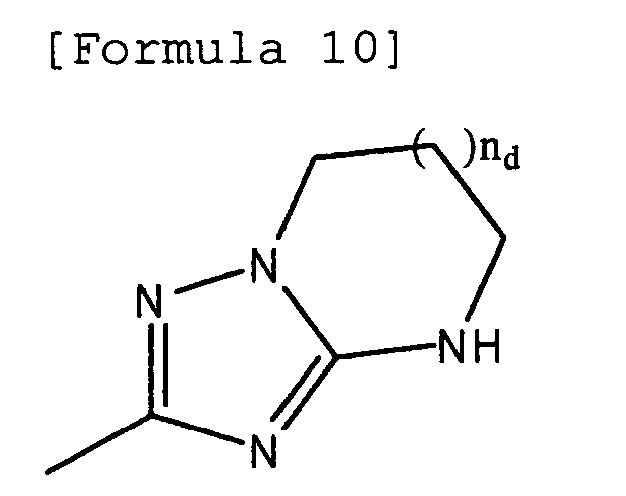
wherein nd represents an integer of 0 to 3. - 33) The compound or pharmacologically acceptable salt thereof according to 1), 18), 20) or 21), wherein Het is a group represented by the formula:

wherein.... represents a single bond or a double bond, X4 represents a methine group or methylene group, an imino group, an oxygen atom, a sulfur atom or -SO2-, which may be substituted with a substituent selected from Substituent Group A4, Y7 represents a carbon atom or a nitrogen atom, and ne and nf independently represent an integer of 0 to 3. - 34) The compound or pharmacologically acceptable salt thereof according to 33), wherein Het is a group represented by the formula:

wherein R8 and R9 are the same or different and each represent a substituent selected from Substituent Group A4, X4 is the same as defined in claim 33, and ng represent an integer of 0 to 2. - 35) The compound or pharmacologically acceptable salt thereof according to 34), wherein R8 represents a 6- to 14-membered aromatic hydrocarbon ring group or 5-to 14-membered aromatic heterocyclic group that may be substituted with 1 to 3 substituents selected from Substituent Group A4.
- 36) The compound or pharmacologically acceptable salt thereof according to 34), wherein R8 represents a phenyl group, pyridinyl group or naphthyl group that may be substituted with 1 to 3 substituents selected from the group consisting of (1) a hydrogen atom, (2) a halogen atom, (3) a cyano group, (4) a C1-6 alkoxy group (wherein the C1-6 alkoxy group group may be substituted with 1 to 3 halogen atoms), (5) a C1-6 alkyl group (wherein the C1-6 alkyl group may be substituted with 1 to 3 halogen atoms, and (6) a amino group that may be substituted with 1 to 2 C1-6 alkyl groups.
- 37) The compound or pharmacologically acceptable salt thereof according to 34), wherein R9 represents a substituent group selected from the group consisting of (1) a hydrogen atom, (2) a halogen atom, (3) a hydroxyl group, (4) a cyano group, (5) a C1-6 alkyl group, (6) a C2-6 alkenyl group, (7) a C2-6 alkynyl group, (8) a C1-6 alkoxy group, and (9) an amino group that may be substituted with 1 or 2 C1-6 alkyl groups.
- 38) The compound or pharmacologically acceptable salt thereof according to any one of 1) to 37), wherein Ar1 is bonded to Ar2 through an atom in the imidazolyl group, triazolyl group or tetrazolyl group represented by Ar1 which may be substituted with substituents and an atom in the phenyl group, pyrimidinyl group or pyridinyl group represented by Ar2 which may be substituted with substituents; Ar2 is bonded to X1 through an atom in the phenyl group, pyrimidinyl group or pyridinyl group represented by Ar2 which may be substituted with substituents; and monovalent Het is bonded to -C=C- or -CR3=CR4- of X1, or divalent Het is bonded to -CR5= of X1.
- 39) The compound or pharmacologically acceptable salt thereof according to 1), wherein the compound is selected from the following group:
- 1) 4-(4-fluorophenyl)-2-{(E)-2-[3-methoxy-4-(4-methyl-1H-imidazol-1-yl)phenyl]vinyl}-1H-imidazole,
- 2) 4-(4-fluorophenyl)-2-{(E)-2-[3-methoxy-4-(4-methyl-1H-imidazol-1-yl)phenyl]vinyl}-1-methyl-1H-imidazole,
- 3) 2-{(E)-2-[3-methoxy-4-(4-methyl-1H-imidazol-1-yl)phenyl]vinyl}-1-methyl-5-phenyl-1H-imidazole,
- 4) 2-{(E)-2-[3-methoxy-4-(4-methyl-1H-imidazol-1-yl)phenyl]vinyl}-4-phenyl-1H-imidazole,
- 5) 2-{(E)-2-[3-methoxy-4-(4-methyl-1H-imidazol-1-yl)phenyl]vinyl}-1-methyl-4-phenyl-1H-imidazole,
- 6) methyl 5-(4-fluorophenyl)-2-{(E)-2-[3-methoxy-4-(4-methyl-1H-imidazol-1-yl)phenyl]vinyl}-1H-imidazole-4-carboxylate,
- 7) 5-(4-fluorophenyl)-2-{(E)-2-[3-methoxy-4-(4-methyl-1H-imidazol-1-yl)phenyl]vinyl}-(1H-imidazol-4-yl)methanol,
- 8) 5-(4-fluorophenyl)-2-{(E)-2-[3-methoxy-4-(4-methyl-1H-imidazol-1-yl)phenyl]vinyl}-1H-imidazole-4-carboxylic acid,
- 9) 5-(4-fluorophenyl)-2-{(E)-2-[3-methoxy-4-(4-methyl-1H-imidazol-1-yl)phenyl]vinyl}-1H-imidazole-4-carboxylic acid (2-chloroethyl)amide,
- 10) 1-(4-fluorophenyl)-3-{(E)-2-[3-methoxy-4-(4-methyl-1H-imidazol-1-yl)phenyl]vinyl}-6,7-dihydro-5H-imidazo[1,5-a]pyrazin-8-one,
- 11) 1-(4-fluorophenyl)-3-{(E)-2-[3-methoxy-4-(4-methyl-1H-imidazol-1-yl)phenyl]vinyl}-7-methyl-6,7-dihydro-5H-imidazo[1,5-a]pyrazin-8-one,
- 12) 1-(4-fluorophenyl)-3-{(E)-2-[3-methoxy-4-(4-methyl-1H-imidazol-1-yl)phenyl]vinyl)-5,6-dihydroimidazo[5,1-c][1,4]oxazin-8-one,
- 13) 1-(4-fluorophenyl)-3-{(E)-2-[3-methoxy-4-(4-methyl-1H-imidazol-1-yl)phenyl]vinyl}-5,6-dihydro-8H-imidazo[5,1-c][1,4]oxazine,
- 14) 2-{4-(4-fluorophenyl)-5-methoxymethyl-2-{(E)-2-[3-methoxy-4-(4-methyl-1H-imidazol-1-yl)phenyl]vinyl}imidazol-1-yl}ethanol,
- 15) 1-(4-fluorophenyl)-3-{(E)-2-[3-methoxy-4-(4-methyl-1H-imidazol-1-yl)phenyl]vinyl}-7-methyl-5,6,7,8-tetrahydroimidazo[1,5-a]pyrazine,
- 16) 3-(3-fluorophenyl)-5-{(E)-2-[3-methoxy-4-(4-methyl-1H-imidazol-1-yl)phenyl]vinyl}-4H-[1,2,4]triazole,
- 17) 3-(4-fluorobenzyl)-5-{(E)-2-[3-methoxy-4-(4-methyl-1H-imidazol-1-yl)phenyl]vinyl}-4H-[1,2,4]triazole,
- 18) 3-(4-fluorophenyl)-8-{1-[3-methoxy-4-(4-methyl-1H-imidazol-1-yl)phenyl]-(E)-methylidene}-5,6,7,8-tetrahydroimidazo[1,2-a]pyridine,
- 19) 2-(4-fluorophenyl)-8-{1-[3-methoxy-4-(4-methyl-1H-imidazol-1-yl)phenyl]-(E)-methylidene}-5,6,7,8-tetrahydroimidazo[1,2-a]pyridine,
- 20) 2-(4-fluorophenyl)-8-{1-[3-methoxy-4-(4-methyl-1H-imidazol-1-yl)phenyl]-(E)-methylidene}-5,6,7,8-tetrahydro[1,2,4]triazolo[1,5-a]pyridine,
- 21) methyl 3-(4-fluorophenyl)-8-{1-[3-methoxy-4-(4-methyl-1H-imidazol-1-yl)phenyl]-(E)-methylidene}-5,6,7,8-tetrahydroimidazo[1,2-a]pyridine-2-carboxylate,
- 22) methyl 2-(4-fluorophenyl)-8-{1-[3-methoxy-4-(4-methyl-1H-imidazol-1-yl)phenyl]-(E)-methylidene}-5,6,7,8-tetrahydroimidazo[1,2-a]pyridine-3-carboxylate,
- 23) {3-(4-fluorophenyl)-8-{1-[3-methoxy-4-(4-methyl-1H-imidazol-1-yl)phenyl]-(E)-methylidene}-5,6,7,8-tetrahydroimidazo[1,2-a]pyridin-2-yl}methanol,
- 24) {2-(4-fluorophenyl)-8-{1-[3-methoxy-4-(4-methyl-1H-imidazol-1-yl)phenyl]-(E)-methylidene}-5,6,7,8-tetrahydroimidazo[1,2-a]pyridin-3-yl]methanol,
- 25) 3-(4-fluorophenyl)-8-{1-[3-methoxy-4-(4-methyl-1H-imidazol-1-yl)phenyl]-(E)-methylidene}-5,6,7,8-tetrahydroimidazo[1,2-a]pyridine-2-carboxylic acid,
- 26) 3-(4-fluorophenyl)-8-{1-[3-methoxy-4-(4-methyl-1H-imidazol-1-yl)phenyl]-(E)-methylidene}-5,6,7,8-tetrahydroimidazo[1,2-a]pyridine-2-carboxylic acid dimethylamide,
- 27) 3-(4-fluorophenyl)-8-{1-[3-methoxy-4-(4-methyl-1H-imidazol-1-yl)phenyl]-(E)-methylidene}-5,6,7,8-tetrahydroimidazo[1,2-a]pyridine-2-carboxylic acid methylamide,
- 28) 3-(4-fluorophenyl)-8-{1-[3-methoxy-4-(4-methyl-1H-imidazol-1-yl)phenyl]-(E)-methylidene}-5,6,7,8-tetrahydroimidazo[1,2-a]pyridine-2-carboxylic acid amide,
- 29) 1-(4-fluorobenzyl)-2-{(E)-2-[3-methoxy-4-(4-methyl-1H-imidazol-1-yl)phenyl]vinyl]-4,5-dimethyl-1H-imidazole,
- 30) 8-{1-[3-methoxy-4-(4-methyl-1H-imidazol-1-yl)phenyl]-(E)-methylidene}-2-pyridin-4-yl-5,6,7,8-tetrahydroimidazo[1,2-a]pyridine,
- 31) 3-[1-(4-fluorophenyl)ethyl]-5-{(E)-2-[3-methoxy-4-(4-methyl-1H-imidazol-1-yl)phenyl]vinyl}-4H-[1,2,4]triazole,
- 32) 3-[2-(4-fluorophenyl)ethyl]-5-{(E)-2-[3-methoxy-4-(4-methyl-1H-imidazol-1-yl)phenyl]vinyl}-4H-[1,2,4]triazole,
- 33) 4-(4-fluorobenzyl)-2-{(E)-2-[3-methoxy-4-(4-methyl-1H-imidazol-1-yl)phenyl]vinyl}-1H-imidazole,
- 34) 5-(4-fluorobenzyl)-3-{(E)-2-[3-methoxy-4-(4-methyl-1H-imidazol-1-yl)phenyl]vinyl}-1-methyl-1H-[1,2,4]triazole,
- 35) 3-(4-fluorobenzyl)-5-{(E)-2-[3-methoxy-4-(4-methyl-1H-imidazol-1-yl)phenyl]vinyl}-1-methyl-1H-[1,2,4]triazole,
- 36) (+)-3-[1-(4-fluorophenyl)ethyl]-5-{(E)-2-[3-methoxy-4-(4-methyl-1H-imidazol-1-yl)phenyl]vinyl}-4H-[1,2,4]triazole,
- 37) (-)-3-[1-(4-fluorophenyl)ethyl]-5-{(E)-2-[3-methoxy-4-(4-methyl-1H-imidazol-1-yl)phenyl]vinyl}-4H-[1,2,4]triazole,
- 38) 5-[1-(4-fluorophenyl)ethyl]-3-{(E)-2-[3-methoxy-4-(4-methyl-1H-imidazol-1-yl)phenyl]vinyl}-1-methyl-1H-[1,2,4]triazole,
- 39) 3-[1-(4-fluorophenyl)ethyl]-5-{(E)-2-[3-methoxy-4-(4-methyl-1H-imidazol-1-yl)phenyl]vinyl}-1-methyl-1H-[1,2,4]triazole,
- 40) 5-[1-(4-fluorophenyl)ethyl]-3-{(E)-2-[3-methoxy-4-(4-methyl-1H-imidazol-1-yl)phenyl]vinyl}-1-methyl-1H-[1,2,4]triazole,
- 41) 3-[1-(4-fluorophenyl)ethyl]-5-{(E)-2-[3-methoxy-4-(4-methyl-1H-imidazol-1-yl)phenyl]vinyl}-1-methyl-1H-[1,2,4]triazole,
- 42) (+)-3-[1-(4-fluorophenyl)ethyl]-5-{(E)-2-[3-methoxy-4-(4-methyl-1H-imidazol-1-yl)phenyl]vinyl}-4-methyl-4H-[1,2,4]triazole,
- 43) (-)-3-[1-(4-fluorophenyl)ethyl]-5-{(E)-2-[3-methoxy-4-(4-methyl-1H-imidazol-1-yl)phenyl]vinyl}-4-methyl-4H-[1,2,4]triazole,
- 44) 3-{(E)-2-[3-methoxy-4-(4-methyl-1H-imidazol-1-yl)phenyl]vinyl}-5-(1-phenylethyl)-4H-[1,2,4]triazole,
- 45) 3-{(E)-2-[3-methoxy-4-(4-methyl-1H-imidazol-1-yl)phenyl]vinyl}-1-methyl-5-(1-phenylethyl)-1H-[1,2,4]triazole,
- 46) 5-{(E)-2-[3-methoxy-4-(4-methyl-1H-imidazol-1-yl)phenyl]vinyl}-1-methyl-3-(1-phenylethyl)-1H-[1,2,4]triazole,
- 47) 3-(4-fluorophenyl)-5-{(E)-2-[3-methoxy-4-(4-methyl-1H-imidazol-1-yl)phenyl]vinyl}-4H-[1,2,4]triazole,
- 48) 5-(4-fluorophenyl)-2-{(E)-2-[3-methoxy-4-(4-methyl-1H-imidazol-1-yl)phenyl]vinyl}-4-methyl-1H-imidazole,
- 49) 3-{(E)-2-[3-methoxy-4-(4-methyl-1H-imidazol-1-yl)phenyl]vinyl}-5-(1-methyl-1-phenylethyl)-4H-[1,2,4]triazole,
- 50) 3-{(E)-2-[3-methoxy-4-(4-methyl-1H-imidazol-1-yl)phenyl]vinyl}-1-phenyl-5,6,7,8-tetrahydroimidazo[1,5-a]pyridine,
- 51) (+)-8-(4-fluorophenyl)-2-{(E)-2-[3-methoxy-4-(4-methyl-1H-imidazol-1-yl)phenyl]vinyl}-5,6,7,8-tetrahydro[1,2,4]triazolo[1,5-a]pyridine,
- 52) (-)-8-(4-fluorophenyl)-2-{(E)-2-[3-methoxy-4-(4-methyl-1H-imidazol-1-yl)phenyl]vinyl}-5,6,7,8-tetrahydro[1,2,4]triazolo[1,5-a]pyridine,
- 53) (+)-2-{(E)-2-[3-methoxy-4-(4-methyl-1H-imidazol-1-yl)phenyl]vinyl}-8-(3,4,5-trifluorophenyl)-5,6,7,8-tetrahydro[1,2,4]triazolo[1,5-a]pyridine,
- 54) (-)-2-{(E)-2-[3-methoxy-4-(4-methyl-1H-imidazol-1-yl)phenyl]vinyl}-8-(3,4,5-trifluorophenyl)-5,6,7,8-tetrahydro[1,2,4]triazolo[1,5-a]pyridine,
- 55) (+)-5-(4-fluorophenyl)-2-{(E)-2-[3-methoxy-4-(4-methyl-1H-imidazol-1-yl)phenyl]vinyl}-5,6,7,8-tetrahydro[1,2,4]triazolo[1,5-a]pyridine,
- 56) (-)-5-(4-fluorophenyl)-2-{(E)-2-[3-methoxy-4-(4-methyl-1H-imidazol-1-yl)phenyl]vinyl}-5,6,7,8-tetrahydro[1,2,4]triazolo[1,5-a]pyridine,
- 57) (+)-2-{(Z)-1-fluoro-2-[3-methoxy-4-(4-methyl-1H-imidazol-1-yl)phenyl]vinyl}-8-(3,4,5-trifluorophenyl)-5,6,7,8-tetrahydro[1,2,4]triazolo[1,5-a]pyridine,
- 58) (-)-2-{(Z)-1-fluoro-2-[3-methoxy-4-(4-methyl-1H-imidazol-1-yl)phenyl]vinyl}-8-(3,4,5-trifluorophenyl)-5,6,7,8-tetrahydro[1,2,4]triazolo[1,5-a]pyridine,
- 59) (+)-2-{(E)-2-[5-methoxy-6-(4-methyl-1H-imidazol-1-yl)pyridin-3-yl]vinyl}-8-(3,4,5-trifluorophenyl)-5,6,7,8-tetrahydro[1,2,4]triazolo[1,5-a]pyridine,
- 60) (-)-2-{(E)-2-[5-methoxy-6-(4-methyl-1H-imidazol-1-yl)pyridin-3-yl]vinyl}-8-(3,4,5-trifluorophenyl)-5,6,7,8-tetrahydro[1,2,4]triazolo[1,5-a]pyridine,
- 61) (+)-2-{(E)-2-[3-fluoro-4-(4-methyl-1H-imidazol-1-yl)phenyl]vinyl}-8-(3,4,5-trifluorophenyl)-5,6,7,8-tetrahydro[1,2,4]triazolo[1,5-a]pyridine,
- 62) (-)-2-{(E)-2-[3-fluoro-4-(4-methyl-1H-imidazol-1-yl)phenyl]vinyl}-8-(3,4,5-trifluorophenyl)-5,6,7,8-tetrahydro[1,2,4]triazolo[1,5-a]pyridine,
- 63) (+)-2-{(E)-2-[3-methoxy-4-(4-methyl-1H-imidazol-1-yl)phenyl]vinyl}-8-(2,4,6-trifluorophenyl)-5,6,7,8-tetrahydro[1,2,4]triazolo[1,5-a]pyridine,
- 64) (-)-2-{(E)-2-[3-methoxy-4-(4-methyl-1H-imidazol-1-yl)phenyl]vinyl}-8-(2,4,6-trifluorophenyl)-5,6,7,8-tetrahydro[1,2,4]triazolo[1,5-a]pyridine,
- 65) 7-(4-fluorophenyl)-2-{(E)-2-[3-methoxy-4-(4-methyl-1H-imidazol-1-yl)phenyl]vinyl}-6,7-dihydro-5H-pyrrolo[1,2-b][1,2,4]triazol-7-ol,
- 66) (-)-2-{(E)-2-[3-methoxy-4-(4-methyl-1H-imidazol-1-yl)phenyl]vinyl}-8-(3,4,5-trifluorophenyl)-5,6,7,8-tetrahydro[1,2,4]triazolo[1,5-a]pyridin-8-ol,
- 67) (+)-2-{(E)-2-[3-methoxy-4-(4-methyl-1H-imidazol-1-yl)phenyl]vinyl}-8-(3,4,5-trifluorophenyl)-5,6,7,8-tetrahydro[1,2,4]triazolo[1,5-a]pyridin-8-ol,
- 68) (+)-2-{(E)-2-[2-fluoro-5-methoxy-4-(4-methyl-1H-imidazol-1-yl)phenyl]vinyl}-8-(3,4,5-trifluorophenyl)-5,6,7,8-tetrahydro[1,2,4]triazolo[1,5-a]pyridine,
- 69) (-)-2-{(E)-2-[2-fluoro-5-methoxy-4-(4-methyl-1H-imidazol-1-yl)phenyl]vinyl}-8-(3,4,5-trifluorophenyl)-5,6,7,8-tetrahydro[1,2,4]triazolo[1,5-a]pyridine,
- 70) (-)-8-(4-fluorophenyl)-2-{(E)-2-[3-methoxy-4-(4-methyl-1H-imidazol-1-yl)phenyl]vinyl}-5,6,7,8-tetrahydro[1,2,4]triazolo[1,5-a]pyridin-8-ol,
- 71) (+)-8-(4-fluorophenyl)-2-{(E)-2-[3-methoxy-4-(4-methyl-1H-imidazol-1-yl)phenyl]vinyl}-5,6,7,8-tetrahydro[1,2,4]triazolo[1,5-a]pyridin-8-ol,
- 72) (+)-8-fluoro-8-(4-fluorophenyl)-2-{(E)-2-[3-methoxy-4-(4-methyl-1H-imidazol-1-yl)phenyl]vinyl}-5,6,7,8-tetrahydro[1,2,4]triazolo[1,5-a]pyridine,
- 73) (-)-8-fluoro-8-(4-fluorophenyl)-2-{(E)-2-[3-methoxy-4-(4-methyl-1H-imidazol-1-yl)phenyl]vinyl}-5,6,7,8-tetrahydro[1,2,4]triazolo[1,5-a]pyridine,
- 74) 8-(4-fluorophenyl)-2-{(E)-2-[3-methoxy-4-(4-methyl-1H-imidazol-1-yl)phenyl]vinyl}-5,6-dihydro[1,2,4]triazolo[1,5-a]pyridine,
- 75) (-)-2-{(E)-2-[3-methoxy-4-(4-methyl-1H-imidazol-1-yl)phenyl]vinyl}-8-(4-methoxyphenyl)-5,6,7,8-tetrahydro-[1,2,4]triazolo[1,5-a]pyridine,
- 76) (+)-2-{(E)-2-[3-methoxy-4-(4-methyl-1H-imidazol-1-yl)phenyl]vinyl}-8-(4-methoxyphenyl)-5,6,7,8-tetrahydro-[1,2,4]triazolo[1,5-a]pyridine,
- 77) (-)-2-{(E)-2-[3-methoxy-4-(4-methyl-1H-imidazol-1-yl)phenyl]vinyl}-8-(3,4,5-trifluorophenyl)-5,6-dihydro-8H-[1,2,4]triazolo[5,1-c][1,4]oxazine,
- 78) (+)-2-{(E)-2-[3-methoxy-4-(4-methyl-1H-imidazol-1-yl)phenyl]vinyl}-8-(3,4,5-trifluorophenyl)-5,6-dihydro-8H-[1,2,4]triazolo[5,1-c][1,4]oxazine,
- 79) (-)-8-(4-fluorophenyl)-2-{(E)-2-[3-methoxy-4-(4-methyl-1H-imidazol-1-yl)phenyl]vinyl}-8-methyl-5,6,7,8-tetrahydro-[1,2,4]triazolo[1,5-a]pyridine,
- 80) (+)-8-(4-fluorophenyl)-2-{(E)-2-[3-methoxy-4-(4-methyl-1H-imidazol-1-yl)phenyl]vinyl}-8-methyl-5,6,7,8-tetrahydro-[1,2,4]triazolo[1,5-a]pyridine,
- 81) 2-(4-fluorobenzyl)-8-{1-[3-methoxy-4-(4-methyl-1H-imidazol-1-yl)phenyl]-(E)-methylidene}-5,6,7,8-tetrahydro[1,2,4]triazolo[1,5-a]pyridine and
- 82) 3-(4-fluorobenzyl)-8-{1-[3-methoxy-4-(4-methyl-1H-imidazol-1-yl)phenyl]-(E)-methylidene}-5,6,7,8-tetrahydro[1,2,4]triazolo[4,3-a]pyridine,
- 83) 3-{(E)-2-[3-methoxy-4-(4-methyl-1H-imidazol-1-yl)phenyl]vinyl}-5-((S)-1-phenylethyl)-4H-[1,2,4]triazole,
- 84) 3-{(E)-2-[3-methoxy-4-(4-methyl-1H-imidazol-1-yl)phenyl]vinyl}-5-((R)-1-phenylethyl)-4H-[1,2,4]triazole,
- 85) (-)-8-(4-fluorophenyl)-8-methoxy-2-{(E)-2-[3-methoxy-4-(4-methyl-1H-imidazol-1-yl)phenyl]vinyl}-5,6,7,8-tetrahydro[1,2,4]triazolo[1,5-a]pyridine,
- 86) (+)-8-(4-fluorophenyl)-8-methoxy-2-{(E)-2-[3-methoxy-4-(4-methyl-1H-imidazol-1-yl)phenyl]vinyl}-5,6,7,8-tetrahydro[1,2,4]triazolo[1,5-a]pyridine,
- 87) (-)-8-methoxy-2-{(E)-2-[3-methoxy-4-(4-methyl-1H-imidazol-1-yl)phenyl]vinyl}-8-(3,4,5-trifluorophenyl)-5,6,7,8-tetrahydro[1,2,4]triazolo[1,5-a]pyridine,
- 88) (+)-8-methoxy-2-{(E)-2-[3-methoxy-4-(4-methyl-1H-imidazol-1-yl)phenyl]vinyl}-8-(3,4,5-trifluorophenyl)-5,6,7,8-tetrahydro[1,2,4]triazolo[1,5-a]pyridine,
- 89) (-)-8-methoxy-2-{(E)-2-[3-methoxy-4-(4-methyl-1H-imidazol-1-yl)phenyl]vinyl}-8-(4-methoxyphenyl)-5,6,7,8-tetrahydro[1,2,4]triazolo[1,5-a]pyridine,
- 90) (+)-8-methoxy-2-{(E)-2-[3-methoxy-4-(4-methyl-1H-imidazol-1-yl)phenyl]vinyl}-8-(4-methoxyphenyl)-5,6,7,8-tetrahydro[1,2,4]triazolo[1,5-a]pyridine,
- 91) 5-[methoxy-(4-methoxyphenyl)methyl]-3-{(E)-2-[3-methoxy-4-(4-methyl-1H-imidazol-1-yl)phenyl]vinyl}-1H-[1,2,4]triazole,
- 92) 7-(4-fluorophenyl)-7-methoxy-2-{(E)-2-[3-methoxy-4-(4-methyl-1H-imidazol-1-yl)phenyl]vinyl}-6,7-dihydro-5H-pyrrolo[1,2-b][1,2,4]triazole,
- 93) 4-(4-fluorophenyl)-2-{(E)-2-[3-methoxy-4-(4-methyl-1H-imidazol-1-yl)phenyl]vinyl}-1-(tetrahydrofuran-2-ylmethyl)-1H-imidazole,
- 94) 4-{5-{(E)-2-[3-methoxy-4-(4-methyl-1H-imidazol-1-yl)phenyl]vinyl}-4H-[1,2,4]triazol-3-yl}-4-(3,4,5-trifluorophenyl)butan-1-ol,
- 95) (+)-2-{(E)-2-[3-methoxy-4-(4-methyl-1H-imidazol-1-yl)phenyl]vinyl}-8-phenyl-5,6,7,8-tetrahydro[1,2,4]triazolo[1,5-a]pyridine-8-carbonitrile,
- 96) (-)-2-{(E)-2-[3-methoxy-4-(4-methyl-1H-imidazol-1-yl)phenyl]vinyl}-8-phenyl-5,6,7,8-tetrahydro[1,2,4]triazolo[1,5-a]pyridine-8-carbonitrile,
- 97) (-)-8-(4-fluorophenyl)-2-{(E)-2-[3-methoxy-4-(4-methyl-1H-imidazol-1-yl)phenyl]vinyl}-5,6,7,8-tetrahydro[1,2,4]triazolo[1,5-a]pyridine-8-carbonitrile,
- 98) (+)-8-(4-fluorophenyl)-2-{(E)-2-[3-methoxy-4-(4-methyl-1H-imidazol-1-yl)phenyl]vinyl}-5,6,7,8-tetrahydro[1,2,4]triazolo[1,5-a]pyridine-8-carbonitrile,
- 99) (+)-8-(4-fluorophenyl)-2-{(E)-2-[3-methoxy-4-(4-methyl-1H-imidazol-1-yl)phenyl]vinyl}-5,6,7,8-tetrahydro[1,2,4]triazolo[1,5-a]pyridin-8-ylamine,
- 100) (-)-8-(4-fluorophenyl)-2-{(E)-2-[3-methoxy-4-(4-methyl-1H-imidazol-1-yl)phenyl]vinyl}-5,6,7,8-tetrahydro[1,2,4]triazolo[1,5-a]pyridin-8-ylamine,
- 101) 2-{(E)-2-[3-fluoro-4-(4-methyl-1H-imidazol-1-yl)phenyl]vinyl}-8-(4-fluorophenyl)-5,6,7,8-tetrahydro[1,2,4]triazolo[1,5-a]pyridine,
- 102) (-)-2-{(E)-2-[3-fluoro-4-(4-methyl-1H-imidazol-1-yl)phenyl]vinyl}-8-(4-fluorophenyl)-5,6,7,8-tetrahydro[1,2,4]triazolo[1,5-a]pyridin-8-ol,
- 103) (+)-2-{(E)-2-[3-fluoro-4-(4-methyl-1H-imidazol-1-yl)phenyl]vinyl}-8-(4-fluorophenyl)-5,6,7,8-tetrahydro[1,2,4]triazolo[1,5-a]pyridin-8-ol,
- 104) 2-{(E)-2-[2-fluoro-5-methoxy-4-(4-methyl-1H-imidazol-1-yl)phenyl]vinyl}-8-(4-fluorophenyl)-5,6,7,8-tetrahydro[1,2,4]triazolo[1,5-a]pyridine,
- 105) (+)-2-{(E)-2-[2-fluoro-5-methoxy-4-(4-methyl-1H-imidazol-1-yl)phenyl]vinyl}-8-(4-fluorophenyl)-5,6,7,8-tetrahydro[1,2,4]triazolo[1,5-a]pyridin-8-ol,
- 106) (-)-2-{(E)-2-[2-fluoro-5-methoxy-4-(4-methyl-1H-imidazol-1-yl)phenyl]vinyl}-8-(4-fluorophenyl)-5,6,7,8-tetrahydro[1,2,4]triazolo[1,5-a]pyridin-8-ol,
- 107) 2-{(Z)-1-fluoro-2-[3-methoxy-4-(4-methyl-1H-imidazol-1-yl)phenyl]vinyl}-8-(4-fluorophenyl)-5,6,7,8-tetrahydro[1,2,4]triazolo[1,5-a]pyridine,
- 108) (-)-2-{(Z)-1-fluoro-2-[3-methoxy-4-(4-methyl-1H-imidazol-1-yl)phenyl]vinyl}-8-(4-fluorophenyl)-5,6,7,8-tetrahydro[1,2,4]triazolo[1,5-a]pyridin-8-ol,
- 109) (+)-2-{(Z)-1-fluoro-2-[3-methoxy-4-(4-methyl-1H-imidazol-1-yl)phenyl]vinyl}-8-(4-fluorophenyl)-5,6,7,8-tetrahydro[1,2,4]triazolo[1,5-a]pyridin-8-ol,
- 110) (-)-2-{(E)-2-[5-methoxy-6-(4-methyl-1H-imidazol-1-yl)pyridin-3-yl]vinyl}-8-(3,4,5-trifluorophenyl)-5,6,7,8-tetrahydro[1,2,4]triazolo[1,5-a]pyridin-8-ol,
- 111) (+)-2-{(E)-2-[5-methoxy-6-(4-methyl-1H-imidazol-1-yl)pyridin-3-yl]vinyl}-8-(3,4,5-trifluorophenyl)-5,6,7,8-tetrahydro[1,2,4]triazolo[1,5-a]pyridin-8-ol,
- 112) (+)-2-{(E)-2-[3-methoxy-4-(4-methyl-1H-imidazol-1-yl)phenyl]vinyl}-7-(3,4,5-trifluorophenyl)-6,7-dihydro-5H-pyrrolo[1,2-b][1,2,4]triazole,
- 113) (-)-2-{(E)-2-[3-methoxy-4-(4-methyl-1H-imidazol-1-yl)phenyl]vinyl}-7-(3,4,5-trifluorophenyl)-6,7-dihydro-5H-pyrrolo[1,2-b][1,2,4]triazole,
- 114) (+)-2-{(E)-2-[3-methoxy-4-(4-methyl-1H-imidazol-1-yl)phenyl]vinyl}-7-(3,4,5-trifluorophenyl)-6,7-dihydro-5H-pyrrolo[1,2-b][1,2,4]triazol-7-ol,
- 115) (-)-2-{(E)-2-[3-methoxy-4-(4-methyl-1H-imidazol-1-yl)phenyl]vinyl}-7-(3,4,5-trifluorophenyl)-6,7-dihydro-5H-pyrrolo[1,2-b][1,2,4]triazol-7-ol,
- 116) (+)-8-(3,4-difluorophenyl)-2-{(E)-2-[3-methoxy-4-(4-methyl-1H-imidazol-1-yl)phenyl]vinyl}-5,6,7,8-tetrahydro-[1,2,4]triazolo[1,5-a]pyridine,
- 117) (-)-8-(3,4-difluorophenyl)-2-{(E)-2-[3-methoxy-4-(4-methyl-1H-imidazol-1-yl)phenyl]vinyl}-5,6,7,8-tetrahydro-[1,2,4]triazolo[1,5-a]pyridine,
- 118) 4-(4-fluorophenyl)-2-{(E)-2-[3-methoxy-4-(4-methyl-1H-imidazol-1-yl)phenyl]vinyl}-4,5,6,7-tetrahydro[1,2,4]triazolo[1,5-a]pyrimidine,
- 119) (+)-3-{(E)-2-[3-methoxy-4-(4-methyl-1H-imidazol-1-yl)phenyl]vinyl}-5-phenyl-5,6,7,8-tetrahydro[1,2,4]triazolo[4,3-a]pyridine,
- 120) (-)-3-{(E)-2-[3-methoxy-4-(4-methyl-1H-imidazol-1-yl)phenyl]vinyl}-5-phenyl-5,6,7,8-tetrahydro[1,2,4]triazolo[4,3-a]pyridine,
- 121) 4-chloro-2-{(E)-2-[3-methoxy-4-(4-methyl-1H-imidazol-1-yl)phenyl]vinyl}-1H-imidazole,
- 122) 4-(4-methoxyphenyl)-2-{(E)-2-[3-methoxy-4-(4-methyl-1H-imidazol-1-yl)phenyl]vinyl}-1H-imidazole,
- 123) 4-(3-methoxyphenyl)-2-{(E)-2-[3-methoxy-4-(4-methyl-1H-imidazol-1-yl)phenyl]vinyl}-1H-imidazole,
- 124) 4-(2-methoxyphenyl)-2-{(E)-2-[3-methoxy-4-(4-methyl-1H-imidazol-1-yl)phenyl]vinyl}-1H-imidazole,
- 125) 4-(4-chlorophenyl)-2-{(E)-2-[3-methoxy-4-(4-methyl-1H-imidazol-1-yl)phenyl]vinyl}-1H-imidazole,
- 126) 4-(4-biphenyl)-2-{(E)-2-[3-methoxy-4-(4-methyl-1H-imidazol-1-yl)phenyl]vinyl}-1H-imidazole,
- 127) 4-(4-propyl)-2-{(E)-2-[3-methoxy-4-(4-methyl-1H-imidazol-1-yl)phenyl]vinyl}-1H-imidazole,
- 128) (+)-2-{(E)-2-[3-methoxy-4-(4-methyl-1H-imidazol-1-yl)phenyl]vinyl}-8-(4-trifluoromethoxyphenyl)-5,6,7,8-tetrahydro[1,2,4]triazolo[1,5-a]pyridine,
- 129) (-)-2-{(E)-2-[3-methoxy-4-(4-methyl-1H-imidazol-1-yl)phenyl]vinyl}-8-(4-trifluoromethoxyphenyl)-5,6,7,8-tetrahydro[1,2,4]triazolo[1,5-a]pyridine,
- 130) (+)-2-{(E)-2-[3-methoxy-4-(4-methyl-1H-imidazol-1-yl)phenyl]vinyl}-8-naphthalen-1-yl-5,6,7,8-tetrahydro[1,2,4]triazolo[1,5-a]pyridine,
- 131) (-)-2-{(E)-2-[3-methoxy-4-(4-methyl-1H-imidazol-1-yl)phenyl]vinyl}-8-naphthalen-1-yl-5,6,7,8-tetrahydro[1,2,4]triazolo[1,5-a]pyridine,
- 132) (+)-2-{(E)-2-[3-methoxy-4-(4-methyl-1H-imidazol-1-yl)phenyl]vinyl}-8-(4-methoxyphenyl)-5,6,7,8-tetrahydro[1,2,4]triazolo[1,5-a]pyridin-8-ol,
- 133) (-)-2-{(E)-2-[3-methoxy-4-(4-methyl-1H-imidazol-1-yl)phenyl]vinyl}-8-(4-methoxyphenyl)-5,6,7,8-tetrahydro[1,2,4]triazolo[1,5-a]pyridin-8-ol,
- 134) (+)-2-{(E)-2-[3-methoxy-4-(4-methyl-1H-imidazol-1-yl)phenyl]vinyl}-8-(4-trifluoromethoxyphenyl)-5,6-dihydro-8H-[1,2,4]triazolo[5,1-c][1,4]oxazine,
- 135) (-)-2-{(E)-2-[3-methoxy-4-(4-methyl-1H-imidazol-1-yl)phenyl]vinyl}-8-(4-trifluoromethoxyphenyl)-5,6-dihydro-8H-[1,2,4]triazolo[5,1-c][1,4]oxazine,
- 136) (-)-2-{(E)-2-[3-methoxy-4-(4-methyl-1H-imidazol-1-yl)phenyl]vinyl}-8-naphthalen-1-yl-5,6,7,8-tetrahydro[1,2,4]triazolo[1,5-a]pyridin-8-ol,
- 137) (+)-2-{(E)-2-[3-methoxy-4-(4-methyl-1H-imidazol-1-yl)phenyl]vinyl}-8-naphthalen-1-yl-5,6,7,8-tetrahydro[1,2,4]triazolo[1,5-a]pyridin-8-ol,
- 138) (-)-2-{(E)-2-[3-methoxy-4-(4-methyl-1H-imidazol-1-yl)phenyl]vinyl}-8-p-tolyl-5,6-dihydro-8H-[1,2,4]triazolo[5,1-c][1,4]oxazine,
- 139) (+)-2-{(E)-2-[3-methoxy-4-(4-methyl-1H-imidazol-1-yl)phenyl]vinyl}-8-p-tolyl-5,6-dihydro-8H-[1,2,4]triazolo[5,1-c][1,4]oxazine,
- 140) (+)-2-{(E)-2-[3-methoxy-4-(4-methyl-1H-imidazol-1-yl)phenyl]vinyl}-8-(2,4,6-trifluorophenyl)-5,6-dihydro-8H-[1,2,4]triazolo[5,1-c][1,4]oxazine,
- 141) (-)-2-{(E)-2-[3-methoxy-4-(4-methyl-1H-imidazol-1-yl)phenyl]vinyl}-8-(2,4,6-trifluorophenyl)-5,6-dihydro-8H-[1,2,4]triazolo[5,1-c][1,4]oxazine,
- 142) (+)-8-(4-bromophenyl)-2-{(E)-2-[3-methoxy-4-(4-methyl-1H-imidazol-1-yl)phenyl]vinyl}-5,6-dihydro-8H-[1,2,4]triazolo[5,1-c][1,4]oxazine,
- 143) (-)-8-(4-bromophenyl)-2-{(E)-2-[3-methoxy-4-(4-methyl-1H-imidazol-1-yl)phenyl]vinyl}-5,6-dihydro-8H-[1,2,4]triazolo[5,1-c][1,4]oxazine,
- 144) (+)-8-(6-chloropyridin-3-yl)-2-{(E)-2-[3-methoxy-4-(4-methyl-1H-imidazol-1-yl)phenyl]vinyl}-5,6-dihydro-8H-[1,2,4]triazolo[5,1-c][1,4]oxazine,
- 145) (-)-8-(6-chloropyridin-3-yl)-2-{(E)-2-[3-methoxy-4-(4-methyl-1H-imidazol-1-yl)phenyl]vinyl}-5,6-dihydro-8H-[1,2,4]triazolo[5,1-c][1,4]oxazine,
- 146) (+)-4-(2-{(E)-2-[3-methoxy-4-(4-methyl-1H-imidazol-1-yl)phenyl]vinyl}-5,6-dihydro-8H-[1,2,4]triazolo[5,1-c][1,4]oxazin-8-yl)benzonitrile,
- 147) (-)-4-(2-{(E)-2-[3-methoxy-4-(4-methyl-1H-imidazol-1-yl)phenyl]vinyl}-5,6-dihydro-8H-[1,2,4]triazolo[5,1-c][1,4]oxazin-8-yl)benzonitrile,
- 148) (+)-8-(4-chlorophenyl)-2-{(E)-2-[3-methoxy-4-(4-methyl-1H-imidazol-1-yl)phenyl]vinyl}-5,6,7,8-tetrahydro[1,2,4]triazolo[1,5-a]pyridine,
- 149) (-)-8-(4-chlorophenyl)-2-{(E)-2-[3-methoxy-4-(4-methyl-1H-imidazol-1-yl)phenyl]vinyl}-5,6,7,8-tetrahydro[1,2,4]triazolo[1,5-a]pyridine,
- 150) (+)-2-{(E)-2-[3-methoxy-4-(4-methyl-1H-imidazol-1-yl)phenyl]vinyl}-8-p-tolyl-5,6,7,8-tetrahydro[1,2,4]triazolo[1,5-a]pyridine,
- 151) (-)-2-{(E)-2-[3-methoxy-4-(4-methyl-1H-imidazol-1-yl)phenyl]vinyl}-8-p-tolyl-5,6,7,8-tetrahydro[1,2,4]triazolo[1,5-a]pyridine,
- 152) (+)-8-(4-chlorophenyl)-2-{(E)-2-[3-methoxy-4-(4-methyl-1H-imidazol-1-yl)phenyl]vinyl}-5,6,7,8-tetrahydro[1,2,4]triazolo[1,5-a]pyridin-8-ol,
- 153) (-)-8-(4-chlorophenyl)-2-{(E)-2-[3-methoxy-4-(4-methyl-1H-imidazol-1-yl)phenyl]vinyl}-5,6,7,8-tetrahydro[1,2,4]triazolo[1,5-a]pyridin-8-ol,
- 154) (+)-2-{(E)-2-[3-methoxy-4-(4-methyl-1H-imidazol-1-yl)phenyl]vinyl}-8-p-tolyl-5,6,7,8-tetrahydro[1,2,4]triazolo[1,5-a]pyridin-8-ol,
- 155) (-)-2-{(E)-2-[3-methoxy-4-(4-methyl-1H-imidazol-1-yl)phenyl]vinyl}-8-p-tolyl-5,6,7,8-tetrahydro[1,2,4]triazolo[1,5-a]pyridin-8-ol,
- 156) (+)-4-{2-{(E)-2-[3-methoxy-4-(4-methyl-1H-imidazol-1-yl)phenyl]vinyl}-5,6,7,8-tetrahydro[1,2,4]triazolo[1,5-a]pyridin-8-yl}benzonitrile,
- 157) (-)-4-{2-{(E)-2-[3-methoxy-4-(4-methyl-1H-imidazol-1-yl)phenyl]vinyl}-5,6,7,8-tetrahydro[1,2,4]triazolo[1,5-a]pyridin-8-yl}benzonitrile,
- 158) (+)-4-{8-hydroxy-2-{(E)-2-[3-methoxy-4-(4-methyl-1H-imidazol-1-yl)phenyl]vinyl}-5,6,7,8-tetrahydro[1,2,4]triazolo[1,5-a]pyridin-8-yl}benzonitrile,
- 159) (-)-4-{8-hydroxy-2-{(E)-2-[3-methoxy-4-(4-methyl-1H-imidazol-1-yl)phenyl]vinyl}-5,6,7,8-tetrahydro[1,2,4]triazolo[1,5-a]pyridin-8-yl}benzonitrile,
- 160) {4-{2-{(E)-2-[3-methoxy-4-(4-methyl-1H-imidazol-1-yl)phenyl]vinyl}-5,6,7,8-tetrahydro[1,2,4]triazolo[1,5-a]pyridin-8-yl}phenyl}dimethylamine,
- 161) (S)-8-(4-chlorophenyl)-3-{(E)-2-[3-methoxy-4-(4-methyl-1H-imidazol-1-yl)phenyl]vinyl}-5,6,7,8-tetrahydro[1,2,4]triazolo[4,3-a]pyridine,
- 162) (R)-8-(4-chlorophenyl)-3-{(E)-2-[3-methoxy-4-(4-methyl-1H-imidazol-1-yl)phenyl]vinyl}-5,6,7,8-tetrahydro[1,2,4]triazolo[4,3-a]pyridine,
- 163) (+)-3-{(E)-2-[3-methoxy-4-(4-methyl-1H-imidazol-1-yl)phenyl]vinyl}-8-(3,4,5-trifluorophenyl)-5,6,7,8-tetrahydro[1,2,4]triazolo[4,3-a]pyridine,
- 164) (-)-3-{(E)-2-[3-methoxy-4-(4-methyl-1H-imidazol-1-yl)phenyl]vinyl}-8-(3,4,5-trifluorophenyl)-5,6,7,8-tetrahydro[1,2,4]triazolo[4,3-a]pyridine,
- 165) (+)-3-{(E)-2-[3-methoxy-4-(4-methyl-1H-imidazol-1-yl)phenyl]vinyl}-7-(3,4,5-trifluorophenyl)-6,7-dihydro-5H-pyrrolo[2,1-c][1,2,4]triazole,
- 166) (-)-3-{(E)-2-[3-methoxy-4-(4-methyl-1H-imidazol-1-yl)phenyl]vinyl}-7-(3,4,5-trifluorophenyl)-6,7-dihydro-5H-pyrrolo[2,1-c][1,2,4]triazole,
- 167) (S)-3-{(E)-2-[3-methoxy-4-(4-methyl-1H-imidazol-1-yl)phenyl]vinyl}-9-(3,4,5-trifluorophenyl)-6,7,8,9-tetrahydro-5H-[1,2,4]triazolo[4,3-a]azepine,
- 168) (R)-3-{(E)-2-[3-methoxy-4-(4-methyl-1H-imidazol-1-yl)phenyl]vinyl}-9-(3,4,5-trifluorophenyl)-6,7,8,9-tetrahydro-5H-[1,2,4]triazolo[4,3-a]azepine,
- 169) (+)-2-{(E)-2-[3-methoxy-4-(4-methyl-1H-imidazol-1-yl)phenyl]vinyl}-9-(3,4,5-trifluorophenyl)-6,7,8,9-tetrahydro-5H-[1,2,4]triazolo[1,5-a]azepine,
- 170) (-)-2-{(E)-2-[3-methoxy-4-(4-methyl-1H-imidazol-1-yl)phenyl]vinyl}-9-(3,4,5-trifluorophenyl)-6,7,8,9-tetrahydro-5H-[1,2,4]triazolo[1,5-a]azepine,
- 171) 3-(4-fluorophenyl)-8-{1-[3-methoxy-4-(4-methyl-1H-imidazol-1-yl)phenyl]-(E)-methylidene}-5,6,7,8-tetrahydro[1,2,4]triazolo[4,3-a]pyridine,
- 172) (-)-2-{(E)-2-[3-methoxy-4-(4-methyl-1H-imidazol-1-yl)phenyl]vinyl}-8-phenyl-5,6,7,8-tetrahydro[1,2,4]triazolo[1,5-a]pyridine,
- 173) (+)-2-{(E)-2-[3-methoxy-4-(4-methyl-1H-imidazol-1-yl)phenyl]vinyl}-8-phenyl-5,6,7,8-tetrahydro[1,2,4]triazolo[1,5-a]pyridine,
- 174) (-)-8-(2-bromophenyl)-2-{(E)-2-[3-methoxy-4-(4-methyl-1H-imidazol-1-yl)phenyl]vinyl}-5,6,7,8-tetrahydro[1,2,4]triazolo[1,5-a]pyridine,
- 175) (+)-8-(2-bromophenyl)-2-{(E)-2-[3-methoxy-4-(4-methyl-1H-imidazol-1-yl)phenyl]vinyl}-5,6,7,8-tetrahydro[1,2,4]triazolo[1,5-a]pyridine,
- 176) 8-(2-bromo-4-fluorophenyl)-2-{(E)-2-[3-methoxy-4-(4-methyl-1H-imidazol-1-yl)phenyl]vinyl}-5,6,7,8-tetrahydro[1,2,4]triazolo[1,5-a]pyridine,
- 177) 8-(2-fluorophenyl)-2-{(E)-2-[3-methoxy-4-(4-methyl-1H-imidazol-1-yl)phenyl]vinyl}-5,6,7,8-tetrahydro[1,2,4]triazolo[1,5-a]pyridine,
- 178) 2-{(E)-2-[3-methoxy-4-(4-methyl-1H-imidazol-1-yl)phenyl]vinyl}-8-(2-methoxyphenyl)-5,6,7,8-tetrahydro[1,2,4]triazolo[1,5-a]pyridine,
- 179) 8-(3-bromophenyl)-2-{(E)-2-[3-methoxy-4-(4-methyl-1H-imidazol-1-yl)phenyl]vinyl}-5,6,7,8-tetrahydro[1,2,4]triazolo[1,5-a]pyridine and
- 180) 2-{(E)-2-[3-methoxy-4-(4-methyl-1H-imidazol-1-yl)phenyl]vinyl}-8-(2-nitrophenyl)-5,6,7,8-tetrahydro[1,2,4]triazolo[1,5-a]pyridine;
- 40) A medicine comprising the compound or pharmacologically acceptable salt thereof according to any one of 1) to 39) as an active ingredient;
- 41) The medicine according to 40) for preventing or treating a disease caused by amyloid-β; and
- 42) The medicine according to 41), wherein the disease caused by amyloid-β is Alzheimer's disease, dementia, Down's syndrome or amyloidosis.
- The compound of the general formula (I) or pharmacologically acceptable salt thereof according to the present invention and the prophylactic or therapeutic agent for a disease caused by Aβ according to the present invention are novel inventions that have not yet been described in any documents.
- Meanings of symbols, terms and the like used in the present specification will be explained, and the present invention will be described in detail below.
- In the present specification, a structural formula of a compound may represent a certain isomer for convenience. However, the present invention includes all isomers and isomer mixtures such as geometric isomers which can be generated from the structure of a compound, optical isomers based on asymmetric carbon, stereoisomers and tautomers. The present invention is not limited to the description of a chemical formula for convenience and may include any one of the isomers or mixtures thereof. Accordingly, the compound of the present invention may have an asymmetric carbon atom in the molecule and exist as an optically active compound or racemate, and the present invention includes each of the optically active compound and the racemate without limitations. Although crystal polymorphs of the compound may be present, the compound is not limited thereto as well and may be present as a single crystal form or a mixture of single crystal forms. The compound may be an anhydride or hydrate.
- The "disease caused by Aβ" refers to a wide variety of diseases such as Alzheimer's disease (see Klein WL, and seven others, Alzheimer's disease-affected brain: Presence of oligomeric Aβ ligands (ADDLs) suggests a molecular basis for reversible memory loss, Proceding National Academy of Science USA, 2003, Sep 2, 100(18), p.10417-10422; Nitsch RM, and sixteen others, Antibodies against β-amyloid slow cognitive decline in Alzheimer's disease, Neuron, 2003, May 22, 38(4), p.547-554; Jarrett JT, and two others, The carboxy terminus of the β amyloid protein is critical for the seeding of amyloid formation: Implications for the pathogenesis of Alzheimer's disease, Biochemistry, 1993, May 11, 32(18), p.4693-4697; Glenner GG, and one other, Alzheimer's disease: initial report of the purification and characterization of a novel cerebrovascular amyloid protein, Biochemical and biophysical research communications, 1984, May 16, 120(3), p.885-890; Masters CL, and six others, Amyloid plaque core protein in Alzheimer disease and Down syndrome, Proceding National Academy of Science USA, 1985, June, 82(12), p.4245-4249; Gouras GK, and eleven others, Intraneuronal Aβ42 accumulation in human brain, American journal of pathology, 2000, Jan, 156(1), p.15-20; Scheuner D, and twenty others, Secreted amyloid β-protein similar to that in the senile plaques of Alzheimer's disease is increased in vivo by the presenilin 1 and 2 and APP mutations linked to familial Alzheimer's disease, Nature Medicine, 1996, Aug, 2(8), p.864-870; and Forman MS, and four others, Differential effects of the swedish mutant amyloid precursor protein on β-amyloid accumulation and secretion in neurons and nonneuronal cells, The journal of biological chemistry, 1997, Dec 19, 272(51), p.32247-32253, for example), senile dementia (see Blass JP, Brain metabolism and brain disease: Is metabolic deficiency the proximate cause of Alzheimer dementia? Journal of Neuroscience Research, 2001, Dec 1, 66(5), p.851-856, for example), frontotemporal dementia (see Evin G, and eleven others, Alternative transcripts of presenilin-1 associated with frontotemporal dementia, Neuroreport, 2002, Apr 16, 13(5), p.719-723, for example), Pick's disease (see Yasuhara O, and three others, Accumulation of amyloid precursor protein in brain lesions of patients with Pick disease, Neuroscience Letters, 1994, Apr 25, 171(1-2), p.63-66, for example), Down's syndrome (see Teller JK, and ten others, Presence of soluble amyloid β-peptide precedes amyloid plaque formation in Down's syndrome, Nature Medicine, 1996, Jan, 2(1), p.93-95; and Tokuda T, and six others, Plasma levels of amyloid β proteins Aβ1-40 and Aβ1-42(43) are elevated in Down's syndrome, Annals of Neurology, 1997, Feb, 41(2), p.271-273, for example), cerebral angiopathy (see Hayashi Y, and nine others, Evidence for presenilin-1 involvement in amyloid angiopathy in the Alzheimer's disease-affected brain, Brain Research, 1998, Apr 13, 789(2), p.307-314; Barelli H, and fifteen others, Characterization of new polyclonal antibodies specific for 40 and 42 amino acid-long amyloid β peptides: their use to examine the cell biology of presenilins and the immunohistochemistry of sporadic Alzheimer's disease and cerebral amyloid angiopathy cases, Molecular Medicine, 1997, Oct, 3(10), p.695-707; Calhoun ME, and ten others, Neuronal overexpression of mutant amyloid precursor protein results in prominent deposition of cerebrovascular amyloid, Proceding National Academy of Science USA, 1999, Nov 23, 96(24), p.14088-14093; and Dermaut B, and ten others, Cerebral amyloid angiopathy is a pathogenic lesion in Alzheimer's Disease due to a novel presenilin-1 mutation, Brain, 2001, Dec, 124(12), p.2383-2392, for example), hereditary cerebral hemorrhage with amyloidosis (Dutch type) (see Cras P, and nine others, Presenile Alzheimer dementia characterized by amyloid angiopathy and large amyloid core type senile plaques in the APP 692Ala --> Gly mutation, Acta Neuropathologica (Berl), 1998, Sep, 96(3), p.253-260; Herzig MC, and fourteen others, Aβ is targeted to the vasculature in a mouse model of hereditary cerebral hemorrhage with amyloidosis, Nature Neuroscience, 2004, Sep, 7(9), p.954-960; van Duinen SG, and five others, Hereditary cerebral hemorrhage with amyloidosis in patients of Dutch origin is related to Alzheimer disease, Proceding National Academy of Science USA, 1987, Aug, 84(16), p.5991-5994; and Levy E, and eight others, Mutation of the Alzheimer's disease amyloid gene in hereditary cerebral hemorrhage, Dutch type, Science, 1990, Jun 1, 248(4959), p.1124-1126, for example), cognitive impairment (see Laws SM, and seven others, Association between the presenilin-1 mutation Glu318Gly and complaints of memory impairment, Neurobiology of Aging, 2002, Jan-Feb, 23(1), p.55-58, for example), memory disorder and learning disability (see Vaucher E, and five others, Object recognition memory and cholinergic parameters in mice expressing human presenilin 1 transgenes, Experimental Neurology, 2002 Jun, 175(2), p.398-406; Morgan D, and fourteen others, Aβ peptide vaccination prevents memory loss in an animal model of Alzheimer's disease, Nature, 2000 Dec 21-28, 408(6815), p.982-985; and Moran PM, and three others, Age-related learning deficits in transgenic mice expressing the 751-amino acid isoform of human β-amyloid precursor protein, Proceding National Academy of Science USA, 1995, June 6, 92(12), p.5341-5345, for example), amyloidosis, cerebral ischemia (see Laws SM, and seven others, Association between the presenilin-1 mutation Glu318Gly and complaints of memory impairment, Neurobiology of Aging, 2002, Jan-Feb, 23(1), p.55-58; Koistinaho M, and ten others, β-amyloid precursor protein transgenic mice that harbor diffuse Aβ deposits but do not form plaques show increased ischemic vulnerability: Role of inflammation, Proceding National Academy of Science USA, 2002, Feb 5, 99(3), p.1610-1615; and Zhang F, and four others, Increased susceptibility to ischemic brain damage in transgenic mice overexpressing the amyloid precursor protein, The journal of neuroscience, 1997, Oct 15, 17(20), p.7655-7661, for example), vascular dementia (see Sadowski M, and six others, Links between the pathology of Alzheimer's disease and vascular dementia, Neurochemical Research, 2004, Jun, 29(6), p.1257-1266, for example), ophthalmoplegia (see O'Riordan S, and seven others, Presenilin-1 mutation (E280G), spastic paraparesis, and cranial MRI white-matter abnormalities, Neurology, 2002, Oct 8, 59(7), p.1108-1110, for example), multiple sclerosis (see Gehrmann J, and four others, Amyloid precursor protein (APP) expression in multiple sclerosis lesions, Glia, 1995, Oct, 15(2), p.141-51; and Reynolds WF, and six others, Myeloperoxidase polymorphism is associated with gender specific risk for Alzheimer's disease, Experimental Neurology, 1999, Jan, 155(1), p.31-41, for example), head injury, cranial trauma (see Smith DH, and four others, Protein accumulation in traumatic brain injury, NeuroMolecular Medicine, 2003, 4(1-2), p.59-72, for example), apraxia (see Matsubara-Tsutsui M, and seven others, Molecular evidence of presenilin 1 mutation in familial early onset dementia, American journal of Medical Genetics, 2002, Apr 8, 114(3), p.292-298, for example), prion disease, familial amyloid neuropathy, triplet repeat disease (see Kirkitadze MD, and two others, Paradigm shifts in Alzheimer's disease and other neurodegenerative disorders: the emerging role of oligomeric assemblies, Journal of Neuroscience Research, 2002, Sep 1, 69(5), p.567-577; Evert BO, and eight others, Inflammatory genes are upreglulated in expanded ataxin-3-expressing cell lines and spinocerebellar ataxia type 3 brains, The Journal of Neuroscience, 2001, Aug 1, 21(15), p.5389-5396; and Mann DM, and one other, Deposition of amyloid(A4) protein within the brains of persons with dementing disorders other than Alzheimer's disease and Down's syndrome, Neuroscience Letters, 1990, Feb 5, 109(1-2), p.68-75, for example), Parkinson's disease (see Primavera J, and four others, Brain accumulation of amyloid-β in Non-Alzheimer Neurodegeneration, Journal of Alzheimer's Disease, 1999, Oct, 1(3), p.183-193, for example), Lewy body dementia (see Giasson BI, and two others, Interactions of amyloidogenic proteins. NeuroMolecular Medicine, 2003, 4(1-2), p.49-58; Masliah E, and six others, β-amyloid peptides enhance α-synuclein accumulation and neuronal deficits in a trancgenic mouse model linking Alzheimer's disease and Parkinson's disease, Proceding National Academy of Science USA, 2001, Oct 9, 98(21), p.12245-12250; Barrachina M, and six others, Amyloid-β deposition in the cerebral cortex in Dementia with Lewy bodies is accompanied by a relative increase in AβPP mRNA isoforms containing the Kunitz protease inhibitor, Neurochemistry International, 2005, Feb, 46(3), p.253-260; and Primavera J, and four others, Brain accumulation of amyloid-β in Non-Alzheimer Neurodegeneration, Journal of Alzheimer's Disease, 1999, Oct, 1(3), p.183-193, for example), parkinsonism-dementia complex (see Schmidt ML, and six others, Amyloid plaques in Guam amyotrophic lateral sclerosis/parkinsonism-dementia complex contain species of Aβ similar to those found in the amyloid plaques of Alzheimer's disease and pathological aging, Acta Neuropathologica (Berl), 1998, Feb, 95(2), p.117-122; and Ito H, and three others, Demonstration of β amyloid protein-containing neurofibrillary tangles in parkinsonism-dementia complex on Guam, Neuropathology and applied neurobiology, 1991, Oct, 17(5), p.365-373, for example), frontotemporal dementia and parkinsonism linked to chromosome 17 (see Rosso SM, and three others, Coexistent tau andamyloid pathology in hereditary frontotemporal dementia with tau mutations, Annals of the New York academy of sciences, 2000, 920, p.115-119, for example), dementia with argyrophilic grains (see Tolnay M, and four others, Low amyloid (Aβ) plaque load and relative predominance of diffuse plaques distinguish argyrophilic grain disease from Alzheimer's disease, Neuropathology and applied neurobiology, 1999, Aug, 25(4), p.295-305, for example), Niemann-Pick disease (see Jin LW, and three others, Intracellular accumulation of amyloidogenic fragments of amyloid-β precursor protein in neurons with Niemann-Pick type C defects is associated with endosomal abnormalities, American Journal of Pathology, 2004, Mar, 164(3), p.975-985, for example), amyotrophic lateral sclerosis (see Sasaki S, and one other, Immunoreactivity of β-amyloid precursor protein in amyotrophic lateral sclerosis, Acta Neuropathologica(Berl), 1999, May, 97(5), p.463-468; Tamaoka A, and four others, Increased amyloid βprotein in the skin of patients with amyotrophic lateral sclerosis, Journal of neurology, 2000, Aug, 247(8), p.633-635; Hamilton RL, and one other, Alzheimer disease pathology in amyotrophic lateral sclerosis, Acta Neuropathologica, 2004, Jun, 107(6), p.515-522; and Turner BJ, and six others, Brain β-amyloid accumulation in transgenic mice expressing mutant superoxide dismutase 1, Neurochemical Research, 2004, Dec, 29(12), p.2281-2286, for example), hydrocephalus (see Weller RO, Pathology of cerebrospinal fluid and interstitial fluid of the CNS: Significance for Alzheimer disease, prion disorders and multiple sclerosis, Journal of Neuropathology and Experimental Neurology, 1998, Oct, 57(10), p.885-894; Silverberg GD, and four others, Alzheimer's disease, normal-pressure hydrocephalus, and senescent changes in CSF circulatory physiology: a hypothesis, Lancet neurology, 2003, Aug, 2(8), p.506-511; Weller RO, and three others, Cerebral amyloid angiopathy: Accumulation of Aβ in interstitial fluid drainage pathways in Alzheimer's disease, Annals of the New York academy of sciences, 2000, Apr, 903, p.110-117; Yow HY, and one other, A role for cerebrovascular disease in determining the pattern of β-amyloid deposition in Alzheimer's disease, Neurology and applied neurobiology, 2002, 28, p.149; and Weller RO, and four others, Cerebrovasculardisease is a major factor in the failure of elimination of Aβ from the aging human brain, Annals of the New York academy of sciences, 2002, Nov, 977, p.162-168, for example), paraparesis (see O'Riordan S, and seven others, Presenilin-1 mutation (E280G), spastic paraparesis, and cranial MRI white-matter abnormalities, Neurology, 2002, Oct 8, 59(7), p.1108-1110; Matsubara-Tsutsui M, and seven others, Molecular evidence of presenilin 1 mutation in familial early onset dementia, American journal of Medical Genetics, 2002, Apr 8, 114(3), p.292-298; Smith MJ, and eleven others, Variable phenotype of Alzheimer's disease with spastic paraparesis, Annals of Neurology, 2001, 49(1), p.125-129; and Crook R, and seventeen others, A variant of Alzheimer's disease with spastic pararesis and unusual plaques due to deletion of exon 9 of presenilin 1, Nature Medicine, 1998, Apr; 4(4), p.452-455, for example), progressive supranuclear palsy (see Barrachina M, and six others, Amyloid-β deposition in the cerebral cortex in Dementia with Lewy bodies is accompanied by a relative increase in AβPP mRNA isoforms containing the Kunitz protease inhibitor, Neurochemistry International, 2005, Feb, 46(3), p.253-260; and Primavera J, and four others, Brain accumulation of amyloid-β in Non-Alzheimer Neurodegeneration, Jornal of Alzheimer's Disease, 1999, Oct, 1(3), p.183-193, for example), intracerebral hemorrhage (see Atwood CS, and three others, Cerebrovascular requirement for sealant, anti-coagulant and remodeling molecules that allow for the maintenance of vascular integrity and blood supply, Brain Research Reviews, 2003, Sep, 43(1), p.164-78; and Lowenson JD, and two others, Protein aging: Extracellular amyloid formation and intracellular repair, Trends in cardiovascular medicine, 1994, 4(1), p.3-8, for example), convulsion (see Singleton AB, and thirteen others, Pathology of early-onset Alzheimer's disease cases bearing the Thr113-114ins presenilin-1 mutation, Brain, 2000, Dec, 123(Pt12), p.2467-2474, for example), mild cognitive impairment (see Gattaz WF, and four others, Platelet phospholipase A2 activity in Alzheimer's disease and mild cognitive impairment, Journal of Neural Transmission, 2004, May, 111(5), p.591-601; and Assini A, and fourteen others, Plasma levels of amyloid β-protein 42 are increased in women with mild cognitive impariment, Neurology, 2004, Sep 14, 63(5), p.828-831, for example) and arteriosclerosis (see De Meyer GR, and eight others, Platelet phagocytosis and processing of β-amyloid precursor protein as a mechanism of macrophage activation in atherosclerosis, Circulation Reserach, 2002, Jun 14, 90(11), p.1197-1204, for example).
- The "5-membered aromatic heterocyclic group", "6- to 14-membered aromatic hydrocarbon ring group", "5- to 14-membered aromatic heterocyclic group", "6- to 14-membered non-aromatic hydrocarbon ring group" and "5- to 14-membered non-aromatic heterocyclic group" in the above formula (I) which are contained in the therapeutic or prophylactic agent for a disease caused by Aβ according to the present invention are defined as follows.
- The "5-membered aromatic heterocyclic group" is a 5-membered aromatic heterocyclic group containing one or more hetero atoms selected from the group consisting of a nitrogen atom, a sulfur atom and an oxygen atom such as

- The "6- to 14-membered aromatic hydrocarbon ring group" refers to a monocyclic, bicyclic or tricyclic aromatic hydrocarbon ring group having 6 to 14 carbon atoms. Preferable examples of the group include 6- to 14-membered monocyclic, bicyclic, or tricyclic aromatic hydrocarbon ring groups such as a phenyl group, indenyl group, naphthyl group, azulenyl group, heptalenyl group, biphenyl group, fluorenyl group, phenalenyl group, phenanthrenyl group and anthracenyl group.
- The "5- to 14-membered aromatic heterocyclic group" refers to a monocyclic, bicyclic or tricyclic aromatic heterocyclic group having 5 to 14 carbon atoms. Preferable examples of the group include (1) nitrogen-containing aromatic heterocyclic groups such as a pyrrolyl group, pyridyl group, pyridazinyl group, pyrimidinyl group, pyrazinyl group, pyrazolinyl group, imidazolyl group, indolyl group, isoindolyl group, indolizinyl group, purinyl group, indazolyl group, quinolyl group, isoquinolyl group, quinolizinyl group, phthalazinyl group, naphthyridinyl group, quinoxalinyl group, quinazolinyl group, cinnolinyl group, pteridinyl group, imidazotriazinyl group, pyrazinopyridazinyl group, acridinyl group, phenanthridinyl group, carbazolyl group, perimidinyl group, phenanthrolinyl group and phenacyl group, (2) sulfur-containing aromatic heterocyclic groups such as a thienyl group and benzothienyl group, (3) oxygen-containing aromatic heterocyclic groups such as a furyl group, pyranyl group, cyclopentapyranyl group, benzofuranyl group and isobenzofuranyl group and (4) aromatic heterocyclic groups containing two or more hetero atoms selected from the group consisting of a nitrogen atom, sulfur atom and oxygen atom such as a thiazolyl group, isothiazolyl group, benzothiazolinyl group, benzothiadiazolyl group, phenothiazinyl group, isoxazolyl group, furazanyl group, phenoxazinyl group, pyrazoloxazolyl group, imidazothiazolyl group, thienofuryl group, furopyrrolyl group and pyridooxazinyl group.
- The "6- to 14-membered non-aromatic hydrocarbon ring group" refers to a cyclic aliphatic hydrocarbon group having 6 to 14 carbon atoms. Examples of the group include cyclic aliphatic hydrocarbon groups having 6 to 14 carbon atoms such as a cyclopropyl group, cyclobutyl group, cyclopentyl group, cyclohexyl group, cycloheptyl group, cyclooctyl group, spiro[3.4]octanyl group, decanyl group, indanyl group, 1-acenaphthenyl group, cyclopentacyclooctenyl group, benzocyclooctenyl group, indenyl group, tetrahydronaphthyl group, 6,7,8,9-tetrahydro-5H-benzocycloheptenyl group and 1,4-dihydronaphthalenyl group.
- The "5- to 14-membered non-aromatic heterocyclic group" 1) has 5 to 14 ring-forming atoms, 2) contains 1 to 5 hetero atoms such as a nitrogen atom, -O- or -S- in the ring-forming atoms, and 3) may contain one or more carbonyl groups, double bonds or triple bonds in the ring, and refers not only to a 5-to 14-membered non-aromatic monocyclic heterocyclic group but also to a saturated heterocyclic group condensed with an aromatic hydrocarbon ring group or a saturated hydrocarbon ring group or saturated heterocyclic group condensed with an aromatic heterocyclic group. Specific examples of the 5- to 14-membered non-aromatic heterocyclic group include an azetidinyl ring, pyrrolidinyl ring, piperidinyl ring, azepanyl ring, azocanyl ring, tetrahydrofuranyl ring, tetrahydropyranyl ring, morpholinyl ring, thiomorpholinyl ring, piperazinyl ring, thiazolidinyl ring, dioxanyl ring, imidazolinyl ring, thiazolinyl ring, 1,2-benzopyranyl ring, isochromanyl ring, chromanyl ring, indolinyl ring, isoindolinyl ring, azaindanyl group, azatetrahydronaphthyl group, azachromanyl group, tetrahydrobenzofuranyl group, tetrahydrobenzothienyl group, 2,3,4,5-tetrahydrobenzo[b]thienyl group, 3,4-dihydro-2H-benzo[b][1,4]dioxepinyl group, indan-1-onyl group, 6,7-dihydro-5H-cyclopentapyrazinyl group, 6,7-dihydro-5H-[1]pyridinyl group, 6,7-dihydro-5H-[1]pyridinyl group, 5,6-dihydro-4H-cyclopenta[b]thienyl group, 4,5,6,7-tetrahydro-benzo[b]thienyl group, 3,4-dihydro-2H-naphthale-1-onyl group, 2,3-dihydro-isoindol-1-onyl group, 3,4-dihydro-2H-isoquinolin-1-onyl group and 3,4-dihydro-2H-benzo[1,4]oxapinyl group.
- Substituent Group A1, Substituent Group A2, Substituent Group A3, Substituent Group A4, Substituent Group A5 and Substituent Group A6 refer to the following groups.
Substituent Group A1 refers to (1) a hydrogen atom, (2) a halogen atom, (3) a cyano group, (4) a nitro group, (5) a C3-8 cycloalkyl group, (6) a C2-6 alkenyl group, (7) a C2-6 alkynyl group, (8) a C1-6 alkoxy group, (9) a C3-8 cycloalkoxy group, (10) a formyl group, (11) a C1-6 alkylcarbonyl group or (12) a C1-6 alkyl group (wherein the C1-6 alkyl group may be substituted with 1 to 3 substituents selected from the group consisting of a halogen atom, a hydroxyl group, a cyano group, a C1-6 alkoxy group, a C3-8 cycloalkyl group and a C1-6 alkylcarbonyl group). - Substituent Group A2 refers to (1) a hydrogen atom, (2) a halogen atom, (3) a hydroxyl group, (4) a cyano group, (5) a C1-6 alkoxy group (wherein the C1-6 alkoxy group may be substituted with 1 to 3 substituents selected from the group consisting of a halogen atom, a cyano group, a C1-6 alkyl group, a C2-6 alkenyl group, a C2-6 alkynyl group and a C3-8 cycloalkyl group), (6) a C3-8 cycloalkoxy group, (7) a C2-6 alkenyloxy group or (8) a C2-6 alkynyloxy group.
- Substituent Group A3 refers to (1) a hydrogen atom, (2) a halogen atom, (3) a 6- to 14-membered aromatic hydrocarbon ring group that may be substituted with 1 to 3 substituents selected from Substituent Group A5, (4) a 5- to 14-membered aromatic heterocyclic group that may be substituted with 1 to 3 substituents selected from Substituent Group A5, (5) a C1-6 alkyl group (wherein the C1-6 alkyl group may be substituted with 1 to 3 substituents selected from the group consisting of a formyl group, a halogen atom, a hydroxyl group, a hydroxyl group having a protecting group, a cyano group, a C2-6 alkenyl group, a C2-6 alkynyl group, a C3-8 cycloalkyl group, a C1-6 alkoxy group, a C1-6 alkylthio group, a C1-6 alkylsulfinyl group, a C1-6 alkylsulfonyl group, a C1-6 alkylcarbonyl group, an amino group (wherein the amino group may be substituted with 1 to 2 of a C1-6 alkyl group optionally having 1 to 5 halogen atoms), a 6- to 14-membered aromatic hydrocarbon ring group that may be substituted with 1 to 3 substituents selected from Substituent Group A5, a 5- to 14-membered aromatic heterocyclic group that may be substituted with 1 to 3 substituents selected from Substituent Group A5, a 6-to 14-membered non-aromatic hydrocarbon ring group that may be substituted with 1 to 3 substituents selected from Substituent Group A5, a 5- to 14-membered non-aromatic heterocyclic group that may be substituted with 1 to 3 substituents selected from Substituent Group A5, and -X-A (wherein X represents an imino group, -O- or -S-, and A represents a 6- to 14-membered aromatic hydrocarbon ring group or 5- to 14-membered aromatic heterocyclic group that may be substituted with 1 to 3 substituents selected from Substituent Group A5)) or (6) a C1-6 alkoxy group that may be substituted with 1 to 3 halogen atoms.
- Substituent Group A4 refers to (1) a hydrogen atom, (2) a halogen atom, (3) a hydroxyl group, (4) a cyano group, (5) a nitro group, (6) a C3-8 cycloalkyl group, (7) a C2-6 alkenyl group that may be substituted with 1 to 3 substituents selected from Substituent Group A5, (8) a C2-6 alkynyl group that may be substituted with 1 to 3 substituents selected from Substituent Group A5, (9) a C3-8 cycloalkoxy group, (10) a C3-8 cycloalkylthio group, (11) a formyl group, (12) a C1-6 alkylcarbonyl group that may be substituted with 1 to 3 substituents selected from Substituent Group A5, (13) a C1-6 alkylthio group that may be substituted with 1 to 3 substituents selected from Substituent Group A5, (14) a C1-6 alkylsulfinyl group that may be substituted with 1 to 3 substituents selected from Substituent Group A5, (15) a C1-6 alkylsulfonyl group that may be substituted with 1 to 3 substituents selected from Substituent Group A5, (16) a hydroxyimino group, (17) a C1-6 alkoxyimino group, (18) a C1-6 alkyl group that may be substituted with 1 to 3 substituents selected from Substituent Group A5, (19) a C1-6 alkoxy group that may be substituted with 1 to 3 substituents selected from Substituent Group A5, (20) an amino group that may be substituted with 1 or 2 substituents selected from Substituent Group A5, (21) a carbamoyl group that may be substituted with 1 or 2 substituents selected from Substituent Group A5, (22) a 6- to 14-membered aromatic hydrocarbon ring group that may be substituted with 1 to 3 substituents selected from Substituent Group A5, (23) a 5- to 14-membered aromatic heterocyclic group that may be substituted with 1 to 3 substituents selected from Substituent Group A5, (24) a 6- to 14-membered non-aromatic hydrocarbon ring group that may be substituted with 1 to 3 substituents selected from Substituent Group A5, (25) a 5- to 14-membered non-aromatic heterocyclic group that may be substituted with 1 to 3 substituents selected from Substituent Group A5, (26) a C2-6 alkenyloxy group, (27) a C2-6 alkynyloxy group, (28) a C3-8 cycloalkylsulfinyl group, (29) a C3-8 cycloalkylsulfonyl group, (30) -X-A (wherein X represents an imino group, -O- or -S-, and A represents a 6- to 14-membered aromatic hydrocarbon ring group or 5- to 14-membered aromatic heterocyclic group that may be substituted with 1 to 3 substituents selected from Substituent Group A6), (31) -CO-A (wherein A is as defined above), (32) =CH-A (wherein A is as defined above), (33) a carboxyl group or (34) a C1-6 alkoxycarbonyl group.
- Substituent Group A5 refers to(1) a hydrogen atom, (2) a halogen atom, (3) a hydroxyl group, (4) a cyano group, (5) a nitro group, (6) a C3-8 cycloalkyl group, (7) a C2-6 alkenyl group, (8) a C2-6 alkynyl group, (9) a C3-8 cycloalkoxy group, (10) a C3-8 cycloalkylthio group, (11) a formyl group, (12) a C1-6 alkylcarbonyl group, (13) a C1-6 alkylthio group, (14) a C1-6 alkylsulfinyl group, (15) a C1-6 alkylsulfonyl group, (16) a hydroxyimino group, (17) a C1-6 alkoxyimino group, (18) a C1-6 alkyl group (wherein the C1-6 alkyl group may be substituted with 1 to 3 substituents selected from Substituent Group A6, a 6- to 14-membered aromatic hydrocarbon ring group (wherein the 6- to 14-membered aromatic hydrocarbon ring group may be substituted with 1 to 3 substituents selected from Substituent Group A6) and a 5- to 14-membered aromatic heterocyclic group(wherein the 5- to 14-membered aromatic heterocyclic group may be substituted with 1 to 3 substituents selected from Substituent Group A6)), (19) a C1-6 alkoxy group (wherein the C1-6 alkoxy group may be substituted with 1 to 3 substituents selected from Substituent Group A6, a 6- to 14-membered aromatic hydrocarbon ring group (wherein the 6- to 14-membered aromatic hydrocarbon ring group may be substituted with 1 to 3 substituents selected from Substituent Group A6)and a 5- to 14-membered aromatic heterocyclic group(wherein the 5- to 14-membered aromatic heterocyclic group may be substituted with 1 to 3 substituents selected from Substituent Group A6)), (20) an amino group that may be substituted with 1 or 2 C1-6 alkyl groups, (21) a carbamoyl group that may be substituted with 1 or 2 C1-6 alkyl groups, (22) a 6- to 14-membered aromatic hydrocarbon ring group that may be substituted with 1 to 3 substituents selected from Substituent Group A6, (23) a 5- to 14-membered aromatic heterocyclic group that may be substituted with 1 to 3 substituents selected from Substituent Group A6, (24) a 6- to 14-membered non-aromatic hydrocarbon ring group that may be substituted with 1 to 3 substituents selected from Substituent Group A6, (25) a 5- to 14-membered non-aromatic heterocyclic group that may be substituted with 1 to 3 substituents selected from Substituent Group A6, (26) a C2-6 alkenyloxy group, (27) a C2-6 alkynyloxy group, (28) a C3-8 cycloalkylsulfinyl group, (29) a C3-8 cycloalkylsulfonyl group, (30) -X-A (wherein X represents an imino group, -O- or -S-, and A represents a 6- to 14-membered aromatic hydrocarbon ring group or 5- to 14-membered aromatic heterocyclic group that may be substituted with 1 to 3 substituents selected from Substituent Group A6), (31) -CO-A (wherein A is as defined above), (32) =CH-A (wherein A is as defined above), (33) a carboxyl group and (34) a C1-6 alkoxycarbonyl group;
- Substituent Group A6 refers to (1) a hydrogen atom, (2) a halogen atom, (3) a hydroxyl group, (4) a cyano group,(5) an amino group that may be substituted with 1 or 2 C1-6 alkyl groups, (6)a C1-6 alkyl group(wherein the C1-6 alkyl group may be substituted with 1 to 3 substituents selected from the group consisting of a halogen atom, a hydroxyl group, a cyano group, an amino group that may be substituted with 1 or 2 C1-6 alkyl groups) and(7) a C1-6 alkoxy group (wherein the C1-6 alkoxy group may be substituted with 1 to 3 substituents selected from the group consisting of a halogen atom, a hydroxyl group, a cyano group, an amino group that may be substituted with 1 or 2 C1-6 alkyl groups).
- The "halogen atom" refers to a fluorine atom, chlorine atom, bromine atom, iodine atom or the like, and is preferably a fluorine atom, chlorine atom or bromine atom.
- The "C1-6 alkyl group" refers to an alkyl group having 1 to 6 carbon atoms. Preferable examples of the group include linear or branched alkyl groups such as a methyl group, ethyl group, n-propyl group, i-propyl group, n-butyl group, i-butyl group, tert-butyl group, n-pentyl group, i-pentyl group, neopentyl group, n-hexyl group, 1-methylpropyl group, 1,2-dimethylpropyl group, 1-ethylpropyl group, 1-methyl-2-ethylpropyl group, 1-ethyl-2-methylpropyl group, 1,1,2-trimethylpropyl group, 1-methylbutyl group, 2-methylbutyl group, 1,1-dimethylbutyl group, 2,2-dimethylbutyl group, 2-ethylbutyl group, 1,3-dimethylbutyl group, 2-methylpentyl group and 3-methylpentyl group.
- The "C2-6 alkenyl group" refers to an alkenyl group having 2 to 6 carbon atoms. Preferable examples of the group include linear or branched alkenyl groups such as a vinyl group, allyl group, 1-propenyl group, isopropenyl group, 1-buten-1-yl group, 1-buten-2-yl group, 1-buten-3-yl group, 2-buten-1-yl group and 2-buten-2-yl group.
- The "C2-6 alkynyl group" refers to an alkynyl group having 2 to 6 carbon atoms. Preferable examples of the group include linear or branched alkynyl groups such as an ethynyl group, 1-propynyl group, 2-propynyl group, butynyl group, pentynyl group and hexynyl group.
- The "C3-8 cycloalkyl group" refers to a cyclic alkyl group having 3 to 8 carbon atoms. Preferable examples of the group include a cyclopropyl group, cyclobutyl group, cyclopentyl group, cyclohexyl group, cycloheptyl group and cyclooctyl group.
- The "C1-6 alkoxy group" refers to an alkyl group having 1 to 6 carbon atoms in which a hydrogen atom is substituted with an oxygen atom. Preferable examples of the group include a methoxy group, ethoxy group, n-propoxy group, i-propoxy group, n-butoxy group, i-butoxy group, sec-butoxy group, tert-butoxy group, n-pentoxy group, i-pentoxy group, sec-pentoxy group, tert-pentoxy group, n-hexoxy group, i-hexoxy group, 1,2-dimethylpropoxy group, 2-ethylpropoxy group, 1-methyl-2-ethylpropoxy group, 1-ethyl-2-methylpropoxy group, 1,1,2-trimethylpropoxy group, 1,1,2-trimethylpropoxy group, 1,1-dimethylbutoxy group, 2,2-dimethylbutoxy group, 2-ethylbutoxy group, 1,3-dimethylbutoxy group, 2-methylpentoxy group, 3-methylpentoxy group and hexyloxy group.
- The "C3-8 cycloalkoxy group" refers to a cyclic alkyl group having 3 to 8 carbon atoms in which one hydrogen atom is substituted with an oxygen atom. Preferable examples of the group include a cyclopropoxy group, cyclobutoxy group, cyclopentoxy group, cyclohexoxy group, cycloheptyloxy group and cyclooctyloxy group.
- The "C2-6 alkenyloxy group" refers to an alkenyl group having 2 to 6 carbon atoms in which one hydrogen atom is substituted with an oxygen atom. Preferable examples of the group include linear or branched alkenyloxy groups such as a vinyloxy group, allyloxy group, 1-propenyloxy group, isopropenyloxy group, 1-buten-1-yloxy group, l-buten-2-yloxy group, 1-buten-3-yloxy group, 2-buten-1-yloxy group and 2-buten-2-yloxy group.
- The "C2-6 alkynyloxy group" refers to an alkynyl group having 2 to 6 carbon atoms in which one hydrogen atom is substituted with an oxygen atom. Preferable examples of the group include linear or branched alkynyloxy groups such as an ethynyloxy group, 1-propynyloxy group, 2-propynyloxy group, butynyloxy group, pentynyloxy group and hexynyloxy group.
- The "C1-6 alkylthio group" refers to an alkyl group having 1 to 6 carbon atoms in which one hydrogen atom is substituted with a sulfur atom. Preferable examples of the group include a methylthio group, ethylthio group, n-propylthio group, i-propylthio group, n-butylthio group, i-butylthio group, tert-butylthio group, n-pentylthio group, i-pentylthio group, neopentylthio group, n-hexylthio group and 1-methylpropylthio group.
- The "C1-6 alkylsulfinyl group" refers to an alkyl group having 1 to 6 carbon atoms in which one hydrogen atom is substituted with a sulfinyl group. Preferable examples of the group include a methylsulfinyl group, ethylmethylsulfinyl group, n-propylsulfinyl group, i-propylsulfinyl group, n-butylsulfinyl group, i-butylsulfinyl group, tert-butylsulfinyl group, n-pentylsulfinyl group, i-pentylsulfinyl group, neopentylsulfinyl group, n-hexylsulfinyl group and 1-methylpropylsulfinyl group.
- The "C1-6 alkylsulfonyl group" refers to an alkyl group having 1 to 6 carbon atoms in which one hydrogen atom is substituted with a sulfonyl group. Preferable examples of the group include a methanesulfonyl group and ethanesulfonyl group.
- The "C3-8 cycloalkylthio group" refers to a cyclic alkyl group having 3 to 8 carbon atoms in which one hydrogen atom is substituted with a sulfur atom. Preferable examples of the group include a cyclopropylthio group, cyclobutylthio group, cyclopentylthio group, cyclohexylthio group, cycloheptylthio group and cyclooctylthio group.
- The "C3-8 cycloalkylsulfinyl group" refers to a cyclic alkyl group having 3 to 8 carbon atoms in which one hydrogen atom is substituted with a sulfinyl group. Preferable examples of the group include a cyclopropylsulfinyl group, cyclobutylsulfinyl group, cyclopentylsulfinyl group, cyclohexylsulfinyl group, cycloheptylsulfinyl group and cyclooctylsulfinyl group.
- The "C3-8 cycloalkylsulfonyl group" refers to a cyclic alkyl group having 3 to 8 carbon atoms in which one hydrogen atom is substituted with a sulfonyl group. Preferable examples of the group include a cyclopropylsulfonyl group, cyclobutylsulfonyl group, cyclopentylsulfonyl group, cyclohexylsulfonyl group, cycloheptylsulfonyl group and cyclooctylsulfonyl group.
- The "amino group that may be substituted with a C1-6 alkyl group" refers to an amino group that may be substituted with an alkyl group having 1 to 6 carbon atoms. Preferable examples of the group include an amino group, methylamino group, ethylamino group, propylamino group and dimethylamino group.
- The "C1-6 alkylcarbonyl group" refers to an alkyl group having 1 to 6 carbon atoms in which one hydrogen atom is substituted with a carbonyl group. Preferable examples of the group include an acetyl group, propionyl group and butyryl group.
- The "C1-6 alkoxyimino group" refers to an imino group in which a hydrogen atom is substituted with a C1-6 alkoxy group. Preferable examples of the group include a methoxyimino group and ethoxyimino group.
- The "C1-6 alkoxycarbonyl group" refers to a carbonyl group in which a hydrogen atom is substituted with a C1-6 alkyl group. Preferable examples of the group include an ethoxycarbonyl group.
- Preferable examples of the "hydroxyl group having a protecting group" include a methoxymethyl ether group, tetrahydropyranyl ether group, tert-butyl ether group, allyl ether group, benzoate group, acetate group, formate group, crotonate group, p-phenylbenzoate group, pivaloate group, tert-butyldimethylsilyl group, tert-butyldiphenylsilyl group, trityl group and benzyl group.
- The substituent in the "6- to 14-membered aromatic hydrocarbon ring group that may be substituted with 1 to 3 substituents", the "5- to 14-membered aromatic heterocyclic group that may be substituted with 1 to 3 substituents", the "6- to 14-membered non-aromatic hydrocarbon ring group that may be substituted with 1 to 3 substituents" or the "5- to 14-membered non-aromatic heterocyclic group that may be substituted with 1 to 3 substituents" is preferably, for example, (1) a hydrogen atom, (2) a halogen atom, (3) a hydroxyl group, (4) a cyano group, (5) a nitro group, (6) a C3-8 cycloalkyl group, (7) a C2-6 alkenyl group, (8) a C2-6 alkynyl group, (9) a C3-8 cycloalkoxy group, (10) a C3-8 cycloalkylthio group, (11) a formyl group, (12) a C1-6 alkylcarbonyl group, (13) a C1-6 alkylthio group, (14) a C1-6 alkylsulfinyl group, (15) a C1-6 alkylsulfonyl group, (16) a hydroxyimino group, (17) a C1-6 alkoxyimino group, (18) a C1-6 alkyl group(wherein the C1-6 alkyl group may be substituted with 1 to 3 substituents selected from Substituent Group A6, a 6-to 14-membered aromatic hydrocarbon ring group (wherein the 6- to 14-membered aromatic hydrocarbon ring group may be substituted with 1 to 3 substituents selected from Substituent Group A6) and a 5- to 14-membered aromatic heterocyclic group(wherein the 5- to 14-membered aromatic heterocyclic group may be substituted with 1 to 3 substituents selected from Substituent Group A6)), (19) a C1-6 alkoxy group(wherein the C1-6 alkoxy group may be substituted with 1 to 3 substituents selected from Substituent Group A6, a 6-to 14-membered aromatic hydrocarbon ring group (wherein the 6- to 14-membered aromatic hydrocarbon ring group may be substituted with 1 to 3 substituents selected from Substituent Group A6)and a 5- to 14-membered aromatic heterocyclic group(wherein the 5- to 14-membered aromatic heterocyclic group may be substituted with 1 to 3 substituents selected from Substituent Group A6)), (20) an amino group that may be substituted with 1 to 2 C1-6 alkyl groups, (21) a carbamoyl group that may be substituted with 1 to 2 C1-6 alkyl groups, (22) a 6- to 14-membered aromatic hydrocarbon ring group, (23) a 5- to 14-membered aromatic heterocyclic group, (24) a 6- to 14-membered non-aromatic hydrocarbon ring group, (25) a 5- to 14-membered non-aromatic heterocyclic group, (26) a C2-6 alkenyloxy group, (27) a C2-6 alkynyloxy group, (28) a C3-8 cycloalkylsulfinyl group, (29) a C3-8 cycloalkylsulfonyl group, (30) -X-A (wherein X represents an imino group, -O- or -S-, and A represents a 6- to 14-membered aromatic hydrocarbon ring group or 5- to 14-membered aromatic heterocyclic group that may be substituted with 1 to 3 substituents selected from Substituent Group A6), (31) -CO-A (wherein A is as defined above), (32) =CH-A (wherein A is as defined above), (33) a carboxyl group, or (34) a C1-6 alkoxycarbonyl group.
- The "compound wherein Het is monovalent and is a 5-membered aromatic heterocyclic group" is a compound of the formula (I), wherein Het represents a 5-membered aromatic heterocyclic group and is preferably, for example, a group of the formula :


- The "compound wherein Het is monovalent and is a 5-membered aromatic heterocyclic group condensed with a 6- to 14-membered non-aromatic hydrocarbon ring group" is a compound of the formula (I), wherein Het represents a 5-membered aromatic heterocyclic group condensed with a 6- to 14-membered non-aromatic hydrocarbon ring group and is preferably, for example, a group of the formula:


- The "compound wherein Het is monovalent and is a 5-membered aromatic heterocyclic group condensed with a 5- to 14-membered non-aromatic heterocyclic group" is a compound of the formula (I), wherein Het represents a 5-membered aromatic heterocyclic group condensed with a 5- to 14-membered non-aromatic heterocyclic group and is preferably, for example, a group of the formula:

- The "Het which is divalent and is a 5-membered aromatic heterocyclic group condensed with a 5- to 14-membered non-aromatic heterocyclic group" is preferably, for example, a group of the formula:

- The "Het which is divalent and is a 5-membered aromatic heterocyclic group condensed with a 6- to 14-membered non-aromatic hydrocarbon ring group" is, for example, a group of the formula:

- The "Het which is a group represented by the formula:
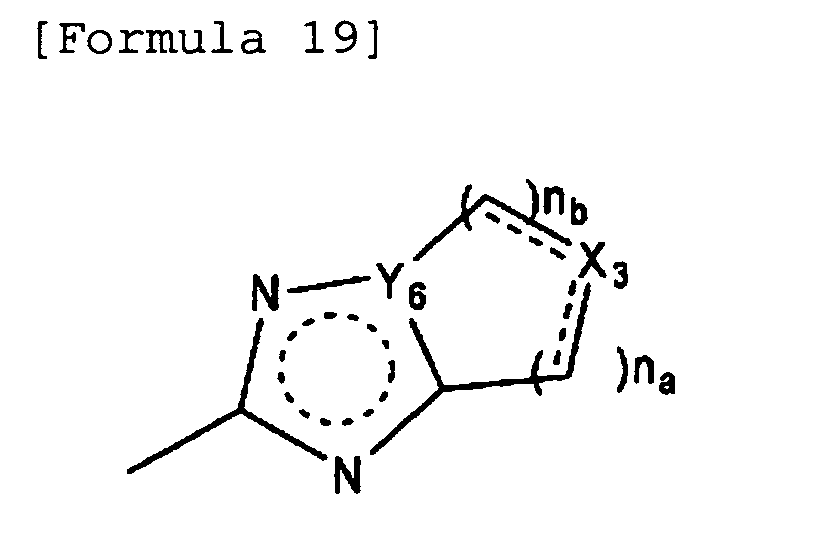
... represents a single bond or a double bond, X3 represents a methine group or methylene group, an imino group, an oxygen atom, a sulfur atom or -SO2-, which may be substituted with a substituent selected from Substituent Group A4, Y6 represents a carbon atom or a nitrogen atom, and na and nb independently represent an integer of 0 to 3", is, for example, a group of the formula: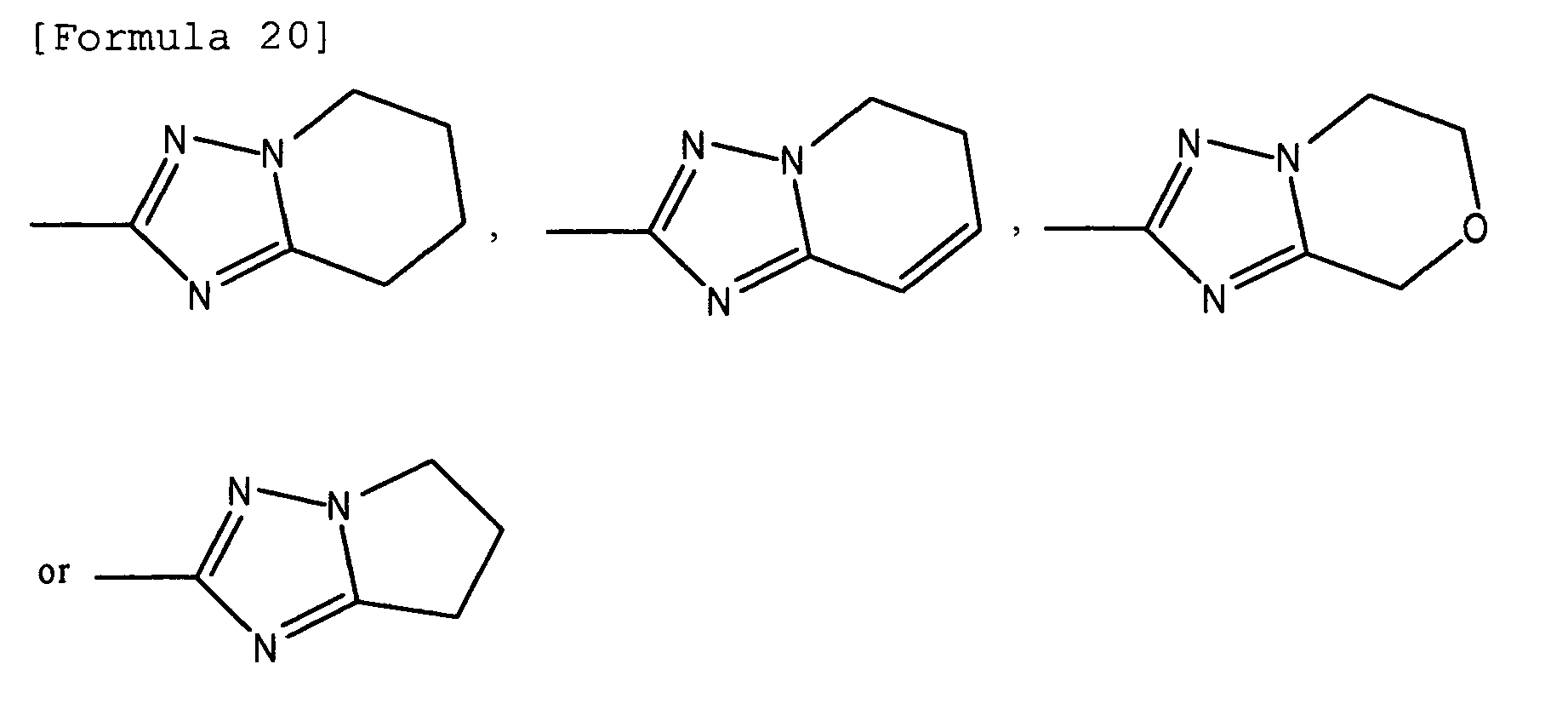
- The "Het which is a group represented by the formula:
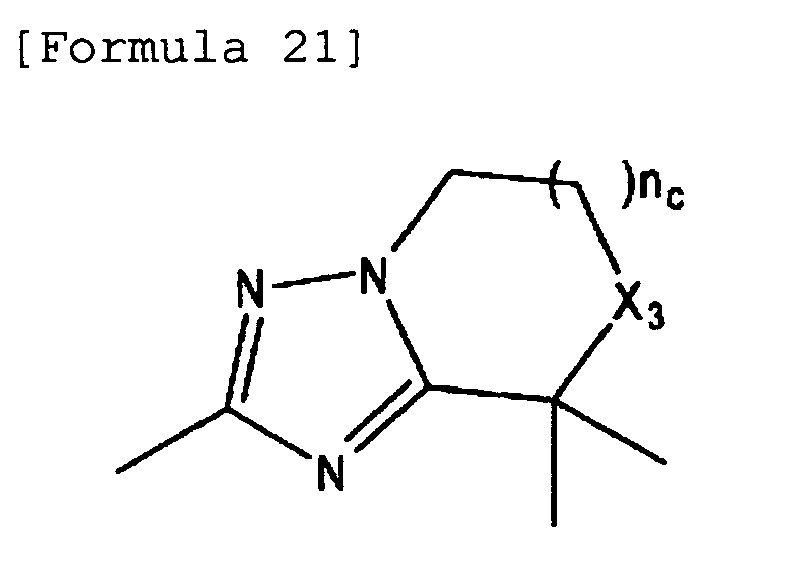

- The "Het which is a group represented by the formula:

wherein... represents a single bond or a double bond, X4 represents a methine group or methylene group, an imino group, an oxygen atom, a sulfur atom or -SO2- which may be substituted with a substituent selected from Substituent Group A4, Y7 represents a carbon atom or a nitrogen atom, and ne and nf independently represent an integer of 0 to 3" is, for example, a group of the formula:
- The "Het which is a group represented by the formula:

wherein R8 and R9 are the same or different and each represent a substituent selected from Substituent Group A4, X4 is the same as defined in claim 33, and ng represent an integer of 0 to 2" is, for example, a group of the formula;
- In the present invention, there are no specific limitations to the "pharmacologically acceptable salt" insofar as it is a pharmacologically acceptable salt formed with a compound of the general formula (I) that is a prophylactic or therapeutic agent for a disease caused by Aβ. Preferable specific examples of the salt include hydrohalides (such as hydrofluorides, hydrochlorides, hydrobromides and hydroiodides), inorganic acid salts (such as sulfates, nitrates, perchlorates, phosphates, carbonates and bicarbonates), organic carboxylates (such as acetates, oxalates, maleates, tartrates, fumarates and citrates), organic sulfonates (such as methanesulfonates, trifluoromethanesulfonates, ethanesulfonates, benzenesulfonates, toluenesulfonates and camphorsulfonates), amino acid salts (such as aspartates and glutamates), quaternary amine salts, alkali metal salts (such as sodium salts and potassium salts) and alkali earth metal salts (such as magnesium salts and calcium salts).
- Next, the compound of the formula (I) of the present invention will be described.
In the compound of the formula (I) or pharmacologically acceptable salt thereof, Ar1 is preferably an imidazolyl group, triazolyl group or tetrazolyl group, Ar1 is more preferably an imidazolyl group or triazolyl group, and Ar1 is most preferably an imidazolyl group.
In the compound of the formula (I) or pharmacologically acceptable salt thereof, Ar1 is preferably substituted with 1 to 3 substituents selected from Substituent Group Al, Ar1 is more preferably substituted with 1 or 2 substituents selected from the group consisting of a hydrogen atom, a halogen atom, a C3-8 cycloalkyl group, a C2-6 alkenyl group, a C2-6 alkynyl group, and a C1-6 alkyl group (wherein the Cl-6 alkyl group may be substituted with 1 to 3 halogen atoms), and Ar1 is most preferably substituted with a C1-6 alkyl group. - In the compound of the formula (I) or pharmacologically acceptable salt thereof, Ar2 is preferably a pyrimidinyl group, pyridinyl group or phenyl group, and Ar2 is more preferably a phenyl group or pyridinyl group.
In the compound of the formula (I) or pharmacologically acceptable salt thereof, Ar2 is preferably substituted with 1 to 3 substituents selected from Substituent Group A2, Ar2 is preferably substituted with 1 to 3 substituents selected from the group consisting of a hydrogen atom, a halogen atom, a hydroxyl group, a cyano group, C1-6 alkoxy group (wherein the C1-6 alkoxy group may be substituted with 1 to 3 substituents selected from the group consisting of a C1-6 alkyl group, a C2-6 alkenyl group, a C2-6 alkynyl group and a C3-8 cycloalkyl group), a C2-6 alkenyloxy group and a C2-6 alkynyloxy group, Ar2 is more preferably substituted with 1 to 3 substituents selected from the group consisting of a hydrogen atom, a halogen atom, a cyano group and a C1-6 alkoxy group, and Ar2 is most preferably substituted with a C1-6 alkoxy group. - In the compound of the formula (I) or pharmacologically acceptable salt thereof, X1 is preferably -C≡C-, -CR3=CR4- or -CR5= (wherein R3, R4 and R5 are the same or different and each represent a substituent selected from Substituent Group A3), X1 is more preferably -CR3=CR4- (wherein R3 and R4 represent a hydrogen atom, a C1-6 alkyl group, a C1-6 alkoxy group or a halogen atom), and X1 is most preferably -CR3=CR4-(wherein R3 and R4 represent a hydrogen atom, or a halogen atom).
- In the compound of the formula (I) or pharmacologically acceptable salt thereof, preferably, Het is monovalent and is a 5-membered aromatic heterocyclic group, a 5-membered aromatic heterocyclic group condensed with a 5- to 14-membered non-aromatic heterocyclic group or a 5-membered aromatic heterocyclic group condensed with a 6- to 14-membered non-aromatic hydrocarbon ring group, which may be substituted with 1 to 3 substituents selected from Substituent Group A4; preferably, Het is monovalent and is a 5-membered aromatic heterocyclic group represented by the formula:

wherein Y1 and Y2 are the same or different and each represent a methine group, nitrogen atom, oxygen atom or sulfur atom; and
more preferably, Het is an imidazolyl group, tetrazolyl group or triazolyl group. - In the compound of the formula (I) or pharmacologically acceptable salt thereof, preferably, Het is monovalent and is a 5-membered aromatic heterocyclic group, a 5-membered aromatic heterocyclic group condensed with a 5- to 14-membered non-aromatic heterocyclic group or a 5-membered aromatic heterocyclic group condensed with a 6- to 14-membered non-aromatic hydrocarbon ring group, which may be substituted with 1 to 3 substituents selected from Substituent Group A4; and
more preferably, Het is an imidazolyl group or triazolyl group that may be substituted with 1 or 2 substituents selected from the group consisting of a C1-6 alkyl group (wherein the C1-6 alkyl group may be substituted with 1 to 3 substituents selected from the group consisting of a halogen atom, a hydroxyl group, a C1-6 alkyl group, a C1-6 alkoxy group, a 6- to 14-membered aromatic hydrocarbon ring group (wherein the 6- to 14-membered aromatic hydrocarbon ring group may be substituted with 1 to 3 substituents selected from the group consisting of a halogen atom, a hydroxyl group, a C1-6 alkyl group (wherein the C1-6 alkyl group may be substituted with 1 to 3 substituents selected from the group consisting of a halogen atom, a hydroxyl group and a C1-6 alkoxy group) and a C1-6 alkoxy group (wherein the C1-6 alkoxy group may be substituted with 1 to 3 substituents selected from the group consisting of a halogen atom, a hydroxyl group and a C1-6 alkoxy group)) and a 5- to 14-membered aromatic heterocyclic group (wherein the 5- to 14-membered aromatic heterocyclic group may be substituted with 1 to 3 substituents selected from the group consisting of a halogen atom, a hydroxyl group, a C1-6 alkyl group (wherein the C1-6 alkyl group may be substituted with 1 to 3 substituents selected from the group consisting of a halogen atom, a hydroxyl group and a C1-6 alkoxy group) and a C1-6 alkoxy group (wherein the C1-6 alkoxy group may be substituted with 1 to 3 substituents selected from the group consisting of a halogen atom, a hydroxyl group and a C1-6 alkoxy group))), a C1-6 alkoxycarbonyl group, a carboxyl group, a carbamoyl group that may be substituted with a C1-6 alkyl group optionally having 1 to 3 halogen atoms, a 6- to 14-membered aromatic hydrocarbon ring group (wherein the 6- to 14-membered aromatic hydrocarbon ring group may be substituted with 1 to 3 substituents selected from the group consisting of a halogen atom, a hydroxyl group, a C1-6 alkyl group (wherein the C1-6 alkyl group may be substituted with 1 to 3 substituents selected from the group consisting of a halogen atom, a hydroxyl group and a C1-6 alkoxy group) and a C1-6 alkoxy group (wherein the C1-6 alkoxy group may be substituted with 1 to 3 substituents selected from the group consisting of a halogen atom, a hydroxyl group and a C1-6 alkoxy group)) and a 5- to 14-membered aromatic heterocyclic group (wherein the 5- to 14-membered aromatic heterocyclic group may be substituted with 1 to 3 substituents selected from the group consisting of a halogen atom, a hydroxyl group, a C1-6 alkyl group (wherein the C1-6 alkyl group may be substituted with 1 to 3 substituents selected from the group consisting of a halogen atom, a hydroxyl group and a C1-6 alkoxy group), a C1-6 alkoxy group (wherein the C1-6 alkoxy group may be substituted with 1 to 3 substituents selected from the group consisting of a halogen atom, a hydroxyl group and a C1-6 alkoxy group) and a halogen atom), or Het is monovalent and is a group represented by the formula:
- In the compound of the formula (I) or pharmacologically acceptable salt thereof, preferably, Het is divalent and is a 5-membered aromatic heterocyclic group, a 5-membered aromatic heterocyclic group condensed with a 5- to 14-membered non-aromatic heterocyclic group or a 5-membered aromatic heterocyclic group condensed with a 6- to 14-membered non-aromatic hydrocarbon ring group, which may be substituted with 1 to 3 substituents selected from Substituent Group A4; and more preferably, Het is divalent and represented by the formula:

wherein X2 represents an oxygen atom or a methylene group, and Y4 and Y5 are the same or different and each represent a methine group or a nitrogen atom,
Het is divalent and represented by the formula:
Het is divalent and is a group represented by the formula:
- In the compound of the formula (I) or pharmacologically acceptable salt thereof, preferably, Het is monovalent and is a group represented by the formula:

... represents a single bond or a double bond, X3 represents a methine group or methylene group, an imino group, an oxygen atom, a sulfur atom or -SO2- which may be substituted with a substituent selected from Substituent Group A4, Y6 represents a carbon atom or a nitrogen atom, and na and nb independently represent an integer of 0 to 3; and more preferably, Het is monovalent and is a group represented by the formula:
wherein R6 and R7 are the same or different and each represent a substituent selected from Substituent Group A4, X3 represents a methine group or methylene group, an imino group, an oxygen atom, a sulfur atom or -SO2-, which may be substituted with a substituent selected from Substituent Group A4,and nc represents an integer of 0 to 3. - In the compound of the formula (I) or pharmacologically acceptable salt thereof, preferably, Het is monovalent and is a group represented by the formula:

- In the compound of the formula (I) or pharmacologically acceptable salt thereof, preferably, Het is monovalent and is a group represented by the formula:

wherein... represents a single bond or a double bond, X4 represents a methine group or methylene group, an imino group, an oxygen atom, a sulfur atom or -SO2- which may be substituted with a substituent selected from Substituent Group A4, Y7 represents a carbon atom or a nitrogen atom, and ne and nf independently represent an integer of 0 to 3. More preferably, Het is a group represented by the formula:
wherein R8 and R9 are the same or different and each represent a substituelnt selected from Substituent Group A4, X4 represents a methine group or methylene group, an imino group, an oxygen atom, a sulfur atom or -SO2-, which may be substituted with a substituent selected from Substituent Group A4, and ng represent an integer of 0 to 2. - In the compound of the formula (I) or pharmacologically acceptable salt thereof, preferably, Het is monovalent and is a group represented by the formula:

wherein R8 and R9 are the same or different and each represent a substituent selected from Substituent Group A4, X4 represents a methine group or methylene group, an imino group, an oxygen atom, a sulfur atom or -SO2-, which may be substituted with a substituent selected from Substituent Group A4, and ng represent an integer of 0 to 2. More preferably, R8 represents a 6- to 14-membered aromatic hydrocarbon ring group or 5- to 14-membered aromatic heterocyclic group that may be substituted with 1 to 3 substituents selected from Substituent Group A5; and R9 is a substituent selected from Subsituent Group A4. Most preferably, R8 represents a phenyl group, pyridinyl group or naphtyl group that may be substituted with 1 to 3 substituents selected from the group consisting of a hydrogen atom, a halogen atom, a cyano group, a C1-6 alkoxy group (wherein the C1-6 alkoxy group group may be substituted with 1 to 3 halogen atoms), a C1-6 alkyl group (wherein the C1-6 alkyl group may be substituted with 1 to 3 halogen atoms, and an amino group that may be substituted with 1 to 2 C1-6 alkyl groups; and R9 represents an amin group that may be substituted with a hydrogen atom, a halogen atom, a hydroxyl group, a cyano group, a C1-6 alkyl group, a C2-6 alkenyl group, a C2-6 alkynyl group, or 1 to 2 C1-6 alkyl groups. - In particular, a compound selected from the following group or a pharmacologically acceptable salt thereof according to claim 1 is particularly suitable, for example, and is useful as a therapeutic or prophylactic agent for a disease caused by amyloid-β such as Alzheimer's disease, senile dementia, Down's syndrome or amyloidosis.
- 1) 4-(4-fluorophenyl)-2-{(E)-2-[3-methoxy-4-(4-methyl-1H-imidazol-1-yl)phenyl]vinyl}-1H-imidazole,
- 2) 4-(4-fluorophenyl)-2-{(E)-2-[3-methoxy-4-(4-methyl-1H-imidazol-1-yl)phenyl]vinyl}-1-methyl-1H-imidazole,
- 3) 2-{(E)-2-[3-methoxy-4-(4-methyl-1H-imidazol-1-yl)phenyl]vinyl}-1-methyl-5-phenyl-1H-imidazole,
- 4) 2-{(E)-2-[3-methoxy-4-(4-methyl-1H-imidazol-1-yl)phenyl]vinyl}-4-phenyl-1H-imidazole,
- 5) 2-{(E)-2-[3-methoxy-4-(4-methyl-1H-imidazol-1-yl)phenyl]vinyl}-1-methyl-4-phenyl-1H-imidazole,
- 6) methyl 5-(4-fluorophenyl)-2-{(E)-2-[3-methoxy-4-(4-methyl-1H-imidazol-1-yl)phenyl]vinyl}-1H-imidazole-4-carboxylate,
- 7) 5-(4-fluorophenyl)-2-{(E)-2-[3-methoxy-4-(4-methyl-1H-imidazol-1-yl)phenyl]vinyl}-(1H-imidazol-4-yl)methanol,
- 8) 5-(4-fluorophenyl)-2-{(E)-2-[3-methoxy-4-(4-methyl-1H-imidazol-1-yl)phenyl]vinyl}-1H-imidazole-4-carboxylic acid,
- 9) 5-(4-fluorophenyl)-2-{(E)-2-[3-methoxy-4-(4-methyl-1H-imidazol-1-yl)phenyl]vinyl}-1H-imidazole-4-carboxylic acid (2-chloroethyl)amide,
- 10) 1-(4-fluorophenyl)-3-{(E)-2-[3-methoxy-4-(4-methyl-1H-imidazol-1-yl)phenyl]vinyl}-6,7-dihydro-5H-imidazo[1,5-a]pyrazin-8-one,
- 11) 1-(4-fluorophenyl)-3-{(E)-2-[3-methoxy-4-(4-methyl-1H-imidazol-1-yl)phenyl]vinyl}-7-methyl-6,7-dihydro-5H-imidazo[1,5-a]pyrazin-8-one,
- 12) 1-(4-fluorophenyl)-3-{(E)-2-[3-methoxy-4-(4-methyl-1H-imidazol-1-yl)phenyl]vinyl}-5,6-dihydroimidazo[5,1-c][1,4]oxazin-8-one,
- 13) 1-(4-fluorophenyl)-3-{(E)-2-[3-methoxy-4-(4-methyl-1H-imidazol-1-yl)phenyl]vinyl}-5,6-dihydro-8H-imidazo[5,1-c][1,4]oxazine,
- 14) 2-{4-(4-fluorophenyl)-5-methoxymethyl-2-{(E)-2-[3-methoxy-4-(4-methyl-1H-imidazol-1-yl)phenyl]vinyl}imidazol-1-yl}ethanol,
- 15) 1-(4-fluorophenyl)-3-{(E)-2-[3-methoxy-4-(4-methyl-1H-imidazol-1-yl)phenyl]vinyl}-7-methyl-5,6,7,8-tetrahydroimidazo[1,5-a]pyrazine,
- 16) 3-(3-fluorophenyl)-5-{(E)-2-[3-methoxy-4-(4-methyl-1H-imidazol-1-yl)phenyl]vinyl}-4H-[1,2,4]triazole,
- 17) 3-(4-fluorobenzyl)-5-{(E)-2-[3-methoxy-4-(4-methyl-1H-imidazol-1-yl)phenyl]vinyl}-4H-[1,2,4]triazole,
- 18) 3-(4-fluorophenyl)-8-{1-[3-methoxy-4-(4-methyl-1H-imidazol-1-yl)phenyl]-(E)-methylidene}-5,6,7,8-tetrahydroimidazo[1,2-a]pyridine,
- 19) 2-(4-fluorophenyl)-8-{1-[3-methoxy-4-(4-methyl-1H-imidazol-1-yl)phenyl]-(E)-methylidene}-5,6,7,8-tetrahydroimidazo[1,2-a]pyridine,
- 20) 2-(4-fluorophenyl)-8-{1-[3-methoxy-4-(4-methyl-1H-imidazol-1-yl)phenyl]-(E)-methylidene}-5,6,7,8-tetrahydro[1,2,4]triazolo[1,5-a]pyridine,
- 21) methyl 3-(4-fluorophenyl)-8-{1-[3-methoxy-4-(4-methyl-1H-imidazol-1-yl)phenyl]-(E)-methylidene}-5,6,7,8-tetrahydroimidazo[1,2-a]pyridine-2-carboxylate,
- 22) methyl 2-(4-fluorophenyl)-8-{1-[3-methoxy-4-(4-methyl-1H-imidazol-1-yl)phenyl]-(E)-methylidene}-5,6,7,8-tetrahydroimidazo[1,2-a]pyridine-3-carboxylate,
- 23) {3-(4-fluorophenyl)-8-{1-[3-methoxy-4-(4-methyl-1H-imidazol-1-yl)phenyl]-(E)-methylidene}-5,6,7,8-tetrahydroimidazo[1,2-a]pyridin-2-yl}methanol,
- 24) {2-(4-fluorophenyl)-8-{1-[3-methoxy-4-(4-methyl-1H-imidazol-1-yl)phenyl]-(E)-methylidene}-5,6,7,8-tetrahydroimidazo[1,2-a]pyridin-3-yl]methanol,
- 25) 3-(4-fluorophenyl)-8-{1-[3-methoxy-4-(4-methyl-1H-imidazol-1-yl)phenyl]-(E)-methylidene}-5,6,7,8-tetrahydroimidazo[1,2-a]pyridine-2-carboxylic acid,
- 26) 3-(4-fluorophenyl)-8-{1-[3-methoxy-4-(4-methyl-1H-imidazol-1-yl)phenyl]-(E)-methylidene}-5,6,7,8-tetrahydroimidazo[1,2-a]pyridine-2-carboxylic acid dimethylamide,
- 27) 3-(4-fluorophenyl)-8-{1-[3-methoxy-4-(4-methyl-1H-imidazol-1-yl)phenyl]-(E)-methylidene}-5,6,7,8-tetrahydroimidazo[1,2-a]pyridine-2-carboxylic acid methylamide,
- 28) 3-(4-fluorophenyl)-8-{1-[3-methoxy-4-(4-methyl-1H-imidazol-1-yl)phenyl]-(E)-methylidene}-5,6,7,8-tetrahydroimidazo[1,2-a]pyridine-2-carboxylic acid amide,
- 29) 1-(4-fluorobenzyl)-2-{(E)-2-[3-methoxy-4-(4-methyl-1H-imidazol-1-yl)phenyl]vinyl]-4,5-dimethyl-1H-imidazole,
- 30) 8-{1-[3-methoxy-4-(4-methyl-1H-imidazol-1-yl)phenyl]-(E)-methylidene}-2-pyridin-4-yl-5,6,7,8-tetrahydroimidazo[1,2-a]pyridine,
- 31) 3-[1-(4-fluorophenyl)ethyl]-5-{(E)-2-[3-methoxy-4-(4-methyl-1H-imidazol-1-yl)phenyl]vinyl}-4H-[1,2,4]triazole,
- 32) 3-[2-(4-fluorophenyl)ethyl]-5-{(E)-2-[3-methoxy-4-(4-methyl-1H-imidazol-1-yl)phenyl]vinyl}-4H-[1,2,4]triazole,
- 33) 4-(4-fluorobenzyl)-2-{(E)-2-[3-methoxy-4-(4-methyl-1H-imidazol-1-yl)phenyl]vinyl}-1H-imidazole,
- 34) 5-(4-fluorobenzyl)-3-{(E)-2-[3-methoxy-4-(4-methyl-1H-imidazol-1-yl)phenyl]vinyl}-1-methyl-1H-[1,2,4]triazole,
- 35) 3-(4-fluorobenzyl)-5-{(E)-2-[3-methoxy-4-(4-methyl-1H-imidazol-1-yl)phenyl]vinyl}-1-methyl-1H-[1,2,4]triazole,
- 36) (+)-3-[1-(4-fluorophenyl)ethyl]-5-{(E)-2-[3-methoxy-4-(4-methyl-1H-imidazol-1-yl)phenyl]vinyl}-4H-[1,2,4]triazole,
- 37) (-)-3-[1-(4-fluorophenyl)ethyl]-5-{(E)-2-[3-methoxy-4-(4-methyl-1H-imidazol-1-yl)phenyl]vinyl}-4H-[1,2,4]triazole,
- 38) 5-[1-(4-fluorophenyl)ethyl]-3-{(E)-2-[3-methoxy-4-(4-methyl-1H-imidazol-1-yl)phenyl]vinyl}-1-methyl-1H-[1,2,4]triazole,
- 39) 3-[1-(4-fluorophenyl)ethyl]-5-{(E)-2-[3-methoxy-4-(4-methyl-1H-imidazol-1-yl)phenyl]vinyl}-1-methyl-1H-[1,2,4]triazole,
- 40) 5-[1-(4-fluorophenyl)ethyl]-3-{(E)-2-[3-methoxy-4-(4-methyl-1H-imidazol-1-yl)phenyl]vinyl}-1-methyl-1H-[1,2,4]triazole,
- 41) 3-[1-(4-fluorophenyl)ethyl]-5-{(E)-2-[3-methoxy-4-(4-methyl-1H-imidazol-1-yl)phenyl]vinyl}-1-methyl-1H-[1,2,4]triazole,
- 42) (+)-3-[1-(4-fluorophenyl)ethyl]-5-{(E)-2-[3-methoxy-4-(4-methyl-1H-imidazol-1-yl)phenyl]vinyl}-4-methyl-4H-[1,2,4]triazole,
- 43) (-)-3-[1-(4-fluorophenyl)ethyl]-5-{(E)-2-[3-methoxy-4-(4-methyl-1H-imidazol-1-yl)phenyl]vinyl}-4-methyl-4H-[1,2,4]triazole,
- 44) 3-{(E)-2-[3-methoxy-4-(4-methyl-1H-imidazol-1-yl)phenyl]vinyl}-5-(1-phenylethyl)-4H-[1,2,4]triazole,
- 45) 3-{(E)-2-[3-methoxy-4-(4-methyl-1H-imidazol-1-yl)phenyl]vinyl}-1-methyl-5-(1-phenylethyl)-1H-[1,2,4]triazole,
- 46) 5-{(E)-2-[3-methoxy-4-(4-methyl-1H-imidazol-1-yl)phenyl]vinyl}-1-methyl-3-(1-phenylethyl)-1H-[1,2,4]triazole,
- 47) 3-(4-fluorophenyl)-5-{(E)-2-[3-methoxy-4-(4-methyl-1H-imidazol-1-yl)phenyl]vinyl}-4H-[1,2,4]triazole,
- 48) 5-(4-fluorophenyl)-2-{(E)-2-[3-methoxy-4-(4-methyl-1H-imidazol-1-yl)phenyl]vinyl}-4-methyl-1H-imidazole,
- 49) 3-{(E)-2-[3-methoxy-4-(4-methyl-1H-imidazol-1-yl)phenyl]vinyl}-5-(1-methyl-1-phenylethyl)-4H-[1,2,4]triazole,
- 50) 3-{(E)-2-[3-methoxy-4-(4-methyl-1H-imidazol-1-yl)phenyl]vinyl}-1-phenyl-5,6,7,8-tetrahydroimidazo[1,5-a]pyridine,
- 51) (+)-8-(4-fluorophenyl)-2-{(E)-2-[3-methoxy-4-(4-methyl-1H-imidazol-1-yl)phenyl]vinyl}-5,6,7,8-tetrahydro[1,2,4]triazolo[1,5-a]pyridine,
- 52) (-)-8-(4-fluorophenyl)-2-{(E)-2-[3-methoxy-4-(4-methyl-1H-imidazol-1-yl)phenyl]vinyl}-5,6,7,8-tetrahydro[1,2,4]triazolo[1,5-a]pyridine,
- 53) (+)-2-{(E)-2-[3-methoxy-4-(4-methyl-1H-imidazol-1-yl)phenyl]vinyl}-8-(3,4,5-trifluorophenyl)-5,6,7,8-tetrahydro[1,2,4]triazolo[1,5-a]pyridine,
- 54) (-)-2-{(E)-2-[3-methoxy-4-(4-methyl-1H-imidazol-1-yl)phenyl]vinyl}-8-(3,4,5-trifluorophenyl)-5,6,7,8-tetrahydro[1,2,4]triazolo[1,5-a]pyridine,
- 55) (+)-5-(4-fluorophenyl)-2-{(E)-2-[3-methoxy-4-(4-methyl-1H-imidazol-1-yl)phenyl]vinyl}-5,6,7,8-tetrahydro[1,2,4]triazolo[1,5-a]pyridine,
- 56) (-)-5-(4-fluorophenyl)-2-{(E)-2-[3-methoxy-4-(4-methyl-1H-imidazol-1-yl)phenyl]vinyl}-5,6,7,8-tetrahydro[1,2,4]triazolo[1,5-a]pyridine,
- 57) (+)-2-{(Z)-1-fluoro-2-[3-methoxy-4-(4-methyl-1H-imidazol-1-yl)phenyl]vinyl}-8-(3,4,5-trifluorophenyl)-5,6,7,8-tetrahydro[1,2,4]triazolo[1,5-a]pyridine,
- 58) (-)-2-{(Z)-1-fluoro-2-[3-methoxy-4-(4-methyl-1H-imidazol-1-yl)phenyl]vinyl}-8-(3,4,5-trifluorophenyl)-5,6,7,8-tetrahydro[1,2,4]triazolo[1,5-a]pyridine,
- 59) (+)-2-{(E)-2-[5-methoxy-6-(4-methyl-1H-imidazol-1-yl)pyridin-3-yl]vinyl}-8-(3,4,5-trifluorophenyl)-5,6,7,8-tetrahydro[1,2,4]triazolo[1,5-a]pyridine,
- 60) (-)-2-{(E)-2-[5-methoxy-6-(4-methyl-1H-imidazol-1-yl)pyridin-3-yl]vinyl}-8-(3,4,5-trifluorophenyl)-5,6,7,8-tetrahydro[1,2,4]triazolo[1,5-a]pyridine,
- 61) (+)-2-{(E)-2-[3-fluoro-4-(4-methyl-1H-imidazol-1-yl)phenyl]vinyl}-8-(3,4,5-trifluorophenyl)-5,6,7,8-tetrahydro[1,2,4]triazolo[1,5-a]pyridine,
- 62) (-)-2-{(E)-2-[3-fluoro-4-(4-methyl-1H-imidazol-1-yl)phenyl]vinyl}-8-(3,4,5-trifluorophenyl)-5,6,7,8-tetrahydro[1,2,4]triazolo[1,5-a]pyridine,
- 63) (+)-2-{(E)-2-[3-methoxy-4-(4-methyl-1H-imidazol-1-yl)phenyl]vinyl}-8-(2,4,6-trifluorophenyl)-5,6,7,8-tetrahydro[1,2,4]triazolo[1,5-a]pyridine,
- 64) (-)-2-{(E)-2-[3-methoxy-4-(4-methyl-1H-imidazol-1-yl)phenyl]vinyl}-8-(2,4,6-trifluorophenyl)-5,6,7,8-tetrahydro[1,2,4]triazolo[1,5-a]pyridine,
- 65) 7-(4-fluorophenyl)-2-{(E)-2-[3-methoxy-4-(4-methyl-1H-imidazol-1-yl)phenyl]vinyl}-6,7-dihydro-5H-pyrrolo[1,2-b][1,2,4]triazol-7-ol,
- 66) (-)-2-{(E)-2-[3-methoxy-4-(4-methyl-1H-imidazol-1-yl)phenyl]vinyl}-8-(3,4,5-trifluorophenyl)-5,6,7,8-tetrahydro[1,2,4]triazolo[1,5-a]pyridin-8-ol,
- 67) (+)-2-{(E)-2-[3-methoxy-4-(4-methyl-1H-imidazol-1-yl)phenyl]vinyl}-8-(3,4,5-trifluorophenyl)-5,6,7,8-tetrahydro[1,2,4]triazolo[1,5-a]pyridin-8-ol,
- 68) (+)-2-{(E)-2-[2-fluoro-5-methoxy-4-(4-methyl-1H-imidazol-1-yl)phenyl]vinyl}-8-(3,4,5-trifluorophenyl)-5,6,7,8-tetrahydro[1,2,4]triazolo[1,5-a]pyridine,
- 69) (-)-2-{(E)-2-[2-fluoro-5-methoxy-4-(4-methyl-1H-imidazol-1-yl)phenyl]vinyl}-8-(3,4,5-trifluorophenyl)-5,6,7,8-tetrahydro[1,2,4]triazolo[1,5-a]pyridine,
- 70) (-)-8-(4-fluorophenyl)-2-{(E)-2-[3-methoxy-4-(4-methyl-1H-imidazol-1-yl)phenyl]vinyl}-5,6,7,8-tetrahydro[1,2,4]triazolo[1,5-a]pyridin-8-ol,
- 71) (+)-8-(4-fluorophenyl)-2-{(E)-2-[3-methoxy-4-(4-methyl-1H-imidazol-1-yl)phenyl]vinyl}-5,6,7,8-tetrahydro[1,2,4]triazolo[1,5-a]pyridin-8-ol,
- 72) (+)-8-fluoro-8-(4-fluorophenyl)-2-{(E)-2-[3-methoxy-4-(4-methyl-1H-imidazol-1-yl)phenyl]vinyl}-5,6,7,8-tetrahydro[1,2,4]triazolo[1,5-a]pyridine,
- 73) (-)-8-fluoro-8-(4-fluorophenyl)-2-{(E)-2-[3-methoxy-4-(4-methyl-1H-imidazol-1-yl)phenyl]vinyl}-5,6,7,8-tetrahydro[1,2,4]triazolo[1,5-a]pyridine,
- 74) 8-(4-fluorophenyl)-2-{(E)-2-[3-methoxy-4-(4-methyl-1H-imidazol-1-yl)phenyl]vinyl}-5,6-dihydro[1,2,4]triazolo[1,5-a]pyridine,
- 75) (-)-2-{(E)-2-[3-methoxy-4-(4-methyl-1H-imidazol-1-yl)phenyl]vinyl}-8-(4-methoxyphenyl)-5,6,7,8-tetrahydro-[1,2,4]triazolo[1,5-a]pyridine,
- 76) (+)-2-{(E)-2-[3-methoxy-4-(4-methyl-1H-imidazol-1-yl)phenyl]vinyl}-8-(4-methoxyphenyl)-5,6,7,8-tetrahydro-[1,2,4]triazolo[1,5-a]pyridine,
- 77) (-)-2-{(E)-2-[3-methoxy-4-(4-methyl-1H-imidazol-1-yl)phenyl]vinyl}-8-(3,4,5-trifluorophenyl)-5,6-dihydro-8H-[1,2,4]triazolo[5,1-c][1,4]oxazine,
- 78) (+)-2-{(E)-2-[3-methoxy-4-(4-methyl-1H-imidazol-1-yl)phenyl]vinyl}-8-(3,4,5-trifluorophenyl)-5,6-dihydro-8H-[1,2,4]triazolo[5,1-c][1,4]oxazine,
- 79) (-)-8-(4-fluorophenyl)-2-{(E)-2-[3-methoxy-4-(4-methyl-1H-imidazol-1-yl)phenyl]vinyl}-8-methyl-5,6,7,8-tetrahydro-[1,2,4]triazolo[1,5-a]pyridine,
- 80) (+)-8-(4-fluorophenyl)-2-{(E)-2-[3-methoxy-4-(4-methyl-1H-imidazol-1-yl)phenyl]vinyl}-8-methyl-5,6,7,8-tetrahydro-[1,2,4]triazolo[1,5-a]pyridine,
- 81) 2-(4-fluorobenzyl)-8-{1-[3-methoxy-4-(4-methyl-1H-imidazol-1-yl)phenyl]-(E)-methylidene}-5,6,7,8-tetrahydro[1,2,4]triazolo[1,5-a]pyridine,
- 82) 3-(4-fluorobenzyl)-8-{1-[3-methoxy-4-(4-methyl-1H-imidazol-1-yl)phenyl]-(E)-methylidene}-5,6,7,8-tetrahydro[1,2,4]triazolo[4,3-a]pyridine,
- 83) 3-{(E)-2-[3-methoxy-4-(4-methyl-1H-imidazol-1-yl)phenyl]vinyl}-5-((S)-1-phenylethyl)-4H-[1,2,4]triazole,
- 84) 3-{(E)-2-[3-methoxy-4-(4-methyl-1H-imidazol-1-yl)phenyl]vinyl}-5-((R)-1-phenylethyl)-4H-[1,2,4]triazole,
- 85) (-)-8-(4-fluorophenyl)-8-methoxy-2-{(E)-2-[3-methoxy-4-(4-methyl-1H-imidazol-1-yl)phenyl]vinyl}-5,6,7,8-tetrahydro[1,2,4]triazolo[1,5-a]pyridine,
- 86) (+)-8-(4-fluorophenyl)-8-methoxy-2-{(E)-2-[3-methoxy-4-(4-methyl-1H-imidazol-1-yl)phenyl]vinyl}-5,6,7,8-tetrahydro[1,2,4]triazolo[1,5-a]pyridine,
- 87) (-)-8-methoxy-2-{(E)-2-[3-methoxy-4-(4-methyl-1H-imidazol-1-yl)phenyl]vinyl}-8-(3,4,5-trifluorophenyl)-5,6,7,8-tetrahydro[1,2,4]triazolo[1,5-a]pyridine,
- 88) (+)-8-methoxy-2-{(E)-2-[3-methoxy-4-(4-methyl-1H-imidazol-1-yl)phenyl]vinyl}-8-(3,4,5-trifluorophenyl)-5,6,7,8-tetrahydro[1,2,4]triazolo[1,5-a]pyridine,
- 89) (-)-8-methoxy-2-{(E)-2-[3-methoxy-4-(4-methyl-1H-imidazol-1-yl)phenyl]vinyl}-8-(4-methoxyphenyl)-5,6,7,8-tetrahydro[1,2,4]triazolo[1,5-a]pyridine,
- 90) (+)-8-methoxy-2-{(E)-2-[3-methoxy-4-(4-methyl-1H-imidazol-1-yl)phenyl]vinyl}-8-(4-methoxyphenyl)-5,6,7,8-tetrahydro[1,2,4]triazolo[1,5-a]pyridine,
- 91) 5-[methoxy-(4-methoxyphenyl)methyl]-3-{(E)-2-[3-methoxy-4-(4-methyl-1H-imidazol-1-yl)phenyl]vinyl}-1H-[1,2,4]triazole,
- 92) 7-(4-fluorophenyl)-7-methoxy-2-{(E)-2-[3-methoxy-4-(4-methyl-1H-imidazol-1-yl)phenyl]vinyl}-6,7-dihydro-5H-pyrrolo[1,2-b][1,2,4]triazole,
- 93) 4-(4-fluorophenyl)-2-{(E)-2-[3-methoxy-4-(4-methyl-1H-imidazol-1-yl)phenyl]vinyl}-1-(tetrahydrofuran-2-ylmethyl)-1H-imidazole,
- 94) 4-{5-{(E)-2-[3-methoxy-4-(4-methyl-1H-imidazol-1-yl)phenyl]vinyl}-4H-[1,2,4]triazol-3-yl}-4-(3,4,5-trifluorophenyl)butan-1-ol,
- 95) (+)-2-{(E)-2-[3-methoxy-4-(4-methyl-1H-imidazol-1-yl)phenyl]vinyl}-8-phenyl-5,6,7,8-tetrahydro[1,2,4]triazolo[1,5-a]pyridine-8-carbonitrile,
- 96) (-)-2-{(E)-2-[3-methoxy-4-(4-methyl-1H-imidazol-1-yl)phenyl]vinyl}-8-phenyl-5,6,7,8-tetrahydro[1,2,4]triazolo[1,5-a]pyridine-8-carbonitrile,
- 97) (-)-8-(4-fluorophenyl)-2-{(E)-2-[3-methoxy-4-(4-methyl-1H-imidazol-1-yl)phenyl]vinyl}-5,6,7,8-tetrahydro[1,2,4]triazolo[1,5-a]pyridine-8-carbonitrile,
- 98) (+)-8-(4-fluorophenyl)-2-{(E)-2-[3-methoxy-4-(4-methyl-1H-imidazol-1-yl)phenyl]vinyl}-5,6,7,8-tetrahydro[1,2,4]triazolo[1,5-a]pyridine-8-carbonitrile,
- 99) (+)-8-(4-fluorophenyl)-2-{(E)-2-[3-methoxy-4-(4-methyl-1H-imidazol-1-yl)phenyl]vinyl}-5,6,7,8-tetrahydro[1,2,4]triazolo[1,5-a]pyridin-8-ylamine,
- 100) (-)-8-(4-fluorophenyl)-2-{(E)-2-[3-methoxy-4-(4-methyl-1H-imidazol-1-yl)phenyl]vinyl}-5,6,7,8-tetrahydro[1,2,4]triazolo[1,5-a]pyridin-8-ylamine,
- 101) 2-{(E)-2-[3-fluoro-4-(4-methyl-1H-imidazol-1-yl)phenyl]vinyl}-8-(4-fluorophenyl)-5,6,7,8-tetrahydro[1,2,4]triazolo[1,5-a]pyridine,
- 102) (-)-2-{(E)-2-[3-fluoro-4-(4-methyl-1H-imidazol-1-yl)phenyl]vinyl}-8-(4-fluorophenyl)-5,6,7,8-tetrahydro[1,2,4]triazolo[1,5-a]pyridin-8-ol,
- 103) (+)-2-{(E)-2-[3-fluoro-4-(4-methyl-1H-imidazol-1-yl)phenyl]vinyl}-8-(4-fluorophenyl)-5,6,7,8-tetrahydro[1,2,4]triazolo[1,5-a]pyridin-8-ol,
- 104) 2-{(E)-2-[2-fluoro-5-methoxy-4-(4-methyl-1H-imidazol-1-yl)phenyl]vinyl}-8-(4-fluorophenyl)-5,6,7,8-tetrahydro[1,2,4]triazolo[1,5-a]pyridine,
- 105) (+)-2-{(E)-2-[2-fluoro-5-methoxy-4-(4-methyl-1H-imidazol-1-yl)phenyl]vinyl}-8-(4-fluorophenyl)-5,6,7,8-tetrahydro[1,2,4]triazolo[1,5-a]pyridin-8-ol,
- 106) (-)-2-{(E)-2-[2-fluoro-5-methoxy-4-(4-methyl-1H-imidazol-1-yl)phenyl]vinyl}-8-(4-fluorophenyl)-5,6,7,8-tetrahydro[1,2,4]triazolo[1,5-a]pyridin-8-ol,
- 107) 2-{(Z)-1-fluoro-2-[3-methoxy-4-(4-methyl-1H-imidazol-1-yl)phenyl]vinyl}-8-(4-fluorophenyl)-5,6,7,8-tetrahydro[1,2,4]triazolo[1,5-a]pyridine,
- 108) (-)-2-{(Z)-1-fluoro-2-[3-methoxy-4-(4-methyl-1H-imidazol-1-yl)phenyl]vinyl}-8-(4-fluorophenyl)-5,6,7,8-tetrahydro[1,2,4]triazolo[1,5-a]pyridin-8-ol,
- 109) (+)-2-{(Z)-1-fluoro-2-[3-methoxy-4-(4-methyl-1H-imidazol-1-yl)phenyl]vinyl}-8-(4-fluorophenyl)-5,6,7,8-tetrahydro[1,2,4]triazolo[1,5-a]pyridin-8-ol,
- 110) (-)-2-{(E)-2-[5-methoxy-6-(4-methyl-1H-imidazol-1-yl)pyridin-3-yl]vinyl}-8-(3,4,5-trifluorophenyl)-5,6,7,8-tetrahydro[1,2,4]triazolo[1,5-a]pyridin-8-ol,
- 111) (+)-2-{(E)-2-[5-methoxy-6-(4-methyl-1H-imidazol-1-yl)pyridin-3-yl]vinyl}-8-(3,4,5-trifluorophenyl)-5,6,7,8-tetrahydro[1,2,4]triazolo[1,5-a]pyridin-8-ol,
- 112) (+)-2-{(E)-2-[3-methoxy-4-(4-methyl-1H-imidazol-1-yl)phenyl]vinyl}-7-(3,4,5-trifluorophenyl)-6,7-dihydro-5H-pyrrolo[1,2-b][1,2,4]triazole,
- 113) (-)-2-{(E)-2-[3-methoxy-4-(4-methyl-1H-imidazol-1-yl)phenyl]vinyl}-7-(3,4,5-trifluorophenyl)-6,7-dihydro-5H-pyrrolo[1,2-b][1,2,4]triazole,
- 114) (+)-2-{(E)-2-[3-methoxy-4-(4-methyl-1H-imidazol-1-yl)phenyl]vinyl}-7-(3,4,5-trifluorophenyl)-6,7-dihydro-5H-pyrrolo[1,2-b][1,2,4]triazol-7-ol,
- 115) (-)-2-{(E)-2-[3-methoxy-4-(4-methyl-1H-imidazol-1-yl)phenyl]vinyl}-7-(3,4,5-trifluorophenyl)-6,7-dihydro-5H-pyrrolo[1,2-b][1,2,4]triazol-7-ol,
- 116) (+)-8-(3,4-difluorophenyl)-2-{(E)-2-[3-methoxy-4-(4-methyl-1H-imidazol-1-yl)phenyl]vinyl}-5,6,7,8-tetrahydro-[1,2,4]triazolo[1,5-a]pyridine,
- 117) (-)-8-(3,4-difluorophenyl)-2-{(E)-2-[3-methoxy-4-(4-methyl-1H-imidazol-1-yl)phenyl]vinyl}-5,6,7,8-tetrahydro-[1,2,4]triazolo[1,5-a]pyridine,
- 118) 4-(4-fluorophenyl)-2-{(E)-2-[3-methoxy-4-(4-methyl-1H-imidazol-1-yl)phenyl]vinyl}-4,5,6,7-tetrahydro[1,2,4]triazolo[1,5-a]pyrimidine,
- 119) (+)-3-{(E)-2-[3-methoxy-4-(4-methyl-1H-imidazol-1-yl)phenyl]vinyl}-5-phenyl-5,6,7,8-tetrahydro[1,2,4]triazolo[4,3-a]pyridine,
- 120) (-)-3-{(E)-2-[3-methoxy-4-(4-methyl-1H-imidazol-1-yl)phenyl]vinyl}-5-phenyl-5,6,7,8-tetrahydro[1,2,4]triazolo[4,3-a]pyridine,
- 121) 4-chloro-2-{(E)-2-[3-methoxy-4-(4-methyl-1H-imidazol-1-yl)phenyl]vinyl}-1H-imidazole,
- 122) 4-(4-methoxyphenyl)-2-{(E)-2-[3-methoxy-4-(4-methyl-1H-imidazol-1-yl)phenyl]vinyl}-1H-imidazole,
- 123) 4-(3-methoxyphenyl)-2-{(E)-2-[3-methoxy-4-(4-methyl-1H-imidazol-1-yl)phenyl]vinyl}-1H-imidazole,
- 124) 4-(2-methoxyphenyl)-2-{(E)-2-[3-methoxy-4-(4-methyl-1H-imidazol-1-yl)phenyl]vinyl}-1H-imidazole,
- 125) 4-(4-chlorophenyl)-2-{(E)-2-[3-methoxy-4-(4-methyl-1H-imidazol-1-yl)phenyl]vinyl}-1H-imidazole,
- 126) 4-(4-biphenyl)-2-{(E)-2-[3-methoxy-4-(4-methyl-1H-imidazol-1-yl)phenyl]vinyl}-1H-imidazole,
- 127) 4-(4-propyl)-2-{(E)-2-[3-methoxy-4-(4-methyl-1H-imidazol-1-yl)phenyl]vinyl}-1H-imidazole,
- 128) (+)-2-{(E)-2-[3-methoxy-4-(4-methyl-1H-imidazol-1-yl)phenyl]vinyl}-8-(4-trifluoromethoxyphenyl)-5,6,7,8-tetrahydro[1,2,4]triazolo[1,5-a]pyridine,
- 129) (-)-2-{(E)-2-[3-methoxy-4-(4-methyl-1H-imidazol-1-yl)phenyl]vinyl}-8-(4-trifluoromethoxyphenyl)-5,6,7,8-tetrahydro[1,2,4]triazolo[1,5-a]pyridine,
- 130) (+)-2-{(E)-2-[3-methoxy-4-(4-methyl-1H-imidazol-1-yl)phenyl]vinyl}-8-naphthalen-1-yl-5,6,7,8-tetrahydro[1,2,4]triazolo[1,5-a]pyridine,
- 131) (-)-2-{(E)-2-[3-methoxy-4-(4-methyl-1H-imidazol-1-yl)phenyl]vinyl}-8-naphthalen-1-yl-5,6,7,8-tetrahydro[1,2,4]triazolo[1,5-a]pyridine,
- 132) (+)-2-{(E)-2-[3-methoxy-4-(4-methyl-1H-imidazol-1-yl)phenyl]vinyl}-8-(4-methoxyphenyl)-5,6,7,8-tetrahydro[1,2,4]triazolo[1,5-a]pyridin-8-ol,
- 133) (-)-2-{(E)-2-[3-methoxy-4-(4-methyl-1H-imidazol-1-yl)phenyl]vinyl}-8-(4-methoxyphenyl)-5,6,7,8-tetrahydro[1,2,4]triazolo[1,5-a]pyridin-8-ol,
- 134) (+)-2-{(E)-2-[3-methoxy-4-(4-methyl-1H-imidazol-1-yl)phenyl]vinyl}-8-(4-trifluoromethoxyphenyl)-5,6-dihydro-8H-[1,2,4]triazolo[5,1-c][1,4]oxazine,
- 135) (-)-2-{(E)-2-[3-methoxy-4-(4-methyl-1H-imidazol-1-yl)phenyl]vinyl}-8-(4-trifluoromethoxyphenyl)-5,6-dihydro-8H-[1,2,4]triazolo[5,1-c][1,4]oxazine,
- 136) (-)-2-{(E)-2-[3-methoxy-4-(4-methyl-1H-imidazol-1-yl)phenyl]vinyl}-8-naphthalen-1-yl-5,6,7,8-tetrahydro[1,2,4]triazolo[1,5-a]pyridin-8-ol,
- 137) (+)-2-{(E)-2-[3-methoxy-4-(4-methyl-1H-imidazol-1-yl)phenyl]vinyl}-8-naphthalen-1-yl-5,6,7,8-tetrahydro[1,2,4]triazolo[1,5-a]pyridin-8-ol,
- 138) (-)-2-{(E)-2-[3-methoxy-4-(4-methyl-1H-imidazol-1-yl)phenyl]vinyl}-8-p-tolyl-5,6-dihydro-8H-[1,2,4]triazolo[5,1-c][1,4]oxazine,
- 139) (+)-2-{(E)-2-[3-methoxy-4-(4-methyl-1H-imidazol-1-yl)phenyl]vinyl}-8-p-tolyl-5,6-dihydro-8H-[1,2,4]triazolo[5,1-c][1,4]oxazine,
- 140) (+)-2-{(E)-2-[3-methoxy-4-(4-methyl-1H-imidazol-1-yl)phenyl]vinyl}-8-(2,4,6-trifluorophenyl)-5,6-dihydro-8H-[1,2,4]triazolo[5,1-c][1,4]oxazine,
- 141) (-)-2-{(E)-2-[3-methoxy-4-(4-methyl-1H-imidazol-1-yl)phenyl]vinyl}-8-(2,4,6-trifluorophenyl)-5,6-dihydro-8H-[1,2,4]triazolo[5,1-c][1,4]oxazine,
- 142) (+)-8-(4-bromophenyl)-2-{(E)-2-[3-methoxy-4-(4-methyl-1H-imidazol-1-yl)phenyl]vinyl}-5,6-dihydro-8H-[1,2,4]triazolo[5,1-c][1,4]oxazine,
- 143) (-)-8-(4-bromophenyl)-2-{(E)-2-[3-methoxy-4-(4-methyl-1H-imidazol-1-yl)phenyl]vinyl}-5,6-dihydro-8H-[1,2,4]triazolo[5,1-c][1,4]oxazine,
- 144) (+)-8-(6-chloropyridin-3-yl)-2-{(E)-2-[3-methoxy-4-(4-methyl-1H-imidazol-1-yl)phenyl]vinyl}-5,6-dihydro-8H-[1,2,4]triazolo[5,1-c][1,4]oxazine,
- 145) (-)-8-(6-chloropyridin-3-yl)-2-{(E)-2-[3-methoxy-4-(4-methyl-1H-imidazol-1-yl)phenyl]vinyl}-5,6-dihydro-8H-[1,2,4]triazolo[5,1-c][1,4]oxazine,
- 146) (+)-4-(2-{(E)-2-[3-methoxy-4-(4-methyl-1H-imidazol-1-yl)phenyl]vinyl}-5,6-dihydro-8H-[1,2,4]triazolo[5,1-c][1,4]oxazin-8-yl)benzonitrile,
- 147) (-)-4-(2-{(E)-2-[3-methoxy-4-(4-methyl-1H-imidazol-1-yl)phenyl]vinyl}-5,6-dihydro-8H-[1,2,4]triazolo[5,1-c][1,4]oxazin-8-yl)benzonitrile,
- 148) (+)-8-(4-chlorophenyl)-2-{(E)-2-[3-methoxy-4-(4-methyl-1H-imidazol-1-yl)phenyl]vinyl}-5,6,7,8-tetrahydro[1,2,4]triazolo[1,5-a]pyridine,
- 149) (-)-8-(4-chlorophenyl)-2-{(E)-2-[3-methoxy-4-(4-methyl-1H-imidazol-1-yl)phenyl]vinyl}-5,6,7,8-tetrahydro[1,2,4]triazolo[1,5-a]pyridine,
- 150) (+)-2-{(E)-2-[3-methoxy-4-(4-methyl-1H-imidazol-1-yl)phenyl]vinyl}-8-p-tolyl-5,6,7,8-tetrahydro[1,2,4]triazolo[1,5-a]pyridine,
- 151) (-)-2-{(E)-2-[3-methoxy-4-(4-methyl-1H-imidazol-1-yl)phenyl]vinyl}-8-p-tolyl-5,6,7,8-tetrahydro[1,2,4]triazolo[1,5-a]pyridine,
- 152) (+)-8-(4-chlorophenyl)-2-{(E)-2-[3-methoxy-4-(4-methyl-1H-imidazol-1-yl)phenyl]vinyl}-5,6,7,8-tetrahydro[1,2,4]triazolo[1,5-a]pyridin-8-ol,
- 153) (-)-8-(4-chlorophenyl)-2-{(E)-2-[3-methoxy-4-(4-methyl-1H-imidazol-1-yl)phenyl]vinyl}-5,6,7,8-tetrahydro[1,2,4]triazolo[1,5-a]pyridin-8-ol,
- 154) (+)-2-{(E)-2-[3-methoxy-4-(4-methyl-1H-imidazol-1-yl)phenyl]vinyl}-8-p-tolyl-5,6,7,8-tetrahydro[1,2,4]triazolo[1,5-a]pyridin-8-ol,
- 155) (-)-2-{(E)-2-[3-methoxy-4-(4-methyl-1H-imidazol-1-yl)phenyl]vinyl}-8-p-tolyl-5,6,7,8-tetrahydro[1,2,4]triazolo[1,5-a]pyridin-8-ol,
- 156) (+)-4-{2-{(E)-2-[3-methoxy-4-(4-methyl-1H-imidazol-1-yl)phenyl]vinyl}-5,6,7,8-tetrahydro[1,2,4]triazolo[1,5-a]pyridin-8-yl}benzonitrile,
- 157) (-)-4-{2-{(E)-2-[3-methoxy-4-(4-methyl-1H-imidazol-1-yl)phenyl]vinyl}-5,6,7,8-tetrahydro[1,2,4]triazolo[1,5-a]pyridin-8-yl}benzonitrile,
- 158) (+)-4-{8-hydroxy-2-{(E)-2-[3-methoxy-4-(4-methyl-1H-imidazol-1-yl)phenyl]vinyl}-5,6,7,8-tetrahydro[1,2,4]triazolo[1,5-a]pyridin-8-yl}benzonitrile,
- 159) (-)-4-[8-hydroxy-2-{(E)-2-[3-methoxy-4-(4-methyl-1H-imidazol-1-yl)phenyl]vinyl}-5,6,7,8-tetrahydro[1,2,4]triazolo[1,5-a]pyridin-8-yl}benzonitrile,
- 160) {4-{2-{(E)-2-[3-methoxy-4-(4-methyl-1H-imidazol-1-yl)phenyl]vinyl}-5,6,7,8-tetrahydro[1,2,4]triazolo[1,5-a]pyridin-8-yl}phenyl}dimethylamine,
- 161) (S)-8-(4-chlorophenyl)-3-{(E)-2-[3-methoxy-4-(4-methyl-1H-imidazol-1-yl)phenyl]vinyl}-5,6,7,8-tetrahydro[1,2,4]triazolo[4,3-a]pyridine,
- 162) (R)-8-(4-chlorophenyl)-3-{(E)-2-[3-methoxy-4-(4-methyl-1H-imidazol-1-yl)phenyl]vinyl}-5,6,7,8-tetrahydro[1,2,4]triazolo[4,3-a]pyridine,
- 163) (+)-3-{(E)-2-[3-methoxy-4-(4-methyl-1H-imidazol-1-yl)phenyl]vinyl}-8-(3,4,5-trifluorophenyl)-5,6,7,8-tetrahydro[1,2,4]triazolo[4,3-a]pyridine,
- 164) (-)-3-{(E)-2-[3-methoxy-4-(4-methyl-1H-imidazol-1-yl)phenyl]vinyl}-8-(3,4,5-trifluorophenyl)-5,6,7,8-tetrahydro[1,2,4]triazolo[4,3-a]pyridine,
- 165) (+)-3-{(E)-2-[3-methoxy-4-(4-methyl-1H-imidazol-1-yl)phenyl]vinyl}-7-(3,4,5-trifluorophenyl)-6,7-dihydro-5H-pyrrolo[2,1-c][1,2,4]triazole,
- 166) (-)-3-{(E)-2-[3-methoxy-4-(4-methyl-1H-imidazol-1-yl)phenyl]vinyl}-7-(3,4,5-trifluorophenyl)-6,7-dihydro-5H-pyrrolo[2,1-c][1,2,4]triazole,
- 167) (S)-3-{(E)-2-[3-methoxy-4-(4-methyl-1H-imidazol-1-yl)phenyl]vinyl}-9-(3,4,5-trifluorophenyl)-6,7,8,9-tetrahydro-5H-[1,2,4]triazolo[4,3-a]azepine,
- 168) (R)-3-{(E)-2-[3-methoxy-4-(4-methyl-1H-imidazol-1-yl)phenyl]vinyl}-9-(3,4,5-trifluorophenyl)-6,7,8,9-tetrahydro-5H-[1,2,4]triazolo[4,3-a]azepine,
- 169) (+)-2-{(E)-2-[3-methoxy-4-(4-methyl-1H-imidazol-1-yl)phenyl]vinyl}-9-(3,4,5-trifluorophenyl)-6,7,8,9-tetrahydro-5H-[1,2,4]triazolo[1,5-a]azepine,
- 170) (-)-2-{(E)-2-[3-methoxy-4-(4-methyl-1H-imidazol-1-yl)phenyl]vinyl}-9-(3,4,5-trifluorophenyl)-6,7,8,9-tetrahydro-5H-[1,2,4]triazolo[1,5-a]azepine,
- 171) 3-(4-fluorophenyl)-8-{1-[3-methoxy-4-(4-methyl-1H-imidazol-1-yl)phenyl]-(E)-methylidene}-5,6,7,8-tetrahydro[1,2,4]triazolo[4,3-a]pyridine,
- 172) (-)-2-{(E)-2-[3-methoxy-4-(4-methyl-1H-imidazol-1-yl)phenyl]vinyl}-8-phenyl-5,6,7,8-tetrahydro[1,2,4]triazolo[1,5-a]pyridine,
- 173) (+)-2-{(E)-2-[3-methoxy-4-(4-methyl-1H-imidazol-1-yl)phenyl]vinyl}-8-phenyl-5,6,7,8-tetrahydro[1,2,4]triazolo[1,5-a]pyridine,
- 174) (-)-8-(2-bromophenyl)-2-{(E)-2-[3-methoxy-4-(4-methyl-1H-imidazol-1-yl)phenyl]vinyl}-5,6,7,8-tetrahydro[1,2,4]triazolo[1,5-a]pyridine,
- 175) (+)-8-(2-bromophenyl)-2-{(E)-2-[3-methoxy-4-(4-methyl-1H-imidazol-1-yl)phenyl]vinyl}-5,6,7,8-tetrahydro[1,2,4]triazolo[1,5-a]pyridine,
- 176) 8-(2-bromo-4-fluorophenyl)-2-{(E)-2-[3-methoxy-4-(4-methyl-1H-imidazol-1-yl)phenyl]vinyl}-5,6,7,8-tetrahydro[1,2,4]triazolo[1,5-a]pyridine,
- 177) 8-(2-fluorophenyl)-2-{(E)-2-[3-methoxy-4-(4-methyl-1H-imidazol-1-yl)phenyl]vinyl}-5,6,7,8-tetrahydro[1,2,4]triazolo[1,5-a]pyridine,
- 178) 2-{(E)-2-[3-methoxy-4-(4-methyl-1H-imidazol-1-yl)phenyl]vinyl}-8-(2-methoxyphenyl)-5,6,7,8-tetrahydro[1,2,4]triazolo[1,5-a]pyridine,
- 179) 8-(3-bromophenyl)-2-{(E)-2-[3-methoxy-4-(4-methyl-1H-imidazol-1-yl)phenyl]vinyl}-5,6,7,8-tetrahydro[1,2,4]triazolo[1,5-a]pyridine and
- 180) 2-{(E)-2-[3-methoxy-4-(4-methyl-1H-imidazol-1-yl)phenyl]vinyl}-8-(2-nitrophenyl)-5,6,7,8-tetrahydro[1,2,4]triazolo[1,5-a]pyridine.
- Methods for preparing the compound of the general formula (I) of the present invention will be described below.
The compound represented by the general formula (I):
- Typically used General Preparation Method 1 for the compound of the general formula (I) of the present invention will be described below.

- The above General Preparation Method 1 includes a method of condensing a carboxylic acid compound (1) with a compound (2a) in Step 1-1 to convert the carboxylic acid compound (1) into an ester compound (3) and reacting the ester compound (3) with ammonia, an ammonium salt or formamide in Step 1-2 to prepare a compound of the general formula (I-1); a method of reacting the compound of the general formula (I-1) with a compound (2b) in Step 1-3 to prepare a compound of the general formula (I-2); a method of reacting the ester compound (3) with ammonia, an ammonium salt or formamide in Step 1-4 to convert the ester compound (3) into an oxazole compound (21) and then reacting the oxazole compound (21) with an amine compound (22) in Step 1-5 to prepare a compound of the general formula (I-2); a method of preparing a compound of the general formula (I-4) or a compound of the general formula (I-5) from the compound of the general formula (I-1) in Step 1-6; a method of preparing a compound of the general formula (I-4) or a compound of the general formula (I-5) from the oxazole compound (21) in Step 1-7; a method of preparing a compound of the general formula (I-6) from the ester compound (3) and ammonia, an ammonium salt or formamide in Step 1-8; and a method of preparing compound of the general formula (I-6) from the oxazole compound (21) in Step 1-9.
- The compound of the general formula (I-4) or the compound of the general formula (I-5) can be prepared from a compound of the general formula (I-1) by intramolecular cyclization reaction according to Step 1-6. Specifically, Step 1-6 as an intramolecular cyclization reaction may employ a known method described in many documents such as N-alkylation reaction (see The Journal of Organic Chemistry, 1977, vol.42, p.3925, for example). The compound of the general formula (I-4) or the compound of the general formula (I-5) can also be prepared from an oxazole compound (21) by intramolecular cyclization reaction according to Step 1-7. Specifically, Step 1-7 may employ a method of forming a triazole or imidazole ring and cyclizing the second ring at the same time in the presence or absence of a nitrogen atom source (see The Chemistry of Heterocyclic Compounds. Imidazole and Derivatives, Part I, p.33, Inters. Publish. 1953, for example).
- Step 1-6 is preferably, for example, a method of stirring a compound of the general formula (I-1),
wherein X1 is -CR3=CR4-, and R4 represents a C1-6 alkyl group substituted with a halogen atom or a C1-6 alkoxy group substituted with a halogen atom, or R11 represents a C1-6 alkyl group (wherein the C1-6 alkyl group is substituted with a halogen atom, a C1-6 alkoxy group substituted with a halogen atom or a C1-6 alkylamino group substituted with a halogen atom), in a solvent in the presence of 1.0 to 10.0 equivalents of a base with respect to the compound of the general formula (I-1). The base used varies according to the starting material and is not specifically limited. Preferable examples of the base include alkali metal hydrides (such as sodium hydride and lithium hydride), alkali metal salts (such as potassium carbonate, sodium carbonate and cesium carbonate), metal alkoxides (such as sodium methoxide and tert-butyl potassium) and organometallic salts (such as lithium diisopropyl amide and lithium hexamethyldisilazane). The solvent used varies according to the starting material, and is not specifically limited insofar as the solvent does not inhibit the reaction and allows the starting material to be dissolved therein to a certain extent. Preferable examples of the solvent include ether solvents such as tetrahydrofuran, 1,4-dioxane and diethyl ether; halogenated solvents such as methylene chloride, 1,2-dichloroethane and chloroform; polar solvents such as N,N-dimethylformamide and N-methylpyrrolidone; nonpolar solvents such as toluene and benzene; and a mixture thereof. The reaction temperature must be a temperature that can complete the reaction without promoting formation of an undesirable by-product, and is preferably -78°C to 200°C, for example. Under preferable reaction conditions, the reaction is completed in 1 to 24 hours, and the progress of the reaction can be monitored by a known chromatography technique. An undesirable by-product can be removed by a technique known to a person skilled in the art such as a conventional chromatography technique, extraction or/and crystallization. - Step 1-7 is preferably, for example, a method of stirring an oxazole compound (21), wherein X1 is - CR3=CR4-, and R4 represents a C1-6 alkyl group substituted with a halogen atom or a C1-6 alkoxy group substituted with a halogen atom, or R11 represents a C1-6 alkyl group (wherein the C1-6 alkyl group is substituted with a halogen atom, a C1-6 alkoxy group substituted with a halogen atom or a C1-6 alkylamino group substituted with a halogen atom), in a solvent in the presence of 1.0 to 100 equivalents of ammonia or an ammonium salt such as ammonium acetate with respect to the oxazole compound (21). Step 1-7 may also be a method of stirring an oxazole compound (21), wherein X1 is -CR3=CR4-, and R4 represents a C1-6 alkyl group substituted with an amino group or a C1-6 alkoxy group substituted with an amino group, or R11 represents a C1-6 alkyl group (wherein the C1-6 alkyl group is substituted with an amino group, a C1-6 alkoxy group substituted with an amino group or a C1-6 alkylamino group substituted with an amino group), in a solvent. The solvent used is not specifically limited insofar as the solvent does not inhibit the reaction and allows the starting material to be dissolved therein to a certain extent. Preferable examples of the solvent include nonpolar solvents such as toluene and benzene; alcohol solvents such as methanol and ethanol; organic acids such as acetic acid; water; and a mixture thereof. The reaction temperature must be a temperature that can complete the reaction without promoting formation of an undesirable by-product, and is preferably room temperature to 250°C, for example. Under preferable reaction conditions, the reaction is completed in 1 to 24 hours, and the progress of the reaction can be monitored by a known chromatography technique. An undesirable by-product can be removed by a technique known to a person skilled in the art such as a conventional chromatography technique, extraction or/and crystallization.
- The compound of the general formula (I-6) can be prepared from an ester compound (3) according to Step 1-8 using ammonia, an ammonium salt or formamide as a nitrogen source, for example. The compound of the general formula (I-6) can also be prepared from an oxazole compound (21) according to Step 1-9 using ammonia, an ammonium salt or formamide as a nitrogen source, for example. Specifically, Step 1-8 or Step 1-9 varies according to the starting material and is not specifically limited insofar as the conditions are similar to those in this reaction. A known method described in many documents may be used for the reaction (see The Chemistry of Heterocyclic Compounds. Imidazole and Derivatives, Part I, p.33, Inters. Publish. 1953, for example). The reaction is preferably a method of stirring an ester compound (3) or an oxazole compound (21) and 1.0 to 100.0 equivalents of ammonia or an ammonium salt such as ammonium acetate with respect to the ester compound (3) or the oxazole compound (21) in a solvent, for example. The solvent used is not specifically limited insofar as the solvent does not inhibit the reaction and allows the starting material to be dissolved therein to a certain extent. Preferable examples of the solvent include nonpolar solvents such as toluene and benzene; alcohol solvents such as methanol and ethanol; organic acids such as acetic acid; water; and a mixture thereof. Formamide may optionally be used as a nitrogen atom source and a solvent. The reaction temperature must be a temperature that can complete the reaction without promoting formation of an undesirable by-product, and is preferably room temperature to 250°C, for example. The yield may be improved when the reaction is performed using a tight container. Under preferable reaction conditions, the reaction is completed in 1 to 24 hours, and the progress of the reaction can be monitored by a known chromatography technique. An undesirable by-product can be removed by a technique known to a person skilled in the art such as a conventional chromatography technique, extraction or/and crystallization.
- The compound of the general formula (I-2) can be prepared by reacting a compound of the general formula (I-1) with a compound of the general formula (2b) according to Step 1-3. Specifically, Step 1-3 may employ a known method described in many documents such as N-alkylation reaction (see The Journal of Organic Chemistry, 1977, vol.42, p.3925, for example) or N-arylation reaction (see The Journal of Organic Chemistry, 2001, vol.66, p.7892; Journal of Medicinal Chemistry, 1981, vol.24, p.1139; or Journal of Medicinal Chemistry, 1991, vol.39, p.2671, for example).
- N-alkylation reaction is preferably, for example, a method of stirring a compound of the general formula (I-1) and 1.0 to 10.0 equivalents of a compound (2b), wherein L2 represents a halogen atom such as a chlorine atom, bromine atom or iodine atom or a sulfonate group such as a methanesulfonate group, p-toluenesulfonate group or trifluoromethanesulfonate group, with respect to the compound of the general formula (I-1) in a solvent in the presence of 1.0 to 10.0 equivalents of a base with respect to the compound of the general formula (I-1). The base used varies according to the starting material and is not specifically limited. Preferable examples of the base include alkali metal hydrides (such as sodium hydride and lithium hydride), alkali metal salts (such as potassium carbonate, sodium carbonate and cesium carbonate) and metal alkoxides (such as sodium methoxide and potassium tert-butoxide). The solvent used varies according to the starting material, and is not specifically limited insofar as the solvent does not inhibit the reaction and allows the starting material to be dissolved therein to a certain extent. Preferable examples of the solvent include ether solvents such as tetrahydrofuran, 1,4-dioxane and diethyl ether; halogenated solvents such as methylene chloride, 1,2-dichloroethane and chloroform; polar solvents such as N,N-dimethylformamide and N-methylpyrrolidone; nonpolar solvents such as toluene and benzene; and a mixture thereof. The reaction temperature must be a temperature that can complete the reaction without promoting formation of an undesirable by-product, and is preferably 0°C to 200°C, for example. Under preferable reaction conditions, the reaction is completed in 1 to 24 hours, and the progress of the reaction can be monitored by a known chromatography technique. An undesirable by-product can be removed by a technique known to a person skilled in the art such as a conventional chromatography technique, extraction or/and crystallization.
- N-arylation reaction may be i) Ullmann reaction, ii) a coupling reaction of an arylboronic acid derivative using a copper compound or iii) nucleophilic substitution reaction.
- In the case of i) Ullmann reaction, there are no specific limitations to the reaction conditions. Ullmann reaction is preferably, for example, a method of stirring a compound of the general formula (I-1) and 1.0 to 10.0 equivalents of a compound (2b), wherein L2 represents a halogen atom such as a chlorine atom, bromine atom or iodine atom, with respect to the compound of the general formula (I-1) in a solvent in the presence of 0.01 to 1.0 equivalent of a copper reagent such as copper, copper bromide or copper iodide with respect to the compound of the general formula (I-1) by addition of 1.0 to 10.0 equivalents of a base with respect to the compound of the general formula (I-1). The base used varies according to the starting material and is not specifically limited. Preferable examples of the base include alkali metal salts (such as potassium carbonate, sodium carbonate, potassium acetate, sodium acetate and cesium carbonate) and metal alkoxides (such as sodium methoxide and potassium tert-butoxide). The solvent used varies according to the starting material, the reagent and the like, and is not specifically limited insofar as the solvent does not inhibit the reaction and allows the starting material to be dissolved therein to a certain extent. Preferable examples of the solvent include ether solvents such as tetrahydrofuran, 1,4-dioxane and diethyl ether; halogenated solvents such as methylene chloride, 1,2-dichloroethane and chloroform; alcohol solvents such as amyl alcohol and isopropyl alcohol; polar solvents such as N,N-dimethylformamide and N-methylpyrrolidone; nonpolar solvents such as toluene, benzene and dichlorobenzene; and a mixture thereof. The reaction temperature must be a temperature that can complete the reaction without promoting formation of an undesirable by-product, and is preferably room temperature to 200°C, for example. Under preferable reaction conditions, the reaction is completed in 1 to 24 hours, and the progress of the reaction can be monitored by a known chromatography technique. An undesirable by-product can be removed by a technique known to a person skilled in the art such as a conventional chromatography technique, extraction or/and crystallization.
- The ii) coupling reaction of an arylboronic acid derivative using a copper compound is preferably, for example, a method of stirring a compound of the general formula (I-1) and 1.0 to 10.0 equivalents of a compound (2b), wherein L2 represents a boronic acid group or a boronate group such as a pinacol boronate group, with respect to the compound of the general formula (I-1) in a solvent in the presence of 0.01 to 1.0 equivalent of a copper reagent such as copper, copper bromide or copper iodide with respect to the compound of the general formula (I-1) by addition of 1.0 to 10.0 equivalents of a base with respect to the compound of the general formula (I-1). The base used varies according to the starting material, the solvent used and the like, and is not specifically limited insofar as the base does not inhibit the reaction. Preferable examples of the base include organic bases such as triethylamine, pyridine and tetramethylethylenediamine; alkali metal salts such as potassium carbonate, sodium carbonate, potassium acetate, sodium acetate and cesium carbonate; and metal alkoxides such as sodium methoxide and potassium tert-butoxide. The copper reagent used varies according to the starting material and is not specifically limited. Preferable examples of the copper reagent include copper acetate and di-µ-hydroxo-bis[(N,N,N',N'-tetramethylethylenediamine)copper (II)] chloride. The solvent used varies according to the starting material, the reagent and the like, and is not specifically limited insofar as the solvent does not inhibit the reaction and allows the starting material to be dissolved therein to a certain extent. Preferable examples of the solvent include ether solvents such as tetrahydrofuran, 1,4-dioxane and diethyl ether; halogenated solvents such as methylene chloride, 1,2-dichloroethane and chloroform; polar solvents such as ethyl acetate, N,N-dimethylformamide and N-methylpyrrolidone; nonpolar solvents such as toluene, benzene, dichlorobenzene; and a mixture thereof. The reaction temperature must be a temperature that can complete the reaction without promoting formation of an undesirable by-product, and is preferably room temperature to 200°C, for example. Good results such as reduction in the reaction time and improvement of the yield can be achieved when the reaction is performed in an oxygen atmosphere or air stream. Under preferable reaction conditions, the reaction is completed in 1 to 24 hours, and the progress of the reaction can be monitored by a known chromatography technique. An undesirable by-product can be removed by a technique known to a person skilled in the art such as a conventional chromatography technique, extraction or/and crystallization.
- In iii) nucleophilic substitution reaction, a compound of the general formula (I-1) and 2.0 to 5.0 equivalents of a compound (2b), wherein L2 represents a halogen atom such as a chlorine atom, bromine atom or iodine atom or a sulfonate group such as a methanesulfonate group, p-toluenesulfonate group or trifluoromethanesulfonate group, with respect to the compound of the general formula (I-1) are preferably stirred in a solvent in the presence or absence of 1.0 to 5.0 equivalents of a base with respect to the compound of the general formula (I-1), for example. The base used varies according to the starting material and is not specifically limited. Preferable examples of the base include sodium hydride, sodium hydroxide, potassium hydroxide, potassium carbonate, sodium carbonate, cesium carbonate, barium carbonate, pyridine, lutidine and triethylamine. The solvent used varies according to the starting material, and is not specifically limited insofar as the solvent does not inhibit the reaction and allows the starting material to be dissolved therein to a certain extent. Preferable examples of the solvent include acetonitrile, tetrahydrofuran, dimethyl sulfoxide, N,N-dimethylformamide and N-methylpyrrolidine. Optionally, the bases may be used as a solvent. The reaction temperature must be a temperature that can complete the reaction without promoting formation of an undesirable by-product, and is preferably room temperature to 150°C, for example. Under preferable reaction conditions, the reaction is completed in 1 to 24 hours, and the progress of the reaction can be monitored by a known chromatography technique. An undesirable by-product can be removed by a technique known to a person skilled in the art such as a conventional chromatography technique or/and crystallization.
- The compound of the general formula (I-2) can be prepared by reacting an oxazole compound (21) with an amine compound (22) according to Step 1-5. Specifically, Step 1-5 varies according to the starting material and is not specifically limited insofar as the conditions are similar to those in this reaction. A known method described in many documents may be used for the reaction (see Heterocyclic Compounds, vol.5, Wiley, New York, N.Y. 1950, p.214, for example). Preferably, an oxazole compound (21) and 1.0 to 100.0 equivalents of an amine compound (22) with respect to the oxazole compound (21) are stirred in a solvent, for example. The solvent used is not specifically limited insofar as the solvent does not inhibit the reaction and allows the starting material to be dissolved therein to a certain extent. Preferable examples of the solvent include ether solvents such as tetrahydrofuran, 1,4-dioxane and diethyl ether; halogenated solvents such as methylene chloride, 1,2-dichloroethane and chloroform; alcohol solvents such as amyl alcohol and isopropyl alcohol; polar solvents such as N,N-dimethylformamide and N-methylpyrrolidone; nonpolar solvents such as toluene, benzene and dichlorobenzene; organic acids such as acetic acid; water; and a mixture thereof. The amine compound (22) to be reacted may be used as a solvent. The reaction temperature must be a temperature that can complete the reaction without promoting formation of an undesirable by-product, and is preferably room temperature to 200°C, for example. Under preferable reaction conditions, the reaction is completed in 1 to 24 hours, and the progress of the reaction can be monitored by a known chromatography technique. An undesirable by-product can be removed by a technique known to a person skilled in the art such as a conventional chromatography technique, extraction or/and crystallization.
- The compound of the general formula (I-1) can be prepared from an ester compound (3) according to Step 1-2 using ammonia, an ammonium salt or formamide as a nitrogen atom source, for example. Specifically, Step 1-2 varies according to the starting material and is not specifically limited insofar as the conditions are similar to those in this reaction. A known method described in many documents may be used for the reaction (see The Chemistry of Heterocyclic Compounds. Imidazole and Derivatives, Part I, p.33, Inters. Publish. 1953, for example). The reaction is preferably a method of stirring an ester compound (3) and 1.0 to 100.0 equivalents of ammonia or an ammonium salt such as ammonium acetate with respect to the ester compound (3) in a solvent, for example. The solvent used is not specifically limited insofar as the solvent does not inhibit the reaction and allows the starting material to be dissolved therein to a certain extent. Preferable examples of the solvent include nonpolar solvents such as toluene and benzene; alcohol solvents such as methanol and ethanol; organic acids such as acetic acid; water; and a mixture thereof. Formamide may optionally be used as a nitrogen atom source and a solvent. The reaction temperature must be a temperature that can complete the reaction without promoting formation of an undesirable by-product, and is preferably room temperature to 250°C, for example. The yield may be improved when the reaction is performed using a tight container. Under preferable reaction conditions, the reaction is completed in 1 to 24 hours, and the progress of the reaction can be monitored by a known chromatography technique. An undesirable by-product can be removed by a technique known to a person skilled in the art such as a conventional chromatography technique, extraction or/and crystallization.
- The ester compound (3) is prepared by condensation reaction of a carboxylic acid compound (1) with a compound (2a) according to Step 1-1.
Specifically, Step 1-1 varies according to the starting material and is not specifically limited insofar as the conditions are similar to those in this reaction. A known method described in many documents may be used for the reaction. Preferable examples of the reaction include i) nucleophilic substitution reaction of a carboxylic acid compound (1) with a compound (2a),
wherein L1 represents a halogen atom such as a chlorine atom, bromine atom or iodine atom or a sulfonate group such as a methanesulfonate group, p-toluenesulfonate group or trifluoromethanesulfonate group (see Shin Jikken Kagaku Koza (New Courses in Experimental Chemistry), vol.22, Yuki Gosei (Organic Synthesis) [IV], edited by The Chemical Society of Japan, Maruzen Co., Ltd., November 1992, p.49-50, for example) and ii) dehydration condensation reaction of a carboxylic acid compound (1) with a compound (2a), wherein L1 represents a hydroxyl group (see Shin Jikken Kagaku Koza (New Courses in Experimental Chemistry), vol.22, Yuki Gosei (Organic Synthesis) [IV], edited by The Chemical Society of Japan, Maruzen Co., Ltd., November 1992, p.43-47, for example). -
- i) Nucleophilic substitution reaction is preferably, for example, a method of stirring a carboxylic acid compound (1) and 1.0 to 10.0 equivalents of a compound (2a) with respect to the carboxylic acid compound (1) in a solvent in the presence of 1.0 to 10.0 equivalents of a base with respect to the carboxylic acid compound (1). The base used varies according to the starting material and is not specifically limited. Preferable examples of the base include alkali metal hydroxides such as sodium hydroxide and lithium hydroxide; alkali metal carbonates such as sodium carbonate; alkali metal salts of alcohols such as sodium methoxide and potassium tert-butoxide; organic bases such as triethylamine, pyridine and diazabicyclononene; organic metals such as butyl lithium and lithium diisobutylamide; alkali metal hydrides such as sodium hydride; and alkali metal ammonium salts such as sodium amide. The solvent used varies according to the starting material and the base used, and is not specifically limited insofar as the solvent does not inhibit the reaction and allows the starting material to be dissolved therein to a certain extent. Preferable examples of the solvent include polar solvents such as nitromethane, acetonitrile, 1-methyl-2-pyrrolidone, N,N-dimethylformamide and dimethyl sulfoxide; ether solvents such as tetrahydrofuran, 1,4-dioxane and 1,2-dimethoxyethane; nonpolar solvents such as benzene, toluene and xylene; alcohol solvents such as ethanol and methanol; halogenated solvents such as chloroform and methylene chloride; water; and a mixed solvent thereof. The reaction temperature must be a temperature that can complete the reaction without promoting formation of an undesirable by-product, and is preferably -78 to 150°C, for example. Under preferable reaction conditions, the reaction is completed in 1 to 24 hours, and the progress of the reaction can be monitored by a known chromatography technique. An undesirable by-product can be removed by a technique known to a person skilled in the art such as a conventional chromatography technique, extraction or/and crystallization.
-
- ii) Dehydration condensation reaction is preferably, for example, a method of stirring a carboxylic acid compound (1) and 1.0 to 10.0 equivalents of a compound (2a) with respect to the carboxylic acid compound (1) in a solvent in the presence of 0.1 to 10.0 equivalents of a condensing agent with respect to the carboxylic acid compound (1). The condensing agent used varies according to the starting material and is not specifically limited. Preferable examples of the condensing agent include inorganic acids such as hydrochloric acid and sulfuric acid; organic acids such as p-toluenesulfonic acid and methanesulfonic acid; 1,3-dicyclohexylcarbodiimide, 1-ethyl-3-(3'-dimethylaminopropyl)carbodiimide, benzotriazol-1-yloxytris(dimethylamino)phosphonium hexafluorophosphate, diethyl cyanophosphonate, bis(2-oxo-3-oxazolidinyl)phosphonic chloride and diphenyl phosphoryl azide. Preferably, 1.0 to 5.0 equivalents of N-hydroxysuccinimide, N-hydroxybenzotriazole or dimethylaminopyridine may be added in order to make the reaction efficiently proceed, for example. The solvent used varies according to the starting material and the condensing agent used, and is not specifically limited insofar as the solvent does not inhibit the reaction and allows the starting material to be dissolved therein to a certain extent. Preferable examples of the solvent include halogenated solvents such as chloroform, methylene chloride and 1,2-dichloroethane; polar solvents such as tetrahydrofuran and N,N-dimethylformamide; and a mixure thereof. The reaction temperature must be a temperature that can complete the reaction without promoting formation of an undesirable by-product, and is preferably ice-cold temperature to 150°C, for example. Under preferable reaction conditions, the reaction is completed in 1 to 24 hours, and the progress of the reaction can be monitored by a known chromatography technique. An undesirable by-product can be removed by a technique known to a person skilled in the art such as a conventional chromatography technique or/and crystallization.
- The oxazole compound (21) can be prepared by reacting an ester compound (3) with ammonia, an ammonium salt or formamide as a nitrogen atom source according to Step 1-4, for example. Specifically, Step 1-4 varies according to the starting material and is not specifically limited insofar as the conditions are similar to those in this reaction. A known method described in many documents may be used for the reaction (see Synthesis, 1998, vol.9, p.1298, for example). Preferably, an ester compound (3) and 1.0 to 100.0 equivalents of ammonia or an ammonium salt such as ammonium acetate with respect to the ester compound (3) are stirred in a solvent, for example. The solvent used is not specifically limited insofar as the solvent does not inhibit the reaction and allows the starting material to be dissolved therein to a certain extent. Preferable examples of the solvent include nonpolar solvents such as toluene and benzene; alcohol solvents such as methanol and ethanol; organic acids such as acetic acid; water; and a mixture thereof. Formamide may optionally be used as a nitrogen atom source and a solvent. The reaction temperature must be a temperature that can complete the reaction without promoting formation of an undesirable by-product, and is preferably room temperature to 250°C, for example. The yield may be improved when the reaction is performed using a tight container. Under preferable reaction conditions, the reaction is completed in 1 to 24 hours, and the progress of the reaction can be monitored by a known chromatography technique. An undesirable by-product can be removed by a technique known to a person skilled in the art such as a conventional chromatography technique, extraction or/and crystallization.
- The compound (2b) is commercially available or can be prepared by a method known to a person skilled in the art (see Shin Jikken Kagaku Koza (New Courses in Experimental Chemistry), vol.19, Yuki Gosei (Organic Synthesis) [I], edited by The Chemical Society of Japan, Maruzen Co., Ltd., September 1992, p.363-482; and Shin Jikken Kagaku Koza (New Courses in Experimental Chemistry), vol.24, Yuki Gosei (Organic Synthesis) [VI], edited by The Chemical Society of Japan, Maruzen Co., Ltd., June 1992, p.61-90, for example).
- The compound (22) is commercially available or can be prepared by a method known to a person skilled in the art (see Shin Jikken Kagaku Koza (New Courses in Experimental Chemistry), vol.20, Yuki Gosei (Organic Synthesis) [II], edited by The Chemical Society of Japan, Maruzen Co., Ltd., July 1992, p.279-372, for example).
- The compound (2a) is commercially available or can be prepared by a method known to a person skilled in the art (see Shin Jikken Kagaku Koza (New Courses in Experimental Chemistry), vol.19, Yuki Gosei (Organic Synthesis) [I], edited by The Chemical Society of Japan, Maruzen Co., Ltd., September 1992, p.363-482; and Shin Jikken Kagaku Koza (New Courses in Experimental Chemistry), vol.20, Yuki Gosei (Organic Synthesis) [II], edited by The Chemical Society of Japan, Maruzen Co., Ltd., July 1992, p.1-110, for example).
-
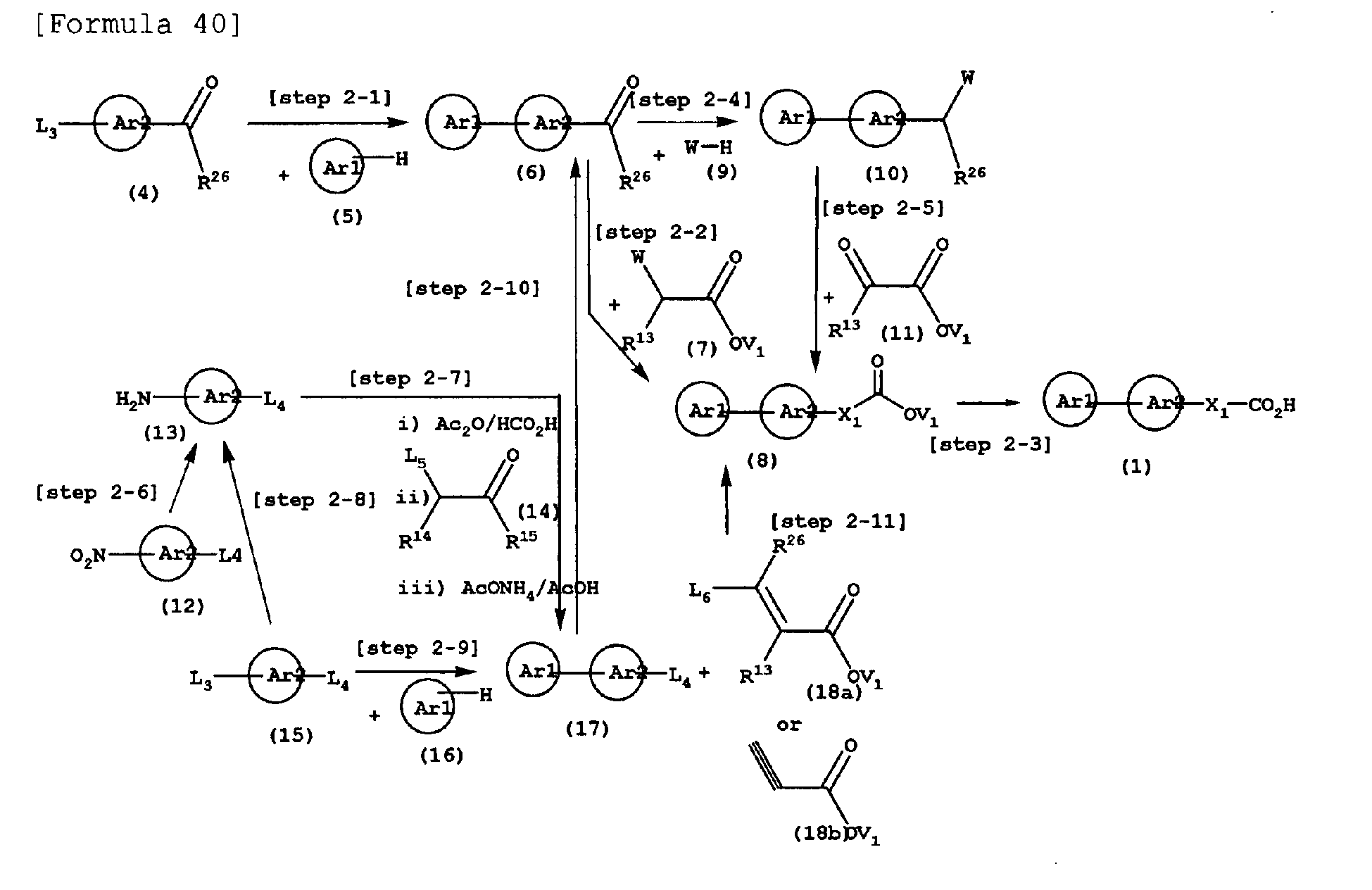
- The carboxylic acid compound (1) is prepared by hydrolysis of an ester compound (8) according to Step 2-3. Specifically, Step 2-3 varies according to the starting material and is not specifically limited insofar as the conditions are similar to those in this reaction. A known method described in many documents may be used for the reaction (see Shin Jikken Kagaku Koza (New Courses in Experimental Chemistry), vol.22, Yuki Gosei (Organic Synthesis) [IV], edited by The Chemical Society of Japan, Maruzen Co., Ltd., November 1992, p.6-11, for example). Preferably, an ester compound (8) is stirred in a solvent in the presence of 1.0 to 100.0 equivalents of a base or acid with respect to the ester compound (8), for example. The base used varies according to the starting material and is not specifically limited. Preferable examples of the base include sodium hydride, sodium hydroxide, potassium hydroxide, potassium carbonate, sodium carbonate, cesium carbonate and barium carbonate. The acid used varies according to the starting material and is not specifically limited. Preferable examples of the acid include inorganic acids such as hydrochloric acid and sulfuric acid; organic acids such as trifluoroacetic acid and p-toluenesulfonic acid; and Lewis acids such as boron trichloride. The solvent used varies according to the starting material, and is not specifically limited insofar as the solvent does not inhibit the reaction and allows the starting material to be dissolved therein to a certain extent. Preferable examples of the solvent include alcohol solvents such as methanol, ethanol and ethylene glycol; ether solvents such as tetrahydrofuran; watre; and a mixture therof. In the case of acid hydrolysis, an organic acid such as acetic acid or formic acid may be used as a solvent. The reaction temperature must be a temperature that can complete the reaction without promoting formation of an undesirable by-product, and is preferably room temperature to 100°C, for example.
Under preferable reaction conditions, the reaction is completed in 1 to 24 hours, and the progress of the reaction can be monitored by a known chromatography technique. An undesirable by-product can be removed by a technique known to a person skilled in the art such as a conventional chromatography technique or/and crystallization. - The ester compound (8) can be prepared as shown by the above reaction formula, but the preparation is not limited thereto. Specifically, the ester compound (8) can be prepared by reacting a compound (4) with a compound (5) in Step 2-1 to obtain a carbonyl compound (6) and then condensing the carbonyl compound (6) by condensation reaction such as Horner-Emmons reaction, Wittig reaction or Peterson reaction in Step 2-2, for example. Alternatively, the ester compound (8) can be prepared by preparing a compound (10) from a carbonyl compound (6) in Step 2-4 and condensing the compound (10) with a compound (11) by condensation reaction such as Horner-Emmons reaction, Wittig reaction or Peterson reaction in Step 2-5. Alternatively, the ester compound (8) can be prepared by forming Ar1 in a compound (17) from an amino compound (13) as a starting material through three-stage reaction in Step 2-7 and then performing coupling reaction of the compound (17) with a compound (18a) or compound (18b) according to Step 2-11. The ester compound (8) can be prepared by converting a compound (15) as a starting material into a compound (17) according to Step 2-9 and then subjecting the compound (17) to Step 2-11.
- A carbonyl compound (6) can be converted into the ester compound (8) and a compound (10) can be converted into the ester compound (8) by a method known to a person skilled in the art. For example, the ester compound (8) can be prepared from a carbonyl compound (6) and a compound (7) according to Step 2-2. Alternatively, the ester compound (8) can be prepared from a compound (10) and a compound (11) according to Step 2-5. Specifically, coupling reaction in Step 2-2 or Step 2-5 varies according to the starting material and is not specifically limited insofar as the conditions are similar to those in this reaction. A method known to a person skilled in the art may be used for the reaction. Preferable examples of the method include Wittig reaction, Horner-Emmons reaction and Peterson reaction (see Shin Jikken Kagaku Koza (Courses in Experimental Chemistry), vol.19, Yuki Gosei (Organic Synthesis) [I], edited by The Chemical Society of Japan, Maruzen Co., Ltd., June 1992, p.57-85, for example).
- In Wittig reaction, a compound (7) or compound (10), wherein W represents a phosphonium salt, and 0.5 to 2.0 equivalents of a carbonyl compound (6) or a compound (11) with respect to the compound (7) or compound (10) are preferably stirred in a solvent in the presence of 1.0 to 5.0 equivalents of a base with respect to the compound (7) or compound (10), for example. This reaction may be a method of first treating a compound (7) or compound (10) and a base to form a phosphorus ylide and then adding a carbonyl compound (6) or a compound (11) to the ylide; or a method of adding a base in the presence of a compound (7) or compound (10) and a carbonyl compound (6) or a compound (11). This reaction is preferably performed in the presence of a solvent from the viewpoint of operativity and stirring efficiency. The solvent used varies according to the starting material and the base used, and is not specifically limited insofar as the solvent does not inhibit the reaction and allows the starting material to be dissolved therein to a certain extent. Preferable examples of the solvent include polar solvents such as nitromethane, acetonitrile, 1-methyl-2-pyrrolidone, N,N-dimethylformamide and dimethyl sulfoxide; ether solvents such as tetrahydrofuran, 1,4-dioxane and 1,2-dimethoxyethane; nonpolar solvents such as benzene, toluene and xylene; alcohol solvents such as ethanol and methanol; halogenated solvents such as chloroform and methylene chloride; water; and a mixed solvent thereof. The base used varies according to the starting material and the solvent. Preferable examples of the base include alkali metal hydroxides such as sodium hydroxide and lithium hydroxide; alkali metal carbonates such as sodium carbonate; alkali metal salts of alcohols such as sodium methoxide and potassium tert-butoxide; organic bases such as triethylamine, pyridine and diazabicyclononene; organic metals such as butyl lithium and lithium diisobutylamide; and alkali metal hydrides such as sodium hydride. The reaction temperature must be a temperature that can complete the reaction without promoting formation of an undesirable by-product, and is preferably -78 to 150°C, for example. Under preferable reaction conditions, the reaction is completed in 1 to 24 hours, and the progress of the reaction can be monitored by a known chromatography technique. An undesirable by-product can be removed by a technique known to a person skilled in the art such as a conventional chromatography technique, extraction or/and crystallization.
- In Horner-Emmons reaction, a compound (7) or compound (10), wherein W represents a phosphite group, and 0.5 to 2.0 equivalents of a carbonyl compound (6) or a compound (11) with respect to the compound (7) or compound (10) are preferably stirred in a solvent in the presence of 1.0 to 5.0 equivalents of a base with respect to the compound (7) or compound (10), for example. This reaction may be a method of first treating a compound (7) or compound (10) and a base to form a carbanion and then adding a carbonyl compound (6) or a compound (11) to the carbanion; or a method of adding a base in the presence of a compound (7) or compound (10) and a carbonyl compound (6) or a compound (11). This reaction is preferably performed in the presence of a solvent from the viewpoint of operativity and stirring efficiency. The solvent used varies according to the starting material and the base used, and is not specifically limited insofar as the solvent does not inhibit the reaction and allows the starting material to be dissolved therein to a certain extent. Preferable examples of the solvent include polar solvents such as 1-methyl-2-pyrrolidone, N,N-dimethylformamide and dimethyl sulfoxide; ether solvents such as tetrahydrofuran, 1,4-dioxane and 1,2-dimethoxyethane; nonpolar solvents such as benzene, toluene and xylene; alcohol solvents such as ethanol and methanol; water; and a mixed solvent thereof. The base used varies according to the starting material and the solvent. Preferable examples of the base include alkali metal hydroxides such as sodium hydroxide and lithium hydroxide; alkali metal carbonates such as sodium carbonate; alkali metal salts of alcohols such as sodium methoxide and potassium tert-butoxide; organic bases such as triethylamine, pyridine and diazabicyclononene; organic metals such as butyl lithium and lithium diisobutylamide; alkali metal hydrides such as sodium hydride; and alkali metal ammonia salts such as sodium amide. The reaction temperature must be a temperature that can complete the reaction without promoting formation of an undesirable by-product, and is preferably -78 to 150°C, for example. Under preferable reaction conditions, the reaction is completed in 1 to 24 hours, and the progress of the reaction can be monitored by a known chromatography technique. An undesirable by-product can be removed by a technique known to a person skilled in the art such as a conventional chromatography technique, extraction or/and crystallization.
- In Peterson reaction, a compound (7) or compound (10), wherein W represents a silyl group, and 0.5 to 2.0 equivalents of a carbonyl compound (6) or a compound (11) with respect to the compound (7) or compound (10) are preferably stirred in a solvent in the presence of 1.0 to 5.0 equivalents of a base with respect to the compound (7) or compound (10), for example. This reaction may be a method of first treating a compound (7) or compound (10) and a base to form a carbanion and then adding a carbonyl compound (6) or a compound (11) to the carbanion; or a method of adding a base in the presence of a compound (7) or compound (10) and a carbonyl compound (6) or a compound (11). This reaction is preferably performed in the presence of a solvent from the viewpoint of operativity and stirring efficiency. The solvent used varies according to the starting material and the base used, and is not specifically limited insofar as the solvent does not inhibit the reaction and allows the starting material to be dissolved therein to a certain extent. Preferable examples of the solvent include polar solvents such as 1-methyl-2-pyrrolidone, N,N-dimethylformamide and dimethyl sulfoxide; ether solvents such as tetrahydrofuran, 1,4-dioxane and 1,2-dimethoxyethane; nonpolar solvents such as benzene, toluene and xylene; alcohol solvents such as ethanol and methanol; water; and a mixed solvent thereof. The base used varies according to the starting material and the solvent. Preferable examples of the base include alkali metal hydroxides such as sodium hydroxide and lithium hydroxide; alkali metal carbonates such as sodium carbonate; alkali metal salts of alcohols such as sodium methoxide and potassium tert-butoxide; organic bases such as triethylamine, pyridine and diazabicyclononene; organic metals such as butyl lithium and lithium diisobutylamide; alkali metal hydrides such as sodium hydride; and alkali metal ammonia salts such as sodium amide. The reaction temperature must be a temperature that can complete the reaction without promoting formation of an undesirable by-product, and is preferably -78 to 150°C, for example. Under preferable reaction conditions, the reaction is completed in 1 to 24 hours, and the progress of the reaction can be monitored by a known chromatography technique. An undesirable by-product can be removed by a technique known to a person skilled in the art such as a conventional chromatography technique, extraction or/and crystallization.
- A compound (17) can be converted into the ester compound (8) by a method known to a person skilled in the art. The ester compound (8) can be prepared from a compound (17) together with a compound (18a) or compound (18b) according to Step 2-11, for example. Specifically, the coupling reaction in Step 2-11 varies according to the starting material and is not specifically limited insofar as the conditions are similar to those in this reaction. A method known to a person skilled in the art may be used for the reaction. Preferable examples of the method include Mizoroki-Heck reaction (see R.F. Heck, "Org. Reactions.", 1982, vol.27, p.345, for example), Suzuki-Miyaura reaction (see A. Suzuki, "Chem. Rev.", 1995, vol.95, p.2457, for example), Sonogashira reaction (see K. Sonogashira, "Comprehensive Organic Synthesis", 1991, vol.3, p.521) and Stille coupling reaction (see J.K. Stille, "Angew. Chem. Int. Ed. Engl.", 1986, vol.25, p.508, for example).
- In Mizoroki-Heck reaction, a halogen compound or triflate compound (17), wherein L4 represents a chlorine atom, a bromine atom, an iodine atom or a sulfonate group such as a trifluoromethanesulfonate group, is preferably coupled with 1.0 to 5.0 equivalents of an alkene compound (18a; wherein L6 is a hydrogen atom) with respect to the compound (17) in the presence of 0.01 to 0.2 equivalent of a transition metal catalyst with respect to the compound (17), for example. This reaction is preferably performed in the presence of a solvent from the viewpoint of operativity and stirring efficiency. The solvent used varies according to the starting material and the transition metal catalyst used, and is not specifically limited insofar as the solvent does not inhibit the reaction and allows the starting material to be dissolved therein to a certain extent. Preferable examples of the solvent include acetonitrile, tetrahydrofuran, 1,4-dioxane, 1,2-dimethoxyethane, benzene, toluene, xylene, 1-methyl-2-pyrrolidone and N,N-dimethylformamide. The reaction temperature must be a temperature that can complete the coupling reaction, and is preferably room temperature to 150°C. This reaction is performed preferably in an inert gas atmosphere, and more preferably in a nitrogen or argon atmosphere. The transition metal catalyst is preferably a palladium complex, for example, and more preferably a known palladium complex such as palladium (II) acetate, dichlorobis(triphenylphosphine)palladium (II), tetrakis(triphenylphosphine)palladium (0) or tris(dibenzylideneacetone)dipalladium (0). It is also preferable to appropriately add a phosphorus ligand (preferably triphenylphosphine, tri-o-tolylphosphine, tri-tert-butylphosphine or 2-(di-tert-butylphosphino)biphenyl, for example) in order to make the reaction efficiently proceed. A preferable result may be achieved in the presence of a base. The base used is not specifically limited insofar as the base is used in a coupling reaction similar to this reaction. Preferable examples of the base include triethylamine, N,N-diisopropylethylamine, N,N-dicyclohexylmethylamine and tetrabutylammonium chloride. Under preferable reaction conditions, the reaction is completed in 1 to 24 hours, and the progress of the reaction can be monitored by a known chromatography technique.
- In Suzuki-Miyaura reaction, a halogen compound or trifluoromethanesulfonate compound (17), wherein L4 represents a chlorine atom, a bromine atom, an iodine atom or a sulfonate group such as a trifluoromethanesulfonate group, is preferably coupled with 1.0 to 5.0 equivalents of a boronic acid compound or boronate compound (18a; wherein L6 is a boronic acid or boronate group) with respect to the compound (17) in the presence of 0.01 to 0.5 equivalent of a transition metal catalyst with respect to the compound (17), for example. This reaction is preferably performed in the presence of a solvent from the viewpoint of operativity and stirring efficiency. The solvent used varies according to the starting material and the transition metal catalyst used, and is not specifically limited insofar as the solvent does not inhibit the reaction and allows the starting material to be dissolved therein to a certain extent. Preferable examples of the solvent include acetonitrile, tetrahydrofuran, 1,4-dioxane, 1,2-dimethoxyethane, benzene, toluene, xylene, 1-methyl-2-pyrrolidone, N,N-dimethylformamide, water and a mixed solvent thereof. The reaction temperature must be a temperature that can complete the coupling reaction, and is preferably room temperature to 200°C. This reaction is performed preferably in an inert gas atmosphere, and more preferably in a nitrogen or argon atmosphere. Under preferable reaction conditions, the reaction is completed in 1 to 24 hours, and the progress of the reaction can be monitored by a known chromatography technique. The transition metal catalyst is preferably a known palladium complex, and more preferably a known palladium complex such as palladium (II) acetate, dichlorobis(triphenylphosphine)palladium (II), tetrakis(triphenylphosphine)palladium (0), or tris(dibenzylideneacetone)dipalladium (0). A phosphorus ligand (preferably triphenylphosphine, tri-o-tolylphosphine, tricyclohexylphosphine, or tri-tert-butylphosphine, for example) may be appropriately added in order to make the reaction efficiently proceed. A quaternary ammonium salt, preferably tetrabutylammonium chloride or tetrabutylammonium bromide, for example, may also be appropriately added in order to make the reaction efficiently proceed. In this reaction, a preferable result may be achieved in the presence of a base. The base used at this time varies according to the starting material, the solvent used and the like, and is not specifically limited. Preferable examples of the base include sodium hydroxide, barium hydroxide, potassium fluoride, cesium fluoride, sodium carbonate, potassium carbonate, cesium carbonate and potassium phosphate. Under preferable reaction conditions, the reaction is completed in 1 to 24 hours, and the progress of the reaction can be monitored by a known chromatography technique. In this reaction, the desired ester compound (8) can be efficiently obtained even when the compound (18a) is a halide or a trifluoromethanesulfonate compound, wherein L6 is a chlorine atom, bromine atom, iodine atom or trifluoromethanesulfonate group, for example, and the compound (17) is a boronic acid compound or boronate compound, wherein L4 is a boronic acid or boronate group, for example.
- The reaction conditions in Sonogashira reaction vary according to the starting material, the solvent and the transition metal catalyst, and are not specifically limited insofar as the conditions are similar to those in this reaction. A method known to a person skilled in the art may be used for the reaction. Preferably, a compound (17), wherein L4 represents a chlorine atom, a bromine atom, an iodine atom or a sulfonate group such as a trifluoromethanesulfonate group, and 1.0 to 5.0 equivalents of an alkyne compound (18b) with respect to the compound (17) are stirred in a solvent, for example. Preferable examples of the solvent used include acetonitrile, tetrahydrofuran, 1,4-dioxane, 1,2-dimethoxyethane, benzene, toluene, xylene, 1-methyl-2-pyrrolidone, N,N-dimethylformamide and dimethyl sulfoxide. More preferable examples of the solvent include tetrahydrofuran, 1,4-dioxane, 1-methyl-2-pyrrolidone and N,N-dimethylformamide. The reaction temperature must be a temperature that can complete the coupling reaction, and is preferably room temperature to 150°C. This reaction is performed preferably in an inert gas atmosphere, and more preferably in a nitrogen or argon atmosphere. Under preferable reaction conditions, the reaction is completed in 1 to 24 hours, and the progress of the reaction can be monitored by a known chromatography technique. The transition metal catalyst is preferably 0.01 to 0.5 equivalent with respect to the compound (17) of a known palladium complex, and more preferably a known palladium complex such as palladium (II) acetate, dichlorobis(triphenylphosphine)palladium (II), tetrakis(triphenylphosphine)palladium (0) or tris(dibenzylideneacetone)dipalladium (0). A phosphorus ligand (preferably triphenylphosphine, tri-o-tolylphosphine or tri-tert-butylphosphine, for example) may be appropriately added, for example, in order to make the reaction efficiently proceed. In the reaction, a metal halide or a quaternary ammonium salt, preferably copper (I) iodide, lithium chloride, tetrabutylammonium fluoride or silver (I) oxide, for example, may be added. A preferable result may be achieved in the presence of a base. The base used here is not specifically limited insofar as the base is used in a coupling reaction similar to this reaction. Preferable examples of the base include basic solvents such as diethylamine, triethylamine, N,N-diisopropylethylamine, piperidine and pyridine.
- In Stille coupling reaction, a trialkyltin compound (17), wherein L4 represents an alkyltin group, and 1.0 to 5.0 equivalents of a halide or a trifluoromethanesulfonate compound (18a), wherein L6 represents a chlorine atom, bromine atom, iodine atom or trifluoromethanesulfonate group, with respect to the compound (17) are preferably stirred in a solvent in the presence of 0.01 to 0.2 equivalent of a transition metal catalyst with respect to the compound (17), for example. It is preferable to appropriately use 0.1 to 5.0 equivalents of copper (I) halide or/and lithium chloride in order to make the reaction efficiently proceed. Preferable examples of the solvent used in this reaction include toluene, xylene, N,N-dimethylformamide, N,N-dimethylacetamide, 1-methyl-2-pyrrolidone and dimethyl sulfoxide. The reaction temperature must be a temperature that can complete the coupling reaction, and is preferably room temperature to 150°C. The preferable transition metal catalyst is a palladium complex, preferably a known palladium complex such as palladium (II) acetate, dichlorobis(triphenylphosphine)palladium (II), tetrakis(triphenylphosphine)palladium (0) or tris(dibenzylideneacetone)dipalladium (0), for example, and more preferably tetrakis(triphenylphosphine)palladium (0) or tris(dibenzylideneacetone)dipalladium (0), for example. This reaction is performed preferably in an inert gas atmosphere, and more preferably in a nitrogen or argon atmosphere. Under preferable reaction conditions, the reaction is completed in 1 to 24 hours, and the progress of the reaction can be monitored by a known chromatography technique.
- The carbonyl compound (6) can be prepared from a compound (4) as a starting material according to Step 2-1, for example. Specifically, Step 2-1 varies according to the starting material and is not specifically limited insofar as the conditions are similar to those in this reaction. A method known to a person skilled in the art may be used for the reaction. For example, a compound (4) and 1.0 to 5.0 equivalents of a compound (5) with respect to the compound (4) are stirred in a solvent in the presence or absence of 1.0 to 5.0 equivalents of a base with respect to the compound (4) (see D.D. Davey et al., "J. Med. Chem.", 1991, vol.39, p.2671-2677). Preferable examples of the base used include sodium hydride, sodium hydroxide, potassium hydroxide, potassium carbonate, sodium carbonate, cesium carbonate, barium carbonate, pyridine, lutidine and triethylamine. The solvent used varies according to the starting material, and is not specifically limited insofar as the solvent does not inhibit the reaction and allows the starting material to be dissolved therein to a certain extent. Preferable examples of the solvent include acetonitrile, tetrahydrofuran, dimethyl sulfoxide, N,N-dimethylformamide and N-methylpyrrolidine. Optionally, the bases may be used as a solvent. The reaction temperature must be a temperature that can complete the reaction without promoting formation of an undesirable by-product, and is preferably room temperature to 150°C, for example. Under preferable reaction conditions, the reaction is completed in 1 to 24 hours, and the progress of the reaction can be monitored by a known chromatography technique. An undesirable by-product can be removed by a technique known to a person skilled in the art such as a conventional chromatography technique or/and crystallization.
- The carbonyl compound (6) can also be prepared from a compound (17) as a starting material according to Step 2-10, for example. Specifically, Step 2-10 varies according to the starting material and is not specifically limited insofar as the conditions are similar to those in this reaction. A method known to a person skilled in the art may be used for the reaction. For example, it is possible to use a two-stage method of converting a compound (17), wherein L4 represents a chlorine atom, a bromine atom, an iodine atom or a sulfonate group such as a trifluoromethanesulfonate group, into a vinyl compound by Stille coupling reaction using 1.0 to 5.0 equivalents of a vinyltin compound with respect to the compound (17) and then oxidizing the carboxylic acid by ozone oxidation reaction (see S.S. Chandran et al., "Bioorg. Med. Chem. Lett.", 2001, vol.11, p.1493-1496, for example). It is also possible to use carbon monoxide insertion reaction using a transition metal catalyst (see T.Okano et al., "Bull. Chem. Soc. Jpn.", 1994, vol.67, p.2329-2332, for example).
- The compound (4) is commercially available or can be obtained by a technique known to a person skilled in the art. If not commercially available, the preferable compound (4), wherein L3 represents a fluorine atom, chlorine atom or bromine atom, can be obtained by oxidizing a corresponding alcohol compound by an oxidation reaction known to a person skilled in the art; or the carbonyl compound can be obtained by reducing a corresponding ester compound by a known reduction reaction.
- The compound (5) used in this step is commercially available or can be obtained by a technique known to a person skilled in the art. (see M.Komoto et al., "Agr. Biol. Chem.", 1968, vol.32, p.983-987; or J.M.Kokosa et al., "J.Org.Chem.", 1983, vol.48, p.3605-3607, for example).
-

- The above reaction formula shows an example of a method for preparing the phosphonate compound (7). Specifically, the phosphonate compound (7) is commercially available or can be obtained by a method shown in the above Step 3-1 to Step 3-3 and known to a person skilled in the art (see C. Patois et al., "Synth. Commun.", 1991, vol.22, p.2391; or J.A. Jackson et al., "J. Org. Chem.", 1989, vol.20, p.5556, for example). Step 3-1 is a step of obtaining the desired phosphonate compound (7) by stirring a phosphonate compound (20a) and 1.0 to 2.0 equivalents of an alkyl halide compound (19a) with respect to the phosphonate compound (20a) in a solvent in the presence of 1.0 to 1.5 equivalents of a base with respect to the phosphonate compound (20a) to introduce R13, for example. Step 3-2 is a step of obtaining the desired phosphonate compound (7) by stirring a phosphonate compound (19b) and 1.0 to 2.0 equivalents of a halogenated formate compound (20b) with respect to the phosphonate compound (19b) in a solvent in the presence of 1.0 to 1.5 equivalents of a base with respect to the phosphonate compound (19b). Step 3-3 is a step of obtaining the desired phosphonate compound (7) by stirring a phosphonic acid halide compound (19c) and 1.0 to 2.0 equivalents of an ester compound (20c) with respect to the phosphonic acid halide compound (19c) in a solvent in the presence of 1.0 to 1.5 equivalents of a base with respect to the phosphonic acid halide compound (19c). The base used varies according to the starting material and is not specifically limited. Preferable examples of the base include sodium hydride, n-butyl lithium, lithium diisopropylamide, lithium bis(trimethylsilyl)amide and sodium bis(trimethylsilyl)amide. The solvent used varies according to the starting material, and is not specifically limited insofar as the solvent does not inhibit the reaction and allows the starting material to be dissolved therein to a certain extent. Preferable examples of the solvent include hexane, toluene, diethyl ether, tetrahydrofuran, N,N-dimethylformamide, hexamethylphosphoric triamide and a mixed solvent thereof. The reaction temperature must be a temperature that can complete the reaction without promoting formation of an undesirable by-product, and is preferably -78°C to 100°C. Under preferable reaction conditions, the reaction is completed in 1 to 24 hours, and the progress of the reaction can be monitored by a known chromatography technique. An undesirable by-product can be removed by a technique known to a person skilled in the art such as a conventional chromatography technique or/and crystallization. The desired phosphonate compound (7) can be efficiently obtained by modification of R13 by a technique known to a person skilled in the art.
- The alkyl halide compound (19a), phosphonate compound (19b), phosphonic acid halide compound (19c), phosphonate compound (20a), halogenated formate compound (20b) and ester compound (20c) used in this step are commercially available or can be obtained by a technique known to a person skilled in the art.
- The compound (10) can be prepared from a compound (6) and a compound (9) according to Step 2-4. Specifically, Step 2-4 varies according to the starting material and is not specifically limited insofar as the conditions are similar to those in this reaction. A method known to a person skilled in the art may be used for the reaction (see Journal of the American Chemistry, 1961, vol.83, p.173, for example). Preferably, a compound (6) and 1.0 to 10.0 equivalents of a compound (9) with respect to the compound (6) are stirred in a solvent in the presence of 1.0 to 10.0 equivalents of a base with respect to the compound (6), for example. The base used varies according to the starting material and is not specifically limited. Preferable examples of the base include organic bases such as 1,8-diazabicyclo[5,4,0]-7-undecene and diisopropylamine; and alkali metal salts such as potassium carbonate and sodium carbonate. The solvent used varies according to the starting material, and is not specifically limited insofar as the solvent does not inhibit the reaction and allows the starting material to be dissolved therein to a certain extent. Preferable examples of the solvent include hexane, toluene, diethyl ether, tetrahydrofuran, N,N-dimethylformamide, hexamethylphosphoric triamide and a mixed solvent thereof. The reaction temperature must be a temperature that can complete the reaction without promoting formation of an undesirable by-product, and is preferably -78°C to 100°C. Under preferable reaction conditions, the reaction is completed in 1 to 24 hours, and the progress of the reaction can be monitored by a known chromatography technique. An undesirable by-product can be removed by a technique known to a person skilled in the art such as a conventional chromatography technique or/and crystallization.
- The compound (9) used in this step is commercially available or can be obtained by a technique known to a person skilled in the art.
- The compound (11) used in this step is commercially available or can be obtained by a technique known to a person skilled in the art.
- The amine compound (13) is commercially available or can be obtained by a technique known to a person skilled in the art. Preferably, the compound can be prepared from a nitro compound (12) as a starting material according to Step 2-6. Specifically, reduction reaction in Step 2-6 varies according to the starting material and is not specifically limited insofar as the conditions are similar to those in this reaction. A method known to a person skilled in the art may be used for the reaction (see Shin Jikken Kagaku Koza (New Courses in Experimental Chemistry), vol.14, Yuki Kagobutsu No Gosei To Hannou (Synthesis and Reaction of Organic Compounds) [III], edited by The Chemical Society of Japan, Maruzen Co., Ltd., February 1978, p.1333-1341, for example). The reaction is preferably a catalytic reduction method using a metal catalyst or a reduction method using a metal, for example. The catalytic reduction method is preferably performed in a hydrogen atmosphere at normal pressure to 100 atm. Preferable examples of the metal catalyst used in this reaction include platinum, platinum oxide, platinum black, Raney nickel and palladium-carbon. The solvent used in the present reaction varies according to the starting material, and is not specifically limited insofar as the solvent does not inhibit the reaction and allows the starting material to be dissolved therein to a certain extent. Preferable examples of the solvent include methanol, ethanol, diethyl ether, tetrahydrofuran, methylene chloride, chloroform and ethyl acetate. An acidic substance such as acetic acid or hydrochloric acid may be appropriately added in order to make the reaction efficiently proceed. The reduction method using a metal preferably employs zinc, iron or tin, for example, and is preferably performed under acidic conditions using hydrochloric acid, acetic acid or ammonium chloride, for example. The solvent used in the present reaction varies according to the starting material, and is not specifically limited insofar as the solvent does not inhibit the reaction and allows the starting material to be dissolved therein to a certain extent. Preferable examples of the solvent include methanol, ethanol and 2-propanol. The reaction temperature must be a temperature that can complete the reaction without promoting formation of an undesirable by-product, and is preferably room temperature to 100°C. Under preferable reaction conditions, the reaction is completed in 1 to 24 hours, and the progress of the reaction can be monitored by a known chromatography technique. An undesirable by-product can be removed by a technique known to a person skilled in the art such as a conventional chromatography technique or/and crystallization.
- The preferable amine compound (13) can also be prepared from a compound (15) as a starting material which is commercially available or can be obtained by a technique known to a person skilled in the art, according to coupling reaction in Step 2-8. Specifically, the coupling reaction in Step 2-8 varies according to the starting material and is not specifically limited insofar as the conditions are similar to those in this reaction. A method known to a person skilled in the art may be used for the reaction. Preferably, for example, it is possible to use a two-stage method of performing coupling reaction of benzophenone imine using a transition metal catalyst and then performing a known benzophenone removal reaction treatment (see S.L. Buchwald et al., "Tetrahedron Lett.", 1997, vol.38, p.6367-6370; or J.F. Hartwig et al., "J. Am. Chem. Soc.", 1998, vol.120, p.827-828, for example). In the coupling reaction of benzophenone imine, a compound (15) and 1.0 to 10.0 equivalents of benzophenone imine with respect to the compound (15) are stirred in a solvent in the presence of 0.01 to 0.2 equivalent of a catalyst with respect to the compound (15). Examples of the catalyst that can be used include known palladium complexes such as palladium (II) acetate, dichlorobis(triphenylphosphine)palladium (II), tetrakis(triphenylphosphine)palladium (0) and tris(dibenzylideneacetone)dipalladium (0); and known nickel catalysts such as (1,5-cyclooctadiene)nickel (0). Preferably, a phosphorus ligand such as triphenylphosphine, tri-o-tolylphosphine, tri-tert-butylphosphine, 2-(di-tert-butylphosphino)biphenyl, 2,2'-bis(diphenylphosphino)-1,1'-binaphthyl, 1,2-bis(diphenylphosphino)ethane or 1,1'-bis(diphenylphosphino)ferrocene may be appropriately added in order to make the reaction efficiently proceed, for example. A preferable result may be achieved in the presence of a base. The base used is not specifically limited insofar as the base is used in a coupling reaction similar to this reaction. Preferable examples of the base include sodium hydroxide, barium hydroxide, potassium fluoride, cesium fluoride, sodium carbonate, potassium carbonate, cesium carbonate, potassium phosphate and sodium tert-butoxide. The solvent used varies according to the starting material and the transition metal catalyst used, and is not specifically limited insofar as the solvent does not inhibit the reaction and allows the starting material to be dissolved therein to a certain extent. Preferable examples of the solvent include acetonitrile, tetrahydrofuran, 1,4-dioxane, 1,2-dimethoxyethane, benzene, toluene, xylene, 1-methyl-2-pyrrolidone and N,N-dimethylformamide. The reaction temperature must be a temperature that can complete the coupling reaction, and is preferably room temperature to 100°C, for example. This reaction is performed preferably in an inert gas atmosphere, and more preferably in a nitrogen or argon atmosphere. A method known to a person skilled in the art may be used for the treatment after the second stage (see T.W. Green, "Protective Groups in Organic Synthesis", John Wiley & Sons, Inc., 1981). An undesirable by-product can be removed by a technique known to a person skilled in the art such as a conventional chromatography technique or/and crystallization.
- In the preferable amine compound (13), L4 can be modified by a method known to a person skilled in the art, and a hydrogen atom in L4 can be preferably converted into a halogen substituent (see Shin Jikken Kagaku Koza (New Courses in Experimental Chemistry), vol.14, Yuki Kagobutsu No Gosei To Hannou (Synthesis and Reaction of Organic Compounds) [I], edited by The Chemical Society of Japan, Maruzen Co., Ltd., November 1977, p.354-360, for example).
- The nitro compound (12) is commercially available or can be obtained by a technique known to a person skilled in the art. If not commercially available, the preferable compound (12), wherein L4 represents a fluorine atom, chlorine atom, bromine atom or iodine atom, can be efficiently obtained from a corresponding precursor by a nitration reaction known to a person skilled in the art (see Shin Jikken Kagaku Koza (New Courses in Experimental Chemistry), vol.14, Yuki Kagobutsu No Gosei To Hannou (Synthesis and Reaction of Organic Compounds) [III], edited by The Chemical Society of Japan, Maruzen Co., Ltd., February 1978, p.1261-1300, for example).
- The compound (17) can be obtained by a technique known to a person skilled in the art. Preferably, the compound (17) can be prepared i) from a compound (15) as a starting material according to Step 2-9 or ii) from an amine compound (13) as a starting material according to Step 2-7, for example.
- In the case of i), Step 2-9 is performed by the same method as in the above Step 2-1.
In the case of ii), an amine compound (13) can be efficiently converted into the compound (17) in Step 2-7 by treating the amine compound (13) with a mixed solvent of acetic anhydride and formic acid in a first stage, condensing the compound with a compound (14) under basic conditions in a second stage, and heating the condensate with ammonium acetate and acetic acid in a third stage, for example. In the first stage, a compound (13) is stirred in a mixed solvent of 2.0 to 10.0 equivalents of acetic anhydride with respect to the compound (13) and 10.0 to 20.0 equivalents of formic acid with respect to the compound (13) at ice-cold temperature to 50°C. In the second stage, 1.0 to 5.0 equivalents of a base is preferably used with respect to the compound (13). Examples of the base include sodium hydride, sodium hydroxide, potassium hydroxide, lithium hydroxide, n-butyl lithium, lithium diisopropylamide, lithium bis(trimethylsilyl)amide and sodium bis(trimethylsilyl)amide. The solvent used in the present reaction varies according to the starting material, and is not specifically limited insofar as the solvent does not inhibit the reaction and allows the starting material to be dissolved therein to a certain extent. Preferable examples of the solvent include diethyl ether, tetrahydrofuran, dimethyl sulfoxide and N,N-dimethylformamide. Preferably, potassium iodide or sodium iodide may be added, for example, in order to make the reaction efficiently proceed. The reaction temperature must be a temperature that can complete the reaction without promoting formation of an undesirable by-product, and is preferably room temperature to 100°C, for example. In the third stage, the condensate is preferably treated in a mixture of 5.0 to 10.0 equivalents of ammonium acetate with respect to the compound (13) and 10.0 to 20.0 equivalents of acetic acid with respect to the compound (13) at 50 to 100°C. Under preferable reaction conditions, the reaction is completed in 1 to 24 hours, and the progress of the reaction can be monitored by a known chromatography technique. An undesirable by-product can be removed by a technique known to a person skilled in the art such as a conventional chromatography technique or/and crystallization. - The compound (14) used in the second stage of this step is commercially available or can be obtained by a technique known to a person skilled in the art. If not commercially available, the preferable compound (14) can be prepared from a corresponding carbonyl compound by a halogenation reaction known to a person skilled in the art (see Shin Jikken Kagaku Koza (New Courses in Experimental Chemistry), vol.19, Yuki Gosei (Organic Synthesis) [I], edited by The Chemical Society of Japan, Maruzen Co., Ltd., June 1992, p.363-482, for example).
- L4 in the compound (17) can be modified by a technique known to a person skilled in the art, and can be preferably converted into, for example, an iodine group (see S.L. Buchwald et al., "J. Am. Chem. Soc.", 2002, vol.124, p.14844-14845, for example), a lower alkyltin group (see J. Marti et al., "Synth. Commun.", 2000, vol.30, p.3023-3030, for example) or a boron group (see N. Miyaura et al., "J. Org. Chem.", 1995, vol.60, p.7508-7510, for example). The compounds (18a) and (18b) are commercially available or can be obtained by a technique known to a person skilled in the art.
- The compound of the general formula (I-1), general formula (I-2) or general formula (I-4), wherein two of R10, R11 and R12 form a ring, can be prepared from the compound (2a) as a starting material, wherein R10 and R11 form a ring, by the same method as above. When the method as above is performed using the compound (2a) as a starting material, wherein R10 or R11 represents an alkyl group substituted with a halogen atom such as a chlorine atom, bromine atom or iodine atom, the compound of the general formula (I-1), general formula (I-2) or general formula (I-4), wherein two of R10, R11 and R12 form a ring, can be prepared in Step 1-2, Step 1-5, Step 1-6 or Step 1-7.
- Typically used General Preparation Method 2 for the compound of the general formula (I) of the present invention will be described below.
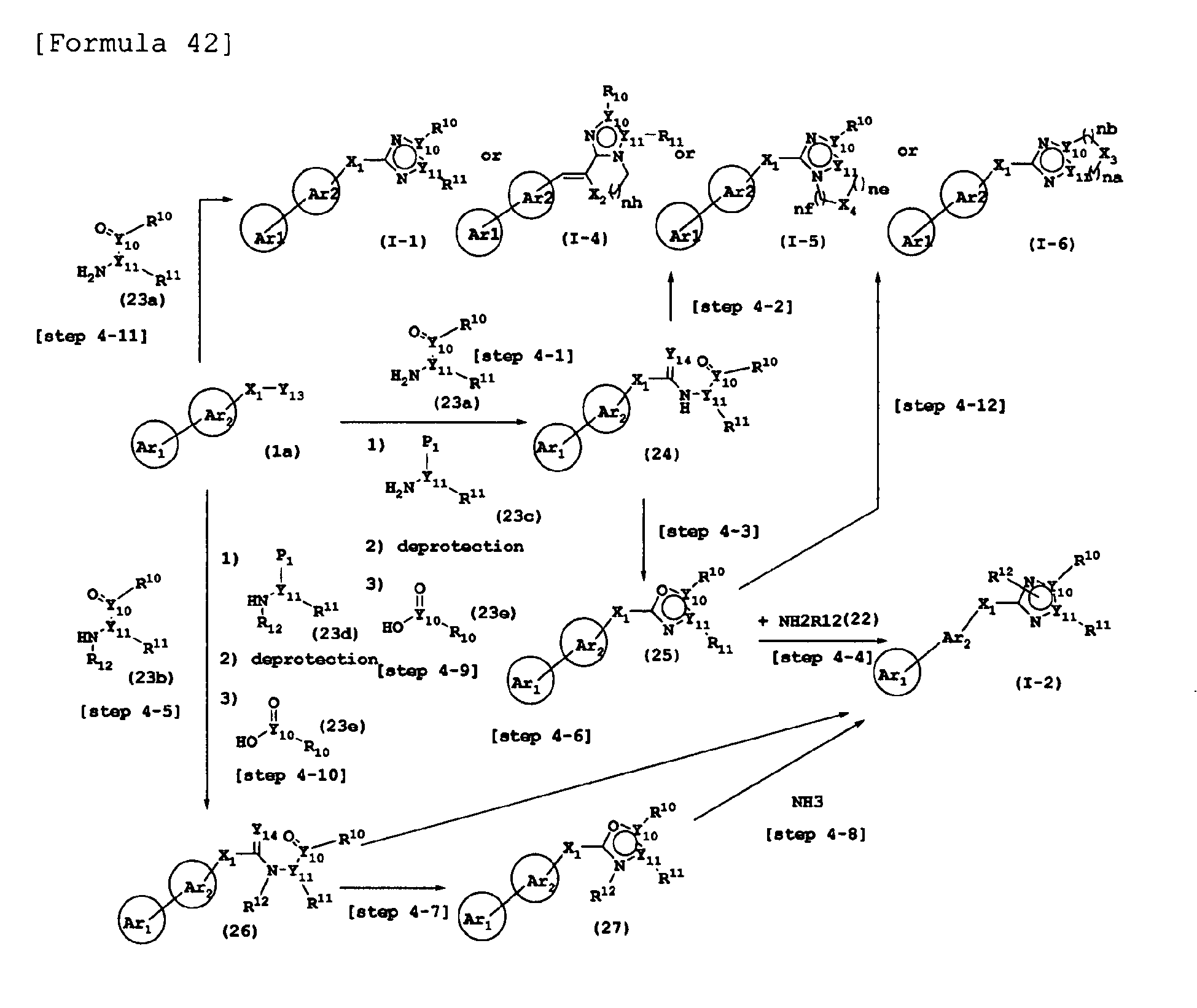
- The above General Preparation Method 2 includes a method of reacting a compound (1a) with an amine compound (23a) or amine compound (23b) according to Step 4-1 or Step 4-5 to convert the compound (1a) into a compound (24) or compound (26), or converting a compound (1a) into a compound (24) or compound (26) according to Step 4-9 or Step 4-10 which is a three-stage reaction including deprotection, and further reacting the resulting compound (24) or compound (26) with ammonia, an ammonium salt or formamide in Step 4-2 or Step 4-6 to prepare a compound of the general formula (I-1), the general formula (I-2), the general formula (I-4), the general formula (I-5) or the general formula (I-6); a method of once converting a compound (24) or compound (26) into an oxazole compound (25) or a compound (27) by dehydration reaction in Step 4-3 or Step 4-7, and then reacting the oxazole compound (25) or the compound (27) with ammonia, an ammonium salt, formamide or an amine compound (22) in Step 4-4, Step 4-8 or Step 4-12 to prepare a compound of the general formula (I-1), the general formula (I-2), the general formula (I-4), the general formula (I-5) or the general formula (I-6); and a method of reacting a compound (1a) with an amine compound (23a) according to Step 4-11 to prepare a compound of the general formula (I-1), the general formula (I-4), the general formula (I-5) or the general formula (I-6).
- The compound of the general formula (I-2) can be prepared i) by reacting a compound (26) in the presence of an acid or base and optionally in the presence of ammonia, an ammonium salt, formamide or the like according to Step 4-6. The compound of the general formula (I-2) can also be prepared ii) by reacting a compound (25) or compound (27) with an amine compound (22), ammonia, an ammonium salt, formamide or the like according to Step 4-4 or Step 4-8.
- The method i), specifically, Step 4-6 varies according to the starting material and is not specifically limited insofar as the conditions are similar to those in this reaction. A known method described in many documents may be used for the reaction (see Heterocyclic Compounds, Vol.5, Wiley, New York, N.Y. 1957, p.503; and Journal of Heterocyclic Chemistry, 1982, vol.19, p.193, for example). Preferably, a compound (26), wherein Y14 represents an oxygen atom or sulfur atom, is stirred in a solvent in the presence of 1.0 to 100.0 equivalents of ammonia, an ammonium salt such as ammonium acetate or ammonium carbonate or formamide with respect to the compound (26), for example. The solvent used is not specifically limited insofar as the solvent does not inhibit the reaction and allows the starting material to be dissolved therein to a certain extent. Preferable examples of the solvent include ether solvents such as tetrahydrofuran, 1,4-dioxane and diethyl ether; halogenated solvents such as methylene chloride, 1,2-dichloroethane and chloroform; alcohol solvents such as amyl alcohol and isopropyl alcohol; polar solvents such as N,N-dimethylformamide and N-methylpyrrolidone; nonpolar solvents such as toluene, benzene and dichlorobenzene; organic acids such as acetic acid; water; and a mixture thereof. Formamide may be used as a solvent. The reaction temperature must be a temperature that can complete the reaction without promoting formation of an undesirable by-product, and is preferably room temperature to 200°C, for example. Under preferable reaction conditions, the reaction is completed in 1 to 24 hours, and the progress of the reaction can be monitored by a known chromatography technique. An undesirable by-product can be removed by a technique known to a person skilled in the art such as a conventional chromatography technique, extraction or/and crystallization.
- Alternatively, a compound (26), wherein Y4 represents a nitrogen atom, is stirred in a solvent in the presence or absence of 0.1 to 10 equivalents of an acid, base or organic salt with respect to the compound (26). Preferable examples of the acid, base or organic salt used include inorganic acids such as hydrochloric acid and sulfuric acid; organic acids, such as p-toluenesulfonic acid and methanesulfonic acid; organic bases such as pyridine and dimethylamino pyridine; and organic salts such as pyridinium p-toluenesulfonate and tetrabutylammonium hydroxide. The solvent used is not specifically limited insofar as the solvent does not inhibit the reaction and allows the starting material to be dissolved therein to a certain extent. Preferable examples of the solvent that can be used include ether solvents such as tetrahydrofuran, 1,4-dioxane and diethyl ether; halogenated solvents such as methylene chloride, 1,2-dichloroethane and chloroform; alcohol solvents such as methanol, ethanol, amyl alcohol and isopropyl alcohol; polar solvents such as N,N-dimethylformamide and N-methylpyrrolidone; nonpolar solvents such as toluene, benzene and dichlorobenzene; water; and a mixture thereof. The above acid, base or organic salt may be used as a solvent. The reaction temperature must be a temperature that can complete the reaction without promoting formation of an undesirable by-product, and is preferably room temperature to 200°C, for example. Under preferable reaction conditions, the reaction is completed in 1 to 24 hours, and the progress of the reaction can be monitored by a known chromatography technique. An undesirable by-product can be removed by a technique known to a person skilled in the art such as a conventional chromatography technique, extraction or/and crystallization.
- The method ii), specifically, Step 4-4 or Step 4-8 varies according to the starting material and is not specifically limited insofar as the conditions are similar to those in this reaction. A known method described in many documents may be used for the reaction (see Heterocyclic Compounds, vol.5, Wiley, New York, N.Y. 1950, p.214; and The Journal of Organic Chemistry, 1962, vol.27, p.3240, for example). For example, an oxazole compound (25) or a compound (27) and 1.0 to 100.0 equivalents of an amine compound (22), ammonia, an ammonium salt such as ammonium acetate or ammonium carbonate or formamide with respect to the compound (25) or compound (27) are stirred in a solvent. The solvent used is not specifically limited insofar as the solvent does not inhibit the reaction and allows the starting material to be dissolved therein to a certain extent. Preferable examples of the solvent include ether solvents such as tetrahydrofuran, 1,4-dioxane and diethyl ether; halogenated solvents such as methylene chloride, 1,2-dichloroethane and chloroform; alcohol solvents such as amyl alcohol and isopropyl alcohol; polar solvents such as N,N-dimethylformamide and N-methylpyrrolidone; nonpolar solvents such as toluene, benzene and dichlorobenzene; organic acids such as acetic acid; water; and a mixture thereof. The amine source to be reacted may be used as a solvent.
The reaction temperature must be a temperature that can complete the reaction without promoting formation of an undesirable by-product, and is preferably room temperature to 200°C, for example. Under preferable reaction conditions, the reaction is completed in 1 to 24 hours, and the progress of the reaction can be monitored by a known chromatography technique. An undesirable by-product can be removed by a technique known to a person skilled in the art such as a conventional chromatography technique, extraction or/and crystallization. The amine compound (22) used in this step is commercially available or can be obtained by a technique known to a person skilled in the art. - The compound of the general formula (I-1), the general formula (I-4), the general formula (I-5) or the general formula (I-6) can be prepared i) by reacting a compound (24) or compound (25) in the presence of ammonia, an ammonium salt, formamide or the like according to Step 4-2 or Step 4-12. The compound of the general formula (I-1), the general formula (I-4), the general formula (I-5) or the general formula (I-6) can also be prepared by reacting a compound (1a) with an amine compound (23a) according to Step 4-11.
- The method i), specifically, Step 4-2 or Step 4-12 is the same method as in Step 4-6.
- The method ii), specifically, Step 4-11 varies according to the starting material and is not specifically limited insofar as the conditions are similar to those in this reaction. A known method described in many documents may be used for the reaction (see Journal of the Chemical Society, 1962, p.5149; and Journal of Medicinal Chemistry, 1983, vol.26, p.1187, for example). For example, a compound (1a), wherein Y13 represents a nitrile group, thioimino ether group or imino ether group, and 1.0 to 5.0 equivalents of an amine compound (23a) with respect to the compound (1a) are stirred in a solvent. The solvent used is not specifically limited insofar as the solvent does not inhibit the reaction and allows the starting material to be dissolved therein to a certain extent. Preferable examples of the solvent include ether solvents such as tetrahydrofuran, 1,4-dioxane and diethyl ether; halogenated solvents such as methylene chloride, 1,2-dichloroethane and chloroform; alcohol solvents such as methanol, ethanol, butanol, amyl alcohol and isopropyl alcohol; polar solvents such as N,N-dimethylformamide and N-methylpyrrolidone; nonpolar solvents such as toluene, benzene and dichlorobenzene; organic acids such as acetic acid; water; and a mixture thereof. The yield may be improved when performing reaction in the presence of 1.0 to 10.0 equivalents of an organic amine such as triethylamine, diisopropylamine or pyridine or an alkali metal salt such as potassium carbonate or sodium carbonate with respect to the compound (1a). The reaction temperature must be a temperature that can complete the reaction without promoting formation of an undesirable by-product, and is preferably room temperature to 200°C, for example. Under preferable reaction conditions, the reaction is completed in 1 to 72 hours, and the progress of the reaction can be monitored by a known chromatography technique. An undesirable by-product can be removed by a technique known to a person skilled in the art such as a conventional chromatography technique, extraction or/and crystallization.
- The compound (24) or compound (26) can be prepared by reacting a compound (1a) with an amine compound (23a) or amine compound (23b) according to Step 4-1 or Step 4-5. Specifically, Step 4-1 or Step 4-5 varies according to the starting material and is not specifically limited insofar as the conditions are similar to those in this reaction. A known method described in many documents may be used for the
reaction (see Shin Jikken Kagaku Koza (New Courses in Experimental Chemistry), vol.22, Yuki Gosei (Organic Synthesis) [IV], edited by The Chemical Society of Japan, Maruzen Co., Ltd., November 1992, p.137-163; and Organic Synthesis, 1941, I, p.5, for example). For example, a compound (1a), wherein Y13 represents a carboxyl group, and 1.0 to 10.0 equivalents of a compound (23a) or compound (23b) with respect to the compound (1a) are stirred in a solvent in the presence of 0.1 to 10.0 equivalents of a condensing agent with respect to the compound (1a). The condensing agent used varies according to the starting material and is not specifically limited. Preferable examples of the condensing agent include inorganic acids such as hydrochloric acid and sulfuric acid; organic acids such as p-toluenesulfonic acid and methanesulfonic acid, 1,3-dicyclohexylcarbodiimide, 1-ethyl-3-(3'-dimethylaminopropyl)carbodiimide, benzotriazol-1-yloxytris(dimethylamino)phosphonium hexafluorophosphate, diethyl cyanophosphonate and bis(2-oxo-3-oxazolidinyl)phosphonic chloride. Preferably, 1.0 to 5.0 equivalents of N-hydroxysuccinimide, N-hydroxybenzotriazole or dimethylaminopyridine may be added with respect to the compound (1a) in order to make the reaction efficiently proceed, for example. The solvent used varies according to the starting material and the condensing agent used, and is not specifically limited insofar as the solvent does not inhibit the reaction and allows the starting material to be dissolved therein to a certain extent. Preferable examples of the solvent include halogenated solvents such as chloroform, methylene chloride and 1,2-dichloroethane; and polar solvents such as tetrahydrofuran and N,N-dimethylformamide. The reaction temperature must be a temperature that can complete the reaction without promoting formation of an undesirable by-product, and is preferably ice-cold temperature to 150°C, for example. Under preferable reaction conditions, the reaction is completed in 1 to 24 hours, and the progress of the reaction can be monitored by a known chromatography technique. An undesirable by-product can be removed by a technique known to a person skilled in the art such as a conventional chromatography technique or/and crystallization. - Alternatively, a compound (1a), wherein Y13 represents a cyano group, imino ether group or thioimino ether group, and 1.0 to 100.0 equivalents of an amine compound (23a) or amine compound (23b) with respect to the compound (1a) are stirred in a solvent. The solvent used is not specifically limited insofar as the solvent does not inhibit the reaction and allows the starting material to be dissolved therein to a certain extent. Preferable examples of the solvent include ether solvents such as tetrahydrofuran, 1,4-dioxane and diethyl ether; halogenated solvents such as methylene chloride, 1,2-dichloroethane and chloroform; alcohol solvents such as methanol, ethanol and isopropyl alcohol; polar solvents such as N,N-dimethylformamide and N-methylpyrrolidone; nonpolar solvents such as toluene, benzene and dichlorobenzene; organic acids such as acetic acid; organic bases such as pyridine; water; and a mixture thereof. The amine compound (23a) or amine compound (24b) may be used as a solvent. The yield may be improved when using 0.1 to 1.0 equivalent of an inorganic acid such as hydrochloric acid, a Lewis acid such as trifluoroborate or an organic acid such as p-toluenesulfonic acid, or 1.0 to 10.0 equivalent of an organic bases such as triethylamine, pyridine and diisopropylethylamine, with respect to the compound (1a). The reaction temperature must be a temperature that can complete the reaction without promoting formation of an undesirable by-product, and is preferably 0 to 200°C, for example. Under preferable reaction conditions, the reaction is completed in 1 to 24 hours, and the progress of the reaction can be monitored by a known chromatography technique. An undesirable by-product can be removed by a technique known to a person skilled in the art such as a conventional chromatography technique, extraction or/and crystallization.
- The compound (24) or compound (26) can also be prepared from a compound (1a) according to Step 4-9 or Step 4-10. Specifically, Step 4-9 or Step 4-10 consists of a three-stage reaction including a deprotection step. In a first stage, a compound (1a) is condensed with a compound (23c) or compound (23d) by dehydration. In a second stage, the protecting group is deprotected. In a third stage, the condensate is condensed with a compound (23e).
- The first-stage condensation reaction may be performed by the same method as in Step 4-1. The second-stage deprotection reaction varies according to the starting material and is not specifically limited insofar as the conditions are similar to those in this reaction. A known method described in many documents may be used for the reaction (see T.W. Green, "Protective Groups in Organic Synthesis", John Wiley & Sons, Inc., 1999, p.615-626). Preferably, the condensation compound in the first stage, wherein P1 represents a tert-butyl carbamate group, is stirred in a solvent in the presence of 1.0 to 100.0 equivalents of an acid with respect to the compound, for example. Examples of the acid used include inorganic acids such as hydrochloric acid and sulfuric acid; and organic acids such as trifluoroacetic acid and methanesulfonic acid. The solvent used is not specifically limited insofar as the solvent does not inhibit the reaction and allows the starting material to be dissolved therein to a certain extent. Preferable examples of the solvent include ethyl acetate, methanol, ethanol, 1,4-dioxane, methylene chloride, chloroform, methanol, isopropyl alcohol, N,N-dimethylformamide and N-methylpyrrolidone. The reaction temperature must be a temperature that can complete the reaction without promoting formation of an undesirable by-product, and is preferably 0 to 100°C, for example. Under preferable reaction conditions, the reaction is completed in 1 to 24 hours, and the progress of the reaction can be monitored by a known chromatography technique. An undesirable by-product can be removed by a technique known to a person skilled in the art such as a conventional chromatography technique, extraction or/and crystallization.
- The third-stage condensation reaction may be performed by the same method as in Step 4-1.
- The compound (1a) can be prepared from a compound (4) or compound (17) by the same method as in the above Step 2-1 or Step 2-10.
- The compound (25) or compound (27) can be prepared from the compound (24) or compound (26) by dehydration reaction according to Step 4-3 or Step 4-7. Specifically, Step 4-3 or Step 4-7 varies according to the starting material and is not specifically limited insofar as the conditions are similar to those in this reaction. A known method described in many documents may be used for the reaction (see The Chemistry of Heterocyclic Compounds, 45; Wiley, New York, 1986, p.1, for example). For example, the compound (24) or compound (26) is stirred in a solvent in the presence of 1.0 to 100.0 equivalents of a dehydration reagent with respect to the compound (24) or compound (26). The dehydration reagent used varies according to the starting material and is not specifically limited. Preferable examples of the dehyration reagent include phosphorus oxychloride, thionyl chloride, phosgene, triphosgene, carbonyldiimidazole, hydrochloric acid, sulfuric acid, p-toluenesulfonic acid, methanesulfonic acid, triphenylphosphine-carbon tetrachloride, and triphenylphophine-carbon tetrabromide. The solvent used is not specifically limited insofar as the solvent does not inhibit the reaction and allows the starting material to be dissolved therein to a certain extent. Preferable examples of the solvent include ether solvents such as tetrahydrofuran, 1,4-dioxane and diethyl ether; halogenated solvents such as methylene chloride, 1,2-dichloroethane and chloroform; polar solvents such as N,N-dimethylformamide and N-methylpyrrolidone; nonpolar solvents such as toluene, benzene and dichlorobenzene; and a mixture thereof. The dehydration reagent may be used as a solvent. The reaction temperature must be a temperature that can complete the reaction without promoting formation of an undesirable by-product, and is preferably 0 to 200°C, for example. Under preferable reaction conditions, the reaction is completed in 1 to 24 hours, and the progress of the reaction can be monitored by a known chromatography technique. An undesirable by-product can be removed by a technique known to a person skilled in the art such as a conventional chromatography technique, extraction or/and crystallization.
- The compound (23a), compound (23b), compound (23c), compound (23d) and compound (23e) are commercially available or can be obtained by a technique known to a person skilled in the art.
- Typically used General Preparation Method 3 for the compound of the general formula (I) of the present invention will be described below.
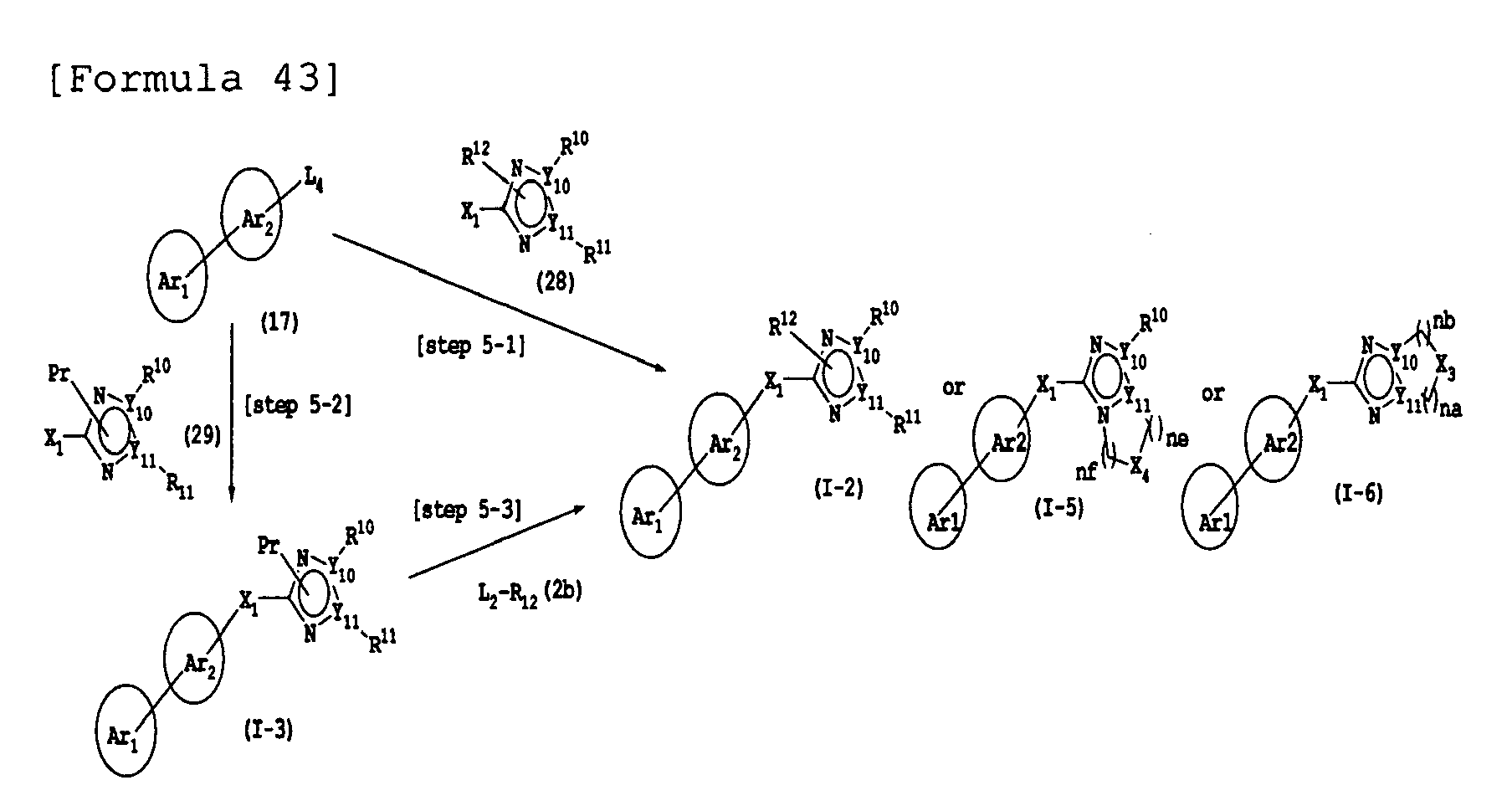
- The above General Preparation Method 3 includes a method of reacting a compound (17) with a heterocyclic compound (28) in Step 5-1 to prepare a compound of the general formula (I-2), the general formula (I-5) or the general formula (I-6); and a method of reacting a compound (17) with a heterocyclic compound (29) having a protecting group in Step 5-2 to once convert the compound (17) into a compound of the general formula (I-3) having a protecting group, and deprotecting the protecting group of the compound of the general formula (I-3) and reacting the compound with a compound (2b) in Step 5-3 to prepare a compound of the general formula (I-2), the general formula (I-5) or the general formula (I-6).
- The compound of the general formula (I-2) or (I-3) can be prepared by i) reacting a compound (17) with a compound (28) or compound (29) according to Step 5-1 or Step 5-2. The compound of the general formula (I-2) can also be prepared by ii) deprotecting the protecting group of the compound of the general formula (I-3) and then reacting the compound with a compound (2b) according to Step 5-3.
- The method i), specifically, Step 5-1 or Step 5-2 varies according to the starting material and is not specifically limited insofar as the conditions are similar to those in this reaction. A known method described in many documents such as Mizoroki-Heck reaction (see R.F. Heck, "Org. Reactions.", 1982, vol.27, p.345, for example) or Sonogashira reaction (see K. Sonogashira, "Comprehensive Organic Synthesis", 1991, vol.3, p.521, for example) may be used for the reaction.
- In Mizoroki-Heck reaction, a compound (17), wherein L4 represents a chlorine atom, a bromine atom, an iodine atom or a sulfonate group such as a trifluoromethanesulfonate group, and 1.0 to 5.0 equivalents of a compound (28) or compound (29), wherein X1 represents an alkenyl group, with respect to the compound (17) are stirred in a solvent in the presence of 0.01 to 0.5 equivalent of a transition metal catalyst with respect to the compound (17), for example. The transition metal catalyst used is preferably a palladium complex, for example, and more preferably a known palladium complex such as palladium (II) acetate, dichlorobis(triphenylphosphine)palladium (II), tetrakis(triphenylphosphine)palladium (0) or tris(dibenzylideneacetone)dipalladium (0). A phosphorus ligand such as triphenylphosphine, tri-o-tolylphosphine, tri-tert-butylphosphine or 2-(di-tert-butylphosphino)biphenyl may be preferably added, for example, in order to make the reaction efficiently proceed. A preferable result may be achieved in the presence of a base. The base used is not specifically limited insofar as the base is used in a coupling reaction similar to this reaction. Preferable examples of the base include triethylamine, N,N-diisopropylethylamine, N,N-dicyclohexylmethylamine and tetrabutylammonium chloride. The solvent used varies according to the starting material and the transition metal catalyst used, and is not specifically limited insofar as the solvent does not inhibit the reaction and allows the starting material to be dissolved therein to a certain extent. Preferable examples of the solvent include acetonitrile, tetrahydrofuran, 1,4-dioxane, 1,2-dimethoxyethane, benzene, toluene, xylene, 1-methyl-2-pyrrolidone and N,N-dimethylformamide. The reaction temperature must be a temperature that can complete the coupling reaction, and is preferably room temperature to 150°C, for example. This reaction is performed preferably in an inert gas atmosphere, and more preferably in a nitrogen or argon atmosphere, for example. Under preferable reaction conditions, the reaction is completed in 1 to 24 hours, and the progress of the reaction can be monitored by a known chromatography technique. An undesirable by-product can be removed by a technique known to a person skilled in the art such as a conventional chromatography technique, extraction or/and crystallization.
- In Sonogashira reaction, a compound (17), wherein L4 represents a chlorine atom, a bromine atom, an iodine atom or a sulfonate group such as a trifluoromethanesulfonate group, and 1.0 to 5.0 equivalents of a compound (28) or compound (29), wherein X1 represents an alkynyl group, with respect to the compound (17) are stirred in a solvent in the presence of 0.01 to 0.5 equivalent of a transition metal catalyst with respect to the compound (17), for example. The transition metal catalyst used is preferably a known palladium complex, for example, and more preferably a known palladium complex such as palladium (II) acetate, dichlorobis(triphenylphosphine)palladium (II), tetrakis(triphenylphosphine)palladium (0) or tris(dibenzylideneacetone)dipalladium (0). A phosphorus ligand such as triphenylphosphine, tri-o-tolylphosphine or tri-tert-butylphosphine may be preferably added, for example, in order to make the reaction efficiently proceed. In the reaction, a good result may be achieved when adding a metal halide or a quaternary ammonium salt, preferably copper (I) iodide, lithium chloride, tetrabutylammonium fluoride or silver (I) oxide, for example. A preferable result may be achieved in the presence of a base. The base used here is not specifically limited insofar as the base is used in a coupling reaction similar to this reaction. Preferable examples of the base include diethylamine, triethylamine, N,N-diisopropylethylamine, a piperidine and pyridine. Preferable examples of the solvent used include acetonitrile, tetrahydrofuran, 1,4-dioxane, 1,2-dimethoxyethane, benzene, toluene, xylene, 1-methyl-2-pyrrolidone, N,N-dimethylformamide and dimethyl sulfoxide. More preferable examples of the solvent include tetrahydrofuran, 1,4-dioxane, 1-methyl-2-pyrrolidone and N,N-dimethylformamide. The reaction temperature must be a temperature that can complete the coupling reaction, and is preferably room temperature to 150°C, for example. This reaction is performed preferably in an inert gas atmosphere, and more preferably in a nitrogen or argon atmosphere, for example. Under preferable reaction conditions, the reaction is completed in 1 to 24 hours, and the progress of the reaction can be monitored by a known chromatography technique. An undesirable by-product can be removed by a technique known to a person skilled in the art such as a conventional chromatography technique, extraction or/and crystallization.
- The method ii), specifically, Step 5-3 consists of first-stage deprotection reaction and second-stage reaction with a compound (2b). The first-stage deprotection reaction varies according to the starting material and is not specifically limited insofar as the conditions are similar to those in this reaction. A known method described in many documents may be used for the reaction (see T.W. Green, "Protective Groups in Organic Synthesis", John Wiley & Sons, Inc., 1999, p.615-626). Preferably, the compound of the general formula (I-3) is stirred in a solvent in the presence of 1.0 to 100.0 equivalents of an acid or base with respect to the compound of the general formula (I-3), for example. Preferable Examples of the acid used include inorganic acids such as hydrochloric acid and sulfuric acid; and organic acids such as trifluoroacetic acid, methanesulfonic acid and p-toluenesulfonic acid. Preferable examples of the base used include alkali metal hydroxides such as sodium hydroxide and potassium hydroxide; alkali metal carbonates such as potassium carbonate and sodium carbonate; and organic amines such as ammonia and methylamine. The solvent used is not specifically limited insofar as the solvent does not inhibit the reaction and allows the starting material to be dissolved therein to a certain extent. Preferable examples of the solvent include acetonitrile, tetrahydrofuran, 1,4-dioxane, 1,2-dimethoxyethane, ethyl acetate, methanol, ethanol, benzene, toluene, xylene, chloroform, methylene chloride , water; and a mixture thereof. An acid or base may be used as a solvent. The reaction temperature must be a temperature that can complete the deprotection reaction, and is preferably room temperature to 150°C, for example.
Under preferable reaction conditions, the reaction is completed in 1 to 24 hours, and the progress of the reaction can be monitored by a known chromatography technique. An undesirable by-product can be removed by a technique known to a person skilled in the art such as a conventional chromatography technique, extraction or/and crystallization. The second stage reaction of the compound (I-3) with the compound (2b) may be performed by the same method as in Step 1-3. -
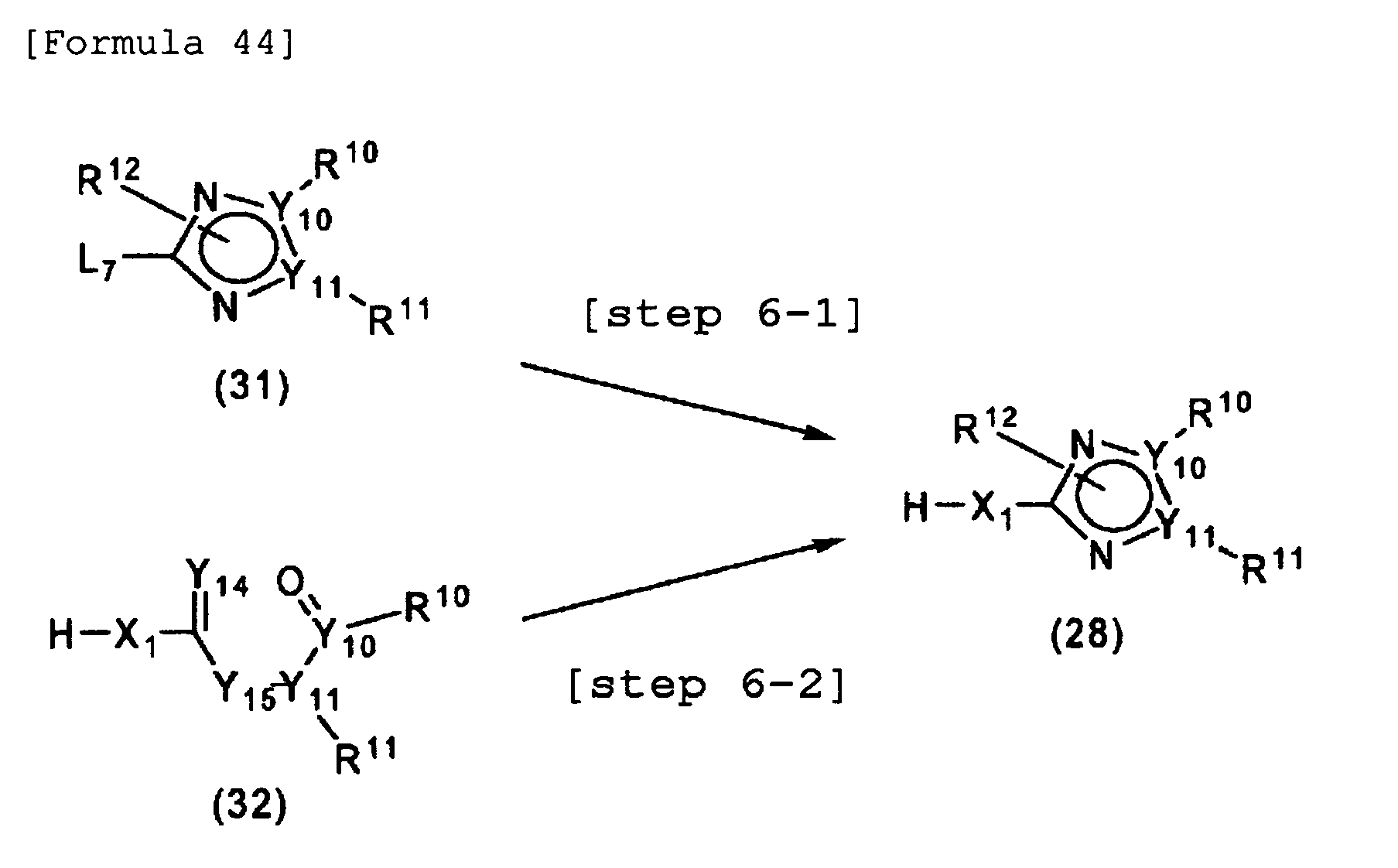
- The compound (28) can be prepared by i) condensing a compound (31) with an alkene or alkyne compound according to Step 6-1. The compound (28) can also be prepared by ii) cyclizing a compound (32) according to Step 6-2.
- The method i), specifically, Step 6-1 varies according to the starting material and is not specifically limited insofar as the conditions are similar to those in this reaction. A known method described in many documents such as Mizoroki-Heck reaction (see R.F. Heck, "Org. Reactions.", 1982, vol.27, p.345, for example), Suzuki-Miyaura reaction (see A. Suzuki, "Chem. Rev.", 1995, vol.95, p.2457, for example), Sonogashira reaction (see K. Sonogashira, "Comprehensive Organic Synthesis", 1991, vol.3, p.521) or Stille coupling reaction (see J.K. Stille, "Angew. Chem. Int. Ed. Engl.", 1986, vol.25, p.508, for example) may be used for the reaction.
- In Mizoroki-Heck reaction, a compound (31), wherein L7 represents a chlorine atom, a bromine atom, an iodine atom or a sulfonate group such as a trifluoromethanesulfonate group, and 1.0 to 5.0 equivalents of an alkene compound, wherein the alkene compound refers to a compound having a double bond in the molecule, with respect to the compound (31) are stirred in a solvent in the presence of 0.01 to 0.2 equivalent of a transition metal catalyst with respect to the compound (31), for example. The transition metal catalyst used is preferably a palladium complex, for example, and more preferably a known palladium complex such as palladium (II) acetate, dichlorobis(triphenylphosphine)palladium (II), tetrakis(triphenylphosphine)palladium (0) or tris(dibenzylideneacetone)dipalladium (0). A phosphorus ligand such as triphenylphosphine, tri-o-tolylphosphine, tri-tert-butylphosphine or 2-(di-tert-butylphosphino)biphenyl may be preferably added, for example, in order to make the reaction efficiently proceed. A preferable result may be achieved in the presence of a base. The base used is not specifically limited insofar as the base is used in a coupling reaction similar to this reaction. Preferable examples of the base include triethylamine, N,N-diisopropylethylamine, N,N-dicyclohexylmethylamine and tetrabutylammonium chloride. The solvent used varies according to the starting material and the transition metal catalyst used, and is not specifically limited insofar as the solvent does not inhibit the reaction and allows the starting material to be dissolved therein to a certain extent. Preferable examples of the solvent include acetonitrile, tetrahydrofuran, 1,4-dioxane, 1,2-dimethoxyethane, benzene, toluene, xylene, 1-methyl-2-pyrrolidone and N,N-dimethylformamide. The reaction temperature must be a temperature that can complete the coupling reaction, and is preferably room temperature to 150°C, for example. This reaction is performed preferably in an inert gas atmosphere, and more preferably in a nitrogen or argon atmosphere, for example. Under preferable reaction conditions, the reaction is completed in 1 to 24 hours, and the progress of the reaction can be monitored by a known chromatography technique. An undesirable by-product can be removed by a technique known to a person skilled in the art such as a conventional chromatography technique, extraction or/and crystallization.
- In Suzuki-Miyaura reaction, a compound (31), wherein L7 represents a chlorine atom, a bromine atom, an iodine atom or a sulfonate group such as a trifluoromethanesulfonate group, and 1.0 to 5.0 equivalents of an alkene or alkyne boronic acid or boronate compound, wherein the boronic acid or boronate compound refers to a boronic acid or boronate compound directly bonded to a double bond or triple bond, with respect to the compound (31) are stirred in a solvent in the presence of 0.01 to 0.5 equivalent of a transition metal catalyst with respect to the compound (31), for example. The transition metal catalyst used is preferably a known palladium complex, and more preferably a known palladium complex such as palladium (II) acetate, dichlorobis(triphenylphosphine)palladium (II), tetrakis(triphenylphosphine)palladium (0) or tris(dibenzylideneacetone)dipalladium (0). A phosphorus ligand such as triphenylphosphine, tri-o-tolylphosphine, tricyclohexylphosphine or tri-tert-butylphosphine may be preferably added, for example, in order to make the reaction efficiently proceed. A quaternary ammonium salt, preferably tetrabutylammonium chloride or tetrabutylammonium bromide, for example, may also be added in order to make the reaction efficiently proceed. In this reaction, a preferable result may be achieved in the presence of a base. The base used at this time varies according to the starting material, the solvent used and the like, and is not specifically limited. Preferable examples of the base include sodium hydroxide, barium hydroxide, potassium fluoride, cesium fluoride, sodium carbonate, potassium carbonate, cesium carbonate and potassium phosphate. The solvent used varies according to the starting material and the transition metal catalyst used, and is not specifically limited insofar as the solvent does not inhibit the reaction and allows the starting material to be dissolved therein to a certain extent. Preferable examples of the solvent include acetonitrile, tetrahydrofuran, 1,4-dioxane, 1,2-dimethoxyethane, benzene, toluene, xylene, 1-methyl-2-pyrrolidone, N,N-dimethylformamide, water and a mixed solvent thereof. The reaction temperature must be a temperature that can complete the coupling reaction, and is preferably room temperature to 200°C, for example. This reaction is performed preferably in an inert gas atmosphere, and more preferably in a nitrogen or argon atmosphere, for example. Under preferable reaction conditions, the reaction is completed in 1 to 24 hours, and the progress of the reaction can be monitored by a known chromatography technique. An undesirable by-product can be removed by a technique known to a person skilled in the art such as a conventional chromatography technique, extraction or/and crystallization. The desired compound (28) can also be obtained from a combination of the boronic acid compound or boronate compound (31), wherein L7 represents a boronic acid group or boronate group, with a halogenated alkene compound or enol trifluoromethanesulfonate compound by the same method as above.
- In Sonogashira reaction, a compound (31), wherein L7 represents a chlorine atom, a bromine atom, an iodine atom or a sulfonate group such as a trifluoromethanesulfonate group, and 1.0 to 5.0 equivalents of an alkyne compound, wherein the alkyne compound refers to a compound having HC≡C- in the molecule, with respect to the compound (31) are stirred in a solvent in the presence of 0.01 to 0.5 equivalent of a transition metal catalyst with respect to the compound (31), for example. The transition metal catalyst used is preferably a known palladium complex, for example, and more preferably a known palladium complex such as palladium (II) acetate, dichlorobis(triphenylphosphine)palladium (II), tetrakis(triphenylphosphine)palladium (0) or tris(dibenzylideneacetone)dipalladium (0). A phosphorus ligand such as triphenylphosphine, tri-o-tolylphosphine or tri-tert-butylphosphine may be preferably added, for example, in order to make the reaction efficiently proceed. In the reaction, a good result may be achieved when adding a metal halide or a quaternary ammonium salt, preferably copper (I) iodide, lithium chloride, tetrabutylammonium fluoride or silver (I) oxide, for example. A preferable result may be achieved in the presence of a base. The base used here is not specifically limited insofar as the base is used in a coupling reaction similar to this reaction. Preferable examples of the base include diethylamine, triethylamine, N,N-diisopropylethylamine, a piperidine and pyridine. Preferable examples of the solvent used include acetonitrile, tetrahydrofuran, 1,4-dioxane, 1,2-dimethoxyethane, benzene, toluene, xylene, 1-methyl-2-pyrrolidone, N,N-dimethylformamide and dimethyl sulfoxide. More preferable examples of the solvent include tetrahydrofuran, 1,4-dioxane, 1-methyl-2-pyrrolidone and N,N-dimethylformamide. The reaction temperature must be a temperature that can complete the coupling reaction, and is preferably room temperature to 150°C, for example. This reaction is performed preferably in an inert gas atmosphere, and more preferably in a nitrogen or argon atmosphere, for example. Under preferable reaction conditions, the reaction is completed in 1 to 24 hours, and the progress of the reaction can be monitored by a known chromatography technique. An undesirable by-product can be removed by a technique known to a person skilled in the art such as a conventional chromatography technique, extraction or/and crystallization.
- In Stille coupling reaction, a compound (31), wherein L7 represents a chlorine atom, bromine atom, iodine atom or trifluoromethanesulfonate group, and 1.0 equivalent or more of a trialkyltin compound, wherein the trialkyltin compound refers to an alkyltin compound directly bonded to a double bond or triple bond, with respect to the compound (31) are stirred in a solvent in the presence of 0.01 to 0.2 equivalent of a transition metal catalyst with respect to the compound (31), for example. The transition metal catalyst used is preferably a palladium complex, for example, and more preferably a known palladium complex such as palladium (II) acetate, dichlorobis(triphenylphosphine)palladium (II), tetrakis(triphenylphosphine)palladium (0) or tris(dibenzylideneacetone)dipalladium (0). 0.1 to 5.0 equivalents of copper (I) halide or/and lithium chloride may be added in order to make the reaction efficiently proceed. Preferable examples of the solvent used include toluene, xylene, N,N-dimethylformamide, N,N-dimethylacetamide, 1-methyl-2-pyrrolidone and dimethyl sulfoxide. The reaction temperature must be a temperature that can complete the coupling reaction, and is preferably room temperature to 100°C, for example. This reaction is performed preferably in an inert gas atmosphere, and more preferably in a nitrogen or argon atmosphere, for example. Under preferable reaction conditions, the reaction is completed in 1 to 24 hours, and the progress of the reaction can be monitored by a known chromatography technique. An undesirable by-product can be removed by a technique known to a person skilled in the art such as a conventional chromatography technique, extraction or/and crystallization. The desired compound (28) can also be obtained from a combination of the tin compound (31), wherein L7 represents a trialkyltin group, with a halogenated alkene compound or enol trifluoromethanesulfonate compound by the same method as above. The halogenated alkene compound refers to a compound of which the hydrogen atom bonded to the double bond in the molecule is substituted with a halogen atom. The enol trifluoromethanesulfonate compound refers to a compound of which the hydrogen atom of the enol ester group in the molecule is substituted with a trifluoromethanesulfonyl group.
- The method ii), specifically, Step 6-2 may be performed by the same method as in Step 4-2 or Step 4-6.
- The compound (31) is commercially available or prepared by a method known to a person skilled in the art. If not commercially available, the compound (31), wherein L7 is a boronic acid group or boronate group, can be prepared by a method known to a person skilled in the art, for example, although the method varies according to the starting material (see Shin Jikken Kagaku Koza (New Courses in Experimental Chemistry), vol.22, Yuki Gosei (Organic Synthesis) [VI], edited by The Chemical Society of Japan, Maruzen Co., Ltd., September 1992, p.61-90, for example). The compound (31), wherein L7 is a trialkyltin group, can be prepared by a method known to a person skilled in the art, although the method varies according to the starting material (see Shin Jikken Kagaku Koza (New Courses in Experimental Chemistry), vol.22, Yuki Gosei (Organic Synthesis) [VI], edited by The Chemical Society of Japan, Maruzen Co., Ltd., September 1992, p.179-201, for example).
- The compound (32) is commercially available or prepared by a method known to a person skilled in the art. If not commercially available, the compound (32) can be prepared by the same method as in Step 1-1 or Step 4-1, for example.
- The compound (29) is commercially available or can be prepared by the same method as in the case of the compound (28) if not commercially available.
- The compound of the general formula (I-5) or the general formula (I-6) can be prepared from the compound (28) or compound (29), wherein two of R10, R11 and R12 form a ring, as a starting material by the same method as above.
- Typically used General Preparation Method 4 for the compound of the general formula (I) of the present invention will be described below.
-

- The above General Preparation Method 4 includes a method of condensing a compound (33) with a heterocyclic compound (34a) in Step 7-1 to prepare a compound of the general formula (I-2), the general formula (I-5) or the general formula (I-6); and a method of condensing a compound (33) with a heterocyclic compound (34b) having a protecting group in Step 7-2 to convert the compound (33) into a compound of the general formula (I-3) having a protecting group, and deprotecting the protecting group of the compound of the general formula (I-3) and subsequently reacting the compound with a compound (2b) in Step 5-3 to prepare a compound of the general formula (I-2), the general formula (I-5) or the general formula (I-6).
- The compound of the general formula (I-2) or the compound of the general formula (I-3) can be prepared by reacting a compound (33) with a compound (34a) or compound (34b) according to Step 7-1 or Step 7-2. Specifically, Step 7-1 or Step 7-2 varies according to the starting material and is not specifically limited insofar as the conditions are similar to those in this reaction. A known method described in many documents may be used for the reaction. Preferable examples of the method include Mizoroki-Heck reaction (see R.F. Heck, "Org. Reactions.", 1982, vol.27, p.345, for example), Suzuki-Miyaura reaction (see A. Suzuki, "Chem. Rev.", 1995, vol.95, p.2457, for example), Sonogashira reaction (see K. Sonogashira, "Comprehensive Organic Synthesis", 1991, vol.3, p.521) and Stille coupling reaction (see J.K. Stille, "Angew. Chem. Int. Ed. Engl.", 1986, vol.25, p.508, for example).
- In Mizoroki-Heck reaction, a compound (33), wherein L7' represents a hydrogen atom, and X1 represents an alkenyl group, and 0.5 to 5.0 equivalents of a compound (34a) or compound (34b), wherein L7 represents a chlorine atom, a bromine atom, an iodine atom or a sulfonate group such as a trifluoromethanesulfonate group, with respect to the compound (33) are stirred in a solvent in the presence of 0.01 to 1.0 equivalent of a transition metal catalyst with respect to the compound (33), for example. The transition metal catalyst used is preferably a palladium complex, for example, and more preferably a known palladium complex such as palladium (II) acetate, dichlorobis(triphenylphosphine)palladium (II), tetrakis(triphenylphosphine)palladium (0) or tris(dibenzylideneacetone)dipalladium (0). A phosphorus ligand such as triphenylphosphine, tri-o-tolylphosphine, tri-tert-butylphosphine or 2-(di-tert-butylphosphino)biphenyl may be preferably added, for example, in order to make the reaction efficiently proceed. A preferable result may be achieved in the presence of a base. The base used is not specifically limited insofar as the base is used in a coupling reaction similar to this reaction. Preferable examples of the base include triethylamine, N,N-diisopropylethylamine, N,N-dicyclohexylmethylamine and tetrabutylammonium chloride. The solvent used varies according to the starting material and the transition metal catalyst used, and is not specifically limited insofar as the solvent does not inhibit the reaction and allows the starting material to be dissolved therein to a certain extent. Preferable examples of the solvent include acetonitrile, tetrahydrofuran, 1,4-dioxane, 1,2-dimethoxyethane, benzene, toluene, xylene, 1-methyl-2-pyrrolidone and N,N-dimethylformamide. The reaction temperature must be a temperature that can complete the coupling reaction, and is preferably room temperature to 150°C, for example. This reaction is performed preferably in an inert gas atmosphere, and more preferably in a nitrogen or argon atmosphere, for example. Under preferable reaction conditions, the reaction is completed in 1 to 24 hours, and the progress of the reaction can be monitored by a known chromatography technique. An undesirable by-product can be removed by a technique known to a person skilled in the art such as a conventional chromatography technique, extraction or/and crystallization.
- In Suzuki-Miyaura reaction, a compound (33), wherein L7' represents a boronic acid or boronate group, and 0.5 to 5.0 equivalents of a compound (34a) or compound (34b), wherein L7 represents a chlorine atom, a bromine atom, an iodine atom or a sulfonate group such as a trifluoromethanesulfonate group, with respect to the compound (33) are stirred in a solvent in the presence of 0.01 to 1.0 equivalent of a transition metal catalyst with respect to the compound (33), for example. The transition metal catalyst used is preferably a known palladium complex, for example, and more preferably a known palladium complex such as palladium (II) acetate, dichlorobis(triphenylphosphine)palladium (II), tetrakis(triphenylphosphine)palladium (0) or tris(dibenzylideneacetone)dipalladium (0). A phosphorus ligand such as triphenylphosphine, tri-o-tolylphosphine, tricyclohexylphosphine or tri-tert-butylphosphine may be preferably added, for example, in order to make the reaction efficiently proceed. A good result may be achieved when appropriately adding a quaternary ammonium salt, preferably tetrabutylammonium chloride or tetrabutylammonium bromide, for example. In this reaction, a preferable result may be achieved in the presence of a base. The base used at this time varies according to the starting material, the solvent used and the like, and is not specifically limited. Preferable examples of the base include sodium hydroxide, barium hydroxide, potassium fluoride, cesium fluoride, sodium carbonate, potassium carbonate, cesium carbonate and potassium phosphate. The solvent used varies according to the starting material and the transition metal catalyst used, and is not specifically limited insofar as the solvent does not inhibit the reaction and allows the starting material to be dissolved therein to a certain extent. Preferable examples of the solvent include acetonitrile, tetrahydrofuran, 1,4-dioxane, 1,2-dimethoxyethane, benzene, toluene, xylene, 1-methyl-2-pyrrolidone, N,N-dimethylformamide, water and a mixed solvent thereof. The reaction temperature must be a temperature that can complete the coupling reaction, and is preferably room temperature to 200°C, for example. This reaction is performed preferably in an inert gas atmosphere, and more preferably in a nitrogen or argon atmosphere, for example. Under preferable reaction conditions, the reaction is completed in 1 to 24 hours, and the progress of the reaction can be monitored by a known chromatography technique. An undesirable by-product can be removed by a technique known to a person skilled in the art such as a conventional chromatography technique, extraction or/and crystallization. The desired compound of the general formula (I-2) or general formula (I-3) can also be obtained from a combination of the compound (33), wherein L7 represents a chlorine atom, a bromine atom, an iodine atom or a sulfonate group such as a trifluoromethanesulfonate group, with the compound (34a) or compound (34b), wherein L7 represents a boronic acid or boronate group, by the same method as above.
- In Sonogashira reaction, an alkyne compound (33), wherein L7' represents a hydrogen atom, and X1 represents an alkynyl group, and 0.5 to 5.0 equivalents of a compound (34a) or compound (34b), wherein L7 represents a chlorine atom, a bromine atom, an iodine atom or a sulfonate group such as a trifluoromethanesulfonate group, with respect to the compound (33) are stirred in a solvent in the presence of 0.01 to 1.0 equivalent of a transition metal with respect to the compound (33), for example. The transition metal catalyst used is preferably a known palladium complex, for example, and more preferably a known palladium complex such as palladium (II) acetate, dichlorobis(triphenylphosphine)palladium (II), tetrakis(triphenylphosphine)palladium (0) or tris(dibenzylideneacetone)dipalladium (0). A phosphorus ligand such as triphenylphosphine, tri-o-tolylphosphine or tri-tert-butylphosphine may be preferably added, for example, in order to make the reaction efficiently proceed. In the reaction, a good result may be achieved when adding a metal halide or a quaternary ammonium salt such as preferably copper (I) iodide, lithium chloride, tetrabutylammonium fluoride or silver (I) oxide, for example. A preferable result may be achieved in the presence of a base. The base used here is not specifically limited insofar as the base is used in a coupling reaction similar to this reaction. Preferable examples of the base include diethylamine, triethylamine, N,N-diisopropylethylamine, a piperidine and pyridine. Preferable examples of the solvent used include acetonitrile, tetrahydrofuran, 1,4-dioxane, 1,2-dimethoxyethane, benzene, toluene, xylene, 1-methyl-2-pyrrolidone, N,N-dimethylformamide, dimethyl sulfoxide and a mixture thereof. More preferable examples of the solvent include tetrahydrofuran, 1,4-dioxane, 1-methyl-2-pyrrolidone and N,N-dimethylformamide. The reaction temperature must be a temperature that can complete the coupling reaction, and is preferably room temperature to 150°C, for example. This reaction is performed preferably in an inert gas atmosphere, and more preferably in a nitrogen or argon atmosphere, for example. Under preferable reaction conditions, the reaction is completed in 1 to 24 hours, and the progress of the reaction can be monitored by a known chromatography technique. An undesirable by-product can be removed by a technique known to a person skilled in the art such as a conventional chromatography technique, extraction or/and crystallization.
- In Stille coupling reaction, a compound (33), wherein L7' represents a chlorine atom, bromine atom, iodine atom or trifluoromethanesulfonate group, and 0.5 to 5.0 equivalents of a compound (34a) or compound (34b), wherein L7 represents an alkyltin group, with respect to the compound (33) are stirred in a solvent in the presence of 0.01 to 1.0 equivalent of a transition metal catalyst with respect to the compound (33), for example. The transition metal catalyst used is preferably a known palladium complex such as palladium (II) acetate, dichlorobis(triphenylphosphine)palladium (II), tetrakis(triphenylphosphine)palladium (0) or tris(dibenzylideneacetone)dipalladium (0), for example, and more preferably tetrakis(triphenylphosphine)palladium (0) or tris(dibenzylideneacetone)dipalladium (0), for example. 0.1 to 5.0 equivalents of copper (I) halide or/and lithium chloride may be appropriately used in order to make the reaction efficiently proceed. Preferable examples of the solvent used include toluene, xylene, N,N-dimethylformamide, N,N-dimethylacetamide, 1-methyl-2-pyrrolidone, dimethyl sulfoxide and a mixture thereof. The reaction temperature must be a temperature that can complete the coupling reaction, and is preferably room temperature to 150°C, for example. This reaction is performed preferably in an inert gas atmosphere, and more preferably in a nitrogen or argon atmosphere, for example. Under preferable reaction conditions, the reaction is completed in 1 to 24 hours, and the progress of the reaction can be monitored by a known chromatography technique. An undesirable by-product can be removed by a technique known to a person skilled in the art such as a conventional chromatography technique, extraction or/and crystallization. The desired compound of the general formula (I-2) or general formula (I-3) can also be obtained from a combination of the compound (33), wherein L7 represents a trialkyltin group, with the compound (34a) or compound (35b), wherein L3 represents a chlorine atom, bromine atom, iodine atom or trifluoromethanesulfonate group, by the same method as above.
- The compound (34a) or compound (34b) can be prepared by the same method as in the case of the compound (31).
- The compound (33) can be prepared from a compound (13) or compound (15) by the same method as in Step 2-7 or Step 2-9.
- The compound of the general formula (I-5) or the general formula (I-6) can be prepared from the compound (34a) or compound (34b), wherein two of R10, R11 and R12 form a ring, as a starting material by the same method as above.
- Typically used General Preparation Method 5 for the compound of the general formula (I) of the present invention will be described below.
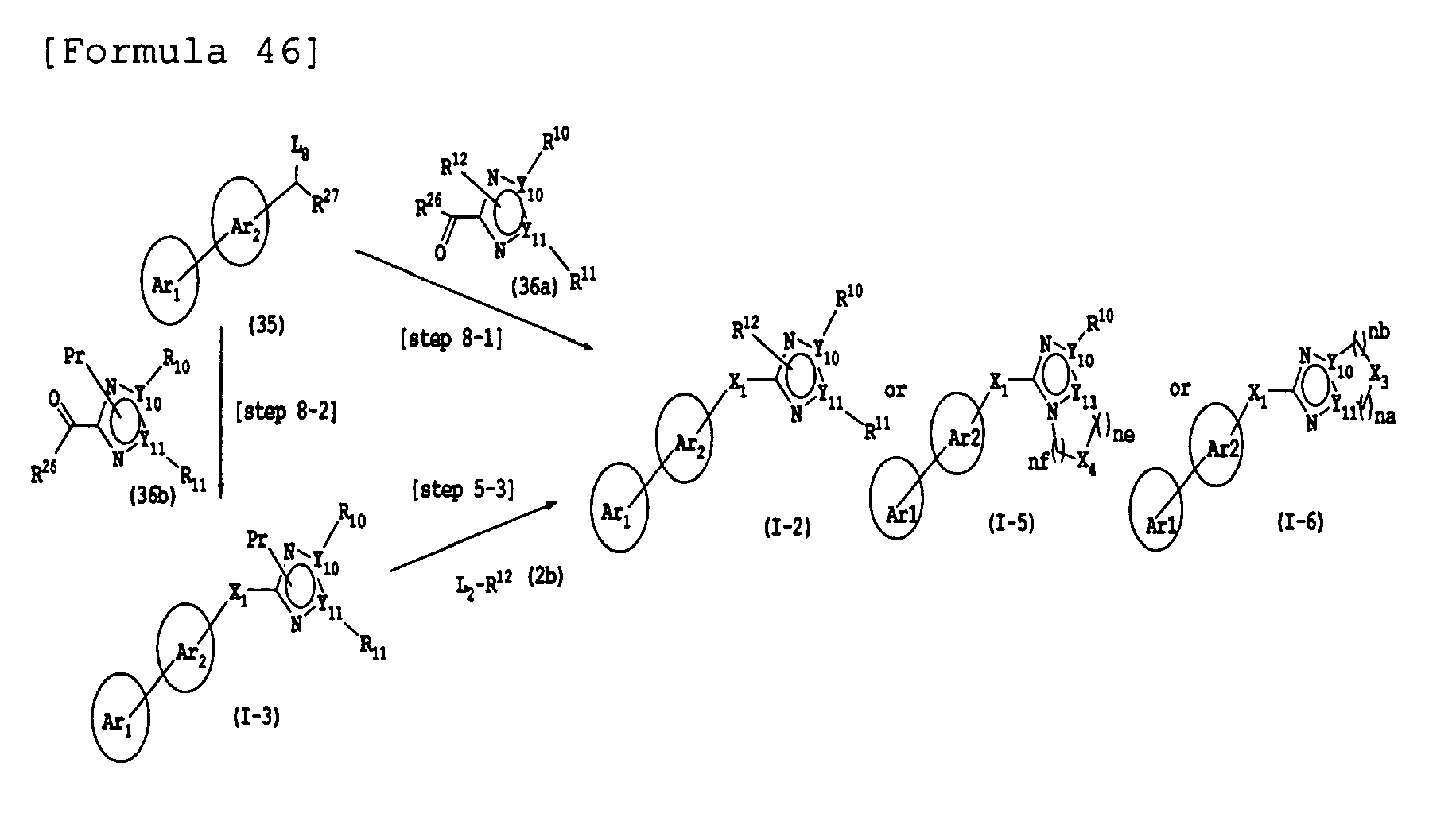
- The above General Preparation Method 5 is an example of a method of condensing a compound (35) with a heterocyclic compound (36a) in Step 8-1 to prepare a compound of the general formula (I-2), the general formula (I-5) or the general formula (I-6); or a method of reacting a compound (35) with a heterocyclic compound (36b) having a protecting group in Step 8-2 to once convert the compound (35) into a compound of the general formula (I-3) having a protecting group, and deprotecting the protecting group of the compound of the general formula (I-3) and subsequently reacting the compound with a compound (2b) in Step 5-3 to prepare a compound of the general formula (I-2), the general formula (I-5) or the general formula (I-6).
- The compound of the general formula (I-2) or the compound of the general formula (I-3) can be prepared by reacting a compound (35) with a compound (36a) or (36b) according to Step 8-1 or Step 8-2. Specifically, Step 8-1 or Step 8-2 varies according to the starting material and is not specifically limited insofar as the conditions are similar to those in this reaction. A known method described in many documents such as Wittig reaction, Horner-Emmons reaction or Peterson reaction (see Shin Jikken Kagaku Koza (new Courses in Experimental Chemistry), vol.19, Yuki Gosei (Organic Synthesis) [I], edited by The Chemical Society of Japan, Maruzen Co., Ltd., June 1992, p.57-85, for example) may be used.
- In Wittig reaction, a compound (35), wherein L8 represents a phosphonium salt, and 0.5 to 2.0 equivalents of a carbonyl compound (36a) or a compound (36b) with respect to the compound (35) are stirred in a solvent in the presence of 1.0 to 5.0 equivalents of a base with respect to the compound (35), for example. This reaction may be a method of first reacting a compound (35) with a base to form a phosphorus ylide and then adding a carbonyl compound (36a) or a compound (36b) to the ylide; or a method of adding a base in the presence of a compound (35) and a carbonyl compound (36a) or a compound (36b). The base used varies according to the starting material and the solvent and is not specifically limited. Preferable examples of the base include alkali metal hydroxides such as sodium hydroxide and lithium hydroxide; alkali metal carbonates such as sodium carbonate; alkali metal salts of alcohols such as sodium methoxide and potassium tert-butoxide; organic bases such as triethylamine, pyridine and diazabicyclononene; organic metals such as butyl lithium and lithium diisobutylamide; and alkali metal hydrides such as sodium hydride. The solvent used varies according to the starting material and the base used, and is not specifically limited insofar as the solvent does not inhibit the reaction and allows the starting material to be dissolved therein to a certain extent. Preferable examples of the solvent used include polar solvents such as nitromethane, acetonitrile, 1-methyl-2-pyrrolidone, N,N-dimethylformamide and dimethyl sulfoxide; ether solvents such as tetrahydrofuran, 1,4-dioxane and 1,2-dimethoxyethane; nonpolar solvents such as benzene, toluene and xylene; alcohol solvents such as ethanol and methanol; halogenated solvents such as chloroform and methylene chloride; water; and a mixed solvent thereof. The reaction temperature must be a temperature that can complete the reaction without promoting formation of an undesirable by-product, and is preferably -78 to 150°C, for example. Under preferable reaction conditions, the reaction is completed in 1 to 24 hours, and the progress of the reaction can be monitored by a known chromatography technique. An undesirable by-product can be removed by a technique known to a person skilled in the art such as a conventional chromatography technique, extraction or/and crystallization.
- In Horner-Emmons reaction, a compound (35), wherein L8 represents a phosphite group, is reacted with 0.5 to 2.0 equivalents of a carbonyl compound (36a) or a compound (36b) with respect to the compound (35) in a solvent in the presence of 1.0 to 5.0 equivalents of a base with respect to the compound (35), for example. This reaction may be a method of first treating a compound (35) and a base to form a carbanion and then adding a carbonyl compound (36a) or a compound (36b) to the carbanion; or a method of adding a base in the presence of a compound (35) and a carbonyl compound (36a) or a compound (36b). The base used varies according to the starting material and the solvent and is not specifically limited. Preferable examples of the base include alkali metal hydroxides such as sodium hydroxide and lithium hydroxide; alkali metal carbonates such as sodium carbonate; alkali metal salts of alcohols such as sodium methoxide and potassium tert-butoxide; organic bases such as triethylamine, pyridine and diazabicyclononene; organic metals such as butyl lithium and lithium diisobutylamide; alkali metal hydrides such as sodium hydride; and alkali metal ammonia salts such as sodium amide. The solvent used varies according to the starting material and the base used, and is not specifically limited insofar as the solvent does not inhibit the reaction and allows the starting material to be dissolved therein to a certain extent. Preferable examples of the solvent include polar solvents such as 1-methyl-2-pyrrolidone, N,N-dimethylformamide and dimethyl sulfoxide; ether solvents such as tetrahydrofuran, 1,4-dioxane and 1,2-dimethoxyethane; nonpolar solvents such as benzene, toluene and xylene; alcohol solvents such as ethanol and methanol; water; and a mixed solvent thereof. The reaction temperature must be a temperature that can complete the reaction without promoting formation of an undesirable by-product, and is preferably -78 to 150°C, for example. Under preferable reaction conditions, the reaction is completed in 1 to 24 hours, and the progress of the reaction can be monitored by a known chromatography technique. An undesirable by-product can be removed by a technique known to a person skilled in the art such as a conventional chromatography technique, extraction or/and crystallization.
- In Peterson reaction, a compound (35), wherein L8 represents a silyl group, is reacted with 0.5 to 2.0 equivalents of a carbonyl compound (36a) or a compound (36b) with respect to the compound (35) in a solvent in the presence of 1.0 to 5.0 equivalents of a base with respect to the compound (35), for example. This reaction may be a method of first treating a compound (35) and a base to form a carbanion and then adding a carbonyl compound (36a) or a compound (36b) to the carbanion; or a method of adding a base in the presence of a compound (35) and a carbonyl compound (36a) or a compound (36b). The base used varies according to the starting material and the solvent and is not specifically limited. Preferable examples of the base include alkali metal hydroxides such as sodium hydroxide and lithium hydroxide; alkali metal carbonates such as sodium carbonate; alkali metal salts of alcohols such as sodium methoxide and potassium tert-butoxide; organic bases such as triethylamine, pyridine and diazabicyclononene; organic metals such as butyl lithium and lithium diisobutylamide; alkali metal hydrides such as sodium hydride; and alkali metal ammonia salts such as sodium amide. The solvent used varies according to the starting material and the base used, and is not specifically limited insofar as the solvent does not inhibit the reaction and allows the starting material to be dissolved therein to a certain extent. Preferable examples of the solvent include polar solvents such as 1-methyl-2-pyrrolidone, N,N-dimethylformamide and dimethyl sulfoxide; ether solvents such as tetrahydrofuran, 1,4-dioxane and 1,2-dimethoxyethane; nonpolar solvents such as benzene, toluene and xylene; alcohol solvents such as ethanol and methanol; water; and a mixed solvent thereof. The reaction temperature must be a temperature that can complete the reaction without promoting formation of an undesirable by-product, and is preferably -78 to 150°C, for example. Under preferable reaction conditions, the reaction is completed in 1 to 24 hours, and the progress of the reaction can be monitored by a known chromatography technique. An undesirable by-product can be removed by a technique known to a person skilled in the art such as a conventional chromatography technique, extraction or/and crystallization.
- The compound (36a) and the compound (36b) are commercially available or can be prepared by a technique known to a person skilled in the art. If not commercially available, the compounds can be prepared by acylation of a compound (31), for example (see Shin Jikken Kagaku Koza (New Courses in Experimental Chemistry), vol.21, Yuki Gosei (Organic Synthesis) [III], edited by The Chemical Society of Japan, Maruzen Co., Ltd., February 1991, p.184-194, for example).
- The compound (35) can be prepared from a compound (6) or compound (17) as a starting material by a known method described in many documents. Preferably, for example, i) the compound (35) as a Wittig reagent, wherein L8 represents a phosphonium salt, can be prepared by halogenating a corresponding alcohol compound by a method known to a person skilled in the art (see Shin Jikken Kagaku Koza (New Courses in Experimental Chemistry), vol.19, Yuki Gosei (Organic Synthesis) [I], edited by The Chemical Society of Japan, Maruzen Co., Ltd., June 1992, p.430-438, for example), and then reacting the compound with an organophosphorus compound such as triphenylphosphine (see Organic Reaction, 1965, vol.14, p.270, for example). ii) The compound (35) as a Horner-Emmons reagent, wherein L8 represents a phosphite, can be prepared by halogenating a corresponding alcohol compound by a method known to a person skilled in the art (see Shin Jikken Kagaku Koza (New Courses in Experimental Chemistry), vol.19, Yuki Gosei (Organic Synthesis) [I], edited by The Chemical Society of Japan, Maruzen Co., Ltd., June 1992, p.430-438, for example), and then reacting the compound with an alkyl phosphinite by Arbuzov reaction (see Chemical Review, 1981, vol.81, p.415, for example) or with a metal phosphonite by Becker reaction (see Journal of the American Chemical Society, 1945, vol.67, p.1180, for example). Alternatively, the Horner-Emmons reagent can be prepared from a corresponding carbonyl compound and a chlorophosphate in the presence of a base (see The Journal of Organic Chemistry, 1989, vol.54, p.4750, for example). iii) The compound (35) as a Peterson reagent, wherein L9 represents a silyl group, can be prepared from a corresponding halogen compound and a trialkylsilyl chloride in the presence of a base (see Journal of Organometallic Chemistry, 1983, vol.248, p.51, for example).
- The compound of the general formula (I-5) or the compound of the general formula (I-6) can be prepared from the compound (36a) or compound (36b),
wherein two of R10, R11 and R12 form a ring, as a starting material by the same method as above. - Typically used General Preparation Method 6 for the compound of the general formula (I) of the present invention will be described below.

- The above General Preparation Method 6 is an example of a method of condensing a compound (6) with a heterocyclic compound (38a) in Step 9-1 to prepare a compound of the general formula (I-2), the general formula (I-5) or the general formula (I-6); or a method of condensing a compound (6) with a heterocyclic compound (38b) having a protecting group in Step 9-2 to convert the compound (6) into a compound of the general formula (I-3) having a protecting group, and deprotecting the protecting group of the compound of the general formula (I-3) and subsequently reacting the compound with a compound (2b) in Step 5-3 to prepare a compound of the general formula (I-2), the general formula (I-5) or the general formula (I-6).
- The compound of the general formula (I-2) or general formula (I-3) can be prepared by reacting a compound (6) with a compound (38a) or compound (36b) according to Step 9-1 or Step 9-2. Specifically, Step 9-1 or Step 9-2 varies according to the starting material and is not specifically limited insofar as the conditions are similar to those in this reaction. A known method described in many documents such as Wittig reaction, Horner-Emmons reaction or Peterson reaction may be used for the reaction (see Jikken Kagaku Koza (Courses in Experimental Chemistry), vol.19, Yuki Gosei (Organic Synthesis) [I], edited by The Chemical Society of Japan, Maruzen Co., Ltd., June 1992, p.57-85, for example).
- In Wittig reaction, a carbonyl compound (6) and 0.5 to 2.0 equivalents of a compound (38a) or compound (38b), wherein L8 represents a phosphonium salt, with respect to the carbonyl compound (6) are stirred in a solvent in the presence of 1.0 to 5.0 equivalents of a base with respect to the carbonyl compound (6), for example. This reaction may be a method of first reacting a compound (38a) or compound (38b) with a base to form a phosphorus ylide and then adding a carbonyl compound (6) to the ylide; or a method of adding a base in the presence of a carbonyl compound (6) and a compound (38a) or compound (38b). The base used varies according to the starting material and the solvent and is not specifically limited. Preferable examples of the base include alkali metal hydroxides such as sodium hydroxide and lithium hydroxide; alkali metal carbonates such as sodium carbonate; alkali metal salts of alcohols such as sodium methoxide and potassium tert-butoxide; organic bases such as triethylamine, pyridine and diazabicyclononene; organic metals such as butyl lithium and lithium diisobutylamide; and alkali metal hydrides such as sodium hydride. The solvent used varies according to the starting material and the base used, and is not specifically limited insofar as the solvent does not inhibit the reaction and allows the starting material to be dissolved therein to a certain extent. Preferable examples of the solvent used include polar solvents such as nitromethane, acetonitrile, 1-methyl-2-pyrrolidone, N,N-dimethylformamide and dimethyl sulfoxide; ether solvents such as tetrahydrofuran, 1,4-dioxane and 1,2-dimethoxyethane; nonpolar solvents such as benzene, toluene and xylene; alcohol solvents such as ethanol and methanol; halogenated solvents such as chloroform and methylene chloride; water; and a mixed solvent thereof. The reaction temperature must be a temperature that can complete the reaction without promoting formation of an undesirable by-product, and is preferably -78 to 150°C, for example. Under preferable reaction conditions, the reaction is completed in 1 to 24 hours, and the progress of the reaction can be monitored by a known chromatography technique. An undesirable by-product can be removed by a technique known to a person skilled in the art such as a conventional chromatography technique, extraction or/and crystallization.
- In Horner-Emmons reaction, a carbonyl compound (6) and 0.5 to 2.0 equivalents of a compound (38a) or compound (38b), wherein L8 represents a phosphite group, with respect to the carbonyl compound (6) are stirred in a solvent in the presence of 1.0 to 5.0 equivalents of a base with respect to the carbonyl compound (6), for example. This reaction may be a method of first treating a compound (38a) or compound (38b) and a base to form a carbanion and then adding a carbonyl compound (6) to the carbanion; or a method of adding a base in the presence of a carbonyl compound (6) and a compound (38a) or compound (38b). The base used varies according to the starting material and the solvent and is not specifically limited. Preferable examples of the base include alkali metal hydroxides such as sodium hydroxide and lithium hydroxide; alkali metal carbonates such as sodium carbonate; alkali metal salts of alcohols such as sodium methoxide and potassium tert-butoxide; organic bases such as triethylamine, pyridine and diazabicyclononene; organic metals such as butyl lithium and lithium diisobutylamide; alkali metal hydrides such as sodium hydride; and alkali metal ammonia salts such as sodium amide. The solvent used varies according to the starting material and the base used, and is not specifically limited insofar as the solvent does not inhibit the reaction and allows the starting material to be dissolved therein to a certain extent. Preferable examples of the solvent include polar solvents such as 1-methyl-2-pyrrolidone, N,N-dimethylformamide and dimethyl sulfoxide; ether solvents such as tetrahydrofuran, 1,4-dioxane and 1,2-dimethoxyethane; nonpolar solvents such as benzene, toluene and xylene; alcohol solvents such as ethanol and methanol; water; and a mixed solvent thereof. The reaction temperature must be a temperature that can complete the reaction without promoting formation of an undesirable by-product, and is preferably -78 to 150°C, for example. Under preferable reaction conditions, the reaction is completed in 1 to 24 hours, and the progress of the reaction can be monitored by a known chromatography technique. An undesirable by-product can be removed by a technique known to a person skilled in the art such as a conventional chromatography technique, extraction or/and crystallization.
- In Peterson reaction, a carbonyl compound (6) and 0.5 to 2.0 equivalents of a compound (38a) or compound (38b), wherein L8 represents a silyl group, with respect to the carbonyl compound (6) are stirred in a solvent in the presence of 1.0 to 5.0 equivalents of a base with respect to the carbonyl compound (6), for example. This reaction may be a method of first treating a compound (38a) or compound (38b) and a base to form a carbanion and then adding a carbonyl compound (6) to the carbanion; or a method of adding a base in the presence of a carbonyl compound (6) and a compound (38a) or compound (38b). The base used varies according to the starting material and the solvent and is not specifically limited. Preferable examples of the base include alkali metal hydroxides such as sodium hydroxide and lithium hydroxide; alkali metal carbonates such as sodium carbonate; alkali metal salts of alcohols such as sodium methoxide and potassium tert-butoxide; organic bases such as triethylamine, pyridine and diazabicyclononene; organic metals such as butyl lithium and lithium diisobutylamide; alkali metal hydrides such as sodium hydride; and alkali metal ammonia salts such as sodium amide. The solvent used varies according to the starting material and the base used, and is not specifically limited insofar as the solvent does not inhibit the reaction and allows the starting material to be dissolved therein to a certain extent. Preferable examples of the solvent include polar solvents such as 1-methyl-2-pyrrolidone, N,N-dimethylformamide and dimethyl sulfoxide; ether solvents such as tetrahydrofuran, 1,4-dioxane and 1,2-dimethoxyethane; nonpolar solvents such as benzene, toluene and xylene; alcohol solvents such as ethanol and methanol; water; and a mixed solvent thereof. The reaction temperature must be a temperature that can complete the reaction without promoting formation of an undesirable by-product, and is preferably -78 to 150°C, for example. Under preferable reaction conditions, the reaction is completed in 1 to 24 hours, and the progress of the reaction can be monitored by a known chromatography technique. An undesirable by-product can be removed by a technique known to a person skilled in the art such as a conventional chromatography technique, extraction or/and crystallization.
- The compound (38a) and the compound (38b) are commercially available or prepared by a technique known to a person skilled in the art. If not commercially available, for example, i) the compound (38a) or compound (38b) as a Wittig reagent, wherein L8 represents a phosphonium salt, can be prepared by halogenating a corresponding alcohol compound by a method known to a person skilled in the art (see Shin Jikken Kagaku Koza (New Courses in Experimental Chemistry), vol.19, Yuki Gosei (Organic Synthesis) [I], edited by The Chemical Society of Japan, Maruzen Co., Ltd., June 1992, p.430-438, for example), and then reacting the compound with an organophosphorus compound such as triphenylphosphine (see Organic Reaction, 1965, vol.14, p.270, for example). ii) The compound (38a) or compound (38b) as a Horner-Emmons reagent, wherein L8 represents a phosphite, can be prepared by halogenating a corresponding alcohol compound by a method known to a person skilled in the art (see Shin Jikken Kagaku Koza (New Courses in Experimental Chemistry), vol.19, Yuki Gosei (Organic Synthesis) [I], edited by The Chemical Society of Japan, Maruzen Co., Ltd., June 1992, p.430-438, for example), and then reacting the compound with an alkyl phosphinite by Arbuzov reaction (see Chemical Review, 1981, vol.81, p.415, for example) or with a metal phosphonite by Becker reaction (see Journal of the American Chemical Society, 1945, vol.67, p.1180, for example). Alternatively, the compound can be prepared from a corresponding carbonyl compound and a chlorophosphate in the presence of a base (see Journal of Organic Chemistry, 1989, vol.54, p.4750, for example). iii) The compound (38a) or compound (38b) as a Peterson reagent, wherein L9 represents a silyl group, can be prepared from a corresponding halogen compound and a trialkylsilyl chloride (see Journal of Organometallic Chemistry, 1983, vol.248, p.51, for example).
- The compound of the general formula (I-5) or the compound of the general formula (I-6) can be prepared from the compound (38a) or compound (38b),
wherein two of R10, R11 and R12 form a ring, as a starting material by the same method as above. - Typically used General Preparation Method 7 for the compound of the general formula (I) of the present invention will be described below.

- The above General Preparation Method 7 is an example of a method of condensing a compound (39) with a compound (40) in Step 10 to prepare a compound of the general formula (I-2), the general formula (I-5) or the general formula (I-6).
- The compound of the general formula (I-2) can be prepared by reacting a compound (39) with a compound (40) according to Step 10. Specifically, Step 10 varies according to the starting material and is not specifically limited insofar as the conditions are similar to those in this reaction. A known method described in many documents such as Mizoroki-Heck reaction (see R.F. Heck, "Org. Reactions.", 1982, vol.27, p.345, for example), Suzuki-Miyaura reaction (see A. Suzuki, "Chem. Rev.", 1995, vol.95, p.2457, for example), Sonogashira reaction (see K. Sonogashira, "Comprehensive Organic Synthesis", 1991, vol.3, p.521) or Stille coupling reaction (see J.K. Stille, "Angew. Chem. Int. Ed. Engl.", 1986, vol.25, p.508, for example) may be used for the reaction.
- In Mizoroki-Heck reaction, a compound (39), wherein L7' represents a chlorine atom, a bromine atom, an iodine atom or a sulfonate group such as a trifluoromethanesulfonate group, and 1.0 to 5.0 equivalents of an alkene compound (40), wherein L7 represents a hydrogen atom, and R111 represents a C1-6 alkenyl group which may be substituted with 1 to 3 substituents selected from the above Substituent Group A4, with respect to the compound (39) are stirred in a solvent in the presence of 0.01 to 0.2 equivalent of a transition metal catalyst with respect to the compound (39), for example. The transition metal catalyst used is preferably a palladium complex, for example, and more preferably a known palladium complex such as palladium (II) acetate, dichlorobis(triphenylphosphine)palladium (II), tetrakis(triphenylphosphine)palladium (0) or tris(dibenzylideneacetone)dipalladium (0). A phosphorus ligand such as triphenylphosphine, tri-o-tolylphosphine, tri-tert-butylphosphine or 2-(di-tert-butylphosphino)biphenyl may be preferably added, for example, in order to make the reaction efficiently proceed. A preferable result may be achieved in the presence of a base. The base used is not specifically limited insofar as the base is used in a coupling reaction similar to this reaction. Preferable examples of the base include triethylamine, N,N-diisopropylethylamine, N,N-dicyclohexylmethylamine and tetrabutylammonium chloride. The solvent used varies according to the starting material and the transition metal catalyst used, and is not specifically limited insofar as the solvent does not inhibit the reaction and allows the starting material to be dissolved therein to a certain extent. Preferable examples of the solvent include acetonitrile, tetrahydrofuran, 1,4-dioxane, 1,2-dimethoxyethane, benzene, toluene, xylene, 1-methyl-2-pyrrolidone and N,N-dimethylformamide. The reaction temperature must be a temperature that can complete the coupling reaction, and is preferably room temperature to 150°C, for example. This reaction is performed preferably in an inert gas atmosphere, and more preferably in a nitrogen or argon atmosphere, for example. Under preferable reaction conditions, the reaction is completed in 1 to 24 hours, and the progress of the reaction can be monitored by a known chromatography technique. An undesirable by-product can be removed by a technique known to a person skilled in the art such as a conventional chromatography technique, extraction or/and crystallization.
- In Suzuki-Miyaura reaction, a compound (39), wherein L7' represents a chlorine atom, a bromine atom, an iodine atom or a sulfonate group such as a trifluoromethanesulfonate group, and 1.0 to 10.0 equivalents of a compound (40), wherein L7 represents a boronic acid group or boronate group, with respect to the compound (39) are stirred in a solvent in the presence of 0.01 to 0.5 equivalent of a transition metal catalyst with respect to the compound (39), for example. The transition metal catalyst used is preferably a known palladium complex, and more preferably a known palladium complex such as palladium (II) acetate, dichlorobis(triphenylphosphine)palladium (II), tetrakis(triphenylphosphine)palladium (0) or tris(dibenzylideneacetone)dipalladium (0). A phosphorus ligand such as triphenylphosphine, tri-o-tolylphosphine, tricyclohexylphosphine or tri-tert-butylphosphine may be preferably added, for example, in order to make the reaction efficiently proceed. A quaternary ammonium salt, preferably tetrabutylammonium chloride or tetrabutylammonium bromide, for example, may also be added in order to make the reaction efficiently proceed. In this reaction, a preferable result may be achieved in the presence of a base. The base used at this time varies according to the starting material, the solvent used and the like, and is not specifically limited. Preferable examples of the base include sodium hydroxide, barium hydroxide, potassium fluoride, cesium fluoride, sodium carbonate, potassium carbonate, cesium carbonate and potassium phosphate. The solvent used varies according to the starting material and the transition metal catalyst used, and is not specifically limited insofar as the solvent does not inhibit the reaction and allows the starting material to be dissolved therein to a certain extent. Preferable examples of the solvent include acetonitrile, tetrahydrofuran, 1,4-dioxane, 1,2-dimethoxyethane, benzene, toluene, xylene, 1-methyl-2-pyrrolidone, N,N-dimethylformamide, water and a mixed solvent thereof. The reaction temperature must be a temperature that can complete the coupling reaction, and is preferably room temperature to 200°C, for example. This reaction is performed preferably in an inert gas atmosphere, and more preferably in a nitrogen or argon atmosphere, for example. Under preferable reaction conditions, the reaction is completed in 1 to 24 hours, and the progress of the reaction can be monitored by a known chromatography technique. An undesirable by-product can be removed by a technique known to a person skilled in the art such as a conventional chromatography technique, extraction or/and crystallization. The desired compound of the general formula (I-2) can also be obtained from a combination of the compound (39), wherein L7 represents a boronic acid group or boronate group, with the compound (40), wherein L7 represents a chlorine atom, a bromine atom, an iodine atom or a sulfonate group such as a trifluoromethanesulfonate group, by the same method as above.
- In Sonogashira reaction, a compound (39), wherein L7' represents a chlorine atom, a bromine atom, an iodine atom or a sulfonate group such as a trifluoromethanesulfonate group, and 1.0 to 10 equivalents of an alkyne compound (40), wherein L7 represents a hydrogen atom, and R111 represents a C1-6 alkynyl group which may be substituted with 1 to 3 substituents selected from the above Substituent Group A4, with respect to the compound (39) are stirred in a solvent in the presence of 0.01 to 0.5 equivalent of a transition metal catalyst with respect to the compound (39), for example. The transition metal catalyst used is preferably a known palladium complex, for example, and more preferably a known palladium complex such as palladium (II) acetate, dichlorobis(triphenylphosphine)palladium (II), tetrakis(triphenylphosphine)palladium (0) or tris(dibenzylideneacetone)dipalladium (0). A phosphorus ligand such as triphenylphosphine, tri-o-tolylphosphine or tri-tert-butylphosphine may be preferably added, for example, in order to make the reaction efficiently proceed. In the reaction, a good result may be achieved when adding a metal halide or a quaternary ammonium salt, preferably copper (I) iodide, lithium chloride, tetrabutylammonium fluoride or silver (I) oxide, for example. A preferable result may be achieved in the presence of a base. The base used here is not specifically limited insofar as the base is used in a coupling reaction similar to this reaction. Preferable examples of the base include diethylamine, triethylamine, N,N-diisopropylethylamine, a piperidine and pyridine. Preferable examples of the solvent used include acetonitrile, tetrahydrofuran, 1,4-dioxane, 1,2-dimethoxyethane, benzene, toluene, xylene, 1-methyl-2-pyrrolidone, N,N-dimethylformamide and dimethyl sulfoxide. More preferable examples of the solvent include tetrahydrofuran, 1,4-dioxane, 1-methyl-2-pyrrolidone and N,N-dimethylformamide. The reaction temperature must be a temperature that can complete the coupling reaction, and is preferably room temperature to 150°C, for example. This reaction is performed preferably in an inert gas atmosphere, and more preferably in a nitrogen or argon atmosphere, for example. Under preferable reaction conditions, the reaction is completed in 1 to 24 hours, and the progress of the reaction can be monitored by a known chromatography technique. An undesirable by-product can be removed by a technique known to a person skilled in the art such as a conventional chromatography technique, extraction or/and crystallization.
- In Stille coupling reaction, a compound (39), wherein L7 represents a chlorine atom, bromine atom, iodine atom or trifluoromethanesulfonate group, and 1.0 equivalent or more of a compound (40), wherein L7 represents a trialkyltin group, with respect to the compound (39) are stirred in a solvent in the presence of 0.01 to 0.2 equivalent of a transition metal catalyst with respect to the compound (39), for example. The transition metal catalyst used is preferably a palladium complex, for example, and more preferably a known palladium complex such as palladium (II) acetate, dichlorobis(triphenylphosphine)palladium (II), tetrakis(triphenylphosphine)palladium (0) or tris(dibenzylideneacetone)dipalladium (0). 0.1 to 5.0 equivalents of copper (I) halide or/and lithium chloride may be added in order to make the reaction efficiently proceed. Preferable examples of the solvent used include toluene, xylene, N,N-dimethylformamide, N,N-dimethylacetamide, 1-methyl-2-pyrrolidone and dimethyl sulfoxide. The reaction temperature must be a temperature that can complete the coupling reaction, and is preferably room temperature to 150°C, for example. This reaction is performed preferably in an inert gas atmosphere, and more preferably in a nitrogen or argon atmosphere, for example. Under preferable reaction conditions, the reaction is completed in 1 to 24 hours, and the progress of the reaction can be monitored by a known chromatography technique. An undesirable by-product can be removed by a technique known to a person skilled in the art such as a conventional chromatography technique, extraction or/and crystallization. The desired compound of the general formula (I-2) can also be obtained from a combination of the compound (39), wherein L7 represents a trialkyltin group, with the compound (40), wherein L7' represents a chlorine atom, bromine atom, iodine atom or trifluoromethanesulfonate group, by the same method as above. The compound (40) is commercially available or can be prepared by a method known to a person skilled in the art.
- The compound (39) can be prepared by a method in the above General Preparation Methods 1 to 6.
- The compound of the general formula (I-5) or the general formula (I-6) can be prepared by the same method as above using, as a starting material, the compound (39), wherein R10 and R12 each represent an alkyl group substituted with an alkenyl group or alkynyl group, or an alkenyl group, alkynyl group or alkyl group substituted with a halogen atom, and L7' represents a chlorine atom, a bromine atom, an iodine atom, a sulfonate group such as a trifluoromethanesulfonate group, or a trialkyltin group, instead of the compound (40).
- Typically used General Preparation Method 8 for the compound of the general formula (I) of the present invention will be described below.

- The above General Preparation Method 8 is an example of a method of condensing a compound (41) with a compound (42) in Step 12 to prepare a compound of the general formula (I-2), the general formula (I-5) or the general formula (I-6).
- The compound of the general formula (I-2) can be prepared by condensing a compound (41) with a compound (42) according to Step 12. Specifically, Step 12 varies according to the starting material and is not specifically limited insofar as the conditions are similar to those in this reaction. For example, a known method described in many documents such as coupling reaction of an arylboronic acid derivative using a copper compound (see The Journal of Organic Chemistry, 2001, vol.66, p.7892, for example), Ullmann reaction (see Journal of Medicinal Chemistry, 1981, vol.24, p.1139, for example) or nucleophilic substitution reaction (see Journal of Medicinal Chemistry, 1991, vol.39, p.2671-2677, for example) may be used for the reaction.
- The coupling reaction of an arylboronic acid derivative using a copper compound is, for example, a method of stirring a compound (41), wherein L3 represents a boronic acid group or boronate group, and 1.0 to 10.0 equivalents of a compound (42) with respect to the compound (41) in a solvent in the presence of 0.01 to 1.0 equivalent of a copper reagent such as copper, copper bromide or copper iodide with respect to the compound (41) by addition of 1.0 to 10.0 equivalents of a base with respect to the compound (41). The base used varies according to the starting material, the solvent used and the like, and is not specifically limited insofar as the base does not inhibit the reaction. Preferable examples of the base include organic bases such as triethylamine, pyridine and tetramethylethylenediamine; alkali metal salts such as potassium carbonate, sodium carbonate, potassium acetate, sodium acetate and cesium carbonate; and metal alkoxides such as sodium methoxide and potassium tert-butoxide. The copper reagent used varies according to the starting material and is not specifically limited. Preferable examples of the copper reagent include copper acetate and di-µ-hydroxo-bis[(N,N,N',N'-tetramethylethylenediamine)copper (II)] chloride. The solvent used varies according to the starting material, the reagent and the like, and is not specifically limited insofar as the solvent does not inhibit the reaction and allows the starting material to be dissolved therein to a certain extent. Preferable examples of the solvent include ether solvents such as tetrahydrofuran, 1,4-dioxane and diethyl ether; halogenated solvents such as methylene chloride, 1,2-dichloroethane and chloroform; polar solvents such as ethyl acetate, N,N-dimethylformamide and N-methylpyrrolidone; nonpolar solvents such as toluene, benzene and dichlorobenzene; and a mixture thereof. The reaction temperature must be a temperature that can complete the reaction without promoting formation of an undesirable by-product, and is preferably room temperature to 200°C, for example. Good results such as reduction in the reaction time and improvement of the yield may be achieved when the reaction is performed in an oxygen atmosphere or air stream. Under preferable reaction conditions, the reaction is completed in 1 to 24 hours, and the progress of the reaction can be monitored by a known chromatography technique. An undesirable by-product can be removed by a technique known to a person skilled in the art such as a conventional chromatography technique, extraction or/and crystallization.
- In Ullmann reaction, a compound (41), wherein L3 represents a halogen atom such as a chlorine atom, bromine atom or iodine atom, and 1.0 to 10.0 equivalents of a compound (42) with respect to the compound (41) are stirred in a solvent in the presence of 0.01 to 1.0 equivalent of a copper reagent such as copper, copper bromide or copper iodide with respect to the compound (41) by addition of 1.0 to 10.0 equivalents of a base with respect to the compound (41), for example. The base used varies according to the starting material and is not specifically limited. Preferable examples of the base include alkali metal salts such as potassium carbonate, sodium carbonate, potassium acetate, sodium acetate and cesium carbonate; and metal alkoxides such as sodium methoxide and potassium tert-butoxide. The solvent used varies according to the starting material, the reagent and the like, and is not specifically limited insofar as the solvent does not inhibit the reaction and allows the starting material to be dissolved therein to a certain extent. Preferable examples of the solvent that can be used include ether solvents such as tetrahydrofuran, 1,4-dioxane and diethyl ether; halogenated solvents such as methylene chloride, 1,2-dichloroethane and chloroform; alcohol solvents such as amyl alcohol and isopropyl alcohol; polar solvents such as N,N-dimethylformamide and N-methylpyrrolidone; nonpolar solvents such as toluene, benzene and dichlorobenzene; and a mixture thereof. The reaction temperature must be a temperature that can complete the reaction without promoting formation of an undesirable by-product, and is preferably room temperature to 200°C, for example. Under preferable reaction conditions, the reaction is completed in 1 to 24 hours, and the progress of the reaction can be monitored by a known chromatography technique. An undesirable by-product can be removed by a technique known to a person skilled in the art such as a conventional chromatography technique, extraction or/and crystallization.
- In nucleophilic substitution reaction, a compound (41), wherein L3 represents a halogen atom such as a chlorine atom, bromine atom or iodine atom or a sulfonate group such as a methanesulfonate group, p-toluenesulfonate group or trifluoromethanesulfonate group, and 2.0 to 5.0 equivalents of a compound (42) with respect to the compound (41) are stirred in a solvent in the presence or absence of 1.0 to 5.0 equivalents of a base with respect to the compound (41), for example. The base used varies according to the starting material and is not specifically limited. Preferable examples of the base include sodium hydride, sodium hydroxide, potassium hydroxide, potassium carbonate, sodium carbonate, cesium carbonate, barium carbonate, pyridine, lutidine and triethylamine. The solvent used varies according to the starting material, and is not specifically limited insofar as the solvent does not inhibit the reaction and allows the starting material to be dissolved therein to a certain extent. Preferable examples of the solvent include acetonitrile, tetrahydrofuran, dimethyl sulfoxide, N,N-dimethylformamide and N-methylpyrrolidine. Optionally, the bases may be used as a solvent. The reaction temperature must be a temperature that can complete the reaction without promoting formation of an undesirable by-product, and is preferably room temperature to 150°C, for example. Under preferable reaction conditions, the reaction is completed in 1 to 24 hours, and the progress of the reaction can be monitored by a known chromatography technique. An undesirable by-product can be removed by a technique known to a person skilled in the art such as a conventional chromatography technique or/and crystallization.
- The compound (41) is prepared by the same method as in the above General Preparation Methods 1 to 7.
- The compound (42) is commercially available or prepared by a method known to a person skilled in the art.
- The compound of the general formula (I-5) or the general formula (I-6) can be prepared from the compound (41), wherein two of R10, R11 and R12 form a ring, as a starting material by the same method as above.
- General Preparation Methods 1 to 8 for the compound of the present invention described above in detail are methods for preparing a compound represented by the general formula (I-1), the general formula (I-2), the general formula (I-3), the general formula (I-4), the general formula (I-5) or the general formula (I-6),
wherein Het falls within a part of the definition of Het in the general formula (I). The compound of the general formula (I), wherein Het falls within another part of the definition of Het, can be prepared almost in the same manner as in the above General Preparation Methods 1 to 8, or can be prepared by another method itself known to a person skilled in the art. The examples described later will provide reference to these Preparation Methods, and the compound of the general formula (I) can be easily prepared by a method itself known to a person skilled in the art based on these examples. - A prophylactic or therapeutic agent for a disease caused by Aβ comprising the compound of the formula (I) or pharmacologically acceptable salt thereof according to the present invention as an active ingredient can be prepared by a conventional method. Preferable examples of the dosage form include tablets, powders, fine granules, granules, coated tablets, capsules, syrups, troches, inhalants, suppositories, injections, ointments, ophthalmic solutions, ophthalmic ointments, nasal drops, ear drops, cataplasms and lotions. The prophylactic or therapeutic agent can be prepared by using ingredients typically used such as an expicient, a binder, a lubricant, a colorant and a corrective, and ingredients used where necessary such as a stabilizer, an emulsifier, an absorbefacient, a surfactant, a pH adjuster, a preservative and an antioxidant, and can be prepared by blending ingredients generally used as materials for a pharmaceutical preparation. Examples of such ingredients include animal and vegetable oils such as soybean oil, beef tallow and synthetic glyceride; hydrocarbons such as liquid paraffin, squalane and solid paraffin; ester oils such as octyldodecyl myristate and isopropyl myristate; higher alcohols such as cetostearyl alcohol and behenyl alcohol; a silicone resin; silicone oil; surfactants such as polyoxyethylene fatty acid ester, sorbitan fatty acid ester, glycerin fatty acid ester, polyoxyethylene sorbitan fatty acid ester, polyoxyethylene hydrogenated castor oil and a polyoxyethylene-polyoxypropylene block copolymer; water-soluble polymers such as hydroxyethylcellulose, polyacrytic acid, a carboxyvinyl polymer, polyethylene glycol, polyvinylpyrrolidone and methylcellulose; lower alcohols such as ethanol and isopropanol; polyhydric alcohols such as glycerin, propylene glycol, dipropylene glycol and sorbitol; sugars such as glucose and sucrose; inorganic powders such as silicic anhydride, magnesium aluminum silicate and aluminum silicate; and purified water. Examples of the expicient used include lactose, corn starch, saccharose, glucose, mannitol, sorbitol, crystalline cellulose and silicon dioxide. Examples of the binder used include polyvinyl alcohol, polyvinyl ether, methylcellulose, ethylcellulose, gum arabic, tragacanth, gelatin, shellac, hydroxypropylmethylcellulose, hydroxypropylcellulose, polyvinylpyrrolidone, a polypropylene glycol-polyoxyethylene block copolymer and meglumine. Examples of the disintegrator used include starch, agar, gelatin powder, crystalline cellulose, calcium carbonate, sodium bicarbonate, calcium citrate, dextrin, pectin and carboxymethylcellulose calcium. Examples of the lubricant used include magnesium stearate, talc, polyethylene glycol, silica and hydrogenated vegetable oil. Examples of the colorant used include those that are permitted to be added to pharmaceuticals. Examples of the corrective used include cocoa powder, menthol, empasm, mentha oil, borneol and cinnamon powder.
- For example, an oral preparation is prepared by adding an active ingredient compound or a salt thereof or a hydrate of the compound or salt, an excipient, and, where necessary, a binder, a disintegrator, a lubricant, a colorant and a corrective, for example, and then forming the mixture into powder, fine granules, granules, tablets, coated tablets or capsules, for example, by a conventional method. It is obvious that tablets or granules may be appropriately coated, for example, sugar coated, where necessary. A syrup or an injection preparation is prepared by adding a pH adjuster, a solubilizer and an isotonizing agent, for example, and a solubilizing aid, a stabilizer and the like where necessary by a conventional method. An external preparation may be prepared by any conventional method without specific limitations. As a base material, any of various materials usually used for a pharmaceutical, a quasi drug, a cosmetic or the like may be used. Examples of the base material include materials such as animal and vegetable oils, mineral oils, ester oils, waxes, higher alcohols, fatty acids, silicone oils, surfactants, phospholipids, alcohols, polyhydric alcohols, water-soluble polymers, clay minerals and purified water. A pH adjuster, an antioxidant, a chelator, a preservative and fungicide, a colorant, a flavor or the like may be added where necessary. Further, an ingredient having a differentiation inducing effect such as a blood flow enhancer, a bactericide, an antiphlogistic, a cell activator, vitamin, amino acid, a humectant or a keratolytic agent may be blended where necessary.
- The dose of the therapeutic or prophylactic agent of the present invention varies according to the degree of symptoms, age, sex, body weight, mode of administration, type of salt and specific type of disease, for example. Typically, the compound of the formula (I) or pharmacologically acceptable salt thereof is orally administered to an adult at about 30 µg to 10 g, preferably 100 µg to 5 g, and more preferably 100 µg to 100 mg per day, or is administered to an adult by injection at about 30 µg to 1 g, preferably 100 µg to 500 mg, and more preferably 100 µg to 30 mg per day, in a single dose or multiple doses, respectively.
- The present invention will now be described in detail with reference to examples. However, the examples are provided only for illustration purposes. The prophylactic or therapeutic agent for a disease caused by Aβ according to the present invention is not limited to the following specific examples in any case. A person skilled in the art can fully implement the present invention by making various modifications to not only the following reference examples and examples but also the claims of the present specification, and such modifications are within the scope of the claims of the present specification.
- The following abbreviations are used in the following examples.
DMF: N,N-dimethylformamide
THF: Tetrahydrofuran
LAH: Lithium aluminum hydride
EDC: 1-Ethyl-3-(3-dimethylaminopropyl)carbodiimide
hydrochloride
HOBT: 1-Hydroxybenzotriazole
IPEA: Diisopropylethylamine
DCC: 1,3-Dicyclohexylcarbodiimide
DMAP: 4-(Dimethylamino)pyridine
TEA: Triethylamine
DPPA: Diphenylphosphoryl azide
CDI: Carbonyldiimidazole
TBAF: Tetrabutylammonium fluoride
PYBOP: Benzotriazol-1-yloxytris(pyrrolidino)phosphonium
hexafluorophosphate
DBU: 1,8-Diazabicyclo[5.4.0]undec-7-ene t: Tertiary
BOPCl: Bis(2-oxo-3-oxazolidinyl)phosphonic chloride
DIBAL-H: Diisobutylaluminum hydride
DAST: Diethylaminosulfur trifluoride
Chromatography was performed using BW-300 manufactured by Fuji Silysia Chemical Ltd. as a carrier unless otherwise specified.
LC-MS: High performance liquid chromatography for preparative isolation of a target compound using mass spectroscopy. As an elution solvent, a 10% to 99% linear gradient system of water containing 0.1% trifluoroacetic acid and acetonitrile containing 0.1% trifluoroacetic acid was used. -

- Methyl iodide (463 g) was added dropwise to a mixture of 3-hydroxy-4-nitrobenzoic acid (199 g) with potassium carbonate (450 g) in DMF (1 L) at room temperature. The reaction solution was stirred at room temperature overnight, and then methyl iodide (230 g) was added to the reaction solution. The reaction solution was further stirred at room temperature for six hours. The reaction solution was added to ice water, and the precipitated solid was collected by filtration. The resulting solid was dried at 50°C overnight to obtain 178 g of the title compound. The property values corresponded to the reported values (CAS #5081-37-8).
- 10% palladium-carbon (containing 50% water, 15 g) was added to a solution of methyl 3-methoxy-4-nitrobenzoate (150 g) in methanol (600 mL) and THF (300 mL), and the reaction solution was stirred at a hydrogen pressure of 0.9 MPa at 50°C to 64°C for 6.5 hours. The reaction solution was left to cool to room temperature and then filtered through celite. The resulting filtrate was concentrated under reduced pressure to obtain 134 g of the title compound. The property values corresponded to the reported values (CAS #41608-64-4).
- Acetic anhydride (268 mL) was added dropwise to formic acid (401 mL) at room temperature, and the reaction solution was stirred at room temperature for 40 minutes. A solution of methyl 4-amino-3-methoxybenzoate (134 g) in THF (600 mL) was added dropwise to the reaction solution at room temperature, and the reaction solution was stirred for one hour. 3.8 L of ice water was added to the reaction solution, and the precipitated solid was filtered and further washed with water (2L). The resulting solid was dried at 50°C overnight to obtain 111 g of the title compound. The property values corresponded to the reported values (CAS #700834-18-0).
- Chloroacetone (84.5 mL) was added dropwise to a mixture of methyl 4-formylamino-3-methoxybenzoate (111 g), cesium carbonate (346 g), and potassium iodide (8.78 g) in DMF (497 mL) at room temperature, and the reaction solution was stirred for three hours. Cesium carbonate (173 g) and chloroacetone (42.0 mL) were added to the reaction solution, which was then stirred at room temperature for two hours. Ice water and ethyl acetate were added to the reaction solution, and the organic layer was separated. Ethyl acetate was added to the aqueous layer, and the organic layer was separated. The organic layers were combined and washed with water and brine in this order. The resulting organic layers were dried over anhydrous magnesium sulfate and then concentrated under reduced pressure. The residue was diluted with toluene, and the solution was concentrated under reduced pressure. tert-Butyl methyl ether and heptane were added to the resulting residue, and the precipitated solid was collected by filtration and washed with a solution of 50% tert-butyl methyl ether in heptane. The resulting solid was air-dried overnight to obtain 118 g of the title compound.
1H-NMR (CDCl3) δ (ppm): 2.19 (s, 3H), 3.91 (s, 3H), 3.94 (s, 3H), 4.49 (s, 2H), 7.31 (d, J=8.0Hz, 1H), 7.63 (d, J=2.0Hz, 1H), 7.69 (dd, J=8.0, 2.0Hz, 1H), 8.33 (s, 1H). - A solution of methyl 4-[formyl-(2-oxopropyl)amino]-3-methoxybenzoate (118 g) and ammonium acetate (172 g) in acetic acid (255 mL) was heated and stirred at 140°C for one hour. After the reaction was completed, the reaction solution was neutralized with aqueous ammonia under ice-cooling. Ethyl acetate was added to the reaction solution, and the organic layer was separated. The resulting organic layer was dried over anhydrous magnesium sulfate and then filtered on a silica gel pad, and the filtrate was concentrated under reduced pressure. tert-Butyl methyl ether and heptane were added to the residue, and the precipitated solid was collected by filtration and washed with a solution of 50% tert-butyl methyl ether in heptane. The resulting solid was air-dried overnight to obtain 68.4 g of the title compound. Further, the crystallization mother liquor was concentrated under reduced pressure, and the residue was purified by silica gel column chromatography (elution solvent: heptane-ethyl acetate system) to obtain 22.3 g of the title compound.
1H-NMR (CDCl3) δ (ppm): 2.30 (s, 3H), 3.94 (s, 3H), 3.96 (s, 3H), 6.98 (brs, 1H), 7.32 (d, J=8.4Hz, 1H), 7.71-7.73 (m, 2H), 7.79 (brs, 1H). - A solution of pyrrolidine (18 mL) in THF (45 mL) was added dropwise to a solution of sodium bis(2-methoxyethoxy)aluminum hydride (65% solution in toluene, 56 mL) in THF (60 mL) at -5°C or less over 15 minutes. The reaction solution was stirred at room temperature for one hour. Then, a suspension of tert-butoxide (2.10 g) in THF (15 mL) was added dropwise to the reaction solution at room temperature, and the reaction solution was stirred for 15 minutes. The above reaction solution was added dropwise to a solution of methyl 3-methoxy-4-(4-methyl-1H-imidazol-1-yl)benzoate (20 g) in THF (50 mL) under ice-cooling over 30 minutes. The reaction solution was stirred at room temperature for two hours, and then a 5 N sodium hydroxide solution (150 mL) was added dropwise to the reaction solution. Ethyl acetate was added to the reaction solution, and the organic layer was separated. The organic layer was washed with a saturated ammonium chloride solution and brine in this order. The organic layer was dried over anhydrous magnesium sulfate and filtered on a silica gel pad, and then the filtrate was concentrated under reduced pressure. The residue was diluted with ethyl acetate, and the precipitated solid was collected by filtration. The resulting solid was air-dried overnight to obtain 7.10 g of the title compound. Further, the crystallization mother liquor was concentrated under reduced pressure, and the residue was purified by silica gel column chromatography (elution solvent: heptane-ethyl acetate-2-propanol system) to obtain 2.65 g of the title compound.
1H-NMR (CDCl3) δ (ppm): 2.31 (s, 3H), 3.97 (s, 3H), 7.02 (brs, 1H), 7.44 (d, J=8.0Hz, 1H), 7.55 (dd, J=1.6Hz, 8.0Hz, 1H), 7.58 (d, J=1.6Hz, 1H), 7.84 (brs, 1H), 10.00 (s, 1H). - Ethyl diethylphosphonoacetate (5.7 g) and lithium hydroxide monohydrate (1.3 g) were sequentially added to a mixed solution of 3-methoxy-4-(4-methyl-1H-imidazol-1-yl)benzaldehyde (5.0 g) in THF (20 mL) and ethanol (5 mL), and the reaction solution was stirred at room temperature for nine hours. A 2 N sodium hydroxide solution (20 mL) was added to the reaction solution, and the reaction solution was stirred at room temperature for 12 hours. The reaction solution was cooled to 0°C, and 2 N hydrochloric acid (20 mL) was added to the reaction solution. The resulting precipitate was collected by filtration. The resulting precipitate was washed with water and ethyl acetate to obtain 5.1 g of the title compound. The property values of the compound are as follows.
1H-NMR (DMSO-d6) δ (ppm): 2.15 (s, 3H), 3.88 (s, 3H), 6.66 (d, J=16.0Hz, 1H), 7.16 (s, 1H), 7.35 (d, J=8.0Hz, 1H), 7.39 (d, J=8.0Hz, 1H), 7.56 (s, 1H), 7.60 (d, J=16.0Hz, 1H), 7.81 (s, 1H). - IPEA (0.28 mL) was added to a solution of (E)-3-[3-methoxy-4-(4-methyl-1H-imidazol-1-yl)phenyl]acrylic acid (200 mg) and 4-fluorophenacyl bromide (185 mg) in DMF (3 mL), and the reaction solution was stirred at room temperature for one hour. Ethyl acetate and saturated sodium bicarbonate water were added to the reaction solution, and the organic layer was separated. The resulting organic layer was dried over anhydrous magnesium sulfate and then concentrated under reduced pressure. The residue was suspended in diethyl ether, and the solid was collected by filtration to obtain 230 mg of the title compound. The property values of the compound are as follows.
1H-NMR (CDCl3) δ (ppm): 2.34 (s, 3H), 3.92 (s, 3H), 5.47 (s, 2H), 6.63 (d, J=16.0Hz, 1H), 6.97 (brs, 1H), 7.20 (t, J=8.8Hz, 2H), 7.22 (d, J=1.6Hz, 1H), 7.23 (dd, J=9.6, 1.6Hz, 1H), 7.30 (d, J=9.6Hz, 1H), 7.81 (d, J=16.0Hz, 1H), 7.85 (brs, 1H), 8.00 (dd, J=8.8, 5.6Hz, 2H). - A solution of 2-(4-fluorophenyl)-2-oxoethyl (E)-3-[3-methoxy-4-(4-methyl-1H-imidazol-1-yl)phenyl]acrylate (230 mg) and ammonium acetate (899 mg) in acetic acid (3 mL) was heated under reflux for five hours. The reaction solution was left to cool to room temperature and concentrated under reduced pressure. Then, ethyl acetate and saturated sodium bicarbonate water were added to the residue, and the organic layer was separated. The resulting organic layer was dried over anhydrous magnesium sulfate and then concentrated under reduced pressure. The residue was purified by silica gel column chromatography (carrier: Chromatorex™ NH; elution solvent: ethyl acetate -> ethyl acetate:methanol = 5:1). The resulting solid was suspended in ethyl acetate-diethyl ether and collected by filtration to obtain 104 mg of the title compound. The property values of the compound are as follows.
1H-NMR (CDCl3) δ (ppm): 2.32 (s, 3H), 3.87 (s, 3H), 6.95 (brs, 1H), 7.05 (d, J=16.4Hz, 1H), 7.09 (t, J=8.8Hz, 2H), 7.11 (brd, J=8.0Hz, 1H), 7.15 (brs, 1H), 7.21 (d, J=8.0Hz, 1H), 7.32 (s, 1H), 7.40 (d, J=16.4Hz, 1H), 7.75 (dd, J=8.8, 5.6Hz, 2H), 7.83 (brs, 1H). -

ESI-MS; m/z 389 [M++H]. 1H-NMR (CDCl3) δ (ppm): 2.32 (s, 3H), 3.79 (s, 3H), 3.90 (s, 3H), 6.92 (d, J=15.6Hz, 1H), 6.93 (brs, 1H), 7.08 (t, J=8.8Hz, 2H), 7.14 (s, 1H), 7.16 (brs, 1H), 7.23-7.26 (m, 2H), 7.65 (d, J=15.6Hz, 1H), 7.74 (brs, 1H), 7.77 (dd, J=8.8, 5.6Hz, 2H). -

- Diethyl cyanophosphonate (0.12 mL) was added to a solution of (E)-3-[3-methoxy-4-(4-methyl-1H-imidazol-l-yl)phenyl]acrylic acid (200 mg) and triethylamine (0.22 mL) in DMF (1 mL) at 0°C. The reaction solution was stirred at 0°C for 30 minutes, and then a-aminoacetophenone hydrochloride (133 mg) was added in small portions to the reaction solution over 30 minutes. The reaction solution was stirred at 0°C for 2.5 hours. Then, ethyl acetate and saturated sodium bicarbonate water were added to the reaction solution, and the organic layer was separated. The resulting organic layer was dried over anhydrous magnesium sulfate and then concentrated under reduced pressure. The residue was purified by silica gel column chromatography (carrier: Chromatorex™ NH; elution solvent: ethyl acetate -> ethyl acetate:methanol = 5:1) to obtain 200 mg of the title compound. The property values of the compound are as follows.
1H-NMR (CDCl3) δ (ppm): 2.30 (s, 3H), 3.91 (s, 3H), 4.92 (d, J=4.0Hz, 2H), 6.57 (d, J=15.2Hz, 1H), 6.80 (brt, J=4.0Hz, 1H), 6.93 (t, J=1.2Hz, 1H), 7.16 (d, J=1.2Hz, 1H), 7.21 (dd, J=8.0, 1.2Hz, 1H), 7.26 (d, J=8.0Hz, 1H), 7.52 (t, J=7.2Hz, 2H), 7.65 (t, J=7.2Hz, 1H), 7.66 (d, J=15.2Hz, 1H), 7.73 (d, J=1.2Hz, 1H), 8.02 (d, J=7.2Hz, 2H). - A solution of methylamine (2 M solution in methanol, 2.7 mL) in acetic acid (5 mL) was added to a solution of (E)-3-[3-methoxy-4-(4-methyl-1H-imidazol-1-yl)phenyl]-N-(2-oxo-2-phenylethyl)acrylic acid amide (100 mg) in xylene (10 mL), and the reaction solution was heated under reflux for 3.5 hours while evaporating methanol. The reaction solution was left to cool to room temperature and then concentrated under reduced pressure. Ethyl acetate and saturated sodium bicarbonate water were added to the residue, and the organic layer was separated. The resulting organic layer was dried over anhydrous magnesium sulfate and then concentrated under reduced pressure. The residue was purified by silica gel column chromatography (carrier: Chromatorex™ NH; elution solvent: heptane:ethyl acetate = 1:1 -> ethyl acetate -> ethyl acetate:methanol = 5:1) to obtain 11 mg of the title compound. The property values of the compound are as follows.
ESI-MS; m/z 371 [M++H]. 1H-NMR (CDCl3) δ (ppm): 2.30 (s, 3H), 3.71 (s, 3H), 3.90 (s, 3H), 6.93 (brs, 1H), 6.97 (d, J=16.0Hz, 1H), 7.15 (brs, 1H), 7.17 (s, 1H), 7.23-7.26 (m, 2H), 7.37-7.42 (m, 3H), 7.46 (t, J=6.4Hz, 2H), 7.63 (d, J=16.0Hz, 1H), 7, 71 (d, J=1.6Hz, 1H). -

ESI-MS; m/z 357 [M++H]. 1H-NMR (CDCl3) δ (ppm): 2.29 (s, 3H), 3.72 (s, 3H), 6.91 (brs, 1H), 6.94 (dd, J=9.6, 1.6Hz, 1H), 6.98 (brs, 1H), 7.04 (d, J=16.4Hz, 1H), 7.11 (d, J=9.6Hz, 1H), 7.25 (t, J=7.2Hz, 1H), 7.32 (d, J=16.4Hz, 1H), 7.38 (t, J=7.2Hz, 2H), 7.46 (brs, 1H), 7.70 (brs, 1H), 7.79 (d, J=7.2Hz, 2H). -

ESI-MS; m/z 371 [M++H]. 1H-NMR (CDCl3) δ (ppm): 2.30 (s, 3H), 3.80 (s, 3H), 3.90 (s, 3H), 6.93 (brs, 1H), 6.94 (d, J=15.6Hz, 1H), 7.16 (brs, 1H), 7.19 (s, 1H), 7.22-7.28 (m, 4H), 7.38 (t, J=7.2Hz, 1H), 7.65 (d, J=15.6Hz, 1H), 7.71 (d, J=1.2Hz, 1H) 7.80 (d, J=7.2Hz, 2H). -

- IPEA (3 mL) was added to a solution of (E)-3-[3-methoxy-4-(4-methyl-1H-imidazol-1-yl)phenyl]acrylic acid (1 g) and methyl 2-chloro-3-(4-fluorophenyl)-3-oxopropionate (CAS #160727-96-8, 1.1 g) in DMF (10 mL), and the reaction solution was stirred at room temperature for two hours. Ethyl acetate and saturated sodium bicarbonate water were added to the reaction solution, and the organic layer was separated. The resulting organic layer was dried over anhydrous magnesium sulfate and then concentrated under reduced pressure. The residue was purified by silica gel column chromatography (carrier: Chromatorex™ NH; elution solvent: ethyl acetate -> ethyl acetate:methanol = 5:1) to obtain 792 mg of the title compound. The property values of the compound are as follows.
1H-NMR (CD3OD) δ (ppm): 2.32 (s, 3H), 3.83 (s, 3H), 3.90 (s, 3H), 6.47 (s, 1H), 6.60 (d, J=16.0Hz, 1H), 6.95 (brs, 1H), 7.16-7.22 (m, 4H), 7.28 (d, J=8.0Hz, 1H), 7.78 (d, J=16.0Hz, 1H), 7.82 (d, J=1.2Hz, 1H), 8.10 (dd, J=8.4, 5.2Hz, 2H). - A solution of 2-(4-fluorophenyl)-1-methoxycarbonyl-2-oxoethyl (E)-3-[3-methoxy-4-(4-methyl-1H-imidazol-1-yl)phenyl]acrylate (792 mg) and ammonium acetate (2.7 g) in acetic acid (10 mL) was heated under reflux for 10 hours. The reaction solution was left to cool to room temperature and concentrated under reduced pressure. Ethyl acetate and saturated sodium bicarbonate water were added to the residue, and the organic layer was separated. The resulting organic layer was dried over anhydrous magnesium sulfate and then concentrated under reduced pressure. The residue was purified by silica gel column chromatography (carrier: Chromatorex™ NH; elution solvent: ethyl acetate -> ethyl acetate:methanol = 5:1). The resulting solid was suspended in diethyl ether and collected by filtration to obtain 417 mg of the title compound. The property values of the compound are as follows.
1H-NMR (DMSO-d6) δ (ppm): 2.32 (s, 3H), 3.87 (s, 3H), 3.96 (s, 3H), 7.05 (d, J=16.8Hz, 1H), 7.08 (brs, 1H), 7.14 (t, J=8.8Hz, 2H), 7.27 (brd, J=9.6Hz, 1H), 7.29 (brs, 1H), 7.32 (d, J=9.6Hz, 1H), 7.56 (brd, J=16.8Hz, 1H), 7.70-7.85 (m, 2H), 8.01 (brs, 1H). -

1H-NMR (CD3OD) δ (ppm): 2.27 (s, 3H), 3.93 (s, 3H), 4.65 (s, 2H), 7.03 (d, J=16.8Hz, 1H), 7.06 (brs, 1H), 7.13 (t, J=8.8Hz, 2H), 7.23 (brd, J=8.0Hz, 1H), 7.29 (brs, 1H), 7.30 (d, J=8.0Hz, 1H), 7.38 (d, J=16.8Hz, 1H), 7.64 (dd, J=8.8, 4.8Hz, 2H), 7.95 (brs, 1H). -
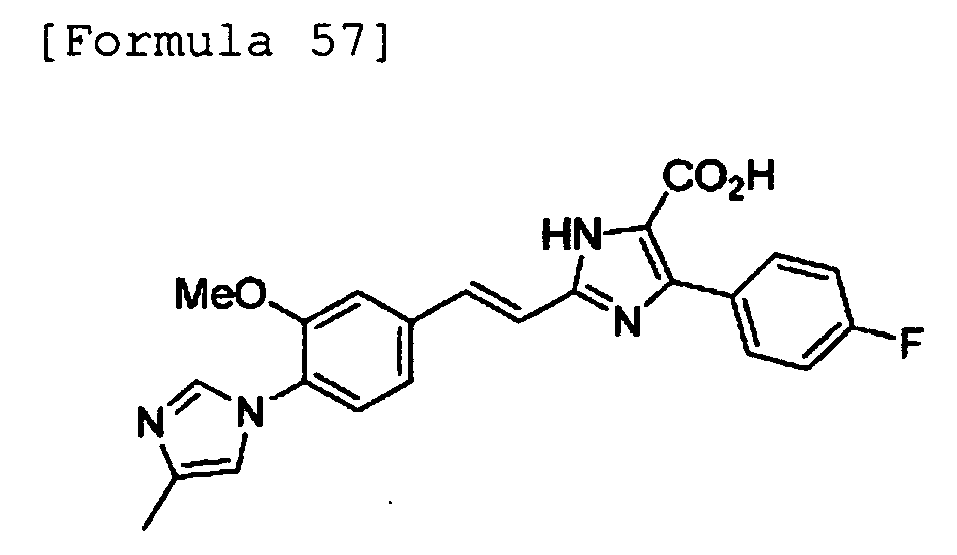
1H-NMR (CD3OD) δ (ppm): 2.18 (s, 3H), 3.91 (s, 3H), 7.18 (d, J=16.4Hz, 1H), 7.22-7.29 (m, 4H), 7.42 (d, J=8.0Hz, 1H), 7.46 (brs, 1H), 7.69 (brd, J=16.4Hz, 1H), 8.00-8.10 (m, 3H). -

ESI-MS; m/z 480 [M++H]. 1H-NMR (CDCl3) δ (ppm): 2.23 (s, 3H), 3.62-3.77 (m, 4H), 3.82 (s, 3H), 6.92 (brs, 1H), 6.93 (d, J=16.4Hz, 1H), 6.98-7.06 (m, 3H), 7.07 (d, J=1.2Hz, 1H), 7.15 (d, J=8.0Hz, 1H), 7.40 (d, J=16.4Hz, 1H), 7.69 (d, J=0.8Hz, 1H), 7.78 (dd, J=8.4, 5.6Hz, 2H). -

ESI-MS; m/z 444 [M++H]. 1H-NMR (CDCl3) δ (ppm): 2.30 (s, 3H), 3.87 (s, 3H), 4.05 (t, J=9.2Hz, 2H), 4.44 (t, J=9.2Hz, 2H), 6.93 (brs, 1H), 6.99 (d, J=16.0Hz, 1H), 7.06-7.15 (m, 4H), 7.22 (d, J=8.4Hz, 1H), 7.47 (d, J=16.0Hz, 1H), 7.75 (brs, 1H), 7.90 (dd, J=9.2, 5.6Hz, 2H). -

1H-NMR (CDCl3) δ (ppm): 2.36 (s, 3H), 3.54 (s, 3H), 3.90 (s, 3H), 3.94 (t, J=9.6Hz, 2H), 4.27 (t, J=9.4Hz, 2H), 6.93 (d, J=16.0Hz, 1H), 6.95 (brs, 1H), 7.14-7.19 (m, 3H), 7.23-7.28 (m, 2H), 7.37 (dd, J=8.8, 5.6Hz, 2H), 7.86 (d, J=16.0Hz, 1H), 7.88 (brs, 1H). -
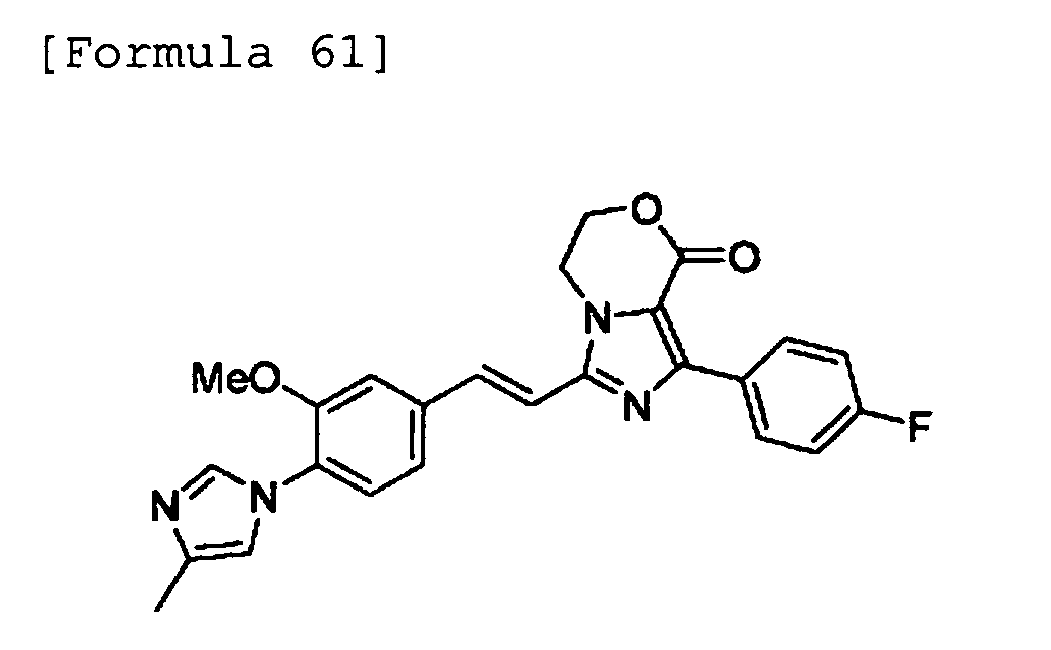
- DCC (47 mg) was added to a solution of 5-(4-fluorophenyl)-2-{(E)-2-[3-methoxy-4-(4-methyl-1H-imidazol-1-yl)phenyl]vinyl}-1H-imidazole-4-carboxylic acid (80 mg) and 2-bromoethanol (0.27 mL), DMAP (5 mg) in DMF (3 mL), and the reaction solution was stirred at room temperature for 15 hours. Then, ethyl acetate and saturated sodium bicarbonate water were added to the reaction solution, and the organic layer was separated. The resulting organic layer was dried over anhydrous magnesium sulfate and then concentrated under reduced pressure. The residue was purified by silica gel column chromatography (elution solvent: ethyl acetate -> ethyl acetate:methanol = 5:1) to obtain 27 mg of the title compound. The property values of the compound are as follows.
1H-NMR (CDCl3) δ (ppm): 2.28 (s, 3H), 3.56 (t, J=5.6Hz, 2H), 3.84 (s, 3H), 4.58 (t, J=5.6Hz, 2H), 6.93 (brs, 1H), 7.01 (d, J=16.4Hz, 1H), 7.08-7.15 (m, 4H), 7.20 (d, J=7.6Hz, 1H), 7.56 (d, J=16.4Hz, 1H), 7.74 (brs, 1H), 7.86-7.95 (m, 2H). - Sodium hydride (containing mineral oil at 60%, 3 mg) was added to a solution of 2-bromoethyl 5-(4-fluorophenyl)-2-{(E)-2-[3-methoxy-4-(4-methyl-1H-imidazol-1-yl)phenyl]vinyl}-1H-imidazole-4-carboxylate (27 mg) in DMF (2 mL), and the reaction solution was stirred at room temperature for three hours. Ethyl acetate and saturated sodium bicarbonate water were added to the reaction solution, and the organic layer was separated. The resulting organic layer was dried over anhydrous magnesium sulfate and then concentrated under reduced pressure. The residue was purified by silica gel column chromatography (carrier: Chromatorex™ NH; elution solvent: ethyl acetate -> ethyl acetate:methanol = 5:1) to obtain 27 mg of the title compound. The property values of the compound are as follows.
1H-NMR (CD3OD) δ (ppm): 2.30 (s, 3H), 3.97 (s, 3H), 4.48 (t, J=5.6Hz, 2H), 4.71 (t, J=5.6Hz, 2H), 7.03 (brs, 1H), 7.12 (d, J=16.0Hz, 1H), 7.16 (t, J=8.8Hz, 2H), 7.24-7.36 (m, 3H), 7.84 (brs, 1H), 7.85 (d, J=16.0Hz, 1H), 8.14 (dd, J=8.8, 5.2Hz, 2H). -
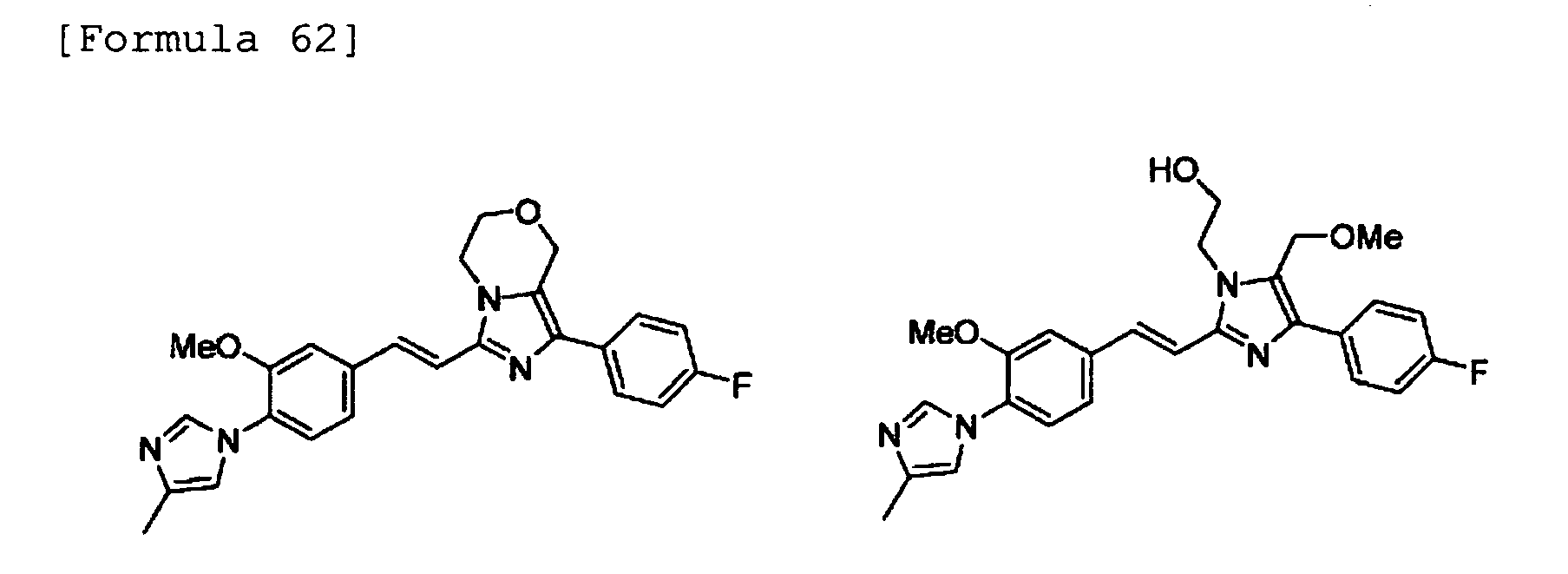
The property values of 1-(4-fluorophenyl)-3-{(E)-2-[3-methoxy-4-(4-methyl-1H-imidazol-1-yl)phenyl]vinyl}-5,6-dihydro-8H-imidazo[5,1-c][1,4]oxazine are as follows.
ESI-MS; m/z 431 [M++H]. 1H-NMR (CDCl3) δ (ppm): 2.41 (s, 3H), 3.92 (s, 3H), 4.11-4.20 (m, 4H), 5.07 (s, 2H), 6.92 (d, J=16.4Hz, 1H), 6.98 (brs, 1H), 7.11 (t, J=8.4Hz, 2H), 7.18 (brs, 1H), 7.23-7.29 (m, 2H), 7.56 (dd, J=8.4, 4.8Hz, 2H), 7.66 (d, J=16.4Hz, 1H), 8.01 (brs, 1H). - The property values of 2-{4-(4-fluorophenyl)-5-methoxymethyl-2-{(E)-2-[3-methoxy-4-(4-methyl-1H-imidazol-1-yl)phenyl]vinyl}imidazol-1-yl}ethanol are as follows.
ESI-MS; m/z 463 [M++H]. 1H-NMR (CDCl3) δ (ppm): 2.38 (s, 3H), 3.44 (s, 3H), 3.91 (s, 3H), 4.01 (t, J=4.4Hz, 2H), 4.32 (t, J=4.4Hz, 2H), 4.49 (s, 2H), 6.96 (brs, 1H), 7.08 (d, J=16.0Hz, 1H), 7.14 (t, J=8.8Hz, 2H), 7.21 (brs, 1H), 7.23 (d, J=6.4Hz, 1H), 7.25 (brd, J=6.4Hz, 1H), 7.63 (dd, J=8.8, 5.2Hz, 2H)7.79 (d, J=16.0Hz, 1H), 8.00 (brs, 1H). -

- LAH (10 mg) was added to a solution of 1-(4-fluorophenyl)-3-{(E)-2-[3-methoxy-4-(4-methyl-1H-imidazol-1-yl)phenyl]vinyl}-5,6-dihydroimidazo[5,1-c][1,4]oxazin-8-one (56 mg) in THF (3 mL), and the reaction solution was stirred at room temperature for 40 minutes. Ethyl acetate and saturated sodium bicarbonate water were added to the reaction solution, and the organic layer was separated. The resulting organic layer was dried over anhydrous magnesium sulfate and then concentrated under reduced pressure to obtain 59 mg of the title crude product. The property value of the compound is as follows.
ESI-MS; m/z 449 [M+ + H]. - Dess-Martin periodinane (280 mg) was added to a solution of 2-{4-(4-fluorophenyl)-5-hydroxymethyl-2-{(E)-2-[3-methoxy-4-(4-methyl-1H-imidazol-1-yl)phenyl]vinyl}imidazol-1-yl}ethanol (59 mg) in methylene chloride (3 mL), and the reaction solution was stirred at room temperature for 1.5 hours. A 1 N sodium hydroxide solution was added to the reaction solution, and the organic layer was separated. Methylamine (2 M solution in methanol, 0.7 mL), acetic acid (0.08 mL) and sodium triacetoxyborohydride (280 mg) were added to the resulting organic layer, and the reaction solution was stirred at room temperature for 1.5 hours. Ethyl acetate and saturated sodium bicarbonate water were added to the reaction solution, and the organic layer was separated. The resulting organic layer was dried over anhydrous magnesium sulfate and then concentrated under reduced pressure. The residue was purified by silica gel column chromatography (carrier: Chromatorex™ NH; elution solvent: ethyl acetate -> ethyl acetate:methanol = 5:1) to obtain 1 mg of the title compound. The property values of the compound are as follows.
ESI-MS; m/z 444 [M++H]. 1H-NMR (CDCl3) δ (ppm): 2.37 (s, 3H), 2.56 (s, 3H), 2.91 (t, J=5.6Hz, 2H), 3.83 (s, 2H), 3.91 (s, 3H), 4.19 (t, J=5.6Hz, 2H), 6.91 (d, J=16.0Hz, 1H), 6.96 (brs, 1H), 7.11 (t, J=8.8Hz, 2H), 7.17 (brs, 1H), 7.21-7.28 (m, 2H), 7.61 (dd, J=8.8, 5.6Hz, 2H), 7.66 (d, J=16.0Hz, 1H), 7.93 (brs, 1H). -

- HOBT (420 mg) and EDC (590 mg) were sequentially added to a solution of (E)-3-[3-methoxy-4-(4-methyl-1H-imidazol-1-yl)phenyl]acrylic acid (530 mg), tert-butyl carbazate (271 mg) and IPEA (0.71 mL) in DMF (10 mL), and the reaction solution was stirred at room temperature for 15 hours. Ethyl acetate and saturated sodium bicarbonate water were added to the reaction solution, and the organic layer was separated. The resulting organic layer was dried over anhydrous magnesium sulfate and then concentrated under reduced pressure. The resulting solid was recrystallized from a mixed solution of ethyl acetate and ethanol to obtain 668 mg of the title compound. The property values of the compound are as follows.
1H-NMR (CDCl3) δ (ppm): 1.51 (s, 9H), 2.30 (s, 3H), 3.88 (s, 3H), 6.45 (d, J=15.6Hz, 1H), 6.76 (brs, 1H), 6.93 (s, 1H), 7.09 (brs, 1H), 7.11 (brd, J=8.0Hz, 1H), 7.25 (d, J=8.0Hz, 1H), 7.65 (d, J=15.6Hz, 1H), 7.73 (s, 1H), 8.80 (brs, 1H). - A solution of 4 N hydrochloric acid in ethyl acetate (3 mL) was added to a solution of tert-butyl N'-{(E)-3-[3-methoxy-4-(4-methyl-1H-imidazol-1-yl)phenyl]acryloyl}hydrazinecarboxylate (668 mg) in ethyl acetate (5 mL) and methanol (1 mL), and the reaction solution was stirred at room temperature for two hours. The solid precipitated in the reaction solution was collected by filtration and washed with diethyl ether to obtain 658 mg of the title compound. The property value of the compound is as follows.
ESI-MS; m/z 273 [M+ + H]. - HOBT (70 mg) and EDC (100 mg) were added to a solution of (E)-3-[3-methoxy-4-(4-methyl-1H-imidazol-1-yl)phenyl]acrylic acid hydrazide dihydrochloride (120 mg), 3-fluorobenzoic acid (49 mg) and IPEA (0.37 mL) in DMF, and the reaction solution was stirred at room temperature for 12 hours. Ethyl acetate and water were added to the reaction solution, and the precipitated solid was collected by filtration to obtain 86 mg of the title compound. The property value of the compound is as follows.
ESI-MS; m/z 395 [M+ + H]. - A solution of 3-fluorobenzoic acid N'-{(E)-3-[3-methoxy-4-(4-methyl-1H-imidazol-1-yl)phenyl]acryloyl}hydrazide (86 mg) in phosphorus oxychloride (2 mL) was stirred at 120°C for one hour. The reaction solution was left to cool to room temperature and concentrated under reduced pressure. Methylene chloride and a 1 N sodium hydroxide solution were added to the residue, and the organic layer was separated. The resulting organic layer was dried over anhydrous magnesium sulfate and then concentrated under reduced pressure. The residue was purified by silica gel column chromatography (carrier: Chromatorex™ NH; elution solvent: heptane:ethyl acetate = 1:1 -> ethyl acetate) to obtain 65 mg of the title compound. The property values of the compound are as follows.
ESI-MS; m/z 377 [M++H]. 1H-NMR (CDCl3) δ (ppm): 2.31 (s, 3H), 3.94 (s, 3H), 6.96 (brs, 1H), 7.12 (d, J=16.4Hz, 1H), 7.22-7.30 (m, 3H), 7.31 (d, J=8.4Hz, 1H), 7.51 (td, J=8.0, 6.0Hz, 1H), 7.63 (d, J=16.4Hz, 1H), 7.75 (d, J=1.6Hz, 1H), 7.79-7.84 (m, 1H), 7.92-7.95 (m, 1H). - A solution of 2-(3-fluorophenyl)-5-{(E)-2-[3-methoxy-4-(4-methyl-1H-imidazol-1-yl)phenyl]vinyl}-[1,3,4]oxadiazole (50 mg) and ammonium acetate (205 mg) in acetic acid (3 mL) was heated under reflux at 150°C for 1.5 hours. The reaction solution was left to cool to room temperature and concentrated under reduced pressure. Ethyl acetate and saturated sodium bicarbonate water were added to the residue, and the organic layer was separated. The resulting organic layer was dried over anhydrous magnesium sulfate and then concentrated under reduced pressure. The residue was purified by silica gel column chromatography (elution solvent: ethyl acetate -> ethyl acetate:methanol = 5:1) to obtain 29 mg of the title compound. The property value of the compound is as follows.
ESI-MS; m/z 376 [M+ + H]. -

- 65 mg of the title compound was obtained from (E)-3-[3-methoxy-4-(4-methyl-1H-imidazol-1-yl)phenyl]acrylic acid hydrazide dihydrochloride (100 mg) and 4-fluorophenylacetic acid (45 mg) by the same method as in Example 16. The property values of the compound are as follows.
1H-NMR (CDCl3) δ (ppm): 2.30 (s, 3H), 3.90 (s, 3H), 4.22 (s, 2H), 6.93 (brs, 1H), 6.99 (d, J=16.0Hz, 1H), 7.05 (t, J=8.4Hz, 2H), 7.15 (d, J=2.0Hz, 1H), 7.17 (dd, J=8.0, 2.0Hz, 1H), 7.27 (d, J=8.0Hz, 1H), 7.32 (dd, J=8.4, 5.2Hz, 2H), 7.45 (d, J=16.0Hz, 1H), 7.72 (d, J=1.2Hz, 1H). - A solution of 2-(4-fluorobenzyl)-5-{(E)-2-[3-methoxy-4-(4-methyl-1H-imidazol-1-yl)phenyl]vinyl}-[1,3,4]oxadiazole (65 mg) and ammonium acetate (256 mg) in acetic acid (1 mL) was stirred at 150°C for four hours. The reaction solution was left to cool to room temperature and concentrated under reduced pressure. Ethyl acetate and saturated sodium bicarbonate water were added to the residue, and the organic layer was separated. The resulting organic layer was dried over anhydrous magnesium sulfate and then concentrated under reduced pressure. The residue was purified by silica gel column chromatography (elution solvent: ethyl acetate -> ethyl acetate:methanol = 5:1). The resulting solid was suspended in diethyl ether and collected by filtration to obtain 40 mg of the title compound. The property values of the compound are as follows. ESI-MS; m/z 390 [M++H]. 1H-NMR (CDCl3) δ (ppm): 2.30 (s, 3H), 3.89 (s, 3H), 4.18 (s, 2H), 6.94 (brs, 1H), 7.05 (t, J=8.8Hz, 2H), 7.06 (d, J=16.4Hz, 1H), 7.18 (brd, J=6.0Hz, 1H), 7.19 (brs, 1H), 7.25 (d, J=6.0Hz, 1H), 7.30 (dd, J=8.8, 5.6Hz, 2H), 7.59 (d, J=16.4Hz, 1H), 7.72 (brs, 1H).
-

- Sodium hydride (containing mineral oil at 40%, 17.4 g) was washed with hexane (100 mL) three times to remove the oily substance. A solution tert-butyl diethylphosphonoacetate (100 g) in THF (100 mL) was added dropwise to a suspension of the sodium hydride in THF (500 mL) at 0°C over 30 minutes. Then, the reaction solution was heated to room temperature and further stirred for one hour. A solution of 1-bromo-3-chloropropane (125 g) in THF (100 mL) was added dropwise to the reaction solution over 30 minutes. After completion of the dropwise addition, the reaction solution was heated under reflux for 15 hours. The reaction solution was left to cool to room temperature. Ethyl acetate (1 L) and saturated aqueous ammonium chloride solution (1 L) were added, and the organic layer was separated. The resulting organic layer was dried over anhydrous magnesium sulfate and concentrated under reduced pressure to obtain 113.4 g of the title compound. The property values of the compound are as follows.
1H-NMR (CDCl3) δ (ppm): 1.31-1.48 (m, 6H), 1.48 (s, 9H), 1.79-2.14 (m, 4H), 2.73-2.91 (m, 1H), 3.55 (t, J=6.4Hz, 2H), 4.10-4.19 (m, 4H). - tert-Butyl 5-chloro-2-(diethoxyphosphoryl)valerate (83.5 g) and lithium hydroxide monohydrate (29.1 g) were sequentially added to a solution of 3-methoxy-4-(4-methyl-1H-imidazol-1-yl)benzaldehyde (50 g) in THF (600 mL) and ethanol (200 mL), and the reaction solution was stirred at room temperature overnight. After confirming that the raw materials disappeared, water and ethyl acetate were added to the reaction solution, and the organic layer was separated. The resulting organic layer was washed with brine, and then dried over anhydrous magnesium sulfate and concentrated under reduced pressure. The residue was purified by silica gel chromatography (elution solvent: heptane:ethyl acetate = 1:1), and the resulting solid was recrystallized from a mixed solution of ethyl acetate and hexane to obtain 54.9 g of the title compound. The property values of the compound are as follows.
1H-NMR (CDCl3) δ (ppm): 1.55 (s, 9H), 1.99-2.08 (m, 2H), 2.30 (s, 3H), 2.63-2.71 (m, 2H), 3.59 (t, J=6.4Hz, 2H), 3.87 (s, 3H), 6.93 (m, 1H), 7.00 (d, J=1.2Hz, 1H), 7.09 (dd, J=8.4, 1.2Hz, 1H), 7.27 (d, J=8.4Hz, 1H), 7.58 (s, 1H), 7.72 (m, 1H). - Trifluoroacetic acid (10 mL) was added to a solution of tert-butyl 5-chloro-2-{1-[3-methoxy-4-(4-methyl-1H-imidazol-1-yl)phenyl-(E)-methylidene]valerate (5 g) in methylene chloride (20 mL), and the reaction solution was stirred at room temperature for two hours. After confirming that the raw materials disappeared, the reaction solution was concentrated under reduced pressure. The resulting solid was collected by filtration and washed with ethyl acetate to obtain 5.7 g of the title compound. The property values of the compound are as follows.
1H-NMR (DMSO-d6) δ (ppm): 1.93-2.03 (m, 2H), 2.35 (s, 3H), 2.58-2.66 (m, 2H), 3.70 (t, J=6.4Hz, 2H), 3.91 (s, 3H), 7.24 (dd, J=8.4, 1.2Hz, 1H), 7.37 (d, J=1.2Hz, 1H), 7.64 (d, J=8.4, 1H), 7.66 (m, 1H), 7.76 (s, 1H), 9.36 (m, 1H). - IPEA (0.14 mL) was added to a solution of 5-chloro-2-{1-[3-methoxy-4-(4-methyl-1H-imidazol-1-yl)phenyl]-(E)-methylidene}valeric acid trifluoroacetic acid salt (110 mg) and 4-fluorophenacyl bromide (85 mg) in DMF (3 mL), and the reaction solution was stirred at room temperature for 30 minutes. Ethyl acetate and saturated sodium bicarbonate water were added to the reaction solution, and the organic layer was separated. The resulting organic layer was dried over anhydrous magnesium sulfate and then concentrated under reduced pressure. The residue was purified by silica gel column chromatography (elution solvent: heptane:ethyl acetate = 1:1 -> ethyl acetate) to obtain 47 mg of the title compound. The property values of the compound are as follows.
1H-NMR (CDCl3) δ (ppm): 2.09-2.20 (m, 2H), 2.31 (s, 3H), 2.78-2.85 (m, 2H), 3.63 (t, J=6.4Hz, 2H), 3.89 (s, 3H), 5.47 (s, 2H), 6.95 (brs, 1H), 7.07 (d, J=1.6Hz, 1H), 7.10 (dd, J=8.0, 1.6Hz, 1H), 7.18 (t, J=8.4Hz, 2H), 7.29 (d, J=8.0Hz, 1H), 7.77 (brs, 1H), 7.85 (s, 1H), 7.99 (dd, J=8.4, 5.2Hz, 2H). - A solution of 2-(4-fluorophenyl)-2-oxoethyl 5-chloro-2-{1-[3-methoxy-4-(4-methyl-1H-imidazol-1-yl)phenyl]-(E)-methylidene}valerate (47 mg) and ammonium acetate (154 mg) in acetic acid (1 mL) was stirred at 120°C for six hours. The reaction solution was left to cool to room temperature and concentrated under reduced pressure. Ethyl acetate and saturated sodium bicarbonate water were added to the residue, and the organic layer was separated. The resulting organic layer was dried over anhydrous magnesium sulfate and then concentrated under reduced pressure. The residue was purified by silica gel column chromatography (elution solvent: heptane:ethyl acetate = 1:1 -> ethyl acetate -> ethyl acetate:methanol = 9:1) to obtain 14 mg of 3-(4-fluorophenyl)-8-{1-[3-methoxy-4-(4-methyl-1H-imidazol-1-yl)phenyl]-(E)-methylidene}-5,6,7,8-tetrahydroimidazo[1,2-a]pyridine and 2 mg of 2-(4-fluorophenyl)-8-{1-[3-methoxy-4-(4-methyl-1H-imidazol-1-yl)phenyl]-(E)-methylidene}-5,6,7,8-tetrahydroimidazo[1,2-a]pyridine.
The property values of 3-(4-fluorophenyl)-8-{1-[3-methoxy-4-(4-methyl-1H-imidazol-1-yl)phenyl]-(E)-methylidene}-5,6,7,8-tetrahydroimidazo[1,2-a]pyridine are as follows.
ESI-MS; m/z 415 [M++H]. 1H-NMR (CDCl3) δ (ppm): 2.09-2.17 (m, 2H), 2.39 (s, 3H), 2.92-2.99 (m, 2H), 3.89 (s, 3H), 4.12 (t, J=5.6Hz, 2H), 6.97 (brs, 1H), 7.07 (t, J=8.8Hz, 2H), 7.09 (d, J=1.6Hz, 1H), 7.10 (dd, J=6.0, 1.6Hz, 1H), 7.15 (s, 1H), 7.26 (d, J=6.0Hz, 1H), 7.79 (dd, J=8.8, 5.2Hz, 2H), 7.81 (brs, 1H), 7.96 (brs, 1H). - The property values of 2-(4-fluorophenyl)-8-{1-[3-methoxy-4-(4-methyl-1H-imidazol-1-yl)phenyl]-(E)-methylidene}-5,6,7,8-tetrahydroimidazo[1,2-a]pyridine are as follows.
ESI-MS; m/z 415 [M++H]. 1H-NMR (CDCl3) δ (ppm): 2.03-2.11 (m, 2H), 2.32 (s, 3H), 2.90-3.01 (m, 2H), 3.86 (s, 3H), 4.04 (t, J=5.6Hz, 2H), 6.93 (d, J=1.2Hz, 1H), 7.07 (brs, 1H), 7.08 (brd, J=8.4Hz, 1H), 7.14 (t, J=8.4Hz, 2H), 7.18 (d, J=1.2Hz, 1H), 7.24 (d, J=8.4Hz, 1H), 7.38 (dd, J=8.4, 5.6Hz, 2H), 7.74 (brs, 1H), 7.77 (brs, 1H). -

- HOBT (108 mg) and EDC (153 mg) were sequentially added to a solution of 5-chloro-2-{1-[3-methoxy-4-(4-methyl-1H-imidazol-1-yl)phenyl]-(E)-methylidene}valeric acid trifluoroacetic acid salt (300 mg), tert-butyl carbazate (71 mg) and IPEA (0.38 mL) in DMF (5 mL), and the reaction solution was stirred at room temperature for three hours. Ethyl acetate and saturated sodium bicarbonate water were added to the reaction solution, and the organic layer was separated. The resulting organic layer was dried over anhydrous magnesium sulfate and then concentrated under reduced pressure. The residue was purified by silica gel column chromatography (carrier: Chromatorex™ NH; elution solvent: heptane:ethyl acetate = 1:1 -> ethyl acetate) to obtain 222 mg of the title compound. The property value of the compound is as follows.
ESI-MS; m/z 449 [M+ + H]. - A solution of 4 N hydrochloric acid in ethyl acetate (1 mL) was added to a solution of tert-butyl N'-{5-chloro-2-{1-[3-methoxy-4-(4-methyl-1H-imidazol-1-yl)phenyl]-(E)-methylidene}pentanoyl}hydrazinecarboxylate (222 mg) in ethyl acetate (1 mL), and the reaction solution was stirred at room temperature for two hours. The reaction solution was concentrated under reduced pressure to obtain 208 mg of the title compound. The property values of the compound are as follows.
1H-NMR (CD3OD) δ (ppm): 1.98-2.06 (m, 2H), 2.44 (s, 3H), 2.75-2.80 (m, 2H), 3.61 (t, J=6.4Hz, 2H), 3.97 (s, 3H), 7.21 (dd, J=8.0, 1.6Hz, 1H), 7.29 (d, J=1.6Hz, 1H), 7.37 (s, 1H), 7.60 (s, 1H), 7.61 (d, J=8.0Hz, 1H), 9.16 (d, J=1.2Hz, 1H). - A 5 N sodium hydroxide solution (3 mL) was added to a solution of 5-chloro-2-{1-[3-methoxy-4-(4-methyl-1H-imidazol-1-yl)phenyl]-(E)-methylidene}valeric acid hydrazide dihydrochloride (208 mg) and 4-fluorobenzoic acid chloride (0.07 mL) in methylene chloride (5 mL) at 0°C, and the reaction solution was stirred at room temperature for one hour. The organic layer was separated from the reaction solution and washed with brine. The resulting organic layer was dried over anhydrous magnesium sulfate and then concentrated under reduced pressure. The residue was purified by silica gel column chromatography (carrier: Chromatorex™ NH; elution solvent: ethyl acetate -> ethyl acetate:methanol = 5:1) to obtain 84 mg of the title compound. The property values of the compound are as follows.
ESI-MS; m/z 471 [M++H]. 1H-NMR (CDCl3) δ (ppm): 1.99-2.08 (m, 2H), 2.29 (s, 3H), 2.74-2.80 (m, 2H), 3.57 (t, J=5.6Hz, 2H), 3.84 (s, 3H), 6.93 (brs, 1H), 6.96 (s, 1H), 6.98 (brd, J=8.0Hz, 1H), 7.09 (t, J=8.8Hz, 2H), 7.23 (d, J=8.0Hz, 1H), 7.37 (brs, 1H), 7.74 (d, J=1.2Hz, 1H), 7.89 (dd, J=8.8, 5.6Hz, 2H). - A solution of 4-fluorobenzoic acid N'-{5-chloro-2-{1-[3-methoxy-4-(4-methyl-1H-imidazol-1-yl)phenyl]-(E)-methylidene}valeric acid} hydrazide (84 mg) in phosphorus oxychloride (2 mL) was stirred at 100°C for 30 minutes. The reaction solution was left to cool to room temperature and concentrated under reduced pressure. Chloroform and a 1 N sodium hydroxide solution were added to the residue, and the organic layer was separated. The resulting organic layer was washed with brine, and then dried over anhydrous magnesium sulfate and concentrated under reduced pressure to obtain 85 mg of the title compound. The property values of the compound are as follows.
ESI-MS; m/z 453 [M++H]. 1H-NMR (CDCl3) δ (ppm): 2.22-2.31 (m, 2H), 2.42 (s, 3H), 3.05-3.11 (m, 2H), 3.70 (t, J=6.0Hz, 2H), 3.95 (s, 3H), 7.03 (brs, 1H), 7.14 (d, J=1.6Hz, 1H), 7.18 (dd, J=8.0, 1.6Hz, 1H), 7.23 (t, J=8.4Hz, 2H), 7.37 (d, J=8.0Hz, 1H), 7.60 (s, 1H), 8.13 (dd, J=8.4, 4.8Hz, 2H), 8.20 (brs, 1H). - A solution of 2-{4-chloro-1-{1-[3-methoxy-4-(4-methyl-1H-imidazol-1-yl)phenyl]-(E)-methylidene}butyl}-5-(4-fluorophenyl)-[1,3,4]oxadiazole (85 mg) and ammonium acetate (290 mg) in acetic acid (3 mL) was heated under reflux for 10 hours. The reaction solution was left to cool to room temperature and concentrated under reduced pressure. Methylene chloride and a 1 N sodium hydroxide solution were added to the residue, and the organic layer was separated. The resulting organic layer was washed with brine, dried over anhydrous magnesium sulfate, and then concentrated under reduced pressure. The resulting residue was purified by silica gel column chromatography (carrier: Chromatorex™ NH; elution solvent: heptane:ethyl acetate = 1:1 -> ethyl acetate) to obtain 34 mg of the title compound. The property values of the compound are as follows.
ESI-MS; m/z 416 [M++H]. 1H-NMR (CDCl3) δ (ppm): 2.17-2.25 (m, 2H), 2.35 (s, 3H), 2.96-3.03 (m, 2H), 3.89 (s, 3H), 4.33 (t, J=6.0Hz, 2H), 6.95 (brs, 1H), 7.04-7.16 (m, 4H), 7.28 (dd, J=8.4Hz, 1H), 7.80 (brs, 1H), 7.83 (brs, 1H), 8.11 (dd, J=8.4, 5.6Hz, 2H). -

- IPEA (1.9 mL) was added to a solution of 5-chloro-2-{1-[3-methoxy-4-(4-methyl-1H-imidazol-1-yl)phenyl]-(E)-methylidene}valeric acid trifluoroacetic acid salt (1.53 g) and methyl 2-chloro-3-(4-fluorophenyl)-3-oxopropionate (CAS #160727-96-8, 624 mg) in DMF (5 mL), and the reaction solution was stirred at room temperature for four hours. Ethyl acetate and saturated sodium bicarbonate water were added to the reaction solution, and the organic layer was separated. The resulting organic layer was dried over anhydrous magnesium sulfate and then concentrated under reduced pressure. The residue was purified by silica gel column chromatography (elution solvent: heptane:ethyl acetate = 1:1 -> ethyl acetate) to obtain 817 mg of the title compound. The property values of the compound are as follows.
ESI-MS; m/z 529 [M++H]. 1H-NMR (CDCl3) δ (ppm): 2.02-2.11 (m, 2H), 2.32 (s, 3H), 2.77 (t, J=7.6Hz, 2H), 3.59 (t, J=6.4Hz, 2H), 3.83 (s, 3H), 3.89 (s, 3H), 6.44 (s, 1H), 6.95 (brs, 1H), 7.04 (d, J=1.6Hz, 1H), 7.07 (dd, J=8.0, 1.6Hz, 1H), 7.20 (t, J=8.8Hz, 2H), 7.28 (d, J=8.0Hz, 1H), 7.78 (d, J=1.2Hz, 1H), 7.83 (s, 1H), 8.09 (dd, J=8.8, 5.2Hz, 2H). - A solution of 2-(4-fluorophenyl)-1-methoxycarbonyl-2-oxoethyl 5-chloro-2-{1-[3-methoxy-4-(4-methyl-1H-imidazol-1-yl)phenyl]-(E)-methylidene}valerate (817 mg) and ammonium acetate (2.37 g) in acetic acid (5 mL) was stirred at 120°C for 11 hours. The reaction solution was left to cool to room temperature and concentrated under reduced pressure. Ethyl acetate and saturated sodium bicarbonate water were added to the residue, and the organic layer was separated. The resulting organic layer was dried over anhydrous magnesium sulfate and then concentrated under reduced pressure. The resulting residue was purified by silica gel column chromatography (elution solvent: heptane:ethyl acetate = 1:1 -> ethyl acetate -> ethyl acetate:methanol = 9:1) to obtain 258 mg of methyl 3-(4-fluorophenyl)-8-{1-[3-methoxy-4-(4-methyl-1H-imidazol-1-yl)phenyl]-(E)-methylidene}-5,6,7,8-tetrahydroimidazo[1,2-a]pyridine-2-carboxylate and 193 mg of methyl 2-(4-fluorophenyl)-8-{1-[3-methoxy-4-(4-methyl-1H-imidazol-1-yl)phenyl]-(E)-methylidene}-5,6,7,8-tetrahydroimidazo[1,2-a]pyridine-3-carboxylate.
The property values of methyl 3-(4-fluorophenyl)-8-{1-[3-methoxy-4-(4-methyl-1H-imidazol-1-yl)phenyl]-(E)-methylidene}-5,6,7,8-tetrahydroimidazo[1,2-a]pyridine-2-carboxylate are as follows.
ESI-MS; m/z 473 [M++H]. 1H-NMR (CDCl3) δ (ppm): 2.08-2.17 (m, 2H), 2.33 (s, 3H), 2.92-2.98 (m, 2H), 3.75 (s, 3H), 3.86 (s, 3H), 4.46 (t, J=6.0Hz, 2H), 6.94 (brs, 1H), 7.05-7.12 (m, 4H), 7.26 (d, J=7.6Hz, 1H), 7.66 (dd, J=8.8, 5.6Hz, 2H), 7.80 (brs, 1H), 7.85 (brs, 1H). - The property values of methyl 2-(4-fluorophenyl)-8-{1-[3-methoxy-4-(4-methyl-1H-imidazol-1-yl)phenyl]-(E)-methylidene}-5,6,7,8-tetrahydroimidazo[1,2-a]pyridine-3-carboxylate are as follows.
ESI-MS; m/z 473 [M++H]. 1H-NMR (CDCl3) δ (ppm): 2.00-2.10 (m, 2H), 2.33 (s, 3H), 2.95-3.02 (m, 2H), 3.80-3.90 (m, 8H), 6.94 (brs, 1H), 7.08 (brs, 1H), 7.09 (brd, J=6.8Hz, 1H), 7.17 (t, J=8.4Hz, 2H), 7.26 (d, J=6.8Hz, 1H), 7.40 (dd, J=8.4, 5.6Hz, 2H), 7.78 (brs, 1H), 7.90 (brs, 1H). -

1H-NMR (CDCl3) δ (ppm): 2.10-2.19 (m, 2H), 2.33 (s, 3H), 2.92-2.99 (m, 2H), 3.86 (s, 3H), 4.16 (t, J=5.2Hz, 2H), 4.76 (s, 2H), 6.94 (brs, 1H), 7.04-7.15 (m, 4H), 7.23 (d, J=8.0Hz, 1H), 7.66 (dd, J=8.4, 5.2Hz, 2H), 7.77 (brs, 1H), 7.78 (brs, 1H). -

1H-NMR (CDCl3) δ (ppm): 2.01-2.10 (m, 2H), 2.31 (s, 3H), 2.94-3.00 (m, 2H), 3.86 (s, 3H), 3.92 (t, J=6.0Hz, 2H), 4.59 (s, 2H), 6.93 (brs, 1H), 7.06 (d, J=1.6Hz, 1H), 7.07 (dd, J=7.2, 1.6Hz, 1H), 7.17 (t, J=8.8Hz, 2H), 7.24 (d, J=7.2Hz, 1H), 7.38 (dd, J=8.8, 5.2Hz, 2H), 7.72 (brs, 1H), 7.73 (brs, 1H). -

ESI-MS; m/z 459 [M+ + H]. -

The property value of the compound is as follows.
ESI-MS; m/z 486 [M+ + H]. -

The property value of the compound is as follows.
ESI-MS; m/z 472 [M+ + H]. -

The property value of the compound is as follows.
ESI-MS; m/z 458 [M+ + H]. -
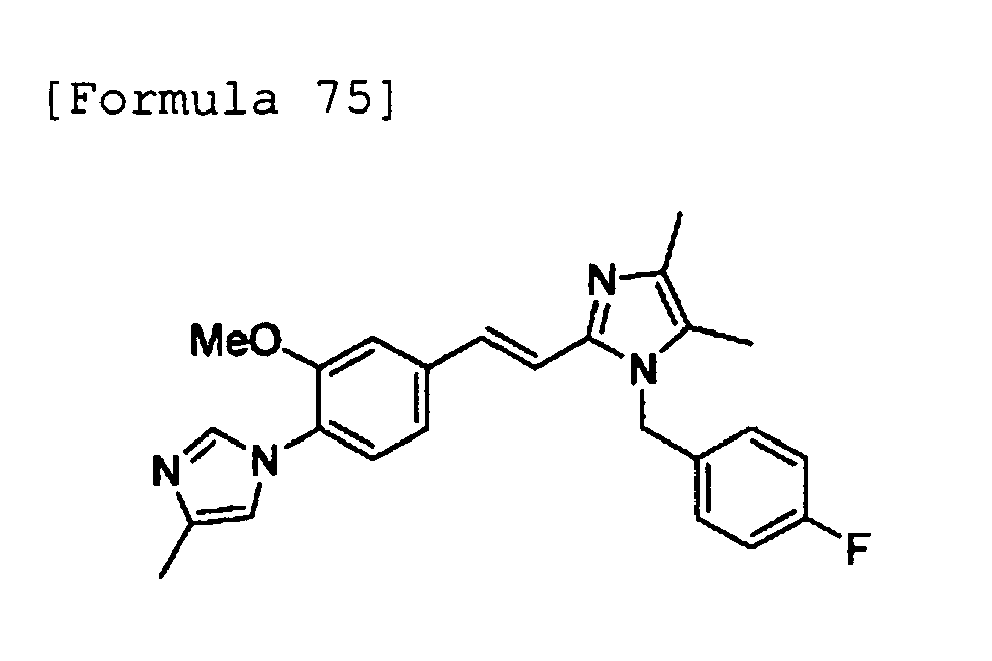
- IPEA (2.1 mL) was added to a solution of (E)-3-[3-methoxy-4-(4-methyl-1H-imidazol-1-yl)phenyl]acrylic acid (1 g) and 3-chloro-2-butanone (0.39 mL) in DMF (10 mL), and the reaction solution was stirred at room temperature for 19 hours. Ethyl acetate and water were added to the reaction solution, and the organic layer was separated. The resulting organic layer was dried over anhydrous magnesium sulfate and then concentrated under reduced pressure. The residue was purified by silica gel column chromatography (elution solvent: ethyl acetate -> ethyl acetate:methanol = 5:1) to obtain 1.3 g of the title compound.
The property values of the compound are as follows.
ESI-MS; m/z 329 [M++H]. 1H-NMR (CDCl3) δ (ppm): 1.50 (d, J=7.2Hz, 3H), 2.23 (s, 3H), 2.32 (s, 3H), 3.91 (s, 3H), 5.24 (q, J=7.2Hz, 1H), 6.52 (d, J=16.4Hz, 1H), 6.95 (brs, 1H), 7.18 (d, J=1.6Hz, 1H), 7.22 (dd, J=8.0, 1.6Hz, 1H), 7.28 (d, J=8.0Hz, 1H), 7.72 (d, J=16.4Hz, 1H), 7.79 (brs, 1H). - A solution of 1-methyl-2-oxopropyl (E)-3-[3-methoxy-4-(4-methyl-1H-imidazol-1-yl)phenyl]acrylate (1.31 g) and ammonium acetate (6.1 g) in acetic acid (10 mL) was stirred at 120°C for six hours and further stirred at 150°C for 12 hours. The reaction solution was left to cool to room temperature and concentrated under reduced pressure. Ethyl acetate and saturated sodium bicarbonate water were added to the residue, and the organic layer was separated. The resulting organic layer was dried over anhydrous magnesium sulfate and then concentrated under reduced pressure. The residue was purified by silica gel column chromatography (carrier: Chromatorex™ NH; elution solvent: ethyl acetate -> ethyl acetate:methanol = 5:1) to obtain 256 mg of a crude product of 2-{(E)-2-[3-methoxy-4-(4-methyl-1H-imidazol-1-yl)phenyl]vinyl]-4,5-dimethyl-1H-imidazole. Sodium hydride (containing mineral oil at 60%, 33 mg) was added to a solution of the crude product in DMF (5 mL), and the reaction solution was stirred at room temperature for 20 minutes. 4-Fluorobenzyl bromide (0.1 mL) was added to the reaction solution, and the reaction solution was stirred at room temperature for one hour. Ethyl acetate and saturated sodium bicarbonate water were added to the reaction solution, and the organic layer was separated. The resulting organic layer was dried over anhydrous magnesium sulfate and then concentrated under reduced pressure. The residue was purified by silica gel column chromatography (carrier: Chromatorex™ NH; elution solvent: ethyl acetate -> ethyl acetate:methanol = 5:1) to obtain 49 mg of the title compound. The property values of the compound are as follows.
1H-NMR (CDCl3) δ (ppm): 2.09 (s, 3H), 2.26 (s, 3H), 2.28 (s, 3H), 3.83 (s, 3H), 5.13 (s, 2H), 6.76 (d, J=16.4Hz, 1H), 6.88 (brs, 1H), 6.97-7.04 (m, 5H), 7.08 (dd, J=8.0, 1.6 Hz, 1H), 7.16 (d, J=8.0, 1H), 7.54 (d, J=16.4Hz, 1H), 7.66 (d, J=1.2Hz, 1H). -

- EDC (1.28 g), HOBT (902 mg) and IPEA (2.33 mL) were sequentially added to a solution of 5-chloro-2-{1-[3-methoxy-4-(4-methylimidazol-1-yl)phenyl]-(E)-methylidene}valeric acid trifluoroacetic acid salt (1 g) and β,β-dimethoxy-4-pyridineethaneamine dihydrochloride (740 mg) as a known compound (CAS #167897-36-1) in DMF (15 mL), and the reaction solution was stirred at room temperature for 12 hours. Ethyl acetate and water were added to the reaction solution, and the organic layer was separated. The resulting organic layer was washed with brine and then dried over anhydrous sodium sulfate and concentrated under reduced pressure. The residue was purified by silica gel column chromatography (carrier: Chromatorex™ NH; elution solvent: heptane:ethyl acetate = 1:2) to obtain 822 mg of the title compound. The property values of the compound are as follows.
1H-NMR (CDCl3) δ (ppm): 1.70-1.78 (m, 2H), 2.35 (s, 3H), 2.54-2.59 (m, 2H), 3.26 (s, 6H), 3.45-3.49 (m, 2H), 3.81-3.89 (m, 2H), 3.85 (s, 3H), 5.59 (m, 1H), 6.88-6.94 (m, 3H), 7.46 (dd, J=4.8, 2.0Hz, 2H), 7.88 (s, 1H), 8.66 (dd, J=4.8, 2.0Hz, 2H). - A solution of 2,2-dimethoxy-2-pyridin-4-ylethyl 5-chloro-2-{1-[3-methoxy-4-(4-methyl-1H-imidazol-1-yl)phenyl]-(E)-methylidene}valerate (800 mg) in DMF (8 mL) was cooled to 0°C. Sodium hydride (containing mineral oil at 60%, 96 mg) was added to the reaction solution, and the reaction solution was stirred at room temperature for one hour. Water and ethyl acetate were added to the reaction solution, and the organic layer was separated. The resulting organic layer was washed with brine, dried over anhydrous sodium sulfate, and then concentrated under reduced pressure. The residue was purified by silica gel column chromatography (carrier: Chromatorex™ NH, elution solvent: heptane:ethyl acetate = 1:2) to obtain 586.9 mg of the title compound. The property values of the compound are as follows.
1H-NMR (CDCl3) δ (ppm): 1.63-1.67 (m, 2H), 2.31 (s, 3H), 2.61-2.65 (m, 2H), 3.14-3.18 (m, 2H), 3.29 (s, 6H), 3.83 (s, 3H), 4.00 (s, 2H), 6.90-6.96 (m, 3H), 7.21 (d, J=8.0Hz, 1H), 7.45 (dd, J=4.8, 2.0Hz, 2H), 7.54 (s, 1H), 7.74 (s, 1H), 8.60 (dd, J=4.8, 2.0Hz, 2H). - Concentrated hydrochloric acid (10 mL) was added to 1-(2,2-dimethoxy-2-pyridin-4-ylethyl)-3-{1-[3-methoxy-4-(4-methyl-1H-imidazol-1-yl)phenyl]-(E)-methylidene}piperidin-2-one (580 mg), and the mixture was stirred at 50°C for four hours. After confirming that the raw materials disappeared, the reaction solution was concentrated under reduced pressure. Saturated sodium bicarbonate water and ethyl acetate were added to the resulting residue, and the organic layer was separated. The resulting organic layer was washed with brine, and then dried over anhydrous sodium sulfate and concentrated under reduced pressure. The residue was purified by silica gel column chromatography (carrier: Chromatorex™ NH, elution solvent: heptane:ethyl acetate = 1:2) to obtain 346.2 mg of the title compound. The property values of the compound are as follows.
1H-NMR (CDCl3) δ (ppm): 1.98-2.05 (m, 2H), 2.34 (s, 3H), 2.88-2.93 (m, 2H), 3.52-3.56 (m, 2H), 3.87 (s, 3H), 4.91 (s, 2H), 6.95 (s, 1H), 7.02-7.06 (m, 2H), 7.27 (s, 1H), 7.77 (dd, J=4.8, 2.0Hz, 2H), 7.79 (s, 1H), 7.84 (s, 1H), 8.84 (dd, J=4.8, 2.0Hz, 2H). - A solution of 3-{1-[3-methoxy-4-(4-methyl-1H-imidazol-1-yl)phenyl]-(E)-methylidene}-1-(2-oxo-2-pyridin-4-ylethyl)piperidin-2-one (150 mg) and ammonium acetate (555 mg) in acetic acid (2 mL) was stirred at 120°C for five hours. The reaction solution was left to cool to room temperature and concentrated under reduced pressure. Ethyl acetate and saturated sodium bicarbonate water were added to the residue, and the organic layer was separated. The resulting organic layer was washed with brine, and then dried over anhydrous sodium sulfate and concentrated under reduced pressure. The residue was purified by silica gel column chromatography (carrier: Chromatorex™ NH; elution solvent: heptane-ethyl acetate system -> ethyl acetate-2-propanol) to obtain 121.5 mg of the title compound. The property values of the compound are as follows.
ESI-MS; m/z 398 [M++H]. 1H-NMR (CDCl3) δ (ppm): 2.02-2.17 (m, 2H), 2.33 (s, 3H), 2.95-2.99 (m, 2H), 3.88 (s, 3H), 4.13-4.17 (m, 2H), 6.95 (s, 1H), 7.08-7.11 (m, 2H), 7.25-7.28 (m, 1H), 7.39 (s, 1H), 7.71 (dd, J=4.8, 2.0Hz, 2H), 7.78 (s, 1H), 7.80 (s, 1H), 8.59 (dd, J=4.8, 2.0Hz, 2H). -

- 23 mg of the title compound was obtained from (E)-3-[3-methoxy-4-(4-methyl-1H-imidazol-1-yl)phenyl]acrylic acid hydrazide dihydrochloride (100 mg) and 4-fluoro-α-methylphenylacetic acid (33 mg) by the same method as in Example 16. The property value of the compound is as follows.
ESI-MS; m/z 405 [M+ + H]. - A solution of 2-[1-(4-fluorophenyl)ethyl]-5-{(E)-2-[3-methoxy-4-(4-methyl-1H-imidazol-1-yl)phenyl]vinyl}-[1,3,4]oxadiazole (23 mg) and ammonium acetate (88 mg) in acetic acid (1 mL) was stirred at 150°C for 10 hours. The reaction solution was left to cool to room temperature and concentrated under reduced pressure. Ethyl acetate and saturated sodium bicarbonate water were added to the residue, and the organic layer was separated. The resulting organic layer was dried over anhydrous magnesium sulfate and then concentrated under reduced pressure. The residue was purified by silica gel column chromatography (elution solvent: ethyl acetate -> ethyl acetate:methanol = 5:1) to obtain 8 mg of the title compound. The property values of the compound are as follows.
ESI-MS; m/z 404 [M++H]. 1H-NMR (CDCl3) δ (ppm): 1.77 (d, J=7.2Hz, 3H), 2.29 (s, 3H), 3.87 (s, 3H), 4.31 (q, J=7.2Hz, 1H), 6.92 (brs, 1H), 7.01 (t, J=8.8Hz, 2H), 7.05 (d, J=16.0Hz, 1H), 7.15 (brd, J=8.0Hz, 1H), 7.16 (brs, 1H), 7.22 (d, J=8.0Hz, 1H), 7.29 (dd, J=8.8, 4.8Hz, 2H), 7.56 (d, J=16.0Hz, 1H), 7.71 (brs, 1H). -
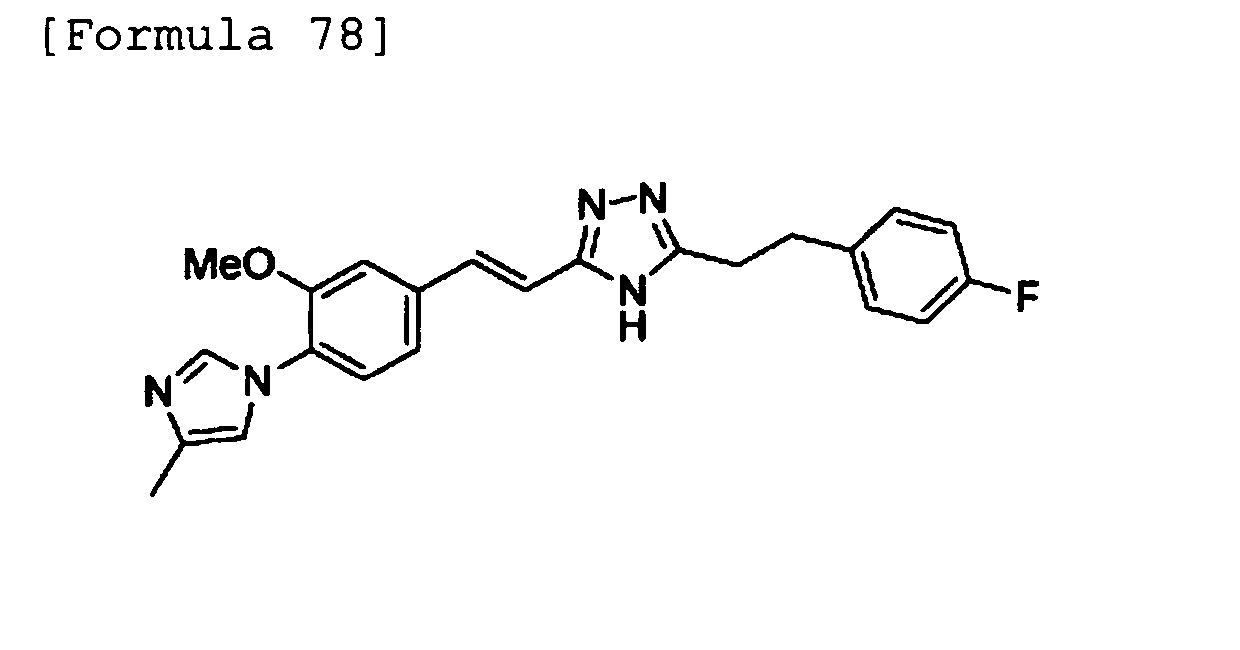
- 33 mg of the title compound was obtained from (E)-3-[3-methoxy-4-(4-methyl-1H-imidazol-1-yl)phenyl]acrylic acid hydrazide dihydrochloride (100 mg) and 3-(4-fluorophenyl)propionic acid (33 mg) by the same method as in Example 16. The property value of the compound is as follows.
ESI-MS; m/z 405 [M+ + H]. - A solution of 2-[2-(4-fluorophenyl)ethyl]-5-{(E)-2-[3-methoxy-4-(4-methyl-1H-imidazol-1-yl)phenyl]vinyl}-[1,3,4]oxadiazole (33 mg) and ammonium acetate (126 mg) in acetic acid (1 mL) was stirred at 150°C for 10 hours. The reaction solution was left to cool to room temperature and concentrated under reduced pressure. Ethyl acetate and saturated sodium bicarbonate water were added to the residue, and the organic layer was separated. The resulting organic layer was dried over anhydrous magnesium sulfate and then concentrated under reduced pressure. The residue was purified by silica gel column chromatography (elution solvent: ethyl acetate -> ethyl acetate:methanol = 5:1) to obtain 8 mg of the title compound. The property values of the compound are as follows.
ESI-MS; m/z 404 [M++H]. 1H-NMR (CDCl3) δ (ppm): 2.31 (s, 3H), 3.11 (s, 4H), 3.88 (s, 3H), 6.94 (brs, 1H), 6.96 (t, J=8.8Hz, 2H), 7.07 (d, J=16.0Hz, 1H), 7.13 (dd, J=8.8, 5.6Hz, 2H), 7.17 (brd, J=8.8Hz, 1H), 7.18 (brs, 1H), 7.23 (d, J=8.8Hz, 1H), 7.57 (d, J=16.0Hz, 1H), 7.74 (brs, 1H). -

- Diethyl cyanophosphonate (0.12 mL) was added to a solution of (E)-3-[3-methoxy-4-(4-methyl-1H-imidazol-1-yl)phenyl]acrylic acid (200 mg) and triethylamine (0.54 mL) in DMF (2 mL), and the reaction solution was stirred at 0°C for 30 minutes. A solution of 1-amino-3-(4-fluorophenyl)propan-2-one hydrochloride (CAS# 93102-98-8, 158 mg) in DMF (1 mL) was added dropwise to the reaction solution over 20 minutes, and the reaction solution was stirred at 0°C for 1.5 hours. Ethyl acetate and saturated sodium bicarbonate water were added to the reaction solution, and the organic layer was separated. The resulting organic layer was dried over anhydrous magnesium sulfate and then concentrated under reduced pressure. The residue was purified by silica gel column chromatography (carrier: Chromatorex™ NH; elution solvent: ethyl acetate -> ethyl acetate:methanol = 5:1) to obtain 43 mg of the title compound. The property values of the compound are as follows.
ESI-MS; m/z 408 [M++H]. 1H-NMR (CDCl3) δ (ppm): 2.30 (s, 3H), 3.77 (s, 2H), 3.89 (s, 3H), 4.34 (d, J=4.4Hz, 2H), 6.35 (brt, J=4.4Hz, 1H), 6.46 (d, J=15.6Hz, 1H), 6.92 (brs, 1H), 7.05 (t, J=8.4Hz, 2H), 7.13 (brs, 1H), 7.15-7.26 (m, 4H), 7.60 (d, J=15.6Hz, 1H), 7.71 (brs, 1H). - A solution of (E)-N-[3-(4-fluorophenyl)-2-oxopropyl]-3-[3-methoxy-4-(4-methyl-1H-imidazol-1-yl)phenyl]acrylamide (43 mg) and ammonium acetate (163 mg) in acetic acid (1 mL) and xylene (5 mL) was heated under reflux for 16 hours. The reaction solution was left to cool to room temperature. Ethyl acetate and saturated sodium bicarbonate water were added to the reaction solution, and the organic layer was separated. The resulting organic layer was dried over anhydrous magnesium sulfate and then concentrated under reduced pressure. The residue was purified by silica gel column chromatography (carrier: Chromatorex™ NH; elution solvent: ethyl acetate -> ethyl acetate:methanol = 5:1) to obtain 13 mg of the title compound. The property values of the compound are as follows.
ESI-MS; m/z 389 [M++H]. 1H-NMR (CDCl3) δ (ppm): 2.28 (s, 3H), 3.80 (s, 3H), 3.96 (s, 2H), 6.75 (brs, 1H), 6.90 (brs, 1H), 6.94 (d, J=16.4Hz, 1H), 6.96 (t, J=8.8Hz, 2H), 7.01 (dd, J=8.0, 1.6Hz, 1H), 7.04 (d, J=1.6Hz, 1H), 7.15 (d, J=8.8Hz, 1H), 7.18-7.24 (m, 3H), 7.66 (s, 1H). -

- Sodium hydrate (containing mineral oil at 60%, 6 mg) was added to a solution of 3-(4-fluorobenzyl)-5-{(E)-2-[3-methoxy-4-(4-methyl-1H-imidazol-1-yl)phenyl]vinyl}-4H-[1,2,4]triiazole (18 mg) in THF (1 mL), and the reaction solution was stirred at room temperature for 30 minutes. Iodomethane (20 mg) was added to the reaction solution, and the reaction solution was then stirred at room temperature for 1.5 hours. Ethyl acetate and saturated sodium bicarbonate water were added to the reaction solution, and the organic layer was separated. The resulting organic layer was dried over anhydrous magnesium sulfate and then concentrated under reduced pressure. The residue was purified by silica gel column chromatography (elution solvent: ethyl acetate:ethanol = 9:1) to obtain 6 mg of 5-(4-fluorobenzyl)-3-{(E)-2-[3-methoxy-4-(4-methyl-1H-imidazol-1-yl)phenyl]vinyl}-1-methyl-1H-[1,2,4]triazole and 2 mg of 3-(4-fluorobenzyl)-5-{(E)-2-[3-methoxy-4-(4-methyl-1H-imidazol-1-yl)phenyl]vinyl}-1-methyl-1H-[1,2,4]triazole.
The property values of 5-(4-fluorobenzyl)-3-{(E)-2-[3-methoxy-4-(4-methyl-1H-imidazol-1-yl)phenyl]vinyl}-1-methyl-1H-[1,2,4]triazole are as follows.
1H-NMR (CDCl3) δ (ppm): 2.30 (s, 3H), 3.72 (s, 3H), 3.88 (s, 3H), 4.16 (s, 2H), 6.92 (brs, 1H), 7.02 (t, J=8.4Hz, 2H), 7.04 (d, J=16.0Hz, 1H), 7.15-7.26 (m, 5H), 7.53 (d, J=16.0Hz, 1H), 7.71 (brs, 1H).
The property values of 3-(4-fluorobenzyl)-5-{(E)-2-[3-methoxy-4-(4-methyl-1H-imidazol-1-yl)phenyl]vinyl}-1-methyl-1H-[1,2,4]triazole are as follows.
1H-NMR (CDCl3) δ (ppm): 2.31 (s, 3H), 3.90 (s, 3H), 3.92 (s, 3H), 4.04 (s, 2H), 6.85 (d, J=15.6Hz, 1H), 6.93 (brs, 1H), 6.98 (t, J=8.4Hz, 2H), 7.14 (d, J=1.6Hz, 1H), 7.22 (dd, J=8.4, 1.6Hz, 1H), 7.26 (d, J=8.4Hz, 1H), 7.32 (dd, J=8.4, 5.6Hz, 2H), 7.65 (d, J=15.6Hz, 1H), 7.74 (brs, 1H). -


- The racemate synthesized by the method in Example 31, 3-[1-(4-fluorophenyl)ethyl]-5-{(E)-2-[3-methoxy-4-(4-methyl-1H-imidazol-1-yl)phenyl]vinyl}-4H-[1,2,4]triazole (72 mg), was separated by CHIRALCEL™ OD-H manufactured by Daicel Chemical Industries, Ltd. (2 cm x 25 cm; mobile phase: hexane:ethanol = 8:2) to obtain the title optically active compound with a retention time of 11 minutes (25 mg, >99% ee) and the title optically active compound with a retention time of 14 minutes (26 mg, >99% ee).
The property values of the title optically active compound with a retention time of 11 minutes (Example 36) are as follows.
1H-NMR (CDCl3) δ (ppm): 1.77 (d, J=7.2Hz, 3H), 2.29 (s, 3H), 3.87 (s, 3H), 4.31 (q, J=7.2Hz, 1H), 6.92 (brs, 1H), 7.01 (t, J=8.8Hz, 2H), 7.05 (d, J=16.0Hz, 1H), 7.15 (brd, J=8.0Hz, 1H), 7.16 (brs, 1H), 7.22 (d, J=8.0Hz, 1H), 7.29 (dd, J=8.8, 4.8Hz, 2H), 7.56 (d, J=16.0Hz, 1H), 7.71 (brs, 1H).
The property values of the title optically active compound with a retention time of 14 minutes (Example 37) are as follows.
1H-NMR (CDCl3) δ (ppm): 1.77 (d, J=7.2Hz, 3H), 2.29 (s, 3H), 3.87 (s, 3H), 4.31 (q, J=7.2Hz, 1H), 6.92 (brs, 1H), 7.01 (t, J=8.8Hz, 2H), 7.05 (d, J=16.0Hz, 1H), 7.15 (brd, J=8.0Hz, 1H), 7.16 (brs, 1H), 7.22 (d, J=8.0Hz, 1H), 7.29 (dd, J=8.8, 4.8Hz, 2H), 7.56 (d, J=16.0Hz, 1H), 7.71 (brs, 1H). -

- 4 mg of 5-[1-(4-fluorophenyl)ethyl]-3-{(E)-2-[3-methoxy-4-(4-methyl-1H-imidazol-1-yl)phenyl]vinyl}-1-methyl-1H-[1,2,4]triazole and 2 mg of 3-[1-(4-fluorophenyl)ethyl]-5-{(E)-2-[3-methoxy-4-(4-methyl-1H-imidazol-1-yl)phenyl]vinyl}-1-methyl-1H-[1,2,4]triazole were obtained by the same method as in Examples 34 and 35 from (+)-3-[1-(4-fluorophenyl)ethyl]-5-{(E)-2-[3-methoxy-4-(4-methyl-1H-imidazol-1-yl)phenyl]vinyl}-4H-[1,2,4]triazole (25 mg) obtained in Example 36.
The property values of 5-[1-(4-fluorophenyl)ethyl]-3-{(E)-2-[3-methoxy-4-(4-methyl-1H-imidazol-1-yl)phenyl]vinyl}-1-methyl-1H-[1,2,4]triazole are as follows.
ESI-MS; m/z 418 [M++H]. 1H-NMR (CDCl3) δ (ppm): 1.76 (d, J=7.6Hz, 3H), 2.30 (s, 3H), 3.61 (s, 3H), 3.88 (s, 3H), 4.20 (q, J=7.6Hz, 1H), 6.93 (brs, 1H), 7.01 (t, J=8.8Hz, 2H), 7.07 (d, J=16.4Hz, 1H), 7.16-7.21 (m, 4H), 7.23 (d, J=8.0Hz, 1H), 7.57 (d, J=16.4Hz, 1H), 7.71 (brs, 1H).
The property values of 3-[1-(4-fluorophenyl)ethyl]-5-{(E)-2-[3-methoxy-4-(4-methyl-1H-imidazol-1-yl)phenyl]vinyl}-1-methyl-1H-[1,2,4]triazole are as follows.
1H-NMR (CDCl3) δ (ppm): 1.70 (d, J=7.6Hz, 3H), 2.30 (s, 3H), 3.89 (s, 3H), 3.92 (s, 3H), 4.25 (q, J=7.6Hz, 1H), 6.85 (d, J=15.6Hz, 1H), 6.93 (brs, 1H), 6.98 (t, J=8.8Hz, 2H), 7.13 (d, J=1.6Hz, 1H), 7.21 (dd, J=8.0, 1.6Hz, 1H), 7.25 (d, J=8.0Hz, 1H), 7.32-7.37 (m, 2H), 7.64 (d, J=15.6Hz, 1H), 7.72 (brs, 1H). -

The property values of 5-[1-(4-fluorophenyl)ethyl]-3-{(E)-2-[3-methoxy-4-(4-methyl-1H-imidazol-1-yl)phenyl]vinyl}-1-methyl-1H-[1,2,4]triazole are as follows.
1H-NMR (CDCl3) δ (ppm): 1.76 (d, J=7.6Hz, 3H), 2.30 (s, 3H), 3.61 (s, 3H), 3.88 (s, 3H), 4.20 (q, J=7.6Hz, 1H), 6.93 (brs, 1H), 7.01 (t, J=8.8Hz, 2H), 7.07 (d, J=16.4Hz, 1H), 7.16-7.21 (m, 4H), 7.23 (d, J=8.0Hz, 1H), 7.57 (d, J=16.4Hz, 1H), 7.71 (brs, 1H).
The property values of 3-[1-(4-fluorophenyl)ethyl]-5-{(E)-2-[3-methoxy-4-(4-methyl-1H-imidazol-1-yl)phenyl]vinyl}-1-methyl-1H-[1,2,4]triazole are as follows.
1H-NMR (CDCl3) δ (ppm): 1.70 (d, J=7.6Hz, 3H), 2.30 (s, 3H), 3.89 (s, 3H), 3.92 (s, 3H), 4.25 (q, J=7.6Hz, 1H), 6.85 (d, J=15.6Hz, 1H), 6.93 (brs, 1H), 6.98 (t, J=8.8Hz, 2H), 7.13 (d, J=1.6Hz, 1H), 7.21 (dd, J=8.0, 1.6Hz, 1H), 7.25 (d, J=8.0Hz, 1H), 7.32-7.37 (m, 2H), 7.64 (d, J=15.6Hz, 1H), 7.72 (brs, 1H). -

- A solution of 40% methylamine in acetic acid (1 mL) was added to a solution of 2-[1-(4-fluorophenyl)ethyl]-5-{(E)-2-[3-methoxy-4-(4-methyl-1H-imidazol-1-yl)phenyl]vinyl}-[1,3,4]oxadiazole (85 mg) synthesized by the method in Example 31 in xylene (20 mL), and the reaction solution was heated under reflux for 12 hours while azeotropic removing water by a Dean-Stark apparatus. The reaction solution was left to cool to room temperature. Then, ethyl acetate and saturated sodium bicarbonate water were added to the reaction solution, and the organic layer was separated. The resulting organic layer was dried over anhydrous magnesium sulfate and then concentrated under reduced pressure. The residue was purified by LC-MS to obtain a trifluoroacetate of a racemate of the title compound. The resulting trifluoroacetate of the racemate of the title compound was diluted with ethyl acetate.
Saturated sodium bicarbonate water was added to the solution, and the organic layer was separated. The resulting organic layer was dried over anhydrous magnesium sulfate and then concentrated under reduced pressure. The residue was separated by CHIRALCEL™ OD-H manufactured by Daicel Chemical Industries, Ltd. (2 cm x 25 cm; mobile phase: hexane:ethanol = 8:2) to obtain the title optically active compound with a retention time of 13 minutes (13 mg, >99% ee) and the title optically active compound with a retention time of 19 minutes (11 mg, >99% ee).
The property values of (+)-3-[1-(4-fluorophenyl)ethyl]-5-{(E)-2-[3-methoxy-4-(4-methyl-1H-imidazol-1-yl)phenyl]vinyl}-4-methyl-4H-[1,2,4]triazole are as follows. ESI-MS; m/z 418 [M++H]. 1H-NMR (CDCl3) δ (ppm): 1.83 (d, J=7.2Hz, 3H), 2.30 (s, 3H), 3.36 (s, 3H), 3.89 (s, 3H), 4.16 (q, J=7.2Hz, 1H), 6.77 (d, J=16.0Hz, 1H), 6.92 (brs, 1H), 7.00 (t, J=8.4Hz, 2H), 7.13 (d, J=1.6Hz, 1H), 7.14-7.26 (m, 4H), 7.71 (d, J=16.0Hz, 1H), 7.72 (brs, 1H).
The property values of (-)-3-[1-(4-fluorophenyl)ethyl]-5-{(E)-2-[3-methoxy-4-(4-methyl-1H-imidazol-1-yl)phenyl]vinyl}-4-methyl-4H-[1,2,4]triazole are as follows.
ESI-MS; m/z 418 [M++H]. 1H-NMR (CDCl3) δ (ppm): 1.83 (d, J=7.2Hz, 3H), 2.30 (s, 3H), 3.36 (s, 3H), 3.89 (s, 3H), 4.16 (q, J=7.2Hz, 1H), 6.77 (d, J=16.0Hz, 1H), 6.92 (brs, 1H), 7.00 (t, J=8.4Hz, 2H), 7.13 (d, J=1.6Hz, 1H), 7.14-7.26 (m, 4H), 7.71 (d, J=16.0Hz, 1H), 7.72 (brs, 1H). -

- 80 mg of the title compound was obtained from (E)-3-[3-methoxy-4-(4-methyl-1H-imidazol-1-yl)phenyl]acrylic acid hydrazide dihydrochloride (200 mg) and 2-phenylpropionic acid (87 mg) by the same method as in Example 16. The property values of the compound are as follows.
1H-NMR (CDCl3) δ (ppm): 1.80 (d, J=7.2Hz, 3H), 2.29 (s, 3H), 3.87 (s, 3H), 4.32 (q, J=7.2Hz, 1H), 6.92 (brs, 1H), 7.08 (d, J=16.0Hz, 1H), 7.17 (brd, J=7.6Hz, 1H), 7.18 (brs, 1H), 7.22 (d, J=7.6Hz, 1H), 7.28-7.39 (m, 5H), 7.57 (d, J=16.0Hz, 1H), 7.69 (d, J=0.8Hz, 1H). -

The property values of 3-{(E)-2-[3-methoxy-4-(4-methyl-1H-imidazol-1-yl)phenyl]vinyl}-1-methyl-5-(1-phenylethyl)-1H-[1,2,4]triazole are as follows.
1H-NMR (CDCl3) δ (ppm): 1.79 (d, J=7.2Hz, 3H), 2.30 (s, 3H), 3.59 (s, 3H), 3.88 (s, 3H), 4.20 (q, J=7.2Hz, 1H), 6.92 (brs, 1H), 7.08 (d, J=16.0Hz, 1H), 7.16-7.23 (m, 5H), 7.23-7.27 (m, 1H), 7.32 (t, J=6.8Hz, 2H), 7.58 (d, J=16.0Hz, 1H), 7.70 (d, J=0.8Hz, 1H).
The property values of 5-{(E)-2-[3-methoxy-4-(4-methyl-1H-imidazol-1-yl)phenyl]vinyl}-1-methyl-3-(1-phenylethyl)-1H-[1,2,4]triazole are as follows.
1H-NMR (CDCl3) δ (ppm): 1.72 (d, J=7.2Hz, 3H), 2.30 (s, 3H), 3.90 (s, 3H), 3.93 (s, 3H), 4.27 (q, J=7.2Hz, 1H), 6.86 (d, J=16.0Hz, 1H), 6.94 (brs, 1H), 7.15 (d, J=1.6Hz, 1H), 7.18-7.28 (m, 3H), 7.31 (t, J=7.6Hz, 2H), 7.40 (dd, J=7.6, 0.8Hz, 2H), 7.65 (d, J=16.0Hz, 1H), 7.73 (brs, 1H). -

- 7 mg of the title compound was obtained from (E)-3-[3-methoxy-4-(4-methyl-1H-imidazol-1-yl)phenyl]acrylic acid hydrazide dihydrochloride (58 mg) and 4-fluorobenzoic acid (35 mg) by the same method as in Example 16. The property values of the compound are as follows.
ESI-MS; m/z 376 [M++H]. 1H-NMR (CD3OD) δ (ppm): 2.28 (s, 3H), 3.95 (s, 3H), 6.98 (brs, 1H), 7.10 (d, J=16.0Hz, 1H), 7.16-7.23 (m, 2H), 7.27 (brd, J=8.0Hz, 1H), 7.30 (brs, 1H), 7.31 (d, J=8.0Hz, 1H), 7.64 (d, J=16.0Hz, 1H), 7.74 (d, J=1.2Hz, 1H), 8.02-8.08 (m, 2H). -

- 16 mg of the title compound was obtained from (E)-3-[3-methoxy-4-(4-methyl-1H-imidazol-1-yl)phenyl]acrylic acid (100 mg) and α-bromopropiophenone (98 mg) by the same method as in Example 6. The property values of the compound are as follows.
1H-NMR (CDCl3) δ (ppm): 2.29 (s, 3H), 2.50 (s, 3H), 3.79 (s, 3H), 6.91 (brs, 1H), 6.99 (d, J=16.4Hz, 1H), 7.00 (dd, J=8.0, 2.0Hz, 1H), 7.05 (d, J=2.0Hz, 1H), 7.14 (d, J=8.0Hz, 1H), 7.25 (d, J=16.4Hz, 1H), 7.25-7.30 (m, 1H), 7.41 (t, J=7.2Hz, 2H), 7.59-7.66 (m, 2H), 7.68 (d, J=1.2Hz, 1H). -

- 16 mg of the title compound was obtained from (E)-3-[3-methoxy-4-(4-methyl-1H-imidazol-1-yl)phenyl]acrylic acid (66 mg) and α,α-dimethylphenylacetic acid (47 mg) by the same method as in Example 16. The property values of the compound are as follows.
ESI-MS; m/z 400 [M++H]. 1H-NMR (CDCl3) δ (ppm): 1.85 (s, 6H), 2.29 (s, 3H), 3.88 (s, 3H), 6.92 (brs, 1H), 7.10 (d, J=16.0Hz, 1H), 7.14 (dd, J=8.0, 2.4Hz, 1H), 7.19 (d, J=2.4Hz, 1H), 7.22 (d, J=8.0Hz, 1H), 7.25-7.28 (m, 1H), 7.32-7.36 (m, 4H), 7.58 (d, J=16.0Hz, 1H), 7.66 (d, J=1.2Hz, 1H). -

- IPEA (0.2 mL), HOBT (78 mg) and EDC (111 mg) were added to a solution of (E)-3-[3-methoxy-4-(4-methyl-1H-imidazol-1-yl)phenyl]acrylic acid (100 mg) and phenylpiperidin-2-ylmethanol (CAS No. 23702-98-9, 74 mg) in DMF (3 mL), and the reaction solution was stirred at room temperature for 14 hours. Ethyl acetate and saturated sodium bicarbonate water were added to the reaction solution, and the organic layer was separated. The resulting organic layer was dried over anhydrous magnesium sulfate and then concentrated under reduced pressure. The residue was purified by silica gel column chromatography (elution solvent: ethyl acetate -> ethyl acetate:methanol = 5:1) to obtain 126 mg of the title compound. The property values of the compound are as follows.
ESI-MS; m/z 432 [M+ + H]. - Dess-Martin periodinane (248 mg) was added to a solution of (E)-1-[2-(hydroxyphenylmethyl)piperidin-1-yl]-3-[3-methoxy-4-(4-methyl-1H-imidazol-1-yl)phenyl]propenone (126 mg) in chloroform (5 mL), and the reaction solution was stirred at room temperature for one hour. The reaction solution was purified as is by silica gel column chromatography (elution solvent: ethyl acetate:heptane = 1:1 -> ethyl acetate -> ethyl acetate:methanol = 9:1) to obtain 90 mg of the title compound. The property values of the compound are as follows.
1H-NMR (CDCl3) δ (ppm): 1.50-1.92 (m, 5H), 2.21-2.30 (m, 1H), 2.30 (s, 3H), 3.49-3.58 (m, 1H), 3.90 (s, 3H), 3.97-4.05 (m, 1H), 6.22 (brd, J=6.0Hz, 1H), 6.93 (d, J=15.6Hz, 1H), 6.94 (brs, 1H), 7.13 (brs, 1H), 7.20 (brd, J=8.0Hz, 1H), 7.25 (d, J=8.0Hz, 1H), 7.47 (t, J=7.2Hz, 2H), 7.57 (t, J=7.2Hz, 1H), 7.65 (d, J=15.6Hz, 1H), 7.74 (s, 1H), 7.97 (d, J=7.2Hz, 2H). - A solution of (E)-1-[2-benzoylpiperidin-1-yl]-3-[3-methoxy-4-(4-methyl-1H-imidazol-1-yl)phenyl]propenone (90 mg) and ammonium acetate (324 mg) in acetic acid (1 mL) was stirred at 150°C for four hours. The reaction solution was left to cool to room temperature. Then, ethyl acetate and saturated sodium bicarbonate water were added to the reaction solution, and the organic layer was separated. The resulting organic layer was washed with brine, dried over anhydrous magnesium sulfate and then concentrated under reduced pressure. The residue was purified by silica gel column chromatography (carrier: Chromatorex NH; elution solvent: heptane:ethyl acetate = 1:1 -> ethyl acetate -> ethyl acetate:methanol = 9:1) to obtain 52 mg of the title compound. The property values of the compound are as follows.
ESI-MS; m/z 411 [M++H]. 1H-NMR (CDCl3) δ (ppm): 1.86-1.94 (m, 2H), 2.04-2.10 (m, 2H), 2.30 (s, 3H), 3.05 (t, J=6.8Hz, 2H), 3.89 (s, 3H), 4.12 (t, J=6.4Hz, 2H), 6.92 (brs, 1H), 6.93 (d, J=16.0Hz, 1H), 7.14 (d, J=1.2Hz, 1H), 7.19 (dd, J=8.4, 1.2Hz, 1H), 7.22 (d, J=8.4Hz, 1H), 7.23-7.26 (m, 1H), 7.40 (t, J=7.6Hz, 2H), 7.60 (d, J=16.0Hz, 1H), 7.70 (d, J=1.6Hz, 1H), 7.74 (dd, J=7.6, 1.2Hz, 2H). -

- IPEA (2.22 mL), HOBT (573 mg) and EDC (813 mg) were added to a solution of 5-chloro-2-(4-fluorophenyl)pentanoic acid (490 mg) synthesized according to the method described in Tetrahedron Letters, 2003, vol.44, p.365 and tert-butyl carbazate (420 mg) in DMF (5 mL), and the reaction solution was stirred at room temperature for 12 hours. Ethyl acetate and 1 N aqueous hydrochloric acid were added to the reaction solution, and the organic layer was separated. The resulting organic layer was washed with saturated sodium bicarbonate water, dried over anhydrous magnesium sulfate and then concentrated under reduced pressure. The residue was purified by silica gel column chromatography (elution solvent: heptane -> heptane:ethyl acetate = 1:1) to obtain 517 mg of the title compound. The property values of the compound are as follows.
ESI-MS; m/z 367 [M++Na].1H-NMR (CDCl3) δ (ppm): 1.44 (s, 9H), 1.61-1.85 (m, 2H), 1.90-2.00 (m, 1H), 2.22-2.32 (m, 1H), 3.38 (t, J=7.2Hz, 1H), 3.46-3.57 (m, 2H), 7.03 (t, J=8.4Hz, 2H), 7.11 (brs, 1H), 7.28 (dd, J=8.4, 5.6Hz, 2H). - A solution of 4 N hydrochloric acid in ethyl acetate (2 mL) was added to a solution of tert-butyl N'-[5-chloro-2-(4-fluorophenyl)pentanoyl]hydrazinecarboxylate (517 mg) in ethyl acetate (2 mL), and the reaction solution was stirred at room temperature for four hours. The reaction solution was concentrated under reduced pressure to obtain 342 mg of the title compound. The property values of the compound are as follows.
1H-NMR (CD3OD) δ (ppm): 1.64-1.81 (m, 2H), 1.90-2.00 (m, 1H), 2.15-2.25 (m, 1H), 3.53-3.60 (m, 3H), 7.07 (t, J=8.4Hz, 2H), 7.39 (dd, J=8.4, 4.8Hz, 2H). - IPEA (1.28 mL), HOBT (330 mg) and EDC (468 mg) were added to a solution of 5-chloro-2-(4-fluorophenyl)pentanoic acid hydrazide hydrochloride (342 mg) and (E)-3-[3-methoxy-4-(4-methyl-1H-imidazol-1-yl)phenyl]acrylic acid (315 mg) in DMF (5 mL), and the reaction solution was stirred at room temperature for 14 hours. Ethyl acetate and saturated sodium bicarbonate water were added to the reaction solution, and the organic layer was separated. The resulting organic layer was dried over anhydrous magnesium sulfate and then concentrated under reduced pressure. The residue was purified by silica gel column chromatography (elution solvent: ethyl acetate -> ethyl acetate:methanol = 5:1) to obtain 427 mg of the title compound. The property value of the compound is as follows.
ESI-MS; m/z 485 [M+ + H]. - Imidazole (211 mg), carbon tetrabromide (1.0 g) and triphenylphosphine (244 mg) were added to a solution of 5-chloro-2-(4-fluorophenyl)pentanoic acid N'-{(E)-3-[3-methoxy-4-(4-methyl-1H-imidazol-1-yl)phenyl]acryloyl}hydrazide (300 mg) in methylene chloride (5 mL), and the reaction solution was stirred at room temperature for 14 hours. The reaction solution was purified as is by silica gel column chromatography (carrier: Chromatorex NH; elution solvent: heptane:ethyl acetate = 1:1 -> ethyl acetate) to obtain 264 mg of the title compound. The property value of the compound is as follows.
ESI-MS; m/z 467 [M+ + H]. - A solution of 2-[4-chloro-1-(4-fluorophenyl)butyl]-5-{(E)-2-[3-methoxy-4-(4-methyl-1H-imidazol-1-yl)phenyl]vinyl}-[1,3,4]oxadiazole (264 mg) and ammonium acetate (871 mg) in acetic acid (2 mL) was stirred at 150°C for 5.5 hours. The reaction solution was left to cool to room temperature. Then, ethyl acetate and saturated sodium bicarbonate water were added to the reaction solution, and the organic layer was separated. The resulting organic layer was dried over anhydrous magnesium sulfate and then concentrated under reduced pressure. The residue was purified by silica gel column chromatography (carrier: Chromatorex NH; elution solvent: ethyl acetate -> ethyl acetate:methanol = 4:1) to obtain 120 mg of a racemate of the title compound. The resulting racemate was separated by CHIRALPAK™ IA manufactured by Daicel Chemical Industries, Ltd. (2 cm x 25 cm; mobile phase: hexane:ethanol = 1:1) to obtain the title optically active compound with a retention time of 14 minutes (43 mg, >99% ee) and the title optically active compound with a retention time of 17 minutes (41 mg, >99% ee).
The property values of (+)-8-(4-fluorophenyl)-2-{(E)-2-[3-methoxy-4-(4-methyl-1H-imidazol-1-yl)phenyl]vinyl}-5,6,7,8-tetrahydro[1,2,4]triazolo[1,5-a]pyridine are as follows. ESI-MS; m/z 430 [M++H]. 1H-NMR (CDCl3) δ (ppm): 2.00-2.25 (m, 3H), 2.29 (s, 3H), 2.30-2.40 (m, 1H), 3.85 (s, 3H), 4.25-4.35 (m, 3H), 6.90 (brs, 1H), 7.02 (t, J=8.8Hz, 2H), 7.05 (d, J=16.0Hz, 1H), 7.10 (dd, J=8.8, 4.8Hz, 2H), 7.13 (brd, J=7.6Hz, 1H), 7.14 (brs, 1H), 7.20 (d, J=7.6Hz, 1H), 7.51 (d, J=16.0Hz, 1H), 7.69 (d, J=0.8Hz, 1H).
The property values of (-)-8-(4-fluorophenyl)-2-{(E)-2-[3-methoxy-4-(4-methyl-1H-imidazol-1-yl)phenyl]vinyl}-5,6,7,8-tetrahydro[1,2,4]triazolo[1,5-a]pyridine are as follows. ESI-MS; m/z 430 [M++H]. 1H-NMR (CDCl3) δ (ppm): 2.00-2.25 (m, 3H), 2.29 (s, 3H), 2.30-2.40 (m, 1H), 3.85 (s, 3H), 4.25-4.35 (m, 3H), 6.90 (brs, 1H), 7.02 (t, J=8.8Hz, 2H), 7.05 (d, J=16.0Hz, 1H), 7.10 (dd, J=8.8, 4.8Hz, 2H), 7.13 (brd, J=7.6Hz, 1H), 7.14 (brs, 1H), 7.20 (d, J=7.6Hz, 1H), 7.51 (d, J=16.0Hz, 1H), 7.69 (d, J=0.8Hz, 1H). -

- IPEA (1.7 mL), HOBT (851 mg) and EDC (1.2 g) were added to a solution of 5-chloro-2-(3,4,5-trifluorophenyl)pentanoic acid (840 mg) synthesized according to the method described in Tetrahedron Letters, 2003, vol.44, p.365 and tert-butyl carbazate (500 mg) in DMF (5 mL), and the reaction solution was stirred at room temperature for 23 hours. Ethyl acetate and saturated sodium bicarbonate water were added to the reaction solution, and the organic layer was separated. The resulting organic layer was dried over anhydrous magnesium sulfate and then concentrated under reduced pressure. The residue was purified by silica gel column chromatography (elution solvent: heptane -> heptane:ethyl acetate = 1:1) to obtain 718 mg of tert-butyl N'-[5-chloro-2-(3,4,5-trifluorophenyl)pentanoyl]hydrazinecarboxylate and 420 mg of tert-butyl N'-[5-(benzotriazol-1-yloxy)-2-(3,4,5-trifluorophenyl)pentanoyl]hydrazinecarboxylate.
The property values of tert-butyl N'-[5-chloro-2-(3,4,5-trifluorophenyl)pentanoyl]hydrazinecarboxylate are as follows.
ESI-MS; m/z 403 [M++Na].1H-NMR (CDCl3) δ (ppm): 1.45 (s, 9H), 1.64-2.00 (m, 3H), 2.15-2.26 (m, 1H), 3.30 (t, J=7.2Hz, 1H), 3.47-3.60 (m, 2H), 6.99 (dd, J=8.4, 6.4Hz, 2H).
The property value of tert-butyl N'-[5-(benzotriazol-1-yloxy)-2-(3,4,5-trifluorophenyl)pentanoyl]hydrazinecarboxylate is as follows.
ESI-MS; m/z 480 [M+ + H]. - Sodium iodide (131 mg) and sodium hydride (containing mineral oil at 40%, 70 mg) were added to a solution of tert-butyl N'-[5-(benzotriazol-1-yloxy)-2-(3,4,5-trifluorophenyl)pentanoyl]hydrazinecarboxylate (420 mg) in DMF (3 mL), and the reaction solution was stirred at 100°C for 19 hours. The reaction solution was left to cool to room temperature. Ethyl acetate and saturated sodium bicarbonate water were added to the reaction solution, and the organic layer was separated. The resulting organic layer was dried over anhydrous magnesium sulfate and then concentrated under reduced pressure. The residue was purified by silica gel column chromatography (elution solvent: heptane -> ethyl acetate) to obtain 134 mg of the title compound. The property values of the compound are as follows.
1H-NMR (CD3OD) δ (ppm): 1.50 (s, 9H), 1.90-2.05 (m, 3H), 2.15-2.23 (m, 1H), 3.61-3.80 (m, 3H), 6.70 (brs, 1H), 6.90 (t, J=8.0, 6.8Hz, 2H). - A solution of 4 N hydrochloric acid in ethyl acetate (1 mL) was added to a solution of tert-butyl [2-oxo-3-(3,4,5-trifluorophenyl)piperidin-1-yl]carbamate (134 mg) in chloroform (1 mL), and the reaction solution was stirred at room temperature for three hours. The reaction solution was concentrated under reduced pressure to obtain 109 mg of the title compound. The property value of the compound is as follows.
ESI-MS; m/z 245 [M+ + H]. - IPEA (0.41 mL), HOBT (105 mg) and EDC (149 mg) were added to a solution of 1-amino-3-(3,4,5-trifluorophenyl)piperidin-2-one hydrochloride (109 mg) and (E)-3-[3-methoxy-4-(4-methyl-1H-imidazol-1-yl)phenyl]acrylic acid (100 mg) in DMF (2 mL), and the reaction solution was stirred at room temperature for three hours. Ethyl acetate and saturated sodium bicarbonate water were added to the reaction solution, and the organic layer was separated. The resulting organic layer was dried over anhydrous magnesium sulfate and then concentrated under reduced pressure. The residue was purified by silica gel column chromatography (elution solvent: ethyl acetate -> ethyl acetate:methanol = 5:1) to obtain 95 mg of the title compound. The property values of the compound are as follows.
ESI-MS; m/z 485 [M++H]. 1H-NMR (CD3OD) δ (ppm): 1.94-2.10 (m, 3H), 2.22-2.30 (m, 1H), 2.31 (s, 3H), 3.64-3.72 (m, 1H), 3.78-3.82 (m, 2H), 3.84 (s, 3H), 6.41 (d, J=16.0Hz, 1H), 6.88 (brd, J=8.0Hz, 1H), 6.90 (brs, 1H), 6.93 (s, 1H), 7.00 (dd, J=6.8, 3.6Hz, 2H), 7.14 (d, J=8.0Hz, 1H), 7.44 (d, J=16.0Hz, 1H), 7.74 (d, J=1.2Hz, 1H), 9.87 (brs, 1H). - A solution of (E)-3-[3-methoxy-4-(4-methyl-1H-imidazol-1-yl)phenyl]-N-[2-oxo-3-(3,4,5-trifluorophenyl)piperidin-1-yl]acrylamide (95 mg) in phosphorus oxychloride (2 mL) was stirred at 120°C for one hour. The reaction solution was left to cool to room temperature and then concentrated under reduced pressure. Ammonium acetate (302 mg) was added to a solution of the residue in acetic acid (1 mL), and the reaction solution was stirred at 150°C for three hours. The reaction solution was left to cool to room temperature. Then, ethyl acetate and saturated sodium bicarbonate water were added to the reaction solution, and the organic layer was separated. The resulting organic layer was dried over anhydrous magnesium sulfate and then concentrated under reduced pressure. The residue was purified by silica gel column chromatography (carrier: Chromatorex NH; elution solvent: heptane:ethyl acetate = 1:1 -> ethyl acetate) to obtain 50 mg of a racemate of the title compound. The resulting racemate was separated by CHIRALPAK™ IA manufactured by Daicel Chemical Industries, Ltd. (2 cm x 25 cm; mobile phase: ethanol) to obtain the title optically active compound with a retention time of 19 minutes (25 mg, >99% ee) and the title optically active compound with a retention time of 33 minutes (22 mg, >99% ee).
The property values of (+)-2-{(E)-2-[3-methoxy-4-(4-methyl-1H-imidazol-1-yl)phenyl]vinyl}-8-(3,4,5-trifluorophenyl)-5,6,7,8-tetrahydro[1,2,4]triazolo[1,5-a]pyridine are as follows. ESI-MS; m/z 466 [M++H]. 1H-NMR (CDCl3) δ (ppm): 1.97-2.25 (m, 3H), 2.30 (s, 3H), 2.32-2.42 (m, 1H), 3.86 (s, 3H), 4.24-4.30 (m, 3H), 6.82 (dd, J=8.0, 6.0Hz, 2H), 6.91 (brs, 1H), 7.05 (d, J=16.8Hz, 1H), 7.14 (dd, J=8.4, 1.6Hz, 1H), 7.16 (s, 1H), 7.21 (d, J=8.4Hz, 1H), 7.50 (d, J=16.8Hz, 1H), 7.69 (d, J=1.2Hz, 1H).
The property values of (-)-2-{(E)-2-[3-methoxy-4-(4-methyl-1H-imidazol-1-yl)phenyl]vinyl}-8-(3,4,5-trifluorophenyl)-5,6,7,8-tetrahydro[1,2,4]triazolo[1,5-a]pyridine are as follows. ESI-MS; m/z 466 [M++H]. 1H-NMR (CDCl3) δ (ppm): 1.97-2.25 (m, 3H), 2.30 (s, 3H), 2.32-2.42 (m, 1H), 3.86 (s, 3H), 4.24-4.30 (m, 3H), 6.82 (dd, J=8.0, 6.0Hz, 2H), 6.91 (brs, 1H), 7.05 (d, J=16.8Hz, 1H), 7.14 (dd, J=8.4, 1.6Hz, 1H), 7.16 (s, 1H), 7.21 (d, J=8.4Hz, 1H), 7.50 (d, J=16.8Hz, 1H), 7.69 (d, J=1.2Hz, 1H). -

- A solution of methyl 5-(4-fluorophenyl)-5-oxopentanoate (CAS No. 149437-67-2, 116 mg) and tert-butyl carbazate (73 mg) in 2-propanol (3 mL) was heated under reflux for six hours. The reaction solution was left to cool to room temperature, and then platinum oxide (10 mg) was added to the reaction solution. The reaction solution was stirred at room temperature in an hydrogen atmosphere at 3.5 atm for eight hours. The reaction solution was filtered through celite, and the filtrate was concentrated under reduced pressure. The residue was purified by silica gel column chromatography (elution solvent: heptane:ethyl acetate = 9:1 -> heptane:ethyl acetate = 1:1) to obtain 81 mg of the title compound. The property value of the compound is as follows.
ESI-MS; m/z 363 [M+ + Na]. - A 1 N sodium hydroxide solution (0.6 mL) was added to a solution of methyl 5-(N'-tert-butoxycarbonylhydrazino)-5-(4-fluorophenyl)pentanoate (81 mg) in methanol (1 mL), and the reaction solution was stirred at room temperature for two hours. 2 N aqueous hydrochloric acid (0.3 mL) was added to the reaction solution, and the reaction solution was concentrated under reduced pressure. HOBT (64 mg) and EDC (91 mg) were added to a solution of the residue in DMF (1 mL), and the reaction solution was stirred at room temperature for two hours. Ethyl acetate and saturated sodium bicarbonate water were added to the reaction solution, and the organic layer was separated. The resulting organic layer was dried over anhydrous magnesium sulfate and then concentrated under reduced pressure. The residue was purified by silica gel column chromatography (elution solvent: heptane:ethyl acetate = 9:1 -> ethyl acetate) to obtain 50 mg of the title compound. The property values of the compound are as follows. ESI-MS; m/z 331 [M++Na].1H-NMR (CDCl3) δ (ppm): 1.43 (s, 9H), 1.78-1.91 (m, 3H), 2.25-2.34 (m, 1H), 2.52-2.70 (m, 2H), 4.90 (brs, 1H), 6.42 (brs, 1H), 7.04 (t, J=8.8Hz, 2H), 7.16 (dd, J=8.8, 4.8Hz, 2H).
- Trifluoroacetic acid (1 mL) was added to a solution of tert-butyl [2-(4-fluorophenyl)-6-oxopiperidin-1-yl]carbamate (50 mg) in chloroform (1 mL). The reaction solution was stirred at room temperature for one hour and then concentrated under reduced pressure. IPEA (0.14 mL), HOBT (65 mg) and EDC (93 mg) were added to a solution of the residue and (E)-3-[3-methoxy-4-(4-methyl-1H-imidazol-1-yl)phenyl]acrylic acid (42 mg) in DMF (2 mL), and the reaction solution was stirred at room temperature for 5.5 hours. Ethyl acetate and saturated sodium bicarbonate water were added to the reaction solution, and the organic layer was separated. The resulting organic layer was dried over anhydrous magnesium sulfate and then concentrated under reduced pressure. The residue was purified by silica gel column chromatography (carrier: Chromatorex NH; elution solvent: ethyl acetate -> ethyl acetate:methanol = 5:1) to obtain 42 mg of the title compound. The property values of the compound are as follows.
1H-NMR (CDCl3) δ (ppm): 1.75-2.00 (m, 3H), 2.27 (s, 3H), 2.35-2.46 (m, 1H), 2.58-2.77 (m, 2H), 3.80 (s, 3H), 5.09 (t, J=6.4Hz, 1H), 6.28 (d, J=15.6Hz, 1H), 6.88 (brs, 2H), 6.91 (brd, J=8.0Hz, 1H), 7.05 (t, J=8.8Hz, 2H), 7.15 (d, J=8.0Hz, 1H), 7.19 (dd, J=8.8, 5.2Hz, 2H), 7.41 (d, J=15.6Hz, 1H), 7.69 (s, 1H), 8.92 (brs, 1H). - A solution of (E)-N-[2-(4-fluorophenyl)-6-oxopiperidin-1-yl]-3-[3-methoxy-4-(4-methyl-1H-imidazol-1-yl)phenyl]acrylamide (42 mg) in phosphorus oxychloride (1 mL) was stirred at 120°C for one hour. The reaction solution was left to cool to room temperature and then concentrated under reduced pressure. Ammonium acetate (144 mg) was added to a solution of the residue in acetic acid (1 mL), and the reaction solution was stirred at 150°C for four hours. The reaction solution was left to cool to room temperature. Then, ethyl acetate and saturated sodium bicarbonate water were added to the reaction solution, and the organic layer was separated. The resulting organic layer was dried over anhydrous magnesium sulfate and then concentrated under reduced pressure. The residue was purified by silica gel column chromatography (carrier: Chromatorex NH; elution solvent: heptane:ethyl acetate = 1:1 -> ethyl acetate - > ethyl acetate:methanol = 5:1) to obtain 14 mg of a racemate of the title compound. The resulting racemate was separated by CHIRALPAK™ IA manufactured by Daicel Chemical Industries, Ltd. (2 cm x 25 cm; mobile phase: ethanol) to obtain the title optically active compound with a retention time of 20 minutes (4 mg, >99% ee) and the title optically active compound with a retention time of 29 minutes (4 mg, >99% ee).
The property values of (+)-5-(4-fluorophenyl)-2-{(E)-2-[3-methoxy-4-(4-methyl-1H-imidazol-1-yl)phenyl]vinyl}-5,6,7,8-tetrahydro[1,2,4]triazolo[1,5-a]pyridine are as follows. ESI-MS; m/z 430 [M++H]. 1H-NMR (CDCl3) δ (ppm): 1.87-2.05 (m, 2H), 2.06-2.15 (m, 1H), 2.29 (s, 3H), 2.40-2.49 (m, 1H), 3.00-3.09 (m, 2H), 3.85 (s, 3H), 5.43 (t, J=5.6Hz, 1H), 6.91 (brs, 1H), 6.91 (brs, 1H), 6.98-7.08 (m, 5H), 7.12 (dd, J=8.0, 1.6Hz, 1H), 7.16 (d, J=1.6Hz, 1H), 7.21 (d, J=8.0Hz, 1H), 7.54 (d, J=16.4Hz, 1H), 7.69 (brs, 1H).
The property values of (-)-5-(4-fluorophenyl)-2-{(E)-2-[3-methoxy-4-(4-methyl-1H-imidazol-1-yl)phenyl]vinyl}-5,6,7,8-tetrahydro[1,2,4]triazolo[1,5-a]pyridine are as follows. ESI-MS; m/z 430 [M++H]. 1H-NMR (CDCl3) δ (ppm): 1.87-2.05 (m, 2H), 2.06-2.15 (m, 1H), 2.29 (s, 3H), 2.40-2.49 (m, 1H), 3.00-3.09 (m, 2H), 3.85 (s, 3H), 5.43 (t, J=5.6Hz, 1H), 6.91 (brs, 1H), 6.91 (brs, 1H), 6.98-7.08 (m, 5H), 7.12 (dd, J=8.0, 1.6Hz, 1H), 7.16 (d, J=1.6Hz, 1H), 7.21 (d, J=8.0Hz, 1H), 7.54 (d, J=16.4Hz, 1H), 7.69 (brs, 1H). -

- A solution of 4 N hydrochloric acid in acetic acid (2 mL) was added to a solution of tert-butyl N'-[5-chloro-2-(3,4,5-trifluorophenyl)pentanoyl]hydrazinecarboxylate (300 mg) in ethyl acetate (2 mL), and the reaction solution was stirred at room temperature for one hour. The reaction solution was concentrated under reduced pressure to obtain 250 mg of the title compound. The property value of the compound is as follows.
ESI-MS; m/z 281 [M+ + H]. - IPEA (0.14 mL) and BOPC1 (100 mg) were added to a solution of 5-chloro-2-(3,4,5-trifluorophenyl)pentanoic acid hydrazide hydrochloride (83 mg) and (Z)-2-fluoro-3-[3-methoxy-4-(4-methyl-1H-imidazol-1-yl)phenyl]acrylic acid (CAS No. 870838-71-4, 72 mg) in methylene chloride (5 mL), and the reaction solution was stirred at room temperature for 13 hours. Ethyl acetate and saturated sodium bicarbonate water were added to the reaction solution, and the organic layer was separated. The resulting organic layer was dried over anhydrous magnesium sulfate and then concentrated under reduced pressure. The residue was purified by silica gel column chromatography (elution solvent: heptane:ethyl acetate = 1:1 -> ethyl acetate - > ethyl acetate:methanol = 9:1) to obtain 84 mg of the title compound. The property value of the compound is as follows.
ESI-MS; m/z 539 [M+ + H]. - A solution of 5-chloro-2-(3,4,5-trifluorophenyl)pentanoic acid N'-{(Z)-2-fluoro-3-[3-methoxy-4-(4-methyl-1H-imidazol-1-yl)phenyl]acryloyl}hydrazide (84 mg) in phosphorus oxychloride (1 mL) was stirred at 120°C for 7.5 hours. The reaction solution was left to cool to room temperature and then concentrated under reduced pressure to obtain 81 mg of the title compound. The property value of the compound is as follows.
ESI-MS; m/z 521 [M+ + H]. - A solution of 2-[4-chloro-1-(3,4,5-trifluorophenyl)butyl]-5-{(Z)-1-fluoro-2-[3-methoxy-4-(4-methyl-1H-imidazol-1-yl)phenyl]vinyl}-[1,3,4]oxadiazole (81 mg) and ammonium acetate (358 mg) in acetic acid (2 mL) was stirred at 150°C for three hours. The reaction solution was left to cool to room temperature. Then, ethyl acetate and saturated sodium bicarbonate water were added to the reaction solution, and the organic layer was separated. The resulting organic layer was dried over anhydrous magnesium sulfate and then concentrated under reduced pressure. The residue was purified by silica gel column chromatography (carrier: Chromatorex NH; elution solvent: heptane:ethyl acetate = 1:1 -> ethyl acetate) to obtain a racemate of the title compound. The resulting racemate was separated by CHIRALPAK™ IA manufactured by Daicel Chemical Industries, Ltd. (2 cm x 25 cm; mobile phase: ethanol) to obtain the title optically active compound with a retention time of 12 minutes (4 mg, >99% ee) and the title optically active compound with a retention time of 20 minutes (4 mg, >99% ee).
The property values of (+)-2-{(Z)-1-fluoro-2-[3-methoxy-4-(4-methyl-1H-imidazol-1-yl)phenyl]vinyl}-8-(3,4,5-trifluorophenyl)-5,6,7,8-tetrahydro[1,2,4]triazolo[1,5-a]pyridine are as follows.
1H-NMR (CDCl3) δ (ppm): 1.99-2.08 (m, 1H), 2.09-2.28 (m, 2H), 2.31 (s, 3H), 2.35-2.44 (m, 1H), 3.87 (s, 3H), 4.28 (t, J=7.2Hz, 1H), 4.34 (t, J=5.2Hz, 2H), 6.74 (d, J=38.4Hz, 1H), 6.82 (dd, J=8.0, 6.4Hz, 2H), 6.94 (brs, 1H), 7.25 (d, J=8.4Hz, 1H), 7.28 (dd, J=8.4, 1.6Hz, 1H), 7.36 (brs, 1H), 7.73 (d, J=0.8Hz, 1H).
The property values of (-)-2-{(Z)-1-fluoro-2-[3-methoxy-4-(4-methyl-1H-imidazol-1-yl)phenyl]vinyl}-8-(3,4,5-trifluorophenyl)-5,6,7,8-tetrahydro[1,2,4]triazolo[1,5-a]pyridine are as follows. 1H-NMR (CDCl3) δ (ppm): 1.99-2.08 (m, 1H), 2.09-2.28 (m, 2H), 2.31 (s, 3H), 2.35-2.44 (m, 1H), 3.87 (s, 3H), 4.28 (t, J=7.2Hz, 1H), 4.34 (t, J=5.2Hz, 2H), 6.74 (d, J=38.4Hz, 1H), 6.82 (dd, J=8.0, 6.4Hz, 2H), 6.94 (brs, 1H), 7.25 (d, J=8.4Hz, 1H), 7.28 (dd, J=8.4, 1.6Hz, 1H), 7.36 (brs, 1H), 7.73 (d, J=0.8Hz, 1H). -

- IPEA (0.14 mL) and BOPC1 (100 mg) were added to a solution of 5-chloro-2-(3,4,5-trifluorophenyl)pentanoic acid hydrazide hydrochloride (83 mg) and (E)-3-[5-methoxy-6-(4-methyl-1H-imidazol-1-yl)pyridin-3-yl]acrylic acid (CAS No. 870837-77-7, 68 mg) in methylene chloride (5 mL), and the reaction solution was stirred at room temperature for 18 hours. Ethyl acetate and saturated sodium bicarbonate water were added to the reaction solution, and the organic layer was separated. The resulting organic layer was dried over anhydrous magnesium sulfate and concentrated under reduced pressure to obtain 112 mg of the title compound. The property value of the compound is as follows.
ESI-MS; m/z 522 [M+ + H]. - A solution of 5-chloro-2-(3,4,5-trifluorophenyl)pentanoic acid N'-{(E)-3-[5-methoxy-6-(4-methyl-1H-imidazol-1-yl)pyridin-3-yl]acryloyl}hydrazide (112 mg) in phosphorus oxychloride (2 mL) was stirred at 120°C for 3.5 hours. The reaction solution was left to cool to room temperature and then concentrated under reduced pressure to obtain 108 mg of the title compound. The property value of the compound is as follows.
ESI-MS; m/z 504 [M+ + H]. - A solution of 5-{(E)-2-{5-[4-chloro-1-(3,4,5-trifluorophenyl)butyl]-[1,3,4]oxadiazol-2-yl}vinyl}-3-methoxy-2-(4-methyl-1H-imidazol-1-yl)pyridine (495 mg) in acetic acid (2 mL) was stirred at 150°C for 25 hours. The reaction solution was left to cool to room temperature. Then, ethyl acetate and saturated sodium bicarbonate water were added to the reaction solution, and the organic layer was separated. The resulting organic layer was dried over anhydrous magnesium sulfate and then concentrated under reduced pressure. The residue was purified by silica gel column chromatography (carrier: Chromatorex NH; elution solvent: heptane:ethyl acetate = 1:1 -> ethyl acetate) to obtain a racemate of the title compound. The resulting racemate was separated by CHIRALPAK™ IA manufactured by Daicel Chemical Industries, Ltd. (2 cm x 25 cm; mobile phase: ethanol) to obtain the title optically active compound with a retention time of 20 minutes (11 mg, >99% ee) and the title optically active compound with a retention time of 25 minutes (12 mg, >99% ee).
The property values of (+)-2-{(E)-2-[5-methoxy-6-(4-methyl-1H-imidazol-1-yl)pyridin-3-yl]vinyl}-8-(3,4,5-trifluorophenyl)-5,6,7,8-tetrahydro[1,2,4]triazolo[1,5-a]pyridine are as follows. 1H-NMR (CDCl3) δ (ppm): 1.97-2.06 (m, 1H), 2.07-2.25 (m, 2H), 2.29 (s, 3H), 2.34-2.42 (m, 1H), 3.97 (s, 3H), 4.23-4.30 (m, 3H), 6.81 (dd, J=8.0, 6.4Hz, 2H), 7.08 (d, J=16.0Hz, 1H), 7.46 (d, J=2.0Hz, 1H), 7.49 (d, J=16.0Hz, 1H), 7.52 (brs, 1H), 8.14 (d, J=2.0Hz, 1H), 8.34 (brs, 1H).
The property values of (-)-2-{(E)-2-[5-methoxy-6-(4-methyl-1H-imidazol-1-yl)pyridin-3-yl]vinyl}-8-(3,4,5-trifluorophenyl)-5,6,7,8-tetrahydro[1,2,4]triazolo[1,5-a]pyridine are as follows. 1H-NMR (CDCl3) δ (ppm): 1.97-2.06 (m, 1H), 2.07-2.25 (m, 2H), 2.29 (s, 3H), 2.34-2.42 (m, 1H), 3.97 (s, 3H), 4.23-4.30 (m, 3H), 6.81 (dd, J=8.0, 6.4Hz, 2H), 7.08 (d, J=16.0Hz, 1H), 7.46 (d, J=2.0Hz, 1H), 7.49 (d, J=16.0Hz, 1H), 7.52 (brs, 1H), 8.14 (d, J=2.0Hz, 1H), 8.34 (brs, 1H). -

- IPEA (0.14 mL) and BOPC1 (100 mg) were added to a solution of 5-chloro-2-(3,4,5-trifluorophenyl)pentanoic acid hydrazide hydrochloride (83 mg) and (E)-3-[3-fluoro-4-(4-methyl-1H-imidazol-1-yl)phenyl]acrylic acid (CAS No. 870839-63-7, 65 mg) in methylene chloride (5 mL), and the reaction solution was stirred at room temperature for 18 hours. Ethyl acetate and saturated sodium bicarbonate water were added to the reaction solution, and the organic layer was separated. The resulting organic layer was dried over anhydrous magnesium sulfate and then concentrated under reduced pressure. The residue was purified by silica gel column chromatography (elution solvent: heptane:ethyl acetate = 1:1 -> ethyl acetate -> ethyl acetate:methanol = 9:1) to obtain 103 mg of the title compound. The property value of the compound is as follows.
ESI-MS; m/z 509 [M+ + H]. - A solution of 5-chloro-2-(3,4,5-trifluorophenyl)pentanoic acid N'-{(E)-3-[3-fluoro-4-(4-methyl-1H-imidazol-1-yl)phenyl]acryloyl}hydrazide (103 mg) in phosphorus oxychloride (2 mL) was stirred at 120°C for 3.5 hours. The reaction solution was left to cool to room temperature and then concentrated under reduced pressure to obtain 99 mg of the title compound. The property value of the compound is as follows.
ESI-MS; m/z 491 [M+ + H]. - A solution of 2-[4-chloro-1-(3,4,5-trifluorophenyl)butyl]-5-{(E)-2-[3-fluoro-4-(4-methyl-1H-imidazol-1-yl)phenyl]vinyl}-[1,3,4]oxadiazole (99 mg) and ammonium acetate (467 mg) in acetic acid (2 mL) was stirred at 150°C for 25 hours. The reaction solution was left to cool to room temperature. Then, ethyl acetate and saturated sodium bicarbonate water were added to the reaction solution, and the organic layer was separated. The resulting organic layer was dried over anhydrous magnesium sulfate and then concentrated under reduced pressure. The residue was purified by silica gel column chromatography (carrier: Chromatorex NH; elution solvent: heptane:ethyl acetate = 1:1 -> ethyl acetate) to obtain a racemate of the title compound. The resulting racemate was separated by CHIRALPAK™ IA manufactured by Daicel Chemical Industries, Ltd. (2 cm x 25 cm; mobile phase: ethanol) to obtain the title optically active compound with a retention time of 17 minutes (14 mg, >99% ee) and the title optically active compound with a retention time of 24 minutes (11 mg, >99% ee).
The property values of (+)-2-{(E)-2-[3-fluoro-4-(4-methyl-1H-imidazol-1-yl)phenyl]vinyl}-8-(3,4,5-trifluorophenyl)-5,6,7,8-tetrahydro[1,2,4]triazolo[1,5-a]pyridine are as follows. ESI-MS; m/z 454 [M++H]. 1H-NMR (CDCl3) δ (ppm): 1.97-2.06 (m, 1H), 2.06-2.25 (m, 2H), 2.30 (s, 3H), 2.32-2.42 (m, 1H), 4.23-4.30 (m, 3H), 6.81 (dd, J=8.0, 6.4Hz, 2H), 6.97 (brs, 1H), 7.03 (d, J=16.8Hz, 1H), 7.29-7.38 (m, 3H), 7.46 (d, J=16.8Hz, 1H), 7.73 (brs, 1H).
The property values of (-)-2-{(E)-2-[3-fluoro-4-(4-methyl-1H-imidazol-1-yl)phenyl]vinyl}-8-(3,4,5-trifluorophenyl)-5,6,7,8-tetrahydro[1,2,4]triazolo[1,5-a]pyridine are as follows. ESI-MS; m/z 454 [M++H]. 1H-NMR (CDCl3) δ (ppm): 1.97-2.06 (m, 1H), 2.06-2.25 (m, 2H), 2.30 (s, 3H), 2.32-2.42 (m, 1H), 4.23-4.30 (m, 3H), 6.81 (dd, J=8.0, 6.4Hz, 2H), 6.97 (brs, 1H), 7.03 (d, J=16.8Hz, 1H), 7.29-7.38 (m, 3H), 7.46 (d, J=16.8Hz, 1H), 7.73 (brs, 1H). -

- IPEA (1.1 mL)and BOPC1 (798 mg) were added to a solution of 5-chloro-2-(2,4,6-trifluorophenyl)pentanoic acid (560 mg) synthesized according to the method described in Tetrahedron Letters, 2003, vol.44, p.365 and tert-butyl carbazate (276 mg) in methylene chloride (5 mL), and the reaction solution was stirred at room temperature for one hour. Ethyl acetate and 1 N aqueous hydrochloric acid were added to the reaction solution, and the organic layer was separated. The resulting organic layer was washed with saturated sodium bicarbonate water, dried over anhydrous magnesium sulfate and then concentrated under reduced pressure. The residue was purified by silica gel column chromatography (elution solvent: heptane -> heptane:ethyl acetate = 1:1) to obtain 333 mg of the title compound. The property values of the compound are as follows.
ESI-MS; m/z 403 [M++Na].1H-NMR (CDCl3) δ (ppm): 1.45 (s, 9H), 1.59-1.71 (m, 1H), 1.75-1.87 (m, 1H), 1.97-2.08 (m, 1H), 2.36-2.47 (m, 1H), 3.47-3.58 (m, 2H), 3.87 (t, J=7.6Hz, 1H), 6.73 (t, J=8.4Hz, 2H), 7.11 (brs, 1H). - A solution of 4 N hydrochloric acid in acetic acid (3 mL) was added to a solution of tert-butyl N'-[5-chloro-2-(2,4,6-trifluorophenyl)pentanoyl]hydrazinecarboxylate (333 mg) in ethyl acetate (3 mL), and the reaction solution was stirred at room temperature for 15 hours. The reaction solution was concentrated under reduced pressure to obtain 277 mg of the title compound. The property value of the compound is as follows.
ESI-MS; m/z 281 [M+ + H]. - IPEA (0.46 mL) and BOPC1 (333 mg) were added to a solution of 5-chloro-2-(2,4,6-trifluorophenyl)pentanoic acid hydrazide hydrochloride (277 mg) and (E)-3-[3-methoxy-4-(4-methyl-1H-imidazol-1-yl)phenyl]acrylic acid (225 mg) in methylene chloride (10 mL), and the reaction solution was stirred at room temperature for two hours. Ethyl acetate and saturated sodium bicarbonate water were added to the reaction solution, and the organic layer was separated. The resulting organic layer was dried over anhydrous magnesium sulfate and then concentrated under reduced pressure. The residue was purified by silica gel column chromatography (elution solvent: heptane:ethyl acetate = 1:1 -> ethyl acetate -> ethyl acetate:methanol = 9:1) to obtain 286 mg of the title compound. The property value of the compound is as follows.
ESI-MS; m/z 521 [M+ + H]. - A solution of 5-chloro-2-(2,4,6-trifluorophenyl)pentanoic acid N'-{(E)-3-[3-methoxy-4-(4-methyl-1H-imidazol-1-yl)phenyl]acryloyl}hydrazide (286 mg) in phosphorus oxychloride (2 mL) was stirred at 120°C for two hours. The reaction solution was left to cool to room temperature and then concentrated under reduced pressure. Ethyl acetate and saturated sodium bicarbonate water were added to the residue, and the organic layer was separated. The resulting organic layer was dried over anhydrous magnesium sulfate and then concentrated under reduced pressure. Ammonium acetate (1.27 g) was added to a solution of the residue in acetic acid (5 mL), and the reaction solution was stirred at 150°C for 12 hours. The reaction solution was left to cool to room temperature. Then, ethyl acetate and saturated sodium bicarbonate water were added to the reaction solution, and the organic layer was separated. The resulting organic layer was washed with brine, dried over anhydrous magnesium sulfate and then concentrated under reduced pressure. The residue was purified by silica gel column chromatography (elution solvent: heptane:ethyl acetate = 1:1 -> ethyl acetate -> ethyl acetate:methanol = 9:1) to obtain a racemate of the title compound. The resulting racemate was separated by CHIRALCEL™ OD-H manufactured by Daicel Chemical Industries, Ltd. (2 cm x 25 cm; mobile phase: hexane:ethanol = 1:1) to obtain the title optically active compound with a retention time of 14 minutes (57 mg, >99% ee) and the title optically active compound with a retention time of 24 minutes (50 mg, >99% ee).
The property values of (+)-2-{(E)-2-[3-methoxy-4-(4-methyl-1H-imidazol-1-yl)phenyl]vinyl}-8-(2,4,6-trifluorophenyl)-5,6,7,8-tetrahydro[1,2,4]triazolo[1,5-a]pyridine are as follows. ESI-MS; m/z 466 [M++H]. 1H-NMR (CDCl3) δ (ppm): 2.02-2.22 (m, 2H), 2.25-2.38 (m, 5H), 3.84 (s, 3H), 4.18-4.26 (m, 1H), 4.32-4.40 (m, 1H), 4.52-4.38 (m, 1H), 6.68 (t, J=8.4Hz, 2H), 6.90 (brs, 1H), 7.02 (d, J=16.0Hz, 1H), 7.11 (dd, J=7.6, 2.4Hz, 1H), 7.13 (d, J=2.4Hz, 1H), 7.19 (d, J=7.6Hz, 1H), 7.44 (d, J=16.0Hz, 1H), 7.68 (brs, 1H).
The property values of (-)-2-{(E)-2-[3-methoxy-4-(4-methyl-1H-imidazol-1-yl)phenyl]vinyl}-8-(2,4,6-trifluorophenyl)-5,6,7,8-tetrahydro[1,2,4]triazolo[1,5-a]pyridine are as follows. ESI-MS; m/z 466 [M++H]. 1H-NMR (CDCl3) δ (ppm): 2.02-2.22 (m, 2H), 2.25-2.38 (m, 5H), 3.84 (s, 3H), 4.18-4.26 (m, 1H), 4.32-4.40 (m, 1H), 4.52-4.38 (m, 1H), 6.68 (t, J=8.4Hz, 2H), 6.90 (brs, 1H), 7.02 (d, J=16.0Hz, 1H), 7.11 (dd, J=7.6, 2.4Hz, 1H), 7.13 (d, J=2.4Hz, 1H), 7.19 (d, J=7.6Hz, 1H), 7.44 (d, J=16.0Hz, 1H), 7.68 (brs, 1H). -

- Acetic acid (1 mL) was added to a solution of 3-(4-fluorophenyl)dihydrofuran-2-one (393 mg) and hydrazine (699 mg) in methanol (10 mL), and the reaction solution was heated to reflux for two hours. The reaction solution was left to cool to room temperature. Then, ethyl acetate and concentrated aqueous ammonia were added to the reaction solution, and the organic layer was separated. The resulting organic layer was dried over anhydrous magnesium sulfate and then concentrated under reduced pressure. Chloroforum was added to the residue, and the precipitated solid was collected by filtration to obtain 147 mg of the title compound. The property values of the compound are as follows.
ESI-MS; m/z 213 [M++H]. 1H-NMR (CD3OD) δ (ppm): 1.87-1.98 (m, 1H), 2.17-2.28 (m, 1H), 3.43-3.50 (m, 2H), 3.58-3.66 (m, 1H), 6.97-7.04 (m, 2H), 7.32-7.39 (m, 2H). - IPEA (0.17 mL), HOBT (134 mg) and EDC (190 mg) were added to a solution of 2-(4-fluorophenyl)-4-hydroxybutyric acid hydrazide (105 mg) and (E)-3-[3-methoxy-4-(4-methyl-1H-imidazol-1-yl)phenyl]acrylic acid (153 mg) in DMF (3 mL), and the reaction solution was stirred at room temperature for 14 hours. Ethyl acetate and brine were added to the reaction solution, and the organic layer was separated. The resulting organic layer was dried over anhydrous magnesium sulfate and concentrated under reduced pressure to obtain 224 mg of the title compound. The property value of the compound is as follows.
ESI-MS; m/z 453 [M+ + H]. - A solution of 2-(4-fluorophenyl)-4-hydroxybutyric acid N'-{(E)-3-[3-methoxy-4-(4-methyl-1H-imidazol-1-yl)phenyl]acryloyl}hydrazide (224 mg) in phosphorus oxychloride (1 mL) was stirred at 120°C for two hours. The reaction solution was left to cool to room temperature and then concentrated under reduced pressure. Ethyl acetate and saturated sodium bicarbonate water were added to the residue, and the organic layer was separated. The resulting organic layer was dried over anhydrous magnesium sulfate and then concentrated under reduced pressure. The residue was purified by silica gel column chromatography (eluent solvent: ethyl acetate -> ethyl acetate:methanol = 3:1) to obtain 87 mg of the title compound. The property value of the compound is as follows.
ESI-MS; m/z 453 [M+ + H]. - A solution of 2-[3-chloro-1-(4-fluorophenyl)propyl]-5-{(E)-2-[3-methoxy-4-(4-methyl-1H-imidazol-1-yl)phenyl]vinyl}-[1,3,4]oxadiazole (87 mg) and ammonium acetate (444 mg) in acetic acid (1 mL) was stirred at 150°C for 17 hours. The reaction solution was left to cool to room temperature and then concentrated under reduced pressure. Ethyl acetate and saturated sodium bicarbonate water were added to the residue, and the organic layer was separated. The resulting organic layer was dried over anhydrous magnesium sulfate and then concentrated under reduced pressure. Potassium carbonate (100 mg) was added to a solution of the residue in methanol (1 mL), and the reaction solution was stirred at room temperature for one hour. Ethyl acetate and brine were added to the reaction solution, and the organic layer was separated. The resulting organic layer was dried over anhydrous magnesium sulfate and concentrated under reduced pressure to obtain 83 mg of the title compound. The property value of the compound is as follows.
ESI-MS; m/z 434 [M+ + H]. - A solution of 3-(4-fluorophenyl)-3-{5-{(E)-2-[3-methoxy-4-(4-methyl-1H-imidazol-1-yl)phenyl]vinyl}-4H-[1,2,4]triazol-3-yl}propan-1-ol (83 mg) in phosphorus oxychloride (1 mL) was stirred at 120°C for one hour. The reaction solution was left to cool to room temperature and then concentrated under reduced pressure. Ethyl acetate and saturated sodium bicarbonate water were added to the residue, and the organic layer was separated. The resulting organic layer was dried over anhydrous magnesium sulfate and concentrated under reduced pressure to obtain 86 mg of the title compound. The property value of the compound is as follows.
ESI-MS; m/z 452 [M+ + H]. - Sodium hydrate (containing mineral oil at 40%, 15 mg) was added to a solution of 3-[3-chloro-1-(4-fluorophenyl)propyl]-5-{(E)-2-[3-methoxy-4-(4-methyl-1H-imidazol-1-yl)phenyl]vinyl}-4H-[1,2,4]triazole (86 mg) in DMF (1 mL), and the reaction solution was stirred at room temperature for 13 hours. Ethyl acetate and saturated sodium bicarbonate water were added to the reaction solution, and the organic layer was separated. The resulting organic layer was dried over anhydrous magnesium sulfate and then concentrated under reduced pressure. The residue was purified by silica gel column chromatography (elution solvent: ethyl acetate) to obtain 3 mg of the title compound. The property values of the compound are as follows.
ESI-MS; m/z 432 [M++H]. 1H-NMR (CDCl3) δ (ppm): 2.27 (s, 3H), 2.90-3.00 (m, 1H), 3.10-3.17 (m, 1H), 3.81 (s, 3H), 4.21-4.27 (m, 1H), 4.36-4.43 (m, 1H), 6.90 (brs, 1H), 6.99 (dd, J=8.0, 2.0Hz, 1H), 7.06 (d, J=2.0Hz, 1H), 7.07 (t, J=8.4Hz, 2H), 7.08 (d, J=16.0Hz, 1H), 7.18 (d, J=8.0Hz, 1H), 7.51 (d, J=16.0Hz, 1H), 7.52-7.58 (m, 2H), 7.81 (brs, 1H). -

The property values of (-)-2-{(E)-2-[3-methoxy-4-(4-methyl-1H-imidazol-1-yl)phenyl]vinyl}-8-(3,4,5-trifluorophenyl)-5,6,7,8-tetrahydro[1,2,4]triazolo[1,5-a]pyridin-8-ol are as follows.
ESI-MS; m/z 482 [M++H]. 1H-NMR (CDCl3) δ (ppm): 2.03-2.12 (m, 2H), 2.28 (s, 3H), 2.30-2, 37 (m, 1H), 2.48-2.61 (m, 1H), 3.70 (d, J=2.4Hz, 3H), 4.17-4.26 (m, 1H), 4.31-4.38 (m, 1H), 6.85 (brs, 1H), 6.86 (d, J=7.2Hz, 1H), 6.90 (brs, 1H), 7.00 (dd, J=16.0, 1.2Hz, 1H), 7.05-7.11 (m, 3H), 7.35 (d, J=16.0Hz, 1H), 7.77 (dd, J=2.8, 1.6Hz, 1H).
The property values of (+)-2-{(E)-2-[3-methoxy-4-(4-methyl-1H-imidazol-1-yl)phenyl]vinyl}-8-(3,4,5-trifluorophenyl)-5,6,7,8-tetrahydro[1,2,4]triazolo[1,5-a]pyridin-8-ol are as follows.
ESI-MS; m/z 482 [M++H]. 1H-NMR (CDCl3) δ (ppm): 2.03-2.12 (m, 2H), 2.28 (s, 3H), 2.30-2, 37 (m, 1H), 2.48-2.61 (m, 1H), 3.70 (d, J=2.4Hz, 3H), 4.17-4.26 (m, 1H), 4.31-4.38 (m, 1H), 6.85 (brs, 1H), 6.86 (d, J=7.2Hz, 1H), 6.90 (brs, 1H), 7.00 (dd, J=16.0, 1.2Hz, 1H), 7.05-7.11 (m, 3H), 7.35 (d, J=16.0Hz, 1H), 7.77 (dd, J=2.8, 1.6Hz, 1H). -

- Lithium hydroxide monohydrate (240 mg) was added to a mixed solution of 2-fluoro-5-methoxy-4-(4-methyl-1H-imidazol-1-yl)benzaldehyde (CAS No. 870851-52-8, 1.03 g) and triethyl phosphonoacetate (1.09 g) in THF (4 mL) and ethanol (1 mL), and the reaction solution was stirred at room temperature for five hours. A 2 N sodium hydroxide solution (4 mL) was added to the reaction solution, and the reaction solution was stirred for 17 hours. 2 N aqueous hydrochloric acid (4 mL) was added to the reaction solution, and the reaction solution was stirred at room temperature for 30 minutes. Then, the precipitated solid was collected by filtration and washed with water and an ether. The resulting solid was air-dried to obtain 1.03 g of the title compound. The property value of the compound is as follows.
ESI-MS; m/z 277 [M+ + H]. - IPEA (0.31 mL) and BOPCl (119 mg) were added to a solution of 5-chloro-2-(3,4,5-trifluorophenyl)pentanoic acid hydrazide hydrochloride (114 mg) and (E)-3-[2-fluoro-5-methoxy-4-(4-methyl-1H-imidazol-1-yl)phenyl]acrylic acid (99 mg) in methylene chloride (5 mL), and the reaction solution was stirred at room temperature for one hour. Ethyl acetate and saturated aqueous ammonium chloride solution were added to the reaction solution, and the organic layer was separated. The resulting organic layer was dried over anhydrous magnesium sulfate and concentrated under reduced pressure to obtain 200 mg of the title compound. The property value of the compound is as follows.
ESI-MS; m/z 539 [M+ + H]. - A solution of 5-chloro-2-(3,4,5-trifluorophenyl)pentanoic acid N'-{(E)-3-[2-fluoro-5-methoxy-4-(4-methyl-1H-imidazol-1-yl)phenyl]acryloyl}hydrazide (200 mg) in phosphorus oxychloride (2 mL) was stirred at 120°C for 5.5 hours. The reaction solution was left to cool to room temperature and then concentrated under reduced pressure. Ethyl acetate and saturated sodium bicarbonate water were added to the residue, and the organic layer was separated. The resulting organic layer was dried over anhydrous magnesium sulfate and concentrated under reduced pressure to obtain 180 mg of the title compound. The property value of the compound is as follows.
ESI-MS; m/z 521 [M+ + H]. - A solution of 2-[4-chloro-1-(3,4,5-trifluorophenyl)butyl]-5- {(E)-2-[2-fluoro-5-methoxy-4-(4-methyl-1H-imidazol-1-yl)phenyl]vinyl}-[1,3,4]oxadiazole(180 mg) and ammonium acetate (533 mg) in acetic acid (2 mL) was stirred at 150°C for 24 hours. The reaction solution was left to cool to room temperature. Then, ethyl acetate and saturated sodium bicarbonate water were added to the reaction solution, and the organic layer was separated. The resulting organic layer was dried over anhydrous magnesium sulfate and then concentrated under reduced pressure. The residue was purified by silica gel column chromatography (elution solvent: heptane:ethyl acetate = 1:1 -> ethyl acetate -> ethyl acetate:methanol = 4:1) to obtain a racemate of the title compound. The resulting racemate was separated by CHIRALPAK™ AD-H manufactured by Daicel Chemical Industries, Ltd. (2 cm x 25 cm; mobile phase: hexane:ethanol = 1:1) to obtain the title optically active compound with a retention time of 12 minutes (19 mg, >99% ee) and the title optically active compound with a retention time of 26 minutes (17 mg, >99% ee).
The property values of (+)-2-((E)-2-[2-fluoro-5-methoxy-4-(4-methyl-1H-imidazol-1-yl)phenyl]vinyl}-8-(3,4,5-trifluorophenyl)-5,6,7,8-tetrahydro[1,2,4]triazolo[1,5-a]pyridine are as follows. ESI-MS; m/z 484 [M++H]. 1H-NMR (CDCl3) δ (ppm): 1.97-2.25 (m, 3H), 2.29 (s, 3H), 2.34-2.42 (m, 1H), 3.85 (s, 3H), 4.24-4.31 (m, 3H), 6.82 (dd, J=8.0, 6.4Hz, 2H), 6.92 (brs, 1H), 7.02 (d, J=10.4Hz, 1H), 7.15 (d, J=5.6Hz, 1H), 7.16 (d, J=16.4Hz, 1H), 7.60 (d, J=16.4Hz, 1H), 7.75 (brs, 1H).
The property values of (-)-2-{(E)-2-[2-fluoro-5-methoxy-4-(4-methyl-1H-imidazol-1-yl)phenyl]vinyl}-8-(3,4,5-trifluorophenyl)-5,6,7,8-tetrahydro[1,2,4]triazolo[1,5-a]pyridine are as follows. ESI-MS; m/z 484 [M++H]. 1H-NMR (CDCl3) δ (ppm): 1.97-2.25 (m, 3H), 2.29 (s, 3H), 2.34-2.42 (m, 1H), 3.85 (s, 3H), 4.24-4.31 (m, 3H), 6.82 (dd, J=8.0, 6.4Hz, 2H), 6.92 (brs, 1H), 7.02 (d, J=10.4Hz, 1H), 7.15 (d, J=5.6Hz, 1H), 7.16 (d, J=16.4Hz, 1H), 7.60 (d, J=16.4Hz, 1H), 7.75 (brs, 1H). -

- Sodium hydride (containing mineral oil at 40%, 21 mg) was added to a solution of (+)-8-(4-fluorophenyl)-2-{(E)-2-[3-methoxy-4-(4-methyl-1H-imidazol-1-yl)phenyl]vinyl}-5,6,7,8-tetrahydro[1,2,4]triazolo[1,5-a]pyridine synthesized by the method in Example 51 (115 mg) in DMF (1 mL), and the reaction solution was stirred at room temperature for one hour under oxygen bubbling. A saturated sodium bisulfite solution was added to the reaction solution, and the reaction solution was stirred at room temperature for 10 minutes. Ethyl acetate and saturated sodium bicarbonate water were added to the reaction solution, and the organic layer was separated. The resulting organic layer was dried over anhydrous magnesium sulfate and then concentrated under reduced pressure. The residue was separated by CHIRALPAK™ AD-H manufactured by Daicel Chemical Industries, Ltd. (2 cm x 25 cm; mobile phase: hexane:ethanol = 1:1) to obtain the title optically active compound with a retention time of 15 minutes (35 mg, >99% ee) and the title optically active compound with a retention time of 25 minutes (35 mg, >99% ee).
The property values of (-)-8-(4-fluorophenyl)-2-{(E)-2-[3-methoxy-4-(4-methyl-1H-imidazol-1-yl)phenyl]vinyl}-5,6,7,8-tetrahydro[1,2,4]triazolo[1,5-a]pyridin-8-ol are as follows.
1H-NMR (CDCl3) δ (ppm): 1.93-2.04 (m, 1H), 2.14-2.24 (m, 1H), 2.28 (s, 3H), 2.29-2.44 (m, 2H), 3.80 (s, 3H), 4.19-4.31 (m, 2H), 6.88 (brs, 1H), 6.94-7.06 (m, 5H), 7.14 (d, J=8.4Hz, 1H), 7.31 (dd, J=8.4, 5.2Hz, 2H), 7.44 (d, J=16.4Hz, 1H), 7.71 (brs, 1H).
The property values of (+)-8-(4-fluorophenyl)-2-{(E)-2-[3-methoxy-4-(4-methyl-1H-imidazol-1-yl)phenyl]vinyl}-5,6,7,8-tetrahydro[1,2,4]triazolo[1,5-a]pyridin-8-ol are as follows.
1H-NMR (CDCl3) δ (ppm): 1.93-2.04 (m, 1H), 2.14-2.24 (m, 1H), 2.28 (s, 3H), 2.29-2.44 (m, 2H), 3.80 (s, 3H), 4.19-4.31 (m, 2H), 6.88 (brs, 1H), 6.94-7.06 (m, 5H), 7.14 (d, J=8.4Hz, 1H), 7.31 (dd, J=8.4, 5.2Hz, 2H), 7.44 (d, J=16.4Hz, 1H), 7.71 (brs, 1H). -

- DAST (0.04 mL) was added to a solution of (+)-8-(4-fluorophenyl)-2-{(E)-2-[3-methoxy-4-(4-methyl-1H-imidazol-1-yl)phenyl]vinyl}-5,6,7,8-tetrahydro[1,2,4]triazolo[1,5-a]pyridine synthesized by the method in Example 51 (51 mg) in methylene chloride (2 mL) at 0°C, and the reaction solution was stirred at 0°C for one hour. Ethyl acetate and saturated sodium bicarbonate water were added to the reaction solution, and the organic layer was separated. The resulting organic layer was dried over anhydrous magnesium sulfate and then concentrated under reduced pressure. The residue was separated by CHIRALPAK™ IA manufactured by Daicel Chemical Industries, Ltd. (2 cm x 25 cm; mobile phase: hexane:ethanol = 1:1) to obtain (+)-8-fluoro-8-(4-fluorophenyl)-2-{(E)-2-[3-methoxy-4-(4-methyl-1H-imidazol-1-yl)phenyl]vinyl}-5,6,7,8-tetrahydro[1,2,4]triazolo[1,5-a]pyridine with a retention time of 11 minutes (6 mg, >99% ee), (-)-8-fluoro-8-(4-fluorophenyl)-2-{(E)-2-[3-methoxy-4-(4-methyl-1H-imidazol-1-yl)phenyl]vinyl}-5,6,7,8-tetrahydro[1,2,4]triazolo[1,5-a]pyridine with a retention time of 12 minutes (5 mg, >99% ee) and 8-(4-fluorophenyl)-2-{(E)-2-[3-methoxy-4-(4-methyl-1H-imidazol-1-yl)phenyl]vinyl}-5,6-dihydro[1,2,4]triazolo[1,5-a]pyridine with a retention time of 14 minutes (2 mg).
The property values of (+)-8-fluoro-8-(4-fluorophenyl)-2-{(E)-2-[3-methoxy-4-(4-methyl-1H-imidazol-1-yl)phenyl]vinyl}-5,6,7,8-tetrahydro[1,2,4]triazolo[1,5-a]pyridine are as follows. 1H-NMR (CDCl3) δ (ppm): 2.12-2.24 (m, 1H), 2.25-2.38 (m, 4H), 2.46-2.64 (m, 2H), 3.86 (s, 3H), 4.21-4.32 (m, 1H), 4.43-4.50 (m, 1H), 6.92 (brs, 1H), 7.07 (d, J=16.4Hz, 1H), 7.11 (t, J=7.6Hz, 2H), 7.15 (dd, J=8.4, 2.4Hz, 1H), 7.16 (brs, 1H), 7.22 (d, J=8.4Hz, 1H), 7.39 (dd, J=8.8, 5.6Hz, 2H), 7.56 (d, J=16.4Hz, 1H), 7.71 (brs, 1H).
The property values of (-)-8-fluoro-8-(4-fluorophenyl)-2-{(E)-2-[3-methoxy-4-(4-methyl-1H-imidazol-1-yl)phenyl]vinyl}-5,6,7,8-tetrahydro[1,2,4]triazolo[1,5-a]pyridine are as follows. 1H-NMR (CDCl3) δ (ppm): 2.12-2.24 (m, 1H), 2.25-2.38 (m, 4H), 2.46-2.64 (m, 2H), 3.86 (s, 3H), 4.21-4.32 (m, 1H), 4.43-4.50 (m, 1H), 6.92 (brs, 1H), 7.07 (d, J=16.4Hz, 1H), 7.11 (t, J=7.6Hz, 2H), 7.15 (dd, J=8.4, 2.4Hz, 1H), 7.16 (brs, 1H), 7.22 (d, J=8.4Hz, 1H), 7.39 (dd, J=8.8, 5.6Hz, 2H), 7.56 (d, J=16.4Hz, 1H), 7.71 (brs, 1H).
The property values of 8-(4-fluorophenyl)-2-{(E)-2-[3-methoxy-4-(4-methyl-1H-imidazol-1-yl)phenyl]vinyl}-5,6-dihydro[1,2,4]triazolo[1,5-a]pyridine are as follows.
1H-NMR (CDCl3) δ (ppm): 2.30 (s, 3H), 2.87-2.95 (m, 2H), 3.89 (s, 3H), 4.40 (t, J=8.0Hz, 2H), 6.44 (t, J=4.8Hz, 1H), 6.93 (brs, 1H), 7.11 (d, J=16.4Hz, 1H), 7.13 (t, J=8.4Hz, 2H), 7.18 (d, J=8.4Hz, 1H), 7.20 (brs, 1H), 7.25 (d, J=8.4Hz, 1H), 7.58 (d, J=16.4Hz, 1H), 7.72 (s, 1H), 7.75 (dd, J=8.4, 5.6Hz, 2H). -

- 292.3 mg of a racemate of the title compound was obtained from 5-chloro-2-(4-methoxyphenyl)pentanoic acid (970 mg) by the same method as in Examples 51 and 52. The racemate was separated by CHIRALCEL™ OJ-H manufactured by Daicel Chemical Industries, Ltd. (2 cm x 25 cm; mobile phase: hexane:ethanol = 80:20) to obtain the title optically active compound with a retention time of 17.9 minutes (10.0 mg; >99% ee) and the title optically active compound with a retention time of 27.4 minutes (10.1 mg; >99% ee).
The property values of the title optically active compound with a retention time of 17.9 minutes are as follows.
ESI-MS; m/z 442 [M++H]. 1H-NMR (CDCl3) δ (ppm): 2.02-2.09 (m, 2H), 2.10-2.19 (m, 1H), 2.29 (s, 3H), 2.29-2.44 (m, 1H), 3.79 (s, 3H), 3.85 (s, 3H), 4.24-4.31 (m, 3H), 6.85-6.91 (m, 3H), 7.03-7.08 (m, 3H), 7.13 (d, J=7.6Hz, 1H), 7.14 (s, 1H), 7.21 (d, J=7.6Hz, 1H), 7.51 (d, J=16.4Hz, 1H), 7.68 (s, 1H).
The property values of the title optically active compound with a retention time of 27.4 minutes are as follows.
ESI-MS; m/z 442 [M++H]. 1H-NMR (CDCl3) δ (ppm): 2.02-2.09 (m, 2H), 2.10-2.19 (m, 1H), 2.29 (s, 3H), 2.29-2.44 (m, 1H), 3.79 (s, 3H), 3.85 (s, 3H), 4.24-4.31 (m, 3H), 6.85-6.91 (m, 3H), 7.03-7.08 (m, 3H), 7.13 (d, J=7.6Hz, 1H), 7.14 (s, 1H), 7.21 (d, J=7.6Hz, 1H), 7.51 (d, J=16.4Hz, 1H), 7.68 (s, 1H). -

- p-Toluenesulfonic acid monohydrate (593 mg) was added to a solution of 3,4,5-trifluorobenzaldehyde (5 g) and 2-chloroethanol (10 mL) in benzene (100 mL), and the reaction solution was heated under reflux for 48 hours using a Dean-Stark reflux tube. The reaction solution was returned to room temperature and then concentrated under reduced pressure. Ethyl acetate and saturated sodium bicarbonate solution were added to the resulting residue, and the organic layer was separated. The resulting organic layer was washed with brine, and then dried over anhydrous magnesium sulfate and concentrated under reduced pressure. The residue was purified by silica gel column chromatography (carrier: Chromatorex NH; elution solvent: heptane:ethyl acetate = 20:1) to obtain 9.3 g of the title compound. The property values of the compound are as follows.
1H-NMR (CDCl3) δ (ppm): 3.68 (t, J=5.6Hz, 4H), 3.79 (t, J=5.6Hz, 4H), 5.63 (s, 1H), 7.16 (t, J=7.2Hz, 2H). - 5-[bis-(2-chloroethoxy)methyl]-1,2,3-trifluorobenzene (9.3 g) was added dropwise to a mixed solution of acetyl chloride (4.8 mL) with thionyl chloride (0.112 mL). The reaction solution was stirred at 60°C for 24 hours, and then left to cool to room temperature and concentrated under reduced pressure. Toluene (20 mL) and copper cyanide (3.57 g) were added to the resulting residue, and the mixed solution was heated under reflux for three hours and left to cool to room temperature. A saturated sodium bicarbonate solution and ethyl acetate were added to the reaction solution. The resulting precipitate was removed by filtration through celite, and then the organic layer was separated. The resulting organic layer was washed with brine, dried over anhydrous magnesium sulfate and then concentrated under reduced pressure. The residue was purified by silica gel column chromatography (carrier: Chromatorex NH; elution solvent: heptane:ethyl acetate = 20:1) to obtain 6.1 g of the title compound. The property values of the compound are as follows.
1H-NMR (CDCl3) δ (ppm): 3.72 (dd, J=5. 6, 5.2Hz, 2H), (dt, J=10.4, 5.6Hz, 1H), 3.83 (dt, J=10.4, 5.2Hz, 1H), 5.33 (s, 1H), 7.20 (t, J=7.2Hz, 2H). - Concentrated hydrochloric acid (20 mL) was added to (2-chloroethoxy)-(3,4,5-trifluorophenyl)acetonitrile (2 g), and the reaction solution was heated under reflux for 24 hours. The reaction solution was left to cool to room temperature and then concentrated under reduced pressure. A 1 N sodium hydroxide solution and diethyl ether were added to the resulting residue, and the aqueous layer was separated. A 5 N hydrochloric acid solution was added to the resulting aqueous layer to make the layer acidic, followed by extraction with ethyl acetate. The resulting organic layer was washed with brine, dried over anhydrous sodium sulfate and then concentrated under reduced pressure to obtain 1.9 g of the title compound. The property values of the compound are as follows.
1H-NMR (CDCl3) δ (ppm): 3.69-3.80 (m, 3H), 3.89 (dq, J=10.8, 5.6Hz, 1H), 4.91 (s, 1H), 7.14 (t, J=7.2Hz, 2H). - HOBT (1.91 g), IPEA (4.31 mL) and EDC (2.71 g) were sequentially added to a solution of (2-chloroethoxy)-(3,4,5-trifluorophenyl)acetic acid (1.9 g) and tert-butyl carbazate (1.03 g) in DMF (30 mL), and the reaction solution was stirred at room temperature for five hours. Ethyl acetate and water were added to the reaction solution, and the organic layer was separated. The resulting organic layer was washed with brine, dried over anhydrous sodium sulfate and then concentrated under reduced pressure. The residue was purified by silica gel column chromatography (elution solvent: heptane-ethyl acetate system) to obtain 1.75 g of the title compound. The property values of the compound are as follows.
1H-NMR (CDCl3) δ (ppm): 1.46 (s, 9H), 3.72 (t, J=5.2Hz, 2H), 3.84 (t, J=5.2Hz, 2H), 4.86 (s, 1H), 6.34 (bs, 1H), 7.14 (t, J=7.2Hz, 2H), 8.35 (s, 1H). - A solution of 4 N hydrochloric acid in ethyl acetate (10 mL) was added to tert-butyl N'-[2-(2-chloroethoxy)-2-(3,4,5-trifluorophenyl)acetyl]hydrazinecarboxylate (700 mg). The reaction solution was stirred at room temperature for one hour and then concentrated under reduced pressure. (E)-3-[3-methoxy-4-(4-methyl-1H-imidazol-1-yl)phenyl]acrylic acid (473 mg), BOPC1 (606 mg) and IPEA (1.59 mL) were sequentially added to a solution of the resulting residue in methylene chloride (15 mL), and the reaction solution was stirred at room temperature for two hours. Ethyl acetate and a saturated ammonium chloride solution were added to the reaction solution, and the organic layer was separated. The resulting organic layer was washed with brine, dried over anhydrous sodium sulfate and then concentrated under reduced pressure. The residue was purified by silica gel column chromatography (carrier: Chromatorex NH; elution solvent: ethyl acetate-methanol system) to obtain 344.9 mg of the title compound. The property values of the compound are as follows. 1H-NMR (CDCl3) δ (ppm): 2.29 (s, 3H), 3.75 (t, J=5.6Hz, 2H), 3.84-3.86 (m, 5H), 4.91 (s, 1H), 6.45 (d, J=15.6Hz, 1H), 6.92 (s, 1H), 7.09-7.23 (m, 4H), 7.23 (s, 1H), 7.68 (d, J=15.6Hz, 1H), 7.73 (s, 1H).
- A solution of (2-chloroethoxy)-(3,4,5-trifluorophenyl)acetic acid N'-{(E)-3-[3-methoxy-4-(4-methyl-1H-imidazol-1-yl)phenyl]acryloyl}hydrazide (340 mg) in phosphorus oxychloride (4 mL) was stirred at 120°C for five hours. The reaction solution was left to cool to room temperature and then concentrated under reduced pressure. A saturated sodium bicarbonate solution and ethyl acetate were added to the resulting residue, and the organic layer was separated. The resulting organic layer was washed with brine, dried over anhydrous magnesium sulfate and then concentrated under reduced pressure. Acetic acid (5 mL) and ammonium acetate (1 g) were added to the residue, and the reaction solution was stirred at 150°C for 15 hours. The reaction solution was left to cool to room temperature and concentrated under reduced pressure. A saturated sodium bicarbonate solution and ethyl acetate were added to the resulting residue, and the organic layer was separated. The resulting organic layer was washed with brine, dried over anhydrous magnesium sulfate and then concentrated under reduced pressure. The residue was purified by silica gel column chromatography (carrier: Chromatorex NH; elution solvent: heptane-ethyl acetate system) to obtain 15.8 mg of a racemate of the title compound. The racemate was separated by CHIRALCEL™ OJ-H manufactured by Daicel Chemical Industries, Ltd. (2 cm x 25 cm; mobile phase: hexane:ethanol = 80:20) to obtain the title optically active compound with a retention time of 18.7 minutes (5.1 mg; >99% ee) and the title optically active compound with a retention time of 23.2 minutes (3.9 mg; >99% ee).
The property values of the title optically active compound with a retention time of 18.7 minutes are as follows.
ESI-MS; m/z 468 [M++H]. 1H-NMR (CDCl3) δ (ppm): 2.30 (s, 3H), 3.88 (s, 3H), 4.15-4.21 (m, 1H), 4.27-4.37 (m, 3H), 5.85 (s, 1H), 6.92 (s, 1H), 7.06 (d, J=16.0Hz, 1H), 7.17-7.27 (m, 5H), 7.55 (d, J=16.0Hz, 1H), 7.71 (s, 1H).
The property values of the title optically active compound with a retention time of 23.2 minutes are as follows.
ESI-MS; m/z 468 [M++H]. 1H-NMR (CDCl3) δ (ppm): 2.30 (s, 3H), 3.88 (s, 3H), 4.15-4.21 (m, 1H), 4.27-4.37 (m, 3H), 5.85 (s, 1H), 6.92 (s, 1H), 7.06 (d, J=16.0Hz, 1H), 7.17-7.27 (m, 5H), 7.55 (d, J=16.0Hz, 1H), 7.71 (s, 1H). -

- 142.1 mg of a racemate of the title compound was obtained from 5-chloro-2-(4-fluorophenyl)-2-methylpentanoic acid (870 mg) by the same method as in Examples 51 and 52. The racemate was separated by CHIRALCEL™ OD-H manufactured by Daicel Chemical Industries, Ltd. (2 cm x 25 cm; mobile phase: hexane:ethanol = 80:20) to obtain the title optically active compound with a retention time of 7.9 minutes (8.8 mg; >99% ee) and the title optically active compound with a retention time of 11.4 minutes (8.7 mg; >99% ee).
The property values of the title optically active compound with a retention time of 7.9 minutes are as follows.
ESI-MS; m/z 444 [M++H]. 1H-NMR (CDCl3) δ (ppm): 1.83 (s, 3H), 1.84-1.92 (m, 1H), 1.99-2.07 (m, 2H), 2.30 (s, 3H), 2.29-2.37 (m, 1H), 3.87 (s, 3H), 4.14 (ddd, J=15.6, 10.4, 5.2Hz, 1H), 4.27 (ddd, J=15.6, 8.8, 6.0Hz, 1H), 6.92 (s, 1H), 6.95-7.01 (m, 2H), 7.04-7.09 (m, 2H), 7.13 (s, 1H), 7.16-7.24 (m, 3H), 7.58 (d, J=16.8Hz, 1H), 7.70 (s, 1H).
The property values of the title optically active compound with a retention time of 11.4 minutes are as follows.
ESI-MS; m/z 444 [M++H]. 1H-NMR (CDCl3) δ (ppm): 1.83 (s, 3H), 1.84-1.92 (m, 1H), 1.99-2.07 (m, 2H), 2.30 (s, 3H), 2.29-2.37 (m, 1H), 3.87 (s, 3H), 4.14 (ddd, J=15.6, 10.4, 5.2Hz, 1H), 4.27 (ddd, J=15.6, 8.8, 6.0Hz, 1H), 6.92 (s, 1H), 6.95-7.01 (m, 2H), 7.04-7.09 (m, 2H), 7.13 (s, 1H), 7.16-7.24 (m, 3H), 7.58 (d, J=16.8Hz, 1H), 7.70 (s, 1H). -

- IPEA (0.5 mL), HOBT (128 mg) and EDC (182 mg) were added to a solution of 5-chloro-2-{1-[3-methoxy-4-(4-methyl-1H-imidazol-1-yl)phenyl]-(E)-methylidene}valeric acid hydrazide dihydrochloride (200 mg) and 4-fluorophenylacetic acid (73 mg) in DMF (3 mL), and the reaction solution was stirred at room temperature for six hours. Ethyl acetate and saturated sodium bicarbonate water were added to the reaction solution, and the organic layer was separated. The resulting organic layer was dried over anhydrous magnesium sulfate and then concentrated under reduced pressure. The residue was purified by silica gel column chromatography (elution solvent: ethyl acetate -> ethyl acetate:methanol = 5:1) to obtain 75 mg of 2-(4-fluorophenyl)-N-{3-{1-[3-methoxy-4-(4-methyl-1H-imidazol-1-yl)phenyl]-(E)-methylidene}-2-oxopiperidin-1-yl}acetamide and 217 mg of (4-fluorophenyl)acetic acid N'-{5-chloro-2-{1-[3-methoxy-4-(4-methyl-1H-imidazol-1-yl)phenyl]-(E)-methylidene}pentanoyl}hydrazide.
The property value of 2-(4-fluorophenyl)-N-{3-{1-[3-methoxy-4-(4-methyl-1H-imidazol-1-yl)phenyl]-(E)-methylidene}-2-oxopiperidin-1-yl}acetamide is as follows.
ESI-MS; m/z 449 [M+ + H].
The property value of (4-fluorophenyl)acetic acid N'-{5-chloro-2-{1-[3-methoxy-4-(4-methyl-1H-imidazol-1-yl)phenyl]-(E)-methylidene}pentanoyl}hydrazide is as follows.
ESI-MS; m/z 485 [M+ + H]. - A solution of 2-(4-fluorophenyl)-N-{3-{1-[3-methoxy-4-(4-methyl-1H-imidazol-1-yl)phenyl]-(E)-methylidene}-2-oxopiperidin-1-yl}acetamide (75 mg) in phosphorus oxychloride (2 mL) was stirred at 120°C for one hour. The reaction solution was left to cool to room temperature and then concentrated under reduced pressure. Ammonium acetate (257 mg) was added to a solution of the residue in acetic acid (2 mL), and the reaction solution was stirred at 150°C for one hour. The reaction solution was left to cool to room temperature. Then, ethyl acetate and saturated sodium bicarbonate water were added to the reaction solution, and the organic layer was separated. The resulting organic layer was washed with brine, dried over anhydrous magnesium sulfate and then concentrated under reduced pressure. The residue was purified by silica gel column chromatography (carrier: Chromatorex NH; elution solvent: heptane:ethyl acetate = 1:1 -> ethyl acetate) to obtain 40 mg of the title compound. The property values of the compound are as follows. ESI-MS; m/z 430 [M++H]. 1H-NMR (CDCl3) δ (ppm): 2.10-2.18 (m, 2H), 2.30 (s, 3H), 2.90-2.96 (m, 2H), 3.84 (s, 3H), 4.06 (s, 2H), 4.20-4.25 (m, 2H), 6.92 (brs, 1H), 6.98 (t, J=8.8Hz, 2H), 7.02 (d, J=2.8Hz, 1H), 7.05 (dd, J=8.0, 2.8Hz, 1H), 7.25 (d, J=8.0Hz, 1H), 7.33 (dd, J=8.8, 5.6Hz, 2H), 7.66 (brs, 1H), 7.71 (d, J=1.2Hz, 1H).
-

- A solution of N'-{5-chloro-2-{1-[3-methoxy-4-(4-methyl-1H-imidazol-1-yl)phenyl]-(E)-methylidene}pentanoyl} hydrazide (217 mg) in phosphorus oxychloride (1 mL) was stirred at 120°C for two hours. The reaction solution was left to cool to room temperature and concentrated under reduced pressure. Ethyl acetate and saturated sodium bicarbonate water were added to the residue, and the organic layer was separated. The resulting organic layer was dried over anhydrous magnesium sulfate and then concentrated under reduced pressure. The residue was purified by silica gel column chromatography (carrier: Chromatorex NH; elution solvent: heptane:ethyl acetate = 1:1 -> ethyl acetate) to obtain 97 mg of the title compound. The property values of the compound are as follows.
ESI-MS; m/z 467 [M++H]. 1H-NMR (CDCl3) δ (ppm): 2.15-2.24 (m, 2H), 2.30 (s, 3H), 2.96-3.01 (m, 2H), 3.65 (t, J=6.0Hz, 2H), 3.89 (s, 3H), 4.22 (s, 2H), 6.94 (brs, 1H), 7.02-7.09 (m, 4H), 7.28 (d, J=8.0Hz, 1H), 7.33 (dd, J=8.4, 5.2Hz, 2H), 7.41 (s, 1H), 7.73 (d, J=1.6Hz, 1H). - Sodium iodide (35 mg) and sodium azide (20 mg) were added to a solution of 2-{4-chloro-1-{1-[3-methoxy-4-(4-methyl-1H-imidazol-1-yl)phenyl]-(E)-methylidene}butyl}-5-(4-fluorobenzyl)[1,3,4]oxadiazole (72 mg) in DMF (2 mL), and the reaction solution was stirred at 80°C for five hours. The reaction solution was left to cool to room temperature. Then, ethyl acetate and saturated sodium bicarbonate water were added to the reaction solution, and the organic layer was separated. The resulting organic layer was dried over anhydrous magnesium sulfate and then concentrated under reduced pressure. The residue was purified by silica gel column chromatography (carrier: Chromatorex NH; elution solvent: heptane:ethyl acetate = 3:1 -> ethyl acetate) to obtain 50 mg of the title compound. The property values of the compound are as follows.
ESI-MS; m/z 474 [M++H]. 1H-NMR (CDCl3) δ (ppm): 1.93-2.02 (m, 2H), 2.30 (s, 3H), 2.87-2.94 (m, 2H), 3.41 (t, J=6.4Hz, 2H), 3.89 (s, 3H), 4.22 (s, 2H), 6.94 (brs, 1H), 7.02-7.09 (m, 4H), 7.28 (d, J=8.0Hz, 1H), 7.30-7.35 (m, 2H), 7.41 (s, 1H), 7.74 (brs, 1H). - Triphenylphosphine (28 mg) and water (0.3 mL) were added to a solution of 2-{4-azido-1-{1-[3-methoxy-4-(4-methyl-1H-imidazol-1-yl)phenyl]-(E)-methylidene}butyl}-5-(4-fluorobenzyl)[1,3,4]oxadiazole (50 mg) in THF (5 mL), and the reaction solution was heated under reflux for four hours. The reaction solution was left to cool to room temperature and then concentrated under reduced pressure. A solution of the residue in acetic acid (2 mL) was heated under reflux for three hours. The reaction solution was left to cool to room temperature and then concentrated under reduced pressure. Ethyl acetate and saturated sodium bicarbonate water were added to the residue, and the organic layer was separated. The resulting organic layer was dried over anhydrous magnesium sulfate and then concentrated under reduced pressure. The residue was purified by silica gel column chromatography (carrier: Chromatorex NH; elution solvent: ethyl acetate -> ethyl acetate:methanol = 5:1) to obtain 40 mg of the title compound. The property values of the compound are as follows. 1H-NMR (CDCl3) δ (ppm): 1.95-2.02 (m, 2H), 2.30 (s, 3H), 2.84-2.90 (m, 2H), 3.71 (t, J=6.0Hz, 2H), 3.86 (s, 3H), 4.21 (s, 2H), 6.93 (brs, 1H), 7.01 (t, J=8.4Hz, 2H), 7.04 (d, J=2.0Hz, 1H), 7.05 (dd, J=8.0, 2.0Hz, 1H), 7.20 (dd, J=8.4, 5.2Hz, 2H), 7.25 (d, J=8.0Hz, 1H), 7.71 (d, J=1.6Hz, 1H), 7.88 (brs, 1H).
-

- A lithium hydroxide monohydrate powder (2.23 g) was added to a suspension of 3-methoxy-4-(4-methyl-1H-imidazol-1-yl)benzaldehyde (10 g) and diethyl cyanomethylphosphonate (8.2 g) in THF (50 ml) under ice-cooling, and the reaction solution was stirred at the same temperature for one hour. Ethyl acetate (200 mL) and water were added to the reaction solution, and the organic layer was separated. The organic layer was washed with brine, dried over anhydrous magnesium sulfate and then filtered through a silica gel pad (carrier: Chromatorex™ NH). The filtrate was concentrated under reduced pressure. The resulting residue was crystallized from ethyl acetate and hexane, and the crystals were collected by filtration. The resulting crystals were dried under reduced pressure to obtain 7.49 g of the title compound. The property values of the compound are as follows.
1H-NMR (CDCl3) δ (ppm): 2.30 (s, 3H), 3.91 (s, 3H), 5.90 (d, J = 16.8 Hz, 1H), 6.93 (d, J = 0.8 Hz, 1H), 7.06 (d, J = 1.6 Hz, 1H), 7.13 (dd, J = 8.0, 1.6 Hz, 1H), 7.29 (d, J = 8.0 Hz, 1H), 7.39 (d, J = 16.8 Hz, 1H), 7.74 (d, J = 0.8 Hz, 1H). - A suspension of (E)-3-[3-methoxy-4-(4-methyl-1H-imidazol-1-yl)phenyl]acrylonitrile (700 mg) in ethanol (6 mL) was saturated with hydrogen chloride gas under ice-cooling, and then the reaction solution was stirred at 0°C overnight. Diethyl ether (10 mL) was added to the reaction solution. The precipitate was removed by filtration, and the filtrate was concentrated under reduced pressure. Ethyl acetate and a saturated sodium bicarbonate solution were added to the resulting residue, and the organic layer was separated. The organic layer was washed with brine, dried over anhydrous magnesium sulfate and then concentrated under reduced pressure. The resulting residue was purified by silica gel column chromatography (elution solvent: heptane-ethyl acetate-ethanol system) to obtain 127 mg of the title compound. The property values of the compound are as follows.
1H-NMR (DMSO-D6) δ (ppm): 1.29 (t, J = 6.8 Hz, 3H), 2.14 (s, 3H), 3.87 (s, 3H), 4.17 (q, J = 6.8 Hz, 2H), 6.74 (d, J = 16.4 Hz, 1H), 7.14 (s, 1H), 7.21 (d, J = 16.4 Hz, 1H), 7.23 (d, J = 8.0 Hz, 1H), 7.38 (d, J = 8.0 Hz, 1H), 7.41 (s, 1H), 7.78 (s, 1H), 8.32 (s, 1H). - EDC (734 mg) was added to a solution of (S)-(+)-2-phenylpropionic acid (CAS #7782-24-3, 500 mg), tert-butyl carbazate (CAS #870-46-2, 440 mg) and HOBT (517 mg) in DMF (7.5 ml), and the reaction solution was stirred at room temperature for eight hours. Ethyl acetate and a sodium bicarbonate solution were added to the reaction solution, and the organic layer was separated. The organic layer was washed with water and brine, dried over anhydrous magnesium sulfate and then concentrated under reduced pressure. Ethyl acetate and heptane were added to the resulting residue, and the precipitated solid was collected by filtration to obtain 482 mg of the title compound. The property values of the compound are as follows.
1H-NMR (DMSO-D6) δ (ppm): 1.33 (d, J = 6.8 Hz, 3H), 1.38 (s, 9H), 3.59 (q, J = 6.8 Hz, 1H), 7.17-7.35 (m, 5H), 8.69 (s, 1H), 9.71 (s, 1H). - 4 N hydrogen chloride-ethyl acetate (2 mL) was added to a suspension of tert-butyl N'-((S)-2-phenylpropionyl)hydrazinecarboxylate (470 mg) in ethyl acetate(4 mL), and the reaction solution was stirred at room temperature overnight. Diethyl ether (6 mL) was added to the reaction solution, and the precipitated powder was collected by filtration. The resulting solid was dried under reduced pressure to obtain 280 mg of the title compound. The property values of the compound are as follows.
1H-NMR (DMSO-D6) δ (ppm): 1.39 (d, J = 7.2 Hz, 3H), 3.79 (q, J = 7.2 Hz, 1H), 7.21-7.37 (m, 5H), 10.29 (brs, 3H), 11.22 (s, 1H). - A solution of ethyl (E)-3-[3-methoxy-4-(4-methyl-1H-imidazol-1-yl)phenyl]acrylimidate (30 mg) and TEA (35 ul) in ethanol (0.5 ml) was added to a solution of (S)-2-phenylpropionic acid hydrazide monohydrochloride (37 mg) and TEA (35 uL) in ethanol (0.5 mL), and the reaction solution was stirred at 75°C for 19 hours. The reaction solution was left to cool to room temperature. Then, ethyl acetate and water were added to the reaction solution, and the organic layer was separated. The organic layer was washed with brine, dried over anhydrous magnesium sulfate and then concentrated under reduced pressure. The resulting residue was purified by silica gel column chromatography (elution solvent: ethyl acetate-ethanol system) to obtain 13.5 mg of the title compound with positive optical rotation. The property values of the compound are as follows.
ESI-MS; m/z 386 [M+ + H]. 1H-NMR (CDCl3) δ (ppm): 1.80 (d, J = 7.2 Hz, 3H), 2.29 (s, 3H), 3.87 (s, 3H), 4.32 (q, J = 7.2 Hz, 1H), 6.92 (brs, 1H), 7.08 (d, J = 16.0 Hz, 1H), 7.17 (brd, J = 7.6 Hz, 1H), 7.18 (brs, 1H), 7.22 (d, J = 7.6 Hz, 1H), 7.28-7.39 (m, 5H), 7.57 (d, J = 16.0 Hz, 1H), 7.69 (d, J = 0.8 Hz, 1H). -

- 272 mg of the title compound was obtained from (R)-(-)-2-phenylpropionic acid (CAS #7782-26-5, 500 mg) and tert-butyl carbazate (440 mg) by the same method as in Example 83. The property values of the compound are as follows.
1H-NMR (DMSO-D6) δ (ppm): 1.39 (d, J = 7.2 Hz, 3H), 3.79 (q, J = 7.2 Hz, 1H), 7.21-7.37 (m, 5H), 10.32 (brs, 3H), 11.24 (s, 1H). - 17.6 mg of the title compound with negative optical rotation was obtained from (R)-2-phenylpropionic acid hydrazide monohydrochloride (22.5 mg) and ethyl (E)-3-[3-methoxy-4-(4-methyl-1H-imidazol-1-yl)phenyl]acrylimidate (29 mg) by the same method as in Example 83. The property values of the compound are as follows.
ESI-MS; m/z 386 [M+ + H]. 1H-NMR (CDCl3) δ (ppm): 1.80 (d, J = 7.2 Hz, 3H), 2.29 (s, 3H), 3.87 (s, 3H), 4.32 (q, J = 7.2 Hz, 1H), 6.92 (brs, 1H), 7.08 (d, J = 16.0 Hz, 1H), 7.17 (brd, J = 7.6 Hz, 1H), 7.18 (brs, 1H), 7.22 (d, J = 7.6 Hz, 1H), 7.28-7.39 (m, 5H), 7.57 (d, J = 16.0 Hz, 1H), 7.69 (d, J = 0.8 Hz, 1H). -

- A suspension of (E)-3-[3-methoxy-4-(4-methyl-1H-imidazol-1-yl)phenyl]acrylonitrile (7.45 g) in ethanol (75 mL) was bubbled with hydrogen chloride gas under ice-cooling for 10 minutes and at room temperature for 15 minutes, and then the reaction solution was stirred at room temperature overnight. The reaction solution was concentrated under reduced pressure. Then, ethanol and diethyl ether were added to the residue, and the precipitated powder was collected by filtration. The resulting powder was crystallized from ethanol and diethyl ether to obtain 9.22 g of the title compound. The property values of the compound are as follows.
ESI-MS; m/z 286 [M+ + H - 2HCl]. 1H-NMR (DMSO-D6) δ (ppm): 1.46 (t, J = 6.8 Hz, 3H), 2.35 (s, 3H), 3.93 (s, 3H), 4.54 (q, J = 6.8 Hz, 2H), 7.18 (d, J = 16.0 Hz, 1H), 7.50 (dd, J = 8.0, 1.2 Hz, 1H), 7.68-7.77 (m, 3H), 8.01 (d, J = 16.0 Hz, 1H), 9.35 (s, 1H). - Cesium carbonate (6.5 g) was added to a solution of 4-fluoromandelic acid (CAS #395-33-5, 1.7 g) and methyl iodide (1.9 mL) in DMF (15 ml), and the reaction solution was stirred at room temperature for 11 hours. Ethyl acetate and water were added to the reaction solution, and the organic layer was separated. The organic layer was washed with water and brine, dried over anhydrous magnesium sulfate and then concentrated under reduced pressure. The residue was purified by silica gel column chromatography (elution solvent: heptane-ethyl acetate system) to obtain 1.22 g of the title compound. The property values of the compound are as follows.
1H-NMR (CDCl3) δ (ppm): 3.40 (s, 3H), 3.72 (s, 3H), 4.75 (s, 1H), 7.02-7.70 (m, 2H), 7.39-7.43 (m, 2H). - A solution of methyl (4-fluorophenyl)methoxyacetate (300 mg) in THF (1.5 mL) was added dropwise at -78°C to a solution in THF (7 mL) of lithium diisopropylamide prepared from diisopropylamine (0.26 mL) and n-butyl lithium (2.66 M solution in hexane, 0.63 mL). Then, the reaction solution was gradually heated to -30°C. 1-chloro-3-iodopropane (0.25 ml) was added dropwise to the reaction solution at -30°C. Then, the reaction solution was gradually heated to 0°C and stirred at the same temperature for one hour. A saturated ammonium chloride solution and ethyl acetate were sequentially added to the reaction solution, and the organic layer was separated. The resulting organic layer was sequentially washed with water, 1 N hydrochloric acid, water, a saturated sodium bicarbonate solution and brine. The resulting organic layer was dried over anhydrous magnesium sulfate and then concentrated under reduced pressure. The resulting residue was purified by silica gel column chromatography (elution solvent: heptane-ethyl acetate system) to obtain 152 mg of the title compound. The property values of the compound are as follows.
1H-NMR (CDCl3) δ (ppm): 1.60-1.70 (m, 2H), 2.24-2.31 (m, 1H), 2.42-2.51 (m, 1H), 3.24 (s, 3H), 3.50-3.58 (m, 2H), 3.72 (s, 3H), 7.00-7.08 (m, 2H), 7.40-7.47 (m, 2H). - A 4 N sodium hydroxide solution (0.2 mL) was added to a mixed solution of methyl 5-chloro-2-(4-fluorophenyl)-2-methoxyvalerate (141 mg) in THF (1 mL) and methanol (0.5 mL), and the reaction solution was stirred at room temperature for 3.5 hours. Methanol (0.5 mL) and a 4 N sodium hydroxide solution (0.1 mL) were added to the reaction solution, and the reaction solution was further stirred at room temperature for 1.5 hours. Water was added to the reaction solution which was then washed with diethyl ether. 1 N hydrochloric acid (1.4 mL) and ethyl acetate were added to the resulting aqueous layer, and the organic layer was separated. The resulting ethyl acetate layer was washed with brine and dried over anhydrous magnesium sulfate. The resulting ethyl acetate layer was concentrated under reduced pressure to obtain 109 mg of the title compound. The property values of the compound are as follows.
1H-NMR (CDCl3) δ (ppm): 1.75-1.85 (m, 2H), 2.31-2.40 (m, 1H), 2.50-2.59 (m, 1H), 3.24 (s, 3H), 3.51-3.73 (m, 2H), 7.05-7.11 (m, 2H), 7.40-7.47 (m, 2H). - Oxalyl chloride (44 µL) was added a mixed solution of 5-chloro-2-(4-fluorophenyl)-2-methoxyvaleric acid (108 mg) in methylene chloride (1 mL) and DMF (1 drop) under ice-cooling, and then the reaction solution was stirred at room temperature for 30 minutes. The acid chloride solution was added dropwise to a solution of tert-butyl carbazate (82 mg) and TEA (0.3 mL) in methylene chloride (2 mL) under ice-cooling, and the reaction solution was stirred at the same temperature for 10 minutes and at room temperature for 30 minutes. Water and ethyl acetate were added to the reaction solution, and the organic layer was separated. The organic layer was sequentially washed with 1 N hydrochloric acid, water, a saturated sodium bicarbonate solution and brine. The resulting organic layer was dried over anhydrous magnesium sulfate and then concentrated under reduced pressure. The resulting residue was purified by silica gel column chromatography (elution solvent: heptane-ethyl acetate system) to obtain 90 mg of the title compound. The property values of the compound are as follows.
ESI-MS; m/z 397 [M+ + Na]. 1H-NMR (CDCl3) δ (ppm): 1.45 (s, 9H), 1.72-1.92 (m, 2H), 2.27-2.36 (m, 1H), 2.49-2.58 (m, 1H), 3.18 (s, 3H), 3.51-3.58 (m, 1H), 3.62-3.69 (m, 1H), 6.31 (brs, 1H), 7.01-7.08 (m, 2H), 7.42-7.47 (m, 2H), 8.42 (s, 1H). - tert-Butyl N'-[5-chloro-2-(4-fluorophenyl)-2-methoxypentanoyl]hydrazinecarboxylate (90 mg) was dissolved in a solution of 4 N hydrogen chloride in dioxane (1 mL), and the reaction solution was stirred at room temperature for 70 minutes. The reaction solution was concentrated under reduced pressure to obtain 81 mg of the title compound. The property value of the compound is as follows.
ESI-MS; m/z 297 [M+ - HCl + Na]. - A solution of 5-chloro-2-(4-fluorophenyl)-2-methoxyvaleric acid hydrazide monohydrochloride (81 mg) and TEA (0.16 ml) in ethanol (1 ml) was added to a solution of ethyl (E)-3-[3-methoxy-4-(4-methyl-1H-imidazol-1-yl)phenyl]acrylimidate dihydrochloride (94 mg) and TEA (0.16 ml) in ethanol (1 ml), and the reaction solution was stirred at 75°C for 24 hours. The reaction solution was left to cool to room temperature. Then, ethyl acetate and water were added to the reaction solution, and the organic layer was separated. The organic layer was washed with brine, dried over anhydrous magnesium sulfate and then concentrated under reduced pressure. The resulting residue was purified by silica gel column chromatography (carrier: Chromatorex™ NH; elution solvent: heptane-ethyl acetate system) and again purified by silica gel column chromatography (elution solvent: ethyl acetate-methanol system) to obtain 36 mg of 8-(4-fluorophenyl)-8-methoxy-2-{(E)-2-[3-methoxy-4-(4-methyl-1H-imidazol-1-yl)phenyl]vinyl}-5,6,7,8-tetrahydro[1,2,4]triazolo[1,5-a]pyridine as a racemate. Then, the racemate was separated by CHIRALPAK™ AD-H manufactured by Daicel Chemical Industries, Ltd. (2 cm x 25 cm; mobile phase: ethanol) to obtain the title optically active compound with a retention time of 15 minutes and negative optical rotation (14.2 mg, 100% ee) and the title optically active compound with a retention time of 18 minutes and positive optical rotation (14.3 mg, >99% ee).
The property values of the title optically active compound with a retention time of 15 minutes are as follows.
ESI-MS; m/z 460 [M+ + H]. 1H-NMR (CDCl3) δ (ppm): 1.96-2.07 (m, 2H), 2.30 (s, 3H), 2.33-2.40 (m, 1H), 2.43-2.55 (m, 1H), 3.31 (s, 3H), 3.87 (s, 3H), 4.14-4.22 (m, 1H), 4.33-4.40 (m, 1H), 6.92 (d, J = 1.2 Hz, 1H), 7.03-7.09 (m, 2H), 7.12 (d, J = 16.4 Hz, 1H), 7.17 (d, J = 8.0 Hz, 1H), 7.18 (s, 1H), 7.22 (d, J = 8.0 Hz, 1H), 7.32-7.38 (m, 2H), 7.57 (d, J = 16.4 Hz, 1H), 7.70 (d, J = 1.2 Hz, 1H).
The property values of the title optically active compound with a retention time of 18 minutes are as follows.
ESI-MS; m/z 460 [M+ + H]. 1H-NMR (CDCl3) δ (ppm): 1.96-2.07 (m, 2H), 2.30 (s, 3H), 2.33-2.40 (m, 1H), 2.43-2.55 (m, 1H), 3.31 (s, 3H), 3.87 (s, 3H), 4.14-4.22 (m, 1H), 4.33-4.40 (m, 1H), 6.92 (d, J = 1.2 Hz, 1H), 7.03-7.09 (m, 2H), 7.12 (d, J = 16.4 Hz, 1H), 7.17 (d, J = 8.0 Hz, 1H), 7.18 (s, 1H), 7.22 (d, J = 8.0 Hz, 1H), 7.32-7.38 (m, 2H), 7.57 (d, J = 16.4 Hz, 1H), 7.70 (d, J = 1.2 Hz, 1H). -

- Trimethyl cyanide (3.2 mL) was added dropwise to a suspension of 3,4,5-trifluorobenzaldehyde (3.2 g) and Zinc iodide (0.64 g) in methylene chloride (30 mL), and the reaction solution was stirred at room temperature for 3.5 hours. The insoluble matter was removed by filtration, and the filtrate was concentrated. A mixed solution of the resulting residue in methanol (30 mL) and concentrated hydrochloric acid (20 mL) was heated under reflux for two hours. The reaction solution was cooled with ice, and a sodium bicarbonate powder (19 g) was added to the reaction solution while stirring. The reaction solution was concentrated under reduced pressure. Water and diethyl ether were added to the resulting residue, and the organic layer was separated. The resulting organic layer was washed with brine, dried over anhydrous magnesium sulfate and then concentrated under reduced pressure. The residue was purified by silica gel column chromatography (elution solvent: heptane-ethyl acetate system), and the resulting yellow crystals were recrystallized from heptane to obtain 3.11 g of the title compound. The property values of the compound are as follows.
1H-NMR (CDCl3) δ (ppm): 3.53 (d, J = 5.2 Hz, 1H), 3.80 (s, 3H), 5.11 (d, J = 5.2 Hz, 1H), 7.06-7.14 (m, 2H). - Methyl hydroxy-(3,4,5-trifluorophenyl)acetate (1.6 g) was methyl-etherified, alkylated, hydrolyzed and then amidated with tert-butyl carbazate by the same method as in Examples 85 and 86 to obtain 15 mg of the title compound. The property values of the compound are as follows.
1H-NMR (CDCl3) δ (ppm): 1.45 (s, 9H), 1.66-1.92 (m, 2H), 2.23-2.32 (m, 1H), 2.43-2.51 (m, 1H), 3.24 (s, 3H), 3.51-3.56 (m, 1H), 3.61-3.68 (m, 1H), 6.29 (brs, 1H), 7.08-7.17 (m, 2H), 8.34 (d, J = 2.8 Hz, 1H). - 13 mg of the title compound was obtained from tert-butyl N'-[5-chloro-2-methoxy-2-(3,4,5-trifluorophenyl)pentanoyl]hydrazinecarboxylate (15 mg) by the same method as in Examples 85 and 86. The property value of the compound is as follows.
ESI-MS; m/z 311 [M+ - HCl + H]. - 3.1 mg of 8-methoxy-2-{(E)-2-[3-methoxy-4-(4-methyl-1H-imidazol-1-yl)phenyl]vinyl}-8-(3,4,5-trifluorophenyl)-5,6,7,8-tetrahydro[1,2,4]triazolo[1,5-a]pyridine as a racemate was obtained from ethyl (E)-3-[3-methoxy-4-(4-methyl-1H-imidazol-1-yl)phenyl]acrylimidate dihydrochloride (17 mg) and 5-chloro-2-methoxy-2-(3,4,5-trifluorophenyl)valeric acid hydrazide monohydrochloride (13 mg) by the same method as in Examples 85 and 86. Then, the racemate was separated by CHIRALPAK™ AD-H manufactured by Daicel Chemical Industries, Ltd. (2 cm x 25 cm; mobile phase: ethanol) to obtain the title optically active compound with a retention time of 14.5 minutes and negative optical rotation (1.16 mg, 100% ee) and the title optically active compound with a retention time of 17.5 minutes and positive optical rotation (1.19 mg, >98% ee).
The property values of the title optically active compound with a retention time of 14.5 minutes are as follows.
ESI-MS; m/z 496 [M+ + H]. 1H-NMR (CDCl3) δ (ppm): 1.91-2.08 (m, 2H), 2.30 (s, 3H), 2.30-2.37 (m, 1H), 2.45-2.58 (m, 1H), 3.27 (s, 3H), 3.88 (s, 3H), 4.13-4.21 (m, 1H), 4.35-4.42 (m, 1H), 6.92 (s, 1H), 7.02-7.08 (m, 2H), 7.10 (d, J = 16.4 Hz, 1H), 7.16-7.26 (m, 3H), 7.56 (d, J = 16.4 Hz, 1H), 7.71 (s, 1H). - The property values of the title optically active compound with a retention time of 17.5 minutes are as follows.
ESI-MS; m/z 496 [M+ + H]. 1H-NMR (CDCl3) δ (ppm): 1.91-2.08 (m, 2H), 2.30 (s, 3H), 2.30-2.37 (m, 1H), 2.45-2.58 (m, 1H), 3.27 (s, 3H), 3.88 (s, 3H), 4.13-4.21 (m, 1H), 4.35-4.42 (m, 1H), 6.92 (s, 1H), 7.02-7.08 (m, 2H), 7.10 (d, J = 16.4 Hz, 1H), 7.16-7.26 (m, 3H), 7.56 (d, J = 16.4 Hz, 1H), 7.71 (s, 1H). -

- A 28% solution of sodium methoxide in methanol (12.8 g) and iodobenzene diacetate (7.15 g) were added to a solution of methyl 4-methoxyphenylacetate (4.0 g) in methanol (60 mL), and the reaction solution was stirred at room temperature for five days. 1 N hydrochloric acid (67 ml) was added dropwise to the reaction solution under ice-cooling, and methanol was evaporated from the reaction solution under reduced pressure. Ethyl acetate was added to the remaining aqueous layer, and the organic layer was separated. The resulting organic layer was sequentially washed with a saturated sodium bicarbonate solution and brine, dried over anhydrous magnesium sulfate and then concentrated under reduced pressure. The resulting residue was purified by silica gel column chromatography (eluting solvent: heptane-ethyl acetate system) to obtain 725 mg of the title compound. The property values of the compound are as follows.
1H-NMR (CDCl3) δ (ppm): 3.37 (s, 3H), 3.72 (s, 3H), 3.80 (s, 3H), 4.72 (s, 1H), 6.89 (dd, J = 6.8, 2.0 Hz, 2H), 7.34 (dd, J = 6.8, 2.0 Hz, 2H). - 246 mg of a mixture of methyl 5-chloro-2-methoxy-2-(4-methoxyphenyl)valerate with methyl methoxy-(4-methoxyphenyl)acetate was obtained from methyl hydroxy-(4-methoxyphenyl)acetate (724 mg) and 1-chloro-3-iodopropane (0.56 ml) by the same method as in Examples 85 and 86. Then, the ester mixture was hydrolyzed and amidated with tert-butyl carbazate according to the method in Examples 85 and 86 to obtain 32 mg of tert-butyl N'-[5-chloro-2-methoxy-2-(4-methoxyphenyl)pentanoyl]hydrazinecarboxylate and 122 mg of tert-butyl N'-[2-methoxy-2-(4-methoxyphenyl)acetyl]hydrazinecarboxylate.
The property values of tert-butyl N'-[5-chloro-2-methoxy-2-(4-methoxyphenyl)pentanoyl]hydrazinecarboxylate are as follows.
1H-NMR (CDCl3) δ (ppm): 1.45 (s, 9H), 1.70-1.92 (m, 2H), 2.25-2.36 (m, 1H), 2.47-2.55 (m, 1H), 3.16 (s, 3H), 3.51-3.57 (m, 1H), 3.61-3.69 (m, 1H), 3.79 (s, 3H), 6.33 (brs, 1H), 6.87 (d, J = 8.8 Hz, 2H), 7.37 (d, J = 8.8 Hz, 2H), 8.44 (s, 1H).
The property values of tert-butyl N'-[2-methoxy-2-(4-methoxyphenyl)acetyl]hydrazinecarboxylate are as follows.
1H-NMR (CDCl3) δ (ppm): 1.46 (s, 9H), 3.36 (s, 3H), 3.80 (s, 3H), 4.69 (s, 1H), 6.38 (brs, 1H), 6.89 (d, J = 8.4 Hz, 2H), 7.33 (d, J = 8.4 Hz, 2H), 8.31 (brs, 1H). - 29 mg of the title compound was obtained from tert-butyl N'-[5-chloro-2-methoxy-2-(4-methoxyphenyl)pentanoyl]hydrazinecarboxylate (32 mg) by the same method as in Examples 85 and 86. The property value of the compound is as follows.
ESI-MS; m/z 309 [M+ - HCl + Na]. - 2.6 mg of 8-methoxy-2-{(E)-2-[3-methoxy-4-(4-methyl-1H-imidazol-1-yl)phenyl]vinyl}-8-(4-methoxyphenyl)-5,6,7,8-tetrahydro[1,2,4]triazolo[1,5-a]pyridine as a racemate was obtained from ethyl (E)-3-[3-methoxy-4-(4-methyl-1H-imidazol-1-yl)phenyl]acrylimidate dihydrochloride (36 mg) and 5-chloro-2-methoxy-2-(4-methoxyphenyl)valeric acid hydrazide monohydrochloride (29 mg) by the same method as in Examples 85 and 86. Then, the racemate was separated by CHIRALPAK™ OJ-H manufactured by Daicel Chemical Industries, Ltd. (2 cm x 25 cm; mobile phase: 30% ethanol-hexane) to obtain the title optically active compound with a retention time of 13 minutes and negative optical rotation (1.25 mg, 100% ee) and the title optically active compound with a retention time of 18.5 minutes and positive optical rotation (0.93 mg, >90% ee).
The property values of the title optically active compound with a retention time of 13 minutes are as follows.
ESI-MS; m/z 472 [M+ + H]. 1H-NMR (CDCl3) δ (ppm): 1.93-2.12 (m, 2H), 2.30 (s, 3H), 2.33-2.50 (m, 2H), 3.32 (s, 3H), 3.81 (s, 3H), 3.87 (s, 3H), 4.13-4.22 (m, 1H), 4.30-4.38 (m, 1H), 6.91 (d, J = 8.8 Hz, 2H), 6.92 (s, 1H), 7.13 (d, J = 16.4 Hz, 1H), 7.17 (d, J = 8.0 Hz, 1H), 7.18 (s, 1H), 7.22 (d, J = 8.0 Hz, 1H), 7.28 (d, J = 8.8 Hz, 2H), 7.59 (d, J = 16.4 Hz, 1H), 7.70 (s, 1H). - The property values of the title optically active compound with a retention time of 18.5 minutes are as follows.
ESI-MS; m/z 472 [M+ + H]. 1H-NMR (CDCl3) δ (ppm): 1.93-2.12 (m, 2H), 2.30 (s, 3H), 2.33-2.50 (m, 2H), 3.32 (s, 3H), 3.81 (s, 3H), 3.87 (s, 3H), 4.13-4.22 (m, 1H), 4.30-4.38 (m, 1H), 6.91 (d, J = 8.8 Hz, 2H), 6.92 (s, 1H), 7.13 (d, J = 16.4 Hz, 1H), 7.17 (d, J = 8.0 Hz, 1H), 7.18 (s, 1H), 7.22 (d, J = 8.0 Hz, 1H), 7.28 (d, J = 8.8 Hz, 2H), 7.59 (d, J = 16.4 Hz, 1H), 7.70 (s, 1H). -

- 100 mg of the title compound was obtained from tert-butyl N'-[2-methoxy-2-(4-methoxyphenyl)acetyl]hydrazinecarboxylate (120 mg) by the same method as in Examples 85 and 86. The property value of the compound is as follows.
ESI-MS; m/z 233 [M+ - HCl + Na]. - 23.6 mg of the title compound was obtained from ethyl (E)-3-[3-methoxy-4-(4-methyl-1H-imidazol-1-yl)phenyl]acrylimidate dihydrochloride (110 mg) and 2-methoxy-2-(4-methoxyphenyl)acetic acid hydrazide monohydrochloride (100 mg) by the same method as in Examples 85 and 86. The property values of the compound are as follows.
ESI-MS; m/z 432 [M+ + H] 1H-NMR (CDCl3) δ (ppm): 2.30 (s, 3H), 3.42 (s, 3H), 3.81 (s, 3H), 3.86 (s, 3H), 5.44 (s, 1H), 6.91 (s, 1H), 6.92 (d, J = 8.8 Hz, 2H), 7.05 (d, J = 16.0 Hz, 1H), 7.13 (d, J = 8.0 Hz, 1H), 7.15 (s, 1H), 7.21 (d, J = 8.0 Hz, 1H), 7.34 (d, J = 8.8 Hz, 2H), 7.54 (d, J = 16.0 Hz, 1H), 7.70 (d, J = 1.2 Hz, 1H). -

- 113 mg of the title compound was obtained from methyl (4-fluorophenyl)methoxyacetate (900 mg) and 1-chloro-2-iodoethane (1.3 g) according to the method in Examples 85 and 86. The property values of the compound are as follows.
1H-NMR (CDCl3) δ (ppm): 2.65 (ddd, J = 16.4, 10.8, 4.8 Hz, 1H), 2.79 (ddd, J = 16.4, 10.8, 5.6 Hz, 1H), 3.27 (s, 3H), 3.27-3.41 (m, 2H), 3.74 (s, 3H), 7.00-7.10 (m, 2H), 7.38-7.48 (m, 2H). - A 5 N sodium hydroxide solution (0.5 mL) was added to a solution of methyl 4-chloro-2-(4-fluorophenyl)-2-methoxybutyrate (113 mg) in methanol (1 mL), and the reaction solution was stirred at room temperature for two hours. Water was added to the reaction solution which was then washed with diethyl ether. 1 N hydrochloric acid (2.6 mL) and ethyl acetate were added to the resulting aqueous layer, and the organic layer was separated. The resulting ethyl acetate layer was washed with brine, dried over anhydrous magnesium sulfate and concentrated under reduced pressure to obtain 90 mg of a carboxylic acid compound. Oxalyl chloride (38 µL) was added a mixed solution of the resulting carboxylic acid compound (90 mg) in methylene chloride (1 mL) and DMF (1 drop) under ice-cooling, and then the reaction solution was stirred at room temperature for 30 minutes. The acid chloride solution was added dropwise to a solution of tert-butyl carbazate (73 mg) and TEA (0.25 mL) in methylene chloride (1.5 mL) under ice-cooling, and the reaction solution was stirred at the same temperature for five minutes and at room temperature for 50 minutes. Water and ethyl acetate were added to the reaction solution, and the organic layer was separated. The organic layer was sequentially washed with 1 N hydrochloric acid, water, a saturated sodium bicarbonate solution and brine, dried over anhydrous magnesium sulfate and then concentrated under reduced pressure. The resulting residue was purified by silica gel column chromatography (elution solvent: heptane-ethyl acetate system) to obtain 37 mg of the title compound. The property values of the compound are as follows.
1H-NMR (CDCl3) δ (ppm): 2.47 (dt, J = 14.0, 6.8 Hz, 1H), 2.66 (ddd, J = 14.0, 6.8, 4.8 Hz, 1H), 3.24 (s, 3H), 4.23 (ddd, J = 8.8, 6.8, 4.8 Hz, 1H), 4.46 (dt, J = 8.8, 6.8 Hz, 1H), 7.06-7.14 (m, 2H), 7.43-7.49 (m, 2H). - A solution of hydrazine (29 mg) in ethanol (0.5 mL) was added to a solution of 3-(4-fluorophenyl)-3-methoxydihydrofuran-2-one (37 mg) in ethanol (1.2 mL), and the reaction solution was stirred at room temperature for 2.5 hours. The reaction solution was concentrated under reduced pressure to obtain 41 mg of the title compound. The property values of the compound are as follows.
ESI-MS; m/z 265 [M+ + Na]. 1H-NMR (CDCl3) δ (ppm): 1.80 (brs, 1H), 2.40 (dt, J = 14.4, 6.4 Hz, 1H), 2.76 (dt, J = 14.4, 6.4 Hz, 1H), 3.15 (s, 3H), 3.72 (brs, 2H), 3.83 (brs, 2H), 7.02-7.09 (m, 2H), 7.36-7.42 (m, 2H), 8.01 (brs, 1H). - A solution of 2-(4-fluorophenyl)-4-hydroxy-2-methoxybutyric acid hydrazide (40 mg) in ethanol (1.6 mL) was added to a solution of ethyl (E)-3-[3-methoxy-4-(4-methyl-1H-imidazol-1-yl)phenyl]acrylimidate dihydrochloride (65 mg) and TEA (0.12 mL) in ethanol (0.7 mL), and the reaction solution was stirred at 75°C for two days. The reaction solution was left to cool to room temperature. Then, ethyl acetate and water were added to the reaction solution, and the organic layer was separated. The organic layer was washed with brine, dried over anhydrous magnesium sulfate and then concentrated under reduced pressure. The resulting residue was purified by silica gel column chromatography (elution solvent: heptane-ethyl acetate-methanol system) to obtain 38 mg of the title compound. The property value of the compound is as follows.
ESI-MS; m/z 464 [M+ + H]. - Triphenylphosphine (22 mg) was added to a suspension of 3-(4-fluorophenyl)-3-methoxy-3-(5-{(E)-2-[3-methoxy-4-(4-methyl-1H-imidazol-1-yl)phenyl]vinyl}-2H-[1,2,4]triazol-3-yl)propan-1-ol (38 mg) in carbon tetrachloride (2 mL) and THF (2 mL), and the reaction solution was heated under reflux for seven hours. The reaction solution was left to cool to room temperature and concentrated under reduced pressure. Ethyl acetate and a saturated sodium bicarbonate solution were added to the resulting residue, and the organic layer was separated. The organic layer was washed with brine, dried over anhydrous magnesium sulfate and then concentrated under reduced pressure. The resulting residue was purified by silica gel column chromatography (carrier: Chromatorex™ NH; elution solvent: heptane-ethyl acetate system), again purified with silica gel column chromatography (elution solvent: ethyl acetate-methanol system) and then purified by LC-MS. After concentrating the target fraction, ethyl acetate and a saturated sodium bicarbonate solution were added to the residue, and the organic layer was separated. The organic layer was washed with brine, dried over anhydrous magnesium sulfate and then concentrated under reduced pressure to obtain 0.69 mg of the title compound. The property values of the compound are as follows.
ESI-MS; m/z 446 [M+ + H]. 1H-NMR (CDCl3) δ (ppm): 2.30 (s, 3H), 2.87 (dt, J = 13.6, 8.0 Hz, 1H), 3.12 (ddd, J = 13.6, 8.0, 2.4 Hz, 1H), 3.21 (s, 3H), 3.89 (s, 3H), 4.20 (ddd, J = 11.2, 8.0, 2.4 Hz, 1H), 4.36 (dt, J = 11.2, 8.0 Hz, 1H), 6.93 (s, 1H), 7.07-7.13 (m, 2H), 7.15 (d, J = 16.4 Hz, 1H), 7.18-7.26 (m, 3H), 7.51-7.58 (m, 2H), 7.65 (d, J = 16.4 Hz, 1H), 7.74 (s, 1H). -

- 14 mg of the title compound was obtained from 5-(4-fluorophenyl)-2-{(E)-2-[3-methoxy-4-(4-methyl-1H-imidazol-1-yl)phenyl]vinyl}-1H-imidazole (50 mg) and tetrahydrofurfuryl bromide (0.03 mL) by the same method as in Example 2. The property values of the compound are as follows.
1H-NMR (CDCl3) δ (ppm): 1.58-1.67 (m, 1H), 1.75-1.96 (m, 2H), 2.01-2.10 (m, 1H), 2.31 (s, 3H), 3.75-3.89 (m, 2H), 3.90 (s, 3H), 4.06-4.26 (m, 3H), 6.93 (brs, 1H), 6.98 (d, J = 16.0 Hz, 1H), 7.06 (t, J = 8.8 Hz, 2H), 7.15 (brs, 1H), 7.21-7.28 (m, 3H), 7.69 (d, J = 16.0 Hz, 1H), 7.71 (brs, 1H), 7.78 (dd, J = 8.8, 5.2 Hz, 2H). -

- A solution of 5-chloro-2-(3,4,5-trifluorophenyl)pentanoic acid N'-{(E)-3-[3-methoxy-4-(4-methyl-1H-imidazol-1-yl)phenyl]acryloyl}hydrazide (2.84 g) in phosphorus oxychloride (5 mL) was stirred at 120°C for one hour. The reaction solution was left to cool to room temperature and then concentrated under reduced pressure. Ammonium acetate (5.72 g) was added to a solution of the residue in acetic acid (5 mL), and the reaction solution was stirred at 150°C for 12 hours. The reaction solution was left to cool to room temperature. Then, ethyl acetate and saturated sodium bicarbonate water were added to the reaction solution, and the organic layer was separated. The resulting organic layer was dried over anhydrous magnesium sulfate and then concentrated under reduced pressure. The residue was purified by silica gel column chromatography (carrier: Chromatorex NH; elution solvent: heptane:ethyl acetate = 1:1 -> ethyl acetate - > ethyl acetate:methanol = 5:1) to obtain 400 mg of the title compound. The property value of the compound is as follows.
ESI-MS; m/z 526 [M+ + H]. - Potassium carbonate (210 mg) was added to a solution of 4-{5-{(E)-2-[3-methoxy-4-(4-methyl-1H-imidazol-1-yl)phenyl]vinyl}-4H-[1,2,4]triazol-3-yl}-4-(3,4,5-trifluorophenyl)butyl acetate (400 mg) in methanol (3 mL), and the reaction solution was stirred at room temperature for three hours. Ethyl acetate and brine were added to the reaction solution, and the organic layer was separated. The resulting organic layer was dried over anhydrous magnesium sulfate and concentrated under reduced pressure to obtain 325 mg of the title compound. The property values of the compound are as follows. 1H-NMR (CDCl3) δ (ppm): 1.54-1.66 (m, 2H), 2.04-2.14 (m, 1H), 2.29 (s, 3H), 2.33-2.43 (m, 1H), 3.67-3.72 (m, 2H), 3.86 (s, 3H), 4.14 (dd, J = 8.4, 6.8 Hz, 1H), 6.93 (brs, 1H), 6.98-7.04 (m, 3H), 7.13 (brd, J = 8.4 Hz, 1H), 7.14 (brs, 1H), 7.21 (d, J = 8.4 Hz, 1H), 7.53 (d, J = 16.0 Hz, 1H), 7.72 (brs, 1H).
-

- Hydrazine (1.2 g) was added to a solution of ethyl 5-chloro-2-cyano-2-phenylpentanoate (CAS No. 52370-87-3, 1 g) in ethanol (5 mL), and the reaction solution was stirred at room temperature for one hour. Ethyl acetate and saturated sodium bicarbonate water were added to the reaction solution, and the organic layer was separated. The resulting organic layer was filtered through a silica gel, and the filtrate was concentrated under reduced pressure to obtain a crude product of 5-chloro-2-cyano-2-phenylpentanoic acid hydrazide.
BOPC1 (1.43 g) was added to a solution of (E)-3-[3-methoxy-4-(4-methyl-1H-imidazol-1-yl)phenyl]acrylic acid (973 mg) and IPEA (1.97 mL) in methylene chloride (10 mL), and the reaction solution was stirred at room temperature for 30 minutes. A solution of the previously obtained crude product of 5-chloro-2-cyano-2-phenylpentanoic acid hydrazide in methylene chloride (5 mL) was added dropwise to the solution, and the reaction solution was stirred at room temperature for 30 minutes. Ethyl acetate and saturated sodium bicarbonate water were added to the reaction solution, and the organic layer was separated. The resulting organic layer was washed with brine, dried over anhydrous magnesium sulfate and then concentrated under reduced pressure. The residue was purified by silica gel column chromatography (carrier: Chromatorex NH; elution solvent: ethyl acetate -> ethyl acetate:methanol = 4:1) to obtain 300 mg of the title compound. The property values of the compound are as follows.
ESI-MS; m/z 456 [M+ + H]. 1H-NMR (CDCl3) δ (ppm): 1.96-2.16 (m, 2H), 2.29 (s, 3H), 2.37-2.46 (m, 1H), 2.64-2.74 (m, 1H), 3.78 (s, 3H), 3.83-3.88 (m, 2H), 6.48 (d, J = 15.6 Hz, 1H), 6.84 (brs, 1H), 6.93 (brs, 1H), 6.95 (brd, J = 8.0 Hz, 1H), 7.08 (d, J = 8.0 Hz, 1H), 7.35-7.42 (m, 1H), 7.48 (t, J = 7.6 Hz, 2H), 7.57 (d, J = 15.6 Hz, 1H), 7.65 (d, J = 7.6 Hz, 2H), 7.68 (brs, 1H), 9.42 (brs, 1H). - A solution of (E)-N-(3-cyano-2-oxo-3-phenylpiperidin-1-yl)-3-[3-methoxy-4-(4-methyl-1H-imidazol-1-yl)phenyl]acrylamide (300 mg) in phosphorus oxychloride (2 mL) was stirred at 120°C for one hour. The reaction solution was left to cool to room temperature and concentrated under reduced pressure. Ammonium acetate (1.52 g) was added to a solution of the residue in acetic acid (2 mL), and the reaction solution was stirred at 150°C for three hours. The reaction solution was left to cool to room temperature. Ethyl acetate and saturated sodium bicarbonate water were added to the reaction solution, and the organic layer was separated. The resulting organic layer was washed with brine, dried over anhydrous magnesium sulfate and then concentrated under reduced pressure. The residue was purified by silica gel column chromatography (carrier: Chromatorex NH; elution solvent: heptane:ethyl acetate = 1:1 -> ethyl acetate - > ethyl acetate:methanol = 4:1) to obtain 58 mg of the title compound. The property values of the compound are as follows.
ESI-MS; m/z 437 [M+ + H]. 1H-NMR (CDCl3) δ (ppm): 2.12-2.24 (m, 1H), 2.30 (s, 3H), 2.30-2.42 (m, 1H), 2.45-2.53 (m, 1H), 2.68-2.76 (m, 1H), 3.87 (s, 3H), 4.30-4.38 (m, 2H), 6.92 (brs, 1H), 7.07 (d, J = 16.4 Hz, 1H), 7.16 (d, J = 1.6 Hz, 1H), 7.17 (dd, J = 8.4, 1.6 Hz, 1H), 7.23 (d, J = 8.4 Hz, 1H), 7.28-7.32 (m, 2H), 7.38-7.45 (m, 3H), 7.58 (d, J = 16.4 Hz, 1H), 7.74 (brs, 1H). - 2-{(E)-2-[3-methoxy-4-(4-methyl-1H-imidazol-1-yl)phenyl]vinyl}-8-phenyl-5,6,7,8-tetrahydro[1,2,4]triazolo[1,5-a]pyridine-8-carbonitrile as a racemate obtained by repeating the above method (82 mg) was separated by CHIRALPAK™ IA manufactured by Daicel Chemical Industries, Ltd. (2 cm x 25 cm; mobile phase: ethanol) to obtain the title optically active compound with a retention time of 14 minutes and positive optical rotation (20 mg, >99% ee) and the title optically active compound with a retention time of 17 minutes and negative optical rotation (24 mg, >99% ee).
-

- Hydrazine (340 mg) was added to a solution of ethyl 5-chloro-2-cyano-2-(4-fluorophenyl)pentanoate (300 mg) in ethanol (3 mL), and the reaction solution was stirred at room temperature for 40 minutes. Ethyl acetate and saturated sodium bicarbonate water were added to the reaction solution, and the organic layer was separated. The resulting organic layer was filtered through a silica gel, and the filtrate was concentrated under reduced pressure to obtain a crude product of 5-chloro-2-cyano-2-(4-fluorophenyl)pentanoic acid hydrazide.
BOPC1 (270 mg) was added to a solution of (E)-3-[3-methoxy-4-(4-methyl-1H-imidazol-1-yl)phenyl]acrylic acid (274 mg) and IPEA (0.37 mL) in methylene chloride (4 mL), and the reaction solution was stirred at room temperature for one hour. A solution of the previously obtained crude product of 5-chloro-2-cyano-2-(4-fluorophenyl)pentanoic acid hydrazide in methylene chloride (1 mL) was added dropwise to the solution, and the reaction solution was stirred at room temperature for eight hours. Ethyl acetate and saturated sodium bicarbonate water were added to the reaction solution, and the organic layer was separated. The resulting organic layer was washed with brine, dried over anhydrous magnesium sulfate and then concentrated under reduced pressure. The residue was purified by silica gel column chromatography (carrier: Chromatorex NH; elution solvent: ethyl acetate:heptane = 1:1 -> ethyl acetate -> ethyl acetate:methanol = 4:1) to obtain 74 mg of the title compound. The property value of the compound is as follows.
ESI-MS; m/z 474 [M+ + H]. - A solution of (E)-N-[3-cyano-3-(4-fluorophenyl)-2-oxopiperidin-1-yl]-3-[3-methoxy-4-(4-methyl-1H-imidazol-1-yl)phenyl]acrylamide (74 mg) in phosphorus oxychloride (3 mL) was stirred at 120°C for 12 hours. The reaction solution was left to cool to room temperature and concentrated under reduced pressure. Ammonium acetate (361 mg) was added to a solution of the residue in acetic acid (3 mL), and the reaction solution was stirred at 150°C for three hours. The reaction solution was left to cool to room temperature. Ethyl acetate and saturated sodium bicarbonate water were added to the reaction solution, and the organic layer was separated. The resulting organic layer was washed with brine, dried over anhydrous magnesium sulfate and then concentrated under reduced pressure. The residue was purified by silica gel column chromatography (carrier: Chromatorex NH; elution solvent: ethyl acetate -> ethyl acetate:methanol = 9:1) to obtain 29 mg of a racemate of the title compound. The racemate obtained by repeating the above step (54 mg) was separated by CHIRALPAK™ AD-H manufactured by Daicel Chemical Industries, Ltd. (2 cm x 25 cm; mobile phase: ethanol) to obtain the title optically active compound with a retention time of 15 minutes and negative optical rotation (16 mg, >99% ee) and the title optically active compound with a retention time of 22 minutes and positive optical rotation (12 mg, >99% ee).
The property values of (-)-8-(4-fluorophenyl)-2-{(E)-2-[3-methoxy-4-(4-methyl-1H-imidazol-1-yl)phenyl]vinyl}-5,6,7,8-tetrahydro[1,2,4]triazolo[1,5-a]pyridine-8-carbonitrile are as follows.
ESI-MS; m/z 455 [M+ + H]. 1H-NMR (CDCl3) δ (ppm): 2.13-2.20 (m, 1H), 2.29 (s, 3H), 2.32-2.48 (m, 2H), 2.67-2.74 (m, 1H), 3.87 (s, 3H), 4.27-4.40 (m, 2H), 6.91 (brs, 1H), 7.05 (d, J = 16.0 Hz, 1H), 7.11 (t, J = 8.8 Hz, 2H), 7.15 (d, J = 1.6 Hz, 1H), 7.16 (dd, J = 8.4, 1.6 Hz, 1H), 7.22 (d, J = 8.4 Hz, 1H), 7.30 (dd, J = 8.8, 4.8 Hz, 2H), 7.57 (d, J = 16.0 Hz, 1H), 7.70 (d, J = 1.2 Hz, 1H). - The property values of (+)-8-(4-fluorophenyl)-2-{(E)-2-[3-methoxy-4-(4-methyl-1H-imidazol-1-yl)phenyl]vinyl}-5,6,7,8-tetrahydro[1,2,4]triazolo[1,5-a]pyridine-8-carbonitrile are as follows. ESI-MS; m/z 455 [M+ + H]. 1H-NMR (CDCl3) δ (ppm): 2.13-2.20 (m, 1H), 2.29 (s, 3H), 2.32-2.48 (m, 2H), 2.67-2.74 (m, 1H), 3.87 (s, 3H), 4.27-4.40 (m, 2H), 6.91 (brs, 1H), 7.05 (d, J = 16.0 Hz, 1H), 7.11 (t, J = 8.8 Hz, 2H), 7.15 (d, J = 1.6 Hz, 1H), 7.16 (dd, J = 8.4, 1.6 Hz, 1H), 7.22 (d, J = 8.4 Hz, 1H), 7.30 (dd, J = 8.8, 4.8 Hz, 2H), 7.57 (d, J = 16.0 Hz, 1H), 7.70 (d, J = 1.2 Hz, 1H).
-

- Methanesulfonic acid (0.3 mL) was added to a solution of 8-(4-fluorophenyl)-2-{(E)-2-[3-methoxy-4-(4-methyl-1H-imidazol-1-yl)phenyl]vinyl}-5,6,7,8-tetrahydro[1,2,4]triazolo[1,5-a]pyridin-8-ol synthesized by the method in Examples 70 and 71 (45 mg) and sodium azide (66 mg) in TFA (1 mL), and the reaction solution was stirred at room temperature for 16 hours. The reaction solution was diluted with ethyl acetate. The solution was added to saturated sodium bicarbonate water, and the organic layer was separated. The resulting organic layer was dried over anhydrous magnesium sulfate and then concentrated under reduced pressure. The residue was purified by silica gel column chromatography (carrier: Chromatorex NH; elution solvent: heptane:ethyl acetate = 1:1 -> ethyl acetate) to obtain 28 mg of the title compound. The property values of the compound are as follows.
ESI-MS; m/z 471 [M+ + H]. 1H-NMR (CDCl3) δ (ppm): 1.94-2.04 (m, 1H), 2.17-2.29 (m, 3H), 2.30 (s, 3H), 3.87 (s, 3H), 4.20-4.33 (m, 2H), 6.92 (brs, 1H), 7.10 (t, J = 8.4 Hz, 2H), 7.11 (d, J = 16.4 Hz, 1H), 7.18 (dd, J = 8.8, 1.2 Hz, 1H), 7.19 (d, J = 1.2 Hz, 1H), 7.23 (d, J = 8.8 Hz, 1H), 7.33 (dd, J = 8.4, 4.8 Hz, 2H), 7.59 (d, J = 16.4 Hz, 1H), 7.70 (d, J = 0.8 Hz, 1H). - Indium (64 mg) was added to a solution of 8-azido-8-(4-fluorophenyl)-2-{(E)-2-[3-methoxy-4-(4-methyl-1H-imidazol-1-yl)phenyl]vinyl}-5,6,7,8-tetrahydro[1,2,4]triazolo[1,5-a]pyridine (26 mg) and concentrated hydrochloric acid (0.09 mL) in THF (1 mL), and the reaction solution was stirred at room temperature for two hours. Ethyl acetate and saturated sodium bicarbonate water were added to the reaction solution, and the organic layer was separated. The resulting organic layer was dried over anhydrous magnesium sulfate and then concentrated under reduced pressure. The residue was purified by silica gel column chromatography (carrier: Chromatorex NH; elution solvent: ethyl acetate) to obtain 10 mg of a racemate of the title compound. The resulting racemate (10 mg) was separated by CHIRALPAK™ IA manufactured by Daicel Chemical Industries, Ltd. (2 cm x 25 cm; mobile phase: hexane:ethanol = 1:1) to obtain the title optically active compound with a retention time of 17 minutes and positive optical rotation (2.4 mg, >99% ee) and the title optically active compound with a retention time of 23 minutes and negative optical rotation (2.4 mg, >99% ee).
The property values of (+)-8-(4-fluorophenyl)-2-{(E)-2-[3-methoxy-4-(4-methyl-1H-imidazol-1-yl)phenyl]vinyl}-5,6,7,8-tetrahydro[1,2,4]triazolo[1,5-a]pyridin-8-ylamine are as follows.
ESI-MS; m/z 445 [M+ + H]. 1H-NMR (CDCl3) δ (ppm): 1.83-1.96 (m, 1H), 2.02-2.11 (m, 2H), 2.30 (s, 3H), 2.30-2.38 (m, 1H), 3.87 (s, 3H), 4.14-4.21 (m, 1H), 4.26-4.35 (m, 1H), 6.92 (brs, 1H), 7.00 (t, J = 8.4 Hz, 2H), 7.09 (d, J = 16.0 Hz, 1H), 7.16 (brd, J = 8.4 Hz, 1H), 7.17 (brs, 1H), 7.20-7.25 (m, 3H), 7.55 (d, J = 16.0 Hz, 1H), 7.71 (brs, 1H). - The property values of (-)-8-(4-fluorophenyl)-2-{(E)-2-[3-methoxy-4-(4-methyl-1H-imidazol-1-yl)phenyl]vinyl}-5,6,7,8-tetrahydro[1,2,4]triazolo[1,5-a]pyridin-8-ylamine are as follows.
ESI-MS; m/z 445 [M+ + H]. 1H-NMR (CDCl3) δ (ppm): 1.83-1.96 (m, 1H), 2.02-2.11 (m, 2H), 2.30 (s, 3H), 2.30-2.38 (m, 1H), 3.87 (s, 3H), 4.14-4.21 (m, 1H), 4.26-4.35 (m, 1H), 6.92 (brs, 1H), 7.00 (t, J = 8.4 Hz, 2H), 7.09 (d, J = 16.0 Hz, 1H), 7.16 (brd, J = 8.4 Hz, 1H), 7.17 (brs, 1H), 7.20-7.25 (m, 3H), 7.55 (d, J = 16.0 Hz, 1H), 7.71 (brs, 1H). -

- 108 mg of the title compound was obtained from 5-chloro-2-(4-fluorophenyl)pentanoic acid hydrazide (500 mg) and (E)-3-[3-fluoro-4-(4-methyl-1H-imidazol-1-yl)phenyl]acrylic acid (502 mg) by the same method as in Examples 61 and 62. The property values of the compound are as follows.
ESI-MS; m/z 418 [M+ + H]. 1H-NMR (CDCl3) δ (ppm): 1.99-2.14 (m, 2H), 2.15-2.25 (m, 1H), 2.30 (s, 3H), 2.30-2.40 (m, 1H), 4.25-4.36 (m, 3H), 6.96 (brs, 1H), 7.02 (t, J = 8.8 Hz, 2H), 7.04 (d, J = 16.4 Hz, 1H), 7.09 (dd, J = 8.8, 5.6 Hz, 2H), 7.30-7.37 (m, 3H), 7.46 (d, J = 16.4 Hz, 1H), 7.72 (brs, 1H). -

- Sodium hydride (containing mineral oil at 40%, 20 mg) was added to a solution of 2-{(E)-2-[3-fluoro-4-(4-methyl-1H-imidazol-1-yl)phenyl]vinyl}-8-(4-fluorophenyl)-5,6,7,8-tetrahydro[1,2,4]triazolo[1,5-a]pyridine (100 mg) in DMF (2 mL), and the reaction solution was stirred at room temperature for one hour while bubbling with oxygen gas. Ethyl acetate and saturated sodium bicarbonate water were added to the reaction solution, and the organic layer was separated. The resulting organic layer was dried over anhydrous magnesium sulfate and then concentrated under reduced pressure. 37 mg of the resulting racemate crude product of the title compound was separated by CHIRALPAK™ IA manufactured by Daicel Chemical Industries, Ltd. (2 cm x 25 cm; mobile phase: ethanol) to obtain the title optically active compound with a retention time of 14 minutes and negative optical rotation (25 mg, >99% ee) and the title optically active compound with a retention time of 37 minutes and positive optical rotation (19 mg, >99% ee).
The property values of (-)-2-{(E)-2-[3-fluoro-4-(4-methyl-1H-imidazol-1-yl)phenyl]vinyl}-8-(4-fluorophenyl)-5,6,7,8-tetrahydro[1,2,4]triazolo[1,5-a]pyridin-8-ol are as follows.
ESI-MS; m/z 434 [M+ + H]. 1H-NMR (CDCl3) δ (ppm): 1.92-2.05 (m, 1H), 2.16-2.24 (m, 1H), 2.29 (s, 3H), 2.30-2.38 (m, 2H), 4.20-4.31 (m, 2H), 4.56 (brs, 1H), 6.94 (brs, 1H), 7.02 (d, J = 16.4 Hz, 1H), 7.03 (t, J = 8.4 Hz, 2H), 7.21 (brd, J = 8.4 Hz, 1H), 7.25-7.32 (m, 4H), 7.42 (d, J = 16.4 Hz, 1H), 7.74 (brs, 1H). - The property values of (+)-2-{(E)-2-[3-fluoro-4-(4-methyl-1H-imidazol-1-yl)phenyl]vinyl}-8-(4-fluorophenyl)-5,6,7,8-tetrahydro[1,2,4]triazolo[1,5-a]pyridin-8-ol are as follows.
ESI-MS; m/z 434 [M+ + H]. 1H-NMR (CDCl3) δ (ppm): 1.92-2.05 (m, 1H), 2.16-2.24 (m, 1H), 2.29 (s, 3H), 2.30-2.38 (m, 2H), 4.20-4.31 (m, 2H), 4.56 (brs, 1H), 6.94 (brs, 1H), 7.02 (d, J = 16.4 Hz, 1H), 7.03 (t, J = 8.4 Hz, 2H), 7.21 (brd, J = 8.4 Hz, 1H), 7.25-7.32 (m, 4H), 7.42 (d, J = 16.4 Hz, 1H), 7.74 (brs, 1H). -

- 92 mg of the title compound was obtained from 5-chloro-2-(4-fluorophenyl)pentanoic acid hydrazide (525 mg) and (E)-3-[2-fluoro-5-methoxy-4-(4-methyl-1H-imidazol-1-yl)phenyl]acrylic acid (591 mg) by the same method as in Examples 68 and 69. The property values of the compound are as follows.
ESI-MS; m/z 448 [M+ + H]. 1H-NMR (CDCl3) δ (ppm): 1.99-2.14 (m, 2H), 2.15-2.25 (m, 1H), 2.29 (s, 3H), 2.31-2.40 (m, 1H), 3.83 (s, 3H), 4.25-4.37 (m, 3H), 6.90 (brs, 1H), 6.99 (d, J = 10.8 Hz, 1H), 7.02 (t, J = 8.4 Hz, 2H), 7.10 (dd, J = 8.4, 4.8 Hz, 2H), 7.13 (d, J = 6.8 Hz, 1H), 7.16 (d, J = 16.4 Hz, 1H), 7.59 (d, J = 16.4 Hz, 1H), 7.72 (brs, 1H). -

- Sodium hydride (containing mineral oil at 40%, 17 mg) was added to a solution of 2-{(E)-2-[2-fluoro-5-methoxy-4-(4-methyl-1H-imidazol-1-yl)phenyl]vinyl}-8-(4-fluorophenyl)-5,6,7,8-tetrahydro[1,2,4]triazolo[1,5-a]pyridine (90 mg) in DMF (2 mL), and the reaction solution was stirred at room temperature for 30 minutes while bubbling with oxygen gas. Ethyl acetate and saturated aqueous ammonium chloride were added to the reaction solution, and the organic layer was separated. The resulting organic layer was dried over anhydrous magnesium sulfate and then concentrated under reduced pressure. The resulting racemate crude product of the title compound was separated by CHIRALPAK™ AD-H manufactured by Daicel Chemical Industries, Ltd. (2 cm x 25 cm; mobile phase: hexane:ethanol = 1:1) to obtain the title optically active compound with a retention time of 11 minutes and positive optical rotation (30 mg, >99% ee) and the title optically active compound with a retention time of 12 minutes and negative optical rotation (25 mg, >99% ee).
The property values of (+)-2-{(E)-2-[2-fluoro-5-methoxy-4-(4-methyl-1H-imidazol-1-yl)phenyl]vinyl}-8-(4-fluorophenyl)-5,6,7,8-tetrahydro[1,2,4]triazolo[1,5-a]pyridin-8-ol are as follows. ESI-MS; m/z 464 [M+ + H]. 1H-NMR (CDCl3) δ (ppm): 1.94-2.04 (m, 1H), 2.15-2.23 (m, 1H), 2.28 (s, 3H), 2.30-2.45 (m, 2H), 3.79 (s, 3H), 4.20-4.33 (m, 2H), 6.87 (brs, 1H), 6.95 (d, J = 10.4 Hz, 1H), 7.01 (d, J = 5.6 Hz, 1H) , 7.03 (t, J = 8.8 Hz, 2H), 7.12 (d, J = 16.4 Hz, 1H), 7.32 (dd, J = 8.8, 5.2 Hz, 2H), 7.53 (d, J = 16.4 Hz, 1H), 7.73 (brs, 1H). - The property values of (-)-2-{(E)-2-[2-fluoro-5-methoxy-4-(4-methyl-1H-imidazol-1-yl)phenyl]vinyl}-8-(4-fluorophenyl)-5,6,7,8-tetrahydro[1,2,4]triazolo[1,5-a]pyridin-8-ol are as follows. ESI-MS; m/z 464 [M+ + H]. 1H-NMR (CDCl3) δ (ppm): 1.94-2.04 (m, 1H), 2.15-2.23 (m, 1H), 2.28 (s, 3H), 2.30-2.45 (m, 2H), 3.79 (s, 3H), 4.20-4.33 (m, 2H), 6.87 (brs, 1H), 6.95 (d, J = 10.4 Hz, 1H), 7.01 (d, J = 5.6 Hz, 1H) , 7.03 (t, J = 8.8 Hz, 2H), 7.12 (d, J = 16.4 Hz, 1H), 7.32 (dd, J = 8.8, 5.2 Hz, 2H), 7.53 (d, J = 16.4 Hz, 1H), 7.73 (brs, 1H).
-

- 100 mg of the title compound was obtained from 5-chloro-2-(4-fluorophenyl)pentanoic acid hydrazide (683 mg) and (Z)-2-fluoro-3-[3-methoxy-4-(4-methyl-1H-imidazol-1-yl)phenyl]acrylic acid (770 mg) by the same method as in Examples 57 and 58. The property values of the compound are as follows.
ESI-MS; m/z 448 [M+ + H]. 1H-NMR (CDCl3) δ (ppm): 2.00-2.15 (m, 2H), 2.16-2.26 (m, 1H), 2.29 (s, 3H), 2.31-2.41 (m, 1H), 3.85 (s, 3H), 4.29-4.37 (m, 3H), 6.71 (d, J = 38.4 Hz, 1H), 6.92 (brs, 1H), 7.03 (t, J = 8.4 Hz, 2H), 7.10 (dd, J = 8.4, 5.2 Hz, 2H), 7.20-7.26 (m, 2H), 7.33 (brs, 1H), 7.70 (brs, 1H). -
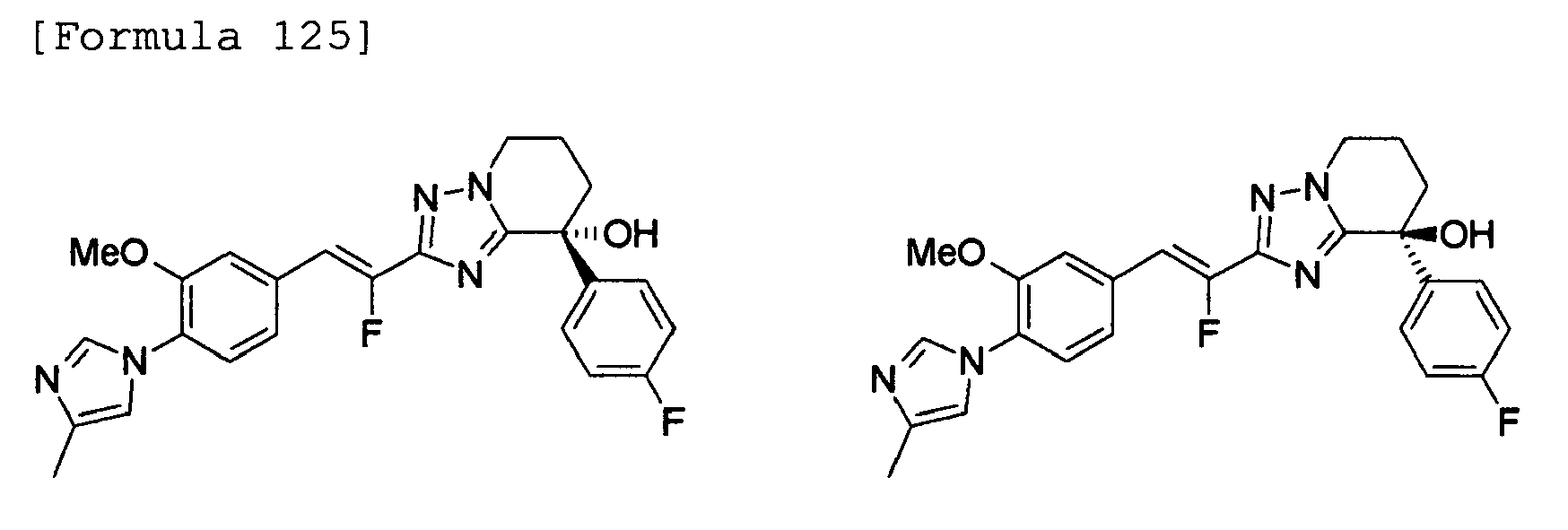
- Sodium hydride (containing mineral oil at 40%, 18 mg) was added to a solution of 2-{(Z)-1-fluoro-2-[3-methoxy-4-(4-methyl-1H-imidazol-1-yl)phenyl]vinyl}-8-(4-fluorophenyl)-5,6,7,8-tetrahydro[1,2,4]triazolo[1,5-a]pyridine (98 mg) in DMF (2 mL), and the reaction solution was stirred at room temperature for 30 minutes while bubbling with oxygen gas. Ethyl acetate and saturated aqueous ammonium chloride were added to the reaction solution, and the organic layer was separated. The resulting organic layer was dried over anhydrous magnesium sulfate and then concentrated under reduced pressure. The resulting racemate crude product of the title compound was separated by CHIRALPAK™ AD-H manufactured by Daicel Chemical Industries, Ltd. (2 cm x 25 cm; mobile phase: hexane:ethanol = 1:1) to obtain the title optically active compound with a retention time of 9 minutes and negative optical rotation (22 mg, >99% ee) and the title optically active compound with a retention time of 10 minutes and positive optical rotation (19 mg, >99% ee).
The property values of (-)-2-{(Z)-1-fluoro-2-[3-methoxy-4-(4-methyl-1H-imidazol-1-yl)phenyl]vinyl}-8-(4-fluorophenyl)-5,6,7,8-tetrahydro[1,2,4]triazolo[1,5-a]pyridin-8-ol are as follows.
ESI-MS; m/z 464 [M+ + H]. 1H-NMR (CDCl3) δ (ppm): 1.96-2.07 (m, 1H), 2.36-2.25 (m, 1H), 2.27 (s, 3H), 2.32-2.48 (m, 2H), 3.77 (s, 3H), 4.23-4.33 (m, 2H), 6.62 (d, J = 38.4 Hz, 1H), 6.87 (brs, 1H), 7.00 (dd, J = 18.0, 1.6 Hz, 1H), 7.03 (t, J = 8.4 Hz, 2H), 7.13 (d, J = 8.4 Hz, 1H) , 7.18 (brs, 1H), 7.33 (dd, J = 8.4, 5.2 Hz, 2H), 7.72 (d, J = 1.2 Hz, 1H). - The property values of (+)-2-{(Z)-1-fluoro-2-[3-methoxy-4-(4-methyl-1H-imidazol-1-yl)phenyl]vinyl}-8-(4-fluorophenyl)-5,6,7,8-tetrahydro[1,2,4]triazolo[1,5-a]pyridin-8-ol are as follows.
ESI-MS; m/z 464 [M+ + H]. 1H-NMR (CDCl3) δ (ppm): 1.96-2.07 (m, 1H), 2.36-2.25 (m, 1H), 2.27 (s, 3H), 2.32-2.48 (m, 2H), 3.77 (s, 3H), 4.23-4.33 (m, 2H), 6.62 (d, J = 38.4 Hz, 1H), 6.87 (brs, 1H), 7.00 (dd, J = 18.0, 1.6 Hz, 1H), 7.03 (t, J = 8.4 Hz, 2H), 7.13 (d, J = 8.4 Hz, 1H) , 7.18 (brs, 1H) , 7.33 (dd, J = 8.4, 5.2 Hz, 2H), 7.72 (d, J = 1.2 Hz, 1H). -

- Sodium hydride (containing mineral oil at 40%, 4 mg) was added to a solution of 2-{(E)-2-[5-methoxy-6-(4-methyl-1H-imidazol-1-yl)pyridin-3-yl]vinyl}-8-(3,4,5-trifluorophenyl)-5,6,7,8-tetrahydro[1,2,4]triazolo[1,5-a]pyridine (21 mg) synthesized by the method in Examples 59 and 60 in DMF (2 mL), and the reaction solution was stirred at room temperature for 30 minutes while bubbling with oxygen gas. Ethyl acetate and saturated aqueous ammonium chloride were added to the reaction solution, and the organic layer was separated. The resulting organic layer was dried over anhydrous magnesium sulfate and then concentrated under reduced pressure. The resulting racemate crude product of the title compound was separated by CHIRALPAK™ AD-H manufactured by Daicel Chemical Industries, Ltd. (2 cm x 25 cm; mobile phase: hexane:ethanol = 1:1) to obtain the title optically active compound with a retention time of 7 minutes and negative optical rotation (3.7 mg, >99% ee) and the title optically active compound with a retention time of 10 minutes and positive optical rotation (3.2 mg, >99% ee).
The property values of (-)-2-{(E)-2-[5-methoxy-6-(4-methyl-1H-imidazol-1-yl)pyridin-3-yl]vinyl}-8-(3,4,5-trifluorophenyl)-5,6,7,8-tetrahydro[1,2,4]triazolo[1,5-a]pyridin-8-ol are as follows.
ESI-MS; m/z 483 [M+ + H]. 1H-NMR (CDCl3) δ (ppm): 2.01-2.16 (m, 2H), 2.28 (s, 3H), 2.30-2.39 (m, 1H), 2.40-2.53 (m, 1H), 3.91 (s, 3H), 4.19-4.28 (m, 1H), 4.29-4.36 (m, 1H), 7.00-7.05 (m, 3H), 7.33 (d, J = 1.6 Hz, 1H), 7.41 (d, J = 16.8 Hz, 1H), 7.46 (brs, 1H), 8.02 (d, J = 1.6 Hz, 1H), 8.28 (brs, 1H). - The property values of (+)-2-{(E)-2-[5-methoxy-6-(4-methyl-1H-imidazol-1-yl)pyridin-3-yl]vinyl}-8-(3,4,5-trifluorophenyl)-5,6,7,8-tetrahydro[1,2,4]triazolo[1,5-a]pyridin-8-ol are as follows. ESI-MS; m/z 483 [M+ + H]. 1H-NMR (CDCl3) δ (ppm): 2.01-2.16 (m, 2H), 2.28 (s, 3H), 2.30-2.39 (m, 1H), 2.40-2.53 (m, 1H), 3.91 (s, 3H), 4.19-4.28 (m, 1H), 4.29-4.36 (m, 1H), 7.00-7.05 (m, 3H), 7.33 (d, J = 1.6 Hz, 1H), 7.41 (d, J = 16.8 Hz, 1H), 7.46 (brs, 1H), 8.02 (d, J = 1.6 Hz, 1H), 8.28 (brs, 1H).
-

- A 2.66 M solution of butyl lithium in hexane (20 mL) was added to a solution of 3,4,5-trifluorophenylacetic acid (5.00 g) in THF (150 mL) in a nitrogen atmosphere at -78°C, and the reaction solution was stirred at -78°C for 20 minutes. The reaction solution was further stirred at 0°C for one hour. Then, 1-bromo-2-chloroethane (2.2 mL) was added at 0°C, and the reaction solution was stirred at room temperature for 14 hours. Ethyl acetate and 1 N hydrochloric acid were added to the reaction solution, and the organic layer was separated. The resulting organic layer was washed with a saturated sodium chloride solution. The resulting organic layer was dried over magnesium sulfate and then concentrated under reduced pressure. The residue was purified by silica gel column chromatography (elution solvent: heptane-ethyl acetate system) to obtain 4.54 g of the title compound. The property values of the compound are as follows.
1H-NMR (CDCl3) δ (ppm): 2.13-2.22 (m, 1H), 2.45-2.54 (m, 1H), 3.36 (ddd, J = 11.6, 8.4, 4.8 Hz, 1H), 3.58 (ddd, J = 11.6, 6.4, 5.2 Hz, 1H), 3.89 (dd, J = 7.6, 7.6 Hz, 1H), 6.94-7.02 (m, 2H). - oxalyl chloride (0.63 mL) and DMF (1 drop) were added to a solution of 4-chloro-2-(3,4,5-trifluorophenyl)butyric acid (1.17 g) in methylene chloride (30 mL) at 0°C, and the reaction solution was stirred at room temperature for one hour. The reaction solution was concentrated under reduced pressure to obtain 4-chloro-2-(3,4,5-trifluorophenyl)butyryl chloride. A solution of 4-chloro-2-(3,4,5-trifluorophenyl)butyryl chloride in THF (5 mL) was added to a solution of tert-butyl carbazate (600 mg) and triethylamine (3.1 mL) in THF (20 mL) at 0°C, and the reaction solution was stirred at room temperature for one hour. The reaction solution was added to a saturated sodium bicarbonate solution, followed by extraction with ethyl acetate. The resulting extract was dried over magnesium sulfate and then concentrated under reduced pressure. The residue was purified by silica gel column chromatography (elution solvent: heptane-ethyl acetate system) to obtain 1.35 g of the title compound. The property value of the compound is as follows.
ESI-MS; m/z 389 [M+ + Na] - A solution of 4 N hydrogen chloride in ethyl acetate (20 mL) was added to tert-butyl N'-[4-chloro-2-(3,4,5-trifluorophenyl)butyryl]hydrazinecarboxylate (1.35 g). The reaction solution was stirred at room temperature for one hour and then concentrated under reduced pressure to obtain 4-chloro-2-(3,4,5-trifluorophenyl)butyric acid hydrazide hydrochloride (1.18 g). A solution of 4-chloro-2-(3,4,5-trifluorophenyl)butyric acid hydrazide hydrochloride (552 mg) and triethylamine (0.95 mL) in ethanol (10 mL) was added to a solution of ethyl (E)-3-[3-methoxy-4-(4-methyl-1H-imidazol-1-yl)phenyl]acrylimidate dihydrochloride (500 mg) and triethylamine (1 mL) in ethanol (10 mL) at room temperature, and the reaction solution was stirred at 80°C for 21 hours. The reaction solution was left to cool to room temperature and concentrated under reduced pressure. A saturated sodium bicarbonate solution was added to the resulting residue, followed by extraction with chloroform. The resulting extract was dried over magnesium sulfate and then concentrated under reduced pressure. The residue was purified by silica gel column chromatography (carrier: Chromatorex NH; elution solvent: heptane-ethyl acetate system) to obtain 131 mg of the title compound as a racemate. The property values of the compound are as follows.
ESI-MS; m/z 452 [M+ + H]. 1H-NMR (CDCl3) δ (ppm): 2.30 (s, 3H), 2.61-2.72 (m, 1H), 3.22-3.32 (m, 1H), 3.89 (s, 3H), 4.17-4.27 (m, 1H), 4.30-4.48 (m, 1H), 4.41 (t, J = 7.6 Hz, 1H), 6.93 (s, 1H), 6.94-7.02 (m, 2H), 7.08 (d, J = 16.4 Hz, 1H), 7.16-7.21 (m, 2H), 7.22-7.27 (m, 1H), 7.58 (d, J = 16.4 Hz, 1H), 7.71 (s, 1H). - The title compound as a racemate obtained above (131 mg) was separated by CHIRALPAK™ IA manufactured by Daicel Chemical Industries, Ltd. (2 cm x 25 cm; mobile phase: ethanol) to obtain the title optically active compound with a retention time of 23 minutes and positive optical rotation (52 mg) and the title optically active compound with a retention time of 32 minutes and negative optical rotation (55 mg).
-

- Sodium hydride (containing mineral oil at 40%, 9 mg) was added to a solution of the optically active compound obtained in Examples 112 and 113 with a retention time of 23 minutes and positive optical rotation, 2-{(E)-2-[3-methoxy-4-(4-methylimidazol-1-yl)phenyl]vinyl}-7-(3,4,5-trifluorophenyl)-6,7-dihydro-5H-pyrrolo[1,2-b][1,2,4]triazole (50 mg) in DMF (2 mL) at room temperature. The reaction solution was stirred at room temperature for 30 minutes while bubbling with oxygen gas and further stirred at room temperature in an oxygen atmosphere for one hour. A sodium thiosulfate solution was added to the reaction solution, followed by extraction with ethyl acetate. The resulting extract was washed with a saturated sodium chloride solution. The resulting organic layer was dried over magnesium sulfate and then concentrated under reduced pressure. The residue was purified by silica gel column chromatography (carrier: Chromatorex NH; elution solvent: heptane-ethyl acetate system, then ethyl acetate-methanol system) to obtain 32 mg of the title compound as a racemate. The property values of the compound are as follows.
ESI-MS; m/z 468 [M+ + H]. 1H-NMR (CDCl3) δ (ppm): 2.25 (s, 3H), 2.86-2.95 (m, 1H), 3.05-3.13 (m, 1H), 3.75 (s, 3H), 4.22-4.30 (m, 1H), 4.36-4.44 (m, 1H), 6.81-6.85 (m, 1H), 6.88 (s, 1H), 6.95 (brs, 1H), 7.05 (d, J = 16.0 Hz, 1H), 7.12 (d, J = 8.0 Hz, 1H), 7.20-7.30 (m, 2H), 7.43 (d, J = 16.0 Hz, 1H), 7.86 (d, J = 0.8 Hz, 1H). - The title compound as a racemate obtained above (32 mg) was separated by CHIRALCEL™ OJ-H manufactured by Daicel Chemical Industries, Ltd. (2 cm x 25 cm; mobile phase: hexane:ethanol = 4:1) to obtain the title optically active compound with a retention time of 21 minutes and positive optical rotation (14 mg) and the title optically active compound with a retention time of 32 minutes and negative optical rotation (14 mg).
-

- Sodium hydride (containing mineral oil at 40%, 0.48 g) was added to a solution of methyl (3,4-difluorophenyl)acetate (CAS #210530-71-5, 2.04 g) in DMF (30 mL) at 0°C, and the reaction solution was stirred at room temperature for 10 minutes. 1-chloro-3-iodopropane (1.3 mL) was added to the reaction solution at 0°C, and the reaction solution was stirred at room temperature for two hours. A saturated ammonium chloride solution was added to the reaction solution, followed by extraction with ethyl acetate. The resulting extract was washed with a saturated sodium chloride solution. The resulting organic layer was dried over magnesium sulfate and then concentrated under reduced pressure. Hydrazine monohydrate (5.5 g) was added to a solution of the resulting residue in ethanol (50 mL) at room temperature, and the reaction solution was stirred at 80°C for seven hours. The reaction solution was left to cool to room temperature and concentrated under reduced pressure. A saturated sodium bicarbonate solution was added to the residue, followed by extraction with chloroform. The resulting extract was dried over magnesium sulfate and then concentrated under reduced pressure. The residue was purified by silica gel column chromatography (elution solvent: heptane-ethyl acetate system, then ethyl acetate-methanol system) to obtain 1.42 g of the title compound. The property values of the compound are as follows. ESI-MS; m/z 227 [M+ + H]. 1H-NMR (CDCl3) δ (ppm): 1.84-2.06 (m, 3H), 2.10-2.21 (m, 1H), 3.53-3.71 (m, 3H), 4.59 (brs, 2H), 6.89-6.95 (m, 1H), 6.97-7.05 (m, 1H), 7.06-7.26 (m, 1H).
- IPEA (1.5 mL), 1-amino-3-(3,4-difluorophenyl)piperidin-2-one (420 mg) and BOPCl (0.53 g) were added to a solution of (E)-3-[3-methoxy-4-(4-methyl-1H-imidazol-1-yl)phenyl]acrylic acid (450 mg) in methylene chloride (15 mL) at room temperature, and the reaction solution was stirred at room temperature for three hours. Water was added to the reaction solution, followed by extraction with chloroform. The resulting extract was washed with a saturated sodium chloride solution. The resulting organic layer was dried over magnesium sulfate and then concentrated under reduced pressure. The residue was purified by silica gel column chromatography (carrier: Chromatorex NH; elution solvent: heptane-ethyl acetate system, then ethyl acetate-methanol system) to obtain 572 mg of the title compound. The property value of the compound is as follows.
ESI-MS; m/z 467 [M+ + H]. - A solution of (E)-N-[3-(3,4-difluorophenyl)-2-oxopiperidin-1-yl]-3-[3-methoxy-4-(4-methyl-1H-imidazol-1-yl)phenyl]acrylamide (572 mg) in phosphorus oxychloride (8 mL) was heated under reflux for one hour. The reaction solution was left to cool to room temperature and concentrated under reduced pressure. Acetic acid (5 mL) and ammonium acetate (4.7 g) were added to the resulting residue, and the reaction solution was stirred at 150°C for two hours. The reaction solution was left to cool to room temperature and concentrated under reduced pressure. A saturated sodium bicarbonate solution was added to the resulting residue, followed by extraction with chloroform. The resulting extract was dried over magnesium sulfate and then concentrated under reduced pressure. The residue was purified by silica gel column chromatography (carrier: Chromatorex NH; elution solvent: heptane-ethyl acetate system) to obtain 373 mg of the title compound as a racemate. The property values of the compound are as follows.
ESI-MS; m/z 448 [M+ + H]. 1H-NMR (CDCl3) δ (ppm): 1.93-2.27 (m, 3H), 2.30 (s, 3H), 2.32-2.42 (m, 1H), 3.86 (s, 3H), 4.25-4.33 (m, 3H), 6.87-6.94 (m, 2H), 6.95-7.02 (m, 1H), 7.06 (d, J = 16.4 Hz, 1H), 7.11-7.18 (m, 3H), 7.20-7.25 (m, 1H), 7.51 (d, J = 16.4 Hz, 1H), 7.70 (d, J = 0.8 Hz, 1H). - The title compound as a racemate (16 mg) was separated by CHIRALPAK™ IA manufactured by Daicel Chemical Industries, Ltd. (2 cm x 25 cm; mobile phase: ethanol) to obtain the title optically active compound with a retention time of 17 minutes and positive optical rotation (7.6 mg) and the title optically active compound with a retention time of 23 minutes and negative optical rotation (7.7 mg).
-

- 4-fluoroaniline (3.82 g) and lithium tetrafluoroborate (3.32 g) were added to a solution of oxetane (1.00 g) in acetonitrile (20 mL) at room temperature, and the reaction solution was stirred at room temperature for 64 hours. A saturated sodium bicarbonate solution was added to the reaction solution, followed by extraction with chloroform. The resulting extract was dried over magnesium sulfate and then concentrated under reduced pressure. The residue was purified by silica gel column chromatography (elution solvent: heptane-ethyl acetate system) to obtain 2.37 g of the title compound. The property values of the compound are as follows.
ESI-MS; m/z 170 [M+ + H]. 1H-NMR (CDCl3) δ (ppm): 1.88 (tt, J = 6.4, 6.0 Hz, 2H), 3.25 (t, J = 6.4 Hz, 2H), 3.83 (t, J = 6.0 Hz, 2H), 6.55-6.62 (m, 2H), 6.86-6.93 (m, 2H). - Thionyl chloride (5.3 mL) was added to a solution of 3-(4-fluorophenylamino)propan-1-ol (2.37 g) in toluene (30 mL) at room temperature, and the reaction solution was stirred at 60°C for five hours. The reaction solution was left to cool to room temperature and concentrated under reduced pressure. Ice and a saturated sodium bicarbonate solution were added to the residue, followed by extraction with ethyl acetate (100 mL). Heptane (100 mL) was added to the resulting extract, and the solution was purified by silica gel column chromatography (elution solvent: heptane:ethyl acetate = 1:1) to obtain (3-chloropropyl)-(4-fluorophenyl)amine. Triethylamine (5.4 mL) and phenyl chlorocarbonate (1.9 mL) were added to a solution of (3-chloropropyl)-(4-fluorophenyl)amine (2.40 g) in THF (40 mL) at 0°C, and the reaction solution was stirred at room temperature for 12 hours. Water was added to the reaction solution, followed by extraction with ethyl acetate. The resulting extract was dried over magnesium sulfate and then concentrated under reduced pressure. The residue was purified by silica gel column chromatography (elution solvent: heptane-ethyl acetate system) to obtain phenyl (3-chloropropyl)-(4-fluorophenyl)carbamate (3.93 g). Hydrazine monohydrate (0.40 mL) was added to a solution of phenyl (3-chloropropyl)-(4-fluorophenyl)carbamate (500 mg) in ethanol (10 mL) at room temperature. The reaction solution was stirred at room temperature for one hour, stirred at 60°C for one hour and heated under reflux for seven hours. Hydrazine monohydrate (0.40 mL) was added to the reaction solution, and the reaction solution was heated under reflux for 13 hours. The reaction solution was left to cool to room temperature and concentrated under reduced pressure. A saturated sodium bicarbonate solution was added to the residue, followed by extraction with chloroform. The resulting extract was dried over magnesium sulfate and then concentrated under reduced pressure. The residue was purified by silica gel column chromatography (elution solvent: heptane-ethyl acetate system, then ethyl acetate-methanol system) to obtain 265 mg of the title compound. The property values of the compound are as follows. ESI-MS; m/z 210 [M+ + H]. 1H-NMR (CDCl3) δ (ppm): 2.15 (tt, J = 6.4, 5.6 Hz, 2H), 3.58-3.67 (m, 4H), 4.31 (brs, 2H), 6.98-7.05 (m, 2H), 7.18-7.24 (m, 2H).
- IPEA (0.51 mL), (E)-3-[3-methoxy-4-(4-methylimidazol-1-yl)phenyl]acrylic acid (150 mg) and BOPCl (0.18 g) were added to a solution of 1-amino-3-(4-fluorophenyl)tetrahydropyrimidin-2-one (132 mg) in methylene chloride (5 mL) at room temperature, and the reaction solution was stirred at room temperature for 13 hours. Water was added to the reaction solution, followed by extraction with chloroform. The resulting extract was washed with a saturated sodium bicarbonate solution. The resulting organic layer was dried over magnesium sulfate and then concentrated under reduced pressure. The residue was purified by silica gel column chromatography (carrier: Chromatorex NH; elution solvent: heptane-ethyl acetate system, then ethyl acetate-methanol system) to obtain 261 mg of the title compound. The property value of the compound is as follows.
ESI-MS; m/z 450 [M+ + H]. - A solution of (E)-N-[3-(4-fluorophenyl)-2-oxotetrahydropyrimidin-1-yl]-3-[3-methoxy-4-(4-methyl-1H-imidazol-1-yl)phenyl]acrylamide (261 mg) in phosphorus oxychloride (3 mL) was heated under reflux for one hour. The reaction solution was left to cool to room temperature and concentrated under reduced pressure. Acetic acid (2 mL) and ammonium acetate (2.2 g) were added to the resulting residue, and the reaction solution was stirred at 150°C for two hours.
The reaction solution was left to cool to room temperature and concentrated under reduced pressure. A saturated sodium bicarbonate solution was added to the resulting residue, followed by extraction with chloroform. The resulting extract was dried over magnesium sulfate and then concentrated under reduced pressure. The residue was purified by silica gel column chromatography (carrier: Chromatorex NH; elution solvent: heptane-ethyl acetate system) to obtain 179 mg of the title compound. The property values of the compound are as follows.
ESI-MS; m/z 431 [M+ + H]. 1H-NMR (CDCl3) δ (ppm): 2.30 (s, 3H), 2.37 (tt, J = 6.4, 5.6 Hz, 2H), 3.83 (t, J = 5.6 Hz, 2H), 3.87 (s, 3H), 4.23 (t, J = 6.4 Hz, 2H), 6.92 (brs, 1H) , 6.95 (d, J = 16.4 Hz, 1H) , 7.07-7.18 (m, 4H), 7.22 (d, J = 8.0 Hz, 1H) , 7.43 (d, J = 16.4 Hz, 1H) 7.47-7.54 (m, 2H), 7.70 (d, J = 1.2 Hz, 1H). -

- IPEA (2.5 mL) was added to a suspension of (E)-3-[3-methoxy-4-(4-methyl-1H-imidazol-1-yl)phenyl]acrylic acid hydrazide (500 mg) in methylene chloride (12 mL) at room temperature, and the reaction solution was stirred at room temperature for 10 minutes. 4-benzoylbutyric acid (334 mg) and BOPCl (442 mg) were added to the reaction solution at room temperature, and was added to the reaction solution, followed by extraction with chloroform. The resulting extract was dried over magnesium sulfate and then concentrated under reduced pressure to obtain 5-oxo-5-phenylpentanoic acid N'-{(E)-3-[3-methoxy-4-(4-methyl-1H-imidazol-1-yl)phenyl]acryloyl}hydrazide (692 mg). Imidazole (494 mg), carbon tetrabromide (2.36 g) and triphenylphosphine (559 mg) were added to a suspension of 5-oxo-5-phenylpentanoic acid N'-{(E)-3-[3-methoxy-4-(4-methyl-1H-imidazol-1-yl)phenyl]acryloyl}hydrazide (634 mg) in methylene chloride (15 mL) at room temperature, and the reaction solution was stirred at room temperature for 12 hours. The reaction solution was concentrated under reduced pressure, and the residue was purified by silica gel column chromatography (elution solvent: heptane-ethyl acetate system, then ethyl acetate-methanol system) to obtain 515 mg of the title compound. The property value of the compound is as follows.
ESI-MS; m/z 429 [M+ + H]. - Sodium borohydride (96 mg) was added to a solution of 4-{5-{(E)-2-[3-methoxy-4-(4-methyl-1H-imidazol-1-yl)phenyl]vinyl}[1,3,4]oxadiazol-2-yl}-1-phenylbuten-1-one (515 mg) in methanol (10 mL) at 0°C, and the reaction solution was stirred at room temperature for one hour. The reaction solution was concentrated under reduced pressure. A saturated sodium bicarbonate solution was added to the residue, followed by extraction with ethyl acetate. The resulting extract was washed with a saturated sodium chloride solution. The organic layer was dried over magnesium sulfate and then concentrated under reduced pressure. Triethylamine (0.43 mL) and methanesulfonic acid chloride (0.12 mL) were added to a solution of the resulting residue in methylene chloride (10 mL) at 0°C, and the reaction solution was stirred at room temperature for 30 minutes. Ethyl acetate was added to the reaction solution, and the reaction solution was sequentially washed with a saturated sodium bicarbonate solution and a saturated sodium chloride solution. The resulting organic layer was dried over magnesium sulfate and then concentrated under reduced pressure. Sodium azide (134 mg) was added to a solution of the resulting residue in DMF (10 mL), and the reaction solution was stirred at room temperature for one hour. Water and ethyl acetate were added to the reaction solution, and the organic layer was separated. The resulting organic layer was washed with a saturated sodium chloride solution, dried over magnesium sulfate and then concentrated under reduced pressure. Triphenylphosphine (405 mg) was added to a mixed solution of the resulting residue in THF (10 mL) and water (0.5 mL) at room temperature, and the reaction solution was stirred at 60°C for one hour. Water (0.5 mL) was added to the reaction solution, and then the reaction solution was stirred at 60°C for 4.5 hours. The reaction solution was left to cool to room temperature and concentrated under reduced pressure.
THF and toluene were added to the residue, and the solution was again concentrated under reduced pressure. A solution of the resulting residue in acetic acid (5 mL) was heated under reflux for one hour. The reaction solution was left to cool to room temperature and concentrated under reduced pressure. A saturated sodium bicarbonate solution was added to the residue, followed by extraction with chloroform. The resulting extract was dried over magnesium sulfate and then concentrated under reduced pressure. The residue was purified by silica gel column chromatography (carrier: Chromatorex NH; elution solvent: heptane-ethyl acetate system, then ethyl acetate-methanol system) to obtain 270 mg of the title compound as a racemate. The property values of the compound are as follows.
ESI-MS; m/z 412 [M+ + H]. 1H-NMR (CDCl3) δ (ppm): 1.83-1.95 (m, 2H), 2.07-2.18 (m, 1H), 2.28 (s, 3H), 2.34-2.45 (m, 1H), 3.00-3.12 (m, 1H), 3.15-3.24 (m, 1H), 3.78 (s, 3H), 5.40 (t, J = 5.2 Hz, 1H), 6.29 (d, J = 16.4 Hz, 1H), 6.79 (s, 1H), 6.83-6.88 (m, 2H), 7.00-7.05 (m, 2H), 7.25 (d, J = 7.6 Hz, 1H), 7.30-7.41 (m, 3H), 7.54 (d, J = 16.4 Hz, 1H) , 7.64 (s, 1H). - The title compound as a racemate (12 mg) was separated by CHIRALCEL™ OD-H manufactured by Daicel Chemical Industries, Ltd. (2 cm x 25 cm; mobile phase: ethanol) to obtain the title optically active compound with a retention time of 15 minutes and positive optical rotation (4.6 mg) and the title optically active compound with a retention time of 20 minutes and negative optical rotation (4.7 mg).
-

- EDC (4.48 g), HOBT (3.14 g) and IPEA (6.76 mL) were sequentially added to a solution of (E)-3-[3-methoxy-4-(4-methyl-1H-imidazol-1-yl)phenyl]acrylic acid (2 g) and aminoacetonitrile hydrochloride (1.08 g) in DMF (25 mL), and the reaction solution was stirred at room temperature for five hours. Ethyl acetate and water were added to the reaction solution, and the organic layer was separated. The resulting organic layer was washed with brine and then dried over anhydrous sodium sulfate and filtered through a silica gel pad (Chromatorex NH). The filtrate was concentrated under reduced pressure. The residue was crystallized (heptane-ethyl acetate-methanol system) to obtain 1.24 g of the title compound. The property values of the compound are as follows.
1H-NMR (CD3OD) δ (ppm): 2.24 (s, 3H), 3.93 (s, 3H), 4.29 (s, 2H), 6.66 (d, J = 15.6 Hz, 1H), 7.10 (s, 1H), 7.30 (dd, J = 8.0, 2.0 Hz, 1H), 7.38-7.40 (m, 2H), 7.63 (d, J = 15.6 Hz, 1H), 7.82 (s, 1H). - Carbon tetrachloride (0.326 mL) was added to a solution of (E)-N-cyanomethyl-3-[3-methoxy-4-(4-methyl-1H-imidazol-1-yl)phenyl]acrylamide (400 mg) and triphenylphosphine (888 mg) in acetonitrile (20 mL), and the reaction solution was stirred at 45°C for 12 hours. The reaction solution was concentrated under reduced pressure. Ethyl acetate and saturated sodium bicarbonate water were added to the resulting residue, and the organic layer was separated. The resulting organic layer was sequentially washed with water and brine, dried over anhydrous sodium sulfate and then concentrated under reduced pressure. The residue was purified by silica gel column chromatography (carrier: Chromatorex NH; elution solvent: ethyl acetate) to obtain 76 mg of the title compound. The property values of the compound are as follows.
ESI-MS; m/z 315 [M+ + H]. 1H-NMR (CDCl3) δ (ppm): 2.29 (s, 3H), 3.78 (s, 3H), 6.89 (d, J = 16.4 Hz, 1H), 6.92 (s, 1H), 6.98-7.01 (m, 3H), 7.12 (d, J = 8.4 Hz, 1H), 7.34 (d, J = 16.4 Hz, 1H), 7.70 (s, 1H). -

- EDC (223 mg), HOBT (157 mg) and IPEA (0.337 mL) were sequentially added to a solution of (E)-3-[3-methoxy-4-(4-methyl-1H-imidazol-1-yl)phenyl]acrylic acid (100 mg) and 2-amino-1-(4-methoxyphenyl)ethanone hydrochloride (CAS No. 3883-94-1, 117 mg) in DMF (3 mL), and the reaction solution was stirred at room temperature for three hours. Ethyl acetate and water were added to the reaction solution, and the organic layer was separated. The resulting organic layer was washed with brine and then dried over anhydrous sodium sulfate and concentrated under reduced pressure. The residue was purified by silica gel column chromatography (carrier: Chromatorex NH; elution solvent: ethyl acetate) to obtain 104.7 mg of the title compound. The property values of the compound are as follows.
1H-NMR (CDCl3) δ (ppm): 2.30 (s, 3H), 3.90 (s, 3H), 3.91 (s, 3H), 4.77 (d, J = 4.4 Hz, 2H), 6.57 (d, J = 15.6 Hz, 1H) , 6.84 (t, J = 4.4 Hz, 1H) , 6.93 (s, 1H) , 6.99 (dd, J = 5.2, 2.8 Hz, 2H), 7.16-7.27 (m, 3H), 7.65 (d, J = 15.6 Hz, 1H), 7.72 (s, 1H), 8.00 (dd, J = 5.2, 2.8 Hz, 1H). - Ammonium acetate (379 mg) was added to a solution of (E)-3-[3-methoxy-4-(4-methyl-1H-imidazol-1-yl)phenyl]-N-[2-(4-methoxyphenyl)-2-oxoethyl]acrylamide (100 mg) in acetic acid (3 mL), and the reaction solution was stirred at 120°C for 12 hours. The reaction solution was concentrated. Ethyl acetate and saturated sodium bicarbonate water were added to the resulting residue, and the organic layer was separated. The resulting organic layer was washed with brine, dried over anhydrous sodium sulfate and then concentrated under reduced pressure. The residue was purified by silica gel column chromatography (carrier: Chromatorex NH; elution solvent: ethyl acetate:2-propanol = 20:1) to obtain 15 mg of the title compound. The property values of the compound are as follows.
1H-NMR (CDCl3) δ (ppm): 2.29 (s, 3H), 3.78 (s, 3H), 3.82 (s, 3H), 6.90-7.03 (m, 6H), 7.13 (d, J = 8.0 Hz, 1H), 7.28 (d, J = 16.4 Hz, 1H), 7.32 (s, 1H), 7.67 (s, 1H), 7.69 (m, 2H). -

- 6.0 mg of the title compound was obtained from (E)-3-[3-methoxy-4-(4-methylimidazol-1-yl)phenyl]acrylic acid (100 mg) and 2-amino-1-(3-methoxyphenyl)ethanone hydrochloride (CAS No. 24037-72-7, 117 mg) by the same method as in Example 122. The property values of the compound are as follows.
1H-NMR (CDCl3) δ (ppm): 2.30 (s, 3H), 3.83 (s, 3H), 3.85 (s, 3H), 6.82 (dd, J = 9.2, 2.4 Hz, 1H), 6.92 (s, 1H) , 7.05-7.09 (m, 3H), 7.18 (d, J = 8.0 Hz, 1H), 7.26-7.33 (m, 4H), 7.39 (s, 1H), 7.71 (s, 1H). -
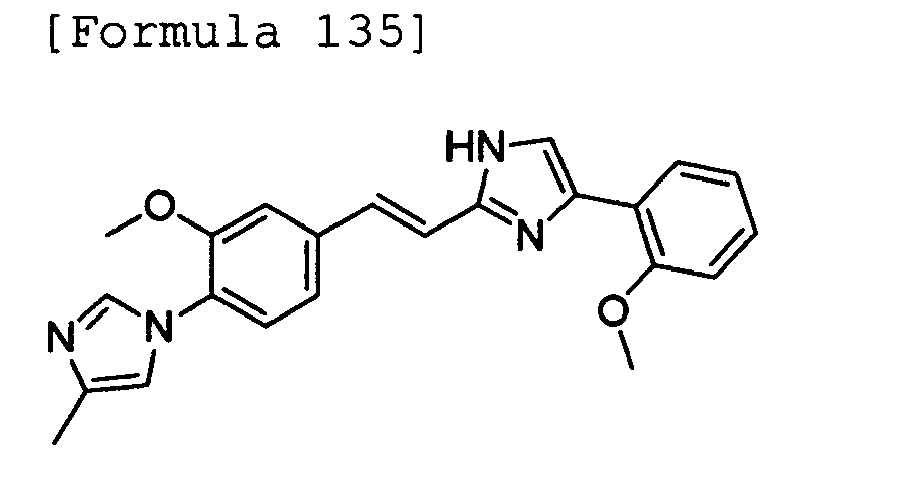
- 23.8 mg of the title compound was obtained from (E)-3-[3-methoxy-4-(4-methyl-1H-imidazol-1-yl)phenyl]acrylic acid (100 mg) and 2-amino-1-(2-methoxyphenyl)ethanone hydrochloride (CAS No. 34589-97-4, 117 mg) by the same method as in Example 122. The property values of the compound are as follows.
1H-NMR (CDCl3) δ (ppm): 2.30 (s, 3H), 3.86 (s, 3H), 4.00 (s, 3H), 6.91 (s, 1H), 6.99-7.12 (m, 5H), 7.19-7.31 (m, 4H), 7.59 (s, 1H), 7.71 (s, 1H). -

- A crude product of the title compound was obtained from (E)-3-[3-methoxy-4-(4-methyl-1H-imidazol-1-yl)phenyl]acrylic acid (150 mg) and 2-amino-1-(4-chlorophenyl)ethanone hydrochloride (CAS No. 5467-71-0, 144 mg) by the same method as in Example 33. The crude product was purified by LC-MS to obtain 3.5 mg of the title compound. The property values of the compound are as follows.
ESI-MS; m/z 391 [M+ + H], 1H-NMR (CD3OD) δ (ppm): 2.44 (s, 3H), 4.03 (s, 3H), 7.30 (d, J = 16.4 Hz, 1H), 7.47 (dd, J = 8.4, 2.0 Hz, 1H), 7.52-7.57 (m, 2H), 7.61-7.65 (m, 2H), 7.75-7.81 (m, 4H), 7.97 (s, 1H), 9.18 (s, 1H). -
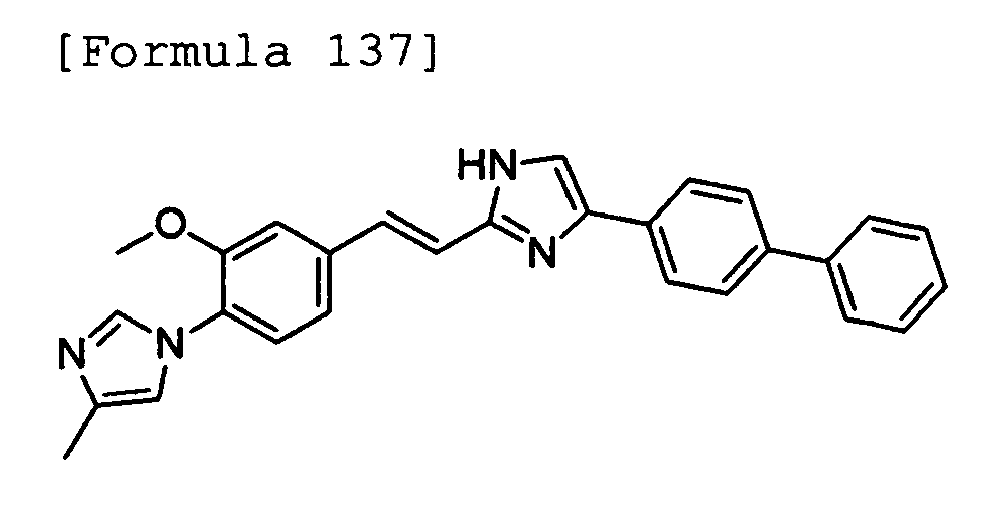
- 6.6 mg of the title compound was obtained from (E)-3-[3-methoxy-4-(4-methyl-1H-imidazol-1-yl)phenyl]acrylic acid (150 mg) and 2-amino-1-(4-biphenyl)ethanone hydrochloride (CAS No. 71350-68-0, 173 mg) by the same method as in Example 33. The property value of the compound is as follows.
ESI-MS; m/z 433 [M+ + H]. -

- A crude product of the title compound was obtained from (E)-3-[3-methoxy-4-(4-methyl-1H-imidazol-1-yl)phenyl]acrylic acid (150 mg) and 1-aminopentan-2-one hydrochloride (CAS No. 41172-98-9, 88.2 mg) by the same method as in Example 33. The crude product was purified by LC-MS to obtain 1.7 mg of the title compound. The property value of the compound is as follows.
ESI-MS; m/z 323 [M+ + H]. -

- A racemate of the title compound was obtained from 5-chloro-2-(4-trifluoromethoxyphenyl)pentanoic acid (1.1 g) by the same method as in Examples 51 and 52. The resulting racemate was separated by CHIRALPAK™ AD-H manufactured by Daicel Chemical Industries, Ltd. (2 cm x 25 cm; mobile phase: ethanol) to obtain the title optically active compound with a retention time of 7.7 minutes and positive optical rotation (9.2 mg, >99% ee) and the title optically active compound with a retention time of 12.9 minutes and negative optical rotation (9.1 mg, >99% ee).
The property values of the title optically active compound with a retention time of 7.7 minutes are as follows.
ESI-MS; m/z 496 [M+ + H], 1H-NMR (CDCl3) δ (ppm): 2.02-2.21 (m, 3H), 2.29 (s, 3H), 2.33-2.39 (m, 1H), 3.85 (s, 3H), 4.27-4.37 (m, 3H), 6.90 (d, J = 1.6 Hz, 1H), 7.05 (d, J = 16.0 Hz, 1H), 7.12-7.22 (m, 7H), 7.50 (d, J = 16.0 Hz, 1H) 7.68 (d, J = 1.6 Hz, 1H). - The property values of the title optically active compound with a retention time of 12.9 minutes are as follows.
ESI-MS; m/z 496 [M+ + H], 1H-NMR (CDCl3) δ (ppm): 2.02-2.21 (m, 3H), 2.29 (s, 3H), 2.33-2.39 (m, 1H), 3.85 (s, 3H), 4.27-4.37 (m, 3H), 6.90 (d, J = 1.6 Hz, 1H), 7.05 (d, J = 16.0 Hz, 1H), 7.12-7.22 (m, 7H), 7.50 (d, J = 16.0 Hz, 1H) 7.68 (d, J = 1.6 Hz, 1H). -

- IPEA (6.05 mL) and BOPCl (2.78 g) were added to a solution of 5-chloro-2-naphthalen-1-ylpentanoic acid (2.4 g) synthesized according to the method described in Tetrahedron Letters, 2003, vol.44, p.365 and (E)-3-[3-methoxy-4-(4-methyl-1H-imidazol-1-yl)phenyl]acrylic acid hydrazide dihydrochloride (2.4 g) in methylene chloride (50 mL), and the reaction solution was stirred at room temperature for 12 hours. Ethyl acetate and 1 N aqueous hydrochloric acid were added to the reaction solution, and the organic layer was separated. The resulting organic layer was sequentially washed with a 1 N sodium hydroxide solution and brine, dried over anhydrous sodium sulfate and then concentrated under reduced pressure. The residue was purified by silica gel column chromatography (carrier: Chromatorex NH; elution solvent: ethyl acetate:methanol = 20:1) and then solidified with tert-butyl methyl ether. Thereafter, the solid was collected by filtration to obtain 2.2 g of the title compound. The property values of the compound are as follows.
1H-NMR (CDCl3) δ (ppm): 1.72-1.81 (m, 1H) , 1.84-1.93 (m, 1H), 2.14-2.22 (m, 1H), 2.28 (s, 3H), 2.43-2.50 (m, 1H), 3.46-3.57 (m, 2H), 3.83 (s, 3H), 4.36 (t, J = 7.6 Hz, 1H), 6.40 (d, J = 16.0 Hz, 1H), 6.90 (s, 1H), 7.05 (d, J = 8.0 Hz, 1H), 7.09 (d, J = 16.0 Hz, 1H), 7.20 (d, J = 8.0 Hz, 1H), 7.43-7.60 (m, 5H), 7.70 (s, 1H), 7.81 (d, J = 8.4 Hz, 1H), 7.88 (d, J = 7.2 Hz, 1H), 8.05 (d, J = 8.0 Hz, 1H), 8.60 (brs, 1H), 8.73 (brs, 1H). - A solution of 5-chloro-2-naphthalen-1-ylpentanoic acid N'-{(E)-3-[3-methoxy-4-(4-methyl-1H-imidazol-1-yl)phenyl]acryloylhydrazide (2.2 g) in phosphorus oxychloride (15 mL) was stirred at 120°C for four hours. The reaction solution was left to cool to room temperature and then concentrated under reduced pressure. Ammonium acetate (6.79 g) was added to a solution of the residue in acetic acid (5 mL), and the reaction solution was stirred at 150°C for 15 hours. The reaction solution was left to cool to room temperature. Then, ethyl acetate and saturated sodium bicarbonate water were added to the reaction solution, and the organic layer was separated. The resulting organic layer was washed with brine, dried over anhydrous magnesium sulfate and then concentrated under reduced pressure. The residue was purified by silica gel column chromatography (carrier: Chromatorex NH; elution solvent: heptane:ethyl acetate = 1:3) to obtain a racemate of the title compound. The resulting racemate was separated by CHIRALPAK™ IA manufactured by Daicel Chemical Industries, Ltd. (2 cm x 25 cm; mobile phase: ethanol) to obtain the title optically active compound with a retention time of 8.6 minutes and positive optical rotation (55.8 mg, >99% ee) and the title optically active compound with a retention time of 10.8 minutes and negative optical rotation (51.4 mg, >99% ee).
The property values of the title optically active compound with a retention time of 8.6 minutes are as follows.
ESI-MS; m/z 462 (M+ + H], 1H-NMR (CDCl3) δ (ppm): 2.04-2.28 (m, 3H), 2.29 (s, 3H), 2.40-2.47 (m, 1H), 3.84 (s, 3H), 4.24-4.31 (m, 1H), 4.38-4.40 (m, 1H), 5.20 (t, J = 5.6 Hz, 1H), 6.86 (d, J = 7.2 Hz, 1H), 6.90 (s, 1H), 7.09 (d, J = 16.0 Hz, 1H), 7.13 (d, J = 8.8 Hz, 1H), 7.14 (s, 1H), 7.20 (d, J = 8.8 Hz, 1H), 7.36 (t, J = 7.2 Hz, 1H), 7.49-7.57 (m, 3H), 7.68 (s, 1H), 7.77 (d, J = 8.4 Hz, 1H), 7.89 (d, J = 7.6 Hz, 1H), 7.99 (d, J = 8.4 Hz, 1H). - The property values of the title optically active compound with a retention time of 10.8 minutes are as follows.
ESI-MS; m/z 462 [M+ + H], 1H-NMR (CDCl3) δ (ppm): 2.04-2.28 (m, 3H), 2.29 (s, 3H), 2.40-2.47 (m, 1H), 3.84 (s, 3H), 4.24-4.31 (m, 1H), 4.38-4.40 (m, 1H), 5.20 (t, J = 5.6 Hz, 1H), 6.86 (d, J = 7.2 Hz, 1H), 6.90 (s, 1H), 7.09 (d, J = 16.0 Hz, 1H), 7.13 (d, J = 8.8 Hz, 1H), 7.14 (s, 1H), 7.20 (d, J = 8.8 Hz, 1H), 7.36 (t, J = 7.2 Hz, 1H), 7.49-7.57 (m, 3H), 7.68 (s, 1H), 7.77 (d, J = 8.4 Hz, 1H), 7.89 (d, J = 7.6 Hz, 1H), 7.99 (d, J = 8.4 Hz, 1H). -

- A racemate of the title compound (83.8 mg) was obtained from 2-{(E)-2-[3-methoxy-4-(4-methyl-1H-imidazol-1-yl)phenyl]vinyl}-8-(4-methoxyphenyl)-5,6,7,8-tetrahydro-[1,2,4]triazolo[1,5-a]pyridine (120 mg) by the same method as in Examples 70 and 71. The racemate was separated by CHIRALPAK™ AD-H manufactured by Daicel Chemical Industries, Ltd. (2 cm x 25 cm; mobile phase: ethanol) to obtain the title optically active compound with a retention time of 8.7 minutes and negative optical rotation (24.5 mg; >99% ee) and the title optically active compound with a retention time of 10.7 minutes and positive optical rotation (18.8 mg; >99% ee).
The property values of the title optically active compound with a retention time of 8.7 minutes are as follows.
ESI-MS; m/z 458 [M+ + H]. 1H-NMR (CDCl3) δ (ppm): 1.95-2.00 (m, 1H), 2.20-2.26 (m, 1H), 2.28 (s, 3H), 2.28-2.36 (m, 2H), 3.79 (s, 3H), 3.80 (s, 3H), 4.22-4.27 (m, 2H), 6.84 (s, 1H), 6.86 (d, J = 8.4 Hz, 2H), 6.97 (m, 1H), 6.99 (s, 1H), 7.00 (d, J = 16.0 Hz, 1H), 7.14 (d, J = 8.0 Hz, 1H), 7.25 (d, J = 8.4 Hz, 2H), 7.44 (d, J = 16.0 Hz, 1H), 7.75 (s, 1H). - The property values of the title optically active compound with a retention time of 10.7 minutes are as follows. ESI-MS; m/z 458 [M+ + H]. 1H-NMR (CDCl3) δ (ppm): 1.95-2.00 (m, 1H), 2.20-2.26 (m, 1H), 2.28 (s, 3H), 2.28-2.36 (m, 2H), 3.79 (s, 3H), 3.80 (s, 3H), 4.22-4.27 (m, 2H), 6.84 (s, 1H), 6.86 (d, J = 8.4 Hz, 2H), 6.97 (m, 1H), 6.99 (s, 1H), 7.00 (d, J = 16.0 Hz, 1H), 7.14 (d, J = 8.0 Hz, 1H), 7.25 (d, J = 8.4 Hz, 2H), 7.44 (d, J = 16.0 Hz, 1H) , 7.75 (s, 1H).
-

- The title compound (4.84 g) was obtained from 4-(trifluoromethoxy)benzaldehyde (5.3 g) by the same method as in Examples 77 and 78. The property values of the compound are as follows.
1H-NMR (CDCl3) δ (ppm): 1.45 (s, 9H), 3.68-2.71 (m, 2H), 3.80-3.83 (m, 2H), 4.94 (s, 1H), 6.38 (brs, 1H), 7.22 (d, J = 8.4 Hz, 2H), 7.50 (d, J = 8.4 Hz, 2H), 8.40 (brs, 1H). - A solution of 4 N hydrochloric acid in ethyl acetate (5 mL) was added to tert-butyl N'-[2-(2-chloroethoxy)-2-(4-trifluoromethoxyphenyl)acetyl]hydrazinecarboxylate (438 mg). The reaction solution was stirred at room temperature for two hours and then concentrated under reduced pressure. Triethylamine (0.5 mL) was added to a solution of the resulting residue in ethanol (5 mL), and the reaction solution was stirred at room temperature for five minutes. A solution of ethyl (E)-3-[3-methoxy-4-(4-methyl-1H-imidazol-1-yl)phenyl]acrylimidate dihydrochloride (290 mg) and triethylamine (0.613 mL) in ethanol (5 mL) was added dropwise to the solution, and the reaction solution was stirred at 80°C for 12 hours. The reaction solution was returned to room temperature and concentrated under reduced pressure. Ethyl acetate and water were added to the resulting residue, and the organic layer was separated. The resulting organic layer was washed with saturated sodium bicarbonate water and brine, dried over anhydrous magnesium sulfate and then concentrated under reduced pressure. The residue was purified by silica gel column chromatography (carrier: Chromatorex NH; elution solvent: heptane:ethyl acetate = 1:3) and then purified by silica gel column chromatography (elution solvent: ethyl acetate:methanol = 20:1) to obtain a racemate of the title compound. The resulting racemate was separated by CHIRALPAK™ AD-H manufactured by Daicel Chemical Industries, Ltd. (2 cm x 25 cm; mobile phase: ethanol) to obtain the title optically active compound with a retention time of 10.4 minutes and positive optical rotation (68.5 mg, >99% ee) and the title optically active compound with a retention time of 15.2 minutes and negative optical rotation (70.9 mg, >99% ee).
The property values of the title optically active compound with a retention time of 8.7 minutes are as follows.
ESI-MS; m/z 498 [M+ + H]. 1H-NMR (CDCl3) δ (ppm): 2.29 (s, 3H), 3.87 (s, 3H), 4.14-4.20 (m, 1H), 4.29-4.41 (m, 3H), 5.94 (s, 1H), 6.91 (s, 1H), 7.06 (d, J = 16.0 Hz, 1H), 7.14-7.16 (m, 2H), 7.21-7.27 (m, 3H), 7.51-7.56 (m, 3H), 7.69 (d, J = 1.2 Hz, 1H). - The property values of the title optically active compound with a retention time of 15.2 minutes are as follows.
ESI-MS; m/z 498 [M+ + H]. 1H-NMR (CDCl3) δ (ppm): 2.29 (s, 3H), 3.87 (s, 3H), 4.14-4.20 (m, 1H), 4.29-4.41 (m, 3H), 5.94 (s, 1H), 6.91 (s, 1H), 7.06 (d, J = 16.0 Hz, 1H), 7.14-7.16 (m, 2H), 7.21-7.27 (m, 3H), 7.51-7.56 (m, 3H), 7.69 (d, J = 1.2 Hz, 1H). -

- A racemate of the title compound (154 mg) was obtained from 2-{(E)-2-[3-methoxy-4-(4-methyl-1H-imidazol-1-yl)phenyl]vinyl}-8-naphthalen-1-yl-5,6,7,8-tetrahydro[1,2,4]triazolo[1,5-a]pyridine (124 mg) by the same method as in Examples 70 and 71. The racemate was separated by CHIRALCEL™ OD-H manufactured by Daicel Chemical Industries, Ltd. (2 cm x 25 cm; mobile phase: hexane:ethanol = 8:2) to obtain the title optically active compound with a retention time of 11.2 minutes and negative optical rotation (2.5 mg; >99% ee) and the title optically active compound with a retention time of 14 minutes and positive optical rotation (2.4 mg; >99% ee).
The property values of the title optically active compound with a retention time of 11.2 minutes are as follows.
ESI-MS; m/z 478 [M+ + H]. 1H-NMR (CDCl3) δ (ppm): 1.95-2.00 (m, 1H), 1.90-2.03 (m, 1H), 2.28 (s, 3H), 2.35-2.40 (m, 2H), 2.80-2.90 (m, 1H), 3.78 (s, 3H), 4.33-4.38 (m, 2H), 6.87 (s, 1H), 7.03 (s, 1H), 7.04 (d, J = 8.0 Hz, 1H), 7.05 (d, J = 16.4 Hz, 1H), 7.15 (d, J = 8.4 Hz, 1H), 7.30-7.46 (m, 5H), 7.70 (s, 1H), 7.81 (d, J = 8.4 Hz, 1H), 7.87 (d, J = 8.0 Hz, 1H), 7.90 (brs, 1H). - The property values of the title optically active compound with a retention time of 14 minutes are as follows.
ESI-MS; m/z 478 [M+ + H]. 1H-NMR (CDCl3) δ (ppm): 1.95-2.00 (m, 1H), 1.90-2.03 (m, 1H), 2.28 (s, 3H), 2.35-2.40 (m, 2H), 2.80-2.90 (m, 1H), 3.78 (s, 3H), 4.33-4.38 (m, 2H), 6.87 (s, 1H), 7.03 (s, 1H), 7.04 (d, J = 8.0 Hz, 1H), 7.05 (d, J = 16.4 Hz, 1H), 7.15 (d, J = 8.4 Hz, 1H), 7.30-7.46 (m, 5H), 7.70 (s, 1H), 7.81 (d, J = 8.4 Hz, 1H), 7.87 (d, J = 8.0 Hz, 1H), 7.90 (brs, 1H). -

- A racemate of the title compound (65.5 mg) was obtained from 4-methylbenzaldehyde (4 g) by the same method as in Examples 77 and 78. The racemate was separated by CHIRALCEL™ OJ-H manufactured by Daicel Chemical Industries, Ltd. (2 cm x 25 cm; mobile phase: ethanol) to obtain the title optically active compound with a retention time of 6.5 minutes and negative optical rotation (26.3 mg) and the title optically active compound with a retention time of 8.6 minutes and positive optical rotation (26.8 mg).
The property values of the title optically active compound with a retention time of 6.5 minutes are as follows. ESI-MS; m/z 428 [M+ + H]. 1H-NMR (CDCl3) δ (ppm): 2.29 (s, 3H), 2.36 (s, 3H), 3.86 (s, 3H), 4.09-4.15 (m, 1H), 4.26-4.39 (m, 3H), 5.90 (s, 1H), 6.91 (s, 1H), 7.07 (d, J = 16.0 Hz, 1H), 7.14 (d, J = 8.4 Hz, 1H), 7.15 (s, 1H), 7.20 (s, 1H), 7.21 (d, J = 8.0 Hz, 2H), 7.31 (d, J = 8.0 Hz, 2H), 7.53 (d, J = 16.0 Hz, 1H), 7.69 (s, 1H). - The property values of the title optically active compound with a retention time of 8.6 minutes are as follows.
ESI-MS; m/z 428 [M+ + H]. 1H-NMR (CDCl3) δ (ppm): 2.29 (s, 3H), 2.36 (s, 3H), 3.86 (s, 3H), 4.09-4.15 (m, 1H), 4.26-4.39 (m, 3H), 5.90 (s, 1H), 6.91 (s, 1H), 7.07 (d, J = 16.0 Hz, 1H), 7.14 (d, J = 8.4 Hz, 1H), 7.15 (s, 1H), 7.20 (s, 1H), 7.21 (d, J = 8.0 Hz, 2H), 7.31 (d, J = 8.0 Hz, 2H), 7.53 (d, J = 16.0 Hz, 1H), 7.69 (s, 1H). -

- A racemate of the title compound (179.6 mg) was obtained from 2,4,6-trifluorobenzaldehyde (3 g) by the same method as in Examples 77 and 78. The racemate was separated by CHIRALPAK™ AD-H manufactured by Daicel Chemical Industries, Ltd. (2 cm x 25 cm; mobile phase: ethanol) to obtain the title optically active compound with a retention time of 4.4 minutes and negative optical rotation (30.4 mg) and the title optically active compound with a retention time of 5.8 minutes and positive optical rotation (32.3 mg).
The property values of the title optically active compound with a retention time of 4.4 minutes are as follows.
ESI-MS; m/z 468 [M+ + H]. 1H-NMR (CDCl3) δ (ppm) : 2.29 (s, 3H), 3.85 (s, 3H), 4.10-4.19 (m, 1H), 4.28-4.32 (m, 1H), 4.38-4.45 (m, 2H), 6.18 (s, 1H), 6.72 (t, J = 8.4 Hz, 2H), 6.91 (d, J = 1.2 Hz, 1H), 7.04 (d, J = 16.4 Hz, 1H), 7.12 (d, J = 8.8 Hz, 1H), 7.14 (s, 1H), 7.21 (d, J = 8.8 Hz, 1H), 7.48 (d, J = 16.4 Hz, 1H), 7.69 (d, J = 1.2 Hz, 1H). - The property values of the title optically active compound with a retention time of 5.8 minutes are as follows.
ESI-MS; m/z 468 [M+ + H]. 1H-NMR (CDCl3) δ (ppm): 2.29 (s, 3H), 3.85 (s, 3H), 4.10-4.19 (m, 1H) , 4.28-4.32 (m, 1H), 4.38-4.45 (m, 2H), 6.18 (s, 1H), 6.72 (t, J = 8.4 Hz, 2H), 6.91 (d, J = 1.2 Hz, 1H), 7.04 (d, J = 16.4 Hz, 1H), 7.12 (d, J = 8.8 Hz, 1H), 7.14 (s, 1H), 7.21 (d, J = 8.8 Hz, 1H), 7.48 (d, J = 16.4 Hz, 1H), 7.69 (d, J = 1.2 Hz, 1H). -

- A racemate of the title compound (352.2 mg) was obtained from 4-bromobenzaldehyde (6 g) by the same method as in Examples 77 and 78. The racemate was separated by CHIRALPAK™ AD-H manufactured by Daicel Chemical Industries, Ltd. (2 cm x 25 cm; mobile phase: ethanol) to obtain the title optically active compound with a retention time of 10.9 minutes and positive optical rotation (6.2 mg) and the title optically active compound with a retention time of 15.7 minutes and negative optical rotation (4.8 mg).
The property values of the title optically active compound with a retention time of 10.9 minutes are as follows.
1H-NMR (CDCl3) δ (ppm): 2.29 (s, 3H), 3.87 (s, 3H), 4.13-4.19 (m, 1H), 4.29-4.38 (m, 3H), 5.89 (s, 1H), 6.91 (s, 1H), 7.06 (d, J = 16.4 Hz, 1H), 7.14-7.16 (m, 2H), 7.22 (d, J = 8.4 Hz, 1H), 7.36 (d, J = 8.0 Hz, 2H), 7.52 (d, J = 8.0 Hz, 2H), 7.53 (d, J = 16.4 Hz, 1H), 7.69 (s, 1H). - The property values of the title optically active compound with a retention time of 15.7 minutes are as follows.
1H-NMR (CDCl3) δ (ppm): 2.29 (s, 3H), 3.87 (s, 3H), 4.13-4.19 (m, 1H), 4.29-4.38 (m, 3H), 5.89 (s, 1H), 6.91 (s, 1H), 7.06 (d, J = 16.4 Hz, 1H), 7.14-7.16 (m, 2H), 7.22 (d, J = 8.4 Hz, 1H), 7.36 (d, J = 8.0 Hz, 2H), 7.52 (d, J = 8.0 Hz, 2H), 7.53 (d, J = 16.4 Hz, 1H), 7.69 (s, 1H). -

- p-Toluenesulfonic acid monohydrate (268 mg) was added to a solution of 6-chloropyridine-3-carboxyaldehyde (2 g) and 2-chloroethanol (9.45 mL) in toluene (100 mL), and the reaction solution was heated under reflux for 15 hours using a Dean-Stark reflux tube. The reaction solution was returned to room temperature, and then the solvent was evaporated from the reaction solution under reduced pressure. Ethyl acetate and a saturated sodium bicarbonate solution were added to the resulting residue, and the organic layer was separated. The resulting organic layer was washed with brine and then dried over anhydrous magnesium sulfate and concentrated under reduced pressure. The residue was purified by silica gel column chromatography (carrier: Chromatorex NH; elution solvent: heptane:ethyl acetate = 10:1) to obtain 3.07 g of the title compound. The property values of the compound are as follows.
1H-NMR (CDCl3) δ (ppm): 3.68 (t, J = 5.6 Hz, 4H), 3.81 (t, J = 5.6 Hz, 4H), 5.75 (s, 1H), 7.44 (d, J = 8.4 Hz, 1H), 7.79 (dd, J = 8.4, 2.8 Hz, 1H), 8.51 (d, J = 2.8 Hz, 1H). - Trimethylsilyl cyanide (1.88 mL) and tetracyanoethylene (240 mg) were added to a solution of 5-[bis-(2-chloroethoxy)methyl]-2-chloropyridine (2.67 g) in acetonitrile (50 mL), and the reaction solution was heated under reflux for five hours. The reaction solution was left to cool to room temperature, and the solvent was evaporated under reduced pressure. Ethyl acetate was added to the resulting residue. The organic layer was washed with brine and then dried over anhydrous magnesium sulfate and concentrated under reduced pressure. The residue was purified by silica gel column chromatography (carrier: Chromatorex NH; elution solvent: heptane:ethyl acetate = 8:1) to obtain 2.04 g of the title compound. The property values of the compound are as follows.
1H-NMR (CDCl3) δ (ppm): 3.72 (dd, J = 5.6, 5.2 Hz, 2H), 3.90 (dt, J = 10.4, 5.6 Hz, 1H), 4.09 (dt, J = 10.4, 5.2 Hz, 1H), 5.40 (s, 1H), 7.44 (d, J = 8.0 Hz, 1H), 7.84 (dd, J = 8.0, 2.0 Hz, 1H), 8.53 (d, J = 2.0 Hz, 1H). - A 5 N hydrochloric acid solution (5 mL) was added to a solution of (2-chloroethoxy)-(6-chloropyridin-3-yl)acetonitrile (1.3 g) in THF (5 mL), and the reaction solution was stirred at 130°C for two hours using a microwave reactor. The reaction solution was left to cool to room temperature. Then, a 5 N sodium hydroxide solution (10 mL) and diethyl ether were added to the reaction solution, and the aqueous layer was separated. A 5 N hydrochloric acid solution (5 mL) was added to the resulting aqueous layer to make the reaction solution neutral again, followed by extraction with methylene chloride twice. The resulting organic layer was dried over anhydrous sodium sulfate and concentrated under reduced pressure to obtain 565.1 mg of the title compound. The property value of the compound is as follows.
ESI-MS; m/z 250 [M+ + H]. - HOBT (681 mg), IPEA (1.98 mL) and EDC (966 mg) were sequentially added to a solution of (2-chloroethoxy)-(6-chloropyridin-3-yl)acetic acid (630 mg) and tert-butyl carbazate (400 mg) in DMF (15 mL), and the reaction solution was stirred at room temperature for three hours. Ethyl acetate and water were added to the reaction solution, and the organic layer was separated. The resulting organic layer was washed with brine, dried over anhydrous sodium sulfate and then concentrated under reduced pressure. The residue was purified by silica gel column chromatography (eluent solvent: heptane:ethyl acetate = 1:2) to obtain 666 mg of the title compound. The property value of the compound is as follows.
ESI-MS; m/z 386 [M+ + H]. - A solution of 4 N hydrochloric acid in ethyl acetate (10 mL) was added to tert-butyl N'-[2-(2-chloroethoxy)-2-(6-chloropyridin-3-yl)acetyl]hydrazinecarboxylate (666 mg). The reaction solution was stirred at room temperature for two hours and then concentrated under reduced pressure. Triethylamine (1.03 mL) was added to a solution of the resulting residue in ethanol (15 mL), and the reaction solution was stirred at room temperature for five minutes. A solution of ethyl (E)-3-[3-methoxy-4-(4-methyl-1H-imidazol-1-yl)phenyl]acrylimidate dihydrochloride (530 mg) and triethylamine (1.03 mL) in ethanol (15 mL) was added dropwise to the solution, and the reaction solution was stirred at 80°C for 12 hours. The reaction solution was returned to room temperature and concentrated under reduced pressure. Ethyl acetate and water were added to the resulting residue, and the organic layer was separated. The resulting organic layer was sequentially washed with saturated sodium bicarbonate water and brine, dried over anhydrous magnesium sulfate and then concentrated under reduced pressure. The residue was purified by silica gel column chromatography (carrier: Chromatorex NH; elution solvent: ethyl acetate) and then purified by silica gel column chromatography (elution solvent: ethyl acetate:methanol = 20:1) to obtain a racemate of the title compound. The resulting racemate was separated by CHIRALPAK™ AD-H manufactured by Daicel Chemical Industries, Ltd. (2 cm x 25 cm; mobile phase: ethanol) to obtain the title optically active compound with a retention time of 15.5 minutes and positive optical rotation (10.5 mg) and the title optically active compound with a retention time of 22.3 minutes and negative optical rotation (8.2 mg).
The property values of the title optically active compound with a retention time of 15.5 minutes are as follows.
ESI-MS; m/z 449 [M+ + H]. 1H-NMR (CDCl3) δ (ppm): 2.30 (s, 3H), 3.88 (s, 3H), 4.17-4.24 (m, 1H), 4.31-4.44 (m, 3H), 5.94 (s, 1H), 6.92 (d, J = 1.2 Hz, 1H), 7.05 (d, J = 16.0 Hz, 1H), 7.15-7.18 (m, 2H), 7.23 (d, J = 8.4 Hz, 1H), 7.38 (d, J = 8.8 Hz, 1H), 7.53 (d, J = 16.0 Hz, 1H), 7.70 (d, J = 1.2 Hz, 1H), 7.80 (dd, J = 8.8, 2.0 Hz, 1H), 8.60 (d, J = 2.0 Hz, 1H). - The property values of the title optically active compound with a retention time of 22.3 minutes are as follows.
ESI-MS; m/z 449 [M+ + H]. 1H-NMR (CDCl3) δ (ppm): 2.30 (s, 3H), 3.88 (s, 3H), 4.17-4.24 (m, 1H), 4.31-4.44 (m, 3H), 5.94 (s, 1H), 6.92 (d, J = 1.2 Hz, 1H), 7.05 (d, J = 16.0 Hz, 1H), 7.15-7.18 (m, 2H), 7.23 (d, J = 8.4 Hz, 1H), 7.38 (d, J = 8.8 Hz, 1H), 7.53 (d, J = 16.0 Hz, 1H), 7.70 (d, J = 1.2 Hz, 1H), 7.80 (dd, J = 8.8, 2.0 Hz, 1H), 8.60 (d, J = 2.0 Hz, 1H). -

- Zinc cyanide (26.2 mg) and tetrakistriphenylphosphine palladium (11.7 mg) were added to a solution of 8-(4-bromophenyl)-2-{(E)-2-[3-methoxy-4-(4-methyl-1H-imidazol-1-yl)phenyl]vinyl}-5,6-dihydro-8H-[1,2,4]triazolo[5,1-c][1,4]oxazine (100 mg) in DMF (1 mL), and the reaction solution was stirred at 130°C for 30 minutes using a microwave reactor. The reaction solution was left to cool to room temperature. Then, water and ethyl acetate were added to the reaction solution, and the organic layer was separated. The resulting organic layer was washed with brine, dried over anhydrous magnesium sulfate and then concentrated under reduced pressure. The residue was purified by silica gel column chromatography (carrier: Chromatorex NH; elution solvent: ethyl acetate) to obtain a racemate of the title compound (22.5 mg). The resulting racemate was separated by CHIRALPAK™ IA manufactured by Daicel Chemical Industries, Ltd. (2 cm x 25 cm; mobile phase: ethanol) to obtain the title optically active compound with a retention time of 11.5 minutes and positive optical rotation (10.1 mg) and the title optically active compound with a retention time of 16.1 minutes and negative optical rotation (9.4 mg).
The property values of the title optically active compound with a retention time of 11.5 minutes are as follows.
ESI-MS; m/z 439 [M+ + H]. 1H-NMR (CDCl3) δ (ppm): 2.30 (s, 3H), 3.87 (s, 3H), 4.17-4.24 (m, 1H), 4.31-4.40 (m, 3H), 5.96 (s, 1H), 6.91 (s, 1H), 7.05 (d, J = 16.0 Hz, 1H), 7.15-7.17 (m, 2H), 7.23 (d, J = 8.4 Hz, 1H), 7.53 (d, J = 16.0 Hz, 1H), 7.66-7.73 (m, 5H). - The property values of the title optically active compound with a retention time of 16.1 minutes are as follows.
ESI-MS; m/z 439 [M+ + H]. 1H-NMR (CDCl3) δ (ppm): 2.30 (s, 3H), 3.87 (s, 3H), 4.17-4.24 (m, 1H), 4.31-4.40 (m, 3H), 5.96 (s, 1H), 6.91 (s, 1H), 7.05 (d, J = 16.0 Hz, 1H), 7.15-7.17 (m, 2H), 7.23 (d, J = 8.4 Hz, 1H), 7.53 (d, J = 16.0 Hz, 1H), 7.66-7.73 (m, 5H). -

- A solution of 4-chlorophenylacetic acid (1 g) in THF (30 mL) was stirred at -78°C for 20 minutes. n-Butyl lithium (2.66 M solution in hexane, 4.41 mL) was added to the solution, and the reaction solution was stirred at -78°C for one hour. Thereafter, the reaction solution was stirred at 0°C for one hour, 1-bromo-3-chloropropane (0.638 mL) was added to the reaction solution, and the reaction solution was stirred at room temperature for 18 hours. Thereafter, ethyl acetate and 1 N aqueous 2hydrochloric acid were added to the reaction solution, and the organic layer was separated. The resulting organic layer was dried over anhydrous magnesium sulfate and concentrated under reduced pressure to obtain 1.55 g of the title compound. The property values of the compound are as follows.
1H-NMR (CDCl3) δ (ppm): 1.62-2.00 (m, 3H), 2.14-2.32 (m, 1H), 3.46-3.59 (m, 3H), 7.24 (d, J = 8.4 Hz, 2H), 7.30 (d, J = 8.4 Hz, 2H). - IPEA (6.02 mL) and BOPC1 (1.79 g) were added to a solution of 5-chloro-2-(4-chlorophenyl)pentanoic acid (1.55 g) and (E)-3-[3-methoxy-4-(4-methyl-1H-imidazol-1-yl)phenyl]acrylic acid hydrazide hydrochloride (2.03 g) in methylene chloride (80 mL), and the reaction solution was stirred at room temperature for two hours. Dichloromethane and saturated sodium bicarbonate water were added to the reaction solution, and the organic layer was separated. The resulting organic layer was dried over anhydrous magnesium sulfate and then concentrated under reduced pressure to obtain 4.67 g of the title compound in an unrefined state. The property value of the compound is as follows.
ESI-MS; m/z 501 [M+ + H]. - A solution of 5-chloro-2-(4-chlorophenyl)pentanoic acid N'-{(E)-3-[3-methoxy-4-(4-methyl-1H-imidazol-1-yl)phenyl]acryloyl}hydrazide (4.67 g) in phosphorus oxychloride (15 mL) was stirred at 120°C for 3.5 hours. The reaction solution was left to cool to room temperature and then concentrated under reduced pressure. Ethyl acetate and saturated sodium bicarbonate water were added to the resulting residue, and the organic layer was separated. The resulting organic layer was dried over anhydrous magnesium sulfate and then concentrated under reduced pressure. The residue was purified by silica gel column chromatography (carrier: Chromatorex NH; elution solvent: heptane:ethyl acetate) to obtain 1.90 g of the title compound. The property value of the compound is as follows.
ESI-MS; m/z 483 [M+ + H]. - A solution of 2-[4-chloro-1-(4-chlorophenyl)butyl]-5-{(E)-2-[3-methoxy-4-(4-methyl-1H-imidazol-1-yl)phenyl]vinyl}-[1,3,4]oxadiazole (1.9 g) and ammonium acetate (9.06 g) in acetic acid (12 mL) was stirred at 150°C for three hours. The reaction solution was left to cool to room temperature, and then acetic acid was evaporated from the reaction solution under reduced pressure. Ethyl acetate and saturated sodium bicarbonate water were added to the resulting residue, and the organic layer was separated. The resulting organic layer was dried over anhydrous magnesium sulfate and then concentrated under reduced pressure. The residue was purified by silica gel column chromatography (carrier: Chromatorex NH; elution solvent: heptane:ethyl acetate = 1:1 -> ethyl acetate - > ethyl acetate:methanol = 9:1) to obtain 654 mg of a racemate of the title compound. The resulting racemate (200 mg) was separated by CHIRALPAK™ IA manufactured by Daicel Chemical Industries, Ltd. (2 cm x 25 cm; mobile phase: hexane:THF = 3:7) to obtain a crude purified product (61.1 mg)of the title optically active compound with a retention time of 10 minutes and positive optical rotation and a crude purified product of the title optically active compound with a retention time of 15 minutes and negative optical rotation. The crude purified product of the title optically active compound with a retention time of 15 minutes was further purified by silica gel column chromatography (elution solvent: ethyl acetate -> ethyl acetate:methanol = 9:1) to obtain 34.5 mg of the title optically active compound with negative optical rotation.
The property values of (-)-8-(4-chlorophenyl)-2-{(E)-2-[3-methoxy-4-(4-methyl-1H-imidazol-1-yl)phenyl]vinyl}-5,6,7,8-tetrahydro[1,2,4]triazolo[1,5-a]pyridine are as follows.
1H-NMR (CDCl3) δ (ppm): 1.97-2.24 (m, 3H), 2.28-2.40 (m, 4H), 3.85 (s, 3H), 4.23-4.34 (m, 3H), 6.90 (brs, 1H), 7.05 (d, J = 16.0 Hz, 1H), 7.08 (d, J = 8.4 Hz, 2H), 7.11-7.16 (m, 2H), 7.21 (brd, J = 8.0 Hz, 1H), 7.31 (d, J = 8.4 Hz, 2H), 7.50 (d, J = 16.0 Hz, 1H), 7.69 (d, J = 0.8 Hz, 1H). -

- A solution of p-tolylacetic acid (1 g) in THF (30 mL) was stirred at -78°C for 30 minutes. n-Butyl lithium (2.66 M solution in hexane, 5.01 mL) was added to the solution, and the reaction solution was stirred at -78°C for three hours. Thereafter, the reaction solution was stirred at 0°C for 30 minutes, 1-bromo-3-chloropropane (0.725 mL) was added to the reaction solution, and the reaction solution was stirred at room temperature for 24 hours. Thereafter, ethyl acetate and 1 N aqueous hydrochloric acid were added to the reaction solution, and the organic layer was separated. The resulting organic layer was dried over anhydrous magnesium sulfate and concentrated under reduced pressure to obtain 1.53 g of the title compound. The property values corresponded to the reported values (CAS #2856-76-0).
- IPEA (4.04 mL), HOBt (1.82 g) and EDC (2.59 g) were added to a solution of 5-chloro-2-p-tolylpentanoic acid (1.53 g) and tert-butyl carbazate (1.07 g) in DMF (25 mL), and the reaction solution was stirred at room temperature overnight. Ethyl acetate and water were added to the reaction solution, and the organic layer was separated. The resulting organic layer was washed with brine, dried over anhydrous magnesium sulfate and then concentrated under reduced pressure. The residue was purified by silica gel column chromatography (elution solvent: heptane-ethyl acetate system) to obtain 1.77 g of the title compound. The property values of the compound are as follows.
1H-NMR (CDCl3) δ (ppm): 1.42 (s, 9H), 1.55-2.06 (m, 3H), 2.11-2.45 (m, 4H), 3.36-3.56 (m, 3H), 6.69 (brs, 1H), 7.13 (d, J = 8.4 Hz, 2H), 7.20 (d, J = 8.4 Hz, 2H), 7.94 (brs, 1H). - A solution of 4 N hydrochloric acid in ethyl acetate (10 mL) was added to tert-butyl N'-(5-chloro-2-p-tolylpentanoyl)hydrazinecarboxylate (600 mg), and the reaction solution was stirred at room temperature for two hours. The reaction solution was concentrated under reduced pressure to obtain a crude product of 5-chloro-2-p-tolylpentanoic acid hydrazide hydrochloride. A solution of ethyl (E)-3-[3-methoxy-4-(4-methyl-1H-imidazol-1-yl)phenyl]acrylimidate hydrochloride (2.03 g) and triethylamine (1 mL) in ethanol (8 mL) was added to a solution of the resulting crude product of 5-chloro-2-p-tolylpentanoic acid hydrazide 2hydrochloride and triethylamine (0.87 mL) in ethanol (8 mL), and the reaction solution was stirred at 80°C in a nitrogen atmosphere for 19.5 hours. The reaction solution was cooled to room temperature, and then the solvent was evaporated from the reaction solution under reduced pressure. Ethyl acetate and saturated sodium bicarbonate water were added to the resulting residue, and the organic layer was separated. The resulting organic layer was washed with brine, dried over anhydrous magnesium sulfate and then concentrated under reduced pressure. The residue was purified by silica gel column chromatography (carrier: Chromatorex NH; elution solvent: heptane:ethyl acetate = 1:1 -> ethyl acetate -> ethyl acetate:methanol = 9:1) and further purified by silica gel column chromatography (elution solvent: ethyl acetate -> ethyl acetate:methanol = 9:1) to obtain 221 mg of a racemate of the title compound. The resulting racemate (100 mg) was separated by CHIRALPAK™ AD-H manufactured by Daicel Chemical Industries, Ltd. (2 cm x 25 cm; mobile phase: hexane:ethanol = 1:1) to obtain the title optically active compound with a retention time of 17 minutes and positive optical rotation (48.6 mg) and the title optically active compound with a retention time of 23 minutes and negative optical rotation (48 mg).
The property values of (+)-2-{(E)-2-[3-methoxy-4-(4-methyl-1H-imidazol-1-yl)phenyl]vinyl}-8-p-tolyl-5,6,7,8-tetrahydro[1,2,4]triazolo[1,5-a]pyridine are as follows.
1H-NMR (CDCl3) δ (ppm): 2.00-2.40 (m, 10H), 3.85 (s, 3H), 4.21-4.35 (m, 3H), 6.91 (brs, 1H), 7.02 (d, J = 8.0 Hz, 2H), 7.07 (d, J = 16.0 Hz, 1H), 7.10-7.18 (m, 4H), 7.21 (d, J = 8.0 Hz, 1H), 7.52 (d, J = 16.0 Hz, 1H), 7.70 (d, J = 1.6 Hz, 1H). - The property values of (-)-2-{(E)-2-[3-methoxy-4-(4-methyl-1H-imidazol-1-yl)phenyl]vinyl}-8-p-tolyl-5,6,7,8-tetrahydro[1,2,4]triazolo[1,5-a]pyridine are as follows.
1H-NMR (CDCl3) δ (ppm) : 2.00-2.40 (m, 10H), 3.85 (s, 3H), 4.21-4.35 (m, 3H), 6.91 (brs, 1H), 7.02 (d, J = 8.0 Hz, 2H), 7.07 (d, J = 16.0 Hz, 1H), 7.10-7.18 (m, 4H), 7.21 (d, J = 8.0 Hz, 1H), 7.52 (d, J = 16.0 Hz, 1H), 7.70 (d, J = 1.6 Hz, 1H). -

- Sodium hydride (containing mineral oil at 40%, 36 mg) was added to a solution of 8-(4-chlorophenyl)-2-{(E)-2-[3-methoxy-4-(4-methyl-1H-imidazol-1-yl)phenyl]vinyl}-5,6,7,8-tetrahydro[1,2,4]triazolo[1,5-a]pyridine synthesized by the method in Example 148 and 149 (200 mg) in DMF (2 mL), and the reaction solution was stirred at room temperature for 5.5 hours under oxygen bubbling. Sodium thiosulfate pentahydride was added to the reaction solution, and the reaction solution was stirred at room temperature for several minutes. Ethyl acetate and a saturated ammonium chloride solution were added to the reaction solution, and the organic layer was separated. The resulting organic layer was dried over anhydrous magnesium sulfate and concentrated under reduced pressure to obtain the title compound as a racemate. The racemate was separated by CHIRALPAK™ IA manufactured by Daicel Chemical Industries, Ltd. (2 cm x 25 cm; mobile phase: hexane:ethanol = 1:1) to obtain a crude purified product of the title optically active compound with a retention time of 14 minutes and positive optical rotation and a crude purified product of the title optically active compound with a retention time of 19 minutes and negative optical rotation. The respective crude purified products were further purified by silica gel column chromatography (elution solvent: ethyl acetate -> ethyl acetate:methanol = 9:1) to obtain 51.4 mg of the title optically active compound with positive optical rotation and 49.8 mg of the title optically active compound with negative optical rotation.
The property values of (+)-8-(4-chlorophenyl)-2-{(E)-2-[3-methoxy-4-(4-methyl-1H-imidazol-1-yl)phenyl]vinyl}-5,6,7,8-tetrahydro[1,2,4]triazolo[1,5-a]pyridin-8-ol are as follows.
1H-NMR (CDCl3) δ (ppm): 1.93-2.06 (m, 1H), 2.10-2.20 (m, 1H), 2.24-2.48 (m, 5H), 3.78 (s, 3H), 4.16-4.35 (m, 2H), 6.86-6.93 (m, 2H), 6.99 (d, J = 16.4 Hz, 1H), 7.00 (d, J = 1.6 Hz, 1H), 7.13 (d, J = 8.0 Hz, 1H), 7.28-7.34 (m, 4H), 7.42 (d, J = 16.4 Hz, 1H), 7.72 (d, J = 1.6 Hz, 1H). - The property values of (-)-8-(4-chlorophenyl)-2-{(E)-2-[3-methoxy-4-(4-methyl-1H-imidazol-1-yl)phenyl]vinyl}-5,6,7,8-tetrahydro[1,2,4]triazolo[1,5-a]pyridin-8-ol are as follows.
1H-NMR (CDCl3) δ (ppm): 1.93-2.06 (m, 1H), 2.10-2.20 (m, 1H), 2.24-2.48 (m, 5H), 3.78 (s, 3H), 4.16-4.35 (m, 2H), 6.86-6.93 (m, 2H), 6.99 (d, J = 16.4 Hz, 1H), 7.00 (d, J = 1.6 Hz, 1H), 7.13 (d, J = 8.0 Hz, 1H), 7.28-7.34 (m, 4H), 7.42 (d, J = 16.4 Hz, 1H), 7.72 (d, J = 1.6 Hz, 1H). -

- The title compound as a racemate was obtained from 2-{(E)-2-[3-methoxy-4-(4-methyl-1H-imidazol-1-yl)phenyl]vinyl}-8-p-tolyl-5,6,7,8-tetrahydro[1,2,4]triazolo[1,5-a]pyridine (121 mg) by the same method as in Examples 152 and 153. The racemate was separated by CHIRALPAK™ AD-H manufactured by Daicel Chemical Industries, Ltd. (2 cm x 25 cm; mobile phase: ethanol) to obtain the title optically active compound with a retention time of 18 minutes and negative optical rotation (34.2 mg; >99% ee) and the title optically active compound with a retention time of 20 minutes and positive optical rotation (36.6 mg).
The property values of (+)-2-{(E)-2-[3-methoxy-4-(4-methyl-1H-imidazol-1-yl)phenyl]vinyl}-8-p-tolyl-5,6,7,8-tetrahydro[1,2,4]triazolo[1,5-a]pyridin-8-ol are as follows.
1H-NMR (CDCl3) δ (ppm): 1.91-2.05 (m, 1H), 2.16-2.40 (m, 9H), 3.81 (s, 3H), 4.24 (t, J = 5.6 Hz, 2H), 6.88 (brs, 1H), 6.98-7.23 (m, 8H), 7.47 (d, J = 16.4 Hz, 1H), 7.70 (d, J = 1.2 Hz, 1H). - The property values of (-)-2-{(E)-2-[3-methoxy-4-(4-methyl-1H-imidazol-1-yl)phenyl]vinyl}-8-p-tolyl-5,6,7,8-tetrahydro[1,2,4]triazolo[1,5-a]pyridin-8-ol are as follows.
ESI-MS; m/z 442 [M+ + H]. 1H-NMR (CDCl3) δ (ppm): 1.91-2.05 (m, 1H), 2.16-2.40 (m, 9H), 3.81 (s, 3H), 4.24 (t, J = 5.6 Hz, 2H), 6.88 (brs, 1H), 6.98-7.23 (m, 8H), 7.47 (d, J = 16.4 Hz, 1H), 7.70 (d, J = 1.2 Hz, 1H). -

- 357.4 mg of a racemate of the title compound was obtained from 4-cyanophenylacetic acid (1 g) by the same method as in Examples 150 and 151. The resulting racemate (154 mg) was separated by CHIRALPAK™ IB manufactured by Daicel Chemical Industries, Ltd. (2 cm x 25 cm; mobile phase: hexane:ethanol = 1:1) to obtain the title optically active compound with a retention time of 27 minutes and negative optical rotation (81.3 mg; >99% ee) and the title optically active compound with a retention time of 41 minutes and positive optical rotation (76.5 mg; 93% ee).
The property values of (+)-4-{2-{(E)-2-[3-methoxy-4-(4-methyl-1H-imidazol-1-yl)phenyl]vinyl}-5,6,7,8-tetrahydro[1,2,4]triazolo[1,5-a]pyridin-8-yl}benzonitrile are as follows.
ESI-MS; m/z 437 [M+ + H]. 1H-NMR (CDCl3) δ (ppm): 1.97-2.34 (m, 6H), 2.35-2.47 (m, 1H), 3.85 (s, 3H), 4.30 (t, J = 6.0 Hz, 2H), 4.38 (t, J = 6.8 Hz, 1H), 6.91 (brs, 1H), 7.05 (d, J = 16.4 Hz, 1H), 7.10-7.18 (m, 2H), 7.21 (d, J = 8.4 Hz, 1H), 7.28 (d, J = 8.4 Hz, 2H), 7.48 (d, J = 16.4 Hz, 1H), 7.64 (d, J = 8.4 Hz, 2H), 7.71 (brs, 1H). - The property values of (-)-4-{2-{(E)-2-[3-methoxy-4-(4-methyl-1H-imidazol-1-yl)phenyl]vinyl}-5,6,7,8-tetrahydro[1,2,4]triazolo[1,5-a]pyridin-8-yl}benzonitrile are as follows.
ESI-MS; m/z 437 [M+ + H]. 1H-NMR (CDCl3) δ (ppm): 1.97-2.34 (m, 6H), 2.35-2.47 (m, 1H), 3.85 (s, 3H), 4.30 (t, J = 6.0 Hz, 2H), 4.38 (t, J = 6.8 Hz, 1H), 6.91 (brs, 1H), 7.05 (d, J = 16.4 Hz, 1H), 7.10-7.18 (m, 2H), 7.21 (d, J = 8.4 Hz, 1H), 7.28 (d, J = 8.4 Hz, 2H), 7.48 (d, J = 16.4 Hz, 1H), 7.64 (d, J = 8.4 Hz, 2H), 7.71 (brs, 1H). -

- The title compound as a racemate was obtained from 4-{2-{(E)-2-[3-methoxy-4-(4-methyl-1H-imidazol-1-yl)phenyl]vinyl}-5,6,7,8-tetrahydro[1,2,4]triazolo[1,5-a]pyridin-8-yl}benzonitrile (203.4 mg) by the same method as in Examples 152 and 153. The resulting racemate was separated by CHIRALPAK™ IA manufactured by Daicel Chemical Industries, Ltd. (2 cm x 25 cm; mobile phase: hexane:ethanol = 1:1) to obtain the title optically active compound with a retention time of 14 minutes and negative optical rotation (75.1 mg; >99% ee) and the title optically active compound with a retention time of 22 minutes and positive optical rotation (72.5 mg; >99% ee).
The property values of (+)-4-{8-hydroxy-2-{(E)-2-[3-methoxy-4-(4-methyl-1H-imidazol-1-yl)phenyl]vinyl}-5,6,7,8-tetrahydro[1,2,4]triazolo[1,5-a]pyridin-8-yl}benzonitrile are as follows.
ESI-MS; m/z 453 [M+ + H]. 1H-NMR (CDCl3) δ (ppm): 1.96-2.23 (m, 2H), 2.27 (s, 3H), 2.31-2.44 (m, 1H), 2.47-2.64 (m, 1H), 3.75 (s, 3H), 4.17-4.39 (m, 2H), 6.79 (d, J = 8.0 Hz, 1H), 6.86 (brs, 1H), 6.93 (brs, 1H), 6.96 (d, J = 16.4 Hz, 1H), 7.08 (d, J = 8.0 Hz, 1H), 7.34 (d, J = 16.4 Hz, 1H), 7.56 (d, J = 8.4 Hz, 2H), 7.65 (d, J = 8.4 Hz, 2H), 7.69 (brs, 1H). - The property values of (-)-4-{8-hydroxy-2-{(E)-2-[3-methoxy-4-(4-methyl-1H-imidazol-1-yl)phenyl]vinyl}-5,6,7,8-tetrahydro[1,2,4]triazolo[1,5-a]pyridin-8-yl}benzonitrile are as follows.
ESI-MS; m/z 453 [M+ + H]. 1H-NMR (CDCl3) δ (ppm): 1.96-2.23 (m, 2H), 2.27 (s, 3H), 2.31-2.44 (m, 1H), 2.47-2.64 (m, 1H), 3.75 (s, 3H), 4.17-4.39 (m, 2H), 6.79 (d, J = 8.0 Hz, 1H), 6.86 (brs, 1H), 6.93 (brs, 1H), 6.96 (d, J = 16.4 Hz, 1H), 7.08 (d, J = 8.0 Hz, 1H), 7.34 (d, J = 16.4 Hz, 1H), 7.56 (d, J = 8.4 Hz, 2H), 7.65 (d, J = 8.4 Hz, 2H), 7.69 (brs, 1H). -

- Iodomethane (0.382 mL) and potassium carbonate (848 mg) were added to a solution of (4-dimethylaminophenyl)acetic acid (1 g) in DMF (10 mL), and the reaction solution was stirred at room temperature for 71 hours. Thereafter, ethyl acetate and water were added to the reaction solution, and the organic layer was separated. The resulting organic layer was washed with brine, dried over anhydrous magnesium sulfate and then concentrated under reduced pressure to obtain 468 mg of the title compound. The property values of the compound are as follows.
1H-NMR (CDCl3) δ (ppm): 2.92 (s, 6H), 3.52 (s, 2H), 3.67 (s, 3H), 6.69 (d, J = 8.4 Hz, 2H), 7.13 (d, J = 8.4 Hz, 2H). - A solution of diisopropylamine (0.391 mL) in THF (10 mL) was stirred at -30°C for 30 minutes. n-Butyl lithium (2.66 M solution in hexane, 1 mL) was added to the solution, and the reaction solution was stirred for one hour. Thereafter, the reaction solution was stirred at -78°C for 30 minutes. Then, a solution of methyl (4-dimethylaminophenyl)acetate (468 mg) in THF (5 mL) was added dropwise to the solution, and the reaction solution was stirred at the same temperature for two hours. To the reaction solution was added 1-bromo-3-chloropropane at -78°C, and the reaction solution was stirred for one hour. Then, the reaction solution was stirred for 42 hours while gradually heating the solution to room temperature. Thereafter, ethyl acetate and saturated sodium bicarbonate water were added to the reaction solution, and the organic layer was separated. The resulting organic layer was washed with brine, dried over anhydrous magnesium sulfate and then concentrated under reduced pressure. The residue was purified by silica gel column chromatography (elution solvent: heptane+ethyl acetate) to obtain 174.7 mg of the title compound. The property values of the compound are as follows.
ESI-MS; m/z 270 [M+ + H]. 1H-NMR (CDCl3) δ (ppm): 1.62-1.81 (m, 2H), 1.83-1.98 (m, 1H), 2.09-2.22 (m, 1H), 2.93 (s, 6H), 3.42-3.56 (m, 3H), 3.64 (s, 3H), 6.69 (d, J = 8.8 Hz, 2H), 7.15 (d, J = 8.8 Hz, 2H). - A 5 N sodium hydroxide solution (0.5 mL) was added to a solution of methyl 5-chloro-2-(4-dimethylaminophenyl)pentanoate (175 mg) in methanol (2 mL), and the reaction solution was stirred at room temperature for 23.5 hours. Thereafter, 1 N aqueous hydrochloric acid (2.5 mL) was added to the reaction solution, and the reaction solution was concentrated under reduced pressure to obtain 317 mg of the title compound. The property value of the compound is as follows.
ESI-MS; m/z 256 [M+ + H]. - IPEA (0.555 mL), HOBt (175 mg) and EDC (249 mg) were added to a solution of 5-chloro-2-(4-dimethylaminophenyl)pentanoic acid (317 mg) and tert-butyl carbazate (103 mg) in DMF (2.5 mL), and the reaction solution was stirred at room temperature for five hours. Ethyl acetate and water were added to the reaction solution, and the organic layer was separated. The resulting organic layer was washed with brine, dried over anhydrous magnesium sulfate and then concentrated under reduced pressure. The residue was purified by silica gel column chromatography (elution solvent: heptane+ethyl acetate) to obtain 106.9 mg of the title compound. The property values of the compound are as follows.
ESI-MS; m/z 370 [M+ + H]. 1H-NMR (CDCl3) δ (ppm): 1.44 (s, 9H), 1.58-1.84 (m, 2H), 1.87-2.00 (m, 1H), 2.20-2.33 (m, 1H), 2.94 (s, 6H), 3.33 (t, J = 7.6 Hz, 1H), 3.43-3.57 (m, 2H), 6.42 (brs, 1H), 6.70 (d, J = 8.8 Hz, 2H), 7.15 (d, J = 8.8 Hz, 2H), 7.24 (brs, 1H). - A solution of 4 N hydrochloric acid in ethyl acetate (2.64 mL) was added to tert-butyl N'-[5-chloro-2-(4-dimethylaminophenyl)pentanoyl]hydrazinecarboxylate (106.9 mg), and the reaction solution was stirred at room temperature for four hours. The reaction solution was concentrated under reduced pressure to obtain 5-chloro-2-(4-dimethylaminophenyl)pentanoic acid hydrazide hydrochloride. A solution of ethyl (E)-3-[3-methoxy-4-(4-methyl-1H-imidazol-1-yl)phenyl]acrylimidate hydrochloride (77.6 mg) and triethylamine (0.16 mL) in ethanol (1.25 mL) was added to a solution of the resulting 5-chloro-2-(4-dimethylaminophenyl)pentanoic acid hydrazide hydrochloride and triethylamine (0.291 mL) in ethanol (1.25 mL), and the reaction solution was stirred at 80°C in a nitrogen atmosphere for 22 hours. The reaction solution was cooled to room temperature, and then the solvent was evaporated from the reaction solution under reduced pressure. Ethyl acetate and saturated sodium bicarbonate water were added to the resulting residue, and the organic layer was separated. The resulting organic layer was washed with brine, dried over anhydrous magnesium sulfate and then concentrated under reduced pressure. The residue was purified by silica gel column chromatography (carrier: Chromatorex NH; elution solvent: heptane:ethyl acetate = 1:1 -> ethyl acetate -> ethyl acetate:methanol = 9:1) and further purified by silica gel column chromatography (elution solvent: ethyl acetate -> ethyl acetate:methanol = 9:1) to obtain 26.6 mg of the title compound. The property values of the compound are as follows.
ESI-MS; m/z 455 [M+ + H]. 1H-NMR (CDCl3) δ (ppm): 1.70-2.36 (m, 7H), 2.93 (s, 6H), 3.85 (s, 3H), 4.18-4.34 (m, 3H), 6.71 (d, J = 8.8 Hz, 2H), 6.91 (brs, 1H), 7.00 (d, J = 8.8 Hz, 2H), 7.07 (d, J = 16.0 Hz, 1H), 7.10-7.18 (m, 2H), 7.21 (d, J = 8.0 Hz, 1H), 7.53 (d, J = 16.0 Hz, 1H), 7.70 (brs, 1H). -

- IPEA (2.5 mL), 5-chloro-2-(4-chlorophenyl)pentanoic acid (430 mg) and BOPC1 (0.44 g) were added to a suspension of (E)-3-[3-methoxy-4-(4-methylimidazol-1-yl)phenyl]acrylic acid hydrazide dihydrochloride (500 mg) in methylene chloride (15 mL) at room temperature, and the reaction solution was stirred at room temperature for 14 hours. Water was added to the reaction solution, followed by extraction with chloroform. The resulting extract was washed with a saturated sodium chloride solution, dried over magnesium sulfate and then concentrated under reduced pressure. A solution of the residue in phosphorus oxychloride (4 mL) was heated under reflux for five hours. The reaction solution was left to cool to room temperature and concentrated under reduced pressure. A saturated sodium bicarbonate solution was added to the resulting residue, followed by extraction with chloroform. The resulting extract was dried over magnesium sulfate and then concentrated under reduced pressure. The residue was purified by silica gel column chromatography (carrier: Chromatorex NH; elution solvent: heptane-ethyl acetate system) to obtain 366 mg of the title compound. The property value of the compound is as follows.
ESI-MS; m/z 483 [M+ + H]. - Sodium azide (0.15 g) was added to a solution of 2-[4-chloro-1-(4-chlorophenyl)butyl]-5-{(E)-2-[3-methoxy-4-(4-methyl-1H-imidazol-1-yl)phenyl]vinyl}[1,3,4]oxadiazole (366 mg) in DMSO (10 mL) at room temperature, and the reaction solution was stirred at 70°C for six hours. The reaction solution was left to cool to room temperature. Then, ethyl acetate and a saturated sodium bicarbonate solution were added to the reaction solution, and the organic layer was separated. The resulting organic layer was washed with a saturated sodium chloride solution, dried over magnesium sulfate and then concentrated under reduced pressure. Triphenylphosphine (0.30 g) was added to a mixed solution of the resulting residue in THF (10 mL) and water (0.5 mL) at room temperature, and the reaction solution was stirred at 60°C for three hours. The reaction solution was left to cool to room temperature and concentrated under reduced pressure.
THF and toluene were added to the residue, and the solution was again concentrated under reduced pressure. A solution of the resulting residue in acetic acid (5 mL) was stirred at 150°C for 1.5 hours. The reaction solution was left to cool to room temperature and concentrated under reduced pressure. A saturated sodium bicarbonate solution was added to the resulting residue, followed by extraction with chloroform. The resulting extract was dried over magnesium sulfate and then concentrated under reduced pressure. The residue was purified by silica gel column chromatography (carrier: Chromatorex NH; elution solvent: heptane-ethyl acetate system, then ethyl acetate-methanol system) to obtain 240 mg of the title compound as a racemate. The property values of the compound are as follows.
ESI-MS; m/z 446 [M+ + H]. 1H-NMR (CDCl3) δ (ppm): 1.97-2.12 (m, 2H), 2.13-2.23 (m, 1H), 2.28-2.37 (m, 1H), 2.31 (d, J = 0.8 Hz, 3H), 3.91 (s, 3H), 4.08-4.18 (m, 2H), 4.40 (dd, J = 7.6, 5.2 Hz, 1H), 6.90 (d, J = 16.4 Hz, 1H), 6.95 (dd, J = 1.2, 1.2 Hz, 1H), 7.11-7.15 (m, 2H), 7.17 (d, J = 1.6 Hz, 1H), 7.21-7.33 (m, 4H), 7.74 (d, J = 16.4 Hz, 1H), 7.73 (d, J = 1.6 Hz, 1H). - The title compound as a racemate (13 mg) was separated by CHIRALPAK™ IB manufactured by Daicel Chemical Industries, Ltd. (2 cm x 25 cm; mobile phase: ethanol) to obtain the title optically active compound with a retention time of 11 minutes (5.2 mg) and the title optically active compound with a retention time of 15 minutes (5.3 mg).
-

- 489 mg of the title compound as a racemate was obtained from (E)-3-[3-methoxy-4-(4-methyl-1H-imidazol-1-yl)phenyl]acrylic acid hydrazide dihydrochloride (1.00 g) and 5-chloro-2-(3,4,5-trifluorophenyl)pentanoic acid (0.93 g) by the same method as in Examples 161 and 162. The property values of the compound are as follows.
ESI-MS; m/z 466 [M+ + H]. 1H-NMR (CDCl3) δ (ppm): 1.95-2.25 (m, 3H), 2.28-2.39 (m, 1H), 2.31 (d, J = 0.8 Hz, 3H), 3.92 (s, 3H), 4.06-4.20 (m, 2H), 4.35 (dd, J = 8.4, 5.6 Hz, 1H), 6.83-6.90 (m, 2H), 6.88 (d, J = 16.4 Hz, 1H), 6.95 (dd, J = 1.2, 1.2 Hz, 1H), 7.17 (d, J = 1.6 Hz, 1H), 7.22-7.30 (m, 2H), 7.72-7.75 (m, 1H), 7.75 (d, J = 16.4 Hz, 1H). - The title compound as a racemate (10 mg) was separated by CHIRALPAK™ IB manufactured by Daicel Chemical Industries, Ltd. (2 cm x 25 cm; mobile phase: ethanol) to obtain the title optically active compound with a retention time of 19 minutes and positive optical rotation (4.5 mg) and the title optically active compound with a retention time of 24 minutes and negative optical rotation (4.6 mg).
-

- oxalyl chloride (0.39 mL) and DMF (1 drop) were added to a solution of 4-chloro-2-(3,4,5-trifluorophenyl)butyric acid (730 mg) in methylene chloride (20 mL) at 0°C, and the reaction solution was stirred at room temperature for one hour. The reaction solution was concentrated under reduced pressure to obtain 4-chloro-2-(3,4,5-trifluorophenyl)butyric acid chloride. Triethylamine (4.1 mL), methylene chloride (20 mL) and DMF (5 mL) were added to a suspension of (E)-3-[3-methoxy-4-(4-methyl-1H-imidazol-1-yl)phenyl]acrylic acid hydrazide dihydrochloride (1.00 g) in THF (25 mL) at room temperature, and the reaction solution was stirred at room temperature for 10 minutes. A solution of 4-chloro-2-(3,4,5-trifluorophenyl)butyric acid chloride obtained above in THF (5 mL) was added to the reaction solution at 0°C, and the reaction solution was stirred at room temperature for one hour. The reaction solution was added to a saturated sodium bicarbonate solution, followed by extraction with ethyl acetate. The resulting extract was dried over magnesium sulfate and then concentrated under reduced pressure. The residue was purified by silica gel column chromatography (carrier: Chromatorex NH; elution solvent: ethyl acetate-methanol system) to obtain the title compound. The property value of the compound is as follows.
ESI-MS; m/z 507 [M+ + H]. - A solution of 4-chloro-2-(3,4,5-trifluorophenyl)butyric acid N'-{(E)-3-[3-methoxy-4-(4-methyl-1H-imidazol-1-yl)phenyl]acryloyl}hydrazide obtained above in phosphorus oxychloride (8 mL) was heated under reflux for five hours. The reaction solution was left to cool to room temperature and concentrated under reduced pressure. A saturated sodium bicarbonate solution was added to the resulting residue, followed by extraction with chloroform. The resulting extract was dried over magnesium sulfate and then concentrated under reduced pressure. The residue was purified by silica gel column chromatography (carrier: Chromatorex NH; elution solvent: heptane-ethyl acetate system) to obtain the title compound. The property value of the compound is as follows.
ESI-MS; m/z 489 [M+ + H]. - Sodium azide (0.27 g) was added to a solution of 2-[3-chloro-1-(3,4,5-trifluorophenyl)propyl]-5-{(E)-2-[3-methoxy-4-(4-methyl-1H-imidazol-1-yl)phenyl]vinyl}[1,3,4]oxadiazole obtained above in DMSO (15 mL) at room temperature, and the reaction solution was stirred at 70°C for nine hours. The reaction solution was left to cool to room temperature. Then, ethyl acetate and a saturated sodium bicarbonate solution were added to the reaction solution, and the organic layer was separated. The resulting organic layer was washed with a saturated sodium chloride solution, dried over magnesium sulfate and then concentrated under reduced pressure. The resulting solid was washed with a mixed solvent of diethyl ether and heptane. Triphenylphosphine (0.36 g) was added to a mixed solution of the resulting solid in THF (10 mL) and water (0.5 mL) at room temperature, and the reaction solution was stirred at 60°C for three hours. The reaction solution was left to cool to room temperature and concentrated under reduced pressure.
THF and toluene were added to the residue, and the solution was again concentrated under reduced pressure. A solution of the resulting residue in acetic acid (5 mL) was stirred at 150°C for five hours. The reaction solution was left to cool to room temperature and concentrated under reduced pressure. A saturated sodium bicarbonate solution was added to the resulting residue, followed by extraction with chloroform. The resulting extract was dried over magnesium sulfate and then concentrated under reduced pressure. The residue was purified by silica gel column chromatography (carrier: Chromatorex NH; elution solvent: heptane-ethyl acetate system, then ethyl acetate-methanol system) to obtain 166 mg of the title compound as a racemate. The property values of the compound are as follows. ESI-MS; m/z 452 [M+ + H]. 1H-NMR (CDCl3) δ (ppm): 2.31 (d, J = 1.2 Hz, 3H), 2.75-2.86 (m, 1H), 3.29-3.38 (m, 1H), 3.92 (s, 3H), 4.18-4.26 (m, 1H), 4.27-4.35 (m, 1H), 4.50 (t, J = 8.0 Hz, 1H), 6.95 (dd, J = 1.2, 1.2 Hz, 1H), 7.04-7.09 (m, 2H), 7.09 (d, J = 16.4 Hz, 1H), 7.15-7.20 (m, 2H), 7.26-7.30 (m, 1H), 7.33 (d, J = 16.4 Hz, 1H), 7.73 (d, J = 1.2 Hz, 1H). - The title compound as a racemate (12 mg) was separated by CHIRALPAK™ IB manufactured by Daicel Chemical Industries, Ltd. (2 cm x 25 cm; mobile phase: ethanol) to obtain the title optically active compound with a retention time of 21 minutes and positive optical rotation (5.4 mg) and the title optically active compound with a retention time of 26 minutes and negative optical rotation (5.5 mg).
-

- A solution of 4 N hydrogen chloride in ethyl acetate (30 mL) was added to tert-butyl N'-[6-chloro-2-(3,4,5-trifluorophenyl)hexanoyl]hydrazinecarboxylate synthesized according to the method described in Examples 112 and 113 (ESI-MS; m/z 417 [M++Na], 2.08 g). The reaction solution was stirred at room temperature for one hour and then concentrated under reduced pressure to obtain 6-chloro-2-(3,4,5-trifluorophenyl)hexanoic acid hydrazide hydrochloride (1.81 g). IPEA (1.5 mL), (E)-3-[3-methoxy-4-(4-methylimidazol-1-yl)phenyl]acrylic acid (450 mg) and BOPC1 (0.53 g) were added to a solution of 6-chloro-2-(3,4,5-trifluorophenyl)hexanoic acid hydrazide hydrochloride (612 mg) in methylene chloride (15 mL) at room temperature, and the reaction solution was stirred at room temperature for three hours. Water was added to the reaction solution, followed by extraction with chloroform. The resulting extract was washed with a saturated sodium chloride solution, dried over magnesium sulfate and then concentrated under reduced pressure. A solution of the resulting residue in phosphorus oxychloride (8 mL) was heated under reflux for three hours. The reaction solution was left to cool to room temperature and concentrated under reduced pressure. A saturated sodium bicarbonate solution was added to the resulting residue, followed by extraction with ethyl acetate. The resulting extract was dried over magnesium sulfate and then concentrated under reduced pressure. The residue was purified by silica gel column chromatography (elution solvent: heptane-ethyl acetate system) to obtain 430 mg of the title compound. The property value of the compound is as follows.
ESI-MS; m/z 517 [M+ + H]. - Sodium azide (0.16 g) was added to a solution of 2-[5-chloro-1-(3,4,5-trifluorophenyl)pentyl]-5-{(E)-2-[3-methoxy-4-(4-methyl-1H-imidazol-1-yl)phenyl]vinyl}[1,3,4]oxadiazole (430 mg) in DMF (10 mL) at room temperature, and the reaction solution was stirred at 70°C for six hours. The reaction solution was left to cool to room temperature. Then, ethyl acetate and a saturated sodium bicarbonate solution were added to the reaction solution, and the organic layer was separated. The resulting organic layer was washed with a saturated sodium chloride solution, dried over magnesium sulfate and then concentrated under reduced pressure. Triphenylphosphine (0.33 g) was added to a mixed solution of the resulting residue in THF (10 mL) and water (0.5 mL) at room temperature, and the reaction solution was stirred at 60°C for two hours. The reaction solution was left to cool to room temperature and concentrated under reduced pressure.
THF and toluene were added to the residue, and the solution was again concentrated under reduced pressure. A solution of the resulting residue in acetic acid (5 mL) was stirred at 150°C for 18 hours. The reaction solution was left to cool to room temperature and concentrated under reduced pressure. A saturated sodium bicarbonate solution was added to the resulting residue, followed by extraction with chloroform. The resulting extract was dried over magnesium sulfate and then concentrated under reduced pressure. The residue was purified by silica gel column chromatography (carrier: Chromatorex NH; elution solvent: heptane-ethyl acetate system, then ethyl acetate-methanol system) to obtain 168 mg of the title compound as a racemate which was a mixture with by-products. The resulting title compound as a racemate (30 mg) was separated by CHIRALPAK™ IB manufactured by Daicel Chemical Industries, Ltd. (2 cm x 25 cm; mobile phase: hexane:ethanol = 4:1) and then by CHIRALPAK™ IA manufactured by Daicel Chemical Industries, Ltd. (2 cm x 25 cm; mobile phase: hexane:ethanol = 1:1) to obtain the title optically active compound with a retention time of 20 minutes (4.0 mg) and the title optically active compound with a retention time of 23 minutes (3.4 mg). The property values of the compounds are as follows. ESI-MS; m/z 480 [M+ + H]. 1H-NMR (CDCl3) δ (ppm): 1.81-2.15 (m, 5H), 2.23-2.35 (m, 1H), 2.31 (s, 3H), 3.87-3.98 (m, 1H), 3.92 (s, 3H), 4.03-4.13 (m, 1H), 4.49 (brd, J = 8.0 Hz, 1H), 6.78-6.87 (m, 3H), 6.95 (s, 1H), 7.16 (s, 1H), 7.22-7.30 (m, 2H), 7.74 (brs, 1H), 7.77 (d, J = 16.0 Hz, 1H). -

- A solution of 6-chloro-2-(3,4,5-trifluorophenyl)hexanoic acid hydrazide hydrochloride (511 mg) and triethylamine (0.65 mL) in ethanol (7 mL) was added to a solution of ethyl (E)-3-[3-methoxy-4-(4-methyl-1H-imidazol-1-yl)phenyl]acrylimidate dihydrochloride (425 mg) and triethylamine (1 mL) in ethanol (7 mL) at room temperature, and the reaction solution was stirred at 80°C for 24 hours. The reaction solution was left to cool to room temperature and concentrated under reduced pressure. Dioxane (15 mL) and IPEA (2 mL) were added to the resulting residue, and the reaction solution was stirred at 110°C for 44 hours. The reaction solution was left to cool to room temperature and concentrated under reduced pressure. Water was added to the resulting residue, followed by extraction with chloroform. The resulting extract was dried over magnesium sulfate and then concentrated under reduced pressure. Sodium hydride (containing mineral oil at 40%, 48 mg) was added to a solution of the resulting residue in THF (20 mL) in a nitrogen atmosphere at 0°C, and the reaction solution was stirred at room temperature for five hours. Sodium hydride (containing mineral oil at 40%, 100 mg) was added to the reaction solution at room temperature, and the reaction solution was stirred at room temperature for three hours. An ammonium chloride solution was added to the reaction solution at 0°C, followed by extraction with chloroform. The resulting extract was dried over magnesium sulfate and then concentrated under reduced pressure. The residue was purified by silica gel column chromatography (carrier: Chromatorex NH; elution solvent: heptane-ethyl acetate system, then ethyl acetate-methanol system) to obtain 63 mg of the title compound as a racemate which was a mixture with by-products. The resulting title compound as a racemate (63 mg) was separated by CHIRALPAK™ IB manufactured by Daicel Chemical Industries, Ltd. (2 cm x 25 cm; mobile phase: hexane:ethanol = 4:1) to obtain the title optically active compound with a retention time of 22 minutes and positive optical rotation (12 mg) and the title optically active compound with a retention time of 41 minutes and negative optical rotation (13 mg).
The property values of the compounds are as follows. ESI-MS; m/z 480 [M+ + H]. 1H-NMR (CDCl3) δ (ppm): 1.84-1.98 (m, 4H), 2.05-2.12 (m, 1H), 2.16-2.27 (m, 1H), 2.29 (d, J = 0.8 Hz, 3H), 3.87 (s, 3H), 4.18-4.26 (m, 1H), 4.28-4.41 (m, 2H), 6.75-6.84 (m, 2H), 6.89-6.93 (m, 1H), 7.01 (d, J = 16.8 Hz, 1H), 7.12-7.17 (m, 2H), 7.22 (d, J = 8.8 Hz, 1H), 7.46 (d, J = 16.8 Hz, 1H), 7.70 (d, J = 1.6 Hz, 1H). -

- IPEA (1.2 mL), EDC (0.89 g) and HOBT (0.62 g) were added to a suspension of 5-chloro-2-{1-[3-methoxy-4-(4-methyl-1H-imidazol-1-yl)phenyl]-(E)-methylidene}valeric acid trifluoroacetic acid salt (1.30 g) and 4-fluorobenzhydrazide (0.37 g) in DMF (25 mL) at room temperature, and the reaction solution was stirred at room temperature for two hours. A saturated sodium bicarbonate solution and ethyl acetate were added to the reaction solution, and the organic layer was separated. The organic layer was washed with a saturated sodium chloride solution, dried over magnesium sulfate and then concentrated under reduced pressure. A solution of the resulting residue in phosphorus oxychloride (6 mL) was heated under reflux for three hours. The reaction solution was left to cool to room temperature and concentrated under reduced pressure. A saturated sodium bicarbonate solution was added to the resulting residue, followed by extraction with chloroform. The resulting extract was dried over magnesium sulfate and then concentrated under reduced pressure. The residue was purified by silica gel column chromatography (carrier: Chromatorex NH; elution solvent: heptane-ethyl acetate system) to obtain 376 mg of the title compound. The property value of the compound is as follows.
ESI-MS; m/z 453 [M+ + H]. - Sodium azide (0.15 g) was added to a solution of 2-{4-chloro-1-{1-[3-methoxy-4-(4-methyl-1H-imidazol-1-yl)phenyl]-(E)-methylidene}butyl}-5-(4-fluorophenyl)[1,3,4]oxadiazole (366 mg) in DMSO (10 mL) at room temperature, and the reaction solution was stirred at 70°C for six hours. The reaction solution was left to cool to room temperature. Then, ethyl acetate and a saturated sodium bicarbonate solution were added to the reaction solution, and the organic layer was separated. The resulting organic layer was washed with a saturated sodium chloride solution, dried over magnesium sulfate and then concentrated under reduced pressure. Triphenylphosphine (0.33 g) was added to a mixed solution of the resulting residue in THF (10 mL) and water (0.5 mL) at room temperature, and the reaction solution was stirred at 60°C for three hours. The reaction solution was left to cool to room temperature and concentrated under reduced pressure.
THF and toluene were added to the residue, and the solution was again concentrated under reduced pressure. A solution of the resulting residue in acetic acid (5 mL) was stirred at 150°C for 1.5 hours. The reaction solution was left to cool to room temperature and concentrated under reduced pressure. A saturated sodium bicarbonate solution was added to the resulting residue, followed by extraction with chloroform. The resulting extract was dried over magnesium sulfate and then concentrated under reduced pressure. The residue was purified by silica gel column chromatography (carrier: Chromatorex NH; elution solvent: heptane-ethyl acetate system, then ethyl acetate-methanol system), solidified with ethyl acetate and hexane and separated by filtration to obtain 188 mg of the title compound. The property values of the compound are as follows.
ESI-MS; m/z 416 [M+ + H]. 1H-NMR (CDCl3) δ (ppm): 2.05-2.13 (m, 2H), 2.31 (d, J = 0.8 Hz, 3H), 2.96-3.02 (m, 2H), 3.88 (s, 3H), 4.10-4.16 (m, 2H), 6.94 (s, 1H), 7.06-7.12 (m, 2H), 7.18-7.29 (m, 3H), 7.68-7.75 (m, 3H), 7.97 (brs, 1H). -

- A solution of methyl phenylacetate (2.0 g) in DMF (5 mL) was added to a solution of sodium hydride (containing mineral oil at 40%, 590 mg) in DMF (20 mL) under ice-cooling. The reaction solution was stirred for 10 minutes, further stirred at room temperature for 30 minutes and then ice-cooled again. A solution of 1-chloro-3-iodopropane (2.99 g) in DMF (5 mL) was added to the reaction mixture, and the reaction solution was stirred at room temperature overnight. Water and ethyl acetate were added to the reaction mixture, and the organic layer was separated. The resulting organic layer was washed with saturated aqueous sodium chloride, dried over anhydrous magnesium sulfate and then concentrated under reduced pressure to obtain a crude product of methyl 5-chloro-2-phenylpentanoate. Hydrazine monohydrate (8 mL) was added to a solution of the resulting crude methyl 5-chloro-2-phenylpentanoate (3.279 g) in ethanol (20 mL), and the reaction solution was stirred at room temperature overnight. The reaction solution was concentrated under reduced pressure. Saturated sodium bicarbonate water and ethyl acetate and were added to the residue, and the organic layer was separated. The resulting organic layer was washed with saturated aqueous sodium chloride, dried over anhydrous magnesium sulfate and then concentrated under reduced pressure. The resulting residue was purified by silica gel column chromatography (elution solvent: heptane-ethyl acetate system) to obtain 730 mg of the title compound. The property values of the compound are as follows.
1H-NMR (CDCl3) δ (ppm): 1.60-2.45 (m, 6H), 3.45-3.59 (m, 2H), 4.53 (t, J = 7.6 Hz, 1H), 7.20-7.40 (m, 5H), 8.10 (brs, 1H). - 32 mg of a racemate of the title compound was obtained from ethyl (E)-3-[3-methoxy-4-(4-methyl-1H-imidazol-1-yl)phenyl]acrylimidate dihydrochloride (250 mg) and 5-chloro-2-phenylpentanoic acid hydrazide (206 mg) by the same method as in Examples 150 and 151. The resulting racemate was separated by CHIRALPAK™ AD-H manufactured by Daicel Chemical Industries, Ltd. (2 cm x 25 cm; mobile phase: ethanol, flow rate: 10 mL/min) to obtain the title optically active compound with a retention time of 21 minutes and negative optical rotation (11 mg) and the title optically active compound with a retention time of 25 minutes and positive optical rotation (12 mg).
The property values of the title optically active compound with a retention time of 21 minutes are as follows.
1H-NMR (CDCl3) δ (ppm): 2.06-2.12 (m, 2H), 2.16-2.24 (m, 1H), 2.29 (s, 3H), 2.33-2.40 (m, 1H), 3.85 (s, 3H), 4.21-4.37 (m, 3H), 6.91 (s, 1H), 7.07 (d, J = 16.4 Hz, 1H), 7.13-7.15 (m, 3H), 7.21 (d, J = 7.6 Hz, 1H), 7.26-7.29 (m, 2H), 7.32-7.36 (m, 2H), 7.52 (d, J = 16.4 Hz, 1H), 7.69 (s, 1H). - The property values of the title optically active compound with a retention time of 25 minutes are as follows.
1H-NMR (CDCl3) δ (ppm): 2.06-2.12 (m, 2H), 2.16-2.24 (m, 1H), 2.29 (s, 3H), 2.33-2.40 (m, 1H), 3.85 (s, 3H), 4.21-4.37 (m, 3H), 6.91 (s, 1H), 7.07 (d, J = 16.4 Hz, 1H), 7.13-7.15 (m, 3H), 7.21 (d, J = 7.6 Hz, 1H), 7.26-7.29 (m, 2H), 7.32-7.36 (m, 2H), 7.52 (d, J = 16.4 Hz, 1H), 7.69 (s, 1H). -

- A solution of methyl 2-bromophenylacetate (2.0 g) in DMF (5 mL) was added to a suspension of sodium hydride (containing mineral oil at 40%, 384 mg) in DMF (20 mL) under ice-cooling. The reaction solution was stirred for 10 minutes, further stirred at room temperature for 30 minutes and then ice-cooled again. A solution of 1-chloro-3-iodopropane (1.96 g) in DMF (5 mL) was added to the reaction mixture, and the reaction solution was stirred at room temperature overnight. Water and ethyl acetate were added to the reaction mixture, and the organic layer was separated. The resulting organic layer was washed with saturated aqueous sodium chloride, dried over anhydrous magnesium sulfate and then concentrated under reduced pressure to obtain a crude product of methyl 2-(2-bromophenyl)-5-chloropentanoate. Hydrazine monohydrate (4 mL) was added to a solution of the resulting crude methyl 2-(2-bromophenyl)-5-chloropentanoate (2.895 g) in ethanol (20 mL), and the reaction solution was stirred at room temperature for three hours. Hydrazine monohydrate (8 mL) was further added to the reaction solution, and the reaction solution was stirred at room temperature for two days. The reaction solution was concentrated under reduced pressure. Saturated sodium bicarbonate water and ethyl acetate and were added to the residue, and the organic layer was separated. The resulting organic layer was washed with saturated aqueous sodium chloride, dried over anhydrous magnesium sulfate and then concentrated under reduced pressure to obtain 1.504 g of the crude purified title compound. The property value of the compound is as follows.
ESI-MS; m/z 269, 271 [M+ + H]. - BOPCl (1.48 g) was added to a suspension of (E)-3-[3-methoxy-4-(4-methyl-1H-imidazol-1-yl)phenyl]acrylic acid (1.0 g), 1-amino-3-(2-bromophenyl)piperidin-2-one (1.26 g) and TEA (1.1 mL) in DMF (20 mL), and the reaction solution was stirred at room temperature for three hours. Water and ethyl acetate were added to the reaction mixture, and the organic layer was separated. The resulting organic layer was washed with saturated aqueous sodium chloride, dried over anhydrous magnesium sulfate and then concentrated under reduced pressure. The resulting residue was purified by silica gel column chromatography (carrier: Chromatorex NH; elution solvent: ethyl acetate-methanol system) to obtain 1.130 g of the title compound. The property values of the compound are as follows. 1H-NMR (CDCl3) δ (ppm): 2.00-2.15 (m, 2H), 2.18-2.28 (m, 1H), 2.29 (s, 3H), 3.63-3.68 (m, 1H), 3.76-3.78 (m, 1H), 3.78 (s, 3H), 3.80-3.84 (m, 1H), 4.22-4.26 (m, 1H), 6.50 (d, J = 16.0 Hz, 1H), 6.84-6.91 (m, 3H), 7.09 (d, J = 8.4 Hz, 1H), 7.14 (dd, J = 7.6, 1.2 Hz, 1H), 7.26-7.31 (m, 1H), 7.42 (d, J = 16.0 Hz, 1H), 7.46 (dd, J = 7.6, 1.2 Hz, 1H), 7.56 (dd, J = 7.6, 1.2 Hz, 1H), 7.73 (d, J = 1.2 Hz, 1H), 10.49 (s, 1H).
- A solution of (E)-N-[3-(2-bromophenyl)-2-oxopiperidin-1-yl]-3-[3-methoxy-4-(4-methyl-1H-imidazol-1-yl)phenyl]acrylamide (1.130 g) in phosphorus oxychloride (7 mL) was heated under reflux for one hour. The reaction mixture was left to cool to room temperature and then concentrated under reduced pressure. Acetic acid (7 mL) and ammonium acetate (6 g) were added to the residue, and the reaction solution was stirred at 150°C for one hour. The reaction solution was left to cool to room temperature and then concentrated under reduced pressure. Saturated sodium bicarbonate water and ethyl acetate and were added to the residue, and the organic layer was separated. The resulting organic layer was washed with saturated aqueous sodium chloride, dried over anhydrous magnesium sulfate and then concentrated under reduced pressure. The resulting residue was purified by silica gel column chromatography (carrier: Chromatorex NH; elution solvent: heptane-ethyl acetate system) to obtain 663 mg of a racemate of the title compound. The resulting racemate (55 mg) was separated by CHIRALPAK™ AD-H manufactured by Daicel Chemical Industries, Ltd. (2 cm x 25 cm; mobile phase: ethanol, flow rate: 10 mL/min) to obtain the title optically active compound with a retention time of 18 minutes and negative optical rotation (20 mg) and the title optically active compound with a retention time of 24 minutes and positive optical rotation (20 mg).
The property values of the title optically active compound with a retention time of 18 minutes are as follows.
1H-NMR (CDCl3) δ (ppm): 2.03-2.20 (m, 2H), 2.30 (s, 3H), 2.35-2.42 (m, 1H), 3.70-3.75 (m, 1H), 3.86 (s, 3H), 4.25-4.35 (m, 2H), 4.76 (t, J = 6.4 Hz, 1H), 6.86 (brd, J = 7.6 Hz, 1H), 6.92 (s, 1H), 7.08 (d, J = 16.4, 0.8 Hz, 1H), 7.13-7.17 (m, 3H), 7.21 (d, J = 7.6 Hz, 1H), 7.26-7.27 (m, 2H), 7.51 (dd, J = 7.6, 0.8 Hz, 1H), 7.69 (d, J = 0.8 Hz, 1H). - The property values of the title optically active compound with a retention time of 24 minutes are as follows.
1H-NMR (CDCl3) δ (ppm): 2.03-2.20 (m, 2H), 2.30 (s, 3H), 2.35-2.42 (m, 1H), 3.70-3.75 (m, 1H), 3.86 (s, 3H), 4.25-4.35 (m, 2H), 4.76 (t, J = 6.4 Hz, 1H), 6.86 (brd, J = 7.6 Hz, 1H), 6.92 (s, 1H), 7.08 (d, J = 16.4, 0.8 Hz, 1H), 7.13-7.17 (m, 3H), 7.21 (d, J = 7.6 Hz, 1H), 7.26-7.27 (m, 2H), 7.51 (dd, J = 7.6 Hz, 0.8 Hz, 1H), 7.69 (d, J = 0.8 Hz, 1H). -

- Thionyl chloride (6 mL) was added dropwise to a solution of 2-bromo-4-fluorophenylacetic acid (5.0 g) in methanol (50 mL), and the reaction solution was stirred at room temperature for one hour. The reaction mixture was concentrated under reduced pressure, and then the residue was dissolved in ethyl acetate. The solution was filtered through a silica gel pad (carrier: Chromatorex NH), and the filtrate was concentrated under reduced pressure to obtain methyl 2-bromo-4-fluorophenylacetate (5.53 g). A solution of methyl 2-bromo-4-fluorophenylacetate (2.0 g) in DMF (5 mL) was added to a suspension of sodium hydride (containing mineral oil at 40%, 356 mg) in DMF (20 mL) under ice-cooling. The reaction solution was stirred for 10 minutes, further stirred at room temperature for 30 minutes and then ice-cooled again. A solution of 1-chloro-3-iodopropane (1.82 g) in DMF (5 mL) was added to the reaction mixture, and the reaction solution was stirred at room temperature for three hours. Water and ethyl acetate were added to the reaction mixture, and the organic layer was separated. The resulting organic layer was washed with saturated aqueous sodium chloride, dried over anhydrous magnesium sulfate and then concentrated under reduced pressure. Hydrazine monohydrate (8 mL) was added to a solution of the resulting crude purified methyl 5-chloro-2-(2-bromo-4-fluoro)phenylpentanoate (2.75 g) in ethanol (20 mL), and the reaction solution was heated under reflux for 3.5 hours. The reaction solution was left to cool to room temperature and then concentrated under reduced pressure. Saturated sodium bicarbonate water and ethyl acetate and were added to the residue, and the organic layer was separated. The resulting organic layer was washed with saturated aqueous sodium chloride, dried over anhydrous magnesium sulfate and then concentrated under reduced pressure. The resulting residue was purified by silica gel column chromatography (elution solvent: ethyl acetate-methanol system) to obtain 1.157 g of the title compound. The property values of the compound are as follows.
1H-NMR (CDCl3) δ (ppm): 1.92-2.00 (m, 2H), 2.11-2.18 (m, 1H), 3.57-3.62 (m, 1H), 3.65-3.72 (m, 1H), 4.03-4.06 (m, 1H), 4.60 (brs, 2H), 6.98-7.02 (m, 1H), 7.15 (dd, J = 8.4, 6.0 Hz, 1H), 7.32 (dd, J = 8.4, 2.8 Hz, 1H). - BOPCl (1.48 g) was added to a suspension of (E)-3-[3-methoxy-4-(4-methyl-1H-imidazol-1-yl)phenyl]acrylic acid (1.0 g), 1-amino-3-(2-bromo-4-fluorophenyl)piperidin-2-one (1.15 g) and TEA (1.1 mL) in DMF (20 mL), and the reaction solution was stirred at room temperature overnight. Water and ethyl acetate were added to the reaction mixture, and the organic layer was separated. The resulting organic layer was washed with saturated aqueous sodium chloride, dried over anhydrous magnesium sulfate and then concentrated under reduced pressure. The resulting residue was purified by silica gel column chromatography (carrier: Chromatorex NH; elution solvent: ethyl acetate-methanol system) to obtain 953 mg of the title compound. The property values of the compound are as follows.
1H-NMR (CDCl3) δ (ppm): 2.02-2.10 (m, 3H), 2.18-2.25 (m, 1H), 2.30 (s, 3H), 3.64-3.69 (m, 1H), 3.80 (s, 3H), 3.83-3.89 (m, 1H), 4.18-4.21 (m, 1H), 6.46 (d, J = 15.6 Hz, 1H), 6.87-6.92 (m, 3H), 7.00-7.05 (m, 1H), 7.15 (d, J = 8.4 Hz, 1H), 7.33 (dd, J = 8.0, 2.8 Hz, 1H), 7.41-7.47 (m, 2H), 7.73 (d, J = 1.2 Hz, 1H), 10.29 (s, 1H). - A solution of (E)-N-[3-(2-bromo-4-fluorophenyl)-2-oxopiperidin-1-yl]-3-[3-methoxy-4-(4-methyl-1H-imidazol-1-yl)phenyl]acrylamide (953 mg) in phosphorus oxychloride (7 mL) was heated under reflux for one hour. The reaction mixture was left to cool to room temperature and then concentrated under reduced pressure. Acetic acid (7 mL) and ammonium acetate (6 g) were added to the residue, and the reaction solution was stirred at 150°C for one hour. The reaction solution was left to cool to room temperature and then concentrated under reduced pressure. Saturated sodium bicarbonate water and ethyl acetate and were added to the residue, and the organic layer was separated. The resulting organic layer was washed with saturated aqueous sodium chloride, dried over anhydrous magnesium sulfate and then concentrated under reduced pressure. The resulting residue was purified by silica gel column chromatography (carrier: Chromatorex NH; elution solvent: heptane-ethyl acetate system) to obtain 559 mg of the title compound. The property values of the compound are as follows.
1H-NMR (CDCl3) δ (ppm): 1.98-2.20 (m, 3H), 2.30 (s, 3H), 2.35-2.42 (m, 1H), 3.86 (s, 3H), 4.28-4.31 (m, 2H), 4.71 (t, J = 6.4 Hz, 1H), 6.87 (dd, J = 8.4 Hz, 5.6 Hz, 1H), 6.92 (t, J = 1.2 Hz, 1H), 6.96-7.01 (m, 1H), 7.07 (d, J = 16.4 Hz, 1H), 7.14-7.16 (m, 2H), 7.22 (d, J = 8.0 Hz, 1H), 7.36 (dd, J = 8.0, 2.8 Hz, 1H), 7.51 (d, J = 16.4 Hz, 1H), 7.70 (d, J = 1.2 Hz, 1H). -

- The title compound (468 mg) was obtained from (E)-N-[3- (2-fluorophenyl)-2-oxopiperidin-1-yl]-3-[3-methoxy-4-(4-methyl-1H-imidazol-1-yl)phenyl]acrylamide (761 mg) and 2-fluorophenylacetic acid as a starting material by the same method as in Example 176.
The property values of the compound are as follows. 1H-NMR (CDCl3) δ (ppm): 2.03-2.24 (m, 3H), 2.29 (s, 3H), 2.33-2.39 (m, 1H), 3.85 (s, 3H), 4.27-4.30 (m, 2H), 4.58-4.61 (m, 1H), 6.91-6.92 (m, 1H), 6.93-6.98 (m, 1H), 7.05-7.15 (m, 5H), 7.21 (d, J = 7.6 Hz, 1H), 7.24-7.30 (m, 1H), 7.51 (d, J = 16.4 Hz, 1H), 7.69 (d, J = 1.2 Hz, 1H). -

- The title compound (371 mg) was obtained from (E) -3-[3-methoxy-4-(4-methyl-1H-imidazol-1-yl)phenyl]-N-[3- (2-methoxyphenyl)-2-oxopiperidin-1-yl] acrylamide (629 mg) and 2-methoxyphenylacetic acid as a starting material by the same method as in Example 176. The property values of the compound are as follows.
1H-NMR (CDCl3) δ (ppm): 2.00-2.29 (m, 4H), 2.29 (s, 3H), 3.81 (s, 3H), 3.85 (s, 3H), 4.22-4.32 (m, 2H), 4.66 (t, J = 6.4 Hz, 1H), 6.82 (dd, J = 7.6 Hz, 2.0 Hz, 1H), 6.87-6.92 (m, 3H), 7.07 (d, J = 16.4 Hz, 1H), 7.12-7.16 (m, 2H), 7.21 (d, J = 8.0 Hz, 1H), 7.23-7.28 (m, 1H), 7.51 (d, J = 16.4 Hz, 1H), 7.69 (d, J = 1.2 Hz, 1H). -

- The title compound (935 mg) was obtained from (E)-N-[3- (3-bromophenyl)-2-oxopiperidin-1-yl]-3-[3-methoxy-4-(4-methyl-1H-imidazol-1-yl)phenyl]acrylamide (1.731 g) and 3-bromophenylacetic acid as a starting material by the same method as in Example 176. The property values of the compound are as follows. 1H-NMR (CDCl3) δ (ppm): 2.00-2.24 (m, 3H), 2.30 (s, 3H), 2.34-2.40 (m, 1H), 3.86 (s, 3H), 4.27-4.33 (m, 3H), 6.91-6.92 (m, 1H), 7.05-7.02 (m, 2H), 7.14-7.16 (m, 2H), 7.20-7.24 (m, 2H), 7.30 (t, J = 2.0 Hz, 1H), 7.40-7.43 (m, 1H), 7.52 (d, J = 16.4 Hz, 1H), 7.70 (d, J = 1.2 Hz, 1H).
-

- The title compound (920 mg) was obtained from (E) -3-[3-methoxy-4-(4-methyl-1H-imidazol-1-yl)phenyl]-N-[3- (2-nitrophenyl)-2-oxopiperidin-1-yl] acrylamide (1.279 g) and 2-nitrophenylacetic acid as a starting material by the same method as in Example 176. The property values of the compound are as follows.
1H-NMR (CDCl3) δ (ppm): 2.13-2.32 (m, 3H), 2.29 (s, 3H), 2.55-2.61 (m, 1H), 3.85 (s, 3H), 4.31-4.35 (m, 2H), 4.92-4.95 (m, 1H), 6.91-6.92 (m, 1H), 7.04 (d, J = 16.4 Hz, 1H), 7.12-7.14 (m, 3H), 7.21 (d, J = 7.6 Hz, 1H), 7.43-7.49 (m, 2H), 7.56-7.60 (m, 1H), 7.69 (d, J = 1.6 Hz, 1H), 8.03 (dd, J = 8.0, 1.6 Hz, 1H). - The present inventors performed the following tests in order to exhibit utility of the compound of the general formula (I) of the present invention.
- Primary neuronal cultures were prepared from the cerebral cortex of embryonic day 18 Wistar rats (Charles River Japan, Yokohama, Japan). Specifically, the embryos were aseptically removed from pregnant rats under ether anesthesia. The brain was isolated from the embryo and immersed in an ice-cold L-15 medium (Invitrogen Corp. Cat #11415-064, Carlsbad, CA, USA, or SIGMA L1518, for example). The cerebral cortex was collected from the isolated brain under a stereoscopic microscope. The cerebral cortex fragments collected were enzymatically treated in an enzyme solution containing 0.25% trypsin (Invitrogen Corp. Cat #15050-065, Carlsbad, CA, USA) and 0.01% DNase (Sigma D5025, St. Louis, MO, USA) at 37°C for 30 minutes to disperse the cells. Here, the enzymatic reaction was stopped by adding inactivated horse serum to the solution. The enzymatically treated solution was centrifuged at 1,500 rpm for five minutes to remove the supernatant. 5 to 10 ml of a medium was added to the resulting cell mass. Neurobasal medium (Invitrogen Corp. Cat #21103-049, Carlsbad, CA, USA) supplemented with 2% B27 supplement (Invitrogen Corp. Cat #17504-044, Carlsbad, CA, USA), 25 µM 2-mercaptoethanol (2-ME, WAKO Cat #139-06861, Osaka, Japan), 0.5 mM L-glutamine (Invitrogen Corp. Cat #25030-081, Carlsbad, CA, USA), and Antibiotics-Antimycotics (Invitrogen Corp. Cat #15240-062, Carlsbad, CA, USA) was used as the medium (Neurobasal/B27/2-ME). However, the above Neurobasal medium not supplemented with 2-ME (Neurobasal/B27) was used for the assay. The cells were redispersed by mild pipetting of the cell mass to which the medium was added. The cell dispersion was filtered through a 40-µm nylon mesh (Cell Strainer, Cat #35-2340, Becton Dickinson Labware, Franklin Lakes, NJ, USA) to remove the remaining cell mass, and thus a neuronal cell suspension was obtained. The neuronal cell suspension was diluted with the medium and then plated in a volume of 100 µl/well at an initial cell density of 5 × 10⁵ cells/cm2 in a 96-well polystyrene culture plate pre-coated with poly-L or D-lysine (Falcon Cat #35-3075, Becton Dickinson Labware, Franklin Lakes, NJ, USA coated with poly-L-lysine using the method shown below, or BIOCOAT™ cell environments Poly-D-lysine cell ware 96-well plate, Cat #35-6461, Becton Dickinson Labware, Franklin Lakes, NJ, USA). Poly-L-lysine coating was carried out as follows. 100 µg/ml of a poly-L-lysine (SIGMA P2636, St. Louis, MO, USA) solution was aseptically prepared with a 0.15 M borate buffer (pH 8.5). 100 µl/well of the solution was added to the 96-well polystyrene culture plate and incubated at room temperature for one or more hours or at 4°C overnight or longer. The coated 96-well polystyrene culture plate was washed with sterile water four or more times, and then dried or rinsed with, for example, sterile PBS or medium, and used for cell plating. The plated cells were cultured in the culture plate at 37°C in 5% CO2-95% air for one day. Then, the total amount of the medium was replaced with a fresh Neurobasal™/B27/2-ME medium, and then the cells were cultured for further three days.
- The drug was added to the culture plate on Day 4 of culture as follows. The total amount of the medium was removed from the wells, and 180 µl/well of Neurobasal medium not containing 2-ME and containing 2% B-27 (Neurobasal/B27) was added thereto. A solution of the test compound in dimethyl sulfoxide (hereinafter abbreviated as DMSO) was diluted with Neurobasal/B27 at 10-fold of the final concentration. 20 µl/well of the dilution was added to and sufficiently mixed with the medium. The final DMSO concentration was 1% or less. Only DMSO was added to the control group.
- The cells were cultured for three days after addition of the compound, and the total amount of the medium was collected. The resulting medium was used as an ELISA sample. The sample was not diluted for ELISA measurement of Aβx-42 and diluted to 5-fold with a diluent supplied with an ELISA kit for ELISA measurement of Aβx-40.
- Cell survival was evaluated by an MTT assay according to the following procedure. After collecting the medium, 100 µl/well of a pre-warmed medium was added to the wells. Further, 8 µl/well of a solution of 8 mg/ml of MTT (SIGMA M2128, St. Louis, MO, USA) in D-PBS(-) (Dulbecco's phosphate buffered Saline, SIGMA D8537, St. Louis, MO, USA) was added to the wells. The 96-well polystyrene culture plate was incubated in an incubator at 37°C in 5% CO2-95% air for 20 minutes. 100 µl/well of an MTT lysis buffer was added thereto, and MTT formazan crystals were sufficiently dissolved in the buffer in the incubator at 37°C in 5% CO2-95% air. Then, the absorbance at 550 nm in each well was measured. The MTT lysis buffer was prepared as follows. 100 g of SDS (sodium dodecyl sulfate (sodium lauryl sulfate), WAKO 191-07145, Osaka, Japan) was dissolved in a mixed solution of 250 mL of N,N-dimethylformamide (WAKO 045-02916, Osaka, Japan) with 250 mL of distilled water. 350 µl each of concentrated hydrochloric acid and concentrated acetic acid were further added to the solution to allow the solution to have a final pH of about 4.7.
Upon measurement, wells having no cells plated and containing only the medium and MTT solution were set as background (bkg). The measured values were respectively applied to the following formula including subtracting bkg values from them. Thus, the proportion against the control group (group not treated with the drug, CTRL) (% of CTRL) was calculated to compare and evaluate cell survival activities.
A550_bkg: absorbance at 550 nm of background well,
A550_CTRL: absorbance at 550 nm of control group well) - For Aβ ELISA, Human/Rat β Amyloid (42) ELISA Kit Wako (#290-62601) and Human/Rat β Amyloid (40) ELISA Kit Wako (#294-62501) from Wako Pure Chemical Industries, Ltd., or Human Amyloid beta (1-42) Assay Kit (#27711) and Human Amyloid beta (1-40) Assay Kit (#27713) from Immuno-Biological Laboratories, Co., Ltd. (IBL Co., Ltd.) were used. Aβ ELISA was carried out according to the protocols recommended by the manufacturers (methods described in the attached documents). However, the Aβ calibration curve was created using beta-amyloid peptide 1-42, rat and beta-amyloid peptide 1-40, rat (Calbiochem, #171596 [Aβ42], #171593 [Aβ40]). The results are shown in Table 1 as percentage to the Aβ concentration in the medium of the control group (% of CTRL).
- (2) The measurement results are shown in Tables 1 to 3 as percentage to the Aβ concentration in the medium of the control group (% of CTRL).
[Table 1] Test compound Effect of reducing Aβ 42 production IC50 (nM) Example 1 45 Example 4 76 Example 5 18 Example 6 60 Example 7 67 Example 9 83 Example 10 130 Example 13 170 Example 15 180 Example 17 58 Example 18 170 Example 21 41 Example 22 170 Example 23 60 Example 31 33 Example 32 62 -
[Table 2] Test compound Effect of reducing Aβ 42 production IC50 (nM) Example 36 34 Example 45 85 Example 49 63 Example 52 14 Example 54 14 Example 58 39 Example 60 40 Example 62 23 Example 64 28 Example 66 20 Example 69 74 Example 75 45 Example 77 83 -
[Table 3] Test compound Effect of reducing Aβ 42 production IC50 (nM) Example 113 32 Example 129 17 Example 130 13 Example 135 43 Example 136 24 Example 138 47 Example 143 22 Example 149 21 Example 151 16 Example 153 31 Example 155 39 Example 172 11 Example 174 23 - The results from Tables 1 to 3 confirmed that the compound of the present invention has an effect of reducing Aβ42 production.
- Accordingly, the compound of the general formula (I) or pharmaceutically acceptable salt thereof according to the present invention have effect to reduce Aβ42 production. Thus, the present invention can particularly provide a prophylactic or therapeutic agent for a neurodegenerative disease caused by Aβ such as Alzheimer's disease or Down's syndrome.
- The compound of the general formula (I) of the present invention has an effect of reducing Aβ40 and Aβ42 production, and thus is particularly useful as a prophylactic or therapeutic agent for a neurodegenerative disease caused by Aβ such as Alzheimer's disease or Down's syndrome.
Claims (42)
- A compound represented by the formula (I):

(1) a 5-membered aromatic heterocyclic group,
(2) a 5-membered aromatic heterocyclic group condensed with a 6- to 14-membered non-aromatic hydrocarbon ring group or
(3) a 5-membered aromatic heterocyclic ring group condensed with a 5- to 14-membered non-aromatic heterocyclic group,
which may be substituted with 1 to 3 substituents selected from the following Substituent Group A4. Substituent Group A1: (1) a hydrogen atom, (2) a halogen atom, (3) a cyano group, (4) a nitro group, (5) a C3-8 cycloalkyl group, (6) a C2-6 alkenyl group, (7) a C2-6 alkynyl group, (8) a C1-6 alkoxy group, (9) a C3-8 cycloalkoxy group, (10) a formyl group, (11) a C1-6 alkylcarbonyl group and (12) a C1-6 alkyl group (wherein the C1-6 alkyl group may be substituted with 1 to 3 substituents selected from the group consisting of a halogen atom, a hydroxyl group, a cyano group, a C1-6 alkoxy group, a C3-8 cycloalkyl group and a C1-6 alkylcarbonyl group). Substituent Group A2: (1) a hydrogen atom, (2) a halogen atom, (3) a hydroxyl group, (4) a cyano group, (5) a C1-6 alkoxy group (wherein the C1-6 alkoxy group may be substituted with 1 to 3 substituents selected from the group consisting of a halogen atom, a cyano group, a C1-6 alkyl group, a C2-6 alkenyl group, a C2-6 alkynyl group and a C3-8 cycloalkyl group), (6) a C3-8 cycloalkoxy group, (7) a C2-6 alkenyloxy group and (8) a C2-6 alkynyloxy group.
Substituent Group A3: (1) a hydrogen atom, (2) a halogen atom, (3) a 6- to 14-membered aromatic hydrocarbon ring group that may be substituted with 1 to 3 substituents selected from Substituent Group A5,
(4) a 5- to 14-membered aromatic heterocyclic group that may be substituted with 1 to 3 substituents selected from Substituent Group A5, (5) a C1-6 alkyl group (wherein the C1-6 alkyl group may be substituted with 1 to 3 substituents selected from the group consisting of a formyl group, a halogen atom, a hydroxyl group, a hydroxyl group having a protecting group, a cyano group, a C2-6 alkenyl group, a C2-6 alkynyl group, a C3-8 cycloalkyl group, a C1-6 alkoxy group, a C1-6 alkylthio group, a C1-6 alkylsulfinyl group, a C1-6 alkylsulfonyl group, a C1-6 alkylcarbonyl group, an amino group (wherein the amino group may be substituted with 1 to 2 of a C1-6 alkyl group optionally having 1 to 3 halogen atoms), a 6- to 14-membered aromatic hydrocarbon ring group that may be substituted with 1 to 3 substituents selected from Substituent Group A5, a 5- to 14-membered aromatic heterocyclic group that may be substituted with 1 to 3 substituents selected from Substituent Group A5, a 6-to 14-membered non-aromatic hydrocarbon ring group that may be substituted with 1 to 3 substituents selected from Substituent Group A5, a 5- to 14-membered non-aromatic heterocyclic group that may be substituted with 1 to 3 substituents selected from Substituent Group A5, and -X-A (wherein X represents an imino group, -O- or -S-, and A represents a 6- to 14-membered aromatic hydrocarbon ring group or 5- to 14-membered aromatic heterocyclic group that may be substituted with 1 to 3 substituents selected from Substituent Group A5)) and (6) a C1-6 alkoxy group that may be substituted with 1 to 3 halogen atoms. Substituent Group A4: (1) a hydrogen atom, (2) a halogen atom, (3) a hydroxyl group, (4) a cyano group, (5) a nitro group, (6) a C3-8 cycloalkyl group, (7) a C2-6 alkenyl group that may be substituted with 1 to 3 substituents selected from Substituent Group A5, (8) a C2-6 alkynyl group that may be substituted with 1 to 3 substituents selected from Substituent Group A5, (9) a C3-8 cycloalkoxy group, (10) a C3-8 cycloalkylthio group, (11) a formyl group, (12) a C1-6 alkylcarbonyl group that may be substituted with 1 to 3 substituents selected from Substituent Group A5, (13) a C1-6 alkylthio group that may be substituted with 1 to 3 substituents selected from Substituent Group A5, (14) a C1-6 alkylsulfinyl group that may be substituted with 1 to 3 substituents selected from Substituent Group A5, (15) a C1-6 alkylsulfonyl group that may be substituted with 1 to 3 substituents selected from Substituent Group A5, (16) a hydroxyimino group, (17) a C1-6 alkoxyimino group, (18) a C1-6 alkyl group that may be substituted with 1 to 3 substituents selected from Substituent Group A5, (19) a C1-6 alkoxy group that may be substituted with 1 to 3 substituents selected from Substituent Group A5, (20) an amino group that may be substituted with 1 or 2 substituents selected from Substituent Group A5, (21) a carbamoyl group that may be substituted with 1 or 2 substituents selected from Substituent Group A5, (22) a 6- to 14-membered aromatic hydrocarbon ring group that may be substituted with 1 to 3 substituents selected from Substituent Group A5, (23) a 5- to 14-membered aromatic heterocyclic group that may be substituted with 1 to 3 substituents selected from Substituent Group A5, (24) a 6- to 14-membered non-aromatic hydrocarbon ring group that may be substituted with 1 to 3 substituents selected from Substituent Group A5, (25) a 5- to 14-membered non-aromatic heterocyclic group that may be substituted with 1 to 3 substituents selected from Substituent Group A5, (26) a C2-6 alkenyloxy group, (27) a C2-6 alkynyloxy group, (28) a C3-8 cycloalkylsulfinyl group, (29) a C3-8 cycloalkylsulfonyl group, (30) -X-A (wherein X represents an imino group, -O- or -S-, and A represents a 6- to 14-membered aromatic hydrocarbon ring group or 5- to 14-membered aromatic heterocyclic group that may be substituted with 1 to 3 substituents selected from Substituent Group A6), (31) -CO-A (wherein A is as defined above), (32) =CH-A (wherein A is as defined above), (33) a carboxyl group and (34) a C1-6 alkoxycarbonyl group. Substituent Group A5: (1) a hydrogen atom, (2) a halogen atom, (3) a hydroxyl group, (4) a cyano group, (5) a nitro group, (6) a C3-8 cycloalkyl group, (7) a C2-6 alkenyl group, (8) a C2-6 alkynyl group, (9) a C3-8 cycloalkoxy group, (10) a C3-8 cycloalkylthio group, (11) a formyl group, (12) a C1-6 alkylcarbonyl group, (13) a C1-6 alkylthio group, (14) a C1-6 alkylsulfinyl group, (15) a C1-6 alkylsulfonyl group, (16) a hydroxyimino group, (17) a C1-6 alkoxyimino group, (18) a C1-6 alkyl group (wherein the C1-6 alkyl group may be substituted with 1 to 3 substituents selected from Substituent Group A6, a 6- to 14-membered aromatic hydrocarbon ring group (wherein the 6- to 14-membered aromatic hydrocarbon ring group may be substituted with 1 to 3 substituents selected from Substituent Group A6) and a 5- to 14-membered aromatic heterocyclic group(wherein the 5- to 14-membered aromatic heterocyclic group may be substituted with 1 to 3 substituents selected from Substituent Group A6)), (19) a C1-6 alkoxy group (wherein the C1-6 alkoxy group may be substituted with 1 to 3 substituents selected from Substituent Group A6, a 6- to 14-membered aromatic hydrocarbon ring group (wherein the 6- to 14-membered aromatic hydrocarbon ring group may be substituted with 1 to 3 substituents selected from Substituent Group A6)and a 5- to 14-membered aromatic heterocyclic group(wherein the 5- to 14-membered aromatic heterocyclic group may be substituted with 1 to 3 substituents selected from Substituent Group A6)), (20) an amino group that may be substituted with 1 or 2 C1-6 alkyl groups, (21) a carbamoyl group that may be substituted with 1 or 2 C1-6 alkyl groups, (22) a 6- to 14-membered aromatic hydrocarbon ring group that may be substituted with 1 to 3 substituents selected from Substituent Group A6, (23) a 5- to 14-membered aromatic heterocyclic group that may be substituted with 1 to 3 substituents selected from Substituent Group A6,(24) a 6- to 14-membered non-aromatic hydrocarbon ring group that may be substituted with 1 to 3 substituents selected from Substituent Group A6, (25) a 5- to 14-membered non-aromatic heterocyclic group that may be substituted with 1 to 3 substituents selected from Substituent Group A6, (26) a C2-6 alkenyloxy group, (27) a C2-6 alkynyloxy group, (28) a C3-8 cycloalkylsulfinyl group, (29) a C3-8 cycloalkylsulfonyl group, (30) -X-A (wherein X represents an imino group, -O- or -S-, and A represents a 6- to 14-membered aromatic hydrocarbon ring group or 5- to 14-membered aromatic heterocyclic group that may be substituted with 1 to 3 substituents that may be substituted with 1 to 3 substituents selected from Substituent Group A6), (31) -CO-A (wherein A is as defined above) and (32) =CH-A (wherein A is as defined above).
Substituent Group A6:
(1) a hydrogen atom, (2) a halogen atom, (3) a hydroxyl group, (4) a cyano group,(5) an amino group that may be substituted with 1 or 2 C1-6 alkyl groups, (6)a C1-6 alkyl group(wherein the C1-6 alkyl group may be substituted with 1 to 3 substituents selected from the group consisting of a halogen atom, a hydroxyl group, a cyano group, an amino group that may be substituted with 1 or 2 C1-6 alkyl groups) and(7) a C1-6 alkoxy group (wherein the C1-6 alkoxy group may be substituted with 1 to 3 substituents selected from the group consisting of a halogen atom, a hydroxyl group, a cyano group, an amino group that may be substituted with 1 or 2 C1-6 alkyl groups). - The compound or pharmacologically acceptable salt thereof according to claim 1, wherein Ar1 is an imidazolyl group or a triazolyl group.
- The compound or pharmacologically acceptable salt thereof according to claim 1 or 2, wherein Ar1 is an imidazolyl group.
- The compound or pharmacologically acceptable salt thereof according to any one of claims 1 to 3, wherein Ar1 is substituted with 1 or 2 substituents selected from the group consisting of (1) a hydrogen atom, (2) a halogen atom, (3) a C3-8 cycloalkyl group, (4) a C2-6 alkenyl group, (5) a C2-6 alkynyl group and (6) a C1-6 alkyl group (wherein the C1-6 alkyl group may be substituted with 1 to 3 halogen atoms).
- The compound or pharmacologically acceptable salt thereof according to any one of claims 1 to 4, wherein Ar1 is substituted with a C1-6 alkyl group.
- The compound or pharmacologically acceptable salt thereof according to any one of claims 1 to 5, wherein Ar2 is a pyrimidinyl group.
- The compound or pharmacologically acceptable salt thereof according to any one of claims 1 to 5, wherein Ar2 is a pyridinyl group.
- The compound or pharmacologically acceptable salt thereof according to any one of claims 1 to 5, wherein Ar2 is a phenyl group.
- The compound or pharmacologically acceptable salt thereof according to any one of claims 1 and 6 to 8, wherein Ar2 is substituted with 1 to 3 substituents selected from the group consisting of (1) a hydrogen atom, (2) a halogen atom, (3) a hydroxyl group, (4) a cyano group, (6) a C1-6 alkoxy group (wherein the C1-6 alkoxy group may be substituted with 1 to 3 substituents selected from the group consisting of a C1-6 alkyl group, a C2-6 alkenyl group, a C2-6 alkynyl group and a C3-8 cycloalkyl group), (7) a C2-6 alkenyloxy group and (8) a C2-6 alkynyloxy group.
- The compound or pharmacologically acceptable salt thereof according to any one of claims 1 and 6 to 9, wherein Ar2 is substituted with 1 to 3 substituents selected from the group consisting of (1) a hydrogen atom, (2) a halogen atom, (3) a cyano group and (4) a C1-6 alkoxy group.
- The compound or pharmacologically acceptable salt thereof according to any one of claims 1 and 6 to 10, wherein Ar2 is substituted with a C1-6 alkoxy group.
- The compound or pharmacologically acceptable salt thereof according to claim 1, wherein X1 is -C≡C- or -CR3=CR4- (wherein R3 and R4 are the same or different and each represent a substituent selected from Substituent Group A3).
- The compound or pharmacologically acceptable salt thereof according to claim 1, wherein X1 is -CR5= (wherein R5 represents a substituent selected from Substituent Group A3).
- The compound or pharmacologically acceptable salt thereof according to claim 1 or 12, wherein X1 is - C≡C-.
- The compound or pharmacologically acceptable salt thereof according to claim 1 or 12, wherein X1 represents -CR3=CR4- (wherein R3 and R4 are the same or different and each represent a substituent selected from Substituent Group A3).
- The compound or pharmacologically acceptable salt thereof according to claim 1, 12 or 15, wherein X1 represents -CR3=CR4- (wherein R3 and R4 represent (1) a hydrogen atom, (2) a C1-6 alkyl group or (3) a C1-6 alkoxy group, or (4) a halogen atom).
- The compound or pharmacologically acceptable salt thereof according to claim 1, 12, 15 or 16, wherein X1 is -CH=CH-.
- The compound or pharmacologically acceptable salt thereof according to claim 1, wherein Het is monovalent and is (1) a 5-membered aromatic heterocyclic group, (2) a 5-membered aromatic heterocyclic group condensed with a 6- to 14-membered non-aromatic hydrocarbon ring group or (3) a 5-membered aromatic heterocyclic group condensed with a 5- to 14-membered non-aromatic heterocyclic group, which may be substituted with 1 to 3 substituents selected from Substituent Group A4 as described in claim 1.
- The compound or pharmacologically acceptable salt thereof according to claim 1, wherein Het is divalent and is (1) a 5-membered aromatic heterocyclic group, (2) a 5-membered aromatic heterocyclic group condensed with a 6- to 14-membered non-aromatic hydrocarbon ring group or (3) a 5-membered aromatic heterocyclic group condensed with a 5- to 14-membered non-aromatic heterocyclic group, which may be substituted with 1 to 3 substituents selected from Substituent Group A4 described in claim 1.
- The compound or pharmacologically acceptable salt thereof according to claim 1 or 18, wherein Het is a 5-membered aromatic heterocyclic group represented by the formula:

- The compound or pharmacologically acceptable salt thereof according to any one of claims 1 and 18 to 20, wherein Het is an imidazolyl group, a tetrazolyl group or a triazolyl group.
- The compound or pharmacologically acceptable salt thereof according to claim 1, 18, 20 or 21, wherein Het is an imidazolyl group or triazolyl group that may be substituted with 1 or 2 substituents selected from the group consisting of (1) a C1-6 alkyl group (wherein the C1-6 alkyl group may be substituted with 1 to 3 substituents selected from the group consisting of a halogen atom, a hydroxyl group, a C1-6 alkyl group, a C1-6 alkoxy group, a 6- to 14-membered aromatic hydrocarbon ring group (wherein the 6- to 14-membered aromatic hydrocarbon ring group may be substituted with 1 to 3 substituents selected from the group consisting of a halogen atom, a hydroxyl group, a C1-6 alkyl group (wherein the C1-6 alkyl group may be substituted with 1 to 3 substituents selected from the group consisting of a halogen atom, a hydroxyl group and a C1-6 alkoxy group) and a C1-6 alkoxy group (wherein the C1-6 alkoxy group may be substituted with 1 to 3 substituents selected from the group consisting of a halogen atom, a hydroxyl group and a C1-6 alkoxy group)) and a 5- to 14-membered aromatic heterocyclic group (wherein the 5- to 14-membered aromatic heterocyclic group may be substituted with 1 to 3 substituents selected from the group consisting of a halogen atom, a hydroxyl group, a C1-6 alkyl group (wherein the C1-6 alkyl group may be substituted with 1 to 3 substituents selected from the group consisting of a halogen atom, a hydroxyl group and a C1-6 alkoxy group) and a C1-6 alkoxy group (wherein the C1-6 alkoxy group may be substituted with 1 to 3 substituents selected from the group consisting of a halogen atom, a hydroxyl group and a Cl-6 alkoxy group))), (2) a C1-6 alkoxycarbonyl group, (3) a carboxyl group, (4) a carbamoyl group that may be substituted with a C1-6 alkyl group optionally having 1 to 3 halogen atoms, (5) a 6- to 14-membered aromatic hydrocarbon ring group (wherein the 6- to 14-membered aromatic hydrocarbon ring group may be substituted with 1 to 3 substituents selected from the group consisting of a halogen atom, a hydroxyl group, a C1-6 alkyl group (wherein the C1-6 alkyl group may be substituted with 1 to 3 substituents selected from the group consisting of a halogen atom, a hydroxyl group and a C1-6 alkoxy group) and a C1-6 alkoxy group (wherein the C1-6 alkoxy group may be substituted with 1 to 3 substituents selected from the group consisting of a halogen atom, a hydroxyl group and a C1-6 alkoxy group)) and (6) a 5- to 14-membered aromatic heterocyclic group (wherein the 5- to 14-membered aromatic heterocyclic group may be substituted with 1 to 3 substituents selected from the group consisting of a halogen atom, a hydroxyl group, a C1-6 alkyl group (wherein the C1-6 alkyl group may be substituted with 1 to 3 substituents selected from the group consisting of a halogen atom, a hydroxyl group and a C1-6 alkoxy group), a C1-6 alkoxy group (wherein the C1-6 alkoxy group may be substituted with 1 to 3 substituents selected from the group consisting of a halogen atom, a hydroxyl group and a C1-6 alkoxy group) and a halogen atom),
or a group represented by the formula:
- The compound or pharmacologically acceptable salt thereof according to claim 1, 19 or 21, wherein Het is represented by the formula:

wherein X2 represents an oxygen atom or a methylene group, and Y4 and Y5 are the same or different and each represent a methine group or a nitrogen atom. - The compound or pharmacologically acceptable salt thereof according to claim 1, 19, 21 or 23,
wherein Het is represented by the formula:
- The compound or pharmacologically acceptable salt thereof according to claim 1, 19, 21 or 23,
wherein Het is a group represented by the formula:
- The compound or pharmacologically acceptable salt thereof according to claim 1, 19, 21 or 23,
wherein Het is represented by the formula:
- The compound or pharmacologically acceptable salt thereof according to claim 1, 18, 20 or 21,
wherein Het is a group represented by the formula:
... represents a single bond or a double bond, X3 represents a methine group or methylene group, an imino group, an oxygen atom, a sulfur atom or -SO2-, which may be substituted with a substituent selected from Substituent Group A4, Y6 represents a carbon atom or a nitrogen atom, and na and nb independently represent an integer of 0 to 3. - The compound or pharmacologically acceptable salt thereof according to claim 27, wherein Het is a group represented by the formula:

wherein R6 and R7 are the same or different and each represent a substituent selected from Substituent Group A4, X3 is as defined in claim 27, and nc represents an integer of 0 to 2. - The compound or pharmacologically acceptable salt thereof according to claim 28, wherein R6 represents a 6- to 14-membered aromatic hydrocarbon ring group or 5- to 14-membered aromatic heterocyclic group that may be substituted with 1 to 3 substituents selected from Substituent Group A4.
- The compound or pharmacologically acceptable salt thereof according to claim 28, wherein R6 represents a phenyl group, pyridinyl group or naphthyl group that may be substituted with 1 to 3 substituents selected from the group consisting of (1) a hydrogen atom, (2) a halogen atom, (3) a cyano group, (4) a C1-6 alkoxy group (wherein the C1-6 alkoxy group group may be substituted with one to three halogen atoms), (5) a C1-6 alkyl group (wherein the C1-6 alkyl group may be substituted with 1 to 3 halogen atoms, and (6) a amino group that may be substituted with one or two C1-6 alkyl groups.
- The compound or pharmacologically acceptable salt thereof according to claim 28, wherein R7 represents a substituent group selected from the group consisting of (1) a hydrogen atom, (2) a halogen atom, (3) a hydroxyl group, (4) a cyano group, (5) a C1-6 alkyl group, (6) a C2-6 alkenyl group, (7) a C2-6 alkynyl group, (8) a C1-6 alkoxy group and (9) a C1-6 alkoxy gropu, and (9)an amino group that may be substituted with 1 or 2 C1-6 alkyl groups.
- The compound or pharmacologically acceptable salt thereof according to claim 1, 18 or 21, wherein Het is a group represented by the formula:

wherein nd represents an integer of 0 to 3. - The compound or pharmacologically acceptable salt thereof according to claim 1, 18, 20 or 21,
wherein Het is a group represented by the formula:
wherein... represents a single bond or a double bond, X4 represents a methine group or methylene group, an imino group, an oxygen atom, a sulfur atom or -SO2-, which may be substituted with a substituent selected from Substituent Group A4, Y7 represents a carbon atom or a nitrogen atom, and ne and nf independently represent an integer of 0 to 3. - The compound or pharmacologically acceptable salt thereof according to claim 33, wherein Het is a group represented by the formula:
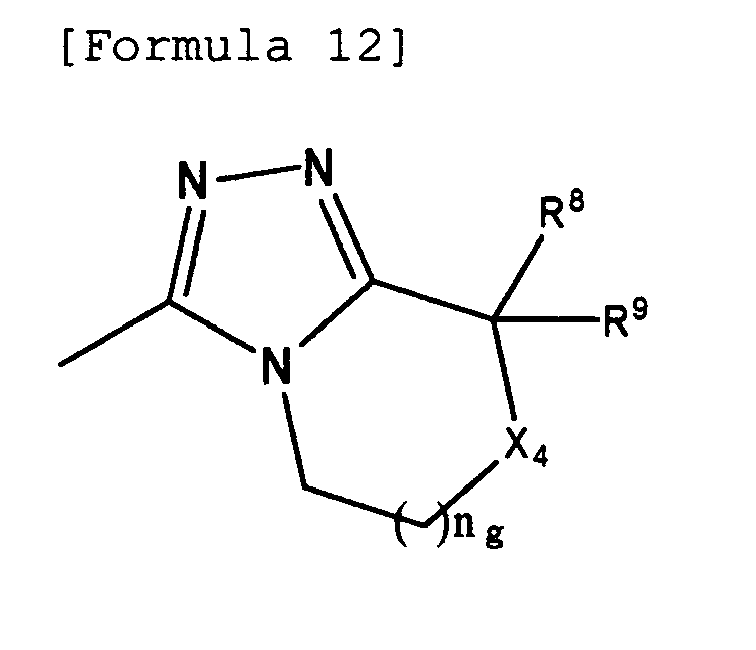
wherein R8 and R9 are the same or different and each represent a substituent selected from Substituent Group A4, X4 is the same as defined in claim 33, and ng represent an integer of 0 to 2. - The compound or pharmacologically acceptable salt thereof according to claim 34, wherein R8 represents a 6- to 14-membered aromatic hydrocarbon ring group or 5- to 14-membered aromatic heterocyclic group that may be substituted with 1 to 3 substituents selected from Substituent Group A4.
- The compound or pharmacologically acceptable salt thereof according to claim 34, wherein R8 represents a phenyl group, pyridinyl group or naphthyl group that may be substituted with 1 to 3 substituents selected from the group consisting of (1) a hydrogen atom, (2) a halogen atom, (3) a cyano group, (4) a C1-6 alkoxy group (wherein the C1-6 alkoxy group group may be substituted with 1 to 3 halogen atoms), (5) a C1-6 alkyl group (wherein the C1-6 alkyl group may be substituted with 1 to 3 halogen atoms, and (6) a amino group that may be substituted with 1 to 2 C1-6 alkyl groups.
- The compound or pharmacologically acceptable salt thereof according to claim 34, wherein R9 represents a substituent group selected from the group consisting of (1) a hydrogen atom, (2) a halogen atom, (3) a hydroxyl group, (4) a cyano group, (5) a C1-6 alkyl group, (6) a C2-6 alkenyl group, (7) a C2-6 alkynyl group, (8) a C1-6 alkoxy group, and (9) an amino group that may be substituted with 1 or 2 C1-6 alkyl groups.
- The compound or pharmacologically acceptable salt thereof according to any one of claims 1 to 37,
wherein Ar1 is bonded to Ar2 through an atom in the imidazolyl group, triazolyl group or tetrazolyl group represented by Ar1 which may be substituted with substituents and an atom in the phenyl group, pyrimidinyl group or pyridinyl group represented by Ar2 which may be substituted with substituents; Ar2 is bonded to X1 through an atom in the phenyl group, pyrimidinyl group or pyridinyl group represented by Ar2 which may be substituted with substituents; and monovalent Het is bonded to -C≡C- or -CR3=CR4- of X1, or divalent Het is bonded to -CR5= of X1. - The compound or pharmacologically acceptable salt thereof according to claim 1, wherein the compound is selected from the following group:1) 4-(4-fluorophenyl)-2-{(E)-2-[3-methoxy-4-(4-methyl-1H-imidazol-1-yl)phenyl]vinyl}-1H-imidazole,2) 4-(4-fluorophenyl)-2-{(E)-2-[3-methoxy-4-(4-methyl-1H-imidazol-1-yl)phenyl]vinyl}-1-methyl-1H-imidazole,3) 2-{(E)-2-[3-methoxy-4-(4-methyl-1H-imidazol-1-yl)phenyl]vinyl}-1-methyl-5-phenyl-1H-imidazole,4) 2-{(E)-2-[3-methoxy-4-(4-methyl-1H-imidazol-1-yl)phenyl]vinyl}-4-phenyl-1H-imidazole,5) 2-{(E)-2-[3-methoxy-4-(4-methyl-1H-imidazol-1-yl)phenyl]vinyl}-1-methyl-4-phenyl-1H-imidazole,6) methyl 5-(4-fluorophenyl)-2-{(E)-2-[3-methoxy-4-(4-methyl-1H-imidazol-1-yl)phenyl]vinyl}-1H-imidazole-4-carboxylate,7) 5-(4-fluorophenyl)-2-{(E)-2-[3-methoxy-4-(4-methyl-1H-imidazol-1-yl)phenyl]vinyl}-(1H-imidazol-4-yl)methanol,8) 5-(4-fluorophenyl)-2-{(E)-2-[3-methoxy-4-(4-methyl-1H-imidazol-1-yl)phenyl]vinyl}-1H-imidazole-4-carboxylic acid,9) 5-(4-fluorophenyl)-2-{(E)-2-[3-methoxy-4-(4-methyl-1H-imidazol-1-yl)phenyl]vinyl}-1H-imidazole-4-carboxylic acid (2-chloroethyl)amide,10) 1-(4-fluorophenyl)-3-{(E)-2-[3-methoxy-4-(4-methyl-1H-imidazol-1-yl)phenyl]vinyl}-6,7-dihydro-5H-imidazo[1,5-a]pyrazin-8-one,11) 1-(4-fluorophenyl)-3-{(E)-2-[3-methoxy-4-(4-methyl-1H-imidazol-1-yl)phenyl]vinyl}-7-methyl-6,7-dihydro-5H-imidazo[1,5-a]pyrazin-8-one,12) 1-(4-fluorophenyl)-3-{(E)-2-[3-methoxy-4-(4-methyl-1H-imidazol-1-yl)phenyl]vinyl}-5,6-dihydroimidazo[5,1-c][1,4]oxazin-8-one,13) 1-(4-fluorophenyl)-3-{(E)-2-[3-methoxy-4-(4-methyl-1H-imidazol-1-yl)phenyl]vinyl}-5,6-dihydro-8H-imidazo[5,1-c][1,4]oxazine,14) 2-{4-(4-fluorophenyl)-5-methoxymethyl-2-{(E)-2-[3-methoxy-4-(4-methyl-1H-imidazol-1-yl)phenyl]vinyl}imidazol-1-yl}ethanol,15) 1-(4-fluorophenyl)-3-{(E)-2-[3-methoxy-4-(4-methyl-1H-imidazol-1-yl)phenyl]vinyl}-7-methyl-5,6,7,8-tetrahydroimidazo[1,5-a]pyrazine,16) 3-(3-fluorophenyl)-5-{(E)-2-[3-methoxy-4-(4-methyl-1H-imidazol-1-yl)phenyl]vinyl}-4H-[1,2,4]triazole,17) 3-(4-fluorobenzyl)-5-{(E)-2-[3-methoxy-4-(4-methyl-1H-imidazol-1-yl)phenyl]vinyl}-4H-[1,2,4]triazole,18) 3-(4-fluorophenyl)-8-{1-[3-methoxy-4-(4-methyl-1H-imidazol-1-yl)phenyl]-(E)-methylidene}-5,6,7,8-tetrahydroimidazo[1,2-a]pyridine,19) 2-(4-fluorophenyl)-8-{1-[3-methoxy-4-(4-methyl-1H-imidazol-1-yl)phenyl]-(E)-methylidene}-5,6,7,8-tetrahydroimidazo[1,2-a]pyridine,20) 2-(4-fluorophenyl)-8-{1-[3-methoxy-4-(4-methyl-1H-imidazol-1-yl)phenyl]-(E)-methylidene}-5,6,7,8-tetrahydro[1,2,4]triazolo[1,5-a]pyridine,21) methyl 3-(4-fluorophenyl)-8-{1-[3-methoxy-4-(4-methyl-1H-imidazol-1-yl)phenyl]-(E)-methylidene}-5,6,7,8-tetrahydroimidazo[1,2-a]pyridine-2-carboxylate,22) methyl 2-(4-fluorophenyl)-8-{1-[3-methoxy-4-(4-methyl-1H-imidazol-1-yl)phenyl]-(E)-methylidene}-5,6,7,8-tetrahydroimidazo[1,2-a]pyridine-3-carboxylate,23) {3-(4-fluorophenyl)-8-{1-[3-methoxy-4-(4-methyl-1H-imidazol-1-yl)phenyl]-(E)-methylidene}-5,6,7,8-tetrahydroimidazo[1,2-a]pyridin-2-yl}methanol,24) {2-(4-fluorophenyl)-8-{1-[3-methoxy-4-(4-methyl-1H-imidazol-1-yl)phenyl]-(E)-methylidene}-5,6,7,8-tetrahydroimidazo[1,2-a]pyridin-3-yl]methanol,25) 3-(4-fluorophenyl)-8-{1-[3-methoxy-4-(4-methyl-1H-imidazol-1-yl)phenyl]-(E)-methylidene}-5,6,7,8-tetrahydroimidazo[1,2-a]pyridine-2-carboxylic acid,26) 3-(4-fluorophenyl)-8-{1-[3-methoxy-4-(4-methyl-1H-imidazol-1-yl)phenyl]-(E)-methylidene}-5,6,7,8-tetrahydroimidazo[1,2-a]pyridine-2-carboxylic acid dimethylamide,27) 3-(4-fluorophenyl)-8-{1-[3-methoxy-4-(4-methyl-1H-imidazol-1-yl)phenyl]-(E)-methylidene}-5,6,7,8-tetrahydroimidazo[1,2-a]pyridine-2-carboxylic acid methylamide,28) 3-(4-fluorophenyl)-8-{1-[3-methoxy-4-(4-methyl-1H-imidazol-1-yl)phenyl]-(E)-methylidene}-5,6,7,8-tetrahydroimidazo[1,2-a]pyridine-2-carboxylic acid amide,29) 1-(4-fluorobenzyl)-2-{(E)-2-[3-methoxy-4-(4-methyl-1H-imidazol-1-yl)phenyl]vinyl]-4,5-dimethyl-1H-imidazole,30) 8-{1-[3-methoxy-4-(4-methyl-1H-imidazol-1-yl)phenyl]-(E)-methylidene}-2-pyridin-4-yl-5,6,7,8-tetrahydroimidazo[1,2-a]pyridine,31) 3-[1-(4-fluorophenyl)ethyl]-5-{(E)-2-[3-methoxy-4-(4-methyl-1H-imidazol-1-yl)phenyl]vinyl}-4H-[1,2,4]triazole,32) 3-[2-(4-fluorophenyl)ethyl]-5-{(E)-2-[3-methoxy-4-(4-methyl-1H-imidazol-1-yl)phenyl]vinyl}-4H-[1,2,4]triazole,33) 4-(4-fluorobenzyl)-2-{(E)-2-[3-methoxy-4-(4-methyl-1H-imidazol-1-yl)phenyl]vinyl}-1H-imidazole,34) 5-(4-fluorobenzyl)-3-{(E)-2-[3-methoxy-4-(4-methyl-1H-imidazol-1-yl)phenyl]vinyl}-1-methyl-1H-[1,2,4]triazole,35) 3-(4-fluorobenzyl)-5-{(E)-2-[3-methoxy-4-(4-methyl-1H-imidazol-1-yl)phenyl]vinyl}-1-methyl-1H-[1,2,4]triazole,36) (+)-3-[1-(4-fluorophenyl)ethyl]-5-{(E)-2-[3-methoxy-4-(4-methyl-1H-imidazol-1-yl)phenyl]vinyl}-4H-[1,2,4]triazole,37) (-)-3-[1-(4-fluorophenyl)ethyl]-5-{(E)-2-[3-methoxy-4-(4-methyl-1H-imidazol-1-yl)phenyl]vinyl}-4H-[1,2,4]triazole,38) 5-[1-(4-fluorophenyl)ethyl]-3-{(E)-2-[3-methoxy-4-(4-methyl-1H-imidazol-1-yl)phenyl]vinyl}-1-methyl-1H-[1,2,4]triazole,39) 3-[1-(4-fluorophenyl)ethyl]-5-{(E)-2-[3-methoxy-4-(4-methyl-1H-imidazol-1-yl)phenyl]vinyl}-1-methyl-1H-[1,2,4]triazole,40) 5-[1-(4-fluorophenyl)ethyl]-3-{(E)-2-[3-methoxy-4-(4-methyl-1H-imidazol-1-yl)phenyl]vinyl}-1-methyl-1H-[1,2,4]triazole,41) 3-[1-(4-fluorophenyl)ethyl]-5-{(E)-2-[3-methoxy-4-(4-methyl-1H-imidazol-1-yl)phenyl]vinyl}-1-methyl-1H-[1,2,4]triazole,42) (+)-3-[1-(4-fluorophenyl)ethyl]-5-{(E)-2-[3-methoxy-4-(4-methyl-1H-imidazol-1-yl)phenyl]vinyl}-4-methyl-4H-[1,2,4]triazole,43) (-)-3-[1-(4-fluorophenyl)ethyl]-5-{(E)-2-[3-methoxy-4-(4-methyl-1H-imidazol-1-yl)phenyl]vinyl}-4-methyl-4H-[1,2,4]triazole,44) 3-{(E)-2-[3-methoxy-4-(4-methyl-1H-imidazol-1-yl)phenyl]vinyl}-5-(1-phenylethyl)-4H-[1,2,4]triazole,45) 3-{(E)-2-[3-methoxy-4-(4-methyl-1H-imidazol-1-yl)phenyl]vinyl}-1-methyl-5-(1-phenylethyl)-1H-[1,2,4]triazole,46) 5-{(E)-2-[3-methoxy-4-(4-methyl-1H-imidazol-1-yl)phenyl]vinyl}-1-methyl-3-(1-phenylethyl)-1H-[1,2,4]triazole,47) 3-(4-fluorophenyl)-5-{(E)-2-[3-methoxy-4-(4-methyl-1H-imidazol-1-yl)phenyl]vinyl}-4H-[1,2,4]triazole,48) 5-(4-fluorophenyl)-2-{(E)-2-[3-methoxy-4-(4-methyl-1H-imidazol-1-yl)phenyl]vinyl}-4-methyl-1H-imidazole,49) 3-{(E)-2-[3-methoxy-4-(4-methyl-1H-imidazol-1-yl)phenyl]vinyl}-5-(1-methyl-1-phenylethyl)-4H-[1,2,4]triazole,50) 3-{(E)-2-[3-methoxy-4-(4-methyl-1H-imidazol-1-yl)phenyl]vinyl}-1-phenyl-5,6,7,8-tetrahydroimidazo[1,5-a]pyridine,51) (+)-8-(4-fluorophenyl)-2-{(E)-2-[3-methoxy-4-(4-methyl-1H-imidazol-1-yl)phenyl]vinyl}-5,6,7,8-tetrahydro[1,2,4]triazolo[1,5-a]pyridine,52) (-)-8-(4-fluorophenyl)-2-{(E)-2-[3-methoxy-4-(4-methyl-1H-imidazol-1-yl)phenyl]vinyl}-5,6,7,8-tetrahydro[1,2,4]triazolo[1,5-a]pyridine,53) (+)-2-{(E)-2-[3-methoxy-4-(4-methyl-1H-imidazol-1-yl)phenyl]vinyl}-8-(3,4,5-trifluorophenyl)-5,6,7,8-tetrahydro[1,2,4]triazolo[1,5-a]pyridine,54) (-)-2-{(E)-2-[3-methoxy-4-(4-methyl-1H-imidazol-1-yl)phenyl]vinyl}-8-(3,4,5-trifluorophenyl)-5,6,7,8-tetrahydro[1,2,4]triazolo[1,5-a]pyridine,55) (+)-5-(4-fluorophenyl)-2-{(E)-2-[3-methoxy-4-(4-methyl-1H-imidazol-1-yl)phenyl]vinyl}-5,6,7,8-tetrahydro[1,2,4]triazolo[1,5-a]pyridine,56) (-)-5-(4-fluorophenyl)-2-{(E)-2-[3-methoxy-4-(4-methyl-1H-imidazol-1-yl)phenyl]vinyl}-5,6,7,8-tetrahydro[1,2,4]triazolo[1,5-a]pyridine,57) (+)-2-{(Z)-1-fluoro-2-[3-methoxy-4-(4-methyl-1H-imidazol-1-yl)phenyl]vinyl}-8-(3,4,5-trifluorophenyl)-5,6,7,8-tetrahydro[1,2,4]triazolo[1,5-a]pyridine,58) (-)-2-{(Z)-1-fluoro-2-[3-methoxy-4-(4-methyl-1H-imidazol-1-yl)phenyl]vinyl}-8-(3,4,5-trifluorophenyl)-5,6,7,8-tetrahydro[1,2,4]triazolo[1,5-a]pyridine,59) (+)-2-{(E)-2-[5-methoxy-6-(4-methyl-1H-imidazol-1-yl)pyridin-3-yl]vinyl}-8-(3,4,5-trifluorophenyl)-5,6,7,8-tetrahydro[1,2,4]triazolo[1,5-a]pyridine,60) (-)-2-{(E)-2-[5-methoxy-6-(4-methyl-1H-imidazol-1-yl)pyridin-3-yl]vinyl}-8-(3,4,5-trifluorophenyl)-5,6,7,8-tetrahydro[1,2,4]triazolo[1,5-a]pyridine,61) (+)-2-{(E)-2-[3-fluoro-4-(4-methyl-1H-imidazol-1-yl)phenyl]vinyl}-8-(3,4,5-trifluorophenyl)-5,6,7,8-tetrahydro[1,2,4]triazolo[1,5-a]pyridine,62) (-)-2-{(E)-2-[3-fluoro-4-(4-methyl-1H-imidazol-1-yl)phenyl]vinyl}-8-(3,4,5-trifluorophenyl)-5,6,7,8-tetrahydro[1,2,4]triazolo[1,5-a]pyridine,63) (+)-2-{(E)-2-[3-methoxy-4-(4-methyl-1H-imidazol-1-yl)phenyl]vinyl}-8-(2,4,6-trifluorophenyl)-5,6,7,8-tetrahydro[1,2,4]triazolo[1,5-a]pyridine,64) (-)-2-{(E)-2-[3-methoxy-4-(4-methyl-1H-imidazol-1-yl)phenyl]vinyl}-8-(2,4,6-trifluorophenyl)-5,6,7,8-tetrahydro[1,2,4]triazolo[1,5-a]pyridine,65) 7-(4-fluorophenyl)-2-{(E)-2-[3-methoxy-4-(4-methyl-1H-imidazol-1-yl)phenyl]vinyl}-6,7-dihydro-5H-pyrrolo[1,2-b][1,2,4]triazol-7-ol,66) (-)-2-{(E)-2-[3-methoxy-4-(4-methyl-1H-imidazol-1-yl)phenyl]vinyl}-8-(3,4,5-trifluorophenyl)-5,6,7,8-tetrahydro[1,2,4]triazolo[1,5-a]pyridin-8-ol,67) (+)-2-{(E)-2-[3-methoxy-4-(4-methyl-1H-imidazol-1-yl)phenyl]vinyl}-8-(3,4,5-trifluorophenyl)-5,6,7,8-tetrahydro[1,2,4]triazolo[1,5-a]pyridin-8-ol,68) (+)-2-{(E)-2-[2-fluoro-5-methoxy-4-(4-methyl-1H-imidazol-1-yl)phenyl]vinyl}-8-(3,4,5-trifluorophenyl)-5,6,7,8-tetrahydro[1,2,4]triazolo[1,5-a]pyridine,69) (-)-2-{(E)-2-[2-fluoro-5-methoxy-4-(4-methyl-1H-imidazol-1-yl)phenyl]vinyl}-8-(3,4,5-trifluorophenyl)-5,6,7,8-tetrahydro[1,2,4]triazolo[1,5-a]pyridine,70) (-)-8-(4-fluorophenyl)-2-{(E)-2-[3-methoxy-4-(4-methyl-1H-imidazol-1-yl)phenyl]vinyl}-5,6,7,8-tetrahydro[1,2,4]triazolo[1,5-a]pyridin-8-ol,71) (+)-8-(4-fluorophenyl)-2-{(E)-2-[3-methoxy-4-(4-methyl-1H-imidazol-1-yl)phenyl]vinyl}-5,6,7,8-tetrahydro[1,2,4]triazolo[1,5-a]pyridin-8-ol,72) (+)-8-fluoro-8-(4-fluorophenyl)-2-{(E)-2-[3-methoxy-4-(4-methyl-1H-imidazol-1-yl)phenyl]vinyl}-5,6,7,8-tetrahydro[1,2,4]triazolo[1,5-a]pyridine,73) (-)-8-fluoro-8-(4-fluorophenyl)-2-{(E)-2-[3-methoxy-4-(4-methyl-1H-imidazol-1-yl)phenyl]vinyl}-5,6,7,8-tetrahydro[1,2,4]triazolo[1,5-a]pyridine,74) 8-(4-fluorophenyl)-2-{(E)-2-[3-methoxy-4-(4-methyl-1H-imidazol-1-yl)phenyl]vinyl}-5,6-dihydro[1,2,4]triazolo[1,5-a]pyridine,75) (-)-2-{(E)-2-[3-methoxy-4-(4-methyl-1H-imidazol-1-yl)phenyl]vinyl}-8-(4-methoxyphenyl)-5,6,7,8-tetrahydro-[1,2,4]triazolo[1,5-a]pyridine,76) (+)-2-{(E)-2-[3-methoxy-4-(4-methyl-1H-imidazol-1-yl)phenyl]vinyl}-8-(4-methoxyphenyl)-5,6,7,8-tetrahydro-[1,2,4]triazolo[1,5-a]pyridine,77) (-)-2-{(E)-2-[3-methoxy-4-(4-methyl-1H-imidazol-1-yl)phenyl]vinyl}-8-(3,4,5-trifluorophenyl)-5,6-dihydro-8H-[1,2,4]triazolo[5,1-c][1,4]oxazine,78) (+)-2-{(E)-2-[3-methoxy-4-(4-methyl-1H-imidazol-1-yl)phenyl]vinyl}-8-(3,4,5-trifluorophenyl)-5,6-dihydro-8H-[1,2,4]triazolo[5,1-c][1,4]oxazine,79) (-)-8-(4-fluorophenyl)-2-{(E)-2-[3-methoxy-4-(4-methyl-1H-imidazol-1-yl)phenyl]vinyl}-8-methyl-5,6,7,8-tetrahydro-[1,2,4]triazolo[1,5-a]pyridine,80) (+)-8-(4-fluorophenyl)-2-{(E)-2-[3-methoxy-4-(4-methyl-1H-imidazol-1-yl)phenyl]vinyl}-8-methyl-5,6,7,8-tetrahydro-[1,2,4]triazolo[1,5-a]pyridine,81) 2-(4-fluorobenzyl)-8-{1-[3-methoxy-4-(4-methyl-1H-imidazol-1-yl)phenyl]-(E)-methylidene}-5,6,7,8-tetrahydro[1,2,4]triazolo[1,5-a]pyridine,82) 3-(4-fluorobenzyl)-8-{1-[3-methoxy-4-(4-methyl-1H-imidazol-1-yl)phenyl]-(E)-methylidene}-5,6,7,8-tetrahydro[1,2,4]triazolo[4,3-a]pyridine,83) 3-{(E)-2-[3-methoxy-4-(4-methyl-1H-imidazol-1-yl)phenyl]vinyl}-5-((S)-1-phenylethyl)-4H-[1,2,4]triazole,84) 3-{(E)-2-[3-methoxy-4-(4-methyl-1H-imidazol-1-yl)phenyl]vinyl}-5-((R)-1-phenylethyl)-4H-[1,2,4]triazole,85) (-)-8-(4-fluorophenyl)-8-methoxy-2-{(E)-2-[3-methoxy-4-(4-methyl-1H-imidazol-1-yl)phenyl]vinyl}-5,6,7,8-tetrahydro[1,2,4]triazolo[1,5-a]pyridine,86) (+)-8-(4-fluorophenyl)-8-methoxy-2-{(E)-2-[3-methoxy-4-(4-methyl-1H-imidazol-1-yl)phenyl]vinyl}-5,6,7,8-tetrahydro[1,2,4]triazolo[1,5-a]pyridine,87) (-)-8-methoxy-2-{(E)-2-[3-methoxy-4-(4-methyl-1H-imidazol-1-yl)phenyl]vinyl}-8-(3,4,5-trifluorophenyl)-5,6,7,8-tetrahydro[1,2,4]triazolo[1,5-a]pyridine,88) (+)-8-methoxy-2-{(E)-2-[3-methoxy-4-(4-methyl-1H-imidazol-1-yl)phenyl]vinyl}-8-(3,4,5-trifluorophenyl)-5,6,7,8-tetrahydro[1,2,4]triazolo[1,5-a]pyridine,89) (-)-8-methoxy-2-{(E)-2-[3-methoxy-4-(4-methyl-1H-imidazol-1-yl)phenyl]vinyl}-8-(4-methoxyphenyl)-5,6,7,8-tetrahydro[1,2,4]triazolo[1,5-a]pyridine,90) (+)-8-methoxy-2-{(E)-2-[3-methoxy-4-(4-methyl-1H-imidazol-1-yl)phenyl]vinyl}-8-(4-methoxyphenyl)-5,6,7,8-tetrahydro[1,2,4]triazolo[1,5-a]pyridine,91) 5-[methoxy-(4-methoxyphenyl)methyl]-3-{(E)-2-[3-methoxy-4-(4-methyl-1H-imidazol-1-yl)phenyl]vinyl}-1H-[1,2,4]triazole,92) 7-(4-fluorophenyl)-7-methoxy-2-{(E)-2-[3-methoxy-4-(4-methyl-1H-imidazol-1-yl)phenyl]vinyl}-6,7-dihydro-5H-pyrrolo[1,2-b][1,2,4]triazole,93) 4-(4-fluorophenyl)-2-{(E)-2-[3-methoxy-4-(4-methyl-1H-imidazol-1-yl)phenyl]vinyl}-1-(tetrahydrofuran-2-ylmethyl)-1H-imidazole,94) 4-{5-{(E)-2-[3-methoxy-4-(4-methyl-1H-imidazol-1-yl)phenyl]vinyl}-4H-[1,2,4]triazol-3-yl}-4-(3,4,5-trifluorophenyl)butan-1-ol,95) (+)-2-{(E)-2-[3-methoxy-4-(4-methyl-1H-imidazol-1-yl)phenyl]vinyl}-8-phenyl-5,6,7,8-tetrahydro[1,2,4]triazolo[1,5-a]pyridine-8-carbonitrile,96) (-)-2-{(E)-2-[3-methoxy-4-(4-methyl-1H-imidazol-1-yl)phenyl]vinyl}-8-phenyl-5,6,7,8-tetrahydro[1,2,4]triazolo[1,5-a]pyridine-8-carbonitrile,97) (-)-8-(4-fluorophenyl)-2-{(E)-2-[3-methoxy-4-(4-methyl-1H-imidazol-1-yl)phenyl]vinyl}-5,6,7,8-tetrahydro[1,2,4]triazolo[1,5-a]pyridine-8-carbonitrile,98) (+)-8-(4-fluorophenyl)-2-{(E)-2-[3-methoxy-4-(4-methyl-1H-imidazol-1-yl)phenyl]vinyl}-5,6,7,8-tetrahydro[1,2,4]triazolo[1,5-a]pyridine-8-carbonitrile,99) (+)-8-(4-fluorophenyl)-2-{(E)-2-[3-methoxy-4-(4-methyl-1H-imidazol-1-yl)phenyl]vinyl}-5,6,7,8-tetrahydro[1,2,4]triazolo[1,5-a]pyridin-8-ylamine,100) (-)-8-(4-fluorophenyl)-2-{(E)-2-[3-methoxy-4-(4-methyl-1H-imidazol-1-yl)phenyl]vinyl}-5,6,7,8-tetrahydro[1,2,4]triazolo[1,5-a]pyridin-8-ylamine,101) 2-{(E)-2-[3-fluoro-4-(4-methyl-1H-imidazol-1-yl)phenyl]vinyl}-8-(4-fluorophenyl)-5,6,7,8-tetrahydro[1,2,4]triazolo[1,5-a]pyridine,102) (-)-2-{(E)-2-[3-fluoro-4-(4-methyl-1H-imidazol-1-yl)phenyl]vinyl}-8-(4-fluorophenyl)-5,6,7,8-tetrahydro[1,2,4]triazolo[1,5-a]pyridin-8-ol,103) (+)-2-{(E)-2-[3-fluoro-4-(4-methyl-1H-imidazol-1-yl)phenyl]vinyl}-8-(4-fluorophenyl)-5,6,7,8-tetrahydro[1,2,4]triazolo[1,5-a]pyridin-8-ol,104) 2-{(E)-2-[2-fluoro-5-methoxy-4-(4-methyl-1H-imidazol-1-yl)phenyl]vinyl}-8-(4-fluorophenyl)-5,6,7,8-tetrahydro[1,2,4]triazolo[1,5-a]pyridine,105) (+)-2-{(E)-2-[2-fluoro-5-methoxy-4-(4-methyl-1H-imidazol-1-yl)phenyl]vinyl}-8-(4-fluorophenyl)-5,6,7,8-tetrahydro[1,2,4]triazolo[1,5-a]pyridin-8-ol,106) (-)-2-{(E)-2-[2-fluoro-5-methoxy-4-(4-methyl-1H-imidazol-1-yl)phenyl]vinyl}-8-(4-fluorophenyl)-5,6,7,8-tetrahydro[1,2,4]triazolo[1,5-a]pyridin-8-ol,107) 2-{(Z)-1-fluoro-2-[3-methoxy-4-(4-methyl-1H-imidazol-1-yl)phenyl]vinyl}-8-(4-fluorophenyl)-5,6,7,8-tetrahydro[1,2,4]triazolo[1,5-a]pyridine,108) (-)-2-{(Z)-1-fluoro-2-[3-methoxy-4-(4-methyl-1H-imidazol-1-yl)phenyl]vinyl}-8-(4-fluorophenyl)-5,6,7,8-tetrahydro[1,2,4]triazolo[1,5-a]pyridin-8-ol,109) (+)-2-{(Z)-1-fluoro-2-[3-methoxy-4-(4-methyl-1H-imidazol-1-yl)phenyl]vinyl}-8-(4-fluorophenyl)-5,6,7,8-tetrahydro[1,2,4]triazolo[1,5-a]pyridin-8-ol,110) (-)-2-{(E)-2-[5-methoxy-6-(4-methyl-1H-imidazol-1-yl)pyridin-3-yl]vinyl}-8-(3,4,5-trifluorophenyl)-5,6,7,8-tetrahydro[1,2,4]triazolo[1,5-a]pyridin-8-ol,111) (+)-2-{(E)-2-[5-methoxy-6-(4-methyl-1H-imidazol-1-yl)pyridin-3-yl]vinyl}-8-(3,4,5-trifluorophenyl)-5,6,7,8-tetrahydro[1,2,4]triazolo[1,5-a]pyridin-8-ol,112) (-)-2-{(E)-2-[3-methoxy-4-(4-methyl-1H-imidazol-1-yl)phenyl]vinyl}-7-(3,4,5-trifluorophenyl)-6,7-dihydro-5H-pyrrolo[1,2-b][1,2,4]triazole,113) (+)-2-{(E)-2-[3-methoxy-4-(4-methyl-1H-imidazol-1-yl)phenyl]vinyl}-7-(3,4,5-trifluorophenyl)-6,7-dihydro-5H-pyrrolo[1,2-b][1,2,4]triazole,114) (+)-2-{(E)-2-[3-methoxy-4-(4-methyl-1H-imidazol-1-yl)phenyl]vinyl}-7-(3,4,5-trifluorophenyl)-6,7-dihydro-5H-pyrrolo[1,2-b][1,2,4]triazol-7-ol,115) (-)-2-{(E)-2-[3-methoxy-4-(4-methyl-1H-imidazol-1-yl)phenyl]vinyl}-7-(3,4,5-trifluorophenyl)-6,7-dihydro-5H-pyrrolo[1,2-b][1,2,4]triazol-7-ol,116) (+)-8-(3,4-difluorophenyl)-2-{(E)-2-[3-methoxy-4-(4-methyl-1H-imidazol-1-yl)phenyl]vinyl}-5,6,7,8-tetrahydro-[1,2,4]triazolo[1,5-a]pyridine,117) (-)-8-(3,4-difluorophenyl)-2-{(E)-2-[3-methoxy-4-(4-methyl-1H-imidazol-1-yl)phenyl]vinyl}-5,6,7,8-tetrahydro-[1,2,4]triazolo[1,5-a]pyridine,118) 4-(4-fluorophenyl)-2-{(E)-2-[3-methoxy-4-(4-methyl-1H-imidazol-1-yl)phenyl]vinyl}-4,5,6,7-tetrahydro[1,2,4]triazolo[1,5-a]pyrimidine,119) (+)-3-{(E)-2-[3-methoxy-4-(4-methyl-1H-imidazol-1-yl)phenyl]vinyl}-5-phenyl-5,6,7,8-tetrahydro[1,2,4]triazolo[4,3-a]pyridine,120) (-)-3-{(E)-2-[3-methoxy-4-(4-methyl-1H-imidazol-1-yl)phenyl]vinyl}-5-phenyl-5,6,7,8-tetrahydro[1,2,4]triazolo[4,3-a]pyridine,121) 4-chloro-2-{(E)-2-[3-methoxy-4-(4-methyl-1H-imidazol-1-yl)phenyl]vinyl}-1H-imidazole,122) 4-(4-methoxyphenyl)-2-{(E)-2-[3-methoxy-4-(4-methyl-1H-imidazol-1-yl)phenyl]vinyl}-1H-imidazole,123) 4-(3-methoxyphenyl)-2-{(E)-2-[3-methoxy-4-(4-methyl-1H-imidazol-1-yl)phenyl]vinyl}-1H-imidazole,124) 4-(2-methoxyphenyl)-2-{(E)-2-[3-methoxy-4-(4-methyl-1H-imidazol-1-yl)phenyl]vinyl}-1H-imidazole,125) 4-(4-chlorophenyl)-2-{(E)-2-[3-methoxy-4-(4-methyl-1H-imidazol-1-yl)phenyl]vinyl}-1H-imidazole,126) 4-(4-biphenyl)-2-{(E)-2-[3-methoxy-4-(4-methyl-1H-imidazol-1-yl)phenyl]vinyl}-1H-imidazole,127) 4-(4-propyl)-2-{(E)-2-[3-methoxy-4-(4-methyl-1H-imidazol-1-yl)phenyl]vinyl}-1H-imidazole,128) (+)-2-{(E)-2-[3-methoxy-4-(4-methyl-1H-imidazol-1-yl)phenyl]vinyl}-8-(4-trifluoromethoxyphenyl)-5,6,7,8-tetrahydro[1,2,4]triazolo[1,5-a]pyridine,129) (-)-2-{(E)-2-[3-methoxy-4-(4-methyl-1H-imidazol-1-yl)phenyl]vinyl}-8-(4-trifluoromethoxyphenyl)-5,6,7,8-tetrahydro[1,2,4]triazolo[1,5-a]pyridine,130) (+)-2-{(E)-2-[3-methoxy-4-(4-methyl-1H-imidazol-1-yl)phenyl]vinyl}-8-naphthalen-1-yl-5,6,7,8-tetrahydro[1,2,4]triazolo[1,5-a]pyridine,131) (-)-2-{(E)-2-[3-methoxy-4-(4-methyl-1H-imidazol-1-yl)phenyl]vinyl}-8-naphthalen-1-yl-5,6,7,8-tetrahydro[1,2,4]triazolo[1,5-a]pyridine,132) (+)-2-{(E)-2-[3-methoxy-4-(4-methyl-1H-imidazol-1-yl)phenyl]vinyl}-8-(4-methoxyphenyl)-5,6,7,8-tetrahydro[1,2,4]triazolo[1,5-a]pyridin-8-ol,133) (-)-2-{(E)-2-[3-methoxy-4-(4-methyl-1H-imidazol-1-yl)phenyl]vinyl}-8-(4-methoxyphenyl)-5,6,7,8-tetrahydro[1,2,4]triazolo[1,5-a]pyridin-8-ol,134) (+)-2-{(E)-2-[3-methoxy-4-(4-methyl-1H-imidazol-1-yl)phenyl]vinyl}-8-(4-trifluoromethoxyphenyl)-5,6-dihydro-8H-[1,2,4]triazolo[5,1-c][1,4]oxazine,135) (-)-2-{(E)-2-[3-methoxy-4-(4-methyl-1H-imidazol-1-yl)phenyl]vinyl}-8-(4-trifluoromethoxyphenyl)-5,6-dihydro-8H-[1,2,4]triazolo[5,1-c][1,4]oxazine,136) (-)-2-{(E)-2-[3-methoxy-4-(4-methyl-1H-imidazol-1-yl)phenyl]vinyl}-8-naphthalen-1-yl-5,6,7,8-tetrahydro[1,2,4]triazolo[1,5-a]pyridin-8-ol,137) (+)-2-{(E)-2-[3-methoxy-4-(4-methyl-1H-imidazol-1-yl)phenyl]vinyl}-8-naphthalen-1-yl-5,6,7,8-tetrahydro[1,2,4]triazolo[1,5-a]pyridin-8-ol,138) (-)-2-{(E)-2-[3-methoxy-4-(4-methyl-1H-imidazol-1-yl)phenyl]vinyl}-8-p-tolyl-5,6-dihydro-8H-[1,2,4]triazolo[5,1-c][1,4]oxazine,139) (+)-2-{(E)-2-[3-methoxy-4-(4-methyl-1H-imidazol-1-yl)phenyl]vinyl}-8-p-tolyl-5,6-dihydro-8H-[1,2,4]triazolo[5,1-c][1,4]oxazine,140) (+)-2-{(E)-2-[3-methoxy-4-(4-methyl-1H-imidazol-1-yl)phenyl]vinyl}-8-(2,4,6-trifluorophenyl)-5,6-dihydro-8H-[1,2,4]triazolo[5,1-c][1,4]oxazine,141) (-)-2-{(E)-2-[3-methoxy-4-(4-methyl-1H-imidazol-1-yl)phenyl]vinyl}-8-(2,4,6-trifluorophenyl)-5,6-dihydro-8H-[1,2,4]triazolo[5,1-c][1,4]oxazine,142) (+)-8-(4-bromophenyl)-2-{(E)-2-[3-methoxy-4-(4-methyl-1H-imidazol-1-yl)phenyl]vinyl}-5,6-dihydro-8H-[1,2,4]triazolo[5,1-c][1,4]oxazine,143) (-)-8-(4-bromophenyl)-2-{(E)-2-[3-methoxy-4-(4-methyl-1H-imidazol-1-yl)phenyl]vinyl}-5,6-dihydro-8H-[1,2,4]triazolo[5,1-c][1,4]oxazine,144) (+)-8-(6-chloropyridin-3-yl)-2-{(E)-2-[3-methoxy-4-(4-methyl-1H-imidazol-1-yl)phenyl]vinyl}-5,6-dihydro-8H-[1,2,4]triazolo[5,1-c][1,4]oxazine,145) (-)-8-(6-chloropyridin-3-yl)-2-{(E)-2-[3-methoxy-4-(4-methyl-1H-imidazol-1-yl)phenyl]vinyl}-5,6-dihydro-8H-[1,2,4]triazolo[5,1-c][1,4]oxazine,146) (+)-4-(2-{(E)-2-[3-methoxy-4-(4-methyl-1H-imidazol-1-yl)phenyl]vinyl}-5,6-dihydro-8H-[1,2,4]triazolo[5,1-c][1,4]oxazin-8-yl)benzonitrile,147) (-)-4-(2-{(E)-2-[3-methoxy-4-(4-methyl-1H-imidazol-1-yl)phenyl]vinyl}-5,6-dihydro-8H-[1,2,4]triazolo[5,1-c][1,4]oxazin-8-yl)benzonitrile,148) (+)-8-(4-chlorophenyl)-2-{(E)-2-[3-methoxy-4-(4-methyl-1H-imidazol-1-yl)phenyl]vinyl}-5,6,7,8-tetrahydro[1,2,4]triazolo[1,5-a]pyridine,149) (-)-8-(4-chlorophenyl)-2-{(E)-2-[3-methoxy-4-(4-methyl-1H-imidazol-1-yl)phenyl]vinyl}-5,6,7,8-tetrahydro[1,2,4]triazolo[1,5-a]pyridine,150) (+)-2-{(E)-2-[3-methoxy-4-(4-methyl-1H-imidazol-1-yl)phenyl]vinyl}-8-p-tolyl-5,6,7,8-tetrahydro[1,2,4]triazolo[1,5-a]pyridine,151) (-)-2-{(E)-2-[3-methoxy-4-(4-methyl-1H-imidazol-1-yl)phenyl]vinyl}-8-p-tolyl-5,6,7,8-tetrahydro[1,2,4]triazolo[1,5-a]pyridine,152) (+)-8-(4-chlorophenyl)-2-{(E)-2-[3-methoxy-4-(4-methyl-1H-imidazol-1-yl)phenyl]vinyl}-5,6,7,8-tetrahydro[1,2,4]triazolo[1,5-a]pyridin-8-ol,153) (-)-8-(4-chlorophenyl)-2-{(E)-2-[3-methoxy-4-(4-methyl-1H-imidazol-1-yl)phenyl]vinyl}-5,6,7,8-tetrahydro[1,2,4]triazolo[1,5-a]pyridin-8-ol,154) (+)-2-{(E)-2-[3-methoxy-4-(4-methyl-1H-imidazol-1-yl)phenyl]vinyl}-8-p-tolyl-5,6,7,8-tetrahydro[1,2,4]triazolo[1,5-a]pyridin-8-ol,155) (-)-2-{(E)-2-[3-methoxy-4-(4-methyl-1H-imidazol-1-yl)phenyl]vinyl}-8-p-tolyl-5,6,7,8-tetrahydro[1,2,4]triazolo[1,5-a]pyridin-8-ol,156) (+)-4-{2-{(E)-2-[3-methoxy-4-(4-methyl-1H-imidazol-1-yl)phenyl]vinyl}-5,6,7,8-tetrahydro[1,2,4]triazolo[1,5-a]pyridin-8-yl}benzonitrile,157) (-)-4-{2-{(E)-2-[3-methoxy-4-(4-methyl-1H-imidazol-1-yl)phenyl]vinyl}-5,6,7,8-tetrahydro[1,2,4]triazolo[1,5-a]pyridin-8-yl}benzonitrile,158) (+)-4-{8-hydroxy-2-{(E)-2-[3-methoxy-4-(4-methyl-1H-imidazol-1-yl)phenyl]vinyl}-5,6,7,8-tetrahydro[1,2,4]triazolo[1,5-a]pyridin-8-yl}benzonitrile,159) (-)-4-{8-hydroxy-2-{(E)-2-[3-methoxy-4-(4-methyl-1H-imidazol-1-yl)phenyl]vinyl}-5,6,7,8-tetrahydro[1,2,4]triazolo[1,5-a]pyridin-8-yl}benzonitrile,160) {4-{2-{(E)-2-[3-methoxy-4-(4-methyl-1H-imidazol-1-yl)phenyl]vinyl}-5,6,7,8-tetrahydro[1,2,4]triazolo[1,5-a]pyridin-8-yl}phenyl}dimethylamine,161) (S)-8-(4-chlorophenyl)-3-{(E)-2-[3-methoxy-4-(4-methyl-1H-imidazol-1-yl)phenyl]vinyl}-5,6,7,8-tetrahydro[1,2,4]triazolo[4,3-a]pyridine,162) (R)-8-(4-chlorophenyl)-3-{(E)-2-[3-methoxy-4-(4-methyl-1H-imidazol-1-yl)phenyl]vinyl}-5,6,7,8-tetrahydro[1,2,4]triazolo[4,3-a]pyridine,163) (+)-3-{(E)-2-[3-methoxy-4-(4-methyl-1H-imidazol-1-yl)phenyl]vinyl}-8-(3,4,5-trifluorophenyl)-5,6,7,8-tetrahydro[1,2,4]triazolo[4,3-a]pyridine,164) (-)-3-{(E)-2-[3-methoxy-4-(4-methyl-1H-imidazol-1-yl)phenyl]vinyl}-8-(3,4,5-trifluorophenyl)-5,6,7,8-tetrahydro[1,2,4]triazolo[4,3-a]pyridine,165) (+)-3-{(E)-2-[3-methoxy-4-(4-methyl-1H-imidazol-1-yl)phenyl]vinyl}-7-(3,4,5-trifluorophenyl)-6,7-dihydro-5H-pyrrolo[2,1-c][1,2,4]triazole,166) (-)-3-{(E)-2-[3-methoxy-4-(4-methyl-1H-imidazol-1-yl)phenyl]vinyl}-7-(3,4,5-trifluorophenyl)-6,7-dihydro-5H-pyrrolo[2,1-c][1,2,4]triazole,167) (S)-3-{(E)-2-[3-methoxy-4-(4-methyl-1H-imidazol-1-yl)phenyl]vinyl}-9-(3,4,5-trifluorophenyl)-6,7,8,9-tetrahydro-5H-[1,2,4]triazolo[4,3-a]azepine,168) (R)-3-{(E)-2-[3-methoxy-4-(4-methyl-1H-imidazol-1-yl)phenyl]vinyl}-9-(3,4,5-trifluorophenyl)-6,7,8,9-tetrahydro-5H-[1,2,4]triazolo[4,3-a]azepine,169) (+)-2-{(E)-2-[3-methoxy-4-(4-methyl-1H-imidazol-1-yl)phenyl]vinyl}-9-(3,4,5-trifluorophenyl)-6,7,8,9-tetrahydro-5H-[1,2,4]triazolo[1,5-a]azepine,170) (-)-2-{(E)-2-[3-methoxy-4-(4-methyl-1H-imidazol-1-yl)phenyl]vinyl}-9-(3,4,5-trifluorophenyl)-6,7,8,9-tetrahydro-5H-[1,2,4]triazolo[1,5-a]azepine,171) 3-(4-fluorophenyl)-8-{1-[3-methoxy-4-(4-methyl-1H-imidazol-1-yl)phenyl]-(E)-methylidene}-5,6,7,8-tetrahydro[1,2,4]triazolo[4,3-a]pyridine,172) (-)-2-{(E)-2-[3-methoxy-4-(4-methyl-1H-imidazol-1-yl)phenyl]vinyl}-8-phenyl-5,6,7,8-tetrahydro[1,2,4]triazolo[1,5-a]pyridine,173) (+)-2-{(E)-2-[3-methoxy-4-(4-methyl-1H-imidazol-1-yl)phenyl]vinyl}-8-phenyl-5,6,7,8-tetrahydro[1,2,4]triazolo[1,5-a]pyridine,174) (-)-8-(2-bromophenyl)-2-{(E)-2-[3-methoxy-4-(4-methyl-1H-imidazol-1-yl)phenyl]vinyl}-5,6,7,8-tetrahydro[1,2,4]triazolo[1,5-a]pyridine,175) (+)-8-(2-bromophenyl)-2-{(E)-2-[3-methoxy-4-(4-methyl-1H-imidazol-1-yl)phenyl]vinyl}-5,6,7,8-tetrahydro[1,2,4]triazolo[1,5-a]pyridine,176) 8-(2-bromo-4-fluorophenyl)-2-{(E)-2-[3-methoxy-4-(4-methyl-1H-imidazol-1-yl)phenyl]vinyl}-5,6,7,8-tetrahydro[1,2,4]triazolo[1,5-a]pyridine,177) 8-(2-fluorophenyl)-2-{(E)-2-[3-methoxy-4-(4-methyl-1H-imidazol-1-yl)phenyl]vinyl}-5,6,7,8-tetrahydro[1,2,4]triazolo[1,5-a]pyridine,178) 2-{(E)-2-[3-methoxy-4-(4-methyl-1H-imidazol-1-yl)phenyl]vinyl}-8-(2-methoxyphenyl)-5,6,7,8-tetrahydro[1,2,4]triazolo[1,5-a]pyridine,179) 8-(3-bromophenyl)-2-{(E)-2-[3-methoxy-4-(4-methyl-1H-imidazol-1-yl)phenyl]vinyl}-5,6,7,8-tetrahydro[1,2,4]triazolo[1,5-a]pyridine and180) 2-{(E)-2-[3-methoxy-4-(4-methyl-1H-imidazol-1-yl)phenyl]vinyl}-8-(2-nitrophenyl)-5,6,7,8-tetrahydro[1,2,4]triazolo[1,5-a]pyridine.
- A medicine comprising the compound or pharmacologically acceptable salt thereof according to any of claims 1 to 39 as an active ingredient.
- The medicine according to claim 40 for preventing or treating a disease caused by amyloid-β.
- The medicine according to claim 41, wherein the disease caused by amyloid-β is Alzheimer's disease, dementia, Down's syndrome or amyloidosis.
Priority Applications (3)
| Application Number | Priority Date | Filing Date | Title |
|---|---|---|---|
| SI200730897T SI1992618T1 (en) | 2006-03-09 | 2007-03-08 | Polycyclic cinnamide derivative |
| PL07738023T PL1992618T3 (en) | 2006-03-09 | 2007-03-08 | Polycyclic cinnamide derivative |
| CY20121100165T CY1112767T1 (en) | 2006-03-09 | 2012-02-16 | CYNAMIC CIRCULAR PRODUCTION |
Applications Claiming Priority (5)
| Application Number | Priority Date | Filing Date | Title |
|---|---|---|---|
| US78051706P | 2006-03-09 | 2006-03-09 | |
| JP2006063562 | 2006-03-09 | ||
| US86170206P | 2006-11-30 | 2006-11-30 | |
| JP2006322728 | 2006-11-30 | ||
| PCT/JP2007/054532 WO2007102580A1 (en) | 2006-03-09 | 2007-03-08 | Polycyclic cinnamide derivative |
Publications (3)
| Publication Number | Publication Date |
|---|---|
| EP1992618A1 true EP1992618A1 (en) | 2008-11-19 |
| EP1992618A4 EP1992618A4 (en) | 2010-11-10 |
| EP1992618B1 EP1992618B1 (en) | 2012-01-18 |
Family
ID=38474999
Family Applications (1)
| Application Number | Title | Priority Date | Filing Date |
|---|---|---|---|
| EP07738023A Active EP1992618B1 (en) | 2006-03-09 | 2007-03-08 | Polycyclic cinnamide derivative |
Country Status (15)
| Country | Link |
|---|---|
| EP (1) | EP1992618B1 (en) |
| KR (1) | KR101464651B1 (en) |
| AR (1) | AR059955A1 (en) |
| AU (1) | AU2007223158B2 (en) |
| CA (1) | CA2643796A1 (en) |
| CY (1) | CY1112767T1 (en) |
| EA (1) | EA016464B1 (en) |
| GE (1) | GEP20115139B (en) |
| HN (1) | HN2008001374A (en) |
| HR (1) | HRP20120174T1 (en) |
| IL (1) | IL193770A (en) |
| MA (1) | MA30268B1 (en) |
| MX (1) | MX2008011221A (en) |
| PL (1) | PL1992618T3 (en) |
| WO (1) | WO2007102580A1 (en) |
Cited By (36)
| Publication number | Priority date | Publication date | Assignee | Title |
|---|---|---|---|---|
| WO2009076337A1 (en) * | 2007-12-11 | 2009-06-18 | Schering Corporation | Gamma secretase modulators |
| WO2010025197A1 (en) * | 2008-08-27 | 2010-03-04 | Eisai R&D Management Co., Ltd. | Process for preparing certain cinnamide compounds |
| WO2010054064A1 (en) * | 2008-11-06 | 2010-05-14 | Schering Corporation | Gamma secretase modulators |
| WO2010054078A1 (en) * | 2008-11-06 | 2010-05-14 | Schering Corporation | Gamma secretase modulators |
| WO2010056722A1 (en) * | 2008-11-13 | 2010-05-20 | Schering Corporation | Gamma secretase modulators |
| WO2010075203A1 (en) * | 2008-12-22 | 2010-07-01 | Schering Corporation | Gamma secretase modulators |
| WO2010083141A1 (en) * | 2009-01-16 | 2010-07-22 | Bristol-Myers Squibb Company | Bicyclic compounds for the reduction of beta-amyloid production |
| WO2010098487A1 (en) * | 2009-02-26 | 2010-09-02 | Eisai R&D Management Co., Ltd. | Nitrogen-containing fused heterocyclic compounds and their use as beta amyloid production inhibitors |
| WO2010098490A1 (en) | 2009-02-26 | 2010-09-02 | Eisai R&D Management Co., Ltd. | Salt of tetrahydrotriazolopyridine derivative and crystal thereof |
| WO2010098488A1 (en) * | 2009-02-26 | 2010-09-02 | Eisai R&D Management Co., Ltd. | Aryl imidazole compounds and their use as beta amyloid production inhibitors |
| EP2117311A4 (en) * | 2007-02-08 | 2011-05-11 | Merck Sharp & Dohme | THERAPEUTICS |
| US8008293B2 (en) | 2007-02-28 | 2011-08-30 | Eisai R&D Management Co., Ltd. | Bicyclic oxomorpholine derivative |
| US8048878B2 (en) | 2005-11-24 | 2011-11-01 | Eisai R&D Management Co., Ltd. | Two cyclic cinnamide compound |
| WO2012029991A1 (en) * | 2010-09-02 | 2012-03-08 | Takeda Pharmaceutical Company Limited | Fused triazoles for the treatment or prophylaxis of mild cognitive impairment |
| US20120258986A1 (en) * | 2011-01-17 | 2012-10-11 | Karyopharm Therapeutics, Inc. | Olefin containing nuclear transport modulators and uses thereof |
| US20120295891A1 (en) * | 2010-01-15 | 2012-11-22 | Sven Franciscus Anna Van Brandt | Novel substituted triazole derivatives as gamma secretase modulators |
| EP2559693A1 (en) * | 2007-08-31 | 2013-02-20 | Eisai R&D Management Co., Ltd. | Polycyclic compound |
| WO2013055793A1 (en) * | 2011-10-12 | 2013-04-18 | University Of Pittsburg-Of The Commonwealth System Of Higher Education | Small molecules targeting androgen receptor nuclear localization and/or level in prostate cancer |
| EP2687528A1 (en) * | 2012-07-17 | 2014-01-22 | Ares Trading S.A. | Fused triazole derivatives as gamma secretase modulators |
| US9181245B2 (en) | 2012-05-16 | 2015-11-10 | Janssen Pharmaceuticals, Inc. | Substituted pyrido[1,2-a]pyrazines and substituted pyrido[1,2-a][1,4]diazepines for the treatment of (inter alia) Alzheimer's disease |
| US9206158B2 (en) | 2011-07-29 | 2015-12-08 | Karyopharm Therapeutics Inc. | Hydrazide containing nuclear transport modulators and uses thereof |
| US9266843B2 (en) | 2012-05-09 | 2016-02-23 | Karyopharm Therapeutics Inc. | Nuclear transport modulators and uses thereof |
| US9428490B2 (en) | 2011-07-29 | 2016-08-30 | Karyopharm Therapeutics Inc. | Nuclear transport modulators and uses thereof |
| US9550757B2 (en) | 2010-03-05 | 2017-01-24 | Karyopharm Therapeutics Inc. | Nuclear transport modulators and uses thereof |
| US9738624B2 (en) | 2013-06-21 | 2017-08-22 | Karyopharm Therapeutics Inc. | Nuclear transport modulators and uses thereof |
| US10112943B2 (en) | 2012-12-20 | 2018-10-30 | Janssen Pharmaceutica Nv | Substituted imidazoles as gamma secretase modulators |
| US10202366B2 (en) | 2013-03-15 | 2019-02-12 | Karyopharm Therapeutics Inc. | Methods of promoting wound healing using CRM1 inhibitors |
| US10246454B2 (en) | 2013-01-17 | 2019-04-02 | Janssen Pharmaceutica Nv | Substituted 3,4-dihydro-2H-pyrido[1,2-a]pyrazine-1,6-diones as gamma secretase modulators |
| US10519139B2 (en) | 2014-08-15 | 2019-12-31 | Karyopharm Therapeutics Inc. | Polymorphs of Selinexor |
| US10526295B2 (en) | 2015-12-31 | 2020-01-07 | Karyopharm Therapeutics Inc. | Nuclear transport modulators and uses thereof |
| US10544110B2 (en) | 2013-09-20 | 2020-01-28 | University of Pittsburgh—of the Commonwealth System of Higher Education | Small molecule inhibitors of the nuclear translocation of androgen receptor for the treatment of castration-resistant prostate cancer |
| US10562897B2 (en) | 2014-01-16 | 2020-02-18 | Janssen Pharmaceutica Nv | Substituted 3,4-dihydro-2H-pyrido[1,2-a]pyrazine-1,6-diones as gamma secretase modulators |
| US10709706B2 (en) | 2015-12-31 | 2020-07-14 | Karopharm Therapeutics Inc. | Nuclear transport modulators and uses thereof |
| US10882834B2 (en) | 2013-09-20 | 2021-01-05 | University of Pittsburgh—of the Commonwealth System of Higher Education | Compounds for treating prostate cancer |
| US10980806B2 (en) | 2016-03-24 | 2021-04-20 | University of Pittsburgh—of the Commonwealth System of Higher Education | Small molecule inhibitors of the nuclear translocation of androgen receptor for the treatment of castration-resistant prostate cancer |
| US11602530B2 (en) | 2016-11-28 | 2023-03-14 | Biogen Ma Inc. | CRM1 inhibitors for treating epilepsy |
Families Citing this family (22)
| Publication number | Priority date | Publication date | Assignee | Title |
|---|---|---|---|---|
| BRPI0511504A (en) | 2004-05-26 | 2008-01-22 | Eisai R&D Man Co Ltd | compound or a pharmaceutically acceptable salt thereof, and preventive or therapeutic agent for a disease resulting from beta-amyloids |
| ATE458729T1 (en) | 2004-10-26 | 2010-03-15 | Eisai R&D Man Co Ltd | AMORPHOUS FORM OF A cinnamic acid amide compound |
| MY144960A (en) | 2005-11-24 | 2011-11-30 | Eisai R&D Man Co Ltd | Morpholine type cinnamide compound |
| TWI378091B (en) | 2006-03-09 | 2012-12-01 | Eisai R&D Man Co Ltd | Multi-cyclic cinnamide derivatives |
| US7737141B2 (en) | 2006-07-28 | 2010-06-15 | Eisai R&D Management Co., Ltd. | Prodrug of cinnamide compound |
| AU2008250436B2 (en) | 2007-05-11 | 2013-03-28 | F. Hoffmann-La Roche Ag | Hetarylanilines as modulators for amyloid beta |
| EP2152695A2 (en) * | 2007-06-01 | 2010-02-17 | Schering Corporation | Gamma secretase modulators |
| US7935815B2 (en) * | 2007-08-31 | 2011-05-03 | Eisai R&D Management Co., Ltd. | Imidazoyl pyridine compounds and salts thereof |
| EP2217604A1 (en) | 2007-11-05 | 2010-08-18 | Schering Corporation | Gamma secretase modulators |
| RU2527177C2 (en) | 2007-12-20 | 2014-08-27 | Энвиво Фармасьютикалз, Инк. | Tetrasubstituted benzenes |
| CA2705411A1 (en) | 2007-12-21 | 2009-07-02 | F. Hoffmann-La Roche Ag | Heteroaryl derivatives as orexin receptor antagonists |
| KR101244517B1 (en) | 2008-01-11 | 2013-03-18 | 에프. 호프만-라 로슈 아게 | Modulators for amyloid beta |
| AU2009216851B2 (en) | 2008-02-22 | 2013-11-07 | F. Hoffmann-La Roche Ag | Modulators for amyloid beta |
| WO2010040661A1 (en) | 2008-10-09 | 2010-04-15 | F. Hoffmann-La Roche Ag | Modulators for amyloid beta |
| AU2009312856A1 (en) | 2008-11-10 | 2010-05-14 | F. Hoffmann-La Roche Ag | Heterocyclic gamma secretase modulators |
| JP2012121809A (en) * | 2009-02-26 | 2012-06-28 | Eisai R & D Management Co Ltd | Method for producing polycyclic compound and intermediate thereof |
| JP2012051805A (en) | 2009-02-26 | 2012-03-15 | Eisai R & D Management Co Ltd | Method for producing tetrahydrotriazolopyridine derivative |
| US20120142672A1 (en) | 2009-07-13 | 2012-06-07 | Tatsuki Koike | Heterocyclic compound and use thereof |
| US8871760B2 (en) * | 2009-09-21 | 2014-10-28 | Roche Palo Alto Llc | [1,2,4]triazolo[3,4-C][1,4]oxazines as P2X7 modulators |
| US8486967B2 (en) | 2010-02-17 | 2013-07-16 | Hoffmann-La Roche Inc. | Heteroaryl substituted piperidines |
| JP2014012641A (en) * | 2010-10-29 | 2014-01-23 | Dainippon Sumitomo Pharma Co Ltd | Novel pyridine derivative |
| PL3419979T3 (en) * | 2016-02-23 | 2020-06-29 | Pfizer Inc. | 6,7-dihydro-5h-pyrazolo[5,1-b][1,3]oxazine-2-carboxamide compounds |
Family Cites Families (4)
| Publication number | Priority date | Publication date | Assignee | Title |
|---|---|---|---|---|
| ATE288898T1 (en) * | 2000-12-04 | 2005-02-15 | Hoffmann La Roche | PHENYLETHENYL OR PHENYLETHINYL DERIVATIVES AS GLUTAMA RECEPTOR ANTAGONISTS |
| JP2006518738A (en) * | 2003-02-12 | 2006-08-17 | トランス テック ファーマ,インコーポレイテッド | Substituted azole derivatives as therapeutic agents |
| US20050187277A1 (en) * | 2004-02-12 | 2005-08-25 | Mjalli Adnan M. | Substituted azole derivatives, compositions, and methods of use |
| BRPI0511504A (en) * | 2004-05-26 | 2008-01-22 | Eisai R&D Man Co Ltd | compound or a pharmaceutically acceptable salt thereof, and preventive or therapeutic agent for a disease resulting from beta-amyloids |
-
2007
- 2007-03-08 PL PL07738023T patent/PL1992618T3/en unknown
- 2007-03-08 GE GEAP200710893A patent/GEP20115139B/en unknown
- 2007-03-08 EP EP07738023A patent/EP1992618B1/en active Active
- 2007-03-08 AR ARP070100958A patent/AR059955A1/en not_active Application Discontinuation
- 2007-03-08 HR HR20120174T patent/HRP20120174T1/en unknown
- 2007-03-08 KR KR1020087023309A patent/KR101464651B1/en not_active Expired - Fee Related
- 2007-03-08 WO PCT/JP2007/054532 patent/WO2007102580A1/en not_active Ceased
- 2007-03-08 EA EA200870336A patent/EA016464B1/en not_active IP Right Cessation
- 2007-03-08 MX MX2008011221A patent/MX2008011221A/en active IP Right Grant
- 2007-03-08 CA CA002643796A patent/CA2643796A1/en not_active Abandoned
- 2007-03-08 AU AU2007223158A patent/AU2007223158B2/en not_active Ceased
-
2008
- 2008-08-28 IL IL193770A patent/IL193770A/en not_active IP Right Cessation
- 2008-09-05 HN HN2008001374A patent/HN2008001374A/en unknown
- 2008-09-08 MA MA31220A patent/MA30268B1/en unknown
-
2012
- 2012-02-16 CY CY20121100165T patent/CY1112767T1/en unknown
Non-Patent Citations (3)
| Title |
|---|
| ONO M ET AL: "Synthesis and biological evaluation of (E)-3-styrylpyridine derivatives as amyloid imaging agents for Alzheimer's disease" NUCLEAR MEDICINE AND BIOLOGY, ELSEVIER, NY, US LNKD- DOI:10.1016/J.NUCMEDBIO.2005.01.006, vol. 32, no. 4, 1 May 2005 (2005-05-01), pages 329-335, XP004881117 ISSN: 0969-8051 * |
| See also references of WO2007102580A1 * |
| ZHI-PHING ZHUANG ET AL: "Structure-Activity Relationship of Imidazo[1,2-a]pyridines as Ligands for Detecting beta-Amyloid Plaques in the Brain" JOURNAL OF MEDICINAL CHEMISTRY, AMERICAN CHEMICAL SOCIETY, WASHINGTON, US LNKD- DOI:10.1021/JM020351J, vol. 46, no. 2, 18 December 2002 (2002-12-18), pages 237-243, XP002543323 ISSN: 0022-2623 * |
Cited By (84)
| Publication number | Priority date | Publication date | Assignee | Title |
|---|---|---|---|---|
| US8048878B2 (en) | 2005-11-24 | 2011-11-01 | Eisai R&D Management Co., Ltd. | Two cyclic cinnamide compound |
| EP2117311A4 (en) * | 2007-02-08 | 2011-05-11 | Merck Sharp & Dohme | THERAPEUTICS |
| US8008293B2 (en) | 2007-02-28 | 2011-08-30 | Eisai R&D Management Co., Ltd. | Bicyclic oxomorpholine derivative |
| EP2559693A1 (en) * | 2007-08-31 | 2013-02-20 | Eisai R&D Management Co., Ltd. | Polycyclic compound |
| US9453000B2 (en) | 2007-08-31 | 2016-09-27 | Eisai R&D Management Co., Ltd. | Polycyclic compound |
| WO2009076337A1 (en) * | 2007-12-11 | 2009-06-18 | Schering Corporation | Gamma secretase modulators |
| WO2010025197A1 (en) * | 2008-08-27 | 2010-03-04 | Eisai R&D Management Co., Ltd. | Process for preparing certain cinnamide compounds |
| WO2010054064A1 (en) * | 2008-11-06 | 2010-05-14 | Schering Corporation | Gamma secretase modulators |
| WO2010054078A1 (en) * | 2008-11-06 | 2010-05-14 | Schering Corporation | Gamma secretase modulators |
| WO2010054067A1 (en) * | 2008-11-06 | 2010-05-14 | Schering Corporation | Gamma secretase modulators |
| WO2010056722A1 (en) * | 2008-11-13 | 2010-05-20 | Schering Corporation | Gamma secretase modulators |
| US8809318B2 (en) | 2008-11-13 | 2014-08-19 | Merck Sharp & Dohme Corp. | Gamma secretase modulators |
| WO2010075203A1 (en) * | 2008-12-22 | 2010-07-01 | Schering Corporation | Gamma secretase modulators |
| US8759337B2 (en) | 2008-12-22 | 2014-06-24 | Merck Sharp & Dohme Corp. | Gamma secretase modulators |
| WO2010083141A1 (en) * | 2009-01-16 | 2010-07-22 | Bristol-Myers Squibb Company | Bicyclic compounds for the reduction of beta-amyloid production |
| RU2515976C2 (en) * | 2009-02-26 | 2014-05-20 | Эйсай Ар Энд Ди Менеджмент Ко., Лтд. | Condensed heterocyclic nitrogen compounds and using them as inhibitors of amyloid beta production |
| US8703954B2 (en) | 2009-02-26 | 2014-04-22 | Eisai R&D Management Co., Ltd. | Salt of tetrahydrotriazolopyridine derivative and crystal thereof |
| CN102333778B (en) * | 2009-02-26 | 2015-05-13 | 卫材R&D管理有限公司 | Salt of tetrahydrotriazolopyridine derivative and crystal thereof |
| WO2010098487A1 (en) * | 2009-02-26 | 2010-09-02 | Eisai R&D Management Co., Ltd. | Nitrogen-containing fused heterocyclic compounds and their use as beta amyloid production inhibitors |
| CN102333778A (en) * | 2009-02-26 | 2012-01-25 | 卫材R&D管理有限公司 | Salt of tetrahydrotriazolopyridine derivative and crystal thereof |
| CN102333777B (en) * | 2009-02-26 | 2014-06-25 | 卫材R&D管理有限公司 | Nitrogen-containing fused heterocyclic compounds and their use as beta-amyloid production inhibitors |
| EP2615090A1 (en) * | 2009-02-26 | 2013-07-17 | Eisai R&D Management Co., Ltd. | Nitrogen-containing fused heterocyclic compounds and their use as beta amyloid production inhibitors |
| WO2010098490A1 (en) | 2009-02-26 | 2010-09-02 | Eisai R&D Management Co., Ltd. | Salt of tetrahydrotriazolopyridine derivative and crystal thereof |
| US8754100B2 (en) | 2009-02-26 | 2014-06-17 | Eisai R&D Management Co., Ltd. | Nitrogen-containing fused heterocyclic compounds and their use as beta amyloid production inhibitors |
| CN102333777A (en) * | 2009-02-26 | 2012-01-25 | 卫材R&D管理有限公司 | Nitrogen-containing fused heterocyclic compounds and their use as inhibitors of beta-amyloid production |
| WO2010098488A1 (en) * | 2009-02-26 | 2010-09-02 | Eisai R&D Management Co., Ltd. | Aryl imidazole compounds and their use as beta amyloid production inhibitors |
| US20120295891A1 (en) * | 2010-01-15 | 2012-11-22 | Sven Franciscus Anna Van Brandt | Novel substituted triazole derivatives as gamma secretase modulators |
| US9079886B2 (en) * | 2010-01-15 | 2015-07-14 | Janssen Pharmaceuticals, Inc. | Substituted triazole derivatives as gamma secretase modulators |
| US9145399B2 (en) | 2010-01-15 | 2015-09-29 | Janssen Pharmaceuticals, Inc. | Substituted bicyclic triazole derivatives as gamma secretase modulators |
| US9550757B2 (en) | 2010-03-05 | 2017-01-24 | Karyopharm Therapeutics Inc. | Nuclear transport modulators and uses thereof |
| WO2012029991A1 (en) * | 2010-09-02 | 2012-03-08 | Takeda Pharmaceutical Company Limited | Fused triazoles for the treatment or prophylaxis of mild cognitive impairment |
| JP2013536798A (en) * | 2010-09-02 | 2013-09-26 | 武田薬品工業株式会社 | Heterocyclic compounds and uses thereof |
| CN103249733A (en) * | 2010-09-02 | 2013-08-14 | 武田药品工业株式会社 | Fused triazoles for the treatment or prophylaxis of mild cognitive impairment |
| US8822699B2 (en) | 2010-09-02 | 2014-09-02 | Takeda Pharmaceutical Company Limited | Heterocyclic compound and use thereof |
| US8901309B2 (en) | 2010-09-02 | 2014-12-02 | Takeda Pharmaceutical Company Limited | Fused triazoles for the treatment or prophylaxis of mild cognitive impairment |
| US9303000B2 (en) * | 2011-01-17 | 2016-04-05 | Karyopharm Therapeutics Inc. | Olefin containing nuclear transport modulators and uses thereof |
| US20120258986A1 (en) * | 2011-01-17 | 2012-10-11 | Karyopharm Therapeutics, Inc. | Olefin containing nuclear transport modulators and uses thereof |
| US9428490B2 (en) | 2011-07-29 | 2016-08-30 | Karyopharm Therapeutics Inc. | Nuclear transport modulators and uses thereof |
| US9714226B2 (en) | 2011-07-29 | 2017-07-25 | Karyopharm Therapeutics Inc. | Hydrazide containing nuclear transport modulators and uses thereof |
| US11034660B2 (en) | 2011-07-29 | 2021-06-15 | Karyopharm Therapeutics Inc. | Hydrazide containing nuclear transport modulators and uses thereof |
| US10544108B2 (en) | 2011-07-29 | 2020-01-28 | Karyopharm Therapeutics Inc. | Hydrazide containing nuclear transport modulators and uses thereof |
| US9206158B2 (en) | 2011-07-29 | 2015-12-08 | Karyopharm Therapeutics Inc. | Hydrazide containing nuclear transport modulators and uses thereof |
| US11787771B2 (en) | 2011-07-29 | 2023-10-17 | Karyopharm Therapeutics Inc. | Hydrazide containing nuclear transport modulators and uses thereof |
| US10173987B2 (en) | 2011-07-29 | 2019-01-08 | Karyopharm Therapeutics Inc. | Hydrazide containing nuclear transport modulators and uses thereof |
| US12291508B2 (en) | 2011-07-29 | 2025-05-06 | Karyopharm Therapeutics Inc. | Hydrazide containing nuclear transport modulators and uses thereof |
| US9981974B2 (en) | 2011-10-12 | 2018-05-29 | University of Pittsburgh—of the Commonwealth System of Higher Education | Small molecules targeting androgen receptor nuclear localization and/or level in prostate cancer |
| WO2013055793A1 (en) * | 2011-10-12 | 2013-04-18 | University Of Pittsburg-Of The Commonwealth System Of Higher Education | Small molecules targeting androgen receptor nuclear localization and/or level in prostate cancer |
| US10004730B2 (en) | 2011-10-12 | 2018-06-26 | University of Pittsburgh—of the Commonwealth System of Higher Education | Small molecules targeting androgen receptor nuclear localization and/or level in prostate cancer |
| US9708276B2 (en) | 2011-10-12 | 2017-07-18 | University of Pittsburgh—of the Commonwealth System of Higher Education | Small molecules targeting androgen receptor nuclear localization and/or level in prostate cancer |
| US11318120B2 (en) | 2012-05-09 | 2022-05-03 | Biogen Ma Inc. | Nuclear transport modulators and uses thereof |
| US9585874B2 (en) | 2012-05-09 | 2017-03-07 | Karyopharm Therapeutics Inc. | Nuclear transport modulators and uses thereof |
| US9861614B2 (en) | 2012-05-09 | 2018-01-09 | Karyopharm Therapeutics Inc. | Nuclear transport modulators and uses thereof |
| US10617677B2 (en) | 2012-05-09 | 2020-04-14 | Biogen Ma Inc. | Nuclear transport modulators and uses thereof |
| US10058535B2 (en) | 2012-05-09 | 2018-08-28 | Biogen Ma Inc. | Nuclear transport modulators and uses thereof |
| US10925859B2 (en) | 2012-05-09 | 2021-02-23 | Biogen Ma Inc. | Nuclear transport modulators and uses thereof |
| US9266843B2 (en) | 2012-05-09 | 2016-02-23 | Karyopharm Therapeutics Inc. | Nuclear transport modulators and uses thereof |
| US10335393B2 (en) | 2012-05-09 | 2019-07-02 | Biogen Ma Inc. | Nuclear transport modulators and uses thereof |
| US9181245B2 (en) | 2012-05-16 | 2015-11-10 | Janssen Pharmaceuticals, Inc. | Substituted pyrido[1,2-a]pyrazines and substituted pyrido[1,2-a][1,4]diazepines for the treatment of (inter alia) Alzheimer's disease |
| US9527853B2 (en) | 2012-07-17 | 2016-12-27 | Ares Trading S.A. | Fused triazole derivatives as gamma secretase modulators |
| EP2687528A1 (en) * | 2012-07-17 | 2014-01-22 | Ares Trading S.A. | Fused triazole derivatives as gamma secretase modulators |
| WO2014012614A1 (en) * | 2012-07-17 | 2014-01-23 | Ares Trading S.A. | Fused triazole derivatives as gamma secretase modulators |
| US10112943B2 (en) | 2012-12-20 | 2018-10-30 | Janssen Pharmaceutica Nv | Substituted imidazoles as gamma secretase modulators |
| US10246454B2 (en) | 2013-01-17 | 2019-04-02 | Janssen Pharmaceutica Nv | Substituted 3,4-dihydro-2H-pyrido[1,2-a]pyrazine-1,6-diones as gamma secretase modulators |
| US10202366B2 (en) | 2013-03-15 | 2019-02-12 | Karyopharm Therapeutics Inc. | Methods of promoting wound healing using CRM1 inhibitors |
| US11124493B2 (en) | 2013-06-21 | 2021-09-21 | Karyopharm Therapeutics Inc. | Nuclear transport modulators and uses thereof |
| US10407405B2 (en) | 2013-06-21 | 2019-09-10 | Karyopharm Therapeutics Inc. | Nuclear transport modulators and uses thereof |
| US12577225B2 (en) | 2013-06-21 | 2026-03-17 | Karyopharm Therapeutics Inc. | Nuclear transport modulators and uses thereof |
| US9738624B2 (en) | 2013-06-21 | 2017-08-22 | Karyopharm Therapeutics Inc. | Nuclear transport modulators and uses thereof |
| US11945794B2 (en) | 2013-06-21 | 2024-04-02 | Karyopharm Therapeutics Inc. | Nuclear transport modulators and uses thereof |
| US10544110B2 (en) | 2013-09-20 | 2020-01-28 | University of Pittsburgh—of the Commonwealth System of Higher Education | Small molecule inhibitors of the nuclear translocation of androgen receptor for the treatment of castration-resistant prostate cancer |
| US10882834B2 (en) | 2013-09-20 | 2021-01-05 | University of Pittsburgh—of the Commonwealth System of Higher Education | Compounds for treating prostate cancer |
| US12202811B2 (en) | 2013-09-20 | 2025-01-21 | University of Pittsburgh—of the Commonwealth System of Higher Education | Compounds for treating prostate cancer |
| US10562897B2 (en) | 2014-01-16 | 2020-02-18 | Janssen Pharmaceutica Nv | Substituted 3,4-dihydro-2H-pyrido[1,2-a]pyrazine-1,6-diones as gamma secretase modulators |
| US10519139B2 (en) | 2014-08-15 | 2019-12-31 | Karyopharm Therapeutics Inc. | Polymorphs of Selinexor |
| US11746102B2 (en) | 2014-08-15 | 2023-09-05 | Karyopharm Therapeutics Inc. | Polymorphs of selinexor |
| US11753401B2 (en) | 2014-08-15 | 2023-09-12 | Karyopharm Therapeutics Inc. | Polymorphs of Selinexor |
| US12371420B2 (en) | 2014-08-15 | 2025-07-29 | Karyopharm Therapeutics Inc. | Polymorphs of Selinexor |
| US11807629B2 (en) | 2014-08-15 | 2023-11-07 | Karyopharm Therapeutics Inc. | Polymorphs of Selinexor |
| US11078190B2 (en) | 2014-08-15 | 2021-08-03 | Karyopharm Therapeutics Inc. | Polymorphs of selinexor |
| US10526295B2 (en) | 2015-12-31 | 2020-01-07 | Karyopharm Therapeutics Inc. | Nuclear transport modulators and uses thereof |
| US10709706B2 (en) | 2015-12-31 | 2020-07-14 | Karopharm Therapeutics Inc. | Nuclear transport modulators and uses thereof |
| US10980806B2 (en) | 2016-03-24 | 2021-04-20 | University of Pittsburgh—of the Commonwealth System of Higher Education | Small molecule inhibitors of the nuclear translocation of androgen receptor for the treatment of castration-resistant prostate cancer |
| US11766433B2 (en) | 2016-03-24 | 2023-09-26 | University Of Pittsburgh - Of The Commonwealth System Of Higher Education | Small molecule inhibitors of the nuclear translocation of androgen receptor for the treatment of castration-resistant prostate cancer |
| US11602530B2 (en) | 2016-11-28 | 2023-03-14 | Biogen Ma Inc. | CRM1 inhibitors for treating epilepsy |
Also Published As
| Publication number | Publication date |
|---|---|
| GEP20115139B (en) | 2011-01-10 |
| EA016464B1 (en) | 2012-05-30 |
| HK1122027A1 (en) | 2009-05-08 |
| HRP20120174T1 (en) | 2012-03-31 |
| CA2643796A1 (en) | 2007-09-13 |
| HK1128085A1 (en) | 2009-10-16 |
| EP1992618B1 (en) | 2012-01-18 |
| IL193770A0 (en) | 2009-05-04 |
| PL1992618T3 (en) | 2012-06-29 |
| CY1112767T1 (en) | 2016-02-10 |
| KR20080108481A (en) | 2008-12-15 |
| IL193770A (en) | 2012-10-31 |
| KR101464651B1 (en) | 2014-11-24 |
| WO2007102580A1 (en) | 2007-09-13 |
| MX2008011221A (en) | 2008-09-11 |
| EP1992618A4 (en) | 2010-11-10 |
| AU2007223158B2 (en) | 2012-04-12 |
| AR059955A1 (en) | 2008-05-14 |
| HN2008001374A (en) | 2011-03-15 |
| EA200870336A1 (en) | 2009-02-27 |
| AU2007223158A1 (en) | 2007-09-13 |
| MA30268B1 (en) | 2009-03-02 |
Similar Documents
| Publication | Publication Date | Title |
|---|---|---|
| EP1992618B1 (en) | Polycyclic cinnamide derivative | |
| US7713993B2 (en) | Multi-cycle cinnamide derivatives | |
| US7935815B2 (en) | Imidazoyl pyridine compounds and salts thereof | |
| US9453000B2 (en) | Polycyclic compound | |
| EP2019094A1 (en) | Heterocyclic type cinnamide derivative | |
| CA2566094A1 (en) | Cinnamide compound | |
| WO2010098488A1 (en) | Aryl imidazole compounds and their use as beta amyloid production inhibitors | |
| HK1122027B (en) | Polycyclic cinnamide derivative |
Legal Events
| Date | Code | Title | Description |
|---|---|---|---|
| PUAI | Public reference made under article 153(3) epc to a published international application that has entered the european phase |
Free format text: ORIGINAL CODE: 0009012 |
|
| 17P | Request for examination filed |
Effective date: 20080905 |
|
| AK | Designated contracting states |
Kind code of ref document: A1 Designated state(s): AT BE BG CH CY CZ DE DK EE ES FI FR GB GR HU IE IS IT LI LT LU LV MC MT NL PL PT RO SE SI SK TR |
|
| AX | Request for extension of the european patent |
Extension state: AL BA HR MK RS |
|
| REG | Reference to a national code |
Ref country code: HK Ref legal event code: DE Ref document number: 1122027 Country of ref document: HK |
|
| A4 | Supplementary search report drawn up and despatched |
Effective date: 20101013 |
|
| GRAP | Despatch of communication of intention to grant a patent |
Free format text: ORIGINAL CODE: EPIDOSNIGR1 |
|
| RIC1 | Information provided on ipc code assigned before grant |
Ipc: A61K 31/4196 20060101ALI20110610BHEP Ipc: C07D 403/10 20060101ALI20110610BHEP Ipc: C07D 233/90 20060101ALI20110610BHEP Ipc: A61K 31/4178 20060101ALI20110610BHEP Ipc: A61K 31/437 20060101ALI20110610BHEP Ipc: A61K 31/4985 20060101ALI20110610BHEP Ipc: C07D 405/06 20060101ALI20110610BHEP Ipc: A61K 31/5383 20060101ALI20110610BHEP Ipc: A61P 25/28 20060101ALI20110610BHEP Ipc: C07D 233/64 20060101AFI20110610BHEP Ipc: A61P 43/00 20060101ALI20110610BHEP |
|
| GRAS | Grant fee paid |
Free format text: ORIGINAL CODE: EPIDOSNIGR3 |
|
| GRAA | (expected) grant |
Free format text: ORIGINAL CODE: 0009210 |
|
| AK | Designated contracting states |
Kind code of ref document: B1 Designated state(s): AT BE BG CH CY CZ DE DK EE ES FI FR GB GR HU IE IS IT LI LT LU LV MC MT NL PL PT RO SE SI SK TR |
|
| AX | Request for extension of the european patent |
Extension state: AL BA HR MK RS |
|
| REG | Reference to a national code |
Ref country code: GB Ref legal event code: FG4D |
|
| REG | Reference to a national code |
Ref country code: CH Ref legal event code: EP |
|
| REG | Reference to a national code |
Ref country code: PT Ref legal event code: SC4A Free format text: AVAILABILITY OF NATIONAL TRANSLATION Effective date: 20120123 |
|
| REG | Reference to a national code |
Ref country code: AT Ref legal event code: REF Ref document number: 541836 Country of ref document: AT Kind code of ref document: T Effective date: 20120215 Ref country code: CH Ref legal event code: NV Representative=s name: BOHEST AG Ref country code: IE Ref legal event code: FG4D |
|
| REG | Reference to a national code |
Ref country code: HR Ref legal event code: TUEP Ref document number: P20120174 Country of ref document: HR |
|
| REG | Reference to a national code |
Ref country code: SE Ref legal event code: TRGR |
|
| REG | Reference to a national code |
Ref country code: NL Ref legal event code: T3 |
|
| REG | Reference to a national code |
Ref country code: DE Ref legal event code: R096 Ref document number: 602007020166 Country of ref document: DE Effective date: 20120322 |
|
| REG | Reference to a national code |
Ref country code: ES Ref legal event code: FG2A Ref document number: 2377740 Country of ref document: ES Kind code of ref document: T3 Effective date: 20120330 |
|
| REG | Reference to a national code |
Ref country code: HR Ref legal event code: T1PR Ref document number: P20120174 Country of ref document: HR |
|
| REG | Reference to a national code |
Ref country code: DK Ref legal event code: T3 |
|
| REG | Reference to a national code |
Ref country code: RO Ref legal event code: EPE |
|
| REG | Reference to a national code |
Ref country code: GR Ref legal event code: EP Ref document number: 20120400165 Country of ref document: GR Effective date: 20120305 |
|
| REG | Reference to a national code |
Ref country code: EE Ref legal event code: FG4A Ref document number: E006513 Country of ref document: EE Effective date: 20120404 |
|
| REG | Reference to a national code |
Ref country code: PL Ref legal event code: T3 |
|
| REG | Reference to a national code |
Ref country code: SK Ref legal event code: T3 Ref document number: E 11544 Country of ref document: SK |
|
| REG | Reference to a national code |
Ref country code: HK Ref legal event code: GR Ref document number: 1122027 Country of ref document: HK |
|
| PLBE | No opposition filed within time limit |
Free format text: ORIGINAL CODE: 0009261 |
|
| STAA | Information on the status of an ep patent application or granted ep patent |
Free format text: STATUS: NO OPPOSITION FILED WITHIN TIME LIMIT |
|
| 26N | No opposition filed |
Effective date: 20121019 |
|
| REG | Reference to a national code |
Ref country code: HU Ref legal event code: AG4A Ref document number: E014839 Country of ref document: HU |
|
| REG | Reference to a national code |
Ref country code: HR Ref legal event code: ODRP Ref document number: P20120174 Country of ref document: HR Payment date: 20130221 Year of fee payment: 7 Ref country code: DE Ref legal event code: R097 Ref document number: 602007020166 Country of ref document: DE Effective date: 20121019 |
|
| PGFP | Annual fee paid to national office [announced via postgrant information from national office to epo] |
Ref country code: CZ Payment date: 20130304 Year of fee payment: 7 Ref country code: LU Payment date: 20130328 Year of fee payment: 7 Ref country code: FI Payment date: 20130313 Year of fee payment: 7 Ref country code: LT Payment date: 20130219 Year of fee payment: 7 Ref country code: EE Payment date: 20130315 Year of fee payment: 7 Ref country code: IS Payment date: 20130218 Year of fee payment: 7 Ref country code: BG Payment date: 20130314 Year of fee payment: 7 Ref country code: HU Payment date: 20130325 Year of fee payment: 7 Ref country code: IE Payment date: 20130322 Year of fee payment: 7 Ref country code: MC Payment date: 20130313 Year of fee payment: 7 Ref country code: DK Payment date: 20130320 Year of fee payment: 7 Ref country code: RO Payment date: 20130226 Year of fee payment: 7 |
|
| PGFP | Annual fee paid to national office [announced via postgrant information from national office to epo] |
Ref country code: LV Payment date: 20130313 Year of fee payment: 7 Ref country code: SK Payment date: 20130308 Year of fee payment: 7 Ref country code: PL Payment date: 20130221 Year of fee payment: 7 Ref country code: GR Payment date: 20130314 Year of fee payment: 7 Ref country code: SI Payment date: 20130228 Year of fee payment: 7 |
|
| PGFP | Annual fee paid to national office [announced via postgrant information from national office to epo] |
Ref country code: AT Payment date: 20130313 Year of fee payment: 7 Ref country code: PT Payment date: 20130304 Year of fee payment: 7 |
|
| PGFP | Annual fee paid to national office [announced via postgrant information from national office to epo] |
Ref country code: CY Payment date: 20130227 Year of fee payment: 7 Ref country code: BE Payment date: 20130320 Year of fee payment: 7 |
|
| PGFP | Annual fee paid to national office [announced via postgrant information from national office to epo] |
Ref country code: TR Payment date: 20120307 Year of fee payment: 6 |
|
| REG | Reference to a national code |
Ref country code: CH Ref legal event code: PCAR Free format text: NEW ADDRESS: HOLBEINSTRASSE 36-38, 4051 BASEL (CH) |
|
| PGFP | Annual fee paid to national office [announced via postgrant information from national office to epo] |
Ref country code: MT Payment date: 20130225 Year of fee payment: 7 |
|
| REG | Reference to a national code |
Ref country code: PT Ref legal event code: MM4A Free format text: LAPSE DUE TO NON-PAYMENT OF FEES Effective date: 20140908 |
|
| REG | Reference to a national code |
Ref country code: HR Ref legal event code: PBON Ref document number: P20120174 Country of ref document: HR Effective date: 20140308 |
|
| REG | Reference to a national code |
Ref country code: DK Ref legal event code: EBP Effective date: 20140331 |
|
| REG | Reference to a national code |
Ref country code: LT Ref legal event code: MM4D Effective date: 20140308 |
|
| PG25 | Lapsed in a contracting state [announced via postgrant information from national office to epo] |
Ref country code: CZ Free format text: LAPSE BECAUSE OF NON-PAYMENT OF DUE FEES Effective date: 20140308 Ref country code: FI Free format text: LAPSE BECAUSE OF NON-PAYMENT OF DUE FEES Effective date: 20140308 Ref country code: CY Free format text: LAPSE BECAUSE OF NON-PAYMENT OF DUE FEES Effective date: 20140308 Ref country code: LU Free format text: LAPSE BECAUSE OF NON-PAYMENT OF DUE FEES Effective date: 20140308 Ref country code: RO Free format text: LAPSE BECAUSE OF NON-PAYMENT OF DUE FEES Effective date: 20140308 Ref country code: LT Free format text: LAPSE BECAUSE OF NON-PAYMENT OF DUE FEES Effective date: 20140308 |
|
| REG | Reference to a national code |
Ref country code: AT Ref legal event code: MM01 Ref document number: 541836 Country of ref document: AT Kind code of ref document: T Effective date: 20140308 |
|
| REG | Reference to a national code |
Ref country code: GR Ref legal event code: ML Ref document number: 20120400165 Country of ref document: GR Effective date: 20141002 |
|
| PG25 | Lapsed in a contracting state [announced via postgrant information from national office to epo] |
Ref country code: LV Free format text: LAPSE BECAUSE OF NON-PAYMENT OF DUE FEES Effective date: 20140308 |
|
| REG | Reference to a national code |
Ref country code: SK Ref legal event code: MM4A Ref document number: E 11544 Country of ref document: SK Effective date: 20140308 |
|
| REG | Reference to a national code |
Ref country code: EE Ref legal event code: MM4A Ref document number: E006513 Country of ref document: EE Effective date: 20140331 |
|
| PG25 | Lapsed in a contracting state [announced via postgrant information from national office to epo] |
Ref country code: PT Free format text: LAPSE BECAUSE OF NON-PAYMENT OF DUE FEES Effective date: 20140908 |
|
| REG | Reference to a national code |
Ref country code: IE Ref legal event code: MM4A Ref country code: SI Ref legal event code: KO00 Effective date: 20141111 |
|
| PG25 | Lapsed in a contracting state [announced via postgrant information from national office to epo] |
Ref country code: BG Free format text: LAPSE BECAUSE OF NON-PAYMENT OF DUE FEES Effective date: 20141231 Ref country code: SK Free format text: LAPSE BECAUSE OF NON-PAYMENT OF DUE FEES Effective date: 20140308 Ref country code: IE Free format text: LAPSE BECAUSE OF NON-PAYMENT OF DUE FEES Effective date: 20140308 Ref country code: EE Free format text: LAPSE BECAUSE OF NON-PAYMENT OF DUE FEES Effective date: 20140331 Ref country code: GR Free format text: LAPSE BECAUSE OF NON-PAYMENT OF DUE FEES Effective date: 20141002 |
|
| PG25 | Lapsed in a contracting state [announced via postgrant information from national office to epo] |
Ref country code: AT Free format text: LAPSE BECAUSE OF NON-PAYMENT OF DUE FEES Effective date: 20140308 Ref country code: SI Free format text: LAPSE BECAUSE OF NON-PAYMENT OF DUE FEES Effective date: 20140309 Ref country code: HU Free format text: LAPSE BECAUSE OF NON-PAYMENT OF DUE FEES Effective date: 20140309 Ref country code: IS Free format text: LAPSE BECAUSE OF FAILURE TO SUBMIT A TRANSLATION OF THE DESCRIPTION OR TO PAY THE FEE WITHIN THE PRESCRIBED TIME-LIMIT Effective date: 20141001 |
|
| REG | Reference to a national code |
Ref country code: FR Ref legal event code: PLFP Year of fee payment: 9 |
|
| PG25 | Lapsed in a contracting state [announced via postgrant information from national office to epo] |
Ref country code: DK Free format text: LAPSE BECAUSE OF NON-PAYMENT OF DUE FEES Effective date: 20140331 |
|
| PGFP | Annual fee paid to national office [announced via postgrant information from national office to epo] |
Ref country code: IT Payment date: 20150326 Year of fee payment: 9 Ref country code: ES Payment date: 20150326 Year of fee payment: 9 Ref country code: DE Payment date: 20150320 Year of fee payment: 9 Ref country code: NL Payment date: 20150319 Year of fee payment: 9 Ref country code: CH Payment date: 20150319 Year of fee payment: 9 |
|
| PG25 | Lapsed in a contracting state [announced via postgrant information from national office to epo] |
Ref country code: PL Free format text: LAPSE BECAUSE OF NON-PAYMENT OF DUE FEES Effective date: 20140308 |
|
| PGFP | Annual fee paid to national office [announced via postgrant information from national office to epo] |
Ref country code: SE Payment date: 20150319 Year of fee payment: 9 Ref country code: FR Payment date: 20150319 Year of fee payment: 9 Ref country code: GB Payment date: 20150319 Year of fee payment: 9 |
|
| REG | Reference to a national code |
Ref country code: PL Ref legal event code: LAPE |
|
| PG25 | Lapsed in a contracting state [announced via postgrant information from national office to epo] |
Ref country code: MT Free format text: LAPSE BECAUSE OF NON-PAYMENT OF DUE FEES Effective date: 20140331 |
|
| PG25 | Lapsed in a contracting state [announced via postgrant information from national office to epo] |
Ref country code: MC Free format text: LAPSE BECAUSE OF NON-PAYMENT OF DUE FEES Effective date: 20140331 |
|
| REG | Reference to a national code |
Ref country code: DE Ref legal event code: R119 Ref document number: 602007020166 Country of ref document: DE |
|
| REG | Reference to a national code |
Ref country code: CH Ref legal event code: PL |
|
| REG | Reference to a national code |
Ref country code: SE Ref legal event code: EUG |
|
| REG | Reference to a national code |
Ref country code: NL Ref legal event code: MM Effective date: 20160401 |
|
| GBPC | Gb: european patent ceased through non-payment of renewal fee |
Effective date: 20160308 |
|
| PG25 | Lapsed in a contracting state [announced via postgrant information from national office to epo] |
Ref country code: SE Free format text: LAPSE BECAUSE OF NON-PAYMENT OF DUE FEES Effective date: 20160309 |
|
| REG | Reference to a national code |
Ref country code: FR Ref legal event code: ST Effective date: 20161130 |
|
| PG25 | Lapsed in a contracting state [announced via postgrant information from national office to epo] |
Ref country code: DE Free format text: LAPSE BECAUSE OF NON-PAYMENT OF DUE FEES Effective date: 20161001 Ref country code: GB Free format text: LAPSE BECAUSE OF NON-PAYMENT OF DUE FEES Effective date: 20160308 Ref country code: NL Free format text: LAPSE BECAUSE OF NON-PAYMENT OF DUE FEES Effective date: 20160401 Ref country code: CH Free format text: LAPSE BECAUSE OF NON-PAYMENT OF DUE FEES Effective date: 20160331 Ref country code: LI Free format text: LAPSE BECAUSE OF NON-PAYMENT OF DUE FEES Effective date: 20160331 Ref country code: FR Free format text: LAPSE BECAUSE OF NON-PAYMENT OF DUE FEES Effective date: 20160331 |
|
| PG25 | Lapsed in a contracting state [announced via postgrant information from national office to epo] |
Ref country code: IT Free format text: LAPSE BECAUSE OF NON-PAYMENT OF DUE FEES Effective date: 20160308 |
|
| PG25 | Lapsed in a contracting state [announced via postgrant information from national office to epo] |
Ref country code: BE Free format text: LAPSE BECAUSE OF NON-PAYMENT OF DUE FEES Effective date: 20140331 |
|
| PG25 | Lapsed in a contracting state [announced via postgrant information from national office to epo] |
Ref country code: TR Free format text: LAPSE BECAUSE OF NON-PAYMENT OF DUE FEES Effective date: 20140308 |
|
| PG25 | Lapsed in a contracting state [announced via postgrant information from national office to epo] |
Ref country code: ES Free format text: LAPSE BECAUSE OF NON-PAYMENT OF DUE FEES Effective date: 20160309 |
|
| PG25 | Lapsed in a contracting state [announced via postgrant information from national office to epo] |
Ref country code: MT Free format text: LAPSE BECAUSE OF NON-PAYMENT OF DUE FEES Effective date: 20140308 |
|
| REG | Reference to a national code |
Ref country code: ES Ref legal event code: FD2A Effective date: 20181207 |