EP1991576B1 - Insulin derivatives - Google Patents
Insulin derivatives Download PDFInfo
- Publication number
- EP1991576B1 EP1991576B1 EP07712327A EP07712327A EP1991576B1 EP 1991576 B1 EP1991576 B1 EP 1991576B1 EP 07712327 A EP07712327 A EP 07712327A EP 07712327 A EP07712327 A EP 07712327A EP 1991576 B1 EP1991576 B1 EP 1991576B1
- Authority
- EP
- European Patent Office
- Prior art keywords
- insulin
- chain
- cooh
- glu
- amino acid
- Prior art date
- Legal status (The legal status is an assumption and is not a legal conclusion. Google has not performed a legal analysis and makes no representation as to the accuracy of the status listed.)
- Not-in-force
Links
- NOESYZHRGYRDHS-UHFFFAOYSA-N insulin Chemical class N1C(=O)C(NC(=O)C(CCC(N)=O)NC(=O)C(CCC(O)=O)NC(=O)C(C(C)C)NC(=O)C(NC(=O)CN)C(C)CC)CSSCC(C(NC(CO)C(=O)NC(CC(C)C)C(=O)NC(CC=2C=CC(O)=CC=2)C(=O)NC(CCC(N)=O)C(=O)NC(CC(C)C)C(=O)NC(CCC(O)=O)C(=O)NC(CC(N)=O)C(=O)NC(CC=2C=CC(O)=CC=2)C(=O)NC(CSSCC(NC(=O)C(C(C)C)NC(=O)C(CC(C)C)NC(=O)C(CC=2C=CC(O)=CC=2)NC(=O)C(CC(C)C)NC(=O)C(C)NC(=O)C(CCC(O)=O)NC(=O)C(C(C)C)NC(=O)C(CC(C)C)NC(=O)C(CC=2NC=NC=2)NC(=O)C(CO)NC(=O)CNC2=O)C(=O)NCC(=O)NC(CCC(O)=O)C(=O)NC(CCCNC(N)=N)C(=O)NCC(=O)NC(CC=3C=CC=CC=3)C(=O)NC(CC=3C=CC=CC=3)C(=O)NC(CC=3C=CC(O)=CC=3)C(=O)NC(C(C)O)C(=O)N3C(CCC3)C(=O)NC(CCCCN)C(=O)NC(C)C(O)=O)C(=O)NC(CC(N)=O)C(O)=O)=O)NC(=O)C(C(C)CC)NC(=O)C(CO)NC(=O)C(C(C)O)NC(=O)C1CSSCC2NC(=O)C(CC(C)C)NC(=O)C(NC(=O)C(CCC(N)=O)NC(=O)C(CC(N)=O)NC(=O)C(NC(=O)C(N)CC=1C=CC=CC=1)C(C)C)CC1=CN=CN1 NOESYZHRGYRDHS-UHFFFAOYSA-N 0.000 title claims abstract description 679
- 239000004026 insulin derivative Substances 0.000 claims description 219
- 102000004877 Insulin Human genes 0.000 claims description 205
- 108090001061 Insulin Proteins 0.000 claims description 205
- 229940125396 insulin Drugs 0.000 claims description 198
- PBGKTOXHQIOBKM-FHFVDXKLSA-N insulin (human) Chemical compound C([C@@H](C(=O)N[C@@H](CC(C)C)C(=O)N[C@H]1CSSC[C@H]2C(=O)N[C@H](C(=O)N[C@@H](CO)C(=O)N[C@H](C(=O)N[C@H](C(N[C@@H](CO)C(=O)N[C@@H](CC(C)C)C(=O)N[C@@H](CC=3C=CC(O)=CC=3)C(=O)N[C@@H](CCC(N)=O)C(=O)N[C@@H](CC(C)C)C(=O)N[C@@H](CCC(O)=O)C(=O)N[C@@H](CC(N)=O)C(=O)N[C@@H](CC=3C=CC(O)=CC=3)C(=O)N[C@@H](CSSC[C@H](NC(=O)[C@H](C(C)C)NC(=O)[C@H](CC(C)C)NC(=O)[C@H](CC=3C=CC(O)=CC=3)NC(=O)[C@H](CC(C)C)NC(=O)[C@H](C)NC(=O)[C@H](CCC(O)=O)NC(=O)[C@H](C(C)C)NC(=O)[C@H](CC(C)C)NC(=O)[C@H](CC=3NC=NC=3)NC(=O)[C@H](CO)NC(=O)CNC1=O)C(=O)NCC(=O)N[C@@H](CCC(O)=O)C(=O)N[C@@H](CCCNC(N)=N)C(=O)NCC(=O)N[C@@H](CC=1C=CC=CC=1)C(=O)N[C@@H](CC=1C=CC=CC=1)C(=O)N[C@@H](CC=1C=CC(O)=CC=1)C(=O)N[C@@H]([C@@H](C)O)C(=O)N1[C@@H](CCC1)C(=O)N[C@@H](CCCCN)C(=O)N[C@@H]([C@@H](C)O)C(O)=O)C(=O)N[C@@H](CC(N)=O)C(O)=O)=O)CSSC[C@@H](C(N2)=O)NC(=O)[C@H](CCC(N)=O)NC(=O)[C@H](CCC(O)=O)NC(=O)[C@H](C(C)C)NC(=O)[C@@H](NC(=O)CN)[C@@H](C)CC)[C@@H](C)CC)[C@@H](C)O)NC(=O)[C@H](CCC(N)=O)NC(=O)[C@H](CC(N)=O)NC(=O)[C@@H](NC(=O)[C@@H](N)CC=1C=CC=CC=1)C(C)C)C1=CN=CN1 PBGKTOXHQIOBKM-FHFVDXKLSA-N 0.000 claims description 164
- 101000976075 Homo sapiens Insulin Proteins 0.000 claims description 161
- 125000000539 amino acid group Chemical group 0.000 claims description 104
- 239000000203 mixture Substances 0.000 claims description 92
- PTFCDOFLOPIGGS-UHFFFAOYSA-N Zinc dication Chemical class [Zn+2] PTFCDOFLOPIGGS-UHFFFAOYSA-N 0.000 claims description 67
- 125000002843 carboxylic acid group Chemical group 0.000 claims description 43
- 239000008194 pharmaceutical composition Substances 0.000 claims description 37
- 125000001424 substituent group Chemical group 0.000 claims description 29
- 125000003178 carboxy group Chemical group [H]OC(*)=O 0.000 claims description 28
- HCHKCACWOHOZIP-UHFFFAOYSA-N Zinc Chemical compound [Zn] HCHKCACWOHOZIP-UHFFFAOYSA-N 0.000 claims description 24
- 125000004432 carbon atom Chemical group C* 0.000 claims description 24
- 125000003275 alpha amino acid group Chemical group 0.000 claims description 23
- 125000000816 ethylene group Chemical group [H]C([H])([*:1])C([H])([H])[*:2] 0.000 claims description 23
- 239000011701 zinc Substances 0.000 claims description 23
- 229910052725 zinc Inorganic materials 0.000 claims description 23
- VILAVOFMIJHSJA-UHFFFAOYSA-N dicarbon monoxide Chemical compound [C]=C=O VILAVOFMIJHSJA-UHFFFAOYSA-N 0.000 claims description 20
- 229910006069 SO3H Inorganic materials 0.000 claims description 17
- 125000003277 amino group Chemical group 0.000 claims description 17
- 239000003937 drug carrier Substances 0.000 claims description 16
- 206010012601 diabetes mellitus Diseases 0.000 claims description 15
- 238000004519 manufacturing process Methods 0.000 claims description 15
- 230000002685 pulmonary effect Effects 0.000 claims description 12
- 230000007935 neutral effect Effects 0.000 claims description 11
- 229910018830 PO3H Inorganic materials 0.000 claims description 8
- 125000003368 amide group Chemical group 0.000 claims description 8
- 229940123452 Rapid-acting insulin Drugs 0.000 claims description 6
- 108010026951 Short-Acting Insulin Proteins 0.000 claims description 6
- 239000003814 drug Substances 0.000 claims description 6
- 125000000896 monocarboxylic acid group Chemical group 0.000 claims description 6
- RWRDLPDLKQPQOW-UHFFFAOYSA-N tetrahydropyrrole Substances C1CCNC1 RWRDLPDLKQPQOW-UHFFFAOYSA-N 0.000 claims description 6
- 125000001183 hydrocarbyl group Chemical group 0.000 claims 2
- 239000002243 precursor Substances 0.000 description 56
- LFQSCWFLJHTTHZ-UHFFFAOYSA-N Ethanol Chemical compound CCO LFQSCWFLJHTTHZ-UHFFFAOYSA-N 0.000 description 54
- 238000000034 method Methods 0.000 description 41
- 230000015572 biosynthetic process Effects 0.000 description 34
- 238000003786 synthesis reaction Methods 0.000 description 33
- 239000003755 preservative agent Substances 0.000 description 31
- 239000000243 solution Substances 0.000 description 31
- 108090000765 processed proteins & peptides Proteins 0.000 description 30
- 230000002335 preservative effect Effects 0.000 description 29
- 239000002245 particle Substances 0.000 description 28
- 238000009472 formulation Methods 0.000 description 25
- 238000000746 purification Methods 0.000 description 25
- XEKOWRVHYACXOJ-UHFFFAOYSA-N Ethyl acetate Chemical compound CCOC(C)=O XEKOWRVHYACXOJ-UHFFFAOYSA-N 0.000 description 23
- KDXKERNSBIXSRK-UHFFFAOYSA-N Lysine Natural products NCCCCC(N)C(O)=O KDXKERNSBIXSRK-UHFFFAOYSA-N 0.000 description 23
- QTBSBXVTEAMEQO-UHFFFAOYSA-N Acetic acid Chemical compound CC(O)=O QTBSBXVTEAMEQO-UHFFFAOYSA-N 0.000 description 21
- KDXKERNSBIXSRK-YFKPBYRVSA-N L-lysine Chemical compound NCCCC[C@H](N)C(O)=O KDXKERNSBIXSRK-YFKPBYRVSA-N 0.000 description 21
- 238000002360 preparation method Methods 0.000 description 21
- 102000004142 Trypsin Human genes 0.000 description 20
- 108090000631 Trypsin Proteins 0.000 description 20
- 210000004027 cell Anatomy 0.000 description 20
- 108090000623 proteins and genes Proteins 0.000 description 20
- 239000012588 trypsin Substances 0.000 description 20
- 238000004895 liquid chromatography mass spectrometry Methods 0.000 description 19
- DHMQDGOQFOQNFH-UHFFFAOYSA-N Glycine Chemical compound NCC(O)=O DHMQDGOQFOQNFH-UHFFFAOYSA-N 0.000 description 18
- 239000000654 additive Substances 0.000 description 17
- 239000000843 powder Substances 0.000 description 17
- 235000001014 amino acid Nutrition 0.000 description 16
- 229940024606 amino acid Drugs 0.000 description 16
- 239000000872 buffer Substances 0.000 description 16
- 235000018102 proteins Nutrition 0.000 description 16
- 102000004169 proteins and genes Human genes 0.000 description 16
- 230000009471 action Effects 0.000 description 15
- 239000003153 chemical reaction reagent Substances 0.000 description 15
- 150000001875 compounds Chemical class 0.000 description 15
- 150000002430 hydrocarbons Chemical group 0.000 description 15
- IJGRMHOSHXDMSA-UHFFFAOYSA-N Atomic nitrogen Chemical compound N#N IJGRMHOSHXDMSA-UHFFFAOYSA-N 0.000 description 14
- 102000008100 Human Serum Albumin Human genes 0.000 description 14
- 108091006905 Human Serum Albumin Proteins 0.000 description 14
- JGFZNNIVVJXRND-UHFFFAOYSA-N N,N-Diisopropylethylamine (DIPEA) Chemical compound CCN(C(C)C)C(C)C JGFZNNIVVJXRND-UHFFFAOYSA-N 0.000 description 14
- 108091028043 Nucleic acid sequence Proteins 0.000 description 14
- 241000700159 Rattus Species 0.000 description 14
- 150000001413 amino acids Chemical class 0.000 description 14
- 201000001421 hyperglycemia Diseases 0.000 description 14
- WQZGKKKJIJFFOK-GASJEMHNSA-N Glucose Natural products OC[C@H]1OC(O)[C@H](O)[C@@H](O)[C@@H]1O WQZGKKKJIJFFOK-GASJEMHNSA-N 0.000 description 13
- 230000010933 acylation Effects 0.000 description 13
- 238000005917 acylation reaction Methods 0.000 description 13
- WQZGKKKJIJFFOK-VFUOTHLCSA-N beta-D-glucose Chemical compound OC[C@H]1O[C@@H](O)[C@H](O)[C@@H](O)[C@@H]1O WQZGKKKJIJFFOK-VFUOTHLCSA-N 0.000 description 13
- 239000008103 glucose Substances 0.000 description 13
- 239000013598 vector Substances 0.000 description 13
- VEXZGXHMUGYJMC-UHFFFAOYSA-N Hydrochloric acid Chemical compound Cl VEXZGXHMUGYJMC-UHFFFAOYSA-N 0.000 description 12
- 108010076504 Protein Sorting Signals Proteins 0.000 description 12
- WYURNTSHIVDZCO-UHFFFAOYSA-N Tetrahydrofuran Chemical compound C1CCOC1 WYURNTSHIVDZCO-UHFFFAOYSA-N 0.000 description 12
- 206010067584 Type 1 diabetes mellitus Diseases 0.000 description 12
- 238000002347 injection Methods 0.000 description 12
- 239000007924 injection Substances 0.000 description 12
- 125000005647 linker group Chemical group 0.000 description 12
- -1 oral Chemical compound 0.000 description 12
- 208000001072 type 2 diabetes mellitus Diseases 0.000 description 12
- 229910018828 PO3H2 Inorganic materials 0.000 description 11
- 238000003776 cleavage reaction Methods 0.000 description 11
- 235000019439 ethyl acetate Nutrition 0.000 description 11
- 230000007017 scission Effects 0.000 description 11
- 235000010356 sorbitol Nutrition 0.000 description 11
- WEVYAHXRMPXWCK-UHFFFAOYSA-N Acetonitrile Chemical compound CC#N WEVYAHXRMPXWCK-UHFFFAOYSA-N 0.000 description 10
- FBPFZTCFMRRESA-FSIIMWSLSA-N D-Glucitol Natural products OC[C@H](O)[C@H](O)[C@@H](O)[C@H](O)CO FBPFZTCFMRRESA-FSIIMWSLSA-N 0.000 description 10
- 240000004808 Saccharomyces cerevisiae Species 0.000 description 10
- 238000002474 experimental method Methods 0.000 description 10
- 229910052757 nitrogen Inorganic materials 0.000 description 10
- 102000004196 processed proteins & peptides Human genes 0.000 description 10
- 238000004007 reversed phase HPLC Methods 0.000 description 10
- 239000000600 sorbitol Substances 0.000 description 10
- 239000000725 suspension Substances 0.000 description 10
- FBPFZTCFMRRESA-JGWLITMVSA-N D-glucitol Chemical compound OC[C@H](O)[C@@H](O)[C@H](O)[C@H](O)CO FBPFZTCFMRRESA-JGWLITMVSA-N 0.000 description 9
- ZMXDDKWLCZADIW-UHFFFAOYSA-N N,N-Dimethylformamide Chemical compound CN(C)C=O ZMXDDKWLCZADIW-UHFFFAOYSA-N 0.000 description 9
- 235000014680 Saccharomyces cerevisiae Nutrition 0.000 description 9
- FAPWRFPIFSIZLT-UHFFFAOYSA-M Sodium chloride Chemical compound [Na+].[Cl-] FAPWRFPIFSIZLT-UHFFFAOYSA-M 0.000 description 9
- HEMHJVSKTPXQMS-UHFFFAOYSA-M Sodium hydroxide Chemical compound [OH-].[Na+] HEMHJVSKTPXQMS-UHFFFAOYSA-M 0.000 description 9
- 238000006243 chemical reaction Methods 0.000 description 9
- 239000012467 final product Substances 0.000 description 9
- 239000007951 isotonicity adjuster Substances 0.000 description 9
- 239000002244 precipitate Substances 0.000 description 9
- 238000007920 subcutaneous administration Methods 0.000 description 9
- LENZDBCJOHFCAS-UHFFFAOYSA-N tris Chemical compound OCC(N)(CO)CO LENZDBCJOHFCAS-UHFFFAOYSA-N 0.000 description 9
- WHUUTDBJXJRKMK-UHFFFAOYSA-N Glutamic acid Natural products OC(=O)C(N)CCC(O)=O WHUUTDBJXJRKMK-UHFFFAOYSA-N 0.000 description 8
- PEDCQBHIVMGVHV-UHFFFAOYSA-N Glycerine Chemical compound OCC(O)CO PEDCQBHIVMGVHV-UHFFFAOYSA-N 0.000 description 8
- WHUUTDBJXJRKMK-VKHMYHEASA-N L-glutamic acid Chemical compound OC(=O)[C@@H](N)CCC(O)=O WHUUTDBJXJRKMK-VKHMYHEASA-N 0.000 description 8
- ISWSIDIOOBJBQZ-UHFFFAOYSA-N Phenol Chemical compound OC1=CC=CC=C1 ISWSIDIOOBJBQZ-UHFFFAOYSA-N 0.000 description 8
- 239000007983 Tris buffer Substances 0.000 description 8
- 210000004369 blood Anatomy 0.000 description 8
- 239000008280 blood Substances 0.000 description 8
- 229920001184 polypeptide Polymers 0.000 description 8
- 239000000126 substance Substances 0.000 description 8
- 150000005846 sugar alcohols Chemical class 0.000 description 8
- 238000012360 testing method Methods 0.000 description 8
- AYFVYJQAPQTCCC-GBXIJSLDSA-N L-threonine Chemical compound C[C@@H](O)[C@H](N)C(O)=O AYFVYJQAPQTCCC-GBXIJSLDSA-N 0.000 description 7
- 239000007832 Na2SO4 Substances 0.000 description 7
- PMZURENOXWZQFD-UHFFFAOYSA-L Sodium Sulfate Chemical compound [Na+].[Na+].[O-]S([O-])(=O)=O PMZURENOXWZQFD-UHFFFAOYSA-L 0.000 description 7
- 230000000996 additive effect Effects 0.000 description 7
- 239000012267 brine Substances 0.000 description 7
- 210000004072 lung Anatomy 0.000 description 7
- 229910052938 sodium sulfate Inorganic materials 0.000 description 7
- HPALAKNZSZLMCH-UHFFFAOYSA-M sodium;chloride;hydrate Chemical compound O.[Na+].[Cl-] HPALAKNZSZLMCH-UHFFFAOYSA-M 0.000 description 7
- 239000006188 syrup Substances 0.000 description 7
- 235000020357 syrup Nutrition 0.000 description 7
- XLYOFNOQVPJJNP-UHFFFAOYSA-N water Substances O XLYOFNOQVPJJNP-UHFFFAOYSA-N 0.000 description 7
- 239000004471 Glycine Substances 0.000 description 6
- CKLJMWTZIZZHCS-REOHCLBHSA-N L-aspartic acid Chemical compound OC(=O)[C@@H](N)CC(O)=O CKLJMWTZIZZHCS-REOHCLBHSA-N 0.000 description 6
- CDBYLPFSWZWCQE-UHFFFAOYSA-L Sodium Carbonate Chemical compound [Na+].[Na+].[O-]C([O-])=O CDBYLPFSWZWCQE-UHFFFAOYSA-L 0.000 description 6
- 238000010521 absorption reaction Methods 0.000 description 6
- KRKNYBCHXYNGOX-UHFFFAOYSA-N citric acid Chemical compound OC(=O)CC(O)(C(O)=O)CC(O)=O KRKNYBCHXYNGOX-UHFFFAOYSA-N 0.000 description 6
- 238000011534 incubation Methods 0.000 description 6
- RLSSMJSEOOYNOY-UHFFFAOYSA-N m-cresol Chemical compound CC1=CC=CC(O)=C1 RLSSMJSEOOYNOY-UHFFFAOYSA-N 0.000 description 6
- 239000013612 plasmid Substances 0.000 description 6
- BWHMMNNQKKPAPP-UHFFFAOYSA-L potassium carbonate Chemical compound [K+].[K+].[O-]C([O-])=O BWHMMNNQKKPAPP-UHFFFAOYSA-L 0.000 description 6
- 239000000047 product Substances 0.000 description 6
- 230000003248 secreting effect Effects 0.000 description 6
- UQDJGEHQDNVPGU-UHFFFAOYSA-N serine phosphoethanolamine Chemical compound [NH3+]CCOP([O-])(=O)OCC([NH3+])C([O-])=O UQDJGEHQDNVPGU-UHFFFAOYSA-N 0.000 description 6
- 235000000346 sugar Nutrition 0.000 description 6
- FBPFZTCFMRRESA-KVTDHHQDSA-N D-Mannitol Chemical compound OC[C@@H](O)[C@@H](O)[C@H](O)[C@H](O)CO FBPFZTCFMRRESA-KVTDHHQDSA-N 0.000 description 5
- DCXYFEDJOCDNAF-REOHCLBHSA-N L-asparagine Chemical compound OC(=O)[C@@H](N)CC(N)=O DCXYFEDJOCDNAF-REOHCLBHSA-N 0.000 description 5
- OUYCCCASQSFEME-QMMMGPOBSA-N L-tyrosine Chemical compound OC(=O)[C@@H](N)CC1=CC=C(O)C=C1 OUYCCCASQSFEME-QMMMGPOBSA-N 0.000 description 5
- 229930195725 Mannitol Natural products 0.000 description 5
- 241001465754 Metazoa Species 0.000 description 5
- 238000005119 centrifugation Methods 0.000 description 5
- 239000003795 chemical substances by application Substances 0.000 description 5
- 230000000694 effects Effects 0.000 description 5
- 230000014509 gene expression Effects 0.000 description 5
- 239000001963 growth medium Substances 0.000 description 5
- 125000003588 lysine group Chemical group [H]N([H])C([H])([H])C([H])([H])C([H])([H])C([H])([H])C([H])(N([H])[H])C(*)=O 0.000 description 5
- 230000014759 maintenance of location Effects 0.000 description 5
- 239000000594 mannitol Substances 0.000 description 5
- 235000010355 mannitol Nutrition 0.000 description 5
- 239000002609 medium Substances 0.000 description 5
- 239000008188 pellet Substances 0.000 description 5
- YBYRMVIVWMBXKQ-UHFFFAOYSA-N phenylmethanesulfonyl fluoride Chemical compound FS(=O)(=O)CC1=CC=CC=C1 YBYRMVIVWMBXKQ-UHFFFAOYSA-N 0.000 description 5
- 230000002035 prolonged effect Effects 0.000 description 5
- 239000011780 sodium chloride Substances 0.000 description 5
- 239000006228 supernatant Substances 0.000 description 5
- HZAXFHJVJLSVMW-UHFFFAOYSA-N 2-Aminoethan-1-ol Chemical compound NCCO HZAXFHJVJLSVMW-UHFFFAOYSA-N 0.000 description 4
- 206010002091 Anaesthesia Diseases 0.000 description 4
- 108020004414 DNA Proteins 0.000 description 4
- 229920002307 Dextran Polymers 0.000 description 4
- ZTEDWFWBGPKUOD-UHFFFAOYSA-N L-beta-aspartyl-L-glycine Chemical compound OC(=O)C(N)CC(=O)NCC(O)=O ZTEDWFWBGPKUOD-UHFFFAOYSA-N 0.000 description 4
- ZDXPYRJPNDTMRX-VKHMYHEASA-N L-glutamine Chemical compound OC(=O)[C@@H](N)CCC(N)=O ZDXPYRJPNDTMRX-VKHMYHEASA-N 0.000 description 4
- HNDVDQJCIGZPNO-YFKPBYRVSA-N L-histidine Chemical compound OC(=O)[C@@H](N)CC1=CN=CN1 HNDVDQJCIGZPNO-YFKPBYRVSA-N 0.000 description 4
- AGPKZVBTJJNPAG-WHFBIAKZSA-N L-isoleucine Chemical compound CC[C@H](C)[C@H](N)C(O)=O AGPKZVBTJJNPAG-WHFBIAKZSA-N 0.000 description 4
- 108010092217 Long-Acting Insulin Proteins 0.000 description 4
- 102000016261 Long-Acting Insulin Human genes 0.000 description 4
- 229940100066 Long-acting insulin Drugs 0.000 description 4
- UIIMBOGNXHQVGW-UHFFFAOYSA-M Sodium bicarbonate Chemical compound [Na+].OC([O-])=O UIIMBOGNXHQVGW-UHFFFAOYSA-M 0.000 description 4
- 229930006000 Sucrose Natural products 0.000 description 4
- 241000282887 Suidae Species 0.000 description 4
- 239000000443 aerosol Substances 0.000 description 4
- 238000001949 anaesthesia Methods 0.000 description 4
- 230000037005 anaesthesia Effects 0.000 description 4
- 125000000732 arylene group Chemical group 0.000 description 4
- 238000003556 assay Methods 0.000 description 4
- 230000008021 deposition Effects 0.000 description 4
- 235000014113 dietary fatty acids Nutrition 0.000 description 4
- 229930195729 fatty acid Natural products 0.000 description 4
- 239000000194 fatty acid Substances 0.000 description 4
- 239000000706 filtrate Substances 0.000 description 4
- 239000012634 fragment Substances 0.000 description 4
- YMAWOPBAYDPSLA-UHFFFAOYSA-N glycylglycine Chemical compound [NH3+]CC(=O)NCC([O-])=O YMAWOPBAYDPSLA-UHFFFAOYSA-N 0.000 description 4
- QQHJDPROMQRDLA-UHFFFAOYSA-N hexadecanedioic acid Chemical compound OC(=O)CCCCCCCCCCCCCCC(O)=O QQHJDPROMQRDLA-UHFFFAOYSA-N 0.000 description 4
- 239000001257 hydrogen Substances 0.000 description 4
- 229910052739 hydrogen Inorganic materials 0.000 description 4
- 238000001802 infusion Methods 0.000 description 4
- 239000004615 ingredient Substances 0.000 description 4
- CDAISMWEOUEBRE-GPIVLXJGSA-N inositol Chemical compound O[C@H]1[C@H](O)[C@@H](O)[C@H](O)[C@H](O)[C@@H]1O CDAISMWEOUEBRE-GPIVLXJGSA-N 0.000 description 4
- FZWBNHMXJMCXLU-BLAUPYHCSA-N isomaltotriose Chemical compound O[C@@H]1[C@@H](O)[C@H](O)[C@@H](CO)O[C@@H]1OC[C@@H]1[C@@H](O)[C@H](O)[C@@H](O)[C@@H](OC[C@@H](O)[C@@H](O)[C@H](O)[C@@H](O)C=O)O1 FZWBNHMXJMCXLU-BLAUPYHCSA-N 0.000 description 4
- 239000000463 material Substances 0.000 description 4
- 230000004048 modification Effects 0.000 description 4
- 238000012986 modification Methods 0.000 description 4
- DNIAPMSPPWPWGF-UHFFFAOYSA-N monopropylene glycol Natural products CC(O)CO DNIAPMSPPWPWGF-UHFFFAOYSA-N 0.000 description 4
- 229910052760 oxygen Inorganic materials 0.000 description 4
- COLNVLDHVKWLRT-QMMMGPOBSA-N phenylalanine group Chemical group N[C@@H](CC1=CC=CC=C1)C(=O)O COLNVLDHVKWLRT-QMMMGPOBSA-N 0.000 description 4
- 230000002829 reductive effect Effects 0.000 description 4
- 150000003839 salts Chemical class 0.000 description 4
- CDAISMWEOUEBRE-UHFFFAOYSA-N scyllo-inosotol Natural products OC1C(O)C(O)C(O)C(O)C1O CDAISMWEOUEBRE-UHFFFAOYSA-N 0.000 description 4
- 239000007787 solid Substances 0.000 description 4
- 238000003756 stirring Methods 0.000 description 4
- 239000005720 sucrose Substances 0.000 description 4
- 239000004094 surface-active agent Substances 0.000 description 4
- HDTRYLNUVZCQOY-UHFFFAOYSA-N α-D-glucopyranosyl-α-D-glucopyranoside Natural products OC1C(O)C(O)C(CO)OC1OC1C(O)C(O)C(O)C(CO)O1 HDTRYLNUVZCQOY-UHFFFAOYSA-N 0.000 description 3
- NZEDHZOVUDEBGW-UHFFFAOYSA-N (2,5-dioxopyrrolidin-1-yl) tetradecanoate Chemical compound CCCCCCCCCCCCCC(=O)ON1C(=O)CCC1=O NZEDHZOVUDEBGW-UHFFFAOYSA-N 0.000 description 3
- QKNYBSVHEMOAJP-UHFFFAOYSA-N 2-amino-2-(hydroxymethyl)propane-1,3-diol;hydron;chloride Chemical compound Cl.OCC(N)(CO)CO QKNYBSVHEMOAJP-UHFFFAOYSA-N 0.000 description 3
- CSCPPACGZOOCGX-UHFFFAOYSA-N Acetone Chemical compound CC(C)=O CSCPPACGZOOCGX-UHFFFAOYSA-N 0.000 description 3
- GUBGYTABKSRVRQ-XLOQQCSPSA-N Alpha-Lactose Chemical compound O[C@@H]1[C@@H](O)[C@@H](O)[C@@H](CO)O[C@H]1O[C@@H]1[C@@H](CO)O[C@H](O)[C@H](O)[C@H]1O GUBGYTABKSRVRQ-XLOQQCSPSA-N 0.000 description 3
- 229910000013 Ammonium bicarbonate Inorganic materials 0.000 description 3
- 239000004475 Arginine Substances 0.000 description 3
- WVDDGKGOMKODPV-UHFFFAOYSA-N Benzyl alcohol Chemical compound OCC1=CC=CC=C1 WVDDGKGOMKODPV-UHFFFAOYSA-N 0.000 description 3
- UXVMQQNJUSDDNG-UHFFFAOYSA-L Calcium chloride Chemical compound [Cl-].[Cl-].[Ca+2] UXVMQQNJUSDDNG-UHFFFAOYSA-L 0.000 description 3
- 101000852815 Homo sapiens Insulin receptor Proteins 0.000 description 3
- 102000003746 Insulin Receptor Human genes 0.000 description 3
- 108010001127 Insulin Receptor Proteins 0.000 description 3
- XUJNEKJLAYXESH-REOHCLBHSA-N L-Cysteine Chemical compound SC[C@H](N)C(O)=O XUJNEKJLAYXESH-REOHCLBHSA-N 0.000 description 3
- ROHFNLRQFUQHCH-YFKPBYRVSA-N L-leucine Chemical compound CC(C)C[C@H](N)C(O)=O ROHFNLRQFUQHCH-YFKPBYRVSA-N 0.000 description 3
- GUBGYTABKSRVRQ-QKKXKWKRSA-N Lactose Natural products OC[C@H]1O[C@@H](O[C@H]2[C@H](O)[C@@H](O)C(O)O[C@@H]2CO)[C@H](O)[C@@H](O)[C@H]1O GUBGYTABKSRVRQ-QKKXKWKRSA-N 0.000 description 3
- 239000004472 Lysine Substances 0.000 description 3
- 229910019142 PO4 Inorganic materials 0.000 description 3
- 108010005991 Pork Regular Insulin Proteins 0.000 description 3
- VMHLLURERBWHNL-UHFFFAOYSA-M Sodium acetate Chemical group [Na+].CC([O-])=O VMHLLURERBWHNL-UHFFFAOYSA-M 0.000 description 3
- CZMRCDWAGMRECN-UGDNZRGBSA-N Sucrose Chemical compound O[C@H]1[C@H](O)[C@@H](CO)O[C@@]1(CO)O[C@@H]1[C@H](O)[C@@H](O)[C@H](O)[C@@H](CO)O1 CZMRCDWAGMRECN-UGDNZRGBSA-N 0.000 description 3
- YXFVVABEGXRONW-UHFFFAOYSA-N Toluene Chemical compound CC1=CC=CC=C1 YXFVVABEGXRONW-UHFFFAOYSA-N 0.000 description 3
- HDTRYLNUVZCQOY-WSWWMNSNSA-N Trehalose Natural products O[C@@H]1[C@@H](O)[C@@H](O)[C@@H](CO)O[C@@H]1O[C@@H]1[C@H](O)[C@@H](O)[C@@H](O)[C@@H](CO)O1 HDTRYLNUVZCQOY-WSWWMNSNSA-N 0.000 description 3
- 239000002253 acid Substances 0.000 description 3
- 125000002252 acyl group Chemical group 0.000 description 3
- HDTRYLNUVZCQOY-LIZSDCNHSA-N alpha,alpha-trehalose Chemical compound O[C@@H]1[C@@H](O)[C@H](O)[C@@H](CO)O[C@@H]1O[C@@H]1[C@H](O)[C@@H](O)[C@H](O)[C@@H](CO)O1 HDTRYLNUVZCQOY-LIZSDCNHSA-N 0.000 description 3
- 238000004458 analytical method Methods 0.000 description 3
- ODKSFYDXXFIFQN-UHFFFAOYSA-N arginine Natural products OC(=O)C(N)CCCNC(N)=N ODKSFYDXXFIFQN-UHFFFAOYSA-N 0.000 description 3
- 125000003118 aryl group Chemical group 0.000 description 3
- 235000003704 aspartic acid Nutrition 0.000 description 3
- 239000011324 bead Substances 0.000 description 3
- OQFSQFPPLPISGP-UHFFFAOYSA-N beta-carboxyaspartic acid Natural products OC(=O)C(N)C(C(O)=O)C(O)=O OQFSQFPPLPISGP-UHFFFAOYSA-N 0.000 description 3
- 210000004899 c-terminal region Anatomy 0.000 description 3
- 239000001110 calcium chloride Substances 0.000 description 3
- 229910001628 calcium chloride Inorganic materials 0.000 description 3
- 238000010790 dilution Methods 0.000 description 3
- 239000012895 dilution Substances 0.000 description 3
- YWQPQFOQNLXEKY-UHFFFAOYSA-N ditert-butyl 5-[10-(2,5-dioxopyrrolidin-1-yl)oxy-10-oxodecoxy]benzene-1,3-dicarboxylate Chemical compound CC(C)(C)OC(=O)C1=CC(C(=O)OC(C)(C)C)=CC(OCCCCCCCCCC(=O)ON2C(CCC2=O)=O)=C1 YWQPQFOQNLXEKY-UHFFFAOYSA-N 0.000 description 3
- NQWUGLQVDDWVAA-LJAQVGFWSA-N ditert-butyl 5-[10-[[(2s)-5-(2,5-dioxopyrrolidin-1-yl)oxy-1-[(2-methylpropan-2-yl)oxy]-1,5-dioxopentan-2-yl]amino]-10-oxodecoxy]benzene-1,3-dicarboxylate Chemical compound C([C@@H](C(=O)OC(C)(C)C)NC(=O)CCCCCCCCCOC=1C=C(C=C(C=1)C(=O)OC(C)(C)C)C(=O)OC(C)(C)C)CC(=O)ON1C(=O)CCC1=O NQWUGLQVDDWVAA-LJAQVGFWSA-N 0.000 description 3
- BEXYRLFULNZGAL-UHFFFAOYSA-N ditert-butyl 5-[10-[[4-(2,5-dioxopyrrolidin-1-yl)oxy-4-oxobutyl]amino]-10-oxodecoxy]benzene-1,3-dicarboxylate Chemical compound CC(C)(C)OC(=O)C1=CC(C(=O)OC(C)(C)C)=CC(OCCCCCCCCCC(=O)NCCCC(=O)ON2C(CCC2=O)=O)=C1 BEXYRLFULNZGAL-UHFFFAOYSA-N 0.000 description 3
- 229940079593 drug Drugs 0.000 description 3
- BTCSSZJGUNDROE-UHFFFAOYSA-N gamma-aminobutyric acid Chemical compound NCCCC(O)=O BTCSSZJGUNDROE-UHFFFAOYSA-N 0.000 description 3
- 235000011187 glycerol Nutrition 0.000 description 3
- 125000005549 heteroarylene group Chemical group 0.000 description 3
- 238000004128 high performance liquid chromatography Methods 0.000 description 3
- 229960002885 histidine Drugs 0.000 description 3
- 102000047882 human INSR Human genes 0.000 description 3
- 125000004435 hydrogen atom Chemical group [H]* 0.000 description 3
- 229960003948 insulin detemir Drugs 0.000 description 3
- 239000008101 lactose Substances 0.000 description 3
- UGOZVNFCFYTPAZ-IOXYNQHNSA-N levemir Chemical compound CCCCCCCCCCCCCC(=O)NCCCC[C@@H](C(O)=O)NC(=O)[C@@H]1CCCN1C(=O)[C@H]([C@@H](C)O)NC(=O)[C@@H](NC(=O)[C@H](CC=1C=CC=CC=1)NC(=O)[C@H](CC=1C=CC=CC=1)NC(=O)CNC(=O)[C@H](CCCNC(N)=N)NC(=O)[C@H](CCC(O)=O)NC(=O)CNC(=O)[C@H]1NC(=O)[C@H](C(C)C)NC(=O)[C@H](CC(C)C)NC(=O)[C@H](CC=2C=CC(O)=CC=2)NC(=O)[C@H](CC(C)C)NC(=O)[C@H](C)NC(=O)[C@H](CCC(O)=O)NC(=O)[C@H](C(C)C)NC(=O)[C@H](CC(C)C)NC(=O)[C@H](CC=2N=CNC=2)NC(=O)[C@H](CO)NC(=O)CNC(=O)[C@@H](NC(=O)[C@H](CC(C)C)NC(=O)[C@H](CC=2N=CNC=2)NC(=O)[C@H](CCC(N)=O)NC(=O)[C@H](CC(N)=O)NC(=O)[C@@H](NC(=O)[C@@H](N)CC=2C=CC=CC=2)C(C)C)CSSC[C@@H]2NC(=O)[C@@H](NC(=O)[C@H](CCC(N)=O)NC(=O)[C@H](CCC(O)=O)NC(=O)[C@@H](NC(=O)[C@@H](NC(=O)CN)[C@@H](C)CC)C(C)C)CSSC[C@H](NC(=O)[C@H]([C@@H](C)CC)NC(=O)[C@H](CO)NC(=O)[C@H]([C@@H](C)O)NC2=O)C(=O)N[C@@H](CO)C(=O)N[C@@H](CC(C)C)C(=O)N[C@@H](CC=2C=CC(O)=CC=2)C(=O)N[C@@H](CCC(N)=O)C(=O)N[C@@H](CC(C)C)C(=O)N[C@@H](CCC(O)=O)C(=O)N[C@@H](CC(N)=O)C(=O)N[C@@H](CC=2C=CC(O)=CC=2)C(=O)N[C@@H](CSSC1)C(=O)N[C@@H](CC(N)=O)C(O)=O)CC1=CC=C(O)C=C1 UGOZVNFCFYTPAZ-IOXYNQHNSA-N 0.000 description 3
- 239000007788 liquid Substances 0.000 description 3
- 239000000178 monomer Substances 0.000 description 3
- 239000006199 nebulizer Substances 0.000 description 3
- 239000000546 pharmaceutical excipient Substances 0.000 description 3
- 239000010452 phosphate Substances 0.000 description 3
- NBIIXXVUZAFLBC-UHFFFAOYSA-K phosphate Chemical compound [O-]P([O-])([O-])=O NBIIXXVUZAFLBC-UHFFFAOYSA-K 0.000 description 3
- 229920001223 polyethylene glycol Polymers 0.000 description 3
- 229910000027 potassium carbonate Inorganic materials 0.000 description 3
- 239000011541 reaction mixture Substances 0.000 description 3
- 230000010076 replication Effects 0.000 description 3
- 238000002821 scintillation proximity assay Methods 0.000 description 3
- 239000001632 sodium acetate Substances 0.000 description 3
- 235000017281 sodium acetate Nutrition 0.000 description 3
- 229910000029 sodium carbonate Inorganic materials 0.000 description 3
- 238000010561 standard procedure Methods 0.000 description 3
- 239000007858 starting material Substances 0.000 description 3
- 125000004299 tetrazol-5-yl group Chemical group [H]N1N=NC(*)=N1 0.000 description 3
- 230000009466 transformation Effects 0.000 description 3
- 150000003751 zinc Chemical class 0.000 description 3
- PUPZLCDOIYMWBV-UHFFFAOYSA-N (+/-)-1,3-Butanediol Chemical compound CC(O)CCO PUPZLCDOIYMWBV-UHFFFAOYSA-N 0.000 description 2
- MTCFGRXMJLQNBG-REOHCLBHSA-N (2S)-2-Amino-3-hydroxypropansäure Chemical compound OC[C@H](N)C(O)=O MTCFGRXMJLQNBG-REOHCLBHSA-N 0.000 description 2
- DYARSXUAELEVKH-MHZLTWQESA-N (4s)-4-[10-[3,5-bis[(2-methylpropan-2-yl)oxycarbonyl]phenoxy]decanoylamino]-5-[(2-methylpropan-2-yl)oxy]-5-oxopentanoic acid Chemical compound CC(C)(C)OC(=O)[C@H](CCC(O)=O)NC(=O)CCCCCCCCCOC1=CC(C(=O)OC(C)(C)C)=CC(C(=O)OC(C)(C)C)=C1 DYARSXUAELEVKH-MHZLTWQESA-N 0.000 description 2
- ZUWMNZJAWFTUNG-UHFFFAOYSA-N 10-[3,5-bis[(2-methylpropan-2-yl)oxycarbonyl]phenoxy]decanoic acid Chemical compound CC(C)(C)OC(=O)C1=CC(OCCCCCCCCCC(O)=O)=CC(C(=O)OC(C)(C)C)=C1 ZUWMNZJAWFTUNG-UHFFFAOYSA-N 0.000 description 2
- JKMHFZQWWAIEOD-UHFFFAOYSA-N 2-[4-(2-hydroxyethyl)piperazin-1-yl]ethanesulfonic acid Chemical compound OCC[NH+]1CCN(CCS([O-])(=O)=O)CC1 JKMHFZQWWAIEOD-UHFFFAOYSA-N 0.000 description 2
- WRMNZCZEMHIOCP-UHFFFAOYSA-N 2-phenylethanol Chemical compound OCCC1=CC=CC=C1 WRMNZCZEMHIOCP-UHFFFAOYSA-N 0.000 description 2
- MPXXKMMZECDKMS-UHFFFAOYSA-N 4-[10-[3,5-bis[(2-methylpropan-2-yl)oxycarbonyl]phenoxy]decanoylamino]butanoic acid Chemical compound CC(C)(C)OC(=O)C1=CC(OCCCCCCCCCC(=O)NCCCC(O)=O)=CC(C(=O)OC(C)(C)C)=C1 MPXXKMMZECDKMS-UHFFFAOYSA-N 0.000 description 2
- CFKMVGJGLGKFKI-UHFFFAOYSA-N 4-chloro-m-cresol Chemical compound CC1=CC(O)=CC=C1Cl CFKMVGJGLGKFKI-UHFFFAOYSA-N 0.000 description 2
- 229920001817 Agar Polymers 0.000 description 2
- WQZGKKKJIJFFOK-QTVWNMPRSA-N D-mannopyranose Chemical compound OC[C@H]1OC(O)[C@@H](O)[C@@H](O)[C@@H]1O WQZGKKKJIJFFOK-QTVWNMPRSA-N 0.000 description 2
- SRBFZHDQGSBBOR-IOVATXLUSA-N D-xylopyranose Chemical compound O[C@@H]1COC(O)[C@H](O)[C@H]1O SRBFZHDQGSBBOR-IOVATXLUSA-N 0.000 description 2
- KCXVZYZYPLLWCC-UHFFFAOYSA-N EDTA Chemical compound OC(=O)CN(CC(O)=O)CCN(CC(O)=O)CC(O)=O KCXVZYZYPLLWCC-UHFFFAOYSA-N 0.000 description 2
- ZGTMUACCHSMWAC-UHFFFAOYSA-L EDTA disodium salt (anhydrous) Chemical compound [Na+].[Na+].OC(=O)CN(CC([O-])=O)CCN(CC(O)=O)CC([O-])=O ZGTMUACCHSMWAC-UHFFFAOYSA-L 0.000 description 2
- VZCYOOQTPOCHFL-OWOJBTEDSA-N Fumaric acid Chemical compound OC(=O)\C=C\C(O)=O VZCYOOQTPOCHFL-OWOJBTEDSA-N 0.000 description 2
- 108700028146 Genetic Enhancer Elements Proteins 0.000 description 2
- 108010008488 Glycylglycine Proteins 0.000 description 2
- 108010089308 Insulin Detemir Proteins 0.000 description 2
- OYIFNHCXNCRBQI-BYPYZUCNSA-N L-2-aminoadipic acid Chemical compound OC(=O)[C@@H](N)CCCC(O)=O OYIFNHCXNCRBQI-BYPYZUCNSA-N 0.000 description 2
- ODKSFYDXXFIFQN-BYPYZUCNSA-P L-argininium(2+) Chemical compound NC(=[NH2+])NCCC[C@H]([NH3+])C(O)=O ODKSFYDXXFIFQN-BYPYZUCNSA-P 0.000 description 2
- QIVBCDIJIAJPQS-VIFPVBQESA-N L-tryptophane Chemical compound C1=CC=C2C(C[C@H](N)C(O)=O)=CNC2=C1 QIVBCDIJIAJPQS-VIFPVBQESA-N 0.000 description 2
- CSNNHWWHGAXBCP-UHFFFAOYSA-L Magnesium sulfate Chemical compound [Mg+2].[O-][S+2]([O-])([O-])[O-] CSNNHWWHGAXBCP-UHFFFAOYSA-L 0.000 description 2
- IMNFDUFMRHMDMM-UHFFFAOYSA-N N-Heptane Chemical compound CCCCCCC IMNFDUFMRHMDMM-UHFFFAOYSA-N 0.000 description 2
- ACIJGUBIMXQCMF-UHFFFAOYSA-N N-L-gamma-glutamyl-glycine Natural products OC(=O)C(N)CCC(=O)NCC(O)=O ACIJGUBIMXQCMF-UHFFFAOYSA-N 0.000 description 2
- SEQKRHFRPICQDD-UHFFFAOYSA-N N-tris(hydroxymethyl)methylglycine Chemical compound OCC(CO)(CO)[NH2+]CC([O-])=O SEQKRHFRPICQDD-UHFFFAOYSA-N 0.000 description 2
- NBIIXXVUZAFLBC-UHFFFAOYSA-N Phosphoric acid Chemical compound OP(O)(O)=O NBIIXXVUZAFLBC-UHFFFAOYSA-N 0.000 description 2
- 229920003171 Poly (ethylene oxide) Polymers 0.000 description 2
- 108010007568 Protamines Proteins 0.000 description 2
- 102000007327 Protamines Human genes 0.000 description 2
- 241000700157 Rattus norvegicus Species 0.000 description 2
- 101900104102 Schizosaccharomyces pombe Triosephosphate isomerase Proteins 0.000 description 2
- PXIPVTKHYLBLMZ-UHFFFAOYSA-N Sodium azide Chemical compound [Na+].[N-]=[N+]=[N-] PXIPVTKHYLBLMZ-UHFFFAOYSA-N 0.000 description 2
- 229920002472 Starch Polymers 0.000 description 2
- AYFVYJQAPQTCCC-UHFFFAOYSA-N Threonine Natural products CC(O)C(N)C(O)=O AYFVYJQAPQTCCC-UHFFFAOYSA-N 0.000 description 2
- 239000004473 Threonine Substances 0.000 description 2
- 239000013504 Triton X-100 Substances 0.000 description 2
- 229920004890 Triton X-100 Polymers 0.000 description 2
- QIVBCDIJIAJPQS-UHFFFAOYSA-N Tryptophan Natural products C1=CC=C2C(CC(N)C(O)=O)=CNC2=C1 QIVBCDIJIAJPQS-UHFFFAOYSA-N 0.000 description 2
- IXKSXJFAGXLQOQ-XISFHERQSA-N WHWLQLKPGQPMY Chemical group C([C@@H](C(=O)N[C@@H](CC=1C2=CC=CC=C2NC=1)C(=O)N[C@@H](CC(C)C)C(=O)N[C@@H](CCC(N)=O)C(=O)N[C@@H](CC(C)C)C(=O)N1CCC[C@H]1C(=O)NCC(=O)N[C@@H](CCC(N)=O)C(=O)N[C@@H](CC(O)=O)C(=O)N1CCC[C@H]1C(=O)N[C@@H](CCSC)C(=O)N[C@@H](CC=1C=CC(O)=CC=1)C(O)=O)NC(=O)[C@@H](N)CC=1C2=CC=CC=C2NC=1)C1=CNC=N1 IXKSXJFAGXLQOQ-XISFHERQSA-N 0.000 description 2
- 235000010724 Wisteria floribunda Nutrition 0.000 description 2
- 0 [*-]C(CC[C@@](C(O)=O)NC(CCCCCCCCCCCCCCC(O)=O)=O)=O Chemical compound [*-]C(CC[C@@](C(O)=O)NC(CCCCCCCCCCCCCCC(O)=O)=O)=O 0.000 description 2
- WNLRTRBMVRJNCN-UHFFFAOYSA-N adipic acid Chemical compound OC(=O)CCCCC(O)=O WNLRTRBMVRJNCN-UHFFFAOYSA-N 0.000 description 2
- 230000002411 adverse Effects 0.000 description 2
- 239000008272 agar Substances 0.000 description 2
- BFNBIHQBYMNNAN-UHFFFAOYSA-N ammonium sulfate Chemical compound N.N.OS(O)(=O)=O BFNBIHQBYMNNAN-UHFFFAOYSA-N 0.000 description 2
- 229910052921 ammonium sulfate Inorganic materials 0.000 description 2
- QVGXLLKOCUKJST-UHFFFAOYSA-N atomic oxygen Chemical compound [O] QVGXLLKOCUKJST-UHFFFAOYSA-N 0.000 description 2
- WPYMKLBDIGXBTP-UHFFFAOYSA-N benzoic acid Chemical compound OC(=O)C1=CC=CC=C1 WPYMKLBDIGXBTP-UHFFFAOYSA-N 0.000 description 2
- 108010056625 beta-aspartylglycine Proteins 0.000 description 2
- 239000012148 binding buffer Substances 0.000 description 2
- 239000004067 bulking agent Substances 0.000 description 2
- 150000001720 carbohydrates Chemical class 0.000 description 2
- 235000014633 carbohydrates Nutrition 0.000 description 2
- OSASVXMJTNOKOY-UHFFFAOYSA-N chlorobutanol Chemical compound CC(C)(O)C(Cl)(Cl)Cl OSASVXMJTNOKOY-UHFFFAOYSA-N 0.000 description 2
- MXOAEAUPQDYUQM-UHFFFAOYSA-N chlorphenesin Chemical compound OCC(O)COC1=CC=C(Cl)C=C1 MXOAEAUPQDYUQM-UHFFFAOYSA-N 0.000 description 2
- 239000002299 complementary DNA Substances 0.000 description 2
- 230000007423 decrease Effects 0.000 description 2
- 230000001419 dependent effect Effects 0.000 description 2
- 238000011033 desalting Methods 0.000 description 2
- 230000008034 disappearance Effects 0.000 description 2
- KVXLNZBCOOQLHY-UHFFFAOYSA-N ditert-butyl 1-hydroxycyclohexa-3,5-diene-1,3-dicarboxylate Chemical compound CC(C)(C)OC(=O)C1=CC=CC(O)(C(=O)OC(C)(C)C)C1 KVXLNZBCOOQLHY-UHFFFAOYSA-N 0.000 description 2
- FZEJPHKIEJVVQZ-UHFFFAOYSA-N ditert-butyl 5-(10-methoxy-10-oxodecoxy)benzene-1,3-dicarboxylate Chemical compound COC(=O)CCCCCCCCCOC1=CC(C(=O)OC(C)(C)C)=CC(C(=O)OC(C)(C)C)=C1 FZEJPHKIEJVVQZ-UHFFFAOYSA-N 0.000 description 2
- 229940112141 dry powder inhaler Drugs 0.000 description 2
- 238000010828 elution Methods 0.000 description 2
- 210000002472 endoplasmic reticulum Anatomy 0.000 description 2
- 210000000981 epithelium Anatomy 0.000 description 2
- 239000013604 expression vector Substances 0.000 description 2
- 150000004665 fatty acids Chemical class 0.000 description 2
- 230000002349 favourable effect Effects 0.000 description 2
- IVLVTNPOHDFFCJ-UHFFFAOYSA-N fentanyl citrate Chemical compound OC(=O)CC(O)(C(O)=O)CC(O)=O.C=1C=CC=CC=1N(C(=O)CC)C(CC1)CCN1CCC1=CC=CC=C1 IVLVTNPOHDFFCJ-UHFFFAOYSA-N 0.000 description 2
- 238000001914 filtration Methods 0.000 description 2
- 108020001507 fusion proteins Proteins 0.000 description 2
- 102000037865 fusion proteins Human genes 0.000 description 2
- FBPFZTCFMRRESA-GUCUJZIJSA-N galactitol Chemical compound OC[C@H](O)[C@@H](O)[C@@H](O)[C@H](O)CO FBPFZTCFMRRESA-GUCUJZIJSA-N 0.000 description 2
- 229960003692 gamma aminobutyric acid Drugs 0.000 description 2
- ACIJGUBIMXQCMF-BYPYZUCNSA-N gamma-Glu-Gly Chemical compound OC(=O)[C@@H](N)CCC(=O)NCC(O)=O ACIJGUBIMXQCMF-BYPYZUCNSA-N 0.000 description 2
- 210000001035 gastrointestinal tract Anatomy 0.000 description 2
- 238000002523 gelfiltration Methods 0.000 description 2
- 239000011521 glass Substances 0.000 description 2
- 150000004676 glycans Chemical class 0.000 description 2
- 229940043257 glycylglycine Drugs 0.000 description 2
- 238000010438 heat treatment Methods 0.000 description 2
- HNDVDQJCIGZPNO-UHFFFAOYSA-N histidine Natural products OC(=O)C(N)CC1=CN=CN1 HNDVDQJCIGZPNO-UHFFFAOYSA-N 0.000 description 2
- 238000010253 intravenous injection Methods 0.000 description 2
- 229960000310 isoleucine Drugs 0.000 description 2
- AGPKZVBTJJNPAG-UHFFFAOYSA-N isoleucine Natural products CCC(C)C(N)C(O)=O AGPKZVBTJJNPAG-UHFFFAOYSA-N 0.000 description 2
- 238000011068 loading method Methods 0.000 description 2
- 238000000816 matrix-assisted laser desorption--ionisation Methods 0.000 description 2
- 238000001906 matrix-assisted laser desorption--ionisation mass spectrometry Methods 0.000 description 2
- 238000005259 measurement Methods 0.000 description 2
- HEBKCHPVOIAQTA-UHFFFAOYSA-N meso ribitol Natural products OCC(O)C(O)C(O)CO HEBKCHPVOIAQTA-UHFFFAOYSA-N 0.000 description 2
- SHCRSWJVWSAMKQ-UHFFFAOYSA-N methyl 10-bromodecanoate Chemical compound COC(=O)CCCCCCCCCBr SHCRSWJVWSAMKQ-UHFFFAOYSA-N 0.000 description 2
- 239000004292 methyl p-hydroxybenzoate Substances 0.000 description 2
- 235000010270 methyl p-hydroxybenzoate Nutrition 0.000 description 2
- LXCFILQKKLGQFO-UHFFFAOYSA-N methylparaben Chemical compound COC(=O)C1=CC=C(O)C=C1 LXCFILQKKLGQFO-UHFFFAOYSA-N 0.000 description 2
- 230000035772 mutation Effects 0.000 description 2
- DBNQIOANXZVWIP-UHFFFAOYSA-N n,n-dimethyl-1,1-bis[(2-methylpropan-2-yl)oxy]methanamine Chemical compound CC(C)(C)OC(N(C)C)OC(C)(C)C DBNQIOANXZVWIP-UHFFFAOYSA-N 0.000 description 2
- QWVGKYWNOKOFNN-UHFFFAOYSA-N o-cresol Chemical compound CC1=CC=CC=C1O QWVGKYWNOKOFNN-UHFFFAOYSA-N 0.000 description 2
- BNJOQKFENDDGSC-UHFFFAOYSA-N octadecanedioic acid Chemical compound OC(=O)CCCCCCCCCCCCCCCCC(O)=O BNJOQKFENDDGSC-UHFFFAOYSA-N 0.000 description 2
- 239000012044 organic layer Substances 0.000 description 2
- 239000001301 oxygen Substances 0.000 description 2
- IWDCLRJOBJJRNH-UHFFFAOYSA-N p-cresol Chemical compound CC1=CC=C(O)C=C1 IWDCLRJOBJJRNH-UHFFFAOYSA-N 0.000 description 2
- 238000007911 parenteral administration Methods 0.000 description 2
- WEXRUCMBJFQVBZ-UHFFFAOYSA-N pentobarbital Chemical compound CCCC(C)C1(CC)C(=O)NC(=O)NC1=O WEXRUCMBJFQVBZ-UHFFFAOYSA-N 0.000 description 2
- 238000003752 polymerase chain reaction Methods 0.000 description 2
- 229920001282 polysaccharide Polymers 0.000 description 2
- 239000005017 polysaccharide Substances 0.000 description 2
- 238000001556 precipitation Methods 0.000 description 2
- 238000012545 processing Methods 0.000 description 2
- 235000013772 propylene glycol Nutrition 0.000 description 2
- 229960004063 propylene glycol Drugs 0.000 description 2
- 229940048914 protamine Drugs 0.000 description 2
- 238000011084 recovery Methods 0.000 description 2
- 238000010992 reflux Methods 0.000 description 2
- 238000009938 salting Methods 0.000 description 2
- 239000000523 sample Substances 0.000 description 2
- CXMXRPHRNRROMY-UHFFFAOYSA-N sebacic acid Chemical compound OC(=O)CCCCCCCCC(O)=O CXMXRPHRNRROMY-UHFFFAOYSA-N 0.000 description 2
- 229910000030 sodium bicarbonate Inorganic materials 0.000 description 2
- VWDWKYIASSYTQR-UHFFFAOYSA-N sodium nitrate Chemical compound [Na+].[O-][N+]([O-])=O VWDWKYIASSYTQR-UHFFFAOYSA-N 0.000 description 2
- 239000001488 sodium phosphate Substances 0.000 description 2
- 229910000162 sodium phosphate Inorganic materials 0.000 description 2
- 235000011008 sodium phosphates Nutrition 0.000 description 2
- 230000006641 stabilisation Effects 0.000 description 2
- 238000011105 stabilization Methods 0.000 description 2
- 239000008107 starch Substances 0.000 description 2
- 235000019698 starch Nutrition 0.000 description 2
- TYFQFVWCELRYAO-UHFFFAOYSA-N suberic acid Chemical compound OC(=O)CCCCCCC(O)=O TYFQFVWCELRYAO-UHFFFAOYSA-N 0.000 description 2
- HHVIBTZHLRERCL-UHFFFAOYSA-N sulfonyldimethane Chemical compound CS(C)(=O)=O HHVIBTZHLRERCL-UHFFFAOYSA-N 0.000 description 2
- 229910052717 sulfur Inorganic materials 0.000 description 2
- 238000001356 surgical procedure Methods 0.000 description 2
- HQHCYKULIHKCEB-UHFFFAOYSA-N tetradecanedioic acid Chemical compound OC(=O)CCCCCCCCCCCCC(O)=O HQHCYKULIHKCEB-UHFFFAOYSA-N 0.000 description 2
- 238000002560 therapeutic procedure Methods 0.000 description 2
- 210000001519 tissue Anatomy 0.000 description 2
- VZCYOOQTPOCHFL-UHFFFAOYSA-N trans-butenedioic acid Natural products OC(=O)C=CC(O)=O VZCYOOQTPOCHFL-UHFFFAOYSA-N 0.000 description 2
- 238000013518 transcription Methods 0.000 description 2
- 230000035897 transcription Effects 0.000 description 2
- 230000002103 transcriptional effect Effects 0.000 description 2
- RYFMWSXOAZQYPI-UHFFFAOYSA-K trisodium phosphate Chemical compound [Na+].[Na+].[Na+].[O-]P([O-])([O-])=O RYFMWSXOAZQYPI-UHFFFAOYSA-K 0.000 description 2
- 210000003462 vein Anatomy 0.000 description 2
- 238000005303 weighing Methods 0.000 description 2
- 210000005253 yeast cell Anatomy 0.000 description 2
- DNIAPMSPPWPWGF-VKHMYHEASA-N (+)-propylene glycol Chemical compound C[C@H](O)CO DNIAPMSPPWPWGF-VKHMYHEASA-N 0.000 description 1
- DNIAPMSPPWPWGF-GSVOUGTGSA-N (R)-(-)-Propylene glycol Chemical compound C[C@@H](O)CO DNIAPMSPPWPWGF-GSVOUGTGSA-N 0.000 description 1
- BJEPYKJPYRNKOW-REOHCLBHSA-N (S)-malic acid Chemical compound OC(=O)[C@@H](O)CC(O)=O BJEPYKJPYRNKOW-REOHCLBHSA-N 0.000 description 1
- XYGVIBXOJOOCFR-BTJKTKAUSA-N (z)-but-2-enedioic acid;8-chloro-6-(2-fluorophenyl)-1-methyl-4h-imidazo[1,5-a][1,4]benzodiazepine Chemical compound OC(=O)\C=C/C(O)=O.C12=CC(Cl)=CC=C2N2C(C)=NC=C2CN=C1C1=CC=CC=C1F XYGVIBXOJOOCFR-BTJKTKAUSA-N 0.000 description 1
- YPFDHNVEDLHUCE-UHFFFAOYSA-N 1,3-propanediol Substances OCCCO YPFDHNVEDLHUCE-UHFFFAOYSA-N 0.000 description 1
- VHJLVAABSRFDPM-UHFFFAOYSA-N 1,4-dithiothreitol Chemical compound SCC(O)C(O)CS VHJLVAABSRFDPM-UHFFFAOYSA-N 0.000 description 1
- CXUCKELNYMZTRT-UHFFFAOYSA-N 1-Ethyl-2-benzimidazolinone Chemical compound C1=CC=C2NC(=O)N(CC)C2=C1 CXUCKELNYMZTRT-UHFFFAOYSA-N 0.000 description 1
- HXOLWQNCRBVION-UHFFFAOYSA-N 1-o-tert-butyl 3-o-(2,5-dioxopyrrolidin-1-yl) 5-[[16-[(2-methylpropan-2-yl)oxy]-16-oxohexadecanoyl]amino]benzene-1,3-dicarboxylate Chemical compound CC(C)(C)OC(=O)C1=CC(NC(=O)CCCCCCCCCCCCCCC(=O)OC(C)(C)C)=CC(C(=O)ON2C(CCC2=O)=O)=C1 HXOLWQNCRBVION-UHFFFAOYSA-N 0.000 description 1
- IIZPXYDJLKNOIY-JXPKJXOSSA-N 1-palmitoyl-2-arachidonoyl-sn-glycero-3-phosphocholine Chemical compound CCCCCCCCCCCCCCCC(=O)OC[C@H](COP([O-])(=O)OCC[N+](C)(C)C)OC(=O)CCC\C=C/C\C=C/C\C=C/C\C=C/CCCCC IIZPXYDJLKNOIY-JXPKJXOSSA-N 0.000 description 1
- OWEGMIWEEQEYGQ-UHFFFAOYSA-N 100676-05-9 Natural products OC1C(O)C(O)C(CO)OC1OCC1C(O)C(O)C(O)C(OC2C(OC(O)C(O)C2O)CO)O1 OWEGMIWEEQEYGQ-UHFFFAOYSA-N 0.000 description 1
- QFGCFKJIPBRJGM-UHFFFAOYSA-N 12-[(2-methylpropan-2-yl)oxy]-12-oxododecanoic acid Chemical compound CC(C)(C)OC(=O)CCCCCCCCCCC(O)=O QFGCFKJIPBRJGM-UHFFFAOYSA-N 0.000 description 1
- FRYOUKNFWFXASU-UHFFFAOYSA-N 2-(methylamino)acetic acid Chemical group CNCC(O)=O.CNCC(O)=O FRYOUKNFWFXASU-UHFFFAOYSA-N 0.000 description 1
- MLONYBFKXHEPCD-UHFFFAOYSA-N 2-amino-2-(hydroxymethyl)propane-1,3-diol Chemical compound OCC(N)(CO)CO.OCC(N)(CO)CO MLONYBFKXHEPCD-UHFFFAOYSA-N 0.000 description 1
- QCDWFXQBSFUVSP-UHFFFAOYSA-N 2-phenoxyethanol Chemical compound OCCOC1=CC=CC=C1 QCDWFXQBSFUVSP-UHFFFAOYSA-N 0.000 description 1
- ORNSULDLFTYVJC-UHFFFAOYSA-N 3-o-tert-butyl 1-o-(2,5-dioxopyrrolidin-1-yl) 4-[[18-[(2-methylpropan-2-yl)oxy]-18-oxooctadecanoyl]amino]benzene-1,3-dicarboxylate Chemical compound C1=C(C(=O)OC(C)(C)C)C(NC(=O)CCCCCCCCCCCCCCCCC(=O)OC(C)(C)C)=CC=C1C(=O)ON1C(=O)CCC1=O ORNSULDLFTYVJC-UHFFFAOYSA-N 0.000 description 1
- VOUAQYXWVJDEQY-QENPJCQMSA-N 33017-11-7 Chemical compound OC(=O)CC[C@H](N)C(=O)N[C@@H](C)C(=O)N[C@@H](CCC(O)=O)C(=O)N[C@@H](CC(O)=O)C(=O)N[C@@H](CC(C)C)C(=O)N[C@@H](CCC(N)=O)C(=O)N[C@@H](C(C)C)C(=O)NCC(=O)N[C@@H](CCC(N)=O)C(=O)N[C@@H](C(C)C)C(=O)N[C@@H](CCC(O)=O)C(=O)N[C@@H](CC(C)C)C(=O)NCC(=O)NCC(=O)NCC(=O)N1CCC[C@H]1C(=O)NCC(=O)N[C@@H](C)C(=O)NCC(=O)N[C@@H](CO)C(=O)N[C@@H](CC(C)C)C(=O)N[C@@H](CCC(N)=O)C(=O)N1[C@H](C(=O)N[C@@H](CC(C)C)C(=O)N[C@@H](C)C(=O)N[C@@H](CC(C)C)C(=O)N[C@@H](CCC(O)=O)C(=O)NCC(=O)N[C@@H](CO)C(=O)N[C@@H](CC(C)C)C(=O)N[C@@H](CCC(N)=O)C(O)=O)CCC1 VOUAQYXWVJDEQY-QENPJCQMSA-N 0.000 description 1
- 125000002373 5 membered heterocyclic group Chemical group 0.000 description 1
- 102000009027 Albumins Human genes 0.000 description 1
- 108010088751 Albumins Proteins 0.000 description 1
- DCXYFEDJOCDNAF-UHFFFAOYSA-N Asparagine Natural products OC(=O)C(N)CC(N)=O DCXYFEDJOCDNAF-UHFFFAOYSA-N 0.000 description 1
- 101710082738 Aspartic protease 3 Proteins 0.000 description 1
- 241000894006 Bacteria Species 0.000 description 1
- 108010023063 Bacto-peptone Proteins 0.000 description 1
- 239000005711 Benzoic acid Substances 0.000 description 1
- 101001011741 Bos taurus Insulin Proteins 0.000 description 1
- LVDKZNITIUWNER-UHFFFAOYSA-N Bronopol Chemical compound OCC(Br)(CO)[N+]([O-])=O LVDKZNITIUWNER-UHFFFAOYSA-N 0.000 description 1
- QFOHBWFCKVYLES-UHFFFAOYSA-N Butylparaben Chemical compound CCCCOC(=O)C1=CC=C(O)C=C1 QFOHBWFCKVYLES-UHFFFAOYSA-N 0.000 description 1
- 108010075254 C-Peptide Proteins 0.000 description 1
- 125000001433 C-terminal amino-acid group Chemical group 0.000 description 1
- OKTJSMMVPCPJKN-UHFFFAOYSA-N Carbon Chemical group [C] OKTJSMMVPCPJKN-UHFFFAOYSA-N 0.000 description 1
- 239000004215 Carbon black (E152) Substances 0.000 description 1
- GHXZTYHSJHQHIJ-UHFFFAOYSA-N Chlorhexidine Chemical compound C=1C=C(Cl)C=CC=1NC(N)=NC(N)=NCCCCCCN=C(N)N=C(N)NC1=CC=C(Cl)C=C1 GHXZTYHSJHQHIJ-UHFFFAOYSA-N 0.000 description 1
- KRKNYBCHXYNGOX-UHFFFAOYSA-K Citrate Chemical compound [O-]C(=O)CC(O)(CC([O-])=O)C([O-])=O KRKNYBCHXYNGOX-UHFFFAOYSA-K 0.000 description 1
- 241000699802 Cricetulus griseus Species 0.000 description 1
- 229920000858 Cyclodextrin Polymers 0.000 description 1
- QNAYBMKLOCPYGJ-UHFFFAOYSA-N D-alpha-Ala Natural products CC([NH3+])C([O-])=O QNAYBMKLOCPYGJ-UHFFFAOYSA-N 0.000 description 1
- HEBKCHPVOIAQTA-QWWZWVQMSA-N D-arabinitol Chemical compound OC[C@@H](O)C(O)[C@H](O)CO HEBKCHPVOIAQTA-QWWZWVQMSA-N 0.000 description 1
- QWIZNVHXZXRPDR-UHFFFAOYSA-N D-melezitose Natural products O1C(CO)C(O)C(O)C(O)C1OC1C(O)C(CO)OC1(CO)OC1OC(CO)C(O)C(O)C1O QWIZNVHXZXRPDR-UHFFFAOYSA-N 0.000 description 1
- 239000004375 Dextrin Substances 0.000 description 1
- 229920001353 Dextrin Polymers 0.000 description 1
- FEWJPZIEWOKRBE-JCYAYHJZSA-N Dextrotartaric acid Chemical compound OC(=O)[C@H](O)[C@@H](O)C(O)=O FEWJPZIEWOKRBE-JCYAYHJZSA-N 0.000 description 1
- 241001269524 Dura Species 0.000 description 1
- 102000005593 Endopeptidases Human genes 0.000 description 1
- 108010059378 Endopeptidases Proteins 0.000 description 1
- YQYJSBFKSSDGFO-UHFFFAOYSA-N Epihygromycin Natural products OC1C(O)C(C(=O)C)OC1OC(C(=C1)O)=CC=C1C=C(C)C(=O)NC1C(O)C(O)C2OCOC2C1O YQYJSBFKSSDGFO-UHFFFAOYSA-N 0.000 description 1
- 241000588724 Escherichia coli Species 0.000 description 1
- 102000008857 Ferritin Human genes 0.000 description 1
- 108050000784 Ferritin Proteins 0.000 description 1
- 238000008416 Ferritin Methods 0.000 description 1
- 229930091371 Fructose Natural products 0.000 description 1
- 239000005715 Fructose Substances 0.000 description 1
- RFSUNEUAIZKAJO-ARQDHWQXSA-N Fructose Chemical compound OC[C@H]1O[C@](O)(CO)[C@@H](O)[C@@H]1O RFSUNEUAIZKAJO-ARQDHWQXSA-N 0.000 description 1
- 102000001390 Fructose-Bisphosphate Aldolase Human genes 0.000 description 1
- 108010068561 Fructose-Bisphosphate Aldolase Proteins 0.000 description 1
- 241000233866 Fungi Species 0.000 description 1
- 229920001503 Glucan Polymers 0.000 description 1
- 239000004366 Glucose oxidase Substances 0.000 description 1
- 108010015776 Glucose oxidase Proteins 0.000 description 1
- 239000007995 HEPES buffer Substances 0.000 description 1
- 101150069554 HIS4 gene Proteins 0.000 description 1
- SQUHHTBVTRBESD-UHFFFAOYSA-N Hexa-Ac-myo-Inositol Natural products CC(=O)OC1C(OC(C)=O)C(OC(C)=O)C(OC(C)=O)C(OC(C)=O)C1OC(C)=O SQUHHTBVTRBESD-UHFFFAOYSA-N 0.000 description 1
- 241000282412 Homo Species 0.000 description 1
- 241000282414 Homo sapiens Species 0.000 description 1
- UFHFLCQGNIYNRP-UHFFFAOYSA-N Hydrogen Chemical compound [H][H] UFHFLCQGNIYNRP-UHFFFAOYSA-N 0.000 description 1
- 229920001612 Hydroxyethyl starch Polymers 0.000 description 1
- 206010061218 Inflammation Diseases 0.000 description 1
- 108010081368 Isophane Insulin Proteins 0.000 description 1
- 102000005237 Isophane Insulin Human genes 0.000 description 1
- LKDRXBCSQODPBY-AMVSKUEXSA-N L-(-)-Sorbose Chemical compound OCC1(O)OC[C@H](O)[C@@H](O)[C@@H]1O LKDRXBCSQODPBY-AMVSKUEXSA-N 0.000 description 1
- ONIBWKKTOPOVIA-BYPYZUCNSA-N L-Proline Chemical compound OC(=O)[C@@H]1CCCN1 ONIBWKKTOPOVIA-BYPYZUCNSA-N 0.000 description 1
- QNAYBMKLOCPYGJ-REOHCLBHSA-N L-alanine Chemical compound C[C@H](N)C(O)=O QNAYBMKLOCPYGJ-REOHCLBHSA-N 0.000 description 1
- 125000000998 L-alanino group Chemical group [H]N([*])[C@](C([H])([H])[H])([H])C(=O)O[H] 0.000 description 1
- FFEARJCKVFRZRR-BYPYZUCNSA-N L-methionine Chemical compound CSCC[C@H](N)C(O)=O FFEARJCKVFRZRR-BYPYZUCNSA-N 0.000 description 1
- 125000000393 L-methionino group Chemical group [H]OC(=O)[C@@]([H])(N([H])[*])C([H])([H])C(SC([H])([H])[H])([H])[H] 0.000 description 1
- FBOZXECLQNJBKD-ZDUSSCGKSA-N L-methotrexate Chemical compound C=1N=C2N=C(N)N=C(N)C2=NC=1CN(C)C1=CC=C(C(=O)N[C@@H](CCC(O)=O)C(O)=O)C=C1 FBOZXECLQNJBKD-ZDUSSCGKSA-N 0.000 description 1
- 125000000174 L-prolyl group Chemical group [H]N1C([H])([H])C([H])([H])C([H])([H])[C@@]1([H])C(*)=O 0.000 description 1
- JVTAAEKCZFNVCJ-UHFFFAOYSA-M Lactate Chemical compound CC(O)C([O-])=O JVTAAEKCZFNVCJ-UHFFFAOYSA-M 0.000 description 1
- ROHFNLRQFUQHCH-UHFFFAOYSA-N Leucine Natural products CC(C)CC(N)C(O)=O ROHFNLRQFUQHCH-UHFFFAOYSA-N 0.000 description 1
- NPBGTPKLVJEOBE-IUCAKERBSA-N Lys-Arg Chemical group NCCCC[C@H](N)C(=O)N[C@H](C(O)=O)CCCNC(N)=N NPBGTPKLVJEOBE-IUCAKERBSA-N 0.000 description 1
- GUBGYTABKSRVRQ-PICCSMPSSA-N Maltose Natural products O[C@@H]1[C@@H](O)[C@H](O)[C@@H](CO)O[C@@H]1O[C@@H]1[C@@H](CO)OC(O)[C@H](O)[C@H]1O GUBGYTABKSRVRQ-PICCSMPSSA-N 0.000 description 1
- 208000001705 Mouth breathing Diseases 0.000 description 1
- FSVCELGFZIQNCK-UHFFFAOYSA-N N,N-bis(2-hydroxyethyl)glycine Chemical compound OCCN(CCO)CC(O)=O FSVCELGFZIQNCK-UHFFFAOYSA-N 0.000 description 1
- 125000000729 N-terminal amino-acid group Chemical group 0.000 description 1
- 229930193140 Neomycin Natural products 0.000 description 1
- 229920000305 Nylon 6,10 Polymers 0.000 description 1
- 108091034117 Oligonucleotide Proteins 0.000 description 1
- 108020005187 Oligonucleotide Probes Proteins 0.000 description 1
- 108010058846 Ovalbumin Proteins 0.000 description 1
- 239000002033 PVDF binder Substances 0.000 description 1
- 102000035195 Peptidases Human genes 0.000 description 1
- 108091005804 Peptidases Proteins 0.000 description 1
- 229920002565 Polyethylene Glycol 400 Polymers 0.000 description 1
- 239000002202 Polyethylene glycol Substances 0.000 description 1
- 229920001213 Polysorbate 20 Polymers 0.000 description 1
- ONIBWKKTOPOVIA-UHFFFAOYSA-N Proline Natural products OC(=O)C1CCCN1 ONIBWKKTOPOVIA-UHFFFAOYSA-N 0.000 description 1
- OFOBLEOULBTSOW-UHFFFAOYSA-N Propanedioic acid Natural products OC(=O)CC(O)=O OFOBLEOULBTSOW-UHFFFAOYSA-N 0.000 description 1
- 239000004365 Protease Substances 0.000 description 1
- 239000004373 Pullulan Substances 0.000 description 1
- 229920001218 Pullulan Polymers 0.000 description 1
- MUPFEKGTMRGPLJ-RMMQSMQOSA-N Raffinose Natural products O(C[C@H]1[C@@H](O)[C@H](O)[C@@H](O)[C@@H](O[C@@]2(CO)[C@H](O)[C@@H](O)[C@@H](CO)O2)O1)[C@@H]1[C@H](O)[C@@H](O)[C@@H](O)[C@@H](CO)O1 MUPFEKGTMRGPLJ-RMMQSMQOSA-N 0.000 description 1
- 108020004511 Recombinant DNA Proteins 0.000 description 1
- 102000006382 Ribonucleases Human genes 0.000 description 1
- 108010083644 Ribonucleases Proteins 0.000 description 1
- 101100319895 Saccharomyces cerevisiae (strain ATCC 204508 / S288c) YAP3 gene Proteins 0.000 description 1
- 101100160515 Saccharomyces cerevisiae (strain ATCC 204508 / S288c) YPS1 gene Proteins 0.000 description 1
- 229920005654 Sephadex Polymers 0.000 description 1
- 239000012507 Sephadex™ Substances 0.000 description 1
- 229920002684 Sepharose Polymers 0.000 description 1
- KEAYESYHFKHZAL-UHFFFAOYSA-N Sodium Chemical compound [Na] KEAYESYHFKHZAL-UHFFFAOYSA-N 0.000 description 1
- 239000004288 Sodium dehydroacetate Substances 0.000 description 1
- KDYFGRWQOYBRFD-UHFFFAOYSA-N Succinic acid Natural products OC(=O)CCC(O)=O KDYFGRWQOYBRFD-UHFFFAOYSA-N 0.000 description 1
- NINIDFKCEFEMDL-UHFFFAOYSA-N Sulfur Chemical compound [S] NINIDFKCEFEMDL-UHFFFAOYSA-N 0.000 description 1
- 239000005864 Sulphur Substances 0.000 description 1
- UZMAPBJVXOGOFT-UHFFFAOYSA-N Syringetin Natural products COC1=C(O)C(OC)=CC(C2=C(C(=O)C3=C(O)C=C(O)C=C3O2)O)=C1 UZMAPBJVXOGOFT-UHFFFAOYSA-N 0.000 description 1
- FEWJPZIEWOKRBE-UHFFFAOYSA-N Tartaric acid Natural products [H+].[H+].[O-]C(=O)C(O)C(O)C([O-])=O FEWJPZIEWOKRBE-UHFFFAOYSA-N 0.000 description 1
- 102000009843 Thyroglobulin Human genes 0.000 description 1
- 108010034949 Thyroglobulin Proteins 0.000 description 1
- 239000007997 Tricine buffer Substances 0.000 description 1
- DTQVDTLACAAQTR-UHFFFAOYSA-N Trifluoroacetic acid Chemical compound OC(=O)C(F)(F)F DTQVDTLACAAQTR-UHFFFAOYSA-N 0.000 description 1
- 102000005924 Triose-Phosphate Isomerase Human genes 0.000 description 1
- 108700015934 Triose-phosphate isomerases Proteins 0.000 description 1
- MUPFEKGTMRGPLJ-UHFFFAOYSA-N UNPD196149 Natural products OC1C(O)C(CO)OC1(CO)OC1C(O)C(O)C(O)C(COC2C(C(O)C(O)C(CO)O2)O)O1 MUPFEKGTMRGPLJ-UHFFFAOYSA-N 0.000 description 1
- KZSNJWFQEVHDMF-UHFFFAOYSA-N Valine Chemical compound CC(C)C(N)C(O)=O KZSNJWFQEVHDMF-UHFFFAOYSA-N 0.000 description 1
- TVXBFESIOXBWNM-UHFFFAOYSA-N Xylitol Natural products OCCC(O)C(O)C(O)CCO TVXBFESIOXBWNM-UHFFFAOYSA-N 0.000 description 1
- JLCPHMBAVCMARE-UHFFFAOYSA-N [3-[[3-[[3-[[3-[[3-[[3-[[3-[[3-[[3-[[3-[[3-[[5-(2-amino-6-oxo-1H-purin-9-yl)-3-[[3-[[3-[[3-[[3-[[3-[[5-(2-amino-6-oxo-1H-purin-9-yl)-3-[[5-(2-amino-6-oxo-1H-purin-9-yl)-3-hydroxyoxolan-2-yl]methoxy-hydroxyphosphoryl]oxyoxolan-2-yl]methoxy-hydroxyphosphoryl]oxy-5-(5-methyl-2,4-dioxopyrimidin-1-yl)oxolan-2-yl]methoxy-hydroxyphosphoryl]oxy-5-(6-aminopurin-9-yl)oxolan-2-yl]methoxy-hydroxyphosphoryl]oxy-5-(6-aminopurin-9-yl)oxolan-2-yl]methoxy-hydroxyphosphoryl]oxy-5-(6-aminopurin-9-yl)oxolan-2-yl]methoxy-hydroxyphosphoryl]oxy-5-(6-aminopurin-9-yl)oxolan-2-yl]methoxy-hydroxyphosphoryl]oxyoxolan-2-yl]methoxy-hydroxyphosphoryl]oxy-5-(5-methyl-2,4-dioxopyrimidin-1-yl)oxolan-2-yl]methoxy-hydroxyphosphoryl]oxy-5-(4-amino-2-oxopyrimidin-1-yl)oxolan-2-yl]methoxy-hydroxyphosphoryl]oxy-5-(5-methyl-2,4-dioxopyrimidin-1-yl)oxolan-2-yl]methoxy-hydroxyphosphoryl]oxy-5-(5-methyl-2,4-dioxopyrimidin-1-yl)oxolan-2-yl]methoxy-hydroxyphosphoryl]oxy-5-(6-aminopurin-9-yl)oxolan-2-yl]methoxy-hydroxyphosphoryl]oxy-5-(6-aminopurin-9-yl)oxolan-2-yl]methoxy-hydroxyphosphoryl]oxy-5-(4-amino-2-oxopyrimidin-1-yl)oxolan-2-yl]methoxy-hydroxyphosphoryl]oxy-5-(4-amino-2-oxopyrimidin-1-yl)oxolan-2-yl]methoxy-hydroxyphosphoryl]oxy-5-(4-amino-2-oxopyrimidin-1-yl)oxolan-2-yl]methoxy-hydroxyphosphoryl]oxy-5-(6-aminopurin-9-yl)oxolan-2-yl]methoxy-hydroxyphosphoryl]oxy-5-(4-amino-2-oxopyrimidin-1-yl)oxolan-2-yl]methyl [5-(6-aminopurin-9-yl)-2-(hydroxymethyl)oxolan-3-yl] hydrogen phosphate Polymers Cc1cn(C2CC(OP(O)(=O)OCC3OC(CC3OP(O)(=O)OCC3OC(CC3O)n3cnc4c3nc(N)[nH]c4=O)n3cnc4c3nc(N)[nH]c4=O)C(COP(O)(=O)OC3CC(OC3COP(O)(=O)OC3CC(OC3COP(O)(=O)OC3CC(OC3COP(O)(=O)OC3CC(OC3COP(O)(=O)OC3CC(OC3COP(O)(=O)OC3CC(OC3COP(O)(=O)OC3CC(OC3COP(O)(=O)OC3CC(OC3COP(O)(=O)OC3CC(OC3COP(O)(=O)OC3CC(OC3COP(O)(=O)OC3CC(OC3COP(O)(=O)OC3CC(OC3COP(O)(=O)OC3CC(OC3COP(O)(=O)OC3CC(OC3COP(O)(=O)OC3CC(OC3COP(O)(=O)OC3CC(OC3COP(O)(=O)OC3CC(OC3CO)n3cnc4c(N)ncnc34)n3ccc(N)nc3=O)n3cnc4c(N)ncnc34)n3ccc(N)nc3=O)n3ccc(N)nc3=O)n3ccc(N)nc3=O)n3cnc4c(N)ncnc34)n3cnc4c(N)ncnc34)n3cc(C)c(=O)[nH]c3=O)n3cc(C)c(=O)[nH]c3=O)n3ccc(N)nc3=O)n3cc(C)c(=O)[nH]c3=O)n3cnc4c3nc(N)[nH]c4=O)n3cnc4c(N)ncnc34)n3cnc4c(N)ncnc34)n3cnc4c(N)ncnc34)n3cnc4c(N)ncnc34)O2)c(=O)[nH]c1=O JLCPHMBAVCMARE-UHFFFAOYSA-N 0.000 description 1
- 238000002835 absorbance Methods 0.000 description 1
- 239000013543 active substance Substances 0.000 description 1
- 235000011037 adipic acid Nutrition 0.000 description 1
- 229960000250 adipic acid Drugs 0.000 description 1
- 238000001042 affinity chromatography Methods 0.000 description 1
- 230000002776 aggregation Effects 0.000 description 1
- 238000004220 aggregation Methods 0.000 description 1
- 235000004279 alanine Nutrition 0.000 description 1
- BNPSSFBOAGDEEL-UHFFFAOYSA-N albuterol sulfate Chemical compound OS(O)(=O)=O.CC(C)(C)NCC(O)C1=CC=C(O)C(CO)=C1.CC(C)(C)NCC(O)C1=CC=C(O)C(CO)=C1 BNPSSFBOAGDEEL-UHFFFAOYSA-N 0.000 description 1
- 150000001298 alcohols Chemical class 0.000 description 1
- 125000003162 alpha-aspartyl group Chemical group 0.000 description 1
- 125000000337 alpha-glutamyl group Chemical group 0.000 description 1
- BJEPYKJPYRNKOW-UHFFFAOYSA-N alpha-hydroxysuccinic acid Natural products OC(=O)C(O)CC(O)=O BJEPYKJPYRNKOW-UHFFFAOYSA-N 0.000 description 1
- 210000002821 alveolar epithelial cell Anatomy 0.000 description 1
- 239000001166 ammonium sulphate Substances 0.000 description 1
- 235000011130 ammonium sulphate Nutrition 0.000 description 1
- AVKUERGKIZMTKX-NJBDSQKTSA-N ampicillin Chemical compound C1([C@@H](N)C(=O)N[C@H]2[C@H]3SC([C@@H](N3C2=O)C(O)=O)(C)C)=CC=CC=C1 AVKUERGKIZMTKX-NJBDSQKTSA-N 0.000 description 1
- 229960000723 ampicillin Drugs 0.000 description 1
- 230000036592 analgesia Effects 0.000 description 1
- 238000010171 animal model Methods 0.000 description 1
- 239000003963 antioxidant agent Substances 0.000 description 1
- 239000007864 aqueous solution Substances 0.000 description 1
- 239000007900 aqueous suspension Substances 0.000 description 1
- PYMYPHUHKUWMLA-UHFFFAOYSA-N arabinose Natural products OCC(O)C(O)C(O)C=O PYMYPHUHKUWMLA-UHFFFAOYSA-N 0.000 description 1
- 235000009582 asparagine Nutrition 0.000 description 1
- 229960001230 asparagine Drugs 0.000 description 1
- 125000004429 atom Chemical group 0.000 description 1
- 238000000889 atomisation Methods 0.000 description 1
- 150000001540 azides Chemical class 0.000 description 1
- 230000004888 barrier function Effects 0.000 description 1
- UREZNYTWGJKWBI-UHFFFAOYSA-M benzethonium chloride Chemical compound [Cl-].C1=CC(C(C)(C)CC(C)(C)C)=CC=C1OCCOCC[N+](C)(C)CC1=CC=CC=C1 UREZNYTWGJKWBI-UHFFFAOYSA-M 0.000 description 1
- 229960001950 benzethonium chloride Drugs 0.000 description 1
- 235000010233 benzoic acid Nutrition 0.000 description 1
- 229960004365 benzoic acid Drugs 0.000 description 1
- 235000019445 benzyl alcohol Nutrition 0.000 description 1
- SRBFZHDQGSBBOR-UHFFFAOYSA-N beta-D-Pyranose-Lyxose Natural products OC1COC(O)C(O)C1O SRBFZHDQGSBBOR-UHFFFAOYSA-N 0.000 description 1
- UCMIRNVEIXFBKS-UHFFFAOYSA-N beta-alanine Chemical compound NCCC(O)=O UCMIRNVEIXFBKS-UHFFFAOYSA-N 0.000 description 1
- 125000003164 beta-aspartyl group Chemical group 0.000 description 1
- GUBGYTABKSRVRQ-QUYVBRFLSA-N beta-maltose Chemical compound OC[C@H]1O[C@H](O[C@H]2[C@H](O)[C@@H](O)[C@H](O)O[C@@H]2CO)[C@H](O)[C@@H](O)[C@@H]1O GUBGYTABKSRVRQ-QUYVBRFLSA-N 0.000 description 1
- 239000007998 bicine buffer Substances 0.000 description 1
- 230000017531 blood circulation Effects 0.000 description 1
- 238000010241 blood sampling Methods 0.000 description 1
- 230000037396 body weight Effects 0.000 description 1
- KGBXLFKZBHKPEV-UHFFFAOYSA-N boric acid Chemical compound OB(O)O KGBXLFKZBHKPEV-UHFFFAOYSA-N 0.000 description 1
- 239000004327 boric acid Substances 0.000 description 1
- IXIBAKNTJSCKJM-BUBXBXGNSA-N bovine insulin Chemical compound C([C@@H](C(=O)N[C@@H](CC(C)C)C(=O)N[C@H]1CSSC[C@H]2C(=O)N[C@@H](C)C(=O)N[C@@H](CO)C(=O)N[C@H](C(=O)N[C@H](C(N[C@@H](CO)C(=O)N[C@@H](CC(C)C)C(=O)N[C@@H](CC=3C=CC(O)=CC=3)C(=O)N[C@@H](CCC(N)=O)C(=O)N[C@@H](CC(C)C)C(=O)N[C@@H](CCC(O)=O)C(=O)N[C@@H](CC(N)=O)C(=O)N[C@@H](CC=3C=CC(O)=CC=3)C(=O)N[C@@H](CSSC[C@H](NC(=O)[C@H](C(C)C)NC(=O)[C@H](CC(C)C)NC(=O)[C@H](CC=3C=CC(O)=CC=3)NC(=O)[C@H](CC(C)C)NC(=O)[C@H](C)NC(=O)[C@H](CCC(O)=O)NC(=O)[C@H](C(C)C)NC(=O)[C@H](CC(C)C)NC(=O)[C@H](CC=3NC=NC=3)NC(=O)[C@H](CO)NC(=O)CNC1=O)C(=O)NCC(=O)N[C@@H](CCC(O)=O)C(=O)N[C@@H](CCCNC(N)=N)C(=O)NCC(=O)N[C@@H](CC=1C=CC=CC=1)C(=O)N[C@@H](CC=1C=CC=CC=1)C(=O)N[C@@H](CC=1C=CC(O)=CC=1)C(=O)N[C@@H]([C@@H](C)O)C(=O)N1[C@@H](CCC1)C(=O)N[C@@H](CCCCN)C(=O)N[C@@H](C)C(O)=O)C(=O)N[C@@H](CC(N)=O)C(O)=O)=O)CSSC[C@@H](C(N2)=O)NC(=O)[C@H](CCC(N)=O)NC(=O)[C@H](CCC(O)=O)NC(=O)[C@H](C(C)C)NC(=O)[C@@H](NC(=O)CN)[C@@H](C)CC)C(C)C)NC(=O)[C@H](CCC(N)=O)NC(=O)[C@H](CC(N)=O)NC(=O)[C@@H](NC(=O)[C@@H](N)CC=1C=CC=CC=1)C(C)C)C1=CN=CN1 IXIBAKNTJSCKJM-BUBXBXGNSA-N 0.000 description 1
- 210000000621 bronchi Anatomy 0.000 description 1
- 229960003168 bronopol Drugs 0.000 description 1
- KDYFGRWQOYBRFD-NUQCWPJISA-N butanedioic acid Chemical compound O[14C](=O)CC[14C](O)=O KDYFGRWQOYBRFD-NUQCWPJISA-N 0.000 description 1
- 238000004364 calculation method Methods 0.000 description 1
- 229940041514 candida albicans extract Drugs 0.000 description 1
- 239000004202 carbamide Substances 0.000 description 1
- 210000001715 carotid artery Anatomy 0.000 description 1
- PUXBGTOOZJQSKH-UHFFFAOYSA-N carprofen Chemical compound C1=C(Cl)C=C2C3=CC=C(C(C(O)=O)C)C=C3NC2=C1 PUXBGTOOZJQSKH-UHFFFAOYSA-N 0.000 description 1
- 210000002421 cell wall Anatomy 0.000 description 1
- 230000001413 cellular effect Effects 0.000 description 1
- 238000012512 characterization method Methods 0.000 description 1
- 238000007385 chemical modification Methods 0.000 description 1
- 239000007795 chemical reaction product Substances 0.000 description 1
- 239000003638 chemical reducing agent Substances 0.000 description 1
- 229960005091 chloramphenicol Drugs 0.000 description 1
- WIIZWVCIJKGZOK-RKDXNWHRSA-N chloramphenicol Chemical compound ClC(Cl)C(=O)N[C@H](CO)[C@H](O)C1=CC=C([N+]([O-])=O)C=C1 WIIZWVCIJKGZOK-RKDXNWHRSA-N 0.000 description 1
- 229960003260 chlorhexidine Drugs 0.000 description 1
- 229960004926 chlorobutanol Drugs 0.000 description 1
- 229960002242 chlorocresol Drugs 0.000 description 1
- HGAZMNJKRQFZKS-UHFFFAOYSA-N chloroethene;ethenyl acetate Chemical compound ClC=C.CC(=O)OC=C HGAZMNJKRQFZKS-UHFFFAOYSA-N 0.000 description 1
- 229960001231 choline Drugs 0.000 description 1
- OEYIOHPDSNJKLS-UHFFFAOYSA-N choline Chemical compound C[N+](C)(C)CCO OEYIOHPDSNJKLS-UHFFFAOYSA-N 0.000 description 1
- 230000002759 chromosomal effect Effects 0.000 description 1
- 210000000349 chromosome Anatomy 0.000 description 1
- 230000015271 coagulation Effects 0.000 description 1
- 238000005345 coagulation Methods 0.000 description 1
- 238000009833 condensation Methods 0.000 description 1
- 230000005494 condensation Effects 0.000 description 1
- 238000010276 construction Methods 0.000 description 1
- 238000007796 conventional method Methods 0.000 description 1
- 239000013078 crystal Substances 0.000 description 1
- 238000012258 culturing Methods 0.000 description 1
- 235000018417 cysteine Nutrition 0.000 description 1
- XUJNEKJLAYXESH-UHFFFAOYSA-N cysteine Natural products SCC(N)C(O)=O XUJNEKJLAYXESH-UHFFFAOYSA-N 0.000 description 1
- 230000007547 defect Effects 0.000 description 1
- 238000012217 deletion Methods 0.000 description 1
- 230000037430 deletion Effects 0.000 description 1
- 235000019425 dextrin Nutrition 0.000 description 1
- 235000005911 diet Nutrition 0.000 description 1
- 230000037213 diet Effects 0.000 description 1
- KCFYHBSOLOXZIF-UHFFFAOYSA-N dihydrochrysin Natural products COC1=C(O)C(OC)=CC(C2OC3=CC(O)=CC(O)=C3C(=O)C2)=C1 KCFYHBSOLOXZIF-UHFFFAOYSA-N 0.000 description 1
- 239000000539 dimer Substances 0.000 description 1
- 208000037265 diseases, disorders, signs and symptoms Diseases 0.000 description 1
- BNIILDVGGAEEIG-UHFFFAOYSA-L disodium hydrogen phosphate Chemical compound [Na+].[Na+].OP([O-])([O-])=O BNIILDVGGAEEIG-UHFFFAOYSA-L 0.000 description 1
- 208000035475 disorder Diseases 0.000 description 1
- 239000006185 dispersion Substances 0.000 description 1
- 238000004090 dissolution Methods 0.000 description 1
- 238000009826 distribution Methods 0.000 description 1
- 239000003651 drinking water Substances 0.000 description 1
- 235000020188 drinking water Nutrition 0.000 description 1
- 229960001484 edetic acid Drugs 0.000 description 1
- 230000005684 electric field Effects 0.000 description 1
- 239000003480 eluent Substances 0.000 description 1
- 210000003743 erythrocyte Anatomy 0.000 description 1
- 125000004185 ester group Chemical group 0.000 description 1
- 239000004403 ethyl p-hydroxybenzoate Substances 0.000 description 1
- 235000010228 ethyl p-hydroxybenzoate Nutrition 0.000 description 1
- 229940043351 ethyl-p-hydroxybenzoate Drugs 0.000 description 1
- HXQVQGWHFRNKMS-UHFFFAOYSA-M ethylmercurithiosalicylic acid Chemical compound CC[Hg]SC1=CC=CC=C1C(O)=O HXQVQGWHFRNKMS-UHFFFAOYSA-M 0.000 description 1
- NUVBSKCKDOMJSU-UHFFFAOYSA-N ethylparaben Chemical compound CCOC(=O)C1=CC=C(O)C=C1 NUVBSKCKDOMJSU-UHFFFAOYSA-N 0.000 description 1
- 210000003527 eukaryotic cell Anatomy 0.000 description 1
- 238000001704 evaporation Methods 0.000 description 1
- 230000008020 evaporation Effects 0.000 description 1
- 230000007717 exclusion Effects 0.000 description 1
- 239000013613 expression plasmid Substances 0.000 description 1
- 238000000605 extraction Methods 0.000 description 1
- 229960002428 fentanyl Drugs 0.000 description 1
- 229960004207 fentanyl citrate Drugs 0.000 description 1
- 238000003818 flash chromatography Methods 0.000 description 1
- IRYFCWPNDIUQOW-UHFFFAOYSA-N fluanisone Chemical compound COC1=CC=CC=C1N1CCN(CCCC(=O)C=2C=CC(F)=CC=2)CC1 IRYFCWPNDIUQOW-UHFFFAOYSA-N 0.000 description 1
- 229960005220 fluanisone Drugs 0.000 description 1
- 239000001530 fumaric acid Substances 0.000 description 1
- 235000011087 fumaric acid Nutrition 0.000 description 1
- 230000004927 fusion Effects 0.000 description 1
- 229930182830 galactose Natural products 0.000 description 1
- 125000002642 gamma-glutamyl group Chemical group 0.000 description 1
- 238000001641 gel filtration chromatography Methods 0.000 description 1
- 230000010030 glucose lowering effect Effects 0.000 description 1
- 235000019420 glucose oxidase Nutrition 0.000 description 1
- 229940116332 glucose oxidase Drugs 0.000 description 1
- 235000013922 glutamic acid Nutrition 0.000 description 1
- 239000004220 glutamic acid Substances 0.000 description 1
- ZDXPYRJPNDTMRX-UHFFFAOYSA-N glutamine Natural products OC(=O)C(N)CCC(N)=O ZDXPYRJPNDTMRX-UHFFFAOYSA-N 0.000 description 1
- 210000002288 golgi apparatus Anatomy 0.000 description 1
- BCQZXOMGPXTTIC-UHFFFAOYSA-N halothane Chemical compound FC(F)(F)C(Cl)Br BCQZXOMGPXTTIC-UHFFFAOYSA-N 0.000 description 1
- 229960003132 halothane Drugs 0.000 description 1
- 238000009396 hybridization Methods 0.000 description 1
- 229930195733 hydrocarbon Natural products 0.000 description 1
- 125000002887 hydroxy group Chemical group [H]O* 0.000 description 1
- 229940050526 hydroxyethylstarch Drugs 0.000 description 1
- ZCTXEAQXZGPWFG-UHFFFAOYSA-N imidurea Chemical compound O=C1NC(=O)N(CO)C1NC(=O)NCNC(=O)NC1C(=O)NC(=O)N1CO ZCTXEAQXZGPWFG-UHFFFAOYSA-N 0.000 description 1
- 229940113174 imidurea Drugs 0.000 description 1
- 239000012535 impurity Substances 0.000 description 1
- 230000006698 induction Effects 0.000 description 1
- 230000004054 inflammatory process Effects 0.000 description 1
- 239000007972 injectable composition Substances 0.000 description 1
- 229960000367 inositol Drugs 0.000 description 1
- 238000003780 insertion Methods 0.000 description 1
- 230000037431 insertion Effects 0.000 description 1
- 230000003993 interaction Effects 0.000 description 1
- 230000002452 interceptive effect Effects 0.000 description 1
- 238000010255 intramuscular injection Methods 0.000 description 1
- 238000004255 ion exchange chromatography Methods 0.000 description 1
- 239000002085 irritant Substances 0.000 description 1
- 231100000021 irritant Toxicity 0.000 description 1
- 210000004731 jugular vein Anatomy 0.000 description 1
- SBUJHOSQTJFQJX-NOAMYHISSA-N kanamycin Chemical compound O[C@@H]1[C@@H](O)[C@H](O)[C@@H](CN)O[C@@H]1O[C@H]1[C@H](O)[C@@H](O[C@@H]2[C@@H]([C@@H](N)[C@H](O)[C@@H](CO)O2)O)[C@H](N)C[C@@H]1N SBUJHOSQTJFQJX-NOAMYHISSA-N 0.000 description 1
- 229960000318 kanamycin Drugs 0.000 description 1
- 229930027917 kanamycin Natural products 0.000 description 1
- 229930182823 kanamycin A Natural products 0.000 description 1
- 239000000832 lactitol Substances 0.000 description 1
- 235000010448 lactitol Nutrition 0.000 description 1
- VQHSOMBJVWLPSR-JVCRWLNRSA-N lactitol Chemical compound OC[C@H](O)[C@@H](O)[C@@H]([C@H](O)CO)O[C@@H]1O[C@H](CO)[C@H](O)[C@H](O)[C@H]1O VQHSOMBJVWLPSR-JVCRWLNRSA-N 0.000 description 1
- 229960003451 lactitol Drugs 0.000 description 1
- 239000010410 layer Substances 0.000 description 1
- 239000000787 lecithin Substances 0.000 description 1
- 235000010445 lecithin Nutrition 0.000 description 1
- 229940067606 lecithin Drugs 0.000 description 1
- 230000000670 limiting effect Effects 0.000 description 1
- 238000004811 liquid chromatography Methods 0.000 description 1
- 229910052943 magnesium sulfate Inorganic materials 0.000 description 1
- VZCYOOQTPOCHFL-UPHRSURJSA-N maleic acid Chemical compound OC(=O)\C=C/C(O)=O VZCYOOQTPOCHFL-UPHRSURJSA-N 0.000 description 1
- 239000011976 maleic acid Substances 0.000 description 1
- 239000001630 malic acid Substances 0.000 description 1
- 235000011090 malic acid Nutrition 0.000 description 1
- VQHSOMBJVWLPSR-WUJBLJFYSA-N maltitol Chemical compound OC[C@H](O)[C@@H](O)[C@@H]([C@H](O)CO)O[C@H]1O[C@H](CO)[C@@H](O)[C@H](O)[C@H]1O VQHSOMBJVWLPSR-WUJBLJFYSA-N 0.000 description 1
- 239000000845 maltitol Substances 0.000 description 1
- 235000010449 maltitol Nutrition 0.000 description 1
- 229940035436 maltitol Drugs 0.000 description 1
- 239000003550 marker Substances 0.000 description 1
- 238000004949 mass spectrometry Methods 0.000 description 1
- 235000012054 meals Nutrition 0.000 description 1
- 230000007246 mechanism Effects 0.000 description 1
- 229940127554 medical product Drugs 0.000 description 1
- QWIZNVHXZXRPDR-WSCXOGSTSA-N melezitose Chemical compound O([C@@]1(O[C@@H]([C@H]([C@@H]1O[C@@H]1[C@@H]([C@@H](O)[C@H](O)[C@@H](CO)O1)O)O)CO)CO)[C@H]1O[C@H](CO)[C@@H](O)[C@H](O)[C@H]1O QWIZNVHXZXRPDR-WSCXOGSTSA-N 0.000 description 1
- 239000012528 membrane Substances 0.000 description 1
- 229940071648 metered dose inhaler Drugs 0.000 description 1
- 229930182817 methionine Natural products 0.000 description 1
- 229960000485 methotrexate Drugs 0.000 description 1
- 125000006357 methylene carbonyl group Chemical group [H]C([H])([*:1])C([*:2])=O 0.000 description 1
- 244000005700 microbiome Species 0.000 description 1
- 238000003801 milling Methods 0.000 description 1
- 238000002156 mixing Methods 0.000 description 1
- 238000010369 molecular cloning Methods 0.000 description 1
- 229910000403 monosodium phosphate Inorganic materials 0.000 description 1
- 235000019799 monosodium phosphate Nutrition 0.000 description 1
- 230000000420 mucociliary effect Effects 0.000 description 1
- 210000003097 mucus Anatomy 0.000 description 1
- 125000001421 myristyl group Chemical group [H]C([*])([H])C([H])([H])C([H])([H])C([H])([H])C([H])([H])C([H])([H])C([H])([H])C([H])([H])C([H])([H])C([H])([H])C([H])([H])C([H])([H])C([H])([H])C([H])([H])[H] 0.000 description 1
- 229960004927 neomycin Drugs 0.000 description 1
- VWBWQOUWDOULQN-UHFFFAOYSA-N nmp n-methylpyrrolidone Chemical compound CN1CCCC1=O.CN1CCCC1=O VWBWQOUWDOULQN-UHFFFAOYSA-N 0.000 description 1
- 235000015097 nutrients Nutrition 0.000 description 1
- 239000002751 oligonucleotide probe Substances 0.000 description 1
- 230000003287 optical effect Effects 0.000 description 1
- 229940092253 ovalbumin Drugs 0.000 description 1
- 230000001590 oxidative effect Effects 0.000 description 1
- 230000037361 pathway Effects 0.000 description 1
- JLFNLZLINWHATN-UHFFFAOYSA-N pentaethylene glycol Chemical compound OCCOCCOCCOCCOCCO JLFNLZLINWHATN-UHFFFAOYSA-N 0.000 description 1
- 229960001412 pentobarbital Drugs 0.000 description 1
- 238000010647 peptide synthesis reaction Methods 0.000 description 1
- 210000001322 periplasm Anatomy 0.000 description 1
- 230000003285 pharmacodynamic effect Effects 0.000 description 1
- 229960005323 phenoxyethanol Drugs 0.000 description 1
- WVDDGKGOMKODPV-ZQBYOMGUSA-N phenyl(114C)methanol Chemical compound O[14CH2]C1=CC=CC=C1 WVDDGKGOMKODPV-ZQBYOMGUSA-N 0.000 description 1
- COLNVLDHVKWLRT-UHFFFAOYSA-N phenylalanine Natural products OC(=O)C(N)CC1=CC=CC=C1 COLNVLDHVKWLRT-UHFFFAOYSA-N 0.000 description 1
- 125000000843 phenylene group Chemical group C1(=C(C=CC=C1)*)* 0.000 description 1
- 235000011007 phosphoric acid Nutrition 0.000 description 1
- 230000037081 physical activity Effects 0.000 description 1
- 230000036470 plasma concentration Effects 0.000 description 1
- 230000008488 polyadenylation Effects 0.000 description 1
- 229940057838 polyethylene glycol 4000 Drugs 0.000 description 1
- 229920005862 polyol Polymers 0.000 description 1
- 150000003077 polyols Chemical class 0.000 description 1
- 239000000256 polyoxyethylene sorbitan monolaurate Substances 0.000 description 1
- 235000010486 polyoxyethylene sorbitan monolaurate Nutrition 0.000 description 1
- 229920000166 polytrimethylene carbonate Polymers 0.000 description 1
- 229920002981 polyvinylidene fluoride Polymers 0.000 description 1
- 230000001376 precipitating effect Effects 0.000 description 1
- 238000002953 preparative HPLC Methods 0.000 description 1
- 125000002924 primary amino group Chemical group [H]N([H])* 0.000 description 1
- 230000037452 priming Effects 0.000 description 1
- 230000008569 process Effects 0.000 description 1
- 239000004405 propyl p-hydroxybenzoate Substances 0.000 description 1
- 235000010232 propyl p-hydroxybenzoate Nutrition 0.000 description 1
- QELSKZZBTMNZEB-UHFFFAOYSA-N propylparaben Chemical compound CCCOC(=O)C1=CC=C(O)C=C1 QELSKZZBTMNZEB-UHFFFAOYSA-N 0.000 description 1
- 235000019423 pullulan Nutrition 0.000 description 1
- 230000002285 radioactive effect Effects 0.000 description 1
- MUPFEKGTMRGPLJ-ZQSKZDJDSA-N raffinose Chemical compound O[C@H]1[C@H](O)[C@@H](CO)O[C@@]1(CO)O[C@@H]1[C@H](O)[C@@H](O)[C@H](O)[C@@H](CO[C@@H]2[C@@H]([C@@H](O)[C@@H](O)[C@@H](CO)O2)O)O1 MUPFEKGTMRGPLJ-ZQSKZDJDSA-N 0.000 description 1
- 230000003362 replicative effect Effects 0.000 description 1
- 229940099315 rimadyl Drugs 0.000 description 1
- 238000005070 sampling Methods 0.000 description 1
- 239000007261 sc medium Substances 0.000 description 1
- HFHDHCJBZVLPGP-UHFFFAOYSA-N schardinger α-dextrin Chemical compound O1C(C(C2O)O)C(CO)OC2OC(C(C2O)O)C(CO)OC2OC(C(C2O)O)C(CO)OC2OC(C(O)C2O)C(CO)OC2OC(C(C2O)O)C(CO)OC2OC2C(O)C(O)C1OC2CO HFHDHCJBZVLPGP-UHFFFAOYSA-N 0.000 description 1
- 238000012216 screening Methods 0.000 description 1
- 230000028327 secretion Effects 0.000 description 1
- 210000004739 secretory vesicle Anatomy 0.000 description 1
- 238000001542 size-exclusion chromatography Methods 0.000 description 1
- 239000011734 sodium Substances 0.000 description 1
- 239000001509 sodium citrate Substances 0.000 description 1
- NLJMYIDDQXHKNR-UHFFFAOYSA-K sodium citrate Chemical compound O.O.[Na+].[Na+].[Na+].[O-]C(=O)CC(O)(CC([O-])=O)C([O-])=O NLJMYIDDQXHKNR-UHFFFAOYSA-K 0.000 description 1
- 235000019259 sodium dehydroacetate Nutrition 0.000 description 1
- 229940079839 sodium dehydroacetate Drugs 0.000 description 1
- AJPJDKMHJJGVTQ-UHFFFAOYSA-M sodium dihydrogen phosphate Chemical compound [Na+].OP(O)([O-])=O AJPJDKMHJJGVTQ-UHFFFAOYSA-M 0.000 description 1
- DSOWAKKSGYUMTF-GZOLSCHFSA-M sodium;(1e)-1-(6-methyl-2,4-dioxopyran-3-ylidene)ethanolate Chemical compound [Na+].C\C([O-])=C1/C(=O)OC(C)=CC1=O DSOWAKKSGYUMTF-GZOLSCHFSA-M 0.000 description 1
- 239000002904 solvent Substances 0.000 description 1
- 241000894007 species Species 0.000 description 1
- 238000013222 sprague-dawley male rat Methods 0.000 description 1
- 239000007921 spray Substances 0.000 description 1
- 238000001694 spray drying Methods 0.000 description 1
- 230000000087 stabilizing effect Effects 0.000 description 1
- 239000011550 stock solution Substances 0.000 description 1
- 238000003860 storage Methods 0.000 description 1
- 238000010254 subcutaneous injection Methods 0.000 description 1
- KDYFGRWQOYBRFD-UHFFFAOYSA-L succinate(2-) Chemical compound [O-]C(=O)CCC([O-])=O KDYFGRWQOYBRFD-UHFFFAOYSA-L 0.000 description 1
- 125000000185 sucrose group Chemical group 0.000 description 1
- 150000008163 sugars Chemical class 0.000 description 1
- 239000013589 supplement Substances 0.000 description 1
- 239000011975 tartaric acid Substances 0.000 description 1
- 235000002906 tartaric acid Nutrition 0.000 description 1
- 125000000999 tert-butyl group Chemical group [H]C([H])([H])C(*)(C([H])([H])[H])C([H])([H])[H] 0.000 description 1
- OFVLGDICTFRJMM-WESIUVDSSA-N tetracycline Chemical compound C1=CC=C2[C@](O)(C)[C@H]3C[C@H]4[C@H](N(C)C)C(O)=C(C(N)=O)C(=O)[C@@]4(O)C(O)=C3C(=O)C2=C1O OFVLGDICTFRJMM-WESIUVDSSA-N 0.000 description 1
- 229930101283 tetracycline Natural products 0.000 description 1
- YLQBMQCUIZJEEH-UHFFFAOYSA-N tetrahydrofuran Natural products C=1C=COC=1 YLQBMQCUIZJEEH-UHFFFAOYSA-N 0.000 description 1
- 229940124597 therapeutic agent Drugs 0.000 description 1
- 229960002175 thyroglobulin Drugs 0.000 description 1
- 210000003437 trachea Anatomy 0.000 description 1
- 230000005945 translocation Effects 0.000 description 1
- 230000032258 transport Effects 0.000 description 1
- OUYCCCASQSFEME-UHFFFAOYSA-N tyrosine Natural products OC(=O)C(N)CC1=CC=C(O)C=C1 OUYCCCASQSFEME-UHFFFAOYSA-N 0.000 description 1
- 238000000825 ultraviolet detection Methods 0.000 description 1
- 239000003981 vehicle Substances 0.000 description 1
- 229940070384 ventolin Drugs 0.000 description 1
- 239000011800 void material Substances 0.000 description 1
- 238000010626 work up procedure Methods 0.000 description 1
- 239000000811 xylitol Substances 0.000 description 1
- 235000010447 xylitol Nutrition 0.000 description 1
- HEBKCHPVOIAQTA-SCDXWVJYSA-N xylitol Chemical compound OC[C@H](O)[C@@H](O)[C@H](O)CO HEBKCHPVOIAQTA-SCDXWVJYSA-N 0.000 description 1
- 229960002675 xylitol Drugs 0.000 description 1
- 239000012138 yeast extract Substances 0.000 description 1
Classifications
-
- C—CHEMISTRY; METALLURGY
- C07—ORGANIC CHEMISTRY
- C07K—PEPTIDES
- C07K14/00—Peptides having more than 20 amino acids; Gastrins; Somatostatins; Melanotropins; Derivatives thereof
- C07K14/435—Peptides having more than 20 amino acids; Gastrins; Somatostatins; Melanotropins; Derivatives thereof from animals; from humans
- C07K14/575—Hormones
- C07K14/62—Insulins
-
- A—HUMAN NECESSITIES
- A61—MEDICAL OR VETERINARY SCIENCE; HYGIENE
- A61P—SPECIFIC THERAPEUTIC ACTIVITY OF CHEMICAL COMPOUNDS OR MEDICINAL PREPARATIONS
- A61P3/00—Drugs for disorders of the metabolism
- A61P3/08—Drugs for disorders of the metabolism for glucose homeostasis
- A61P3/10—Drugs for disorders of the metabolism for glucose homeostasis for hyperglycaemia, e.g. antidiabetics
-
- A—HUMAN NECESSITIES
- A61—MEDICAL OR VETERINARY SCIENCE; HYGIENE
- A61K—PREPARATIONS FOR MEDICAL, DENTAL OR TOILETRY PURPOSES
- A61K38/00—Medicinal preparations containing peptides
Definitions
- the present invention relates to novel human insulin derivatives which are soluble at physiological pH values and have a prolonged profile of action.
- the invention also relates to pharmaceutical compositions containing them, to a method of treating diabetes and hyperglycaemia using the insulin derivatives of the invention and to the use of such insulin derivatives in the treatment of diabetes and hyperglycaemia.
- the treatment of diabetes both type 1 diabetes and type 2 diabetes, relies to an increasing extent on the so-called intensive insulin treatment.
- the patients are treated with multiple daily insulin injections comprising one or two daily injections of long acting insulin to cover the basal insulin requirement supplemented by bolus injections of a rapid acting insulin to cover the insulin requirement related to meals.
- Long acting insulin compositions are well known in the art.
- one main type of long acting insulin compositions comprises injectable aqueous suspensions of insulin crystals or amorphous insulin.
- the insulin compounds utilized typically are protamine insulin, zinc insulin or protamine zinc insulin.
- Another type of long acting insulin compositions are solutions having a pH value below physiological pH from which the insulin will precipitate because of the rise in the pH value when the solution is injected.
- a drawback with these solutions is that the particle size distribution of the precipitate formed in the tissue on injection, and thus the release profile of the medication, depends on the blood flow at the injection site and other parameters in a somewhat unpredictable manner.
- a further drawback is that the solid particles of the insulin may act as a local irritant causing inflammation of the tissue at the site of injection.
- Human insulin has three primary amino groups: the N-terminal group of the A-chain and of the B-chain and the ⁇ -amino group of LysB29.
- Several insulin derivatives which are substituted in one or more of these groups are known in the prior art.
- WO 95/07931 discloses human insulin derivatives wherein the ⁇ -amino group of LysB29 has a lipophilic substituent. These insulin derivatives have a prolonged profile of action and are soluble at physiological pH values.
- WO 97/31022 discloses insulin derivatives wherein the ⁇ -amino group of N-terminal group of the B-chain and/or the ⁇ -amino group of Lys at position B28, B29 or B30 has a substituent of the formula -CO-W-COOH where W is be a long chain hydrocarbon group having from 12 to 22 carbon atoms. These insulin derivatives have a prolonged profile of action and are soluble at physiological pH values.
- Another insulin derivative is disclosed in international patent application.
- the application patent application WO 2005/012347 describes an insulin derivative having a side chain attached to either the ⁇ -amino group of the N-terminal amino acid residue of the B-chain or to the ⁇ -amino acid of a Lys residue present in the B-chain of the parent insulin.
- Efficient pulmonary delivery of a protein is dependent on the ability to deliver the protein to the deep lung alveolar epithelium. Proteins that are deposited in the upper airway epithelium are not absorbed to a significant extent. This is due to the overlying mucus which is approximately 30-40 ⁇ m thick and acts as a barrier to absorption. In addition, proteins deposited on this epithelium are cleared by mucociliary transport up the airways and then eliminated via the gastrointestinal tract. This mechanism also contributes substantially to the low absorption of some protein particles. The extent to which proteins are not absorbed and instead eliminated by these routes depends on their solubility, their size, as well as other less understood characteristics.
- the present invention addresses and alleviates the problems of the prior art.
- the present invention is based on the recognition that acylation of insulin can be performed in a Lys residue present in the A-chain or in a Lys residue in the B-chain of a parent insulin.
- an insulin derivative comprising a parent insulin and a substituent, wherein the substituent is attached either to an ⁇ -amino group of a Lys residue present in the A-chain of the parent insulin at position A8, A9, A10, A12, A14, A15, A17, A18, A21, A22, A23 or A24 or to an ⁇ -amino group of a Lys residue in the B-chain of the parent insulin at position B1, B2, B3, B4, B20, B21 or B22 provided that when B3 is Lys, then B29 is not Glu, where the substituent is of general formula: -W-X-Y-Z wherein W is:
- the substituent attached to ⁇ -amino group of the Lys residue can comprise a lipophilic group, a fatty acid or a fatty diacid, an aromatic group or an amino acid residue which optionally contains a group which can be negatively charged.
- the fatty diacid will typically comprise from 4 to 22, from 6 to 22, from 8 to 20, from 8 to 18, from 4 to 18, from 6 to 18, from 8 to 16, from 8 to 22, from 8 to 17 or from 8 to 15 carbon atoms in the carbon chain.
- Non limiting examples of the fatty diacid moiety are diacids with the formula HOOC-(CH 2 ) r1 -COOH, where r 1 is 4 to 22.
- Examples of fatty diacids are succinic acid, hexanedioic acid, octanedioic acid, decanedioic acid, dodecanedioic acid, tetradecanedioic acid, hexadecanedioic acid or octadecandedioic acid.
- desB30 insulin With “desB30 insulin”, “desB30 human insulin” is meant a natural insulin or an analogue thereof lacking the B30 amino acid residue. Similarly, “desB29desB30 insulin” or “desB29desB30 human insulin” means a natural insulin or an analogue thereof lacking the B29 and B30 amino acid residues.
- B(1-29) and “B-chain” is meant a natural insulin B-chain or an analogue thereof lacking the B30 amino acid residue.
- A(1-21) and “A-chain” means the natural insulin A-chain or an analogue thereof.
- A(1-24) means a modified A-chain, where the A-chain has been extended at the C-terminal with 3 codable amino acids.
- B1 the amino acid residue at position 1 in the B-chain of insulin (counted from the N-terminal end) and the amino acid residue at position 1 in the A-chain of insulin (counted from the N-terminal end), respectively.
- the amino acid residue in a specific position may also be denoted as e.g. PheB1 which means that the amino acid residue at position B1 is a phenylalanine residue.
- insulin as used herein is meant human insulin with disulfide bridges between CysA7 and CysB7 and between CysA20 and CysB19 and an internal disulfide bridge between CysA6 and CysA11, porcine insulin and bovine insulin.
- POT is the Schizosaccharomyces pombe triose phosphate isomerase gene.
- leader an amino acid sequence consisting of a pre-peptide (the signal peptide) and a pro-peptide.
- signal peptide is understood to mean a pre-peptide which is present as an N-terminal sequence on the precursor form of a protein.
- the function of the signal peptide is to allow the heterologous protein to facilitate translocation into the endoplasmic reticulum.
- the signal peptide is normally cleaved off in the course of this process.
- the signal peptide may be heterologous or homologous to the yeast organism producing the protein.
- a number of signal peptides which may be used with the DNA construct of the invention including.yeast aspartic protease 3 (YAP3) signal peptide or any functional analog ( Egel-Mitani et al.
- pro-peptide means a polypeptide sequence whose function is to allow the expressed polypeptide to be directed from the endoplasmic reticulum to the Golgi apparatus and further to a secretory vesicle for secretion into the culture medium (i.e. exportation of the polypeptide across the cell wall or at least through the cellular membrane into the periplasmic space of the yeast cell).
- the pro-peptide may be the yeast ⁇ -factor pro-peptide, vide US 4,546,082 and 4,870,008 .
- the pro-peptide may be a synthetic pro-peptide, which is to say a pro-peptide not found in nature.
- Suitable synthetic pro-peptides are those disclosed in US 5,395,922 ; 5,795,746 ; 5,162,498 and WO 98/32867 .
- the pro-peptide can contain an endopeptidase processing site at the C-terminal end, such as a Lys-Arg sequence or any functional analogue thereof.
- insulin precursor as used herein is meant a single chain polypeptide which after cleavage with an appropriate protease, for example trypsin, yields a two chain insulin, insulin analogue, or insulin derivative.
- An example of such an insulin precursor is "B'A", which is a single chain insulin precursor where the C-terminal amino acid residue of the B-chain is directly bound to the A1 amino acid residue in the A-chain.
- a specific example of such a B'A insulin precursor is LysA9 ArgB29 desB30 B'A, where ArgB29 is directly connected to GlyA1.
- insulin analogue as used herein is meant a polypeptide which has a molecular structure which formally can be derived from the structure of a naturally occurring insulin, for example that of human insulin, by deleting and/or substituting at least one amino acid residue occurring in the natural insulin and/or by adding at least one amino acid residue.
- the added and/or substituted amino acid residues can either be codable amino acid residues or other naturally occurring amino acid residues or purely synthetic amino acid residues.
- insulin analogues examples include desB30 human insulin analogues; insulin analogues wherein one or both of B1 and B2 have been deleted; insulin analogues wherein the A-chain and/or the B-chain have an N-terminal extension and insulin analogues wherein the A-chain and/or the B-chain have a C-terminal extension.
- one or two Arg may be added to position B1.
- one or more of B26-B30 may have been deleted.
- parent insulin is meant an insulin analogue containing only one Lys residue in the A-chain and/or the B-chain, which Lys residue is not present at position B29.
- parent insulins are LysA9 ArgB29 desB30 human insulin and LysB22 ArgB29 desB30 human insulin.
- insulin derivative as used herein is meant a naturally occurring insulin or an insulin analogue which has been chemically modified, e.g. by introducing a substituent in one or more positions of the insulin backbone or by oxidizing or reducing groups of the amino acid residues in the insulin or by converting a free carboxylic group to an ester group or acylating a free amino group or a hydroxy group.
- the insulin derivatives of the invention are named according to the following rule: The sequence starts with the chemical modification, continues with the A-chain, and ends with the B-chain.
- the amino acid residues are named after their respective counterparts in human insulin and mutations and acylations are explicitly described whereas unaltered amino acid residues in the A- and B-chains are not mentioned.
- an insulin having the following mutations as compared to human insulin LysA9, ArgB29, desB30 and is acylated with myristyl at the N ⁇ of LysA9 is named N ⁇ A9 -myristyl LysA9 ArgB29 desB30 human insulin.
- an insulin derivative according to the invention is stated to be “soluble at physiological pH values” it means that the insulin derivative can be used for preparing insulin compositions that are fully dissolved at physiological pH values.
- Such favourable solubility may either be due to the inherent properties of the insulin derivative alone or a result of a favourable interaction between the insulin derivative and one or more ingredients contained in the vehicle.
- an amino acid residue having a carboxylic acid group in the side chain designates amino acid residues like Asp, Glu and hGlu.
- the amino acids can be in either the L- or D-configuration. If nothing is specified it is understood that the amino acid residue is in the L-configuration.
- the present invention concerns an insulin derivative comprising a parent insulin and a substituent, wherein the substituent is attached either to an ⁇ -amino group of a Lys residue present in the A-chain of the parent insulin at position A8, A9, A10, A12, A14, A15, A17, A18, A21, A22, A23 or A24 or to an ⁇ -amino group of a Lys residue in the B-chain of the parent insulin at position B1, B2, B3, 84, B20, B21 or B22 provided that when B3 is Lys, then B29 is not Glu, where the substituent is of general formula: W-X-Y-Z wherein W is:
- the substituent of the insulin derivative according to the invention is attached to the ⁇ -amino group of the Lys residue present at position A8 in the A-chain of the parent insulin.
- the substituent of the insulin derivative is attached to the ⁇ -amino group of the Lys residue present at position A9 in the A-chain of the parent insulin.
- the substituent of the insulin derivative is attached to the ⁇ -amino group of the Lys residue present at position A14 in the A-chain of the parent insulin.
- the substituent of the insulin derivative is attached to the ⁇ -amino group of the Lys residue present at position A18 in the A-chain of the parent insulin.
- the substituent of the insulin derivative is attached to the ⁇ -amino group of the Lys residue present at position A21 in the A-chain of the parent insulin.
- the substituent of the insulin derivative is attached to the ⁇ -amino group of the Lys residue present at position A22 in the A-chain of the parent insulin.
- the substituent of the insulin derivative according to the invention is attached to the ⁇ -amino group of the Lys residue present at position A23 in the A-chain of the parent insulin.
- the substituent of the insulin derivative according to the invention is attached to the ⁇ -amino group of the Lys residue present at position A24 in the A-chain of the parent insulin.
- the acyl group is connected to a lysine residue using an amino acid linker.
- the acyl group is advantageously connected to a lysine residue via a ⁇ - or an ⁇ -glutamyl linker, or via a ⁇ - or an ⁇ -aspartyl linker or via an ⁇ -amido- ⁇ -glutamyl linker, or via an ⁇ -amido- ⁇ -aspartyl linker.
- the substituent of the insulin derivative has a general formula: -W-X-Y-Z wherein W is:
- side chain -W-X-Y-Z is attached to the ⁇ -amino group of a Lys residue present in the A- or B-chain of the parent insulin.
- the side chain -W-X-Y-Z is attached to the ⁇ -amino group of a Lys residue present at position A8, A9, A10, A12, A14, A15, A17, A18, A21, A22, A23, A24 or B1, B2, B3, B4, B20, B21 or B22.
- the substructure W of the substituent -W-X-Y-Z can be a covalent bond.
- W can be a residue of an amino acid having a carboxylic acid group in the side chain which residue forms, with one of its carboxylic acid groups, an amide group with the ⁇ -amino group of a Lys residue present in the A- or the B-chain of the parent insulin and where said residue comprises a total of from 4 to 10 carbon atoms.
- W can, for example, be a linker.
- the linker comprises 1-4 amino acid residues linked together via amide bonds of which at least one has a free carboxylic acid group or a group which is negatively charged at neutral pH.
- the linker is an amino acid residue, a peptide.chain of 2-4 amino acid residues or has the motif is ⁇ -Asp, ⁇ -Asp, ⁇ -Glu, ⁇ -Glu, ⁇ -hGlu and ⁇ -hGlu;
- the linkers will typically be an amino acid residue or a chain of amino acid residue comprising up to four amino acids.
- the linker may be selected from the group consisting of ⁇ -Asp; ⁇ -Asp; ⁇ -Glu; ⁇ -Glu; ⁇ -hGlu; ⁇ -hGlu; -N(CH 2 COOH)CH 2 CO-, -N(CH 2 CH 2 COOH)CH 2 CH 2 CO-; -N(CH 2 COOH)CH 2 CH 2 CO- or -N(CH 2 CH 2 COOH)CH 2 CO-
- linkers are: ⁇ -Asp-Gly; Gly- ⁇ -Asp; ⁇ -Asp-Gly; Gly- ⁇ -Asp; ⁇ -Glu-Gly; Gly- ⁇ -Glu; ⁇ -Glu-Gly; Gly- ⁇ -Glu; ⁇ -hGlu-Gly; Gly- ⁇ -hGlu; ⁇ -hGlu-Gly; and Gly- ⁇ -hGlu.
- the linker is a chain composed of two amino acid residues, independently having from 4 to 10 carbon atoms, and both having a carboxylic acid group in the side chain.
- One of these amino acid residues or both of them can be a-amino acid residues.
- linkers are: ⁇ -Asp-a-Asp; ⁇ -Asp-a-Glu; ⁇ -Asp- ⁇ -hGlu; ⁇ -Asp- ⁇ -Asp; ⁇ -Asp- ⁇ -Glu; ⁇ -Asp- ⁇ -hGlu; ⁇ -Asp- ⁇ -Asp; ⁇ -Asp- ⁇ -hGlu; ⁇ -Asp- ⁇ -Asp; ⁇ -Asp- ⁇ -hGlu; ⁇ -Glu- ⁇ -Asp; ⁇ -Glu- ⁇ -Asp; ⁇ -Glu- ⁇ -Glu; ⁇ -Glu- ⁇ -hGlu; ⁇ -Glu- ⁇ -Asp; ⁇ -Glu- ⁇ -Asp; ⁇ -Glu- ⁇ -Asp; ⁇ -Glu- ⁇ -Asp; ⁇ -Glu- ⁇ -Asp; ⁇ -Glu- ⁇ -Asp; ⁇ -Glu- ⁇ -Asp; ⁇ -Glu- ⁇ -Asp
- the linker is a chain composed of three amino acid residues, independently having from 4 to 10 carbon atoms, the amino acid residues of the chain being selected from the group of residues having a neutral side chain and residues having a carboxylic acid group in the side chain so that the chain has at least one residue which has a carboxylic acid group in the side chain.
- the amino acid residues are ⁇ -amino acid residues.
- the linker is a chain composed of four amino acid residues, independently having from 4 to 10 carbon atoms, the amino acid residues of the chain being selected from the group having a neutral side chain and residues having a carboxylic acid group in the side chain so that the chain has at least one residue which has a carboxylic acid group in the side chain.
- the amino acid residues are ⁇ -amino acid residues.
- the substructure X of the side chain -W-X-Y-Z can be a group of the formula - C O-that, which via a bond from the underscored carbonyl carbon in X, forms an amide bond with an amino group in W or, when W is a covalent bond, forms a bond with the ⁇ -amino group of a Lys residue present in the A- or B-chain of the parent insulin.
- the substructure X of the side chain can be a group of the formula -COCH(COOH) C O- that, via a bond from the underscored carbonyl carbon in X, forms an amide bond with an amino group in W or, when W is a covalent bond, forms a bond with the ⁇ -amino group of a Lys residue present in the A- or B-chain of the parent insulin.
- the substructure X of the side chain can be a group of the formula -CON(CM 2 COOH)CH 2 C O- that, via a bond from the underscored carbonyl carbon in X, forms an amide bond with an amino group in W or, when W is a covalent bond, forms a bond with the ⁇ -amino group of a Lys residue present in the A- or B-chain of the parent insulin.
- the substructure X of the side chain can be a group of the formula -CON(CH 2 COOH)CH 2 CON(CH 2 COOH)CH 2 C O- that, via a bond from the underscored carbonyl carbon in X, forms an amide bond with an amino group in W or, when W is a covalent bond, forms a bond with the ⁇ -amino group of a Lys residue present in the A- or B-chain of the parent insulin.
- the.substructure X of the side chain can be a group of the formula -CON(CH 2 CH 2 COOH)CH 2 CH 2 C O-that, via a bond from the underscored carbonyl carbon in X, forms an amide bond with an amino group in W or, when W is a covalent bond, forms a bond with the ⁇ -amino group of a Lys residue present in the A- or B-chain of the parent insulin.
- the substructure X of the side chain can be a group of the formula -CON(CH 2 CH 2 COOH)CH 2 CH 2 CON(CH 2 CH 2 COOH)CH 2 CH 2 C O- that, via a bond from the underscored carbonyl carbon in X, forms an amide bond with an amino group in W or, when W is a covalent bond, forms a bond with the ⁇ -amino group of a Lys residue present in the A- or B-chain of the parent insulin.
- the substructure X of the side chain can be a group of the formula -CON(CH 2 CH 2 COOH)CH 2 C O- that, via a bond from the underscored carbonyl carbon in X, forms an amide bond with an amino group in W or, when W is a covalent bond, forms a bond with the ⁇ -amino group of a Lys residue present in the A- or B-chain of the parent insulin.
- the substructure X of the side chain can be a group of the formula -CON(CH 2 COOH)CH 2 CH 2 C O- that, via a bond from the underscored carbonyl carbon in X, forms an amide bond with an amino group in W or, when W is a covalent bond, forms a bond with the ⁇ -amino group of a Lys residue present in the A- or B-chain of the parent insulin.
- the substructure Y of the side chain -W-X-Y-Z can be a group of the formula -(CH 2 ) m - where m is an integer in the range of from 6 to 32, from 8 to 20, or from 12 to 20, or m is 11, 12, 13, 14, 15 or 16.
- the substructure Z of the side chain -W-X-Y-Z is -COOH provided that when W is a covalent bond and X is -CO-, then Z is different from -COOH.
- Z is -CO-Asp.
- Z is -CO-Glu.
- Z is -CO-Gly.
- Z is -CO-Ser.
- Z is -CH(COOH) 2 .
- Z is -N(CH 2 COOH) 2 .
- Z is -SO 3 H.
- Z is -PO 3 H.
- the insulin derivative is having a formula: wherein Ins is a parent insulin moiety and -C(O)-X 1 -W-[CH 2 ] m -X-Y-Q-Z is a substituent and where the Ins is attached to the substituent via an amide bond between an ⁇ -amino group of a Lys residue present in the A or B chain of Ins and a CO-group bound to X 1 , W, [CH 2 ] m , Y or Q in the substituent; X 1 is
- X 1 can be -(CH 2 ) n where n is 1, 2, 3, 4, 5 or 6.
- invention X can be NR, where R is hydrogen or -(CH 2 ) p -COOH; -(CH 2 ) p -SO 3 H; -(CH 2 ) p -PO 3 H 2; -(CH 2 ) p -O-SO 3 H 2 ; -(CH 2 ) p -O-PO 3 H 2 ; an aryl group substituted with 1 or 2 -(CH 2 ) p -O-COOH groups; -(CH 2 ) p -tetrazol-5-yl, where p is an integer in the range of 1 to 6.
- X 1 can be -(CR 1 R 2 ) q -NR-CO-.
- X 1 can be -(CH 2 )-(CHCOOH)-NH-CO- or -(CH 2 ) 2 -(CHCOOH)-NH-CO-
- X 1 can be -((CR 3 R 4 ) q1 -NR-CO) 2-4 - or X 1 can be a bond.
- W can be phenylene or W can be a 5-7 membered heterocyclic ring system comprising nitrogen, oxygen or sulphur. When W is a 5 membered heterocyclic ring it can comprise at least one oxygen.
- W is arylene, which may be substituted with -COOH. In one aspect W is a bond.
- X is -O-, where R can be hydrogen or -(CH 2 ) p -COOH. In one aspect p is 1 or 2.
- X is a bound.
- Y is -(CR 1 R 2 ) q -NR-CO-, where q is 1 and R 1 and R 2 are hydrogen.
- Y can be -CH 2 -NH-CO- or -(CH 2 ) 3 -(CHCOOH)-NH-CO-.
- Y is (CR 3 R 4 ) q1 -NR-CO where R 3 and R 4 can be H, -COOH, or OH, q1 is 1-6 and R is defined as above.
- Y is -((CR 3 R 4 ) q1 -NR-CO) 2-4 -, where R 3 and R 4 can be H, -COOH, or OH, q1 is 1-6 and R is defined as above. In one aspect Y is a bond.
- Q is -(CH 2 ) r - where r is an integer from 4 to 22, from 8 to 20 or from 10 to 18.
- r can be 12, 13, 14, 15, 16, 17 or 18.
- Q is a divalent chain of the formula: -(CH 2 ) s -Q 1 -(C 6 H 4 ) v1 -Q 2 -(CH 2 ) w -Q 3 -(C 6 H 4 ) v2 -Q 4 -(CH 2 ) t -Q 5 -(C 6 H 4 ) v3 -Q 6 -(CH 2 ) z - wherein Q 1 - Q 6 independently of each other can be O; S or a bond; where s, w, t and z independently of each other are zero or an integer from 1 to 10 so that the sum of s, w, t and z is in the range from 4 to 22, and v 1 , v 2 , and v 3 independently of each other can be zero or 1.
- s is 1 or 2, 9, 10 or 11.
- v 1 is 1 or 2.
- Q 1 , Q 2 , Q 5 and Q 6 are all a bond.
- Q 1 is S or O.
- w is 2.
- v 2 is 1 and t is 1.
- Z is -COOH,-CO-Asp,-CO-Glu,-CO-Gly, -CO-Ser, -CH(COOH) 2 , -N(CH 2 COOH) 2 ,-SO 3 H, -PO 3 H 2 , -O-SO 3 H, -O-PO 3 H 2 or -tetrazol-5-yl.
- Z is -O-W 1 , where W 1 is arylene or heteroarylene substituted with one or two groups selected from -COOH, -SO 3 H, and -PO 3 H 2 and tetrazol-5-yl.
- the insulin moiety - in the present text also referred to as the parent insulin - of the insulin derivative according to the invention can be an insulin analogue, which may contain only one lysine residue, which is not present at position B29 of the B-chain of the insulin analogue.
- This lysine residue may be in one of positions A8, A9, A10, A12, A14, A15, A17, A18, A21, A22, A23 or A24 in the A-chain of the parent insulin or to an ⁇ -amino group of a Lys residue in the B-chain at position B1, B2, B3, B4, B20, B21 or B22 in the B-chain of the parent insulin.
- the parent insulin can for example be human insulin or porcine insulin, wherein the Lys residue in position B29 is substituted and a Lys residue has been inserted in a position in the A-chain or B-chain, which position is not B29 of the B-chain.
- amino acid residue at one of the positions A8, A9, A10, A12, A14, A15, A17, A18, A21, A22, A23 or A24 of the A-chain of the parent insulin is a Lys residue.
- amino acid residue at one of the positions position B1, B2, B3, B4, B20, B21 or B22 of the B-chain of the parent insulin is a Lys residue.
- the amino acid residue at position B29 is Arg, Pro or Thr.
- the amino acid residue at position B1 and/or B30 has been deleted.
- the amino acid residue at position B29 is Arg, Pro or Thr and the amino acid residue at one of the positions A8, A9, A10, A12, A14, A15, A17, A18, A21, A22, A23, A24, B1, B2, B3, B4, B20, B21 or B22 of the A or the B chain' is Lys.
- a specific example from this group is LysA17 ArgB29 human insulin.
- the amino acid residues at position B30 has been deleted and the amino acid residue at position B29 can be any codable amino acid except Lys and the amino acid residue at one of the positions A8, A9, A10, A12, A14, A15, A17, A18, A21; A22, A23, A24, B1, B2, B3, B4, B20, B21 or B22 of the A- or the B-chain is Lys, provided that when Lys is at position B3, then B29 is not Glu.
- a specific example from this group of parent insulin analogues is LysA12 HisB29 desB30 human insulin.
- the amino acid residues at position B29 and B30 have been deleted and the amino acid residue at one of the positions A8, A9, A10, A12, A14, A15, A17, A18, A21, A22, A23, A24, B1, B2, B3, B4, B20, B21 or B22 of the A- or the B-chain is Lys,.
- a specific example from this group of parent insulin analogues is LysA8 desB29 desB30 human insulin.
- the amino acid residue at position B26, B27, B28, B29 and B30 can be any codable amino acid except Lys or a deletion and the amino acid at one of the positions A8, A9, A10, A12, A14, A15, A17, A18, A21, A22, A23, A24, B1, B2, B3, B4, B20, B21 or B22 of the A- or the B-chain is Lys, provided that when Lys is at position B3, then B29 is not Glu.
- a specific example from this group of parent insulin analogues is LysB4 desB26 desB27 desB28 desB29 desB30 human insulin.
- the A-chain has been extended at the C-terminus with one, two or three amino acid residues, the positions of the extended amino acid residues being at position A22, A23 or A24.
- a Lys substitutes one of the amino acids at position A22, A23 or A24 of the A-chain. Any of the one or two remaining amino acid positions in the extension may be any codable amino acid residue except Lys.
- a specific example from this group of parent insulin analogues is LysA22 ArgB29 desB30 human insulin or GlyA22 LysA23 ArgB29 desB30 human insulin.
- the amino acid residue at position A21 of the parent insulin is Gly or Asn.
- the amino acid residue at position A21 of the parent insulin should be Gly, Ala or Gln when the amino acid residue at position A23 or A24 of the parent insulin is Lys.
- amino acid residue at position B3 of the parent insulin is Lys or the amino acid residue at position B28 of the parent insulin is Asp.
- parent insulin analogues examples include ArgB29 human insulin or ArgB29desB30 human insulin.
- the insulin derivative is selected from the group consisting of N ⁇ A8 -myristyl LysA8 ArgB29 desB30 human insulin, N ⁇ A9 -myristyl LysA9 ArgB29 desB30 human insulin, N ⁇ A10 -myristyl LysA10 ArgB29 desB30 human insulin, N ⁇ A12 -myristyl LysA12 ArgB29 desB30 human insulin, N ⁇ A14 -myristyl LysA14 ArgB29 desB30 human insulin, N ⁇ A15 -myristyl LysA15 ArgB29 desB30 human insulin, N ⁇ A17 -myristyl LysA17 ArgB29 desB30 human insulin, N ⁇ A18 -myristyl LysA18 ArgB29 desB30 human insulin, N ⁇ A21 -myristyl LysA21 ArgB29 desB30 human insulin, N ⁇ A21 -myr
- the insulin derivative is selected from the group consisting of N ⁇ A8 - ⁇ -carboxypentadecanoyl- ⁇ -Glu LysA8 ArgB29 desB30 human insulin, N ⁇ A9 - ⁇ -carboxypentadecanoyl- ⁇ -Glu LysA9 ArgB29 desB30 human insulin, N ⁇ A10 - ⁇ -carboxypentadecanoyl- ⁇ -Glu LysA10 ArgB29 desB30 human insulin, N ⁇ A12 - ⁇ -carboxypentadecanoyl- ⁇ -Glu LysA12 ArgB29 desB30 human insulin, N ⁇ A14 - ⁇ -carboxypentadecanoyl- ⁇ -Glu LysA14 ArgB29 desB30 human insulin, N ⁇ A15 - ⁇ -carboxypentadecanoyl- ⁇ -Glu LysA15 ArgB29 desB30 human insulin, N ⁇ A17 - ⁇ -car
- the insulin derivative is selected from the group consisting of N ⁇ A22 - ⁇ -carboxypentadecanoyl- ⁇ -Glu LysA22 GlyA21 ArgB29 desB30 human insulin, N ⁇ 22 - ⁇ -carboxypentadecanoyl- ⁇ -Glu LysA22 AlaA21 ArgB29 desB30 human insulin, N ⁇ A22 - ⁇ -carboxypentadecanoyl- ⁇ -Glu LysA22 GlnA21 ArgB29 desB30 human insulin, N ⁇ A23 - ⁇ -carboxypentadecanoyl- ⁇ -Glu LysA23 GlyA21 GlyA22 ArgB29 desB30 human insulin, N ⁇ A23 - ⁇ -carboxypentadecanoyl- ⁇ -Glu LysA23 AlaA21 GlyA22 ArgB29 desB30 human insulin, N ⁇ A23 - ⁇ -carboxypentadecanoy
- Insulin derivatives according to the invention may be provided in the form of essentially zinc free compounds or in the form of zinc complexes.
- zinc complexes of an insulin derivative according to the invention about two zinc ions, about three zinc ions or about four zinc ions or even up to 12 zinc ions can be bound to 6 molecules of insulin derivative (hexamer). Solutions of zinc complexes of the insulin derivatives will contain mixtures of such species.
- the zinc content in a pharmaceutical composition may be up to about 12 zinc ions per 6 molecules of insulin derivative.
- the upper limit for the zinc content is the content of zinc which would cause precipitation of the insulin and turning the solution into a suspension.
- the pharmaceutical composition comprises between about 4.3 and about 12 zinc ions per 6 molecules of insulin derivative or between about 4.5 and about 12 zinc ions per 6 molecules of insulin derivative. In a further aspect of the invention the pharmaceutical composition comprises between above 5 and about 11.4 zinc ions per 6 molecules of insulin derivative or between about 5.5 and about 10 zinc ions per 6 molecules of insulin derivative.
- the invention further comprises a method for producing a pharmaceutical composition comprising an insulin derivative wherein more than about 4 zinc ions per 6 molecules of insulin derivative are added to the composition.
- the method comprises adding up to about 12 zinc ions per 6 molecules of insulin derivative to the composition.
- zinc ions per 6 molecules of insulin derivative are added to the composition, for example about 5 and about 11.4 zinc ions per 6 molecules of insulin derivative are added to the composition or between about 5.5 and about 10 zinc ions per 6 molecules of insulin derivative are added to the composition.
- At least 0.5 zinc ion per 6 molecules of insulin derivative is added to the composition after addition of a preservative or at least 1 zinc ion per 6 molecules of insulin derivative is added to the composition after addition of a preservative.
- zinc ions per 6 molecules of insulin derivative are added to the composition after the addition of a preservative or between about 5.5 and about 10 zinc ions per 6 molecules of insulin derivative are added to the composition after the addition of a preservative.
- the method comprises adding part of the zinc before addition of a preservative and part of the zinc after addition of a preservative.
- the method comprises adding at least 1 zinc ion per 6 molecules of insulin derivative before addition of a preservative and adding at least 1 zinc ion per 6 molecules of insulin derivative after addition of a preservative.
- the method comprises adding at least 1, 2, 3, 4, 5 or 6 zinc ion per 6 molecules of insulin derivative before addition of a preservative and adding at least 2, 3, 4, 5 or 6 zinc ions per 6 molecules of insulin derivative after addition of a preservative.
- the number of zinc ions added before addition of a preservative is at least 3 zinc ion per 6 molecules of insulin derivative and the number of zinc ions added after addition of a preservative are at least 3 zinc ions per 6 molecules of insulin derivative.
- the preservative added is phenol and/or m-cresol.
- the invention is related to a pharmaceutical composition
- a pharmaceutical composition comprising a therapeutically effective amount of an insulin derivative or a zinc complex of the insulin derivative according to the invention together with a pharmaceutically acceptable carrier can be provided for the treatment of type 1 diabetes, type 2 diabetes and other states that cause hyperglycaemia in patients in need of such a treatment.
- An insulin derivative or a pharmaceutical composition comprising the insulin derivative or a zinc complex of the insulin derivative according to the invention can be used for the manufacture of a pharmaceutical composition for the use in the treatment of type 1 diabetes, type 2 diabetes and other states that cause hyperglycaemia.
- a pharmaceutical composition for treating type 1 diabetes, type 2 diabetes and other states that cause hyperglycaemia in a patient in need of such a treatment comprising a therapeutically effective amount of an insulin derivative or a zinc complex of the insulin derivative according to the invention in mixture with an insulin or an insulin analogue which has a rapid onset of action, together with pharmaceutically acceptable carriers and additives.
- the invention provides a pharmaceutical composition being a mixture of an insulin derivative or a zinc complex of the insulin derivative according to the invention and human insulin or a rapid acting insulin analogue selected group consisting of AspB28 human insulin; LysB28ProB29 human insulin and LysB3GluB29 human insulin.
- the insulin derivative according to the invention and the rapid acting insulin analogue can be mixed in a ratio from about 90 /10%; about 70/30% or about 50/50%.
- a pharmaceutical composition for the use in the treatment of type 1 diabetes, type 2 diabetes and other states that cause hyperglycaemia, the composition comprising the insulin derivative according to the invention together with a pharmaceutically acceptable carrier and pharmaceutical acceptable additives.
- a pharmaceutical composition for the use in the treatment of type 1 diabetes, type 2 diabetes and other states that cause hyperglycaemia, the composition comprising an insulin derivative according to the invention in mixture with an insulin or an insulin analogue which has a rapid onset of action, together with a pharmaceutical acceptable carrier and pharmaceutical acceptable additives.
- the invention relates to a pharmaceutical composition
- a pharmaceutical composition comprising an insulin derivative according to the invention which is soluble at physiological pH values.
- the invention relates to a pharmaceutical composition
- a pharmaceutical composition comprising an insulin derivative according to the invention which is soluble at pH values in the interval from about 6.5 to about 8.5.
- the invention relates to a pharmaceutical composition with a prolonged profile of action which comprises an insulin derivative according to the invention.
- the invention in another aspect, relates to a pharmaceutical composition which is a solution containing from about 120 nmol/ml to about 2400 nmol/ml, from about 400 nmol/ml to about 2400 nmol/ml, from about 400 nmol/ml to about 1200 nmol/ml, from about 600 nmol/ml to about 2400 nmol/ml, or from about 600 nmol/ml to about 1200 nmol/ml of an insulin derivative according to the invention or of a mixture of the insulin derivative according to the invention with a rapid acting insulin analogue.
- the starting product for the acylation, the parent insulin or insulin analogue or a precursor thereof can be produced by either well-know peptide synthesis or by well known recombinant production in suitable transformed microorganisms.
- the insulin starting product can be produced by a method which comprises culturing a host cell containing a DNA sequence encoding the polypeptide and capable of expressing the polypeptide in a suitable nutrient medium under conditions permitting the expression of the peptide, after which the resulting peptide is recovered from the culture.
- the medium used to culture the cells may be any conventional medium suitable for growing the host cells, such as minimal or complex media containing appropriate supplements. Suitable media are available from commercial suppliers or may be prepared according to published recipes ( e.g . in catalogues of the American Type Culture Collection).
- the peptide produced by the cells may then be recovered from the culture medium by conventional procedures including separating the host cells from the medium by centrifugation or filtration, precipitating the proteinaceous components of the supernatant or.filtrate by means of a salt, e.g . ammonium sulphate, purification by a variety of chromatographic procedures, e.g . ion exchange chromatography, gel filtration chromatography, affinity chromatography, or the like, dependent on the type of peptide in question.
- a salt e.g . ammonium sulphate
- the DNA sequence encoding the parent insulin may suitably be of genomic or cDNA origin, for instance obtained by preparing a genomic or cDNA library and screening for DNA sequences coding for all or part of the polypeptide by hybridisation using synthetic oligonucleotide probes in accordance with standard techniques (see, for example, Sambrook, J, Fritsch, EF and Maniatis, T, Molecular Cloning: A Laboratory Manual, Cold Spring Harbor Laboratory Press, New York, 1989 ).
- the DNA sequence encoding the parent insulin may also be prepared synthetically by established standard methods, e.g .
- the DNA sequence may also be prepared by polymerase chain reaction using specific primers, for instance as described in US 4,683,202 or Saiki et al., Science 239 (1988), 487 - 491 .
- the DNA sequence may be inserted into any vector which may conveniently be subjected to recombinant DNA procedures, and the choice of vector will often depend on the host cell into which it is to be introduced.
- the vector may be an autonomously replicating vector, i.e . a vector which exists as an extrachromosomal entity, the replication of which is independent of chromosomal replication, e.g . a plasmid.
- the vector may be one which, when introduced into a host cell, is integrated into the host cell genome and replicated together with the chromosome(s) into which it has been integrated.
- the vector is for example an expression vector in which the DNA sequence encoding the parent insulin is operably linked to additional segments required for transcription of the DNA, such as a promoter.
- the promoter may be any DNA sequence which shows transcriptional activity in the host cell of choice and may be derived from genes encoding proteins either homologous or heterologous to the host cell. Examples of suitable promoters for directing the transcription of the DNA encoding the parent insulin in a variety of host cells are well known in the art, cf. for instance Sambrook et a / ., supra.
- the DNA sequence encoding the parent insulin may also, if necessary, be operably connected to a suitable terminator, polyadenylation signals, transcriptional enhancer sequences, and translational enhancer sequences.
- the recombinant vector of the invention may further comprise a DNA sequence enabling the vector to replicate in the host cell in question.
- the vector may also comprise a selectable marker, e.g . a gene the product of which complements a defect in the host cell or one which confers resistance to a drug, e.g . ampicillin, kanamycin, tetracyclin, chloramphenicol, neomycin, hygromycin or methotrexate.
- a selectable marker e.g . a gene the product of which complements a defect in the host cell or one which confers resistance to a drug, e.g . ampicillin, kanamycin, tetracyclin, chloramphenicol, neomycin, hygromycin or methotrexate.
- a secretory signal sequence (also known as a leader sequence, prepro sequence or pre sequence) may be provided in the recombinant vector.
- the secretory signal sequence is joined to the DNA sequence encoding the peptide in the correct reading frame.
- Secretory signal sequences are commonly positioned 5' to the DNA sequence encoding the peptide.
- the secretory signal sequence may be that normally associated with the peptide or may be from a gene encoding another secreted protein.
- the host cell into which the DNA sequence or the recombinant vector is introduced may be any cell which is capable of producing the present peptide and includes bacteria, yeast, fungi and higher eukaryotic cells.
- suitable host cells well known and used in the art are, without limitation, E. coli, Saccharomyces cerevisiae, or mammalian BHK or CHO cell lines.
- the parent insulin molecule is then converted into the insulin derivatives of the invention by introducing of the relevant side chain in either the B1 position or in the chosen Lys position in the B-chain.
- the side chain can be introduced by any convenient method and many methods are disclosed in the prior art for acylation of an amino group. More details will appear from the following examples.
- the insulin derivatives of this invention of the claimed formula can, for example, be administered subcutaneously, orally, or pulmonary.
- the compounds of the formula are formulated analogously with the formulation of known insulins. Furthermore, for subcutaneous administration, the compounds of the formula are administered analogously with the administration of known insulins and, generally, the physicians are familiar with this procedure.
- the insulin derivatives of this invention may be administered by inhalation in a dose effective manner to increase circulating insulin levels and/or to lower circulating glucose levels. Such administration can be effective for treating disorders such as diabetes or hyperglycemia. Achieving effective doses of insulin requires administration of an inhaled dose of insulin derivative of this invention of more than about 0.5 ⁇ g/kg to about 50 ⁇ g/kg. A therapeutically effective amount can be determined by a knowledgeable practitioner, who will take into account factors including insulin level, blood glucose levels, the physical condition of the patient, the patient's pulmonary status, or the like.
- insulin derivative of this invention may be delivered by inhalation to achieve rapid absorption thereof.
- Administration by inhalation can result in pharmacokinetics comparable to subcutaneous administration of insulins.
- Inhalation of a insulin derivative of this invention leads to a rapid rise in the level of circulating insulin followed by a rapid fall in blood glucose levels.
- Different inhalation devices typically provide similar pharmacokinetics when similar particle sizes and similar levels of lung deposition are compared.
- insulin derivative of this invention may be delivered by any of a variety of inhalation devices known in the art for administration of a therapeutic agent by inhalation. These devices include metered dose inhalers, nebulizers, dry powder generators, sprayers, and the like. Insulin derivative of this invention is delivered by a dry powder inhaler or a sprayer.
- an inhalation device for administering insulin derivative of this invention is advantageously reliable, reproducible, and accurate.
- the inhalation device should deliver small particles, for example, less than about 10 ⁇ m, for example about 1-5 ⁇ m, for good respirability.
- Some specific examples of commercially available inhalation devices suitable for the practice of this invention are Turbohaler TM (Astra), Rotahaler ® (Glaxo), Diskus ® (Glaxo), Spiros TM inhaler (Dura), devices marketed by Inhale Therapeutics, AERx TM (Aradigm), the Ultravent ® nebulizer (Mallinckrodt), the Acorn II ® nebulizer (Marquest Medical Products), the Ventolin ® metered dose inhaler (Glaxo), the Spinhaler ® powder inhaler (Fisons), or the like.
- the formulation of insulin derivative of this invention, the quantity of the formulation delivered, and the duration of administration of a single dose depend on the type of inhalation device employed.
- the frequency of administration and length of time for which the system is activated will depend mainly on the concentration of insulin conjugate in the aerosol. For example, shorter periods of administration can be used at higher concentrations of insulin conjugate in the nebulizer solution.
- Devices such as metered dose inhalers can produce higher aerosol concentrations, and can be operated for shorter periods to deliver the desired amount of insulin conjugate.
- Devices such as powder inhalers deliver active agent until a given charge of agent is expelled from the device. In this type of inhaler, the amount of insulin derivative of this invention in a given quantity of the powder determines the dose delivered in a single administration.
- the particle size of insulin derivative of this invention in the formulation delivered by the inhalation device is critical with respect to the ability of insulin to make it into the lungs, and into the lower airways or alveoli.
- the insulin derivative of this invention can be formulated so that at least about 10% of the insulin conjugate delivered is deposited in the lung, for example about 10 to about 20%, or more. It is known that the maximum efficiency of pulmonary deposition for mouth breathing humans is obtained with particle sizes of about 2 ⁇ m to about 3 ⁇ m. When particle sizes are above about 5 ⁇ m pulmonary deposition decreases substantially. Particle sizes below about 1 ⁇ m cause pulmonary deposition to decrease, and it becomes difficult to deliver particles with sufficient mass to be therapeutically effective.
- particles of the insulin derivative delivered by inhalation have a particle size less than about 10 ⁇ m, for example in the range of about 1 ⁇ m to about 5 ⁇ m.
- the formulation of the insulin derivative is selected to yield the desired particle size in the chosen inhalation device.
- an insulin derivative of this invention is prepared in a particulate form with a particle size of less than about 10 ⁇ m, for example about 1 to about 5 ⁇ m.
- the particle size is effective for delivery to the alveoli of the patient's lung.
- the dry powder is largely composed of particles produced so that a majority of the particles have a size in the desired range.
- at least about 50% of the dry powder is made of particles having a diameter less than about 10 ⁇ m.
- Such formulations can be achieved by spray drying, milling, or critical point condensation of a solution containing insulin conjugate and other desired ingredients. Other methods also suitable for generating particles useful in the current invention are known in the art.
- the particles are usually separated from a dry powder formulation in a container and then transported into the lung of a patient via a carrier air stream.
- a carrier air stream typically, in current dry powder inhalers, the force for breaking up the solid is provided solely by the patient's inhalation.
- air flow generated by the patient's inhalation activates an impeller motor which deagglomerates the particles.
- Formulations of insulin derivatives of this invention for administration from a dry powder inhaler typically include a finely divided dry powder containing the derivative, but the powder can also include a bulking agent, carrier, excipient, another additive, or.the like.
- Additives can be included in a dry powder formulation of insulin conjugate, for example, to dilute the powder as required for delivery from the particular powder inhaler, to facilitate processing of the formulation, to provide advantageous powder properties to the formulation, to facilitate dispersion of the powder from the inhalation device, to stabilize the formulation (for example, antioxidants or buffers), to provide taste to the formulation, or the like.
- the additive does not adversely affect the patient's airways.
- the insulin derivative can be mixed with an additive at a molecular level or the solid formulation can include particles of the insulin conjugate mixed with or coated on particles of the additive.
- Typical additives include mono-, di-, and polysaccharides; sugar alcohols and other polyols, such as, for example, lactose, glucose, raffinose, melezitose, lactitol, maltitol, trehalose, sucrose, mannitol, starch, or combinations thereof; surfactants, such as sorbitols, diphosphatidyl choline, or lecithin; or the like.
- an additive such as a bulking agent
- an additive is present in an amount effective for a purpose described above, often at about 50% to about 90% by weight of the formulation.
- Additional agents known in the art for formulation of a protein such as insulin analogue protein can also be included in the formulation.
- a spray including the insulin derivatives of this invention can be produced by forcing a suspension or solution of insulin conjugate through a nozzle under pressure.
- the nozzle size and configuration, the applied pressure, and the liquid feed rate can be chosen to achieve the desired output and particle size.
- An electrospray can be produced, for example, by an electric field in connection with a capillary or nozzle feed.
- particles of insulin conjugate delivered by a sprayer have a particle size less than about 10 ⁇ m, for example in the range of about 1 ⁇ m to about 5 ⁇ m.
- Formulations of insulin derivatives of this invention suitable for use with a sprayer will typically include the insulin derivative in an aqueous solution at a concentration of about 1 mg to about 20 mg of insulin conjugate per ml of solution.
- the formulation can include agents such as an excipient, a buffer, an isotonicity agent, a preservative, a surfactant, and, for example zinc.
- the formulation can also include an excipient or agent for stabilization of the insulin derivative, such as a buffer, a reducing agent, a bulk protein, or a carbohydrate.
- Bulk proteins useful in formulating insulin conjugates include albumin, protamine, or the like.
- Typical carbohydrates useful in formulating insulin conjugates include sucrose, mannitol, lactose, trehalose, glucose, or the like.
- the insulin derivative formulation can also include a surfactant, which can reduce or prevent surface-induced aggregation of the insulin conjugate caused by atomization of the solution in forming an aerosol.
- a surfactant which can reduce or prevent surface-induced aggregation of the insulin conjugate caused by atomization of the solution in forming an aerosol.
- Various conventional surfactants can be employed, such as polyoxyethylene fatty acid esters and alcohols, and polyoxyethylene sorbitol fatty acid esters. Amounts will generally range between about 0.001 and about 4% by weight of the formulation.
- compositions containing an insulin derivative according to the present invention may also be administered parenterally to patients in need of such a treatment.
- Parenteral administration may be performed by subcutaneous, intramuscular or intravenous injection by means of a syringe, optionally a pen-like syringe.
- parenteral administration can be performed by means of an infusion pump.
- Further options are to administer the insulin nasally or pulmonally, for example in compositions, powders or liquids, specifically designed for the purpose.
- Injectable compositions of the insulin derivatives of the invention can be prepared using the conventional techniques of the pharmaceutical industry which involve dissolving and mixing the ingredients as appropriate to give the desired end product.
- an insulin derivative according to the invention is dissolved in an amount of water which is somewhat less than the final volume of the composition to be prepared.
- An isotonic agent, a preservative and a buffer is added as required and the pH value of the solution is adjusted - if necessary - using an acid, e.g. hydrochloric acid, or a base, e.g. aqueous sodium hydroxide as needed.
- the volume of the solution is adjusted with water to give the desired concentration of the ingredients.
- the buffer is selected from the group consisting of sodium acetate, sodium carbonate, citrate, glycylglycine, histidine, glycine, lysine, arginine, sodium dihydrogen phosphate, disodium hydrogen phosphate, sodium phosphate, and tris(hydroxymethyl)-aminomethan, bicine, tricine, malic acid, succinate, maleic acid, fumaric acid, tartaric acid, aspartic acid or mixtures thereof.
- Each one of these specific buffers constitutes an alternative aspect of the invention.
- the formulation further comprises a pharmaceutically acceptable preservative which may be selected from the group consisting of phenol, o-cresol, m-cresol, p-cresol, methyl p-hydroxybenzoate, propyl p-hydroxybenzoate; 2-phenoxyethanol, butyl p-hydroxybenzoate, 2-phenylethanol, benzyl alcohol, chlorobutanol, and thiomerosal, bronopol, benzoic acid, imidurea, chlorohexidine, sodium dehydroacetate, chlorocresol, ethyl p-hydroxybenzoate, benzethonium chloride, chlorphenesine, 3-(4-chlorophenoxy)propane-1,2-diol or mixtures thereof.
- a pharmaceutically acceptable preservative which may be selected from the group consisting of phenol, o-cresol, m-cresol, p-cresol, methyl p-hydroxybenzoate, propyl p-hydroxybenzoate; 2-
- the preservative is present in a concentration from 0.1 mg/ml to 20 mg/ml. In a further aspect of the invention the preservative is present in a concentration from 0.1 mg/ml to 5 mg/ml. In a further aspect of the invention the preservative is present in a concentration from 5 mg/ml to 10 mg/ml. In a further aspect of the invention the preservative is present in a concentration from 10 mg/ml to 20 mg/ml. Each one of these specific preservatives constitutes an alternative aspect of the invention.
- the use of a preservative in pharmaceutical compositions is well-known to the skilled person. For convenience reference is made to Remington: The Science and Practice of Pharmacy, 19th edition, 1995 .
- the formulation further comprises an isotonic agent which may be selected from the group consisting of a salt (e.g. sodium chloride), a sugar or sugar alcohol, an amino acid (e.g. L-glycine, L-histidine, arginine, lysine, isoleucine, aspartic acid, tryptophan, threonine), an alditol (e.g. glycerol (glycerine), 1,2-propanediol (propyleneglycol), 1,3-propanediol, 1,3-butanediol) polyethyleneglycol (e.g. PEG400), or mixtures thereof.
- a salt e.g. sodium chloride
- a sugar or sugar alcohol e.g. L-glycine, L-histidine, arginine, lysine, isoleucine, aspartic acid, tryptophan, threonine
- an alditol e.g.
- Any sugar such as mono-, di-, or polysaccharides, or water-soluble glucans, including for example fructose, glucose, mannose, sorbose, xylose, maltose, lactose, sucrose, trehalose, dextran, pullulan, dextrin, cyclodextrin, soluble starch, hydroxyethyl starch and carboxymethylcellulose-Na may be used.
- the sugar additive is sucrose.
- Sugar alcohol is defined as a C4-C8 hydrocarbon having at least one-OH group and includes, for example, mannitol, sorbitol, inositol, galactitol, dulcitol, xylitol, and arabitol.
- the sugar alcohol additive is mannitol.
- the sugars or sugar alcohols mentioned above may be used individually or in combination. There is no fixed limit to the amount used, as long as the sugar or sugar alcohol is soluble in the liquid preparation and does not adversely effect the stabilizing effects achieved using the methods of the invention.
- the sugar or sugar alcohol concentration is between about 1 mg/ml and about 150 mg/ml.
- the isotonic agent is present in a concentration from 1 mg/ml to 50 mg/ml. In a further aspect of the invention the isotonic agent is present in a concentration from 1 mg/ml to 7 mg/ml. In a further aspect of the invention the isotonic agent is present in a concentration from 8 mg/ml to 24 mg/ml. In a further aspect of the invention the isotonic agent is present in a concentration from 25 mg/ml to 50 mg/ml. Each one of these spedfic isotonic agents constitutes an alternative aspect of the invention.
- the use of an isotonic agent in pharmaceutical compositions is well-known to the skilled person. For convenience reference is made to Remington: The Science and Practice of Pharmacy, 19th edition, 1995 .
- Typical isotonic agents are sodium chloride, mannitol, dimethyl sulfone and glycerol and typical preservatives are phenol, m-cresol, methyl p-hydroxybenzoate and benzyl alcohol.
- buffers examples include sodium acetate, glycylglycine, HEPES (4-(2-hydroxyethyl)-1-piperazineethanesulfonic acid) and sodium phosphate.
- a composition for nasal administration of an insulin derivative according to the present invention may, for example, be prepared as described in European Patent No. 272097 (to Novo Nordisk A/S).
- compositions containing insulin derivatives of this invention can be used in the treatment of states which are sensitive to insulin. Thus, they can be used in the treatment of type 1 diabetes, type 2 diabetes and hyperglycaemia for example as sometimes seen in seriously injured persons and persons who have undergone major surgery.
- the optimal dose level for any patient will depend on a variety of factors including the efficacy of the specific insulin derivative employed, the age, body weight, physical activity, and diet of the patient, on a possible combination with other drugs, and on the severity of the state to be treated. It is recommended that the daily dosage of the insulin derivative of this invention be determined for each individual patient by those skilled in the art in a similar way as for known insulin compositions.
- the insulin derivatives of this invention may be used in mixture with other types of insulin, e.g. insulin analogues with a more rapid onset of action.
- insulin analogues e.g. in the European patent applications having the publication Nos. EP 214826 (Novo Nordisk A/S), EP 375437 (Novo Nordisk A/S) and EP 383472 (Eli Lilly & Co.).
- plasmids are of the C-POT type, similar to those described in EP 171142 , which are characterized by containing the Schizosaccharomyces pombe triose phosphate isomerase gene (POT) for the purpose of plasmid selection and stabilization in S. cerevisiae.
- POT Schizosaccharomyces pombe triose phosphate isomerase gene
- the plasmids also contain the S. cerevisiae triose phosphate isomerase promoter and terminator. These sequences are similar to the corresponding sequences in plasmid pKFN1003 (described in WO 90/10075 ) as are all sequences except the sequence of the Eco RI- Xba I fragment encoding the fusion protein of the leader and the insulin product.
- Eco RI- Xba I fragment of pKFN1003 is simply replaced by an Eco RI- Xb aI fragment encoding the leader-insulin fusion of interest.
- Eco RI- Xba I fragments may be synthesized using synthetic oligonucleotides and PCR according to standard techniques.
- Yeast transformants were prepared by transformation of the host strain S. cerevisiae strain MT663 ( MATa / MAT ⁇ pep4-3 / pep4 -3 HIS4 / his4 tpi::LEU2 / tpi::LEU2 Cir + ).
- the yeast strain MT663 was deposited in the Deutsche Sammlung von Mikroorganismen und Zellkulturen in connection with filing WO 92/11378 and was given the deposit number DSM 6278.
- the suspension was incubated at 30°C for 15 minutes, centrifuged and the cells resuspended in 10 ml of a solution containing 1.2 M sorbitol, 10 mM Na 2 EDTA, 0.1 M sodium citrate, pH 0 5.8, and 2 mg Novozym®234.
- the suspension was then centrifuged and the pellet resuspended in 0.5 ml of 1.2 M sorbitol. Then, 6 ml of top agar (the SC medium of Sherman et al. (1982) Methods in Yeast Genetics, Cold Spring Harbor Laboratory) containing 1.2 M sorbitol plus 2.5% agar) at 52°C was added and the suspension poured on top of plates containing the same agar-solidified, sorbitol containing medium. S. cerevisiae strain MT663 transformed with expression plasmids was grown in YPD for 72 h at 30°C.
- insulin precursors were produced as described above and isolated from the culture medium and purified.
- the insulin precursors were acylated and processed as described in the below examples to produce the final insulin derivatives.
- These insulin derivatives were tested for biological insulin activity as measured by binding affinity to the human insulin receptor relative to that of human insulin as described below.
- the insulin derivatives of the invention can be purified by employing one or more of the following procedures which are typical within the art. These procedures can - if needed - be modified with regard to gradients, pH, salts, concentrations, flow, columns and so forth. Depending on factors such as impurity profile, solubility of the insulins in question etcetera, these modifications can readily be recognised and made by a person skilled in the art.
- Step 1 Synthesis of myristic acid N -hydroxysuccinimide ester
- Step 2 Preparation and purification of the insulin precursor LysA9 ArgB29 desB30 B'A
- the insulin precursor LysA9 ArgB29 desB30 B'A was purified as described in the purification steps A to C below.
- a 300 ml SP Big Beads Sepharose column (100-300 ⁇ m, Amersham Biosciences) was equilibrated with 1 liter of 0.1 M citric acid pH 3.5 (flow app. 20 ml/min), before loading the 15.25 liters of prepared culture media over night (flow app. 10 ml/min). After loading the column was again washed with 1 liter of 0.1 M citric acid pH 3.5 followed by 1 liter of 40 vol% ethanol (flow app.
- step B the eluate was evaporated to dryness and the pellet re-dissolved in 0.25 M acetic acid.
- the pH was lowered further to 1.5 immediately before purification by reverse-phase HPLC on a C18 column (ODDMS C18, 20x250 mm, 200 A, 10 ⁇ m, FeF Chemicals A/S).
- the precursor solution was sterile filtrated (22 ⁇ m, Low Protein Binding Durapore ® (PVDF), Millipore).
- a gradient from 15% B to 50% B was run over the column, where Buffer A: 0.2 M (NH 4 ) 2 SO 4 , 0.04 M ortho-phosphoric acid, 10 vol% ethanol, pH 2.5 and Buffer B: 70 vol% ethanol.
- the gradient was run over 120 min with a flow of 5 ml/min, column temperature at 40°C.
- the insulin precursor LysA9 ArgB29 desB30 B'A was eluted at approximately 35% B and pooled (total volume 75 ml).
- step C the ethanol content in the eluate from reverse-phase HPLC was lowered to less than 5 vol% using a rotary evaporator (new volume: ⁇ 50 ml).
- a 1000 ml G25 Sephadex column (5x55 cm, Amersham Biosciences) was washed in 0.5 M acetic acid and the insulin precursor LysA9 ArgB29 desB30 B'A was then applied to the column and thereby de-salted by gelfiltration in 0.5 M acetic acid.
- the insulin precursor was followed by UV detection at 280 nm, while the salt was followed by conductivity measurement. Immediately after desalting the insulin precursor was lyophilized (160 mg by weight, 5759.87 m/z).
- Step 3 Synthesis of N ⁇ A9 -myristyl LysA9 ArgB29 desB30 B'A precursor
- Step 4 Production of N ⁇ A9 -myristyl LysA9 ArgB29 desB30 human insulin
- acylated insulin analogue N ⁇ A9 -myristyl LysA9 ArgB29 desB30 human insulin was then purified (removing trypsin and any un-acylated, doubly-acylated etc. or un-cleaved insulin molecules) by reverse-phase HPLC.
- a 40% B to 100% B gradient was applied to a C4 column (Jupiter C4, 5 ⁇ m, 300 ⁇ 10x250 mm, Phenomenex), where Buffer A: 10 mM Tris, 15 mM (NH 4 )HCO 3 , 10 vol% ethanol, pH 8.5 and Buffer B: 70 vol% ethanol.
- the gradient was run over 120 min with a flow of 2 ml/min, column temperature at 40°C, and column size 1x25 cm.
- the N ⁇ A9 -myristyl LysA9 ArgB29 desB30 human insulin was eluted at 70% B (volume of eluated analogue: 15 ml).
- the analogue was precipitated by lowering the pH to approximately 6, re-dissolved in 2 ml of 0.5 M acetic acid and lyophilized (amount of analogue by weight: 9.3 mg by weight, LCMS: 5988.04 m/z).
- Step 1 Preparation of ⁇ -carboxypentadecanoyl-L-Glu(OSu)-OH
- acylating reagent ⁇ -carboxypentadecanoyl-L-Glu(OSu)-OH was prepared essentially as described for octadecandioyl-L-Glu(OSu)-OH ( ⁇ -carboxyheptadecanoyl-L-Glu(OSu)-OH) in WO-2005012347-A2 , starting from hexadecanedioic acid instead of octadecanedioic acid.
- Step 2 Preparation and purification of the insulin precursor LysA9 ArgB29 desB30 B'A
- the insulin precursor was purified as described under step 2 in example 1.
- Step 3 Synthesis of N ⁇ A9 - ⁇ -carboxypentadecanoyl- ⁇ -Glu LysA9 ArgB29 desB30 B'A precursor
- lyophilized insulin precursor LysA9 ArgB29 desB30 B'A was dissolved in 2 ml of 100 mM Na 2 CO 3 pH 10.8. 13 mg of the acylation reagent ⁇ -carcarboxypentadecanoyl-L-Glu(OSu)-OH was suspended in 500 ⁇ l CH 3 CN. The acylation reagent was then dissolved by addition of 70 ⁇ l NMP. The 570 ⁇ l of acylation reagent solution was then added slowly to the insulin precursor solution while stirring (hereby the acylation reagent was 2.5 times in excess).
- Step 4 Production of N ⁇ A9 - ⁇ -carboxypentadecanoyl- ⁇ -Glu LysA9 ArgB29 desB30 human insulin
- N ⁇ A9 - ⁇ -carboxypentadecanoyl- ⁇ -Glu LysA9 ArgB29 desB30 B'A precipitate was dissolved in 3 ml 50 mM glycine, 20 vol% ethanol pH 10.0.
- 1 mg of lyophilized porcine trypsin (Novo Nordisk A/S) was also dissolved in 1.5 ml 50 mM glycine, 20 vol% ethanol pH 10.0, and was then added to the insulin precursor solution (hereby the insulin precursor was 300 times in excess). The reaction was then incubated at room temperature for 15 minutes, after which the trypsin activity was stopped by lowering the pH ⁇ 3.
- acylated insulin analogue N ⁇ A9 - ⁇ -carboxypentadecanoyl- ⁇ -Glu LysA9 ArgB29 desB30 human insulin was then purified (removing trypsin and any un-acylated, doubly-acylated etc. or un-cleaved insulin molecules) by reverse-phase HPLC.
- a 25% B to 55% B gradient was applied to a Fuji C4 column (15 ⁇ m, 200 ⁇ , 10x250 mm, FeF Chemicals A/S), where Buffer A: 10 mM Tris, 15 mM (NH 4 )HCO 3 , 10 vol% ethanol, pH 8.5 and Buffer B: 70 vol% ethanol.
- the gradient was run over 100 min with a flow of 3 ml/min at room temperature.
- the N ⁇ A9 - ⁇ -carboxypentadecanoyl- ⁇ -Glu LysA9 ArgB29 desB30 human insulin was eluted at approximately 48% B (17 mg of derivative).
- the analogue was precipitated by lowering the pH below 5, re-dissolved in 2 ml of 0.5 M acetic acid and lyophilized (LC-MS: 6173 m/z).
- Step 1 Preparation of ⁇ -carboxypentadecanoyl-L-Glu(OSu)-OH
- Step 2 Preparation and purification of the insulin precursor LysB3 AraB29 desB30 B'A
- the insulin precursor was purified essentially as described in under step 2 in example 1, i.e. with a capture step, followed by reverse-phase HPLC, and a final desalting. Immediately after de-salting the insulin precursor was lyophilized (LC-MS: 5731.34 m/z).
- Step 3 Synthesis of N ⁇ B3 - ⁇ -carboxypentadecanoyl- ⁇ -Glu LysB3 ArgB29 desB30 B'A precursor
- Step 4 Production of N ⁇ B3 - ⁇ -carboxypentadecanoyl- ⁇ -Glu LysB3 AraB29 desB30 human insulin
- N ⁇ B3 - ⁇ -carboxypentadecanoyl- ⁇ -Glu LysB3 ArgB29 desB30 B'A was cleaved by trypsin essentially as described for N ⁇ A9 - ⁇ -Carboxypentadecanoyl- ⁇ -Glu LysA9 ArgB29 desB30 B'A, step 4 in example 2.
- the acylated insulin analogue N ⁇ B3 - ⁇ -carboxypentadecanoyl- ⁇ -Glu LysB3 ArgB29 desB30 human insulin was then purified by reverse-phase HPLC.
- First the reaction mixture from the trypsin cleavage was diluted by adding water to 10% ethanol (4.5 ml) and 175 ⁇ l PMSF (1 mg/ml) was added to inhibit trypsin.
- the pH was adjusted to 8 to dissolve the N ⁇ B3 - ⁇ -carboxypentadecanoyl- ⁇ -Glu LysB3 ArgB29 desB30 human insulin.
- a 20% B to 50% B gradient was applied to a Fuji C4 column (15 ⁇ m, 200 ⁇ , 10x250 mm, FeF Chemicals A/S), where Buffer A: 10 mM Tris, 15 mM (NH 4 )HCO 3 , 10 vol% ethanol, pH 8.5 and Buffer B: 70 vol% ethanol.
- the gradient was run over 160 min with a flow of 3 ml/min at room temperature.
- the N ⁇ B3 -ctrcarboxypentadecanoyl- ⁇ -Glu LysB3 ArgB29 desB30 human insulin was eluted at app. 30% B.
- the derivative was further purified by reverse-phase HPLC using an analytical Jupiter C4 column (5 ⁇ m, 300 ⁇ , 4.6x150 mm, Phenomenex). A 20% B to 50% B gradient was applied to the column, where Buffer A: 12.5 mM Tris, 20 mM (NH 4 )SO 4 , 20 vol% CH 3 CN, pH 7 and Buffer B: 80 vol% CH 3 CN.
- Buffer A 12.5 mM Tris, 20 mM (NH 4 )SO 4 , 20 vol% CH 3 CN, pH 7
- Buffer B 80 vol% CH 3 CN.
- the sample from the above preparative HPLC was divided into approximately 10 subsamples, and each subsample was purified on the analytical HPLC scale. Total volume after purification: 20 ml, 91% purity.
- the analogue was precipitated by lowering the pH to 5.12, and the pellet was lyophilized (1 mg, LC-MS: 6148.4 m/z).
- the title compound is isolated after purification by RP-HPLC, which can be performed on a Gilson 215 system using a SP 250/21 Nucleosil 300-7 C4 column and a water/acetonitril 10-80% gradient containing 0.1 % TFA.
- Step 2 5-(9-Methoxycarbonyl-nonyloxy)-isophthalic acid di- tert -butyl ester
- Step 3 5-(9-Carboxy-nonyloxy)-isophthalic acid di- tert -butyl ester
- Step 4 5-[9-(2,5-Dioxo-pyrrolidin-1-yloxycarbonyl)-nonyloxy]-isophthalic acid di- tert- butyl ester
- Step 5 5-[9-((S)-1- tert -Butoxycarbonyl-3-carboxy-propylcarbamoyl)-nonyloxy]-isophthalic acid di- tert -butyl ester
- Step 6 5- ⁇ 9-[(S)-1- tert -Butoxycarbonyl-3-(2,5-dioxo-pyrrolidin-1-yloxycarbonyl)-propylcarbamoyl]-nonyloxy ⁇ -isophthalic acid di- tert -butyl ester
- Step 1 5-[9-(3-Carboxy-propylcarbamoyl)-nonyloxy]-isophthalic acid di- tert -butyl ester
- Step 2 5- ⁇ 9-[3-(2,5-Dioxo-pyrrolidin-1-yloxycarbonyl)-propylcarbamoyl]-nonyloxy ⁇ -isophthalic acid di- tert -butyl ester
- the hydrophobicity of an insulin derivative is found by reverse phase HPLC run under isocratic conditions.
- the elution time of the insulin derivative is compared to that of HI or another derivative with a known hydrophibicity under the same conditions.
- the void time of the HPLC system, t 0 is determined by injecting 5 ⁇ l of 0.1 mM NaNO 3 .
- Runing conditions Column: Lichrosorb RP-C18, 5 ⁇ m, 4 x 250 mm Buffer A: 0.1 M natrium phosphate pH 7.3, 10 vol% CH 3 CN Buffer B: 50 vol% CH 3 CN Injection volume: 5 ⁇ l Run time: max 60 minutes After running an initial gradient, the isocratic level for running the derivative and reference (for example HI) is chosen, and the elution times of the derivative and reference under isocratic conditions are used in the above equation to calculate k'rel deriv .
- isocratic level for running the derivative and reference for example HI
- the affinity of the insulin derivatives of the invention for the human insulin receptor is determined by a SPA assay (Scintillation Proximity Assay) microtiterplate antibody capture assay.
- SPA-PVT antibody-binding beads, anti-mouse reagent (Amersham Biosciences, Cat No. PRNQ0017) are mixed with 25 ml of binding buffer (100 mM HEPES pH 7.8; 100 mM sodium chloride, 10 mM MgSO 4 , 0.025% Tween-20).
- Reagent mix for a single Packard Optiplate Packard No.
- 6005190 is composed of 2.4 ⁇ l of a 1:5000 diluted purified recombinant human insulin receptor (either with or without exon 11), an amount of a stock solution of A14Tyr[ 125 I]-human insulin corresponding to 5000 cpm per 100 ⁇ l of reagent mix, 12 ⁇ l of a 1:1000 dilution of F12 antibody, 3 ml of SPA-beads and binding buffer to a total of 12 ml. A total of 100 ⁇ l reagent mix is then added to each well in the Packard Optiplate and a dilution series of the insulin derivative is made in the Optiplate from appropriate samples. The samples are then incubated for 16 hours while gently shaken. The phases are the then separated by centrifugation for 1 min and the plates counted in a Topcounter. The binding data were fitted using the nonlinear regression algorithm in the GraphPad Prism 2.01 (GraphPad Software, San Diego, CA).
- HSA human serum albumin
- HSA aff K d (Detemir)/K d (derivative).
- HSA is immobilised in the Minileak material (KemEnTec 1011 F) by over night incubation at room temperature with HSA (Sigma A-1887) and PEG (Fluka 95172) in 0.3 M NaHCO 3 pH 8.8.
- HSA-Minileak material is stored in 0.1 M Tris(HCl) pH 7.4, 0.02% azide.
- the amount of HSA immobilised on the material is assessed by incubating HSA-Minileak with 3 H-myristic acid (PerkinElmer NET-830) and various amounts of free HSA in 0.1 M Tris(HCl) pH 7.4, 0.025% Triton-X-100 for two hours at room temperature.
- HSA-Minileak is incubated with the A14Tyr[ 125 I]-derivative for two hours at room temperature in 0.1 M Tris(HCl) pH 7.4, 0.025% Triton-X-100. After incubation the samples are centrifuged and half the supernatant is removed to new tubes.
- the insulin derivatives of the invention are in a solution consisting of 0.6 mM derivative, 2.1 Zn 2+ /hexamer, 16 mM phenol, 7 mM phosphate pH 7.8.
- the retention time of the derivative is then compared to the retention times of the following standard molecules: Standard I: HSA+HSA dimer (66.4 kDa+133 kDa) Co(III)hexamer (35.0 kDa) X2 monomer (5.9 kDa) Standard II: Blue dextran (1.5 MDa) Thyroglobulin (669 kDa) Ferritin (440 kDa) Aldolase (158 kDa) Ovalbumin (44.5 kDa) Ribonuclease (13.7 kDa)
- K av t - t 0 / V t / f + t d - t 0 Where t is the retention time for
- the K av value indicates the degree of selv-association of a derivative, i.e. a large K av similar to the K av for the Co(III)hexamer and X2 monomer shows low or no propensity of the derivative to form large, selv-associated complexes, while very small K av close to zero or even negative shows great propensity of the derivative for selv-association into large, soluble complexes.
- Hypnorm-Dormicum s.c. (1.25 mg/ml Dormicum, 2.5 mg/ml fluanisone, 0.079 mg/ml fentanyl citrate) 2 ml/kg as a priming dose (to timepoint -30 min prior to test substance dosing) and additional 1 ml/kg every 20 minutes.
- the animals are dosed with an intravenous injection (tail vein), 1 ml/kg, of control and test compounds (usual dose range 0.125-20 nmol/kg).
- Blood samples for the determination of whole blood glucose concentration were collected in heparinized 10 ⁇ l glass tubes by puncture of the capillary vessels in the tail tip to time -20min and 0 min (before dosing), and to time 10, 20, 30, 40, 60, 80, 120, and 180 min after dosing.
- Blood glucose concentrations were measured after dilution in analysis buffer by the immobilized glucose oxidase method using an EBIO Plus autoanalyzer (Eppendorf, Germany).
- Mean plasma glucose concentrations courses (mean ⁇ SEM) are made for each dose and each compound.
- T 50% is the time when 50% of an injected amount of the A14 Tyr[ 125 I] labelled derivative of an insulin to be tested has disappeared from the injection site as measured with an external ⁇ -counter.
- Formulated preparations of insulin derivatives labelled in Tyr A14 with 125 I were injected sc. in pigs as previously described ( Ribel, U., J ⁇ rgensen, K, Brange, J, and Henriksen, U. The pig as a model for subcutaneous insulin absorption in man. Serrano-Rios, M and Lefèbvre, P. J. 891-896. 1985. Amsterdam; New York; Oxford, Elsevier Science Publishers. 1985 (Conference Proceeding )).
- Sprague Dawley male rats weighing 238-383 g on the experimental day were used for the clamp experiment.
- the rats had free access to feed under controlled ambient conditions and were fasted overnight (from 3 pm) prior to the clamp experiment.
- the rats were acclimatized in the animal facilities for at least 1 week prior to the surgical procedure. Approximately 1 week prior to the clamp experiment Tygon catheters were inserted under halothane anaesthesia into the jugular vein (for infusion) and the carotid artery (for blood sampling) and exteriorised and fixed on the back of the neck. The rats were given Streptocilin vet. (Boehringer Ingelheim; 0.15 ml/rat, i.m.) post-surgically and placed in an animal care unit (25 °C) during the recovery period.
- Anorphin (0.06 mg/rat, s.c.) was administered during anaesthesia and Rimadyl (1.5 mg/kg, s.c.) was administered after full recovery from the anaesthesia (2-3 h) and again once daily for 2 days.
- Plasma glucose levels were measured at 10 min intervals throughout and infusion of 20% aqueous glucose was adjusted accordingly in order to maintain euglyceamia. Samples of re-suspended erythrocytes were pooled from each rat and returned in about 1 ⁇ 2 ml volumes via the carotid catheter.
- test substance will be dosed pulmonary by the drop instillation method.
- male Wistar rats (app.250 g) are anaesthesized in app. 60 ml fentanyl/dehydrodenzperidol/- dormicum given as a 6.6 ml/kg sc primingdose and followed by 3 maintainance doses of 3.3 ml/kg sc with an interval of 30 min.
- a special cannula with rounded ending is mounted on a syringe containing the 200 ul air and test substance (1 ml/kg). Via the orifice, the cannula is introduced into the trachea and is forwarded into one of the main bronchi - just passing the bifurcature. During the insertion, the neck is palpated from the exterior to assure intratracheal positioning. The content of the syringe is injected followed by 2 sec pause. Thereafter, the cannula is slowly drawn back. The rats are kept anaesthesized during the test (blood samples for up to 4 or 8 hrs) and are euthanized after the experiment.
Landscapes
- Health & Medical Sciences (AREA)
- Chemical & Material Sciences (AREA)
- Diabetes (AREA)
- Life Sciences & Earth Sciences (AREA)
- Organic Chemistry (AREA)
- General Health & Medical Sciences (AREA)
- Endocrinology (AREA)
- Medicinal Chemistry (AREA)
- Proteomics, Peptides & Aminoacids (AREA)
- Biophysics (AREA)
- Biochemistry (AREA)
- Genetics & Genomics (AREA)
- Gastroenterology & Hepatology (AREA)
- Molecular Biology (AREA)
- Zoology (AREA)
- Toxicology (AREA)
- Hematology (AREA)
- Nuclear Medicine, Radiotherapy & Molecular Imaging (AREA)
- Bioinformatics & Cheminformatics (AREA)
- Emergency Medicine (AREA)
- Obesity (AREA)
- Chemical Kinetics & Catalysis (AREA)
- General Chemical & Material Sciences (AREA)
- Engineering & Computer Science (AREA)
- Pharmacology & Pharmacy (AREA)
- Animal Behavior & Ethology (AREA)
- Public Health (AREA)
- Veterinary Medicine (AREA)
- Peptides Or Proteins (AREA)
- Medicines That Contain Protein Lipid Enzymes And Other Medicines (AREA)
Abstract
Description
- The present invention relates to novel human insulin derivatives which are soluble at physiological pH values and have a prolonged profile of action. The invention also relates to pharmaceutical compositions containing them, to a method of treating diabetes and hyperglycaemia using the insulin derivatives of the invention and to the use of such insulin derivatives in the treatment of diabetes and hyperglycaemia.
- Currently, the treatment of diabetes, both type 1 diabetes and type 2 diabetes, relies to an increasing extent on the so-called intensive insulin treatment. According to this regimen, the patients are treated with multiple daily insulin injections comprising one or two daily injections of long acting insulin to cover the basal insulin requirement supplemented by bolus injections of a rapid acting insulin to cover the insulin requirement related to meals.
- Long acting insulin compositions are well known in the art. Thus, one main type of long acting insulin compositions comprises injectable aqueous suspensions of insulin crystals or amorphous insulin. In these compositions, the insulin compounds utilized typically are protamine insulin, zinc insulin or protamine zinc insulin.
- Certain drawbacks are associated with the use of insulin suspensions. Thus, in order to secure an accurate dosing, the insulin particles must be suspended homogeneously by gentle shaking before a defined volume of the suspension is withdrawn from a vial or expelled from a cartridge. Also, for the storage of insulin suspensions, the temperature must be kept within more narrow limits than for insulin solutions in order to avoid lump formation or coagulation.
- Another type of long acting insulin compositions are solutions having a pH value below physiological pH from which the insulin will precipitate because of the rise in the pH value when the solution is injected. A drawback with these solutions is that the particle size distribution of the precipitate formed in the tissue on injection, and thus the release profile of the medication, depends on the blood flow at the injection site and other parameters in a somewhat unpredictable manner. A further drawback is that the solid particles of the insulin may act as a local irritant causing inflammation of the tissue at the site of injection.
- Human insulin has three primary amino groups: the N-terminal group of the A-chain and of the B-chain and the ε-amino group of LysB29. Several insulin derivatives which are substituted in one or more of these groups are known in the prior art.
-
WO 95/07931 - International patent application
WO 96/29344 -
WO 97/31022 - Another insulin derivative is disclosed in international patent application. The application patent application
WO 2005/012347 describes an insulin derivative having a side chain attached to either the α-amino group of the N-terminal amino acid residue of the B-chain or to the ε-amino acid of a Lys residue present in the B-chain of the parent insulin. - Unfortunately, many diabetics are unwilling to undertake intensive therapy due to the discomfort associated with the many injections required to maintain close control of glucose levels. This type of therapy can be both psychologically and physically painful. Upon oral administration, insulin is rapidly degraded in the gastro intestinal tract and is not absorbed into the blood stream. Therefore, many investigators have studied alternate routes for administering insulin, such as oral, rectal, transdermal, and nasal routes. Thus far, however, these routes of administration have not resulted in effective insulin absorption.
- Efficient pulmonary delivery of a protein is dependent on the ability to deliver the protein to the deep lung alveolar epithelium. Proteins that are deposited in the upper airway epithelium are not absorbed to a significant extent. This is due to the overlying mucus which is approximately 30-40 µm thick and acts as a barrier to absorption. In addition, proteins deposited on this epithelium are cleared by mucociliary transport up the airways and then eliminated via the gastrointestinal tract. This mechanism also contributes substantially to the low absorption of some protein particles. The extent to which proteins are not absorbed and instead eliminated by these routes depends on their solubility, their size, as well as other less understood characteristics.
- There is still a need for insulins having a more prolonged profile of action than the insulin derivatives known up till now and which at the same time are soluble at physiological pH values and have a potency which is comparable to that of human insulin. Furthermore, there is need for further insulin formulations which are well suited for pulmonary application
- The present invention addresses and alleviates the problems of the prior art.
- The present invention is based on the recognition that acylation of insulin can be performed in a Lys residue present in the A-chain or in a Lys residue in the B-chain of a parent insulin.
- According to the invention there is provided an insulin derivative comprising a parent insulin and a substituent, wherein the substituent is attached either to an ε-amino group of a Lys residue present in the A-chain of the parent insulin at position A8, A9, A10, A12, A14, A15, A17, A18, A21, A22, A23 or A24 or to an ε -amino group of a Lys residue in the B-chain of the parent insulin at position B1, B2, B3, B4, B20, B21 or B22 provided that when B3 is Lys, then B29 is not Glu, where the substituent is of general formula:
-W-X-Y-Z
wherein W is: - an α-amino acid residue having a carboxylic acid group in the side chain which residue forms, with one of its carboxylic acid groups, an amide group with the ε-amino group of a Lys residue present in the A- or the B-chain of the parent insulin; or
- a chain composed of two, three or four α-amino acid residues linked together via amide bonds, which chain, via an amide bond, is linked to the ε-amino group of a Lys residue present in the A- or the B-chain of the parent insulin, the amino acid residues of W being selected from the group of amino acid residues having a neutral side chain and amino acid residues having a carboxylic acid group in the side chain so that W has at least one amino acid residue which has a carboxylic acid group in the side chain; or
- a covalent bond from X to the ε-amino group of a Lys residue present in the A- or the B-chain of the parent insulin;
- -CO-;
- -CH(COOH)CO-;
- -CON(CH2COOH)CH2 CO-;
- -CON(CH2COOH)CH2CON(CH2COOH)CH2 CO-;
- -CON(CH2CH2COOH)CH2CH2 CO-;
- -CON(CH2CH2COOH)CH2CH2CON(CH2CH2COOH)CH2CH2 CO-;
- -CONHCH(COOH)(CH2)4NHCO- ;
- -CON(CH2CH2COOH)CH2 CO-; or
- -CON(CH2COOH)CH2CH2 CO-
- a) when W is an amino acid residue or a chain of amino acid residues, the underscored carbonyl carbon in X forms an amide bond with an amino group in W, or
- b) when W is a covalent bond, the underscored carbonyl carbon in X forms an amide bond with the ε-amino group of a Lys residue present in the A- or the B-chain of the parent insulin;
- -(CH2)m- where m is an integer in the range of 6 to 32;
- a divalent hydrocarbon chain comprising 1, 2 or 3 -CH=CH- groups and a number of -CH2- groups sufficient to give a total number of carbon atoms in the chain in the range of 10 to 32;
- a divalent hydrocarbon chain of the formula -(CH2)vC8H4(CH2)w- wherein v and w are integers or one of them is zero so that the sum of v and w is in the range of 6 to 30; and Z is:
- -COOH;
- -CO-Asp;
- -CO-Glu;
- -CO-Gly;
- -CO-Sar;
- -CH(COOH)2;
- -N(CH2COOH)2;
- -SO3H; or
- -PO3H;
- The substituent attached to ε -amino group of the Lys residue can comprise a lipophilic group, a fatty acid or a fatty diacid, an aromatic group or an amino acid residue which optionally contains a group which can be negatively charged.The fatty diacid will typically comprise from 4 to 22, from 6 to 22, from 8 to 20, from 8 to 18, from 4 to 18, from 6 to 18, from 8 to 16, from 8 to 22, from 8 to 17 or from 8 to 15 carbon atoms in the carbon chain.
- Non limiting examples of the fatty diacid moiety are diacids with the formula HOOC-(CH2)r1-COOH, where r1 is 4 to 22. Examples of fatty diacids are succinic acid, hexanedioic acid, octanedioic acid, decanedioic acid, dodecanedioic acid, tetradecanedioic acid, hexadecanedioic acid or octadecandedioic acid.
- With "desB30 insulin", "desB30 human insulin" is meant a natural insulin or an analogue thereof lacking the B30 amino acid residue. Similarly, "desB29desB30 insulin" or "desB29desB30 human insulin" means a natural insulin or an analogue thereof lacking the B29 and B30 amino acid residues.
- With "B(1-29)" and "B-chain" is meant a natural insulin B-chain or an analogue thereof lacking the B30 amino acid residue. "A(1-21)" and "A-chain" means the natural insulin A-chain or an analogue thereof. "A(1-24) means a modified A-chain, where the A-chain has been extended at the C-terminal with 3 codable amino acids.
- With "B1", "A1" etc. is meant the amino acid residue at position 1 in the B-chain of insulin (counted from the N-terminal end) and the amino acid residue at position 1 in the A-chain of insulin (counted from the N-terminal end), respectively. The amino acid residue in a specific position may also be denoted as e.g. PheB1 which means that the amino acid residue at position B1 is a phenylalanine residue.
- With "insulin" as used herein is meant human insulin with disulfide bridges between CysA7 and CysB7 and between CysA20 and CysB19 and an internal disulfide bridge between CysA6 and CysA11, porcine insulin and bovine insulin.
- "POT" is the Schizosaccharomyces pombe triose phosphate isomerase gene.
- By a "leader" is meant an amino acid sequence consisting of a pre-peptide (the signal peptide) and a pro-peptide.
- The term "signal peptide" is understood to mean a pre-peptide which is present as an N-terminal sequence on the precursor form of a protein. The function of the signal peptide is to allow the heterologous protein to facilitate translocation into the endoplasmic reticulum. The signal peptide is normally cleaved off in the course of this process. The signal peptide may be heterologous or homologous to the yeast organism producing the protein. A number of signal peptides which may be used with the DNA construct of the invention including.yeast aspartic protease 3 (YAP3) signal peptide or any functional analog (Egel-Mitani et al. (1990) YEAST 6:127-137 and
US 5,726,038 ) and the α-factor signal of the MFα1 gene (Thorner (1981) in The Molecular Biology of the Yeast Saccharomyces cerevisiae, Strathern et al., eds., pp 143-180, Cold Spring Harbor Laboratory, NY andUS 4,870,00 . - The term "pro-peptide" means a polypeptide sequence whose function is to allow the expressed polypeptide to be directed from the endoplasmic reticulum to the Golgi apparatus and further to a secretory vesicle for secretion into the culture medium (i.e. exportation of the polypeptide across the cell wall or at least through the cellular membrane into the periplasmic space of the yeast cell). The pro-peptide may be the yeast α-factor pro-peptide, vide
US 4,546,082 and4,870,008 . Alternatively, the pro-peptide may be a synthetic pro-peptide, which is to say a pro-peptide not found in nature. Suitable synthetic pro-peptides are those disclosed inUS 5,395,922 ;5,795,746 ;5,162,498 andWO 98/32867 - By "insulin precursor" as used herein is meant a single chain polypeptide which after cleavage with an appropriate protease, for example trypsin, yields a two chain insulin, insulin analogue, or insulin derivative. An example of such an insulin precursor is "B'A", which is a single chain insulin precursor where the C-terminal amino acid residue of the B-chain is directly bound to the A1 amino acid residue in the A-chain. A specific example of such a B'A insulin precursor is LysA9 ArgB29 desB30 B'A, where ArgB29 is directly connected to GlyA1.
- By "insulin analogue" as used herein is meant a polypeptide which has a molecular structure which formally can be derived from the structure of a naturally occurring insulin, for example that of human insulin, by deleting and/or substituting at least one amino acid residue occurring in the natural insulin and/or by adding at least one amino acid residue. The added and/or substituted amino acid residues can either be codable amino acid residues or other naturally occurring amino acid residues or purely synthetic amino acid residues.
- Examples of insulin analogues are desB30 human insulin analogues; insulin analogues wherein one or both of B1 and B2 have been deleted; insulin analogues wherein the A-chain and/or the B-chain have an N-terminal extension and insulin analogues wherein the A-chain and/or the B-chain have a C-terminal extension. Thus one or two Arg may be added to position B1. Also one or more of B26-B30 may have been deleted.
- By "parent insulin" is meant an insulin analogue containing only one Lys residue in the A-chain and/or the B-chain, which Lys residue is not present at position B29.
- Specific examples of parent insulins are LysA9 ArgB29 desB30 human insulin and LysB22 ArgB29 desB30 human insulin.
- By "insulin derivative," as used herein is meant a naturally occurring insulin or an insulin analogue which has been chemically modified, e.g. by introducing a substituent in one or more positions of the insulin backbone or by oxidizing or reducing groups of the amino acid residues in the insulin or by converting a free carboxylic group to an ester group or acylating a free amino group or a hydroxy group.
- The insulin derivatives of the invention are named according to the following rule: The sequence starts with the chemical modification, continues with the A-chain, and ends with the B-chain. The amino acid residues are named after their respective counterparts in human insulin and mutations and acylations are explicitly described whereas unaltered amino acid residues in the A- and B-chains are not mentioned. For example, an insulin having the following mutations as compared to human insulin LysA9, ArgB29, desB30 and is acylated with myristyl at the Nε of LysA9 is named N εA9-myristyl LysA9 ArgB29 desB30 human insulin.
- When an insulin derivative according to the invention is stated to be "soluble at physiological pH values" it means that the insulin derivative can be used for preparing insulin compositions that are fully dissolved at physiological pH values. Such favourable solubility may either be due to the inherent properties of the insulin derivative alone or a result of a favourable interaction between the insulin derivative and one or more ingredients contained in the vehicle.
-
Amino acid Three-letter code Glycine Gly Proline Pro Alanine Ala Valine Val Leucine Leu Isoleucine Ile Methionine Met Cysteine Cys Phenylalanine Phe Tyrosine Tyr Tryptophan Trp Histidine His Lysine Lys Arginine Arg Glutamine Gln Asparagine Asn Glutamic Acid Glu Aspartic Acid Asp Serine Ser Threonine Thr - The expression "an amino acid residue having a carboxylic acid group in the side chain" designates amino acid residues like Asp, Glu and hGlu. The amino acids can be in either the L- or D-configuration. If nothing is specified it is understood that the amino acid residue is in the L-configuration.
- The expression "an amino acid residue having a neutral side chain" designates amino acid residues like Gly, Ala, Val, Leu, Ile, Phe, Pro, Ser, Thr, Cys, Met, Tyr, Asn and Gln.
-
CV column volume EDTA ethylene diamine tetraacetic acid LC liquid chromatography MALDI Matrix Assisted Laser Desorption Ionization MS mass spectrometry NMP N-methyl-2-pyrrolidone PCR polymerase chain reaction PMSF phenyl methyl sulphonyl fluoride RT room temperature SEC size exclusion chromatography SPA Scitillation Proximity Assay Tris tris(hydroxymethyl)aminomethane vol% volume percentage O.D. optical density = absorbance X2 monomer AspB9 GluB27 human insulin hGlu homo-glutamic acid Su N-succinimidyl - hGlu is homoglutamic acid.
- TFA: trifluoracetic acid
- DMF: N,N-dimethylformamide
- EtOAc: Ethyl acetate
- THF: tetrahydrofuran
- TSTU: O-(N-succinimidyl)-1,1,3,3-tetramethyluronium tetrafluoroborate
- DIPEA: Diisopropylethylamine
- α-Asp is the L-form of -HNCH(CO-)CH2COOH.
- β-Asp is the L-form of -HNCH(COOH)CH2CO-.
- α-Glu is the L-form of -HNCH(CO-)CH2CH2COOH.
- γ-Glu is the L-form of -HNCH(COOH)CH2CH2CO-.
- α-hGlu is the L-form of-HNCH(CO-)CH2CH2CH2COOH.
- δ-hGlu is the L-form of -HNCH(COOH)CH2CH2CH2CO-.
- β-Ala is -NH-CH2-CH2-COOH.
- Sar is sarcosine (N-methylglycine).
- The present invention concerns an insulin derivative comprising a parent insulin and a substituent, wherein the substituent is attached either to an ε-amino group of a Lys residue present in the A-chain of the parent insulin at position A8, A9, A10, A12, A14, A15, A17, A18, A21, A22, A23 or A24 or to an ε -amino group of a Lys residue in the B-chain of the parent insulin at position B1, B2, B3, 84, B20, B21 or B22 provided that when B3 is Lys, then B29 is not Glu, where the substituent is of general formula:
W-X-Y-Z
wherein W is: - an α-amino acid residue having a carboxylic acid group in the side chain which residue forms, with one of its carboxylic acid groups, an amide group with the ε-amino group of a Lys residue present in the A- or the B-chain of the parent insulin; or
- a chain composed of two, three or four α-amino acid residues linked together via amide bonds, which chain, via an amide bond, is linked to the ε-amino group of a Lys residue present in the A- or the B-chain of the parent insulin, the amino acid residues of W being selected from the group of amino acid residues having a neutral side chain and amino acid residues having a carboxylic acid group in the side chain so that W has at least one amino acid residue which has a carboxylic acid group in the side chain; or
- a covalent bond from X to the ε-amino group of a Lys residue present in the A- or the B-chain of the parent insulin;
- -CO-;
- -CH(COOH)CO-;
- -CON(CH2COOH)CH2 CO-;
- -CON(CH2COOH)CH2CON(CH2COOH)CH2 CO- ;
- -CON(CH2CH2COOH)CH2CH2 CO-;
- -CON(CH2CH2COOH)CH2CH2CON(CH2CH2COOH)CH2CH2 CO-;
- -CONHCH(COOH)(CH2)4NHCO-;
- -CON(CH2CH2COOH)CH2 CO-; or
- -CON(CH2COOH)CH2CH2 CO-
- a) when W is an amino acid residue or a chain of amino acid residues, the underscored carbonyl carbon in X forms an amide bond with an amino group in W, or
- b) when W is a covalent bond, the underscored carbonyl carbon in X forms an amide bond with the ε-amino group of a Lys residue present in the A- or the B-chain of the parent insulin;
- -(CH2)m- where m is an integer in the range of 6 to 32;
- a divalent hydrocarbon chain comprising 1, 2 or 3 -CH=CH- groups and a number of -CH2- groups sufficient to give a total number of carbon atoms in the chain in the range of 10 to 32;
- a divalent hydrocarbon chain of the formula -(CH2)vC6H4(CH2)w- wherein v and w are integers or one of them is zero so that the sum of v and w is in the range of 6 to 30; and Z is:
- -COOH;
- -CO-Asp;
- -CO-Glu;
- -CO-Gly;
- -CO-Sar;
- -CH(COOH)2;
- -N(CH2COOH)2;
- -SO3H; or
- -PO3H;
- In one aspect the substituent of the insulin derivative according to the invention is attached to the ε-amino group of the Lys residue present at position A8 in the A-chain of the parent insulin.
- In one aspect the substituent of the insulin derivative is attached to the ε-amino group of the Lys residue present at position A9 in the A-chain of the parent insulin.
- In one aspect the substituent of the insulin derivative is attached to the ε-amino group of the Lys residue present at position A14 in the A-chain of the parent insulin.
- In one aspect the substituent of the insulin derivative is attached to the ε-amino group of the Lys residue present at position A18 in the A-chain of the parent insulin.
- In one aspect the substituent of the insulin derivative is attached to the ε-amino group of the Lys residue present at position A21 in the A-chain of the parent insulin.
- In one aspect the substituent of the insulin derivative is attached to the ε-amino group of the Lys residue present at position A22 in the A-chain of the parent insulin.
- In one aspect the substituent of the insulin derivative according to the invention is attached to the ε-amino group of the Lys residue present at position A23 in the A-chain of the parent insulin.
- In one aspect the substituent of the insulin derivative according to the invention is attached to the ε-amino group of the Lys residue present at position A24 in the A-chain of the parent insulin.
- In one aspect the acyl group is connected to a lysine residue using an amino acid linker. According to this aspect the acyl group is advantageously connected to a lysine residue via a γ- or an α-glutamyl linker, or via a β- or an α-aspartyl linker or via an α-amido-γ-glutamyl linker, or via an α-amido-β-aspartyl linker.
- In one aspect of the invention the substituent of the insulin derivative has a general formula:
-W-X-Y-Z
wherein W is: - an α-amino acid residue having a carboxylic acid group in the side chain which residue forms, with one of its carboxylic acid groups, an amide group with the ε-amino group of a Lys residue present in the A- or the B-chain of the parent insulin; or
- a chain composed of two, three or four α-amino acid residues linked together via amide bonds, which chain, via an amide bond, is linked to the ε-amino group of a Lys residue present in the A- or the B-chain of the parent insulin, the amino acid residues of W being selected from the group of amino acid residues having a neutral side chain and amino acid residues having a carboxylic acid group in the side chain so that W has at least one amino acid residue which has a carboxylic acid group in the side chain; or
- a covalent bond from X to the ε-amino group of a Lys residue present in the A-or the B-chain of the parent insulin;
- -CO-;
- -CH(COOH)CO-;
- -CON(CH2COOH)CH2 CO-;
- -CON(CH2COOH)CH2CON(CH2COOH)CH2 CO-;
- -CON(CH2CH2COOH)CH2CH2 CO-;
- -CON(CH2CH2COOH)CH2CH2CON(CH2CH2COOH)CH2CH2 CO-;
- -CONHCH(COOH)(CH2)4NHCO-;
- -CON(CH2CH2COOH)CH2 CO-; or
- -CON(CH2COOH)CH2CH2 CO-
- a) when W is an amino acid residue or a chain of amino acid residues, the underscored carbonyl carbon in X forms an amide bond with an amino group in W, or
- b) when W is a covalent bond, the underscored carbonyl carbon in X forms an amide bond with the ε-amino group of a Lys residue present in the A- or the B-chain of the parent insulin;
- -(CH2)m- where m is an integer in the range of 6 to 32;
- a divalent hydrocarbon chain comprising 1, 2 or 3 -CH=CH- groups and a number of -CH2- groups sufficient to give a total number of carbon atoms in the chain in the range of 10 to 32;
- a divalent hydrocarbon chain of the formula -(CH2)vC6H4(CH2)w- wherein v and w are integers or one of them is zero so that the sum of v and w is in the range of 6 to 30; and Z is:
- -COOH;
- -CO-Asp;
- -CO-Glu;
- -CO-Gly;
- -CO-Ser;
- -CH(COOH)2;
- -N(CH2COOH)2;
- -SO3H; or
- -PO3H;
- In one aspect of the invention, side chain -W-X-Y-Z is attached to the ε-amino group of a Lys residue present in the A- or B-chain of the parent insulin. In one more specific aspect of this aspect, the side chain -W-X-Y-Z is attached to the ε-amino group of a Lys residue present at position A8, A9, A10, A12, A14, A15, A17, A18, A21, A22, A23, A24 or B1, B2, B3, B4, B20, B21 or B22.
- The substructure W of the substituent -W-X-Y-Z can be a covalent bond. Alternatively, W can be a residue of an amino acid having a carboxylic acid group in the side chain which residue forms, with one of its carboxylic acid groups, an amide group with the ε-amino group of a Lys residue present in the A- or the B-chain of the parent insulin and where said residue comprises a total of from 4 to 10 carbon atoms. Specifically, W can, for example, be a linker.
- In one aspect W can be connected to the ε-amino group of the Lys residue in the A- or B-chain of the parent insulin via a urea linker.
- In one aspect the linker comprises 1-4 amino acid residues linked together via amide bonds of which at least one has a free carboxylic acid group or a group which is negatively charged at neutral pH.
- In one aspect the linker is an amino acid residue, a peptide.chain of 2-4 amino acid residues or has the motif is α-Asp, β-Asp, α-Glu, γ-Glu, α-hGlu and δ-hGlu;
- N(CH2COOH)CH2CO-; -N(CH2CH2COOH)CH2CH2CO-; -N(CH2COOH)CH2CH2CO- or -N(CH2CH2COOH)CH2CO-
- The linkers will typically be an amino acid residue or a chain of amino acid residue comprising up to four amino acids. Specifically, the linker may be selected from the group consisting of α-Asp; β-Asp; α-Glu; γ-Glu; α-hGlu; δ-hGlu; -N(CH2COOH)CH2CO-, -N(CH2CH2COOH)CH2CH2CO-; -N(CH2COOH)CH2CH2CO- or -N(CH2CH2COOH)CH2CO-
- In a further aspect the linker can be a chain composed of two amino acid residues of which one has from 4 to 10 carbon atoms and a carboxylic acid group in the side chain while the other has from 2 to 11 carbon atoms but no free carboxylic acid group. The amino acid residue with no free carboxylic acid group can be a neutral α-amino acid residue. Examples of such linkers are are: α-Asp-Gly; Gly-α-Asp; β-Asp-Gly; Gly-β-Asp; α-Glu-Gly; Gly-α-Glu; γ-Glu-Gly; Gly-γ-Glu; α-hGlu-Gly; Gly-α-hGlu; δ-hGlu-Gly; and Gly-δ-hGlu.
- In a further aspect the linker is a chain composed of two amino acid residues, independently having from 4 to 10 carbon atoms, and both having a carboxylic acid group in the side chain. One of these amino acid residues or both of them can be a-amino acid residues. Examples of such linkers are: α-Asp-a-Asp; α-Asp-a-Glu; α-Asp-α-hGlu; α-Asp-β-Asp; α-Asp-γ-Glu; α-Asp-δ-hGlu; β-Asp-α-Asp; β-Asp-α-Glu; β-Asp-α-hGlu; β-Asp-β-Asp; β-Asp-γ-Glu; β-Asp-δ-hGlu; α-Glu-α-Asp; α-Glu-α-Glu; α-Glu-α-hGlu; α-Glu-β-Asp; α-Glu-γ-Glu; α-Glu-δ-hGlu; γ-Glu-α-Asp; γ-Glu-α-Glu; γ-Glu-α-hGlu; γ-Glu-β-Asp; γ-Glu-γ-Glu; γ-Glu-δ-hGlu; α-hGlu-α-Asp; α-hGlu-α-Glu; α-hGlu-α-hGlu; α-hGlu-β-Asp; α-hGlu-γ-Glu; α-hGlu-δ-hGlu; δ-hGlu-α-Asp; δ-hGlu-α-Glu; δ-hGlu-α-hGlu; δ-hGlu-β-Asp; δ-hGlu-γ-Glu; and δ-hGlu-δ-hGlu.
- In a further aspect the linker is a chain composed of three amino acid residues, independently having from 4 to 10 carbon atoms, the amino acid residues of the chain being selected from the group of residues having a neutral side chain and residues having a carboxylic acid group in the side chain so that the chain has at least one residue which has a carboxylic acid group in the side chain. In one aspect, the amino acid residues are α-amino acid residues.
- In a further aspect, the linker is a chain composed of four amino acid residues, independently having from 4 to 10 carbon atoms, the amino acid residues of the chain being selected from the group having a neutral side chain and residues having a carboxylic acid group in the side chain so that the chain has at least one residue which has a carboxylic acid group in the side chain. In one aspect, the amino acid residues are α-amino acid residues.
- The substructure X of the side chain -W-X-Y-Z can be a group of the formula -CO-that, which via a bond from the underscored carbonyl carbon in X, forms an amide bond with an amino group in W or, when W is a covalent bond, forms a bond with the ε-amino group of a Lys residue present in the A- or B-chain of the parent insulin.
- In a further aspect, the substructure X of the side chain can be a group of the formula -COCH(COOH)CO- that, via a bond from the underscored carbonyl carbon in X, forms an amide bond with an amino group in W or, when W is a covalent bond, forms a bond with the ε-amino group of a Lys residue present in the A- or B-chain of the parent insulin.
- In a further aspect, the substructure X of the side chain can be a group of the formula -CON(CM2COOH)CH2 CO- that, via a bond from the underscored carbonyl carbon in X, forms an amide bond with an amino group in W or, when W is a covalent bond, forms a bond with the ε-amino group of a Lys residue present in the A- or B-chain of the parent insulin.
- In a further aspect, the substructure X of the side chain can be a group of the formula -CON(CH2COOH)CH2CON(CH2COOH)CH2 CO- that, via a bond from the underscored carbonyl carbon in X, forms an amide bond with an amino group in W or, when W is a covalent bond, forms a bond with the ε-amino group of a Lys residue present in the A- or B-chain of the parent insulin.
- In a further aspect, the.substructure X of the side chain can be a group of the formula -CON(CH2CH2COOH)CH2CH2 CO-that, via a bond from the underscored carbonyl carbon in X, forms an amide bond with an amino group in W or, when W is a covalent bond, forms a bond with the ε-amino group of a Lys residue present in the A- or B-chain of the parent insulin.
- In a further aspect, the substructure X of the side chain can be a group of the formula -CON(CH2CH2COOH)CH2CH2CON(CH2CH2COOH)CH2CH2 CO- that, via a bond from the underscored carbonyl carbon in X, forms an amide bond with an amino group in W or, when W is a covalent bond, forms a bond with the ε-amino group of a Lys residue present in the A- or B-chain of the parent insulin.
- In a further aspect, the substructure X of the side chain can be a group of the formula -CON(CH2CH2COOH)CH2 CO- that, via a bond from the underscored carbonyl carbon in X, forms an amide bond with an amino group in W or, when W is a covalent bond, forms a bond with the ε-amino group of a Lys residue present in the A- or B-chain of the parent insulin.
- In a further aspect, the substructure X of the side chain can be a group of the formula -CON(CH2COOH)CH2CH2 CO- that, via a bond from the underscored carbonyl carbon in X, forms an amide bond with an amino group in W or, when W is a covalent bond, forms a bond with the ε-amino group of a Lys residue present in the A- or B-chain of the parent insulin.
- The substructure Y of the side chain -W-X-Y-Z can be a group of the formula -(CH2)m- where m is an integer in the range of from 6 to 32, from 8 to 20, or from 12 to 20, or m is 11, 12, 13, 14, 15 or 16.
- In another aspect, Y is a divalent hydrocarbon chain comprising 1, 2 or 3 -CH=CH-groups and a number of -CH2- groups sufficient to give a total number of carbon atoms in the chain in the range of from 6 to 32, from 10 to 32, or from 12 to 20.
- In one aspect, Y is a divalent hydrocarbon chain of the formula -(CH2)vC6H4(CH2)w- wherein v and w are integers or one of them is zero so that the sum of v and w is in the range of 6 to 30 or from 10 to 20.
- In one aspect, the substructure Z of the side chain -W-X-Y-Z is -COOH provided that when W is a covalent bond and X is -CO-, then Z is different from -COOH.
- In one aspect, Z is -CO-Asp.
- In one aspect, Z is -CO-Glu.
- In one aspect, Z is -CO-Gly.
- In one aspect, Z is -CO-Ser.
- In one aspect, Z is -CH(COOH)2.
- In one aspect, Z is -N(CH2COOH)2.
- In one aspect, Z is -SO3H.
- In one aspect, Z is -PO3H.
- In one aspect of the invention the insulin derivative is having a formula:

X1 is - -(CH2)n where n is 1, 2, 3, 4, 5 or 6;
- NR, where R is hydrogen or -(CH2)p-COOH; -(CH2)p-SO3H; -(CH2)p-PO3H2; -(CH2)p-O-SO3H2; -(CH2)p-O-PO3H2; an aryl group substituted with 1 or 2 -(CH2)p-O-COOH groups; - (CH2)p-tetrazol-5-yl, where p is an integer in the range of 1 to 6;
- -(CR1R2)q-NR-CO-, where R1 and R2 can be H, -COOH, or OH, q is 1-6 and R is defined as above;
- -((CR3R4)q1-NR-CO)2-4 -, where R3 and R4 can be H, -COOH, or OH, q1 is 1-6 and R is defined as above; or
- a bond
- -O-;
-

- a bond;
- -(CR1R2)q-NR-CO-, where R1 and R2 can be H, -COOH, a bond or OH, q is 1-6; and R is defined as above;
- NR where R is defined as above;
- -((CR3R4)q1-NR-CO)2-4 -, where R3 and R4 can be H, -COOH, or OH, q1 is 1-6 and R is defined as above; or
- a bond;
- -(CH2)r- where r is an integer from 4 to 22;
- a divalent hydrocarbon chain comprising 1, 2 or 3 -CH=CH- groups and a number of -CH2- groups sufficient to give a total number of carbon atoms in the chain in the range of 4 to 22; or
- a divalent chain of the formula
-(CH2)s-Q1-(C6H4)v1-Q2-(CH2)w-Q3-(C6H4)v2-Q4-(CH2)t-Q5-(C6H4)v3-Q6-(CH2)z-
- -COOH;
- -CO-Asp;
- -CO-Glu;
- -CO-Gly;
- -CO-Ser;
- -CH(COOH)2;
- -N(CH2COOH)2;
- -SO3H
- -PO3H2;
- O-SO3H;
- O-PO3H2;
- -tetrazol-5-yl or
- -O-W1,
- In one aspect of the invention X1 can be -(CH2)n where n is 1, 2, 3, 4, 5 or 6.
- In one aspect of the.invention X, can be NR, where R is hydrogen or -(CH2)p-COOH; -(CH2)p-SO3H; -(CH2)p-PO3H2; -(CH2)p-O-SO3H2; -(CH2)p-O-PO3H2; an aryl group substituted with 1 or 2 -(CH2)p-O-COOH groups; -(CH2)p-tetrazol-5-yl, where p is an integer in the range of 1 to 6.
- In one aspect X1 can be -(CR1R2)q-NR-CO-. For example X1 can be -(CH2)-(CHCOOH)-NH-CO- or -(CH2)2-(CHCOOH)-NH-CO-
- In one aspect X1 can be -((CR3R4)q1-NR-CO)2-4 - or X1 can be a bond.
- In one aspect W can be phenylene or W can be a 5-7 membered heterocyclic ring system comprising nitrogen, oxygen or sulphur. When W is a 5 membered heterocyclic ring it can comprise at least one oxygen.
- In one aspect W is arylene, which may be substituted with -COOH. In one aspect W is a bond.
- In one aspect X is -O-,

- In one aspect X is a bound.
- In one aspect Y is -(CR1R2)q-NR-CO-, where q is 1 and R1 and R2 are hydrogen. For example Y can be -CH2-NH-CO- or -(CH2)3-(CHCOOH)-NH-CO-.
- In one aspect Y is (CR3R4)q1-NR-CO where R3 and R4 can be H, -COOH, or OH, q1 is 1-6 and R is defined as above.
- In one aspect Y is -((CR3R4)q1-NR-CO)2-4 -, where R3 and R4 can be H, -COOH, or OH, q1 is 1-6 and R is defined as above. In one aspect Y is a bond.
- In one aspect Q is -(CH2)r- where r is an integer from 4 to 22, from 8 to 20 or from 10 to 18. For example r can be 12, 13, 14, 15, 16, 17 or 18.
- In one aspect Q is a divalent chain comprising 1, 2 or 3 -CH=CH- groups and a number of -CH2- groups sufficient to give a total number of carbon atoms in the chain in the range of 4 to 22.
- In one aspect Q is a divalent chain of the formula:
-(CH2)s-Q1-(C6H4)v1-Q2-(CH2)w-Q3-(C6H4)v2-Q4-(CH2)t-Q5-(C6H4)v3-Q6-(CH2)z-
wherein Q1 - Q6 independently of each other can be O; S or a bond; where s, w, t and z independently of each other are zero or an integer from 1 to 10 so that the sum of s, w, t and z is in the range from 4 to 22, and v1, v2, and v3 independently of each other can be zero or 1. - In one aspect s is 1 or 2, 9, 10 or 11. In one aspect v1 is 1 or 2. In one aspect Q1, Q2, Q5 and Q6 are all a bond. In one aspect Q1 is S or O. In one aspect w is 2. In one v2 is 1 and t is 1.
- In one aspect Z is -COOH,-CO-Asp,-CO-Glu,-CO-Gly, -CO-Ser, -CH(COOH)2, -N(CH2COOH)2,-SO3H, -PO3H2, -O-SO3H, -O-PO3H2 or -tetrazol-5-yl.
- In one aspect Z is -O-W1, where W1 is arylene or heteroarylene substituted with one or two groups selected from -COOH, -SO3H, and -PO3H2 and tetrazol-5-yl.
- The insulin moiety - in the present text also referred to as the parent insulin - of the insulin derivative according to the invention can be an insulin analogue, which may contain only one lysine residue, which is not present at position B29 of the B-chain of the insulin analogue. This lysine residue may be in one of positions A8, A9, A10, A12, A14, A15, A17, A18, A21, A22, A23 or A24 in the A-chain of the parent insulin or to an ε -amino group of a Lys residue in the B-chain at position B1, B2, B3, B4, B20, B21 or B22 in the B-chain of the parent insulin.
- The parent insulin can for example be human insulin or porcine insulin, wherein the Lys residue in position B29 is substituted and a Lys residue has been inserted in a position in the A-chain or B-chain, which position is not B29 of the B-chain.
- In one aspect the amino acid residue at one of the positions A8, A9, A10, A12, A14, A15, A17, A18, A21, A22, A23 or A24 of the A-chain of the parent insulin is a Lys residue.
- In one aspect the amino acid residue at one of the positions position B1, B2, B3, B4, B20, B21 or B22 of the B-chain of the parent insulin is a Lys residue.
- In one group of parent insulin analogues, the amino acid residue at position B29 is Arg, Pro or Thr.
- In one group of parent insulin analogues, the amino acid residue at position B1 and/or B30 has been deleted.
- In one group of parent insulin analogues the amino acid residue at position B29 is Arg, Pro or Thr and the amino acid residue at one of the positions A8, A9, A10, A12, A14, A15, A17, A18, A21, A22, A23, A24, B1, B2, B3, B4, B20, B21 or B22 of the A or the B chain' is Lys. A specific example from this group is LysA17 ArgB29 human insulin.
- In one group of parent insulin analogues, the amino acid residues at position B30 has been deleted and the amino acid residue at position B29 can be any codable amino acid except Lys and the amino acid residue at one of the positions A8, A9, A10, A12, A14, A15, A17, A18, A21; A22, A23, A24, B1, B2, B3, B4, B20, B21 or B22 of the A- or the B-chain is Lys, provided that when Lys is at position B3, then B29 is not Glu. A specific example from this group of parent insulin analogues is LysA12 HisB29 desB30 human insulin.
- In one group of parent insulin analogues, the amino acid residues at position B29 and B30 have been deleted and the amino acid residue at one of the positions A8, A9, A10, A12, A14, A15, A17, A18, A21, A22, A23, A24, B1, B2, B3, B4, B20, B21 or B22 of the A- or the B-chain is Lys,. A specific example from this group of parent insulin analogues is LysA8 desB29 desB30 human insulin.
- In one group of parent insulin analogues, the amino acid residue at position B26, B27, B28, B29 and B30 can be any codable amino acid except Lys or a deletion and the amino acid at one of the positions A8, A9, A10, A12, A14, A15, A17, A18, A21, A22, A23, A24, B1, B2, B3, B4, B20, B21 or B22 of the A- or the B-chain is Lys, provided that when Lys is at position B3, then B29 is not Glu. A specific example from this group of parent insulin analogues is LysB4 desB26 desB27 desB28 desB29 desB30 human insulin.
- In one group of parent insulin analogues, the A-chain has been extended at the C-terminus with one, two or three amino acid residues, the positions of the extended amino acid residues being at position A22, A23 or A24. A Lys substitutes one of the amino acids at position A22, A23 or A24 of the A-chain. Any of the one or two remaining amino acid positions in the extension may be any codable amino acid residue except Lys. A specific example from this group of parent insulin analogues is LysA22 ArgB29 desB30 human insulin or GlyA22 LysA23 ArgB29 desB30 human insulin.
- In one aspect of the invention the amino acid residue at position A21 of the parent insulin is Gly or Asn. The amino acid residue at position A21 of the parent insulin should be Gly, Ala or Gln when the amino acid residue at position A23 or A24 of the parent insulin is Lys.
- In one aspect the amino acid residue at position B3 of the parent insulin is Lys or the amino acid residue at position B28 of the parent insulin is Asp.
- Examples of parent insulin analogues are ArgB29 human insulin or ArgB29desB30 human insulin.
- In a still further aspect the insulin derivative is selected from the group consisting of N εA8-myristyl LysA8 ArgB29 desB30 human insulin, N εA9-myristyl LysA9 ArgB29 desB30 human insulin, N εA10-myristyl LysA10 ArgB29 desB30 human insulin, N εA12-myristyl LysA12 ArgB29 desB30 human insulin, N εA14-myristyl LysA14 ArgB29 desB30 human insulin, N εA15-myristyl LysA15 ArgB29 desB30 human insulin, N εA17-myristyl LysA17 ArgB29 desB30 human insulin, N εA18-myristyl LysA18 ArgB29 desB30 human insulin, N εA21-myristyl LysA21 ArgB29 desB30 human insulin, N εA22-myristyl LysA22 ArgB29 desB30 human insulin, N εB1-myristyl LysB1 ArgB29 desB30 human insulin, N εB2-myristyl LysB2 ArgB29 desB30 human insulin, N εB3-myristyl LysB3 ArgB29 desB30 human insulin, N εB4-myristyl LysB4 ArgB29 desB30 human insulin, N εB20-myristyl LysB20 ArgB29 desB30 human insulin, N εB21-myristyl LysB21 ArgB29 desB30 human insulin and N εB22-myristyl LysB22 ArgB29 desB30 human insulin.
- In a still further aspect the insulin derivative is selected from the group consisting of N εA8-ω-carboxypentadecanoyl-γ-Glu LysA8 ArgB29 desB30 human insulin, N εA9-ω-carboxypentadecanoyl-γ-Glu LysA9 ArgB29 desB30 human insulin, N εA10-ω-carboxypentadecanoyl-γ-Glu LysA10 ArgB29 desB30 human insulin, N εA12-ω-carboxypentadecanoyl-γ-Glu LysA12 ArgB29 desB30 human insulin, N εA14-ω-carboxypentadecanoyl-γ-Glu LysA14 ArgB29 desB30 human insulin, N εA15-ω-carboxypentadecanoyl-γ-Glu LysA15 ArgB29 desB30 human insulin, N εA17-ω-carboxypentadecanoyl-γ-Glu LysA17 ArgB29 desB30 human insulin, N εA18-ω-carboxypentadecanoyl-γ-Glu LysA18 ArgB29 desB30 human insulin, N εA21-ω-carboxypentadecanoyl-γ-Glu LysA21 ArgB29 desB30 human insulin, N εA22-ω-carboxypentadecanoyl-γ-Glu LysA22 ArgB29 desB30 human insulin, N εB1-ω-carboxypentadecanoyl-γ-Glu LysB1 ArgB29 desB30 human insulin, N εB2-ω-carboxypentadecanoyl-γ-Glu LysB2 ArgB29 desB30 human insulin, N εB3-ω-carboxypentadecanoyl-γ-Glu LysB3 ArgB29 desB30 human insulin, N εB4-ω-carboxypentadecanoyl-γ-Glu LysB4 ArgB29 desB30 human insulin, N εB20-ω-carboxypentadecanoyl-γ-Glu LysB20 ArgB29 desB30 human insulin, N εB21-ω-carboxypentadecanoyl-γ-Glu LysB21 ArgB29 desB30 human insulin and N εB22-ω-carboxypentadecanoyl-γ-Glu LysB22 ArgB29 desB30 human insulin.
- In a further aspect the insulin derivative is selected from the group consisting of N εA22-ω-carboxypentadecanoyl-γ-Glu LysA22 GlyA21 ArgB29 desB30 human insulin, N ε22- ω -carboxypentadecanoyl-γ-Glu LysA22 AlaA21 ArgB29 desB30 human insulin, N εA22- ω-carboxypentadecanoyl-γ-Glu LysA22 GlnA21 ArgB29 desB30 human insulin, N εA23- ω-carboxypentadecanoyl-γ-Glu LysA23 GlyA21 GlyA22 ArgB29 desB30 human insulin, N εA23- ω -carboxypentadecanoyl-γ-Glu LysA23 AlaA21 GlyA22 ArgB29 desB30 human insulin, N εA23-ω-carboxypentadecanoyl-γ-Glu LysA23 GlnA21 GlyA22 ArgB29 desB30 human insulin, N εA24- ω-carboxypentadecanoyl-γ-Glu LysA24 GlyA21 GlyA22 GlyA23 ArgB29 desB30 human insulin, N εA24- ω -carboxypentadecanoyl-γ-Glu LysA24 AlaA21 GlyA22 GlyA23 ArgB29 desB30 human insulin, N εA24- ω-carboxypentadecanoyl-γ-Glu LysA24 GlnA21 GlyA22 GlyA23 ArgB29 desB30 human insulin, N εA22-ω-carboxyheptadecanoyl-γ-Glu LysA22 ArgB29 desB30 human insulin, N εA23-ω-carboxyheptadecanoyl-γ-Glu LysA23 GlyA22 ArgB29 desB30 human insulin, N εA23-ω-carboxyheptadecanoyl-γ-Glu LysA23 GlyA21 GlyA22 ArgB29 desB30 human insulin, N εA23- ω-carboxyheptadecanoyl-γ-Glu LysA23 AlaA21 GlyA22 ArgB29 desB30 human insulin, N εA23-ω-carboxyheptadecanoyl-γ-Glu LysA23 GlnA21 GlyA22 ArgB29 desB30 human insulin, N εA24-ω-carboxyheptadecanoyl-γ-Glu LysA24 GlyA21 GlyA22 GlyA23 ArgB29 desB30 human insulin, N εA24- ω-carboxyheptadecanoyl-γ-Glu LysA24 AlaA21 GIyA22 GlyA23 ArgB29 desB30 human insulin and N εA24-ω-carboxyheptadecanoyl-γ-Glu LysA24 GlnA21 GlyA22 GlyA23ArgB29 desB30 human insulin.
- Insulin derivatives according to the invention may be provided in the form of essentially zinc free compounds or in the form of zinc complexes. When zinc complexes of an insulin derivative according to the invention are provided, about two zinc ions, about three zinc ions or about four zinc ions or even up to 12 zinc ions can be bound to 6 molecules of insulin derivative (hexamer). Solutions of zinc complexes of the insulin derivatives will contain mixtures of such species.
- The zinc content in a pharmaceutical composition may be up to about 12 zinc ions per 6 molecules of insulin derivative. The upper limit for the zinc content is the content of zinc which would cause precipitation of the insulin and turning the solution into a suspension.
- In one aspect of the invention the pharmaceutical composition comprises between about 4.3 and about 12 zinc ions per 6 molecules of insulin derivative or between about 4.5 and about 12 zinc ions per 6 molecules of insulin derivative. In a further aspect of the invention the pharmaceutical composition comprises between above 5 and about 11.4 zinc ions per 6 molecules of insulin derivative or between about 5.5 and about 10 zinc ions per 6 molecules of insulin derivative.
- The invention further comprises a method for producing a pharmaceutical composition comprising an insulin derivative wherein more than about 4 zinc ions per 6 molecules of insulin derivative are added to the composition.
- In one aspect of the invention the method comprises adding up to about 12 zinc ions per 6 molecules of insulin derivative to the composition.
- In one aspect of the invention the method comprises adding between about 4.3 and about 12 zinc ions per 6 molecules of insulin derivative to the composition.
- In a further aspect of the invention between about 4.5 and about 12 zinc ions per 6 molecules of insulin derivative are added to the composition, for example about 5 and about 11.4 zinc ions per 6 molecules of insulin derivative are added to the composition or between about 5.5 and about 10 zinc ions per 6 molecules of insulin derivative are added to the composition.
- One aspect of the invention concerns a method for producing a pharmaceutical composition. The method comprises adding zinc to the composition before the addition of a preservative. In one aspect of the invention between about 4.5 and about 12 zinc ions per 6 molecules of insulin derivative are added to the composition before the addition of a preservative or for example about 5 and about 11.4 zinc ions per 6 molecules of insulin derivative are added to the composition before the addition of a preservative or for example between about 5.5 and about 10 zinc ions per 6 molecules of insulin derivative are added to the composition before the addition of a preservative.
- In one aspect of the invention the method comprises adding up to about 12 zinc ions to the composition after addition of a preservative.
- In one aspect of the invention at least 0.5 zinc ion per 6 molecules of insulin derivative is added to the composition after addition of a preservative or at least 1 zinc ion per 6 molecules of insulin derivative is added to the composition after addition of a preservative.
- In a further aspect of the invention more than about 2, 3, 4, 5, or 6 zinc ions per 6 molecules of insulin derivative are added to the composition after the addition of a preservative
- In a further aspect of the invention between about 4.5 and about 12 zinc ions per 6 molecules of insulin derivative are added to the composition after the addition of a preservative or between about 5.5 and about 10 zinc ions per 6 molecules of insulin derivative are added to the composition after the addition of a preservative.
- In one aspect of the invention the method comprises adding part of the zinc before addition of a preservative and part of the zinc after addition of a preservative.
- In one aspect the method comprises adding at least 1 zinc ion per 6 molecules of insulin derivative before addition of a preservative and adding at least 1 zinc ion per 6 molecules of insulin derivative after addition of a preservative.
- In another aspect of the invention the method comprises adding at least 1, 2, 3, 4, 5 or 6 zinc ion per 6 molecules of insulin derivative before addition of a preservative and adding at least 2, 3, 4, 5 or 6 zinc ions per 6 molecules of insulin derivative after addition of a preservative.
- In one aspect of the invention the number of zinc ions added before addition of a preservative is at least 3 zinc ion per 6 molecules of insulin derivative and the number of zinc ions added after addition of a preservative are at least 3 zinc ions per 6 molecules of insulin derivative.
- In one aspect of the invention the preservative added is phenol and/or m-cresol.
- In a further aspect the invention is related to a pharmaceutical composition comprising a therapeutically effective amount of an insulin derivative or a zinc complex of the insulin derivative according to the invention together with a pharmaceutically acceptable carrier can be provided for the treatment of type 1 diabetes, type 2 diabetes and other states that cause hyperglycaemia in patients in need of such a treatment.
- An insulin derivative or a pharmaceutical composition comprising the insulin derivative or a zinc complex of the insulin derivative according to the invention can be used for the manufacture of a pharmaceutical composition for the use in the treatment of type 1 diabetes, type 2 diabetes and other states that cause hyperglycaemia.
- In a further aspect of the invention, there is provided a pharmaceutical composition for treating type 1 diabetes, type 2 diabetes and other states that cause hyperglycaemia in a patient in need of such a treatment, comprising a therapeutically effective amount of an insulin derivative or a zinc complex of the insulin derivative according to the invention in mixture with an insulin or an insulin analogue which has a rapid onset of action, together with pharmaceutically acceptable carriers and additives.
- In one aspect the invention provides a pharmaceutical composition being a mixture of an insulin derivative or a zinc complex of the insulin derivative according to the invention and human insulin or a rapid acting insulin analogue selected group consisting of AspB28 human insulin; LysB28ProB29 human insulin and LysB3GluB29 human insulin.
- In a further aspect the invention is related to a pulmonary application for treating type 1 diabetes, type 2 diabetes and other states that cause hyperglycaemia in a patient in need of such a treatment, comprising a therapeutically effective amount of an insulin derivative or a zinc complex of the insulin derivative according to the invention optionally in mixture with an insulin or an insulin analogue which has a rapid onset of action, together with pharmaceutically acceptable carriers and additives.
- The insulin derivative according to the invention and the rapid acting insulin analogue can be mixed in a ratio from about 90 /10%; about 70/30% or about 50/50%.
- In a further aspect of the invention, there is provided a method of treating type 1 diabetes, type 2 diabetes and other states that cause hyperglycaemia in a patient in need of such a treatment, comprising administering to the patient a therapeutically effective amount of an insulin derivative according to the invention together with a pharmaceutically acceptable carrier and pharmaceutical acceptable additives.
- In a further aspect of the invention, there is provided a method for the manufacture of a pharmaceutical composition for the use in the treatment of type 1 diabetes, type 2 diabetes and other states that cause hyperglycaemia, the composition comprising the insulin derivative according to the invention together with a pharmaceutically acceptable carrier and pharmaceutical acceptable additives.
- In a further aspect of the invention, there is provided a method of treating type 1 diabetes, type 2 diabetes and other states that cause hyperglycaemia in a patient in need of such a treatment, comprising administering to the patient a therapeutically effective amount of an insulin derivative according to the invention in mixture with an insulin or an insulin analogue which has a rapid onset of action, together with a pharmaceutically acceptable carrier and pharmaceutical acceptable additives.
- In a further aspect of the invention, there is provided a method for the manufacture of a pharmaceutical composition for the use in the treatment of type 1 diabetes, type 2 diabetes and other states that cause hyperglycaemia, the composition comprising an insulin derivative according to the invention in mixture with an insulin or an insulin analogue which has a rapid onset of action, together with a pharmaceutical acceptable carrier and pharmaceutical acceptable additives..
- In another aspect, the invention relates to a pharmaceutical composition comprising an insulin derivative according to the invention which is soluble at physiological pH values.
- In another aspect, the invention relates to a pharmaceutical composition comprising an insulin derivative according to the invention which is soluble at pH values in the interval from about 6.5 to about 8.5.
- In another aspect, the invention relates to a pharmaceutical composition with a prolonged profile of action which comprises an insulin derivative according to the invention.
- In another aspect, the invention relates to a pharmaceutical composition which is a solution containing from about 120 nmol/ml to about 2400 nmol/ml, from about 400 nmol/ml to about 2400 nmol/ml, from about 400 nmol/ml to about 1200 nmol/ml, from about 600 nmol/ml to about 2400 nmol/ml, or from about 600 nmol/ml to about 1200 nmol/ml of an insulin derivative according to the invention or of a mixture of the insulin derivative according to the invention with a rapid acting insulin analogue.
- The starting product for the acylation, the parent insulin or insulin analogue or a precursor thereof can be produced by either well-know peptide synthesis or by well known recombinant production in suitable transformed microorganisms. Thus the insulin starting product can be produced by a method which comprises culturing a host cell containing a DNA sequence encoding the polypeptide and capable of expressing the polypeptide in a suitable nutrient medium under conditions permitting the expression of the peptide, after which the resulting peptide is recovered from the culture.
- The medium used to culture the cells may be any conventional medium suitable for growing the host cells, such as minimal or complex media containing appropriate supplements. Suitable media are available from commercial suppliers or may be prepared according to published recipes (e.g. in catalogues of the American Type Culture Collection). The peptide produced by the cells may then be recovered from the culture medium by conventional procedures including separating the host cells from the medium by centrifugation or filtration, precipitating the proteinaceous components of the supernatant or.filtrate by means of a salt, e.g. ammonium sulphate, purification by a variety of chromatographic procedures, e.g. ion exchange chromatography, gel filtration chromatography, affinity chromatography, or the like, dependent on the type of peptide in question.
- The DNA sequence encoding the parent insulin may suitably be of genomic or cDNA origin, for instance obtained by preparing a genomic or cDNA library and screening for DNA sequences coding for all or part of the polypeptide by hybridisation using synthetic oligonucleotide probes in accordance with standard techniques (see, for example, Sambrook, J, Fritsch, EF and Maniatis, T, Molecular Cloning: A Laboratory Manual, Cold Spring Harbor Laboratory Press, New York, 1989). The DNA sequence encoding the parent insulin may also be prepared synthetically by established standard methods, e.g. the phosphoamidite method described by Beaucage and Caruthers, Tetrahedron Letters 22 (1981), 1859 - 1869, or the method described by Matthes et al., EMBO Journal 3 (1984), 801 - 805. The DNA sequence may also be prepared by polymerase chain reaction using specific primers, for instance as described in
US 4,683,202 or Saiki et al., Science 239 (1988), 487 - 491. - The DNA sequence may be inserted into any vector which may conveniently be subjected to recombinant DNA procedures, and the choice of vector will often depend on the host cell into which it is to be introduced. Thus, the vector may be an autonomously replicating vector, i.e. a vector which exists as an extrachromosomal entity, the replication of which is independent of chromosomal replication, e.g. a plasmid. Alternatively, the vector may be one which, when introduced into a host cell, is integrated into the host cell genome and replicated together with the chromosome(s) into which it has been integrated.
- The vector is for example an expression vector in which the DNA sequence encoding the parent insulin is operably linked to additional segments required for transcription of the DNA, such as a promoter. The promoter may be any DNA sequence which shows transcriptional activity in the host cell of choice and may be derived from genes encoding proteins either homologous or heterologous to the host cell. Examples of suitable promoters for directing the transcription of the DNA encoding the parent insulin in a variety of host cells are well known in the art, cf. for instance Sambrook et a/., supra.
- The DNA sequence encoding the parent insulin may also, if necessary, be operably connected to a suitable terminator, polyadenylation signals, transcriptional enhancer sequences, and translational enhancer sequences. The recombinant vector of the invention may further comprise a DNA sequence enabling the vector to replicate in the host cell in question.
- The vector may also comprise a selectable marker, e.g. a gene the product of which complements a defect in the host cell or one which confers resistance to a drug, e.g. ampicillin, kanamycin, tetracyclin, chloramphenicol, neomycin, hygromycin or methotrexate.
- To direct a peptide of the present invention into the secretory pathway of the host cells, a secretory signal sequence (also known as a leader sequence, prepro sequence or pre sequence) may be provided in the recombinant vector. The secretory signal sequence is joined to the DNA sequence encoding the peptide in the correct reading frame. Secretory signal sequences are commonly positioned 5' to the DNA sequence encoding the peptide. The secretory signal sequence may be that normally associated with the peptide or may be from a gene encoding another secreted protein.
- The procedures used to ligate the DNA sequences coding for the parent insulin, the promoter and optionally the terminator and/or secretory signal sequence, respectively, and to insert them into suitable vectors containing the information necessary for replication, are well known to persons skilled in the art (cf., for instance, Sambrook et al.., supra).
- The host cell into which the DNA sequence or the recombinant vector is introduced may be any cell which is capable of producing the present peptide and includes bacteria, yeast, fungi and higher eukaryotic cells. Examples of suitable host cells well known and used in the art are, without limitation, E. coli, Saccharomyces cerevisiae, or mammalian BHK or CHO cell lines.
- The parent insulin molecule is then converted into the insulin derivatives of the invention by introducing of the relevant side chain in either the B1 position or in the chosen Lys position in the B-chain. The side chain can be introduced by any convenient method and many methods are disclosed in the prior art for acylation of an amino group. More details will appear from the following examples.
- The insulin derivatives of this invention of the claimed formula can, for example, be administered subcutaneously, orally, or pulmonary.
- For subcutaneous administration, the compounds of the formula are formulated analogously with the formulation of known insulins. Furthermore, for subcutaneous administration, the compounds of the formula are administered analogously with the administration of known insulins and, generally, the physicians are familiar with this procedure.
- The insulin derivatives of this invention may be administered by inhalation in a dose effective manner to increase circulating insulin levels and/or to lower circulating glucose levels. Such administration can be effective for treating disorders such as diabetes or hyperglycemia. Achieving effective doses of insulin requires administration of an inhaled dose of insulin derivative of this invention of more than about 0.5 µg/kg to about 50 µg/kg. A therapeutically effective amount can be determined by a knowledgeable practitioner, who will take into account factors including insulin level, blood glucose levels, the physical condition of the patient, the patient's pulmonary status, or the like.
- According to the invention, insulin derivative of this invention may be delivered by inhalation to achieve rapid absorption thereof. Administration by inhalation can result in pharmacokinetics comparable to subcutaneous administration of insulins. Inhalation of a insulin derivative of this invention leads to a rapid rise in the level of circulating insulin followed by a rapid fall in blood glucose levels. Different inhalation devices typically provide similar pharmacokinetics when similar particle sizes and similar levels of lung deposition are compared.
- According to the invention, insulin derivative of this invention may be delivered by any of a variety of inhalation devices known in the art for administration of a therapeutic agent by inhalation. These devices include metered dose inhalers, nebulizers, dry powder generators, sprayers, and the like. Insulin derivative of this invention is delivered by a dry powder inhaler or a sprayer. There are a several desirable features of an inhalation device for administering insulin derivative of this invention. For example, delivery by the inhalation device is advantageously reliable, reproducible, and accurate. The inhalation device should deliver small particles, for example, less than about 10 µm, for example about 1-5 µm, for good respirability. Some specific examples of commercially available inhalation devices suitable for the practice of this invention are Turbohaler™ (Astra), Rotahaler® (Glaxo), Diskus® (Glaxo), Spiros™ inhaler (Dura), devices marketed by Inhale Therapeutics, AERx™ (Aradigm), the Ultravent® nebulizer (Mallinckrodt), the Acorn II® nebulizer (Marquest Medical Products), the Ventolin® metered dose inhaler (Glaxo), the Spinhaler® powder inhaler (Fisons), or the like.
- As those skilled in the art will recognize, the formulation of insulin derivative of this invention, the quantity of the formulation delivered, and the duration of administration of a single dose depend on the type of inhalation device employed. For some aerosol delivery systems, such as nebulizers, the frequency of administration and length of time for which the system is activated will depend mainly on the concentration of insulin conjugate in the aerosol. For example, shorter periods of administration can be used at higher concentrations of insulin conjugate in the nebulizer solution. Devices such as metered dose inhalers can produce higher aerosol concentrations, and can be operated for shorter periods to deliver the desired amount of insulin conjugate. Devices such as powder inhalers deliver active agent until a given charge of agent is expelled from the device. In this type of inhaler, the amount of insulin derivative of this invention in a given quantity of the powder determines the dose delivered in a single administration.
- The particle size of insulin derivative of this invention in the formulation delivered by the inhalation device is critical with respect to the ability of insulin to make it into the lungs, and into the lower airways or alveoli. The insulin derivative of this invention can be formulated so that at least about 10% of the insulin conjugate delivered is deposited in the lung, for example about 10 to about 20%, or more. It is known that the maximum efficiency of pulmonary deposition for mouth breathing humans is obtained with particle sizes of about 2 µm to about 3 µm. When particle sizes are above about 5 µm pulmonary deposition decreases substantially. Particle sizes below about 1 µm cause pulmonary deposition to decrease, and it becomes difficult to deliver particles with sufficient mass to be therapeutically effective. Thus, particles of the insulin derivative delivered by inhalation have a particle size less than about 10 µm, for example in the range of about 1 µm to about 5 µm. The formulation of the insulin derivative is selected to yield the desired particle size in the chosen inhalation device.
- Advantageously for administration as a dry powder, an insulin derivative of this invention is prepared in a particulate form with a particle size of less than about 10 µm, for example about 1 to about 5 µm. The particle size is effective for delivery to the alveoli of the patient's lung. The dry powder is largely composed of particles produced so that a majority of the particles have a size in the desired range. Advantageously, at least about 50% of the dry powder is made of particles having a diameter less than about 10 µm. Such formulations can be achieved by spray drying, milling, or critical point condensation of a solution containing insulin conjugate and other desired ingredients. Other methods also suitable for generating particles useful in the current invention are known in the art.
- The particles are usually separated from a dry powder formulation in a container and then transported into the lung of a patient via a carrier air stream. Typically, in current dry powder inhalers, the force for breaking up the solid is provided solely by the patient's inhalation. In another type of inhaler, air flow generated by the patient's inhalation activates an impeller motor which deagglomerates the particles.
- Formulations of insulin derivatives of this invention for administration from a dry powder inhaler typically include a finely divided dry powder containing the derivative, but the powder can also include a bulking agent, carrier, excipient, another additive, or.the like. Additives can be included in a dry powder formulation of insulin conjugate, for example, to dilute the powder as required for delivery from the particular powder inhaler, to facilitate processing of the formulation, to provide advantageous powder properties to the formulation, to facilitate dispersion of the powder from the inhalation device, to stabilize the formulation (for example, antioxidants or buffers), to provide taste to the formulation, or the like. Advantageously, the additive does not adversely affect the patient's airways. The insulin derivative can be mixed with an additive at a molecular level or the solid formulation can include particles of the insulin conjugate mixed with or coated on particles of the additive. Typical additives include mono-, di-, and polysaccharides; sugar alcohols and other polyols, such as, for example, lactose, glucose, raffinose, melezitose, lactitol, maltitol, trehalose, sucrose, mannitol, starch, or combinations thereof; surfactants, such as sorbitols, diphosphatidyl choline, or lecithin; or the like. Typically an additive, such as a bulking agent, is present in an amount effective for a purpose described above, often at about 50% to about 90% by weight of the formulation. Additional agents known in the art for formulation of a protein such as insulin analogue protein can also be included in the formulation.
- A spray including the insulin derivatives of this invention can be produced by forcing a suspension or solution of insulin conjugate through a nozzle under pressure. The nozzle size and configuration, the applied pressure, and the liquid feed rate can be chosen to achieve the desired output and particle size. An electrospray can be produced, for example, by an electric field in connection with a capillary or nozzle feed. Advantageously, particles of insulin conjugate delivered by a sprayer have a particle size less than about 10 µm, for example in the range of about 1 µm to about 5 µm.
- Formulations of insulin derivatives of this invention suitable for use with a sprayer will typically include the insulin derivative in an aqueous solution at a concentration of about 1 mg to about 20 mg of insulin conjugate per ml of solution. The formulation can include agents such as an excipient, a buffer, an isotonicity agent, a preservative, a surfactant, and, for example zinc. The formulation can also include an excipient or agent for stabilization of the insulin derivative, such as a buffer, a reducing agent, a bulk protein, or a carbohydrate. Bulk proteins useful in formulating insulin conjugates include albumin, protamine, or the like. Typical carbohydrates useful in formulating insulin conjugates include sucrose, mannitol, lactose, trehalose, glucose, or the like. The insulin derivative formulation can also include a surfactant, which can reduce or prevent surface-induced aggregation of the insulin conjugate caused by atomization of the solution in forming an aerosol. Various conventional surfactants can be employed, such as polyoxyethylene fatty acid esters and alcohols, and polyoxyethylene sorbitol fatty acid esters. Amounts will generally range between about 0.001 and about 4% by weight of the formulation.
- Pharmaceutical compositions containing an insulin derivative according to the present invention may also be administered parenterally to patients in need of such a treatment. Parenteral administration may be performed by subcutaneous, intramuscular or intravenous injection by means of a syringe, optionally a pen-like syringe. Alternatively, parenteral administration can be performed by means of an infusion pump. Further options are to administer the insulin nasally or pulmonally, for example in compositions, powders or liquids, specifically designed for the purpose.
- Injectable compositions of the insulin derivatives of the invention can be prepared using the conventional techniques of the pharmaceutical industry which involve dissolving and mixing the ingredients as appropriate to give the desired end product. Thus, according to one procedure, an insulin derivative according to the invention is dissolved in an amount of water which is somewhat less than the final volume of the composition to be prepared. An isotonic agent, a preservative and a buffer is added as required and the pH value of the solution is adjusted - if necessary - using an acid, e.g. hydrochloric acid, or a base, e.g. aqueous sodium hydroxide as needed. Finally, the volume of the solution is adjusted with water to give the desired concentration of the ingredients.
- In a further aspect of the invention the buffer is selected from the group consisting of sodium acetate, sodium carbonate, citrate, glycylglycine, histidine, glycine, lysine, arginine, sodium dihydrogen phosphate, disodium hydrogen phosphate, sodium phosphate, and tris(hydroxymethyl)-aminomethan, bicine, tricine, malic acid, succinate, maleic acid, fumaric acid, tartaric acid, aspartic acid or mixtures thereof. Each one of these specific buffers constitutes an alternative aspect of the invention.
- In a further aspect of the invention the formulation further comprises a pharmaceutically acceptable preservative which may be selected from the group consisting of phenol, o-cresol, m-cresol, p-cresol, methyl p-hydroxybenzoate, propyl p-hydroxybenzoate; 2-phenoxyethanol, butyl p-hydroxybenzoate, 2-phenylethanol, benzyl alcohol, chlorobutanol, and thiomerosal, bronopol, benzoic acid, imidurea, chlorohexidine, sodium dehydroacetate, chlorocresol, ethyl p-hydroxybenzoate, benzethonium chloride, chlorphenesine, 3-(4-chlorophenoxy)propane-1,2-diol or mixtures thereof. In a further aspect of the invention the preservative is present in a concentration from 0.1 mg/ml to 20 mg/ml. In a further aspect of the invention the preservative is present in a concentration from 0.1 mg/ml to 5 mg/ml. In a further aspect of the invention the preservative is present in a concentration from 5 mg/ml to 10 mg/ml. In a further aspect of the invention the preservative is present in a concentration from 10 mg/ml to 20 mg/ml. Each one of these specific preservatives constitutes an alternative aspect of the invention. The use of a preservative in pharmaceutical compositions is well-known to the skilled person. For convenience reference is made to Remington: The Science and Practice of Pharmacy, 19th edition, 1995.
- In a further aspect of the invention the formulation further comprises an isotonic agent which may be selected from the group consisting of a salt (e.g. sodium chloride), a sugar or sugar alcohol, an amino acid (e.g. L-glycine, L-histidine, arginine, lysine, isoleucine, aspartic acid, tryptophan, threonine), an alditol (e.g. glycerol (glycerine), 1,2-propanediol (propyleneglycol), 1,3-propanediol, 1,3-butanediol) polyethyleneglycol (e.g. PEG400), or mixtures thereof. Any sugar such as mono-, di-, or polysaccharides, or water-soluble glucans, including for example fructose, glucose, mannose, sorbose, xylose, maltose, lactose, sucrose, trehalose, dextran, pullulan, dextrin, cyclodextrin, soluble starch, hydroxyethyl starch and carboxymethylcellulose-Na may be used. In one aspect the sugar additive is sucrose. Sugar alcohol is defined as a C4-C8 hydrocarbon having at least one-OH group and includes, for example, mannitol, sorbitol, inositol, galactitol, dulcitol, xylitol, and arabitol. In one aspect the sugar alcohol additive is mannitol. The sugars or sugar alcohols mentioned above may be used individually or in combination. There is no fixed limit to the amount used, as long as the sugar or sugar alcohol is soluble in the liquid preparation and does not adversely effect the stabilizing effects achieved using the methods of the invention. In one aspect, the sugar or sugar alcohol concentration is between about 1 mg/ml and about 150 mg/ml. In a further aspect of the invention the isotonic agent is present in a concentration from 1 mg/ml to 50 mg/ml. In a further aspect of the invention the isotonic agent is present in a concentration from 1 mg/ml to 7 mg/ml. In a further aspect of the invention the isotonic agent is present in a concentration from 8 mg/ml to 24 mg/ml. In a further aspect of the invention the isotonic agent is present in a concentration from 25 mg/ml to 50 mg/ml. Each one of these spedfic isotonic agents constitutes an alternative aspect of the invention. The use of an isotonic agent in pharmaceutical compositions is well-known to the skilled person. For convenience reference is made to Remington: The Science and Practice of Pharmacy, 19th edition, 1995.
- Typical isotonic agents are sodium chloride, mannitol, dimethyl sulfone and glycerol and typical preservatives are phenol, m-cresol, methyl p-hydroxybenzoate and benzyl alcohol.
- Examples of suitable buffers are sodium acetate, glycylglycine, HEPES (4-(2-hydroxyethyl)-1-piperazineethanesulfonic acid) and sodium phosphate.
- A composition for nasal administration of an insulin derivative according to the present invention may, for example, be prepared as described in European Patent No.
272097 - Compositions containing insulin derivatives of this invention can be used in the treatment of states which are sensitive to insulin. Thus, they can be used in the treatment of type 1 diabetes, type 2 diabetes and hyperglycaemia for example as sometimes seen in seriously injured persons and persons who have undergone major surgery. The optimal dose level for any patient will depend on a variety of factors including the efficacy of the specific insulin derivative employed, the age, body weight, physical activity, and diet of the patient, on a possible combination with other drugs, and on the severity of the state to be treated. It is recommended that the daily dosage of the insulin derivative of this invention be determined for each individual patient by those skilled in the art in a similar way as for known insulin compositions.
- Where expedient, the insulin derivatives of this invention may be used in mixture with other types of insulin, e.g. insulin analogues with a more rapid onset of action. Examples of such insulin analogues are described e.g. in the European patent applications having the publication Nos.
EP 214826 EP 375437 EP 383472 - The invention will be summarized in the following paragraphs:
- 1. An insulin derivative comprising a parent insulin and a substituent, wherein the substituent is attached either to an ε-amino group of a Lys residue present in the A-chain of the parent insulin at position A8, A9, A10, A12, A14, A15, A17, A18, A21, A22, A23 or A24 or to an ε -amino group of a Lys residue in the B-chain of the parent insulin at position B1, B2, B3, B4, B20, B21 or B22 provided that when B3 is Lys, then B29 is not Glu, where the substituent is of general formula:
-W-X-Y-Z
wherein W is:- an α-amino acid residue having a carboxylic acid group in the side chain which residue forms, with one of its carboxylic acid groups, an amide group with the ε-amino group of a Lys residue present in the A- or the B-chain of the parent insulin; or
- a chain composed of two, three or four α-amino acid residues linked together via amide bonds, which chain, via an amide bond, is linked to the ε-amino group of a Lys residue present in the A- or the B-chain of the parent insulin, the amino acid residues of W being selected from the group of amino acid residues having a neutral side chain and amino acid residues having a carboxylic acid group in the side chain so that W has at least one amino acid residue which has a carboxylic acid group in the side chain; or
- a covalent bond from X to the ε-amino group of a Lys residue present in the A- or the B-chain of the parent insulin;
- -CO-;
- -CH(COOH)CO-;
- -CON(CH2COOH)CH2 CO-
- -CON(CH2COOH)CH2CON(CH2COOH)CH2 CO-;
- -CON(CH2CH2COOH)CH2CH2 CO-
- -CON(CH2CH2COOH)CH2CH2CON(CH2CH2COOH)CH2CH2 CO-;
- CONHCH(COOH)(CH2)4NHCO- ;
- -CON(CH2CH2COOH)CH2 CO- or
- -CON(CH2COOH)CH2CH2 CO-.
- a) when W is an amino acid residue or a chain of amino acid residues, the underscored carbonyl carbon in X forms an amide bond with an amino group in W, or
- b) when W is a covalent bond, the underscored carbonyl carbon in X forms an amide bond with the ε-amino group of a Lys residue present in the A- or the B-chain of the parent insulin;
- -(CH2)m where m is an integer in the range of 6 to 32;
- a divalent hydrocarbon chain comprising 1, 2 or 3 -CH=CH- groups and a number of -CH2- groups sufficient to give a total number of carbon atoms in the chain in the range of 10 to 32;
- a divalent hydrocarbon chain of the formula -(CH2)vC6H4(CH2)w- wherein v and w are integers or one of them is zero so that the sum of v and w is in the range of 6 to 30; and
- -COOH;
- -CO-Asp;
- -CO-Glu;
- -CO-Gly;
- -CO-Sar;
- -CH(COOH)2;
- -N(CH2COOH)2;
- -SO3H; or
- -PO3H;
- 2. Insulin derivative according to paragraph 1, wherein W is an α-amino acid residue having a carboxylic acid group in the side chain which residue forms, with one of its carboxylic acid groups, an amide group with the ε-amino group of a Lys residue present in the A- or the B-chain of the parent insulin.
- 3. An insulin derivative according to any of paragraphs 1-2, wherein W is an α-amino acid residue having from 4 to 10 carbon atoms.
- 4. An insulin derivative according to paragraphs 1-3, wherein W is selected from the group consisting of α-Asp, β-Asp, α-Glu, γ-Glu, α-hGlu and δ-hGlu.
- 5. An insulin derivative according to paragraph 1, wherein W is a chain composed of two α-amino acid residues of which one has from 4 to 10 carbon atoms and a free carboxylic acid group while the other has from 2 to 11 carbon atoms but no free carboxylic acid group.
- 6. An insulin derivative according to paragraph 1 and 5 wherein W is selected from the group consisting of α-Asp-Gly; Gly-α-Asp; β-Asp-Gly; Gly-β-Asp; α-Glu-Gly; Gly-α-Glu; γ-Glu-Gly; Gly-γ-Glu; α-hGlu-Gly; Gly-α-hGlu; δ-hGlu-Gly; and Gly-δ-hGlu.
- 7. An insulin derivative according to paragraph 1, wherein W is a chain composed of two α-amino acid residues, independently having from 4 to 10 carbon atoms, and both having a free carboxylic acid group.
- 8. An insulin derivative according to paragraph 1 and 7, wherein W is selected from the group consisting of α-Asp-a-Asp; α-Asp-a-Glu; α-Asp-a-hGlu; α-Asp-β-Asp; α-Asp-γ-Glu; α-Asp-δ-hGlu; β-Asp-α-Asp; β-Asp-α-Glu; β-Asp-α-hGlu; β-Asp-β-Asp; β-Asp-γ-Glu; β-Asp-δ-hGlu; α-Glu-α-Asp; α-Glu-α-Glu; α-Glu-α-hGlu; α-Glu-β-Asp; α-Glu-γ-Glu; α-Glu-δ-hGlu; γ-Glu-α-Asp; γ-Glu-α-Glu; γ-Glu-α-hGlu; γ-Glu-β-Asp; γ-Glu-γ-Glu; γ-Glu-δ-hGlu;
α-hGlu-α-Asp; α-hGlu-α-Glu; α-hGlu-α-hGlu; α-hGlu-β-Asp; α-hGlu-γ-Glu; α-hGlu-δ-hGlu;
δ-hGlu-α-Asp; δ-hGlu-α-Glu; δ-hGlu-α-hGlu; δ-hGlu-β-Asp; δ-hGlu-γ-Glu; and δ-hGlu-δ-hGlu. - 9. An insulin derivative according to paragraph 1, wherein W is a covalent bond.
- 10. An insulin derivative according to any of the paragraphs 1-9, wherein X is -CO- or-COCH(COOH)CO-.
- 11. An insulin derivative according to paragraphs 1-9, wherein X is
- -CON(CH2COOH)CH2 CO-;
- -CON(CH2COOH)CH2CON(CH2COOH)CH2 CO-;
- -CON(CH2CH2COOH)CH2CH2 CO-;
- -CON(CH2CH2COOH)CH2CH2CON(CH2CH2COOH)CH2CH2 CO-
- -CON(CH2CH2COOH)CH2 CO- or
- -CON(CH2COOH)CH2CH2 CO-.
- 12. An insulin derivative according to any of paragraphs 1-11, wherein Y is - (CH2)m- where m is an integer in the range of from 6 to 32.
- 13. An insulin derivative according to paragraph 12 wherein m is in the range from 8-20.
- 14. An insulin derivative according to paragraphs 12-13, wherein m is 11, 12, 13, 14, 15 or 16.
- 15. Insulin derivative according to any one of paragraphs 1-14, wherein Z is - COOH.
- 16. Insulin derivative according to any one of paragraphs 1-14, wherein Z is - CO-Asp.
- 17. Insulin derivative according to any one of paragraphs 1-14, wherein Z is - CO-Glu.
- 18. Insulin derivative according to any one of paragraphs 1-14, wherein Z is - CO-Gly.
- 19. Insulin derivative according to any one of paragraphs 1-14, wherein Z is - CO-Sar.
- 20. An insulin derivative according to any one of the paragraphs 1-14, wherein Z is -CH(COOH)2.
- 21. An insulin derivative according to any one of the paragraphs 1-14, wherein Z is -N(CH2COOH)2.
- 22. An insulin derivative according to any one of the paragraphs 1-14, wherein Z is -SO3H.
- 23. An insulin derivative according to any one of the paragraphs 1-14, wherein Z is -PO3H.
- 24. Insulin derivative according to any of the paragraphs 1-23, wherein the parent insulin is an insulin analogue, which do not have a Lys residue at position B29 of the B-chain.
- 25. Insulin derivative according to any of the paragraphs 1-24, wherein the parent insulin is human insulin or porcine insulin, wherein the Lys residue in position B29 is substituted and a Lys residue is inserted in a position in the A-chain or B-chain except position B29.
- 26. Insulin derivative according to paragraphs 1 and 24-25, wherein the amino acid residue at one of the positions A8, A9, A10, A12, A14, A15, A17, A18, A21, A22, A23 or A24 of the A-chain of the parent insulin is a Lys residue.
- 27. Insulin derivative according to paragraphs 1 and 24-25, wherein the amino acid residue at one of the positions position B1, B2, B3, B4, B20, B21 or B22 of the B-chain of the parent insulin is a Lys residue.
- 28. Insulin derivative according to paragraph 24-27, wherein the amino acid residue at position B30 of the parent insulin has been deleted.
- 29. Insulin derivative according to paragraph 24-28, wherein the amino acid residue at position B1 of the parent insulin has been deleted.
- 30. Insulin derivative according to paragraph 24-29, wherein the amino acid residue in position A21 of the parent insulin is Gly or Asn.
- 31. Insulin derivative according to paragraph 24-30, wherein the amino acid residue at position B3 of the parent insulin is Lys.
- 32. Insulin derivative according to paragraph 24-31, wherein the amino acid residue at position B28 of the parent insulin is Asp.
- 33. Insulin derivative according to any of paragraphs 24-32, wherein the amino acid residue at position B29 of the parent insulin is Pro or Thr.
- 34. A zinc complex of an insulin derivative according to any one of the preceding paragraphs wherein two zinc ions, three zinc ions ,four zinc ions, five zinc ions, six zinc ions, seven zinc ions, eight zinc ions, nine zinc ions, ten zinc ions, eleven zinc ions or twelve zinc ions are bound per six molecules of insulin derivative.
- 35. A pharmaceutical composition for the treatment of diabetes in a patient in need of such treatment, comprising a therapeutically effective amount of an insulin derivative according to any of the preceding paragraphs optionally together with a pharmaceutically acceptable carrier.
- 36. A pharmaceutical composition for the treatment of diabetes in a patient in need of such treatment, comprising a therapeutically effective amount of an insulin derivative according to any of the preceding paragraphs in mixture with an insulin or an insulin analogue which has a rapid onset of action optionally together with a pharmaceutically acceptable carrier.
- 37. A method for producing a pharmaceutical composition according to paragraphs 35-36 or a zinc complex of an insulin derivative according to paragraph 34, wherein up to about 12 zinc ions per 6 molecules of insulin derivative are added to the pharmaceutical composition.
- 38. A method according to paragraph 37, wherein the up to about 12 zinc ions per 6 molecules of insulin derivative are added to the pharmaceutical composition after addition of a preservative.
- 39. A method of treating diabetes in a patient in need of such a treatment, comprising administering to the patient a therapeutically effective amount of an insulin derivative according to any of paragraphs 1-33 optionally together with a pharmaceutically acceptable carrier.
- 40. A method of treating diabetes in a patient in need of such a treatment, comprising administering to the patient a therapeutically effective amount of an insulin derivative according to any of paragraphs 1-33 in mixture with an insulin or an insulin analogue which has a rapid onset of action optionally together with a pharmaceutically acceptable carrier.
- 41. A method according to paragraphs 39-40 for pulmonary treatment of diabetes.
- 42. Use of an insulin derivative according to any of paragraphs 1-33 for the manufacture of a pharmaceutical composition for the use in the treatment of type 1 diabetes, type 2 diabetes and other states that cause hyperglycaemia.
- 43. Use of an insulin derivative according to any of paragraphs 1-33 in mixture with an insulin or an insulin analogue which has a rapid onset of action for the manufacture of a pharmaceutical composition for the use in the treatment of type 1 diabetes, type 2 diabetes and other states that cause hyperglycaemia.
- 44. A mixture of an insulin derivative according to any of paragraphs 1-33 and a rapid acting insulin analogue selected from the group consisting of AspB28 human insulin; LysB28ProB29 human insulin and LysB3GluB29 human insulin.
- 45. Insulin derivative according to paragraph 1, wherein the insulin derivative is selected from the group consisting of
N εA9-myristyl LysA9 ArgB29 desB30 human insulin,
N εB3-myristyl LysB3 ArgB29 desB30 human insulin,
N εB22-myristyl LysB22 ArgB29 desB30 human insulin,
N εA15-myristyl LysA15 ArgB29 desB30 human insulin,
N εA18-myristyl LysA18 ArgB29 desB30 human insulin,
N εA22-myristyl LysA22 ArgB29 desB30 human insulin,
N εA9-ω-carboxypentadecanoyl-γ-Glu LysA9 ArgB29 desB30 human insulin,
N εB3-ω-carboxypentadecanoyl-γ-Glu LysB3 ArgB29 desB30 human insulin,
N εB22-ω-carboxypentadecanoyl-γ-Gtu LysB22 ArgB29 desB30 human insulin,
N εA15-ω-carboxypentadecanoyl-y-Glu LysA15 ArgB29 desB30 human insulin,
N εA18-ω-carboxypentadecanoyl-γ-Glu LysA18 ArgB29 desB30 human insulin,
N εA22-ω-carboxypentadecanoyl-γ-Glu LysA22 ArgB29 desB30 human insulin. - The invention will further be summarized in the following paragraphs:
- 1 a. Insulin derivatives having a side chain attached either to an ε-amino group of a Lys residue present in the A-chain at position A8, A9, A10, A12, A14, A15, A17, A18, A21, A22, A23 or A24 or to an ε -amino group of a Lys residue in the B-chain at position B1, B2, B3, B4, B20, B21 or B22 of the parent insulin
provided that when B3 is Lys, then B29 is not Gluwhere the side chain is of the general formula:
-W-X-Y-Z
wherein W is:- an α-amino acid residue having a carboxylic acid group in the side chain which residue forms, with one of its carboxylic acid groups, an amide group with the ε-amino group of a Lys residue present in the A- or the B-chain of the parent insulin; or
- a chain composed of two, three or four α-amino acid residues linked together via amide bonds, which chain - via an amide bond - is linked to the ε-amino group of a Lys residue present in the A- or the B-chain of the parent insulin, the amino acid residues of W being selected from the group of amino acid residues having a neutral side chain and amino acid residues having a carboxylic acid group in the side chain so that W has at least one amino acid residue which has a carboxylic acid group in the side chain; or
- a covalent bond from X to the ε-amino group of a Lys residue present in the A- or the B-chain of the parent insulin;
- -CO-;
- -CH(COOH)CO-;
- -N(CH2COOH)CH2 CO-;
- -N(CH2COOH)CH2CON(CH2COOH)CH2 CO-;
- -N(CH2CH2COOH)CH2CH2 CO-;
- -N(CH2CH2COOH)CH2CH2CON(CH2CH2COOH)CH2CH2 CO-;
- -NHCH(COOH)(CH2)4NHCO-;
- -N(CH2CH2COOH)CH2 CO- or
- -N(CH2COOH)CH2CH2 CO-.
- a) when W is an amino acid residue or a chain of amino acid residues, via a bond from the underscored carbonyl carbon forms an amide bond with an amino group in W, or
- b) when W is a covalent bond, via a bond from the underscored carbonyl carbon forms an amide bond with the ε-amino group of a Lys residue present in the A- or the B-chain of the parent insulin;
- -(CH2)m where m is an integer in the range of 6 to 32;
- a divalent hydrocarbon chain comprising 1, 2 or 3 -CH=CH- groups and a number of -CH2- groups sufficient to give a total number of carbon atoms in the chain in the range of 10 to 32;
- a divalent hydrocarbon chain of the formula -(CH2)vC6H4(CH2)w- wherein v and w are integers or one of them is zero so that the sum of v and w is in the range of 6 to 30; and
- -COOH;
- -CO-Asp;
- -CO-Glu;
- -CO-Gly;
- -CO-Sar;
- -CH(COOH)2;
- N(CH2COOH)2;
- -SO3H; or
- -PO3H;
- 2a. An insulin derivative according to paragraphs 1a, in which the acyl group is linked to the lysine residue using an amino acid as linker.
- 3a. An insulin derivative according to paragraph 2a, in which the amino acid link is α-glutamyl or γ-glutamyl bonded or β- or α-aspartyl bonded.
- 4a An insulin derivative according to paragraph 2a, in which the amino acid link is γ-aminobutanoyl bonded, β-alanyl bonded, α-amido-γ-glutamyl bonded, or α-amido-β-aspartyl bonded.
- 5a. Insulin derivative according to paragraph 1a, wherein the side chain comprises a fatty acid or a fatty diacid
- 6a. Insulin derivative according to paragraph 1a, wherein the lipophilic group can be negatively charged.
- 7a. Insulin derivative according to paragraph 6a, wherein the side chain comprises a lipophilic amino acid residue.
- 8a. Insulin derivative according to paragraph 6a, wherein the side chain comprises an amino acid residue.
- 9a. Insulin derivative according to any of the preceding paragraphs, wherein the parent insulin is desB30 human insulin, ArgB29 human insulin or ArgB29desB30 human insulin.
- 10a. A zinc complex of an insulin derivative according to any one of the preceding paragraphs wherein up to 12 zinc atoms are bound per 6 insulin derivatives.
- 11 a. A pharmaceutical composition for the treatment of diabetes in a patient in need of such treatment, comprising a therapeutically effective amount of an insulin derivative according to any of the paragraphs 1a-9a or a zinc complex of the insulin derivative according to paragraph 10a together with a pharmaceutically acceptable carrier.
- 12a. A pharmaceutical composition for the treatment of diabetes in a patient in need of such treatment, comprising a therapeutically effective amount of an insulin derivative according to any of the paragraphs 1 a-9a or a zinc complex of the insulin derivative according to paragraph 10a in mixture with an insulin or an insulin analogue which has a rapid onset of action, together with a pharmaceutically acceptable carrier.
- 13a. A pharmaceutical composition according to paragraph 11a or 12a intended for pulmonal administration.
- 14a. A pharmaceutical composition according to paragraphs 11a-13a comprising up to about 12 zinc ions per 6 molecules of insulin derivative.
- 15a. A method for producing a pharmaceutical composition according to paragraphs 11a-13a, wherein up to about 12 zinc ions per 6 molecules of insulin derivative are added to the pharmaceutical composition after addition of a preservative.
- 16a. A method of treating diabetes in a patient in need of such a treatment, comprising administering to the patient a therapeutically effective amount of an insulin derivative according to paragraphs 1a-9a or a zinc complex of the insulin derivative according to paragraph 10a together with a pharmaceutically acceptable carrier and pharmaceutical acceptable additives.
- 17a. A method of treating diabetes in a patient in need of such a treatment, comprising administering to the patient a therapeutically effective amount of an insulin derivative according to paragraphs 1a-9a or a zinc complex of the insulin derivative according to paragraph 10a in mixture with an insulin or an insulin analogue which has a rapid onset of action, together with a pharmaceutically acceptable carrier and pharmaceutical acceptable additives.
- All expressions plasmids are of the C-POT type, similar to those described in
EP 171142 WO 90/10075 - Yeast transformants were prepared by transformation of the host strain S. cerevisiae strain MT663 (MATa/MATα pep4-3/pep4-3 HIS4/his4 tpi::LEU2/tpi::LEU2 Cir+). The yeast strain MT663 was deposited in the Deutsche Sammlung von Mikroorganismen und Zellkulturen in connection with filing
WO 92/11378 - MT663 was grown on YPGaL (1 % Bacto yeast extract, 2% Bacto peptone, 2% galactose, 1% lactate) to an O.D. at 600 nm of 0.6. 100 ml of culture was harvested by centrifugation, washed with 10 ml of water, recentrifuged and resuspended in 10 ml of a solution containing 1.2 M sorbitol, 25 mM Na2EDTA pH = 8.0 and 6.7 mg/ml dithiotreitol. The suspension was incubated at 30°C for 15 minutes, centrifuged and the cells resuspended in 10 ml of a solution containing 1.2 M sorbitol, 10 mM Na2EDTA, 0.1 M sodium citrate, pH 0 5.8, and 2 mg Novozym®234. The suspension was incubated at 30°C for 30 minutes, the cells collected by centrifugation, washed in 10 ml of 1.2 M sorbitol and 10 ml of CAS (1.2 M sorbitol, 10 mM CaCl2, 10 mM Tris HCl (pH = 7.5) and resuspended in 2 ml of CAS. For transformation, 1 ml of CAS-suspended cells was mixed with approx. 0.1 mg of plasmid DNA and left at room temperature for 15 minutes. 1 ml of (20% polyethylene glycol 4000, 10 mM CaCl2, 10 mM Tris HCl, pH = 7.5) was added and the mixture left for a further 30 minutes at room temperature. The mixture was centrifuged and the pellet resuspended in 0.1 ml of SOS (1.2 M sorbitol, 33% v/v YPD, 6.7 mM CaCl2) and incubated at 30°C for 2 hours. The suspension was then centrifuged and the pellet resuspended in 0.5 ml of 1.2 M sorbitol. Then, 6 ml of top agar (the SC medium of Sherman et al. (1982) Methods in Yeast Genetics, Cold Spring Harbor Laboratory) containing 1.2 M sorbitol plus 2.5% agar) at 52°C was added and the suspension poured on top of plates containing the same agar-solidified, sorbitol containing medium. S. cerevisiae strain MT663 transformed with expression plasmids was grown in YPD for 72 h at 30°C.
- A number of insulin precursors were produced as described above and isolated from the culture medium and purified. The insulin precursors were acylated and processed as described in the below examples to produce the final insulin derivatives. These insulin derivatives were tested for biological insulin activity as measured by binding affinity to the human insulin receptor relative to that of human insulin as described below.
- The following examples refer to intermediate compounds and final products identified in the specification and in the examples. The preparation of the insulin derivatives of the present invention is described in detail using the following examples, but the chemical reactions and purification schemes described are disclosed in terms of their general applicability to the preparation of the insulin derivatives of the invention. Occasionally, the reaction may not be applicable as described to each compound included within the disclosed scope of the invention. The compounds for which this occurs will be readily recognised by those skilled in the art. In these cases the reactions can be successfully performed by conventional modifications known to those skilled in the art, that is, by appropriate protection of interfering groups, by changing to other conventional reagents, or by routine modification of reaction conditions. Alternatively, other reactions disclosed herein or otherwise conventional will be applicable to the preparation of the corresponding compounds of the invention. In all preparative methods, all starting materials are known or may easily be prepared from known starting materials. All temperatures are set forth in degrees Celsius and unless otherwise indicated, all parts and percentages are by weight when referring to yields and all parts are by volume when referring to solvents and eluents.
- The insulin derivatives of the invention can be purified by employing one or more of the following procedures which are typical within the art. These procedures can - if needed - be modified with regard to gradients, pH, salts, concentrations, flow, columns and so forth. Depending on factors such as impurity profile, solubility of the insulins in question etcetera, these modifications can readily be recognised and made by a person skilled in the art.
-

- Synthesis of the acylation reagent myristic acid N-hydroxysuccinimide ester was performed as described in B. Faroux-Corlay et al., J. Med. Chem. 2001, 44, 2188-2203.
- The insulin precursor LysA9 ArgB29 desB30 B'A was purified as described in the purification steps A to C below.
- In step A 10.75 liters of cleared culture media was diluted by addition of 4.5 liters of 99% ethanol, to give a total volume of 15.25 liters containing 30 vol% ethanol (conductivity 2.7 mS/cm, pH = 3.4). A 300 ml SP Big Beads Sepharose column (100-300 µm, Amersham Biosciences) was equilibrated with 1 liter of 0.1 M citric acid pH 3.5 (flow app. 20 ml/min), before loading the 15.25 liters of prepared culture media over night (flow app. 10 ml/min). After loading the column was again washed with 1 liter of 0.1 M citric acid pH 3.5 followed by 1 liter of 40 vol% ethanol (flow app. 20 ml/min). The bound insulin precursor LysA9 ArgB29 desB30 B'A was then eluted with 1.5 liters of 0.2 M sodium acetate, 35 vol% ethanol, pH 5.75 (flow: 1.5 ml/min, volume of eluted precursor: 400 ml, amount of precursor: 220 mg).
- In step B the eluate was evaporated to dryness and the pellet re-dissolved in 0.25 M acetic acid. The pH was lowered further to 1.5 immediately before purification by reverse-phase HPLC on a C18 column (ODDMS C18, 20x250 mm, 200 A, 10 µm, FeF Chemicals A/S). Before application to the column the precursor solution was sterile filtrated (22 µm, Low Protein Binding Durapore® (PVDF), Millipore). A gradient from 15% B to 50% B was run over the column, where Buffer A: 0.2 M (NH4)2SO4, 0.04 M ortho-phosphoric acid, 10 vol% ethanol, pH 2.5 and Buffer B: 70 vol% ethanol. The gradient was run over 120 min with a flow of 5 ml/min, column temperature at 40°C. The insulin precursor LysA9 ArgB29 desB30 B'A was eluted at approximately 35% B and pooled (total volume 75 ml).
- In step C the ethanol content in the eluate from reverse-phase HPLC was lowered to less than 5 vol% using a rotary evaporator (new volume: ∼50 ml). A 1000 ml G25 Sephadex column (5x55 cm, Amersham Biosciences) was washed in 0.5 M acetic acid and the insulin precursor LysA9 ArgB29 desB30 B'A was then applied to the column and thereby de-salted by gelfiltration in 0.5 M acetic acid. The insulin precursor was followed by UV detection at 280 nm, while the salt was followed by conductivity measurement. Immediately after desalting the insulin precursor was lyophilized (160 mg by weight, 5759.87 m/z).
- 30 mg of lyophilized insulin precursor LysA9 ArgB29 desB30 B'A was dissolved in 5 ml of 50 mM boric acid pH 2.6. The pH was then raised to 10.2 with a few drops of 1 M NaOH. 4 mg of the acylation reagent myristic acid N-hydroxysuccinimide ester was dissolved in 3.4 ml CH3CN under careful heating to approximately 50°C. 3.2 ml of acylation reagent solution was then added to the insulin precursor solution while stirring (hereby the acylation reagent was 1.75 times in excess). After incubation with stirring for 60 minutes at room temperature, the reaction was stopped by addition of 2.1 ml 0.2 M ethanolamine pH 9.0. After 10 minutes incubation at room temperature the pH was adjusted to 6.4, whereby the acylated insulin precursor N εA9-myristyl LysA9 ArgB29 desB30 B'A precipitated. The precipitate was stored at 4°C over night (amount of precipitate: 23 mg).
- The 23 mg of N εA9-myristyl LysA9 ArgB29 desB30 B'A precipitate was dissolved in 4.2 ml 50 mM glycine, 20 vol% ethanol pH 10.0. 3.6 mg of lyophilized porcine trypsin (Novo Nordisk A/S) was also dissolved in 3.5 ml 50 mM glycine, 20 vol% ethanol pH 10.0. Of this trypsin solution 0.5 ml was then added to the insulin precursor solution (hereby the insulin precursor was in 200 times excess). The mixture was then incubated at room temperature for 15 minutes, after which the trypsin activity was stopped by lowering the pH <3 (pH = 2.08 with 0.5 M acetic acid).
- The acylated insulin analogue N εA9-myristyl LysA9 ArgB29 desB30 human insulin was then purified (removing trypsin and any un-acylated, doubly-acylated etc. or un-cleaved insulin molecules) by reverse-phase HPLC. A 40% B to 100% B gradient was applied to a C4 column (Jupiter C4, 5 µm, 300 Å 10x250 mm, Phenomenex), where Buffer A: 10 mM Tris, 15 mM (NH4)HCO3, 10 vol% ethanol, pH 8.5 and Buffer B: 70 vol% ethanol. The gradient was run over 120 min with a flow of 2 ml/min, column temperature at 40°C, and column size 1x25 cm. The N εA9-myristyl LysA9 ArgB29 desB30 human insulin was eluted at 70% B (volume of eluated analogue: 15 ml). The analogue was precipitated by lowering the pH to approximately 6, re-dissolved in 2 ml of 0.5 M acetic acid and lyophilized (amount of analogue by weight: 9.3 mg by weight, LCMS: 5988.04 m/z).
- The acylating reagent ω-carboxypentadecanoyl-L-Glu(OSu)-OH was prepared essentially as described for octadecandioyl-L-Glu(OSu)-OH (ω-carboxyheptadecanoyl-L-Glu(OSu)-OH) in
WO-2005012347-A2 , starting from hexadecanedioic acid instead of octadecanedioic acid.
- The insulin precursor was purified as described under step 2 in example 1.
- 40 mg of lyophilized insulin precursor LysA9 ArgB29 desB30 B'A was dissolved in 2 ml of 100 mM Na2CO3 pH 10.8. 13 mg of the acylation reagent ω-carcarboxypentadecanoyl-L-Glu(OSu)-OH was suspended in 500 µl CH3CN. The acylation reagent was then dissolved by addition of 70 µl NMP. The 570 µl of acylation reagent solution was then added slowly to the insulin precursor solution while stirring (hereby the acylation reagent was 2.5 times in excess). After incubation with stirring for 60 minutes at room temperature, the reaction was stopped by adjusting pH to approximately 5, whereby the acylated insulin precursor N εA9-ω-carboxypentadecanoyl-γ-Glu LysA9 ArgB29 desB30 B'A precipitated. The precipitate was stored at 4°C over night (LC-MS: 6154.93 m/z).
- The N εA9-ω-carboxypentadecanoyl-γ-Glu LysA9 ArgB29 desB30 B'A precipitate was dissolved in 3 ml 50 mM glycine, 20 vol% ethanol pH 10.0. 1 mg of lyophilized porcine trypsin (Novo Nordisk A/S) was also dissolved in 1.5 ml 50 mM glycine, 20 vol% ethanol pH 10.0, and was then added to the insulin precursor solution (hereby the insulin precursor was 300 times in excess). The reaction was then incubated at room temperature for 15 minutes, after which the trypsin activity was stopped by lowering the pH <3.
- The acylated insulin analogue N εA9-ω-carboxypentadecanoyl-γ-Glu LysA9 ArgB29 desB30 human insulin was then purified (removing trypsin and any un-acylated, doubly-acylated etc. or un-cleaved insulin molecules) by reverse-phase HPLC. A 25% B to 55% B gradient was applied to a Fuji C4 column (15 µm, 200 Å, 10x250 mm, FeF Chemicals A/S), where Buffer A: 10 mM Tris, 15 mM (NH4)HCO3, 10 vol% ethanol, pH 8.5 and Buffer B: 70 vol% ethanol. The gradient was run over 100 min with a flow of 3 ml/min at room temperature. The N εA9-ω-carboxypentadecanoyl-γ-Glu LysA9 ArgB29 desB30 human insulin was eluted at approximately 48% B (17 mg of derivative). The analogue was precipitated by lowering the pH below 5, re-dissolved in 2 ml of 0.5 M acetic acid and lyophilized (LC-MS: 6173 m/z).
-

- Preparation of the acylation reagent ω-carboxypentadecanoyl-L-Glu(OSu)-OH was performed as described under example 2.
- The insulin precursor was purified essentially as described in under step 2 in example 1, i.e. with a capture step, followed by reverse-phase HPLC, and a final desalting. Immediately after de-salting the insulin precursor was lyophilized (LC-MS: 5731.34 m/z).
- The synthesis of the insulin precursor NεB3-ω-carboxypenta-decanoyl-γ-Glu LysB3 ArgB29 desB30 B'A was performed essentially as described in step 3 of example 2 (LC-MS: 6128.2 m/z).
- The NεB3-ω-carboxypentadecanoyl-γ-Glu LysB3 ArgB29 desB30 B'A was cleaved by trypsin essentially as described for N εA9-ω-Carboxypentadecanoyl-γ-Glu LysA9 ArgB29 desB30 B'A, step 4 in example 2.
- The acylated insulin analogue NεB3-ω-carboxypentadecanoyl-γ-Glu LysB3 ArgB29 desB30 human insulin was then purified by reverse-phase HPLC. First the reaction mixture from the trypsin cleavage was diluted by adding water to 10% ethanol (4.5 ml) and 175 µl PMSF (1 mg/ml) was added to inhibit trypsin. The pH was adjusted to 8 to dissolve the NεB3-ω-carboxypentadecanoyl-γ-Glu LysB3 ArgB29 desB30 human insulin. A 20% B to 50% B gradient was applied to a Fuji C4 column (15 µm, 200 Å, 10x250 mm, FeF Chemicals A/S), where Buffer A: 10 mM Tris, 15 mM (NH4)HCO3, 10 vol% ethanol, pH 8.5 and Buffer B: 70 vol% ethanol. The gradient was run over 160 min with a flow of 3 ml/min at room temperature. The NεB3-ctrcarboxypentadecanoyl-γ-Glu LysB3 ArgB29 desB30 human insulin was eluted at app. 30% B.
- The derivative was further purified by reverse-phase HPLC using an analytical Jupiter C4 column (5 µm, 300 Å, 4.6x150 mm, Phenomenex). A 20% B to 50% B gradient was applied to the column, where Buffer A: 12.5 mM Tris, 20 mM (NH4)SO4, 20 vol% CH3CN, pH 7 and Buffer B: 80 vol% CH3CN. The sample from the above preparative HPLC was divided into approximately 10 subsamples, and each subsample was purified on the analytical HPLC scale. Total volume after purification: 20 ml, 91% purity.
- The analogue was precipitated by lowering the pH to 5.12, and the pellet was lyophilized (1 mg, LC-MS: 6148.4 m/z).
-

- Preparation and purification of the LysB3 ArgB29 desB30 B'A precursor is described in example 3. Synthesis of the N εB3-myristyl LysB3 ArgB29 desB30 B'A precursor and the following cleavage by trypsin to produce the final product, N εB3-myristyl LysB3 ArgB29 desB30 human insulin, was performed essentially as described in example 1. LC-MS: Intact derivative: 5959.0 m/z, B-chain of reduced derivative: 3581.3 m/z.
-

- Preparation and purification of the LysB22 ArgB29 desB30 B'A precursor was done essentially as described in example 1 and 3. Synthesis of the N εB22-myristyl LysB22 ArgB29 desB30 B'A precursor and the following cleavage by trypsin to produce the final product, N εB22-myristyl LysB22 ArgB29 desB30 human insulin, was performed essentially as described in example 1. LC-MS: Intact derivative: 5917.2 m/z, reduced derivative: 2382.60 m/z (A-chain), 3537.70 m/z (B-chain).
-

- Preparation and purification of the LysB22 ArgB29 desB30 B'A precursor was done essentially as described in example 1 and 3. Synthesis of the N εB22-ω-carboxypentadecanoyl-γ-Glu LysB22 ArgB29 desB30 B'A precursor and the following cleavage by trypsin to produce the final product, N εB22-ω-carboxypentadecanoyl-γ-Glu LysB22 ArgB29 desB30 human insulin, was performed essentially as described in example 2 and 3. MS calculated: 6104.06 m/z.
-

- Preparation and purification of the LysA15 ArgB29 desB30 B'A precursor was done essentially as described in example 1 and 3. Synthesis of the N εA15-myristyl LysA15 ArgB29 desB30 B'A precursor and the following cleavage by trypsin to produce the final product, N εA15-myristyl LysA15 ArgB29 desB30 human insulin, was performed essentially as described in example 1. MALDI-MS: Intact derivative: 5946.14 m/z, B-chain of reduced derivative: 3356.23 m/z.
-

- Preparation and purification of the LysA15 ArgB29 desB30 B'A precursor was done essentially as described in example 1 and 3. Synthesis of the N εA15-ω-carboxypentadecanoyl-γ-Glu LysA15 ArgB29 desB30 B'A precursor and the following cleavage by trypsin to produce the final product, N εA15-ω-carboxypentadecanoyl-γ-Glu LysA15 ArgB29 desB30 human insulin, was performed essentially as described in example 2 and 3. MS calculated: 6132.12 m/z.
-

- Preparation and purification of the LysA18 ArgB29 desB30 B'A precursor was done essentially as described in example 1 and 3. Synthesis of the N εA18-myristyl LysA18 ArgB29 desB30 B'A precursor and the following cleavage by trypsin to produce the final product, N εA18-myristyl LysA18 ArgB29 desB30 human insulin, was performed essentially as described in example 1. LC-MS: Intact derivative: 5959.5 m/z, B-chain of reduced derivative: 3355.50 m/z.
-

- Preparation and purification of the LysA18 ArgB29 desB30 B'A precursor was done essentially as described in example 1 and 3. Synthesis of the N εA18-ω-carboxypentadecanoyl-γ-Glu LysA18 ArgB29 desB30 B'A precursor and the following cleavage by trypsin to produce the final product, N εA18-ω-carboxypentadecanoyl-γ-Glu LysA18 ArgB29 desB30 human insulin, was performed essentially as described in example 2 and 3. MALDI-MS: 6146.96 m/z.
-

- Preparation and purification of the LysA22 ArgB29 desB30 B'A precursor was done essentially as described in example 1 and 3. Synthesis of the N εA22-myristyl LysA22 ArgB29 desB30 B'A precursor and the following cleavage by trypsin to produce the final product, N εA22-myristyl LysA22 ArgB29 desB30 human insulin, was performed essentially as described in example 1. LC-MS: 6072.3 m/z.
-
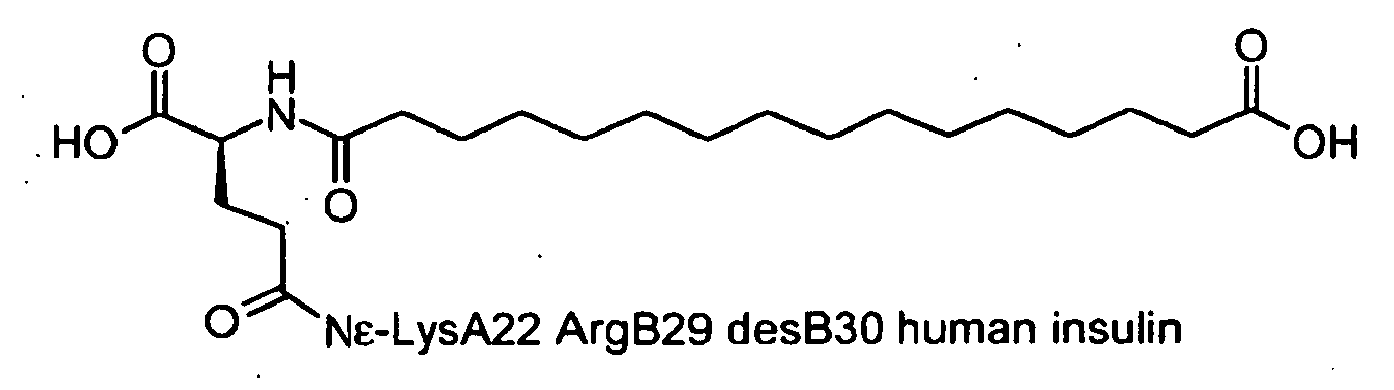
- Preparation and purification of the LysA22 ArgB29 desB30 B'A precursor was done essentially as described in example 1 and 3. Synthesis of the N εA22-ω-carboxypentadecanoyl-γ-Glu LysA22 ArgB29 desB30 B'A precursor and the following cleavage by trypsin to produce the final product, N εA22-carboxypentadecanoyl-γ-Glu LysA22 ArgB29 desB30 human insulin, was performed essentially as described in example 2 and 3. LC-MS: 6260.2 m/z.
-
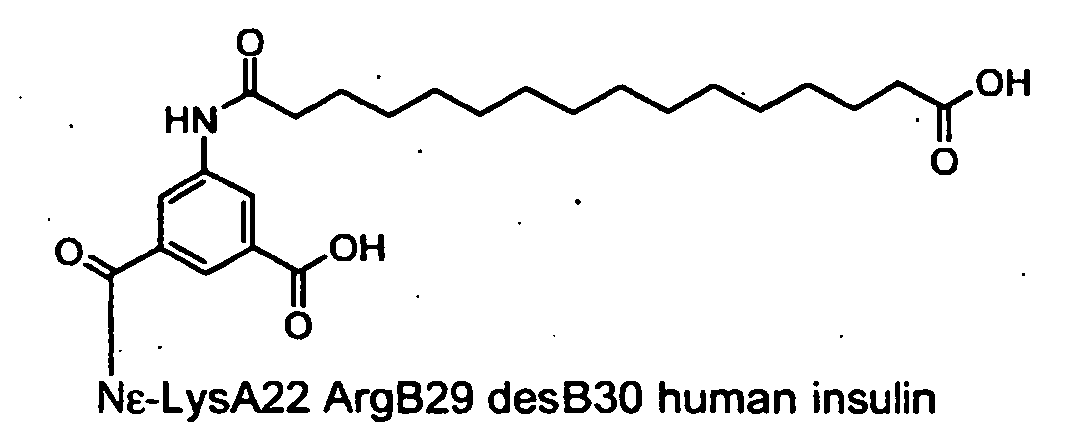
- To LysA22 ArgB29 desB30 human insulin (100 mg) dissolved in 0.1 M Na2CO3 (2.25 ml) is added 1.2 equivalents 5-(15-tert-butoxycarbonylpentadecanoylamino)isophthalic acid 3-tert-butyl ester 1-(2,5-dioxopyrrolidin-1-yl) ester (prepared as described in
WO 2006082204 ) dissolved in acetonitrile (1.13 ml). The insulin derivative is isolated by isoelectric precipitation. The dried product is treated with TFA for 30 min. The TFA is removed by evaporation. The title compound is isolated after purification by RP-HPLC, which can be performed on a Gilson 215 system using a SP 250/21 Nucleosil 300-7 C4 column and a water/acetonitril 10-80% gradient containing 0.1 % TFA. -

- 4-(17-tert-Butoxycarbonyl-heptadecanoylamino)isophthalic acid 3-tert-butyl ester 1-(2,5-dioxo-pyrrolidin-1-yl) ester is reacted with LysA22 ArgB29 desB30 human insulin followed by TFA treatment and purification similarly as described above.
-

- 5-{9-[(S)-1-tert-Butoxycarbonyl-3-(2,5-dioxo-pyrrolidin-1-yloxycarbonyl)propylcarbamoyl]nonyloxy}isophthalic acid di-tert-butyl ester (prepared as described below) is reacted with LysA22 ArgB29 desB30 human insulin followed by TFA treatment and purification similarly as described above.
-

- 5-{9-[3-(2,5-Dioxo-pyrrolidin-1-yloxycarbonyl)-propylcarbamoyl]-nonyloxy}-isophthalic acid di-tert-butyl ester (prepared as described below) is reacted with LysA22 ArgB29 desB30 human insulin followed by TFA treatment and purification similarly as described above.
- To a suspension of 5-hydroxy-isophtalic acid (1.06 g, 5.8 mmol) in dry toluene (20 ml) at 60°C was added N,N-dimethylformamid di-tert-butyl acetal (7.0 mL, 29.2 mmol) and the tempeature was raised to 100°C. Dry DMF (5 ml) was added. The mixture was stirred under nitrogen. After 2h more N,N-dimethylformamid di-tert butyl acetal (7.0 mL, 29.2 mmol) was added. After 3 h the reaction mixture was cooled to room temperature and filtered. The solid was purified by flash chromatography using heptane / EtOAc / acetic acid 40:20:3. The title compound was isolated, contaminated by the tri-tert-butyl ester.
LC-MS: 239,13 (M-tBu) - 3-Hydroxy-isophthalic acid di-tert-butyl ester (90 mg, 0.3 mmol) was dissolved in dry acetone (5 ml), K2CO3 (90 mg, 0.65 mmol) and methyl 10-bromodecanoate (0.075 ml, 0.3 mmol) was added. The mixture was heated to reflux. The heating caused dissolution of the K2CO3. After a while, a precipitate was formed. Reflux (50°C) was continued over night. More K2CO3 (30 mg, 0.2 mmol) and methyl 10-bromodecanoate (0.025 ml, 0.1 mmol) was added. The mixture was refluxed at 50°C over night. To the dry reaction mixture EtOAc and water was added. After extraction, the organic layer was washed with water and brine,dried (Na2SO4) and concentrated to give the crude title compound as a clear oil.
LC-MS : m/z: 423.34 (M-tBu). - To a solution of 5-(9-methoxycarbonyl-nonyloxy)-isophthalic acid di-tert-butyl ester (162 mg, 0.34 mmol) in THF (2 ml) was added 1 N NaOH (0.35 ml). The mixture was refluxed for 7 h. The mixture was left at room temperature over night before concentration. To the residue EtOAc and 0.1N HCl was added. The aqueous layer was extracted twice with EtOAc. The combined organic layers were washed with brine, dried (Na2SO4) and concentrated to give a clear syrup.
LC-MS: m/z: 465.3 (M+1). - To a solution of 5-(9-Carboxy-nonyloxy)-isophthalic acid di-tert-butyl ester (156 mg, 0.34 mmol) in dry THF (2 ml) was added TSTU (125 mg) and DIPEA (0.08 ml). The mixture was stirred under nitrogen over night. The mixture was concentrated. The residue was redissolved in EtOAc and filtered. The filtrate was washed with 0.1N HCl (2x), and brine (1x), dried (Na2SO4) and concentrated to give a clear syrup.
LC-MS: m/z: 562.3 (M+1). - To a solution of 5-[9-(2,5-Dioxo-pyrrolidin-1-yloxycarbonyl)-nonyloxy]-isophthalic acid di-tert-butyl ester (62 mg, 0.11 mmol) in dry DMF (1 ml), H-Glu-OtBu (0.027 g, 0.13 mmol) and DIPEA (0.05 ml) was added. The mixture was stirred over night under nitrogen for 4 h. The mixture was concentrated. The residue was redisolved in EtOAc and washed with 0.1 N HCl (2x), brine (1x), dried (Na2SO4) and concentrated to give a syrup.
LC-MS: m/z: 650.44 (M+1). - 5-[9-((S)-1-tert-Butoxycarbonyl-3-carboxy-propylcarbamoyl)-nonyloxy]-isophthalic acid di-tert-butyl ester (70 mg, 0.11 mmol) was dissolved in dry THF (1 ml). TSTU (40 mg, 0.13 mmol) and DIPEA (0.05 ml) was added. The mixture was stirred at room temperature under nitrogen over the weekend. The mixture was concentrated. The residue was redissolved in EtOAc and filtered. The filtrate was washed with 0.1 N HCl (2x), washed with brine (1x), dried (Na2SO4) and concentrated to give a clear syrup. There was still starting material present and the TSTU-treatment was repeated followed by work up to give the title compound as a clear syrup.
LC-MS: m/z: 747 (M+1). - 5-[9-(2,5-Dioxo-pyrrolidin-1-yloxycarbonyl)-nonyloxy]-isophthalic acid di-tert-butyl ester (100 mg, 0.18 mmol) was dissolved in dry DMF (2 ml). 4-Aminobutyric acid (GABA, 23 mg, 0.2 mmol) and DIPEA (0.05 ml) was added. The mixture was stirred under nitrogen for 2 days. The mixture was concentrated. The residue was dissolved in EtOAc and washed with 0.1 N HCl (2x) and brine (1x), dried (Na2SO4) and concentrated to give a clear syrup.
LC-MS: m/z: 550.33 (M+1). - To a solution of 5-[9-(3-Carboxy-propylcarbamoyl)-nonyloxy]-isophthalic acid di-tert-butyl ester (62 mg, 0.11 mmol) in dry THF (2 ml) was added DIPEA (0.05 ml) and TSTU (41 mg, 0.14 mmol). The mixture was stirred at room temperature under nitrogen over night. The mixture was concentrated and EtOAc was added to the residue. The precipitate was removed by filtration. The filtrate was washed with 0.1 N HCl (2x) and brine (1x), dried (Na2SO4) and concentrated to give a clear syrup.
LC-MS: m/z: 647.29. - The hydrophobicity of an insulin derivative is found by reverse phase HPLC run under isocratic conditions. The elution time of the insulin derivative is compared to that of HI or another derivative with a known hydrophibicity under the same conditions. The hydrophobicity, k'rel, is calculated as: k'relderiv = ((tderiv-t0)/(tref-t0))*k'relref. Using HI as reference: k'relref = k'relHI = 1. The void time of the HPLC system, t0, is determined by injecting 5 µl of 0.1 mM NaNO3. Runing conditions:
Column: Lichrosorb RP-C18, 5µm, 4 x 250 mm Buffer A: 0.1 M natrium phosphate pH 7.3, 10 vol% CH3CN Buffer B: 50 vol% CH3CN Injection volume: 5 µl Run time: max 60 minutes - The affinity of the insulin derivatives of the invention for the human insulin receptor is determined by a SPA assay (Scintillation Proximity Assay) microtiterplate antibody capture assay. SPA-PVT antibody-binding beads, anti-mouse reagent (Amersham Biosciences, Cat No. PRNQ0017) are mixed with 25 ml of binding buffer (100 mM HEPES pH 7.8; 100 mM sodium chloride, 10 mM MgSO4, 0.025% Tween-20). Reagent mix for a single Packard Optiplate (Packard No. 6005190) is composed of 2.4 µl of a 1:5000 diluted purified recombinant human insulin receptor (either with or without exon 11), an amount of a stock solution of A14Tyr[125I]-human insulin corresponding to 5000 cpm per 100 µl of reagent mix, 12 µl of a 1:1000 dilution of F12 antibody, 3 ml of SPA-beads and binding buffer to a total of 12 ml. A total of 100 µl reagent mix is then added to each well in the Packard Optiplate and a dilution series of the insulin derivative is made in the Optiplate from appropriate samples. The samples are then incubated for 16 hours while gently shaken. The phases are the then separated by centrifugation for 1 min and the plates counted in a Topcounter. The binding data were fitted using the nonlinear regression algorithm in the GraphPad Prism 2.01 (GraphPad Software, San Diego, CA).
- The affinity for human serum albumin of the insulin derivatives of the invention are given as the relative binding constant of the A14Tyr[125I]-derivative to human serum albumin (HSA) immobilized on Minileak particles and measured at 23 °C as compared to insulin Detemir (equal.to 1 in saline buffer): HSAaff = Kd(Detemir)/Kd(derivative).
HSA is immobilised in the Minileak material (KemEnTec 1011 F) by over night incubation at room temperature with HSA (Sigma A-1887) and PEG (Fluka 95172) in 0.3 M NaHCO3 pH 8.8. After incubation the reaction is stopped by addition of 1 M ethanolamine pH 9.0, and the material is washed several times with 0.1 M Tris(HCl) pH 7.4, with 0.1 M NaHCO3 pH 9.0, and with 0.1 M phosphate pH 3.0. The HSA-Minileak material is stored in 0.1 M Tris(HCl) pH 7.4, 0.02% azide. The amount of HSA immobilised on the material is assessed by incubating HSA-Minileak with 3H-myristic acid (PerkinElmer NET-830) and various amounts of free HSA in 0.1 M Tris(HCl) pH 7.4, 0.025% Triton-X-100 for two hours at room temperature. After centrifugation of the samples the supernatant is analysed in a scintillation-counter, and the amount of immobilised HSA is calculated.
When determining the affinity of the insulin derivatives for HSA, various amounts of HSA-Minileak is incubated with the A14Tyr[125I]-derivative for two hours at room temperature in 0.1 M Tris(HCl) pH 7.4, 0.025% Triton-X-100. After incubation the samples are centrifuged and half the supernatant is removed to new tubes. Both half the supernatant (½S) and the remaining supernatant plus pellet (½S+P) is analysed is a gamma-counter, and these data are used for the calculation of Kd for the A14Tyr[125I]-derivative. - The ability of the insulin derivatives of the invention to self-associate into large, but soluble complexes is analysed using SEC (size exclusion chromatoghaphy):
Column: Superose™ 6 PC 3.2/30, CV = 2.4 ml (Amerham Biosciences) Temperature: 37°C SEC buffer: 140 mM NaCl, 10 mM TrisHCl, 0.01% NaN3, pH 7.5 Injection volume: 20 µl Flow: 0.04 ml/min Runtime: 80 min - For this analysis the insulin derivatives of the invention are in a solution consisting of 0.6 mM derivative, 2.1 Zn2+/hexamer, 16 mM phenol, 7 mM phosphate pH 7.8. The retention time of the derivative is then compared to the retention times of the following standard molecules:
Standard I: HSA+HSA dimer (66.4 kDa+133 kDa) Co(III)hexamer (35.0 kDa) X2 monomer (5.9 kDa) Standard II: Blue dextran (1.5 MDa) Thyroglobulin (669 kDa) Ferritin (440 kDa) Aldolase (158 kDa) Ovalbumin (44.5 kDa) Ribonuclease (13.7 kDa) 
Where t is the retention time for a given peak, t0 is the retention time for Blue dextran, Vt is the total column volume (here 2.4 ml), f is the flow (here 0.04 ml/min), and td is the retention time for Blue dextran without the column in the system. - The Kav value indicates the degree of selv-association of a derivative, i.e. a large Kav similar to the Kav for the Co(III)hexamer and X2 monomer shows low or no propensity of the derivative to form large, selv-associated complexes, while very small Kav close to zero or even negative shows great propensity of the derivative for selv-association into large, soluble complexes.
Compound Hydrophobicity rela-
tive to human insulinInsulin receptor affinity
relative to human insulinSelf-association:
Kav (% area of peak)Example 1 + ++ Peak 1 (37%): ++
Peak 2 (63%): ++Example 2 ++ ++ Peak 1 (64%): ++
Peak 2 (36%):+Example 3 ++ +++ - Example 4 + +++ ++ (100%) Example 5 + ++ + (100%) Example 7 + ++ - Example 9 + +++ Peak 1 (95%): ++
Peak 2 (5%): +Example 10 +++ Peak 1 (65%): +
Peak 2 (35%): +Note:
Hydrophobicity relative to human insulin: k'rel <1: +++, 1-10: ++, >10: + (HI =1) Insulin receptor affinity relative to human insulin: <5%: +, 5-50%: ++, >50%: +++ Self-association: Kav <0.55: ++ and Kav ≥0.55: +
(Kav = 0.55 for human serum albumin (HSA), Kav = 0.63 for human insulin Co(III)hexamer, and Kav = 0.72 for the monomeric insulin analogue X2.) - Male Wistar rats, 200-300 g, fasted for 18 h, was anesthetized using either Hypnorm-Dormicum s.c. (1.25 mg/ml Dormicum, 2.5 mg/ml fluanisone, 0.079 mg/ml fentanyl citrate) 2 ml/kg as a priming dose (to timepoint -30 min prior to test substance dosing) and additional 1 ml/kg every 20 minutes.
- The animals are dosed with an intravenous injection (tail vein), 1 ml/kg, of control and test compounds (usual dose range 0.125-20 nmol/kg). Blood samples for the determination of whole blood glucose concentration were collected in heparinized 10 µl glass tubes by puncture of the capillary vessels in the tail tip to time -20min and 0 min (before dosing), and to time 10, 20, 30, 40, 60, 80, 120, and 180 min after dosing. Blood glucose concentrations were measured after dilution in analysis buffer by the immobilized glucose oxidase method using an EBIO Plus autoanalyzer (Eppendorf, Germany). Mean plasma glucose concentrations courses (mean ± SEM) are made for each dose and each compound.
- T50% is the time when 50% of an injected amount of the A14 Tyr[125I] labelled derivative of an insulin to be tested has disappeared from the injection site as measured with an external γ-counter.
- The principles of laboratory animal care were followed. Specific pathogen-free LYYD, non-diabetic female pigs, cross-breed of Danish Landrace, Yorkshire and Duroc, were used (Holmenlund, Haarloev, Denmark) for pharmacokinetic and pharmacodynamic studies. The pigs were conscious, 4-5 months of age and weighing 70-95 kg. The animals were fasted overnight for 8 h before the experiment.
- Formulated preparations of insulin derivatives labelled in TyrA14 with 125I were injected sc. in pigs as previously described (Ribel, U., Jørgensen, K, Brange, J, and Henriksen, U. The pig as a model for subcutaneous insulin absorption in man. Serrano-Rios, M and Lefèbvre, P. J. 891-896. 1985. Amsterdam; New York; Oxford, Elsevier Science Publishers. 1985 (Conference Proceeding)).
- At the beginning of the experiments a dose of 60 nmol of the insulin derivative according to the invention (test compound) and a dose of 60 nmol of insulin detemir (both 125I labelled in Tyr A14) were injected at two separate sites in the neck of each pig.
- The disappearance of the radioactive label from the site of sc. injection was monitored using a modification of the traditional external gamma-counting method (Ribel, U. Subcutaneous absorption of insulin analogues. Berger, M. and Gries, F. A. 70-77 (1993). Stuttgart; New York, Georg Thime Verlag (Conference Proceeding)). With this modified method it was possible to measure continuously the disappearance of radioactivity from a subcutaneous depot for several days using cordless portable device (Scancys Laboratorieteknik, Vaerløse, DK-3500, Denmark). The measurements were performed at 1-min intervals, and the counted values were corrected for background activity.
- Sprague Dawley male rats weighing 238-383 g on the experimental day were used for the clamp experiment. The rats had free access to feed under controlled ambient conditions and were fasted overnight (from 3 pm) prior to the clamp experiment.
- The rats were acclimatized in the animal facilities for at least 1 week prior to the surgical procedure. Approximately 1 week prior to the clamp experiment Tygon catheters were inserted under halothane anaesthesia into the jugular vein (for infusion) and the carotid artery (for blood sampling) and exteriorised and fixed on the back of the neck. The rats were given Streptocilin vet. (Boehringer Ingelheim; 0.15 ml/rat, i.m.) post-surgically and placed in an animal care unit (25 °C) during the recovery period. In order to obtain analgesia, Anorphin (0.06 mg/rat, s.c.) was administered during anaesthesia and Rimadyl (1.5 mg/kg, s.c.) was administered after full recovery from the anaesthesia (2-3 h) and again once daily for 2 days.
- The clamp technique employed was adapted from (1). At 7 am on the experimental day overnight fasted (from 3 pm the previous day) rats were weighed and connected to the sampling syringes and infusion system (Harvard 22 Basic pumps, Harvard, and Perfectum Hypodermic glass syringe, Aldrich) and then placed into individual clamp cages where they rested for ca. 45 min before start of experiment. The rats were able to move freely on their usual bedding during the entire experiment and had free access to drinking water. After a 30 min basal period during which plasma glucose levels were measured at 10 min intervals, the insulin derivative to be tested and human insulin (one dose level per rat, n = 6-7 per dose level) were infused (i.v.) at a constant rate for 300 min. Plasma glucose levels were measured at 10 min intervals throughout and infusion of 20% aqueous glucose was adjusted accordingly in order to maintain euglyceamia. Samples of re-suspended erythrocytes were pooled from each rat and returned in about ½ ml volumes via the carotid catheter.
- On each experimental day, samples of the solutions of the individual insulin derivatives to be tested and the human insulin solution were taken before and at the end of the clamp experiments and the concentrations of the peptides were confirmed by HPLC. Plasma concentrations of rat insulin and C-peptide as well as of the insulin derivative to be tested and human insulin were measured at relevant time points before and at the end of the studies. Rats were killed at the end of experiment using a pentobarbital overdose.
- The test substance will be dosed pulmonary by the drop instillation method. In brief, male Wistar rats (app.250 g) are anaesthesized in app. 60 ml fentanyl/dehydrodenzperidol/- dormicum given as a 6.6 ml/kg sc primingdose and followed by 3 maintainance doses of 3.3 ml/kg sc with an interval of 30 min. Ten minutes after the induction of anaesthesia, basal samples are obtained from the tail vein (t = -20 min) followed by a basal sample immediately prior to the dosing of test substance (t=0). At t= 0, the test substance is dosed intra tracheally into one lung. A special cannula with rounded ending is mounted on a syringe containing the 200 ul air and test substance (1 ml/kg). Via the orifice, the cannula is introduced into the trachea and is forwarded into one of the main bronchi - just passing the bifurcature. During the insertion, the neck is palpated from the exterior to assure intratracheal positioning. The content of the syringe is injected followed by 2 sec pause. Thereafter, the cannula is slowly drawn back. The rats are kept anaesthesized during the test (blood samples for up to 4 or 8 hrs) and are euthanized after the experiment.
m is 0, 1, 2, 3, 4, 5 or 6;
X is
Z is:
and any Zn2+ complex thereof.
Claims (16)
- An insulin derivative comprising a parent insulin and a substituent, wherein the substituent is attached either to an ε-amino group of a Lys residue present in the A-chain of the parent insulin at position A8, A9, A10, A12, A14, A15, A17, A18, A21, A22, A23 or A24 or to an ε -amino group of a Lys residue in the B-chain of the parent insulin at position B1, B2, B3, B4, B20, B21 or B22 provided that when B3 is Lys, then B29 is not Glu, where the substituent is of general formula:
-W-X-Y-Z
wherein W is:• an α-amino acid residue having a carboxylic acid group in the side chain which residue forms, with one of its carboxylic acid groups, an amide group with the ε-amino group of a Lys residue present in the A- or the B-chain of the parent insulin; or• a chain composed of two, three or four α-amino acid residues linked together via amide bonds, which chain, via an amide bond, is linked to the ε-amino group of a Lys residue present in the A- or the B-chain of the parent insulin, the amino acid residues of W being selected from the group of amino acid residues having a neutral side chain and amino acid residues having a carboxylic acid group in the side chain so that W has at least one amino acid residue which has a carboxylic acid group in the side chain; or• a covalent bond from X to the ε-amino group of a Lys residue present in the A- or the B-chain of the parent insulin;X is:• -CO-;• -CH(COOH)CO-;• -CON(CH2COOH)CH2 CO-;• -CON(CH2COOH)CH2CON(CH2COOH)CH2 CO-;• -CON(CH2CH2COOH)CH2 CH2O-;• -CON(CH2CH2COOH)CH2CH2CON(CH2CH2COOH)CH2CH2 CO-;• -CONHCH(COOH)(CH2)4NHCO-;• -CON(CH2CH2COOH)CH2 CO-; or• -CON(CH2COOH)CH2CH2 CO-Provided thata) when W is an amino acid residue or a chain of amino acid residues, the underscored carbonyl carbon in X forms an amide bond with an amino group in W, orb) when W is a covalent bond, the underscored carbonyl carbon in X forms an amide bond with the ε-amino group of a Lys residue present in the A- or the B-chain of the parent insulin;Y is:• -(CH2)m- where m is an integer in the range of 6 to 32;• a divalent hydrocarbon chain comprising 1, 2 or 3 -CH=CH- groups and a number of -CH2- groups sufficient to give a total number of carbon atoms in the chain in the range of 10 to 32;• a divalent hydrocarbon chain of the formula -(CH2)vC6H4(CH2)w- wherein v and w are integers or one of them is zero so that the sum of v and w is in the range of 6 to 30; and Z is:• -COOH;• -CO-Asp;• -CO-Glu;• -CO-Gly;• -CO-Sar;• -CH(COOH)2;• -N(CH2COOH)2;• -SO3H; or• -PO3H;and any Zn2+ complexes thereof. - An insulin derivative according to claim 1, wherein W is an α-amino acid residue having from 4 to 10 carbon atoms.
- An insulin derivative according to claim 1, wherein W is a chain composed of two α-amino acid residues of which one has from 4 to 10 carbon atoms and a free carboxylic acid group while the other has from 2 to 11 carbon atoms but no free carboxylic acid group.
- An insulin derivative according to claim 1, wherein W is a covalent bond.
- An insulin derivative according to any of the claims 1-4, wherein X is -CO- or -COCH(COOH)CO-.
- An insulin derivative according to any of claims 1-5, wherein Y is -(CH2)m where m is an integer in the range of from 6 to 32.
- Insulin derivative according to claims 1-6, wherein Z is -COOH.
- An insulin derivative according to any of the claims 1-7, wherein the parent insulin is an insulin analogue.
- Insulin derivative according to claim 8, wherein the parent insulin is ArgB29 human insulin or ArgB29desB30 human insulin.
- A zinc complex of an insulin derivative according to any one of the preceding claims wherein two zinc ions, three zinc ions ,four zinc ions, five zinc ions, six zinc ions, seven zinc ions, eight zinc ions, nine zinc ions, ten zinc ions, eleven zinc ions or twelve zinc ions are bound per six molecules of insulin derivative.
- A pharmaceutical composition for the treatment of diabetes in a patient in need of such treatment, comprising a therapeutically effective amount of an insulin derivative according to any of the preceding claims optionally together with a pharmaceutically acceptable carrier.
- A method for producing a pharmaceutical composition according to claims 1-9 or a zinc complex of an insulin derivative according to claim 10, wherein up to about 12 zinc ions per 6 molecules of insulin derivative are added to the pharmaceutical composition.
- Insulin derivative according to any of claims 1-9 for use as a medicament optionally together with a pharmaceutically acceptable carrier.
- Insulin derivative according to claim 13 for pulmonary use.
- A mixture of an insulin derivative according to any of claims 1-9 and a rapid acting insulin analogue selected from the group consisting of AspB28 human insulin; LysB28ProB29 human insulin and LysB3GluB29 human insulin.
- Insulin derivative according to claim 1, wherein the insulin derivative is selected from the group consisting of
N εA9-myristyl LysA9 ArgB29 desB30 human insulin,
N εB3-myristyl LysB3 ArgB29 desB30 human insulin,
N εB22-myristyl LysB22 ArgB29 desB30 human insulin,
N εA15-myristyl LysA15 ArgB29 desB30 human insulin,
N εA18-myristyl LysA18 ArgB29 desB30 human insulin,
N εA22-myristyl LysA22 ArgB29 desB30 human insulin,
N εA9-ω-carboxypentadecanoyl-γ-Glu LysA9 ArgB29 desB30 human insulin,
N εB3-ω-carboxypentadecanoyl-γ-Glu LysB3 ArgB29 desB30 human insulin,
N εB22-ω-carboxypentadecanoyl-γ-Glu LysB22 ArgB29 desB30 human insulin,
N εA15-ω-carboxypentadecanoyl-γ-Glu LysA15 ArgB29 desB30 human insulin,
N εA1B-ω-carboxypentadecanoyl-γ-Glu LysA18 ArgB29 desB30 human insulin,
N εA22-ω-carboxypentadecanoyl-γ-Glu LysA22 ArgB29 desB30 human insulin.
Priority Applications (2)
| Application Number | Priority Date | Filing Date | Title |
|---|---|---|---|
| EP07712327A EP1991576B1 (en) | 2006-02-27 | 2007-02-27 | Insulin derivatives |
| EP10168840A EP2256129B1 (en) | 2006-02-27 | 2007-02-27 | Insulin derivatives |
Applications Claiming Priority (4)
| Application Number | Priority Date | Filing Date | Title |
|---|---|---|---|
| EP06110441 | 2006-02-27 | ||
| EP06118253 | 2006-08-01 | ||
| PCT/EP2007/051835 WO2007096431A1 (en) | 2006-02-27 | 2007-02-27 | Insulin derivatives |
| EP07712327A EP1991576B1 (en) | 2006-02-27 | 2007-02-27 | Insulin derivatives |
Related Child Applications (1)
| Application Number | Title | Priority Date | Filing Date |
|---|---|---|---|
| EP10168840.6 Division-Into | 2010-07-08 |
Publications (2)
| Publication Number | Publication Date |
|---|---|
| EP1991576A1 EP1991576A1 (en) | 2008-11-19 |
| EP1991576B1 true EP1991576B1 (en) | 2010-09-29 |
Family
ID=38001155
Family Applications (2)
| Application Number | Title | Priority Date | Filing Date |
|---|---|---|---|
| EP07712327A Not-in-force EP1991576B1 (en) | 2006-02-27 | 2007-02-27 | Insulin derivatives |
| EP10168840A Not-in-force EP2256129B1 (en) | 2006-02-27 | 2007-02-27 | Insulin derivatives |
Family Applications After (1)
| Application Number | Title | Priority Date | Filing Date |
|---|---|---|---|
| EP10168840A Not-in-force EP2256129B1 (en) | 2006-02-27 | 2007-02-27 | Insulin derivatives |
Country Status (7)
| Country | Link |
|---|---|
| US (1) | US8722620B2 (en) |
| EP (2) | EP1991576B1 (en) |
| JP (2) | JP5202338B2 (en) |
| AT (2) | ATE557037T1 (en) |
| DE (1) | DE602007009496D1 (en) |
| ES (1) | ES2387955T3 (en) |
| WO (1) | WO2007096431A1 (en) |
Cited By (1)
| Publication number | Priority date | Publication date | Assignee | Title |
|---|---|---|---|---|
| WO2011051486A2 (en) | 2009-11-02 | 2011-05-05 | Novo Nordisk A/S | Pharmaceutical solution of non covalently bound albumin and acylated insulin |
Families Citing this family (45)
| Publication number | Priority date | Publication date | Assignee | Title |
|---|---|---|---|---|
| AU2004261353B2 (en) * | 2003-08-05 | 2009-12-10 | Novo Nordisk A/S | Novel insulin derivatives |
| ES2435522T3 (en) | 2005-02-02 | 2013-12-20 | Novo Nordisk A/S | Insulin derivatives |
| WO2006082204A1 (en) | 2005-02-02 | 2006-08-10 | Novo Nordisk A/S | Insulin derivatives |
| EP1969004B1 (en) | 2005-12-28 | 2011-08-10 | Novo Nordisk A/S | Compositions comprising an acylated insulin and zinc and method of making the said compositions |
| JP5202338B2 (en) | 2006-02-27 | 2013-06-05 | ノボ・ノルデイスク・エー/エス | New insulin derivatives |
| AU2007247109B2 (en) * | 2006-05-09 | 2012-03-15 | Novo Nordisk A/S | Insulin derivative |
| WO2007128815A1 (en) * | 2006-05-09 | 2007-11-15 | Novo Nordisk A/S | Insulin derivative |
| CN101541830A (en) | 2006-09-22 | 2009-09-23 | 诺沃-诺迪斯克有限公司 | Protease resistant insulin analogues |
| WO2008132224A2 (en) | 2007-04-30 | 2008-11-06 | Novo Nordisk A/S | Method for drying a protein composition, a dried protein composition and a pharmaceutical composition comprising the dried protein |
| JP5552046B2 (en) | 2007-06-13 | 2014-07-16 | ノボ・ノルデイスク・エー/エス | Pharmaceutical preparation containing an insulin derivative |
| AU2008288413B2 (en) | 2007-08-15 | 2013-09-26 | Novo Nordisk A/S | Insulin analogues with an acyl and aklylene glycol moiety |
| WO2009022006A1 (en) | 2007-08-15 | 2009-02-19 | Novo Nordisk A/S | Insulins with an acyl moiety comprising repeating units of alkylene glycol containing amino acids |
| ES2543393T3 (en) | 2007-11-08 | 2015-08-18 | Novo Nordisk A/S | Insulin derivative |
| CN101970477B (en) * | 2008-03-14 | 2014-12-31 | 诺沃-诺迪斯克有限公司 | Protease-stabilized insulin analogues |
| HUE032284T2 (en) * | 2008-03-18 | 2017-09-28 | Novo Nordisk As | Protease stabilized, acylated insulin analogues |
| EP2262539B1 (en) | 2008-04-01 | 2015-07-15 | Novo Nordisk A/S | Insulin albumin conjugates |
| CN102202683A (en) * | 2008-10-30 | 2011-09-28 | 诺沃-诺迪斯克有限公司 | Treating diabetes melitus using insulin injections with less than daily injection frequency |
| WO2010088294A1 (en) | 2009-01-28 | 2010-08-05 | Smartcells, Inc. | Conjugate based systems for controlled drug delivery |
| RU2011135730A (en) | 2009-01-28 | 2013-03-10 | Смартселлз, Инк. | CRYSTAL INSULIN CONJUGATES |
| JP2012516339A (en) | 2009-01-28 | 2012-07-19 | スマートセルズ・インコーポレイテツド | Exogenous stimulated controlled release material body and use thereof |
| WO2010088286A1 (en) | 2009-01-28 | 2010-08-05 | Smartcells, Inc. | Synthetic conjugates and uses thereof |
| JP2012520879A (en) | 2009-03-20 | 2012-09-10 | スマートセルズ・インコーポレイテツド | End-functionalized conjugates and uses thereof |
| WO2010107520A1 (en) * | 2009-03-20 | 2010-09-23 | Smartcells, Inc. | Soluble non-depot insulin conjugates and uses thereof |
| WO2012015691A2 (en) | 2010-07-28 | 2012-02-02 | Smartcells, Inc. | Recombinant lectins, binding-site modified lectins and uses thereof |
| JP2013535467A (en) | 2010-07-28 | 2013-09-12 | スマートセルズ・インコーポレイテツド | Recombinantly expressed insulin polypeptide and uses thereof |
| WO2012015681A2 (en) | 2010-07-28 | 2012-02-02 | Smartcells, Inc. | Drug-ligand conjugates, synthesis thereof, and intermediates thereto |
| DK2632478T3 (en) | 2010-10-27 | 2019-10-07 | Novo Nordisk As | TREATMENT OF DIABETES MELITUS USING INSULIN INJECTIONS SUBMITTED AT VARIOUS INJECTION INTERVALS |
| EP2720711A1 (en) * | 2011-06-15 | 2014-04-23 | Novo Nordisk A/S | Multi substituted insulins |
| EP2836508B1 (en) | 2012-04-11 | 2016-06-29 | Novo Nordisk A/S | Insulin formulations |
| EP2991672A1 (en) | 2013-04-30 | 2016-03-09 | Novo Nordisk A/S | Novel administration regime |
| US9884125B2 (en) | 2013-10-04 | 2018-02-06 | Merck Sharp & Dohme Corp. | Glucose-responsive insulin conjugates |
| CA2926701A1 (en) | 2013-10-07 | 2015-04-16 | Novo Nordisk A/S | Novel derivative of an insulin analogue |
| AR099569A1 (en) | 2014-02-28 | 2016-08-03 | Novo Nordisk As | INSULIN DERIVATIVES AND THE MEDICAL USES OF THESE |
| EP3280450A4 (en) * | 2015-04-08 | 2018-12-12 | Merck Sharp & Dohme Corp. | Glucose-responsive insulin conjugates |
| BR112018002416A2 (en) | 2015-08-25 | 2018-09-18 | Novo Nordisk As | insulin derivatives and their medical uses |
| ES2886837T3 (en) | 2016-12-16 | 2021-12-21 | Novo Nordisk As | Pharmaceutical compositions containing insulin |
| CN107602437A (en) * | 2017-08-09 | 2018-01-19 | 上海昂德生物科技有限公司 | The preparation method of Acibenzolar |
| CA3071686A1 (en) | 2017-08-17 | 2019-02-21 | Novo Nordisk A/S | Novel acylated insulin analogues and uses thereof |
| US10335464B1 (en) | 2018-06-26 | 2019-07-02 | Novo Nordisk A/S | Device for titrating basal insulin |
| TW202039437A (en) | 2018-12-11 | 2020-11-01 | 法商賽諾菲公司 | Peptide binder |
| US12427187B2 (en) | 2019-06-06 | 2025-09-30 | Merck Sharp & Dohme Llc | Glucose-responsive insulin conjugates |
| CN114096269B (en) | 2019-07-12 | 2024-06-11 | 诺和诺德股份有限公司 | High-concentration insulin preparations |
| MA58093B1 (en) | 2019-12-11 | 2024-09-30 | Novo Nordisk A/S | NEW INSULIN ANALOGUES AND THEIR USES |
| BR112022013009A2 (en) * | 2019-12-30 | 2022-09-06 | Gan & Lee Pharmaceuticals Co Ltd | INSULIN DERIVATIVES, PHARMACEUTICAL COMPOSITION, INSULIN DERIVATIVE USE AND METHODS TO TREAT OR PREVENT DIABETES, TO INCREASE THE CAPACITY OF AN INSULIN DERIVATIVE, AND TO INCREASE THE POTENCY OF AN INSULIN DERIVATIVE |
| CN113075342B (en) * | 2020-01-04 | 2024-02-27 | 东莞市东阳光仿制药研发有限公司 | A method for separating and detecting substances related to the side chain of insulin degludec |
Family Cites Families (48)
| Publication number | Priority date | Publication date | Assignee | Title |
|---|---|---|---|---|
| US487000A (en) | 1892-11-29 | Shirt | ||
| US4546082A (en) | 1982-06-17 | 1985-10-08 | Regents Of The Univ. Of California | E. coli/Saccharomyces cerevisiae plasmid cloning vector containing the alpha-factor gene for secretion and processing of hybrid proteins |
| US4870008A (en) | 1983-08-12 | 1989-09-26 | Chiron Corporation | Secretory expression in eukaryotes |
| AU600885B2 (en) | 1984-05-25 | 1990-08-30 | Zymogenetics Inc. | Stable DNA constructs |
| US4683202A (en) | 1985-03-28 | 1987-07-28 | Cetus Corporation | Process for amplifying nucleic acid sequences |
| PH25772A (en) | 1985-08-30 | 1991-10-18 | Novo Industri As | Insulin analogues, process for their preparation |
| NZ222907A (en) | 1986-12-16 | 1990-08-28 | Novo Industri As | Preparation for intranasal administration containing a phospholipid absorption enhancing system |
| DK463887D0 (en) | 1987-09-07 | 1987-09-07 | Novo Industri As | GAERLEADER |
| HUT56857A (en) | 1988-12-23 | 1991-10-28 | Novo Nordisk As | Human insulin analogues |
| DK105489D0 (en) | 1989-03-03 | 1989-03-03 | Novo Nordisk As | POLYPEPTIDE |
| IL93282A (en) | 1989-02-09 | 1995-08-31 | Lilly Co Eli | Insulin analogs |
| DK300090D0 (en) | 1990-12-19 | 1990-12-19 | Novo Nordisk As | PROCEDURE FOR PREPARING LEADER SEQUENCES |
| DK82893D0 (en) | 1993-07-08 | 1993-07-08 | Novo Nordisk As | PEPTIDE |
| NZ273285A (en) | 1993-09-17 | 1997-10-24 | Novo Nordisk As | Insulin derivatives and compositions thereof |
| US6869930B1 (en) * | 1993-09-17 | 2005-03-22 | Novo Nordisk A/S | Acylated insulin |
| US6011007A (en) * | 1993-09-17 | 2000-01-04 | Novo Nordisk A/S | Acylated insulin |
| US5461031A (en) * | 1994-06-16 | 1995-10-24 | Eli Lilly And Company | Monomeric insulin analog formulations |
| US5639642A (en) | 1994-06-16 | 1997-06-17 | Novo Nordisk A/S | Synthetic leader peptide sequences |
| US5646242A (en) * | 1994-11-17 | 1997-07-08 | Eli Lilly And Company | Selective acylation of epsilon-amino groups |
| US6251856B1 (en) * | 1995-03-17 | 2001-06-26 | Novo Nordisk A/S | Insulin derivatives |
| CA2215694A1 (en) * | 1995-03-17 | 1996-09-26 | Novo Nordisk A/S | Insulin derivatives |
| US6451970B1 (en) | 1996-02-21 | 2002-09-17 | Novo Nordisk A/S | Peptide derivatives |
| US5905140A (en) * | 1996-07-11 | 1999-05-18 | Novo Nordisk A/S, Novo Alle | Selective acylation method |
| WO1998032867A1 (en) | 1997-01-24 | 1998-07-30 | Novo Nordisk A/S | Synthetic leader peptide sequences |
| US5898067A (en) * | 1997-02-07 | 1999-04-27 | Novo Nordisk A/S | Crystallization of proteins |
| US6451762B1 (en) * | 1997-10-24 | 2002-09-17 | Novo Nordisk A/S | Aggregates of human insulin derivatives |
| PL195845B1 (en) | 1997-10-24 | 2007-10-31 | Novo Nordisk As | Aggregates of human insulin derivatives |
| DE69924232D1 (en) * | 1998-01-09 | 2005-04-21 | Novo Nordisk As | STABILIZED INSULIN PREPARATIONS |
| CA2334859A1 (en) | 1998-06-12 | 1999-12-23 | Kings College London | Insulin analogue |
| EP1453860A2 (en) | 2001-12-02 | 2004-09-08 | Novo Nordisk A/S | Novel glucose-dependant insulins |
| US8003605B2 (en) * | 2002-03-13 | 2011-08-23 | Novo Nordisk A/S | Minimising body weight gain in insulin treatment |
| US20040138099A1 (en) * | 2002-11-29 | 2004-07-15 | Draeger Eberhard Kurt | Insulin administration regimens for the treatment of subjects with diabetes |
| WO2004096854A2 (en) * | 2003-04-29 | 2004-11-11 | Eli Lilly And Company | Insulin analogs having protracted time action |
| EP1644411A2 (en) | 2003-07-11 | 2006-04-12 | Novo Nordisk A/S | Stabilised insulin compositions |
| US20060183667A1 (en) * | 2003-07-11 | 2006-08-17 | Novo Nordisk A/S | Stabilised insulin compositions |
| AU2004261353B2 (en) * | 2003-08-05 | 2009-12-10 | Novo Nordisk A/S | Novel insulin derivatives |
| EP1687428A1 (en) | 2003-11-14 | 2006-08-09 | Novo Nordisk A/S | Processes for making acylated insulin |
| WO2006008238A1 (en) | 2004-07-16 | 2006-01-26 | Novo Nordisk A/S | Method for selective acylation |
| WO2006082204A1 (en) | 2005-02-02 | 2006-08-10 | Novo Nordisk A/S | Insulin derivatives |
| EP1969004B1 (en) * | 2005-12-28 | 2011-08-10 | Novo Nordisk A/S | Compositions comprising an acylated insulin and zinc and method of making the said compositions |
| JP5202338B2 (en) | 2006-02-27 | 2013-06-05 | ノボ・ノルデイスク・エー/エス | New insulin derivatives |
| AU2007247109B2 (en) | 2006-05-09 | 2012-03-15 | Novo Nordisk A/S | Insulin derivative |
| WO2007128815A1 (en) | 2006-05-09 | 2007-11-15 | Novo Nordisk A/S | Insulin derivative |
| JP5552046B2 (en) * | 2007-06-13 | 2014-07-16 | ノボ・ノルデイスク・エー/エス | Pharmaceutical preparation containing an insulin derivative |
| ES2543393T3 (en) | 2007-11-08 | 2015-08-18 | Novo Nordisk A/S | Insulin derivative |
| CN101861333A (en) | 2007-11-16 | 2010-10-13 | 诺沃-诺迪斯克有限公司 | Pharmaceutical composition comprising a GLP-1 peptide or exendin-4 peptide and a basal insulin peptide |
| CN102202683A (en) * | 2008-10-30 | 2011-09-28 | 诺沃-诺迪斯克有限公司 | Treating diabetes melitus using insulin injections with less than daily injection frequency |
| AU2011252127B2 (en) | 2010-05-10 | 2014-02-20 | Novo Nordisk A/S | Process for the preparation of insulin-zinc complexes |
-
2007
- 2007-02-27 JP JP2008556768A patent/JP5202338B2/en not_active Expired - Fee Related
- 2007-02-27 EP EP07712327A patent/EP1991576B1/en not_active Not-in-force
- 2007-02-27 US US12/280,851 patent/US8722620B2/en not_active Expired - Fee Related
- 2007-02-27 AT AT10168840T patent/ATE557037T1/en active
- 2007-02-27 AT AT07712327T patent/ATE482977T1/en not_active IP Right Cessation
- 2007-02-27 ES ES10168840T patent/ES2387955T3/en active Active
- 2007-02-27 EP EP10168840A patent/EP2256129B1/en not_active Not-in-force
- 2007-02-27 WO PCT/EP2007/051835 patent/WO2007096431A1/en not_active Ceased
- 2007-02-27 DE DE602007009496T patent/DE602007009496D1/en active Active
-
2012
- 2012-06-19 JP JP2012137431A patent/JP5475836B2/en not_active Expired - Fee Related
Cited By (1)
| Publication number | Priority date | Publication date | Assignee | Title |
|---|---|---|---|---|
| WO2011051486A2 (en) | 2009-11-02 | 2011-05-05 | Novo Nordisk A/S | Pharmaceutical solution of non covalently bound albumin and acylated insulin |
Also Published As
| Publication number | Publication date |
|---|---|
| JP2009528325A (en) | 2009-08-06 |
| JP5202338B2 (en) | 2013-06-05 |
| JP2012214486A (en) | 2012-11-08 |
| EP2256129A1 (en) | 2010-12-01 |
| EP1991576A1 (en) | 2008-11-19 |
| DE602007009496D1 (en) | 2010-11-11 |
| WO2007096431A1 (en) | 2007-08-30 |
| ATE557037T1 (en) | 2012-05-15 |
| ATE482977T1 (en) | 2010-10-15 |
| JP5475836B2 (en) | 2014-04-16 |
| ES2387955T3 (en) | 2012-10-04 |
| US20090137454A1 (en) | 2009-05-28 |
| US8722620B2 (en) | 2014-05-13 |
| EP2256129B1 (en) | 2012-05-09 |
Similar Documents
| Publication | Publication Date | Title |
|---|---|---|
| EP2256129B1 (en) | Insulin derivatives | |
| EP2178912B1 (en) | Insulin analogues with an acyl and aklylene glycol moiety | |
| EP1969004B1 (en) | Compositions comprising an acylated insulin and zinc and method of making the said compositions | |
| EP2386572B1 (en) | Insulin derivative | |
| EP2178910B1 (en) | Insulins with an acyl moiety comprising repeating units of alkylene glycol containing amino acids | |
| EP2217621B1 (en) | Insulin derivative | |
| US8859493B2 (en) | Insulin derivatives | |
| EP2024390B1 (en) | Insulin derivative | |
| CA2215694A1 (en) | Insulin derivatives | |
| ES2353649T3 (en) | INSULIN DERIVATIVES | |
| EP2058330A1 (en) | Insulin derivative |
Legal Events
| Date | Code | Title | Description |
|---|---|---|---|
| PUAI | Public reference made under article 153(3) epc to a published international application that has entered the european phase |
Free format text: ORIGINAL CODE: 0009012 |
|
| 17P | Request for examination filed |
Effective date: 20080722 |
|
| AK | Designated contracting states |
Kind code of ref document: A1 Designated state(s): AT BE BG CH CY CZ DE DK EE ES FI FR GB GR HU IE IS IT LI LT LU LV MC NL PL PT RO SE SI SK TR |
|
| 17Q | First examination report despatched |
Effective date: 20090112 |
|
| GRAP | Despatch of communication of intention to grant a patent |
Free format text: ORIGINAL CODE: EPIDOSNIGR1 |
|
| DAX | Request for extension of the european patent (deleted) | ||
| GRAS | Grant fee paid |
Free format text: ORIGINAL CODE: EPIDOSNIGR3 |
|
| GRAA | (expected) grant |
Free format text: ORIGINAL CODE: 0009210 |
|
| AK | Designated contracting states |
Kind code of ref document: B1 Designated state(s): AT BE BG CH CY CZ DE DK EE ES FI FR GB GR HU IE IS IT LI LT LU LV MC NL PL PT RO SE SI SK TR |
|
| REG | Reference to a national code |
Ref country code: GB Ref legal event code: FG4D |
|
| REG | Reference to a national code |
Ref country code: CH Ref legal event code: EP |
|
| REG | Reference to a national code |
Ref country code: IE Ref legal event code: FG4D |
|
| REF | Corresponds to: |
Ref document number: 602007009496 Country of ref document: DE Date of ref document: 20101111 Kind code of ref document: P |
|
| PG25 | Lapsed in a contracting state [announced via postgrant information from national office to epo] |
Ref country code: LT Free format text: LAPSE BECAUSE OF FAILURE TO SUBMIT A TRANSLATION OF THE DESCRIPTION OR TO PAY THE FEE WITHIN THE PRESCRIBED TIME-LIMIT Effective date: 20100929 Ref country code: FI Free format text: LAPSE BECAUSE OF FAILURE TO SUBMIT A TRANSLATION OF THE DESCRIPTION OR TO PAY THE FEE WITHIN THE PRESCRIBED TIME-LIMIT Effective date: 20100929 Ref country code: AT Free format text: LAPSE BECAUSE OF FAILURE TO SUBMIT A TRANSLATION OF THE DESCRIPTION OR TO PAY THE FEE WITHIN THE PRESCRIBED TIME-LIMIT Effective date: 20100929 |
|
| REG | Reference to a national code |
Ref country code: NL Ref legal event code: VDEP Effective date: 20100929 |
|
| LTIE | Lt: invalidation of european patent or patent extension |
Effective date: 20100929 |
|
| PG25 | Lapsed in a contracting state [announced via postgrant information from national office to epo] |
Ref country code: SI Free format text: LAPSE BECAUSE OF FAILURE TO SUBMIT A TRANSLATION OF THE DESCRIPTION OR TO PAY THE FEE WITHIN THE PRESCRIBED TIME-LIMIT Effective date: 20100929 |
|
| REG | Reference to a national code |
Ref country code: ES Ref legal event code: FG2A Effective date: 20110221 |
|
| PG25 | Lapsed in a contracting state [announced via postgrant information from national office to epo] |
Ref country code: SE Free format text: LAPSE BECAUSE OF FAILURE TO SUBMIT A TRANSLATION OF THE DESCRIPTION OR TO PAY THE FEE WITHIN THE PRESCRIBED TIME-LIMIT Effective date: 20100929 Ref country code: LV Free format text: LAPSE BECAUSE OF FAILURE TO SUBMIT A TRANSLATION OF THE DESCRIPTION OR TO PAY THE FEE WITHIN THE PRESCRIBED TIME-LIMIT Effective date: 20100929 Ref country code: GR Free format text: LAPSE BECAUSE OF FAILURE TO SUBMIT A TRANSLATION OF THE DESCRIPTION OR TO PAY THE FEE WITHIN THE PRESCRIBED TIME-LIMIT Effective date: 20101230 |
|
| PG25 | Lapsed in a contracting state [announced via postgrant information from national office to epo] |
Ref country code: RO Free format text: LAPSE BECAUSE OF FAILURE TO SUBMIT A TRANSLATION OF THE DESCRIPTION OR TO PAY THE FEE WITHIN THE PRESCRIBED TIME-LIMIT Effective date: 20100929 Ref country code: IS Free format text: LAPSE BECAUSE OF FAILURE TO SUBMIT A TRANSLATION OF THE DESCRIPTION OR TO PAY THE FEE WITHIN THE PRESCRIBED TIME-LIMIT Effective date: 20110129 Ref country code: PT Free format text: LAPSE BECAUSE OF FAILURE TO SUBMIT A TRANSLATION OF THE DESCRIPTION OR TO PAY THE FEE WITHIN THE PRESCRIBED TIME-LIMIT Effective date: 20110131 Ref country code: CZ Free format text: LAPSE BECAUSE OF FAILURE TO SUBMIT A TRANSLATION OF THE DESCRIPTION OR TO PAY THE FEE WITHIN THE PRESCRIBED TIME-LIMIT Effective date: 20100929 Ref country code: SK Free format text: LAPSE BECAUSE OF FAILURE TO SUBMIT A TRANSLATION OF THE DESCRIPTION OR TO PAY THE FEE WITHIN THE PRESCRIBED TIME-LIMIT Effective date: 20100929 Ref country code: EE Free format text: LAPSE BECAUSE OF FAILURE TO SUBMIT A TRANSLATION OF THE DESCRIPTION OR TO PAY THE FEE WITHIN THE PRESCRIBED TIME-LIMIT Effective date: 20100929 Ref country code: NL Free format text: LAPSE BECAUSE OF FAILURE TO SUBMIT A TRANSLATION OF THE DESCRIPTION OR TO PAY THE FEE WITHIN THE PRESCRIBED TIME-LIMIT Effective date: 20100929 |
|
| PG25 | Lapsed in a contracting state [announced via postgrant information from national office to epo] |
Ref country code: BE Free format text: LAPSE BECAUSE OF FAILURE TO SUBMIT A TRANSLATION OF THE DESCRIPTION OR TO PAY THE FEE WITHIN THE PRESCRIBED TIME-LIMIT Effective date: 20100929 |
|
| PLBE | No opposition filed within time limit |
Free format text: ORIGINAL CODE: 0009261 |
|
| STAA | Information on the status of an ep patent application or granted ep patent |
Free format text: STATUS: NO OPPOSITION FILED WITHIN TIME LIMIT |
|
| PG25 | Lapsed in a contracting state [announced via postgrant information from national office to epo] |
Ref country code: PL Free format text: LAPSE BECAUSE OF FAILURE TO SUBMIT A TRANSLATION OF THE DESCRIPTION OR TO PAY THE FEE WITHIN THE PRESCRIBED TIME-LIMIT Effective date: 20100929 Ref country code: DK Free format text: LAPSE BECAUSE OF FAILURE TO SUBMIT A TRANSLATION OF THE DESCRIPTION OR TO PAY THE FEE WITHIN THE PRESCRIBED TIME-LIMIT Effective date: 20100929 |
|
| PG25 | Lapsed in a contracting state [announced via postgrant information from national office to epo] |
Ref country code: MC Free format text: LAPSE BECAUSE OF NON-PAYMENT OF DUE FEES Effective date: 20110228 |
|
| REG | Reference to a national code |
Ref country code: CH Ref legal event code: PL |
|
| REG | Reference to a national code |
Ref country code: DE Ref legal event code: R097 Ref document number: 602007009496 Country of ref document: DE Effective date: 20110630 |
|
| PG25 | Lapsed in a contracting state [announced via postgrant information from national office to epo] |
Ref country code: CH Free format text: LAPSE BECAUSE OF NON-PAYMENT OF DUE FEES Effective date: 20110228 Ref country code: LI Free format text: LAPSE BECAUSE OF NON-PAYMENT OF DUE FEES Effective date: 20110228 |
|
| REG | Reference to a national code |
Ref country code: IE Ref legal event code: MM4A |
|
| PG25 | Lapsed in a contracting state [announced via postgrant information from national office to epo] |
Ref country code: IE Free format text: LAPSE BECAUSE OF NON-PAYMENT OF DUE FEES Effective date: 20110227 |
|
| PG25 | Lapsed in a contracting state [announced via postgrant information from national office to epo] |
Ref country code: CY Free format text: LAPSE BECAUSE OF FAILURE TO SUBMIT A TRANSLATION OF THE DESCRIPTION OR TO PAY THE FEE WITHIN THE PRESCRIBED TIME-LIMIT Effective date: 20100929 Ref country code: LU Free format text: LAPSE BECAUSE OF NON-PAYMENT OF DUE FEES Effective date: 20110227 |
|
| PG25 | Lapsed in a contracting state [announced via postgrant information from national office to epo] |
Ref country code: BG Free format text: LAPSE BECAUSE OF FAILURE TO SUBMIT A TRANSLATION OF THE DESCRIPTION OR TO PAY THE FEE WITHIN THE PRESCRIBED TIME-LIMIT Effective date: 20101229 Ref country code: TR Free format text: LAPSE BECAUSE OF FAILURE TO SUBMIT A TRANSLATION OF THE DESCRIPTION OR TO PAY THE FEE WITHIN THE PRESCRIBED TIME-LIMIT Effective date: 20100929 |
|
| PG25 | Lapsed in a contracting state [announced via postgrant information from national office to epo] |
Ref country code: HU Free format text: LAPSE BECAUSE OF FAILURE TO SUBMIT A TRANSLATION OF THE DESCRIPTION OR TO PAY THE FEE WITHIN THE PRESCRIBED TIME-LIMIT Effective date: 20100929 |
|
| REG | Reference to a national code |
Ref country code: FR Ref legal event code: PLFP Year of fee payment: 10 |
|
| REG | Reference to a national code |
Ref country code: FR Ref legal event code: PLFP Year of fee payment: 11 |
|
| REG | Reference to a national code |
Ref country code: FR Ref legal event code: PLFP Year of fee payment: 12 |
|
| PGFP | Annual fee paid to national office [announced via postgrant information from national office to epo] |
Ref country code: DE Payment date: 20180122 Year of fee payment: 12 Ref country code: GB Payment date: 20180122 Year of fee payment: 12 |
|
| PGFP | Annual fee paid to national office [announced via postgrant information from national office to epo] |
Ref country code: IT Payment date: 20180122 Year of fee payment: 12 Ref country code: FR Payment date: 20180123 Year of fee payment: 12 |
|
| REG | Reference to a national code |
Ref country code: DE Ref legal event code: R119 Ref document number: 602007009496 Country of ref document: DE |
|
| GBPC | Gb: european patent ceased through non-payment of renewal fee |
Effective date: 20190227 |
|
| PG25 | Lapsed in a contracting state [announced via postgrant information from national office to epo] |
Ref country code: DE Free format text: LAPSE BECAUSE OF NON-PAYMENT OF DUE FEES Effective date: 20190903 Ref country code: GB Free format text: LAPSE BECAUSE OF NON-PAYMENT OF DUE FEES Effective date: 20190227 |
|
| PG25 | Lapsed in a contracting state [announced via postgrant information from national office to epo] |
Ref country code: IT Free format text: LAPSE BECAUSE OF NON-PAYMENT OF DUE FEES Effective date: 20190227 Ref country code: FR Free format text: LAPSE BECAUSE OF NON-PAYMENT OF DUE FEES Effective date: 20190228 |
|
| REG | Reference to a national code |
Ref country code: ES Ref legal event code: FD2A Effective date: 20200331 |
|
| PG25 | Lapsed in a contracting state [announced via postgrant information from national office to epo] |
Ref country code: ES Free format text: LAPSE BECAUSE OF NON-PAYMENT OF DUE FEES Effective date: 20190228 |
|
| PGFP | Annual fee paid to national office [announced via postgrant information from national office to epo] |
Ref country code: ES Payment date: 20180228 Year of fee payment: 12 |
|
| PG25 | Lapsed in a contracting state [announced via postgrant information from national office to epo] |
Ref country code: ES Free format text: LAPSE BECAUSE OF NON-PAYMENT OF DUE FEES Effective date: 20190228 |