EP1990340A1 - Oligothiophene derivatives - Google Patents
Oligothiophene derivatives Download PDFInfo
- Publication number
- EP1990340A1 EP1990340A1 EP07447030A EP07447030A EP1990340A1 EP 1990340 A1 EP1990340 A1 EP 1990340A1 EP 07447030 A EP07447030 A EP 07447030A EP 07447030 A EP07447030 A EP 07447030A EP 1990340 A1 EP1990340 A1 EP 1990340A1
- Authority
- EP
- European Patent Office
- Prior art keywords
- derivative
- formula
- oligothiophene
- oligothiophene derivative
- dioxaborolane
- Prior art date
- Legal status (The legal status is an assumption and is not a legal conclusion. Google has not performed a legal analysis and makes no representation as to the accuracy of the status listed.)
- Withdrawn
Links
Images

Classifications
-
- C—CHEMISTRY; METALLURGY
- C07—ORGANIC CHEMISTRY
- C07D—HETEROCYCLIC COMPOUNDS
- C07D333/00—Heterocyclic compounds containing five-membered rings having one sulfur atom as the only ring hetero atom
- C07D333/02—Heterocyclic compounds containing five-membered rings having one sulfur atom as the only ring hetero atom not condensed with other rings
- C07D333/04—Heterocyclic compounds containing five-membered rings having one sulfur atom as the only ring hetero atom not condensed with other rings not substituted on the ring sulphur atom
- C07D333/06—Heterocyclic compounds containing five-membered rings having one sulfur atom as the only ring hetero atom not condensed with other rings not substituted on the ring sulphur atom with only hydrogen atoms, hydrocarbon or substituted hydrocarbon radicals, directly attached to the ring carbon atoms
- C07D333/14—Radicals substituted by singly bound hetero atoms other than halogen
- C07D333/18—Radicals substituted by singly bound hetero atoms other than halogen by sulfur atoms
-
- C—CHEMISTRY; METALLURGY
- C07—ORGANIC CHEMISTRY
- C07D—HETEROCYCLIC COMPOUNDS
- C07D409/00—Heterocyclic compounds containing two or more hetero rings, at least one ring having sulfur atoms as the only ring hetero atoms
- C07D409/14—Heterocyclic compounds containing two or more hetero rings, at least one ring having sulfur atoms as the only ring hetero atoms containing three or more hetero rings
-
- C—CHEMISTRY; METALLURGY
- C09—DYES; PAINTS; POLISHES; NATURAL RESINS; ADHESIVES; COMPOSITIONS NOT OTHERWISE PROVIDED FOR; APPLICATIONS OF MATERIALS NOT OTHERWISE PROVIDED FOR
- C09K—MATERIALS FOR MISCELLANEOUS APPLICATIONS, NOT PROVIDED FOR ELSEWHERE
- C09K11/00—Luminescent materials, e.g. electroluminescent or chemiluminescent
- C09K11/06—Luminescent materials, e.g. electroluminescent or chemiluminescent containing organic luminescent materials
-
- H—ELECTRICITY
- H01—ELECTRIC ELEMENTS
- H01B—CABLES; CONDUCTORS; INSULATORS; SELECTION OF MATERIALS FOR THEIR CONDUCTIVE, INSULATING OR DIELECTRIC PROPERTIES
- H01B1/00—Conductors or conductive bodies characterised by the conductive materials; Selection of materials as conductors
- H01B1/06—Conductors or conductive bodies characterised by the conductive materials; Selection of materials as conductors mainly consisting of other non-metallic substances
- H01B1/12—Conductors or conductive bodies characterised by the conductive materials; Selection of materials as conductors mainly consisting of other non-metallic substances organic substances
- H01B1/124—Intrinsically conductive polymers
- H01B1/127—Intrinsically conductive polymers comprising five-membered aromatic rings in the main chain, e.g. polypyrroles, polythiophenes
Definitions
- the present invention relates to new bridged oligothiophene derivatives and to their use in a liquid crystal medium for electronic devices, in particular for semiconductors.
- the transport of electric charges in a field effect transistor occurs in the first molecular layers of the interlayer situated between the dielectric layer and the semi-conductive layer.
- the conductivity of those layer decreases.
- the approach of the present invention is to provide molecules that are able to transport charges in three dimensions instead of two dimensions where two conjugated segments are connected by a ⁇ -bond bridge.
- the latter promotes charge transport that is less sensitive to surface defects.
- Figure 4 of the present invention shows the principle of the improvement reached by a bridged molecule compared to a non-bridged molecule.
- the bridged molecules of the present invention are oligothiophene derivatives.
- the present invention aims to provide new molecular structures based on bridged oligothiophene derivatives that are able to overcome the drawbacks of the prior art and able to reduce impact of the surface defects due to irregular surfaces on which the semi-conductive layer is applied.
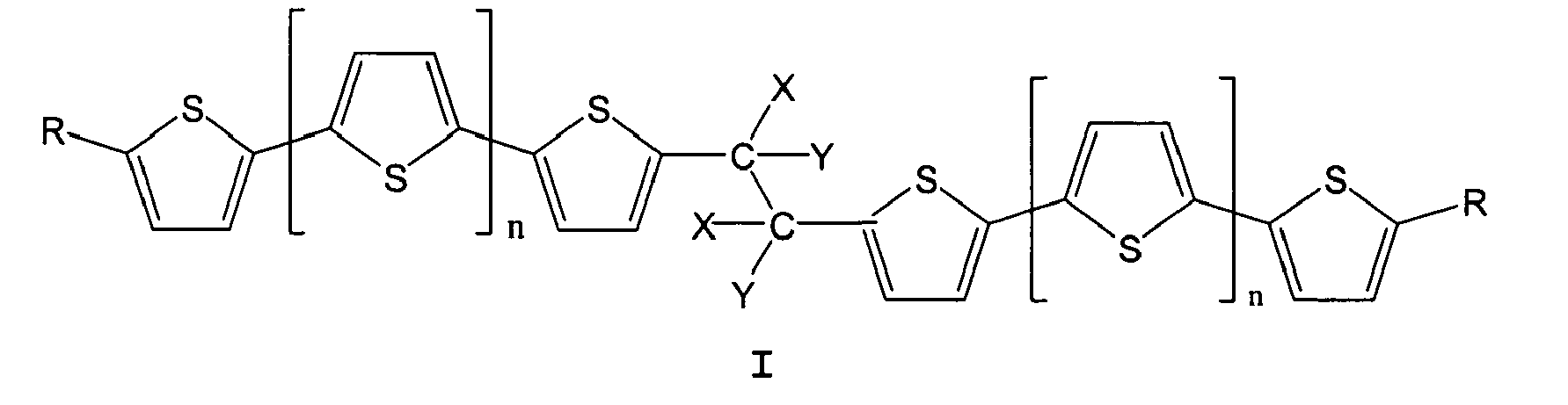
- the present invention discloses an oligothiophene derivative of the formula I or II:
- the present invention further discloses the use of the oligothiophene derivative of Claim 1 in a liquid crystal medium.
- the present invention additionally discloses the use of the oligothiophene derivative of Claim 1 as semiconductor.
- the present invention finally discloses an electronic device element comprising the oligothiophene derivative of Claim 1.
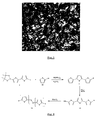
- Fig. 1 represents a photograph of the optical texture of 1,2-di-(5-hexyl-2-terthiophene)ethane 10a at 193°C under polarized light.
- Fig. 2 schematically represents the synthesis of the oligothiophene derivatives of the formula II.
- Fig. 3 schematically represents the synthesis of the oligothiophene derivatives of the structure I.
- Fig. 4 schematically represents the advantage of a bridged molecule compared to a non-bridged molecule.
- phase transition temperatures were measured by differential scanning calorimetry (Mettler Toledo DSC 821), optical textures were observed with polarizing microscopy (Nikon Eclipse 80i). 1,2-Di-(5-bromo-2-thienyl)ethane 5-hexylterthiophene [2] , 5-(3,7-dimethyloctyl)bithiophene [3] and 5-mercapto-5'-hexylterthiophene [4] were prepared as described in the literature.
Landscapes
- Chemical & Material Sciences (AREA)
- Organic Chemistry (AREA)
- Physics & Mathematics (AREA)
- Spectroscopy & Molecular Physics (AREA)
- Engineering & Computer Science (AREA)
- Materials Engineering (AREA)
- Heterocyclic Carbon Compounds Containing A Hetero Ring Having Oxygen Or Sulfur (AREA)
- Pharmaceuticals Containing Other Organic And Inorganic Compounds (AREA)
- Compositions Of Macromolecular Compounds (AREA)
- Liquid Crystal Substances (AREA)
Abstract
The present invention is related to oligothiophene derivatives of the formula I or II:


wherein X = H or CH3,
Y = H or CH3,
n = 1 or 2, and
R = carbon chain, branched or not, saturated or not, with 6 to 15 carbon atoms.
Y = H or CH3,
n = 1 or 2, and
R = carbon chain, branched or not, saturated or not, with 6 to 15 carbon atoms.
Description
- The present invention relates to new bridged oligothiophene derivatives and to their use in a liquid crystal medium for electronic devices, in particular for semiconductors.
- The transport of electric charges in a field effect transistor occurs in the first molecular layers of the interlayer situated between the dielectric layer and the semi-conductive layer. When said first molecular layers are interrupted by some defects, the conductivity of those layer decreases. These defects are one of the reasons for the poor reproducibility of the threshold voltage of those transistors.
- In the past, this problem was handled via the highest possible flatness of the dielectric layer; but on a microscopic scale, surfaces are never perfectly flat.
- Recently, this problem was approached by self-aligning molecules. This self alignment can again be perturbed by surface irregularities at molecular scale.
- The approach of the present invention is to provide molecules that are able to transport charges in three dimensions instead of two dimensions where two conjugated segments are connected by a σ-bond bridge. The latter promotes charge transport that is less sensitive to surface defects.
-
Figure 4 of the present invention shows the principle of the improvement reached by a bridged molecule compared to a non-bridged molecule. - The bridged molecules of the present invention are oligothiophene derivatives.
- Bridged oligothiophene derivatives have been disclosed by A.Berlin et al, "Anodic coupling of oligothiophenes bridged by ethylene groups" in Synthetic Metals, 55-57 (1993), 4796-4801. Similar structures were also disclosed by Tadatake Sato and al., "Synthesis and photophysical properties of 1,3-Di(oligothienyl)propane" in Tetrahedron Letters, Vo1.38,N°34, pp.6039-6042, 1997.
- Nevertheless, the molecules disclosed in the above-cited references are different from those of the present invention and are synthesised for other purposes.
- The present invention aims to provide new molecular structures based on bridged oligothiophene derivatives that are able to overcome the drawbacks of the prior art and able to reduce impact of the surface defects due to irregular surfaces on which the semi-conductive layer is applied.
- The present invention discloses an oligothiophene derivative of the formula I or II:

- wherein
- X = H or CH3,
Y = H or CH3,
n = 1 or 2, and
R = carbon chain, branched or not, saturated or not, with 6 to 15 carbon atoms. - Preferred embodiments of the present invention are:
- the oligothiophene derivatives of the formula I or II
wherein R is a, b, or c with:


- the oligothiophene derivative of the formula I,
wherein X = Y = H and wherein R is a and n = 1. - the oligothiophene derivative of the formula I,
wherein X = Y = H and wherein R is b and n = 1. - the oligothiophene derivative of the formula I,
wherein X = Y = H and wherein R is c and n = 1. - the oligothiophene derivative of the formula I,
wherein X = Y = CH3 and wherein R is a and n = 1. - the oligothiophene derivative of the formula I,
wherein X = Y = CH3 and wherein R is b and n = 1. - the oligothiophene derivative of the formula I,
wherein X = Y = CH3 and wherein R is c and n = 1. - the oligothiophene derivative of the formula I,
wherein X = H and Y = CH3 and R is a and n = 1. - the oligothiophene derivative of the formula I,
wherein X = H and Y = CH3 and R is b and n = 1. - the oligothiophene derivative of the formula I,
wherein X = H and Y = CH3 and R is c and n = 1. - the oligothiophene derivative of the formula I,
wherein X = Y = H and wherein R is a and n = 2. - the oligothiophene derivative of the formula I,
wherein X = Y = H and wherein R is b and n = 2. - the oligothiophene derivative of the formula I,
wherein X = Y = H and wherein R is c and n = 2. - the oligothiophene derivative of the formula I,
wherein X = Y = CH3 and wherein R is a and n = 2. - the oligothiophene derivative of the formula I,
wherein X = Y = CH3 and wherein R is b and n = 2. - the oligothiophene derivative of the formula I,
wherein X = Y = CH3 and wherein R is c and n = 2. - the oligothiophene derivative of the formula I,
wherein X = H and Y = CH3 and R is a and n = 2. - the oligothiophene derivative of the formula I,
wherein X = H and Y = CH3 and R is b and n = 2. - the oligothiophene derivative of the formula I,
wherein X = H and Y = CH3 and R is c and n = 2. - the oligothiophene derivative of formula II,
wherein R is a and n = 2. - the oligothiophene derivative of formula II,
wherein R is b and n = 2. - the oligothiophene derivative of formula II,
wherein R is c and n = 2. - the oligothiophene derivative of formula II,
wherein R is a and n = 1. - the oligothiophene derivative of formula II,
wherein R is b and n = 1. - the oligothiophene derivative of formula II,
wherein R is c and n = 1. - The present invention further discloses the use of the oligothiophene derivative of
Claim 1 in a liquid crystal medium. - The present invention additionally discloses the use of the oligothiophene derivative of
Claim 1 as semiconductor. - The present invention finally discloses an electronic device element comprising the oligothiophene derivative of
Claim 1. -
Fig. 1 represents a photograph of the optical texture of 1,2-di-(5-hexyl-2-terthiophene)ethane 10a at 193°C under polarized light. -
Fig. 2 schematically represents the synthesis of the oligothiophene derivatives of the formula II. -
Fig. 3 schematically represents the synthesis of the oligothiophene derivatives of the structure I. -
Fig. 4 schematically represents the advantage of a bridged molecule compared to a non-bridged molecule. - In the different synthetic steps used for the molecules of the present invention, all chemicals were purchased from Aldrich or Acros and used without further purification unless stated otherwise. THF was refluxed over sodium and benzophenone until blue-violet color persisted and directly distilled into a reaction flask. Commercially available solution of BuLi in hexane was titrated with Ph2CHCOOH immediately before use. t-BuOK was used as solution in THF (1M).
- For the identification of the chemical structure, 1H-NMR (300MHz) and 13C-NMR (75MHz) spectra were recorded in CDCl3 on Brucker Avance 300 spectrometer; chemical shifts (δ) are given in ppm relative to TMS (internal standard); coupling constants (J) are given in Hz. EI-MS (70 eV) spectra were recorded on a VG Micromass 7070F instrument.
- Concerning the liquid crystal properties, phase transition temperatures were measured by differential scanning calorimetry (Mettler Toledo DSC 821), optical textures were observed with polarizing microscopy (Nikon Eclipse 80i). 1,2-Di-(5-bromo-2-thienyl)ethane 5-hexylterthiophene[2], 5-(3,7-dimethyloctyl)bithiophene[3] and 5-mercapto-5'-hexylterthiophene[4] were prepared as described in the literature.
- In the following description, the underlined numbers refer to the intermediate molecules shown in
Fig. 2 and3 and the notation a, b and c to the type of R groups as described inClaim 2. - A solution of 1.3mmol of monoalkylated oligothiophene in THF is cooled down to -78°C, 2 eq of BuLi is added dropwise. The mixture is stirred during 15 min. at -78°C. Then 1.6mmol of 2-isopropoxy-4,4-tertramethyl-1,2,3-dioxaborolane is added to the mixture. This solution is stirred during 30 min. at -78°C and slowly heated to room temperature for 3 hours. The reaction mixture is poured into ether (50ml) and then into water mixed with 2.5ml of 1M HCl solution. The organic phase is extracted, dried over MgSO4 and evaporated. The product is then used for the next reaction without other purification.
- Prepared according to the
procedure 1 from 1.3mmol (0.4mg) of 5-(3,7-dimethyloctyl)bithiophene 6b and 0.3ml of 2-isopropoxy-4,4-tertramethyl-1,2,3-dioxaborolane.
A transparent liquid is obtained. Yield: 98%.
1H NMR (300 MHz, CDCl3, 25 °C): δ = 7.50 (d, 1H, J=3.7Hz); 7.15 (d, 1H, J=3.7Hz); 7.03 (d, 1H, J=3.7 Hz); 6.68 (d, 1H, J=3.7 Hz); 2.80 (t, 2H, J=7.7 Hz), 1.71-1.10 (m, 23H), 0.91 (d, 3H, J=6.3Hz),0.86 (d, 6H, J=6.7Hz) ppm. - Prepared according to the
procedure 1 from 1.8mmol (670mg) of 5-(3,7,11-trimethyldodecyl-2,6,10-triene)bithiophene and 0.5ml of 2-isopropoxy-4,4-tertramethyl-1,2,3-dioxaborolane.
A green liquid is obtained. Yield: 98%.
1H NMR (300 MHz, CDCl3, 25 °C): δ = 7.50 (d, 1H, J=3.7Hz); 7.15 (d, 1H, J=3.7Hz); 7.03 (d, 1H, J=3.7 Hz); 6,68 (d, 1H, J=3.7 Hz); 5.4 (t, J=8.8 Hz, 1H), 5.11-5.07 (m, 4H), 3.5 (d, 7.2 Hz, 2H), 1.74-0.8 (m, 30H) ppm. - Prepared according to the
procedure 1 from 1.3mmol (440mg) of 5-hexylterthiophene 7a and 1.6mmol (0.4ml) 2-isopropoxy-4,4-tertramethyl-1,2,3-dioxaborolane.
A green solid is obtained. Yield: 96%.
1H NMR (300 MHz, CDCl3, 25 °C) : δ = 7.51 (d, 1H, J=3.7Hz), 7.21 (d, 1H, J=3.7Hz), 7.00-6.97 (m, 3H), 6.68(d, 1H, J=3.7Hz), 2.79 (t, 2H, J=7.3Hz), 1.68 (quint, 4H, J=7.7Hz), 1.41-1.24 (m, 15H), 0.89 (t, 3H, J=6.6Hz) ppm. - 0.7mmol of 1,2-di-(5-bromo-2-thienyl)
ethane 4 and 95mg of Pd cat in solution with toluene (10ml) is heated to 75°C, a solution of boron ester (3 eq) in EtOH (6ml) and a solution of K2CO3 (18 eq) in water (6ml) are added dropwise. After 24h of stirring at 75°C, the mixture is cooled down and filtered. The solid is cristallised from toluene. - Prepared according to the
general procedure 2 from 300mg of 1,2-di-(5-bromo-2-thienyl)ethane 4 and 905mg of 5-hexyl-5'-(4,4,5,5-tetramethyl-1,2,3-dioxaborolane-2-yl)-2,2'-bithiophene 8a.
An orange solid is obtained after cristallisation from toluene. Yield: 67%.
1H NMR (300 MHz, CDCl3, 25 °C) : δ = 6.99-6.96 (m, 4H), 6.70 (d, 1H, J=3.7Hz), 6.67 (d, 1H, J=3.7Hz), 3.17 (s, 4H), 2.79 (t, 4H, J=7.3Hz), 1.68 (quint, 4H, J=7.3Hz), 1.30-1.33 (m, 12H), 0.89 (t, 6H, J=6.9Hz) ppm. DSC: K 113°C LC1 175°C LC2 213°C I. - Prepared according to the
general procedure 1 from 0.2mmol (74mg) of 1,2-di-(5-bromo-2-thienyl)ethane 4 and 0.6mmol (250mg) 5-(3,7-dimethyloctyl)-5'-(4,4,5,5-tetramethyl-1,2,3-dioxaborolane-2-yl)-2,2'-bithiophene 9b.
An orange solid is obtained after cristallisation from toluene. Yield: 71%.
1H NMR (300 MHz, CDCl3, 25 °C) : δ = 6.99-6.96 (m, 4H), 6.71 (d, 1H, J=3.7Hz); 6.68 (d, 1H, J=3.7Hz), 3.17 (s, 4H), 2.79 (t, 4H, J=7.5Hz), 1.68 (quint, 4H, J=7.5Hz), 1.71-1.10 (m, 16H), 0.91 (d, 6H, J=6.3Hz), 0.86 (d, 12H, J=6.7Hz) ppm. DSC: K 126°C LC 157°C I. - Prepared according to the
general procedure 1 from 0.4mmol (147mg) of 1,2-di-(5-bromo-2-thienyl)ethane 4 and 1.2mmol (552mg) 5-hexyl-5"-(4,4,5,5-tetramethyl-1,2,3-dioxaborolane-2-yl)-2,2"-terthiophene 9a.
A red solid is soxhlet in methanol. Yield: 65%.
1H NMR (300 MHz, CDCl3, 25°C): δ = 7.06-6.90 (m, 6H), 6.68 (d, 1H, J=3.3 Hz), 6.64 (d, 1H, J=3.3Hz), 3.19 (s, 4H), 2.80 (t, 4H, J=7,7Hz), 1.70 (quint, 4H, J=7.3Hz), 1.36-1.24 (m, 12H), 0.93 (t, 6H, J=6.6Hz) ppm. Mp: 261°C. - Prepared according to the
general procedure 1 from 0.2mmol (74mg) of 1,2-di-(5-bromo-2-thienyl)ethane 4 and 0.2mmol (100mg) 5-(3,7,11-trimethyldodecyl-2,6,10-triene)-5'-(4,4,5,5-tetramethyl-1,2,3-dioxaborolane-2-yl)-2,2'-bithiophene 9b.
A yellow solid is obtained after cristallisation from toluene. Yield: 20%.
1H NMR (300 MHz, CDCl3, 25 °C): δ = 6.99-6.96 (m, 4H), 6.70 (d, 1H, J=3.7Hz), 6.67 (d, 1H, J=3.7Hz) , 3.17 (s, 4H), 5.4 (t, J=6.6Hz, 2H), 5.11-5.09 (m, 8H), 3.5 (d, J=6.3 Hz, 4H), 2.33-1.94 (m, 8H), 1.61 (s, 6H), 1.59 (s, 6H), 1.45-1.33 (m, 4H), 1.08 (s, 6H), 1.06 (s, 6H) ppm. - 0.04ml of SO2Cl2 in 4ml of dichloromethane were added dropwise to 0.8mmol (300mg) of 5-mercapto-5'-hexylterthiophene 13a in solution in 2ml of dichloromethane at room temperature. The solution is stirred for 1 hour at room temperature. After completion of the reaction, the solvent is evaporated in vacuum.
A yellow solid is obtained. Yield: 85%.
1H NMR (300 MHz, CDCl3, 25 °C) : δ = 7.09 (t, 2H, J=4.0Hz), 7.04-6.99 (m, 3H), 6.68 (d, 1H, J=3.7 Hz), 2.80 (t, 2H, J=7.3Hz), 1.68 (quint, 4H, J=7.3Hz), 1.41-1.25 (m, 28H), 0.89 (t, 6H, J=6.6Hz)ppm. Decomposition > 250°C.
Claims (29)
- An oligothiophene derivative of the formula I or II:


Y = H or CH3,
n = 1 or 2, and
R = carbon chain, branched or not, saturated or
not, with 6 to 15 carbon atoms. - The oligothiophene derivative of Claim 1
wherein R is a, b, or c with:


- The oligothiophene derivative of Claim 1 wherein said derivative is formula I, wherein X = Y = H and wherein R is a and n = 1.
- The oligothiophene derivative of Claim 1 wherein said derivative is formula I, wherein X = Y = H and wherein R is b and n = 1.
- The oligothiophene derivative of Claim 1 wherein said derivative is formula I, wherein X = Y = H and wherein R is c and n = 1.
- The oligothiophene derivative of Claim 1 wherein said derivative is formula I, wherein X = Y = CH3 and wherein R is a and n = 1.
- The oligothiophene derivative of Claim 1 wherein said derivative is formula I, wherein X = Y = CH3 and wherein R is b and n = 1.
- The oligothiophene derivative of Claim 1 wherein said derivative is formula I, wherein X = Y = CH3 and wherein R is c and n = 1.
- The oligothiophene derivative of Claim 1 wherein said derivative is formula I and wherein X = H and Y = CH3 and R is a and n = 1.
- The oligothiophene derivative of Claim 1 wherein said derivative is formula I and wherein X = H and Y = CH3 and R is b and n = 1.
- The oligothiophene derivative of Claim 1 wherein said derivative is formula I and wherein X = H and Y = CH3 and R is c and n = 1.
- The oligothiophene derivative of Claim 1 wherein said derivative is formula I, wherein X = Y = H and wherein R is a and n = 2.
- The oligothiophene derivative of Claim 1 wherein said derivative is formula I, wherein X = Y = H and wherein R is b and n = 2.
- The oligothiophene derivative of Claim 1 wherein said derivative is formula I, wherein X = Y = H and wherein R is c and n = 2.
- The oligothiophene derivative of Claim 1 wherein said derivative is formula I, wherein X = Y = CH3 and wherein R is a and n = 2.
- The oligothiophene derivative of Claim 1 wherein said derivative is formula I, wherein X = Y = CH3 and wherein R is b and n = 2.
- The oligothiophene derivative of Claim 1 wherein said derivative is formula I, wherein X = Y = CH3 and wherein R is c and n = 2.
- The oligothiophene derivative of Claim 1 wherein said derivative is formula I and wherein X = H and Y = CH3 and R is a and n = 2.
- The oligothiophene derivative of Claim 1 wherein said derivative is formula I and wherein X = H and Y = CH3 and R is b and n = 2.
- The oligothiophene derivative of Claim 1 wherein said derivative is formula I and wherein X = H and Y = CH3 and R is c and n = 2.
- The oligothiophene derivative of Claim 1 wherein said derivative is formula II and wherein R is a and n = 2.
- The oligothiophene derivative of Claim 1 wherein said derivative is formula II, and wherein R is b and n = 2.
- The oligothiophene derivative of Claim 1 wherein said derivative is formula II, and wherein R is c and n = 2.
- The oligothiophene derivative of Claim 1 wherein said derivative is formula II, and wherein R is a and n = 1.
- The oligothiophene derivative of Claim 1 wherein said derivative is formula II, and wherein R is b and n = 1.
- The oligothiophene derivative of Claim 1 wherein said derivative is formula II, and wherein R is c and n = 1.
- Use of the oligothiophene derivative of Claim 1 in a liquid crystal medium.
- Use of the oligothiophene derivative of Claim 1 as semiconductor.
- Electronic device element comprising the oligothiophene derivative of Claim 1.
Priority Applications (8)
| Application Number | Priority Date | Filing Date | Title |
|---|---|---|---|
| EP07447030A EP1990340A1 (en) | 2007-05-08 | 2007-05-08 | Oligothiophene derivatives |
| JP2010506931A JP2010526121A (en) | 2007-05-08 | 2008-05-07 | Oligothiophene derivatives |
| EP08774046A EP2144901B1 (en) | 2007-05-08 | 2008-05-07 | Oligothiophene derivatives |
| US12/598,709 US20110105768A1 (en) | 2007-05-08 | 2008-05-07 | Oligothiophene Derivatives |
| DE602008005572T DE602008005572D1 (en) | 2007-05-08 | 2008-05-07 | Oligothiophenderivate |
| AT08774046T ATE502032T1 (en) | 2007-05-08 | 2008-05-07 | OLIGOTHIOPHENE DERIVATIVES |
| KR1020097023274A KR20100016322A (en) | 2007-05-08 | 2008-05-07 | Oligothiophene derivatives |
| PCT/EP2008/055643 WO2008135592A1 (en) | 2007-05-08 | 2008-05-07 | Oligothiophene derivatives |
Applications Claiming Priority (1)
| Application Number | Priority Date | Filing Date | Title |
|---|---|---|---|
| EP07447030A EP1990340A1 (en) | 2007-05-08 | 2007-05-08 | Oligothiophene derivatives |
Publications (1)
| Publication Number | Publication Date |
|---|---|
| EP1990340A1 true EP1990340A1 (en) | 2008-11-12 |
Family
ID=38564607
Family Applications (2)
| Application Number | Title | Priority Date | Filing Date |
|---|---|---|---|
| EP07447030A Withdrawn EP1990340A1 (en) | 2007-05-08 | 2007-05-08 | Oligothiophene derivatives |
| EP08774046A Not-in-force EP2144901B1 (en) | 2007-05-08 | 2008-05-07 | Oligothiophene derivatives |
Family Applications After (1)
| Application Number | Title | Priority Date | Filing Date |
|---|---|---|---|
| EP08774046A Not-in-force EP2144901B1 (en) | 2007-05-08 | 2008-05-07 | Oligothiophene derivatives |
Country Status (7)
| Country | Link |
|---|---|
| US (1) | US20110105768A1 (en) |
| EP (2) | EP1990340A1 (en) |
| JP (1) | JP2010526121A (en) |
| KR (1) | KR20100016322A (en) |
| AT (1) | ATE502032T1 (en) |
| DE (1) | DE602008005572D1 (en) |
| WO (1) | WO2008135592A1 (en) |
Families Citing this family (1)
| Publication number | Priority date | Publication date | Assignee | Title |
|---|---|---|---|---|
| JP5567286B2 (en) * | 2009-03-25 | 2014-08-06 | ユー・ディー・シー アイルランド リミテッド | Organic electroluminescence device |
Citations (2)
| Publication number | Priority date | Publication date | Assignee | Title |
|---|---|---|---|---|
| US20020072618A1 (en) * | 2000-07-12 | 2002-06-13 | Ali Afzali-Ardakani | Synthesis of soluble derivatives of sexithiophene and their use as the semiconducting channels in thin-film field-effect transistors |
| JP2003062274A (en) * | 2002-08-08 | 2003-03-04 | Fuji Shoji:Kk | Pachinko game machine |
-
2007
- 2007-05-08 EP EP07447030A patent/EP1990340A1/en not_active Withdrawn
-
2008
- 2008-05-07 KR KR1020097023274A patent/KR20100016322A/en not_active Withdrawn
- 2008-05-07 WO PCT/EP2008/055643 patent/WO2008135592A1/en not_active Ceased
- 2008-05-07 EP EP08774046A patent/EP2144901B1/en not_active Not-in-force
- 2008-05-07 DE DE602008005572T patent/DE602008005572D1/en active Active
- 2008-05-07 JP JP2010506931A patent/JP2010526121A/en not_active Abandoned
- 2008-05-07 AT AT08774046T patent/ATE502032T1/en not_active IP Right Cessation
- 2008-05-07 US US12/598,709 patent/US20110105768A1/en not_active Abandoned
Patent Citations (2)
| Publication number | Priority date | Publication date | Assignee | Title |
|---|---|---|---|---|
| US20020072618A1 (en) * | 2000-07-12 | 2002-06-13 | Ali Afzali-Ardakani | Synthesis of soluble derivatives of sexithiophene and their use as the semiconducting channels in thin-film field-effect transistors |
| JP2003062274A (en) * | 2002-08-08 | 2003-03-04 | Fuji Shoji:Kk | Pachinko game machine |
Non-Patent Citations (6)
| Title |
|---|
| A. BERLIN AND CO: "Anodic coupling of oligothiophenes bridged by ethylene groups", SYNTHETIC METALS, vol. 55, 1993, pages 4796 - 4801, XP002455032 * |
| CHEMISTRY LETTERS , 35(3), 266-267 CODEN: CMLTAG; ISSN: 0366-7022, 2006 * |
| DATABASE CA [online] CHEMICAL ABSTRACTS SERVICE, COLUMBUS, OHIO, US; KIM, DONG-HA ET AL: "Synthesis of silicon-bridged oligothiophenes and applications to thin film transistors", XP002455035, retrieved from STN Database accession no. 2006:308004 * |
| DATABASE CA [online] CHEMICAL ABSTRACTS SERVICE, COLUMBUS, OHIO, US; KIM, HYUNG-SUN ET AL: "Synthesis and characterization of new thiophene derivative containing alkylene linkage", XP002455036, retrieved from STN Database accession no. 2003:658042 * |
| POLYMER PREPRINTS (AMERICAN CHEMICAL SOCIETY, DIVISION OF POLYMER CHEMISTRY) , 44(2), 423-424 CODEN: ACPPAY; ISSN: 0032-3934, 2003 * |
| SATO T ET AL: "Synthesis and Photophysical Properties of 1,3-Di(oligothienyl)propane", TETRAHEDRON LETTERS, ELSEVIER, AMSTERDAM, NL, vol. 38, no. 34, August 1997 (1997-08-01), pages 6039 - 6042, XP004086566, ISSN: 0040-4039 * |
Also Published As
| Publication number | Publication date |
|---|---|
| US20110105768A1 (en) | 2011-05-05 |
| ATE502032T1 (en) | 2011-04-15 |
| KR20100016322A (en) | 2010-02-12 |
| EP2144901B1 (en) | 2011-03-16 |
| WO2008135592A1 (en) | 2008-11-13 |
| JP2010526121A (en) | 2010-07-29 |
| DE602008005572D1 (en) | 2011-04-28 |
| EP2144901A1 (en) | 2010-01-20 |
Similar Documents
| Publication | Publication Date | Title |
|---|---|---|
| TWI457345B (en) | Method for preparing substituted pentacene | |
| Ponomarenko et al. | Synthesis and thermal behaviour of α, α′-didecyloligothiophenes | |
| Wang et al. | The synthesis and optical properties of benzothiazole-based derivatives with various π-electron donors as novel bipolar fluorescent compounds | |
| CN110386930B (en) | Aggregation-induced luminescence compound, preparation method and application thereof | |
| JP6080870B2 (en) | Organic semiconductor material for solution process and organic semiconductor device | |
| JP5341973B2 (en) | Novel production of useful monomers for semiconductor polymer products | |
| CN102046636A (en) | Fused thiophenes and methods for their preparation and use | |
| JP7159586B2 (en) | Aromatic compounds, organic semiconductor layers, and organic thin film transistors | |
| Busireddy et al. | Dithienopyrrole-benzodithiophene based donor materials for small molecular BHJSCs: Impact of side chain and annealing treatment on their photovoltaic properties | |
| US8618298B2 (en) | Perylene tetracarboximide derivatives for photovoltaic devices | |
| JP2009076868A (en) | Soluble sexithiophene derivatives and thin film field effect transistors using the same | |
| CN104017571B (en) | Electroluminescent organic material and application thereof | |
| WO2018181462A1 (en) | Aromatic compound, organic semiconductor layer, and organic thin film transistor | |
| Wang et al. | Synthesis and characterization of new planar butterfly-shaped fused oligothiophenes | |
| JP2007502251A (en) | Monomers, oligomers, and polymers of 2-functionalized and 2,7-difunctionalized carbazoles | |
| Shen et al. | A star-shaped oligothiophene with triphenylamine as core and octyl cyanoacetate as end groups for solution-processed organic solar cells | |
| Liau et al. | Synthesis and characterisation of liquid crystal molecules based on thieno [3, 2-b] thiophene and their application in organic field-effect transistors | |
| US9876182B2 (en) | Thieno-containing compounds and processes and uses thereof | |
| Rodriguez-Alba et al. | Synthesis, characterization and optical properties of novel oligothiophenes bearing pyrene units attached via well defined oligo (ethylene glycol) spacers | |
| JP2007529596A (en) | Pentathienyl-fluorene copolymer | |
| Liu et al. | Synthesis and optical properties of a series of thermally stable diphenylanthrazolines | |
| JP2006008679A (en) | Method for producing small molecule thiophene compound | |
| EP2144901B1 (en) | Oligothiophene derivatives | |
| Ellinger et al. | Aggregation Phenomena of Long α‐and α, ω‐Substituted Oligothiophenes–the Effect of Branched vs. Linear End‐Groups | |
| CN107216321A (en) | Organic second-order nonlinear optical chromophore with Y-type D-pi-A structure, and synthetic method and application thereof |
Legal Events
| Date | Code | Title | Description |
|---|---|---|---|
| PUAI | Public reference made under article 153(3) epc to a published international application that has entered the european phase |
Free format text: ORIGINAL CODE: 0009012 |
|
| AK | Designated contracting states |
Kind code of ref document: A1 Designated state(s): AT BE BG CH CY CZ DE DK EE ES FI FR GB GR HU IE IS IT LI LT LU LV MC MT NL PL PT RO SE SI SK TR |
|
| AX | Request for extension of the european patent |
Extension state: AL BA HR MK RS |
|
| AKX | Designation fees paid | ||
| REG | Reference to a national code |
Ref country code: DE Ref legal event code: 8566 |
|
| STAA | Information on the status of an ep patent application or granted ep patent |
Free format text: STATUS: THE APPLICATION IS DEEMED TO BE WITHDRAWN |
|
| 18D | Application deemed to be withdrawn |
Effective date: 20090513 |