EP1990216A1 - Rim and bicycle wheel with wings having compensated waving - Google Patents
Rim and bicycle wheel with wings having compensated waving Download PDFInfo
- Publication number
- EP1990216A1 EP1990216A1 EP08005651A EP08005651A EP1990216A1 EP 1990216 A1 EP1990216 A1 EP 1990216A1 EP 08005651 A EP08005651 A EP 08005651A EP 08005651 A EP08005651 A EP 08005651A EP 1990216 A1 EP1990216 A1 EP 1990216A1
- Authority
- EP
- European Patent Office
- Prior art keywords
- wings
- rim
- areas
- axial distance
- spoke attachment
- Prior art date
- Legal status (The legal status is an assumption and is not a legal conclusion. Google has not performed a legal analysis and makes no representation as to the accuracy of the status listed.)
- Withdrawn
Links
- 238000000034 method Methods 0.000 claims description 52
- 239000002184 metal Substances 0.000 claims description 12
- 229910052751 metal Inorganic materials 0.000 claims description 12
- 239000002131 composite material Substances 0.000 claims description 11
- 238000003490 calendering Methods 0.000 claims description 9
- 239000000463 material Substances 0.000 claims description 7
- 238000005452 bending Methods 0.000 claims description 4
- 230000000694 effects Effects 0.000 description 57
- 238000003466 welding Methods 0.000 description 9
- DOSMHBDKKKMIEF-UHFFFAOYSA-N 2-[3-(diethylamino)-6-diethylazaniumylidenexanthen-9-yl]-5-[3-[3-[4-(1-methylindol-3-yl)-2,5-dioxopyrrol-3-yl]indol-1-yl]propylsulfamoyl]benzenesulfonate Chemical compound C1=CC(=[N+](CC)CC)C=C2OC3=CC(N(CC)CC)=CC=C3C(C=3C(=CC(=CC=3)S(=O)(=O)NCCCN3C4=CC=CC=C4C(C=4C(NC(=O)C=4C=4C5=CC=CC=C5N(C)C=4)=O)=C3)S([O-])(=O)=O)=C21 DOSMHBDKKKMIEF-UHFFFAOYSA-N 0.000 description 8
- 239000007769 metal material Substances 0.000 description 5
- 210000000080 chela (arthropods) Anatomy 0.000 description 4
- 238000001125 extrusion Methods 0.000 description 4
- 238000005304 joining Methods 0.000 description 4
- 230000009977 dual effect Effects 0.000 description 3
- 238000003780 insertion Methods 0.000 description 3
- 230000037431 insertion Effects 0.000 description 3
- 238000000465 moulding Methods 0.000 description 3
- 239000004411 aluminium Substances 0.000 description 2
- 229910052782 aluminium Inorganic materials 0.000 description 2
- XAGFODPZIPBFFR-UHFFFAOYSA-N aluminium Chemical compound [Al] XAGFODPZIPBFFR-UHFFFAOYSA-N 0.000 description 2
- 230000007423 decrease Effects 0.000 description 2
- 238000009826 distribution Methods 0.000 description 2
- 238000003754 machining Methods 0.000 description 2
- OKTJSMMVPCPJKN-UHFFFAOYSA-N Carbon Chemical compound [C] OKTJSMMVPCPJKN-UHFFFAOYSA-N 0.000 description 1
- 102000015933 Rim-like Human genes 0.000 description 1
- 108050004199 Rim-like Proteins 0.000 description 1
- 238000004026 adhesive bonding Methods 0.000 description 1
- 210000000746 body region Anatomy 0.000 description 1
- 229910052799 carbon Inorganic materials 0.000 description 1
- 238000010276 construction Methods 0.000 description 1
- 238000004132 cross linking Methods 0.000 description 1
- 238000005520 cutting process Methods 0.000 description 1
- 239000000835 fiber Substances 0.000 description 1
- 239000002657 fibrous material Substances 0.000 description 1
- 239000011159 matrix material Substances 0.000 description 1
- 230000002093 peripheral effect Effects 0.000 description 1
- 239000000126 substance Substances 0.000 description 1
Images













Classifications
-
- B—PERFORMING OPERATIONS; TRANSPORTING
- B60—VEHICLES IN GENERAL
- B60B—VEHICLE WHEELS; CASTORS; AXLES FOR WHEELS OR CASTORS; INCREASING WHEEL ADHESION
- B60B21/00—Rims
- B60B21/06—Rims characterised by means for attaching spokes, i.e. spoke seats
- B60B21/062—Rims characterised by means for attaching spokes, i.e. spoke seats for bicycles
-
- B—PERFORMING OPERATIONS; TRANSPORTING
- B21—MECHANICAL METAL-WORKING WITHOUT ESSENTIALLY REMOVING MATERIAL; PUNCHING METAL
- B21D—WORKING OR PROCESSING OF SHEET METAL OR METAL TUBES, RODS OR PROFILES WITHOUT ESSENTIALLY REMOVING MATERIAL; PUNCHING METAL
- B21D53/00—Making other particular articles
- B21D53/26—Making other particular articles wheels or the like
- B21D53/30—Making other particular articles wheels or the like wheel rims
-
- B—PERFORMING OPERATIONS; TRANSPORTING
- B60—VEHICLES IN GENERAL
- B60B—VEHICLE WHEELS; CASTORS; AXLES FOR WHEELS OR CASTORS; INCREASING WHEEL ADHESION
- B60B1/00—Spoked wheels; Spokes thereof
- B60B1/02—Wheels with wire or other tension spokes
- B60B1/0215—Wheels with wire or other tension spokes characterised by specific grouping of spokes
-
- B—PERFORMING OPERATIONS; TRANSPORTING
- B60—VEHICLES IN GENERAL
- B60B—VEHICLE WHEELS; CASTORS; AXLES FOR WHEELS OR CASTORS; INCREASING WHEEL ADHESION
- B60B21/00—Rims
- B60B21/02—Rims characterised by transverse section
- B60B21/025—Rims characterised by transverse section the transverse section being hollow
-
- B—PERFORMING OPERATIONS; TRANSPORTING
- B60—VEHICLES IN GENERAL
- B60B—VEHICLE WHEELS; CASTORS; AXLES FOR WHEELS OR CASTORS; INCREASING WHEEL ADHESION
- B60B21/00—Rims
- B60B21/02—Rims characterised by transverse section
- B60B21/026—Rims characterised by transverse section the shape of rim well
-
- B—PERFORMING OPERATIONS; TRANSPORTING
- B60—VEHICLES IN GENERAL
- B60B—VEHICLE WHEELS; CASTORS; AXLES FOR WHEELS OR CASTORS; INCREASING WHEEL ADHESION
- B60B21/00—Rims
- B60B21/02—Rims characterised by transverse section
- B60B21/04—Rims characterised by transverse section with substantially radial flanges
-
- B—PERFORMING OPERATIONS; TRANSPORTING
- B60—VEHICLES IN GENERAL
- B60B—VEHICLE WHEELS; CASTORS; AXLES FOR WHEELS OR CASTORS; INCREASING WHEEL ADHESION
- B60B21/00—Rims
- B60B21/08—Rims characterised by having braking surfaces
-
- B—PERFORMING OPERATIONS; TRANSPORTING
- B60—VEHICLES IN GENERAL
- B60B—VEHICLE WHEELS; CASTORS; AXLES FOR WHEELS OR CASTORS; INCREASING WHEEL ADHESION
- B60B21/00—Rims
- B60B21/10—Rims characterised by the form of tyre-seat or flange, e.g. corrugated
- B60B21/104—Rims characterised by the form of tyre-seat or flange, e.g. corrugated the shape of flanges
-
- B—PERFORMING OPERATIONS; TRANSPORTING
- B60—VEHICLES IN GENERAL
- B60B—VEHICLE WHEELS; CASTORS; AXLES FOR WHEELS OR CASTORS; INCREASING WHEEL ADHESION
- B60B5/00—Wheels, spokes, disc bodies, rims, hubs, wholly or predominantly made of non-metallic material
- B60B5/02—Wheels, spokes, disc bodies, rims, hubs, wholly or predominantly made of non-metallic material made of synthetic material
-
- Y—GENERAL TAGGING OF NEW TECHNOLOGICAL DEVELOPMENTS; GENERAL TAGGING OF CROSS-SECTIONAL TECHNOLOGIES SPANNING OVER SEVERAL SECTIONS OF THE IPC; TECHNICAL SUBJECTS COVERED BY FORMER USPC CROSS-REFERENCE ART COLLECTIONS [XRACs] AND DIGESTS
- Y10—TECHNICAL SUBJECTS COVERED BY FORMER USPC
- Y10T—TECHNICAL SUBJECTS COVERED BY FORMER US CLASSIFICATION
- Y10T29/00—Metal working
- Y10T29/49—Method of mechanical manufacture
- Y10T29/49481—Wheel making
- Y10T29/49492—Land wheel
- Y10T29/49506—Tensioned spoke type wheel making
Definitions
- the present invention refers to a rim for a bicycle wheel, to a wheel comprising such a rim and to a process for making such a rim and such a wheel.
- rim is often used to refer to a wheel (of a bicycle or other) without a tyre.
- rim it is meant to indicate more precisely the peripheral part of the wheel of a bicycle to which the tyre is fitted.
- a wheel comprises a rim connected to a hub through a plurality of spokes or arms.
- Typical configurations of the cross section of a bicycle rim are U-shaped or inverted A-shaped.
- U-shaped rims there are two side walls and a radially inner circumferential wall, also known as “lower bridge” or even simply “bridge” (in the absence of other bridges).
- inverted A-shaped rims there is both a “lower bridge” and an “upper bridge”; more specifically, there is a radially inner portion of the cross section of the rim, formed from a chamber defined by the upper bridge (outer in the radial direction), by two side walls and by the lower bridge (inner in the radial direction).
- the side walls of the rim extend radially outwards, beyond the lower bridge in the case of a U-shaped rim and beyond the upper bridge in the case of an inverted A-shaped rim, to define circumferential wings for fitting a tyre.
- the circumferential wings have outer sides in the form of outer annular surfaces substantially parallel with respect to the middle plane of the rim (and substantially parallel to each other).
- braking races are normally formed that provide braking surfaces on which the two brake pads close.
- Making rims from metal, in particular aluminium involves extruding a profile with a section substantially the same as that desired for the final rim, cutting a blank of the profile, calendering it to obtain a circular element, and finally jointing end-to-end, for example through the insertion of a joint that is glued to the inner walls of the chamber, or else through welding with the insertion of one or more joints glued or in any case fixed in the chamber of the rim, or else through pins or similar.
- the circular element is then perforated to make the holes to mount the spokes in predetermined spoke attachment areas, which follow one another circumferentially alternating with intermediate areas; a machining process (turning) is also carried out on the outer sides of the wings to form the braking races with braking surfaces parallel to one another, which are therefore a constant distance apart for the entire circumference of the rim.
- spoke attachment area in general a portion is meant, extending circumferentially on the rim, in which a single spoke or else a set of spokes grouped close together are fastened.
- the tyre and the inner tube are mounted and then inflation takes place according to the desired pressures (normally between 6 and 10 atm).
- rims made from composite material the braking races with parallel braking surfaces are obtained during the moulding step of the rim itself. Unlike rims made from metallic material, rims made from composite material have no jointing, since they are already annular from the outset.
- the waving of the distance between the wings and therefore between the braking races is induced on the rim during the assembly of the wheel.
- the degree of waving depends upon the type of material used and upon the type of geometry of the section of the rim (shape, length of the side walls, etc.).
- a first type of waving, distributed over the entire circumference of the wheel, is caused at the moment when the spokes are tightened, to a particularly marked extent in wheels with the spokes grouped together, since the traction force, oriented towards the centre of the rim in the spoke attachment area due to the spokes being tightened, causes a variation in distance between the wings and therefore between the braking races.
- the wings When the tyre is mounted on the wheel and inflated, the wings also undergo the flaring effect described above, being pushed laterally outwards by the pressure of the tyre along the entire circumference of the rim; therefore the wings move apart ( figure 9c ). Moreover, because of the different rigidity of the rim in the spoke attachment areas compared to the intermediate areas, due to the traction of the spokes, the waving effect with the tyre inflated ( fig. 9c ) is increased with respect to the waving effect with the tyre deflated ( fig. 9b ). In the spoke attachment areas, therefore, the wings subjected to the pressure of the inflated tyre undergo a greater deformation than the deformation that they undergo in the intermediate areas. The distributed waving effect of the spoke attachment area arises once again on the wheel with the tyre inflated, in addition to the flaring effect.
- the variation in distance between the wings in the spoke attachment areas compared to the distance between the wings in the intermediate areas results in a waving effect of the braking races; this waving is distributed, i.e. substantially repeats cyclically along the circumference of the rim according to the distribution of the spokes.
- This distributed waving occurs both on metallic rims, and on rims made from composite material, since it is not linked to the type of material from which the rim is made nor to the possible presence of a joint.
- a second type of waving ( figures 10a-10b ), not distributed cyclically along the circumference of the rim but rather localised in a single area, is caused at the moment of inflation of the tyre on wheels provided with rims with a joint, both in wheels with single spokes (to which figures 10a and 10b refer) and in wheels with grouped spokes.
- the inflation of the tyre results in an inevitable deformation of the wings that are pushed outwards by the pressure of the tyre.
- such a deformation is not homogeneous along the entire circumference of the rim, since at the jointing area the rim has a greater rigidity than at the other areas of the rim.
- the greater rigidity of the jointing area is due to the welding on the one hand and to the joints inserted on the other (in rims with welding and joint such an effect is the sum of the two, whereas it is less evident where jointing is carried out with a joint glued to the wall of the chamber of the rim and without welding).
- the deformation of the wings in the jointing area is less than the deformation of the wings in the rest of the rim.
- the braking surfaces have a narrowing at the jointing area (localised waving), as shown in fig. 10b.
- Fig. 10c shows (for a wheel with grouped spokes) both the effect of localised waving in the jointing area, and the distributed waving effect due to the spokes being tightened, as represented in figures 9a-9c .
- Localised waving is normally of a greater magnitude (about double) compared to distributed waving caused by the spokes being tightened.
- the problem at the basis of the present invention is to improve the braking efficiency and the air seal, for wheels with tubeless tyres.
- a rim according to the invention suitable for being coupled with a hub through a plurality of spokes tightened to form a bicycle wheel, comprises a pair of wings connected by at least one bridge, a plurality of spoke attachment areas alternating in the circumferential direction with a plurality of intermediate areas in said at least one bridge, and is characterised in that the axial distance between the wings at the spoke attachment areas is different from the axial distance between the wings at the intermediate areas.
- each wing has an outer side on which a braking race is formed, an improvement in braking efficiency is also obtained.
- the axial distance between the wings is measured between the outer sides thereof.
- the axial distance between the wings at the spoke attachment areas is greater than the axial distance between the wings at the intermediate areas.
- the axial distance between the wings at the spoke attachment areas is less than the axial distance between the wings at the intermediate areas.
- the axial distance between the wings at the spoke attachment areas is the same for all the spoke attachment areas; preferably, the axial distance between the wings at the intermediate areas is the same for all of the intermediate areas. In this way, the deformations in the wheel by distributed waving are compensated uniformly over the entire circumference.
- the axial distance between the wings at the spoke attachment areas is the same for all the spoke attachment areas and the axial distance between the wings at the intermediate areas is the same for all of the intermediate areas, and moreover the difference in axial distance between the wings is such as to compensate for the axial deformation induced on the wings when the rim is mounted in a wheel with the spokes tightened, so that in the mounted wheel the wings are the same distance apart in the spoke attachment areas and in the intermediate areas.
- the axial distance between the wings varies progressively between the spoke attachment areas and the intermediate areas. This gradual variation is not only easier to obtain, but also best corresponds to the corresponding gradual deformations by distributed waving.
- the rim can be made from composite material or else metal, from a blank that is extruded, calendered into circular shape and closed upon itself through jointing between the ends of the blank.
- the axial distance between the wings at the jointing area is preferably provided to be greater than the axial distance between the wings at the areas far from the jointing area.
- the axial distance between the wings at the jointing area is greater than the axial distance between the wings at the spoke attachment areas as well as the axial distance between the wings at the intermediate areas.
- the invention concerns, in particular, a spoked bicycle wheel, comprising a hub, a rim according to what has been described above and a plurality of spokes tightened between the hub and the rim, in which the wings of the rim subjected to the tension of the spokes have a smaller variation in distance apart at the spoke attachment areas and at the intermediate areas than in the rim without spokes tightened; preferably, the variation in distance is substantially zero.
- the same distance between the wings is also provided at the jointing area, if present and with the tyre inflated.
- the wings converge, and even more preferably, when the tyre is mounted on the wheel and it is inflated, the wings converge less and at best are parallel.
- the invention concerns a process for making a rim, suitable for being coupled with a hub through a plurality of spokes tightened to form a bicycle wheel, comprising the steps of:
- the process also comprises the step of:
- step a) comprises the substeps of:
- step a1b) comprises bending the wings inwards and/or outwards at the spoke attachment areas and/or at the intermediate areas, or else removing material from outer sides of the wings at the spoke attachment areas and/or at the intermediate areas.
- step a) provides:
- step c) is carried out after substep a1a) and before substep a1b).
- the rim is made from metal from a blank that is extruded, shaped into circular shape and closed upon itself through jointing between the ends of the blank, and the process also comprises the step of:
- the wings are formed so that they converge, by this meaning that they are inclined towards each other.
- the invention concerns a process for making a bicycle wheel, comprising the steps of:
- the process also comprises the step of:
- step a) comprises the substeps of:
- step a1b) comprises bending the wings inwards and/or outwards at the spoke attachment areas and/or at the intermediate areas, or else removing material from the outer sides of the wings at the spoke attachment areas and/or at the intermediate areas.
- step e) is carried out after substep a1a) and before substep a1b). Furthermore, according to another preferred embodiment, step e) is carried out after step d).
- the rim is made from metal from a blank that is extruded, shaped into circular shape and closed upon itself through jointing between the ends of the blank, and the process also comprises the steps of:
- the wings are formed so that they converge, by this meaning that they are inclined towards one another. Even more preferably, in the step of:
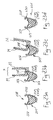
- Figure 3a shows the section of a rim 1 according to the invention that has a section with U-shaped configuration comprising two side walls 4, 5 and a radially inner circumferential wall 6 (lower bridge).
- the side walls 4, 5 extend radially outwards to define two circumferential wings 7, 8 for fitting a tyre 16.
- the circumferential wings 7, 8 have outer sides 9, 10 on which braking races 11, 12 are formed that provide braking surfaces on which the two brake pads (not shown) close during braking.
- the braking races 11, 12 are not parallel to one another, but rather converge: their distance apart (and the distance from the middle plane M of the rim 1) decreases as the distance from the centre of the rim 1 increases.
- the progression shown in the figures is intentionally exaggerated in order to show this clearly; real values for such a narrowing are of the order of tenths of a mm.
- the rim 1 is used to make a wheel 3, together with a hub connected to the rim 1 by spokes (neither the hub nor the spokes are shown in figures 3a to 3c ) and to the tyre 16, mounted on the rim 1 between the wings 7, 8.
- the tyre 16 is mounted on the rim 1 ( figure 3b ) and then inflated ( figure 3c )
- the wings 7, 8 deform outwards, with a flaring effect.
- Such flaring is compensated by the original convergence of the wings 7, 8 and therefore in the wheel 3 with the tyre 16 inflated the braking races 11, 12 converge less and, at best, are parallel (as shown in fig. 3c ).
- Figure 4a shows the section of a rim 21 according to the invention that has an inverted A-shaped section.
- the radially inner body region is formed from a chamber 22, defined by a radially outer circumferential wall or upper bridge 23, by two side walls 24, 25 and by a radially inner circumferential wall or lower bridge 26.
- the side walls 24, 25 extend radially outwards to define circumferential wings 27, 28 for fitting a tyre 36.
- the circumferential wings 27, 28 have outer sides 29, 30 on which braking races 31, 32 are formed that provide braking surfaces on which the two brake pads (not shown) close during braking.
- the braking races 31, 32 are not parallel to one another, but rather converge: their distance apart (and the distance from the middle plane M of the rim 21) decreases as the distance from the centre of the rim 21 increases, starting substantially from the height of intersection with the upper bridge 23.
- a typical value of this narrowing is 0.15mm for each wing 27, 28, for a total of 0.3mm.
- the rim 21 is used to make a wheel 33, together with a hub connected to the rim 21 by spokes (the hub and the spokes are not shown in figures 4a to 4c , but are shown in figure 12 ) and to a tyre 36, mounted on the rim 21 between the wings 27, 28.
- the tyre 36 is mounted on the rim 21 ( figure 4b ) and then inflated ( figure 4c )
- the wings 27, 28 deform outwards, starting substantially from the intersection with the upper bridge 23, with a flaring effect.
- Figures 11 and 12 show perspective views of the rim 21 and the wheel 33.
- the wheel 33 represented is a rear wheel, of the type with grouped spokes, and comprises the rim 21, a hub 34 and a set of spoke connections 35 between the hub 34 and the rim 21.
- the set of spoke connections 35 (also known as spoking) of the wheel 33 comprises twenty-four spokes 35 grouped in eight sets of three. There are therefore eight spoke attachment areas 41-48, each comprising three individual spoke attachment seats, alternating with eight intermediate areas 51-58.
- the rim 21 is made from composite material, for example made by moulding and cross linking or setting of a fibrous material, such a carbon fibre, in a matrix of polymeric material.
- a fibrous material such as a carbon fibre
- the details on the construction of the rim 21 in general can be found, for example, in EP 1 231 077 , incorporated here by reference.
- the rim 21 is in one piece, and therefore there is no jointing.
- a hole 37 is formed for housing a valve for retaining air inside the tyre 36 (not shown in figures 11 and 12 ) that can be associated with the outside of the rim 21.
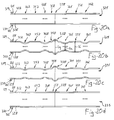
- the outer sides 29, 30 of the wings 27, 28 with the braking races 31, 32 are waved: indeed, at each spoke attachment area 41-48, the outer sides 29, 30 of the rim 21 are a shorter distance Da apart in the axial direction (with reference to the axis of the wheel 33) than their distance Di at the intermediate areas 51-58.
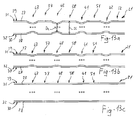
- the distance in the axial direction between the outer sides 29, 30 varies progressively between the spoke attachment areas 41-48 and the intermediate areas 51-58, as shown by figure 13a .
- the rim 21, and in particular the wings 27, 28 on whose outer sides 29, 30 the braking races 31, 32 are formed undergo a deformation (as already explained with reference to the prior art) such that the distance between the wings 27, 28 and more specifically between the outer sides 29, 30 at the spoke attachment areas 41-48 increases.
- the result is that the distance between the outer sides 29, 30 with the braking races 31, 32 of the rim 21 has lower variations with respect to the rim 21 without spokes (as shown in fig. 13b ).
- the rim 21 of figure 13a can be obtained, in general, according to what is described in the cited document EP 1 231 077 , by providing that the shape of the mould in the area for forming the wings has the desired waved shape.
- Figures 14 and 15 show perspective view of a rim 121 and a wheel 133 according to a different embodiment of the invention.
- the wheel 133 represented is again a rear wheel, of the type with grouped spokes, and comprises the rim 121, a hub 134 and a set of spoke connections 135 between the hub 134 and the rim 121.
- the rim 121 is of the metallic type, made through extrusion of a rod of suitable cross section, calendering it and jointing the ends at a jointing area 138. Therefore, figures 4a to 4c are also representative of the section of the rim 121 and of the wheel 133, in circumferential areas different to the jointing area 138. Such figures 4a to 4c therefore also display the reference numerals of the wheel 133 in brackets.
- a hole 137 is made to house a valve for retaining air inside the tyre 136 that can be associated with the outside of the rim 121.
- the jointing in the area 138 is carried out by butt welding of the ends of the extruded and calendered rod.
- a pair of full metallic inserts 139, 140 are inserted into the chamber 122 of the rim 121, used to allow the ends to be gripped with suitable pincers during welding without the risk of deforming the rim 121.
- the jointing in the area 138 can take place through a sleeve, inserted with interference and with a possible gluing substance in the inner chamber 122 of the rim 121.
- the joining in the area 138 can take place through pins inserted in the wall of the ends of the rim 121.
- Figure 16a schematically shows a blank of the rim 121 after extrusion, calendering, joining in the jointing area 138 and after the braking races 131, 132 have been formed (for example by turning) on the outer sides 129, 130 of the wings 127, 128.
- a deformation is carried out on such a preform of figure 16a (for example with one of the processes described hereafter) so that the outer sides 129, 130 of the wings 127, 128 of the rim 121 at the spoke attachment areas 141-148 are a shorter distance Da apart than the distance Di apart of the outer sides 129, 130 of the wings 127, 128 of the rim 121 at the intermediate areas 151-158 ( figure 16b ).
- the distance in the axial direction between the outer sides 129, 130 varies progressively between the spoke attachment areas 141-148 and the intermediate areas 151-158, as shown by figure 16b .
- the rim 121 When the wheel 133 is assembled using the rim 121 and the spokes 135 are tightened between the rim 121 and the hub 134, the rim 121, and in particular the outer sides 129, 130 of the wings 127, 128 on which the braking races 131, 132 are formed, undergo a deformation (as already explained with reference to the prior art) such that the distance between the outer sides 129, 130 at the spoke attachment areas 141-148 increases, without however reaching the distance at the intermediate areas 151-158.
- the result is that the distance between the outer sides 129, 130 with the braking races 131, 132 of the rim 121 has smaller variations than the rim 121 without spokes, as shown in figure 16c .
- the tyre 136 When, finally, the tyre 136 is mounted on the wheel 133 and inflated, there is a deformation of the wings 127, 128 outwards with a non-uniform increase in the distance between the outer sides 129, 130 with the braking races 131, 132 along the circumference: in the jointing area 138 the rigidity of the rim 121 is greater and the deformation occurs to a lower extent, whereas in the spoke attachment areas 141-148 the rigidity of the rim 121 is less and the deformation occurs to a greater extent. However, the greater deformation in the spoke attachment areas 141-142 is compensated by the residual inward deformation.
- Figures 17a-17c show a variant of the steps described in figures 16a-16c for making the same wheel 133, in which first the spokes 135 are tightened and then the deformation of the rim 121 is carried out.
- the spokes 135 are mounted and tightened on the preform ( figure 17a ).
- the tightening involves an outward deformation of the wings 127, 128 at the spoke attachment areas 141-148 ( figure 17b ).
- the inward deformation of the wings 127, 128 is carried out ( figure 17c ) at the spoke attachment areas 141-148 to obtain a shorter distance Da compared to the distance Di existing between the wings 127, 128 in the intermediate areas 151-158.
- the tyre 136 When, finally, the tyre 136 is mounted on the wheel 133 and inflated, there is an outward deformation of the wings 127, 128 with a non-uniform increase in the distance between the outer sides 129, 130 with the braking races 131, 132 along the circumference: in the jointing area 138 the rigidity of the rim 121 is greater and the deformation occurs to a lower extent, whereas in the spoke attachment areas 141-148 the rigidity of the rim 121 is less and the deformation occurs to a greater extent. However, the greater deformation in the spoke attachment areas 141-142 is compensated by the residual inward deformation.
- the rim 121 shall have the same shape obtained with the previous process before the assembly of the spokes 135, i.e. that of figure 16b .
- Figures 19a and 19b show perspective views of a rim 221 and a wheel 233 according to a different embodiment of the invention.
- the wheel 233 represented is a front wheel, of the type with equally distributed single spokes, and comprises the rim 221, a hub 234 and a set of spoke connections 235 between the hub 234 and spoke attachment areas 249 on the rim 221, alternating with intermediate areas 259.
- the rim 221 is of the metallic type, made through extrusion of a rod having a suitable cross section, calendering it and joining the ends at a jointing area 238. Therefore, figures 4a to 4c are also representative of the section of the rim 221 and of the wheel 233, in circumferential areas different to the jointing area 238. Such figures 4a to 4c thus also display the reference numerals of the wheel 233, in brackets.
- a hole 237 is made in the rim 221 to house a valve for retaining air inside the tyre 236 that can be associated with the outside of the rim 221.
- the jointing in the area 238 is carried out by butt welding of the ends of the extruded and calendered rod.
- a pair of full metallic inserts 239, 240 (summarily shown in figure 19a ) are inserted into the chamber 222 of the rim 221, used to allow the ends to be gripped with suitable pincers during welding without the risk of deforming the rim 221.
- Figures 18a to 18c refer to the rim 221 and to the wheel 233 .
- Figure 18a schematically shows a blank of the rim 221 after extrusion, calendering, joining in the jointing area 238 and after the braking races 231, 232 have been formed (for example by turning) on the outer sides 229, 230 of the wings 227, 228.
- a deformation is made on the preform of figure 18a (for example with one of the processes described hereafter) so that, in the rim 221, the outer sides 229, 230 of the wings 227, 228 with the braking races 231, 232, are a greater distance Dg apart at the jointing area 238 than the distance D of the outer sides 229, 230 in the other areas (widening of the jointing area 238, figure 18b ).
- the distance in the axial direction between the outer sides 229, 230 varies progressively between the jointing area 238 and the adjacent areas, as shown by figure 18b .
- Figures 20a to 20d refer to a rim 321 and to a wheel 333 similar to the rim 121 and wheel 133 described above; in particular, the rim 221 is of the metallic type with a jointing area 338 and the wheel 333 has the same distribution of the spokes as the type described above.
- figures 14 and 15 are also representative of the rim 321 and of the wheel 333. Such figures thus also display the reference numerals of the wheel 333, in brackets.
- figures 4a to 4c are also representative of the section of the rim 321 and of the wheel 333, in circumferential areas different to the jointing area 338. Such figures 4a to 4c thus also display the reference numerals of the wheel 333 in brackets.
- a first deformation is made on the preform of figure 20a (for example with one of the processes described hereafter) so that, in the rim 321, the outer sides 329, 330 of the wings 327, 328 with the braking races 331, 332, are a shorter distance Da apart at the spoke attachment areas 341-348 than the distance Di of the outer sides 329, 330 with the braking races 331, 332 of the rim 321 at the intermediate areas 351-358.
- a second deformation is then made so that the outer sides 329, 330 of the wings 327, 328 of the rim 321 are a greater distance Dg apart at the jointing area 338 than the distance Di of the outer sides 329, 330 in the adjacent areas.
- the distance in the axial direction between the outer sides 329, 330 varies progressively between the jointing area 338 and the adjacent areas and between the spoke attachment areas 341-348 and the intermediate areas 351-358, as shown by figure 20b .
- the tyre 336 When, finally, the tyre 336 is mounted on the wheel 333 and inflated, there is an outward deformation of the wings 327, 328 with a non-uniform increase in the distance between the outer sides 329, 330 with the braking races 331, 332 along the circumference: in the jointing area 338 the rigidity of the rim 321 is greater and the deformation occurs to a lower extent, whereas in the spoke attachment areas 341-348 the rigidity of the rim 321 is less and the deformation occurs to a greater extent. However, the reduced deformation in the jointing area 338 is compensated by the previous outward deformation, as well as the greater deformation in the spoke attachment areas 341-348 is compensated by the residual inward deformation. In the wheel 333 with the tyre 336 inflated, therefore, the localised waving effect in the jointing area 338 due to the joint and the distributed waving effect are reduced and, at best, are inexistent (as shown in figure 20d ).
- the distance between the outer sides 329, 330 of the wings 327, 328 with the braking races 331, 332 has smaller variations, and at best no variation, along the entire circumference of the wheel 333, including the jointing area 338.
- Figures 21a-21d show a variant of the steps described in figures 20a-20d for making the same wheel 333, in which first the spokes 335 are tightened and then the rim 321 is deformed.
- the spokes 335 are mounted on the preform ( figure 21 a) and tightened.
- the tightening involves an outward deformation of the wings 327, 328 at the spoke attachment areas 341-348 ( figure 21b ).
- a first deformation is carried out to deform the wings 327, 328 inwards at the spoke attachment areas 341-348 to obtain a shorter distance Da than the distance Di existing between the wings 327, 328 in the intermediate areas 351-358.
- the tyre 336 When, finally, the tyre 336 is mounted on the wheel 333 and inflated, there is an outward deformation of the wings 327, 328 with a non-uniform increase in the distance between the outer sides 329, 330 with the braking races 331, 332 along the circumference: in the jointing area 338 the rigidity of the rim 321 is greater and the deformation occurs to a lower extent, whereas in the spoke attachment areas 341-348 the rigidity of the rim 321 is less and the deformation occurs to a greater extent. However, the lower deformation is compensated by the previous outward deformation, just as the greater deformation in the spoke attachment areas 341-348 is compensated by the residual inward deformation. In the wheel 333 with the tyre 336 inflated, therefore, the localised waving effect due to the jointing 338 is reduced and, at best, is inexistent ( figure 21d ).
- the distance between the outer sides 329, 330 of the wings 327, 328 with the braking races 331, 332 has smaller variations, and at best no variation, along the entire circumference of the wheel 333, including the jointing area 338.
- the rim 321 shall have the same shape obtained with the previous process before the assembly of the spokes 335, i.e. that of figure 20b .
- a deformation is carried out on such a preform of figure 22a (for example with one of the processes described hereafter, in particular the one illustrated in figures 26a to 26d ) so that, in the rim 221, the outer sides 229, 230 of the wings 227, 228 with the braking races 231, 232 of the rim 221 are a greater distance Dg apart at the jointing area 238 than the distance D of the outer sides 229, 230 in the other areas (similarly to what has been seen for figures 18a-18c ).
- a rim like the rims shown and described above can be made in various ways so as to compensate the flaring effect.
- the shape of the rim ( figures 3a and 4a ) with the wings converging is achieved directly in the moulding step of the rim (for example using the process described in EP 1 231 077 and modifying the shape of the mould in accordance with the profile to be obtained).
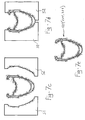
- rims made from metal and as shown in figures 5a-5c and 6a-6c it can be provided to start from an extruded piece with the wings of suitable section (increased), then machining the outer sides of the wings along the entire circumference (turning) so that they have the desired inclination.
- Another alternative is to provide a standard extruded piece (for example the one shown in figure 2a ) that is then inserted inside two suitably shaped half-moulds S1 and S2, as schematically indicated in figures 7a to 7d ; the closing of the half-moulds S1 and S2 determines the deformation of the wings along the entire circumference and therefore the desired shape of figure 7e (that corresponds to the rim of figure 4a ).
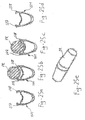
- the wing 228 is gripped between the ends of the arms P1 and P2 of a pincer P ( figure 23b ).
- the pincer P is rotated ( figure 23c ) in a controlled manner so that the wing 228 is deformed by a predetermined amount (for example 0.1mm).
- the operation is repeated in an analogous way for the other wing 227.
- the final effect shall be a widening of the wings 227, 228, and therefore an increase in distance between the outer sides 229, 230, by 0.2mm ( figure 23d ).
- the deformation of the wings can be carried out inwards.
- the rim 221 is inserted in two half-moulds S1 and S2.
- two punches S3 and S4 are inserted ( figure 24b ) that push the wings 227, 228 against the respective shaped walls of the half-moulds S1 and S2 ( figure 24c ).
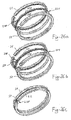
- a presser element PR in the form of a tapered toroidal slug ( figure 25e ) is pushed radially from the outside towards the centre of the rim 221 ( figure 25c ) to deform the wings 227, 228 outwards.
- an element of thickness SP is inserted to keep the jointing area 238 at the distance Dg ( figure 19b ).
- the rim 221 is then inserted into two half-moulds S1, S2 that push the wings 227, 228 to the distance apart D for the entire circumference, except for the jointing area 238 where the element of thickness SP is located.
- each of the compensations of the flaring, distributed waving and localised waving effects can be implemented alone or with one or more of the others on the same rim.
- the compensation of the flaring effect has been illustrated, but there could also be a compensation of the distributed waving effect and/or (if the rim 1 is metallic) of the localised waving effect.
- the compensation of the distributed waving effect has been illustrated, but not of the localised waving effect and of the flaring effect, which are still present since the rim 121 is made from metal, with jointing.
- the compensation of the localised waving effect has been illustrated, but not of the distributed waving effect and of the flaring effect, which are still present since the rim 221 is made from metal, with jointing.
- the compensation both of the distributed waving effect and of the localised waving effect have been illustrated.
Landscapes
- Engineering & Computer Science (AREA)
- Mechanical Engineering (AREA)
- Chemical & Material Sciences (AREA)
- Materials Engineering (AREA)
- Tires In General (AREA)
- Steering Devices For Bicycles And Motorcycles (AREA)
- Motorcycle And Bicycle Frame (AREA)
Abstract


Description
- The present invention refers to a rim for a bicycle wheel, to a wheel comprising such a rim and to a process for making such a rim and such a wheel.
- In common usage, the term rim is often used to refer to a wheel (of a bicycle or other) without a tyre. However, in the following description, by the term rim it is meant to indicate more precisely the peripheral part of the wheel of a bicycle to which the tyre is fitted. Normally, therefore, a wheel comprises a rim connected to a hub through a plurality of spokes or arms.
- Typical configurations of the cross section of a bicycle rim are U-shaped or inverted A-shaped. In U-shaped rims there are two side walls and a radially inner circumferential wall, also known as "lower bridge" or even simply "bridge" (in the absence of other bridges). In inverted A-shaped rims, on the other hand, there is both a "lower bridge" and an "upper bridge"; more specifically, there is a radially inner portion of the cross section of the rim, formed from a chamber defined by the upper bridge (outer in the radial direction), by two side walls and by the lower bridge (inner in the radial direction).
- The side walls of the rim extend radially outwards, beyond the lower bridge in the case of a U-shaped rim and beyond the upper bridge in the case of an inverted A-shaped rim, to define circumferential wings for fitting a tyre. The circumferential wings have outer sides in the form of outer annular surfaces substantially parallel with respect to the middle plane of the rim (and substantially parallel to each other). On such outer sides, braking races are normally formed that provide braking surfaces on which the two brake pads close.
- Making rims from metal, in particular aluminium, involves extruding a profile with a section substantially the same as that desired for the final rim, cutting a blank of the profile, calendering it to obtain a circular element, and finally jointing end-to-end, for example through the insertion of a joint that is glued to the inner walls of the chamber, or else through welding with the insertion of one or more joints glued or in any case fixed in the chamber of the rim, or else through pins or similar. The circular element is then perforated to make the holes to mount the spokes in predetermined spoke attachment areas, which follow one another circumferentially alternating with intermediate areas; a machining process (turning) is also carried out on the outer sides of the wings to form the braking races with braking surfaces parallel to one another, which are therefore a constant distance apart for the entire circumference of the rim.
- It should be noted that by spoke attachment area in general a portion is meant, extending circumferentially on the rim, in which a single spoke or else a set of spokes grouped close together are fastened.
- Then the spokes are connected to the holes of the rim and to the central hub and then the spokes are tightened to make the wheel.
- Finally, the tyre and the inner tube (if provided) are mounted and then inflation takes place according to the desired pressures (normally between 6 and 10 atm).
- In rims made from composite material, the braking races with parallel braking surfaces are obtained during the moulding step of the rim itself. Unlike rims made from metallic material, rims made from composite material have no jointing, since they are already annular from the outset.
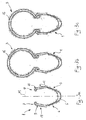
- It has been found that in practice known wheels that use the described rims have the drawback that at the moment of inflation of the tyre the circumferential wings for fitting the tyre deform outwards under the pressure of the tyre; as a result of this there is a flaring effect of the wings that leads to both an increase in the distance between the wings and therefore between the braking races along the entire circumference, and above all a loss of parallelism of the wings and therefore of the braking races, with a reduction in the braking efficiency of the brake pads when they rest on the braking races and with problems of air seal for wheels with tubeless tyres. This flaring effect is shown in
figures 1a and 1b and infigures 2a and 2b , for U-shaped and inverted A-shaped rims, respectively. Infigures 1a and2a the tyre mounted on the rim is deflated, whereas infigure 1b and2b the tyre is inflated. - It has also been found that in practice known wheels that use the described rims have the drawback that the distance between the wings is not constant along the circumference of the wheel (waving effect), with problems of vibration and noisiness during braking caused by the pads that push upon the wings and with problems of air seal for wheels with tubeless tyres.
- The waving of the distance between the wings and therefore between the braking races is induced on the rim during the assembly of the wheel. The degree of waving depends upon the type of material used and upon the type of geometry of the section of the rim (shape, length of the side walls, etc.).
- A first type of waving, distributed over the entire circumference of the wheel, is caused at the moment when the spokes are tightened, to a particularly marked extent in wheels with the spokes grouped together, since the traction force, oriented towards the centre of the rim in the spoke attachment area due to the spokes being tightened, causes a variation in distance between the wings and therefore between the braking races.
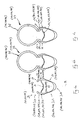
- In the case of rims with U-shaped configuration (schematic views of
figures 8a-8c in which such views represent a blank of the rim seen from the outside along its extension), the bridge is substantially pulled by the spokes towards the centre of the rim and the wings move towards one another; therefore, the distance between the wings in the spoke attachment area is in the end less than the distance between the wings in the intermediate areas (figure 8b ). When the tyre is mounted on the wheel and inflated, the wings also undergo the flaring effect described above, since they are pushed laterally outwards by the pressure of the tyre along the entire circumference of the rim; and therefore the wings move apart (figure 8c ). The distributed waving effect of the spoke attachment area therefore arises once again on the wheel with the tyre inflated, in addition to the flaring effect. - In the case of rims with inverted A-shaped configuration, with spokes attached to the lower bridge (schematic views of
figures 9a-9c in which such views represent a blank of the rim seen from the outside along its extension), when the section is pulled by the spokes towards the centre of the rim, due to the presence of the upper bridge, there is a deformation of the wings outwards at the spoke attachment area; therefore, in the end in the spoke attachment areas the distance between the wings is greater than the distance between the wings in the intermediate areas creating the waving effect (figure 9b ). When the tyre is mounted on the wheel and inflated, the wings also undergo the flaring effect described above, being pushed laterally outwards by the pressure of the tyre along the entire circumference of the rim; therefore the wings move apart (figure 9c ). Moreover, because of the different rigidity of the rim in the spoke attachment areas compared to the intermediate areas, due to the traction of the spokes, the waving effect with the tyre inflated (fig. 9c ) is increased with respect to the waving effect with the tyre deflated (fig. 9b ). In the spoke attachment areas, therefore, the wings subjected to the pressure of the inflated tyre undergo a greater deformation than the deformation that they undergo in the intermediate areas. The distributed waving effect of the spoke attachment area arises once again on the wheel with the tyre inflated, in addition to the flaring effect. - For both the U-shaped and inverted A-shaped configurations, the variation in distance between the wings in the spoke attachment areas compared to the distance between the wings in the intermediate areas results in a waving effect of the braking races; this waving is distributed, i.e. substantially repeats cyclically along the circumference of the rim according to the distribution of the spokes. This distributed waving occurs both on metallic rims, and on rims made from composite material, since it is not linked to the type of material from which the rim is made nor to the possible presence of a joint.
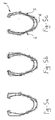
- A second type of waving (
figures 10a-10b ), not distributed cyclically along the circumference of the rim but rather localised in a single area, is caused at the moment of inflation of the tyre on wheels provided with rims with a joint, both in wheels with single spokes (to whichfigures 10a and 10b refer) and in wheels with grouped spokes. The inflation of the tyre, as stated above, results in an inevitable deformation of the wings that are pushed outwards by the pressure of the tyre. However, such a deformation is not homogeneous along the entire circumference of the rim, since at the jointing area the rim has a greater rigidity than at the other areas of the rim. In particular, the greater rigidity of the jointing area is due to the welding on the one hand and to the joints inserted on the other (in rims with welding and joint such an effect is the sum of the two, whereas it is less evident where jointing is carried out with a joint glued to the wall of the chamber of the rim and without welding). - Therefore, the deformation of the wings in the jointing area is less than the deformation of the wings in the rest of the rim. In the wheel provided with an inflated tyre, therefore, the braking surfaces have a narrowing at the jointing area (localised waving), as shown in
fig. 10b. Fig. 10c shows (for a wheel with grouped spokes) both the effect of localised waving in the jointing area, and the distributed waving effect due to the spokes being tightened, as represented infigures 9a-9c . Localised waving is normally of a greater magnitude (about double) compared to distributed waving caused by the spokes being tightened. - Consequently, the problem at the basis of the present invention is to improve the braking efficiency and the air seal, for wheels with tubeless tyres.
- Such a problem is solved by a rim according to claim 1, by a wheel according to claim 13, by a process according to claim 19 as well as by a process according to
claim 28. - More specifically, a rim according to the invention, suitable for being coupled with a hub through a plurality of spokes tightened to form a bicycle wheel, comprises a pair of wings connected by at least one bridge, a plurality of spoke attachment areas alternating in the circumferential direction with a plurality of intermediate areas in said at least one bridge, and is characterised in that the axial distance between the wings at the spoke attachment areas is different from the axial distance between the wings at the intermediate areas.
- In this way, it is possible to induce an advance deformation in the rim before it is assembled in a wheel, in the direction opposite the direction of deformation by distributed waving that the rim will undergo afterwards, due to assembly in the wheel; consequently, the wheel can in the end have a substantially reduced distributed waving (possibly even zero waving), with an improvement in the air seal in the case of assembly of a wheel with a tubeless tyre.
- In the case in which each wing has an outer side on which a braking race is formed, an improvement in braking efficiency is also obtained.
- Preferably, the axial distance between the wings is measured between the outer sides thereof.
- In the case in which the rim comprises a single bridge between the pair of wings (U-shaped configuration), the axial distance between the wings at the spoke attachment areas is greater than the axial distance between the wings at the intermediate areas.
- In the case in which the rim comprises a lower bridge and at least one upper bridge between the pair of wings (inverted A-shaped configuration or configuration with many chambers), the axial distance between the wings at the spoke attachment areas is less than the axial distance between the wings at the intermediate areas.
- Preferably, the axial distance between the wings at the spoke attachment areas is the same for all the spoke attachment areas; preferably, the axial distance between the wings at the intermediate areas is the same for all of the intermediate areas. In this way, the deformations in the wheel by distributed waving are compensated uniformly over the entire circumference.
- In a preferred embodiment, the axial distance between the wings at the spoke attachment areas is the same for all the spoke attachment areas and the axial distance between the wings at the intermediate areas is the same for all of the intermediate areas, and moreover the difference in axial distance between the wings is such as to compensate for the axial deformation induced on the wings when the rim is mounted in a wheel with the spokes tightened, so that in the mounted wheel the wings are the same distance apart in the spoke attachment areas and in the intermediate areas.
- Preferably, the axial distance between the wings varies progressively between the spoke attachment areas and the intermediate areas. This gradual variation is not only easier to obtain, but also best corresponds to the corresponding gradual deformations by distributed waving.
- The rim can be made from composite material or else metal, from a blank that is extruded, calendered into circular shape and closed upon itself through jointing between the ends of the blank. In this last case, when the rim is mounted in a wheel and the tyre is inflated, there is also the drawback of localised waving, and therefore the axial distance between the wings at the jointing area is preferably provided to be greater than the axial distance between the wings at the areas far from the jointing area.
- Preferably, the axial distance between the wings at the jointing area is greater than the axial distance between the wings at the spoke attachment areas as well as the axial distance between the wings at the intermediate areas.
- In a second aspect, the invention concerns, in particular, a spoked bicycle wheel, comprising a hub, a rim according to what has been described above and a plurality of spokes tightened between the hub and the rim, in which the wings of the rim subjected to the tension of the spokes have a smaller variation in distance apart at the spoke attachment areas and at the intermediate areas than in the rim without spokes tightened; preferably, the variation in distance is substantially zero.
- Preferably, the same distance between the wings is also provided at the jointing area, if present and with the tyre inflated.
- Preferably, when the tyre is dismounted from the wheel or else - if it is mounted - it is flat, the wings converge, and even more preferably, when the tyre is mounted on the wheel and it is inflated, the wings converge less and at best are parallel.
- In a third aspect, the invention concerns a process for making a rim, suitable for being coupled with a hub through a plurality of spokes tightened to form a bicycle wheel, comprising the steps of:
- a) making a rim comprising a pair of wings connected by at least one bridge;
- b) providing a plurality of spoke attachment areas and a plurality of intermediate areas in said at least one bridge, alternating in the circumferential direction;
- Preferably, the process also comprises the step of:
- c) forming a braking race on the outer side of each of the wings.
- Preferably, above all for metallic rims, step a) comprises the substeps of:
- a1a) forming the rim with the wings spaced apart uniformly along the entire circumference;
- a1b) deforming the wings varying the distance between them at the spoke attachment areas and/or at the intermediate areas.
- Preferably, step a1b) comprises bending the wings inwards and/or outwards at the spoke attachment areas and/or at the intermediate areas, or else removing material from outer sides of the wings at the spoke attachment areas and/or at the intermediate areas.
- In the case of rims made from composite material, on the other hand, preferably step a) provides:
- a2) forming the rim directly with the wings spaced apart non-uniformly along the circumference.
- According to a preferred embodiment, step c) is carried out after substep a1a) and before substep a1b).
- Preferably, the rim is made from metal from a blank that is extruded, shaped into circular shape and closed upon itself through jointing between the ends of the blank, and the process also comprises the step of:
- d) deforming the wings so that the axial distance between the wings at the jointing area is greater than the axial distance between the wings at the areas far from the jointing area.
- Preferably, the wings are formed so that they converge, by this meaning that they are inclined towards each other.
- In a fourth aspect, the invention concerns a process for making a bicycle wheel, comprising the steps of:
- a) making a rim comprising a pair of wings connected by at least one bridge;
- b) providing a plurality of spoke attachment areas and a plurality of intermediate areas in said at least one bridge, alternating in the circumferential direction;
- c) connecting the rim with a hub through spokes;
- d) tightening the spokes between the hub and said spoke attachment areas of said at least one bridge;
- Preferably, the process also comprises the step of:
- e) forming a braking race on the outer side of each of the wings.
- Preferably, above all with metallic rims, step a) comprises the substeps of:
- a1a) forming the rim with the wings spaced apart uniformly along the entire circumference;
- a1b) deforming the wings varying the distance between them at the spoke attachment areas and/or at the intermediate areas.
- Preferably, step a1b) comprises bending the wings inwards and/or outwards at the spoke attachment areas and/or at the intermediate areas, or else removing material from the outer sides of the wings at the spoke attachment areas and/or at the intermediate areas.
- In the case of rims made from composite material, on the other hand, it is preferable:
- a2) to form the rim directly with the wings spaced apart non-uniformly along the circumference.
- According to a preferred embodiment, step e) is carried out after substep a1a) and before substep a1b). Furthermore, according to another preferred embodiment, step e) is carried out after step d).
- Preferably, the rim is made from metal from a blank that is extruded, shaped into circular shape and closed upon itself through jointing between the ends of the blank, and the process also comprises the steps of:
- f) deforming the wings so that the axial distance between the wings at the jointing area is greater than the axial distance between the wings at the areas far from the jointing area;
- g) mounting a tyre on the rim;
- h) inflating the tyre mounted on the rim to a predetermined inflation pressure, so that the variation in axial distance between the wings at the jointing area compared to the axial distance between the wings at the areas far from the jointing area is reduced, more preferably cancelled out.
- Preferably, the wings are formed so that they converge, by this meaning that they are inclined towards one another. Even more preferably, in the step of:
- h) inflating the tyre mounted on the rim to a predetermined inflation pressure,
- Further characteristics and advantages of the present invention shall become clearer from the following detailed description of some preferred embodiments thereof, made with reference to the attached drawings. In such drawings:
-
figures 1a and 1b show a wheel with a rim of the prior art with U-shaped configuration, in two configurations with the tyre deflated and with the tyre inflated, respectively; -
figures 2a and 2b show a wheel with a rim of the prior art with inverted A-shaped configuration, in two configurations with the tyre deflated and with the tyre inflated, respectively; -
figure 3a shows a section of a rim according to the invention, with U-shaped configuration; -
figure 3b shows a section of a wheel that uses the rim offigure 3a , with the tyre mounted and deflated; -
figure 3c shows the wheel offigure 3b , with the tyre inflated; -
figure 4a shows a section of a rim according to the invention, with inverted A-shaped configuration; -
figure 4b shows a section of a wheel that uses the rim offigure 4a , with the tyre mounted and deflated; -
figure 4c shows the wheel offigure 4b , with the tyre inflated; -
figures 5a to 5c show the steps of a process for obtaining the rim offigure 3a ; -
figures 6a to 6c show the steps of a process for obtaining the rim offigure 4a ; -
figures 7a to 7e show the steps of another process for obtaining the rim offigure 4a ; -
figures 8a to 8c ,9a to 9c and10a to 10c show rims of the prior art with the waving effects highlighted; more specifically:-
figure 8a shows a rim with U-shaped configuration and with grouped spokes before the spokes are applied and tightened; -
figure 8b shows the rim offigure 8a after the spokes are tightened; -
figure 8c again shows the rim offigure 8a after it has been mounted in a wheel and the tyre has been inflated; -
figure 9a shows a rim with inverted A-shaped configuration and with grouped spokes before the spokes are applied and tightened; -
figure 9b shows the rim offigure 9a after the spokes are tightened; -
figure 9c again shows the rim offigure 9a after it has been mounted in a wheel and the tyre has been inflated; -
figure 10a shows a rim with single spokes, before it has been mounted in a wheel; -
figure 10b shows the rim offigure 10a after it has been mounted in a wheel and the tyre has been inflated; -
figure 10c shows a rim with grouped spokes, after the spokes have been tightened and after it has been mounted in a wheel and the tyre has been inflated;
-
-
figure 11 shows an axonometric view of a rim according to the invention, of the type made from composite material, without a joint, having a section as shown infigure 4a ; -
figure 12 shows an axonometric view of a rear wheel with grouped spokes that uses the rim offigure 11 , without a tyre; -
figures 13a and 13b schematically show steps of a process for obtaining the wheel offigure 12 ; -
figure 14 shows an axonometric view of a rim according to the invention, of the metallic type, with a joint, having a section as shown infigure 4a ; -
figure 15 shows an axonometric view of a rear wheel with grouped spokes that uses the rim offigure 14 , without a tyre; -
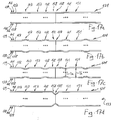
figures 16a to 16c and17a to 17c , schematically show process steps for obtaining the wheel offigure 15 ; -
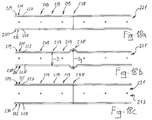
figures 18a to 18c schematically show the steps of a process for obtaining the wheel offigure 19b ; -
figure 19a shows an axonometric view of a rim according to the invention, of the metallic type, with a joint, having a section as shown infigure 4a ; -
figure 19b shows an axonometric view of a front wheel with single spokes that uses the rim offigure 19a , without a tyre; -
figures 20a to 20d and21a to 21d , schematically show process steps for obtaining the wheel offigure 15 ; -
figures 22a to 22c schematically show the steps of a process for obtaining the wheel offigure 19b ; -
figures 23a to 23d ,24a to 24d ,25a to 25e ,26a to 26c schematically show deformation processes of the wings. -
Figure 3a shows the section of a rim 1 according to the invention that has a section with U-shaped configuration comprising twoside walls 4, 5 and a radially inner circumferential wall 6 (lower bridge). Theside walls 4, 5 extend radially outwards to define twocircumferential wings 7, 8 for fitting atyre 16. Thecircumferential wings 7, 8 haveouter sides 9, 10 on which braking races 11, 12 are formed that provide braking surfaces on which the two brake pads (not shown) close during braking. - As shown in
figure 3a , the braking races 11, 12 are not parallel to one another, but rather converge: their distance apart (and the distance from the middle plane M of the rim 1) decreases as the distance from the centre of the rim 1 increases. The progression shown in the figures is intentionally exaggerated in order to show this clearly; real values for such a narrowing are of the order of tenths of a mm. - The rim 1 is used to make a wheel 3, together with a hub connected to the rim 1 by spokes (neither the hub nor the spokes are shown in
figures 3a to 3c ) and to thetyre 16, mounted on the rim 1 between thewings 7, 8. When thetyre 16 is mounted on the rim 1 (figure 3b ) and then inflated (figure 3c ), thewings 7, 8 deform outwards, with a flaring effect. Such flaring is compensated by the original convergence of thewings 7, 8 and therefore in the wheel 3 with thetyre 16 inflated the braking races 11, 12 converge less and, at best, are parallel (as shown infig. 3c ). -
Figure 4a shows the section of arim 21 according to the invention that has an inverted A-shaped section. The radially inner body region is formed from achamber 22, defined by a radially outer circumferential wall orupper bridge 23, by twoside walls side walls circumferential wings tyre 36. Thecircumferential wings outer sides - As shown in
figure 4a , the braking races 31, 32 are not parallel to one another, but rather converge: their distance apart (and the distance from the middle plane M of the rim 21) decreases as the distance from the centre of therim 21 increases, starting substantially from the height of intersection with theupper bridge 23. A typical value of this narrowing is 0.15mm for eachwing - The
rim 21 is used to make awheel 33, together with a hub connected to therim 21 by spokes (the hub and the spokes are not shown infigures 4a to 4c , but are shown infigure 12 ) and to atyre 36, mounted on therim 21 between thewings tyre 36 is mounted on the rim 21 (figure 4b ) and then inflated (figure 4c ), thewings upper bridge 23, with a flaring effect. Such flaring is compensated in thewheel 33 with thetyre 36 inflated by the original convergence of thewings wheel 33 with thetyre 36 inflated the braking races 31, 32 converge less and, at best, are parallel (as shown infig. 4c ). -
Figures 11 and12 show perspective views of therim 21 and thewheel 33. - The
wheel 33 represented is a rear wheel, of the type with grouped spokes, and comprises therim 21, ahub 34 and a set ofspoke connections 35 between thehub 34 and therim 21. - The set of spoke connections 35 (also known as spoking) of the
wheel 33 comprises twenty-fourspokes 35 grouped in eight sets of three. There are therefore eight spoke attachment areas 41-48, each comprising three individual spoke attachment seats, alternating with eight intermediate areas 51-58. - The
rim 21 is made from composite material, for example made by moulding and cross linking or setting of a fibrous material, such a carbon fibre, in a matrix of polymeric material. The details on the construction of therim 21 in general can be found, for example, inEP 1 231 077 , incorporated here by reference. Therim 21 is in one piece, and therefore there is no jointing. - In the rim 21 a
hole 37 is formed for housing a valve for retaining air inside the tyre 36 (not shown infigures 11 and12 ) that can be associated with the outside of therim 21. - As schematically shown in
figure 13a , theouter sides wings outer sides rim 21 are a shorter distance Da apart in the axial direction (with reference to the axis of the wheel 33) than their distance Di at the intermediate areas 51-58. The progression shown in the figures is intentionally exaggerated for the sake of clarity; real values for Da and Di can, indeed, be Da=20.70mm and Di=20.80mm. - The distance in the axial direction between the
outer sides figure 13a . - When the
wheel 33 is assembled using therim 21 and thespokes 35 are tightened between therim 21 and thehub 34, therim 21, and in particular thewings outer sides wings outer sides outer sides rim 21 has lower variations with respect to therim 21 without spokes (as shown infig. 13b ). The subsequent assembly of the tyre and its inflation determine a further outward deformation of thewings figure 13c , such a deformation is such that the distance between theouter sides rim 21 does not vary and remains constant along the entire circumference of therim 21. - The
rim 21 offigure 13a can be obtained, in general, according to what is described in the cited documentEP 1 231 077 , by providing that the shape of the mould in the area for forming the wings has the desired waved shape. -
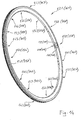
Figures 14 and15 show perspective view of arim 121 and awheel 133 according to a different embodiment of the invention. - The
wheel 133 represented is again a rear wheel, of the type with grouped spokes, and comprises therim 121, ahub 134 and a set ofspoke connections 135 between thehub 134 and therim 121. Unlike the embodiment offigures 11 and12 , therim 121 is of the metallic type, made through extrusion of a rod of suitable cross section, calendering it and jointing the ends at ajointing area 138. Therefore,figures 4a to 4c are also representative of the section of therim 121 and of thewheel 133, in circumferential areas different to thejointing area 138. Suchfigures 4a to 4c therefore also display the reference numerals of thewheel 133 in brackets. - In a position diametrically opposite the
jointing area 138, in the rim 121 ahole 137 is made to house a valve for retaining air inside the tyre 136 that can be associated with the outside of therim 121. - The jointing in the
area 138 is carried out by butt welding of the ends of the extruded and calendered rod. A pair of fullmetallic inserts 139, 140 (summarily shown infigure 14 ) are inserted into thechamber 122 of therim 121, used to allow the ends to be gripped with suitable pincers during welding without the risk of deforming therim 121. - As an alternative to the welding and to the insertion of the
inserts area 138 can take place through a sleeve, inserted with interference and with a possible gluing substance in theinner chamber 122 of therim 121. Again alternatively, the joining in thearea 138 can take place through pins inserted in the wall of the ends of therim 121. -
Figure 16a schematically shows a blank of therim 121 after extrusion, calendering, joining in thejointing area 138 and after the braking races 131, 132 have been formed (for example by turning) on theouter sides wings - A deformation is carried out on such a preform of
figure 16a (for example with one of the processes described hereafter) so that theouter sides wings rim 121 at the spoke attachment areas 141-148 are a shorter distance Da apart than the distance Di apart of theouter sides wings rim 121 at the intermediate areas 151-158 (figure 16b ). - The distance in the axial direction between the
outer sides figure 16b . - When the
wheel 133 is assembled using therim 121 and thespokes 135 are tightened between therim 121 and thehub 134, therim 121, and in particular theouter sides wings outer sides outer sides rim 121 has smaller variations than therim 121 without spokes, as shown infigure 16c . When, finally, the tyre 136 is mounted on thewheel 133 and inflated, there is a deformation of thewings outer sides jointing area 138 the rigidity of therim 121 is greater and the deformation occurs to a lower extent, whereas in the spoke attachment areas 141-148 the rigidity of therim 121 is less and the deformation occurs to a greater extent. However, the greater deformation in the spoke attachment areas 141-142 is compensated by the residual inward deformation. In thewheel 133 with the tyre 136 inflated, therefore, the distributed waving effect is reduced and, at best, is inexistent (as shown infigure 16d ), whereas the localised waving effect in thejointing area 138 due to the joint is not compensated. -
Figures 17a-17c show a variant of the steps described infigures 16a-16c for making thesame wheel 133, in which first thespokes 135 are tightened and then the deformation of therim 121 is carried out. Thespokes 135 are mounted and tightened on the preform (figure 17a ). The tightening, as stated, involves an outward deformation of thewings figure 17b ). At this point the inward deformation of thewings figure 17c ) at the spoke attachment areas 141-148 to obtain a shorter distance Da compared to the distance Di existing between thewings - When, finally, the tyre 136 is mounted on the
wheel 133 and inflated, there is an outward deformation of thewings outer sides jointing area 138 the rigidity of therim 121 is greater and the deformation occurs to a lower extent, whereas in the spoke attachment areas 141-148 the rigidity of therim 121 is less and the deformation occurs to a greater extent. However, the greater deformation in the spoke attachment areas 141-142 is compensated by the residual inward deformation. In thewheel 133 with the tyre 136 inflated, therefore, the distributed waving effect is reduced and, at best, is inexistent (as shown infigure 17d ), whereas the localised waving effect in thejointing area 138 due to the joint is not compensated. - It should be noted that, starting from the condition shown in
figure 17c , if thespokes 135 are loosened (or removed), therim 121 shall have the same shape obtained with the previous process before the assembly of thespokes 135, i.e. that offigure 16b . -
Figures 19a and19b show perspective views of arim 221 and awheel 233 according to a different embodiment of the invention. - The
wheel 233 represented is a front wheel, of the type with equally distributed single spokes, and comprises therim 221, ahub 234 and a set ofspoke connections 235 between thehub 234 and spokeattachment areas 249 on therim 221, alternating withintermediate areas 259. Therim 221 is of the metallic type, made through extrusion of a rod having a suitable cross section, calendering it and joining the ends at ajointing area 238. Therefore,figures 4a to 4c are also representative of the section of therim 221 and of thewheel 233, in circumferential areas different to thejointing area 238. Suchfigures 4a to 4c thus also display the reference numerals of thewheel 233, in brackets. - In a position diametrically opposite the
jointing area 238, ahole 237 is made in therim 221 to house a valve for retaining air inside the tyre 236 that can be associated with the outside of therim 221. - The jointing in the
area 238 is carried out by butt welding of the ends of the extruded and calendered rod. A pair of fullmetallic inserts 239, 240 (summarily shown infigure 19a ) are inserted into the chamber 222 of therim 221, used to allow the ends to be gripped with suitable pincers during welding without the risk of deforming therim 221. -
Figures 18a to 18c refer to therim 221 and to thewheel 233 . -
Figure 18a schematically shows a blank of therim 221 after extrusion, calendering, joining in thejointing area 238 and after the braking races 231, 232 have been formed (for example by turning) on theouter sides wings - A deformation is made on the preform of
figure 18a (for example with one of the processes described hereafter) so that, in therim 221, theouter sides wings jointing area 238 than the distance D of theouter sides jointing area 238,figure 18b ). - The distance in the axial direction between the
outer sides jointing area 238 and the adjacent areas, as shown byfigure 18b . - When the
wheel 233 is assembled using therim 221, thespokes 235 are tightened between therim 221 and thehub 234 and the tyre 236 is mounted on thewheel 233 and inflated, there is an outward deformation of thewings outer sides rim 221, except for thejointing area 238 in which the rigidity of therim 221 is greater and the deformation occurs to a lower extent (figure 18c ). However, such a lower deformation is compensated by the previous outward deformation. In thewheel 233 with the tyre 236 inflated, therefore, the localised waving effect due to the jointing is reduced and, at best, is inexistent (as shown infig. 18c ). -
Figures 20a to 20d refer to arim 321 and to awheel 333 similar to therim 121 andwheel 133 described above; in particular, therim 221 is of the metallic type with ajointing area 338 and thewheel 333 has the same distribution of the spokes as the type described above. - Therefore,
figures 14 and15 are also representative of therim 321 and of thewheel 333. Such figures thus also display the reference numerals of thewheel 333, in brackets. Moreover,figures 4a to 4c are also representative of the section of therim 321 and of thewheel 333, in circumferential areas different to thejointing area 338. Suchfigures 4a to 4c thus also display the reference numerals of thewheel 333 in brackets. - A first deformation is made on the preform of
figure 20a (for example with one of the processes described hereafter) so that, in therim 321, theouter sides wings outer sides rim 321 at the intermediate areas 351-358. A second deformation is then made so that theouter sides wings rim 321 are a greater distance Dg apart at thejointing area 338 than the distance Di of theouter sides - The distance in the axial direction between the
outer sides jointing area 338 and the adjacent areas and between the spoke attachment areas 341-348 and the intermediate areas 351-358, as shown byfigure 20b . - When the
wheel 333 is assembled using therim 321 described and thespokes 335 are tightened between therim 321 and thehub 334, therim 321 and in particular thewings outer sides figure 20c . - When, finally, the tyre 336 is mounted on the
wheel 333 and inflated, there is an outward deformation of thewings outer sides jointing area 338 the rigidity of therim 321 is greater and the deformation occurs to a lower extent, whereas in the spoke attachment areas 341-348 the rigidity of therim 321 is less and the deformation occurs to a greater extent. However, the reduced deformation in thejointing area 338 is compensated by the previous outward deformation, as well as the greater deformation in the spoke attachment areas 341-348 is compensated by the residual inward deformation. In thewheel 333 with the tyre 336 inflated, therefore, the localised waving effect in thejointing area 338 due to the joint and the distributed waving effect are reduced and, at best, are inexistent (as shown infigure 20d ). - The distance between the
outer sides wings wheel 333, including thejointing area 338. - In the
wheel 333, therefore, the distributed waving and localised waving effects are compensated. -
Figures 21a-21d show a variant of the steps described infigures 20a-20d for making thesame wheel 333, in which first thespokes 335 are tightened and then therim 321 is deformed. Thespokes 335 are mounted on the preform (figure 21 a) and tightened. The tightening, as stated, involves an outward deformation of thewings figure 21b ). At this point a first deformation is carried out to deform thewings wings wings outer sides jointing area 338 than the distances Da and Di of theouter sides - When, finally, the tyre 336 is mounted on the
wheel 333 and inflated, there is an outward deformation of thewings outer sides jointing area 338 the rigidity of therim 321 is greater and the deformation occurs to a lower extent, whereas in the spoke attachment areas 341-348 the rigidity of therim 321 is less and the deformation occurs to a greater extent. However, the lower deformation is compensated by the previous outward deformation, just as the greater deformation in the spoke attachment areas 341-348 is compensated by the residual inward deformation. In thewheel 333 with the tyre 336 inflated, therefore, the localised waving effect due to thejointing 338 is reduced and, at best, is inexistent (figure 21d ). - The distance between the
outer sides wings wheel 333, including thejointing area 338. - It should be noted that, starting from the condition shown in
figure 21d , if the tyre 336 is deflated and thespokes 335 are loosened (or removed), therim 321 shall have the same shape obtained with the previous process before the assembly of thespokes 335, i.e. that offigure 20b . - For the described solutions, it is possible to provide an alternative dual process of deformation of the rim. As an example hereafter the description of such an alternative is given for the wheel 233 (
figures 18a-18c ), with reference tofigures 22a to 22c . - A deformation is carried out on such a preform of
figure 22a (for example with one of the processes described hereafter, in particular the one illustrated infigures 26a to 26d ) so that, in therim 221, theouter sides wings rim 221 are a greater distance Dg apart at thejointing area 238 than the distance D of theouter sides figures 18a-18c ). In this case, however, instead of widening thejointing area 238, one starts from a preform with theouter sides wings figure 22a ) and thewings figure 22b ). At this point thespokes 235 are mounted and tightened and the tyre 236 is mounted and inflated (figure 22c ) similarly to what has been seen with reference tofigure 18c . - A rim like the rims shown and described above can be made in various ways so as to compensate the flaring effect.
- In the case of a rim made from composite material, the shape of the rim (
figures 3a and4a ) with the wings converging is achieved directly in the moulding step of the rim (for example using the process described inEP 1 231 077 and modifying the shape of the mould in accordance with the profile to be obtained). - In the case of a rim made from aluminium (or another metal), it is possible to make the extruded piece directly with the modified shape of the rim (
figures 3a and4a ). - Alternatively, again for rims made from metal and as shown in
figures 5a-5c and6a-6c , it can be provided to start from an extruded piece with the wings of suitable section (increased), then machining the outer sides of the wings along the entire circumference (turning) so that they have the desired inclination. - Another alternative is to provide a standard extruded piece (for example the one shown in
figure 2a ) that is then inserted inside two suitably shaped half-moulds S1 and S2, as schematically indicated infigures 7a to 7d ; the closing of the half-moulds S1 and S2 determines the deformation of the wings along the entire circumference and therefore the desired shape offigure 7e (that corresponds to the rim offigure 4a ). - A possible process for obtaining a deformation of the wings, in this particular case an outward deformation, is described with reference to
figures 23a to 23d . - At the area to be widened (for example at the
jointing 238 of the rim 221), thewing 228 is gripped between the ends of the arms P1 and P2 of a pincer P (figure 23b ). The pincer P is rotated (figure 23c ) in a controlled manner so that thewing 228 is deformed by a predetermined amount (for example 0.1mm). The operation is repeated in an analogous way for theother wing 227. The final effect shall be a widening of thewings outer sides figure 23d ). - In a similar way, the deformation of the wings can be carried out inwards.
- A first variant of such a process is described with reference to
figures 24a to 24d . - At the area to be widened (for example at the
jointing 238 of the rim 221), therim 221 is inserted in two half-moulds S1 and S2. In the area located between thewings figure 24b ) that push thewings figure 24c ). - A second variant of such a process is described with reference to
figures 25a to 25e . - At the area to be widened (for example at the
jointing 238 of the rim 221), a presser element PR in the form of a tapered toroidal slug (figure 25e ) is pushed radially from the outside towards the centre of the rim 221 (figure 25c ) to deform thewings - A process for obtaining a dual deformation of the wings, as provided in particular in the solution of
figures 22a-22c , is described with reference tofigures 26a to 26d . - At the
jointing area 238, between thewings jointing area 238 at the distance Dg (figure 19b ). Therim 221 is then inserted into two half-moulds S1, S2 that push thewings jointing area 238 where the element of thickness SP is located. - As stated above in the description of the various embodiments, at the moment of inflation of the tyre the wings of the rim deform outwards causing them to move apart for the entire circumference of the rim and thus causing the braking races to move away. Such a flaring effect and its compensation have been described in greater detail for the
wheels 3 and 33, with reference tofigures 3 to 7 . - It should be noted that each of the compensations of the flaring, distributed waving and localised waving effects (where necessary, i.e. with metallic rims with jointing) can be implemented alone or with one or more of the others on the same rim.
- As an example, in the previous description of the wheel 3 the compensation of the flaring effect has been illustrated, but there could also be a compensation of the distributed waving effect and/or (if the rim 1 is metallic) of the localised waving effect. For the
wheel 133 the compensation of the distributed waving effect has been illustrated, but not of the localised waving effect and of the flaring effect, which are still present since therim 121 is made from metal, with jointing. For thewheel 233 the compensation of the localised waving effect has been illustrated, but not of the distributed waving effect and of the flaring effect, which are still present since therim 221 is made from metal, with jointing. For thewheel 333 the compensation both of the distributed waving effect and of the localised waving effect have been illustrated. - Furthermore, it should be noted that the previous description of wheels with compensation of the distributed and localised waving effects (
wheels - On the other hand, in the case of rims with a more complex section than those with an inverted A-shape (rims with many chambers), the behaviour with respect to the distributed waving effect is the same as the rims with an inverted A-shaped section, and therefore what has been described above also applies directly to such rims.
Claims (38)
- Rim, suitable for being coupled with a hub (34, 134, 334) through a plurality of spokes (35, 135, 335) tightened to form a bicycle wheel (13, 33, 133, 333), comprising a pair of wings (7, 8; 27, 28; 127, 128; 327, 328) connected by at least one bridge (6, 23, 26), a plurality of spoke attachment areas (41-48; 141-148; 341-348) alternating in the circumferential direction with a plurality of intermediate areas (51-58; 151-158; 351-358) in said at least one bridge (6, 23, 26), characterised in that the axial distance between the wings (7, 8; 27, 28; 127, 128; 327, 328) at the spoke attachment areas (41-48; 141-148; 341-348) is different from the axial distance between the wings (7, 8; 27, 28; 127, 128; 327, 328) at the intermediate areas (51-58; 151-158; 351-358).
- Rim according to claim 1, wherein each wing (7, 8; 27, 28; 127, 128; 327, 328) has an outer side (9, 10; 29, 30; 129, 130; 339, 330) on which a braking race (11, 12; 31, 32; 131, 132; 331, 332) is formed.
- Rim according to claim 1, wherein the wheel (13, 33, 133, 333) comprises a single bridge (6) between the pair of wings (7, 8; 27, 28; 127, 128; 327, 328), and wherein the axial distance between the wings (7, 8; 27, 28; 127, 128; 327, 328) at the spoke attachment areas (41-48; 141-148; 341-348) is greater than the axial distance between the wings (7, 8; 27, 28; 127, 128; 327, 328) at the intermediate areas (51-58; 151-158; 351-358).
- Rim according to claim 1, wherein the wheel (13, 33, 133, 333) comprises a lower bridge (26) and at least one upper bridge (23) between the pair of wings (7, 8; 27, 28; 127, 128; 327, 328), wherein the axial distance between the wings (7, 8; 27, 28; 127, 128; 327, 328) at the spoke attachment areas (41-48; 141-148; 341-348) is less than the axial distance between the wings (7, 8; 27, 28; 127, 128; 327, 328) at the intermediate areas (51-58; 151-158; 351-358).
- Rim according to one of claims 1 to 4, wherein the axial distance between the wings (7, 8; 27, 28; 127, 128; 327, 328) is measured between the outer sides (9, 10; 29, 30; 129, 130; 339, 330) thereof.
- Rim according to claim 1, wherein the axial distance between the wings (7, 8; 27, 28; 127, 128; 327, 328) at the spoke attachment areas (41-48; 141-148; 341-348) is the same for all the spoke attachment areas (41-48; 141-148; 341-348).
- Rim according to claim 1, wherein the axial distance between the wings (7, 8; 27, 28; 127, 128; 327, 328) at the intermediate areas (51-58; 151-158; 351-358) is the same for all the intermediate areas (51-58; 151-158; 351-358).
- Rim according to claim 1, wherein the axial distance between the wings (7, 8; 27, 28; 127, 128; 327, 328) varies progressively between the spoke attachment areas (41-48; 141-148; 341-348) and the intermediate areas (51-58; 151-158; 351-358).
- Rim according to claim 1, wherein the axial distance between the wings (7, 8; 27, 28; 127, 128; 327, 328) at the spoke attachment areas (41-48; 141-148; 341-348) is the same for all the spoke attachment areas (41-48; 141-148; 341-348) and the axial distance between the wings (7, 8; 27, 28; 127, 128; 327, 328) at the intermediate areas (51-58; 151-158; 351-358) is the same for all the intermediate areas (51-58; 151-158; 351-358), and wherein the difference in axial distance between the wings (7, 8; 27, 28; 127, 128; 327, 328) is such as to compensate for the axial deformation induced on the wings (7, 8; 27, 28; 127, 128; 327, 328) when the rim is mounted in a wheel (13, 33, 133, 333) with the spokes (35, 135, 335) tightened, so that in the mounted wheel (13, 33, 133, 333) the wings (7, 8; 27, 28; 127, 128; 327, 328) are the same distance apart in the spoke attachment areas (41-48; 141-148; 341-348) and in the intermediate areas (51-58; 151-158; 351-358).
- Rim according to claim 1, made from composite material.
- Rim according to claim 1, made from metal from a blank that is extruded, calendered into circular shape and closed upon itself through jointing between the ends of the blank, wherein the axial distance between the wings (127, 128; 327, 328) at the jointing area is greater than the axial distance between the wings (127, 128; 327, 328) at the areas far from the jointing area.
- Rim according to claims 9 and 11, wherein the axial distance between the wings (127, 128; 327, 328) at the jointing area is greater than the axial distance between the wings (127, 128; 327, 328) at the spoke attachment areas (141-148; 341-348) as well as the axial distance between the wings (127, 128; 327, 328) at the intermediate areas (151-158; 351-358).
- Spoked bicycle wheel, comprising a hub (34, 134, 334), a rim according to any one of claims 1 to 12 and a plurality of spokes (35, 135, 335) tightened between the hub and the rim, wherein the wings (7, 8; 27, 28; 127, 128; 327, 328) of the rim subjected to the tension of the spokes (35, 135, 335) have a smaller variation in distance apart at the spoke attachment areas (41-48; 141-148; 341-348) and at the intermediate areas (51-58; 151-158; 351-358) than in the rim without spokes (35, 135, 335) tightened.
- Wheel according to claim 13, wherein said variation is substantially zero.
- Bicycle wheel according to claim 13, wherein the rim is made from metal from a blank that is extruded, shaped into circular shape and closed upon itself through jointing between the ends of the blank, in which, when a tyre (136, 336) is dismounted from the wheel (133, 333) or else - if it is mounted - it is flat, the axial distance between the wings (127, 128; 327, 328) at the jointing area (138, 338) is greater than the axial distance between the wings (127, 128; 327, 328) at the areas far from the jointing area (138, 338).
- Bicycle wheel according to claim 15, wherein, when the tyre (136, 336) is mounted on the wheel (133, 333) and is inflated, the variation in axial distance between the wings (127, 128; 327, 328) at the jointing area (138, 338) and at the areas far from the jointing area (138, 338) is smaller than the variation in axial distance between the wings (127, 128; 327, 328) at the jointing area (138, 338) and at the areas far from the jointing area (138, 338) with the tyre (136, 336) deflated.
- Bicycle wheel according to claim 13, wherein, when the tyre (16, 136, 336) is dismounted from the wheel (13, 33, 133, 333) or else - if it is mounted - it is flat, the wings (7, 8; 27, 28; 127, 128; 327, 328) converge.
- Bicycle wheel according to claim 17, wherein, when the tyre (16, 136, 336) is mounted on the wheel (13, 33, 133, 333) and is inflated, the wings (7, 8; 27, 28; 127, 128; 327, 328) are parallel.
- Process for making a rim, suitable for being coupled with a hub (34, 134, 334) through a plurality of spokes (35, 135, 335) tightened to form a bicycle wheel (13, 33, 133, 333), comprising the steps of:a) making a rim (1, ,21, 121, 321) comprising a pair of wings (7, 8; 27, 28; 127, 128; 327, 328) connected by at least one bridge (6, 23, 26);b) providing a plurality of spoke attachment areas (41-48; 141-148; 341-348) and a plurality of intermediate areas (51-58; 151-158; 351-358) in said at least one bridge (6, 23, 26), alternating in the circumferential direction;characterised by providing in step a) that the wings (7, 8; 27, 28; 127, 128; 327, 328) are shaped and sized so that the axial distance between the wings (7, 8; 27, 28; 127, 128; 327, 328) at the spoke attachment areas (41-48; 141-148; 341-348) is different from the axial distance between the wings (7, 8; 27, 28; 127, 128; 327, 328) at the intermediate areas (51-58; 151-158; 351-358).
- Process according to claim 19, comprising the step of:c) forming a braking race (11, 12; 31, 32; 131, 132; 331, 332) on the outer side (9, 10; 29, 30; 129, 130; 339, 330) of each of the wings (7, 8; 27, 28; 127, 128; 327, 328).
- Process according to claim 19 , wherein step a) comprises the substeps of:a1a) forming the rim (1, ,21, 121, 321) with the wings (7, 8; 27, 28; 127, 128; 327, 328) spaced apart uniformly along the entire circumference;a1b) deforming the wings (7, 8; 27, 28; 127, 128; 327, 328) varying the distance between them at the spoke attachment areas (41-48; 141-148; 341-348) and/or at the intermediate areas (51-58; 151-158; 351-358).
- Process according to claim 21, wherein step a1b) comprises bending the wings (7, 8; 27, 28; 127, 128; 327, 328) inwards and/or outwards at the spoke attachment areas (41-48; 141-148; 341-348) and/or at the intermediate areas (51-58; 151-158; 351-358).
- Process according to claim 21, wherein step a1b) comprises removing material from outer sides (9, 10; 29, 30; 129, 130; 339, 330) of the wings (7, 8; 27, 28; 127, 128; 327, 328) at the spoke attachment areas (41-48; 141-148; 341-348) and/or at the intermediate areas (51-58; 151-158; 351-358).
- Process according to claim 19, wherein step a) provides:a2) forming the rim (1, ,21, 121, 321) directly with the wings (7, 8; 27, 28; 127, 128; 327, 328) spaced apart non-uniformly along the circumference.
- Process according to claim 21, wherein after substep a1a) and before substep a1b) the following step is carried out:c) forming a braking race (11, 12; 31, 32; 131, 132; 331, 332) on the outer side (9, 10; 29, 30; 129, 130; 339, 330) of each of the wings (7, 8; 27, 28; 127, 128; 327, 328).
- Process according to claim 19, wherein the rim (121, 321) is made from metal from a blank that is extruded, shaped into circular shape and closed upon itself through jointing (138, 338) between the ends of the blank, also comprising the step of:d) deforming the wings (127, 128; 327, 328) so that the axial distance between the wings (127, 128; 327, 328) at the jointing area (138, 338) is greater than the axial distance between the wings (127, 128; 327, 328) at the areas far from the jointing area (138, 338).
- Process according to claim 19, wherein in step a) the wings (7, 8; 27, 28; 127, 128; 327, 328) are formed converging.
- Process for making a bicycle wheel (13, 33, 133, 333), comprising the steps of:a) making a rim (1, ,21, 121, 321) comprising a pair of wings (7, 8; 27, 28; 127, 128; 327, 328) connected by at least one bridge (6, 23, 26);b) providing a plurality of spoke attachment areas (41-48; 141-148; 341-348) and a plurality of intermediate areas (51-58; 151-158; 351-358) in said at least one bridge (6, 23, 26), alternating in the circumferential direction;c) connecting the rim (1, ,21, 121, 321) with a hub (34, 134, 334) through spokes (35, 135, 335);d) tightening the spokes (35, 135, 335) between the hub (34, 134, 334) and said spoke attachment areas (41-48; 141-148; 341-348) of said at least one bridge (6, 23, 26);characterised by providing in step a) that the wings (7, 8; 27, 28; 127, 128; 327, 328) are shaped and sized so that before the spokes (35, 135, 335) are tightened the axial distance between the wings (7, 8; 27, 28; 127, 128; 327, 328) at the spoke attachment areas (41-48; 141-148; 341-348) is different from the axial distance between the wings (7, 8; 27, 28; 127, 128; 327, 328) at the intermediate areas (51-58; 151-158; 351-358).
- Process according to claim 28, comprising the step of:e) forming a braking race (11, 12; 31, 32; 131, 132; 331, 332) on the outer side (9, 10; 29, 30; 129, 130; 339, 330) of each of the wings (7, 8; 27, 28; 127, 128; 327, 328).
- Process according to claim 28, wherein step a) comprises the substeps of:a1a) forming the rim (1, ,21, 121, 321) with the wings (7, 8; 27, 28; 127, 128; 327, 328) spaced apart uniformly along the entire circumference;a1b) deforming the wings (7, 8; 27, 28; 127, 128; 327, 328) varying the distance between them at the spoke attachment areas (41-48; 141-148; 341-348) and/or at the intermediate areas (51-58; 151-158; 351-358).
- Process according to claim 30, wherein step a1b) comprises bending the wings (7, 8; 27, 28; 127, 128; 327, 328) inwards and/or outwards at the spoke attachment areas (41-48; 141-148; 341-348) and/or at the intermediate areas (51-58; 151-158; 351-358).
- Process according to claim 30, wherein step a1b) comprises removing material from outer sides (9, 10; 29, 30; 129, 130; 339, 330) of the wings (7, 8; 27, 28; 127, 128; 327, 328) at the spoke attachment areas (41-48; 141-148; 341-348) and/or at the intermediate areas (51-58; 151-158; 351-358).
- Process according to claim 28, wherein step a) provides:a2) forming the rim (1, ,21, 121, 321) directly with the wings (7, 8; 27, 28; 127, 128; 327, 328) spaced apart non-uniformly along the circumference.
- Process according to claim 30, wherein after substep a1a) and before substep a1b) the following step is carried out:e) forming a braking race (11, 12; 31, 32; 131, 132; 331, 332) on the outer side (9, 10; 29, 30; 129, 130; 339, 330) of each of the wings (7, 8; 27, 28; 127, 128; 327, 328).
- Process according to claim 28, wherein after step d) the following step is carried out:e) forming a braking race (11, 12; 31, 32; 131, 132; 331, 332) on the outer side (9, 10; 29, 30; 129, 130; 339, 330) of each of the wings (7, 8; 27, 28; 127, 128; 327, 328).
- Process according to claim 28, wherein the rim (121, 321) is made from metal from a blank that is extruded, shaped into circular shape and closed upon itself through jointing (138, 338) between the ends of the blank, also comprising the steps of:f) deforming the wings (127, 128; 327, 328) so that the axial distance between the wings (127, 128; 327, 328) at the jointing area (138, 338) is greater than the axial distance between the wings (127, 128; 327, 328) at the areas far from the jointing area (138, 338);g) mounting a tyre (136, 336) on the rim (121, 321);h) inflating the tyre (136, 336) mounted on the rim (121, 321) to a predetermined inflation pressure, so that the variation in axial distance between the wings (127, 128; 327, 328) at the jointing area (138, 338) with respect to the axial distance between the wings (127, 128; 327, 328) at the areas far from the jointing area (138, 338) is reduced.
- Process according to claim 28, wherein in step a) the wings (7, 8; 27, 28; 127, 128; 327, 328) are formed converging.
- Process according to claim 37, comprising the steps of:g) mounting a tyre (16, 136, 336) on the rim (1, ,21, 121, 321);h) inflating the tyre (16, 136, 336) mounted on the rim (1, ,21, 121, 321) to a predetermined inflation pressure, so that the wings (7, 8; 27, 28; 127, 128; 327, 328) are parallel.
Applications Claiming Priority (1)
| Application Number | Priority Date | Filing Date | Title |
|---|---|---|---|
| IT000915A ITMI20070915A1 (en) | 2007-05-07 | 2007-05-07 | CIRCLE AND BICYCLE WHEEL WITH COMPENSATED WAVING FINS |
Publications (1)
| Publication Number | Publication Date |
|---|---|
| EP1990216A1 true EP1990216A1 (en) | 2008-11-12 |
Family
ID=38561564
Family Applications (1)
| Application Number | Title | Priority Date | Filing Date |
|---|---|---|---|
| EP08005651A Withdrawn EP1990216A1 (en) | 2007-05-07 | 2008-03-26 | Rim and bicycle wheel with wings having compensated waving |
Country Status (5)
| Country | Link |
|---|---|
| US (1) | US20080277995A1 (en) |
| EP (1) | EP1990216A1 (en) |
| JP (1) | JP2009001261A (en) |
| CN (1) | CN101311004A (en) |
| IT (1) | ITMI20070915A1 (en) |
Cited By (1)
| Publication number | Priority date | Publication date | Assignee | Title |
|---|---|---|---|---|
| EP2829418A1 (en) * | 2013-07-26 | 2015-01-28 | Mavic S.A.S. | Bicycle wheel rim |
Families Citing this family (5)
| Publication number | Priority date | Publication date | Assignee | Title |
|---|---|---|---|---|
| ITMI20070916A1 (en) * | 2007-05-07 | 2008-11-08 | Campagnolo Srl | RIM AND BICYCLE WHEEL WITH COMPENSATED LOCALIZED WINGS |
| ITMI20070917A1 (en) * | 2007-05-07 | 2008-11-08 | Campagnolo Srl | RIM AND BICYCLE WHEEL WITH CLAMPS WITH COMPENSATED FLARING |
| FR2997896A1 (en) * | 2012-11-15 | 2014-05-16 | Alex Global Technology Inc | BICYCLE WHEEL WHEEL |
| CN113291094B (en) * | 2021-06-09 | 2023-02-03 | 中国科学院长春应用化学研究所 | Spoke and rim fixing device for jointing non-pneumatic tire |
| KR102491255B1 (en) * | 2022-06-25 | 2023-01-26 | 김수철 | Rim for bike |
Citations (5)
| Publication number | Priority date | Publication date | Assignee | Title |
|---|---|---|---|---|
| US5499864A (en) * | 1993-06-16 | 1996-03-19 | Klein Bicycle Corporation | Bicycle wheel rims |
| EP1231077A2 (en) | 2001-02-13 | 2002-08-14 | Campagnolo S.R.L. | Method for producing a bicycle wheel rim, apparatus for implementing the method and bicycle wheel rim obtained thereby |
| US20040163255A1 (en) * | 2003-02-25 | 2004-08-26 | Shook William B. | Lightweight bicycle wheel rim and method for producing it |
| FR2890580A1 (en) * | 2005-09-14 | 2007-03-16 | Salomon Sa | RIM FOR A SPOKE WHEEL AND METHOD FOR THE PRODUCTION THEREOF |
| DE102006044338A1 (en) * | 2005-09-23 | 2007-04-19 | Shook, William B., Tampa | Manufacturing method of rim for bicycle wheel, involves extruding thin-walled, hollow section having external tab and subjecting hollow section without external tab to buckling when producing rim |
Family Cites Families (12)
| Publication number | Priority date | Publication date | Assignee | Title |
|---|---|---|---|---|
| US1563811A (en) * | 1925-12-01 | Rim for tires and method of making the same | ||
| US1942091A (en) * | 1932-07-30 | 1934-01-02 | Budd Wheel Co | Manufacture of wire wheels |
| US2126223A (en) * | 1937-12-22 | 1938-08-09 | Frank W Schwinn | Metal wheel rim |
| DE59104701D1 (en) * | 1990-07-25 | 1995-03-30 | Jiri Krampera | RIM FOR A SPOKED BICYCLE REAR WHEEL. |
| DE4231539A1 (en) * | 1991-12-07 | 1993-06-09 | Jochen 8221 Tacherting De Klieber | WHEEL FOR A VEHICLE |
| US5734142A (en) * | 1996-07-19 | 1998-03-31 | Trek Bicycle Corporation | Method of welding electrically conductive metal profiles |
| US6024413A (en) * | 1997-09-04 | 2000-02-15 | Spencer Technology, Inc. | Bicycle wheel and rim |
| WO2003045710A1 (en) * | 2001-11-29 | 2003-06-05 | Compositech, Inc. | Composite bicycle rim with seamless braking surface |
| TW549249U (en) * | 2002-10-16 | 2003-08-21 | Alex Global Technology Inc | Wheel rim for bicycle with protruded corner strengthening structure |
| DE102006010445B4 (en) * | 2006-03-03 | 2014-02-13 | Denk Engineering Gmbh | rim |
| ITMI20070917A1 (en) * | 2007-05-07 | 2008-11-08 | Campagnolo Srl | RIM AND BICYCLE WHEEL WITH CLAMPS WITH COMPENSATED FLARING |
| ITMI20070916A1 (en) * | 2007-05-07 | 2008-11-08 | Campagnolo Srl | RIM AND BICYCLE WHEEL WITH COMPENSATED LOCALIZED WINGS |
-
2007
- 2007-05-07 IT IT000915A patent/ITMI20070915A1/en unknown
-
2008
- 2008-03-26 EP EP08005651A patent/EP1990216A1/en not_active Withdrawn
- 2008-05-02 JP JP2008120437A patent/JP2009001261A/en active Pending
- 2008-05-07 US US12/116,517 patent/US20080277995A1/en not_active Abandoned
- 2008-05-07 CN CNA2008100887950A patent/CN101311004A/en active Pending
Patent Citations (5)
| Publication number | Priority date | Publication date | Assignee | Title |
|---|---|---|---|---|
| US5499864A (en) * | 1993-06-16 | 1996-03-19 | Klein Bicycle Corporation | Bicycle wheel rims |
| EP1231077A2 (en) | 2001-02-13 | 2002-08-14 | Campagnolo S.R.L. | Method for producing a bicycle wheel rim, apparatus for implementing the method and bicycle wheel rim obtained thereby |
| US20040163255A1 (en) * | 2003-02-25 | 2004-08-26 | Shook William B. | Lightweight bicycle wheel rim and method for producing it |
| FR2890580A1 (en) * | 2005-09-14 | 2007-03-16 | Salomon Sa | RIM FOR A SPOKE WHEEL AND METHOD FOR THE PRODUCTION THEREOF |
| DE102006044338A1 (en) * | 2005-09-23 | 2007-04-19 | Shook, William B., Tampa | Manufacturing method of rim for bicycle wheel, involves extruding thin-walled, hollow section having external tab and subjecting hollow section without external tab to buckling when producing rim |
Cited By (2)
| Publication number | Priority date | Publication date | Assignee | Title |
|---|---|---|---|---|
| EP2829418A1 (en) * | 2013-07-26 | 2015-01-28 | Mavic S.A.S. | Bicycle wheel rim |
| FR3008924A1 (en) * | 2013-07-26 | 2015-01-30 | Mavic Sas | RIM FOR BICYCLE WHEEL |
Also Published As
| Publication number | Publication date |
|---|---|
| ITMI20070915A1 (en) | 2008-11-08 |
| JP2009001261A (en) | 2009-01-08 |
| CN101311004A (en) | 2008-11-26 |
| US20080277995A1 (en) | 2008-11-13 |
Similar Documents
| Publication | Publication Date | Title |
|---|---|---|
| EP1990215A1 (en) | Rim and bicycle wheel with wings having compensated localised waving | |
| EP1990216A1 (en) | Rim and bicycle wheel with wings having compensated waving | |
| EP2674304B1 (en) | Bicycle wheel and relative manufacturing process | |
| EP3505365B1 (en) | Bicycle rim | |
| TWI398367B (en) | Rim for a bicycle spoked wheel, wheel and manufacturing method | |
| US20080054712A1 (en) | Rim for a spoked bicycle wheel and relative spoked wheel | |
| US20080315674A1 (en) | Spoked bicycle wheel, components thereof and relative manufacturing methods | |
| US20080054711A1 (en) | Rim for a spoked bicycle wheel, process suitable for manufacturing it, and relative spoked wheel | |
| JP2002240504A (en) | Spoke wheels | |
| EP1990214A1 (en) | Rim and bicycle wheel with wings with compensated flaring | |
| US20070102995A1 (en) | Bicycle rim | |
| US10252568B2 (en) | Bicycle wheel and relative manufacturing process | |
| JP2004359217A (en) | Rim for bicycle | |
| TWI627077B (en) | Bicycle wheel rim and respective bicycle wheel | |
| EP1759878B1 (en) | Bicycle spoked wheel, set of spoke connections therefor, and relative manufacturing method |
Legal Events
| Date | Code | Title | Description |
|---|---|---|---|
| PUAI | Public reference made under article 153(3) epc to a published international application that has entered the european phase |
Free format text: ORIGINAL CODE: 0009012 |
|
| AK | Designated contracting states |
Kind code of ref document: A1 Designated state(s): AT BE BG CH CY CZ DE DK EE ES FI FR GB GR HR HU IE IS IT LI LT LU LV MC MT NL NO PL PT RO SE SI SK TR |
|
| AX | Request for extension of the european patent |
Extension state: AL BA MK RS |
|
| 17P | Request for examination filed |
Effective date: 20090430 |
|
| 17Q | First examination report despatched |
Effective date: 20090602 |
|
| AKX | Designation fees paid |
Designated state(s): AT BE BG CH CY CZ DE DK EE ES FI FR GB GR HR HU IE IS IT LI LT LU LV MC MT NL NO PL PT RO SE SI SK TR |
|
| STAA | Information on the status of an ep patent application or granted ep patent |
Free format text: STATUS: THE APPLICATION IS DEEMED TO BE WITHDRAWN |
|
| 18D | Application deemed to be withdrawn |
Effective date: 20091013 |