EP1988471A2 - Arbitrary power function using logarithm lookup table - Google Patents
Arbitrary power function using logarithm lookup table Download PDFInfo
- Publication number
- EP1988471A2 EP1988471A2 EP08153553A EP08153553A EP1988471A2 EP 1988471 A2 EP1988471 A2 EP 1988471A2 EP 08153553 A EP08153553 A EP 08153553A EP 08153553 A EP08153553 A EP 08153553A EP 1988471 A2 EP1988471 A2 EP 1988471A2
- Authority
- EP
- European Patent Office
- Prior art keywords
- value
- logarithm
- lookup table
- gamma
- lookup
- Prior art date
- Legal status (The legal status is an assumption and is not a legal conclusion. Google has not performed a legal analysis and makes no representation as to the accuracy of the status listed.)
- Withdrawn
Links
Images


Classifications
-
- H—ELECTRICITY
- H04—ELECTRIC COMMUNICATION TECHNIQUE
- H04N—PICTORIAL COMMUNICATION, e.g. TELEVISION
- H04N5/00—Details of television systems
- H04N5/14—Picture signal circuitry for video frequency region
- H04N5/20—Circuitry for controlling amplitude response
- H04N5/202—Gamma control
-
- H—ELECTRICITY
- H04—ELECTRIC COMMUNICATION TECHNIQUE
- H04N—PICTORIAL COMMUNICATION, e.g. TELEVISION
- H04N9/00—Details of colour television systems
- H04N9/64—Circuits for processing colour signals
- H04N9/68—Circuits for processing colour signals for controlling the amplitude of colour signals, e.g. automatic chroma control circuits
- H04N9/69—Circuits for processing colour signals for controlling the amplitude of colour signals, e.g. automatic chroma control circuits for modifying the colour signals by gamma correction
Definitions
- This application relates to the field of image processing and/or data processing.
- LUT lookup table
- the image data value represented by an appropriately sized binary number, is used as an index pointing to a table entry where the translated representation resides.
- a LUT is associated with a particular defined power. If several defined powers are needed, then several LUTs 12a-12n, each associated with one defined power, are required as illustrated in Fig. 1 .
- This approach requires allocating substantial system resources for LUTs, especially when the number of gammas is large. For example, each LUT may need to be stored in expensive one-time programmable memory. Further, such an approach can only work with a limited number of defined powers for which a corresponding LUT is established. To support a new defined power, the system has to be revised to incorporate a new LUT.
- Iterative algorithms based on Newton's method may also be used to compute a number to any defined power using only arithmetic operations.
- these methods require a relatively large number of calculations, and require time and processing power that is also expensive to provide for small displays such as mobile phones and the like.
- the invention includes an image-processing device having
- an image display device includes a stored gamma value, a forward logarithm lookup table, and an inverse logarithm lookup table.
- a method in another embodiment, includes obtaining a numerical representation of a color intensity level, looking up a logarithm value associated with at least one element of the numerical representation of a color intensity level in a lookup table. The method continues with storing a result of the looking up and multiplying the result of looking up by a fractional portion of a gamma translation value and storing the result as an exponent value.
- the lookup table is used in reverse to obtain the inverse logarithm of the exponent value, and the inverse logarithm of the exponent value is multiplied by the element of the numerical representation of a color intensity level raised to a power defined by an integer portion of the gamma translation value.
- Another method includes storing a color value in a computer-readable memory, storing a desired gamma translation value in a computer-readable memory; separating the gamma translation value into a non-integer part and an integer part, looking up the logarithm of the color value and storing the logarithm of the color value as a forward log value, multiplying the non-integer part by the forward log value and storing a result of the multiplying as an exponent value, determining the inverse logarithm of the exponent value and storing the inverse logarithm of the exponent value as an inverse logarithm result, raising the color value to a power defined by the integer part and storing a result of the raising as a raising result, and multiplying the inverse logarithm result and the raising result to produce a transformed color value.
- Yet another method includes multiplying a fractional portion of a gamma value by the logarithm of a color value to obtain an exponent value, finding the inverse logarithm of the exponent value, and obtaining a gamma-transformed color value using the inverse logarithm.
- a processing device comprises a lookup table and a processing circuit configured to provide both forward lookups and reverse lookups during a process of calculating a non-integer power of a number.
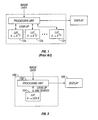
- Fig. 1 illustrates a prior art display system.
- Fig. 2 is a block diagram illustrating a display system in accordance with one embodiment of the invention.
- Fig. 3 is a block diagram illustrating a display system in accordance with another embodiment of the invention.
- Fig. 4 illustrates one exemplary flow to raise an image data value to a defined power.
- Fig. 5 is a functional block diagram illustrating one embodiment of a system configured to raise an image data value to a defined power.
- Fig. 6 is a flowchart of one embodiment of a method of raising an image data value to a defined power.
- Certain embodiments which will be described below raise a number to a power using a fixed number of lookup tables.
- the LUT may be used for both forward lookups and reverse lookups.
- These embodiments may work with any power, either integer or non-integer.
- these embodiments are illustrated in image processing applications to raise an image data value to any power (e.g., a gamma or a desired gamma translation value) during gamma translation.
- any power e.g., a gamma or a desired gamma translation value
- these embodiments may be used in various other applications which require raising a number to any power, and are not intended to be limited to gamma translation or image processing.
- a "gamma translation process” is a process in which a numerical representation of image data is raised to a defined power.
- the defined power will typically be related to the gamma value well known to those in the art, and this is why it is termed herein a gamma translation process.
- the defined power need not be related to any specific or currently known image processing parameter.
- Certain embodiments reduce the size of the one or more look up tables by separating the defined power, represented by ⁇ , into an integer portion ⁇ _ i and a fractional portion ⁇ _ f .
- ⁇ ⁇ _i + ⁇ _f
- the process described above is used to calculate x ⁇ _f , which is then multiplied by x ⁇ _ i to get the value for x ⁇ .
- the value for x ⁇ _ i can be easily calculated by multiplying x an integer number ⁇ _ i times.
- Fig. 2 is an overview illustrating one embodiment of a display system.
- the display system 100 includes a display 106 and an image processing unit 108.
- the display 106 may be any device that is configured to display an image, whether in motion (e.g., video) or stationary (e.g., still image), and whether textual or pictorial.
- the display 106 may be, but not limited to, an LCD, a CRT, or an interferometric modulator display.
- the embodiments may be implemented in or associated with a variety of electronic devices such as, but not limited to, mobile telephones, wireless devices, personal data assistants (PDAs), hand-held or portable computers, GPS receivers/navigators, cameras, MP3 players, camcorders, game consoles, wrist watches, clocks, calculators, television monitors, flat panel displays, computer monitors, auto displays (e.g., odometer display, etc.), cockpit controls and/or displays, display of camera views (e.g., display of a rear view camera in a vehicle), electronic photographs, electronic billboards or signs, projectors, architectural structures, packaging, and aesthetic structures (e.g., display of images on a piece of jewelry).
- PDAs personal data assistants
- GPS receivers/navigators cameras
- MP3 players camcorders
- game consoles e.g., wrist watches, clocks, calculators
- television monitors flat panel displays
- computer monitors e.g., auto displays (e.g., odometer display
- the image processing unit 108 is configured at least in part to process image data and then feed the processed image data to the display device 106.
- the image data may include a numerical representation of an image or a portion of an image.
- the image data may include a numerical representation of a color value (also referred to as "pixel value"), which indicates the intensity level of one color channel of one fundamental element of the image (e.g. the brightness of a pixel of a specific color).
- the color value may comprise a RBG value or a portion thereof, a CMYK value or a portion thereof, a grayscale value or a portion thereof, or any other numerical representation of a color or grayscale value in whole or in part.
- the image processing device 108 may include a processing unit 102 which may be any general purpose single- or multi-chip microprocessor such as an ARM, Pentium ® , Pentium II ® , Pentium III ® , Pentium IV ® , Pentium ® Pro, an 8051, a MIPS ® , a Power PC ® , an ALPHA ® , or any special purpose microprocessor such as a digital signal processor, microcontroller, or a programmable gate array.
- the processing unit 102 may be configured to execute one or more software modules.
- the image processing device 108 may further include a look up table (LUT) 104 with which the processing unit 102 is configured to communicate.
- LUT is a data structure, usually an array or associative array, which is associated with a function. Each array element is a function of an index pointing to that element. The array is usually used to replace a runtime computation with a simpler lookup operation. The speed gain can be significant, since retrieving a value from memory is often faster than performing an extended series of arithmetic computations.
- the LUT 104 may be hardwired, programmable, or both.
- the LUT 104 is a logarithm lookup table in which each entry is a log function of a number related to the index.
- the processing unit may be configured to look up from the LUT, returning values from given indices, and also to search within the LUT 104, returning indices that contain values closest to given values.
- the processing unit accesses a memory location of the LUT 104 corresponding to a number x and retrieves the value stored at that location.
- search operation the processing unit searches the memory locations of the LUT 104 for a target value and returns the index pointing to the location in which a value closest to the target value is stored.
- interpolation instead of simply finding the value closest to the target value may be used in the search operation.
- the target value may be, for example, 0.25. Right below 0.25 there may be a value of 0.2 stored at an index of 3. Right above 0.25 there may be a value of 0.4 stored at an index of 4.
- One choice as described above is to return an index of 3 because the index 3 points to a value 0.2 which is the closest value to the target value of 0.25. But more accuracy may be achieved if interpolation between 0.2 and 0.4 is used. Depending on the desired accuracy level, different types of interpolation may be used.
- the search operation may be configured to return a function of the index retrieved, instead of the index itself. For example, the returned value may be the index retrieved plus an offset that depends on the difference between the ideal value and the value found in the table. This may improve the accuracy of the search operation.
- Fig. 3 is a diagram illustrating another embodiment of a display system. Rather than using one LUT 104, this embodiment includes two LUTs 112 and 114.
- the LUT 112 is similar to the LUT 104 in Fig. 2 .
- the LUT 114 is an inverse logarithm look up table wherein each table entry is the exponentiation of the associated index.
- the processing unit is configured to perform look up operations using both the LUTs 112 and 114. Though this embodiment requires one more LUT, it may save time by replacing the search operation with a simpler look up operation.
- the LUT 114 may have fractional indices that are returned during the search operation instead of just the integer indices. During the lookup, the integer index matching the data is used to retrieve the desired log value. When searching, more values to search through are provided, where the additional values searched store log values for fractional inputs such as log values for fractional indices between integer indices 42 and 43
- Fig. 4 illustrates one exemplary flow to raise a data value to a defined power.
- the data value and the defined power are represented by x and ⁇ respectively.
- a natural logarithm look up table 202 is first used to compute the natural logarithm ln(x) of an image data value x.
- x is used as an index to look up the LUT 202 and the table entry to which the index x points to is ln(x).
- This process uses the LUT in a traditional manner and may be referred to as forward look-up.
- the ln(x) is then multiplied by a fractional portion of the defined power, ⁇ _ f , using a multiplier 204.
- the next step is to calculate the exponent of z, which is represented by e z .
- a search algorithm is employed to find one entry of the LUT 202 which most closely matches z.
- the index associated with that table entry is e z .
- This process uses the LUT 202 in a manner different from the traditional manner and may be referred to as a reverse look-up.
- the search algorithm may be any suitable search algorithm such as various list search algorithms.
- the result of the search is x raised to the power ⁇ -_ f .
- a LUT may store at 64 memory locations ln(1/64), ln(2/64), etc. up to ln(1).
- the power being used may, for example, be 1.8. If the image data for a given pixel is 42, representing a brightness of 42/64, the processor would access memory location 42, retrieving the value of ln(42/64), which is -0.422. This value is multiplied by 0.8, the fractional portion of the power, resulting in a z value of -0.338. The memory locations of the LUT are then searched for this value.
- the reverse search process thus returns the index 46. Because the integer part of the power is one, the original value of 42/64 (x 1 ) is multiplied by 46/64 (x 0.8 ), and the result is 0.472 (x 1.8 ). This is closest to 30/64, thus converting the original 6-bit pixel value of 42 to a new 6-bit pixel value of 30. This may be compared to a direct calculation of (42/64) 1.8 , which is 0.4685, while 30/64 is 0.468.
- the resulting z value would be -0.0844 because the fractional part of the power is 0.2 instead of 0.8.
- the search process would return the index 59 where the value -0.0820 is stored. Because the integer portion of the power is 2, multiplication of (42/64) 2 times (59/64) would be performed, resulting in a value of 0.397. This is closest to 26/64, converting the pixel value of 42 into a pixel value of 26. This may be compared to a direct calculation of (42/64) 2.2 which is 0.396, while 26/64 is 0.406.
- a second inverse logarithm (exponentiation) look up table is included. While the LUT 202 includes entries which are the natural logarithm of the associated index, the inverse LUT include entries each of which is the value for e raised to the associated index. The value for z is used as an index to look up the inverse logarithm in the second LUT and the table entry to which the index z points to stores the value for e z . Though this example requires one more LUT, it may save time by replacing the searching operation with a simpler look up operation.
- the resulting retrieved value for e z which is equal to x ⁇ _ f as indicated by Equation 3, is then multiplied by x ⁇ -_ i using a multiplier 206.
- a multiplier 206 In some embodiments, there is only one multiplier which functions as both multipliers 204 and 206. The product is thus equal to x ⁇ .
- the value for x ⁇ _ i may be calculated using a multiplier (not shown in the figure). For example, if ⁇ _ i is 3, x may be raised to the power of 3 by multiplying x with itself three times.
- Fig. 5 is a functional block diagram illustrating one embodiment of a system configured to raise an image data value to any power.
- the system includes a logarithm look up table 304, which may be similar to the LUT 202 (see Fig. 4 ).
- the index of the LUT 304 may be, for example, represented by an appropriately sized binary number.
- the system further includes an inverse logarithm LUT 308 wherein each entry is the exponentiation of the corresponding index, as described earlier with regard to Fig. 3 .
- the system may further include two multipliers 306 and 312.
- the multiplier 306 is configured to multiply ⁇ _f by ln(x).
- the multiplier 312 is configured to multiply x ⁇ -i by x ⁇ -f .
- the output of the multiplier 312 is then x ⁇ .
- one multiplier is configured to function as both multipliers 306 and 312.
- Fig. 6 is a flowchart of one embodiment of a method of raising a data value to any power. Depending on the embodiment, certain steps of the method may be removed, merged together, or rearranged in order. The general principle of the exemplary method will be described first as below.
- the method begins at a block 402, where the image data value x is stored in a computer-readable memory.
- a defined power is stored in a computer-readable memory.
- the defined power is separated into an integer part and a non-integer part.
- the logarithm of the image data value is looked up and stored as a forward log value. As described with regard to Fig. 4 , the logarithm is obtained by forward looking up a logarithm LUT using the image data value as an index.
- the forward log value is multiplied by the non-integer part of the defined power. The result is then stored as an exponent value.
- the inverse logarithm of the exponent value obtained in block 412 is determined and the result is stored as the inverse logarithm result.
- the inverse logarithm of the exponent value is obtained by reverse looking up a logarithm LUT. Alternatively, it may be obtained by forward looking up an inverse logarithm LUT using the exponent value as an index.
- the image data value is raised to the integer part of the defined power.
- the result is stored as a raising result.
- the operation of raising can be performed by multiplying 1 by the image data value multiple times.
- the inverse logarithm result is multiplied by the raising result.
- the product of multiplying is the image data value raised to the defined power.
- the embodiments discussed herein teach separating the defined power into an integer part and a fractional part. This separation is beneficial because it dramatically decreases the size of the lookup table or lookup tables.
- the image data value can be trivially raised to any integer by repeated multiplication which does not create much of a computational burden.
Landscapes
- Engineering & Computer Science (AREA)
- Multimedia (AREA)
- Signal Processing (AREA)
- Image Processing (AREA)
- Controls And Circuits For Display Device (AREA)
- Facsimile Image Signal Circuits (AREA)
- Image Generation (AREA)
- Picture Signal Circuits (AREA)
Abstract
Description
- This application relates to the field of image processing and/or data processing.
- For many display devices, there is a nonlinear relationship between the brightness of a pixel as it appears on the screen, and the numerical value of that pixel. This nonlinear relationship is approximately a power function, wherein the displayed brightness is the pixel value raised to a power of a numeral referred to herein as gamma, which is typically a non-integer between 1 and 3. In various image processing applications, a process sometimes called gamma translation is performed, raising a pixel value to a defined power. In some situations, a previously performed gamma translation is reversed, which also involves raising a pixel value to a defined power. For convenience, the defined power is always referred to herein as gamma, regardless of its relationship between the image data values and the visual characteristics of the display device.
- Conventionally, a lookup table ("LUT") is used in these processes. The image data value, represented by an appropriately sized binary number, is used as an index pointing to a table entry where the translated representation resides. A LUT is associated with a particular defined power. If several defined powers are needed, then
several LUTs 12a-12n, each associated with one defined power, are required as illustrated inFig. 1 . This approach requires allocating substantial system resources for LUTs, especially when the number of gammas is large. For example, each LUT may need to be stored in expensive one-time programmable memory. Further, such an approach can only work with a limited number of defined powers for which a corresponding LUT is established. To support a new defined power, the system has to be revised to incorporate a new LUT. - Iterative algorithms based on Newton's method may also be used to compute a number to any defined power using only arithmetic operations. However, these methods require a relatively large number of calculations, and require time and processing power that is also expensive to provide for small displays such as mobile phones and the like.
- Another way to raise a number to any defined power is to use piecewise linear approximations, which combine smaller LUTs with arithmetic operations. However, this approach achieves greater accuracy at the expense of increasing the number of arithmetic operations.
- Therefore, it is desirable to develop a method and system of raising an image data value to a power that uses a fixed, and preferably small number of LUTs and that works with any defined data and power value. Such a method and system may be equally applied to a variety of applications to raise a number to a power of any real number.
- The system, method, and devices of the invention each have several aspects, no single one of which is solely responsible for its desirable attributes. Without limiting the scope of this invention, its more prominent features will now be discussed briefly. After considering this discussion, and particularly after reading the section entitled "Detailed Description of Certain Embodiments" one will understand how the features of this invention provide advantages over other devices.
- In one embodiment, the invention includes an image-processing device having
- a lookup table and a processing circuit configured to provide both forward lookups and reverse lookups during a gamma translation process. In another embodiment, an image display device includes a stored gamma value, a forward logarithm lookup table, and an inverse logarithm lookup table.
- In another embodiment, a method according to the invention includes obtaining a numerical representation of a color intensity level, looking up a logarithm value associated with at least one element of the numerical representation of a color intensity level in a lookup table. The method continues with storing a result of the looking up and multiplying the result of looking up by a fractional portion of a gamma translation value and storing the result as an exponent value. The lookup table is used in reverse to obtain the inverse logarithm of the exponent value, and the inverse logarithm of the exponent value is multiplied by the element of the numerical representation of a color intensity level raised to a power defined by an integer portion of the gamma translation value.
- Another method includes storing a color value in a computer-readable memory, storing a desired gamma translation value in a computer-readable memory; separating the gamma translation value into a non-integer part and an integer part, looking up the logarithm of the color value and storing the logarithm of the color value as a forward log value, multiplying the non-integer part by the forward log value and storing a result of the multiplying as an exponent value, determining the inverse logarithm of the exponent value and storing the inverse logarithm of the exponent value as an inverse logarithm result, raising the color value to a power defined by the integer part and storing a result of the raising as a raising result, and multiplying the inverse logarithm result and the raising result to produce a transformed color value.
- Yet another method includes multiplying a fractional portion of a gamma value by the logarithm of a color value to obtain an exponent value, finding the inverse logarithm of the exponent value, and obtaining a gamma-transformed color value using the inverse logarithm.
- In another embodiment, a processing device comprises a lookup table and a processing circuit configured to provide both forward lookups and reverse lookups during a process of calculating a non-integer power of a number.
-
Fig. 1 illustrates a prior art display system. -
Fig. 2 is a block diagram illustrating a display system in accordance with one embodiment of the invention. -
Fig. 3 is a block diagram illustrating a display system in accordance with another embodiment of the invention. -
Fig. 4 illustrates one exemplary flow to raise an image data value to a defined power. -
Fig. 5 is a functional block diagram illustrating one embodiment of a system configured to raise an image data value to a defined power. -
Fig. 6 is a flowchart of one embodiment of a method of raising an image data value to a defined power. - The following detailed description is directed to certain specific embodiments of the invention. However, the invention can be embodied in a multitude of different ways. In this description, reference is made to the drawings wherein like parts are designated with like numerals throughout.
- Certain embodiments which will be described below raise a number to a power using a fixed number of lookup tables. In one embodiment, only one log lookup table is used. The LUT may be used for both forward lookups and reverse lookups. These embodiments may work with any power, either integer or non-integer. In the following discussion, these embodiments are illustrated in image processing applications to raise an image data value to any power (e.g., a gamma or a desired gamma translation value) during gamma translation. However, it should be noted that these embodiments may be used in various other applications which require raising a number to any power, and are not intended to be limited to gamma translation or image processing.
- As used herein, a "gamma translation process" is a process in which a numerical representation of image data is raised to a defined power. The defined power will typically be related to the gamma value well known to those in the art, and this is why it is termed herein a gamma translation process. However, depending on the display type, image data source, and other variables, the defined power need not be related to any specific or currently known image processing parameter.
- The inventions described herein take advantage of the fact that finding x raised to the power y is equivalent to finding e raised to the power y · ln(x), as illustrated below.

- In the method below, a look up table is used to find ln(x) from x, and this result is multiplied by the defined power y to form the value z = y · ln(x). Then, either the same look up table or a second look up table is used to find ez . The result is the value for xy , which can therefore be found for any x and any y with only one or two look up tables.
- This is in contrast with prior art methods that would require a different look up table for each desired value of y. It will be appreciated that the base of the log and exponentiation functions are arbitrary, and the formula above is applicable for base 2, 10, e, or any other value, as long as the logarithm function and exponentiation function are performed with the same base.
- Certain embodiments reduce the size of the one or more look up tables by separating the defined power, represented by γ, into an integer portion γ_i and a fractional portion γ_f.

The process described above is used to calculate x γ_f , which is then multiplied by xγ_i to get the value for xγ. The value for xγ_i can be easily calculated by multiplying x an integer number γ_i times.

Because the process now only needs to raise any number x to a power ranging between 0 and 1, the size of the lookup table(s) is decreased. -
Fig. 2 is an overview illustrating one embodiment of a display system. The display system 100 includes adisplay 106 and animage processing unit 108. Thedisplay 106 may be any device that is configured to display an image, whether in motion (e.g., video) or stationary (e.g., still image), and whether textual or pictorial. Thedisplay 106 may be, but not limited to, an LCD, a CRT, or an interferometric modulator display. More particularly, it is contemplated that the embodiments may be implemented in or associated with a variety of electronic devices such as, but not limited to, mobile telephones, wireless devices, personal data assistants (PDAs), hand-held or portable computers, GPS receivers/navigators, cameras, MP3 players, camcorders, game consoles, wrist watches, clocks, calculators, television monitors, flat panel displays, computer monitors, auto displays (e.g., odometer display, etc.), cockpit controls and/or displays, display of camera views (e.g., display of a rear view camera in a vehicle), electronic photographs, electronic billboards or signs, projectors, architectural structures, packaging, and aesthetic structures (e.g., display of images on a piece of jewelry). - The
image processing unit 108 is configured at least in part to process image data and then feed the processed image data to thedisplay device 106. The image data may include a numerical representation of an image or a portion of an image. In one embodiment, the image data may include a numerical representation of a color value (also referred to as "pixel value"), which indicates the intensity level of one color channel of one fundamental element of the image (e.g. the brightness of a pixel of a specific color). The color value may comprise a RBG value or a portion thereof, a CMYK value or a portion thereof, a grayscale value or a portion thereof, or any other numerical representation of a color or grayscale value in whole or in part. - In the exemplary embodiment, the
image processing device 108 may include aprocessing unit 102 which may be any general purpose single- or multi-chip microprocessor such as an ARM, Pentium®, Pentium II®, Pentium III®, Pentium IV®, Pentium® Pro, an 8051, a MIPS®, a Power PC®, an ALPHA®, or any special purpose microprocessor such as a digital signal processor, microcontroller, or a programmable gate array. As is conventional in the art, theprocessing unit 102 may be configured to execute one or more software modules. - In one embodiment, the
image processing device 108 may further include a look up table (LUT) 104 with which theprocessing unit 102 is configured to communicate. A LUT is a data structure, usually an array or associative array, which is associated with a function. Each array element is a function of an index pointing to that element. The array is usually used to replace a runtime computation with a simpler lookup operation. The speed gain can be significant, since retrieving a value from memory is often faster than performing an extended series of arithmetic computations. TheLUT 104 may be hardwired, programmable, or both. In one embodiment, theLUT 104 is a logarithm lookup table in which each entry is a log function of a number related to the index. - The processing unit may be configured to look up from the LUT, returning values from given indices, and also to search within the
LUT 104, returning indices that contain values closest to given values. In the look up operation, the processing unit accesses a memory location of theLUT 104 corresponding to a number x and retrieves the value stored at that location. In search operation, the processing unit searches the memory locations of theLUT 104 for a target value and returns the index pointing to the location in which a value closest to the target value is stored. - In one embodiment, interpolation instead of simply finding the value closest to the target value may be used in the search operation. The target value may be, for example, 0.25. Right below 0.25 there may be a value of 0.2 stored at an index of 3. Right above 0.25 there may be a value of 0.4 stored at an index of 4. One choice as described above is to return an index of 3 because the index 3 points to a value 0.2 which is the closest value to the target value of 0.25. But more accuracy may be achieved if interpolation between 0.2 and 0.4 is used. Depending on the desired accuracy level, different types of interpolation may be used. In another embodiment, the search operation may be configured to return a function of the index retrieved, instead of the index itself. For example, the returned value may be the index retrieved plus an offset that depends on the difference between the ideal value and the value found in the table. This may improve the accuracy of the search operation.
- As described above, raising a data value to a power using the method outlined above requires performing both a logarithm computation and an exponentiation computation. The look up and search procedures on the
single LUT 104 provide these functions in the embodiment ofFigure 2 . -
Fig. 3 is a diagram illustrating another embodiment of a display system. Rather than using oneLUT 104, this embodiment includes twoLUTs LUT 112 is similar to theLUT 104 inFig. 2 . TheLUT 114 is an inverse logarithm look up table wherein each table entry is the exponentiation of the associated index. The processing unit is configured to perform look up operations using both theLUTs LUT 114 may have fractional indices that are returned during the search operation instead of just the integer indices. During the lookup, the integer index matching the data is used to retrieve the desired log value. When searching, more values to search through are provided, where the additional values searched store log values for fractional inputs such as log values for fractional indices between integer indices 42 and 43 -
Fig. 4 illustrates one exemplary flow to raise a data value to a defined power. The data value and the defined power are represented by x and γ respectively. InFig. 4 , a natural logarithm look up table 202 is first used to compute the natural logarithm ln(x) of an image data value x. In this process, x is used as an index to look up theLUT 202 and the table entry to which the index x points to is ln(x). This process uses the LUT in a traditional manner and may be referred to as forward look-up. The ln(x) is then multiplied by a fractional portion of the defined power, γ_f, using amultiplier 204. The product is represented by z = γ_f·ln(x). - The next step is to calculate the exponent of z, which is represented by ez . In the exemplary embodiment, a search algorithm is employed to find one entry of the
LUT 202 which most closely matches z. The index associated with that table entry is ez . This process uses theLUT 202 in a manner different from the traditional manner and may be referred to as a reverse look-up. The search algorithm may be any suitable search algorithm such as various list search algorithms. The result of the search is x raised to the power γ-_f. - For example, we might have 6-bit image data comprising values from 1 to 64 and representing a gray scale intensity between 0 (black) and 1 (white) in 64 increments. For this embodiment, a LUT may store at 64 memory locations ln(1/64), ln(2/64), etc. up to ln(1). The power being used may, for example, be 1.8. If the image data for a given pixel is 42, representing a brightness of 42/64, the processor would access memory location 42, retrieving the value of ln(42/64), which is -0.422. This value is multiplied by 0.8, the fractional portion of the power, resulting in a z value of -0.338. The memory locations of the LUT are then searched for this value. The closest value stored in the LUT to the value -0.338 is -0.332, which is stored in memory location 46, since ln(46/64) = -0.332. The reverse search process thus returns the index 46. Because the integer part of the power is one, the original value of 42/64 (x1) is multiplied by 46/64 (x0.8), and the result is 0.472 (x1.8). This is closest to 30/64, thus converting the original 6-bit pixel value of 42 to a new 6-bit pixel value of 30. This may be compared to a direct calculation of (42/64)1.8, which is 0.4685, while 30/64 is 0.468.
- If the power were 2.2 instead, the resulting z value would be -0.0844 because the fractional part of the power is 0.2 instead of 0.8. In this case, the search process would return the index 59 where the value -0.0820 is stored. Because the integer portion of the power is 2, multiplication of (42/64)2 times (59/64) would be performed, resulting in a value of 0.397. This is closest to 26/64, converting the pixel value of 42 into a pixel value of 26. This may be compared to a direct calculation of (42/64)2.2 which is 0.396, while 26/64 is 0.406.
- It can therefore be appreciated that a single LUT can be used to raise any value x to any power y with this process, thus avoiding multiple and inflexible LUTs or computationally complex iterative methods.
- It will be appreciated that the exponentiation function may be calculated in other ways. In the embodiment illustrated in
Figures 3 and5 , a second inverse logarithm (exponentiation) look up table is included. While theLUT 202 includes entries which are the natural logarithm of the associated index, the inverse LUT include entries each of which is the value for e raised to the associated index. The value for z is used as an index to look up the inverse logarithm in the second LUT and the table entry to which the index z points to stores the value for ez . Though this example requires one more LUT, it may save time by replacing the searching operation with a simpler look up operation. - The resulting retrieved value for ez , which is equal to x γ_f as indicated by Equation 3, is then multiplied by x γ-_i using a
multiplier 206. In some embodiments, there is only one multiplier which functions as bothmultipliers -
Fig. 5 is a functional block diagram illustrating one embodiment of a system configured to raise an image data value to any power. The system includes a logarithm look up table 304, which may be similar to the LUT 202 (seeFig. 4 ). The index of theLUT 304 may be, for example, represented by an appropriately sized binary number. - In one embodiment, the system further includes an
inverse logarithm LUT 308 wherein each entry is the exponentiation of the corresponding index, as described earlier with regard toFig. 3 . The system is configured to look up theLUT 308 using z = γ_f·ln(x) as input and get the exponent of Z = γ_f·ln(x) which is equal to x γ_f . - The system may further include two
multipliers multiplier 306 is configured to multiply γ_f by ln(x). Themultiplier 312 is configured to multiply xγ-i by xγ-f . The output of themultiplier 312 is then x γ. In some embodiments, one multiplier is configured to function as bothmultipliers -
Fig. 6 is a flowchart of one embodiment of a method of raising a data value to any power. Depending on the embodiment, certain steps of the method may be removed, merged together, or rearranged in order. The general principle of the exemplary method will be described first as below. - The method begins at a
block 402, where the image data value x is stored in a computer-readable memory. Next at ablock 404, a defined power is stored in a computer-readable memory. Moving to ablock 406, the defined power is separated into an integer part and a non-integer part. Next at ablock 408, the logarithm of the image data value is looked up and stored as a forward log value. As described with regard toFig. 4 , the logarithm is obtained by forward looking up a logarithm LUT using the image data value as an index. Moving to ablock 412, the forward log value is multiplied by the non-integer part of the defined power. The result is then stored as an exponent value. - Next at a
block 414, the inverse logarithm of the exponent value obtained inblock 412 is determined and the result is stored as the inverse logarithm result. In one embodiment, the inverse logarithm of the exponent value is obtained by reverse looking up a logarithm LUT. Alternatively, it may be obtained by forward looking up an inverse logarithm LUT using the exponent value as an index. - Moving to a
block 416, the image data value is raised to the integer part of the defined power. The result is stored as a raising result. The operation of raising can be performed by multiplying 1 by the image data value multiple times. - Lastly at a
block 418, the inverse logarithm result is multiplied by the raising result. The product of multiplying is the image data value raised to the defined power. - The embodiments discussed herein teach separating the defined power into an integer part and a fractional part. This separation is beneficial because it dramatically decreases the size of the lookup table or lookup tables. The image data value can be trivially raised to any integer by repeated multiplication which does not create much of a computational burden. In other embodiments, it is possible not to separate the defined power into two parts. In that case, the entire defined power is treated as the fractional part is in the above discussion, and the integer part of the exponent value is set to zero.
- The foregoing description details certain embodiments of the invention. It will be appreciated, however, that no matter how detailed the foregoing appears in text, the invention may be practiced in many ways. It should be noted that the use of particular terminology when describing certain features or aspects of the invention should not be taken to imply that the terminology is being re-defined herein to be restricted to including any specific characteristics of the features or aspects of the invention with which that terminology is associated.
Claims (20)
- A device comprising:means for storing data having a lookup table stored therein; andmeans for providing both forward lookups and reverse lookups during a gamma translation process.
- The device of claim 1, wherein said storing means comprises a storage element, or the lookup providing means comprises a processing circuit.
- The device of any one of claims 1 or 2, wherein said lookup providing means is configured to translate a value with respect to a non-integer gamma.
- The device of claim 3, wherein the value comprises at least one element of a numerical representation of a color intensity level.
- The device of any one of claims 1-4, further comprising means for multiplying.
- The device of claim 5, wherein the multiplying means comprises a multiplier.
- The device of any one of claims 1-6, wherein said lookup table comprises a set of logarithms associated with a set of values.
- The device of any one of claims 1-7, further comprising a gamma-adjustment user interface.
- The device of any one of claims 1-8, wherein said lookup providing means is configured to search a set of logarithms for an index associated with a value.
- The device of any one of claims 1-9, wherein the providing means is configured to process image data.
- The device of any one of claim 10, further comprising a display configured to communicate with the providing means to display the processed image data.
- The device of any one of claims 1-11, wherein the providing means is configured to:look up a logarithm value associated with a color value in said lookup table;multiply a fractional portion of a gamma translation value by the logarithm of the color value to obtain an exponent value;find the inverse logarithm of said exponent value based on a reverse lookup of said lookup table; andobtain a gamma-transformed color value using said inverse logarithm.
- A method comprising:looking up a logarithm value associated with a color value in a lookup table;multiplying a fractional portion of a gamma translation value by the logarithm of the color value to obtain an exponent value;finding the inverse logarithm of said exponent value based on a reverse lookup of said lookup table; andobtaining a gamma-transformed color value using said inverse logarithm.
- The method of claim 13, wherein the color value comprises at least one element of a numerical representation of a color intensity level.
- The method of any one of claims 13 or 14, wherein the obtaining of a gamma-transformed color value comprises multiplying said inverse logarithm of said exponent value by said color value raised to a power defined by an integer portion of the gamma translation value.
- The method of any one of claims 13-15, wherein said color value comprises an RGB value.
- The method of any one of claims 13-16, wherein said color value comprises an CMYK value.
- The method of any one of claims 13-17, wherein said gamma translation value is a positive non-integer.
- The method of any one of claims 13-18, wherein said lookup table is a logarithm lookup table.
- The method of any one of claims 13-19, further comprising wherein said lookup table is a logarithm lookup table.
Applications Claiming Priority (2)
| Application Number | Priority Date | Filing Date | Title |
|---|---|---|---|
| US11/698,609 US7957589B2 (en) | 2007-01-25 | 2007-01-25 | Arbitrary power function using logarithm lookup table |
| EP08714203A EP1980097A1 (en) | 2007-01-25 | 2008-01-21 | Arbitrary power function using logarithm lookup table |
Related Parent Applications (1)
| Application Number | Title | Priority Date | Filing Date |
|---|---|---|---|
| EP08714203A Division EP1980097A1 (en) | 2007-01-25 | 2008-01-21 | Arbitrary power function using logarithm lookup table |
Publications (2)
| Publication Number | Publication Date |
|---|---|
| EP1988471A2 true EP1988471A2 (en) | 2008-11-05 |
| EP1988471A3 EP1988471A3 (en) | 2008-11-26 |
Family
ID=39472529
Family Applications (2)
| Application Number | Title | Priority Date | Filing Date |
|---|---|---|---|
| EP08153553A Withdrawn EP1988471A3 (en) | 2007-01-25 | 2008-01-21 | Arbitrary power function using logarithm lookup table |
| EP08714203A Withdrawn EP1980097A1 (en) | 2007-01-25 | 2008-01-21 | Arbitrary power function using logarithm lookup table |
Family Applications After (1)
| Application Number | Title | Priority Date | Filing Date |
|---|---|---|---|
| EP08714203A Withdrawn EP1980097A1 (en) | 2007-01-25 | 2008-01-21 | Arbitrary power function using logarithm lookup table |
Country Status (7)
| Country | Link |
|---|---|
| US (1) | US7957589B2 (en) |
| EP (2) | EP1988471A3 (en) |
| JP (1) | JP2010517435A (en) |
| KR (1) | KR20090101485A (en) |
| CN (1) | CN101589610A (en) |
| TW (1) | TW200843486A (en) |
| WO (1) | WO2008091824A1 (en) |
Families Citing this family (18)
| Publication number | Priority date | Publication date | Assignee | Title |
|---|---|---|---|---|
| US7499208B2 (en) | 2004-08-27 | 2009-03-03 | Udc, Llc | Current mode display driver circuit realization feature |
| US8310441B2 (en) | 2004-09-27 | 2012-11-13 | Qualcomm Mems Technologies, Inc. | Method and system for writing data to MEMS display elements |
| US20090040167A1 (en) * | 2007-08-06 | 2009-02-12 | Wein-Town Sun | Programmable nonvolatile memory embedded in a timing controller for storing lookup tables |
| US7782522B2 (en) | 2008-07-17 | 2010-08-24 | Qualcomm Mems Technologies, Inc. | Encapsulation methods for interferometric modulator and MEMS devices |
| CN102177539B (en) * | 2008-10-14 | 2014-07-23 | 杜比实验室特许公司 | Device and method for processing signals |
| US20100156956A1 (en) * | 2008-12-19 | 2010-06-24 | Madden Thomas E | Grayscale characteristic for non-crt displays |
| US8736590B2 (en) | 2009-03-27 | 2014-05-27 | Qualcomm Mems Technologies, Inc. | Low voltage driver scheme for interferometric modulators |
| US8405649B2 (en) * | 2009-03-27 | 2013-03-26 | Qualcomm Mems Technologies, Inc. | Low voltage driver scheme for interferometric modulators |
| WO2011050348A2 (en) * | 2009-10-24 | 2011-04-28 | Stc.Unm | System and methods for automatic placement of spatial supression regions in mri and mrsi |
| US20110109615A1 (en) * | 2009-11-12 | 2011-05-12 | Qualcomm Mems Technologies, Inc. | Energy saving driving sequence for a display |
| CN102110078A (en) * | 2009-12-23 | 2011-06-29 | 富士通株式会社 | Method and system for obtaining an approximate operation result of a power function Xp |
| US20150103252A1 (en) * | 2013-10-16 | 2015-04-16 | Nvidia Corporation | System, method, and computer program product for gamma correction in a video or image processing engine |
| CN105355184B (en) * | 2015-12-10 | 2017-07-28 | 深圳市华星光电技术有限公司 | The lookup table management method and device of a kind of liquid crystal display |
| CN115665407B (en) * | 2018-12-31 | 2023-08-04 | 华为技术有限公司 | Inter-component linear modeling method and device for intra-frame prediction |
| CN111580784B (en) * | 2020-04-10 | 2023-07-25 | 科大讯飞股份有限公司 | Power function calculation device and power function calculation method |
| US11343495B2 (en) | 2020-06-03 | 2022-05-24 | Tencent America LLC | Methods of simplification of temporal filtering |
| CN116306826B (en) * | 2021-12-18 | 2026-04-24 | 广州小鹏自动驾驶科技有限公司 | Hardware acceleration circuits, data processing acceleration methods, chips and accelerators |
| CN114399830B (en) * | 2022-03-25 | 2022-06-24 | 深圳比特微电子科技有限公司 | Target class identification method and device and readable storage medium |
Family Cites Families (85)
| Publication number | Priority date | Publication date | Assignee | Title |
|---|---|---|---|---|
| US4709995A (en) | 1984-08-18 | 1987-12-01 | Canon Kabushiki Kaisha | Ferroelectric display panel and driving method therefor to achieve gray scale |
| FR2605444A1 (en) | 1986-10-17 | 1988-04-22 | Thomson Csf | METHOD FOR CONTROLLING AN ELECTROOPTIC MATRIX SCREEN AND CONTROL CIRCUIT USING THE SAME |
| JPS63298287A (en) | 1987-05-29 | 1988-12-06 | シャープ株式会社 | Liquid crystal display device |
| US5010328A (en) | 1987-07-21 | 1991-04-23 | Thorn Emi Plc | Display device |
| US4954789A (en) | 1989-09-28 | 1990-09-04 | Texas Instruments Incorporated | Spatial light modulator |
| US5227900A (en) | 1990-03-20 | 1993-07-13 | Canon Kabushiki Kaisha | Method of driving ferroelectric liquid crystal element |
| DE69128581T2 (en) * | 1990-08-20 | 1998-04-16 | Fujitsu Ltd | Method and device for the transmission of monitoring/management information between communication devices connected by a switching network |
| US5132796A (en) * | 1990-09-04 | 1992-07-21 | Matsushita Electric Industrial Co., Ltd. | Method and apparatus for digitally processing gamma pedestal and gain |
| US5233459A (en) | 1991-03-06 | 1993-08-03 | Massachusetts Institute Of Technology | Electric display device |
| JPH05216617A (en) | 1992-01-31 | 1993-08-27 | Canon Inc | Display drive device and information processing system |
| US5255093A (en) | 1992-06-19 | 1993-10-19 | Panasonic Technologies, Inc. | Apparatus and a method for limiting gain in a digital gamma corrector |
| US5285196A (en) | 1992-10-15 | 1994-02-08 | Texas Instruments Incorporated | Bistable DMD addressing method |
| US6674562B1 (en) | 1994-05-05 | 2004-01-06 | Iridigm Display Corporation | Interferometric modulation of radiation |
| US5828367A (en) | 1993-10-21 | 1998-10-27 | Rohm Co., Ltd. | Display arrangement |
| US5398076A (en) * | 1993-12-16 | 1995-03-14 | Ati Technologies, Inc. | Gamma correcting processing of video signals |
| JP3298301B2 (en) | 1994-04-18 | 2002-07-02 | カシオ計算機株式会社 | Liquid crystal drive |
| US7550794B2 (en) | 2002-09-20 | 2009-06-23 | Idc, Llc | Micromechanical systems device comprising a displaceable electrode and a charge-trapping layer |
| US7123216B1 (en) | 1994-05-05 | 2006-10-17 | Idc, Llc | Photonic MEMS and structures |
| US6680792B2 (en) | 1994-05-05 | 2004-01-20 | Iridigm Display Corporation | Interferometric modulation of radiation |
| US6040937A (en) | 1994-05-05 | 2000-03-21 | Etalon, Inc. | Interferometric modulation |
| GB2297878B (en) | 1995-02-10 | 1999-05-19 | Innovation Tk Limited | Digital image processing |
| US5912758A (en) | 1996-09-11 | 1999-06-15 | Texas Instruments Incorporated | Bipolar reset for spatial light modulators |
| US5771116A (en) | 1996-10-21 | 1998-06-23 | Texas Instruments Incorporated | Multiple bias level reset waveform for enhanced DMD control |
| JP3884809B2 (en) * | 1997-01-20 | 2007-02-21 | 株式会社日立製作所 | Digital power unit and graphics system using the same |
| US5990894A (en) | 1997-06-16 | 1999-11-23 | Sun Microsystems, Inc. | Method for implementing the power function DP and computer graphics system employing the same |
| GB2330678A (en) | 1997-10-16 | 1999-04-28 | Sharp Kk | Addressing a ferroelectric liquid crystal display |
| JP3403635B2 (en) | 1998-03-26 | 2003-05-06 | 富士通株式会社 | Display device and method of driving the display device |
| US6178435B1 (en) * | 1998-06-30 | 2001-01-23 | International Business Machines Corporation | Method and system for performing a power of two estimation within a data processing system |
| US6182100B1 (en) * | 1998-06-30 | 2001-01-30 | International Business Machines Corporation | Method and system for performing a logarithmic estimation within a data processing system |
| US6128638A (en) | 1998-07-23 | 2000-10-03 | Silicon Graphics, Inc. | Method and apparatus for calculating X to the Exponent of Y |
| JP2000075963A (en) | 1998-08-27 | 2000-03-14 | Sharp Corp | Display device power saving control system |
| JP4074714B2 (en) | 1998-09-25 | 2008-04-09 | 富士フイルム株式会社 | Array type light modulation element and flat display driving method |
| JP3919954B2 (en) | 1998-10-16 | 2007-05-30 | 富士フイルム株式会社 | Array type light modulation element and flat display driving method |
| GB9827945D0 (en) | 1998-12-19 | 1999-02-10 | Secr Defence | Method of driving a spatial light modulator |
| US7012600B2 (en) | 1999-04-30 | 2006-03-14 | E Ink Corporation | Methods for driving bistable electro-optic displays, and apparatus for use therein |
| TW523727B (en) | 1999-05-27 | 2003-03-11 | Koninkl Philips Electronics Nv | Display device |
| JP4274633B2 (en) * | 1999-06-23 | 2009-06-10 | 株式会社ルネサステクノロジ | Power arithmetic unit |
| US6862029B1 (en) | 1999-07-27 | 2005-03-01 | Hewlett-Packard Development Company, L.P. | Color display system |
| US6507330B1 (en) | 1999-09-01 | 2003-01-14 | Displaytech, Inc. | DC-balanced and non-DC-balanced drive schemes for liquid crystal devices |
| JP2001103504A (en) * | 1999-09-30 | 2001-04-13 | Fujitsu General Ltd | Color correction and gamma correction circuit |
| WO2003007049A1 (en) | 1999-10-05 | 2003-01-23 | Iridigm Display Corporation | Photonic mems and structures |
| US6466358B2 (en) | 1999-12-30 | 2002-10-15 | Texas Instruments Incorporated | Analog pulse width modulation cell for digital micromechanical device |
| US7098884B2 (en) | 2000-02-08 | 2006-08-29 | Semiconductor Energy Laboratory Co., Ltd. | Semiconductor display device and method of driving semiconductor display device |
| JP3498033B2 (en) | 2000-02-28 | 2004-02-16 | Nec液晶テクノロジー株式会社 | Display device, portable electronic device, and method of driving display device |
| US6674413B2 (en) | 2000-03-30 | 2004-01-06 | Matsushita Electric Industrial Co., Ltd. | Display control apparatus |
| US20010052887A1 (en) | 2000-04-11 | 2001-12-20 | Yusuke Tsutsui | Method and circuit for driving display device |
| US7298352B2 (en) * | 2000-06-28 | 2007-11-20 | Lg.Philips Lcd Co., Ltd. | Apparatus and method for correcting gamma voltage and video data in liquid crystal display |
| US6593934B1 (en) | 2000-11-16 | 2003-07-15 | Industrial Technology Research Institute | Automatic gamma correction system for displays |
| US6504641B2 (en) | 2000-12-01 | 2003-01-07 | Agere Systems Inc. | Driver and method of operating a micro-electromechanical system device |
| GB2373121A (en) | 2001-03-10 | 2002-09-11 | Sharp Kk | Frame rate controller |
| KR20030095954A (en) | 2001-04-26 | 2003-12-24 | 코닌클리케 필립스 일렉트로닉스 엔.브이. | Display device |
| US6809711B2 (en) | 2001-05-03 | 2004-10-26 | Eastman Kodak Company | Display driver and method for driving an emissive video display |
| JP3749147B2 (en) | 2001-07-27 | 2006-02-22 | シャープ株式会社 | Display device |
| JP4190862B2 (en) | 2001-12-18 | 2008-12-03 | シャープ株式会社 | Display device and driving method thereof |
| US6750589B2 (en) | 2002-01-24 | 2004-06-15 | Honeywell International Inc. | Method and circuit for the control of large arrays of electrostatic actuators |
| US6700138B2 (en) | 2002-02-25 | 2004-03-02 | Silicon Bandwidth, Inc. | Modular semiconductor die package and method of manufacturing thereof |
| US6574033B1 (en) | 2002-02-27 | 2003-06-03 | Iridigm Display Corporation | Microelectromechanical systems device and method for fabricating same |
| US7126577B2 (en) | 2002-03-15 | 2006-10-24 | Koninklijke Philips Electronics N.V. | Electrophoretic active matrix display device |
| US7256795B2 (en) | 2002-07-31 | 2007-08-14 | Ati Technologies Inc. | Extended power management via frame modulation control |
| US7372999B2 (en) | 2002-09-09 | 2008-05-13 | Ricoh Company, Ltd. | Image coder and image decoder capable of power-saving control in image compression and decompression |
| EP1414011A1 (en) | 2002-10-22 | 2004-04-28 | STMicroelectronics S.r.l. | Method for scanning sequence selection for displays |
| JP4555951B2 (en) | 2002-12-10 | 2010-10-06 | エプコス アクチエンゲゼルシャフト | Driving an array of MEMS (Micro-Electro-Mechanical-System) elements |
| US7400489B2 (en) | 2003-04-30 | 2008-07-15 | Hewlett-Packard Development Company, L.P. | System and a method of driving a parallel-plate variable micro-electromechanical capacitor |
| EP2698784B1 (en) | 2003-08-19 | 2017-11-01 | E Ink Corporation | Electro-optic display |
| US7161728B2 (en) | 2003-12-09 | 2007-01-09 | Idc, Llc | Area array modulation and lead reduction in interferometric modulators |
| US7499208B2 (en) | 2004-08-27 | 2009-03-03 | Udc, Llc | Current mode display driver circuit realization feature |
| US7515147B2 (en) | 2004-08-27 | 2009-04-07 | Idc, Llc | Staggered column drive circuit systems and methods |
| US7560299B2 (en) | 2004-08-27 | 2009-07-14 | Idc, Llc | Systems and methods of actuating MEMS display elements |
| US7602375B2 (en) | 2004-09-27 | 2009-10-13 | Idc, Llc | Method and system for writing data to MEMS display elements |
| US7626581B2 (en) | 2004-09-27 | 2009-12-01 | Idc, Llc | Device and method for display memory using manipulation of mechanical response |
| US20060066594A1 (en) | 2004-09-27 | 2006-03-30 | Karen Tyger | Systems and methods for driving a bi-stable display element |
| US7327510B2 (en) | 2004-09-27 | 2008-02-05 | Idc, Llc | Process for modifying offset voltage characteristics of an interferometric modulator |
| US8514169B2 (en) | 2004-09-27 | 2013-08-20 | Qualcomm Mems Technologies, Inc. | Apparatus and system for writing data to electromechanical display elements |
| US8310441B2 (en) | 2004-09-27 | 2012-11-13 | Qualcomm Mems Technologies, Inc. | Method and system for writing data to MEMS display elements |
| US7545550B2 (en) | 2004-09-27 | 2009-06-09 | Idc, Llc | Systems and methods of actuating MEMS display elements |
| US7532195B2 (en) | 2004-09-27 | 2009-05-12 | Idc, Llc | Method and system for reducing power consumption in a display |
| US7920136B2 (en) | 2005-05-05 | 2011-04-05 | Qualcomm Mems Technologies, Inc. | System and method of driving a MEMS display device |
| US7948457B2 (en) | 2005-05-05 | 2011-05-24 | Qualcomm Mems Technologies, Inc. | Systems and methods of actuating MEMS display elements |
| US20070038693A1 (en) * | 2005-08-10 | 2007-02-15 | Christian Jacobi | Method and Processor for Performing a Floating-Point Instruction Within a Processor |
| US20070126673A1 (en) | 2005-12-07 | 2007-06-07 | Kostadin Djordjev | Method and system for writing data to MEMS display elements |
| US8391630B2 (en) | 2005-12-22 | 2013-03-05 | Qualcomm Mems Technologies, Inc. | System and method for power reduction when decompressing video streams for interferometric modulator displays |
| JP2007193237A (en) * | 2006-01-20 | 2007-08-02 | Sony Corp | Display device and portable terminal |
| US8194056B2 (en) | 2006-02-09 | 2012-06-05 | Qualcomm Mems Technologies Inc. | Method and system for writing data to MEMS display elements |
| US7586644B2 (en) * | 2006-02-15 | 2009-09-08 | Conexant Systems, Inc. | Color conversion system and method |
| US8049713B2 (en) | 2006-04-24 | 2011-11-01 | Qualcomm Mems Technologies, Inc. | Power consumption optimized display update |
-
2007
- 2007-01-25 US US11/698,609 patent/US7957589B2/en not_active Expired - Fee Related
-
2008
- 2008-01-21 WO PCT/US2008/051581 patent/WO2008091824A1/en not_active Ceased
- 2008-01-21 EP EP08153553A patent/EP1988471A3/en not_active Withdrawn
- 2008-01-21 KR KR1020097016657A patent/KR20090101485A/en not_active Withdrawn
- 2008-01-21 EP EP08714203A patent/EP1980097A1/en not_active Withdrawn
- 2008-01-21 JP JP2009547372A patent/JP2010517435A/en active Pending
- 2008-01-21 CN CNA2008800030118A patent/CN101589610A/en active Pending
- 2008-01-24 TW TW097102655A patent/TW200843486A/en unknown
Also Published As
| Publication number | Publication date |
|---|---|
| EP1988471A3 (en) | 2008-11-26 |
| JP2010517435A (en) | 2010-05-20 |
| EP1980097A1 (en) | 2008-10-15 |
| US7957589B2 (en) | 2011-06-07 |
| WO2008091824A1 (en) | 2008-07-31 |
| CN101589610A (en) | 2009-11-25 |
| KR20090101485A (en) | 2009-09-28 |
| US20080180576A1 (en) | 2008-07-31 |
| TW200843486A (en) | 2008-11-01 |
Similar Documents
| Publication | Publication Date | Title |
|---|---|---|
| US7957589B2 (en) | Arbitrary power function using logarithm lookup table | |
| EP1988509B1 (en) | Apparatus and method for texture level of detail computation | |
| US9922616B2 (en) | Display controller for enhancing visibility and reducing power consumption and display system including the same | |
| US10943530B1 (en) | Mura compensation method and apparatus for OLED display and electronic device | |
| Ambalathankandy et al. | An FPGA implementation of a tone mapping algorithm with a halo-reducing filter | |
| KR20110058854A (en) | Dual Lookup Table Design for Edge-Directed Image Scaling | |
| US20220084260A1 (en) | Efficient color mapping systems and methods | |
| KR20200038414A (en) | Information processing apparatus, information processing method, non-transitory computer-readable storage medium | |
| US20170185378A1 (en) | Division operation apparatus and method of the same | |
| CN101459763B (en) | Digital image reinforcement method | |
| US9852540B2 (en) | Graphics lighting engine including log and anti-log units | |
| CN113990267B (en) | Pixel brightness compensation method and device, storage medium and display panel | |
| CN111798810A (en) | Special-shaped screen contour compensation method with good compensation effect and high efficiency and terminal | |
| Peng et al. | Histogram shrinking for power-saving contrast enhancement | |
| CN119296493A (en) | Gamma curve compensation method, chip, electronic device and storage medium | |
| CN115273723A (en) | Image processing method and device, display device, electronic device and storage medium | |
| KR100934593B1 (en) | Graphics engine with efficient interpolation | |
| Pagliari et al. | Low-overhead adaptive constrast enhancement and power reduction for OLEDs | |
| US20260080847A1 (en) | Curvature Interpolation for Lookup Table | |
| Pagliari et al. | Optimal content-dependent dynamic brightness scaling for OLED displays | |
| CN110910307B (en) | Image processing method, device, terminal and storage medium | |
| CN106162134B (en) | Display method and display device | |
| Krause et al. | A new class of very efficient algorithms for local dimming | |
| CN116823669A (en) | Image processing methods, devices, electronic equipment and storage media | |
| US20230177728A1 (en) | Color management caching for display processing pipelines |
Legal Events
| Date | Code | Title | Description |
|---|---|---|---|
| PUAI | Public reference made under article 153(3) epc to a published international application that has entered the european phase |
Free format text: ORIGINAL CODE: 0009012 |
|
| PUAL | Search report despatched |
Free format text: ORIGINAL CODE: 0009013 |
|
| AC | Divisional application: reference to earlier application |
Ref document number: 1980097 Country of ref document: EP Kind code of ref document: P |
|
| AK | Designated contracting states |
Kind code of ref document: A2 Designated state(s): AT BE BG CH CY CZ DE DK EE ES FI FR GB GR HR HU IE IS IT LI LT LU LV MC MT NL NO PL PT RO SE SI SK TR |
|
| AX | Request for extension of the european patent |
Extension state: AL BA MK RS |
|
| RIC1 | Information provided on ipc code assigned before grant |
Ipc: H04N 5/202 20060101AFI20081016BHEP |
|
| RIN1 | Information on inventor provided before grant (corrected) |
Inventor name: ANDERSON, MICHAEL H. |
|
| AK | Designated contracting states |
Kind code of ref document: A3 Designated state(s): AT BE BG CH CY CZ DE DK EE ES FI FR GB GR HR HU IE IS IT LI LT LU LV MC MT NL NO PL PT RO SE SI SK TR |
|
| AX | Request for extension of the european patent |
Extension state: AL BA MK RS |
|
| 17P | Request for examination filed |
Effective date: 20090526 |
|
| AKX | Designation fees paid |
Designated state(s): AT BE BG CH CY CZ DE DK EE ES FI FR GB GR HR HU IE IS IT LI LT LU LV MC MT NL NO PL PT RO SE SI SK TR |
|
| STAA | Information on the status of an ep patent application or granted ep patent |
Free format text: STATUS: THE APPLICATION IS DEEMED TO BE WITHDRAWN |
|
| 18D | Application deemed to be withdrawn |
Effective date: 20120801 |