EP1986757B1 - Durchlüfteter entgaser - Google Patents
Durchlüfteter entgaser Download PDFInfo
- Publication number
- EP1986757B1 EP1986757B1 EP07751638.3A EP07751638A EP1986757B1 EP 1986757 B1 EP1986757 B1 EP 1986757B1 EP 07751638 A EP07751638 A EP 07751638A EP 1986757 B1 EP1986757 B1 EP 1986757B1
- Authority
- EP
- European Patent Office
- Prior art keywords
- well fluid
- fluid
- process tank
- well
- gas
- Prior art date
- Legal status (The legal status is an assumption and is not a legal conclusion. Google has not performed a legal analysis and makes no representation as to the accuracy of the status listed.)
- Not-in-force
Links
Images




Classifications
-
- E—FIXED CONSTRUCTIONS
- E21—EARTH OR ROCK DRILLING; MINING
- E21B—EARTH OR ROCK DRILLING; OBTAINING OIL, GAS, WATER, SOLUBLE OR MELTABLE MATERIALS OR A SLURRY OF MINERALS FROM WELLS
- E21B21/00—Methods or apparatus for flushing boreholes, e.g. by use of exhaust air from motor
- E21B21/06—Arrangements for treating drilling fluids outside the borehole
- E21B21/063—Arrangements for treating drilling fluids outside the borehole by separating components
- E21B21/067—Separating gases from drilling fluids
-
- B—PERFORMING OPERATIONS; TRANSPORTING
- B01—PHYSICAL OR CHEMICAL PROCESSES OR APPARATUS IN GENERAL
- B01D—SEPARATION
- B01D19/00—Degasification of liquids
- B01D19/0005—Degasification of liquids with one or more auxiliary substances
Definitions
- the invention relates generally to a method for treating well fluids.
- various fluids typically are used in the well for a variety of reasons.
- Common uses for well fluids include: lubrication and cooling of drill bit cutting surfaces while drilling generally or drilling-in ( i . e ., drilling in a targeted petroleum bearing formation), transportation of "cuttings" (pieces of formation dislodged by the cutting action of the teeth on a drill bit) to the surface, controlling formation fluid pressure to prevent blowouts, maintaining well stability, suspending solids in the well, minimizing fluid loss into and stabilizing the formation through which the well is being drilled, fracturing the formation in the vicinity of the well, displacing the fluid within the well with another fluid, cleaning the well, testing the well, implacing a packer fluid, abandoning the well or preparing the well for abandonment, and otherwise treating the well or the formation.
- the concentration of hydrogen sulfide released from the fluid, emitted due to the partial pressure of the gas is less than about 15 ppm.
- the partial pressure of hydrogen sulfide at ambient temperatures is a function of the concentration of sulfide ions in the fluid and the pH of the fluid.
- the pH of the well fluid is typically maintained at a minimum of about 11.5.
- action is routinely taken to remove sulfide from the well fluid.
- Dissolved gases cause many problems in the oil field. Gases and other fluids present in subterranean formations, collectively called reservoir fluids, are prone to enter a wellbore drilled through the formation. In many cases, dense drilling fluids, completion brines, fracturing fluids, and so forth are provided to maintain a countering pressure that restrains the reservoir fluids from entering the wellbore. However, there are many instances where the counter pressure is too low to restrain the reservoir fluids. This may be due to, for example, a miscalculation of the fluid density needed to maintain a hydrostatic overbalance or a transient lowering of pressure due to movement of the drill string in the hole.
- Gasses may also enter the wellbore through molecular diffusion if there is insufficient flux of fluid from the wellbore to keep it swept away. Finally, reservoir fluids escape from the fragments of the formation that are being drilled up. The reservoir fluid that enters the well is then free to mix with the supplied well fluid and rise to the surface.
- a primary hazard is an avalanche effect of gas evolution and expansion, wherein gas bubbles rise in a liquid stream, expanding as they rise. As the bubbles expand, they expel dense fluid from the bore, and further reduce the hydrostatic pressure of the wellbore fluid. Such a progression may eventually lead to a 'blow out', whereby so much restraining pressure has been lost that the high pressure reservoir can flow uncontrollably into the wellbore.
- the invention relates to a method of reducing entrained and dissolved gases from a well fluid, the method including flowing a well fluid into a process tank, exerting a centrifugal force on the well fluid, wherein a mechanical degasser coupled to the process tank is configured to exert the centrifugal force on the well fluid, and generating bubbles into the well fluid proximate an intake of the mechanical degasser, wherein generating bubbles in the well fluid comprises injecting gas into the well fluid, the gas injected into the well fluid comprising oxygen.
- embodiments of the invention are directed to a novel method for removing entrained and/or dissolved gases from a well fluid.
- embodiments of the invention are directed to a novel method for removing hydrogen sulfide, H 2 S, from well fluids.
- Embodiments of the invention include both physically removing the entrained and/or dissolved gas for flaring and chemical conversion of the gas into non-toxic, non-corrosive forms.
- Embodiments of the invention include removal or destruction of H 2 S through at least three processes, including partition of the H 2 S between gas and liquid phases, acid/base equilibria between dissolved sulfide species, and electrochemical equilibria between dissolved H 2 S, oxygen (O 2 ), sulfur (S), and water (H 2 O).
- Embodiments of the present invention involve degassing and aeration apparatuses. Exemplary apparatuses are described below.
- Degassers assist in maintaining a circulating fluid density so as to maintain needed hydrostatic pressure of the well fluid.
- a degasser applies a vacuum to a fluid and subjects the fluid to centripetal acceleration. The fluid is then sprayed against a surface, thereby removing entrained air and slowly-evolving bubbles of dissolved formation gases from the circulating fluid before its return downhole or before the fluids disposal.
- a mechanical degasser for example, a MI SWACO® CD-1400, available from M-I, LLC (Houston, TX) is coupled to a process tank.
- the well fluid passes through the mechanical degasser wherein centrifugal force is exerted on the well fluid.
- the centrifugal force of the mechanical degasser multiplies the force acting on the entrained gas bubbles, for example, hydrogen sulfide, to increase buoyancy of the gas bubbles, thereby releasing the entrained gas bubbles from the well fluid.
- the increase in buoyancy of the gas bubbles accelerates the bubble-rise velocity. As the bubbles rise toward the surface, they escape the well fluid.
- any device known in the art that will exert a centrifugal force on the fluid may be used in place of a mechanical degasser.
- Sparging air through liquids strips both super-saturated and sub-saturated dissolved gases by carrying them out of the liquid. If the dissolved gas is not present in the gas used to sparge, the partial pressure of the dissolved gas is accordingly zero. Thus, the dissolved gases partition into the introduced, or sparged, gas bubble. With sparging at a constant rate under conditions of vapor/dissolved gas equilibrium, the reduction of dissolved gas proceeds exponentially, limited only by the total volume of sparge gas. The volume of dissolved gas removed from the fluid, in many instances, is limited by the rate in which the sparge gas bubbles can rise through the fluid and emerge. Attempts to pump high volumes of sparge gas become frustrated as the bubble content increases, because the viscosity of the bubble/liquid system increases, thereby hindering the rise of bubbles.
- the rate of oxygen transfer across the air/fluid interface can only be determined empirically. For a fixed volume of air sparged through a fluid, mass transfer of gases into and out of the fluid is be a strong function of the surface area at the air/gas interface. Further, the more time each bubble resides in the liquid, the more complete the exchange. The Stokes-Einstein equation shows that residence time is primarily a function of the bubble diameter, gross density of the media, and system viscosity.
- D the diffusion coefficient
- k the Boltzmann constant
- T the absolute temperature
- ⁇ the frictional coefficient
- Bubbles may be generated by any method known in the art.
- bubbles may be generated by an aeration device.
- the aeration device may include a septum or membrane configured with small perforations through which air may be released.
- the membrane may be flexible, such as a woven or non-woven fabric, or a sheet of rubber or other elastomer with perforated openings cast or otherwise formed therethrough.
- the membrane may be rigid, for example a solid frit, which is a body of sintered particles with fine openings between particles, or a metal surface with fine perforations, or openings devised by any means known in the art.
- bubbles may be created by passing gas through a surface free of openings, such as permeating hydrogen through a palladium film, at a lower flux.
- the membrane may be constructed of any of a number of materials known in the art, for example, glass, metal, plastic, etc., such that air may be sparged into the fluid. Bubbles may also be generated through direct mechanical means, wherein air is entrained in a well fluid by mixing. Further, bubbles may be generated through chemical means by various reactions known in the art that may convert solid or liquid components into gases.
- bubbles may be generated through destabilizing a gas-liquid solution. Bubbles may spontaneously form when the pressure or temperature of a liquid is changed from a previous state of gas/liquid saturation.
- DAF Dissolved Air Flotation
- Bubbles may spontaneously form when the pressure or temperature of a liquid is changed from a previous state of gas/liquid saturation.
- Commercially, Dissolved Air Flotation (DAF) saturates water with air at higher applied pressure, for example, 0.689 MPa (100 psi), and then reduces the pressure of the system. The water may then be allowed to flow from a closed pressured conduit or vessel into a large vessel open to the atmosphere.
- DAF Dissolved Air Flotation
- a flexible, porous hose may sparge air into a fluid.
- the flexible, porous hose may be attached to weighted frames by any method known in the art, for example, by plastic ties or wire wrap.
- the hose may be fashioned into any shape using standard hose fittings.
- the hose may be disposed proximate the intake of a degasser.
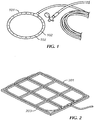
- FIG. 1 shows an example of a hose configured with small perforations 102 to introduce bubbles proximate the intake of a degasser. While the circular hose of FIG.
- a more aggressive air injection may be provided using a bubbler pattern that covers the entire base of the process tank.
- a hose 201 may be secured to a weighted frame 203.
- Such an arrangement provides more linear feet of the hose, or bubbler, and many more bubbles for a given process tank.
- many of the bubbles generated may be outside the immediate draw of the degasser.
- the degasser used must be effective to reduce foaming.
- a proper range of air bubbles introduced into the fluid may be determined by measuring flow rate of the air as a function of hose length and applied pressure, as shown in the Examples below.
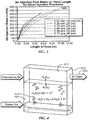
- Figure 3 shows the resulting air injection rates achievable for varied lengths of soaker hose for a range of injection pressures. Fine bubble generation was limited to injection pressures of 0.172 MPa (25 psi) or lower. For shorter hose lengths, the air injection rate was limited due to over-pressuring of the hose. Accordingly, longer lengths of tubing are required to achieve high flow rates at low injection pressures. Thus, in this embodiment, approximately 50L/min of air per meter of hose is required to retain fine bubble generation.
- H has a value of 8.56 x 10⁻³ atm ⁇ m 3 /mol at 20°C. This relation applies to air and water in the degassing system strictly when the two phases are allowed to stand long enough in contact for all portions of the gas and liquid to come into equilibrium. For example, if pure water were allowed to stand in a atmosphere of pure H 2 S, the equilibrium concentration of dissolved H 2 S would be 3740 mg/L.
- air bubbles 419 are injected into a well fluid 420 contained in process tank 422. Entrained gases, for example hydrogen sulfide, may escape and fill the headspace volume 424. The gases that fill the headspace volume 424 are sent to flare 426.
- Entrained gases for example hydrogen sulfide
- water containing dissolved H 2 S may flow into a process tank with the following system limitations.
- the equilibrium concentration of H 2 S in the air space of the process tank may be determined as described below.
- a process tank may have a total volume of 8,000 L and may be loaded with 6,000L of water containing 1,000 mg/L of H 2 S. This leaves 2,000 L of vapor space.
- the air in the vapor space may be void of oxygen (for reasons discussed later).
- the pH is kept stable at 2.0 even as H 2 S leaves the fluid.
- the 6,000 L of water contains (1,000 mg/L x 6,000 L x 1g/1000mg x 1kg/1,000g) 6 kg of H 2 S.
- the molecular weight of H 2 S is approximately 34 g/mol, so there are (6 kg x 1000g/kg x 1 mol/34 g) 176.47 mol of H 2 S in the water.
- the mole fraction of H 2 S may be calculated as (moles H 2 S)/(moles water).
- One liter of water weighs nearly 1 kg, and the molecular weight of water is 18 g/mol.
- the number of moles of water can be determined by multiplying the total volume of static water by the fraction of mol/L. of water (55 mol/L x 6000 L) to yield 330,000 mol of water. Accordingly, the mole fraction of H 2 S is approximately (176.47/330,000) 0.000535.
- Hydrogen sulfide is an acid with two equivalents per mole, sequentially ionizing: H 2 S ⁇ H + + HS - and HS - ⁇ H + + S -2
- the second ionization constant is relatively low or weak such that S -2 is virtually non-existent in dilute aqueous systems.
- Henry's law (shown in Equation 1) holds only when there is no chemical reaction between the solute and solvent. Accordingly, the pH of the well fluid affects the hydrogen sulfide ionization and the H 2 S concentration. Thus, the liquid/gas equilibria of H 2 S is partially dependent on the ionization of the hydrogen sulfide.
- Sulfide in the form of HS - is not volatile. As shown in Figure 5 , as the pH falls below 6, the sulfide in the well fluid is more likely to be in the non-volatile, HS - , form.
- a buffer may be added to the fluid to maintain a pH of less than 6. For example, citric acid may be provided to hold the pH at 4.
- oxygen is sparged into the well fluid to remove hydrogen sulfide from the well fluid.
- Oxygen in the sparged air generally a nuisance to well fluids in the wellbore because of its corrosive nature, can be beneficial in sparging operations of general fluids.
- Hydrogen sulfide reacts with oxygen to become relatively harmless elemental sulfur.
- U.S. Patent No. 5,525,242 issued to Kerecz and U.S. Patent No. 6,352,943 issued to Kohlenberg describe methods of removing hydrogen sulfide by sparging with air . Additionally, the removal of air may be facilitated by dispersing the water as a mist or inducing a vortex.
- oxygen is a more effective sparging agent for scavenging hydrogen sulfide, because oxygen readily reacts with hydrogen sulfide.
- the thermodynamic drive to convert elemental oxygen into water by reacting with hydrogen sulfide to form elemental sulfur results in very low residual hydrogen sulfide.
- the kinetics of oxygen transfer across the gas/liquid interface may be a limiting factor; however, by using small bubbles rather than larger bubbles (as discussed below), this process may become more effective.
- the determination of how large a contribution oxygen makes to the removal of hydrogen sulfide in the well fluid is detailed below.
- E the maximum potential difference, or electromotive force
- R the thermodynamic gas constant
- T the absolute temperature
- F Faraday's constant
- n the number of electrons.
- 0.0592 V may replace RT/F in Equation 5 above.
- a system for removing hydrogen sulfide is shown in Figure 6 .
- H 2 S enters the system as soluble sulfides with well fluid 630 as it is flowed into process tank 632.
- the well fluid 630 pours into the process tank until it reaches a pre-selected depth corresponding to a pre-selected volume.
- the pre-selected depth corresponds to a volume of 6 m 3 of contained well fluid.
- Air 634 is sparged into the fluid 630.
- a mechanical degasser (not shown) coupled to the process tank 632 exerts a centrifugal force on the well fluid 630 to facilitate the escape of entrained gases into headspace volume 636.
- the removed entrained gases are sent to flare 638 for burning.
- the contained well fluid 630 spills over a weir arrangement in the process tank into a separate compartment.
- a mobile degassing system is provided to remove entrained and/or dissolved gases from a well fluid.
- a well fluid for example, a spent acid
- the well fluid undergoes a gross gas/liquid separation 702 in a unit upstream from the system, with the gases sent to a flare 713.
- At least one surge tank 703 regulates the flow of the well fluid before the well fluid enters a process tank containing at least one weir.
- the pH of the well fluid in the process tank is measured at 704.
- the pH of the well fluid may be measured by any method known in the art, and is not limited herein.
- acid is added, shown at 705, to the well fluid until a pH of less than 4 is reached.
- the acid added to the well fluid to maintain a pH of 4 may be citric acid.
- acids may be used to lower and maintain the pH of the well fluid.
- the level of fluid in the process tank is measured, shown at 706.
- the level of fluid in the process tank may be measured by any method known in the art, for example, electronically by a sensor or manually by a system operator. Once the liquid level has reached a predetermined value required for running a degasser, the degasser is turned on, shown at 707.
- the well fluid is aerated 708 by injecting or sparging air 709 through the fluid in the process tank.
- the fluid sparged through the well fluid is oxygen.
- the mechanical degasser and sparging are performed simultaneously. The centrifugal force of the mechanical degasser multiplies the force acting on the entrained gas bubbles and the oxygen bubbles to increase buoyancy and release of both the entrained gas bubbles and the oxygen bubbles. The increase in buoyancy of the bubbles accelerates the bubble-rise velocity. As the entrained gas bubbles and the oxygen bubbles rise toward the surface, they escape the well fluid.
- the oxygen injected into the well fluid may react with hydrogen sulfide dissolved in the fluid, thereby producing elemental sulfur, which may be more easily separated from the fluid.
- the well fluid rises to the level of the weir 710 due to the input flow of well fluid and aeration of the tank, the well fluid pours over the weir and empties into another containment. The outfall well fluid 711 may then be safely disposed.
- the aeration and degassing system may be continuously operated for a period of time. In one embodiment, the aeration and degassing system is continuously operated for approximately 8 to 10 hours at a time. After aeration and degassing may be stopped periodically during the process to remove elemental sulfur from the process tank that results from the reaction between oxygen sparged into the well fluid and entrained hydrogen sulfide.
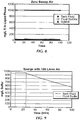
- 6,000L of well fluid with a pH of 2.0 contained in a 8,000L process tank is sparged with zero air at a rate of 1,000 L/min.
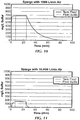
- the amount of sulfur reduced over time as a result of the sparging is shown in Figure 10 for both the well fluid in the process tank and the well fluid that spills over the weir. Sparging the well fluid with zero air at 1,000 L/min results in larger reduction in sulfur content than sparging the well fluid with zero air at 100 L/min.
- 6,000L of well fluid with a pH of 2.0 contained in a 8,000L process tank is sparged with zero air at a rate of 10,000 L/min. Sparging the well fluid with zero air at 10,000 L/min results in significant and immediate reduction in sulfides, as shown in Figure 11 for both the well fluid in the process tank and the well fluid that spills over the weir.
- Figure 12 shows the result of a system where the pH is 8 and zero air is sparged through the well fluid at a rate of 1,000 L/min for both the well fluid in the process tank and the well fluid that spills over the weir.
- Figure 12 (pH 8) and Figure 10 (pH 2) shows the extraction of hydrogen sulfide in the higher pH well fluid its much less efficient than in the well fluid with a lower pH.
- embodiments of the present invention provide a system and method for reducing the amount of hydrogen sulfide in a well fluid. Further, embodiments of the present invention may reduce the risks to both the structure of the well and personnel associated with circulating well fluid, including embrittled tubulars, corrosion of equipment, and death.
Landscapes
- Engineering & Computer Science (AREA)
- Geology (AREA)
- Life Sciences & Earth Sciences (AREA)
- Mining & Mineral Resources (AREA)
- Physics & Mathematics (AREA)
- Environmental & Geological Engineering (AREA)
- Fluid Mechanics (AREA)
- Mechanical Engineering (AREA)
- General Life Sciences & Earth Sciences (AREA)
- Geochemistry & Mineralogy (AREA)
- Chemical & Material Sciences (AREA)
- Chemical Kinetics & Catalysis (AREA)
- Degasification And Air Bubble Elimination (AREA)
- Physical Water Treatments (AREA)
Claims (12)
- Verfahren zum Verringern mitgerissener und gelöster Gase aus einem Bohrlochfluid, wobei das Verfahren umfasst:Strömenlassen eines Bohrlochfluids in einen Prozessbehälter;Ausüben einer Zentrifugalkraft auf das Bohrlochfluid;wobei ein mechanischer Entgaser, der mit dem Prozessbehälter gekoppelt ist, dafür konfiguriert ist, die Zentrifugalkraft auf das Bohrlochfluid auszuüben; undErzeugen von Blasen in dem Bohrlochfluid in der Nähe eines Einlasses des mechanischen Entgasers,wobei das Erzeugen von Blasen in dem Bohrlochfluid das Injizieren von Gas in das Bohrlochfluid umfasst, wobei das in das Bohrlochfluid injizierte Gas Sauerstoff umfasst.
- Verfahren nach Anspruch 1, wobei das in das Bohrlochfluid injizierte Gas Luft ist.
- Verfahren nach Anspruch 1, das ferner das Bestimmen des pH-Werts des Bohrlochfluids in dem Prozessbehälter umfasst.
- Verfahren nach Anspruch 3, das ferner das Aufrechterhalten des pH-Werts des Bohrlochfluids in dem Prozessbehälter unter einem vorgegebenen Wert umfasst.
- Verfahren nach Anspruch 4, wobei das Aufrechterhalten des pH-Werts des Bohrlochfluids das Zuführen einer Säure zu dem Bohrlochfluid in dem Prozessbehälter umfasst.
- Verfahren nach Anspruch 5, wobei die Säure Zitronensäure ist.
- Verfahren nach Anspruch 1, das ferner das Abfackeln des Gases umfasst.
- Verfahren nach Anspruch 1, wobei das Ausüben einer Zentrifugalkraft auf das Bohrlochfluid ausgeführt wird, nachdem das Bohrlochfluid ein vorgegebenes Volumen des Prozessbehälters erreicht hat.
- Verfahren nach Anspruch 1, das ferner das Überlaufenlassen des Bohrlochfluids in den Prozessbehälter über ein Wehr umfasst.
- Verfahren nach Anspruch 2, wobei das Erzeugen von Blasen das Injizieren von Luft durch einen Schlauch, der wenigstens eine Durchlochung umfasst, umfasst.
- Verfahren nach Anspruch 10, wobei der Schlauch einen umfasst, der aus der Gruppe ausgewählt ist, die aus Elastomer, Fritte, Glas, Metall, Kunststoff und irgendeiner Kombination davon besteht.
- Verfahren nach Anspruch 2, wobei das Ausüben einer Zentrifugalkraft auf das Bohrlochfluid und das Injizieren der Luft in das Bohrlochfluid gleichzeitig ausgeführt werden.
Applications Claiming Priority (2)
| Application Number | Priority Date | Filing Date | Title |
|---|---|---|---|
| US77637206P | 2006-02-24 | 2006-02-24 | |
| PCT/US2007/004894 WO2007100750A2 (en) | 2006-02-24 | 2007-02-23 | Aerated degasser |
Publications (3)
| Publication Number | Publication Date |
|---|---|
| EP1986757A2 EP1986757A2 (de) | 2008-11-05 |
| EP1986757A4 EP1986757A4 (de) | 2012-03-28 |
| EP1986757B1 true EP1986757B1 (de) | 2017-02-08 |
Family
ID=38459602
Family Applications (1)
| Application Number | Title | Priority Date | Filing Date |
|---|---|---|---|
| EP07751638.3A Not-in-force EP1986757B1 (de) | 2006-02-24 | 2007-02-23 | Durchlüfteter entgaser |
Country Status (7)
| Country | Link |
|---|---|
| US (1) | US7753990B2 (de) |
| EP (1) | EP1986757B1 (de) |
| CA (2) | CA2642792C (de) |
| EA (1) | EA016519B1 (de) |
| MX (1) | MX2008010771A (de) |
| NO (1) | NO20084027L (de) |
| WO (1) | WO2007100750A2 (de) |
Families Citing this family (7)
| Publication number | Priority date | Publication date | Assignee | Title |
|---|---|---|---|---|
| US8613360B2 (en) | 2006-09-29 | 2013-12-24 | M-I L.L.C. | Shaker and degasser combination |
| US20080164068A1 (en) * | 2006-12-21 | 2008-07-10 | M-I Llc | System and method for cleaning drill cuttings with degassed water |
| WO2013043042A1 (en) * | 2011-09-23 | 2013-03-28 | Taxon B.V. | Spherical separation device and method for separation |
| US9346677B2 (en) * | 2012-08-29 | 2016-05-24 | Sandvik Process Systems Llc | Sulfur degasser apparatus and method |
| CA3112371A1 (en) * | 2018-09-06 | 2020-03-12 | Swade HOLOWATUK | Process and system for removing hydrogen sulfide from sour water |
| US11646002B2 (en) | 2021-02-01 | 2023-05-09 | Bryan PAIGE | Capo for use with a stringed musical instrument, and method of using same |
| US11813551B1 (en) | 2021-11-22 | 2023-11-14 | Viro Petroleum & Energy, LLC | Hydrogen sulfide mitigation methods and systems |
Family Cites Families (19)
| Publication number | Priority date | Publication date | Assignee | Title |
|---|---|---|---|---|
| US4010012A (en) * | 1975-02-03 | 1977-03-01 | Dresser Industries, Inc. | Total gas containment system |
| US3977972A (en) * | 1975-04-02 | 1976-08-31 | Exxon Research And Engineering Company | Method and apparatus for reclaiming contaminated liquid |
| GB1591899A (en) * | 1976-12-27 | 1981-07-01 | Dresser Ind | Degasser spray vessel |
| US4412924A (en) * | 1981-12-29 | 1983-11-01 | Feather Orval R | Water purification system |
| GB8508690D0 (en) * | 1985-04-03 | 1985-05-09 | Ici Plc | Deaerating water |
| WO1987007590A1 (fr) * | 1986-06-12 | 1987-12-17 | Wilke Engelbart | Procede et dispositif pour la gazeification des liquides en fines bulles et sur une grande surface |
| SU1431798A1 (ru) | 1986-06-23 | 1988-10-23 | Сибирский научно-исследовательский институт нефтяной промышленности | Способ подготовки нефти |
| SU1634295A1 (ru) | 1989-03-20 | 1991-03-15 | Предприятие П/Я Г-4882 | Устройство дл дегазации жидкости |
| SK268891A3 (en) * | 1991-08-30 | 1994-12-07 | Ludwig Scheibinger | Device for aeration of tank with liquid |
| US5516360A (en) | 1994-04-08 | 1996-05-14 | Baker Hughes Incorporated | Abrasion resistant gas separator |
| US5525242A (en) | 1994-10-19 | 1996-06-11 | Kerecz; Robert C. J. | Apparatus and process for the aeration of water |
| US5673752A (en) | 1995-12-22 | 1997-10-07 | Scudder; Pat | Method and apparatus for producing gas from a formation containing both gas and water |
| US5900137A (en) * | 1996-06-27 | 1999-05-04 | Homan; Edwin Daryl | Apparatus and method for separating components in well fluids |
| FR2762043B1 (fr) | 1997-04-14 | 1999-06-25 | Inst Francais Du Petrole | Outil d'exploration par ondes elastiques pour puits |
| US6103108A (en) | 1998-09-24 | 2000-08-15 | Kohlenberg; Larry D. | Water treatment apparatus |
| US6143709A (en) | 2000-03-28 | 2000-11-07 | Carey; Charles C. | Well cleaning stimulation and purging method |
| US6673135B2 (en) * | 2002-02-08 | 2004-01-06 | National Tank Company | System and method of separating entrained immiscible liquid component of an inlet stream |
| US7282081B2 (en) * | 2004-08-12 | 2007-10-16 | Verscharen John A | Method and apparatus for high efficiency multi-stage packed tower aeration with PH adjustment and reutilization of outlet air |
| NO330765B1 (no) * | 2006-03-15 | 2011-07-11 | Hamworthy Plc | Tank for behandling av fluider og system for prosessering av bronnfluider omfattende en slik tank |
-
2007
- 2007-02-22 US US11/677,829 patent/US7753990B2/en not_active Expired - Fee Related
- 2007-02-23 WO PCT/US2007/004894 patent/WO2007100750A2/en not_active Ceased
- 2007-02-23 EP EP07751638.3A patent/EP1986757B1/de not_active Not-in-force
- 2007-02-23 CA CA2642792A patent/CA2642792C/en not_active Expired - Fee Related
- 2007-02-23 CA CA2755939A patent/CA2755939C/en not_active Expired - Fee Related
- 2007-02-23 EA EA200870293A patent/EA016519B1/ru not_active IP Right Cessation
- 2007-02-23 MX MX2008010771A patent/MX2008010771A/es active IP Right Grant
-
2008
- 2008-09-22 NO NO20084027A patent/NO20084027L/no not_active Application Discontinuation
Non-Patent Citations (1)
| Title |
|---|
| None * |
Also Published As
| Publication number | Publication date |
|---|---|
| CA2642792C (en) | 2012-01-03 |
| CA2642792A1 (en) | 2007-09-07 |
| EA016519B1 (ru) | 2012-05-30 |
| MX2008010771A (es) | 2008-09-01 |
| CA2755939A1 (en) | 2007-09-07 |
| EA200870293A1 (ru) | 2009-02-27 |
| EP1986757A4 (de) | 2012-03-28 |
| WO2007100750A3 (en) | 2007-11-01 |
| US20070199703A1 (en) | 2007-08-30 |
| WO2007100750A2 (en) | 2007-09-07 |
| EP1986757A2 (de) | 2008-11-05 |
| US7753990B2 (en) | 2010-07-13 |
| NO20084027L (no) | 2008-11-19 |
| CA2755939C (en) | 2013-11-26 |
Similar Documents
| Publication | Publication Date | Title |
|---|---|---|
| EP1986954B1 (de) | Hydrogensulfid-bearbeitungssystem | |
| EP1986757B1 (de) | Durchlüfteter entgaser | |
| Seright et al. | Effect of dissolved iron and oxygen on stability of hydrolyzed polyacrylamide polymers | |
| CA1074695A (en) | Method and apparatus for recovering metal values from mineral ores by in-situ mining | |
| US20150307375A1 (en) | Preventing mobilization of trace metals in subsurface aquifers due to the introduction of oxygenated water | |
| WO2019239200A1 (en) | Systems and methods for carbonated water flooding of hydrocarbon reservoirs | |
| US12246975B2 (en) | Carbon sequestration systems in conjunction with oil and gas operations | |
| US4756836A (en) | Downhole hydrogen sulfide scavenging in drilling mud using iron chelates | |
| US20240083788A1 (en) | System for friction reduction with carbon sequestration | |
| EP0851843B1 (de) | Methode und apparat zur unterirdischen biologischen sanierung | |
| US8783345B2 (en) | Microbial enhanced oil recovery delivery systems and methods | |
| US8574441B2 (en) | Process for removing oxidants from water injected into a subsurface aquifer to prevent mobilization of trace metals | |
| US20150203391A1 (en) | Method to remove ammonia from mine depressurization water | |
| US20250346799A1 (en) | Material and methods for enhanced triazine-h2s scavenging efficiency in bubble tower reactor using nano-bubbling technology | |
| US20250206643A1 (en) | Carbon sequestration systems in conjunction with oil and gas operations | |
| US20240076216A1 (en) | Dynamic produced water treatment apparatus and system with carbon sequestration | |
| Carlberg | Vacuum deaeration-a new unit operation for waterflood treating plants | |
| RU2728168C1 (ru) | Способ предотвращения прорывов пластовых вод к забоям газовых, газоконденсатных или газогидратных скважин | |
| Hunt et al. | Emplacement and release of brines from subsurface | |
| Luber et al. | Air injection wells for groundwater remediation-large scale experiment | |
| Baumgartner | Texas Panhandle Injection Waters---And Their Solution |
Legal Events
| Date | Code | Title | Description |
|---|---|---|---|
| PUAI | Public reference made under article 153(3) epc to a published international application that has entered the european phase |
Free format text: ORIGINAL CODE: 0009012 |
|
| 17P | Request for examination filed |
Effective date: 20080331 |
|
| AK | Designated contracting states |
Kind code of ref document: A2 Designated state(s): AT BE BG CH CY CZ DE DK EE ES FI FR GB GR HU IE IS IT LI LT LU LV MC NL PL PT RO SE SI SK TR |
|
| A4 | Supplementary search report drawn up and despatched |
Effective date: 20120223 |
|
| RIC1 | Information provided on ipc code assigned before grant |
Ipc: B01D 19/00 20060101AFI20120217BHEP |
|
| DAX | Request for extension of the european patent (deleted) | ||
| 17Q | First examination report despatched |
Effective date: 20131211 |
|
| GRAP | Despatch of communication of intention to grant a patent |
Free format text: ORIGINAL CODE: EPIDOSNIGR1 |
|
| INTG | Intention to grant announced |
Effective date: 20161026 |
|
| STAA | Information on the status of an ep patent application or granted ep patent |
Free format text: STATUS: GRANT OF PATENT IS INTENDED |
|
| GRAS | Grant fee paid |
Free format text: ORIGINAL CODE: EPIDOSNIGR3 |
|
| GRAA | (expected) grant |
Free format text: ORIGINAL CODE: 0009210 |
|
| STAA | Information on the status of an ep patent application or granted ep patent |
Free format text: STATUS: THE PATENT HAS BEEN GRANTED |
|
| AK | Designated contracting states |
Kind code of ref document: B1 Designated state(s): AT BE BG CH CY CZ DE DK EE ES FI FR GB GR HU IE IS IT LI LT LU LV MC NL PL PT RO SE SI SK TR |
|
| REG | Reference to a national code |
Ref country code: GB Ref legal event code: FG4D |
|
| REG | Reference to a national code |
Ref country code: CH Ref legal event code: EP Ref country code: AT Ref legal event code: REF Ref document number: 866613 Country of ref document: AT Kind code of ref document: T Effective date: 20170215 |
|
| REG | Reference to a national code |
Ref country code: IE Ref legal event code: FG4D |
|
| REG | Reference to a national code |
Ref country code: DE Ref legal event code: R096 Ref document number: 602007049762 Country of ref document: DE |
|
| REG | Reference to a national code |
Ref country code: LT Ref legal event code: MG4D |
|
| REG | Reference to a national code |
Ref country code: NL Ref legal event code: MP Effective date: 20170208 |
|
| REG | Reference to a national code |
Ref country code: AT Ref legal event code: MK05 Ref document number: 866613 Country of ref document: AT Kind code of ref document: T Effective date: 20170208 |
|
| PG25 | Lapsed in a contracting state [announced via postgrant information from national office to epo] |
Ref country code: FI Free format text: LAPSE BECAUSE OF FAILURE TO SUBMIT A TRANSLATION OF THE DESCRIPTION OR TO PAY THE FEE WITHIN THE PRESCRIBED TIME-LIMIT Effective date: 20170208 Ref country code: LT Free format text: LAPSE BECAUSE OF FAILURE TO SUBMIT A TRANSLATION OF THE DESCRIPTION OR TO PAY THE FEE WITHIN THE PRESCRIBED TIME-LIMIT Effective date: 20170208 Ref country code: GR Free format text: LAPSE BECAUSE OF FAILURE TO SUBMIT A TRANSLATION OF THE DESCRIPTION OR TO PAY THE FEE WITHIN THE PRESCRIBED TIME-LIMIT Effective date: 20170509 |
|
| PGFP | Annual fee paid to national office [announced via postgrant information from national office to epo] |
Ref country code: GB Payment date: 20170503 Year of fee payment: 11 |
|
| PG25 | Lapsed in a contracting state [announced via postgrant information from national office to epo] |
Ref country code: LV Free format text: LAPSE BECAUSE OF FAILURE TO SUBMIT A TRANSLATION OF THE DESCRIPTION OR TO PAY THE FEE WITHIN THE PRESCRIBED TIME-LIMIT Effective date: 20170208 Ref country code: PT Free format text: LAPSE BECAUSE OF FAILURE TO SUBMIT A TRANSLATION OF THE DESCRIPTION OR TO PAY THE FEE WITHIN THE PRESCRIBED TIME-LIMIT Effective date: 20170608 Ref country code: AT Free format text: LAPSE BECAUSE OF FAILURE TO SUBMIT A TRANSLATION OF THE DESCRIPTION OR TO PAY THE FEE WITHIN THE PRESCRIBED TIME-LIMIT Effective date: 20170208 Ref country code: SE Free format text: LAPSE BECAUSE OF FAILURE TO SUBMIT A TRANSLATION OF THE DESCRIPTION OR TO PAY THE FEE WITHIN THE PRESCRIBED TIME-LIMIT Effective date: 20170208 Ref country code: BG Free format text: LAPSE BECAUSE OF FAILURE TO SUBMIT A TRANSLATION OF THE DESCRIPTION OR TO PAY THE FEE WITHIN THE PRESCRIBED TIME-LIMIT Effective date: 20170508 Ref country code: ES Free format text: LAPSE BECAUSE OF FAILURE TO SUBMIT A TRANSLATION OF THE DESCRIPTION OR TO PAY THE FEE WITHIN THE PRESCRIBED TIME-LIMIT Effective date: 20170208 Ref country code: NL Free format text: LAPSE BECAUSE OF FAILURE TO SUBMIT A TRANSLATION OF THE DESCRIPTION OR TO PAY THE FEE WITHIN THE PRESCRIBED TIME-LIMIT Effective date: 20170208 |
|
| REG | Reference to a national code |
Ref country code: DE Ref legal event code: R119 Ref document number: 602007049762 Country of ref document: DE |
|
| REG | Reference to a national code |
Ref country code: CH Ref legal event code: PL |
|
| PG25 | Lapsed in a contracting state [announced via postgrant information from national office to epo] |
Ref country code: LI Free format text: LAPSE BECAUSE OF NON-PAYMENT OF DUE FEES Effective date: 20170228 Ref country code: CZ Free format text: LAPSE BECAUSE OF FAILURE TO SUBMIT A TRANSLATION OF THE DESCRIPTION OR TO PAY THE FEE WITHIN THE PRESCRIBED TIME-LIMIT Effective date: 20170208 Ref country code: IT Free format text: LAPSE BECAUSE OF FAILURE TO SUBMIT A TRANSLATION OF THE DESCRIPTION OR TO PAY THE FEE WITHIN THE PRESCRIBED TIME-LIMIT Effective date: 20170208 Ref country code: CH Free format text: LAPSE BECAUSE OF NON-PAYMENT OF DUE FEES Effective date: 20170228 Ref country code: SK Free format text: LAPSE BECAUSE OF FAILURE TO SUBMIT A TRANSLATION OF THE DESCRIPTION OR TO PAY THE FEE WITHIN THE PRESCRIBED TIME-LIMIT Effective date: 20170208 Ref country code: EE Free format text: LAPSE BECAUSE OF FAILURE TO SUBMIT A TRANSLATION OF THE DESCRIPTION OR TO PAY THE FEE WITHIN THE PRESCRIBED TIME-LIMIT Effective date: 20170208 Ref country code: RO Free format text: LAPSE BECAUSE OF FAILURE TO SUBMIT A TRANSLATION OF THE DESCRIPTION OR TO PAY THE FEE WITHIN THE PRESCRIBED TIME-LIMIT Effective date: 20170208 |
|
| REG | Reference to a national code |
Ref country code: IE Ref legal event code: MM4A |
|
| PG25 | Lapsed in a contracting state [announced via postgrant information from national office to epo] |
Ref country code: DK Free format text: LAPSE BECAUSE OF FAILURE TO SUBMIT A TRANSLATION OF THE DESCRIPTION OR TO PAY THE FEE WITHIN THE PRESCRIBED TIME-LIMIT Effective date: 20170208 Ref country code: MC Free format text: LAPSE BECAUSE OF FAILURE TO SUBMIT A TRANSLATION OF THE DESCRIPTION OR TO PAY THE FEE WITHIN THE PRESCRIBED TIME-LIMIT Effective date: 20170208 Ref country code: PL Free format text: LAPSE BECAUSE OF FAILURE TO SUBMIT A TRANSLATION OF THE DESCRIPTION OR TO PAY THE FEE WITHIN THE PRESCRIBED TIME-LIMIT Effective date: 20170208 |
|
| PLBE | No opposition filed within time limit |
Free format text: ORIGINAL CODE: 0009261 |
|
| STAA | Information on the status of an ep patent application or granted ep patent |
Free format text: STATUS: NO OPPOSITION FILED WITHIN TIME LIMIT |
|
| PG25 | Lapsed in a contracting state [announced via postgrant information from national office to epo] |
Ref country code: LU Free format text: LAPSE BECAUSE OF NON-PAYMENT OF DUE FEES Effective date: 20170223 |
|
| REG | Reference to a national code |
Ref country code: FR Ref legal event code: ST Effective date: 20171129 |
|
| 26N | No opposition filed |
Effective date: 20171109 |
|
| PG25 | Lapsed in a contracting state [announced via postgrant information from national office to epo] |
Ref country code: FR Free format text: LAPSE BECAUSE OF NON-PAYMENT OF DUE FEES Effective date: 20170410 Ref country code: DE Free format text: LAPSE BECAUSE OF NON-PAYMENT OF DUE FEES Effective date: 20170901 |
|
| REG | Reference to a national code |
Ref country code: BE Ref legal event code: MM Effective date: 20170228 |
|
| PG25 | Lapsed in a contracting state [announced via postgrant information from national office to epo] |
Ref country code: SI Free format text: LAPSE BECAUSE OF FAILURE TO SUBMIT A TRANSLATION OF THE DESCRIPTION OR TO PAY THE FEE WITHIN THE PRESCRIBED TIME-LIMIT Effective date: 20170208 Ref country code: IE Free format text: LAPSE BECAUSE OF NON-PAYMENT OF DUE FEES Effective date: 20170223 |
|
| PG25 | Lapsed in a contracting state [announced via postgrant information from national office to epo] |
Ref country code: BE Free format text: LAPSE BECAUSE OF NON-PAYMENT OF DUE FEES Effective date: 20170228 |
|
| GBPC | Gb: european patent ceased through non-payment of renewal fee |
Effective date: 20180223 |
|
| PG25 | Lapsed in a contracting state [announced via postgrant information from national office to epo] |
Ref country code: GB Free format text: LAPSE BECAUSE OF NON-PAYMENT OF DUE FEES Effective date: 20180223 |
|
| PG25 | Lapsed in a contracting state [announced via postgrant information from national office to epo] |
Ref country code: HU Free format text: LAPSE BECAUSE OF FAILURE TO SUBMIT A TRANSLATION OF THE DESCRIPTION OR TO PAY THE FEE WITHIN THE PRESCRIBED TIME-LIMIT; INVALID AB INITIO Effective date: 20070223 |
|
| PG25 | Lapsed in a contracting state [announced via postgrant information from national office to epo] |
Ref country code: CY Free format text: LAPSE BECAUSE OF NON-PAYMENT OF DUE FEES Effective date: 20170208 |
|
| PG25 | Lapsed in a contracting state [announced via postgrant information from national office to epo] |
Ref country code: TR Free format text: LAPSE BECAUSE OF FAILURE TO SUBMIT A TRANSLATION OF THE DESCRIPTION OR TO PAY THE FEE WITHIN THE PRESCRIBED TIME-LIMIT Effective date: 20170208 |
|
| PG25 | Lapsed in a contracting state [announced via postgrant information from national office to epo] |
Ref country code: IS Free format text: LAPSE BECAUSE OF FAILURE TO SUBMIT A TRANSLATION OF THE DESCRIPTION OR TO PAY THE FEE WITHIN THE PRESCRIBED TIME-LIMIT Effective date: 20170608 |
|
| P01 | Opt-out of the competence of the unified patent court (upc) registered |
Effective date: 20231216 |