EP1986501B1 - Process for manufacturing a fermented milk - Google Patents
Process for manufacturing a fermented milk Download PDFInfo
- Publication number
- EP1986501B1 EP1986501B1 EP06707505.1A EP06707505A EP1986501B1 EP 1986501 B1 EP1986501 B1 EP 1986501B1 EP 06707505 A EP06707505 A EP 06707505A EP 1986501 B1 EP1986501 B1 EP 1986501B1
- Authority
- EP
- European Patent Office
- Prior art keywords
- rotor
- stator
- fermented milk
- peripheral velocity
- viscosity
- Prior art date
- Legal status (The legal status is an assumption and is not a legal conclusion. Google has not performed a legal analysis and makes no representation as to the accuracy of the status listed.)
- Revoked
Links
Images
Classifications
-
- A—HUMAN NECESSITIES
- A23—FOODS OR FOODSTUFFS; TREATMENT THEREOF, NOT COVERED BY OTHER CLASSES
- A23C—DAIRY PRODUCTS, e.g. MILK, BUTTER OR CHEESE; MILK OR CHEESE SUBSTITUTES; PREPARATION THEREOF
- A23C19/00—Cheese; Cheese preparations; Making thereof
- A23C19/06—Treating cheese curd after whey separation; Products obtained thereby
-
- A—HUMAN NECESSITIES
- A23—FOODS OR FOODSTUFFS; TREATMENT THEREOF, NOT COVERED BY OTHER CLASSES
- A23C—DAIRY PRODUCTS, e.g. MILK, BUTTER OR CHEESE; MILK OR CHEESE SUBSTITUTES; PREPARATION THEREOF
- A23C9/00—Milk preparations; Milk powder or milk powder preparations
- A23C9/12—Fermented milk preparations; Treatment using microorganisms or enzymes
- A23C9/122—Apparatus for preparing or treating fermented milk products
- A23C9/1223—Apparatus for preparing or treating fermented milk products for making stirred yoghurt; Apparatus with agitating or stirring means; Continuous bulk fermentation, heating or cooling, i.e. continuous inlet and outlet flow of yoghurt
-
- B—PERFORMING OPERATIONS; TRANSPORTING
- B01—PHYSICAL OR CHEMICAL PROCESSES OR APPARATUS IN GENERAL
- B01F—MIXING, e.g. DISSOLVING, EMULSIFYING OR DISPERSING
- B01F27/00—Mixers with rotary stirring devices in fixed receptacles; Kneaders
- B01F27/27—Mixers with stator-rotor systems, e.g. with intermeshing teeth or cylinders or having orifices
- B01F27/271—Mixers with stator-rotor systems, e.g. with intermeshing teeth or cylinders or having orifices with means for moving the materials to be mixed radially between the surfaces of the rotor and the stator
- B01F27/2711—Mixers with stator-rotor systems, e.g. with intermeshing teeth or cylinders or having orifices with means for moving the materials to be mixed radially between the surfaces of the rotor and the stator provided with intermeshing elements
-
- B—PERFORMING OPERATIONS; TRANSPORTING
- B01—PHYSICAL OR CHEMICAL PROCESSES OR APPARATUS IN GENERAL
- B01F—MIXING, e.g. DISSOLVING, EMULSIFYING OR DISPERSING
- B01F2215/00—Auxiliary or complementary information in relation with mixing
- B01F2215/04—Technical information in relation with mixing
- B01F2215/0413—Numerical information
- B01F2215/0418—Geometrical information
- B01F2215/0431—Numerical size values, e.g. diameter of a hole or conduit, area, volume, length, width, or ratios thereof
-
- B—PERFORMING OPERATIONS; TRANSPORTING
- B01—PHYSICAL OR CHEMICAL PROCESSES OR APPARATUS IN GENERAL
- B01F—MIXING, e.g. DISSOLVING, EMULSIFYING OR DISPERSING
- B01F2215/00—Auxiliary or complementary information in relation with mixing
- B01F2215/04—Technical information in relation with mixing
- B01F2215/0413—Numerical information
- B01F2215/0436—Operational information
- B01F2215/045—Numerical flow-rate values
-
- B—PERFORMING OPERATIONS; TRANSPORTING
- B01—PHYSICAL OR CHEMICAL PROCESSES OR APPARATUS IN GENERAL
- B01F—MIXING, e.g. DISSOLVING, EMULSIFYING OR DISPERSING
- B01F2215/00—Auxiliary or complementary information in relation with mixing
- B01F2215/04—Technical information in relation with mixing
- B01F2215/0413—Numerical information
- B01F2215/0436—Operational information
- B01F2215/0481—Numerical speed values
-
- B—PERFORMING OPERATIONS; TRANSPORTING
- B01—PHYSICAL OR CHEMICAL PROCESSES OR APPARATUS IN GENERAL
- B01F—MIXING, e.g. DISSOLVING, EMULSIFYING OR DISPERSING
- B01F2215/00—Auxiliary or complementary information in relation with mixing
- B01F2215/04—Technical information in relation with mixing
- B01F2215/0413—Numerical information
- B01F2215/0486—Material property information
- B01F2215/0495—Numerical values of viscosity of substances
Definitions
- the invention relates to a process for the manufacturing of a fermented milk, namely a stirred or drinking fermented milk or fresh cheese, comprising a smoothing step after fermentation in a tank to generate an homogeneous and smooth texture.
- a stirred fermented milk is incubated in a tank and the final coagulum is broken by stirring prior to cooling and packing.
- the texture is somewhat like a thick cream and is less firm than that of a set yoghurt (which is incubated and cooled in the final package and is characterized by a firm jelly like structure).
- a drinking fermented milk is very similar to a stirred fermented milk, but its viscosity is much lower.
- the stirred operation after fermentation is a key process in the manufacturing of stirred or drinking fermented milk, such as a stirred yoghurt or a drinking yoghurt.
- This unit operation is usually performed by using filters or valves.
- the process also relates to a fermented milk that has been submitted to a step of high pressure homogeneization before fermentation.
- the first known solution for the stirring operation after fermentation is the continuous agitation of the fermented mass in the tank during the transfer operation to cooler. But the standard agitation in a tank leads to a high viscosity loss.
- the second solution namely using a static filter has been a better alternative to smooth the product, but the new ingredient development, some texture innovation, the complexity of current lines for a big mix of different products and the viscosity target variation, require a new more sensible system for this operation.
- a hand cleaning of the filter is necessary to achieve the total cleanliness with hygiene risks for the products. It also implies interrupting the production during the cleaning operation.
- CA 2 167 020 discloses a process for the manufacture of a fermented milk comprising after a fermentation step, a smoothing step performed by a rotor-stator mixer.
- WO 93/10665 discloses a process for producing a solid water-in-oil emulsion, such as butter or margarine.
- EP 0 499 041 discloses a process for the production of a processed cheese.
- DE 35 19 854 discloses a device for mixing and/or homogenizing a flowable material, and especially a cream.
- the present invention relates to a process for the manufacture of stirred or drinking fermented milk or a fresh cheese comprising after a fermentation step a smoothing step wherein said smoothing step is performed by a rotor stator mixer comprising a ring shaped rotor and a ring shaped stator, and wherein a radial gap between rings of the stator and the rotor is between 0.5 mm and 2 mm, and preferably equal to 0.5 mm, each ring of the rotor and of the stator being provided with radial slots having a given width, comprising adjusting the rotational speed of the rotor to adjust the peripheral velocity.
- a rotor stator mixer comprising a ring shaped rotor and a ring shaped stator, and wherein a radial gap between rings of the stator and the rotor is between 0.5 mm and 2 mm, and preferably equal to 0.5 mm, each ring of the rotor and of the stator being provided with radial slots
- the stator head may have three rings and the rotor head three rings.
- the slot width may be between 0.3 mm and 2 mm, and more particularly between 0.5 mm and 1.8 mm
- the rotor may be operated so that the peripheral velocity is not higher than 16 m/s for a stirred fermented milk, more particularly between 3.5 m/s and 16 m/s or between 5.5 m/s and 11.4 m/s (depending on the line flow rate and the machine model).
- the peripheral speed is between 3.5 m/s and 16 m/s.
- the peripheral speed is preferably between 3.8 m/s and 15.7 m/s.
- the peripheral speed is preferably between 5.5 m/s and 11.4 m/s.
- the peripheral velocity is between 22 m/s and 30 m/s for a flow rate between 150 l/h and 20,000 l/h and preferably between 25 and 30 m/s for a flow rate between 20,000 l/h and 60,000 l/h.
- these speeds do not bring a high shear rate to the product, hence minimizing the viscosity loss.
- the fermented milk may be of the fat free type and the process comprises adjusting the peripheral velocity.
- the fermented milk may be of a medium fat formula comprising a fat content between 3% and 5% in weight and the process comprises adjusting the peripheral velocity.
- the fermented milk may have a fat free formula with an addition of starch between 1.5% and 3% in weight and the process comprises adjusting the peripheral velocity, the slot width being less than 1mm, or, with a slot width between 0.3 mm and 0.8 mm, adjusting the peripheral velocity up to 11 m/s.
- the fermented milk may have a high-fat content between 7.5% and 10% in weight.
- the fermented milk may be a fresh cheese and the process comprises adjusting the peripheral velocity, the slot width being between 1mm and 1.5 mm.
- the invention also relates to a smoothing rotor-stator mixer for performing the process defined above, comprising a ring shaped rotor head and a ring shaped stator, wherein a radial gap between the rings of the stator and of the rotor is between 0.5 mm and 2 mm, and preferably equal to 0.5 mm, each ring of the rotor and of the stator being provided with radial slots having a given width.
- the stator may have three rings and the rotor head may have three rings.
- the slot width may be between 0.3 mm and 2 mm and more particularly between 0.5 mm and 1.5 mm.
- the rotational speed of the rotor may be adjustable so that the peripheral velocity is not higher than 16 m/s, and more particularly between 3.5 m/s and 16 m/s.
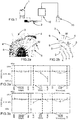
- figure 1 illustrates the smoothing step according to the invention
- figures 2a and 2b show the internal structure of the mixer
- figures 3a and 3b illustrate a test for a formula that is fat free with starch.
- the process according to the invention concerns a fermented milk as defined by the Codex Alimentarius Standard for Fermented Milks (CODEX STAN 243-2003) or a fresh cheese.
- the preferred product is a stirred or drinking yoghurt (the meaning of the word "yoghurt” being the broadest meaning we could have - i.e. the U.S. meaning).
- Yoghurt according to the invention is including product containing some bacterial strains like Lactobacillus spp. paracasei, Bifidobacterium animals subsp lactis, Lactococcus spp. lactis, Lactobacillus spp. plantarum... and product containing vegetable oils like phytosterols (and sterols esters) or PUFA.
- Cheese according to the invention is the unripened semi-solid product in which the whey protein/casein ratio does not exceed that of milk, obtained by:
- Fresh cheese may be obtained by adding rennet to a milk mass, fermenting, and draining by centrifugation to obtain an homogeneous paste which may be smoothed according to the present invention.
- the product used in the experiments is a yoghurt-based fermented white mass, manufactured with different fat and protein content in the range of 0 - 10% Fat Content FC and 3 - 5.5% Protein Content PC (in weight), and 1,5 - 3% starch content for a formula including starch..
- the products have been classified in four different categories:
- Table 1 Formula specifications for the white masses White masses Fat (%) Protein (%) Dry weight (%) Range 0-10 3-5.5 FFF 0.05 4.90 13.70 MFF 4.00 4.40 20.85 FFS 0.07 4.02 10.97 HFC 9.6 4.35
- tested compositions comprise 2.2% starch and 0.2% gelatine in weight.
- Figure 1 illustrates the smoothing stage according to the invention.
- a pump 2 is placed downwards from a fermentation tank 1.
- the in-line mixer 10 is placed after the pump.
- the product is recovered in a tank 20 at the output of the in-line mixer 10.
- the fermented product is pumped, and then smoothed in the pump 2 at about 38-39°C (depending on the culture), at the pH target of 4.65.
- the samples are stored at 10°C prior to analysis.
- FIG 2a shows the internal structure of the stator head of the mixer 10 and Figure 2b shows the assembly of a rotor-stator head of the mixer 10.
- the stator head 3 is comprised of three rings 4 each of which is provided with radial slots 5.
- the rotor head 6 is comprised of three rings 7 each of which is provided with radial slots 8.
- Radial slots 5 and 8 have a width Ws and the stator-rotor gap between the stator rings 4 and the rotor rings 7 is designated by G.
- FIGS 3a and 3b illustrate the impact of peripheral velocity (V) on FFS Formula viscosity at D1 for a ring slot width of 1.5 mm (a) and 0.5 mm (b) respectively,
- the resident time in mixer 10 is close to a few seconds.
- the two main components of the velocity field are the peripheral velocity (flow between rotor-stator gap) and the radial component (flow along the ring slots).
- the peripheral velocity depends on the rotational speed of the rotor head.
- the radial velocity depends on both the flow rate and on the geometrical parameters of the rotor-stator design (slot width).
- the object of the smoothing operation according to the invention is to obtain a smooth and possible grainless texture with a particular target viscosity.
- the adjustment of the peripheral speed allows to adjust the viscosity of the product and/or to monitor the viscosity in real time during production.
- a fermented milk according to the invention may be submitted to a mixing step (very slow stirring) in the fermentation tank just sufficient to avoid the building of a firm jelly-like structure like that of a conventional set yoghurt. Then the process according to the invention may be considered as involving a double stirring (very slow stirring in the tank, slow stirring or smoothing downstream of the tank).
- the dynamic device includes only one rotor-stator generator with 3 rings and a fixed gap between rotor and stator rings, of 0.5 mm. These parameters (1 generator, 3 rings stator and 3 rings rotor) were optimised on the first part of study
- the smoothing operation in the rotor-stator system is a double stirring process with two main components of the velocity field: the peripheral velocity (flow between rotor-stator gap) and the radial component (flow in the ring slots).
- the peripheral velocity is the most influent parameter. Its relative weight on the viscosity response is so important that all other factors are negligible.
- the peripheral velocity has to be adjusted according to the flow rate.
- the peripheral velocity must be less than 12 m/s.
- the ring slot width is the second most important factor. It has a positive effect on viscosity. An optimum is reached at 1 mm due to a high quadratic effect.
- the flow rate has a low impact on viscosity, but the model definition depending on it, is also very important.
- the peripheral velocity is always the parameter that must be adjusted first to achieve the highest textured fermented milk with the highest creamy and cosmetic perception.
- FF formula without fat
- the peripheral velocity has a negative impact on texture.
- the flow rate has low impact on viscosity response compared to the other factors.
- the model (depending on the flow rate) and the slot width are established to minimized the radial shearing that would affect viscosity in a negative way.
- the final viscosity of the product is determined by the peripheral speed.
- the peripheral velocity has a negative impact on texture properties as long as its level is higher than that of radial velocity.
- each formula depends on its microstructure, i.e. the protein network cohesion.
- the flow in an in-line rotor-stator mixing device mainly depends on the initial viscosity of the white mass and also on the microstructure of the white mass.
- the viscosity at D1 obtained with an in-line rotor-stator mixing device is higher than that obtained with a prior art disk filter.
- dynamic smoothing is less destructive for the texture.
- the new smoothing technology is a suitable solution for reaching smooth products whatever the fat and the protein content, and possibly for removing grains, which results in a smoother and more creamy perception.
- the inline rotor-stator mixing device is a highly flexible equipment allowing to enhance the product texture compared to a static filter by adjusting the rotational speed of the rotor, the other on line parameters have been set (device model depending on the flow rate and slot width).
- High rotation speed (more than 22 m/s) are used for drinking fermented milk, e.g. drinking yoghurt.
Landscapes
- Life Sciences & Earth Sciences (AREA)
- Chemical & Material Sciences (AREA)
- Engineering & Computer Science (AREA)
- Food Science & Technology (AREA)
- Polymers & Plastics (AREA)
- Microbiology (AREA)
- Chemical Kinetics & Catalysis (AREA)
- Dairy Products (AREA)
Description
- The invention relates to a process for the manufacturing of a fermented milk, namely a stirred or drinking fermented milk or fresh cheese, comprising a smoothing step after fermentation in a tank to generate an homogeneous and smooth texture.
- A stirred fermented milk, is incubated in a tank and the final coagulum is broken by stirring prior to cooling and packing. The texture is somewhat like a thick cream and is less firm than that of a set yoghurt (which is incubated and cooled in the final package and is characterized by a firm jelly like structure). A drinking fermented milk is very similar to a stirred fermented milk, but its viscosity is much lower.
- The stirred operation after fermentation is a key process in the manufacturing of stirred or drinking fermented milk, such as a stirred yoghurt or a drinking yoghurt. This unit operation is usually performed by using filters or valves.
- More particularly, the process also relates to a fermented milk that has been submitted to a step of high pressure homogeneization before fermentation.
- The first known solution for the stirring operation after fermentation is the continuous agitation of the fermented mass in the tank during the transfer operation to cooler. But the standard agitation in a tank leads to a high viscosity loss.
- The second solution, namely using a static filter has been a better alternative to smooth the product, but the new ingredient development, some texture innovation, the complexity of current lines for a big mix of different products and the viscosity target variation, require a new more sensible system for this operation.
- On the other hand, the stirred yoghurt manufacturing with a static filter is impossible to do without changing filter during production because of the plugging.
- A hand cleaning of the filter is necessary to achieve the total cleanliness with hygiene risks for the products. It also implies interrupting the production during the cleaning operation.
- Some processes or devices are disclosed in the
documents CA 2 167 020 ,WO 93/10665 EP 0 499 041 andDE 35 19 854 . -
CA 2 167 020WO 93/10665 EP 0 499 041 discloses a process for the production of a processed cheese. -
DE 35 19 854 discloses a device for mixing and/or homogenizing a flowable material, and especially a cream. - The present invention relates to a process for the manufacture of stirred or drinking fermented milk or a fresh cheese comprising after a fermentation step a smoothing step wherein said smoothing step is performed by a rotor stator mixer comprising a ring shaped rotor and a ring shaped stator, and wherein a radial gap between rings of the stator and the rotor is between 0.5 mm and 2 mm, and preferably equal to 0.5 mm, each ring of the rotor and of the stator being provided with radial slots having a given width, comprising adjusting the rotational speed of the rotor to adjust the peripheral velocity.
- The stator head may have three rings and the rotor head three rings.
- The slot width may be between 0.3 mm and 2 mm, and more particularly between 0.5 mm and 1.8 mm
- The rotor may be operated so that the peripheral velocity is not higher than 16 m/s for a stirred fermented milk, more particularly between 3.5 m/s and 16 m/s or between 5.5 m/s and 11.4 m/s (depending on the line flow rate and the machine model).
- For a stirred fermented milk (e.g. stirred yoghurt) or a fresh cheese, with a target viscosity between 300 mPas and 3700 mPas, the peripheral speed is between 3.5 m/s and 16 m/s.
- For a flow rate between 150 l/h and 20,000 l/h, the peripheral speed is preferably between 3.8 m/s and 15.7 m/s.
- For a flow rate between 20,000 l/h and 60,000 l/h, the peripheral speed is preferably between 5.5 m/s and 11.4 m/s.
- For a drinking fermented milk (e.g. a drinking yoghurt) with a target viscosity between 30 mPas and 300 mPas, the peripheral velocity is between 22 m/s and 30 m/s for a flow rate between 150 l/h and 20,000 l/h and preferably between 25 and 30 m/s for a flow rate between 20,000 l/h and 60,000 l/h. With such a low viscosity, these speeds do not bring a high shear rate to the product, hence minimizing the viscosity loss.
- The fermented milk may be of the fat free type and the process comprises adjusting the peripheral velocity.
- The fermented milk may be of a medium fat formula comprising a fat content between 3% and 5% in weight and the process comprises adjusting the peripheral velocity.
- The fermented milk may have a fat free formula with an addition of starch between 1.5% and 3% in weight and the process comprises adjusting the peripheral velocity, the slot width being less than 1mm, or, with a slot width between 0.3 mm and 0.8 mm, adjusting the peripheral velocity up to 11 m/s.
- The fermented milk may have a high-fat content between 7.5% and 10% in weight.
- The fermented milk may be a fresh cheese and the process comprises adjusting the peripheral velocity, the slot width being between 1mm and 1.5 mm.
- The invention also relates to a smoothing rotor-stator mixer for performing the process defined above, comprising a ring shaped rotor head and a ring shaped stator, wherein a radial gap between the rings of the stator and of the rotor is between 0.5 mm and 2 mm, and preferably equal to 0.5 mm, each ring of the rotor and of the stator being provided with radial slots having a given width.
- The stator may have three rings and the rotor head may have three rings.
- The slot width may be between 0.3 mm and 2 mm and more particularly between 0.5 mm and 1.5 mm.
- The rotational speed of the rotor may be adjustable so that the peripheral velocity is not higher than 16 m/s, and more particularly between 3.5 m/s and 16 m/s.
- In the appended drawing,
figure 1 illustrates the smoothing step according to the invention,figures 2a and 2b show the internal structure of the mixer andfigures 3a and 3b illustrate a test for a formula that is fat free with starch. - It is worth mentioning that in prior art, there was a great variety of machines for mixing or dispersing the ingredients in the first stage of the process (ingredient mixing).
- The current fields of application of these machines are homogeneous mixing, suspending and dissolving powders, dispersing applications, emulsifying.
- No one of these machines may be used for the smoothing of yoghurts after fermentation, since a direct implementation of such an equipment would produce a high or very high viscosity loss that would not be acceptable.
- According to the invention, it has been found that a machine of the rotor-stator type having ring shaped stator and rotor each having radial slots could be adapted to achieve the smoothing operation which minimizes the loss of texture, i.e. the loss of viscosity.
- State of the art machine of this type always provide high shear rates because on the one hand of the dimensioning of the stator and rotor and on the other hand of their fixed frequency of rotation (50 Hz or 100 Hz, i.e. 3000 or 6000 rpm), corresponding to a range of velocities of 18 - 25 m/s. This range of velocities is not suitable for the process according to this invention for products such as a stirred or drinking fermented milk, or a fresh cheese.
- The process according to the invention concerns a fermented milk as defined by the Codex Alimentarius Standard for Fermented Milks (CODEX STAN 243-2003) or a fresh cheese. The preferred product is a stirred or drinking yoghurt (the meaning of the word "yoghurt" being the broadest meaning we could have - i.e. the U.S. meaning). Yoghurt according to the invention is including product containing some bacterial strains like Lactobacillus spp. paracasei, Bifidobacterium animals subsp lactis, Lactococcus spp. lactis, Lactobacillus spp. plantarum... and product containing vegetable oils like phytosterols (and sterols esters) or PUFA.
- Cheese according to the invention is the unripened semi-solid product in which the whey protein/casein ratio does not exceed that of milk, obtained by:
- a) coagulation wholly or partly the following raw materials : milk, skimmed milk, partly skimmed milk, cream, whey cream, or buttermilk, or any combination of these materials, through the action of rennet or other suitable coagulating enzymes, and by partially draining the whey resulting from such coagulation; and/or
- b) processing techniques involving coagulation of milk and/or materials obtained from milk which give an end-product with similar physical, chemical and organoleptic characteristics as the product defined under a).
- Fresh cheese may be obtained by adding rennet to a milk mass, fermenting, and draining by centrifugation to obtain an homogeneous paste which may be smoothed according to the present invention.
- The product used in the experiments is a yoghurt-based fermented white mass, manufactured with different fat and protein content in the range of 0 - 10% Fat Content FC and 3 - 5.5% Protein Content PC (in weight), and 1,5 - 3% starch content for a formula including starch..
- The products have been classified in four different categories:
- Fat Free Formula: FFF (less than 0,5 % FC)
- Medium Fat Formula: MFF (between 3% and 5% FC)
- FF with starch & gelatine: FFS Formula (less than 0.5% FC with 1.5 - 3% starch in weight).
- High-Fat Content Formula: HFC (9.5% FC) for yoghurt or for fresh cheese.
- The corresponding specifications and components are gathered in Table 1.
Table 1: Formula specifications for the white masses White masses Fat (%) Protein (%) Dry weight (%) Range 0-10 3-5.5 FFF 0.05 4.90 13.70 MFF 4.00 4.40 20.85 FFS 0.07 4.02 10.97 HFC 9.6 4.35 - For the FFS formula, tested compositions comprise 2.2% starch and 0.2% gelatine in weight.
- Moreover, experiments has been made with white mass used for making fresh cheeses with a fat content between 3,4 and 7,1% and a protein content between 4,9 and 5,4%.
-
Figure 1 illustrates the smoothing stage according to the invention. Apump 2 is placed downwards from afermentation tank 1. The in-line mixer 10 is placed after the pump. The product is recovered in atank 20 at the output of the in-line mixer 10. - For the experiment design, the fermented product is pumped, and then smoothed in the
pump 2 at about 38-39°C (depending on the culture), at the pH target of 4.65. - Sampling is done on the product at 38-39°C after the smoothing operation. All different products are maintained at fermentation temperature until batch experiments are finished. Then, the fermented milk is packaged and cooled into a cooling cell down to 10°C.
- The samples are stored at 10°C prior to analysis.
-
Figure 2a shows the internal structure of the stator head of themixer 10 andFigure 2b shows the assembly of a rotor-stator head of themixer 10. Thestator head 3 is comprised of threerings 4 each of which is provided withradial slots 5. Therotor head 6 is comprised of threerings 7 each of which is provided withradial slots 8.Radial slots -
Figures 3a and 3b illustrate the impact of peripheral velocity (V) on FFS Formula viscosity at D1 for a ring slot width of 1.5 mm (a) and 0.5 mm (b) respectively, - The middle curve of
Fig 3a shows the impact of the peripheral velocity on viscosity at D1 for a low radial velocity (low flow rate Q = 3010 kg/h & high slot width = 1,5 mm) : the increase in peripheral velocity induces a viscosity loss. - The middle curve of
Fig 3b shows the peripheral velocity impact on viscosity at D1 for a high radial velocity (high flow rate Q = 5000 kg/h & low slot width of 0.5 mm) : the increase in peripheral velocity allows to raise the texture until 11 m/s (maximum in 2108 at 11 m/s). - In order to obtain the same viscosity values with different parameters of flow rate (Q) and ring slot width (W), it is necessary to adjust the peripheral velocity.
- The resident time in
mixer 10 is close to a few seconds. The two main components of the velocity field are the peripheral velocity (flow between rotor-stator gap) and the radial component (flow along the ring slots). - The peripheral velocity depends on the rotational speed of the rotor head. On the other hand, the radial velocity depends on both the flow rate and on the geometrical parameters of the rotor-stator design (slot width).
- The object of the smoothing operation according to the invention is to obtain a smooth and possible grainless texture with a particular target viscosity.
- By adapting the geometry and the rotational speed of a rotor-stator mixer, it is possible to obtain a dynamic smoothing ensuring a slow stirring of a stirred fermented milk, e.g. a yoghurt.
- The adjustment of the peripheral speed allows to adjust the viscosity of the product and/or to monitor the viscosity in real time during production.
- A fermented milk according to the invention may be submitted to a mixing step (very slow stirring) in the fermentation tank just sufficient to avoid the building of a firm jelly-like structure like that of a conventional set yoghurt. Then the process according to the invention may be considered as involving a double stirring (very slow stirring in the tank, slow stirring or smoothing downstream of the tank).
- Conversely, prior art filters are neither flexible nor suitable for high-texture white masses and lead to a rapid filter plugging and the obtained fermented milk still has grains. Smoothing with a disk filter is not suitable to achieve a smooth product.. With such filters, a milk enrichment in concentrated powder of protein and/or cream would bring drawbacks. Conventional stirring in the tank also leads to a high viscosity loss.
- It is not possible to obtain new textures or to use new ingredients with the known devices and to achieve a quality product, in viable conditions technically and economically.
- The dynamic device includes only one rotor-stator generator with 3 rings and a fixed gap between rotor and stator rings, of 0.5 mm. These parameters (1 generator, 3 rings stator and 3 rings rotor) were optimised on the first part of study
- On the second part, two different models of equipment were used (z66 & z 120), in order to define the device size depending on the flow rate (the first important factor).
- Three factors are essential: the flow rate (Q), the peripheral velocity (V) which depends on the rotational speed of the rotor head, and the ring slot width (Ws) to obtain a high quality product, i.e. a high-texture, smooth and grainless product.
- Dynamic viscosity measurements were conducted with the rheometer Rheolab MC1 (Physica) at day 1 (D1) and day 15 (D15). Experiments were performed at 10°C. The imposed shear rate was 64 s-1. Data at 10s were recorded.
- The smoothing operation in the rotor-stator system is a double stirring process with two main components of the velocity field: the peripheral velocity (flow between rotor-stator gap) and the radial component (flow in the ring slots).
- The best results for the quality product are reached by using a low rotational speed (corresponding to a peripheral velocity up to 16 m/s) in all cases having a high-viscosity (> 300 mPas), e.g. stirred fermented milk or fresh cheese.
- Each product requires a different velocity value, and the responses in terms of quality (viscosity) are different depending on the product.
- The results on smoothing five different white masses with the help of the same rotor-stator mixing device show that:
- The peripheral velocity is the most influent parameter. Its relative weight on the viscosity response is so important that all other factors are negligible.
- To reach high-texture products, the peripheral velocity has to be adjusted according to the flow rate.
- In these conditions, to reach a target viscosity of 1100 mPas, the peripheral velocity must be less than 12 m/s.
- The ring slot width is the second most important factor. It has a positive effect on viscosity. An optimum is reached at 1 mm due to a high quadratic effect.
- The flow rate has a low impact on viscosity, but the model definition depending on it, is also very important.
- The peripheral velocity is always the parameter that must be adjusted first to achieve the highest textured fermented milk with the highest creamy and cosmetic perception. As for FF formula (without fat), the peripheral velocity has a negative impact on texture.
- In addition, there is a high interaction between flow rate and ring slot width. The ring slot width is more important as the flow rate is high. Finally, at high flow rate, the slot width should be the highest in order to obtain products with high viscosity at D1.
- The flow rate has low impact on viscosity response compared to the other factors.
- The model (depending on the flow rate) and the slot width are established to minimized the radial shearing that would affect viscosity in a negative way. Once the equipment is defined, the final viscosity of the product is determined by the peripheral speed.
- All the factors have an impact on the viscosity response at D1, i.e. the flow rate, the peripheral velocity, the slot width, their interactions and quadratic effects. The optimum in viscosity response depends on the ratio between the two main components of the velocity that characterise the fluid flow (peripheral and radial velocities), and so the corresponding components of the shear rates and associated fluid particle resident times.
- As the flow rate increases and/or the slot width decreases, the corresponding shear rates increase and so the viscosity decreases, all factors being equal in other respects.
- The peripheral velocity has a negative impact on texture properties as long as its level is higher than that of radial velocity.
- For a low radial velocity (
Figure 3a ), i.e. low flow rate and high slot width, the increase of the peripheral velocity allows to lower the texture of stirred fermented milk (diminution of viscosity). - On the other hand, for a high radial velocity (
Figure 3b ), the increase of the peripheral velocity allows to raise the texture (increase of viscosity) of stirred fermented milk until V = 11 m/s. - With a dynamic system, as for a static one, the fat and the protein contents have a positive impact on the product texture, the protein being the most important factor for texture improvement.
- Subject to either a static or a dynamic smoothing, the overall behaviour of each formula depends on its microstructure, i.e. the protein network cohesion. The flow in an in-line rotor-stator mixing device mainly depends on the initial viscosity of the white mass and also on the microstructure of the white mass.
- As shown in Table 2 below, a surprising texture improvement can be made by increasing the velocity of the rotor head for some formulae (see also
fig 3a and 3b ).
- For both low (i.e. Fat<5.2% and Protein<3.7%) and high textured product (i.e. Fat>4.8% and Protein>5.2%), the viscosity at D1 obtained with an in-line rotor-stator mixing device is higher than that obtained with a prior art disk filter. For these fermented milk formula, dynamic smoothing is less destructive for the texture.
- From these results, one can conclude that the fluid flow into the rotor-stator head highly depends on the initial viscosity of the product. For low viscous fluid (FF formula), the flow would mainly take place in the rotor-stator gap. As a result, the peripheral velocity and so the corresponding components of the shear rates have a high impact on the final product texture. The imbalance between the flow into the rotor-stator gap and into the ring slot width is more important as the peripheral velocity (i.e. the rotational speed of the rotor head), is high in view of the radial velocity (i.e. the flow rate). Moreover, this imbalance allows to smooth the product well and remove its grains. It means that there is a mean shear rate threshold allowing to optimise the product aspect (smoothness, grains quantity).
- The higher the viscosity of the fluid, the more laminar the fluid flow leading to reduce the imbalance between both flows. The "product sensitivity" to the radial velocity (i.e. flow rate) will be more important. As a result, the influent factors on texture loss are the flow rate and the slot width (FFS formula).
- The new smoothing technology is a suitable solution for reaching smooth products whatever the fat and the protein content, and possibly for removing grains, which results in a smoother and more creamy perception.
- The inline rotor-stator mixing device is a highly flexible equipment allowing to enhance the product texture compared to a static filter by adjusting the rotational speed of the rotor, the other on line parameters have been set (device model depending on the flow rate and slot width).
- It is possible to adjust the viscosity of fermented milk or yoghurt masses by a rotor-stator system, simply by fixing a particular peripheral speed which is obtained by adjusting the rotational speed of the mixer.
- The dimensions of the equipment depend, as shown above on the product and on the target value of viscosity, generally implying a low loss of viscosity.
- Low rotation speeds (less than 16 m/s) are used for stirred fermented milk, e.g. stirred yoghurt, or fresh cheese.
- High rotation speed (more than 22 m/s) are used for drinking fermented milk, e.g. drinking yoghurt.
Claims (23)
- A process for the manufacture of a fermented milk, namely a stirred or drinking fermented milk or fresh cheese, comprising after a fermentation step a smoothing step wherein said smoothing step is performed by a rotor stator mixer comprising a ring shaped rotor head and a ring shaped stator head, and wherein a radial gap between rings of the stator and the rotor is between 0.5 mm and 2 mm, and preferably equal to 0.5 mm, each ring of the rotor and of the stator being provided with radial slots having a given width, said process comprising adjusting the rotational speed of the rotor to adjust the peripheral velocity.
- A process as in claim 1, wherein the stator head has three rings and the rotor head has three rings.
- A process as in claim 1 or 2, wherein the product is a stirred fermented milk or a fresh cheese and wherein the rotor is operated so that the peripheral velocity is between 3.5 m/s and 16 m/s.
- A process as in claim 3, wherein the flow rate is less than 20,000 1/h and wherein said peripheral velocity is between 3.8 m/s and 16 m/s.
- A process as in claim 3, wherein the flow rate is between 20,000 1/h and 60.000 1/h and wherein said peripheral velocity is between 5.5 m/s and 11.4 m/s.
- A process as in any one claims 3 to 5 wherein after smoothing, the viscosity is between 300 mPas and 3,700 mPas.
- A process as in claim 1 or 2, wherein the product is a drinking fermented milk and wherein said peripheral velocity is between 22 m/s and 30 m/s.
- A process as in claim 7, wherein the flow rate is less than 20,000 l/h.
- A process as in claim 7, wherein the flow rate is between 20,000 l/h and 60,000 l/h and wherein said peripheral velocity is between 25 and 30 m/s.
- A process as in any one of claims 7 to 9, wherein after smoothing the viscosity is between 30 mPas and 300 mPas.
- A process as in any of the preceding claims, wherein the slot width is between 0.3 mm and 2 mm.
- A process as in claim 11, wherein the slot width is between 0.5 mm and 1.8 mm.
- A process as in any of the preceding claims, wherein said fermented milk is of the fat free type.
- A process as in any one of the claims 1 to 12, wherein said fermented milk is a medium fat formula having a fat content between 3% and 5 % in weight.
- A process as in any one of claims 1 to 12, wherein said fermented milk is a high fat content formula having a fat content between 7.5% and 10% in weight.
- A process as in any one of claims 1 to 12, wherein said fermented milk is a fat free formula with an addition of starch between 1.5% and 3% in weight and wherein said slot width is between 1 mm and 2 mm.
- A process as in any one of claims 1 to 12, wherein said fermented milk is a fat free formula with an addition of starch between 1.5% and 3% in weight and wherein the process comprises, with a slot width between 0.3 mm and 0.8 mm, adjusting the peripheral velocity up to 11 m/s.
- A process as in any one of claims 1 to 12, wherein said fermented milk is a fresh cheese formula, wherein the slot width is between 1 mm and 1.5 mm.
- A smoothing rotor-stator mixer for performing the process according to any of the preceding claims, comprising a ring-shaped rotor head and a ring shaped stator head, wherein a radial gap between rings of the stator and of the rotor is between 0.5 mm and 2 mm, and preferably equal to 0.5 mm, each ring of the rotor and of the stator being provided with radial slots having a given width, and means for adjusting the rotational speed of the rotor.
- A mixer according to claim 19, wherein the stator head has three rings and the rotor head has three rings.
- A mixer according to claim 19 or 20, wherein the slot width is between 0.3 mm and 2 mm, more particularly between 0.5 mm and 1.8 mm.
- A mixer according to anyone of claim 19 to 21, wherein the rotational speed of the rotor is adjustable so that the peripheral velocity is not higher than 16 m/s, and more particularly between 3.5 m/s and 16 m/s.
- A mixer according to any one of claims 19 to 22, wherein the rotational speed of the rotor is adjustable so that the peripheral velocity is between 22 m/s and 30 m/s and more particularly between 25 m/s and 30 m/s.
Priority Applications (1)
| Application Number | Priority Date | Filing Date | Title |
|---|---|---|---|
| PL06707505T PL1986501T3 (en) | 2006-02-22 | 2006-02-22 | Process for manufacturing a fermented milk |
Applications Claiming Priority (1)
| Application Number | Priority Date | Filing Date | Title |
|---|---|---|---|
| PCT/EP2006/002197 WO2007095969A1 (en) | 2006-02-22 | 2006-02-22 | Process for manufacturing a fermented milk |
Publications (2)
| Publication Number | Publication Date |
|---|---|
| EP1986501A1 EP1986501A1 (en) | 2008-11-05 |
| EP1986501B1 true EP1986501B1 (en) | 2017-07-05 |
Family
ID=37105655
Family Applications (1)
| Application Number | Title | Priority Date | Filing Date |
|---|---|---|---|
| EP06707505.1A Revoked EP1986501B1 (en) | 2006-02-22 | 2006-02-22 | Process for manufacturing a fermented milk |
Country Status (7)
| Country | Link |
|---|---|
| US (1) | US9259697B2 (en) |
| EP (1) | EP1986501B1 (en) |
| BR (1) | BRPI0621561A2 (en) |
| CA (1) | CA2643089C (en) |
| ES (1) | ES2642040T3 (en) |
| PL (1) | PL1986501T3 (en) |
| WO (1) | WO2007095969A1 (en) |
Families Citing this family (16)
| Publication number | Priority date | Publication date | Assignee | Title |
|---|---|---|---|---|
| WO2010122376A1 (en) | 2009-04-20 | 2010-10-28 | Compagnie Gervais Danone | Low-calorie dairy products. |
| DE102009030459A1 (en) | 2009-06-25 | 2010-12-30 | Molkerei Alois Müller GmbH & Co. KG | Method and device for processing fermented milk products |
| WO2012038773A1 (en) * | 2010-09-20 | 2012-03-29 | Compagnie Gervais Danone | Dairy nutrition with cereals |
| CN105007745A (en) | 2013-01-25 | 2015-10-28 | 热尔韦法国达能公司 | Process for preparing strained fermented dairy product |
| US20150189895A1 (en) * | 2014-01-08 | 2015-07-09 | Earl Christiansen | Compositions Comprising High-Protein Yogurt Powders and Methods for Making Them |
| US10912316B2 (en) | 2014-10-21 | 2021-02-09 | Sodima | Cavitated fermented dairy product |
| WO2016108064A1 (en) * | 2014-12-31 | 2016-07-07 | Compagnie Gervais Danone | Foaming dairy compositions |
| ES2784506T3 (en) | 2015-12-24 | 2020-09-28 | Gervais Danone Sa | Use of a lactase to improve the preparation of a strained fermented milk product |
| CN108722300A (en) * | 2018-08-09 | 2018-11-02 | 河南禾力能源股份有限公司 | Boxlike acid mixer |
| CA3059315C (en) | 2018-10-19 | 2024-01-09 | Compagnie Gervais Danone | Reduced carbohydrate dairy products |
| AU2021346848A1 (en) | 2020-09-25 | 2023-03-16 | Société des Produits Nestlé S. A. | Process for preparing shelf-stable plant-based fermented dairy drink analogues and shelf-stable plant-based fermented dairy drink analogues thereof |
| MX2023003026A (en) | 2020-09-25 | 2023-04-10 | Nestle Sa | A PROCESS FOR PREPARING A PRODUCT OF FERMENTED PLANT ORIGIN THAT CONTAINS PROTEINS. |
| US20250151744A1 (en) | 2021-12-22 | 2025-05-15 | Societe Des Produits Nestle S.A. | Shelf-stable fermented plant-based food product packaged in a flexible container and process for producing such product |
| CN118900634A (en) | 2022-03-11 | 2024-11-05 | 雀巢产品有限公司 | Methods for preparing fermented dairy analogs using non-dairy ingredients containing beta-glucan |
| WO2024047084A1 (en) | 2022-08-31 | 2024-03-07 | Société des Produits Nestlé S.A. | Fermented plant compositions prepared from integral oilseeds |
| WO2024047085A1 (en) | 2022-08-31 | 2024-03-07 | Société des Produits Nestlé S.A. | Fermented plant compositions containing oil bodies |
Citations (3)
| Publication number | Priority date | Publication date | Assignee | Title |
|---|---|---|---|---|
| EP0611272A1 (en) | 1993-02-12 | 1994-08-17 | Machines Collette | Mixing device for aerating and mixing pumpable semi-liquid products |
| CA2167020A1 (en) | 1996-01-11 | 1997-07-12 | Roland Karg | Process for making an improved yogurt |
| EP1489130A1 (en) | 2002-03-28 | 2004-12-22 | Dainippon Ink And Chemicals, Inc. | Method for producing polyurethane emulsion |
Family Cites Families (11)
| Publication number | Priority date | Publication date | Assignee | Title |
|---|---|---|---|---|
| GB342098A (en) * | 1930-01-03 | 1931-01-29 | Aplin & Barrett & The Western | Improvements in or relating to the treatment or preparation of cheese |
| US3285331A (en) * | 1964-05-21 | 1966-11-15 | Bratland Arthur | Combined mixing and homogenising apparatus |
| DE3519854C1 (en) | 1985-06-03 | 1987-02-05 | Waldner Gmbh & Co Hermann | Device for mixing and / or homogenizing a flowable material, in particular a cream |
| DE9116859U1 (en) | 1991-02-15 | 1994-04-07 | Stephan & Soehne | Device for the production of processed cheese |
| EP0540087B1 (en) * | 1991-10-31 | 1995-05-17 | Unilever N.V. | Spoonable soured low-fat non dairy creams |
| WO1993010665A1 (en) | 1991-12-03 | 1993-06-10 | Niro A/S | Process for producing a solid water-in-oil emulsion and an apparatus for carrying out the process |
| GB9801410D0 (en) * | 1998-01-22 | 1998-03-18 | Unilever Plc | Frozen food product |
| JP3752072B2 (en) * | 1998-02-17 | 2006-03-08 | 株式会社ヤクルト本社 | Method for producing acidic milk beverage |
| US6689402B1 (en) * | 1999-03-31 | 2004-02-10 | Kraft Foods, Inc. | Methods for manufacture of fat-free cream cheese |
| US20020012719A1 (en) * | 2000-04-04 | 2002-01-31 | Nadland Karl Johan | Method for manufacturing a cultured dairy product containing exogenously added protein |
| DE60210794T2 (en) * | 2001-10-17 | 2007-05-10 | E.I. Dupont De Nemours And Co., Wilmington | ROTOR-STATOR APPARATUS AND METHOD FOR FORMING PARTICLES |
-
2006
- 2006-02-22 US US12/279,479 patent/US9259697B2/en active Active
- 2006-02-22 EP EP06707505.1A patent/EP1986501B1/en not_active Revoked
- 2006-02-22 PL PL06707505T patent/PL1986501T3/en unknown
- 2006-02-22 CA CA2643089A patent/CA2643089C/en not_active Expired - Lifetime
- 2006-02-22 ES ES06707505.1T patent/ES2642040T3/en not_active Expired - Lifetime
- 2006-02-22 BR BRPI0621561-0A patent/BRPI0621561A2/en not_active Application Discontinuation
- 2006-02-22 WO PCT/EP2006/002197 patent/WO2007095969A1/en not_active Ceased
Patent Citations (3)
| Publication number | Priority date | Publication date | Assignee | Title |
|---|---|---|---|---|
| EP0611272A1 (en) | 1993-02-12 | 1994-08-17 | Machines Collette | Mixing device for aerating and mixing pumpable semi-liquid products |
| CA2167020A1 (en) | 1996-01-11 | 1997-07-12 | Roland Karg | Process for making an improved yogurt |
| EP1489130A1 (en) | 2002-03-28 | 2004-12-22 | Dainippon Ink And Chemicals, Inc. | Method for producing polyurethane emulsion |
Non-Patent Citations (7)
| Title |
|---|
| "Joghurt-Stretching bei der Sudmilch", DEUTSCHES MILCHWIRTSCHAFT, July 1996 (1996-07-01), pages 324 - 325, XP055479365 |
| A. Y. TAMIME ET AL.: "Yoghurt Science and Technology", 1999, CRC, pages: 196 - 199, XP055479378 |
| YTRON DR. KARG GMBH: "The YTRON-Z system", YTRON-Z, May 1991 (1991-05-01), XP055479345 |
| YTRON: "Fiche d'application: le lissage du yaourt", COMMERCIAL BROCHURE, 2010, XP055479400, Retrieved from the Internet <URL:http://www.ytron.com/index.php?elD=tx securedownloads&u=O&g=O&t =1523009678&hash=998b8e6d7a4be645179edcc581b99d4ad63c86c5&fil e=fileadmin/secure/Prospekte brochures/Fiche Appli-Yaourt.pdf> |
| YTRON: "Joghurt-stretching - neues Verfahren zur Konsistenzeinstellung", DEUTSCHES MILCHWIRTSCHAFT, August 1995 (1995-08-01), pages 421, XP055479354 |
| YTRON: "Yoghurt ''Stretching'' with YTRON-Z", PROCESS REPORT, March 1995 (1995-03-01), XP055479338 |
| YTRON-Z: "Revolution in the Production of Quark'' Quark-''Stretching with YTRON-Z", PROCESS REPORT, July 1995 (1995-07-01), XP055479389 |
Also Published As
| Publication number | Publication date |
|---|---|
| ES2642040T3 (en) | 2017-11-15 |
| CA2643089A1 (en) | 2007-08-30 |
| PL1986501T3 (en) | 2018-01-31 |
| CA2643089C (en) | 2013-09-24 |
| US20090252831A1 (en) | 2009-10-08 |
| EP1986501A1 (en) | 2008-11-05 |
| US9259697B2 (en) | 2016-02-16 |
| BRPI0621561A2 (en) | 2011-12-13 |
| WO2007095969A1 (en) | 2007-08-30 |
Similar Documents
| Publication | Publication Date | Title |
|---|---|---|
| CA2643089C (en) | Process for manufacturing a fermented milk | |
| CN106417668B (en) | Greece's Yoghourt and preparation method thereof | |
| US20210267228A1 (en) | Method for making vegan dairy products from hemp seed, cauliflower, and oats | |
| CN108835258B (en) | Low-acidity high-protein fermented milk and production method thereof | |
| JP6955907B2 (en) | Fermented milk production method | |
| JPWO2011078107A1 (en) | Production method of rich type yogurt | |
| Seo | Physicochemical changes during cream fermentation and quality characteristics of lactic butter produced using cultured creams with different fermentation levels | |
| AU725050B2 (en) | Method of preparing a dairy spread | |
| JP4791377B2 (en) | Fermented milk production method and fermented milk produced thereby | |
| AU2019319023B2 (en) | Process for producing a fermented milk soft cheese product | |
| CN106998718A (en) | The fermented dairy product of cavitation | |
| JP4791376B2 (en) | Fermented milk and its production method | |
| CN104365864A (en) | Quark base mix having enhanced taste properties | |
| RU2409961C2 (en) | Fermented milk production method | |
| MX2008010651A (en) | Absorbent article with logically correlated image and textual graphics | |
| JP2008212075A (en) | Cheese and its manufacturing method | |
| EP4681545A1 (en) | Fermented milk | |
| JP7674890B2 (en) | Curd crushing tool, curd crushing device, method for producing fermented milk and fermented milk | |
| Preece | Understanding the structure and function in reduced fat cheese using double emulsion technology | |
| WO2012038773A1 (en) | Dairy nutrition with cereals | |
| WO2024190811A1 (en) | Fermented milk | |
| JP2018143221A (en) | Fermented milk | |
| WO2024190813A1 (en) | Method for producing fermented milk | |
| US20150366232A1 (en) | Compositions And Methods For Producing A High Protein Curd Composition |
Legal Events
| Date | Code | Title | Description |
|---|---|---|---|
| PUAI | Public reference made under article 153(3) epc to a published international application that has entered the european phase |
Free format text: ORIGINAL CODE: 0009012 |
|
| 17P | Request for examination filed |
Effective date: 20080904 |
|
| AK | Designated contracting states |
Kind code of ref document: A1 Designated state(s): AT BE BG CH CY CZ DE DK EE ES FI FR GB GR HU IE IS IT LI LT LU LV MC NL PL PT RO SE SI SK TR |
|
| RIN1 | Information on inventor provided before grant (corrected) |
Inventor name: BILOE, SEBASTIEN Inventor name: GENOVESI, NOEMIE Inventor name: DI TECCO, THIERRY Inventor name: CARON, JEAN-PIERRE Inventor name: OSPINA MARTINEZ, ANA |
|
| DAX | Request for extension of the european patent (deleted) | ||
| 17Q | First examination report despatched |
Effective date: 20090420 |
|
| STAA | Information on the status of an ep patent application or granted ep patent |
Free format text: STATUS: EXAMINATION IS IN PROGRESS |
|
| GRAP | Despatch of communication of intention to grant a patent |
Free format text: ORIGINAL CODE: EPIDOSNIGR1 |
|
| STAA | Information on the status of an ep patent application or granted ep patent |
Free format text: STATUS: GRANT OF PATENT IS INTENDED |
|
| INTG | Intention to grant announced |
Effective date: 20170217 |
|
| GRAS | Grant fee paid |
Free format text: ORIGINAL CODE: EPIDOSNIGR3 |
|
| GRAA | (expected) grant |
Free format text: ORIGINAL CODE: 0009210 |
|
| STAA | Information on the status of an ep patent application or granted ep patent |
Free format text: STATUS: THE PATENT HAS BEEN GRANTED |
|
| AK | Designated contracting states |
Kind code of ref document: B1 Designated state(s): AT BE BG CH CY CZ DE DK EE ES FI FR GB GR HU IE IS IT LI LT LU LV MC NL PL PT RO SE SI SK TR |
|
| REG | Reference to a national code |
Ref country code: GB Ref legal event code: FG4D |
|
| REG | Reference to a national code |
Ref country code: CH Ref legal event code: EP |
|
| REG | Reference to a national code |
Ref country code: AT Ref legal event code: REF Ref document number: 905921 Country of ref document: AT Kind code of ref document: T Effective date: 20170715 |
|
| REG | Reference to a national code |
Ref country code: IE Ref legal event code: FG4D |
|
| REG | Reference to a national code |
Ref country code: DE Ref legal event code: R096 Ref document number: 602006052946 Country of ref document: DE |
|
| REG | Reference to a national code |
Ref country code: NL Ref legal event code: FP |
|
| REG | Reference to a national code |
Ref country code: ES Ref legal event code: FG2A Ref document number: 2642040 Country of ref document: ES Kind code of ref document: T3 Effective date: 20171115 Ref country code: AT Ref legal event code: MK05 Ref document number: 905921 Country of ref document: AT Kind code of ref document: T Effective date: 20170705 |
|
| REG | Reference to a national code |
Ref country code: LT Ref legal event code: MG4D |
|
| PG25 | Lapsed in a contracting state [announced via postgrant information from national office to epo] |
Ref country code: FI Free format text: LAPSE BECAUSE OF FAILURE TO SUBMIT A TRANSLATION OF THE DESCRIPTION OR TO PAY THE FEE WITHIN THE PRESCRIBED TIME-LIMIT Effective date: 20170705 Ref country code: AT Free format text: LAPSE BECAUSE OF FAILURE TO SUBMIT A TRANSLATION OF THE DESCRIPTION OR TO PAY THE FEE WITHIN THE PRESCRIBED TIME-LIMIT Effective date: 20170705 Ref country code: SE Free format text: LAPSE BECAUSE OF FAILURE TO SUBMIT A TRANSLATION OF THE DESCRIPTION OR TO PAY THE FEE WITHIN THE PRESCRIBED TIME-LIMIT Effective date: 20170705 Ref country code: LT Free format text: LAPSE BECAUSE OF FAILURE TO SUBMIT A TRANSLATION OF THE DESCRIPTION OR TO PAY THE FEE WITHIN THE PRESCRIBED TIME-LIMIT Effective date: 20170705 |
|
| REG | Reference to a national code |
Ref country code: FR Ref legal event code: PLFP Year of fee payment: 13 |
|
| PG25 | Lapsed in a contracting state [announced via postgrant information from national office to epo] |
Ref country code: LV Free format text: LAPSE BECAUSE OF FAILURE TO SUBMIT A TRANSLATION OF THE DESCRIPTION OR TO PAY THE FEE WITHIN THE PRESCRIBED TIME-LIMIT Effective date: 20170705 Ref country code: BG Free format text: LAPSE BECAUSE OF FAILURE TO SUBMIT A TRANSLATION OF THE DESCRIPTION OR TO PAY THE FEE WITHIN THE PRESCRIBED TIME-LIMIT Effective date: 20171005 Ref country code: IS Free format text: LAPSE BECAUSE OF FAILURE TO SUBMIT A TRANSLATION OF THE DESCRIPTION OR TO PAY THE FEE WITHIN THE PRESCRIBED TIME-LIMIT Effective date: 20171105 |
|
| REG | Reference to a national code |
Ref country code: DE Ref legal event code: R026 Ref document number: 602006052946 Country of ref document: DE |
|
| PLBI | Opposition filed |
Free format text: ORIGINAL CODE: 0009260 |
|
| PLBI | Opposition filed |
Free format text: ORIGINAL CODE: 0009260 |
|
| PLAX | Notice of opposition and request to file observation + time limit sent |
Free format text: ORIGINAL CODE: EPIDOSNOBS2 |
|
| PG25 | Lapsed in a contracting state [announced via postgrant information from national office to epo] |
Ref country code: RO Free format text: LAPSE BECAUSE OF FAILURE TO SUBMIT A TRANSLATION OF THE DESCRIPTION OR TO PAY THE FEE WITHIN THE PRESCRIBED TIME-LIMIT Effective date: 20170705 Ref country code: CZ Free format text: LAPSE BECAUSE OF FAILURE TO SUBMIT A TRANSLATION OF THE DESCRIPTION OR TO PAY THE FEE WITHIN THE PRESCRIBED TIME-LIMIT Effective date: 20170705 Ref country code: DK Free format text: LAPSE BECAUSE OF FAILURE TO SUBMIT A TRANSLATION OF THE DESCRIPTION OR TO PAY THE FEE WITHIN THE PRESCRIBED TIME-LIMIT Effective date: 20170705 |
|
| 26 | Opposition filed |
Opponent name: FRIESLANDCAMPINA NEDERLAND B.V. Effective date: 20180329 |
|
| 26 | Opposition filed |
Opponent name: NESTEC S.A. Effective date: 20180405 |
|
| PG25 | Lapsed in a contracting state [announced via postgrant information from national office to epo] |
Ref country code: SK Free format text: LAPSE BECAUSE OF FAILURE TO SUBMIT A TRANSLATION OF THE DESCRIPTION OR TO PAY THE FEE WITHIN THE PRESCRIBED TIME-LIMIT Effective date: 20170705 Ref country code: EE Free format text: LAPSE BECAUSE OF FAILURE TO SUBMIT A TRANSLATION OF THE DESCRIPTION OR TO PAY THE FEE WITHIN THE PRESCRIBED TIME-LIMIT Effective date: 20170705 |
|
| PLAF | Information modified related to communication of a notice of opposition and request to file observations + time limit |
Free format text: ORIGINAL CODE: EPIDOSCOBS2 |
|
| PG25 | Lapsed in a contracting state [announced via postgrant information from national office to epo] |
Ref country code: SI Free format text: LAPSE BECAUSE OF FAILURE TO SUBMIT A TRANSLATION OF THE DESCRIPTION OR TO PAY THE FEE WITHIN THE PRESCRIBED TIME-LIMIT Effective date: 20170705 |
|
| REG | Reference to a national code |
Ref country code: CH Ref legal event code: PL |
|
| PG25 | Lapsed in a contracting state [announced via postgrant information from national office to epo] |
Ref country code: MC Free format text: LAPSE BECAUSE OF FAILURE TO SUBMIT A TRANSLATION OF THE DESCRIPTION OR TO PAY THE FEE WITHIN THE PRESCRIBED TIME-LIMIT Effective date: 20170705 |
|
| PLBB | Reply of patent proprietor to notice(s) of opposition received |
Free format text: ORIGINAL CODE: EPIDOSNOBS3 |
|
| REG | Reference to a national code |
Ref country code: IE Ref legal event code: MM4A |
|
| PG25 | Lapsed in a contracting state [announced via postgrant information from national office to epo] |
Ref country code: LU Free format text: LAPSE BECAUSE OF NON-PAYMENT OF DUE FEES Effective date: 20180222 Ref country code: CH Free format text: LAPSE BECAUSE OF NON-PAYMENT OF DUE FEES Effective date: 20180228 Ref country code: LI Free format text: LAPSE BECAUSE OF NON-PAYMENT OF DUE FEES Effective date: 20180228 |
|
| PG25 | Lapsed in a contracting state [announced via postgrant information from national office to epo] |
Ref country code: IE Free format text: LAPSE BECAUSE OF NON-PAYMENT OF DUE FEES Effective date: 20180222 |
|
| PGFP | Annual fee paid to national office [announced via postgrant information from national office to epo] |
Ref country code: DE Payment date: 20190219 Year of fee payment: 14 |
|
| PLAB | Opposition data, opponent's data or that of the opponent's representative modified |
Free format text: ORIGINAL CODE: 0009299OPPO |
|
| R26 | Opposition filed (corrected) |
Opponent name: SOCIETE DES PRODUITS NESTLE S.A. Effective date: 20180405 |
|
| RDAF | Communication despatched that patent is revoked |
Free format text: ORIGINAL CODE: EPIDOSNREV1 |
|
| APBM | Appeal reference recorded |
Free format text: ORIGINAL CODE: EPIDOSNREFNO |
|
| APBP | Date of receipt of notice of appeal recorded |
Free format text: ORIGINAL CODE: EPIDOSNNOA2O |
|
| APAH | Appeal reference modified |
Free format text: ORIGINAL CODE: EPIDOSCREFNO |
|
| REG | Reference to a national code |
Ref country code: DE Ref legal event code: R064 Ref document number: 602006052946 Country of ref document: DE Ref country code: DE Ref legal event code: R103 Ref document number: 602006052946 Country of ref document: DE |
|
| APBU | Appeal procedure closed |
Free format text: ORIGINAL CODE: EPIDOSNNOA9O |
|
| RDAG | Patent revoked |
Free format text: ORIGINAL CODE: 0009271 |
|
| STAA | Information on the status of an ep patent application or granted ep patent |
Free format text: STATUS: PATENT REVOKED |
|
| REG | Reference to a national code |
Ref country code: FI Ref legal event code: MGE |
|
| 27W | Patent revoked |
Effective date: 20200207 |
|
| GBPR | Gb: patent revoked under art. 102 of the ep convention designating the uk as contracting state |
Effective date: 20200207 |
|
| PG25 | Lapsed in a contracting state [announced via postgrant information from national office to epo] |
Ref country code: PT Free format text: LAPSE BECAUSE OF FAILURE TO SUBMIT A TRANSLATION OF THE DESCRIPTION OR TO PAY THE FEE WITHIN THE PRESCRIBED TIME-LIMIT Effective date: 20170705 Ref country code: CY Free format text: LAPSE BECAUSE OF FAILURE TO SUBMIT A TRANSLATION OF THE DESCRIPTION OR TO PAY THE FEE WITHIN THE PRESCRIBED TIME-LIMIT Effective date: 20170705 |
|
| PGFP | Annual fee paid to national office [announced via postgrant information from national office to epo] |
Ref country code: ES Payment date: 20200322 Year of fee payment: 15 Ref country code: PL Payment date: 20200127 Year of fee payment: 15 Ref country code: GB Payment date: 20200219 Year of fee payment: 15 Ref country code: NL Payment date: 20200219 Year of fee payment: 15 |
|
| PGFP | Annual fee paid to national office [announced via postgrant information from national office to epo] |
Ref country code: BE Payment date: 20200219 Year of fee payment: 15 |
|
| PGFP | Annual fee paid to national office [announced via postgrant information from national office to epo] |
Ref country code: FR Payment date: 20200115 Year of fee payment: 15 |
|
| PG25 | Lapsed in a contracting state [announced via postgrant information from national office to epo] |
Ref country code: TR Free format text: LAPSE BECAUSE OF FAILURE TO SUBMIT A TRANSLATION OF THE DESCRIPTION OR TO PAY THE FEE WITHIN THE PRESCRIBED TIME-LIMIT Effective date: 20170705 |
|
| PG25 | Lapsed in a contracting state [announced via postgrant information from national office to epo] |
Ref country code: GR Free format text: LAPSE BECAUSE OF FAILURE TO SUBMIT A TRANSLATION OF THE DESCRIPTION OR TO PAY THE FEE WITHIN THE PRESCRIBED TIME-LIMIT Effective date: 20170705 |