EP1985476A1 - Electromagnetic suspension device - Google Patents
Electromagnetic suspension device Download PDFInfo
- Publication number
- EP1985476A1 EP1985476A1 EP06833100A EP06833100A EP1985476A1 EP 1985476 A1 EP1985476 A1 EP 1985476A1 EP 06833100 A EP06833100 A EP 06833100A EP 06833100 A EP06833100 A EP 06833100A EP 1985476 A1 EP1985476 A1 EP 1985476A1
- Authority
- EP
- European Patent Office
- Prior art keywords
- phase
- electric current
- rotor
- suspension device
- motor
- Prior art date
- Legal status (The legal status is an assumption and is not a legal conclusion. Google has not performed a legal analysis and makes no representation as to the accuracy of the status listed.)
- Withdrawn
Links
Images



Classifications
-
- F—MECHANICAL ENGINEERING; LIGHTING; HEATING; WEAPONS; BLASTING
- F16—ENGINEERING ELEMENTS AND UNITS; GENERAL MEASURES FOR PRODUCING AND MAINTAINING EFFECTIVE FUNCTIONING OF MACHINES OR INSTALLATIONS; THERMAL INSULATION IN GENERAL
- F16F—SPRINGS; SHOCK-ABSORBERS; MEANS FOR DAMPING VIBRATION
- F16F15/00—Suppression of vibrations in systems; Means or arrangements for avoiding or reducing out-of-balance forces, e.g. due to motion
- F16F15/02—Suppression of vibrations of non-rotating, e.g. reciprocating systems; Suppression of vibrations of rotating systems by use of members not moving with the rotating systems
- F16F15/03—Suppression of vibrations of non-rotating, e.g. reciprocating systems; Suppression of vibrations of rotating systems by use of members not moving with the rotating systems using magnetic or electromagnetic means
-
- B—PERFORMING OPERATIONS; TRANSPORTING
- B60—VEHICLES IN GENERAL
- B60G—VEHICLE SUSPENSION ARRANGEMENTS
- B60G17/00—Resilient suspensions having means for adjusting the spring or vibration-damper characteristics, for regulating the distance between a supporting surface and a sprung part of vehicle or for locking suspension during use to meet varying vehicular or surface conditions, e.g. due to speed or load
- B60G17/015—Resilient suspensions having means for adjusting the spring or vibration-damper characteristics, for regulating the distance between a supporting surface and a sprung part of vehicle or for locking suspension during use to meet varying vehicular or surface conditions, e.g. due to speed or load the regulating means comprising electric or electronic elements
- B60G17/0152—Resilient suspensions having means for adjusting the spring or vibration-damper characteristics, for regulating the distance between a supporting surface and a sprung part of vehicle or for locking suspension during use to meet varying vehicular or surface conditions, e.g. due to speed or load the regulating means comprising electric or electronic elements characterised by the action on a particular type of suspension unit
- B60G17/0157—Resilient suspensions having means for adjusting the spring or vibration-damper characteristics, for regulating the distance between a supporting surface and a sprung part of vehicle or for locking suspension during use to meet varying vehicular or surface conditions, e.g. due to speed or load the regulating means comprising electric or electronic elements characterised by the action on a particular type of suspension unit non-fluid unit, e.g. electric motor
-
- H—ELECTRICITY
- H02—GENERATION; CONVERSION OR DISTRIBUTION OF ELECTRIC POWER
- H02P—CONTROL OR REGULATION OF ELECTRIC MOTORS, ELECTRIC GENERATORS OR DYNAMO-ELECTRIC CONVERTERS; CONTROLLING TRANSFORMERS, REACTORS OR CHOKE COILS
- H02P21/00—Arrangements or methods for the control of electric machines by vector control, e.g. by control of field orientation
- H02P21/0085—Arrangements or methods for the control of electric machines by vector control, e.g. by control of field orientation specially adapted for high speeds, e.g. above nominal speed
- H02P21/0089—Arrangements or methods for the control of electric machines by vector control, e.g. by control of field orientation specially adapted for high speeds, e.g. above nominal speed using field weakening
-
- H—ELECTRICITY
- H02—GENERATION; CONVERSION OR DISTRIBUTION OF ELECTRIC POWER
- H02P—CONTROL OR REGULATION OF ELECTRIC MOTORS, ELECTRIC GENERATORS OR DYNAMO-ELECTRIC CONVERTERS; CONTROLLING TRANSFORMERS, REACTORS OR CHOKE COILS
- H02P21/00—Arrangements or methods for the control of electric machines by vector control, e.g. by control of field orientation
- H02P21/06—Rotor flux based control involving the use of rotor position or rotor speed sensors
-
- H—ELECTRICITY
- H02—GENERATION; CONVERSION OR DISTRIBUTION OF ELECTRIC POWER
- H02P—CONTROL OR REGULATION OF ELECTRIC MOTORS, ELECTRIC GENERATORS OR DYNAMO-ELECTRIC CONVERTERS; CONTROLLING TRANSFORMERS, REACTORS OR CHOKE COILS
- H02P21/00—Arrangements or methods for the control of electric machines by vector control, e.g. by control of field orientation
- H02P21/22—Current control, e.g. using a current control loop
-
- H—ELECTRICITY
- H02—GENERATION; CONVERSION OR DISTRIBUTION OF ELECTRIC POWER
- H02P—CONTROL OR REGULATION OF ELECTRIC MOTORS, ELECTRIC GENERATORS OR DYNAMO-ELECTRIC CONVERTERS; CONTROLLING TRANSFORMERS, REACTORS OR CHOKE COILS
- H02P25/00—Arrangements or methods for the control of AC motors characterised by the kind of AC motor or by structural details
- H02P25/02—Arrangements or methods for the control of AC motors characterised by the kind of AC motor or by structural details characterised by the kind of motor
- H02P25/06—Linear motors
-
- H—ELECTRICITY
- H02—GENERATION; CONVERSION OR DISTRIBUTION OF ELECTRIC POWER
- H02P—CONTROL OR REGULATION OF ELECTRIC MOTORS, ELECTRIC GENERATORS OR DYNAMO-ELECTRIC CONVERTERS; CONTROLLING TRANSFORMERS, REACTORS OR CHOKE COILS
- H02P25/00—Arrangements or methods for the control of AC motors characterised by the kind of AC motor or by structural details
- H02P25/02—Arrangements or methods for the control of AC motors characterised by the kind of AC motor or by structural details characterised by the kind of motor
- H02P25/06—Linear motors
- H02P25/062—Linear motors of the induction type
-
- B—PERFORMING OPERATIONS; TRANSPORTING
- B60—VEHICLES IN GENERAL
- B60G—VEHICLE SUSPENSION ARRANGEMENTS
- B60G2202/00—Indexing codes relating to the type of spring, damper or actuator
- B60G2202/40—Type of actuator
- B60G2202/42—Electric actuator
-
- B—PERFORMING OPERATIONS; TRANSPORTING
- B60—VEHICLES IN GENERAL
- B60G—VEHICLE SUSPENSION ARRANGEMENTS
- B60G2204/00—Indexing codes related to suspensions per se or to auxiliary parts
- B60G2204/40—Auxiliary suspension parts; Adjustment of suspensions
- B60G2204/419—Gears
- B60G2204/4193—Gears worm gears
-
- F—MECHANICAL ENGINEERING; LIGHTING; HEATING; WEAPONS; BLASTING
- F16—ENGINEERING ELEMENTS AND UNITS; GENERAL MEASURES FOR PRODUCING AND MAINTAINING EFFECTIVE FUNCTIONING OF MACHINES OR INSTALLATIONS; THERMAL INSULATION IN GENERAL
- F16F—SPRINGS; SHOCK-ABSORBERS; MEANS FOR DAMPING VIBRATION
- F16F2232/00—Nature of movement
- F16F2232/04—Rotary-to-translation conversion
-
- H—ELECTRICITY
- H02—GENERATION; CONVERSION OR DISTRIBUTION OF ELECTRIC POWER
- H02P—CONTROL OR REGULATION OF ELECTRIC MOTORS, ELECTRIC GENERATORS OR DYNAMO-ELECTRIC CONVERTERS; CONTROLLING TRANSFORMERS, REACTORS OR CHOKE COILS
- H02P21/00—Arrangements or methods for the control of electric machines by vector control, e.g. by control of field orientation
Definitions
- the motor M upon forced input of a rotational motion from the screw shaft, an electric current flows in each winding 12 by virtue of induced electromotive force and electric power provided from a power supply, thereby forming a magnetic field and creating an electromagnetic field, with consequent generation of torque for suppressing the rotational motion of the screw shaft 1.
- the motor M functions to suppress a relative linear motion between the screw shaft 1 and the ball screw nut 2.
- the resulting torque can suppress the relative linear motion between the screw shaft 1 and the ball screw nut 2.
Landscapes
- Engineering & Computer Science (AREA)
- Power Engineering (AREA)
- Physics & Mathematics (AREA)
- General Engineering & Computer Science (AREA)
- Mechanical Engineering (AREA)
- Electromagnetism (AREA)
- Acoustics & Sound (AREA)
- Aviation & Aerospace Engineering (AREA)
- Vehicle Body Suspensions (AREA)
- Control Of Ac Motors In General (AREA)
- Vibration Prevention Devices (AREA)
Abstract
Description
- The present invention relates to an improvement of an electromagnetic suspension device most suitable for vehicles.
- For example, in Japanese Patent Laid-Open Publication No.
2003-104025 - As to control of a motor in an electromagnetic suspension device, as is disclosed in Japanese Patent Laid-Open Publication No.
Hei 6 (1994)-153569 - The d and q phases are phase windings obtained by dq conversion which is for conversion to orthogonal two-phase windings equivalent to three-phase U, V, W windings of the motor, simplifying the motor control.
- Eventually, a motor control unit converts the aforesaid dq-phase voltage command values into actual three-phase voltage command values in accordance with the following expression (1) and controls the motor:

- In the above conventional electromagnetic suspension device, the d and q phase electric currents, in a steady state, are controlled so as to follow up the respective electric current target values because integral compensation is performed. However, in a dynamic state in the control using the above dq conversion, not only the d-phase electric current and the q-phase electric current interfere with each other but also, under the influence of induced electromotive force, there occurs a deviation between the target values of the electric currents in those phases and actual electric current values in those phases.
- Therefore, in the case where the electric current target values for the motor varies dynamically, especially in the case of an electromagnetic suspension device that the motor is rotated forcibly by input of a dynamic external force from a road surface during running of a vehicle, there occurs a situation where the d-phase electric current is not completely controlled to 0.
- As a result, as shown in
FIG. 5 , the q-phase voltage is interfered by the d-phase electric current and is influenced by induced electromotive force, the other d-phase voltage is influenced by the q-phase electric current and the q-phase electric current cannot be controlled to the q-phase electric current target value. - In the electromagnetic suspension device, particularly when the expansion/contraction stroke speed is high, the rotor's electrical angle velocity also becomes high in comparison with the motor in an ordinary working environment, so that the foregoing interference becomes more influential and the control force which the electromagnetic suspension device generates varies greatly. Consequently, the electromagnetic suspension device can no longer generate its intended control force, resulting in that not only the ride comfort in the vehicle is deteriorated but also tuning of the electromagnetic suspension device becomes difficult.
- Moreover, it is necessary for the electromagnetic suspension device to exert a sufficient control force even when the expansion/contraction stroke speed is high. In case of performing a field weakening control involving applying a field weakening electric current positively to d phase in order to let the motor generate sufficient torque even in high-speed rotation, the interference becomes more influential.
- The present invention has been accomplished to remedy the above-mentioned drawbacks and it is an object of the invention to provide an electromagnetic suspension device capable of improving the ride comfort in a vehicle.
- According to the present invention, as means for solving the above-mentioned problems there is provided, in an electromagnetic suspension device comprising one member, the other member adapted to perform a relative motion with respect to the one member, and a motor capable of at least suppressing the relative motion, and wherein electric current values of d and q phases are determined using dq conversion from electric currents flowing in the motor and an electrical angle of a rotor, and the motor is controlled on the basis of both d-phase voltage command value and q-phase voltage command value, the improvement characterized by further comprising correction means for correcting the d-phase voltage command value on the basis of both q-phase electric current and electrical angular velocity of the rotor and correcting the q-phase voltage command value on the basis of both d-phase electric current and electrical angular velocity of the rotor.
- According to the electromagnetic suspension device of the present invention, both d- and q-phase voltage command values are corrected by the correction means, the q-phase electric current does not interfere with d-phase voltage, further, the d-phase electric current does not interfere with q-phase voltage and the influence of induced electromotive force is eliminated, so that the d- and q-phase electric currents are controlled to respective d- and q-phase electric current target values.
- Thus, according to the electromagnetic suspension device of the present invention, the d- and q-phase electric currents can be controlled to respective electric current target values and it is possible to generate an intended control force without variation of the generated control force. Consequently, it is possible to improve the ride comfort in a vehicle and tuning of the electromagnetic suspension device becomes easier.
-
-
FIG. 1 is a conceptual diagram of an electromagnetic suspension device. -
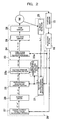
FIG. 2 is a system diagram of a control unit in the electromagnetic suspension device according to an embodiment of the present invention. -
FIG. 3 is a diagram showing a PWM circuit. -
FIG. 4 is a conceptual diagram of an electromagnetic suspension device according to another embodiment of the present invention. -
FIG. 5 is a diagram showing the state of d- and q-phase electric current target values and that of d- and q-phase electric currents in a conventional electromagnetic suspension device. - The present invention will be described hereunder by way of embodiments thereof illustrated in the drawings.
- As shown in
FIG. 1 , an electromagnetic suspension device according to an embodiment of the present invention is made up of a screw shaft 1 as one member, aball screw nut 2 adapted to perform a relative motion with respect to the screw shaft 1, and a motor M. - More specifically, the screw shaft 1 is threadedly engaged with the
ball screw nut 2 rotatably and an upper end inFIG. 1 of the screw shaft 1 is connected to a rotor R of the motor M. On the other hand, theball screw nut 2 is fixed to an upper end of atube 4 into which the screw shaft 1 is inserted and theball screw nut 2 can be connected through thetube 4 to one of a sprung member and an unsprung member of a vehicle. - The screw shaft 1 is connected rotatably to the other of the vehicular sprung and unsprung members. More specifically, the screw shaft 1 is journaled to a ball bearing provided in the other of the vehicular sprung and unsprung members, or the motor M is fixed to the other of the vehicular sprung and unsprung members.
- Therefore, when the screw shaft 1 and the
ball screw nut 2 perform a linear relative motion in the axial direction, the screw shaft 1 performs a rotational motion, which rotational motion is transmitted to the rotor R of the motor M. In this connection, there may be adopted a construction wherein the rotational speed of the screw shaft 1 is reduced through a reducer constituted for example by a gear mechanism and then the rotational motion of the screw shaft 1 is transmitted to the rotor R. - In the case where the screw shaft 1 is made unrotatable and instead the
ball screw nut 2 is rotated when both of them perform a linear relative motion in the axial direction, the rotational motion of theball screw nut 2 may be transmitted to the rotor R of the motor M. More particularly, this can be done by connecting the screw shaft 1 to one of the vehicular sprung and unsprung members unrotatably, connecting theball screw nut 2 to the other of the vehicular sprung and unsprung members rotatably through a ball bearing or the like, and transmitting the rotational motion of theball screw nut 2 to the rotor R of the motor M through a gear mechanism or a friction wheel mechanism. - In this case, the motor M is constituted as a three-phase brushless motor including a cylindrical frame 10, a stator as an armature disposed on the inner periphery side of the frame 10, and the rotor R journaled to the frame 10 rotatably. More specifically, the stator includes an
annular stator core 11 having plural teeth andwindings 12 in U, V and W phases wound round the teeth. The rotor R includes ashaft 13 and adriving magnet 14 mounted on a yoke portion of theshaft 13. - The
driving magnet 14 is made up of magnet blocks so as to realize a predetermined pole number of blocks and is embedded in the yoke portion of theshaft 13. The motor M is an embedded magnet type motor. Of course, thedriving magnet 14 may be blocked so as to realize a predetermined number of poles and be bonded to the outer periphery of theshaft 13 or may be formed annularly, magnetized in a divided manner and be fitted on the outer periphery of theshaft 13. In the case of a surface magnet type, an eddy current loss is apt to occur on the surface of thedriving magnet 14 during a field weakening control to be described later. Thus, the embedded magnet type is preferred. - A
position sensor 15 is mounted on the motor M to detect a rotational position of the rotor R. More specifically, theposition sensor 15 is for example made up of a resolver core mounted on theshaft 13 and a resolver stator mounted on the frame 10 in opposition to the resolver core. Theposition sensor 15 is connected to a calculatingsection 16 as calculating means. The calculatingsection 16 receives a signal outputted from theposition sensor 15, then dedicatedly calculates and outputs an electrical angle θ and an electrical angular velocity ω of the rotor R. - In this electromagnetic suspension device, as described above, the motor M is used as a drive source, so when electrical energy is given to the motor M to drive the motor, the screw shaft 1 is rotated, whereby the screw shaft 1 and the
ball screw nut 2 can be allowed to perform a relative linear motion positively, that is, can be stroked and it is possible to let the motor function as an actuator. - In the motor M, upon forced input of a rotational motion from the screw shaft, an electric current flows in each winding 12 by virtue of induced electromotive force and electric power provided from a power supply, thereby forming a magnetic field and creating an electromagnetic field, with consequent generation of torque for suppressing the rotational motion of the screw shaft 1. Thus, the motor M functions to suppress a relative linear motion between the screw shaft 1 and the
ball screw nut 2. In this case, with electric power resulting from regeneration and conversion of externally inputted kinetic energy into electrical energy, which is done by the motor M, or with electric power provided from the power supply in addition to the said regeneration, the resulting torque can suppress the relative linear motion between the screw shaft 1 and theball screw nut 2. - Thus, in this electromagnetic suspension device, since the motor M can be allowed to function as both an actuator and a generator, not only it is possible to suppress the relative linear motion between the screw shaft 1 and the
ball screw nut 2, but also it is possible to make the most of the function as an actuator and thereby control the attitude of the vehicular body. In this way the electromagnetic suspension device can also exhibit the function of an active suspension. - More specifically, for controlling the electric currents flowing in the
windings 12 of the motor M, thewindings 12 of U, V and W phases are connected to acontrol unit 20 and the motor M is drive-controlled by thecontrol unit 20. - As shown in
FIG. 2 , thecontrol unit 20 basically includes an electric current targetvalue calculating section 27 which calculates electric current target values id* and iq* on the basis of a torque command inputted from a vehicle control unit (not shown), the vehicle control unit controlling the electrical angle velocity ω outputted from the calculatingsection 16 and the vehicle attitude, two-phase electriccurrent calculating means 21 which performs dq conversion of electric currents flowing in two of three phases and calculates a d-phase electric current value id and a q-phase electric current value iq, a proportional-integral control section 22 which calculates a d-phase voltage command value Vd1 and a q-phase voltage command value Vq1 on the basis of the electric current target values id*, iq* and the electric current values id, iq, acorrecting section 23 which corrects the d-phase voltage command value Vd1 on the basis of the q-phase current iq and also corrects the q-phase voltage command value Vq1 on the basis of the d-phase electric current id to calculate an after-d-phase-correction voltage command value Vd2 and an after-q-phase-correction voltage command value Vq2, three-phase conversion calculation means 24 for converting the after-d-phase-correction voltage command value Vd2 and the after-q-phase-correction voltage command value Vq2 into voltage command values Vu, Vv and Vw of U, V and W phases, acurrent detector 25 for detecting electric current values of electric currents flowing in two of three phases U, V and W of the three-phase brushless motor, e.g. electric current values iu and iv, and aPWM circuit 26. - The
control unit 20 performs a proportional-integral control for the motor M on the basis of deviations ed and eq between the electric current target values id*, iq* determined by the electric current targetvalue calculating section 27 and the electric current values id, iq of d and q phases obtained as a calculation result in the two-phase electric current calculatingmeans 21. - The electric current target
value calculating section 27 outputs the d- and q-phase electric current target values id* and iq* to the proportional-integral control section 22 in accordance with a predetermined control rule and on the basis the torque command outputted from the foregoing vehicle control unit and the electrical angular velocity ω of the rotor R. In this case, as the vehicle control rule in the vehicle control unit there is used vehicle body attitude control or vibration suppressing control such as skyhook control. The output to the electric current targetvalue calculating section 27 is not limited to the torque command. The output may be in the form of, for example, a force command or a q-phase electric current target value and a corresponding conversion may be done in the electric current targetvalue calculating section 27. Of course, a modification may be made such that a signal necessary for vehicle control such as sprung speed is picked up by the electric current targetvalue calculating section 27 of thecontrol unit 20, which in turn calculates a vehicle control rule. - As the
current detector 25 there may be used a non-contact type detector using a Hall element or a winding or a current sensor which acquires electric current values from voltage drops of resistors interposed in series with three-phase windings respectively. - It suffices for the
current detector 25 to detect electric current values of electric currents flowing in two of U, V and W phases. This is because if two-phase electric current values are detected, they can be converted to d- and q-phase electric current values from the rotor's electrical angle θ in accordance with an expression (2) to be described later. - As shown in
FIG. 3 , thePWM circuit 26 includes sixswitching elements 41 for the supply of an electric current to each of three-phase windings C in the motor M and a pulse generator (not shown) such as a multi-vibrator for applying PWM pulse signals to theswitching elements 41. ThePWM circuit 26 supplies an electric current to each of the above phases on the basis of voltage command values Vu, Vv and Vw outputted by the three-phase conversion calculation means 24 and at a predetermined PWM duty ratio. - Using the electrical angle θ and as shown in the following expression (2), the two-phase electric current calculating means 21 performs calculation for converting the electric current values iv and iu into d- and q-phase electric current values id and iq and outputs the thus-converted d- and q-phase electric current values id and iq to the proportional-
integral control section 22.
- The proportional-
integral control section 22 calculates deviations between the electric current target values id*, iq* and the electric current values id, iq, then integrates the deviations, multiplies the deviations and integral values by a suitable gain respectively and outputs d- and q-phase voltage command values Vd1, Vq1. - Next, the correcting
section 23 includes a correctionvalue calculating section 23a, the correctionvalue calculating section 23a calculating a d-phase voltage correction value Vda by multiplying a reactance ωL in a motor M winding by the q-phase electric current iq, the reactance ωL comprising the electrical angular velocity ω of the rotor R and one winding inductance L of the motor M, also calculating a q-phase voltage correction value Vqa by adding the product of the reactance ωL and the d-phase electric current id to an induced electromotive force ωF, the induced electromotive force being obtained by multiplying the electrical angle velocity ω by a maximum magnetic flux interlinkage value F, and a voltagecommand synthesizing section 23b for calculating an after-d-phase-correction voltage command value Vd2 by adding the d-phase voltage correction value Vda to the d-phase voltage command value Vd1 and further calculating an after q-phase correction voltage command value Vq2 by adding the q-phase voltage correction value Vqa to the q-phase voltage command value Vq1. - The influence of the d-phase electric current id on the q-phase voltage Vq and the influence of the q-phase electric current iq on the d-phase voltage Vd are as shown in the following expression (3) if the electrical angular velocity ω, reactance ωL and maximum magnetic flux interlinkage value F are used for the d- and q-phase voltage command values Vd', Vq'. In the following expression, R stands for winding resistance and P stands for a differential operator:

- On the other hand, the d- and q-phase voltage correction values Vda, Vqa obtained by the correction
value calculation section 23a are calculated by the following expression (4):
- The after-d-phase-correction command value Vd2 and the after-q-phase correction command value Vq2 both outputted by the voltage
command synthesizing section 23b are shown by the following expression (5):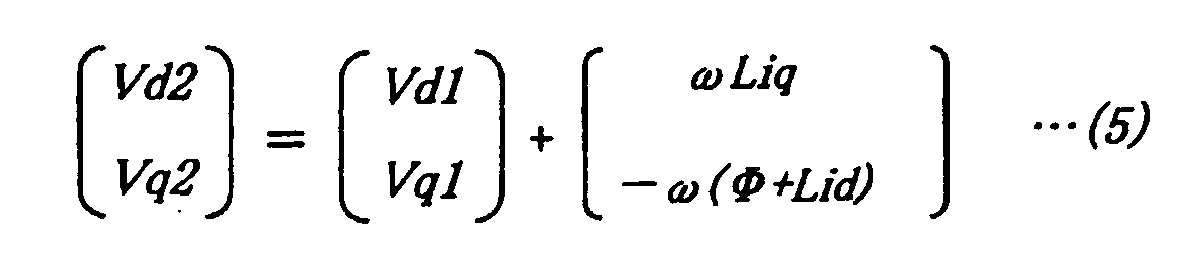
- If the after-d-phase-correction command value Vd2 and the after-q-phase-correction command value Vq2 are substituted into the d-phase voltage command value Vd' and the q-phase voltage command value Vq', respectively, in the above expression (3), the d- and q-phase voltages Vd, Vq are shown by the following expression (6):

- A look at the above expression (6) shows that the q-phase electric current iq exerts no influence on the d-phase voltage Vd and neither do the d-phase electric current id and the induced electromotive force ωF on the q-phase voltage Vq.
- Thus, in this electromagnetic suspension device, the influence of the q-phase electric current iq on the d-phase voltage command value Vd1 can be eliminated by the correcting
section 23 as correction means, likewise the influence of the d-phase electric current Vd and the induced electromotive force ωF on the q-phase voltage command value Vq1 can be eliminated, and the q-phase electric current iq can be controlled accurately to a desired value. - After the above correction, the after-d-phase-correction voltage command value Vd2 and the after-q-phase-correction voltage command value Vq2 are inputted to the three-phase conversion calculation means 24 for making the foregoing conversion. By the calculation of the foregoing expression (1) the three-phase conversion calculation means 24 converts the after-d-phase-correction voltage command value Vd2 and the after-q-phase-correction voltage command value Vq2 into actual U-, V- and W-phase voltage command values Vu, Vv and Vw and outputs the thus-converted voltage command values Vu, Vv and Vw to the
PWM circuit 26. - The
control unit 20 includes avoltage limiter 28 and acurrent limiter 29. When the PWM opening is full open, that is, when the PWM duty ratio is a maximum value or more, thevoltage limiter 28 limits the voltage command values Vu, Vv and Vw outputted by the three-phase conversion calculation means 24 to values which maximizes the PWM duty ratio. Thecurrent limiter 29 is for clamping the electric current target values id* and iq* lest they should exceed predetermined values. - As hardware, the
control unit 20 is constituted for example as a known computer system (not shown) including an amplifier for amplifying the signals outputted from thecurrent detector 25, a converter for converting an analog signal into a digital signal, a CPU (Central Processing Unit) as a processor for processing signals provided from thecurrent detector 25 and the calculatingsection 16 and performing various arithmetic operations, memories such as ROM (Read Only Memory) and RAM (Random Access Memory), a crystal oscillator, and a bus line for connection of these components. Thecontrol unit 20 is configured so that it can output the voltage command values Vu, Vv and Vw to thePWM circuit 26. - In this case, control processing procedures for calculating target values, correction values and command values in the two-phase electric current calculating means 21, proportional-
integral control section 22, correctingsection 23, three-phase conversion calculation means 24 and electric current targetvalue calculating section 27 are pre-stored as programs in ROM or other memories. Since the inductance L and the maximum magnetic flux interlinkage value F which are required in the correctionvalue calculating section 23a are constants, all that is required is to measure those values in advance, store them into a memory and read them at the beginning of the associated control processing procedure. - Next, a description will be given about the operation of the electromagnetic suspension device. Upon input of a dynamic vibration from a road surface during running of a vehicle, the output torque of the motor M is controlled by the
control unit 20 described above to suppress the transfer of the vibration to the vehicle body side. In this connection, as described above, the d- and q-phase voltage command values Vd1 and Vq1 are corrected by the correctingsection 23, the q-phase electric current iq does not interfere with the d-phase voltage Vd, neither does the d-phase electric current id interfere with the q-phase voltage Vq, and the influence of the induced electromotive force ωF on the q-phase voltage Vq can be eliminated. Therefore, the d- and q-phase electric currents id, iq can be controlled to the d- and q-phase electric current target values id*, iq*, respectively. - Thus, according to this electromagnetic suspension device, the electric currents id and iq can be controlled to the respective electric current target values id* and iq* and thus it is possible to generate a desired control force without variation of the generated control force, so that it is possible to improve the ride comfort in the vehicle and tuning of the electromagnetic suspension device becomes easier.
- In this embodiment it is not that the
control unit 20 directly processes the signal outputted from theposition sensor 15 and calculates the electrical angle θ and electrical angular velocity ω of the rotor R. But there is provided the calculatingsection 16 dedicated to the calculation of both electrical angle θ and electrical angular velocity ω. Therefore, if only the arithmetic operation cycle in the calculatingsection 16 is set so as to permit calculation of the electrical angular velocity ω in a high frequency region, it becomes possible to effect control with a high accuracy even without keeping the operation cycle of the arithmetic processor in thecontrol unit 20 very high in speed. Consequently, it is possible to reduce the cost of the entire device. - When the expansion/contraction stroke speed of the electromagnetic suspension device becomes higher than a predetermined value, for example, when the vehicle is running and gets over a step while turning sharply, the motor M is compelled to rotate at high speed while generating a large torque.
- Even in such a case, since the induced electromotive force is large and the amount of the generated q-phase electric current iq contributing to torque is limited, there occurs a case where the required torque cannot be generated. Therefore, the electric current target
value calculating section 27 performs a field weakening control for weakening the field of the motor and sets the d-phase electric current target value id* to a predetermined negative value to let an electric current not contributing to torque flow in d phase positively, thereby weakening the field of the motor and allowing an electric current of a larger value to flow in q phase. - As an inevitable result of such a positive field weakening control, the d- and q-phase electric currents id, iq interfere with the d- and q-phase voltages Vd, Vq. However, in this electromagnetic suspension device, as described above, that interference can be prevented from occurrence by the processing performed in the correcting
section 23. Accordingly, even during the field weakening control, the d- and q-phase electric currents id, iq can be controlled to the respective electric current target values id* and iq* and a desired control force can be generated without variation of the generated control force. Besides, even in the case where the expansion/contraction stroke speed becomes high, the electromagnetic suspension device can exhibit a control force sufficient to suppress vibration of the vehicle body and hence it is possible to improve the ride comfort in the vehicle. - Referring now to
FIG. 4 , there is illustrated an electromagnetic suspension device according to another embodiment of the present invention. This electromagnetic suspension device is comprised of atube 31 as one member, arod 32 as the other member adapted to perform a relative motion with respect to thetube 31, and a motor M2 capable of at least suppressing the said relative motion. - More specifically, the
tube 31 is connected to one of a sprung member and an unsprung member of a vehicle and therod 32 connected to the other of the sprung and unsprung members of the vehicle are inserted into thetube 31. - Further, the motor M2 includes driving
magnets 33, the driving magnets being mounted on the outer periphery of therod 32 in such a manner that S and N poles appear alternately in the axial direction, andwindings 34 mounted within thetube 31 in opposition to the drivingmagnets 33, thewindings 34 being disposed in such a manner that U, V and W phases are arranged alternately in the axial direction of thetube 31 over a predetermined length. - The
windings 34 mounted within thetube 31 are formed annularly by molding and are coated on at least inner periphery side with resin for example. Further, annular bearings (not shown) are disposed between the inner peripheries of thewindings 34 and the outer periphery of therod 32 or the drivingmagnets 33 to prevent axial eccentricity of therod 32 with respect to thetube 31. - Thus, this another electromagnetic suspension device is of a so-called linear motor type construction wherein when the
rod 32 performs a relative motion while moving forward or backward with respect to thetube 31, the drivingmagnets 33 move relatively with respect to thewindings 34. Also in this another electromagnetic suspension device, as in the electromagnetic suspension device of the previous embodiment, the motor M2 functions as both motor and generator and the operation thereof is the same as that of the motor M. - Therefore, with a
control unit 20 provided with the same correctingsection 23 as in the previous embodiment, it is possible to eliminate interference of the q-phase electric current iq with the d-phase voltage Vd, interference of the d-phase electric current id with the q-phase voltage Vq and the influence of induced electromotive force. Accordingly, as in the electromagnetic suspension device of the previous embodiment, the d- and q-phase electric currents id and iq can be controlled to the respective electric current target values id* and iq* and the desired control force can be generated without variation of the generated control force. Consequently, it is possible to improve the ride comfort in the vehicle and tuning of the electromagnetic suspension device becomes easier. - The present invention has been described above by way of embodiments thereof, but it goes without saying that the scope of the present invention is not limited to the details illustrated or explained.
- The electromagnetic suspension device of the present invention is applicable to a vehicular suspension.
Claims (8)
- In an electromagnetic suspension device comprising one member, the other member adapted to perform a relative motion with respect to the one member, and a motor capable of at least suppressing said relative motion, and wherein electric current values of d and q phases are determined using dq conversion from electric currents flowing in the motor and an electrical angle of a rotor, and the motor is controlled on the basis of both d-phase voltage command value and q-phase voltage command value, the improvement characterized by further comprising correction means for correcting the d-phase voltage command value on the basis of both q-phase electric current and electrical angular velocity of the rotor and correcting the q-phase voltage command value on the basis of both d-phase electric current and electrical angular velocity of the rotor.
- An electromagnetic suspension device according to claim 1, wherein the correction means corrects the d-phase voltage command value and the q-phase voltage command value so as to eliminate interference of the q-phase electric current with the d-phase voltage and interference of both d-phase electric current and induced electromotive force with the q-phase voltage.
- An electromagnetic suspension device according to claim 1, wherein the field of the motor is weakened when the expansion/contraction stroke speed equals or exceeds a predetermined speed.
- An electromagnetic suspension device according to claim 2, wherein the field of the motor is weakened when the expansion/contraction stroke speed equals or exceeds a predetermined speed.
- An electromagnetic suspension device according to claim 1, comprising calculation means for dedicatedly calculating an electrical angle and an electrical angular velocity of the rotor upon receipt of a signal from a resolver which is for detecting an electrical angle of the rotor.
- An electromagnetic suspension device according to claim 2, comprising calculation means for dedicatedly calculating an electrical angle and an electrical angular velocity of the rotor upon receipt of a signal from a resolver which is for detecting an electrical angle of the rotor.
- An electromagnetic suspension device according to claim 3, comprising calculation means for dedicatedly calculating an electrical angle and an electrical angular velocity of the rotor upon receipt of a signal from a resolver which is for detecting an electrical angle of the rotor.
- An electromagnetic suspension device according to claim 4, comprising calculation means for dedicatedly calculating an electrical angle and an electrical angular velocity of the rotor upon receipt of a signal from a resolver which is for detecting an electrical angle of the rotor.
Applications Claiming Priority (2)
| Application Number | Priority Date | Filing Date | Title |
|---|---|---|---|
| JP2006039198A JP2007216822A (en) | 2006-02-16 | 2006-02-16 | Electromagnetic suspension device |
| PCT/JP2006/323259 WO2007094107A1 (en) | 2006-02-16 | 2006-11-15 | Electromagnetic suspension device |
Publications (2)
| Publication Number | Publication Date |
|---|---|
| EP1985476A1 true EP1985476A1 (en) | 2008-10-29 |
| EP1985476A4 EP1985476A4 (en) | 2009-05-06 |
Family
ID=38371295
Family Applications (1)
| Application Number | Title | Priority Date | Filing Date |
|---|---|---|---|
| EP06833100A Withdrawn EP1985476A4 (en) | 2006-02-16 | 2006-11-15 | ELECTROMAGNETIC SUSPENSION DEVICE |
Country Status (5)
| Country | Link |
|---|---|
| US (1) | US20090026989A1 (en) |
| EP (1) | EP1985476A4 (en) |
| JP (1) | JP2007216822A (en) |
| CN (1) | CN101336171A (en) |
| WO (1) | WO2007094107A1 (en) |
Families Citing this family (11)
| Publication number | Priority date | Publication date | Assignee | Title |
|---|---|---|---|---|
| FR2912375B1 (en) * | 2007-02-14 | 2009-12-18 | Eurocopter France | ELECTRIC FLIGHT CONTROL JACK FOR AIRCRAFT |
| JP5178768B2 (en) * | 2010-04-06 | 2013-04-10 | 三菱電機株式会社 | AC rotating machine control device and electric power steering control device |
| JP2014167320A (en) * | 2013-02-28 | 2014-09-11 | Hitachi Automotive Systems Ltd | Electromagnetic suspension device |
| JP6725443B2 (en) * | 2017-03-15 | 2020-07-15 | 日立グローバルライフソリューションズ株式会社 | Vibration control device and washing machine |
| JP6417443B1 (en) * | 2017-04-17 | 2018-11-07 | 本田技研工業株式会社 | Electromagnetic suspension device |
| US10690215B2 (en) * | 2018-02-23 | 2020-06-23 | Tenneco Automotive Operating Company Inc. | Damper with electro-magnetic actuator |
| CN108427347B (en) * | 2018-04-04 | 2023-08-15 | 肇庆学院 | Control system of internal stable electromagnetic suspension micromirror |
| JP6923591B2 (en) * | 2019-04-12 | 2021-08-18 | 本田技研工業株式会社 | Electric suspension device |
| JP7153615B2 (en) * | 2019-07-12 | 2022-10-14 | 本田技研工業株式会社 | electric suspension device |
| CN112696476B (en) * | 2020-12-03 | 2022-04-12 | 天津理工大学 | Electric loader with electromagnetic buffer |
| US11890931B2 (en) * | 2021-04-27 | 2024-02-06 | Luis Marcial Medina | Suspension power electric generator |
Family Cites Families (14)
| Publication number | Priority date | Publication date | Assignee | Title |
|---|---|---|---|---|
| JPS62203596A (en) * | 1986-02-28 | 1987-09-08 | Mitsubishi Heavy Ind Ltd | Speed controller for 3-phase ac motor |
| CA1336616C (en) * | 1988-10-05 | 1995-08-08 | I. Davis Roy | Electrically powered active suspension for a vehicle |
| US5028073A (en) * | 1990-01-08 | 1991-07-02 | General Electric Company | Dynamic vehicle suspension system including electronically commutated motor |
| JP3383682B2 (en) * | 1992-11-04 | 2003-03-04 | ファナック株式会社 | Current control method for AC servomotor |
| US5441298A (en) * | 1993-10-22 | 1995-08-15 | Ford Motor Company | Apparatus for stabilizing an electric active suspension system upon interruption of the power supply |
| JPH08182398A (en) * | 1994-12-27 | 1996-07-12 | Fuji Electric Co Ltd | Permanent magnet type synchronous motor drive device |
| JPH08275599A (en) * | 1995-03-30 | 1996-10-18 | Meidensha Corp | Control method for permanent magnet synchronous motor |
| WO2000014866A1 (en) * | 1998-09-03 | 2000-03-16 | Mitsubishi Denki Kabushiki Kaisha | Controller for ac motor |
| JP2003104025A (en) * | 2001-09-28 | 2003-04-09 | Tokico Ltd | Electromagnetic suspension device |
| JP3914108B2 (en) * | 2002-07-15 | 2007-05-16 | 本田技研工業株式会社 | DC brushless motor control device |
| US6984948B2 (en) * | 2002-12-12 | 2006-01-10 | Matsushita Electric Industrial Co., Ltd. | Motor control apparatus |
| JP3722128B2 (en) * | 2003-02-05 | 2005-11-30 | 日産自動車株式会社 | VEHICLE ELECTRIC SUSPENSION DEVICE AND MOTOR CONTROL METHOD FOR VEHICLE ELECTRONIC SUSPENSION DEVICE |
| JP3722127B2 (en) * | 2003-02-05 | 2005-11-30 | 日産自動車株式会社 | Electromagnetic suspension device for vehicle |
| JP4068547B2 (en) * | 2003-10-31 | 2008-03-26 | トヨタ自動車株式会社 | Vehicle suspension system |
-
2006
- 2006-02-16 JP JP2006039198A patent/JP2007216822A/en active Pending
- 2006-11-15 WO PCT/JP2006/323259 patent/WO2007094107A1/en not_active Ceased
- 2006-11-15 CN CNA2006800520048A patent/CN101336171A/en active Pending
- 2006-11-15 US US12/278,456 patent/US20090026989A1/en not_active Abandoned
- 2006-11-15 EP EP06833100A patent/EP1985476A4/en not_active Withdrawn
Also Published As
| Publication number | Publication date |
|---|---|
| JP2007216822A (en) | 2007-08-30 |
| US20090026989A1 (en) | 2009-01-29 |
| CN101336171A (en) | 2008-12-31 |
| EP1985476A4 (en) | 2009-05-06 |
| WO2007094107A1 (en) | 2007-08-23 |
Similar Documents
| Publication | Publication Date | Title |
|---|---|---|
| EP2093098B1 (en) | Wheel driving apparatus and electric vehicle including the same | |
| JP5286357B2 (en) | Electric steering device | |
| US7737648B2 (en) | Motor controller | |
| US7567055B2 (en) | Controller for brushless motor | |
| EP3300245B1 (en) | Motor control device | |
| EP1985476A1 (en) | Electromagnetic suspension device | |
| US7112933B1 (en) | Controller for brushless motor | |
| US11594992B2 (en) | Motor control device | |
| JP5548645B2 (en) | Electric power steering control device | |
| EP4254775B1 (en) | Control device of rotating electric machine and electromotive power steering device | |
| US20230412100A1 (en) | Controller for rotary electric machine and electric power steering apparatus | |
| JP2020150666A (en) | Motor control device, motor control method, and electric power steering device | |
| JP2009044913A (en) | Motor device and electric power steering device | |
| US11387760B2 (en) | Motor control device | |
| JP5220293B2 (en) | Motor control device, motor control method, and actuator | |
| JP4908096B2 (en) | Control device and actuator control device | |
| JP4908095B2 (en) | Drive system and actuator | |
| JP2007069836A (en) | Electric power steering device | |
| JP2008062738A (en) | Electromagnetic suspension device | |
| JP2019058044A (en) | Motor control device and actuator | |
| JP4895737B2 (en) | Motor control device | |
| JP2007089287A (en) | Motor control device |
Legal Events
| Date | Code | Title | Description |
|---|---|---|---|
| PUAI | Public reference made under article 153(3) epc to a published international application that has entered the european phase |
Free format text: ORIGINAL CODE: 0009012 |
|
| 17P | Request for examination filed |
Effective date: 20080818 |
|
| AK | Designated contracting states |
Kind code of ref document: A1 Designated state(s): DE FR GB |
|
| DAX | Request for extension of the european patent (deleted) | ||
| RBV | Designated contracting states (corrected) |
Designated state(s): DE FR GB |
|
| RIN1 | Information on inventor provided before grant (corrected) |
Inventor name: INOUE, HIROFUMI Inventor name: KUBOTA, TOMOO |
|
| A4 | Supplementary search report drawn up and despatched |
Effective date: 20090402 |
|
| 17Q | First examination report despatched |
Effective date: 20090721 |
|
| STAA | Information on the status of an ep patent application or granted ep patent |
Free format text: STATUS: THE APPLICATION IS DEEMED TO BE WITHDRAWN |
|
| 18D | Application deemed to be withdrawn |
Effective date: 20100518 |