EP1982984B1 - Manufacture of tricyclic thrombin receptor antagonists and pharmaceutical compositions comprising them - Google Patents
Manufacture of tricyclic thrombin receptor antagonists and pharmaceutical compositions comprising them Download PDFInfo
- Publication number
- EP1982984B1 EP1982984B1 EP08012015A EP08012015A EP1982984B1 EP 1982984 B1 EP1982984 B1 EP 1982984B1 EP 08012015 A EP08012015 A EP 08012015A EP 08012015 A EP08012015 A EP 08012015A EP 1982984 B1 EP1982984 B1 EP 1982984B1
- Authority
- EP
- European Patent Office
- Prior art keywords
- group
- process according
- compound
- cooch
- pharmaceutical composition
- Prior art date
- Legal status (The legal status is an assumption and is not a legal conclusion. Google has not performed a legal analysis and makes no representation as to the accuracy of the status listed.)
- Expired - Lifetime
Links
- 0 CC([C@]([C@]1C[C@]2[C@]3CC[C@@](*)C2)[C@]3C=C[C@@](CC2)N=CC2c2cc(F)ccc2)OC1=O Chemical compound CC([C@]([C@]1C[C@]2[C@]3CC[C@@](*)C2)[C@]3C=C[C@@](CC2)N=CC2c2cc(F)ccc2)OC1=O 0.000 description 5
- DHPXJEPXEOEQID-LQFUFHSOSA-N C[C@@H](C[C@H](C1)C2CCC1=O)C(C)C2/C=C/c1ccc(-c2cc(F)ccc2)[nH]1 Chemical compound C[C@@H](C[C@H](C1)C2CCC1=O)C(C)C2/C=C/c1ccc(-c2cc(F)ccc2)[nH]1 DHPXJEPXEOEQID-LQFUFHSOSA-N 0.000 description 1
Classifications
-
- C—CHEMISTRY; METALLURGY
- C07—ORGANIC CHEMISTRY
- C07D—HETEROCYCLIC COMPOUNDS
- C07D405/00—Heterocyclic compounds containing both one or more hetero rings having oxygen atoms as the only ring hetero atoms, and one or more rings having nitrogen as the only ring hetero atom
- C07D405/02—Heterocyclic compounds containing both one or more hetero rings having oxygen atoms as the only ring hetero atoms, and one or more rings having nitrogen as the only ring hetero atom containing two hetero rings
- C07D405/06—Heterocyclic compounds containing both one or more hetero rings having oxygen atoms as the only ring hetero atoms, and one or more rings having nitrogen as the only ring hetero atom containing two hetero rings linked by a carbon chain containing only aliphatic carbon atoms
-
- A—HUMAN NECESSITIES
- A61—MEDICAL OR VETERINARY SCIENCE; HYGIENE
- A61P—SPECIFIC THERAPEUTIC ACTIVITY OF CHEMICAL COMPOUNDS OR MEDICINAL PREPARATIONS
- A61P13/00—Drugs for disorders of the urinary system
- A61P13/12—Drugs for disorders of the urinary system of the kidneys
-
- A—HUMAN NECESSITIES
- A61—MEDICAL OR VETERINARY SCIENCE; HYGIENE
- A61P—SPECIFIC THERAPEUTIC ACTIVITY OF CHEMICAL COMPOUNDS OR MEDICINAL PREPARATIONS
- A61P25/00—Drugs for disorders of the nervous system
-
- A—HUMAN NECESSITIES
- A61—MEDICAL OR VETERINARY SCIENCE; HYGIENE
- A61P—SPECIFIC THERAPEUTIC ACTIVITY OF CHEMICAL COMPOUNDS OR MEDICINAL PREPARATIONS
- A61P29/00—Non-central analgesic, antipyretic or antiinflammatory agents, e.g. antirheumatic agents; Non-steroidal antiinflammatory drugs [NSAID]
-
- A—HUMAN NECESSITIES
- A61—MEDICAL OR VETERINARY SCIENCE; HYGIENE
- A61P—SPECIFIC THERAPEUTIC ACTIVITY OF CHEMICAL COMPOUNDS OR MEDICINAL PREPARATIONS
- A61P35/00—Antineoplastic agents
-
- A—HUMAN NECESSITIES
- A61—MEDICAL OR VETERINARY SCIENCE; HYGIENE
- A61P—SPECIFIC THERAPEUTIC ACTIVITY OF CHEMICAL COMPOUNDS OR MEDICINAL PREPARATIONS
- A61P43/00—Drugs for specific purposes, not provided for in groups A61P1/00-A61P41/00
-
- A—HUMAN NECESSITIES
- A61—MEDICAL OR VETERINARY SCIENCE; HYGIENE
- A61P—SPECIFIC THERAPEUTIC ACTIVITY OF CHEMICAL COMPOUNDS OR MEDICINAL PREPARATIONS
- A61P7/00—Drugs for disorders of the blood or the extracellular fluid
-
- A—HUMAN NECESSITIES
- A61—MEDICAL OR VETERINARY SCIENCE; HYGIENE
- A61P—SPECIFIC THERAPEUTIC ACTIVITY OF CHEMICAL COMPOUNDS OR MEDICINAL PREPARATIONS
- A61P7/00—Drugs for disorders of the blood or the extracellular fluid
- A61P7/02—Antithrombotic agents; Anticoagulants; Platelet aggregation inhibitors
-
- A—HUMAN NECESSITIES
- A61—MEDICAL OR VETERINARY SCIENCE; HYGIENE
- A61P—SPECIFIC THERAPEUTIC ACTIVITY OF CHEMICAL COMPOUNDS OR MEDICINAL PREPARATIONS
- A61P9/00—Drugs for disorders of the cardiovascular system
-
- A—HUMAN NECESSITIES
- A61—MEDICAL OR VETERINARY SCIENCE; HYGIENE
- A61P—SPECIFIC THERAPEUTIC ACTIVITY OF CHEMICAL COMPOUNDS OR MEDICINAL PREPARATIONS
- A61P9/00—Drugs for disorders of the cardiovascular system
- A61P9/02—Non-specific cardiovascular stimulants, e.g. drugs for syncope, antihypotensives
-
- A—HUMAN NECESSITIES
- A61—MEDICAL OR VETERINARY SCIENCE; HYGIENE
- A61P—SPECIFIC THERAPEUTIC ACTIVITY OF CHEMICAL COMPOUNDS OR MEDICINAL PREPARATIONS
- A61P9/00—Drugs for disorders of the cardiovascular system
- A61P9/04—Inotropic agents, i.e. stimulants of cardiac contraction; Drugs for heart failure
-
- A—HUMAN NECESSITIES
- A61—MEDICAL OR VETERINARY SCIENCE; HYGIENE
- A61P—SPECIFIC THERAPEUTIC ACTIVITY OF CHEMICAL COMPOUNDS OR MEDICINAL PREPARATIONS
- A61P9/00—Drugs for disorders of the cardiovascular system
- A61P9/06—Antiarrhythmics
-
- A—HUMAN NECESSITIES
- A61—MEDICAL OR VETERINARY SCIENCE; HYGIENE
- A61P—SPECIFIC THERAPEUTIC ACTIVITY OF CHEMICAL COMPOUNDS OR MEDICINAL PREPARATIONS
- A61P9/00—Drugs for disorders of the cardiovascular system
- A61P9/10—Drugs for disorders of the cardiovascular system for treating ischaemic or atherosclerotic diseases, e.g. antianginal drugs, coronary vasodilators, drugs for myocardial infarction, retinopathy, cerebrovascula insufficiency, renal arteriosclerosis
-
- A—HUMAN NECESSITIES
- A61—MEDICAL OR VETERINARY SCIENCE; HYGIENE
- A61P—SPECIFIC THERAPEUTIC ACTIVITY OF CHEMICAL COMPOUNDS OR MEDICINAL PREPARATIONS
- A61P9/00—Drugs for disorders of the cardiovascular system
- A61P9/12—Antihypertensives
-
- C—CHEMISTRY; METALLURGY
- C07—ORGANIC CHEMISTRY
- C07D—HETEROCYCLIC COMPOUNDS
- C07D405/00—Heterocyclic compounds containing both one or more hetero rings having oxygen atoms as the only ring hetero atoms, and one or more rings having nitrogen as the only ring hetero atom
- C07D405/14—Heterocyclic compounds containing both one or more hetero rings having oxygen atoms as the only ring hetero atoms, and one or more rings having nitrogen as the only ring hetero atom containing three or more hetero rings
-
- C—CHEMISTRY; METALLURGY
- C07—ORGANIC CHEMISTRY
- C07D—HETEROCYCLIC COMPOUNDS
- C07D417/00—Heterocyclic compounds containing two or more hetero rings, at least one ring having nitrogen and sulfur atoms as the only ring hetero atoms, not provided for by group C07D415/00
- C07D417/14—Heterocyclic compounds containing two or more hetero rings, at least one ring having nitrogen and sulfur atoms as the only ring hetero atoms, not provided for by group C07D415/00 containing three or more hetero rings
Definitions
- the present invention relates to a process for the manufacture of substituted tricyclic thrombin receptor antagonists, pharmaceutical compositions containing them and their use in the treatment of diseases associated with thrombosis, atherosclerosis, restenosis, hypertension, angina pectoris, arrhythmia, heart failure, cerebral ischemia, stroke, inflammatory disorders, neurodegenerative diseases and cancer.
- thrombin receptor antagonists also known as protease activated receptor (PAR) antagonists will be useful in the treatment of thrombotic, inflammatory, atherosclerotic and fibroproliferative disorders, as well as other disorders in which thrombin and its receptor play a pathological role.
- PAR protease activated receptor
- Thrombin receptor antagonists peptides have been identified based on structure-activity studies involving substitutions of amino acids on thrombin receptors. In Bematowicz et al, J. Med. Chem., vol. 39, pp. 4879-4887 (1996 ), tetra- and pentapeptides are disclosed as being potent thrombin receptor antagonists, for example N-trans-cinnamoyl-p-fluoroPhe-p-guanidinoPhe-Leu-Arg-NH 2 and N-trans-cinnamoyl-p-fluoroPhe-p-guanidinoPhe-Leu-Arg-Arg-NH 2 . Peptide thrombin receptor antagonists are also disclosed in WO 94/03479, published February 17, 1994 .
- Substituted tricyclic thrombin receptor antagonists are disclosed in US 6,063,847 , US 6,326,380 and U.S. Serial Nos. 09/880222 ( WO 01/96330 ) and 10/271715 and WO 99/26943 .
- the present invention relates to a process for the manufacture of thrombin receptor antagonists.
- the invention relates to the following embodiments:
- Thrombin receptor antagonist compounds prepared by the present invention can have anti-thrombotic, anti-platelet aggregation, antiatherosclerotic, antirestenotic and/or anti-coagulant activity.
- Thrombosis-related diseases treated by the compounds prepared by this invention include thrombosis, atherosclerosis, restenosis, hypertension, angina pectoris, arrhythmia, heart failure, myocardial infarction, glomerulonephritis, thrombotic and thromboembolytic stroke, peripheral vascular diseases, other cardiovascular diseases, cerebral ischemia, inflammatory disorders and cancer, as well as other disorders in which thrombin and its receptor play a pathological role.
- Et ethyl
- Me methyl
- Pr propyl
- Ac acetyl
- rt room temperature
- PTLC preparative thin layer chromatography
- THF tetrahydrofuran
- TBAF tetra-n-butylammonium fluoride
- Tips triisopropylsilyl
- Tf trifluoromethanesulfonyl
- Phosphonate 7 described in US 6,063,847 , (3.27 g, 8.1 mmol) was dissolved in THF (12 ml) and C(O)Oled to 0 °C, followed by addition of 2.5 M n-BuLi (3.2 ml, 8.1 mmol). The reaction mixture was stirred at 0 °C for 10 min and warmed up to rt. A solution of aldehyde 6 , described in US 6,063,847 , in THF (12 ml) was added to the reaction mixture. The reaction mixture was stirred for 30 min. Standard aqueous work-up, followed by column chromatography (30-50% EtOAc in hexane) afforded product 8 .
- inert, pharmaceutically acceptable carriers can be either solid or liquid.
- Solid form preparations include powders, tablets, dispersible granules, capsules, cachets and suppositories.
- the powders and tablets may be comprised of from about 5 to about 95 percent active ingredient.
- Suitable solid carriers are known in the art, e.g ., magnesium carbonate, magnesium stearate, talc, sugar or lactose. Tablets, powders, cachets and capsules can be used as solid dosage forms suitable for oral administration. Examples of pharmaceutically acceptable carriers and methods of manufacture for various compositions may be found in A. Gennaro (ed.), The Science and Practice of Pharmacy, 20th Edition, Lippincott William & Wilkins, Baltimore, MD, (2000 ).
- Liquid form preparations include solutions, suspensions and emulsions. As an example may be mentioned water or water-propylene glycol solutions for parenteral injection or addition of sweeteners and opacifiers for oral solutions, suspensions and emulsions. Liquid form preparations may also include solutions for intranasal administration.
- Aerosol preparations suitable for inhalation may include solutions and solids in powder form, which may be in combination with a pharmaceutically acceptable carrier, such as an inert compressed gas, e.g ., nitrogen.
- a pharmaceutically acceptable carrier such as an inert compressed gas, e.g ., nitrogen.
- solid form preparations which are intended to be converted, shortly before use, to liquid form preparations for either oral or parenteral administration.
- liquid forms include solutions, suspensions and emulsions.
- the compounds manufactured by the process of the invention may also be deliverable transdermally.
- the transdermal compositions can take the form of creams, lotions, aerosols and/or emulsions and can be included in a transdermal patch of the matrix or reservoir type as are conventional in the art for this purpose.
- the compound is administered orally.
- the pharmaceutical preparation is in a unit dosage form.
- the preparation is subdivided into suitably sized unit doses containing appropriate quantities of the active component, e.g ., an effective amount to achieve the desired purpose.
- the daily dose of a compound manufactured by the process of the invention for treatment of a disease or condition cited above is about 0.001 to about 100 mg/kg of body weight per day, preferably about 0.001 to about 10 mg/kg.
- the dosage level is therefore from about 0.1 to about 700 mg of drug per day, given in a single dose or 2-4 divided doses.
- the amount and frequency of administration of the compounds prepared by the invention and/or the pharmaceutically acceptable salts thereof will be regulated according to the judgment of the attending clinician considering such factors as age, condition and size of the patient as well as severity of the symptoms being treated.
- the activity of the compounds manufactured by the press of the invention can be determined by the following procedures.
- A(pF-F)R(ChA)(hR)(I 2 -YyNH 2 (1.03 mg) and 10% Pd/C (5.07 mg) were suspended in DMF (250 ⁇ l) and diisopropylethylamine (10 ⁇ l).
- the vessel was attached to the tritium line, frozen in liquid nitrogen and evacuated.
- Tritium gas (342 mCi) was then added to the flask, which was stirred at room temperature for 2 hours.
- the excess tritium was removed and the reacted peptide solution was diluted with DMF (0.5 ml) and filtered to remove the catalyst.
- the collected DMF solution of the crude peptide was diluted with water and freeze dried to remove the labile tritium.
- the solid peptide was redissolved in water and the freeze drying process repeated.
- the tritiated peptide [ 3 H]haTRAP) was dissolved in 0.5 ml of 0.1% aqueous TFA and purified by HPLC using the following conditions: column, Vydac C18, 25 cm x 9.4 mm I.D.; mobile phase, (A) 0.1 % TFA in water, (B) 0.1% TFA in CH 3 CN; gradient, (A/B) from 100/0 to 40/60 over 30 min; flow rate, 5 ml /min; detection, UV at 215 nm.
- the radiochemical purity of [ 3 H]haTRAP was 99% as analyzed by HPLC. A batch of 14.9 mCi at a specific activity of 18.4 Ci/mmol was obtained.
- Platelet membranes were prepared using a modification of the method of Natarajan et a l ( Natarajan et al, Int. J. Peptide Protein Res., vol. 45, pp.145-151 (1995 ) from 20 units of platelet concentrates obtained from the North Jersey Blood Center (East Orange, N.J.) within 48 hours of collection. All steps were carried out at 4° C under approved biohazard safety conditions. Platelets were centrifuged at 100 x g for 20 minutes at 4° C to remove red cells. The supernatants were decanted and centrifuged at 3000 x g for 15 minutes to pellet platelets.
- Platelets were resuspended in 10 mM Tris-HCl, pH 7.5, 150 mM NaCl, 5 mM EDTA, to a total volume of 200 ml and centrifuged at 4400 x g for 10 minutes. This step was repeated two additional times. Platelets were resuspended in 5 mM Tris-HCl, pH 7.5, 5 mM EDTA to a final volume of approximately 30 ml and were homogenized with 20 strokes in a Dounce homogenizer.
- Membranes were pelleted at 41,000 x g, resuspended in 40-50 ml 20 mM Tris-HCl, pH 7.5, 1 mM EDTA, 0.1 mM dithiothreitol, and 10 ml aliquots were frozen in liquid N 2 and stored at -80° C. To complete membrane preparation, aliquots were thawed, pooled, and homogenized with 5 strokes of a Dounce homogenizer.
- Membranes were pelleted and washed 3 times in 10 mM triethanolamine-HCl, pH 7.4, 5 mM EDTA, and resuspended in 20-25 ml 50 mM Tris-HCl, pH 7.5, 10 mM MgCl 2 , 1 mM EGTA, and 1% DMSO. Aliquots of membranes were frozen in liquid N 2 and stored at -80° C. Membranes were stable for at least 3 months. 20 units of platelet concentrates typically yielded 250 mg of membrane protein. Protein concentration was determined by a Lowry assay ( Lowry et al, J. Biol. Chem., vol. 193, pp.265-275 (1951 ).
- Thrombin receptor antagonists were screened using a modification of the thrombin receptor radioligand binding assay of Ahn et al . ( Ahn et al, Mol. Pharmacol., vol. 51, p.350-356 (1997 ). The assay was performed in 96 well Nunc plates (Cat. No. 269620) at a final assay volume of 200 ⁇ l. Platelet membranes and [ 3 H]haTRAP were diluted to 0.4 mg/ml and 22.2 nM, respectively, in binding buffer (50 mM Tris-HCl, pH 7.5, 10 mM MgCl 2 , 1 mM EGTA, 0.1 % BSA).
- the incubated membranes were harvested using a Packard FilterMate Universal Harvester and were rapidly washed four times with 300 ⁇ l ice cold 50 mM Tris-HCl, pH 7.5, 10 mM MgCl 2 , 1 mM EGTA. MicroScint 20 scintillation cocktail (25 ⁇ l) was added to each well, and the plates were counted in a Packard TopCount Microplate Scintillation Counter. The specific binding was defined as the total binding minus the nonspecific binding observed in the presence of excess (50 ⁇ M) unlabeled haTRAP.
- % Inhibition Total binding - Binding in the presence of a test compound Total binding - Nonspecific binding x 100
- K i IC 50 1 + concentration of radioligan affinity K D ⁇ of radioligand Hence, a lower value of K i indicates greater binding affinity.
- A(pF-F)R(ChA)(hR)Y-NH 2 and A(pF-F)R(ChA)(hR)(I 2 -Y)-NH 2 were custom synthesized by AnaSpec Inc. (San Jose, CA). The purity of these peptides was >95%. Tritium gas (97%) was purchased from EG&G Mound, Miamisburg Ohio. The gas was subsequently loaded and stored on an IN/US Systems Inc. Trisorber. MicroScint 20 scintillation cocktail was obtained from Packard Instrument Co.
- Conscious chaired cynomolgus monkeys are allowed to equilibrate for 30 min.
- a needle catheter is inserted into a brachial vein for infusion of test drugs.
- Another needle catheter is inserted into the other brachial or saphenous vein and used for blood sampling.
- a baseline blood sample (1-2 ml) is collected in vacutainer tubes containing a thrombin inhibitor CVS 2139 (100 ⁇ g/0.1 ml saline) as an anticoagulant.
- the drug is then infused intravenously over a period of 30 min.
- Blood samples (1 ml) are collected at 5, 10, 20, 30 min during and 30, 60, 90 min after termination of the drug infusion.
- the animals are dosed with the drug using a gavage cannula.
- Blood samples are collected at 0, 30, 60, 90, 120, 180, 240, 300, 360 min after dosing.
- 0.5 ml of the blood is used for whole blood aggregation and the other 0.5 ml is used for determining the plasma concentration of the drug or its metabolites. Aggregation is performed immediately after collection of the blood sample as described below.
- a 0.5 ml blood sample is added to 0.5 ml of saline and warmed to 37°C in a Chronolog whole blood aggregometer. Simultaneously, the impedance electrode is warmed in saline to 37°C.
- the blood sample with a stir bar is placed in the heating block well, the impedance electrode is placed in the blood sample and the collection software is started. The software is allowed to run until the baseline is stabilized and then a 20 ⁇ calibration check is performed. 20 ⁇ is equal to 4 blocks on the graphic produced by the computer software.
- the agonist (haTRAP) is added by an adjustable volume pipette (5-25 ⁇ l) and the aggregation curve is recorded for 10 minutes. Maximum aggregation in 6 minutes following agonist addition is the value recorded.
- Platelet aggregation studies were performed according to the method of Bednar et al. ( Bednar, B., Condra, C., Gould, R.J., and Connolly, T.M., Throm. Res., vol. 77, pp.453-463 (1995 )). Blood was obtained from healthy human subjects who were aspirin free for at least 7 days by venipuncture using ACD as anticoagulant. Platelet rich plasma was prepared by centrifugation at 100Xg for 15 minutes at 15 deg C. Platelets were pelleted at 3000xg and washed twice in buffered saline containing 1 mM EGTA and 20 ⁇ g/ml apyrase to inhibit aggregation.
- Aggregation was performed at room temperature in buffered saline supplemented with 0.2 mg/ml human fibrinogen. Test compound and platelets were preincubated in 96-well flat-bottom plates for 60 minutes. Aggregation was initiated by adding 0.3 ⁇ M haTRAP or 0.1 U/ml thrombin and rapidly vortexing the mixture using a Lab Line Titer Plate Shaker (speed 7). Percent aggregation was monitored as increasing light transmittance at 405 nm in a Spectromax Plate Reader.
Landscapes
- Health & Medical Sciences (AREA)
- Chemical & Material Sciences (AREA)
- Organic Chemistry (AREA)
- Engineering & Computer Science (AREA)
- Bioinformatics & Cheminformatics (AREA)
- General Health & Medical Sciences (AREA)
- Chemical Kinetics & Catalysis (AREA)
- General Chemical & Material Sciences (AREA)
- Medicinal Chemistry (AREA)
- Nuclear Medicine, Radiotherapy & Molecular Imaging (AREA)
- Pharmacology & Pharmacy (AREA)
- Life Sciences & Earth Sciences (AREA)
- Animal Behavior & Ethology (AREA)
- Public Health (AREA)
- Veterinary Medicine (AREA)
- Cardiology (AREA)
- Heart & Thoracic Surgery (AREA)
- Urology & Nephrology (AREA)
- Diabetes (AREA)
- Hematology (AREA)
- Neurosurgery (AREA)
- Vascular Medicine (AREA)
- Biomedical Technology (AREA)
- Neurology (AREA)
- Hospice & Palliative Care (AREA)
- Pain & Pain Management (AREA)
- Rheumatology (AREA)
- Pharmaceuticals Containing Other Organic And Inorganic Compounds (AREA)
- Plural Heterocyclic Compounds (AREA)
- Medicines That Contain Protein Lipid Enzymes And Other Medicines (AREA)
- Acyclic And Carbocyclic Compounds In Medicinal Compositions (AREA)
Description
- The present application claims priority under 35 USC section 119(e) of United States Provisional application Serial No.
60/373,072, filed April 16, 2002 - The present invention relates to a process for the manufacture of substituted tricyclic thrombin receptor antagonists, pharmaceutical compositions containing them and their use in the treatment of diseases associated with thrombosis, atherosclerosis, restenosis, hypertension, angina pectoris, arrhythmia, heart failure, cerebral ischemia, stroke, inflammatory disorders, neurodegenerative diseases and cancer.
- Thrombin is known to have a variety of activities in different cell types and thrombin receptors are known to be present in such cell types as human platelets, vascular smooth muscle cells, endothelial cells and fibroblasts. It is therefore possible that thrombin receptor antagonists, also known as protease activated receptor (PAR) antagonists will be useful in the treatment of thrombotic, inflammatory, atherosclerotic and fibroproliferative disorders, as well as other disorders in which thrombin and its receptor play a pathological role.
- Thrombin receptor antagonists peptides have been identified based on structure-activity studies involving substitutions of amino acids on thrombin receptors. In Bematowicz et al, J. Med. Chem., vol. 39, pp. 4879-4887 (1996), tetra- and pentapeptides are disclosed as being potent thrombin receptor antagonists, for example N-trans-cinnamoyl-p-fluoroPhe-p-guanidinoPhe-Leu-Arg-NH2 and N-trans-cinnamoyl-p-fluoroPhe-p-guanidinoPhe-Leu-Arg-Arg-NH2. Peptide thrombin receptor antagonists are also disclosed in
WO 94/03479, published February 17, 1994 - Substituted tricyclic thrombin receptor antagonists are disclosed in
US 6,063,847 ,US 6,326,380 andU.S. Serial Nos. 09/880222 WO 01/96330 10/271715 WO 99/26943 - The present invention relates to a process for the manufacture of thrombin receptor antagonists.
- In particular, the invention relates to the following embodiments:
- 1. Process for the manufacture of compounds of the following general formula (II):

comprising the step of reacting the compound of the following formula (α-13)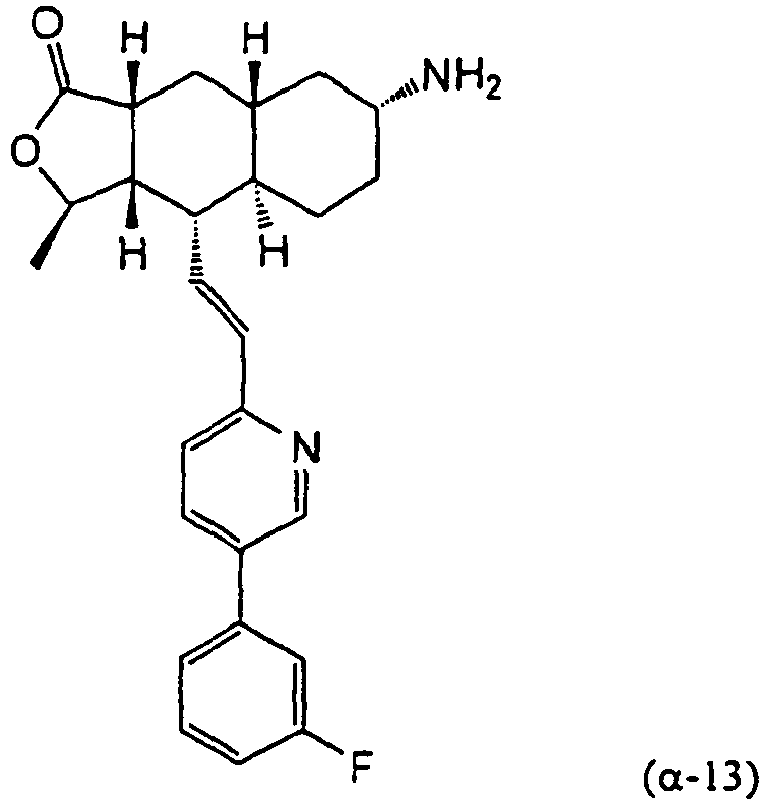
Rx-X is selected from the group consisting of Cl-COOCH2CH3, Cl-SO2CH3, CH3-NCO, and (CH3CO)2O. - 2. Process according to, wherein Rx is COOCH2CH3 and Rx-X is Cl-COOCH2CH3.
- 3. Process according to embodiment 1 or embodiment 2 wherein the compound of formula (α-13) is obtained by reacting the compound of formula (12)

followed by reaction with NaBH3CN,
followed by separation and isolation of stereoisomer (α-13). - 4.Reaction intermediate of the following formula (α-13)

- 5. Process for the manufacture of pharmaceutical compositions comprising compounds of the following general formula (II) or pharmaceutically acceptable salts or solvates thereof:

comprising the use of said compound of formula (II) or a pharmaceutically acceptable salt or solvate thereof, as well as the use of an inert pharmaceutically acceptable carrier which is either solid or liquid. - 6.The process according to embodiment 5, wherein Rx represents COOCH2CH3.
- 7. The process according to embodiment 5 or 6, wherein the pharmaceutical composition is a solid preparation selected from the group consisting of powders, tablets, dispersible granules, capsules, cachets and suppositories.
- 8. The process according to embodiment 7, wherein the pharmaceutical composition is a solid dosage form suitable for oral administration selected from the group consisting of powder, tablet, capsule and cachet.
- 9. The process according to embodiment 5 or 6, wherein the pharmaceutical composition is a liquid preparation selected from the group consisting of solutions, suspensions and emulsions.
- 10. The process according to embodiment 5 or 6, wherein the pharmaceutical composition is an aerosol preparation suitable for inhalation selected from the group consisting of solutions and solids in powder form.
- 11. The process according to embodiment 5 or 6, wherein the pharmaceutical composition is a transdermal composition selected from the group consisting of creams, lotions, aerosols, and emulsions.
- Thrombin receptor antagonist compounds prepared by the present invention can have anti-thrombotic, anti-platelet aggregation, antiatherosclerotic, antirestenotic and/or anti-coagulant activity. Thrombosis-related diseases treated by the compounds prepared by this invention include thrombosis, atherosclerosis, restenosis, hypertension, angina pectoris, arrhythmia, heart failure, myocardial infarction, glomerulonephritis, thrombotic and thromboembolytic stroke, peripheral vascular diseases, other cardiovascular diseases, cerebral ischemia, inflammatory disorders and cancer, as well as other disorders in which thrombin and its receptor play a pathological role.
- This invention relates to the following embodiments:
- 1. Process for the manufacture of compounds of the following general formula (II):

comprising the step of reacting the compound of the following formula (α-13)
Rx-X is selected from the group consisting of Cl-COOCH2CH3, Cl-SO2CH3, CH3-NCO, and (CH3CO)2O. - 2. Process according to embodiment 1, wherein Rx is COOCH2CH3 and Rx-X is Cl-COOCH2CH3.
- 3. Process according to embodiment 1 or embodiment 2 wherein the compound of formula (α-13) is obtained by reacting the compounds of formula (12)

followed by reaction with NaBH3CN,
followed by separation and isolation of stereoisomer (α-13). - 4. Reaction intermediate of the following formula (α-13)

- 5. Process for the manufacture of pharmaceutical compositions comprising compounds of the following general formula (II) or pharmaceutically acceptable salts or solvates thereof:
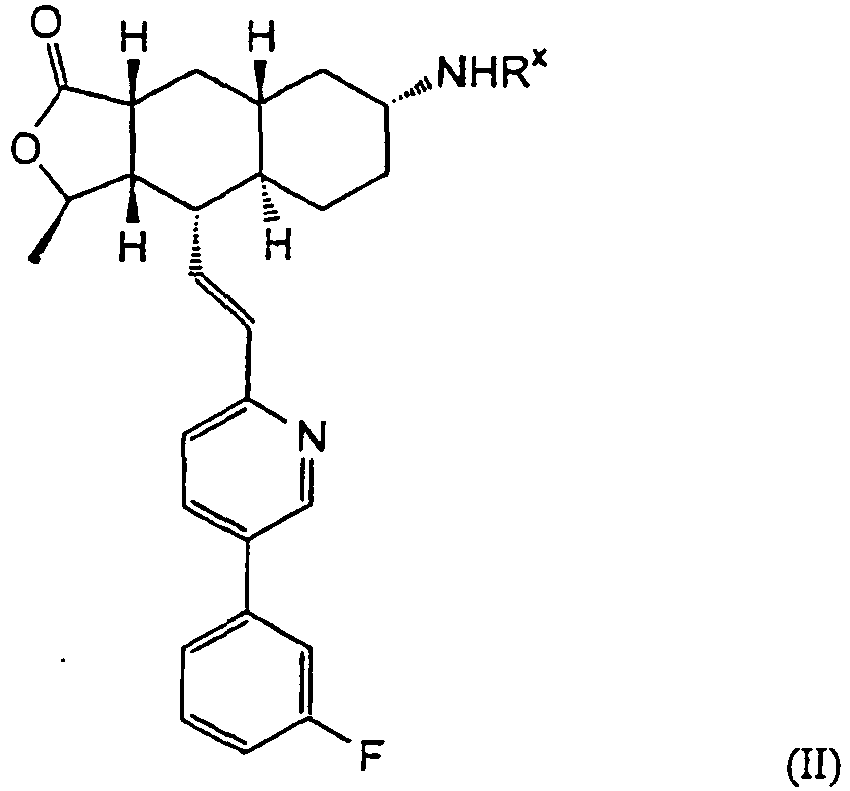
comprising the use of said compound of formula (II) or a pharmaceutically acceptable salt or solvate thereof, as well as the use of an inert pharmaceutically acceptable carrier which is either solid or liquid. - 6. The process according to embodiment 5, wherein Rx represents COOCH2CH3.
- 7. The process according to embodiment 5 or 6 wherein the pharmaceutical composition is a solid preparation selected from the group consisting of powders, tablets, dispersible granules, capsules, cachets and suppositories.
- 8. The process according to embodiment 7, wherein the pharmaceutical composition is a solid dosage form suitable for oral administration selected from the group consisting of powder, tablet, capsule and cachet.
- 9. The process according to embodiment 5 or 6, wherein the pharmaceutical composition is a liquid preparation selected from the group consisting of solutions, suspensions and emulsions.
- 10. The process according to embodiment 5 or 6, wherein the pharmaceutical composition is an aerosol preparation suitable for inhalation selected from the group consisting of solutions and solids in powder form.
- 11. The process according to embodiment 5 or 6, wherein the pharmaceutical composition is a transdermal composition selected from the group consisting of creams, lotions, aerosols, and emulsions.
- Following are examples of processes of the invention. In the examples, the following abbreviations are used: Et (ethyl); Me (methyl); Pr (propyl); Ac (acetyl); rt (room temperature); PTLC (preparative thin layer chromatography); THF (tetrahydrofuran); TBAF (tetra-n-butylammonium fluoride); Tips (triisopropylsilyl); and Tf (trifluoromethanesulfonyl).
-


- Compound 1 (646 mg, 1.38 mmol) was dissolved in 2.0 M CH3NH2 in CH3OH (15 ml, 30 mmol) and stirred at rt for 5 min followed by addition of NaCNBH3 (173 mg, 2.75 mmol). The reaction mixture was stirred at rt overnight and concentrated to dryness under reduced pressure. Removal of the solvent followed by PTLC separation (7% 1 M NH3 in CH3OH/ CH2Cl2) afforded β-4 (spot 1, 76 mg, 11%) and α-4 (spot 2, 100 mg, 15%). β-4: 1HNMR (CDCl3): δ 1.15-1.24 (m, 5H), 1.42 (d, J= 6 Hz, 3H), 1.42-1.61 (m, 2H), 1.71-1.95 (m, 4H), 2.21 (m, 1H), 2.38 (s, 3H), 2.45 (m, 1H), 2.71 (m, 1H), 2.84 (m, 1H), 4.75 (m, 1H), 6.51-6.63 (m, 2H), 7.26 (m, 2H), 7.75-7.85 (m, 4H), 8.77 (d, J= 2.0 Hz, 1H). α-4: 1HNMR (CDCl3): δ 0.95 (m, 2H), 1.10-1.40 (m, 5H), 1.41 (d, J= 6 Hz, 3H), 1.82-1.95 (m, 5H), 2.38 (m, 2H), 2.42 (s, 3H), 2.65 (m, 1H), 4.79 (m, 1H), 6.51-6.63 (m, 2H), 7.26 (m, 2H), 7.75-7.85 (m, 4H), 8.77 (d, J= 2.0 Hz, 1H).
- Compound α-4 (50 mg), ethyl chloroformate (0.15 ml) and Et3N (0.3 ml) in CH2Cl2 (5 ml) were stirred for 2 h. The reaction mixture was directly separated by PTLC (EtOAc hexane, 1:1) to afford the title compound (48 mg, 84%). MS m/z 557 (M+1). HRMS Calcd for C31H36N2O4F3 (M+1): 557.2627, found 557.2620.
-
-

- Phosphonate 7, described in
US 6,063,847 , (3.27 g, 8.1 mmol) was dissolved in THF (12 ml) and C(O)Oled to 0 °C, followed by addition of 2.5 M n-BuLi (3.2 ml, 8.1 mmol). The reaction mixture was stirred at 0 °C for 10 min and warmed up to rt. A solution of aldehyde 6, described inUS 6,063,847 , in THF (12 ml) was added to the reaction mixture. The reaction mixture was stirred for 30 min. Standard aqueous work-up, followed by column chromatography (30-50% EtOAc in hexane) afforded product 8. 1HNMR (CDCl3): δ 0.92-1.38 (m, 31 H), 1.41 (d, J= 6 Hz, 3H), 1.40-1.55 (m, 2H), 1.70-1.80 (m, 2H), 1.81-1.90 (m, 2H), 2.36 (m, 2H), 2.69 (m, 1H), 3.89 (m, 4H), 4.75 (m, 1H), 6.28-6.41 (m, 2H), 7.05-7.15 (m, 2H), 8.19 (br s, 1H).
- Compound 8 (2.64 g, 4.8 mmol) was dissolved in THF (48 ml). The reaction mixture was C(O)Oled to 0 °C followed by addition of 1 M TBAF (4.8 ml). The reaction mixture was stirred for 5 min followed by standard aqueous work-up. Column chromatography (50% EtOAc/hexane) afforded product 9 (1.9 g, 100%). 1HNMR (CDCl3): δ 1.15-1.55 (m, 6H), 1.41 (d, J= 6 Hz, 3H), 1.70-1.82 (m, 3H), 1.85-1.90 (m, 1H), 2.36 (m, 2H), 2.69 (m, 1H), 3.91 (m, 4H), 4.75 (m, 1H), 6.18-6.45 (m, 2H), 7.19 (br s, 2H), 8.19 (br s, 1H).

- To a solution of compound 9 (250 mg, 0.65 mmol) in pyridine (5 ml) C(O)Oled to 0 °C was added Tf2O (295 µL, 2.1 mmol). The reaction mixture was stirred overnight at rt. Standard aqueous work-up followed by column chromatography afforded product 10 (270 mg, 80%). 1HNMR (CDCl3): δ 1.15-1.55 (m, 6H), 1.41 (d, J= 6 Hz, 3H), 1.70-1.82 (m, 3H), 1.85-1.90 (m, 1H), 2.36 (m, 2H), 2.69 (m, 1H), 3.91 (m, 4H), 4.75 (m, 1H), 6.42-6.68 (m, 2H), 7.25 (m, 1H), 7.55 (m, 1H), 8.49 (d, J= 2.8 Hz, 1H).

- Compound 10 (560 mg, 1.1 mmol), 3-fluorophenyl boronic acid (180 mg, 1.3 mmol) and K2CO3 (500 mg, 3.6 mmol) were mixed with toluene (4.4 ml), H2O (1.5 ml) and EtOH (0.7 ml) in a sealed tube. Under an atmosphere of N2, Pd(Ph3P)4 (110 mg, 0.13 mmol) was added. The reaction mixture was heated at 100 °C for 2 h under N2. The reaction mixture was C(O)Oled down to rt, poured to EtOAc (30 ml) and washed with water (2X20 ml). The EtOAc solution was dried with NaHCO3 and concentrated at reduced pressure to give a residue. Preparative TLC separation of the residue (50% EtOAc in hexane) afforded product 11 (445 mg, 89%). 1HNMR (CDCl3): δ 1.15-1.59 (m, 6H), 1.43 (d, J= 6 Hz, 3H), 1.70-1.79 (m, 2H), 1.82 (m, 1H), 1.91 (m, 2H), 2.41 (m, 2H), 2.69 (m, 1H), 3.91 (m, 4H), 4.75 (m, 1H), 6.52-6.68 (m, 2H), 7.15 (m, 1H), 7.22 (m, 2H), 7.35 (m, 1H), 7.44 (m, 1H), 7.81 (m, 1H), 8.77 (d, J= 1.2 Hz, 1H).

- Compound 11 (445 mg, 0.96 mmol) was dissolved in a mixture of acetone (10 ml) and 1 N HCl (10 ml). The reaction mixture was heated at 50 °C for 1h. Standard aqueous work-up followed by preparative TLC separation (50% EtOAc in hexane) afforded product 12 (356 mg, 89%). 1HNMR (CDCl3): δ 1.21-1.45 (m, 2H), 1.47 (d, J= 5.6 Hz, 3H), 1.58-1.65 (m, 2H), 2.15 (m, 1H), 2.18-2.28 (m, 2H), 2.35-2.51 (m, 5H), 2.71 (m, 1H), 4.79 (m, 1H), 6.52-6.68 (m, 2H), 7.15 (m, 1H), 7.22 (m, 2H), 7.35 (m, 1H), 7.44 (m, 1H), 7.81 (m, 1H), 8.77 (d, J= 1.2 Hz, 1H).

- Compound 12 (500 mg, 4.2 mmol) was dissolved in EtOH (40 ml) and CH2Cl2 (15 ml) NH3 (g) was bubbled into the solution for 5 min. The reaction mixture was C(O)Oled to 0 °C followed by addition of Ti(OiPr)4 (1.89 ml, 6:3 mmol). After stirring at 0 °C for 1 h, 1M TiCl4 (6.3 ml, 6.3 mmol) was added. The reaction mixture was stirred at rt for 45 min and concentrated to dryness under reduced pressure. The residue was dissolved in CH3OH (10 ml) and NaBH3CN (510 mg, 8 mmol) was added. The reaction mixture was stirred overnight at rt. The reaction mixture was poured to 1 N NaOH (100 ml) and extracted with EtOAc (3x 100 ml). The organic layer was combined and dried with NaHCO3. Removal of solvent and separation by PTLC (5% 2 M NH3 in CH3OH/ CH2Cl2) afforded β-13 (spot 1, 30 mg, 6%) and α-13 (spot 2, 98 mg, 20%). β-13: 1HNMR (CDCl3): δ 1.50-1.38 (m, 5H), 1.42 (d, J= 6 Hz, 3H), 1.51-1.75 (m, 5H), 1.84 (m, 2H), 2.38 (m, 1H), 2.45 (m, 1H), 3.38 (br s, 1H), 4.78 (m, 1H), 6.59 (m, 2H), 7.15 (m, 1H), 7.26 (m, 2H), 7.36 (m, 1H), 7.42 (m, 1H), 7.82 (m, 1H), 8.77 (d, J= 2 Hz, 1H). α-13: 1HNMR (CDCl3): δ 0.95 (m, 2H), 1.02-1.35 (m, 6H), 1.41 (d, J= 6 Hz, 3H), 1.82-1.95 (m, 4H), 2.37 (m; 2H), 2.69 (m, 2H), 4.71 (m, 1H), 6.71 (m, 2H), 7.11 (m, 1H), 7.25 (m, 2H), 7.38 (m, 1H), 7.42 (m, 1H), 7.80 (m, 1H), 8.76 (d, J= 1.6 Hz, 1H).
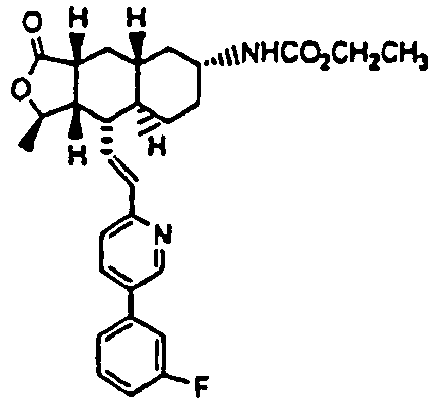
- Compound α-13 (300 mg, 0.71 mmol) was dissolved in CH2Cl2 (10 ml) followed by addition of Et3N (0.9 ml). The reaction mixture was C(O)Oled to 0 °C and ethyl chloroformate (0.5 ml) was added. The reaction mixture was stirred at rt for 1 h. The reaction mixture was directly separated by preparative TLC (EtOAc/hexane, 1:1) to give the title compound (14) (300 mg, 86%). MS m/z 493 (M+1). HRMS Calcd for C29H34N2O4F (M+1): 493.2503, found 493.2509.
-


- Compound 12 (130 mg, 0.31 mmol) was dissolved in 2.0 M CH3NH2 in CH3OH (5 ml, 10 mmol). After stirring at rt for 5 min, NaCNBH3 (40 mg, 0.62 mmol) was added. The reaction mixture was stirred at rt overnight. Removal of the solvent followed by PTLC separation (7% 1 M NH3 in CH3OH/ CH2Cl2) afforded β-15 (spot 1, 20 mg, 15%) and α-15 (spot 2, 25 mg, 19%). β-15: 1HNMR (CDCl3): δ 1.15-1.25 (m, 5H), 1.42 (m, 3H), 1.42-1.61 (m, 2H), 1.75-1.90 (m, 3H), 2.25-2.45 (m, 2H), 2.41 (s, 3H), 2.70 (m, 1H), 2.85 (m, 1H), 4.75 (m, 1H), 6.51-6.61 (m, 2H), 7.11 (m, 1H), 7.23-7.27 (m, 2H), 7.35 (m, 1H), 7.45 (m, 1H), 7.80 (m, 1H), 8.76 (d, J= 2.4 Hz, 1H). α-15: 1HNMR (CDCl3): δ 0.90 (m, 2H), 1.10-1.35 (m, 5H), 1.41 (d, J= 5.6 Hz, 3H), 1.82-2.01 (m, 4H), 2.36 (m, 2H), 2.39 (s, 3H), 2.55-2.65 (br s , 1H), 2.71 (m, 1H), 4.79 (m, 1H), 6.51-6.63 (m, 2H), 7.08 (m, 1H), 7.26 (m, 2H), 7.34 (m 1H), 7.42 (m, 1H), 7.81 (m, 1H), 8.76 (d, J= 2.0 Hz, 1H).
- Compound α-15 (25 mg, 0.06 mmol) was dissolved in CH2Cl2 (5 ml) followed by addition of Et3N (0.2 ml). The reaction mixture was C(O)Oled to 0°C and ethyl chloroformate (0.1 m) was added. The reaction mixture was stirred at rt for 1 h. The reaction mixture was directly separated by preparative TLC (EtOAc/hexane, 1:1) to give the title compound (25 mg, 85%). MS m/z 507 (M+1). HRMS Calcd for C30H36N2O4F (M+1): 507.2659, found 507.2652.
-

- Compound α-13 (10 mg, 0.02 mmol) was dissolved in CH2Cl2 (3 ml) followed by addition of Et3N (0.5 ml). The reaction mixture was C(O)Oled to 0°C and CH3SO2Cl (0.2 ml) was added. The reaction mixture was stirred at rt for 1 h. The reaction mixture was directly separated by preparative TLC (EtOAc/hexane, 1:1) to give the title compound (10 mg, 84%). MS m/z 499 (M+1). HRMS Calcd for C27H32N2O4FS (M+1): 499.2067, found 499.2071.
-

- Compound α-13 (50 mg, 0.1 mmol) was dissolved in CH2Cl2 (5 ml) followed by addition of CH3NCO (250 mg). The reaction mixture was stirred at rt for 1 h. The reaction mixture was directly separated by preparative TLC (CH3OH/ CH2Cl2, 7%) to give the title compound (60 mg as HCl salt, 98%). MS m/z 478 (M+1). HRMS Calcd for C28H33N3O3F (M+1): 478.2506, found 478.2516.
-

- Compound α-13 (50 mg, 0.1 mmol) was dissolved in CH2Cl2 (3 mL) followed by addition of Et3N (0.5 mL). The reaction mixture was C(O)Oled to 0 °C and acetic anhydride (0.2 mL) was added. The reaction mixture was stirred at rt overnight. The reaction mixture was directly separated by preparative TLC (CH3OH/ CH2Cl2, 8%) to give the title compound (52 mg, 94%). MS m/z 463 (M+1). HRMS Calcd for C28H32N2O3F (M+1): 463.2397, found 463.2399.
- Using the methods described above, Comparative example 13 was also prepared,

R2= -CF3
HRMs (n+1) :
observed 585.2951 - For preparing pharmaceutical compositions from the compounds manufactured by the process of this invention, inert, pharmaceutically acceptable carriers can be either solid or liquid. Solid form preparations include powders, tablets, dispersible granules, capsules, cachets and suppositories. The powders and tablets may be comprised of from about 5 to about 95 percent active ingredient. Suitable solid carriers are known in the art, e.g., magnesium carbonate, magnesium stearate, talc, sugar or lactose. Tablets, powders, cachets and capsules can be used as solid dosage forms suitable for oral administration. Examples of pharmaceutically acceptable carriers and methods of manufacture for various compositions may be found in A. Gennaro (ed.), The Science and Practice of Pharmacy, 20th Edition, Lippincott William & Wilkins, Baltimore, MD, (2000).
- Liquid form preparations include solutions, suspensions and emulsions. As an example may be mentioned water or water-propylene glycol solutions for parenteral injection or addition of sweeteners and opacifiers for oral solutions, suspensions and emulsions. Liquid form preparations may also include solutions for intranasal administration.
- Aerosol preparations suitable for inhalation may include solutions and solids in powder form, which may be in combination with a pharmaceutically acceptable carrier, such as an inert compressed gas, e.g., nitrogen.
- Also included are solid form preparations which are intended to be converted, shortly before use, to liquid form preparations for either oral or parenteral administration. Such liquid forms include solutions, suspensions and emulsions.
- The compounds manufactured by the process of the invention may also be deliverable transdermally. The transdermal compositions can take the form of creams, lotions, aerosols and/or emulsions and can be included in a transdermal patch of the matrix or reservoir type as are conventional in the art for this purpose.
- Preferably the compound is administered orally.
- Preferably, the pharmaceutical preparation is in a unit dosage form. In such form, the preparation is subdivided into suitably sized unit doses containing appropriate quantities of the active component, e.g., an effective amount to achieve the desired purpose.
- The daily dose of a compound manufactured by the process of the invention for treatment of a disease or condition cited above is about 0.001 to about 100 mg/kg of body weight per day, preferably about 0.001 to about 10 mg/kg. For an average body weight of 70 kg, the dosage level is therefore from about 0.1 to about 700 mg of drug per day, given in a single dose or 2-4 divided doses.
- The amount and frequency of administration of the compounds prepared by the invention and/or the pharmaceutically acceptable salts thereof will be regulated according to the judgment of the attending clinician considering such factors as age, condition and size of the patient as well as severity of the symptoms being treated.
- The activity of the compounds manufactured by the press of the invention can be determined by the following procedures.
- A(pF-F)R(ChA)(hR)(I2-YyNH2 (1.03 mg) and 10% Pd/C (5.07 mg) were suspended in DMF (250 µl) and diisopropylethylamine (10 µl). The vessel was attached to the tritium line, frozen in liquid nitrogen and evacuated. Tritium gas (342 mCi) was then added to the flask, which was stirred at room temperature for 2 hours. At the completion of the reaction, the excess tritium was removed and the reacted peptide solution was diluted with DMF (0.5 ml) and filtered to remove the catalyst. The collected DMF solution of the crude peptide was diluted with water and freeze dried to remove the labile tritium. The solid peptide was redissolved in water and the freeze drying process repeated. The tritiated peptide ([3H]haTRAP) was dissolved in 0.5 ml of 0.1% aqueous TFA and purified by HPLC using the following conditions: column, Vydac C18, 25 cm x 9.4 mm I.D.; mobile phase, (A) 0.1 % TFA in water, (B) 0.1% TFA in CH3CN; gradient, (A/B) from 100/0 to 40/60 over 30 min; flow rate, 5 ml /min; detection, UV at 215 nm. The radiochemical purity of [3H]haTRAP was 99% as analyzed by HPLC. A batch of 14.9 mCi at a specific activity of 18.4 Ci/mmol was obtained.
- Platelet membranes were prepared using a modification of the method of Natarajan et al (Natarajan et al, Int. J. Peptide Protein Res., vol. 45, pp.145-151 (1995) from 20 units of platelet concentrates obtained from the North Jersey Blood Center (East Orange, N.J.) within 48 hours of collection. All steps were carried out at 4° C under approved biohazard safety conditions. Platelets were centrifuged at 100 x g for 20 minutes at 4° C to remove red cells. The supernatants were decanted and centrifuged at 3000 x g for 15 minutes to pellet platelets. Platelets were resuspended in 10 mM Tris-HCl, pH 7.5, 150 mM NaCl, 5 mM EDTA, to a total volume of 200 ml and centrifuged at 4400 x g for 10 minutes. This step was repeated two additional times. Platelets were resuspended in 5 mM Tris-HCl, pH 7.5, 5 mM EDTA to a final volume of approximately 30 ml and were homogenized with 20 strokes in a Dounce homogenizer. Membranes were pelleted at 41,000 x g, resuspended in 40-50 ml 20 mM Tris-HCl, pH 7.5, 1 mM EDTA, 0.1 mM dithiothreitol, and 10 ml aliquots were frozen in liquid N2 and stored at -80° C. To complete membrane preparation, aliquots were thawed, pooled, and homogenized with 5 strokes of a Dounce homogenizer. Membranes were pelleted and washed 3 times in 10 mM triethanolamine-HCl, pH 7.4, 5 mM EDTA, and resuspended in 20-25 ml 50 mM Tris-HCl, pH 7.5, 10 mM MgCl2, 1 mM EGTA, and 1% DMSO. Aliquots of membranes were frozen in liquid N2 and stored at -80° C. Membranes were stable for at least 3 months. 20 units of platelet concentrates typically yielded 250 mg of membrane protein. Protein concentration was determined by a Lowry assay (Lowry et al, J. Biol. Chem., vol. 193, pp.265-275 (1951).
- Thrombin receptor antagonists were screened using a modification of the thrombin receptor radioligand binding assay of Ahn et al. (Ahn et al, Mol. Pharmacol., vol. 51, p.350-356 (1997). The assay was performed in 96 well Nunc plates (Cat. No. 269620) at a final assay volume of 200 µl. Platelet membranes and [3H]haTRAP were diluted to 0.4 mg/ml and 22.2 nM, respectively, in binding buffer (50 mM Tris-HCl, pH 7.5, 10 mM MgCl2, 1 mM EGTA, 0.1 % BSA). Stock solutions (10 mM in 100% DMSO) of test compounds were further diluted in 100% DMSO. Unless otherwise indicated, 10 µl of diluted compound solutions and 90 µl of radioligand (a final concentration of 10 nM in 5% DMSO) were added to each well, and the reaction was started by the addition of 100 µl of membranes (40 µg protein/well). The binding was not significantly inhibited by 5% DMSO. Compounds were tested at three concentrations (0.1, 1 and 10 µM). The plates were covered and vortex-mixed gently on a Lab-Line Titer Plate Shaker for 1 hour at room temperature. Packard UniFilter GF/C filter plates were soaked for at least 1 hour in 0.1 % polyethyleneimine. The incubated membranes were harvested using a Packard FilterMate Universal Harvester and were rapidly washed four times with 300 µl ice cold 50 mM Tris-HCl, pH 7.5, 10 mM MgCl2, 1 mM EGTA. MicroScint 20 scintillation cocktail (25 µl) was added to each well, and the plates were counted in a Packard TopCount Microplate Scintillation Counter. The specific binding was defined as the total binding minus the nonspecific binding observed in the presence of excess (50 µM) unlabeled haTRAP. The % Inhibition by a compound of [3H]haTRAP binding to thrombin receptors was calculated from the following relationship:

- Affinity values (Ki) were then determined using the following formula:

Hence, a lower value of Ki indicates greater binding affinity. - A(pF-F)R(ChA)(hR)Y-NH2 and A(pF-F)R(ChA)(hR)(I2-Y)-NH2, were custom synthesized by AnaSpec Inc. (San Jose, CA). The purity of these peptides was >95%. Tritium gas (97%) was purchased from EG&G Mound, Miamisburg Ohio. The gas was subsequently loaded and stored on an IN/US Systems Inc. Trisorber. MicroScint 20 scintillation cocktail was obtained from Packard Instrument Co.
- Conscious chaired cynomolgus monkeys are allowed to equilibrate for 30 min. A needle catheter is inserted into a brachial vein for infusion of test drugs. Another needle catheter is inserted into the other brachial or saphenous vein and used for blood sampling. In those experiments where the compound is administered orally only one catheter is used. A baseline blood sample (1-2 ml) is collected in vacutainer tubes containing a thrombin inhibitor CVS 2139 (100 µg/0.1 ml saline) as an anticoagulant. The drug is then infused intravenously over a period of 30 min. Blood samples (1 ml) are collected at 5, 10, 20, 30 min during and 30, 60, 90 min after termination of the drug infusion. In PO experiments the animals are dosed with the drug using a gavage cannula. Blood samples are collected at 0, 30, 60, 90, 120, 180, 240, 300, 360 min after dosing. 0.5 ml of the blood is used for whole blood aggregation and the other 0.5 ml is used for determining the plasma concentration of the drug or its metabolites. Aggregation is performed immediately after collection of the blood sample as described below.
- A 0.5 ml blood sample is added to 0.5 ml of saline and warmed to 37°C in a Chronolog whole blood aggregometer. Simultaneously, the impedance electrode is warmed in saline to 37°C. The blood sample with a stir bar is placed in the heating block well, the impedance electrode is placed in the blood sample and the collection software is started. The software is allowed to run until the baseline is stabilized and then a 20 Ω calibration check is performed. 20 Ω is equal to 4 blocks on the graphic produced by the computer software. The agonist (haTRAP) is added by an adjustable volume pipette (5-25 µl) and the aggregation curve is recorded for 10 minutes. Maximum aggregation in 6 minutes following agonist addition is the value recorded.
- Platelet aggregation studies were performed according to the method of Bednar et al. (Bednar, B., Condra, C., Gould, R.J., and Connolly, T.M., Throm. Res., vol. 77, pp.453-463 (1995)). Blood was obtained from healthy human subjects who were aspirin free for at least 7 days by venipuncture using ACD as anticoagulant. Platelet rich plasma was prepared by centrifugation at 100Xg for 15 minutes at 15 deg C. Platelets were pelleted at 3000xg and washed twice in buffered saline containing 1 mM EGTA and 20 µg/ml apyrase to inhibit aggregation. Aggregation was performed at room temperature in buffered saline supplemented with 0.2 mg/ml human fibrinogen. Test compound and platelets were preincubated in 96-well flat-bottom plates for 60 minutes. Aggregation was initiated by adding 0.3 µM haTRAP or 0.1 U/ml thrombin and rapidly vortexing the mixture using a Lab Line Titer Plate Shaker (speed 7). Percent aggregation was monitored as increasing light transmittance at 405 nm in a Spectromax Plate Reader.
- Tests in the human breast carcinoma model in nude mouse are conducted according to the procedure reported in S. Even-Ram et. al., Nature Medicine, 4, 8, pp. 909-914 (1988).
- Compounds prepared by the present invention are surprisingly active in the ex-vivo platelet aggregation test model. In these studies, the compound of Example 2 of this invention, after oral administration at a dose of 0.1 mg/kg, completely inhibited aggregation of platelets induced by exogenously added thrombin receptor activating peptide for duration of 24 hours. Even after 48 hours, approximately 65% of inhibition of platelet aggregation was sustained. In contrast, N-alkyl carbamate analogs, Comparative Examples 1A, 2A and 13 of
US 6,063,847 , were studied under similar conditions using a dose of 0.5 mg/kg, a 5-fold increase over the dose of the compound of Example 2. Under these conditions, the N-alkyl compounds showed no significant inhibition of platelet aggregation at various time points.
Claims (11)
- Process for the manufacture of compounds of the following general formula (II):

comprising the step of reacting the compound of the following formula (α-13)
Rx-X is selected from the group consisting of Cl-COOCH2CH3, Cl-SO2CH3, CH3-NCO, and (CH3CO)2O. - Process according to claim 1, wherein Rx is COOCH2CH3 and Rx-X is Cl-COOCH2CH3.
- Process according to claim 1 or claim 2, wherein the compound of formula (α-13) is obtained by reacting the compound of formula (12)

followed by reaction with NaBH3CN,
followed by separation and isolation of stereoisomer (α-13). - Reaction intermediate of the following formula (α-13)

- Process for the manufacture of pharmaceutical compositions comprising compounds of the following general formula (II) or pharmaceutically acceptable salts or solvates thereof:

comprising the use of said compound of formula (II) or a pharmaceutically acceptable salt or solvate thereof, as well as the use of an inert pharmaceutically acceptable carrier which is either solid or liquid. - The process according to Claim 5, wherein Rx represents COOCH2CH3.
- The process according to Claim 5, or 6, wherein the pharmaceutical composition is a solid preparation selected from the group consisting of powders, tablets, dispersible granules, capsules, cachets and suppositories.
- The process according to Claim 7, wherein the pharmaceutical composition is a solid dosage form suitable for oral administration selected from the group consisting of powder, tablet, capsule and cachet.
- The process according to Claim 5 or 6, wherein the pharmaceutical composition is a liquid preparation selected from the group consisting of solutions, suspensions and emulsions.
- The process according to Claim 5 or 6, wherein the pharmaceutical composition is an aerosol preparation suitable for inhalation selected from the group consisting of solutions and solids in powder form.
- The process according to Claim 5 or 6, wherein the pharmaceutical composition is a transdermal composition selected from the group consisting of creams, lotions, aerosols, and emulsions.
Priority Applications (1)
| Application Number | Priority Date | Filing Date | Title |
|---|---|---|---|
| EP09150996A EP2062890B1 (en) | 2002-04-16 | 2003-04-14 | Tricyclic thrombin receptor antagonist |
Applications Claiming Priority (3)
| Application Number | Priority Date | Filing Date | Title |
|---|---|---|---|
| US37307202P | 2002-04-16 | 2002-04-16 | |
| EP07016461A EP1860106B1 (en) | 2002-04-16 | 2003-04-14 | Tricyclic thrombin receptor antagonists |
| EP03718393A EP1495018B3 (en) | 2002-04-16 | 2003-04-14 | Tricyclic thrombin receptor antagonists |
Related Parent Applications (4)
| Application Number | Title | Priority Date | Filing Date |
|---|---|---|---|
| EP07016461A Division EP1860106B1 (en) | 2002-04-16 | 2003-04-14 | Tricyclic thrombin receptor antagonists |
| EP03718393A Division-Into EP1495018B3 (en) | 2002-04-16 | 2003-04-14 | Tricyclic thrombin receptor antagonists |
| EP03718393.6 Division | 2003-04-14 | ||
| EP07016461.1 Division | 2007-08-22 |
Related Child Applications (2)
| Application Number | Title | Priority Date | Filing Date |
|---|---|---|---|
| EP09150996A Division EP2062890B1 (en) | 2002-04-16 | 2003-04-14 | Tricyclic thrombin receptor antagonist |
| EP09150996.8 Division-Into | 2009-01-21 |
Publications (3)
| Publication Number | Publication Date |
|---|---|
| EP1982984A2 EP1982984A2 (en) | 2008-10-22 |
| EP1982984A3 EP1982984A3 (en) | 2008-10-29 |
| EP1982984B1 true EP1982984B1 (en) | 2013-02-13 |
Family
ID=29250954
Family Applications (5)
| Application Number | Title | Priority Date | Filing Date |
|---|---|---|---|
| EP08012015A Expired - Lifetime EP1982984B1 (en) | 2002-04-16 | 2003-04-14 | Manufacture of tricyclic thrombin receptor antagonists and pharmaceutical compositions comprising them |
| EP09150995A Expired - Lifetime EP2065384B1 (en) | 2002-04-16 | 2003-04-14 | Tricyclic thrombin receptor antagonist |
| EP07016461A Expired - Lifetime EP1860106B1 (en) | 2002-04-16 | 2003-04-14 | Tricyclic thrombin receptor antagonists |
| EP03718393A Expired - Lifetime EP1495018B3 (en) | 2002-04-16 | 2003-04-14 | Tricyclic thrombin receptor antagonists |
| EP09150996A Expired - Lifetime EP2062890B1 (en) | 2002-04-16 | 2003-04-14 | Tricyclic thrombin receptor antagonist |
Family Applications After (4)
| Application Number | Title | Priority Date | Filing Date |
|---|---|---|---|
| EP09150995A Expired - Lifetime EP2065384B1 (en) | 2002-04-16 | 2003-04-14 | Tricyclic thrombin receptor antagonist |
| EP07016461A Expired - Lifetime EP1860106B1 (en) | 2002-04-16 | 2003-04-14 | Tricyclic thrombin receptor antagonists |
| EP03718393A Expired - Lifetime EP1495018B3 (en) | 2002-04-16 | 2003-04-14 | Tricyclic thrombin receptor antagonists |
| EP09150996A Expired - Lifetime EP2062890B1 (en) | 2002-04-16 | 2003-04-14 | Tricyclic thrombin receptor antagonist |
Country Status (33)
| Country | Link |
|---|---|
| US (3) | US7304078B2 (en) |
| EP (5) | EP1982984B1 (en) |
| JP (2) | JP4558331B2 (en) |
| KR (1) | KR101026929B1 (en) |
| CN (1) | CN1659162B (en) |
| AR (1) | AR039570A1 (en) |
| AT (3) | ATE494284T1 (en) |
| AU (1) | AU2003221932B2 (en) |
| BR (1) | BRPI0309309B8 (en) |
| CA (1) | CA2482858C (en) |
| CY (3) | CY1107184T1 (en) |
| DE (3) | DE60331114D1 (en) |
| DK (2) | DK1495018T3 (en) |
| EC (1) | ECSP045368A (en) |
| ES (3) | ES2297150T7 (en) |
| FR (1) | FR15C0047I2 (en) |
| IL (1) | IL164585A (en) |
| LT (1) | LTC1495018I2 (en) |
| LU (1) | LU92759I2 (en) |
| MX (1) | MXPA04010308A (en) |
| MY (1) | MY144040A (en) |
| NL (1) | NL300746I1 (en) |
| NO (2) | NO330500B1 (en) |
| NZ (2) | NZ575139A (en) |
| PE (1) | PE20040412A1 (en) |
| PL (1) | PL214718B1 (en) |
| PT (2) | PT2065384E (en) |
| RU (2) | RU2329264C9 (en) |
| SG (1) | SG164279A1 (en) |
| SI (2) | SI1495018T1 (en) |
| TW (1) | TWI343919B (en) |
| WO (1) | WO2003089428A1 (en) |
| ZA (1) | ZA200408342B (en) |
Families Citing this family (63)
| Publication number | Priority date | Publication date | Assignee | Title |
|---|---|---|---|---|
| US6346510B1 (en) | 1995-10-23 | 2002-02-12 | The Children's Medical Center Corporation | Therapeutic antiangiogenic endostatin compositions |
| US7488742B2 (en) * | 2000-06-15 | 2009-02-10 | Schering Corporation | Thrombin receptor antagonists |
| US7235567B2 (en) * | 2000-06-15 | 2007-06-26 | Schering Corporation | Crystalline polymorph of a bisulfate salt of a thrombin receptor antagonist |
| US20040192753A1 (en) * | 2000-06-15 | 2004-09-30 | Samuel Chackalamannil | Methods of use of thrombin receptor antagonists |
| WO2005118576A1 (en) * | 2004-05-28 | 2005-12-15 | Schering Corporation | Constrained himbacine analogs as thrombin receptor antagonists |
| CA2582353A1 (en) * | 2004-10-06 | 2006-04-20 | University Of Rochester | Treatment of pulmonary hypertension using an agent that inhibits a tissue factor pathway |
| US20060172397A1 (en) * | 2005-01-14 | 2006-08-03 | Schering Corporation | Preparation of chiral propargylic alcohol and ester intermediates of himbacine analogs |
| DK1848705T3 (en) * | 2005-01-14 | 2010-06-14 | Schering Corp | EXO and diastereoselective syntheses of himbacin analogs |
| AR052871A1 (en) | 2005-01-14 | 2007-04-11 | Schering Corp | AN EXO-SELECTIVE SYNTHESIS OF HIMBACINE ANALOGS |
| SG158885A1 (en) * | 2005-01-14 | 2010-02-26 | Schering Corp | Synthesis of himbacine analogs |
| US7541471B2 (en) * | 2005-01-14 | 2009-06-02 | Schering Corporation | Synthesis of himbacine analogs |
| AU2006230292A1 (en) * | 2005-03-31 | 2006-10-05 | Schering Corporation | Spirocyclic thrombin receptor antagonists |
| WO2007075808A2 (en) * | 2005-12-20 | 2007-07-05 | Schering Corporation | Methods for preventing and/or treating a cell proliferative disorder |
| WO2007075964A2 (en) * | 2005-12-22 | 2007-07-05 | Schering Corporation | Thrombin receptor antagonists as prophylaxis to complications from cardiopulmonary surgery |
| PE20080183A1 (en) * | 2006-04-06 | 2008-03-10 | Schering Corp | TRA COMBINATION THERAPIES |
| JP2009533450A (en) * | 2006-04-13 | 2009-09-17 | シェーリング コーポレイション | Fused ring thrombin receptor antagonist |
| CA2655720A1 (en) * | 2006-06-29 | 2008-01-10 | Schering Corporation | Substituted bicyclic and tricyclic thrombin receptor antagonists |
| AR061727A1 (en) * | 2006-06-30 | 2008-09-17 | Schering Corp | DIETILE SYNTHESIS [[5- (3-FLUOROPHENYL) -PIRIDIN -2IL] METHYL] PHOSPHONATE |
| TWI367112B (en) * | 2006-06-30 | 2012-07-01 | Schering Corp | Immediate-release tablet formulations of a thrombin receptor antagonist |
| DE102006036023A1 (en) | 2006-08-02 | 2008-02-07 | Sanofi-Aventis | Imino-imidazo-pyridine derivatives with antithrombotic activity |
| TWI343262B (en) * | 2006-09-26 | 2011-06-11 | Schering Corp | Rapidly disintegrating lyophilized oral formulations of a thrombin receptor antagonist |
| MX2009003758A (en) * | 2006-10-04 | 2009-04-22 | Schering Corp | Thrombin receptor antagonists based on the modified tricyclic unit of himbacine. |
| MX2009003761A (en) * | 2006-10-04 | 2009-06-30 | Schering Corp | Bicyclic and tricyclic derivatives as thrombin receptor antagonists. |
| EP2120879A2 (en) * | 2006-12-22 | 2009-11-25 | Schering Corporation | Disintegration promoters in solid dose wet granulation formulations |
| MX2009010268A (en) * | 2007-03-23 | 2009-11-09 | Schering Corp | Reduction of adverse events.after percutaneous intervention by use of a thrombin receptor antagonist. |
| CA2713551C (en) | 2008-02-05 | 2016-06-14 | Sanofi-Aventis | Triazolium salts as par1 inhibitors, production thereof, and use as medicaments |
| MY152040A (en) | 2008-02-05 | 2014-08-15 | Sanofi Aventis | Triazolopyridazines as par1 inhibitors, production thereof, and use as medicaments |
| WO2009124103A2 (en) * | 2008-04-02 | 2009-10-08 | Schering Corporation | Combination therapies comprising par1 antagonists with par4 antagonists |
| JP5504259B2 (en) | 2008-05-19 | 2014-05-28 | メルク・シャープ・アンド・ドーム・コーポレーション | Heterocyclic compounds as factor IXA inhibitors |
| SI2438060T1 (en) | 2009-06-04 | 2014-04-30 | Merck Sharp & Dohme Corp. | Active metabolite of a thrombin receptor antagonist |
| EP2440191A2 (en) | 2009-06-08 | 2012-04-18 | Schering Corporation | A thrombin receptor antagonist and clopidogrel fixed dose tablet |
| EP2462123B1 (en) | 2009-08-04 | 2013-10-02 | Merck Sharp & Dohme Corp. | 4,5,6-trisubstituted pyrimidine derivatives as factor ixa inhibitors |
| ES2532902T3 (en) | 2010-04-16 | 2015-04-01 | Sanofi | Tricyclic pyridyl vinyl pyrroles as inhibitors of PAR1 |
| PL2558462T3 (en) | 2010-04-16 | 2015-03-31 | Sanofi Sa | Pyridyl-vinyl-pyrazolo-chinolines as PAR1 inhibitors |
| KR101303348B1 (en) | 2010-06-25 | 2013-09-03 | 한국화학연구원 | [6 + 5] conjugated bicycle, a thrombin receptor antagonist, preparation method thereof and pharmaceutical composition comprising the same |
| WO2013134012A1 (en) | 2012-03-06 | 2013-09-12 | Merck Sharp & Dohme Corp. | Preparation and use of bicyclic himbacine derivatives as par-receptor antagonists |
| EP3024550A4 (en) | 2013-07-22 | 2016-12-07 | Merck Sharp & Dohme | CO-CRYSTAL OF VORAPAXAR PAR-1 RECEPTOR ANTAGONIST AND ASPIRINE |
| WO2015026685A1 (en) * | 2013-08-22 | 2015-02-26 | Merck Sharp & Dohme Corp. | 7a-heterocycle substituted- 6, 6-difluoro bicyclic himbacine derivatives |
| US9808473B2 (en) | 2013-08-22 | 2017-11-07 | Merck Sharp & Dohme Corp. | Preparation and use of 3-pyridyl substituted-6,6-difluoro bicyclic himbacine derivatives as par-1 receptor antagonists |
| US9701669B2 (en) | 2013-08-22 | 2017-07-11 | Merck Sharp & Dohme Corp. | Preparation and use of 7a-amide substituted- 6,6-difluoro bicyclic himbacine derivatives as PAR-1 receptor antagonists |
| FR3014693B1 (en) | 2013-12-16 | 2016-01-08 | Pf Medicament | USE OF 3- (2-CHLORO-PHENYL) -1- [4- (4-FLUORO-BENZYL) -PIPERAZIN-1-YL] -PROPENONE FOR THE PREVENTION AND / OR TREATMENT OF PELVI-PERINEAL FUNCTIONAL PATHOLOGIES |
| WO2015160636A1 (en) | 2014-04-16 | 2015-10-22 | Merck Sharp & Dohme Corp. | Factor ixa inhibitors |
| DE102014108210A1 (en) | 2014-06-11 | 2015-12-17 | Dietrich Gulba | rodenticide |
| CN105985303B (en) * | 2015-02-13 | 2020-08-14 | 上海彩迩文生化科技有限公司 | Preparation method of anticoagulant, intermediate and preparation method thereof |
| CN106478608A (en) * | 2015-09-01 | 2017-03-08 | 博瑞生物医药(苏州)股份有限公司 | The crystalline polymorph of the husky sulfate of Walla handkerchief |
| CN106749201A (en) * | 2015-11-25 | 2017-05-31 | 博瑞生物医药(苏州)股份有限公司 | A kind of preparation method of Walla handkerchief sand and its intermediate |
| TR201601548A2 (en) * | 2016-02-05 | 2018-03-21 | Sanovel Ilac Sanayi Ve Ticaret Anonim Sirketi | A PHARMACEUTICAL COMPOSITION OF VORAPAKSAR AND METOPROLOL |
| WO2017134200A1 (en) * | 2016-02-05 | 2017-08-10 | Sanovel Ilac Sanayi Ve Ticaret A.S. | A novel pharmaceutical composition of vorapaxar and metoprolol |
| TW201738221A (en) * | 2016-04-22 | 2017-11-01 | Jiangsu Tasly Diyi Pharmaceutical Co Ltd | New himbacine analogue and uses thereof in medicines |
| CN106236779A (en) * | 2016-08-22 | 2016-12-21 | 孔五 | A kind of preparation method of Cord blood platelet rich plasma PRP |
| FR3090317B1 (en) | 2018-12-19 | 2021-05-07 | Cvasthera | USE OF A PAR-1 ANTAGONIST FOR THE TREATMENT OF CHRONIC INFLAMMATORY INTESTINAL DISEASE |
| CN110407819B (en) * | 2019-08-02 | 2020-06-26 | 牡丹江医学院 | Thrombin receptor antagonists as a prophylactic for surgical complications |
| US20210113536A1 (en) * | 2019-10-21 | 2021-04-22 | United States Government as Represented by the Department of Veteran Affairs | Methods and compositions for detecting and treating venous thromboembolism |
| FR3109089B1 (en) | 2020-04-08 | 2023-04-14 | Cvasthera | PHARMACEUTICAL COMPOSITION FOR THE TREATMENT OF INFLAMMATORY BOWEL DISEASES |
| CA3189771A1 (en) | 2020-07-22 | 2022-01-27 | Janssen Pharmaceutica Nv | Compounds useful as factor xia inhibitors |
| US11845748B2 (en) | 2021-03-18 | 2023-12-19 | Janssen Pharmaceutica Nv | Bicyclic pyridine N-oxide derivatives useful as a factor XIa inhibitors |
| US11814364B2 (en) | 2021-03-18 | 2023-11-14 | Janssen Pharmaceutica Nv | Pyridine N-oxide derivatives useful as factor XIa inhibitors |
| US11919881B2 (en) | 2021-03-18 | 2024-03-05 | Janssen Pharmaceutica Nv | Substituted pyridine N-oxide derivatives useful as a factor XIa inhibitors |
| EP4070658A1 (en) | 2021-04-06 | 2022-10-12 | BIORoxx GmbH | Use of anticoagulant active compounds as rodenticide |
| US11897880B2 (en) | 2021-04-30 | 2024-02-13 | Janssen Pharmaceutica Nv | 7,8-dihydrobenzo[e]pyrido[3,4-c]azocine-2,5(3H,6H)-dione derivatives useful as a factor XIa inhibitors |
| US12286429B2 (en) | 2021-07-22 | 2025-04-29 | Janssen Pharmaceutica Nv | 5-oxo-1,2,3,5,8,8a-hexahydroindolizine-3-carboxamide derivatives useful as a factor XIa inhibitors |
| US11958856B2 (en) | 2021-07-22 | 2024-04-16 | Janssen Pharmaceutica Nv | Substituted 1,2,3,8,9,9a-hexahydro-5H-pyrrolo[1,2-a]azepin-5-ones as factor XIa inhibitors |
| FR3134314A1 (en) | 2022-04-08 | 2023-10-13 | Cvasthera | PHARMACEUTICAL COMPOSITION BASED ON VORAPAXAR AND ITS USE FOR THE TREATMENT OF INFLAMMATORY INTESTINAL DISEASES |
Family Cites Families (12)
| Publication number | Priority date | Publication date | Assignee | Title |
|---|---|---|---|---|
| FR2623810B2 (en) | 1987-02-17 | 1992-01-24 | Sanofi Sa | ALPHA SALTS- (TETRAHYDRO-4,5,6,7 THIENO (3,2-C) PYRIDYL-5) (2-CHLORO-PHENYL) -THETHYL ACETATE DEXTROGYRE AND PHARMACEUTICAL COMPOSITIONS CONTAINING THE SAME |
| TW197435B (en) * | 1990-11-22 | 1993-01-01 | Takeda Pharm Industry Co Ltd | |
| GB9102862D0 (en) * | 1991-02-11 | 1991-03-27 | Erba Carlo Spa | N-imidazolyl derivatives of substituted or alkoxymino tetrahydronaphthalenes and chromans |
| IL106197A (en) | 1992-07-30 | 1999-11-30 | Cor Therapeutics Inc | Thrombin receptor antagonists and pharmaceutical compositions comprising them |
| US5576328A (en) | 1994-01-31 | 1996-11-19 | Elf Sanofi | Method for the secondary prevention of ischemic events |
| SK285153B6 (en) | 1997-11-25 | 2006-07-07 | Schering Corporation | Heterocyclic-substituted tricyclic compound, pharmaceutical composition containing it and its use |
| US6063847A (en) * | 1997-11-25 | 2000-05-16 | Schering Corporation | Thrombin receptor antagonists |
| FR2779726B1 (en) | 1998-06-15 | 2001-05-18 | Sanofi Sa | POLYMORPHIC FORM OF CLOPIDOGREL HYDROGENOSULFATE |
| US20040192753A1 (en) * | 2000-06-15 | 2004-09-30 | Samuel Chackalamannil | Methods of use of thrombin receptor antagonists |
| US7488742B2 (en) * | 2000-06-15 | 2009-02-10 | Schering Corporation | Thrombin receptor antagonists |
| KR100604742B1 (en) * | 2000-06-15 | 2006-07-26 | 쉐링 코포레이션 | Thrombin receptor antagonist |
| CA2463628A1 (en) | 2001-10-18 | 2003-04-24 | Schering Corporation | Himbacine analogues as thrombin receptor antagonists |
-
2003
- 2003-04-14 EP EP08012015A patent/EP1982984B1/en not_active Expired - Lifetime
- 2003-04-14 CA CA2482858A patent/CA2482858C/en not_active Expired - Lifetime
- 2003-04-14 ES ES03718393T patent/ES2297150T7/en active Active
- 2003-04-14 BR BRPI0309309A patent/BRPI0309309B8/en not_active IP Right Cessation
- 2003-04-14 AR ARP030101302A patent/AR039570A1/en active IP Right Grant
- 2003-04-14 DK DK03718393T patent/DK1495018T3/en active
- 2003-04-14 ES ES09150995T patent/ES2357876T3/en not_active Expired - Lifetime
- 2003-04-14 CN CN038131129A patent/CN1659162B/en not_active Expired - Fee Related
- 2003-04-14 MY MYPI20031400A patent/MY144040A/en unknown
- 2003-04-14 AT AT09150995T patent/ATE494284T1/en active
- 2003-04-14 AU AU2003221932A patent/AU2003221932B2/en not_active Ceased
- 2003-04-14 SI SI200331110T patent/SI1495018T1/en unknown
- 2003-04-14 NZ NZ575139A patent/NZ575139A/en not_active IP Right Cessation
- 2003-04-14 EP EP09150995A patent/EP2065384B1/en not_active Expired - Lifetime
- 2003-04-14 WO PCT/US2003/011510 patent/WO2003089428A1/en not_active Ceased
- 2003-04-14 DE DE60331114T patent/DE60331114D1/en not_active Expired - Lifetime
- 2003-04-14 EP EP07016461A patent/EP1860106B1/en not_active Expired - Lifetime
- 2003-04-14 SG SG200607217-7A patent/SG164279A1/en unknown
- 2003-04-14 JP JP2003586149A patent/JP4558331B2/en not_active Expired - Fee Related
- 2003-04-14 KR KR1020047016409A patent/KR101026929B1/en not_active Expired - Fee Related
- 2003-04-14 AT AT03718393T patent/ATE378330T1/en active
- 2003-04-14 EP EP03718393A patent/EP1495018B3/en not_active Expired - Lifetime
- 2003-04-14 RU RU2004133375/04A patent/RU2329264C9/en active
- 2003-04-14 DK DK09150995.0T patent/DK2065384T3/en active
- 2003-04-14 ES ES07016461T patent/ES2338171T3/en not_active Expired - Lifetime
- 2003-04-14 PT PT09150995T patent/PT2065384E/en unknown
- 2003-04-14 PL PL373332A patent/PL214718B1/en unknown
- 2003-04-14 NZ NZ535880A patent/NZ535880A/en not_active IP Right Cessation
- 2003-04-14 SI SI200331969T patent/SI2065384T1/en unknown
- 2003-04-14 EP EP09150996A patent/EP2062890B1/en not_active Expired - Lifetime
- 2003-04-14 MX MXPA04010308A patent/MXPA04010308A/en active IP Right Grant
- 2003-04-14 PE PE2003000375A patent/PE20040412A1/en active IP Right Grant
- 2003-04-14 DE DE60335679T patent/DE60335679D1/en not_active Expired - Lifetime
- 2003-04-14 US US10/412,982 patent/US7304078B2/en active Active
- 2003-04-14 AT AT07016461T patent/ATE455774T1/en not_active IP Right Cessation
- 2003-04-14 DE DE60317493.0T patent/DE60317493T3/en not_active Expired - Lifetime
- 2003-04-14 PT PT03718393T patent/PT1495018E/en unknown
- 2003-04-15 TW TW092108648A patent/TWI343919B/en not_active IP Right Cessation
-
2004
- 2004-10-14 ZA ZA200408342A patent/ZA200408342B/en unknown
- 2004-10-14 IL IL164585A patent/IL164585A/en active IP Right Grant
- 2004-10-15 EC EC2004005368A patent/ECSP045368A/en unknown
- 2004-11-15 NO NO20044963A patent/NO330500B1/en not_active IP Right Cessation
-
2007
- 2007-04-10 US US11/733,635 patent/US7713999B2/en not_active Expired - Lifetime
- 2007-07-06 US US11/774,358 patent/US20070270439A1/en not_active Abandoned
-
2008
- 2008-02-07 CY CY20081100152T patent/CY1107184T1/en unknown
- 2008-02-21 RU RU2008106401/04A patent/RU2008106401A/en not_active Application Discontinuation
-
2010
- 2010-03-05 JP JP2010049903A patent/JP2010132710A/en not_active Withdrawn
-
2011
- 2011-03-30 CY CY20111100338T patent/CY1111363T1/en unknown
-
2015
- 2015-06-29 NL NL300746C patent/NL300746I1/nl unknown
- 2015-06-29 LU LU92759C patent/LU92759I2/en unknown
- 2015-07-01 LT LTPA2015027C patent/LTC1495018I2/en unknown
- 2015-07-03 FR FR15C0047C patent/FR15C0047I2/en active Active
- 2015-07-09 NO NO2015016C patent/NO2015016I1/en not_active IP Right Cessation
- 2015-07-10 CY CY2015029C patent/CY2015029I2/en unknown
Also Published As
Similar Documents
| Publication | Publication Date | Title |
|---|---|---|
| EP1860106B1 (en) | Tricyclic thrombin receptor antagonists | |
| US6645987B2 (en) | Nor-seco himbacine derivatives useful as thrombin receptor antagonists | |
| EP2075250B1 (en) | Thrombin receptor antagonists | |
| EP1966203B1 (en) | Oxazoloisoquinoline derivatives as thrombin receptor antagonists | |
| EP2007755B1 (en) | Fused ring thrombin receptor antagonists | |
| HK1123302B (en) | Manufacture of tricyclic thrombin receptor antagonists and pharmaceutical compositions comprising them | |
| HK1129893B (en) | Tricyclic thrombin receptor antagonist | |
| AU2008200842B2 (en) | Tricyclic thrombin receptor antagonists | |
| HK1070887B (en) | Tricyclic thrombin receptor antagonists | |
| HK1131133A (en) | Tricyclic thrombin receptor antagonist | |
| HK1128694A (en) | Thrombin receptor antagonists | |
| EP1764366A2 (en) | Thrombin receptor antagonists |
Legal Events
| Date | Code | Title | Description |
|---|---|---|---|
| PUAI | Public reference made under article 153(3) epc to a published international application that has entered the european phase |
Free format text: ORIGINAL CODE: 0009012 |
|
| PUAL | Search report despatched |
Free format text: ORIGINAL CODE: 0009013 |
|
| AC | Divisional application: reference to earlier application |
Ref document number: 1860106 Country of ref document: EP Kind code of ref document: P Ref document number: 1495018 Country of ref document: EP Kind code of ref document: P |
|
| AK | Designated contracting states |
Kind code of ref document: A2 Designated state(s): AT BE BG CH CY CZ DE DK EE ES FI FR GB GR HU IE IT LI LU MC NL PT RO SE SI SK TR |
|
| AX | Request for extension of the european patent |
Extension state: AL LT LV MK |
|
| AK | Designated contracting states |
Kind code of ref document: A3 Designated state(s): AT BE BG CH CY CZ DE DK EE ES FI FR GB GR HU IE IT LI LU MC NL PT RO SE SI SK TR |
|
| AX | Request for extension of the european patent |
Extension state: AL LT LV MK |
|
| 17P | Request for examination filed |
Effective date: 20090429 |
|
| REG | Reference to a national code |
Ref country code: HK Ref legal event code: DE Ref document number: 1123302 Country of ref document: HK |
|
| AKX | Designation fees paid |
Designated state(s): GB |
|
| REG | Reference to a national code |
Ref country code: DE Ref legal event code: 8566 |
|
| 17Q | First examination report despatched |
Effective date: 20110309 |
|
| RAP1 | Party data changed (applicant data changed or rights of an application transferred) |
Owner name: MERCK SHARP & DOHME CORP. |
|
| GRAP | Despatch of communication of intention to grant a patent |
Free format text: ORIGINAL CODE: EPIDOSNIGR1 |
|
| RIC1 | Information provided on ipc code assigned before grant |
Ipc: C07D 405/06 20060101AFI20120813BHEP Ipc: A61K 31/44 20060101ALI20120813BHEP |
|
| GRAS | Grant fee paid |
Free format text: ORIGINAL CODE: EPIDOSNIGR3 |
|
| GRAA | (expected) grant |
Free format text: ORIGINAL CODE: 0009210 |
|
| AC | Divisional application: reference to earlier application |
Ref document number: 1860106 Country of ref document: EP Kind code of ref document: P Ref document number: 1495018 Country of ref document: EP Kind code of ref document: P |
|
| AK | Designated contracting states |
Kind code of ref document: B1 Designated state(s): GB |
|
| REG | Reference to a national code |
Ref country code: GB Ref legal event code: FG4D |
|
| REG | Reference to a national code |
Ref country code: HK Ref legal event code: GR Ref document number: 1123302 Country of ref document: HK |
|
| PLBE | No opposition filed within time limit |
Free format text: ORIGINAL CODE: 0009261 |
|
| STAA | Information on the status of an ep patent application or granted ep patent |
Free format text: STATUS: NO OPPOSITION FILED WITHIN TIME LIMIT |
|
| 26N | No opposition filed |
Effective date: 20131114 |
|
| PGFP | Annual fee paid to national office [announced via postgrant information from national office to epo] |
Ref country code: GB Payment date: 20220325 Year of fee payment: 20 |
|
| REG | Reference to a national code |
Ref country code: GB Ref legal event code: 732E Free format text: REGISTERED BETWEEN 20220908 AND 20220914 |
|
| REG | Reference to a national code |
Ref country code: GB Ref legal event code: PE20 Expiry date: 20230413 |
|
| PG25 | Lapsed in a contracting state [announced via postgrant information from national office to epo] |
Ref country code: GB Free format text: LAPSE BECAUSE OF EXPIRATION OF PROTECTION Effective date: 20230413 |