EP1981195A2 - Method and apparatus for transmission and construction of quasi orthogonal vectors - Google Patents
Method and apparatus for transmission and construction of quasi orthogonal vectors Download PDFInfo
- Publication number
- EP1981195A2 EP1981195A2 EP08009184A EP08009184A EP1981195A2 EP 1981195 A2 EP1981195 A2 EP 1981195A2 EP 08009184 A EP08009184 A EP 08009184A EP 08009184 A EP08009184 A EP 08009184A EP 1981195 A2 EP1981195 A2 EP 1981195A2
- Authority
- EP
- European Patent Office
- Prior art keywords
- matrix
- vector
- sequence
- vectors
- orthogonal
- Prior art date
- Legal status (The legal status is an assumption and is not a legal conclusion. Google has not performed a legal analysis and makes no representation as to the accuracy of the status listed.)
- Granted
Links
Images

Classifications
-
- H—ELECTRICITY
- H04—ELECTRIC COMMUNICATION TECHNIQUE
- H04J—MULTIPLEX COMMUNICATION
- H04J13/00—Code division multiplex systems
- H04J13/0007—Code type
- H04J13/004—Orthogonal
-
- G—PHYSICS
- G06—COMPUTING OR CALCULATING; COUNTING
- G06F—ELECTRIC DIGITAL DATA PROCESSING
- G06F7/00—Methods or arrangements for processing data by operating upon the order or content of the data handled
- G06F7/58—Random or pseudo-random number generators
-
- H—ELECTRICITY
- H04—ELECTRIC COMMUNICATION TECHNIQUE
- H04J—MULTIPLEX COMMUNICATION
- H04J13/00—Code division multiplex systems
- H04J13/0007—Code type
- H04J13/0022—PN, e.g. Kronecker
- H04J13/0025—M-sequences
-
- H—ELECTRICITY
- H04—ELECTRIC COMMUNICATION TECHNIQUE
- H04J—MULTIPLEX COMMUNICATION
- H04J13/00—Code division multiplex systems
- H04J13/0074—Code shifting or hopping
-
- H—ELECTRICITY
- H04—ELECTRIC COMMUNICATION TECHNIQUE
- H04J—MULTIPLEX COMMUNICATION
- H04J13/00—Code division multiplex systems
- H04J13/10—Code generation
- H04J13/12—Generation of orthogonal codes
Definitions
- This invention relates to the field of communications systems and, in particular, to the transmission of spread coded message signals within communications systems.
- the total number of binary code vectors having a length n is 2 n .
- n the total number of binary vectors 2" within the total vector space
- only n are mutually orthogonal.
- W b a set of code vectors using the 0/1 alphabet
- W n a set using the -1/+1 alphabet
- the mobile station receives the total transmission signal S and tries to eliminate all message signals except its own.
- the mobile station can multiply signal S by the transpose of its own Walsh code vector.
- the separation of the transmitted message signals at the receiver depends on a zero correlation between the wanted signal and all of the other message signals.
- Quasi orthogonal vectors are vectors that are in addition to the n orthogonal vectors. Quasi orthogonal vectors have been selected from the remaining code vectors in the total binary 2 n vector space in order to provide as little interference as possible. Specifically, quasi orthogonal vectors are selected to provide a level of interference that is within acceptable limits, even though the level of interference is not zero.
- a computer search can be performed within the total 2 n vector space for binary (+1/-1 alphabet) masks.
- the masks can be applied to the orthogonal vectors to form a new set of vectors that are quasi orthogonal vectors.
- Applying a total of M masks to a set of Walsh code vectors w n the number of quasi orthogonal functions produced is: (M + 1) n.
- the interference resulting from the use of the new code vectors can be tested and the code vectors that provide the lowest correlation can be selected to provide a set of quasi orthogonal vectors.
- a plurality of such masking functions can be found in order to provide a plurality of sets of quasi orthogonal vectors from a single set of orthogonal vectors.
- the quasi orthogonal vectors should be mutually orthogonal with respect to each other. There is a non-zero correlation between at least one code vector in the orthogonal set and one vector in the quasi orthogonal set.
- the correlation between two orthogonal vectors is zero.
- Lower absolute value of correlation results in better separation between message signals mixed with the orthogonal vectors and the ones mixed with quasi orthogonal vectors.
- Better signal separation results in lower interference between the signals at the time of decoding.
- the mean square correlation between orthogonal vectors and their corresponding quasi orthogonal vectors where n is a power of two is 1/n.
- the lower bound on the absolute value of correlation can be shown to have the value, 1/ ⁇ n .
- This quantity is referred to as the Holtzman lower bound.
- Masks have been found that meet the lower bound for cases wherein n is an even power of two. However, in cases where n is an odd power of two this bound has not been met with an equality.
- the lowest correlation found in the latter case is ⁇ 2/ ⁇ n . Therefore, the interference of the best quasi orthogonal vectors found in the odd power of two case using the computer search technique is ⁇ 2 times the theoretical limit.
- a transmission method in a communications system having orthogonal code vectors for transmitting message signals includes forming a first vector matrix using a first series of cyclic shifts and forming a second vector matrix using a second series of cyclic shifts.
- the first vector matrix is permuted to provide an orthogonal code and the permuting operations are determined.
- the method also sets forth applying the determined permuting operations to the second matrix to provide a quasi orthogonal code vector.
- the quasi orthogonal code vector is applied to a message signal to provide an encoded message signal and the encoded message signal is transmitted.
- the forming of the first matrix vector includes cyclic shifts of a sequence having a characteristic polynomial.
- the characteristic polynomial of the sequence can be a primitive polynomial with a degree r.
- the sequence is an m-sequence.
- the first matrix is extended prior to permuting.
- the primitive polynomial is lifted to a quaternary polynomial.
- a sequence having the quaternary polynomial as its characteristic polynomial is generated whereby the sequence thus formed is a Family A sequence and the step of forming the second matrix is formed according to the Family A sequence.
- the second matrix is also extended prior to permuting the second matrix.
- the second vector matrix is permuted to provide a mask and the mask is applied to an orthogonal code vector to provide the quasi orthogonal vector.
- the mask can be applied to a plurality of orthogonal vectors to provide a plurality of quasi orthogonal vectors.
- masks m are constructed and applied to orthogonal code vectors in order to provide quasi orthogonal code vectors, wherein the masks are four phase or quaternary phase shift keying (QSPK) masks.
- the signal transmission method of the present invention can require two masks m when transmitting a message signal. One of the two masks can be used for the in phase (I) channel and one can be used for the out of phase (Q) channel.
- the new masks m can be generated using linear feedback shift registers (LFSR).
- LFSR linear feedback shift registers
- a 2 k -ary LFSR sequence s[t] is a sequence having a having symbols ⁇ 0,1,...,2 k -1 ⁇ where k is limited to the value 1 in the binary case and two in the quaternary case.
- the coefficients c i belong to the set (0, 1, ... , 2 k -1 ⁇ and c r ⁇ 0.
- the sequence s[t] is periodic with a period that is less than or equal to 2 r -1. If the period of the sequence s[t] reaches the maximum value 2 r -1, the characteristic polynomial of s[t] is defined as a primitive polynomial and the sequence s[t] is an m-sequence. Sequences of this type are taught in S. W. Golomb, "Shift Register Sequences," Holden Day, San Francisco, CA, 1967 .
- a code C' includes one period of an m-sequence and one period of each of its cyclic shifts. Thus, the size of the code C' is 2 r -1.
- the code C' can then be extended by appending a zero bit to each code word in C'. The zero is appended at the same bit location of each code word. The inclusion of an all zero vector in this manner forms the code matrix C form the code C'.
- the code matrix C has a length 2 r and a size 2 r .
- the code C can be columnwise and rowwise permuted to create the Walsh code W b ,2 r of size 2 r .
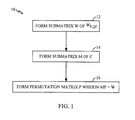
- permutation matrix algorithm 10 which is suitable for use in the present invention.
- a submatrix W of matrix W b ,2 r is formed as shown in block 12.
- the submatrix W includes r rows having indices 1, 2, 4, ..., 2 r-1 .
- the indexing of w b,2 r is zero based and ranges from 0 to 2 r -1.
- Matrix W therefore has r rows and 2 r columns. Every column of matrix W is distinct from all of the other columns.
- a submatrix M of code matrix C is then formed as shown in block 14 of permutation matrix algorithm 10.
- Submatrix M has r rows and 2 r columns.
- an intermediate submatrix M' having r rows and 2 r -1 columns is formed.
- Submatrix M' is formed by adding a column containing all zeros to submatrix M.
- the first row of submatrix M' can be any cyclic shift of the m-sequence used in constructing code C.
- the r-1 rows of submatrix M' following the first row are successive shifts by one time unit in each case beginning with the first row. Every column of submatrix M is distinct.
- Permutation matrix P is the required output of algorithm 10. Because submatrices M and W have the same set of distinct columns the determination of P in this manner is straightforward.
- permutation matrix P can be determined using a matrix computation technique. It will be understood by those skilled in the art that the rows of the matrix CP are the same as the rows of W b ,2 r .
- a sequence known as Family A can be determined.
- the Family A sequence is taught, for example, in S. Boztas, P. V. Kumar, R, Hammons, "4-Phase Sequences with Near-Optimum Correlation Properties," IEEE Transactions on Information Theory, IT-38 No. 3 (May 1992), pp 1101-1113 .
- c(y) be a binary primitive polynomial of degree r.
- Such a lift of the binary polynomial c(x) to the quaternary polynomial g(x) is a special case of the Hensel lift of polynomials. For example, see B, R, MacDonald, "Finite Rings with Identity,” Marcel Dekker, Inc., New York, 1974.
- the LFSR sequence with the characteristic polynomial g(x) is defined to be a Family A sequence. The sequence has a period 2 r -1.
- Quasi orthogonal mask generation algorithm 50 can be used to construct 4-phase masks for forming quasi orthogonal vectors of length 2 r .
- a binary primitive polynomial c(x) of degree r is provided as shown in block 52.
- primitive polynomial c(x) as its characteristic polynomial, a period of an m-sequence is constructed as shown in block 56.
- the rows of matrix M each contain a period of the m-sequence of block 56 along with all of its cyclic shifts.
- Matrix M' is then extended to form matrix M as shown in block 62.
- the extension of matrix M' is performed by adding an all zero column and an all zero row to matrix M'.
- the dimensions of matrix M are therefore 2 r X 2 r .
- the first column of matrix M can be the all zero column.
- a permutation P is found which column permutes the matrix M to contain the same row vectors as those contained in W b,2 r .
- the permutation matrix method taught hereinabove, or any other method known to those skilled in the art, can be used to perform the operations of block 56.
- a Hensel lift is then performed on the primitive polynomial c(x) obtained in block 52 of mask generation algorithm 50 to provide the polynomial g(x) as described hereinabove.
- the Hensel lift operation is shown in block 72.
- One period of the Family A sequences with the polynomial g(x) as its characteristic polynomial is generated as shown in block 78.
- a sequence of the Family A sequences is selected. The selected sequence can be any one of the Family A sequences having at least one symbol equal to 1 or 3.
- a vector N' of length (2 r -1) is constructed.
- the vector N' consists of a period of the Family A sequence selected according to block 78.
- a vector N of length 2 r is formed by appending a zero bit at the first bit location to vector N'.
- the vector N is then column permuted using the permute P found in block 66.
- the resulting permuted code word can be used as a masking function for generating quasi orthogonal vectors according to the method of the present invention.
- the quasi orthogonal vectors generated in this manner can be used with symbol mapping to (+1, - 1, +j, -j).
- a total of 127 masks can be generated in this manner for a length 128 Walsh code.
- vector mapping function 100 As shown in vector mapping function 100 a quasi orthogonal vector mask can be represented equivalently with symbols from the ⁇ 0, 1, 2, 3 ⁇ alphabet or with symbols from ⁇ +1, -1, +j, -j ⁇ alphabet of Table 1 using the mapping:
- the correlation between any code vector in the Walsh code and any code vector obtained by applying the masks of Table I to the Walsh code vectors is ⁇ 1 / 16 ⁇ j / 16 .
- the method of quasi orthogonal mask generation algorithm 50 can be generalized to all powers of two to yield the optimal quasi orthogonal vectors for each power of two.
- Table II sets forth the correlations and the number of masks provided according to the method of the present invention for several powers of two.
Landscapes
- Engineering & Computer Science (AREA)
- Computer Networks & Wireless Communication (AREA)
- Signal Processing (AREA)
- Physics & Mathematics (AREA)
- Theoretical Computer Science (AREA)
- General Physics & Mathematics (AREA)
- Pure & Applied Mathematics (AREA)
- Mathematical Optimization (AREA)
- Mathematical Analysis (AREA)
- General Engineering & Computer Science (AREA)
- Computational Mathematics (AREA)
- Mobile Radio Communication Systems (AREA)
- Error Detection And Correction (AREA)
- Compression, Expansion, Code Conversion, And Decoders (AREA)
- Image Processing (AREA)
- Digital Transmission Methods That Use Modulated Carrier Waves (AREA)
- Ultra Sonic Daignosis Equipment (AREA)
- Apparatus For Radiation Diagnosis (AREA)
- Stereo-Broadcasting Methods (AREA)
Abstract
Description
- This invention relates to the field of communications systems and, in particular, to the transmission of spread coded message signals within communications systems.
- It is well known in the art of communications to mix message signals to be transmitted with spreading code vectors. This permits the message signals to be combined, transmitted, and separated from each other after transmission. The most useful feature of a set of code vectors suitable for this purpose is that the spreading code vectors are mutually orthogonal. This permits a theoretical interference of zero between the message signals. The code vectors most commonly used for this purpose are Walsh code vectors.
- The total number of binary code vectors having a length n is 2n. However, of the total number of
binary vectors 2" within the total vector space, only n are mutually orthogonal. For example, when n=8 there are 256 different binary vectors. Only 8 of the 256 vectors are mutually orthogonal. Therefore, in a system wherein n=8 usually only 8 message signals can be combined and separated in this manner and only 8 users can be supported simultaneously. Likewise, if n=128 then 128 users can be supported simultaneously. Some of the vectors can be idle some of the time, thereby permitting more than n users to be serviced. However, the size of the code vectors still places a limitation on the size of the communications system. - A set W of code vectors w meeting the orthogonality requirement for a theoretical interference of zero can be represented as follows:


wherein each vector wi is a column vector using a 0/1 alphabet or, equivalently, a -1/+1 alphabet. Hereinbelow, a set of code vectors using the 0/1 alphabet is expressed as Wb,n and a set using the -1/+1 alphabet is expressed as Wn. - Since all vectors w in the set W are orthogonal to each other, the dot product of any two vectors in the set must be zero. This can be represented as:

where x and y can have any values between 1 and n, x ≠ y and (wx,wy) is equal to


- Representing the ith data symbol to be transmitted as di and the total number of transmit signals as k, the total transmission signal S transmitted by a base station to a mobile station is:

- In order to eliminate the other messages the mobile station can multiply signal S by the transpose of its own Walsh code vector. An example wherein i = 1 is as follows:
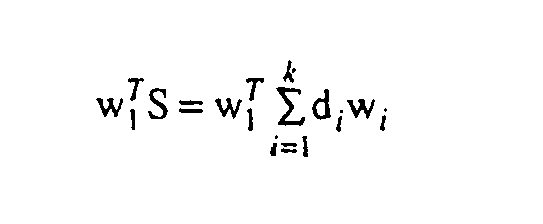

wherein the first term on the right side represents the wanted signal. The second term in the right side represents the interference from all of the remaining message signals mixed with their individual Walsh codes. Solving this equation yields: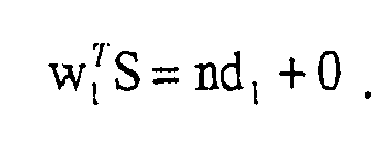
- In order to utilize communications systems as effectively as possible it is desirable to simultaneously transmit and separate as many message signals as possible. However, it is only possible to mix n message signals and separate them with zero interference because only n orthogonal vectors are available, as previously described. To overcome this limitation it is known to use quasi orthogonal functions. Quasi orthogonal vectors are vectors that are in addition to the n orthogonal vectors. Quasi orthogonal vectors have been selected from the remaining code vectors in the total binary 2n vector space in order to provide as little interference as possible. Specifically, quasi orthogonal vectors are selected to provide a level of interference that is within acceptable limits, even though the level of interference is not zero.
- In order to select quasi orthogonal vectors a computer search can be performed within the total 2n vector space for binary (+1/-1 alphabet) masks. The masks can be applied to the orthogonal vectors to form a new set of vectors that are quasi orthogonal vectors. Applying a total of M masks to a set of Walsh code vectors wn, the number of quasi orthogonal functions produced is: (M + 1) n. Applying a mask m to a code vector w ∈ Wn includes a component by component multiplication of the mask m and the orthogonal code vector w to give the new code vector:

- The interference resulting from the use of the new code vectors can be tested and the code vectors that provide the lowest correlation can be selected to provide a set of quasi orthogonal vectors. A plurality of such masking functions can be found in order to provide a plurality of sets of quasi orthogonal vectors from a single set of orthogonal vectors. In order to permit message signals mixed with the quasi orthogonal vectors found by the computer search to be separated from each other, the quasi orthogonal vectors should be mutually orthogonal with respect to each other. There is a non-zero correlation between at least one code vector in the orthogonal set and one vector in the quasi orthogonal set.
- Representing the quasi orthogonal vectors as v it can be shown that:

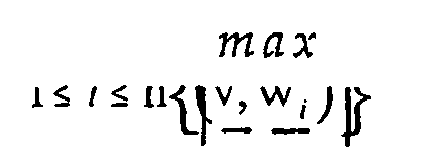
- Since their correlation is a useful measure of the amount of separation between vectors, the normalized correlation between two code vectors x and y can be defined as:

- The mean square correlation between orthogonal vectors and their corresponding quasi orthogonal vectors where n is a power of two is 1/n. The lower bound on the absolute value of correlation can be shown to have the value, 1/√n. This quantity is referred to as the Holtzman lower bound. Masks have been found that meet the lower bound for cases wherein n is an even power of two. However, in cases where n is an odd power of two this bound has not been met with an equality. The lowest correlation found in the latter case is √2/√n. Therefore, the interference of the best quasi orthogonal vectors found in the odd power of two case using the computer search technique is √2 times the theoretical limit.
- Thus it desirable to find additional quasi orthogonal vectors having lower correlation with the orthogonal vectors for the case wherein n is an odd power of 2, in order to expand the capacity of communications systems while maintaining acceptably low amounts of interference.
- A transmission method in a communications system having orthogonal code vectors for transmitting message signals is taught. The method includes forming a first vector matrix using a first series of cyclic shifts and forming a second vector matrix using a second series of cyclic shifts. The first vector matrix is permuted to provide an orthogonal code and the permuting operations are determined. The method also sets forth applying the determined permuting operations to the second matrix to provide a quasi orthogonal code vector. The quasi orthogonal code vector is applied to a message signal to provide an encoded message signal and the encoded message signal is transmitted. The forming of the first matrix vector includes cyclic shifts of a sequence having a characteristic polynomial. The characteristic polynomial of the sequence can be a primitive polynomial with a degree r. The sequence is an m-sequence. The length of the orthogonal code vector is n = 2r and the forming of the first vector matrix can require n-1 cyclic shifts. The first matrix is extended prior to permuting. The primitive polynomial is lifted to a quaternary polynomial. A sequence having the quaternary polynomial as its characteristic polynomial is generated whereby the sequence thus formed is a Family A sequence and the step of forming the second matrix is formed according to the Family A sequence. The second matrix is also extended prior to permuting the second matrix. The second vector matrix is permuted to provide a mask and the mask is applied to an orthogonal code vector to provide the quasi orthogonal vector. The mask can be applied to a plurality of orthogonal vectors to provide a plurality of quasi orthogonal vectors.
- The features, objects, and advantages of the present invention will become more apparent from the detailed description set forth below when taken in conjunction with the drawings in which like reference characters identify corresponding elements throughout and wherein:
-
Fig. 1 shows a block diagram representation of a permutation matrix algorithm suitable for use in the method of the present invention; -
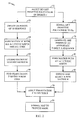
Fig 2 shows a block diagram representation of the quasi orthogonal mask generation algorithm of the present invention; and -
Fig. 3 shows a block diagram representation of a method for mapping vectors that is suitable for use in the method of the present invention. - In the signal transmission method of the present invention, masks m are constructed and applied to orthogonal code vectors in order to provide quasi orthogonal code vectors, wherein the masks are four phase or quaternary phase shift keying (QSPK) masks. Thus the masks m have an alphabet of four elements, {±1, ±j}, rather than two elements, where j = √-1 is the imaginary root of unity. It will be understood that the signal transmission method of the present invention can require two masks m when transmitting a message signal. One of the two masks can be used for the in phase (I) channel and one can be used for the out of phase (Q) channel.
- In order to practice the transmission method of the present invention, the new masks m can be generated using linear feedback shift registers (LFSR). A 2k-ary LFSR sequence s[t] is a sequence having a having symbols {0,1,...,2k-1} where k is limited to the
value 1 in the binary case and two in the quaternary case. The sequence satisfies a linear recurrence relationship of the form:
where r ≥ 1 is the degree of the recursion. The coefficients ci belong to the set (0, 1, ... , 2k-1} and cr ≠ 0. This type of sequence s[t] has a characteristic polynomial:
- When k = 1, the sequence s[t] is periodic with a period that is less than or equal to 2r-1. If the period of the sequence s[t] reaches the maximum value 2r-1, the characteristic polynomial of s[t] is defined as a primitive polynomial and the sequence s[t] is an m-sequence. Sequences of this type are taught in S. W. Golomb, "Shift Register Sequences," Holden Day, San Francisco, CA, 1967.
- A code C' includes one period of an m-sequence and one period of each of its cyclic shifts. Thus, the size of the code C' is 2r-1. The code C' can then be extended by appending a zero bit to each code word in C'. The zero is appended at the same bit location of each code word. The inclusion of an all zero vector in this manner forms the code matrix C form the code C'.
- The code matrix C has a
length 2r and asize 2r. In one embodiment the code C can be columnwise and rowwise permuted to create the Walsh code W b,2 r ofsize 2r. However, it is sufficient to obtain permutation matrix P such that the set of row vectors of the matrix product CP are the same as the set of row vectors of W b,2 r . - Referring now to
Fig. 1 , there is shown permutation matrix algorithm 10 which is suitable for use in the present invention. In permutation matrix algorithm 10 a submatrix W of matrix W b,2 r is formed as shown inblock 12. The submatrix W includes rrows having indices r is zero based and ranges from 0 to 2r-1. Matrix W therefore has r rows and 2r columns. Every column of matrix W is distinct from all of the other columns. - A submatrix M of code matrix C is then formed as shown in
block 14 of permutation matrix algorithm 10. Submatrix M has r rows and 2r columns. In order to form submatrix M an intermediate submatrix M' having r rows and 2r-1 columns is formed. Submatrix M' is formed by adding a column containing all zeros to submatrix M. The first row of submatrix M' can be any cyclic shift of the m-sequence used in constructing code C. The r-1 rows of submatrix M' following the first row are successive shifts by one time unit in each case beginning with the first row. Every column of submatrix M is distinct. - A permutation matrix P such that MP = W is then determined as set forth in
block 16 of permutation matrix algorithm 10. Permutation matrix P is the required output of algorithm 10. Because submatrices M and W have the same set of distinct columns the determination of P in this manner is straightforward. In an alternate embodiment of the invention permutation matrix P can be determined using a matrix computation technique. It will be understood by those skilled in the art that the rows of the matrix CP are the same as the rows of W b,2 r . - When k = 2, and sequences therefore have a quaternary alphabet, a sequence known as Family A can be determined. The Family A sequence is taught, for example, in S. Boztas, P. V. Kumar, R, Hammons, "4-Phase Sequences with Near-Optimum Correlation Properties," IEEE Transactions on Information Theory, IT-38 No. 3 (May 1992), pp 1101-1113. In order to obtain a Family A sequence, let c(y) be a binary primitive polynomial of degree r. A polynomial g(x) having coefficients in the set {0, 1, 2, 3} can be lifted from the polynomial c(x) as follows:

- Referring now to
Fig. 2 , there is shown quasi orthogonalmask generation algorithm 50. Quasi orthogonalmask generation algorithm 50 can be used to construct 4-phase masks for forming quasi orthogonal vectors oflength 2r. In mask generation algorithm 50 a binary primitive polynomial c(x) of degree r is provided as shown inblock 52. Using primitive polynomial c(x) as its characteristic polynomial, a period of an m-sequence is constructed as shown inblock 56. - Matrix M' having dimensions (2r-1) X (2r-1) for the case where n = 2r s constructed as shown in
block 58. The rows of matrix M each contain a period of the m-sequence ofblock 56 along with all of its cyclic shifts. Matrix M' is then extended to form matrix M as shown inblock 62. The extension of matrix M' is performed by adding an all zero column and an all zero row to matrix M'. The dimensions of matrix M are therefore 2rX 2r. For convenience, the first column of matrix M can be the all zero column. As set forth in block 56 a permutation P is found which column permutes the matrix M to contain the same row vectors as those contained in W b,2r . The permutation matrix method taught hereinabove, or any other method known to those skilled in the art, can be used to perform the operations ofblock 56. - A Hensel lift is then performed on the primitive polynomial c(x) obtained in
block 52 ofmask generation algorithm 50 to provide the polynomial g(x) as described hereinabove. The Hensel lift operation is shown inblock 72. One period of the Family A sequences with the polynomial g(x) as its characteristic polynomial is generated as shown inblock 78. A sequence of the Family A sequences is selected. The selected sequence can be any one of the Family A sequences having at least one symbol equal to 1 or 3. - A vector N' of length (2r-1) is constructed. The vector N' consists of a period of the Family A sequence selected according to
block 78. A vector N oflength 2r is formed by appending a zero bit at the first bit location to vector N'. As shown inblock 70 the vector N is then column permuted using the permute P found inblock 66. The resulting permuted code word can be used as a masking function for generating quasi orthogonal vectors according to the method of the present invention. The quasi orthogonal vectors generated in this manner can be used with symbol mapping to (+1, - 1, +j, -j). A total of 127 masks can be generated in this manner for a length 128 Walsh code. Two of the masks generated according to quasiorthogonal mask algorithm 50 are set forth in Table I.Table I [1j1j1j1j1j1j1j1j1j1j1j1j-1-j-1-j-1-j-1-j1j1j-1-j-1-j1j1j-1-j -1-j1j1j-1-j-1-j-1-j-1-j1j1j1j-1-j1j-1-j1j-1-j1j-1-j1j-1-j1j-1 -j-1-j1j-1-j1j1j-1-j-1-j1j1j-1-j-1-j1j1j-1-j-1-j1j-1-j1j1j-1-j] [1j1j1j1j-1-j-1-j1j1j1j-1-j1j-1-j1j-1-j-1-j1j1-j1-j-1j-1j-1j-1j -1j-1j1-j-1j-1j1-j1-j-1j1-j-1j-j1j-1-j1j-1j-1-j1-j1j-1-j1-j1-j1 -j1-j1-j1j-1j-1j1-j-1-j-1j1-j-1j1-j-1j1j1j1-j-1-j-1j1j1j1j1] - Referring now to
Fig. 3 , there is shownvector mapping function 100. As shown in vector mapping function 100 a quasi orthogonal vector mask can be represented equivalently with symbols from the {0, 1, 2, 3} alphabet or with symbols from {+1, -1, +j, -j} alphabet of Table 1 using the mapping: - 0→1
- 1→j
- 2→-1
- 3→-j
- The correlation between any code vector in the Walsh code and any code vector obtained by applying the masks of Table I to the Walsh code vectors is


mask generation algorithm 50 can be generalized to all powers of two to yield the optimal quasi orthogonal vectors for each power of two. Table II sets forth the correlations and the number of masks provided according to the method of the present invention for several powers of two.Table II Length Maximum Absolute Correlation With Walsh code Correlation Spectrum Number Of Available Masks 32 0.177 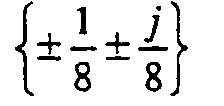
31 64 0.125 
63 128 0.0833 
127 256 0.0625 
255 512 0.0442 
511 - The previous description of the preferred embodiments is provided to enable any person skilled in the art to make or use the present invention. The various modifications to these embodiments will be readily apparent to those skilled in the art, and the generic principles defined herein may be applied to other embodiments without the use of the inventive faculty. Thus, the present invention is not intended to be limited to the embodiments shown herein but is to be accorded the widest scope consistent with the principles and novel features disclosed herein.
-
- 1. A transmission method in a communications system having orthogonal code vectors for transmitting message signals, comprising the steps of:
- (a) forming a first vector matrix using a first series of cyclic shifts;
- (b) forming a second vector matrix using a second series of cyclic shifts;
- (c) permuting the first vector matrix to provide an orthogonal code;
- (d) determining the permuting operations of step (c);
- (e) applying the determined permuting operations to the second matrix to provide a quasi orthogonal code vector; and
- (f) applying the quasi orthogonal code vector to a message signal to provide an encoded message signal and transmitting the encoded message signal.
- 2. The transmission method of 1, wherein step (a) comprises cyclic shifts of a sequence having a characteristic polynomial.
- 3. The transmission method of 2, wherein the characteristic polynomial of the sequence is a primitive polynomial.
- 4. The transmission method of 3, wherein the primitive polynomial has a degree r.
- 5. The transmission method of 4, wherein the sequence comprises an m-sequence.
- 6. The transmission method of 2, wherein n = 2r is equal to the length of the orthogonal code vector and step (a) comprises n-1 cyclic shifts.
- 7. The transmission method of 6, comprising the step of extending the first matrix prior to permuting the first matrix.
- 8. The transmission method of 3, wherein the primitive polynomial is a binary polynomial comprising the step of lifting the binary polynomial to a quaternary polynomial.
- 9. The transmission method of 8, comprising the step of forming a sequence having the quaternary polynomial as its characteristic polynomial whereby the sequence thus formed is a Family A sequence.
- 10. The transmission method of 9, comprising the step of forming the second matrix according to the Family A sequence.
- 11. The transmission method of 10, comprising the step of extending the second matrix prior to permuting the second matrix.
- 12. The transmission method of 1, comprising the steps of:
- (a) permuting the second vector matrix to provide a mask; and
- (b) applying the mask to an orthogonal code vector to provide the quasi orthogonal vector.
- 13. The transmission method of 12, comprising the step of applying the mask to a plurality of orthogonal vectors to provide a plurality of quasi orthogonal vectors.
- 14. The transmission method of 1, wherein the orthogonal code vector has a length n and the absolute value of correlation between the orthogonal vector and the quasi orthogonal vector is 1/√n for n any power of two.
- 15. A communications system having orthogonal code vectors for transmitting message signals, comprising:
- (a) a first vector matrix formed by a first series of cyclic shifts;
- (b) a second vector matrix formed by a second series of cyclic shifts;
- (c) an orthogonal code vector formed by permutting the first vector matrix;
- (d) a determination of the permuting operations of paragraph (c);
- (e) a quasi orthogonal code vector formed by applying the determined permuting operations to the second matrix; and
- (f) an encoded message signal for transmission formed by applying the quasi orthogonal code vector to a message signal.
- 16. A transmission system in a communications system having orthogonal code vectors for transmitting message signals, comprising:
- (a) means for forming a first vector matrix using a first series of cyclic shifts;
- (b) means for forming a second vector matrix using a second series of cyclic shifts;
- (c) means for permuting the first vector matrix to provide an orthogonal code vector from the first vector matrix;
- (d) means for determining the permuting operations of step (c);
- (e) means for applying the determined permuting operations to the second matrix to provide a quasi orthogonal code vector; and
- (f) means for applying the quasi orthogonal code vector to a message signal to provide an encoded message signal and transmitting the encoded message signal.
Claims (15)
- A method of transmitting a wireless signal comprising:applying a QPSK quasi orthogonal code vector to a data signal to produce a coded message signal, wherein the QPSK quasi orthogonal code vector is optimized to have minimal correlation with a set of orthogonal codes and all sub-blocks of said set of orthogonal codes having 2r chips, where r is an integer; andtransmitting the coded message signal.
- An apparatus for transmitting a wireless signal comprising:means for applying a QPSK quasi orthogonal code vector to a data signal to produce a coded message signal, wherein the QPSK quasi orthogonal code vector is optimized to have minimal correlation with a set of orthogonal codes and all sub-blocks of said set of orthogonal codes having 2r chips, where r is an integer; andmeans for transmitting the coded message signal.
- The apparatus of claim 2, whereinthe means for applying are a mixer (110) for applying; andthe means for transmitting are a transmitter for transmitting.
- A transmission system in a communications system having orthogonal code vectors for transmitting message signals, comprising:means for forming a first vector matrix using a first series of cyclic shifts;means for forming a second vector matrix using a second series of cyclic shifts;means for permuting the first vector matrix to provide an orthogonal code vector from the first vector matrix;means for determining the permuting operations of the result from the means for permuting;means for applying the determined permuting operations to the second matrix to provide a quasi orthogonal code vector; andmeans for applying the quasi orthogonal code vector to a message signal to provide an encoded message signal and transmitting the encoded message signal.
- The transmission system of claim 4, wherein the means for forming a first vector matrix being adapted to perform cyclic shifts of a sequence having a characteristic polynomial.
- The transmission system of claim 5, wherein the characteristic polynomial of the sequence is a primitive polynomial.
- The transmission system of claim 6, wherein the sequence comprises an m-sequence.
- The transmission system of claim 5, wherein n = 2r is equal to the length of the orthogonal code vector and the means for forming a first vector matrix being adapted to perform n-1 cyclic shifts.
- The transmission system of any of the claims 4 to 8, comprising means for extending the first matrix prior to permuting the first matrix.
- The transmission system of claim 6, wherein the primitive polynomial is a binary polynomial comprising means for lifting the binary polynomial to a quaternary polynomial.
- The transmission system of claim 10, comprising means for forming a sequence having the quaternary polynomial as its characteristic polynomial whereby the sequence thus formed is a Family A sequence.
- The transmission system of claim 11, comprising means for forming the second matrix according to the Family A sequence.
- The transmission system of claim 12, comprising means for extending the second matrix prior to permuting the second matrix.
- The transmission system of claim 4, comprising:means for permuting the second vector matrix to provide a mask; andmeans for applying the mask to an orthogonal code vector to provide the quasi orthogonal vector.
- The transmission system of claim 14, wherein the means for applying the mask are adapted to applying the mask to a plurality of orthogonal vectors to provide a plurality of quasi orthogonal vectors.
Applications Claiming Priority (2)
| Application Number | Priority Date | Filing Date | Title |
|---|---|---|---|
| US09/136,107 US6157611A (en) | 1998-08-18 | 1998-08-18 | Method and apparatus for transmission and construction of quasi orthogonal vectors |
| EP99942302A EP1105992B1 (en) | 1998-08-18 | 1999-08-17 | Method and apparatus for transmission and construction of quasi orthogonal vectores |
Related Parent Applications (2)
| Application Number | Title | Priority Date | Filing Date |
|---|---|---|---|
| EP99942302A Division EP1105992B1 (en) | 1998-08-18 | 1999-08-17 | Method and apparatus for transmission and construction of quasi orthogonal vectores |
| EP99942302.3 Division | 1999-08-17 |
Publications (3)
| Publication Number | Publication Date |
|---|---|
| EP1981195A2 true EP1981195A2 (en) | 2008-10-15 |
| EP1981195A3 EP1981195A3 (en) | 2009-09-16 |
| EP1981195B1 EP1981195B1 (en) | 2012-01-11 |
Family
ID=22471334
Family Applications (2)
| Application Number | Title | Priority Date | Filing Date |
|---|---|---|---|
| EP08009184A Expired - Lifetime EP1981195B1 (en) | 1998-08-18 | 1999-08-17 | Apparatus for construction of quasi orthogonal vectors |
| EP99942302A Expired - Lifetime EP1105992B1 (en) | 1998-08-18 | 1999-08-17 | Method and apparatus for transmission and construction of quasi orthogonal vectores |
Family Applications After (1)
| Application Number | Title | Priority Date | Filing Date |
|---|---|---|---|
| EP99942302A Expired - Lifetime EP1105992B1 (en) | 1998-08-18 | 1999-08-17 | Method and apparatus for transmission and construction of quasi orthogonal vectores |
Country Status (23)
| Country | Link |
|---|---|
| US (1) | US6157611A (en) |
| EP (2) | EP1981195B1 (en) |
| JP (1) | JP4261061B2 (en) |
| KR (1) | KR100767485B1 (en) |
| CN (1) | CN1197284C (en) |
| AT (2) | ATE541371T1 (en) |
| AU (1) | AU752859B2 (en) |
| BG (1) | BG105265A (en) |
| BR (1) | BR9913062A (en) |
| CA (1) | CA2340760A1 (en) |
| DE (1) | DE69939543D1 (en) |
| ES (2) | ES2312214T3 (en) |
| HU (1) | HU224300B1 (en) |
| ID (1) | ID29526A (en) |
| IL (1) | IL141470A0 (en) |
| NO (1) | NO20010809L (en) |
| PL (1) | PL346150A1 (en) |
| RO (1) | RO121304B1 (en) |
| RU (1) | RU2001107123A (en) |
| SI (1) | SI20603A (en) |
| SK (1) | SK3092001A3 (en) |
| WO (1) | WO2000011825A1 (en) |
| ZA (1) | ZA200101349B (en) |
Families Citing this family (11)
| Publication number | Priority date | Publication date | Assignee | Title |
|---|---|---|---|---|
| WO2000014975A2 (en) | 1998-09-08 | 2000-03-16 | Samsung Electronics Co., Ltd. | Device and method for generating quaternary complex quasi-orthogonal code and spreading transmission signal using quasi-orthogonal code in cdma communication system |
| DE69916787T2 (en) * | 1998-09-25 | 2004-09-23 | Samsung Electronics Co., Ltd., Suwon | DEVICE AND METHOD FOR GENERATING A QUASIONTHOGONAL CODE AND FOR DISTRIBUTING CHANNEL SIGNALS IN A MOBILE COMMUNICATION SYSTEM |
| KR100383614B1 (en) * | 1998-10-19 | 2003-10-08 | 삼성전자주식회사 | Allocation Device and Method of Code Division Multiple Access Communication System |
| US6314125B1 (en) | 1998-12-09 | 2001-11-06 | Qualcomm Incorporated | Method and apparatus for the construction and transmission of binary quasi orthogonal vectors |
| US7394792B1 (en) | 2002-10-08 | 2008-07-01 | Urbain A. von der Embse | Multi-scale CDMA |
| US7352796B1 (en) * | 2001-02-13 | 2008-04-01 | Urbain Alfred von der Embse | Multiple data rate complex Walsh codes for CDMA |
| US7015835B2 (en) * | 2004-03-17 | 2006-03-21 | Lawrence Technologies, Llc | Imposing and recovering correlithm objects in conjunction with table lookup |
| US8830983B2 (en) * | 2005-12-20 | 2014-09-09 | Lg Electronics Inc. | Method of generating code sequence and method of transmitting signal using the same |
| CN101170337B (en) * | 2006-10-25 | 2012-04-11 | 中国科学院上海微系统与信息技术研究所 | Multi-antenna multi-rate transmitter with optimized throughput and transmission method thereof |
| US8077693B2 (en) | 2007-09-19 | 2011-12-13 | Samsung Electronics Co., Ltd. | Resource remapping and regrouping in a wireless communication system |
| US11032061B2 (en) * | 2018-04-27 | 2021-06-08 | Microsoft Technology Licensing, Llc | Enabling constant plaintext space in bootstrapping in fully homomorphic encryption |
Family Cites Families (8)
| Publication number | Priority date | Publication date | Assignee | Title |
|---|---|---|---|---|
| US3715508A (en) * | 1967-09-15 | 1973-02-06 | Ibm | Switching circuits employing orthogonal and quasi-orthogonal pseudo-random code sequences |
| EP0421639B1 (en) * | 1989-09-20 | 1998-04-22 | Fujitsu Limited | Parallel data processing system |
| JP2527104B2 (en) * | 1990-01-22 | 1996-08-21 | 三菱電機株式会社 | Orthogonal sequence generator and radar apparatus including orthogonal sequence generator |
| EP0525408A3 (en) * | 1991-07-01 | 1993-12-22 | Eastman Kodak Co | Method for multiframe wiener restoration of noisy and blurred image sequences |
| MY112371A (en) * | 1993-07-20 | 2001-05-31 | Qualcomm Inc | System and method for orthogonal spread spectrum sequence generation in variable data rate systems |
| US5463657A (en) * | 1994-02-15 | 1995-10-31 | Lockheed Missiles & Space Company, Inc. | Detection of a multi-sequence spread spectrum signal |
| US5606322A (en) * | 1994-10-24 | 1997-02-25 | Motorola, Inc. | Divergent code generator and method |
| US5768269A (en) * | 1995-08-25 | 1998-06-16 | Terayon Corporation | Apparatus and method for establishing frame synchronization in distributed digital data communication systems |
-
1998
- 1998-08-18 US US09/136,107 patent/US6157611A/en not_active Expired - Lifetime
-
1999
- 1999-08-17 ES ES99942302T patent/ES2312214T3/en not_active Expired - Lifetime
- 1999-08-17 AU AU55711/99A patent/AU752859B2/en not_active Ceased
- 1999-08-17 KR KR1020017002126A patent/KR100767485B1/en not_active Expired - Lifetime
- 1999-08-17 JP JP2000566982A patent/JP4261061B2/en not_active Expired - Lifetime
- 1999-08-17 EP EP08009184A patent/EP1981195B1/en not_active Expired - Lifetime
- 1999-08-17 CA CA002340760A patent/CA2340760A1/en not_active Abandoned
- 1999-08-17 RO ROA200100182A patent/RO121304B1/en unknown
- 1999-08-17 ID IDW20010658A patent/ID29526A/en unknown
- 1999-08-17 EP EP99942302A patent/EP1105992B1/en not_active Expired - Lifetime
- 1999-08-17 BR BR9913062-9A patent/BR9913062A/en not_active Application Discontinuation
- 1999-08-17 AT AT08009184T patent/ATE541371T1/en active
- 1999-08-17 IL IL14147099A patent/IL141470A0/en unknown
- 1999-08-17 ES ES08009184T patent/ES2377026T3/en not_active Expired - Lifetime
- 1999-08-17 WO PCT/US1999/018814 patent/WO2000011825A1/en not_active Ceased
- 1999-08-17 RU RU2001107123/09A patent/RU2001107123A/en not_active Application Discontinuation
- 1999-08-17 DE DE69939543T patent/DE69939543D1/en not_active Expired - Lifetime
- 1999-08-17 AT AT99942302T patent/ATE408278T1/en not_active IP Right Cessation
- 1999-08-17 HU HU0104670A patent/HU224300B1/en not_active IP Right Cessation
- 1999-08-17 PL PL99346150A patent/PL346150A1/en not_active Application Discontinuation
- 1999-08-17 SK SK309-2001A patent/SK3092001A3/en unknown
- 1999-08-17 SI SI9920077A patent/SI20603A/en not_active IP Right Cessation
- 1999-08-17 CN CNB998112593A patent/CN1197284C/en not_active Expired - Lifetime
-
2001
- 2001-02-16 ZA ZA200101349A patent/ZA200101349B/en unknown
- 2001-02-16 BG BG105265A patent/BG105265A/en unknown
- 2001-02-16 NO NO20010809A patent/NO20010809L/en not_active Application Discontinuation
Non-Patent Citations (2)
| Title |
|---|
| B, R, MACDONALD: "Finite Rings with Identity", 1974, MARCEL DEKKER, INC. |
| S. BOZTAS; P. V. KUMAR; R, HAMMONS: "4-Phase Sequences with Near-Optimum Correlation Properties", IEEE TRANSACTIONS ON INFORMATION THEORY, vol. IT-38, no. 3, May 1992 (1992-05-01), pages 1101 - 1113 |
Also Published As
Similar Documents
| Publication | Publication Date | Title |
|---|---|---|
| US6314125B1 (en) | Method and apparatus for the construction and transmission of binary quasi orthogonal vectors | |
| EP1858171B1 (en) | Method and apparatus for reducing peak-to-average ratio in a CDMA communication system | |
| EP1981195B1 (en) | Apparatus for construction of quasi orthogonal vectors | |
| US6125378A (en) | Method and apparatus for generating families of code signals using multiscale shuffling | |
| US7065700B2 (en) | Encoding apparatus and method in CDMA communication system | |
| CA2277747A1 (en) | A method and an arrangement for despreading a coded sequence in a communication system | |
| US6611566B2 (en) | Reflection and transmission of quasi orthogonal vectors | |
| AU2001244764A1 (en) | Encoding apparatus and method in CDMA communication system | |
| EP1047215B1 (en) | A method of enhancing security for the transmission of information | |
| US7075968B1 (en) | Method for whitening spread spectrum codes | |
| MXPA01001737A (en) | Method and apparatus for transmission and construction of quasi orthogonal vectors | |
| Da Rocha et al. | A new approach to the design of codes for the binary adder channel | |
| HK1038453B (en) | Method for transmission and construction of quasi orthogonal vectors | |
| Tirkel et al. | Sequences with large ZCZ | |
| CZ2001613A3 (en) | Transmission method, communication and transmission system with orthogonal coding vectors for transmission of information signal |
Legal Events
| Date | Code | Title | Description |
|---|---|---|---|
| PUAI | Public reference made under article 153(3) epc to a published international application that has entered the european phase |
Free format text: ORIGINAL CODE: 0009012 |
|
| 17P | Request for examination filed |
Effective date: 20080519 |
|
| AC | Divisional application: reference to earlier application |
Ref document number: 1105992 Country of ref document: EP Kind code of ref document: P |
|
| AK | Designated contracting states |
Kind code of ref document: A2 Designated state(s): AT BE CH CY DE DK ES FI FR GB GR IE IT LI LU MC NL PT SE |
|
| PUAL | Search report despatched |
Free format text: ORIGINAL CODE: 0009013 |
|
| AK | Designated contracting states |
Kind code of ref document: A3 Designated state(s): AT BE CH CY DE DK ES FI FR GB GR IE IT LI LU MC NL PT SE |
|
| 17Q | First examination report despatched |
Effective date: 20100316 |
|
| AKX | Designation fees paid |
Designated state(s): AT BE CH CY DE DK ES FI FR GB GR IE IT LI LU MC NL PT SE |
|
| REG | Reference to a national code |
Ref country code: DE Ref legal event code: R079 Ref document number: 69943986 Country of ref document: DE Free format text: PREVIOUS MAIN CLASS: H04J0013020000 Ipc: H04J0013000000 |
|
| GRAP | Despatch of communication of intention to grant a patent |
Free format text: ORIGINAL CODE: EPIDOSNIGR1 |
|
| RIC1 | Information provided on ipc code assigned before grant |
Ipc: H04J 13/00 20110101AFI20110627BHEP Ipc: H04J 11/00 20060101ALI20110627BHEP |
|
| RTI1 | Title (correction) |
Free format text: APPARATUS FOR CONSTRUCTION OF QUASI ORTHOGONAL VECTORS |
|
| GRAS | Grant fee paid |
Free format text: ORIGINAL CODE: EPIDOSNIGR3 |
|
| GRAA | (expected) grant |
Free format text: ORIGINAL CODE: 0009210 |
|
| AC | Divisional application: reference to earlier application |
Ref document number: 1105992 Country of ref document: EP Kind code of ref document: P |
|
| AK | Designated contracting states |
Kind code of ref document: B1 Designated state(s): AT BE CH CY DE DK ES FI FR GB GR IE IT LI LU MC NL PT SE |
|
| REG | Reference to a national code |
Ref country code: GB Ref legal event code: FG4D |
|
| REG | Reference to a national code |
Ref country code: CH Ref legal event code: EP |
|
| REG | Reference to a national code |
Ref country code: AT Ref legal event code: REF Ref document number: 541371 Country of ref document: AT Kind code of ref document: T Effective date: 20120115 |
|
| REG | Reference to a national code |
Ref country code: IE Ref legal event code: FG4D |
|
| REG | Reference to a national code |
Ref country code: DE Ref legal event code: R096 Ref document number: 69943986 Country of ref document: DE Effective date: 20120315 |
|
| REG | Reference to a national code |
Ref country code: SE Ref legal event code: TRGR |
|
| REG | Reference to a national code |
Ref country code: NL Ref legal event code: T3 Ref country code: ES Ref legal event code: FG2A Ref document number: 2377026 Country of ref document: ES Kind code of ref document: T3 Effective date: 20120321 |
|
| PG25 | Lapsed in a contracting state [announced via postgrant information from national office to epo] |
Ref country code: BE Free format text: LAPSE BECAUSE OF FAILURE TO SUBMIT A TRANSLATION OF THE DESCRIPTION OR TO PAY THE FEE WITHIN THE PRESCRIBED TIME-LIMIT Effective date: 20120111 |
|
| PG25 | Lapsed in a contracting state [announced via postgrant information from national office to epo] |
Ref country code: PT Free format text: LAPSE BECAUSE OF FAILURE TO SUBMIT A TRANSLATION OF THE DESCRIPTION OR TO PAY THE FEE WITHIN THE PRESCRIBED TIME-LIMIT Effective date: 20120511 Ref country code: GR Free format text: LAPSE BECAUSE OF FAILURE TO SUBMIT A TRANSLATION OF THE DESCRIPTION OR TO PAY THE FEE WITHIN THE PRESCRIBED TIME-LIMIT Effective date: 20120412 |
|
| REG | Reference to a national code |
Ref country code: AT Ref legal event code: MK05 Ref document number: 541371 Country of ref document: AT Kind code of ref document: T Effective date: 20120111 |
|
| PG25 | Lapsed in a contracting state [announced via postgrant information from national office to epo] |
Ref country code: CY Free format text: LAPSE BECAUSE OF FAILURE TO SUBMIT A TRANSLATION OF THE DESCRIPTION OR TO PAY THE FEE WITHIN THE PRESCRIBED TIME-LIMIT Effective date: 20120111 |
|
| PG25 | Lapsed in a contracting state [announced via postgrant information from national office to epo] |
Ref country code: DK Free format text: LAPSE BECAUSE OF FAILURE TO SUBMIT A TRANSLATION OF THE DESCRIPTION OR TO PAY THE FEE WITHIN THE PRESCRIBED TIME-LIMIT Effective date: 20120111 |
|
| PLBE | No opposition filed within time limit |
Free format text: ORIGINAL CODE: 0009261 |
|
| STAA | Information on the status of an ep patent application or granted ep patent |
Free format text: STATUS: NO OPPOSITION FILED WITHIN TIME LIMIT |
|
| 26N | No opposition filed |
Effective date: 20121012 |
|
| PG25 | Lapsed in a contracting state [announced via postgrant information from national office to epo] |
Ref country code: AT Free format text: LAPSE BECAUSE OF FAILURE TO SUBMIT A TRANSLATION OF THE DESCRIPTION OR TO PAY THE FEE WITHIN THE PRESCRIBED TIME-LIMIT Effective date: 20120111 |
|
| REG | Reference to a national code |
Ref country code: DE Ref legal event code: R097 Ref document number: 69943986 Country of ref document: DE Effective date: 20121012 |
|
| REG | Reference to a national code |
Ref country code: CH Ref legal event code: PL |
|
| PG25 | Lapsed in a contracting state [announced via postgrant information from national office to epo] |
Ref country code: MC Free format text: LAPSE BECAUSE OF NON-PAYMENT OF DUE FEES Effective date: 20120831 |
|
| PG25 | Lapsed in a contracting state [announced via postgrant information from national office to epo] |
Ref country code: CH Free format text: LAPSE BECAUSE OF NON-PAYMENT OF DUE FEES Effective date: 20120831 Ref country code: LI Free format text: LAPSE BECAUSE OF NON-PAYMENT OF DUE FEES Effective date: 20120831 |
|
| REG | Reference to a national code |
Ref country code: IE Ref legal event code: MM4A |
|
| PG25 | Lapsed in a contracting state [announced via postgrant information from national office to epo] |
Ref country code: IE Free format text: LAPSE BECAUSE OF NON-PAYMENT OF DUE FEES Effective date: 20120817 |
|
| PG25 | Lapsed in a contracting state [announced via postgrant information from national office to epo] |
Ref country code: LU Free format text: LAPSE BECAUSE OF NON-PAYMENT OF DUE FEES Effective date: 20120817 |
|
| REG | Reference to a national code |
Ref country code: FR Ref legal event code: PLFP Year of fee payment: 18 |
|
| REG | Reference to a national code |
Ref country code: FR Ref legal event code: PLFP Year of fee payment: 19 |
|
| REG | Reference to a national code |
Ref country code: FR Ref legal event code: PLFP Year of fee payment: 20 |
|
| PGFP | Annual fee paid to national office [announced via postgrant information from national office to epo] |
Ref country code: ES Payment date: 20180903 Year of fee payment: 20 Ref country code: DE Payment date: 20180716 Year of fee payment: 20 Ref country code: IT Payment date: 20180813 Year of fee payment: 20 Ref country code: NL Payment date: 20180730 Year of fee payment: 20 Ref country code: FR Payment date: 20180718 Year of fee payment: 20 |
|
| PGFP | Annual fee paid to national office [announced via postgrant information from national office to epo] |
Ref country code: GB Payment date: 20180726 Year of fee payment: 20 Ref country code: SE Payment date: 20180810 Year of fee payment: 20 Ref country code: FI Payment date: 20180726 Year of fee payment: 20 |
|
| REG | Reference to a national code |
Ref country code: DE Ref legal event code: R071 Ref document number: 69943986 Country of ref document: DE |
|
| REG | Reference to a national code |
Ref country code: NL Ref legal event code: MK Effective date: 20190816 |
|
| REG | Reference to a national code |
Ref country code: GB Ref legal event code: PE20 Expiry date: 20190816 |
|
| REG | Reference to a national code |
Ref country code: SE Ref legal event code: EUG |
|
| PG25 | Lapsed in a contracting state [announced via postgrant information from national office to epo] |
Ref country code: GB Free format text: LAPSE BECAUSE OF EXPIRATION OF PROTECTION Effective date: 20190816 |
|
| REG | Reference to a national code |
Ref country code: ES Ref legal event code: FD2A Effective date: 20200903 |
|
| PG25 | Lapsed in a contracting state [announced via postgrant information from national office to epo] |
Ref country code: ES Free format text: LAPSE BECAUSE OF EXPIRATION OF PROTECTION Effective date: 20190818 |