EP1978474A1 - System & Verfahren - Google Patents
System & Verfahren Download PDFInfo
- Publication number
- EP1978474A1 EP1978474A1 EP07251490A EP07251490A EP1978474A1 EP 1978474 A1 EP1978474 A1 EP 1978474A1 EP 07251490 A EP07251490 A EP 07251490A EP 07251490 A EP07251490 A EP 07251490A EP 1978474 A1 EP1978474 A1 EP 1978474A1
- Authority
- EP
- European Patent Office
- Prior art keywords
- data
- attributes
- data objects
- data set
- association network
- Prior art date
- Legal status (The legal status is an assumption and is not a legal conclusion. Google has not performed a legal analysis and makes no representation as to the accuracy of the status listed.)
- Ceased
Links
Images


Classifications
-
- G—PHYSICS
- G06—COMPUTING OR CALCULATING; COUNTING
- G06N—COMPUTING ARRANGEMENTS BASED ON SPECIFIC COMPUTATIONAL MODELS
- G06N5/00—Computing arrangements using knowledge-based models
- G06N5/02—Knowledge representation; Symbolic representation
- G06N5/022—Knowledge engineering; Knowledge acquisition
- G06N5/025—Extracting rules from data
-
- G—PHYSICS
- G06—COMPUTING OR CALCULATING; COUNTING
- G06N—COMPUTING ARRANGEMENTS BASED ON SPECIFIC COMPUTATIONAL MODELS
- G06N7/00—Computing arrangements based on specific mathematical models
- G06N7/02—Computing arrangements based on specific mathematical models using fuzzy logic
Definitions
- the present invention relates to a system and a method for monitoring a process, and in particular to a system and a method that can automatically identify and report abnormal process behaviour.
- Identifying abnormal patterns in the activities of the monitored process is very challenging because of the variety of factors, human and/or system related, that can affect the execution of process tasks.
- human behaviour in human-driven processes is very difficult to predict or model. It is a very complex task to formulate mappings between process activities and the status of the factors affecting them. Discovery of regular patterns, associations among task attributes, and long-term trends in Key performance indicators can be used to capture the status of the process.
- the inventors are only aware of one system which has the ability to discover relationships from process data (see F. Casati et al, "Business Process Intelligence", 2002 ).
- This system uses commercial data mining tools to analyse process logs and then uses this data to classify the process instances.
- the main disadvantage with this approach is that these classifiers are static in nature and require major retraining even when there are small changes in the process and or in the resources used to execute the process.
- a method of monitoring a process comprising the steps of: a) receiving a first process data set from one or more process logs, wherein the first process data set comprises a first plurality of data objects and each of the first plurality of data objects is associated one of a plurality of attributes; b) identifying associations between each of the plurality of data attributes and one or more of the further data attributes to form an association network; c) receiving a second process data set from one or more process logs, wherein the second process data set comprises a second plurality of data objects; and d) comparing the second plurality of data objects with the association network.
- the association network may be updated in accordance with the results of the comparison made in step d).
- An alert may be generated in accordance with the results of the comparison made in step d).
- the method may comprise the further step of: e) the first process data set is transformed such that and each of the first plurality of data objects is represented by a fuzzy logic function; wherein step e) is carried out after step a) but before step b).
- the method may comprise the further step of: f) the first process data set is transformed such that a further plurality of the plurality of data objects are replaced by one or more composite data objects, wherein each composite data objects is generated by combining one ore more of the plurality of data objects; wherein step f) is carried out after step a) but before step b).
- the method may further comprise the further step of g) creating one or more composite fuzzy logic functions, the or each composite fuzzy logic functions comprising one ore more fuzzy logic functions, wherein step g) is carried out after step b) but before step c).
- a computer program product comprising computer executable code for performing a method as described above.
- a system comprising: a learning component configured to receive process data from one or more process logs, a detection component and an association network wherein, in use, the system such that: the learning component receives a first process data set from the one or more process logs, wherein the first process data set comprises a first plurality of data objects and each of the first plurality of data objects is associated one of a plurality of attributes; the learning component identifies associations between each of the plurality of data attributes and one or more of the further data attributes to form the association network; the detection component receives a second process data set from one or more process logs, wherein the second process data set comprises a second plurality of data objects; and detection component compares the second plurality of data objects with the association network.
- Figure 1 shows a schematic depiction of a system 100 according to the present invention.
- the system 100 comprises a learning component 110, a detection component 120 and an association network 130.
- Both of the learning component 110 and the detection component 120 receive data from a plurality of process logs 20.
- the learning component uses this received process log data to define the association network 130 and the detection node can then use subsequent process log data to determine if there is a process abnormality and/or to update the association network definitions.
- the process logs numerical data relating to each instance of the process to which they are related and contain the execution attributes of each process task within each instance. These attributes are usually set, for example at the process design time by the owner of the process, however the system allows 'on the fly' definition of new attributes or the deletion of attributes that are no longer relevant.
- the process logs may record the amount of time taken to perform a process, or a task that forms a part of a process, (sometimes referred to as execution data) or a parameter value related to the process (server loading, network load, message flow rate, etc.), sometimes referred to as environmental data.
- the learning component 110 learns a normal pattern of the process execution activities based on historical process log data and converts it into an association network structure that links the tasks, their attributes, and the surrounding influences.
- Each task that is a part of a process has a number of attributes that can be measured and recorded numerically in a process log 20. Examples of these attributes include the duration, cost, customer satisfaction ...etc.
- there are other surrounding factors that may be recorded such as the resource executing the process, load level (on a server for example) and other factors that can have an effect on the process execution.
- the learning component examines the existing process execution logs where each process instance is recorded. The log contains the execution attributes of each process task within each instance.
- the learning component learns a normal pattern of the process execution activities, based on the data held in the process log, in the form of an association network structure that links the tasks, their attributes, and the surrounding influences.
- the association network will thus be a compact description of the normal behaviour of the process.
- association network is based on the technique disclosed by R Agrawal et al, "Fast discovery of association rules", Advances in Knowledge and Discovery and Data Mining. AAAI/MIT Press, Cambridge, MA, 1995 , which is commonly used to perform market basket analysis (i.e. in determining a normal pattern of customer shopping patterns).
- the method of forming the association network in a method according to the present invention is an extension of the association rules technique disclosed by Agrawal et al . It is an analytical method that allows associations to be discovered in a much more complex system by breaking the system into attribute groups and then analysing the relationships between these attribute groups. In this way it allows a more focused rule discovery.
- the network can be stored in data base in a similar way to a tree structure.
- FIG. 2 shows a depiction of a flowchart describing the behaviour of a learning component in a system according to the present invention.
- the behaviour component at step S200 first receives the historical process log data, which comprises numerical task attribute values, that will be used to determine the association network.
- the numerical task attribute values received from the process log are subjected to a 'fuzzification' process.
- This fuzzification converts the numerical values of the attributes into fuzzy categories using membership functions that are either set by a user (using a fuzzy membership editing tool ⁇ for example the fuzzy editing tool disclosed in SPIDA [ DD Nauck et al, "SPIDA - A Novel Data Analysis Tool Authors", BT Technology Journal, Volume 21, Number 4, October 2003, pp.
- fuzzy membership derivation technique can be learnt automatically using a fuzzy membership derivation technique.
- One possible technique is to run a one-dimensional fuzzy cluster analysis on each attribute in order to determine a suitable number of clusters representing fuzzy sets. Each cluster would then be approximated by a standard triangular or trapezoidal membership function which leads to complete fuzzy partitions for each attribute. Other possibilities will be immediately apparent to a person skilled in the art.
- the fuzzified attributes and any categorical attributes are then passed to the association network building algorithm which, at step S230 (see below), calculates the associations between the different nodes and builds the network.
- Figure 1 shows two further optional steps that may be included in a method according to the present invention.
- the structure of the association network 130 reflects structure of the input data.
- Figure 3 shows a schematic depiction of an association network structure 130.
- the structure of the association network comprises a plurality of layer groups (134, 136 & 138): it will be understood that the number of layer groups will vary with the data structure obtained from the process and that the association network may comprise fewer than or more than the three layer groups shown in Figure 3 .
- group 134 is a duration attribute group
- group 136 is a cost attribute group
- group 138 is a satisfaction attribute group.
- These layer groups represent the fuzzified data received from the process log.
- Each of the layer groups comprises a plurality of nodes (1341, 1342, 1361, 1362, 1381, 1382, ..., etc) such that the number of nodes in each layer group is equal to the number of fuzzy sets discovered for the task/attribute combination during the learning stage (see above).
- each of the layer groups 134, 136 & 138 comprise n nodes.
- Each of the n nodes in the layer groups are represented as singleton fuzzy memberships, where the weight of the membership function indicates the significance of the node. For example, in a case where two or more resources contribute to the execution of a single task, weights can be assigned to each resource in proportion to their assigned part of task. The sum of all the weights for a single task must add up to unity.
- Figure 3 shows the different attribute values by a number different attribute values (for example, very low cost, low cost, medium cost, high cost, very high cost, ).
- the association network further comprise a resource layer group 132, which is a categorical group, that indicates the resources (1321, 1322, ..., 132n) that are working on the process tasks.
- a resource layer group 132 which is a categorical group, that indicates the resources (1321, 1322, ..., 132n) that are working on the process tasks.
- association network may comprise a group 139 representing a group of composite attributes (1391, 1392, ...,) that may have been formed from a number of task attributes and/or external factors.
- Connections between different layers indicate connections that are detected during the learning process.
- the weights on the interconnections among the layers convey the likelihood of the connection that was determined during the learning process.
- Interconnections may be formed between nodes of different, but not among the nodes of the layers in the same layer group. These interconnections hold the weight values which indicates the strength of associations among nodes.
- Figure 3 shows two examples of these interconnections, where a first interconnection is shown by the solid arrowed lines connecting a number of different groups and a second interconnection is shown by the dashed arrowed line.
- the first interconnection represents a strong association between Resource 1 (1321), the duration attribute of Task 2 (1342), the cost attribute of Task 2 (1362) and the satisfaction attribute of Task 2 (1382).
- the arrows of the interconnection indicate that there is a very strong association between the resource, duration and cost attributes, whereas the satisfaction attribute is split between "very satisfied” and "very unsatisfied”.
- the second interconnection shows that for Task n there is a strong association with a very high satisfaction attribute with no association with any of the resources; i.e. the customer satisfaction does not depend upon the availability and/or quality of the resources. This information is useful in flagging future reduced satisfaction, which may be due to new factors such as a new resource or some other external condition that previously had no influence on the process.
- weightings associated with the second interconnection will now be described. Initially all the weights, including that of the second interconnection, are set to zero. Then, for each process execution, the attributes are fuzzified using the established fuzzy membership functions. The weight of the connection for each particular execution is calculated by multiplying the two fuzzy membership values for the cost attribute and the satisfaction attribute of Task n. When the weights of all the execution instances (which have been retrieved from the process logs) are calculated, the global weight for each discovered connection can be calculated using an exponentially weighted moving average scheme (this is used to reduce the sensitivity to a one-off, large change in the weight of one of the instances). The association network now describes the dominant behaviour of the process as a table containing all the interconnections and their exponentially-weighted, moving averaged weights.
- association network is relevant to a process that has a single execution path (i.e. contains similar set of tasks which are executed with different attributes).
- a process comprising multiple paths can be analysed in order to form an association network.
- the learning component would establish a behavioural description network for each possible path of execution, as long as there are sufficient samples of each possible path in order to establish a meaningful pattern of behavioural for all the paths. Paths which do not have enough samples to establish a significant model should be excluded from the analysis.
- the generated association network can then be used to detect any abnormal behaviour in the task execution for new process instances.
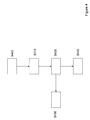
- Figure 4 shows a schematic depiction of a flowchart describing the behaviour of a detection component in a system according to the present invention.
- the process log data is fuzzified and then at step S420 the detection component can compare the task behaviour with the patterns of the association network to determine whether the new data follows the patterns that were previously discovered.
- the detection component produces comparison results on two levels: at a global level and at an interconnection level.
- the global comparison level looks for overall variation between the new process instance and the learned network by comparing all connections and finding evidence of significant difference, for example, by using a chi-squared test. This global comparison level is useful for providing a general idea of whether the overall process is behaving according to the learned model or whether there is a significant deviation from the model.
- the second level of comparison is interconnection based.
- the value of each interconnection in the new process instance can be compared with its counterpart in the learnt association model, and if any of these show significant difference then at step S430 this will be reported as an abnormality that is affecting that particular interconnection.
- a report may also be generated in case the new task data deviates substantially from the previously discovered patterns. The report can be generated immediately, and then sent to an appropriate operator, as the data about any task becomes available and there is no need to wait until the process instance has finished.
- Users of the invention can use the two levels in a number of ways but generally a process owner will monitor the global reporting facility to see if overall the process is running smoothly according to what is expected. They can use the interconnection-specific facility to drill down and find out the details of why things are going wrong, or indeed why things are improving in the context of the process execution. For example some instances of the process might use different resources or partners to carry out certain tasks and this way a clear picture will emerge of the best possible execution scenario.
- a major advantage of using fuzzy sets for describing attributes is that small deviations are not reported as abnormal patterns, thus reducing the number of false positives and subsequently reducing the cost of running a system according to the present invention. It is possible that the attributes of each task could be defined using crisp logic (i.e. not fuzzy membership functions) in which case the weights of all connections will simply be determined by the number of occurrences of that Interconnection. Such a non-fuzzy implementation of a system according to the present invention would result in a very sensitive system that would be likely to report a large number of unnecessary alarms.
- the weights on the network interconnections can updated with this new data at step S440, in order for the network to reflect the latest state of execution.
- a number of policies can be applied to include the effect of the new data on the weight of the interconnections. It has been found that the most useful approach is an exponentially weighted approach, as this results in the increased importance of the newest process instances compared to older ones, but at the same time safeguards the updates of the interconnection against one-off instances of unusual process executions. It should be noted that one-off abnormal behaviour will still be reported, but its effect on the learning process will not be very significant due to the filtering effect of the weighted average calculation.
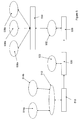
- Figure 5 shows a schematic depiction of a process comprising three tasks 510, 520 & 530.
- Task_1 510 is executed by a call to a web service, and this service may be provided by one of two possible providers 514a, 514b.
- the choice between the two service providers is based on the decision logic in a selection policy 512. Initially, the selection policy could be based on passing alternate requests to the two providers or any other decision function set by a process administrator.
- Task_2 520 may be executed by a human operator 522 who receives the task through a web portal or an email. It may be assumed that there is only one human operator for this task.
- Task_3 530 is executed by sending a JMS (Java Messaging Service) request 532 to an ESB (Enterprise Service Bus) 534.
- the ESB 534 puts the request on a JMS Topic that is subscribed to by three applications 536a, 536b, 536 c, each of which is capable of providing the functionality required to execute Task_3.
- the ESB comprises a mechanism for deciding which of the applications a particular task should be assigned to.
- the task attributes will be recorded in one or more process logs.
- the learning component will process the process log data as discussed above and the result of this is a network of associations to show the dominant (and possibly other significant) rules that link the different combinations of the resources and attributes.
- the Resources group of the association network will contain the two web services 514a, 514b, the human actor 522, and the three applications 536a, 536b, 536c connected to the ESB.
- the association network will also comprise a Cost attribute group and a Duration attribute group. In addition, there are also two composite attributes, the total cost and total duration.
- a rule could indicate that Task_1 is always executed with a short duration and high cost if service provider 514a was responsible for the execution, while another rule can indicate that when Application 536a is used to execute Task_3, the associated duration is long.
- the composite attribute rule can be useful, for example, to learn that the composite cost of the process is primarily dominated by the Web service cost, and that the composite duration is mainly composed of the duration of the Task_2 (i.e. the human actor task takes a long time when compared to the automated tasks).
- these associations can be continuously updated to reflect any changes in the dominant behaviour of the process.
- the update of the weights is normally carried out using a weighted average algorithm in order to smooth out any short-lived abnormalities. For example, if the duration of execution by service provider 514a is too long for one instance, for example due to a temporary problem with the web service, then this should not unduly affect all the other "short-duration" execution instances by the same web service. However, such a behaviour will be picked up by the detection component of the system and highlighted to the process owner, who can then take any corrective action as necessary.
- the present invention may be implemented on a conventional computing device, such as a personal computer or similar, or an interconnected array of such computing devices.
- the invention will be implemented using computer executable code that may be supplied on physical media (such as a USB drive, CD-ROM, DVD, etc) or supplied or made available for transfer or download via a communications network.
- the invention may be implemented by running computer executable code on a computer that is accessible via a communications network such that process log data is transferred to a network accessible computer from a client computer, such that the network accessible computer generates and returns to the client computer one or more of: an association network, updates to an association network or alerts regarding a process trend or abnormality.
Landscapes
- Engineering & Computer Science (AREA)
- Theoretical Computer Science (AREA)
- General Engineering & Computer Science (AREA)
- Physics & Mathematics (AREA)
- General Physics & Mathematics (AREA)
- Software Systems (AREA)
- Artificial Intelligence (AREA)
- Data Mining & Analysis (AREA)
- Evolutionary Computation (AREA)
- Computing Systems (AREA)
- Mathematical Physics (AREA)
- Health & Medical Sciences (AREA)
- Molecular Biology (AREA)
- Life Sciences & Earth Sciences (AREA)
- Automation & Control Theory (AREA)
- Biomedical Technology (AREA)
- Fuzzy Systems (AREA)
- General Health & Medical Sciences (AREA)
- Computational Linguistics (AREA)
- Algebra (AREA)
- Computational Mathematics (AREA)
- Mathematical Analysis (AREA)
- Mathematical Optimization (AREA)
- Pure & Applied Mathematics (AREA)
- Debugging And Monitoring (AREA)
Priority Applications (4)
| Application Number | Priority Date | Filing Date | Title |
|---|---|---|---|
| EP07251490A EP1978474A1 (de) | 2007-04-04 | 2007-04-04 | System & Verfahren |
| EP08718702A EP2132686A1 (de) | 2007-04-04 | 2008-03-12 | System und verfahren |
| US12/594,714 US20100131433A1 (en) | 2007-04-04 | 2008-03-12 | System & method |
| PCT/GB2008/000859 WO2008122753A1 (en) | 2007-04-04 | 2008-03-12 | System & method |
Applications Claiming Priority (1)
| Application Number | Priority Date | Filing Date | Title |
|---|---|---|---|
| EP07251490A EP1978474A1 (de) | 2007-04-04 | 2007-04-04 | System & Verfahren |
Publications (1)
| Publication Number | Publication Date |
|---|---|
| EP1978474A1 true EP1978474A1 (de) | 2008-10-08 |
Family
ID=38377340
Family Applications (2)
| Application Number | Title | Priority Date | Filing Date |
|---|---|---|---|
| EP07251490A Ceased EP1978474A1 (de) | 2007-04-04 | 2007-04-04 | System & Verfahren |
| EP08718702A Withdrawn EP2132686A1 (de) | 2007-04-04 | 2008-03-12 | System und verfahren |
Family Applications After (1)
| Application Number | Title | Priority Date | Filing Date |
|---|---|---|---|
| EP08718702A Withdrawn EP2132686A1 (de) | 2007-04-04 | 2008-03-12 | System und verfahren |
Country Status (3)
| Country | Link |
|---|---|
| US (1) | US20100131433A1 (de) |
| EP (2) | EP1978474A1 (de) |
| WO (1) | WO2008122753A1 (de) |
Families Citing this family (1)
| Publication number | Priority date | Publication date | Assignee | Title |
|---|---|---|---|---|
| US10861031B2 (en) | 2015-11-25 | 2020-12-08 | The Nielsen Company (Us), Llc | Methods and apparatus to facilitate dynamic classification for market research |
Family Cites Families (2)
| Publication number | Priority date | Publication date | Assignee | Title |
|---|---|---|---|---|
| US5311562A (en) * | 1992-12-01 | 1994-05-10 | Westinghouse Electric Corp. | Plant maintenance with predictive diagnostics |
| EP1708099A1 (de) * | 2005-03-29 | 2006-10-04 | BRITISH TELECOMMUNICATIONS public limited company | Schemaabbildung |
-
2007
- 2007-04-04 EP EP07251490A patent/EP1978474A1/de not_active Ceased
-
2008
- 2008-03-12 WO PCT/GB2008/000859 patent/WO2008122753A1/en not_active Ceased
- 2008-03-12 US US12/594,714 patent/US20100131433A1/en not_active Abandoned
- 2008-03-12 EP EP08718702A patent/EP2132686A1/de not_active Withdrawn
Non-Patent Citations (3)
| Title |
|---|
| D. NAUCK, M. SPOTT AND B. AZVINE: "SPIDA - a novel data analysis tool", BT TECHNOLOGY JOURNAL, vol. 21, no. 4, 31 October 2003 (2003-10-31), XP002448220 * |
| GUOQING CHEN, QIANG WEI: "Fuzzy association rules and the extended mining algorithms", INFORMATION SCIENCES, vol. 147, 31 December 2002 (2002-12-31), pages 201 - 228, XP002448218 * |
| RAMAKRISHNAN SRIKANT AND RAKESH AGRAWAL: "Mining generalized association rules", FUTURE GENERATION COMPUTER SYSTEMS, vol. 13, 31 December 1997 (1997-12-31), pages 161 - 180, XP002448219 * |
Also Published As
| Publication number | Publication date |
|---|---|
| WO2008122753A1 (en) | 2008-10-16 |
| US20100131433A1 (en) | 2010-05-27 |
| EP2132686A1 (de) | 2009-12-16 |
Similar Documents
| Publication | Publication Date | Title |
|---|---|---|
| CN112769605B (zh) | 一种异构多云的运维管理方法及混合云平台 | |
| US8429748B2 (en) | Network traffic analysis using a dynamically updating ontological network description | |
| CN111212038A (zh) | 基于大数据人工智能的开放数据api网关系统 | |
| KR20050037606A (ko) | 컴퓨터 기반 방법, 컴퓨터 프로그램 제품 및 데이터 처리시스템 | |
| US20120096143A1 (en) | System and method for indicating the impact to a business application service group resulting from a change in state of a single business application service group node | |
| CN118520405A (zh) | 基于人工智能的云数据平台综合服务管理系统及方法 | |
| García et al. | Automatic alarm prioritization by data mining for fault management in cellular networks | |
| Gupta et al. | A QoS-supported approach using fault detection and tolerance for achieving reliability in dynamic orchestration of web services | |
| CN120378281A (zh) | 异常检测方法及装置、非易失性存储介质、电子设备 | |
| CN119201617A (zh) | 故障预测方法和装置、存储介质及电子设备 | |
| CN118313663A (zh) | 一种企业运维风控管理方法及系统 | |
| Gaikwad et al. | A framework design for algorithmic it operations (aiops) | |
| US20100131433A1 (en) | System & method | |
| CN120144308A (zh) | 一种多云管理方法、系统、设备和计算机可读存储介质 | |
| Teggi et al. | AIOPs based Predictive Alerting for System Stability in IT Environment | |
| Li et al. | An integrated data-driven framework for computing system management | |
| CN117633683A (zh) | 异常交易数据的检测方法、装置及电子设备 | |
| CN115150289B (zh) | 基于复合监控的异常处理方法及系统 | |
| CN114584453A (zh) | 一种应用系统的故障分析方法及装置 | |
| CN111988172B (zh) | 一种网络信息管理平台、装置及安全管理方法 | |
| CN115080979A (zh) | 安全漏洞管控平台及方法 | |
| Mukunthan et al. | Multilevel Petri net‐based ticket assignment and IT management for improved IT organization support | |
| EP4338069B1 (de) | Kategorisierung eines neuen benutzers in einem informationstechnologiesystem | |
| CN119057780B (zh) | 一种运维系统、方法、装置及电子设备 | |
| CN118353763B (zh) | 网络故障检测方法、装置、设备及可读存储介质 |
Legal Events
| Date | Code | Title | Description |
|---|---|---|---|
| PUAI | Public reference made under article 153(3) epc to a published international application that has entered the european phase |
Free format text: ORIGINAL CODE: 0009012 |
|
| AK | Designated contracting states |
Kind code of ref document: A1 Designated state(s): AT BE BG CH CY CZ DE DK EE ES FI FR GB GR HU IE IS IT LI LT LU LV MC MT NL PL PT RO SE SI SK TR |
|
| AX | Request for extension of the european patent |
Extension state: AL BA HR MK RS |
|
| AKX | Designation fees paid | ||
| REG | Reference to a national code |
Ref country code: DE Ref legal event code: 8566 |
|
| STAA | Information on the status of an ep patent application or granted ep patent |
Free format text: STATUS: THE APPLICATION HAS BEEN REFUSED |
|
| 18R | Application refused |
Effective date: 20090417 |