EP1976941B2 - Novel products - Google Patents
Novel products Download PDFInfo
- Publication number
- EP1976941B2 EP1976941B2 EP07704930.2A EP07704930A EP1976941B2 EP 1976941 B2 EP1976941 B2 EP 1976941B2 EP 07704930 A EP07704930 A EP 07704930A EP 1976941 B2 EP1976941 B2 EP 1976941B2
- Authority
- EP
- European Patent Office
- Prior art keywords
- formula
- compound
- group
- plasma
- pulsed
- Prior art date
- Legal status (The legal status is an assumption and is not a legal conclusion. Google has not performed a legal analysis and makes no representation as to the accuracy of the status listed.)
- Not-in-force
Links
Classifications
-
- B—PERFORMING OPERATIONS; TRANSPORTING
- B29—WORKING OF PLASTICS; WORKING OF SUBSTANCES IN A PLASTIC STATE IN GENERAL
- B29C—SHAPING OR JOINING OF PLASTICS; SHAPING OF MATERIAL IN A PLASTIC STATE, NOT OTHERWISE PROVIDED FOR; AFTER-TREATMENT OF THE SHAPED PRODUCTS, e.g. REPAIRING
- B29C59/00—Surface shaping of articles, e.g. embossing; Apparatus therefor
- B29C59/14—Surface shaping of articles, e.g. embossing; Apparatus therefor by plasma treatment
-
- C—CHEMISTRY; METALLURGY
- C09—DYES; PAINTS; POLISHES; NATURAL RESINS; ADHESIVES; COMPOSITIONS NOT OTHERWISE PROVIDED FOR; APPLICATIONS OF MATERIALS NOT OTHERWISE PROVIDED FOR
- C09D—COATING COMPOSITIONS, e.g. PAINTS, VARNISHES OR LACQUERS; FILLING PASTES; CHEMICAL PAINT OR INK REMOVERS; INKS; CORRECTING FLUIDS; WOODSTAINS; PASTES OR SOLIDS FOR COLOURING OR PRINTING; USE OF MATERIALS THEREFOR
- C09D4/00—Coating compositions, e.g. paints, varnishes or lacquers, based on organic non-macromolecular compounds having at least one polymerisable carbon-to-carbon unsaturated bond ; Coating compositions, based on monomers of macromolecular compounds of groups C09D183/00 - C09D183/16
-
- B—PERFORMING OPERATIONS; TRANSPORTING
- B01—PHYSICAL OR CHEMICAL PROCESSES OR APPARATUS IN GENERAL
- B01D—SEPARATION
- B01D67/00—Processes specially adapted for manufacturing semi-permeable membranes for separation processes or apparatus
- B01D67/0081—After-treatment of organic or inorganic membranes
- B01D67/009—After-treatment of organic or inorganic membranes with wave-energy, particle-radiation or plasma
-
- B—PERFORMING OPERATIONS; TRANSPORTING
- B01—PHYSICAL OR CHEMICAL PROCESSES OR APPARATUS IN GENERAL
- B01D—SEPARATION
- B01D69/00—Semi-permeable membranes for separation processes or apparatus characterised by their form, structure or properties; Manufacturing processes specially adapted therefor
- B01D69/02—Semi-permeable membranes for separation processes or apparatus characterised by their form, structure or properties; Manufacturing processes specially adapted therefor characterised by their properties
-
- B—PERFORMING OPERATIONS; TRANSPORTING
- B01—PHYSICAL OR CHEMICAL PROCESSES OR APPARATUS IN GENERAL
- B01L—CHEMICAL OR PHYSICAL LABORATORY APPARATUS FOR GENERAL USE
- B01L3/00—Containers or dishes for laboratory use, e.g. laboratory glassware; Droppers
-
- B—PERFORMING OPERATIONS; TRANSPORTING
- B01—PHYSICAL OR CHEMICAL PROCESSES OR APPARATUS IN GENERAL
- B01L—CHEMICAL OR PHYSICAL LABORATORY APPARATUS FOR GENERAL USE
- B01L3/00—Containers or dishes for laboratory use, e.g. laboratory glassware; Droppers
- B01L3/50—Containers for the purpose of retaining a material to be analysed, e.g. test tubes
-
- B—PERFORMING OPERATIONS; TRANSPORTING
- B05—SPRAYING OR ATOMISING IN GENERAL; APPLYING FLUENT MATERIALS TO SURFACES, IN GENERAL
- B05D—PROCESSES FOR APPLYING FLUENT MATERIALS TO SURFACES, IN GENERAL
- B05D1/00—Processes for applying liquids or other fluent materials
- B05D1/62—Plasma-deposition of organic layers
-
- B—PERFORMING OPERATIONS; TRANSPORTING
- B05—SPRAYING OR ATOMISING IN GENERAL; APPLYING FLUENT MATERIALS TO SURFACES, IN GENERAL
- B05D—PROCESSES FOR APPLYING FLUENT MATERIALS TO SURFACES, IN GENERAL
- B05D7/00—Processes, other than flocking, specially adapted for applying liquids or other fluent materials to particular surfaces or for applying particular liquids or other fluent materials
-
- C—CHEMISTRY; METALLURGY
- C03—GLASS; MINERAL OR SLAG WOOL
- C03C—CHEMICAL COMPOSITION OF GLASSES, GLAZES OR VITREOUS ENAMELS; SURFACE TREATMENT OF GLASS; SURFACE TREATMENT OF FIBRES OR FILAMENTS MADE FROM GLASS, MINERALS OR SLAGS; JOINING GLASS TO GLASS OR OTHER MATERIALS
- C03C17/00—Surface treatment of glass, not in the form of fibres or filaments, by coating
- C03C17/28—Surface treatment of glass, not in the form of fibres or filaments, by coating with organic material
- C03C17/32—Surface treatment of glass, not in the form of fibres or filaments, by coating with organic material with synthetic or natural resins
- C03C17/328—Polyolefins
-
- C—CHEMISTRY; METALLURGY
- C08—ORGANIC MACROMOLECULAR COMPOUNDS; THEIR PREPARATION OR CHEMICAL WORKING-UP; COMPOSITIONS BASED THEREON
- C08F—MACROMOLECULAR COMPOUNDS OBTAINED BY REACTIONS ONLY INVOLVING CARBON-TO-CARBON UNSATURATED BONDS
- C08F114/00—Homopolymers of compounds having one or more unsaturated aliphatic radicals, each having only one carbon-to-carbon double bond, and at least one being terminated by a halogen
- C08F114/18—Monomers containing fluorine
- C08F114/185—Monomers containing fluorine not covered by the groups C08F114/20 - C08F114/28
-
- C—CHEMISTRY; METALLURGY
- C08—ORGANIC MACROMOLECULAR COMPOUNDS; THEIR PREPARATION OR CHEMICAL WORKING-UP; COMPOSITIONS BASED THEREON
- C08F—MACROMOLECULAR COMPOUNDS OBTAINED BY REACTIONS ONLY INVOLVING CARBON-TO-CARBON UNSATURATED BONDS
- C08F2/00—Processes of polymerisation
- C08F2/46—Polymerisation initiated by wave energy or particle radiation
- C08F2/52—Polymerisation initiated by wave energy or particle radiation by electric discharge, e.g. voltolisation
-
- C—CHEMISTRY; METALLURGY
- C08—ORGANIC MACROMOLECULAR COMPOUNDS; THEIR PREPARATION OR CHEMICAL WORKING-UP; COMPOSITIONS BASED THEREON
- C08F—MACROMOLECULAR COMPOUNDS OBTAINED BY REACTIONS ONLY INVOLVING CARBON-TO-CARBON UNSATURATED BONDS
- C08F220/00—Copolymers of compounds having one or more unsaturated aliphatic radicals, each having only one carbon-to-carbon double bond, and only one being terminated by only one carboxyl radical or a salt, anhydride ester, amide, imide or nitrile thereof
- C08F220/02—Monocarboxylic acids having less than ten carbon atoms; Derivatives thereof
- C08F220/10—Esters
- C08F220/22—Esters containing halogen
- C08F220/24—Esters containing halogen containing perhaloalkyl radicals
-
- C—CHEMISTRY; METALLURGY
- C08—ORGANIC MACROMOLECULAR COMPOUNDS; THEIR PREPARATION OR CHEMICAL WORKING-UP; COMPOSITIONS BASED THEREON
- C08J—WORKING-UP; GENERAL PROCESSES OF COMPOUNDING; AFTER-TREATMENT NOT COVERED BY SUBCLASSES C08B, C08C, C08F, C08G or C08H
- C08J7/00—Chemical treatment or coating of shaped articles made of macromolecular substances
- C08J7/12—Chemical modification
- C08J7/16—Chemical modification with polymerisable compounds
-
- D—TEXTILES; PAPER
- D06—TREATMENT OF TEXTILES OR THE LIKE; LAUNDERING; FLEXIBLE MATERIALS NOT OTHERWISE PROVIDED FOR
- D06M—TREATMENT, NOT PROVIDED FOR ELSEWHERE IN CLASS D06, OF FIBRES, THREADS, YARNS, FABRICS, FEATHERS OR FIBROUS GOODS MADE FROM SUCH MATERIALS
- D06M10/00—Physical treatment of fibres, threads, yarns, fabrics or fibrous goods made from such materials, e.g. by ultrasonic waves, corona discharge, irradiation, electric currents or magnetic fields; Physical treatment combined with treatment with chemical compounds or elements
- D06M10/02—Sonic or ultrasonic waves; Corona discharge
- D06M10/025—Corona discharge or low temperature plasma
-
- D—TEXTILES; PAPER
- D06—TREATMENT OF TEXTILES OR THE LIKE; LAUNDERING; FLEXIBLE MATERIALS NOT OTHERWISE PROVIDED FOR
- D06M—TREATMENT, NOT PROVIDED FOR ELSEWHERE IN CLASS D06, OF FIBRES, THREADS, YARNS, FABRICS, FEATHERS OR FIBROUS GOODS MADE FROM SUCH MATERIALS
- D06M14/00—Graft polymerisation of monomers containing carbon-to-carbon unsaturated bonds on to fibres, threads, yarns, fabrics, or fibrous goods made from such materials
- D06M14/18—Graft polymerisation of monomers containing carbon-to-carbon unsaturated bonds on to fibres, threads, yarns, fabrics, or fibrous goods made from such materials using wave energy or particle radiation
-
- D—TEXTILES; PAPER
- D21—PAPER-MAKING; PRODUCTION OF CELLULOSE
- D21H—PULP COMPOSITIONS; PREPARATION THEREOF NOT COVERED BY SUBCLASSES D21C OR D21D; IMPREGNATING OR COATING OF PAPER; TREATMENT OF FINISHED PAPER NOT COVERED BY CLASS B31 OR SUBCLASS D21G; PAPER NOT OTHERWISE PROVIDED FOR
- D21H19/00—Coated paper; Coating material
- D21H19/10—Coatings without pigments
- D21H19/14—Coatings without pigments applied in a form other than the aqueous solution defined in group D21H19/12
- D21H19/16—Coatings without pigments applied in a form other than the aqueous solution defined in group D21H19/12 comprising curable or polymerisable compounds
-
- B—PERFORMING OPERATIONS; TRANSPORTING
- B01—PHYSICAL OR CHEMICAL PROCESSES OR APPARATUS IN GENERAL
- B01L—CHEMICAL OR PHYSICAL LABORATORY APPARATUS FOR GENERAL USE
- B01L2200/00—Solutions for specific problems relating to chemical or physical laboratory apparatus
- B01L2200/12—Specific details about manufacturing devices
-
- B—PERFORMING OPERATIONS; TRANSPORTING
- B01—PHYSICAL OR CHEMICAL PROCESSES OR APPARATUS IN GENERAL
- B01L—CHEMICAL OR PHYSICAL LABORATORY APPARATUS FOR GENERAL USE
- B01L2300/00—Additional constructional details
- B01L2300/16—Surface properties and coatings
- B01L2300/161—Control and use of surface tension forces, e.g. hydrophobic, hydrophilic
-
- B—PERFORMING OPERATIONS; TRANSPORTING
- B01—PHYSICAL OR CHEMICAL PROCESSES OR APPARATUS IN GENERAL
- B01L—CHEMICAL OR PHYSICAL LABORATORY APPARATUS FOR GENERAL USE
- B01L2300/00—Additional constructional details
- B01L2300/16—Surface properties and coatings
- B01L2300/161—Control and use of surface tension forces, e.g. hydrophobic, hydrophilic
- B01L2300/165—Specific details about hydrophobic, oleophobic surfaces
-
- B—PERFORMING OPERATIONS; TRANSPORTING
- B01—PHYSICAL OR CHEMICAL PROCESSES OR APPARATUS IN GENERAL
- B01L—CHEMICAL OR PHYSICAL LABORATORY APPARATUS FOR GENERAL USE
- B01L3/00—Containers or dishes for laboratory use, e.g. laboratory glassware; Droppers
- B01L3/02—Burettes; Pipettes
- B01L3/0275—Interchangeable or disposable dispensing tips
-
- B—PERFORMING OPERATIONS; TRANSPORTING
- B01—PHYSICAL OR CHEMICAL PROCESSES OR APPARATUS IN GENERAL
- B01L—CHEMICAL OR PHYSICAL LABORATORY APPARATUS FOR GENERAL USE
- B01L3/00—Containers or dishes for laboratory use, e.g. laboratory glassware; Droppers
- B01L3/50—Containers for the purpose of retaining a material to be analysed, e.g. test tubes
- B01L3/508—Rigid containers without fluid transport within
- B01L3/5082—Test tubes per se
-
- B—PERFORMING OPERATIONS; TRANSPORTING
- B01—PHYSICAL OR CHEMICAL PROCESSES OR APPARATUS IN GENERAL
- B01L—CHEMICAL OR PHYSICAL LABORATORY APPARATUS FOR GENERAL USE
- B01L3/00—Containers or dishes for laboratory use, e.g. laboratory glassware; Droppers
- B01L3/50—Containers for the purpose of retaining a material to be analysed, e.g. test tubes
- B01L3/508—Rigid containers without fluid transport within
- B01L3/5085—Rigid containers without fluid transport within for multiple samples, e.g. microtitration plates
-
- B—PERFORMING OPERATIONS; TRANSPORTING
- B05—SPRAYING OR ATOMISING IN GENERAL; APPLYING FLUENT MATERIALS TO SURFACES, IN GENERAL
- B05D—PROCESSES FOR APPLYING FLUENT MATERIALS TO SURFACES, IN GENERAL
- B05D2203/00—Other substrates
- B05D2203/22—Paper or cardboard
-
- B—PERFORMING OPERATIONS; TRANSPORTING
- B05—SPRAYING OR ATOMISING IN GENERAL; APPLYING FLUENT MATERIALS TO SURFACES, IN GENERAL
- B05D—PROCESSES FOR APPLYING FLUENT MATERIALS TO SURFACES, IN GENERAL
- B05D2203/00—Other substrates
- B05D2203/30—Other inorganic substrates, e.g. ceramics, silicon
- B05D2203/35—Glass
-
- B—PERFORMING OPERATIONS; TRANSPORTING
- B05—SPRAYING OR ATOMISING IN GENERAL; APPLYING FLUENT MATERIALS TO SURFACES, IN GENERAL
- B05D—PROCESSES FOR APPLYING FLUENT MATERIALS TO SURFACES, IN GENERAL
- B05D5/00—Processes for applying liquids or other fluent materials to surfaces to obtain special surface effects, finishes or structures
- B05D5/08—Processes for applying liquids or other fluent materials to surfaces to obtain special surface effects, finishes or structures to obtain an anti-friction or anti-adhesive surface
- B05D5/083—Processes for applying liquids or other fluent materials to surfaces to obtain special surface effects, finishes or structures to obtain an anti-friction or anti-adhesive surface involving the use of fluoropolymers
-
- D—TEXTILES; PAPER
- D21—PAPER-MAKING; PRODUCTION OF CELLULOSE
- D21H—PULP COMPOSITIONS; PREPARATION THEREOF NOT COVERED BY SUBCLASSES D21C OR D21D; IMPREGNATING OR COATING OF PAPER; TREATMENT OF FINISHED PAPER NOT COVERED BY CLASS B31 OR SUBCLASS D21G; PAPER NOT OTHERWISE PROVIDED FOR
- D21H21/00—Non-fibrous material added to the pulp, characterised by its function, form or properties; Paper-impregnating or coating material, characterised by its function, form or properties
- D21H21/14—Non-fibrous material added to the pulp, characterised by its function, form or properties; Paper-impregnating or coating material, characterised by its function, form or properties characterised by function or properties in or on the paper
- D21H21/16—Sizing or water-repelling agents
-
- D—TEXTILES; PAPER
- D21—PAPER-MAKING; PRODUCTION OF CELLULOSE
- D21H—PULP COMPOSITIONS; PREPARATION THEREOF NOT COVERED BY SUBCLASSES D21C OR D21D; IMPREGNATING OR COATING OF PAPER; TREATMENT OF FINISHED PAPER NOT COVERED BY CLASS B31 OR SUBCLASS D21G; PAPER NOT OTHERWISE PROVIDED FOR
- D21H25/00—After-treatment of paper not provided for in groups D21H17/00 - D21H23/00
- D21H25/04—Physical treatment, e.g. heating, irradiating
- D21H25/06—Physical treatment, e.g. heating, irradiating of impregnated or coated paper
-
- D—TEXTILES; PAPER
- D21—PAPER-MAKING; PRODUCTION OF CELLULOSE
- D21H—PULP COMPOSITIONS; PREPARATION THEREOF NOT COVERED BY SUBCLASSES D21C OR D21D; IMPREGNATING OR COATING OF PAPER; TREATMENT OF FINISHED PAPER NOT COVERED BY CLASS B31 OR SUBCLASS D21G; PAPER NOT OTHERWISE PROVIDED FOR
- D21H27/00—Special paper not otherwise provided for, e.g. made by multi-step processes
- D21H27/08—Filter paper
Definitions
- the present invention relates to novel products in the form of laboratory consumables, which are treated to prevent retention of reagents on the surface thereof, as well as to processes for their production.
- Plasma deposition techniques have been quite widely used for the deposition of polymeric coatings onto a range of surfaces, and in particular onto fabric surfaces. This technique is recognised as being a clean, dry technique that generates little waste compared to conventional wet chemical methods. Using this method, plasmas are generated from organic molecules, which are subjected to an electrical field. When this is done in the presence of a substrate, the radicals of the compound in the plasma polymerise on the substrate.
- a laboratory consumable formed by exposing said consumable to pulsed plasma comprising a compound of formula (I) where R 1 , R 2 and R 3 are independently selected from hydrogen, alkyl, haloalkyl or aryl optionally substituted by halo; and R 4 is a group X-R 5 where R 5 is an alkyl or haloalkyl group and X is a bond; a group of formula -C(O)O(CH 2 ) n Y- where n is an integer of from 1 to 10 and Y is a bond or a sulphonamide group; or a group -(O) P R 6 (O) q (CH 2 )t- where R 6 is aryl optionally substituted by halo, p is 0 or 1, q is 0 or 1 and t is 0 or an integer of from 1 to 10, provided that where q is 1, t is other than 0, for
- the polymeric layer enhances the surface of the laboratory consumable in particular by making it more oil and water repellent, and, in some cases, making it an ultra-non-binding surface.
- the expression "in a gaseous state” refers to gases or vapours, either alone or in mixture, as well as aerosols.
- laboratory consumable refers to any piece of equipment, which comes into contact with liquid reagents, polar and apolar solvents or samples in the course of normal laboratory use, including use for example in medical environments such as hospitals and research laboratories. Generally these will be single use disposable devices, although some may be used repeatedly, for example after washing or cleaning of some type.
- laboratory consumables include pipette tips, filtration membranes, microplates (including 96 well plates), immunoassay products (such as lateral flow devices), centrifuge tubes (including microcentrifuge tubes), microtubes, specimen tubes, test tubes, blood collection tubes, flat based tubes, aseptically produced containers, general labware, burettes, curvettes, needles, hypodermic syringes, sample vials/bottles, screw cap containers, or weighing bottles.
- immunoassay products such as lateral flow devices
- centrifuge tubes including microcentrifuge tubes
- microtubes specimen tubes
- test tubes test tubes
- blood collection tubes flat based tubes
- aseptically produced containers general labware, burettes, curvettes, needles, hypodermic syringes, sample vials/bottles, screw cap containers, or weighing bottles.
- thermosetting resins thermoplastic resins poly-olefins, acetals, polyamidic resins, acrylic resins (PMMA), hydrocarbons or fluorocarbons such as polyethylene (PE), polypropylene (PP), polymethylpentene (PMP or TPX ® ), polystyrene (PS), polyvinyl chloride (PVC), polyoxymethylene (POM), nylon (PA6), polycarbonates (PC), polytetrafluoroethylene (PTFE), tetrafluoroethylene-perfluoropropylene (FEP), perfluoroalkoxy (PFA), polyvinylidene fluoride (PVDF), ethylene-tetrafluorethylene (ETFE), ethylene-cholortrifluoroethylene (E-CTFE) and glass.
- PE polyethylene
- PP polypropylene
- PMP or TPX ® polymethylpentene
- PS polystyrene
- PVC polyvinyl chloride
- POM polyoxym
- the laboratory consumable is a pipette tip.
- a pipette tip By utilising the method defined above, highly advantageous pipette tips have been produced.
- the main features and benefits of using this approach are that both the inside and the outside of the tip are coated and so enhanced, allowing much less binding to all surfaces, reducing loss of liquid and maximizing sample recovery.
- Laboratory consumables treated in this way provide are water and oil repellent, and also resistant to clogging. They may have useful "shake dry” properties also, reducing risk of contamination after washing.
- the enhancement material or layer is molecularly bound to the surface and so there are no leachables; the modification becomes part of the device.
- the coated tips' surface displays much lower surface energies then polypropylene and so will bind less material.
- liquid retention by the pipette tip in use is virtually eliminated (as can be illustrated photographically) meaning that the results obtained using these tips are more accurate and reliable, and reagent costs can be reduced, in some cases by more than 10%.
- microplates including 96 well plates
- centrifuge tubes including microcentrifuge tubes
- membranes such as those used as filtration membranes or those used in immunoassay devices. These membranes are made of porous material. It is necessary for liquid to pass through the pores of the material. In the case of filtration membranes, particles above a particular size are retained on the surface. In the case of membranes used immunoassays, liquid and small particles such as gold or latex particles are required also to pass through the pores of the membrane. Although these membranes are able to fulfil these functions, they are generally made of a liquid absorbent material such as cellulose. This means that significant quantities of liquid will be retained within the membrane, as they will become saturated in use. This can be problematic, in particular where only small volumes of liquid are being used.
- Membranes treated in accordance with the invention retain their porosity, as the coating layer deposited thereon is only molecules thick. Therefore, the liquid or even small particles can continue to pass through them, in particular when a positive pressure is applied to the liquid, or a negative pressure is applied to the other side of the membrane to draw the liquid through. However, larger particles will not. However, substantially all the liquid applied will pass through the membrane, since it will not adhere or be absorbed by the material of the membrane.
- Precise conditions under which the plasma polymerization takes place in an effective manner will vary depending upon factors such as the nature of the polymer, the laboratory consumable and will be determined using routine methods and/or the techniques.
- Suitable plasmas for use in the method of the invention include non-equilibrium plasmas such as those generated by radiofrequencies (Rf), microwaves or direct current (DC). They may operate at atmospheric or sub-atmospheric pressures as are known in the art. In particular however, they are generated by radiofrequencies (Rf).
- Rf radiofrequencies
- DC direct current
- Various forms of equipment may be used to generate gaseous plasmas. Generally these comprise containers or plasma chambers in which plasmas may be generated. Particular examples of such equipment are described for instance in WO2005/08996 and WO02/28548 , but many other conventional plasma generating apparatus are available.
- the item to be treated is placed within a plasma chamber together with the material to be deposited in gaseous state, a glow discharge is ignited within the chamber and a suitable voltage is applied, which may be pulsed.
- the gas used within the plasma may comprise a vapour of the monomeric compound alone, but it may be combined with a carrier gas, in particular, an inert gas such as helium or argon.
- a carrier gas in particular, an inert gas such as helium or argon.
- helium is a preferred carrier gas as this can minimises fragmentation of the monomer.
- the relative amounts of the monomer vapour to carrier gas is suitably determined in accordance with procedures which are conventional in the art.
- the amount of monomer added will depend to some extent on the nature of the particular monomer being used, the nature of the laboratory disposable being treated, the size of the plasma chamber etc.
- monomer may be delivered for example at a rate of from 100-150mg/min.
- Carrier gas such as helium is suitably administered at a constant rate for example at a rate of from 5-90, for example from 15-30sccm.
- the ratio of monomer to carrier gas will be in the range of from 100:1 to 1:100, for instance in the range of from 10:1 to 1:100, and in particular about 1:1 to 1:10. The precise ratio selected will be so as to ensure that the flow rate required by the process is achieved.
- the monomer may be delivered into the chamber by way of an aerosol device such as a nebuliser or the like, as described for example in WO2003/097245 and WO03/101621 .
- a preliminary continuous power plasma may be struck for example for from 2-10 minutes for instance for about 4 minutes, within the chamber. This may act as a surface pre-treatment step, ensuring that the monomer attaches itself readily to the surface, so that as polymerisation occurs, the coating "grows" on the surface.
- the pre-treatment step may be conducted before monomer is introduced into the chamber, in the presence of only the inert gas.
- the plasma is then suitably switched to a pulsed plasma to allow polymerisation to proceed, at least when the monomer is present.
- a glow discharge is suitably ignited by applying a high frequency voltage, for example at 13.56MHz.
- a high frequency voltage for example at 13.56MHz.
- electrodes which may be internal or external to the chamber, but in the case of the larger chambers are internal.
- the gas, vapour, gas mixture or aerosol is supplied at a rate of at least 1 standard cubic centimetre per minute (sccm) and preferably in the range of from 1 to 100sccm.
- sccm standard cubic centimetre per minute
- this is supplied at a rate of from 80-300mg/minute, for example at about 120mg per minute depending upon the nature of the monomer, whilst the pulsed voltage is applied.
- Gases or vapours may be drawn or pumped into the plasma region.
- gases or vapours may be drawn into the chamber as a result of a reduction in the pressure within the chamber, caused by use of an evacuating pump, or they may be pumped or injected into the chamber as is common in liquid handling.
- Polymerisation is suitably effected using vapours of compounds of formula (I), which are maintained at pressures of from 0.1 to 200mtorr, suitably at about 80-100mtorr.
- the applied fields are suitably of power of from 40 to 500W, suitably at about 100W peak power, applied as a pulsed field.
- the pulses are applied in a sequence which yields very low average powers, for example in a sequence in which the ratio of the time on time off is in the range of from 1:500 to 1:1500.
- Particular examples of such sequence are sequences where power is on for 20-50 ⁇ s, for example about 30 ⁇ s, and off for from 1000 ⁇ s to 30000 ⁇ s, in particular about 20000 ⁇ s.
- Typical average powers obtained in this way are 0.01W.
- the fields are suitably applied from 30 seconds to 90 minutes, preferably from 5 to 60 minutes, depending upon the nature of the compound of formula (I) and the laboratory consumable etc.
- a plasma chamber used is of sufficient volume to accommodate multiple laboratory consumables, for example up to 500,000 pipette tips at the same time.
- the plasma is created with a voltage as a pulsed field, at an average power of from 0.001 to 500w/m 3 , for example at from 0.001 to 100w/m 3 and suitably at from 0.005 to 0.5w/m 3 .
- These conditions are particularly suitable for depositing good quality uniform coatings, in large chambers, for example in chambers where the plasma zone has a volume of greater than 500cm 3 , for instance 0.5m 3 or more, such as from 0.5m 3 -10m 3 and suitably at about 1m 3 .
- the layers formed in this way have good mechanical strength.
- the dimensions of the chamber will be selected so as to accommodate the particular laboratory consumable being treated.
- generally cuboid chambers may be suitable for a wide range of applications, but if necessary, elongate or rectangular chambers may be constructed or indeed cylindrical, or of any other suitable shape.
- the chamber may be a sealable container, to allow for batch processes, or it may comprise inlets and outlets for laboratory consumables, to allow it to be utilised in a continuous process.
- the pressure conditions necessary for creating a plasma discharge within the chamber are maintained using high volume pumps, as is conventional for example in a device with a "whistling leak".
- the monomers used are selected from monomers of formula (I) as defined above.
- Suitable haloalkyl groups for R 1 , R 2 , R 3 and R 5 are fluoroalkyl groups.
- the alkyl chains may be straight or branched and may include cyclic moieties.
- the alkyl chains suitably comprise 2 or more carbon atoms, suitably from 2-20 carbon atoms and preferably from 6 to 12 carbon atoms.
- alkyl chains are generally preferred to have from 1 to 6 carbon atoms.
- R 5 is a haloalkyl, and more preferably a perhaloalkyl group, particularly a perfluoroalkyl group of formula C m F 2m+1 where m is an integer of 1 or more, suitably from 1-20, and preferably from 4-12 such as 4, 6 or 8.
- Suitable alkyl groups for R 1 , R 2 and R 3 have from 1 to 6 carbon atoms.
- R 1 , R 2 and R 3 are hydrogen. In a particular embodiment R 1 , R 2 , R 3 are all hydrogen. In yet a further embodiment however R 3 is an alkyl group such as methyl or propyl.
- n is an integer which provides a suitable spacer group.
- n is from 1 to 5, preferably about 2.
- Suitable sulphonamide groups for Y include those of formula - N(R 7 )SO 2 - where R 7 is hydrogen or alkyl such as C 1-4 alkyl, in particular methyl or ethyl.
- X in formula (I) is a bond.
- R 7 is hydrogen or C 1-6 alkyl such as methyl.
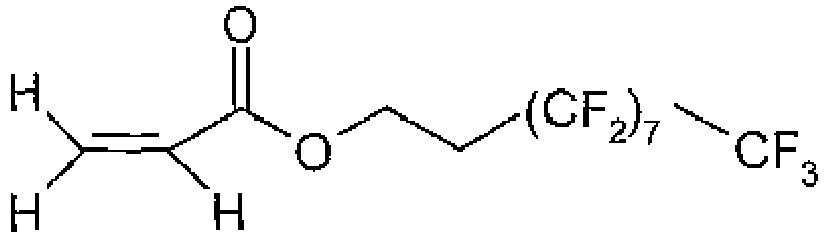
- a particular example of a compound of formula (III) is a compound of formula (IV) where R 7 is as defined above, and in particular is hydrogen and x is an integer of from 1 to 9, for instance from 4 to 9, and preferably 7. In that case, the compound of formula (IV) is 1H,1H,2H,2H-heptadecafluorodecylacylate.
- the invention provides a method according to claims 4-15 for reducing liquid sample retention by a laboratory consumable, said method comprising exposing said consumable to a pulsed plasma comprising a compound of formula (I) where R 1 , R 2 and R 3 are independently selected from hydrogen, alkyl, haloalkyl or aryl optionally substituted by halo; and R 4 is a group X-R 5 where R 5 is an alkyl or haloalkyl group and X is a bond; a group of formula -C(O)O(CH 2 ) n Y-where n is an integer of from 1 to 10 and Y is a bond or a sulphonamide group; or a group -(O) P R 6 (O) q (CH 2 ) t - where R 6 is aryl optionally substituted by halo, p is 0 or 1, q is 0 or 1 and t is 0 or an integer of from 1 to 10, provided that where q
- the laboratory consumable is placed in a plasma deposition chamber, a glow discharge is ignited within said chamber, and a voltage applied as a pulsed field.
- a set of polypropylene pipette tips were placed into a plasma chamber with a processing volume of ⁇ 300 litres.
- the chamber was connected to supplies of the required gases or vapours, via a mass flow controller and/or liquid mass flow meter and a mixing injector as appropriate.
- the chamber was evacuated to between 3 - 10 mtorr base pressure before allowing helium into the chamber at 20 sccm until a pressure of 80 mtorr was reached. A continuous power plasma was then struck for 4 minutes using RF at 13.56 MHz at 300 W.
- 1H,1H,2H,2H-heptadecafluorodecylacylate ( CAS # 27905-45-9 ) of formula was brought into the chamber at a rate of 120 milli grams per minute and the plasma switched to a pulsed plasma at 30 micro seconds on-time and 20 milli seconds off-time at a peak power of 100 W for 40 minutes. On completion of the 40 minutes the plasma power was turned off along with the processing gases and vapours and the chamber evacuated back down to base pressure. The chamber was then vented to atmospheric pressure and the pipette tips removed.
- cellulose filter papers (Whatman number 1) were placed into the chamber and processed under the same conditions. It was found that despite the fact the plasma enhanced paper appears the same, had the same handle and could not be differentiated either by appearance or feel; repelled water to an extent that the water formed beads on the surface which roll around effortlessly. Despite this, the droplets could be forced through the microporous paper if sufficient force was applied as the process does not block up the pores. The paper remained un-wet but can still carry out its filtering capabilities.
Landscapes
- Chemical & Material Sciences (AREA)
- Chemical Kinetics & Catalysis (AREA)
- Health & Medical Sciences (AREA)
- Engineering & Computer Science (AREA)
- Organic Chemistry (AREA)
- Medicinal Chemistry (AREA)
- Polymers & Plastics (AREA)
- Physics & Mathematics (AREA)
- Plasma & Fusion (AREA)
- Life Sciences & Earth Sciences (AREA)
- General Chemical & Material Sciences (AREA)
- Materials Engineering (AREA)
- Wood Science & Technology (AREA)
- Clinical Laboratory Science (AREA)
- Textile Engineering (AREA)
- Hematology (AREA)
- Inorganic Chemistry (AREA)
- Manufacturing & Machinery (AREA)
- Analytical Chemistry (AREA)
- Geochemistry & Mineralogy (AREA)
- General Health & Medical Sciences (AREA)
- Toxicology (AREA)
- Physical Or Chemical Processes And Apparatus (AREA)
- Treatments Of Macromolecular Shaped Articles (AREA)
- Devices For Use In Laboratory Experiments (AREA)
- Sampling And Sample Adjustment (AREA)
- Organic Low-Molecular-Weight Compounds And Preparation Thereof (AREA)
- Addition Polymer Or Copolymer, Post-Treatments, Or Chemical Modifications (AREA)
- Other Resins Obtained By Reactions Not Involving Carbon-To-Carbon Unsaturated Bonds (AREA)
- Physical Vapour Deposition (AREA)
- Laminated Bodies (AREA)
Description
- The present invention relates to novel products in the form of laboratory consumables, which are treated to prevent retention of reagents on the surface thereof, as well as to processes for their production.
- There is a need for laboratory equipment and in particular laboratory consumables, to be as non-binding to reagents or samples as possible so as to avoid retention of these on the equipment. In particular, the biochemical and chemical reactions conducted for example for research or analysis, and in particular medical or forensic diagnostics, often use very small volumes of samples or reagents. Retention of samples or reagents in any significant proportion on the surface of laboratory equipment, which comes into direct contact with them during the sample or reagent handling can affect the results significantly. Furthermore, since many of the reagents are extremely costly, there are economic implications as a result of reagent loss in this way.
- Various approaches have been made to address this problem. These include processes aimed at creating ultra smooth surfaces or solid materials such as those used to produce pipette tips in order to reduce retention. Other approaches have included processes aimed at adding additives to migrate through the polymer dip coating the tips in a liquid repellent media. Plasma deposition techniques have been quite widely used for the deposition of polymeric coatings onto a range of surfaces, and in particular onto fabric surfaces. This technique is recognised as being a clean, dry technique that generates little waste compared to conventional wet chemical methods. Using this method, plasmas are generated from organic molecules, which are subjected to an electrical field. When this is done in the presence of a substrate, the radicals of the compound in the plasma polymerise on the substrate. Conventional polymer synthesis tends to produce structures containing repeat units that bear a strong resemblance to the monomer species, whereas a polymer network generated using a plasma can be extremely complex. The properties of the resultant coating can depend upon the nature of the substrate as well as the nature of the monomer used and conditions under which it is deposited.
- The applicants have found that by utilising a specific type of monomer under particular deposition conditions, laboratory consumables having ultra-non-binding nano-coatings thereon can be produced.
- According to the present invention there is provided a laboratory consumable according to claims 1-3 and having a polymeric coating, formed by exposing said consumable to pulsed plasma comprising a compound of formula (I)
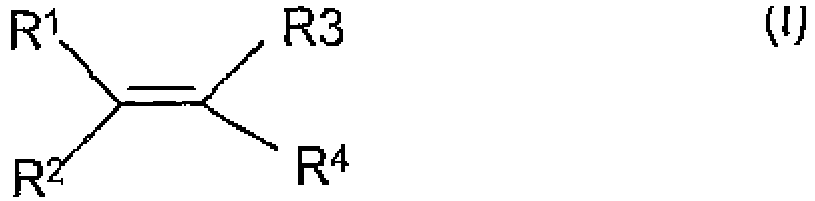
- The polymeric layer enhances the surface of the laboratory consumable in particular by making it more oil and water repellent, and, in some cases, making it an ultra-non-binding surface.
- As used herein, the expression "in a gaseous state" refers to gases or vapours, either alone or in mixture, as well as aerosols.
- As used herein, the term "laboratory consumable" refers to any piece of equipment, which comes into contact with liquid reagents, polar and apolar solvents or samples in the course of normal laboratory use, including use for example in medical environments such as hospitals and research laboratories. Generally these will be single use disposable devices, although some may be used repeatedly, for example after washing or cleaning of some type.
- Particular examples of laboratory consumables include pipette tips, filtration membranes, microplates (including 96 well plates), immunoassay products (such as lateral flow devices), centrifuge tubes (including microcentrifuge tubes), microtubes, specimen tubes, test tubes, blood collection tubes, flat based tubes, aseptically produced containers, general labware, burettes, curvettes, needles, hypodermic syringes, sample vials/bottles, screw cap containers, or weighing bottles. These can be made from a wide variety of materials such as, thermosetting resins, thermoplastic resins poly-olefins, acetals, polyamidic resins, acrylic resins (PMMA), hydrocarbons or fluorocarbons such as polyethylene (PE), polypropylene (PP), polymethylpentene (PMP or TPX®), polystyrene (PS), polyvinyl chloride (PVC), polyoxymethylene (POM), nylon (PA6), polycarbonates (PC), polytetrafluoroethylene (PTFE), tetrafluoroethylene-perfluoropropylene (FEP), perfluoroalkoxy (PFA), polyvinylidene fluoride (PVDF), ethylene-tetrafluorethylene (ETFE), ethylene-cholortrifluoroethylene (E-CTFE) and glass.
- In a particular embodiment, the laboratory consumable is a pipette tip. By utilising the method defined above, highly advantageous pipette tips have been produced. In particular, the main features and benefits of using this approach are that both the inside and the outside of the tip are coated and so enhanced, allowing much less binding to all surfaces, reducing loss of liquid and maximizing sample recovery.
- Laboratory consumables treated in this way provide are water and oil repellent, and also resistant to clogging. They may have useful "shake dry" properties also, reducing risk of contamination after washing.
- Furthermore, the enhancement material or layer is molecularly bound to the surface and so there are no leachables; the modification becomes part of the device. The coated tips' surface displays much lower surface energies then polypropylene and so will bind less material. As a result, liquid retention by the pipette tip in use is virtually eliminated (as can be illustrated photographically) meaning that the results obtained using these tips are more accurate and reliable, and reagent costs can be reduced, in some cases by more than 10%.
- Similar advantages accrue in relation to other laboratory consumables which are used to handle in particular small volumes of sample or reagent, such as microtitre plates. microplates (including 96 well plates), centrifuge tubes (including microcentrifuge tubes) and microtubes.
- The fact that needles and syringes can be made so that virtually no liquid is retained therein is a significant advantage since it means that accurate dosing of materials, in particular medicines can be ensured.
- Another type of laboratory consumable to benefit significantly from the modification of the invention are membranes such as those used as filtration membranes or those used in immunoassay devices. These membranes are made of porous material. It is necessary for liquid to pass through the pores of the material. In the case of filtration membranes, particles above a particular size are retained on the surface. In the case of membranes used immunoassays, liquid and small particles such as gold or latex particles are required also to pass through the pores of the membrane. Although these membranes are able to fulfil these functions, they are generally made of a liquid absorbent material such as cellulose. This means that significant quantities of liquid will be retained within the membrane, as they will become saturated in use. This can be problematic, in particular where only small volumes of liquid are being used.
- Membranes treated in accordance with the invention retain their porosity, as the coating layer deposited thereon is only molecules thick. Therefore, the liquid or even small particles can continue to pass through them, in particular when a positive pressure is applied to the liquid, or a negative pressure is applied to the other side of the membrane to draw the liquid through. However, larger particles will not. However, substantially all the liquid applied will pass through the membrane, since it will not adhere or be absorbed by the material of the membrane.
- Precise conditions under which the plasma polymerization takes place in an effective manner will vary depending upon factors such as the nature of the polymer, the laboratory consumable and will be determined using routine methods and/or the techniques.
- Suitable plasmas for use in the method of the invention include non-equilibrium plasmas such as those generated by radiofrequencies (Rf), microwaves or direct current (DC). They may operate at atmospheric or sub-atmospheric pressures as are known in the art. In particular however, they are generated by radiofrequencies (Rf).
- Various forms of equipment may be used to generate gaseous plasmas. Generally these comprise containers or plasma chambers in which plasmas may be generated. Particular examples of such equipment are described for instance in
WO2005/08996 WO02/28548 - In general, the item to be treated is placed within a plasma chamber together with the material to be deposited in gaseous state, a glow discharge is ignited within the chamber and a suitable voltage is applied, which may be pulsed.
- The gas used within the plasma may comprise a vapour of the monomeric compound alone, but it may be combined with a carrier gas, in particular, an inert gas such as helium or argon. In particular helium is a preferred carrier gas as this can minimises fragmentation of the monomer.
- When used as a mixture, the relative amounts of the monomer vapour to carrier gas is suitably determined in accordance with procedures which are conventional in the art. The amount of monomer added will depend to some extent on the nature of the particular monomer being used, the nature of the laboratory disposable being treated, the size of the plasma chamber etc. Generally, in the case of conventional chambers, monomer may be delivered for example at a rate of from 100-150mg/min. Carrier gas such as helium is suitably administered at a constant rate for example at a rate of from 5-90, for example from 15-30sccm. In some instances, the ratio of monomer to carrier gas will be in the range of from 100:1 to 1:100, for instance in the range of from 10:1 to 1:100, and in particular about 1:1 to 1:10. The precise ratio selected will be so as to ensure that the flow rate required by the process is achieved.
- Alternatively, the monomer may be delivered into the chamber by way of an aerosol device such as a nebuliser or the like, as described for example in
WO2003/097245 andWO03/101621 - The plasma is then suitably switched to a pulsed plasma to allow polymerisation to proceed, at least when the monomer is present.
- In all cases, a glow discharge is suitably ignited by applying a high frequency voltage, for example at 13.56MHz. This is suitably applied using electrodes, which may be internal or external to the chamber, but in the case of the larger chambers are internal.
- Suitably the gas, vapour, gas mixture or aerosol is supplied at a rate of at least 1 standard cubic centimetre per minute (sccm) and preferably in the range of from 1 to 100sccm.
- In the case of the monomer vapour, this is supplied at a rate of from 80-300mg/minute, for example at about 120mg per minute depending upon the nature of the monomer, whilst the pulsed voltage is applied.
- Gases or vapours may be drawn or pumped into the plasma region. In particular, where a plasma chamber is used, gases or vapours may be drawn into the chamber as a result of a reduction in the pressure within the chamber, caused by use of an evacuating pump, or they may be pumped or injected into the chamber as is common in liquid handling.
- Polymerisation is suitably effected using vapours of compounds of formula (I), which are maintained at pressures of from 0.1 to 200mtorr, suitably at about 80-100mtorr.
- The applied fields are suitably of power of from 40 to 500W, suitably at about 100W peak power, applied as a pulsed field. The pulses are applied in a sequence which yields very low average powers, for example in a sequence in which the ratio of the time on time off is in the range of from 1:500 to 1:1500. Particular examples of such sequence are sequences where power is on for 20-50µs, for example about 30µs, and off for from 1000µs to 30000µs, in particular about 20000µs. Typical average powers obtained in this way are 0.01W.
- The fields are suitably applied from 30 seconds to 90 minutes, preferably from 5 to 60 minutes, depending upon the nature of the compound of formula (I) and the laboratory consumable etc.
- Suitably a plasma chamber used is of sufficient volume to accommodate multiple laboratory consumables, for example up to 500,000 pipette tips at the same time.
- A particularly suitable apparatus and method for producing laboratory consumables in accordance with the invention is described in
WO2005/089961 . In particular, when using high volume chambers of this type, the plasma is created with a voltage as a pulsed field, at an average power of from 0.001 to 500w/m3, for example at from 0.001 to 100w/m3 and suitably at from 0.005 to 0.5w/m3. - These conditions are particularly suitable for depositing good quality uniform coatings, in large chambers, for example in chambers where the plasma zone has a volume of greater than 500cm3, for instance 0.5m3 or more, such as from 0.5m3-10m3 and suitably at about 1m3. The layers formed in this way have good mechanical strength.
- The dimensions of the chamber will be selected so as to accommodate the particular laboratory consumable being treated. For instance, generally cuboid chambers may be suitable for a wide range of applications, but if necessary, elongate or rectangular chambers may be constructed or indeed cylindrical, or of any other suitable shape.
- The chamber may be a sealable container, to allow for batch processes, or it may comprise inlets and outlets for laboratory consumables, to allow it to be utilised in a continuous process. In particular in the latter case, the pressure conditions necessary for creating a plasma discharge within the chamber are maintained using high volume pumps, as is conventional for example in a device with a "whistling leak". However it will also be possible to process certain items at atmospheric pressure, or close to, negating the need for "whistling leaks"
The monomers used are selected from monomers of formula (I) as defined above. Suitable haloalkyl groups for R1, R2, R3 and R5 are fluoroalkyl groups. The alkyl chains may be straight or branched and may include cyclic moieties. - For R5, the alkyl chains suitably comprise 2 or more carbon atoms, suitably from 2-20 carbon atoms and preferably from 6 to 12 carbon atoms.
- For R1, R2 and R3, alkyl chains are generally preferred to have from 1 to 6 carbon atoms.
- Preferably R5 is a haloalkyl, and more preferably a perhaloalkyl group, particularly a perfluoroalkyl group of formula CmF2m+1 where m is an integer of 1 or more, suitably from 1-20, and preferably from 4-12 such as 4, 6 or 8.
- Suitable alkyl groups for R1, R2 and R3 have from 1 to 6 carbon atoms.
- In one embodiment, at least one of R1, R2 and R3 is hydrogen. In a particular embodiment R1, R2, R3 are all hydrogen. In yet a further embodiment however R3 is an alkyl group such as methyl or propyl.
- Where X is a group -C(O)O(CH2)nY-, n is an integer which provides a suitable spacer group. In particular, n is from 1 to 5, preferably about 2.
- Suitable sulphonamide groups for Y include those of formula - N(R7)SO2 - where R7 is hydrogen or alkyl such as C1-4 alkyl, in particular methyl or ethyl.
- In one embodiment, the compound of formula (I) is a compound of formula (II)
CH2=CH-R5 (II)
where R5 is as defined above in relation to formula (I). - In compounds of formula (II), X in formula (I) is a bond. However in a preferred embodiment, the compound of formula (I) is an acrylate of formula (III)
CH2=CR7C(O)O(CH2)nR5 (III)
where n and R5 as defined above in relation to formula (I) and R7 is hydrogen, C1-10 alkyl, or C1-10 haloalkyl. In particular R7 is hydrogen or C1-6 alkyl such as methyl. A particular example of a compound of formula (III) is a compound of formula (IV)
- In a further aspect, the invention provides a method according to claims 4-15 for reducing liquid sample retention by a laboratory consumable, said method comprising exposing said consumable to a pulsed plasma comprising a compound of formula (I)

in a gaseous state for a sufficient period of time to allow a polymeric layer to form on the surface of the laboratory consumable, and wherein the compound of formula (I) in gaseous form is fed into the plasma at a rate of from 80-300 mg/minute, whilst the pulsed voltage is applied. - Suitably, the laboratory consumable is placed in a plasma deposition chamber, a glow discharge is ignited within said chamber, and a voltage applied as a pulsed field.
- Suitable monomers and reaction conditions for use in this method are as described above.
- The invention will now be particularly described by way of example.
- A set of polypropylene pipette tips were placed into a plasma chamber with a processing volume of ∼ 300 litres. The chamber was connected to supplies of the required gases or vapours, via a mass flow controller and/or liquid mass flow meter and a mixing injector as appropriate.
- The chamber was evacuated to between 3 - 10 mtorr base pressure before allowing helium into the chamber at 20 sccm until a pressure of 80 mtorr was reached. A continuous power plasma was then struck for 4 minutes using RF at 13.56 MHz at 300 W.
- After this period, 1H,1H,2H,2H-heptadecafluorodecylacylate (CAS # 27905-45-9) of formula
- It was found that the pipette tips was covered with an ultra-non-binding, pin-hole free modification that had a surface energy much lower that a Teflon® (PTFE) coated surface. The coating was distributed both inside and outside the pipette tip and was molecularly attached.
- The performance of the pipette tips was significantly enhanced, as liquid retention was virtually eliminated and maximum sample recovery was possible.
- By using the same method as outlined in Example 1, cellulose filter papers (Whatman number 1) were placed into the chamber and processed under the same conditions. It was found that despite the fact the plasma enhanced paper appears the same, had the same handle and could not be differentiated either by appearance or feel; repelled water to an extent that the water formed beads on the surface which roll around effortlessly. Despite this, the droplets could be forced through the microporous paper if sufficient force was applied as the process does not block up the pores. The paper remained un-wet but can still carry out its filtering capabilities.
Claims (14)
- A laboratory consumable having a polymeric coating, formed by exposing said consumable to pulsed plasma comprising a compound of formula (I)
 where R1, R2 and R3 are independently selected from hydrogen, alkyl, haloalkyl or aryl optionally substituted by halo; and R4 is a group X-R5 where R5 is an alkyl or haloalkyl group and X is a bond; a group of formula -C(O)O(CH2)n y- where n is an integer of from 1 to 10 and Y is a bond or a sulphonamide group; or a group -(O)PR6(O)q(CH2)t- where R6 is aryl optionally substituted by halo, p is 0 or 1, q is 0 or 1 and t is 0 or an integer of from 1 to 10, provided that where q is 1, t is other than 0, for a sufficient period of time to allow a polymeric layer to form on the surface of the laboratory consumable, andwherein the compound of formula (I) in gaseous form is fed into the plasma at a rate of from 80-300 mg/minute, whilst the pulsed voltage is applied.
 - A laboratory consumable according to claim 1 which is selected from pipette tips, filtration membranes, microplates immunoassay products, centrifuge tubes, microtubes, specimen tubes, test tubes, blood collection tubes, flat based tubes, aseptically produced containers, general labware, burettes, cuvettes, needles, hypodermic syringes, sample vials/bottles, screw cap containers, or weighing bottles.
- A laboratory consumable according to claim 2 which is a pipette tip.
- A method for reducing liquid sample retention by a laboratory consumable, said method comprising exposing said consumable to a pulsed plasma comprising a compound of formula (I)
 where R1, R2 and R3 are independently selected from hydrogen, alkyl, haloalkyl or aryl optionally substituted by halo; and R4 is a group X-R5 where R5 is an alkyl or haloalkyl group and X is a bond; a group of formula -C(O)O(CH2)nY- where n is an integer of from 1 to 10 and Y is a bond or a sulphonamide group; or a group -(O)PR6(O)q(CH2)t- where R6 is aryl optionally substituted by halo, p is 0 or 1, q is 0 or 1 and t is 0 or an integer of from 1 to 10, provided that where q is 1, t is other than 0,
in a gaseous state for a sufficient period of time to allow a polymeric layer to form on the surface of the laboratory consumable, andwherein the compound of formula (I) in gaseous form is fed into the plasma at a rate of from 80-300 mg/minute, whilst the pulsed voltage is applied. - A method according to claim 4 wherein the laboratory consumable is placed in a plasma deposition chamber, a glow discharge is ignited within said chamber, and a voltage applied as a pulsed field.
- A method according to claim 4 or claim 5 wherein applied voltage is at a power of from 40 to 500 W.
- A method according to any one of claims 4 to 6 wherein the voltage is pulsed in a sequence in which the ratio of the time on : time off is in the range of from 1:500 to 1:1500.
- A method according to claim 7 wherein the voltage is pulsed in a sequence where power is on for 20-50 µs, and off for from 1000 µs to 30000 µs.
- A method according to any one of claims 4 to 8 wherein the voltage is applied as a pulsed field for a period of from 30 seconds to 90 minutes, for example from 5 to 60 minutes.
- A method according to any one of claims 4 to 9, wherein in a preliminary step, a continuous power plasma is applied to the laboratory consumable, optionally in the presence of an inert gas.
- A method according to any one of claims 4 to 10 wherein the plasma is created with a voltage at an average power of from 0.001 to 500 W/m3, for example from 0.001 to 100 W/m3, such as from 0.005 to 0.5 W/m3.
- A method according to any one of claims 4 to 11 wherein the compound of formula (I) is a compound of formula (II)
CH2=CH-R5 (II)
where R5 is as defined in claim 1, or a compound of formula (III)
CH2=CR7C(O)O(CH2)nR5 (III)
where n and R5 as defined in claim 1 and R7 is hydrogen, C1-10 alkyl, or C1-10 haloalkyl. - A method according to claim 12 wherein the compound of formula (I) is a compound of formula (III).
- A method according to claim 13 wherein the compound of formula (III) is a compound of formula (IV)

Priority Applications (1)
| Application Number | Priority Date | Filing Date | Title |
|---|---|---|---|
| EP17195755.8A EP3333227A1 (en) | 2006-01-20 | 2007-01-19 | Novel products |
Applications Claiming Priority (3)
| Application Number | Priority Date | Filing Date | Title |
|---|---|---|---|
| GB0601113A GB2434368B (en) | 2006-01-20 | 2006-01-20 | Plasma coated laboratory consumables |
| US76224906P | 2006-01-26 | 2006-01-26 | |
| PCT/GB2007/000148 WO2007083121A1 (en) | 2006-01-20 | 2007-01-19 | Novel products |
Related Child Applications (2)
| Application Number | Title | Priority Date | Filing Date |
|---|---|---|---|
| EP17195755.8A Division EP3333227A1 (en) | 2006-01-20 | 2007-01-19 | Novel products |
| EP17195755.8A Division-Into EP3333227A1 (en) | 2006-01-20 | 2007-01-19 | Novel products |
Publications (3)
| Publication Number | Publication Date |
|---|---|
| EP1976941A1 EP1976941A1 (en) | 2008-10-08 |
| EP1976941B1 EP1976941B1 (en) | 2017-10-11 |
| EP1976941B2 true EP1976941B2 (en) | 2021-04-07 |
Family
ID=37946340
Family Applications (2)
| Application Number | Title | Priority Date | Filing Date |
|---|---|---|---|
| EP17195755.8A Withdrawn EP3333227A1 (en) | 2006-01-20 | 2007-01-19 | Novel products |
| EP07704930.2A Not-in-force EP1976941B2 (en) | 2006-01-20 | 2007-01-19 | Novel products |
Family Applications Before (1)
| Application Number | Title | Priority Date | Filing Date |
|---|---|---|---|
| EP17195755.8A Withdrawn EP3333227A1 (en) | 2006-01-20 | 2007-01-19 | Novel products |
Country Status (13)
| Country | Link |
|---|---|
| US (1) | US8163356B2 (en) |
| EP (2) | EP3333227A1 (en) |
| JP (2) | JP2009524510A (en) |
| KR (1) | KR20080090518A (en) |
| CN (2) | CN103450720A (en) |
| AU (1) | AU2007206778B2 (en) |
| CA (1) | CA2637478C (en) |
| GB (1) | GB2434368B (en) |
| IL (1) | IL192904A (en) |
| NZ (1) | NZ570463A (en) |
| TW (1) | TWI423850B (en) |
| WO (1) | WO2007083121A1 (en) |
| ZA (1) | ZA200806847B (en) |
Families Citing this family (24)
| Publication number | Priority date | Publication date | Assignee | Title |
|---|---|---|---|---|
| GB0621520D0 (en) * | 2006-10-28 | 2006-12-06 | P2I Ltd | Novel products |
| GB2443322B (en) * | 2006-10-28 | 2010-09-08 | P2I Ltd | Plasma coated microfabricated device or component thereof |
| GB0713830D0 (en) * | 2007-07-17 | 2007-08-29 | P2I Ltd | Novel products method |
| EP2098305A1 (en) * | 2008-03-06 | 2009-09-09 | Universite Libre De Bruxelles | Method of depositing a fluorinated layer from a precursor monomer |
| US20110014395A1 (en) * | 2007-09-06 | 2011-01-20 | Universite Libre De Bruxelles | Method for depositing a fluorinated layer from a precursor monomer |
| GB0721527D0 (en) * | 2007-11-02 | 2007-12-12 | P2I Ltd | Filtration Membranes |
| GB0810326D0 (en) * | 2008-06-06 | 2008-07-09 | P2I Ltd | Filtration media |
| GB201000538D0 (en) | 2010-01-14 | 2010-03-03 | P2I Ltd | Liquid repellent surfaces |
| GB201003275D0 (en) * | 2010-02-26 | 2010-04-14 | Portal Medical Ltd | Method of manufacturing a medicament dispenser device |
| US8852693B2 (en) | 2011-05-19 | 2014-10-07 | Liquipel Ip Llc | Coated electronic devices and associated methods |
| US9265896B2 (en) | 2012-02-23 | 2016-02-23 | Shinmaywa Industries, Ltd. | Method for manufacturing puncture needle |
| EP3722500A1 (en) | 2013-12-13 | 2020-10-14 | The North Face Apparel Corp. | Plasma treatments for coloration of textiles |
| GB201403558D0 (en) | 2014-02-28 | 2014-04-16 | P2I Ltd | Coating |
| CN106663769B (en) | 2014-05-13 | 2020-06-19 | 赛尔格有限责任公司 | Functionalized porous membranes and methods of making and using the same |
| KR20180018675A (en) | 2015-06-09 | 2018-02-21 | 피2아이 리미티드 | coating |
| US10351729B2 (en) | 2016-03-03 | 2019-07-16 | Motorola Mobility Llc | Polysiloxane films and methods of making polysiloxane films |
| US10212825B2 (en) | 2016-03-03 | 2019-02-19 | Motorola Mobility Llc | Polysiloxane films and methods of making polysiloxane films |
| CN105648770B (en) * | 2016-03-25 | 2018-04-13 | 广州拜费尔空气净化材料有限公司 | A kind of preparation method of super hydrophobic surface |
| US11596948B2 (en) * | 2016-11-17 | 2023-03-07 | Enicor Gmbh | Coated articles for blood coagulation testing and methods of preparing the same |
| CN106378048A (en) * | 2016-11-25 | 2017-02-08 | 贵州盛茂白芨开发有限公司 | Shaking table for rhizoma bletillae starch experiment |
| US20230227689A1 (en) * | 2020-05-18 | 2023-07-20 | Jiangsu Favored Nanotechnology Co., LTD | Water-resistant film layer and article thereof |
| EP3913110A1 (en) | 2020-05-20 | 2021-11-24 | Eppendorf AG | Laboratory consumable and method for manufacturing same |
| CN113801360B (en) * | 2021-11-18 | 2022-03-04 | 赛宁(苏州)生物科技有限公司 | Surface treatment method for realizing low-adsorption plastic liquid-transfer suction head |
| DE102022104688A1 (en) | 2022-02-28 | 2023-08-31 | Eppendorf Se | Laboratory consumable having a water and/or oil repellent coating and method of making the laboratory consumable |
Citations (2)
| Publication number | Priority date | Publication date | Assignee | Title |
|---|---|---|---|---|
| WO2003063938A1 (en) † | 2002-02-01 | 2003-08-07 | Astrazeneca Ab | Novel process for coating inhalation devices |
| WO2005089961A1 (en) † | 2004-03-18 | 2005-09-29 | The Secretary Of State Of Defence | Coating of a polymer layer using low power pulsed plasma in a plasma chamber of a large volume |
Family Cites Families (19)
| Publication number | Priority date | Publication date | Assignee | Title |
|---|---|---|---|---|
| US4649071A (en) * | 1984-04-28 | 1987-03-10 | Kabushiki Kaisha Toyota Chuo Kenkyusho | Composite material and process for producing the same |
| JPS61204008A (en) * | 1985-03-06 | 1986-09-10 | Kanebo Ltd | Filter having excellent compaction resistance |
| JPH0762684B2 (en) * | 1986-12-16 | 1995-07-05 | 積水化学工業株式会社 | Method for producing plate for immunoassay |
| JPH0270059A (en) * | 1987-12-02 | 1990-03-08 | Idemitsu Petrochem Co Ltd | Appliance and its production |
| JPH06104754B2 (en) * | 1989-07-24 | 1994-12-21 | ジェルマン サイエンシズ テクノロジー インコーポレイテッド | Method for treating a porous substrate to obtain improved water and oil repellency |
| JPH03131351A (en) * | 1989-10-16 | 1991-06-04 | Fuji Photo Film Co Ltd | Pipette tip subjected to water-repellent treatment |
| JP2990608B2 (en) * | 1989-12-13 | 1999-12-13 | 株式会社ブリヂストン | Surface treatment method |
| JPH0889820A (en) * | 1994-09-28 | 1996-04-09 | Sumitomo Bakelite Co Ltd | Tip for dispenser and its preparation |
| WO1996024392A1 (en) * | 1995-02-07 | 1996-08-15 | Fidia Advanced Biopolymers, S.R.L. | Process for the coating of objects with hyaluronic acid, derivatives thereof, and semisynthetic polymers |
| JP2781777B2 (en) * | 1996-05-02 | 1998-07-30 | ベクトン・ディッキンソン・アンド・カンパニー | Blood collection test tube assembly |
| GB9712338D0 (en) * | 1997-06-14 | 1997-08-13 | Secr Defence | Surface coatings |
| WO1998058117A1 (en) | 1997-06-14 | 1998-12-23 | The Secretary Of State For Defence | Surface coatings |
| AU744202B2 (en) * | 1997-08-08 | 2002-02-21 | Board Of Regents | Non-fouling, wettable coated devices |
| JP3359556B2 (en) * | 1997-12-11 | 2002-12-24 | 住友ベークライト株式会社 | Culture plate and its culture method or test method |
| JP3993971B2 (en) * | 2000-08-09 | 2007-10-17 | 北海製罐株式会社 | Plastic container having gas barrier coating layer and method for producing the same |
| EA006831B1 (en) | 2000-10-04 | 2006-04-28 | Дау Корнинг Айэлэнд Лимитед | Method and apparatus for forming a coating |
| GB0211354D0 (en) | 2002-05-17 | 2002-06-26 | Surface Innovations Ltd | Atomisation of a precursor into an excitation medium for coating a remote substrate |
| GB0212848D0 (en) | 2002-06-01 | 2002-07-17 | Surface Innovations Ltd | Introduction of liquid/solid slurry into an exciting medium |
| JP4769027B2 (en) * | 2005-06-17 | 2011-09-07 | 凸版印刷株式会社 | container |
-
2006
- 2006-01-20 GB GB0601113A patent/GB2434368B/en not_active Expired - Fee Related
-
2007
- 2007-01-19 CA CA2637478A patent/CA2637478C/en not_active Expired - Fee Related
- 2007-01-19 WO PCT/GB2007/000148 patent/WO2007083121A1/en not_active Ceased
- 2007-01-19 TW TW096102115A patent/TWI423850B/en not_active IP Right Cessation
- 2007-01-19 EP EP17195755.8A patent/EP3333227A1/en not_active Withdrawn
- 2007-01-19 KR KR1020087020349A patent/KR20080090518A/en not_active Ceased
- 2007-01-19 JP JP2008550842A patent/JP2009524510A/en not_active Withdrawn
- 2007-01-19 US US12/161,210 patent/US8163356B2/en not_active Expired - Fee Related
- 2007-01-19 AU AU2007206778A patent/AU2007206778B2/en not_active Ceased
- 2007-01-19 NZ NZ570463A patent/NZ570463A/en unknown
- 2007-01-19 CN CN2013100896912A patent/CN103450720A/en active Pending
- 2007-01-19 CN CNA2007800025581A patent/CN101370878A/en active Pending
- 2007-01-19 EP EP07704930.2A patent/EP1976941B2/en not_active Not-in-force
-
2008
- 2008-07-17 IL IL192904A patent/IL192904A/en not_active IP Right Cessation
- 2008-08-07 ZA ZA200806847A patent/ZA200806847B/en unknown
-
2012
- 2012-12-28 JP JP2012287581A patent/JP5385451B2/en not_active Expired - Fee Related
Patent Citations (2)
| Publication number | Priority date | Publication date | Assignee | Title |
|---|---|---|---|---|
| WO2003063938A1 (en) † | 2002-02-01 | 2003-08-07 | Astrazeneca Ab | Novel process for coating inhalation devices |
| WO2005089961A1 (en) † | 2004-03-18 | 2005-09-29 | The Secretary Of State Of Defence | Coating of a polymer layer using low power pulsed plasma in a plasma chamber of a large volume |
Non-Patent Citations (8)
| Title |
|---|
| "about P2i", P2I, 7 October 2018 (2018-10-07), pages 1 - 8 † |
| "P2i extends coverage of super-repellent coatings", ABORATORYTALK, 2 September 2005 (2005-09-02), pages 1 - 3, Retrieved from the Internet <URL:aboratorytalk.com/article/57209/p2i-extends-coverage-of-super> † |
| "P2i Extends Pipette Nano-Coating Range", THECHNOLOGY NETWORKS, 8 September 2005 (2005-09-08), pages 1 - 2, Retrieved from the Internet <URL:https://www.technologynetworks.com/drug-discovery/news/p2i-extends-pipette-nanocoating-range-204683> † |
| "Plasma treatment can apply liquid repellency to any material", TECHNICAL TEXTILES INTERNATIONAL, May 2005 (2005-05-01), pages 23 - 25 † |
| "Plasma: efficient filter enhancement", FILTRATION + SEPARATION, November 2005 (2005-11-01), pages 1 - 3 † |
| CHUN FENG ET AL.: "Deposition of Well-Defined Fluoropolymer Nanospheres on PET Substrate by Plasma Polymerization of Heptadecafluorodecyl Acrylate and Their Potential Application as a Protective Layer", PLASMA PROCESS. POLYM., vol. 2, 2005, pages 127 - 135 † |
| S. R. COULSON ET AL.: "Super-Repellent Composite Fluoropolymer Surfaces", J. PHYS. CHEM. B, vol. 104, 2000, pages 8836 - 8840 † |
| S. R. COULSON ET AL.: "Ultralow Surface Energy Plasma Polymer Films", CHEM. MATER., vol. 12, 2000, pages 2031 - 2038 † |
Also Published As
| Publication number | Publication date |
|---|---|
| KR20080090518A (en) | 2008-10-08 |
| IL192904A0 (en) | 2009-02-11 |
| EP1976941A1 (en) | 2008-10-08 |
| US20100234524A1 (en) | 2010-09-16 |
| GB2434368A (en) | 2007-07-25 |
| JP5385451B2 (en) | 2014-01-08 |
| JP2009524510A (en) | 2009-07-02 |
| JP2013099745A (en) | 2013-05-23 |
| EP3333227A1 (en) | 2018-06-13 |
| EP1976941B1 (en) | 2017-10-11 |
| AU2007206778B2 (en) | 2011-11-03 |
| CN103450720A (en) | 2013-12-18 |
| WO2007083121A1 (en) | 2007-07-26 |
| TWI423850B (en) | 2014-01-21 |
| ZA200806847B (en) | 2009-12-30 |
| CA2637478C (en) | 2014-11-25 |
| AU2007206778A1 (en) | 2007-07-26 |
| CN101370878A (en) | 2009-02-18 |
| TW200732039A (en) | 2007-09-01 |
| GB0601113D0 (en) | 2006-03-01 |
| GB2434368B (en) | 2010-08-25 |
| IL192904A (en) | 2013-05-30 |
| US8163356B2 (en) | 2012-04-24 |
| CA2637478A1 (en) | 2007-07-26 |
| NZ570463A (en) | 2010-10-29 |
Similar Documents
| Publication | Publication Date | Title |
|---|---|---|
| EP1976941B1 (en) | Novel products | |
| CN101611100B (en) | Novel products | |
| CN108463493B (en) | Polymeric substrates having surfaces with reduced adhesion of biomolecules and thermoplastic articles of such substrates | |
| EP2523759A2 (en) | Liquid repellent surfaces | |
| EP2207613B1 (en) | Use of filtration membranes | |
| EP2275598A1 (en) | Surface coatings |
Legal Events
| Date | Code | Title | Description |
|---|---|---|---|
| PUAI | Public reference made under article 153(3) epc to a published international application that has entered the european phase |
Free format text: ORIGINAL CODE: 0009012 |
|
| 17P | Request for examination filed |
Effective date: 20080804 |
|
| AK | Designated contracting states |
Kind code of ref document: A1 Designated state(s): AT BE BG CH CY CZ DE DK EE ES FI FR GB GR HU IE IS IT LI LT LU LV MC NL PL PT RO SE SI SK TR |
|
| DAX | Request for extension of the european patent (deleted) | ||
| 111Z | Information provided on other rights and legal means of execution |
Free format text: AT BE BG CH CY CZ DE DK EE ES FI FR GB GR HU IE IS IT LT LU LV MC NL PL PT RO SE SI SK TR Effective date: 20151120 |
|
| 17Q | First examination report despatched |
Effective date: 20160229 |
|
| GRAP | Despatch of communication of intention to grant a patent |
Free format text: ORIGINAL CODE: EPIDOSNIGR1 |
|
| STAA | Information on the status of an ep patent application or granted ep patent |
Free format text: STATUS: GRANT OF PATENT IS INTENDED |
|
| INTG | Intention to grant announced |
Effective date: 20170307 |
|
| D11X | Information provided on other rights and legal means of execution (deleted) | ||
| GRAS | Grant fee paid |
Free format text: ORIGINAL CODE: EPIDOSNIGR3 |
|
| GRAJ | Information related to disapproval of communication of intention to grant by the applicant or resumption of examination proceedings by the epo deleted |
Free format text: ORIGINAL CODE: EPIDOSDIGR1 |
|
| GRAL | Information related to payment of fee for publishing/printing deleted |
Free format text: ORIGINAL CODE: EPIDOSDIGR3 |
|
| STAA | Information on the status of an ep patent application or granted ep patent |
Free format text: STATUS: EXAMINATION IS IN PROGRESS |
|
| GRAR | Information related to intention to grant a patent recorded |
Free format text: ORIGINAL CODE: EPIDOSNIGR71 |
|
| STAA | Information on the status of an ep patent application or granted ep patent |
Free format text: STATUS: GRANT OF PATENT IS INTENDED |
|
| GRAA | (expected) grant |
Free format text: ORIGINAL CODE: 0009210 |
|
| STAA | Information on the status of an ep patent application or granted ep patent |
Free format text: STATUS: THE PATENT HAS BEEN GRANTED |
|
| INTC | Intention to grant announced (deleted) | ||
| AK | Designated contracting states |
Kind code of ref document: B1 Designated state(s): AT BE BG CH CY CZ DE DK EE ES FI FR GB GR HU IE IS IT LI LT LU LV MC NL PL PT RO SE SI SK TR |
|
| INTG | Intention to grant announced |
Effective date: 20170905 |
|
| REG | Reference to a national code |
Ref country code: GB Ref legal event code: FG4D |
|
| REG | Reference to a national code |
Ref country code: CH Ref legal event code: EP |
|
| REG | Reference to a national code |
Ref country code: IE Ref legal event code: FG4D |
|
| REG | Reference to a national code |
Ref country code: AT Ref legal event code: REF Ref document number: 935987 Country of ref document: AT Kind code of ref document: T Effective date: 20171115 |
|
| REG | Reference to a national code |
Ref country code: DE Ref legal event code: R096 Ref document number: 602007052638 Country of ref document: DE |
|
| REG | Reference to a national code |
Ref country code: NL Ref legal event code: FP |
|
| REG | Reference to a national code |
Ref country code: FR Ref legal event code: PLFP Year of fee payment: 12 |
|
| REG | Reference to a national code |
Ref country code: LT Ref legal event code: MG4D |
|
| REG | Reference to a national code |
Ref country code: AT Ref legal event code: MK05 Ref document number: 935987 Country of ref document: AT Kind code of ref document: T Effective date: 20171011 |
|
| PGFP | Annual fee paid to national office [announced via postgrant information from national office to epo] |
Ref country code: NL Payment date: 20180130 Year of fee payment: 12 |
|
| PG25 | Lapsed in a contracting state [announced via postgrant information from national office to epo] |
Ref country code: ES Free format text: LAPSE BECAUSE OF FAILURE TO SUBMIT A TRANSLATION OF THE DESCRIPTION OR TO PAY THE FEE WITHIN THE PRESCRIBED TIME-LIMIT Effective date: 20171011 Ref country code: SE Free format text: LAPSE BECAUSE OF FAILURE TO SUBMIT A TRANSLATION OF THE DESCRIPTION OR TO PAY THE FEE WITHIN THE PRESCRIBED TIME-LIMIT Effective date: 20171011 Ref country code: LT Free format text: LAPSE BECAUSE OF FAILURE TO SUBMIT A TRANSLATION OF THE DESCRIPTION OR TO PAY THE FEE WITHIN THE PRESCRIBED TIME-LIMIT Effective date: 20171011 |
|
| PG25 | Lapsed in a contracting state [announced via postgrant information from national office to epo] |
Ref country code: IS Free format text: LAPSE BECAUSE OF FAILURE TO SUBMIT A TRANSLATION OF THE DESCRIPTION OR TO PAY THE FEE WITHIN THE PRESCRIBED TIME-LIMIT Effective date: 20180211 Ref country code: GR Free format text: LAPSE BECAUSE OF FAILURE TO SUBMIT A TRANSLATION OF THE DESCRIPTION OR TO PAY THE FEE WITHIN THE PRESCRIBED TIME-LIMIT Effective date: 20180112 Ref country code: BG Free format text: LAPSE BECAUSE OF FAILURE TO SUBMIT A TRANSLATION OF THE DESCRIPTION OR TO PAY THE FEE WITHIN THE PRESCRIBED TIME-LIMIT Effective date: 20180111 Ref country code: LV Free format text: LAPSE BECAUSE OF FAILURE TO SUBMIT A TRANSLATION OF THE DESCRIPTION OR TO PAY THE FEE WITHIN THE PRESCRIBED TIME-LIMIT Effective date: 20171011 Ref country code: AT Free format text: LAPSE BECAUSE OF FAILURE TO SUBMIT A TRANSLATION OF THE DESCRIPTION OR TO PAY THE FEE WITHIN THE PRESCRIBED TIME-LIMIT Effective date: 20171011 |
|
| PGFP | Annual fee paid to national office [announced via postgrant information from national office to epo] |
Ref country code: BE Payment date: 20180130 Year of fee payment: 12 Ref country code: FR Payment date: 20180130 Year of fee payment: 12 |
|
| REG | Reference to a national code |
Ref country code: DE Ref legal event code: R026 Ref document number: 602007052638 Country of ref document: DE |
|
| PLBI | Opposition filed |
Free format text: ORIGINAL CODE: 0009260 |
|
| PLAX | Notice of opposition and request to file observation + time limit sent |
Free format text: ORIGINAL CODE: EPIDOSNOBS2 |
|
| PG25 | Lapsed in a contracting state [announced via postgrant information from national office to epo] |
Ref country code: EE Free format text: LAPSE BECAUSE OF FAILURE TO SUBMIT A TRANSLATION OF THE DESCRIPTION OR TO PAY THE FEE WITHIN THE PRESCRIBED TIME-LIMIT Effective date: 20171011 Ref country code: CZ Free format text: LAPSE BECAUSE OF FAILURE TO SUBMIT A TRANSLATION OF THE DESCRIPTION OR TO PAY THE FEE WITHIN THE PRESCRIBED TIME-LIMIT Effective date: 20171011 Ref country code: SK Free format text: LAPSE BECAUSE OF FAILURE TO SUBMIT A TRANSLATION OF THE DESCRIPTION OR TO PAY THE FEE WITHIN THE PRESCRIBED TIME-LIMIT Effective date: 20171011 Ref country code: DK Free format text: LAPSE BECAUSE OF FAILURE TO SUBMIT A TRANSLATION OF THE DESCRIPTION OR TO PAY THE FEE WITHIN THE PRESCRIBED TIME-LIMIT Effective date: 20171011 |
|
| 26 | Opposition filed |
Opponent name: EPPENDORF AG Effective date: 20180711 |
|
| PG25 | Lapsed in a contracting state [announced via postgrant information from national office to epo] |
Ref country code: PL Free format text: LAPSE BECAUSE OF FAILURE TO SUBMIT A TRANSLATION OF THE DESCRIPTION OR TO PAY THE FEE WITHIN THE PRESCRIBED TIME-LIMIT Effective date: 20171011 Ref country code: RO Free format text: LAPSE BECAUSE OF FAILURE TO SUBMIT A TRANSLATION OF THE DESCRIPTION OR TO PAY THE FEE WITHIN THE PRESCRIBED TIME-LIMIT Effective date: 20171011 Ref country code: IT Free format text: LAPSE BECAUSE OF FAILURE TO SUBMIT A TRANSLATION OF THE DESCRIPTION OR TO PAY THE FEE WITHIN THE PRESCRIBED TIME-LIMIT Effective date: 20171011 |
|
| REG | Reference to a national code |
Ref country code: CH Ref legal event code: PL |
|
| PG25 | Lapsed in a contracting state [announced via postgrant information from national office to epo] |
Ref country code: LU Free format text: LAPSE BECAUSE OF NON-PAYMENT OF DUE FEES Effective date: 20180119 |
|
| REG | Reference to a national code |
Ref country code: IE Ref legal event code: MM4A |
|
| PG25 | Lapsed in a contracting state [announced via postgrant information from national office to epo] |
Ref country code: SI Free format text: LAPSE BECAUSE OF FAILURE TO SUBMIT A TRANSLATION OF THE DESCRIPTION OR TO PAY THE FEE WITHIN THE PRESCRIBED TIME-LIMIT Effective date: 20171011 Ref country code: CH Free format text: LAPSE BECAUSE OF NON-PAYMENT OF DUE FEES Effective date: 20180131 Ref country code: LI Free format text: LAPSE BECAUSE OF NON-PAYMENT OF DUE FEES Effective date: 20180131 |
|
| PLBB | Reply of patent proprietor to notice(s) of opposition received |
Free format text: ORIGINAL CODE: EPIDOSNOBS3 |
|
| PLBP | Opposition withdrawn |
Free format text: ORIGINAL CODE: 0009264 |
|
| PG25 | Lapsed in a contracting state [announced via postgrant information from national office to epo] |
Ref country code: IE Free format text: LAPSE BECAUSE OF NON-PAYMENT OF DUE FEES Effective date: 20180119 |
|
| PGFP | Annual fee paid to national office [announced via postgrant information from national office to epo] |
Ref country code: GB Payment date: 20190121 Year of fee payment: 13 |
|
| PG25 | Lapsed in a contracting state [announced via postgrant information from national office to epo] |
Ref country code: MC Free format text: LAPSE BECAUSE OF FAILURE TO SUBMIT A TRANSLATION OF THE DESCRIPTION OR TO PAY THE FEE WITHIN THE PRESCRIBED TIME-LIMIT Effective date: 20171011 |
|
| REG | Reference to a national code |
Ref country code: NL Ref legal event code: MM Effective date: 20190201 |
|
| REG | Reference to a national code |
Ref country code: BE Ref legal event code: MM Effective date: 20190131 |
|
| PG25 | Lapsed in a contracting state [announced via postgrant information from national office to epo] |
Ref country code: NL Free format text: LAPSE BECAUSE OF NON-PAYMENT OF DUE FEES Effective date: 20190201 Ref country code: FR Free format text: LAPSE BECAUSE OF NON-PAYMENT OF DUE FEES Effective date: 20190131 |
|
| PG25 | Lapsed in a contracting state [announced via postgrant information from national office to epo] |
Ref country code: BE Free format text: LAPSE BECAUSE OF NON-PAYMENT OF DUE FEES Effective date: 20190131 |
|
| PLAY | Examination report in opposition despatched + time limit |
Free format text: ORIGINAL CODE: EPIDOSNORE2 |
|
| PLBC | Reply to examination report in opposition received |
Free format text: ORIGINAL CODE: EPIDOSNORE3 |
|
| PG25 | Lapsed in a contracting state [announced via postgrant information from national office to epo] |
Ref country code: TR Free format text: LAPSE BECAUSE OF FAILURE TO SUBMIT A TRANSLATION OF THE DESCRIPTION OR TO PAY THE FEE WITHIN THE PRESCRIBED TIME-LIMIT Effective date: 20171011 |
|
| PG25 | Lapsed in a contracting state [announced via postgrant information from national office to epo] |
Ref country code: HU Free format text: LAPSE BECAUSE OF FAILURE TO SUBMIT A TRANSLATION OF THE DESCRIPTION OR TO PAY THE FEE WITHIN THE PRESCRIBED TIME-LIMIT; INVALID AB INITIO Effective date: 20070119 Ref country code: PT Free format text: LAPSE BECAUSE OF FAILURE TO SUBMIT A TRANSLATION OF THE DESCRIPTION OR TO PAY THE FEE WITHIN THE PRESCRIBED TIME-LIMIT Effective date: 20171011 |
|
| PG25 | Lapsed in a contracting state [announced via postgrant information from national office to epo] |
Ref country code: CY Free format text: LAPSE BECAUSE OF FAILURE TO SUBMIT A TRANSLATION OF THE DESCRIPTION OR TO PAY THE FEE WITHIN THE PRESCRIBED TIME-LIMIT Effective date: 20171011 |
|
| GBPC | Gb: european patent ceased through non-payment of renewal fee |
Effective date: 20200119 |
|
| PG25 | Lapsed in a contracting state [announced via postgrant information from national office to epo] |
Ref country code: GB Free format text: LAPSE BECAUSE OF NON-PAYMENT OF DUE FEES Effective date: 20200119 |
|
| PUAH | Patent maintained in amended form |
Free format text: ORIGINAL CODE: 0009272 |
|
| STAA | Information on the status of an ep patent application or granted ep patent |
Free format text: STATUS: PATENT MAINTAINED AS AMENDED |
|
| 27A | Patent maintained in amended form |
Effective date: 20210407 |
|
| AK | Designated contracting states |
Kind code of ref document: B2 Designated state(s): AT BE BG CH CY CZ DE DK EE ES FI FR GB GR HU IE IS IT LI LT LU LV MC NL PL PT RO SE SI SK TR |
|
| REG | Reference to a national code |
Ref country code: DE Ref legal event code: R102 Ref document number: 602007052638 Country of ref document: DE |
|
| PGFP | Annual fee paid to national office [announced via postgrant information from national office to epo] |
Ref country code: FI Payment date: 20210125 Year of fee payment: 15 |
|
| PGFP | Annual fee paid to national office [announced via postgrant information from national office to epo] |
Ref country code: DE Payment date: 20210129 Year of fee payment: 15 |
|
| REG | Reference to a national code |
Ref country code: DE Ref legal event code: R119 Ref document number: 602007052638 Country of ref document: DE |
|
| REG | Reference to a national code |
Ref country code: FI Ref legal event code: MAE |
|
| PG25 | Lapsed in a contracting state [announced via postgrant information from national office to epo] |
Ref country code: FI Free format text: LAPSE BECAUSE OF NON-PAYMENT OF DUE FEES Effective date: 20220119 Ref country code: DE Free format text: LAPSE BECAUSE OF NON-PAYMENT OF DUE FEES Effective date: 20220802 |
|
| P01 | Opt-out of the competence of the unified patent court (upc) registered |
Effective date: 20230524 |